Many Austen fans know well the description of Jane Austen by writer Mary Russell Mitford (1787-1855):
“À propos to novels, I have discovered that our great favourite, Miss Austen, is my countrywoman; that mamma knew all her family very intimately; and that she herself is an old maid (I beg her pardon – I mean a young lady) with whom mamma before her marriage was acquainted. Mamma says that she was then the prettiest, silliest, most affected, husband-hunting butterfly she ever remembers; and a friend of mine, who visits her now, says that she has stiffened into the most perpendicular, precise, taciturn piece of “single blessedness” that ever existed, and that, till ‘Pride and Prejudice’ showed what a precious gem was hidden in that unbending case, she was no more regarded in society than a poker or a fire-screen, or any other thin upright piece of wood or iron that fills its corner in peace and quietness. The case is very different now; she is still a poker – but a poker of whom every one is afraid. It must be confessed that this silent observation from such an observer is rather formidable. Most writers are good-humoured chatterers – neither very wise nor very witty: – but nine times out of ten (at least in the few that I have known) unaffected and pleasant, and quite removing by their conversation any awe that may have been excited by their works. But a wit, a delineator of character, who does not talk, is terrific indeed!” [April 3, 1815 (vol. 1, pp. 305-7)]
Two generations of this family were Austen neighbors. The Rev. Richard Russell, Mary Russell Mitford’s maternal grandfather, was the rector of Ashe, a parish about two miles from Steventon. Upon his death in 1783, his widow and daughter moved to nearby Alresford – and it was in Alresford that Mary Russell Mitford was born – on 16 December 1787, two years after her parents’ marriage (17 October 1785).
Therefore, food for thought regarding the description of Jane Austen as “the prettiest, silliest, most affected, husband-hunting butterfly” – “Miss Russell” would have been talking about Jane Austen as a ten-year-old (or younger) child! Remember Jane’s girlish scribblings found in the marriage register of Steventon!
 Reading the entire quotation over, one wonders if MRM truly meant to imply that Jane was ‘thin,’ as most critics take her comment to mean and then go on to compare it to the silhouette (at right). What if MRM wrote without any real emphasis on the words ‘thin upright piece of wood or iron’ and instead concentrated on the image painted by ‘that fills its corner in peace and quietness’? There is indeed a delightful picture in the thought of Austen as ‘a wit, a delineator of character’ who sits, watches — and then writes!
MRM continues, and begins to qualify the description of Austen:
“After all, I do not know that I can quite vouch for this account, though the friend from whom I received it is truth itself; but her family connections must render her disagreeable to Miss Austen, since she is the sister-in-law of a gentleman who is at law with Miss A.’s brother for the greater part of his fortune. [original footnote: Every other account of Jane Austen, from whatever quarter, represents her as handsome, graceful, amiable, and shy.] You must have remarked how much her stories hinge upon entailed estates; doubtless she has learnt to dislike entails. Her brother was adopted by a Mr. Knight, who left him his name and two much better legacies in an estate of five thousand a year in Kent, and another of nearly double the value in Hampshire; but it seems he forgot some ceremony – passing a fine, I think they call it – with regard to the Hampshire property, which Mr. Baverstock has claimed in right of his mother, together with the mesne rents, and is likely to be successful.”
A trying time for all three of the Austen women: Mrs Austen, Jane and Cassandra; they were in danger of losing their home if Edward lost this case.
If we concentrate solely on vol. I of The Life of Mary Russell Mitford (ed. by Rev. A.G. L’Estrange, 1870) we read early comments on Austen’s work (and note here: they knew the identity of the author?!?) that are fascinating, untainted-by-the-movies reactions to Austen’s characters.
“The want of elegance is almost the only want in Miss Austen. I have not read her ‘Mansfield Park;’ but it is impossible not to feel in every line of ‘Pride and Prejudice,’ in every word of ‘Elizabeth,’ the entire want of taste which could produce so pert, so worldly a heroine as the beloved of such a man as Darcy. Wickham is equally bad. Oh! they were just fit for each other, and I cannot forgive that delightful Darcy for parting them. Darcy should have married Jane. He is of all the admirable characters the best designed and the best sustained. I quite agree with you in preferring Miss Austen to Miss Edgeworth. If the former had a little more taste, a little more perception of the graceful, as well as of the humorous, I know not indeed any one to whom I should not prefer her. There is not of the hardness, the cold selfishness, of Miss Edgeworth about her writings; she is in a much better humour with the world; she preaches no sermons; she wants nothing but the beau-idéal of the female character to be a perfect novel writer; and perhaps even that beau-idéal would only be missed by such a petite maîtresse in books as myself…” [20 December 1814 (vol. 1, p. 300)]
What prompted this post was a footnote in a book on the Shaw-Lefevres (relatives of Emma Austen-Leigh): “Compare Harriet Martineau’s opinion of Mary Russell Mitford, in her Autobiography, ed. by Maria Weston (Boston, 1877): “I must say that personally I did not like her so well as I liked her works. The charming bonhommie of her writings appeared at first in her conversation and manners; but there were other things which sadly impaired its charm…. What concerned me was her habit of flattery, and the twin habit of disparagement of others. I never knew her to respond to any act of course of conduct which was morally lofty. She could not believe in it, nor, of course, enjoy it: and she seldom failed to ‘see through it’, and to delight in her superiority to admiration.” This delving to find someone to describe MRM was due to “Miss Mitford’s vitriolic attack” (in a letter of 1807 in L’Estrange’s Life) of the Lefevres. A Strong Supporting Cast, a Shaw-Lefevre biography by F.M.G. Willson, even calls MRM “a near but hostile neighbour”. And yet here is what MRM says about Emma:
“… go for amusement to Miss Edgeworth and Miss Austen. By-the-way, how delightful is her ‘Emma!’ the best, I think, of all her charming works.” [2 July 1816 (vol. 1, p. 331)]
Find out for yourself what MRM has to say about Austen and her novels: vol I; vol II; vol III. [Note: vols I and III are the Bentley (London) edition; vol II is the last of a 2-volume set published in NY by Harper & Brothers. Once again Books.google doesn’t have all of a set!]
With new editions of diaries and letters appearing seemingly monthly, let us know what reactions to Austen or her novels YOU have come across from the pens of similar first-generation readers during the 1810s and 1820s!
 A year today – on 22 January 2008 – our Vermont Region received its official ‘welcome’ to the North American Jane Austen realm! So… Happy Birthday JASNA-Vermont!
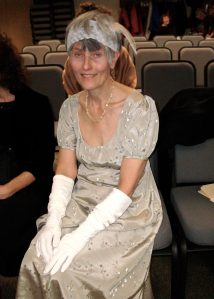 Jeanne V.: “Just wanted to say that the event on Sunday was…a lot of fun. I brought someone who swore she would only watch the dancing and she was scooped up and danced every one! Now, we need to do more dancing…”
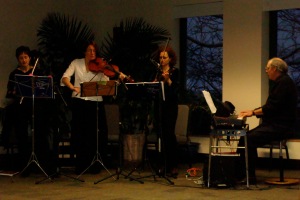

 Kelly will give a talk entitled Georgiana Darcy and the ‘Naïve Art’ of Young Ladies at the Governor’s House in Hyde Park on Friday, 30 January 2009. Our hostess, Suzanne Boden (a new JASNA -Vermont member!) invites you to join us for an entire Weekend dedicated to Austen’s Pride and Prejudice:
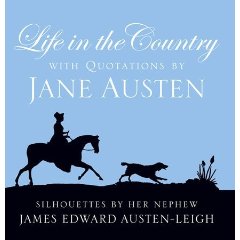 In time for holiday giving, Life in the Country should find a pleasant reception. Pairing the prose and letters of Jane Austen (in quotation format) with the fine artistic narrative of her nephew James Edward Austen-Leigh, Life in the Country provides visuals and words that both entertain and entrance. Accompanying essays provide nice overviews of Jane Austen; silhouettes in general and Austen-Leigh’s work within the genre; and a concise discourse on Austen-Leigh by his great-granddaughter Joan Austen-Leigh. Serious scholars will be able to delve deeper into various topics thanks to the short bibliography. (Though heavily centered on Austen scholarship, the list does include such as Sue McKechnie’s British Silhouette Artists, a must-have reference for those interested in this art form.)
 While Jane won’t be there, we have The Burlington Country Dancers, and “Impropriety” will provide the live music. Join in the dance or just watch the dancers glide around the dancefloor – then enjoy afternoon tea and goodies. Our flyer can be found
  Newly republished by Moonrise Press (Ludlow, England), author Penelope Byrde’s book on fashion is now in its second regeneration. Initially published in the 70s as A Frivolous Distinction, it found a new lease on life in an expanded edition put out by Excellent Press in 1999. It has now been rescued from its consignment to used bookstores (if you were lucky enough to find a copy) by this paperback edition. May Moonrise Press profit from its belief in the continuing interest in this subject – fashion not only in Austen’s day but, more precisely, in Austen’s own life.
  Jane Austen in Vermont