I have been reader of Austen for many years; was re-introduced when my daughter was in college and reading "Emma" and I read it along with her, and thus re-discovered Austen with a whole new appreciation! Happily my daughter, Jess, "got" that "Emma" was quite funny, the only one to do so in her class, I might add.
I re-read the books periodically and find them a tonic for the soul, as well as the best gauge of humanity I have ever encountered....and the humor helps immensely (not to mention Darcy!) My favorite book is Persuasion, I find Fanny the truest of feminists, NOT the major milktoast of all fiction characters, Elizabeth is a delight, and I often forget that these people ARE NOT REAL!
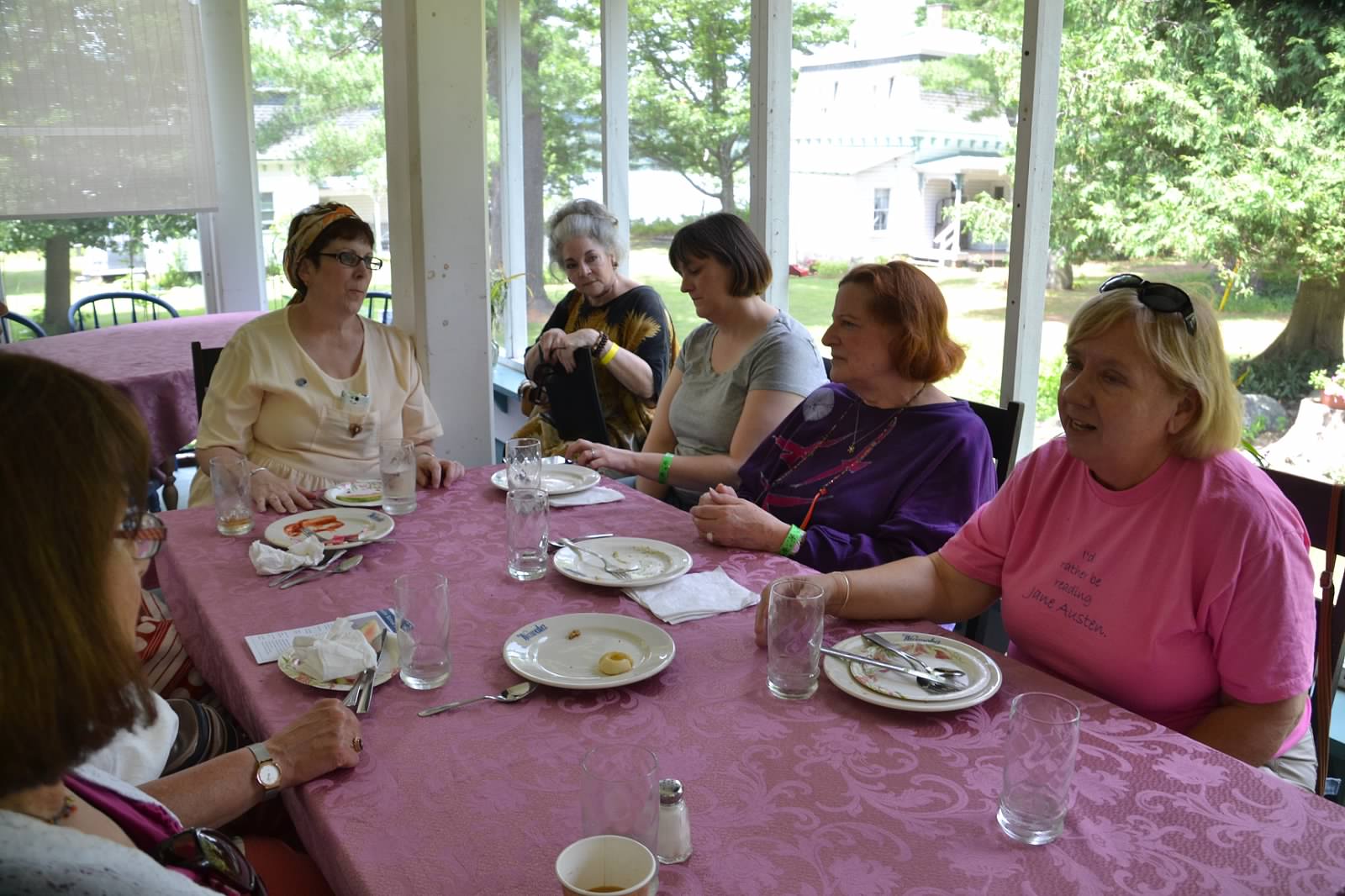
I have a group of friends scattered around New England who gather together several times a year to discuss books, most often Austen, as she is really the anchor (all due to the delightful, wonderful Ingrid G. of New Hampshire, who started this all many years ago with a weekend at Pinkham Notch at the base of Mount Washington in NH with a workshop "I'd Rather be Reading Jane Austen"!)...we call ourselves the Wild Women, but really, how can that be possible, trekking about the White Mountains, sipping tea and conversing about Austen!
And it all helps that I have a used bookstore called Bygone Books, now only an online presence. Every booklover's dream is to own a bookstore....and I challenge each and everyone of you to try it for a week!
I am currently the Advisory Chair for the JASNA-South Carolina Region. I post information about both this region and the JASNA-Vermont Region and its events on this blog.
It’s been five days since our reentry into the 21st century and everyday lives. For three days, Friday, September 27 – Sunday, September 29, Sarah and I joined 750 other readers to talk about one author, and just one of her books: Jane Austen’s “own darling child” Pride & Prejudice. To sit in a full convention hall to celebrate one woman and her book, 200 years old this year, was a marvel. And yet, after listening to plenary speaker, John Mullan, on “Speechless in Pride & Prejudice,” almost 800 people didn’t seem at all out of bounds for such a subject. I came away loving Jane even more, something I didn’t think was possible.
At home, I’m the trivia nut, and have even been accused of being “obsessed” with Jane Austen. Folks, I was nothing compared to this crowd. Mullan opened up his talk with a trivia question…
Janine’s talk at the AGM was very enlightening! – hopefully it will be published in ‘Persuasions’; but you can also read the whole wonderful book [‘Matters of Fact in Jane Austen’], where the various sites and names in all of Austen’s works are discussed…
Today marks the start of the annual gathering of the Jane Austen Society of North America (JASNA), hosted this year in Minneapolis. This particular meeting celebrates the bicentennial of Pride and Prejudice (first published in 1813) with the pomp that is due this standout literary favorite, including workshops, exhibits, lectures, readings, and, of course, a Regency-style ball. Because I recently published a book about Jane Austen as a consummate name-dropper and participant in early celebrity culture, I was invited to speak to JASNA members about the celebrity currency of the names in Pride and Prejudice .
This post is a sneak peek into the new research that I will be sharing with JASNA members about how specific surnames and locations in Pride and Prejudice slyly point to the ancestral home of the real-world Fitzwilliam and Darcy families—directing a reader’s encounter with the fictional estate of…
“If adventures will not befall a young lady in her own village,
she must seek them abroad…”
-Jane Austen in Northanger Abbey
Alas! without a Mrs. Allen to squire me about or offer much-needed fashion advice, nor a Henry Tilney awaiting me in the wings, I head off for another adventure at the JASNA Annual Meeting – this year in Minneapolis, in celebration of the bicentenary of Pride & Prejudice.
I promise reporting and pictures upon my return – there is never time to post during the conference, what with lectures, and field trips, and Tea, and Balls and Emporiums, one has not a moment to reflect until on the plane returning home – so I will offer various musings on the event next week … I will try to facebook and/or Twitter if I can [but no promises!] so check both for updates:
Dear Readers: I welcome today Ron Dunning, who wrote here last year about his “Akin to Jane” website – today he shares with us an article he wrote for the Huguenots of Spitalfields newsletter “Strangers” – here expanded somewhat and with pictures – and see how Jane Austen connects to various families and traditions of Spitalfields life in London.
To have lived in London for the past 40 years has been an immense pleasure. Now I’ve discovered a new one, and that is to be retired in London. I’ve always loved to explore, but was only able to appreciate the various parts of town for their ambience. Now there’s time to appreciate them more deeply, to learn about their associations with history, about interesting residents. Many have passed out of fashion and been built over – in which case there’s only the odd surviving building to stimulate the imagination – but in other areas, where the faded charm is obvious and where their economic value has not been great enough to attract the redevelopers, new residents have moved in to restore houses and revive the life of the community.
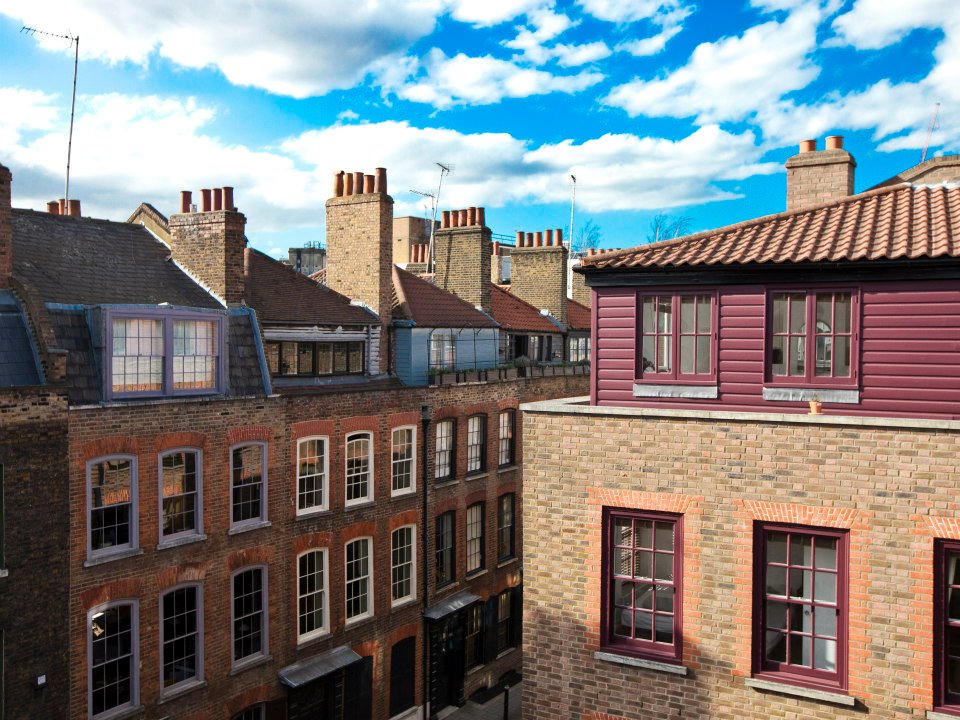
[Rooftops of Spitalfields, formerly the workrooms of the silk weavers and now gentrified – c Jeremy Freedman]
One such area that I’ve come to know much better is Spitalfields, just to the east of London’s old city walls. Its development by speculative builders was begun in the early 1700s, as a new suburb. Huguenot refugees from France and the Low Countries soon settled there, particularly those involved in the silk fabric trade. They brought their skills and their contacts from the continent and quickly restored their prosperity. Some 150 years later the mechanising of weaving, relaxation of tariffs on imports from France, and robust trade with China destroyed the Spitalfields silk trade.
[Image from the Huguenots of Spitalfields Facebook page]
The houses had aged by the mid-19th century too, and to some extent Spitalfields became a slum, housing successive waves of immigrants – who each moved on once they became prosperous. By the 1970s, when the latest wave of new arrivals to the poorer streets was Bengali, city redevelopment was threatening to overtake it. Just in the nick of time young artists discovered the antique charm of the weavers’ houses, which could be bought for a pittance. They are now worth over £1,000,000.
I’ve been researching the Austen pedigree for long enough that it’s possible to link her family with almost anyone. Though the worlds of the Huguenots and of Jane Austen would seem almost to inhabit separate universes, a surprising number of Huguenot families had close connections with hers. I’ve made a list of the most notable.
Anyone who has read Jon Spence’s book, Becoming Jane Austen (or seen the film Becoming Jane), will recognise the name of Lefroy. Antoine Loffroy, a native of Cambray, took refuge in England from religious persecution in the Low Countries in about 1587, and settled at Canterbury, where he and his family engaged in the business of silk dyeing. His descendant Tom Lefroy was the one young man with whom Jane was said to be truly in love. Tom at that point didn’t have an income with which to support a wife, and was quickly bundled off by his elders and betters. He rose eventually to become the Chief Justice of the Court of Queen’s Bench in Ireland and, at the end of his life, remembered Jane with great affection. Ben Lefroy, from a later generation, did marry an Austen – one of Jane’s favourite nieces, Jane Anna Elizabeth.
The Portals were an ancient and noble Protestant family of Toulouse who stood firmly by the faith of their fathers, and several of them suffered death rather than recant it. They were among the Huguenots who introduced the art of fine paper making to England – Henry Portal established a mill at Laverstoke, on the River Itchen in Hampshire. He achieved such a reputation that the Bank of England awarded him the contract to produce bank notes. Living in Hampshire, the Portals had extensive social contacts with the Austens. Adela Portal married Jane’s nephew Edward Knight, while her sister Caroline married Edward’s brother William.
The Chenevixes were another distinguished family of Protestants, this time from Lorraine, who fled after the 1685 Revocation of the Edict of Nantes. One branch settled in Ireland, and were much attracted to the military and clerical professions. Melesina Chenevix, the poet and diarist, and granddaughter of Richard Chenevix, the Anglican Bishop of Waterford and of Lismore, was the ancestor of a number of people linked to the Austen pedigree. Melesina had married Richard Trench – the de la Tranches were yet another family who had taken refuge in England shortly after the massacre of St. Bartholomew – and their descendants assumed the double-barrelled surname of Chenevix-Trench. Their granddaughter Melesina Mary Chenevix-Trench married Chomley Austen-Leigh, Jane’s great nephew. Melesina Mary’s sister Helen Emily married Arthur Blundell George Sandys Hill, another great nephew. Their brother Charles married Emily Mary Lefroy, a cousin of Tom Lefroy. Their cousin Melesina Gladys, as well as being the mother of the famous editor of the Daily Telegraph, Bill Deedes, was the grandmother of FitzWalter Plumptre, the Baron FitzWalter – who can also trace his pedigree to the family of Eleanor Bridges, the wife of Jane’s brother Edward. Lord FitzWalter still lives at Goodnestone, the seat of the Bridges family, where Edward and Eleanor lived before they could move into Godmersham.
David Papillon, the first of his family to settle in England, had been sent with his mother and siblings by his father, to escape persecution. They were shipwrecked while crossing the English Channel, and his mother drowned. The story of the mingling of genes between David’s descendants and the Austens, through the Brodnaxes, is a bit too obscure to tell here, but one of them featured in Jane’s life – the Rev John Rawstorne Papillon. The living of Chawton parish was offered to him; should he decline, it was then to pass to Jane’s brother Henry. John did take it and became the rector of the village in which Jane lived during her final years. There is a neat bracketing of Huguenot suitors for her hand, from the beginning and the end of her adult life – Mrs Knight, the widow of Thomas Brodnax and elderly benefactor of both the Austens and the Papillons, suggested that the Rev John, a life-long bachelor, would make a suitable husband. With characteristic irony Jane remarked in a note to her sister: ‘I am very much obliged to Mrs Knight for such a proof of the interest she takes in me – & she may depend upon it, that I will marry Mr Papillon, whatever may be his reluctance or my own – I owe her much more than such a trifling sacrifice.’
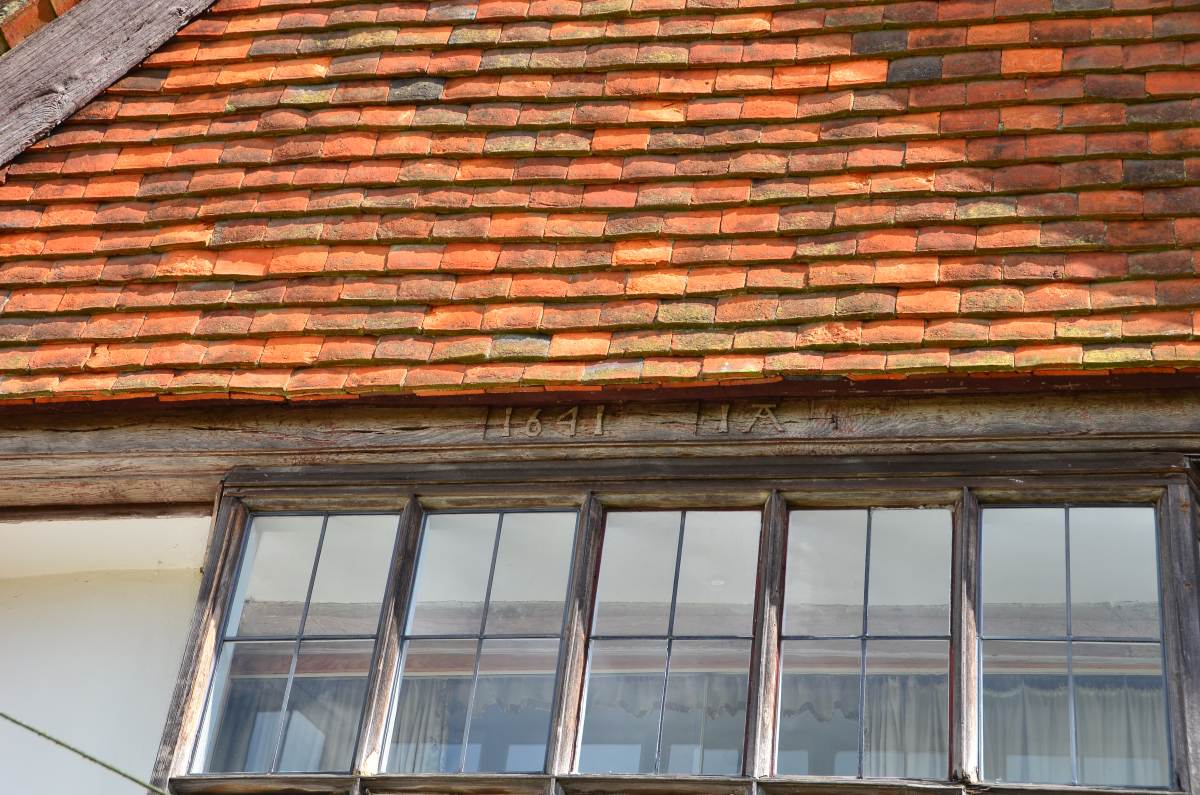
I could end this essay here, but want to mention another resonance between the Huguenots and the Austens, and to return Spitalfields to the fore. Jane’s paternal ancestors, going back three generations and further, were clothiers of Kent – staunchly Protestant, fiercely independent, wool and woollen fabric merchants. The organisation of their business was very similar to that of the silk merchants in London. I was struck, while gazing up to the roofs of Spitalfields, by a parallel. In both industries labour was organised by narrowly demarcated skills, and in both the weavers’ workplace was accommodated on the top floor of merchant’s houses. I was seized by a vivid impression of crabbed men and no doubt women, in both London and Kent, toiling for 14 hours a day in those garrets for a pittance!
Grovehurst House c Ron Dunning
[Grovehurst House: one of the Austen houses at Horsmonden in Kent, which dates in parts from the 14th century – I was struck by the resonance between Spitalfields and the Kentish Austens – they were clothiers, and their industry in wool was structured much like silk weaving in London. My understanding is that the weavers worked in the loft of this house.]
[Initials of John (Iohannes, presumably) Austen, over the middle window upstairs, cRon Dunning]
[Another Austen house (Broadford) at Horsmonden, Kent where the weavers laboured on the top floor]
*******************
A brief history of the Huguenots
The St. Bartholomew’s Day Massacrein 1572 was a targeted group of assassinations, followed by a wave of Roman Catholic mob violence, directed against the French Calvinist Protestants (known as Huguenots) during France’s Wars of Religion. The Edict of Nantes, issued on 13 April 1598 by King Henry IV of France, granted them substantial rights in the interest of civil unity. In October 1685 Louis XIV, Henry IV’s grandson, revoked the Edict of Nantes with the Edict of Fontainebleau, and declared Protestantism illegal. As many as 400,000 Protestants chose to leave France, moving to Great Britain, Prussia, the Dutch Republic, Switzerland, South Africa, and the new French colonies in North America. This exodus deprived France of many of its most skilled and industrious individuals.
*********************
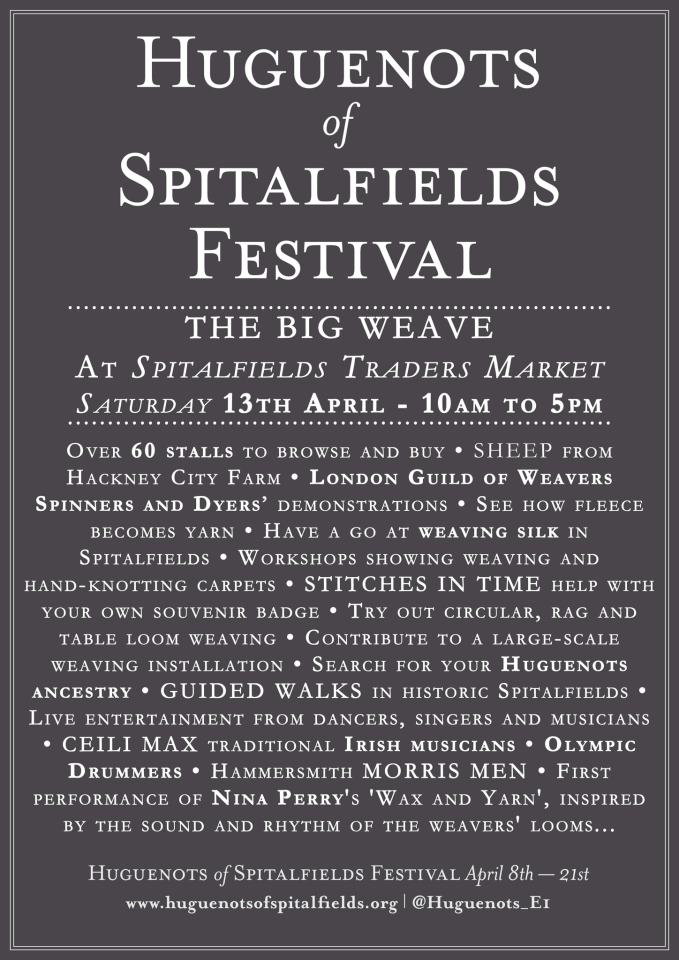
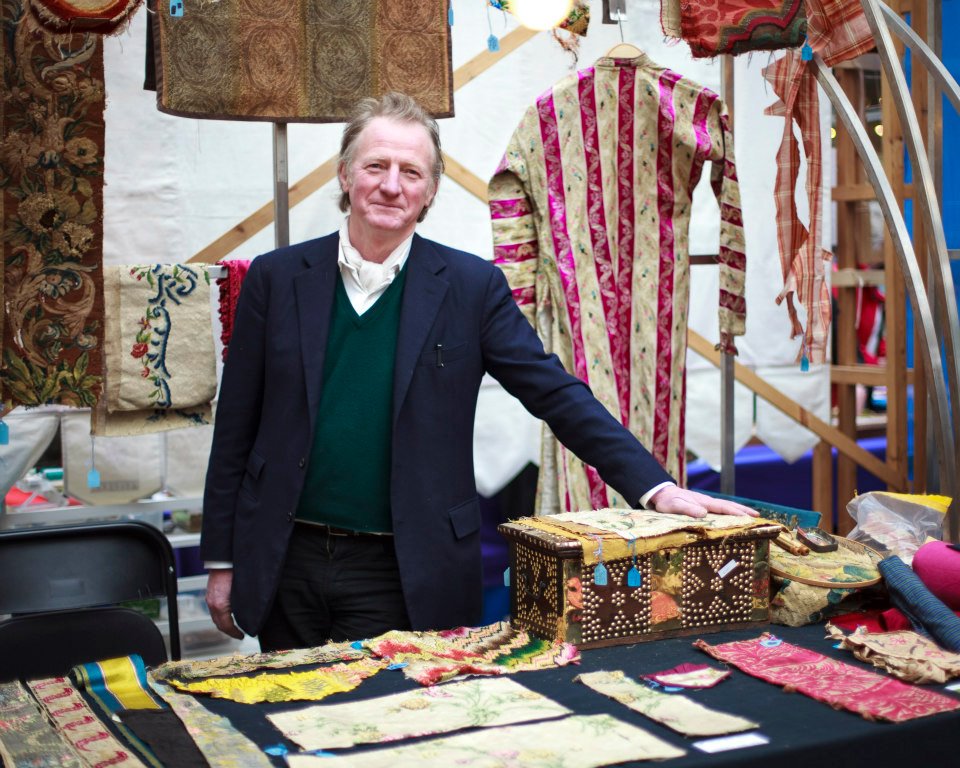
The Big Weave c Jeremy FreedmanSpitalfields, c Jeremy Freedman
Links and attributions, with thanks to all!
Photographs of Spitalfields as noted are the work of Jeremy Freedman: www.jeremyfreedman.com
Visitors to a new Worthing housing estate are in for a literary experience.
Three streets at the Barratt Homes development, The Fieldings have been given names connected to celebrated author Jane Austen.
The Fieldings
[Image from the Barratt Homes website]
Austen found inspiration for many scenes and characters in her final and unfinished novel Sanditon when she visited the town in 1805.
Members of the Jane Austen Society contacted Worthing Borough Council calling for a street name in the town for the author. [it is the JAS-Midlands Branch that spearheaded this effort under the leadership of Chris Sandrawich.]
Barratt Homes have now unveiled the street names as Austen Gate, Sanditon Way and Chawton Gate on the estate. [There is also a block of flats called Mansfield Court.]
Society members and descendants of the author gathered in Worthing to mark the unveiling.
JAS-Midlands Branch
Barratt southern counties sales director Lynnette St Quintin said: “Where we build new homes and create new communities, it is important they are reflective of local history. The Worthing connection with Jane Austen is certainly one for everyone to be proud of.”
One wonders with “The Fieldings” so named if there might also be a Joseph Andrews Avenue or a Tom Jones Junction, or how about Bow Street Runners Boulevard … even Jane Austen would like that I think!
***********************
You might recall last year’s efforts regarding the Library Passage in Worthing: this street naming is a partial result of the JAS’s hopes to have some recognition of Jane Austen in the area. There is more to come in a future post from Chris Sandrawich, so stay-tuned, and on your next trek to England be sure to put Worthing on your itinerary; better yet, buy a home here at Chawton Gate!
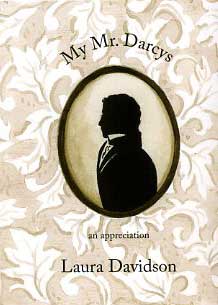
I most fortunately stumbled upon this book My Mr. Darcys when searching for another Austen title and found the bookseller had this title as well – but alas! no available copies. So I went straight to the source and found not only this but other delightful books from the Boston-based book artist Laura Davidson – we got into a conversation about what inspired her to create this miniature book [4 ¼” x 3”] about the various Mr. Darcys in film:
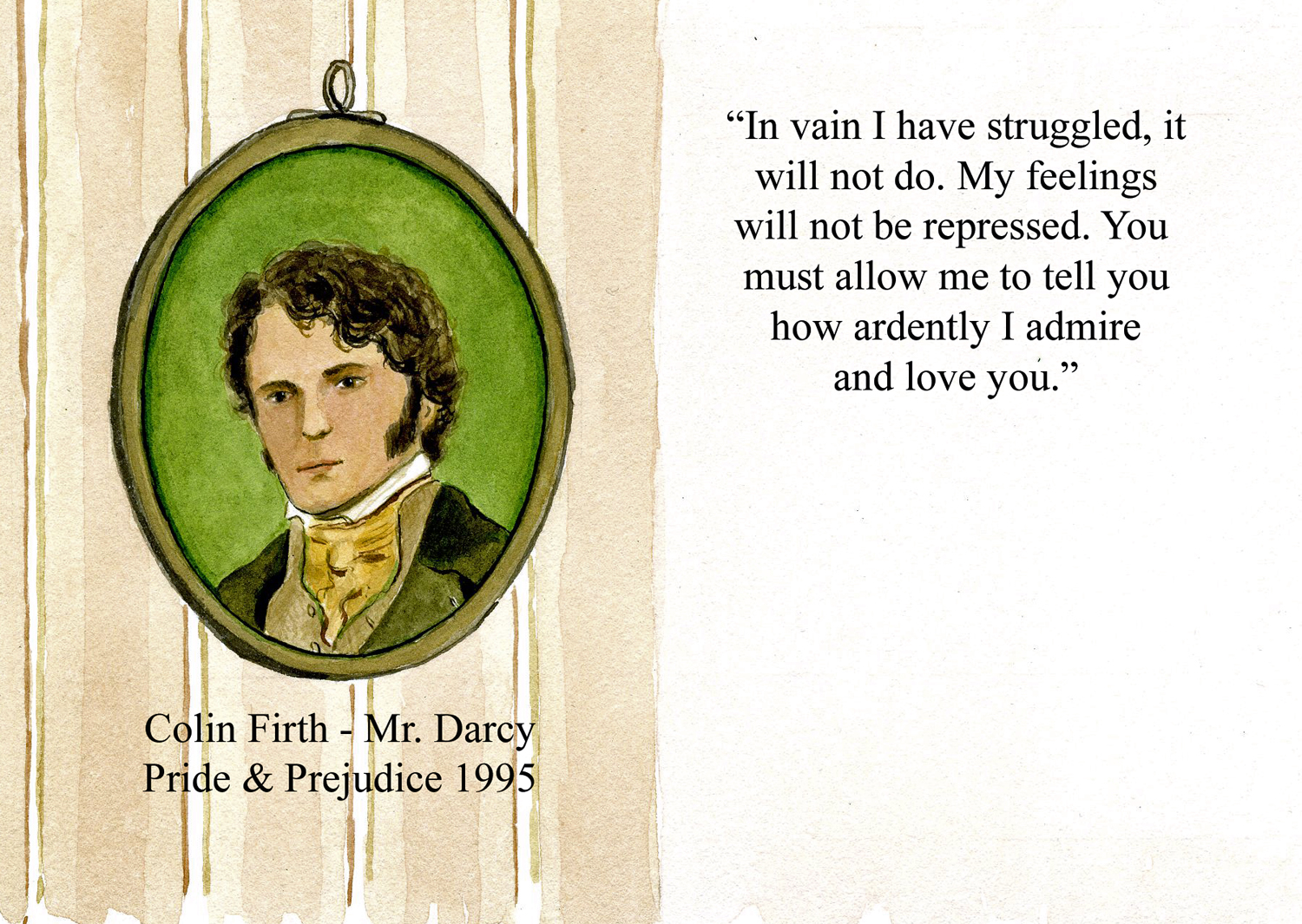
LD: My Mr. Darcys: An Appreciation (2009) is a tribute to the many actors who have played the role of Mr. Darcy in Pride & Prejudice adaptations. It includes portrait miniatures of sixactors along with text from each film. It is especially made for the true Austenite.
There are 500 copies, each signed and numbered. $28.00
When I was doing research for this book, I had to re-watch all of the films, taking notes about which line would work with each painted miniature of the actors. This was easier than one might think, and also really fun. When it came to the text on the back of my book, I knew which line from P&P I wanted to use, but had no idea where to find it quickly. I phoned my older sister Paula, a devoted Austenite and the one who introduced me to Jane originally. She was driving, pulled off the road, and reached into the side pocket of the passenger door to pull out her emergency copy of P&P and found the passage for me right away. At the time – I was amused by this. But now, of course, I carry an emergency copy of P&P on my phone (along with Persuasion). [Ed. I am not going to tell you which passage Laura chose for the back of the book – you will just have to buy your own copy to find out! – but what passage do you think she might have chosen?]
JAIV: Why did you feel compelled to do this book – you refer to your sister being an “Austenite” – are you as well?
LD: At the time, my sister and I were talking quite often about the various adaptations of Pride and Prejudice and it occurred to me that there must be women everywhere having the same conversations and comparing Darcys. I’m a book artist, and much of my work is making visual lists, drawing everyday items, familiar yet very personal things. My work often reflects my passion for art history, maps and architecture. My Mr. Darcys was a bit out of the blue. I don’t really know how it came into my mind to do the book exactly, but once the seed was planted there was no turning back. I like that a book a woman wrote 200 years ago still resonates today and inspires artists, writers, and filmmakers to keep the characters alive. So, I would say that yes, I am an Austenite.
JAIV: Which of the novels do you like the best?
LD: Persuasion. I adore Anne Elliot, because she always knew her own heart even though she was afraid to follow it.
JAIV: Which adaptation do you like the best?
LD: I love the 1995 BBC adaptation of Pride and Prejudice. I think it was perfectly cast. Of all the Austen adaptations I’ve seen though, the Persuasion from 1995 is my favorite. Watching it is like comfort food to me.
JAIV: And which Mr. Darcy is your favorite, and why?
LD: Laurence Olivier was in the first “Hollywoodized” version which was terribly cast, except for him. He played Darcy’s imperiousness beautifully, but the compromised ending let him down.
Colin Firth was absolutely perfect in the role, getting the arrogance right, but showing the vulnerability beneath. Plus, all the Darcys that came after were a direct result of his performance, and that of the rest of the cast. If he hadn’t had the charm and charisma to pull off the Darcy character, I doubt any of the other adaptations would have been made.
So, Colin Firth, to me, is the definitive Mr. Darcy. And we can’t forget the lake scene…!
************
So fellow Darcy fans, this is must have book – know that some of you like David Rintoul the best from the 1980 BBC production – he is, sorry to say not in this book – but everyone else is, each with an appropriate quote that sums up his character best… it is small, doesn’t take up much shelf space, but I think you will choose to display it in a prominent place somewhere as a centerpiece to your Austen collection.
What else I had to buy: for an obsessed Red-Sox Fan! [and a best friend, even though I am, dare I say it, a Yankee Fan…]
Fenway Park Tunnel Book: This tunnel book shows a view of Fenway Park and the skyline of Boston. The images were painted, then offset printed, laser cut and pieced together by hand. Each copy is signed.
2007, 2008; 2nd edition (with 2007 world championship flag); 6.5 x 8 and 3/16 inches, 6 two-sided pages; $38.
I bought another book but as it is a gift for a friend that I have not yet given it to, I must wait – but will say it has something to do with Birds!
And what book-loving person would not require this:
Block Prints: Read Art
2012, 10 x 14” hand printed on Kitakata rice paper, two colors. One small print on a book page is attached, printed in an edition of 12. Unframed $125.
*********************
Here is Laura’s website and contact information: http://www.lauradavidson.com/ – take some time to look at her various creations – time well-spent I assure you! If you have a question or a comment for Laura, please do so here and I will pass them on to her for a response…
[all images copyright Laura Davidson and used with permission]
Kelly was the driving force behind the formation of the JASNA Vermont Region – if you have been following her blog at Two Teens in the Time of Austen – or you are just discovering it for the first time today, head over to Amazon and add this to your kindle! – I promise you will not be disappointed!
Smith&GoslingThe biography A Memoir of Jane Austen, compiled by her nephew James Edward Austen Leigh, was first published in 1870 (2nd edition on google.books). In 1911, daughter Mary Augusta Austen Leigh wrote down Edward’s own life history. Two Teens in the Time of Austen dramatizes events in the lives of Edward’s beloved wife Emma Smith (1801-1876) and her friend and sister-in-law Mary Gosling (1800-1842).
It is Emma’s eventual connection to the Austens of Steventon which gives this project its very name! (The fact that the diaries of both girls begin in the period that saw Austen’s publications, doesn’t hurt either.) Celebrate with me five years of uncovering the lives of the Smiths & Goslings. You can even “click to Look Inside“. Lightly edited, and highly rearranged, “Random Jottings” (estimated at 170 pages) serves as an introduction to the world of my Two Teens from posts published…
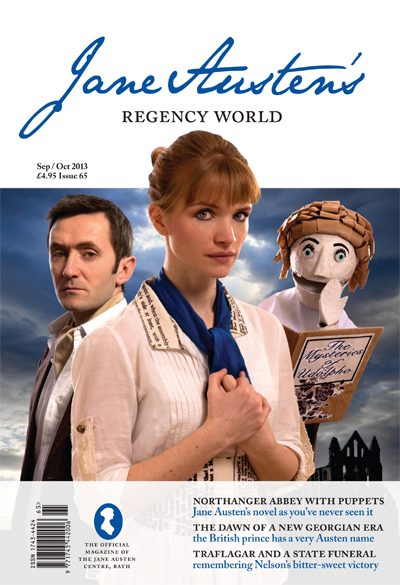
The September/October issue of Jane Austen’s Regency World magazine is out now and will be mailed to subscribers this week. In it you can read about:
Northanger Abbey with strings: the Gothic puppet show that gripped the Edinburgh Festival and is heading to Bath and London
JASNA AGM preview: an exclusive look at September’s gathering in Minneapolis
The importance of being George: the new royal baby has a very Austen name
Trafalgar and Nelson: how the press reported the great Naval victory – plus Nelson’s funeral remembered
Remembering the Burneys: a new plaque in unveiled in memory of Fanny
Plus News, Letters, Book Reviews and information from Jane Austen Societies in the Netherlands, UK and Australia
************************
To subscribe now click here: http://janeaustenmagazine.co.uk/subscribe/ – and make sure that you are among the first to read all the news from Jane Austen’s Regency World.
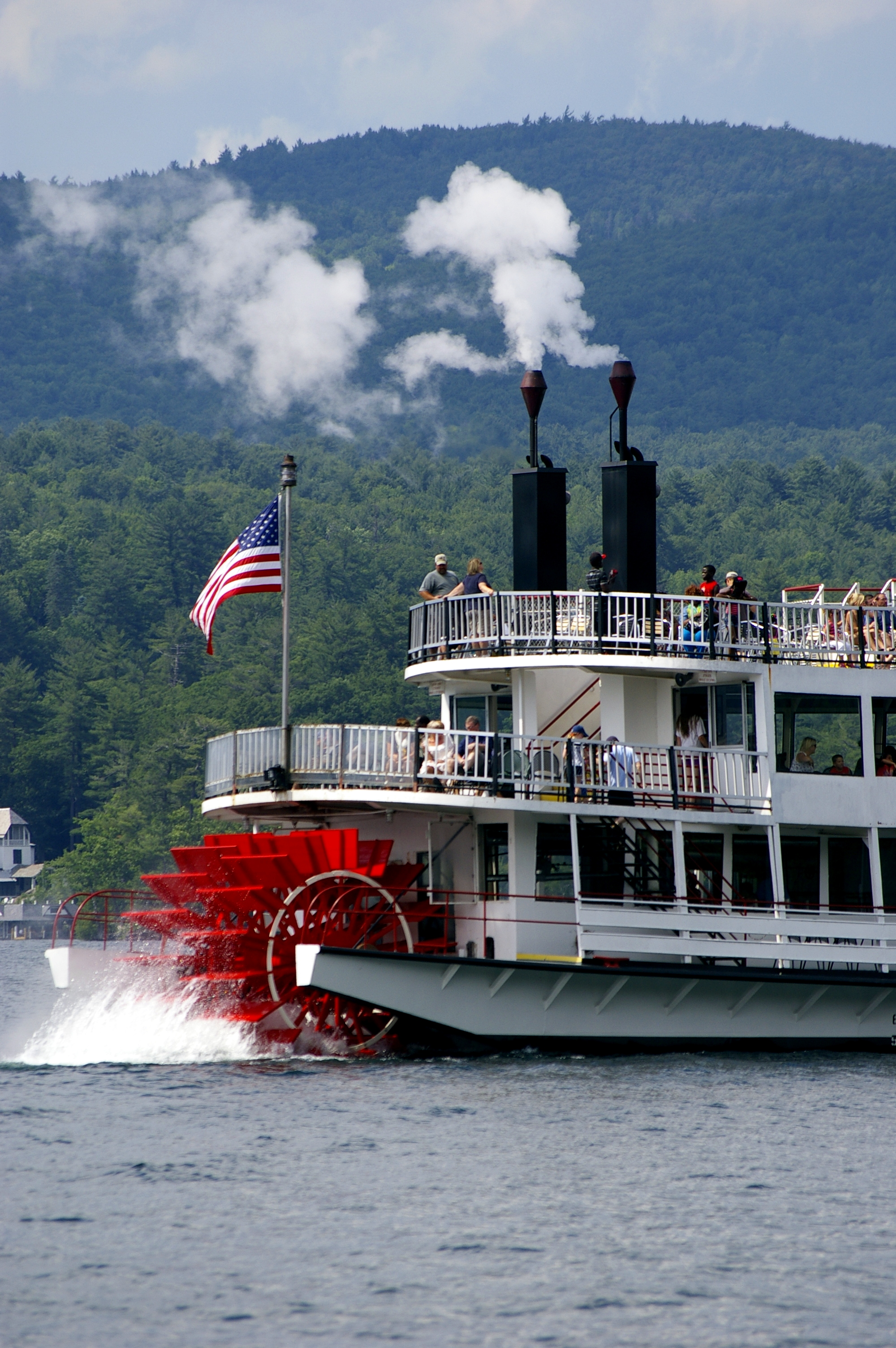
I am posting here several pictures from the JASNA-New York Capital Region’s Retreat from a few weeks ago – a fabulous time was had by all as we learned about, discussed, laughed over, and watched Jane Austen’s Persuasion. The overnight retreat was held at the Wiawaka Holiday House located on Lake George, New York, a perfect setting for a 24-hour immersion in the early 19th century. [See here for information on the weekend]
Wiawaka House c2013 Mary Huber
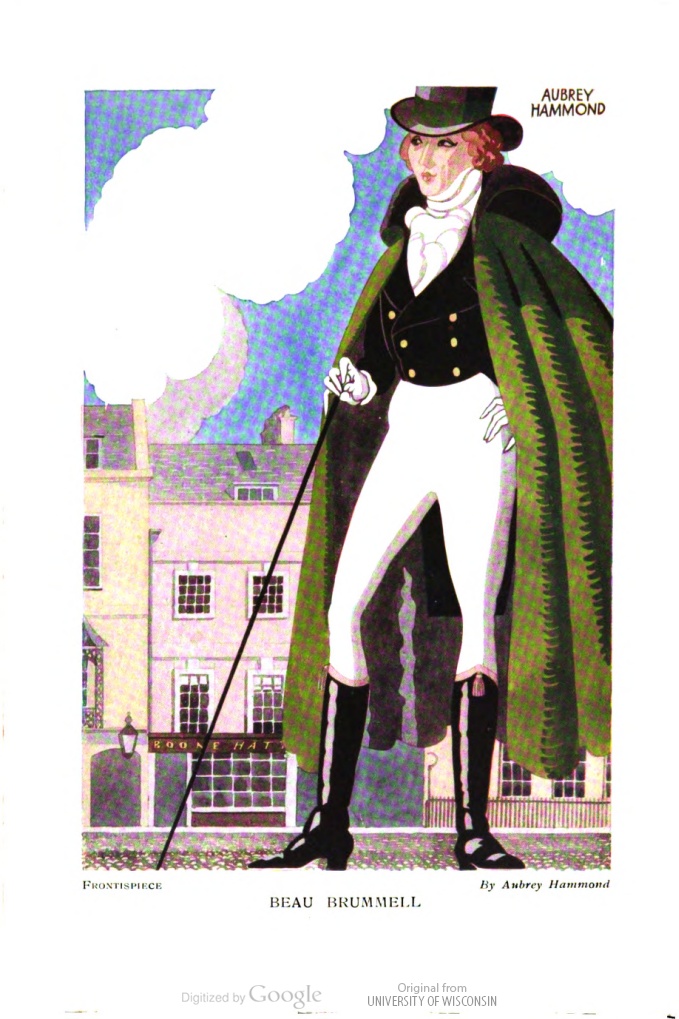
The event was facilitated by member Billie Franchini, who offered up great discussion questions, and kept us all on track and everything running very smoothly. We had the pleasure of listening to local author Marilyn Rothstein talk about the Regency Period, with tales of the Prince Regent, life in London for the upper classes, and Beau Brummell.
[Beau Brummell, by Aubrey Hammond, in Lewis Melville, Beau Brummell (NY: Doran, 1925) – at Hathi Trust]
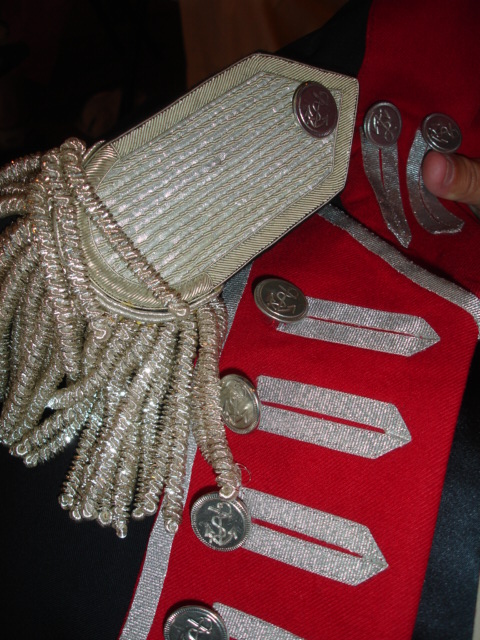
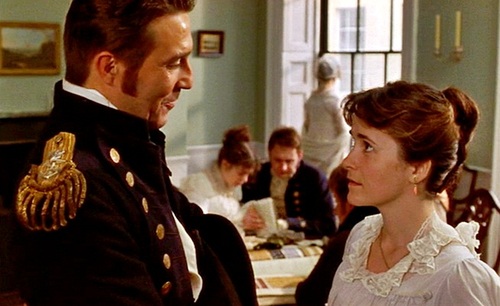
Lisa Brown, from the Syracuse and Rochester JASNA regions (and who has said she really just joined JASNA so she could talk about her first Love, The Royal Navy!), gave an enlightening talk on the uniforms of the Royal Navy from the period, as she passed around various examples of jackets made of superfine wool with epaulettes and buttons that we could handle and ooh! and aah! over [alas! – all empty with no Captain Wentworth in sight!]
the all-important epaulette c2013 D BarnumNavy Uniforms 1795-1812 – Lisa Brown
***************
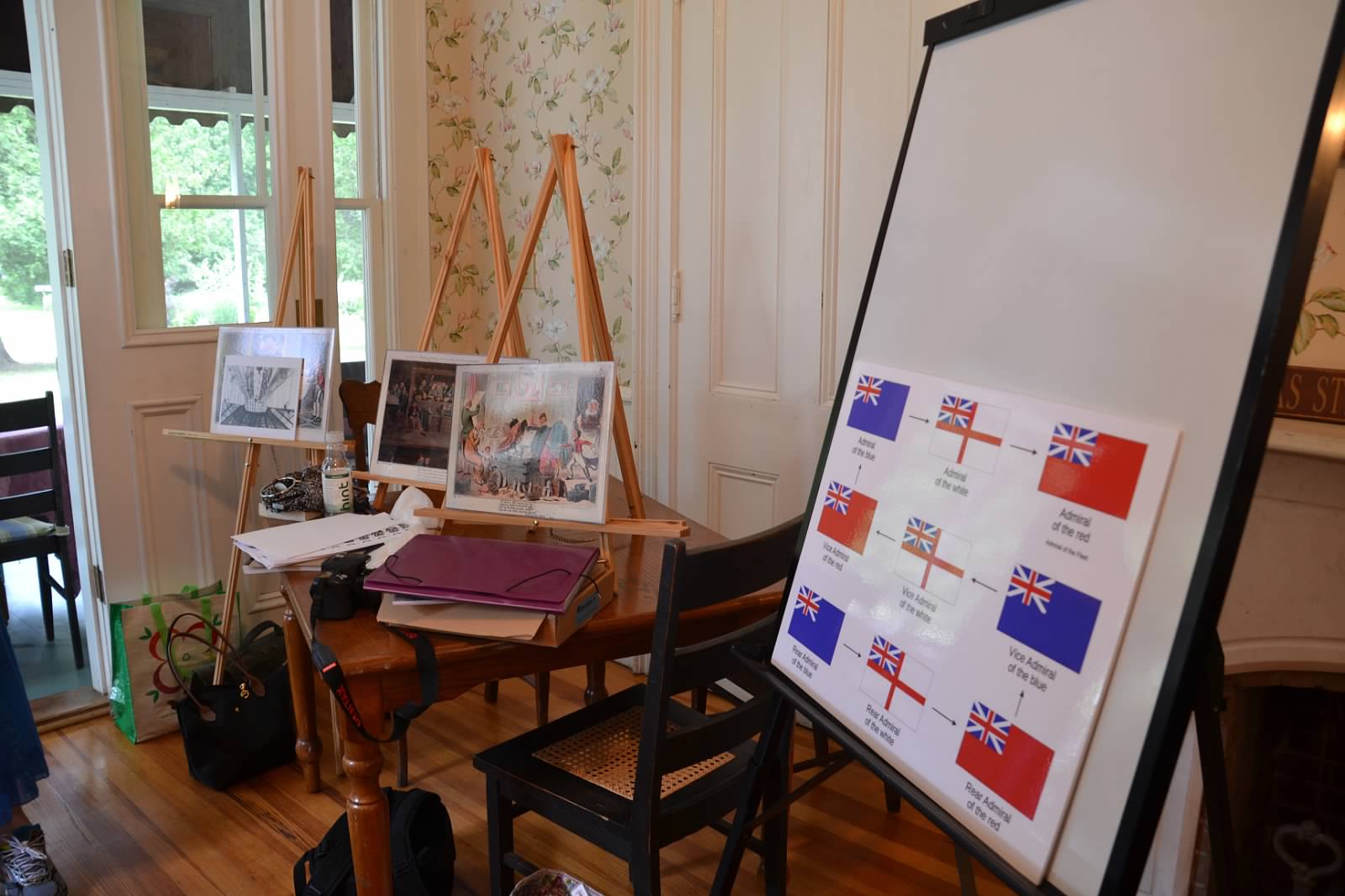
Lisa spoke the next day as well on “How Captain Wentworth Made His Fortune” – wherein we learned about the various ships of the period (and those that Wentworth commanded), the rating system, how one became an officer with hopes of success in battle and a future as an admiral, how one earned their prize money, how often a sailor was relegated to half-pay status [think Capt. Harville] and how very knowledgeable Jane Austen was about the Royal Navy because of her brothers’ involvement. Lisa is a veritable encyclopedia about the RN and she handled our peppering with questions admirably! [very excited to announce that Lisa will be speaking at our JASNA-Vermont June 2014 meeting!]
Lisa’s exhibits – c2013 Mary HuberTea on the Porch! c2013 D Barnum
The weekend ended with a sumptuous Tea, prepared mostly by RC Pat Friesen, and a final discussion of the joys of viewing the movie adaptation of Persuasion – thankfully the one with Amanda Root and Ciaran Hinds! – which we had done the night before… one never tires of this nearly perfect adaptation, and one always sees things not seen before, moreso when viewing it with a group…
A lovely 24-hour immersion! – up for next year is Northanger Abbey, and a more perfect setting I cannot imagine. Thank you all in the Capital Region JASNA group for making us all feel so very welcome and offering up insightful Austen discussion!
I welcome today JASNA member Janeite Bonnie, as she offers us the tale of her time-travel adventure at Jane Austen Summer Camp, sponsored by the JASNA-Connecticut Region on July 26-28, 2013. Bonnie was, alas! without a working camera, and it is with thanks that I use fellow camper Tess Quinn’s photographs! [Tess is the author most recently of Pride Revisited.]
Enjoy all – so sorry I was not there – hopefully next year! [I was at the Middletown Inn a few years ago for a wedding, and I can attest to it being the perfect setting for anything to do with Jane Austen!]
______________________________
I was a last-minute registrant for the Jane Austen Summer Camp, and registered for only the second half of the weekend, taking a miss on the workshops on Saturday morning because I had either attended similar workshops before or had skills that did not require workshops such as were offered. I drove down from VT to Middletown, CT on Saturday afternoon wondering what to expect in terms of the area in which the event took place, since such things do tend to color my experience. As I turned onto Main Street, I spied a row of 18th century clapboard houses across the street, and I thrilled to the sight. When I pulled up to the gate of the Inn at Middletown, I was immediately favorably impressed. The Inn at Middletown has the look of an early 19th century manor house, with wings, snubby portico, and miniature curved drive. When I walked inside, the Inn continued to enchant me with its central curved staircase, immense chandelier, fireplace, and patterned marble floor. The room I shared with my friend Shari was tasteful, but I barely had time to enjoy it before I had to begin my transformation into a Regency lady.
Middletown Inn [Wikipedia]
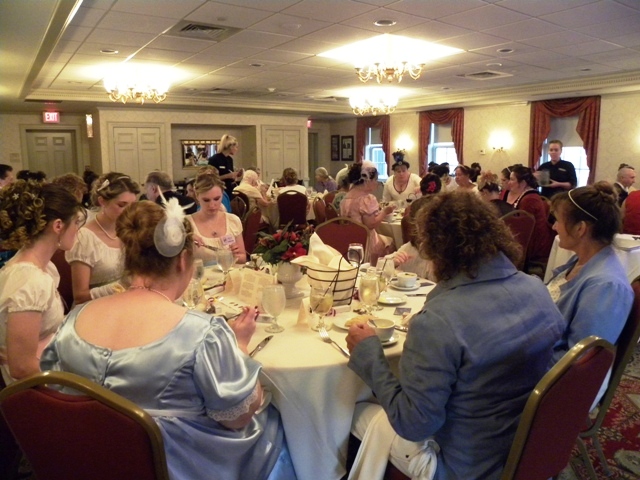
Our Saturday evening began with gathering in the second floor lobby, where alcoholic beverages were dispensed to those willing with shillings. Some faces were familiar; we have crossed paths at other JASNA, time-travel, and dance events. Most of us, I am gratified to report, were dressed in period outfits, and we exchanged compliments and admiring looks.
Dinner before the Ball!
When we entered the conference room for dinner, I was pleasantly surprised to see it looking period-appropriate, too, with nicely painted woodwork, wallpaper, double-hung windows dressed up in patterned draperies, wall sconces, a boarded-up fireplace (well, it *is* summer) with a mantel and mirror above, and a sideboard in a recess with a mirror overhanging it. Of course, I made my way to the center table so that I could have a great seat for the lecture after dinner by Irene Urban, who is known to me through Regency dance. She is a maven of Regency cookery, but more of her soon.
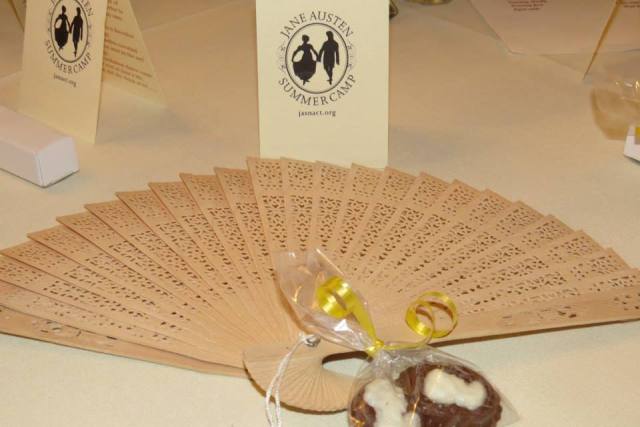
Table setting
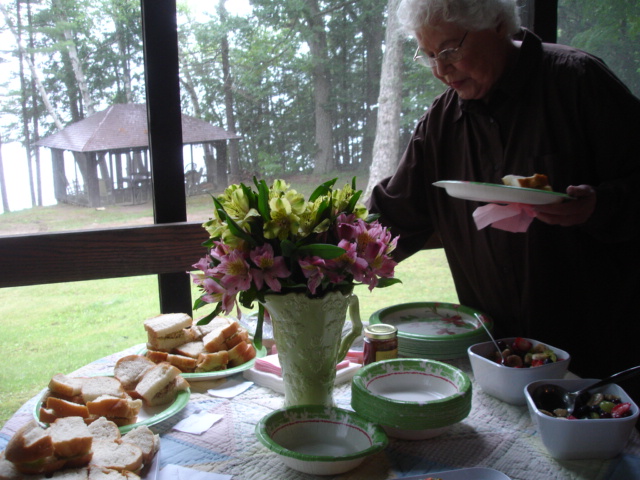
The table was dressed up with a sweet urn of colorful flowers, and everyone had gifts of a sandalwood fan and chocolates in front of her place setting. Lovely chocolates, by the way: They looked like cameos, with a milk chocolate base and a silhouette Jane Austen silhouetted in white chocolate. We started off dinner with a delicious cold soup of Lord-knows-what, but the ingredient I do remember is champagne. More alcohol — terrific for loosening the joints and inhibitions for dancing! Everyone enjoyed their main course, too. I had already heard praise of the Inn at Middletown’s cuisine, but tasting was believing. The presentation was also quite lovely. Well done!
We did not enjoy a last course of dessert because that was saved for the break during the ball. However, Irene Urban’s lecture on Regency dining was a delicious treat for the mind, and I would have willingly gone back for seconds and thirds, but it was all too quickly over, with no Q and A session. Irene dropped tantalizing tidbits such as what was stocked in a Regency larder, including all the dead animals, which she accompanied with an etching of the same. I would imagine that if cruel Regency parents had wanted to punish their naughty little ones, they could have locked them in a dark pantry for an hour. Irene is not an all-talk-and-no-action lady; if you have ever attended an event with which she is connected, you are treated to period delights created from recipes that she has adapted from vague original recipes in her collection of period cookbooks.
Susan de Guardiola and her Soldiers
Next up was the ball, which was called by Susan de Guardiola, a Regency dance expert. The dances were simple to suit those who had never danced period dances before. The room was splendidly lit up, quite full of company, but not insufferably hot, so we were spared the trials of E. and M. The crowd organized into two longways sets, and off we went, balancing, dos-a-dosing, slipping, turning, gazing, flirting, and attending. I think we all acquitted ourselves rather well, and as a reward were treated to sumptuous desserts during the break, as well as the raffling off of two splendid gift baskets and several smaller gifts.
–
Sunday’s activities began with a promenade to a local historical house museum [the General Mansfield House]. Many folks chose to dress up again, and I believe we looked fresh and charming in our day gowns, bonnets, reticules, and parasols. We gathered in the lobby, then strolled out through the front courtyard, crossed the street, and there we were. The docent of the museum greeted us on the steps, then spent the next twenty minutes lecturing about the history of the house and its occupants while we stood, wilting. An older woman required a chair, which my friend Shari borrowed and brought to her, and still the lecture continued! We were finally allowed to tour the house and the grounds, which were not extensive but had a few suitable places for photo ops.
After the museum, we returned to the hotel to check out and have brunch: yummy cheese blintzes and vegetable quiche. After brunch, Dr. Mark Schenker, associate dean of Yale College, presented a lecture titled “The Richness of ‘Ordinary Life’ in Austen’s Novels”. While my author friends on either side of me scribbled away, I just sat in bliss. Dr. Schenker, while having ample notes, frequently put them down and wove witty and insightful incidental observations into his structured lecture. He is the type of speaker who leaves you glowing with happiness after you’ve been privileged to hear him. I am embarrassed to admit that, although I
Dr. Schenker – “Is that _really_ all you can remember?!
thoroughly enjoyed the lecture (and it made me wish that I had come for the full weekend so that I could have heard his other lecture Friday night), the only thing he said that I can quote was that he referred to Jane and Charles Bingley as the couple downstairs, the Mertzes of Jane Austen’s couples! What a thing to remember.
**************
The weekend was capped with an ice cream social, the raffling off of two more marvelous gift baskets and smaller gifts, and the screening of the soon-to-be released film Austenland. I do believe that this movie is haunting me. I had already sat through the initial free preview for JASNA-NY members at the Sony screening room in New York and felt I had wasted two hours of my life. I had even squeezed it into my tight schedule when it was offered because, of course, it was a one-time-only experience. However, two or three more free previews were offered after that to JASNA-NY members. This past weekend, all the way up in mid-Connecticut I thought I could enjoy a good Austen movie with other Janeites, when, lo and behold, Austenland again popped up and put a pin in my Austen euphoria. N.B. I just received an e-mail from JASNA-NY about yet one more free preview of Austenland, to take place on Tuesday, July 30, in Manhattan!
Austenland company
I left very glad that I had made the effort to drive for four and one-quarter hours the 260 miles from my home to the Inn at Middletown. Everyone with whom I spoke was positive about all aspects of the gathering, from the venue to the food, from the workshops to the lectures, from the ball to the gift baskets and the camp store, all were praised. It is testament to the tremendous concerted efforts of all the organizers of this event, and I hope to see it repeated and expanded in two years.
For what do we live, but to make sport for our neighbours, and laugh at them in our turn? –Jane Austen
**********************
[Note: all pictures c2013 Tess Quinn, with thanks!, unless noted otherwise]





















 Jane Austen in Vermont
