Books · Fashion & Costume · Jane Austen · Regency England · Social Life & Customs

On My Bookshelf ~

I love my mailman!  He brings me such gifts almost on a daily basis – yesterday he brought these two books:

book cover ja unrequited love 

Jane Austen: an Unrequited Love, by Andrew Norman [The History Press, 2009] – where the author proposes “that Jane and Cassandra had a falling out over a young clergyman, whom he identifies for the first time.  He also suggests that along with the Addison’s disease that killed her, Jane Austen suffered from TB.”  [from the jacket]


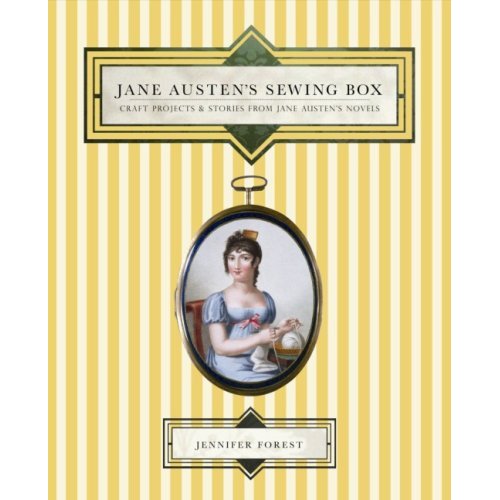
book cover jane austens sewing boxJane Austen’s Sewing Box: Craft projects and stories from Jane Austen’s Novels,  by Jennifer Forest [Murdoch Books, 2009] [see Janiete Kelly’s post on this title] – it is a sumptuous book! 

Please join us tomorrow when I will post an interview with the author, as well as review the book. ~

[I am now going in search of my long-abandoned embroidery supplies… ]


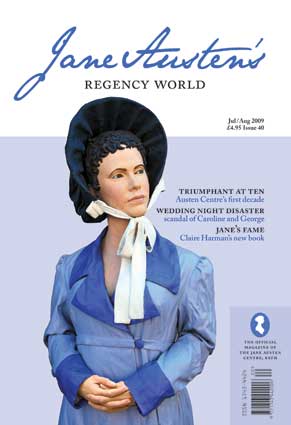
 … and today he brought me the latest issue of Jane Austen’s Regency World [July/August 2009] – as always cram-packed with interesting articles and lovely illustrations – on Austen, Mary Shelley, Queen Caroline, global warming in JA’s time, book reviews, and much more [I will post the full contents tomorrow], but you can see hightlights of the issue as well as download a sample article from a previous issue at the magazine’s website [note that this is the NEW website for JARW, so change your links in your “favorites.”]

JARW_40_Cover_small


How sad to be burdened with a day-job with all this reading to be done!

Posted by Deb

Austen Literary History & Criticism · Book reviews · Collecting Jane Austen · Jane Austen · Publishing History

Book Review ~ “Jane’s Fame” by Claire Harman

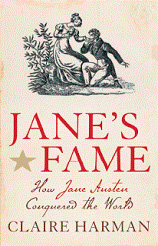
book cover jane's fameMany of us who grew up in the late 40s – early 50s had our Jane Austen force-fed to us in high school (unless we were fortunate enough to be blessed with an Austen-loving mother or father!).  Pride & Prejudice was the standard text with little reference to the other works; followed by George Eliot’s Silas Marner, Dickens’s A Tale of Two Cities and / or Great Expectations, Shakespeare (hopefully!), and Hemingway, Steinbeck, Salinger for contemporary authors.  But I’ve often thought that Austen got a bum-rap with this “required-reading” status, the educational system’s way of compensating for what an early critic said in calling Austen “a critic’s novelist – highly spoken of and little read.” [p. 120]  And while I am the first to admit that Austen is not for everyone [their terrible loss!], I have long believed that this approach to Austen added to her suffering from the great reader-turnoff. 

For me, a voracious reader as a youngster and teenager, I went on to read some of her novels, but alas! not all, feeling more at home with Alcott, the Brontes, Dickens, and later Wilkie Collins, all those more accessible Victorian novelists.  So it was in later life that I returned to Austen – and I perhaps needed that distance of time (and some wisdom!) to re-appreciate her brilliance – the humor and irony, the language, that characterization, and of course, the age-old love stories.  So from my current vantage point I marvel at Austen’s ability to stay fresh, to speak to different generations, and to speak to each individual in different ways through one’s own life. And in these fifteen plus years of “re-Austenising” myself, I’ve gone much beyond the novels, to the biographies, criticism, her Regency / Georgian world, and the current surfeit of films, and sequels and continuations, and even the latest parodies, creating quite a book collection in the process – and I have really barely begun!  

So I was most excited to hear about the release of Claire Harman’s new book, Jane’s Fame: How Jane Austen Conquered the World [Canongate, 2009], stirring up controversy even before it hit the bookstores [see my previous post, “Discord in Austen Land”].  [Harman has authored Fanny Burney: A Biography (Knopf, 2001) and works on Sylvia Townsend Warner and Robert Louis Stevenson].   It is an engaging read – historical, biographical, critical and anecdotal, all rolled into a capsule of Austen’s claim to fame – and just why was she so popular?  “the public whipped into a frenzy” [p. 243]  in the late nineteenth century and again in the late twentieth? – by “[James Edward] Austen-Leigh’s Memoir in the first instance, and in the second, a man in a wet shirt” [p. 243] [with thanks to Colin Firth!] – simplified reasoning perhaps, but a good chuckle and that glimmer of truth. 

Harman explains that

…this book charts the growth of Austen’s fame, the changing status of her work and what it has stood for, or been made to stand for, in English culture over the past two-hundred years.  In the foreground is the story of Austen’s authorship, one of persistence, accident, advocacy, and sometimes surprising neglect.  Not only did Austen publish her books anonymously and enjoy very little success during her lifetime, but publication itself only came very late, after twenty years of unrewarded labor.  I have sought to reconstruct these pre-fame years in the spirit of uncertainty through which Austen lived them.  Her prized irony and famous manipulation of tone I believe owes much to it; part of the reason why she pleases us so much now is that she was, for years, pleasing only herself.  [p. 7-8]

Thus, Harman starts by placing Austen squarely in the context of her times – her family and friends as writers – her mother, brothers James and Henry, her friend Anne Lefroy’s brother Samuel Egerton Brydges, and her pride in her own quite delightful juvenile writings.  Incorporating a general account of Austen’s life [Harman assumes the reader brings much knowledge of Austen’s life and gives only a cursory telling], she presents us with a great summary of Austen’s writings, the publication history and early responses to each work, drawing heavily on Brian Southam’s Jane Austen, The Critical Heritage [London 1968], and emphasizing Austen’s literary ambitions. [for more on this, see Jan Fergus’s The Professional Woman Writer” in The Cambridge Companion to Jane Austen, one of the earlier scholarly arguments to clearly see Austen in this light, far removed from the portrait painted by her brother Henry and later her nephew.]

Following Austen’s death in 1817, her copyrights still owned by Cassandra were sold to Richard Bentley and his issue of all six novels in 1833 did much to keep Austen in print; but her popularity waned, the rise of the Victorian novel sending Austen to the shadows, not to mention Charlotte Bronte’s dislike of Austen, quoted by Elizabeth Gaskell in her Bronte biography in 1857 [but ironically, how close is Gaskell’s North & South to Pride & Prejudice!]  So Austen remained largely unread until the Austen-Leigh Memoir of 1870, followed by various new editions of the novels and the selected letters in 1890. 

Harman explores in her chapter on the “Divine Jane” [quoting W.D. Howells] the publishing of these new editions and the illustrated versions that sought to “fix the characters in one’s mind” [p.159], the biographies, and critical analyses in this first burgeoning fame-fest, and her new status as darling of the intellectual snobbish-elite, championed by the likes of Leslie Stephen, Henry James, George Saintsbury, and Howells [and of course, not to leave out Mark Twain’s adamant dislike!] – all this culminating in R.W. Chapman’s Oxford edition of her works in 1923, “the first complete scholarly edition of any English novelist.” [p. 192]. 

In “Canon and Canonisation,” Harman chronicles the scholarly critical analysis that continues unabated to the present – the vast extent of academic and non-academic writing – on the one hand, Austen as a pleasure-read, the writer “who wrote so clearly and simply, and who was so small scale” [p. 200] – and on the other, the critical study of Austen’s “unconsciousness and brilliance” and here we see her “easy passage into English literature courses” [p. 201].  Austen makes critical literary history as manuscripts and contemporary memoirs became available for study – resulting in library collections, various illustrated editions, Jane Austen Societies, interest in her “homes and haunts,” more biographies from various standpoints, new paths of criticism taking into account the political, sociological and historical elements, and the many works on the manners and mores, fashion and handiwork, cookery and letter-writing – all things Austen indeed! [A friend visiting my home recently asked me what could all these Austen-related books on my shelves possibly be about when she only wrote six books!] 

And finally to film and what she terms “Jane Austen TM”, Harman again summarizing all that came before the “wet shirt” and after – the movies, the sequels, the internet and YouTube concoctions, the blogsphere , the Societies, the fan-fiction sites, the costume-driven fanatics, etc.  And Harman ends with the question, “What would Austen have made of all this? [p. 278] – in answer, she cites the differing views of D.W. Harding, Lionel Trilling, Henry James, and E.M. Forster to prove to us that “the significance of Jane Austen is so personal and so universal, so intimately connected with our sense of ourselves and of our whole society, that it is impossible to imagine a time when she or her works could have delighted us long enough.” [p. 281]

 One of the criticisms of Harman’s book has been her light non-academic approach to Austen [and perhaps her re-working of others’ ideas into this “popular” framework] – but it all works so well for what and for whom it is intended.  Harman’s gift is taking an inordinate amount of primary and secondary material and presenting it into a very readable, information-packed and anecdotal whole – everything you would ever want to know about Jane Austen all put together in a neat little package of 342 pages.  This of course may be its greatest shortcoming – too neat a package with strong authorial opinions thrown in [and a feeling to this reader of all being rather rushed at the end – “let’s wrap this up, throw in a few final tales and get it published” sort of feeling…] –  it must needs be leaving something out! [Indeed, the 2005 Pride & Prejudice barely gets a mention, either an oversight or the expression of the author’s opinion of that film – but no matter what your views of that adaptation might be, it has to be praised for bringing Jane Austen and P&P  to yet another generation who do not find Colin Firth’s wet shirt scene all that WE make it out to be – and thus it is a clear topic for Jane’s current and ongoing “fame.”] 

But as a resource, with a terrific reading list to be gleaned from the text and bibliography [though I do quibble with the number of un-sourced quotations and overly shortened citations that are unclear (especially in regard to the letters – a number and date would have been most helpful!)], Jane’s Fame should be required reading [not force-fed please…] for anyone interested in the facts of Austen’s writing life and how she has risen to such heights and commands such a presence in so many people’s lives.  And you will likely take away new and interesting tidbits such as finding what Katherine Mansfield had to say about Emma:  “Mr. Knightley in the shrubbery would be something!” [p. 247] [aah! indeed!]

4 1/2 full inkwells [out of 5]

 Further Reading: [all page citations above are to Janes’ Fame]

  • See my post on the various Reviews of Jane’s Fame
  • Copeland, Edward, Juliet McMaster, eds.  The Cambridge Companion to Jane Austen.  Cambridge University Press, 1997.
  • Fergus, Jan.  “The Professional Woman Writer” in The Cambridge Companion, pp. 12-31, where Fergus summarizes and expands these arguments first presented in her Jane Austen: A Literary Life. London: Macmillan 1991.  These are must-reads…
  • Sutherland, Kathryn.  Jane Austen’s Textual Lives: from Aeschylus to Bollywood. Oxford, 2005, pb 2007.  Note that it is Professor Sutherland who started the controversy that Harman essentially lifted her ideas – I have this book and have skimmed it only, so cannot comment fully – but just looking at the table of contents, one finds the similarities a little alarming, and the Sutherland book has far more depth to the notes and bibliography – but again, I emphasize the “popular” nature of Harman’s book. 
  • Todd, Janet, ed.  Jane Austen in Context.  Cambridge University Press, 2005, 2007 with corrections. 
  • Claire Harman’s website with cites to reviews of Jane’s Fame
  • Austenblog:  Mag’s review of Jane’s Fame

Posted by Deb
Jane Austen · Movies · News

Masterpiece announces BBC “Emma”

Our very own Janeite Mae filled my inbox today with the welcome news that Masterpiece Theatre has announced the BBC Emma dates for 2010!  Here is the press release from PBS: [and thank you Mae, for the heads-up!]

BBC Worldwide Sales and Distribution and WGBH today announced co-productions of two star-studded dramas: the beloved classic, Emma, and the sequel to BAFTA-winning and Emmy-nominated drama Cranford, Cranford 2. Both programs will make their U.S. premiere in early 2010 on WGBH’s MASTERPIECE CLASSIC on PBS. 

Commented Susanna Pollack, SVP, Sales & Distribution and Children’s, BBC Worldwide, Americas, “Following Cranford’s success in the U.S. and UK, we are excited to be working with WGBH again to bring its sequel, Cranford 2, as well as the Jane Austen’s classical tale, Emma, to audiences next year.” 

“Our viewers have been clamoring for more Jane Austen and more Judi Dench,” said MASTERPIECE executive producer Rebecca Eaton “These new productions add up to a very strong MASTERPIECE CLASSIC season in 2010.” 

Emma (4 x 60)

Romola Garai (Atonement, Daniel Deronda), Sir Michael Gambon (Cranford, Gosford Park), and Jonny Lee Miller (Byron, Eli Stone, Trainspotting) star in this BBC and WGBH co-production which follows the dire consequences of Emma’s failed matchmaking schemes. Michael Gambon plays Emma’s affectionate, neurotic father who allows her to be mistress of their household. Jonny Lee Miller—(who stars in MASTERPIECE’s Endgame, premiering in October) plays Mr. Knightley, Emma’s shrewd and attractive neighbor, who provides a welcome counterpart to headstrong Emma. Fresh and funny, this perceptive adaptation by Sandy Welch (Our Mutual Friend, Jane Eyre, North and South) brings Jane Austen’s comic masterpiece to life.

Cranford 2 (2 x 60)

The BAFTA-winning and Emmy-nominated drama, Cranford, starring Dame Judi Dench (Notes on a Scandal, Shakespeare in Love), Imelda Staunton (Vera Drake, Fingersmith), Francesca Annis (Jane Eyre, Reckless), and Eileen Atkins (Scenes of a Sexual Nature, Gosford Park), returns as a two-part sequel, Cranford 2. The original drama chronicled a small Cheshire market town in the early 1840s on the cusp of great change. The BBC and WGBH co-production in association with Chestermead Ltd, picks up the story in 1844. New faces coming to the close-knit town include Jonathan Pryce (Pirates of the Caribbean), Tom Hiddleston (Wallander), and Tim Curry (Spamalot). Based on the novels by Elizabeth Gaskell, Cranford 2 is written by Heidi Thomas (I Capture the Castle, Madame Bovary).       

Other shows  announced for the early 2010 lineup are:  

  • A Small Island [based on the Orange Prize winning novel by Andrea Levy]   
  • Framed, adapted from Frank Cottrell Boyce’s (The Last Enemy) children’s novel 
  • Sharpe’s Peril  & Sharpe’s Challenge, with Sean Bean playing Bernard Cornwall’s character 
  • The 39 Steps, starring Rupert Penry Jones (Persuasion, Burn Up, MI-5 [Spooks]) as Richard Hannay, in this classic John Buchan mystery.

[see the PBS site for more information on all these new shows – it makes one ALMOST long for winter…]

*And because we cannot get enough of all things Austen,  see this BBC article on filming Emma in Chilham

*And a lovely 5-minute YouTube montage of production shots here: http://www.youtube.com/watch?v=CF_cOGGM7QI

*And full cast information at the Imdb site

emma bbc emma

Romola Garai as Emma  and Johdi May as Miss Taylor [Ms. May was in the  The Mayor of Casterbridge (2003) with Ciaran Hinds

set272

Jonny Lee Miller as Knightley [Miller also played Edmund Bertram in the Rozema Mansfield Park – this seems to always be left off his credits – we continue to live in hope that he will be as good a Knightley as Richard Armitage would have been!]

[above photographs from Pemberley.com]

emma bbc blake ritson

and “dear” Mr. Elton will be played by Blake Ritson [who was Edmund Bertram in the 2007 Mansfield Park – are we sufficiently confused?!

emma bbc rupert evans

And finally then there is Rupert Evans as Frank Churchill [Evans played Margaret Hale’s brother Frederick in North & South [with the aforementioned Richard Armitage…(sigh!)]

*******************************

PS:  this added July 9, 2009 – the BBC has the trailer for this new Emma now available online.  Go to the BBC site here, scroll through the carousel and click on “Emma” to view the trailer – quite lovely! [and thanks Mae for the heads-up!]

Posted by Deb

Books · Jane Austen · News

A Little Help with Your Next Read ~

pile of booksMost of us are always looking for a recommendation of what next to read – despite our toppling TBR piles, there is always room for a new title! – And those of us who read Jane Austen, and then re-read Jane Austen, are forever asking what to read after you have read it all, again and again. 
So I enjoyed this article I found at the Guardian.com book blog on “the murky business of book recommendations” by Chris Powell – he refers to a website that offers book suggestions by just typing in the last book you have read:  The Bookseer at www.bookseer.com– there are two lists, one from Amazon.com [they are everywhere; so much for your local bookseller], and Library Thing.

This is sort of fun, so try it [though when I tried it tonight, there was a problem with Library Thing loading its data – Powell in his article says that when he loaded Ray Bradbury’s The Illustrated Man, Library Thing brought up Wuthering Heights and then a slew of Jane Austen books – so a tad off course perhaps – for me tonight, all I get is “nada” for the Library Thing list [the Bookseer is also on Twitter where there is some talk about this problem…]

Anyway, this is too much information – I have typed in Emma, and get all six Austen novels and nothing else;  Our Tempestuous Day by Carolly Erickson and get a list of other Regency-related works [including a new one I did not know about!];  John Steinbeck Of Mice and Men, and I find I should read Catcher in the Rye, To Kill a Mockingbird, Blood Brothers, Lord of the Flies, and A View from the Bridge [all your basic uplifting stories, and all of which I have read… thank you very much, but it is a nice list] – and if you type in The Grapes of Wrath, it is a similar list with the addition of a few other Steinbeck titles and The Great Gatsby.  Library Thing is still saying “nada” – so still not working, which is too bad because I think that list is more interesting [I think that Jane Austen titles come up for all requests…]

But you can really get into this and try to figure out the brain behind the computer – if you put in Evelina by Fanny Burney, you get the expected 18th century staples and then Sexing the Cherry by Jeanette Winterson pops up!  [I am having way too much fun…] – but if you type in any book by Mark Twain, all you get is a list of Mark Twain titles [he would be pleased…] [BUT Huckleberry Finn brings up Oscar Wilde’s The Importance of Being Earnest – go figure…

And here is my favorite:  The Bible [no author] [it came back and said, “by Jove, I need an author for that!] so I typed in “God” and these titles came up:

THE SHACK!! – OMG, now that’s some incredible marketing! And Amazon must assume the Bible is a childrens’ book…yikes!

But I save the best for last – Pride and Prejudice by Jane Austen, and along with a picture of P&P and Zombies [I am not kidding…] we get the following booklist:

…and LibraryThing recommends:

Nada…

Ok, I am done with this…but I just HAD to share – let me know what YOU come up with!

Posted by Deb

Books · Jane Austen · Literature · News · Rare Books

Auction Results ~ Austen on the Block

The Jane Austen Pride & Prejudice  for sale at the New York Bloomsbury Auction of June 23, 2009 with an estimate of $50,000. – $70, 000.  remains unsold [for more details on this see my original post here]

A quick summary of a few other items of interest:

Bronte [Acton, Currer and Ellis Bell]. Poems. Philadelphia: Lea and Blanchard, 1848. first american edition. est. $800 – $1000. Sold for $700

Samuel Taylor Coleridge.  Poems on Various Subjects.London: for G.G. and J. Robinsons, and J. Cottle, Bristol, 1796. first edition of Coleridge’s first book of poems, issued together with the first published verses of Charles Lamb, signed C.L. Hayward est. $1000 – $1500.  Sold for $2600 [a few other Coleridge items either did not sell or sold for less than the estimate]

John Keats – a first edition of his last collection of poems estimated at $12,000 – 15,000 was unsold

Percy Bysshe Shelley. Queen Mab; A Philosophical Poem: With Notes. London: privately printed by P.B. Shelley, 1813. very rare. est. $12000 – $18000; Sold for $11000 [ most other Shelley items did not sell]

William Wordsworth. Lyrical Ballads, with Pastoral and Other Poems, in Two Volumes. London: R. Taylor and Co., 1805. 2 volumes [the last edition in which Coleridge’s poems appear]. est. $1500 – $2000; Sold for $1700 [other Wordsworth items sold for lower than estimates or not at all]

Thomas Hardy. There were 22 Hardy items for sale, many of the books remain unsold, but most of the autograph letters sold mid-range or less than the estimates- here is one example:   Three autograph letters signed to Florence Yolland on the Death of Emma, Hardy’s first wife.Max Gate, Dorchester: 24 December 1912 to 22 October 1913. 6 manuscript pages, 8vo (varying sizes). Mourning stationery, three autograph envelopes (all labeled “opened by censor” when sent to F. Adams in 1939) est. $2000 – $3000; Sold for $1000.

Full auction results can be found at the Bloomsbury Auction website.

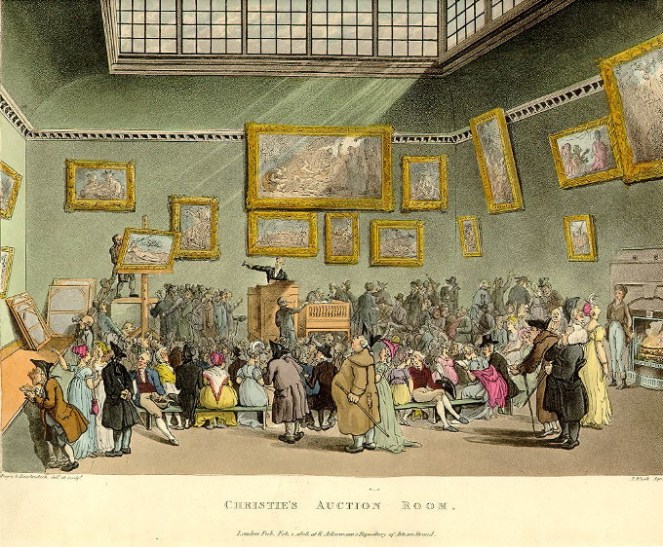
Christies auction room image

[image from the NYPL.org]

Posted by Deb

Books · Jane Austen · Literature · News

Mark Twain on Jane Austen ~ Methinks he protests too much!

My son popped in the other night, quite excited about his discovery in a new Mark Twain book of an essay on Jane Austen – he was thrilled to pass on to me the curmudgeon-par-excellence of Twain bashing Austen.  He was disappointed to discover I already knew about Twain’s avid dislike of Austen – but I appreciated his concern for my feelings!

who-is-mark-twain-cover

The new Twain book is Who is Mark Twain, edited by Robert H. Hirst, The Mark Twain Foundation, 2009 [texts copyrighted 2001].  As Hirst explains in his Note:

I have described all twenty-four pieces as ‘previously unpublished,’ by which I mean not printed or otherwise made readily accessible to the general reader.  More strictly speaking, all of them were included in a microfilm edition issued by the Mark Twain Project in 2001…. But Who is Mark Twain? represents the first time any of these manuscripts has been published for a general audience.

The book is a collection of essays penned by Twain over the years but never published – one of these is titled “Jane Austen” written in 1905.  I knew of this essay because it was actually published by Emily Auerbach in the Virginia Quarterly Review [Winter 1999] and latterly in an Appendix in her Searching for Jane Austen [University of Wisconsin, 2004], along with an insightful article on Twain.  But alas! the book sits upon my shelf, skimmed, and I did not read this until my son gave me the nudge. [There have also been other posts on some of the Austen blogs about this and I don’t mean to be repetitive, but finally just getting to this … thanks to my son!]

Auerbach asks the question in her article “A Barkeeper Entering the Kingdom of Heaven:  Did Mark Twain Really Hate Jane Austen?” – she concludes that perhaps Twain was “a closet Janeite, a fake who read and appreciated far more of Jane Austen than he admitted” [p.299]; that his astute and unfinished essay on Austen indeed proved that he really “got” her [p.301], and despite all his moanings to the contrary, they were more alike than not in observing and depicting human foibles and relying on humor to best express their views [Auerbach compares Twain and Austen to the pairing of Bogart and Hepburn in the film The African Queen: Twain “the irrepressible riverboat pilot, and Austen, the tea-drinking maiden aunt.” [p. 302]- this made me smile!]

I am appending several passages from Twain’s essay, as it quite delightful and many of you may not have read it.  Go out and buy the book – and the other essays cover all manner of Twain’s humorous musings.

Whenever I take up “Pride and Prejudice” or “Sense and Sensibility,” I feel like a barkeeper entering the Kingdom of Heaven. I mean, I feel as he would probably feel, would almost certainly feel. I am quite sure I know what his sensations would be—and his private comments. He would be certain to curl his lip, as those ultra-good Presbyterians went filing self-complacently along. Because he considered himself better than they? Not at all. They would not be to his taste—that is all.

*****

Does Jane Austen do her work too remorselessly well? For me, I mean? Maybe that is it. She makes me detest all her people, without reserve. Is that her intention? It is not believable. Then is it her purpose to make the reader detest her people up to the middle of the book and like them in the rest of the chapters? That could be. That would be high art. It would be worth while, too. Some day I will examine the other end of her books and see.

***

All the great critics praise her art generously.  To start with, they say she draws her characters with sharp distinction and a sure touch.  I believe that this is true, as long as the characters she is drawing are odious.  I am doing “Sense and Sensibility” now, and have accomplished the first third of it – not for the first time.  To my mind, Marianne is not attractive; I am sure I should not care for her, in actual life. I suppose she was intended to be unattractive.  Edward Ferrars has fallen in love with Elinor, and she with him; the justification of this may develop later, but thus far there is no way to account for it; for, thus far, Elinor is a wax figure and Edward a shadow, and how could such manufactures as these warm up and feel a passion.

Edward is an unpleasant shadow, because he has discarded his harmless waxwork and engaged himself to Lucy Steele, who is coarse, ignorant, vicious, brainless, heartless, a flatterer, a sneak— and is described by the supplanted waxwork as being “a woman superior in person and understanding to half her sex;” and “time and habit will teach Edward to forget that he ever thought another superior to her.” Elinor knows Lucy quite well. Are those sentimental falsities put into her mouth to make us think she is a noble and magnanimous waxwork, and thus exalt her in our estimation? And do they do it?

Willoughby is a frankly cruel, criminal and filthy society-gentleman.

Old Mrs. Ferrars is an execrable gentlewoman and unsurpassable course and offensive.

Mr. Dashwood, gentleman, is a coarse and cold-hearted money-worshipper; his Fanny is coarse and mean. Neither of them ever says or does a pleasant thing.

Mr. Robert Ferrars, gentleman, is coarse, is a snob, and an all-round offensive person.

Mr. Palmer, gentleman, is coarse, brute-mannered, and probably an ass, though we cannot tell, yet, because he cloaks himself behind silences which are not often broken by speeches that contain material enough to construct an analysis out of.

His wife, lady, is coarse and silly.

Lucy Steele’s sister is coarse, foolish, and disagreeable.

[from Who is Mark Twain, pages 47-50]

And there it ends – quite the review! [and as almost everyone has pointed out, Twain applies the word “course” to nearly all the characters in the book]- one would think he was actually enjoying EVERY minute of his reading of S&S! [don’t you just LOVE the “filthy” Willoughby!?]

mark_twain_mug_shot


Further reading:

  • Auerbach, Emily, Searching for Jane Austen [University of Wisconsin Press, 2004]
  • Flavin, James.  The Sincerest Form of Flattery:  Twain’s Imitation of Austen.  Persuasions 25, [2003], pp. 103-109 [not online] [Flavin’s premise is that Twain actually COPIED Austen’s famous scene of money manipulation between Fanny and John Dashwood in S&S in his Life on the Mississippi] – a great article
  • Twain, Mark; Robert H. Hirst, editor.  Who is Mark Twain? [ Mark Twain Foundation, 2009]
  • The Offical Website of Mark Twain
  • The Mark Twain House [Hartford Connecticut]

Posted by Deb

Fashion & Costume · Jane Austen · JASNA-Vermont events · Regency England · Social Life & Customs

Better Late than Never – Part II: Fashion in Jane Austen’s World

Please see Kelly’s post below this for Part I – we have both been swamped these past two weeks and FINALLY getting to our respective posts on Hope Greenberg’s fabulous talk on fashion at our June 7th  JASNA-Vermont gathering …  with the beautiful backdrop of the Chapel at the Vermont College of Fine Arts, and a capacity crowd …

First I append a guest post from our own Janeite Marcia: 

Fashionable Sunday in Montpelier

 Hope Greenberg’s presentation on Sunday June 7, 2009 provided much, much more than I imagined.  Who knew fashion was so complex? 

 For me, the most fascinating part was learning about how Austen used references to clothing and fashion to develop her characters.  While reading Sense and Sensibility, it was clear that Lucy Steele’s manners were lacking, her behavior even tacky.  Hope used the scene where Lucy inquires of Marianne regarding her clothing, and even her clothing allowance, to illustrate how Lucy is revealed as crass and ill-mannered. 

As Hope Greenberg described, in addition to Lucy’s inquires of Marianne, from Wickham’s (Pride and Prejudice) only needing regimentals, to Mrs. Allen (Northanger Abbey) talking of little but clothing, we are treated to exquisite development of many of the Austen characters by these brief, but powerful, references to wardrobe, clothing, and fashion.  We all accept that Lucy is uncultured, Wickham is without depth of character, and Mrs. Allen is a mere silly airhead.  These are the perfect, subtle, understated Jane Austen descriptions which leave the reader with no doubt of the author’s meaning, while wondering where the impression came from.  

While there are few enough references in the Austen novels regarding fashion and clothing, each of those mentioned by Hope Greenberg is amazingly revealing and powerful.  Thanks to Hope, those of us who attended on Sunday will be more aware of such references and techniques as we reread Austen and will certainly be able to better appreciate the genius of Jane Austen. 

It was a lovely way to spend a Sunday afternoon.  Thank you to JASNA-Vermont!

***********************************************************

fashion plate walking dress

Thank you Marcia for your thoughts!   We were most fortunate to have Hope spend a few hours with us – as a Humanities Computing Specialist at the University of Vermont, Hope has combined her love of history and 19th-century material and literary culture with her love of historic clothing and English Country Dance – she offered us a visual feast [with a new Macintosh program that presented all the fashion illustrations in the mode of flipping the pages of a book!] taking us through the process of dressing a lady of fashion from her linen shifts, corsets, petticoats, dresses, pelisses /spencers, to her shawls, hats and muffs, reticules, and other accessories; and dressing the man of fashion with his shirts, breaches / trousers, weskits, cravats, jackets and the glorious greatcoat – all this shown in the various fabrics and textiles of the time, with Hope’s actual dresses, fashion illustrations, and photographs from the trove of 18th and 19th century clothing in the UVM Fleming Museum.  Hope ended her talk with a quick run through the various changes in fashion over the short period from the late 1780s to the 1820s – the French influence; the military influence; the return to the classical Egyptian and Grecian styles; the waist going up; the waist going down; the petticoat as an undergarment to the petticoat as part of the main dress; Beau Brummel’s affect on male fashion; the central role of the fashion magazines – all this in a short 2-hour whirlwind of muslin, linen and silk!  [alas!  we did go over a bit!]

And as Marcia mentions above – I too learned much from Hope’s references to Austen’s use of clothing details [or lack thereof] to delineate character – Willoughby’s shooting jacket; Nancy Steele’s obsession with her appearance; the lack of description of Bingley and Darcy, yet the emphasis on Wickham’s “regimentals”; Mrs. Bennet’s ridiculous concerns with wedding clothes and carriages; Lydia’s silliness about her bonnet; Mrs. Elton in Emma [no more need be said!]; Mrs. Allen in Northanger Abbey – and only Henry Tilney [dear Henry!] being “forgiven” for his extensive clothing musings!

So we heartily thank Hope for sharing her expertise with us – we are all alot wiser about Regency fashion and more attuned to Austen’s brilliant commentary.

*******************************************************************

Ditto Kelly’s thanks for a gracious afternoon in Montreal, a la Donwell Abbey and strawberry picking; hearing a fascinating preview of Jan Fergus’s upcoming AGM talk on “Tensions between Brothers and Sisters in Austen’s Novels”; and sharing a delicious tea with other JASNA-Montreal members [my daughter joined me for this trek to Montreal – and she loved all the Austen chatter – it is my daughter after all who got me re-reading Austen when she was studying Emma in college nearly 20 years ago – she called me up to say she seemed to be the only one in the class who thought Emma was FUNNY – I knew then and there we had raised her right!]  Anyway, I digress – a huge thank you to Elaine Bander for a wonderful afternoon!

**************************************************************

And a little counterpoint to my blogging partner and cohort in JASNA-Vermont – who ever said that Knightley was a “namby-pamby”??  – I always viewed him as a very strong character – so we need to have a lively discussion about this!  And of course lots to discuss about Mr. Collins – I agree that the 1995 makes him out to be SUCH a dolt [and the Lost in Austen character is just too CREEPY!] – the Elizabeth Garvie P&P rendition is much truer to the book [the music alone captures his essence] – but think we need to go back to the novel to see what Austen really says about him – and she makes no bones about making him out to be quite ridiculous.  Kelly, we should have a session JUST on Mr. Collins – I think we could get a rousing discussion going! [there is also a book just on him by the way, titled “Mr. Collins Considered” – a great place to start, as well as the Irene Collins [no relation!] book on Austen and the clergy…]

mr collins brock illus

[illustration from Pemberley.com]

Posted by Deb

Books · Jane Austen · News · Rare Books

Austen on the Block

Auction picture - P&P 62309

314. [AUSTEN, Jane (1775-1817).] Pride and Prejudice: a Novel in Three Volumes. London: T. Egerton, 1813. 3 volumes, 12mo. Half-titles. Contemporary dark brown sprinkled calf, brown endpapers, gilt volume numbers to spine, green morocco gilt lettering pieces to style, with “Charleton” gilt-stamped to upper cover; half morocco folding case. Condition: intermittent foxing; rebacked preserving original spines, a little wear to extremities, exposure to several corners, renewed lettering labels. Provenance: Frida Best (bookplate); Susan Carnegie? with intriguing provenance of an early feminist author.

It is tempting to identify the ownership stamp with Charleton House, Montrose, the home, from her marriage in 1769 until her death in 1821 of the feminist writer and philanthropist Susan Carnegie: “…she learned to challenge the idea that women were intellectually less able than men, choosing instead to explain discrepancies in terms of women’s educational opportunities and their general treatment in a patriarchal society. Certainly in her correspondence Susan was fearless in drawing attention to a lack of respect or of rudeness on the part of male writers. Prior to her marriage to George Carnegie of Pitarrow (1726-1799), she acknowledged her future husband’s right to command her, but hoped ‘that he never will have [the] occasion or inclination to exercise it’. (Oxford DNB). On her death the estate passed to her grandson George Carnegie Fullerton, poet and sportsman. His extravagances resulted his sale of the three Ayrshire properties, and another other volume with this ownership stamp, a copy of Charles Emmanuel de Warnery’s Remarks on Cavalry, 1798, sold at Bonham’s in 2003.
First edition. Gilson 3; Grolier Hundred 69; Keynes 3; Sadleir 62b.

est. $50,000 – $70,000

[from the Bloomsbury Auctions Catalogue.  “Fine Books & Manuscripts, Literature and Americana” –  New York,  Sale June 23, 2009.  See the Bloomsbury website for more information on the sale.]

Jane Austen · News

On the Air and in your Inbox ~ All Things Austen

                                                                                                                                     penguin_logoPenguin.com has just announced a new program of  “Classics on Air” – the first program [and rightfully so!] is on “Why We Love Jane Austen” with Juliette Wells*, Alan Walker, and Stephen Morrison: listen in for this 30 minute episode…


Elda Rotor of Penguin Classics interviews Jane Austen scholar Juliette Wells about Austenmania, what it means to be a Janeite, etiquette in Austen’s time, and Pride and Prejudice and Zombies. Alan Walker, head of academic marketing, introduces listeners to Excellent Women by Barbara Pym on “Reading the Classics from A to Z.” And Stephen Morrison, associate publisher and editor in chief of Penguin Books, offers up the opening to Jane Austen’s Pride and Prejudice in his segment, “First Pages.”


jane austen centre logo

Also today, the Jane Austen Newsletter appeared in my email box, always a happy occurrence:  news items include an article on Sandy Lerner and the Chawton House Library; Jane Austen’s prayers by Linore Rose Birkard; Persuasion, the Twitter version; the National Gallery of Victoria exhibit of fashion during Jane Austen’s lifetime; a quiz on Austen manners; a reminder to vote in the Regency World Awards by June 30th; a follow-up on the production of the movie “Jane Austen Handheld“; and yet another article on the new book by Andrew Norman on Austen’s unrequited love…

You can sign up for the Centre’s monthly email newsletter here.

*Juliette Wells of Manhattanville College will be speaking at the 2009 JASNA AGM on “The Closeness of Sisters: Pride & Prejudice’s Influence on How We Imagine Jane and Cassandra.”

Books · Jane Austen · Literature · News

Silksoundbooks ~ Audiobooks read by your favorite actors

 I stumbled upon this yesterday – Silksoundbooks.com, an audiobooks website with some of your favorite actors reading their favorite classics:

silksoundbooks persuasion

Silksoundbooks is a collaboration of English and American actors who came together and decided to record their favourite literature for you to enjoy. Headed by Bill Nighy (Pirates of the Caribbean / Love Actually / Underworld), many of the artists involved believe so much in the project, that they have waived performance fees in favour of taking shares in the company.

Unlike some audio book download websites, we record all our audio books in the leading recording studios in London and New York, with some of the most experienced directors from the worlds of radio, TV & film…… we are sure you will hear the difference!

We started this project with one simple aim – to deliver great quality audio books to you at great value – Just $14.95 each! Enjoy!

[from the website]

Check out the website at Silksoundbooks.com and see the catalogue of 64 books currently available, all are unabridged and exclusive to this project. Here is a sampling of books and the readers [but alas! no Richard Armitage, yet …  can we petition for him?!]  Part of the delight is to find a good number of actors / actresses related to Jane Austen films in some way, and two of Austen’s novels:

  • Jane Austen.  Persuasion, read by Olivia Williams
  • Jane Austen.  Northanger Abbey, read by Lynn Redgrave
  • Elizabeth Gaskell.  My Lady Ludlow, read by Susannah York
  • Henry James.  Washington Square, read by Jennifer Ehle 
  • Emily Bronte.  Wuthering Heights, read by Juliet Stevenson
  • Charlotte Bronte.  Jane Eyre, read by Emily Woof
  • Fanny Burney.  Evelina, read by Finty Williams, Judi Dench and Geoffrey Palmer
  • Mary Shelley.  Frankenstein, read by Derek Jacobi
  • Joseph Conrad.  Heart of Darkness, read by Toby Stephens
  • Gustave Flaubert.  Madame Bovary, read by Julie Christie
  • Henry James.  The Aspern Papers, read by Jeremy Northam
  • Henry Fielding.  Joseph Andrews, read by Rufus Sewell
  • George Eliot.  Mill on the Floss, read by Fiona Shaw
  • Hans Christian Andersen.  The Snow Queen and other Fairy Stories, read by Greta Scacchi
  • Thomas Hughes.  Tom Brown’s Schooldays, read by Hugh Bonneville

And this is just a short listing!  Visit the website and experience this feast – I have already downloaded Washington Square read by Jennifer Ehle [a.k.a. Elizabeth Bennet!] to my ipod – it is easy to do [you will need a current version of Java] and quite wonderful listening! 

silksoundbooks washington square

Further reading:  an article in The Guardian when the site was first launched; and another at Timeout.com