The Leslie Hindman Auctioneers sale on April 10, 2013 in Chicago: Sale 239 – Fine Books and Manuscripts [preview starts April 6] has three items of interest to collectors and readers of Jane Austen, and this time a pleasant surprise to see them in a more affordable range…
1. Lot 319:
* JANE AUSTEN. Mansfield Park. London: J. Murray, 1816.
3 vols. 12mo, modern quarter morocco, renewed endpapers. Second edition. Lacks half-titles; 2-inch tear to title page vol. 2 restored; spines deteriorating and hinges cracked; otherwise the interior is in near fine condition with very little brownspotting.
Estimate $ 1,000-2,000.
2. Lot 320:
* JANE AUSTEN. Fragment of a Novel, written January-March 1817. Now First Printed from the Manuscript [Sandition]. Oxford: Clarendon Press, 1925.
8vo, publisher’s cloth-backed blue boards, printed spine label, facsimile frontispiece. Limited edition facsimile, one of 250 copies on handmade paper. Boards lightly soiled with some loss to spine label; otherwise very good.
Estimate $ 100-200.
3. Lot 434A:
JANE AUSTEN. Works (COLLECTED WORKS). London: Richard Bentley and Son, 1882.
6 vols. 8vo, 3/4 maroon morocco over decorative boards, title in gilt to black leather spine labels, t.e.g. Light edgewear; otherwise fine.
Estimate $ 100-200.
__________
My note: this last item does not offer a very comprehensive description, so I would suggest an inquiry to the auction house for more information. This is likely the Steventon Edition that Bentley published in 1882, limited to 375 sets; size is 20.5 cm, or a small octavo (8vo), obviously rebound here; there are illustrations (those that appeared in Bentley’s original Standard Novels of 1833, and a few additional woodcuts and a facsimile of Austen’s letter to Anna Lefroy (29 Nov 1814)) – full information on the edition can be found in Gilson at D13; but again, please check with the auction house to verify that it is this edition (there was a reissue in 1886). The interest in the Steventon Edition is that it was the last complete edition of Jane Austen’s works to be published by Bentley, her major publisher in England from 1833 to 1882, and holder of the copyrights until their various successive expiry dates.
And now doubly delighted to hear from Tony that he is planning a similar miniature edition of Pride and Prejudice – perfect timing for this bicentenary year. It will be another triple-decker, as was the original, in the same format and size as Emma with the same typeface. Each of the three volumes is to be published separately, in April, June, and August; the third volume will include a slipcase for the set.
Volume I and II will contain 240 pages, and 260 pages for Vol. III, all bound in a lovely soft faux leather, in a pretty butterscotch color. The endpapers will be decorated with colored illustrations from the 1907 Dent edition, four different pictures in each volume. The slipcase will be decorated with some of the same illustrations. It will be a limited edition of 15 copies. [no image is yet available]
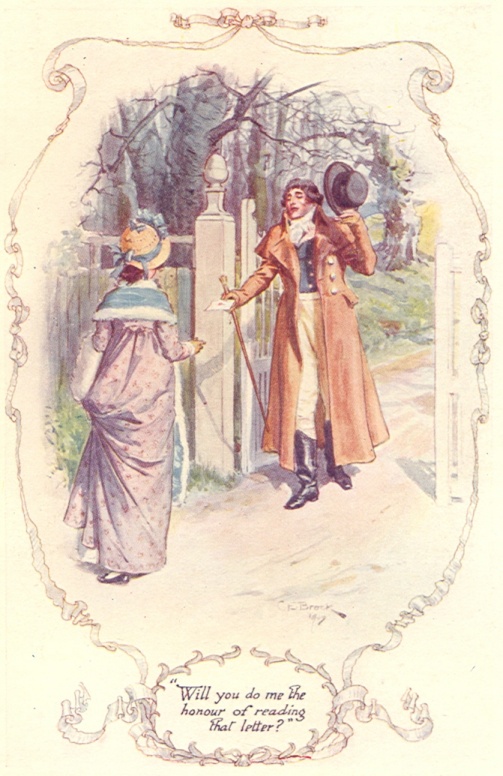
C. E. Brock – ‘Pride and Prejudice’ – Dent 1907 – Mollands
The first volume will be available near the end of April; price is $35. / volume, the complete set with slipcase, $105. You can order either by volume as they become available or wait for the complete set in August, but with only 15 sets available, you best get your order in soon! [There was a second edition of Emma, and there are copies still available.]
Other titles that Tony has published in this miniature format: [see his website for more information on each]
Priestley: Experiments and Observations of Different Kinds of Air
In the United States, a miniature book is usually considered to be one which is no more than three inches in height, width, or thickness. Some aficionados collect slightly larger books while others specialize in even smaller sizes. Outside of the United States, books up to four inches are often considered miniature.
Enquiring Readers: Ron Dunning has previously posted here at Jane Austen in Vermont about his invaluable Jane Austen genealogy website. As he continues to research the connections, he is discovering amazing coincidences and some very familiar names. Today he gives some insight into a marriage that took place between a Darcy and a de Burgh in 1329 and speculates on whether Jane Austen could possibly have known about this…
***************
What Jane Might Well Have Known, and What She Couldn’t Possibly Have Known, About Her Ancestors
I’m against making any assumption based on slim evidence, but I’m about to make two; first of all, concerning a great coincidence about which Jane can’t have known anything. In 1329 a marriage took place between John Darcy, 1st Lord Darcy of Knaith, and Joan de Burgh. (The spelling doesn’t matter – even up to the 18th century spellings hadn’t been fully standardised.) Joan’s father Richard de Burgh, 2nd Earl of Ulster, was a direct ancestor of Mrs Austen through her brother John.
Last summer when my Akin to Jane [ www.janeaustensfamily.co.uk ] website was launched one or two people, with admirable perseverance, trawled through my separate family tree [ http://wc.rootsweb.ancestry.com/~janeausten ] and on discovering this marriage, insisted that Jane must have known. I was never in any doubt that she couldn’t possibly have known. This was also the opinion of the only other person who has studied the Austen pedigree extensively, Anielka Briggs.
Dugdale Baronage – Skinnerinc.com
While Baronetages were readily available in the late 1700s, the dignity having been created only in 1611, there were very few studies of the Peerage and all of those were very primitive. William Dugdale’s Baronage of England of 1675 covered only England. (Remember that Joan’s father John de Burgh was the Earl of Ulster; the marriage in question is said to have taken place in County Kildare.)
The Rev. Barlow’s Complete English Peeragewas printed in 1772, so might just have been in George Austen’s library, but again deals just with English peerages. Another possibility, Arthur Collins’s Peerage series*, was first published in 1709, with reprints every few years and frequent new editions. Even he appears not to have included Irish peerages, and in the eight editions that I was able to search, not a single de Burgh featured in the indexes.
Barlow Peerage – Open Library
A further obstacle in the way of Jane’s knowing (or for that matter anyone at the time) is that there was no direct male descent from the de Burghs to the Austens – the surname soon disappeared from Jane’s pedigree, through a series of female links. Traditional pedigrees concentrate on the direct male line.
However, John Darcy did himself play a role in the Austen pedigree – he was a many-greats-grandfather of Charles Austen’s wives, the sisters Frances and Harriet Palmer. John and his first wife, Emmeline Heron, were the ancestors of four generations of male Darcys; Elizabeth Darcy, in the fifth generation, married James Strangeways; and that surname continued down to the Palmer girls’ paternal grandmother, Dorothy Strangeways. In Charles’s children, the Darcy and the de Burgh lines were finally united.
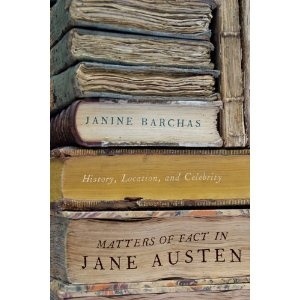
My second assumption concerns what Jane might well have known. Janine Barchas, in her Matters of Fact in Jane Austen, speculates that she, in choosing the names of Darcy, Wentworth, Woodhouse, FitzWilliam, Tilney, etc., was alluding “to actual high-profile politicians and contemporary celebrities as well as to famous historical figures and landed estates.” In the words of Juliet McMaster in the blurb, she was “a confirmed name dropper who subtly manipulates the celebrity culture of her day.” On page 118 Janine Barchas wrote, “Cassandra Willoughby (…) the supposed ancestor of Mrs Austen.” Yes – she’s almost got it. Cassandra was Mrs Austen’s 1st cousin, twice removed.
I think that Jane may well have known about the family relationship and its relevance. Cassandra’s mother Emma (Willoughby and then Child, née Barnard) was Cassandra Leigh’s great-great-aunt; it was Emma’s sister Elizabeth (Brydges, née Barnard) who was her great-grandmother. Elizabeth was also the mother of James Bridges, the Duke of Chandos, who married Cassandra Willoughby – the two were cousins. Emma’s first husband was the noted naturalist, Francis Willoughby; after his death she remarried, to Sir Josiah Child – supreme governor of the East India Company, an early monetarist, and a rapaciously wealthy financier to 17th century royalty. Emma and Sir Josiah’s son Richard Child became the Earl Tylney of Castlemaine, and one of his great-granddaughters was Catherine Tylney-Long.
Barchas speculates that Jane, in naming her Catherine Tilney, had this other Catherine in mind. This lady had inherited a vast estate and fortune in 1794 at the age of 5, and at 18 was reputedly the richest commoner in England. Catherine Tylney was Jane Austen’s 4th cousin. Very few of us have any idea about our fourth cousins, but based on the following circumstantial evidence, I suspect that Jane did know that they were distantly related.
Catherine Tylney-Long – Wanstead HouseWanstead House
There is a strong tradition in the Warwickshire village of Middleton, the seat of Francis Willoughby, that Jane visited there on the trip to Staffordshire in 1806 with her mother and sister. Middleton certainly lies in a direct line, as the crow flies, from their stop at Stoneleigh to Hamstall Ridware, where her cousin was the Rector. If they did visit, it may have been because Mrs Austen knew of the family relationship – she was certainly considered to have been proud of her aristocratic ancestors. The Austens preserved a letter written by Elizabeth Brydges in the 1680s from Constantinople, giving advice to her daughter who had been left behind; I think it likely that she’d have known about Elizabeth’s sister Emma’s illustrious marriages, and have told her daughters.
*********************
Thank you Ron! for all this information [my head is spinning!] – I do wonder what Lady C might say to all this – would she be concerned about the “Shades of Pemberly [being] thus polluted” by any of these illustrious ancestors?
If you have questions for Ron, please comment below.
Just again to prove once again that all roads lead back to Jane Austen, it is interesting here to note that Egerton Brydges edited this 1812 edition of the Collins Peerage – this is Jane Austen’s very own Mr. Brydges, brother to her friend Madame Lefroy. Austen makes much of his novel Arthur Fitz-Albini (1798) in her letter of 25 November 1798:
We have got Fitz-Albini; my father has brought it against my private wishes, for it does not quite satisfy my feelings that we should purchase the only one of Egerton’s works of which his family are ashamed. That these scruples, however do not at all interfere with my reading it, you will easily believe. We have neither of us yet finished the first volume. My father is disappointed – I am not, for I expected nothing better. Never did any book carry more internal evidence of its author. Every sentiment is completely Egerton’s. There is very little story, and what there is [is] told in a strange unconnected way. There are many characters introduced, apparently merely to be delineated. We have not been able to recognize any of them hitherto except Dr and Mrs Hey and Mr. Oxenden, who is not very tenderly treated…. [Letters, No. 12]
“I do not write for such dull elves As have not a great deal of ingenuity themselves.”
– Letters, No. 79
Jane Austen wrote the above to her sister Cassandra on January 29, 1813, the day after Pride and Prejudice is published:
There are a few Typical errors – & a “said he” or a “said she” would sometimes make the Dialogue more immediately clear – but “I do not write for such dull elves As have not a great deal of ingenuity themselves.” [the notes remark that this is from Scott’s Marmion: “I do not rhyme to that dull elf / Who cannot image to himself…”]
She could have as soon written “stupid” for her dull elves, as she does in another place in this letter:
The Advertisement is in out paper to day for the first time; – 18s – He shall ask £1-1 for my two next, & £1-8 for my stupidest of all.
I think Jane Austen liked the word “stupid” – it appears in all her writings: the juvenilia, the novels, the letters – and she uses it to great effect. But I would argue that today the word has a more negative connotation, especially when used to describe a person, as in “he is a really stupid man” vs. “this is a stupid movie.” I have been re-reading Pride and Prejudice very SLOWLY and as always, even on this umpteenth read, I find things that amaze – and this time I find myself dwelling on Austen’s “stupids.”
Rowlandson -VADS online
Many of us can call quickly to mind a few of her more famous lines: You can comment below in the “comments” section with: Which book / who said it / to or about whom:
1. “Not that ______ was always stupid — by no means; she learnt the fable of ‘The Hare and Many Friends’ as quickly as any girl in England.”
2. “The person, be it gentleman or lady, who has not pleasure in a good novel, must be intolerably stupid.”
3. “She is a stupid girl, & has nothing to recommend her.”
4. “She had never seen _______ so silent and stupid.”
5. “_____ is as stupid as the weather.”
6. “I feel quite stupid. It must be sitting up so late last night. _____, you must do something to keep me awake. I cannot work. Fetch the cards; I feel so very stupid. ”
7. “If this man had not twelve thousand a year, he would be a very stupid fellow.”
8. “…that he had been sent to sea, because he was stupid and unmanageable…”
********************
And these are only a small sample of Austen’s ‘stupids’ – there are a number more in each novel – it has been interesting to see how and why she uses this term, more freely thrown about in her letters: – just these few here by way of example:
-“We met not a creature at Mrs. Lillingstone’s, & yet were not so very stupid, as I expected, which I attribute to my wearing my new bonnet & being in good looks” [Ltr. 36],
-“And now, that is such a sad, stupid attempt at Wit, about Matter, that nobody can smile at it, & I am quite out of heart. I am sick of myself, & my bad pens.” [Ltr. 53], and
-“I expect a very stupid Ball, there will be nobody worth dancing with, & nobody worth talking to but Catherine; for I believe Mrs. Lefroy will not be there…”[Ltr. 14]
***************
But today I will focus only on Pride and Prejudice, continuing my closer look at the novel throughout this bicentenary year.
We begin by going back to the source, the OED to see how it has been used and its meanings as Jane Austen would have seen it used: [Oxford English Dictionary: www.OED.com ]
Wits Magazine – illus G. Cruikshank – Project Gutenberg
Adj.
1. a.Having one’s faculties deadened or dulled; in a state of stupor, stupefied, stunned; esp. hyperbolically, stunned with surprise, grief, etc. Obs. exc. arch. (poet.). As in Shakespeare’s Winter’s Tale (1623): Is not your Father growne incapeable Of reasonable affayres? Is he not stupid With Age, and altring Rheumes? Can he speake? heare? Know man, from man?
1. b. Belonging to or characterized by stupor or insensibility. Obs. As in Keats Endymion (1818): “My sweet dream Fell into nothing—into stupid sleep.”
1. c. Of a part of the body: Paralysed. Obs.
1. d. Emotionally or morally dull or insensible; apathetic, indifferent. Const. to [compare French stupide à] – As in Steele in the Guardian (1713): “It was a Cause of great Sorrow and Melancholy to me…to see a Crowd in the Habits of the Gentry of England stupid to the noblest Sentiments we have.”
2. As the characteristic of inanimate things: Destitute of sensation, consciousness, thought, or feeling. Obs. As in 1722 W. Wollaston Religion of Nature (1722) – “Matter is incapable of acting, passive only, and stupid.”
3. a. Wanting in or slow of mental perception; lacking ordinary activity of mind; slow-witted, dull. As in J. Addison Spectator (1712) “A Man, who cannot write with Wit on a proper Subject, is dull and stupid.” And Frances Burney in Evelina (1778): “‘Why is Miss Anville so grave?’ ‘Not grave, my Lord,’ said I, ‘only stupid.’”
3. b. Of attributes, actions, ideas, etc.: Characterized by or indicating stupidity or dullness of comprehension. As in J. Jortin Sermons (1771): “Great reason have we to be thankful that we are not educated in such stupid and inhuman principles.”
3. c. Of the lower animals: Irrational. Also of an individual animal, its propensities, etc.: Lacking intelligence or animation, senseless, dull. Obs. As in Goldsmith History of the Earthand Animated Nature (1774): “[The badger] is a solitary stupid animal.”
4. Void of interest, tiresome, boring, dull. As in: Burney, Evelina (1778): “Of all the stupid places ever I see, that Howard Grove is the worst! there’s never no getting nothing one wants.”
5. Obstinate, stubborn. (north. dial.)
B. noun. A stupid person. Colloq. As in Steele Spectator (1712): “Thou art no longer to drudge in raising the Mirth of Stupids…for thy Maintenance.”
******
If we look at the stupids of Pride and Prejudice, we see all of these definitions in their great variety, but the emphasis is on being tiresome, boring as in number 4 above:
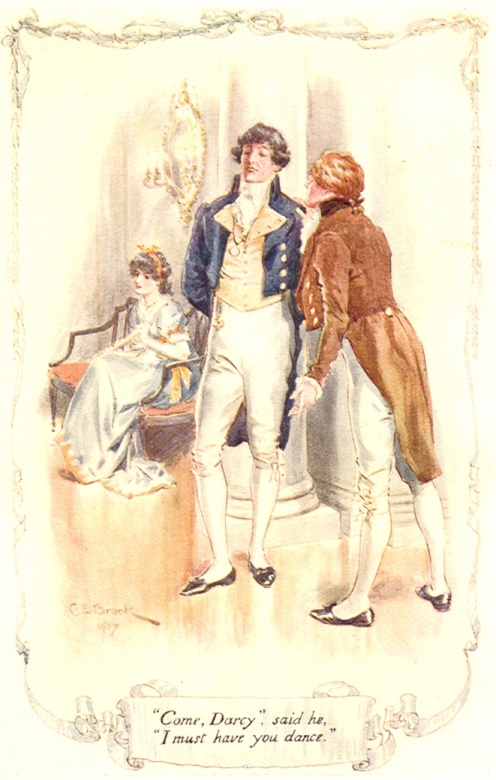
CE Brock – Mollands.net
1. “Come, Darcy,” said he, “I must have you dance. I hate to see you standing about by yourself in this stupid manner. You had much better dance.” [vol. I, ch. III]
2. She had been watching him the last hour, she said, as he walked up and down the street, and had Mr. Wickham appeared, Kitty and Lydia would certainly have continued the occupation, but unluckily no one passed the window now except a few of the officers, who, in comparison with the stranger, were become ‘stupid, disagreeable fellows.’ [vol. I, ch. XV]
3. “ Oh! if that is all, I have a very poor opinion of young men who live in Derbyshire; and their intimate friends who live in Hertfordshire are not much better. I am sick of them all. Thank Heaven! I am going to-morrow where I shall find a man who has not one agreeable quality, who has neither manner nor sense to recommend him. Stupid men are the only ones worth knowing, after all.” [vol. II, ch. IV]
from Georgian Index
4. When the gentlemen had joined them, and tea was over, the card-tables were placed. Lady Catherine, Sir William, and Mr. and Mrs. Collins sat down to quadrille; and as Miss De Bourgh chose to play at cassino, the two girls had the honour of assisting Mrs. Jenkinson to make up her party. Their table was superlatively stupid. Scarcely a syllable was uttered that did not relate to the game, except when Mrs. Jenkinson expressed her fears of Miss De Bourgh’s being too hot or too cold .… [vol. II, ch. VI]
5. “Well, he certainly is very agreeable, and I give you leave to like him. You have liked many a stupider person.” [vol. I, ch. IV]
CE Brock – Mollands.net
6. The stupidity with which he was favoured by nature must guard his courtship from any charm that could make a woman wish for its continuance [vol. I, ch. XXII]
7. But why Mr. Darcy came so often to the Parsonage it was more difficult to understand. It could not be for society, as he frequently sat there ten minutes together without opening his lips; and when he did speak, it seemed the effect of necessity rather than of choice — a sacrifice to propriety, not a pleasure to himself. He seldom appeared really animated. Mrs. Collins knew not what to make of him. Colonel Fitzwilliam’s occasionally laughing at his stupidity proved that he was generally different, which her own knowledge of him could not have told her… [vol. II, ch. IX]
8. Wickham will soon be gone; and therefore it will not signify to anybody here what he really is. Some time hence it will be all found out, and then we may laugh at their stupidity in not knowing it before. At present I will say nothing about it.” [vol. II, ch. XVII]
9. Elizabeth was distressed. She felt that she had no business at Pemberley, and was obliged to assume a disinclination for seeing it. She must own that she was tired of great houses; after going over so many, she really had no pleasure in fine carpets or satin curtains. … Mrs. Gardiner abused her stupidity. “If it were merely a fine house richly furnished,” said she, “I should not care about it myself; but the grounds are delightful. They have some of the finest woods in the country.” [vol. II, ch. XIX]
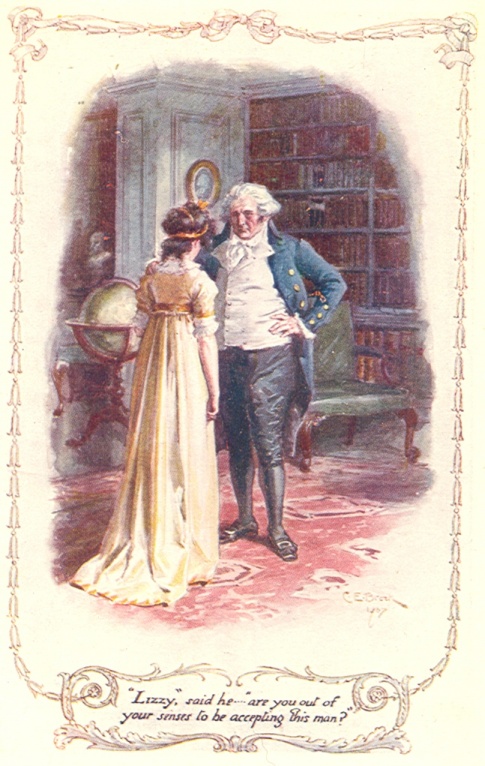
And finally when Mr. Bennet asks Lizzy: “Lizzy,” said he, “what are you doing? Are you out of your senses, to be accepting this man?” – he could as well have called her stupid… [vol. III, ch. XVII]
Note your answers to the eight non Pride and Prejudice quotes at the beginning of this post in the comment area below: how did you do? we shall have no dull elves around here…
“La! You are so strange! But I must tell you how it went off. We were married, you know, at St. Clement’s, because Wickham’s lodgings were in that parish. And it was settled that we should all be there by eleven o’clock. My uncle and aunt and I were to go together; and the others were to meet us at the church. Well, Monday morning came, and I was in such a fuss! I was so afraid, you know, that something would happen to put it off, and then I should have gone quite distracted. And there was my aunt, all the time I was dressing, preaching and talking away just as if she was reading a sermon. However, I did not hear above one word in ten, for I was thinking, you may suppose, of my dear Wickham. I longed to know whether he would be married in his blue coat.
“Well, and so we breakfasted at ten as usual; I thought it would never be over; for, by the bye, you are to understand, that my uncle and aunt were horrid unpleasant all the time I was with them. If you’ll believe me, I did not once put my foot out of doors, though I was there a fortnight. Not one party, or scheme, or any thing. To be sure London was rather thin, but, however, the Little Theatre was open. Well, and so just as the carriage came to the door, my uncle was called away upon business to that horrid man Mr. Stone. And then, you know, when once they get together, there is no end of it. Well, I was so frightened I did not know what to do, for my uncle was to give me away; and if we were beyond the hour, we could not be married all day. But, luckily, he came back again in ten minutes time, and then we all set out. However, I recollected afterwards that if he had been prevented going, the wedding need not be put off, for Mr. Darcy might have done as well.”
“Mr. Darcy!” repeated Elizabeth, in utter amazement.
Pride and Prejudice, v. III, ch. IX
St Clement Danes – Strand (London Views)
Jane Austen often gives clues to the whereabouts of her locations, especially in her London passages – we know she knew London well and placed her characters in just the right spot to tell her readers who they were by where they lived. We famously have a few “____shire”s scattered about regarding the militia, for an element of secrecy one might assume? But in Pride and Prejudice there are two locations that she specifies that bring only confusion, and both involve Wickham and Lydia: St. Clement, where they were married, and Edward Street, home to Mrs. Younge, Georgiana’s former governess and friend and devious helper to Wickham. Today I will deal with the former…
When Lydia remarks that “We were married, you know, at St. Clement’s, because Wickham’s lodgings were in that parish.” – she gives a clue that perhaps contemporary readers would not have found confusing, but we are left with not being completely sure which St. Clements she is referring to: St Clement Danes in the Strand, or St. Clement Eastcheap. Neither is mentioned in her extant letters.
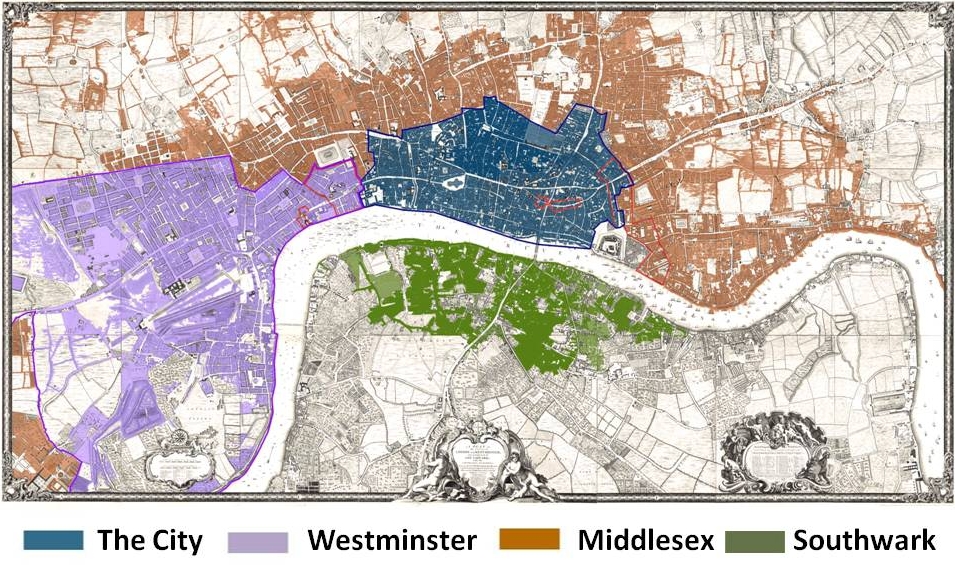
Pat Rogers notes in her 2006 Cambridge edition of Pride and Prejudice that the fairly large parish of St. Clement Danes had a population of 12,000 in 1801 and “contained areas of cheap lodgings and some raffish districts, notably a part of Drury Lane” (531-32). Most who have written on this would agree (see Kaplan and Fullerton cites below), largely because the other St. Clement (Eastcheap), on St. Clement’s Lane between Lombard Street and Great Eastcheap, would have been too close to the Gardiner’s who lived on Gracechurch Street [see maps for location of both churches]. Wickham would not have placed himself in such a smaller parish, with a population of 350 in 1801 (Rogers, 531), and so close to those who might find him out. Another reason that Rogers selects this as the best option is that in order to marry in this parish, one of the parties had to have residence there for fifteen days (Rogers, 532). Laurie Kaplan adds that “the length of time required for residency functions perfectly for the elopement plot of the novel, for tension increases the longer Lydia and Wickham remain unmarried” (Kaplan, 7). But we know Wickham had no mind to marry Lydia … .another story entirely… (the text is very clear on this: Mrs. Gardiner relates to Elizabeth: “…it only remained, he [Darcy] thought, to secure and expedite a marriage, which in his very first conversation with Wickham, he easily learnt, had never been his design.” (357).
But perhaps in the end, we should just abide by Susannah Fullerton, where in her Celebrating Pride and Prejudice, she blames Lydia for the whole confusing mess: “How typical of Lydia to be inexact in her information!” (p. 94-95)
Horwood Map panel 14. [RICHARD HORWOOD – MAP OF LONDON, WESTMINSTER AND SOUTHWARK, 1813] St Clement Danes is located at the heart of London, placed on an island in the middle of the Strand,
opposite the Royal Courts of Justice, the Temple and Fleet Street – on the map above circled in purple.
(Click on map and zoom in; map courtesy of Sue Forgue at Regency Encyclopedia, from the Guildhall Library, London)
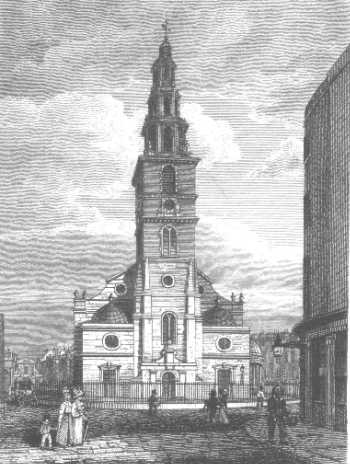
St. Clement Danes: The first church on the site was founded by Danes in the 9th century, and named after St. Clement, patron saint of mariners. It has been rebuilt by William the Conqueror, later again in the Middle Ages, and rebuilt yet again in 1680-82 by Christopher Wren, a steeple added in 1719-20. It was gutted during the blitz, only the walls and tower left standing, and since reconstruction has served as the central church for the Royal Air Force.
An early street view of the Strand and St Clement Danes Church, 1753. On the right is the original entrance to the building.
cTrustees of the British Museum; image from Christina Parolin, Radical Spaces (ANU, 2010).
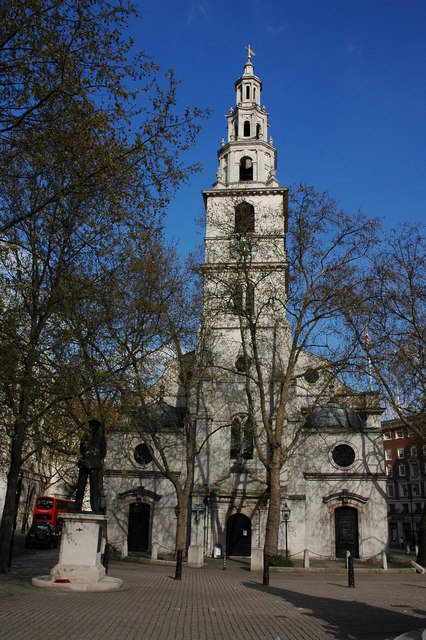
St Clement Danes today: when in London in May 2011 I visited the Church for the first time, finding it a quite lovely and peacful setting on its little island in the midst of bustling London – here are a few shots, alas! not that well focused and no exterior shots of the facade, so I include one from Geograph.org.uk, with thanks.
St Clement DanesSt Clement Danes, interiorSt Clement Danes ceilingflag in St Clement Danes
St Clement Danes exterior – cPhilip Halling, Geograph.org.uk
[A movie aside: You will notice that there are no entrance steps, as there are no steps for St Clements Eastcheap – if you recall from the 1995 movie, Lydia is running up the steps to the church, so neither of these sites were used in the movie [and I find no picture of this scene – if anyone knows where that exterior shot was filmed, please let me know!]
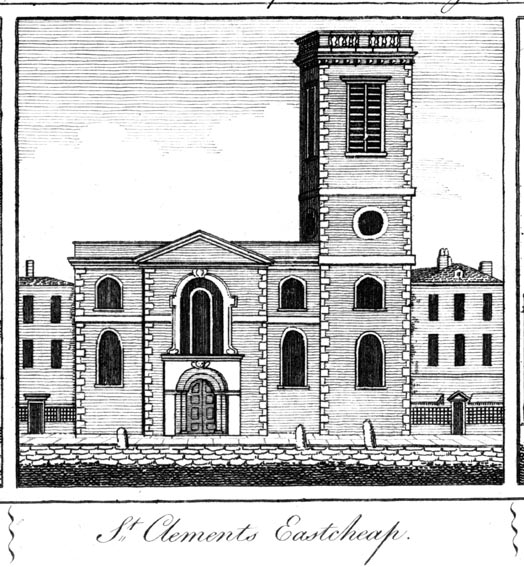
Facade St Clement Eastcheap
c.1760, from Walter Harrison’s History of London (1777) – wikipedia
******************
St. Clement Eastcheap: located on St. Clement’s Lane between Lombard Street and Great Eastcheap [today on Clement’s Lane, off King William Street] and close to London Bridge and the River Thames – see here on the Horwood panel 15:
Horwood Map panel 15. [RICHARD HORWOOD – MAP OF LONDON, WESTMINSTER AND SOUTHWARK, 1813]
The purple marks Gracechurch Street, home ot the Gardiners, and ends at the botton at Great Eastcheap,
go one block to the left to find St. Clement’s Lane, the Church is on the right.
(Click on map and zoom in; map courtesy of Sue Forgue at Regency Encyclopedia, from the Guildhall Library, London)
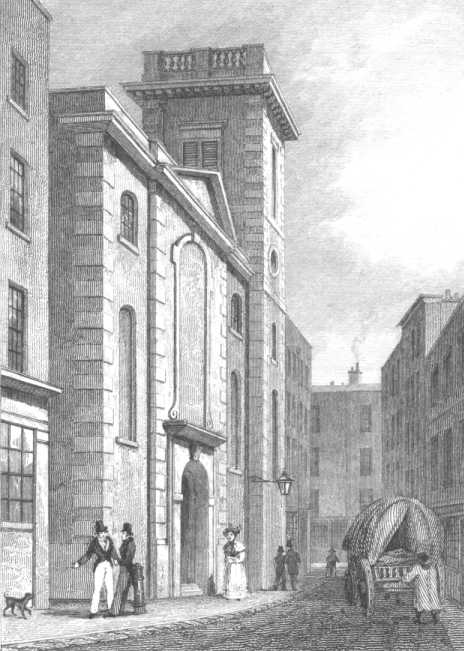
Though we are quite sure that this is not where Austen had Lydia and Wickham marrying, it is still worth noting – perhaps we are wrong in our assumptions after all, and Wickham was just “hiding in plain sight”? This St. Clement has possible Roman origins; it was destroyed in 1666 in the Great Fire of London, and rebuilt in the 1680s and also designed by Wren. And one should note that “cheap” is an old Saxon word meaning “market” and does not mean “cheap” as we associate it today. Here are a few images:
St Clement Eastcheap – London ViewsSt Clement Eastcheap today – wikipedia
The St Clement argument does not just revolve around Jane Austen [and indeed may she just been throwing out a very sly reference to her sailor brothers? – just a thought, St. Clement being the patron saint of sailors] … The Churches apparently have a long-standing “quibble” over which is the St. Clement referred to in the nursery rhyme “Oranges and Lemons” – here is the full rhyme: [the long version from wikipedia: http://en.wikipedia.org/wiki/Oranges_and_Lemons ]. It is the bells of St. Clement Danes that ring out the tune of the rhyme three times a day.
“Oranges And Lemons”, Nicholl Bouvier Games 1874, “The Pictorial World” by Agnes Rose Bouvier (1842 – 1892) – wikipedia
Gay go up and gay go down, To ring the bells of London town.
Oranges and lemons, Say the bells of St. Clements.
Bull’s eyes and targets, Say the bells of St. Margret’s.
Brickbats and tiles, Say the bells of St. Giles’.
Halfpence and farthings, Say the bells of St. Martin’s.
Pancakes and fritters, Say the bells of St. Peter’s.
Two sticks and an apple, Say the bells of Whitechapel.
Pokers and tongs, Say the bells of St. John’s.
Kettles and pans, Say the bells of St. Ann’s.
Old Father Baldpate, Say the slow bells of Aldgate.
You owe me ten shillings, Say the bells of St. Helen’s.
When will you pay me? Say the bells of Old Bailey.
And finally, to bring this back to Jane Austen, where all begins and ends after all, there is behind the St Clement Danes church a statue, by Percy Hetherington Fitzgerald and erected in 1910, of all people, Jane Austen’s very own Dear Dr. Johnson. I think she would be pleased, don’t you?
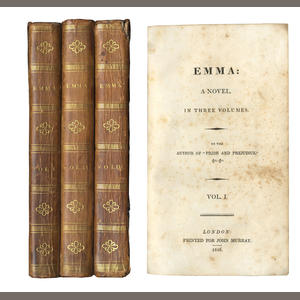
Emma, 3 vol., FIRST EDITION, half-titles in volumes 2 and 3, spotting, one gathering working loose and blank lower margin torn away from advertisement leaf at end of volume 3, one front free endpaper near detached, bookplate of “John Hawkshaw, Esq., Hollycombe”, contemporary half calf, gilt lettering on spines, headbands frayed (volume 2 with small loss at head and foot of backstrip) [Gilson A8; Keynes 8], 8vo, John Murray, 1816.
Now this appears to be the same copy that did not sell at the Bonham’s November 13, 2012 auction where the estimates were substantially higher:
£6,000 – 8,000; €7,400 – 9,900; US$ 9,500 – 13,000
********************
My interest lies in the bookplate of “John Hawkshaw, Esq., Hollycombe” – always curious to see where a book has been and where it heads, and who are the participants in the story; it is often hard to track this information accurately unless a written provenance accompanies the book. In this case it appears that all we have is this bookplate, and my research takes me thus, a very quick summary: [i.e how a whole afternoon can be spent tracing some stranger’s life and how it all can lead one down unimagined paths with only more extensive research to be undertaken …]
John Hawkshaw – wikipedia
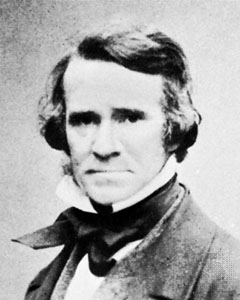
John Hawkshaw (1811 – 1891) was a British civil engineer from Yorkshire who was the chief engineer of a number of the railway lines in the Manchester area, later London, as well as responsible (some say the “saviour”) for the completion of the Suez Canal. He was knighted in 1873. He lived at Hollycombe, his country estate in Liphook, Hampshire, purchased from Charles William Taylor in 1866. (To add to the confusion, the book titled A History of the Castles, Mansions, and Manors of Western Sussex, by Dudley George Cary Elwes, and Charles John Robinson (London, 1876), notes two other properties purchased by Hawkshaw from Taylor, so more research needed here.]
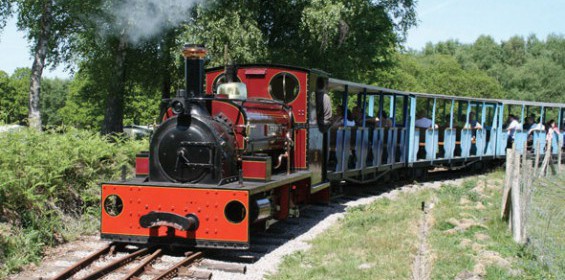
Hollycombe today is privately owned, but the pleasure gardens, expanded by Hawkshaw and more fully landscaped by his son [more on him below] are open to visitors, as is the nearby Hollycombe Steam Museum.
Hollycombe Steam Museum
Their London home was in Belgrave Mansions, St. John’s Wood High Street, close to Bond Street in the heart of the West End.
But did John Hawkshaw read his copy Jane Austen’s Emma, or was his bookplate just really an owner stamp, and the real reader in the house was his wife Ann Hawkshaw? (though it is nice to imagine them all reading it aloud.)
a modern reprint
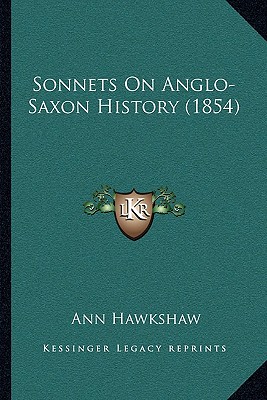
Ann Hawkshaw (1812 – 1885) was an English poet. She published four volumes of poetry between 1842 and 1871. She married our John Hawkshaw in 1835 and they settled in Salford, near Manchester, where they mixed with the prominent thinkers of the day to include William and Elizabeth Gaskell. Her first volume of poetry ‘Dionysius the Areopagite’ with Other Poems was published in 1842, followed byPoems for My Children in 1847. Sonnets on Anglo-Saxon History was published in 1854, and retells the history of Britain up to the Norman Conquest.
John Clarke Hawkshaw
The Hawkshaws had six children, the most well-known was John Clarke Hawkshaw (1841-1921), who like his father was a civil engineer. In 1865 he married Cicely Wedgwood (1837-1917), daughter of Francis Wedgwood (1800-1880), grandson of Josiah Wedgwood, founder of the famed pottery firm. Francis’s sister Emma Wedgwood (1808-1896) married her cousin Charles Darwin (they were first cousins: Wedgwood’s daughter Susannah was Darwin’s mother). Emma was therefore Cicely’s Aunt and we can find this letter penned to her in the online Darwin Correspondence Project:
Hollycombe. | Liphook. | Hants.
Dear Aunt Emma
I am afraid it is too late to notice about the baby’s tears with any accuracy for I have repeatedly seen her eyes full of tears already but can give no nearer date than that I must have seen them so before she was 3 weeks old; about the tears overflowing onto her cheeks I can observe as I have never seen it happen yet, indeed it hardly happens in what one may call babydom does it?
We are having such a nice holiday here and as all the tiresome shooting is over I have Clarke to myself and we ride and walk about and don’t feel such strangers to the place as we did and the idle thoughtless life is doing Clarke good I am thankful to say.
Believe me dear Aunt Emma | Your affecte niece | Cicely M Hawkshaw
9th Feb. [1868]
Emma Darwin, 1840 – by George Richmond
****************
So from this letter we know that John Clarke Hawkshaw was known as Clarke and that he was able to get away to the family home and enjoy some “idle thoughtless life”! [images of Downton Abbey!]
Such a dizzying trip from a simple bookplate in a first edition of Jane Austen! – we have encountered various British luminaries ranging from railroad and canal engineers, to literary and Unitarian connections in Manchester, to country estates in Hampshire [Jane’s own territory], to the Wedgwood Potteries of London, and ending with Evolution, all in one family’s connections. It is comforting to think that this copy of Emma was read, enjoyed and discussed, and passed along to succeeding generations of this great family! I wonder where it will end up come March 19th? … stay tuned!
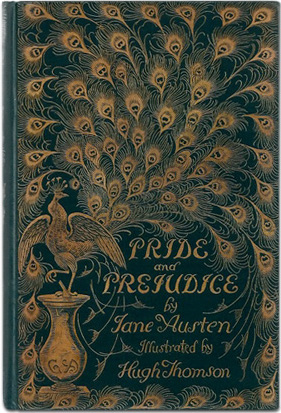
Let’s just be honest about our superficiality. Even when it comes to the high-minded business of literature, people do judge books by their covers. Perhaps that’s why Amazon produces glossy mock “covers” for its disembodied e-books, to be inspected and decided upon alongside the traditional print offerings.
Book covers may be especially important when it comes to the classics. After all, many of us have a general sense of, if not a thorough familiarity with, the contents within. Perhaps more than anything else, these covers show what matters to prospective buyers. Two centuries of Jane Austen’s “Pride and Prejudice” are particularly revealing about the novel’s broad and sustained popular reach….
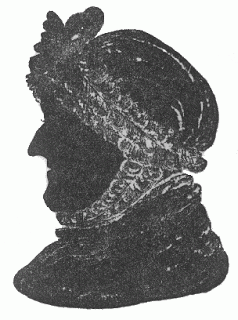
Richard III, by an unknown artist – National Portrait Gallery
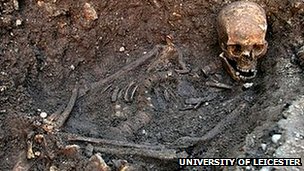
Richard III has been getting much-needed attention these past few days – his Bones, it seems, have been languishing beneath a parking lot …
About 22 years ago on a trip to Scotland with the Appalachian Mountain Club, we stayed in Beauly not far from Inverness in a Castle called Aigas (now the Aigas Field Centre), hosted by Sir John Lister-Kaye and his Lady Lucy. We spent our days studying the flora, fauna, and geology of the surrounding area, a glorious adventure, as you can imagine – but one of the most memorable parts of the trip was meeting another guest staying at the Castle – he was not part of our group, but came there every year to go birding, an elderly gentleman blessed with a brilliant mind and great charm – his one great obsession other than birds was Richard III, and from him I learned about the Richard III Society. He went off into spasms of ecstasy telling of his also annual treks to Bosworth where he could hear the “swish, swish” of the swords on the field where Richard was slain in 1485.
Illustration depicting the Battle of Bosworth Field, with King Richard III on the white horse.
Credit: The Print Collector/Heritage-Images – from Britannica.com
******************
The earliest surviving portrait of Richard III – from the RIII Society website
I came home with my own obsession with the long-dead Richard – read everything I could find on him, beginning with Josephine Tey’s The Daughter of Time, her tribute to Richard [she was a staunch member of the Society] and the clear statement of her belief in his innocence. Shakespeare had done the young King a dirty deed it seems, maligned forever in History as the murderer of the Princes in the Tower and various other souls including his Wife, and perpetrator of all manner of other nefarious politically-induced deeds…
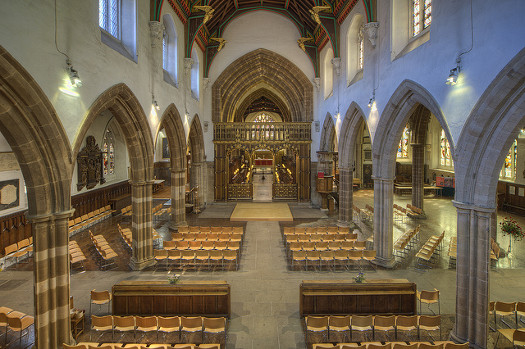
I confess to having forgotten more than I ever actually knew about RIII, and now other than Shakespeare and Tey, he has largely fallen off my radar, or at least I no longer need to get into discussions with everyone I meet in a rabid defense of his innocence… but I am excited about his Bones being found and restored to a rightful burial place at Leicester Cathedral; this discovery shall certainly bring on a re-assessment of who he might really have been…
Leicester Cathedral – RutlandChurches.co.uk
Which brings us to Jane Austen:
Austen, as avid readers know, had an aversion to the name of “Richard”: let’s recall her first paragraph in Northanger Abbey, where she denigrates Catherine’s father so:
Her father was a clergyman, without being neglected, or poor, and a very respectable man, though his name was Richard …
And later in a 1796 letter to her sister, she remarks on Mr. Richard Harvey’s match being put off, “till he has got a better Christian name, of which he has great Hopes.” [Letters, p. 10]
And famously in Persuasion, and one of the nastiest comments in all her novels, on poor Dick Musgrove:
The real circumstances of this pathetic piece of family history were, that the Musgroves had had the ill fortune of a very troublesome, hopeless son, and the good fortune to lose him before he reached his twentieth year; that he had been sent to sea, because he was stupid and unmanageable on shore; that he had been very little cared for at any time by his family, though quite as much as he deserved; seldom heard of, and scarcely at all regretted, when the intelligence of his death abroad had worked its way to Uppercross, two years before.
He had, in fact, though his sisters were now doing all they could for him, by calling him “poor Richard,” been nothing better than a thick-headed, unfeeling, unprofitable Dick Musgrove, who had never done any thing to entitle himself to more than the abbreviation of his name, living or dead. [Persuasion v. I, ch. VI]
Ouch!
No one has ever satisfactorily explained this aversion of Austen’s to the name ‘Richard’ – one could certainly explain it as her disliking Richard III with such a passion that anyone named Richard should suffer her admonition; but here is what she says about Richard in her History of England, with such a contradictory tone, one does not quite know what she really thought [forever the illusive Jane] – but on the whole I think she believes him to be mistreated by History – perhaps she would have been a reigning member of the Richard III Society!
Cassandra’s portrait of Richard III
Richard the 3d
The Character of this Prince has been in general very severely treated by Historians, but as he was a York, I am rather inclined to suppose him a very respectable Man. It has indeed been confidently asserted that he killed his two Nephews & his Wife, but it has also been declared that he did not kill his two Nephews, which I am inclined to beleive true; & if this is the case, it may also be affirmed that he did not kill his Wife, for if Perkin Warbeck was really the Duke of York, why might not Lambert Simnel be the Widow of Richard. Whether innocent or guilty, he did not reign long in peace, for Henry Tudor E. of Richmond as great a villain as ever lived, made a great fuss about getting the Crown & having killed the King at the battle of Bosworth, he succeeded to it.
So what do you think? Should Richard III be exonerated of his dastardly deeds? Should we do as Jane did and be “rather inclined to suppose him a very respectable Man”? I will just say that may Richard at least from henceforth Rest in Peace…
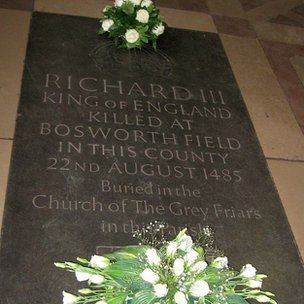
[Richard III Memorial in Leicester Cathedral]
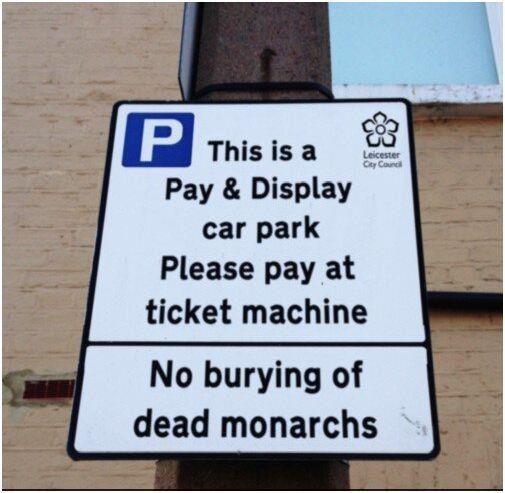
And I must add this final image sent just this morning from a friend – only the English can get away with this sort of thing, but I laughed ‘til tears came… somehow I think Jane Austen would be laughing too…
A big thank you to Julie at Austenonly for blogging about this. And do visit the link to Harrington’s other Austen materials – a treasure-trove for the Austen-collector…
























 Jane Austen in Vermont