Austen Literary History & Criticism · Jane Austen · News

On the Block! ~ An Imaginary Jane Austen

Up for auction on March 29, 2011 – Papers and Portraits, Bonham’s London, an imaginary portrait of Jane Austen.  

From the catalogue:

Lot No: 6 – A Portrait of Jane Austen BY AN UNKNOWN ARTIST, half-length, wash and pencil, highlighted with chalk, on vellum, inscribed on the verso in a small contemporary hand ‘Miss Jane Austin’ (sic) and with the location or inventory number ‘A76’, contemporary gilt frame with attached identification label ‘Jane Austen B. 1775 – D. 1817’, chalk numbers on verso of frame ‘166 8234’ and inscribed on the old backing board in an early nineteenth-century hand ‘Price £3-3s 0d Frame £0 5s 0d.’ and with chalk mark ‘A68’, size of image 5¾ x c. 4½ inches (14. 5 x c. 12 cm), overall size 11¾ x 10½ inches (30 x 27 cm), no date [but ?1818]

Estimate: £1,000 – 2,000, € 1,200 – 2,400

Footnote: THIS IS THE EARLIEST OF THE SO-CALLED ‘IMAGINARY’ PORTRAITS OF JANE AUSTEN, thus listed by Deirdre Le Faye in her article ‘Imaginary Portraits of Jane Austen’ in Jane Austen Society Report, 2007, pp. 42-52 (a copy of which is included with the lot).

Le Faye suggests that the portrait ‘could be as early as 1818’, one year after Austen’s death. Le Faye comments: ‘This might well be a creation by the Revd William Jones (1777-1821), curate and vicar of Broxbourne and Hoddesdon – or if not him, someone with very similar interests. On 17th April 1818 Mr Jones confided to his diary: “Whenever I am much ‘taken with’ an author, I generally draw his or her likeness in my own fancy…” The artist, whoever he/she may have been, seems to have read Henry’s “Biographical Notice [of the Author”, by Jane Austen’s brother Henry in the four-volumes of Northanger Abbey and Persuasion in 1817] and invented the portrait accordingly, depicting a thin, large-nosed, well-dressed middle-aged lady set against a background of a swagged curtain, classical columns, and cathedral tower. She is sitting at a small round table, quill and notebook in hand and with eyes upraised apparently seeking literary inspiration from the heavens. The elements of the portrait are symbolic – her closely-fitting long-sleeved dress suggests sober respectability; and her various rings and necklaces demonstrate likewise that she was well off, not a poor hack writer starving in a garret. The sleeping cat on the table beside her implies spinsterhood – a pet instead of a child – and the cathedral tower in the background, vaguely reminiscent of Canterbury, harks back to Henry’s statement in his last paragraph that “She was thoroughly religious and devout.”‘

Jane Austen was noted for wearing caps, largely out of fashion by the time of this portrait, as her niece Caroline Austen noted: ‘She always wore a cap – Such was the custom with ladies who were not quite young…I never saw her without one…either morning or evening’ (G.H. Tucker, Jane Austen the Woman, 1994, p. 10). Jane Austen herself commented that wearing a cap ‘saves me a world of torment as to hair-dressing’.

There is no professional portrait of Jane Austen and the only authentic representation of her is a watercolour sketch drawn by her sister Cassandra, probably about 1810, which is now in the National Portrait Gallery; it was described by R.W. Chapman as a ‘disappointing scratch’ (Jane Austen: Facts and Problems, 1946, p. 212).

In this cataloguer’s view the present portrait goes beyond Henry Austen’s description of his sister in catching Austen family characteristics, including the somewhat elongated large nose and somewhat pointed chin. The sitter is clearly above middle height (Henry said ‘It could not have been increased without exceeding the middle height’) and thin, as was Jane Austen. Despite what is stated above by Deirdre Le Faye, Henry Austen did not mention in his account that his sister was thin and large-nosed. Mrs Beckford, a friend of Jane’s, however, described her in a letter as ‘a tall thin spare person…the face by no means so broad & plump as represented…’ (Tucker, op. cit., pp. 11-12).

[An image of the Portrait can be found in the JAS Report 2007, opp. p 64, as well as the Bonham’s catalogue linked above; the text is from Bonhams catalogue] 

With thanks to Marsha and Kerri for the information.

Copyright @2011, by Deb Barnum at Jane Austen in Vermont
Austen Literary History & Criticism · Jane Austen · Jane Austen Societies · News · Regency England · Social Life & Customs

Hot off the Press! ~ ‘Jane Austen’s Regency World Magazine’ ~ 50th Issue!

The March/April 2011 issue of Jane Austen’s Regency World magazine – the fiftieth edition! – is now on sale. 

In the new issue: 

JARW AT FIFTY  ~ The Jane Austen community worldwide celebrates the 50th edition of Jane Austen’s Regency World Magazine

SANDY LERNER INTERVIEW  ~ The entrepreneur who rescued Chawton House speaks exclusively about the pleasure and pain of such a significant project 

REGENCY ROYAL WEDDINGS  ~ What Prince William and Kate Middleton can learn from Georgian nuptials

HOME COMFORTS ~ Maggie Lane on how Jane Austen’s books show how ideas about the home were changing 

CLERICAL FATHERS  ~ Contrasting the lives of George Austen and Patrick Brontë 

NO NOOSE IS GOOD NEWS ~ The convict who started Australia’s first newspaper 

TAKEN BY THE PRESS ~ The fear of press gangs stalked the streets of Regency Britain 

Plus: All the latest news from the world of Jane Austen, as well as letters, book reviews, quiz, competition and news from JAS and JASNA – and from the Jane Austen Society of the Netherlands 

For further information, and to subscribe, visit: www.janeaustenmagazine.co.uk

And direct from publisher Tim Bullamore: “Apologies once again to subscribers in the US whose deliveries of the last issue were delayed by increased security checks, seasonal closures, industrial action and bad weather on both sides of the Atlantic!”

Hope our wait will be a short one this time!

Copyright @2011, by Deb Barnum at Jane Austen in Vermont
Austen Literary History & Criticism · Collecting Jane Austen · Jane Austen · News · Regency England · Social Life & Customs

In My Mailbox! ~ ‘Jane Austen’s Regency World Magazine’ ~ Finally!

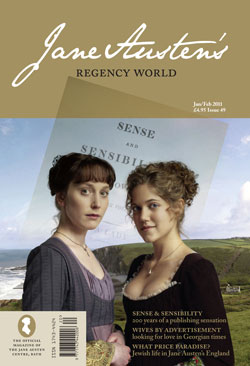
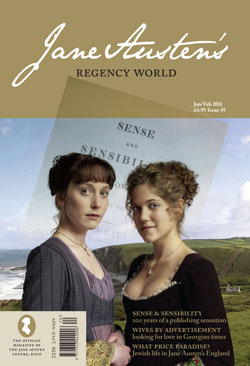
Well, better late than never! – the last issue [Jan / Feb 2011, Issue 49] of Jane Austen’s Regency World Magazine has finally shown up in my mailbox – yesterday! – I wrote about it in a post back in December

As always, cram-packed with interesting articles and images, this issue is devoted to Sense and Sensibility at 200.

So nice to curl up on a sofa with something to read – no kindle, no computer, just an old-fashioned hand-held magazine! You can subscribe here at their website:  janeaustenmagazine.co.uk – the March/April issue, which goes on sale March 1, 2011,  is celebrating its own anniversary – the magazine’s 50th issue! – articles on Royal Weddings in Austen’s time;  Sandy Lerner on why she bought Chawton, and a comparison of the clerical careers of Patrick Bronte and George Austen – plus lots more!  Hope this one arrives sooner rather than later!

Copyright @2011, by Deb Barnum at Jane Austen in Vermont

Austen Literary History & Criticism · Books · Jane Austen · Jane Austen Popular Culture · Regency England · Social Life & Customs

In Praise of Margaret Sullivan (and Her Henry Tilney)

A few words of praise for Margaret Sullivan, famed “Editrix” of Austenblog, developer of Molland’s, personal blogger at Tilney and Trap Doors, and authoress: 

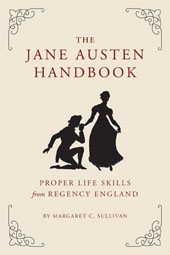
Her Jane Austen Handbook, first published in 2007 will be re-released in early March 2011 by Quirk Books.  Note that this is not a new edition; it has the same content with just a change in the subtitle from “A Sensible Yet Elegant Guide to Her World” to “Proper Life Skills from Regency England”.  There is a new cover design and a change from turquoise to a cocoa brown for text and illustations.  The illustrations by Kathryn Rathke are a delight.  All text and references are exactly the same, alerting you to such important concerns as:

  • How to Become an Accomplished Lady
  • How to Identify the Quality
  • How to Write a Letter [with directions on the proper fold]
  • How to Become Known as a Valuable Neighbor
  • How to Marry Off Your Daughter
  • How to Decline an Unwanted Proposal of Marriage
  • How to Behave at a Dinner Party 
  • How to Get Rid of Unwanted Guests

Certainly all necessary rules of etiquette we could all still learn and apply today ~ I for one do lament the loss of the letter-writing culture…!

An Appendix includes a short biography of Austen, a page summary of the novels and other works, and a few words on the film adaptations.  A short list of Resources, a very select Bibliography, a Glossary and index round it all out. 

If you didn’t get this book the first time around, don’t miss out again – it is a  must-have addition to your Austen collection – fun and informative [card games, dances, fashion, needlework, all manner of Regency social life and customs!], and filled with Sullivan’s well-known wit:

It is a truth universally acknowledged that in this world there are haves and have-nots.  Some are born to marry a man with ten thousand a year and have jewels and pin money second to none; some are destined to teach that woman’s children and be patronized by her servants.  In the sad event that you are forced to seek employment, here are a few acceptable ways for you to do so.  All are ill-paid and unpleasant in their own way and should be avoided if at all possible.   [She then outlines the following]

  •  Governess
  • Schoolteacher
  • Companion
  • Lady’s Maid
  • Authoress

[The Jane Austen Handbook, p. 87-88] 

Fortunately for us, Sullivan chose the latter, perhaps because, as her dedication so lovingly conveys, “For my mother, who let me read everything.”  We should all follow such sage advice!

**********************

I am late to the table one this one, but here ‘s another shout-out about Sullivan’s also recently re-published novella There Must Be Murder, a sequel to Northanger Abbey – as noted in her article in the latest JASNA News (Vol. 26, No. 3, Winter 2010), it is available from Librifiles.com  as a hardcopy [also at Amazon] and as a free ebook from Girlebooks.com  .  [It is also available on the Jane Austen Centre website where it was first published.]

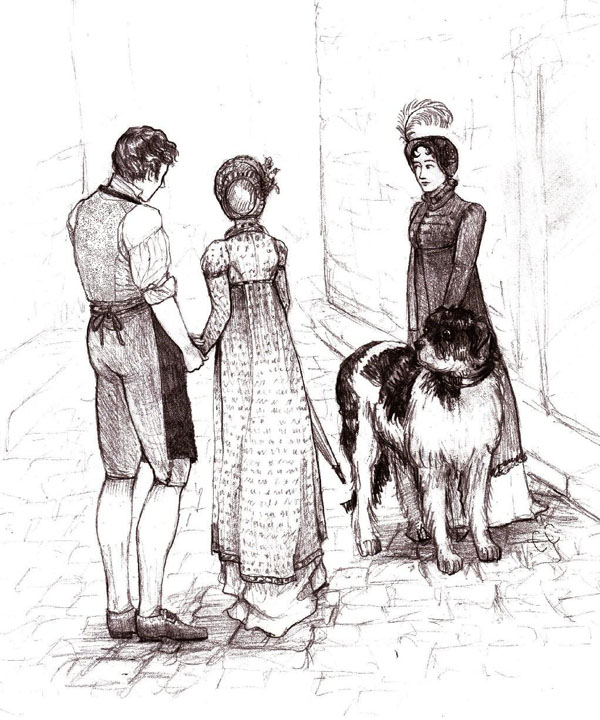
So I added this to my Kindle and have had the most enjoyable time with Henry and Catherine as they return to Bath shortly after their marriage – filled with Tilney’s expected wit and humor, Catherine’s laughing at her own efforts to not be temped into gothic thinking, an almost romantic General Tilney pursuing a lovely Bath widow, a possible rival for Henry’s attentions, a fair bit about Henry’s newfoundland much appreciated by dog-lovers everywhere, and a possible murder indeed [no spoilers here!].  The illustrations by Cassandra Chouinard are a perfect accompaniment to this fun read – who can resist a few hours with Henry Tilney! ~  highly recommended.

[illustration from the Jane Austen Center website]

 Further reading:

Copyright @2011, by Deb Barnum, at Jane Austen in Vermont

Austen Literary History & Criticism · Jane Austen · Regency England · Social Life & Customs

The ‘Sense & Sensibility’ Bicentenary Celebration

Maria Grazia at My Jane Austen Book Club is hosting a year-long celebration of the 200 year anniversary of the publication of Sense & Sensibility. Maria has invited twelve other Austen bloggers [including yours truly] to each post an article on Austen’s first published work.  Here is Maria’s invitation and the schedule:

October 2011 will mark the bicentenary of the publication of Jane Austen’s Sense and Sensibility. This is why ‘My Jane Austen Book Club’ wants to  dedicate a special space to the celebration and discussion of Austen’s first achievement as a published writer. I have invited some expert Janeites to contribute to the discussion and they have kindly and generously accepted . Katherine at November’s Autumn  and Gaskell Blog contributed the cute button on the left. Each month one of them will deal with a theme, a character, a topic somehow linked to Sense and Sensibility. The discussion will be open to you all with your comments, questions and suggestions. There will be a monthly giveaway and you will have the chance to win a book or DVD connected to our celebration. Here’s the schedule of our  virtual meetings. Take notes.

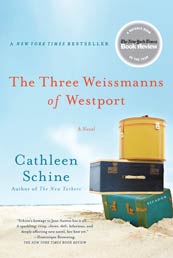
 1.  January“Marriage & Money in Sense & Sensibility” by Jennifer Becton – this article is now live on Maria’s site – If you comment  and leave your e-mail address on this first post or/and on the announcement of the Grand Event for Sense and Sensibility Bicentenary, you’ll be entered in the giveaway of The Three Weissmans of Westport by Cathleen Shine. This novel,  published by Picador,  is a new modern re-telling of Jane Austen’s Sense and Sensibility – this giveaway is for US readers only  but there will be others open worldwide. It ends 31st January.

  Stay tuned for:

2.  February – “Sense and Sensibility on Screen” by Alexa Adams

3.  March – “Inheritance Laws & Their Consequences in Sense & Sensibility” by C. Allyn Pierson

4.  April – “Lost in Sense & Sensibility” by Beth Patillo

5.  May – “Willoughby: A Rogue on Trial” by Jane Odiwe

6.  June – “Secrets in Sense & Sensibility” by Deb Barnum of Jane Austen in Vermont

7.  July – “Interview with Lucy Steele” by Laurie Viera Rigler  

8.  August – “Settling for the Compromise Marriage” by Regina Jeffers

9.  September – “The Origins of S&S: Richardson, Jane Austen, Elinor & Mariannne”  by Lynn Shepherd                           

10.  October – “Sense & Sensibility Fanfiction” by Meredith of Austenesque Reviews 

11. November – “Minor Characters in Sense & Sensibility” by Vic of Jane Austen’s World

12.  December – “Marianne Dashwood: A Passion for Dead Leaves & Other Sensibilities”  by Laurel Ann of Austenprose  

********************

A  year chock full of  S&S insights! – so check back to read these sure-to-be-interesting posts on S&S and a chance each month to win the latest giveaway.

There are also other Sense & Sensibility celebrations and blog tours – I will post on these another day – in the meantime, check out Jennifer Becton’s post on  “Marriage & Money in Sense & Sensibility”  at My Jane Austen Book Club.  With hearty thanks to Maria for setting this up!

Copyright @ 2011, Deb Barnum at Jane Austen in Vermont.

Austen Literary History & Criticism · Books · Jane Austen · Jane Austen Circle · Literature

Reading ‘Clarissa’

I made a promise to myself back in August 2010 to finally read Samuel Richardson’s Clarissa, this promise made after reading Laurel Ann’s Austenprose interview with Lynn Shepherd.  Shepherd is the author of the  Austen-inspired mystery Murder at Mansfield Park, but also a Samuel Richardson scholar and author of  Clarissa’s Painter: Portraiture, Illustration, and Representation in the Novels of Samuel Richardson (Oxford University Press, 2009].

I have had Clarissa sitting on my bedside table for years – a friend gave it to me as a joke, daring me to read the thing – I was tempted to tear it into nine parts [an easy thing to do!] and have each of my book group buddies read their piece of the book and report on it – an easy way to lessen the pain of reading this rather large tome – my copy [the Penguin edition of 1985 with introduction and notes by Angus Ross] measures 9 x 6 x 2.75″ with a total of 1534 pages, a heady feast of endless words in very small print!  But alas! I could not go the book destruction route, it’s not in my genetic makeup, and so have just stared at this thing for years, dusting it occasionally, contemplating its use as a doorstop or such [it weighs 2 lbs, 11oz!], but somewhat guilty all the while…  an English major who cleverly avoided this book or any Richardson for that matter because everything is just so long and not to mention depressing! And despite Richardson being Jane Austen’s favorite author, and that she read and re-read his works and was greatly influenced by him, I just haven’t done it… until now…

So when I read Lynn Shepherd’s post and saw the brilliant suggestion to read Clarissa in ‘real time’, starting on January 10th, and finishing on December 18th, I thought this was a perfect solution, nearly a whole year to finish the thing,  not much time to be spent on a daily basis – how bad can it possibly be?  So, Dear Readers, I have begun – January 10th, with already a welcome reprieve as the next letter is not until January 13th… 

When I told my gifting friend that I was finally going to read the thing – she wondered how I would be able to put it down and not read ahead – I told her I did not think that would be a problem in this case – and indeed it seems not to be so far!

I welcome anyone else who would like to join me in this – there have been group reads of Clarissa on other listservs – I am not going to post about the book,  just periodic updates of my reading progress.  My only concern is I am already looking forlornly at Richardson’s other book on my shelf, Pamela, a much shorter and happier exercise in reading what Jane Austen read… – so wish me luck and join me if you can!

Samuel Richardson (NNDB)

Further reading on Samuel Richardson:

Copyright @ 2011 Deb Barnum, Jane Austen in Vermont

Austen Literary History & Criticism · Books · Jane Austen · JASNA · Literature · Publishing History

Jane Austen on her ‘Sense & Sensibility’

Sense and Sensibility was first published in October 1811, hence all manner of this 200 year anniversary celebration will be literally taking over the world, or at least the blog-sphere world, for this entire year! [See the JASNA site  for information on the next AGM in October in Fort Worth]

There are already a number of blog events in place [I will be posting on these shortly], but I hope this year at Jane Austen in Vermont to do a number of posts on S&S, starting with its very interesting publishing history. So today, Part I – a compilation of what Jane Austen wrote in her letters about her first published work – there is not as much as on Pride & Prejudice or Mansfield Park and Emma, but she did make a number of comments that are worth noting. The upcoming Part II will outline the details of its publication and how it was received by her contemporaries. [You can also re-visit my previous posts on “Travel in S&S” – Part I, Part II, and Part III, and more to come regarding the types of carriages in use during Austen’s time.]

Note that all references in the letters are to: Deirdre Le Faye, ed. Jane Austen’s Letters. 3rd Edition. NY: Oxford, 1997, c1995.


Jane Austen on Sense & Sensibility
:

Ltr. 71. 25 April 1811, to Cassandra, from Sloane St, London

No indeed, I am never too busy to think of S&S. I can no more forget it, than a mother can forget her suckling child; & I am much obliged to you for your enquiries. I have had two sheets to correct, but the last only brings us to W.s [Willoughby] first appearance. Mrs. K [Mrs. Knight, Edward’s adoptive aunt] regrets in the most flattering manner that she must wait till May, but I have scarcely a hope of its being out in June. – Henry does not neglect it; he has hurried the Printer, & says he will see him again today. – It will not stand still during his absence, it will be sent to Eliza. – The Incomes remain as they were, but I will get them altered if I can. – I am very much gratified by Mrs. K.s interest in it; & whatever may be the event of it as to my credit with her, sincerely wish her curiosity could be satisfied sooner than is now probable. I think she will like my Elinor, but cannot build on anything else.

[Note: S&S was actually not published until 23 October 1811]


Ltr. 79. 29 Jan 1813
, to Cassandra, from Chawton

[Talking about P&P after its publication] – I have lopt & cropt so successfully however that I imagine it must be rather shorter than S&S altogether. – Now I will try to write of something else…


Ltr. 86. 3-6 July 1813
, to Francis Austen, from Chawton

You will be glad to hear that every Copy of S&S is sold & that is has brought me £140 – besides the Copyright, if that should ever be of any value.* – I have now therefore written myself into £250. – which only makes me long for more. – I have something in hand – which I hope on the credit of P&P will sell well, tho’ not half so entertaining. [i.e. Mansfield Park]

*My note: this is the world’s most perfect example of understatement!


Ltr. 87. 15-16 Sept 1813
, to Cassandra, from Henrietta St, London

Nothing has been done as to S&S. The Books came to hand too late for him to have time for it, before he went. [i.e send the books to Warren Hastings]


Ltr. 90. 25 Sept 1813, to Francis Austen, from Godmersham Park

[On the secret of her authorship]

  I was previously aware of what I should be laying myself open to – but the truth is that the Secret has spread so far as to be scarcely the Shadow of a secret now – & that I believe whenever the 3rd appears, I shall not even attempt to tell Lies about it. – I shall rather try to make all the Money than all the Mystery I can of it. – People shall pay for their Knowledge if I can make them. – Henry heard P&P warmly praised in Scotland, by Lady Robt Kerr & another Lady; – and what does he do in the warmth of his Brotherly vanity & Love, but immediately tell them who wrote it! – A Thing once set going in that way – one knows how it spreads! – and he, dear Creature, has set it going so much more than once. I know if is all done from affection & partiality – but at the same time, let me here again express to you & Mary my sense of the superior kindness which you have shewn on the occasion, in doing what I wished. – I am trying to harden myself. – After all, what a trifle it is in all its Bearings, to the really important points of one’s existence even in this World!

[postscript] There is to be a 2d Edition of S&S. Egerton advises it.

[Note: the 2nd edition was published 29 October1813]

Henry Austen

Ltr. 91. 11-12 Oct 1813, to Cassandra, from Godmerhsam Park

I dined upon Goose yesterday – which I hope will secure a good Sale of my 2d Edition.

[Note: Le Faye cites a poem from 1708: Old Michaelmas Day was October 11]

“That who eats Goose on Michael’s Day
 Shan’t money lack, his Debts to pay.”


Ltr. 95. 3 Nov 1813
, to Cassandra in London from Godmersham Park.

Your tidings of S&S give me pleasure. I have never seen it advertised. …

…I suppose in the meantime I shall owe dear Henry a great deal of Money for Printing, etc. – I hope Mrs. Fletcher will indulge herself with S&S.

[Note: Mrs. Fletcher was the wife of William Fletcher, of Trinity College Dublin – Austen notes that” Mrs. Fletcher, the wife of a Judge, an old Lady & very good & very clever, who is all curiosity to know about me…”. The 2nd edition of S&S, advertized on 29 October 1813,  was published at the author’s expense, thus Henry likely paid for it]


Ltr. 96. 6-7 Nov 1813
, to Cassandra in London, from Godmersham Park

Since I wrote last, my 2d Edit. has stared me in the face. – Mary tells me that Eliza [Mrs. Fowle] means to buy it. I wish she may. It can hardly depend upon any more Fyfield Estates [sale of Fowle property] – I cannot help hoping that many will feel themselves obliged to buy it. I shall not mind imagining it a disagreeable Duty to them, so as they do it. Mary heard before she left home, that it was very much admired at Cheltenham, & that it was given to Miss Hamilton [the writer Elizabeth Hamilton]. It is pleasant to have such a respectable Writer named. I cannot tire you I am sure on this subject, or I would apologise.

Elizabeth Hamilton - Wikipedia

Ltr. 100 21 Mar 1814, to Francis Austen, from London

Perhaps before the end of April, Mansfield Park by the author of S&S – P&P may be in the world. Keep the name to yourself. I should not like to have it known beforehand. [i.e. about MP]

Ltr. 121. 17-18 Oct 1815, to Cassandra, from Hans Place in London

Mr. Murray’s Letter is come; he is a Rogue of course, but a civil one. He offers £450 – but wants to have the Copyright of MP & S&S included. It will end in my publishing for myself I dare say. – He sends more praise however than I expected. It is an amusing Letter. You shall see it.

John Murray II

Ltr. 122(A)(D). 20-21 Oct 1815, draft of letter from Henry Austen to John Murray, in London

On the subject of the expence & profit of publishing, you must be better informed than I am; – but Documents in my possession appear to prove that the Sum offered by you for the Copyright of Sense & Sensibility, Mansfield Park & Emma, is not equal to the Money which my Sister has actually cleared by one very moderate Edition of Mansfield Park – (You Yourself expressed astonishment that so small an Edit. of such a work should have been sent into the World) & a still smaller one of Sense & Sensibility.- …

[Note: the 1st edition of S&S was 750 or 1000 copies; MP was probably 1,250, and Emma was 2,000 copies.]

Ltr. 154. 13 Mar 1817, to Caroline Austen, from Chawton

I have just recd nearly twenty pounds myself on the 2d Edit: of S&S* – which gives me this fine flow of Literary Ardour.

* Sense and Sensibility [footnoted by Austen in pencil]

*********************

Isn’t it such a delight to hear Austen’s very own words on her writing! Stay tuned for Part II on how it all came to be…

Illustration: John Murray II from Polylooks.com

Copyright@Deb Barnum, Jane Austen in Vermont, 2011.

Austen Literary History & Criticism · Jane Austen · Literature · Social Life & Customs

Jane Austen’s ‘Outside of Enough’

Anyone who reads Georgette Heyer or other Regency-era historical fiction is surely familiar with the phrase “outside of enough” – one of those “cant” phrases that is self-explanatory, doesn’t need a lexicon or such to figure out its meaning.  It is a great turn of words, isn’t it? and so much more effective that “that’s enough” or “enough is enough” or “I’ve had enough” or “more than enough”, or “this is too much” or “enough already”!

But where did it come from? When was it first used? I don’t currently have access to the OED and it does not show up in the phrase reference sources I have or in online sources. Joanna Waugh on her website says it came into use around 1887.  It now seems overly used – certainly in every historical romance novel, but also in political writings, general conversation [just ‘google’ it!].  I am reminded of the phrase “gone missing”- a term I first heard in England years ago and needed to have it explained to me! – I later heard it on Canadian news programs, but now I hear it everywhere, read it in the newspapers, definitely a British turn of phrase adopted here in the US.

But back to “outside of enough” – I have assumed this was a term that Heyer perhaps had made up – she did do that with some of her Regency cant phrases so prevalent in her dialogue.   So I was quite surprised and delighted to discover this dialogue between Lucy Steele and Elinor in a recent re-read of Sense and Sensibility:

[Lucy Steele]  : “And what a charming little family they have! I never saw such fine children in my life. I declare I quite doat upon them already, and indeed I am always distractedly fond of children.”

   “I should guess so,” said Elinor with a smile, “from what I have witnessed this morning.”

   “I have a notion,” said Lucy, “you think the little Middletons rather too much indulged; perhaps they may be the outside of enough; but it is so natural in Lady Middleton; and for my part, I love to see children full of life and spirits; I cannot bear them if they are tame and quiet.”

    “I confess,” replied Elinor, “that while I am at Barton Park, I never think of tame and quiet children with any abhorrence.” 

[S&S, Vol. 1, Ch. xxi ]

Two Brock illustrations of “sweet” Lucy…

Fig. 1 "We have been engaged these four years"
Fig. 2 "She could have no doubt of its being Edward's face"


So we might think that Austen was the first writer to use the phrase, albeit putting it into the mouth of one of her more vulgar characters.  But a quick search of Google Books brings up the following sources:

1.  Algernon Sidney. Of the Use and Abuse of Parliaments: In Two Historical Discourses. 1744 – a reference is made to “outside of enough” as somewhere expressed by Shakespeare. [I did search the Shakespeare Concordance  and the term “outside” comes up 14 times in Shakespeare’s texts, but alas! all lacking the necessary “of enough”] 

2.  Colley Cibber.  The Dramatic Works of Colley Cibber.  1777. “…I’ll have everything on the outside of enough today.” 

3.  Joseph Gwilt, et al.  An Encyclopaedia of Architecture.  1842. re: “premising, that if the caution whereof we speak be taken, the thickness resulting from the following investigations will be much more than the outside of enough.” [p. 410]

4.  Henry C. K. Wyld.  A History of Modern Colloquial Idiom.  1920.  Wyld cites the above Austen passage as “largely the way of speech of the better society of an earlier age, which has come down in the world, and survives among a pretentious provincial bourgeoisie.” [p. 376] [which seems to indicate the term was used in an earlier period and Austen would have been familiar with that…]

So, I must carry on and dig deeper and find a better reference – if anyone has any thoughts, please comment – but shan’t we at least credit Austen (via Heyer I would think) with what appears to be the source for the excessive use of the term today? – I do feel the need to nearly scream, “all right, all right, the constant use of this phrase is really the outside of enough”!

Illustrations:

Copyright @Deb Barnum, Jane Austen in Vermont, 2011.

Austen Literary History & Criticism · Jane Austen · Literature

Jane Austen’s Very Own Scrooge

Fig. 1

It is a rare date that Austen mentions in her works, but one of them is today, December 24: Christmas Eve, “(for it was a very great event that Mr. Woodhouse should dine out, on the 24th of December)” [Emma Vol. I, Ch. xiii]

While we usually associate Mr. Woodhouse with often curmudgeonly weather-obsessed behavior, here he is most eager to get all wrapped up and head over to Randalls:

Mr. Woodhouse had so completely made up his mind to the visit, that in spite of the increasing coldness, he seemed to have no idea of shrinking from it, and set forward at last most punctually with his eldest daughter in his own carriage, with less apparent consciousness of the weather than either of the others; too full of the wonder of his own going, and the pleasure it was to afford at Randalls to see that it was cold, and too well wrapt up to feel it. [E, Vol. I, Ch. xiii]

Fig. 2

So it is not dear Mr. Woodhouse who is Scrooge this Christmas Eve, but Austen is adept at creating one, and long before Dickens ever did:

‘A man,” said he, ‘must have a very good opinion of himself when he asks people to leave their own fireside, and encounter such a day as this, for the sake of coming to see him. He must think himself a most agreeable fellow; I could not do such a thing. It is the greatest absurdity — Actually snowing at this moment! The folly of not allowing people to be comfortable at home, and the folly of people’s not staying comfortably at home when they can! If we were obliged to go out such an evening as this, by any call of duty or business, what a hardship we should deem it; — and here are we, probably with rather thinner clothing than usual, setting forward voluntarily, without excuse, in defiance of the voice of nature, which tells man, in every thing given to his view or his feelings, to stay at home himself, and keep all under shelter that he can; — here are we setting forward to spend five dull hours in another man’s house, with nothing to say or to hear that was not said and heard yesterday, and may not be said and heard again to-morrow. Going in dismal weather, to return probably in worse; — four horses and four servants taken out for nothing but to convey five idle, shivering creatures into colder rooms and worse company than they might have had at home.” [E, Vol. I, Ch. xiii]

Well, “Bah! Humbug!” to you too, John Knightley!he is our Scrooge this Christmas Eve [indeed, I believe that Isabella has married her father!] and his ill humor continues throughout the evening – ending of course with his gloomy and overblown report of the worsening weather that sets off three full pages of discussion on the risks of setting out, on the possibility of being snowed-in, on the cold, on the danger to the horses and the servants – “‘What is to be done, my dear Emma? – what is to be done?’ was Mr. Woodhouse’s first exclamation…” and it all is finally “settled in a few brief sentences” by Mr. Knightley and Emma, certainly foreshadowing their success as a companionable couple.

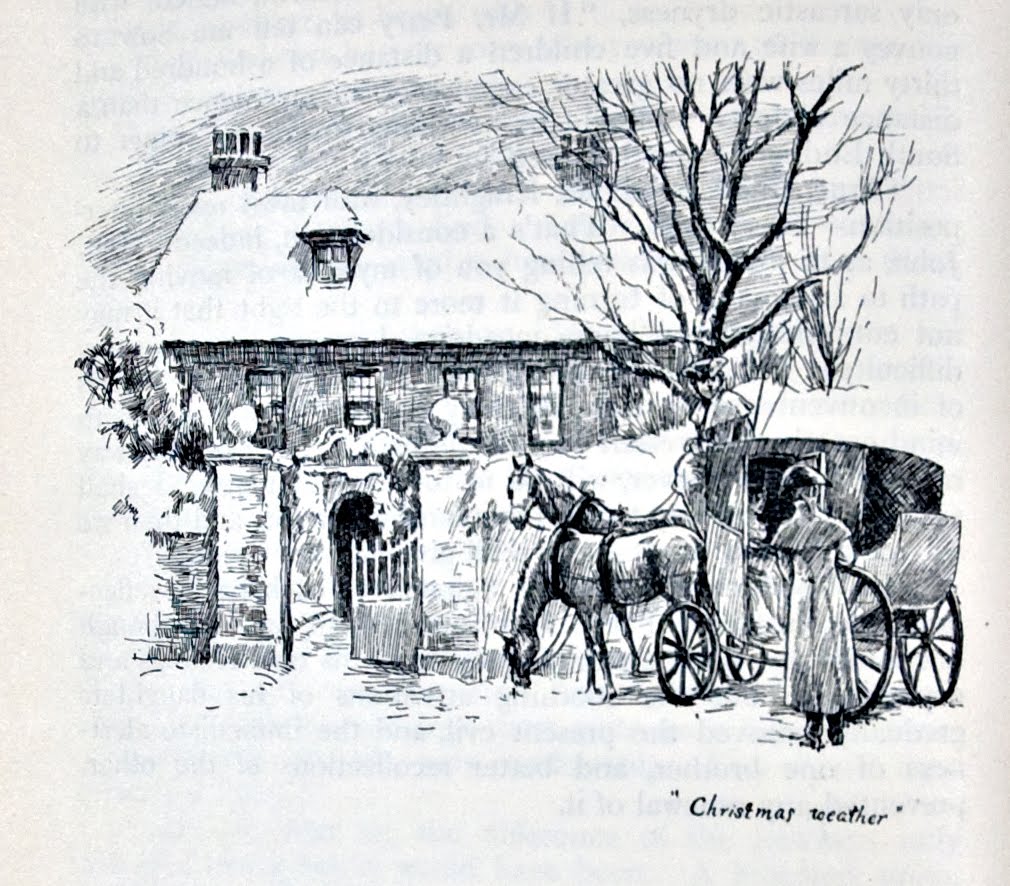
Fig. 3 'Christmas Weather'

And this leads to one of Austen’s most comic scenes – the proposal of Mr. Elton, Emma trapped in the carriage alone with him believing that “he had been drinking too much of Mr. Weston’s good wine, and felt sure that he would want to be talking nonsense…” – which of course he does…

Wishing you all a very Merry Christmas, with much snow on the ground (but not enough to trouble your carriage), some song and wine (but not enough to induce unwanted and overbearing offers of love and marriage), and the pleasure of good company (with hopefully no Scrooge-like visitors to whom you must either “comply” or be “quarrelsome” or like Emma, have your “heroism reach only to silence.” )

P.S. – And tonight pull your Emma off the shelf and read through these chapters in volume I [ch, 13-15] for a good chuckle! – this of course before your annual reading of A Christmas Carol.

___________________
Illustrations:

1.  Emma’s Christmas Day Paper Doll at Fancy Ephemera.com
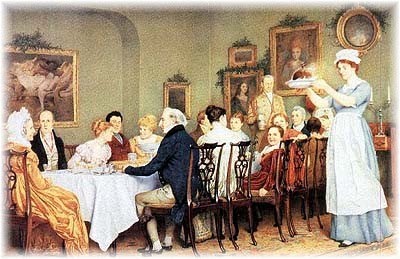
2.  Dinner at Randalls at Chrismologist.blogspot.com
3.  ‘Christmas Weather’ at Harlequin Historical Authors
4.  Vintage postcard in my collection

Austen Literary History & Criticism · Jane Austen · Literature · News

Hot off the Presses! ~ ‘Jane Austen’s Regency World Magazine’ and ‘The Female Spectator’

Will await this showing up in my mailbox [though see the publisher’s note about weather-induced delivery delays] –  here is the latest table of contents from Jane Austen’s Regency World magazine, the January/February 2011 issue No. 49: 

  • Sense & Sensibility at 200 ~  Leading writers look at the history, relevance, importance and morality of Jane Austen’s first published novel
     
  • What price Paradise? ~ Life as a Jewish person in Regency England
     
  • Wives by Advertisement ~ The risks and rewards of Georgian lonely hearts’ adverts
     
  • Jane Austen and Robert Burns ~ What she really thought about the Scottish poet
     
  • Jane Austen edited by a man ~  One writer’s angry response to recent news reports 

*The new curator at Jane Austen’s House Museum reveals what Jane means to her 

*Plus: All the latest news from the world of Jane Austen, as well as letters, book reviews, quiz, competition and news from JAS and JASNA 

Wondering what to ask Santa for Christmas?  Well if you have been “good” and “nice” and not “naughty” or “shouting” or “crying” the whole year through, then you deserve a subscription to JARW!  For further information, and to subscribe, visit: http://www.janeaustenmagazine.co.uk/index.html


[PLEASE NOTE:

 1.      The March/April 2011 issue of Jane Austen’s Regency World magazine will be the FIFTIETH issue!
2.      Overseas subscribers, especially in the US and Canada: be advised that the January/February issue may be delayed by 7-10 days because of a backlog of cargo in the UK following recent bad weather, and sorting difficulties in both the US and Canadian postal services. We apologise for any delay or inconvenience this may cause. Jane Austen’s Regency World ~ well worth waiting for!

 *****

Chawton House Library has published the latest issue of its newsletter The Female Spectator, Vol. 14, No. 3 (Autumn 2010) [and thankfully, this has arrived in my mailbox!] :   

  • Chawton Chronicles” from CEO Steve Lawrence re: Edward Austen Knight’s silk suit
  • “Brian Charles Southam”, an obituary – by Gillian Dow
  • “Reading and Re-reading in Sarah Fielding’s The Countess of Dellwyn” – by Louise Curran
  • “Aspects of Household Management during the Long Eighteenth Century: The Invalid’s Dietary” – by Catherine Morley
  • “A Birthday Banquet for Sarah Fielding” [ her 300th!]  – by Linda Bree and Peter Sabor, on the November conference at CHL on Sarah Fielding.  Link provided to a podcast of Isobel Grundy’s lecture here:  http://www.soton.ac.uk/scecs/newsandevents/2010/fielding_grundy.shtml
  •  The Education Programme at CHL – by Sarah Parry 
  • “Stories behind the Paintings”  by Jacqui Grainger – this essay on the portrait of Mary Robinson, actress and mistress of the Prince Regent, that hangs in the Great Hall of the Chawton House Library [with a heads-up re: the National Portrait Gallery [the UK NPG-  sorry folks!] exhibition entitled “The First Actresses: Nell Gwyn to Sarah Siddons” set for 20 Oct 2011 – 8 Jan 2012] 
  • “The Shire Horses” – by Angie McLaren  
  • “House and Estate News”:  Conservation Projects – by Paul Dearn; The Park and Gardens – by Alan Bird
  • “Dates for Your Diary” – as always, lovely to see what is coming up, and, as always, quite depressed that I am on this side of the world…

You too can receive this quarterly newsletter in your mailbox [weather notwithstanding…] by becoming a member of the CHL – information is  here: Chawton House Library membership [see link for North American members].  See also the several links to full-text [pdf] past newsletters here, and a contents listing of all issues here.

And please check out the latest news on the CHL website – there is a new short story competition in the offing – so start mending your pens and submit your creation by March 31, 2011 – guidelines are here.

Happy reading and writing all!