Austen Literary History & Criticism · Book reviews · Books · Collecting Jane Austen · Jane Austen · Literature · Regency England · Social Life & Customs

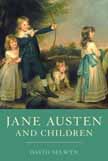
Book Review ~ “Jane Austen and Children” by David Selwyn

To be at the beginning of life, one must start at the end of the novel.  For although Jane Austen concludes her books with the marriage of the hero and heroine to which the whole thrust of the narrative has been leading, and the reader rejoices in the perfect happiness of the union, in reality the best is yet to come: they will have children – procreation  being not only the natural and desirable end of marriage, but also an economic and dynastic necessity.  And those children will have their own stories…What will become of the Darcy children?…”  (Ch. 1, Confinement, p. 5)

And thus does David Selwyn begin his treatise on Jane Austen and Children (Continuum, 2010), a most enjoyable journey through the world of childhood and parenting and education and growing-up in the life of Jane Austen, and the lives of her fictional characters.  If you are perhaps one of those people who think that Jane Austen does not like children, an idea certainly fed buy such comments about women “breeding again” or the child-generated “dirt and noise” or “the two parties of Children is the cheif Evil” [Ltr. 92], or the proper child-rearing “Method has been wanting” [Ltr. 86], etc. – you need to read this book!

Selwyn takes his reader essentially through the nine ages of man [with apologies to Shakespeare] beginning with confinement and birth, through infancy, childhood, parenting, sibling relations, reading and education, and finally maturity, as Selwyn says, the “end of the novel” when the Hero and Heroine come together, after all manner of trial and tribulation, to begin their own family.

We are given a general survey of the shift in the attitudes toward children, that late eighteenth – early nineteenth century view that fell between viewing children as not just “little adults” to the Victorian view of “seen but not heard”, following Locke and Rousseau and believing children to be natural innocents.  In each chapter Selwyn seamlessly weaves pieces of Austen’s life as gleaned from her letters and scenes from all her writings – and it is masterly done, all with a historical perspective.  We see Jane as a child, as a madly composing adolescent, a loving and humorous Aunt imaginatively interacting with her nieces and nephews, and as an accomplished writer whose fictional children are far more worthy of our notice than we have previously supposed: the frolicsome Walter hanging on Anne’s neck in Persuasion; the spoiled Middletons; the noisy and undisciplined Musgroves; the grateful and engaging Charles Blake in The Watsons; the John Knightley brood in the air courtesy of their Uncle George; the dynamics of the five Bennet sisters; Henry Dashwood the center of attention for the manipulative Steele sisters; the reality-based scenes of Betsy and Susan Price at Portsmouth; and finally Fanny Price, Austen’s only heroine we see grow up from childhood, having an elegant come-out, finding true-live and ends “needing a larger home.”

In all her works, Austen uses children as “a resource for her narrative strategies” (p. 4), be that comedy, a plot device to further the action, or a means of revealing attitudes and responses of the adults around them (p. 3).  Austen’s children are easy to miss – they won’t be after reading this book – here they are brought to life, given character and meaning, and you will see what Selwyn terms “Austen’s satirical delight in children behaving in character” (p. 73)

If Austen’s fiction seems to gloss over the reality of childbirth [the exception is Sense and Sensibility’s two Elizas], her letters tell the tale of its dangers [Austen lost three sisters-in-law to death in childbirth], and Selwyn links all to the social structure of the day, the nursing of babies and swaddling practices, to child rearing theories and moralizing tracts, and governesses and Austen’s ambivalence toward them. We visit boarding schools along with Jane and her characters and we hear the voices of a number of contemporary diarists (Agnes Porter, Sophia Baker, Susan Sibbald, Elizabeth Ham and Sarah Pennington).  There is a lovely in-depth chapter on the reading materials written especially for children and Austen’s first-hand knowledge of these titles.  The discussion on sisters and brothers, those so important in Austen’s own life, and those in her fiction, for example, characters with confidants (Lizzy and Jane, Elinor and Marianne), those isolated (Fanny, Anne Elliot, Emma Watson, Mary Bennet), and those with younger sisters (Margaret Dashwood and Susan Price).  As part of the growing-up process, Selwyn uncovers much on “coming-out” as Austen herself writes of in her “Collection of Letters” [available online here] – with the emphasis here on Fanny as the only heroine to have a detailed “coming-out” party.

The chapter on “Parents” starts with the premise that “in Jane Austen’s novels the parents best suited to bringing up children are dead” (p.95) and Selwyn takes us from the historical view of parenting, through Dr. Johnson’s “Cruelty of Parental Tyranny” [shadows of Northanger Abbey] to a full discussion of the marriage debate in the 18th-century – that between the worldly concerns of wealth vs. choice of partner based on emotional love as personified in Sir Thomas and Fanny Price respectively.  Excerpts are included from James Austen’s very humorous Loiterer piece   “The Absurdity of Marrying from Affection.” (p. 207) and Dr. John Gregory’s A Father’s Legacy to his Daughters (1774) [viewable at Google Books here] , and the Edgeworth’s Practical Education (1798) [Vol. III at Google Books here].  One finds that in reading all of Austen’s letters and all the works you can indeed discover a complete instruction manual for good parenting!

Jane Austen and Children appropriately ends with Selwyn’s speculation on what sort of parents her Heroes and Heroines will be, all of course based on the subtle and not-so-subtle clues that Austen has given us throughout each work – conjecturing on this is perhaps why we have so many sequels with little Darcys, Brandons, Bertrams, Knightleys, Tilneys, and Ferrars running about!

Just as in his Jane Austen and Leisure, where Selwyn analyzes the various intellectual, domestic and social pursuits of the gentry as evidenced in Austen’s world and her works, he here gives us an accessible and delightful treatise on Austen’s children, culling from her works the many quotes and references related to children and linking all to the historical context of the place of children in the long eighteenth century.  The book has extensive notes, a fine bibliography of sources on child-rearing, contemporary primary materials, children’s literature, and literary history, and several black and white illustrations.  (I did note that there are a few mixed up footnotes in chapter 3, hopefully to be corrected in the next printing).  What will this book give you? – you will never again miss the importance of Austen’s many children, peaking from behind the page, there for a set purpose to show you what great parents the Gardners are, or just to make certain you see how very selfish the John Dashwoods and the Miss Steeles are, or to see the generosity of an Emma Watson in her rescue of Charles Blake, or to feel the lack for the poor Musgrove boys having Mary for a mother, the playfulness of an otherwise conservative Mr. Knightley, and the unnerving near touch of Captain Wentworth as he relieves Anne of her burden –  thank you David Selwyn for bringing all these children to life for Austen’s many readers – you have given us all a gift!
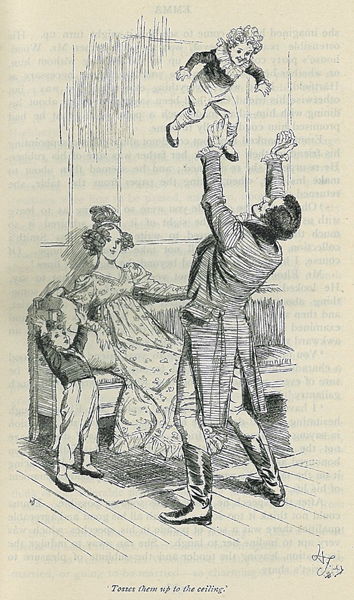
Emma – ‘Tosses them up to the ceiling’
[by Hugh Thomson, print at Solitary Elegance]

 __________________

Jane Austen and Children
Continuum, 2010
ISBN:  978-1847-250414

David Selwyn is a teacher at the Bristol School in Bristol, UK.  He has been involved with the Jane Austen Society [UK] for a number of years, has been the Chairman since 2008,  the editor of the JAS Report since 2001, and has written and edited several works on Austen.  He very graciously agreed to an “interview” about this latest work that you can find by clicking here.  See also the post on the various illustrations of Austen’s children by the Brocks and Hugh Thomson.  And finally, I append below a select bibliography of Selwyn’s writings on Jane Austen and her family.

 Select Bibliography:  

  1. Lane, Maggie, and David Selwyn, eds.  Jane Austen: A Celebration.  Manchester: Fyfield, 2000. 
  2. Selwyn, David, ed.  The Complete Poems of James Austen, Jane Austen’s Eldest Brother. Chawton: Jane Austen Society, 2003. 
  3. _____. “Consumer Goods.” Jane Austen in Context. Ed. Janet Todd. Cambridge Ed. of the Works of Jane Austen. New York: Cambridge UP, 2005. 215-24. 
  4. _____, ed.  Fugitive Pieces: Trifles Light as Air: The Poems of James Edward Austen-Leigh.  Winchester: Jane Austen Society, 2006. 
  5. _____. “A Funeral at Bray, 1876.” Jane Austen Society, Collected Reports V (1998): 480-86. 
  6. _____. “Games and Play in Jane Austen’s Literary Structures.” Persuasions 23: 15-28 
  7. _____. “Incidental closures in Mansfield Park.”  [Conference on “Jane Austen and Endings”, University of London, 17 November 2007] – unpublished paper. 
  8. _____. “James Austen – Artist.” Jane Austen Society Report 1998. 157-63. 
  9. _____.  Jane Austen and Leisure.  London: Hambledon Continuum, 1999. 
  10. _____, ed.  Jane Austen: Collected poems and Verse of the Austen Family.  Manchester:  Carcanet / Jane Austen Society, 1996. 
  11. _____, ed.  Jane Austen Society Report, 2001 – present. 
  12. ­_____. “Poetry.” Jane Austen in Context. Ed. Janet Todd. Cambridge Ed. of the Works of Jane Austen. New York: Cambridge UP, 2005. 59-67. 
  13. _____. “Shades of the Austens’ Friends.” Jane Austen Society Collected Reports V (2002): 134. 
  14. _____. “Some Sermons of Mr Austen.” Jane Austen Society Collected Reports V (2001): 37-38. 
Austen Literary History & Criticism · Jane Austen

Illustrations of the Children in Jane Austen

In my previous post interviewing David Selwyn on his new book Jane Austen and Children [book review will be posted tomororw], I commented on discovering how many children there actually are in Austen’s novels, and how easy they are to miss.  So I started thinking about Austen’s works as published through the years accompanied by the various illustrators.  Here are several selections by the Brocks and Hugh Thomson, showing that in each novel there is at least one illustration with children as the subject ~ and how delightful they are!

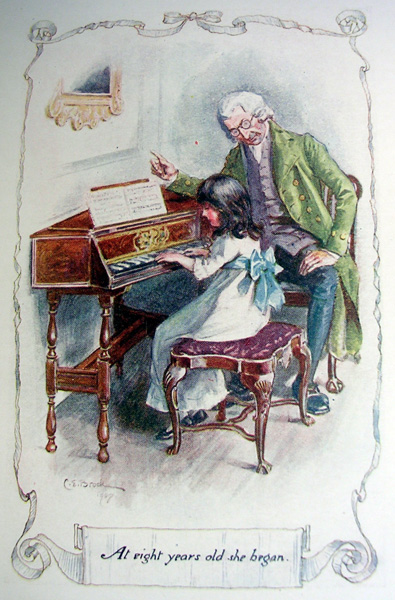
Northanger Abbey ~ C.E. Brock ~ Catherine at the piano ~ “At eight years old she began…[Vol. I, Ch. I]

***

Sense and Sensibility~  C.E. Brock – “ The time may come when Harry will regret that so large a sum was parted with”  [Vol.I, Ch. II]


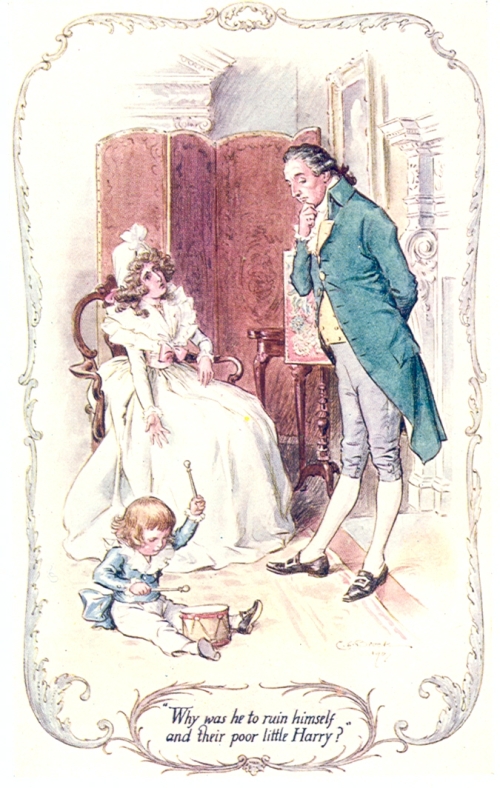
Sense and Sensbility ~ C.E. Brock ~ “Why was he to ruin himself and their poor little Harry?”  [Vol. I, Ch. II]

***

Pride and Prejudice ~  C.E. Brock  ~ “On the stairs were a troop of little boys and girls”  [Vol. II, Ch. IV]

 ***

Mansfield Park ~ C.E. Brock ~  Fanny on arriving in Mansfield Park ~ ” In vain were the well-meant condescensions of Sir Thomas”  [Vol. I, Ch. II]

and the same scene from H.M. Brock:


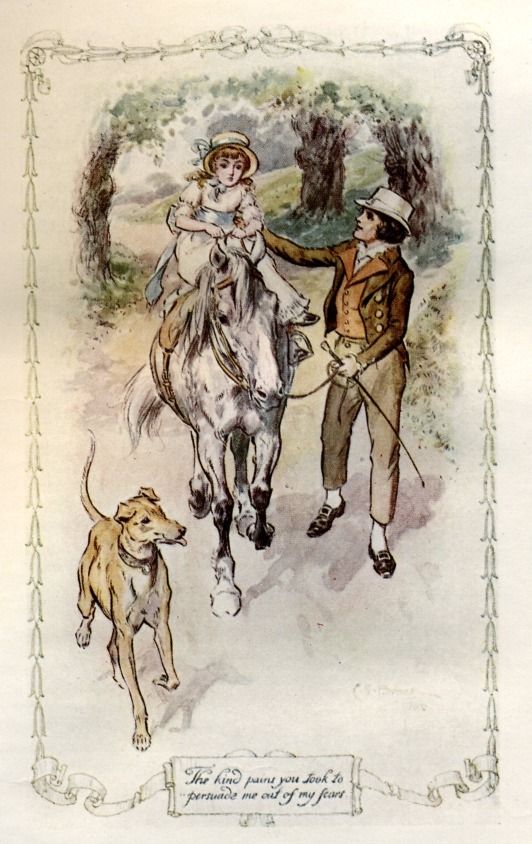
 Mansfield Park ~ C.E. Brock ~ “The kind pains you took to…persuade me out of my fears”  [Vol. I, Ch. III]

Mansfield Park ~ Hugh Thomson ~ “Mrs. Price … only discomposed if she saw Rebecca pass by with a flower in her hat.” [Ch.  42]

 ***

Emma  ~ Hugh Thomson ~ “With a slice of wedding cake” [Vol. I, Ch. II]

Emma  ~ Hugh Thomson “Tosses them up to the ceiling” [Vol. I, Ch. IX]

 ***

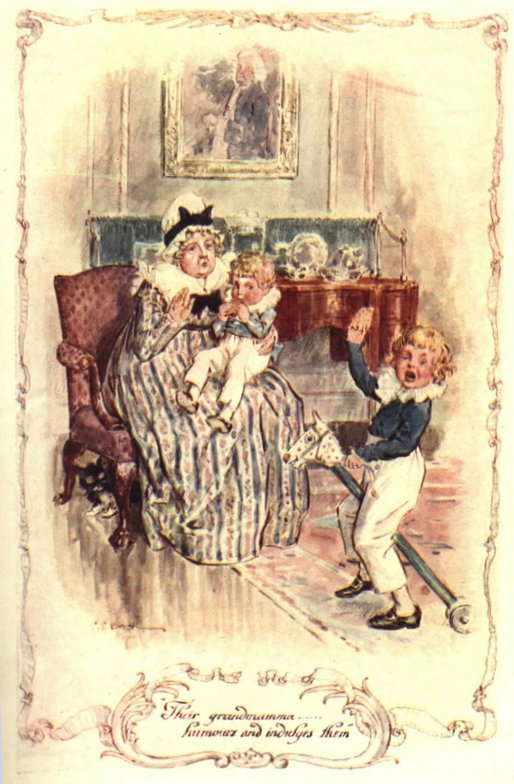
 Persuasion ~ C.E. Brock ~  Their Grandmamma…humours and indulges them” [Vol. I, Ch.VI]

Persuasion ~ C. E. Brock ~ ‘Brought Home in consequence of a bad fall…’ [Vol. i, Ch. VII]

Persuasion ~ C.E. Brock ‘ In another moment…someone was taking him from her” [Vol. I, Ch. IX]

___________________________________________

Sources:  all Brock illustrations are from Mollands; the Hugh Thomson illustrations are from Solitary Elegance. and the Thomson illus of Mrs. Price and children is from Pemberley.com

Austen Literary History & Criticism · Book reviews · Collecting Jane Austen · Jane Austen · Regency England

Author Interview ~ David Selwyn on ‘Jane Austen and Children’

David Selwyn had graciously offered to answer my questions about his newest book, Jane Austen and Children (Continuum, 2010).  David is the current Chairman of the Jane Austen Society, editor of the Annual JAS Report since 2001,  and author of numerous works and articles on Austen.  His previous Jane Austen and Leisure (Hambledon Continuum, 1999)) is a must-read treasure trove of social and domestic activities that Austen engaged in and referred to in her novels. His current work is another must-read that weaves the historical, the factual and the fictional world of Austen and her works, all relating to children.  I will post a review of the book in a few days [after the 16th Birthday celebration] –  but I will say now that I most highly recommend this book, and suggest that you add this to your holiday “want” list and hope it may be found under your tree on Christmas morn…!

 Welcome David! 

JAIV:  I think when reading the novels, it is so very easy to overlook the number of children and how Austen’s presents them – but after reading your book one sees indeed how many children there are in her works and their importance to the narrative – is this what prompted you to write the book? the fact that too many people really do not see?

DS:      Yes, and I was struck by the fact that nobody had written on the subject, nor as far as I knew lectured on it. 

JAIV:  Jane Austen is often said to have not been particularly fond of children – was this another main reason in writing your book? – to show that as not the case? – 

DS:      As regards the novels, it always seemed to be assumed that her world was essentially an adult one (which I suppose largely it is) and the crucial role that children play in her exploration of it had been missed. As regards her own feelings about children, nobody who reads the letters can be in any doubt as to her fondness for her nephews and nieces.

JAIV:  Did anything surprise you in your research? 

DS:      How sensible she was about the bringing up of children – but then, I suppose one ought never to be surprised by JA’s wisdom on any matter!

JAIV:  And such extensive research! – the references in her letters, other family reminiscences, all the novels and minor works, and the historical context of child rearing in the long 18th century! – how long have you been working on this? 

DS:      For some years, but the editing of JEAL’s poems (Fugitive Pieces) intervened.

JAIV:  And this book presents such a seamless weaving of this real life, historical and fictional contexts – what are your working habits, writing process to achieve this?

DS:      I re-read the novels, minor works and letters, making notes of anything relevant in notebooks (one for each text) and highlight the notes in different colours according to theme. I did this for Jane Austen and Leisure and found that it worked. You’ll notice that at this stage I don’t use a computer. I also do a lot of background reading in social history, biography etc, and make notes on those books too of course.

JAIV:  You say that Jane Austen “makes use of her children to reveal aspects of her adult characters” – what is your favorite example of this?

DS:      It is difficult to choose, because each time she does it it is so wholly convincing. Annamaria Middleton and the naughty little Musgrove boy are the funniest, and the latter creates the most delicately balanced mood of comedy and emotion in any scene with children in it; but I love the little Gardiners, whose charming behaviour shows just how children should be brought up.

JAIV:  And then secondly, that Austen uses children as a means of advancing the plot – what is the best example of this?

DS:      It would certainly have been Charles Blake in ‘The Watsons’ had JA finished the novel.

JAIV:  There is much on Mansfield Park, perhaps because unlike the other heroines [other than the quick summary of Catherine Morland’s childhood], Fanny is presented to us as a child – but you seem to write most fondly of this novel, indeed, you end your book with thoughts on Fanny and Edmund making the best parents.  Is Mansfield Park your favorite among the novels? Or is this an unfair question! [who can ever choose!]

DS:      As you say, an impossible question. Yes, I do admire MP very much (and think that Fanny is often under-rated: she knows exactly what she wants and in the end gets it); but ultimately my favourite is Emma, partly because it is surely the subtlest and cleverest novel before Henry James, and partly because I think Miss Bates is, as well as being very funny, one of the most moving examples of human goodness in any literary work – JA touches us profoundly with the portrayal of a single woman who centres all the energy of a loving heart on her mother and niece (which is why the scene at Box Hill is so truly climactic – Emma’s thoughtless crushing of such a good heart is appalling, as she herself soon realises). By the way, another thing about Miss Bates: how brilliant of JA to be able to create such a wholly imagined voice that another character (Emma) can mimic it – flannel petticoats etc. 

JAIV:  It has always “troubled” me that Jane is the only child in this Austen family with only one given name – you speak of her having two godmothers both named “Jane” – do you think this is the reason? or do you have other thoughts? 

DS:      But she wasn’t: James, George and Edward had no second names, and nor did their parents. It may well be that the habit of giving two Christian names was becoming more fashionable during this period. 

JAIV:  One of the most famous child-based scenes in Austen is in Persuasion when Captain Wentworth helps Anne by the swift removal of her troublesome nephew – why is this scene so important to the plot? 

DS:      It brings Anne and Captain Wentworth intimately close for the first time in the novel – though JA is delicate enough to depict that intimacy with the child’s hands preventing direct physical contact between them.

JAIV:  Where much of The Watsons can be seen to appear in her other works, the most marvelous piece, when Emma Watson engages young Charles Blake in the dance, is nowhere to be found anywhere else [though it has been said that Mr. Knightley’s dancing with Harriet Smith is Austen’s reworking of this scene].  Do you think Austen could have placed this somewhere in her surviving novels? 

DS:     No, I don’t think she was ever to give a child quite such individual prominence again. 

JAIV:  You start your chapter on “Parents”: “In Jane Austen’s novels the parents best suited to bringing up children are dead.”  Who of the living parents do you think are the most effective? Who the least?  

DS:      The Gardiners are far and away the best. Sir Walter Elliot (though not of course the late Lady Elliot) is a disgrace to the Baronetage in which he takes such pride!

JAIV:  You so obviously love Jane Austen!  – when did this begin for you? 

DS:      In  picking up a stray copy of Emma when I was at home ill once, when I was a (music) student. But I was also thrilled to see a real live JA MS which used to be on display in the Pump Room at Bath (it is now safely tucked away in the offices of Bath City Council); it was the ‘headache’ poem, and it was hung in a hinged frame enabling you to see the reverse, on which there was one of the versions of the ‘Gill-Gell’ verse. I remember noting in the Minor Works volume that Chapman (re-edited by Brian Southam) said that he did not know where that particular version of the Gill’ Gell poem was, and I gleefully thought to myself, ‘I do – it’s in Bath!’ I seem to remember writing to OUP, but I didn’t get a reply.

JAIV:  You say that “it is highly unlikely that Jane Austen ever read a word of Mary Wollstonecraft (though she did read the novels of her radical husband, William Godwin)” – how are you so sure she did not read Wollstonecraft, and how so sure she did read Godwin? 

DS:      This is, I concede, speculation. JA refers to Godwin in a letter and Deirdre Le Faye suggests that she ‘was probably acquainted with Caleb Williams’; I am not sure she didn’t read Hannah More, but I think it unlikely.

JAIV:  One of the many things I took from your book in its focus, its seeing all through the lens of childhood, was a pattern of new themes emerging in all the novels – for instance, the theme in Emma of unconditional love, the love parents have for children, but in Emma, this love that Emma has for her father, Miss Bates for her mother and Jane Fairfax, Mr. Knightley for Emma – i.e. as you say “the unconditional love for people who may, consciously or unconsciously, require sacrifices to be made for them.” [p.111]. What are some other themes that became clearer for you since approaching the novels from this viewpoint? 

DS:      Not so much themes as procedures, and in particular the technique of introducing children not really for their own sake but as a contrivance for some aspect of plot or characterisation – and in the process, being JA, to bring them wonderfully to life.

JAIV:  One could read your book, re-read all of Austen, and get a very lucid and valuable instruction manual for good parenting! – did you have this perception yourself before reading and studying the books through this lens? 

DS:      No, it had never occurred to me that JA could be seen in such a light until I looked closely and specifically at what she says about children and parents.

JAIV:  Your book on Jane Austen and Leisure also offered a very valuable (and very enjoyable!) contribution to an understanding of Austen in the context of social history, her reading, her novels and her life and letters – again in many instances taking a few well-placed words in Austen and giving them such meaning.  What is up next for you?? 

DS:      I hope to do some more editing for a JA Society book. What a pity that JEAL’s sister Caroline destroyed the MSS of her poems; I should like to have brought those out.    

********************

Thank you so much David for answering all my questions!  Stay tuned for my review and a select bibliography on David Selwyn’s other Austen-related works. 

 [Getty Images.com]

Austen Literary History & Criticism · Jane Austen · Publishing History · Regency England

A Visit to Carlton House ~ November 13, 1815

Today in Jane Austen’s life:  on November 13, 1815, Jane Austen visited Carlton House, the London home of the Prince Regent, at the invitation of the Prince’s Librarian James Stanier Clarke.  Austen was “asked” to dedicate her next book  – Emma – to the Prince – it is the only dedication in her six novels [her juvenilia was humorously dedicated to her family members – see Peter Sabor’s article in Persuasions 31 (2009) “Brotherly and Sisterly Dedications in Jane Austen’s Juvenilia”]. 

Carlton House - front view

This is Austen’s  letter to Clarke on the 15th:

Wednesday 15 November 1815

Sir,

I must take the liberty of asking You a question – Among the many flattering attentions which I rec’d from you at Carlton House, on Monday last, was the Information of my being at liberty to dedicate any future Work to HRH the P.R. without the necessity of any Solicitation on my part.  Such at least, I beleived to be your words; but as I am very anxious to be quite certain of what was intended, I intreat you to have the goodness to inform me how such Permission is to be understood, & whether it is incumbent on me to shew my sense of the Honour, by inscribing the Work now in the Press, to H.R.H. – I sh’d be equally concerned to appear either presumptuous or Ungrateful.-

I am etc…

[Le Faye, Ltr. 125 (D), p. 296]

Clarke responded immediately:

“It is certainly not incumbent on you to dedicate your work now in the Press to His Royal Highness: but if you wish to do the Regent that honour either now or at some future period, I am happy to send you that permission which need not require any more trouble or solicitation on your Part.”  (Ltr. 125 (A), p.296)

Austen and Clarke engaged in a lively correspondence about this dedication and Clarke’s efforts to have Austen write a book about a clergyman… Austen responded in her most humorous fashion:

“I am fully sensible than an Historical Romance founded on the House of Saxe Cobourg might be more to the purpose of Profit or Popularity, than such pictures of domestic Life in Country Villages as I deal in – but I could no more write a Romance than an Epic Poem. – I could not sit seriously down to write a serious Romance under any other notice than to save my Life, & if it were indispensible for me to keep it up & never relax into laughing at myself or other people, I am sure I should be hung before I finished the first Chapter.- No – I must keep to my own style & go on in my own Way…” (Ltr. 138(D), p. 312).

It is unfortunate that no letter exists in which Jane writes Cassandra her impressions of Carlton House and the Prince’s request – it surely must have been written – how could Austen resist sharing her thoughts about Clarke and Carlton House with her sister! – it is likely one of those that Cassandra felt could not be passed on perhaps for its anti-P.R. sentiments. – In Letter 128 to Cassandra (Le Faye, 300), Austen writes “I did mention the P.R.- in my note to Mr. Murray, it brought me a fine compliment in return…” – which seems to indicate that Austen had written just previously to Cassandra about this request for a dedication.  But all we have is Austen’s very humorous dedication to Emma:

TO HIS ROYAL HIGHNESS THE PRINCE REGENT,

THIS WORK IS, BY HIS ROYAL HIGHNESS’S PERMISSION,
MOST RESPECTFULLY DEDICATED,
BY HIS ROYAL HIGHNESS’S
DUTIFUL AND OBEDIENT HUMBLE SERVANT,

THE AUTHOR

***********


Carlton House staircase

Further reading:

[Images from the Wikipedia article on Carlton House]

Austen Literary History & Criticism · Jane Austen · Jane Austen Societies · JASNA

Jane Austen AGM ~ Day 4: Mayhem! Team Catherine, Essays, Austen in the Wild West, & Future AGMs

Forgot to mention that the JASNA General Meeting was yesterday before the Ball: always nice to applaud the outgoing and incoming officers and offer a collective Thank You to all the volunteers that people this organization. Plus, the official announcement that Montreal will be the host of the 2014 AGM – on Mansfield Park in celebration of its publication 200 years ago.  Very close to Vermont, so very excited!

Sunday morning – the business meeting for the RCs – an updating on the finances, new features for RCs and another opportunity to share program ideas: beer-tasting [it brings the men out!]; military history [ditto!]; book swaps; Sherlock Holmes; whist and other games; a cemetery tour; balls and festivals – so much happening about Austen everywhere!

Brunch delicious and shared with Laurel Ann and Laurie Viera Rigler and several others at the round table – the winner of the High School essay contest read her winning entry – “Exposure of Truth” about Catherine in Mrs. Tilney’s bedroom – delightful to see another generation discovering and interpreting Jane Austen’s BOOKS!

Then a panel discussion “Dispute without Mayhem” – moderated by Kimberly Brangwin with Diana Birchall, Joan Ray and William Phillips – all responding to such questions as: What is the great joy of Northanger Abbey?  What is to be made of Henry’s “We are English” reprimand?  Does Northanger Abbey show Austen’s literary immaturity? Etc. – all ended quite amicably – no mayhem at all! – with a push and a Hurrah! for a Team Catherine to gain equal footing with the very vocal Team Tilney!

So future AGMs? Mark your calendars now  – check out the details at the JASNA website

2012 Annual General Meeting, Oct. 5-7, New York, NY USA
Theme: “Sex, Money, and Power in Jane Austen’s Fiction”

RCs Nili Olay and Jerry Vetowich gave a rousing intro and welcome to the appropriately titled Sex, Money and Power in Jane Austen’s Fiction, in Brooklyn NY October 5-7, 2012.  Admiral Jerry protested the “sex” part but was promptly silenced by Nili…looks to be great fun!

2013 Annual General Meeting, Oct. 4-6, Minneapolis, MN USA
Theme: “Jane Austen: Pride and Prejudice … 200 years”

2014 Annual General Meeting, Oct. 10-12, Montréal, Québec, Canada
Theme: “Mansfield Park in Montréal: Contexts, Conventions and Controversies”

All very exciting to contemplate! – but up next is October in Fort Worth Texas to celebrate Sense & Sensibility: 2011 Annual General Meeting, Oct. 14-16, Fort Worth, TX USA  Theme: “Jane Austen: 200 years of Sense and Sensibility” – If their introduction is any indication of what they have in store for us, saddle up your best Palomino and giddy-up to Texas – the AGM team presented a rollicking video of Emma Thompson’s Sense & Sensibility interspersed with Western movie scenes featuring the likes of John Wayne and friends – an absolute hoot! – raucous laughter all around [you can also listen to the Austen ‘Home of the Range’ sung at last year’s AGM here – alas! link not accessible – will add tomorrow…].  So this Janeite will be certainly packing up her saddle bags and band boxes – for long before obsessions with Gregory Peck in a grey-flannel suit, Russell Crowe in Roman gear, Colin Firth in a wet white shirt, and Richard Armitage in Victorian costume and black leather with metal – long before any of them – Cowboys were my thing – I was Annie Oakley, Calamity Jane and Dale Evans all rolled into one – and my heart was really only for one fellow: how perfect to run into Him [ i.e. Roy Rogers for the uninitiated] on our cross-country trek [see the blog of our trip here] in a pub in South Dakota:

So Fort Worth, here I come!  And Portland, thank you for a glorious few days! –  here are some final pictures that capture the fun:

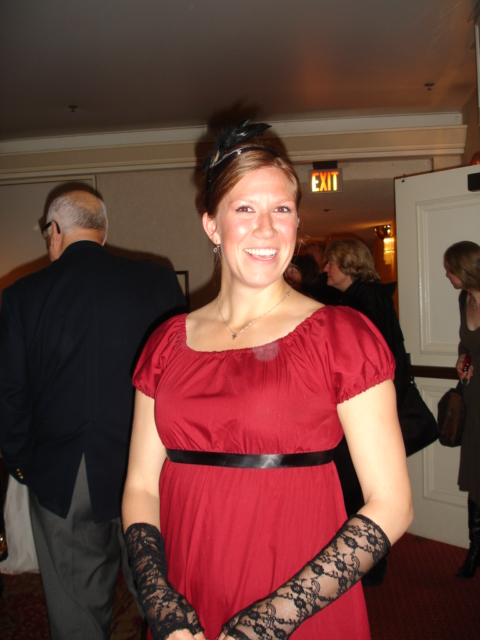
lovely gown!
Kimberly Brangwin in evening dress

Jill Kristensen, Wyoming
Marsha Huff at the Ball

Thank you Marsha for a fabulous four years, your beautiful Vermeer insights,
and for sharing your love of Austen with all of us!

Austen Literary History & Criticism · Fashion & Costume · Jane Austen · Jane Austen Circle · JASNA · Regency England · Social Life & Customs

Jane Austen AGM ~ Day 3 Recap: Gothic Horror, Catherine’s Imagination, Henry as Hero [again!], Fashion, Conduct Books, & a Ball!

Day Three at the JASNA AGM in Portland:  A quick continental breakfast with Laurel Ann and a few friends at the table – discovered that Elaine Bander is quite a scholar of Dorothy L. Sayers –more on this in another post – and then off to the Plenary with JASNA North American Scholar Juliet McMaster on  – “‘A Surmise of such Horror’: Catherine Morland’s Imagination.”  I have heard Prof. McMaster speak on several occasions and she never fails to express “in the best chosen language” all there is to love about Jane Austen. Today she begins with showing us a “cheap” 1965 paperback edition of Northanger Abbey, where “gothic’ is everything, cover and blurbs teasing us with the horrors that await us in these pages – she ends her talk with surmising that perhaps they didn’t get it so wrong!  She presents this by examining the quality of Catherine’s mind – a combination of innocence and wisdom, likening her to the “holy fool” of Shakespeare or Dickens, a “good fool”.  Where Henry Tilney is so often the focus of Northanger Abbey criticism, Catherine relegated to the “heroine” that Austen herself seems to denigrate, McMaster gives us a gift: Catherine redeemed and placed in her rightful home next to Austen’s other great heroines.


Juliet McMaster

Catherine, as we know, is described in negatives in those first pages, and Henry teases her about the “intellectual poverty” of a visit with Mrs. Allen – McMaster likens her “brain as a closet,” Catherine’s cluttered and well-stocked but vacuous [Henry and Eleanor are well-stocked but ordered; John Thorpe has a “double occupancy”!] –  this “moving toyshop of her mind” is a perfect metaphor for Catherine – she learns aesthetic sensibility [that hyacinth!], not unlike the Romantic sensibility of Coleridge and Wordsworth, and her gothic readings and Henry’s very near prediction of her experiences in the Abbey all serve Catherine in her “awakening, an imaginative awakening, and we end able to love her “faults and all.” [as Mr. Knightley on his Emma!] –  and what of Henry’s reprimand? The one scene in NA that has caused the most commentary? often an expression of concern that Henry could end up as tyranical as his father? McMaster believes that Henry is revitalized and rejuvenated by Catherine, and she views his rebuke as almost a “cover-up” – that his surmising Catherine’s thoughts before she has clearly expressed them [go back and read the book!], that Henry is all too aware of the truths about his father – Catherine awakens his own fears, and indeed contributes to his strength in openly defying his father.

I later, in yet another trip to the Emporium!, talked with Professor McMaster and added four more books to my Juvenilia Press edition, now complete as to Austen’s works, with McMaster’s fanciful illustrations… and one last thought – McMaster threw out this tidbit – “pay attention to when Austen uses the word ‘almost.’”

Juliet McMaster with her "The Beautiful Cassandra"

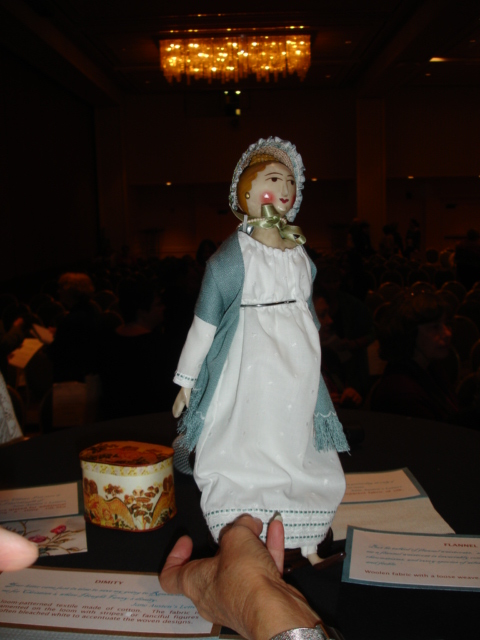
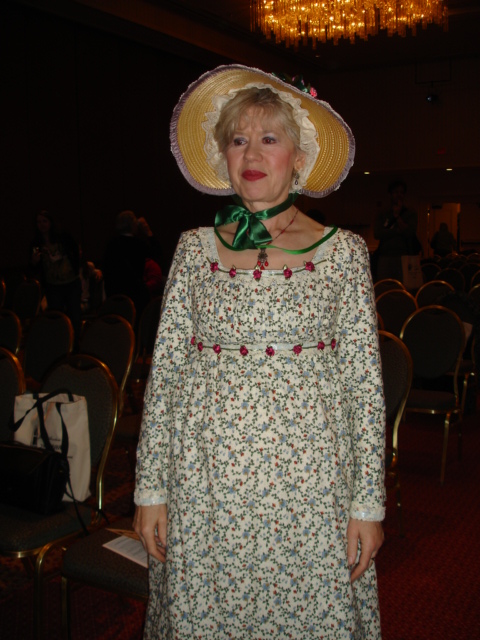
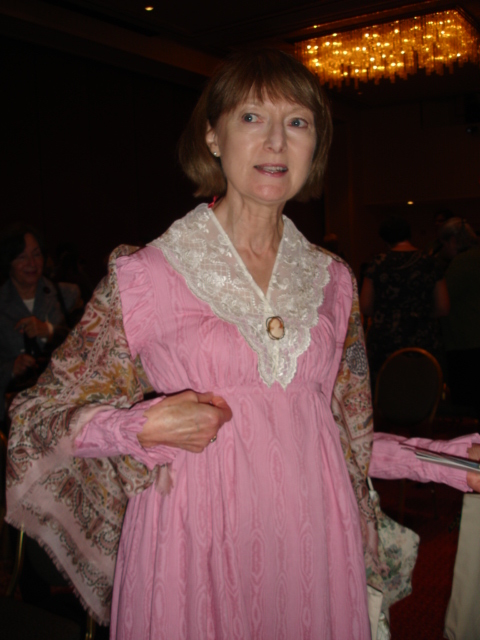
So after feeling quite confident in Catherine’s true place in the Austen canon, on to a fashion session with Mary Hafner-Laney, a specialist in construction of historic clothing in “ ‘I was tempted by a pretty coloured muslin’: Jane Austen and the Art of being Fashionable” – a presentation covering the various fashion sources in magazines, such as La Belle Assemblee, the use of fashion dolls [see illus. below] in the marketing, purchasing and sewing process, all the while citing Austen’s many references to the fashions of the day in her letters, filled as well all know with fashion gossip! and her novels. Mary took us through the process of purchasing the materials, choosing styles, finding a dressmaker, and the costs – i.e. nothing off the racks in Austen’s time!  She spoke about Eleanor’s white gowns and other color options, types of fabrics and where they came from and the stores that sold them.  Then a few words on undergarments, laundering, remaking and dying, and how one can never have “too much trim”!  A lovely and informative talk! and now some pictures of the beautifully clad listeners:

fashion doll

Syrie James and Bonnie Wise
Kimberly Brangwin
Pat Panshin
the always lovely Baronda Bradley!

******* 

And here, one of the rare negatives at a JASNA event but have to mention because I was so stunned! – Mary did not expect such a large audience [149!] and came without enough handouts – a facsimile of La Belle Assemblee [100], a booklet of fashion samples [50], and a regency fashion illustration with samples [50] – before Mary finished her Q&A, several people started going up front to get a handout – raging mutiny from the ranks! – they returned to their seats abashed [but with their booty…] and I turned to the woman next to me and said “Oh dear! This is going to be like a bra sale at Filene’s basement!” [what are the chances that this woman used to actually work at a Filene’s basement! – yikes!] and sure enough, as soon as Mary gave the go, a mad rush to the front, pushing and grabbing and quite appalling really! – who would have thought this lovely sedate group [and some so fashionably attired] could turn into such a greedy rabble! – yikes again!

On to Elvira Casel – always expected to present a thought-provoking topic, this time on “The Abduction of Catherine Morland: Deception, Sex and Courtship in Northanger Abbeyshe began with first eliminating any expectations that this talk would be about “SEX” – sex is inferred in Austen but that courtship process is full of sexual overtones in being all about finding a sexual / life partner –  and the sex part dealt with, she talked about “how honest people can negotiate a world that is often dishonest.” Casal gives us a Henry and a John Thorpe as rivals in the first part of the book – Thorpe’s abduction of Catherine tantamount to a gothic rape, his insidious lies, though propelling the plot, are ineffective because Catherine is on to him early on – and Henry’s immediate attraction to Catherine [who asked for that introduction from Mr. King after all?!], their conversation of the dance showing their developing relationship – Catherine might be puzzled but she does understand that Henry is defining his values, his idea of commitment.  Casal posits Henry and Thorpe as would-be narrators – Thorpe’s “fictions” propel the plot, but it is Henry as the true narrator / storyteller – he is very attuned to others, but there are concerns about his controlling nature – it is he who introduces the gothic story to Catherine, he stimulates her imagination – he is culpable here – but Casal sees Henry as ceasing to be the narrator when he seeks to be the hero in Catherine’s own story in the making.  During the Q&A, she said what I thought was the most interesting point in her argument:  Henry Tilney most resembles Elizabeth Bennet as a character – they both use humor to distance themselves from pain, disguising their true feelings.

Fourth session [wow! My brain is totally taxed – McMaster’s “closet” of clutter, and completely disordered!]

Susan Allen Ford on “Ingenious Torments: Reading Instructive Texts in Northanger Abbey– Professor Ford, who is working on a book about what Austen’s characters are reading focused on the didactic texts inherent in Northanger Abbey – those specifically mentioned or inferred: Mrs. Morland’s Mirror, with info on John Homespun and family [i.e Henry McKenzie of The Man of Feeling fame] as “cousins” of the Morlands  – plain country folk, yet Mrs. Morland’s inadequacy as a parent in her oft-quoted platitudes and clichés of life; the Richardson footnote on woman’s behavior in courtship; and finally Jane Collier’s An Essay on the Art of Ingeniously Tormenting, a satiric anti-conduct book.  Collier outlines the various human relationships, emphasizing the aspects of teasing and torment  [recall Catherine’s historians “labouring only for the torment of little boys and girls”] in all these relationships.  Prof. Ford talks of Austen’s use of the word “torment” – Henry four times, Catherine three, how Isabella personifies the “tormenting” by a friend, the extent of General Tilney “tormenting” Mrs. Tilney.  In the end, Austen mocks the prevailing didactic texts of the time by showing their inadequacies “for the emotional tortures in friendship, courtship and family relationships.”


End of breakouts! – so much learned,  so much missed – look forward to Persuasions On-line [December 2010]  and Persuasions 32 [May 2011] to fill in the gaps!

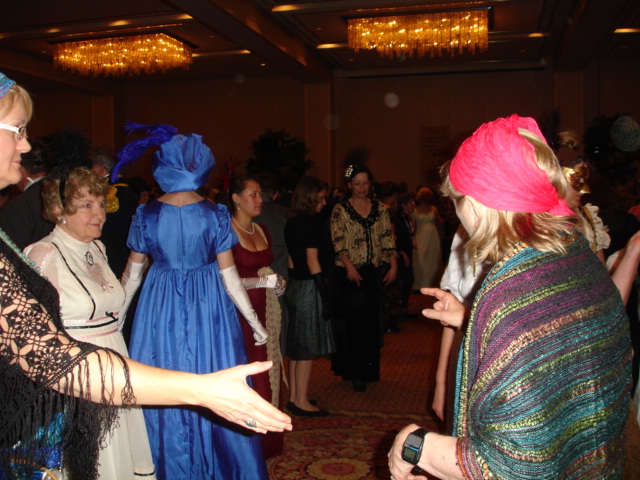
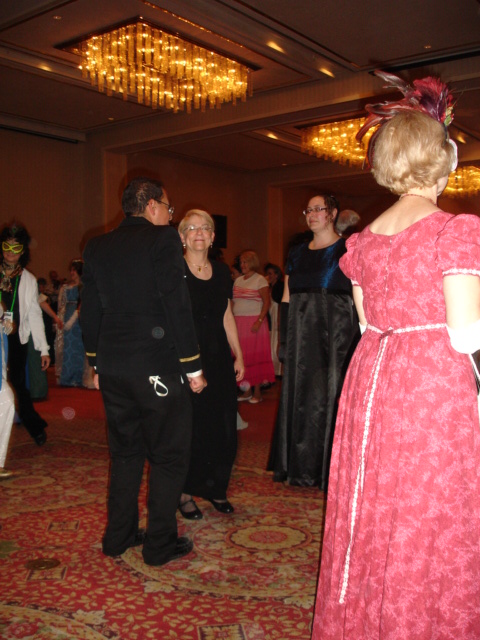
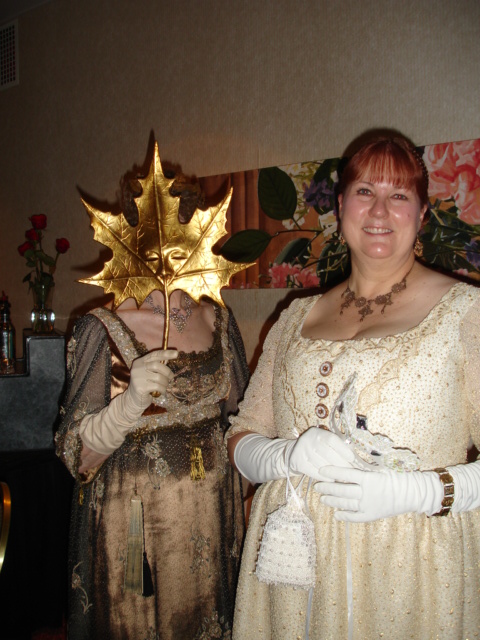
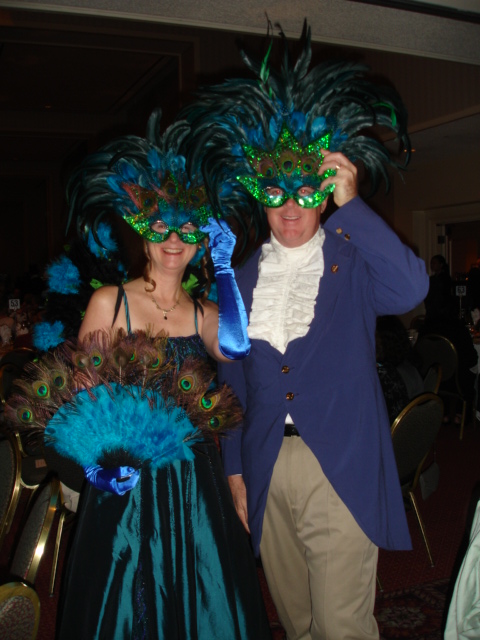
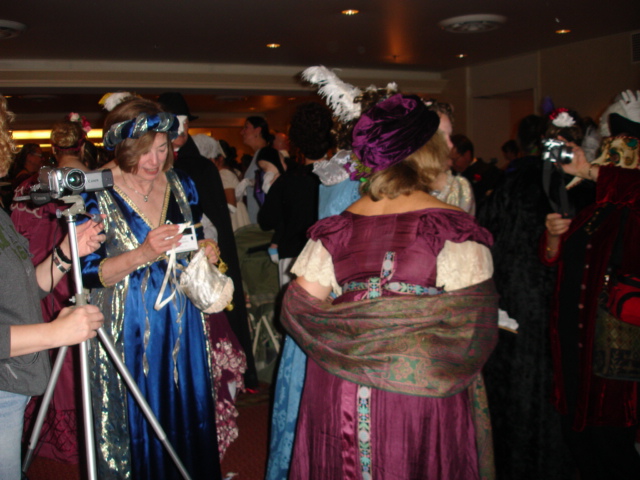
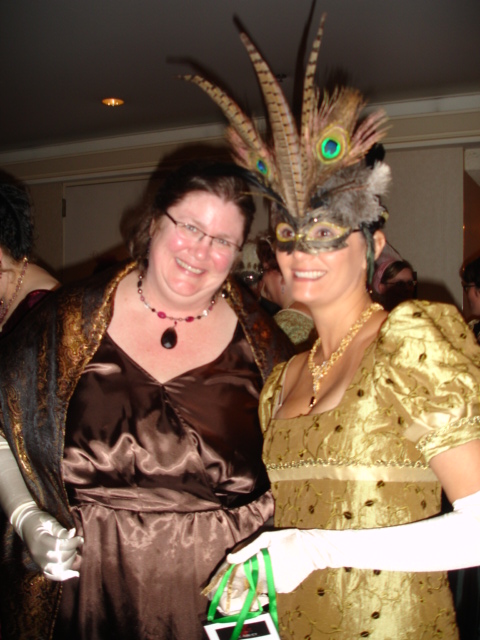
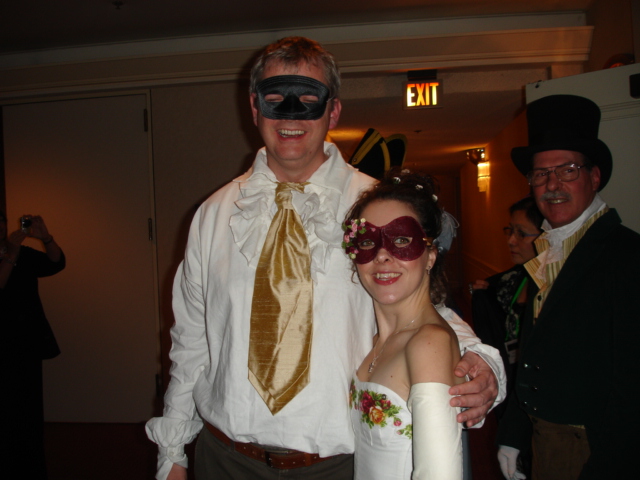
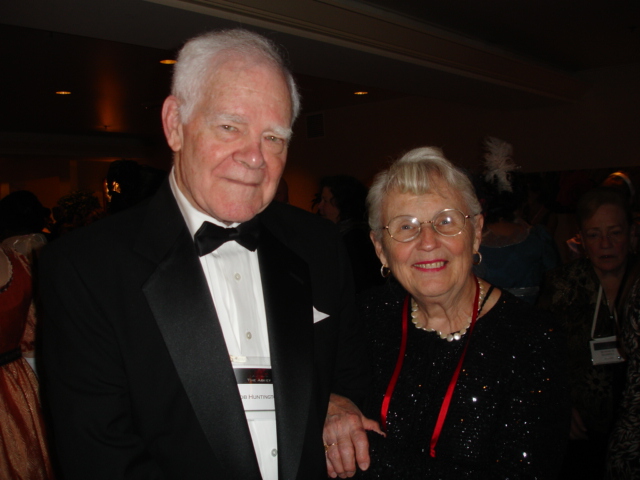
And then, the Banquet and Ball – the AGM had more fashionable Ladies and Gentlemen than I have ever seen – some elaborate Regency, some outrageous costumes for the Bal Masque – my costume still the “pattern-in-the-bag state – only a black velvet Spencer over a long dress – best I could do, but certainly not Promenade material! – which was great because I could just stand there and take pictures.  Dinner was great fun – we had a fun table and met all manner of Austen bloggers and web masters:  Sue Forgue of Regency Encyclopedia [contact me for passwords]; Diana Birchall of Mrs. Darcy’s Dilemma fame and her blog “Light, Bright and Sparkling”- we bonded on our “born and bred” in New York heritage; she introduced me to Ellen Moody, long known to me from the Austen listservs – I marvel at her Calendars of the novels – so great to meet  her – we also bonded on our “born and bred” in New York heritage!… others across the table beyond the hollering needed to hear – will get in touch with them via email – then off to see the Promenade, a fiasco of elevator limitations, so no parading about the streets of Portland for this year – no matter, the foyer and ballroom were quite fine to exhibit the finery!  pictures follow with names of those I got permission from – I did go into the Monster Mash event for a bit to hear the three different talks on the gothic – but headed back to the room for a needed respite – alas! my skills at English Country Dance to be exhibited next year! – and again, more and more people up there dancing this year – this is a wonderful trend at the AGMs – back to the sewing machine and ECD instruction for me!


Laurel Ann and Laurie Viera Rigler
absolutely stunning!
Syrie James and husband Bill
Diana Birchall

Baronda and Eric
a perfect Phantom!

Debbie Aldous and Christina Boyd
lovely in purple!

and friend”]
Tim Bullamore and friend
Jo Ann and Philip Staples

“]
Liz Cooper

Ceil and Bob Huntington
Lorraine and William Hanaway

Carol Moss - JASNA webmaster!
Laurel Ann and her roomie!
Portland at night...
Austen Literary History & Criticism · Books · Jane Austen · Jane Austen Sequels · Jane Austen Societies · JASNA · Regency England

Jane Austen AGM ~ Day 2 Recap: Auden, Castles, Henry the Hero, Dancers, & Gothic Art

Portland AGM – Day Two ~ I first refer to Laurel Ann’s post at Austenprose for her take on Day 2 – we did a lot together, but also tried to attend different break-out sessions –  so here is a quick summary of my day two: I should start this by saying something about my love of Northanger Abbey – it took me few readings, over a few years, but now I count it as one of my favorites, Catherine an engaging heroine and Henry quite to-die-for and Austen more on her game than she is often given credit for – you can read this former post about my thoughts on NA, rather than repeat all that – but just wanted to emphasize how much I was looking forward to this AGM and it most certainly exceeded my expectations!

I was completely bummed that I had to miss the Team Tilney offering headed by Maggie “‘Da Man” Sulllivan and thankfully Laurel Ann shared the happenings with me – I had to go off to a THREE hour [yikes!] regional coordinator training session, which was great – some new people, some old friends, some great new ideas – Claire Bellanti, VP of Regions gave an inspiring meeting – and we all left with plans for new programs and ways to connect with each other in our varying attempts to bring Jane Austen into the lives of the folks in our respective regions.  Claire had us all introduce the person next to us and we each had to share what book, other than of course any Austen, we would want with us if stranded on a desert island – interesting responses [perhaps a future post]!

After a quick lunch with Laurel Ann, we headed into the official AGM opening, hearing President Marsha Huff on her love of Northanger Abbey; the JAS Secretary Maureen Stiller who spoke of the loss this year of two great Austen scholars Elizabeth Jenkins and Brian Southam; and Steve Lawrence from Chawton House Library and Joan Ray thanking members for their generosity to the NAFCHL [North American Friends of Chawton House Library] –

and then on to the Plenary speaker Stephanie Barron, noted  author of the Jane Austen mysteries, on Suspicious Characters, Red Herrings, and Unreliable Detectives: Elements of Mystery in Jane Austen’s Northanger Abbey – a delightful talk on the mystery elements in Austen, a crime in every novel, the heroine as solver, the detectives and pseudo-detectives, and the final restoration of order.  Barron quotes W. H. Auden and his three requirements of a mystery novel, all present in Austen’s works: a closed society; a state of innocence with the “crime” committed by a fallen member of the society; and the societal ritual that the criminal has knowledge of in order to commit the crime, but is overcome by one of superior knowledge who restores order [thankfully!] –  Barron then applies this pattern to Northanger Abbey – the investigators, the clues, the red herrings – Henry as the consummate detective, Catherine as ignoring the clues, Isabella the dropper of clues, John Thorpe as the red herring, General Tilney as the fallen one – with Henry finally restoring order, Catherine all the while gaining understanding of the male world, “penetrating the veil” as in all good gothic novels.  Barron ended her talk with a comment on the Kathryn Sutherland kerfuffle about one’s editors [you can read more about it here], a reference to her short story to be part of Laurel Ann’s Jane Austen short story anthology Jane Made Me Do It [we all whooped! Laurel Ann swooned!], and answered some questions on her latest book Jane Austen and the Madness of Lord Byron – she spoke about following Austen’s chronological real life in the writing of her fictional mystery series, and oh! what will happen in 1817.  All in all quite a wonderful introduction to this year’s AGM!

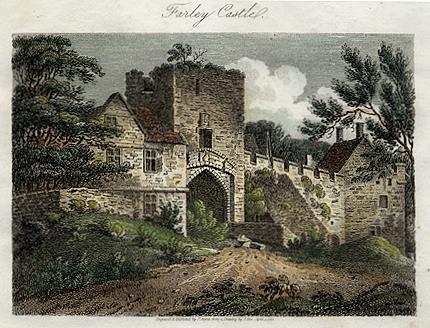
Then off to the first of many break-out sessions – and what a task to choose! – each session offering such variety and depth – the choice so difficult – I decided to do at least one on the gothic literary features of NA, one on fashion and all that muslin, and of course, something on Henry Tilney.  So my first was to hear the ever interesting Janine Barchas on The Real Bluebeard of Bath: A Historical Model for Northanger Abbey a brilliant tour through the nightmarish history of the Farley-Hungerford Castle, within driving distance form Bath, and a place that Austen would likely have visited or known about in her time in Bath. Professor Barchas shared the words in a contemporary guidebook, Richard Warner’s Excursions from Bath [1801], a book known to have been in George Austen’s library and containing Jane’s marginalia – and here we have some real-life gothic tales about what went on in Farley Castle and may have served as Austen’s inspiration for her own Abbey story, truth of course being far more bizarre than fiction!

Then off to see Stephanie Eddleman on “Henry Tilney: Austen’s Feminized Hero?” – One of the things that can get my dander up in a discussion about NA is talk that Henry is too feminine to be a true hero, or too condescending to be an equal lover to Catherine, or too distant as a character to engage the reader – so I was hoping that Prof. Eddleman would give me much needed ammunition! – and she did indeed:  Henry as the one hero who stands apart – he is her only witty hero; he is feminized but not feminine, and unlike Austen’s other feminized male characters [Frank Churchill, Robert Ferrars], Austen is not critical of Henry.  I most appreciated Eddleman’s answer to Marvin Mudrick’s contention that Henry is a detached, disengaged character – she feels that Henry develops intimacy through his intelligence and wit, always encouraging Catherine toward her own independent thinking.  I hope this talk will be in Persuasions – it gives much needed support for Henry as True & Worthy Austen Hero.

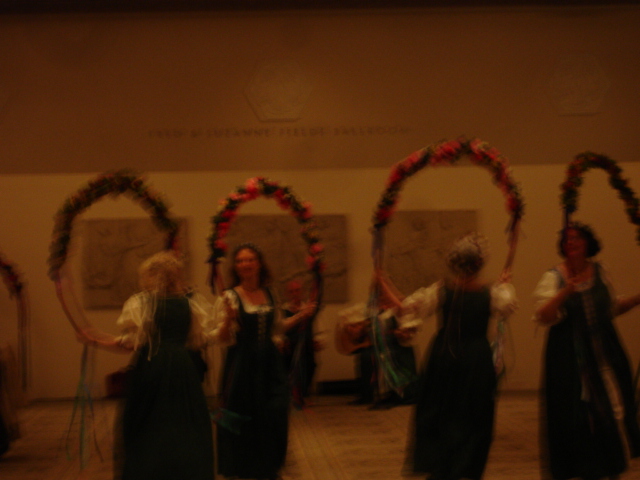
With all these great thoughts swimming around in my head, off we ran to the Portland Art Museum for the General Reception with the Wild Rose Garland Dancers – we arrived slightly behind schedule and found long lines for food and drink – Laurel Ann off for food, I did drinks – the long line frustration only lessened by a gentleman who told me all about his breakout session by James Nagle on “Dismemberment in the Library with the Quill Pen” – all about Regency succession rules, primogeniture, entails, etc. – Laurel Ann also went to this, so between the two of them I felt as though I had not missed this obviously interesting and entertaining talk – so this made the line move – we ate and drank and stood for the dancers as there was not a seat in sight – the dancers quite lovely and great fun to watch – here are a few pictures [with apologies for the dark and motion]:

Wild Rose Garland Dancers
the woman who would not sit down
The Dancers and the Players
“]
Sneakers- for my son
Player Gerhardt Quast on his Bodhron

[with thanks for letting me take a picture of his sneakers for my son!]

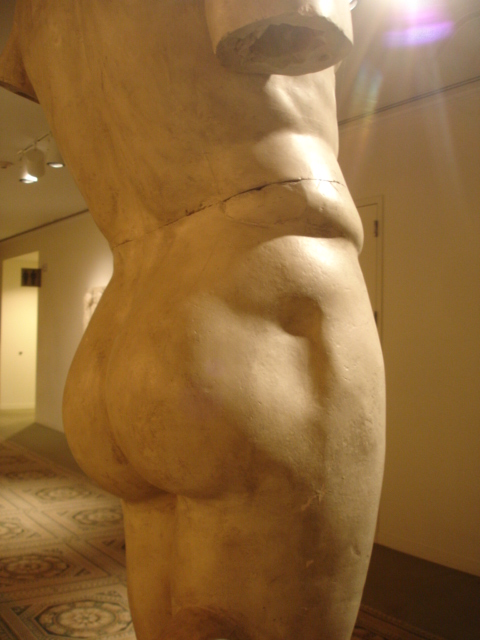
Next to me, however, was a woman who said she was sorely distracted by the distant statue of a rather large naked man [rear view only] – pictures duly taken, much laughter around and we were lost in the giggles for the rest of the evening [too much wine perhaps and not enough food?] – I see that Laurel Ann posted on this and the woman left a comment, so we are glad to have found her – and send you thanks Brenda for making our evening! – not that the dancers were not fabulous – we were just giddy at this point and who could resist!

 I regret not taking more photos of the museum offerings – I see that Diana Birchall has several on her blog – so I send you over there for a peak to Light Bright and Sparkling.  And you can view the Museum website as well.

And then the evening not nearly over – back to the hotel for the author book signings and to hear Jeff Nigro’s talk on Mystery Meets Muslin: Regency Gothic Dress in Art, Fashion and the Theatre.”  Jeff is the new RC for the Chicago Region and had spoken at that AGM two years ago on Art – so here again, another interesting visual treat about art and fashion and the literary and theatrical world of Austen’s time – I am not sure I will ever look at the art of the period the same ever again, or at least trust what I am looking at! – I am not even sure I can understand my notes! – so much information in this talk! – the mixing and matching of styles in the historical and contemporary works of art, with an emphasis on the “Gothick Picturesque”, the eclectic Regency gothic – Nigro shows that Austen’s Northanger Abbey is itself an eclectic mix, an overlapping of genres, as encompassed in both the Thomson and Brock illustrations. This was such a visual tour, one must see it to appreciate it, and not well described without the visual piece to accompany it – I would dearly love to get Jeff to visit Vermont and share his love of the arts with us…

So Day Two –who knew that just sitting around and absorbing all things Austen could be so invigorating and exhausting!  I will add this – hanging out with Laurel Ann had many perks! – the book she is editing involves a number of great Austenesque authors who have each contributed a story to the anthology [see Austenprose for details] – but while I have been attending AGMs for a number of years and was happy to introduce Laurel Ann to a number of JASNA people [and as soon as they understood she is the force behind Austenprose they all nearly genuflected!] – but her contacts with her authors was a treat for me to be introduced and spend some time with them as well – I have a few pictures of them and append them here with links to their sites – great writers all who embrace Austen in their own imaginative ways – I look forward to Laurel Ann’s book publication [alas! not until next October – just in time for the Fort Worth AGM!] – so thank you Laurel Ann for this – great fun all around!

Syrie James, Laurel Ann Nattress, and Cindy Jones

Syrie James and her husband Bill were a delight to meet – she costumed every day and he for the ball [will save the elaborate ball dress for tomorrow!] – Syrie has authored The Lost Memoirs of Jane Austen, The Secret Diaries of Charlotte Bronte [we bonded on a mutual love of Jane Eyre], and Dracula, My Love [on my TBR pile -I hear it is great!]  Visit her website here.

Cindy Jones has a new book coming out [March 29, 2011] My Jane Austen Summer: A Season at Mansfield Park – we had a great chat and I look forward to reading her book – please visit her blog at First Draft to learn more about her and her forthcoming  book. Cindy is also blogging at the new Austen Author’s blog.

Marsha Huff, Laurel Ann Nattress, Laurie Viera Rigler

Marsha Huff is, of course, JASNA President – this is her last AGM as head of the troops, and she has now passed on the torch to Iris Lutz from the Tucson Region – it has been a wonderful four years with Marsha and we will miss her – but I don’t think she will wander very far from the activities!  In this picture, she has just given Laurel Ann her JASNA Life Member pin! – so congrats to Laurel Ann on this!

Laurie Viera Rigler needs no introduction, but you can view her website here and her blog here – always a sheer pleasure to spend time with Laurie – but alas! no gossip on her next book – we must content ourselves for now with her “Sex and the Austen Girl” creations [such a punishment…]

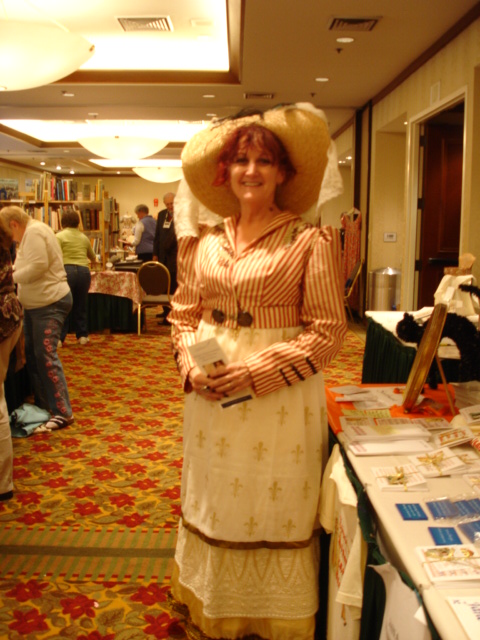
And I will close with another fashionista picture of Rebecca Morrison-Peck, one of the Emporium vendors – you can visit her shop at Etsy here:  http://www.etsy.com/shop/thethatchedcottage, where you will find all manner of Regency fashion pieces.  I was quite disappointed to try on two lovely spencers – one too large, the other too small – so will wait for another day to adorn myself – I purchased a Regency dress pattern three years ago , and that is as far as I have gotten – my Singer retains its dust and I think I should just give in and buy something from one of these far more talented mantuamakers!

Rebecca Morrison-Peck - The Thatched Cottage

Vic, who we sorely missed and hope one of these days to meet at an AGM, has posted links on her Jane Austen Today blog to several of the AGM posts already out there – so check out the thoughts and pictures of everyone else! … and finally,

Stay-tuned for tomorrow, Day Three and the Ball fashions! – I think this was the most costumed AGM yet!

Austen Literary History & Criticism · Books · Jane Austen · Rare Books

Austen on the Block ~ Auction Results!

Well, I have been immersed in the long 18th century these past several days [and will shortly post on the fabulous AGM in Portland in the next few days] – but while there, the October 28 Sotheby’s auction that I posted about last month, The Library of an English Bibliophile Part I, took place and here are the results

and the winner? Pride and Prejudice at £139,250! – whatever would Jane say?!


LOT 1

[AUSTEN, JANE.]
SENSE AND SENSIBILITY: A NOVEL… BY A LADY. LONDON: PRINTED FOR THE AUTHOR BY C. ROWORTH AND PUBLISHED BY T. EGERTON, 1811

40,000—60,000 GBP
Lot Sold.  Hammer Price with Buyer’s Premium:  49,250 GBPLOT 2

[AUSTEN, JANE.]
PRIDE AND PREJUDICE: A NOVEL. LONDON: G. SIDNEY FOR T. EGERTON, 1813

75,000—100,000 GBP
Lot Sold.  Hammer Price with Buyer’s Premium:  139,250 GBP

LOT 3

[AUSTEN, JANE.]
EMMA: A NOVEL. LONDON: C. ROWORTH FOR JOHN MURRAY, 1816

20,000—30,000 GBP
Lot Sold.  Hammer Price with Buyer’s Premium:  30,000 GBP

LOT 4

[AUSTEN, JANE.]
MANSFIELD PARK: A NOVEL. LONDON: FOR  J. MURRAY, 1816

1,500—2,000 GBP
Lot Sold.  Hammer Price with Buyer’s Premium:  1,875 GBP

LOT 5

[AUSTEN, JANE.]
NORTHANGER ABBEY: AND PERSUASION…WITH A BIOGRAPHICAL NOTICE OF THE AUTHOR. LONDON: JOHN MURRAY, 1818

20,000—30,000 GBP
Lot Sold.  Hammer Price with Buyer’s Premium:  43,250 GBP

 Further reading and other results in this auction at Sotheby’s website

Austen Literary History & Criticism · Jane Austen · Literature · Publishing History

Jane Austen and Her Editor…

Update:   read this very welcome response to this discussion by Geoff Nunberg at NPR here.

I am on the road, so not able to connect to all my Austen “feeds” on a daily basis, so I was grateful to hear from Janeite Marti who sent me the information on this latest kerfuffle in Austenland – it seems that Professor Kathryn Sutherland has, in her releasing the latest digital editions of Austen’s fiction manuscripts [see the link here Jane Austen Fiction Manuscripts], made comments on Austen’s spelling and punctutaion and the need for a proper editor to clean everything up for publication – how the press has picked up on this in a world-class endeavor to bring Austen down a peg or two,  tossing her from her very high literary pedestal!  Vic at Jane Austen’s World has addressed the issue most adequately, so I send you there to read her near perfect defense of “Dear Jane.”

I will add this – we have long known that Austen was no Marian Grammarian – her spelling WAS appalling [thankfully spelling is not a requirement for imaginative thinking, brilliant characterization and comic timing] – and we do know, if you are at all conversant with her letters, that she worked diligently with her publishers [and likely an editor as well! alas!] correcting proofs of her novels. And those of us who have seen any of her working manuscripts, or indeed have read Sanditon or The Watsons in their unpunctuated, unparagraphed state have also long known how Austen wrote – we should also take into account her need to conserve paper – her letters attest to this – the cross-writing, the writing on all available edges  –  but these mentions of her unruly notetaking, scribbling, lack of paragraph formation and quotation marks and obvious need of an editor, is not all that Sutherland had to say, and the media emphasis on this is unfair to both her and Austen.  One should read further:

Still more interesting to her, however, is the authorial voice one hears in the manuscripts. She calls it “a more innovative, more experimental voice” than Austen gets credit for. “By not working with the grammatical form, she’s actually coming much closer to writing real conversation” than in the printed versions where “she’s pulled back into a more conventional form,” the scholar said. “It’s a voice you’re perhaps not hearing again until the early 20th century.”

So let’s embrace this gift of seeing Austen at work and instead of quibbling about commas and quotation marks that make it look like some male editor made the Austen we all admire, do as Sutherland suggests and take Austen’s works to yet another level… what an opportunity we have!
 
 
Further reading: 
‘Persuasion’ manuscript
Austen Literary History & Criticism · Books · Jane Austen · News · Regency England

Hot off the Press! ~ Jane Austen’s Regency World, Nov -Dec 2010

The November/December 2010 edition of Jane Austen’s Regency World is now on sale:


In the new issue:

*ALL I WANT FOR CHRISTMAS: seasonal gift suggestions for the Austen fan in your life – or hints to drop your family and friends if you are an Austen fan!

*POWER OF ATTRACTIONS: what gives some of Jane’s characters sex appeal

*WHY I’M BANISHING JANE FROM MY BOOKSHELF: the reader who has fallen out of love with Austen

*THANKS FOR ALL THE FISH: Amy Patterson, of Jane Austen Books, finds similarities in the writings of Douglas Adam and Jane Austen

*NOVEMBER IN THE NOVELS: a busy time of year in Jane’s writing

*TOM AND JERRY: No, not the cartoon; a sportswriter’s fiction from the 1820s

*ON THE COVER: Royal Crescent Hotel, Bath, one of the grandest buildings in the city. Sharon Love, the general manager, tells us about “My Jane Austen”
 
Plus: All the latest news from the world of Jane Austen, as well as letters, book reviews, quiz, competition and news from JAS and JASNA
 
For further information, and to subscribe, visit: www.janeaustenmagazine.co.uk

DHL permitting (!) it will be available at next week’s JASNA conference in Portland, Oregon!