Austen Literary History & Criticism · Book reviews · Collecting Jane Austen · Jane Austen · Publishing History

Book Review ~ “Jane’s Fame” by Claire Harman

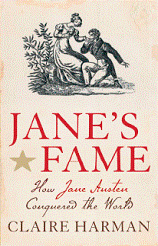
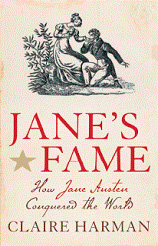
book cover jane's fameMany of us who grew up in the late 40s – early 50s had our Jane Austen force-fed to us in high school (unless we were fortunate enough to be blessed with an Austen-loving mother or father!).  Pride & Prejudice was the standard text with little reference to the other works; followed by George Eliot’s Silas Marner, Dickens’s A Tale of Two Cities and / or Great Expectations, Shakespeare (hopefully!), and Hemingway, Steinbeck, Salinger for contemporary authors.  But I’ve often thought that Austen got a bum-rap with this “required-reading” status, the educational system’s way of compensating for what an early critic said in calling Austen “a critic’s novelist – highly spoken of and little read.” [p. 120]  And while I am the first to admit that Austen is not for everyone [their terrible loss!], I have long believed that this approach to Austen added to her suffering from the great reader-turnoff. 

For me, a voracious reader as a youngster and teenager, I went on to read some of her novels, but alas! not all, feeling more at home with Alcott, the Brontes, Dickens, and later Wilkie Collins, all those more accessible Victorian novelists.  So it was in later life that I returned to Austen – and I perhaps needed that distance of time (and some wisdom!) to re-appreciate her brilliance – the humor and irony, the language, that characterization, and of course, the age-old love stories.  So from my current vantage point I marvel at Austen’s ability to stay fresh, to speak to different generations, and to speak to each individual in different ways through one’s own life. And in these fifteen plus years of “re-Austenising” myself, I’ve gone much beyond the novels, to the biographies, criticism, her Regency / Georgian world, and the current surfeit of films, and sequels and continuations, and even the latest parodies, creating quite a book collection in the process – and I have really barely begun!  

So I was most excited to hear about the release of Claire Harman’s new book, Jane’s Fame: How Jane Austen Conquered the World [Canongate, 2009], stirring up controversy even before it hit the bookstores [see my previous post, “Discord in Austen Land”].  [Harman has authored Fanny Burney: A Biography (Knopf, 2001) and works on Sylvia Townsend Warner and Robert Louis Stevenson].   It is an engaging read – historical, biographical, critical and anecdotal, all rolled into a capsule of Austen’s claim to fame – and just why was she so popular?  “the public whipped into a frenzy” [p. 243]  in the late nineteenth century and again in the late twentieth? – by “[James Edward] Austen-Leigh’s Memoir in the first instance, and in the second, a man in a wet shirt” [p. 243] [with thanks to Colin Firth!] – simplified reasoning perhaps, but a good chuckle and that glimmer of truth. 

Harman explains that

…this book charts the growth of Austen’s fame, the changing status of her work and what it has stood for, or been made to stand for, in English culture over the past two-hundred years.  In the foreground is the story of Austen’s authorship, one of persistence, accident, advocacy, and sometimes surprising neglect.  Not only did Austen publish her books anonymously and enjoy very little success during her lifetime, but publication itself only came very late, after twenty years of unrewarded labor.  I have sought to reconstruct these pre-fame years in the spirit of uncertainty through which Austen lived them.  Her prized irony and famous manipulation of tone I believe owes much to it; part of the reason why she pleases us so much now is that she was, for years, pleasing only herself.  [p. 7-8]

Thus, Harman starts by placing Austen squarely in the context of her times – her family and friends as writers – her mother, brothers James and Henry, her friend Anne Lefroy’s brother Samuel Egerton Brydges, and her pride in her own quite delightful juvenile writings.  Incorporating a general account of Austen’s life [Harman assumes the reader brings much knowledge of Austen’s life and gives only a cursory telling], she presents us with a great summary of Austen’s writings, the publication history and early responses to each work, drawing heavily on Brian Southam’s Jane Austen, The Critical Heritage [London 1968], and emphasizing Austen’s literary ambitions. [for more on this, see Jan Fergus’s The Professional Woman Writer” in The Cambridge Companion to Jane Austen, one of the earlier scholarly arguments to clearly see Austen in this light, far removed from the portrait painted by her brother Henry and later her nephew.]

Following Austen’s death in 1817, her copyrights still owned by Cassandra were sold to Richard Bentley and his issue of all six novels in 1833 did much to keep Austen in print; but her popularity waned, the rise of the Victorian novel sending Austen to the shadows, not to mention Charlotte Bronte’s dislike of Austen, quoted by Elizabeth Gaskell in her Bronte biography in 1857 [but ironically, how close is Gaskell’s North & South to Pride & Prejudice!]  So Austen remained largely unread until the Austen-Leigh Memoir of 1870, followed by various new editions of the novels and the selected letters in 1890. 

Harman explores in her chapter on the “Divine Jane” [quoting W.D. Howells] the publishing of these new editions and the illustrated versions that sought to “fix the characters in one’s mind” [p.159], the biographies, and critical analyses in this first burgeoning fame-fest, and her new status as darling of the intellectual snobbish-elite, championed by the likes of Leslie Stephen, Henry James, George Saintsbury, and Howells [and of course, not to leave out Mark Twain’s adamant dislike!] – all this culminating in R.W. Chapman’s Oxford edition of her works in 1923, “the first complete scholarly edition of any English novelist.” [p. 192]. 

In “Canon and Canonisation,” Harman chronicles the scholarly critical analysis that continues unabated to the present – the vast extent of academic and non-academic writing – on the one hand, Austen as a pleasure-read, the writer “who wrote so clearly and simply, and who was so small scale” [p. 200] – and on the other, the critical study of Austen’s “unconsciousness and brilliance” and here we see her “easy passage into English literature courses” [p. 201].  Austen makes critical literary history as manuscripts and contemporary memoirs became available for study – resulting in library collections, various illustrated editions, Jane Austen Societies, interest in her “homes and haunts,” more biographies from various standpoints, new paths of criticism taking into account the political, sociological and historical elements, and the many works on the manners and mores, fashion and handiwork, cookery and letter-writing – all things Austen indeed! [A friend visiting my home recently asked me what could all these Austen-related books on my shelves possibly be about when she only wrote six books!] 

And finally to film and what she terms “Jane Austen TM”, Harman again summarizing all that came before the “wet shirt” and after – the movies, the sequels, the internet and YouTube concoctions, the blogsphere , the Societies, the fan-fiction sites, the costume-driven fanatics, etc.  And Harman ends with the question, “What would Austen have made of all this? [p. 278] – in answer, she cites the differing views of D.W. Harding, Lionel Trilling, Henry James, and E.M. Forster to prove to us that “the significance of Jane Austen is so personal and so universal, so intimately connected with our sense of ourselves and of our whole society, that it is impossible to imagine a time when she or her works could have delighted us long enough.” [p. 281]

 One of the criticisms of Harman’s book has been her light non-academic approach to Austen [and perhaps her re-working of others’ ideas into this “popular” framework] – but it all works so well for what and for whom it is intended.  Harman’s gift is taking an inordinate amount of primary and secondary material and presenting it into a very readable, information-packed and anecdotal whole – everything you would ever want to know about Jane Austen all put together in a neat little package of 342 pages.  This of course may be its greatest shortcoming – too neat a package with strong authorial opinions thrown in [and a feeling to this reader of all being rather rushed at the end – “let’s wrap this up, throw in a few final tales and get it published” sort of feeling…] –  it must needs be leaving something out! [Indeed, the 2005 Pride & Prejudice barely gets a mention, either an oversight or the expression of the author’s opinion of that film – but no matter what your views of that adaptation might be, it has to be praised for bringing Jane Austen and P&P  to yet another generation who do not find Colin Firth’s wet shirt scene all that WE make it out to be – and thus it is a clear topic for Jane’s current and ongoing “fame.”] 

But as a resource, with a terrific reading list to be gleaned from the text and bibliography [though I do quibble with the number of un-sourced quotations and overly shortened citations that are unclear (especially in regard to the letters – a number and date would have been most helpful!)], Jane’s Fame should be required reading [not force-fed please…] for anyone interested in the facts of Austen’s writing life and how she has risen to such heights and commands such a presence in so many people’s lives.  And you will likely take away new and interesting tidbits such as finding what Katherine Mansfield had to say about Emma:  “Mr. Knightley in the shrubbery would be something!” [p. 247] [aah! indeed!]

4 1/2 full inkwells [out of 5]

 Further Reading: [all page citations above are to Janes’ Fame]

  • See my post on the various Reviews of Jane’s Fame
  • Copeland, Edward, Juliet McMaster, eds.  The Cambridge Companion to Jane Austen.  Cambridge University Press, 1997.
  • Fergus, Jan.  “The Professional Woman Writer” in The Cambridge Companion, pp. 12-31, where Fergus summarizes and expands these arguments first presented in her Jane Austen: A Literary Life. London: Macmillan 1991.  These are must-reads…
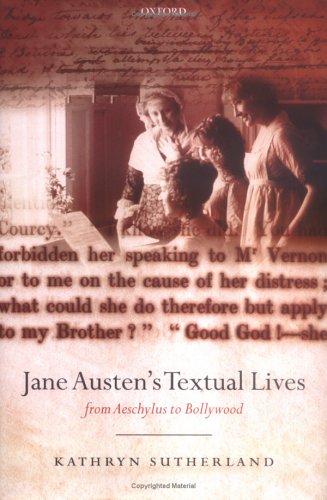
  • Sutherland, Kathryn.  Jane Austen’s Textual Lives: from Aeschylus to Bollywood. Oxford, 2005, pb 2007.  Note that it is Professor Sutherland who started the controversy that Harman essentially lifted her ideas – I have this book and have skimmed it only, so cannot comment fully – but just looking at the table of contents, one finds the similarities a little alarming, and the Sutherland book has far more depth to the notes and bibliography – but again, I emphasize the “popular” nature of Harman’s book. 
  • Todd, Janet, ed.  Jane Austen in Context.  Cambridge University Press, 2005, 2007 with corrections. 
  • Claire Harman’s website with cites to reviews of Jane’s Fame
  • Austenblog:  Mag’s review of Jane’s Fame

Posted by Deb
Austen Literary History & Criticism · Literature · Women Writers

In My Mailbox ~ ‘The Female Spectator’

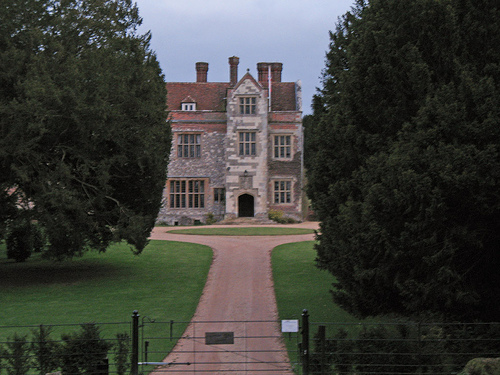
I am always thrilled to find in my mailbox the latest issue [Vol. 13, No. 1, Winter 2009] of The Female Spectator, the newsletter of the Chawton House Library. 

The first article by Helen Cole, a PhD candidate at the University of Southampton, is on “The  Minerva Press and the Illustrations of the Late Eighteenth-Century Novel” – Cole is researching the Minerva Press novels of the 1790s, regarded by many as “historically interesting but of minimal literary value”, yet often illustrated with engravings that had little to do with the narrative, or enhanced with an engraved bookplate, or rebound in fine bindings, thus proving that at the time these books were likely considered valuable to the owner.  The bound-in engravings were not consistently present,  leading one to question on what basis the publisher made these binding decisions.  Cole’s research has been made all the easier since the availability of the Eighteenth Century Collections Online[ECCO]* which allows access to many little-known 18th-century novels. [*note that this source is accessible only to subscribing institutions]

A second article, ” ‘A Chawton Experience’ : Women and Education in the Gentleman’s Magazine and the Anti-Jacobin (1797-1799)” by Helen Loader, a PhD candidate at the University of Winchester, summarizes her research into the reviews in these two journals of works written by or about women, and the often prevailing male view of the lack of education among women writers and the dangers of reading such novels.  Ms. Loader cites to two sources that are available online: 

Emily Lorraine de Montluzin “Attributions of Authorship in the Gentleman’s Magazine 1731-1868: an Electronic Union List, University of Virginia – http://etext.lib.virginia.edu/bsuva/gm2/index.html

and Mary Darby Robinson, A Letter to the Women of England on the Injustice of Mental Subordination (1799) at http://romantic.arhu.umd.edu/editions/robinson/

[this text, part of the University of Maryland’s Romantic Circles database also includes various other related resources]

Other news from the Library:

  • A new acquisition:  a small collection of manuscript family recipe books dating from the 18th and early 19th centuries belonging to three inter-related families.
  • Information on the forthcoming conference, “New Directions in Austen Studies”, July 9-11, 2009, celebrating Austen’s move to Chawton in 1809.
  • Application information for the Chawton House Library visiting fellowships – there are now four scholars in residence positions and applications are due by May 30, 2009.

For more information on the Library, the Conference, the Fellowships and other events, see the Library website .

For information on becoming a member of the Library, click here.  It is worth every penny so you too can find this newsletter in YOUR mailbox!

chawton-house-library


Austen Literary History & Criticism · Book reviews · Jane Austen · News

“Jane’s Fame” ~ the Reviews

book-cover-janes-fame

The reviews are in on Claire Harman’s Jane’s Fame: How Jane Austen Conquered the World [Canongate, 2009]


I list several of them for your perusal.  [I am fortunate indeed to have just been in the UK – I went into every Waterstone’s I came across until finally the date of release arrived and a very helpful shop-keeper found it sitting on a to-be-shelved cart!  – so I am almost finished and will post my thoughts shortly…]


The Telegraph, by Frances Wilson

The Independent, by Elspeth Barker

Times Online, by John Carey

The Guardian, by Kathryn Hughes

The Spectator Book Club, by Philip Hensher

The Literary Review, by Mark Bostridge

A preview of the book at Austenprose

My previous post at JAIV about the Jane’s Fame controversy

Austen Literary History & Criticism · Books · Jane Austen · News · Rare Books · Regency England

Austen on the Block ~ Bloomsbury Auctions

Bloomsbury Auctions-New York  announces the exhibition and auction of


The Paula Peyraud Collection, Samuel Johnson

and

 Women Writers in Georgian Society


Wednesday, 6 May, 2009 • 10:00 am


Bloomsbury Auctions, the world’s leading auction house for rare books and works on paper, announces The Paula Peyraud Collection, Samuel Johnson and Women Writers in Georgian Society with over 480 lots of books, manuscripts and paintings tells the fascinating story of English society in the middle and late Georgian periods. This extraordinary sale focuses on the artistic and literary women who came to the fore in the period 1750-1840.


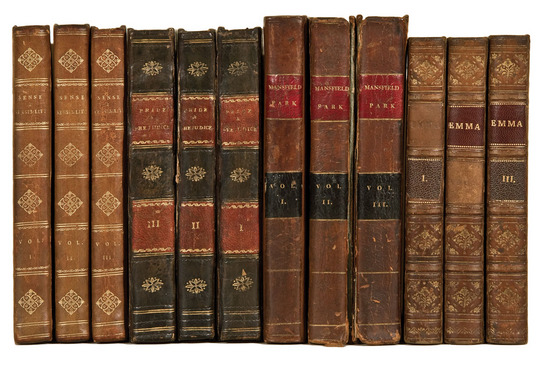
 A highlight in the sale are the following five titles from Jane Austen: 

bloomsbury-auction-austen

  • Emma-1816- 3 volumes: $8,000-12,000
  • Mansfield Park-1814- 3 volumes: $7,000-10,000
  • Northanger Abbey-1818- 4 volumes: $5,000-8,000
  • Pride and Prejudice-1813- 3 volumes Carysfort copy: $20,000-30,000
  • Sense and Sensibility-1811- 3 volumes: $25,000-35,000 


There are a total of 483 lots for sale, to comprise books, autograph letters, engravings and watercolors of the era:  Johnson and Boswell, and Walpole, etc., and many women writers are represented:  Frances Burney, Maria Edgewoth, Hannah More, Hester Thrale Piozzi, Charlotte Lennox, Charlotte Smith, Charlotte Bronte, Ann Radcliffe, Marguerite Blessington, to name a few.


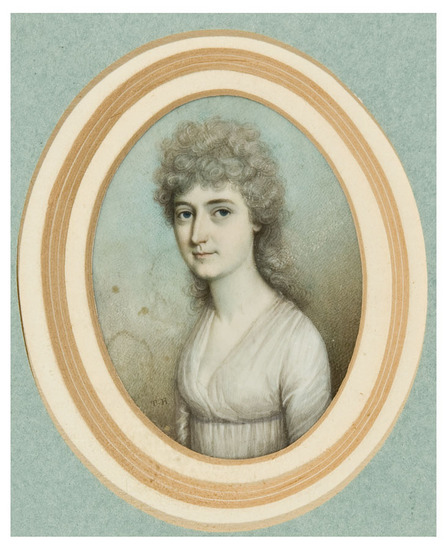
And see this watercolor of Elizabeth Bridges, Austen’s sister-in-law:

elizabeth-bridges-watercolor
Bloomsbury Auction - May 6, 2009 Lot No.127


127. [AUSTEN, Jane (1775-1817)] – Thomas Hazlehurst (1740 – 1821). Portrait miniature of Elizabeth Bridges Knight wearing a white dress with a blue ribbon tied under corsage. Watercolor on ivory, oval.
2 1/2 x 2 inches (6.5 x 5 cm).
Initialed “T.H.” (lower right).
A fine portrait miniature of Jane Austen’s sister in law, Elizabeth Bridges (1773-1808) who married Edward Austen, the brother of Jane Austen. Edward took the name of his second cousin Mr. Knight on inheriting in 1812 his estates in Kent at Godmersham Park. They had 11 children.
This lot sold with an uncolored print of Godmersham Park by Watts.
Literature: Country Life. 27 July 1987, ill. p.111.  Est. $2000 – 3000.

 *********************************************

Location:  Bloomsbury Auction Gallery, 6 West 48th Street New York 10019

Viewing hours:  

  • Friday May 1- By appointment
  • Saturday May 2- 10-5 p.m.
  • Monday May 4- 10-7 p.m.
  • Tuesday May 5- 10-5 p.m.

Bloomsbury Auctions is the world’s leading auction house for rare books and works on paper and is headquartered in London with salerooms in New York and Rome.


 For further information call Bloomsbury:  212-719-1000 or email at newyork@bloomsburyauctions.com


You can view the full catalogue at the Bloomsbury website.


Austen Literary History & Criticism · Jane Austen · News · Publishing History

If you can wait until November ~

This is a tad ahead of schedule, but Mark your Calendars! 

The Pierpont Morgan Library in New York City will be hosting a Jane Austen exhibit to begin in November 2009:

Jane Austen
November 2009 through March 2010

austen-lady-susan-ms-morgan-library

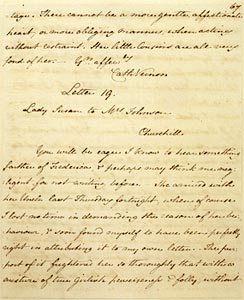
 Jane Austen, Lady Susan, autograph manuscript, written ca. 1793–94 and transcribed in fair copy soon after 1805. The Morgan Library & Museum, Purchased in 1947; MA 1226.


*********************************

This exhibition explores the life, work, and legacy of Jane Austen (1775–1817), regarded as one of the greatest novelists in the English language. During the past two decades, numerous successful motion picture and television adaptations of Austen’s novels have led to a resurgence of interest in Austen’s life and work. This show provides a close-up portrait of Austen, achieving tangible intimacy primarily through the presentation of her autograph manuscripts and personal letters which the Morgan has not exhibited in a generation.

The Morgan’s collection of Austen’s autograph manuscripts and letters is the largest of any institution in the world, and includes the darkly satiric Lady Susan, the only surviving manuscript of any of Austen’s novels. The exhibition will also include first and early illustrated editions of Jane Austen’s novels and letters, as well as contemporary drawings and prints depicting people, places, and events of significance in Austen’s life.

Responding to the revival of interest in Austen’s life and work, the exhibition provides a deeper insight into Austen’s essentially enigmatic character and personality, the craft of writing, and the historical context in which she lived and wrote. The exhibition will explore not only Austen’s personal reading, and the literary influences that inspired and informed her work, but also the response to Austen by later writers as diverse as Scott, Bronte, Nabokov, Twain, Chesterton, and Auden.

[From the Morgan Library website]

Austen Literary History & Criticism · Jane Austen

Bishop’s PRIDE, part II

Prof. Robert Morrison
Queen’s University, Kingston
“Getting Around Pride & Prejudice: Gothicism, Fairy Tales & the Very World of All Us”.

In a thought-provoking premise, Dr. Morrison equated the “Gothic” literary tradition with a fear of spinsterhood and the deeper fear of its relation, poverty.

Citing sources such as Byron and Wollstonecraft, his ideas contained such laden words as humility, compassion, love, humiliation, terror, anguish, in short: firm Gothic Territory. Neoclassical in form and structure, with fairytale endings of “happily ever after,” Austen’s writings are often paired with Shelley’s in Dr. Morrison’s classes. Pretty women, estates, happy marriages. ” ‘What calm lives those people had,’ said Churchill of Austen’s characters.” But Austen’s major achievement, hidden perhaps, are the shortage of men, passing mentions of prize money and economic crises: “Politics seems to shape the novel at every turn”. Austen cannot continue to suppress or ignore the ‘individual’. Citing Howells, we could all agree that Elizabeth – a gentleman’s daughter – was more a ‘lady’ than even Lady Catherine de Bourgh. Elizabeth’s triumph over Lady Catherine can be taken as a triumph of humanity over rank.

The linchpin is realism, Dr Morrison concluded, but her novels touch on the fears (the Gothic).

Some points and arguments that Dr Morrison advanced which caught my particular attention:

Citing Martin Amis, he commented on Austen’s thoughts and rhythms invading his own thoughts and rhythms. I would heartily agree; it makes such a difference in my quality of writing (even speech), when I read the phrases of a powerful author as opposed to a pedestrian hack.

He brought up the reactions of such readers as Annabelle Milbank and Henry Crabbe Robinson. These are precious, as they are reactions to the novels, from people living during Austen’s lifetime, and wholly untainted by memories of films and teleplays. HCR even called Mr Collins ‘a masterpiece’! My thoughts exactly (which made a later comment [see below] hard to fathom).

Dr Morrison made a joke of Catherine Morland’s name; citing that everyone in the novels wants ‘more land’. He promoted the idea of a woman being “her father’s burden; her husband’s property”. But the comment of Charlotte Lucas committing “respectable prostitution” – well, that seemed out of place. Actually, it left me shaking my head – ‘No!’ When Dr Morrison said that his ‘skin crawled’ at the idea of the Collinses’ marriage, that sounded more ‘colored by film depictions of Mr Collins’ than genuine thoughts about the plight of both characters: one in want of a good wife; the other in want of a good home.

In equating the Gothic, there was this thought-provoking idea behind Darcy’s comment on Elizabeth’s looks: Darcy doesn’t want to dance (doesn’t even wish to be at the dance); and all people talk about is his money! Darcy’s “tolerable” evaluation of Elizabeth “haunts her – raises the specter of spinsterhood”. Her greatest asset (no dowry) is her looks. Excellent way of digging deeper into this much-quoted comment by Darcy.

Elizabeth is wrong about Charlotte, willing to be wrong about Wickham, and wrong about Darcy. Darcy’s letter helps her see herself more clearly. The implacable resentment Elizabeth attributes to Darcy, she feels herself.

One unanswered – until that evening – observation: when Dr Morrison spoke of Austen’s use of words and cited her deliberate use of “a month” in Elizabeth’s rejection of Darcy. Dr. Morrison’s thoughts centered on Lizzy’s inability to forgive the slight Darcy had inflicted. But as the question period opened and this was addressed (with more than one person saying ‘I never really noticed’) it became apparent that Austen meant more by this specific period of time: not an hour, not a day – but “I had not known you a month”. The Play that evening answered this hitherto unanswered observation – and it is in the novel: When Mr Wickham is ‘confessing’ his life story to Elizabeth, he asks her how long Darcy has stayed with Bingley. The magic answer: “About a month.” Obviously Austen wanted readers to conclude, in the proposal scene, that  Lizzy’s enmity against Darcy survived the slight to her ‘tolerable’ looks, but surfaced to the fore from the point at which she ‘knows’ Darcy to have harmed the prospects of Mr Wickham!

An audience member then brought up this acute observation: Miss de Bourgh, in being sickly, is quite Gothic and can be seen as the symbol of “the dead end,” the dying system that once was predicated upon blood (again the idea of rank versus the humanity of Elizabeth). And on that thought, which touched on the truly Gothic – the vampire tales, we broke for beverages, cookies and oranges. There will be more to say on this subject when the Play is discussed; for the actress portraying Miss de Bourgh gave the role something never seen before.

Austen Literary History & Criticism · Jane Austen · News · Schedule of Events · Uncategorized

Bishop’s PRIDE

Two Saturdays ago (March 14th, to be exact) I ventured up to Bishop’s University (Lennoxville, Quebec) for a Pride & Prejudice Weekend – a symposium, thanks to English department professor Claire Grogan; a delicious ‘Jane Austen’s Cream Tea’ at Uplands; a Pride & Prejudice play, adapted by drama professor George Rideout; and an Austen-era Sunday Service in the university’s beautiful chapel. Sure the footlights have dimmed, the curtain has dropped, and the weekend’s events have faded into memory – but readers should know what they missed; and why they should keep an eye out for a production of this well-thought-out new play.

Saturday afternoon’s symposium featured three speakers; a full-hall (a good 70 people) had gathered to hear them.

Prof. Peter Sabor
McGill University, Montreal
“Portraying Jane Austen: How Anonymous became a Celebrity”. 
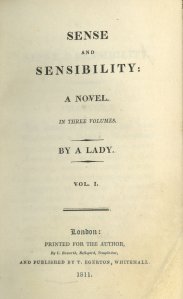
senseandsensibilitytitlepage

Illustrated by images, Dr. Sabor brought the audience along Austen’s circuitous route to celebrity – beginning with the original “BY A LADY” title page of Sense and Sensibility and showing near the end a publicity photo that made everyone chuckle: Jane Austen Hollywood-ized, complete with cell phone (the giant, 1980s version), conducting business while lounging on a poolside chaise.

In between these humble beginnings and the 20th-century hype lay a lot of Austen territory to be explored. Austen, of course, sold the copyright to Pride & Prejudice – her most popular novel – for ₤110. In 1813, the three volumes sold for 18 shilling (“about $2 Canadian today”).

Austen’s name has been located on a few subscription lists (Burney’s Camilla; the 1808 sermons of the Rev. Thomas Jefferson). Dr. Sabor explained that it was costly to purchase books by subscription. Such lists, however, can be invaluable to the researcher (I have located many Goslings and Smiths on subscription lists; it gives a thrill to realize they knew the author or valued the work enough to purchase a copy – or more than one – before the presses rolled).

The anonymous review (in reality Walter Scott) of Emma highlights Austen’s soon-acknowledged authorship a few years later: Although the title page of Northanger Abbey cited “By the author of ‘Pride and Prejudice,’ ‘Mansfield Park,’ &c,” the first volume included brother Henry’s biographical notice – thereby naming in print for the first time exactly who authored all six of these novels. [See also Henry’s updated version in the Bentley edition (1833) of S&S.] Beginning in 1818, we see reviews that mention Austen by name. (In an aside: Emma Smith, the future Mrs James-Edward Austen, was in 1817 already citing her as the author, specifically, of Mansfield Park; though Emma spelled the last name, as many did and often still do, Austin.)

A French translation of Austen’s last completed novel – published under the title La famille Elliot – becomes the first book in which Austen’s name appears as author on a title page. The year is 1821. [For information on the translator, see Ellen Moody.]

When discussion of the known and purported Austen portraits began, the audience was given a truly informative lesson on the pitfalls, as well as hopes and shattered dreams, of claimants to “authentic Janes”. Even the 1804 sketch: Is it a depiction of Jane by her sister Cassandra?? Anna Lefroy (half-sister to James-Edward Austen) inherited it, and to this day it resides within the family. (It was first presented by Chapman in his volume of Letters.)

The illustrations of Austen grow more wild as the publicity picks up – paper dolls, figures made for ‘action,’ plush and bobble-headed dolls, even an Austen Powers ‘superhero’. From recreations to fantasy depictions, Austen’s ‘anonymity’ has certainly turned a complete 360-degrees.

ADDENDUM: for an observation on the so-called ‘wedding ring portrait’ of Jane Austen (which Dr. Sabor called “bizarre”, see SEPARATED AT BIRTH?)

*

next: Prof. Robert Morrison (Queen’s), “Getting Around Pride & Prejudice: Gothicism, Fairy Tales & the Very World of All Us”

Waiting in the Wings: read insights into the character of Miss Bingley by actress Stephanie Izsak.

Austen Literary History & Criticism · Books · Jane Austen · Literature

Discord in Austen Land

Here is an interesting article at the Guardian.co.uk about a new book on Austen by Claire Harman (author of the 2001 biography Fanny Burney) ~ Jane’s Fame: How Jane Austen Conquered the World, to be published next month, and a conflict with the academic writings of Professor Kathryn Sutherland, author of the ground-breaking 2005 Jane Austen’s Textual Lives, from Aeschylus to Bollywood.  It’s quite the kerfuffle….

book-cover-janes-fame

book-cover-ja-textual-lives

Further reading:

[Adding here 3/17/09:  I had noted in my comments below that Ellen Moody has addressed this issue in more depth on Austen-L and Janeites as well as her blog, so I add here the link to her post: 

http://server4.moody.cx/index.php?id=1016#comment

 NB: scroll down further on her blog as there is quite a bit more after the reference to Emily Hahn’s book on Fanny Burney]