Julie Klassen’s latest book, The Innkeeper of Ivy Hill, has just been released and there are various bloggers offering up reviews, excerpts, interviews and guest posts. I will be posting about the book on December 20th, but wanted you to see and follow the other posts that began on December 5th – please be sure to comment on any of the blogs in order to be entered into the random drawing: the winner will receive a $20 Teavana gift card and a package of four inspirational British romances from four different eras (The Innkeeper of Ivy Hill by Julie Klassen, A Haven on Orchard Lane by Lawana Blackwell, The Lost Heiress by Roseanna M. White, Not by Sight by Kate Breslin). The winner will be notified on December 22.
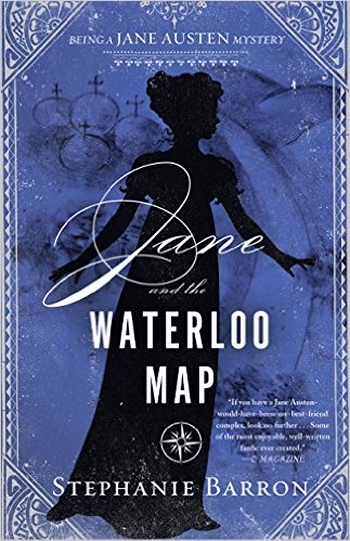
Amateur sleuth Jane Austen returns in Jane and the Waterloo Map,
the thirteenth novel in Stephanie Barron’s delightful Regency-era mystery series.
Gentle Readers: Today Jane Austen in Vermont is taking part in the ‘Jane Austen and the Waterloo Map’ blog tour that began on February 2, 2016 (see other tour stops below). Ms. Barron has done it again! – this time taking us into the Battle of Waterloo, but not before presenting our Jane with a body in the Carlton House Library! Read here an except from Chapter 8, followed by the details for the Giveaway – you can comment here or any of the other blog posts until February 29th.
***************************
About the book:
November, 1815. The Battle of Waterloo has come and gone, leaving the British economy in shreds; Henry Austen, high-flying banker, is about to declare bankruptcy—dragging several of his brothers down with him. The crisis destroys Henry’s health, and Jane flies to his London bedside, believing him to be dying. While she’s there, the chaplain to His Royal Highness the Prince Regent invites Jane to tour Carlton House, the Prince’s fabulous London home. The chaplain is a fan of Jane’s books, and during the tour he suggests she dedicate her next novel—Emma—to HRH, whom she despises. However, before she can speak to HRH, Jane stumbles upon a body—sprawled on the carpet in the Regent’s library. The dying man, Colonel MacFarland, was a cavalry hero and a friend of Wellington’s. He utters a single failing phrase: “Waterloo map” . . . and Jane is on the hunt for a treasure of incalculable value and a killer of considerable cunning.
And now….
AN EXCERPT FROM CHAPTER 8: In which Jane discusses the Battle of Waterloo with one of its survivors,
Lieutenant James Dunross of the Scots Greys.
“I did wonder whether the Colonel’s final words had any connexion to his valor on the field at Waterloo.” I looked at the Lieutenant rather than my hostess’s rigid form. “I have heard him described as a Hero. Would it trouble you to speak of him—or might I persuade you to recount his actions on that glorious day?”
There was the briefest pause.
“James?” Miss MacFarland queried in a lowered tone, her gaze fixed on the glowing coals.
“My dear,” he replied.
“Will it distress you?”
“Naturally. But as I expect to be hearing of Waterloo for the rest of my life, I had as well become accustomed.” The Lieutenant’s aspect was light, but his voice betrayed his distaste. “I should not use the word glory, however, to describe it. Carnage is more apt.”
“No,” Miss MacFarland protested. She turned impulsively to face us. “It shall always be a day of glory to me, because you and Ewan were spared! I cannot tell you how incomprehensible it is, Miss Austen, that my brother survived that battle—only to end in the fashionable desert of Carlton House. Incomprehensible!”
“The Colonel belonged to the Scots Greys, I believe?”
“He began military life in an hussar regiment, and saw years of active service in the Peninsula; but being better suited to heavy dragoon work, exchanged two years ago into the Greys. That is how we came to be acquainted with Lieutenant Dunross—James served in the regiment under my brother.”
Battle of Waterloo 1815 – William Sadler [Wikipedia]The gentleman forced himself heavily to his feet, and crossed with the aid of his cane to the draped window. He pulled aside the dark blue curtain and leaned into the casement, staring expressionlessly down at Keppel Street.“Are you at all familiar with the course of the battle?” Miss MacFarland asked.
“What little I learned from published accounts.”
“Then you will know that the cavalry was commanded by Lord Uxbridge.”
As who did not? Uxbridge had cut a dash among the Great for most of his life: He was an earl as well as a general; head of the Paget family; a darling of the ton; and Wellington’s reputed enemy. A few years since, Uxbridge ran off with the Duke’s sister-in-law, and embarrassed all their acquaintance. Divorce and outrage are nothing new to people of Fashion, however; and tho’ Uxbridge and Wellington might not sit down to whist together, once battle was joined with Napoleon, one was in command of the other’s cavalry. Some ten brigades, in fact.
“In the early afternoon of that wearing day, Wellington’s left was under serious attack from the French batteries,” Miss MacFarland said. I collected from her unvaried tone that she had told this story—or heard it told by her brother—many times. “General Picton was killed, and shells were exploding with horrific effect all along the British line. Our troops were giving way under the assault of d’Erlon’s columns. Uxbridge saw it as Wellington could not, being far down the right. The Earl threw Lord Edward Somerset and the Household Brigade into the thick of the fight, then galloped off to the Union Brigade. This is composed, as perhaps you may know, of three regiments: the English, or Royals; the Scots Greys; and the Irish, or Inniskillings.”
“Ah,” I managed. I had never thought to consider which regiments comprised the Union Brigade.
“Sir William Ponsonby was in command.”
Another man of Fashion. The Ponsonbys had spawned Lady Caroline Lamb, one of most outrageous ladies I have ever encountered.
“And above Ponsonby was Uxbridge,” I said encouragingly, having got it all straight. “So Somerset and Ponsonby and Uxbridge—who might normally have met peaceably in a ballroom—charged off together on horseback to slaughter the French.”
“Indeed. Or at least, their gun batteries.” Miss MacFarland glanced almost unwillingly at Lieutenant Dunross, but the silent figure by the parlour window gave no sign that he was attending to our conversation.
“The Greys were supposed to be held in reserve,” she continued. “But in fact they attacked the longest—well after the Royals and the Inniskillings had given up.”
“Of their own volition? –Without waiting for the command to charge?”
“No Scotsmen would be left in the rear while the English and Irish attack,” Miss MacFarland said proudly. “And indeed, the Union Brigade succeeded in their object so well that the French were turned.”
“For a little while, perhaps,” James Dunross tossed over his shoulder. “A half hour, even. But as is so often true in the smoke and confusion of battle, the hunters became the hunted.”
“I am sure that Ewan regarded that charge as having won the day,” Miss MacFarland argued.
“So he may have done! But he was wrong, Georgie. The battle was won by Blücher and his Prussians, not the Scots Greys.” He turned abruptly from the window and stumped back to us on his cane, his countenance alight with anger. “You must apprehend, Miss Austen, that most of our commanders and cavalrymen know nothing of military science. Excellent fellows, to be sure—Uxbridge was an hussar in his youth, and could not be called green—but we are gentlemen first and soldiers a distant second. What we know of cavalry manoeuvres was learnt on the hunting field. We are apt to get carried away by our own daring, as tho’ a confrontation with the French were a day’s hunting with the Quorn. Which is rather what happened at Waterloo.”
I stared at him frowningly. “You were distracted by a fox?”
“In our enthusiasm to have at Buonaparte, we charged too far,” Dunross explained, “and then could not get back again to the British lines. Most of us had never been in battle before. Ponsonby was unhorsed—he’d left his best charger in the rear because he could not bear to expose so expensive a mount to enemy fire. When the hack he rode into battle failed him, he was shot dead where he stood. The French cavalry counterattacked with Lancers. Do you know of them?”
I shook my head.
“Quite a new thing in military circles, but utterly terrifying. They carry something like a jousting stick and can stab anything on two or four legs to death. One of them stabbed me as I lay on the ground, unhorsed after that celebrated charge.”
“The hunters became the hunted, as you say?”
He smiled thinly. “Our cavalry were broken up, cut off, surrounded, and destroyed.”
I glanced at Miss MacFarland. Her expression was grim, as tho’ it were physical pain to hear Dunross speak.
“You will admit, James, that the Greys showed the most dramatic charge of all, in the midst of a sunken lane between hedges, where they sabered the French to pieces?” she cried. “You will admit that they seized one of Napoleon’s Eagles–the most dreadful shame a Frenchman may know?”
“Certainly,” he returned. “And then the French threw themselves down and pretended to surrender to us. Being honourless rogues, however, they stood up and fired on us as we approached to disarm them.”
She threw up her hands. “I wonder you regard even my brother as worthy of your respect, James,” she cried.
“I must,” he returned. “I owe him my life. Such as it is.”
******************
Grand Giveaway Contest!!
Win One of Three Fabulous Prizes
In celebration of the release of Jane and the Waterloo Map, Stephanie is offering a chance to win one of three prize packages filled with an amazing selection of Jane Austen-inspired gifts and books!
To enter the giveaway contest, simply leave a comment on any or all of the blog stops on Jane and the Waterloo Map Blog Tour starting February 02, 2016 through 11:59 pm PT, February 29, 2016. Winners will be drawn at random from all of the comments and announced on Stephanie’s website on March 3, 2016. Winners have until March 10, 2016 to claim their prize. Shipment is to US addresses. Good luck to all!
“Barron deftly imitates Austen’s voice, wit, and occasional melancholy while spinning a well-researched plot that will please historical mystery readers and Janeites everywhere. Jane Austen died two years after the events of Waterloo; one hopes that Barron conjures a few more adventures for her beloved protagonist before historical fact suspends her fiction.”
The Blog Tour: For more about Jane and the Waterloo Map, you can visit and comment on these other blogs throughout the month of February – there are reviews, interviews, guest blogs, and more excerpts, plus the fabulous giveaway opportunity. Join the fun!
Stephanie Barron was born in Binghamton, New York, the last of six girls. She attended Princeton and Stanford Universities, where she studied history, before going on to work as an intelligence analyst at the CIA. She wrote her first book in 1992 and left the Agency a year later. Since then, she has written fifteen books. She lives and works in Denver, Colorado. Learn more about Stephanie and her books at her website, visit her on Facebook and Goodreads.
All the FACTS:
Title: Jane and the Waterloo Map (Being a Jane Austen Mystery)
I welcome JASNA-Vermont member Margaret Harrington, who has written a few words on our last JASNA meeting. As part of the Burlington Book Festival, we were fortunate to have Susan J. Wolfson, Professor of English at Princeton University, speak on her annotated edition of Northanger Abbey (Harvard UP 2014). With many thanks to Champlain Collegefor allowing us their fabulous space in Aiken Hall, to our hospitality team Hope Greenberg and Heather Brothers, and all our generous bakers for the usual delicious fare! We were all very honored for the opportunity to listen to and talk with Dr. Wolfson, who made us all love and appreciate Northanger Abbey all the more.
We at JASNA-Vermont also heartily thank JASNA (the Jane Austen Society of North America) for graciously offering us a grant so we could bring Dr. Wolfson to Vermont for this Burlington Book Festival event – we could not have done it without them!
******************
Susan J. Wolfson spoke on “Jane Austen before She Became Jane Austen” at our JASNA-Vermont September 27th meeting which was also an event for the Burlington Book Festival.
Dr. Wolfson gave a multi-layered talk centered on Northanger Abbey, the first book Jane Austen wrote and sold. In an engaging lecture the Princeton professor placed the book into the history of the time so that we, the audience and readers, could understand events behind the episodes of the novel. We gained new insights into what captured the young author’s imagination because we were given a lively narration of the London riots, Sir William Pitt’s system of surveillance, the social circus in Bath, and most of all, the template of the Gothic novel on which Austen based Northanger Abbey.
Wolfson’s talk wrapped the novel in the fabric of the society of the time so that we could understand the characters better, especially the dynamic between Henry Tilney and Catherine Morland. We also were given provocative ideas
such as Northanger Abbey is about training the mind of the reader, and that Jane Austen was not really interested in married life yet her first book has a Meta marriage plot. We learned that although this was her first novel it was not published until after the author’s death and there were years when it sat on the publisher’s shelf prompting Jane Austen to sign her complaint to the publisher as Mrs. Ashton Dennis, an acronym for MAD.
As I write this short report, I have before me on my desk the Jane Austen Northanger AbbeyAnnotated Edition edited by Susan J. Wolfson. It is a beautiful book to see, to touch, to open, to smell, and soon I will be reading it. This gives a whole new life to the book for me because I had reread it on my eBook before the lecture. How wonderful to look forward to this edition after attending such an insightful, interesting, accessible, engaging talk.
**********
Some photos from our event:
Co-Rc Marcia M
Hope G setting up food
Heather B, Theresa R, and our youngest JASNA-Vermont member!
Maryann P with more food
Susan Wolfson with Champlain College student Kes S.
Is there a better summer read (we still have three weeks left – don’t rush it please!) than a Regency Romance? And one laced with a mystery, a good number of secrets, and echoes of Jane Eyre?[Please see below for the Book Giveaway info].
Julie Klassen’s latest title is Lady Maybe, a tale of a young woman, an unwed mother, who does all in her power to protect her son, and unwilling to divulge the father’s name. This is one of the many intriguing secrets in this historical romance, and once again Klassen portrays the gruesome reality of the “fallen woman” in Regency England – Hannah Rogers’ only choice is to leave home and try to manage on her own, an impossible task in a world where women are the victims of a system that affords them no way to survive alone, or at least survive respectably.
The book begins with a horrible carriage accident and from there we encounter so many secrets and betrayals that to write any sort of substantial review would spoil the reading journey! Nothing is as it seems – you must puzzle it all out along with the characters – and though it is clear who our Heroine is after the first few chapters, the Real Hero is not truly revealed until the end. And along the way, any number of social issues in early nineteenth-century England are spread before the reader: the plight of unwed mothers, the difficulties of divorce, the prejudicial justice system, and the vagaries of gossip – all this, with some compelling bits of Jane Eyre hovering about, makes Lady Maybe an engaging must-read.
Jokingly, I say the real reason I write books is to justify my long-held desire to travel to England. But the truth is, my research trips there enrich my novels’ settings and add a great deal of historical detail. So far, I’ve been able to go three times.
While writing Lady Maybe, set in Regency England, I needed to find a road dangerously near a cliff’s edge overlooking the sea. Initially, I searched for the location using Google Earth, old maps, and web sites. I finally found the ideal setting—a coastal road in North Devon along the Bristol Channel near Lynton & Lynmouth. These twin villages are nestled amid the dramatic landscape of Exmoor National Park—also the setting of the novel Lorna Doone by R.D. Blackmore.
I wrote my first draft before I ever visited the area. Then, last year, an old friend and I had the privilege of traveling there. We drove on winding, breathtakingly-narrow roads as far as we could, then continued on by foot, walking on a carriage road hundreds of years old. Wind whipped hair in our faces, pulled hoods from our heads, and drowned out our voices as we searched for the perfect spot to send a carriage careening down into the water far below. Standing on the edge of that cliff, overlooking the sun-streaked blue and gray water, the opening scenes began to play like a movie in my mind: a lady’s companion, a carriage accident, and a desperate woman trying to rescue her child…
During an earlier trip to England, my husband and I visited a carriage museum in Devon. There, I learned the difference between a landau, barouche, traveling chariot, gig, chaise, and more. How fascinating to see so many historic carriages up close, to peer into the rich interiors, and imagine my characters heading off on their life-changing journey.
[a Barouche]
I hope readers will enjoy the journey as well!
************
Lady Maybe synopsis (from the rear cover):
A woman’s startling secrets lead her into unexpected danger and romance in Regency England…
One final cry…”God almighty, help us!” and suddenly her world shifted violently, until a blinding collision scattered her mind and shook her bones. Then, the pain. The freezing water. And as all sensation drifted away, a hand reached for hers, before all faded into darkness…
Now she has awakened as though from some strange, suffocating dream in a warm and welcoming room she has never seen before, and tended to by kind, unfamilar faces. But not all has been swept away. She recalls fragments of the accident. She remembers a baby. And a ring on her finger reminds her of a lie.
But most of all, there is a secret. And in this house of strangers she can trust no one but herself to keep it.
Lady Maybe Berkley Trade, July 2015
Price: $16.
ISBN: 978-0-425-28207-6
**************************
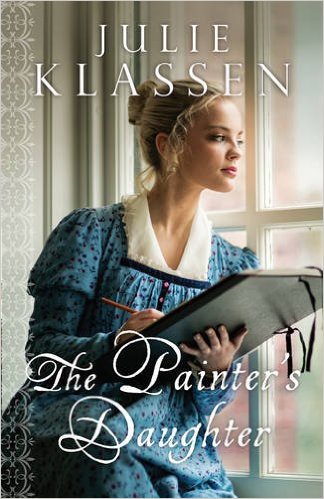
For those of you who love Klassen’s Regency novels, the wait for the next one is short one! The Painter’s Daughter will be released on December 1, 2015 (it is available for pre-order now). Here is the synopsis:
Sophie Dupont, daughter of a portrait painter, assists her father in his studio, keeping her own artwork out of sight. She often walks the cliffside path along the north Devon coast, popular with artists and poets. It’s where she met the handsome Wesley Overtree, the first man to tell her she’s beautiful. Captain Stephen Overtree is accustomed to taking on his brother’s neglected duties. Home on leave, he’s sent to find Wesley. Knowing his brother rented a cottage from a fellow painter, he travels to Devonshire and meets Miss Dupont, the painter’s daughter. He’s startled to recognize her from a miniature portrait he carries with him–one of Wesley’s discarded works. But his happiness plummets when he realizes Wesley has left her with child and sailed away to Italy in search of a new muse. Wanting to do something worthwhile with his life, Stephen proposes to Sophie. He does not offer love, or even a future together, but he can save her from scandal. If he dies in battle, as he believes he will, she’ll be a respectable widow with the protection of his family. Desperate for a way to escape her predicament, Sophie agrees to marry a stranger and travel to his family’s estate. But at Overtree Hall, her problems are just beginning. Will she regret marrying Captain Overtree when a repentant Wesley returns? Or will she find herself torn between the father of her child and her growing affection for the husband she barely knows?
*********************
About the Author:
Julie Klassen loves all things Jane—Jane Eyre and Jane Austen. She is the bestselling author of ten novels set in Regency England, including her new release, Lady Maybe. Julie is a member of the Jane Austen Society of North America, and enjoys traveling to England to research her books whenever she can. A graduate of the University of Illinois, Julie worked as a fiction editor for sixteen years and now writes full time. Three of her novels have won the Christy Award for Historical Romance. She also won the Minnesota Book Award, and has been a finalist in the Romance Writers of America’s RITA Awards. Julie and her husband have two teenaged sons and live in St. Paul, Minnesota.
Please comment or ask a question of Julie in the box below to be entered into the random drawing for a copy of Lady Maybe, with hearty thanks to Julie and her publisher Berkley Books. Deadline is Tuesday September 15, 2015 11:59 pm – winner will be announced the next day – domestic mailings only, sorry to say.
Quite fascinating. I am particularly interested in your comment that Edward had more land and less money than many thought then and today. I know there are those who revile Edward today for not doing more for his mother and sisters instead of praising him for what he did do. . I’d love to have a copy of that book as much for what it says about general conditions and Edward’s in particular. – I have the impression that Mr. Knightley also had more land than cash on hand and that his brother John received an allowance or something from their estate.
Nancy, please contact me as soon as possible with your contact details, and Linda will get the book sent off to you right away.
Thanks all for your terrific comments, and to Linda for her generosity for the guest post and responding to all your questions. Those of you who didn’t win, I encourage you to do it the old-fashioned way and buy the book – it is worth every penny and more of the $11.95!
And apologies for delay in announcing the giveaway – the Holiday caught me up short!
Gentle Readers: Today I welcome Linda Slothouber, author of Jane Austen, Edward Knight, & Chawton: Commerce & Community (Woodpigeon Publishing, 2015), the result of her research at Chawton House Library in 2013. As the recipient of a grant through JASNA’s International Visitor Program, Linda’s project was to research the management of the Chawton estate in Hampshire during Edward Knight’s [nee Austen] ownership and this recently published book presents her findings. It is a most interesting and informative read, giving insights into the life and character of Jane Austen’s brother, thereby showing us how knowledgeable Jane Austen was in creating her own Heroes as landlords [think Mr. Knightley and Mr. Darcy! Henry Crawford, not so much…] – she had a fine model in her very own brother! I cannot improve upon what Deirdre Le Faye has written, that this book is “an essential addition to the Austenian bookshelf.”
I asked Linda how she chose this topic, what prompted her to apply for the JASNA grant, and here is her response: “Having written about other businesses in Jane Austen’s time, such as Wedgwood and Richard Arkwright’s cotton-spinning empire, I was very interested in how the business of estate management worked, both in the real world and in Jane Austen’s fiction. I made some preliminary inquiries and found out from Chawton House Library about the Knight Archive and other potential resources. My original intention, when I applied to JASNA’s International Visitor Program, was to write a much shorter book, but each question I answered spawned two more, and I discovered some stories and information I just couldn’t bear to leave out.” She tells us more about it all in her post below.
Linda has generously offered us a copy of her book for a giveaway, so please leave any comments and questions for her after this post in order to be entered into the random drawing [details below].
**************
Edward Knight, Landlord by Linda Slothouber
The number of books, websites, magazines, and television programs that aim to explain the world in which Jane Austen lived must number well into the hundreds. Many of them give a broad view of historical events and cultural conditions, compressing decades of time and significant regional diversities into a notional Georgian/Regency England.
In researching my book, Jane Austen, Edward Knight, & Chawton: Commerce and Community, I wanted to complement the more general histories by looking closely at specific people in a specific place. My goal was to answer my own questions about the structure and economy of the English estate by looking at the experience of the estate-owner who would have been most familiar to Jane Austen: her brother, Edward. Adopted by rich relations, Edward inherited Godmersham Park in Kent; property in Chawton, Steventon, and elsewhere in Hampshire; and property in three other counties, changing his surname to Knight as a condition of the inheritance. (Ronald Dunning gives more background on the Knight family here.)
Presentation of Edward Austen to Thomas and Catherine Knight – wikipedia
I knew that the landed gentry made their money from renting and using their inherited lands, but how exactly did that happen? How involved were landowners in estate management? Jane Austen’s brother was an excellent case study. I also wanted to explore how Chawton actually functioned as a community and get a better look at the people who lived in the cottages and farmhouses. Who were the people that Jane Austen would have encountered during her years in Chawton? When Chawton Great House was vacant or in the hands of tenants, what effect did that have on the estate and the village?
A View of Chawton @1740 by Mellichamp. Chawton House Library (BBC – Your Paintings)
My research into these questions was possible because of the availability of the Knight Archive, a treasure trove of several centuries’ worth of papers. In 1961, 1986, and at various points in the 1990s, the Knight family gathered up record books, official documents, and random bits of paper from Chawton House and turned them over to the Hampshire Record Office in Winchester. The HRO’s archivists created an index, but, because many entries refer to bundles of documents, the index can’t comprehensively describe everything in the archive. The experience of going through one bundle after another, carefully unfolding 200-year-old papers to discover what each one contained, is something I will never forget! Among the fascinating odds and ends I came across were the bills for Elizabeth Austen’s funeral and for the care of Jane and Edward’s brother George in his last weeks, the seating plan for the church in Chawton, and the list of poor old ladies to whom flannel petticoats were given after Edward Knight’s death.
Most of the documents in the Knight Archive concern the management of the Chawton estate and other Knight holdings. While there are significant gaps, what has survived provides important insight into the Knights’ estate operations in Hampshire over a long period of time. I read estate papers written by Elizabeth Knight and her steward in the early 1700s, and then turned to an estate wages book from the early 1900s, when Montagu Knight was the squire; some of the activities done on the estate remained remarkably constant, and some of the same surnames appeared on the lists of workers in both centuries. As the focus of my research fell exactly between these two points, the range of documents provided an invaluable context for understanding Edward Knight’s period of ownership.
Excerpt from Edward Knight’s 1807 bank ledger, showing several deposits of estate income made by his steward, Bridger Seward, and forwarded through Henry Austen’s bank in Alton. (Courtesy of Barclays Group Archives)
The period between 1808 and 1819, encompassing the years when Jane Austen lived in Chawton, is, by chance, particularly well documented. An estate accounts book has survived and is supported by bundles of vouchers documenting specific purchases and jobs done on the estate. To pursue some questions, such as how much money Edward Knight earned from all his property in a typical year, I had to do some detective work, comparing the data found in the Knight Archive with that from other sources, including the Godmersham Heritage Centre, Barclays Group Archives (which holds Knight’s banking ledgers), and previously published sources such as Deirdre Le Faye’s Chronology of Jane Austen and Her Family.
So what did I learn? It turns out Edward Knight had more land, and less money, than has commonly been believed. I estimate that his contemporaries would have spoken of him as having “7,000 or 8,000 pounds a year,” not the £15,000 his near-contemporary Mary Russell Mitford stated (admittedly based on hearsay) as his income. Knight had to contend with a lawsuit that threatened his ownership of his Hampshire property – that much is well-known – but his wealth was also affected by changes in the national economy that affected land values and farming income, presenting problems that plagued him throughout the 1820s and seem to have had an effect on his health, as well.
Edward Austen Knight – CHL
Knight felt deeply his responsibilities to his family, to the community, and to his own posterity – his son and the future heirs of the Knight estates. Throughout his life, he provided financial assistance to many members of his family, though his female relations received far less direct financial support than his brothers did, or received assistance in ways that were not recorded in bank ledgers. As for the community, Knight’s support for education, health care, and housing for the poor made Chawton more stable and less miserable than many other villages at the time. It may be tempting to criticize some of his actions and omissions from our 21st-century vantage point, but L.P. Hartley’s maxim holds true: “The past is another country: they do things differently there.”
Learning about Edward Knight’s history and experience in estate management is valuable in its own right, but adding to the body of knowledge about Jane Austen is always a goal. By discovering more about the people she knew during her eight years in Chawton and comparing the facts of their lives with what she wrote about them, we may come a tiny step closer to understanding her views and feelings.
One individual she knew well is William Triggs, Edward Knight’s gamekeeper at Chawton. Triggs was by far the most well-paid of the Chawton estate servants; his salary of £52 was nearly half that of the estate steward. His primary responsibility was to protect game on the estate for Edward Knight’s sons and guests to shoot when they came to stay. Since this didn’t happen often, some of his time was spent overseeing hay-making and other projects on the land, paying workers, and selling hay and potatoes on behalf of the estate (all tasks a bailiff might have done, but Knight didn’t employ one at Chawton at the time). He was trusted with the money required to carry out these tasks and he earned a commission on sales. He had guns and dogs and a horse that was purchased with estate funds, as was his hat, which cost a guinea (four times the cost of a common laborer’s hat). Gamekeepers at the time were often resented by villagers for their high-handed ways and for siding with landowners, and this may have been the case with Triggs. I found only one record in Knight’s estate accounts of poachers being conveyed to jail, but I did find a mention of a charge of assault brought against Triggs, which was settled by the estate paying the large sum of 9 pounds to the victim.
Jane Austen mentioned Triggs several times in her letters. She found in him a worthy subject of long-running jokes shared with several members of her family. She ended one letter, written from Godmersham Park to Cassandra back in Chawton, “With love to you all, including Triggs.” In another letter, she wrote of seeing Triggs scurry down the lane, laden with birdcages and luggage, to meet the coach—not the kindest observation surely, but it seems to me she took some delight in seeing Triggs lose his swagger and struggle with lowly tasks. In 1817, an interesting meeting took place: “Tell William [Edward Knight’s son] that Triggs is as beautiful & condescending as ever, & was so good as to dine with us today,” wrote Jane. We must imagine Triggs, the servant who perhaps acted above his station, sitting down to dine with the Austen women, who were related to the squire at the Great House but living in much humbler circumstances. How did Jane Austen feel about being condescended to by her brother’s employee? She tried to make conversation with him, but was it the sort of conversation Mr. Bennet had with Mr. Collins at dinner? Did she speak aloud, teasingly, what she later wrote in her letter, that Triggs must have looked “very handsome” in his green coat at a recent funeral procession? By discovering more about the dinner guest at the cottage table, it becomes easier to at least formulate such questions, even if the answers remain elusive.
A final word: Even a scrap of paper of no obvious significance, which might easily have gone in the fire 200 years ago, has its magic today: the words, the spelling, the quality of signatures (or X’s marked down by the unlettered), and the amount of paper allocated to a particular purpose all tell us something. If such ephemera is worth saving and studying, then how much more essential is it to preserve a unique document that is central to Jane Austen’s life story? Right now, Jane Austen’s House Museum is engaged in a campaign to collect £10,000 to purchase the letter that Cassandra Austen wrote to her niece Fanny immediately after Jane Austen’s death. To secure the letter, this sum must be collected within less than three months. Please read about the letter and consider contributing to the fundraising campaign. [ The letter is CEA / 3, dated July 29, 1817 – Le Faye, 4th ed., p. 363 – you can read the text here]
**************
About the Author: A 20-year career in management and technology consulting, degrees in English and Administration, and a stint as JASNA’s International Visitor to Chawton in 2013 created the foundation for Linda to write her 2015 book, Jane Austen, Edward Knight, & Chawton: Commerce & Community. The book is available from Amazon, Woodpigeon Publishing, and Jane Austen Books in the U.S., and is available in the shop at Chawton House Library. Linda blogs about new findings and supplemental research at chawtoncommerceandcommunity.blogspot.com. [Please note that Linda will be donating all profits from U.S. sales to the JASNA 2016 AGM. For those of you attending JASNA-Vermont’s 7 June 2015 meeting, I will have copies for sale.]
*************
Book Giveaway:
Thanks you so much Linda for your guest post on Edward Knight! Readers, please leave a comment or question for Linda in order to be entered into a random drawing to win a copy of Jane Austen, Edward Knight, & Chawton: Commerce and Community. Deadline is next Friday May 22, 2015 at 11:59 pm. Winner will be announced on May 23. Limited to domestic mailings, sorry to say, but don’t let that keep you from commenting!
Chawton House Library today – cTony Grant
[Tony Grant and I visited CHL last May on a very rainy day –
his picture was better than mine so I use it here with thanks!]
I first had the pleasure of discovering Julie Klassen while on an camping trek along the East coast – I was looking for some late-night reading while tucked away in that comfortable Airstream bed. I cannot recall exactly how I first came upon The Apothecary’s Daughter – it may have been some kindle special, but though I didn’t know a thing about the author, nor that she was classified as a writer of “Christian fiction,” I loved the title and was hooked from the first page. Since then (and no longer stuck in that Airstream) I have read all of her eight novels, each of them a mix of mystery and romance, with gothic elements and literary illusions in abundance. You will find Jane Austen and the Brontes well represented, especially Jane Eyre.
Her first book The Lady of Milkwood Manor, tells the tale of unmarried motherhood, and each succeeding book focuses on a social issue of the Regency period and the plight of women in this constrained patriarchal world. And yes, there is the Romance, with various brooding Heroes vying for attention, great British houses with secrets to be unearthed, and lovely Heroines who are strong in the face of societal missteps, where faith plays a part in finding one’s way, and all adding up to a perfect read.
Today we are celebrating Ms. Klassen’s most recent book, The Secret of Pembrooke Park, currently on a blog tour sponsored by Laurel Ann at Austenprose, and where this book was awarded “Best Regency Era novel of 2014.” [the blog tour goes from February 16 – March 2nd]
In the spring of 1818, twenty-four-year-old Abigail Foster fears she is destined to become a spinster. Her family’s finances are in ruins and the one young man she truly esteems has fallen for another woman — her younger, prettier sister Louisa.
Forced to retrench after the bank failure of Austen, Gray & Vincent, the Foster family optimistically pool their resources for another London Season for her sister in hopes of an advantageous alliance. While searching for more affordable lodgings, a surprising offer is presented: the use of a country manor house in Berkshire abandoned for eighteen years. The Fosters journey to the imposing Pembrooke Park and are startled to find it entombed as it was abruptly left, the tight-lipped locals offering only rumors of a secret room, hidden treasure and a murder in its mysterious past.
Eager to restore her family fortune, Abigail, with the help of the handsome local curate William Chapman and his sister Leah, begins her search into the heavily veiled past aided by unsigned journal pages from a previous resident and her own spirited determination. As old friends and new foes come calling at Pembrooke Park, secrets come to light. Will Abigail find the treasure and love she seeks…or very real danger?
We are fortunate to have Julie join us here at ‘Jane Austen in Vermont’ for an interview. [Please see below for the Grand Prize Contest and book giveaway details]
Welcome Julie!
JAIV:You heartily credit Jane Austen as the greatest influence in your writing – tell us how and when you first discovered her, and how she has continued influencing you. And what do you think it is about Jane Austen that she is more popular than ever, in both academia and popular culture?
JK: I have been a fan of Jane Austen ever since I fell in love with Colin Firth as Mr. Darcy in the 1995 BBC/A&E adaptation of Pride and Prejudice. Seeing it led me to read all of Jane Austen’s books and in turn, to set my novels in the Regency period, when her books were published. As far as her on-going popularity, no doubt experts could answer that better than I could, but for me her novels’ endless appeal lies in the ideal they depict–family affection, chivalry, romance, and true love triumphing over adversity–things so many of us long for. Jane Austen’s timeless humor is the icing on the cake!
JAIV:You have many references to Jane Austen’s characters in all your novels. The Girl in the Gatehouse for instance, reads like a sequel to Mansfield Park – a young woman sent from her home, her reputation compromised by the seduction of a rake of a man named Crawford – her name is Mariah, her sister Julia [though I do have to say I was happy not to see Mrs. Norris hanging about!].
In The Secret of Pembrooke Park, we have a handsome, intelligent and caring vicar – does he have a Jane Austen model? Tell us something of your research into the Anglican clergy during this time period.
JK: The Girl in the Gatehouse is one of my favorites. I fondly call it my “ode to Jane,” since it has the most nods to Miss Austen. In The Secret of Pembrooke Park, the character of William Chapman was in a great way inspired by Austen’s wry and witty Henry Tilney in Northanger Abbey. (Although he is more like Edward Ferrars in that he hasn’t a living of his own, nor a wealthy benefactor). Mr. Chapman is handsome and humble, godly and kind, but also a man’s man—athletic, good-humored, and hardworking. To research Anglicanism, I read biographies of 19th-century clergymen, attended several Anglican services in the US and England, and consulted the Book of Common Prayer. But it would take much more than that to become expert, so I had a London vicar’s wife read the manuscript to help me avoid errors. Her husband kindly answered questions as needed.
JAIV:You write what is termed “Traditional Regencies” – i.e. more like Jane Austen and Georgette Heyer than Eloisa James and other “bodice-ripper” writers – Romance for sure with lots of butterflies, quivering lips, and stolen kisses, but no explicit sex scenes. [Jane Austen approves heartily!]. Has it been easy to find a publisher for your Christian-based tales? And have your three Christy Awards helped in spreading the word about your books?
JK: When my first novel was published seven years ago, most historical fiction from Christian publishers was set in post-Civil War America. Now, there are many authors writing traditional regencies. Because of this, I am often credited with inspiring the growth of the genre in the inspirational market. I don’t know if the awards have helped or not, but I am certainly grateful and humbled to have won them!
JAIV:Your books all strongly emphasize the power and presence of a Christian God – both your Heroines and Heroes go through times of doubt and loss and then embrace their faith to find themselves. Do you think this aspect of your work limits your readership? How has your own faith influenced your writing?
JK: I came to faith in my twenties. Like the characters in my novels, I have made many mistakes in my life and am still far from perfect. But I have experienced forgiveness and second chances and this naturally weaves its way into my novels. Considering the time period, it would be more unnatural not to include things like church services and family prayers, which were a regular part of Jane Austen’s life as a clergyman’s daughter and common in society in general. As far as limiting readership, that’s the wonderful thing about publishing—we all like different kinds of books. A good thing, too, or we would need only a few authors rather than the broad spectrum writing today! As writers, the content we choose to include—or not to include—affects our readership. Some people avoid steamy novels, for example, and some avoid sweet ones. The books I write reflect the kind of fiction I like to read and who I am as a person. I appreciate reviews like this one from Booklist, that says, “…the author’s deft incorporation of the faith-based component of her story means this well-crafted romance will have wide appeal beyond inspirational romance fans.” And thankfully, this seems to be the case, because I hear from readers from various backgrounds who enjoy the books.
JAIV:Your epigraphs show a wide reading of early women writers, as well as Jane Austen’s works and letters – is there anyone you have read that you have enjoyed as much as Austen or Bronte [I know you love Jane Eyre!] who has influenced your own writing?
JK: Thank you. I also love Elizabeth Gaskell, Frances Hodgson Burnett, and Georgette Heyer. And no one created characters like Charles Dickens!
Elizabeth Gaskell (1832) – Wikipedia
–
JAIV:Each of your eight novels has a strong heroine who finds or places herself in a situation that reflects her limited choices as a woman: servant, governess, teacher, medicine healer, a novel-writer [think “Anonymous”!], etc. You cover the topics of unwed motherhood, the life of servitude, loss of inheritance, loss of reputation, herbal medicine, the “evils” of dancing, and more … all about women trapped in social and personal prisons. As a woman of the 21st century, it is difficult to imagine that world of 200 years ago. How do you get it right?
JK: I am sure it helps that I love this time period—my favorite novels, costume dramas, blogs, and research books, are all set in or around this era. I spend a lot of time in Jane Austen’s letters and check my dialogue on an online etymology dictionary to make sure each word spoken was in use at the time. I sometimes have experts read sections or answer questions on certain topics (the military, cricket, blacksmithing, English country dancing, etc.). I am a member of JASNA and learn a lot through their meetings and speakers. And I go to England when I can. It’s an ongoing education! I am certainly fallible and make my share of errors, but I do my research and work hard to accurately portray the era. That said, I write fiction, not history, and occasionally take liberties for the sake of the story. When I do, I acknowledge this in my Author’s Note at the back of the books.
JAIV: The Secret of Pembrooke Park is your longest novel to date, offering again your reader-pleasing combination of mystery, scary gothic elements, and of course Romance, to tell a tale where the reader is never quite sure who the Hero might be and how the mystery will play out – did you know when you set out on your writing journey how it would all be resolved? Which brings us to: can you share with us your writing process? – do you start with a social issue, or a character, or a mystery to be solved?
JK: I submit a synopsis to my publisher in advance, so I have a fairly good idea of how things will be resolved, but there is always room for surprises along the way. My process has evolved over the years and I’m still fine-tuning it. But I usually begin with a situation that intrigues me, e.g. a lady who finds herself working as a wet nurse, or having to go into hiding as a housemaid or, in this case, moving into a long-abandoned manor. From there, I think about what kind of character would be most interesting and satisfying to see in—and grow through—that situation. Specific plot points and twists develop from there.
JAIV:Your next book is already available for pre-order: Lady Maybe, due out in July 2015. Can you tell us something about it? And, what’s up next??
JK: Lady Maybe (Berkley) is about a woman whose startling secrets lead her into unexpected danger and romance in Regency England. And then in December comes The Painter’s Daughter (Bethany House), which is my first novel with a marriage-in-name-only premise.
JAIV: Thank you Julie for so generously sharing your thoughts on writing, your faith, and your forays into the Regency period! I very much look forward to your next two books – such a treat to have two in one year!
*************
Please leave a comment or a question for Julie and you will be entered into the Giveaway Contest!
***************
Grand Giveaway Contest
Win One of Four Fabulous Prizes!
In celebration of the release of The Secret of Pembrooke Park, four chances to win copies of Julie’s books and other Jane Austen-inspired items are being offered.
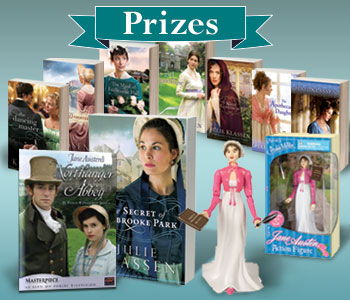
Three lucky winners will receive one trade paperback or eBook copy of The Secret of Pembrooke Park, and one grand prize winner will receive one copy of all eight of Julie’s novels:
Lady of Milkweed Manor (2008)
The Apothecary’s Daughter (2009)
The Silent Governess (2010)
The Girl in the Gatehouse (2011)
The Maid of Fairbourne Hall (2012)
The Tutor’s Daughter (2013)
The Dancing Master (2014)
The Secret of Pembrooke Park (2014)
…and one DVD of Northanger Abbey (2007) and a Jane Austen Action Figure.
To enter the giveaway contest, simply leave a comment on any or all of the blog stops on The Secret of Pembrooke Park BlogTourstarting February 16, 2015 through 11:59 pm PT, March 9, 2015. Winners will be drawn at random from all of the comments and announced on Julie Klassen’s website on March 16, 2015. Winners have until March 22, 2015 to claim their prize. The giveaway contest is open to residents of the US, UK, and Canada. Digital books will be sent through Amazon or Barnes & Noble. Good luck to all!
***************
Author Bio:
Julie Klassen loves all things Jane—Jane Eyre and Jane Austen. A graduate of the University of Illinois, Julie worked in publishing for sixteen years and now writes full time. Three of her books have won the Christy Award for Historical Romance. She has also been a finalist in the Romance Writers of America’s RITA Awards. Julie and her husband have two sons and live in St. Paul, Minnesota. Learn more about Julie and her books at her website, follow her on Twitter, and visit her on Facebook and Goodreads.
UPDATE: The deadline to comment and win a kindle copy of Revisit Mansfield Park, How Fanny Married Henry has been extended until next Sunday November 30, 11:59 pm due to the holiday – winner will be announced December 1st. Sarah has offered a second copy of her book as an incentive to comment! Happy Thanksgiving all!
****************
Gentle Readers: I invite today to ‘Jane Austen in Vermont’ Sarah Ozcandarli, who has written a story reimagining the ending of Mansfield Park, an ending about which all of us, including Jane Austen, have pondered the “what if…?” Her book is titled Revisit Mansfield Park, How Fanny Married Henry – I confess to not having finished the book as yet – it is now on my kindle awaiting a moment to give it the time it deserves (I will say that the first three chapters very nicely summarize the plot and characterizations of Mansfield Park).
Sarah contacted me a few weeks ago to say that a number of my links on the blog led to the dreaded “oops! – where did you find such a link?” – because as all we bloggers know, who has time to go back and check all the links we ever have put out there, links that go nowhere – such a disappointment to the reader – I wonder always, where does this information go to? Some cyberspace default-filled world with thoughts and ideas and information no longer accessible – it is all quite daunting really, isn’t it?? – but I did go in and remove or edit some of these links Sarah told me about, and in our conversation she told me she had written a tale of Mansfield Park with the plot line that Fanny and Henry do end up together (no spoilers here, this outcome, as you see, is in the title!), as do Edmund and Mary – not an uncommon thought among those people largely disappointed with the lacklustre ending of Mary going off to London, Henry off with Maria and then on to his surely dissipated life (a life Fanny could have salvaged if she had only given him the chance he asked her for), and Fanny and Edmund riding off into the sunset of boredom. So I give you a post from Sarah about how her love of Jane Austen began, and what it was about Mansfield Park that made her want to change the ending. Please leave your comment or question for Sarah to win a kindle version of her book – see details below!
***************
First falling in love . . .
“You will not know the day or the hour”, says St. Matthew, but if the agent is Masterpiece Theatre in the year 1981, the day will Tuesday and the hour 8:00 pm. I was toiling through my last semester at university on that fateful night, when there were two contenders for my attention: Electricity & Magnetism II and the BBC’s Pride & Prejudice. I wanted to study E&M, but my housemates Meg and Laurie were determined that I should be acquainted with Jane Austen. They were two against one, but we were all winners, for I fell in love with Lizzy and Darcy and their creator about fifteen minutes into the program.
Once graduated, and free to read according to my own inclinations, Jane Austen quickly became my first favorite among writers and has never descended from that pedestal. I read all I could find about her life and family, I devoured her letters, but oddly enough, I never noticed the vast collection of Austen-related news, fact, and opinion on the internet. One day in 2012 I googled “white soup” and read through one blog, and then another, and realized that our respect for the greatest novelist in the English language need not prevent us from using her characters to people our own stories!
Then writing a book . . .
That being so, I could fulfill my wish (and Cassandra Austen’s as well) that in Mansfield Park Fanny Price should be allowed to marry Henry Crawford, instead of Edmund Bertram. After all Jane herself had written that if Henry had “persevered, and uprightly, Fanny must have been his reward,” and with Jane’s and Cassandra’s opinions of Henry duly noted I was emboldened to write a different ending for Mansfield Park – a sort of Volume III(b) – with plans for a sequel to tackle Edmund and Mary’s problems.
The first difficulty of the story I wanted to tell was that Fanny justifiably disliked and distrusted Henry, and had no
CE Brock -Mansfield Park – Mollands
conception that his interest in her was genuine until Sir Thomas informed her that Henry had made “decided proposals” for her. When Henry left Mansfield a few days later he had achieved very little in his quest to change Fanny’s opinion of him. When next they meet, Henry was in Portsmouth to visit Fanny, and as he took his leave of her, he nearly begged her to advise him to return to his work at Everingham. In Mansfield Park Fanny rather unkindly dismissed Henry’s plea; in my story Fanny observed that:
“Henry had said he would show Fanny by his constancy that he deserved her, and now, when all her friends at Mansfield, excepting perhaps her aunt, had forgotten her even more thoroughly than she had anticipated that they would, here was Henry Crawford, as constant as he had declared he would be, and asking her advice.”
Fanny’s judgment, though in all respects sound, was only once sought in all of Mansfield Park. Edmund asked Fanny to approve his participation in Lovers’ Vows – though Edmund was well aware that Fanny would not approve – and having gotten her opinion, he ignored it. Henry’s request was a much greater compliment, not least because he intended to abide by her advice; he truly wanted to be encouraged to do right by his responsibilities at Everingham. This, I think, is the pivotal moment for Henry and Fanny, when they will move forward together if Fanny tells Henry her opinion, or stall out if she does not.
A chance to win . . .
Dear Readers, please comment or leave a question for me to be entered into the giveaway of the Kindle version of Revisit Mansfield Park, How Fanny Married Henry. [see details below]
Revisit Mansfield Park for Kindle – It is available only in English, but can be purchased from Amazon in the USA, England, Germany, France, Spain, Italy, Japan, India, Canada, Brazil, Mexico and Australia, and may be read for free with the Prime or Kindle Unlimited Programs.
****************
About the author: Sarah Ozcandarli graduated in 1981 from Carnegie-Mellon University with a BS in Physics and English, and went back three years later for an MS in Industrial Administration. Her varied career took her to Pittsburgh, Philadelphia, New York City, Los Angeles and Boston, where she sought and found her Mr. Darcy. They were married in 1996 and live near Boston with a large menagerie of wild and domesticated critters, some of which are now hibernating.
Book Giveaway! Please leave a comment or question for Sarah by Sunday Nov 23, 2014, 11:59 pm to be entered into a random drawing to win the kindle version of Sarah’s book, available to all, but you must of course be a kindle user!
You might consider the question Sarah asks: In your reading of Mansfield Park, have you ever thought that Fanny should have ended up with Henry Crawford and Edmund with Mary? And if so, why?
Gentle Readers:David Shapard, author of five annotated editions of Jane Austen’s novels – all but Mansfield Park, which is due out next year – will be joining the JASNA Vermont Region next week at the Burlington Book Festival. He will be speaking on “The World of Jane Austen and her Novels,” offering us a peek into the society of early 19th-century England that dominates her novels, with a focus on the position and customs of the controlling landed elite, and the role of women in this society. I welcome David today for a Q&A about his love of Jane Austen and his excellent annotated editions. If you have any questions for him, please do comment at the end of this post – but better yet, if you are in the area next weekend, please join us at his talk – Saturday September 20, 2014, 1:30-2:45 at the Fletcher Free Library, 235 College St, Burlington VT. [for more info: September 2014 flyer]
*********
So welcome David – thank you for being so gracious in answering all my questions!
JAIV: To start off, why do you think Jane Austen still speaks to us 200 years after she first published her Sense and Sensibility in 1811?
DS: I think Jane Austen interests us partly because she is so good, i.e. quality will out. I believe she is the best novelist in the English language, and that gives her a bedrock appeal, one she has had for a very long time (even if she has not always been the object of as much enthusiasm as today). With her you have well-constructed plots, brilliantly delineated characters, interesting and profound themes, and superb language – meaning excellence in all the major elements of a novel. One symptom of this is the variety of reasons people have for appreciating Austen: people, in giving their reasons, have cited, among other things, her comedy, her poignant romances, her keen insight into human psychology, her careful depiction of society, and her moral messages. With so many strong elements, she can appeal to an array of tastes and interests. Another reason is that, even though her novels are set firmly within her own time, she was looking at many matters that transcend that time. Her focus is on basic matters that people always have to deal with, whom to marry, how to relate to other people, how to judge right and wrong, how to cope with the difficulties of life. Her characters personality traits, feelings, relationships, and moral dilemmas are all ones that are still frequently found today, so the insights and lessons presented in her novels can still ring true today.
JAIV: Whatever got you so interested in Jane Austen to first take on annotating Pride and Prejudice (in 2004)?
DS: I had long loved Jane Austen, for many of the reasons described in my previous answer. But there were several precipitating factors that spurred me to attempt an annotated version of her novel. In the six months or so preceding the decision I had begun to read and sometimes participate in an online forum devoted to Jane Austen, The Republic of Pemberley. This, in addition to being very enjoyable, helped me appreciate how much interest and discussion even very specific points in Austen could generate. That eventually gave me the idea of doing a running commentary on her novels, in which various passages would be examined and elucidated. One feature of Austen is that she is a very subtle author, who makes many of her points quietly and unobtrusively; she also is one who is especially good in the details. For this reason the standard format for analysis of a novel, an article or book examining it as a whole, and looking at the overall theme, would inevitably miss much of what makes her so worth reading. But these elements could be brought out through a more minute analysis of the entire novel. At that time this idea was simply one for the indefinite future. But soon after events occurred that convinced me that I was unlikely to procure a permanent, full-time position teaching at a college or university, the profession I had been pursuing for a number of years. I decided to turn to writing, which I had long seen as my principal alternative. I had a longstanding idea for a book, but work on it soon persuaded me that it was the great idea I had earlier thought. While casting around for other ideas I suddenly thought again of my Austen project. I had seen annotated versions of other classic works, and liked them. I also knew there was a large market for anything related to Austen. So I decided to try this, and I quickly realized that I had made an excellent choice.
JAIV: We think so too! ~ Which novel is your favorite? And why? And did your favorite change after your in-depth readings and the historical research?
DS:Mansfield Park is my favorite overall. I like what I consider its density, the many story lines and the many different complex subjects it explores. At the same time, while the plot is very eventful, it does not rely at all on improbable coincidences, as others of Austen do to some degree. Finally, it has four different characters – Fanny, Edmund, Mary, and Henry – whose inner life is shown, who change over the course of the novel, and who experience serious inner conflicts. In other Austen novels there are only one or two characters about whom that could be said. This has not really changed because of my doing the annotated books. The main change that brought about was simply to increase my appreciation for each one; this was especially true for the four I consider her strongest, Pride and Prejudice, Persuasion, Emma, and Mansfield Park (I am only part way through doing the last).
JAIV: Why the long gap before the next annotated edition came out, Persuasion in 2010? And when does Mansfield Park come out?
DS: I had first done Pride and Prejudice because I knew it was by far the most popular. I held off doing others until I knew how well it did, and it took a number of years before it succeeded. I wasn’t able to sell it initially, then I self-published it, then somebody at Random House noticed it and approached me about signing with them. After that came out, and did well, my editor there approached me again about doing the other Austen novels. Mansfield Park will come out next year, probably late in the year. The gap between it and the previous one, Northanger Abbey, is the result of my having devoted much of the last year to working on a special enhanced version of Pride and Prejudice that is designed for an iPad. It comes out in a few weeks, and I am very excited about it, but it has significantly delayed Mansfield Park.
– JAIV: Does Jane Austen get anything wrong?
DS: She got very little wrong. All I have noticed is a mistake on a date of a letter in Pride and Prejudice, and two specific events, one in Emma and one in Sense and Sensibility, that are probably wrong, based on what I have read about the history of the time. There are also at least a couple places where a quotation from a poem or other writing is off. But that is really a remarkable record, especially when you consider that she didn’t have a large library to consult for quotations or other references.
JAIV: What do you think of the films? – do you have a favorite? Any that you find completely appalling?
DS: I like the films overall. They are no substitute for reading the novels, since much of what is in there cannot be shown on film. But the films can do things the novels cannot, such as show houses and carriages and costumes, as well as specific places. That is something I have also done in my books, and the visual adaptations go even further in that direction. It is also nice to see the characters brought to life by real people, even though I inevitably judge them according to how well they correspond to the characters in the novel and often find them wanting, at least in certain respects. In terms of favorites, I would probably say the Sense and Sensibility written by Emma Thompson. I also like the Persuasion with Amanda Root and the Pride and Prejudice miniseries with Jennifer Ehle and Colin Firth. I did not like overall the series of TV adaptations that appeared a few years ago, and I thought the Mansfield Park of that series was the worst of any adaptation I have seen.
JAIV: Oh! I agree with you there, though the Persuasion with Anne running around the street in a panic while reading the Captain’s letter is embarrassing to watch as well! ~ Tell us something about your writing process: when and how?
DS: I usually start by reading through the novel several times, and as carefully as possible; while doing so I note any possible point I might wish to make or passage I wish to explore further or think about. I also listen to audio versions with the same purpose in mind, for I find that in hearing it I sometimes notice things I don’t notice when simply reading it. Then for the historical references, which is what requires the most effort, I organized all the points or topics I want to look at by subject matter, and start reading, or rereading, various books related to those topics. I also, at some point, read through commentaries on the novel to see what additional insights they offer, re-examine Austen’s letters and other biographical material to see what’s relevant there, and look at the words I might need to define; I use here a pre-existing list of words with different meanings in Austen’s time, supplemented for what I may have noticed in addition through my reading. As I do all these things I often go ahead and write the annotations appropriate to what I’ve just found. When all that is done I begin to go through the book chapter by chapter and insert whatever points have not been made. After that it’s just a series of reading over again and making corrections, by myself and by my editor, until the text is finally settled, and also adding other material like illustrations and maps.
JAIV: How do you think your annotated editions compare to the Harvard University annotated series that began in 2010 with P&P [their Mansfield Park is due out in the Fall of 2015, edited by Deidre Lynch]
DS: I am not that familiar with these other annotated versions. I know they are in hardcover and are significantly larger (and therefore also more expensive); they also have some color pictures. In terms of the content, my sense is that they have fewer annotations. In the case of the one that I have read, the Pride and Prejudice, it does have fewer annotations overall. Some of its annotations, especially definitions of words, are similar to mine. The principal difference is that it focuses less on historical background – there are definitely fewer annotations there – and more on literary interpretations. It has a number of annotations that explore debates between different literary scholars regarding points in the novel, something mine does not do.
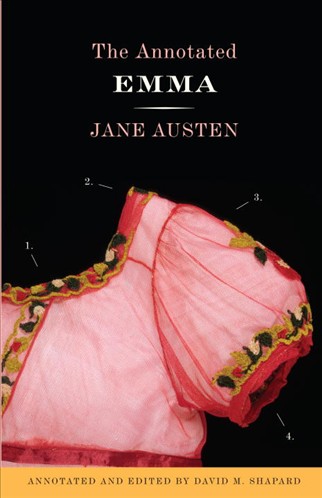
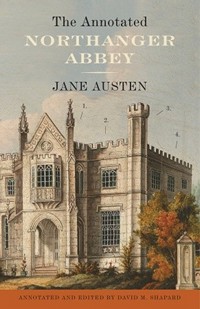
JAIV: The covers for each work: did you choose them yourself? – and the idea of annotating them is a very good one – gets the reader right into ‘reading the annotations’ mode!
DS: The publisher comes up with the cover, along with the overall design, though they always show it to me for my approval. They had the idea of doing annotations for the cover, but I am the one who comes up with the annotations themselves. That is also part of the process of agreeing on a cover picture: it has to be one that I think will be suitable for annotating.
JAIV: I know you mention “plot disclosures” at the beginning of the book to alert readers that some of your notes might contain “spoiler alerts” – did you get complaints about that when the first edition of your P&P first came out?
DS: Yes, I did get some complaints about my first edition of Pride and Prejudice. I had envisioned the book being used by many people as a reference, one they would turn to whenever they were curious about a specific point; thus I didn’t worry so much about plot spoilers. But it seems that most people have simply read it through, as with most books, and that many are reading the novel for the first time. As a consequence, I have tried harder in later editions to avoid giving anything significant away. That has constrained me in some respects, because important points about a passage often relate to something that happens later, but I think it’s worth it to avoid spoiling the surprise for the reader. The one important exception here was in Emma: it centers around several mysteries, especially one big one, and I felt that a valuable feature of an annotated edition would lie in showing how all sorts of apparently minor and innocuous actions take on a completely different significance in light of what we find out in the end. So in the case of the annotations for those passages, I put “CAUTION: PLOT SPOILER” at the start to warn off any first-time readers who wished to preserve the surprise.
– JAIV: Are you a book collector? And Jane Austen in particular? – if so, what is your favorite edition of any of her works, and why?
DS: I like to buy books and I have a large library, but I am not a collector in the sense of seeking out rare or special editions. The editions of Jane Austen I have used are those that are most scholarly and authoritative: these are an Oxford edition that first came out in the 1920’s, and the even more exhaustive Cambridge editions (with many notes of their own) that have come out within the last decade. JAIV: You are nearly done with annotating the six novels – what’s up next? Will you annotate the minor works or any of the Juvenilia?
DS: I am close to being done with annotating the novels. It is possible the publisher will also want to do enhanced editions of other Austen novels; I’m sure that will be determined by how well the Pride and Prejudice about to appear does. I have thought about annotating other Austen works, but I am not sure if there is sufficient demand for that. I also have a few ideas for novels of my own, some related to Jane Austen. But right now I am keeping my options open and waiting to see what develops out of my existing books.
JAIV: Why do you think the modern reader should have a better understanding of the society of the Regency Period? and can the reader still enjoy Jane Austen without having to read annotated versions?
DS: I think that understanding the Regency period helps greatly in understanding Jane Austen. Of course, millions of people have enjoyed and appreciated Jane Austen over the years without having any particular knowledge of her period, beyond what they could pick up from the novels themselves. I know I was in that situation when I first read her. So such knowledge is in no way a precondition. But I think that if one understands the historical background, all sorts of important events in the novels become much clearer and more comprehensible, and all sorts of particular details, ones the reader probably passed over without much thought, become significant. The story then springs to life in a variety of new ways.
*************
David M. Shapard (c) Michael Lionstar
Thank you David again for joining us here at Jane Austen in Vermont! We look forward to welcoming you to the real Vermont next weekend, where there will be an opportunity at the Book Festival to purchase all your Jane Austen annotated editions and have you personally sign them! I will also add here that David will be the leader on a tour next spring to Jane Austen’s England. The trip will be through Edventures, a tour group that offers educational trips to many parts of the world – or as they say, “Edventures – Adventure Travel That Educates.” You can read more about it here: http://goedventures.com/ – and click here for the flier with details: Huber-Jane Austen 2015 Itinerary April 21 Any questions for David? – please comment below! Further reading:


























 Jane Austen in Vermont