Author Interviews · Book reviews · Books · Jane Austen · Jane Austen Popular Culture · London · Rare Books · Regency England

Part I ~ The Perfect Visit ~ Interview with Stuart Bennett, Wherein We Meet Jane Austen and Shakespeare … and Enter to Win the Book Giveaway!

The Perfect Visit (Longbourn Press, 2011) is, no way to say it otherwise, a perfect treat – who of us would not want to spend a few days [or pull an all-nighter!] in the company of a time-travelling couple who are each in turn lovers of books, Jane Austen, Shakespeare, and just possibly each other? –

Today I welcome the author Stuart Bennett for a blog interview where we talk about how a rare bookseller became a writer of a first novel that brings to life both Jane Austen and Shakespeare, takes us on a whirlwind tour of their times, regales us with book history as we trek about the bookstalls of London and Bath, and all this in a mere 342 pages, a book sure to take a prime spot on your bookshelf.  So join us today for Part I of the interview, stay tuned for Part II this weekend, and enter the Book Giveaway by commenting or asking a question on either post before 11:59 pm 15 April 2012. Winner will be announced on Monday April 16, 2012 (worldwide eligibility).

************************

Welcome Stuart!  Thank you so much for joining us here at Jane Austen in Vermont. I have known of you for a good number of years as a rare bookseller and for a time president of the ABAA [Antiquarian Booksellers’ Association of America] – needless to say when I discovered you had recently published this book on Jane Austen [the title even comes from Emma: “It was a delightful visit; – perfect in being much too short.” [Vol. I, Ch. XIII]] – I saw my two worlds colliding in the most marvelous of cosmic alignments! I was so greedy to begin, I immediately downloaded it on my kindle, my hardcopy order far too slow to arrive, and was happily transported to the various times in your tale. So lets talk a bit about your background as a rare bookseller, your love of Jane Austen and Shakespeare [and how you dared to put both in the same tale!], the history of books, the time-travel bits, the woman-issue, and of course, just the sheer pleasure of a really nice romance…

*****************************

Talking about the story:

JAIV: To start, please explain the premise of your tale – a time-travel, book-loving love story that you say was first titled “A Bibliographical Romance” – so tell us about “The Project,” or at least a quick synopsis without giving too much away!

SB:  It starts as the tale of two bibliophiles planning to go back in time to rescue lost books and manuscripts. Vanessa decides on Regency England; Ned goes to Shakespeare’s. But they both have their own agendas as well.  Vanessa wants to rewrite history. And Ned wants to meet the Bard himself. 

Vanessa falls foul of the law, transported from Jane Austen’s genteel world to the dark underbelly of a Regency prison. 1607 London shows an equally black side to Ned when he antagonises one of Shakespeare’s rivals, escaping with his life only to find that an accident of time takes him only halfway home.

Talking about Jane Austen: 

“It was a delightful visit; – perfect, in being too short.” [Emma, vol. 1, ch. 13]

JAIV:  I know of your background as an antiquarian bookseller and former ABAA president – you have spent most of your life in books published before 1850.  So why Jane Austen for you? And why Shakespeare? Why not Frances Burney or Chaucer? Is it their times or their works, their continuing popularity today? 

SB:  Jane Austen and Shakespeare are central to my book because I love them.  A bookseller writing a “bibliographical romance” is committing a self-indulgent act – the more so with the presence of time-travel – and these two authors are part of it.  Frances Burney is intriguing, but I confess that had Jane Austen never written (could I have written any kind of  Perfect Visit without J.A.? – I doubt it) I might have been more tempted by Maria Edgeworth as a character.  Or maybe Hester Lynch Piozzi.  Chaucer and his world needs a true mediaevalist: I don’t have the knowledge of or empathy to go there.

JAIV:  You say in your postscript: “It is a presumption of a very high order to bring both Jane Austen and William Shakespeare into a single work of fiction, let alone a first novel … of the two, somehow Jane Austen intimidates me more, even though Shakespeare is perhaps the greater genius.” Explain your thoughts on the intimidating Miss Austen!

SB:  Wonderful question.  What is it that’s so intimidating?  I think it may be that, compared to Shakespeare, we really know quite a bit about Jane Austen’s life, notwithstanding the wholesale destruction of her letters by her sister and niece.  And what we know seems domesticated and uneventful. 

So how and why did she become, as I see her, the greatest novelist ever to write in English?  One could ask a similar question about Shakespeare and his plays: how did the grammar-school boy from provincial Stratford manage those.  And of course the fact that we know so little about Shakespeare’s life allows those in Shakespeare-denial (Oxfordians and similar snobs) scope for their own inventions. What we have of Jane Austen’s personal history is secure. 

As a novelist it’s a relief to have no sense of what Shakespeare was like as a man, let alone as a conversationalist.  I could invent quite freely.  The real Jane Austen, on the other hand, survives in family memoirs and letters, and I considered it my job to try to be true to her.  All I felt confident about at the time went into The Perfect Visit , but she haunts me still, and features much more largely in one of the two sequels/prequels to P.V. which are complete in first drafts but still have a long way to go.

JAIV:  How and when did you first discover Jane Austen? – as a reader or a collector or as a bookseller?  Or was your name [despite that extra “t”!] the impetus behind reading and writing about Jane Austen?! 

SB:  No to the last – I didn’t know there was a character in Jane Austen with my name mis-spelled until I was in my early twenties.  J.A. wasn’t quite the household name she’s become in the last thirty years, and I think I was lucky in being no younger than twenty-one, at university in England, when first introduced to the novels via Emma.  I couldn’t put it down.  

(I should add, however, that I take comfort in the fact that my spelling of “Bennett” is the same as the street in Bath.  Perhaps J.A. – or so I like to think – was recollecting the street as a good character name and simply forgot the last “t”.)

JAIV:  I don’t like to ask this question because who can ever work through such a dilemma, but I always do because the answers are so enlightening – but first I would ask if Persuasion is your favorite Austen novel? – it figures prominently in your story: Ned’s reading Persuasion; he and Vanessa are in Bath and literally take a Persuasion tour [which was great fun!]; and their romance has echoes of the Anne / Wentworth story.  ….

SB:  Your question – I’m sure this won’t surprise you – contains its own answer.  All the elements you describe in my book derive from my love of Persuasion. which seems to me to express most clearly Jane Austen’s own longings and losses, as the most autobiographical of all her novels.

JAIV:  A lovely answer! Persuasion is my own favorite, and it is wonderful how you weave Anne Elliot’s tale into your own. 

Is it every antiquarian bookseller‘s dream to actually visit the time of their literary hero[es]? To meet them as Vanessa meets Jane Austen and Ned William Shakespeare – is this your own vicarious dream? And has this time-travel story been in your head for the longest time?  I know you have written non-fiction works on book collecting, but have you written other yet-unpublished novels or fictional pieces?

 SB:  I think I may have answered the salient points of this great question in the course of dealing with other questions, but I would add this:  The most successful antiquarian booksellers I know don’t spend time dreaming about time-travel.  Instead they get to the auctions and flea-markets I didn’t know existed, woo wealthy collectors, and have healthier bottom lines. 

JAIV:  Yes! That bottom line does get in the way of day-dreaming and novel-writing, doesn’t it?! Jane Austen’s very own problem as well! 

 We find, along with your heroine, that we are soon to be in Jane Austen’s presence: 

“The first response to Vanessa’s knock was a rustle of papers, receding footsteps, and the creak of an interior door.” [p.5] 

– and we know we are in Jane Austen’s house in Chawton! … and we are there almost holding our breath as Vanessa first meets her, describes her – how difficult was she to create on your page, knowing readers all have their very own Jane Austen in their head?

Chawton Cottage

SB:  I did my very best to describe the physical J.A., and also Martha Lloyd, that emerge from contemporary accounts.  As to that first conversation, as well as later ones, the Jane Austen I hear is graceful, a little shy, with a ready wit and even sarcasm, but fundamentally kind.  Can any J.A. aficionado really demur to that?

JAIV:   Your heroine Vanessa Horwood is what Mr. Darcy would call an “accomplished woman” – even your Jane Austen character says “I have, it seems, in one young woman a literary critic, a musician, a financier, and an apothecary.”  [p. 7]. Is it fair to ask a male writer with a female protagonist, for a good part of the book at least – are you a little bit in love with your Vanessa?

SB:  All’s fair, and of course I am.  But I was also a little taken aback when many who know me best said that my Vanessa reminds them of me, and not always my most lovable side.

JAIV:  Aah – you have created your own better half it seems! 

 The description of clothing is very exact! – may I ask if you tend toward Henry Tilney in “understand[ing] your muslins, sir”?

Morning Dress @1819, R. Ackermann [wikicommons]

SB:  I hope so.  But Ackermann’s Repository and other contemporary sources are a great help too, not to mention the modern books by the Cunningtons, e.g. Handbook of English Costume in the Nineteenth Century

JAIV:    As you mention above, these times had heavy realities that Austen kept in the background for the more astute reader to find – but they are there – your heroine is jailed for forgery and will likely hang or will be transported – so this part of your story tells this darker side, the underbelly of Regency life, especially for women.  What was prison like and what resources did you use to make this seem so real? 
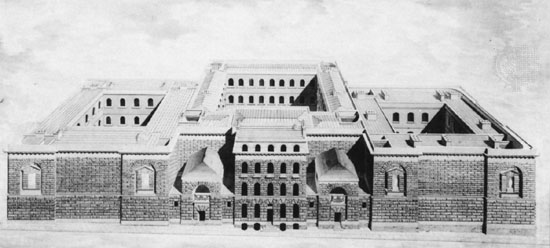
Newgate Prison - eb.com

SB:  I’ve read, and also bought and sold, so many accounts of English malefactors and their punishments in Regency and earlier times that I can’t really cite many of the sources that contributed to my sense of what a prison must have been like at that time.  Did I get it right?  Perhaps partly so, but I suspect the reality of most female penitentiaries was worse than I describe.  

Two essential sources for the Regency period are those to which Elizabeth Fry (who makes an appearance in The Perfect Visit) contributed: Notes on a Visit to some of the Prisons in Scotland and the North of England with Elizabeth Fry (this was published by Elizabeth Fry’s brother Joseph John Gurney) and Observations, on the Visiting, Superintendence and Government of Female Prisoners.


Elizabeth Fry, by Charles Robert Leslie - wp

 
Talking about Time-Travel:

 “Thus the whirligig of time brings in his revenges.” [Twelfth Night, Act V, Sc. 1] – [p. 113]

JAIV:  This is a time-travel book: and filled with “Rules of Time –Travel” – are these of your own creation for this story or from other sources? A few of the “rules” for example: 

  • -you cannot kill anyone
  • -cannot play modern music [in this case Vanessa playing Rachmaninoff if anyone is present]
  • -only organic clothing and material will pass through the time portal, so books, coins of the times, etc. will go, but no illuminated manuscripts
  • – the loss of the language of our 21st century life
  • -can only go the past, no travel into the future

SB:  As a child I watched, and was haunted by an episode of The Twilight Zone in which (as I recall from my single viewing close to fifty years ago) a criminal transports to the past, remains a criminal, and murders his own grandfather. 

Was it in the Wild West?  I’m not sure.  But what I remember is the image at episode’s end where the onscreen modern criminal dissolves saying something like “If I’ve just killed my grandfather, then how” [more dissolve] “can I” [almost gone] “exist?”  That was the origin of the first rule.  The others I developed as I sought consistency

JAIV:  Yikes! I remember that Twilight Zone episode! [also quite a faded memory!]. My other favorite was the 2-part Star Trek tale when Captain Kirk goes back in time and falls in love with Joan Collins – her character dies in “real life” and he must watch this and not step in to help so as not to completely alter the socio-political history of the future – I think I’ve seen that show 10 times! And it breaks my heart every time… 

So, I must assume you are a fan of time-travel literature? Your favorite? 

SB: As a kid I loved Robert A. Heinlein’s Door into Summer.  And Ray Bradbury wrote perhaps the greatest of all time-travel short stories, “A Sound of Thunder,” from which “the butterfly effect” has become a scientific term of art.  Alison Uttley’s Traveller in Time is a children’s book that transcends the genre (but then so do many of the best children’s books).  More recently I sobbed my way through The Time Traveler’s Wife (too bad about the movie though).

JAIV:  I haven’t watched the movie because I heard it was so dreadful – and yes, the book was sob-city-central! 

Shakespeare’s time reads like a gazetteer of London as Ned tours around looking for booksellers and all things Shakespeare, with detailed street names and historical sites and bookseller stalls – You must be familiar with London, so I must ask what is your favorite book on London? And London during the Elizabethan period?  The Regency period? And your favorite London haunt? [other than perhaps the British Library?!]
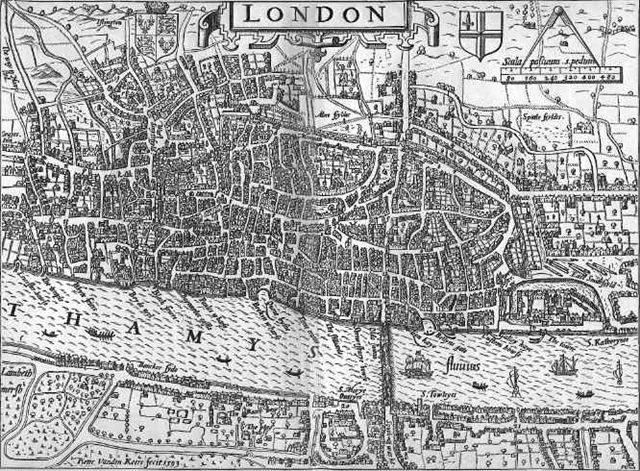
[Map of London 1593 – Internet Shakespeare Editions]

SB:  Oh dear, I didn’t want to sound like a gazetteer.  I lived more than ten years in London, and three in Bath, so much of what I wrote was from recollection.  Then I went back, retracing my characters’ steps with period maps and other clues to get the street names right, and to remove bridges and buildings that weren’t there at the times I was writing about.  I consulted all kinds of odd books, especially Regency ones, that I’d put aside during the course of my bookselling.  Pierce Egan’s Walks through Bath (1819) is a good example, and a useful one too.  For a modern book on London in Shakespeare’s time, the Oxford compendium Shakespeare’s England, first published in 1916, is still (I think) as good as it gets

JAIV:   On no! I meant that your book reading in parts like a gazetteer was a GOOD thing! I love the old London maps and had great fun following Ned around! 

The topic of carriages interests me very much, and the question of calculating distances and times is a difficult one: you say a coach traveling to London from Winchester in 1817 [50 miles] took 7 hours.  What sources did you use for those calculations?

SB:  Contemporary travel guides are not easy to come by, and sometimes even give conflicting information, but quite a few of the Regency and later guides to London have appendices of travel times.  I did the best I could with several of these.

JAIV:   I love the little bit about Fanny Dickens, Charles’s oldest sister, though you do say you muddled the dates a bit  – why Fanny and not other characters from the London or Bath of the time?

SB:  My brain accumulates trivia, and from somewhere or other I knew Fanny Dickens was a talented pianist.  That scene in Perfect Visit (I love it too – thank you) unexpectedly wrote itself one afternoon in the London Library where I was supposed to be doing other things.  I couldn’t let go of that scene, even when I found out I’d muddled the dates.  But with Fanny, Jane Austen, Elizabeth Fry, John Payne Collier, et al., already in the Regency parts of the novel, I felt that cluttering it up with even more celebrities would be too much of a good thing. 

JAIV:  Your Part III and IV are set in September 1833 [I will not ruin the plot and tell anyone the how and why!] – so without giving too much away, why this date? 

SB:  Touché!  September 1833 imposed itself on an early draft of the novel when I was trying to figure out a way to get Ned to the early 19th century.  My justification seemed compelling at the time, and then, quite suddenly, didn’t much matter at all.  But I’d gone to a lot of trouble getting the topography and costume of 1833 London as close to right as I could, so I kept Ned there.  I could invoke other reasons too, but I agree they would spoil the plot.

***************************** 

Thank you Stuart! – we will continue our conversation this weekend – Gentle Readers, please ask any question you might have for Stuart or leave a comment on either this post or the Part II post, and you will be entered into the random drawing for a copy of The Perfect Visit. Please do so by 11:59 pm, April 15, 2012.

Stuart Bennett was an auctioneer at Christie’s in London before starting his own rare book business. He is the author of the Christie’s Collectors Guide How to Buy Photographs (1987), Trade Binding in the British Isles (2004) which the London Times Literary Supplement called “a bold and welcome step forward” in the history of bookbinding, and many publications on early photography, auctions and auctioneers, and rare books. He currently lives and works near Boston, Massachusetts.

The Perfect Visit, by Stuart Bennett
Longbourn Press, 2011
ISBN: 9780615542706

For more information:

Copyright @2012 Jane Austen in Vermont
Author Interviews · Books · Jane Austen · Jane Austen Popular Culture

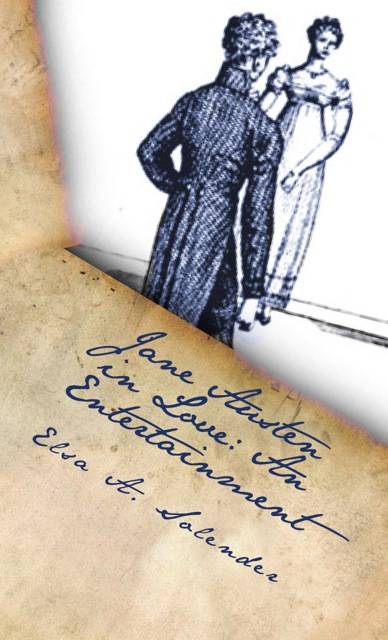
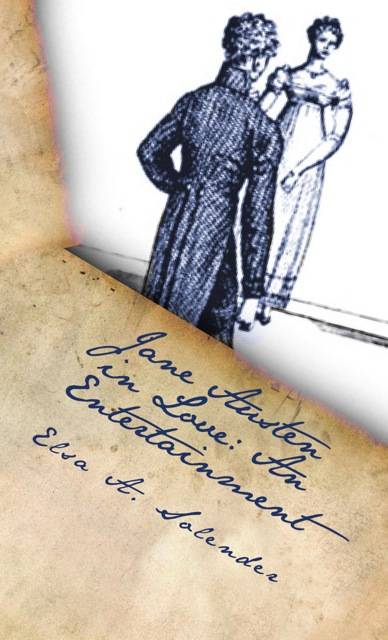
Book Giveaway Reminder! ~ Jane Austen in Love by Elsa Solender

Reminder! – today is the last day to comment on the post about Elsa Solender’s Jane Austen in Love: An Entertainment.  Go here: http://tinyurl.com/73grlcc and post your comment to be included in the drawing tomorrow March 5, 2012.

Copyright @2012 Jane Austen in Vermont
Author Interviews · Book reviews · Books · Collecting Jane Austen · Jane Austen · Jane Austen Popular Culture

An Interview and Book Giveaway! ~ Jane Austen in Love: An Entertainment by Elsa Solender

We welcome today Elsa Solender, former JASNA president, now author of Jane Austen in Love: An Entertainment. The book is currently available as a kindle ebook, and I heartily recommend that you download it immediately from Amazon.com– if you have no kindle, you can add a free kindle app to your computer and various i-products, and read it that way… rightaway… 

Solender’s sub-title of “An Entertainment” clearly states what this book is about – a fanciful confection of Jane Austen in love, where we are given a birds-eye view of episodes in her childhood, intimate moments with her sister, her family, and friends; an imaginary take on her feelings for Tom Lefroy; her 1-day engagement to Harris Bigg-Wither; and the fateful meeting with the rumored and wished-for ‘Gentleman suitor of the seaside’ –  part real, part imaginary, and part straight from Austen’s own fiction, all beautifully woven together into this tribute to love in the life of Jane Austen.  Read it, and then, as you would any Austen novel, read it again – there is much to discover and savor, and great fun to stumble upon the allusions to the letters, the known people in her life, and her very own fictional characters! 

Please see below the interview for the giveaway rules [either a kindle book reimbursement or if the winner is kindle-less, a copy of Dancing with Mr. Darcy, the anthology which contains Ms. Solender’s short story “Second Thoughts.”

 ****************************

JAIV: Welcome Elsa!  I appreciate you visiting Jane Austen in Vermont today, as we talk about your new book Jane Austen in Love: An Entertainment.

But first, tell us a little about your beginnings, your discovery of Jane Austen.

ES: My mother gave me Pride and Prejudice when I was in seventh grade and just 12. I was too young and put it aside. The next year, I returned to it, read it, loved it, and spent the month of July that year speeding through the other five Austen novels non-stop every day as if I were running—or reading —  in a marathon . I didn’t reread them again until freshman year at Barnard College. The papers I produced on Emma and for assignments were all close textual analyses (I recently re-read one or two of those papers – they’re not bad). My professors were New Critics focused almost exclusively on texts and critiques, with little historical or biographical background considered. To read too much into the author’s intentions or personal background was to commit one of the dreaded critical fallacies of New Criticism. But Jane Austen’s texts stood up magnificently with minimal background material. I really didn’t learn much about her life until I joined JASNA at its inception in 1979. After all is said and done, though, it’s the novels that count – which is a rather strange thing for the author of a biographical novel to admit, I guess.

JAIV:  And because I have to always at least ask the impossible-to-answer question: which is your favorite Austen novel and why?

ES: My favorite changes. I liked Emma best when I was younger – she’s an enfant terrible and a bit of a monster, with all the fascination of a monster, but Mr. Knightley loves her, and so must we.  I was enamored of Mansfield Park for a while because of its problems and artistic challenges: Imagine choosing Fanny Price as your protagonist and Edmund as your “hero.” What a task Jane Austen set for herself there! I loved Northanger Abbey because I found it reassuringly imperfect in its structure, yet wonderfully entertaining, with so many amusing characters and clever lines. Then again, I think Captain Wentworth’s letter in Persuasion is one of the most passionate  — but I am going on and on! Let me just say that I have always loved Pride & Prejudice – but add that when I’m not with the one I love, I love the one I’m with!

JAIV:  Why do you think that Jane Austen continues to be the “darling” of academia as well as popular culture?

ES: Austen is endlessly fascinating – just as Shakespeare is.  Her themes are universal, her language is rich, her psychological insights are penetrating, her social commentary is flawless, her moral compass unfailingly true. As times and trends change, new approaches to her work and life stimulate new thinking. For example, feminists in the 1970’s found her “conservative.” Then they read her again —with new eyes—and discovered her subversive qualities. Academics can still mine her work and her life – and all the spin-offs of those basic materials. JASNA’s journal, Persuasions, provides a juried venue for publication, another factor encouraging the academicians. I suspect that every gifted and ambitious young actress of every age yearns to have a go at playing  Elizabeth Bennet if she can,  just as the best young (and not so young) actors want to give Hamlet a try. We’ll have another bunch of filmed versions soon again, I suspect.

JAIV:  You have written a novel around your short story “Second Thoughts” – the runner-up in the first Chawton House Library Short Story Contest  and published in the anthology Dancing with Mr. Darcy – explain how you went from that story [did you write it first with no intention to write more?], to the full novel, and why?

ES: The idea for the story came to me in a flash when I read the contest topic (and learned that the judging would be done anonymously – my name would not be on the manuscript so no judge would know I had been president of JASNA). I wrote it very quickly and polished it for weeks afterward. I felt it was pretty risky to dare to try to enter Jane Austen’s consciousness, so I had better write it all out before I let myself get intimidated.  Since I was entering her mind, not trying to imitate her prose, there could be some leeway for stylistic imperfections. While I was in residence at Chawton House Library —part of the prize for the three prizewinners of the contest— I began experimenting with the narrative point of view to see if I might extend the story into something broader than a single event in Jane Austen’s life. I was looking for a narrator who was not Jane Austen, but wrote like her – though not as well, of course.

JAIV:  How do you change that story in this novel?  And why? [without giving too much away!]

ES: I didn’t change much. As my narrator writes, she learns to write better, and to enter Jane Austen’s consciousness more confidently. The story is the culmination of that process, both artistically and in the merging of her own consciousness with Jane’s.

JAIV: You use Cassandra Austen as your first-person narrator – how did you decide on her and not Jane Austen, or another person in Austen’s life?  

Cassandra Austen

ES: I would never try to directly imitate Jane Austen’s style although I have imitated Defoe, Boswell and Johnson in the past. I needed someone who was privy to Jane Austen’s most intimate thoughts and feelings. Who but Cassandra?

JAIV:  You write in a 19th century style that does not actually imitate Austen [who can!] but sounds true to the times and Cassandra’s inner voice – how did you go about creating that voice in that time?

ES: Since my college days, I have been told that I have a pretty good ear for imitation, especially of dialogue. When I was working at Barnard after graduation, I actually ghost wrote two pieces for a symposium in a national publication which were supposed to be by two different people.  When I was a student, one could sometimes substitute an imitation for a term paper in the eighteenth century literature courses that we at Barnard could take in the Columbia Graduate Faculties.  I chose that option because I was so busy:  I was a married student with a part–time but demanding job as a stringer for The New York Times as well as a full program of courses. An imitation required little research, just familiarity with the mechanics of style (which I had) and a good ear and a taste for satire – so I wrote “Moll Flanders in New York” and “Samuel Johnson in New York”— with lots of dialogue—and I got A’s on both. What I did was start out reading something by the author I was imitating and just continued on in the same voice into my own plot. I familiarized myself with Cassandra’s letters and found I could pretty well pick up on her sentence structures and vocabulary– although one has to reach beyond imitation and empathize with the character one is creating for a novel. I hope I did that in my book.

JAIV:  Jane Austen in Love: An Entertainment tells the story of some of the most private and intimate episodes in Austen’s life.  We know so little really – the “facts” are quite sparse and there has been much speculation through the years. It is so tempting for her “disciples” to fill in the blanks – from the letters, the works and anything else one can find! What inspired you to take this on? – to tell her story from the viewpoint of her closest confidant and fill in those many blanks with such realistic happenings?

ES:  Strangely enough, I find that the idea of borrowing Jane Austen’s characters is —for me at least — very uncomfortable. Her characters are her intellectual property. In my mind, they still belong to her. I tried once taking a very minor flat character and working out a fiction from the few hints we were given, but I really didn’t enjoy doing it. In reading biographies of Jane Austen, I always felt unsatisfied (In fact, that’s my problem with many biographies – and with autobiographies, too. Where there is speculation about a subject’s inner life in a biography, which purports to be factual, I tend to irrationally dislike and distrust it. I am also leery of the revelations of autobiographers about themselves.] Yet my interest was in the inner life of Jane Austen that was concealed from us, but might possibly be perceived intuitively from her writing. What facets of Jane Austen’s inner life, I asked myself, might have led her to write as she did? What events and people might she have examined and used as grist for her fictional mill? And what might have happened that influenced her to leave out some matters – like religion, for example, or war? Somehow, speculating in a clearly marked work of fiction seemed more seemly to me than speculating in a historical or biographical study. Others may well disagree – if so, they shouldn’t read my book. Also, there was a bit of wish fulfillment involved: I wanted to find my beloved author a partner, at least for a while, who was worthy of her genius. I meant my “gentleman at Sidmouth” to be a kind of gift or tribute in gratitude for the joy her work has given me. Does that sound corny?  Well, perhaps it’s because I’ve been happily married for many years.

JAIV:  No, not corny at all! – I think many of us wish for her seaside suitor to have been real for her. How else we ask could she have written such passionate tales of love, and of love lost and found?

You title your book “Jane Austen in Love” – and it is really about the many loves of Jane Austen: her sister, her family, her cousin Eliza, Madame Lefroy, her flirtation with Tom Lefroy, her proposal from Bigg-Wither, and her mysterious suitor at the seaside. You create dialogue and story to bring these known facts to life, brilliantly piecing all with a fully imagined Austen by using many references and at times actual dialogue from the novels. Which leads me to ask, how ever did you decide on what to include from her real life experiences and from her fiction?  – At times I had to check my Letters biographical index to see if someone was real or not! Mr. and Mrs. Austen are at times the Bennets; fictional neighbors become the Mrs. and Miss Bates; several “real life” adventures are straight from the books [including a rescue a la Willoughby and Marianne!] – it was great fun to stumble upon these, and I am sure I would find more on a second reading! – but how did you manage this? –

ES:   You are both a perceptive and astute reader! Thank you for “getting” so much of what I was after.  I think all her loves contributed to Jane Austen’s concept of a meaningful romantic partnership and to her development as a novelist. I worked mostly from memory—I have been reading and rereading her novels for decades, as well as  reams of secondary source material— but occasionally I sought out a suitable phrase and planted it for my reader to find and enjoy – a bit like a literary treasure hunt. At the same time, someone with only a little knowledge of the background and biography—like a latter day New Critic— ought to be able to enjoy the characters and the story without consulting any other work.  As I wrote in my acknowledgements, Deirdre Le Faye’s books were invaluable resources when my memory didn’t serve or I needed verification. She deals in facts—brilliantly — and I deal—ultimately— in fancy, which is why I call the book an “entertainment.”  I think all writers use real life and, if they are successful, transmute it into fiction which, in some ways, can become “truer” or “better” or “more real” than mere facts could ever be: Facts are both random and fixed, but a fiction writer has the freedom (and responsibility) to shape —and stack— and change— facts for his or her own artistic purposes. 

JAIV: An author can find themselves on dangerous ground combining known biographical facts and a fictional telling of what might have actually happened, dialogue and all – are you at all concerned about the reception of this novel? concerned that Austen “fans” might feel their own private Austen has been tampered with?

ES: I think we who love Jane Austen’s novels yearn for a better image of her, whether it’s a visual image or a persuasive word picture that syncs with the novels. We want to know her intimately, although she (and Cassandra) did their best to keep what they deemed “private” away from us.  I speculate in the novel whether the destruction Cassandra wrought was really such a good idea in the end: The varying images of Jane Austen that have come down to us over two centuries —Saint Jane, Jane the Hater, Dear Jane, Sour Jane — might not have pleased or satisfied either sister. Even so, through the novels, she seems to belong to each of us in a special way. I offer my speculations, with the blanks filled in as I would like them to be; but it’s clearly my own personal notion of her (as well as a bit of a dream for her).  I am perhaps presumptuous in my presentation – but I did at least spare her from vampires, zombies and sea monsters.

JAIV:  Yes, it was quite delightful to spend my reading hours with a real Jane and her family and friends!  I love especially your description of Madame Lefroy – she jumps off the page as such a lively, lovely character – did you have a particular portrait in mind when you wrote this?

ES: Not really – although she likes some of the same poems as one of my favorite high school teachers and looks rather like my freshman English professor.

JAIV:  Ah yes, the autobiographical comes out doesn’t it!

Which leads me to the reader’s confusion of this real and fictional world … I found myself reminded of many Austen’s biographical tidbits that have retreated in my brain to a “save for later” file – and now pleasantly brought to the fore, such as her Abbey school experience, details about Eliza de Feuillide – and then there are the various characters and incidents that I know must be fictional – I feel as though I need to do a re-read of the letters and all biographies, and all the novels to cipher the facts from your tale! – what advice can you give the reader?

ES: Read and re-read  the novels, themselves, for pleasure and illumination. Look to Deirdre Le Faye for facts.

JAIV:  Indeed, where would we be in Austen scholarship without Deirdre Le Faye!

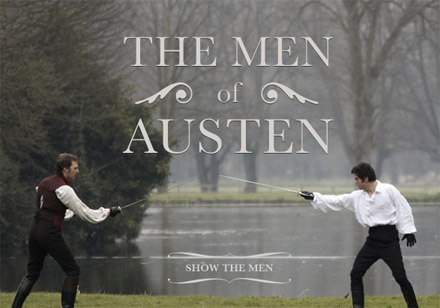
In my mind the seaside suitor you imagine for Austen is very like one of her fictional heroes – I will not say which he most reminds me of! – everyone might find their own – but is this gentleman a composite of all her heroes or does he lean toward personifying one of them? And if so, is this your own favorite Austen hero? [i.e. who did you have on your nametag at the Richmond AGM “Jane Austen and Her Men” in 1996  – I realize you cannot really say… but skim around it if you can!

The Men of Austen at Masterpeice Theatre

ES:  He’s entirely my creation – but of course, any ideal male character of mine would have to be strongly influenced by Jane Austen’s heroes – and by the virtues of my own particular husband, to whom the book is dedicated.

JAIV:  Just a question about the publishing process:  though I am an avid book collector, I do have a kindle and use it mostly for those books I don’t really need on my already over-stuffed shelves [though alas! it is a rare book I read that I don’t want to own!] – I would have liked your book in a hardcopy to add to my Austen collection, but it is right now only available exclusively in the kindle format.  Can you tell us how this came about and if this has worked for you?

ES: There is no more room on my shelves for new books either, but I keep on buying them. I have about a dozen double-booked shelves. I make myself give up a book (usually an old paperback) whenever I add a new book. I bought the Kindle for my husband after shipping ten shelves of his books to his office. Then I bought one for myself – good for reading on buses and subways. Sometimes I read a book on Kindle and then buy a “hard copy.”

My literary agent and I turned to the Amazon Kindle publication after she received, over the space of a year, “the most beautiful and admiring rejection letters of (her) career.” One reason for declining the book was that biographical novels don’t seem to be selling well (despite “Wolf Hall”). Another editor said she liked it but it “moved at the pace of a Jane Austen novel” – which she didn’t regard as a virtue.  Then, a couple of months ago, an executive at Amazon — with whom my agent used to work when she was an editor at a major publishing house — asked to put her backlist on Kindle. He also asked if she had something new that she loved that was not being picked up by a traditional publishing house. She suggested my book. He was enthusiastic – and in the end, it was presented as a e-book on Amazon at absolutely no cost to me. The object was to “get it out there” and have it read. No one doubts that eBooks have a future – as many of them are sold now as “regular” books.  Unfortunately, neither the editing process nor the marketing have been what we hoped (and expected) they would be. We are working on correcting irritating reversals of words, missing words, etc. for which I ask your patience. Also, Amazon’s plan for marketing turned out to be quite different than we expected and we need to establish a “presence” for the book on the Web during what they deem a “slow rollout.”

Incidentally, the free Kindle “app” can be downloaded easily from Amazon so that a Kindle e-book can be read on any computer or tablet. I learned that after my book was published.

JAIV:  Are you expecting that it will be available as a “real” book at some point?

ES:  My agent ardently hopes that one of the editors who held the book for months and months, and complimented it warmly, but then declined to purchase it, will ultimately publish it. That’s our objective. It needs to sell rather well to attract any attention, and I do have the right to take it back from Amazon after a year (and they can make a counter offer). Right now, I am receiving immense pleasure hearing from readers who enjoy the book – and tell me (and Amazon and the world) why they like it.

JAIV:  Do you enjoy any of the Austen-inspired fiction? – the sequels, continuations, the mash-ups? Can you share any of your favorites and why?

ES: I am hyper-critical and impatient with slips in voice and style (including my own). One sequel I read years ago about Jane Fairfax in the Burke Collection at Goucher College made me think about writing one of my own – but in the end  I didn’t feel comfortable doing it.  I thought Joan Austen-Leigh’s Return to Highbury, built around a very minor character in Emma, had its own merit. [this was the first title of her book, it was later changed to Mrs. Goddard, Mistress of a School.] And borrowing another writer’s very minor character is what Tom Stoppard does so wonderfully in Rosenkranz and Guildenstern are Dead and he borrows biographical characters for his Arcadia.

JAIV: Your say your book is about love, but it is not a formula romance. Into what genre, if any, do you think it might fit?

ES: It’s true that my plot doesn’t follow the traditional romantic course of Girl meets Boy, they fall in love, complications arise, they work them out, Girl and Boy get married and live happily after. It might have been more salable if it had fit into that genre. I was limited – and also challenged – by the known facts of Jane Austen’s life, sketchy as they are. Mine is a work of fiction based on those facts, but embroidered with my own— hopefully plausible— imaginings. It is, in a sense, a feminist novel – not overtly so, but implicitly: I think I show how a young woman’s romantic “career” could be influenced, even destroyed by lack of fortune and the influence of people who had power over her, even those who loved her and acted in what they may have thought was her best interest. I wanted to show, however, that even in restricted circumstances, without marriage, women of spirit and ingenuity could build a meaningful and satisfying life if they were allowed space to develop their talents and build relationships with family and friends. In that sense, it may be as much a modern novel as a historical one.

JAIV:  If Jane Austen had married Mr. Bigg-Wither—or her mysterious suitor—do you think we would have had the six novels? Perhaps we would have nothing but the Juvenilia and random letters that no one would care about….

ES: I doubt very much that we would have had any novels if she had married, even if her husband meant to be supportive of her ambition to write. With either man as her husband, she would have had responsibilities as a wife and helpmate that would have left her very little time of her own, whether as the lady of the manor or a clergyman’s wife. Children would have demanded even more of her attention. I do believe that her sister Cassandra protected Jane’s writing time once they settled at Chawton with a generosity that a husband and children of her era would not likely have been able to equal. Very few women I know have been able to demand what psychologists call “self-time” until very recently when professional women have become equal contributors to their family’s finances and in a position to insist on certain prerogatives in return.   Perhaps Jane Austen might have completed novels if she had managed to live to a ripe old age—like her mother, or her brother Francis, who became Admiral of the Fleet at 90 when he outlived his contemporaries —and that would only have happened with a husband  willing to tolerate and nurture her rather unusual ambitions. In my short story, I wanted to suggest that she rejected conventional comfort and security that marriage to Bigg-Wither would have brought her for two reasons: One was her conviction that a marriage without affection and respect could not flourish, the second was her irresistible drive to write.

JAIV:  I know you have written about “Recreating Austen’s World on the Screen” in JASNA’s Persuasions –  What are your quick thoughts on the movies – Your favorites? Those that got it wrong?

ES: I liked the Colin Firth P&P best. I hated all the Mansfield Parks.

JAIV:  If you could tell us the best five works in your Austen collection [besides the Works themselves], what would you choose?  Which books have been the most valuable to you in understanding Austen and her times?

For instance, you write in Jane Austen in Love, a bit on “the secret language of the fan” [all quite fun where you have Eliza impart to her younger cousins all her thoughts about “love”!] – what books have you found most helpful in understanding these social customs?

ES: All of Deirdre Le Faye‘s works are helpful.  All Juliet McMaster’s critical studies are of comparable value in their own way. I often refer to The Jane Austen Companion (by J. David Grey, Brian Southam and Walt Litz).  I also make great use of the Internet when I am looking for something I vaguely remember – or don’t recall, but need.

JAIV:  What else do you like to read?

ES:  I am a voracious reader. I usually keep about four books going at one time. On my bed table and on my Kindle, I have bookmarks right now in: Here, an anthology of  wonderful poems by the late Wislawa Szymborska, whose outlook and tone resembled Jane Austen’s in many ways;  The Life of Super-Earths by Dimitar Sasselov (I am almost as passionate about astrophysics as I am about Jane Austen);  Boswell’s Presumptuous Task: The Making of the Life of Dr. Johnson by Adam Sisman, and Sugar Street, Book II of the Cairo Trilogy of  Mahfouz.  I am passionate about — and often reread— the novels in Patrick O’Brian’s Aubrey – Maturin series (he told me Jane Austen was his stylistic muse); the trilogies of the late great Canadian novelist, Robertson Davies, and the works of my favorite teacher in The Committee on Social Thought at University of Chicago, Saul Bellow.

JAIV:  And for the writers out there: what is your writing process? And your best advice to aspiring writers?

ES: Every writer has his or her own peculiar process. If you need to write – just do it. Otherwise, find something easier to do.

JAIV:  Do you have any other fiction in the works?

ES: Yes.

JAIV:  Ok, I shall not ask more on that! Anything else you would like to share with my readers?

ES:  Just that I hope they will give my novel a try and let me know what they think of it.

*****************

Thank you Elsa for your graciousness in answering all these questions! I wish you the very best with your new book – and we at JASNA-Vermont look forward to your visit to us next fall as part of the Burlington Book Festival!

About the author: Elsa A. Solender, a New Yorker, was president of the Jane Austen Society of North America from 1996-2000.  Educated at Barnard College and the University ofChicago, she has worked as a journalist, editor, and college teacher in Chicago, Baltimore and New York. She represented an international non-governmental women’s organization at the United Nations during a six-year residency in Geneva. She wrote and delivered to the United Nations Social Council the first-ever joint statement by the Women’s International Non-Governmental Organizations (WINGO) on the right of women and girls to participate in the development of their country. She has published articles and reviews in a variety of American magazines and newspapers and has won three awards for journalism. Her short story, “Second Thoughts,” was named one of three prizewinners in the 2009 Chawton House Library Short Story Competition. Some 300 writers from four continents submitted short stories inspired by Jane Austen or the village of Chawton, where she wrote her six novels. Ms. Solender was the only American prizewinner, and she is the only American writer whose story was published in Dancing With Mr. Darcy, an anthology of the twenty top-rated stories of the contest

Ms. Solender’s story “A Special Calling” was a finalist in the Glimmer Train Short Short Story Competition. Of more than 1,000 stories submitted, Ms. Solender’s story was ranked among the top fifty and was granted Honorable Mention. She has served on the boards of a non-profit theater, a private library and various literary and alumnae associations.  Ms. Solender is married, has two married sons and seven grandchildren, and lives in Manhattan.

*****************************

Book Giveaway!

Please post your comments or questions ~ Elsa will happily respond to you! All commenters will be entered into the random Book Giveaway drawing for a copy of Jane Austen in Love: An Entertainment, which is only available as an Amazon kindle ebook.  If the winner has a kindle, I will reimburse the $8.99 it costs to download. If you are alas! kindle-less, the winner will be sent a copy of the Chawton House Library’s Dancing With Mr. Darcy, which includes Ms. Solender’s story “Second Thoughts” – an imaginary tale of Jane Austen’s sleepless night after accepting the proposal of Harris Bigg-Wither, which is part of this new work.  

The deadline to comment is 11:59 pm  Sunday March 4,  2012 – Winner will be announced on Monday March 5, 2012.  Worldwide eligibility.

Copyright @2012 Jane Austen in Vermont
Author Interviews · Books · Jane Austen · Jane Austen Popular Culture · Jane Austen Sequels

Book Giveaway Reminder! ~ Jane Austen Made Me Do It

Reminder to post a comment on the interview with Laurel Ann Nattress, to be thrown into the mix for the giveaway of her book Jane Austen Made me Do It – you have until tomorrow night October 26 at midnight [i.e. the wee hours of the morning of October 27th] – I will announce the winner during the  day of the 27th…

Worldwide eligibility!

Good luck one and all!

Author Interviews · Books · Collecting Jane Austen · Jane Austen · Jane Austen Popular Culture · Jane Austen Sequels

Jane Austen Made Her Do It! ~ an Interview with Laurel Ann Nattress, blogger, author and friend ~ and a Book Giveaway!

We are very fortunate today to welcome Laurel Ann Nattress, creator of the blog Austenprose,  and editor of the just released Jane Austen Made Me Do It, a collection of Austen-inspired short stories.  The book was just launched ~ on October 14, 2011 at the Fort Worth JASNA AGM!  

Hello Laurel Ann!  

A hearty welcome to you today as you trek around the world on your Grand Blog Tour!  A lovely time here in Vermont, so sorry we are doing this via cyberspace rather than a true visit over a hot cup of tea on a colorful fall day – but alas! this will have to do! 

Before we get to your new [and very exciting!] book, I’d like to start with a few general questions about you and Jane Austen. 

JAIV: Most of us in “Jane Austen Land” know you as the dedicated, enthusiastic, and insightful author / editor of the Austenprose blog.  Just give us a brief look into your personal history, your first experience with Jane Austen and why she has remained such an integral part of your life. 

LAN: Hi Deb, thanks for inviting me to chat with you today on Jane Austen inVermont. Can we have some of your famous Vermont maple syrup with the hot cup of tea?   

 *blushes* Your diplomacy in describing my Jane Austen output is very kind, but honestly, it is all just a wonderful outlet for my Austen obsession that began with the 1980 airing of PBS/BBC Fay Weldon television adaptation of Pride and Prejudice. I knew of Jane Austen previously, but that five hour miniseries was a life altering experience. Compelled to discover more works by this fabulous author, I read all of Austen’s novels and worshiped in silence. There is just something so intriguing about the Regency era; a simplicity and civility that is so refreshing to our complicated modern lives. Looking back is delightful – though, I do prefer modern conveniences such as the Internet, plumbing and social advances.

Austen has remained integral to my life because her characters have. Her astute observation of human nature is around me every day in my family, friends, people I meet through my work as a bookseller, and through my blog. I recently had an encounter with a modern-day Fanny Dashwood that I was much wiser of because of Austen’s portrayal of her in Sense and Sensibility. Austen makes me think – and learn – and I love the challenge.

JAIV:  Can I dare ask that always-asked / impossible-to-answer question – which is your favorite Austen novel and why? 

LAN: You are right Deb, this is an impossible-to-answer question! I could give the politically correct answer and say that my favorite Jane Austen novel is the one I am currently reading, but I won’t, and will go out on a limb and say it wavers between Mansfield Park and Lady Susan. Are you shocked? Oh, I do dearly love to laugh with Pride and Prejudice and get pierced through my soul with Persuasion, but I am one to root for the underdog, so I will stick with my first choices. I think I am drawn to the dark characters in both of these novels and how they are played against the plot. The novella Lady Susan is especially intriguing to me because it was an early work, not as developed and polished as her full novels, and its eponymous heroine is just out-and-out wicked. I would love to see it made into the next mini-series or movie. (hint, hint) 

JAIV:  I agree with you Laurel Ann – I do wonder why Lady Susan has never been made into a movie – casting it would be great fun!…

If you were to start an Austen library, what would you say are the essential works to have [the Complete Works and Lettersbeing a given]? 

LAN:  here you go for starters:

Fiction: Novels by her contemporaries of course: Ann Radcliffe: Fanny Burney, and Samuel Richardson, but also contemporary authors who continue her legacy: Georgette Heyer, Stephanie Barron, Lauren Willig and Syrie James to name only a few.  

Non-fiction: *walking to my bookshelves* My favorite biography: Jane Austen: A Life, by Claire Tomalin, and Jane Austen: The World of Her Novels, by Deirdre Le Faye. 

Reference Sources: For the Inner-librarian in us all: A Bibliography of Jane Austen, by David Gilson and for general Regency & Georgian culture: All Things Austen, by Kirstin Olsen. 

JAIV:  Your introduction contains many fine quotes from Austen’s works – if you could choose one quote from all her writings, what would be your favorite? 

LAN: From a letter to her sister, Cassandra – 13 May, 1801 

‘Another stupid party last night; perhaps if larger they might be less intolerable, but here there were only just enough to make one card-table, with six people to look on and talk nonsense to each other.’ 

The whole letter is just a cut up of the characters and family in the neighborhood. I enjoy seeing her unguarded and making sport of the humanity that surrounded her. Jane Austen did not suffer fools gladly, which probably got her into trouble with her family. It may be one of the main reasons that her sister destroyed much of their personal correspondence.  

JAIV:  So now let’s talk about your book, Jane Austen Made Me Do It: Original Stories Inspired by Literature’s Most Astute Observer of the Human Heart: 

This is your first venture into editing and publishing – please tell us about how this all came about? – a dream-come-true really, isn’t it? 

LAN: Indeed a dream project Deb, that came about because of my blog Austenprose. Isn’t the Internet grand? It (and the movies) has opened up Austen to a wider audience. 

I feature many book reviews and author interviews on my blog, and as I continued to work with them, I saw a thread connecting them and my passion for Jane Austen. They were all so enthusiastic about her work and how Austen had inspired them. One day, out of the blue, I thought to myself, “Why couldn’t I edit an anthology of Austen-inspired stories? I could ask all of the authors that I had worked with to contribute a story!” 

Of course, my biggest challenge was if I could find a publisher, so I reached out to some of the authors I knew for advice. Before I could write up a book proposal, I was contacted by a literary agent who wrote to me in appreciation of the work I had done promoting his client.  I thought about it for about 10 seconds, and then I seized the opportunity at once, called him inNew York, and pitched my idea to him.  He loved it.  So did Random House.  I had a book deal within a week and twenty authors lined up in about a month.  It was truly a day when my stars and planets aligned and magic happened.

JAIV:  I love subtitles – they give the author an opportunity to give a real hint of what’s inside, a well-worded tug on the reader.  Your title of Jane Austen Made Me Do Itis just brilliant, and the subtitle defining Jane Austen as an “astute observer of the human heart” is in itself an astute description of our favorite author – how long did it take to come up with this title, or was it always floating around in your head? 

LAN: I must give all the credit of the title to my agent, Mitchell Waters.  He thought of Jane Austen Made Me Do It and presented it to my editor who loved it.  The subtitle arose from some of my writing on my blog that my editor was struck by.  She elaborated and lengthened it. I liked it, so we used it.

JAIV:  And, I love the cover, a creative way of getting all those words onto the cover without looking wordy! – and the young lady in forward motion, almost saying to us, “come on, let’s look inside, shall we?”  How much input did you have on the cover design and other physical aspects of the book? 

LAN: Cover design is an art. I see hundreds of new ones arrive monthly at my job as a bookseller.  Some just jump out at you from the new release tables. Others, not so much.  The first time I saw the cover design for Jane Austen Made Me Do It I was taken aback.  It was striking and so different than any other cover I had seen. 

Authors have very little input on cover design or marketing.  We are just the talent.  The publisher is the sales professional.  The only thing that I requested to change was the ribbon color from orange to pink and that they add a grosgrain texture.  I was relieved when they agreed and I think the end result is amazing.

JAIV:  I know you are familiar with many of the Austen-inspired fiction writers, either through their works or befriending them through your blog – how ever did you choose from the many excellent authors out there? And what was the writing requirement you posed to them?

LAN: Since the 1995 A&E/BBC airing of Pride and Prejudice staring the dishy Colin Firth as Mr. Darcy, the output of Austen-inspired novels has created a new book genre – Austenesque.  We all have our favorite authors that we personally connect with and want to read over and over.  The same is true for me of Austen-inspired novels.  It took me about 15 minutes to compile a list of my dream authors for my editor to look through.  Happily she agreed with all of them and added a few new authors that she knew admired Jane Austen.  The day I sent out the email query was amazing.  Within ten minutes I had my first response from Lauren Willig.  She was ecstatic.  Everyone that I had worked with previously said yes over the next few days.  Within a month, we had our line-up set. 

I was pretty open with the requirements with the authors.  The story needed to be about five thousand words in length, but other than that, they could write in any genre and era.  I threw this quote at them and let them loose. 

“[S]uppose as much as you chuse; give a loose to your fancy, indulge your imagination in every possible flight which the subject will afford,” Elizabeth Bennet, Pride and Prejudice, Ch 60. 

JAIV:  The variety and diversity of these stories is quite amazing, all connected to Jane Austen in some way – she is either in the story or her presence is felt in some way; there are historical tales and contemporary tales; some of her characters are revisited; there are love stories and ghost stories, we get to visit with Stephanie Barron’s (and Jane’s!) favorite gentleman Lord Harold Trowbridge again!, and even The Beatles make an appearance! – were you surprised by this so very wide range of tales?? and how so? 

LAN: Yes, I was entirely surprised and delighted by the diversity. We had hoped for about half historical and half contemporary stories so that it would appeal to a wider audience.  The authors sent me their ideas and I encouraged them in certain directions.  When the stories started arriving, I was thrilled with the result.  There were very few re-writes and then copy editing followed for all.  It took about two years from concept to curtain.  All of my authors, except for the short story contest winner, were polished pros.  They came though like champions. 

JAIV:  How ever did you figure out the order of stories? 

LAN: This was entirely my choice.  It was gut instinct really and a bit of formula that will remain a secret! ;-)

JAIV:  There are twenty-two stories, written by known published authors – all but one that is –  “The Love Letter” by Brenna Aubrey [which I have to say is in my top three list – will say which in my review!), winner of the short story contest  – tell us about the process of that contest and the difficulties in choosing just this one from so many entries? 

LAN: The Jane Austen Made Me Do It Short Story Contest was also entirely my idea.  I thought it in keeping with Jane Austen’s dedication of her craft to inspire novice and unpublished authors to write.  It was held online at the Republic of Pemberley last January. The stories were submitted and posted on the contest board and the public voted on the Top Ten. Those finalists advanced to the review by my editor and me with my agent stepping in if there was a tie. 

We were blown over by the response.  Eighty-eight stories were submitted. They were amazing.  Selecting the Grand Prize Winner was quite a challenge, but from the moment I had read Brenna Aubrey’s “The Love Letter,” I knew that it was very special.  I was thrilled that it made it into the Top Ten and that my editor loved it too.  You can still read the stories online – so please check them out. 

JAIV:  You have not published a book before.  Here you had to choose and edit the stories; write the introduction; add in author bios; create and implement a marketing strategy to include the book’s website, PR materials [bookmarks and posters and magnets, oh my!); launch the book, etc! – what in this whole process surprised you the most? Discouraged you the most? Inspired you the most? 

LAN: You are so observant Deb.  Jane Austen has taught you well.  Yes, there is a huge process to bring a book to publication and market it.  I had seen the end product – the sales part of it – when a book hits the bookstore.  I also had been involved in the marketing end while working with publishers and authors on my blog, but I knew nothing about the process before that. 

One hears horror stories about the long road to publication.  Our dear Jane Austen had her own trials before Sense and Sensibility was published in 1811. As I mentioned previously, I presented my idea to a literary agent who took the chance on an unpublished blogger and connected me with the perfect editor at Random House who loved the idea.  Working with Caitlin was so encouraging.  She is very positive and nurturing for a new editor.  Her expertise and instincts guided me to many of my decisions.  I was surrounded by an amazing team of agent, editor and authors.  I am very grateful and am so pleased with the result.  

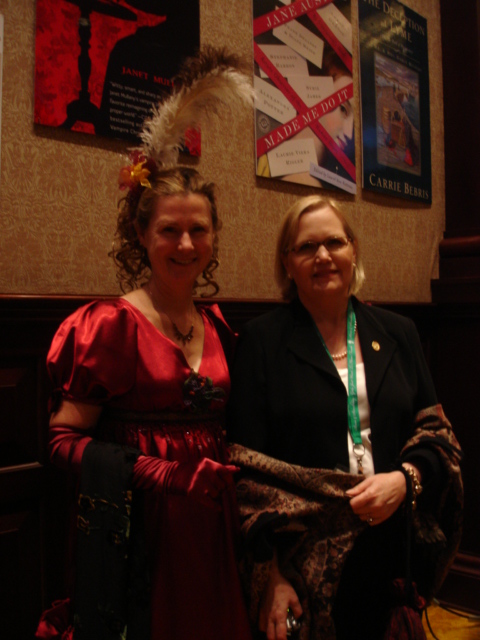
JAIV:  Jane Austen Made Me Do It officially launched on Friday, October 14, 2011 in the Barnes & Noble in Fort Worth, Texas, during the JASNA AGM.  Please tell us about this evening – the whole event, who came, what was said, what yousaid, questions asked, etc… 

LAN: I could write a whole blog (and will) on the eventful book launch. Here it is in a nutshell: in attendance were Pamela Aidan, Stephanie Barron, Carrie Bebris, Syrie James, Janet Mullany, Margaret Sullivan and me.  It was the trifecta of Jane Austen book launches with two of my anthology authors: Carrie Bebris and Janet Mullany also sharing the limelight launching their new titles: The Deception at Lyme and Jane Austen Blood Persuasion.  I was very nervous.  I had never spoken in public before.  I was told I was as white as a sheet, but that my talk went off well.  We had about 150 in attendance, many of which were attendees of the JASNA conference.  I inscribed a lot of books that night.  It was surreal. 

JAIV:  What is next for you with this book? – any more launch parties? book talks? etc?

LAN: I have my local book launch for Jane Austen Made Me Do It on Saturday, October 22, 2011 at Barnes & Noble in Lynnwood, WA.  This is my store (I work there) so it is particularly eventful to celebrate with friends and family and co-workers.  I have other events in the queue, but I do get a rest for a while, which I really need after weeks of build-up and writing 32 blogs for my Grand Tour of the blogosphere! Phew!

JAIV:  And now that you have had this first publishing experience, what is your next project? – would you do another such anthology? and what would you say was the most valuable lesson you learned this first time out? i.e. what is your best advice to a would-be writer? 

LAN: I have two projects that are in development.  One is an anthology and the other is a new kind of annotated edition of Austen. I will leave you hanging in suspense Deb! 

JAIV:  You and I have had numerous discussions on the popular culture aspect of Jane Austen today: the movies, the continuations, the sequels, prequels, retellings, the comic books and graphic renditions, the mash-ups and the paraphernalia, the you-tubes, the facebook and twitter pages and blogs – the list is endless as you know! – so what would you say to the person most horrified by these reincarnations of Jane Austen, these 21st century takes on her classic literary talents, that person who wants her and her characters left in peace, that person who will re-read the originals over and over before daring to tread into these murky insane waters of popular culture – what can you say to them so they might be encouraged to read these works, to hopefully discover your book to be a fine start?! 

LAN: The Austen purist is a tough convert. If they enjoy the original author only and do not want to try anyone else, I can only add that I hope they might consider branching out and being adventuresome. I hope that they might be tempted by my anthology because it was written in the spirit of Jane Austen’s ideals of creativity and craft development.  It might just make them laugh – and even Austen’s self-elevating heroine Emma Woodhouse, who she feared no one would like but herself, is appealing because she has the keen sense of laughing at the sublimely ridiculous Mr. Elton: 

“After this speech he was gone as soon as possible. Emma could not think it too soon; for with all his good and agreeable qualities, there was a sort of parade in his speeches which was very apt to incline her to laugh. She ran away to indulge the inclination, leaving the tender and the sublime of pleasure to Harriet’s share.” Emma, Chapter 9

JAIV:  And finally, if you weren’t reading Jane Austen, if heaven-forbid there never had been a Jane Austen [gasp!], what would you be doing?

LAN: I would be obsessed with James Fenimore Cooper. The Last of the Mohicans is actually Sense and Sensibility with guns, Indians and red coats! But that is a whole other blog post, right? 

JAIV:  Indeed it is!  Thank you Laurel Ann for so graciously answering all my questions! I wish you the best of everything with this book – I loved it and will post a review in the coming week…

LAN: It was my pleasure Deb.  Thanks for your inspiring questions.  Hope to meet you again soon to share that cup of tea and more musings on our favorite author! 

*******************************

About the editor:

 Laurel Ann, on the right, with Syrie James, one of the anthology
authors, at the JASNA AGM in Fort Worth

A life-long acolyte of Jane Austen, Laurel Ann Nattress is the author/editor of Austenprose.com a blog devoted to the oeuvre of her favorite author and the many books and movies that she has inspired. She is a life member of the Jane Austen Society of North America, a regular contributor to the PBS blog Remotely Connected and the Jane Austen Centre online magazine. An expatriate of southern California, Laurel Ann lives in a country cottage near Snohomish, Washington. Visit Laurel Ann at her blogs Austenprose.com and JaneAustenMadeMeDoIt.com, on Twitter as @Austenprose, and on Facebook as Laurel Ann Nattress

Jane Austen Made Me Do It: Original Stories Inspired by Literature’s Most Astute Observer of the Human Heart, edited by Laurel Ann Nattress

Ballantine Books
ISBN: 978-0345524966 

Giveaway of Jane Austen Made Me Do It 

Enter a chance to win one copy of Jane Austen Made Me Do It by leaving a comment by midnight October 26, 2011 [i.e. the morning of the 27th], stating what intrigues you about reading an Austen-inspired short story anthology. Winners to be drawn at random and announced on October 27th, 2011.  Open to all and will ship internationally.  Good luck to everyone!

 Copyright @2011 Deb Barnum, at Jane Austen in Vermont
Austen Literary History & Criticism · Author Interviews · Books · Jane Austen

Why Jane Austen? – Book Giveaway Deadline…

Last chance to enter the book giveaway drawing for Why Jane Austen? by Rachel Brownstein:  deadline is tomorrow Wednesday August 10th at midnight – drawing on Thursday August 18.  You can comment on either of these posts, on Why Jane Austen in your life, or just stop by and say “hello”!

Part I: https://janeausteninvermont.wordpress.com/2011/07/31/rachel-brownstein-on-why-jane-austen-an-interview-and-book-giveaway/ 

Part II: https://janeausteninvermont.wordpress.com/2011/08/01/interview-and-book-giveaway-why-jane-austen-by-rachel-brownstein/

Winner will be announced Thursday afternoon…!

Copyright @2011 by Deb Barnum, of Jane Austen in Vermont
Austen Literary History & Criticism · Author Interviews · Book reviews · Books · Collecting Jane Austen · Jane Austen · Literature

Part II: Interview and Book Giveaway! ~ Why Jane Austen? by Rachel Brownstein

Contrary to the main current of popular opinion today, Jane Austen’s novels are not first of all and most importantly about pretty girls in long dresses waiting for love and marriage; and they are not most importantly English and Heritage, small and decorous and mannerly and pleasant. Read with any degree of attention, they do not work well as escape reading: there are too many hardheaded observations and hard, recalcitrant details in them…  
[ Rachel Brownstein, Why Jane Austen? p. 247]


Hello Professor Brownstein! And welcome to Jane Austen in Vermont

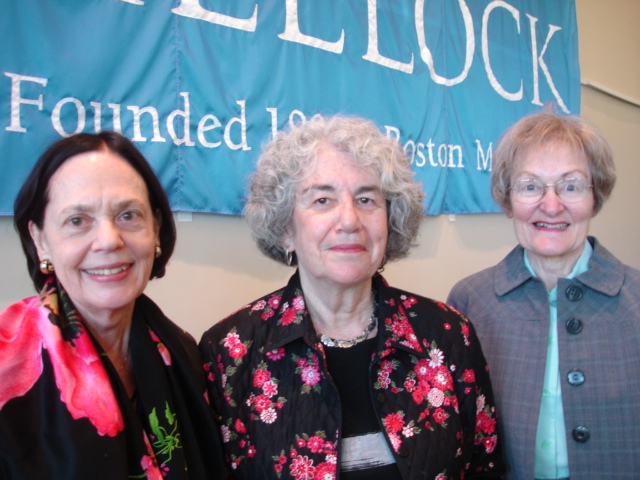
I had the pleasure of hearing you read from your newest work Why Jane Austen? at the JASNA-Massachusetts May meeting [see photo below].  You have very graciously agreed to this interview (as well as to speak at our June 2012 JASNA-Vermont gathering!] – so I heartily welcome you today to discuss your new book on Jane Austen. 

JAIV:  You strive in this work to undercut conventional thinking on Jane Austen, by offering us a good number of “essays” on novels, authorship, women writers [but much on Byron!], neighbors, gossip, language, biography, the importance of re-reading – you move from the real life, the fictions, the use of words, and personal anecdote in such a seamless weaving of thoughts, that I marvel at the weight of each sentence [for example, I love this one:  “Emma is as nosy as a novelist about private lives” [p. 223] – one could think about that sentence for hours! 

But to start, just tell us a little about why you titled your book Why Jane Austen?

RB:  The book asks why there is so much interest in this particular long-dead woman novelist: why Jane Austen right now and not, say, George Eliot or Virginia Woolf, or Jane Austen’s contemporary, the novelist and poet Charlotte Smith?


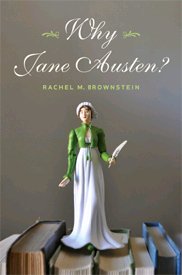
JAIV:  And one must ask about the cover! – Who decided to use the Jane Austen action figure?

RB:  It was I who brought my action figure—along with other pieces of Austeniana I own–to the office of Columbia University Press.  It was the brilliant art director who decided to put it on the cover, and the brilliant photographer, I think, who placed the figure on top of the books. 


JAIV:  I completely agree with your insistence on calling her “Jane Austen” – unable to call her “Austen” (“would have startled her, makes me wince a little” [p. 11]), nor just “Jane”, nor certainly “Dear Jane” – why is this so for Jane Austen and for no other author?

RB:  I think it’s Claire Harman, in her book, “Jane’s Fame,” who observes that she’s the only author people call by her first name alone.  This is a really interesting question.  I think she’s “Jane” because of a mix of doting indulgence and a condescension that verges on contempt—the kind familiarity brings.  It’s partly a function of her being a woman, and unmarried, and long-ago, and therefore girlish, and in some way small—you know, they talk about her small canvas, her narrow range.  It’s deplorable, really—and really a function of misreading her novels as merely delightful.


JAIV:  One of the main themes in your book is based on the Katherine Mansfield quote that serves as an epigraph:

 “The truth is that every true admirer of the novels cherishes the happy thought that he alone – reading between the lines – has become the secret friend of their author.”

Is this why you think that Jane Austen has and continues to have such a profound pull on her readers?

RB:  Yes.  I think her conspiratorial confidence in her readers is flattering and engaging.  After all, she’s so smart and so charming, and she takes us into her confidence. 

JAIV:  Your first chapter begins with Pride and Prejudice and its emphasis on “truth” – the first sentence staking its claim on the rest of the novel with this term: “it is a truth universally acknowledged” (certainly the most discussed opening line in literary history!) – you say the word “truth” occurs in Pride and Prejudicetwenty-four times, and one of your main themes is to show the power of the novel to reveal truths. This isn’t a question, but please explain a little if you can.

RB:  One of the reasons I start there is to begin to suggest it’s worth looking at the words in Jane Austen’s novels—not only the stories and the characters and the themes, but the words that convey all those.  Also, the great matter of truth is the question about novels, isn’t it: why spend time reading fictions that don’t tell you anything that’s true? What’s the value of other people’s fantasies? What can we learn from novels?  What truths do they have to tell?  Jane Austen wrote that novels are about human nature; George Eliot suggested later on that novels give a reader “a shape” for her “expectations.”  Neither of these is clear, but both seem to me very suggestive.   

Jane Austen’s novels, it seems to me, raise questions about the language in which we say what’s true and not true, and therefore about the capacity to know and tell truths, or the truth.


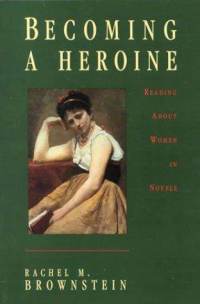
JAIV:  Your seminal book Becoming a Heroine: Reading about Women in Novels was published in 1982, and re-published in 1994 with a new postscript.  You were then trying to place your own learning and thinking and writing in the context of the feminist criticism of the previous decade.  Are there any shifts in your thinking since then that you could comment on? [You mention that this new book is really an atonement – that such previous readings of Jane Austen as “a paragon of proto-feminist romance” are misreadings, i.e. “not reading her as she is meant to be read.” [p. 8]  – and that Why Jane Austen? is written in “defense of Jane Austen and in self-defense as well…” [p. 10]]

RB:  I’m a little tongue-in-cheek about the matter of atonement, and a little serious too.  I’m sorry about some things that have been done in the name of feminism, but I continue to be a feminist, and a feminist literary critic, and I am especially feminist as a meta-critic, or critic of the critics.  It seems to me immensely important that Jane Austen was a woman. 

Austen’s relationship to romance is complicated: she wrote romances that are also anti-romances.  Reading them as books about women’s issues, I think, does Jane Austen a disservice. They are about men and women, and dreams and realities, and greed and social climbing.  She said they were about human nature; and she adds that they are written in “the best chosen language.” My argument is that it’s worth paying attention to all of that, not only to some of it. 


JAIV:  Again about Becoming a Heroine: Would you write about the same books today? [note: Heroine contains a full chapter on Jane Austen that touches on all her novels; the other works discussed in separate chapters are: Richardson’s Clarissa; Charlotte Bronte’s Villette; The Egoist by George Meredith; George Eliot’s Daniel Deronda; Henry James’s Portrait of a Lady; and Mrs. Dalloway by Virginia Woolf] 

RB:  No—but I still love all those novels, and enjoy teaching and talking about them. 

JAIV:  So if “No”, what works would you write about now?

RB:  I don’t think I can answer your question about the books I’d include in another version of “Becoming a Heroine”–I’d have to write another book. In other words, the novels I DID write about there come together in a series or sequence that (to my mind) suggests a development in the idea of a heroine. A novel reader who has an even slightly different idea could set up a different sequence of novels.  So no, there’s nothing I’d change, unless I changed everything–or something basic in the central idea.


JAIV:  This new work is similar to Heroine in being more a meditation on Jane Austen, combining scholarly and textual analysis, literary biography, historical context, all melded together with your own story as a reader, a student, and a teacher.  I found it a very engaging read, each sentence packed-full, the approach to the subject very different from the usual scholarly work.  As soon as I finished, I knew a re-read was required, not to mention the need to re-read all of the novels and look again with your critical eye!  If one could take only one thing from this book, what would you want it to be?

RB:  Thank you for your very kind words.  The one thing I would want a reader to take from my book is this: go and reread Jane Austen!


JAIV:  You write constantly posing questions to the reader – a wonderful teaching strategy! – and especially effective in one’s efforts to make a “Life of Jane Austen” out of the details in the novels – and in our efforts to find her in her characters, in her language, in her plots, we find her all the more illusive..  We cannot help ourselves – we have only such scant tidbits of information! Why do you think this is a dangerous approach?

RB:  It’s dangerous if you believe the life story you compose for Jane Austen—but taken with a grain or two of salt it’s fun. 

JAIV:  Your personal story that you so generously weave through this book is similar in some ways to William Deresiewicz’s new work A Jane Austen Education [and he indeed writes a lovely blurb for your work on the jacket cover (note: this is quoted in yesterday’s post)] – at least your “confession” of early on being way too clever and cool to read Jane Austen, then later way too clever and cool to not be in the know about Jane Austen – do you think that this is still the view of readers / non –readers of Jane Austen?

RB:  Deresiewicz, who is a generation younger and a man, says he started out thinking those classic novels were dull and boring, and not for readers like him. My story is very different.  When I was in college—and I went to a woman’s college, in the mid-1950s–literary girls were expected to know Jane Austen without taking a course in the novels.  My freshman English teacher engaged me in a conversation about Pride and Prejudice although it was not assigned reading: it was as if just because you were a young woman reader you already knew your Jane Austen.  Things are different now: being in the know about Jane Austen has changed a lot since then.  Today, for many people, it means being up on the latest pop-cultural Jane-related phenomenon, the zombies or whatever.


JAIV:  Any comment on Deresiewicz’s book? – it seems to have generated mixed reviews.

RB:  Let’s take another page from Jane Austen’s book—Northanger Abbey—and leave the reviewers out of it.  The Deresiewicz book is a lively read and the voice is engaging.  And I am amused by the idea of a man owning up to learning life lessons from Jane Austen. 

   
JAIV:  I like your answer of taking that cue from Jane Austen

There are a number of anecdotes you tell where you put yourself in time and place (and these are not always pleasant encounters!) – is there any concern of people discovering themselves between the pages? – or is everything politely disguised?

RB:  I don’t know about politely.  I scrambled details, left things out, and added bits, and no one actually real is all there, I sincerely hope.  You’ll recognize the echo of Henry Austen: my aim was to write about human nature, not individuals.


JAIV:  Which Jane Austen novel did you first read? Does it remain your favorite? [a horrible question, but one must ask!]

RB:  Pride and Prejudice: a predictable answer, but one must try to tell the truth. 

JAIV:  Your commentary about the movie adaptations – “adaptation is translation” [p. 35] is a wonderful essay.  You mention loving “Clueless” – can you share what other of the various adaptations worked the best? The least?

RB:  I admire Roger Michell’s beautiful film version of Persuasion, and I found lots to like in the astute choices made in making the Emma Thompson -Ang Lee Sense and Sensibility.  And of course I love the BBC miniseries of Pride and Prejudice—so much that Joe Wright’s version, starring the thoroughly miscast Keira Knightley, seems to me all wrong.

JAIV:  The inevitable Sequels / Continuations question:  What are your thoughts!?

RB:  Some work; others don’t; several work well in parts, but don’t measure up.  Jane Austen sets the bar very high.  I was surprised and delighted by the first half of Colleen McCullough’s The Independence of Miss Mary Bennet.   


JAIV:  Well then, I must ask what you think about the second half!

RB:  I was disappointed in the second half of “Miss Mary Bennet” because the emphasis moved–disproportionately, I felt–from Mary to Darcy, and the plot thickened too much.  I liked the stuff that seemed Austenian but a little outre–Mary and her money falling in the muck–and was less interested in the stuff about enslaved children imprisoned in caves.  It is of course very professional–being by a pro–but then it gets extravagant and falls apart.  It’s Darcy’s fault.


JAIV: Oh dear! – I thought Darcy could never be at fault for anything! 

But as for another of Jane Austen’s heroes, you call Edward Ferrars “morose, depressed, self-involved, and boring” [p. 247] – are you in the camp of preferring Colonel Brandon as the more proper mate for Elinor? What then happens to Marianne?

RB:  I was writing as a reader, not a novelist. 

 JAIV:  Good answer! 

You speak of Jane Austen’s best readers being those who feel they are complicit with her take on human nature – I could say the same about your writing – you invite the reader into your secret world of ‘Understanding the truth about Jane Austen’ – you brought me into your world years ago when I read of you [in Heroine] as a fifteen-year-old hiding out in the bathroom reading Henry James hugging your “secret knowledge that [your parents] were harboring a viper in their bathroom.” [p. 5]  I love this!  Do you find students still coming to you with that wide-eyed wonder of discovering literature as transporter, as transformer?

RB:  Yes.  This is one important reason why I continue to love teaching.


JAIV:  You make many references to “best readers” or “reading well” or “close readers”  – how I would have loved to taken one (or more!) of your classes, where you question, question, question, to make the student sit up, take notice, and shift his / her thinking –  [you offer a wide range of bibliographical references that shall add weight to my bookshelves and deduct funds from my book budget!] –  How does one become such a reader without going back to school?!

RB:  I’m with Elizabeth Bennet, when she tells Lady Catherine, of her and her sisters, that “We were always encouraged to read.”  Read and reread, is my advice—and don’t believe everything you read.


JAIV:  Your chapter on “Why We Reread Jane Austen” focuses on Emma – and you devote a number of pages to just the use of the word “understanding” – can you tell us a little about this?

RB:  I’m fascinated by the word and by the process of coming to understand something or someone and by what Locke called “the understanding,” the mind.  And you can see that word as a key to Emma, where insistent repetitions of the word begin to make the reader understand its shades of meaning.  The heroine prides herself on her understanding, or intellectual power, but she misunderstands what’s going on, and imagines mutual understandings among her friends—relationships, we call them–that sometimes do and sometimes don’t exist. 


JAIV:  Your last sentence:

 “And in the face of the Kindle and the Nook, the iPad and the graphic novel, not to mention the ongoing crisis in education and the widely lamented decline of serious reading, there is some anticipatory nostalgia as well for the once-thriving, once-glamorous, once-literary book business.” 

Can you explain your concerns?

RB:  I was nostalgically harking back to a time when the book business was more literary, and not so commercially driven. 

 
JAIV:  In your Heroine, you tell an amusing anecdote about visiting your Doctor and his comments about Georgette Heyer, and in so doing give a lovely tribute to her writings.  Have you continued to read her?  Can I ask that horrible question again of which is your favorite? 

RB:  I haven’t read Heyer for such a long time – I adored all the novels with their saucy heroines years ago; I’m going to revisit them again; but I’m afraid I have nothing more to say about them now… sorry! 


JAIV:  The oft-asked question of a writer:  How do you work? 

RB:  In fits and starts—and with a lot of false starts.  I’ve finally learned to write on my laptop, but I still have to print the thing out and go over it with a pen, and that remains my favorite part of the writing process.


JAIV:  And finally, have you ever written any fiction yourself?  Is there a novel in you somewhere??

RB:  Yes I have, and Yes I think there is, but No, I’m not ready to talk about it.


JAIV:  Anything else you would like to share

RB:  Thank you.  I enjoy the opportunity to clarify what I might have left unclear, and I enjoy the chance to keep on talking about Jane Austen.  One of the things I learned from Lionel Trilling—the mid-20th-century critic whose last unfinished essay, “Why We Read Jane Austen,” is echoed by the title of my book—is that the conversation around Jane Austen is almost as interesting as what she herself says.  I am always eager to engage in that conversation, which always interests me.

JAIV:  Thank you so much Rachel for joining us today – it is true that the conversation around Jane Austen is endlessly interesting! – and your book asks many probing questions of its readers for those conversations to continue!  

l. – r.: Marcia Folsom, Rachel Brownstein, and Nancy Yee,
JASNA-Mass Meeting, May 2011 at Wheelock College
[photo – D. Barnum]

*******************

 Book Giveaway!

If anyone has a comment or a question for Professor Brownstein, please post it on either this post or yesterday’s post – – you might like to answer “Why Jane Austen? in your own life! –

 You will be entered into the Book giveaway random drawing for a copy of Why Jane Austen?  – the deadline is midnight next Wednesday night August 10, 2011 – Winner will be announced on Thursday August 11, 2011  [worldwide eligibility].

************************

Why Jane Austen?, by Rachel Brownstein
Columbia University Press, 2011
ISBN:  978-0231153904 ; $29.50
search inside at Amazon.com

About the Author: Rachel M. Brownstein is professor of English at Brooklyn College and the CUNY Graduate Center. She is the author of two critically acclaimed books, Becoming a Heroine: Reading About Women in Novels and Tragic Muse: Rachel of the Comédie-Française.

Click here for my review and bibliography

Copyright @2011 by Deb Barnum, of Jane Austen in Vermont
Author Interviews · Book reviews · Books · Jane Austen · Jane Austen Popular Culture · Regency England

Interview with Louise Allen, Part II ~ Regency Romance, Heroes, and Thoughts on Writing

Book Giveaway! ~ See details at the end of this post.

I welcome again Louise Allen for the second part of my interview about her new book Walks Through Regency London ~ [click here for Part I]

JAIV:  Hello again Louise! – now let’s talk about your fiction: I have to make the embarrassing confession that I have not read any of your Regency romances! Your website says you write “Scandalously witty Regency romance” – how are you different from the other writers in this genre?

LA: I write romance, so obviously there is emotional intensity, but I have a well-developed sense of humour and I don’t enjoy writing about people who can’t laugh at themselves and the situation they find themselves in. A hero who isn’t witty isn’t quite a hero for me and my heroines, who all have a bit of me in them somewhere, are more likely to find the light side of any disaster, pick themselves up and carry on. And scandalous? Well, I’m told I write “hot” historicals – which means that I tend to have slightly older, more experienced and/or less conventional heroines who might have convincingly amorous encounters.

JAIV: What book would you suggest a “newbie” start with? [I promise to order a copy right away!]

LA:  Well, I’ve just won a CataRomance Reviewer’s Choice Award for The Lord & the Wayward Lady which is the first of a series of eight books I wrote with five other authors. I also wrote the seventh in the series, The Officer and the Proper Lady which I have to confess is a favourite of mine. Or you might like to start with a trilogy which comes out in the States later this year (August, September, November) – “The Transformation of the Shelley Sisters.” The first one is Practical Widow to Passionate Mistress.

JAIV:  You have several stand-alone titles and several titles in series – which do you prefer to write? Is it hard to let a character go when there is no sequel in the wings?

LA:  I do enjoy being able to stretch myself over a series and I love revisiting characters from earlier books. And yes, I hate letting my characters go! But it does make scheduling problems and there is more flexibility and variety with stand-alone books. My next one will be a singleton and I’m just starting it. Mills & Boon is producing a series set in historical houses owned by the National Trust, linking a fictional romance with real events and people, and I’m lucky enough to have been asked to do one. I’ve chosen Wimpole Hall in Cambridgeshire. When I’ve completed that I’ll be writing one set entirely in India in the 1790s.

JAIV:  This National Trust series sounds intriguing! Are any of your other characters based on historical figures?

LA:  I will occasionally have real characters “walking on” – the Prince Regent or Wellington for example – but all my heroes and heroines are entirely fictitious. I try very hard to make sure historical events take place as the records show and I’m not making people act out of character.

JAIV:  What is your writing process? – do you plan ahead or as you have said yourself do “the Hero and Heroine take over and sabotage all your efforts at discipline”?

LA:  I’m what is known in the business as a “pantser” – I fly by the seat of my pants into the fog – rather than being a planner. But I need to know my characters very well before I start, then I put them in a situation and I hope I can keep control of them!

JAIV:  Do you have a favorite character? – the Hero? The Heroine?

LA:  I need to be able to identify with the heroine – and hope my readers will too. And I have to be a little bit in love with the hero (luckily my husband is secure about this!). Some heroes though, stay with me – Hal Carlow in The Officer and the Proper Lady and Jack Ryder in The Dangerous Mr Ryder for example.

JAIV:  What makes a great Hero? A great Heroine?

LA:  My heroes have to be men of honour, even if sometimes that is buried rather deeply. They must have courage – physical and moral – and they need an edge of darkness, of danger. And a sense of humour, of course! Great heroines have the reader living the book with them – and I wish there was a recipe for achieving that. I know I’ve succeeded when my editor says (in a good way) “ was in tears over x or y”.

JAIV:  Do you believe in the transformation of the Rake, his redemption? –

LA:  That depends on the rake. There were some genuinely unpleasant and vicious Regency rakes. I believe that a man who has, for good reason, become cynical and cold and destructive can be redeemed by love, but there are things I wouldn’t countenance in one of my heroes.

JAIV:  How do you come up with names? Ravenhurst, Carlow, etc…

LA:  What a good question – I wish I knew the answer! I tell my subconscious to get on with it and end up with lists and jotted notes on every scrap of paper. Then I have to try them out and see what works. Sometimes a character insists on a different name and I have to give in.

JAIV:  If you were giving advice to budding writers, what would it be?

LA:  Write, write, write – you have to learn technique and you have to build your writing “muscles”. Listen to constructive advice from agents, publishers, published writers and think about what they are saying. But never over-polish your work so that you lose you unique “voice”.

JAIV:  Your covers – do you have input or is this out of your hands?

LA:  Out of my hands!


UK cover


US cover


                                                                   JAIV:  You mention that your last work is part of a “continuity series” of eight books written by six different authors. How ever did you all come together in such a task? And how different was the writing process for your two books in this series? – what are the other titles and authors, and should the series be read in order?

LA:  The editors at HMB in Richmond, London, put us together – we didn’t know each other so it was a sharp learning curve. Fortunately we got on very well together, which was a good thing as we had to come up with the over-arching mystery that links the books, all the characters and eight plots ourselves, subject to editorial approval. For me it meant I had to plan far more than I usually do and the process was slower as we were all writing at the same time and constantly checking back and forth to ensure continuity of plot and characterization, especially as we were all using each other’s characters. But it was a wonderful experience and we are still firm friends. The books can be read alone, but if read in order you also get to follow the mystery through to its conclusion. In order they are:

The Lord & the Wayward Lady (Louise Allen)

Paying the Virgin’s Price (Christine Merrill)

The Smuggler & the Society Bride (Julia Justiss)

Claiming the Forbidden Bride (Gayle Wilson)

The Viscount & the Virgin (Annie Burrows)

Unlacing the Innocent Miss (Margaret McPhee)

The Officer & the Proper Lady (Louise Allen)

Taken By the Wicked Rake (Christine Merrill)


JAIV: I am interested in your current “work in progress” – to be set in India – you have recently visited to inspire you and help in your research – I had the good fortune to visit India a few years ago and was so moved by the beauty of the people and the culture – what were your impressions? And what works are your reading for your historical research?

LA:  As I said above, this is now the book after next. I went to India last year and used some of that experience in my “Danger & Desire” trilogy (out in the States next year) but I wanted to do one set there entirely, and rather earlier than I usually write – the late 1700s. I love India, even at its most chaotic, and Rajasthan where we were in January had the most incredible palaces and forts, many of which we stayed in. I’m reading through a pile of quite academic material on the East India Company but I found William Dalrymple’s The White Moghuls very inspiring and for light relief there is always William Hickey – Memoirs of a Georgian Rake.

JAIV:  What is the most essential tool in marketing your work?

LA:  Constant contact with readers is paramount. I keep my website up to date, I tweet and I’ll do talks wherever and whenever I can. Next week I’m speaking at a US base in Norfolk!

JAIV:  And finally a question about the publishing aspect of books vs. Kindle [etc.] – I see that many of your works are available in the ebooks format – have you seen an increase in sales because of this?

LA:  I love books, but I love my Kindle too and I’m really pleased that many of my out of print books are becoming available in e-formats. It is too early to say what impact it is having on sales, but I don’t think there is any option other than to go along that route. Having said that, I can’t see the paper book dying any time soon, thank goodness.

JAIV:  And finally, what do you like to do when not writing??!

LA:  I read voraciously, travel, go antiquing, garden and talk endlessly to other writers.

JAIV:  Anything else you would like to say?

LA:  Thank you very much for having me! And do get in touch if you are coming to London – I’d love to meet members of your Society.

JAIV:  Thank you Louise for sharing your thoughts with us – You have been most generous with your time!  To All: Please look for my review of  Walks Through Regency London in Friday’s post.

Your turn! – if anyone has any questions of Louise, please ask away! – see details for the book giveaway below… You can visit Louise’s website here  and find her on Twitter @LouiseRegency

If you would like to order the Regency Walks book, you can do so directly from her website – I can attest to the book being mailed right away, arriving safe and sound and very quickly!

Book Giveaway:  Please enter the drawing for a copy of Walks Through Regency London, compliments of ‘Jane Austen in Vermont’, by asking Louise a question or commenting on any of the three posts about this book.  Drawing will take place next Wednesday 2 March 2011; comments accepted through 11 p.m. EST March 1st.  [Delivery worldwide.]

[All images from Louise Allen’s website, except the letter-writing sketch which seems to be everywhere…]

Copyright @2011, Deb Barnum, at Jane Austen in Vermont.

Author Interviews · Book reviews · Books · Jane Austen · Jane Austen Popular Culture · Regency England

Interview: Part I ~ Walking around Regency London with Louise Allen

NOTE:  Book giveaway! ~ see the end of this post for details!

 Please welcome author Louise Allen today as she answers questions about her new book on Regency London.  Louise is a very successful writer of historical Regency romances, over thirty-five titles to date!  Her interest in all things Regency is fed by constant research into the period, as well as the development of a fine collection of prints and ephemera from the era – all this to help in her writing. In December 2010 she released her first non-fiction work titled Walks Through Regency London [available direct from her at louiseallen [dot] regency [at] tiscali [dot] co [dot] uk


JAIV:  Thank you Louise for joining us here in Vermont today! I was so pleased to get your new book on Regency London hot off the press! – I ordered two copies and gave one to another London-obsessed friend and she is most enjoying your book!…we only wish we could both be in London together and exploring Town with your book in hand, rather than this armchair traveler thing! – hopefully, sometime soon…we’re working on it!

JAIVSo first, tell us something about yourself.

LA:  Thank you very much for inviting me to join you – it is great to be in Vermont, even if only in cyberspace! I live in the East of England with my husband and we are about to move even further east, to a cottage on the North Norfolk coast. I was first published back in 1985 and for years I wrote alongside my full-time job as a property manager, but for the last three years I’ve been writing full-time and I love it.

JAIV:  When did you first discover your love of the Regency period? Why this time and place?

LA:  I think I first became aware of it when reading Georgette Heyer as a teenager. I’ve always been an historian – I studied landscape history, historical geography and archaeology at university – but it took me a while to settle on the “long” Regency as a period to write in. My first book was set during the English Civil War of the 17thc but my editor encouraged me to look at the Regency and I fell in love with it. I think it is because it occupies a transitional place between the agricultural and aristocratic world of the 18thc and the rapid technological change and urbanization of the Victorian era. Boundaries are always interesting and complex and it is also sufficiently different and yet recognizable, which makes it fascinating to write about. And I’m English, so English history felt right.

JAIV:  Did you read Jane Austen as well as Georgette Heyer? – do you re-read them? Which are your favorite titles, if it is possible to choose?

LA:  Yes, to both authors and yes to re-reading. Austen – I love Pride & Prejudice, but I find Sense & Sensibility more interesting. I was at Jane Austen’s house at Chawton last year and it was very moving to walk in her garden and to see her tiny writing table. Heyer favourites? The Grand Sophy and also The Toll Gate, which isn’t everyone’s choice, but I’m tall, so I identify with the heroine!

JAIV: You obviously use London and the London social scene in your fiction, and the need to be accurate has led you to amass a great deal of research through the years – hence your “Walks” book – what first prompted you to pull all this together and publish it?

LA:  My husband and I love walking, and we love London, so it was no hardship to start exploring when I wanted to check details. Then we got hooked and started exploring specific areas – when I looked at my notes and our photos I realized that I had the makings of a book.

JAIV:  You cite the 1807 The Picture of London guidebook as your main source. What other books did you use? – there are so many works on London – which are your favorite and why?

LA:  I use the 1807 guide because it is fun to take it for a walk where it must once have gone with its Regency owner – it is the real thing, much used and slightly battered. We also take the invaluable A-Z of Regency London published by the London Topographical Society. Their historical A-Zs are a brilliant resource. When I checked my shelves just now I found I have 55 reference books on London, so it is a problem to pick out just a few, but I would say The London Encyclopedia (published by Macmillan) is an essential. Peter Ackroyd’s London: The Biography is full of fascinating, unusual and often downright weird information and Dan Cruickshank’s book on the sensual life of London The Secret History of Georgian London is about so much more than sex.

JAIV:  What are your favorite haunts in London, for both Regency times and the present?

LA:  The St James’s area is the best preserved Georgian/Regency quarter. Soho is endlessly fascinating – so many layers of history. The City, although it has been leveled by the great fire and then again by the Blitz still preserves its medieval street patterns and modern office blocks must contort themselves to fit the shape of some ancient workhouse or monastery cloister. You can even see the curved walls of Newgate Prison fossilized in the shape of an ultra modern building. But it is hard to find a part of London that isn’t interesting if you are prepared to be very nosy!

JAIV:  The book is fact-filled and anecdotal, and culled from so much available information – how did you decide what to include and what not to include?

LA:  It was a nightmare! I had enough material for twenty walks, but I tried to chose ones that gave a variety of experiences, which were all about 2 miles long and which could be split up if walkers wanted to have a shorter route or spend more time in a museum.

JAIV:  Did you discover anything surprising in your research and exploration? Something you did not already know?

LA:  It wasn’t so much new facts that I found but places which gave me a real frisson of excitement: the 1820s operating theatre where you can see the marks of the surgeons’ saws on the table; the last galleried coaching inn left in London; the great scales in Berry Bros & Rudd where Byron used to weigh himself; having a drink in Tom Cribb’s own pub and exploring the back alleys behind Almack’s which were once filed with high-class brothels and gambling dens. Perhaps the most unexpected discovery was in a Chinese supermarket in Soho – walk past stacks of dried herbs and fish, bags of rice and look up and realize you are in a very old house indeed – and in the back is still the sweeping 18thc staircase. This is the Turk’s Head coffee-house and Dr Johnson and Joshua Reynolds were just two of the great men who  socialized here.

[Image of Samuel Johnson: Johnsonese.com]

JAIV:  The illustrations in your book are from your own collection. What other ephemera from the era do you look for? When did you start becoming a serious collector? – and did your writing come first or vice versa?

LA:  The writing came first then the more I wanted to know about the period, the more I would look for items from it. I collect fashion prints 1790-1820, prints of London from Ackermann’s Repository, coaching and sporting prints, bills and invoices, playbills and anything else that I can get my hands on. I started buying fashion prints when I stubbed my toe on a box of over thirty, all framed, under the table at an auction. I got them for a song and as the porter staggered out to the car with them he said, ‘Bloody hell, madam, you don’t half buy in bulk!’ He didn’t know how true it was, I’m afraid – I’ve got about 1,000 prints now.

[Charles Street]

JAIV:  Where are your favorite haunts to find items? How do you categorize and store them?

LA:  On-line and live auctions, antique fairs and antique shops are all good places to search, but auctions are the most productive. I store them in archival-quality binders on acid free paper, or have them framed by a specialist framer using acid-free mounts. I arrange the fashion prints by date, the London prints by street and everything else by subject.

JAIV:  You bring the Regency so to life! – better to have this guide while actually walking around London – but even so this journey of readinghas been delightful… Which of your walks is your favorite? – what is your favorite part of London?

LA:  Thank you! I enjoy them all – it depends on my mood. If I am feeling like high society and shopping, Mayfair and St James’s are best. Hyde Park is great for a good walk, Soho is vibrant and slightly edgy and the City surprisingly dark and sinister.

JAIV:  The process of writing fiction and non-fiction is quite different – explain the process for writing this Walks book.

LA:  I was very conscious the whole time that I had to make this crystal-clear for people to follow. It would have more than doubled the cost if I’d included maps, so users needed to be able to do without, or use it in conjunction with an ordinary pocket map. Then, once I had plotted each walk out on a modern map it was a question of picking out the relevant points of interest or short snippets of interesting information and weaving them in with the directions – and then re-walking to check every turning and fact.

JAIV:  Do you have another non-fiction Regency-era book in the works?

LA:  We are tracing the original route of the Great North Road, the main coaching route between Edinburgh and London – but not on foot! This is great fun and needs a lot of detective work and old maps. I see this one as possibly being a Kindle book rather than a print one.

JAIV:  Thank you Louise for joining us today for Part I of this interview! Louise is happy to answer any of your questions, so please ask away!

Stay tuned: Part II  tomorrow where I continue this interview with Louise on her Regency Romances and her thoughts on writing; followed by Part III, a book review of Walks Through Regency London

You can visit Louise’s website here and find her on Twitter @LouiseRegency

If you would like to order the Regency Walks book, you can do so directly from her website – I can attest to the book being mailed right away, arriving safe and sound and very quickly!

Thank you again Louise for joining us today – looking forward to continuing our discussion  tomorrow!

Book Giveaway:  Please enter the drawing for a copy of Walks Through Regency London, compliments of ‘Jane Austen in Vermont’, by asking Louise a question or commenting on any of the three posts about this book.  Drawing will take place next Wednesday 2 March 2011; comments accepted through 11 p.m. EST March 1st.  [Delivery worldwide.]

[All images excepting Dr. J from Louise Allen’s website]

Copyright @2011, Deb Barnum, at Jane Austen in Vermont.