Austen Literary History & Criticism · Book reviews · Books · Collecting Jane Austen · Jane Austen · Literature · Regency England · Social Life & Customs

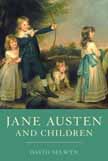
Book Review ~ “Jane Austen and Children” by David Selwyn

To be at the beginning of life, one must start at the end of the novel.  For although Jane Austen concludes her books with the marriage of the hero and heroine to which the whole thrust of the narrative has been leading, and the reader rejoices in the perfect happiness of the union, in reality the best is yet to come: they will have children – procreation  being not only the natural and desirable end of marriage, but also an economic and dynastic necessity.  And those children will have their own stories…What will become of the Darcy children?…”  (Ch. 1, Confinement, p. 5)

And thus does David Selwyn begin his treatise on Jane Austen and Children (Continuum, 2010), a most enjoyable journey through the world of childhood and parenting and education and growing-up in the life of Jane Austen, and the lives of her fictional characters.  If you are perhaps one of those people who think that Jane Austen does not like children, an idea certainly fed buy such comments about women “breeding again” or the child-generated “dirt and noise” or “the two parties of Children is the cheif Evil” [Ltr. 92], or the proper child-rearing “Method has been wanting” [Ltr. 86], etc. – you need to read this book!

Selwyn takes his reader essentially through the nine ages of man [with apologies to Shakespeare] beginning with confinement and birth, through infancy, childhood, parenting, sibling relations, reading and education, and finally maturity, as Selwyn says, the “end of the novel” when the Hero and Heroine come together, after all manner of trial and tribulation, to begin their own family.

We are given a general survey of the shift in the attitudes toward children, that late eighteenth – early nineteenth century view that fell between viewing children as not just “little adults” to the Victorian view of “seen but not heard”, following Locke and Rousseau and believing children to be natural innocents.  In each chapter Selwyn seamlessly weaves pieces of Austen’s life as gleaned from her letters and scenes from all her writings – and it is masterly done, all with a historical perspective.  We see Jane as a child, as a madly composing adolescent, a loving and humorous Aunt imaginatively interacting with her nieces and nephews, and as an accomplished writer whose fictional children are far more worthy of our notice than we have previously supposed: the frolicsome Walter hanging on Anne’s neck in Persuasion; the spoiled Middletons; the noisy and undisciplined Musgroves; the grateful and engaging Charles Blake in The Watsons; the John Knightley brood in the air courtesy of their Uncle George; the dynamics of the five Bennet sisters; Henry Dashwood the center of attention for the manipulative Steele sisters; the reality-based scenes of Betsy and Susan Price at Portsmouth; and finally Fanny Price, Austen’s only heroine we see grow up from childhood, having an elegant come-out, finding true-live and ends “needing a larger home.”

In all her works, Austen uses children as “a resource for her narrative strategies” (p. 4), be that comedy, a plot device to further the action, or a means of revealing attitudes and responses of the adults around them (p. 3).  Austen’s children are easy to miss – they won’t be after reading this book – here they are brought to life, given character and meaning, and you will see what Selwyn terms “Austen’s satirical delight in children behaving in character” (p. 73)

If Austen’s fiction seems to gloss over the reality of childbirth [the exception is Sense and Sensibility’s two Elizas], her letters tell the tale of its dangers [Austen lost three sisters-in-law to death in childbirth], and Selwyn links all to the social structure of the day, the nursing of babies and swaddling practices, to child rearing theories and moralizing tracts, and governesses and Austen’s ambivalence toward them. We visit boarding schools along with Jane and her characters and we hear the voices of a number of contemporary diarists (Agnes Porter, Sophia Baker, Susan Sibbald, Elizabeth Ham and Sarah Pennington).  There is a lovely in-depth chapter on the reading materials written especially for children and Austen’s first-hand knowledge of these titles.  The discussion on sisters and brothers, those so important in Austen’s own life, and those in her fiction, for example, characters with confidants (Lizzy and Jane, Elinor and Marianne), those isolated (Fanny, Anne Elliot, Emma Watson, Mary Bennet), and those with younger sisters (Margaret Dashwood and Susan Price).  As part of the growing-up process, Selwyn uncovers much on “coming-out” as Austen herself writes of in her “Collection of Letters” [available online here] – with the emphasis here on Fanny as the only heroine to have a detailed “coming-out” party.

The chapter on “Parents” starts with the premise that “in Jane Austen’s novels the parents best suited to bringing up children are dead” (p.95) and Selwyn takes us from the historical view of parenting, through Dr. Johnson’s “Cruelty of Parental Tyranny” [shadows of Northanger Abbey] to a full discussion of the marriage debate in the 18th-century – that between the worldly concerns of wealth vs. choice of partner based on emotional love as personified in Sir Thomas and Fanny Price respectively.  Excerpts are included from James Austen’s very humorous Loiterer piece   “The Absurdity of Marrying from Affection.” (p. 207) and Dr. John Gregory’s A Father’s Legacy to his Daughters (1774) [viewable at Google Books here] , and the Edgeworth’s Practical Education (1798) [Vol. III at Google Books here].  One finds that in reading all of Austen’s letters and all the works you can indeed discover a complete instruction manual for good parenting!

Jane Austen and Children appropriately ends with Selwyn’s speculation on what sort of parents her Heroes and Heroines will be, all of course based on the subtle and not-so-subtle clues that Austen has given us throughout each work – conjecturing on this is perhaps why we have so many sequels with little Darcys, Brandons, Bertrams, Knightleys, Tilneys, and Ferrars running about!

Just as in his Jane Austen and Leisure, where Selwyn analyzes the various intellectual, domestic and social pursuits of the gentry as evidenced in Austen’s world and her works, he here gives us an accessible and delightful treatise on Austen’s children, culling from her works the many quotes and references related to children and linking all to the historical context of the place of children in the long eighteenth century.  The book has extensive notes, a fine bibliography of sources on child-rearing, contemporary primary materials, children’s literature, and literary history, and several black and white illustrations.  (I did note that there are a few mixed up footnotes in chapter 3, hopefully to be corrected in the next printing).  What will this book give you? – you will never again miss the importance of Austen’s many children, peaking from behind the page, there for a set purpose to show you what great parents the Gardners are, or just to make certain you see how very selfish the John Dashwoods and the Miss Steeles are, or to see the generosity of an Emma Watson in her rescue of Charles Blake, or to feel the lack for the poor Musgrove boys having Mary for a mother, the playfulness of an otherwise conservative Mr. Knightley, and the unnerving near touch of Captain Wentworth as he relieves Anne of her burden –  thank you David Selwyn for bringing all these children to life for Austen’s many readers – you have given us all a gift!
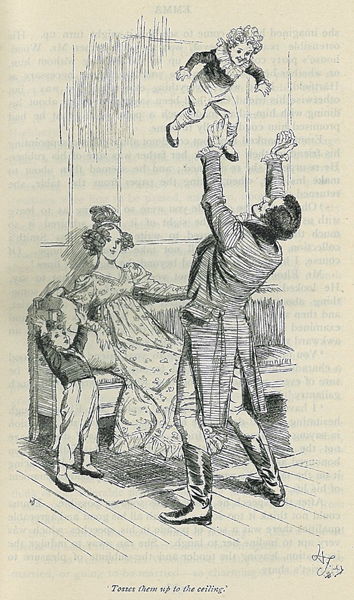
Emma – ‘Tosses them up to the ceiling’
[by Hugh Thomson, print at Solitary Elegance]

 __________________

Jane Austen and Children
Continuum, 2010
ISBN:  978-1847-250414

David Selwyn is a teacher at the Bristol School in Bristol, UK.  He has been involved with the Jane Austen Society [UK] for a number of years, has been the Chairman since 2008,  the editor of the JAS Report since 2001, and has written and edited several works on Austen.  He very graciously agreed to an “interview” about this latest work that you can find by clicking here.  See also the post on the various illustrations of Austen’s children by the Brocks and Hugh Thomson.  And finally, I append below a select bibliography of Selwyn’s writings on Jane Austen and her family.

 Select Bibliography:  

  1. Lane, Maggie, and David Selwyn, eds.  Jane Austen: A Celebration.  Manchester: Fyfield, 2000. 
  2. Selwyn, David, ed.  The Complete Poems of James Austen, Jane Austen’s Eldest Brother. Chawton: Jane Austen Society, 2003. 
  3. _____. “Consumer Goods.” Jane Austen in Context. Ed. Janet Todd. Cambridge Ed. of the Works of Jane Austen. New York: Cambridge UP, 2005. 215-24. 
  4. _____, ed.  Fugitive Pieces: Trifles Light as Air: The Poems of James Edward Austen-Leigh.  Winchester: Jane Austen Society, 2006. 
  5. _____. “A Funeral at Bray, 1876.” Jane Austen Society, Collected Reports V (1998): 480-86. 
  6. _____. “Games and Play in Jane Austen’s Literary Structures.” Persuasions 23: 15-28 
  7. _____. “Incidental closures in Mansfield Park.”  [Conference on “Jane Austen and Endings”, University of London, 17 November 2007] – unpublished paper. 
  8. _____. “James Austen – Artist.” Jane Austen Society Report 1998. 157-63. 
  9. _____.  Jane Austen and Leisure.  London: Hambledon Continuum, 1999. 
  10. _____, ed.  Jane Austen: Collected poems and Verse of the Austen Family.  Manchester:  Carcanet / Jane Austen Society, 1996. 
  11. _____, ed.  Jane Austen Society Report, 2001 – present. 
  12. ­_____. “Poetry.” Jane Austen in Context. Ed. Janet Todd. Cambridge Ed. of the Works of Jane Austen. New York: Cambridge UP, 2005. 59-67. 
  13. _____. “Shades of the Austens’ Friends.” Jane Austen Society Collected Reports V (2002): 134. 
  14. _____. “Some Sermons of Mr Austen.” Jane Austen Society Collected Reports V (2001): 37-38. 
Austen Literary History & Criticism · Book reviews · Collecting Jane Austen · Jane Austen · Regency England

Author Interview ~ David Selwyn on ‘Jane Austen and Children’

David Selwyn had graciously offered to answer my questions about his newest book, Jane Austen and Children (Continuum, 2010).  David is the current Chairman of the Jane Austen Society, editor of the Annual JAS Report since 2001,  and author of numerous works and articles on Austen.  His previous Jane Austen and Leisure (Hambledon Continuum, 1999)) is a must-read treasure trove of social and domestic activities that Austen engaged in and referred to in her novels. His current work is another must-read that weaves the historical, the factual and the fictional world of Austen and her works, all relating to children.  I will post a review of the book in a few days [after the 16th Birthday celebration] –  but I will say now that I most highly recommend this book, and suggest that you add this to your holiday “want” list and hope it may be found under your tree on Christmas morn…!

 Welcome David! 

JAIV:  I think when reading the novels, it is so very easy to overlook the number of children and how Austen’s presents them – but after reading your book one sees indeed how many children there are in her works and their importance to the narrative – is this what prompted you to write the book? the fact that too many people really do not see?

DS:      Yes, and I was struck by the fact that nobody had written on the subject, nor as far as I knew lectured on it. 

JAIV:  Jane Austen is often said to have not been particularly fond of children – was this another main reason in writing your book? – to show that as not the case? – 

DS:      As regards the novels, it always seemed to be assumed that her world was essentially an adult one (which I suppose largely it is) and the crucial role that children play in her exploration of it had been missed. As regards her own feelings about children, nobody who reads the letters can be in any doubt as to her fondness for her nephews and nieces.

JAIV:  Did anything surprise you in your research? 

DS:      How sensible she was about the bringing up of children – but then, I suppose one ought never to be surprised by JA’s wisdom on any matter!

JAIV:  And such extensive research! – the references in her letters, other family reminiscences, all the novels and minor works, and the historical context of child rearing in the long 18th century! – how long have you been working on this? 

DS:      For some years, but the editing of JEAL’s poems (Fugitive Pieces) intervened.

JAIV:  And this book presents such a seamless weaving of this real life, historical and fictional contexts – what are your working habits, writing process to achieve this?

DS:      I re-read the novels, minor works and letters, making notes of anything relevant in notebooks (one for each text) and highlight the notes in different colours according to theme. I did this for Jane Austen and Leisure and found that it worked. You’ll notice that at this stage I don’t use a computer. I also do a lot of background reading in social history, biography etc, and make notes on those books too of course.

JAIV:  You say that Jane Austen “makes use of her children to reveal aspects of her adult characters” – what is your favorite example of this?

DS:      It is difficult to choose, because each time she does it it is so wholly convincing. Annamaria Middleton and the naughty little Musgrove boy are the funniest, and the latter creates the most delicately balanced mood of comedy and emotion in any scene with children in it; but I love the little Gardiners, whose charming behaviour shows just how children should be brought up.

JAIV:  And then secondly, that Austen uses children as a means of advancing the plot – what is the best example of this?

DS:      It would certainly have been Charles Blake in ‘The Watsons’ had JA finished the novel.

JAIV:  There is much on Mansfield Park, perhaps because unlike the other heroines [other than the quick summary of Catherine Morland’s childhood], Fanny is presented to us as a child – but you seem to write most fondly of this novel, indeed, you end your book with thoughts on Fanny and Edmund making the best parents.  Is Mansfield Park your favorite among the novels? Or is this an unfair question! [who can ever choose!]

DS:      As you say, an impossible question. Yes, I do admire MP very much (and think that Fanny is often under-rated: she knows exactly what she wants and in the end gets it); but ultimately my favourite is Emma, partly because it is surely the subtlest and cleverest novel before Henry James, and partly because I think Miss Bates is, as well as being very funny, one of the most moving examples of human goodness in any literary work – JA touches us profoundly with the portrayal of a single woman who centres all the energy of a loving heart on her mother and niece (which is why the scene at Box Hill is so truly climactic – Emma’s thoughtless crushing of such a good heart is appalling, as she herself soon realises). By the way, another thing about Miss Bates: how brilliant of JA to be able to create such a wholly imagined voice that another character (Emma) can mimic it – flannel petticoats etc. 

JAIV:  It has always “troubled” me that Jane is the only child in this Austen family with only one given name – you speak of her having two godmothers both named “Jane” – do you think this is the reason? or do you have other thoughts? 

DS:      But she wasn’t: James, George and Edward had no second names, and nor did their parents. It may well be that the habit of giving two Christian names was becoming more fashionable during this period. 

JAIV:  One of the most famous child-based scenes in Austen is in Persuasion when Captain Wentworth helps Anne by the swift removal of her troublesome nephew – why is this scene so important to the plot? 

DS:      It brings Anne and Captain Wentworth intimately close for the first time in the novel – though JA is delicate enough to depict that intimacy with the child’s hands preventing direct physical contact between them.

JAIV:  Where much of The Watsons can be seen to appear in her other works, the most marvelous piece, when Emma Watson engages young Charles Blake in the dance, is nowhere to be found anywhere else [though it has been said that Mr. Knightley’s dancing with Harriet Smith is Austen’s reworking of this scene].  Do you think Austen could have placed this somewhere in her surviving novels? 

DS:     No, I don’t think she was ever to give a child quite such individual prominence again. 

JAIV:  You start your chapter on “Parents”: “In Jane Austen’s novels the parents best suited to bringing up children are dead.”  Who of the living parents do you think are the most effective? Who the least?  

DS:      The Gardiners are far and away the best. Sir Walter Elliot (though not of course the late Lady Elliot) is a disgrace to the Baronetage in which he takes such pride!

JAIV:  You so obviously love Jane Austen!  – when did this begin for you? 

DS:      In  picking up a stray copy of Emma when I was at home ill once, when I was a (music) student. But I was also thrilled to see a real live JA MS which used to be on display in the Pump Room at Bath (it is now safely tucked away in the offices of Bath City Council); it was the ‘headache’ poem, and it was hung in a hinged frame enabling you to see the reverse, on which there was one of the versions of the ‘Gill-Gell’ verse. I remember noting in the Minor Works volume that Chapman (re-edited by Brian Southam) said that he did not know where that particular version of the Gill’ Gell poem was, and I gleefully thought to myself, ‘I do – it’s in Bath!’ I seem to remember writing to OUP, but I didn’t get a reply.

JAIV:  You say that “it is highly unlikely that Jane Austen ever read a word of Mary Wollstonecraft (though she did read the novels of her radical husband, William Godwin)” – how are you so sure she did not read Wollstonecraft, and how so sure she did read Godwin? 

DS:      This is, I concede, speculation. JA refers to Godwin in a letter and Deirdre Le Faye suggests that she ‘was probably acquainted with Caleb Williams’; I am not sure she didn’t read Hannah More, but I think it unlikely.

JAIV:  One of the many things I took from your book in its focus, its seeing all through the lens of childhood, was a pattern of new themes emerging in all the novels – for instance, the theme in Emma of unconditional love, the love parents have for children, but in Emma, this love that Emma has for her father, Miss Bates for her mother and Jane Fairfax, Mr. Knightley for Emma – i.e. as you say “the unconditional love for people who may, consciously or unconsciously, require sacrifices to be made for them.” [p.111]. What are some other themes that became clearer for you since approaching the novels from this viewpoint? 

DS:      Not so much themes as procedures, and in particular the technique of introducing children not really for their own sake but as a contrivance for some aspect of plot or characterisation – and in the process, being JA, to bring them wonderfully to life.

JAIV:  One could read your book, re-read all of Austen, and get a very lucid and valuable instruction manual for good parenting! – did you have this perception yourself before reading and studying the books through this lens? 

DS:      No, it had never occurred to me that JA could be seen in such a light until I looked closely and specifically at what she says about children and parents.

JAIV:  Your book on Jane Austen and Leisure also offered a very valuable (and very enjoyable!) contribution to an understanding of Austen in the context of social history, her reading, her novels and her life and letters – again in many instances taking a few well-placed words in Austen and giving them such meaning.  What is up next for you?? 

DS:      I hope to do some more editing for a JA Society book. What a pity that JEAL’s sister Caroline destroyed the MSS of her poems; I should like to have brought those out.    

********************

Thank you so much David for answering all my questions!  Stay tuned for my review and a select bibliography on David Selwyn’s other Austen-related works. 

 [Getty Images.com]

Austen Literary History & Criticism · Book reviews · Books · Collecting Jane Austen · Jane Austen · Literature · Publishing History · Regency England

Book Review ~ ‘The Annotated Persuasion’

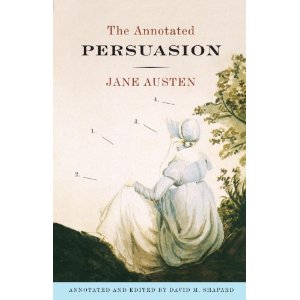
Last week I ran into Barnes & Noble to pick up the latest annotated Pride and Prejudice, edited by Patricia Meyer Spacks, and since then I have been “gadding about” as Austen would say – so no time to really give it a complete read and review; but in another trek yesterday into yet another Barnes & Noble [no worries, I also have haunted the local USED booksellers!], my husband stumbled upon the just published [as in October 5, 2010]  The Annotated Persuasion, annotated and edited by David M. Shapard [New York: Anchor Books, 2010; paperbound; ISBN:  978-0-307-39078-3] – and I have discovered a veritable feast! 

Shapard is known for his annotated edition of Pride and Prejudice [which I have but it is not in hand, as I am in “gadding about” mode as mentioned above…] – so I cannot compare this book to that edition [his annotated Sense & Sensibility is to be, I believe, published in April 2011] – though I have found that work quite useful as a reliable reference source – it was first published in hardcover followed by a paperback edition; this Persuasion is only in paperback… it is also a smaller format, likely because the novel is so much shorter, but this renders the many illustrations quite small – but I quibble about these few drawbacks …. publishers decisions do not always make the most sense… 

I first look for the extras:  

An Introduction which gives a brief history of the publishing of Persuasion, and the differences in this final novel from Austen’s other works

A Chronology of the novel [will compare this to Ellen Moody’s calendar 

Maps of sites that relate to the characters and storyline: the world, England, Somerset, Lyme, and two of Bath 

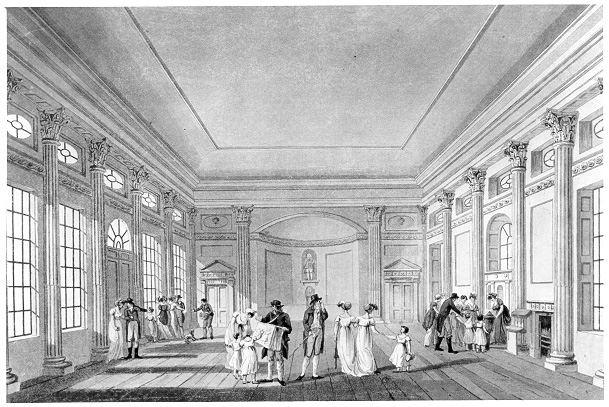
A good number of b/w Illustrations – there is unfortunately no listing of these; the source is indicated under each picture, but a listing would have served as an index to the subjects, which cover all manner of Regency life:  architecture such as that in Bath with interior and exterior scenes of the Assembly Rooms; various carriages; fashion; furniture; Naval life; the Cobb in Lyme Regis; etc.  – many of these illustrations will be familiar to most readers with a modicum of knowledge about the period – and color would have been nice – but the point here of these illustrations is to serve as a starting reference for further research, and it is an added plus to have any of these included. 

Bibliography:  this also serves as a starting point – it is in no way a complete listing of sources, but likely those sources that Shapard relied on for his research.  How complete can a bibliography of Austen be without mention of Claire Tomalin’s biography under that category, or Claudia L. Johnson’s Jane Austen: Women, Politics and the Novel or Kaplan’s Jane Austen Among Women nowhere to be found – but as Shapard is an historian, it is that strength that resides in this bibliography, again a great starting point for further study – it is organized by broad subjects:  language; cultural and literary background; marriage and the family; position of women; children; housekeeping and servants; entails and estates and the landed gentry; rural and urban life; the military; medicine; the law; education; books, media, libraries; writing; postal service; transportation; theater [but no mention of the two works Jane Austen and the Theatre – two works with the same title and both quite comprehensive]; music and dance; sports; weather; the seaside resorts; houses and gardens; fashion; food; etiquette and female conduct books; and others – again, a good select listing of resources on various topics.   

The Literary commentary and annotations:  Shapard begins with the caveat that “the comments on the techniques and themes of the novel represent the personal views and interpretations of the editor…such views have been carefully considered, but inevitably they will still provoke disagreement among some readers “ [xi] – which Shapard encourages…; these annotations include such literary commentary, historical context, and definitions of words in context if they had a different meaning in Austen’s time, some repeated when necessary or cross-references provided.  

The book is arranged with the original text on the verso, the annotations and illustrations on the recto – the annotations are extensive as the following few very random examples show: 

  1. Persuasion starts with the full description of Sir Walter Elliot’s obsession with both his own personal charms and his listing in the baronetage – Shapard here provides information on that book and others of the time and the definition of “baronet” and how Sir Walter acquired his own status…
  2. Gout is fully described on pages 311 and 315, when Anne learns that the Crofts are removing to Bath dues to the Admiral’s “gouty” condition.
  3. “replaced” – [p. 103] – “they suspected great injury, but knew not where; but now the collar-bone was soon replaced”   – the annotation explains that the word “replaced” had the meaning in Austen’s time of “to be put back in its original position” rather than “to take the place of” – there is also a description of anatomical knowledge as understood at the time.
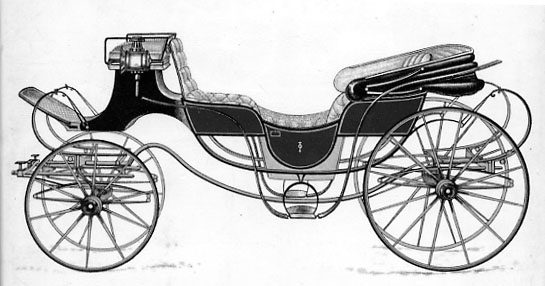
  4. Carriages get much attention whenever they are mentioned in the text – so we have descriptions and illustrations of barouches and chaise and fours, and chairs and of course Anne’s pretty little “landaulette” [p. 483]                                                                         
         

    a barouche


  5. Money and wealth – Wentworth’s income explained [p. 145]
  6. Servants:  various duties outlined [p.  87]
  7. Street names, shops, locations explained throughout; e.g. The Cobb; Tattersall’s [a mention on p. 14 with an illustration]; Milsom Street; Westgate Buildings;…etc…
  8. The Clergy in Austen’s time
  9. Austen’s language as delineating character:  as in the following: “Lady Russell had only to listen composedly, and wish them happy; but internally her heart reveled in angry pleasure, in pleased contempt” [p. 232] – and the annotation reads:  “Her reveling in such emotions indicates her moral inferiority to Anne, who never derives pleasure from anger or contempt.” [p. 233]
  10. Social rules and strictures:  some examples – Sunday traveling [p. 305]; shaking of hands between men and women [p. 427]; not using first names, even those of friends such as Anne and Mrs. Smith

 A look at a few key scenes will also illustrate Shapard’s invaluable commentary: 

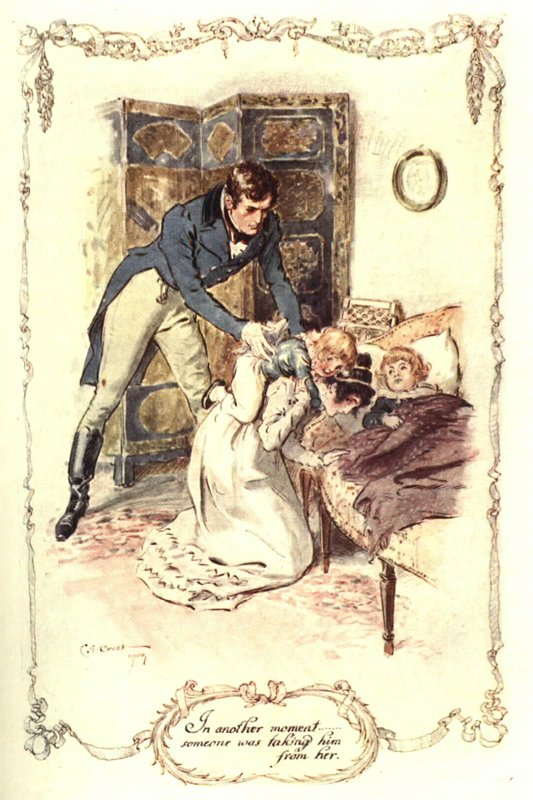
  1. Wentworth removing young Walter Musgrove from around Anne’s neck [pp. 152-5]:  Shapard emphasizes the importance of this scene in displaying both Anne’s and Wentworth’s feelings – he quotes William Dean Howell’s how “this simple, this homely scene, is very pretty, and is very like things that happen in life, where there is reason to think that love is oftener shown in quality than quantity, and does its effect as perfectly in the little as in the great events. [from Heroines of Fiction].  Shapard also suggests that Wentworth’s reluctance to converse with Anne about what has just happened is as much due to his efforts to remain aloof as it is to a “simple dislike of thanks,” [p. 155], as is true of Mr. Knightley in Emma. 
                                                                                                        

    Brock illus - from Molland's


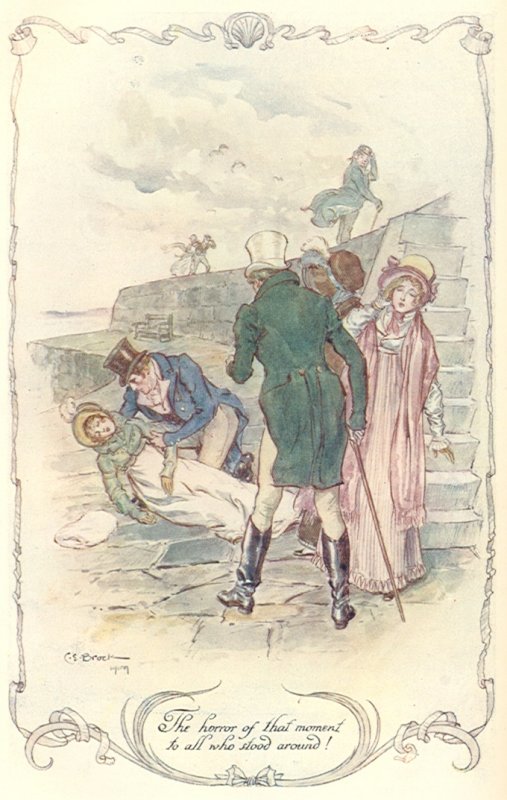
  2. Louisa’s fall in Lyme Regis [p. 210-15]:  Shapard describes the Cobb, the steps that were the scene of The Fall, comments on the feelings of Anne and Wentworth, the strength of the former and the uncharacteristic weakness of the latter; Anne’s carrying the “salts” [have you ever wondered why Anne IS carrying smelling salts and conveniently has them in her possession? – “here are salts – take them, take them.” [p. 210]]; the calling for the surgeon and the differences between he and an apothecary; the comic relief of “the sight of a dead young lady, nay, two dead young ladies, for it proved twice as fine as the first report.” [p. 213-4] 
    "The horror of the moment" - from Molland's


  3. and of course, The Letter! [p. 452] – Shapard so rightly states that “Wentworth’s passionate language contrasts him with other Jane Austen heroes, who are often much cooler and more rational.  It also fits with the more intense emotional tone of this novel … the letter itself is arguably the moment of highest emotion in her works…” [p. 453]  – and we are given a picture of a writing table of the time [p. 457] – there is also extensive commentary on the conversation between Capt. Harville and Anne. 

As referred to above, there are disappointments in this work – I would most wish for an index to the annotations – these could be just general subject areas, such as similar divisions as in the bibliography – so for instance – all annotations which discuss medicine could be cited, or any references to carriages, or fashion, or Bath locations, the Navy, or examples of Free Indirect Discourse, the literary allusions such as Byron’s The Corsair and Matthew Prior’s poem “Henry and Emma”, etc.  As it is, one needs to read through the entire work to find the references, and as Shapard wishes for this to be a work for reference purposes, this addition of an index would seem to be a necessity.  A index of Characters would have also been a helpful addition – one must reach for their Chapman for this information; and finally there is also no “note on the text”, important information in any such reference source – the bibliography lists Chapman’s 1933 edition, Spacks’s Norton critical edition [1995]; and the latest Cambridge edition edited by Janet Todd and Antje Blank [2006] – but I would have liked to see from whence he took the exact text…

That all said – this is a delightful and fact-filled addition to your Austen Library – and if you are already fairly well-versed in the Regency period and Austen criticism, this will serve as a copy of Persuasion where much of this information is at your fingertips; if you are just starting your adventure in reading Austen, this will be a great introduction to the very rich world of her writings, her world, and her literary themes – what more can we ask for!  [other than a hardcover with an index!]

 4 full inkwells out of 5

[please note that the illustrations are meant to illustrate this post and are not illustrations in the work being reviewed] 

Book reviews · Regency England

Book Review ~ ‘Bath Tangle’ by Georgette Heyer

Here is the review of Georgette Heyer’s Bath Tangle that I wrote for the “Georgette Heyer Celebration” at Austenprose:

I first encountered Georgette Heyer’s Bath Tangle via audio and I was enchanted – the head-strong Hero and Heroine, not always likeable, at odds with each other from page one – so I was delighted to read the book when Laurel Ann asked me to do this review – another Heyer, another cast of characters, and an abundance of Regency settings to savor!

Serena Carlow, 25, a titian-haired beauty, strong-willed, headstrong, accomplished*, daring and tempestuous, certainly anything but “serene”, has suddenly lost her father, the Earl of Spenborough.  He leaves a twenty-two year old wife, no male heir with his estate passing to a cousin, and a will that provides for Serena’s fortune to be under the trusteeship of the Marquis of Rotherham.  Fanny, now the widowed Lady Spenborough, a young girl, barely out of the schoolroom when she was pledged to the 47 year-old Earl against her will, is well-named – Austen’s Fanny Price looms over this character.  Though of a shy, retiring disposition and propriety-bound, she and Serena, so very different, have forged a true friendship – they move together to the Dower House, leaving the cousin and wife, a la the John Dashwoods in Sense & Sensibility, to take over the Earl’s entire estate. Serena is left with an allowance, her fortune of 10,000 pounds a year to be passed to her only upon her marriage to a man approved by Rotherham …which of course sends Serena “up into the boughs.”

Major back story, as in Persuasion:  Serena and Rotherham were betrothed three years before, her father’s wish, but Serena crying-off shortly before the ceremony because “they did not suit”.  Rotherham is after all a harsh and arrogant fellow, with an “imperious and tyrannical disposition”, “high in the instep”, barely even handsome [but he has great hands! and those powerful shoulders!] – they do their “dagger-drawing” from page one and while they may not think they suit, we know quite differently, that they are meant for each other, everyone else paling in comparison…..[Shakespeare’s Taming of the Shrew comes to mind!]

Fanny and Serena decamp to Bath for a change of scene during their mourning period – and so enters Major Hector Kirkby, Serena’s “first and only true love” from six years before – and she, Hector’s “goddess”, his dream become real when they once again meet.  Hector is fine and handsome, but a tad frightened of Serena’s strong personality of “funning humours and openness of temper”. They set all the tongues of Bath wagging, embark on a secret engagement [due to mourning etiquette], Rotherham is consulted and approves, then announces his own engagement to the not-yet 18 year old Emily, and suddenly, Everyone Ends Up In Bath: Mothers in the marriage mart; Aunts critical of Serena’s behaviors; Rotherham’s family demanding attention and money; Hector’s dream; Serena feeling 19 again; the fortune-seeking Lalehams, pushing Emily into the arms of the Marquis; and Mrs. Floore, Emily’s grandmother, one very lively jump-off-the-page character, “of little height and astonishing girth”, vulgar and socially stigmatized, with an outrageous sense of fashion; and Rotherham, the jilted lover, who says of Serena “she would have been well-enough if she ever broke to bridle”, he is“blue-devilled” and angry, bordering on the cruel throughout most of the book…

Heyer gives us what we love her for: the witty dialogue; the fashions described; the list of cant terms [ramshackle, clodpole, “the dismals” feather-headed, ninny-hammer, on-dits, bird-witted, toad-eating, etc]; the Hero and Heroine throwing all the barbs known – abominable, wretch, odious, detestable, termagant, etc.]; and Bath in all its glory – the Libraries, Assemblies, name-dropping of real residents [Madame D’Arblay, Mrs. Piozzi, the scandalous Caroline Lamb and her Glenarvon];  the political arena of the time [Rotherham is in Parliament] – all the many details that make this visit to the Bath of Regency England so very real, so very engaging, and with that Heyeresque rollicking Romance, a courtship novel with its Many Tangles to help turn the pages – Delightful!

[*Note:  Jude Morgan’s An Accomplished Woman [St. Martin’s, 2009] literally duplicates this Heyer formula and does so quite well – I recommend it!]

[Posted by Deb]

Book reviews · Jane Austen · Regency England · Women Writers

Book Review ~ ‘The Quiet Gentleman’ at Austenprose

As mentioned in a previous post, Laurel Ann at Austenprose has been celebrating Georgette Heyer through the month of August, with various guest reviews of the novels and interviews with Heyer experts.  Laurel Ann had asked me to write a review of The Quiet Gentleman, which is posted today, and Bath Tangle which will be posted August 20th. 

Reading Georgette Heyer is a new experience for me, and the immersion has been quite enjoyable – I most like stumbling upon her Austen echoes, and they are there in her characters, her settings, her plots – Heyer greatly admired Austen amd read and re-read her through the years.  I don’t agree with those who think that Heyer is another Austen [here is a short article on the topic], but it is a lesson in influence to read Heyer’s romances [and her mysteries aren’t half-bad either!], and see where Austen touches her.

You can read the review of ‘The Quiet Gentleman’ here  at Austenprose – please visit and comment; I’ll post the full text here next week.

Book reviews · Literature

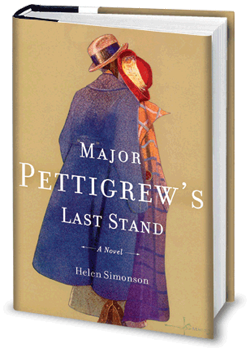
Book Review ~ ‘Major Pettigrew’s Last Stand’

Inquiring Readers:  I welcome guest blogger Janeite Lynne, a JASNA-Vermont member, who has penned a review of Helen Simonson’s Major Pettigrew’s Last Stand.  Thank you Lynne for sharing your thoughts about this book that everyone I know has been touting very loudly!

When I first began reading Major Pettigrew’s Last Stand by Helen Simonson, I wasn’t sure that I wanted to spend a whole book with Major Pettigrew, a widower and retired military man living in Somerset, England.  He seemed like a mix of Jane Austen’s minor characters—a stuffy member of the local gentry focused on his position and his guns.  But Simonson deftly lets the Major develop and come to life in the first half of the book, and I became engrossed in his story. 

The Major, (please don’t refer to him as Mr. or Ernest), is the center of the book and the reason to read it.  He is an opinionated man.

 On women drivers:  “He didn’t like being driven by a woman.  He hated their cautious creeping about at intersections, and their heavy-handed indifference to the nuances of gear changing, and their complete ignorance of the rearview mirror.”

 On Americans: Americans seemed to enjoy the sport of publicly humiliating one another.  The occasional American sitcoms that came on TV were filled with childish fat men poking fun at others, all rolled eyeballs and metallic taped laughter.”

 On the golf club: “It was a source of annoyance to the Major that what had once been a very refined black tie dance, with simple steak menu and a good band, had been turned into a series of increasingly elaborate theme evenings.” 

                                                              And…

“…it freed them from the sullen charms of waitresses who, culled from the pool of unmotivated young women being spat out by the local school, specialized in a mood of suppressed rage.  Many seemed to suffer from some disease of holes in the face and it had taken the Major some time to work out that the club rules required young women to remove all jewelry and that the holes were piercings bereft of decorations.”

As Major Pettigrew’s Last Stand opens, the Major has just learned that his only brother, Bertie, is dead.  It is through his reaction to his brother’s death, as well as his growing relationship with Mrs. Ali, a local shop keeper, that Simonson shows us Major Pettigrew as a whole person.  As he struggles with the changes in his life, his opinions become less strident and more blurred by the human relationships that he allows himself to experience. 

 Later in the novel, Mrs. Ali must make a decision to mail a letter that will likely change her life.  Major Pettigrew watches her at the postbox. 

“He never imagined so clearly the consequences of mailing a letter—the impossibility of retrieving it from the iron mouth of the box…It suddenly seemed horrible that one’s words could not be taken back, one’s thoughts allowed none of the remediation of speaking face to face.” 

Major Pettigrew’s Last Stand, for me, came down to the importance of risking the face to face relationships of life.  There are many other plot elements in the book.  There are issues of prejudice, land development, and prickly relationships between parents and children.  Simonson competently explores each of these, but her writing is at its best when she is drawing the Major and his re-entry into his emotional life.  When the book ended, I had come full circle.  I was happy in Major Pettigrew’s company, and I wanted to know what he would do next.

**********************************

Helen Simonson
Major Pettigrew’s Last Stand
Random House, 2010
ISBN:  978-1400068937

[Posted by Janiete Lynne]

Austen Literary History & Criticism · Book reviews · Books · Collecting Jane Austen · Jane Austen · Publishing History

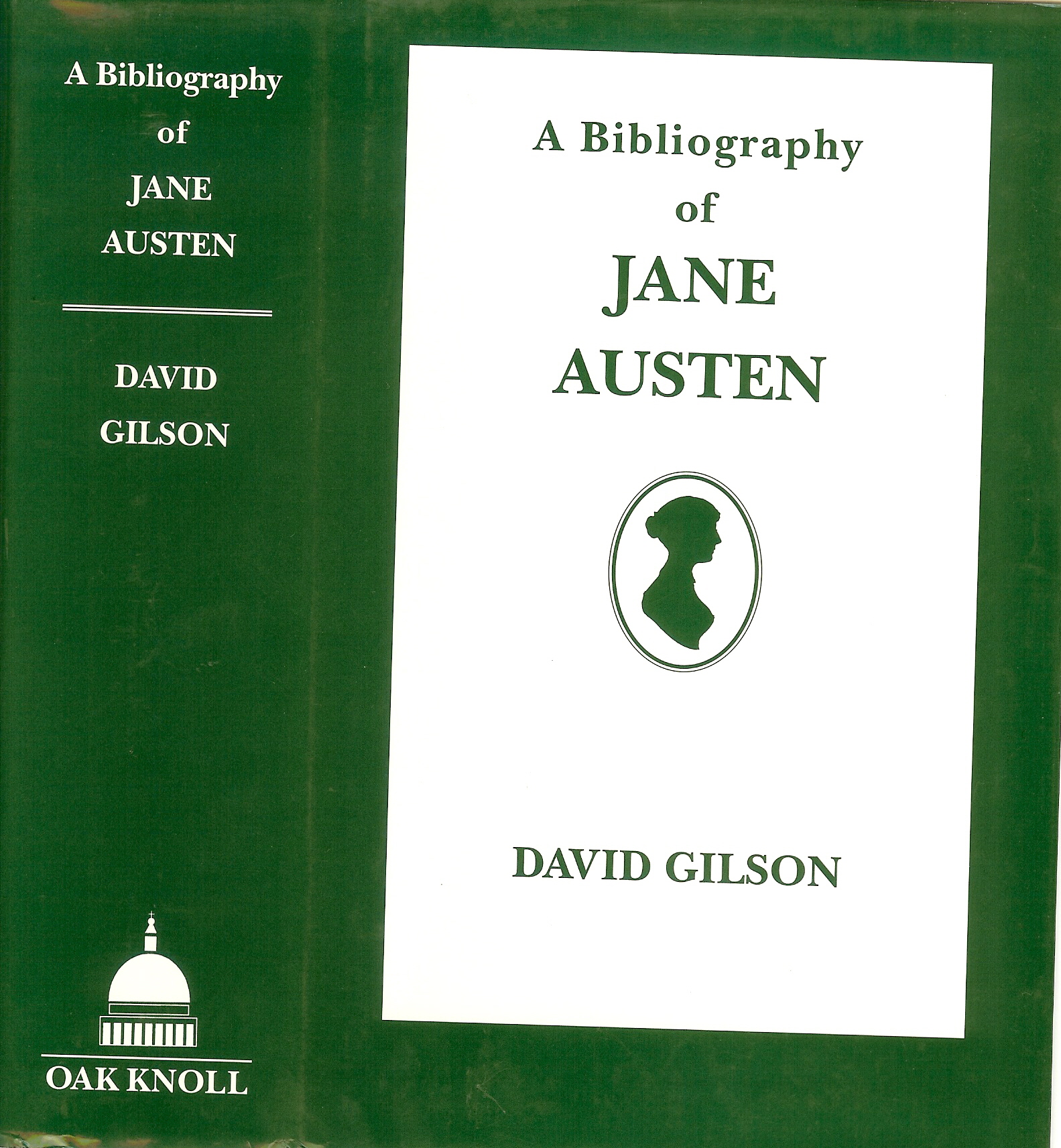
Your Jane Austen Library ~ Gilson’s Bibliography ~ a Review

Gilson, David.  A Bibliography of Jane AustenNew Introduction and Corrections by the Author.  Winchester: St. Paul’s Bibliographies  / New Castle, Delaware: Oak Knoll Press, 1997.

***********************

 I am often asked what I would consider the most important book to add to ones own “Jane Austen Library.”  Primary sources of course, the Chapman Oxford set of all the novels, minor works, juvenilia, etc – these volumes remain the source for citation in any scholarly work.  The new Cambridge edition would be lovely, but presently beyond my pocketbook, so the local University Library suffices for this ;  though I do wonder when this edition of the works will supplant the Chapman for citation purposes – shall start saving now…

But after that, what?   I would choose and most highly recommend David Gilson’s Bibliography of Jane Austen.  Originally published in 1982, Gilson had set out to revise and update the Sir Geoffrey Keynes’ 1929 Nonesuch Press Austen bibliography, after discovering the lack of information in the Keynes relating to the early American editions of Austen’s works.  Gilson wrote about these and other discoveries of the various early translations in his articles for The Book Collector.  At Keynes’ suggestion, Gilson began a second edition but found it best to present a whole new work based on Keynes but with much additional information and to include the work of Chapman in his 1955 Austen bibliography.  The 1997 edition is not a revision of the 1982 work but does include a new introduction, corrections, some additions, and a brief bibliographic essay on material published since 1978It is less physically attractive and lacks the frontispiece illustrations of the 1st edition, but I consider this very comprehensive work [at 877 pages!] the starting point for all Austen research. Gilson writes a very informative essay prefacing each of the twelve chapters, includes a chronological listing of editions and reprints and an exhaustive index that links back to all the entries.

I offer here a brief capsule of each of these chapters:  

A.  The Original Editions:  Gilson follows the principles set down by Philip Gaskell in his New Introduction to Bibliography [1972] and the entry for each original edition is exhaustive: full bibliographical details of the physical book [title; collation; contents; technical notes on the paper, printing, headlines, chapter headings and endings, binding; etc]; its publishing history; reviews and contemporary comments; later publishing history; auction records [fascinating!]; listing of copies examined; and other copies known to exist. [I LOVE this stuff!] 

B.  First American Editions:  as Austen mentions nothing about foreign editions of her work, Gilson assumes she knew nothing about the Emma that was published by Matthew Carey in 1816, a very rare edition, and unknown of by the earlier bibliographers – [Gilson B1].  Gilson again gives full bibliographical data as for the original editions, noting the textual variations in punctuation and spelling. 

C. Translations:  as Gilson states, despite that “JA’s opinion of the French seems not to have been high [citing her letter of Sept  8, 1816]…the French first paid her the compliment of translating her novels in 1813 and 1815.” [Gilson, p. 135]  Same full bibliographic details here for the various translations. 

D.  Editions Published by Richard Bentley:  no reissue of Austen’s novels is known after 1818 until 1832 when Richard Bentley decided to include them in his series of Standard Novels [quoting Chapman].  The copyrights had been sold to him by Cassandra for £210 and the P&P copyright was purchased from Egerton for £40.  [Gilson, p. 211]  Covers all the Bentley editions through 1882, with bibliographical details. 

E.  Later Editions and Selections:  lists “as far as it has been practicable” all other later editions of the novels from the 1830s onwards, with cursory bibliographical details and a focus on the statistical details for these editions, excepting the “textually significant edition edited by Chapman (E150)” [Gilson, p. 238] – there are 425 entries in this section. 

F.  Minor Works:  great literary history here! – with complete bibliographical details for Lady Susan, The Watsons, Charades, Love & Freindship, Sanditon, “Plan of a Novel”, Persuasion chapters, Prayers, the Juvenilia, etc. 

G.  Letters:  Brabourne, Bodley Head, Chapman editions, Le Faye coming later [the new 3rd edition, in 1995] 

H.  Dramatisations:  Gilson states that in 1929 Keynes could only find three dramatic adaptations, but fifty are listed here, and only those that are published works, and surprise of surprises, P&P being the most popular. [Gilson, p. 405]

J.  Continuations and Completions  [no “I” so not skipping anything]:  Gilson lists 14, adds a good number in his 1997 update, but since then the world has been inundated with all manner of sequels, prequels, and mash-ups –  this chapter is a good starting point for some of the less known early sequels that have gotten lost in the back room library stacks – some are quite good [Brinton and Bonavia-Hunt for example]

K.  Books Owned by Jane Austen:  there is much evidence of what Austen actually read – in Chapman’s indexes and other studies on literary influences on her – but as Gilson states, “the actual copies prove more elusive” [p. 431], so these twenty entries listed are noted in some way to have been subscribed to by her or inscribed in some way – the essay here is very informative and great to learn of the provenance of some of these titles Austen owned and read.  [Note:  I have set up a page in the Bibliography section on this blog titled Jane Austen’s Reading ~ a Bibliography –  a list of all the books that Austen owned or is known to have read, compiled from various sources – it makes a great reading list! – (it is still a work in progress…)]

L. Miscellaneous:  the ever-needed catch-all and quite a little find, as Gilson says “unclassifiable miscellanea (with yet a curious fascination of their own!) [p. 449] – for example an Elizabeth Goudge short story “Escape for Jane”, a romanticized re-telling of the Harris Bigg-Wither episode (L24), a number of works adapted for children, and a few works on the Leigh-Perrot trial.

M.  Biography and Criticism:  everything from 1813 on, to include books, journal articles, reviews, etc, chronologically arranged and annotated [though not consistently], 1814 items in total, with a bibliographical essay in the updated version to touch on recent resources, ALL examined by Gilson personally.  No words here to adequately explain this section – just an amazing piece of scholarship –

Appendix:  ca chronological listing of all editions, reprints and and adaptations of JA’s works recorded in the bibliography

Index:  pp. 753-877 – exhaustive!

… but here of course is where any printed book falls short – before it hits the stands, it is outdated. Recent efforts to keep Austen bibliography current have been largely produced by Barry Roth in his three works:

  • Roth, Barry and Joel Clyde Weinsheimer.  An Annotated Bibliography of Jane Austen Studies, 1952-1972.  Charlottesville, VA: University Press of Virginia, 1973.
  • Roth, Barry. An Annotated Bibliography of Jane Austen Studies, 1973-1983.  Charlottesville, VA: University Press of Virginia, 1985.
  • __________.  An Annotated Bibliography of Jane Austen Studies, 1984-1994.  Ohio University Press, 1996.
  • __________ .  bibliographies  in Persuasions and Persuasions On-Line published annually by the Jane Austen Society of North America [JASNA]: each annual issue has a bibliography titled “Jane Austen Works and Studies” [and later the  “Jane Austen Bibliography”] and is available online since the 1999 bibliography appeared in the 2001 Persuasions On-Line. [Note that the bibliographies in the earlier issues of Persuasions were compiled by Patricia Latkin, and later by Latkin and Roth together, then just by Professor Roth.]

And now the Internet with such immediate access to journals and books, tons of bibliographies, etc. has made all of us capable of being completely on top of everything every minute of the day – but for me, there is nothing quite like going to my Gilson to get back to those earlier days of bibliography, when a scholar such as he lovingly handled each work and made the effort to describe with such fullness each edition so it may become present before you [because you certainly cannot afford them!] and thus we are brought a little bit closer to the Austen we all love and admire – indeed, we can feel as excited as she did upon receipt of her own first copy of Pride & Prejudice as she exclaimed to Cassandra I want to tell you that I have got my own darling Child from London “ [Le Faye, Letter 79, p. 201]

If you don’t have this book, get it – it makes for fascinating reading! [I confess to being a librarian and I know we are all a little bit weird about this bibliography and classification thing, but this book will give you much to ponder, trust me…]

Further Reading:

  • Chapman, R.W.  Jane Austen:  A Critical Bibliography. 2nd ed.  London: Oxford University Press, 1969.
  • Keynes, Geoffrey.  Jane Austen:  A Bibliography.  NY:  Burt Franklin, 1968 [originally published in London, 1929]
  • The Roth bibliographies noted above 

A few other sources, mostly Gilson, though not a complete list:

  • Gilson, David.  “Auction Sales,” in A Jane Austen Companion, ed. J. David Grey.  NY:  Macmillan, 1986.  See also his “Editions and Publishing History,” “Obituaries, “ and “Verses” in this same volume.
  • ____________. “Books and Their Owners: Some Early American Editions of Jane Austen.” Book Collector 48 (1999): 238-41.
  • ___________. “The Early American Editions of Jane Austen.”  The Book Collector 18 (1969): 340-52.
  • ___________. “Henry Austen’s ‘Memoir of Miss Austen,” Persuasions 19 (1997):12-19.
  • ___________. “Later Publishing History with Illustrations” in Jane Austen in Context, ed. Janet Todd. The Cambridge Edition of the Works of Jane Austen, Cambridge University Press, 2005.      
  • ____________.  Putting Jane Austen in Order.  Persuasions 17 (1995):12-15
  • ____________.  “Serial Publication of Jane Austen in French,” The Book Collector 23 (1974): 547-50.
  • Latkin, Patricia.  “Looking for Jane in All the Wrong Places: Collecting Books in Gilson’s Category J.”   Persuasions 15 (1993):  63-68.       

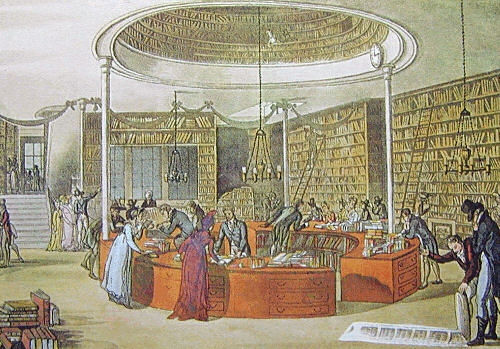
[Image from Ackermann’s via hibiscus-sinensis.com]

* I will be posting occasional reviews of books recommended “For Your Austen Library” – these will be listed on the bibliography page so titled.  You can also visit the the other Bibliography pages for more reading recommendations.

[Posted by Deb]

Book reviews · Books · Jane Austen

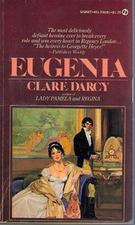
Book Review ~ ‘Eugenia’ by Clare Darcy

Eugenia
by Clare Darcy
Walker and Company 1977, Signet 1978
[and other various reprints]

 She had never thought a great deal about being in love before, not being romantically inclined and having read very few of the novels over which other young ladies at Miss Bascom’s had shed luxurious tears; but obviously, she thought, it was quite as uncomfortable a matter as those marbled volumes depicted it as being.                                                                                                          [Eugenia, p. 231]    

Clare Darcy’s Eugenia is a bit of a different confection than the usual Regency Romance.  The Heroine is still the smart, feisty, quick-thinking, in this case tomboy-like young lady, and Our Hero is as expected, tall, dark and handsome, strong and muscular; but there are only rare moments of sword-crossing, none of the “they started off hating each other”  – indeed, this Hero and Heroine are only occasionally found interacting on the page together, and barely ever alone – but it is quite charming all the same…  and thankfully largely lacking the incessant “infant-brat-chit” talk!

We begin in Bath in May of 1811, and Miss Eugenia Liddiard, an orphan since her father’s death three years ago and schooled at the Miss Bascom’s Select Academy for Young Ladies, is finally returning “home” to the Essex seat of her cousin / guardian Lord Chandross.  Lady Chandross, “not a proper guardian”, is to chaperon Eugenia in her first London Season, the goal to marry her off as soon as possible so she, Lady C, may return to to her own dalliances unencumbered.  Eugenia wants none of this – she is practical and not romantic and has definitely made up her mind to propose marriage to her childhood friend Tom Rowntree, brother of her best friend Muffet, so she will no longer be a burdensome project, be able to settle on land adjacent to her former home Coverts in Kent [her “place of belonging” and now in the care of a hands-off elderly clergyman cousin], and to be free to just be, taking no orders from anyone.  

Fortunately for all, characters and readers alike, the traveling chaise bearing Eugenia and her abigail is forestalled at the less than fashionable Kings Head Inn due to a raging storm and washed-out roads, and Eugenia, “who liked new experiences of any sort”, serendipitously runs into her cousin “Gerry” at the Inn, and the adventure begins.  By page nine we have met our Hero, have a full understanding of the the Heroine’s character, beauty, love of adventure, and quite wild imagination with a penchant for concocting very tall tales when the occasion calls for it.  

For “Gerry” is not Eugenia’s wild and reckless cousin Gerry at all, but the dead-ringer “Richard” [to wit, Jane Austen may not approve but he makes a fine Hero just the same!].  Richard is yet another cousin [isn’t is striking How Many Cousins there are in these Regency novels?!], also forestalled at the Inn and suffering from the lingering effects of a fever – and alas! he collapses in a dead faint in the Inn’s coffeehouse, Eugenia comes to the rescue and discovers the truth of his identity – he is the “by-blow” of her long-dead uncle Charles, thus not the true legitimate male heir to Coverts because he has only hearsay evidence, no written proof, of his parent’s marriage. Orphaned shortly after birth and raised by a clergyman in Ireland, Richard has returned to England to prove his birthright; Eugenia schemes for him to pass himself off as his look-alike cousin and come to her guardian’s estate to recuperate, offering her help to search the ecclesiastical records for the hoped-for marriage registry.  

 But, as all best-laid plans must indeed go awry or we wouldn’t have a tale to tell, real cousin Gerry is being sought by the Bow Street Runners for Highway Robbery and Murder – Richard must go into hiding until Gerry can be captured or he risks the gallows…

… so… her wondrous and fertile imagination madly at work, Eugenia sets up a new plan [she calls it “acting, not lying” ] – with much disguise, masquerading, outrageous fabrications to family and friends, and many a character entering her play – her old nurse Nan and her old groom Haggart to whom she confides Richard’s secrets; Lady Brassbororough [!], Lady B, the former “scarlet woman” famous for her stage past and various liaisons among the the rich of the ton, now a rather large woman covered in emeralds and diamonds, with a pug named Wellington who bites on command, with a resource of ready swears to send any man staggering into a corner, and who thankfully, in the end, saves the day.  

I’ll tell no more – but Miss Darcy, like Heyer before her in False Colours, gives us an almost gentle tale of mistaken identity, complete with Regency cant, French sayings, and an abundance of Regency references [Stulz the tailor, the 1697 play “The Deceiver Deceived“, Hessian soup, Fanchon, ices at Gunter’s  [though it is misnamed Gunther’s – her mistake or a typo?] are just a few examples … there are a good many more with the fun of looking them up!]; the two bumbling Bow Street Runners, Baker and Cartwright [perfect name for a TV show!]; dance requests and marriage proposals from all the wrong people; the “highest kick of fashion” described; the settings of Town and Country knowingly depicted; the ever-present cadre of servants, who keep “up a dignified pretence, for the sake of [their] positions, of being deaf and blind as well as quite uninterested” [p. 242]; the requisite pistols and grown men brawling; a charming and defiant Heroine who unromantic as she believes herself to be discovers “the joy of knowing love” and the pain of not having it returned; and finally The Hero, more Fitzwilliam Darcy-like  – aloof and composed with a quiet, impenetrable reserve and decisive manner – and thankfully knows how to perform the proper Embraces and Crushing Kisses when so called upon.  

 Lady Chandross, “with her usual air of fashionable indifference“, sums it all up nicely with “so it seems that everything has turned out for the best in the end, quite in the manner of one of those dull little comedies where everyone reforms or is suitably paired off just before the curtain falls”  [p. 224] – Miss Darcy may laugh so at her own little creation, but so do we, and again, though this is not Heyer, it is great fun – put it on your summer reading list!  

3 1/2 full inkwells out of 5  

[Posted by Deb]  

Book reviews · Jane Austen · Regency England

Book Review ~ ‘Georgina’ by Clare Darcy


Georgina, by Clare Darcy. 
NY:  Walker and Company, 1971;
NY:  Dell, 1977 [and other reprints]

***********

The opening scene finds us in a house on Great Pulteney Street in Bath, where a rejected marriage proposal has all the Power family at odds – we quickly see that Miss Georgina Power is not going to be forced into an arranged marriage with one Mr. Smallwoods, despite his prospective title and comfortable fortune – and to avoid the inevitable resulting gossip, she is quickly shipped off to Ireland to visit her father’s cousin, the widowed Arabella Quinlevan, who has her own plans for Georgina to marry her son Brandon.  They reside at The Place of the Oaks, a fine estate, slowing running to seed since the death of the owner, Georgina’s uncle, whose daughter Nuala had recently died and the estate rather than going to the next rightful heir, our Heroine Georgina, fell to Nuala’s “odious adventurer” rake of a husband, Mr. Shannon. [phew! sufficiently confused?] 

Now Mr. Shannon has all the qualities of the Regency Rake – but he has no place in this closed Society, as he is the “natural son” of the Scottish Lord Cartan, and this, coupled with his arrogant air and lack of proper manners and a bad reputation fueled by the gossip-mongers, sets the entire cast of characters off to a rousingly bad start when Shannon returns to The Place unannounced, asserts his rights as owner and expects the Quinlevans to vacate immediately.  

He walked into the book-room with Brandon.  Her concept of arrogance was immediately strengthened by the sight of a tall figure, carried with distinction and set off to careless advantage in a well-fitting drab coat, buckskins, and top boots, and a harsh-featured face with cool grey eyes. [p. 33]

 Georgina labels him a “rag-mannered basket-scrambler” [p.36] and the sparks begin, that ever-present in a Regency Romance “crossing of swords”.  Shannon IS an arrogant, cold-hearted Hero. They both are hot-tempered, she “devilishly obstinate” and persistent, with a sharp and honest tongue, displaying all manner of improper behaviors for a Lady; he showing no emotion, no feelings, but seemingly a hardened rake who had married Nuala for her fortune. But Georgina begins to see that in his fine management of the estate, the respect the servants and tenants show him, his growing friendship with Brandon, his protectiveness of her [like all Regency Heroes, he does have a penchant for showing up exactly when the Heroine has landed in the suds!], that perhaps the neighborhood’s opinion is not so justified after all – her efforts to defend him bring on the tattle-boxes and the damage is done. 

True to this genre, the conventional escapades begin, Georgina in numerous scrapes, masquerades, marriage proposals in abundance – some for love, some for her fortune – balls, midnight runaways, the machinations of a few nasty and jealous Matrons, and like Heyer before her, Miss Darcy’s strong, silent, Hero does indeed have feelings – all conveyed in his Eyes:  “the glad incredulous welcome in his eyes” changing to “an indifferent sardonic coolness”, “the contempt she read in those eyes”, “a look of such bleak unhappiness in those grey eyes”, “those hard grey eyes, strangely softening”, etc…, otherwise we would be at a loss…!

Georgina was Clare Darcy’s first book, though I did not read it first, and I recollect that I thought it more serious than anything Heyer had certainly ever written – truth be told, it lacks that expected humor and even Darcy’s own hand at it improves in her later works.  I wonder perhaps that she was not sure where her Regency era talents would take her in this first book.  There is a certain gravity to the narrative -we have a dark Hero, a mystery in his past about his marriage and the death of his wife, rejected by a Society that seems more mean-spirited than funny, and a Heroine who fights the fortune-focused, behavior-constraining society she lives in, breaking almost every Rule in the Book to clarify what she instinctively knows about this man.  Thankfully, her young cohort Brandon, whose mother is set to have him betrothed to Georgina, is the salvation here – the bookish, Byron-like figure [with the required limp] is quite adorable and amusing, bringing much-needed levity. 

I liked this book very much – and while we again know from the first moment that the name of Mr. Shannon is introduced on the page, where it is all headed, it was great fun.  And one must like a book where the proposing Hero says: “Nay, I’m no hand at speeches!” – even Jane Austen’s Mr. Knightley would approve!

 4/5 full inkwells

Book reviews · Books · Jane Austen · Literature · News

Book Giveaway! ~ ‘Dancing with Mr. Darcy’

JASNA-Vermont will be giving away a copy of Dancing with Mr. Darcy, the short story anthology from Chawton House Library, published by Honno Press ~ please post a comment by Saturday November 14, 2009 to qualify.  Author Lane Ashfeldt will send the book to the winner directly ~  see the following posts to comment:

book cover dancing mr darcy

[Posted by Deb]