Book reviews · Books · Jane Austen · Jane Austen Sequels · News

Last Chance! ‘The Importance of Being Emma’ ~ Book Giveaway

Reminder to all:  the deadline for posting comments and / or queries to author Juliet Archer to win a free copy of The Importance of Being Emma is midnight Friday September 25! 

book cover importance of being emma

Posts to comment on:

Just a comment or a query and you will be entered in the drawing.  The book will be sent to you directly from the publisher Choc-Lit.

Thanks to all who have participated, and a hearty thank you to Juliet Archer for her very thoughtful responses!

[Posted by Deb]

Book reviews · Books · Jane Austen · Jane Austen Sequels

Juliet Archer’s “Emma”, Part 2 ~ Book Giveaway!

Life certainly gets in the way of blogging! – here is the promised Part 2 of my interview with Juliet Archer, author of The Importance of Being Emma, and a confessed “19th-century mind in a 21st-century body.”  [see Part 1 of this interview here].  Please see below for the book giveaway info… we welcome your queries and comments!

book cover importance of being emma


Deb:  Welcome back Juliet!  You mention in your last answer that the next novel in your series  “Jane Austen in the 21st Century Series”  is “Persuade Me”, after Austen’s “Persuasion”–  why did you start with “Emma”?

 JA:  Although Emma’s the first Austen modernisation I’ve had published, it’s actually my third attempt. I’ve done very early drafts of both Pride and Prejudice and Persuasion. When I realised how wide a gulf there was between writing something and getting it published, I focused on Emma because it was my most recent work and I thought it would need less doing to it. I was wrong! 

I think Emma is Austen’s most comic novel, so I was thrilled when The Importance of Being Emma was shortlisted for the 2009 Melissa Nathan Award for Comedy Romance.  

Deb:  [Congratulations on that! ] ~ What do you think Austen would say to your “meddling” with her story?  What would she say about all the sexual content? 

JA:  There’s been so much ‘meddling’ with Austen already that she’d probably be bored rigid by the time she got to The Importance of Being Emma! I hope she’d be proud to see her story adapt so well to a different time period and social setting, and that she’d be sympathetic to the changes I’ve made. Most of all, I hope she’d have a good laugh!

 As for the sexual content, for my hero and heroine it sits firmly within a framework of love, commitment and ultimately marriage – a scenario which comes across very strongly in the original novels. Given the world we live in, I felt I couldn’t modernise Austen without including some sexual content and, fortunately, readers seem to think I’ve struck the right balance.

 Deb:  I do agree with your readers here!  I think your characterization and plot devices are spot-on and the sexual scenes are so very well done, and of course we know how it ends – marriage IS the goal after all!  Which leads me to my next question:  We all do know this story and how it ends, so there are no surprises here – how did you go about creating enough interest and tension to make your reader want to keep turning those pages?  [I know that I did!] 

JA:  [Thank you!] First, with most mainstream romantic fiction, Austen-based or not, we can guess instantly who’s destined for whom – the interest is in how they get together. So in that respect my story’s no different from many others. Second, as you’ve already indicated, the alternating 1st person point of view helps to create interest and tension. And finally, in my opinion Austen does two things – effortlessly – that make the reader want to keep turning the pages: characterisation and dialogue, often laced with humour. By imitating her work, I hope I’ve written what many readers see as a ‘page turner’.

Deb:  Yes, indeed you have!   And now for a few personal questions if you don’t mind…  What else have you written? 

JA:  What started me writing novels was the BBC’s dramatisation of Gaskell’s North and South, starring Richard Armitage. So I’ve got a few modern ‘fanfics’ lying around and still hope to have a 21st-century version of North and South published – although not until I’ve got Austen modernisations out of my system. 

Before that, I wrote very bad, unpublishable poetry – rather like my version of Giles Benwick in Persuade Me.

 Deb:  The Armitage “North & South” adaptation seems to have set off a number of fan-fic writers – there are whole blogs devoted to it!  I would eagerly await your updated version – [and hopefully Mr. Armitage could be persuaded to play the part yet again…?] – but I digress! – What is your writing habit?

JA:  I work full-time in London Monday through Friday, so I fit my writing into my spare time and also get up early most mornings. In the evenings, a glass of wine is known to get me in the mood! My family keep me grounded and occasionally remember to feed me. 

Most of my first draft goes straight onto the computer – PC in the study, laptop in the garden or bed! But I’m always printing pages off so that I can read and edit on the train going to and from work. For me, there’s no substitute for the printed word – yet. 

Deb:  Oh, I like hearing about your love of the PRINTED word! Anything else you would like to share? 

JA:  I’m married with two teenage children and live in Hertfordshire, Pride and Prejudice country. Unlike Anne Elliot in Persuasion, I resisted well-meant advice and married young, before graduating from university with a First in French and Russian. Initially I worked in IT and company acquisitions, then ran my own consultancy business, and now I work for a national healthcare organisation. 

Finally, I love hearing from Jane Austen fans, so please visit my website – and I welcome readers to contact me directly.

Deb:  Thanks so much Juliet for visiting us and sharing your thoughts on the writing of YOUR “Emma”!   I wish you much success – and am looking forward to “Persuade Me ” and making the acquaintance of your Captain Wentworth! ~ Now Gentle Readers, please send in your queries and comments to participate in the book giveaway…

***************************************

Book Giveaway:  Juliet has most graciously offered to answer any questions you might have for her – all queries and comments posted between today and midnight September 25, 2009 will be entered into a drawing for the free book giveaway, courtesy of Choc-Lit.  All are eligible to enter.

The Importance of Being Emma
by Juliet Archer
Harpenden, UK:  Choc-Lit, 2008   £7.99 / $13.07 [paperback]; also available in an ebook version direct from the publisher for £3.99 / $5.99
ISBN:  978-1-906931-20-9

[Posted by Deb]

Book reviews · Books · Jane Austen · Jane Austen Sequels

Interview with Juliet Archer ~ Author of ‘The Importance of Being Emma’

Today we welcome author Juliet Archer, author of The Importance of Being Emma, [Choc-Lit, 2008].  Ms. Archer, who says she is a 19th-century mind in a 21st-century body [though she adds that some days it is the other way around!] joins us today from London to talk about her very humorous modernization of Jane Austen’s Emma.  [Click here for my review of the book].  We are also offering a free book giveaway direct from the publisher, the winner drawn from all comments posted by September 25th [see below for full details]

book cover importance of being emma


Hello Juliet ~ thank you for joining us here at Jane Austen in Vermont!  I enjoyed your spin on Austen’s ‘Emma’ very much, and look forward to others in this series of “Jane Austen in the 21st Century.”

JA [note the initials!]:  Hi Deb, thank you for the opportunity to ‘talk’ to you and your blog readers.

Deb:  To start, just tell us briefly what YOUR Emma is about. 

JA:  I’ve lifted the plot and characters of Austen’s original and plonked (a technical term!) them very much into the 21st century. Cue mobile phones, emails, jobs and liberated attitudes to social and sexual interaction! 

Deb:  So many Austen “fans” are drawn to the historical period of the Regency, and like their sequels, etc. to be so set as well.  What inspired you to do a re-telling of ‘Emma’ in our modern-day world?  And why do you think lovers of Austen will enjoy reading your book?

JA:  Modernising Jane Austen is not an original idea – for example, Melissa Nathan wrote versions of Pride and Prejudice and Persuasion almost ten years ago. Then we have Helen Fielding imagining Bridget Jones as a modern-day Lizzy Bennet; and even Stephenie Meyer has admitted that Bella and Edward’s early relationship in Twilight was influenced by Pride and Prejudice.  In effect, Austen’s novels seem to provide an elegant template for most romantic fiction and chick lit, whether consciously or unconsciously. So, if you like, there are lots of ‘unofficial’ as well as ‘official’ modern versions out there already. I’ve just kept more closely to the originals!

I have several reasons for retelling these novels through 21st-century eyes. First, I’m learning from the master of my chosen genre. As Claire Harman notes in Jane’s Fame, a wonderful account of the Austen phenomenon, ‘It seems almost redundant to itemize aspects of Austen’s appeal; there are the brilliantly constructed plots, the romance, the comedy.’  Second, what started as a bit of an experiment has become compulsive fun: who will I tamper with next – delectable Darcy or calculating Crawford?  Third, a 21st-century context gives me an opportunity to explore some aspects of the originals that Austen couldn’t, or wouldn’t, develop – particularly the male point of view. And finally I hope to appeal to those – like my own daughter – who adore the dramatisations of Austen’s work yet can’t get into the books themselves. 

If you’re an Austen lover, then my versions have an extra dimension – looking for the parallels with the originals and, I hope, appreciating the differences. For example, the Box Hill incident in Emma: I couldn’t see this working as a picnic these days, so I’ve changed the setting – but, I hope, kept to the spirit of the original. And I wanted to give Emma’s outburst to Miss Bates the context of a rare moment of self-awareness, so I added something to the original. 

Interestingly, I’ve met with far more support than resistance from Austen lovers. When one of my publisher’s reps gave a copy of The Importance of Being Emma to the manager of a local Waterstone’s store (a leading UK book chain), she threw up her hands in horror and exclaimed, ‘Who would want to tamper with Jane Austen?’  After reading the book, however, she became a staunch fan, gave it a glowing staff recommendation and arranged for me to do a talk at the local literary festival.

 Deb: Comparisons will be made with the movie “Clueless” – how is your story different? 

JA:  I love that movie! But the high school setting and teenage culture are a step too far for a middle-aged author like me, and I wanted to stick as closely to Austen’s settings as possible. 

So my story takes place mainly in the village of Highbury, Surrey, England, and my characters are nearer in age to the originals. Donwell Abbey with its farming interests has evolved into Donwell Organics, while the Woodhouses also have a family business, Highbury Foods. As Knightley observes, however, in spite of various precautions Henry ‘never ate anything labelled “Highbury Foods”; he said his digestion was far too delicate.’ 

Deb:  You make Knightley quite “hot” and obviously very interested in sex!– what in Austen’s ‘Emma’ made you want to expand on this aspect of Knightley’s character?

JA:  If we turn this question round, it becomes ‘How do I make Austen’s Knightley fit into a modern world?’ Don’t get me wrong, I love the original Knightley just the way he is. But ‘a 37-year-old farmer leading a solitary existence, until he realises he loves the nubile 21-year-old next door’ just didn’t translate convincingly to the 21st century! And what appeal would there be in the modern equivalent of Knightley’s immortal line ‘God knows, I have been a very indifferent lover’?! 

So my Knightley had to have a makeover. I cut the age difference, to make sure he wasn’t old enough (technically) to be Emma’s father. Gave him a stunning girlfriend who’s looking to settle down. And kept him well away from Highbury while Emma was growing up. But the most enjoyable part was filling in the gaps that Austen left in our understanding of Knightley. Austen provided a starting point, an end point and a few little clues along the way – the rest was up to me! 

And, remember, in my version we meet Knightley when he’s thousands of miles away from his girlfriend and confronted by this gorgeous young girl he used to call ‘Mouse’! Is it surprising that his mind, er, wanders? 

Deb:  I mention this in my review, but just again explain why you changed the names of some of the main characters? 

JA:  As I modernise Austen’s novels, I change characters’ names only with good reason. The most obvious change in The Importance of Being Emma is Knightley. I don’t know any men in their mid-30s called George – they are either much older or much younger. I certainly like the name, especially when it is attached to a certain Mr Clooney! 

So I reserved ‘George’ for Mr Knightley Senior; in my version I felt he had to be alive, since enough parents in the original Emmahave expired as it is – and I include Henry Woodhouse in this! Then I looked round for a similar, solid-sounding name of one syllable for his son and – for personal reasons – chose ‘Mark’. Same with Frank – in the UK, at least, it no longer has a contemporary feel, so I went for ‘Flynn’ Churchill, with its shades of Irish blarney! 

In Persuade Me (my version of Persuasion), I’ve changed Anne and Frederick to Anna and Rick, again for a more contemporary feel. Similarly, Anne’s sister Mary (an unusual name these days in the UK) has become Mona – for obvious reasons. 

Deb:  You tell the story in alternating chapters from Emma’s and then Mark Knightley’s point of view – it certainly helps us to know exactly what is going on in Knightley’s mind as well as the she says / he says that can be quite funny with all the gender miss-readings of any given encounter! – why this format?  Advantages and disadvantages? 

JA:  Not all of Austen’s novels lend themselves to this format, but in my version of Emma I wanted to heighten the sense of misunderstanding and conflict between the two main characters. The alternating 1st person points of view are intended to assist this and, as you say, to provide a comic touch. It also means that we see the secondary characters through the eyes of Emma and Mark and, of course, their views are usually diametrically opposed. 

Advantages? I can explore the main characters’ innermost thoughts in a much more intense and, at times, humorous way. Disadvantages? It’s limited to what two characters are experiencing. Interestingly, Stephenie Meyer chose the 1st person for her Twilight series; it’s told from Bella’s point of view, although I understand she’s now written a version of the first book from Edward’s point of view. At least I’m giving the reader two for the price of one!

I’ve also written my second novel, Persuade Me, through the eyes of the main characters Anna and Rick, but here I’ve chosen the 3rd person throughout. This has enabled me to introduce other perspectives occasionally – to create humour, such as the musings of Sir Walter Elliot, 8th baronet, or a different slant on one of the main characters, such as Sophie Croft puzzling over her brother’s behaviour.

Deb: Thank you Juliet for joining us today and sharing your insights ~  stay-tuned for Part 2!

************************************

Join us for Part 2 of this interview with Juliet Archer tomorrow ~ she will talk more on the backstory of writing her Emma and her thoughts on what Austen might say about her book.

Book Giveaway:  Juliet has most graciously offered to answer any questions you might have for her – all queries and comments posted between today and midnight September 25, 2009 will be entered into a drawing for the free book giveaway, courtesy of Choc-Lit.  All are eligible to enter.

[Posted by Deb] 
Book reviews · Books · Jane Austen · Jane Austen Sequels

Stay Tuned! ~ An Interview with Author Juliet Archer

book cover the-importance-of-being-emma


Last week I posted a review of Juliet Archer’s The Importance of Being Emma  [you can read my review here] ~  tomorrow I will post the first part of a two-part interview with Ms. Archer where she will share with us her thoughts on writing this modernization of Jane Austen for the 21st Century, the first in a series. 

Book Giveaway Contest:  We will be offering a copy of the book direct from the publisher Choc-Lit, the winner chosen from the comments submitted ~  please post either a query for Ms. Archer or a comment about your thoughts on updating Austen by midnight Thursday September 24th; winner will be announced on Friday September 25th [worldwide eligibility]

[Posted by Deb]

Book reviews · Books · Jane Austen Sequels

Book Review ~ ‘The Importance of Being Emma’

book cover the-importance-of-being-emma


“You have shown that you can dance, and you know we are not really so much brother and sister as to make it at all improper.”

“Brother and sister!  no, indeed.”

[Emma, vol. III, ch. II, Chapman, p.331  ]


Juliet Archer in her Author’s  Note to The Importance of Being Emma, quotes this passage as the inspiration for her rollicking take on Jane Austen’s Emma.  If you like imagining your Knightley as a to-die-for, sex-obsessed hero, or in the words of Emma at fourteen, “Mark Knightley:  twenty-five, tall, dark, and handsome, and known among my older sister’s crowd as the Sex God” [p. 1] – then this book is a must-read, a perfect end of summer “choc-lit”* confection.

Emma Woodhouse, rich, lovely and clever, is back home at twenty-three, fully armed with an MBA from Harvard, to take on the role of Marketing Director at Highbury Foods, the family business, a “supplier of non-perishable delicacies to upmarket homes and hotels.”  She is young and naive, and who should appear but Mark Knightley,** home from India temporarily to help with HIS family business, Donwell Organics, and the perfect “mentor” to guide Emma in the realities of the business world.  They have not seen each other for years, and Emma is still smarting at Knightley’s discovery of her teenage crush – she is determined to keep her distance and not fall prey to the Knightley charm.

Knightley on the other hand is stunned to find his “Mouse” as he calls her with “long legs silhouetted against the window, lines and curves in perfect proportion.  Short beige skirt stretched taut across more curves – nicely rounded, a pert promise of pleasure.  Matching jacket with side vents, no doubt designed to draw the male eye to the symmetry below” [p. 10] – then promptly criticizes her for overuse of make-up and the plot is set for 398 pages of misunderstandings, concealed emotions, and an inordinate amount of sexual tension.  This is Emma in the 21st century, as the series is aptly named, and for those of you eternally frustrated by Austen’s not giving her readers nearly enough of the inner-musings of her heroes – indeed the Darcy in the 1995 P&P is so gripping because for the first time we are privy to his emotional state – and who of you has not yearned for much more to YOUR imagined Knightley – a more ardent lover, a fully-expressed proposal scene…?  Well, it’s ALL here folks! – Knightley it seems is wholly driven by sex, and everyone is happy to oblige – except of course Emma, who really has her heart set on the yet-to-be-met Flynn Churchill.

Told in a first-person narrative, with alternating Emma / Mark chapters, we see the same events from their individual perspectives.  This approach increases the intensity of the action, allows for much humor, and of course puts the mind of the hero front and center.  Knightley, as I’ve always believed Austen portrays him, subtle though it be, is really an emotional mess – here he is confused by his feelings for Emma, no longer brotherly, his every sighting of her expressed in such strong sexual terms – all making for one awkward encounter after another.  No spoilers here, just suffice it to say that Ms. Archer creates a few fairly explicit sex scenes…nicely done I might add…

And thankfully, all the usual suspects are present – Henry Woodhouse, head of the business and a chronic hypochondriac; Philip Elton, CFO [yikes!] with his “Gusty” ever obnoxious; Harriet, a bit of a dim but lovely bulb with a bizarre fashion sense as a personal assistant; Rob Martin in trade of course; John and Izzy Knightley; George Knightley, the father, still alive and running Donwell Organics, but off traveling the world with his young and demanding selfish wife; The Westons; Jane Fairfax, beautiful and aloof and the source of much of Emma’s jealousy; Mary “Batty” Bates endlessly chatting away; Flynn Churchill, a chef of all things! but still two-faced and a tad sleazy; a few other characters thrown in to round out the modern picture [hint:  Knightley has a girlfriend]; and Emma, still “clueless” to all the relationship mix-ups around her and still thinking SHE is pulling all the strings. 

One knows of course how the book ends – it was after all written nearly 200 years ago! – so it must be Archer’s endearing re-creation of the story and characters with a super-modern spin that keeps one turning the pages – Austen purists may blanch at seeing their Knightley sex-crazed and at times cruel [“it was badly done indeed!” turns into two pages of a blistering, swear-filled argument], but the heart of the story is still here, and it is an enjoyable romp to search for Archer’s re-imagining the many side stories into a modern-day England – seeing the hero and heroine come to terms with their conflicting emotions, their many tense and often humorous misreads of each other, [and do I dare mention quite a hot Knightley!] to make this indeed a great fun read – you just need to suspend your Regency sensibilities before entering!

******************************

 * Choc-Lit – “Where heroes are like chocolate – irresistible!”  The Importance of Being Emma is the first in the series by Juliet Archer, “Jane Austen in the 21st Century”.  Her take on Persuasion is up next [click here for an excerpt of Persuade Me].  See the Choc-Lit website and the author’s website at www.julietarcher.com for more information and other related links.

**Ms. Archer has changed several names: Mr. Knightley is now “Mark”, as father George is still in the picture; Flynn Churchill sounds a bit more modern, etc.  She discusses this in a posted comment on Austenblog [see comment #12].  For this reader, the name “Mark” brought to mind the actor Mark Strong who played Knightley in the Kate Beckinsdale “Emma”… [Strong does indeed get better with age, and this film adaptation of “Emma” has grown on me more and more after a number of re-viewings…]

4 out of 5 Full Inkwells

The Importance of Being Emma
by Juliet Archer
Harpenden, UK:  Choc-Lit, 2008
ISBN:  978-1-906931-20-9

Posted By Deb

Book reviews

For Better, For Worse

jane-austen-marriage-cover1

A compendium of Austen characters, relatives, friends and neighbors highlight Hazel Jones’ look into the subject of Jane Austen & Marriage. As the book proceeds through the steps of acquaintance, engagement, marriage, and even separation, Jones fleshes out the interaction between man and woman in nineteenth-century Britain. Illustrative excerpts from the novels and primary research sources provide a well-rounded, informative basis for her walk up the garden path and down the aisle.

Examining, chapter by chapter, components of relationships, the book begins with “Choice.” We learn that both sexes could, in fact, choose to opt out of the game. Concerns over continual childbearing and the risk of death, some women made the choice to remain single. Due in part to the shortage of men on the homefront (thanks to the Napoleonic Wars), others found the choice made for them. Men in a position to marry, on the other hand, sometimes thought about their incomes and the demands a growing family would make upon it before contemplating marriage. Therefore, the idea of choice concerns much more than the selection of a life-partner.

Jones’ next chapter brings up the point of how “the question” might actually be popped: in person, via letter, via an intermediary. Sadly, she finds little — in conduct literature or letters — to indicate the “traditional” down on bended knee type of proposal. Few readers will have delved into letters and diaries from this period; the timid suitors who chose the letter/intermediary route might therefore come as a pleasant surprise.

Discussions of conduct books point up the idea that such items existed because no one conducted themselves as they “ought” to have done. By looking at the paramount examples valued by these conduct books and juxtaposing them with the reality of relationships recorded in letters, diaries, and biographies, readers realize just how much Austen’s novels were signs of their times.

Two minor points that the writer and/or editor should have attended to are the spellings of Longbourne and Lizzie in place of the standard Longbourn and Lizzy. The fault may lie with Jones’  use of the Penguin edition of Austen novels.

Jane Austen & Marriage may supply few totally new revelations, but as a compendium of love, courtship, and marriage in Austen’s era (as well as family), Jones has provided a particularly useful book. Readers will welcome the author’s friendly style of writing as well as her insight into women like Lydia Bennet, Anne Elliot, and Marianne Dashwood. Highly recommended.

Four full inkwells.

 (for more on this book, see Two Teens in the Time of Austen, my research blog)

Book reviews · Regency England

” Frederica ” ~ ‘Cutting One’s Eye Teeth’* on Georgette Heyer’s Regency Cant

Layout 1Frederica
Georgette Heyer
Sourcebooks Casablanca, 2008
ISBN:  1402214766
[originally published 1965]

I loved this book ~ just so full of humor and the usual fabulous Heyer-created characters – the scattered, talkative heroine, though surely not pretty enough to BE the heroine; the elegant and aloof hero, always “quizzing”; the off-the-wall family of the heroine [who else but to engage the hero?]; the elitist family of the hero appalled at the arrival into their midst of this not quite up-to-snuff relative; and a series of hilarious mishaps and one serious accident to give everyone a chance to show who they really are – a pure Heyer-romp, and one you must add to your to-be-read-pile.

A quick overview:  Frederica, already “on-the-shelf” at about twenty-four and the sole guardian of her younger siblings, entreats a distant cousin, Lord Alverstoke, to take on her sister’s coming-out in London.  The Marquis is the epitome of the Regency Buck, older [in his late thirties], rude and condescending to his sisters and their families, yet bored with his fashionable lifestyle.  When Frederica appears on the scene, he is in no way inclined to help this unheard of “cousin” with her beautiful sister and two out-of-control brothers – but he is taken in regardless and agrees to help her, at first just as an exercise to undercut his sisters, and little knowing that his easy, boring existence will never be the same again.

No full review or spoilers here! – you can see with the opening lines where this story will lead – but Heyer in Frederica gives us one humorous page after another, and the creation of the two young brothers Felix and Jessamy, one of a scientific bent, the other bound for the clergy, gives the reader an interesting diversion on the hero-heroine tale – what IS it about these boys that makes Alverstoke, who barely acknowledges his own nephews and nieces, take such a liking to them and their endless mis-adventures?

What I found so engaging about this book is the abundant collection of Regency “cant” thrown into every sentence whenever possible – Heyer had a field day in this book with her uncivil tongue!  During the Regency it was the fashion for upper-class men to pepper their speech with the language of the lower classes, especially boxing and horse-racing speak as well as that of the Regency underworld.  In Frederica, we have a heroine with three brothers who use this talk constantly – she is adept at it herself, much to Alverstoke’s surprise and delight [“…such cant expressions on the lips of delicately nurtured females are extremely unbecoming,” he says to her with a “gleam in his eye” -p. 177].  Most of the terms you can figure out in context, others you can look up in the Regency Lexicon for starters [though alas! so many are not there!] or if you have Jennifer Kloester’s very helpful Georgette Heyer’s Regency World, or The Regency Companion and see below for other sources and links on cant – otherwise you might be at a loss in reading this book!

I here append a list – you will see that many terms make reference to one’s “stupidity” or “denseness”, but there are many others that apply to all manner of situations – if you can figure them out OUT of context, you are a better “canter” than I! [and with apologies for any duplication – I feel like I am transcribing a foreign language!]

  • Tremendous swell
  • Rake-down
  • Moonling
  • Slow-top
  • Nip-farthing ball
  • Bumble bath
  • A complete hand
  • Ramshackle
  • Rubbishing style
  • Tongue runs like a fiddlestick
  • Cry craven
  • Stow it!
  • Rag–mannered
  • Little bagpipe
  • Shabster
  • Oh botheration!
  • Shag-rag
  • A regular trump
  • Frippery fellow
  • Gammon
  • Bird-witted
  • Pudding-hearts
  • Toadeaters
  • Shatter-brained
  • Pea-goose
  • A set-off
  • Wet-goose
  • Dovecots
  • Paper-skulled
  • You are a baggage
  • Rackety gadabout
  • Give you a pepper
  • Clodpole
  • Stupid little looby
  • Rats in your garrett
  • Complete to a shade
  • Young stiff-ramp
  • Nipperkin
  • Of all the plumpers
  • City-mushroom
  • Dagger-cheap
  • Ape-leader
  • A flat
  • On-dits
  • “coming”
  • Flummery
  • Needle-witted
  • Prattle-box
  • Gabblemongering
  • Purse-pinched
  • Basket-scrambler
  • Young cawker
  • Mill
  • Gudgeon
  • Ninnyhammer
  • Rusticated
  • O’clock
  • Blunt
  • Bag-wig feeling out of curl…cut up stiff
  • Mawworm
  • Moulder
  • Sapskull
  • Chawbacon
  • Cawkers
  • Jobbernoll
  • In the seeds
  • Hip
  • Cockloft
  • Barques of frailty
  • Top-lofty
  • Chancery suit upon the nob
  • Lobcoble
  • Gibble-gabbing
  • Peel eggs
  • Havey-cavey
  • Thratchgallows
  • Bacon-picker
  • Dicked in the nob
  • Bumble broth
  • Nipperkin
  • Mull
  • Poke nose
  • Top sawyer driving
  • Nip-shot
  • Go into whoops
  • Roll of flimsies
  • Jackstraw
  • Game as a pebble
  • Nodcock
  • Ugly as bull-beef
  • Take a damper
  • A knock in the cradle
  • Curst addle-plot
  • Watering pot!

[ *Cutting one’s eye teeth = to become knowing, to understand the world ]

5 full inkwells [out of 5]  ~ Highly recommended ~

Further Reading on Regency Cant:

Further Reading on Frederica:

Posted by Deb

Book reviews · Fashion & Costume · Jane Austen · Regency England · Social Life & Customs

Book Review ~ Jane Austen’s Sewing Box

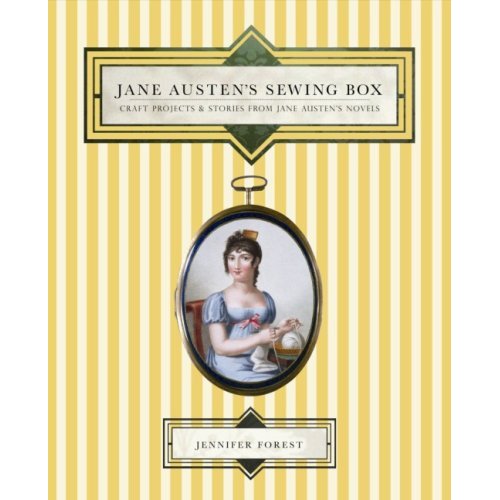
book cover jane austens sewing boxJane Austen’s Sewing Box: Craft Projects & Stories from Jane Austen’s Novels. 
by Jennifer Forest.  Murdoch Books Australia, 2009 

ISBN:  9781741963748, paperback, 224 pages.


 This is a lovely, sumptuous book.  When it first arrived, I did a quick skim – it is filled with photographs, decorated papers, fashion plates, quotes from Austen, and a good number of handiwork projects – hmmm, I thought, maybe one of those books that just looks nice but is of little substance – a coffee table [albeit a small one] book you look at once and then relegate it to collect dust in the “parlor” –  But on further study I found within these 224 pages a wealth of information – a brief but amazingly thorough introductory commentary on Regency historic and social life, the world of “women’s work” in Austen’s time, and the references to Austen’s many mentions of these real-life activities in her novels and letters.

 Ms. Forest has a background in history and cultural heritage, and combining this knowledge, her love of Austen and a “passion for fabric arts and crafts,” she has given us a treasure of a book.  With a starting point of finding Austen’s references to handi- and fancy work, Forest puts these quotes in their historical context, explains the meaning and use of the piece, and then provides instructions for each project – each of varying skill level, each a different task – there is knitting, sewing, embroidery, netting, paperwork, glasswork, and canvas-work, a total of eighteen different projects – from a letter case, linen cravat, fur tippet, to a pin cushion, reticule, bonnet and muslin cap – all mentioned by Jane Austen, and here lovingly replicated, with photographs of Regency era decorative arts and Ackermann’s fashion plates interspersed throughout. 

Best to show an example, so I will choose the huswife [page 100ff]  [ “the huswife was a small fabric case with pockets to hold all those tools for sewing and needlework – scissors, tape measure, thread, pins, and pin cushion”( page 104)]: 

This is a sewing task for beginners, with two pages of photographs of the finished piece, a short history of the huswife and its uses, a quote [all the quotes are written in script] from Emma where Austen uses the term [there is also a second quote from Sense & Sensibility spoken by Anne Steele] – here Miss Bates has misplaced a letter from Jane Fairfax that she later reads to Emma:

 “Thank you. You are so kind!” replied the happily deceived aunt, while eagerly hunting for the letter. “Oh here it is.  I was sure it could not be far off, but I had put my huswife on it, you see, and without being aware, and so it was hid.”  [page 104, quoting Emma]

 This is followed by a full page of blue decorated paper with a part of the quote, a full page fashion plate from Ackermann’s, and a full page of an art reproduction depicting a woman at her fancy work, then a full page photograph of a detail from a piece of Regency furniture [all photographs are from the Johnston Collection *], and then three pages of project instructions with black and white drawings, and a final photograph of a furniture detail.  This format and sequence is followed for each of the eighteen projects, ending with a list of suppliers, references and an index.

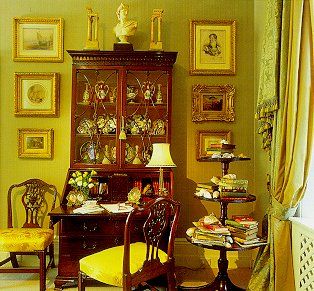
johnston collection desk
from The Johnston Collection


All these Austen quotes, taken out of context, are quite a wonderful discovery! – they can so easily be passed over in the reading – what indeed IS a huswife? or a tippet? [“Jane, dear Jane, where are you? here is your tippet.  Mrs. Weston begs you to put on your tippet.”]  Or a transparency? [“and its greatest elegancies and ornaments were a faded footstool of Julia’s work, too ill done for the drawing room, three transparencies, made in a rage for transparencies…”] or a reticule? [“…a letter which she [Mrs. Elton] had apparently been reading aloud to Miss Fairfax, and return it into the purple and gold reticule by her side.”]  or “netting” for that matter [“They all paint tables, cover screens and net purses” says Charles Bingley]; and then of course Lady Bertram’s carpet-work and “yards of fringe!” 

This book opened up a whole new awareness of Austen’s writing in the NOW – her knowing what her readers would glean from these almost off-hand references [as in Mrs. Elton’s purple and gold reticule, “expensive colours that Austen possibly chose to sketch her character’s pretensions to grandeur, associated as they were with royalty and luxury.” [page 182] – and as always one is awed by Austen’s use of such fine details to delineate character.

fashion plate yellow dress
from Costumes.org

 The book is by no means comprehensive on the subject – but there are so many tidbits of Regency social life and customs, coupled with Austen’s words – I found in the reading an “oasis of calm”, a slowing down, a return to a time of sewing for the poor, or making your brother’s shirts (done in private), and your embroidery and fancy work and painting put on public display to show yourself as “an accomplished woman” [a la Mr. Darcy] – and the exquisite paper and decoration, the furniture details, and the fashion illustrations all combine to create this time-warp, invoking the Regency era and “its enthusiastic appreciation of design in all forms – dress, architecture, interiors, furniture, wallpaper and fabric” [page 17] – the whole sphere is beautifully presented in these pages and makes this a wonderful addition to your Jane Austen collection and a great starting point for your creative endeavors! 

5 full inkwells [out of 5]

* The Johnston Collection is “a Fine and Decorative Arts Museum, Gallery and Reference Library in East Melbourne, Australia.  It is no ordinary museum with roped off exhibits, but presents an astonishing and diverse collection arranged in the English Country House Style.”  Visit their website for the history, gallery exhibits, and a sampling of the treasures in the collection.

Posted by Deb

Book reviews · Books · Fashion & Costume · Jane Austen · Regency England · Social Life & Customs

Interview with Jennifer Forest, author of “Jane Austen’s Sewing Box”

book cover jane austens sewing box


Today we have Jennifer Forest joining us to share her thoughts on her new book Jane Austen’s Sewing Box: Craft Projects & Stories from Jane Austen’s Novels [NSW, Australia: Murdoch Books, 2009]:

What inspired Jane Austen’s Sewing Box? 

I love Jane Austen, history and craft so it seemed quite natural for me to join these  interests.  A few years ago, re-reading Jane Austen’s novels I noticed that she makes quite a few references to craft including sewing, knotting, painting and netting. It spurred me on to start digging around to find out what the crafts were that Jane Austen’s women were doing.  The Regency left a strong design legacy and there are many examples of the beautiful craft worked by women during this great period for arts and craft. 

What types of projects are in the book?  

Just as Jane Austen includes a range of craft references in her novels, there are also a range of projects in the book.  All projects are based on her novels and letters, so there’s everything from making paper flowers, to embroidery, sewing, painting, knitting and those lost arts of netting and knotting.  

What skills do you need to do the projects? 

I really believe that craft should be something you can do, not something you struggle with to the end! So there is something for all skill levels from beginner and intermediate projects to more advanced projects for experienced crafty people.  I also used materials and tools true to the period that can be sourced from shops today. 

How did you use original objects from the Regency for Jane Austen’s Sewing Box? 

I have been fortunate to work in museums where I was surrounded by beautiful objects from the past, so I knew there was a collection of Regency items available for research. Each project is based on original examples from the Regency period, from the overall design right down to details like the actual size of a finished piece, colours and materials. 

Were Regency women the original “domestic goddess”?

Well, the home was their empire in the Regency and craft skills were so important to the management of a household that it was called “women’s work”.  The ability of women to hand sew was crucial to clothing the family and helping support the poor in their village.  This was a time before sewing machines and shopping malls, when it wasn’t so easy to buy what ever you needed.  Even when tailors and dressmakers were used, women’s work in many families provided the men’s shirts, children’s clothes, nightwear, towels, sheets and bedding.  

How long would she spend on “women’s work”?

A Regency woman either alone or in a work party could easily spend 4 to 5 hours a day working.  Jane and Cassandra Austen often made their brother’s shirts, even when they had left home, married and in Charles’ case, joined the navy.  Jane Austen was proud of her neat running stitch in making up her brother’s shirts!

 Was it all sewing shirts and making towels?

No, craft skills gave women a way to show their creative talents.  Much of the professional world, including art, was only really open to men.  But Regency women also loved arts and design. Craft skills allowed a woman to express her creativity and design abilities, whether that was in a handmade huswife or purse to be given as a gift or in painted pieces like the firescreens made by Elinor Dashwood in Sense and Sensibility.  

Why do you love Jane Austen? 

I think every time I read her novels my reasons for liking them change!  Her character portrayals are far better than most writers.  I think most of us today still recognise her characters in people we know – we’ve all known an ‘Emma Woodhouse’, a ‘Miss Bates’ or a ‘Fitzwilliam Darcy’.  She is actually quite funny and witty in a beautiful and clever way.  But at the same time I think she was an acute observer and sharp commentator on her times. 

What handiwork / craft do you do? 

I love trying out new crafts skills so I’ve experimented with a range of different things. What I keep coming back to though is screen printing (love combining paint and fabric), felting, sewing and embroidery.

*******************************************************

Thank you Jennifer for joining us today!  If anyone has any questions, please send a comment and I will get those answered for you.  I received the book in the mail yesterday and will be posting a review of it tomorrow – it is a wonderful compilation of history, Austen quotes, visual treats and, of course, the crafts!  The book is now available for ordering on amazon.co.uk ; there are several available copies from independent sellers on the US Amazon site, but is not actually available yet in the US.

Further reading:

Posted by Deb

Austen Literary History & Criticism · Book reviews · Collecting Jane Austen · Jane Austen · Publishing History

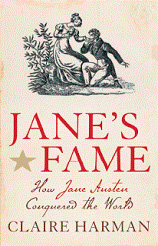
Book Review ~ “Jane’s Fame” by Claire Harman

book cover jane's fameMany of us who grew up in the late 40s – early 50s had our Jane Austen force-fed to us in high school (unless we were fortunate enough to be blessed with an Austen-loving mother or father!).  Pride & Prejudice was the standard text with little reference to the other works; followed by George Eliot’s Silas Marner, Dickens’s A Tale of Two Cities and / or Great Expectations, Shakespeare (hopefully!), and Hemingway, Steinbeck, Salinger for contemporary authors.  But I’ve often thought that Austen got a bum-rap with this “required-reading” status, the educational system’s way of compensating for what an early critic said in calling Austen “a critic’s novelist – highly spoken of and little read.” [p. 120]  And while I am the first to admit that Austen is not for everyone [their terrible loss!], I have long believed that this approach to Austen added to her suffering from the great reader-turnoff. 

For me, a voracious reader as a youngster and teenager, I went on to read some of her novels, but alas! not all, feeling more at home with Alcott, the Brontes, Dickens, and later Wilkie Collins, all those more accessible Victorian novelists.  So it was in later life that I returned to Austen – and I perhaps needed that distance of time (and some wisdom!) to re-appreciate her brilliance – the humor and irony, the language, that characterization, and of course, the age-old love stories.  So from my current vantage point I marvel at Austen’s ability to stay fresh, to speak to different generations, and to speak to each individual in different ways through one’s own life. And in these fifteen plus years of “re-Austenising” myself, I’ve gone much beyond the novels, to the biographies, criticism, her Regency / Georgian world, and the current surfeit of films, and sequels and continuations, and even the latest parodies, creating quite a book collection in the process – and I have really barely begun!  

So I was most excited to hear about the release of Claire Harman’s new book, Jane’s Fame: How Jane Austen Conquered the World [Canongate, 2009], stirring up controversy even before it hit the bookstores [see my previous post, “Discord in Austen Land”].  [Harman has authored Fanny Burney: A Biography (Knopf, 2001) and works on Sylvia Townsend Warner and Robert Louis Stevenson].   It is an engaging read – historical, biographical, critical and anecdotal, all rolled into a capsule of Austen’s claim to fame – and just why was she so popular?  “the public whipped into a frenzy” [p. 243]  in the late nineteenth century and again in the late twentieth? – by “[James Edward] Austen-Leigh’s Memoir in the first instance, and in the second, a man in a wet shirt” [p. 243] [with thanks to Colin Firth!] – simplified reasoning perhaps, but a good chuckle and that glimmer of truth. 

Harman explains that

…this book charts the growth of Austen’s fame, the changing status of her work and what it has stood for, or been made to stand for, in English culture over the past two-hundred years.  In the foreground is the story of Austen’s authorship, one of persistence, accident, advocacy, and sometimes surprising neglect.  Not only did Austen publish her books anonymously and enjoy very little success during her lifetime, but publication itself only came very late, after twenty years of unrewarded labor.  I have sought to reconstruct these pre-fame years in the spirit of uncertainty through which Austen lived them.  Her prized irony and famous manipulation of tone I believe owes much to it; part of the reason why she pleases us so much now is that she was, for years, pleasing only herself.  [p. 7-8]

Thus, Harman starts by placing Austen squarely in the context of her times – her family and friends as writers – her mother, brothers James and Henry, her friend Anne Lefroy’s brother Samuel Egerton Brydges, and her pride in her own quite delightful juvenile writings.  Incorporating a general account of Austen’s life [Harman assumes the reader brings much knowledge of Austen’s life and gives only a cursory telling], she presents us with a great summary of Austen’s writings, the publication history and early responses to each work, drawing heavily on Brian Southam’s Jane Austen, The Critical Heritage [London 1968], and emphasizing Austen’s literary ambitions. [for more on this, see Jan Fergus’s The Professional Woman Writer” in The Cambridge Companion to Jane Austen, one of the earlier scholarly arguments to clearly see Austen in this light, far removed from the portrait painted by her brother Henry and later her nephew.]

Following Austen’s death in 1817, her copyrights still owned by Cassandra were sold to Richard Bentley and his issue of all six novels in 1833 did much to keep Austen in print; but her popularity waned, the rise of the Victorian novel sending Austen to the shadows, not to mention Charlotte Bronte’s dislike of Austen, quoted by Elizabeth Gaskell in her Bronte biography in 1857 [but ironically, how close is Gaskell’s North & South to Pride & Prejudice!]  So Austen remained largely unread until the Austen-Leigh Memoir of 1870, followed by various new editions of the novels and the selected letters in 1890. 

Harman explores in her chapter on the “Divine Jane” [quoting W.D. Howells] the publishing of these new editions and the illustrated versions that sought to “fix the characters in one’s mind” [p.159], the biographies, and critical analyses in this first burgeoning fame-fest, and her new status as darling of the intellectual snobbish-elite, championed by the likes of Leslie Stephen, Henry James, George Saintsbury, and Howells [and of course, not to leave out Mark Twain’s adamant dislike!] – all this culminating in R.W. Chapman’s Oxford edition of her works in 1923, “the first complete scholarly edition of any English novelist.” [p. 192]. 

In “Canon and Canonisation,” Harman chronicles the scholarly critical analysis that continues unabated to the present – the vast extent of academic and non-academic writing – on the one hand, Austen as a pleasure-read, the writer “who wrote so clearly and simply, and who was so small scale” [p. 200] – and on the other, the critical study of Austen’s “unconsciousness and brilliance” and here we see her “easy passage into English literature courses” [p. 201].  Austen makes critical literary history as manuscripts and contemporary memoirs became available for study – resulting in library collections, various illustrated editions, Jane Austen Societies, interest in her “homes and haunts,” more biographies from various standpoints, new paths of criticism taking into account the political, sociological and historical elements, and the many works on the manners and mores, fashion and handiwork, cookery and letter-writing – all things Austen indeed! [A friend visiting my home recently asked me what could all these Austen-related books on my shelves possibly be about when she only wrote six books!] 

And finally to film and what she terms “Jane Austen TM”, Harman again summarizing all that came before the “wet shirt” and after – the movies, the sequels, the internet and YouTube concoctions, the blogsphere , the Societies, the fan-fiction sites, the costume-driven fanatics, etc.  And Harman ends with the question, “What would Austen have made of all this? [p. 278] – in answer, she cites the differing views of D.W. Harding, Lionel Trilling, Henry James, and E.M. Forster to prove to us that “the significance of Jane Austen is so personal and so universal, so intimately connected with our sense of ourselves and of our whole society, that it is impossible to imagine a time when she or her works could have delighted us long enough.” [p. 281]

 One of the criticisms of Harman’s book has been her light non-academic approach to Austen [and perhaps her re-working of others’ ideas into this “popular” framework] – but it all works so well for what and for whom it is intended.  Harman’s gift is taking an inordinate amount of primary and secondary material and presenting it into a very readable, information-packed and anecdotal whole – everything you would ever want to know about Jane Austen all put together in a neat little package of 342 pages.  This of course may be its greatest shortcoming – too neat a package with strong authorial opinions thrown in [and a feeling to this reader of all being rather rushed at the end – “let’s wrap this up, throw in a few final tales and get it published” sort of feeling…] –  it must needs be leaving something out! [Indeed, the 2005 Pride & Prejudice barely gets a mention, either an oversight or the expression of the author’s opinion of that film – but no matter what your views of that adaptation might be, it has to be praised for bringing Jane Austen and P&P  to yet another generation who do not find Colin Firth’s wet shirt scene all that WE make it out to be – and thus it is a clear topic for Jane’s current and ongoing “fame.”] 

But as a resource, with a terrific reading list to be gleaned from the text and bibliography [though I do quibble with the number of un-sourced quotations and overly shortened citations that are unclear (especially in regard to the letters – a number and date would have been most helpful!)], Jane’s Fame should be required reading [not force-fed please…] for anyone interested in the facts of Austen’s writing life and how she has risen to such heights and commands such a presence in so many people’s lives.  And you will likely take away new and interesting tidbits such as finding what Katherine Mansfield had to say about Emma:  “Mr. Knightley in the shrubbery would be something!” [p. 247] [aah! indeed!]

4 1/2 full inkwells [out of 5]

 Further Reading: [all page citations above are to Janes’ Fame]

  • See my post on the various Reviews of Jane’s Fame
  • Copeland, Edward, Juliet McMaster, eds.  The Cambridge Companion to Jane Austen.  Cambridge University Press, 1997.
  • Fergus, Jan.  “The Professional Woman Writer” in The Cambridge Companion, pp. 12-31, where Fergus summarizes and expands these arguments first presented in her Jane Austen: A Literary Life. London: Macmillan 1991.  These are must-reads…
  • Sutherland, Kathryn.  Jane Austen’s Textual Lives: from Aeschylus to Bollywood. Oxford, 2005, pb 2007.  Note that it is Professor Sutherland who started the controversy that Harman essentially lifted her ideas – I have this book and have skimmed it only, so cannot comment fully – but just looking at the table of contents, one finds the similarities a little alarming, and the Sutherland book has far more depth to the notes and bibliography – but again, I emphasize the “popular” nature of Harman’s book. 
  • Todd, Janet, ed.  Jane Austen in Context.  Cambridge University Press, 2005, 2007 with corrections. 
  • Claire Harman’s website with cites to reviews of Jane’s Fame
  • Austenblog:  Mag’s review of Jane’s Fame

Posted by Deb