Book reviews · Books · Fashion & Costume · Jane Austen · Regency England · Social Life & Customs

Interview with Jennifer Forest, author of “Jane Austen’s Sewing Box”

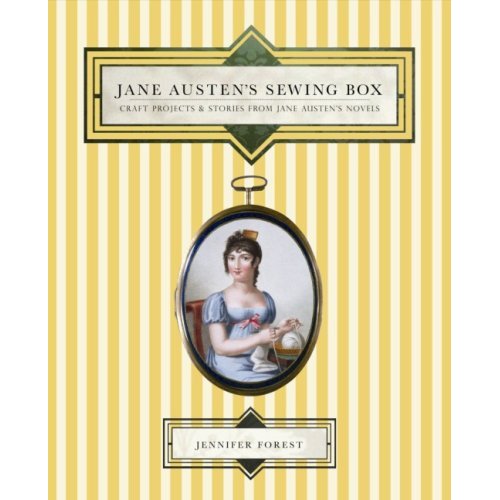
book cover jane austens sewing box


Today we have Jennifer Forest joining us to share her thoughts on her new book Jane Austen’s Sewing Box: Craft Projects & Stories from Jane Austen’s Novels [NSW, Australia: Murdoch Books, 2009]:

What inspired Jane Austen’s Sewing Box? 

I love Jane Austen, history and craft so it seemed quite natural for me to join these  interests.  A few years ago, re-reading Jane Austen’s novels I noticed that she makes quite a few references to craft including sewing, knotting, painting and netting. It spurred me on to start digging around to find out what the crafts were that Jane Austen’s women were doing.  The Regency left a strong design legacy and there are many examples of the beautiful craft worked by women during this great period for arts and craft. 

What types of projects are in the book?  

Just as Jane Austen includes a range of craft references in her novels, there are also a range of projects in the book.  All projects are based on her novels and letters, so there’s everything from making paper flowers, to embroidery, sewing, painting, knitting and those lost arts of netting and knotting.  

What skills do you need to do the projects? 

I really believe that craft should be something you can do, not something you struggle with to the end! So there is something for all skill levels from beginner and intermediate projects to more advanced projects for experienced crafty people.  I also used materials and tools true to the period that can be sourced from shops today. 

How did you use original objects from the Regency for Jane Austen’s Sewing Box? 

I have been fortunate to work in museums where I was surrounded by beautiful objects from the past, so I knew there was a collection of Regency items available for research. Each project is based on original examples from the Regency period, from the overall design right down to details like the actual size of a finished piece, colours and materials. 

Were Regency women the original “domestic goddess”?

Well, the home was their empire in the Regency and craft skills were so important to the management of a household that it was called “women’s work”.  The ability of women to hand sew was crucial to clothing the family and helping support the poor in their village.  This was a time before sewing machines and shopping malls, when it wasn’t so easy to buy what ever you needed.  Even when tailors and dressmakers were used, women’s work in many families provided the men’s shirts, children’s clothes, nightwear, towels, sheets and bedding.  

How long would she spend on “women’s work”?

A Regency woman either alone or in a work party could easily spend 4 to 5 hours a day working.  Jane and Cassandra Austen often made their brother’s shirts, even when they had left home, married and in Charles’ case, joined the navy.  Jane Austen was proud of her neat running stitch in making up her brother’s shirts!

 Was it all sewing shirts and making towels?

No, craft skills gave women a way to show their creative talents.  Much of the professional world, including art, was only really open to men.  But Regency women also loved arts and design. Craft skills allowed a woman to express her creativity and design abilities, whether that was in a handmade huswife or purse to be given as a gift or in painted pieces like the firescreens made by Elinor Dashwood in Sense and Sensibility.  

Why do you love Jane Austen? 

I think every time I read her novels my reasons for liking them change!  Her character portrayals are far better than most writers.  I think most of us today still recognise her characters in people we know – we’ve all known an ‘Emma Woodhouse’, a ‘Miss Bates’ or a ‘Fitzwilliam Darcy’.  She is actually quite funny and witty in a beautiful and clever way.  But at the same time I think she was an acute observer and sharp commentator on her times. 

What handiwork / craft do you do? 

I love trying out new crafts skills so I’ve experimented with a range of different things. What I keep coming back to though is screen printing (love combining paint and fabric), felting, sewing and embroidery.

*******************************************************

Thank you Jennifer for joining us today!  If anyone has any questions, please send a comment and I will get those answered for you.  I received the book in the mail yesterday and will be posting a review of it tomorrow – it is a wonderful compilation of history, Austen quotes, visual treats and, of course, the crafts!  The book is now available for ordering on amazon.co.uk ; there are several available copies from independent sellers on the US Amazon site, but is not actually available yet in the US.

Further reading:

Posted by Deb

Books · Fashion & Costume · Jane Austen · Regency England · Social Life & Customs

On My Bookshelf ~

I love my mailman!  He brings me such gifts almost on a daily basis – yesterday he brought these two books:

book cover ja unrequited love 

Jane Austen: an Unrequited Love, by Andrew Norman [The History Press, 2009] – where the author proposes “that Jane and Cassandra had a falling out over a young clergyman, whom he identifies for the first time.  He also suggests that along with the Addison’s disease that killed her, Jane Austen suffered from TB.”  [from the jacket]


book cover jane austens sewing boxJane Austen’s Sewing Box: Craft projects and stories from Jane Austen’s Novels,  by Jennifer Forest [Murdoch Books, 2009] [see Janiete Kelly’s post on this title] – it is a sumptuous book! 
Please join us tomorrow when I will post an interview with the author, as well as review the book. ~

[I am now going in search of my long-abandoned embroidery supplies… ]


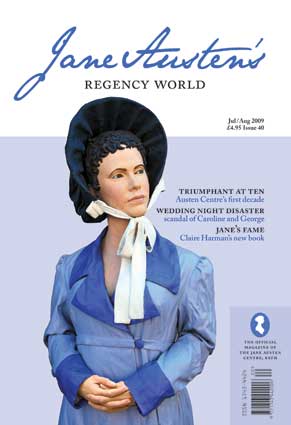
 … and today he brought me the latest issue of Jane Austen’s Regency World [July/August 2009] – as always cram-packed with interesting articles and lovely illustrations – on Austen, Mary Shelley, Queen Caroline, global warming in JA’s time, book reviews, and much more [I will post the full contents tomorrow], but you can see hightlights of the issue as well as download a sample article from a previous issue at the magazine’s website [note that this is the NEW website for JARW, so change your links in your “favorites.”]

JARW_40_Cover_small


How sad to be burdened with a day-job with all this reading to be done!

Posted by Deb

Books · Jane Austen · News

A Little Help with Your Next Read ~

pile of booksMost of us are always looking for a recommendation of what next to read – despite our toppling TBR piles, there is always room for a new title! – And those of us who read Jane Austen, and then re-read Jane Austen, are forever asking what to read after you have read it all, again and again. 
So I enjoyed this article I found at the Guardian.com book blog on “the murky business of book recommendations” by Chris Powell – he refers to a website that offers book suggestions by just typing in the last book you have read:  The Bookseer at www.bookseer.com– there are two lists, one from Amazon.com [they are everywhere; so much for your local bookseller], and Library Thing.

This is sort of fun, so try it [though when I tried it tonight, there was a problem with Library Thing loading its data – Powell in his article says that when he loaded Ray Bradbury’s The Illustrated Man, Library Thing brought up Wuthering Heights and then a slew of Jane Austen books – so a tad off course perhaps – for me tonight, all I get is “nada” for the Library Thing list [the Bookseer is also on Twitter where there is some talk about this problem…]

Anyway, this is too much information – I have typed in Emma, and get all six Austen novels and nothing else;  Our Tempestuous Day by Carolly Erickson and get a list of other Regency-related works [including a new one I did not know about!];  John Steinbeck Of Mice and Men, and I find I should read Catcher in the Rye, To Kill a Mockingbird, Blood Brothers, Lord of the Flies, and A View from the Bridge [all your basic uplifting stories, and all of which I have read… thank you very much, but it is a nice list] – and if you type in The Grapes of Wrath, it is a similar list with the addition of a few other Steinbeck titles and The Great Gatsby.  Library Thing is still saying “nada” – so still not working, which is too bad because I think that list is more interesting [I think that Jane Austen titles come up for all requests…]

But you can really get into this and try to figure out the brain behind the computer – if you put in Evelina by Fanny Burney, you get the expected 18th century staples and then Sexing the Cherry by Jeanette Winterson pops up!  [I am having way too much fun…] – but if you type in any book by Mark Twain, all you get is a list of Mark Twain titles [he would be pleased…] [BUT Huckleberry Finn brings up Oscar Wilde’s The Importance of Being Earnest – go figure…

And here is my favorite:  The Bible [no author] [it came back and said, “by Jove, I need an author for that!] so I typed in “God” and these titles came up:

THE SHACK!! – OMG, now that’s some incredible marketing! And Amazon must assume the Bible is a childrens’ book…yikes!

But I save the best for last – Pride and Prejudice by Jane Austen, and along with a picture of P&P and Zombies [I am not kidding…] we get the following booklist:

…and LibraryThing recommends:

Nada…

Ok, I am done with this…but I just HAD to share – let me know what YOU come up with!

Posted by Deb

Books · Jane Austen · Literature · News · Rare Books

Auction Results ~ Austen on the Block

The Jane Austen Pride & Prejudice  for sale at the New York Bloomsbury Auction of June 23, 2009 with an estimate of $50,000. – $70, 000.  remains unsold [for more details on this see my original post here]

A quick summary of a few other items of interest:

Bronte [Acton, Currer and Ellis Bell]. Poems. Philadelphia: Lea and Blanchard, 1848. first american edition. est. $800 – $1000. Sold for $700

Samuel Taylor Coleridge.  Poems on Various Subjects.London: for G.G. and J. Robinsons, and J. Cottle, Bristol, 1796. first edition of Coleridge’s first book of poems, issued together with the first published verses of Charles Lamb, signed C.L. Hayward est. $1000 – $1500.  Sold for $2600 [a few other Coleridge items either did not sell or sold for less than the estimate]

John Keats – a first edition of his last collection of poems estimated at $12,000 – 15,000 was unsold

Percy Bysshe Shelley. Queen Mab; A Philosophical Poem: With Notes. London: privately printed by P.B. Shelley, 1813. very rare. est. $12000 – $18000; Sold for $11000 [ most other Shelley items did not sell]

William Wordsworth. Lyrical Ballads, with Pastoral and Other Poems, in Two Volumes. London: R. Taylor and Co., 1805. 2 volumes [the last edition in which Coleridge’s poems appear]. est. $1500 – $2000; Sold for $1700 [other Wordsworth items sold for lower than estimates or not at all]

Thomas Hardy. There were 22 Hardy items for sale, many of the books remain unsold, but most of the autograph letters sold mid-range or less than the estimates- here is one example:   Three autograph letters signed to Florence Yolland on the Death of Emma, Hardy’s first wife.Max Gate, Dorchester: 24 December 1912 to 22 October 1913. 6 manuscript pages, 8vo (varying sizes). Mourning stationery, three autograph envelopes (all labeled “opened by censor” when sent to F. Adams in 1939) est. $2000 – $3000; Sold for $1000.

Full auction results can be found at the Bloomsbury Auction website.

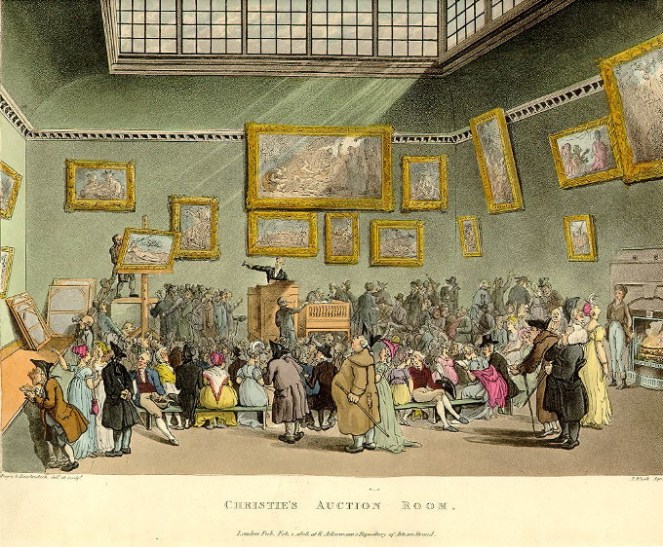
Christies auction room image

[image from the NYPL.org]

Posted by Deb

Books · Fashion & Costume · Jane Austen · News · Social Life & Customs

Jane Austen’s Sewing Box

sewingAusten-lover and author Jennifer Forest sends information about her new book (due out in the UK July 6 and available for pre-order), Jane Austen’s Sewing Box (Murdoch Books; 224 pages; £14.99).

If you love handicrafts, this books contains 18 projects, which involve sewing skills, needleworking, netting, painting, paper craft and knitting! Forest has set the projects in their history and literary context, placing Regency-era handiwork alongside extracts from the novels; an explanation of why women made such items; full color photos; and step-by-step instructions.

“Yes, all of them [are accomplished women] I think. They all paint tables, cover screens and net purses.” — Charles Bingley

Jennifer describes the book:

The projects in Jane Austen’s Sewing Box are both objects of beauty and useful for our contemporary lives. Using a range of techniques and readily-available materials and tools, the projects are easily accessible for all skill levels and interests.

All projects are modelled on:

  • projects worked by Jane Austen’s characters
  • work of her circle, and noted in her letters
  • original objects from the Regency period

As a sewer-knitter-crocheter-needleworker, I can’t wait to see this book.

Look for information on Jennifer Forest, and Jane Austen’s Sewing Box, on her website. And stay tuned for a guest appearance by Jennifer on this blog…

[submitted by KM]

Books · Jane Austen · Literature · News

Mark Twain on Jane Austen ~ Methinks he protests too much!

My son popped in the other night, quite excited about his discovery in a new Mark Twain book of an essay on Jane Austen – he was thrilled to pass on to me the curmudgeon-par-excellence of Twain bashing Austen.  He was disappointed to discover I already knew about Twain’s avid dislike of Austen – but I appreciated his concern for my feelings!

who-is-mark-twain-cover

The new Twain book is Who is Mark Twain, edited by Robert H. Hirst, The Mark Twain Foundation, 2009 [texts copyrighted 2001].  As Hirst explains in his Note:

I have described all twenty-four pieces as ‘previously unpublished,’ by which I mean not printed or otherwise made readily accessible to the general reader.  More strictly speaking, all of them were included in a microfilm edition issued by the Mark Twain Project in 2001…. But Who is Mark Twain? represents the first time any of these manuscripts has been published for a general audience.

The book is a collection of essays penned by Twain over the years but never published – one of these is titled “Jane Austen” written in 1905.  I knew of this essay because it was actually published by Emily Auerbach in the Virginia Quarterly Review [Winter 1999] and latterly in an Appendix in her Searching for Jane Austen [University of Wisconsin, 2004], along with an insightful article on Twain.  But alas! the book sits upon my shelf, skimmed, and I did not read this until my son gave me the nudge. [There have also been other posts on some of the Austen blogs about this and I don’t mean to be repetitive, but finally just getting to this … thanks to my son!]

Auerbach asks the question in her article “A Barkeeper Entering the Kingdom of Heaven:  Did Mark Twain Really Hate Jane Austen?” – she concludes that perhaps Twain was “a closet Janeite, a fake who read and appreciated far more of Jane Austen than he admitted” [p.299]; that his astute and unfinished essay on Austen indeed proved that he really “got” her [p.301], and despite all his moanings to the contrary, they were more alike than not in observing and depicting human foibles and relying on humor to best express their views [Auerbach compares Twain and Austen to the pairing of Bogart and Hepburn in the film The African Queen: Twain “the irrepressible riverboat pilot, and Austen, the tea-drinking maiden aunt.” [p. 302]- this made me smile!]

I am appending several passages from Twain’s essay, as it quite delightful and many of you may not have read it.  Go out and buy the book – and the other essays cover all manner of Twain’s humorous musings.

Whenever I take up “Pride and Prejudice” or “Sense and Sensibility,” I feel like a barkeeper entering the Kingdom of Heaven. I mean, I feel as he would probably feel, would almost certainly feel. I am quite sure I know what his sensations would be—and his private comments. He would be certain to curl his lip, as those ultra-good Presbyterians went filing self-complacently along. Because he considered himself better than they? Not at all. They would not be to his taste—that is all.

*****

Does Jane Austen do her work too remorselessly well? For me, I mean? Maybe that is it. She makes me detest all her people, without reserve. Is that her intention? It is not believable. Then is it her purpose to make the reader detest her people up to the middle of the book and like them in the rest of the chapters? That could be. That would be high art. It would be worth while, too. Some day I will examine the other end of her books and see.

***

All the great critics praise her art generously.  To start with, they say she draws her characters with sharp distinction and a sure touch.  I believe that this is true, as long as the characters she is drawing are odious.  I am doing “Sense and Sensibility” now, and have accomplished the first third of it – not for the first time.  To my mind, Marianne is not attractive; I am sure I should not care for her, in actual life. I suppose she was intended to be unattractive.  Edward Ferrars has fallen in love with Elinor, and she with him; the justification of this may develop later, but thus far there is no way to account for it; for, thus far, Elinor is a wax figure and Edward a shadow, and how could such manufactures as these warm up and feel a passion.

Edward is an unpleasant shadow, because he has discarded his harmless waxwork and engaged himself to Lucy Steele, who is coarse, ignorant, vicious, brainless, heartless, a flatterer, a sneak— and is described by the supplanted waxwork as being “a woman superior in person and understanding to half her sex;” and “time and habit will teach Edward to forget that he ever thought another superior to her.” Elinor knows Lucy quite well. Are those sentimental falsities put into her mouth to make us think she is a noble and magnanimous waxwork, and thus exalt her in our estimation? And do they do it?

Willoughby is a frankly cruel, criminal and filthy society-gentleman.

Old Mrs. Ferrars is an execrable gentlewoman and unsurpassable course and offensive.

Mr. Dashwood, gentleman, is a coarse and cold-hearted money-worshipper; his Fanny is coarse and mean. Neither of them ever says or does a pleasant thing.

Mr. Robert Ferrars, gentleman, is coarse, is a snob, and an all-round offensive person.

Mr. Palmer, gentleman, is coarse, brute-mannered, and probably an ass, though we cannot tell, yet, because he cloaks himself behind silences which are not often broken by speeches that contain material enough to construct an analysis out of.

His wife, lady, is coarse and silly.

Lucy Steele’s sister is coarse, foolish, and disagreeable.

[from Who is Mark Twain, pages 47-50]

And there it ends – quite the review! [and as almost everyone has pointed out, Twain applies the word “course” to nearly all the characters in the book]- one would think he was actually enjoying EVERY minute of his reading of S&S! [don’t you just LOVE the “filthy” Willoughby!?]

mark_twain_mug_shot


Further reading:

  • Auerbach, Emily, Searching for Jane Austen [University of Wisconsin Press, 2004]
  • Flavin, James.  The Sincerest Form of Flattery:  Twain’s Imitation of Austen.  Persuasions 25, [2003], pp. 103-109 [not online] [Flavin’s premise is that Twain actually COPIED Austen’s famous scene of money manipulation between Fanny and John Dashwood in S&S in his Life on the Mississippi] – a great article
  • Twain, Mark; Robert H. Hirst, editor.  Who is Mark Twain? [ Mark Twain Foundation, 2009]
  • The Offical Website of Mark Twain
  • The Mark Twain House [Hartford Connecticut]

Posted by Deb

Books · Jane Austen · Movies · News

Better Late than Never

Long over due are many comments on VARIOUS Austen (or Austen-related) topics. I have been so lazy in completing my online thoughts on the Austen Symposium in Lennoxville, Quebec (March!), and when at lunch with Janeite MKay, and she asked about the play, I had the thought: Well, better late than NEVER! So thoughts on that, and the last talk will come — I promise!

A little closer in time are two JASNA meetings. Our own JASNA-Vermont chapter hosted HOPE GREENBERG in Montpelier on June 7th; and Montreal/Quebec City’s chapter hosted a ‘Donwell Abbey’ strawberry picking at Elaine Bander’s Montreal home.

Before I forget – since Donwell Abbey reminds me – David from Montpelier, who attended our meeting on the 7th (he is a JASNA member! Yeah, David!!), spoke about reading P.D. James. This brought up James’ JAS (Jane Austen Society; in Britain) lecture a decade-plus ago. I just happened to have a copy of that the year’s “Report” (as JAS’s journal is called). So in digging it out for David, I re-read it myself. She brings up some points (since she treats Emma as a detective novel) about ‘clues’ in the novel that is unique and thought-provoking. But for me the more startling ideas were thoughts fired by her comments on Mr Knightley! James painted a picture of an exceptionally strong man, one who not the namby-pamby many name him to be. Makes me want to pull the novel out again — and soon!

HopeGreenberg_orange-regencyHope’s illustrated lecture on Fashion was one of the most comprehensive I have ever had the priviledge to listen to. The amazing amount of pictures – drawn from paintings, clothing (who knew Burlington’s Fleming Museum had so much in their ‘attics’!!), period drawings, etc. – as well as the lovely gowns Hope had on display (including the one she wore!), all brought to our capacity audience, visually and virtually, the fashion in Austen’s era. Thank you, Hope.

One JASNA-Vermont couple, Jim and Carol, had this to say about the presentation: Sunday was delightful …We enjoyed the presentation, especially once the sound was turned up a bit [Hope was microphoned]. I thought the visuals were very effective and useful for someone who is not at all versed in the subtleties of Regency fashion. Indeed, I have been most impressed with the intellectual content and professionalism of all three presentation we have attended. We look forward to our next meeting!”

Thanks, Jim! Great to hear such words of encouragement.

David wrote succinctly: “Thank you for hosting such a nice event…It was the largest attendance I have yet seen at a lecture, although it was only my third.”

We do have a growing and attentive audience in the Montpelier region! ‘Thanks,’ to everyone who attended Sunday.

And David shared his opinion that to bring Austen elsewhere in the state would greatly increase our presence; he writes about having some thing in St. Johnsbury — someday.

For the Montreal JASNA meeting, I went in order to meet their guest speaker, Jan Fergus. Jan’s book on 18th century publishing in Britain utilized the 1730-40 ledger (held at the Bodleian) belonging to Robert Gosling — Mary Gosling’s great-grandfather (my diarist; see SmithandGosling.wordpress.com, my research blog). Jan decried the sloppiness of Norton’s recent Austen publications; she ‘would proof them for free’, she exclaimed, as she showed the handwritten notes in the rear cover of her copy. Her lecture was a preview of her AGM lecture – on Brothers and Sisters in Austen’s novels, of course (Jan centered Sunday’s talk on Jane and Elizabeth Bennet).

The food was plentiful – and the strawberries sweet and delicious! Elaine has a lovely home, and I’m sure everyone was grateful for the invitation to visit her perfumed garden (peonies!). The weather held off just enough to make the day quite pleasant.

Two of the Montreal members are off to England, Elaine Bander herself; and Peter Sabor gives a paper at the Chawton Conference. Someday I hope it’s me that is able to hop a plane and have people anticipate some talk I’m about to give…

Which reminds me again, and I will close with this thought, of my lunch with MKay. We got to discussing – what else! – P&P films (1980, 1995 and 2005), as well as Lost in Austen. And that brought around a discussion of Darcy and Mr Collins. Between this lunch and Jan Fergus’s talk, I am convinced more than ever that 1995 (and, by extension, the Lost in Austen series) got poor Mr Collins ‘wrong’; that Charlotte was never a martyr to her marriage (a match made in heaven? perhaps not; but NOT a match made in hell either…); and that there is more to the Darcy-Collins pairing than people are willing to admit (MY paper proposal for Chawton; not accepted, of course.)

Time’s a tickin’ and Sunday morning’s winding down; so I will get off my soap box and get back to my book – a fascinating look at Virigina Woolf’s servants: Mrs Woolf and the Servants, by Alison Light. A ‘souvenir’ from my Montreal trip…

Still haven’t heard if my registration for the AGM puts me in among the 550 members going to Philadelphia… I see the numbers, as of 6/19, now stand at 503.

And JASNA’s website announces the inclusion of Persuasions vol. 3 – published in 1981. We must applaud JASNA’s dedication (and those who put these journals online for all) in making these invaluable resources available, and for free!

Books · Jane Austen · News · Rare Books

Austen on the Block

Auction picture - P&P 62309

314. [AUSTEN, Jane (1775-1817).] Pride and Prejudice: a Novel in Three Volumes. London: T. Egerton, 1813. 3 volumes, 12mo. Half-titles. Contemporary dark brown sprinkled calf, brown endpapers, gilt volume numbers to spine, green morocco gilt lettering pieces to style, with “Charleton” gilt-stamped to upper cover; half morocco folding case. Condition: intermittent foxing; rebacked preserving original spines, a little wear to extremities, exposure to several corners, renewed lettering labels. Provenance: Frida Best (bookplate); Susan Carnegie? with intriguing provenance of an early feminist author.

It is tempting to identify the ownership stamp with Charleton House, Montrose, the home, from her marriage in 1769 until her death in 1821 of the feminist writer and philanthropist Susan Carnegie: “…she learned to challenge the idea that women were intellectually less able than men, choosing instead to explain discrepancies in terms of women’s educational opportunities and their general treatment in a patriarchal society. Certainly in her correspondence Susan was fearless in drawing attention to a lack of respect or of rudeness on the part of male writers. Prior to her marriage to George Carnegie of Pitarrow (1726-1799), she acknowledged her future husband’s right to command her, but hoped ‘that he never will have [the] occasion or inclination to exercise it’. (Oxford DNB). On her death the estate passed to her grandson George Carnegie Fullerton, poet and sportsman. His extravagances resulted his sale of the three Ayrshire properties, and another other volume with this ownership stamp, a copy of Charles Emmanuel de Warnery’s Remarks on Cavalry, 1798, sold at Bonham’s in 2003.
First edition. Gilson 3; Grolier Hundred 69; Keynes 3; Sadleir 62b.

est. $50,000 – $70,000

[from the Bloomsbury Auctions Catalogue.  “Fine Books & Manuscripts, Literature and Americana” –  New York,  Sale June 23, 2009.  See the Bloomsbury website for more information on the sale.]

Books · Jane Austen · Literature · News

Silksoundbooks ~ Audiobooks read by your favorite actors

 I stumbled upon this yesterday – Silksoundbooks.com, an audiobooks website with some of your favorite actors reading their favorite classics:

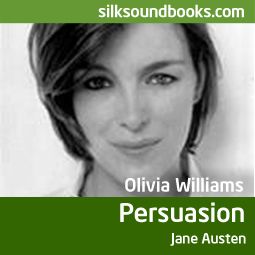
silksoundbooks persuasion

Silksoundbooks is a collaboration of English and American actors who came together and decided to record their favourite literature for you to enjoy. Headed by Bill Nighy (Pirates of the Caribbean / Love Actually / Underworld), many of the artists involved believe so much in the project, that they have waived performance fees in favour of taking shares in the company.

Unlike some audio book download websites, we record all our audio books in the leading recording studios in London and New York, with some of the most experienced directors from the worlds of radio, TV & film…… we are sure you will hear the difference!

We started this project with one simple aim – to deliver great quality audio books to you at great value – Just $14.95 each! Enjoy!

[from the website]

Check out the website at Silksoundbooks.com and see the catalogue of 64 books currently available, all are unabridged and exclusive to this project. Here is a sampling of books and the readers [but alas! no Richard Armitage, yet …  can we petition for him?!]  Part of the delight is to find a good number of actors / actresses related to Jane Austen films in some way, and two of Austen’s novels:

  • Jane Austen.  Persuasion, read by Olivia Williams
  • Jane Austen.  Northanger Abbey, read by Lynn Redgrave
  • Elizabeth Gaskell.  My Lady Ludlow, read by Susannah York
  • Henry James.  Washington Square, read by Jennifer Ehle 
  • Emily Bronte.  Wuthering Heights, read by Juliet Stevenson
  • Charlotte Bronte.  Jane Eyre, read by Emily Woof
  • Fanny Burney.  Evelina, read by Finty Williams, Judi Dench and Geoffrey Palmer
  • Mary Shelley.  Frankenstein, read by Derek Jacobi
  • Joseph Conrad.  Heart of Darkness, read by Toby Stephens
  • Gustave Flaubert.  Madame Bovary, read by Julie Christie
  • Henry James.  The Aspern Papers, read by Jeremy Northam
  • Henry Fielding.  Joseph Andrews, read by Rufus Sewell
  • George Eliot.  Mill on the Floss, read by Fiona Shaw
  • Hans Christian Andersen.  The Snow Queen and other Fairy Stories, read by Greta Scacchi
  • Thomas Hughes.  Tom Brown’s Schooldays, read by Hugh Bonneville

And this is just a short listing!  Visit the website and experience this feast – I have already downloaded Washington Square read by Jennifer Ehle [a.k.a. Elizabeth Bennet!] to my ipod – it is easy to do [you will need a current version of Java] and quite wonderful listening! 

silksoundbooks washington square

Further reading:  an article in The Guardian when the site was first launched; and another at Timeout.com

Books · Jane Austen · News · Regency England · Social Life & Customs

New Release ~ “Behind Closed Doors: At Home in Georgian England”

Just a heads-up on this book to be released October 12, 2009: 

Behind Closed Doors: at Home in Georgian England, by Amanda Vickery.  Yale University Press, 2009. [can be pre-ordered for $45.00]

Here is what the Yale University Press website has to say:

In this brilliant new work, Amanda Vickery unlocks the homes of Georgian England to examine the lives of the people who lived there. Writing with her customary wit and verve, she introduces us to men and women from all walks of life: gentlewoman Anne Dormer in her stately Oxfordshire mansion, bachelor clerk and future novelist Anthony Trollope in his dreary London lodgings, genteel spinsters keeping up appearances in two rooms with yellow wallpaper, servants with only a locking box to call their own.


Vickery makes ingenious use of upholsterer’s ledgers, burglary trials, and other unusual sources to reveal the roles of house and home in economic survival, social success, and political representation during the long eighteenth century. Through the spread of formal visiting, the proliferation of affordable ornamental furnishings, the commercial celebration of feminine artistry at home, and the currency of the language of taste, even modest homes turned into arenas of social campaign and exhibition.


Amanda Vickery is reader in history, Royal Holloway University of London, and the author of The Gentleman’s Daughter: Women’s Lives in Georgian England, which won the Whitfield, Wolfson, and Longman-History Today prizes. She is also the co-editor, with John Styles, of Gender, Taste and Material Culture in Britain and North America, 1700–1830.

… a definite addition to your want list – and if you don’t already have it, you must also add Vickery’s previous work …

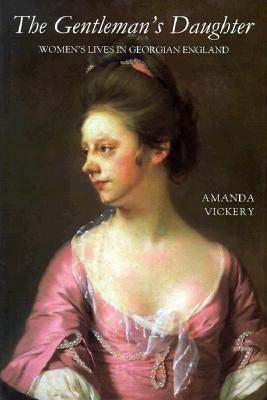
book cover - gentleman's daughter

The Gentleman’s Daughter: Women’s Lives in Georgian England [Yale University Press, 1998; softbound edition, 2003] is already on my toppling TBR pile(s).  Here are a few [of the many] reviews of this earlier work, the winner of several history/ literary awards: