This is a wonderful find: you can download The Jane Austen Centenary Booklet, 1917 at Austenonly – thank you Julie W. and Mr. Brodnax Moore for sharing this hard-to-find pamphlet produced to mark the unveiling of the Centenary Tablet on Chawton Cottage, now the Jane Austen House Museum, in 1917.
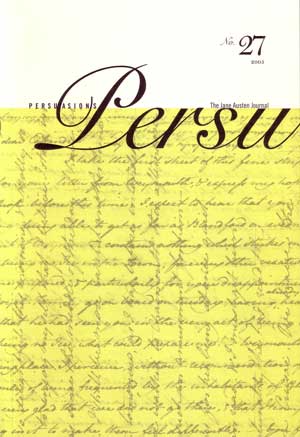
The latest issue of Perusasions – volume 33 [not as the image indicates!], papers from the Fort Worth AGM on 200 Years of Sense and Sensibility has been mailed to members [and like me you hopefully already have received it!] The journal is not online – you must be a JASNA member to receive it. Here is the table of contents:
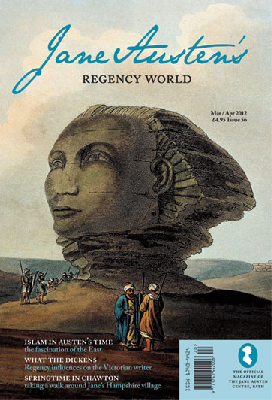
Coming soon to your mailbox! ~ the new issue of Jane Austen’s Regency World (May/June 2012, No 57):
Mozart’s Sister: a stunning new film tells of the talented musician eclipsed by a famous brother
Oops, I did it again: drink, drugs, sex and gambling… lax morals prevailed in Georgian England
Taking a tour around Steventon, birthplace of Jane Austen
Rage against the machine: how the Luddites sought to protect their jobs and their families
Exploring the character of Elizabeth Bennet
Plus … all the latest news from the world of Jane Austen, your letters, round-ups from the Jane Austen Society of the UK and the Jane Austen Society of North America, book reviews and quiz!
The Female Spectator, Vol. 16, No. 1 (Winter 2012) , the newsletter of theChawton House Library is out!
Here are the contents to whet your appetite:
“Some Treasures in the Chawton House Library Collection” – by Margaret S. Yoon, about her “discovery” at the CHL of two very important books for her studies.
“The Suit for a Case; Or, A Case for a Suit” – by Eleanor Marsden – on the recently restored suit belonging to Edward Austen Knight, and the need for a conservation-grade display case. [Lovely to see that JASNA member Sue Forgue of the JASNA-Greater Chicago Region, and author of the website Regency Encyclopedia, has already made a generous donation to the cause!] – if your are interested in helping, please email the Development Director at eleanor.marsden@chawton.net
“The Sheridan Trial” – by Helen Cole – an account of the 1787 Trial of Mrs. Lydia Sheridan, wife of Major Henry Sheridan, for adultery with Francis Newman, Esq., and the inclusion of an engraving in the CHL copy that does not seem to fit the tale…
“A Conference of Our Own: On the 20th Anniversary of the BWWA” – by Pamela Corpron Parker – on the upcoming conference of the British Women Writers Association, June 7-10, 2012 at the University of Colorado, Boulder. See here for more details: http://www.bwwc2012.com/
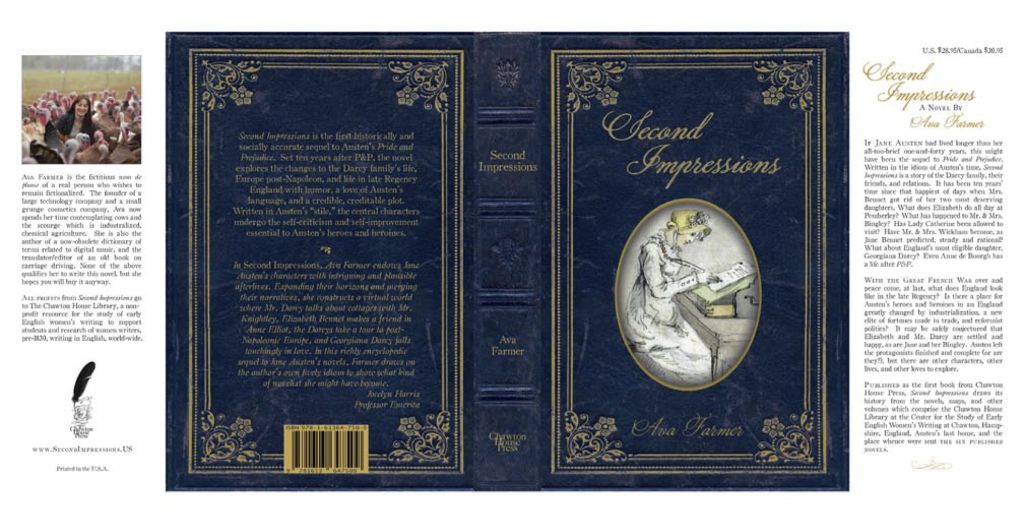
“Second Impressions by Ava Farmer: A History of a Novel” – by Sandy Lerner – on the writing and publication of her recently published Second Impressions, a sequel to Pride and Prejudice, and 26 years in the making…[see more at the Chawton House Press website.
“‘Poetry of Taste and Refinements’: Consumer Literature in Nineteenth-Century Annuals” – by Serena Baiesi – on the fashionable gift-books with their collection of engravings and literary pieces, published between 1822 and 1850.
And, “The Chawton Chronicles” – the letter from the CEO Stephen Lawrence [with the very exciting news that Dr. Gillian Dow will be taking on a broader role at CHL as Deputy Chief Executive and Director of Research!]; this issue’s “Faces of Chawton” column on Ray Clarke, the Maintenance Technician at CHL and his appreciation of CHL for his own and future generations; and the always-depresses-me because-I-live-over-here-and-not-over-there “Dates for your Diary” feature of upcoming lectures, tours, and conferences [you can look here on the website for upcoming events: http://www.chawton.org/news/index.html ]
Note that Pickering & Chatto is re-publishing a number of the rare books housed in the Chawton House Library collection in new scholarly editions. This Chawton House Library Series is organized into three areas: Women’s Memoirs, Women’s Travel Writings, and Women’s Novels. How lovely it would be to buy at least ALL the 10 novels for $675 / £395 !
I was saddened today to read about the death of Vera Quin. A message was sent to various JASNA contacts from Louise West, curator of the Jane Austen House Museum in Chawton.
Claire Bellanti, Margaret Chittick & Vera Quin at JASNA’s 2011 AGM in Fort Worth,Texas
[photograph from Kerri S. with thanks]
I had the pleasure these past few years of hearing Ms. Quin and her friend Margaret Chittick speak on all things Jane Austen at the JASNA AGMs:
in 2008 in Chicago, we saw “Looking at Landscape with Austen in Her Time and Ours”
in 2009 inPhiladelphia, we discovered how “Marginal Siblings Stir the Plot”
In 2011 in Fort Worth, we heard that indeed “Sense and Sensibility is Full of Surprises”!
…all three offering a great interchange between Vera and Margaret as they shared their knowledge and love of Jane Austen with an abundance of information, insight and laughter!
And two of my favorite books in my Jane Austen collection are by Vera Quin:
Most of the thirty surviving letters that Jane Austen wrote during her visits to London between 1796 and 1815 were written to her sister Cassandra. They provide a detailed account of the people she met and the many events she attended.
Vera Quin gives particulars of the houses where she stayed and Jane’s relationship with her London relatives, especially her brother Henry, who started in business as a banker and then became a parish priest. Despite their length and wealth of information, the letters reveal very little of Jane’s feelings, although there is more than a hint of a flirtation with the young Tom Lefroy. [from the publisher’s website]
and…
In Paris with Jane Austen. Cappella Archive, 2005. 250pp.
HB:1-902918-22-3: £17.00; PB: 1-902918-32-0: £12.00
One fascinating byway of English Literature is how quickly pirated versions of Jane Austen’s novels were translated into French and made available in Paris so soon after their publication in England. Despite the Napoleonic Wars a variety of English books and scientific papers was smuggled to France for translation, sometimes on cartel ships exchanging French and English prisoners of war.
Vera Quin has writen an engaging guide book to those streets in Geneva and Paris where Jane’s Austen’s novels were translated; where the printers and booksellers lived, and the libraries from which copies were borrowed.
She considers the differences between the English and French versions whereby, much like modern television adaptations, subtlety of language was lost but romantic appeal was amplified. She includes much background material, providing a very clear account of the French Revolution and details of the work of contemporary female novelists who were Jane Austen’s continental literary competitors. [from the publisher’s website]
[You can find copies at Cappella Archive; the London book is also available at Jane Austen Books [call to see if they might have the Paris book as well…] ]
Vera did much for her Jane Austen Society in the UK and we have been fortunate to have her attend and participate in our own JASNA gatherings where she brought much grace and humor. I am most grateful to have seen her and to have these two book gems to remember her by – she shall be greatly missed…
Jane Austen’s Regency World magazine is the only full-colour glossy magazine dedicated to Jane Austen and the Georgian and Regency times. It is published six times a year in Bath, England, and mailed worldwide by subscription. Copies are also sold via Jane Austen’s House Museum, Chawton; the Jane Austen Centre, Bath; and Jane Austen Books in the US.
We welcome today Elsa Solender, former JASNA president, now author of Jane Austen in Love: An Entertainment. The book is currently available as a kindle ebook, and I heartily recommend that you download it immediately from Amazon.com– if you have no kindle, you can add a free kindle app to your computer and various i-products, and read it that way… rightaway…
Solender’s sub-title of “An Entertainment” clearly states what this book is about – a fanciful confection of Jane Austen in love, where we are given a birds-eye view of episodes in her childhood, intimate moments with her sister, her family, and friends; an imaginary take on her feelings for Tom Lefroy; her 1-day engagement to Harris Bigg-Wither; and the fateful meeting with the rumored and wished-for ‘Gentleman suitor of the seaside’ – part real, part imaginary, and part straight from Austen’s own fiction, all beautifully woven together into this tribute to love in the life of Jane Austen. Read it, and then, as you would any Austen novel, read it again – there is much to discover and savor, and great fun to stumble upon the allusions to the letters, the known people in her life, and her very own fictional characters!
Please see below the interview for the giveaway rules [either a kindle book reimbursement or if the winner is kindle-less, a copy of Dancing with Mr. Darcy, the anthology which contains Ms. Solender’s short story “Second Thoughts.”
****************************
JAIV: Welcome Elsa! I appreciate you visiting Jane Austen in Vermont today, as we talk about your new book Jane Austen in Love: An Entertainment.
But first, tell us a little about your beginnings, your discovery of Jane Austen.
ES:My mother gave me Pride and Prejudice when I was in seventh grade and just 12. I was too young and put it aside. The next year, I returned to it, read it, loved it, and spent the month of July that year speeding through the other five Austen novels non-stop every day as if I were running—or reading — in a marathon . I didn’t reread them again until freshman year at Barnard College. The papers I produced on Emma and for assignments were all close textual analyses (I recently re-read one or two of those papers – they’re not bad). My professors were New Critics focused almost exclusively on texts and critiques, with little historical or biographical background considered. To read too much into the author’s intentions or personal background was to commit one of the dreaded critical fallacies of New Criticism. But Jane Austen’s texts stood up magnificently with minimal background material. I really didn’t learn much about her life until I joined JASNA at its inception in 1979. After all is said and done, though, it’s the novels that count – which is a rather strange thing for the author of a biographical novel to admit, I guess.
JAIV: And because I have to always at least ask the impossible-to-answer question: which is your favorite Austen novel and why?
ES:My favorite changes. I liked Emma best when I was younger – she’s an enfant terrible and a bit of a monster, with all the fascination of a monster, but Mr. Knightley loves her, and so must we. I was enamored of Mansfield Park for a while because of its problems and artistic challenges: Imagine choosing Fanny Price as your protagonist and Edmund as your “hero.” What a task Jane Austen set for herself there! I loved Northanger Abbey because I found it reassuringly imperfect in its structure, yet wonderfully entertaining, with so many amusing characters and clever lines. Then again, I think Captain Wentworth’s letter in Persuasion is one of the most passionate — but I am going on and on! Let me just say that I have always loved Pride & Prejudice – but add that when I’m not with the one I love, I love the one I’m with!
JAIV: Why do you think that Jane Austen continues to be the “darling” of academia as well as popular culture?
ES:Austen is endlessly fascinating – just as Shakespeare is. Her themes are universal, her language is rich, her psychological insights are penetrating, her social commentary is flawless, her moral compass unfailingly true. As times and trends change, new approaches to her work and life stimulate new thinking. For example, feminists in the 1970’s found her “conservative.” Then they read her again —with new eyes—and discovered her subversive qualities. Academics can still mine her work and her life – and all the spin-offs of those basic materials. JASNA’s journal, Persuasions, provides a juried venue for publication, another factor encouraging the academicians. I suspect that every gifted and ambitious young actress of every age yearns to have a go at playing Elizabeth Bennet if she can, just as the best young (and not so young) actors want to give Hamlet a try. We’ll have another bunch of filmed versions soon again, I suspect.
JAIV: You have written a novel around your short story “Second Thoughts” – the runner-up in the first Chawton House Library Short Story Contest and published in the anthology Dancing with Mr. Darcy – explain how you went from that story [did you write it first with no intention to write more?], to the full novel, and why?
ES:The idea for the story came to me in a flash when I read the contest topic (and learned that the judging would be done anonymously – my name would not be on the manuscript so no judge would know I had been president of JASNA). I wrote it very quickly and polished it for weeks afterward. I felt it was pretty risky to dare to try to enter Jane Austen’s consciousness, so I had better write it all out before I let myself get intimidated. Since I was entering her mind, not trying to imitate her prose, there could be some leeway for stylistic imperfections. While I was in residence at Chawton House Library —part of the prize for the three prizewinners of the contest— I began experimenting with the narrative point of view to see if I might extend the story into something broader than a single event in Jane Austen’s life. I was looking for a narrator who was not Jane Austen, but wrote like her – though not as well, of course.
JAIV: How do you change that story in this novel? And why? [without giving too much away!]
ES:I didn’t change much. As my narrator writes, she learns to write better, and to enter Jane Austen’s consciousness more confidently. The story is the culmination of that process, both artistically and in the merging of her own consciousness with Jane’s.
JAIV: You use Cassandra Austen as your first-person narrator – how did you decide on her and not Jane Austen, or another person in Austen’s life?
Cassandra Austen
ES:I would never try to directly imitate Jane Austen’s style although I have imitated Defoe, Boswell and Johnson in the past. I needed someone who was privy to Jane Austen’s most intimate thoughts and feelings. Who but Cassandra?
JAIV: You write in a 19th century style that does not actually imitate Austen [who can!] but sounds true to the times and Cassandra’s inner voice – how did you go about creating that voice in that time?
ES:Since my college days, I have been told that I have a pretty good ear for imitation, especially of dialogue. When I was working at Barnard after graduation, I actually ghost wrote two pieces for a symposium in a national publication which were supposed to be by two different people. When I was a student, one could sometimes substitute an imitation for a term paper in the eighteenth century literature courses that we at Barnard could take in the Columbia Graduate Faculties. I chose that option because I was so busy: I was a married student with a part–time but demanding job as a stringer for The New York Times as well as a full program of courses. An imitation required little research, just familiarity with the mechanics of style (which I had) and a good ear and a taste for satire – so I wrote “Moll Flanders in New York” and “Samuel Johnson in New York”— with lots of dialogue—and I got A’s on both. What I did was start out reading something by the author I was imitating and just continued on in the same voice into my own plot. I familiarized myself with Cassandra’s letters and found I could pretty well pick up on her sentence structures and vocabulary– although one has to reach beyond imitation and empathize with the character one is creating for a novel. I hope I did that in my book.
JAIV:Jane Austen in Love: An Entertainment tells the story of some of the most private and intimate episodes in Austen’s life. We know so little really – the “facts” are quite sparse and there has been much speculation through the years. It is so tempting for her “disciples” to fill in the blanks – from the letters, the works and anything else one can find! What inspired you to take this on? – to tell her story from the viewpoint of her closest confidant and fill in those many blanks with such realistic happenings?
ES:Strangely enough, I find that the idea of borrowing Jane Austen’s characters is —for me at least — very uncomfortable. Her characters are her intellectual property. In my mind, they still belong to her. I tried once taking a very minor flat character and working out a fiction from the few hints we were given, but I really didn’t enjoy doing it. In reading biographies of Jane Austen, I always felt unsatisfied (In fact, that’s my problem with many biographies – and with autobiographies, too. Where there is speculation about a subject’s inner life in a biography, which purports to be factual, I tend to irrationally dislike and distrust it. I am also leery of the revelations of autobiographers about themselves.] Yet my interest was in the inner life of Jane Austen that was concealed from us, but might possibly be perceived intuitively from her writing. What facets of Jane Austen’s inner life, I asked myself, might have led her to write as she did? What events and people might she have examined and used as grist for her fictional mill? And what might have happened that influenced her to leave out some matters – like religion, for example, or war? Somehow, speculating in a clearly marked work of fiction seemed more seemly to me than speculating in a historical or biographical study. Others may well disagree – if so, they shouldn’t read my book. Also, there was a bit of wish fulfillment involved: I wanted to find my beloved author a partner, at least for a while, who was worthy of her genius. I meant my “gentleman at Sidmouth” to be a kind of gift or tribute in gratitude for the joy her work has given me. Does that sound corny? Well, perhaps it’s because I’ve been happily married for many years.
JAIV: No, not corny at all! – I think many of us wish for her seaside suitor to have been real for her. How else we ask could she have written such passionate tales of love, and of love lost and found?
You title your book “Jane Austen in Love” – and it is really about the many loves of Jane Austen: her sister, her family, her cousin Eliza, Madame Lefroy, her flirtation with Tom Lefroy, her proposal from Bigg-Wither, and her mysterious suitor at the seaside. You create dialogue and story to bring these known facts to life, brilliantly piecing all with a fully imagined Austen by using many references and at times actual dialogue from the novels. Which leads me to ask, how ever did you decide on what to include from her real life experiences and from her fiction? – At times I had to check my Letters biographical index to see if someone was real or not! Mr. and Mrs. Austen are at times the Bennets; fictional neighbors become the Mrs. and Miss Bates; several “real life” adventures are straight from the books [including a rescue a la Willoughby and Marianne!] – it was great fun to stumble upon these, and I am sure I would find more on a second reading! – but how did you manage this? –
ES:You are both a perceptive and astute reader! Thank you for “getting” so much of what I was after. I think all her loves contributed to Jane Austen’s concept of a meaningful romantic partnership and to her development as a novelist. I worked mostly from memory—I have been reading and rereading her novels for decades, as well as reams of secondary source material— but occasionally I sought out a suitable phrase and planted it for my reader to find and enjoy – a bit like a literary treasure hunt. At the same time, someone with only a little knowledge of the background and biography—like a latter day New Critic— ought to be able to enjoy the characters and the story without consulting any other work. As I wrote in my acknowledgements, Deirdre Le Faye’s books were invaluable resources when my memory didn’t serve or I needed verification. She deals in facts—brilliantly — and I deal—ultimately— in fancy, which is why I call the book an “entertainment.” I think all writers use real life and, if they are successful, transmute it into fiction which, in some ways, can become “truer” or “better” or “more real” than mere facts could ever be: Facts are both random and fixed, but a fiction writer has the freedom (and responsibility) to shape —and stack— and change— facts for his or her own artistic purposes.
JAIV: An author can find themselves on dangerous ground combining known biographical facts and a fictional telling of what might have actually happened, dialogue and all – are you at all concerned about the reception of this novel? concerned that Austen “fans” might feel their own private Austen has been tampered with?
ES:I think we who love Jane Austen’s novels yearn for a better image of her, whether it’s a visual image or a persuasive word picture that syncs with the novels. We want to know her intimately, although she (and Cassandra) did their best to keep what they deemed “private” away from us. I speculate in the novel whether the destruction Cassandra wrought was really such a good idea in the end: The varying images of Jane Austen that have come down to us over two centuries —Saint Jane, Jane the Hater, Dear Jane, Sour Jane — might not have pleased or satisfied either sister. Even so, through the novels, she seems to belong to each of us in a special way. I offer my speculations, with the blanks filled in as I would like them to be; but it’s clearly my own personal notion of her (as well as a bit of a dream for her). I am perhaps presumptuous in my presentation – but I did at least spare her from vampires, zombies and sea monsters.
JAIV: Yes, it was quite delightful to spend my reading hours with a real Jane and her family and friends! I love especially your description of Madame Lefroy – she jumps off the page as such a lively, lovely character – did you have a particular portrait in mind when you wrote this?
ES:Not really – although she likes some of the same poems as one of my favorite high school teachers and looks rather like my freshman English professor.
JAIV: Ah yes, the autobiographical comes out doesn’t it!
Which leads me to the reader’s confusion of this real and fictional world … I found myself reminded of many Austen’s biographical tidbits that have retreated in my brain to a “save for later” file – and now pleasantly brought to the fore, such as her Abbey school experience, details about Eliza de Feuillide – and then there are the various characters and incidents that I know must be fictional – I feel as though I need to do a re-read of the letters and all biographies, and all the novels to cipher the facts from your tale! – what advice can you give the reader?
ES:Read and re-read the novels, themselves, for pleasure and illumination. Look to Deirdre Le Faye for facts.
JAIV: Indeed, where would we be in Austen scholarship without Deirdre Le Faye!
In my mind the seaside suitor you imagine for Austen is very like one of her fictional heroes – I will not say which he most reminds me of! – everyone might find their own – but is this gentleman a composite of all her heroes or does he lean toward personifying one of them? And if so, is this your own favorite Austen hero? [i.e. who did you have on your nametag at the Richmond AGM “Jane Austen and Her Men” in 1996 – I realize you cannot really say… but skim around it if you can!
ES:He’s entirely my creation – but of course, any ideal male character of mine would have to be strongly influenced by Jane Austen’s heroes – and by the virtues of my own particular husband, to whom the book is dedicated.
JAIV: Just a question about the publishing process: though I am an avid book collector, I do have a kindle and use it mostly for those books I don’t really need on my already over-stuffed shelves [though alas! it is a rare book I read that I don’t want to own!] – I would have liked your book in a hardcopy to add to my Austen collection, but it is right now only available exclusively in the kindle format. Can you tell us how this came about and if this has worked for you?
ES:There is no more room on my shelves for new books either, but I keep on buying them. I have about a dozen double-booked shelves. I make myself give up a book (usually an old paperback) whenever I add a new book. I bought the Kindle for my husband after shipping ten shelves of his books to his office. Then I bought one for myself – good for reading on buses and subways. Sometimes I read a book on Kindle and then buy a “hard copy.”
My literary agent and I turned to the Amazon Kindle publication after she received, over the space of a year, “the most beautiful and admiring rejection letters of (her) career.” One reason for declining the book was that biographical novels don’t seem to be selling well (despite “Wolf Hall”). Another editor said she liked it but it “moved at the pace of a Jane Austen novel” – which she didn’t regard as a virtue. Then, a couple of months ago, an executive at Amazon — with whom my agent used to work when she was an editor at a major publishing house — asked to put her backlist on Kindle. He also asked if she had something new that she loved that was not being picked up by a traditional publishing house. She suggested my book. He was enthusiastic – and in the end, it was presented as a e-book on Amazon at absolutely no cost to me. The object was to “get it out there” and have it read. No one doubts that eBooks have a future – as many of them are sold now as “regular” books. Unfortunately, neither the editing process nor the marketing have been what we hoped (and expected) they would be. We are working on correcting irritating reversals of words, missing words, etc. for which I ask your patience. Also, Amazon’s plan for marketing turned out to be quite different than we expected and we need to establish a “presence” for the book on the Web during what they deem a “slow rollout.”
Incidentally, the free Kindle “app” can be downloaded easily from Amazon so that a Kindle e-book can be read on any computer or tablet. I learned that after my book was published.
JAIV: Are you expecting that it will be available as a “real” book at some point?
ES:My agent ardently hopes that one of the editors who held the book for months and months, and complimented it warmly, but then declined to purchase it, will ultimately publish it. That’s our objective. It needs to sell rather well to attract any attention, and I do have the right to take it back from Amazon after a year (and they can make a counter offer). Right now, I am receiving immense pleasure hearing from readers who enjoy the book – and tell me(and Amazon and the world) why they like it.
JAIV: Do you enjoy any of the Austen-inspired fiction? – the sequels, continuations, the mash-ups? Can you share any of your favorites and why?
ES:I am hyper-critical and impatient with slips in voice and style (including my own). One sequel I read years ago about Jane Fairfax in the Burke Collection at Goucher College made me think about writing one of my own – but in the end I didn’t feel comfortable doing it. I thought Joan Austen-Leigh’s Return to Highbury, built around a very minor character in Emma, had its own merit. [this was the first title of her book, it was later changed to Mrs. Goddard, Mistress of a School.] And borrowing another writer’s very minor character is what Tom Stoppard does so wonderfully in Rosenkranz and Guildenstern are Dead and he borrows biographical characters for his Arcadia.
JAIV: Your say your book is about love, but it is not a formula romance. Into what genre, if any, do you think it might fit?
ES: It’s true that my plot doesn’t follow the traditional romantic course of Girl meets Boy, they fall in love, complications arise, they work them out, Girl and Boy get married and live happily after. It might have been more salable if it had fit into that genre. I was limited – and also challenged – by the known facts of Jane Austen’s life, sketchy as they are. Mine is a work of fiction based on those facts, but embroidered with my own— hopefully plausible— imaginings. It is, in a sense, a feminist novel – not overtly so, but implicitly: I think I show how a young woman’s romantic “career” could be influenced, even destroyed by lack of fortune and the influence of people who had power over her, even those who loved her and acted in what they may have thought was her best interest. I wanted to show, however, that even in restricted circumstances, without marriage, women of spirit and ingenuity could build a meaningful and satisfying life if they were allowed space to develop their talents and build relationships with family and friends. In that sense, it may be as much a modern novel as a historical one.
JAIV: If Jane Austen had married Mr. Bigg-Wither—or her mysterious suitor—do you think we would have had the six novels? Perhaps we would have nothing but the Juvenilia and random letters that no one would care about….
ES:I doubt very much that we would have had any novels if she had married, even if her husband meant to be supportive of her ambition to write. With either man as her husband, she would have had responsibilities as a wife and helpmate that would have left her very little time of her own, whether as the lady of the manor or a clergyman’s wife. Children would have demanded even more of her attention. I do believe that her sister Cassandra protected Jane’s writing time once they settled at Chawton with a generosity that a husband and children of her era would not likely have been able to equal. Very few women I know have been able to demand what psychologists call “self-time” until very recently when professional women have become equal contributors to their family’s finances and in a position to insist on certain prerogatives in return. Perhaps Jane Austen might have completed novels if she had managed to live to a ripe old age—like her mother, or her brother Francis, who became Admiral of the Fleet at 90 when he outlived his contemporaries —and that would only have happened with a husband willing to tolerate and nurture her rather unusual ambitions. In my short story, I wanted to suggest that she rejected conventional comfort and security that marriage to Bigg-Wither would have brought her for two reasons: One was her conviction that a marriage without affection and respect could not flourish, the second was her irresistible drive to write.
JAIV: I know you have written about “Recreating Austen’s World on the Screen” in JASNA’s Persuasions – What are your quick thoughts on the movies – Your favorites? Those that got it wrong?
ES:I liked the Colin Firth P&P best. I hated all the Mansfield Parks.
JAIV: If you could tell us the best five works in your Austen collection [besides the Works themselves], what would you choose? Which books have been the most valuable to you in understanding Austen and her times?
For instance, you write in Jane Austen in Love, a bit on “the secret language of the fan” [all quite fun where you have Eliza impart to her younger cousins all her thoughts about “love”!] – what books have you found most helpful in understanding these social customs?
ES:All of Deirdre Le Faye‘s works are helpful. All Juliet McMaster’s critical studies are of comparable value in their own way. I often refer to The Jane Austen Companion (by J. David Grey, Brian Southam and Walt Litz). I also make great use of the Internet when I am looking for something I vaguely remember – or don’t recall, but need.
JAIV: What else do you like to read?
ES:I am a voracious reader. I usually keep about four books going at one time. On my bed table and on my Kindle, I have bookmarks right now in: Here, an anthology of wonderful poems by the late Wislawa Szymborska, whose outlook and tone resembled Jane Austen’s in many ways; The Life of Super-Earths by Dimitar Sasselov (I am almost as passionate about astrophysics as I am about Jane Austen); Boswell’s Presumptuous Task: The Making of the Life of Dr. Johnson by Adam Sisman, and Sugar Street, Book II of the Cairo Trilogy of Mahfouz. I am passionate about — and often reread— the novels in Patrick O’Brian’s Aubrey – Maturin series (he told me Jane Austen was his stylistic muse); the trilogies of the late great Canadian novelist, Robertson Davies, and the works of my favorite teacher in The Committee on Social Thought at University of Chicago, Saul Bellow.
JAIV: And for the writers out there: what is your writing process? And your best advice to aspiring writers?
ES:Every writer has his or her own peculiar process. If you need to write – just do it. Otherwise, find something easier to do.
JAIV: Do you have any other fiction in the works?
ES:Yes.
JAIV: Ok, I shall not ask more on that! Anything else you would like to share with my readers?
ES:Just that I hope they will give my novel a try and let me know what they think of it.
*****************
Thank you Elsa for your graciousness in answering all these questions! I wish you the very best with your new book – and we at JASNA-Vermont look forward to your visit to us next fall as part of the Burlington Book Festival!
About the author: Elsa A. Solender, a New Yorker, was president of the Jane Austen Society of North America from 1996-2000. Educated at Barnard College and the University ofChicago, she has worked as a journalist, editor, and college teacher in Chicago, Baltimore and New York. She represented an international non-governmental women’s organization at the United Nations during a six-year residency in Geneva. She wrote and delivered to the United Nations Social Council the first-ever joint statement by the Women’s International Non-Governmental Organizations (WINGO) on the right of women and girls to participate in the development of their country. She has published articles and reviews in a variety of American magazines and newspapers and has won three awards for journalism. Her short story, “Second Thoughts,” was named one of three prizewinners in the 2009 Chawton House Library Short Story Competition. Some 300 writers from four continents submitted short stories inspired by Jane Austen or the village of Chawton, where she wrote her six novels. Ms. Solender was the only American prizewinner, and she is the only American writer whose story was published in Dancing With Mr. Darcy, an anthology of the twenty top-rated stories of the contest
Ms. Solender’s story “A Special Calling” was a finalist in the Glimmer Train Short Short Story Competition. Of more than 1,000 stories submitted, Ms. Solender’s story was ranked among the top fifty and was granted Honorable Mention. She has served on the boards of a non-profit theater, a private library and various literary and alumnae associations. Ms. Solender is married, has two married sons and seven grandchildren, and lives in Manhattan.
*****************************
Book Giveaway!
Please post your comments or questions ~ Elsa will happily respond to you! All commenters will be entered into the random Book Giveaway drawing for a copy of Jane Austen in Love: An Entertainment, which is only available as an Amazon kindle ebook. If the winner has a kindle, I will reimburse the $8.99 it costs to download. If you are alas! kindle-less, the winner will be sent a copy of the Chawton House Library’s Dancing With Mr. Darcy, which includes Ms. Solender’s story “Second Thoughts” – an imaginary tale of Jane Austen’s sleepless night after accepting the proposal of Harris Bigg-Wither, which is part of this new work.
The deadline to comment is 11:59 pm Sunday March 4, 2012 – Winner will be announced on Monday March 5, 2012. Worldwide eligibility.
This book I shall get straightaway – available in paperback or for your kindle – and as this one looks like a keeper – books! bibliophiles! manuscripts! Shakespeare! Austen! – kindle will just not cut it…
Quoting full text from the Fine Books & Collections blog, by Rebecca Rego Barry:
If you enjoy novels with bookish characters and antiquarian themes, have I got a recommendation for you! Bookseller Stuart Bennett‘s debut novel, A Perfect Visit, is the story of a modern-day librarian and graduate student who get involved in a time travel project aimed at acquiring books and manuscripts to bring back to the future for profit and preservation. The American librarian, Ned Marston, travels to Shakespeare’s London to rescue lost quartos and ends up befriending the Bard, while the Canadian student, Vanessa Horwood, hopes to score a Jane Austen manuscript but gets sent to jail soon after meeting the dying author. If you can put aside your misgivings about a time travel plot (and you should, despite Dickens biographer Peter Ackroyd’s statement that “If a late-20th-century person were suddenly to find himself in a tavern or house of the period, he would literally be sick — sick with the smells, sick with the food, sick with the atmosphere around him” ), Ned and Vanessa’s experiences among famous authors and book collectors make for a perfectly delightful read.
In the postscript, Bennett, formerly with Christie’s rare books department and more recently past president of the ABAA, writes that the working title of this book was “A Bibliographical Romance” — less creative than the final title, taken from Austen’s Emma, but more descriptive. He goes on to say, “If I have tinkered a little with history, I have done my best not to tinker with bibliography…Every reference to books, authorship, texts, publisher’s imprints, and prices is, as far as I know, accurate.” It brings to mind the PBS slogan, “entertainment without the guilt.”
Do you think Mr. Bennett was destined to write this book because of his name?? [despite the extra ‘t’…]
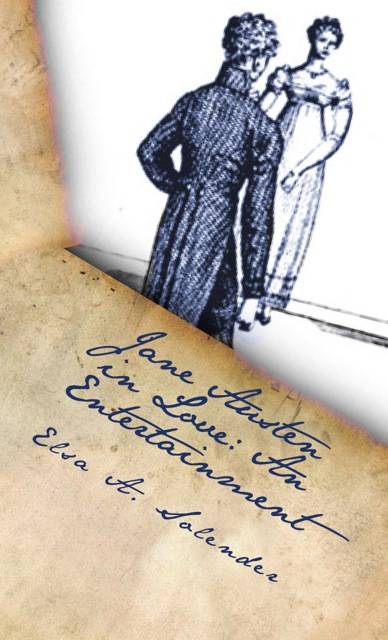
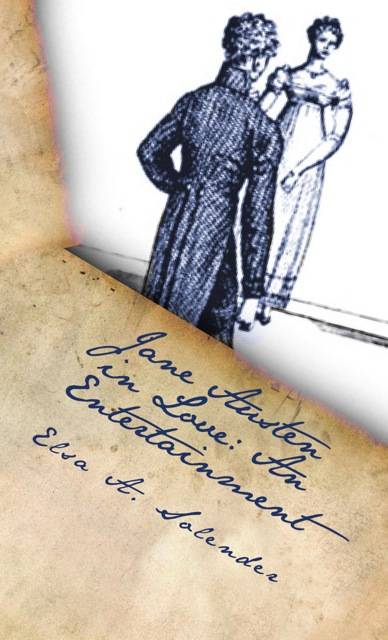
Jane Austen in Love: An Entertainment, by Elsa A. Solender.
An E-book exclusively for the Amazon Kindle – $8.99
Fall in love with the gentleman at Sidmouth who won Jane Austen’s heart, as Elsa Solender fills in the blanks of Jane Austen’s romantic “career.” In this continuation of her prize winning short story, Austen enthusiasts will find the known facts of Austen’s life meticulously brought to life in a narrative that is rich in elegant Austenian turns of phrase and references. The rest of the story— as it might have happened— is told by the only possible narrator, one who knew Jane Austen intimately enough to dare to enter her consciousness and reveal missing and hidden details with a persuasive touch of the novelist’s own wit, style and insight. Sometimes poignantly, sometimes ironically, readers meet colorful characters as they educate, inspire and amuse the creator of six of the world’s most memorable novels. Finally, in her biographical “entertainment,” Solender gives Jane Austen the gift of a true love worthy of her genius.
About the Author: Past president of the Jane Austen Society of North America, Elsa Solender worked as a journalist, editor and college teacher before turning to fiction. Her writing has appeared in a wide variety of publications including The New York Times, The Baltimore Sun and Persuasions, the Journal of the Jane Austen Society of North America. She was a prize-winner in the first Chawton House Library Jane Austen Story Competition and a finalist in a Glimmertrain short fiction contest. As representative of an international women’s organization to the United Nations in Geneva, she wrote and delivered the first-ever joint statement of all accredited women’s non-governmental organizations on the right of women and girls to participate in the development of their countries. She lives and works in New York City.
***********************
Well, it is on my kindle as we speak! – I look forward to reading this – I thought that Ms. Solender’s short story that won a runner-up prize in the Chawton House competition (titled “Second Thoughts” – I review the book here) was a brilliant imaginative telling of Jane Austen’s night of torment after accepting the proposal of Harris Bigg-Wither – so I expect this shall be another beautifully written piece … will let you know! Please share your thoughts when you read it!
The random drawing for the 2012 Jane Austen Calendar from the JASNA-Wisconsin group has just been done! – Drum Roll Please…and the Winners are…
Felicia, who commented on December 16th and wrote the following:
I would thank Miss Austen for bringing some wonderful people in my life. Because of her books I have met some great friends.
Felicia
And
Cara Dragnev, who commented on December 16th as well:
Happy Birthday to Jane! And what a tribute to her to have this wonderful blog party! If I wrote Jane a letter, I would first of all THANK her. Thank her for all the joy she has brought to me and all who read her. I would love for her to see one of her books as a film and get a reaction. Can you imagine? Thank you for joining in this wonderful party!
~Cara
***********************
Congratulations Felicia and Cara! I will email each of you privately, but if you see this, please send me your mailing address and contact information as soon as possible and I will get the calendar off to you right away. If I don’t hear from you by December 27th, I will draw another name. My email is jasnavermont [at] gmail [dot] com
If you are not one of the lucky winners, and are in desperate need of a Jane Austen calendar [and you should be…], you can order your own copy and more for all your friends at the JASNA-Wisconsin website here.
Thank you all for participating! – I have not answered any of your comments due to the Holiday Season Craziness, but thank each and every one of you for your own delightful letters to Jane Austen and the various gifts you would give her if you could! I encourage everyone with a spare minute in their day [and when might that be one asks?] to read the many comments and see how Austen has touched so many lives across generations and geography…
And a final thank you to JASNA-Vermont’s Michelle Singer for her lovely tribute letter to Jane that started all this !












 Jane Austen in Vermont