Dear Readers: Today join me for Part II on the Heraldic windows at Chawton House Library, this post giving details on the two windows on the Great Staircase. [You can read Part I on the Great Gallery here] – And again I thank Edward Hepper, one of the Chawton House Library’s invaluable volunteers, for sharing with us his expertise on heraldry.
Chawton House Library
Part II: The Great Staircase:
The Landing window
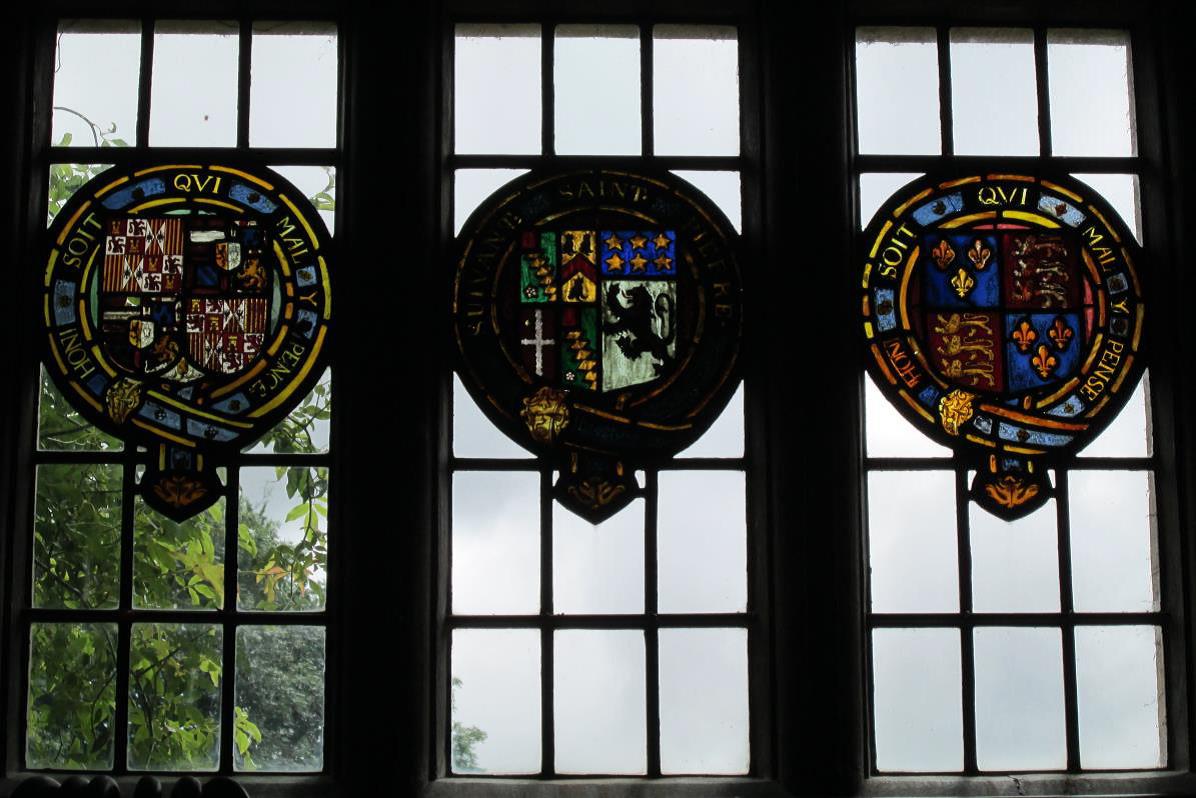
The windows on the staircase landing and that at the foot of the stairs were modified by Sir Edwin Lutyens to display this collection of mid-Tudor heraldry. It probably came from the Manor of Neatham, on the other side of Alton, which came into the Knight family in the mid-18th century. Neatham had been owned by Anthony Browne, 1st Viscount Montagu, and the heraldry fits with his prominent Roman Catholic allegiance – he was an Executor of Queen Mary’s will.
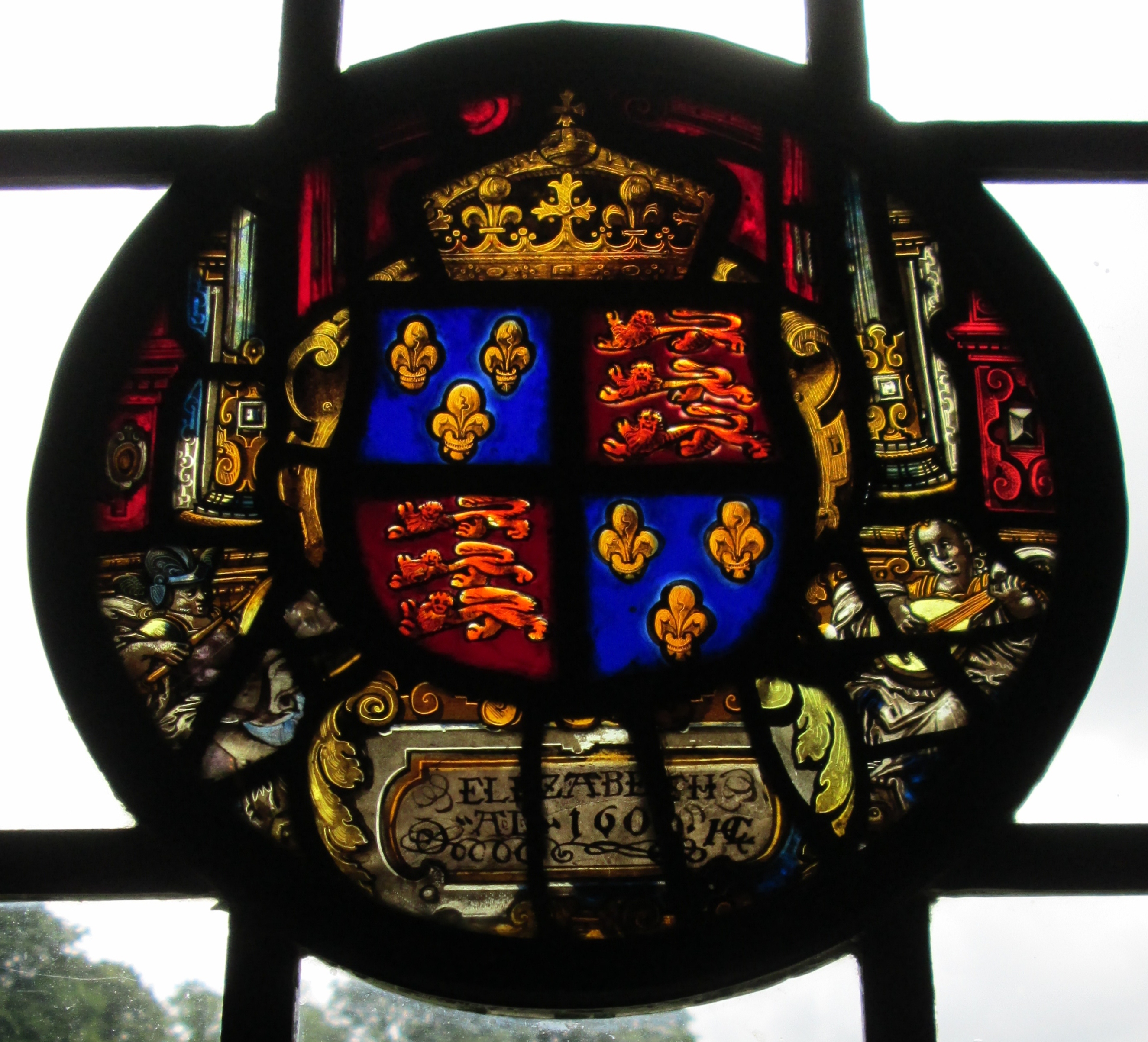
Queen Elizabeth I
Edward Manners, 3rd Earl of Rutland
King Henry II of France
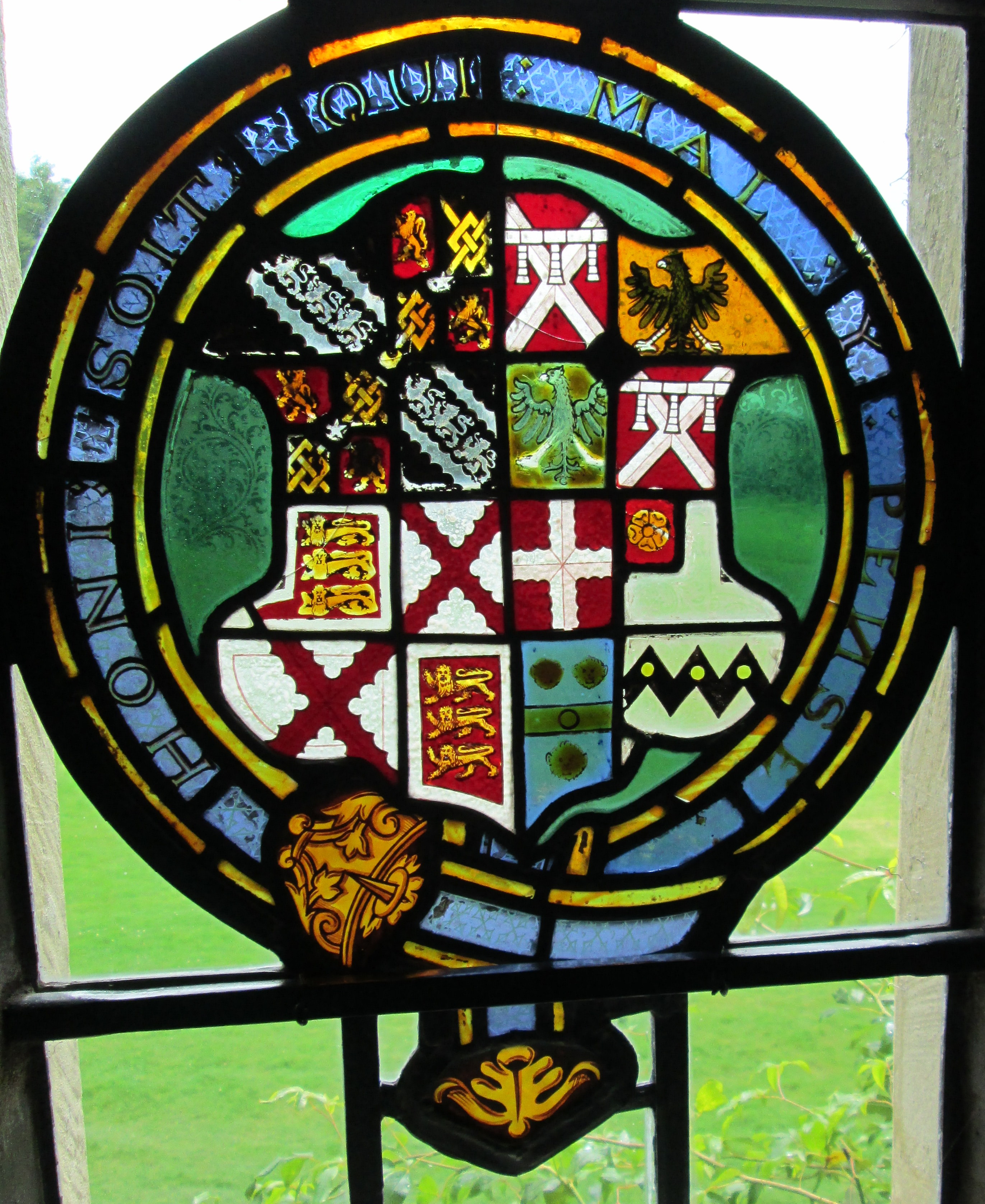
Anthony Browne, 1st Viscount Montagu [see note below]
Close-ups:
Queen Elizabeth I
*************
Edward Manners, 3rd Earl of Rutland
***************
King Henry II of France
*************
Anthony Browne, 1st Viscount Montagu
[Note: Anthony Browne, 1st Viscount Montagu was a leading courtier, Roman Catholic, supported Queen Mary, attended the official wedding of Mary and Philip in Winchester Cathedral (though note that the DNB entry for Browne says Hampton Court Palace in which she stayed frequently but DNB for Mary and the cathedral’s own records state Winchester Cathedral), and was MP for Petersfield (DNB)]
*****************
2. The Window at the foot of the stairs:
King Philip II of Spain (NB the punning arms of Leon, Castille and Grenada)
Edward Knight (jr) & Adela Portal
Queen Mary I
Close-ups:
King Philip II of Spain
*************
Edward Knight Jr & Adela Portal
************
Queen Mary I
*********************
Notes:
Edward Knight is the odd one out and his glass must be at least three hundred years later, perhaps bought or commissioned by Montagu Knight. They include Knight, Austen, Leigh and Portal.
The arms of Queens Mary and Elizabeth are the same as those for English sovereigns from, Henry V to Elizabeth I. In this case, Elizabeth is labelled as such. Mary has to be Mary because of the provenance and context of the other arms shown.
Similarly, Henry used the same arms as nearly all the French Kings but Henry II was the only one who was a Knight of the Garter – and so had the Garter encircling his shield.
The difficulty was to see the reason why the 3rd Earl of Rutland was included as he was not a prominent Catholic, like most of the others. However, the 3rd (or bottom left quarter) in his and the Browne shields are the same, which points to a relationship between Rutland and Browne. Indeed, examination of their family trees points to a common descent from Edmund of Woodstock (son of King Edward II) via John, 1st Baron Tiptoft, and it is the Woodstock and Tiptoft arms that appear in this 3rd quarter. A family tree or pedigree is available to show this connection. Browne, being a relatively ‘new’ man was keen to show his historical and aristocratic credentials and so included as many quarterings as possible of related families (including Browne, FitzAlan, Maltravers, Neville, Monthermer, Woodstock, Tiptoft, Ingoldsthorpe, Bradston, de la Pole and Deburgh). Rutland, being the 3rd Earl, was well established and so did not need so many quarterings (just Manners, Roos, Belvoir, Ross or Especk, FitzBernard, Woodstock and Tiptoft); however his presence in the window added to Browne’s prestige.
Philip II of Spain is included because as Mary’s husband, he was King of England, during her reign. His arms include most of the European territories he ruled: Castille, Leon, Sicily, Aragon, Austria, Burgundy, Brabant, Flanders, Tyrol and Granada.
There is more information available on the heraldry in the rest of the house (stained glass, wood carving, paintings and tilework).
***************
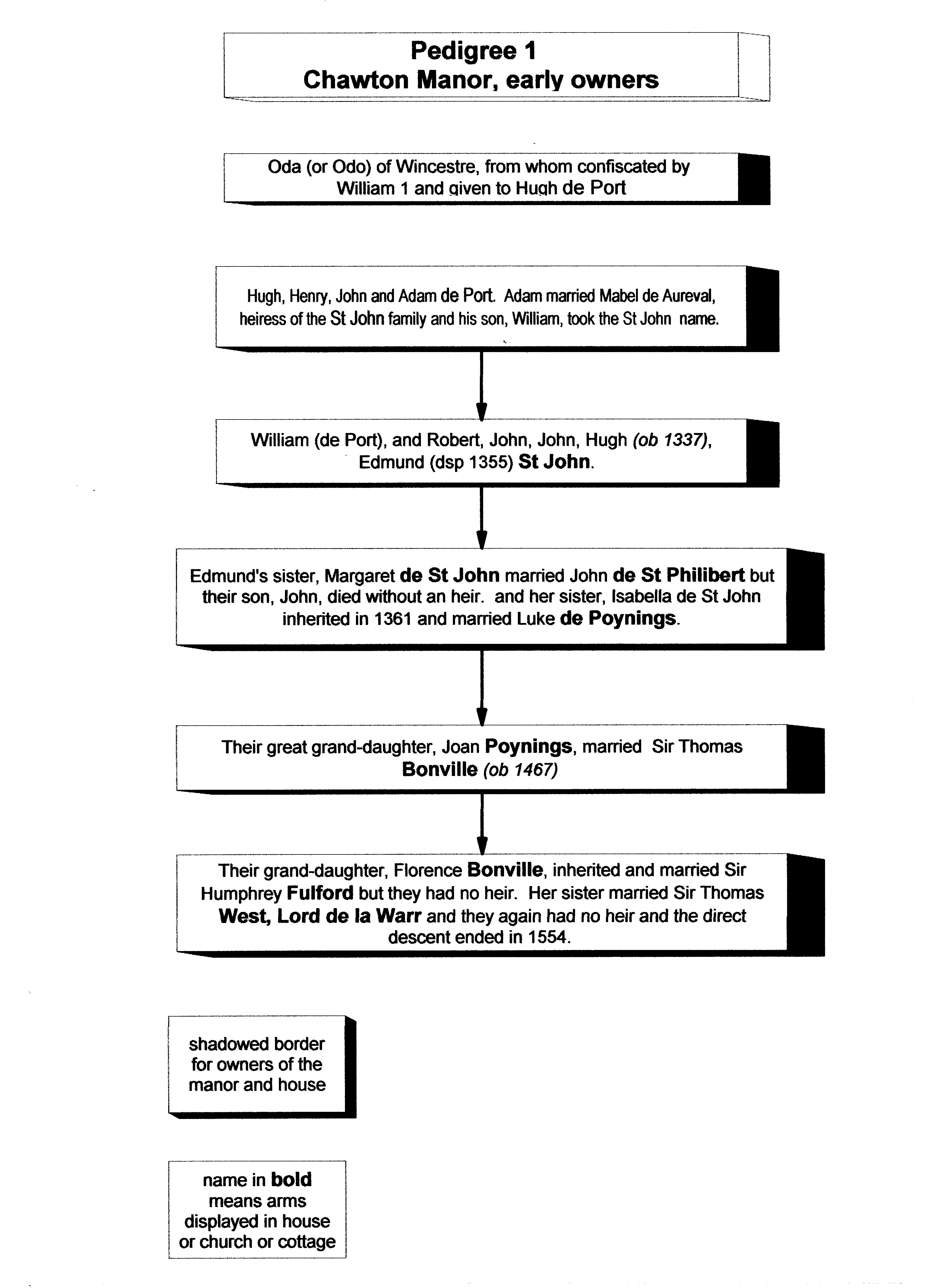
Mr. Hepper also sent along three family trees: here is the first one on the early owners of Chawton House (others to follow in next post)- (no worries, there will be no quizzes at the end…):
Early owners of Chawton House, pre-Knight Family, from 1066 – c1550
Stay tuned for more, and with thanks again to Edward Hepper!
c2016 Jane Austen in Vermont, text and images by Edward Hepper
Dear Readers: Today I am posting in response to a question on Tony Grant’s post about visiting the Emma exhibitionat Chawton House Library a few weeks ago. One of Tony’s pictures at the end of the post was of stained glass windows at the Library, and “Lady L” inquired about them. Tony had not seen anything about the various windows and portraits, but he confessed to be solely focused on Emma to really pay close attention. I have since discovered that all the heraldic windows are indeed explained at CHL, and that one of the Library’s many terrific volunteers has researched the history and meaning of all of them. Edward Hepper has graciously sent me his write-ups along with pictures and with his and CHL Executive Director Gillian Dow’s permission, I share this with all of you. Mr. Hepper is a long-term member of the British Heraldy Society, http://www.theheraldrysociety.com/home.htm and is quite knowledgeable on the family coats-of-arms that grace the windows of CHL – you will see some connections to Jane Austen and her family…but there is much other British history in these windows as well!
**************
Chawton House Library
We will start today in the Great Gallery:
These three windows were commissioned by Montagu Knight from the London firm Powell, of Whitefriars. They were installed between 1910 and 1913. The first window, furthest from the Great Staircase, shows the families of the freeholders from the 11th century over the next five hundred years. They were all descendants from the de Ports, to whom William the Conqueror granted the estate, although sometimes the lack of a male heir meant that Chawton passed through the female line with a change of name and coat of arms. The last of this family was Leonard West, by whom Chawton was sold to the Arundels.
St John, successors to the DePorts
St Philibert
Poynings
Bonville
Fulford
West (NB the punning ‘W’)
**********
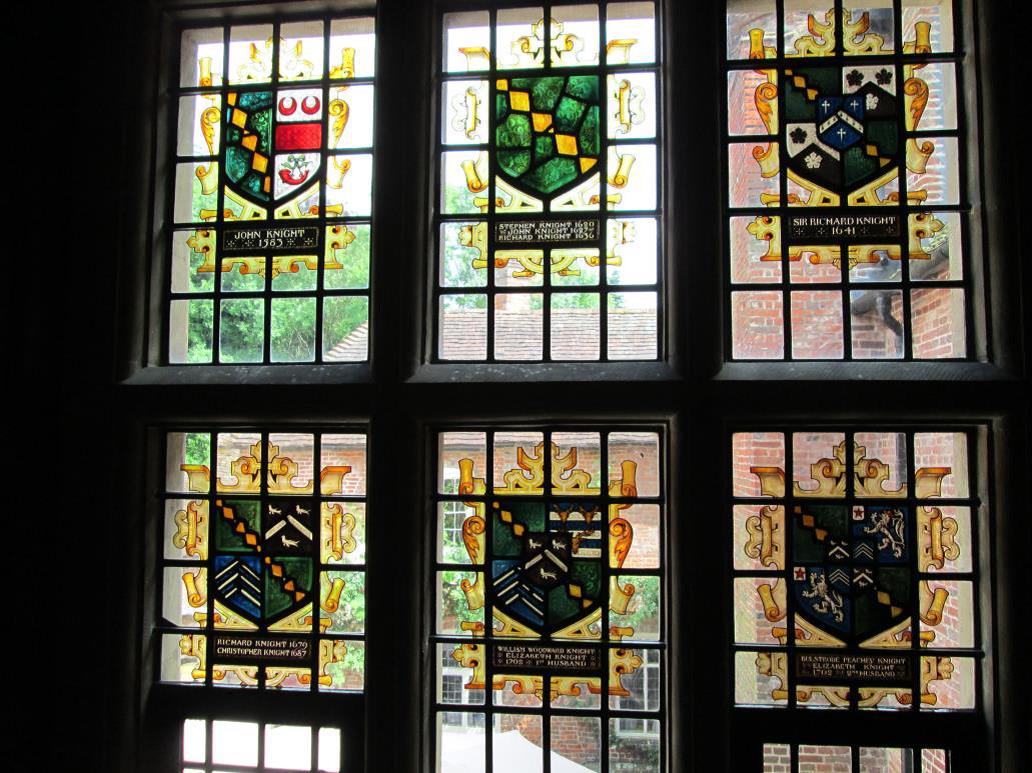
Within a few years, they sold to Nicholas Knight, whose son John, started to build the present house in 1583. The Knight family have held the freehold ever since – over four hundred years, although it has several times passed through the female line to other branches of the family which have had to adopt the name and arms of Knight (usually slightly differenced).
The succeeding Knights are shown in the next two windows and the dates next to their names indicate the year in which each of them succeeded to the freehold.
John Knight & Mary Neale (1583)
Stephen & Richard Knight (1620, 1637)
Sir Richard Knight & Priscilla Reynolds (1641)
Richard & Christopher (Martin) Knight (NB punning martins) (1679, 1687)
Elizabeth (Martin) Knight & William Woodward Knight (1702)
Elizabeth (Martin) Knight & Bulstrode Peachey Knight (1702) [Elizabeth Martin Knight had two husbands: William Woodward and Bulstrode Peachey (you cannot make up a name like that…)]
Here are their portraits, to put a face to a name:
Richard Knight
Richard Martin Knight
Sir Richard Knight – Richard (Martin) Knight
Christopher Martin Knight
William Woodward
Christopher (Martin) Knight – William Woodward
Elizabeth Martin Knight
Bulstrode Peachey
Elizabeth (Martin) Knight – Bulstrode Peachey
******************
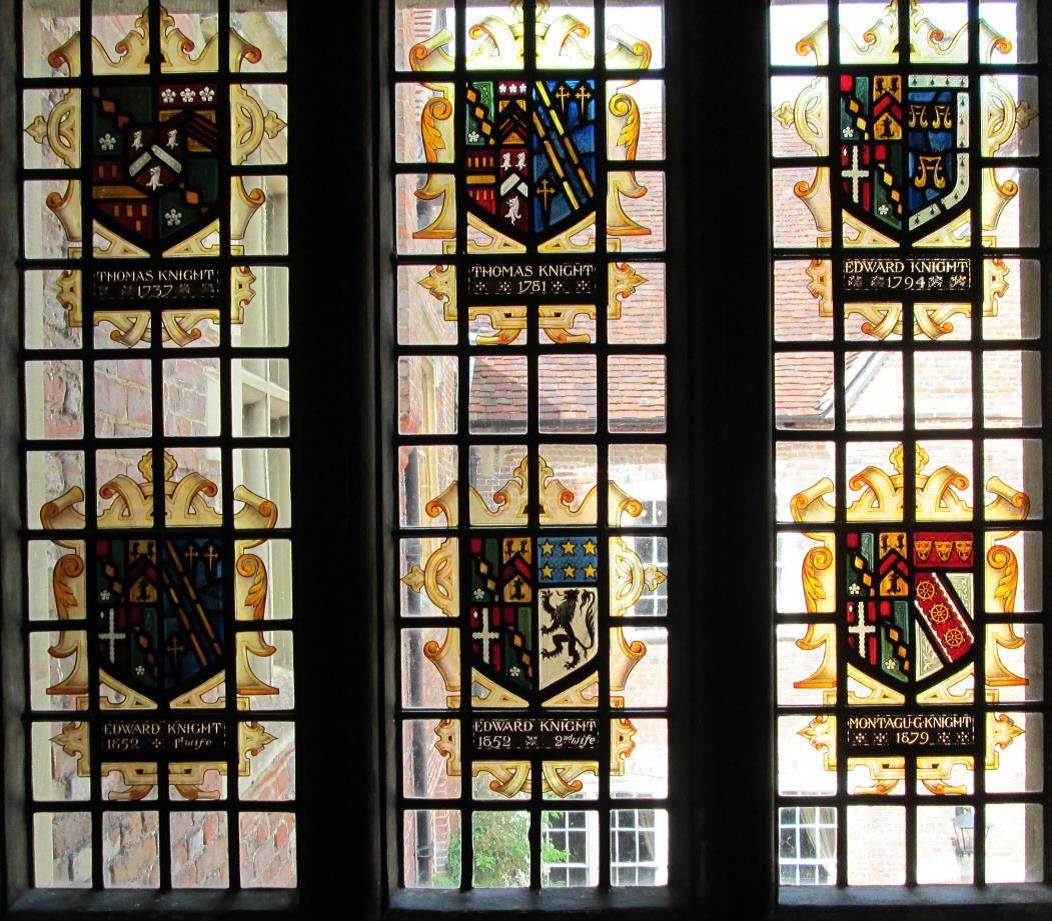
The third window brings us to Jane Austen territory:
Thomas (Brodnax) Knight & Jane Monk (1637)
Thomas Knight (jr) & Elizabeth Knatchbull (1781)
Edward (Austen) Knight & Elizabeth Bridges (1794)
Edward Knight (jr) & Mary Dorothea Knatchbull (1st wife) (1852)
Edward Knight (jr) & Adela Portal (2nd wife) (1852)
Montagu Knight & Florence Hardy (1879)
And their portraits:
Thomas Brodnax Knight
Jane Monk
Thomas (Brodnax) Knight – Jane Monk, wife of Thomas Knight (sr)
Thomas B Knight Jr
Edward Austen Knight
Thomas (Brodnax) Knight (jr) – Edward (Austen) Knight (Jane Austen’s brother)
Edward Austen Knight Jr
Montagu Knight
Edward Knight (jr) – Montagu Knight
*****************
Hearty thanks to Edward Hepper for allowing me to post on this – stay tuned for more information on the other windows … And I will be conversing with Ron Dunning to make sense of all these names and their connections to Austen – see his Jane Austen Genealogy for starters…
c2016 Jane Austen in Vermont; text and photos c Edward Hepper
Gentle Readers: I welcome today one of our JASNA-Vermont members, Heather Brothers, as she muses on a certain passage in “Persuasion” that she “discovered” during a recent re-listen. We’ve had a bit of an email discussion over this, so now want to it share with you and solicit your thoughts too.
The Musgrove’s Parlour
Several years ago I came upon the audio version of Persuasion as read by Juliet Stevenson. The manner of her reading infused more meaning into Persuasion than I ever picked up reading it myself. And through listening to this several times, I have noticed some fascinating passages that I would otherwise have overlooked. Here is one and I am happy to share others:
Anne has arrived at Uppercross and is going to visit the Musgroves with Mary…
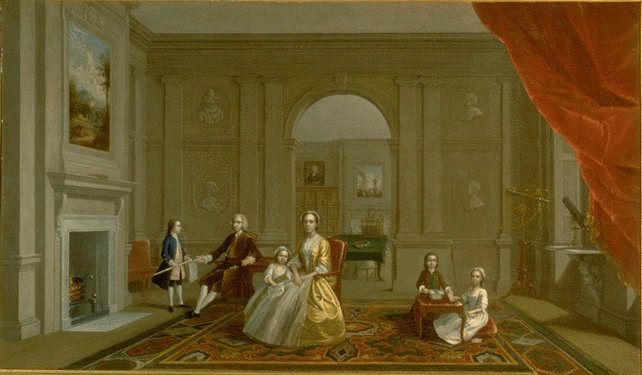
To the Great House accordingly they went, to sit the full half hour in the old-fashioned square parlour, with a small carpet and shining floor, to which the present daughters of the house were gradually giving the proper air of confusion by a grand piano forte and a harp, flower-stands and little tables placed in every direction. Oh! Could the originals of the portraits against the wainscot, could the gentleman in brown velvet and the ladies in blue satin have seen what was going on, have been conscious of such an overthrow of all order and neatness! The portraits themselves seemed to be staring in astonishment.
[Persuasion, Vol. I, Ch. 5]
******************
I have come to understand that Persuasion is written on the cusp of a new time period. Just before this passage above, Mr. and Mrs. Musgrove are described as representing the old ways and the two Miss Musgroves as the new ways. I get the impression that Jane Austen is using even the parlor in the Musgrove house as showing this change – that the minutia of interior design itself represents a change from the old ways to the new ways.
What was happening in interior design at this time? What architectural changes were taking place? I understand from fashion that ionic columns and flowing lines were the mode, but simplicity doesn’t seem to be the case with the Musgrove girls’ additions to the parlor. When I read this piece to my husband, who is an architect, he immediately got the impression that the girls were over-decorating; that they were building up the style to improve and impress.
This leads me to think that the astonishing overthrow of all order and neatness is both referring to the style of the room but also to the girls themselves. What would the portraits have thought of Henrietta and Louisa Musgrove in their endless pursuit of happiness, fun and excitement?
Seen in an earnest light, Henrietta and Louisa’s behavior is seriously flawed. Henrietta almost loses a good, stable life with a man she really likes and Louisa almost kills herself through taking their love-struck silliness to too high of a level. Did it all start in the parlor? Would the piano forte have been sufficient, but the additional harp, flower-stands and little tables represent the overthrow of moderation? Is Jane Austen’s commentary on the parlor a harbinger of what’s to come for these girls or for society?
If anyone can recommend books on this subject – please let me know!
********************
This portrait may serve as an example of what Jane Austen is referring to, hanging on the Musgrove parlor walls “against the wainscot,” where all is “order and neatness.”
Austen packs into this one rather obscure sentence much about what is going on in the Musgrove household and the wider world! Thoughts anyone?
Heather Brothers is one of our “Team of Janeites” in Vermont who helps with Hospitality and Boutique sales at our quarterly meetings. She is a young mother of two adorable girls, and also the author of a Regency-era novel, The Introduction of a Gentleman (2013) – it is a terrific read – you can find it on Amazon (and interesting to note that the cover depicts a young lady sitting at a pianoforte!)
Heather has also initiated at our meetings “The Awesome Austen Moment” – where we ask someone to read aloud a short passage from any of the Works, just to remind us all exactly what Austen could convey in any given sentence, this Persuasion piece a perfect example.
You can read more about Heather and her book here:
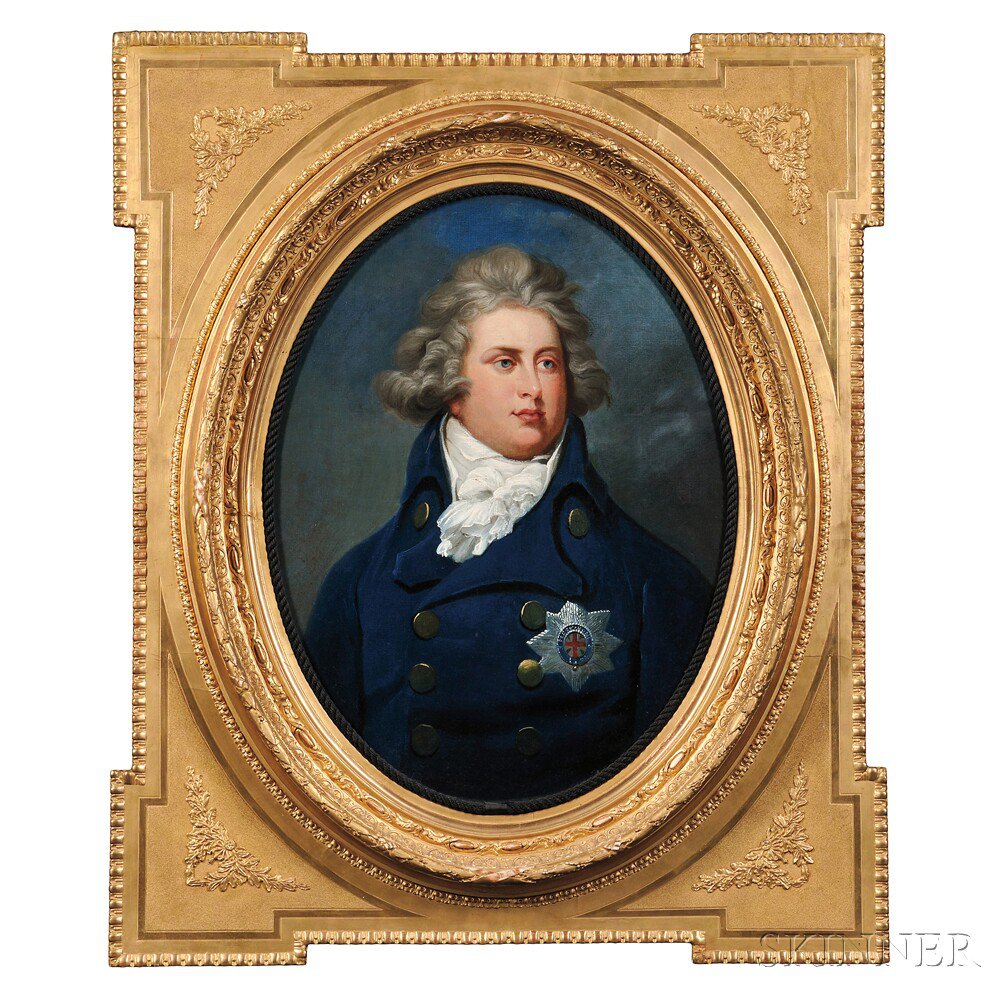
This week, a portrait of the Prince Regent, a.k.a. Prinnie and later George IV, is up for sale at Skinner. Here is the chance you’ve been waiting for – to have his mighty visage staring down at you from your library walls! Whatever would Jane Austen say? – she was not, as we know, a big fan of the Prince. [for more information on Austen’s 1815 visit to Carlton House and the Prince Regent’s Librarian, click here.]
Prince of Wales
British School, 18th/19th Century ~ George IV as The Prince of Wales
British School, 18th/19th Century – George IV as The Prince of Wales
Unsigned, with labels including one from The Closson Art Galleries, Cincinnati, on the stretcher.
Oil on canvas, 28 1/4 x 23 3/4 in. (71.5 x 60.5 cm), framed.
Condition: Lined, retouch, fine craquelure, surface accretions.
N.B. The portrait is somewhat similar in feel to that painted by John Russell, RA, in 1789, now in the collection of the Fogg Art Museum, Harvard University, which may have been the inspiration for this copy.
Stretcher incised “W.MORRILL/LINER” u.c. bar. Also with a label from Art Conservation & Services, San Francisco, California, on the stretcher. Other period labels on the stretcher are unattributed and variously inscribed with numbers. One more promising label is inscribed “S.Buckly & Co/8-5-21”
************
See the full Auction catalogue for a stunning collection of fine silver, snuff boxes, paintings, porcelain, furnishings, and other decorative arts.
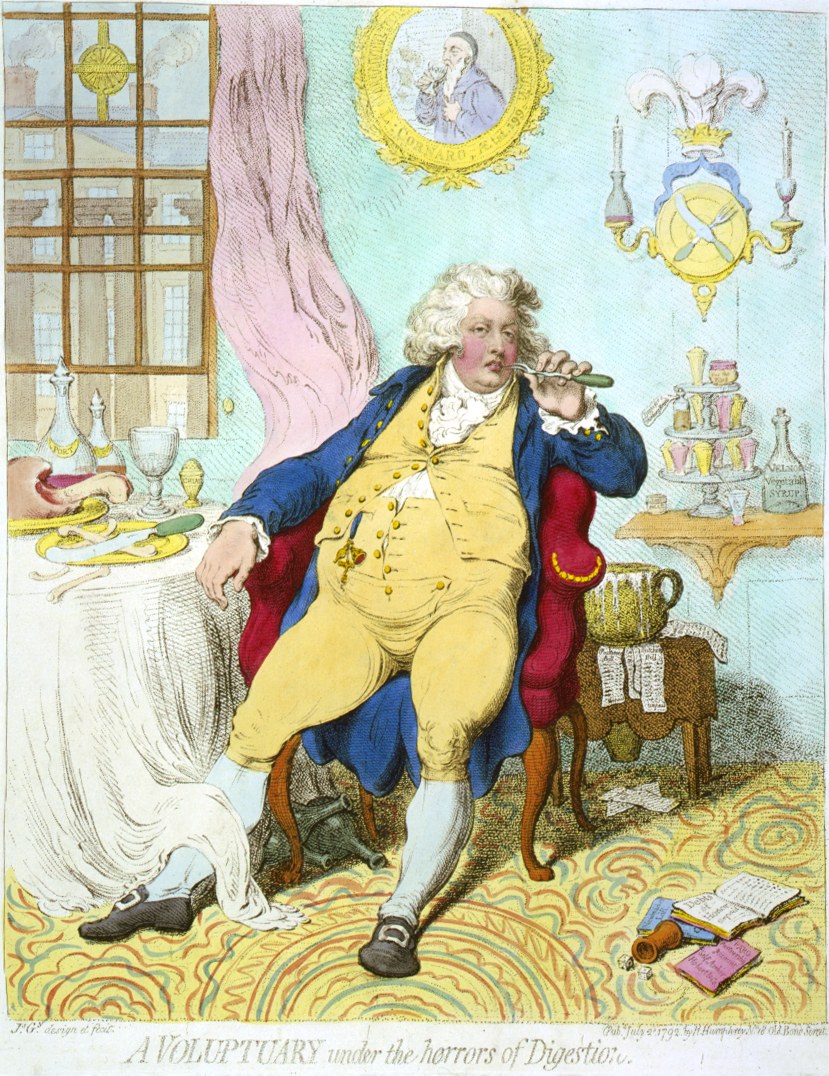
And here is the Prince later as George IV and what the caricaturists and his own profligate ways made of him:
A Voluptuary under the horrors of Digestion (1792)
by James Gillray [Wikipedia]
Dear Gentle Readers: Continuing in my efforts to celebrate all things Mansfield Park through 2014, I welcome today Tony Grant, of London Calling fame, who writes on the visit to Sotherton, that all-important metaphor-filled dramatic scene in the novel where character is revealed, plot points are suggested, sides are taken, and where Fanny, in her usual state of aloneness, observes it all – Tony’s emphasis is on the concept of “improving” the estate.
**************
A Visit to Sotherton Court
Harlestone House, Northamptonshire, which has some of the elements of Sotherton. From Jane Austen Town and Country Style by Susan Watkins (Thames & Hudson, 1990) [from JASA website]
~
Eighteenth-century gardens were not merely intended to be pretty places for listening to birdsong and observing plants and trees. Of course you could do that if you wanted to but they were much more than that. The new landscaped gardens of the 18th century “improved” nature, reflected European landscape art of the time and were spiritual and emotional places. Jane Austen, by introducing the idea that her characters in Mansfield Park should visit Sotherton and provide suggestions for the “improvement” of the landscape, was creating a situation where individuals would be able to express their “taste,” and so reveal their inner characters. This scene in Mansfield Park is full of metaphors, which indeed an 18th century landscaped garden itself would embody. At Sotherton there is the ancient Tudor mansion, dark and sombre from the past; the ancient oak avenue, about which Fanny feels so concerned, and the wilderness.
Tom Bertram, who Miss Crawford found entertaining company, decides to take off for the races at B…… Nobody expects him to return for weeks so Maria Crawford prepares herself for a less lively time at the dining table at Mansfield Park. However, no sooner had Tom Bertram left the scene but Mr Rushworth, Maria Bertram’s betrothed, appears, just returned from his own travels to visit his friend, Smith, who has had his property Compton improved by an “improver.” Mr Rushworth’s head is full of thoughts for now improving his own estate at Sotherton. This was no light matter in the 18th century. The process involved the revealing of a person’s “taste.” The concept of acquiring taste in the 18th century was a serious matter. Young men from wealthy and aristocratic families travelled Europe on what was termed the Grand Tour to finish their education and to acquire “taste” by visiting the art galleries of Europe and visiting the houses and homes of the European aristocracy to observe all the new concepts in architecture and landscape design. The wealthy employed architects and landscape gardeners to turn their estates into examples of “taste” for them.
In the mid-18th century the social commentator George Coleman decried the great fashion of his time:
“Taste is at present the darling idol of the polite world…The fine ladies and gentlemen dress with Taste; the architects, whether Gothic or Chinese, build with Taste; the painters paint with Taste; critics read with Taste; and in short, fiddlers, players, singers, dancers, and mechanics themselves, are all the sons and daughters of Taste. Yet in this amazing super-abundancy of Taste, few can say what it really is, or what the word itself signifies.”
In Mansfield Park, it seems everybody is asked their opinion. Mr Rushworth is the only one who apparently doesn’t have a clue.
“I must try to do something with it,” said Mr Rushworth, “but I do not know what. I hope I shall have some good friend to help me.”
This is a terrible admission in the 18th – early 19th century from one who is the owner of an estate, who is wealthy, and who has apparently had all the advantages.
Miss Bertram answers him with restrained disdain,
“Your best friend upon such an occasion, said Miss Bertram, calmly, “would be Mr Repton, I imagine.”
Mrs Norris provides her view,
“Such a place as Sotherton Court deserves every thing that taste and money can do….planting and improving.”
Lady Bertram puts her view, “…..a very pretty shrubbery.”
And even, shy, mouse-like Fanny Price confidently disagrees with Mr Rushworth when he suggests that an ancient oak avenue should be cut down…
“Cut down an avenue! What a pity. Does not it make you think of Cowper? ‘Ye fallen avenues once more I mourn your fate unmerited.’”
All that poor Mr Rushworth can say meekly is, “I think I shall have Repton.”
It seems as though Mr Rushworth cannot win and the whole discussion shows him to have inferior or no taste at all. A terrible handicap.
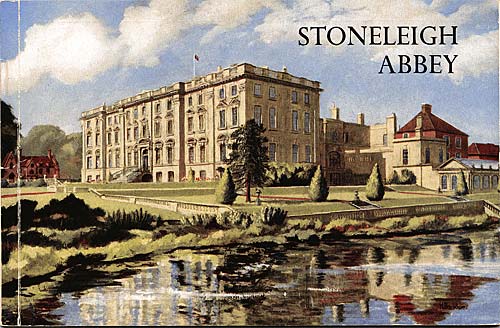
Stoneleigh Abbey
Stoneleigh Abbey, perhaps a source for Sotherton Court, especially the Chapel scene – image from a guide book to Stoneleigh Abbey in Henley, Staffordshire, printed by Wood, Mitchell and Co Ltd. (Windows on Warwickshire website)
When everybody is at Sotherton the unsuitableness of the house and its estate is apparent:
“Henry Crawford was looking grave and shaking his head at the windows. Every room on the west front looked across a lawn to the beginning of the avenue immediately beyond tall iron palisades and gates.”
There is a lengthy discussion about how they are to tour the estate. Carriages are suggested and who is going to go with whom and which horses should be used is detailed, and Mrs Norris fusses at her fussiest best:
“Mrs Norris was beginning to arrange by what junction of carriages and horses most could be done, when the young people, meeting with an outward door, temptingly open on a flight of steps which led immediately to turf and shrubs and all the sweets of pleasure grounds, as by one impulse, one wish for air and liberty, all walked out.”
And they all emerged into the wilderness. It is strange, but from this point onwards all thought of “improvements” seems to dissipate. Well, apart from one lame joke:
“Mr Crawford was the first to move forward (Where did they think they were? An alien planet?)to examine the capabilities of that end of the house.”
This is so corny. Jane must have had a chuckle to herself over that pun.
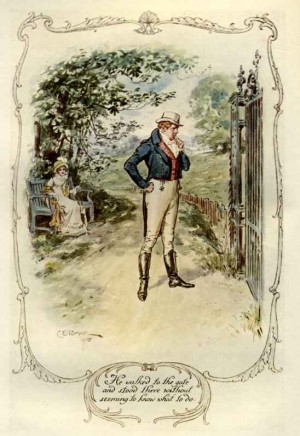
Mr Rushworth at the gate – CE Brock (Mollands)
For most of the time in the wilderness Fanny is abandoned. She interacts, first with Edmund and Maria Crawford, when they are “clumped” together like a copse of trees; but Edmund and Miss Crawford wander off leaving her alone. Mr Crawford, Miss Bertram and Mr Rushworth then meet her, but Mr Rushworth returns to the house to get the key to let them out of the locked gate that leads from wilderness to the park beyond. Mr Crawford and Miss Bertram, impatient, wander off too and find their own way into the park and aim for a grassy knoll where they can get a better overview of the “situation.” Fanny sits worrying about everybody. There seems to be a loss of etiquette and social standards. There is a sense of the loosening of society’s usual rules. The very name “wilderness” suggests biblical references and a wild place of danger. There are unlocked doors, locked gates, iron fences, hidden barriers in the form of a ha-ha, and an open world beyond the park – a myriad of things that can be seen as psychological and social barriers as well as physical barriers.
“In the late 18th century the term ‘wilderness garden’ meant something different from what we might think of it these days in the modern world of horticulture. Inspired by the Grand Tour and the new literary form of nature poetry by Romantic poets such as Wordsworth and Coleridge, these fashionable wilderness gardens satisfied the demand for the world beyond the gate. They were tamed, but not entirely.They were a place where well-heeled ladies and gentlemen could experience a frisson from a brush with nature without ever having to stray too far from the relative safety of the English countryside. And they were a direct contrast to the formality of gardens nearer the great house where everything was managed and controlled.”[“Witley Court’s Wilderness” at English Heritage.org]
**********
There is a wonderful example of a “wilderness” in the grounds of Hampton Court. It is not a very large area, perhaps no larger than a cricket field, and from it you can see the Lion Gate, the palace through the trees and doorways through the surrounding brick wall into the more formal gardens. It is an area comprising a web of pathways dissecting a meadow which in the spring is carpeted with bluebells and daffodils. These untamed lawns are set beneath a woodland of apparently randomly growing trees. The area is shaded and has a feel of freedom, an untamed essence.
Hampton Court (Wikipedia)
The guide book to Hampton Court says,
“The term ‘wilderness’ refers to a place to wander, rather than an uncultivated area of garden. William III would have walked through the wilderness at Hampton Court Palace with his devoted wife Mary II. It would have comprised 18ft high hornbeam hedges, with interstices planted with elm. The Wilderness was the English version of a French ‘bosquet’. The high hedges, secluded benches and winding paths made it a place where members of the Royal Court could go for privacy and where gentlemen in particular could entertain ladies in private.”
Mr Rushworth seems to be “rushing,” to get his estate “improved,” an eagerness reflected in his wishing to marry Maria Bertram. His mother appears just as eager for him in all these aspects too. Jane Austen has chosen her character’s name carefully to fit his character. The quickest way he can think of doing it is by hiring Humphrey Repton to do all the work. This suggests that he will not and perhaps cannot contribute to the process. He wants a garden “off the peg” so to speak. Is this also a metaphor for the state of his relationship with Maria Bertram? Is she too an “off the peg” marriage? Is she too just for show? So Repton was to design his garden and Mr Crawford was to provide the requirements his future wife might want, or am I being too cruel? If this is the case he will feel no emotional attachment to his prospective wife and nor feel ownership of his garden. He wants others to be impressed by what he has, that is all. He can throw money at these projects but no ideas.
Edmund on the other hand suggests,
“…but had I a place to new fashion, I should not put myself into the hands of an improver. I would rather have an inferior degree of beauty, of my own choice, and acquired progressively. I would rather abide by my own blunders than by his.”
A much more independent view – Edmund would rather satisfy himself than others and not worry about their opinions. We can think of his future relationship with Fanny Price in these terms too.
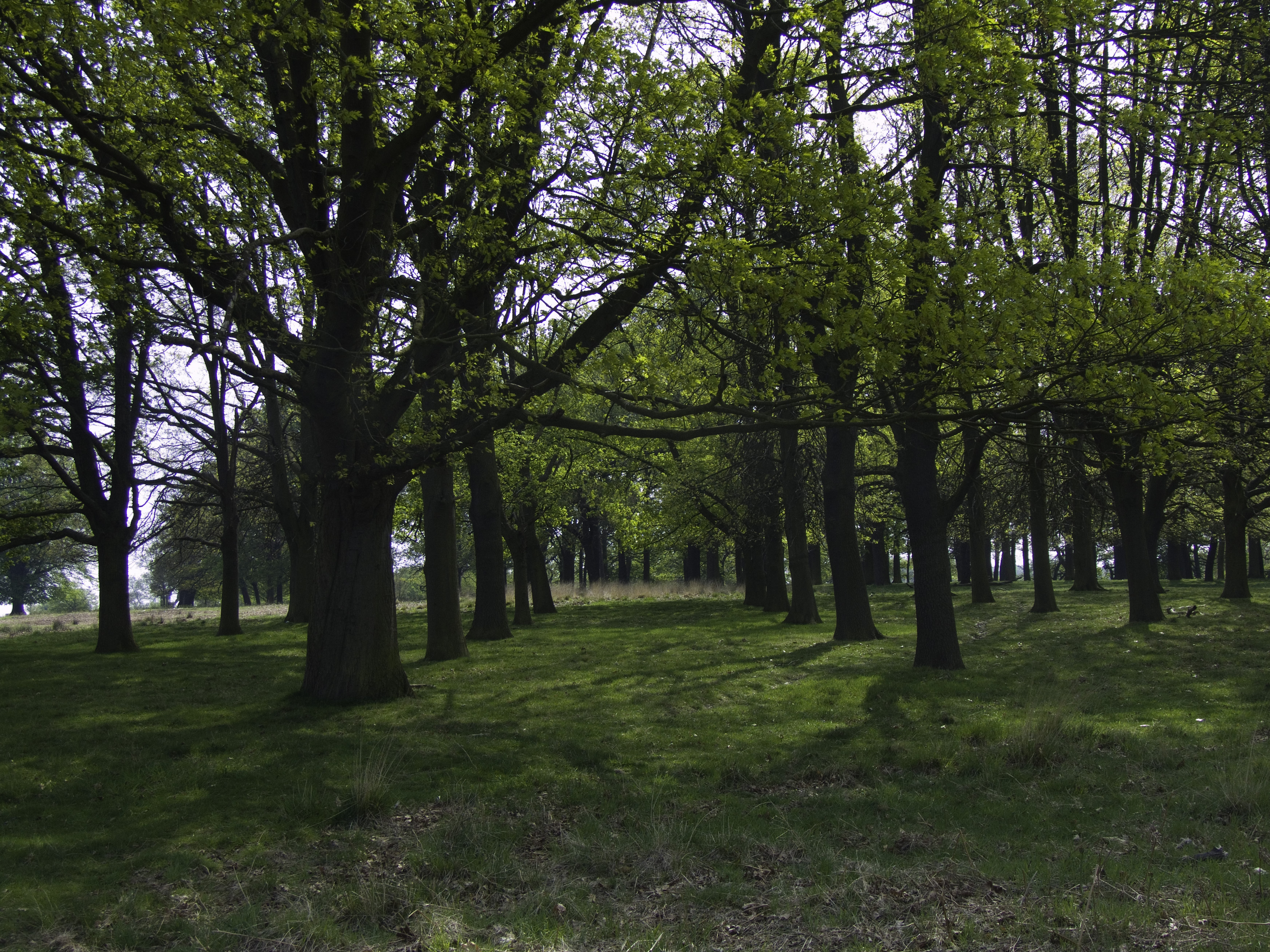
Avenue of oak trees, cTony Grant
Fanny Price, shocked at the thought of the avenue of oaks being cut down, makes a powerful request to see them, which is a surprising demand from her. We are not used to her making demands. Perhaps this visit to Sotherton marks the rise of Fanny Price and is a pointer to the future. Oak trees are ancient trees and avenues are straight and regimented. To walk down a long avenue of trees, especially in the Spring and Summer when the foliage is at its height, provides an experience of shade and light, the rustling of leaves and the sound of birdsong but you are lead into the distance along a straight path. They are a combination of natural beauty and grace but they also provide an undeviating path. Perhaps a metaphor for Fanny Price herself, unwavering in her innocence, honesty and intelligence grounded in a strong moral foundation but also a breath of natural air. It would be a shame to cut down an avenue of oaks. They take hundreds of years to grow. They span many generations. They are an historical record and link together generations. Fanny’s sense of their worth is in contrast to Mary Crawford, whose following statement is true on one level but does not take into account that the best of the past should not only be kept but built upon:
“Every generation has its improvements.”
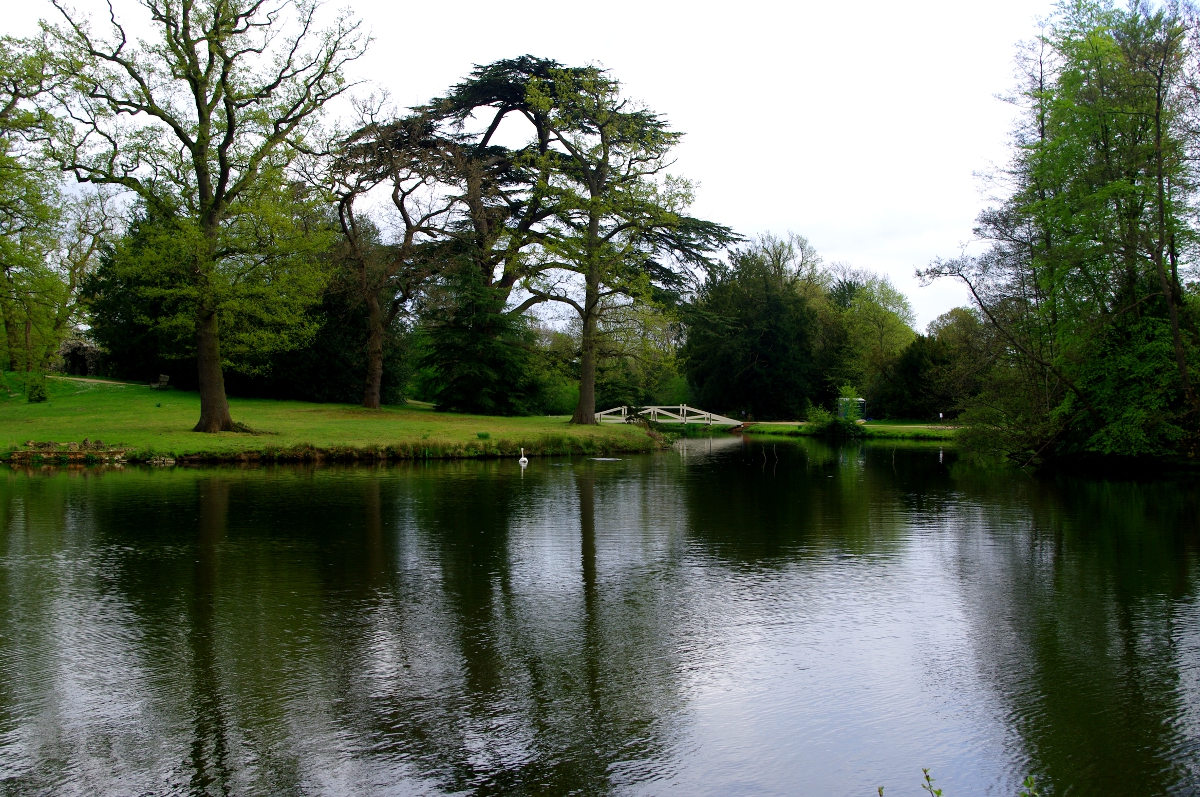
Part of the lake at Painshill Park, cTony Grant
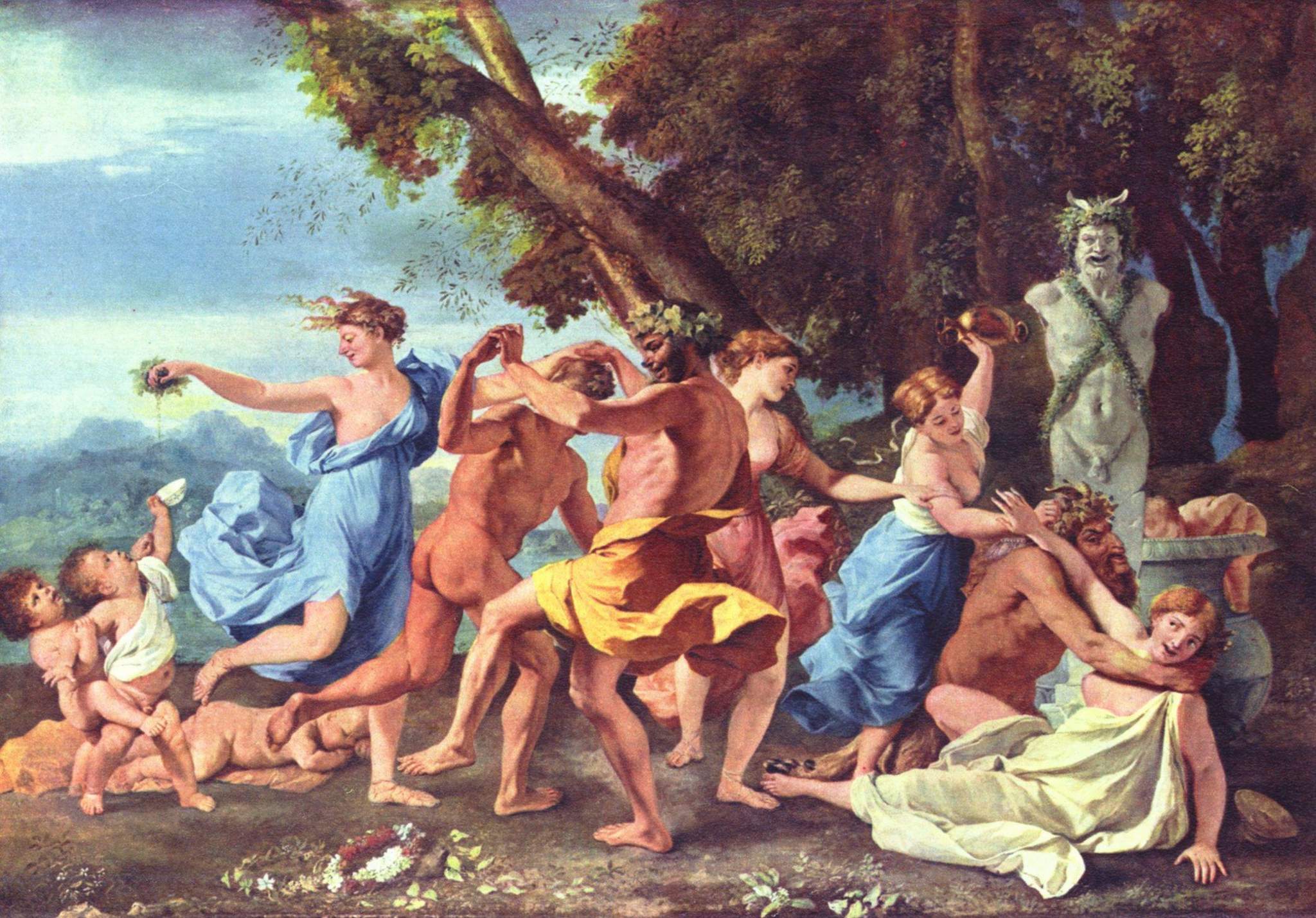
The estates of the aristocracy and the wealthy in the 18th century were places designed to provide emotional experiences. The Honourable Charles Hamilton, the 9th son of the Earl of Aberavon was born in 1704. Being the 9th son he could not hope to inherit his father’s estates but through the provision of a good education, an intelligent mind, the completion of two Grand Tours, energetic ambitions and the acquisition of some well-paid government posts, he bought land at Painshill near Cobham in Surrey. His life’s work began creating a park inspired by the European artists, Nicolas Poussin, Claude Lorrain and Salvator Rosa. He succeeded magnificently and his park atPainshill has been, in recent years, renovated and is open to the public today. He created a landscape of far vistas, an undulating landscape, a strategically positioned serpentine lake, bridges, mounds, trees and woods. He created different areas that contrived different moods formed by ruined abbeys, tall turrets, Turkish tents, Gothic temples and crystal lined grottos. From the influence of Pousin’s paintings we might conjecture about the sort of parties he held inside the crystalline grottos.
Salvator Rosa
Rosa – Evening Landscape
[Images: Wikipedia]
West Wycombe Park, developed by Sir Francis Dashwood 2nd baronet between1740 and 1800, leaves us in no doubt about its purpose and uses. He famously began the Hell Fire Club in the caves of West Wyckham. He too had his temples and Palladian and Neoclassical follies based on the Italian Villas he had encountered on his Grand Tour. He spent limitless amounts of money on his park and employed three architects and two landscape gardeners. He actually employed Humphrey Repton at one stage. His park included temples to Apollo, Diana and Venus. The activities that went on in these places have been recorded and were debauched to say the least.
Humphry Repton (Wikipedia)
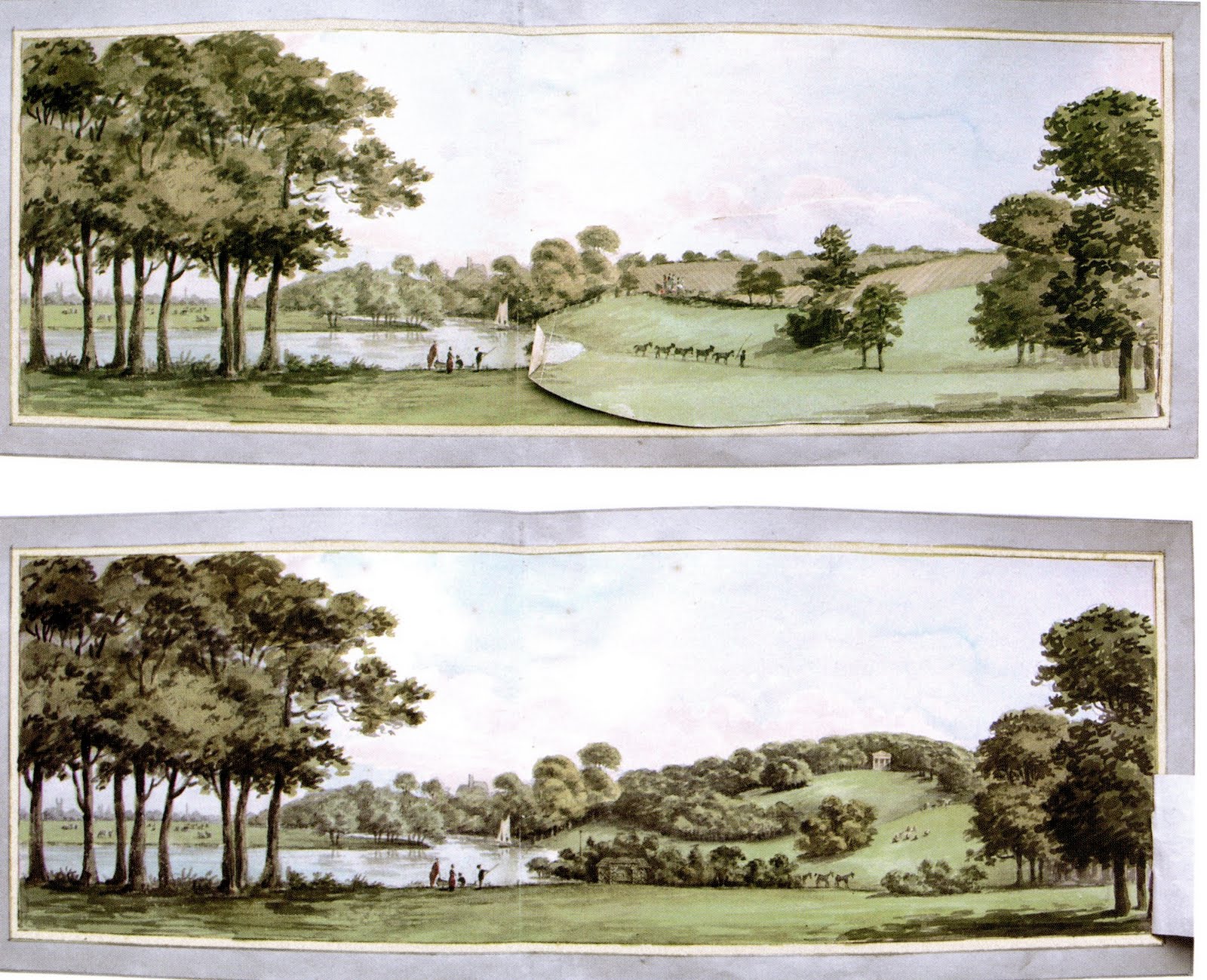
Who was Humphry Repton the gentleman who Mr Rushworth was intent on employing to “improve” the park at Sotherton? He was a gardening author and landscape designer. He began his career as a landscape gardener late in life at the age of 36 in 1788. He followed in the footsteps of Capability Brown who had died in 1783. Hence the pun that Jane makes in chapter 9,
“Mr Crawford was the first to move forward, to examine the capabilities of that end of the house.”
His basic theory, which he repeated on many estates, was to create a terrace near the house, and produce a serpentine park between clumps of woodland and lakes creating different views. He was accused of “advising the same thing at different places.” However, most of his work was done during the time of the Napoleonic Wars when money was not so readily at hand for the great landowners. In contrast to Capability Brown, whose landscape gardening was more creative. Repton’s designs were not as ambitious. Browns approach, continued by Repton, was to offer a variety of services. He could provide a survey and a plan for the property owner to develop themselves, or he could provide the planning service and a foreman to oversee the work, or he could oversee the work himself. He built on this process by also writing and producing what were called “The Red Books.” These were bound volumes with recommendations and included, what perhaps was most useful for the client to envisage what his estate might look like, before and after sketches. Repton was a contemporary of Jane Austen and the current popular landscape designer of the time she was writing Mansfield Park. In her choice of referring to Repton, she was right up with the latest fashions and “taste.”
Repton’s Before and After sketches (Wikipedia)
Capability Brown (Wikipedia)
Returning to Capability Brown, what is interesting is that towards the end of his career he was employed at Hampton Court as the King’s gardener. He lived in a house in the palace grounds called Wilderness House which is still there today, right next to, the Wilderness.
*************
And finally, as we join the Sotherton Party heading home, we discover what we really knew all along, that Mrs Norris partakes of the selfish practice of “spunging”-
“What else have you been spunging?” said Maria, half–pleased that Sotherton should be so complimented.
“Spunging, my dear! It is nothing but four of those beautiful pheasants’ eggs, which Mrs. Whitaker would quite force upon me: she would not take a denial.”
I was so delighted to hear her described that way returning after their day at Sotherton by one of the Miss Bertram’s. It might appear as spoken in a fit of pique but oh how true it is. Austen provides one or two other jokes during the visit to Sotherton, but it is this one that satisfies me the most; it describes Mrs Norris exactly.
Nicolas Poussin – Bacchanal before a herm (1632-33) – National Gallery London (Wikipedia)
c2014, Jane Austen in Vermont; text by Tony Grant, images as noted.
The Wellcome Library announced on Monday its plan to release over 100,000 images from its collection of treasures – all in the Public Domain! [CC-BY = please give credit to the Wellcome Library when using any image]
One fine example:
A pretty barmaid drawing beer. Coloured lithograph, c. 1825. Published: Tregear London (123, Cheapside); Printed: Dean & Manday, lithographers [London]
Image credit: the Wellcome Library, London
A quick search brings up nothing “Jane Austen” – but as you imagine there are nearly 300 Rowlandson prints – here is one to bring to mind summer while more than half the country is in a deep-freeze:
L0017751 – Venus’s Bathing (Margate) – A woman diving off a bathing wagon in to the sea
Hand-coloured etching 1790 By: Thomas Rowlandson Image Credit: Wellcome Library, London
Another book to be added to your wish list, due out early December!
Jane Austen and the Arts: Elegance, Propriety, and Harmony Edited by Natasha Duquette and Elisabeth Lenckos.
Lehigh U P / Rowman & Littlefield, 2013
What makes this book so special to JASNA-Vermont is that one of the chapters is by our founding member Kelly McDonald! – see chapter 2 in the table of contents below, and her blog post on it here. Congratulations Kelly!
Contributions by Jessica Brown; Diane N. Capitani; Christine Colón; Alice Davenport; Deborah Kennedy; Kathryn L. Libin; Kelly McDonald; Belisa Monteiro; Jeffrey Nigro; J. Russell Perkin; Erin J. Smith; Vivasvan Soni; Melora G. Vandersluis and Frederick A. Duquette.
The essays collected in Jane Austen and the Arts; Elegance, Propriety, and Harmony examine Austen’s understanding of the arts, her aesthetic philosophy, and her role as artist. Together, they explore Austen’s connections with Edmund Burke, Adam Smith, Johann Wolfgang von Goethe, Madame de Staël, Joanna Baillie, Jean Jacques Rousseau, Mary Anne Schimmelpenninck, and other writers engaged in debates on the sensuous experience and the intellectual judgment of art. Our contributors look at Austen’s engagement with diverse art forms, painting, ballet, drama, poetry, and music, investigating our topic within historically grounded and theoretically nuanced essays. They represent Austen as a writer-thinker reflecting on the nature and practice of artistic creation and considering the social, moral, psychological, and theological functions of art in her fiction. We suggest that Austen knew, modified, and transformed the dominant aesthetic discourses of her era, at times ironically, to her own artistic ends. As a result, a new, and compelling image of Austen emerges, a “portrait of a lady artist” confidently promoting her own distinctly post-enlightenment aesthetic system.
***************
Table of Contents:
Preface: Jane Austen’s Critique of Aesthetic Judgment by Vivasvan Soni
Introduction by Natasha Duquette and Elisabeth Lenckos
I. The Fine Arts in Austen’s World: Music, Dance, and Portraiture
Ch 1. “Daily Practice, Musical Accomplishment, and the Example of Jane Austen” – Kathryn Libin Ch 2.”A ‘Reputation for Accomplishment’: Marianne Dashwood and Emma Woodhouse as Artistic Performers” – Kelly McDonald Ch 3. “Miss Bingley’s Walk: The Aesthetics of Movement in Pride and Prejudice” – Erin Smith
Ch 4. “The Sister Artist: Cassandra Austen’s Portraits of Jane Austen in Art-Historical Context” – Jeffrey Nigro
II. Austen and Romanticism: Female Genius, Gothicism, and Sublimity
Ch 5 – “Portrait of a Lady (Artist): Jane Austen’s Anne Elliot, Madame de Staël’s Corrine, and the Woman of Genius Novel” – Elisabeth Lenckos
Ch 6 – “Jane Austen’s Comic Heroines and the Controversial Pleasures of Wit” – Belisa Monteiro
Ch 7 – “An Adaptable Aesthetic: Eighteenth-Century Landscapes, Ann Radcliffe, and Jane Austen” – Alice Davenport
Ch 8. “Exploring the Transformative Power of Literature: Joanna Baillie, Jane Austen and the Aesthetics of Moral Reform” – Christine Colón
Ch 9. “Jane Austen’s Influence on Stephenie Meyer” – Deborah Kennedy
III. Austen in Political, Social, and Theological Context
Ch 10. “Aesthetics, Politics, and the Interpretation of Mansfield Park” – Russell Perkin
Ch 11. “Reflections on Mirrors: Austen, Rousseau, and Socio-Politics” – Melora Vandersluis
Ch 12. “‘So much novelty and beauty!’: Spacious Reception through an Aesthetic of Restraint in Persuasion” – Jessica Brown
Ch 13. “Augustinian Aesthetics in Jane Austen’s World: God as Artist” – Diane Capitani
Ch 14. “‘Delicacy of Taste’ Redeemed: The Aesthetic Judgments of Austen’s Clergymen Heroes” – Fred and Natasha Duquette
I have Tea on the brain because our JASNA-Vermont group is planning a Regency-style Afternoon Tea at The Governor’s House in Hyde Park on July 24th, 2013 [$25. / person, reservations required]
And so, Tea being on my radar [where it always is really…], I find there are a number of tea caddies up for auction at Sworders, Fine Art Auctioneers.
These are particularly lovely: [Lot 69]
A pair of George III oval papier mâché tea caddies
Birmingham, c.1780, by Henry Clay, the first with a hinged lid decorated with bands of berried leaves and anthemia centred by a hallmarked silver loop handle stamped with the initials ‘HC’, the body with transfer decorated scenes of Demeter in the House of Kelos together with other classical figures, instruments and a painted chevron band, the second similarly decorated, but with palmette borders, 11cm high Provenance: By repute the Earls of Jersey, Osterley Park Middlesex, sold 1949. Literature: For a similar single caddy, ‘The Robert Harman Collection’, Sotheby’s, 12 November 1999, lot 6. The silver loop handle carries the hallmark of Henry Clay, ‘Japanner in Ordinary to His Majesty and His Royal Highness The Prince of Wales’. Clay specialised in Etruscan-style decoration of this kind. A visitor to his workshop in Covent Garden in 1775 reported that he made boxes, tea caddies, panels for coaches and sedan chairs, coffee trays and ‘…all kinds of other vessels, black with orange figures in the style of Etruscan vases’ (‘George Christoph Lichtenberg’s Visits to England as described in his Letters and Diaries’, translated and annotated by M L Mare and W H Quarrell, Oxford, 1938).
Estimate: £5000 – £8000
Or this: [Lot 60]
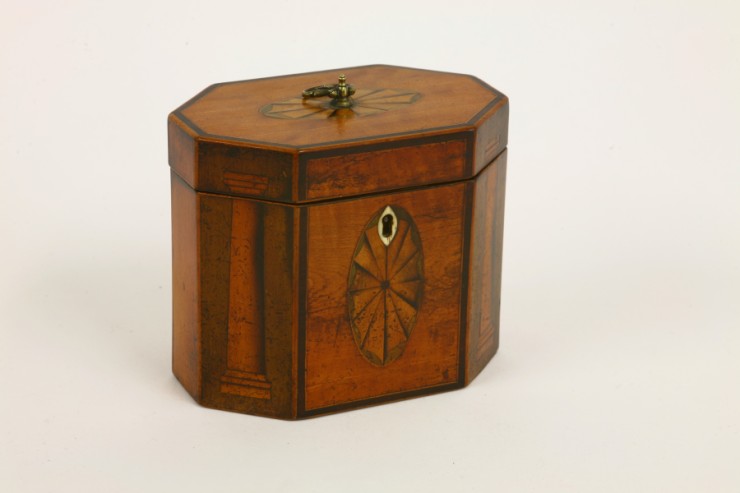
A George III tea caddy
of rectangular form with canted corners, the lid in harewood (?) with an inlaid oval patera within strung borders, the front panel in mahogany similarly decorated, the canted corners inlaid with plain shaded columns on a stained ground, 11.5cm high.




















 Jane Austen in Vermont