Where oh where do I begin to tell of this joyous day? All places I have been before, but more engaging touring about with a group of like-minded people, and the chance to see so much more behind the scenes…
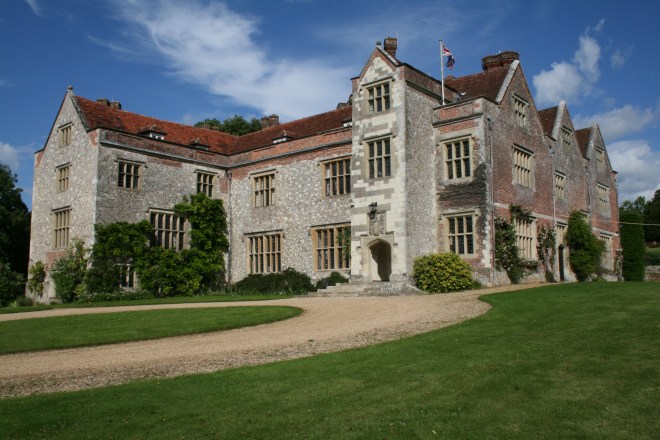
We are today off from our Winchester hotel to Chawton – and there to see the two most important sites having to do with Jane Austen: Chawton House and the Jane Austen House Museum.
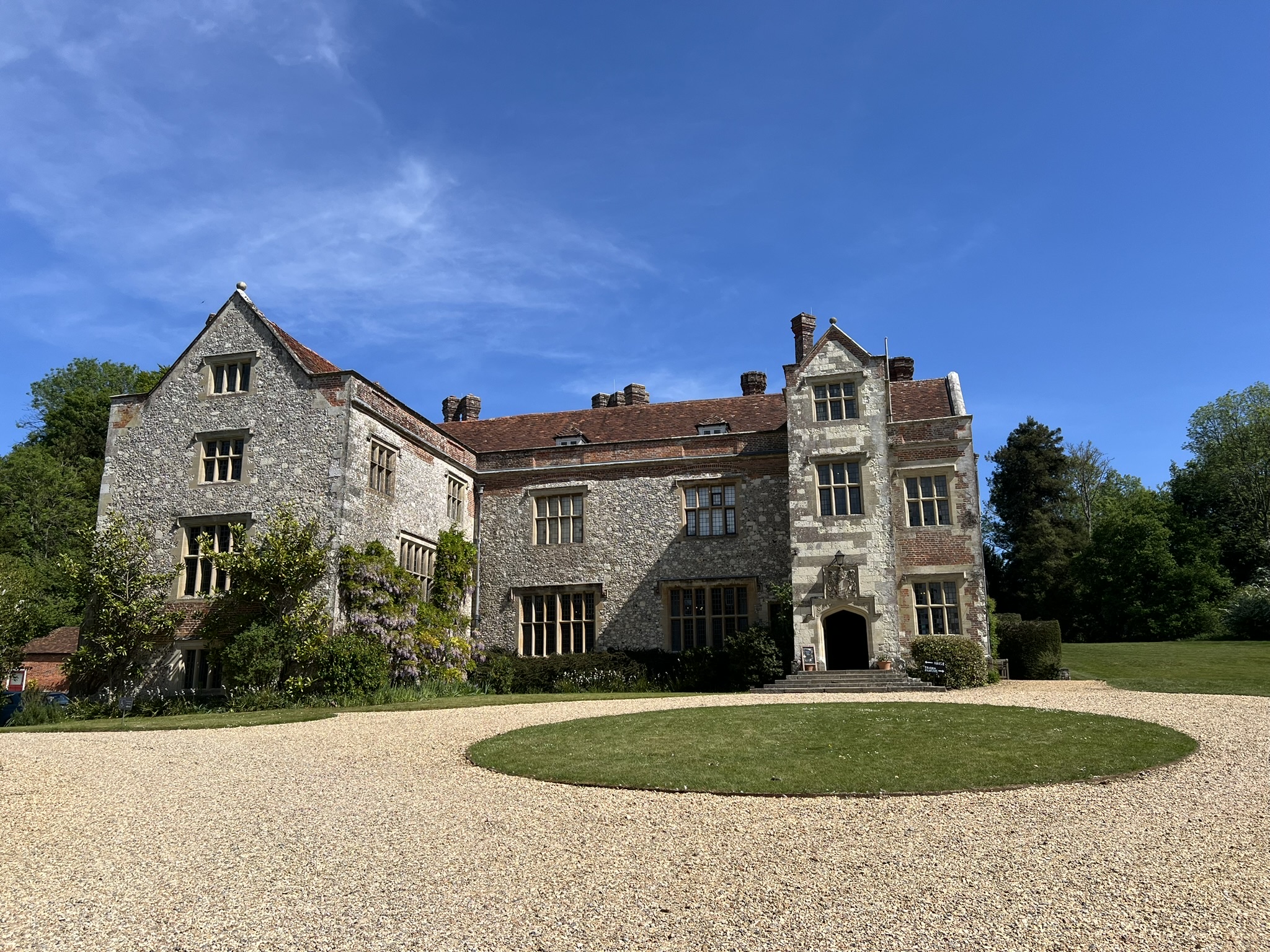
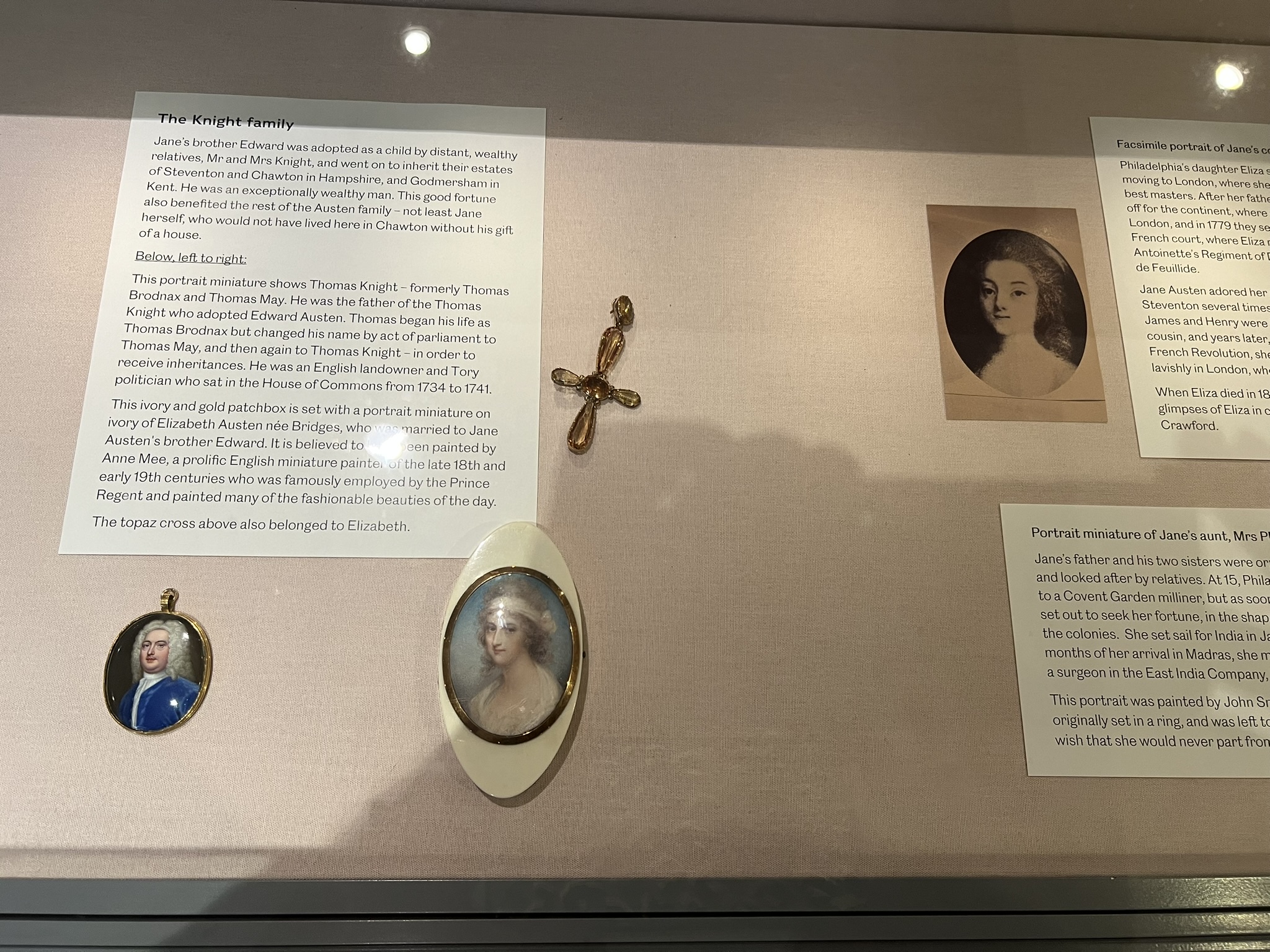
Chawton House is an Elizabethan manor house still in the Knight family, owned by Edward Austen Knight, Jane Austen’s brother. Edward was adopted by the Knight family and he inherited three estates: Steventon, Chawton and Godmersham Park. You can read all this interesting history here – https://chawtonhouse.org/visit/house/
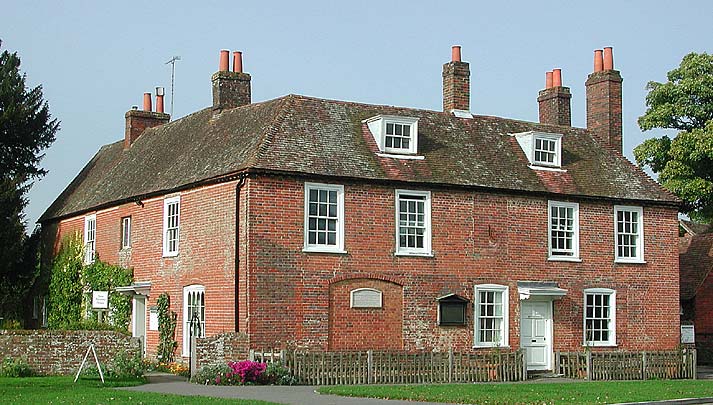
…the main point being that Edward’s ownership of this Chawton estate gave him the ability to offer the steward’s cottage on the property to his mother and two sisters in 1809 [this is now called the Jane Austen House Museum] – and so, like Godmersham Park, Jane would have visited this house often – a short walk up the road – again, giving her the knowledge of life on a gentleman’s country estate. Edward’s stewardship of his land and properties certainly served as a model for her grand land-owning Heroes in her novels: Mr. Darcy, Mr. Knightley, and Col. Brandon.
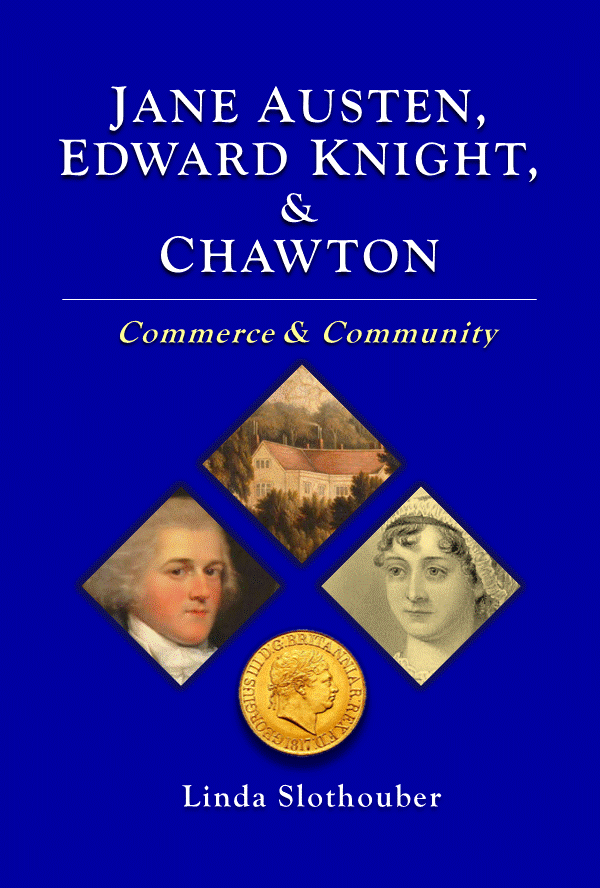
[If you have any doubts about Edward’s generosity, please read Linda Slothouber’s book: Jane Austen, Edward Knight, & Chawton: Commerce and Community [Woodpigeon Publishing, 2015.]
************
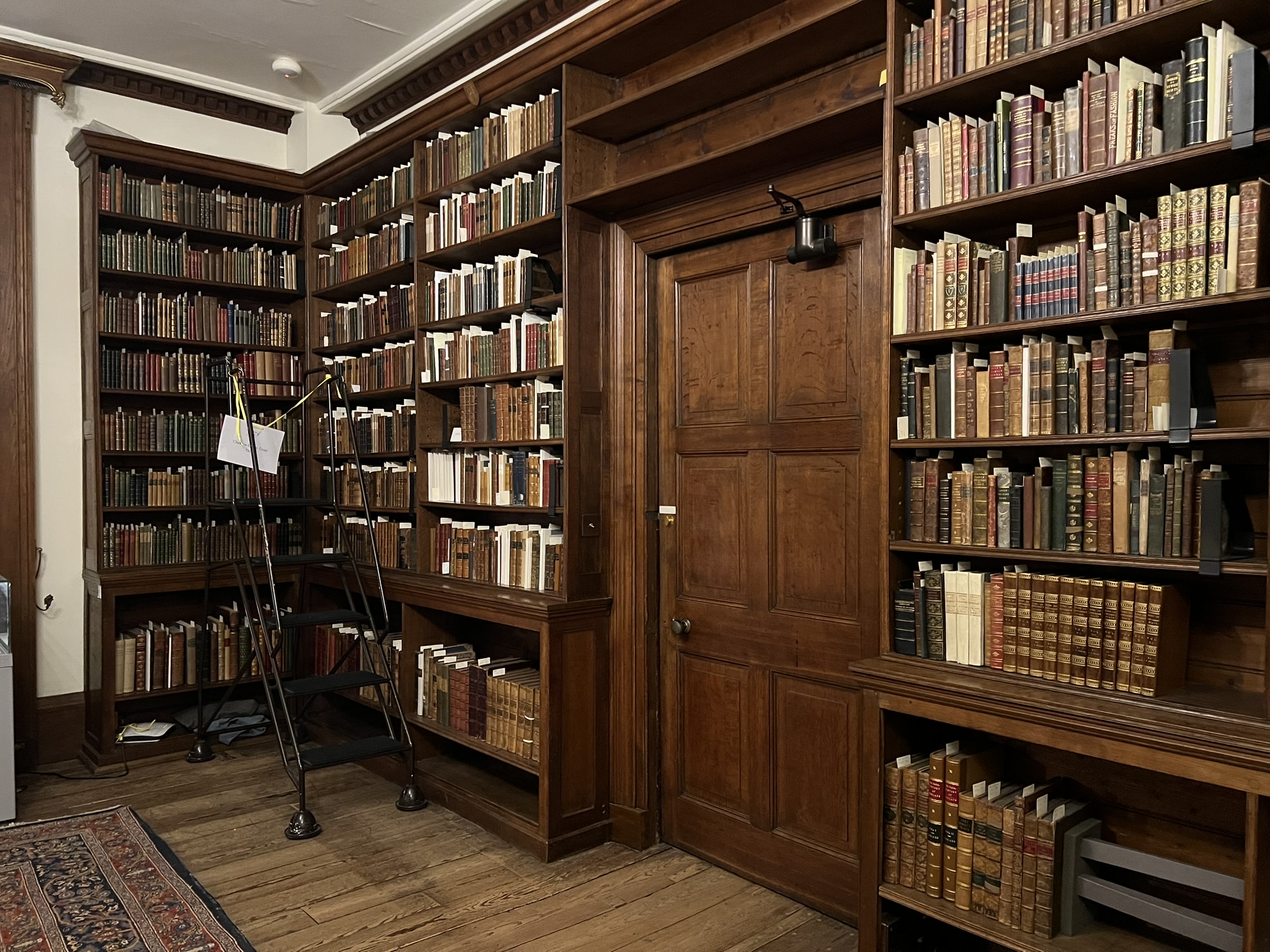
Chawton House is far more than a visit to a grand manor – complete with a tea room, numerous indoor and outdoor events throughout the year, a splendid garden and a place to wander, an Airbnb stay, and a wedding venue – it is most importantly a Library and Centre for the study of early women writers, 1600-1830. https://chawtonhouse.org/the-library/using-the-library/ – which is exactly what it says, a library of early women writers with many rare and unique titles; they also present changing exhibits on the many aspects of these women writers – right now one on “Sisters of the Pen.” [more on this below] – and do not miss their regular online offerings to us far afield.
The history of this library is novel-worthy itself – the American Sandy Lerner, taking on the lease of the property and keeping it from becoming a golf course [!] – the renovations to the house and outlying buildings, the housing of her book collection of these mostly forgotten women writers, and the creation of the now self-sustaining manor we can visit and study at today.
or if you are in the US or Canada, you can join the North American Friends of Chawton House here: https://www.nafch.org/ ]
Lots more to say here, but let’s get to our visit and some photos!
Katie Childs with Edward Austen Knight
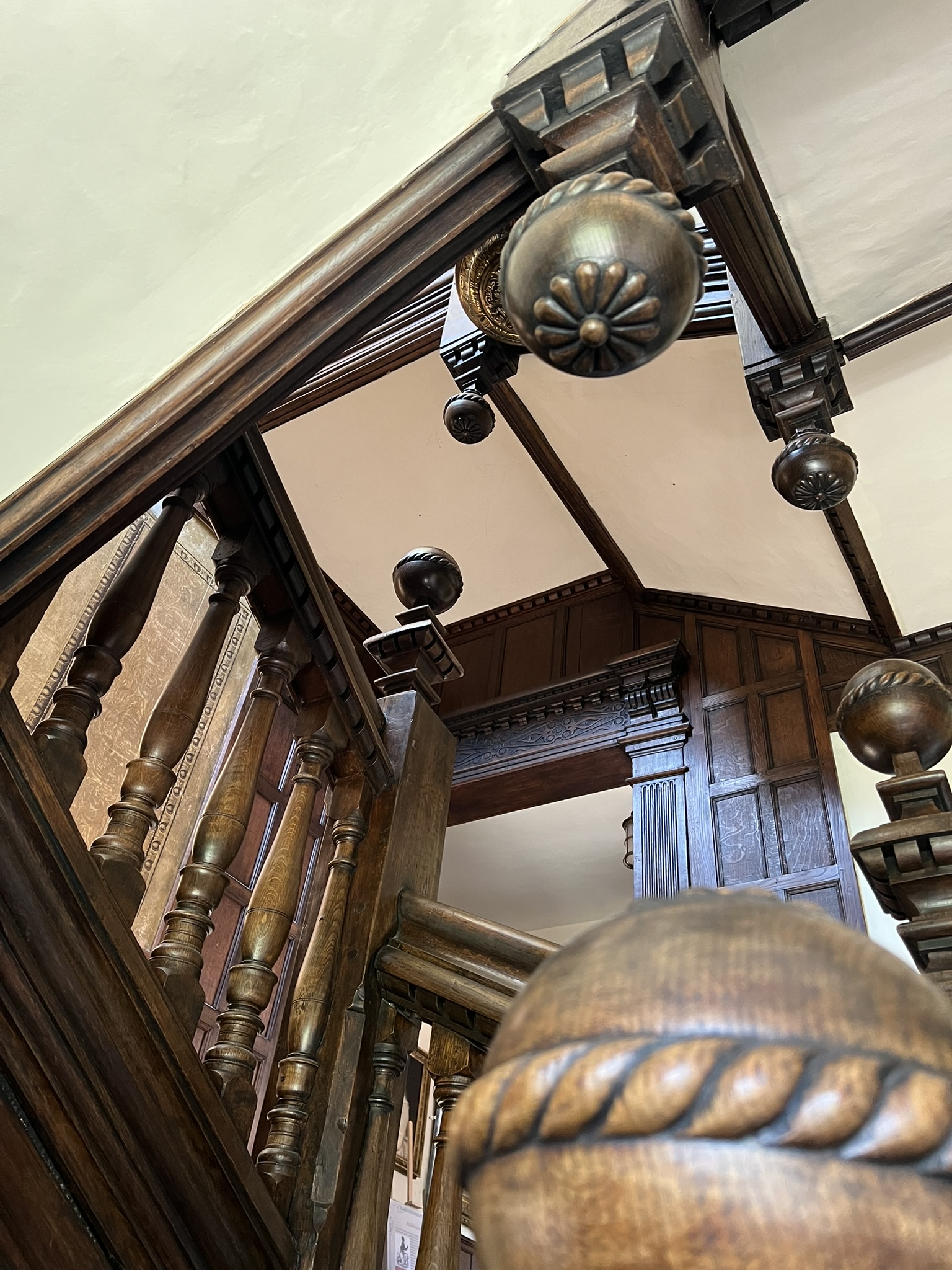
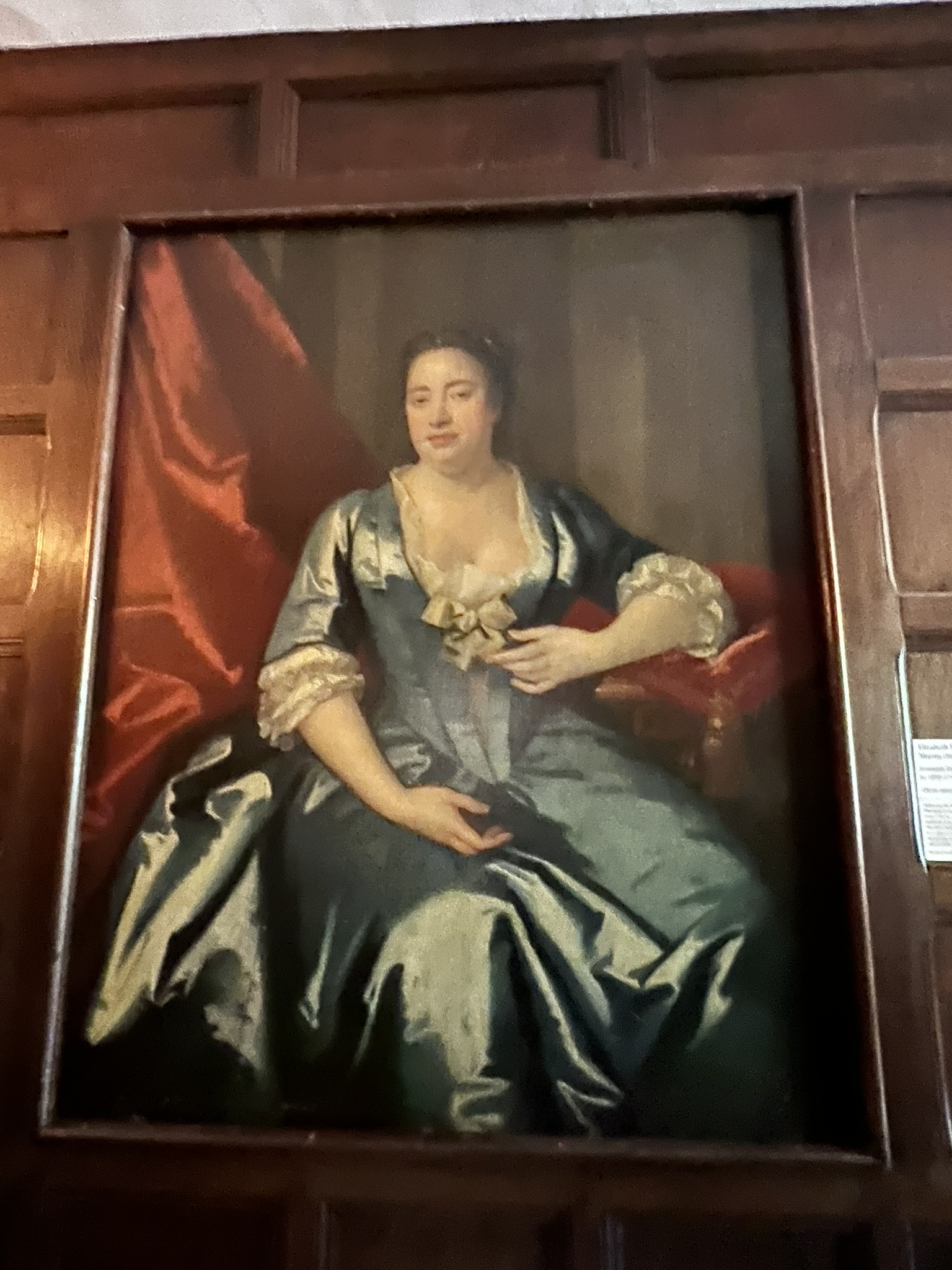
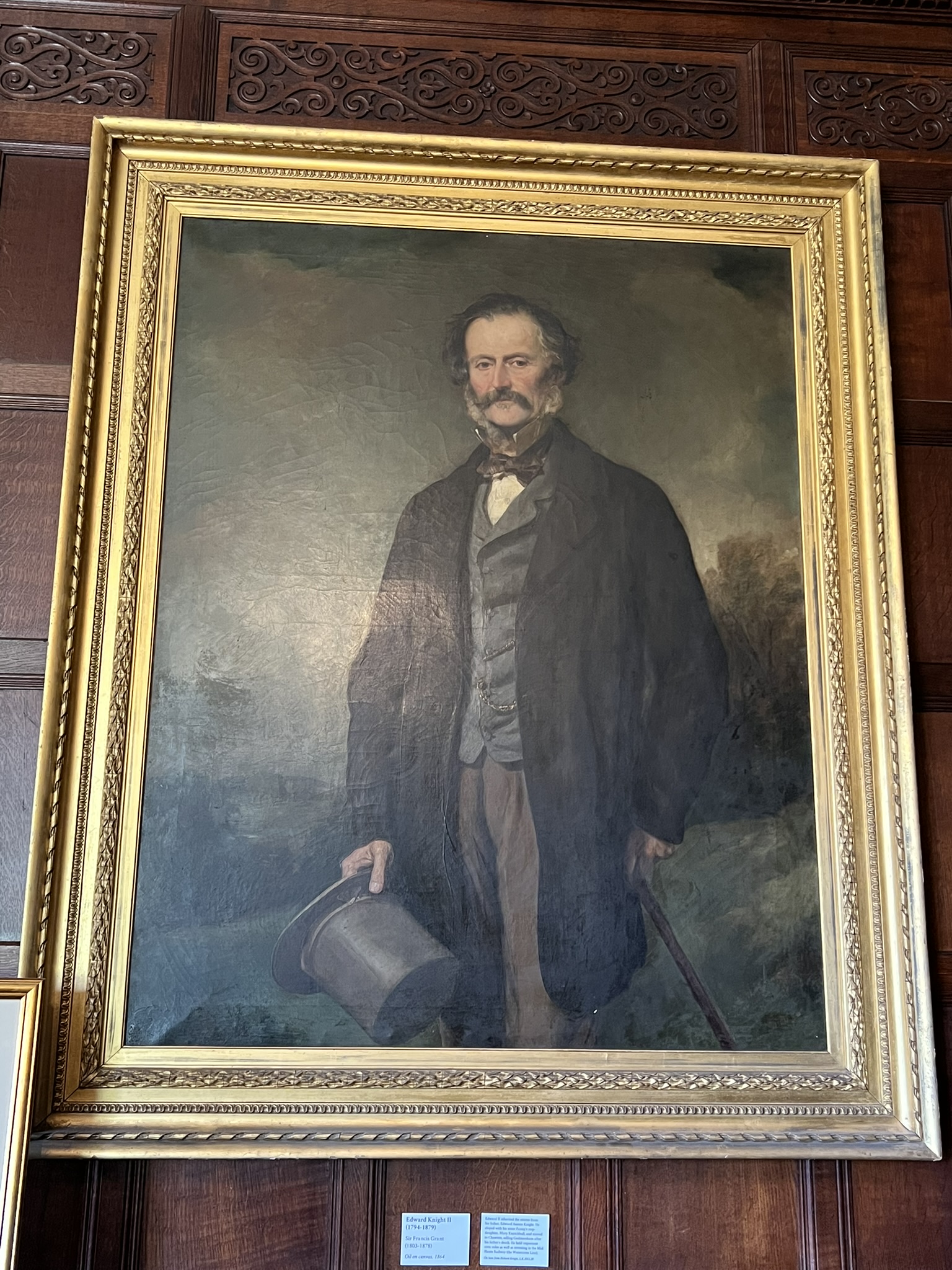
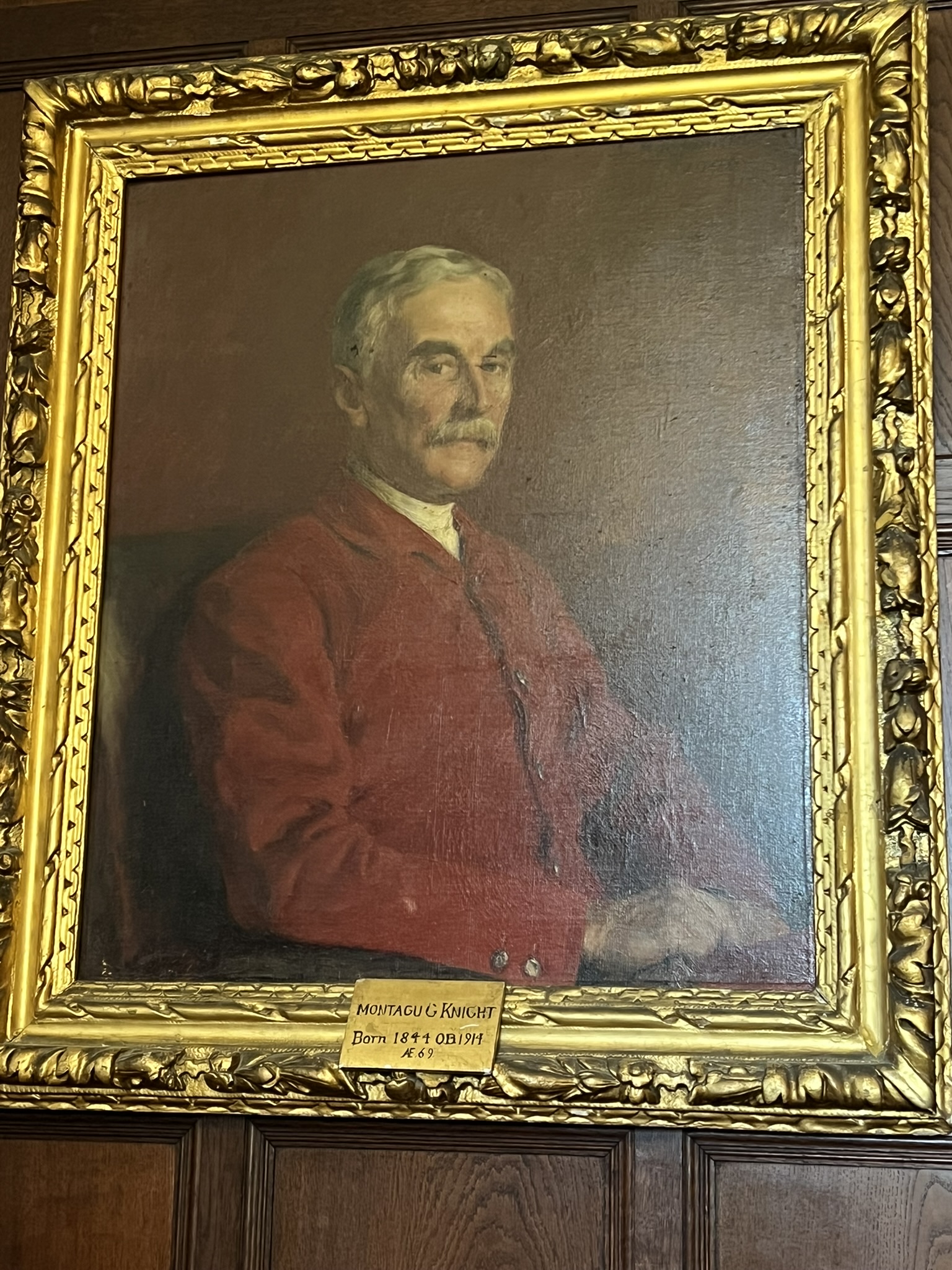
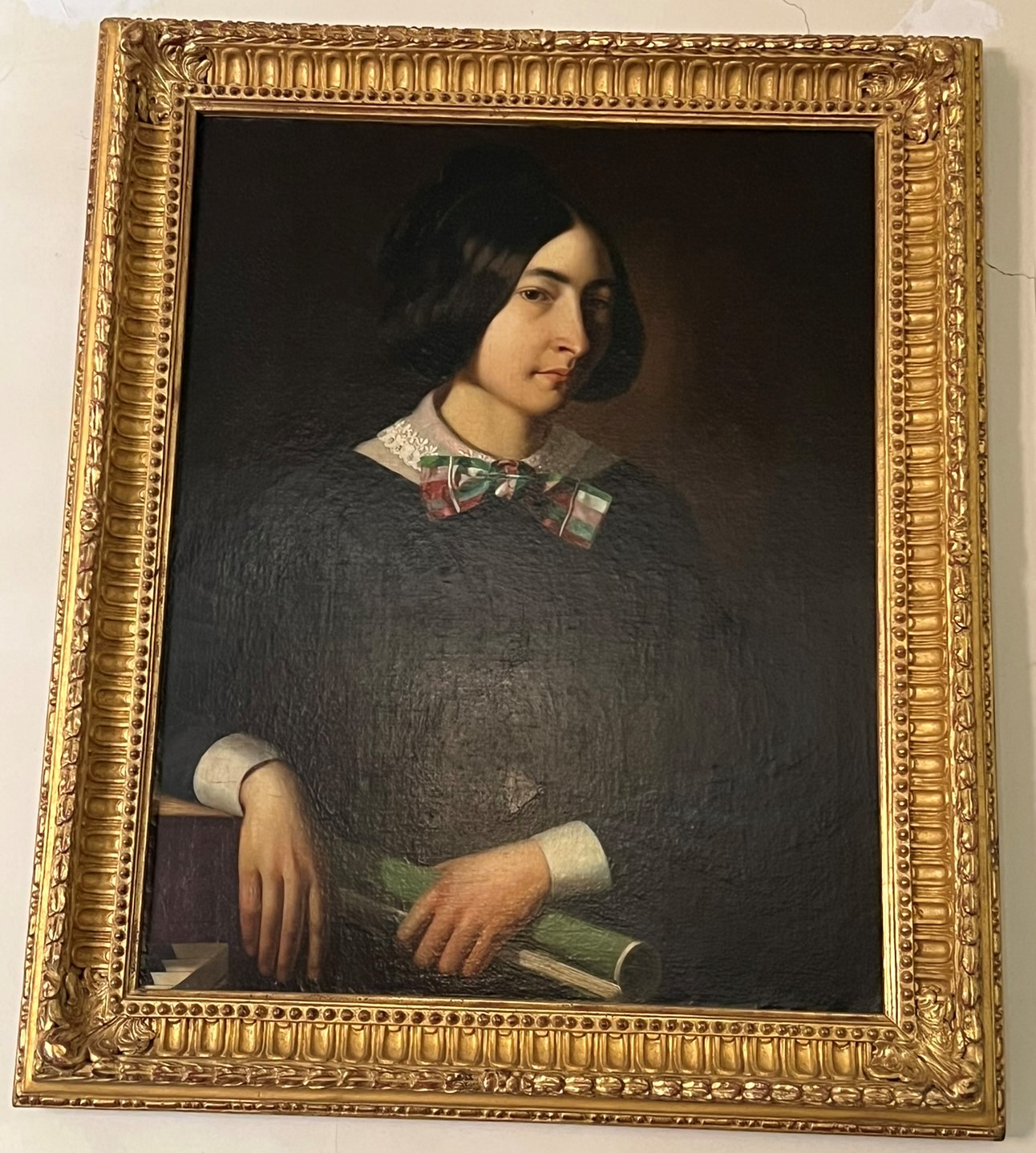
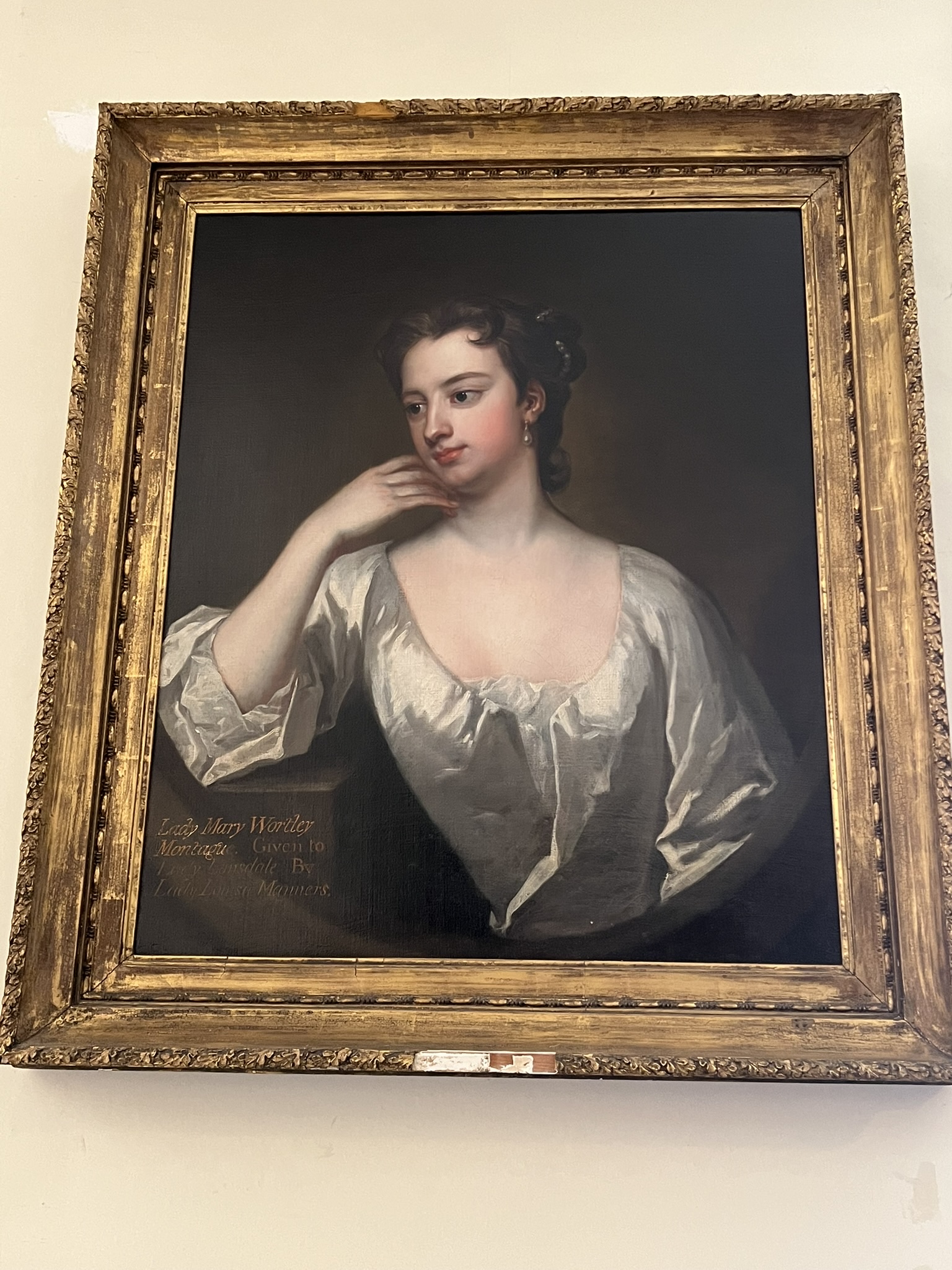
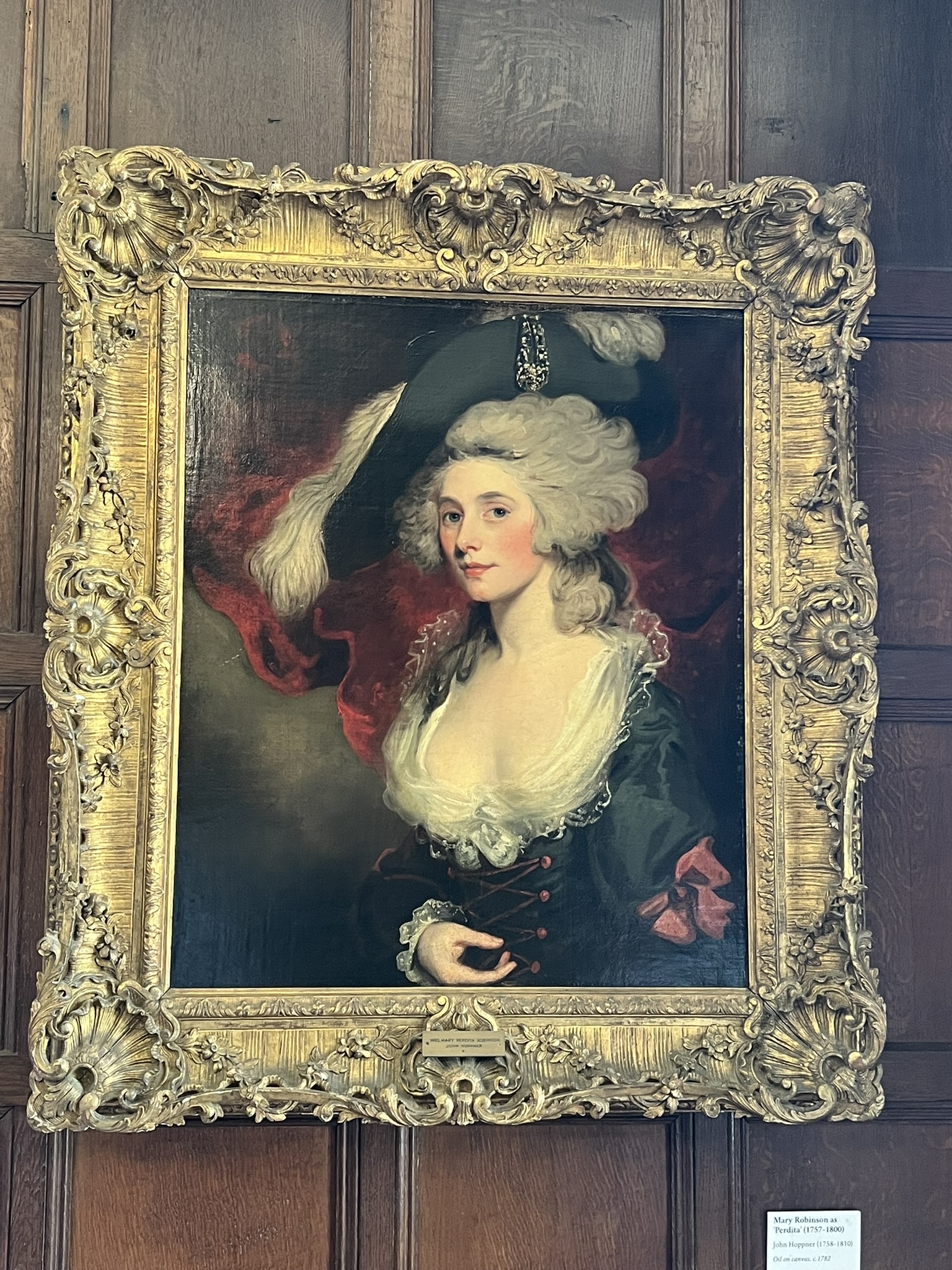
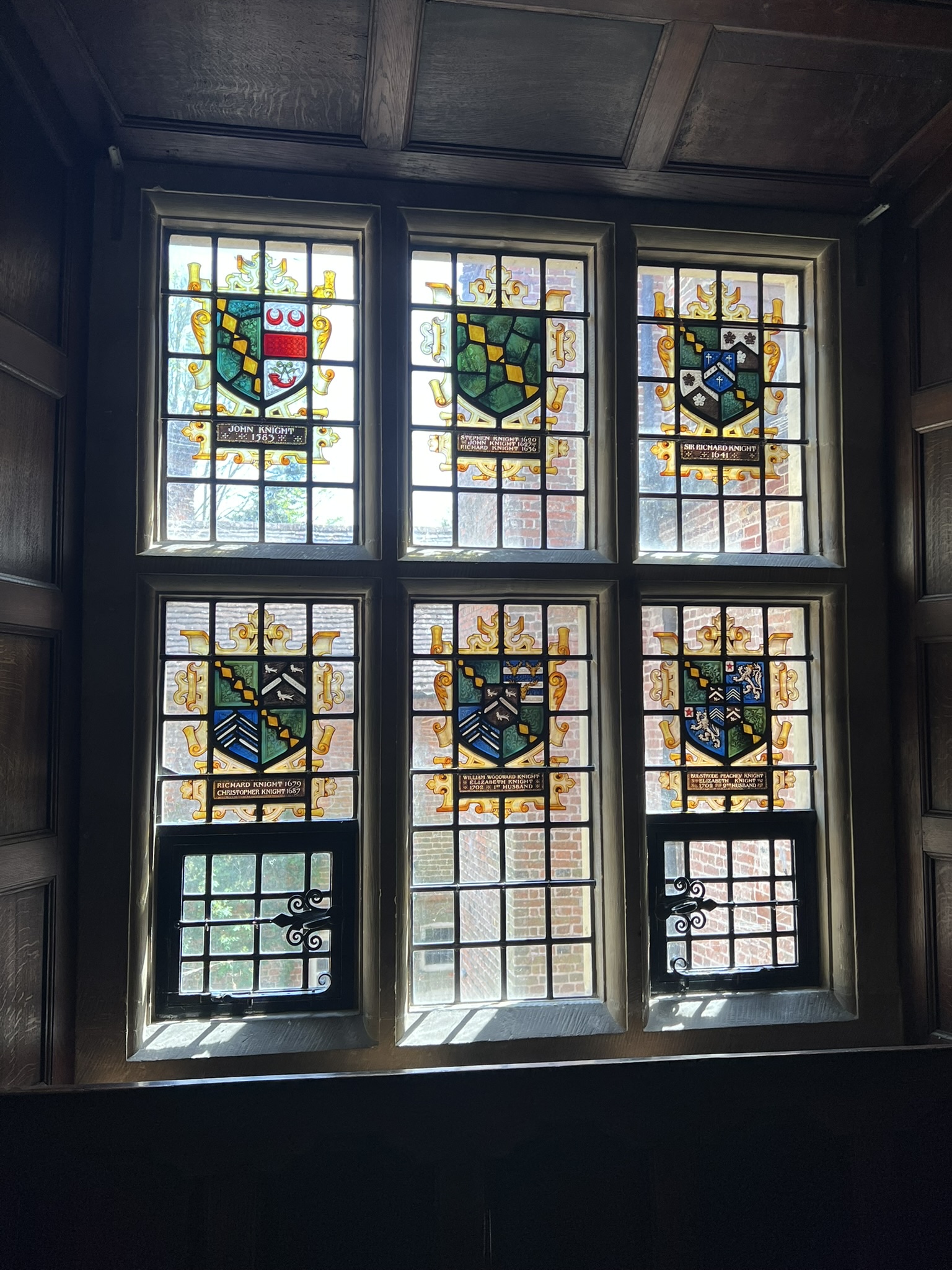
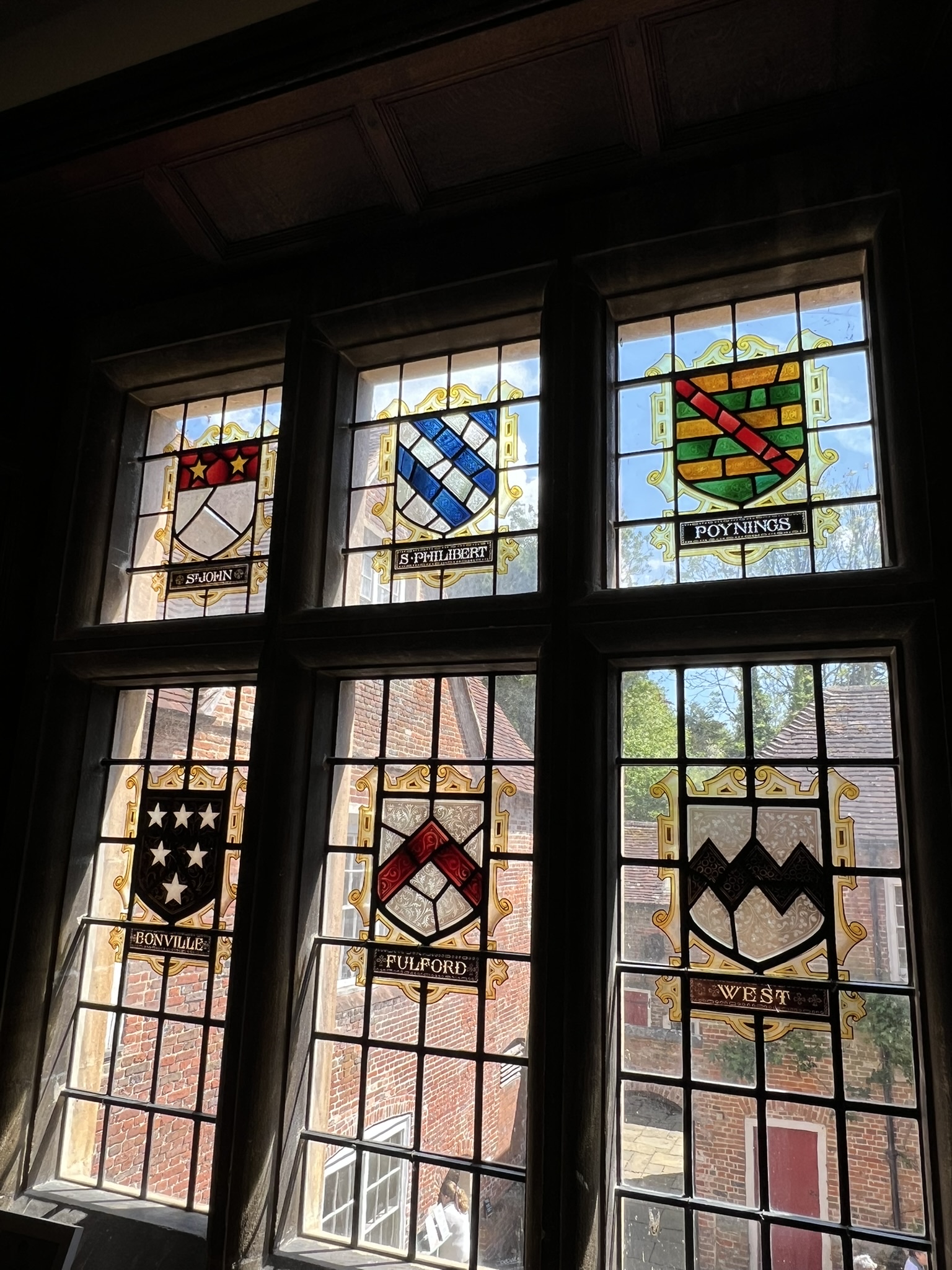
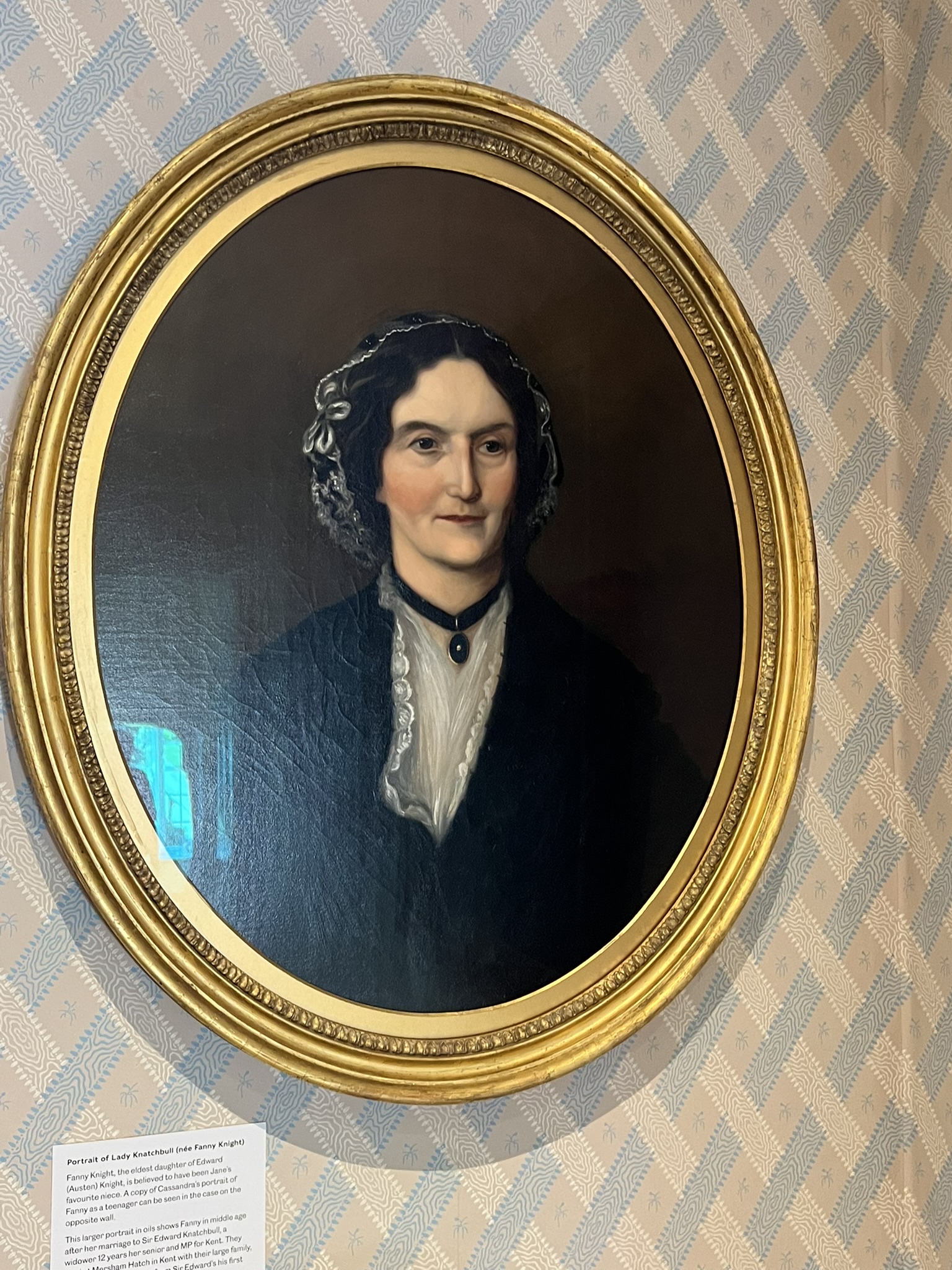
We were first greeted by Katie Childs – the Chief Executive [if you have been paying attention, we also met Katie at Godmersham Park!] – who gave us some of the history of the house, the library, current plans and exhibitions. We were able to tour the house on our own [ascending the grand staircase such an experience!] – seeing all the portraits of Knight family members, hung along with some of the famous women writers, actresses, manor house owners – and admiring the heraldic windows that I have posted about before.
Elizabeth Knight – Edward Knight Jr – Montagu George Knight
George Sand – Lady Mary Wortley Montagu – Mary Robinson
and what manor would be complete without an image of the Duchess of Devonshire:
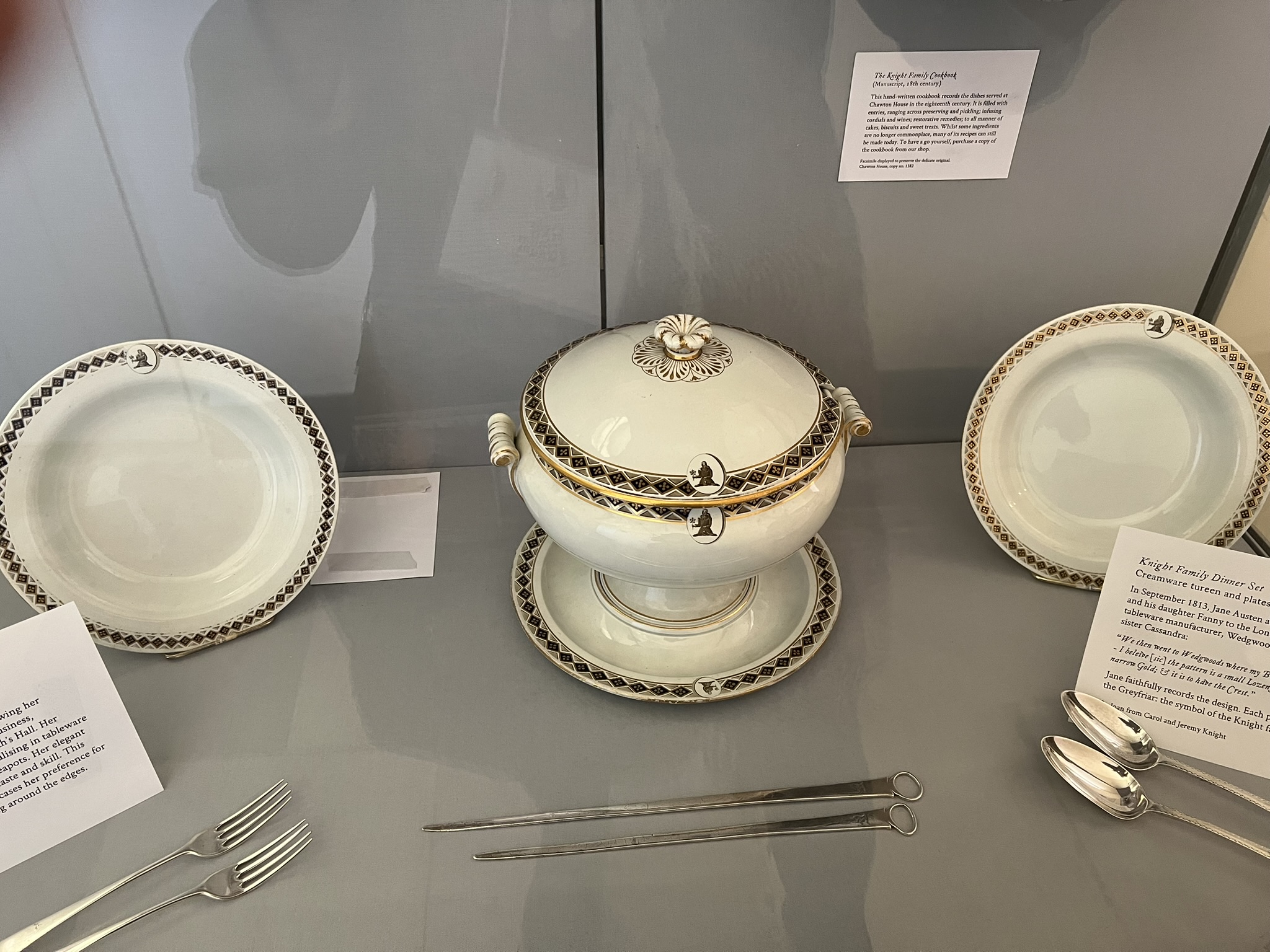
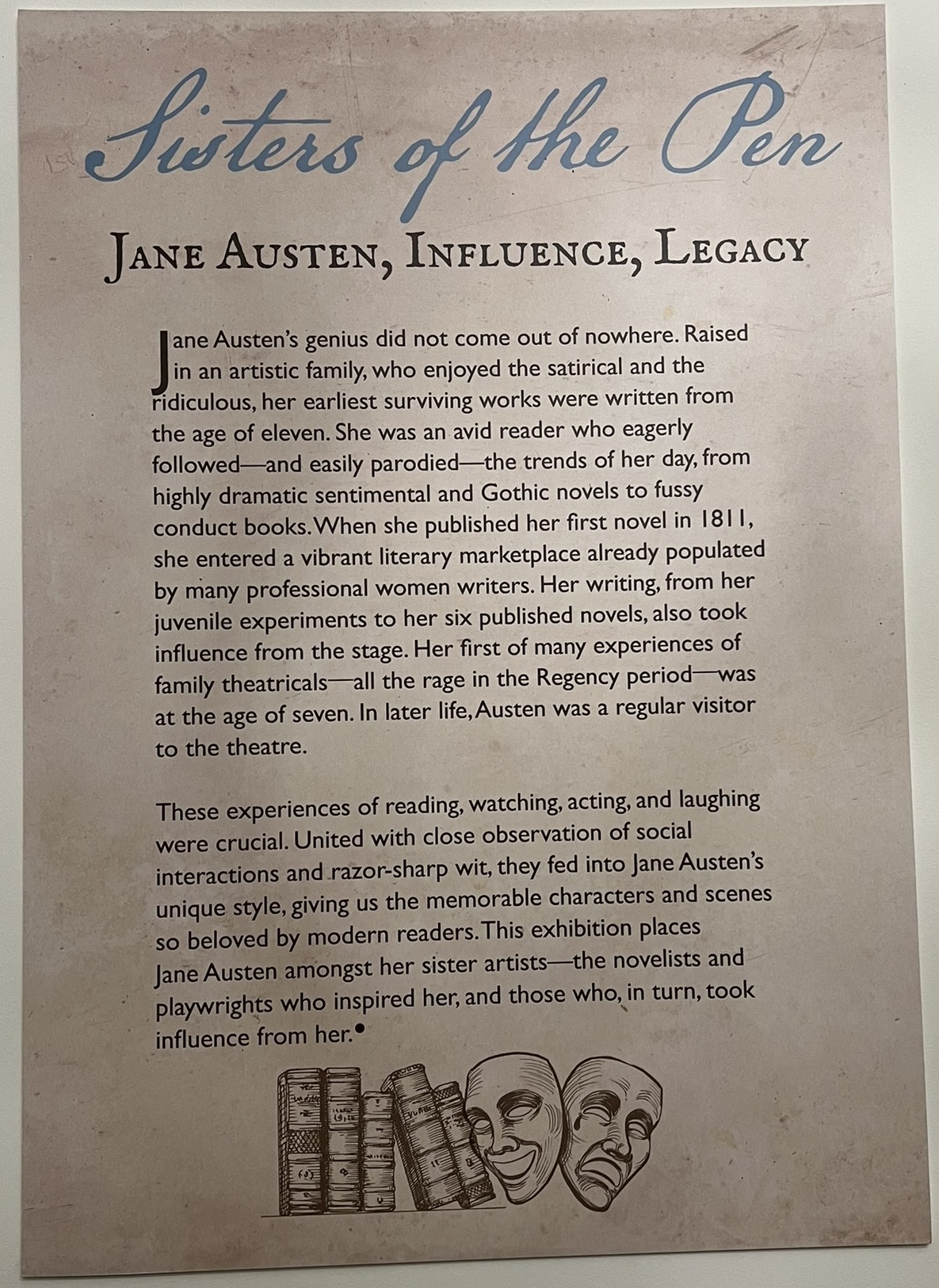
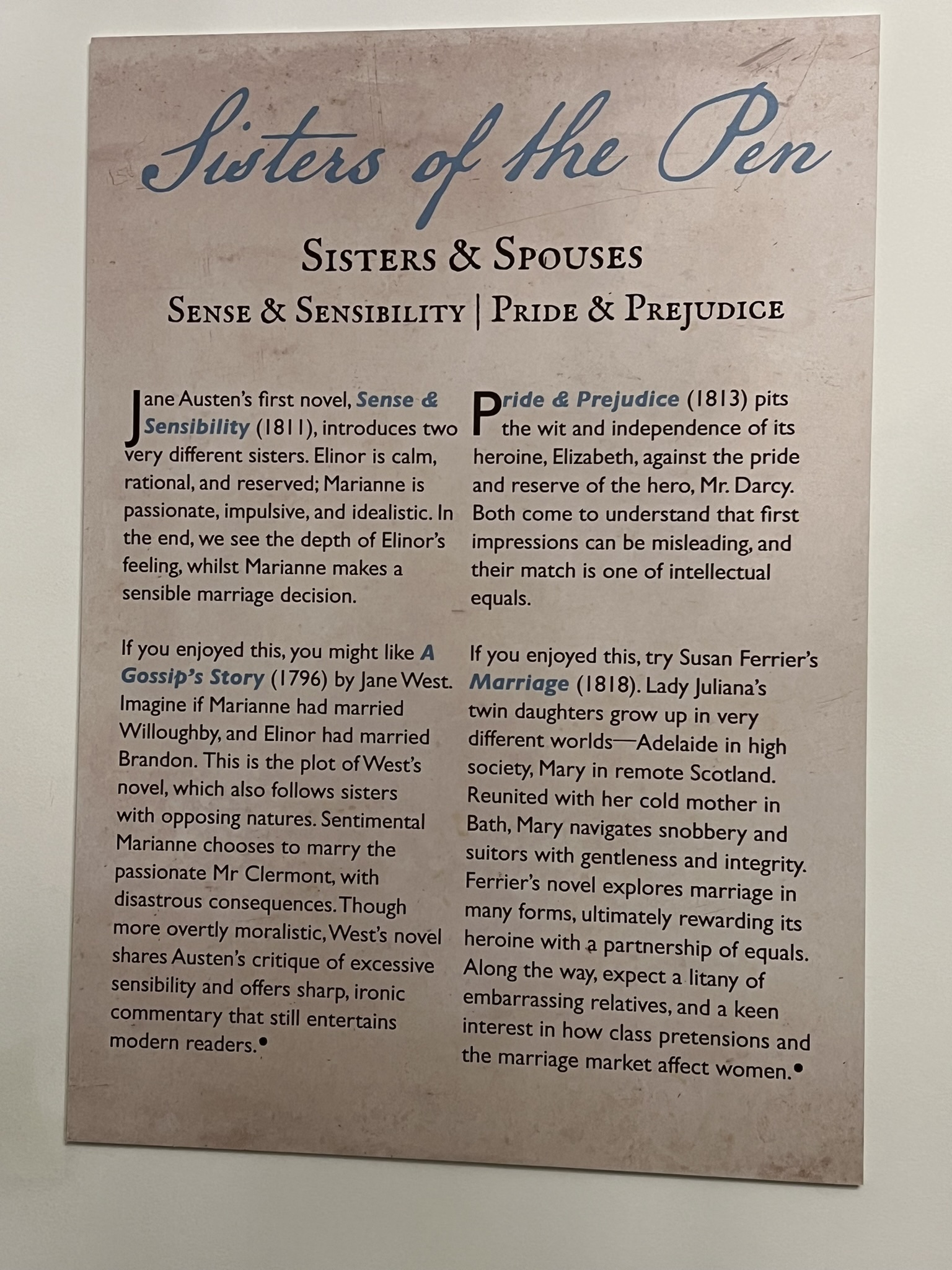
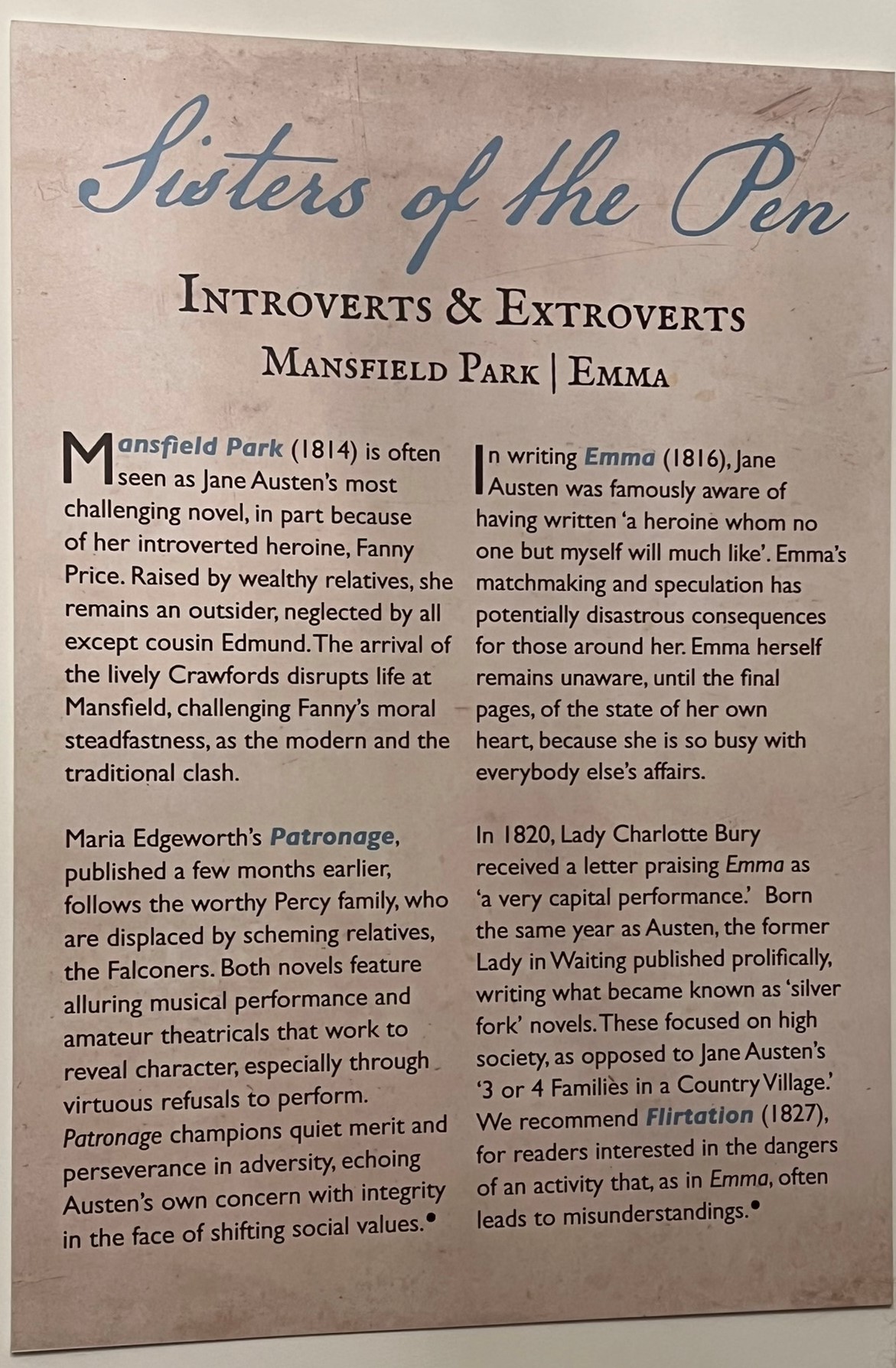
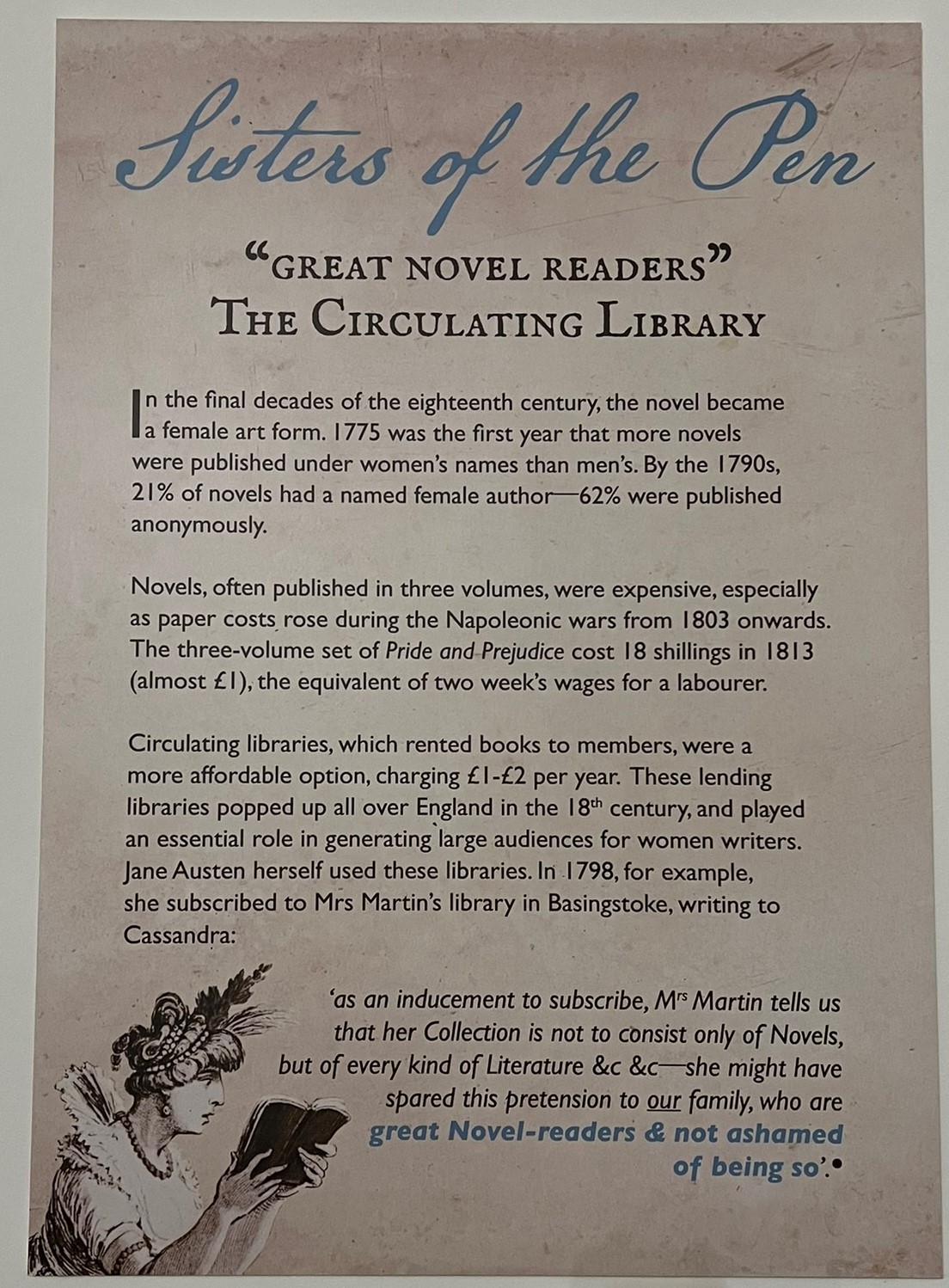
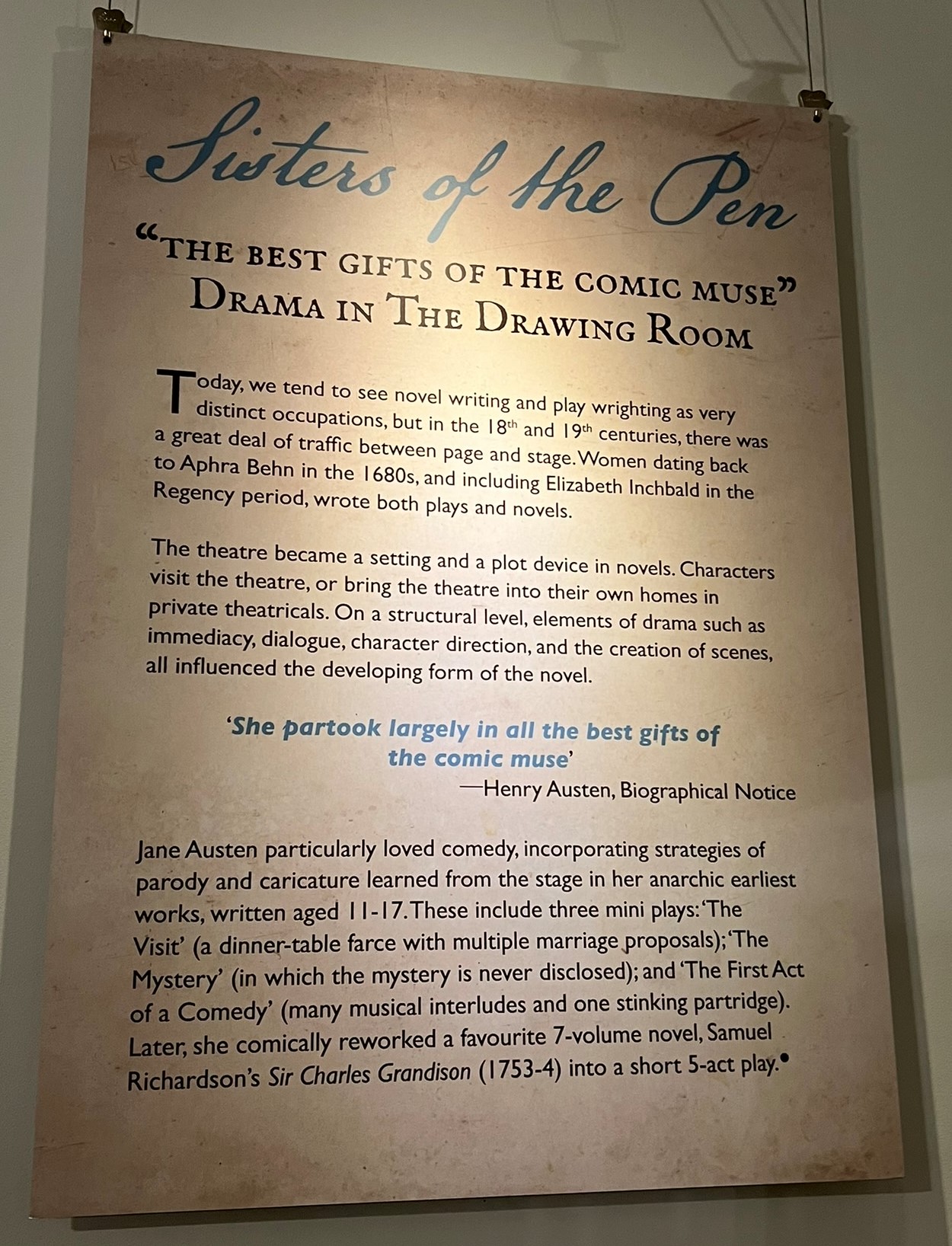
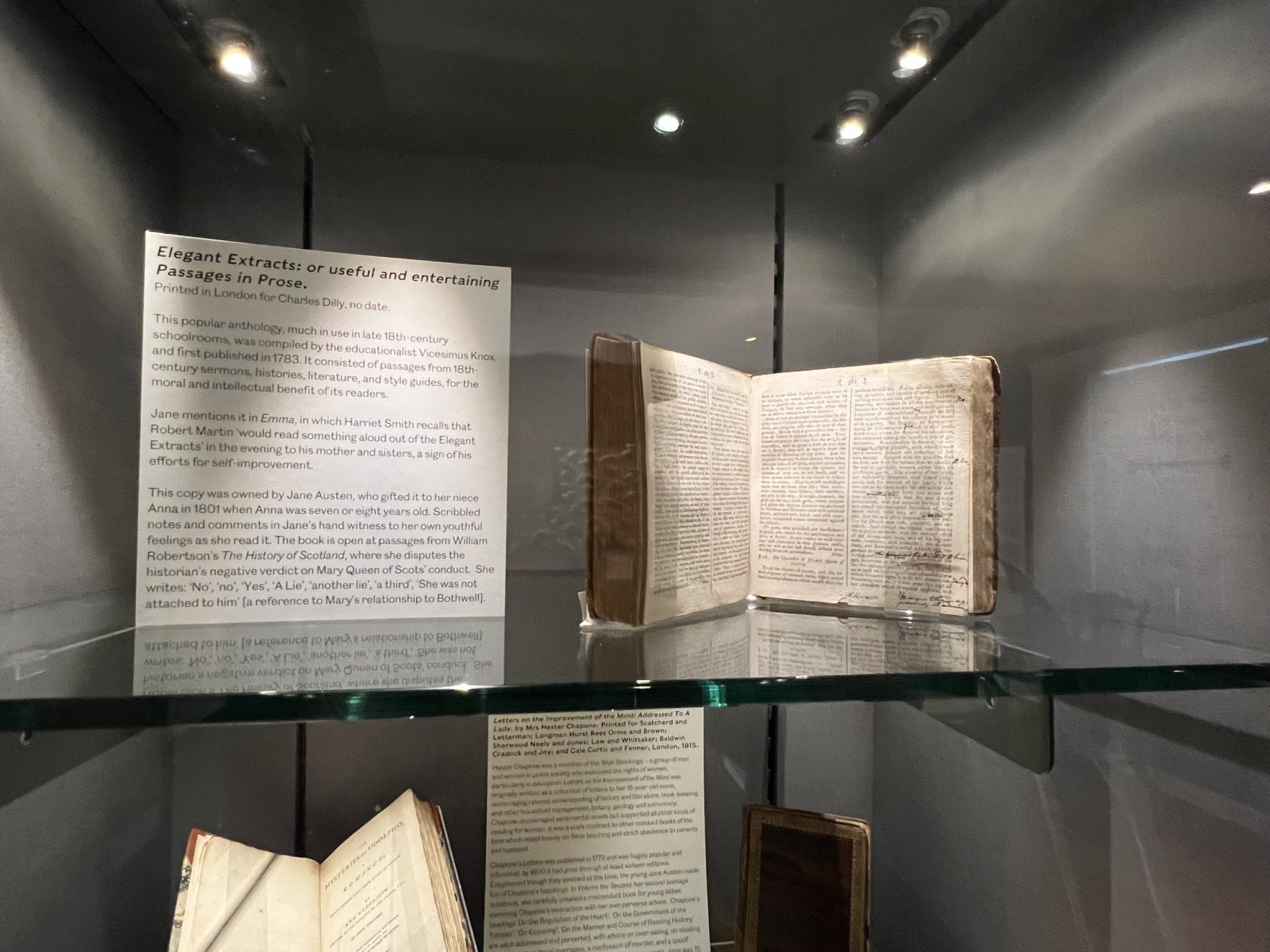
The current exhibition is quite eye-opening, especially if you were not previously aware of the numerous women writers before and during Jane Austen’s time [spoiler alert: Jane Austen did not invent the novel as we know it, nor was she the only woman writing in the late 18th / early 19th century!] – it is called “The Great Forgetting” – the removal of 100s of women writers from the canon, now subject to the ongoing process of being recovered – this exhibition “Sisters of the Pen: Jane Austen, Influence, Legacy” tells this history with both signboards, objects and books – it is beautifully done and no way to quite capture it with random photos – here are a few to give you a sense:
[and for the rest, you just must visit yourself!]
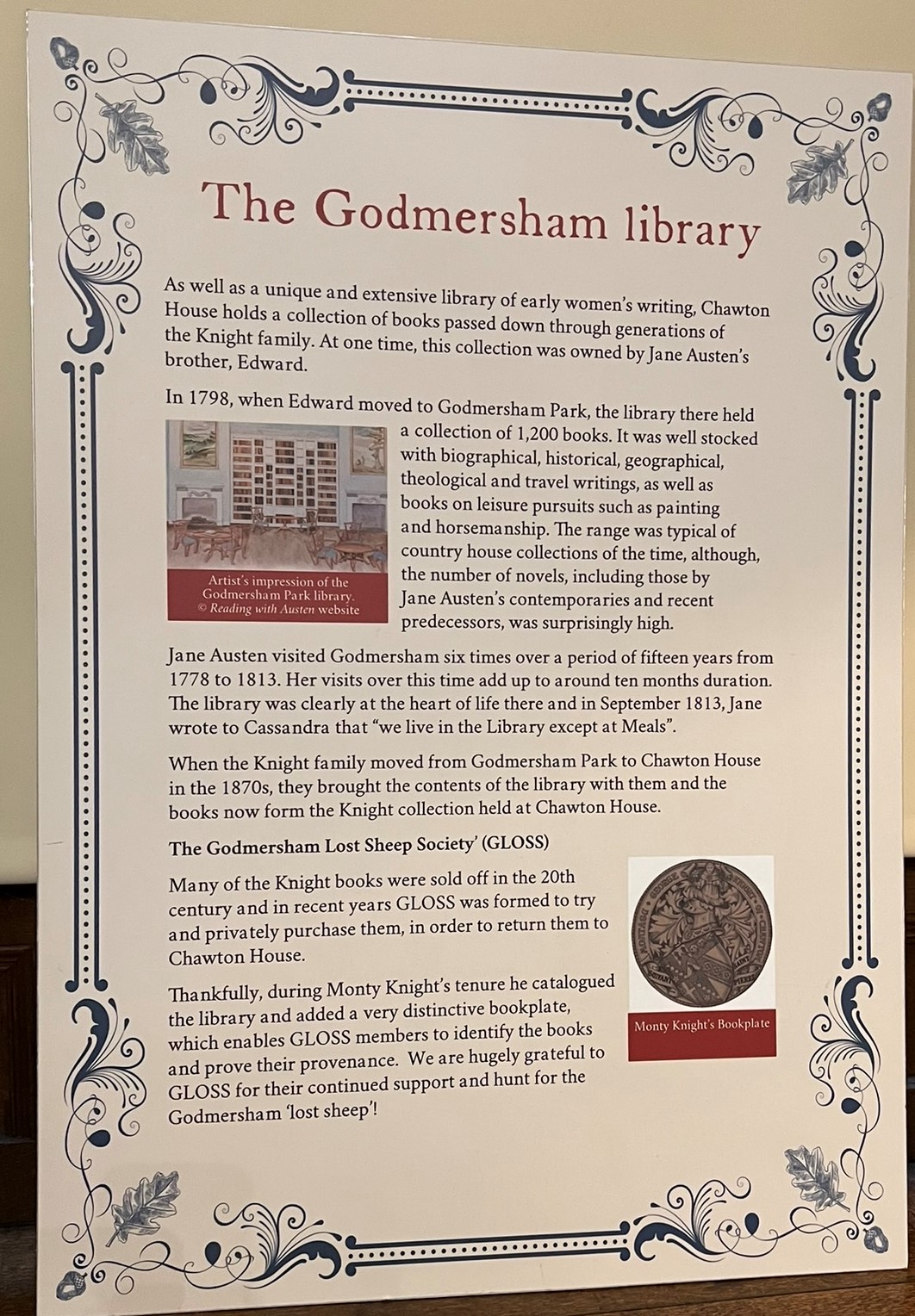
It was nice to see the display on the Godmersham Park library and the Reading with Austen website and the blogwhich tells of the GLOSS finds: “Bulstrode Peachey”, one of the volunteers, was very happy to tell me all about it, and even happier to learn I worked with Peter Sabor in returning the “Lost Sheep” to Chawton House:
It was grand to meet a number of the Chawton House volunteers – those that keep it all going and preserving and sharing the grand history here to visitors like us.
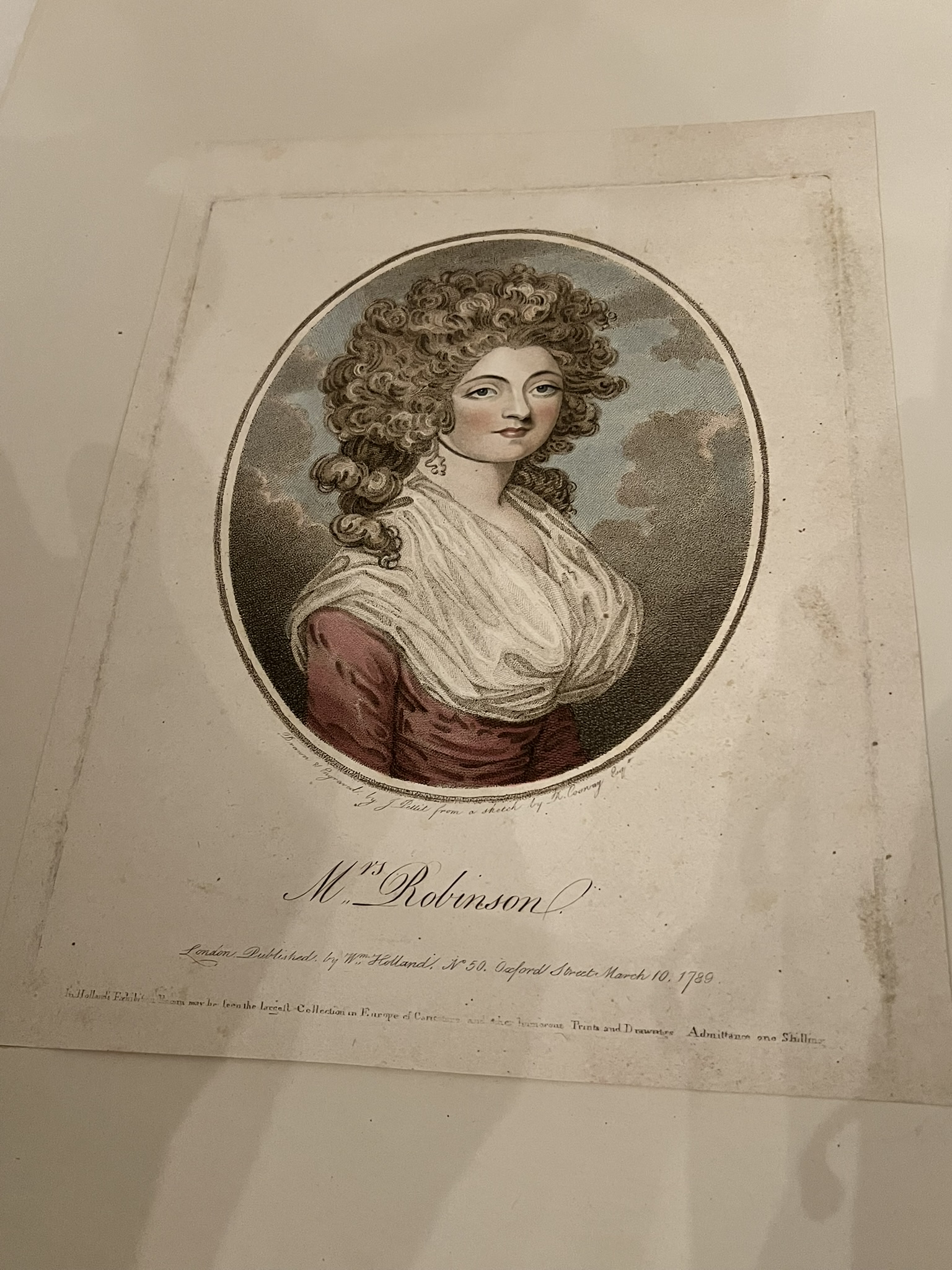
Katie invited us to see some of the recent acquisitions from the Deirdre Le Faye Archive: here is a Mary Robinson print:
and here an example of Le Faye’s numerous fashion prints:
and one of Le Faye’s carriage prints:
************
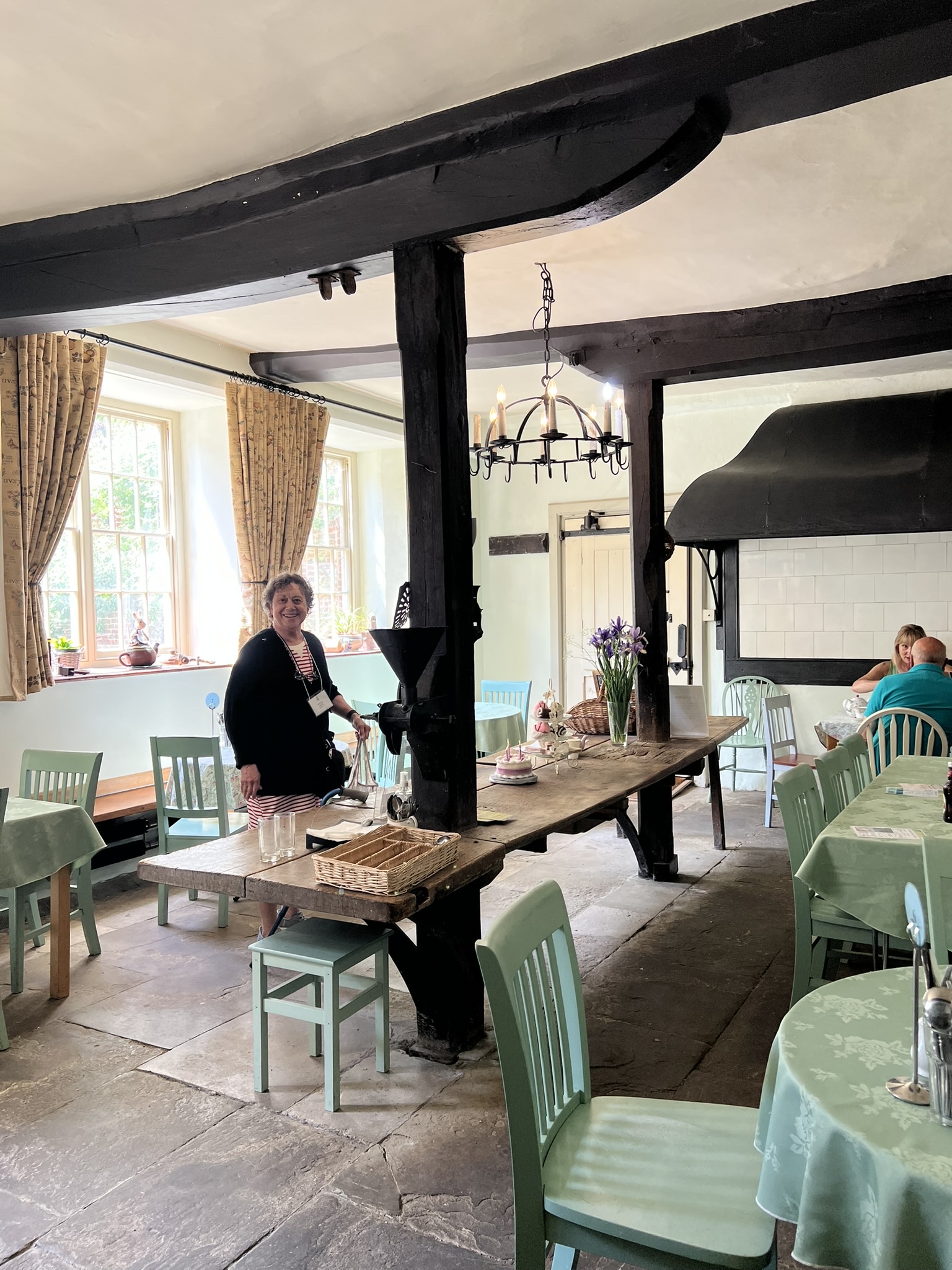
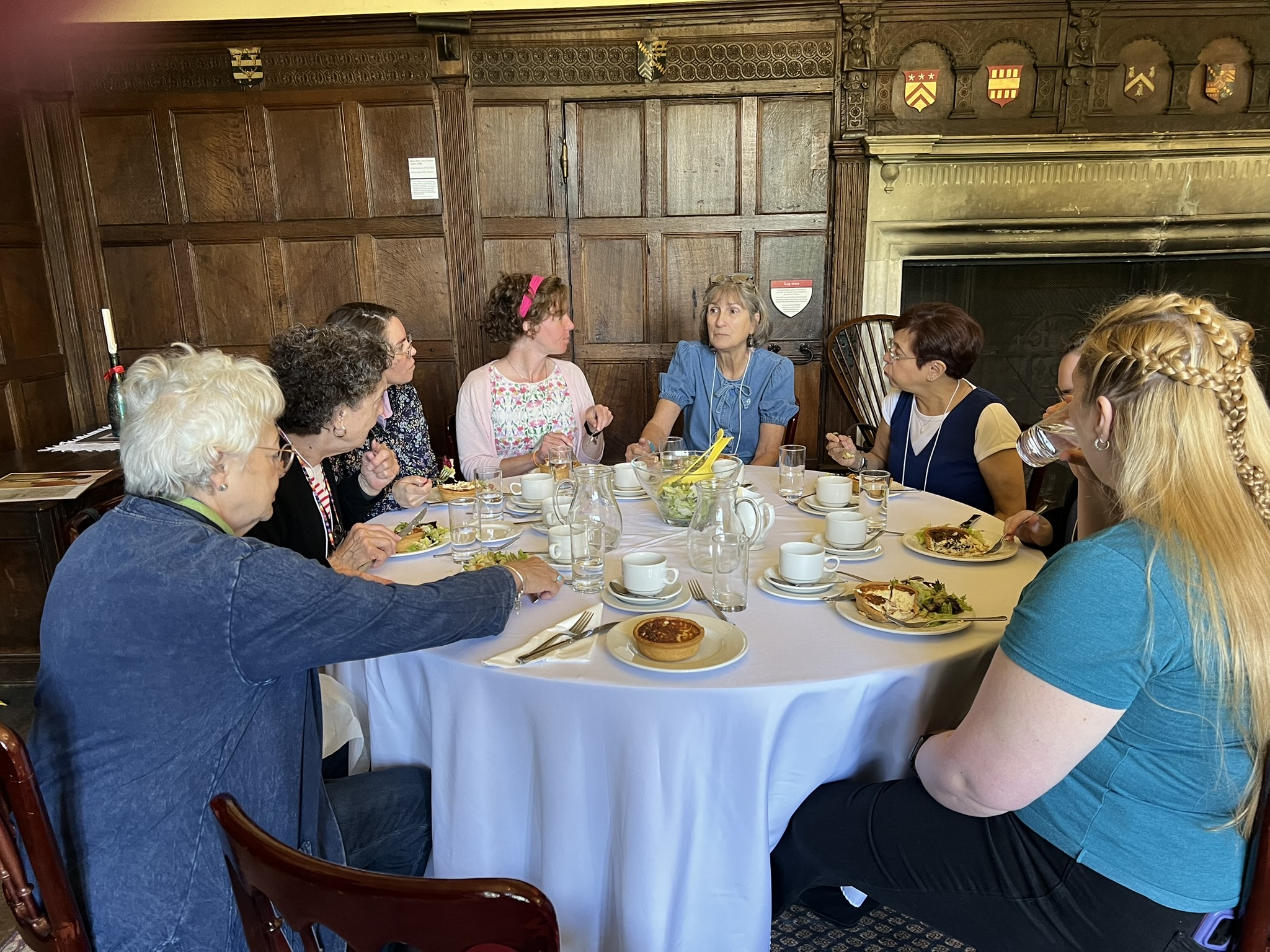
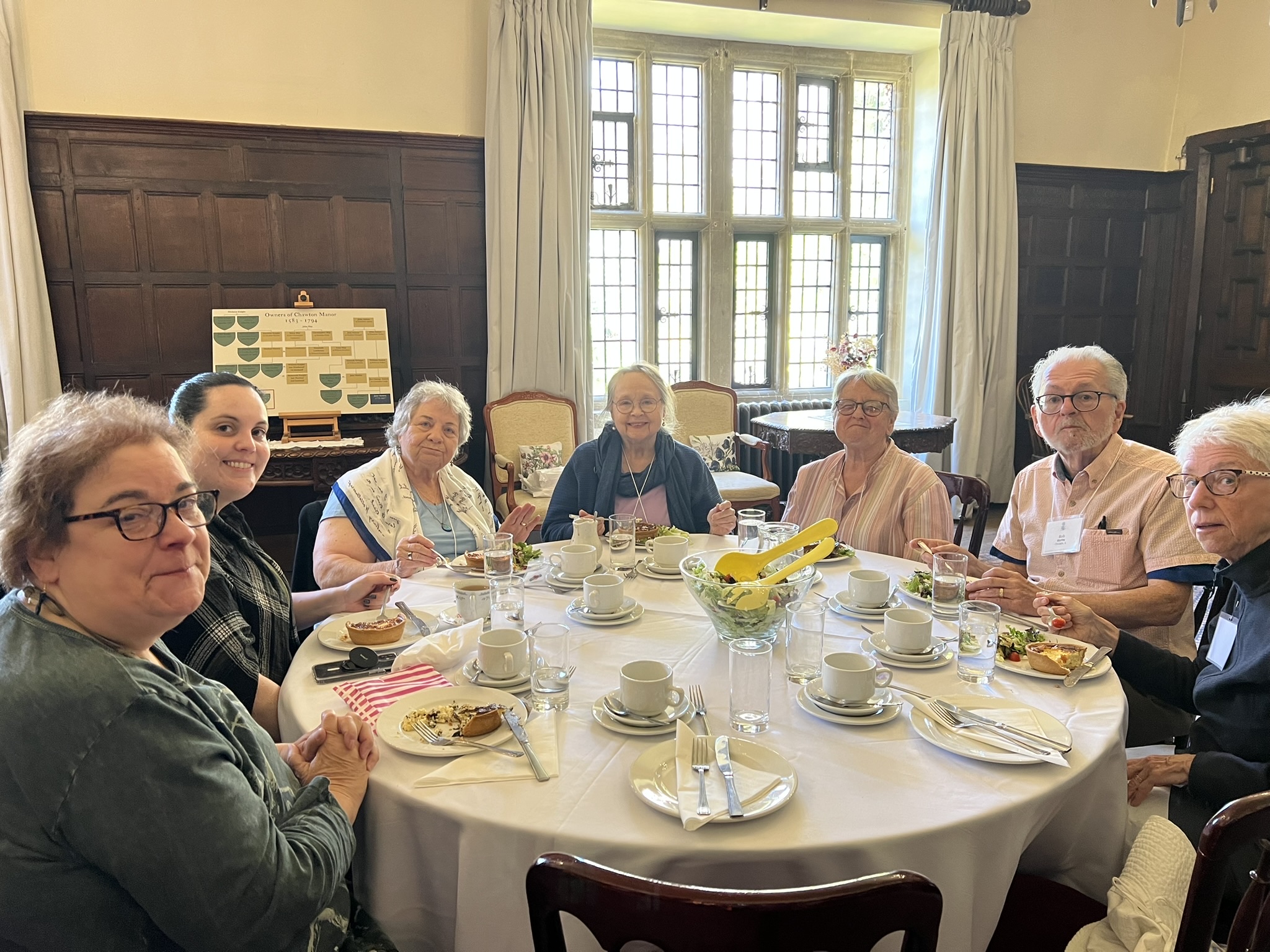
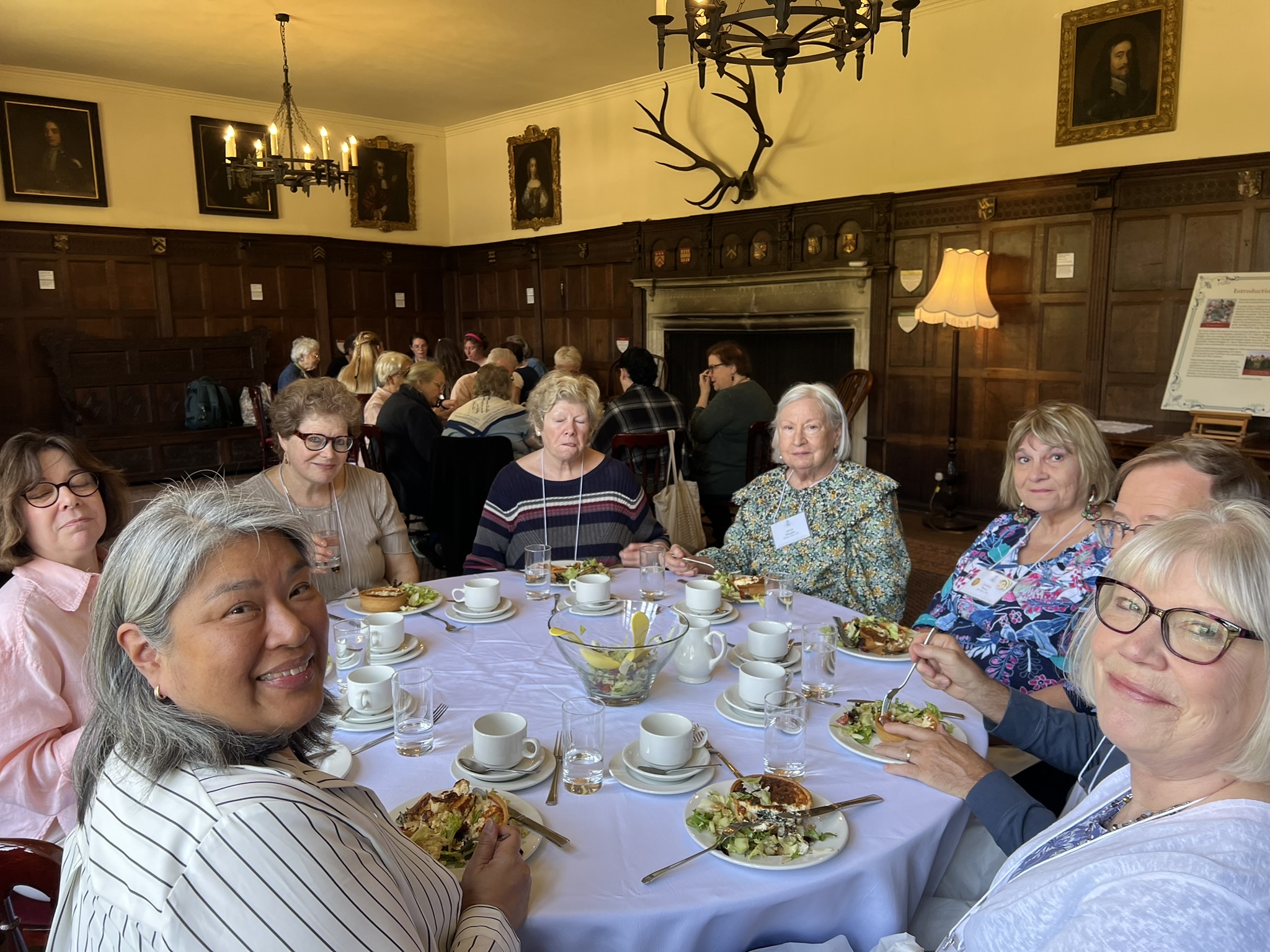
Then a delightful lunch:
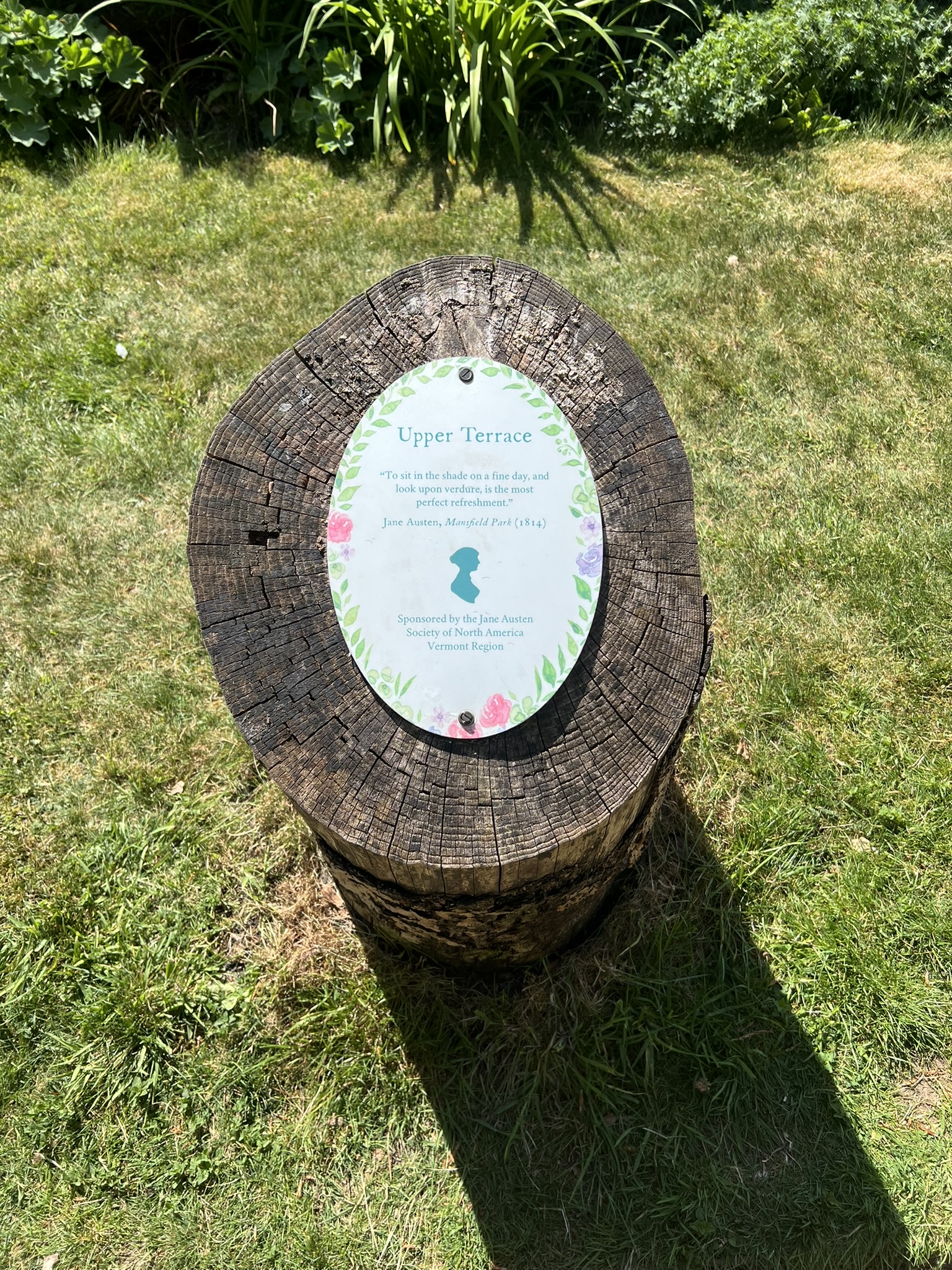
….and of course a chance to SHOP and then to wander about the grounds – I did visit the marker at the Upper Terrace, donated to NAFCH by the Vermont Region:
**************
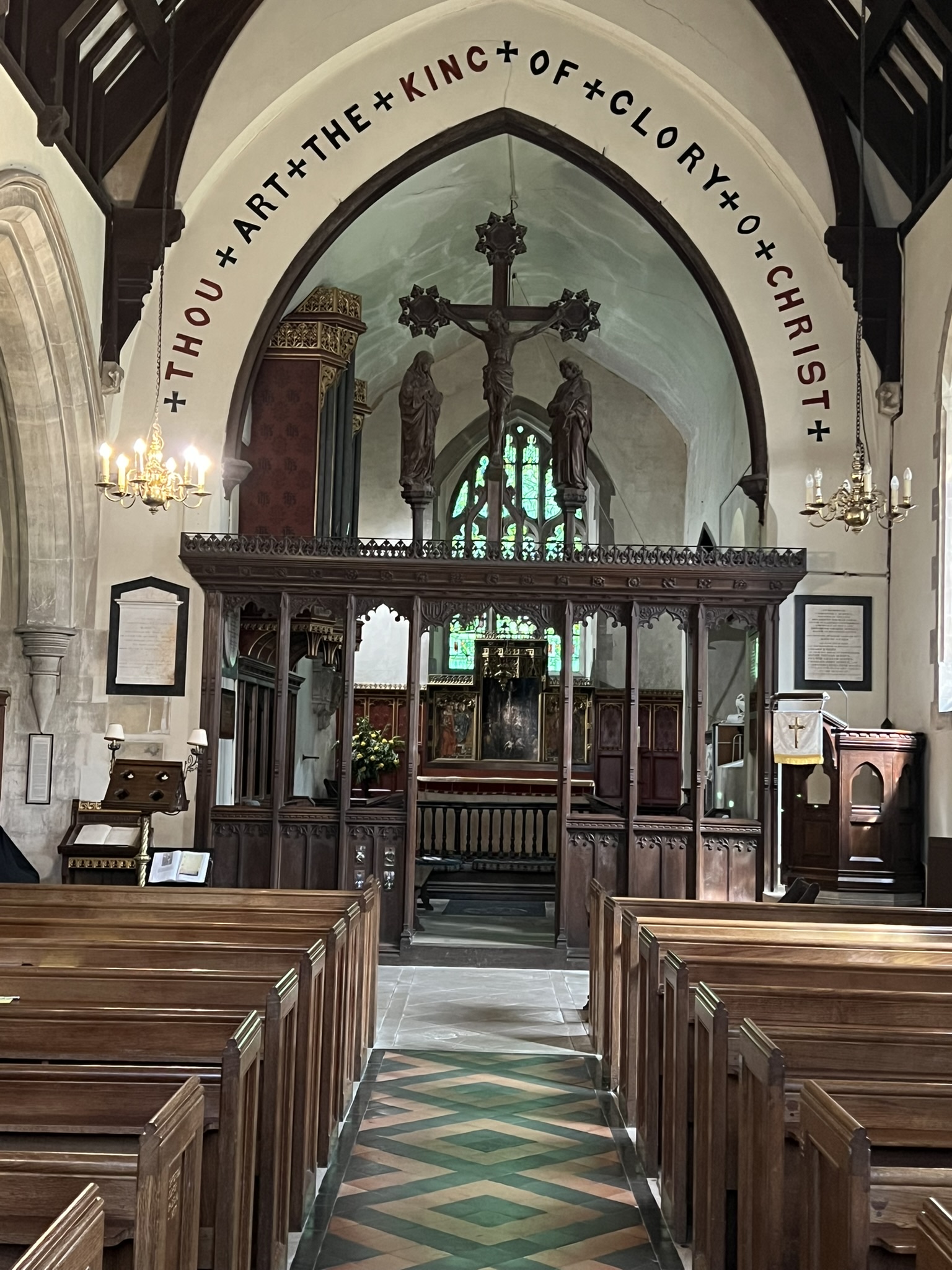
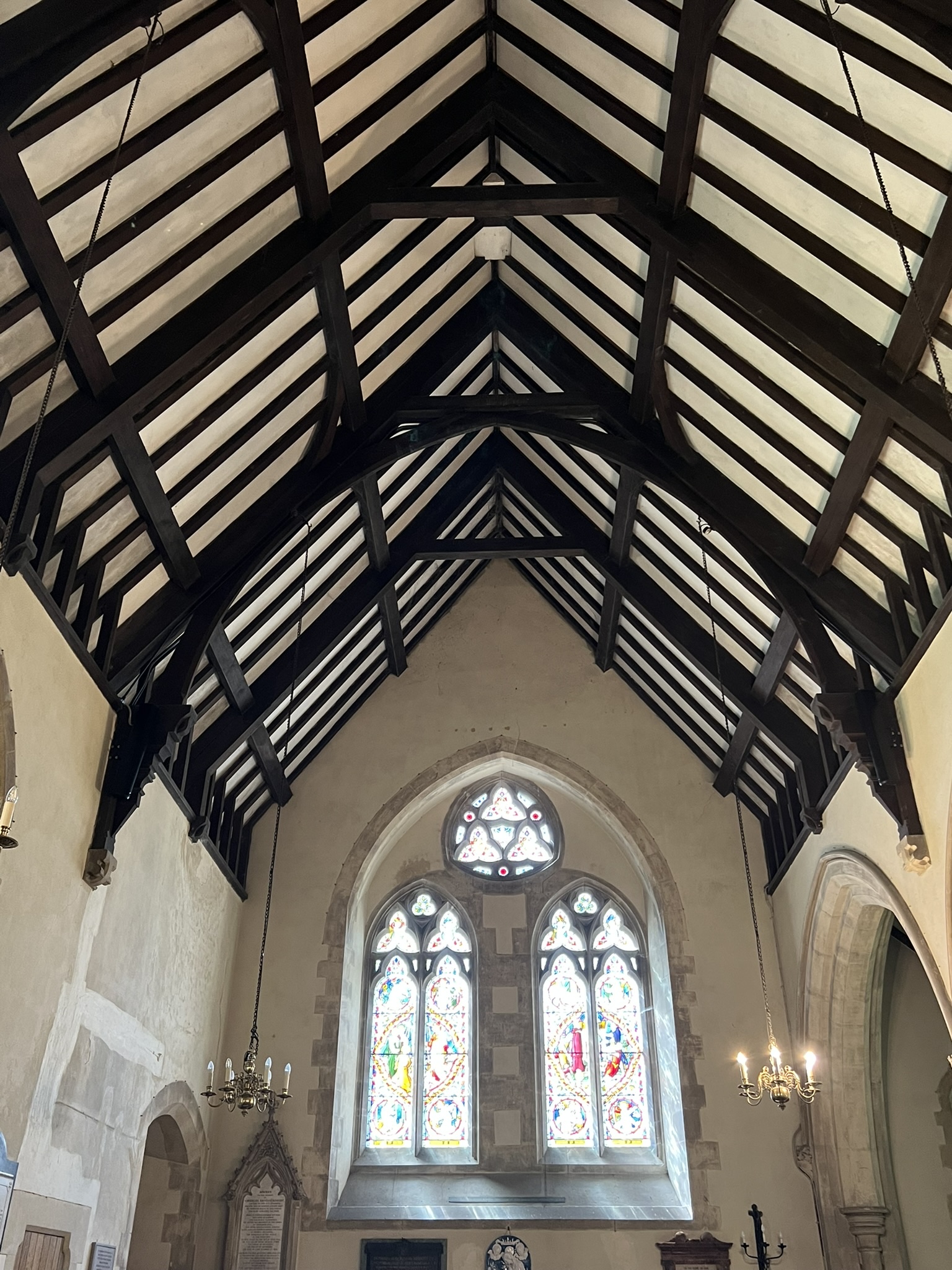
A short walk down the drive takes us to the Church on the grounds – do I dare say it is a St. Nicholas??! – where Jane and family would have worshipped and where we will find the graves of Mrs. Austen and Cassandra:
************
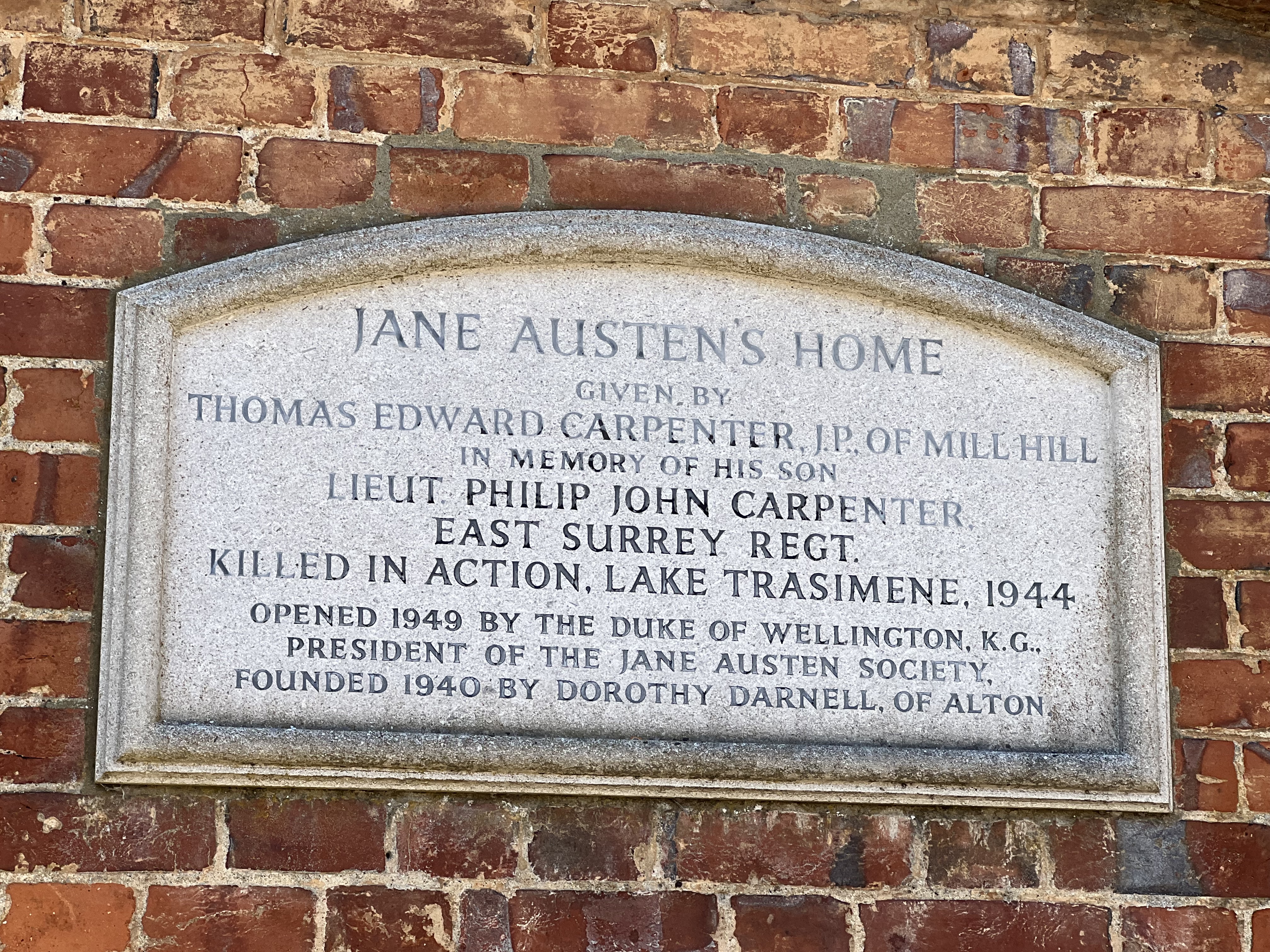
We were then off down the road to the “Chawton Cottage” – now called the JAHM: https://janeaustens.house/ – a short trek in Jane Austen’s footsteps, nothing much changed from her own time here, excepting macadam and sidewalks, and cars roaming about rather than horses and carriages and stagecoaches rumbling by their front window….
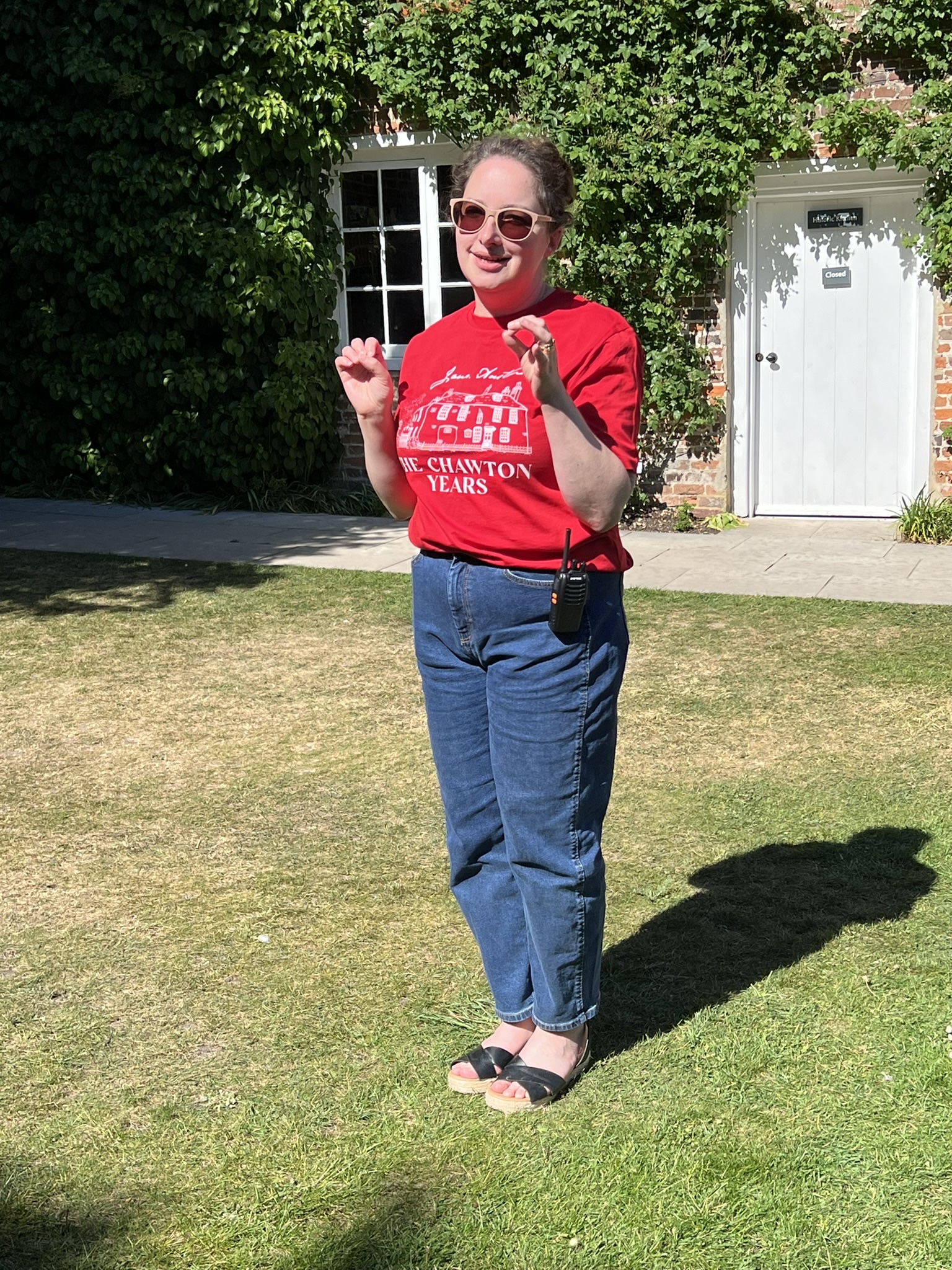
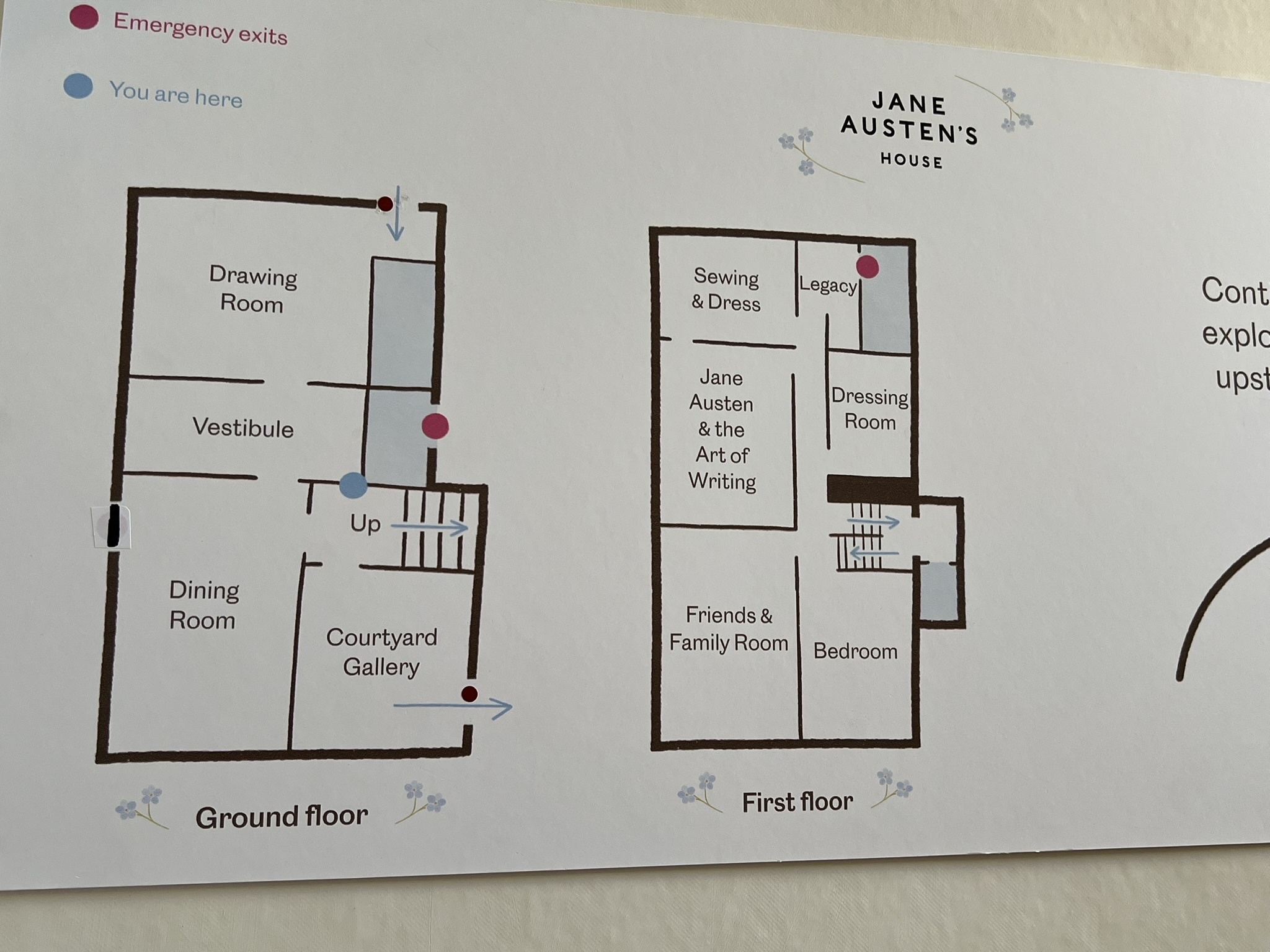
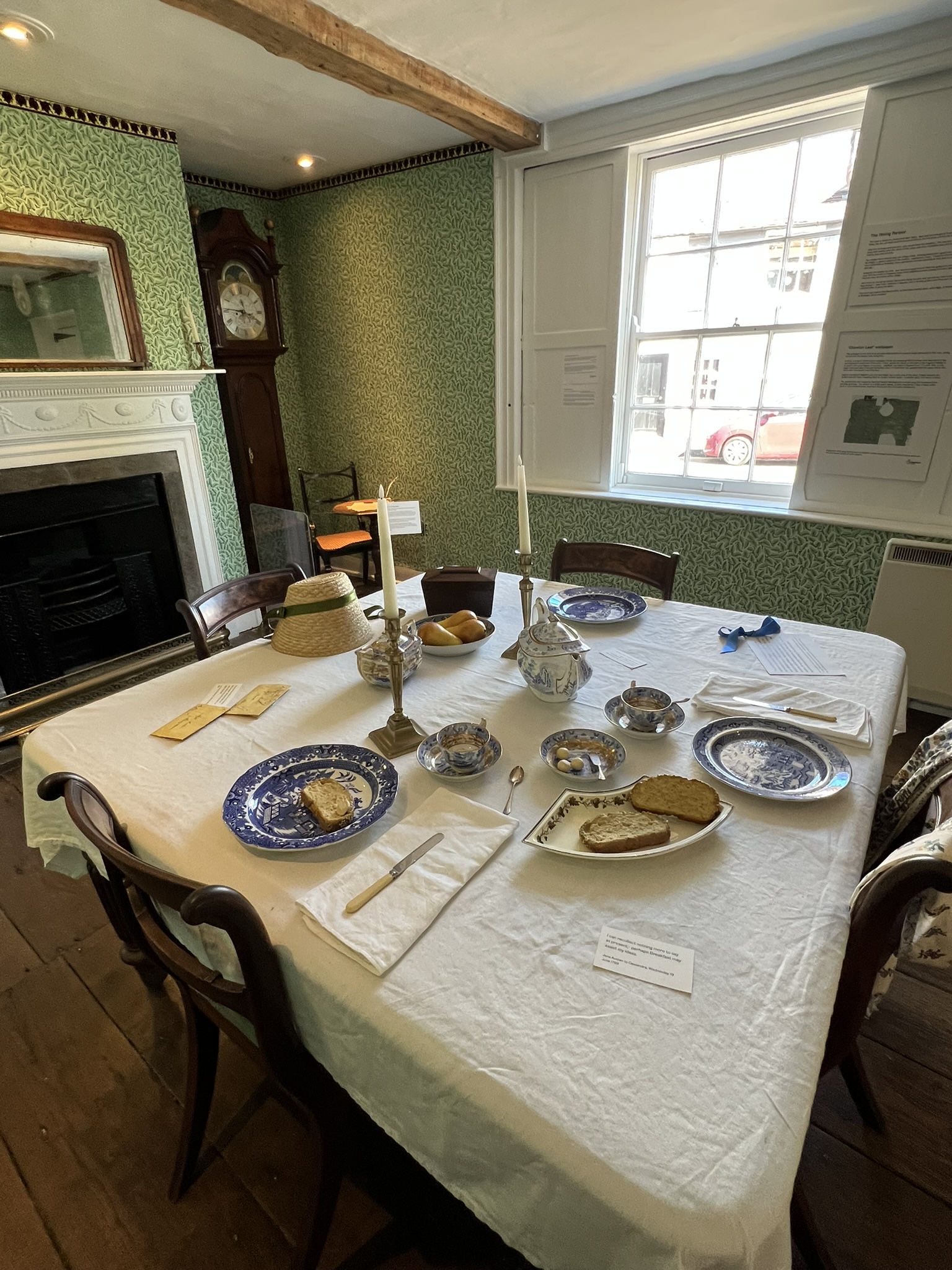
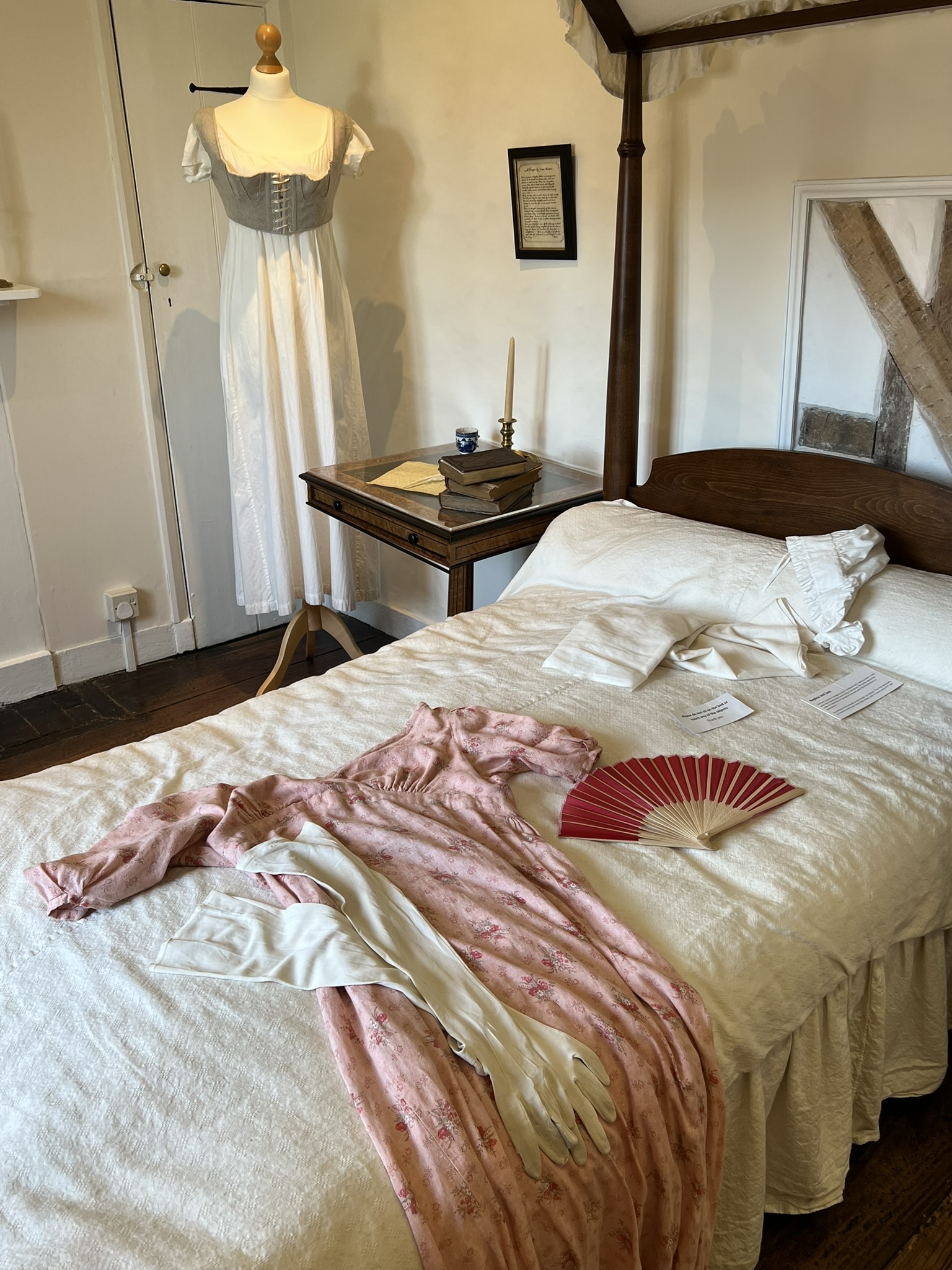
Warmly welcomed by house Director Lizzie Dunford, we could tour the house on our own, a living monument to seeing how Jane and her sister Cassandra and her mother lived in this “cottage” but actually quite a large home:
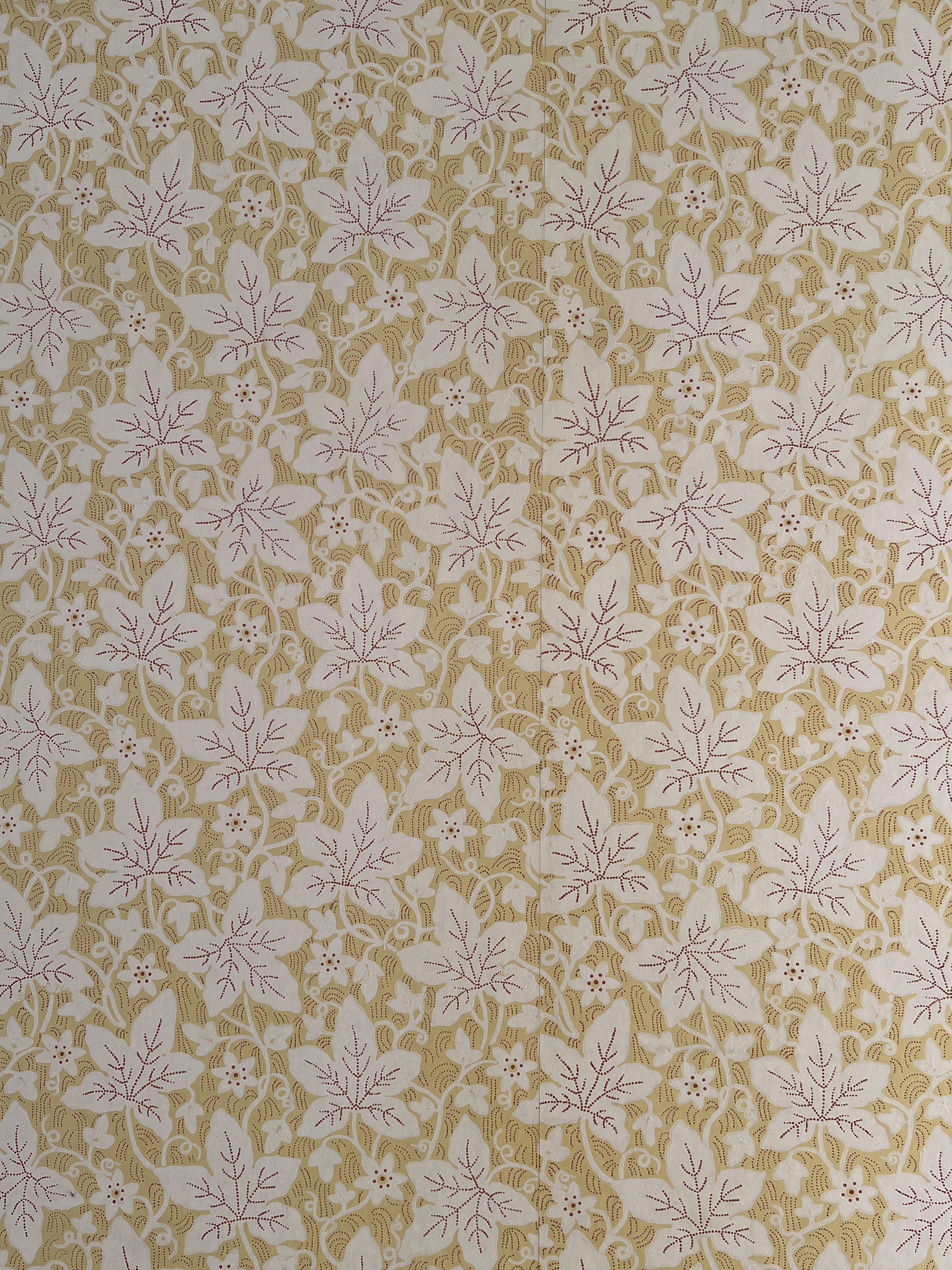
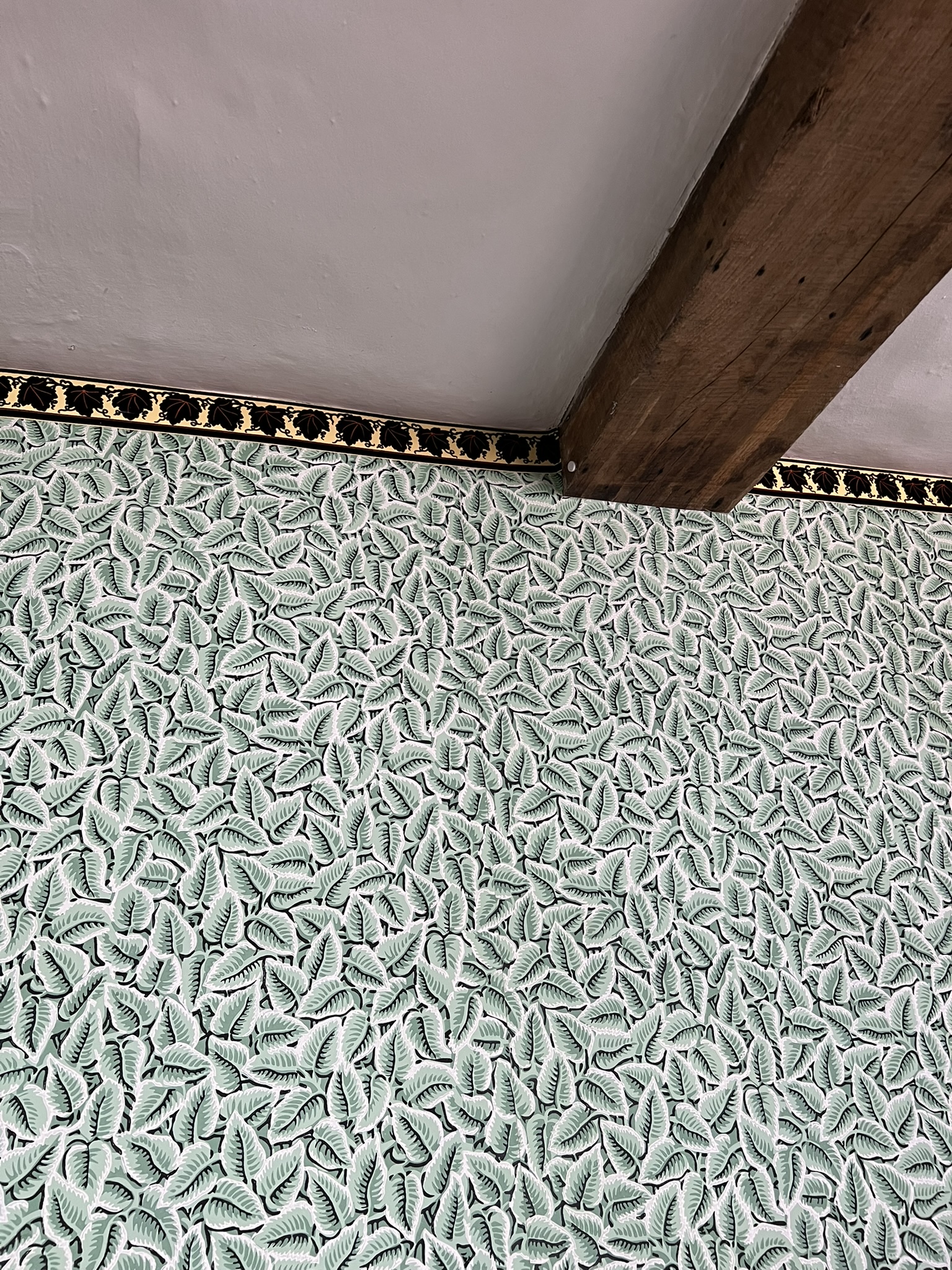
The rooms decorated with the newly minted wallpaper, recreated from the existing fragments, it all feels as though Jane herself is just around the corner…
As there was a concert scheduled for that evening, we were fortunate to be there when the pianist and singer were rehearsing – a Jane Faifax / Frank Churchill moment for sure!
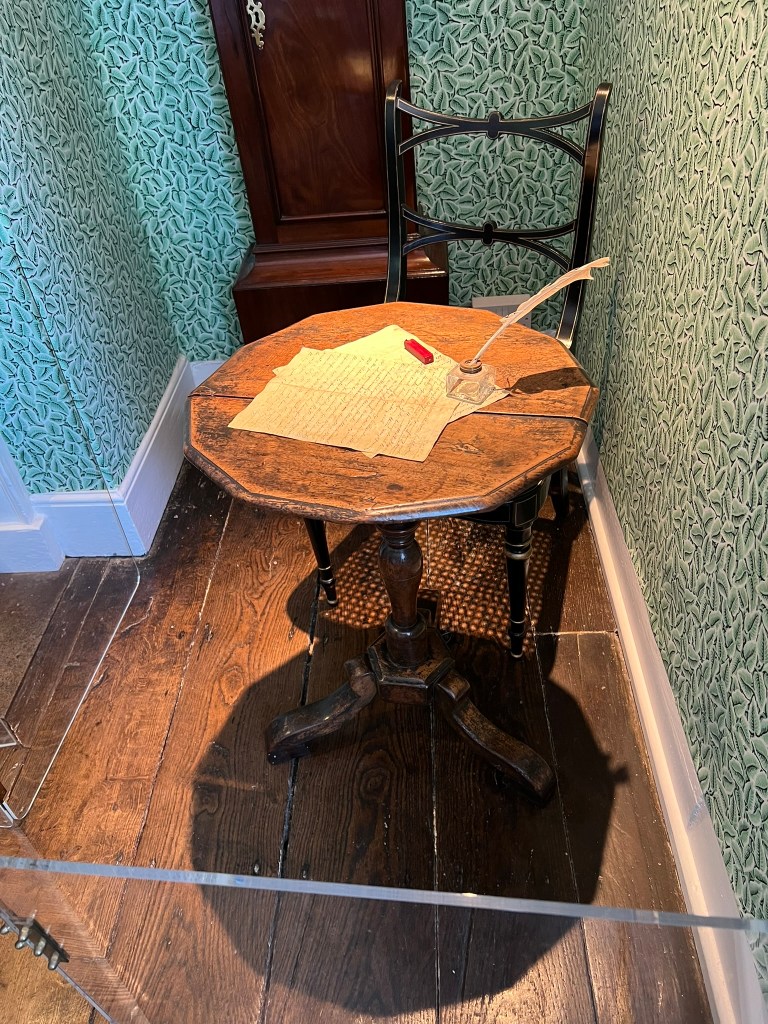
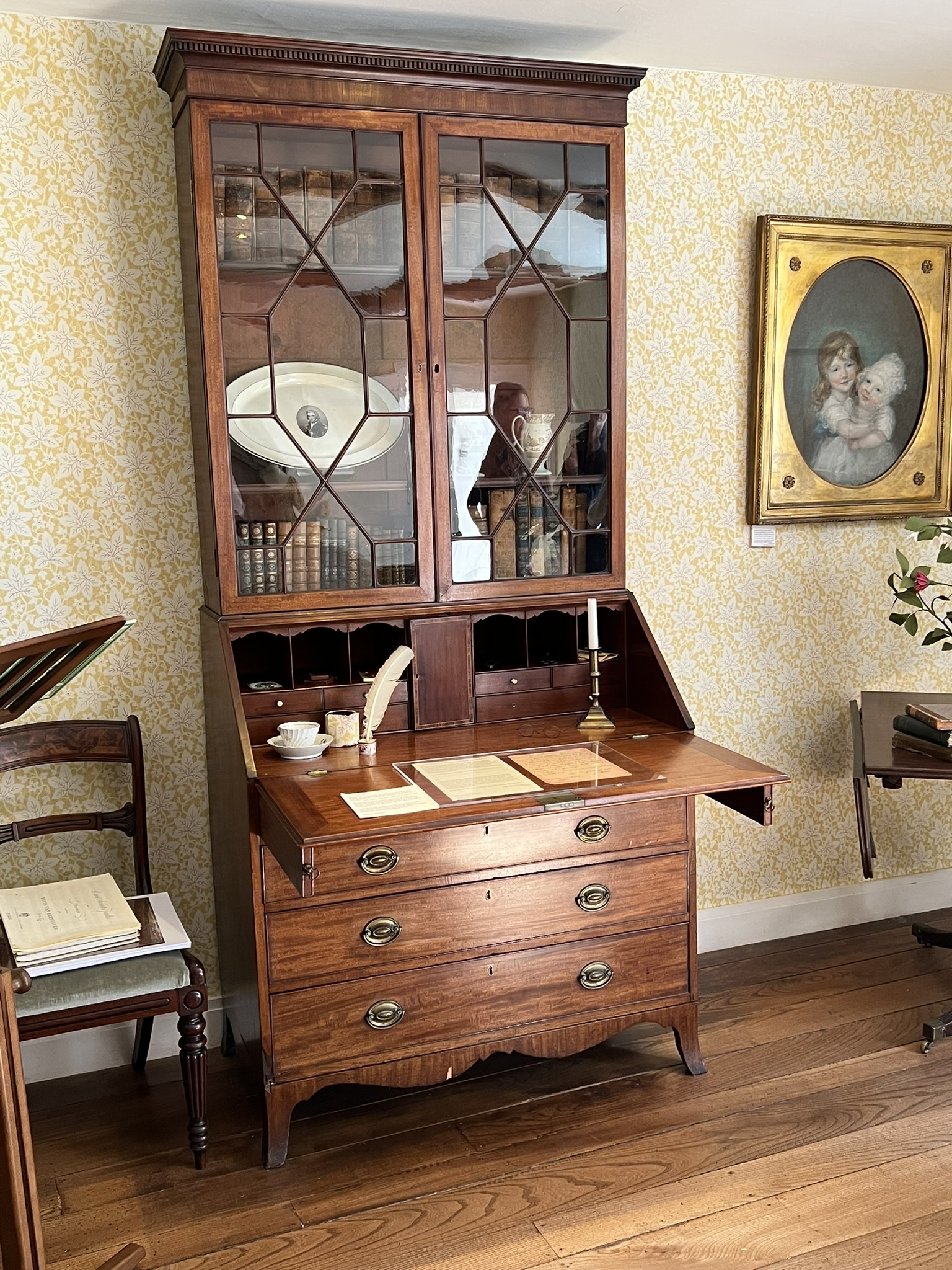
Here is a slideshow of various spots and objects in the house, starting with the infamous writing table where Austen “scribbled” her letters and novels: [scroll right to see all the photos]
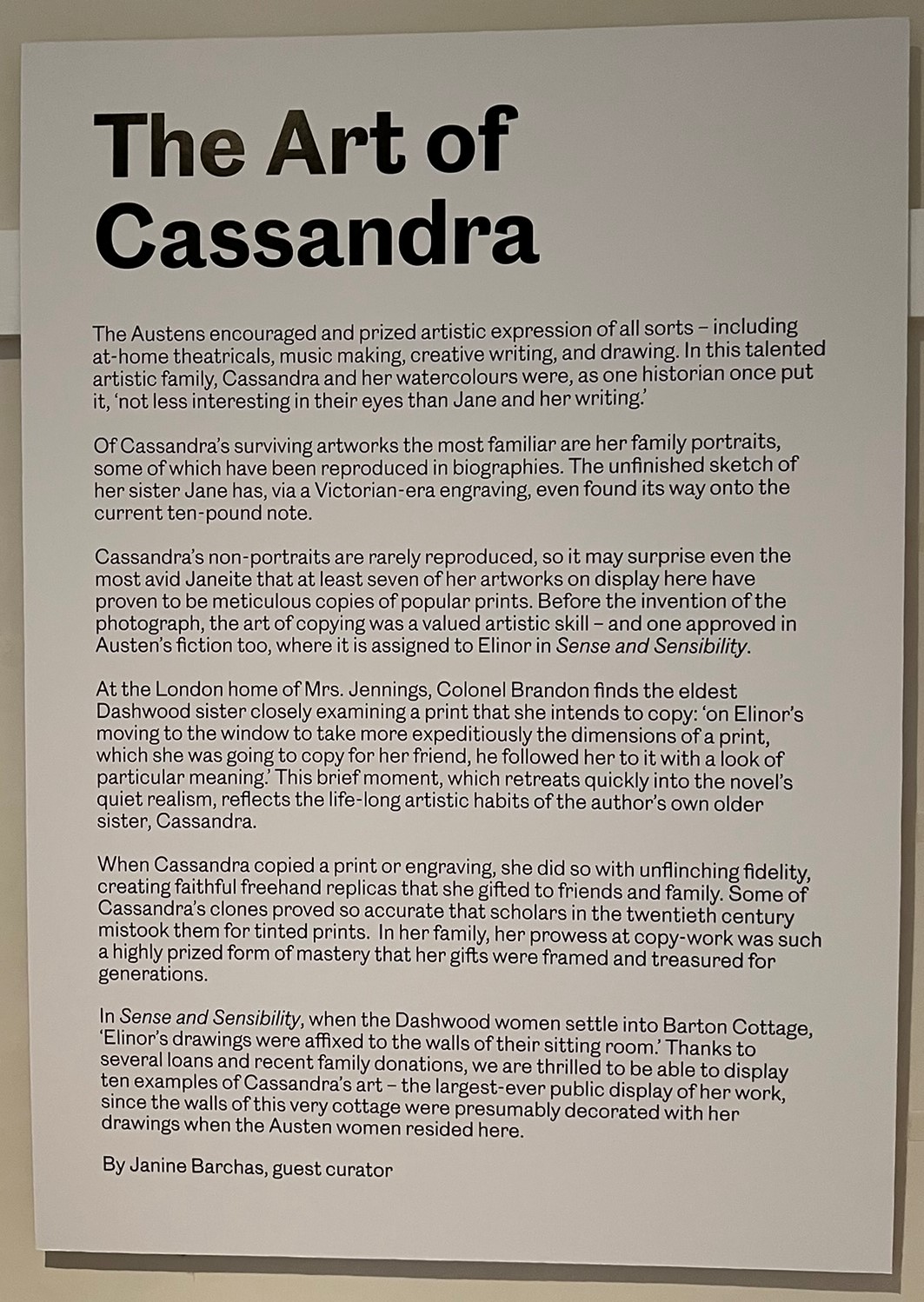
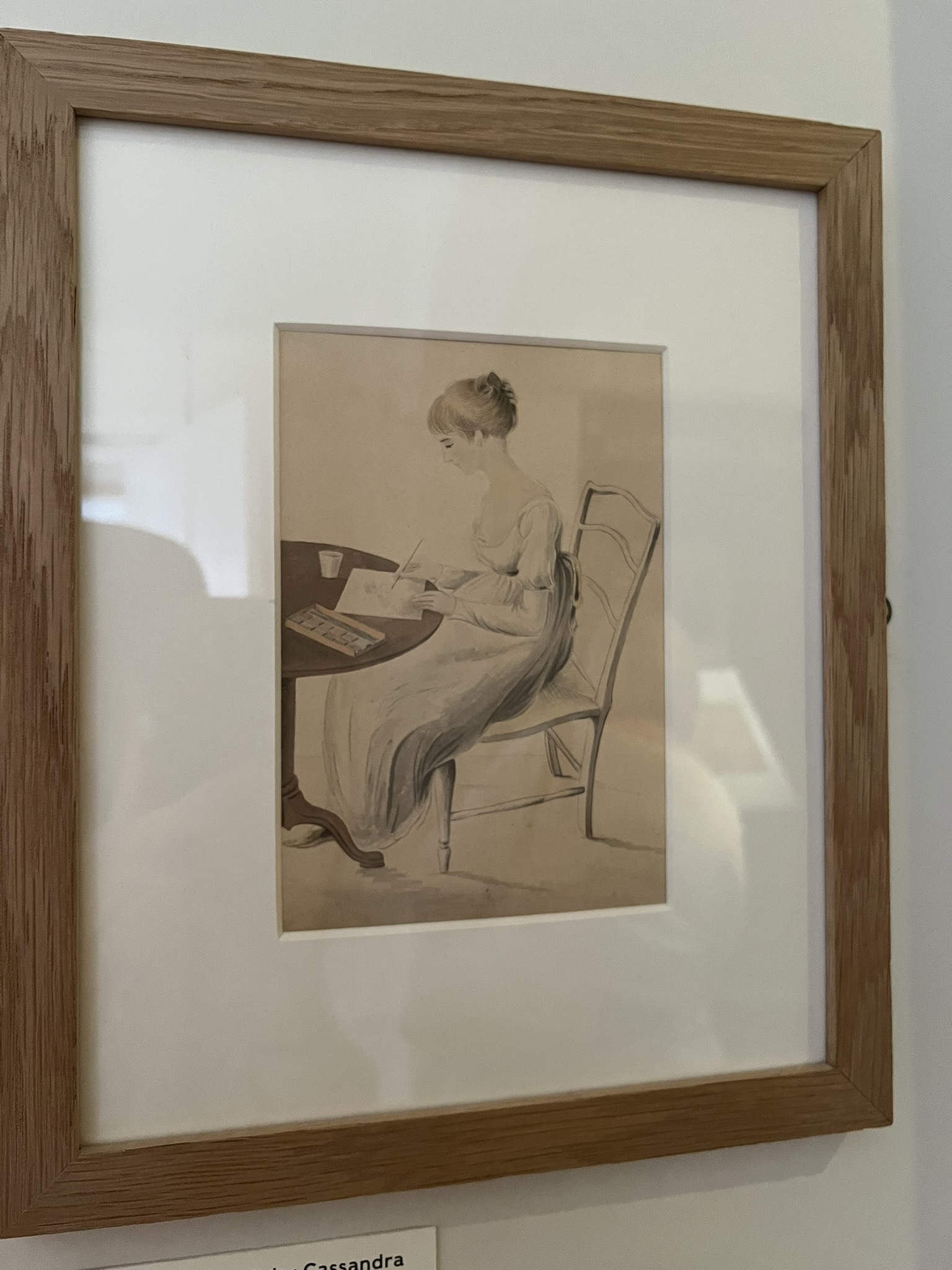
And were incredibly lucky again to see the exhibit on “The Art of Cassandra” on view til Sept 7, 2025, and curated by Professor Janine Barchas – a first-time ever display of 10 works by Austen’s sister:
This seemingly modest exhibition of ten artworks is the largest-ever public display of the confirmed works of Cassandra Austen. Not since Cassandra’s creative years in this very cottage have so many of her surviving artworks been gathered together in one place. Four of these were only recently discovered to exist among the possessions of Austen descendants. I’m thrilled that they will once again be displayed in the home where the Austen women lived and worked.’
– Janine Barchas, 2025
[Sorry! I did not take any more photos of Cassandra’s drawings, I was so enchanted by them – this link takes you to the online exhibition!]
The shop here at JAHM is yet another treasure trove as well as a danger to one’s wallet – I regret not buying the ring – I rarely wear gold, and somehow the silver one just doesn’t feel like the real thing…so I shall get through my disappointment by looking at the photo [image from JAHM]:
The garden at JAHM is a delight and you can imagine Jane and Cassandra working in it, enjoying it every day:
Our young Piony [sic] at the foot of the Fir tree has just blown & looks very handsome; & the whole of the Shrubbery Border will soon be very gay with Pinks & Sweet Williams, in addition to the Columbines already in bloom. The Syringes too are coming out. – We are likely to have a great crop of Orleans plumbs…
Jane Austen, 29 May 1811 from Chawton to Cassandra at Godmersham Park
These tulips will have to do!
Time for afternoon tea! [we did not want for food on this tour!]
And then back to the hotel…the evening on our own… a glorious day!!
First, we traveled on our bus today to Goodnestone [did I mention yet our very-talented bus driver on this trip, Paul? A master of small lanes, hedgerows, and city maneuvers, Paul brought his expertise, patience (with all the Jane talk!), and humor to each day. The bus was smaller than the average bus, but with NO SIDE MIRROS, which proved his abilities beyond possibility…[I have a picture thanks to Joy!..]
– but I bring this up because today, traveling down a country lane on the way to Goodnestone, this big red behemoth attracted a herd of sheep like none of us have ever seen – unlike a Gary Larson cartoon, where the cows keep eating and ignoring the passing-by humans, these sheep raced to the fence to visit the huge bus – did they think it was their Mother?? Many of us got out to greet them, all running toward us – whatever they expected or what was on their minds we were unable to determine – but it gave us all a good laugh and we felt more welcomed than ever to the Kent countryside [I did have a Thomas Hardy moment of all the sheep racing to and jumping over the cliff edge in Far From the Madding Crowd, one of the most distressing moments in 19th century literature…but no such sad outcome for us – the fence stopped any such disaster and we just bid them all adieu and continued our journey smiling all the way…]
Goodnestone was the family home of Elizabeth Bridges, wife to Edward Knight. Brook Bridges purchased the home in 1704 [more on him in a bit…] – it remains in the family and now you can visit the house and gardens and it serves as a wedding venue. I was looking forward to seeing this house and having tea there, but alas! our plans were sent all askew by a film crew taking over the house for a “Married at First Sight” filming… the UK series has been on TV since 2015 – I did watch ½ an episode on TV while there and was quite stupefied by its stupidity…but if it helps support the Goodnestone estate, then that is a mere quibble of taste…
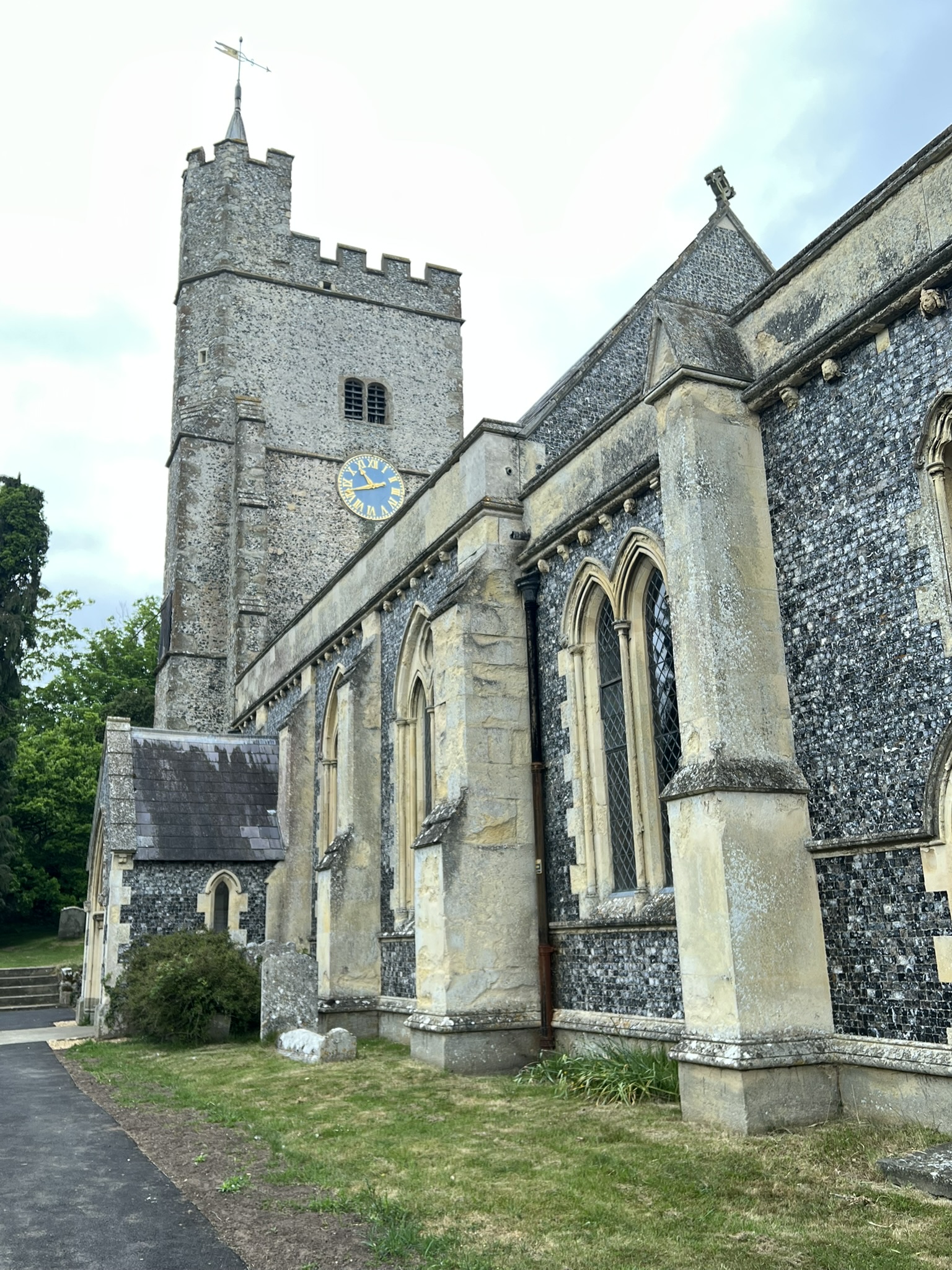
So, only distant shots, and a visit to the Church of the Holy Cross, where we were introduced to one of the family who gave us the low-down on the family history, and a tour around the church. This is the church where Edward and Elizabeth were married – it was actually a double wedding [Elizabeth’s sister Sophia and William Deedes], perhaps giving Austen the idea for her Pride and Prejudice double wedding of the Bennet sisters, Elizabeth and Jane.
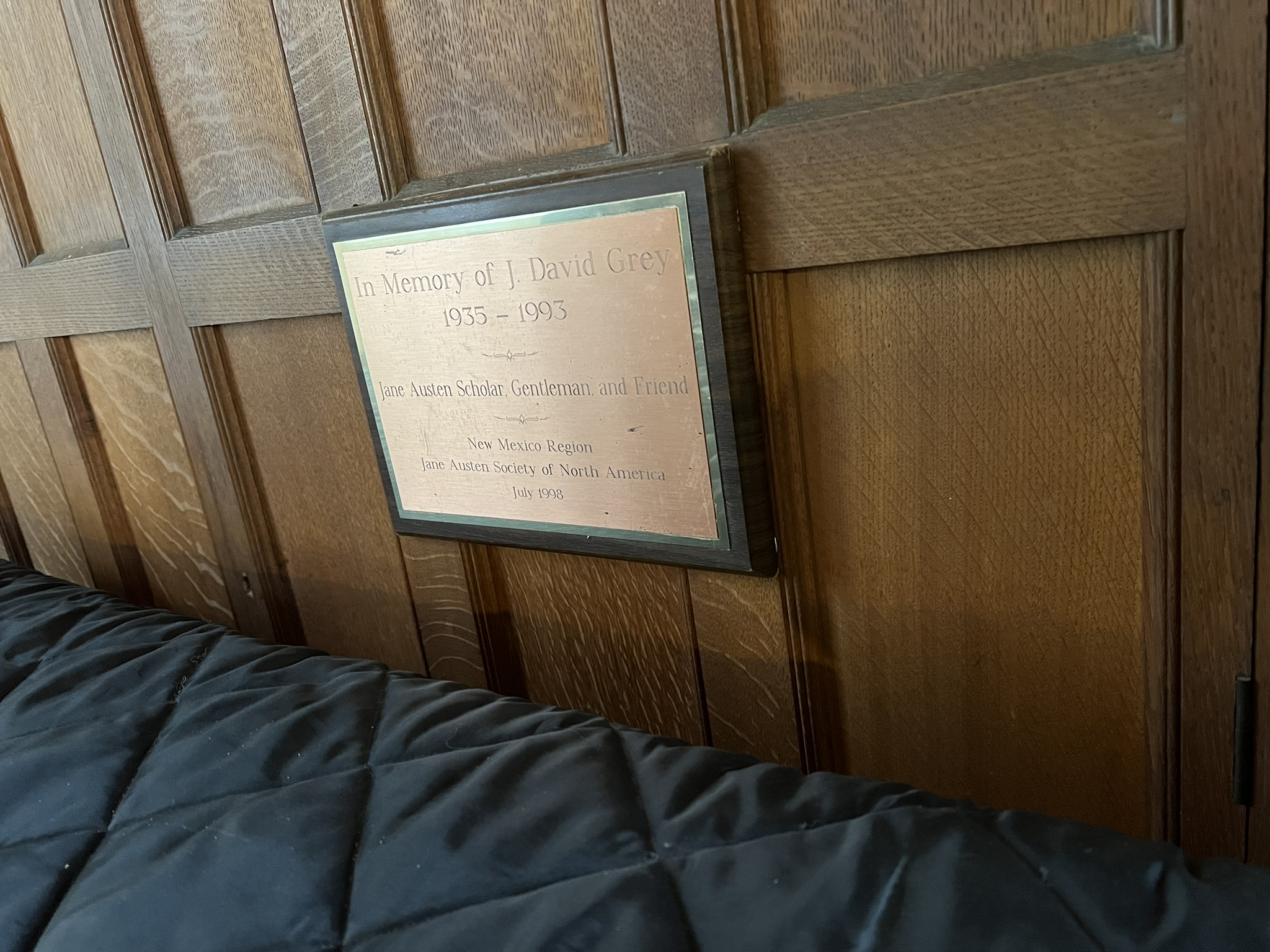
Of interest to Janeites is the plaque to J. David Grey, one of the founders of JASNA, and installed here in his memory with JASNA’s support.
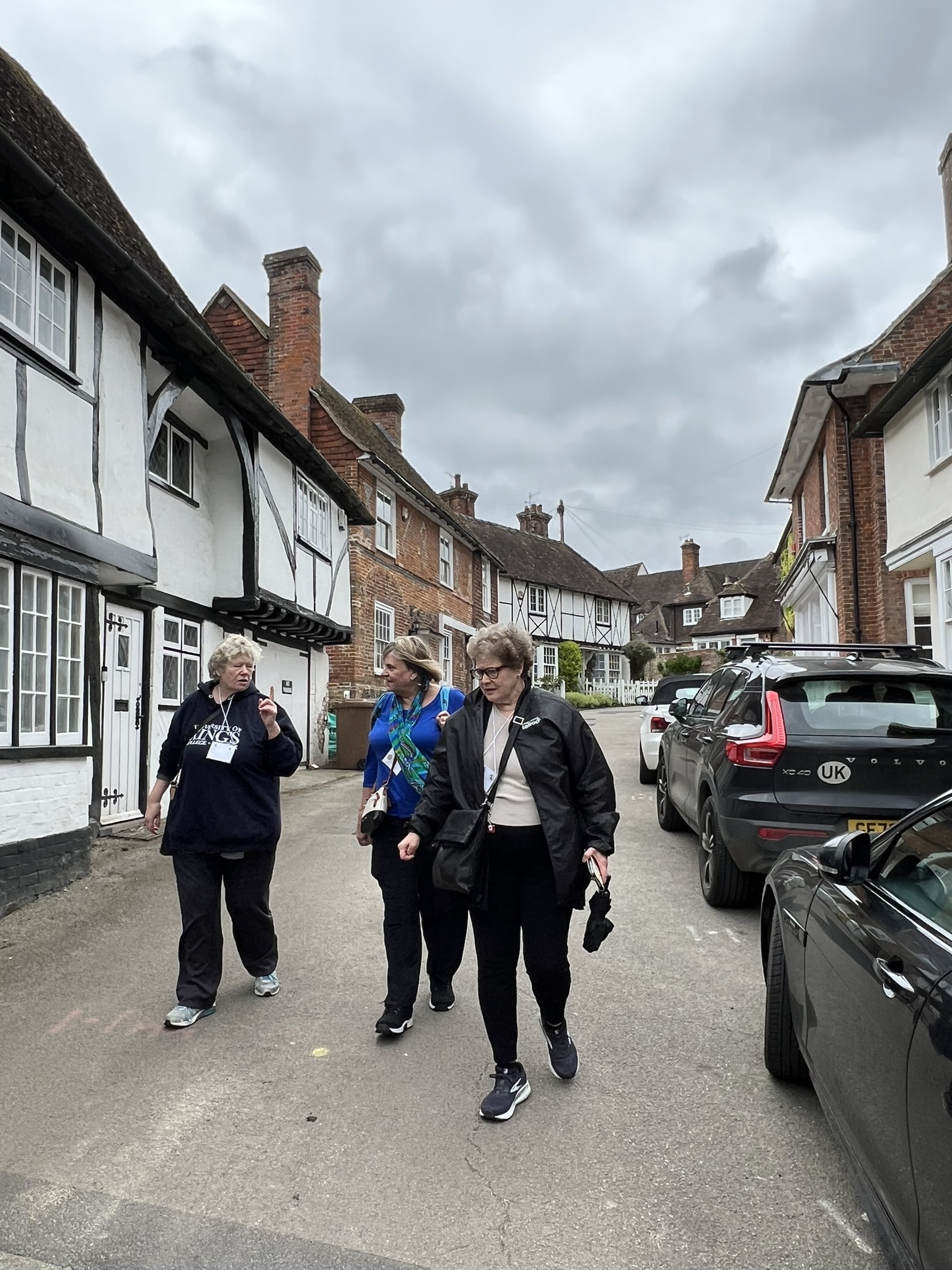
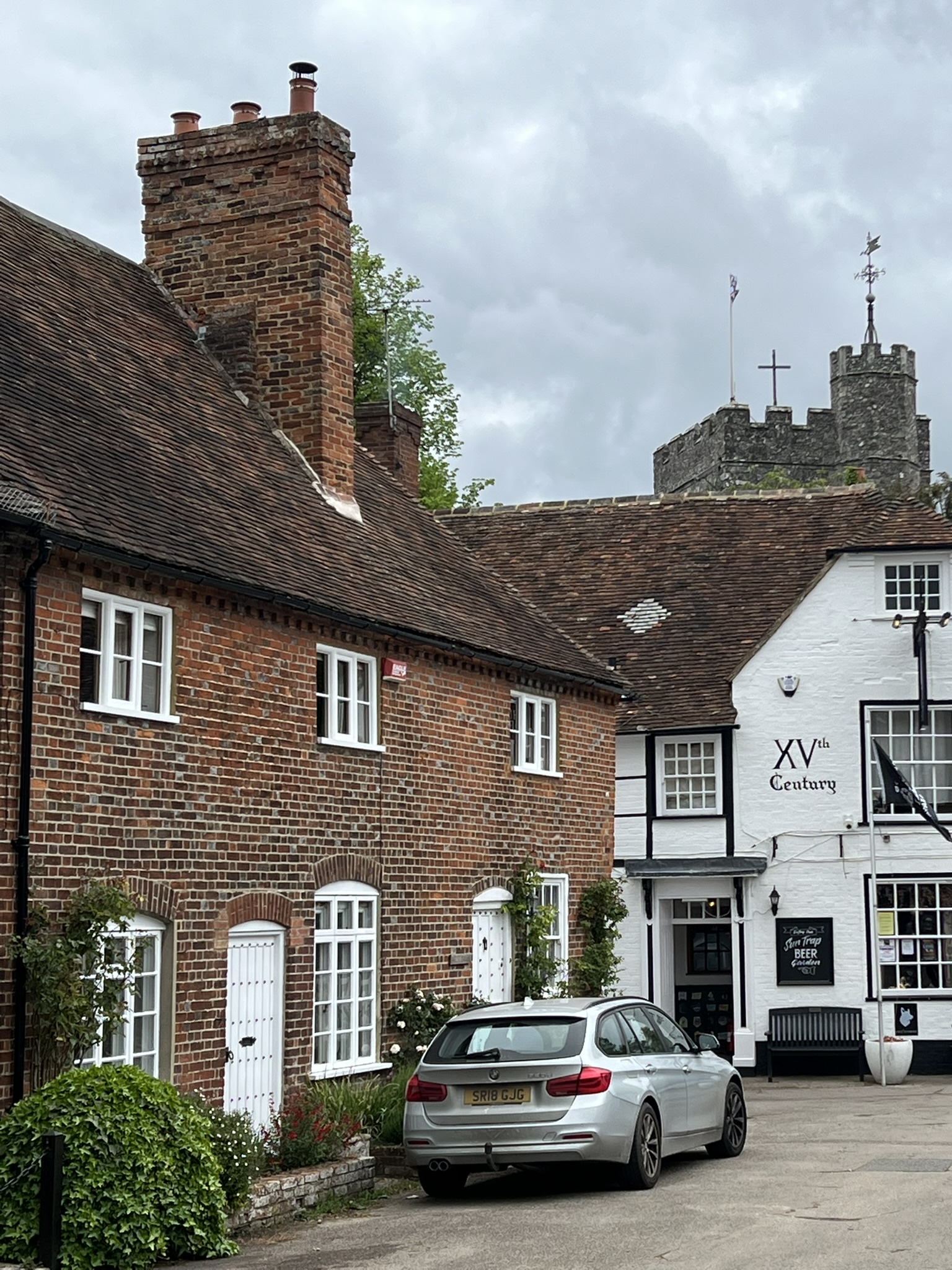
Then off to Chilham, the village that served as the location for Highbury in the 2009 Emma series. We were able to walk around the village and had lunch at the Woolpack Inn, established in 1480 [so delicious, I forgot to take a single picture!], and an appropriate spot considering our sheep welcome…
***********
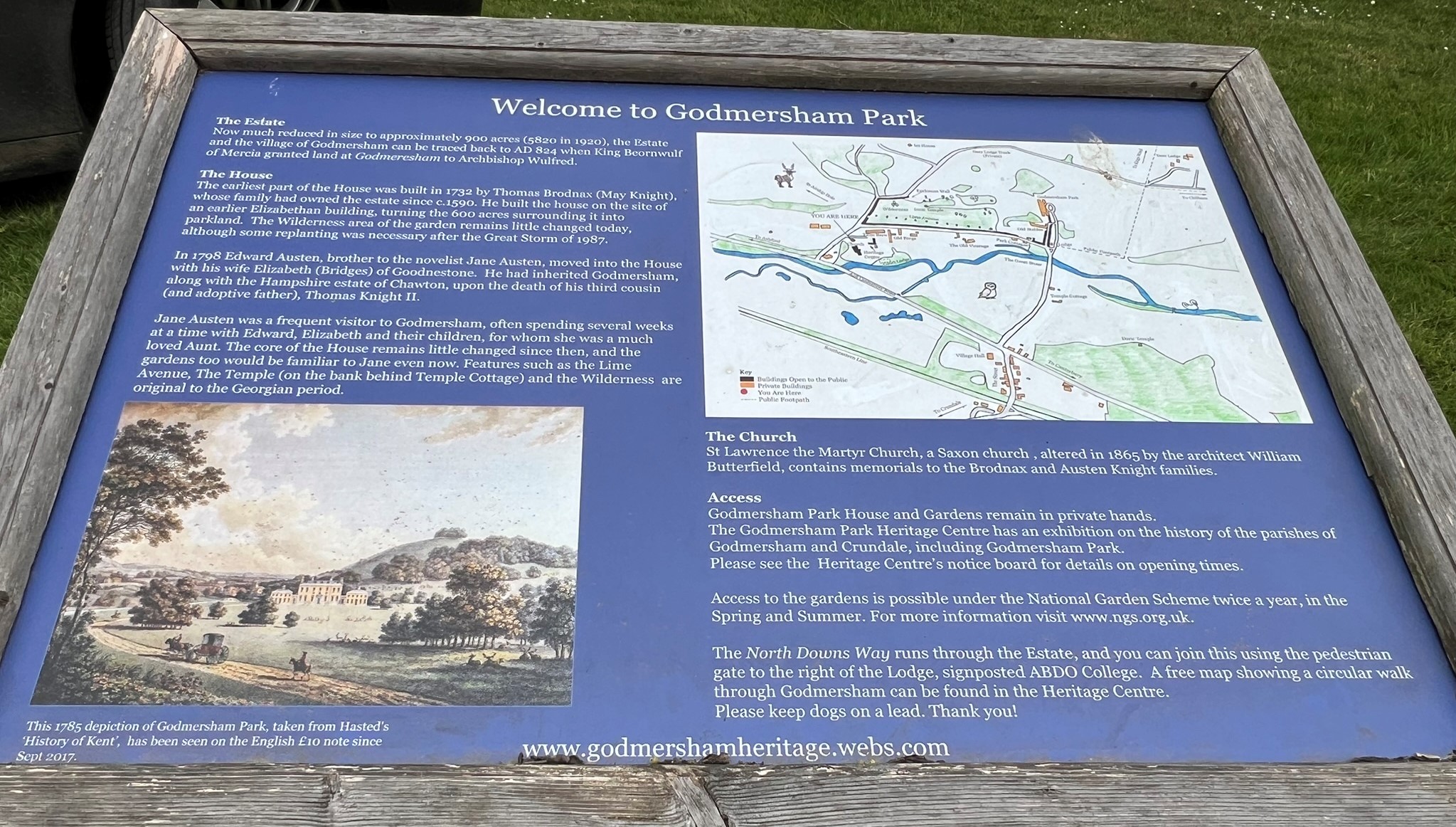
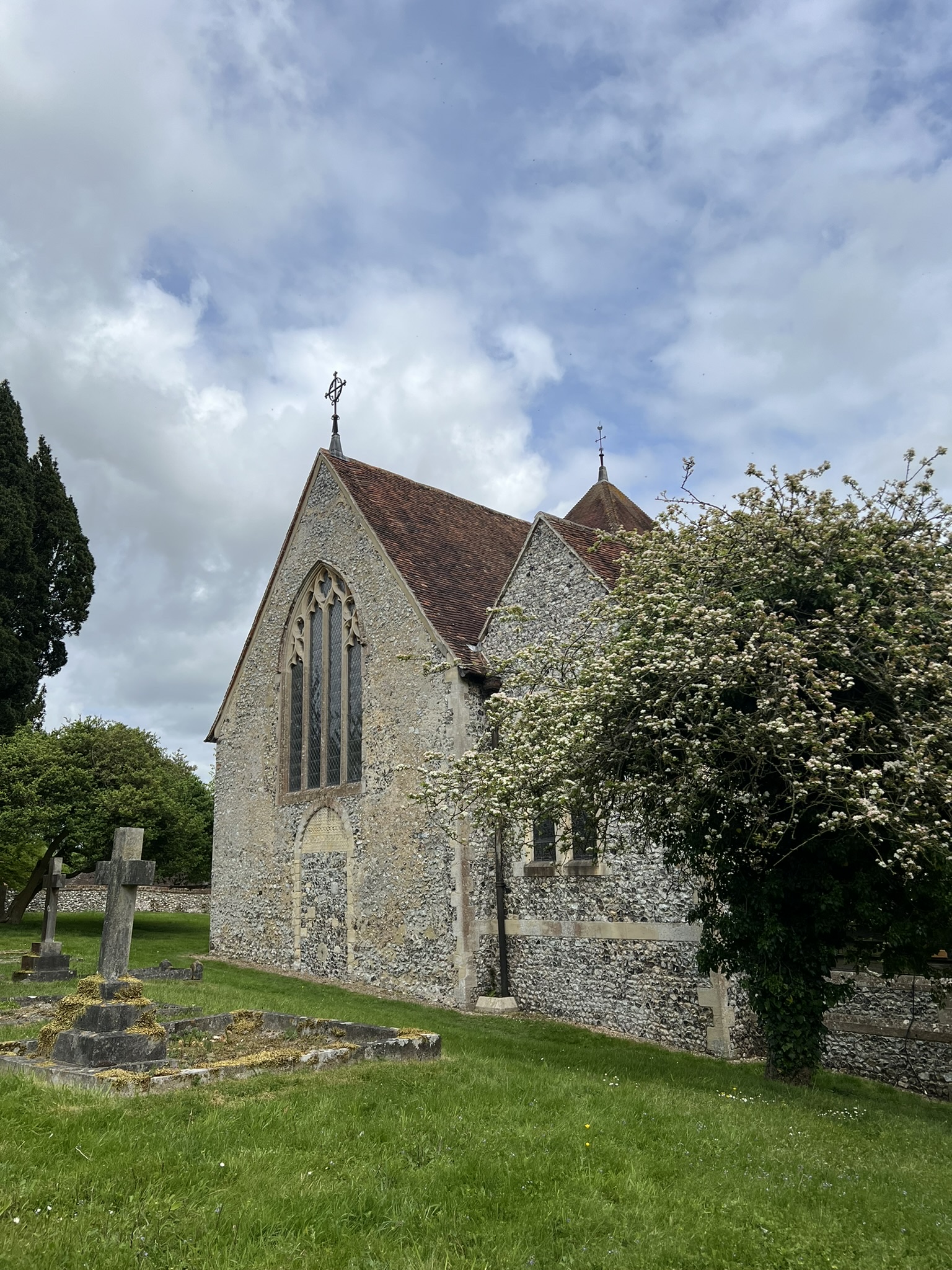
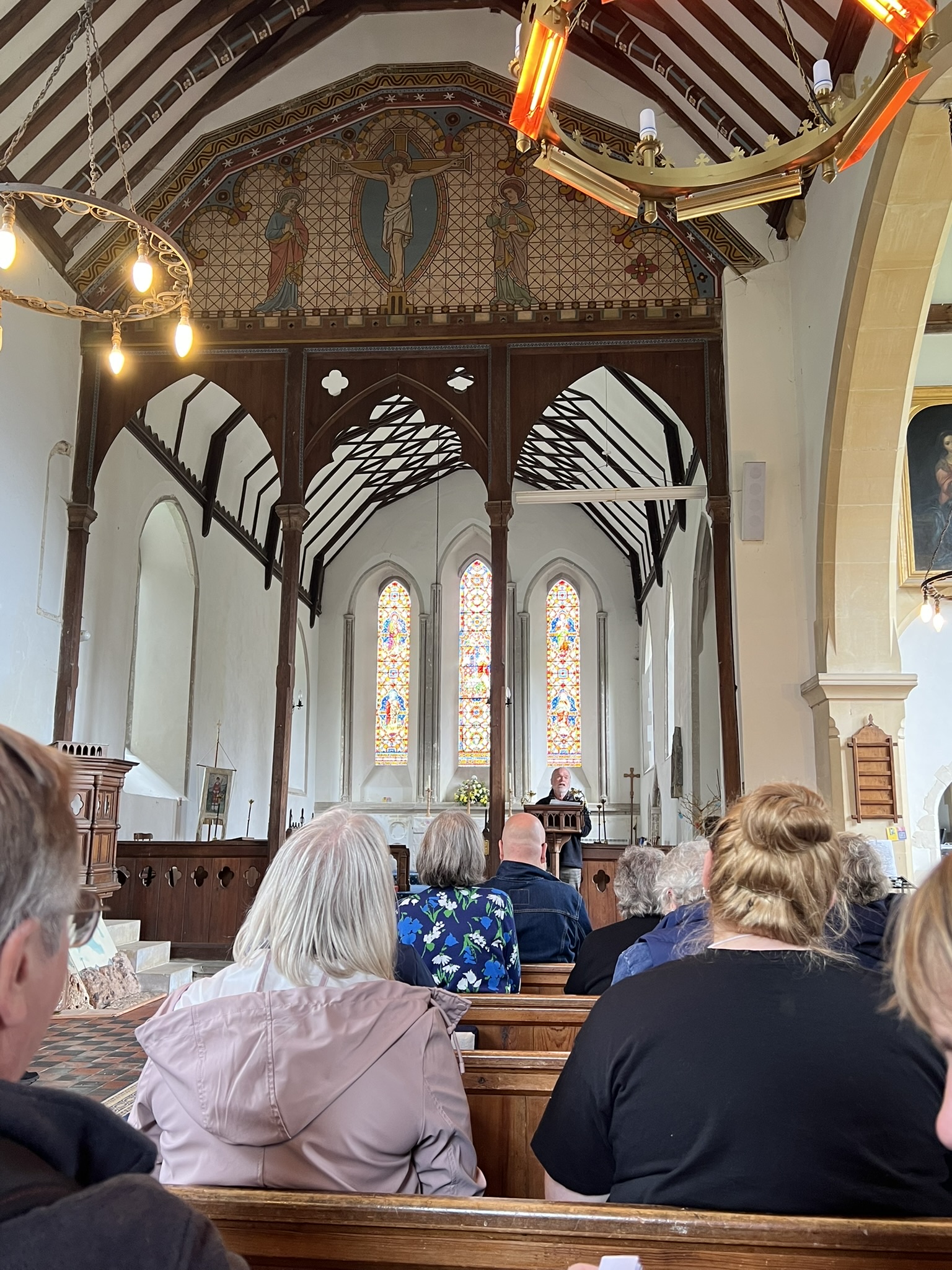
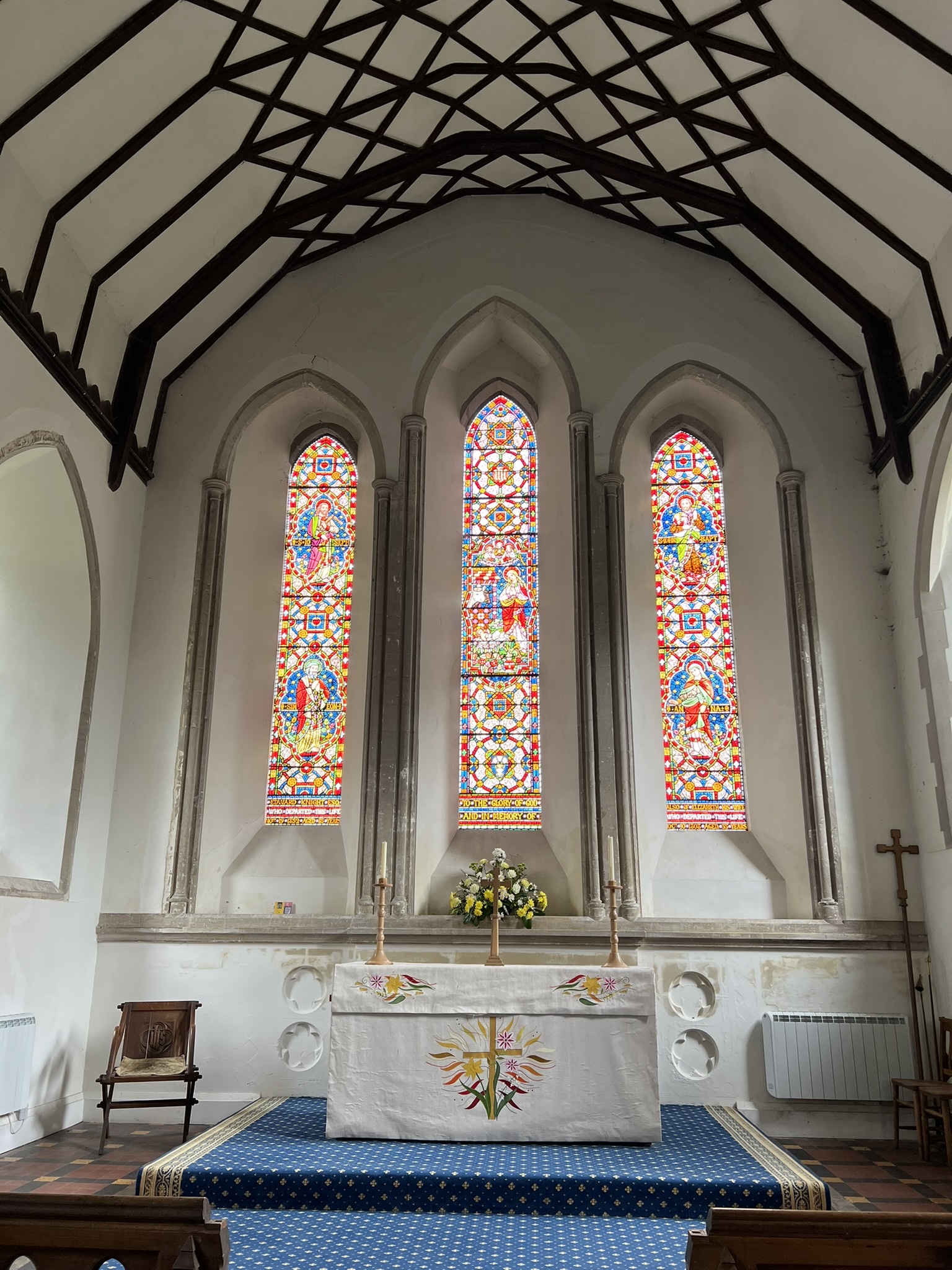
Then to Godmersham Park, my most anticipated spot on the tour. First to the Church, surprisingly not a St Nicholas, but a St. Lawrence: here we had a history lesson about its connections to the Austens.
Godmersham Park was Edward Austen’s home, inherited from his adoptive parents that required him to change his name to Knight. Here he and Elizabeth raised their 11 children [Elizabeth died after the birth of the 11th at the age of 35 in 1808] and where his extensive gentleman’s library was housed, the source of Professor Peter Sabor’s project Reading with Austen– the website offers an interactive plan of the library showing what books were on the shelves and their location as Jane Austen would have experienced. The goal of the project has also been to return as many of the books that were originally in Edward’s library if at all possible – we call ourselves The Godmersham Lost Sheep Society – you can read all about it at these links – we actively fundraise to help in the purchase of any books that might show up at auction or in booksellers’ catalogues.
Godmersham Park
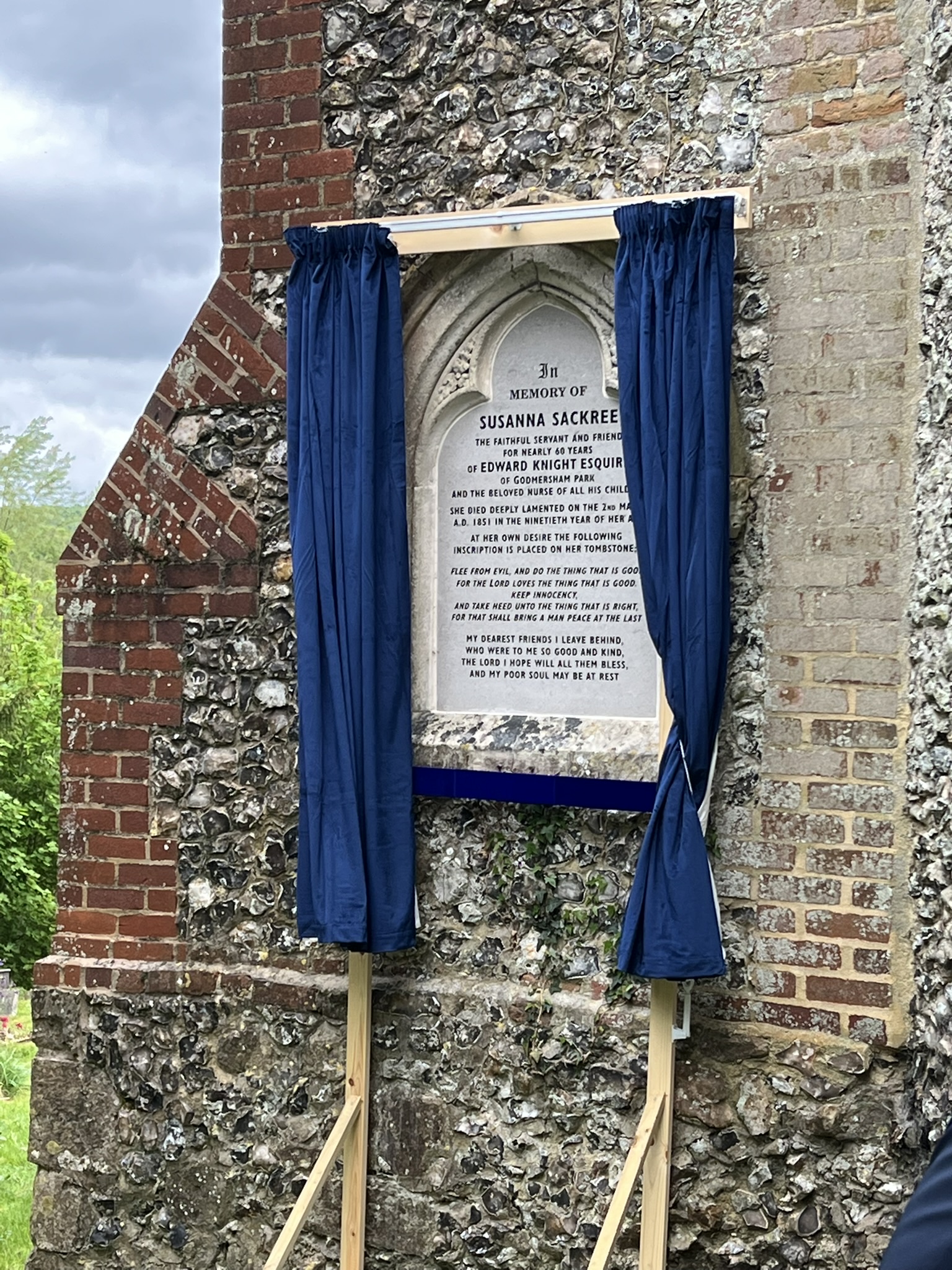
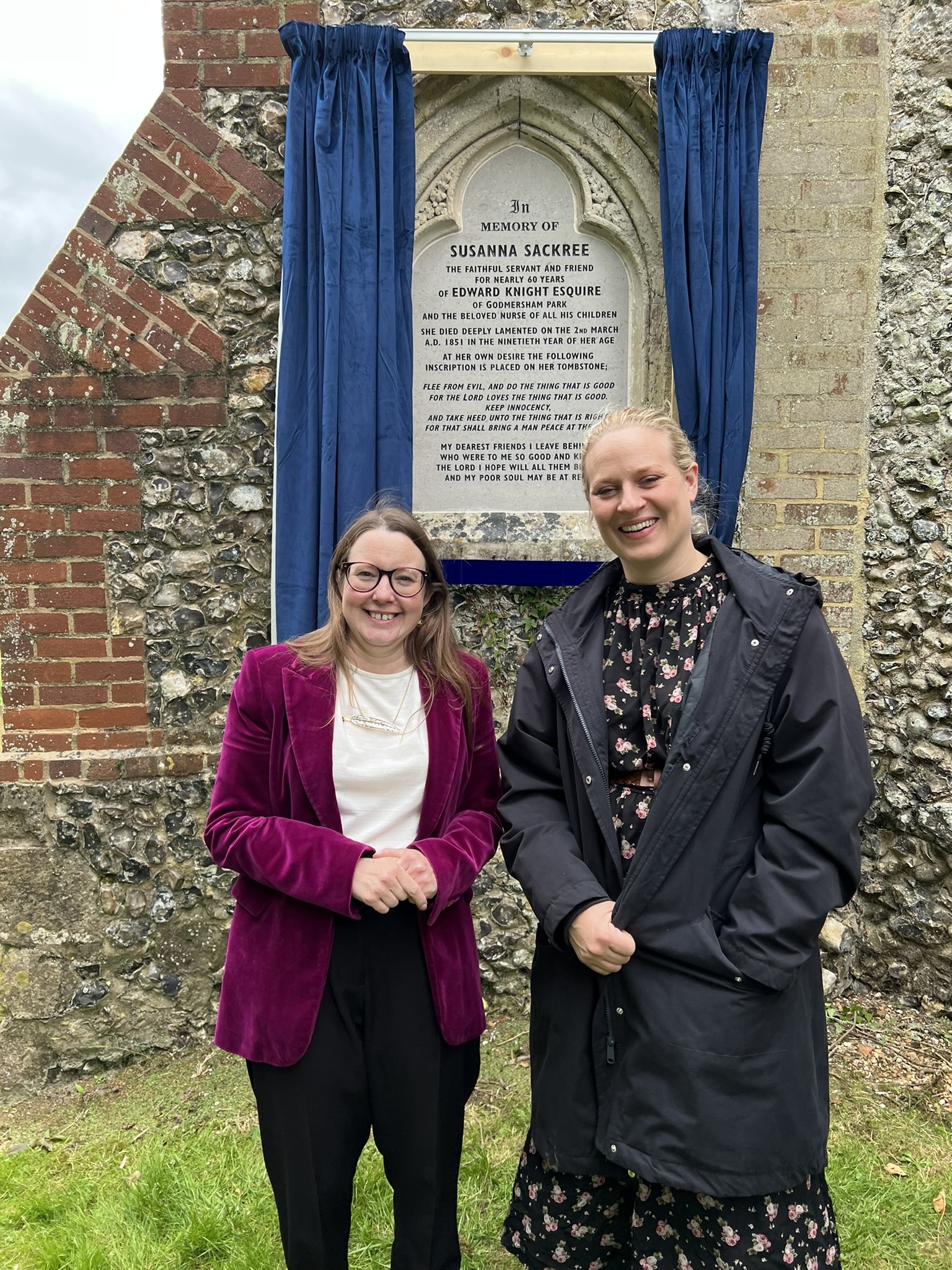
We were honored to be present for the unveiling at the Church of the Susannah Sackree memorial, here with Katie and Kim from Chawton House:
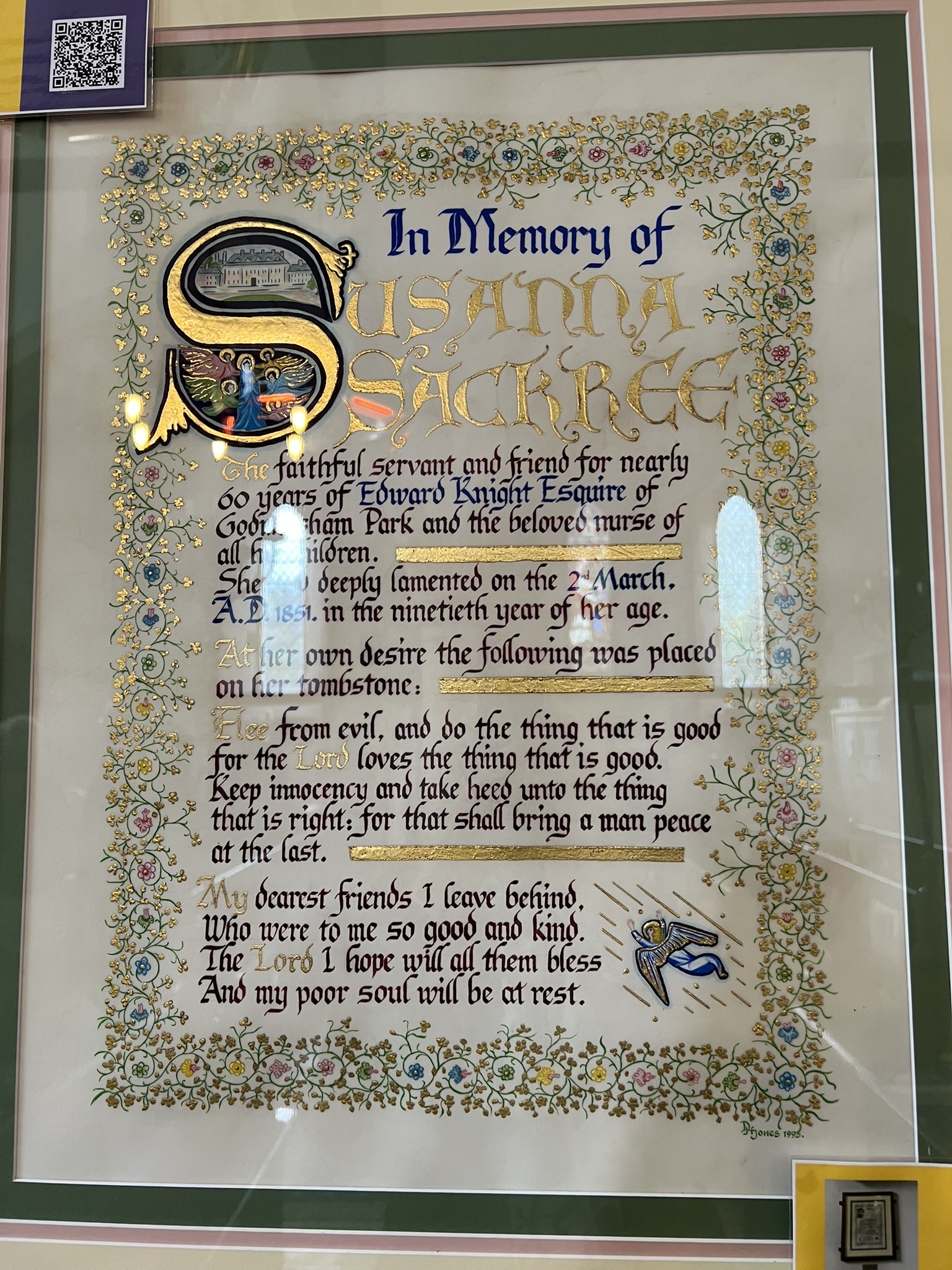
Susannah Sackree was the nursemaid to the Knight children, and memorialized by them in the church and now with this grand memorial on the exterior. It was a very moving moment to see a servant, often forgotten by their employers and history, so lovingly remembered by the Knight family.
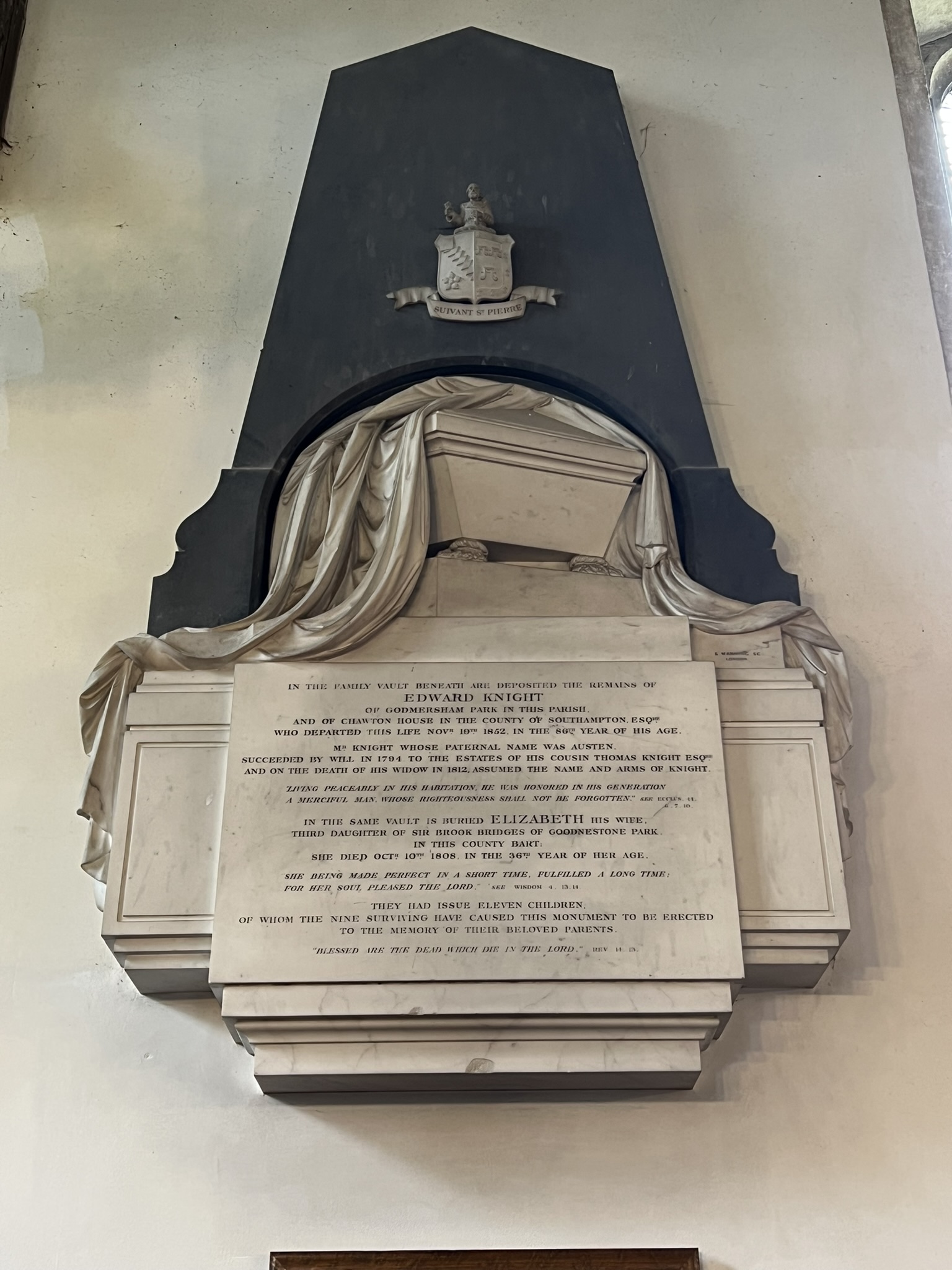
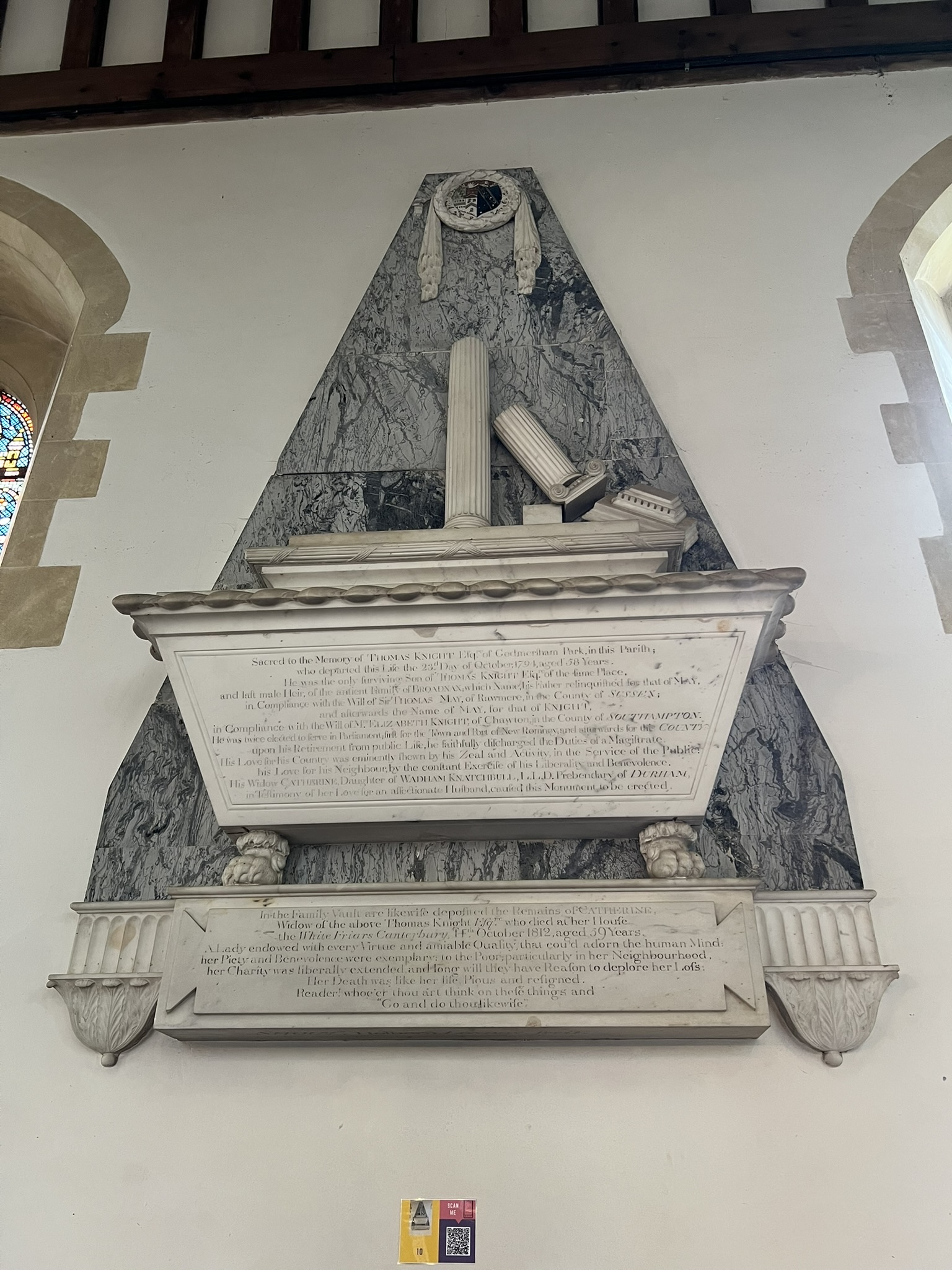
Susannah Sackree, Edward Knight, and Thomas Knight Memorials
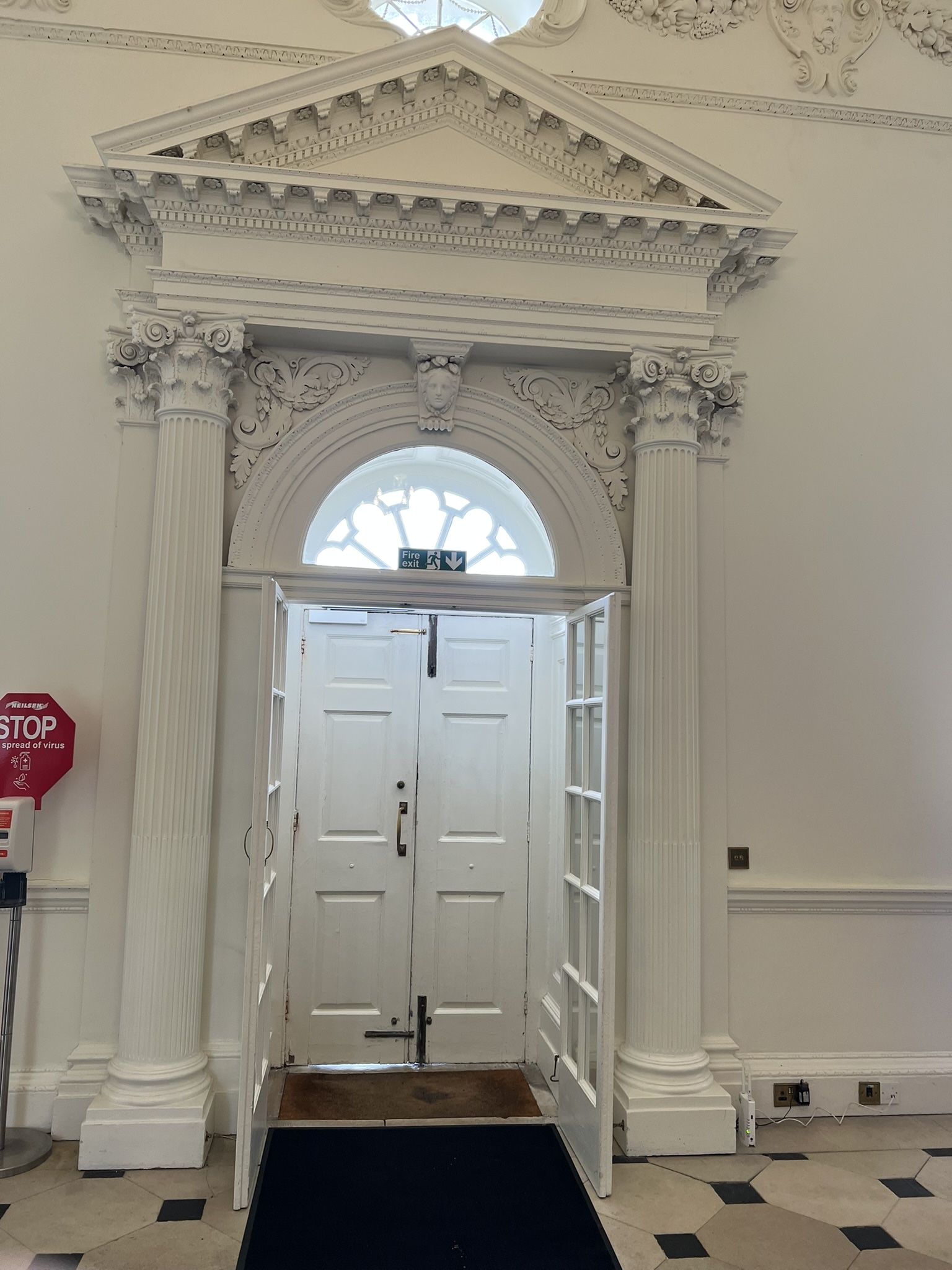
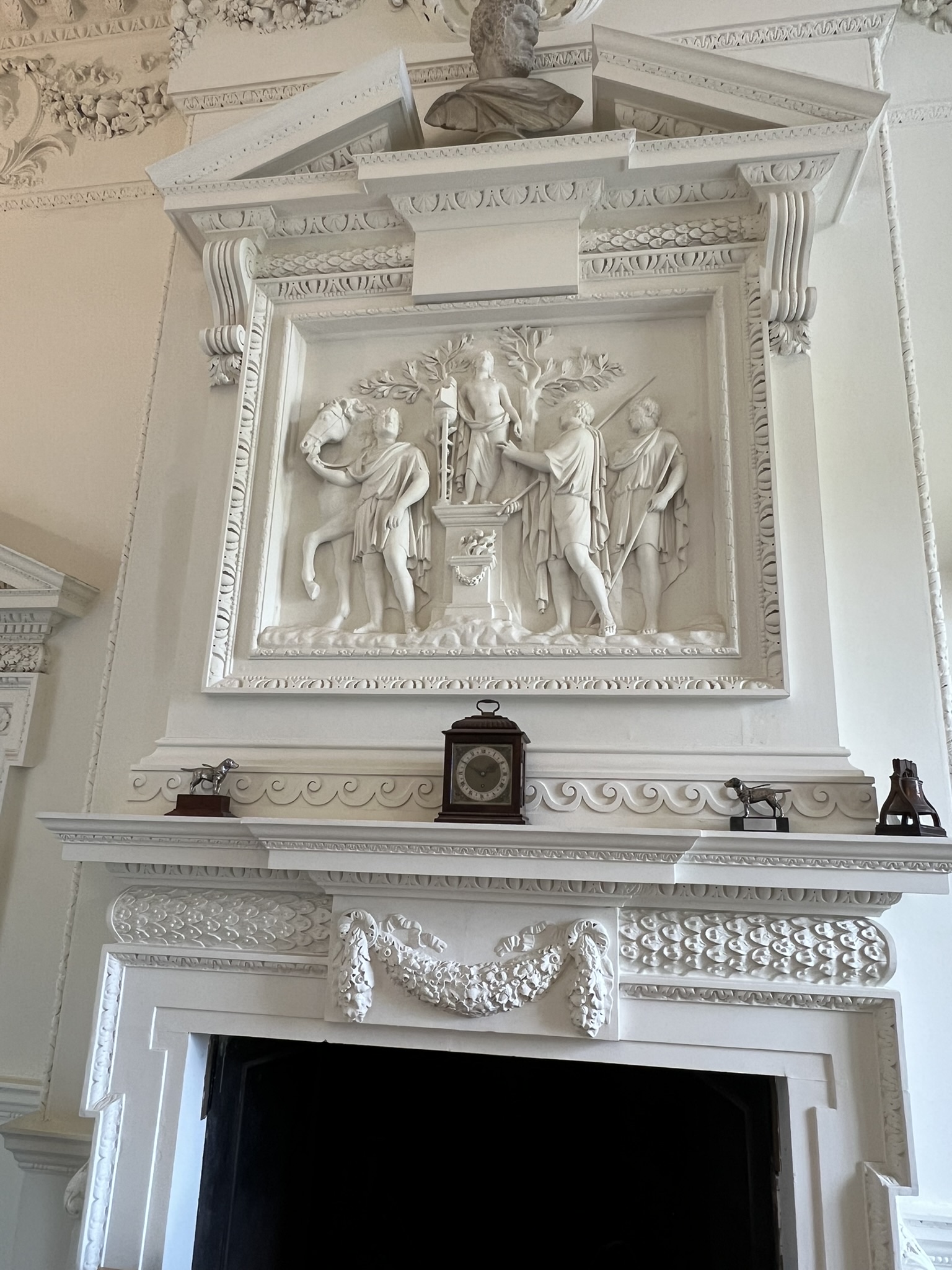
The Heritage Centre tells the story of the house and grounds – it now serves as home to the Association of British Dispensing Opticians and so you cannot tour the house, BUT, we were allowed into [under a code of silence] the entrance foyer, nearly the same as it was in Austen’s time – but no library to visit or any of the other rooms Jane would have stayed in – it is all classrooms now…
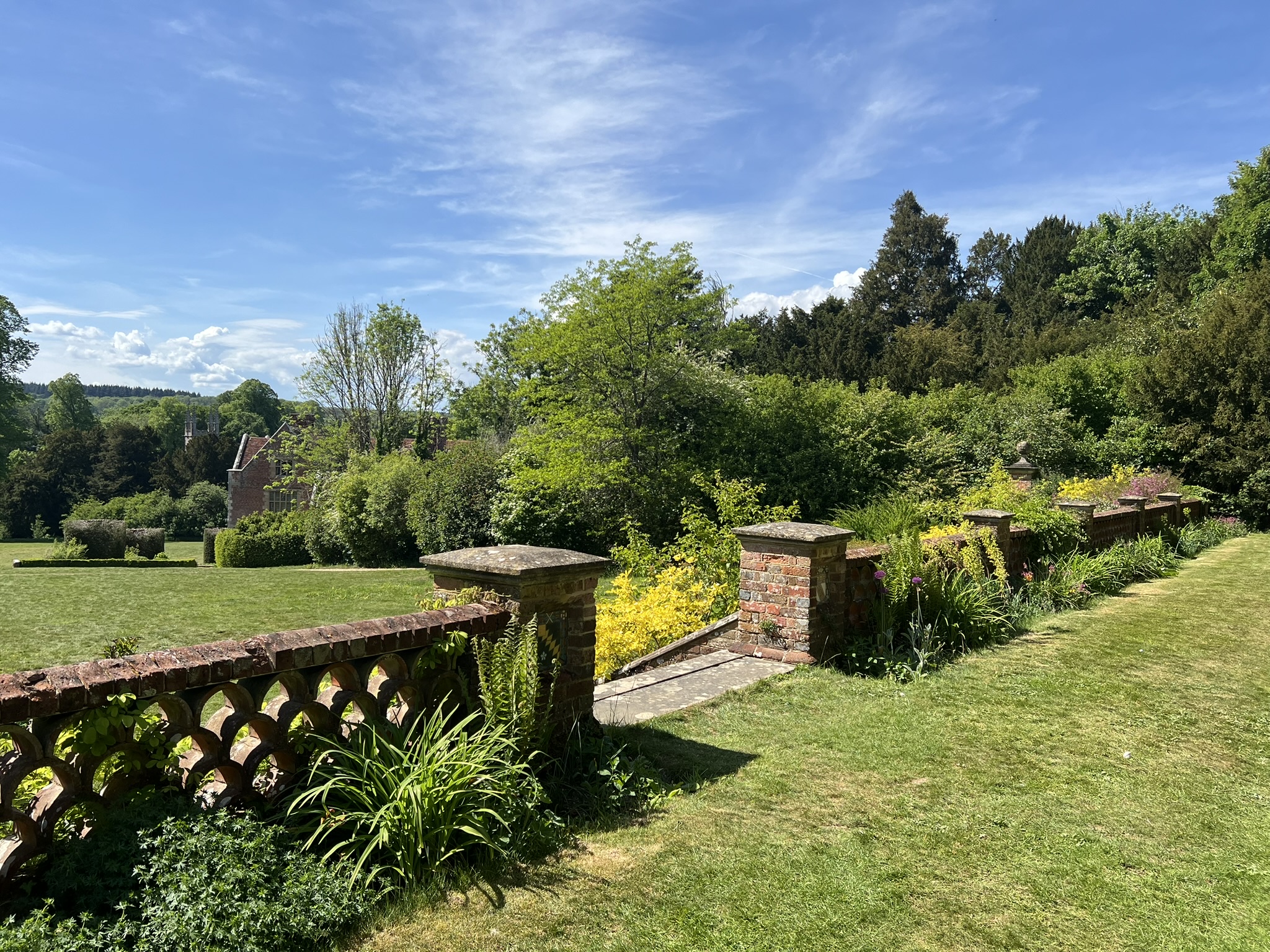
The grounds however we could walk around, and as we know that Jane, being an avid walker, would have strolled around these very spots – one could almost feel her there hovering about…
**************
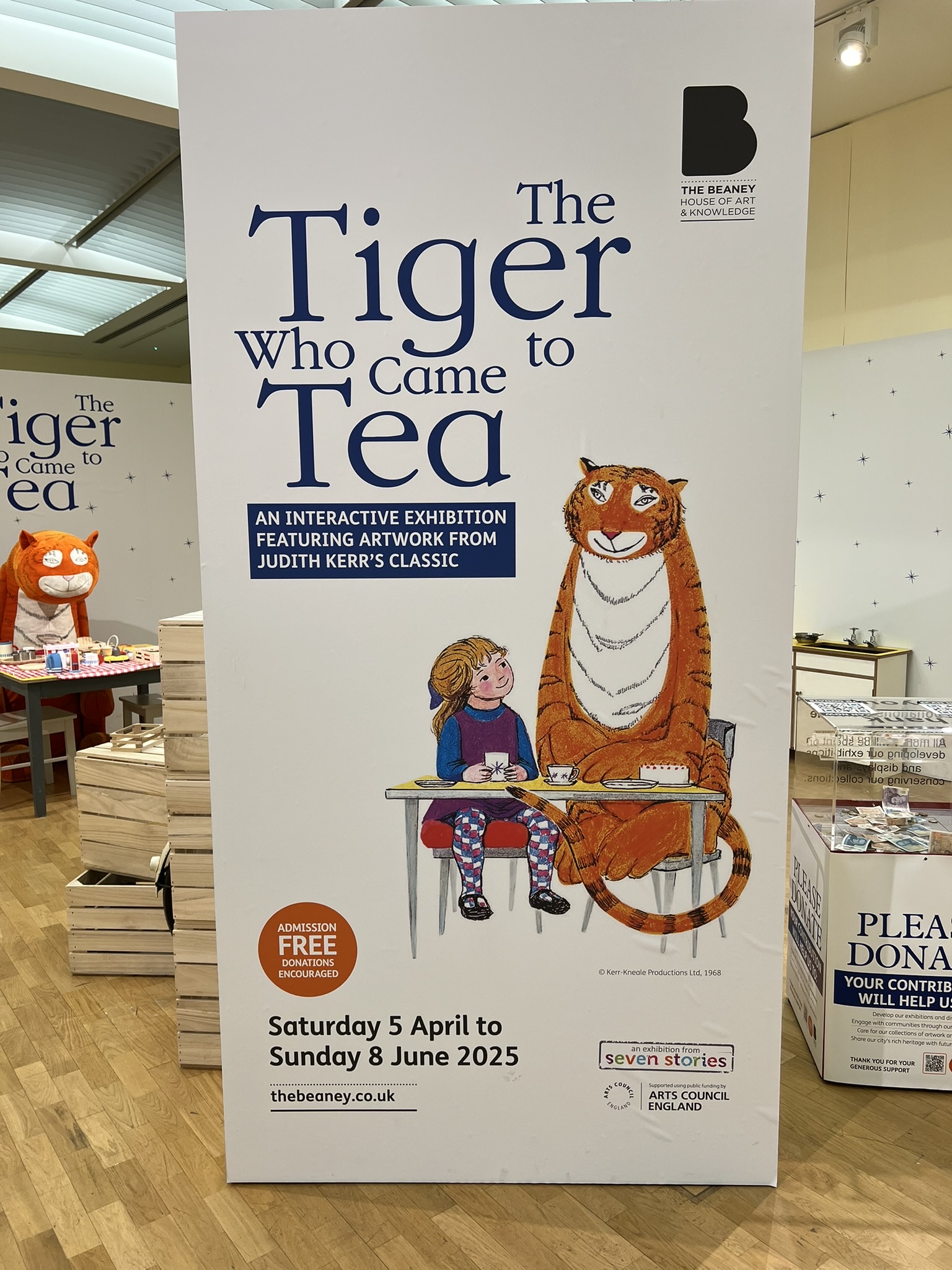
Refreshments were gratefully received, and then we were off to Canterbury. Some of us went to the evensong at the Cathedral [one of my favorite things to do when in England], this after walking around the city for a while – we had two goals in mind: to see the portrait of the scandalous father of Elizabeth Bridges, Sir Brook Bridges (1733-91), whose portrait hangs in the Beaney House of Art & Knowledge – here he is in all his glory:
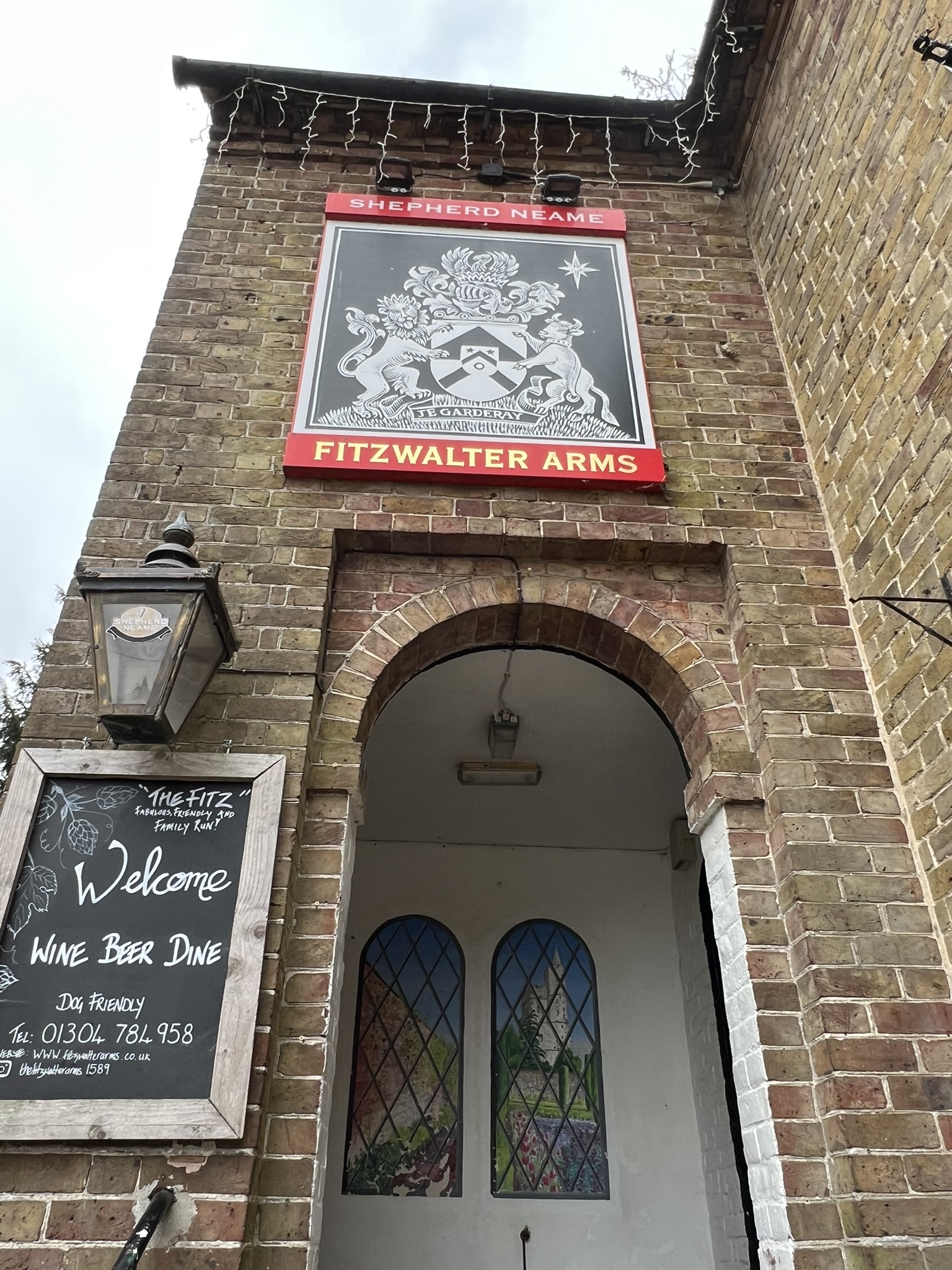
[Bridges married Fanny Fowler, who was heiress to the title Baron Fitzwalter, and still the prominent name here at Goodnestone]:
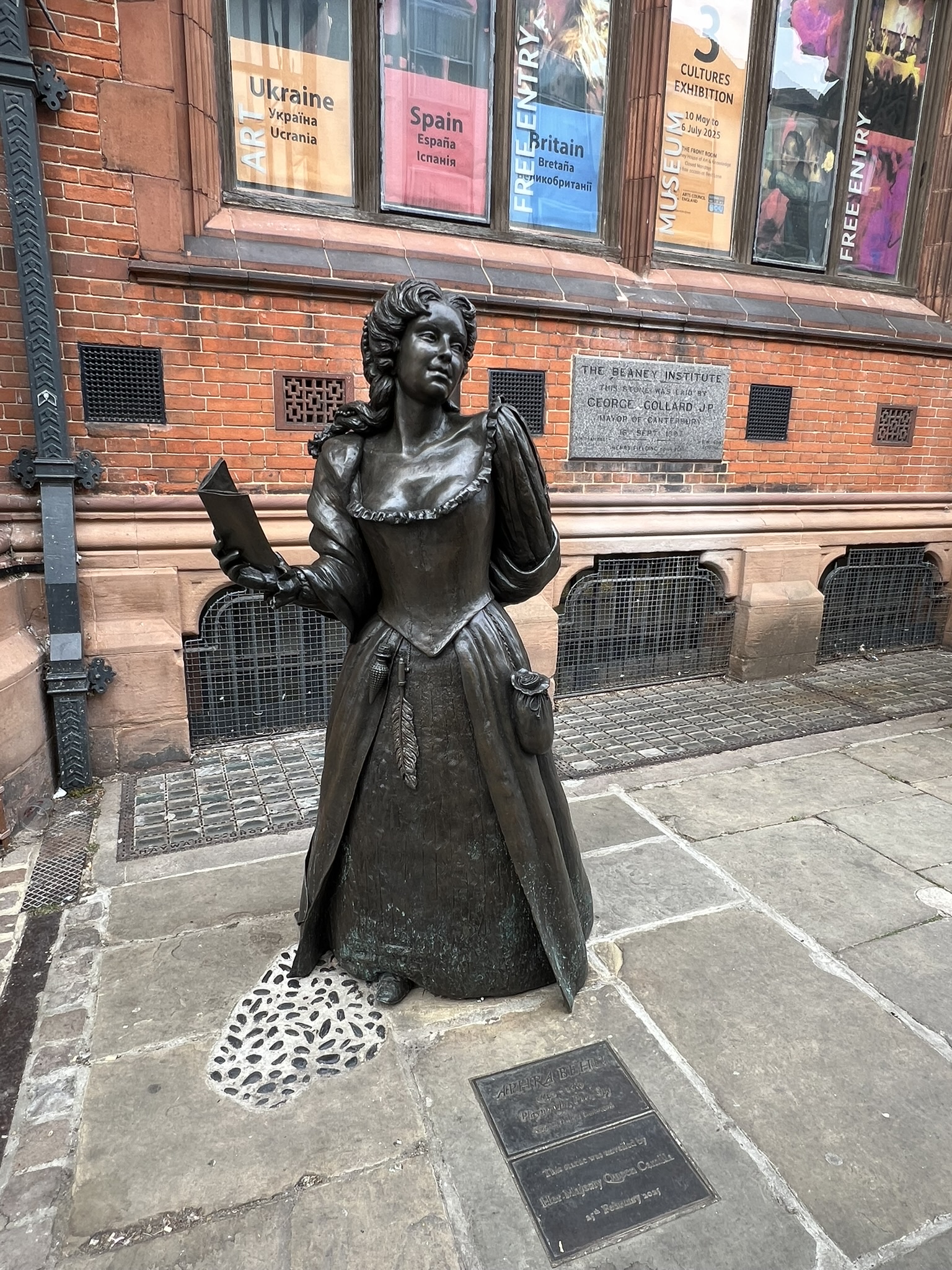
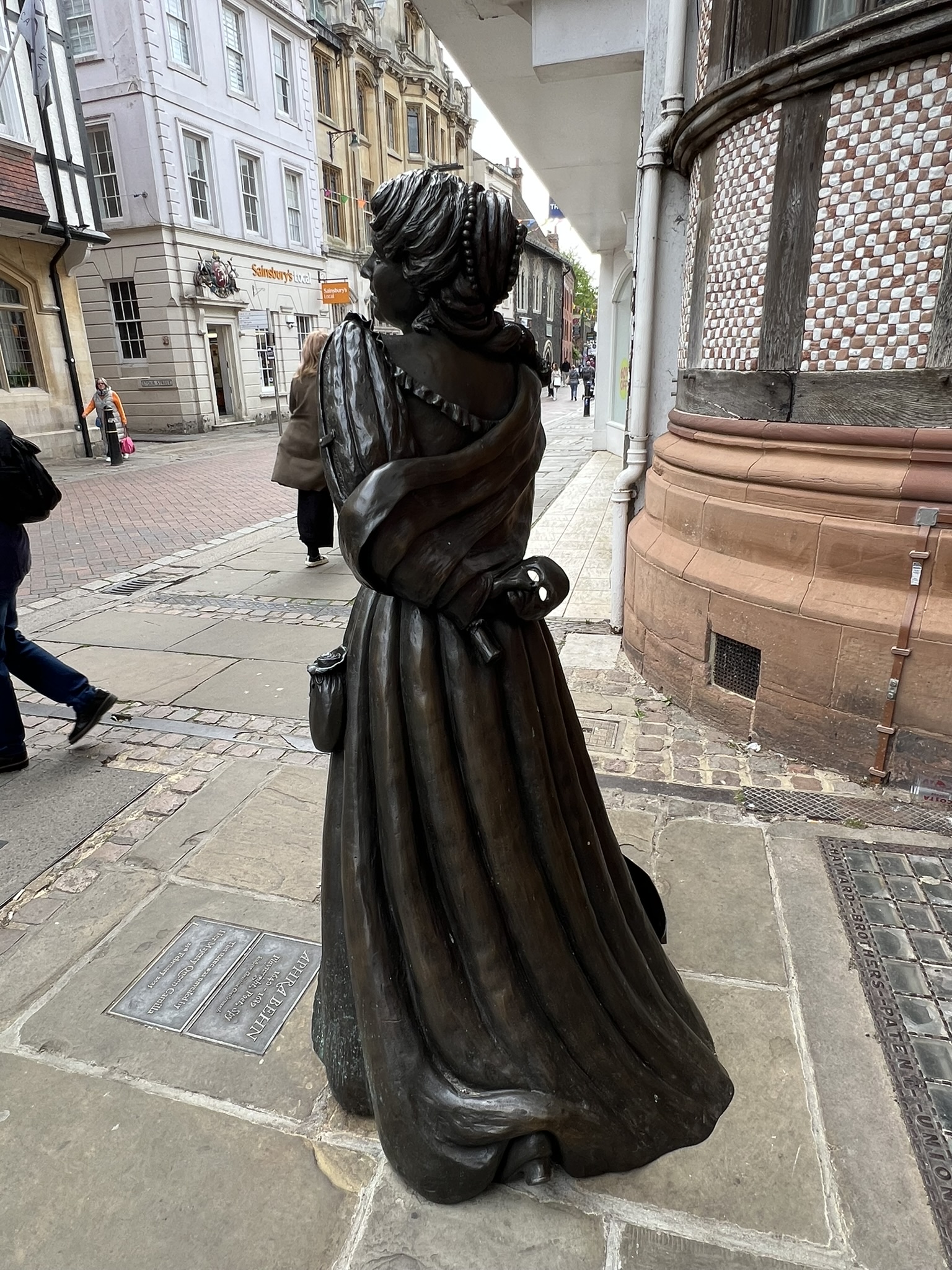
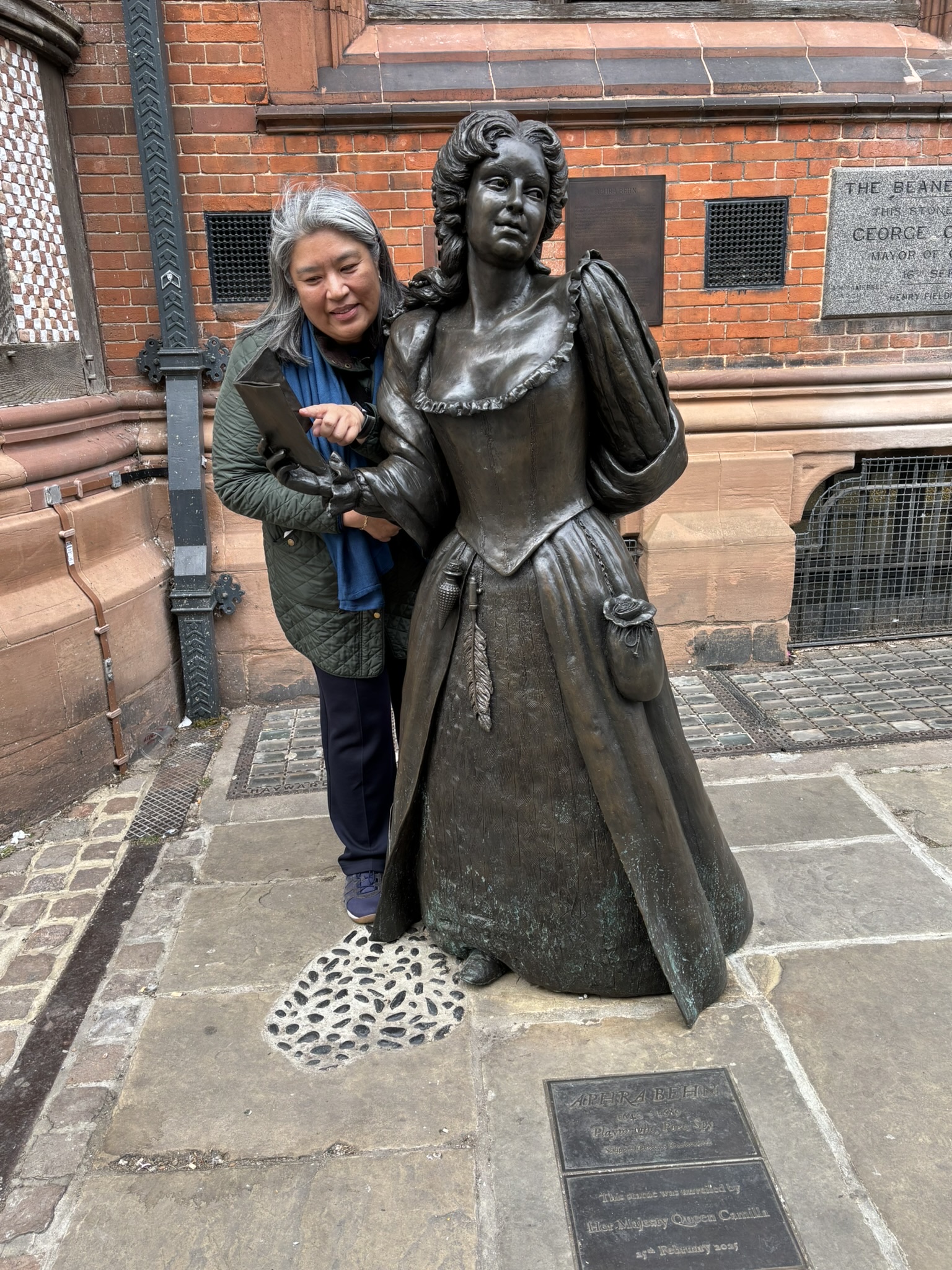
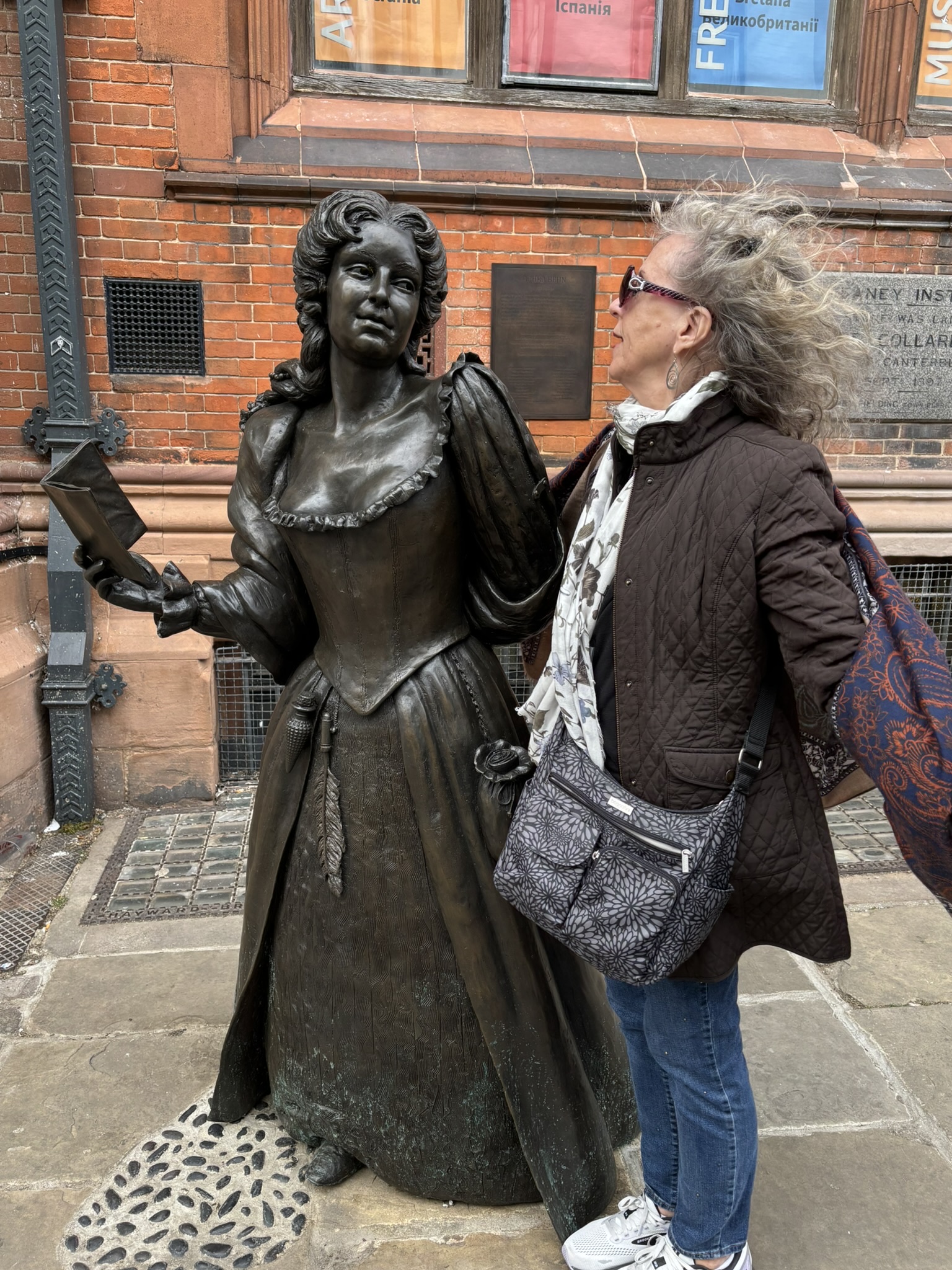
And Joy and I giving tribute to this early woman writer par excellence:
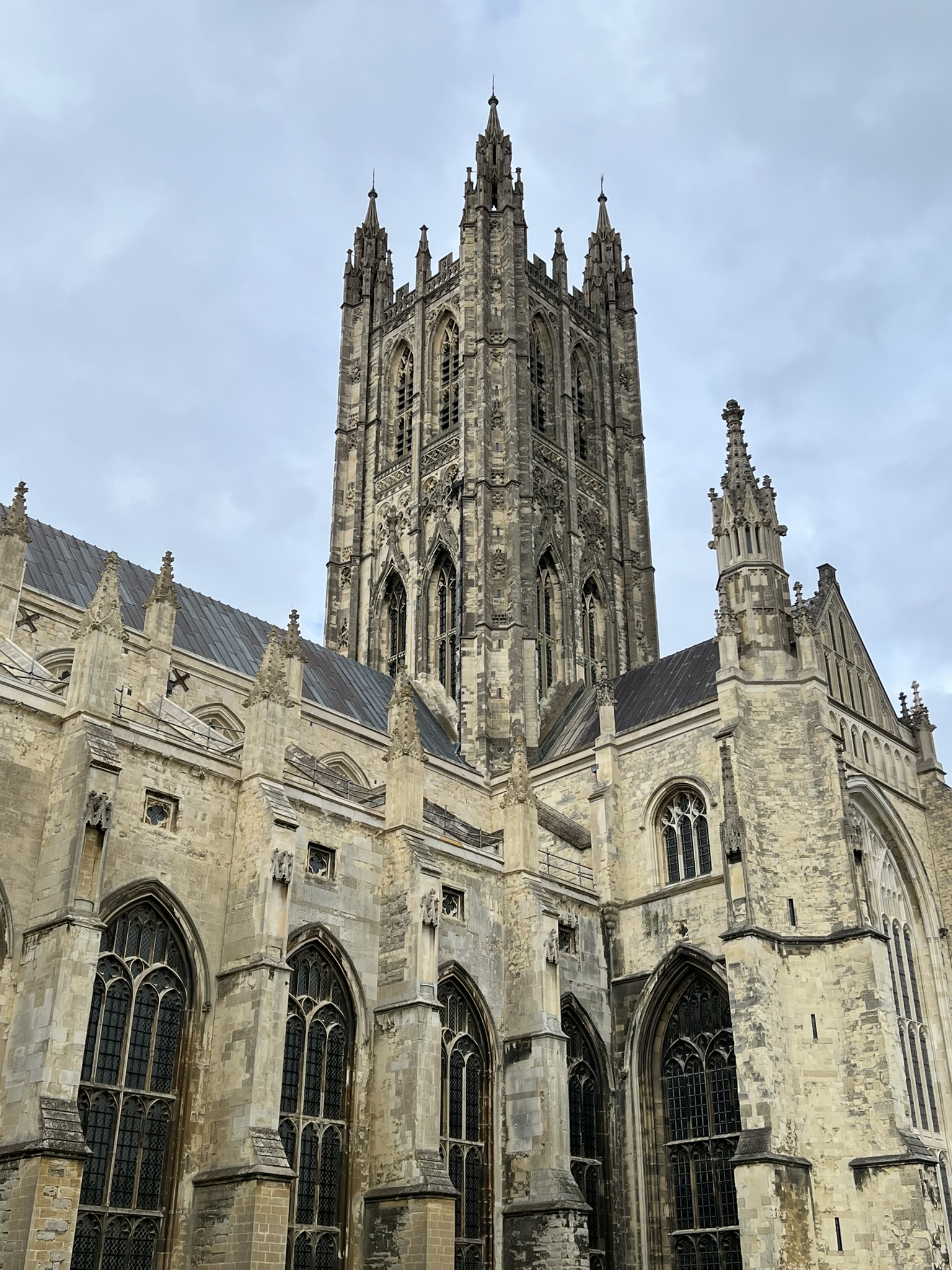
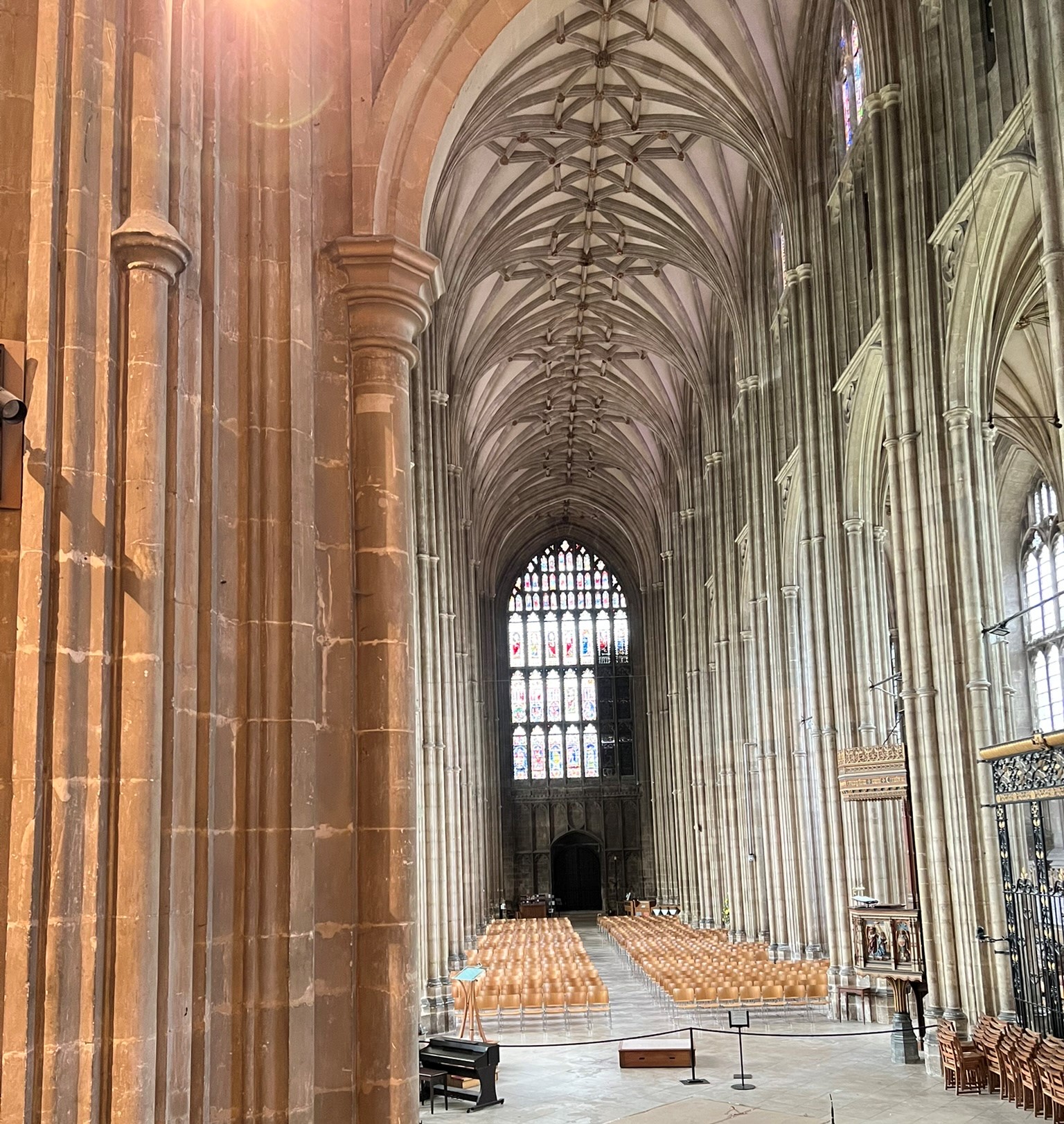
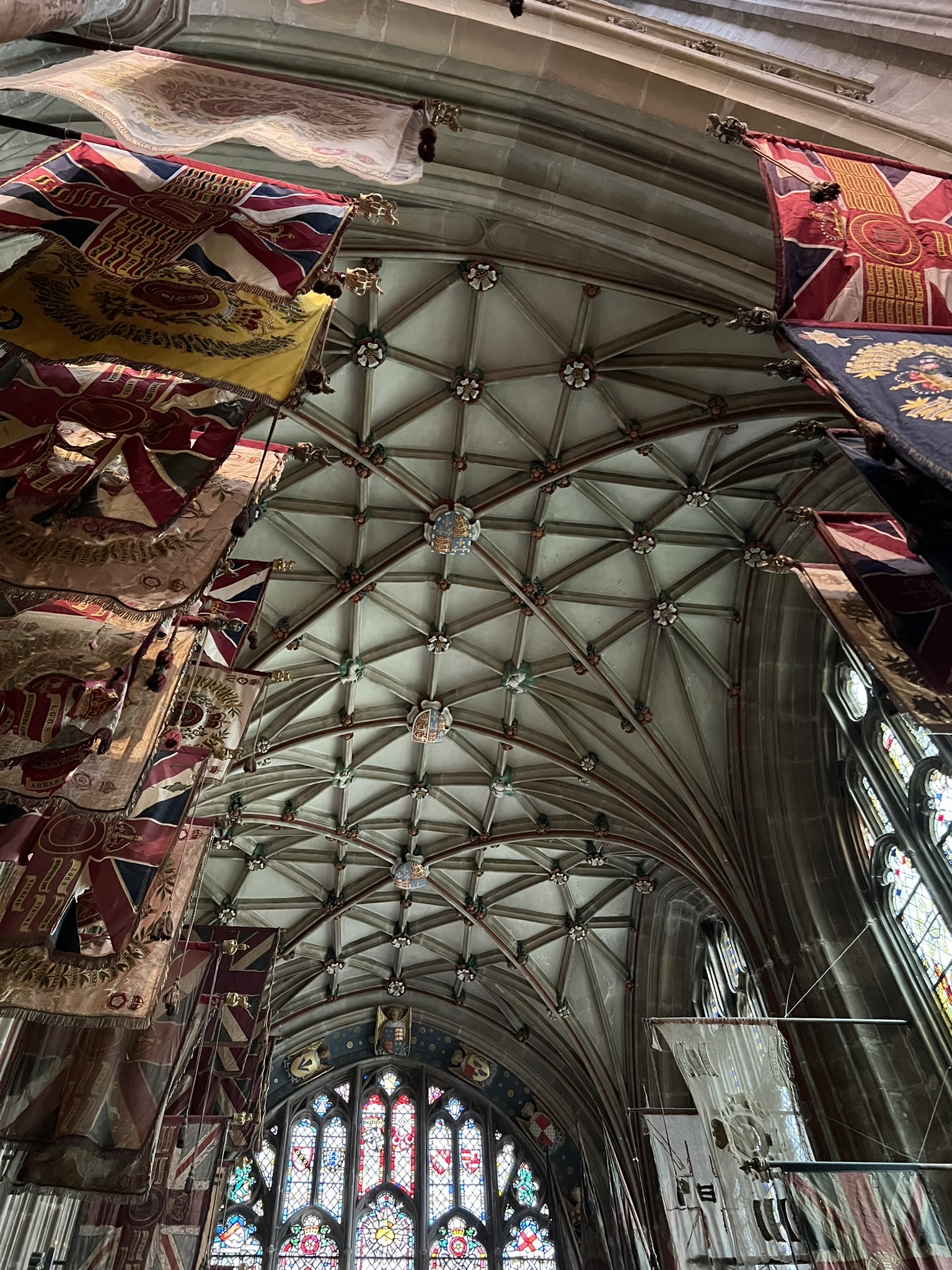
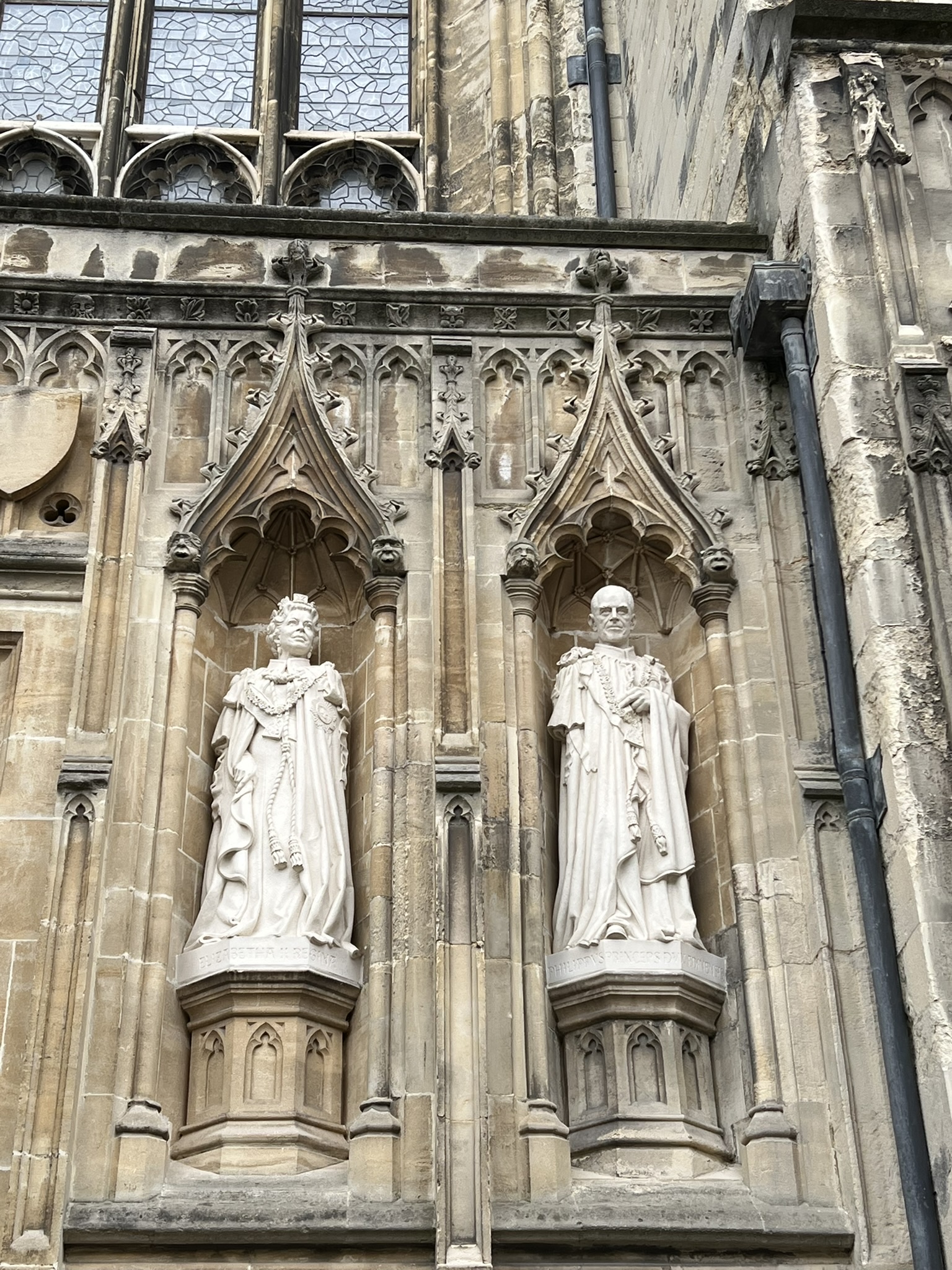
Our walk around Canterbury found us in delightful conversation with a gentleman who asked where we were from: Joy says California – “You must be a hippie” he says. I in South Carolina but from Vermont, and he goes into rhapsodies about Bernie Sanders! [Bernie’s brother has long lived in England and has served in the Labour Party, and this fellow apparently knows him…it was good to have a conversation about the troubles in the US right now – everyone sympathetic to us but also not appreciative of the tariff situation and concerns about ally relationships…] – it was an enlightening conversation, but we were off to Evensong – which was beautiful, as always, – reserved seats just for JASNA, and though we were unable to take photos during the service, I captured a few on the way out…and the exterior [much restoration work going on covering up the main entrance]:
So, until tomorrow, when we leave our gorgeous Chilston Park Hotel and head to Winchester for four nights, by way of Worthing…
c2025JaneAustenInVermont
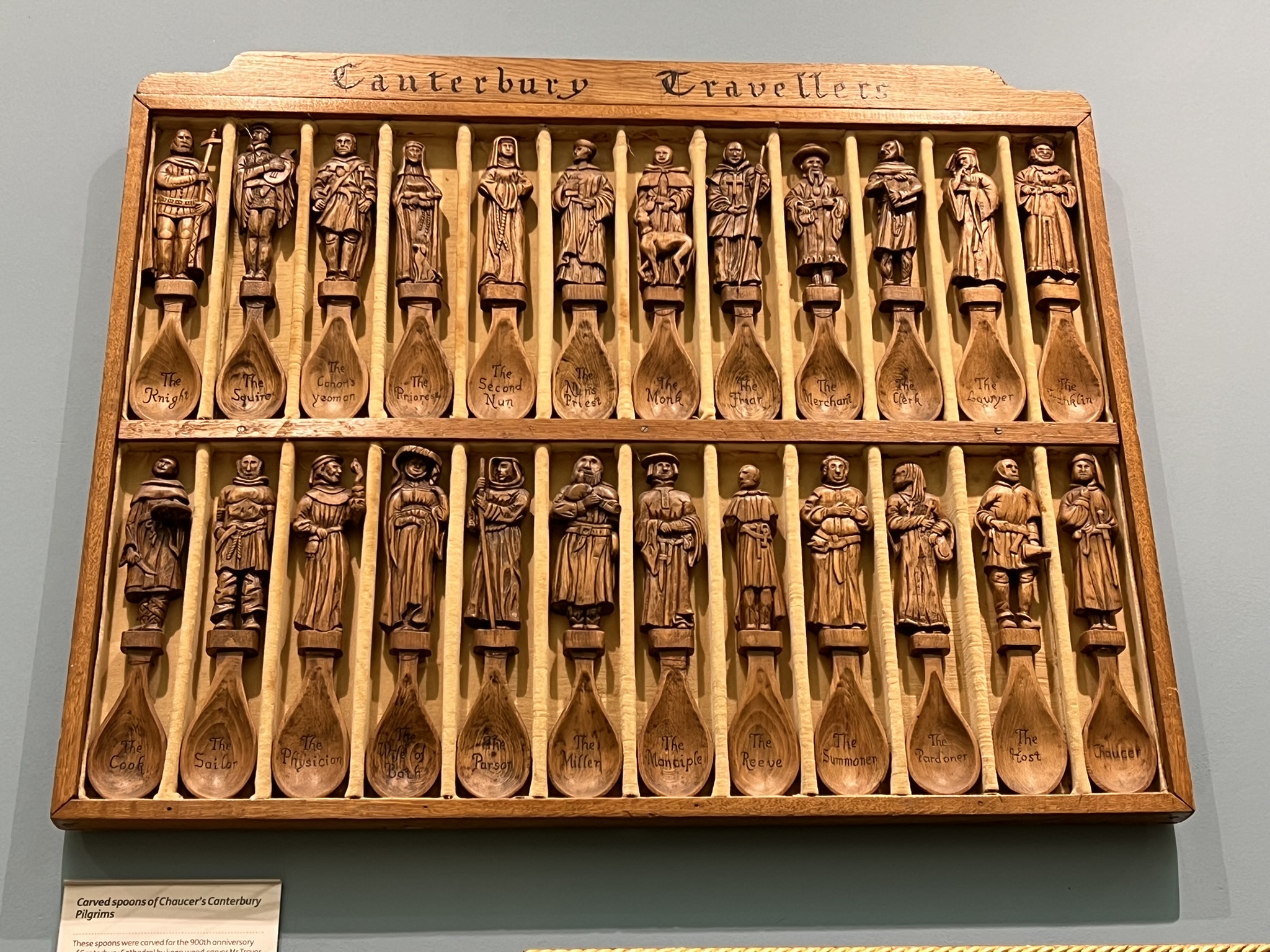
Feeling a bit like a “Canterbury Traveller”… [from the Beaney Museum]
This was the title of my talk at the JASNA AGM in Cleveland last month. I covered a variety of topics, focusing mostly on female book ownership in Jane’s Austen’s time and how she fit into that world of being a “book owner.” David Gilson in his A Bibliography of Jane Austen lists 20 titles that are known to have been owned by Austen, the only way of knowing for sure because she inscribed them. There were others that she gifted to family members and I have included those as well.
The wealth of information on Jane Austen as a reader is quite overwhelming – I direct you to the recently published What Jane Austen’s Characters Read (and Why) by Susan Allen Ford (Bloomsbury, 2024), where there is an excellent summary of her reading in the introduction and chapter one. Also see my bibliography posted below. But my focus was just on the books Austen owned, fitting those into the various subject categories of a gentleman’s or elite lady’s private library, and thereby seeing the variety of works she felt strongly enough about to inscribe her name with that pride of ownership.
I will not be publishing this paper, though I might gradually publish it in sections on this blog – but I did have handouts at the talk and so I am putting both of those on here now: the list of books Austen owned and where they are now, and a very select bibliography of the many books and articles and websites I consulted during my research.
I will add that the Richardson Sir Charles Grandison that was in David Gilson’s private collection is indeed at King’s College Library, Cambridge, as Peter Sabor suggested at the end of my talk. So I have edited the handout to reflect that.
More to come on this very interesting topic, but wanted to get these handouts available to people, as we didn’t have enough during the breakout session.
************* Thank you to all of you who came to my session – very hard choices – I wanted to be at other talks myself! For those of you who have the virtual component of the meeting, my talk was recorded and is available at that virtual JASNA link you would have been sent via email.
If you have any questions, please feel free to contact me.
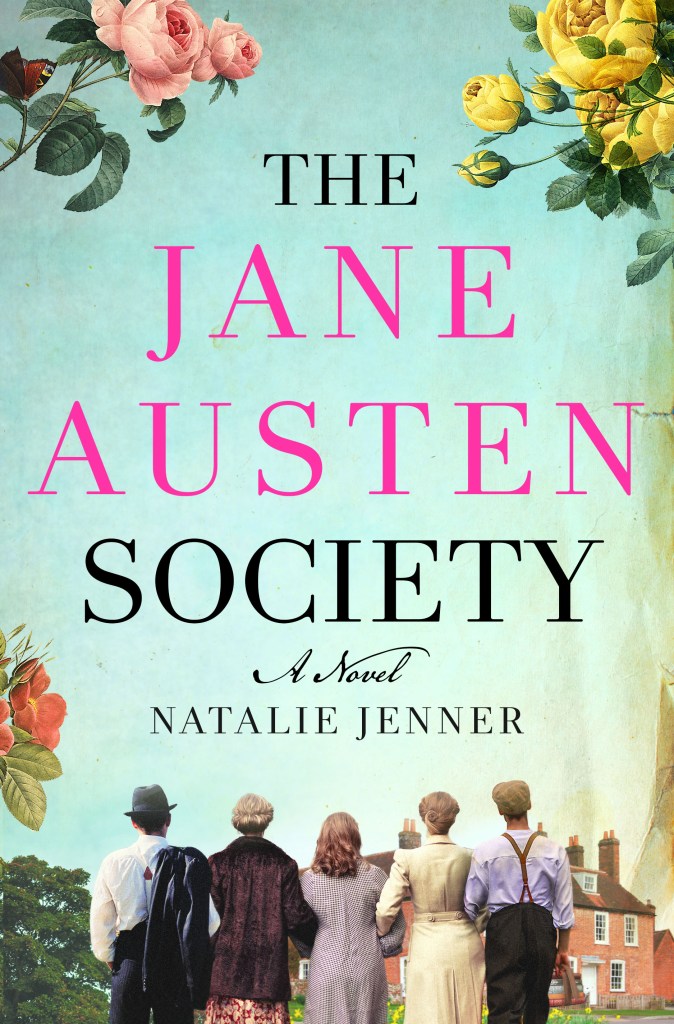
Are you a maker of Lists? Do you keep a List of books to read, lists of books read, movies to watch, TV shows not to be missed, lists of gifts, grocery lists, house to-do lists, a master To-Do List? Do you have a List of Lists? Or, as one friend asked me years ago, do you ever add something to your To-Do list already done so you can cross it off? (I said absolutely NO!). But I do love lists – they organize a life, give a sense of control (false though that may be), especially in these troubled times. And so I find that instead of writing a more traditional book review of The Jane Austen Society, that I’d make a List, a very important list of at-least TEN reasons you should read this book – one reason alone is enough; ten means you should buy it immediately and jump right into its world.
1. The Characters: Real and True
The author Natalie Jenner has said she had no outline for this tale, envisioned about eight characters, half male and half female, and essentially let them run amok.* We can only be glad she did! As one of her more Willoughby-like characters says of this rag-tag motley crew of folk all bent on forming a Jane Austen society: they were “a band of misfits with negligible expertise and no head for business: a country doctor, an old maid, a schoolmarm, a bachelor farmer, a fey auctioneer, a conflict-averse solicitor, a scullery maid, and one Hollywood movie star.” [276] – a “band of misfits” indeed. They are all from different backgrounds and histories, all part of the small rural community of Chawton, all with tragedy, pain and grief permeating and controlling their lives. Yet each is fully-drawn – you like, even love, these people.
2. The Plot: So Inventive
This is fiction (more on this below) – and not even historical fiction – it has nothing to do with the Real Jane Austen Society formed in the 1940s, same as our fictional group – so don’t confuse them. Let this story tell itself, as it brilliantly does: how this unlikely cast of characters discover a commonality in Jane Austen of all people, and strive to honor her in some way – they do live in Chawton after all… And in so doing, each finds Hope and Love and Self-Knowledge. And as the tale of each unfolds and their lives become inexorably intertwined, we have mysteries and secrets, stories of war and deaths, disagreements among neighbors, gossipy goings-on, and Love and Romance. What is there not to like? Jane Austen has given them a purpose, a sense of hope and a road map into an understanding of the heart. You find fast friends over Jane Austen, as many of us have found in our own lives.
3. The Setting: Chawton, of course
Chawton House
Not everyone living in this fictional Chawton reads or even likes Jane Austen. Some resent the weird travelers looking for sites associated with her. Even the family heir confesses a preference for the Brontës (especially Villette – pay attention here). But the setting is one we all are very familiar with, if we know a bit about Austen’s life after 1809. Living in Chawton Cottage (now Jane Austen’s House ) and trekking to her brother Edward’s Great House (now Chawton House), Jane Austen walked these walks, sat in these chairs, read in this library, all so beautifully and authentically described by Jenner. You are in this world in the 1940s, right along with the characters.
Jane Austen’s House
4. The Library [not as “In the Library with Colonel Mustard and the lead pipe”…but a Real Library]
One of my favorite parts of the book (the librarian-bookseller in me). Jenner confesses to a wee mistake about the location of the library at Chawton, but literary license allows just about anything, so she is heartily forgiven. Because she gives us Evie, the aforementioned scullery maid, who at 16 (and without giving too much away) has been secretly cataloguing the entire library in the Great House for the past two years and therefore is more knowledgeable about what’s there, what it’s all worth (and with the added bit of a FOUND letter by Austen, of which I shall say no more…), than anyone else in the family (who have ignored the library for generations) or anyone else in town. Evie is a delightful character – we would like to recruit her for our Reading with Austen / Godmersham Lost Sheep Society project!**
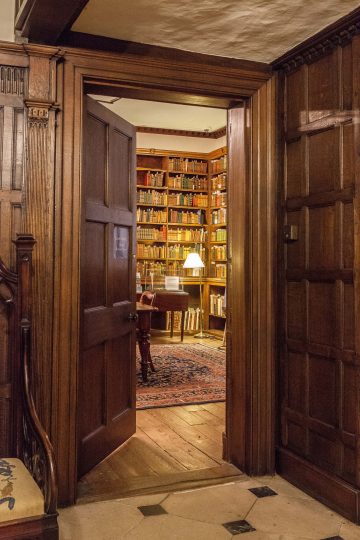
Reading Room at Chawton House
5. Jane Austen in Plain Sight:
One of the pure joys of this book is the light-hearted yet insightful analysis of Austen and her novels: characters actively discussing all the works in their general conversation with each other. Farmer Adam, on first reading Pride and Prejudice considers that “he was becoming quite worried about Mr. Darcy.” [10] The town doctor and the local schoolteacher have a lively chat about Emma: the teacher dislikes Emma, the doctor adores her – they wrangle over Mr. Knightley’s true feelings as Austen drops her clues. [I was delighted to find a new-to-me hint to add to my ever-growing List of Clues that Mr. Knightley is very much in Love.]
Then there are the almost direct correlations between characters – you’ll certainly find a Willoughby or Henry Crawford or a William Elliot in these pages, several of Austen’s couples, maybe even a Mr. Rushworth and a Mrs. Elton – there’s even a Dog! – the fun is finding them and going “aah…” Here’s a standout: one of the characters says “within the pages of Mansfield Park was the playbook for making a good woman fall for a cad.” [151] How true that is – and I never looked at Crawford’s behavior in such a light before…
And then the direct quotes in different contexts, which leads us to…
6. Jane Austen Is Not for “Dull Elves”:
The Austen discussion and character correlations are more straightforward than the many allusions scattered throughout, multiple readings likely needed to flesh them all out. Austen was a master of the allusion herself and again, it’s great fun to find these little crumbs:
“You have borne it as no other woman in England would have…” [295]
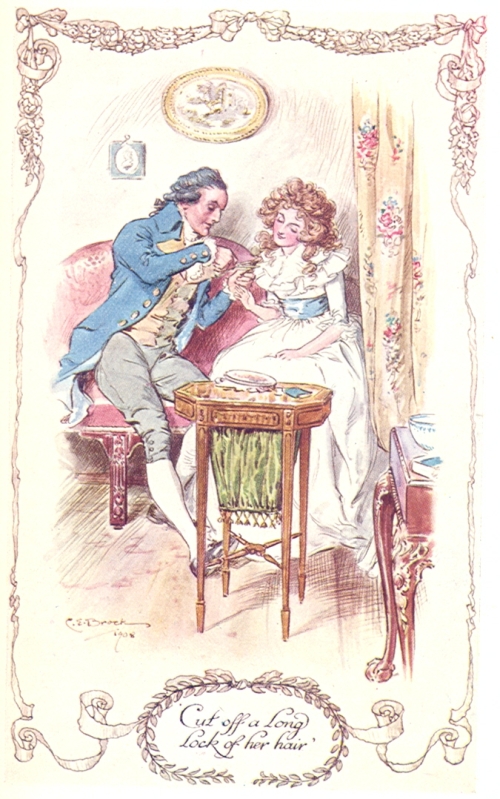
“I probably would’ve cut him a lock of my own hair if he’d asked for it.” [188]…
Sense & Sensibility – CE Brock – Molland’s
So many – don’t want to inhibit your “sharp-elves” detective skills, so that’s all I shall share…which leads us to another no-spoilers here item on our list…
7. The Mystery(ies)wherein lies a will and an heir just like an Austen plot…
….and shall just say there are secrets and mysteries in abundance. So much under the surface, so much history Jenner gradually allows the reader to see, like the proverbial peeling away of an onion – layers of stories to reveal truths… and again, not unlike Austen, Jenner feeds us more and more of each character and their motivations, and we care largely because of ….
8. The Romance: There’s A Lot of It!
So we have eight major characters, and a house full of minors (some of whom, like in Austen, have a lot to say, and a lot to do to move the plot along). Part of the fun (and mystery) is who will end up with whom? Even one of the characters falls asleep one night musing on and making mental lists of possible couplings. Evie at 16 is perhaps the most perceptive at seeing what the heck is going on. It’s all quite endearing – but no spoilers here (though can I say there is a Wentworth-like letter??)
9. It’s Fiction!
Ok, have to repeat this – this is pure fiction, not even great literature (though it is very well written), not based on the real Jane Austen Society as I’ve said (and that real story is compelling it is own right – you can read about it here.)
But even if you are not an avid reader of fiction, but you like Jane Austen, you will get much out of your few hours of time invested. And even if you don’t know squat about Jane Austen, you’ll love this book (you can also listen to it – spending several hours with Richard Armitage is top on my Must-Do list] – because of the humor, the grace, and the romance, and because…
10. We Need This Right Now:
This is a Feel Good book – and goodness, we need that right now more than anything – pick it up and wander back into a simpler (though in so many ways harder) time, to a place ravaged by war, when loss and grief were the bywords of the day, and live for a bit with this delightful “band of misfits” as they each find their way to a better future, all with thanks to Jane Austen, a lesson for us all, especially now…
** For a real-life cataloguing project concerning Edward Austen Knight’s libraries at his Godmersham and Chawton estates, please visit the Reading with Austen website and the Reading with Austen blog. Under the direction of Professor Peter Sabor, the hope is to locate (and return if possible) as many of the books that were originally in the Knight library during Jane Austen’s time. We need Evie on this project!
************
About the author:
Natalie Jenner is the debut author of THE JANE AUSTEN SOCIETY, a fictional telling of the start of the society in the 1940s in the village of Chawton, where Austen wrote or revised her major works. Born in England and raised in Canada, Natalie graduated from the University of Toronto with degrees in English Literature and Law and has worked for decades in the legal industry. She recently founded the independent bookstore Archetype Books in Oakville, Ontario, where she lives with her family and two rescue dogs.
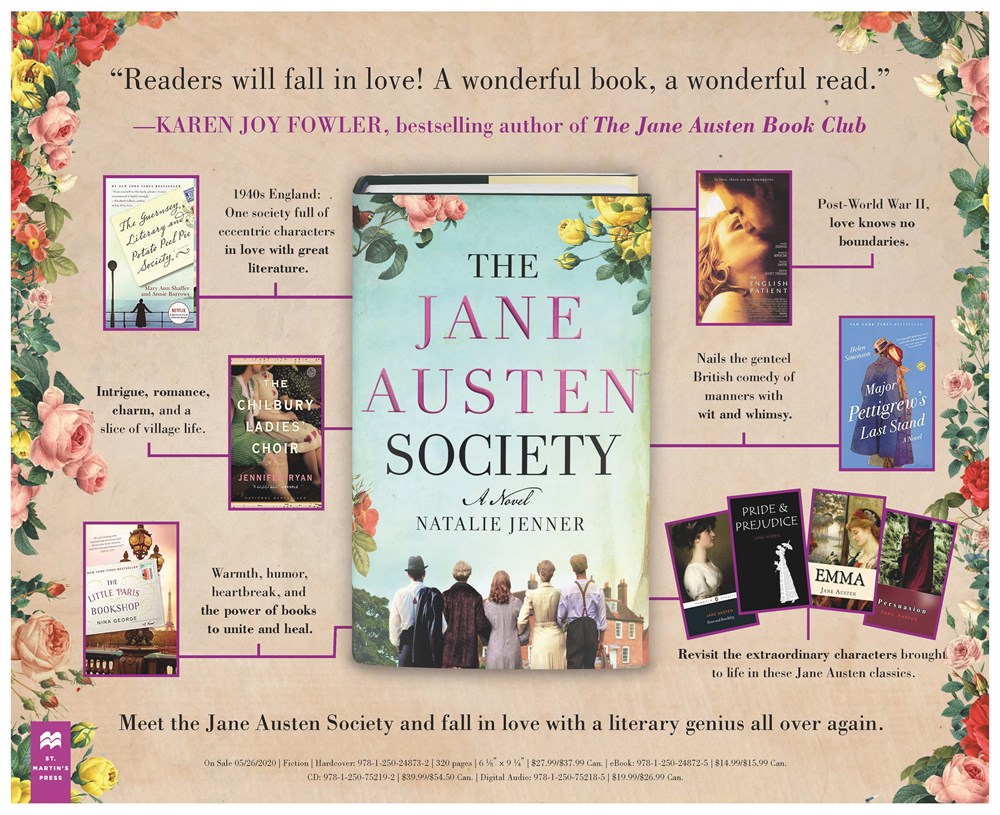
Just after the Second World War, in the small English village of Chawton, an unusual but like-minded group of people band together to attempt something remarkable.
One hundred and fifty years ago, Chawton was the final home of Jane Austen, one of England’s finest novelists. Now it’s home to a few distant relatives and their diminishing estate. With the last bit of Austen’s legacy threatened, a group of disparate individuals come together to preserve both Jane Austen’s home and her legacy. These people—a laborer, a young widow, the local doctor, and a movie star, among others—could not be more different and yet they are united in their love for the works and words of Austen. As each of them endures their own quiet struggle with loss and trauma, some from the recent war, others from more distant tragedies, they rally together to create the Jane Austen Society.
Book details: Genre: Historical Fiction, Austenesque Fiction
The Jane Austen Society: A Novel, by Natalie Jenner St. Martin’s Press (May 26, 2020) Hardcover ISBN: 978-1250248732 eBook ASIN: B07WQPPXFW Audiobook ASIN: B082VL7VRR
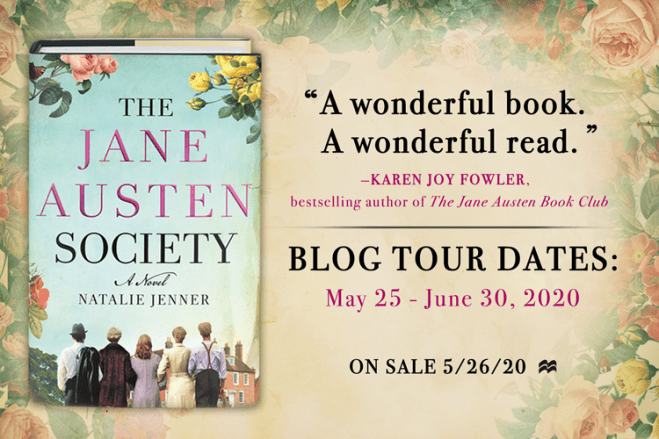
Hello there Gentle Readers: I welcome you to join in on the virtual online book tour of THE JANE AUSTEN SOCIETY, Natalie Jenner’s highly acclaimed debut novel May 25 through June 30, 2020. Seventy-five popular blogs and websites specializing in historical fiction, historical romance, women’s fiction, and Austenesque fiction will feature interviews and reviews of this post-WWII novel set in Chawton, England. All is sponsored and coordinated by Laurel Ann at Austenprose. The pandemic has limited the author from engaging in the usual real-life book talks and marketing tours, so we are going all out to be sure that this book gets a full-court press in our now largely virtual world. Please enjoy all the chat, then get thee to a bookstore and add it to your TBR pile (on top!) – you will not be disappointed…
My review will go live tomorrow but wanted to list here all the blog tour sites that over the next month will be offering reviews and interviews of this delightful tale:
About the Book:
Just after the Second World War, in the small English village of Chawton, an unusual but like-minded group of people band together to attempt something remarkable.
One hundred and fifty years ago, Chawton was the final home of Jane Austen, one of England’s finest novelists. Now it’s home to a few distant relatives and their diminishing estate. With the last bit of Austen’s legacy threatened, a group of disparate individuals come together to preserve both Jane Austen’s home and her legacy. These people—a laborer, a young widow, the local doctor, and a movie star, among others—could not be more different and yet they are united in their love for the works and words of Austen. As each of them endures their own quiet struggle with loss and trauma, some from the recent war, others from more distant tragedies, they rally together to create the Jane Austen Society.
*************
Book details:
Genre: Historical Fiction, Austenesque Fiction
The Jane Austen Society: A Novel, by Natalie Jenner St. Martin’s Press (May 26, 2020) Hardcover ISBN: 978-1250248732 eBook ASIN: B07WQPPXFW Audiobook ASIN: B082VL7VRR
Blog Tour Dates: May 25 – June 30, 2020 [see below]
****************
About the author:
Natalie Jenner is the debut author of THE JANE AUSTEN SOCIETY, a fictional telling of the start of the society in the 1940s in the village of Chawton, where Austen wrote or revised her major works. Born in England and raised in Canada, Natalie graduated from the University of Toronto with degrees in English Literature and Law and has worked for decades in the legal industry. She recently founded the independent bookstore Archetype Books in Oakville, Ontario, where she lives with her family and two rescue dogs.
One of Goodreads Big Books of Spring & Hot Books of Summer
One of Audible’s Top 50 Most Anticipated Spring Audiobooks
June 2020 Indie Next Pick
May 2020 Library Reads Pick
Starred Review – Library Journal
Starred Review – Booklist
Audiobook Narrated By Actor Richard Armitage (!!):
The full unabridged text of THE JANE AUSTEN SOCIETY was read by the distinguished English film, television, theatre and voice actor Richard Armitage for the audiobook recording. Best known by many period drama fans for his outstanding performance as John Thornton in the BBC television adaptation of North and South (2004), Armitage also portrayed Thorin Oakenshield in Peter Jackson’s film trilogy adaptation of The Hobbit (2012 – 2014).
Spotify users can access a playlist for THE JANE AUSTEN SOCIETY at the following link: https://open.spotify.com/playlist/5Q1Vl17qyQQIvvPGeIPCkr?si=-iMhVz8uRk2v2mTdolrPdg. The playlist includes music from various film adaptions of Jane Austen’s books, as well as film scores by such incomparable artists as Hans Zimmer, Ennio Morricone, Rachel Portman, and Michael Nyman.
************
BLOG TOUR SCHEDULE: [I’ll add live links once the post is active]
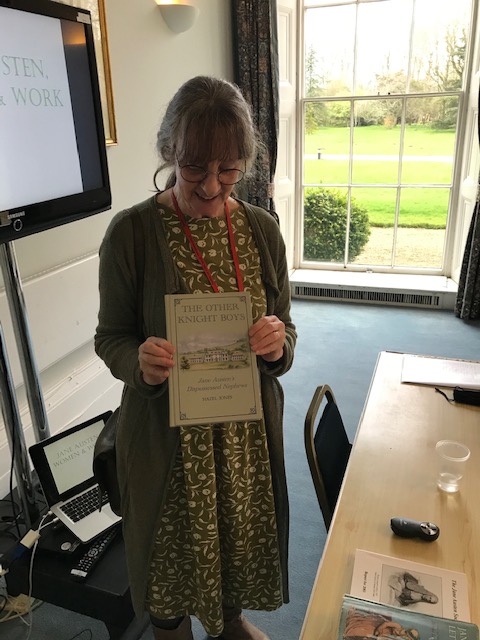
Enquiring Readers: Today I welcome Austen scholar Hazel Jones in an interview about her newest book The Other Knight Boys: Jane Austen’s Dispossessed Nephews. If you have been following my blog Reading with Austen: Returning the Lost Sheep of Godmersham, you have seen the several posts on the diaries of Charles Bridges Knight, i.e all the excerpts that Hazel shared with me of Charles’ references to his reading in the library at Godmersham Park, home to his father, and Jane Austen’s brother, Edward Austen Knight [see below for links to these posts]. Hazel has been researching not only the life of Charles, but also the lives of the five other sons of Edward [all six in order are: Edward, George, Henry, William, Charles, and John]. Her recently published book just flows with tales of their childhood into manhood adventures. I highly recommend it, many of the stories worthy of an Austen novel!
So, Welcome Hazel!
JAIV: Can you give a brief summary of the book?
HJ: Jane Austen’s letters provide clear-sighted glimpses of her six Knight nephews as they grew up, but hers was not the only pen to record their privileged upbringing. Cassandra and Henry Austen commented on Edward Austen Knight’s indulgence of his sons and worried about the boys’ ability to cope with future adversity in the wider world; their affectionate sister Fanny noted key moments in their lives – birthdays, holidays, marriages; Charles kept a detailed diary throughout the 1830s and 40s. The Other Knight Boys explores the character of each nephew in turn, their professional and personal circumstances, their close fraternal bonds as well as the difficulties and disappointments they encountered in adulthood. For five of the brothers, future dispossession of their beloved family home at Godmersham as a consequence of birth order was a reality they had to live with. How it affected the choices they made forms the story that the book attempts to tell.
JAIV: How did you end up doing this research on Austen’s nephews, the six sons of her brother Edward?
HJ: Quite by chance, in 2010, I was in a small party on a guided tour of Trafalgar (pronounced Traffle-gar) Park near Salisbury in Wiltshire. The property featured as Hartfield in the 1996 ITV film of Emma [with Kate Beckinsale], as well as Barton Park in Emma Thompson’s Sense & Sensibility. Originally known as Standlynch Park, it was acquired in 1813 by Parliament for Nelson’s brother William, the new 1st Earl Nelson and re-named Trafalgar Park. The Nelson family lived here until 1946. In 2010, the owner was Michael Wade, whose housekeeper conducted us around the ground floor rooms. In the saloon she pointed out a stunning full length portrait of William Nelson’s beautiful wife, Hilare. Wait a minute, I thought, wasn’t she subsequently married to one of Jane Austen’s Knight nephews? Next followed some very intensive sleuthing which uncovered baptismal records in Cornwall and three marriages – to a cousin, to Nelson and eventually to George Knight of Godmersham. The Kent History and Library Centre and the British Library supplied more biographical material and in a room not usually open to visitors at Chawton House, I found a portrait of George as a young man. My research turned into an article on the couple for the 2016 Jane Austen Society Annual Report. After that came the urge to write about the other five Knight boys and uncover as much as possible about the women in their lives. Charles of course never married, but he had close relationships with his father, his brothers and their spouses.
[Portrait of Hilare Countess Nelson, by George Sanders, 1829-34. Courtesy of Martyn Downer and Michael Wade]
JAIV: Your research took you to materials scattered throughout southern England – “Kent, Hampshire, and beyond” as you say (3). Was most of this known or did you discover any untapped sources?
HJ: The archives in Hampshire Record Office and the Kent Archives at Maidstone have been scoured pretty thoroughly by Austen scholars across many generations, although even here I discovered one or two sparkling gems which had never appeared in any other text. Previously ‘untapped sources’ for me were the Winchester College Archives, the matriculation records held at St John’s and University College in Oxford, the Nelson archive at the British Library and the War Office records at the National Archive, Kew. Articles in the Jane Austen Society Annual Reports (now accessible online) also filled in a number of gaps and put me in touch with other Austen / Knight researchers such as Margaret Wilson, who then provided material I would not otherwise have found. Sophia Hillan, Linda Slothouber, Maggie Lane and Deirdre Le Faye were also happy to have their generous flow of scholarship ‘tapped’. Karen ievers, Andrew Bradford and Hampshire Cultural Trust allowed me to see and reproduce previously unseen images.
JAIV: Of the six boys-to-men you researched, was there more information available from sources on any one more than others? And if so, was that frustrating? For instance I know that Charles kept extensive diaries for years – did any of the others leave such behind them?
HJ: Edward’s life is well documented, given that he was the eldest son and lived at Chawton House, but there are few examples, beyond business letters, of his own personal voice. George’s facility with language shines through his amusing poems and articles on cricket written for The Sporting Magazine. His restless character is evidenced by Fanny’s reports of his comings and goings between England and the Continent, his inability to settle to a career in the law and Charles’s revelation of his brother’s wish to try his luck in America. Letters were written to Fanny by all of the brothers, she records their arrival in her daily diary entries, but where are they now? I wish I had found a greater number of letters from Henry to Lizzy Rice. He comes across as the most contentedly independent and self-sufficient of all the brothers; the harrowing nature of his early death tugs at my heart strings. One or two of William’s letters have survived, together with contemporary descriptions of his youthful exuberance and Fanny’s revelation of his affair with the Knatchbull governess. John is the brother about whom least is known and the hardest to pin down on the page, yet his moving account of the loss of Godmersham is the most revealing of all.
JAIV: Edward, of course, was the heir, and while he appears to have maintained a close and friendly relationship with each of his brothers, there had to have been some bad feelings about how he really dispossessed all of them from their Godmersham Park home. Do you feel sympathetic toward him? Did he have any choice?
HJ: Edward’s siblings must have understood that maintaining Chawton House and Godmersham Park was impossible. The drain of his first and second families on Edward’s finances would have been excessive. The sons from his first marriage were at the stage where they required cash, so when Edward Austen Knight died, money came their way via their father. What appears inexplicable is Edward’s expensive and architecturally unsympathetic alterations to Godmersham in 1853, shortly before he decided to lease the property for 20 years. I can understand his attachment to Chawton – it had been his permanent home since 1826, although his frequent and lengthy returns to Kent each year might have misled his brothers and sisters into believing he would eventually move back and continue to make Godmersham available to all the family. When he sold it in 1875, of the brothers only John was still alive.
Chawton House
JAIV: Some great drama in the family! What is your favorite story? [then I’ll tell you mine!]
HJ: Difficult to choose one … Louisa Lushington’s* description on her visit to Godmersham of the boys somersaulting into the river fully clothed comes near the top of the list and I rather like the story Henry and George concocted, featuring Uncle Henry Austen’s imprisonment for poisoning his second wife. Scandal is always irresistible too … Fanny’s snide references to Fanny Jones, the consequences of Edward’s elopement with Mary Dorothea, William’s affair with the governess.
*[The Journal of Louisa Lushington (1821-22), with an introduction by Linda Slothouber, Chawton House, 2017]
Ok, so you mention my favorite! Edward’s elopement with his sister’s step-daughter is quite compelling, and definitely worthy of a novel – I cannot tell anymore, readers – buy the book!
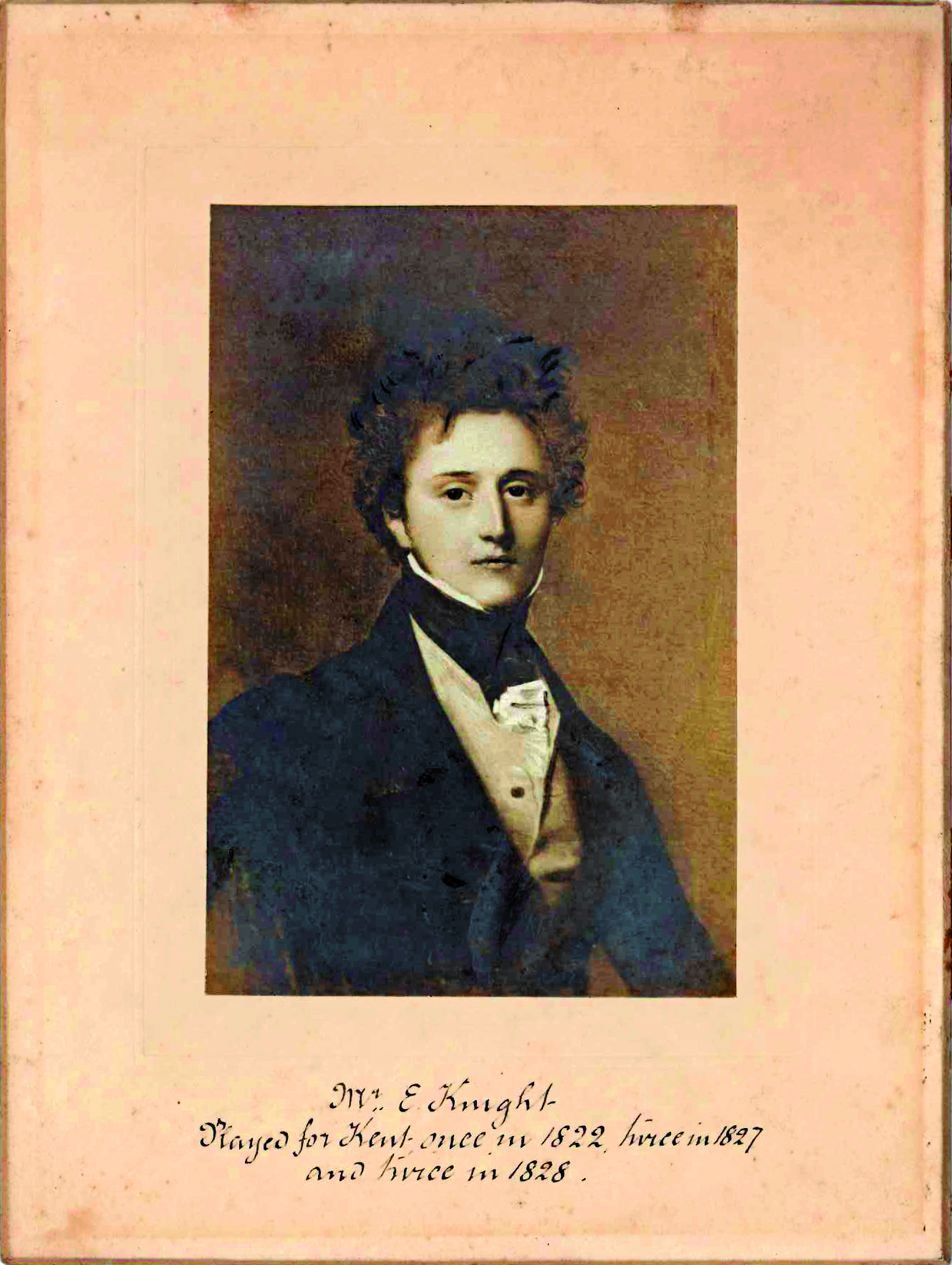
Photograph of a lost portrait of Edward Knight,
held by Kent County Cricket Club, Canterbury.
JAIV: There was so much tragedy in their lives: not unlike their father and uncles (excepting the youngest John, and Charles who never married), all suffered the loss of first wives in childbirth or illness. It is really wrenching to read – how do you think they all handled this?
HJ: Tragedies such as these are almost unimaginable in our modern age of effective remedies, reliable diagnoses and informed medical expertise. Death in childbirth happened so frequently that many women – judging by their correspondence – did not expect to survive, so perhaps their husbands anticipated the worst before it happened. As for the Knight husbands, they certainly grieved for a time, it’s difficult to tell for how long, but from Charles’s diaries we learn that Edward was decimated by the loss of Mary Dorothea and that William and Henry were emotionally affected on the first anniversary of their wives’ deaths. Two or three years later, they are all married again, and embarking on the creation of second families. Life went on. Perhaps a combination of strong religious belief, practical rationality and fraternal support carried them through the worst.
Elizabeth Bridges Knight – Jane Austen blog by Kleurrijk
JAIV: Any sense that the death of their mother after the birth of her 11th child (Brook John, known as John) in 1808 (Edward was 14) had a long-lasting effect on any/each of them?
HJ: John would not have remembered his mother and Charles’s recollections were probably indistinct at best. The affection the brothers felt for each other, for their sisters, and for their father – and his for them – strengthened the familial tie after Elizabeth’s death. Their easy, happy life at Godmersham appears to continue much the same as before, with Fanny standing in as a very capable and loving presence. Male and female occupations and interests were largely separate and distinct, which perhaps helped to lessen the sense of loss at the time and later. Edward, George, Henry and William were away at school for most of the year, Charles and John were initially under Fanny’s care until the time came for them to leave. Any long term effect might have manifested itself in a very understandable anxiety when their own wives became pregnant.
JAIV: Was Jane Austen a big factor in any of their lives growing up (she died when Edward was 23 in July 1817)? But when she became more popular and James Edward Austen Leigh (James’s son) wrote her memoir in 1869 – did any of Edward’s children contribute to that?
HJ: According to Anna Lefroy, Jane Austen was not loved by the Knight children, although they appreciated her story-telling skills. Anna had her own reasons for holding this view, but the probability is that Jane was merely tolerated by the nephews while at Godmersham, especially as they grew older and beyond female influence. Given their hunting, fishing and shooting pursuits, Jane called it ‘sporting mania’, they would see little of her during the day and there is evidence that at and after dinner, she found their their male acquaintance and their talk of wholesale slaughter distasteful. Maria Bertram, bored silly by Mr Rushworth’s boast of game bagged and poachers apprehended, comes to mind. A spinster aunt casting disapproving looks across the table, however, would have had little effect on these confident, indulged young men. At Chawton, out of the hunting season, the nephews appear to have proved more congenial company, especially Henry and William, whose visits to the Cottage in their aunt’s final year are recorded with great affection in her letters. In 1822, Henry Knight wrote to his sister Lizzy that he expected Chawton to feel ‘sadly unreal’, surely on account of Aunt Jane’s absence, when he next visited.
James Edward Austen-Leigh attempted to access Fanny’s letters from Jane Austen, but did not succeed. He stayed with William Knight at the new Steventon Rectory for a day and night, in order to walk the familiar lanes and remind himself of where the old rectory used to stand. At the time the Memoir was written, Henry, George and Charles were dead.
JAIV: In reading about Edward’s family, do you feel that at any time in her writing that Jane Austen was modelling a character after a real-life family member?
HJ: No. [ha! Love this very succinct answer!]
JAIV: What surprised you the most? – Something previously unknown to you or anyone else in the Austen research world?
HJ: A small discovery involved Henry’s attendance at University College, Oxford. There is no reference to this in other texts and it was even a surprise to Deirdre Le Faye. Another concerns George’s final years, after his wife’s death. I am intrigued by his relationship, whatever it entailed, with Fanny Jones. George’s sister Lady Knatchbull certainly suspected something untoward, especially when her brother moved to Hereford to share a house with Fanny and her husband. One that almost got away is the small sheet of paper, Plate 8 in my book, comprising poems written by Edward Knight II and his second wife Adela. It was listed in the HRO catalogue, but missing from the file. It had still not surfaced when my last day at the Record Office came, but in the three hours it took to drive home, the Archivist had located, photocopied and forwarded it.
Charles Bridges Knight
JAIV: For instance, Charles went to Cambridge not Oxford like the rest of his family – do you know why that was?
HJ: One of my theories is that he was sent to Cambridge to detach him from certain school friends who had involved him in a rebellion at Winchester College in 1818. A number of the expelled ringleaders went on to Oxford, with which Winchester was closely associated. His sister Fanny reveals that Charles was ‘intended for the Law’ at this point – maybe Cambridge had a better reputation for training lawyers. One can only speculate.
JAIV: All the brothers had very interesting and novel-worthy love interests – some thwarted by parental involvement – but there were elopements, governess shenanigans, some intermarriage with cousins, etc., some of which you have mentioned above – Charles was the only brother not to marry – was there any love interest found in his diaries?
HJ: From time to time, Charles expresses a lukewarm interest in what he calls ‘domestic happiness’ but he recognized at the same time that it would very likely result in a diminution of his income and the luxury it afforded. While living at Godmersham he attended balls with his sisters, usually reporting afterwards that he had found them ‘stupid’ or that he ‘had not been up to the mark’. He is open to the appeal of women and notes their beauty, or lack of it, and liveliness. In the summer of 1847, when Charles was forty-four, heavily inked deletions appear in his diaries, which appear to be linked to Lizzie Pole, a young woman he encountered at Wolverton Rectory. That Charles himself was not responsible for these obliterations is a possibility, since not all of the references to ‘dear Lizzie’ are removed. His end of the year summary for 1847 expresses ‘shame and sorrow’ at his unbecoming behaviour and ‘cold unfeeling heart’. What happened remains a mystery.
JAIV: Charles’ diaries are quite detailed and extensive. Are you hoping to do more with them? Make them available to a larger audience? [You were terrific in sharing excerpts from the diaries about Charles’ reading while at Godmersham – see links below]
HJ: Yes indeed. See the answer below!
JAIV: Your previous books, Jane Austen and Marriage (2009, paperback 2017 by Uppercross Press), Jane Austen’s Journeys (2014) are both excellent and informative reads where you discuss the times Jane Austen lived in and how the understanding of that helps us understand her plots and characters. Did you enjoy researching the real people in Austen’s life more or less than delving into a subject?
HJ: I loved creating both of my previous books, but have found biographical writing fascinating and wholly compelling (for that, read obsessive). The Other Knight Boys was my first foray as a writer into this territory and I must admit I did find this kind of study more absorbing than focusing on a set subject. It’s something of a cliché to say it, but I did develop a strong sense of each nephew as a living breathing individual, and consequently able to make informed leaps into speculative musing where there were gaps in the records. Where the boys’ experiences overlapped – attendance at Henry and Sophia’s wedding, for example, or the visit to Ireland on their sister Cassandra’s death – deciding in which chapter or chapters to locate the material and at the same time avoiding unnecessary repetition, was a very complex but rewarding process, rather like solving a six-dimensional puzzle.
JAIV: Which leads us to: What’s up next?
HJ: I am currently working with Peter Sabor on the transcription and annotation of Charles Knight’s diaries – 1832 – 1851.
[The Sophia Hillan book May, Lou & Cass: Jane Austen’s Nieces in Ireland (Blackstaff Press, 2011) covers the lives of Marianne (May), Louisa, and Cassandra Jane – much has already been written about Fanny, so what about Elizabeth (Lizzy) – is there a story to tell there?
M.C. Hammond’s Relating to Jane has already covered Lizzy Rice’s life.
[JAIV: Goodness, I have this book on my shelf and have never read it – more than half the book is on Lizzy Knight!: Relating to Jane: Studies on the Life and Novels of Jane Austen with a Life of Her Niece Elizabeth Austen/Knight, by M. C. Hammond (Minerva Press, 1998)].
JAIV: What is your favorite Austen and why? Your favorite character?
HJ: This reminds me of that question from a famous BBC Radio 4 programme: ‘Which book would you choose to take with you to your desert island?’ My answer would have to be ‘The Complete Works of Jane Austen’. I find it impossible to single out for special notice one novel or one character. Heroines, heroes and minor characters, they are all perfectly realized and crafted.
JAIV: An absolutely perfect answer! So, what else do you like to read?
HJ: I love reading biographies, by Claire Tomalin and Hermione Lee in particular, also intelligent detective and thriller fiction – P.D. James, Ian Rankin, Stella Rimington, Henning Mankell, Stieg Larsson, Kate Atkinson; authors from other genres include Dorothy Whipple, Hilary Mantel, C.J. Sansom, Tracey Chevalier … I could go on.
JAIV: well. Thank you for that – a perfect reading list to add to my already toppling TBR pile! [and I see that many of Dorothy Whipple’s books have been republished by the incomparable Persephone Books.]
****************
A hearty Thank You! Hazel, for sharing so much about your book and research into the world of Austen’s nephews. You give a very loving picture of their varied lives, emphasizing their continued connection and affection for each other, and giving us a compelling view into this next generation of the Austen family. The amount of your research alone astounds me! And again, I highly recommend it to all. If you have any questions for Hazel, please comment below and I will forward them to her for answering.
Hazel Jones, Denman College, Oxfordshire
About the author:
Hazel Jones taught English at Exeter University’s Department of Lifelong Learning. She has lectured to Austen Societies in the UK, USA, Canada, Australia, and the Netherlands and contributed articles to a number of their journals. Since 1995 she has tutored residential courses on Jane Austen’s life, letters and novels in a range of locations. Her published books include Jane Austen and Marriage (2009) and Jane Austen’s Journeys (2014).
The Other Knight Boys: Jane Austen’s Dispossessed Nephews, by Hazel Jones
Crediton, Devon, UK: Uppercross Press, 2020.
165 pages, color illustrations, notes, bibliography, index.
Dear Readers: This post originally appeared on Reading with Austen blog – a listing of all the women writers and their works that were in the Godmersham Park Library – a Library that Jane Austen had access to on her visits to her brother’s home in Kent. I have noted their current location or if they are LOST SHEEP – you can read more about the Library and our effort to locate the missing works here at the Reading with Austen website. Please contact us if you should happen upon any!
Abbreviations:
KC = Knight Collection at Chawton House
JAHM= Jane Austen House Museum
LOST SHEEP– please help us find this title!
Of the 45 authors listed with a total of 62 titles, 23 are in the Knight Collection at Chawton House, 29 are LOST SHEEP, 3 works are partially in KC and partially LOST, 2 are in private collections, and the 5 Jane Austen 1st editions are at the Jane Austen’s House Museum.
As mentioned in my previous post on Sarah Scott, it is interesting to search the Godmersham Park Library 1818 catalogue for titles written by women, knowing that Jane Austen would have had access to them. So here is a list of all the women writers and their works, with hopes to eventually do a post on each (which might actually get done in these times of quarantine…).
It is quite an impressive list – novelists, poets, playwrights, philosophers, historians, essayists, translators, letter-writers! And while many of the works remain in the Knight Collection, there are more that are Lost Sheep, our effort still to locate them. If you might have a copy of any work by any of these women with a Knight bookplate in them, please get in touch with us!
******************
Jane Austen
Hannah More
Maria Edgeworth
Austen, Jane (1775-1817) [of course!]
Northanger Abbey: and Persuasion. 1st 4 vols. London, 1818. JAHM
Sense and Sensibility: A Novel. 1st 3 vols. London, 1818. JAHM
Pride and Prejudice: A Novel. 1st 3 vols. London, 1813. JAHM
Mansfield Park: A Novel. 1st 3 vols. London, 1814. JAHM
Emma: A Novel. 1st 3 vols. London, 1816. JAHM
Baillie, Joanna (1762-1851)
A Series of Plays, in which it is attempted to delineate The Stronger Passions of the Mind, each passion being the subject of A Tragedy and a Comedy. 4th 2 vols. London, 1803. LOST SHEEP
Barbauld, Anna Letitia (1743-1825) [as A. Aikin, her maiden name]
Miscellaneous pieces, in prose, by J. and A. L. Aikin. 2nd 1 vol. London, 1775. LOST SHEEP
Bowdler, Jane (1743-1784)
Poems and essays, by A Lady Lately Deceased. 2 vols. Bath, 1786. KC
[Jane Bowdler] Poems and Essays by A Lady Lately Deceased. Bath, 1786.Brooke, Frances (1724-1789)
The History of Lady Julia Mandeville. By the translator of Lady Catesby’s letters. 2nd 2 vols. London, 1763. LOST SHEEP
Brunton, Mary (1778-1818)
Self-control: a novel. 3rd 3 vols. Edinburgh, 1811. KC
Burney, Frances (1752-1840)
The Wanderer; or, Female Difficulties. By the author of Evelina; Cecilia; and Camilla. 5 vols. London, 1814. KC (vol 2-4 only)
Campan, Jeanne Louise Henriette Genest (1752-1822)
Memoirs of the private life of Marie Antoinette, Queen of France and Navarre. To which are added, recollections, sketches, and anecdotes, illustrative of the reigns of Louis XIV. Louis XV. And Louis XVI. By Madame Campan, First Lady of the bed-chamber to the Queen. 3rd 2 vols. London, 1824. KC
Carter, Elizabeth (1717-1806)
Poems on Several Occasions. 1 vol. London, 1762. LOST SHEEP
All the Works of Epictetus, Which are now Extant; consisting of His Discourses, preserved by Arrian, In Four Books, The Enchiridion, and Fragments. Translated from the Original Greek, By Elizabeth Carter. With An Introduction, and Notes, by the Translator. 1 vol. London, 1758. KC (2 copies)
Chapone, Hester (1727-1801)
Letters on the Improvement of the mind, addressed to a young lady. 1st 2 vols. London, 1773. KC
Cornwallis, Mary (1758-1836)
Observations, Critical, Explanatory, and Practical, on the Canonical Scriptures. By Mrs. Cornwallis, of Wittersham, Kent. 4 vols. London, 1817. LOST SHEEP
Craven, Elizabeth Craven, Baroness (1750-1828)
A Journey through The Crimea to Constantinople. In A Series of Letters from the Right Honourable Elizabeth Lady Craven, To His Serene Highness The Margrave of Brandebourg, Anspach, and Bareith. Written in the Year M DCC LXXXVI. 1st 1 vol. London, 1789. LOST SHEEP
Dixon, Sarah (1671/2-1765)
Poems on Several Occasions. 1st 1 vol. Canterbury, 1740. LOST SHEEP
Dobson, Susannah (d. 1795) [as translator]
The Life of Petrarch. Collected from Memoires pour la Vie de Petrarch. Jacques-François-Paul-Aldonce de Sade (1705-1778); translated by Mrs. [Susannah] Dobson. 4th 2 vols. Embellished with eight copper-plates, designed by Kirk, and engraved by Ridley. London, 1799.KC
Edgeworth, Maria (1768-1849)
Patronage by Maria Edgeworth. 4 vols. 2nd London, 1814. KC
Tales of Fashionable Life, by Miss Edgeworth. 1st 6 vols. London, 1809-12. KC
Harrington, a tale; and Ormond, a tale. 2 vols. London, 1817.LOST SHEEP
Elie de Beaumont, Anne-Louise Morin-Dumesnil (1729-1783)
Lettres Du Marquis de Roselle. Par Madame E. D. B. Nouvelle Edition. 2 vols. London, 1764. KC
Elwood, Anne Katharine (1796-1873)
Narrative of a Journey Overland from England by the Continent of Europe, Egypt, and the Red Sea, to India; including a residence there, and voyage home, in the years 1825, 26, 27, and 28. By Mrs. Colonel Elwood. In two volumes. 1 vol ed? London, 1830. LOST SHEEP
Fielding, Sarah (1710-1768) [as translator]
Xenophon’s Memoirs of Socrates. With the Defence of Socrates, before His Judges. Translated from The Originial [sic] Greek. By Sarah Fielding. 1st 1 vol. Bath, 1762. KC
Gardiner, Jane (1758-1840)
An excursion from London to Dover: containing some account of the Manufactures, Natural and Artificial Curiosities, History and Antiquities of the Towns and Villages. Interspersed with Historical and Biographical Anecdotes, Natural History, Poetical Extracts, and Tales. Particularly intended for the amusement and instruction of youth. By Jane Gardiner, Elsham Hall, Lincolnshire. In Two Vols. 1st. ed. 2 vols. London, 1806. KC
Jane Gardiner. An Excursion from London to Dover. London, 1806.
Genlis, Stéphanie Félicité, comtesse de (1746-1830)
Adèle et Théodore, ou, Lettres sur l’éducation, Contenant[.] Tous les principes relatifs aux trois différens plans d’éducation des Princes, des jeunes Personnes, & des Hommes. 1st 3 vols. Paris, 1782. KC (vol 3 only), LOST SHEEP (vol 1 and 2)
Les Veillées du Château, ou, cours de morale à l’usage des enfans, par l’auteur d’Adèle et Théodore. 1st 3 vols. Paris, 1784. KC
Graffigny, (Françoise d’Issembourg d’Happoncourt), Mme de (1695-1758)
Letters written by a Peruvian Princess. A New Edition, in two Volumes. London, 1771. LOST SHEEP
The Peruvian letters, Translated from the French. With An additional original Volume. By R. Roberts, translator of Select Tales from Marmontel, author of Sermons by a Lady, and translator of the History of France, from the Abbé Millot. 2 vols. London, 1774. KC
Lettres d’une Peruvienne. 1 vol. Paris, n.d. LOST SHEEP
Grant, Anne (1755-1838)
Poems on various subjects, by Mrs. Grant. 1st Edinburgh, 1803. LOST SHEEP
Letters from the mountains; Being the real correspondence of a lady, between the years 1773 and 1807. 2nd 3 vols. London, 1807.KC
Hays, Mary (1759-1843)
Female Biography; or, Memoirs of Illustrious and Celebrated Women, of all ages and countries. Alphabetically arranged. By Mary Hays. 1st 6 vols. London, 1803. In the collections of the Godmersham Park Heritage Centre.
Haywood, Eliza Fowler (1693-1756) – as a contributor
A Companion to the theatre: or, a view Of our most celebrated Dramatic Pieces: In which the Plan, Characters, and Incidents of each are particularly explained. Interspers’d With Remarks Historical, Critical and Moral. 2 vols. London, 1747. LOST SHEEP
Lee, Harriet (1757-1851) and Sophia Lee (1750-1824)
Canterbury tales. By Harriet Lee [and Sophia Lee]. 5 vols. London, 1804. [The original 5 volumes of this work were published in 1797, 1798, 1799, 1801 and 1805. The 4th edition of vol. 1 was published in 1804; it’s not possible to identify the editions of the rest of volumes in the Godmersham Library copy from the Godmersham catalogue details]. LOST SHEEP
Lee, Sophia (1750-1824) [see under Harriet Lee]
Lennox, Charlotte (ca. 1730-1804) [as translator]
Memoirs of Maximilian de Bethune, Duke of Sully, Prime Minister to Henry the Great. Containing The History of the Life and Reign of that Monarch, And his own Administration under Him. By Pierre Mathurin de L’écluse des Loges (ca. 1713-1783). Translated from the French by the Author of The Female Quixote [Charlotte Lennox]. To which is added, The Trial of Ravaillac for the Murder of Henry the Great. 5 vols. London, 1757. KC
Macaulay, Catharine (1731-1791)
The history of England from the accession of James I. to that of the Brunswick Line. By Catharine Macaulay. 1st 5 vols. (of 8). London, 1763-83. KC
Catharine Macaulay. • The history of England from the accession of James I. to that of the Brunswick Line. London, 1763-83.
Maintenon, Françoise d’Aubigné, marquise de (1635-1719)
Lettres de Madame de Maintenon. Contenant[.] Des Lettres à différentes personnes, celles à M. d’Aubigné, & celles à M. & à Me. de Villette. Nouvelle Edition. 16 vols. Maestricht [Maastricht], 1778.KC
Marlborough, Sarah Churchill, Duchess of (1660-1744)
An Account of the Conduct of the Dowager Duchess of Marlborough, From her first coming to Court, To the Year 1710. In a Letter from Herself to my Lord––. 1 vol. London, 1742. LOST SHEEP
Masters, Mary (fl. 1733-1755)
Familiar Letters and Poems on Several Occasions. By Mary Masters. 1st 1 vol. London, 1755. LOST SHEEP
Meades, Anna (b. ca. 1734)
The history of Sir William Harrington. Written some years since, And revised and corrected By the late Mr. Richardson, author of Sir Charles Grandison, Clarissa, &c. 1st 4 vols. London, 1771. LOST SHEEP
Montagu, Elizabeth Robinson (1718-1800)
An Essay on the Writings and Genius of Shakespear, compared with the Greek and French Dramatic Poets. With Some Remarks Upon the Misrepresentations of Mons. de Voltaire. 1st 1 vol. London, 1769. LOST SHEEP
The letters of Mrs. Elizabeth Montagu, with some of the letters of her correspondents. Part the first, Containing her letters from an early age to the age of twenty-three. Published by M. Montagu, Esq. M.P., her 1st 2 vols. (of 4). London, 1809-13. KC
Montolieu, Isabelle de (1751-1832)
Agathoclès, ou Lettres écrites de Rome et de Grèce, au commencement du Quatrième Siècle, Traduites de l’allemand de Mme. Pichler, Par Mme. Isabelle de Montolieu. 1st 4vols. Paris, 1812. LOST SHEEP
More, Hannah (1745-1833)
Florio: A Tale, For Fine Gentlemen and Fine Ladies: and, The Bas Bleu; or, Conversation: Two Poems. 1st 1 vol. London, 1786. LOST SHEEP
Strictures on the modern system of female education. With a view of the principles and conduct prevalent among women of rank and fortune. By Hannah More. 9th 2 vols. London, 1799. LOST SHEEP
Coelebs in search of a wife. Comprehending Observations on domestic habits and manners, religion and morals. 9th 2 vols. London, 1809. KC
Fragmens de lettres originales De Madame Charlotte-Elizabeth de Bavière, Veuve de Monsieur, Frère unique de Louis XIV, Ecrites à S. A. S. Monseigneur le Duc Antoine-Ulric de B** W****, & à S. A. R. Madame la Princess de Galles, Caroline, née Princess d’Anspach. De 1715 à 1720. 1st 2 vols. Hambourg, 1788. KC
Parry, Catherine (d. 1788)
Eden Vale. A Novel. In Two Volumes. Dedicated, by permission, To Lady Shelburne. By Mrs. Catherine Parry. 1st 2 vols. London, 1784. KC (vol. 2 only); LOST SHEEP(vol. 1)
Letters to and from the late Samuel Johnson, LL.D. To which are added some poems never before printed. Published from the original mss. in her possession, by Hester Lynch Piozzi. 1st 2 vols. London, 1789. LOST SHEEP
Observations and reflections made in the course of a journey through France, Italy, and Germany. By Hester Lynch Piozzi. 1st 2 vols. London, 1789. In a private collection.
Anecdotes of the late Samuel Johnson, LL.D. during the last twenty years of his life. By Hesther Lynch Piozzi. 1st 1 vol. London, 1786. LOST SHEEP
Porter, Jane (1776-1850)
The pastor’s fire-side, a novel. 1st 4 vols. London, 1817. LOST SHEEP
Radcliffe, Ann Ward (1764-1823)
A Journey made in the summer of 1794, through Holland and the Western Frontier of Germany, with a Return Down the Rhine: to which are added observations during a tour to The Lakes of Lancashire, Westmoreland, and Cumberland. By Ann Radcliffe. 1st 1 vol. London, 1795. LOST SHEEP
Riccoboni, Marie Jeanne de Heurles Laboras de Mézières (1713-1792)
Lettres de Mylady Juliette Catesby, A Mylady Henriette Campley, Son Amie. Quatrieme Edition. 4th 1 vol. Amsterdam, 1760. KC
Marie Jeanne Riccoboni. Lettres de Mylady Juliette Catesby, A Mylady Henriette Campley, Son Amie. Amsterdam, 1760.
The history of Sir George Ellison. 1st 2 vols. London, 1766. LOST SHEEP
A Description of Millenium Hall, and the Country Adjacent: Together with the Characters of the Inhabitants, And such Historical Anecdotes and Reflections, as May excite in the Reader proper Sentiments of Humanity, and lead the Mind to the Love of Virtue. By A Gentleman on his Travels. 1st 1 vol. London, 1762. LOST SHEEP
Sévigné, Marie de Rabutin-Chantal, marquise de (1629-1696)
Recueil des lettres de Madame la Marquise de Sévigné, a Madame la Comtesse de Grignan, sa fille. Nouvelle Edition augmentée. 9 vols. Paris,m 1785. KC
Smith, Charlotte Turner (1749-1806)
Elegiac sonnets, by Charlotte Smith. The fifth edition, with additional sonnets and other poems. 5th 1 vol. London, 1789. LOST SHEEP
The letters of a solitary wanderer: containing narratives of various description. By Charlotte Smith. 1st 2 vols (of 3?). London, 1800. LOST SHEEP
West, Jane (1758-1852)
Letters to a young lady, in which the duties and character of women are considered, chiefly with a reference to prevailing opinions. By Jane West. 4th 3 vols. London, 1811. KC
**********************
There are several titles in the catalogue with no author listed. Here are two novels – could either of these been written by a woman? [these 2 titles were not counted in the totals noted above] – more on these two books in a future post…
Edward. A novel. Dedicated (by permission) to Her Majesty. London, 1774. 2 vols. LOST SHEEP
The correspondents, an original novel; in a series of letters. A new edition. London, 1775. 1 vol. LOST SHEEP




































 Jane Austen in Vermont