Auctions · Austen Literary History & Criticism · Books · Georgian Period · Jane Austen · Jane Austen Circle · Literature · Rare Books · Regency England

Austen on the Block! ~ A Lot of Lots!

UPDATE: Prices Realized added as available, includes buyer’s premium

There is much going on with Jane Austen and the Auction Block in the next month! – just this past week, Gorringes at their October 23, 2013 Fine Art, Antiques & Collectables auction – Sale LOCT13, had this on offer: Estimate £2,000-3,000.  SOLD for £11,000 !

Gorringes-letter-10-23-13

Lot 1454:

Austen, Jane.  An autograph manuscript fragment, comprising four lines, attached to another leaf bearing authentication, in turn attached to a letter from her nephew, James Edward Austen-Leigh, written on paper bearing watermark date 1868, at Bray Vicarage, February 7, 1870, presenting the fragment to Rev. G. C. Berkeley: ‘Men may get into the habit of repeating the words of our Prayers by rote, perhaps without thoroughly understanding – certainly without thoroughly feeling their full force and meaning.’ All attached to the title page of a copy of Austen-Leigh’s ‘A Memoir of Jane Austen…’ fragment approximately 1.75 x 6in.

******************

Upcoming auctions:  an abundance of Austen, Austen’s Circle, and Regency-era prints – I include various items because they are too wonderful not to share, but please visit each auction house site to see the “infinite variety” of offerings:

Bloomsbury: 7 November 2013. Library of a Gentleman: Fine Colour Plate, Costume, Travel and Sporting Books. London.

This auction is filled with Ackerman, Rowlandson, Cruickshank, Gillray and others! – here are a few examples, but go have a look at this treasure-trove for a Gentleman OR a Lady!

Lot 1:
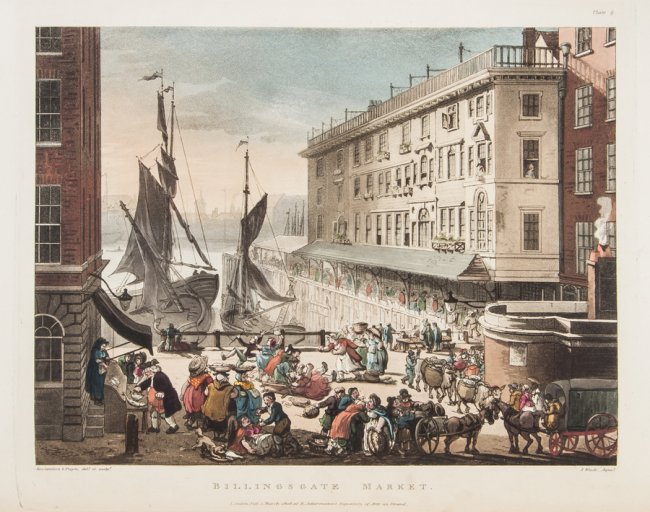
AckermannsLondon-bloomsbury-11-7-13

Ackermann’s London – “Billingsgate Market”

Ackermann, (Rudolph). Microcosm of London.

3 vol., first edition, early issue  with several of Abbey’s 12 “key plates” in first state (nos.1, 5, 8, 10, 11 & 18 and possibly 9), lacking half-titles, with wood-engraved pictorial titles, engraved dedication leaves, 104 hand-coloured aquatint plates after Rowlandson and Pugin, offsetting from plates but plates generally clean, some text leaves in vol.1 browned, handsome contemporary diced russia with elaborate gilt borders and cornerpieces, by C.Hering with his ticket, g.e., rebacked preserving old gilt spines, later cloth slip-cases edged in morocco, [Abbey Scenery 212; Tooley 7], 4to,  [1808-10].

Early issue bound from the original parts, watermarked 1806-07 and with all the 13 errata at end of vol.3 uncorrected and the Contents leaf in vol.1 headed “Contents”. However, the imprint of the wood-engraved title to vol.2 does not have a comma after “Bensley” but that in vol.1 does.

Estimate: £3,000 – £5,000; Starting Bid £2,600 – Sold for £4464

**********

Lot 2:

Agg-Foppish-Bloomsbury-11-7-13

“Foppish Attitudes” from The Busy Body, or Men and Manners

[Agg (John)] The Busy Body, or Men and Manners, edited by Humphrey Hedgehog, vol.1 & 2 only (parts 1-12), 11 hand-coloured aquatint plates by Williams, a little browning and offsetting, later tan calf, gilt, by Rivière & Son, spines gilt, g.e., spines chipped at head, joints split with covers becoming loose, 8vo, J.Johnston, 1816-17.

Estimate £200 – £300; starting Bid £180  – Sold for £211

************

Lot 3:

DrivingDiscoveries-Bloomsbury-11-7-13

“Driving Discoveries”

[Alken (Henry)] – the set of 7 hand-coloured etchings by Henry Alken, very slight marginal soiling, bookplates of William Henry Smith, Viscount Hambleden and George Seton Veitch, handsome later scarlet morocco, by Rivière & Son, covers with gilt border and upper cover titled and dated in gilt, spine gilt in compartments with five raised bands, g.e., corners very slightly rubbed, an excellent copy, [Siltzer pp.57 & 69; Tooley 25], oblong 4to, S. & J.Fuller, 1817 [watermarked 1821].

Estimate: £600 – £800; starting Bid £500 – Sold for £1364

*************

Lot 37:
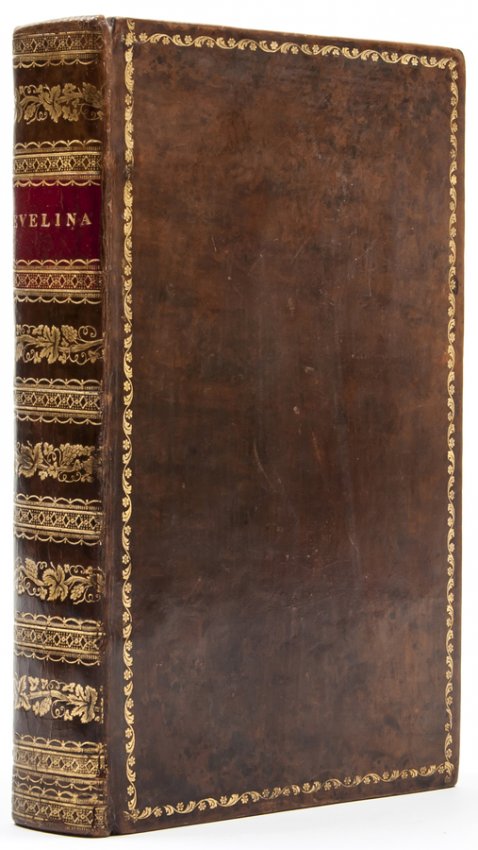
Evelina-bloomsbury-11-7-13[Burney (Fanny)] Evelina: or Female Life in London: being the History of a Young Lady’s Introduction to Fashionable Life, and the Gay Scenes of the Metropolis, hand-coloured engraved additional pictorial title and 6 plates after W.Heath, all but one aquatints, most offset onto text, some browning, bookplates of Charles C.Auchinloss and Hon.John Wayland Leslie, contemporary mottled calf, gilt, spine gilt with red morocco label, small gouge to lower cover, preserved in later red silk folder (a little rubbed and faded), red morocco slip-case (slightly darkened at edges), [Tooley 119], 8vo, 1822.

⁂ ***Originally published in 1778 under the title Evelina, or, A Young Lady’s Entrance into the World but reissued with this title following the popularity of Egan’s Life in London..

Estimate £200 – £300; starting Bid £180 – Sold for £496

***************

Lot 267:

Dacre-school-bloomsbury-11-7-13

Dacre (Charlotte). The School for Friends, a Domestic Tale, first edition, hand-coloured etched frontispiece and vignette title by Thomas Rowlandson, 12pp. text, lightly soiled and stained, stitched in original blue wrappers with paper label on upper wrapper, uncut, slightly soiled, preserved in later cloth portfolio and morocco-backed cloth slip-case, spine faded, 8vo, Thomas Tegg, [c.1800].

One copy only listed on COPAC, in the National Library of Scotland..

Estimate: £200 – £300; starting bid £180 – Sold for £3968

***********

Lot 274:
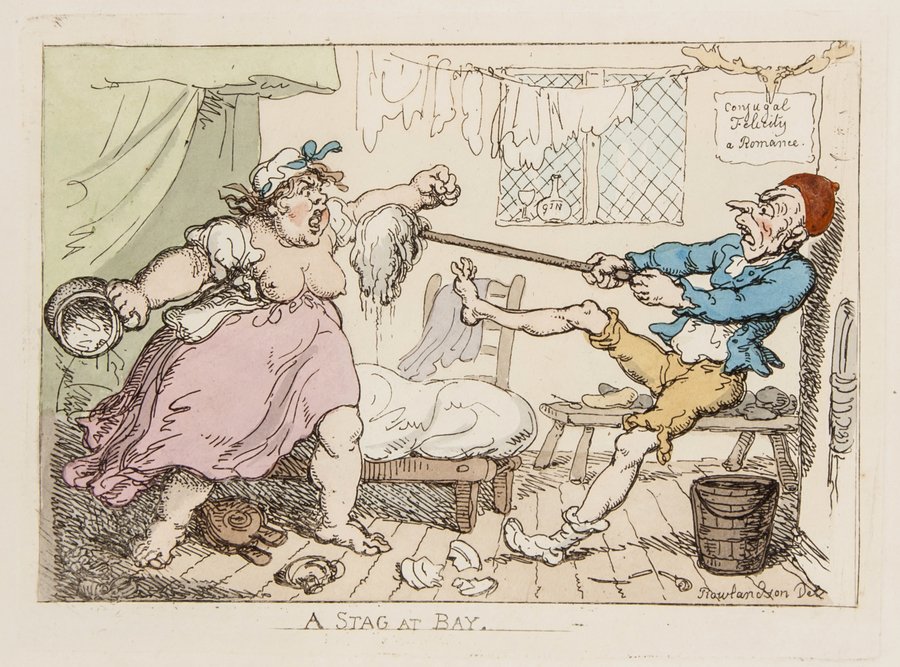
Rowlandson-miseries-bloomsbury-11-7-13

Rowlandson: “A Stag at Bay”

Rowlandson, Thomas. Miseries of Human Life”

Hand-coloured etched title and 50 plates by Thomas Rowlandson, without the rare ‘Pall Mall’ plate but replaced with ‘The Chiropodist’ as often and with an additional plate ‘The Enraged Vicar’ (signed and dated in plate 1805), otherwise with all plates as listed in the Abbey copy, light foxing, mostly marginal but affecting a few images, ex-library copy with bookplate and ink accession number to lower margin of first plate (otherwise unstamped), later olive morocco, gilt, by Rivière & Son, spine gilt, t.e.g., rather faded and a little rubbed, covers warped, upper joint repaired, [Abbey, Life 317], 4to, R. Ackermann, [1808].

Estimate: £500 – £700; Starting Bid £440 – Sold for £1054

**********

Lot 279:
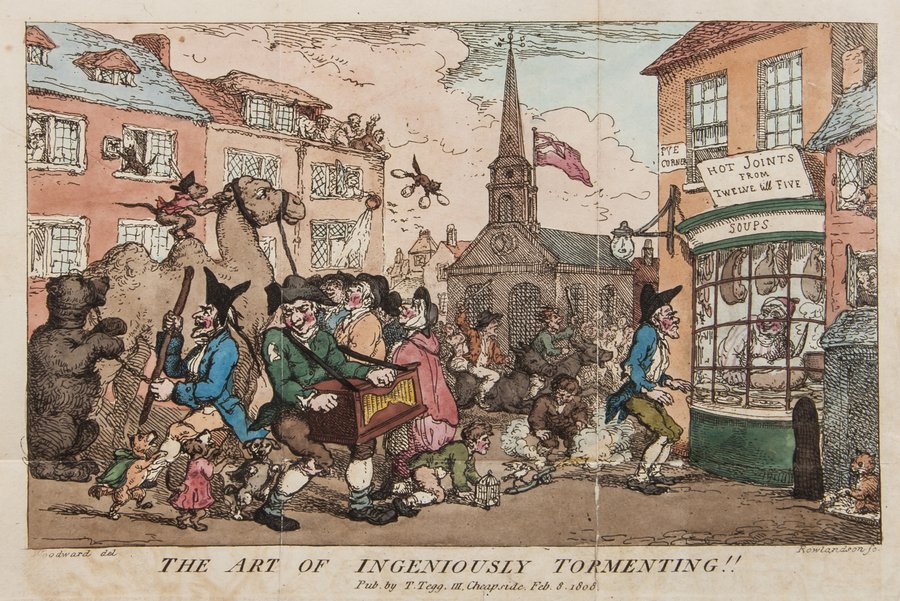
Collier-Rowlandson-bloomsbury-11-7-13

[Collier (Jane)] An Essay on the Art of Ingeniously Tormenting.

Half-title, folding etched frontispiece and 4 plates by Rowlandson after G.M.Woodward, all hand-coloured, frontispiece with short tear repaired, text browned, later tan calf, gilt, spine gilt, t.e.g., others uncut, a little rubbed, upper joint split, 12mo, 1808.

Estimate: £100 – £150; Starting Bid £90 – Sold for £112

**********

Lot 288:
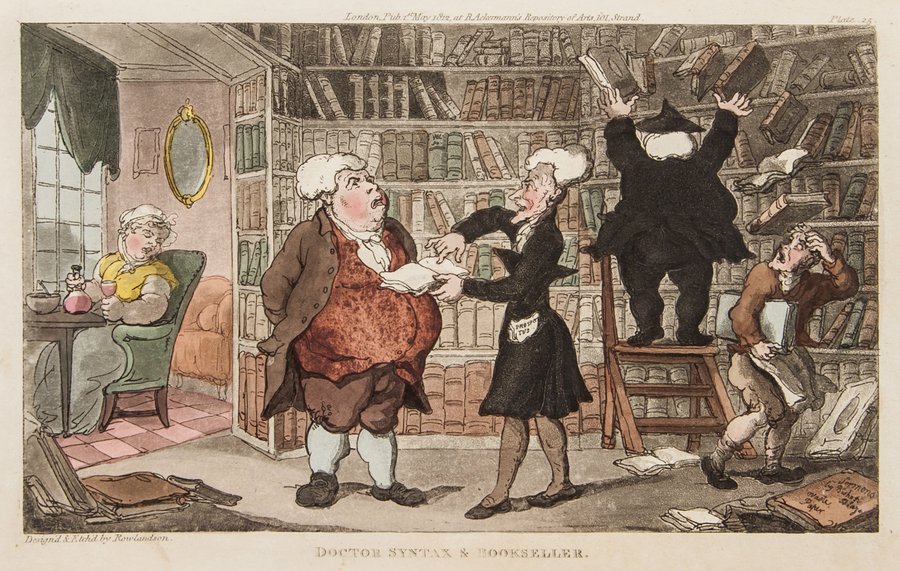
Rowlandson-syntaxbookseller-bloomsbury-11-7-13

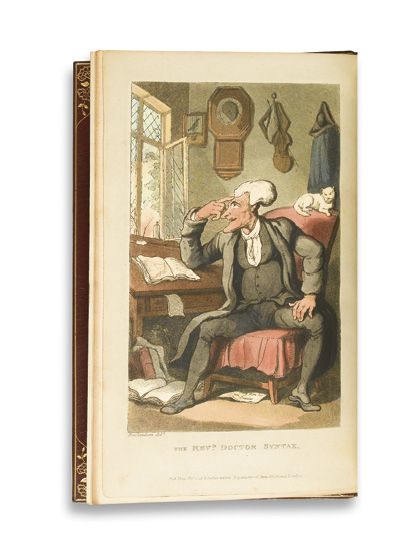
Rowlandson: “Doctor Syntax and Bookseller”

[Combe (William)] The Tour of Doctor Syntax, in Search of the Picturesque. A Poem.

First edition, second issue with “Canto I”, hand-coloured aquatint frontispiece, vignette title and 29 plates by Rowlandson, 4pp. advertisements at end, old ink signature at head of title, some light browning and soiling, final leaf of text with small repair to upper inner margin, original boards, uncut, rubbed, rebacked preserving part of old paper label on spine, preserved in later red morocco drop-back box with metal catch, gilt, slightly rubbed, [Tooley 427], 8vo, [1812].

Estimate: £200 – £300; Starting Bid £180 –  Sold for £496

**********

Lot 344:

Wilson-Bloomsbury-11-7-13

Wilson (Harriette) – [?Heath (Henry)] Illustrations of Harriette Wilson’s Memoirs,

12 hand-coloured etched plates, 3 signed “H.H.”, c.170 x 140 or vice versa, 7 trimmed to border or just outside plate-mark and tipped into blank leaves, light soiling, one or two small tears to edge of image (repaired), engraved circular bookplate of Sir David Lionel Salomons, Bart., later dark blue morocco, gilt, by Bumpus of Oxford, spine gilt, very slightly rubbed and marked, 4to, S.W.Fores, 1825.

Estimate: £1,000 – £1,500; Starting Bid £900 – Sold for £1736

*************************

Millea Bros. November 9, 2013.  Asian, English, Modern Books

Lot 1473:
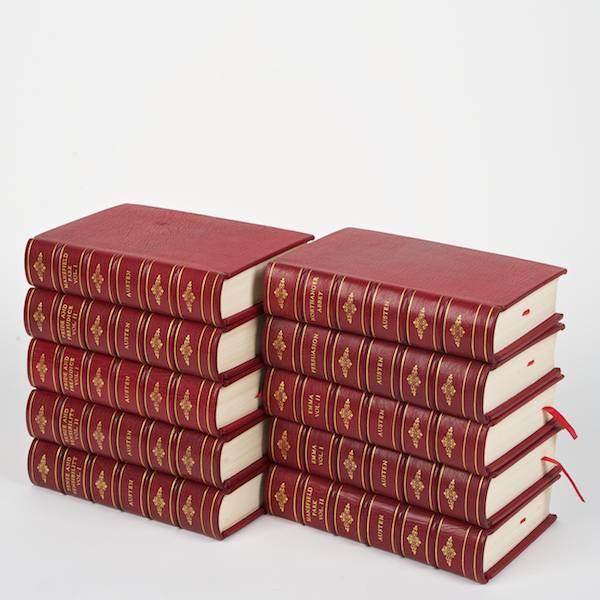
Millea-works-covers-11-9-13

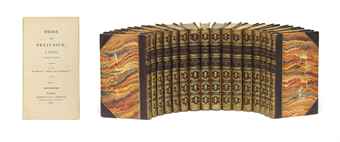
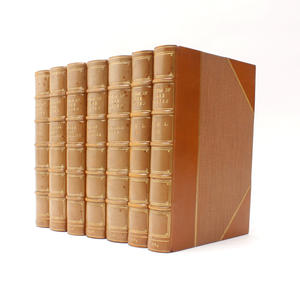
Austen, Jane. Works. London, 1925. (10) volumes, 8vo., red morocco – Condition report: overall good, bindings good, a few scuffs and nicks

Estimate: $500-700. [no price realized available]

There is no further description about this set in the auction catalogue, but it is the 1925 George Harrap reprint of the 1908-9 Chatto & Windus edition of the novels, with illustrations by A. Wallis Mills.  Here is one illustration:

Millea-works-illus-11-9-13

**************** 

Bonham’s:  12 November 2013. Books, Atlases, Manuscripts and Photographs including the Aldine Collection of the late Sir Robert Horton, London.

Lot 165:

Bonhams-Emma-11-12-13

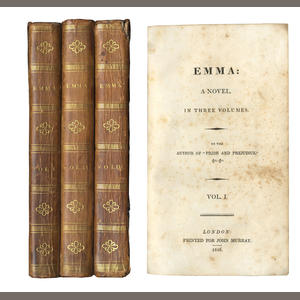
Austen, Jane. Emma: A Novel, 3 vol., first edition, half-titles in volumes 2 and 3 only, advertisement leaf at end of volume 3, light scattered foxing, stitching becoming loose with P3-4 in volume 1 partially detached, ownership signature of “M.E. Malden” on endpapers, contemporary half calf, worn, 3 covers detached, 4 corners strengthened with vellum, spines cracked [Gilson A8], 12mo, John Murray, 1816.

Estimate:  £4,000 – 6,000 (US$ 6,400 – 9,600) – Sold for £5,250 (US$ 8,435) inc. premium

*****************

Christies: 15 November 2013. Sale 9702: Fine Printed Books and Manuscripts. London.

Lot 402:
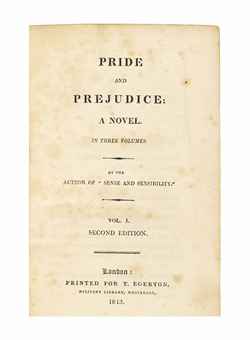
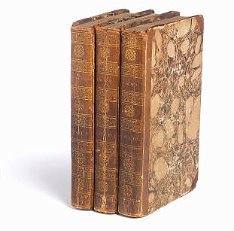
Christies-P&P-11-15-13Austen, Jane. Pride and Prejudice. London: T. Egerton, 1813. 2nd edition. 3 volumes, 12° (173 x 115mm). (Lacking half-titles, P2 at end of volume one with small marginal repair, tiny orange marginal mark to L5v of vol. II and lighter mark on a few other leaves, some spotting occasionally heavier.) Contemporary calf (rebacked, extremities lightly rubbed).

Estimate: £2,000 – £3,000 ($3,234 – $4,851) –

Sold for £2750 ($4,406)     

**********

Lot 403:
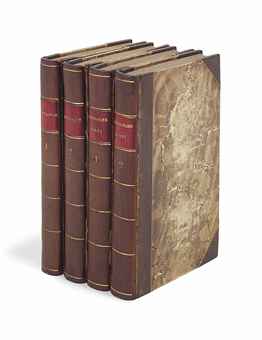
Christies-NA-P-11-15-13Austen, Jane. Northanger Abbey: and Persuasion… With a Biographical Notice of the Author [by Henry Austen]. London: C. Rowarth [vols I-II], and T. Davison [vols III- IV] for John Murray, 1818 [but ca. 20 December 1817]. 4 volumes, 12° (169 x 100mm). Half-titles. (Some occasional light browning and spotting, without final blanks P7-8 in vol. IV as often.) Contemporary half calf, leather gilt spine labels, speckled edges (front cover of vol. I nearly detached, front joints cracked and restored in vol. III, extremities lightly rubbed). Provenance: Maria Cipriani (ownership inscription). FIRST EDITION OF BOTH NOVELS.

Estimate: £3,000 – £5,000 ($4,851 – $8,085) – Sold for £4,750 ($7,610)

************

Of interest:

Lot 148:

Christies-Wollstonecraft-11-15-13

WOLLSTONECRAFT, Mary (1759-1797). Thoughts on the Education of Daughters with Reflections on Female Conduct, in the more important Duties of Life. London: J. Johnson, 1787. 8° (150 x 98mm). G6 a cancel as usual. (Short tear to last leaf.) Contemporary half calf (rebacked, extremities rubbed).

FIRST EDITION OF WOLLSTONECRAFT’S FIRST BOOK. Although it was an educational manual, the ‘more or less veiled remarks about her own emotional state … make it abundantly clear that she was far more interested in the state of her own life and the prospects that lay ahead of young women than in their years at school’ (Claire Tomalin, The Life and Death of Mary Wollstonecraft, London: Pelican, 1977, pp. 58-59). GOOD COPY. Rothschild 2595.

Estimate: £1,800 – £2,500 ($2,898 – $4,025) – Sold for £3,750 ($6,008)

****************

Christies: 20 November 2013. Sale 1160. Valuable Manuscripts and Printed Books. London.

Lot 84:
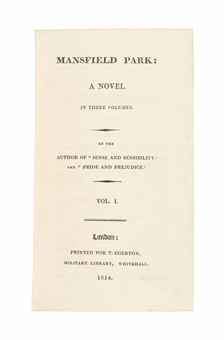
MP-Christies-11-20-13[AUSTEN, Jane (1775-1817).] Mansfield Park: A Novel… By the Author of “Sense and Sensibility,” and “Pride and Prejudice.” London: T. Egerton, 1814.

FIRST EDITION. 3 volumes, 12° (176 x 102mm). Half-titles. (Lacking blank O4 in volume II and advertisement leaf in volume III, occasional faint spotting.) Contemporary calf, flat spines with compartments ruled in gilt, green morocco gilt spine labels to second compartments, the others tooled in blind, speckled edges (extremities very lightly rubbed).

Estimate: £4,000 – £6,000 ($6,484 – $9,726) –  Sold for £13,750 ($22,138)

Lot 85: (another one!)

NA&P-Christies-11-20-13[AUSTEN, Jane (1775-1817).] Northanger Abbey: and Persuasion … With a Biographical Notice of the Author [by Henry Austen]. London: C. Rowarth [vols I-II], and T. Davison [vols III- IV] for John Murray, 1818 [but c. 20 December 1817].

4 volumes, 12° (177 x 103mm). Half-titles. (Some occasional light spotting, without final blanks P7-8 in vol. IV.) Contemporary calf, tan morocco gilt spine labels, speckled edges (extremities lightly rubbed, spines more heavily). Provenance: Baroness Keith of Meiklour House (bookplates). 1st edition of both novels.

Estimate: £4,000 – £6,000  ($6,484 – $9,726) – Sold for £7,500 ($12,075)

************

Also of interest at this auction:

Lot 124:

johnsondictionary-christies-11-20-13JOHNSON, Samuel (1709-1784). A Dictionary of the English Language in which the words are deduced from their originals, and illustrated in their different significations by examples from the best writers. London: W. Strahan for J. and P. Knapton [and others], 1755.

FIRST EDITION. 2 volumes, 2° (405 x 250mm). Titles in red and black, woodcut tail-pieces. (The first title with repaired losses and tears affecting some letters, the titles and a few leaves repaired in the inside margin, some marginal tears and some of these repaired, occasional mostly marginal soiling and spotting, faint dampstain in the margins of some leaves in vol. II.) Contemporary calf (neatly rebacked to style, corners repaired, sides scuffed). Provenance: David Tennant (title signature, some marginalia including on the verso of second title) — Stewart of Glasserton (bookplate).

Estimate: £5,000 – £8,000 ($8,105 – $12,968) – Not Sold

******************

All images are from each of the auction house websites, as cited.

Happy browsing!

c2013 Jane Austen in Vermont
Great Britain - History · Jane Austen · Jane Austen Circle · London · Social Life & Customs

Jane Austen and the Huguenots ~ Guest Post by Ron Dunning

Dear Readers: I welcome today Ron Dunning, who wrote here last year about his Akin to Jane” website – today he shares with us an article he wrote for the Huguenots of Spitalfields newsletter “Strangers” – here expanded somewhat and with pictures – and see how Jane Austen connects to various families and traditions of Spitalfields life in London.

*******************

Christ Church Spitalfields

[View looking down Brushfield Street toward Christ Church, Spitalfields – image from HofS facebook page, from Bishopsgate Institute]

Jane Austen’s Family and the Huguenots

To have lived in London for the past 40 years has been an immense pleasure. Now I’ve discovered a new one, and that is to be retired in London. I’ve always loved to explore, but was only able to appreciate the various parts of town for their ambience. Now there’s time to appreciate them more deeply, to learn about their associations with history, about interesting residents. Many have passed out of fashion and been built over – in which case there’s only the odd surviving building to stimulate the imagination – but in other areas, where the faded charm is obvious and where their economic value has not been great enough to attract the redevelopers, new residents have moved in to restore houses and revive the life of the community.

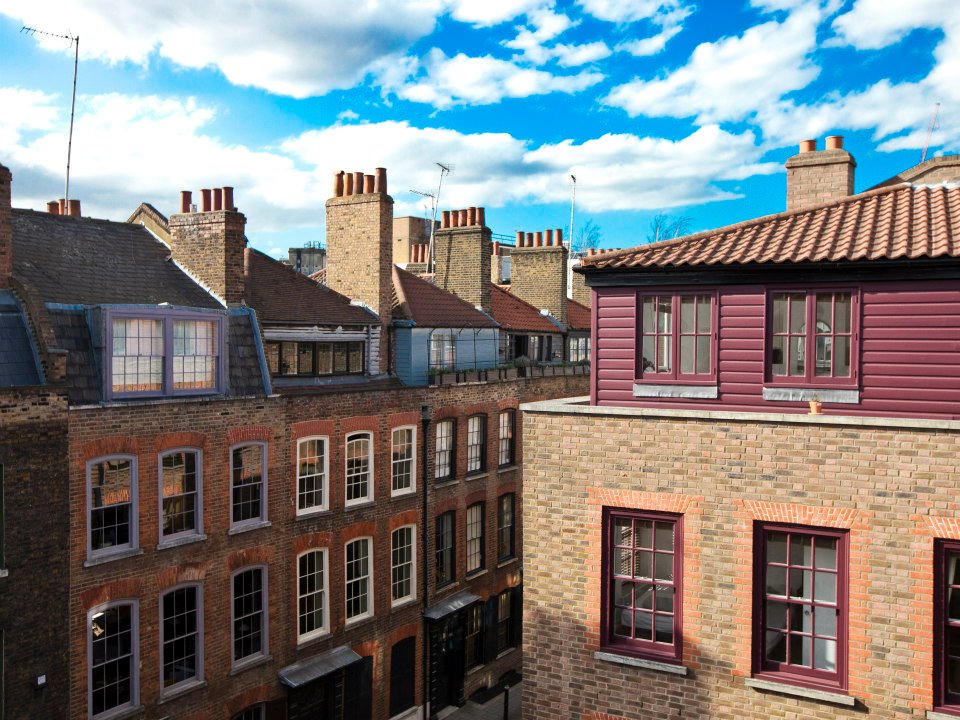
Spitalfields rooftops cRon Dunning

[Rooftops of Spitalfields, formerly the workrooms of the silk weavers and now gentrified – c Jeremy Freedman]

One such area that I’ve come to know much better is Spitalfields, just to the east of London’s old city walls. Its development by speculative builders was begun in the early 1700s, as a new suburb. Huguenot refugees from France and the Low Countries soon settled there, particularly those involved in the silk fabric trade. They brought their skills and their contacts from the continent and quickly restored their prosperity. Some 150 years later the mechanising of weaving, relaxation of tariffs on imports from France, and robust trade with China destroyed the Spitalfields silk trade.

silkweaving-spitalfields

 [Image from the Huguenots of Spitalfields Facebook page]

The houses had aged by the mid-19th century too, and to some extent Spitalfields became a slum, housing successive waves of immigrants – who each moved on once they became prosperous. By the 1970s, when the latest wave of new arrivals to the poorer streets was Bengali, city redevelopment was threatening to overtake it. Just in the nick of time young artists discovered the antique charm of the weavers’ houses, which could be bought for a pittance. They are now worth over £1,000,000.

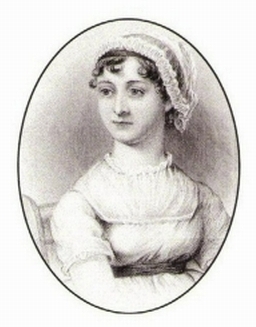
jane-austen-frontispiece-1870I’ve been researching the Austen pedigree for long enough that it’s possible to link her family with almost anyone.  Though the worlds of the Huguenots and of Jane Austen would seem almost to inhabit separate universes, a surprising number of Huguenot families had close connections with hers. I’ve made a list of the most notable.

Anyone who has read Jon Spence’s book, Becoming Jane Austen (or seen the film Becoming Jane), will recognise the name of Lefroy. Antoine Loffroy, a native of Cambray, took refuge in England from religious persecution in the Low Countries in about 1587, and settled at Canterbury, where he and his family engaged in the business of silk dyeing. His descendant Tom Lefroy was the one young man with whom Jane was said to be truly in love. Tom at that point didn’t have an income with which to support a wife, and was quickly bundled off by his elders and betters. He rose eventually to become the Chief Justice of the Court of Queen’s Bench in Ireland and, at the end of his life, remembered Jane with great affection. Ben Lefroy, from a later generation, did marry an Austen – one of Jane’s favourite nieces, Jane Anna Elizabeth.

The Portals were an ancient and noble Protestant family of Toulouse who stood firmly by the faith of their fathers, and several of them suffered death rather than recant it. They were among the Huguenots who introduced the art of fine paper making to England – Henry Portal established a mill at Laverstoke, on the River Itchen in Hampshire. He achieved such a reputation that the Bank of England awarded him the contract to produce bank notes. Living in Hampshire, the Portals had extensive social contacts with the Austens. Adela Portal married Jane’s nephew Edward Knight, while her sister Caroline married Edward’s brother William.

The Chenevixes were another distinguished family of Protestants, this time from Lorraine, who fled after the 1685 Revocation of the Edict of Nantes. One branch settled in Ireland, and were much attracted to the military and clerical professions. Melesina Chenevix, the poet and diarist, and granddaughter of Richard Chenevix, the Anglican Bishop of Waterford and of Lismore, was the ancestor of a number of people linked to the Austen pedigree. Melesina had married Richard Trench – the de la Tranches were yet another family who had taken refuge in England shortly after the massacre of St. Bartholomew – and their descendants assumed the double-barrelled surname of Chenevix-Trench. Their granddaughter Melesina Mary Chenevix-Trench married Chomley Austen-Leigh, Jane’s great nephew. Melesina Mary’s sister Helen Emily married Arthur Blundell George Sandys Hill, another great nephew. Their brother Charles married Emily Mary Lefroy, a cousin of Tom Lefroy. Their cousin Melesina Gladys, as well as being the mother of the famous editor of the Daily Telegraph, Bill Deedes, was the grandmother of FitzWalter Plumptre, the Baron FitzWalter – who can also trace his pedigree to the family of Eleanor Bridges, the wife of Jane’s brother Edward.  Lord FitzWalter still lives at Goodnestone, the seat of the Bridges family, where Edward and Eleanor lived before they could move into Godmersham.

David Papillon, the first of his family to settle in England, had been sent with his mother and siblings by his father, to escape persecution. They were shipwrecked while crossing the English Channel, and his mother drowned. The story of the mingling of genes between David’s descendants and the Austens, through the Brodnaxes, is a bit too obscure to tell here, but one of them featured in Jane’s life – the Rev John Rawstorne Papillon. The living of Chawton parish was offered to him; should he decline, it was then to pass to Jane’s brother Henry. John did take it and became the rector of the village in which Jane lived during her final years. There is a neat bracketing of Huguenot suitors for her hand, from the beginning and the end of her adult life – Mrs Knight, the widow of Thomas Brodnax and elderly benefactor of both the Austens and the Papillons, suggested that the Rev John, a life-long bachelor, would make a suitable husband. With characteristic irony Jane remarked in a note to her sister: ‘I am very much obliged to Mrs Knight for such a proof of the interest she takes in me – & she may depend upon it, that I will marry Mr Papillon, whatever may be his reluctance or my own – I owe her much more than such a trifling sacrifice.’

I could end this essay here, but want to mention another resonance between the Huguenots and the Austens, and to return Spitalfields to the fore. Jane’s paternal ancestors, going back three generations and further, were clothiers of Kent – staunchly Protestant, fiercely independent, wool and woollen fabric merchants. The organisation of their business was very similar to that of the silk merchants in London. I was struck, while gazing up to the roofs of Spitalfields, by a parallel.  In both industries labour was organised by narrowly demarcated skills, and in both the weavers’ workplace was accommodated on the top floor of merchant’s houses. I was seized by a vivid impression of crabbed men and no doubt women, in both London and Kent, toiling for 14 hours a day in those garrets for a pittance!

Grovehurst House c Ron Dunning

[Grovehurst House:  one of the Austen houses at Horsmonden in Kent, which dates in parts from the 14th century –  I was struck by the resonance between Spitalfields and the Kentish Austens – they were clothiers, and their industry in wool was structured much like silk weaving in London.  My understanding is that the weavers worked in the loft of this house.]

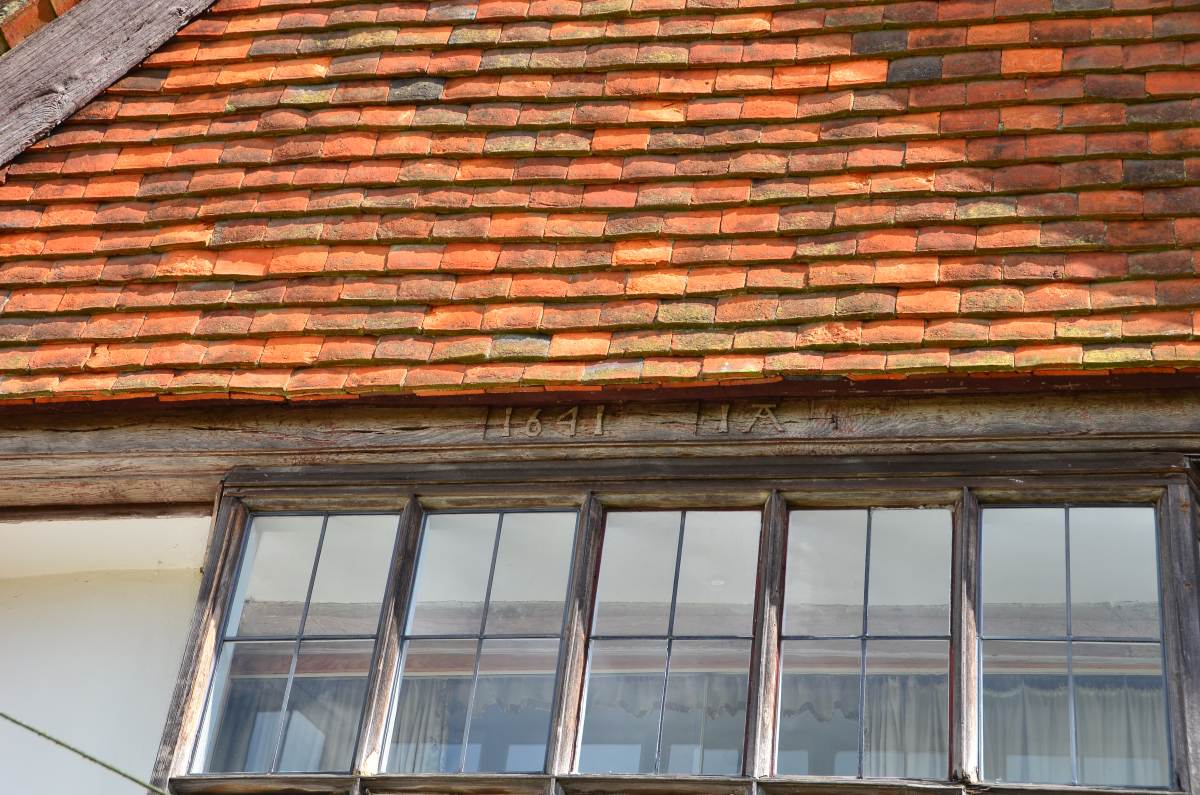
Grovehurst4-initials

[Initials of John (Iohannes, presumably) Austen, over the middle window upstairs, cRon Dunning]

 Horsmondenhouse

 [Another Austen house (Broadford) at Horsmonden, Kent where the weavers laboured on the top floor]

*******************

A brief history of the Huguenots

The St. Bartholomew’s Day Massacre in 1572 was a targeted group of assassinations, followed by a wave of Roman Catholic mob violence, directed against the French Calvinist Protestants (known as Huguenots) during France’s Wars of Religion. The Edict of Nantes, issued on 13 April 1598 by King Henry IV of France, granted them substantial rights in the interest of civil unity. In October 1685 Louis XIV, Henry IV’s grandson, revoked the Edict of Nantes with the Edict of Fontainebleau, and declared Protestantism illegal. As many as 400,000 Protestants chose to leave France, moving to Great Britain, Prussia, the Dutch Republic, Switzerland, South Africa, and the new French colonies in North America. This exodus deprived France of many of its most skilled and industrious individuals.

*********************

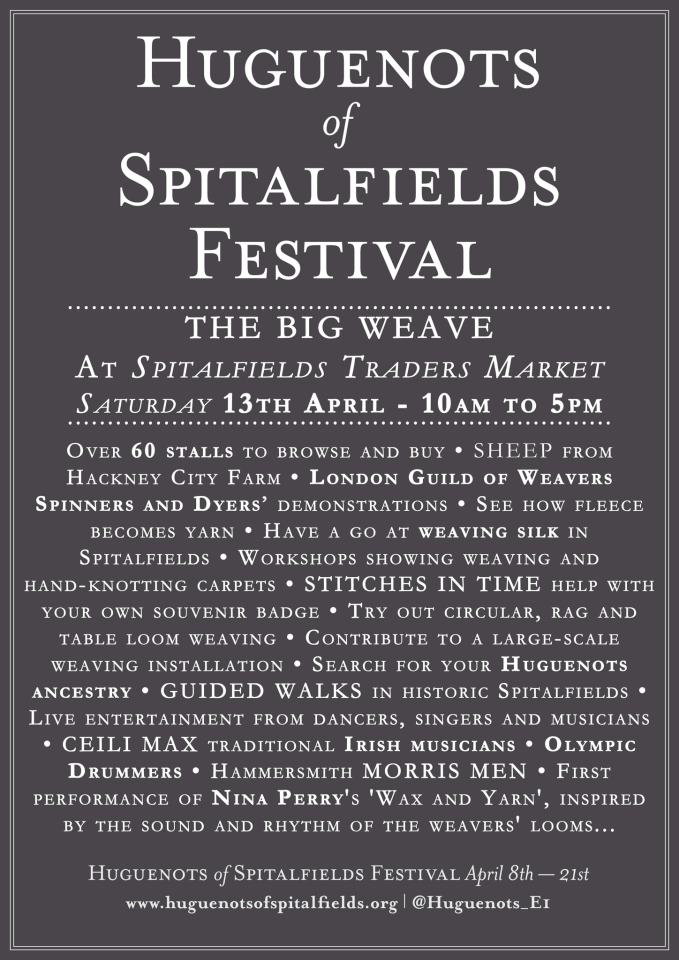
bigweaveposter

The Big Weave c Jeremy Freedman
Spitalfieldsrowhouses
Spitalfields, c Jeremy Freedman

Links and attributions, with thanks to all!

c2013 Jane Austen in Vermont
Austen Literary History & Criticism · Great Britain - History · Jane Austen · Jane Austen Circle · Jane Austen's Letters · Regency England

What Jane Knew ~ A 1329 Darcy – De Bourgh Marriage in Jane Austen’s Family Tree

Enquiring Readers: Ron Dunning has previously posted here at Jane Austen in Vermont about his invaluable Jane Austen genealogy website. As he continues to research the connections, he is discovering amazing coincidences and some very familiar names.  Today he gives some insight into a marriage that took place between a Darcy and a de Burgh in 1329 and speculates on whether Jane Austen could possibly have known about this…

***************

jane-austen-frontispiece-1870

What Jane Might Well Have Known, and What She Couldn’t Possibly Have Known, About Her Ancestors

I’m against making any assumption based on slim evidence, but I’m about to make two; first of all, concerning a great coincidence about which Jane can’t have known anything. In 1329 a marriage took place between John Darcy, 1st Lord Darcy of Knaith, and Joan de Burgh. (The spelling doesn’t matter – even up to the 18th century spellings hadn’t been fully standardised.) Joan’s father Richard de Burgh, 2nd Earl of Ulster, was a direct ancestor of Mrs Austen through her brother John.

Last summer when my Akin to Jane [ www.janeaustensfamily.co.uk ] website was launched one or two people, with admirable perseverance, trawled through my separate family tree [ http://wc.rootsweb.ancestry.com/~janeausten ] and on discovering this marriage, insisted that Jane must have known. I was never in any doubt that she couldn’t possibly have known. This was also the opinion of the only other person who has studied the Austen pedigree extensively, Anielka Briggs.

Dugdale Baronage - Skinnerinc.com
Dugdale Baronage – Skinnerinc.com

While Baronetages were readily available in the late 1700s, the dignity having been created only in 1611, there were very few studies of the Peerage and all of those were very primitive. William Dugdale’s Baronage of England of 1675 covered only England. (Remember that Joan’s father John de Burgh was the Earl of Ulster; the marriage in question is said to have taken place in County Kildare.)

The Rev. Barlow’s Complete English Peerage was printed in 1772, so might just have been in George Austen’s library, but again deals just with English peerages. Another possibility, Arthur Collins’s Peerage series*, was first published in 1709, with reprints every few years and frequent new editions. Even he appears not to have included Irish peerages, and in the eight editions that I was able to search, not a single de Burgh featured in the indexes.

Barlow Peerage - Open Library
Barlow Peerage – Open Library

A further obstacle in the way of Jane’s knowing (or for that matter anyone at the time) is that there was no direct male descent from the de Burghs to the Austens – the surname soon disappeared from Jane’s pedigree, through a series of female links. Traditional pedigrees concentrate on the direct male line.

However, John Darcy did himself play a role in the Austen pedigree – he was a many-greats-grandfather of Charles Austen’s wives, the sisters Frances and Harriet Palmer. John and his first wife, Emmeline Heron, were the ancestors of four generations of male Darcys; Elizabeth Darcy, in the fifth generation, married James Strangeways; and that surname continued down to the Palmer girls’ paternal grandmother, Dorothy Strangeways. In Charles’s children, the Darcy and the de Burgh lines were finally united.

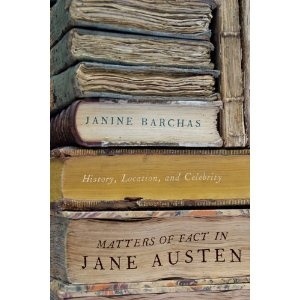
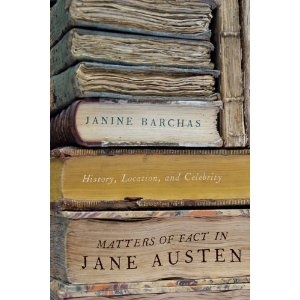
My second assumption concerns what Jane might well have known. Janine Barchas, in her Matters of Fact in Jane Austen, speculates that she, in choosing the names of Darcy, Wentworth, Woodhouse, FitzWilliam, Tilney, etc., was alluding “to actual high-profile politicians and contemporary celebrities as well as to famous historical figures and landed estates.” In the words of Juliet McMaster in the blurb, she was “a confirmed name dropper who subtly manipulates the celebrity culture of her day.” On page 118 Janine Barchas wrote, “Cassandra Willoughby (…) the supposed ancestor of Mrs Austen.”  Yes – she’s almost got it.  Cassandra was Mrs Austen’s 1st cousin, twice removed.

book-cover-barchas-matters

I think that Jane may well have known about the family relationship and its relevance. Cassandra’s mother Emma (Willoughby and then Child, née Barnard) was Cassandra Leigh’s great-great-aunt; it was Emma’s sister Elizabeth (Brydges, née Barnard) who was her great-grandmother.  Elizabeth was also the mother of James Bridges, the Duke of Chandos, who married Cassandra Willoughby – the two were cousins. Emma’s first husband was the noted naturalist, Francis Willoughby; after his death she remarried, to Sir Josiah Child – supreme governor of the East India Company, an early monetarist, and a rapaciously wealthy financier to 17th century royalty.  Emma and Sir Josiah’s son Richard Child became the Earl Tylney of Castlemaine, and one of his great-granddaughters was Catherine Tylney-Long.

Barchas speculates that Jane, in naming her Catherine Tilney, had this other Catherine in mind. This lady had inherited a vast estate and fortune in 1794 at the age of 5, and at 18 was reputedly the richest commoner in England. Catherine Tylney was Jane Austen’s 4th cousin.  Very few of us have any idea about our fourth cousins, but based on the following circumstantial evidence, I suspect that Jane did know that they were distantly related.

Catherine Tylney-Long - Wanstead House
Catherine Tylney-Long – Wanstead House
Wanstead House
Wanstead House

[Image: Wanstead House ]

Mrs. Austen
Mrs. Austen

There is a strong tradition in the Warwickshire village of Middleton, the seat of Francis Willoughby, that Jane visited there on the trip to Staffordshire in 1806 with her mother and sister. Middleton certainly lies in a direct line, as the crow flies, from their stop at Stoneleigh to Hamstall Ridware, where her cousin was the Rector. If they did visit, it may have been because Mrs Austen knew of the family relationship – she was certainly considered to have been proud of her aristocratic ancestors. The Austens preserved a letter written by Elizabeth Brydges in the 1680s from Constantinople, giving advice to her daughter who had been left behind; I think it likely that she’d have known about Elizabeth’s sister Emma’s illustrious marriages, and have told her daughters.

*********************

Thank you Ron! for all this information [my head is spinning!] – I do wonder what Lady C might say to all this – would she be concerned about the “Shades of Pemberly [being] thus polluted” by any of these illustrious ancestors?

If you have questions for Ron, please comment below.

Ed. Note: * Collins Peerage:

Collins Peerage - 1812 ed.
Collins Peerage – 1812 ed.

Just again to prove once again that all roads lead back to Jane Austen, it is interesting here to note that Egerton Brydges edited this 1812 edition of the Collins Peerage – this is Jane Austen’s very own Mr. Brydges, brother to her friend Madame Lefroy. Austen makes much of his novel Arthur Fitz-Albini (1798) in her letter of 25 November 1798:

We have got Fitz-Albini; my father has brought it against my private wishes, for it does not quite satisfy my feelings that we should purchase the only one of Egerton’s works of which his family are ashamed. That these scruples, however do not at all interfere with my reading it, you will easily believe. We have neither of us yet finished the first volume. My father is disappointed – I am not, for I expected nothing better. Never did any book carry more internal evidence of its author. Every sentiment is completely Egerton’s. There is very little story, and what there is [is] told in a strange unconnected way. There are many characters introduced, apparently merely to be delineated. We have not been able to recognize any of them hitherto except Dr and Mrs Hey and Mr. Oxenden, who is not very tenderly treated…. [Letters, No. 12]

*****************

Further reading:

1.  Ron Dunning’s Jane Austen websites:

2.  Janine Barchas links:

3. History of Catherine Tylney-Long at Wanstead Park website: http://www.wansteadpark.org.uk/hist/the-owners-of-wanstead-park-part-10-1784-1825/

4.  Wanstead Wildlife.org [information and above image]: http://www.wansteadwildlife.org.uk/index.php/home/list-of-people?id=101

5. William Dugdale Baronage [above image]: https://www.skinnerinc.com/auctions/2526B/lots/212

6. Frederic Barlow. Complete English Peerage (London, 1775): [complete text and above image]: http://openlibrary.org/books/OL24241621M/The_complete_English_peerage

7. Collins’s Peerage of England: [complete text and above image]: http://openlibrary.org/books/OL7054900M/Collins’s_peerage_of_England_genealogical_biographical_and_historical.

8. A nice introduction to Charles Austen at Austenprose.

  c2013 Jane Austen in Vermont
Auctions · Austen Literary History & Criticism · Great Britain - History · Jane Austen · Jane Austen Circle · Rare Books

Austen on the Block! ~ A First Edition Emma, Or, Where an Interesting Bookplate Might Take You…

UPDATE:  I posted the results here: it sold on March 19, 2013 at Bonham’s London for £8,125 (inc. premium) or about $12,312.

******************

Jane Austen will again make an appearance in the upcoming Bonham’s auction on March 19, 2013: a first Edition Emma – here are the details:

Emma bonhams 3-2013Books, Maps, Manuscripts & Historical Photographs, No. 20751. 19 Mar 2013 14:00 GMT London, Knightsbridge

Lot 6: AUSTEN (JANE).

Emma, 3 vol., FIRST EDITION, half-titles in volumes 2 and 3, spotting, one gathering working loose and blank lower margin torn away from advertisement leaf at end of volume 3, one front free endpaper near detached, bookplate of “John Hawkshaw, Esq., Hollycombe”, contemporary half calf, gilt lettering on spines, headbands frayed (volume 2 with small loss at head and foot of backstrip) [Gilson A8; Keynes 8], 8vo, John Murray, 1816.

Estimate:  £4,000 – 5,000; €4,600 – 5,800;  US$ 6,100 – 7,700

Now this appears to be the same copy that did not sell at the Bonham’s November 13, 2012 auction where the estimates were substantially higher:
£6,000 – 8,000; €7,400 – 9,900;  US$ 9,500 – 13,000

********************

My interest lies in the bookplate of “John Hawkshaw, Esq., Hollycombe” – always curious to see where a book has been and where it heads, and who are the participants in the story; it is often hard to track this information accurately unless a written provenance accompanies the book.  In this case it appears that all we have is this bookplate, and my research takes me thus, a very quick summary: [i.e how a whole afternoon can be spent tracing some stranger’s life and how it all can lead one down unimagined paths with only more extensive research to be undertaken …]

John Hawkshaw - wikipedia
John Hawkshaw – wikipedia

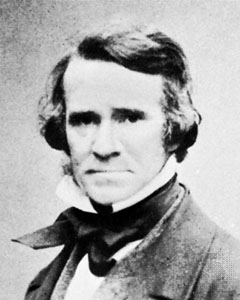
John Hawkshaw (1811 – 1891) was a British civil engineer from Yorkshire who was the chief engineer of a number of the railway lines in the Manchester area, later London, as well as responsible (some say the “saviour”) for the completion of the Suez Canal.  He was knighted in 1873. He lived at Hollycombe, his country estate in Liphook, Hampshire, purchased from Charles William Taylor in 1866. (To add to the confusion, the book titled A History of the Castles, Mansions, and Manors of Western Sussex, by Dudley George Cary Elwes, and Charles John Robinson (London, 1876), notes two other properties purchased by Hawkshaw from Taylor, so more research needed here.]

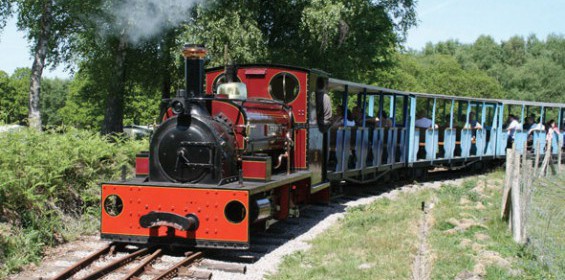
Hollycombe today is privately owned, but the pleasure gardens, expanded by Hawkshaw and more fully landscaped by his son [more on him below] are open to visitors, as is the nearby Hollycombe Steam Museum.

Hollycombe Steam Museum

Their London home was in Belgrave Mansions, St. John’s Wood High Street, close to Bond Street in the heart of the West End.

But did John Hawkshaw read his copy Jane Austen’s Emma, or was his bookplate just really an owner stamp, and the real reader in the house was his wife Ann Hawkshaw? (though it is nice to imagine them all reading it aloud.)

a modern reprint
a modern reprint

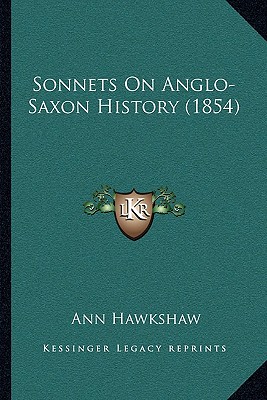
Ann Hawkshaw (1812 – 1885) was an English poet. She published four volumes of poetry between 1842 and 1871. She married our John Hawkshaw in 1835 and they settled in Salford, near Manchester, where they mixed with the prominent thinkers of the day to include William and Elizabeth Gaskell. Her first volume of poetry Dionysius the Areopagite’ with Other Poems was published in 1842, followed by Poems for My Children in 1847. Sonnets on Anglo-Saxon History was published in 1854, and retells the history of Britain up to the Norman Conquest.

John Clarke Hawkshaw

The Hawkshaws had six children, the most well-known was John Clarke Hawkshaw (1841-1921), who like his father was a civil engineer. In 1865 he married Cicely Wedgwood (1837-1917), daughter of Francis Wedgwood (1800-1880), grandson of Josiah Wedgwood, founder of the famed pottery firm. Francis’s sister Emma Wedgwood (1808-1896) married her cousin Charles Darwin (they were first cousins: Wedgwood’s daughter Susannah was Darwin’s mother). Emma was therefore Cicely’s Aunt and we can find this letter penned to her in the online Darwin Correspondence Project:

Hollycombe. | Liphook. | Hants.

Dear Aunt Emma

I am afraid it is too late to notice about the baby’s tears with any accuracy for I have repeatedly seen her eyes full of tears already but can give no nearer date than that I must have seen them so before she was 3 weeks old; about the tears overflowing onto her cheeks I can observe as I have never seen it happen yet, indeed it hardly happens in what one may call babydom does it?

We are having such a nice holiday here and as all the tiresome shooting is over I have Clarke to myself and we ride and walk about and don’t feel such strangers to the place as we did and the idle thoughtless life is doing Clarke good I am thankful to say.

Believe me dear Aunt Emma | Your affecte niece | Cicely M Hawkshaw

9th Feb. [1868]

Emma Darwin, 1840 - by George Richmond
Emma Darwin, 1840 – by George Richmond

****************

So from this letter we know that John Clarke Hawkshaw was known as Clarke and that he was able to get away to the family home and enjoy some “idle thoughtless life”! [images of Downton Abbey!]

Such a dizzying trip from a simple bookplate in a first edition of Jane Austen! – we have encountered various British luminaries ranging from railroad and canal engineers, to literary and Unitarian connections in Manchester, to country estates in Hampshire [Jane’s own territory], to the Wedgwood Potteries of London, and ending with Evolution, all in one family’s connections.  It is comforting to think that this copy of Emma was read, enjoyed and discussed, and passed along to succeeding generations of this great family!  I wonder where it will end up come March 19th? … stay tuned!

c2013 Jane Austen in Vermont
Austen Literary History & Criticism · Jane Austen · Jane Austen Circle · Literature · Regency England

Jane Austen and Robert Burns

Today is the birthday of Robert Burns (25 January 1759 – 21 July 1796).  One cannot forget those Robert Burns poems we all had to recite in high school, often our first introduction to the “romantic” poets – ‘O, My Luve is Like a Red, Red Rose’ or ‘Tam O’Shanter’ or ‘To a Louse: on seeing one on a Lady’s bonnet at church’ – and of course how often do we sing or hear ‘Sweet Afton’ and ‘Auld Lang Syne’!

Robert Burns - from wikipedia
Robert Burns – from wikipedia

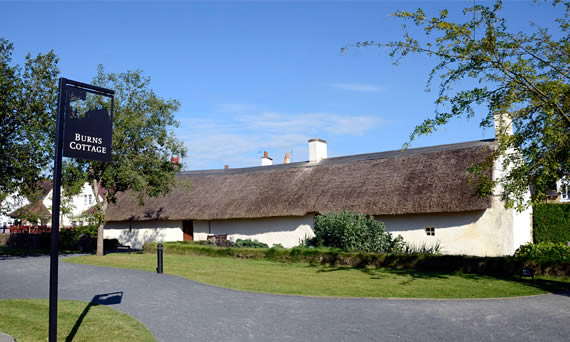
I had the fortune a number of years ago to visit Burns’s home in Alloway, Ayr, Scotland, and became sort of enamored with him – who can not? But what of Jane Austen and Burns? – she certainly read his poetry.  And we now know that in her music notebooks she had copied out the music notation of two of Burns’s songs: My Love She’s But a Lassie Yet, and My Ain Kind Dearie – and Gillian Dooley has recently noted that Austen had written out in her own hand Their Groves o’ Sweet Myrtle, [see the link below to this full article] where it shows that Austen had transcribed the words “Save Love’s willing fetters – the chains of his Jean” to “the charms of his Jane” – evidence perhaps that Austen secretly admired Burns after all…?! [see full text of this song below]

Burns Cottage, Ayr
Burns Cottage, Ayr

All we have of her written words as to how she may have felt about Burns appear in Sanditon, with the ridiculous Sir Edward Denham spewing forth the following:

But while we are on the subject of Poetry, what think you, Miss Heywood, of Burns’ Lines to his Mary? — Oh I there is Pathos to madden one! — If ever there was a Man who felt, it was Burns. — Montgomery has all the Fire of Poetry, Wordsworth has the true soul of it — Campbell in his Pleasures of Hope has touched the extreme of our Sensations — “Like Angel’s visits, few & far between.’ Can you conceive any thing more subduing, more melting, more fraught with the deep Sublime than that Line? — But Burns — I confess my sence of his Pre-eminence, Miss Heywood — If Scott has a fault, it is the want of Passion. — Tender, Elegant, Descriptive — but Tame. — The Man who cannot do justice to the attributes of Woman is my contempt. — Sometimes indeed a flash of feeling seems to irradiate him — as in the Lines we were speaking of — “Oh! Woman in our hours of Ease’. — But Burns is always on fire. — His Soul was the Altar in which lovely Woman sat enshrined, his Spirit truly breathed the immortal Incence which is her Due. –”

To which Charlotte replies, in what critics have assumed is Jane Austen’s voice:

“I have read several of Burns’ Poems with great delight”, said Charlotte, as soon as she had time to speak, “but I am not poetic enough to separate a Man’s Poetry entirely from his Character; — & poor Burns’s known Irregularities greatly interrupt my enjoyment of his Lines. — I have difficulty in depending on the Truth of his Feelings as a Lover. I have not faith in the sincerity of the affections of a Man of his Description. He felt & he wrote & he forgot.”

“Oh! no no” exclaimed Sir Edward in an extacy (sic). “He is all about ardour and Truth! – His genius and his susceptibilities might lead him into some Aberrations – But who is perfect?…. Nor can you, loveliest Miss Heywood (speaking with an air of deep sentiment) – nor can any Woman be a fair judge of what a Man may be propelled to say, write or do, by the sovereign impulses of illimitable Ardour.”

[from Sanditon, ch. VII]

So I leave you with these thoughts on Jane Austen and Robert Burns and a few links for further reading:

Robert Burns

***********************

Full text of Their Groves o’ Sweet Myrtle:

Their groves o’ sweet myrtle let Foreign Lands reckon,
Where bright-beaming summers exalt the perfume;
Far dearer to me yon lone glen o’ green breckan,
Wi’ the burn stealing under the lang, yellow broom.
Far dearer to me are yon humble broom bowers
Where the blue-bell and gowan lurk, lowly, unseen;
For there, lightly tripping, among the wild flowers,
A-list’ning the linnet, aft wanders my Jean. 

Tho’ rich is the breeze in their gay, sunny valleys,
And cauld Caledonia’s blast on the wave;
Their sweet-scented woodlands that skirt the proud palace,
What are they? – the haunt of the Tyrant and Slave.
The Slave’s spicy forests, and gold-bubbling fountains,
The brave Caledonian views wi’ disdain;
He wanders as free as the winds of his mountains,
Save Love’s willing fetters – the chains of his Jean.

c2013, Jane Austen in Vermont
Austen Literary History & Criticism · Books · Jane Austen · Jane Austen Circle · Jane Austen's Letters · Literature · Publishing History

Jane Austen’s ‘own darling Child’

Gentle Readers: This year we have just entered upon will be a long and interesting 365 days of celebrating the 1813 publication of Pride and Prejudice ! There are festivals, conferences, blog postings, reading challenges, and already many newspaper and journal articles on this timeless work by Jane Austen.  I would like to start off my own celebration of this beloved classic with repeating a post I wrote two years ago, where I had pulled together all the references that Austen makes to this, her “own darling Child,” in her letters.  It makes fascinating reading to “hear” her…
pp-christies-12-7-12
The publishing history of Pride and Prejudice, Jane Austen’s most popular book, then and now, is an interesting study in the book trade of early 19th century England.  First completed in 1797 (and called First Impressions) and rejected by the publisher her father took the manuscript to, Austen reworked her draft over time and submitted it to Thomas Egerton, the publishing house of her Sense & Sensibility, in 1812 (it was published on January 28, 1813).   She sold the copyright outright for £110, and did not incur other expenses in its publication, as she did in the three other works published in her lifetime [see links below for more information.]  How we would love to know her thoughts on this road to publication! – how we would love to have her letters written while in the process of the writing to give us some idea of her imagination at work – where WAS the model for Pemberley?  was Mr. Darcy someone REAL?  was Elizabeth Bennet her alter ego? was MR COLLINS drawn from life? – or to have the letters to her brother Henry and his to Egerton – but alas! we have very little, just a few comments scattered among the surviving letters.
Books · Great Britain - History · Jane Austen · Jane Austen Circle · Jane Austen Societies · Travel

All I Want for Christmas? ~ Anything Jane Austen Please! Day 2: Take a Literary Tour with Susannah Fullerton, President of the Jane Austen Society of Australia

I cannot think of a gift I would want more than this! [do hope my caro sposo is paying close attention!]– I had the pleasure of meeting Susannah Fullerton at the JASNA AGM in Brooklyn – she goes above and beyond as the President of the Jane Austen Society of Australia (JASA), has just published A Dance with Jane Austen [she wrote a guest post here], and she has a new book coming out in early 2013 Celebrating Pride and Prejudice (titled Happily Ever After in the UK)

Continue reading “All I Want for Christmas? ~ Anything Jane Austen Please! Day 2: Take a Literary Tour with Susannah Fullerton, President of the Jane Austen Society of Australia”

Auctions · Austen Literary History & Criticism · Books · Jane Austen · Jane Austen Circle · Literature · Rare Books

Austen on the Block! ~ An Austen-Filled Autumn at Upcoming Auctions

UPDATE: Prices realized noted in red as they become available

There are a number of Jane Austen materials coming up for auction in the next few weeks, some actually affordable! – and then some, not so much…  here are brief synopses – visit the auction house websites for more information.

This one is a bit different and an interesting addition to anyone’s Pride and Prejudice collection!

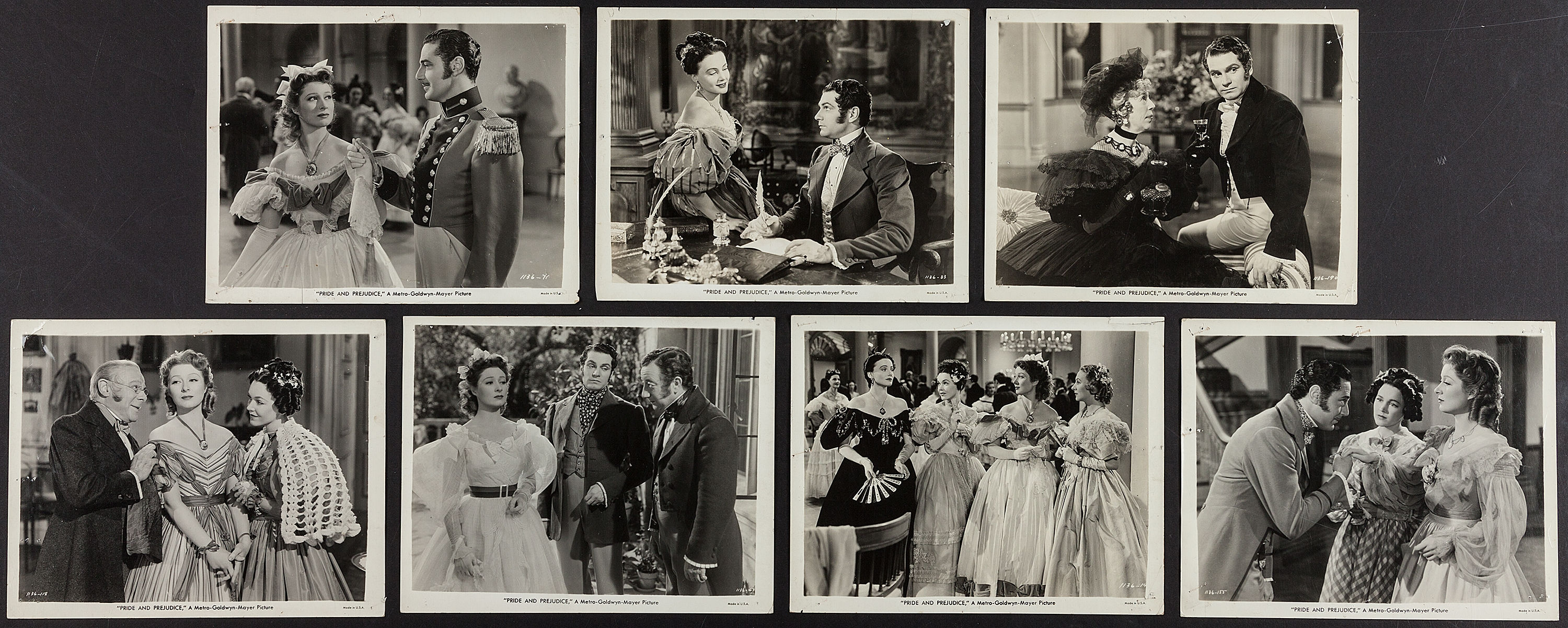
November 18, 2012. Heritage Auctions, Lot 54353. Pride and Prejudice 1939 Movie photographs:

Pride and Prejudice (MGM, 1939). Photos (16) (8″ X 10″). Drama.

Vintage gelatin silver, single weight, glossy photos. Starring Greer Garson, Laurence Olivier, Mary Boland, Edna May Oliver, Maureen O’Sullivan, Ann Rutherford, Frieda Inescort, Edmund Gwenn, Karen Morley, Heather Angel, Marsha Hunt, Bruce Lester, Edward Ashley, Melville Cooper, Marten Lamont, E.E. Clive, May Beatty, Marjorie Wood, Gia Kent. Directed by Robert Z. Leonard.

There are 14 different photos with a duplicate each of 1136-190, and 1136-149; unrestored photos with bright color and a clean overall appearance. They may have general signs of use, such as slight edge wear, pinholes, surface creases and crinkles, and missing paper. All photos have a slight curl. Please see full-color, enlargeable image below for more details. Fine.

SOLD $179.25 (incl buyer’s premium)

 **********************

November 18, 2012.  Skinner, Inc. – Fine Books and Manuscripts, Boston. Sale 2621B

Lot 208:  Austen, Jane (1775-1817). Letters. London: Richard Bentley & Son, 1884. 

Octavo, in two volumes, first edition, edited by Edward Knatchbull-Hugessen, first Baron Brabourne (1829-1893), in publisher’s green cloth, ex libris Henry Cabot Lodge, with his bookplate; preliminaries in volume one a bit cockled, with some discoloration.

Jane Austen’s letters speak for themselves: “Dr. Gardiner was married yesterday to Mrs. Percy and her three daughters.” “I cannot help thinking that it is more natural to have flowers grow out of the head than fruit? What do you think on the subject?”

Estimate $300-500. SOLD $250. (incl buyer’s premium)

*****************

Lot 4 : AUSTEN, JANE. Northanger Abbey. Volume 1 (only, of 2). 12mo, original publisher’s drab boards backed in purple cloth (faded to brown), lacking paper spine label, edgewear; text block almost entirely loose from spine, few binding threads and signatures loose, several leaves in first third heavily creased, few other margins creased; else quite clean overall. Philadelphia: Carey & Lea, 1833

FIRST AMERICAN EDITION AND ONE OF 1250 COPIES. In need of some repair, but complete and in original cloth. All First American Editions of Austen are difficult to find. Later printings of this title did not occur until 1838, as a one-volume collected edition and, as a single volume in 1845. Gilson B5.

Estimate $500-750. SOLD: $600. [incl buyer’s premium]

**********************

This is the big one!

November 21, 2012. Christie’s. Valuable Manuscripts and Printed Books. London.  Sale 5690.

Lot 150:  AUSTEN, Jane (1775-1817). Sense and Sensibility … second edition. London: for the author by C. Roworth and published by T. Egerton, 1813. 3 volumes. (Lacks half-titles and final blanks, some browning and staining.) Gilson A2; Keynes 2.

Lot Description

AUSTEN, Jane (1775-1817). Sense and Sensibility … second edition. London: for the author by C. Roworth and published by T. Egerton, 1813. 3 volumes. (Lacks half-titles and final blanks, some browning and staining.) Gilson A2; Keynes 2.

Pride and Prejudice. London: T. Egerton, 1813. 3 volumes. (Lacks half-titles, lightly browned, a few leaves slightly torn along inner margin or with fragments torn from outer margin, margin of B10 in vol. I a little soiled, title of vol. III with slight stain at bottom margin, quires I and M in same vol. somewhat stained.) FIRST EDITION. Gilson A3; Keynes 3.

Mansfield Park. London: T. Egerton, 1814. 3 volumes. (Lacks half-titles, without blank O4 in vol. II or final advertisement leaf in vol. III, weak printing impression affecting 3 lines on Q10r.) FIRST EDITION. Gilson A6; Keynes 6.

Emma. London: John Murray, 1816. 3 volumes. (Lacks half-titles, E12 of vol. I misbound before E1, tear to bottom margin of E7 in vol. II, other marginal tears, L7-8 of vol. II remargined at bottom, title of vol. III with closed internal tear, some spotting, staining and light soiling.) FIRST EDITION. Gilson A8; Keynes 8.

Northanger Abbey and Persuasion. London: John Murray, 1818. 4 volumes. (Lacks half-titles and blanks P7-8 at end of vol. IV, some browning and spotting.) FIRST EDITION. Gilson A9; Keynes 9.

Together 6 works in 16 volumes, 12° (177 x 100mm). Uniformly bound in later 19th-century black half morocco over comb-marbled boards, marbled endpapers and edges (vol. I of Mansfield Park with scuffing at joints and upper corner of front cover).

Second edition of Sense and Sensibility, ALL OTHER TITLES IN FIRST EDITION. A rare opportunity to purchase the six most admired novels in the English language as a uniformly bound set. (16)

Estimate: £30,000 – £50,000 ($47,610 – $79,350) SOLD: £39,650 ( $63,004) (incl buyer’s premium)

**********************

November 27, 2012. Bonham’s. Printed Books and Maps. Oxford. 19851.

Lot 26:  AUSTEN (JANE) The Novels…Based on Collation of the Early Editions by R.W. Chapman. 5 vol., second edition, Oxford, Clarendon Press, 1926; together with The Letters of Jane Austen, 2 vol., frontispieces, uniform half calf by Hatchards, gilt panelled spines, faded, 8vo, Richard Bentley, 1884 (7)

Estimate: £300 – 500 ( US$ 480 – 810); (€380 – 630) – SOLD: £525  ($844.) (incl. buyer’s premium)

**************************

December 7, 2012. Christies. Fine Printed Books and Manuscripts Including Americana. New York. Sale 2607.

 Lot 140: [AUSTEN, Jane (1775-1817)]. Pride and Prejudice. London: Printed for T. Egerton, 1813.

Lot Description:

[AUSTEN, Jane (1775-1817)]. Pride and Prejudice. London: Printed for T. Egerton, 1813.

Three volumes, 8o (171 x 101 mm). Contemporary half calf and marbled boards, spines gilt-ruled, black morocco lettering pieces (a few stains and some rubbing); cloth folding case. Provenance: H. Bradley Martin (bookplate; his sale Sotheby’s New York, 30 April 1990, lot 2571).

FIRST EDITION. Originally titled First Impressions, Pride and Prejudice was written between October 1796 and August 1797 when Jane Austen was not yet twenty-one, the same age, in fact, as her fictional heroine Elizabeth Bennet. After an early rejection by the publisher Cadell who had not even read it, Austen’s novel was finally bought by Egerton in 1812 for £110. It was published in late January 1813 in a small edition of approximately 1500 copies and sold for 18 shillings in boards. In a letter to her sister Cassandra on 29 January 1813, Austen writes of receiving her copy of the newly publishing novel (her “own darling child”), and while acknowledging its few errors, she expresses her feelings toward its heroine as such: “I must confess that I think her as delightful a creature as ever appeared in print, & how I shall be able to tolerate those who do not like her at least, I do not know.” Gilson A3; Grolier English 69; Keynes 3; Sadleir 62b. (3)

Estimate: $30,000 – $50,000 –  SOLD:  $68,500  (incl buyer’s premium)

***********************

Lot 86: Presentation copy of Emma. Provenance: Anne Sharp (1776-1853) “Anne Sharp” in vol. 1 and “A. Sharp” in vol. 2 and 3.

Lot Description:

One of twelve presentation copies recorded in the publisher’s archives and presented to Jane Austen’s “excellent kind friend”: the only presentation copy given to a personal friend of the author.

In a letter to the publisher John Murray dated 11 December 1815, Austen noted that she would “subjoin a list of those persons, to whom I must trouble you to forward a Set each, when the Work is out; – all unbound, with From the Authoress, in the first page”. Most of these copies were for members of Austen’s family. David Gilson in his bibliography of Austen lists these presentation copies, based on information in John Murray’s records, as follows:

  • two to Hans Place, London (presumably for Jane Austen and Henry Austen)
  • Countess of Morley
  • Rev. J.S. Clarke (the Prince Regent’s librarian)
  • J. Leigh Perrot (the author’s uncle)
  • two for Mrs Austen
  • Captain Austen (presumed to be Charles Austen)
  • Rev. J. Austen
  • H.F. Austen (presumed to be Francis)
  • Miss Knight (the author’s favourite niece Fanny Knight)
  • Miss Sharpe [sic]

Anne Sharp (1776-1853) was Fanny-Catherine Knight’s governess at Godmersham in Kent from 1804 to 1806. She resigned due to ill-health and then held a number of subsequent positions as governess and lady’s companion. Deirdre Le Faye notes that by 1823 she was running her own boarding-school for girls in Liverpool (see Jane Austen’s Letters, third edition, 1995, p. 572). She retired in 1841 and died in 1853.

In 1809 Austen wrote to her sister Cassandra Austen that “Miss Sharpe… is born, poor thing! to struggle with Evil…” Four years later Jane wrote to Cassandra that “…I have more of such sweet flattery from Miss Sharp! – She is an excellent kind friend” (which may refer to Anne Sharp’s opinion of Pride and Prejudice). It is known that Anne Sharp thought Mansfield Park “excellent” but she preferred Pride and Prejudice and rated Emma “between the two” (see Jane Austen’s Letters, third edition, 1995, p. 573).
There is one known extant letter from Jane Austen to Anne Sharp, dated 22 May 1817. She is addressed as “my dearest Anne”. After Jane Austen’s death, Cassandra Austen wrote to Anne Sharp on 28 July 1817 sending a “lock of hair you wish for, and I add a pair of clasps which she sometimes wore and a small bodkin which she had had in constant use for more than twenty years”.

“In Miss Sharp she found a truly compatible spirit… Jane took to her at once, and formed a lasting relationship with her… [she occupied] a unique position as the necessary, intelligent friend” (Claire Tomalin, Jane Austen: A Life, 2000).

Anne Sharp is known to have visited Chawton on at least two occasions: in June 1815 and in August-September 1820. Deirdre Le Faye notes that James-Edward Austen-Leigh described her as “horridly affected but rather amusing” (see Jane Austen’s Letters, third edition, 1995, p.573)

Estimate: 150,000-200,000 GBP* UPDATE: UNSOLD

[*Now this confuses me: this copy of Anne Sharp’s Emma sold at Bonhams for a record £180,000 in 2008, and was subsequently sold to an undisclosed buyer for £325,000. in 2010 [see my post here and here on these sales] – I have got to hit the calculator to see what’s up with this…]

 ************************

Also in this sale:

Lot 87:  Austen, Jane. Northanger Abbey and Persuasion. John Murray, 1818.

Lot Description:

A set of Austen’s posthumously published novels in an attractive binding to a contemporary design. It appears that this set was the property of the Revd Fulwar-Craven Fowle (1764-1840). He was a pupil of Rev. George Austen at Steventon between 1778 and 1781. He is occasionally mentioned in Austen’s letters; it appears he participated in a game of vingt-un in 1801 and sent a brace of pheasants in 1815. Fulwar-Craven Fowle’s brother, Thomas (1765-1797) had been engaged to Cassandra Austen in 1792.

Deirdre Le Faye notes that he had “an impatient and rather irascible nature” and “did not bother to read anything of Emma except the first and last chapters, because he had heard it was not interesting” (see Jane Austen’s Letters, 1995, p. 525).

 Estimate: 4,000 – 6,000 GBP UPDATE: UNSOLD

**********************

And a few from Austen’s Circle I could not resist reporting on: these are all in the Swann Auction on November 20th – lots of other finds, so take a look:

Swann Sale 2295 Lot 40

BYRON, LORD GEORGE GORDON NOEL. Works. 13 volumes. Titles in red and black. Illustrated throughout with full page plate engravings. 4to, contemporary 1/4 brown crushed morocco, spines handsomely tooled and lettered in gilt in compartments, shelfwear to board extremities with some exposure, corners bumped; top edges gilt, others uncut. London, 1898-1904
Estimate $1,000-1,500   SOLD: $1200. (incl buyer’s premium)

limited edition, number 97 of 250 sets initialed by the publisher. This set includes a tipped-in ALS (8vo, one folded sheet. April 7, 1892) by the editor of this edition, Ernest Hartley Coleridge, the grandson of Samuel Taylor Coleridge, to a Mr. Tours[?], recounting a lecture he had recently given in Minneapolis.

********************


Swann  Sale 2295 Lot 204:

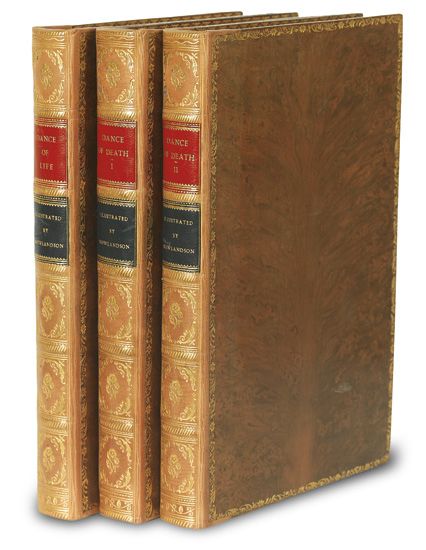
(ROWLANDSON, THOMAS.) The English Dance of Death. 2 volumes. * The Dance of Life. Together, 3 volumes. Engraved colored title-page and 37 hand-colored engraved plates in each volume of the Dance of Death, 25 hand-colored plates in the Dance of Life, by Rowlandson. Tall 8vo, later full tree calf gilt, spines tooled in gilt in 6 compartments with morocco lettering pieces in 2, rebacked; top edges gilt; occasional offsetting to text from plates and spotting to preliminaries; leather bookplates of Stephen M. Dryfoos mounted to front pastedown of 2 volumes; the whole slipcased together. London: R. Ackerman, 1815-16; 1817
Estimate $1,000-1,500 – SOLD: $3600. (incl buyer’s premium)

first editions in fine condition. “Indispensable to any Rowlandson collection, one of the essential pivots of any colour plate library, being one of the main works of Rowlandson”–(Tooley 410-411); Hardie 172; Abbey Life, 263-264; Prideaux 332; Grolier, Rowlandson 32.


Swann Sale 2295 Lot 205:

ROWLANDSON, THOMAS.) [Combe, William.] The Tour of Doctor Syntax, in Search of the Picturesque * In Search of Consolation * In Search of a Wife. Together, 3 volumes. Colored aquatint frontispiece in each volume, volumes 1 and 3 with additional aquatint title-page, and 75 colored plates by Rowlandson, colored vignette at end of vol. 3. Large 8vo, uniform full crimson crushed morocco blocked in gilt with corner floral ornaments, spines richly gilt in 4 compartments, titles in 2; turn-ins; by Root & Son, top edges gilt; bookplates of Edward B. Krumbhaar (vol. 1 only) and Christopher Heublein Perot (with his autograph). first edition in book form, second state, handsomely bound. London: R. Ackerman, 1812-20-(21)
Estimate $600-900 – SOLD: $960. (incl buyer’s premium)

 ***************************

And despite my love of Austen, I do periodically enter the 20th century [sometimes the 21st!] and I still harbor my great admiration and love of John Steinbeck, so this I share because it is so rare and lovely to behold:

Swann Sale 2295 Lot 234 John Steinbeck. Cup of Gold.

STEINBECK, JOHN. Cup of Gold. 8vo, original yellow cloth lettered in black; pictorial dust jacket, spine panel evenly faded with minor chipping to ends with slight loss of a few letters, light rubbing along folds, small rubber inkstamp on front flap; bookplate with name obscured in black pen on front pastedown. New York: Robert M. McBride & Co., 1929
Estimate $8,000-12,000 – SOLD: $14,400 (incl buyer’s premium)

scarce first edition, first issue of steinbeck’s first book with the McBride publisher imprint and “First Published, August 1929” on copyright page. Jacket flap corners evenly clipped as issued with “$2.50” printed price present. The publisher printed only 2476 copies, 939 of which were remaindered as unbound sheets and evidently sold to Covici-Friede who issued them with new preliminaries, preface, binding, and jacket in 1936. Variant copy (no priority) with the top edges unstained. Goldstone-Payne A1.a.

**********************

All images are from the respective auction houses with thanks.

Have fun browsing, and bidding if you wish!

 c2012 Jane Austen in Vermont
Austen Literary History & Criticism · Author Interviews · Books · Collecting Jane Austen · Great Britain - History · Jane Austen · Jane Austen Circle · Regency England

Guest Post: Janine Barchas ~ A Janecation in Yorkshire? ~ Jane Austen’s Real Wentworths

Gentle Readers:  I welcome today, Janine Barchas, associate professor of English at the University of Texas, Austin, where she teaches, perfectly situated you might say, Austen in Austin. She has published a number of scholarly articles on Jane Austen and the just released Matters of Fact in Jane Austen: History, Location and Celebrity (Johns Hopkins UP, 2012).  She has graciously offered to share a bit of one of the tales expounded on in her book, the Wentworth family of Yorkshire.  I think you will want to know more about her very interesting findings – I highly recommend the book! – and see below for a contest offering from the publisher that starts this coming Friday October 26 [see the blog here: http://jhupressblog.com/ ] – and please comment or ask Janine a question!

***********************

A Janecation in Yorkshire?  Jane Austen’s Real Wentworths

Although South Yorkshire may seem an unlikely destination for a Janeite pilgrim, the research for my book Matters of Fact in Jane Austen: history, location, and celebrity (Johns Hopkins UP, 2012) led me to two breathtaking country estates with histories that connect to Austen’s fictions: Wentworth Castle and Wentworth Woodhouse.

I was not tracing Austen’s physical steps, but following some of her leading names—particularly Wentworth, Woodhouse, Fitzwilliam, Darcy, Watson, and Vernon.  When Austen selected these surnames for her fictional protagonists, they hung on the real-world family trees of these two neighboring Yorkshire estates.  Not unlike the Kennedy family in our own era, the Wentworth clan consisted of high-profile politicians and celebrities—with newspapers assiduously tracking all sightings and London shops selling reproductions of family portraits as cheap paper pinups.  Jane Austen, too, seems to have been keenly aware of Wentworth celebrity.

Wentworth Woodhouse

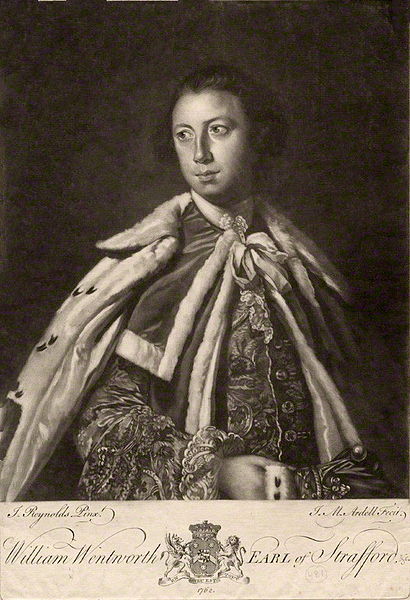
Even a short summary of the history of Wentworth Woodhouse can make an Austen fan sit up with the surprise of recognition.  After Robert Wentworth married a rich heiress named Emma Wodehouse, their Yorkshire family so prospered that in 1611 its senior line achieved a baronetcy, just as the owner’s sister married the heir of the wealthy D’Arcy family.  The eldest son of that same first baronet was the hapless Thomas Wentworth, first Earl of Strafford and martyr to the royalist cause.  With the Restoration, the estate was returned to Strafford’s eldest son, William Wentworth.  But when William died without issue in 1695, it transferred to the children of his sister, Anne Wentworth, wife to the head of the Watson family.  When in 1751, Charles Watson, heir to these princely estates, succeeded his father as the second Marquess of Rockingham, he became one of the wealthiest peers in England.  Charles Watson Wentworth, having added his mother’s maiden name to his own, was twice elected Prime Minister of England.  But he died unexpectedly and childless in 1782, just after his second election at age 52.  Thus, when Austen was a mere girl, the combined fortunes of the Woodhouses, Wentworths, and Watsons transferred to their next of kin, the Fitzwilliams.

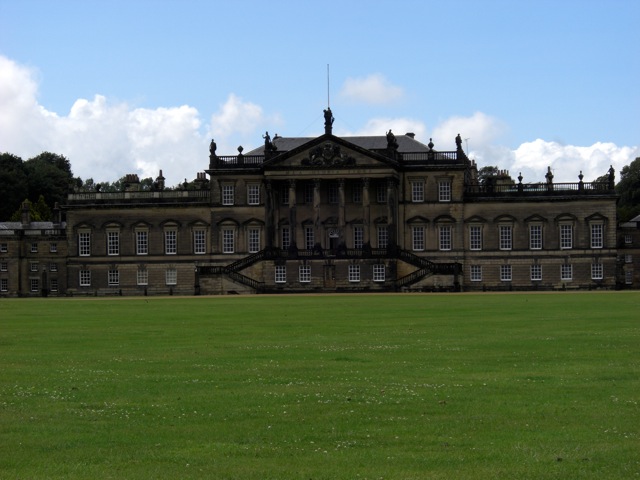
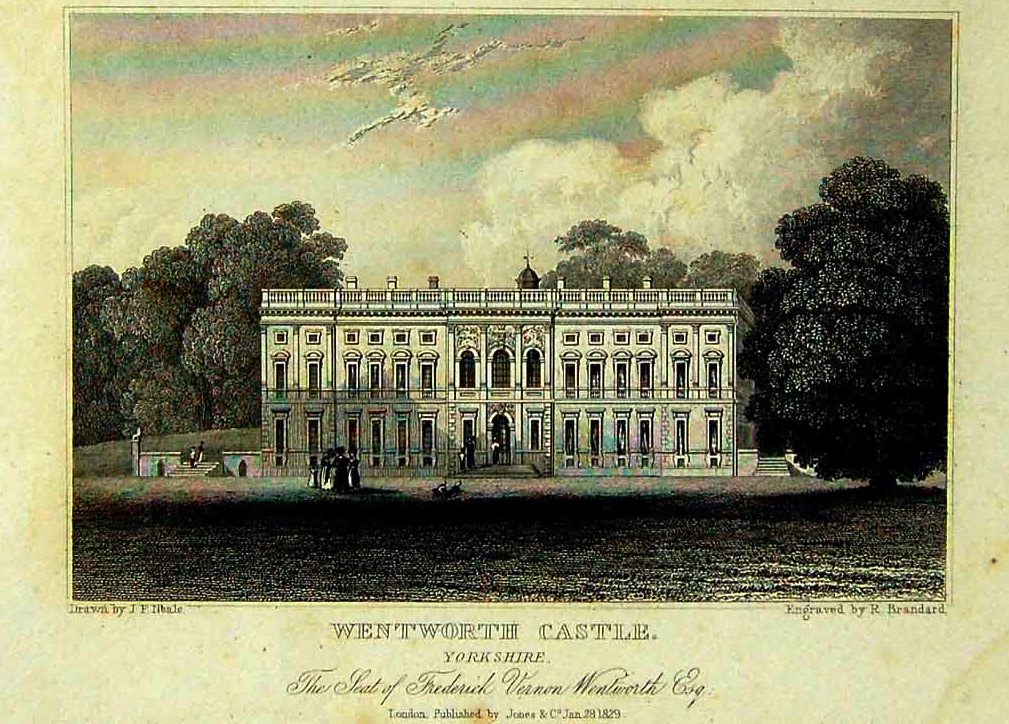
Wentworth Castle
Wentworth Castle, 1829

By then, a family feud between Wentworth cousins (Tory and Whig) had resulted in Wentworth Castle.  Even the name of the rival estate deliberately taunted the mere “House” six miles away.  Major renovations to Wentworth Castle were duly answered with elaborate improvements to nearby Wentworth Woodhouse, shaping English garden design through one family’s political rivalry.  The competitive landscaping at these neighboring estates, the bulk of which took place between 1710 and 1790, was a prolonged endeavor that occurred on a grand scale and in the national spotlight.  It was in 1791, when Austen was in her teens, that the Wentworth Castle estate and titles were inherited by an obscure gentleman from Dorset named (I’m not making this up!) Frederick Wentworth, making him the third and last Earl of Strafford.  When Austen reached her late 20s, Wentworth Castle became the property of young Frederick Vernon after another heated Wentworth-family dispute. The historical circumstances surrounding this contested transfer of Wentworth wealth resemble those in Lady Susan, which features at least two characters named Frederic Vernon as well as a dispute over a family castle.

William Wentworth – 2nd Earl of Strafford

[Image from wikipedia]

After years of wily namedropping, and perhaps because her contemporary readers would have instantly connected the hero of Persuasion with this glamorous Wentworth family, Austen disclaims in her final novel.  She has the sycophantic Sir Walter Elliot sneeringly dismiss any link between Capt. Frederick Wentworth, the story’s self-made naval officer, and the highborn Wentworths from Yorkshire, who held titles such as the Earl of Strafford: “Mr. Wentworth was nobody, I remember, quite unconnected; nothing to do with the Strafford family.”  By placing the requisite disclaimer in the mouth of Sir Walter, Austen keeps her own tongue firmly in her cheek.  Sir Walter is notoriously unreliable—a narcissistic fop who lacks judgment.  Despite, or perhaps because of, Sir Walter’s dismissal, the name of Frederick Wentworth so flagrantly invites contemporary associations that the upending of those expectations (a landless sailor named after one of England’s most famous landowning families?) becomes part of the story’s piquancy and contemporary appeal.

Anne Wentworth, Countess of Strafford – by Joshua Reynolds c1745

[Image from wikipedia]

Today, both properties are being renovated and have opened their gardens to visitors.  Privately owned Wentworth Woodhouse has plans for a spa and hotel by 2015, while the Wentworth Castle Trust (the house is a teacher training college) has already restored the castle folly for which the property is known.  In both cases, the grounds and vistas are as stunning as eighteenth-century and regency guidebooks record.  While enjoying the picturesque herds of deer that, according to the locals, have roamed there since 1066, I could not help smiling at how the popularity of Austen’s fictional characters—especially Fitzwilliam Darcy and Frederick Wentworth—have succeeded in eclipsing their historical namesakes, casting a Janeite shadow over the once-glittering owners of these estates.

Wentworth Castle folly
Wentworth Castle Estate
Wentworth Woodhouse estate

If you’re an Austen enthusiast who has already been to Bath, Lyme Regis, and Chawton, then consider a visit to Wentworth Woodhouse and Wentworth Castle.  Meanwhile, I hope that my book takes you partway there.

The Fitzwilliam Arms in nearby Rotherham

***************************

For a few photos as well as more information about these and other glamorous places alluded to by Austen, see the JHU Press Blog post by Janine “Jane Austen on Location”: http://jhupressblog.com/2012/09/12/jane-austen-on-location/

Johns Hopkins UP is about to run a small contest that would give away copies of my book to the first few who answer correctly a historical question with an Austen twist.  Look for the question on the JHU Press Blog, starting on 26 October.

****************

About the author: Janine Barchas is the author of Graphic Design, Print Culture, and the Eighteenth-Century Novel (Cambridge UP, 2003), the editor of The Annotations in Lady Bradshaigh’s Copy of Clarissa (English Literary Studies, U of Victoria, 1998), and numerous scholarly works on Austen (search her name on the Jasna.org website here). Her research interests include eighteenth-century literature and culture, the British novel, book history, textual studies, Jane Austen, and early fiction by women. At the JASNA 2012 AGM, she spoke on “Austen Between the Covers: A Brief History of Book Cover Art”, and will be one of the plenary speakers at the JASNA 2013 AGM in Minneapolis, the AGM celebrating 200 years of Pride and Prejudice.

Further Reading:

Wentworth Castle:

Wentworth Woodhouse:

And note that The Country House Revealed is a six part BBC series first aired on BBC Two in May 2011 in which British architectural historian Dan Cruickshank visits six houses never before open to public view, and examines the lives of the families who lived there. Wentworth Woodhouse s featured in Episode 4.

All photographs by Janine Barchas.

Please leave any comments or questions for Janine below – and don’t forget to check out the JHU Press blog on October 26, and see if you can answer the Jane Austen question!

c2012 Jane Austen in Vermont
Author Interviews · Collecting Jane Austen · Great Britain - History · Jane Austen · Jane Austen Circle · Regency England · Social Life & Customs

An Interview with Ron Dunning on his Jane Austen Genealogy ~ The New and Improved Jane Austen Family Tree!

UPDATE: April 25, 2023

Ron Dunning has asked me to update this blog post to reflect changes to the RootsWeb WorldConnect family trees, which were retired on 15 April 2023.  Ancestry.com, which owns the RootsWeb site, has promised to migrate the WorldConnect genealogical collection to a new free-access site later in the year. Ron asks that you be cognizant that none of his own research is available at present, though his website janeaustensfamily.co.uk, and its component, Akin to Jane, has not been affected.  The hope is that once the migration of the genealogical collection is complete, all will fall back into place – including many additions and corrections which had not been available on the old WorldConnect site. Please email Ron if you have questions.

*****************

Some of you may be familiar already with the Ancestry.com Jane Austen Family Tree created by Ronald Dunning.  It is quite the amazing compilation of ancestors and descendants of “Dear Aunt Jane” – a resource for Austen fans and scholars alike the world over.

So we are happy to announce that Mr. Dunning has continued with his Austen genealogical work and his new and improved website is to be “unveiled” at the Jane Austen Society meeting tomorrow (21 July 2012) at the Chawton House Library [an article about the history of the website will appear in the next JAS Report] – details of the meeting are here: http://www.janeaustensoci.freeuk.com/pages/AGM_details.htm.

The link to the new website is here: http://www.janeaustensfamily.co.uk/  where you will find new content, the complete transcribed text of the manuscript of Akin to Jane, and links to the original RootsWeb site noted above [see below for information on how best to access the data.]

Ron has been very kind to answer a few of my questions about how and why he took on this monumental research project, so hope you enjoy learning more about it – then you must take some time to search the database – it is great fun to poke around in when you might have an extra minute or two on any given day – you might even find that somewhere deep in the listings some of your very own relatives share a connection to Jane!

********************************

A hearty welcome to you Ron – with thanks for sharing with us the history of your website!

JAIV:  What prompted you to get involved with this Austen family research project to begin with? 

RD:  I grew up in Toronto, a city, and a wonderful city it is, whose civilised history only goes back for two centuries. All of my grandparents were English, but the thought of having interesting ancestors would have seemed too ridiculous to entertain. My paternal grandmother was the sort who wrote regularly to every English member of her and my grandfather’s families, and was always nattering about their current situations. In 1972, aged 25, I left Toronto to find work as a classical musician, and the idea of going to England, where there would be a ready-made family, was deeply appealing. Just before my departure, my grandmother told me that we had some sort of connection with the Austens, though she didn’t know what.

We must have been almost the only branch of descendants who’d lost sight of it!  I was pleased to be able to tell her, before she died, that Frank Austen [Jane’s brother] was her great-great-grandfather.  It was difficult to get much further back than that in the 1970s, so I gave up the search to get on with work, and to raise my own brace of descendants. In 1998 my wife bought a computer for our kids and, Luddite that I am, I grumbled and scowled in the background – till I thought that I might just see what it’s like.

I was soon drawn back to family history. The kids were old enough that they preferred neglect to parental attention, though we did meet occasionally to fight over whose turn it was to use the computer. At the time I thought that it would stand to reason that the Austen genealogy had been exhausted, so for the next five years I worked through the seven non-Austen great-grandparents’ lines, and just copied the charts in the backs of Jane Austen biographies.

When that was thoroughly exhausted I was addicted, and needed a fix! Simultaneously it became evident that the authors of the biographies had all copied the family charts from one another, and there was a lot further to go.  In particular they mainly recorded the male lines, dishonouring the women. I’ve found that not just Cassandra Leigh but George Austen too had eminent ancestors, which means that their records go back, potentially, to the beginning of recorded history.

Now I have a lifetime’s supply of fixes, and in retirement, a full time job.  Do not call it a hobby.  And don’t say that I’m obsessed. Oh well, all right, perhaps I am. This study means a lot more to me than just a growing collection of names – it makes me feel organically connected, not just to the Austen family (and I don’t feel at all proprietorial about Jane) but to the whole of English history.

JAIV: Tell us something about Joan Corder and her manuscript, Akin to Jane – how and when and where did you first come upon it – what a find! – and why did she not publish her research? 

RD:  Joan Corder was born and lived through her life in the English county of Suffolk. She served as a young woman, during World War 2, in intelligence as a plotter, then moved back home to look after her widowed mother. She didn’t marry. Over the course of her life she became a distinguished herald and genealogist; Akin to Jane was her first big project.

It was to her enduring disappointment that she couldn’t interest a publisher – so only two copies of the manuscript were made. One was presented to the Jane Austen Society and can be seen at the Jane Austen’s House Museum at Chawton, where it has been, presumably, consulted by most if not all of Jane Austen’s later biographers.

With use, the manuscript has become increasingly fragile; people still visit the Museum to inspect it. My Austen cousin Patrick Stokes scanned the work to help preserve it for posterity, and it’s his scans that are displayed on the website. The museum curator is pleased that she can now refer interested parties to the web, and retire the original.

[Ron says on the website: “I would like to acknowledge and thank my Austen cousin, Patrick Stokes, who first brought the manuscript of Akin to Jane to my attention, and gave me a copy.”]

Joan Corder


JAIV:  What, of all the discoveries in your research, surprised you the most?

RD:  So many discoveries! They constantly amaze, but no longer surprise.  I’ve been making a list, and intend to write articles about them. Here is a sample and though many of them seem improbable, they are all true.

Direct Ancestors

1.  William IX, Duke of Aquitaine.  William was a leader of the 1101 Crusade.  He is best known today as the earliest troubadour – a vernacular lyric poet in the Occitan language – whose work has survived.  Grandfather of Eleanor of Aquitaine, and Jane Austen’s 19th-great-grandfather.
2.  Owain Glyndwr, Prince of Wales. Shakespeare’s Owen Glendower. Jane’s 13th-great-grandfather.

Owain Glyndwr – the BBC

3. John King, Bishop of London, from 1611 (the year of the King James Bible) to 1621. John King ordained John Donne. Jane’s  4th-great-grandfather.

John King, Bishop of London (1611-1621)

4.  Faith Coghill, the wife of Sir Christopher Wren. The  1st cousin once removed of George Austen.

5. Lizzie Throckmorton, the wife of Sir Walter Raleigh. A distant cousin of Cassandra Leigh.

Elizabeth Throckmorton

[image from Peerage.com]

6.  Katherine Leigh, the wife of Robert Catesby, the Gunpowder plotter, another distant cousin.

7.  Both of Jane’s parents were descended from royalty. Cassandra was descended from John of Gaunt, the son of Edward III, so every previous English king, back to William the Conqueror, and some beyond, was her ancestor.  For George we have to go back two generations further, to Edward I.

8.  Some Scottish royalty – the real-life Duncan I of Scotland who was either murdered by his cousin, the real-life Macbeth, or killed in battle against him.  Macbeth, as we know, succeeded him as King.  Duncan was Jane’s 21st-great-grandfather.

9.  By the way, we all know from Jane’s juvenilia that she “preferred” Mary Queen of Scots to Queen Elizabeth. Well – not only was she related to both, but in Jane Austen’s Sailor Brothers she is quoted favourably comparing her brother Frank with Queen Elizabeth.

Cassandra Austen’s Mary Queen of Scots – The History of England


JAIV:  This is all wonderful! 
But I must ask, any real gossip – things hidden for generations?

RD:  Ooh – I’d be banished from the family if I revealed any of those!

JAIV: Oh, but the story of Elizabeth and Herbert is quite an interesting one! All hidden from the family and worthy of a Victorian novel! –  or at least akin to the writers of Victorian novels, as the lives of Charles Dickens and Wilkie Collins can attest! [see below for the link!]

JAIV:  Where do you go from here? 

RD:  I began the web project thinking that I would be producing a revision of Akin to Jane , but it eventually became obvious that the plan was unworkable. I want the reader to be drawn to my research, and not to think that Joan Corder’s work was the end of it. She managed to record a little over 300 of George and Cassandra Austen’s descendants, and gave ancestors no attention. My genealogical database contains more than 1200 descendants – that is, another 900 – and another ten thousand people, who include ancestors, collateral families, and families of social connections. The address of that, by the way, is http://wc.rootsweb.ancestry.com/~janeausten.

There is a link beneath each individual in Akin to Jane to that database, but in the long run I plan to organise things better. I’ll spend next winter learning the html to create a proper design (you won’t know it, but the current one is improper), and intend to do wondrous things with a sidebar. That will take care of technicalities. I have only just begun thinking beyond the current content, and have decided that I will add more original family history source material. I believe that one can jinx plans by talking about them too soon, so I’ll do that when I know that the material can be used.

JAIV:  Is there a book in the works?

RD: I’m sorry. No book. Articles, yes. Though I’ve really enjoyed building the Jane Austen’s Family website, it has absorbed an immense amount of time – time taken away from research, my first love.

 ****************************************************** 

Thank you Ron for joining us here today! [well, really you are at the JAS meeting at the Chawton House Library, and I am here in Vermont, but we can pretend, can’t we?] – it has been delightful getting to know you via emails! and I very much appreciate you sharing all this with us. What a gift of research you have given the Jane Austen world…

Now Dear Readers, it is time for you to journey through these ancestry files, both those of Joan Corder’s Akin to Jane manuscript, now transcribed for all to see on the website, as well as the expanded genealogical research at the Ancestry.com site that Ron has lovingly put together over these past how many years?!   Ron makes it clear that this is still a work in progress [isn’t everything?] and he will continue to make changes to the set-up and continuously add content.  But it is best to just dive in and see all that is there – [as an aside, so please forgive the intrusion, I must say that I put in several of my family names (both my parents were born in England, so I knew there was a chance of some connection somewhere), and find that the mother of Sir Christopher Wren has my maiden name, and his wife, mentioned above [Faith Coghill] was a direct cousin to George Austen! – now I have some serious sleuthing to do to find the exact connection – but I have been quite annoying to friends and family these past few days since my discovery – and not sure in any given minute whether to sit down and write a Novel, or get out my drafting table and design a Cathedral – this genealogy stuff can be quite daunting!]

So back to the matter at hand – let’s head into the Austen genealogy: to begin, go first to the main page: where you will see these links:

1. Akin to Jane – Joan Corder’s original and transcribed manuscript – click on this and you will find these links:

Akin to Jane title page
  • Jane Austen’s Family– Index of Names, and Lists: Corder’s notes on the Austen family, indexed by Austen family members, all surnames of the extended family – you will find links to:

1.  Jane’s family and their descendants: George and Cassandra Austen; James Austen; George Austen; Edward Austen, later Knight; Henry Thomas Austen; Cassandra Elizabeth Austen; Francis William Austen; Jane Austen; and Charles John Austen

2.  Index of people by surname: Austen Family; Austen-Leigh; Bradford, Hill and Hubback; Knatchbull; Knight; Lefroy and Purvis; and Rice

  • Highlights page – oh! much here and much more to be added:

“There is good reason for the general reader to delve into this manuscript. One of Joan Corder’s informants, Miss Marcia Rice, who was 84 in 1954 when the work was written, was the granddaughter of Edward Knight’s daughter Elizabeth, and her husband Edward Royd Rice. Miss Rice wrote extensive memoirs of her family, which Joan Corder copied. Her recollections of her distant childhood were refracted through the most rosy of tinted spectacles; few could read those for her grandmother without needing the discreet use of a tissue. Here is a direct link to Elizabeth.

Please don’t stop with Elizabeth – Miss Rice didn’t. She left a wonderful record immortalising her entire Rice family, from aunts who could be quirky or intellectual, to uncles who could be courageous or reckless. For many of them there are links in the text to portraits. Be sure not to neglect reading Miss Rice’s personal memories, on page 115; and those following, on her great-aunt Marianne Knight.” –

  • Heraldry – Eleven Coats of Arms: these are worthy of a website all their own!
Austen Coat-of-Arms
  • Joan Corder – author of Akin to Jane: information on the author of the original family tree.
  • Author’s and Editor’s Notes: notes from both Corder and Dunning with explanations on how to use the Akin to Jane database and links to Dunning’s Roots Web database.
  • Contact Me – Ronald Dunning: he would love to hear from you!
Ron Dunning

2.  Recent Research – Ron’s explanation of his research that continues that of what is in Akin to Jane at the Jane Austen Family Tree website at RootsWeb:
http://wc.rootsweb.ancestry.com/cgi-bin/igm.cgi?db=janeausten

3.   Articles – there are three articles now, more to be added:

  • “An Unconventional Love Match”
  • “The Last Welsh Prince of Wales – Jane Austen’s Welsh Ancestry”
  • “Latitude and Longitude”

Be sure to read all the extra links – these often explain the contents and how the database works; and do not miss all the illustrations that appear throughout the website:

http://www.janeaustensfamily.co.uk/akin-to-jane/text/illustrations-and-portraits.html

Vice Admiral Francis William Austen

Now the fun part: you really do need to explore – but I shall give you this start – the wonderful story noted on the “Highlights Page” above of Elizabeth Austen [later Knight], daughter of Jane Austen’s brother Edward, from her grand-daughter Marcia Alice Rice, as written for Joan Corder in 1953:

http://www.janeaustensfamily.co.uk/akin-to-jane/text/edward/051a.html

 Image of Elizabeth Austen-Knight Rice and her husband Edward Royd Rice

and then this quite romantic tale that I mentioned above of another Elizabeth and her husband Herbert: Herbert was the last child of Fanny Catherine Austen Knight Knatchbull (Jane Austen’s favorite niece – quite the mouthful! – and later on they added Hugessen to the name!) –  here we have a tale of a secret marriage, he and his wife Elizabeth living under an assumed name, Herbert never telling his mother, never telling his colleagues in Parliament, having many children – all right out of a Victorian novel! : you can find it here on the ancestry.com website:

http://wc.rootsweb.ancestry.com/cgi-bin/igm.cgi?op=GET&db=janeausten&id=I3046

and you can read Ron’s take on the story and his research here:

http://www.janeaustensfamily.co.uk/articles/unconventional-love-match.html

So just dig around – click on any link of interest – there are treasures to be discovered lurking behind those links! – whatever would Jane Austen make of all this do you think? – would she be absolutely appalled to discover she was related to Queen Elizabeth?? I now wonder after all if even I am related to Queen Elizabeth … and maybe you are too!

If you have any questions for Ron, please leave a comment here – he is happy to respond to any queries or suggestions…

c2012, Jane Austen in Vermont