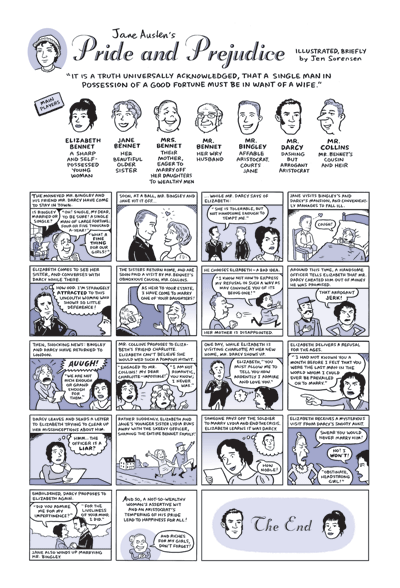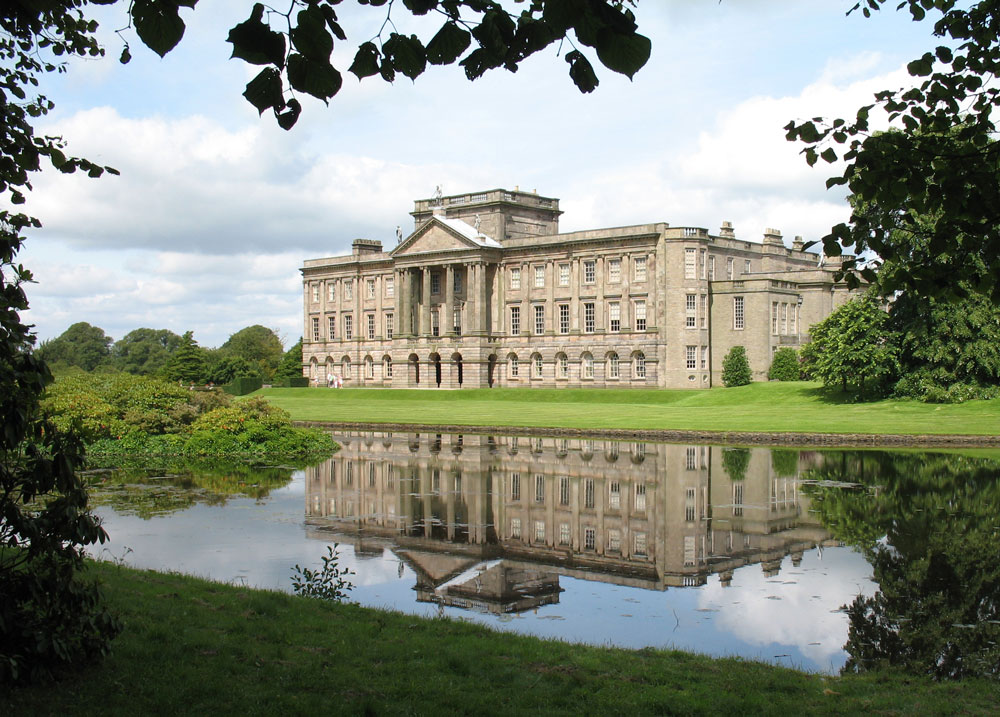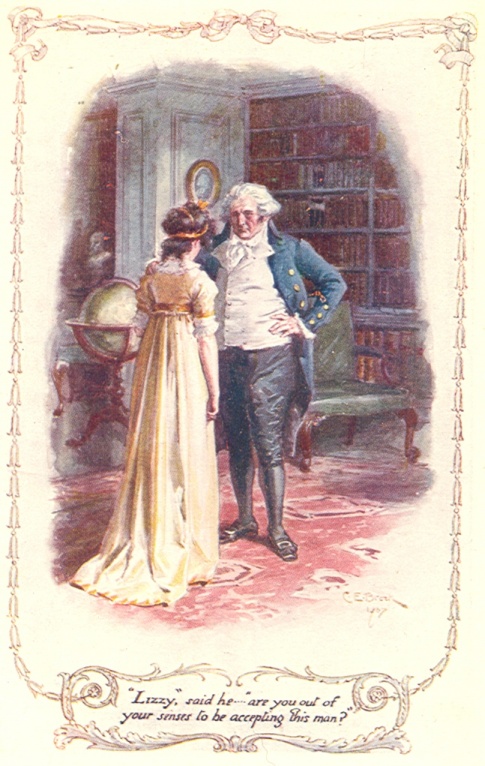
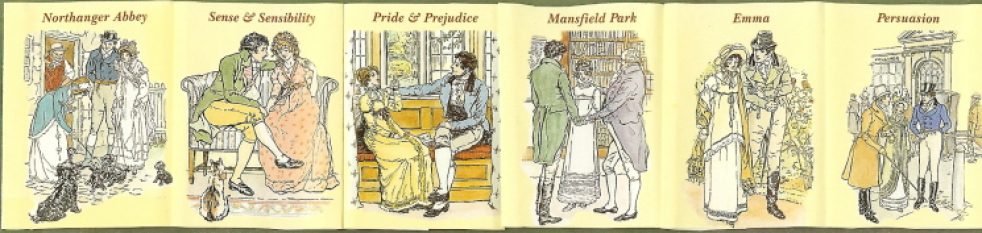
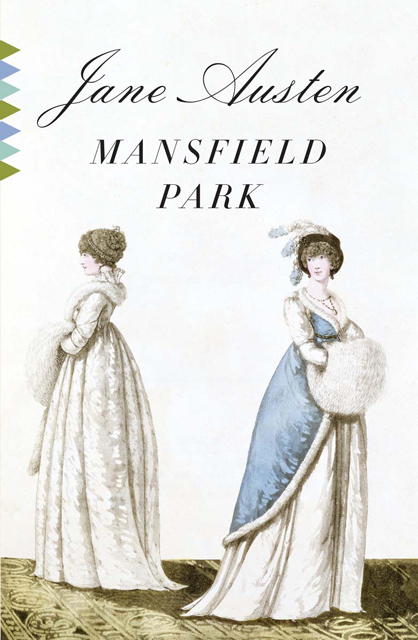
I have something in hand – which I hope on the credit of P. & P. will sell well, tho’ not half so entertaining. (Ltr. 86: 3 – 6 July 1813, to Capt. Francis Austen)
*****************
Dear Gentle Readers: This history of the publishing of Mansfield Park serves as an introduction to Sarah Emsley’s series “An Invitation to Mansfield Park,” which will begin on May 9th on her blog. As we celebrate this bicentenary of Austen’s third novel, published in May 1814, it seems only right to begin at the beginning, from when Austen first makes mention of Mansfield Park in her letters and its subsequent road to publication, to the later printings and early illustrated works. I am posting it here because of its length and number of illustrations – and Sarah will be re-blogging it immediately. Please continue to visit her blog for the interesting posts she has lined up for the next several months from various Jane Austen scholars and bloggers – a worthy tribute as we all give Mansfield Park the undivided attention it deserves!
~
The Publishing of Mansfield Park
We have Cassandra’s word that Jane Austen began Mansfield Park “sometime around February 1811 and finished soon after June 1813.” Letters during this time [you can read all the letters relating to Mansfield Park here] indicate that at least Cassandra was already very familiar with this work-in-progress – a few of the letters show how diligent Austen was in checking her facts about ordination and hedgerows, ships of the Royal Navy, and correct terminology for the Gibraltar “Commissioner.”
Early readers of the letters took her reference to “Ordination”
Now I will try to write of something else; – it shall be a complete change of subject – Ordination. (Ltr. 79: 29 Jan 1813)
to mean this was the theme of her next book, i.e. Mansfield Park. It is now generally accepted that she was just acknowledging her request in a previous letter for information on the process of ordination – to get it right about Edmund. (But see Michael Karounos, “Ordination and Revolution in Mansfield Park.” SEL 44.4 (2004): 715-36, for a discussion of what Austen meant by this word “ordination” and how it is indeed the theme of the novel.)

[image: JASNA.org / Zohn]
Henry has this moment said that he likes my M. P. better & better; – he is in the 3d vol. – I believe now he has changed his mind as to foreseeing the end; – he said yesterday at least that he defied anybody to say whether H.C. would be reformed, or would forget Fanny in a fortnight. (Ltr. 98: 8 Mar 1814).
…indeed the question that has been plaguing readers ever since!
Austen is traveling with Henry to London in March 1814 to negotiate its publication with Thomas Egerton; Henry is reading the manuscript for the first time, i.e. he was not in on the story during its composition over the past two years, as Cassandra was – Henry did not see it until it was ready for the press. It is also telling that her primary interest is Henry’s opinion concerning the ending and what happens with Henry Crawford!
Mansfield Park was being written at the same time Austen was revising Pride & Prejudice for publication [published in January 1813] – Janet Todd makes note of this allusion to the first sentence of P&P: “…there certainly are not so many men of large fortune in the world, as there are pretty women to deserve them.” (Todd, 75). Was Austen perhaps making a sly nod to her previous novel? MP is also the first work to be entirely written after settling in Chawton in 1809. The secret of her authorship is already out, thanks largely to Henry, though she will continue to publish anonymously. She writes to her brother Francis in September 1813:

…the Secret has spread so far as to be scarcely the Shadow of a secret now – & that I beleive whenever the 3d appears, I shall not even attempt to tell Lies about it. – I shall rather try to make all the Money than all the Mystery I can of it… (Ltr. 90: 25 Sept 1813)
The internal chronology has created its own controversy among scholars and readers – it is an especially important issue when deciphering her references to slavery (the topic of another post!). John Wiltshire in his introduction to The Cambridge Edition of Mansfield Park (2005) wonders why this book took so long to write (Feb 1811-June 1813), longer than her other works, and why the nine-month delay in getting it to London for publishing (March 1814). He speculates that “Mansfield Park is a novel carefully revised and perhaps thoroughly rewritten” and this accounts for the discrepancies in time, what he calls the “double-time scheme.” (Wiltshire, xxxi). But the delay could also be attributed to the long illness of Henry’s wife Eliza and her death in April of 1813. (Wiltshire, xxvii). [See links below for the chronologies.]
**********
This detective work on the composing of Mansfield Park is so very interesting, and essential to interpreting Austen’s intent in this controversial and often misunderstood novel. We are left largely with speculation and a host of unanswered questions. But today I am going to talk about the physical object, the book Mansfield Park as part of our material culture – how it came to be, what it looked like, who bought it and what it cost, followed by a brief introduction to the later printing history that included the American, illustrated and foreign editions.
~
The 1st Edition:
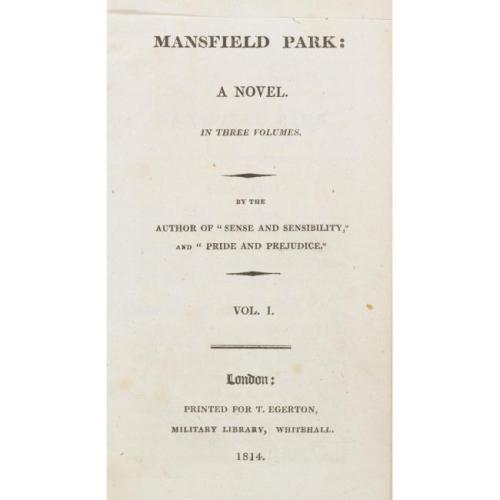 Mansfield Park title page – 1st edition
Like her S&S and P&P, Mansfield Park was published by Thomas Egerton in 1814. The title page states: “By the Author of ‘Sense & Sensibility,’ and ‘Pride & Prejudice.’” Writing to Francis on March 21, 1814, she hopes that
Perhaps before the end of April, Mansfield Park by the author of S&S. – P.&P. may be in the World. Keep the name to yourself. I sh’d not like to have it known beforehand. (Ltr. 100)
But it is not advertised until May 9, 1814, in The Star, and again on May 14, and further noted in The Morning Chronicle of May 23 and 27. Published on commission – Austen retained the copyright, paid for the costs of paper, printing, and advertising; the publisher distributes to the trade and takes about 10% of the profits – the author loses if the book does not sell well. This third novel came into the world in a run of about only 1250 copies, in 3-volumes, and sold for 18 shillings in boards. And it sells well – Austen writes in November of 1814 “You will be glad to hear that the first Edit. of M.P. is all sold.” (Ltr. 109). As with all the finished novels, excepting the cancelled chapters of Persuasion, there is no manuscript.
~
*What did it look like?

Pride and Prejudice 1st ed. – National Library of Scotland
The popular 3-volume format, called a “triple-decker” or a “three-decker,” was typical for novels of the day – what Susan Wolfson calls “a reader-friendly form for sequential purchasing and borrowing and family sharing.” (Wolfson, 112). This image is of a nearly perfect first edition of Pride & Prejudice at the National Library of Scotland – Mansfield Park would have looked like this, bound in blue-gray paper boards, with gray-brown or off-white paper backstrips and white paper spine labels. As Egerton engaged two different printers, many variations in quality and type result in the text. The volumes are 12mo, or duodecimo [about 7-8 inches], i.e. the original printed sheet has been folded four times to its constituent 12 leaves, resulting in 24 pages with about 23 lines to the page. [Note that P&P had 23 lines to the page; MP had 25 lines]
R. W. Chapman, editor of the Oxford complete works in 1923, writes in his memoir The Portrait of a Scholar:
“Those who have once read P&P in three slim duodecimos, with a ha’porth [= a halfpennyworth] of large type to the page, will not easily reconcile themselves to the inelegance of the modern reprint, close printed in one crowded volume.”
…as you can see from this first page of Pride & Prejudice: 
But Mansfield Park was printed on much cheaper paper than P&P, with 25 lines to the page. Chapman, who relied on the 2nd edition of MP for his Oxford works, said that “of all the editions of the novels, the 1st edition of Mansfield Park is by far the worst printed.” (Chapman, xi-xii). Much scholarly debate has centered around the errors in the text, especially the lack of consistency in the spelling, grammar, and punctuation. We are reminded of Henry Tilney’s complaint to Catherine Morland about women letter-writers, where there is “a general deficiency of subject, a total inattention to stops, and a very frequent ignorance of grammar,” a criticism often directed at Austen herself! (I discuss this further under the 2nd edition below).
~
*Who bought copies?
-At a cost of 18s in boards – remember: 20 shillings = a pound – the average person earned maybe 15-20 pounds / year – so who was actually buying books? [See Wolfson on this]
- ½ purchased by circulating libraries
- ½ were purchased by the titled gentry and upper middle classes, who would often rebind the volumes in leather for their private libraries, an example here:

Mansfield Park – 1sted, rebound – image: Jonkers Rare Books, UK
~
* Who reviewed it?
– There were no contemporary reviews of Mansfield Park. Wiltshire rather humorously compares this to the treatment of Fanny Price in the tale: “neglected, passed over, misunderstood, sneered at and ill-used” (Wiltshire, lvii). This lack of notice certainly distressed Austen. She kept a list of “Opinions of Mansfield Park” from family and friends (she later did the same for Emma) – a selection first appeared in James Edward Austen-Leigh’s Memoir of Jane Austen (1870), and all were published in Chapman’s edition of “Plan of a Novel” in 1926, and later reprinted in the Minor Works volume in 1954. You can read them here at Jane Austen’s Fiction Manuscripts in their original and transcribed form:

“Opinions of Mansfield Park” – from “Jane Austen’s Fiction Manuscripts”
As you can see, the commentary from the time differs little from today: better than P&P / not as good as P&P; Fanny not likeable / Fanny the best; love Mary Crawford / hate Mary Crawford; Will Fanny marry Henry or Edmund?; Not enough love between Hero and Heroine, etc., etc. – all the same arguments we go round and round with! I especially like Cassandra who “delighted much in Mr. Rushworth’s stupidity,” and Mrs. Austen: “My Mother — not liked it so well as P. & P. — Thought Fanny insipid. – Enjoyed Mrs. Norris.”
Austen was later piqued by the 1816 review of Emma in the Quarterly Review (March 1816), and now known to be by Walter Scott. She writes to John Murray on April 1, 1816 (Ltr.139):
The Authoress of Emma has no reason I think to complain of her treatment in it – except in the total omission of Mansfield Park. – I cannot but be sorry that so clever a Man as the Reveiwer of Emma should consider it as unworthy of being noticed.
Did Jane Austen know this review was by Scott? – We can only conjecture…
~
*Where can you see a copy?
-David Gilson, in his Bibliography of Jane Austen, lists the various institutions and individuals who own first editions of Mansfield Park – certainly available for viewing in many of the major libraries in the US and UK. Of special interest is Cassandra’s copy, held by the University of Texas at Austin.
~
*The 2nd Edition:
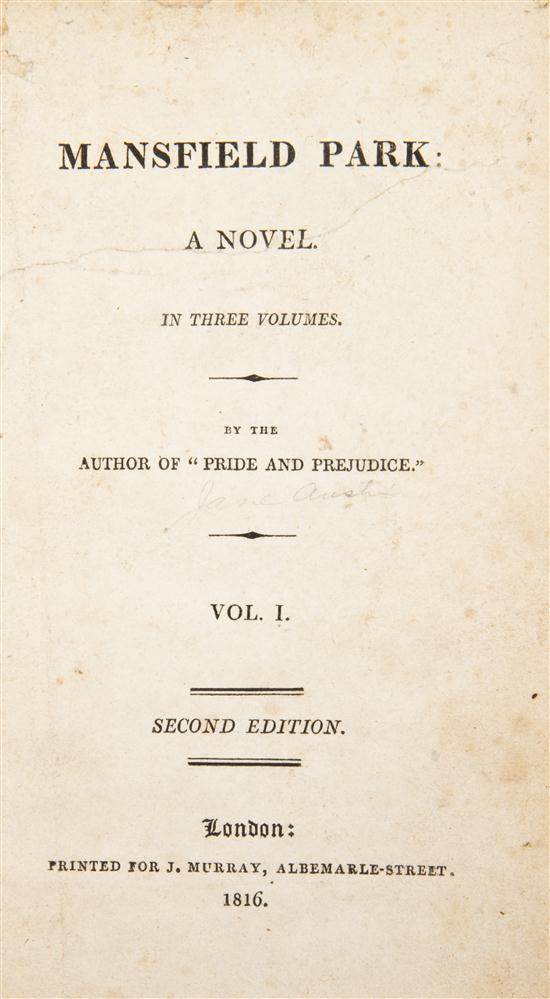 Having sold the copyright of Pride & Prejudice to Egerton outright, Austen was unable to make any changes to its 2nd and 3rd editions. But for Mansfield Park she was able to correct the many errors of spelling and punctuation and made several technical edits. She hoped for a quick edition after November 1814 – it is not settled yet whether I do hazard a 2d Edition. We are to see Egerton today… (Ltr. 114). But Egerton did not publish – Did he refuse? Not offer good terms? Or was Jane Austen displeased with Egerton for the poor and mistake-ridden printing of the first?
She moved to the firm of John Murray to publish her Emma, and Murray took on the 2nd edition of MP as well. She writes on December 11, 1815 to Murray: I return also, Mansfield Park, as ready for a 2d Edit: I beleive, as I can make it. (Ltr. 130).
Austen likely gave him a marked up copy of the 1st edition. Succeeding editions have offered varying texts to the reading public, beginning with Richard Bentley’s “Standard Novels Series” of 1833 to Chapman’s Oxford edition of 1923, with his full textual analysis of the two editions, choosing the 2nd as the preferred text.
This analysis continues as to author intent (see for example Claudia Johnson’s “A Name to Conjure With,” Persuasions 30 (2008): 15-26), and current scholarly editions collate the two editions, updating Chapman, and offer the reader all instances of variation and a certain amount of confusion.
 For the Penguin edition of 1996, Kathryn Sutherland relies on the 1st edition and includes seven pages of textual variants between the two editions. In her Textual Lives, Sutherland explains her preference for the first edition, feeling that Chapman’s “improvements” in his Oxford edition, especially those of punctuation, were at odds with [his] commitment to ‘recovery and restoration’ of the text. (Sutherland, 2007, 292).
Claudia Johnson in her Norton Critical Edition of Mansfield Park (1998) favors the 2nd edition – she praises Chapman for his “monumental achievement” in creating the Oxford Works, but finds his practice in collating the 2 editions was at times “capricious” and without justification. In writing of all the punctuation and spelling variants, Johnson surmises that Austen may have been relying on the printer to make corrections, as was often the practice in publishing at this time in order to ensure uniform punctuation. [Johnson cites Caleb Stower The Printer’s Grammar; or, Introduction to the Art of Printing (London, 1808).] (Johnson, xviii – xix).

John Wiltshire, in editing the 2005 Cambridge edition, returns to the text of the 2nd edition as Chapman had, concluding that both “Austen and Murray wished to produce a second edition of the novel which, whilst it may not have been closer than the first to the author’s original manuscript, would be more creditable to both.” (Wiltshire, xxxix).
~
*What did it look like?
750 copies were printed, published also on commission, Austen paying costs up front. It is again in the 3-volume format, set by three different printers, again an explanation for the lack of consistency; boards were gray-brown paper or blue-gray, on better quality paper. It was advertised in The Morning Post on February 19, 1816 and sold for 18 shillings. It did not sell well and most copies were remaindered; her costs were set against her profit on Emma, which as a result made little for her.
-It is important when reading your Mansfield Park to note which edition it is based on – these many variations, be they mistakes in the 1st edition, Austen’s own corrections for the 2nd, printer errors in both, or the various editorial decisions in subsequent publications, often change the meaning of the text, and trying to determine Austen’s intention just adds to the many questions we would ask her if we could…
~
Other Editions of interest:
*1st American Edition:
 Mansfield Park – 1st Amer. Ed. Swann auction 11-21-13
The first of Austen’s novels to be published in America was Emma in 1816 by Matthew Carey of Philadelphia. It is unlikely that Austen knew of it. Mansfield Park first appeared in 1832 published by Carey & Lea, in two volumes, with a title page stating “by Miss Austen, Author of ‘Pride and Prejudice,’ ‘Emma,’ etc. etc.,” in drab paper boards with purple cloth spines and white paper spine labels. 1250 copies were printed, with a number of variations from the British text, most referring to the Deity, such as:
- “Good Heaven!” = “Indeed!”
- “Some touches of the angel” = “Some excellencies”
- And Mr. Price’s many “By G__” are just completely omitted!
These 2-volume editions sold for around $2.00 and are quite rare today in the original boards.
~
*First Translated Edition:


Mansfield Park was first translated into French and published in a series of extracts in 1815 in the Swiss periodical Bibliothèque britannique. A year later the 4-volume Le Parc de Mansfield, ou Les Trois Cousines par l’Auteur de Raison et Sensibilité, ou Les Deux Manières d’Aimer; d’Orgueil et Préjugé, etc. Traduit de L’Anglais, par M. Henri V*****N [Vilmain], Paris, 1816, appeared. [see title page above] This translation is readily available today in a paperback reprint published by Hachette Livre.
~
*The First Sequel:
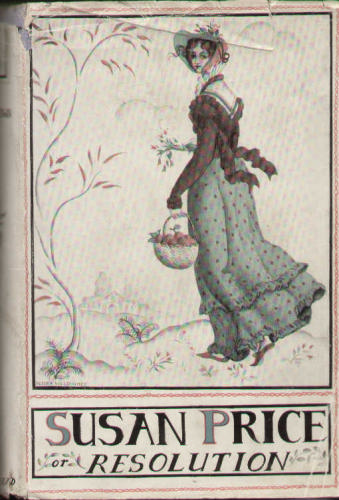 Mansfield Park does not have the following of P&P, where sequels and retellings abound. But of interest is the first such for MP, titled Susan Price, or Resolution by Mrs. Francis Brown (London: John Lane / Bodley Head, 1930.) It concerns Susan Price’s romance with her cousin Tom Bertram (Gilson, 423). Mrs. Brown is Edith Charlotte Hubback, great grand-daughter of Francis Austen. She also wrote continuations to S&S (Margaret Dashwood, or Interference, 1929) and a completion of The Watsons in 1928, as well as co-authored Jane Austen’s Sailor Brothers (1906).
~
*The First Illustrated Edition:
The topic of Jane Austen’s illustrators would take more than an entire book! – so will just here note that the first illustrated edition of any of Austen’s novels was the French translation of Persuasion as “La Famille Elliot” in 1821 – it was also the first edition to name “Miss Jane Austen” as the author.
Mansfield Park was first illustrated in the Richard Bentley one volume edition of 1833, with an engraved frontispiece and title page vignette by William Greatbatch after George Pickering. The frontispiece is of Fanny trying on the infamous necklace with the caption:
 Mansfield Park – 1833 ed. frontispiece and title page [image: ecbooks, UK (abebooks)]
“Miss Crawford smiled her approbation and hastened to complete her gift by putting the necklace around her, and making her see how well it looked.” [this differs from the text!]
The title page vignette is of Sir Thomas encountering Mr. Yates on the stage, with Tom lurking in the background:
“The moment Yates perceived Sir Thomas, he gave perhaps the very best start he had ever given in the whole course of his rehearsals.”
[You can view them here at Google Books.]
These fashions are quite from the wrong era! – looking more like those from the 1940 film of P&P! It was not until the Dent edition of 1892 by R. Brimley Johnson with the illustrations of William Cooke and decorations by F. C. Tilney (no relation to the adorable Henry!) that illustrators actually got the Regency right. And these were rather quickly replaced by the Brock brothers for the Dent edition of 1898. H. M. Brock illustrated the Mansfield Park volume with a frontispiece and five plates:

“In vain were the well-meant condescensions of Sir Thomas”
Mansfield Park, illus. H. M. Brock (Dent 1898) [Mollands]

“Miss Price all alone!”
Mansfield Park, illus. H. M. Brock (Dent 1898) [Mollands]
And C. E. Brock later captured the same Yates / Sir Thomas scene in his Dent edition of 1908:

“A ranting young man who appeared likely to knock him down backwards”
Mansfield Park, illus. C. E. Brock (Dent 1908) [Mollands]
Our favorite illustrator Hugh Thomson, like the Brock Brothers, had a more humorous approach to the novels. As he had in his 1894 George Allen edition of P&P, Thomson illustrated Mansfield Park with a frontis and 39 line drawings. This was published in 1897 by Macmillan and included an introduction by Austin Dobson. An image here of Fanny and Henry Crawford:
 Mansfield Park, illus. Hugh Thomson (Macmillan 1897) [Republic of Pemberley]
Another important illustrated edition to note was the 1875 Groombridge edition (London), with a lithograph frontis and six plates after drawings by A. F. Lydon (Alexander Francis Lydon). The only Austen novel from this publisher, and hard to find today, the illustrations offer a more serious, darker vision of the novel, with purplish-gray toned illustrations emphasizing Fanny’s isolation from the Park and all those in it. (See Carroll, 67).
 Mansfield Park, illus. A. F. Lydon (Groombridge, 1875)
You can view the novel and the other plates by Lydon here at Google Books
The numerous illustrated editions that have followed, right up until today, show these varied approaches to the tone of this novel. I’ve read Mansfield Park a good number of times – I find I would take a very different view from one reading to the next if I was attempting to illustrate the text. What about you? – how would you illustrate MP?
~
*What is it worth today?
-Prices vary, so this is a ball-park estimate with a few recent auction examples: note that the book in its original state, i.e. the paper-covered boards in the case of Mansfield Park, will have a higher value than even the most beautifully bound set – this is the first rule of book collecting; condition, condition, condition is the second! These estimates noted here are taken from the Quill & Brush Author Price Guide for Jane Austen, 2007, and are based on auction sales and bookseller catalogues.
- 1st edition: in original boards = $75, 000. / rebound = $25,000.
- 2nd edition: in original boards = $25,000. / rebound = $5,000.
- 1st American ed.: in original boards = $10,000. / rebound = $3,500. – rare in original boards
- Bentley edition of 1833: vary from $3,000 – $5,000.
Available at present online are two 1st editions, all rebound and of varying condition – one is on sale for $15,000, one is for $38,000. There is also a 2nd edition in original boards online for $10,000. You can begin your search here at abebooks.com.

Recent Auctions:
1. This 1st edition sold at Sothebys in December 1813 for $13,750.; but a rebound 2nd edition recently sold for as little as $688. – so buyer beware!
2. 1st American edition, 2vols, Philadelphia: Carey & Lea, 1832. 8vo, original publisher’s 1/4 cloth-backed drab boards, lettering labels on. Estimate $4,000 – 6,000.; Price Realized $5,376.
***************
This only gives a brief introduction to the very varied and interesting publishing history of Austen’s third novel, with all the decorative bindings, illustrators, and scholarly editing and introductions not being touched upon here. She of course saw only the first and second editions, in their drab boards – what would she make of this visual feast of editions through the past 200 years? What would she think of the great variety of illustrations of her Fanny and Edmund, and Mary and Henry Crawford, Lady Bertram and her pug, and Sir Thomas and Mrs. Norris? And while she earned a meager £320 for Mansfield Park alone, what would she think of the costs of these first editions today?
A full collection of Mansfield Park will not take up as much space on your bookshelves as a collection of Pride & Prejudice – but the variety is just as beautiful and desirable – whether you think Fanny a “creep-mouse” or an independent woman who learns to value herself as others finally do, the book itself, in all its many incarnations, will always be worth your study, will always satisfy your collecting habits – like Fanny herself, you too can become “a subscriber – amazed at being anything in propria persona, amazed at [your] own doings in every way; to be a renter, a chuser of books!”
~
One of my favorite covers: 
Mansfield Park (Routledge, 1900) – Lasting Words, UK for sale for £125 on abebooks
*****************
Further reading: with lots of Mansfield Park bindings!
- Janine Barchas’s post on Mansfield Park covers at Jane Austen Society Nederland – http://www.janeaustensociety.nl/janinebarchasMANSFIELD PARK.html
- Sarah Emsley’s blog posts: ‘An Invitation to Mansfield Park’ – http://sarahemsley.com/an-invitation-to-mansfield-park/
- Sarah Emsley’s Pinterest board for MP – http://www.pinterest.com/sarahemsley/mansfield-park/
- And the beginnings of my Pinterest board for MP – http://www.pinterest.com/austeninvermont/jane-austen-mansfield-park/
- For the additional images of Mansfield Park by the Brock brothers, see Mollands: http://www.mollands.net/etexts/mansfieldpark/mpillus.html
- Full text of MP at Adelaide.edu here: http://ebooks.adelaide.edu.au/a/austen/jane/a93m/index.html
- Full text of MP at Internet Archive with illustrations by Hugh Thomson (Macmillan, 1903 ed): https://archive.org/details/mansfieldpark01austgoog
References:
Austen, Jane. Jane Austen’s Letters. 3rd ed., edited by Deirdre Le Faye. Oxford, 1997. [I have the 4th edition but alas! it is not with me at present, so I continue to cite the 3rd ed.]
_____. Mansfield Park. Ed. R. W. Chapman. Oxford, 1966.
_____. Mansfield Park. Ed. Claudia L. Johnson. Norton, 1998.
_____. Mansfield Park. Ed. James Kinsley. Introd. Jane Stabler. Oxford, 2008.
_____. Mansfield Park. Ed. Kathryn Sutherland. Penguin, 1996.
_____. Mansfield Park. Ed. John Wiltshire. Cambridge, 2005.
_____. “Opinions of Mansfield Park.” Jane Austen’s Fiction Manuscripts. http://www.janeausten.ac.uk/manuscripts/blopinions/1.html
Carroll, Laura, and John Wiltshire. “Jane Austen, Illustrated.” A Companion to Jane Austen. Ed. Claudia L. Johnson and Clara Tuite. Wiley-Blackwell, 2009. 62-77.
Chapman, R. W. Portrait of a Scholar. Oxford, 1923.
Gilson, David. A Bibliography of Jane Austen. Oak Knoll, 1997. The most invaluable resource of all. If you are collecting Jane Austen, you need this book!
Karounos, Michael. “Ordination and Revolution in Mansfield Park.” SEL 44.4 (2004): 715-36.
Sutherland, Kathryn. Jane Austen’s Textual Lives: From Aeschylus to Bollywood. Oxford, 2007.
Todd, Janet. The Cambridge Introduction to Jane Austen. Cambridge, 2006.
Wolfson, Susan J. “Re: Reading Pride and Prejudice ‘What Think you of Books?’” A Companion to Jane Austen. Ed. Claudia L. Johnson and Clara Tuite. Wiley-Blackwell, 2009. 112-22.
~
The Chronology of Mansfield Park:
- R. W. Chapman’s chronology: http://www.pemberley.com/janeinfo/mansfchr.html
- Ellen Moody’s calendar: http://www.jimandellen.org/austen/Mansfield Park.calendar.html
They both argue for a 1808-09 time frame beginning with the Ball in December.
- Brian Southam in his “The Silence of the Bertrams.” (TLS 17 Feb 1995: 13) argues for an 1812-13 scheme.
***************

“How much I used to dread riding”
Mansfield Park, illus. Hugh Thomson (Macmillan 1897) [Internet Archive]