Just a reminder about the giveaway for Syrie James’s newest book, Jane Austen’s First Love. I am extending the deadline for another week, through the holiday weekend until Tuesday September 2, 2014, with the winner announced Wednesday September 3. Please either comment on this post or the original post where Syrie wrote about Lady Bridges’ letters on her daughters’ marriages – one of those daughters, Elizabeth, married Jane Austen’s brother Edward Austen (later Austen-Leigh). (Sad to say, Elizabeth died at the age of 35 shortly after the birth of her eleventh child). These letters from Lady Bridges to her friend tell the tale of the desire to marry one’s daughters well – not unlike Mrs. Bennet!
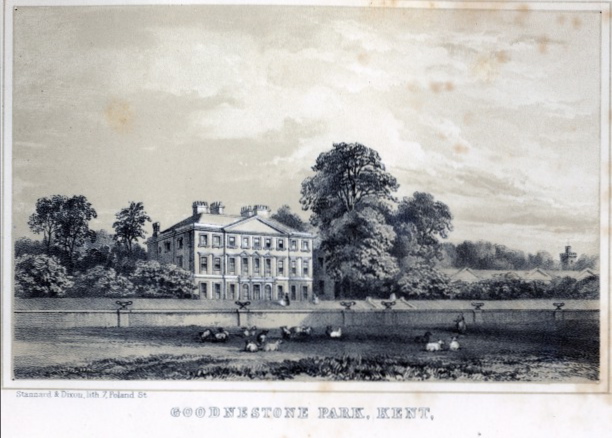
Syrie’s new book is about Jane Austen’s acquaintance with Edward Taylor whom she met while visiting the Bridges’s home at Goodnestone Park in Kent. It is the imagined story of Jane Austen’s first love, based on extensive research. Syrie’s previous books on Jane Austen have been first class entertainments as she has taken us into the Regency world we all so love to visit! – and I highly recommend this new work, where we have real-life and fiction so beautifully intertwined.
Please comment or ask Syrie a question either here or on the previous post:
About the Author: Syrie James, hailed by Los Angeles Magazine as “the queen of nineteenth century re-imaginings,” is the bestselling author of nine critically acclaimed novels including The Missing Manuscript of Jane Austen (“A literary feast for Anglophiles”—Publisher’s weekly), The Lost Memoirs of Jane Austen (named one of the best first novels of the year by Library Journal), and The Secret Diaries of Charlotte Brontë (Audie Award, Romance 2011; Great Group Read, Women’s National Book Association). Syrie’s books have been translated into eighteen languages. She is a member of the Writer’s Guild of America and a life member of JASNA. Follow Syrie on twitter, visit her on facebook, and learn more about her and her books at syriejames.com.
Best of luck in the giveaway – You have until September 3rd!
Just a reminder about the giveaway for Syrie James’s newest book, Jane Austen’s First Love. I am extending the deadline for another week, through the holiday weekend until Tuesday September 2, 2014, with the winner announced Wednesday September 3. See below for Giveaway details!
Gentle Readers: I welcome Syrie James today with a post on a bit of her background research for her new book Jane Austen’s First Love. Syrie has based her tale on the real-life Edward Taylor, mentioned by Austen in her letters – he may have been her never-forgotten First Love and hence perhaps a model for her very own Mr. Darcy. Syrie’s previous books on Jane Austen have been first class entertainments as she has taken us into the Regency world we all so love to visit – and I highly recommend this new work, where we have real-life and fiction so beautifully intertwined. – see details at the end of the post on how to win a copy of your own…
Letters From Lady Bridges on the Engagements of Her Three Daughters
“It is certainly a very singular instance of good fortune in One Family, that 3 Girls, almost unknown, should have attach’d to themselves three Young Men of such unexceptionable Characters.” —Lady Bridges of Goodnestone Park, July 10, 1791
The above was written by Lady Bridges, the former Fanny Fowler, wife of Sir Brook Bridges, 3rd Baronet of Goodnestone Park in Kent. Lady Bridges had eleven children including Elizabeth Bridges, who married Jane Austen’s brother Edward Austen in December, 1791. That year must have been a very busy and happy one for the Bridges family, as sisters Elizabeth and Fanny became engaged within weeks of each other, and another sister Sophia became engaged a few months later—an unusual occurrence in any family at any time, as Lady Bridges gleefully notes.
This remarkable circumstance in the Bridges family is one of several things which inspired me to write my novel, JANE AUSTEN’S FIRST LOVE. The book takes place during the summer of 1791, when fifteen-year-old Jane visits the Bridges family to join in a month of festivities celebrating their daughters’ engagements. While at Goodnestone Park, Jane meets and falls in love with devilishly handsome Edward Taylor, heir to the nearby, ancestral estate of Bifrons. Edward Taylor is a real person who Jane adored in her youth, as mentioned in several of her letters to her sister Cassandra—references that made me eager to learn more about him, and to write about their relationship.
During my research, I uncovered a trove of information about the remarkable Edward Taylor and his family which was previously unknown to Austen biographers. He spent much of his youth living and traveling abroad, and was extremely well-read and accomplished, qualities which must have greatly appealed to the young Jane. Learning all this was exciting, and it helped me to bring him to life in my novel accurately and in vivid detail.
Another Austen fact that inspiredJANE AUSTEN’S FIRST LOVE is that in 1791, Jane wrote a comedic short story, The Three Sisters, featuring characters named Fanny and Sophia. I felt certain that Jane visited Kent that summer, where she not only met the young ladies who inspired that story, but also met and became enamored of Edward Taylor—and that her experiences there greatly shaped her views forever after regarding love and marriage.
During my research for the book, I was excited to come upon three letters which Lady Bridges wrote in 1791, announcing the engagement of her daughters Elizabeth, Fanny, and Sophia. The letters are little gems, providing us with a glimpse of that family’s history. Here are the letters in their entirety:
LETTER #1
To Mrs. Fielding, St. James’ Palace, London.
Goodnestone: (March 2, 1791)
MY DEAR MRS. FIELDING,
Elizabeth Bridges
I cannot leave to my Daurs the pleasure of informing you of an Event that gives us the greatest satisfaction. We had for some time observed a great attachment between Mr. Austin (Mr. Knight’s Relation) and our dear Elizth; and Mr. Knight has, in the handsomest manner, declared his entire approbation of it; but as they are both very young, he wish’d it not to take place immediately, and as it will not suit him to give up much at present, their Income will be small, and they must be contented to live in the Country, which I think will be no hardship to either party, as they have no high Ideas, and it is a greater satisfaction to us than if she was to be thrown upon the world in a higher sphere, young and inexperienced as she is. He is a very sensible, amiable young man, and I trust and hope there is every prospect of Happiness to all parties in their union. This Affair has very much agitated Sir B., and he has not been quite so well for some days past as he had been for a month before; but now it is decided he will, I make no doubt, be better again in a few days, but I have long observed that when his mind has been agitated he has had a return of cough and oppression. He has sent his case to Bath, and if he is encouraged to go there, we shall set out according to the time pointed out from thence, as he has desired to know when the Waters have most efficacy. Fatty is so good (as) to stay with my Girls during our absence, or I should be much distress’d at leaving them so long. She has been pretty well, upon the whole, ever since she has been here, and in remarkable good Looks and Spirits.
Adieu, my dearest Mrs. Fielding. All here unite with me in kindest love and compts: as due. My Daurs desire their duty to you.
Believe me ever yours affectionately, F. B.
[NOTES: “F.B” is Lady Bridges, whose Christian name was Fanny, the same as her eldest daughter. “Sir B” is Sir Brook, her husband. “Fatty” was Isabella, sister of Mrs. C. Fielding’s husband. A popular woman, she was known all her life as Fatty Fielding, and often visited at Goodnestone Park and Godmersham Park.]
Edward Austen Knight
***********
LETTER #2
Goodnestone: (March 28, 1791)
MY DEAR MRS. FIELDING,
I flatter myself you are so truly interested in the welfare of my dearest children, that I am not afraid of being troublesome in writing again so soon, but must inform you that my dearest Fanny has received an offer of Marriage from Mr. Lewis Cage, a Gentleman of this County of an unexceptionable good character. His proposal has our entire approbation. As you was so kind to express a wish to be acquainted with Mr. Austin, I inform’d him of it, in consequence of which he call’d at St. James’s, and was very much disappointed he was not so fortunate to find you at home, as his Time would not permit him to make a Second Attempt; indeed, I should be quite happy that your two future Nephews should be known to you, and I hope it will not be long before they have an opportunity of being introduced. My Daughters are going to-morrow to Godmersham for a Week; I do not accompany them, as Mr. Bridges is here. Sir Brook continues charmingly well, and is in very good spirits. I hope we shall get a glimpse of you as we pass through town to Bath the middle of next month, tho’ our stay will be very short. How is Miss Finch? I hope much recovered since she left Margate. I am quite delighted to hear such good accounts of Augusta, and hope she feels no remains of her severe Illness, but that she and all the rest of your Family are well. All here unite with me in kindest Love to you all.
Believe me, ever yours affectionately, F. B.
[NOTES: “Miss Finch” was probably one of Mrs. Fielding’s three sisters. “Augusta Sophia” was the youngest daughter of Mrs. Fielding.]
A close-up of Goodnestone in Austen’s Day
***********
LETTER #3
Brock St., Bath: (July 10, 1791)
MY DEAR MRS. FIELDING,
After having wrote to you so lately you will be no doubt surprized at hearing again so soon, and not less so to find that the Cause of my addressing myself to you is to inform you that we have received proposals of Marriage from Mr. William Deedes for your God-daughter, our dear Sophia. He is a young Man of a very Amiable Disposition and universally beloved, and his Father has been so kind to approve his Choice. I hope it will meet with your approbation, and think she bids as fair to be happy with her Connection as her sisters with theirs. It is certainly a very singular instance of good fortune in One Family, that 3 Girls, almost unknown, should have attach’d to themselves three Young Men of such unexceptionable Characters, and I pray to God that their future conduct will ever do Credit to their Choice. Mr. William Deedes is gone with Mr. Knight on the Scotch Tour; he had been long engaged to accompany them, but did not choose to set out on so long an excursion till he had explain’d himself. As I have many letters to write I will not obtain you longer than to beg our best Love and good wishes to you and all your dear Family, and kind Compliments to Lady Charlotte and Miss Finch.
About the Author: Syrie James, hailed by Los Angeles Magazine as “the queen of nineteenth century re-imaginings,” is the bestselling author of nine critically acclaimed novels including The Missing Manuscript of Jane Austen (“A literary feast for Anglophiles”—Publisher’s weekly), The Lost Memoirs of Jane Austen (named one of the best first novels of the year by Library Journal), and The Secret Diaries of Charlotte Brontë (Audie Award, Romance 2011; Great Group Read, Women’s National Book Association). Syrie’s books have been translated into eighteen languages. She is a member of the Writer’s Guild of America and a life member of JASNA. Follow Syrie on twitter, visit her on facebook, and learn more about her and her books at syriejames.com.
***********
Thank you Syrie for sharing those wonderful letters with us – a perfect example of the marriage market of the late 18th century – such a happy year for these parents in 1791! And how interesting that you discovered these letters in your research into Edward Taylor. Readers, please either comment or ask Syrie a question about her new book and you will be entered into a giveaway for a copy of Jane Austen’s First Love.
Deadline is Tuesday, September 2, 2014 at 11:59 pm (EST) – winner will be announced September 3rd. Limited to US residents, sorry to say – and with hearty thanks to the publisher Berkley for the giveaway.
__________
UPDATE:
I add this comment here from Janine Barchas who wished to send this along to Syrie James: the cover of a Mansfield Park (Philadelphia, circa 1900) with the image of Fanny Brydges as seen above. Thank you Janine for sharing this – always nice to bring Mansfield Park into the mix whenever possible!
c2014 Jane Austen in Vermont; text and images courtesy of Syrie James, with thanks.
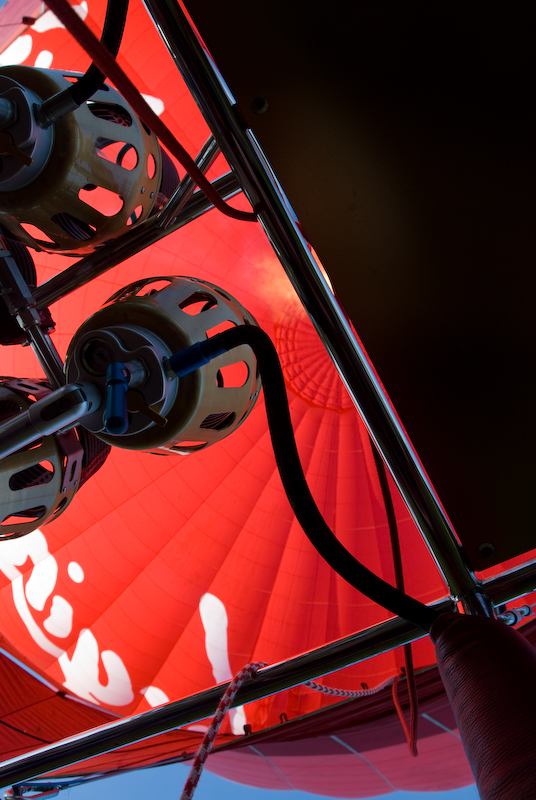
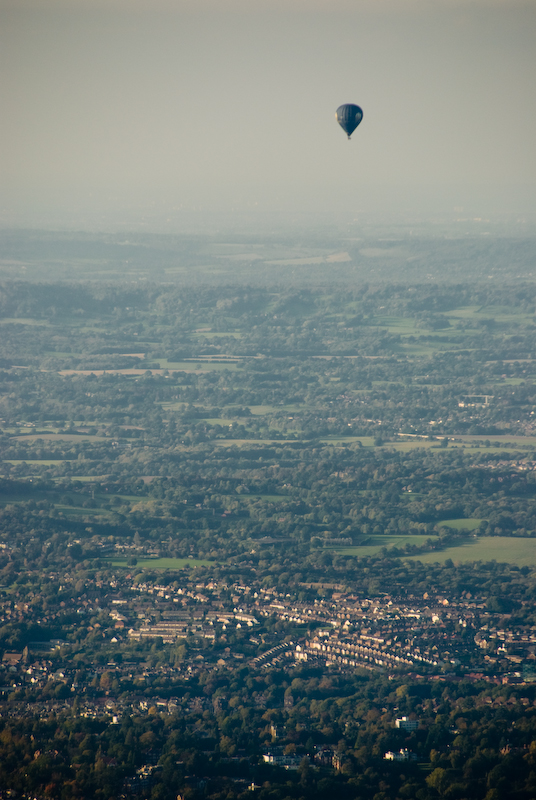
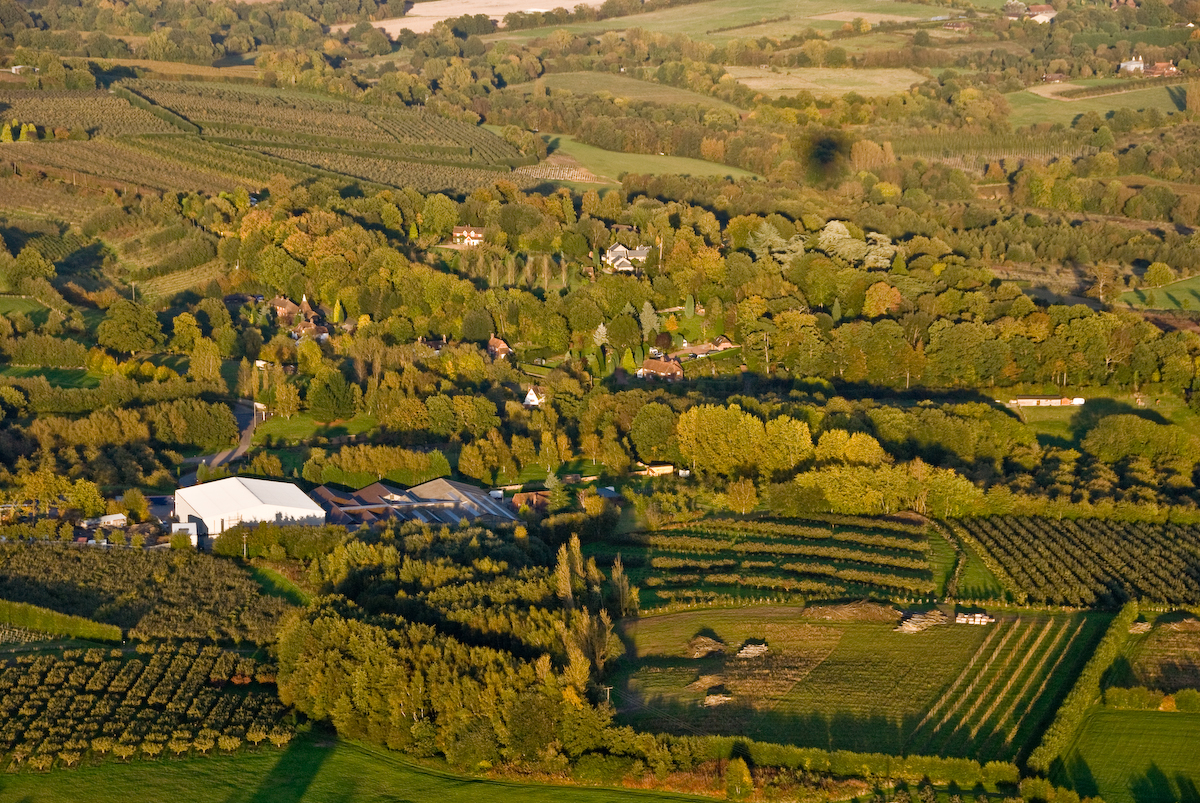
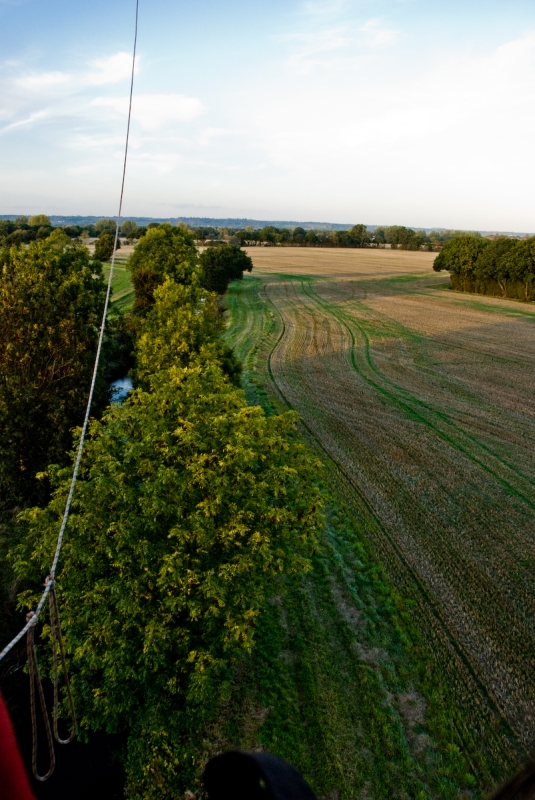
Gentle Readers: I welcome today Ron Dunning, author of the Jane Austen’s Family Website. Ron had written here before on Horsmonden in “Jane Austen and the Huguenots” – but today he tells of a hot air balloon ride he and his wife Helena took in 2008 where he took these wonderful pictures of Kent and the surrounding countryside – enjoy the ride!
*******
Sheep
Horsmonden from on High
by Ron Dunning
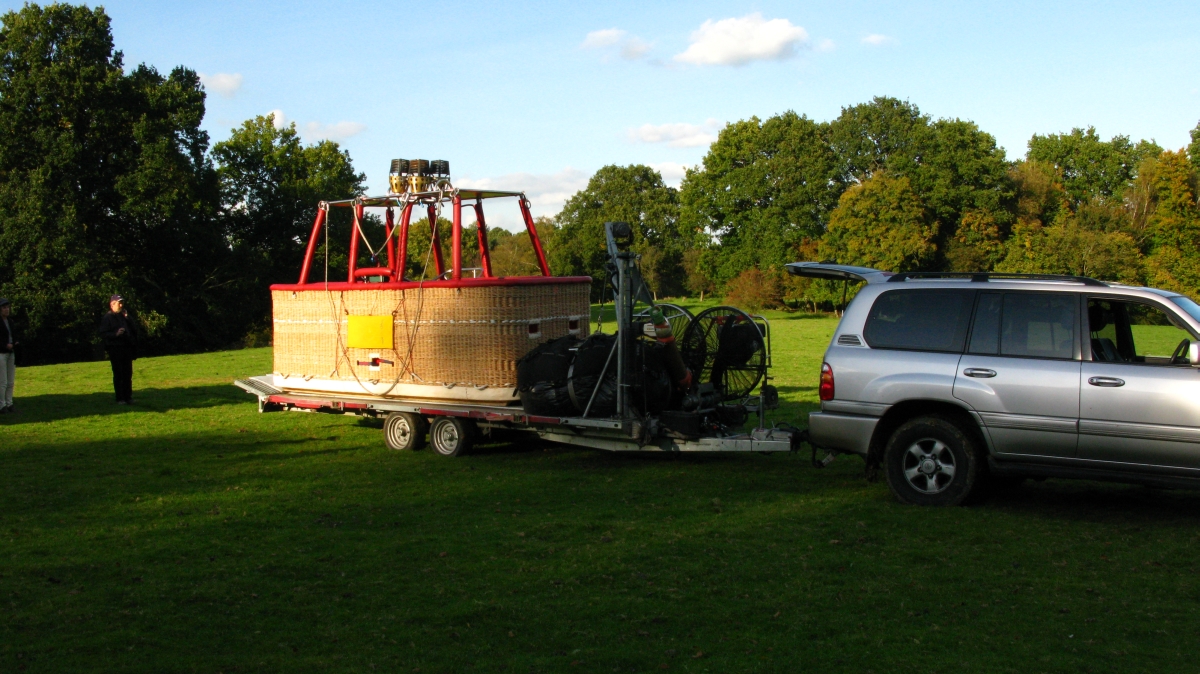
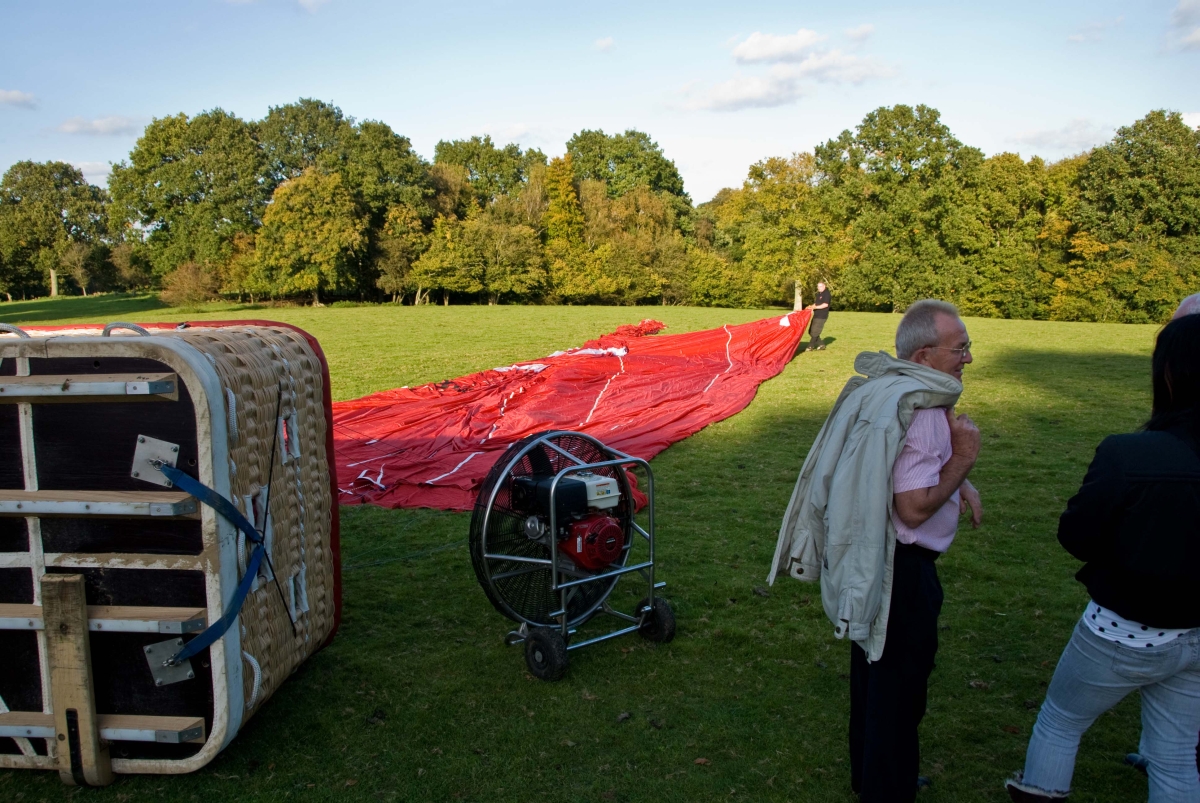
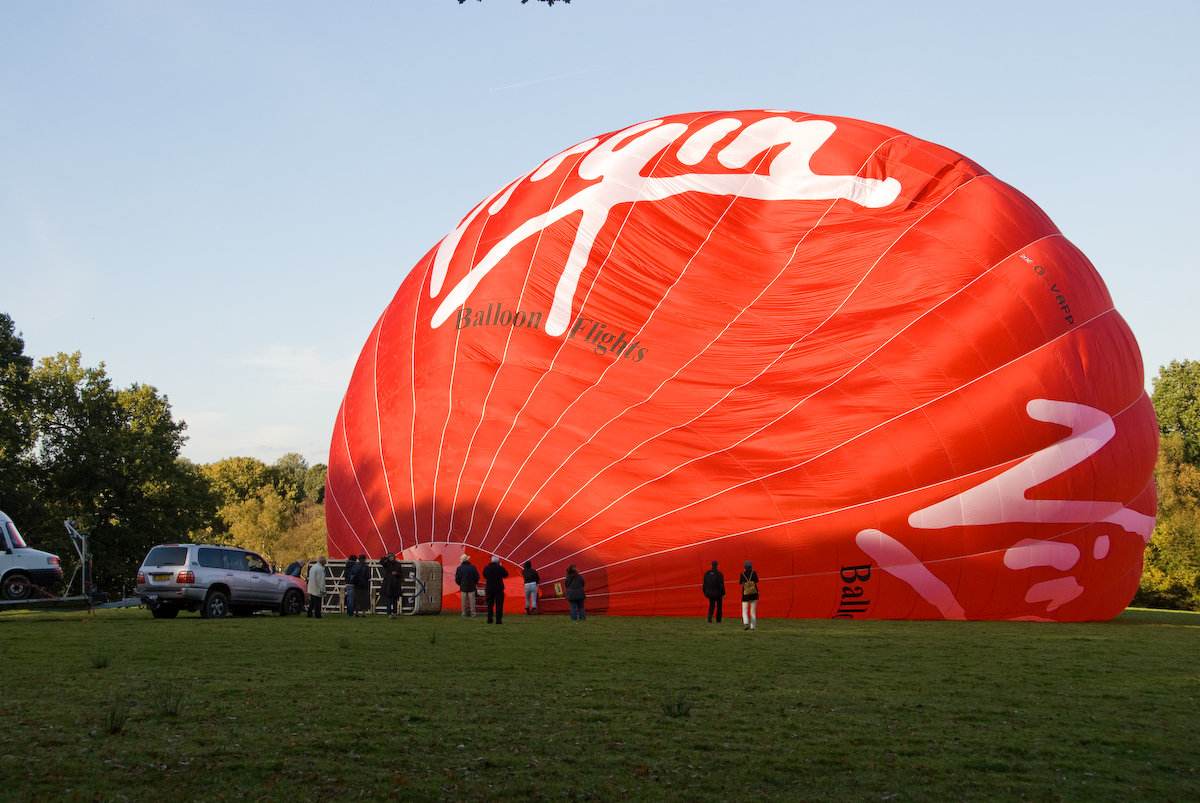
For my birthday in the spring of 2008 Helena, my wife, bought me a ticket for a hot-air balloon flight. I preferred to share the pleasure, so I waited till her birthday a few months later, and bought one for her. The weather that summer was very wet, and it wasn’t possible to book a flight until early October. We chose a launch site in Wadhurst, on the Sussex border with Kent, an area that we know and love, on what turned out to be a golden Indian summer’s afternoon.
The direction of a balloon’s flight is entirely dependent on the wind. I had given no prior thought to the fact that the Austens’ ancestral heartland of Goudhurst and Horsmonden lay only some ten miles away, but the wind took us, at 12 mph, precisely in that direction. I only realised that this was our on our route as we passed over St Margaret of Antioch in Pisidia – Horsmonden’s parish church, with its collection of Austen graves and memorial brasses.
Till then I had simply been enjoying the wonderfully calm experience. (Even though a balloon flies a few thousand feet above ground level its passengers aren’t troubled by wind, since it is blown along at the same speed as the air.) Now I began to scan the horizon for Broadford, and possibly even Grovehurst, the Austen houses. I couldn’t find Broadford. It may have been possible to see it, but I wouldn’t have recognised it from the south, the direction from which we were travelling, since I’d only ever seen the front, which faces north.
Grovehurst lies at least a mile further beyond the village, in wooded country. The wind, and our so ground speed, had dropped. I spent the next fifteen minutes straining my eyes for a glimpse of the house, to no avail. Then, just as we were descending in search of a landing site in a friendly farmer’s field, and as the pilot was announcing a Gypsy site to the left, and as I had quite given up on spotting it, there was Grovehurst on the right. The pilot turned the balloon through 360 degrees (I don’t know how he managed that!) for everyone to see, and marked the Austen’s ancestral home on his map to show future passengers.
I don’t believe that there is any record of Jane Austen’s visiting Horsmonden, where her grandfather William Austen was born. His heroic mother, Elizabeth Weller, had to take a housekeeping job at Sevenoaks School in 1708 to keep her family together, and that broke the Austens’ relationship with the village. It would not be an anachronism to imagine Jane, if she had visited, seeing her ancestral home by air – on 19 September 1783 Pilatre De Rozier, a scientist, launched the first hot air balloon called ‘Aerostat Reveillon.’ The first manned flight came two months later on November 21, with a balloon made by two French brothers, Joseph and Etienne Montgolfier.
At that time, when the fastest land transport proceeded at the rate of a trotting horse, ascending in a balloon and flying with the wind would have struck most people as terrifying and mad. As it happens my wife, who is normally fearless, asked me if I too had been worried. I confess that my imagination is generally vividly aware of consequences – and there we were at 2000 feet, with no parachutes, in a wicker laundry basket! But I was so absorbed in reconnaissance that I had forgotten to give the danger any thought.
ArrivalStill a Blank SlateTaking Shape ITaking Shape IIInflationInflation IIFiring upRising UpRising Up IILifting OffAloftNeighbour!Bayham Abbey RuinsLamberhurstBewl WaterSt Margaret of Antioch in PisidiaHorsmondenGrovehurstKentGroundlingsPursuit VehicleLanding StripSkid MarksPacking UpStowing Away
**********
Thank you Ron for this beautiful travelogue of Kent from the air!
I have to add that I have won a raffle only one time in my life, and that was for a hot-air balloon ride – it was quite the adventure, a totally unique experience of floating above the world without the usual noisy airplane sounds, so quiet and peaceful that I never wanted it to end – but we had a sudden wind pick-up and took off away from the tracer car [and my family who were following – my son, 7 years old at the time thought I had disappeared into the ether, never to be seen again; my nearly teenaged daughter was hoping beyond hope that was true!] and had a quite dramatic crash landing at a reservoir, all diving out of the basket to keep the balloon from falling into the water – but alas! my pictures, though quite lovely of the Connecticut countryside, are all on slides and do not, believe it or not, have anything to do with Jane Austen…
Anyone want to comment on Ron’s journey and photographs? or add any of your own ballooning adventures [whether Jane Austen-related or not!]?
Text and images copyright by Ronald Dunning, with thanks!
Syrie James on her new novel “Jane Austen’s First Love” – don’t miss out on the giveaways from Austenprose and others on the Blog Tour! Can’t wait to read this – Love Syrie James’ books!
I am very pleased to welcome author Syrie James to Austenprose today to officially open her virtual book launch party and blog tour of Jane Austen’s First Love, published by Berkley Trade. This new Austenesque novel is a fascinating combination of fact and fiction, exploring the first romance of fifteen year-old Jane Austen with the handsome and sophisticated Edward Taylor.
Syrie has generously offered a guest blog sharing her inspiration to write her new book—and to add to the festivities—we will be offering an amazing selection of giveaways including: trade paperback copies of Jane Austen’s First Love, a muslin tote bag stuffed with Jane Austen goodies, and a specially commissioned painting inspired by the novel. Just leave a comment following this blog post to enter. The contest details are listed below. Good luck to all.
Dear Gentle Readers: Today I welcome Margaret Harrington, a member of JASNA and happily for us, the Vermont Region. Margaret recently returned from her immersion in Sense and Sensibility at the Jane Austen Summer Program at UNC Chapel Hill, June 12-15, 2014. She shares with us her thoughts with pictures – looks to have been a delightful adventure!
**************
The Jane Austen Summer Program at UNC ~
“Sense & Sensibility Revisited”
by Margaret Harrington, JASNA Vermont member
Jane Austen’s juvenilia play “Jack and Alice” given a lively performance
I experienced blissful immersion in Jane Austen’s novel Sense and Sensibility during this four day conference at the University of North Carolina, Chapel Hill. From the gracious reception at the UNC Friday Center throughout the days and evenings of serious enjoyment, I conclude that this was a wonderful personal adventure. There were lectures, teas, regency dancing, a play, movies, intense conversations about Jane Austen, and some thunder storms. The conference offered study of the book itself, provided insight into the culture in which it was written, and even gave a pleasant glimpse of one or two aspects of contemporary culture in the American south.
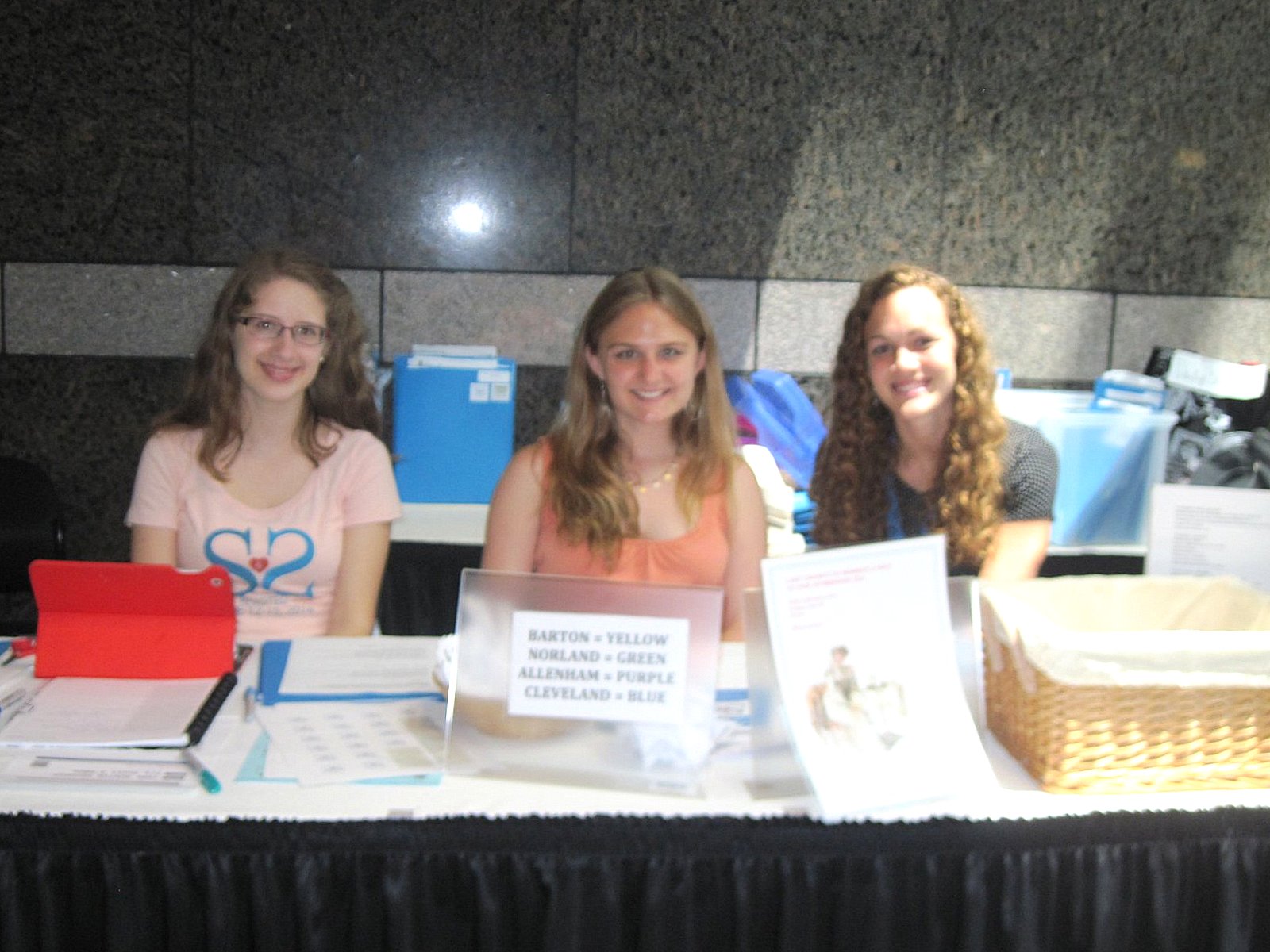
A warm welcome from Emma, Emily and Rachel at the UNC Friday Center
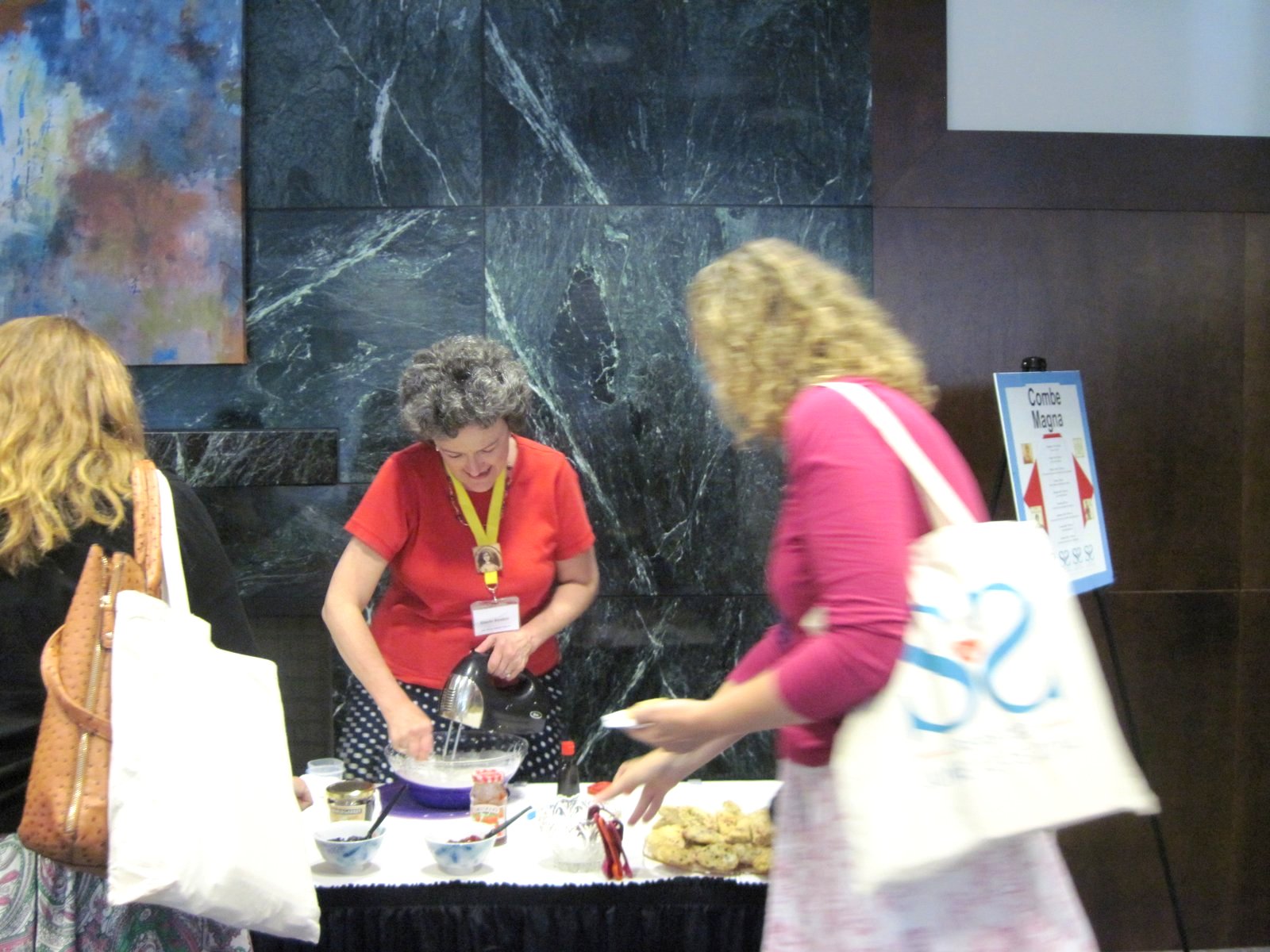
‘Elevenses’ of clotted cream and scones dished up by Gisele Rankin of JASNA North Carolina
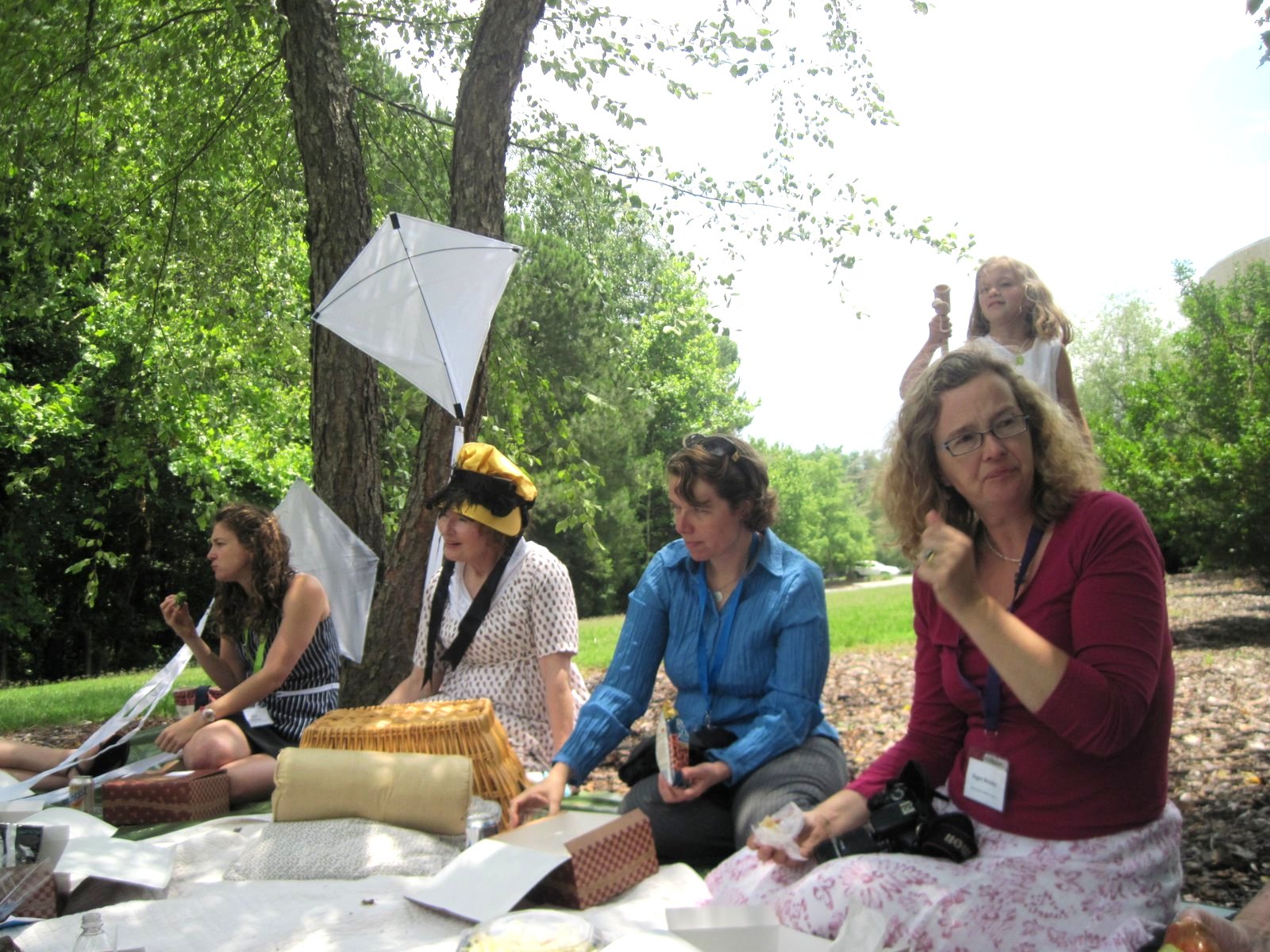
Lunch on the lawn with kite flying and shuttlecock
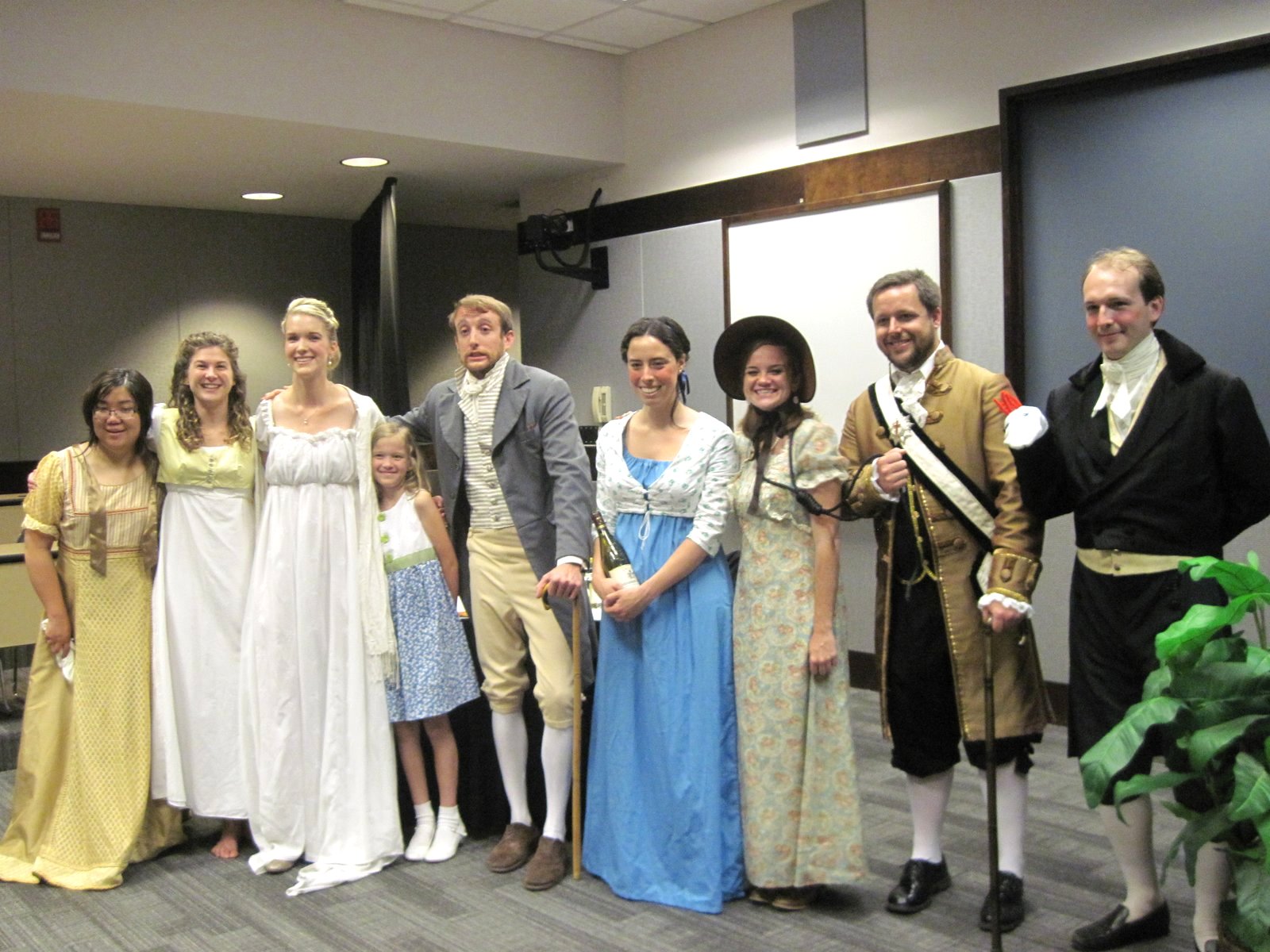
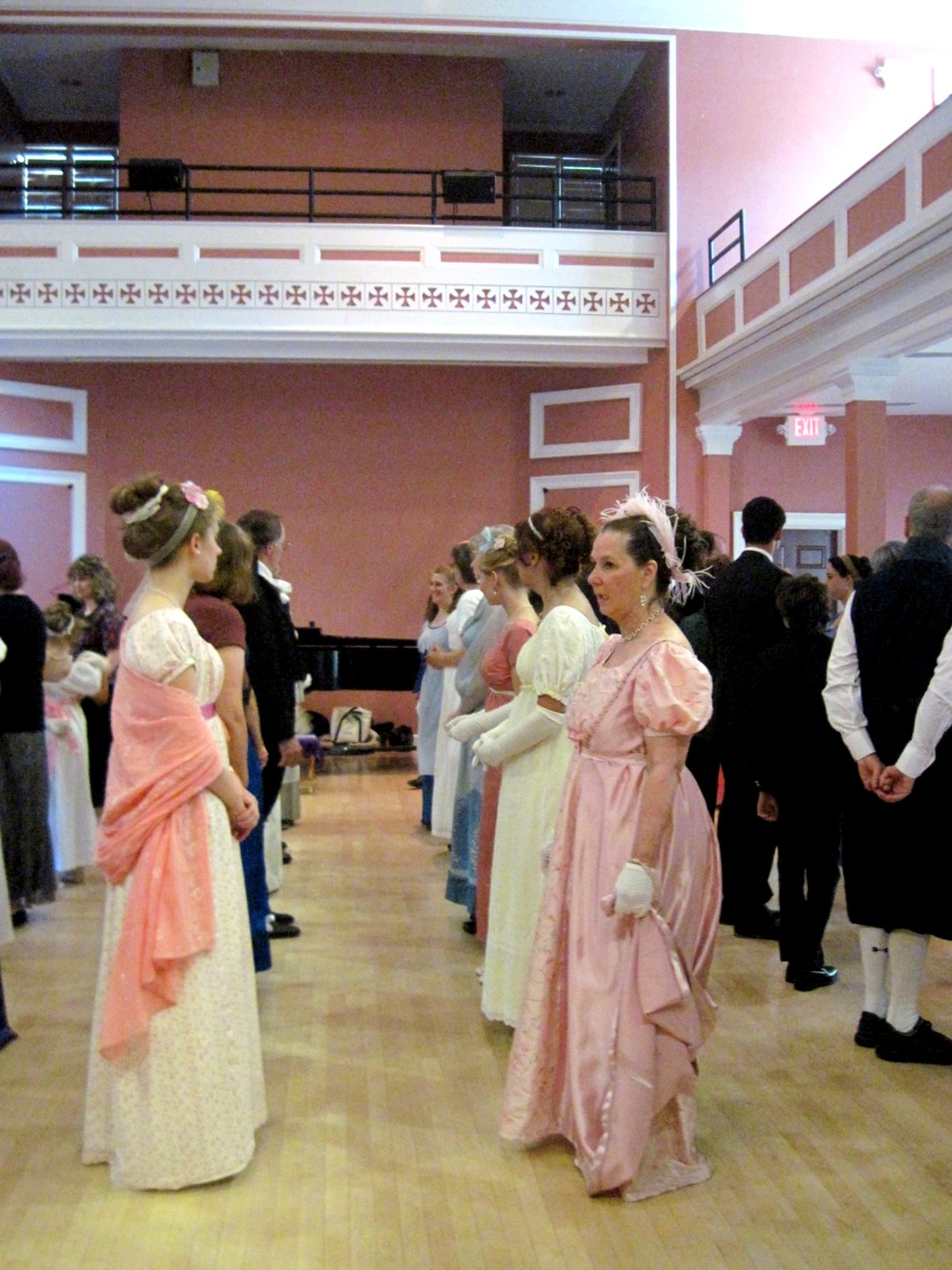
The ‘Sense and Sensibility’ Ball at Gerrard Hall, UNC
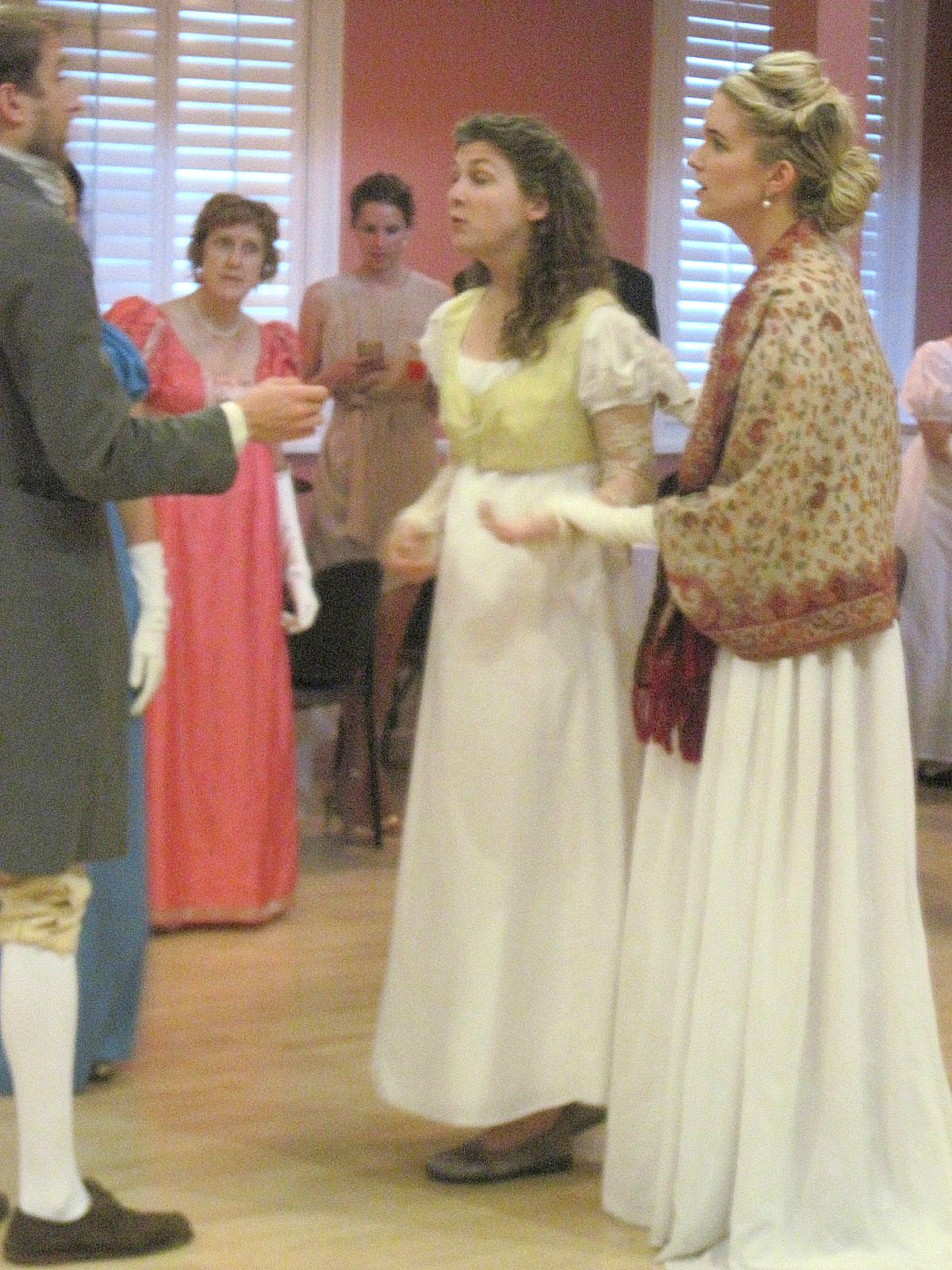
Drama at the Sense and Sensibility Ball
************
Dr. James Thompson of UNC-Chapel Hill co-hosted the event and set the tone for the conference as both formally educational and informally warm and welcoming.
Inger Brodey
The initial lecture by his co-host Dr. Inger Brodey, also of UNC-Chapel Hill, entitled “Making Sense of Sensibility” placed us in the Regency world of the philosophers and other writers who influenced Jane Austen’s concepts. I gleaned from this opening lecture that to interpret the novel as a dichotomy between sense and sensibility or as a tension between the two mind sets of Marianne and Elinor is to limit perception. Professor Brodey opened up a whole world of ideas which were accessible to Austen and evidenced in her writing and showed me that Sense and Sensibility has a richness of texture I had not been aware of prior to the lecture.
In fact the days were planned to deepen understanding of the novel with 15 minute context corners on the subjects of Law and Inheritance, Childhood and Education, Medicine and Illness, and the Clergy and the Church. These were followed with 45 minute Context Response sessions during which we, the participants, exchanged ideas. Then of course there were ‘Elevenses’ with scones and clotted cream. There were boxed lunches on the lawn with kites, battledore and shuttlecock as period entertainment. There were dance workshops to prepare us for the Regency ball. There was an amusing and informative lecture by Colgate University Professor Deborah Knuth Klenck on: “Jane Austen’s School of Rhetoric: Style, Substance and ‘Delicacy of Mind.’”
Jade Bettin, UNC-Chapel Hill, demonstrates (on a willing participant) the way to corset up properly during her lecture “‘But he talked of flannel waistcoats’: How Clothing Makes the Men and Women of S&S.”
Dr. Robert Clark, University of East Anglia, Norwich, England, author of The Literary Encyclopedia, was an amazing speaker in the two lectures he gave to expand and deepen our understanding of Sense and Sensibility. In the first he concentrated on the economic facts that drove Jane Austen’s world, such as The Inclosure Act of 1773, which diminished the number of people who could own land to under 500 in all of England, entitling an oligarchical society to the prestige and privileges Austen’s characters scramble so hard to hold onto in her novels. In his second lecture entitled “The White Glare of Bath,” Professor Clark made Jane Austen’s playground of intrigue, balls, and shopping come alive up from the ground in the white stones and mortar and rubble that savvy developers offered to the rich for their recreational homes. In his remarkable lecture I could see Jane Austen moving about Bath, shopping and promenading, visiting, plotting her novels.
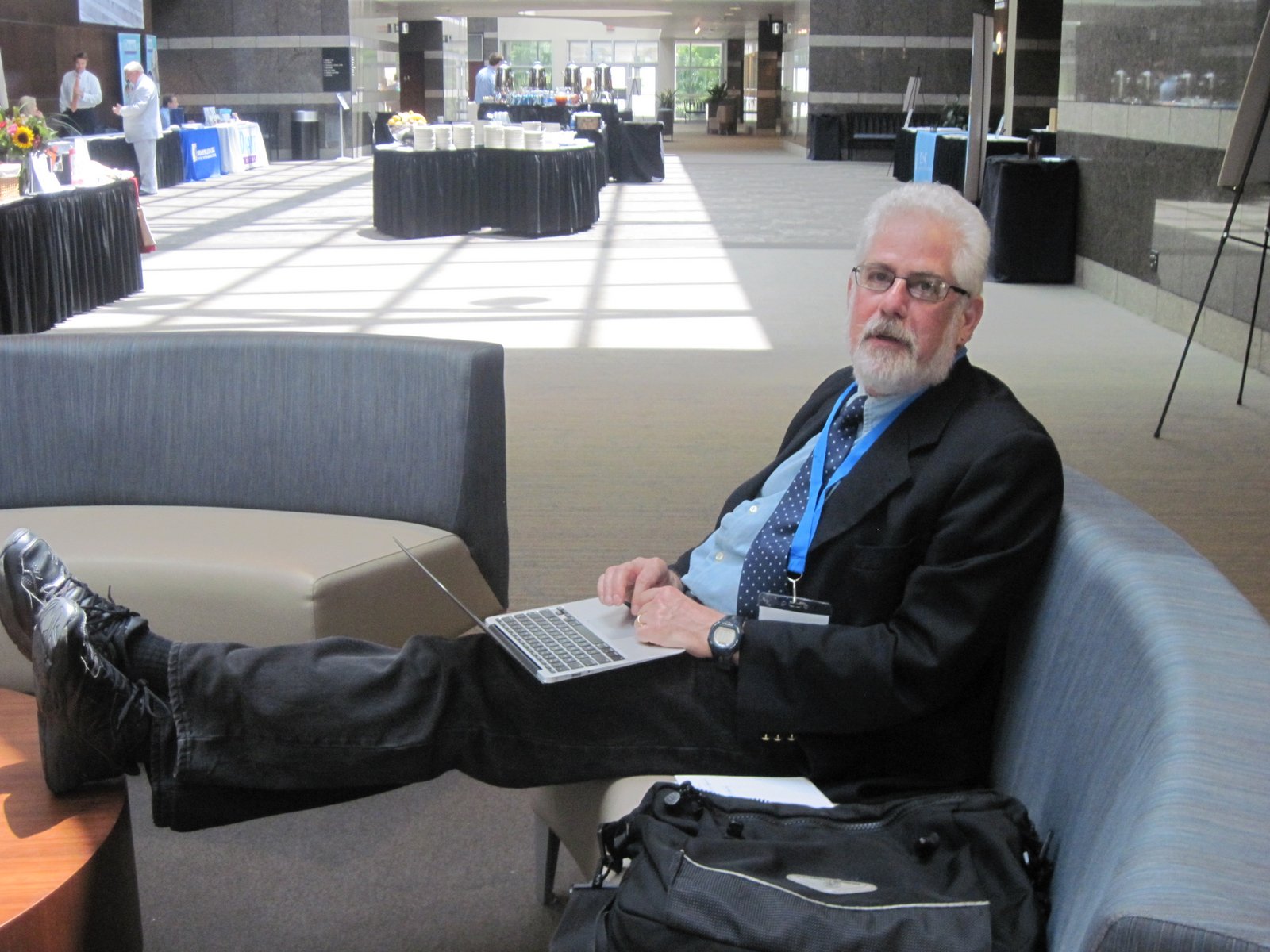
Dr. Robert Clark relaxes a moment after his talk on Bath
***********
All in all my experience was totally wonderful and I’d recommend it to Janeites everywhere. Next year’s conference is entitled “Emma at 200.”
Imagine that!
I leave you with a picture of Janeite Maureen O’Connor who attended the conference from far away Brooklyn and dressed authentically for every occasion:
Maureen O’Connor
Text and images by Margaret Harrington, with thanks!
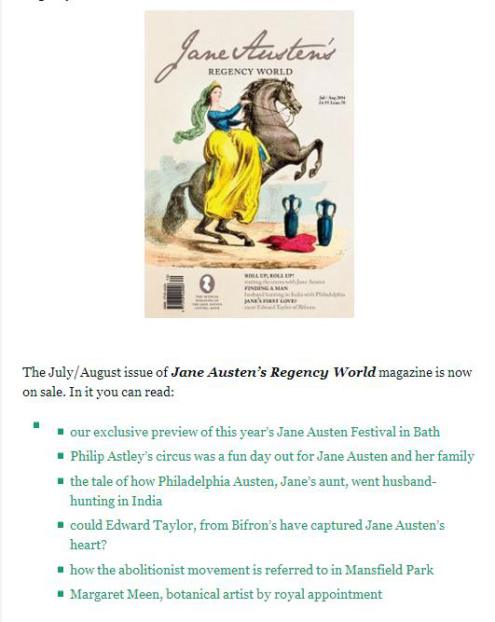
Just thrilled to bits to see the release of the July/August issue of Jane Austen’s Regency World magazine: my article on Margaret Meen is included:
Margaret Meen – believed by some to have been governess to the four Smith sisters of Erle Stoke Park – AKA, Lady Northampton, Mrs Chute, Mrs Smith and Miss Smith – was definitely a painter (on vellum and paper) of botanicals, and a teacher. Including, as the JARW line suggests: to the Royal family of Queen Charlotte and her girls. I truly hope that I’ve uncovered a bit of “life” for this somewhat undiscovered artist — and invite you to seek out a copy of the full-color publication that promises to deliver “EVERYTHING that is happening in the world of Jane Austen“, including this tidbit of Smith & Gosling history.
Commissioned by the producers of the new movie Belle, acclaimed biographer Paula Byrne aims to reveal the true story behind the main characters in the movie: Dido Elizabeth Belle, the illegitimate daughter of a captain in the Royal Navy and an African slave, and her great-uncle, William Murray, 1st Earl of Mansfield (1705-93) and Lord Chief Justice of the King’s Bench. Belle: The Slave Daughter and the Lord Chief Justice is both a companion volume to the popular movie and a time capsule into the turbulent abolition movement in the late eighteenth-century England.
Inspired by the 1779 portrait of Dido and her cousin Lady Elizabeth Murray, screenwriter Misan Sagay has written a compelling story based on facts she first learned of while visiting the 2007, Slavery and Justice Exhibition. Dido and Elizabeth were Lord Mansfield’s wards and raised together at…
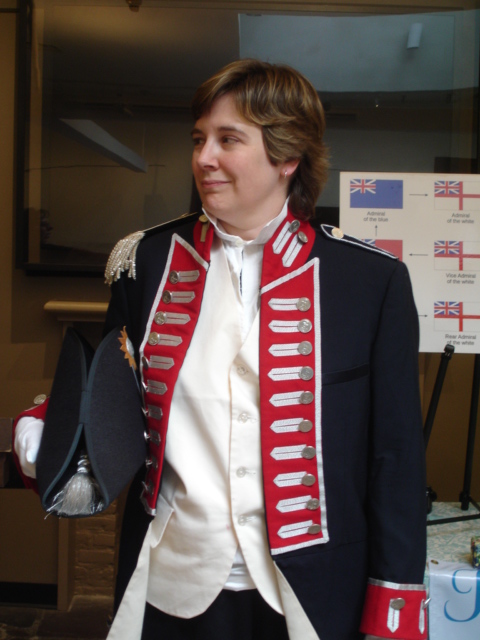
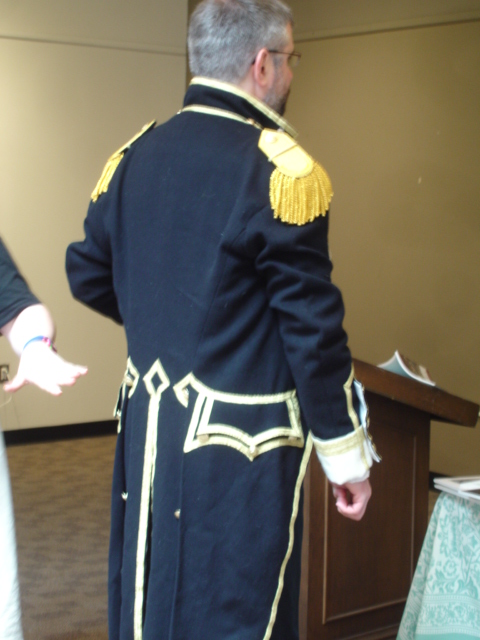
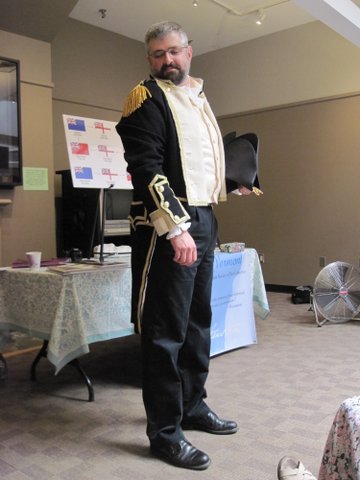
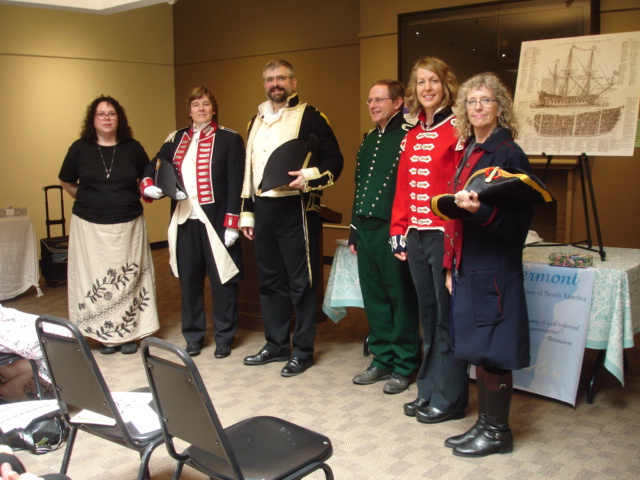
With hearty thanks to Lisa Brown for sharing her love of the Royal Navy with us Vermont Janeites, and to Marie Sprayberry for telling us of her shared-with-Jane rabid dislike of the Prince Regent and why, and displaying examples from her Georgian era royal collectibles – a most delightful day, despite the intense heat of Burlington’s heat wave and the Fletcher Free Library’s air conditioning on the fritz… [I have now successfully subjected our members and guests to one freezing December Tea where the computerized heating system refused to cooperate and we listened most intently to the two speakers, quietly shivering in our winter coats; and now the reverse of overheating the same members and guests with no air and loud fans in the skylight heated Pickering Room – as one guest bravely noted – “it was all a cost-free day in a sauna” ] – I find I have some control over these meetings, but alas! minus zero control over the weather and heating / cooling system snafus – I do apologize and thank you for your tolerance and good grace as an audience…
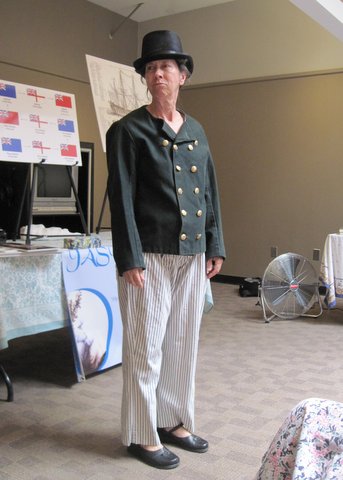
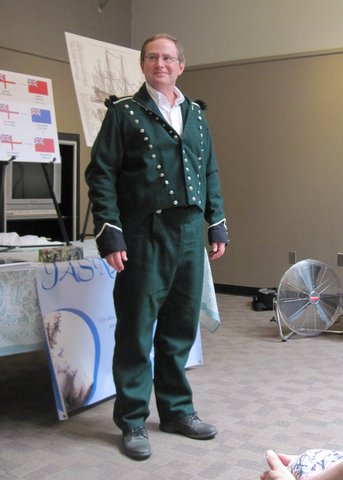
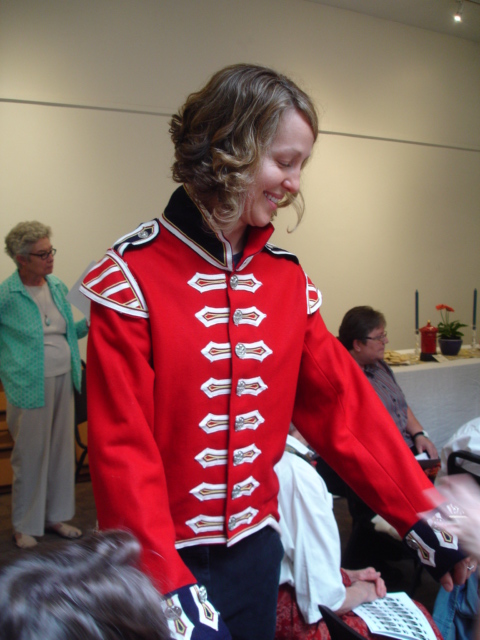
That said, extra kudos go to the models who courageously wore their wool-clad Royal Navy uniforms with elegance and style, as they paraded for us samples from Lisa’s wonderful collection. Here are a few pictures with descriptions of each, with thanks to our fearless models for being such good sports:
Marilyn as appropriately clad “able seaman”
[photo: c2014 M. Harrington]
And a group shot of us all with Lisa (minus the able seaman, who had left to swab the deck), and with yours truly in the quickly donned uniform of a French Navy Lieutenant.
*************************
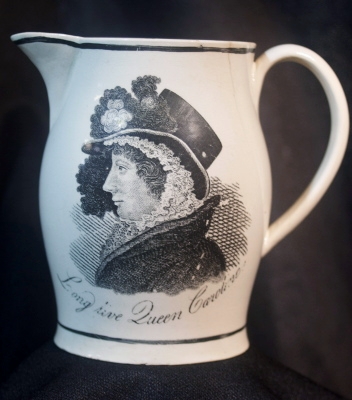
Marie’s talk on the Prince Regent was cut short near the end by the heat and near fainting attendees, which was too bad as we were all quite taken with her chat on the dastardly Prince and his wicked ways – you can read the rest of her talk here in Persuasions-OnLine 33.1 (2012):
“Long Live Queen Caroline!” ceramic jug (1820)
[from the collection of A. Marie Sprayberry and Edward R. Voytovich;
photo by E. Voytovich] [see the POL article for more images of Marie’s collection]
****************
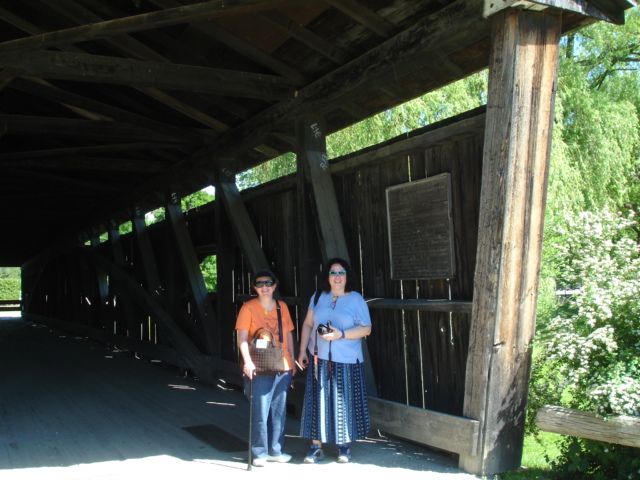
All in all a great day, with a great audience, and a fun weekend with Marie and Lisa, here cavorting about at the incomparable Shelburne Museum… Marie (left) and Lisa (right) on a Vermont covered bridge:
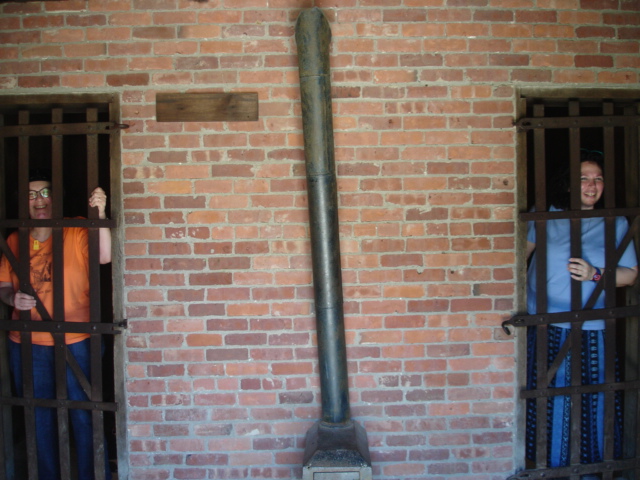
Gaoled JASNA Regional Coordinators Marie and Lisa (hoping to be released in time for the Montreal AGM]
[All images c2014 by Deb Barnum, unless otherwise noted; and with special thanks to Margaret Harrington!]
Lisa Brown will present an enlightening talk on how the Royal Navy figures in Mansfield Park and Persuasion. We will learn about the uniforms, the ships, the rating system, prize money, and more; as well as discover how very knowledgeable Jane Austen was about the Royal Navy because of her brothers’ involvement. Various uniforms will be on display – but, alas! without a Captain Wentworth in sight!
A. Marie Sprayberry investigates why Jane Austen wrote of the Princess of Wales in 1813: “Poor Woman, I shall support her as long as I can, because she is a Woman, & because I hate her Husband.” The Prince Regent brazenly personified the three themes of sex, money, and power – as long as the money was someone else’s! But did Jane Austen have particular reasons for disdaining him? And how might her views of the Prince have influenced her work? Photos of contemporary royal commemorative china and medals will illustrate the talk, all from Marie’s collection.
*Lisa and Marie are co-regional coordinators of the Syracuse Region; Lisa also co-chairs the Rochester Region, is an ECD teacher, owns a Regency era costume business, and has given various talks on the Royal Navy and Regency fashion; she works as a proof reader. Marie has spoken to JASNA on the Prince Regent and will be speaking at the Montreal AGM on “Fanny Price as Fordyce’s Ideal Woman?” She works from her Syracuse home for a NYC-based publisher.
Free & open to the public ~ Light refreshments served
Not sure about anyone else out there, but I’ve always thought Tom Bertram as nearly a throwaway character – other than the plot device of his being the eldest son and heir, which sort of messes everything up for Edmund and Mary, for what purpose is he in Mansfield Park? He leaves the action early on to go to Antigua with Sir Thomas, and like Mary Crawford, we soon forget all about him … He brings grief to the Park with his profligate ways, but as a character, who is he really?
On this latest re-read of MP, I decided to pay close attention to Mr. Bertram, and find to my surprise and delight that he is quite the Talker! – He babbles on incessantly about all manner of things, often for a laugh-out-loud moment! Who knew MP was so funny??
I give here one such example; it is a long passage but just read it through – I promise a few laughs! – and then I wonder what your thoughts are about Tom – tell me in the comments below…
The scene: Fanny at her first Ball, a very spontaneous Ball pulled together at Mansfield Park – [Vol. I, Ch. xii]
Fanny could listen no farther. Listening and wondering were all suspended for a time, for Mr. Bertram was in the room again; and though feeling it would be a great honour to be asked by him, she thought it must happen. He came towards their little circle; but instead of asking her to dance, drew a chair near her, and gave her an account of the present state of a sick horse, and the opinion of the groom, from whom he had just parted. Fanny found that it was not to be, and in the modesty of her nature immediately felt that she had been unreasonable in expecting it. When he had told of his horse, he took a newspaper from the table, and looking over it, said in a languid way, “If you want to dance, Fanny, I will stand up with you.” With more than equal civility the offer was declined; she did not wish to dance. “I am glad of it,” said he, in a much brisker tone, and throwing down the newspaper again, “for I am tired to death. I only wonder how the good people can keep it up so long. They had need be all in love, to find any amusement in such folly; and so they are, I fancy. If you look at them you may see they are so many couple of lovers—all but Yates and Mrs. Grant—and, between ourselves, she, poor woman, must want a lover as much as any one of them. A desperate dull life hers must be with the doctor,” making a sly face as he spoke towards the chair of the latter, who proving, however, to be close at his elbow, made so instantaneous a change of expression and subject necessary, as Fanny, in spite of everything, could hardly help laughing at. “A strange business this in America, Dr. Grant! What is your opinion? I always come to you to know what I am to think of public matters.”
“My dear Tom,” cried his aunt soon afterwards, “as you are not dancing, I dare say you will have no objection to join us in a rubber; shall you?” Then leaving her seat, and coming to him to enforce the proposal, added in a whisper, “We want to make a table for Mrs. Rushworth, you know. Your mother is quite anxious about it, but cannot very well spare time to sit down herself, because of her fringe. Now, you and I and Dr. Grant will just do; and though we play but half–crowns, you know, you may bet half–guineas with him.”
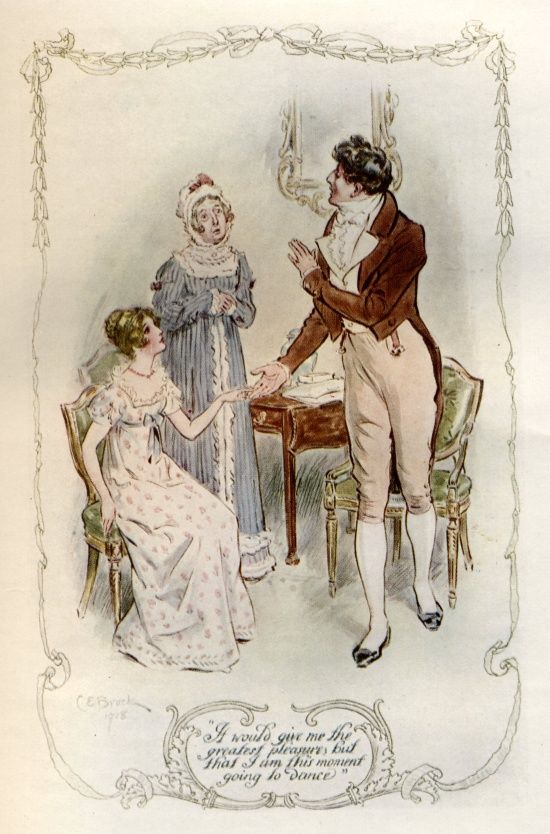
“I should be most happy,” replied he aloud, and jumping up with alacrity, “it would give me the greatest pleasure; but that I am this moment going to dance.” Come, Fanny, taking her hand, “do not be dawdling any longer, or the dance will be over.”
Fanny was led off very willingly, though it was impossible for her to feel much gratitude towards her cousin, or distinguish, as he certainly did, between the selfishness of another person and his own.
“A pretty modest request upon my word,” he indignantly exclaimed as they walked away. “To want to nail me to a card–table for the next two hours with herself and Dr. Grant, who are always quarrelling, and that poking old woman, who knows no more of whist than of algebra. I wish my good aunt would be a little less busy! And to ask me in such a way too! without ceremony, before them all, so as to leave me no possibility of refusing. That is what I dislike most particularly. It raises my spleen more than anything, to have the pretence of being asked, of being given a choice, and at the same time addressed in such a way as to oblige one to do the very thing, whatever it be! If I had not luckily thought of standing up with you I could not have got out of it. It is a great deal too bad. But when my aunt has got a fancy in her head, nothing can stop her.”
*******************************
The above scene is depicted by C. E. Brock in the Mansfield Park of 1908 [Mollands]
There are more such scenes with Tom I shall post on – but I just love this one, with Fanny sitting there and nervously thinking that he must ask her to dance, but he just goes on and on about a sick horse and Mrs. Grant in need of a proper lover…
Do you have a favorite scene that stars Tom Bertram?? Or, who is your favorite Tom Bertram at the Movies? My personal favorite, I must confess, is…..
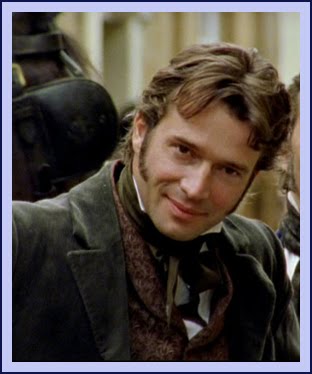
…. James Purefoy as Tom Bertram – Mansfield Park (1999) [Pinterest]

 About the Author: Syrie James, hailed by Los Angeles Magazine as “the queen of nineteenth century re-imaginings,” is the bestselling author of nine critically acclaimed novels including The Missing Manuscript of Jane Austen (“A literary feast for Anglophiles”—Publisher’s weekly), The Lost Memoirs of Jane Austen (named one of the best first novels of the year by Library Journal), and The Secret Diaries of Charlotte Brontë (Audie Award, Romance 2011; Great Group Read, Women’s National Book Association). Syrie’s books have been translated into eighteen languages. She is a member of the Writer’s Guild of America and a life member of JASNA. Follow Syrie on twitter, visit her on facebook, and learn more about her and her books at syriejames.com.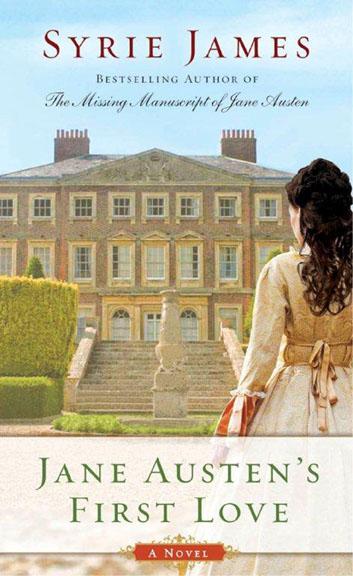



















 From the desk of Laurel Ann Nattress: