Austen Literary History & Criticism · Collecting Jane Austen · Jane Austen · JASNA · Literature

Happy Birthday Jane Austen!

The first order of business today, on this 238th birthday of Jane Austen, is the annual publication of JASNA’s Persuasions On-Line Vol. 34, No. 1 (Winter 2013). Click here for the Table of Contents to yet another inspiring collection of essays, some from the 2013 AGM in Minneapolis on Pride and Prejudice, and other “Miscellany” – all about Jane Austen…and perfect winter reading material…

Here is the link: http://www.jasna.org/persuasions/on-line/vol34no1/index.html

pollogo

I will posting other things today, so please stay tuned!

c2013 Jane Austen in Vermont
Austen Literary History & Criticism · Books · Jane Austen · Jane Austen Popular Culture · Literature

Mr. Darcy’s Feelings; Or, More on the Inner Life of Jane Austen’s Hero…Part II

Please see the first post on Mr. Darcy’s Feelings – Pride and Prejudice Vol. I here

Now on to Volume II!

Skipping through the text to locate just commentary on Mr. Darcy’s feelings and instances of Elizabeth’s professed dislike of the man leaves out an awful lot of interesting passages – taking Jane Austen out of context is a dangerous thing! – we have missed Mr. Collins and his rejected proposal entirely! always too wonderful to skim over – for here we learn more about Elizabeth and her feelings on marriage and friendship than anywhere else in the novel.  I have always thought she is very quick to judgment on Charlotte’s choice of a partner – she forgets what is clear in the text to us and would have been for contemporary readers – that Charlotte is a rational creature and knows she has little choice if she is to have a “comfortable home” of her own… even the narrator is critical of Elizabeth, described as “less clear-sighted” in the case of Wickham’s marrying for money and independence than she is of her friend’s similar decision, a crucial point in seeing Elizabeth’s own prejudices.

CEBrock-collinsproposal-mollands

C. E. Brock. “Almost as soon as I entered the house I singled you out as the companion of my future life.”
P&P. Macmillan, 1895. Volume I, Ch. 19 [Mollands]

But I digress – we shall leave Mr. Collins and continue in search of Mr. Darcy’s feelings…

***********

Elizabeth blames Darcy for taking Bingley away, and he is “condemned [by everybody, except Jane Bennet] as the worst of men” (p. 107)* – she rants:

p. 119.

“Oh! if that is all, I have a very poor opinion of young men who live in Derbyshire; and their intimate friends who live in Hertfordshire are not much better. I am sick of them all. Thank Heaven! I am going to-morrow where I shall find a man [Collins] who has not one agreeable quality, who has neither manner nor sense to recommend him. Stupid men are the only ones worth knowing, after all.”

[And Darcy as always, though nowhere to be found in the book here, is not far from her thoughts, as so on seeing Miss De Bourgh:]

p. 122.

“I like her appearance,” said Elizabeth, struck with other ideas. “She looks sickly and cross. Yes, she will do for him very well. She will make him a very proper wife.”

p. 125. [on meeting Lady Catherine for the first time:]

??????????????????? Lady Catherine –  P&P 1995

When, after examining the mother, in whose countenance and deportment she soon found some resemblance of Mr. Darcy…

p. 131.

Elizabeth had heard soon after her arrival that Mr. Darcy was expected there in the course of a few weeks, and though there were not many of her acquaintance whom she did not prefer, his coming would furnish one comparatively new to look at in their Rosings parties, and she might be amused in seeing how hopeless Miss Bingley’s designs on him were, by his behaviour to his cousin, for whom he was evidently destined by Lady Catherine, who talked of his coming with the greatest satisfaction, spoke of him in terms of the highest admiration, and seemed almost angry to find that he had already been frequently seen by Miss Lucas and herself.

p. 131. [The ever-observant Charlotte]:

…and to the great surprise of all the party, when Mr. Collins returned, the gentlemen [Darcy and Col. Fitzwilliam] accompanied him. Charlotte had seen them from her husband’s room crossing the road, and immediately running into the other, told the girls what an honour they might expect, adding —

“I may thank you, Eliza, for this piece of civility. Mr. Darcy would never have come so soon to wait upon me.”

Elizabeth had scarcely time to disclaim all right to the compliment before their approach was announced by the door-bell, and shortly afterwards the three gentlemen entered the room. Colonel Fitzwilliam, who led the way, was about thirty, not handsome, but in person and address most truly the gentleman. Mr. Darcy looked just as he had been used to look in Hertfordshire — paid his compliments, with his usual reserve, to Mrs. Collins, and whatever might be his feelings towards her friend, met her with every appearance of composure. Elizabeth merely curtseyed to him, without saying a word.

p. 132. Col. Fitzwilliam and Elizabeth at the pianoforte:

Mrs. Collins’s pretty friend had moreover caught his fancy very much. He now seated himself by her, and talked so agreeably of Kent and Hertfordshire, of travelling and staying at home, of new books and music, that Elizabeth had never been half so well entertained in that room before; and they conversed with so much spirit and flow, as to draw the attention of Lady Catherine herself, as well as of Mr. Darcy. His eyes had been soon and repeatedly turned towards them with a look of curiosity…

p. 133.

[Lady Catherine] “…though Mrs. Collins has no instrument, she is very welcome, as I have often told her, to come to Rosings every day, and play on the piano forte in Mrs. Jenkinson’s room. She would be in nobody’s way, you know, in that part of the house.”

 Mr. Darcy looked a little ashamed of his aunt’s ill-breeding, and made no answer. 

p. 133-35. [a long passage but one the most important exchanges between them; and notice Darcy’s smiles!]

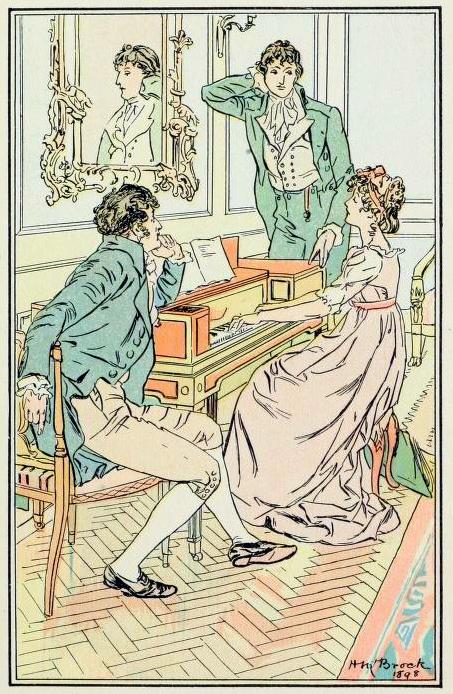
He [Col. Fitzwilliam] drew a chair near her. Lady Catherine listened to half a song, and then talked, as before, to her other nephew; till the latter walked away from her, and moving with his usual deliberation towards the pianoforte, stationed himself so as to command a full view of the fair performer’s countenance. Elizabeth saw what he was doing, and at the first convenient pause, turned to him with an arch smile, and said –

CEBrock-atpianoforte-adelaide

H. M. Brock. “At the pianoforte”. P&P. Dent, 1898 [Adelaide]

“You mean to frighten me, Mr. Darcy, by coming in all this state to hear me? But I will not be alarmed though your sister does play so well. There is a stubbornness about me that never can bear to be frightened at the will of others. My courage always rises with every attempt to intimidate me.”

“I shall not say that you are mistaken,” he replied, “because you could not really believe me to entertain any design of alarming you; and I have had the pleasure of your acquaintance long enough to know that you find great enjoyment in occasionally professing opinions which in fact are not your own.”

Elizabeth laughed heartily at this picture of herself, and said to Colonel Fitzwilliam, “Your cousin will give you a very pretty notion of me, and teach you not to believe a word I say. I am particularly unlucky in meeting with a person so well able to expose my real character, in a part of the world where I had hoped to pass myself off with some degree of credit. Indeed, Mr. Darcy, it is very ungenerous in you to mention all that you knew to my disadvantage in Hertfordshire — and, give me leave to say, very impolitic too — for it is provoking me to retaliate, and such things may come out as will shock your relations to hear.”

“I am not afraid of you,” said he smilingly.

“Pray let me hear what you have to accuse him of,” cried Colonel Fitzwilliam. “I should like to know how he behaves among strangers.”

“You shall hear then — but prepare yourself for something very dreadful. The first time of my ever seeing him in Hertfordshire, you must know, was at a ball — and at this ball, what do you think he did? He danced only four dances! I am sorry to pain you — but so it was. He danced only four dances, though gentlemen were scarce; and, to my certain knowledge, more than one young lady was sitting down in want of a partner. Mr. Darcy, you cannot deny the fact.”

“I had not at that time the honour of knowing any lady in the assembly beyond my own party.”

“True; and nobody can ever be introduced in a ball room. Well, Colonel Fitzwilliam, what do I play next? My fingers wait your orders.”

“Perhaps,” said Darcy, “I should have judged better had I sought an introduction; but I am ill qualified to recommend myself to strangers.”

“Shall we ask your cousin the reason of this?” said Elizabeth, still addressing Colonel Fitzwilliam. “Shall we ask him why a man of sense and education, and who has lived in the world, is ill qualified to recommend himself to strangers?”

“I can answer your question,” said Fitzwilliam, “without applying to him. It is because he will not give himself the trouble.”

“I certainly have not the talent which some people possess,” said Darcy, “of conversing easily with those I have never seen before. I cannot catch their tone of conversation, or appear interested in their concerns, as I often see done.”

“My fingers,” said Elizabeth, “do not move over this instrument in the masterly manner which I see so many women’s do. They have not the same force or rapidity, and do not produce the same expression. But then I have always supposed it to be my own fault — because I would not take the trouble of practising. It is not that I do not believe my fingers as capable as any other woman’s of superior execution.”

Darcy smiled and said, “You are perfectly right. You have employed your time much better. No one admitted to the privilege of hearing you can think anything wanting. We neither of us perform to strangers.”

p. 135. [Elizabeth watching Mr. Darcy very closely!]

AnnedeBourgh-P&P2005

Anne de Bourgh. P&P 2005.

Elizabeth looked at Darcy to see how cordially he assented to his cousin’s praise; but neither at that moment nor at any other could she discern any symptom of love; and from the whole of his behaviour to Miss De Bourgh she derived this comfort for Miss Bingley, that he might have been just as likely to marry her, had she been his relation.

p. 136.

…when the door opened, and to her very great surprise Mr. Darcy, and Mr. Darcy only, entered the room.

He seemed astonished too on finding her alone, and apologised for his intrusion by letting her know that he had understood all the ladies to be within.

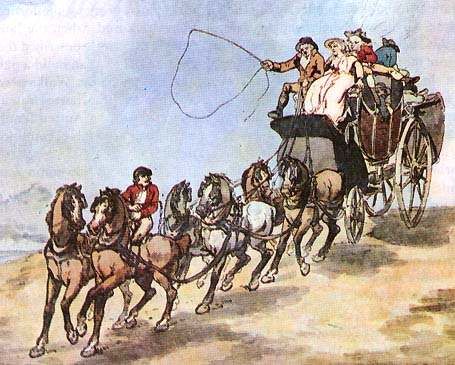
p. 137… [the “50 miles of good road” discussion, each misunderstanding the other…]

coach

“It must be very agreeable to her to be settled within so easy a distance of her own family and friends.”

“An easy distance, do you call it? It is nearly fifty miles.”

“And what is fifty miles of good road? Little more than half a day’s journey. Yes, I call it a very easy distance.”

“I should never have considered the distance as one of the advantages of the match,” cried Elizabeth. “I should never have said Mrs. Collins was settled near her family.”

“It is a proof of your own attachment to Hertfordshire. anything beyond the very neighbourhood of Longbourn, I suppose, would appear far.”

As he spoke there was a sort of smile which Elizabeth fancied she understood; he must be supposing her to be thinking of Jane and Netherfield, and she blushed as she answered …–

p. 138. [love this!]

Elizabeth looked surprised. The gentleman experienced some change of feeling; he drew back his chair, took a newspaper from the table, and, glancing over it, said, in a colder voice —

“Are you pleased with Kent?”

p. 138.

“What can be the meaning of this?” said Charlotte, as soon as he was gone. “My dear Eliza, he must be in love with you, or he would never have called on us in this familiar way.”

But when Elizabeth told of his silence, it did not seem very likely, even to Charlotte’s wishes, to be the case; and after various conjectures, they could at last only suppose his visit to proceed from the difficulty of finding anything to do, which was the more probable from the time of year. All field sports were over.

p. 139. [inside Charlotte’s head…]

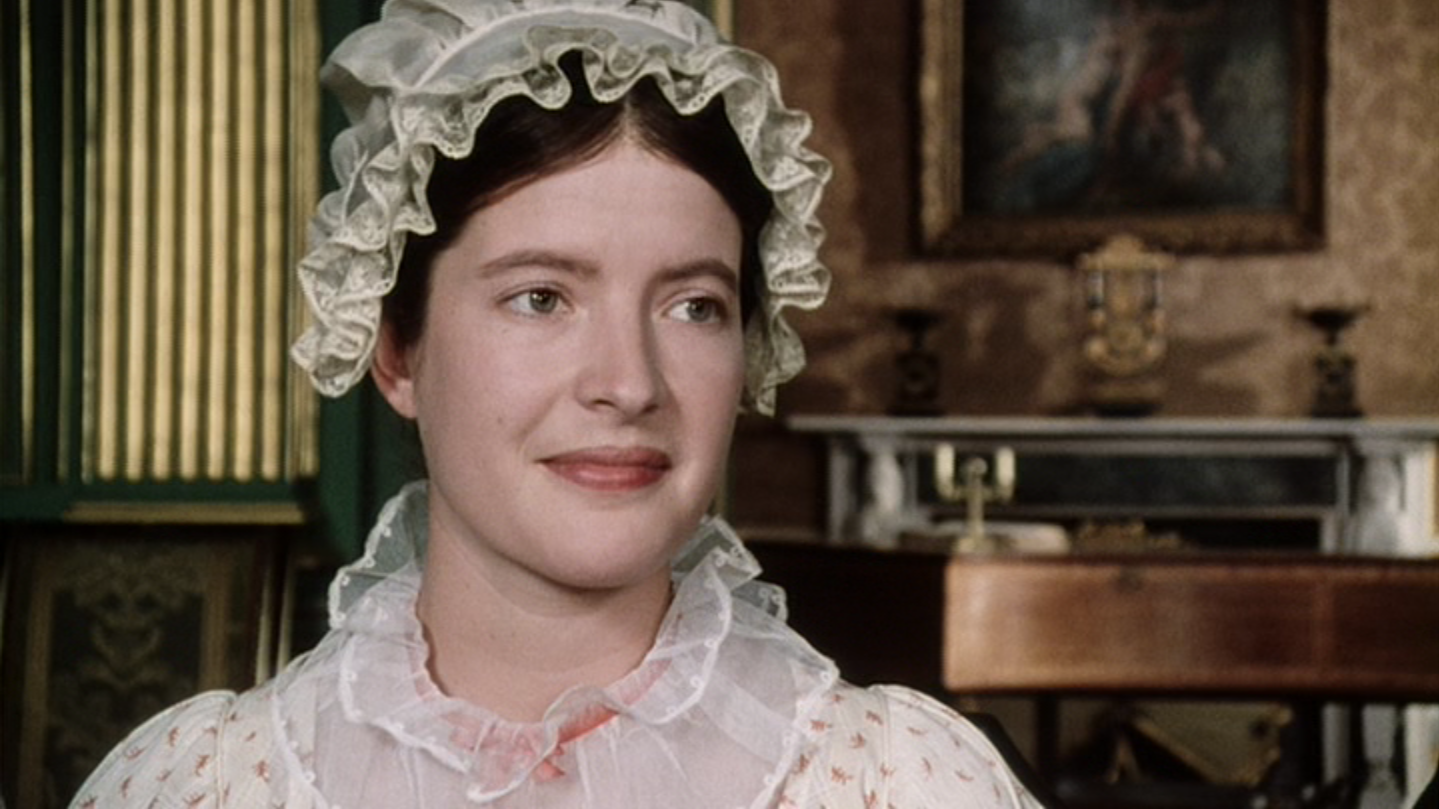
charlotte lucasBut why Mr. Darcy came so often to the Parsonage it was more difficult to understand. It could not be for society, as he frequently sat there ten minutes together without opening his lips; and when he did speak, it seemed the effect of necessity rather than of choice — a sacrifice to propriety, not a pleasure to himself. He seldom appeared really animated. Mrs. Collins knew not what to make of him. Colonel Fitzwilliam’s occasionally laughing at his stupidity proved that he was generally different, which her own knowledge of him could not have told her; and as she would have liked to believe this change the effect of love, and the object of that love her friend Eliza, she set herself seriously to work to find it out. She watched him whenever they were at Rosings, and whenever he came to Hunsford; but without much success. He certainly looked at her friend a great deal, but the expression of that look was disputable. It was an earnest, steadfast gaze, but she often doubted whether there were much admiration in it, and sometimes it seemed nothing but absence of mind.

She had once or twice suggested to Elizabeth the possibility of his being partial to her, but Elizabeth always laughed at the idea; and Mrs. Collins did not think it right to press the subject, from the danger of raising expectations which might only end in disappointment; for in her opinion it admitted not of a doubt, that all her friend’s dislike would vanish, if she could suppose him to be in her power…

p. 139-40.

More than once did Elizabeth, in her ramble within the Park, unexpectedly meet Mr. Darcy. She felt all the perverseness of the mischance that should bring him where no one else was brought, and, to prevent its ever happening again, took care to inform him at first that it was a favourite haunt of hers. How it could occur a second time, therefore, was very odd! [Ha!]  Yet it did, and even a third. It seemed like wilful ill-nature, or a voluntary penance, for on these occasions it was not merely a few formal enquiries and an awkward pause and then away, but he actually thought it necessary to turn back and walk with her. He never said a great deal, nor did she give herself the trouble of talking or of listening much; but it struck her in the course of their third rencontre that he was asking some odd unconnected questions –

p. 140.  Elizabeth asks Col. Fitzwilliam:

“Do you certainly leave Kent on Saturday?” said she.

“Yes — if Darcy does not put it off again. [my emphasis]But I am at his disposal. He arranges the business just as he pleases.”

“And if not able to please himself in the arrangement, he has at least great pleasure in the power of choice. I do not know anybody who seems more to enjoy the power of doing what he likes than Mr. Darcy.”

p. 144. [after Elizabeth learns from Col. Fitzwilliam of Darcy’s intervention between Bingley and Jane]

When they were gone, Elizabeth, as if intending to exasperate herself as much as possible against Mr. Darcy, chose for her employment the examination of all the letters which Jane had written to her since her being in Kent.

p. 145.  The Proposal: [his timing could not have been any worse!] –won’t put it all here… I direct you to re-read the whole thing! [pp. 144-48.] – or you can watch the 6.14 minute 1995 movie version here:

or the 4 minute, and very wet version here [P&P 2005]

-In spite of her deeply rooted dislike she could not be insensible to the compliment of such a man’s affection, and though her intentions did not vary for an instant, she was at first sorry for the pain he was to receive; till, roused to resentment by his subsequent language, she lost all compassion in anger….

– she could easily see that he had no doubt of a favourable answer…. Etc, etc…

-Mr. Darcy, who was leaning against the mantlepiece with his eyes fixed on her face, seemed to catch her words with no less resentment than surprise. His complexion became pale with anger, and the disturbance of his mind was visible in every feature. He was struggling for the appearance of composure…

thomson-darcyproposal2

Hugh Thomson, illus. P&P. George Allen, 1894.

p. 148.

That she should receive an offer of marriage from Mr. Darcy! that he should have been in love with her for so many months! — so much in love as to wish to marry her in spite of all the objections which had made him prevent his friend’s marrying her sister, and which must appear at least with equal force in his own case — was almost incredible! — it was gratifying to have inspired unconsciously so strong an affection. But his pride, his abominable pride…

Chapter 12.  [Elizabeth avoids meeting Darcy on her walk, but he finds her and passes her The Letter (he could not have delivered it any other way in order to protect her reputation…)]

CEBrock-darcyletter-mollands

C. E. Brock. “Would you do me the honour of reading that letter?” P&P. Macmillan 1895. Volume II, Ch. 12. [Mollands]

p. 150.

With no expectation of pleasure, but with the strongest curiosity, Elizabeth opened the letter, and, to her still increasing wonder, perceived an envelope containing two sheets of letter-paper…

The Letter: [like The Proposal, read this! pp. 150-56.]

Darcyletter-writing

Mr. Darcy writing The Letter – P&P 1995

p. 156.

Astonishment, apprehension, and even horror, oppressed her. She wished to discredit it entirely, repeatedly exclaiming, “This must be false! This cannot be! This must be the grossest falsehood!” — and when she had gone through the whole letter, though scarcely knowing anything of the last page or two, put it hastily away, protesting that she would not regard it, that she would never look in it again.

p. 159.

…that proud and repulsive as were his manners, she had never, in the whole course of their acquaintance — an acquaintance which had latterly brought them much together, and given her a sort of intimacy with his ways — seen anything that betrayed him to be unprincipled or unjust — anything that spoke him of irreligious or immoral habits: that among his own connexions he was esteemed and valued….

She grew absolutely ashamed of herself. Of neither Darcy nor Wickham could she think without feeling that she had been blind, partial, prejudiced, absurd.

“How despicably have I acted!” she cried; “I, who have prided myself on my discernment! I, who have valued myself on my abilities! who have often disdained the generous candour of my sister, and gratified my vanity in useless or blameable distrust. How humiliating is this discovery! yet, how just a humiliation! Had I been in love, I could not have been more wretchedly blind. But vanity, not love, has been my folly. Pleased with the preference of one, and offended by the neglect of the other [my emphasis] on the very beginning of our acquaintance, I have courted prepossession and ignorance, and driven reason away, where either were concerned. Till this moment I never knew myself.”

p. 161. [Lady Catherine’s take on Darcy has always caused me a full laugh-out-loud moment:]

….“They were excessively sorry to go! But so they always are. The dear colonel rallied his spirits tolerably till just at last; but Darcy seemed to feel it most acutely; more, I think, than last year. His attachment to Rosings, certainly increases.”

p. 163. – another favorite! [underlines are my emphasis ]

Reflection must be reserved for solitary hours; whenever she was alone, she gave way to it as the greatest relief; and not a day went by without a solitary walk, in which she might indulge in all the delight of unpleasant recollections….

….Mr. Darcy’s letter she was in a fair way of soon knowing by heart. She studied every sentence; and her feelings towards its writer were at times widely different… and his disappointed feelings became the object of compassion. His attachment excited gratitude, his general character respect; but she could not approve him; nor could she for a moment repent her refusal, or feel the slightest inclination ever to see him again. [Ha!]

….it may be easily believed that the happy spirits which had seldom been depressed before, were now so much affected as to make it almost impossible for her to appear tolerably cheerful.

p. 166.  [telling Jane about the Proposal]

To know that she had the power of revealing what would so exceedingly astonish Jane, and must, at the same time, so highly gratify whatever of her own vanity she had not yet been able to reason away….

p. 171. [Elizabeth to Jane about Wickham and Darcy]

“… There is but such a quantity of merit between them; just enough to make one good sort of man; and of late it has been shifting about pretty much. For my part, I am inclined to believe it all Mr. Darcy’s; but you shall do as you chuse.”

p. 172. Elizabeth to Jane:

“Oh! no, my regret and compassion are all done away by seeing you so full of both. I know you will do him [Darcy] such ample justice, that I am growing every moment more unconcerned and indifferent. Your profusion makes me saving; and if you lament over him much longer my heart will be as light as a feather.”

[Elizabeth:] “And yet I meant to be uncommonly clever in taking so decided a dislike to him, without any reason. It is such a spur to one’s genius, such an opening for wit, to have a dislike of that kind. One may be continually abusive without saying anything just; but one cannot be always laughing at a man without now and then stumbling on something witty.”

[Elizabeth:] The general prejudice against Mr. Darcy is so violent, that it would be the death of half the good people in Meryton to attempt to place him in an amiable light….”

p. 175.

She [Elizabeth] felt anew the justice of Mr. Darcy’s objections; and never had she before been so much disposed to pardon his interference in the views of his friend.

p. 183.

Derbyshire-P&P2005

With the mention of Derbyshire there were many ideas connected. It was impossible for her [Elizabeth] to see the word without thinking of Pemberley and its owner. “But surely,” said she, “I may enter his county with impunity, and rob it of a few petrified spars without his perceiving me.”

p. 184. [Mrs. Gardiner to Elizabeth:]

“My love, should not you like to see a place of which you have heard so much?” said her aunt; “A place, too, with which so many of your acquaintance are connected. Wickham passed all his youth there, you know.”

Elizabeth was distressed. She felt that she had no business at Pemberley, and was obliged to assume a disinclination for seeing it. She must own that she was tired of great houses; after going over so many, she really had no pleasure in fine carpets or satin curtains….

Elizabeth said no more — but her mind could not acquiesce. The possibility of meeting Mr. Darcy, while viewing the place, instantly occurred. It would be dreadful! She blushed at the very idea, and thought it would be better to speak openly to her aunt than to run such a risk…

…and her alarms being now removed, she was at leisure to feel a great deal of curiosity to see the house herself; and when the subject was revived the next morning, and she was again applied to, could readily answer, and with a proper air of indifference, that she had not really any dislike to the scheme. — To Pemberley, therefore, they were to go.

pemberley-photo

Lyme Park, a.k.a. Pemberley P&P 1995

End of Volume II – anything I missed that you want to share?

Stay tuned for Volume III!

*Page citations from: Austen, Jane. Pride and Prejudice. Ed. James Kinsley. Introd. Fiona Stafford. New York: Oxford UP, 2008.

c2013 Jane Austen in Vermont
Austen Literary History & Criticism · Books · Collecting Jane Austen · Jane Austen · Literature · Publishing History · Rare Books

A Little Jane Austen with Your Daily Hygiene? ~ Janine Barchas on “Sense, Sensibility, and Soap”

For those of you interested in the publishing history of Jane Austen, Professor Janine Barchas has recently published another of her fabulous bibliographical articles on Austen covers, this time in the journal Book History.  It discusses the little-known fact of a Lever Brothers soap marketing campaign that offered various giveaways, including hardbound editions of classic literature, Jane Austen among them.  I append here the beginning of the article, one of the many [and interesting!] illustrations, and a link to the rest of it … with thanks to Janine for alerting me to it!

Source: Janine Barchas. “Sense, Sensibility, and Soap: An Unexpected Case Study in Digital Resources for Book History.” Book History 16 (2013): 185-214.

Unrecorded in even David Gilson’s A Bibliography of Jane Austen is the little-known fact that soap manufacturer Lever Brothers published editions of Sense and Sensibility and Pride and Prejudice during the 1890s as part of a unique marketing campaign for Sunlight soap. The first English company to combine massive product giveaways with large-scale advertising, Lever Brothers offered a range of prizes in “Sunlight Soap Monthly Competitions” to “young folks” (contestants could not be older than seventeen) who sent in the largest number of soap wrappers. The Sunlight advertising blitz, targeted to working- and lower-middle-class consumers, proved such a boon to sales that Lever Brothers ran the competition for a full seven years, annually escalating the giveaways. Prizes included cash, bicycles, silver key-chains, gold watches, and—for the largest number of winners—cloth-bound books. For this purpose, Lever Brothers published and distributed its own selection of fiction titles by “Popular Authors” and “Standard Authors,” including cloth-bound editions of Sense and Sensibility and Pride and Prejudice. By 1897, the year the competition closed, Lever Brothers had awarded well over a million volumes.

Continue Reading: Barchas-SSandSoap-BookHistory

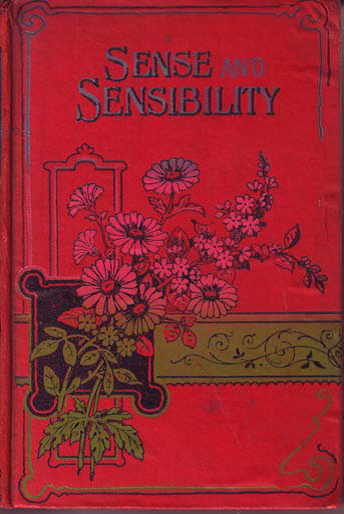
S&S-LeverBros

Jane Austen, Sense and Sensibility in red cloth (Port Sunlight: Lever Brothers, n.d.).

For those of you with Project Muse access, here is the direct link: http://muse.jhu.edu/journals/bh/summary/v016/16.barchas.html

c2013 Jane Austen in Vermont
Austen Literary History & Criticism · Jane Austen · Jane Austen Popular Culture · Literature

Mr. Darcy’s Feelings; Or, What Jane Austen Really Tells Us About Her Hero…

Much has been made of the film adaptations of Pride and Prejudice and the need to make the feelings of the hero more apparent to the viewer, the complaint being that Jane Austen really doesn’t give us much to go on regarding her Heroes and their inner life.  Andrew Davies famously says he had to “sex her up” to make the films work for a modern audience, and while I like to see Colin Firth in a wet shirt and Matthew Macfadyen bare-chested at dawn as much as the next swooning female, I do take issue with the need to edit the text to the point of it seeming more like a modern romance than an early nineteenth-century novel.  One of Jane Austen’s greatest strengths and why we still read her year after year over the past 200 years, is her creation of believable characters who live and breathe on and off the page – and the need for our imaginations to bring whatever we will to the reading…

PP2005-mcfadyen-dawn

P&P 2005 – Matthew Macfadyen as Mr. Darcy

This year has brought with it any number of celebrations of Pride and Prejudice from plays and festivals to conferences and all sorts of fan fiction and games and “stuff” one cannot live without, but the best way to celebrate the book in my mind is to just find a quiet corner somewhere and re-read it, perhaps for the umpteenth time, but read it again nonetheless.  We know from her letters that Jane Austen read the book aloud to her family any number of times – whether she read it during and after the many alterations she made to the text is not so clear … but her family began what has become for many of us an annual reading, and we enjoy it as much as they did, our only loss in not having Austen to answer our questions –

I began this year of celebrating the bicentenary of P&P with a close reading in January, my intention to make note of every time Austen comments as the narrator or has Darcy express or state anything regarding his feelings for Elizabeth Bennet, as well as her feelings in return – and I find so much more than I ever thought was there, and seeing them out of context is quite enlightening – I don’t think that Andrew Davies had to add anything at all to the text – it is already there, as you shall see.


 P&P 1995 – Colin Firth as Mr. Darcy – “The Look”

John Wiltshire recently wrote an essay on “Mr. Darcy’s Smile” ** – and one might have asked ‘did Mr. Darcy EVER smile?’, our first impression no different than Elizabeth’s in assigning him to the Snob pile. Professor Wiltshire rescues him from that place of the aloof, observing, not present fellow, by telling us how often in the text Jane Austen has her Mr. Darcy actually Smile. So let’s see what we find, see what Austen tells us directly about Darcy’s feelings – for some reason we gloss over it all too easily and have come to depend upon Andrew Davies to visually remind us …

The other vexing question is of course when does Elizabeth fall for Mr. Darcy?  This is a controversial point – some believe her tongue-in-cheek statement to Jane,

“It has been coming on so gradually, that I hardly know when it began. But I believe I must date it from my first seeing his beautiful grounds at Pemberley.” 

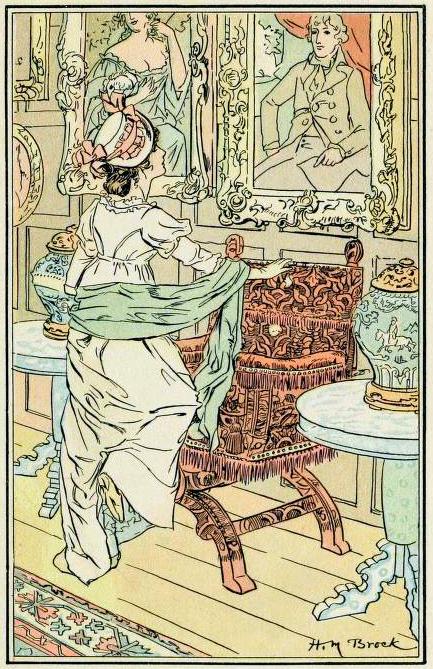
-this one sentence dividing Janeites, scholars and fans alike as to Elizabeth’s perhaps overly mercenary view of the world and her need to “land” a wealthy partner, that “to be mistress of Pemberley might be something!”  Some don’t see Elizabeth at all attracted to Darcy with any sort of passion like the films are overwrought with – that she comes to admire and then Love Darcy because of all his good qualities once his Asperger / shy/ snob demeanor crashes around him… But again, reading the text closely, both the actions, dialogue, and the narrator’s commentary, we are shown an Elizabeth both humiliated by Darcy’s apparent disdain of her [and her eager willingness to accept the neighborhood gossip that disses him at his first appearance], and her awareness in every moment they are in the same room together, of everything he is doing – she sees him watching her mother, reacting to her mother and other family members, sees him change color upon meeting Wickham, watches closely his relationship with Caroline Bingley, and most importantly sees him watching her, always passing it off as some strange behavior on his part, protesting too much because she knows he cannot tolerate her – in short she is always in a state of heightened awareness whenever Darcy is in her space. What changes for her at Pemberley is not its grandeur and its grounds, but his portrait, where she for the first time can look at him directly, his eyes upon her as in life, “with such a smile over [his] face, as she remembered to have sometimes seen, when he looked at her” (p. 189), but here she does not have to turn away in a confused embarrassed state…

Dent 1898-HMBrock-eatdpicture-adelaide

“In earnest contemplation” – H. M. Brock. P&P. Dent, 1898.
Image: Adelaide ebook

I had wanted to post on this as this celebratory year began, but here I am nearly the end of the year and ready to launch into celebrating Mansfield Park !– but shall post these quotes now, just under the wire… starting today with Volume I. *

From Volume I:

p. 7. [where it all begins! – Darcy’s insult, Elizabeth’s humiliation and wounded pride]

“Which do you mean?” and turning round, [Darcy] looked for a moment at Elizabeth, till catching her eye, he withdrew his own and coldly said, “She is tolerable; but not handsome enough to tempt me; and I am in no humour at present to give consequence to young ladies who are slighted by other men. You had better return to your partner and enjoy her smiles, for you are wasting your time with me.” 

   Mr. Bingley followed his advice. Mr. Darcy walked off; and Elizabeth remained with no very cordial feelings towards him. She told the story, however, with great spirit among her friends; for she had a lively, playful disposition, which delighted in any thing ridiculous.

Macmillan1895-cebrock-darcy-tempt-bw-mollands

C. E. Brock. P&P. Macmillan 1895

p. 13.  [but Elizabeth later says:]  

“That is very true,” replied Elizabeth, “and I could easily forgive his pride, if he had not mortified mine.”

p. 16.  [How quickly Darcy changes his mind about Elizabeth!]:

Occupied in observing Mr. Bingley’s attentions to her sister, Elizabeth was far from suspecting that she was herself becoming an object of some interest in the eyes of his friend. Mr. Darcy had at first scarcely allowed her to be pretty; he had looked at her without admiration at the ball; and when they next met, he looked at her only to criticise. But no sooner had he made it clear to himself and his friends that she had hardly a good feature in her face, than he began to find it was rendered uncommonly intelligent by the beautiful expression of her dark eyes. To this discovery succeeded some others equally mortifying. Though he had detected with a critical eye more than one failure of perfect symmetry in her form, he was forced to acknowledge her figure to be light and pleasing; and in spite of his asserting that her manners were not those of the fashionable world, he was caught by their easy playfulness. Of this she was perfectly unaware; — to her he was only the man who made himself agreeable nowhere, and who had not thought her handsome enough to dance with. 

   He began to wish to know more of her, and as a step towards conversing with her himself, attended to her conversation with others. His doing so drew her notice. It was at Sir William Lucas’s, where a large party were assembled. 

   “What does Mr. Darcy mean,” said she to Charlotte, “by listening to my conversation with Colonel Forster?” 

[and the teasing begins!]

p. 18.  Sir William Lucas:

Brock-P&P-Lucas-dance

C. E. Brock. P&P. Dent, 1898. [Mollands]

“My dear Miss Eliza, why are not you dancing? — Mr. Darcy, you must allow me to present this young lady to you as a very desirable partner. You cannot refuse to dance, I am sure, when so much beauty is before you.” And, taking her hand, he would have given it to Mr. Darcy, who, though extremely surprised, was not unwilling to receive it, when she instantly drew back, and said with some discomposure to Sir William — 

   “Indeed, sir, I have not the least intention of dancing. I entreat you not to suppose that I moved this way in order to beg for a partner.” 

   Mr. Darcy, with grave propriety, requested to be allowed the honour of her hand, but in vain. Elizabeth was determined; nor did Sir William at all shake her purpose by his attempt at persuasion. 

   “You excel so much in the dance, Miss Eliza, that it is cruel to deny me the happiness of seeing you; and though this gentleman dislikes the amusement in general, he can have no objection, I am sure, to oblige us for one half-hour.” 

   “Mr. Darcy is all politeness,” said Elizabeth, smiling. 

   “He is indeed; but considering the inducement, my dear Miss Eliza, we cannot wonder at his complaisance — for who would object to such a partner?” 

   Elizabeth looked archly, and turned away. Her resistance had not injured her with the gentleman, and he was thinking of her with some complacency… 

p. 19.   [Darcy to Miss Bingley who is ever in pursuit…]:

missbingley“Your conjecture is totally wrong, I assure you. My mind was more agreeably engaged. I have been meditating on the very great pleasure which a pair of fine eyes in the face of a pretty woman can bestow.” 

   Miss Bingley immediately fixed her eyes on his face, and desired he would tell her what lady had the credit of inspiring such reflections. Mr. Darcy replied with great intrepidity — 

   “Miss Elizabeth Bennet.” 

   “Miss Elizabeth Bennet!” repeated Miss Bingley. “I am all astonishment. How long has she been such a favourite? — and pray, when am I to wish you joy?” …

p. 24.  [Elizabeth arriving at Netherfield to offer comfort Jane]:

Mr. Darcy said very little, and Mr. Hurst nothing at all. The former was divided between admiration of the brilliancy which exercise had given to her complexion, and doubt as to the occasion’s justifying her coming so far alone. The latter was thinking only of his breakfast.

P&P2005-Elizabeth walking-jasna

 Kiera Knightley as Elizabeth – image: jasna.org

p. 26.

“I am afraid, Mr. Darcy,” observed Miss Bingley, in a half-whisper, “that this adventure has rather affected your admiration of her fine eyes.” 

   “Not at all,” he replied; “they were brightened by the exercise.”

p. 28. [this is an interesting: Elizabeth has been reading a book while the others plays cards – but when the talk turns to Mr. Darcy’s library at Pemberley, she takes such an interest in what is being said, that she puts her book aside and moves close to the card table…and what follows is the discussion of the “accomplished woman.”]:

Elizabeth was so much caught by what passed as to leave her very little attention for her book; and soon laying it wholly aside, she drew near the card-table, and stationed herself between Mr. Bingley and his eldest sister, to observe the game. 

chatsworth-house-library-BritMag

The Library at Chatsworth a.k.a. Pemberley
[Britain Magazine]

p. 33. [Elizabeth says; notice how she “trembles”:]

I wonder who first discovered the efficacy of poetry in driving away love!” 

 “I have been used to consider poetry as the food of love,” said Darcy. 

“Of a fine, stout, healthy love it may. Everything nourishes what is strong already. But if it be only a slight, thin sort of inclination, I am convinced that one good sonnet will starve it entirely away.” 

 Darcy only smiled; and the general pause which ensued made Elizabeth tremble lest her mother should be exposing herself again. She longed to speak, but could think of nothing to say… 

p. 38.

Elizabeth could not help observing, as she turned over some music books that lay on the instrument, how frequently Mr. Darcy’s eyes were fixed on her. She hardly knew how to suppose that she could be an object of admiration to so great a man; … 

p. 38.

… and Darcy had never been so bewitched by any woman as he was by her. He really believed that, were it not for the inferiority of her connexions, he should be in some danger. 

p. 39.

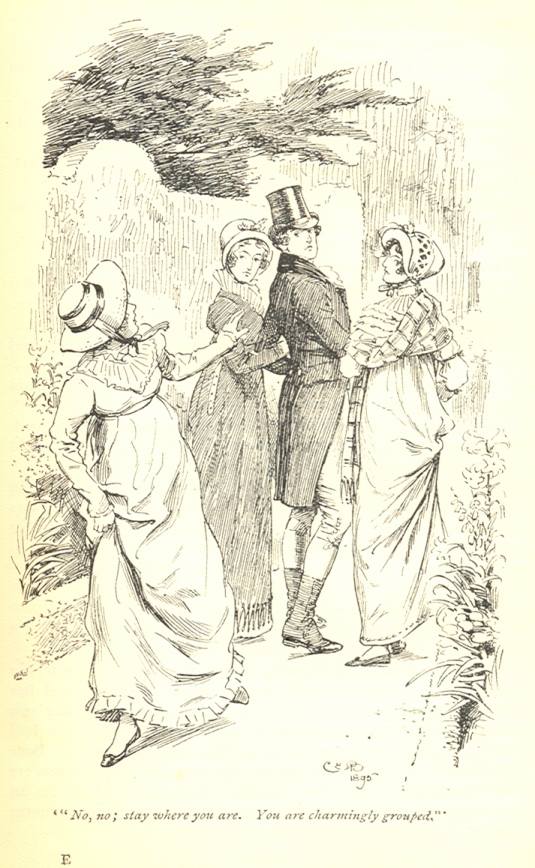
CeBrock-macmillan1895-group

C. E. Brock. P&P. Macmillan 1895 [Mollands]

Mr. Darcy felt their rudeness
[i. e Caroline and Mrs. Hurst leaving Elizabeth to walk by herself…]

p. 44.

…and Darcy, after a few moments recollection, was not sorry for it. He began to feel the danger of paying Elizabeth too much attention. 

p. 44.

To Mr. Darcy it was welcome intelligence: Elizabeth had been at Netherfield long enough. She attracted him more than he liked — and Miss Bingley was uncivil to her, and more teasing than usual to himself. He wisely resolved to be particularly careful that no sign of admiration should now escape him, nothing that could elevate her with the hope of influencing his felicity; sensible that if such an idea had been suggested, his behaviour during the last day must have material weight in confirming or crushing it. Steady to his purpose, he scarcely spoke ten words to her through the whole of Saturday, and though they were at one time left by themselves for half an hour, he adhered most conscientiously to his book, and would not even look at her.

p. 55.

Mr. Darcy corroborated it with a bow, and was beginning to determine not to fix his eyes on Elizabeth…

p. 72.  [during their dance]…

…on each side dissatisfied, though not to an equal degree, for in Darcy’s breast there was a tolerable powerful feeling towards her, which soon procured her pardon, and directed all his anger against another.

[And here Elizabeth always watching Darcy and his reactions to her and her family]:

p. 68.

…when she found herself suddenly addressed by Mr. Darcy, who took her so much by surprise in his application for her hand, that, without knowing what she did, she accepted him. He walked away again immediately, and she was left to fret over her own want of presence of mind…

 Limiteded1940-darcyandelizabeth

Helen Sewell. P&P. Limited Editions Club, 1940

p. 69.

…took her place in the set, amazed at the dignity to which she was arrived in being allowed to stand opposite to Mr. Darcy, and reading in her neighbours’ looks their equal amazement in beholding it.

p. 76.

Elizabeth blushed and blushed again with shame and vexation. She could not help frequently glancing her eye at Mr. Darcy, though every glance convinced her of what she dreaded; for though he was not always looking at her mother, she was convinced that his attention was invariably fixed by her. The expression of his face changed gradually from indignant contempt to a composed and steady gravity.

p. 78.

She was at least free from the offence of Mr. Darcy’s farther notice; though often standing within a very short distance of her, quite disengaged, he never came near enough to speak.

*********************

marveldarcy

Mr. Darcy – P&P – Marvel Comics

*****************

Stay tuned for quotes from Volume II. Do you find any that I have missed that somehow allude to this connection between Darcy and Elizabeth from nearly the first moment they set eyes upon each other?

*********************

*Page citations from: Austen, Jane. Pride and Prejudice. Ed. James Kinsley. Introd. Fiona Stafford. New York: Oxford UP, 2008.

** See John Wiltshire, “Mr. Darcy’s Smile.” The Cinematic Jane Austen: Essays on the Filmic Sensibility of the Novels. Ed. David Monaghan, Ariane Hudelet, and John Wiltshire. Jefferson, NC: McFarland, 2009. 94-110.

c2013 Jane Austen in Vermont
Austen Literary History & Criticism · Collecting Jane Austen · Jane Austen · Jane Austen Merchandise · Jane Austen Popular Culture · Literature · Regency England

Playing Jane Austen ~ The Jane Game Launches on Kickstarter!

Today is the day! – the Kickstarter campaign of The Jane Game has been launched!

I first posted on this here in January 2013 –  now it is time for you to sign on and help with getting this Jane Austen trivia game completed for distribution – a donation of $40. [or more!] will get you a copy of the game as well as the satisfaction of helping a Jane Austen entrepreneur. The Kickstarter website is here, where you will find the details of the game, the Rules of the game, and the various donation categories – you have until December 14, 2013 to sign on… I just did, and hope you will too!

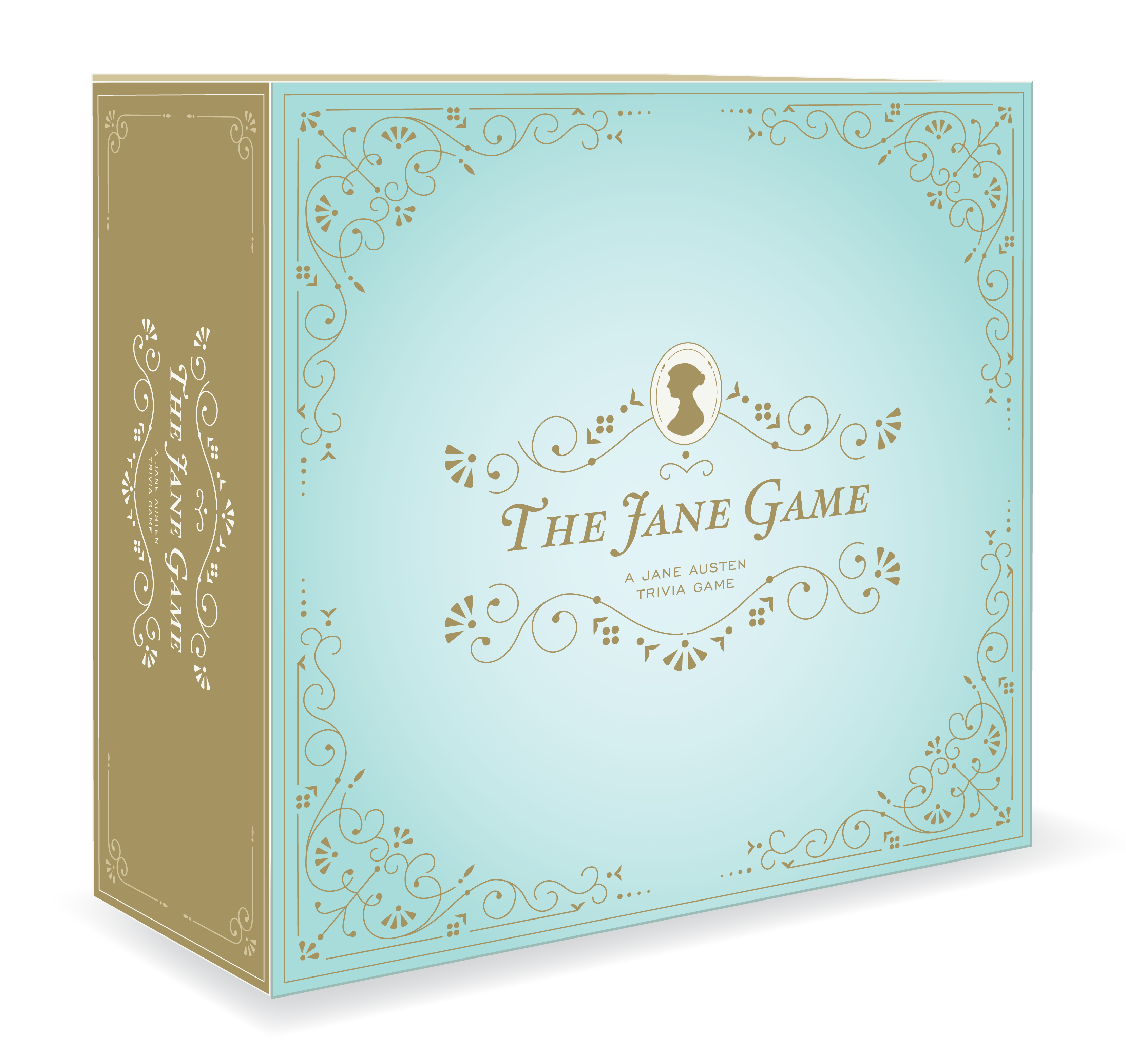
Promoted_Posts_BoxEnter Jane Austen’s world of elegance, wit and romance along with your friends when you play The Jane Game

The Jane Game is a trivia board game devoted to Jane Austen’s six novels. It is designed to bring Austen admirers together to share in her stories, characters, wit and language. While playing, each participant enters Jane’s world as one of her heroines. As such, you seek after a fortunate life by becoming an accomplished woman, gaining life experience and choosing to marry or not. Through chance, expertise and choice you could become the envied Mrs. Darcy, the pitied Mrs. Collins or the new roommate of Miss Bates. 

****************

And here are a few words from creator Elizabeth Bankhead on what to expect: 

Experience Section: The Jane Game gives you the experience of:

  • Entering Jane Austen’s world
  • Sharing in the merriment with your friends
  • Becoming more acquainted with Austen’s novels and encouraging us to want to read her more

Unique Section: The Jane Game 

  • Is a shared experience
  • Is the only board game that has trivia from all 6 of Jane’s beloved novels

Details:

  • $37 and shipping is free; after the Kickstarter campaign it will be $40 +shipping
  • Kickstarter ends on December 14, 2013

Kickstarter 101:

  • Kickstarter is a method through which we can give small amounts of money that together will equal a large sum…which, in this case, will be the cost of manufacturing the game
  • If you give the cost of the game, then you will get a game, which basically means you are pre-ordering
  • If we do not reach our goal, your credit card doesn’t get charged. This protects you and me. It gives a guarantee that you will receive a nice product and guarantees that I won’t be stuck with promises I cannot keep because I do not have enough money

Why pledge now? 

  • You Become a Founder: As such, you become part of The Jane Game. Welcome! Your name is placed on our website and you get to take part in some of the decisions for the game’s future.
  • Get the Game…and First: You get The Jane Game, which is “loveliness itself,” is it not?  If we are able to do a larger print run and can sell them, you get the game before any other distribution begins.
  • We Need You: We have covered the cost of the game’s development, but we cannot manufacture and ship the game to you without your support.
  • Free Shipping: We are covering the cost of shipping to many areas of the world, which will not be the case if it goes retail.

 ***************

Click here to see The Jane Game video

janegamebanner

Further information:

[Text and images courtesy of The Jane Game and Elizabeth Bankhead]

c2013 Jane Austen in Vermont
Auctions · Austen Literary History & Criticism · Books · Jane Austen · Publishing History · Rare Books

More Austen on the Block! ~ A Jane Austen Portrait, First Editions, and More

UPDATE:  Prices realized [with buyer’s premium] are noted as made available

I wonder what is going on – I posted last week on several upcoming auctions with a number of Jane Austen offerings – and now I write about even more – there seems to an abundance, more than usual – why is this do you think??

***************

I will start with this, out of date order, but perhaps the most unique, interesting, (and expensive) to us:

Sothebys – 10 December 2013: English Literature, History, Children’s Books & Illustrations. London.

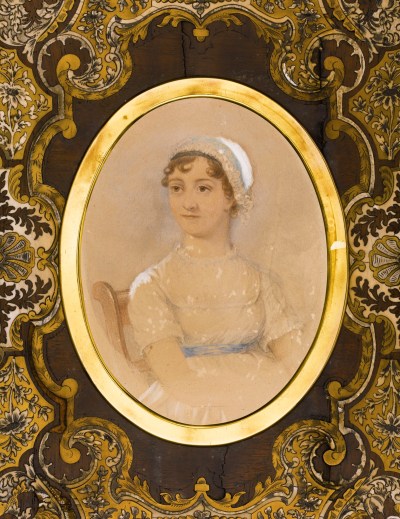
Lot 283:
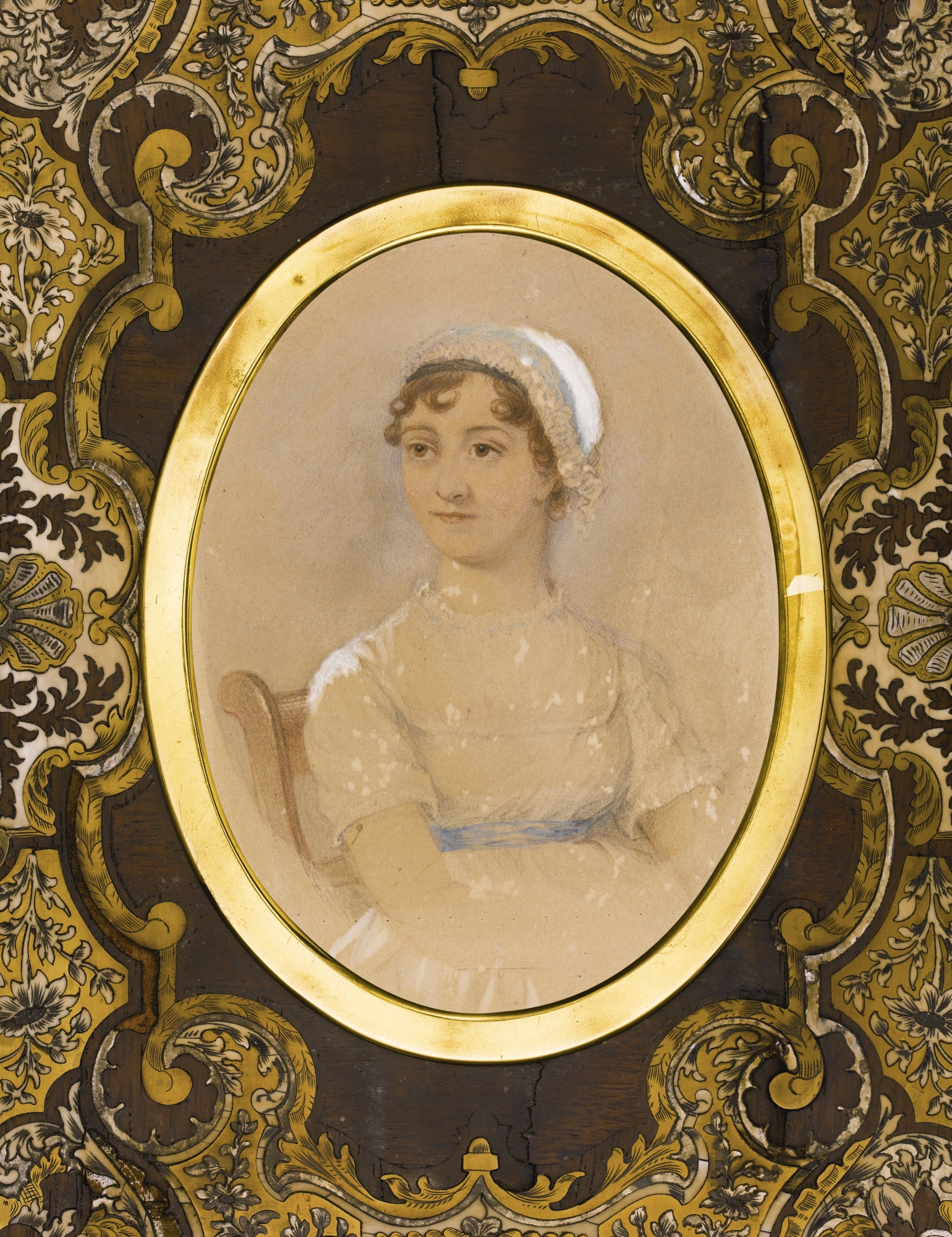
Sothebys-JA Portrait-12-10-13

Austen, Jane – by James Andrews. PORTRAIT OF JANE AUSTEN.

watercolour over pencil heightened with gouache on card, depicting the author with brown curly hair and hazel eyes seated and facing towards the right, in a white frilled bonnet with light blue ribbon and a white dress with a dark blue ribbon under the bust, a small section at the bottom of the portrait apparently unfinished, oval, 143 x 100mm (overall sheet size 170 x 125mm), 1869, series of pin-holes at the top and bottom of the card, pencil markings probably by the engraver, mounted, framed, and glazed, frame size 327 x 247mm, the frame being a reused lid from a casket or box, French or German, probably eighteenth century, walnut inlaid with boulle-style marquetry of flowers and scrollwork in brass, silver, ivory, and mother of pearl, loss to surface of portrait probably due to insect damage, mostly affecting the dress, slight discolouration at edges seemingly where previously mounted in a rectangular frame.

The portrait of Jane Austen was commissioned by her nephew, James Edward Austen-Leigh, to illustrate his memoir of his aunt. This watercolor by painter James Andrews was the basis for the engraved version that is the best known and most reproduced image of Austen. It has been in the family ever since.

Estimate: £150,000 — 200,000 

[Note: For those of you in the New York area, this portrait will be on view from November 19 to 21 on the fourth floor of Sotheby’s, 1334 York Ave at 72nd St. Sotheby’s is open from 10 to 5. ]

There are other must-have items at this auction – see below [all are in chronological order]

***************

Swanns Galleries.  November 21, 2013. 19TH & 20TH CENTURY LITERATURE. Sale 2332.

Lot 4:

Swann-MP-11-21-13

AUSTEN, JANE. Mansfield Park. 2 volumes. Philadelphia: Carey & Lea, 1832.

4 page publisher’s catalogue inserted at front of volume 1. 8vo, original publisher’s 1/4 cloth-backed drab boards, lettering labels on spines (absent but for trace remnants on each volume, and with small contemporary institutional labels either perished or remnant only below on each volume), cocked, few short splits at spine tips, generally mild staining and light wear to boards, corners rubbed with light exposure; hinges tender, pastedowns coming loose from boards in volume 1, scattered foxing throughout, at times heavily to volume 2, occasional small chips at deckle, old penciled numerals on front free endpapers, paper repairs on 2 leaves in volume 1 with no loss of text; housed in custom drop-back cloth case.

First american edition, extremely rare in the original binding. One of 1250 copies printed. Few copies of any of Austen’s first American editions have survived. “No appearance of the 1832 M[ansfield] P[ark] at auction has been traced” (Gilson, rev. ed., 1997). A survey of ABPC and AE records only one unsophisticated copy sold in the last 30 years. Gilson B4.

Estimate $4,000 – 6,000 – Price Realized $5,376

_______

Lot 5:

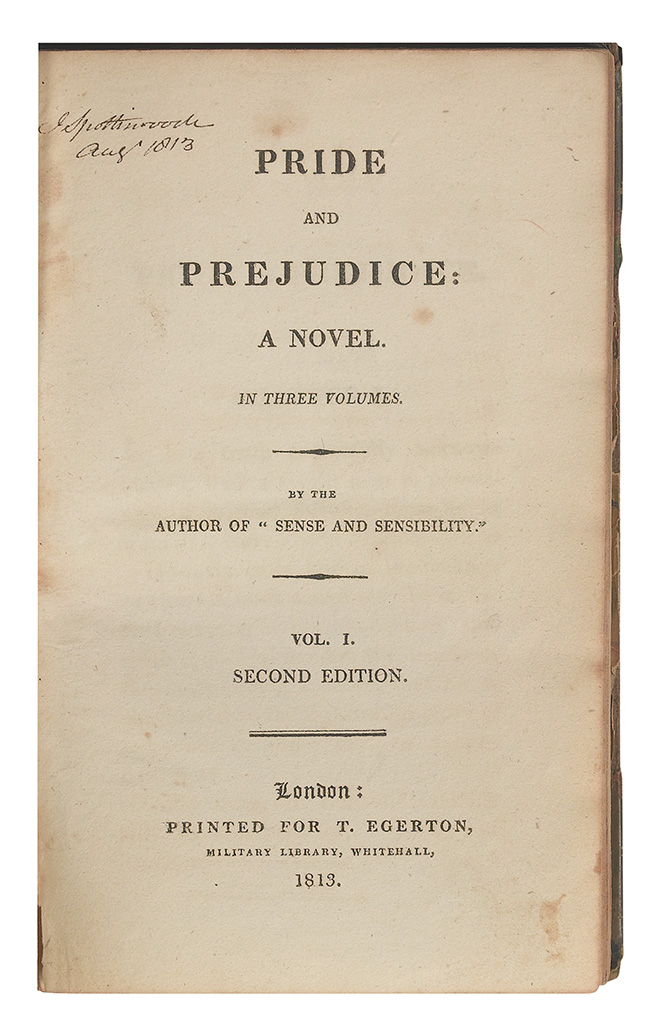
Swann-P&P2nd-11-21-13AUSTEN, JANE. Pride and Prejudice. Second Edition. London: Printed for T. Egerton, 1813.

3 volumes. Lacking half-titles. 12mo, contemporary 1/2 calf over marbled boards, spine gilt with leather lettering pieces (two perished, one with partial loss), covers and spines scuffed with some splitting along spine ends, fore-edges bumped in areas, joints strengthened; scattered light foxing, neat contemporary ownership inscriptions on title-page of each volume.

The less common second edition. According to Gilson, the publishing history is rather furtive (“The size of the edition is not known”). It does differ from the first edition in that it is entirely reset, resulting in occasional variations within the page. In addition, there are numerous small changes to spelling and punctuation and, occasionally, a change in wording (see Gilson A4 for list of alterations.); Chapman 4.

Estimate $3,000 – 4,000 – Price Realized $4,096
________

Swann-novels-11-21-13Lot 6:  

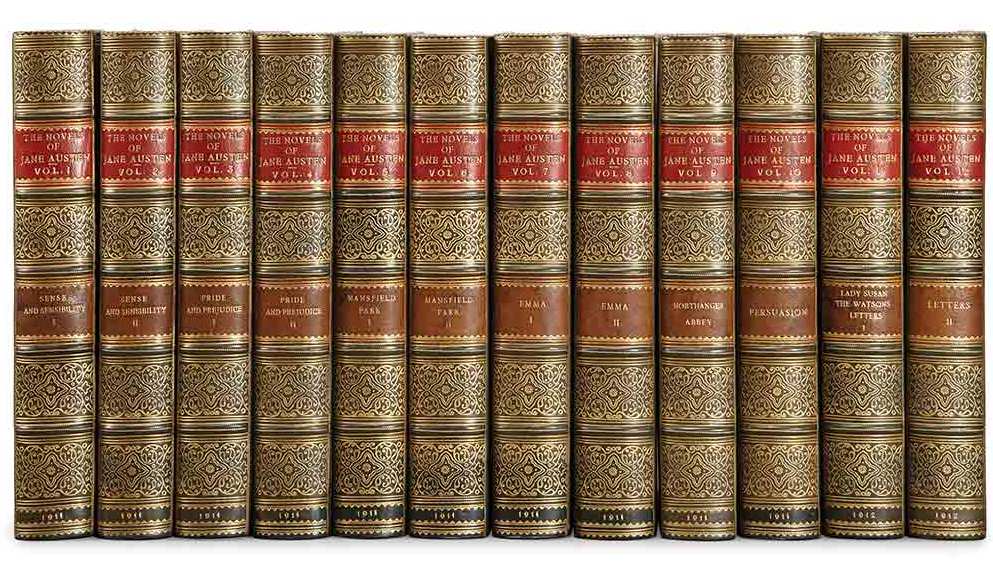
AUSTEN, JANE. The Novels. Edinburgh: John Grant, 1911-12.

12 volumes. Portrait frontispiece to volume 1. 8vo, later 1/4 olive calf, spine gilt in 5 compartments with gilt-lettered morocco lettering pieces in 1, top edges gilt. the Winchester Edition, a bright and clean set. One of the more desirable editions of Austen’s works.

Estimate $800 – 1,200 – Price Realized  $1,875

____________________

Also of interest: [to me anyway!]- as well as some wonderful offerings in children’s literature, lots of Dickens, alas! only one Hardy, but some lovely Hemingways and Twains…

Lot 238:  

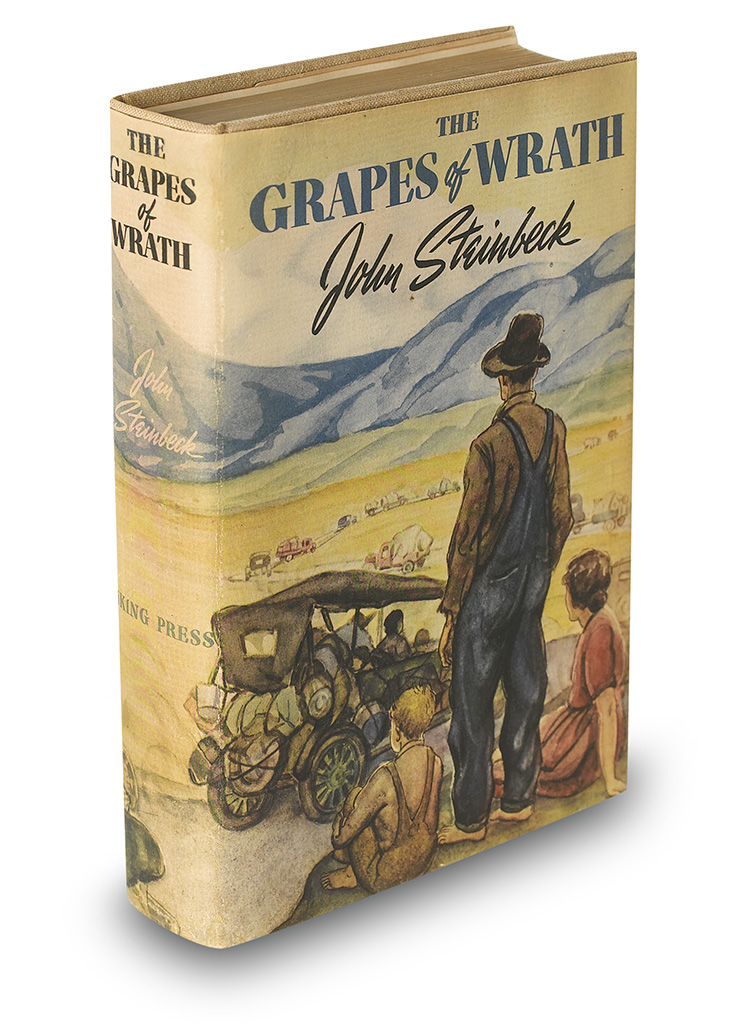
Swann-Steinbeck-11-21-13Steinbeck, John. ASSOCIATION COPY WITH ‘PIGASUS’ DRAWING.
The Grapes of Wrath
. New York: Viking, (1939)

8vo, publisher’s pictorial tan cloth, covers clean with virtually no rubbing or wear; outer pastedown edges with faint evidence of binder’s glue as usual, though with no offsetting to facing endpapers; first state dust jacket, mild rubbing to folds, small skillful restorations to spine panel tips and flap folds, bright and clean, a superb example with the original $2.75 price present.

First edition, an excellent association copy, inscribed on the front free endpaper “For Jules and Joyce and also Joan [underlined] with love John Steinbeck.” Below his signature Steinbeck added his “Pigasus” drawing. Jules Buck was a movie producer; he and Steinbeck made an early attempt toward a collaborative screenplay for what would become Elia Kazan’s “Viva Zapata,” though Steinbeck’s contribution was such that he received sole credit. Buck produced such post-war film classics as Robert Siodmak’s The Killers (based on the story by Ernest Hemingway), and Jules Dassin’s The Naked City. His wife Joyce Gates was an actress and their daughter Joan became the editor of French Vogue. Steinbeck generally reserved his flying pig doodle for close friends or significant occasions. In a letter (March, 1983) Elaine Steinbeck explained the significance of the image: “The Pigasus symbol came from my husband’s fertile, joyful, and often wild imagination … John would never have been so presumptuous as to use the winged horse as his symbol; the little pig said that man must try to attain the heavens though his equipment be meager. Man must aspire though he be earthbound” (The Martha Heasley Cox Center for Steinbeck Studies). An excellent inscribed copy with a fine association. Goldstone & Payne A12.a.

Estimate $18,000 – 25,000 – Price Realized $18,750
_________
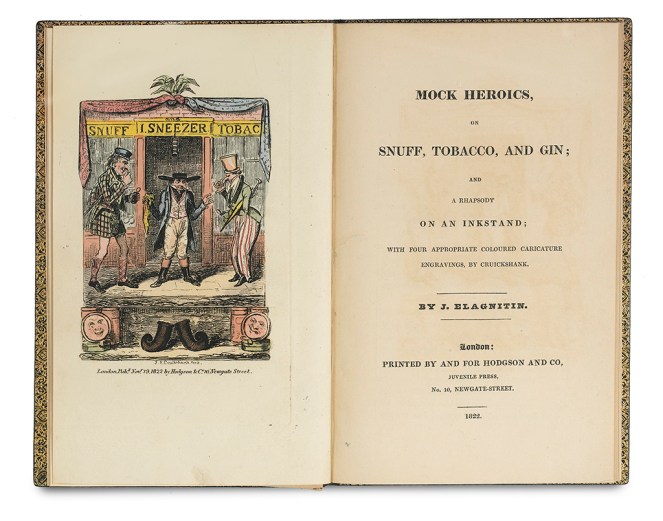
Swann-Cruikshank-11-21-13Lot 71: 

[Cruikshank, Isaac Robert]. UNRECORDED CRUIKSHANK (illus.). Mock Heroics, on Snuff, Tobacco, and Gin; And A Rhapsody on an Inkstand by J. Elagnitin. London: Hodgson and Co., 1822.

Frontispiece and 3 full page color engravings by I. R. Cruikshank. 8vo, contemporary full dark green crushed morocco, French fillet covers, spine decorated in gilt in compartments, all edges gilt, wide inner dentelles, by Riviere; tiny marginal repair on frontispiece, mild offsetting to title-page, else quite clean.

First edition of rare Cruikshank title with very bright, clean impressions of the plates. Shows London denizens taking snuff, on the pipe, at the debauch, and a more lonely pursuit. Not in Krumbhaar. 

Estimate $700 – 1,000 – Price Realized $469 

*****************

Doyle, New York. Monday, November 25, 2013 at 10am Rare Books, Autographs & Photographs – Sale 13BP04

Lot 522:
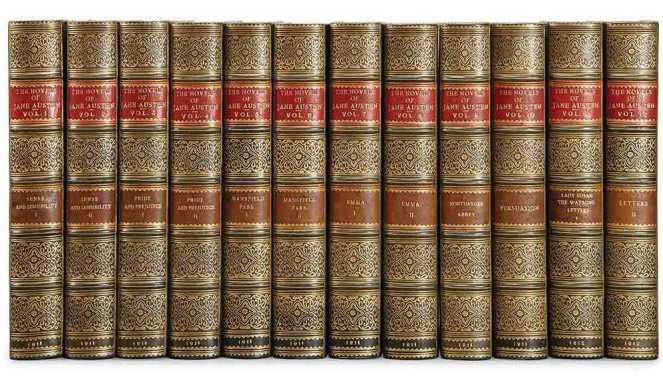
Doyle-JAset-11-25-13-2AUSTEN, JANE. The Novels. Edinburgh: John Grant, 1911-12.

The Winchester edition. Twelve volumes, full blue morocco gilt, the spines elaborately tooled and lettered in gilt with red morocco lettering labels, top edge gilt. 8 1/2 x 5 1/2 inches (22 x 14 cm). A fine and attractive set.

Estimate $1,000-1,500

[Note: This set is similar to the one noted above, just with a different binding – which do you like best?]
______

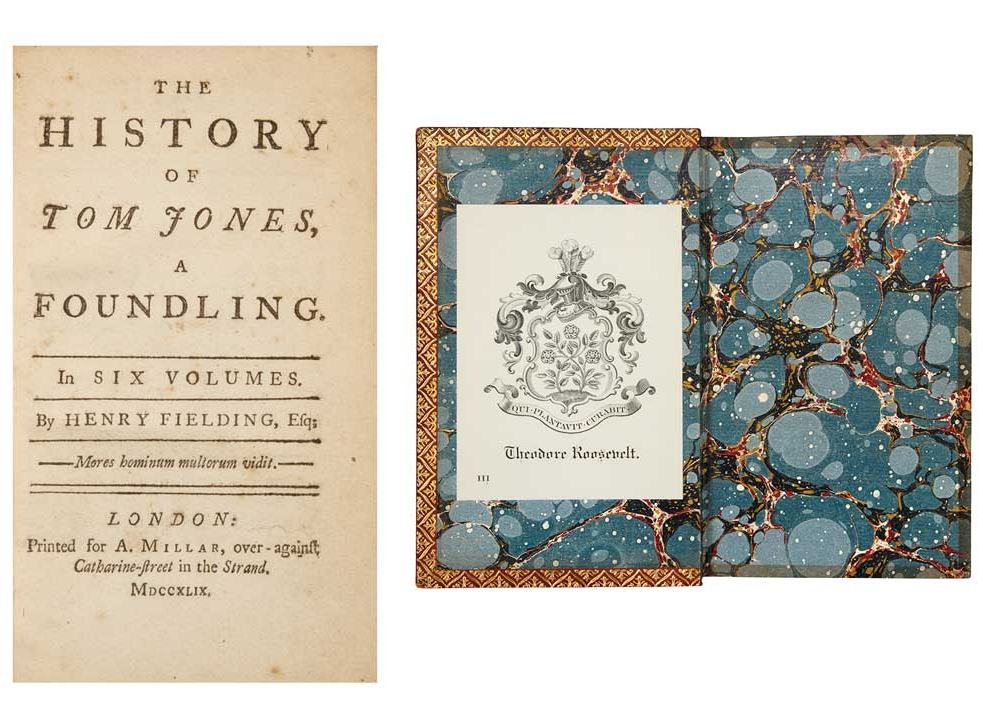
There is quite a collection of photographs and political collectibles at this auction, including this Tom Jones, Theodore Roosevelt’s copy:

Doyle-Fielding-11-25-13-2Lot 515:

FIELDING, HENRY. The History of Tom Jones, a Foundling. London: printed for A. Millar, over-against Catharine-Street in the Strand, 1749. First edition, Theodore Roosevelt’s copy, with his “Qui plantavit curabit” bookplate to each pastedown. Six volumes, later full brown morocco gilt, all edges gilt. 6 1/4 x 3 3/4 inches (16 1/2 x 10 cm); with the errata leaf present in vol. I and with most called for cancels: Vol. I: B9, 10; Vol. II: N12; Vol. III: H8-10, M3; Vol. IV: B1, Vol. V: N8. [without the cancels at B4 and 5 in vol. II and Q11 in vol. III]. A 1910 inscription to front free endpaper on vol. I in an unknown hand, some foxing throughout, D10 in vol 2 with tear not affecting text, joints and extremities rubbed, losses to lettering labels, a sound set.
First edition of one of the earliest English works to be called a novel – with a very fine American provenance.

Estimate $2,000-3,000

********************

Sotheby’s auction December 5, 2013 New York:  Fine Books and Manuscripts, Including Americana

This is my birthday, so in case you are wondering what I might like, I will take any of these…

Lot 85:
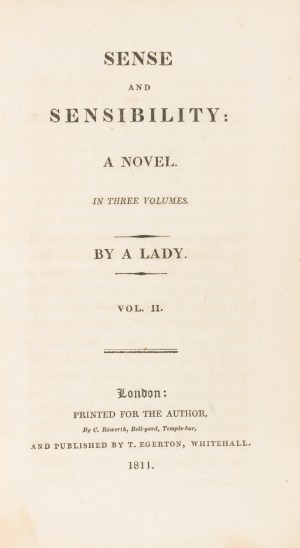
Sothebys-S&S-12-5-13

Austen, Jane. Sense and Sensibility. London: Printed for the Author and published by T. Egerton, 1811.

3 volumes, 12mo (6 3/4 x 4 in.; 172 x 104 mm). Half-titles  (with the correct length of rules as called for) in all volumes but lacking the terminal blanks in each, lower corner of B2 torn away in vol. 1, very occasional and mostly marginal faint staining throughout. Modern three quarter tan morocco and linen cloth by Sangorski and Sutcliffe, red morocco labels.

Estimate: $20,000 — 30,000. Did Not Sell

_______

Lot 86:

Pride and Prejudice: A Novel. London: T. Egerton, 1813

3 volumes, 12mo (6 3/4 x 4 1/16 in.; 171 x 105 mm). Lacks half-titles, some staining and browning throughout but less so  in vols. 2 and 3, closed tear in gutter of first text page in vol. 1 and last of vol. 3,  front endpapers lacking in last Sothebys-P&P-12-5-13volume. Contemporary half calf and marbled boards, spines with six gilt-ruled compartments and black morocco labels, a little rubbed overall, with minor wear at head of volume 1.

Estimate: $20,000 — 30,000

SOLD for $46,875.

______

Lot 87:

Sothebys-MP-12-5-13Austen, Jane. Mansfield Park. London: Printed for T. Egerton, 1814

3 volumes. 12mo (6 7/8 x 4 1/4 in.; 176 x 105 mm). Lacking half-titles but terminal blanks present, lower corner of Q3 in vol. 1 torn away, vol. 3 pg. 175 with clean tear repaired, few light stray spots to title pages, but text  unusually free from staining and browning. Near-contemporary half calf and marbled boards, spines gilt in 5 compartments, red and black morocco labels; sides rubbed, vol.1 rebacked preserving spine, upper joint of vol. 3 starting.

Estimate: $7,000 — 10,000 – SOLD for $13,750.
_______

Lot 88: 
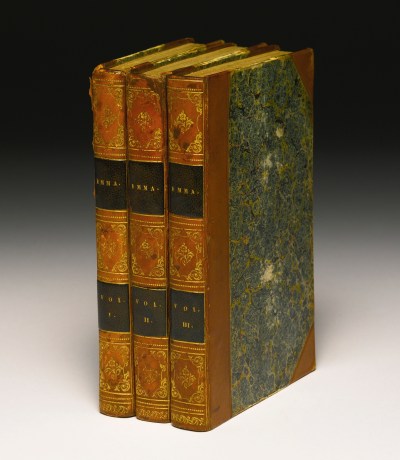
Sothebys-E-12-5-13

Austen, Jane. Emma: A Novel. London: Printed for John Murray, 1816.

3 volumes, 12mo (6 ¼ x 4 1/8 in.; 165 x 105 mm). Lacking half-titles; intermittent spotting and some staining, more so in vol. 2.  Near-contemporary half calf and marbled boards, spines gilt in 5 compartments with black morocco labels; some rubbing to sides and minor shelfwear along bottom edges, some skinning at top of spine ends.

Estimate: $7,000 — 9,000 – SOLD for $11,875.
_______

Sothebys-NA&P-12-5-13Lot 89:

Austen, Jane. Northanger Abbey: and Persuasion. London, John Murray, 1818.

4 volumes, 12mo (6 3/4 x 4 1/4 in.; 172 x 106 mm). Lacking half-titles; some very minor and mostly marginal spotting. Contemporary black half roan and marbled boards, spines ruled and gilt-titled; some rubbing to joints, slight wear at corners and along bottom edge, but a generally handsome set.

Estimate : $5,000 — 7,000 – SOLD for $8,125.

_______

Other items of interest at this auction:

Lot 92: Love this binding!
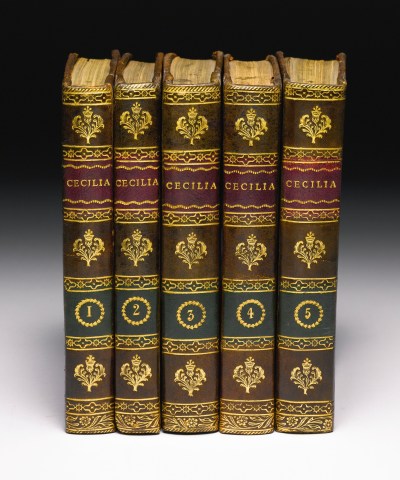
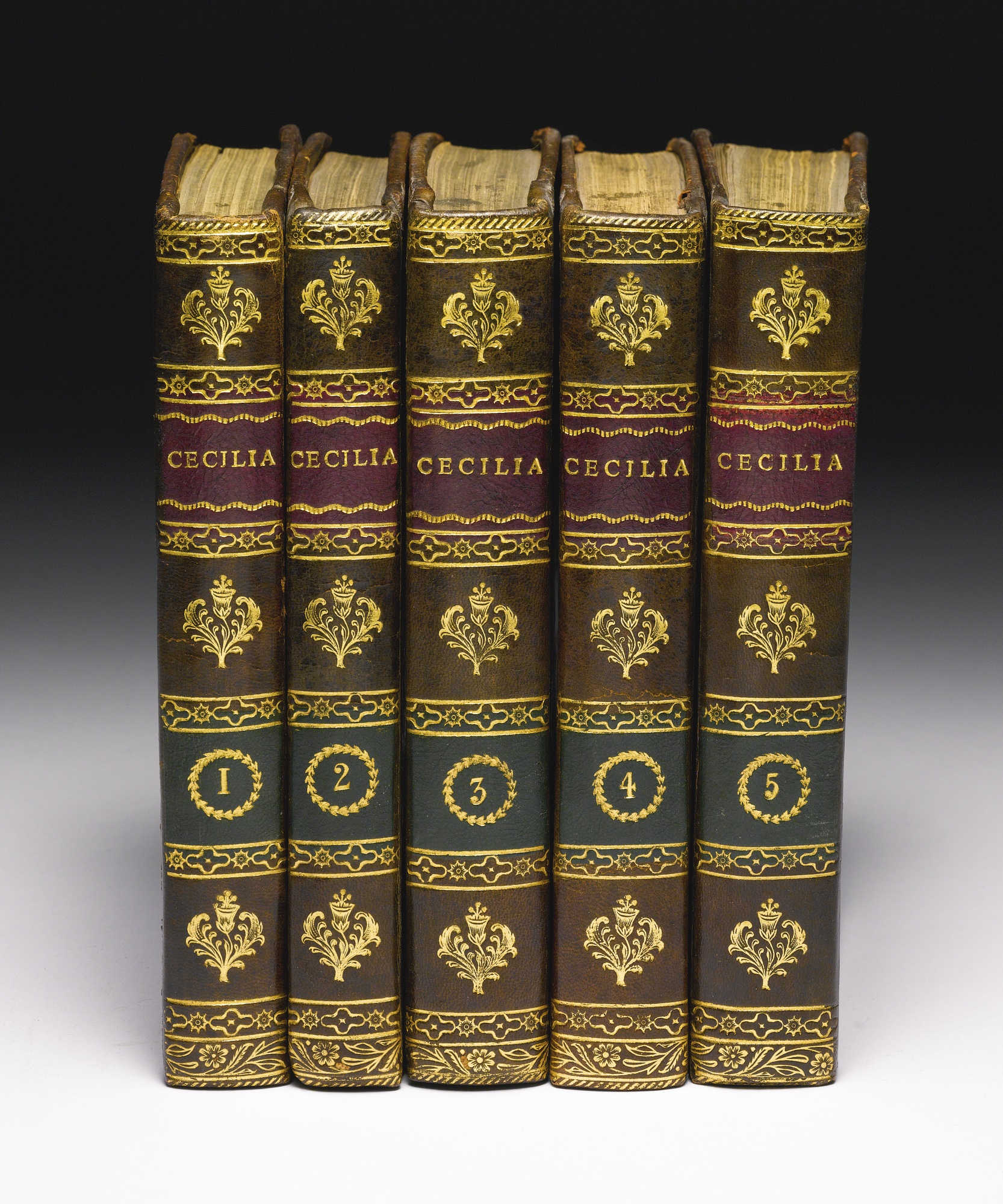
Sothebys-Cecilia-12-5-13

Burney, Frances. Cecilia, or Memoires of an Heiress. London: for T Payne and Son and T Cadell, 1782

5 volumes, 12mo (6 3/4 x 4 ins; 172 x 100 mm). Advertisement leaf present in first volume, vols. 2, 3, 5 lacking rear endpapers. Contemporary calf, rebacked to style with red morocco and green morocco labels.

Estimate: $2,000 — 4,000.
______

Lot 93:

Sothebys-Camilla-12-5-13Burney, Frances. Camilla: or a Picture of Youth.  London: for T. Payne, T. Cadell Jun and W. Davies, 1796

5 volumes, 12mo (174 x 102 mm). The occasional proud gathering and a few closed marginal tears to a handul leaves only. Contemporary speckled calf, single rule border to sides, spines with double-ruled compartments, green morocco labels; trace of rubbing to joints, upper joint of vol. 2 tender, but a lovely set.

Estimate: $3,000 — 5,000.
___________

Lot 96:

Sothebys-Byron-12-5-13Byron, George Gordon, Lord. Autograph verses for The Corsair. [1814].

Autograph fragment of two verses. 1 page (7 x 1 in.; 180 x 28 mm). Mounted in a portfolio with a portrait of the author; “And sad & lonely mid the holy calm /  Near Theseus’ fence y on solitary Palm.”

These two lines are the verses 1213 and 1214 of The Corsair, Canto III, published in 1814. In the edition of the Works of Lord Byron (Coleridge & Prothero, 1898-1905), the verses are: “And, dun and sombre ‘mid the holy calm, / Near Theseus’ fane yon solitary palm.”

Together with: autograph letter, signed (“Lord Byron” in third person). 1 page (8 5/3 x 6 7/8 in.; 219 x 175 mm), “13 Piccadilly Terrace, August 15th 1815”; to an unidentified correspondent: “Lord Byron presents his compliments to Mr. Juling [?] & would be glad to know if the letter of which he encloses the cover was not overcharged upon the [District?] stated on the address by the postman. The charge was thirteen pence half penny”. Formerly folded, soiling and foxing, tiny repair on the address. –Autograph address panel, cut from the address leaf of a letter addressed to his sister, August Leigh. 1 page (4 3/4 x 3 in.; 121 x 75 mm); wax seal; mounted in tinted roan folder.

Estimate: $4,000 — 6,000. 

***************

Sothebys – 10 December 2013: English Literature, History, Children’s Books & Illustrations. London

This auction includes the portrait noted above, but there a number of other offerings worth sharing: see the catalogue online where you will find a treasure-trove of children’s books and their illustrators  [Rackham, Tolkien, Potter, Robinson, Shepard, Pogany, Nielsen, Dulac, De Brunhoff, Carroll, Blyton, and more] , and also Johnson, Dickens, Pope, and Swift… and more…

Lot 284:

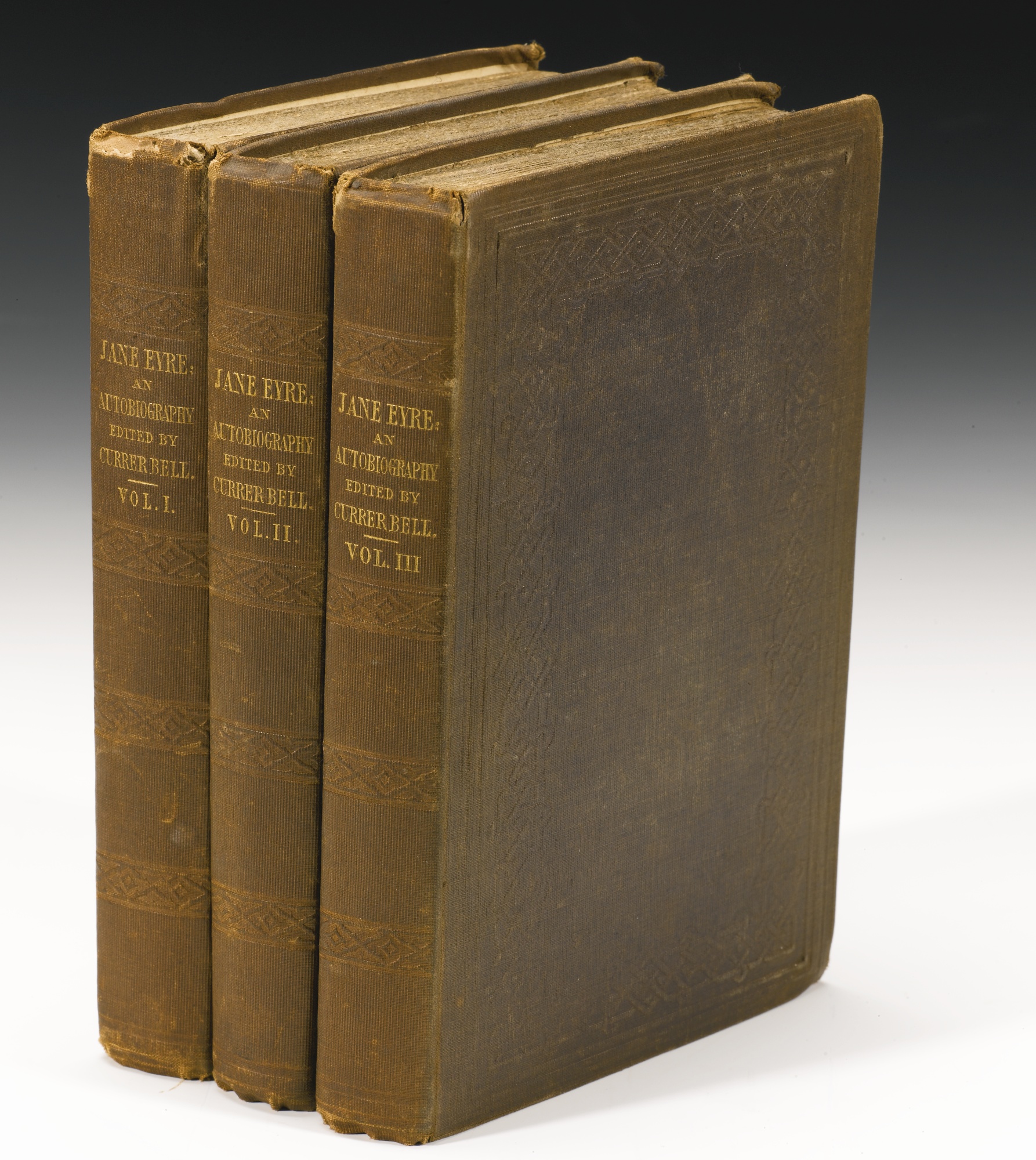
Sothbys-Bronte-12-10-13

[Brontë, Charlotte]. JANE EYRE. AN AUTOBIOGRAPHY. EDITED BY CURRER BELL. SMITH, ELDER AND CO., 1847

8vo (198 x 124mm), 3 volumes, first edition of the author’s first published novel, half-titles, publisher’s 32pp. catalogue dated October 1847 at the end of volume 1, without the extra advertisement leaf present in some copies (no priority), original dark greyish reddish brown vertically-ribbed cloth, covers decorated in blind with triple line border enclosing decorative trellis-like border, pale yellow endpapers, tear to inner margin of T2 in volume 1 (not affecting text), small portion of lower outer margin of U3 in volume 2 torn away (also not affecting text), occasional foxing and browning to text leaves, lower hinges of volumes 1 and 3 starting, hinge of upper hinge of volume 2 slightly cracked, cloth at top of spine of volume 1 slightly chipped, further slight edge-wear to covers and some slight fading.

Estimate: £35,000 — 45,000 

____________

These are just fun!

Lot 219:
Sothebys-cards-12-10-13

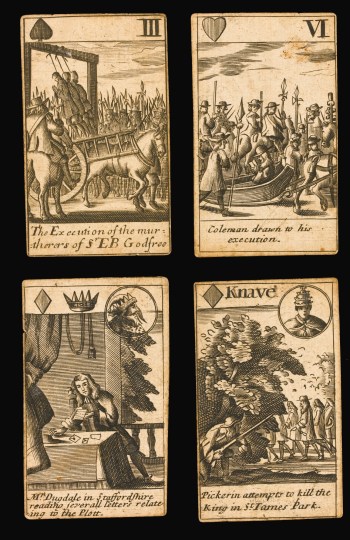
Playing cards: Popish Plot cards. [LONDON: ROBERT WALTON, C. 1679 OR LATER]

52 cards, each 90 x 54mm., engraved with captions, grey patterned versos, 12 mounted in a frame, the rest in a folder attached to the back of the frame,  three cards somewhat worn (two of diamonds, ten of spades and ace of hearts), king of clubs torn with loss of club symbol.

Estimate: £2,500 — 3,000
_____

There are several other playing cards on offer as well – another example – because the images are fabulous!
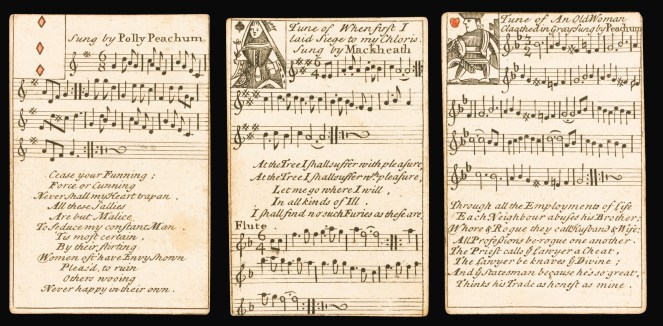
Sothebys-cards_opera-12-10-13Lot 236:

Playing cards: The Beggar’s Opera [LONDON: JOHN BOWLES, C. 1730]

52 cards, each 95 x 62mm., engraved with the hearts and diamonds coloured in red, plain versos, 13 mounted in a frame, the rest in a folder attached to the back of the frame, a few cards cut close, a few light stains

Estimate: £3,000 — 5,000

____

Lot 335:
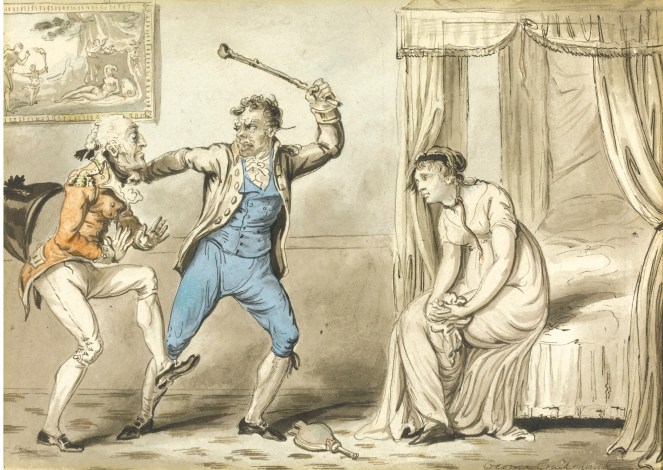
Sothebys-Cruikshank-12-10-13

Cruikshank, George. THE OUTRAGED HUSBAND.

165 by 228mm., ink and watercolour drawing, signed lower right, mounted, framed and glazed, some minor browning at extremities from former mount

Estimate: £1,500 — 2,000 

*********************

Some great items to add to your wish list! – go to the auction catalogues for even more treasures! Happy hunting [and wishing…]

C2013 Jane Austen in Vermont
Jane Austen · Jane Austen Popular Culture · Jane Austen Societies · JASNA · News · Social Life & Customs

Jane Austen on Nightline ~ Mr. Darcy Rules!

Here is the video that showed on Nightline last night “Oh Mr. Darcy! Jane Austen Super Fans” – where the camera takes us through various Jane Austen events with costumed, tea-drinking fans, as well as numerous film clips of our favorite Mr. Darcys in all manner of steamy situations …

The reporters hit the JASNA AGM in Minneapolis, a Jane Austen group in Pasadena, and our very own Governor’s House in Hyde Park, Vermont which makes a grand showing, fabulous for Innkeeper Suzanne!

c2013 Jane Austen in Vermont
Austen Literary History & Criticism · Books · Collecting Jane Austen · Decorative Arts · Fashion & Costume · Georgian England · Georgian Period · Jane Austen · Regency England · Social Life & Customs

Your Jane Austen Library: Jane Austen and the Arts: Elegance, Propriety, and Harmony

Another book to be added to your wish list, due out early December!

ja-and-arts

Jane Austen and the Arts: Elegance, Propriety, and Harmony
Edited by Natasha Duquette and Elisabeth Lenckos.
Lehigh U P / Rowman & Littlefield, 2013

What makes this book so special to JASNA-Vermont is that one of the chapters is by our founding member Kelly McDonald! – see chapter 2 in the table of contents below, and her blog post on it here. Congratulations Kelly!

**************

About the book, from the Rowman & Littlefield website:

Contributions by Jessica Brown; Diane N. Capitani; Christine Colón; Alice Davenport; Deborah Kennedy; Kathryn L. Libin; Kelly McDonald; Belisa Monteiro; Jeffrey Nigro; J. Russell Perkin; Erin J. Smith; Vivasvan Soni; Melora G. Vandersluis and Frederick A. Duquette.

The essays collected in Jane Austen and the Arts; Elegance, Propriety, and Harmony examine Austen’s understanding of the arts, her aesthetic philosophy, and her role as artist. Together, they explore Austen’s connections with Edmund Burke, Adam Smith, Johann Wolfgang von Goethe, Madame de Staël, Joanna Baillie, Jean Jacques Rousseau, Mary Anne Schimmelpenninck, and other writers engaged in debates on the sensuous experience and the intellectual judgment of art. Our contributors look at Austen’s engagement with diverse art forms, painting, ballet, drama, poetry, and music, investigating our topic within historically grounded and theoretically nuanced essays. They represent Austen as a writer-thinker reflecting on the nature and practice of artistic creation and considering the social, moral, psychological, and theological functions of art in her fiction. We suggest that Austen knew, modified, and transformed the dominant aesthetic discourses of her era, at times ironically, to her own artistic ends. As a result, a new, and compelling image of Austen emerges, a “portrait of a lady artist” confidently promoting her own distinctly post-enlightenment aesthetic system.

***************

Table of Contents:

Preface: Jane Austen’s Critique of Aesthetic Judgment by Vivasvan Soni
Introduction by Natasha Duquette and Elisabeth Lenckos

I.  The Fine Arts in Austen’s World: Music, Dance, and Portraiture

Ch 1. “Daily Practice, Musical Accomplishment, and the Example of Jane Austen”  – Kathryn Libin
Ch 2.”A ‘Reputation for Accomplishment’: Marianne Dashwood and Emma Woodhouse as Artistic Performers” –  Kelly McDonald
Ch 3. “Miss Bingley’s Walk: The Aesthetics of Movement in Pride and Prejudice” – Erin Smith
Ch 4. “The Sister Artist: Cassandra Austen’s Portraits of Jane Austen in Art-Historical Context” – Jeffrey Nigro

II. Austen and Romanticism: Female Genius, Gothicism, and Sublimity

Ch 5 – “Portrait of a Lady (Artist): Jane Austen’s Anne Elliot, Madame de Staël’s Corrine, and the Woman of Genius Novel” – Elisabeth Lenckos
Ch 6 – “Jane Austen’s Comic Heroines and the Controversial Pleasures of Wit” – Belisa Monteiro
Ch 7 – “An Adaptable Aesthetic: Eighteenth-Century Landscapes, Ann Radcliffe, and Jane Austen” – Alice Davenport
Ch 8. “Exploring the Transformative Power of Literature: Joanna Baillie, Jane Austen and the Aesthetics of Moral Reform” – Christine Colón
Ch 9. “Jane Austen’s Influence on Stephenie Meyer” – Deborah Kennedy

III. Austen in Political, Social, and Theological Context

Ch 10. “Aesthetics, Politics, and the Interpretation of Mansfield Park” – Russell Perkin
Ch 11. “Reflections on Mirrors: Austen, Rousseau, and Socio-Politics” – Melora Vandersluis
Ch 12. “‘So much novelty and beauty!’: Spacious Reception through an Aesthetic of Restraint in Persuasion” – Jessica Brown
Ch 13. “Augustinian Aesthetics in Jane Austen’s World: God as Artist” – Diane Capitani
Ch 14. “‘Delicacy of Taste’ Redeemed: The Aesthetic Judgments of Austen’s Clergymen Heroes” – Fred and Natasha Duquette

*************

Due out in December, you can pre-order the book here – the ebook will be available this month for a penny less!

978-1-61146-137-4 • Hardback -December 2013 • $80.00 • (£49.95)
978-1-61146-138-1 • eBook – November 2013 • $79.99 • (£49.95)

You can also pre-order it here for a little less at Amazon.

[Text and image from the Rowman website]

C2013 Jane Austen in Vermont
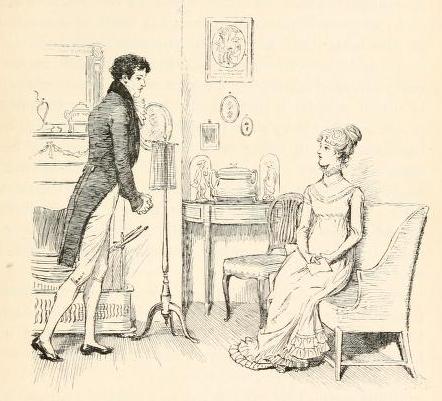
Fashion & Costume · Georgian England · Georgian Period · Great Britain - History · Jane Austen · London · Museum Exhibitions · Regency England · Social Life & Customs

Museum Musings: The British Library ~ “Georgians Revealed”

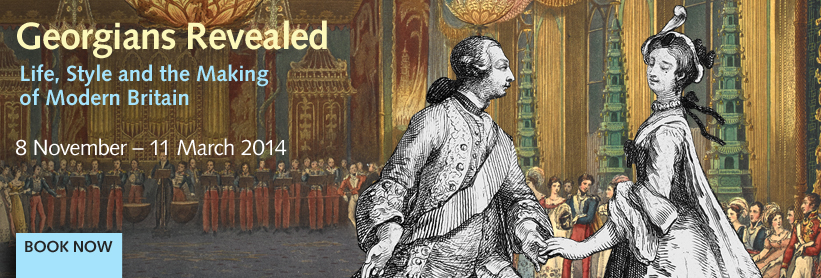
Opening today! ~ “Georgians Revealed: Life, Style and the Making of Modern Britain” – 8 November – 11 March 2014 at the British Library

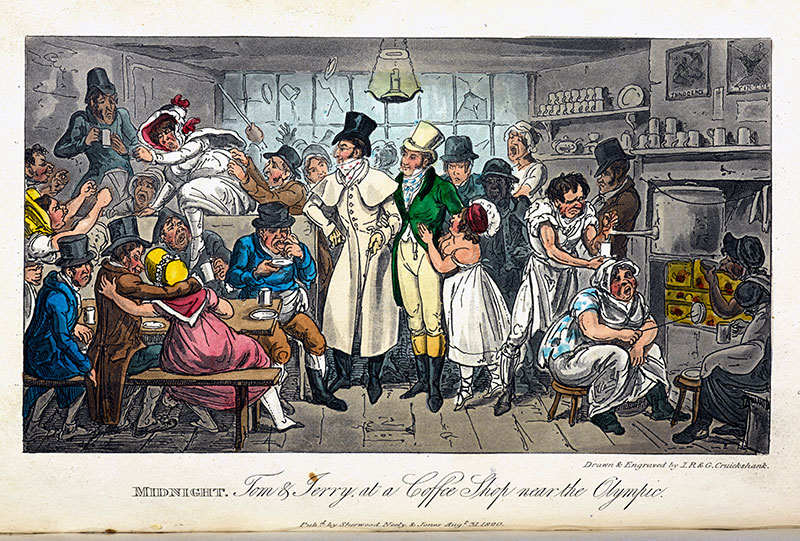
tomjerrycoffeeshop-orig

I.R. and G. Cruikshank. ‘Tom & Jerry at a Coffee Shop near the Olympic’ – Pierce Egan, Life in London (London, 1823).

 Tasteful and polite, or riotous and pleasure-obsessed? Discover the Georgians as they really were, through the objects that tell the stories of their lives.

From beautifully furnished homes to raucous gambling dens, Georgians Revealed explores the revolution in everyday life that took place between 1714 and 1830. Cities and towns were transformed. Taking tea, reading magazines, gardening and shopping for leisure were commonplace, and conspicuous consumption became the pastime of the emerging middle classes.

Popular culture as we know it began, and with it the unstoppable rise of fashion and celebrity. Art galleries, museums and charities were founded. In this time of incredible innovation, ideas were endlessly debated in the new coffee houses and spread via the information highway that was mass print.

Drawing on the British Library’s uniquely rich and rare collections of illustrated books, newspapers, maps and advertisements, as well as loaned artworks and artifacts, “Georgians Revealed” brings to life the trials and triumphs of the ordinary people who transformed Britain forever.

Georgiansrevealed banner

See this link for a short video on the exhibition by curator Moira Goff.

And check out the online shop where all manner of Georgian -related treasures are for sale, as well as a catalogue of the exhibition, another must-have for your Jane Austen collection!

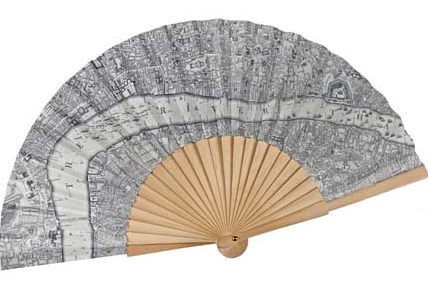
Georgians-map_fan3

Rocque map of London fan, £8
A beautiful wooden fan, featuring a historic map created by John Rocque.
The fan has been created exclusively for the British Library. Wood/ canvas.

[Images and text from the British Library website]

c2013 Jane Austen in Vermont
Austen Literary History & Criticism · Books · Collecting Jane Austen · Jane Austen · Jane Austen Illustrators · Museum Exhibitions · Publishing History

The Folio Society’s Latest Pride and Prejudice
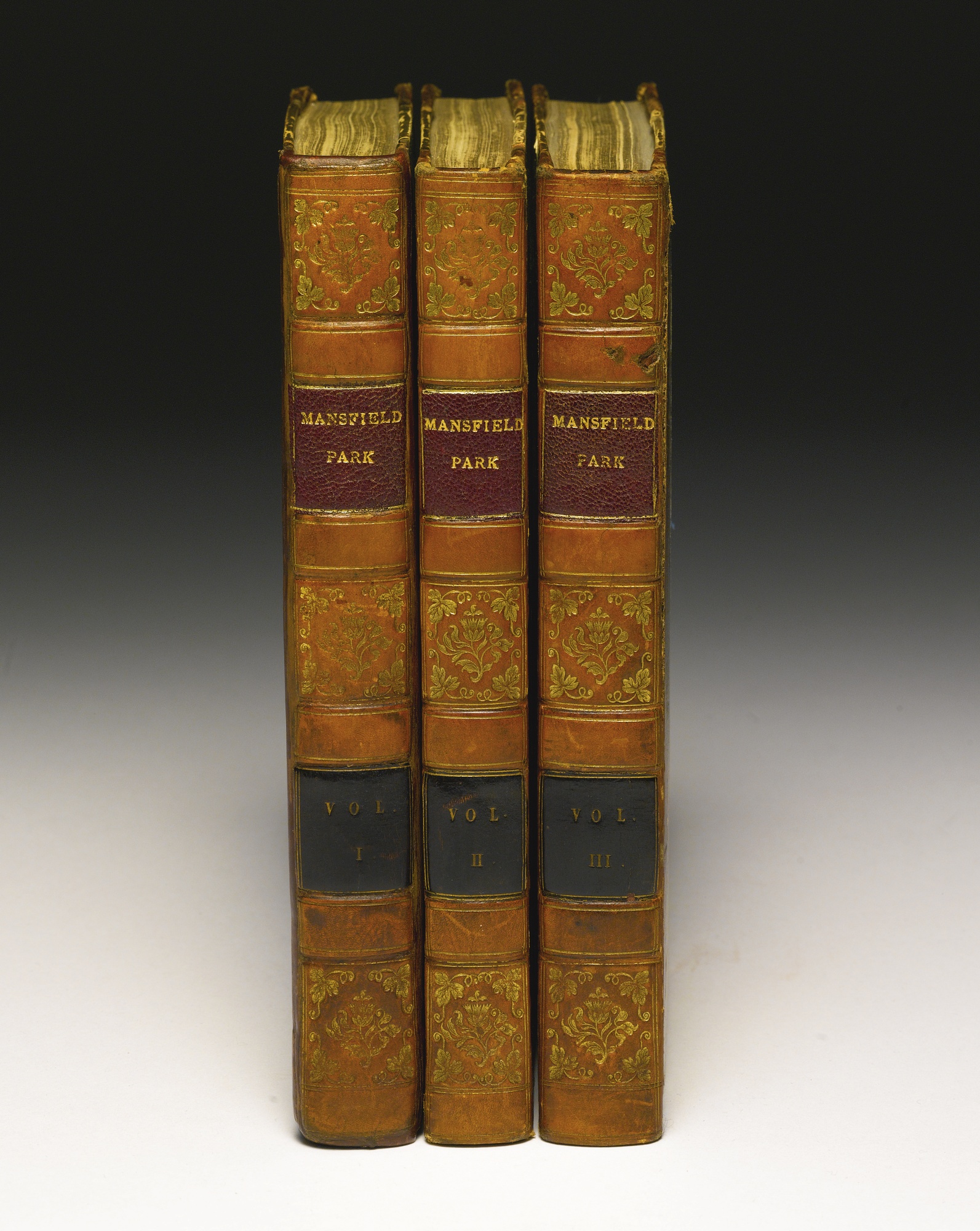
If you are into your holiday shopping early, or compiling your own wish-list, here is a fine start: a must-have for your Jane Austen collection:  the Folio Society’s latest edition of  Pride and Prejudice, 2013.

PP-cover-Folio2013

“I had not known you a month before I felt that you were the last man in the world whom I could ever be prevailed on to marry.” 

One of the world’s favourite books, Pride and Prejudice has long been regarded as a classic romance. In Elizabeth Bennet and Fitzwilliam Darcy, Jane Austen created the greatest pair of sparring lovers since Shakespeare’s Beatrice and Benedick. This sparkling comedy of manners features an inimitable cast of characters including the obsequious Mr Collins, the autocratic Lady Catherine de Bourgh, and Mrs Bennet, the most embarrassing mother in literature.

The award-winning Balbusso twins have contributed eight exquisite illustrations to this edition, as well as a striking cover design. The novel’s celebrated first line is blocked in gold on the slipcase. In a new introduction, the author Sebastian Faulks praises ‘a novel of almost boundless wit and charm that has withstood film and television adaptations and attempts to define it as a “fairy tale” or a “rom-com”.’

balbusso_05_pplarge

[Pride and Prejudice (Folio, 2013): image from the Balbusso website]

Details:

  • Introduced by Sebastian Faulks.
  • Illustrated by Anna and Elena Balbusso.
  • Bound in metallic cloth, blocked with a design by Anna and Elena Balbusso.
  • 352 pages.
  • Frontispiece and 7 colour illustrations.
  • Book size: 9½” x 6¼”
  • $62.50

[Text from the Folio Society Website]

********