Austen Literary History & Criticism · Book reviews · Books · Jane Austen · Jane Austen Circle · Literature · Publishing History · Women Writers

Book Review: Nicholas Ennos’ Jane Austen: A New Revelation ~ “Conspiracy is the Sincerest Form of Flattery”

Dear Gentle Readers: I welcome today Janine Barchas with her review of the recently published Jane Austen: A New Revelation by Nicholas Ennos – his book tackles the question of who really authored Jane Austen’ s six novels and juvenilia…

***************

“Conspiracy is the Sincerest Form of Flattery”

Review of Nicholas Ennos, Jane Austen: A New Revelation (Senesino Books, Oct. 2013).  Pp. 372.  £25.  Available from Amazon.com as an e-book for Kindle for $10.99. 
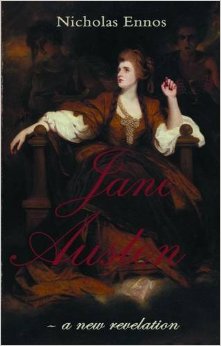
cover-ennos-jarevelation

The litmus test of true literary achievement is whether your works are deemed so great that you simply could not have written them.

Janeites need no longer envy students of Shakespeare their intricate web of Renaissance conspiracy theories.  Whereas Shakespeare scholarship has long enjoyed the spectral presence of the Earl of Oxford, Austen studies can now boast a countess named Eliza de Feuillide.

The self-published Jane Austen: A New Revelation alleges that “a poor, uneducated woman with no experience of sex or marriage” could not possibly have written the sophisticated works of social satire and enduring romance that we traditionally attribute to Jane Austen.  The book’s author, Nicholas Ennos (the aura of conspiracy allows that this is not necessarily his/her real name), asserts that biographers have been leading everyone by the nose.  The true author of the Austen canon is, instead, Madame la Comtesse de Feuillide, born Eliza Hancock (1761-1813).  Eliza was the worldly and well-educated older cousin of Jane Austen who, after being made a young widow by the French Revolution, married Henry Austen, Jane’s favorite brother.  The sassy Eliza has long been pointed to as a model for the morally challenged characters of Lady Susan and Mary Crawford in the fictions.  To identify Eliza as the actual author was, Ennos explains, the next logical step.
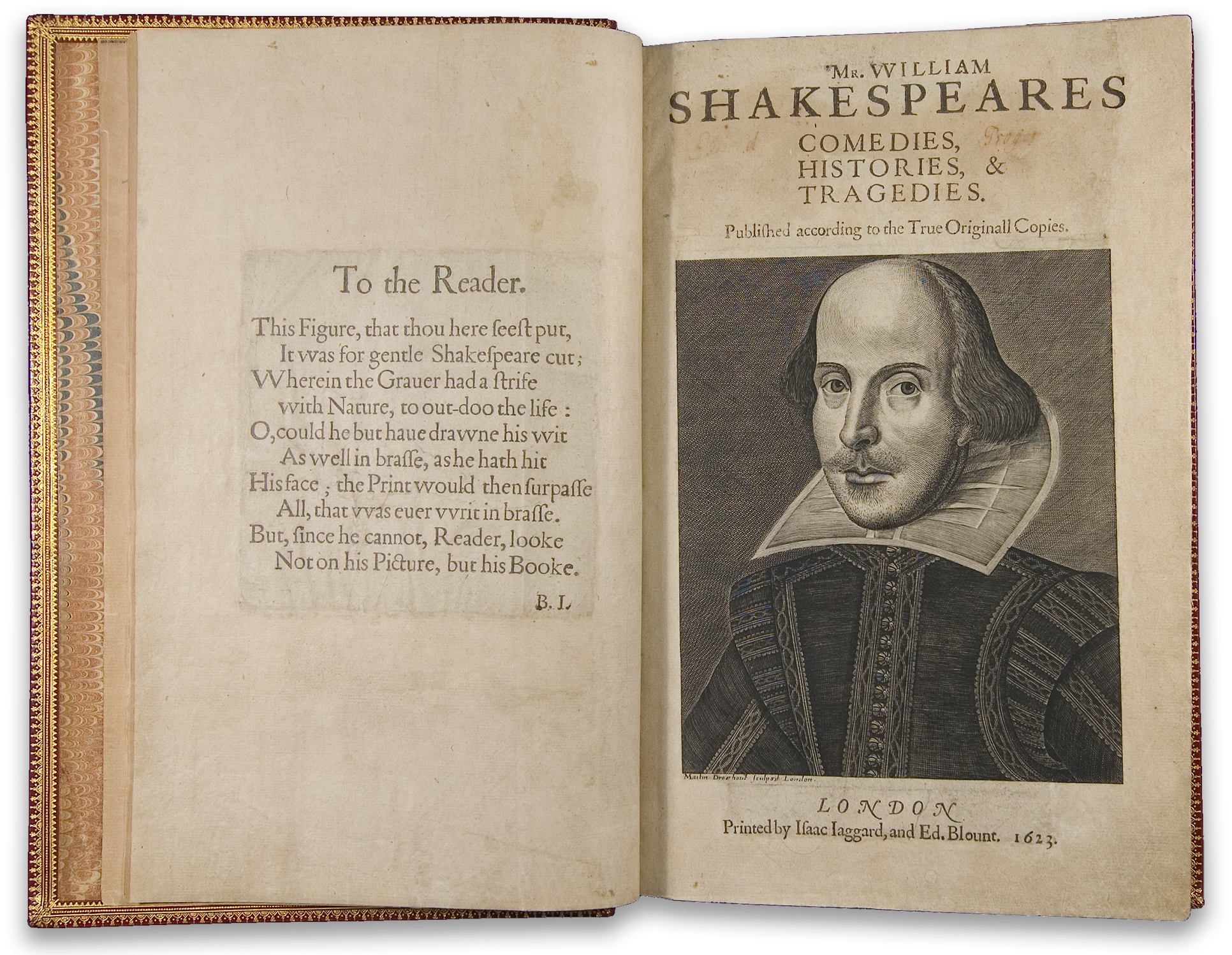
shakespeare-1stfolio-haverford

Shakespeare’s First Folio – Haverford.edu

Just so, and also about two centuries into his literary afterlife, William Shakespeare’s lofty literary achievements were judged incompatible with his humble origins, sowing seeds of doubt that a person so little known could have achieved so much.  Slowly, the man named Will Shakespeare from Stratford-upon-Avon came to be considered by a small-but-articulate fringe to be a mere front shielding the genuine author (or authors) of the works written under the pen name of Shakespeare.  Austen’s genteel poverty, relative isolation, and biographical quiet allows for a similar approach.  For how, asks Ennos, can genius thrive with so little food of experience to feed it?

The arguments for Shakespeare reattribution rely heavily upon biographical allusions as well as the absence of works in manuscript.  Similarly, Austen critics who have been keen to spot biographical references to real places and family members in the fictions have apparently opened the door to skeptics who can now point to Cassandra’s “systematic destruction” of her sister’s letters as proof of a conspiracy.  Ennos also draws attention to the “suspicious” parallel fact that no Austen novel survives in manuscript.  The juvenilia, which does survive in Jane’s hand, is explained away as early secretarial work for Eliza during her visits to the Steventon household.

Eliza died in April of 1813, well before the publication of Mansfield Park (1814), Emma (1815), or Persuasion and Northanger Abbey (Dec 1817).  The so-called Oxfordians overcame the timeline obstacles posed by Edward de Vere’s early death in 1604 by redating many Shakespeare texts, which (their logic dictates) must have been composed earlier than previously thought and squirreled away for later publication by an appointed agent.  So too is the Austen corpus deftly redated by Ennos—with husband Henry, cousin Cassandra, and amanuensis Jane as co-conspirators.  Some historians allow that Eliza was in all probability the natural daughter of politician Warren Hastings.  Ennos adds to this existing context of secrecy that Eliza’s illegitimacy was the “disgrace” that the Austens “were determined to cover up after Eliza’s death” and the reason that “the myth of Jane Austen’s authorship was invented.”

Readers of Austen will doubtless need some time to process the implications of these revelations.  For example, what of the presumed poignancy of Persuasion’s temporal setting?  The events in this novel take place during the false peace of the summer of 1814—a short reprieve in the Napoleonic wars that saw the premature return of Britain’s navy men after the initial exile of Napoleon to Elba.  Persuasion has been on record as composed between August 1815 and August 1816, in the full knowledge of both the false hopes of that summer and the true end to the war that came with the Battle of Waterloo in June 1815.  Ennos moves the novel’s date of composition prior to April 1813.  Although he does not go so far as to urge Eliza’s historical prescience, he suggests that these features are merely evidence of judicious tweaks to manuscripts left in Henry’s care at Eliza’s death.

Eliza de Feuillide                 Frances Burney                 Jane Austen

This is not all.  Ennos further declares that the precocious Eliza also wrote the novels conventionally attributed to Frances Burney (1752-1840).  The resemblances between Evelina and Pride and Prejudice have long been acknowledged by scholars who have (mistakenly, according to Ennos) attributed this to Burney’s literary influence upon the young Austen.  Ennos reasons that Frances Burney’s lack of literary success after Eliza’s death, including her “truly dreadful” novel The Wanderer in 1814, is evidence of her being, in fact, an imposter.  While future stylometric analysis may eventually confirm that Jane and Fanny were one and the same Eliza, this method has not settled the authorship question irrevocably for Shakespeare.  Perhaps this is why Ennos does not turn to computer analysis or linguistics for help.  He does identify Elizabeth Hamilton, the name of another minor authoress, as a further pseudonym used by the talented Eliza—ever widening the corpus of works that might appeal to those already interested in Austen.

It is a truth universally acknowledged that the novels attributed to Jane Austen were published anonymously during her lifetime.  Logically, any book written anonymously must be in want of a conspiracy.   The grassy knoll of this particular conspiracy is the biographical notice in Northanger Abbey, released simultaneously with Persuasion six months after Jane Austen’s death in 1817.  History has taken Henry Austen, a failed banker, at his word in identifying the author as his sister.  Ennos, who is not very gallant towards the species of academics and literary critics whom he dismisses as “simple souls,” suggests that Austen scholarship has been surprisingly gullible in accepting Henry’s attribution without question.

In the wake of the Ireland forgeries of the 1790s, generations of Shakespeare scholars offered dozens of different names for the man behind the mask of “Will Shakespeare.”  Although the Earl of Oxford has garnered Hollywood’s vote, Francis Bacon and Christopher Marlowe are next in popularity.  We can only hope that these allegations by Ennos prop open the doors of Austen authorship so that additional candidates can step forward to provide generations of graduate students with dissertation fodder.

Does the Eliza attribution theory expect to be taken seriously?  Or does this maverick publication deliberately mock established scholarship by means of cartoonish imitation?  I’m not sure it really matters.  If this project had ambitions to be a serious Sokal-style hoax, then it did not manage to convince a top publisher and, as a result, lacks the ability to wound deeply.  The prose is also too earnest and unadorned for an academic satire—devoid of the jargon that should dutifully accompany a spoof.  The resulting pace is too sluggish for irony.  That said, there are plenty of moments that even David Lodge could not improve upon.  For example, Ennos points to an acrostic “proof” of hidden clues in the dedicatory poem to Evelina (only visible if decoded into Latin abbreviations).  There is also the syllogistic central assertion that if the novels of both Burney and Austen resemble the Latinate style of Tacitus, then these could only have been written by 1) the same person and 2) someone schooled in Latin.  Ergo, Eliza is the true author behind both, since only she could have learned Latin from Reverend George Austen, Jane’s father (who might teach a niece but never his youngest daughter).  Finally, there are gestures towards wider bodies of knowledge: “In this respect the philosophy of both authors has been linked to the views of the Swedish philosopher, Swedenborg.”  Perhaps Ennos is simply angling for someone to buy the movie option.  “Anonymous” did well at the box office, so why not a film dubbed “Eliza”?

No matter what the intention, hearty congratulations are due to Jane Austen.  For her, this news makes for a strong start to the New Year.  Exactly two centuries into her literary afterlife, a doubting Thomas was the last requirement of literary celebrity still missing from her resume.  Austen can now take her seat next to Shakespeare, secure in the knowledge that her authorship, too, has begun to be questioned.

You know you’ve hit the big time when you didn’t write your own work.

— Reviewed by Janine Barchas

*****************

Barchas is the author of Matters of Fact in Jane Austen: History, Location, and Celebrity (Johns Hopkins, 2012).  She is also the creator of “What Jane Saw”, an on-line reconstruction of an art exhibit attended by Jane Austen on 24 May 1813.   Recently, she has written for The New York Times and the Johns Hopkins University Press Blog.

c2014 Jane Austen in Vermont; text c2014 Janine Barchas
Austen Literary History & Criticism · Collecting Jane Austen · Jane Austen · JASNA · Literature

Happy Birthday Jane Austen!

The first order of business today, on this 238th birthday of Jane Austen, is the annual publication of JASNA’s Persuasions On-Line Vol. 34, No. 1 (Winter 2013). Click here for the Table of Contents to yet another inspiring collection of essays, some from the 2013 AGM in Minneapolis on Pride and Prejudice, and other “Miscellany” – all about Jane Austen…and perfect winter reading material…

Here is the link: http://www.jasna.org/persuasions/on-line/vol34no1/index.html

pollogo

I will posting other things today, so please stay tuned!

c2013 Jane Austen in Vermont
Austen Literary History & Criticism · Books · Jane Austen · Jane Austen Popular Culture · Literature

Mr. Darcy’s Feelings; Or, More on the Inner Life of Jane Austen’s Hero…Part II

Please see the first post on Mr. Darcy’s Feelings – Pride and Prejudice Vol. I here

Now on to Volume II!

Skipping through the text to locate just commentary on Mr. Darcy’s feelings and instances of Elizabeth’s professed dislike of the man leaves out an awful lot of interesting passages – taking Jane Austen out of context is a dangerous thing! – we have missed Mr. Collins and his rejected proposal entirely! always too wonderful to skim over – for here we learn more about Elizabeth and her feelings on marriage and friendship than anywhere else in the novel.  I have always thought she is very quick to judgment on Charlotte’s choice of a partner – she forgets what is clear in the text to us and would have been for contemporary readers – that Charlotte is a rational creature and knows she has little choice if she is to have a “comfortable home” of her own… even the narrator is critical of Elizabeth, described as “less clear-sighted” in the case of Wickham’s marrying for money and independence than she is of her friend’s similar decision, a crucial point in seeing Elizabeth’s own prejudices.

CEBrock-collinsproposal-mollands

C. E. Brock. “Almost as soon as I entered the house I singled you out as the companion of my future life.”
P&P. Macmillan, 1895. Volume I, Ch. 19 [Mollands]

But I digress – we shall leave Mr. Collins and continue in search of Mr. Darcy’s feelings…

***********

Elizabeth blames Darcy for taking Bingley away, and he is “condemned [by everybody, except Jane Bennet] as the worst of men” (p. 107)* – she rants:

p. 119.

“Oh! if that is all, I have a very poor opinion of young men who live in Derbyshire; and their intimate friends who live in Hertfordshire are not much better. I am sick of them all. Thank Heaven! I am going to-morrow where I shall find a man [Collins] who has not one agreeable quality, who has neither manner nor sense to recommend him. Stupid men are the only ones worth knowing, after all.”

[And Darcy as always, though nowhere to be found in the book here, is not far from her thoughts, as so on seeing Miss De Bourgh:]

p. 122.

“I like her appearance,” said Elizabeth, struck with other ideas. “She looks sickly and cross. Yes, she will do for him very well. She will make him a very proper wife.”

p. 125. [on meeting Lady Catherine for the first time:]

??????????????????? Lady Catherine –  P&P 1995

When, after examining the mother, in whose countenance and deportment she soon found some resemblance of Mr. Darcy…

p. 131.

Elizabeth had heard soon after her arrival that Mr. Darcy was expected there in the course of a few weeks, and though there were not many of her acquaintance whom she did not prefer, his coming would furnish one comparatively new to look at in their Rosings parties, and she might be amused in seeing how hopeless Miss Bingley’s designs on him were, by his behaviour to his cousin, for whom he was evidently destined by Lady Catherine, who talked of his coming with the greatest satisfaction, spoke of him in terms of the highest admiration, and seemed almost angry to find that he had already been frequently seen by Miss Lucas and herself.

p. 131. [The ever-observant Charlotte]:

…and to the great surprise of all the party, when Mr. Collins returned, the gentlemen [Darcy and Col. Fitzwilliam] accompanied him. Charlotte had seen them from her husband’s room crossing the road, and immediately running into the other, told the girls what an honour they might expect, adding —

“I may thank you, Eliza, for this piece of civility. Mr. Darcy would never have come so soon to wait upon me.”

Elizabeth had scarcely time to disclaim all right to the compliment before their approach was announced by the door-bell, and shortly afterwards the three gentlemen entered the room. Colonel Fitzwilliam, who led the way, was about thirty, not handsome, but in person and address most truly the gentleman. Mr. Darcy looked just as he had been used to look in Hertfordshire — paid his compliments, with his usual reserve, to Mrs. Collins, and whatever might be his feelings towards her friend, met her with every appearance of composure. Elizabeth merely curtseyed to him, without saying a word.

p. 132. Col. Fitzwilliam and Elizabeth at the pianoforte:

Mrs. Collins’s pretty friend had moreover caught his fancy very much. He now seated himself by her, and talked so agreeably of Kent and Hertfordshire, of travelling and staying at home, of new books and music, that Elizabeth had never been half so well entertained in that room before; and they conversed with so much spirit and flow, as to draw the attention of Lady Catherine herself, as well as of Mr. Darcy. His eyes had been soon and repeatedly turned towards them with a look of curiosity…

p. 133.

[Lady Catherine] “…though Mrs. Collins has no instrument, she is very welcome, as I have often told her, to come to Rosings every day, and play on the piano forte in Mrs. Jenkinson’s room. She would be in nobody’s way, you know, in that part of the house.”

 Mr. Darcy looked a little ashamed of his aunt’s ill-breeding, and made no answer. 

p. 133-35. [a long passage but one the most important exchanges between them; and notice Darcy’s smiles!]

He [Col. Fitzwilliam] drew a chair near her. Lady Catherine listened to half a song, and then talked, as before, to her other nephew; till the latter walked away from her, and moving with his usual deliberation towards the pianoforte, stationed himself so as to command a full view of the fair performer’s countenance. Elizabeth saw what he was doing, and at the first convenient pause, turned to him with an arch smile, and said –

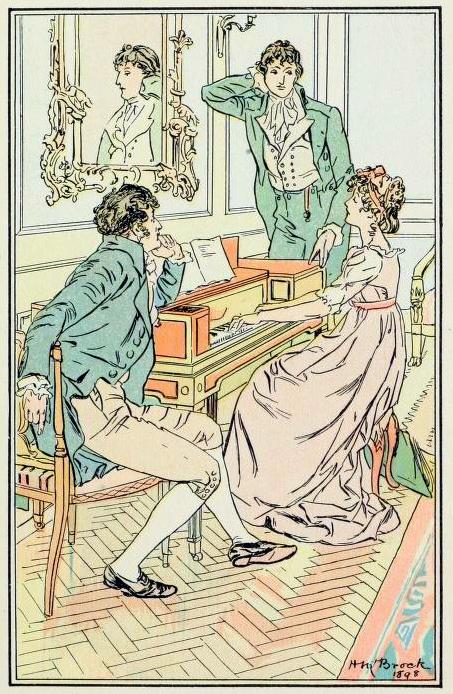
CEBrock-atpianoforte-adelaide

H. M. Brock. “At the pianoforte”. P&P. Dent, 1898 [Adelaide]

“You mean to frighten me, Mr. Darcy, by coming in all this state to hear me? But I will not be alarmed though your sister does play so well. There is a stubbornness about me that never can bear to be frightened at the will of others. My courage always rises with every attempt to intimidate me.”

“I shall not say that you are mistaken,” he replied, “because you could not really believe me to entertain any design of alarming you; and I have had the pleasure of your acquaintance long enough to know that you find great enjoyment in occasionally professing opinions which in fact are not your own.”

Elizabeth laughed heartily at this picture of herself, and said to Colonel Fitzwilliam, “Your cousin will give you a very pretty notion of me, and teach you not to believe a word I say. I am particularly unlucky in meeting with a person so well able to expose my real character, in a part of the world where I had hoped to pass myself off with some degree of credit. Indeed, Mr. Darcy, it is very ungenerous in you to mention all that you knew to my disadvantage in Hertfordshire — and, give me leave to say, very impolitic too — for it is provoking me to retaliate, and such things may come out as will shock your relations to hear.”

“I am not afraid of you,” said he smilingly.

“Pray let me hear what you have to accuse him of,” cried Colonel Fitzwilliam. “I should like to know how he behaves among strangers.”

“You shall hear then — but prepare yourself for something very dreadful. The first time of my ever seeing him in Hertfordshire, you must know, was at a ball — and at this ball, what do you think he did? He danced only four dances! I am sorry to pain you — but so it was. He danced only four dances, though gentlemen were scarce; and, to my certain knowledge, more than one young lady was sitting down in want of a partner. Mr. Darcy, you cannot deny the fact.”

“I had not at that time the honour of knowing any lady in the assembly beyond my own party.”

“True; and nobody can ever be introduced in a ball room. Well, Colonel Fitzwilliam, what do I play next? My fingers wait your orders.”

“Perhaps,” said Darcy, “I should have judged better had I sought an introduction; but I am ill qualified to recommend myself to strangers.”

“Shall we ask your cousin the reason of this?” said Elizabeth, still addressing Colonel Fitzwilliam. “Shall we ask him why a man of sense and education, and who has lived in the world, is ill qualified to recommend himself to strangers?”

“I can answer your question,” said Fitzwilliam, “without applying to him. It is because he will not give himself the trouble.”

“I certainly have not the talent which some people possess,” said Darcy, “of conversing easily with those I have never seen before. I cannot catch their tone of conversation, or appear interested in their concerns, as I often see done.”

“My fingers,” said Elizabeth, “do not move over this instrument in the masterly manner which I see so many women’s do. They have not the same force or rapidity, and do not produce the same expression. But then I have always supposed it to be my own fault — because I would not take the trouble of practising. It is not that I do not believe my fingers as capable as any other woman’s of superior execution.”

Darcy smiled and said, “You are perfectly right. You have employed your time much better. No one admitted to the privilege of hearing you can think anything wanting. We neither of us perform to strangers.”

p. 135. [Elizabeth watching Mr. Darcy very closely!]

AnnedeBourgh-P&P2005

Anne de Bourgh. P&P 2005.

Elizabeth looked at Darcy to see how cordially he assented to his cousin’s praise; but neither at that moment nor at any other could she discern any symptom of love; and from the whole of his behaviour to Miss De Bourgh she derived this comfort for Miss Bingley, that he might have been just as likely to marry her, had she been his relation.

p. 136.

…when the door opened, and to her very great surprise Mr. Darcy, and Mr. Darcy only, entered the room.

He seemed astonished too on finding her alone, and apologised for his intrusion by letting her know that he had understood all the ladies to be within.

p. 137… [the “50 miles of good road” discussion, each misunderstanding the other…]

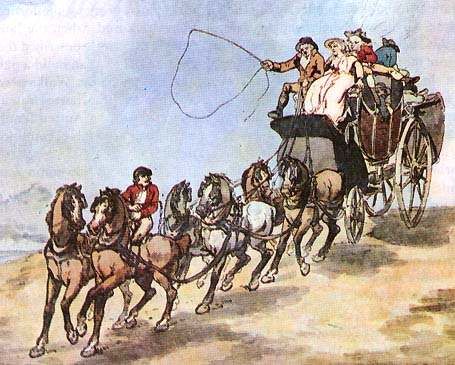
coach

“It must be very agreeable to her to be settled within so easy a distance of her own family and friends.”

“An easy distance, do you call it? It is nearly fifty miles.”

“And what is fifty miles of good road? Little more than half a day’s journey. Yes, I call it a very easy distance.”

“I should never have considered the distance as one of the advantages of the match,” cried Elizabeth. “I should never have said Mrs. Collins was settled near her family.”

“It is a proof of your own attachment to Hertfordshire. anything beyond the very neighbourhood of Longbourn, I suppose, would appear far.”

As he spoke there was a sort of smile which Elizabeth fancied she understood; he must be supposing her to be thinking of Jane and Netherfield, and she blushed as she answered …–

p. 138. [love this!]

Elizabeth looked surprised. The gentleman experienced some change of feeling; he drew back his chair, took a newspaper from the table, and, glancing over it, said, in a colder voice —

“Are you pleased with Kent?”

p. 138.

“What can be the meaning of this?” said Charlotte, as soon as he was gone. “My dear Eliza, he must be in love with you, or he would never have called on us in this familiar way.”

But when Elizabeth told of his silence, it did not seem very likely, even to Charlotte’s wishes, to be the case; and after various conjectures, they could at last only suppose his visit to proceed from the difficulty of finding anything to do, which was the more probable from the time of year. All field sports were over.

p. 139. [inside Charlotte’s head…]

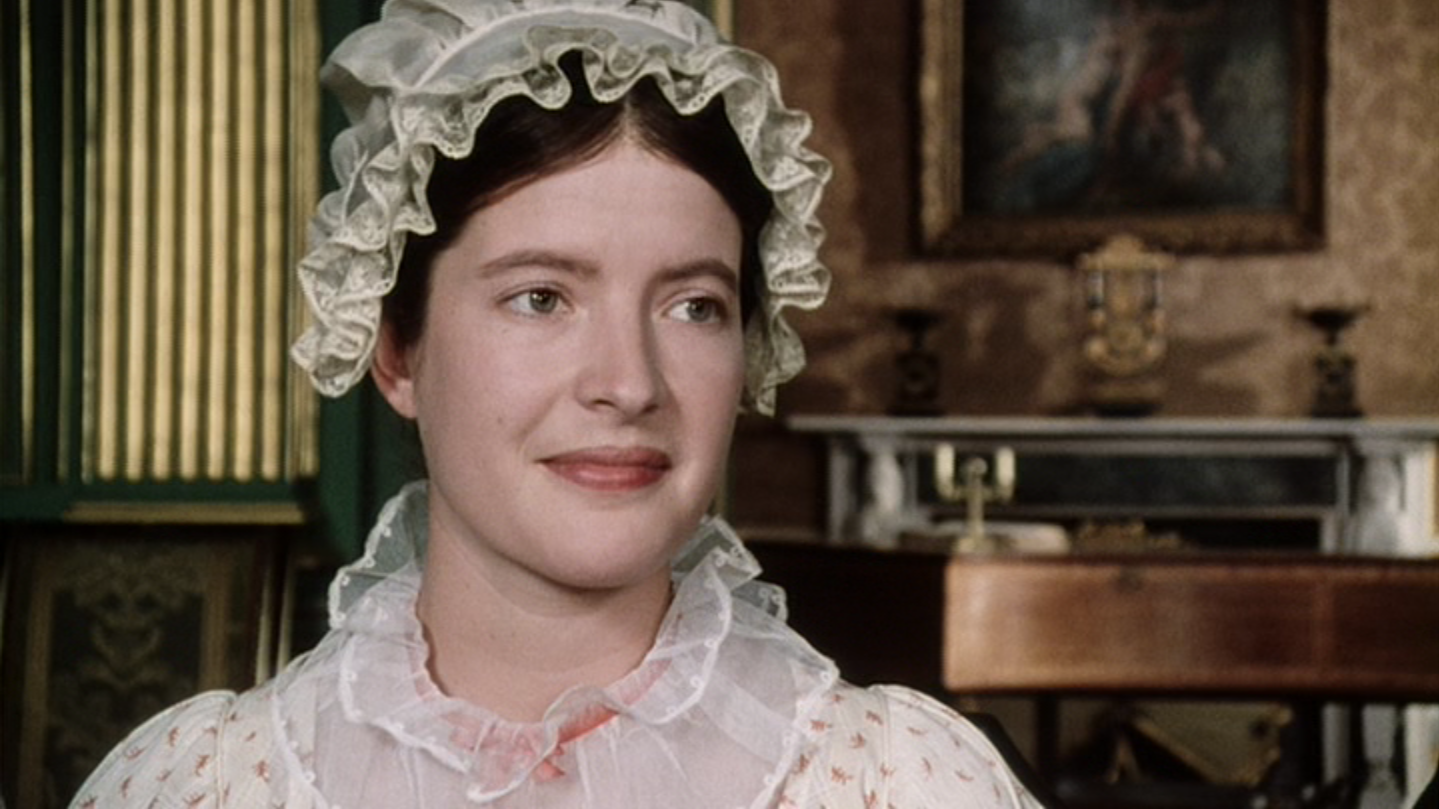
charlotte lucasBut why Mr. Darcy came so often to the Parsonage it was more difficult to understand. It could not be for society, as he frequently sat there ten minutes together without opening his lips; and when he did speak, it seemed the effect of necessity rather than of choice — a sacrifice to propriety, not a pleasure to himself. He seldom appeared really animated. Mrs. Collins knew not what to make of him. Colonel Fitzwilliam’s occasionally laughing at his stupidity proved that he was generally different, which her own knowledge of him could not have told her; and as she would have liked to believe this change the effect of love, and the object of that love her friend Eliza, she set herself seriously to work to find it out. She watched him whenever they were at Rosings, and whenever he came to Hunsford; but without much success. He certainly looked at her friend a great deal, but the expression of that look was disputable. It was an earnest, steadfast gaze, but she often doubted whether there were much admiration in it, and sometimes it seemed nothing but absence of mind.

She had once or twice suggested to Elizabeth the possibility of his being partial to her, but Elizabeth always laughed at the idea; and Mrs. Collins did not think it right to press the subject, from the danger of raising expectations which might only end in disappointment; for in her opinion it admitted not of a doubt, that all her friend’s dislike would vanish, if she could suppose him to be in her power…

p. 139-40.

More than once did Elizabeth, in her ramble within the Park, unexpectedly meet Mr. Darcy. She felt all the perverseness of the mischance that should bring him where no one else was brought, and, to prevent its ever happening again, took care to inform him at first that it was a favourite haunt of hers. How it could occur a second time, therefore, was very odd! [Ha!]  Yet it did, and even a third. It seemed like wilful ill-nature, or a voluntary penance, for on these occasions it was not merely a few formal enquiries and an awkward pause and then away, but he actually thought it necessary to turn back and walk with her. He never said a great deal, nor did she give herself the trouble of talking or of listening much; but it struck her in the course of their third rencontre that he was asking some odd unconnected questions –

p. 140.  Elizabeth asks Col. Fitzwilliam:

“Do you certainly leave Kent on Saturday?” said she.

“Yes — if Darcy does not put it off again. [my emphasis]But I am at his disposal. He arranges the business just as he pleases.”

“And if not able to please himself in the arrangement, he has at least great pleasure in the power of choice. I do not know anybody who seems more to enjoy the power of doing what he likes than Mr. Darcy.”

p. 144. [after Elizabeth learns from Col. Fitzwilliam of Darcy’s intervention between Bingley and Jane]

When they were gone, Elizabeth, as if intending to exasperate herself as much as possible against Mr. Darcy, chose for her employment the examination of all the letters which Jane had written to her since her being in Kent.

p. 145.  The Proposal: [his timing could not have been any worse!] –won’t put it all here… I direct you to re-read the whole thing! [pp. 144-48.] – or you can watch the 6.14 minute 1995 movie version here:

or the 4 minute, and very wet version here [P&P 2005]

-In spite of her deeply rooted dislike she could not be insensible to the compliment of such a man’s affection, and though her intentions did not vary for an instant, she was at first sorry for the pain he was to receive; till, roused to resentment by his subsequent language, she lost all compassion in anger….

– she could easily see that he had no doubt of a favourable answer…. Etc, etc…

-Mr. Darcy, who was leaning against the mantlepiece with his eyes fixed on her face, seemed to catch her words with no less resentment than surprise. His complexion became pale with anger, and the disturbance of his mind was visible in every feature. He was struggling for the appearance of composure…

thomson-darcyproposal2

Hugh Thomson, illus. P&P. George Allen, 1894.

p. 148.

That she should receive an offer of marriage from Mr. Darcy! that he should have been in love with her for so many months! — so much in love as to wish to marry her in spite of all the objections which had made him prevent his friend’s marrying her sister, and which must appear at least with equal force in his own case — was almost incredible! — it was gratifying to have inspired unconsciously so strong an affection. But his pride, his abominable pride…

Chapter 12.  [Elizabeth avoids meeting Darcy on her walk, but he finds her and passes her The Letter (he could not have delivered it any other way in order to protect her reputation…)]

CEBrock-darcyletter-mollands

C. E. Brock. “Would you do me the honour of reading that letter?” P&P. Macmillan 1895. Volume II, Ch. 12. [Mollands]

p. 150.

With no expectation of pleasure, but with the strongest curiosity, Elizabeth opened the letter, and, to her still increasing wonder, perceived an envelope containing two sheets of letter-paper…

The Letter: [like The Proposal, read this! pp. 150-56.]

Darcyletter-writing

Mr. Darcy writing The Letter – P&P 1995

p. 156.

Astonishment, apprehension, and even horror, oppressed her. She wished to discredit it entirely, repeatedly exclaiming, “This must be false! This cannot be! This must be the grossest falsehood!” — and when she had gone through the whole letter, though scarcely knowing anything of the last page or two, put it hastily away, protesting that she would not regard it, that she would never look in it again.

p. 159.

…that proud and repulsive as were his manners, she had never, in the whole course of their acquaintance — an acquaintance which had latterly brought them much together, and given her a sort of intimacy with his ways — seen anything that betrayed him to be unprincipled or unjust — anything that spoke him of irreligious or immoral habits: that among his own connexions he was esteemed and valued….

She grew absolutely ashamed of herself. Of neither Darcy nor Wickham could she think without feeling that she had been blind, partial, prejudiced, absurd.

“How despicably have I acted!” she cried; “I, who have prided myself on my discernment! I, who have valued myself on my abilities! who have often disdained the generous candour of my sister, and gratified my vanity in useless or blameable distrust. How humiliating is this discovery! yet, how just a humiliation! Had I been in love, I could not have been more wretchedly blind. But vanity, not love, has been my folly. Pleased with the preference of one, and offended by the neglect of the other [my emphasis] on the very beginning of our acquaintance, I have courted prepossession and ignorance, and driven reason away, where either were concerned. Till this moment I never knew myself.”

p. 161. [Lady Catherine’s take on Darcy has always caused me a full laugh-out-loud moment:]

….“They were excessively sorry to go! But so they always are. The dear colonel rallied his spirits tolerably till just at last; but Darcy seemed to feel it most acutely; more, I think, than last year. His attachment to Rosings, certainly increases.”

p. 163. – another favorite! [underlines are my emphasis ]

Reflection must be reserved for solitary hours; whenever she was alone, she gave way to it as the greatest relief; and not a day went by without a solitary walk, in which she might indulge in all the delight of unpleasant recollections….

….Mr. Darcy’s letter she was in a fair way of soon knowing by heart. She studied every sentence; and her feelings towards its writer were at times widely different… and his disappointed feelings became the object of compassion. His attachment excited gratitude, his general character respect; but she could not approve him; nor could she for a moment repent her refusal, or feel the slightest inclination ever to see him again. [Ha!]

….it may be easily believed that the happy spirits which had seldom been depressed before, were now so much affected as to make it almost impossible for her to appear tolerably cheerful.

p. 166.  [telling Jane about the Proposal]

To know that she had the power of revealing what would so exceedingly astonish Jane, and must, at the same time, so highly gratify whatever of her own vanity she had not yet been able to reason away….

p. 171. [Elizabeth to Jane about Wickham and Darcy]

“… There is but such a quantity of merit between them; just enough to make one good sort of man; and of late it has been shifting about pretty much. For my part, I am inclined to believe it all Mr. Darcy’s; but you shall do as you chuse.”

p. 172. Elizabeth to Jane:

“Oh! no, my regret and compassion are all done away by seeing you so full of both. I know you will do him [Darcy] such ample justice, that I am growing every moment more unconcerned and indifferent. Your profusion makes me saving; and if you lament over him much longer my heart will be as light as a feather.”

[Elizabeth:] “And yet I meant to be uncommonly clever in taking so decided a dislike to him, without any reason. It is such a spur to one’s genius, such an opening for wit, to have a dislike of that kind. One may be continually abusive without saying anything just; but one cannot be always laughing at a man without now and then stumbling on something witty.”

[Elizabeth:] The general prejudice against Mr. Darcy is so violent, that it would be the death of half the good people in Meryton to attempt to place him in an amiable light….”

p. 175.

She [Elizabeth] felt anew the justice of Mr. Darcy’s objections; and never had she before been so much disposed to pardon his interference in the views of his friend.

p. 183.

Derbyshire-P&P2005

With the mention of Derbyshire there were many ideas connected. It was impossible for her [Elizabeth] to see the word without thinking of Pemberley and its owner. “But surely,” said she, “I may enter his county with impunity, and rob it of a few petrified spars without his perceiving me.”

p. 184. [Mrs. Gardiner to Elizabeth:]

“My love, should not you like to see a place of which you have heard so much?” said her aunt; “A place, too, with which so many of your acquaintance are connected. Wickham passed all his youth there, you know.”

Elizabeth was distressed. She felt that she had no business at Pemberley, and was obliged to assume a disinclination for seeing it. She must own that she was tired of great houses; after going over so many, she really had no pleasure in fine carpets or satin curtains….

Elizabeth said no more — but her mind could not acquiesce. The possibility of meeting Mr. Darcy, while viewing the place, instantly occurred. It would be dreadful! She blushed at the very idea, and thought it would be better to speak openly to her aunt than to run such a risk…

…and her alarms being now removed, she was at leisure to feel a great deal of curiosity to see the house herself; and when the subject was revived the next morning, and she was again applied to, could readily answer, and with a proper air of indifference, that she had not really any dislike to the scheme. — To Pemberley, therefore, they were to go.

pemberley-photo

Lyme Park, a.k.a. Pemberley P&P 1995

End of Volume II – anything I missed that you want to share?

Stay tuned for Volume III!

*Page citations from: Austen, Jane. Pride and Prejudice. Ed. James Kinsley. Introd. Fiona Stafford. New York: Oxford UP, 2008.

c2013 Jane Austen in Vermont
Austen Literary History & Criticism · Books · Collecting Jane Austen · Jane Austen · Literature · Publishing History · Rare Books

A Little Jane Austen with Your Daily Hygiene? ~ Janine Barchas on “Sense, Sensibility, and Soap”

For those of you interested in the publishing history of Jane Austen, Professor Janine Barchas has recently published another of her fabulous bibliographical articles on Austen covers, this time in the journal Book History.  It discusses the little-known fact of a Lever Brothers soap marketing campaign that offered various giveaways, including hardbound editions of classic literature, Jane Austen among them.  I append here the beginning of the article, one of the many [and interesting!] illustrations, and a link to the rest of it … with thanks to Janine for alerting me to it!

Source: Janine Barchas. “Sense, Sensibility, and Soap: An Unexpected Case Study in Digital Resources for Book History.” Book History 16 (2013): 185-214.

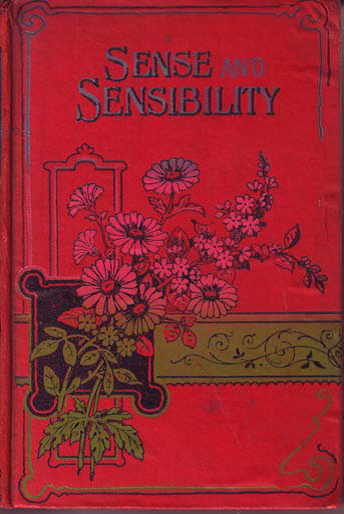
Unrecorded in even David Gilson’s A Bibliography of Jane Austen is the little-known fact that soap manufacturer Lever Brothers published editions of Sense and Sensibility and Pride and Prejudice during the 1890s as part of a unique marketing campaign for Sunlight soap. The first English company to combine massive product giveaways with large-scale advertising, Lever Brothers offered a range of prizes in “Sunlight Soap Monthly Competitions” to “young folks” (contestants could not be older than seventeen) who sent in the largest number of soap wrappers. The Sunlight advertising blitz, targeted to working- and lower-middle-class consumers, proved such a boon to sales that Lever Brothers ran the competition for a full seven years, annually escalating the giveaways. Prizes included cash, bicycles, silver key-chains, gold watches, and—for the largest number of winners—cloth-bound books. For this purpose, Lever Brothers published and distributed its own selection of fiction titles by “Popular Authors” and “Standard Authors,” including cloth-bound editions of Sense and Sensibility and Pride and Prejudice. By 1897, the year the competition closed, Lever Brothers had awarded well over a million volumes.

Continue Reading: Barchas-SSandSoap-BookHistory

S&S-LeverBros

Jane Austen, Sense and Sensibility in red cloth (Port Sunlight: Lever Brothers, n.d.).

For those of you with Project Muse access, here is the direct link: http://muse.jhu.edu/journals/bh/summary/v016/16.barchas.html

c2013 Jane Austen in Vermont
Austen Literary History & Criticism · Jane Austen · Jane Austen Popular Culture · Literature

Mr. Darcy’s Feelings; Or, What Jane Austen Really Tells Us About Her Hero…

Much has been made of the film adaptations of Pride and Prejudice and the need to make the feelings of the hero more apparent to the viewer, the complaint being that Jane Austen really doesn’t give us much to go on regarding her Heroes and their inner life.  Andrew Davies famously says he had to “sex her up” to make the films work for a modern audience, and while I like to see Colin Firth in a wet shirt and Matthew Macfadyen bare-chested at dawn as much as the next swooning female, I do take issue with the need to edit the text to the point of it seeming more like a modern romance than an early nineteenth-century novel.  One of Jane Austen’s greatest strengths and why we still read her year after year over the past 200 years, is her creation of believable characters who live and breathe on and off the page – and the need for our imaginations to bring whatever we will to the reading…

PP2005-mcfadyen-dawn

P&P 2005 – Matthew Macfadyen as Mr. Darcy

This year has brought with it any number of celebrations of Pride and Prejudice from plays and festivals to conferences and all sorts of fan fiction and games and “stuff” one cannot live without, but the best way to celebrate the book in my mind is to just find a quiet corner somewhere and re-read it, perhaps for the umpteenth time, but read it again nonetheless.  We know from her letters that Jane Austen read the book aloud to her family any number of times – whether she read it during and after the many alterations she made to the text is not so clear … but her family began what has become for many of us an annual reading, and we enjoy it as much as they did, our only loss in not having Austen to answer our questions –

I began this year of celebrating the bicentenary of P&P with a close reading in January, my intention to make note of every time Austen comments as the narrator or has Darcy express or state anything regarding his feelings for Elizabeth Bennet, as well as her feelings in return – and I find so much more than I ever thought was there, and seeing them out of context is quite enlightening – I don’t think that Andrew Davies had to add anything at all to the text – it is already there, as you shall see.


 P&P 1995 – Colin Firth as Mr. Darcy – “The Look”

John Wiltshire recently wrote an essay on “Mr. Darcy’s Smile” ** – and one might have asked ‘did Mr. Darcy EVER smile?’, our first impression no different than Elizabeth’s in assigning him to the Snob pile. Professor Wiltshire rescues him from that place of the aloof, observing, not present fellow, by telling us how often in the text Jane Austen has her Mr. Darcy actually Smile. So let’s see what we find, see what Austen tells us directly about Darcy’s feelings – for some reason we gloss over it all too easily and have come to depend upon Andrew Davies to visually remind us …

The other vexing question is of course when does Elizabeth fall for Mr. Darcy?  This is a controversial point – some believe her tongue-in-cheek statement to Jane,

“It has been coming on so gradually, that I hardly know when it began. But I believe I must date it from my first seeing his beautiful grounds at Pemberley.” 

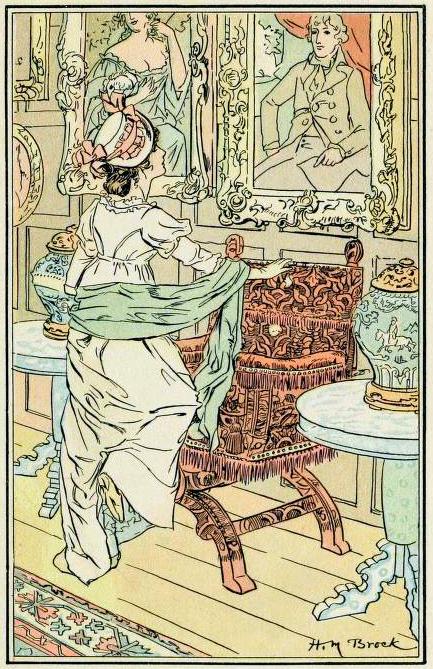
-this one sentence dividing Janeites, scholars and fans alike as to Elizabeth’s perhaps overly mercenary view of the world and her need to “land” a wealthy partner, that “to be mistress of Pemberley might be something!”  Some don’t see Elizabeth at all attracted to Darcy with any sort of passion like the films are overwrought with – that she comes to admire and then Love Darcy because of all his good qualities once his Asperger / shy/ snob demeanor crashes around him… But again, reading the text closely, both the actions, dialogue, and the narrator’s commentary, we are shown an Elizabeth both humiliated by Darcy’s apparent disdain of her [and her eager willingness to accept the neighborhood gossip that disses him at his first appearance], and her awareness in every moment they are in the same room together, of everything he is doing – she sees him watching her mother, reacting to her mother and other family members, sees him change color upon meeting Wickham, watches closely his relationship with Caroline Bingley, and most importantly sees him watching her, always passing it off as some strange behavior on his part, protesting too much because she knows he cannot tolerate her – in short she is always in a state of heightened awareness whenever Darcy is in her space. What changes for her at Pemberley is not its grandeur and its grounds, but his portrait, where she for the first time can look at him directly, his eyes upon her as in life, “with such a smile over [his] face, as she remembered to have sometimes seen, when he looked at her” (p. 189), but here she does not have to turn away in a confused embarrassed state…

Dent 1898-HMBrock-eatdpicture-adelaide

“In earnest contemplation” – H. M. Brock. P&P. Dent, 1898.
Image: Adelaide ebook

I had wanted to post on this as this celebratory year began, but here I am nearly the end of the year and ready to launch into celebrating Mansfield Park !– but shall post these quotes now, just under the wire… starting today with Volume I. *

From Volume I:

p. 7. [where it all begins! – Darcy’s insult, Elizabeth’s humiliation and wounded pride]

“Which do you mean?” and turning round, [Darcy] looked for a moment at Elizabeth, till catching her eye, he withdrew his own and coldly said, “She is tolerable; but not handsome enough to tempt me; and I am in no humour at present to give consequence to young ladies who are slighted by other men. You had better return to your partner and enjoy her smiles, for you are wasting your time with me.” 

   Mr. Bingley followed his advice. Mr. Darcy walked off; and Elizabeth remained with no very cordial feelings towards him. She told the story, however, with great spirit among her friends; for she had a lively, playful disposition, which delighted in any thing ridiculous.

Macmillan1895-cebrock-darcy-tempt-bw-mollands

C. E. Brock. P&P. Macmillan 1895

p. 13.  [but Elizabeth later says:]  

“That is very true,” replied Elizabeth, “and I could easily forgive his pride, if he had not mortified mine.”

p. 16.  [How quickly Darcy changes his mind about Elizabeth!]:

Occupied in observing Mr. Bingley’s attentions to her sister, Elizabeth was far from suspecting that she was herself becoming an object of some interest in the eyes of his friend. Mr. Darcy had at first scarcely allowed her to be pretty; he had looked at her without admiration at the ball; and when they next met, he looked at her only to criticise. But no sooner had he made it clear to himself and his friends that she had hardly a good feature in her face, than he began to find it was rendered uncommonly intelligent by the beautiful expression of her dark eyes. To this discovery succeeded some others equally mortifying. Though he had detected with a critical eye more than one failure of perfect symmetry in her form, he was forced to acknowledge her figure to be light and pleasing; and in spite of his asserting that her manners were not those of the fashionable world, he was caught by their easy playfulness. Of this she was perfectly unaware; — to her he was only the man who made himself agreeable nowhere, and who had not thought her handsome enough to dance with. 

   He began to wish to know more of her, and as a step towards conversing with her himself, attended to her conversation with others. His doing so drew her notice. It was at Sir William Lucas’s, where a large party were assembled. 

   “What does Mr. Darcy mean,” said she to Charlotte, “by listening to my conversation with Colonel Forster?” 

[and the teasing begins!]

p. 18.  Sir William Lucas:

Brock-P&P-Lucas-dance

C. E. Brock. P&P. Dent, 1898. [Mollands]

“My dear Miss Eliza, why are not you dancing? — Mr. Darcy, you must allow me to present this young lady to you as a very desirable partner. You cannot refuse to dance, I am sure, when so much beauty is before you.” And, taking her hand, he would have given it to Mr. Darcy, who, though extremely surprised, was not unwilling to receive it, when she instantly drew back, and said with some discomposure to Sir William — 

   “Indeed, sir, I have not the least intention of dancing. I entreat you not to suppose that I moved this way in order to beg for a partner.” 

   Mr. Darcy, with grave propriety, requested to be allowed the honour of her hand, but in vain. Elizabeth was determined; nor did Sir William at all shake her purpose by his attempt at persuasion. 

   “You excel so much in the dance, Miss Eliza, that it is cruel to deny me the happiness of seeing you; and though this gentleman dislikes the amusement in general, he can have no objection, I am sure, to oblige us for one half-hour.” 

   “Mr. Darcy is all politeness,” said Elizabeth, smiling. 

   “He is indeed; but considering the inducement, my dear Miss Eliza, we cannot wonder at his complaisance — for who would object to such a partner?” 

   Elizabeth looked archly, and turned away. Her resistance had not injured her with the gentleman, and he was thinking of her with some complacency… 

p. 19.   [Darcy to Miss Bingley who is ever in pursuit…]:

missbingley“Your conjecture is totally wrong, I assure you. My mind was more agreeably engaged. I have been meditating on the very great pleasure which a pair of fine eyes in the face of a pretty woman can bestow.” 

   Miss Bingley immediately fixed her eyes on his face, and desired he would tell her what lady had the credit of inspiring such reflections. Mr. Darcy replied with great intrepidity — 

   “Miss Elizabeth Bennet.” 

   “Miss Elizabeth Bennet!” repeated Miss Bingley. “I am all astonishment. How long has she been such a favourite? — and pray, when am I to wish you joy?” …

p. 24.  [Elizabeth arriving at Netherfield to offer comfort Jane]:

Mr. Darcy said very little, and Mr. Hurst nothing at all. The former was divided between admiration of the brilliancy which exercise had given to her complexion, and doubt as to the occasion’s justifying her coming so far alone. The latter was thinking only of his breakfast.

P&P2005-Elizabeth walking-jasna

 Kiera Knightley as Elizabeth – image: jasna.org

p. 26.

“I am afraid, Mr. Darcy,” observed Miss Bingley, in a half-whisper, “that this adventure has rather affected your admiration of her fine eyes.” 

   “Not at all,” he replied; “they were brightened by the exercise.”

p. 28. [this is an interesting: Elizabeth has been reading a book while the others plays cards – but when the talk turns to Mr. Darcy’s library at Pemberley, she takes such an interest in what is being said, that she puts her book aside and moves close to the card table…and what follows is the discussion of the “accomplished woman.”]:

Elizabeth was so much caught by what passed as to leave her very little attention for her book; and soon laying it wholly aside, she drew near the card-table, and stationed herself between Mr. Bingley and his eldest sister, to observe the game. 

chatsworth-house-library-BritMag

The Library at Chatsworth a.k.a. Pemberley
[Britain Magazine]

p. 33. [Elizabeth says; notice how she “trembles”:]

I wonder who first discovered the efficacy of poetry in driving away love!” 

 “I have been used to consider poetry as the food of love,” said Darcy. 

“Of a fine, stout, healthy love it may. Everything nourishes what is strong already. But if it be only a slight, thin sort of inclination, I am convinced that one good sonnet will starve it entirely away.” 

 Darcy only smiled; and the general pause which ensued made Elizabeth tremble lest her mother should be exposing herself again. She longed to speak, but could think of nothing to say… 

p. 38.

Elizabeth could not help observing, as she turned over some music books that lay on the instrument, how frequently Mr. Darcy’s eyes were fixed on her. She hardly knew how to suppose that she could be an object of admiration to so great a man; … 

p. 38.

… and Darcy had never been so bewitched by any woman as he was by her. He really believed that, were it not for the inferiority of her connexions, he should be in some danger. 

p. 39.

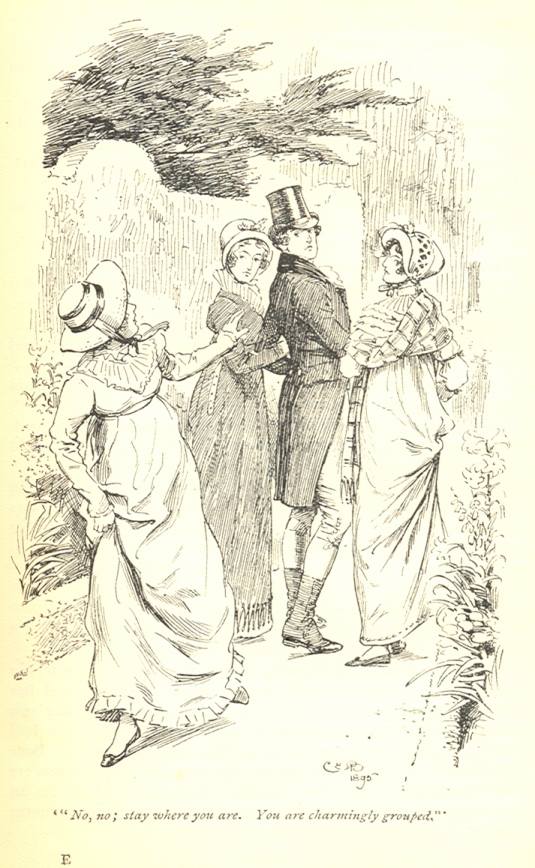
CeBrock-macmillan1895-group

C. E. Brock. P&P. Macmillan 1895 [Mollands]

Mr. Darcy felt their rudeness
[i. e Caroline and Mrs. Hurst leaving Elizabeth to walk by herself…]

p. 44.

…and Darcy, after a few moments recollection, was not sorry for it. He began to feel the danger of paying Elizabeth too much attention. 

p. 44.

To Mr. Darcy it was welcome intelligence: Elizabeth had been at Netherfield long enough. She attracted him more than he liked — and Miss Bingley was uncivil to her, and more teasing than usual to himself. He wisely resolved to be particularly careful that no sign of admiration should now escape him, nothing that could elevate her with the hope of influencing his felicity; sensible that if such an idea had been suggested, his behaviour during the last day must have material weight in confirming or crushing it. Steady to his purpose, he scarcely spoke ten words to her through the whole of Saturday, and though they were at one time left by themselves for half an hour, he adhered most conscientiously to his book, and would not even look at her.

p. 55.

Mr. Darcy corroborated it with a bow, and was beginning to determine not to fix his eyes on Elizabeth…

p. 72.  [during their dance]…

…on each side dissatisfied, though not to an equal degree, for in Darcy’s breast there was a tolerable powerful feeling towards her, which soon procured her pardon, and directed all his anger against another.

[And here Elizabeth always watching Darcy and his reactions to her and her family]:

p. 68.

…when she found herself suddenly addressed by Mr. Darcy, who took her so much by surprise in his application for her hand, that, without knowing what she did, she accepted him. He walked away again immediately, and she was left to fret over her own want of presence of mind…

 Limiteded1940-darcyandelizabeth

Helen Sewell. P&P. Limited Editions Club, 1940

p. 69.

…took her place in the set, amazed at the dignity to which she was arrived in being allowed to stand opposite to Mr. Darcy, and reading in her neighbours’ looks their equal amazement in beholding it.

p. 76.

Elizabeth blushed and blushed again with shame and vexation. She could not help frequently glancing her eye at Mr. Darcy, though every glance convinced her of what she dreaded; for though he was not always looking at her mother, she was convinced that his attention was invariably fixed by her. The expression of his face changed gradually from indignant contempt to a composed and steady gravity.

p. 78.

She was at least free from the offence of Mr. Darcy’s farther notice; though often standing within a very short distance of her, quite disengaged, he never came near enough to speak.

*********************

marveldarcy

Mr. Darcy – P&P – Marvel Comics

*****************

Stay tuned for quotes from Volume II. Do you find any that I have missed that somehow allude to this connection between Darcy and Elizabeth from nearly the first moment they set eyes upon each other?

*********************

*Page citations from: Austen, Jane. Pride and Prejudice. Ed. James Kinsley. Introd. Fiona Stafford. New York: Oxford UP, 2008.

** See John Wiltshire, “Mr. Darcy’s Smile.” The Cinematic Jane Austen: Essays on the Filmic Sensibility of the Novels. Ed. David Monaghan, Ariane Hudelet, and John Wiltshire. Jefferson, NC: McFarland, 2009. 94-110.

c2013 Jane Austen in Vermont
Austen Literary History & Criticism · Collecting Jane Austen · Jane Austen · Jane Austen Merchandise · Jane Austen Popular Culture · Literature · Regency England

Playing Jane Austen ~ The Jane Game Launches on Kickstarter!

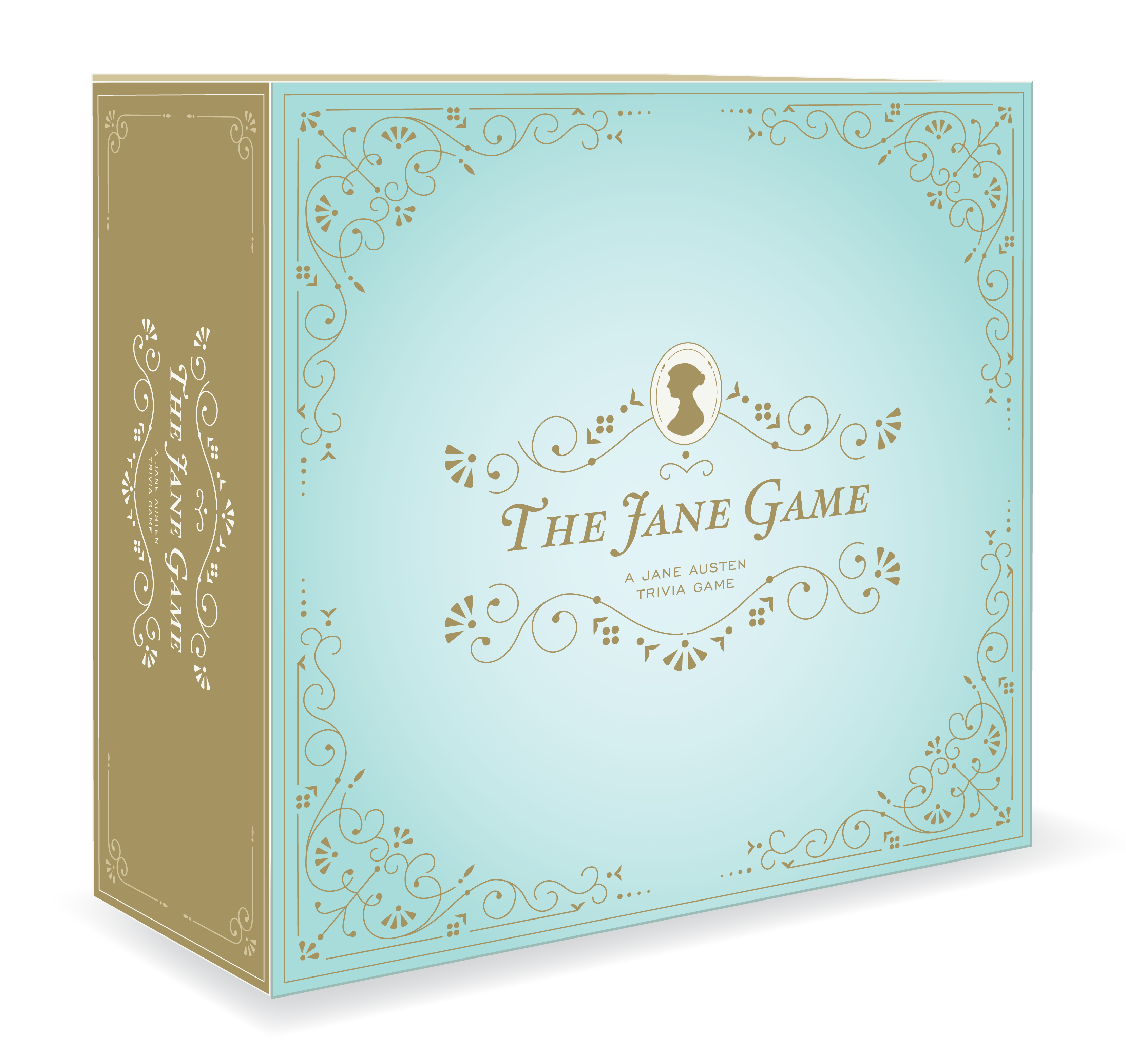
Today is the day! – the Kickstarter campaign of The Jane Game has been launched!

I first posted on this here in January 2013 –  now it is time for you to sign on and help with getting this Jane Austen trivia game completed for distribution – a donation of $40. [or more!] will get you a copy of the game as well as the satisfaction of helping a Jane Austen entrepreneur. The Kickstarter website is here, where you will find the details of the game, the Rules of the game, and the various donation categories – you have until December 14, 2013 to sign on… I just did, and hope you will too!

Promoted_Posts_BoxEnter Jane Austen’s world of elegance, wit and romance along with your friends when you play The Jane Game

The Jane Game is a trivia board game devoted to Jane Austen’s six novels. It is designed to bring Austen admirers together to share in her stories, characters, wit and language. While playing, each participant enters Jane’s world as one of her heroines. As such, you seek after a fortunate life by becoming an accomplished woman, gaining life experience and choosing to marry or not. Through chance, expertise and choice you could become the envied Mrs. Darcy, the pitied Mrs. Collins or the new roommate of Miss Bates. 

****************

And here are a few words from creator Elizabeth Bankhead on what to expect: 

Experience Section: The Jane Game gives you the experience of:

  • Entering Jane Austen’s world
  • Sharing in the merriment with your friends
  • Becoming more acquainted with Austen’s novels and encouraging us to want to read her more

Unique Section: The Jane Game 

  • Is a shared experience
  • Is the only board game that has trivia from all 6 of Jane’s beloved novels

Details:

  • $37 and shipping is free; after the Kickstarter campaign it will be $40 +shipping
  • Kickstarter ends on December 14, 2013

Kickstarter 101:

  • Kickstarter is a method through which we can give small amounts of money that together will equal a large sum…which, in this case, will be the cost of manufacturing the game
  • If you give the cost of the game, then you will get a game, which basically means you are pre-ordering
  • If we do not reach our goal, your credit card doesn’t get charged. This protects you and me. It gives a guarantee that you will receive a nice product and guarantees that I won’t be stuck with promises I cannot keep because I do not have enough money

Why pledge now? 

  • You Become a Founder: As such, you become part of The Jane Game. Welcome! Your name is placed on our website and you get to take part in some of the decisions for the game’s future.
  • Get the Game…and First: You get The Jane Game, which is “loveliness itself,” is it not?  If we are able to do a larger print run and can sell them, you get the game before any other distribution begins.
  • We Need You: We have covered the cost of the game’s development, but we cannot manufacture and ship the game to you without your support.
  • Free Shipping: We are covering the cost of shipping to many areas of the world, which will not be the case if it goes retail.

 ***************

Click here to see The Jane Game video

janegamebanner

Further information:

[Text and images courtesy of The Jane Game and Elizabeth Bankhead]

c2013 Jane Austen in Vermont
Auctions · Austen Literary History & Criticism · Books · Georgian Period · Jane Austen · Jane Austen Circle · Literature · Rare Books · Regency England

Austen on the Block! ~ A Lot of Lots!

UPDATE: Prices Realized added as available, includes buyer’s premium

There is much going on with Jane Austen and the Auction Block in the next month! – just this past week, Gorringes at their October 23, 2013 Fine Art, Antiques & Collectables auction – Sale LOCT13, had this on offer: Estimate £2,000-3,000.  SOLD for £11,000 !

Gorringes-letter-10-23-13

Lot 1454:

Austen, Jane.  An autograph manuscript fragment, comprising four lines, attached to another leaf bearing authentication, in turn attached to a letter from her nephew, James Edward Austen-Leigh, written on paper bearing watermark date 1868, at Bray Vicarage, February 7, 1870, presenting the fragment to Rev. G. C. Berkeley: ‘Men may get into the habit of repeating the words of our Prayers by rote, perhaps without thoroughly understanding – certainly without thoroughly feeling their full force and meaning.’ All attached to the title page of a copy of Austen-Leigh’s ‘A Memoir of Jane Austen…’ fragment approximately 1.75 x 6in.

******************

Upcoming auctions:  an abundance of Austen, Austen’s Circle, and Regency-era prints – I include various items because they are too wonderful not to share, but please visit each auction house site to see the “infinite variety” of offerings:

Bloomsbury: 7 November 2013. Library of a Gentleman: Fine Colour Plate, Costume, Travel and Sporting Books. London.

This auction is filled with Ackerman, Rowlandson, Cruickshank, Gillray and others! – here are a few examples, but go have a look at this treasure-trove for a Gentleman OR a Lady!

Lot 1:

AckermannsLondon-bloomsbury-11-7-13

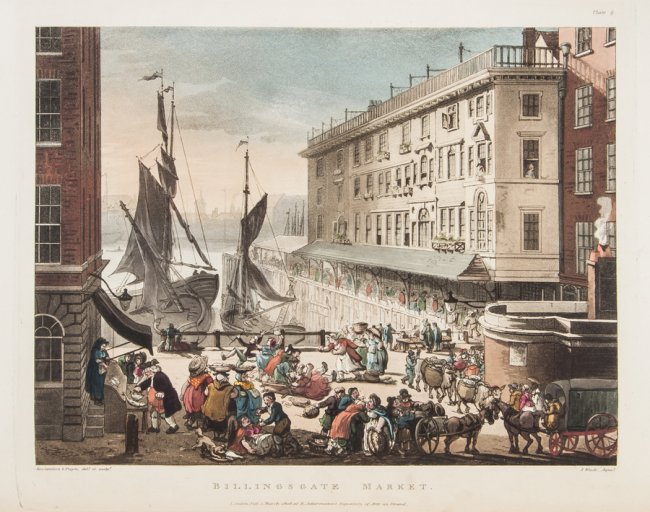
Ackermann’s London – “Billingsgate Market”

Ackermann, (Rudolph). Microcosm of London.

3 vol., first edition, early issue  with several of Abbey’s 12 “key plates” in first state (nos.1, 5, 8, 10, 11 & 18 and possibly 9), lacking half-titles, with wood-engraved pictorial titles, engraved dedication leaves, 104 hand-coloured aquatint plates after Rowlandson and Pugin, offsetting from plates but plates generally clean, some text leaves in vol.1 browned, handsome contemporary diced russia with elaborate gilt borders and cornerpieces, by C.Hering with his ticket, g.e., rebacked preserving old gilt spines, later cloth slip-cases edged in morocco, [Abbey Scenery 212; Tooley 7], 4to,  [1808-10].

Early issue bound from the original parts, watermarked 1806-07 and with all the 13 errata at end of vol.3 uncorrected and the Contents leaf in vol.1 headed “Contents”. However, the imprint of the wood-engraved title to vol.2 does not have a comma after “Bensley” but that in vol.1 does.

Estimate: £3,000 – £5,000; Starting Bid £2,600 – Sold for £4464

**********

Lot 2:

Agg-Foppish-Bloomsbury-11-7-13

“Foppish Attitudes” from The Busy Body, or Men and Manners

[Agg (John)] The Busy Body, or Men and Manners, edited by Humphrey Hedgehog, vol.1 & 2 only (parts 1-12), 11 hand-coloured aquatint plates by Williams, a little browning and offsetting, later tan calf, gilt, by Rivière & Son, spines gilt, g.e., spines chipped at head, joints split with covers becoming loose, 8vo, J.Johnston, 1816-17.

Estimate £200 – £300; starting Bid £180  – Sold for £211

************

Lot 3:

DrivingDiscoveries-Bloomsbury-11-7-13

“Driving Discoveries”

[Alken (Henry)] – the set of 7 hand-coloured etchings by Henry Alken, very slight marginal soiling, bookplates of William Henry Smith, Viscount Hambleden and George Seton Veitch, handsome later scarlet morocco, by Rivière & Son, covers with gilt border and upper cover titled and dated in gilt, spine gilt in compartments with five raised bands, g.e., corners very slightly rubbed, an excellent copy, [Siltzer pp.57 & 69; Tooley 25], oblong 4to, S. & J.Fuller, 1817 [watermarked 1821].

Estimate: £600 – £800; starting Bid £500 – Sold for £1364

*************

Lot 37:

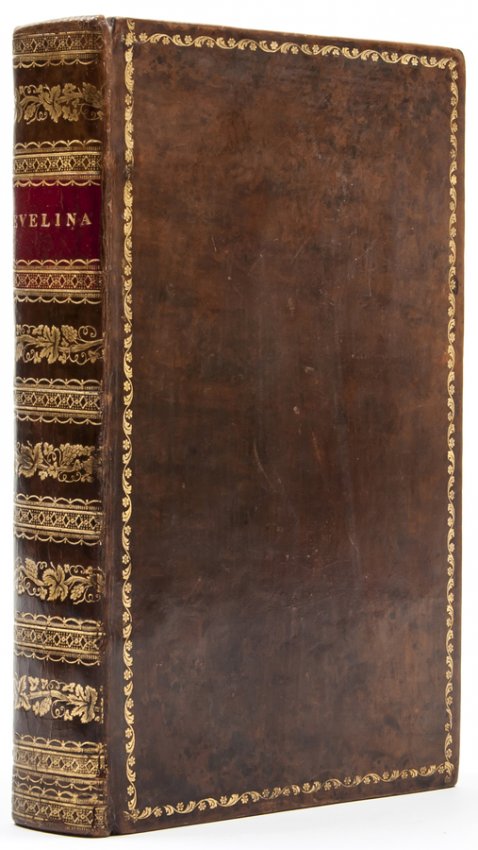
Evelina-bloomsbury-11-7-13[Burney (Fanny)] Evelina: or Female Life in London: being the History of a Young Lady’s Introduction to Fashionable Life, and the Gay Scenes of the Metropolis, hand-coloured engraved additional pictorial title and 6 plates after W.Heath, all but one aquatints, most offset onto text, some browning, bookplates of Charles C.Auchinloss and Hon.John Wayland Leslie, contemporary mottled calf, gilt, spine gilt with red morocco label, small gouge to lower cover, preserved in later red silk folder (a little rubbed and faded), red morocco slip-case (slightly darkened at edges), [Tooley 119], 8vo, 1822.

⁂ ***Originally published in 1778 under the title Evelina, or, A Young Lady’s Entrance into the World but reissued with this title following the popularity of Egan’s Life in London..

Estimate £200 – £300; starting Bid £180 – Sold for £496

***************

Lot 267:

Dacre-school-bloomsbury-11-7-13

Dacre (Charlotte). The School for Friends, a Domestic Tale, first edition, hand-coloured etched frontispiece and vignette title by Thomas Rowlandson, 12pp. text, lightly soiled and stained, stitched in original blue wrappers with paper label on upper wrapper, uncut, slightly soiled, preserved in later cloth portfolio and morocco-backed cloth slip-case, spine faded, 8vo, Thomas Tegg, [c.1800].

One copy only listed on COPAC, in the National Library of Scotland..

Estimate: £200 – £300; starting bid £180 – Sold for £3968

***********

Lot 274:

Rowlandson-miseries-bloomsbury-11-7-13

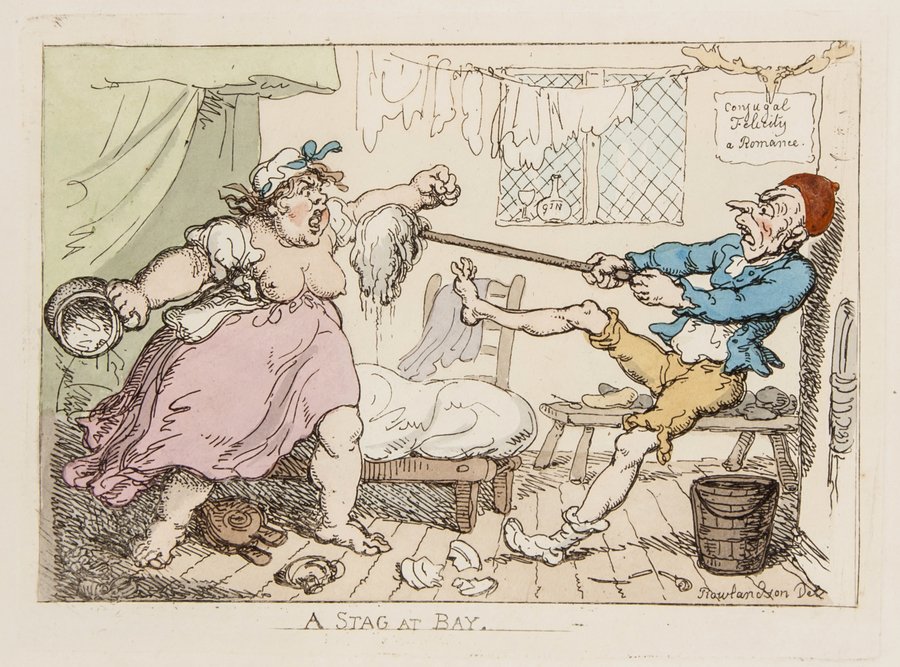
Rowlandson: “A Stag at Bay”

Rowlandson, Thomas. Miseries of Human Life”

Hand-coloured etched title and 50 plates by Thomas Rowlandson, without the rare ‘Pall Mall’ plate but replaced with ‘The Chiropodist’ as often and with an additional plate ‘The Enraged Vicar’ (signed and dated in plate 1805), otherwise with all plates as listed in the Abbey copy, light foxing, mostly marginal but affecting a few images, ex-library copy with bookplate and ink accession number to lower margin of first plate (otherwise unstamped), later olive morocco, gilt, by Rivière & Son, spine gilt, t.e.g., rather faded and a little rubbed, covers warped, upper joint repaired, [Abbey, Life 317], 4to, R. Ackermann, [1808].

Estimate: £500 – £700; Starting Bid £440 – Sold for £1054

**********

Lot 279:

Collier-Rowlandson-bloomsbury-11-7-13

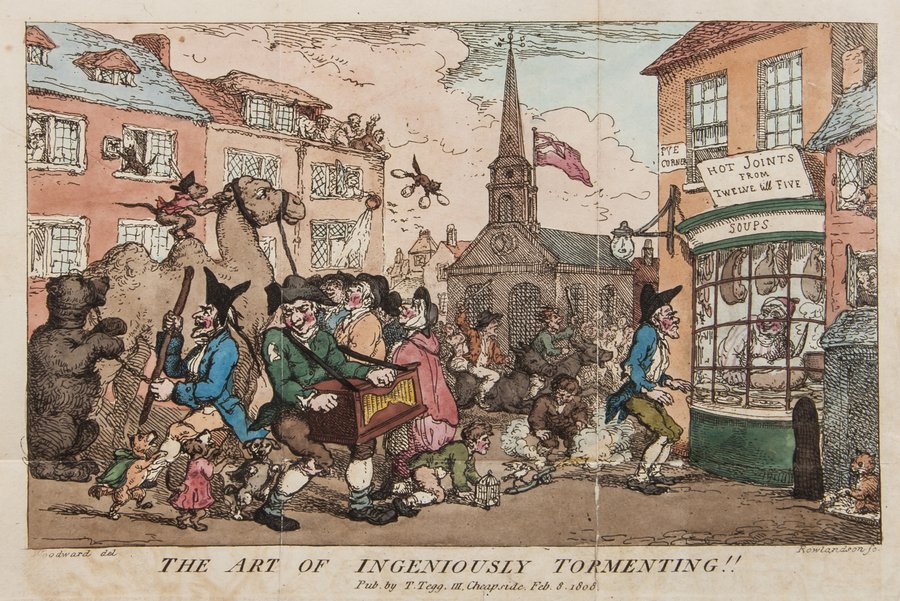
[Collier (Jane)] An Essay on the Art of Ingeniously Tormenting.

Half-title, folding etched frontispiece and 4 plates by Rowlandson after G.M.Woodward, all hand-coloured, frontispiece with short tear repaired, text browned, later tan calf, gilt, spine gilt, t.e.g., others uncut, a little rubbed, upper joint split, 12mo, 1808.

Estimate: £100 – £150; Starting Bid £90 – Sold for £112

**********

Lot 288:

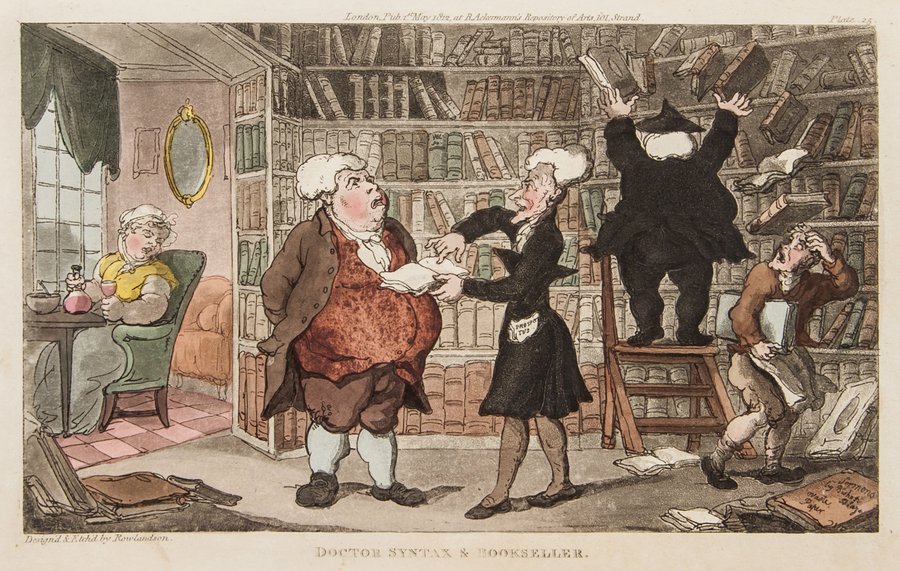
Rowlandson-syntaxbookseller-bloomsbury-11-7-13

Rowlandson: “Doctor Syntax and Bookseller”

[Combe (William)] The Tour of Doctor Syntax, in Search of the Picturesque. A Poem.

First edition, second issue with “Canto I”, hand-coloured aquatint frontispiece, vignette title and 29 plates by Rowlandson, 4pp. advertisements at end, old ink signature at head of title, some light browning and soiling, final leaf of text with small repair to upper inner margin, original boards, uncut, rubbed, rebacked preserving part of old paper label on spine, preserved in later red morocco drop-back box with metal catch, gilt, slightly rubbed, [Tooley 427], 8vo, [1812].

Estimate: £200 – £300; Starting Bid £180 –  Sold for £496

**********

Lot 344:

Wilson-Bloomsbury-11-7-13

Wilson (Harriette) – [?Heath (Henry)] Illustrations of Harriette Wilson’s Memoirs,

12 hand-coloured etched plates, 3 signed “H.H.”, c.170 x 140 or vice versa, 7 trimmed to border or just outside plate-mark and tipped into blank leaves, light soiling, one or two small tears to edge of image (repaired), engraved circular bookplate of Sir David Lionel Salomons, Bart., later dark blue morocco, gilt, by Bumpus of Oxford, spine gilt, very slightly rubbed and marked, 4to, S.W.Fores, 1825.

Estimate: £1,000 – £1,500; Starting Bid £900 – Sold for £1736

*************************

Millea Bros. November 9, 2013.  Asian, English, Modern Books

Lot 1473:

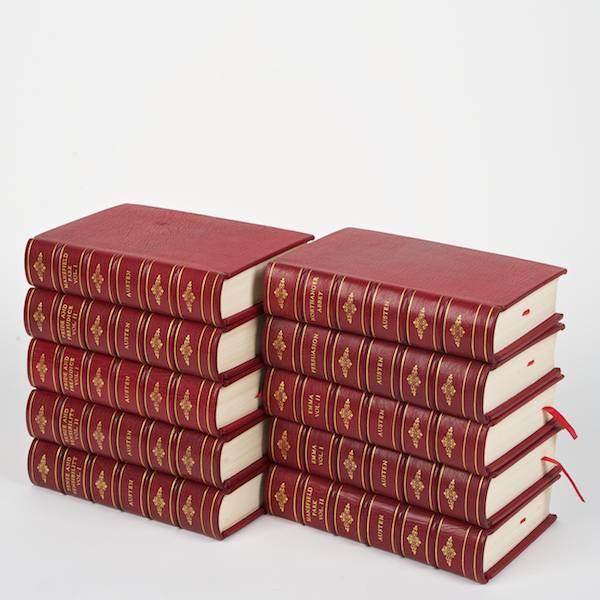
Millea-works-covers-11-9-13

Austen, Jane. Works. London, 1925. (10) volumes, 8vo., red morocco – Condition report: overall good, bindings good, a few scuffs and nicks

Estimate: $500-700. [no price realized available]

There is no further description about this set in the auction catalogue, but it is the 1925 George Harrap reprint of the 1908-9 Chatto & Windus edition of the novels, with illustrations by A. Wallis Mills.  Here is one illustration:

Millea-works-illus-11-9-13

**************** 

Bonham’s:  12 November 2013. Books, Atlases, Manuscripts and Photographs including the Aldine Collection of the late Sir Robert Horton, London.

Lot 165:

Bonhams-Emma-11-12-13

Austen, Jane. Emma: A Novel, 3 vol., first edition, half-titles in volumes 2 and 3 only, advertisement leaf at end of volume 3, light scattered foxing, stitching becoming loose with P3-4 in volume 1 partially detached, ownership signature of “M.E. Malden” on endpapers, contemporary half calf, worn, 3 covers detached, 4 corners strengthened with vellum, spines cracked [Gilson A8], 12mo, John Murray, 1816.

Estimate:  £4,000 – 6,000 (US$ 6,400 – 9,600) – Sold for £5,250 (US$ 8,435) inc. premium

*****************

Christies: 15 November 2013. Sale 9702: Fine Printed Books and Manuscripts. London.

Lot 402:

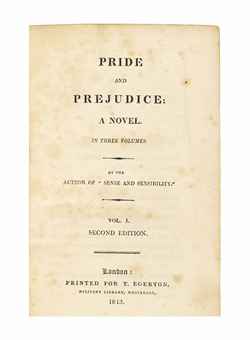
Christies-P&P-11-15-13Austen, Jane. Pride and Prejudice. London: T. Egerton, 1813. 2nd edition. 3 volumes, 12° (173 x 115mm). (Lacking half-titles, P2 at end of volume one with small marginal repair, tiny orange marginal mark to L5v of vol. II and lighter mark on a few other leaves, some spotting occasionally heavier.) Contemporary calf (rebacked, extremities lightly rubbed).

Estimate: £2,000 – £3,000 ($3,234 – $4,851) –

Sold for £2750 ($4,406)     

**********

Lot 403:

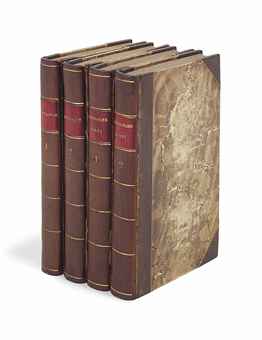
Christies-NA-P-11-15-13Austen, Jane. Northanger Abbey: and Persuasion… With a Biographical Notice of the Author [by Henry Austen]. London: C. Rowarth [vols I-II], and T. Davison [vols III- IV] for John Murray, 1818 [but ca. 20 December 1817]. 4 volumes, 12° (169 x 100mm). Half-titles. (Some occasional light browning and spotting, without final blanks P7-8 in vol. IV as often.) Contemporary half calf, leather gilt spine labels, speckled edges (front cover of vol. I nearly detached, front joints cracked and restored in vol. III, extremities lightly rubbed). Provenance: Maria Cipriani (ownership inscription). FIRST EDITION OF BOTH NOVELS.

Estimate: £3,000 – £5,000 ($4,851 – $8,085) – Sold for £4,750 ($7,610)

************

Of interest:

Lot 148:

Christies-Wollstonecraft-11-15-13

WOLLSTONECRAFT, Mary (1759-1797). Thoughts on the Education of Daughters with Reflections on Female Conduct, in the more important Duties of Life. London: J. Johnson, 1787. 8° (150 x 98mm). G6 a cancel as usual. (Short tear to last leaf.) Contemporary half calf (rebacked, extremities rubbed).

FIRST EDITION OF WOLLSTONECRAFT’S FIRST BOOK. Although it was an educational manual, the ‘more or less veiled remarks about her own emotional state … make it abundantly clear that she was far more interested in the state of her own life and the prospects that lay ahead of young women than in their years at school’ (Claire Tomalin, The Life and Death of Mary Wollstonecraft, London: Pelican, 1977, pp. 58-59). GOOD COPY. Rothschild 2595.

Estimate: £1,800 – £2,500 ($2,898 – $4,025) – Sold for £3,750 ($6,008)

****************

Christies: 20 November 2013. Sale 1160. Valuable Manuscripts and Printed Books. London.

Lot 84:

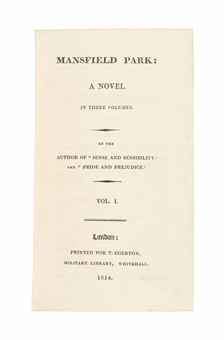
MP-Christies-11-20-13[AUSTEN, Jane (1775-1817).] Mansfield Park: A Novel… By the Author of “Sense and Sensibility,” and “Pride and Prejudice.” London: T. Egerton, 1814.

FIRST EDITION. 3 volumes, 12° (176 x 102mm). Half-titles. (Lacking blank O4 in volume II and advertisement leaf in volume III, occasional faint spotting.) Contemporary calf, flat spines with compartments ruled in gilt, green morocco gilt spine labels to second compartments, the others tooled in blind, speckled edges (extremities very lightly rubbed).

Estimate: £4,000 – £6,000 ($6,484 – $9,726) –  Sold for £13,750 ($22,138)

Lot 85: (another one!)

NA&P-Christies-11-20-13[AUSTEN, Jane (1775-1817).] Northanger Abbey: and Persuasion … With a Biographical Notice of the Author [by Henry Austen]. London: C. Rowarth [vols I-II], and T. Davison [vols III- IV] for John Murray, 1818 [but c. 20 December 1817].

4 volumes, 12° (177 x 103mm). Half-titles. (Some occasional light spotting, without final blanks P7-8 in vol. IV.) Contemporary calf, tan morocco gilt spine labels, speckled edges (extremities lightly rubbed, spines more heavily). Provenance: Baroness Keith of Meiklour House (bookplates). 1st edition of both novels.

Estimate: £4,000 – £6,000  ($6,484 – $9,726) – Sold for £7,500 ($12,075)

************

Also of interest at this auction:

Lot 124:

johnsondictionary-christies-11-20-13JOHNSON, Samuel (1709-1784). A Dictionary of the English Language in which the words are deduced from their originals, and illustrated in their different significations by examples from the best writers. London: W. Strahan for J. and P. Knapton [and others], 1755.

FIRST EDITION. 2 volumes, 2° (405 x 250mm). Titles in red and black, woodcut tail-pieces. (The first title with repaired losses and tears affecting some letters, the titles and a few leaves repaired in the inside margin, some marginal tears and some of these repaired, occasional mostly marginal soiling and spotting, faint dampstain in the margins of some leaves in vol. II.) Contemporary calf (neatly rebacked to style, corners repaired, sides scuffed). Provenance: David Tennant (title signature, some marginalia including on the verso of second title) — Stewart of Glasserton (bookplate).

Estimate: £5,000 – £8,000 ($8,105 – $12,968) – Not Sold

******************

All images are from each of the auction house websites, as cited.

Happy browsing!

c2013 Jane Austen in Vermont
Austen Literary History & Criticism · Fashion & Costume · Jane Austen · Jane Austen Popular Culture · Literature · Regency England

Summering With Jane Austen ~ Part IV ~ in Vermont!

There are Jane Austen events all over the place this summer, as a number of previous posts have shown, and thankfully I can post on a few that are right here in Vermont! – so mark your calendars!

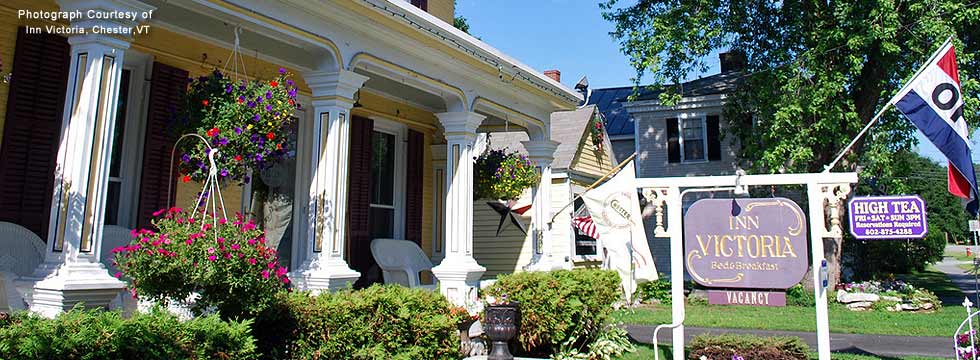
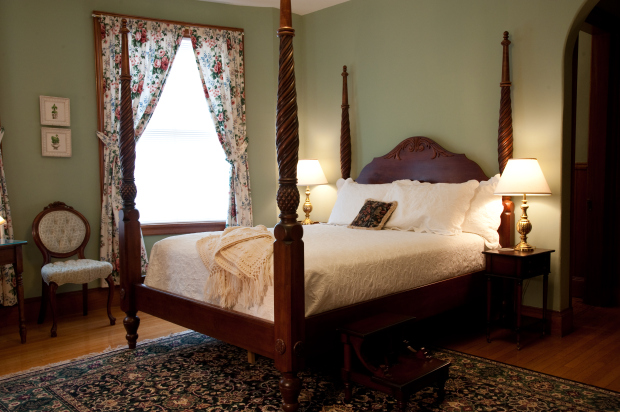
The Inn Victoria in Chester Vermont is hosting a  Jane Austen Garden Party on Saturday, July 20, 2013

Tea at the Inn Victoria

Enjoy the company of like-minded enthusiasts on Saturday July 20 for a Garden Party at Inn Victoria’s Secret Garden: 

  • If you wish you may dress in period costume
  • Enjoy book readings
  • High Tea in an elegant & peaceful garden setting
  • Evening movie [a Jane Austen of course!] on the 8′ x 12′ screen 

You can reserve for the day [events begin about 1pm and go through the evening movie and will cost $35. / person], or you can call to Reserve for the day and a room to spend the night….802-875-4288

Inn Victoria Chester Vermont

 *****************


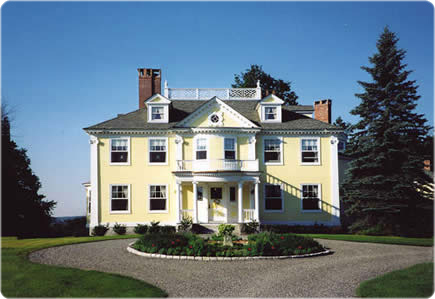
The Governor’s House in Hyde Park Vermont continues its series of Jane Austen weekends with two events this August:


Governor's House - The English Room
Governor’s House – The English Room


Pride and Prejudice Weekend on August 2 – 4, 2013  [and if you cannot make this weekend, you can also try September 13 – 15, 2013 or January 10 – 12, 2014!]:

A leisurely weekend of literary-inspired diversions has something for every Jane Austen devoteé. Imagine a literary retreat that will slip you quietly back into Regency England in a beautiful old mansion where Jane herself would feel at home. Take afternoon tea. Listen to Mozart. Bring your needlework. Share your thoughts at a book discussion of Pride and Prejudice and how the movies stand up to the books. Attend the talk about the time of Jane Austen. Test your knowledge of Jane Austen, her books, and the Regency period and possibly take home a prize. Take a carriage ride. For the gentleman there are riding and fly fishing as well as lots of more modern diversions if a whole weekend of Jane is not his cup of tea. Join every activity or simply indulge yourself quietly all weekend watching the movies. Dress in whichever century suits you. Just imagine the interesting conversation with a whole houseful of Jane’s readers under one roof. Weekend guests have commented that they wish there had been a tape recorder under the dinner table so they could replay the evening again and again. It won’t just be good company; it will be the “company of clever well-informed people who have a great deal of conversation”. It will be the best! It’s not Bath, but it is Hyde Park and you’ll love Vermont circa 1800.


Governors House walkers

And also this:  Special Jane Austen Weekend in Character, August 9 – 11, 2013

Another Jane Austen “in character” weekend is scheduled for August 2013. Each guest will choose to be a character from any one of Austen’s novels. Period dress is optional, but guests will interact in character throughout the weekend. The activities will depend somewhat on the weather and participant interest, but may include a Regency dinner party, an evening of games, letter writing, fencing, English Country dancing, crewel embroidery, tatting, rolled paper decoration, a game of croquet, a very long walk, riding, carriage driving, archery, shooting, and a picnic with or without Colonel Brandon. Rates are the same as regular Jane Austen weekends, but there is an additional charge to participate in some activities. Now’s your chance to be Elizabeth Bennet, Anne Elliot or Lady Catherine, but only one of each character may sign up so make haste to confirm your reservation. Bring your own Darcy or maybe meet him on the croquet lawn. Perhaps the door to the romance of Jane’s world isn’t in Hammersmith after all.

You can view the video of last year’s character weekend here:


You can also participate in the Inn’s periodic Afternoon Teas: [see website for costs]

  • Afternoon Tea and Tea Etiquette Talk – June 30, 2013 3:00 pm
  • Jane Austen Tea – August 3, 2013 3:00 pm
  • Jane Austen Tea – September 14, 2013 3:00 pm

*******************

And a small digression here: Innkeeper Suzanne began her series of Downton Abbey discussion dinners this past winter and these will continue once the new season is broadcast, so watch the website for dates and times.  And if this isn’t enough to fill up your schedule, Suzanne is also embarking on a new literary adventure called the Vermont Apple Pie Literary and Travel Society:

cover-The-Guernsey-Literary-and-Potato-Peel-Pie-SocietyThe fictional Guernsey Literary and Potato Pie Peel Society began as a spur-of-the-moment inspiration to make it possible for the people of Guernsey to get together and enliven their existence during the time of the World War II German occupation of the islands. Although this is Vermont and our pie will be apple, we too want to enliven our evenings with stimulating conversation. Guernsey during the occupation and how that impacted the daily lives of its citizens will be the topic for our first series of dinners and talks.  We will organize a travel adventure to Guernsey and other Channel Islands in May.

It’s not your ordinary book club, more like a salon where discerning minds can share their intellectual curiosity, although books will be part of the backdrop of our discussions and we will suggest a list of possible titles to consider reading for each topic. The dinners will be held on Saturday evenings and for those who spend the weekend, there may be other activities to expand the general topic. We invite your thoughts and participation. So if you enjoy the society of people who read and think, want to learn something new, enjoy talking about ideas, yearn to visit new places and expand your circle of interesting friends, then please join us because we want to hear what you have to add to the conversation.

The dinners will be held at the Governor’s House in Hyde Park, 100 Main Street, Hyde Park, Vermont.  Cost is $45.00 plus tax per person and, of course, includes home-made apple pie. See the website for reservation information.

Schedule for Guernsey under German Occupation:

Dinners & Discussion:

  • October 19, 2013 – 6:00 pm
  • February 1, 2014
  • March 8, 2014

Travel to Guernsey:  May, 2014

For more information and how to sign up, as well as a suggested reading list, please visit the website here: http://www.onehundredmain.com/events/vermont-apple-pie-literary-and-travel-society/


Future topics include:

  • Newfoundland and its connections to the Channel Islands and other places
  • Rudyard Kipling in Vermont
  • Palladio, Vicenza and the legacy to English and American architecture
  • Spices: where they come from, how they got here, and what we do with them
Governor's House in Hyde Park
Governor’s House in Hyde Park

 ******************

Hope to see some of you at these various events – one wonders what we actually did before Jane Austen took over our lives?

c2013 Jane Austen in Vermont
Auctions · Books · Jane Austen · Literature · Rare Books

Austen on the Block!

Several interesting (and largely expensive!) items will be up for auction in the next month:

CHRISTIES: Sale 8952: Fine Printed Books and Manuscripts, 18 June 2013, London.

P&Ptp - christies 6-18-13Lot 174: 

AUSTEN, Jane (1775-1817). Pride and Prejudice. London: T. Egerton, 1813. 3 volumes, 12° (173 x 115mm). (Lacking half-titles, P2 at end of volume one with small marginal repair, tiny orange marginal mark to L5v of vol. II and lighter mark on a few other leaves, some spotting occasionally heavier.) Contemporary calf (rebacked, extremities lightly rubbed).

Second edition. Pride and Prejudice was written between October 1796 and August 1797 when Jane Austen was not yet twenty-one, the same age, in fact, as her fictional heroine Elizabeth Bennet. After an early rejection by the publisher Cadell, Austen’s novel was finally bought by Egerton in 1812 for £110. It was published in late January 1813 in a small edition of approximately 1500 copies and sold for 18 shillings in boards. The present second edition is thought to have been published in October that same year. Gilson A4; Keynes 4. (3)

Estimate: £3,000 – £5,000 ($4,527 – $7,545)


Lot 175: 

AUSTEN, Jane (1775-1817). Sense and Sensibility, London: printed for the Author and published by T. Egerton, 1813. 3 volumes, 12° (176 x 105mm). (Lacking half-titles and without final blanks, occasional light spotting.) Contemporary calf, gilt spines (joints splitting, corners very lightly bumped, small blank stain to vol. II). S&S - Christies 6-18-13

Second edition of Jane Austen’s first published novel which grew from a sketch entitled Elinor and Marianne, written in 1795 in the form of letters; it was revised 1797-1798 at Steventon; and again in 1809-1810, the first year of Jane Austen’s residence at Chawton. Thomas Egerton undertook the publication of the first edition in 1813 on a commission basis, and Jane Austen ‘actually made a reserve from her very moderate income to meet the expected loss’. The price of the novel was 15 shillings in boards and advertisements first appeared for it on 30 October 1811. The present second edition is believed to have been printed in October 1813 as the first edition sold out in less than two years. Gilson A2; Keynes 2. (3)

Estimate: £3,000 – £5,000 ($4,527 – $7,545)

Lot 192:

SETS, English and French literature — AUSTEN, Jane. Works. Illustrated by C.E. Brock. London: 1907. 6 volumes, 8°. Contemporary red half calf, spines lettered in gilt (extremities rubbed). [With:] ELIOT, George. Works. Library Edition. Edinburgh: 1901. 10 volumes, 8°. Contemporary blue half roan, spine tooled in gilt (spines evenly faded, extremities rubbed). [And:] BALZAC, Honoré de. Oeuvres completes. Paris: 1869-1876. 24 volumes, 8°. Contemporary red half roan, spines lettered in gilt (extremities rubbed). And 5 related others [ie. Maupassant, Corneille, Rabelais, Macaulay] in 33 volumes, 12° and 8°. (73)

Estimate: £500 – £800 ($755 – $1,207)

PP lizzy - brock
Brock – P&P

[Image from Mollands]

******************

Other items of interest at this Christie’s auction (i.e., what I would love to have!):

Lot 75:

ACKERMANN — Microcosm of London. London: T. Bensley for R. Ackermann [1808-1810, plates watermarked 1806-1808]. 3 volumes, 4° (330 x 272mm). Engraved titles, engraved dedication leaves, and 104 hand-coloured aquatint plates by Buck, Stadler and others after Rowlandson and Pugin. (Lacking half-titles, light offsetting from the plates onto the text, some text leaves evenly browned.) Late 19th- early 20th-century red half calf, spine gilt in compartments, morocco labels (spines lightly and evenly faded).

ackermann london - christies 6-18-13

ONE OF ACKERMANN’S FINEST BOOKS, the rumbustious figures of Rowlandson are the perfect foil to Pugin’s clear and accurate architectural settings. Printing continued for nearly 30 years but, as Abbey notes, the ‘original impressions of these splendid plates have a luminous quality entirely absent from later printings’. This copy is evidently bound from the original parts: with the first issue of the contents leaf in volume 1, and all the errata uncorrected in volumes 2 and 3, and 5 out of 6 errata corrected in volume 1. This copy shows 2 of Abbey’s first state points for the plates: at plates 8 and 11 in volume 1. Abbey Scenery 212; Tooley 7. (3)

Estimate: £3,000 – £5,000 ($4,527 – $7,545)

****************

BONHAMSBooks, Maps, Manuscripts and Historical Photographs 20752, 19 Jun 2013 London.

Lot 139: 

S&S1st - bonhams 6-19-13[AUSTEN (JANE)]. Sense and Sensibility: a Novel. In Three Volumes. By a Lady, 3 vol., first edition, without half-titles, final blank leaf present in volume 2 only, some pale foxing and staining, contemporary calf, sides with gilt and blind-tooled borders, rebacked preserving most of original backstrips and red morocco labels [Keynes 1; Gilson A1; Sadleir 62a], 12mo (173 x 104mm.), Printed for the author, by C. Roworth… and published by T. Egerton, 1811. FIRST EDITION OF JANE AUSTEN’S FIRST PUBLISHED NOVEL. According to Keynes, Egerton printed no more than 1000 copies, priced at 15 shillings in boards; all were sold by the middle of 1813.

Estimate: £15,000 – 20,000  US$ 23,000 – 30,000 €18,000 – 23,000


*****************


Also of note in this auction: a first edition of Jane Eyre

Lot 147: 

[BRONTE (CHARLOTTE)]. Jane Eyre. An Autobiography, 3 vol., first edition, with all but two of the printing flaws listed by Smith, half-titles in each volume (but without the additional fly-leaf and advertisements), volume 2 with additional 8-page ‘Ready Money Price List of Drawing & Painting Materials… Alexander Hill’ tipped-in on front free endpaper (seemingly removed from other volumes), original price of “31/6” marked in pencil on front paste-down of volume 1, a few leaves slightly creased, some light foxing and occasional soiling in margins, UNTRIMMED IN PUBLISHER’S GREY BOARDS with grey/brown diaper half cloth spine, rubbed, spine label to volume 1 chipped with loss of 2 or 3 letters, split to lower joint of volume 2, crease to upper cover of volume 3, [Sadleir 346; Smith 2; Grolier, English 83], 8vo (199 x 122mm.), Smith, Elder, and Co., 1847janeeyre - bonhams 6-19-13


Footnotes

FIRST EDITION OF THE FIRST BRONTE SISTERS NOVEL: AN EXTREMELY RARE VARIANT IN ORIGINAL BOARDS, ENTIRELY UNTRIMMED AND WITH THE ORIGINAL PRICE OF ’31/6′ MARKED IN PENCIL. The binding seems to correspond with Smith’s variant B (allowing for some fading of the cloth over the years), but with white rather than yellow endpapers and a further slight variation in the printed spine labels, those on the present set having no semi-colon after “Eyre” and the words “In Three Volumes” inserted above the volume number. We can find no trace of any other copy in original boards having sold at auction.

Provenance: the tipped-in small price list of drawing and painting materials suggests an Edinburgh connection at or soon after the time of publication. Alexander Hill (of Princes Street, Edinburgh, younger brother of the painter David Octavius Hill) was publisher, artists’ colourman and printer to the Royal Scottish Academy from 1830 until his death in 1866. In 1847 he was also appointed printseller and publisher in Edinburgh to Queen Victoria and Prince Albert (see National Archives, LC 5/243 p.61). The price list tipped-in to this copy gives Hill’s address as 67 Princes Street, where he had a shop from 1839 until his death, and mentions the royal appointment, reference to which he seems to have dropped by 1853.

Estimate: £30,000 – 50,000  US$ 45,000 – 75,000 €35,000 – 58,000

*********************

BONHAMS:  Fine Books and Manuscripts 20981: June 25, 2013, New York

Lot 3259

[Austen, Jane]. Northanger Abbey: and Persuasion. With a Biographical Notice of the Author. London: John Murray, 1818. 4 volumes. 12mo (180 x 105 mm). [2], xxiv, 300; [2], 331, [2], 280; [2], 308 pp. Without half-titles. Period half calf over marbled boards, spines gilt. Extremities rubbed, typical light spotting and toning, pp 251-262 in vol 3 creased at outer margin, ffep. in vol 1 loose, volume 4 more so with a crack down spine, a little re-touching to vol 2 spine.

NA P 4v- Bonhams image

Provenance: T. Hope (early ownership stamps); purchased by the family of the current owner in 1960 from McDonald Booth. FIRST EDITION IN CONTEMPORARY BINDING of Jane Austen’s last published work, issued a year after her death. Persuasion was in fact her first novel, but its first appearance is in this set. This was also her only four-volume publication, all previous works were issued in “triple-deckers.” Gilson A9; Sadleir 62e.

Estimate:  US$ 5,000 – 8,000 £3,300 – 5,300 €3,900 – 6,200


Lot 3260: 

E - bonhams 

[Austen, Jane]. Emma: A Novel. In Three Volumes. By the author of “Pride and Prejudice” &c. &c. London: Printed for John Murray, 1816. 3 volumes. 12mo (176 x 112 mm). [6], 322; [2], 351, [1]; [4], 363, [1 ad] pp. Half-titles in vols 1 & 2. Old green marbled boards rebacked to style in calf, green morocco spine labels. Intermittent spotting and browning; vol 2 L8 with corner tear crossing a few letters.

FIRST EDITION. Emma is the only one of Jane Austen’s novels to bear a dedication, to the Prince Regent. It was her fourth novel to be published with a print run of 2000 copies. Gilson A8; Sadleir 62d.

Estimate:  US$ 8,000 – 12,000 £5,300 – 8,000  €6,200 – 9,300

***************

And finally, this letter from Frances Burney to her father comes to auction in just a few days:

Dreweatts / Bloomsbury auction: Important Books & Manuscripts – 30th Anniversary Sale,30 May 2013 London

Lot 171:  

burney letter - dreweatts 5-30-13

Burney  (Frances [Fanny], married name D’Arblay, writer, 1752-1840) Autograph Letter initialled “FB d’A” to her father, Charles Burney, “My dearly beloved Padre”, 4pp. with address panel, 8vo, Chenies Street, 12th June 1813, lamenting that she had not been able to visit him, “but some Giant comes always in the way. Twice I have expected Charles [Charles Burney (1757-1817), schoolmaster and book collector; brother of Fanny], to convey me: but his other engagements have made him arrive too late”, social activities, “Yesterday I dined with Lady Lansdowne, & found her remarkably amiable. She is niece to a person with whom I was particularly acquainted of old, at the Queen’s house, Mr. Digby, who was vice Chamberlain; & that made a little opening to converse… Lady Anne was in high spirits, & full of sportive talk & exhilarating smiles. We had no sort of political talk. All was elegant, pleasing, & literary”, and Sir Joshua Reynolds portrait of Dr Burney, “Every body talks of your portrait at Sir Joshua’s exhibition, & concurs in saying it is one of the best that greatest of English Masters ever painted. I have not yet, to my infinite regret, found time for going thither. Mrs. Waddington will positively take me once to Chelsea, to pay her respects to you; but she is prepared for being denied your sight, if you should be ill-disposed for company. Sally must see her at all events: besides she is a great admirer of Traits of Nature”, ink postal stamp, remains of red wax seal, folds, slightly browned.

*** Unpublished; not in The Journals and Letters of Fanny Burney (Madame D’Arblay), edited by Joyce Hemlow & others, Oxford, The Clarendon Press, 1972-75.

Estimate: £3,000-4,000

[Images and text from the respective auction sites]

c2013, Jane Austen in Vermont
Austen Literary History & Criticism · Jane Austen · Literature · Regency England

Summering with Jane Austen

There are a number of Jane Austen courses and conferences this summer, many in celebration of the 200 years of Pride and Prejudice.  How I wish I had a clone to send to any and all of these events!  But alas! I shall have to content myself with reading about others’ adventures of “summering with Jane” and hope that at least some of the talks will be published somewhere soon. Today I start with a first of several posts on the various offerings – on the weekend course at the University of North Carolina, the Jane Austen Summer Program: [ http://humanities.unc.edu/programs/jasp/ ]

UNClogoDon’t miss the first Jane Austen Summer Program —
held on UNC’s campus June 27-30, 2013!

Organized by UNC’s Department of English and Comparative Literature in conjunction with the Program in the Humanities, this four-day summer program celebrates the 200th anniversary of the publication of Pride and Prejudice.

Learning experiences include lecture formats and discussion groups daily. Discussions will focus on Pride and Prejudice in its historical context as well as its many afterlives in fiction and film.

Additional events include a Regency ball, the chance to partake in an English tea, a silent auction of Austen-related items, and the opportunity to view special exhibits tailored to the conference.

Detailed Schedule for the Jane Austen Summer Program: http://humanities.unc.edu/programs/jasp/jaspschedule/

*************

But here are the basics: please no drooling on your keyboard … [note that I have left out all the mealtimes – there will be time for food!]

Thursday, June 27: Welcome and check-in

3:15 – 3:30: Introduction and Welcome: Dr. Terry Rhodes, Senior Associate Dean of the Fine Arts & Humanities, UNC-CH

3:30 – 4:30:  Plenary Lecture and Discussion, “Manners Envy in Pride and Prejudice” – James Thompson, Professor of English and Comparative Literature, UNC-CH

4:45 – 5:45:  Context Class sections I: Money and Land – With Maria Wisdom and Danielle Coreale; Beverly Taylor and Laurie Langbauer; Doug Murray and Jessica Richard; Susan Allen Ford and Sarah Marsh

7:00 – 8:00: Plenary Lecture, “The Networked Novel and what it did to Domestic Fiction” – Nancy Armstrong, Gilbert, Louis, and Edward Lehrman Professor of English and Editor, Novel: A Forum on Fiction, Duke University 

Friday, June 28: Romantic Education

9:15 – 10:00: Context Class sections II: Mothers and Daughters

10:15 – 11:00:Plenary Panel on Jane Austen and Romance – Sarah Frantz, Associate Professor of English, Fayetteville State University; Emma Calabrese, Teaching Assistant, English, UNC-CH; Phil Stillman, Graduate Student, English, Duke University; Kumarini Silva, Assistant Professor of Communications Studies, UNC-CH

11:15 – 11:45: Elevenses and
Presentation of Collection of Editions of Pride and Prejudice – Virginia Claire Tharrington, Independent Scholar

12:00 – 12:45: Response discussion sessions I – With Phil Stillman and Suzanna Geiser; Whitney Jones and Jane Lim; Doreen Theirauf and Meghan Blair; Michele Robinson and Ashley Guy

2:15 – 3:15: Plenary Lecture, “Education and Experience in Pride and Prejudice” – Jessica Richard, Associate Professor of English, Wake Forest University

3:30 – 4:15: Response discussion sessions II

4:30 – 5:30: Dance Instruction, Session 1 – Mr. Jack Maus and the NC Assembly Dancers

7:30 – 10:00: Production of Austen’s Juvenilia by Ashley Guy, Ted Scheinman, and Adam McCune, and Showing of Wright’s Pride and Prejudice

Saturday, June 29: Pride and Prejudice’s Afterlives 

9:15 – 10:00: Context Class sections III

10:15 – 11:00: Plenary Roundtable Panel on Jane Austen and Film Adaptation – Inger Brodey, Bank of America Distinguished Term Professor of Honors, Associate Professor of Comparative Literature, Asian Studies, and Global Studies, and Director of the Comparative Literature Program, UNC-CH; Suzanne Pucci, Professor of French and Italian Studies; Director of the Committee on Social Theory, University of Kentucky; Ellen Moody, English, George Mason University; Ted Scheinman, Research Assistant, English, UNC-CH

11:00 – 11:30: Elevenses

11:30 – 12:15: Response discussion sessions III

1:30 – 2:30: Dance Instruction, Session 2

2:45 – 4:00: Plenary Lecture and Discussion, “The Placement of a Waist – Character through Costume in Pride and Prejudice” – Jade Bettin, Adjunct Assistant Professor of Dramatic Arts, UNC-CH

7:00 – 9:00: Regency Ball: Refreshments, Whist, and Silent Auction – Jack Maus, Caller; Ted Earhard, Fiddle; Julie Gorka, Piano 

Sunday, June 30: Mr. Collins and Others

mrcollins-brock

[Mr. Collins proposing – C. E. Brock – from http://www.pemberley.com/janeinfo/ppv1n19.html ]

9:15 – 10:00: Context Class sections IV

10:15 – 11:00: BREAKOUT sessions

-“The Eyes Have It:  The Male and Female Gaze in Pride and Prejudice” – Douglas Murray, Professor of English, Belmont University

-“Mr. Collins Interrupted: Reading Fordyce’s Sermons with Pride and Prejudice” – Susan Allen Ford, Professor of English, Delta State University

“‘What think you of books?’ Thoughts on Collecting Editions of Pride and Prejudice” – Virginia Claire Tharrington, Independent Scholar

11:30 – 12:30: Finger Food and conclude silent auction of Austen-related items

12:30 – 1:00: Formal Farewell and Leavetaking

3:00 – 4:30: English Tea (optional)

 ***************

[Content and image from the UNC website]

Visit the website for accommodation information; you can register here: https://hhv.oasis.unc.edu/

If you go, please take notes and send me your thoughts for posting here!

c2013 Jane Austen in Vermont