Auctions · Austen Literary History & Criticism · Books · Collecting Jane Austen · Jane Austen · Literature · Publishing History · Rare Books

Austen on the Block! ~ Affordable Jane

The Leslie Hindman Auctioneers sale on April 10, 2013 in Chicago: Sale 239 – Fine Books and Manuscripts  [preview starts April 6] has three items of interest to collectors and readers of Jane Austen, and this time a pleasant surprise to see them in a more affordable range…

1.  Lot 319:

MP-2ded

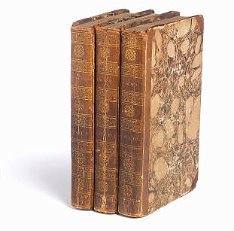
* JANE AUSTEN.  Mansfield Park. London: J. Murray, 1816.

3 vols. 12mo, modern quarter morocco, renewed endpapers. Second edition. Lacks half-titles; 2-inch tear to title page vol. 2 restored; spines deteriorating and hinges cracked; otherwise the interior is in near fine condition with very little brownspotting.

Estimate $ 1,000-2,000.


2.  Lot 320:

Fragment

* JANE AUSTEN.  Fragment of a Novel, written January-March 1817. Now First Printed from the Manuscript [Sandition]. Oxford: Clarendon Press, 1925.

8vo, publisher’s cloth-backed blue boards, printed spine label, facsimile frontispiece. Limited edition facsimile, one of 250 copies on handmade paper. Boards lightly soiled with some loss to spine label; otherwise very good.

Estimate $ 100-200.


3. Lot 434A:

works-1882

JANE AUSTEN.  Works (COLLECTED WORKS). London: Richard Bentley and Son, 1882.

6 vols. 8vo, 3/4 maroon morocco over decorative boards, title in gilt to black leather spine labels, t.e.g. Light edgewear; otherwise fine.

Estimate $ 100-200.

__________

My note:  this last item does not offer a very comprehensive description, so I would suggest an inquiry to the auction house for more information.  This is likely the Steventon Edition that Bentley published in 1882, limited to 375 sets; size is 20.5 cm, or a small octavo (8vo), obviously rebound here; there are illustrations (those that appeared in Bentley’s original Standard Novels of 1833, and a few additional woodcuts and a facsimile of Austen’s letter to Anna Lefroy (29 Nov 1814)) – full information on the edition can be found in Gilson at D13; but again, please check with the auction house to verify that it is this edition (there was a reissue in 1886).  The interest in the Steventon Edition is that it was the last complete edition of Jane Austen’s works to be published by Bentley, her major publisher in England from 1833 to 1882, and holder of the copyrights until their various successive expiry dates.

[Images from the Leslie Hindman Auctioneers website.]

c2013 Jane Austen in Vermont
Austen Literary History & Criticism · Books · Collecting Jane Austen · Jane Austen · Jane Austen Popular Culture · Literature · Publishing History

Want List: A Miniature Pride and Prejudice from Plum Park Press

I posted several months ago about a miniature Emma, published by the bookbinder Tony Firman at his Plum Park Press. Since then I have received my very own Emma and am delighted with it:

Miniature Emma from Park Plum Press
Miniature ‘Emma’ from Park Plum Press

And now doubly delighted to hear from Tony that he is planning a similar miniature edition of Pride and Prejudice – perfect timing for this bicentenary year.  It will be another triple-decker, as was the original, in the same format and size as Emma with the same typeface. Each of the three volumes is to be published separately, in April, June, and August; the third volume will include a slipcase for the set.

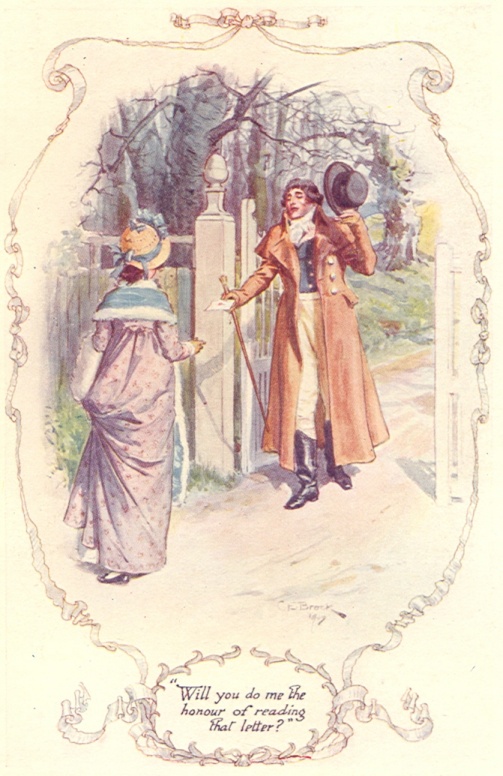
Volume I and II will contain 240 pages, and 260 pages for Vol. III, all bound in a lovely soft faux leather, in a pretty butterscotch color. The endpapers will be decorated with colored illustrations from the 1907 Dent edition, four different pictures in each volume. The slipcase will be decorated with some of the same illustrations. It will be a limited edition of 15 copies. [no image is yet available]

C. E. Brock - Pride and Prejudice, Dent 1907 - Mollands
C. E. Brock – ‘Pride and Prejudice’ – Dent 1907 – Mollands

The first volume will be available near the end of April; price is $35. / volume, the complete set with slipcase, $105.  You can order either by volume as they become available or wait for the complete set in August, but with only 15 sets available, you best get your order in soon!  [There was a second edition of Emma, and there are copies still available.]

Other titles that Tony has published in this miniature format: [see his website for more information on each]

  • Priestley: Experiments and Observations of Different Kinds of Air
  • Curtis: The Botanical Magazine
  • Housman: A Shropshire Lad and Last Poems
  • Davenport: English Embroidered Bookbindings
  • Hubbard: William Morris
  • Crane: A Floral Fantasy
  • Huygens: Treatise on Light
  • Morris: A Dream of John Ball
  • Higgin: Handbook of Embroidery
  • Browning: The Last Ride
  • Blades: The Enemies of Books
  • Geikie: Geology
  • Einstein: Relativity
  • Austen: Emma
  • Wells: The Time Machine
  • Carroll: Alice’s Adventures in Wonderland
  • Lavoisier: Elements of Chemistry
  • Fitzwilliam: Jacobean Embroidery

firmanlogo
Tony Firman Bookbinding
205 Bayne Road, Haslet, TX 76052
www.TonyFirmanBookbinding.com

************************

Further reading: and if you have any questions, please comment below…

In the United States, a miniature book is usually considered to be one which is no more than three inches in height, width, or thickness. Some aficionados collect slightly larger books while others specialize in even smaller sizes. Outside of the United States, books up to four inches are often considered miniature.

 c2013 Jane Austen in Vermont
Great Britain - History · Jane Austen · Literature · London · Museum Exhibitions · Regency England · Travel

Touring with Jane Austen ~ Marble Hill House, Twickenham, and Richmond

Enquiring Minds: Tony Grant of London Calling, and a regular contributor to Jane Austen’s World, had written a post for me on Marble Hill House in Twickenham – but alas! I have been so delayed in getting this on the blog that we agreed he should post it himself and I will link to it… so herewith the tale of Marble Hill House, home to Henrietta Howard, mistress of George II. This all started with a conversation over Joshua Reynolds’s house, which led to Richmond Hill, and then on to Henrietta Howard and Marble Hill House, and then Pope and Swift, Horace Walpole, John Gay and the Scriblerus Club, a bit on Wordsworth and Sir Walter Scott and on to Dickens and Virginia and Leonard Woolf, and of course Jane Austen gets her required mention – you get the idea – this is cram-packed with literary tourism and as always, Tony’s fine photographs…

****************

The Thames from Richmond Hill

The River Thames wends its tortuous way across England from Thames Head in Gloucestershire until it reaches the southernmost part of the North Sea. Its journey stretches for 215 miles. Finally the wide Thames Estuary which pours its contents into The North Sea is bordered on the north bank by the Essex coast and Southend on Sea and at its southern bank by the Kent coast, Sheerness and the entrance to the Medway.

Along its course The Thames passes though some beautiful English countryside before it enters the Greater London area passing by Sunbury and on to Hampton, then Hampton Court, Kingston upon Thames, Twickenham and Richmond. At last it reaches the centre of London with its iconic landmarks. The Thames, from London along its whole length, has a long history of Iron Age villages, Roman habitation, Saxon towns, and mediaeval settlements, Tudor Palaces and Georgian and Victorian Villas.  London itself began as a Roman settlement for trade, built at the nearest bridging point to the coast   where they had their port called Ritupiae (Richborough). They wanted to penetrate the hinterland north of the Thames. Indeed the names Thames which was Celtic in origin but had its Roman equivalent (Tamesas recorded in Latin as Tamesis)  and London (Londinium) come to us from Roman times.

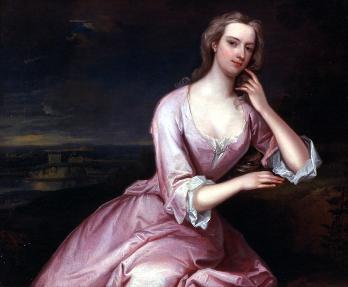
Over the centuries the Thames outside of London has provided a beautiful Arcadian retreat for the wealthy, the famous, the aristocracy and the monarchy away from the stench and diseases prevalent in many periods of London’s history. They built palaces and grand houses and villas with adjoining estates and landscaped parks to relax and take their leisure in. Marble Hill House is a Palladian Villa built between 1724 and 1729, very close to Richmond upon Thames but on the northern bank of the Thames near Twickenham. It was built for George II’s mistress, Henrietta Howard….

Henrietta Howard
Henrietta Howard

 Continue reading…

Thank you Tony for this sun-drenched tour through London!

For more on Marble Hill House, etc,  you can look here:

Marble Hill House
Marble Hill House

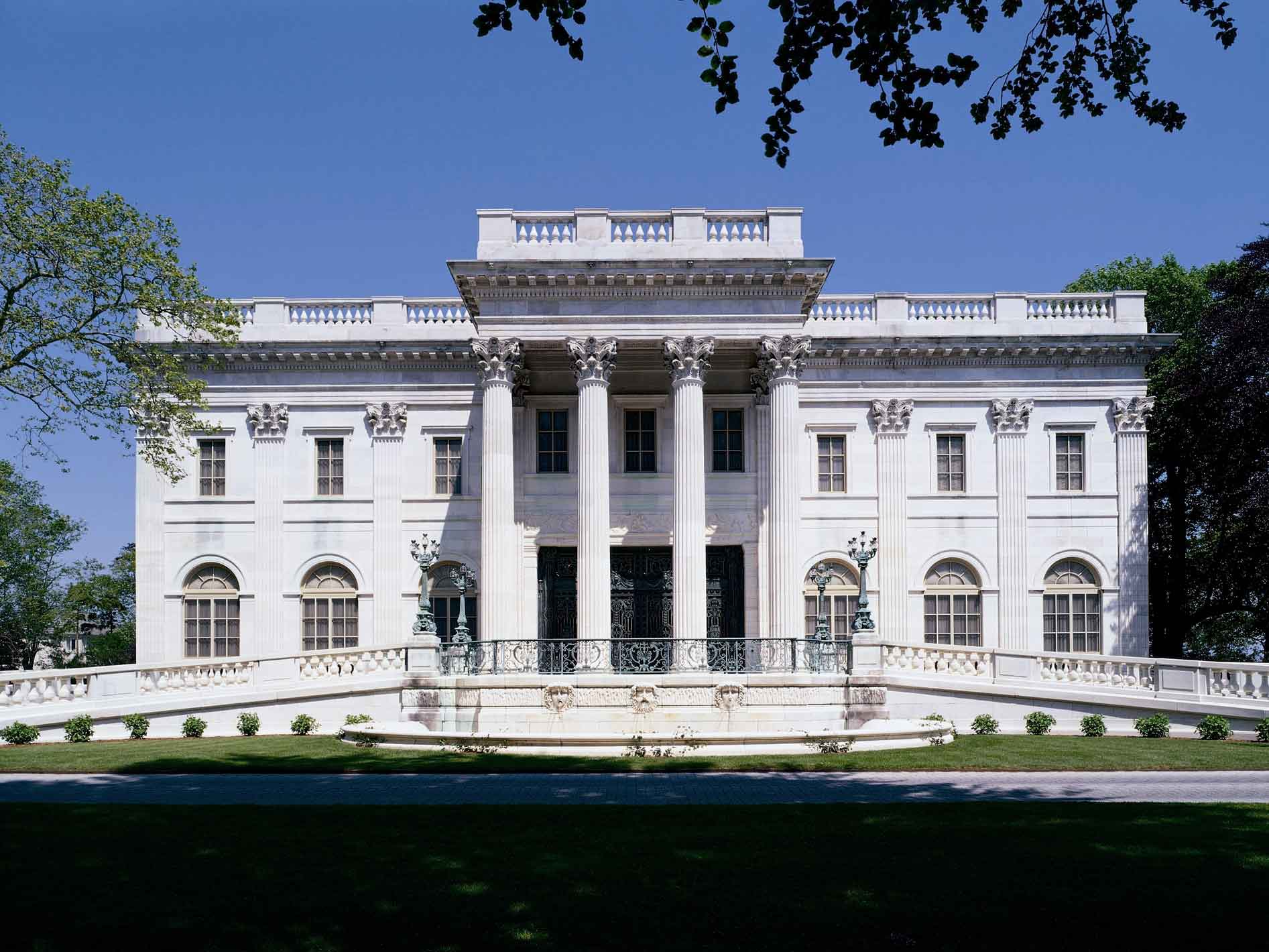
…and not to be confused with our very own MARBLE HOUSE, the William Vanderbilt’s summer “cottage” in Newport, Rhode Island:

Marble House, Newport, RI
c2013 Jane Austen in Vermont
Austen Literary History & Criticism · Jane Austen · Jane Austen Circle · Literature · Regency England

Jane Austen and Robert Burns

Today is the birthday of Robert Burns (25 January 1759 – 21 July 1796).  One cannot forget those Robert Burns poems we all had to recite in high school, often our first introduction to the “romantic” poets – ‘O, My Luve is Like a Red, Red Rose’ or ‘Tam O’Shanter’ or ‘To a Louse: on seeing one on a Lady’s bonnet at church’ – and of course how often do we sing or hear ‘Sweet Afton’ and ‘Auld Lang Syne’!

Robert Burns - from wikipedia
Robert Burns – from wikipedia

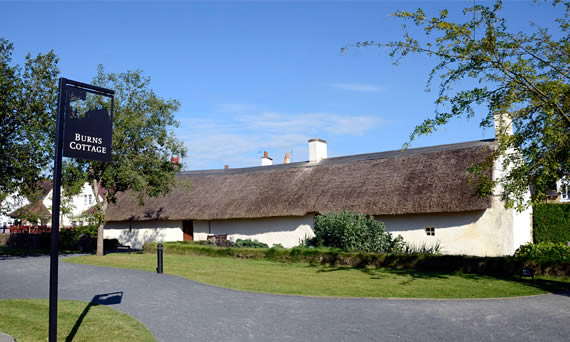
I had the fortune a number of years ago to visit Burns’s home in Alloway, Ayr, Scotland, and became sort of enamored with him – who can not? But what of Jane Austen and Burns? – she certainly read his poetry.  And we now know that in her music notebooks she had copied out the music notation of two of Burns’s songs: My Love She’s But a Lassie Yet, and My Ain Kind Dearie – and Gillian Dooley has recently noted that Austen had written out in her own hand Their Groves o’ Sweet Myrtle, [see the link below to this full article] where it shows that Austen had transcribed the words “Save Love’s willing fetters – the chains of his Jean” to “the charms of his Jane” – evidence perhaps that Austen secretly admired Burns after all…?! [see full text of this song below]

Burns Cottage, Ayr
Burns Cottage, Ayr

All we have of her written words as to how she may have felt about Burns appear in Sanditon, with the ridiculous Sir Edward Denham spewing forth the following:

But while we are on the subject of Poetry, what think you, Miss Heywood, of Burns’ Lines to his Mary? — Oh I there is Pathos to madden one! — If ever there was a Man who felt, it was Burns. — Montgomery has all the Fire of Poetry, Wordsworth has the true soul of it — Campbell in his Pleasures of Hope has touched the extreme of our Sensations — “Like Angel’s visits, few & far between.’ Can you conceive any thing more subduing, more melting, more fraught with the deep Sublime than that Line? — But Burns — I confess my sence of his Pre-eminence, Miss Heywood — If Scott has a fault, it is the want of Passion. — Tender, Elegant, Descriptive — but Tame. — The Man who cannot do justice to the attributes of Woman is my contempt. — Sometimes indeed a flash of feeling seems to irradiate him — as in the Lines we were speaking of — “Oh! Woman in our hours of Ease’. — But Burns is always on fire. — His Soul was the Altar in which lovely Woman sat enshrined, his Spirit truly breathed the immortal Incence which is her Due. –”

To which Charlotte replies, in what critics have assumed is Jane Austen’s voice:

“I have read several of Burns’ Poems with great delight”, said Charlotte, as soon as she had time to speak, “but I am not poetic enough to separate a Man’s Poetry entirely from his Character; — & poor Burns’s known Irregularities greatly interrupt my enjoyment of his Lines. — I have difficulty in depending on the Truth of his Feelings as a Lover. I have not faith in the sincerity of the affections of a Man of his Description. He felt & he wrote & he forgot.”

“Oh! no no” exclaimed Sir Edward in an extacy (sic). “He is all about ardour and Truth! – His genius and his susceptibilities might lead him into some Aberrations – But who is perfect?…. Nor can you, loveliest Miss Heywood (speaking with an air of deep sentiment) – nor can any Woman be a fair judge of what a Man may be propelled to say, write or do, by the sovereign impulses of illimitable Ardour.”

[from Sanditon, ch. VII]

So I leave you with these thoughts on Jane Austen and Robert Burns and a few links for further reading:

Robert Burns

***********************

Full text of Their Groves o’ Sweet Myrtle:

Their groves o’ sweet myrtle let Foreign Lands reckon,
Where bright-beaming summers exalt the perfume;
Far dearer to me yon lone glen o’ green breckan,
Wi’ the burn stealing under the lang, yellow broom.
Far dearer to me are yon humble broom bowers
Where the blue-bell and gowan lurk, lowly, unseen;
For there, lightly tripping, among the wild flowers,
A-list’ning the linnet, aft wanders my Jean. 

Tho’ rich is the breeze in their gay, sunny valleys,
And cauld Caledonia’s blast on the wave;
Their sweet-scented woodlands that skirt the proud palace,
What are they? – the haunt of the Tyrant and Slave.
The Slave’s spicy forests, and gold-bubbling fountains,
The brave Caledonian views wi’ disdain;
He wanders as free as the winds of his mountains,
Save Love’s willing fetters – the chains of his Jean.

c2013, Jane Austen in Vermont
Austen Literary History & Criticism · Books · Jane Austen · Jane Austen Circle · Jane Austen's Letters · Literature · Publishing History

Jane Austen’s ‘own darling Child’

Gentle Readers: This year we have just entered upon will be a long and interesting 365 days of celebrating the 1813 publication of Pride and Prejudice ! There are festivals, conferences, blog postings, reading challenges, and already many newspaper and journal articles on this timeless work by Jane Austen.  I would like to start off my own celebration of this beloved classic with repeating a post I wrote two years ago, where I had pulled together all the references that Austen makes to this, her “own darling Child,” in her letters.  It makes fascinating reading to “hear” her…
pp-christies-12-7-12
The publishing history of Pride and Prejudice, Jane Austen’s most popular book, then and now, is an interesting study in the book trade of early 19th century England.  First completed in 1797 (and called First Impressions) and rejected by the publisher her father took the manuscript to, Austen reworked her draft over time and submitted it to Thomas Egerton, the publishing house of her Sense & Sensibility, in 1812 (it was published on January 28, 1813).   She sold the copyright outright for £110, and did not incur other expenses in its publication, as she did in the three other works published in her lifetime [see links below for more information.]  How we would love to know her thoughts on this road to publication! – how we would love to have her letters written while in the process of the writing to give us some idea of her imagination at work – where WAS the model for Pemberley?  was Mr. Darcy someone REAL?  was Elizabeth Bennet her alter ego? was MR COLLINS drawn from life? – or to have the letters to her brother Henry and his to Egerton – but alas! we have very little, just a few comments scattered among the surviving letters.
Austen Literary History & Criticism · Books · Collecting Jane Austen · Jane Austen · Jane Austen Merchandise · Jane Austen Popular Culture · Jane Austen Sequels · Literature

On My Bookshelf ~ Jane Austen in 2013, Or, How My “Wish-List” Just Got Longer

A quick look at the upcoming Jane Austen books in 2013 has inflated my “Wish List” yet again – and I don’t even have all the 2012 books yet… alas! no shelf space! [not to mention my pocketbook…] – there are just some books you should not add to your kindle, though I might feel more strongly about this than many, but here is a quick list of what’s coming out in the next few months, more detailed info and reviews will follow, but for now, you can see that there is no slacking off in Austenland…

Continue reading “On My Bookshelf ~ Jane Austen in 2013, Or, How My “Wish-List” Just Got Longer”

Books · Jane Austen · Literature

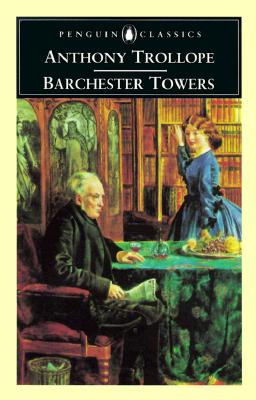
A Jane Austen Reading Group Wanders into Anthony Trollope

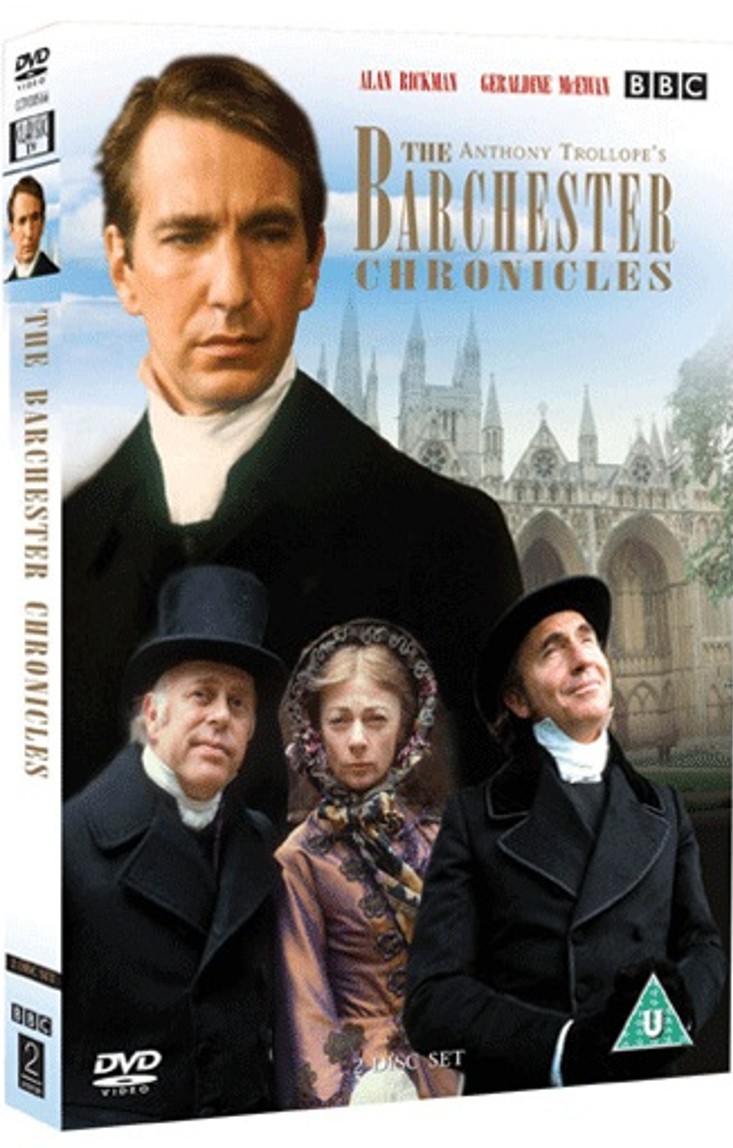
Our JASNA Jane Austen Reading Group has wandered astray and is currently reading Anthony Trollope.  We have started with Barchester Towers and will be discussing this on Wednesday night, though we know the series really starts with The Warden, which some have already read – some have seen the 1982 BBC production with Alan Rickman playing Slope [perhaps a prerequisite for playing Snape?], and some have listened to it on audiobooks – we most certainly shall have a lively discussion this week!

Anyway, I have had a few complaints about this Trollope read and have asked a member of the famed Men’s Austen Book Group from Montpelier [they started out with Austen and have gone onto Eliot and now Hardy, and now call themselves ‘Finches of the Grove’, from Great Expectations] – John is in another co-ed off-shoot of that group and they have wandered into Trollope as well – I have asked him to share with us why he loves Trollope so much.  You can also see the blog of two members of this group, Sarah and Michelle, who write about their collective reading – here are their thoughts on Barchester Towers at Two Girls Fishing .

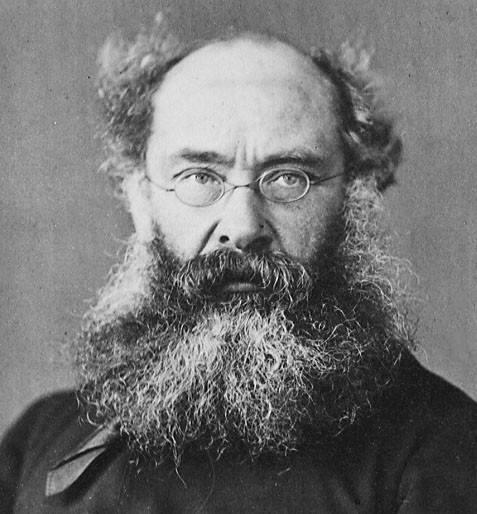
So I welcome John Bollard, on Anthony Trollope:

Anthony Trollope

Hi Deb,

You asked me a while ago to write something about why I like Anthony Trollope so much, which I will now attempt to do. Share with others if you wish.

One thing I really like is the narrator. Trollope’s narrator is always very much a character, although not a character who participates in the action–so the point of view is not quite omnipotent, but not quite first person either. I love the way he (the narrator) invites the reader into the story, invites him to take a particular view of this or that character or situation–to be not too hard on this character because of that circumstance, or to remember that this other character has shown a certain weakness in the past, and so forth. It’s a device that’s very much out of fashion these days, but I find that it draws the reader in, and creates a unique intimacy between the reader and the story. Sitting down to read a Trollope novel is like sitting down for a cup of tea with a good friend who knows all the news and gossip and talks about it in the most charming, entertaining way.

Another thing I like is Trollope’s heroines. They are very nuanced characters–always good, of course, but not without flaws. They tend to succeed by courageous adherence to principle–in fact, stubbornness is probably their most common failing, vide Eleanor Bold. In this they are more like Jane Austen’s heroines than like anyone else’s. All Trollope’s characters, even the comic ones, are complex. Villains tend to be more ignorant or blind than really evil. Heroes have their weaknesses, their vanities, etc. Trollope, through the narrator, always has a very gentle touch with his characters. Virtue is rewarded and vice punished, but there is always affection and sympathy even for the most difficult people.

Many of the novels involve whole networks of relationships, and do not simply follow the progress of a single hero and heroine; Trollope often chooses to comment on a particular relationship by contrasting it or setting it in conflict with another. Many of the books revolve around an Austen-style marriage plot, but Trollope is also very interested in marriages per se, especially the inner dynamic versus the outer appearance.

Look at all the marriages in Barchester Towers: the Grantlys, the Stanhopes, the Proudies, the Quiverfuls, even the quasi-marriage of the Thornes of Ullathorn. Quite a cast, you must admit, and quite an elaborate social scene in which to bring the love and the money together at the end.

Since I discovered Trollope, a couple of years ago, I’ve read a dozen of his novels, and the only one I have not cared for is The Way We Live Now. I mention this because many critics have claimed that this is his greatest, so any of your members who enjoyed Barchester Towers, and were looking for more might be steered that way. I would suggest rather sticking with the Barsetshire series and going on to Dr. Thorne, which is a delightful book, although not at all a continuation BT. (Books 3 through 5 in the series deal mainly with other characters in the county, and the BT characters are mentioned only casually. Things come together a bit in the final book with a return to the affairs of Barchester and the clergy.) Or, the first novel of the Palliser series: Can You Forgive Her?, which is wonderful, and typical Trollope. (Three heroines! Six suitors!) There is sly, gentle humor in all his books, however Barchester Towers is by far the most overtly comic, and is in that sense not quite typical.

Some have wondered why Trollope is not more widely read, and I have no real answer for that. Perhaps in part because he rather deprecated his own work. Perhaps he is more read in England than here, but I don’t really know that. I always imagine there is a book group in England who are scratching their heads, wondering why nobody reads Mark Twain.

Hope you’re well.  Looking forward to the meeting on the 28th. … Now to throw another log on the fire and get back to The Eustace Diamonds.
John

******************

Thanks John for sharing your love of Trollope with us! – Anyone out there who is a Trollope reader? –  please comment and offer your reasons for liking him – I love John’s comment about Mark Twain – anyone in the UK who is scratching their head about him??

Further Reading:

and if you must, there is this:

c2012, Jane Austen in Vermont
Austen Literary History & Criticism · Author Interviews · Books · Jane Austen · Literature · Regency England · Social Life & Customs

Maggie Lane on Understanding Austen: Key Concepts in the Six Novels

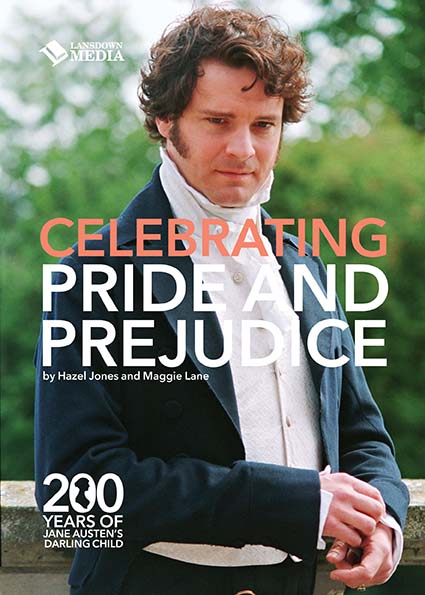
I had the pleasure to converse a bit with author Maggie Lane at the Brooklyn AGM last month – she signed a copy for me of her new book co-authored with Hazel Jones Celebrating Pride and Prejudice (Bath: Lansdown Media, 2012]


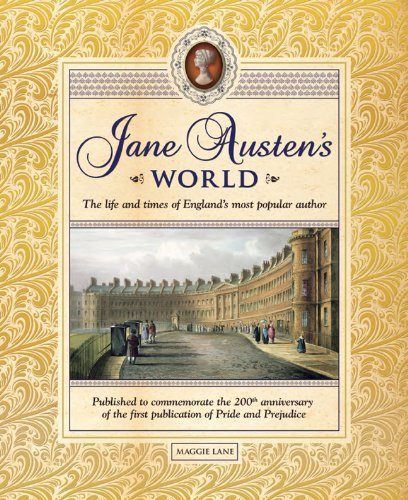
But Ms. Lane has been very busy! – I also purchased her just published Understanding Austen: Key Concepts in the Six Novels (London: Robert Hale, 2012) and in February 2013, her invaluable Jane Austen’s World: The Life and Times of England’s Most Popular Novelist (Carlton, 2013) will be published in a new revised edition with a new cover.

[You may pre-order here at Amazon.uk  ]

Those of us who subscribe to the Jane Austen’s Regency World magazine [and who does not! – if you have perchance let this fall through the cracks, it is a perfect holiday gift to request for yourself and / or give to your Austen friends: http://janeaustenmagazine.co.uk/subscribe/

… but those who do already subscribe will know that Maggie is the consultant editor, and author in each issue of the always interesting take on Austen “minutiae”, wherein she will take what the average reader will often gloss over and suggest the significance of the most obscure terms, themes or ideas, thereby making a reading all the more interesting and compelling.  Indeed in the latest Nov – Dec 2012 issue in her essay on “Shoelaces and Shawls”, Maggie addresses the clothing accessories in Emma’s Highbury, offering a discussion of shawls and shoes, and tippets and umbrellas, and the “elegance” of Mrs. Elton’s garish purple and gold; and she too makes reference to the importance of the already-famous Mr. Knightley’s gaiters

But today I want to share with you some of Maggie Lane’s own words on her book Understanding Austen.  She has most graciously written us a lovely essay on how the book came into being.  If you have any questions for Maggie or would like more information on the book, please comment below – she will be happy to answer you.

For some years now I have enjoyed being Consultant Editor of, and writer for, the Jane Austen and her Regency World magazine.  While other contributors explore the visual, social or political aspects of the world that Jane Austen inhabited, or discuss prominent personalities of the period, when writing my own articles I see my brief as keeping close to the novels themselves.  In each issue, I attempt to illuminate some theme or idea that plays a subtle yet vital part in Austen texts.  Thus it was that I hit on the idea of investigating some of the abstract nouns – elegance, openness and reserve, to take three examples – that feature so often in the six novels.

I soon realised that there was far more to say about these concepts than could be encompassed in the word-length of an article.  The idea for a new book was born!  The subject seems to me replete with interest.  There is the linguistic interest of how the meanings of certain words have shifted in the two centuries between Jane Austen’s time and our own.  Candour is a good example of that.  It now means frankness amounting sometimes even to rudeness, yet in Austen’s time it still carried the sense of generosity of spirit, of giving other people the benefit of the doubt, which Elizabeth Bennet so admires in her sister Jane.  And then there is the moral weight which Austen attaches to certain words.  Composure is almost always a quality to be recommended and tried for.  It preserves the individual from unpleasant notice and calms the nerves.  Yet when Willoughby displays composure in his London encounter with the deeply distressed Marianne, he is behaving as a heartless cad.  Anne Elliot’s “elegance of mind” is of a wholly different calibre from “the sameness and the elegance” of her eldest sister’s way of life.

The nuances which Jane Austen accords to all her favourite abstract terms make them an endlessly fascinating study.  By focussing on her vocabulary, noticing which words keep company with others, juxtaposing and comparing familiar sentences from across the novels, I gained new insights and new understanding which I hope my readers will share.

 *******************

Thank you Maggie!

I append here the Table of Contents to the work – an abundance of terms under discussion!

  1. Genius, Wit and Taste
  2. Elegance
  3. Openness and Reserve
  4. Exertion and Composure
  5. Liberality and Candour
  6. Gentility
  7. Delicacy
  8. Reason and Feeling
  9. Person and Countenance
  10. Air and Address
  11. Mind
  12. Temper
  13. Spirit
  14. Sensibility, Sense and Sentiment
  15. Firmness, Fortitude and Forbearance
  16. Propriety and Decorum
  17. A Nice Distinction

By way of example, let’s look at the Heroes of the novels and how they fare comparatively in the chapter on “Person and Countenance”:

Henry Tilney had a pleasing countenance, a very intelligent and lively eye, and if not quite handsome, was very near it; Bingley was good looking and gentlemanlike; he had a pleasant countenance and easy, unaffected manners; but alas! his friend Mr. Darcy is soon discovered to be proud, to be above his company and above being pleased; and not all his large estate in Derbyshire could then save him from having a most forbidding, disagreeable countenance.

Wickham had all the best part of beauty, a fine countenance, a good figure, and a very pleasing address.

Edward Ferrars does not at first appeal: at first sight, his address is certainly not striking, and his person can hardly be called handsome; Brandon: though his face was not handsome, his countenance was sensible, and his address was particularly gentlemanlike. And Willoughby? His person and air were equal to what her [Marianne] fancy had ever drawn for the hero of a favourite story. – which should send up red flags to the reader immediately!

Frank Churchillhis countenance had a great deal of the spirit and liveliness of his father’s – he looked quick and sensible.

And this description of Henry Crawford has always given me a chuckle: he was plain to be sure, but then he had so much countenance, and his teeth were so good. !

And Elizabeth Elliot is quick to observe [in the chapter on “Air and Address” which links quite nicely with “Person and Countenance”] this about Captain Wentworth: [she] had been long enough in Bath to understand the importance of a man of such an air and appearance as his…Captain Wentworth would move about well in her drawing room. Indeed!

And so it goes – are you not intrigued to find how Mr. Knightley is so described? I highly recommend this book – you will find you shall choose to re-read all the novels all over again, all the more appreciating the language and narrative meaning through Maggie’s insightful view – it is perhaps another holiday gift to add to your own ‘want-list’?

Do you have a favorite term or description in Austen that you would like to share? or a question about a term that might be confusing to you? – please comment below, along with any questions for Maggie.

About the author:

Maggie Lane is the author of numerous (and invaluable!) works on Jane Austen [see list below]–
She has also published articles in the Jane Austen Society Annual Reports,
the JASNA journal Persuasions, and has lectured on Austen
in the UK, the US, Canada, and Australia.

Having served for many years on the committee of the Jane Austen Society UK,
she is now Chair of its South West branch; she lives in Exeter.

Maggie Lane.
Understanding Austen: Key Concepts in the Six Novels.
London: Robert Hale, 2012.
ISBN: 978-0-7090-9078-6
£16.99 ($24.95)

Her works:

  • Jane Austen’s England (1986)
  • Jane Austen’s World (1996, 2005, new edition out in Feb 2013]
  • Jane Austen’s Family Through Five Generations (1984, 1992)
  • Literary Daughters (1989)
  • Jane Austen and Names (2002)
  • A Charming Place: Bath in the Life and Novels of Jane Austen (1988)
  • Jane Austen and Food (1995)
  • The Jane Austen Quiz and Puzzle Book (1982) [and various other quiz books on Dickens, Hardy, Bronte, Shakespeare, and more!]
  • Jane Austen in Lyme (2003)
  • Celebrating Pride and Prejudice: 200 Years of Jane Austen’s Darling Child
c2012, Jane Austen in Vermont
Auctions · Austen Literary History & Criticism · Books · Jane Austen · Jane Austen Circle · Literature · Rare Books

Austen on the Block! ~ An Austen-Filled Autumn at Upcoming Auctions

UPDATE: Prices realized noted in red as they become available

There are a number of Jane Austen materials coming up for auction in the next few weeks, some actually affordable! – and then some, not so much…  here are brief synopses – visit the auction house websites for more information.

This one is a bit different and an interesting addition to anyone’s Pride and Prejudice collection!

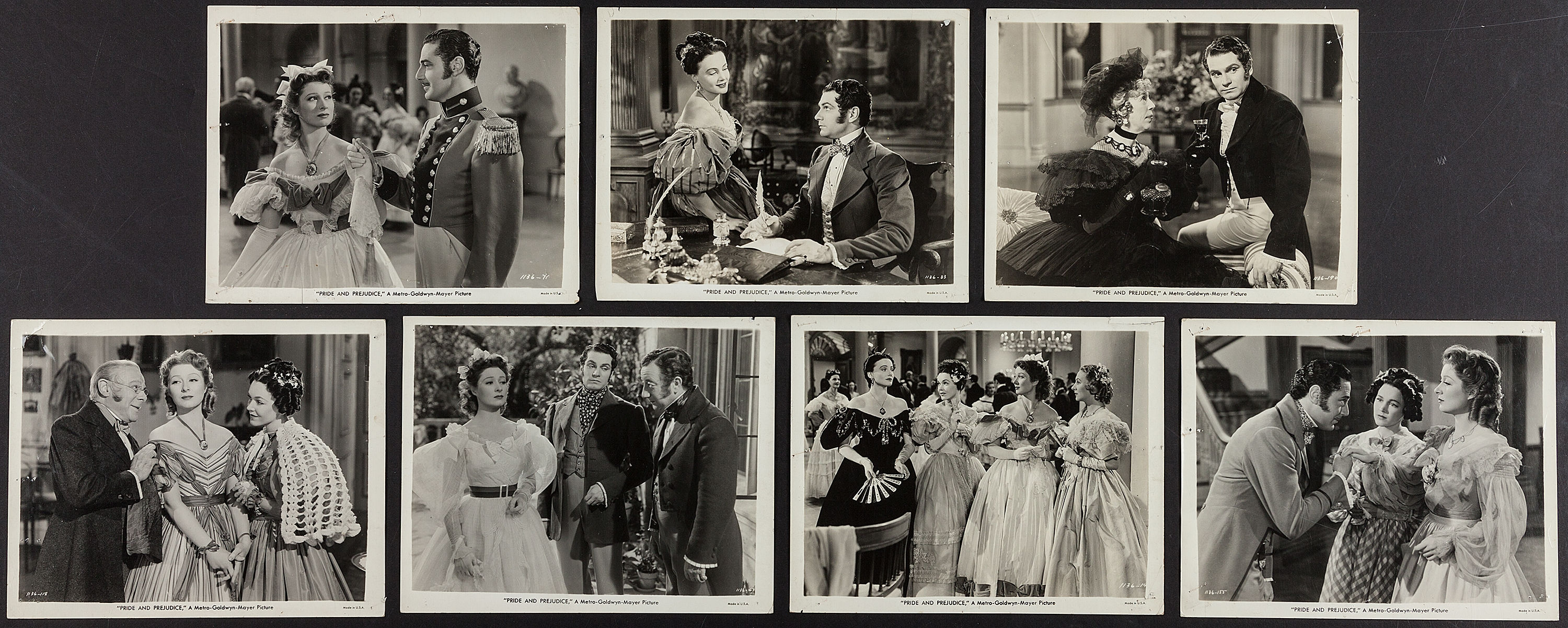
November 18, 2012. Heritage Auctions, Lot 54353. Pride and Prejudice 1939 Movie photographs:
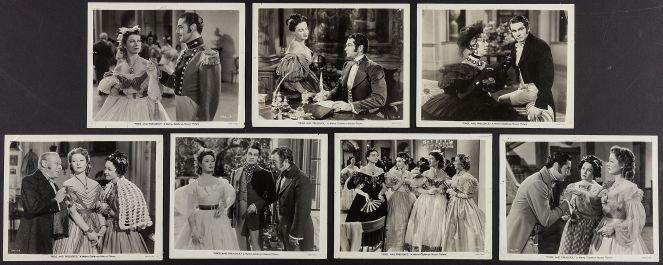
Pride and Prejudice (MGM, 1939). Photos (16) (8″ X 10″). Drama.

Vintage gelatin silver, single weight, glossy photos. Starring Greer Garson, Laurence Olivier, Mary Boland, Edna May Oliver, Maureen O’Sullivan, Ann Rutherford, Frieda Inescort, Edmund Gwenn, Karen Morley, Heather Angel, Marsha Hunt, Bruce Lester, Edward Ashley, Melville Cooper, Marten Lamont, E.E. Clive, May Beatty, Marjorie Wood, Gia Kent. Directed by Robert Z. Leonard.

There are 14 different photos with a duplicate each of 1136-190, and 1136-149; unrestored photos with bright color and a clean overall appearance. They may have general signs of use, such as slight edge wear, pinholes, surface creases and crinkles, and missing paper. All photos have a slight curl. Please see full-color, enlargeable image below for more details. Fine.

SOLD $179.25 (incl buyer’s premium)

 **********************

November 18, 2012.  Skinner, Inc. – Fine Books and Manuscripts, Boston. Sale 2621B

Lot 208:  Austen, Jane (1775-1817). Letters. London: Richard Bentley & Son, 1884. 
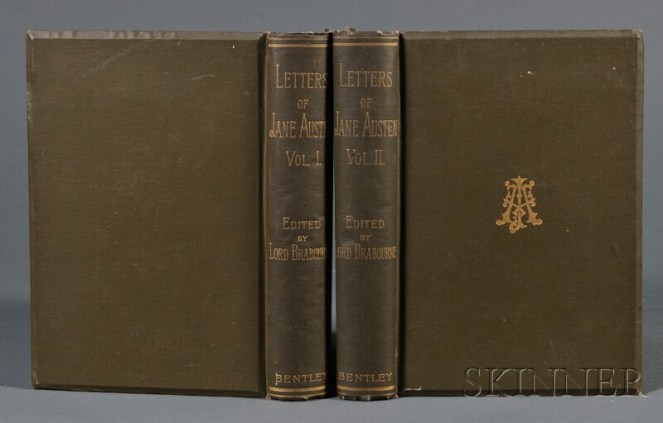
Octavo, in two volumes, first edition, edited by Edward Knatchbull-Hugessen, first Baron Brabourne (1829-1893), in publisher’s green cloth, ex libris Henry Cabot Lodge, with his bookplate; preliminaries in volume one a bit cockled, with some discoloration.

Jane Austen’s letters speak for themselves: “Dr. Gardiner was married yesterday to Mrs. Percy and her three daughters.” “I cannot help thinking that it is more natural to have flowers grow out of the head than fruit? What do you think on the subject?”

Estimate $300-500. SOLD $250. (incl buyer’s premium)

*****************

Lot 4 : AUSTEN, JANE. Northanger Abbey. Volume 1 (only, of 2). 12mo, original publisher’s drab boards backed in purple cloth (faded to brown), lacking paper spine label, edgewear; text block almost entirely loose from spine, few binding threads and signatures loose, several leaves in first third heavily creased, few other margins creased; else quite clean overall. Philadelphia: Carey & Lea, 1833

FIRST AMERICAN EDITION AND ONE OF 1250 COPIES. In need of some repair, but complete and in original cloth. All First American Editions of Austen are difficult to find. Later printings of this title did not occur until 1838, as a one-volume collected edition and, as a single volume in 1845. Gilson B5.

Estimate $500-750. SOLD: $600. [incl buyer’s premium]

**********************

This is the big one!

November 21, 2012. Christie’s. Valuable Manuscripts and Printed Books. London.  Sale 5690.
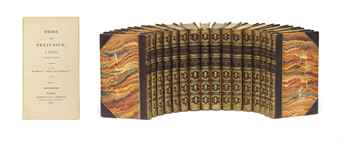
Lot 150:  AUSTEN, Jane (1775-1817). Sense and Sensibility … second edition. London: for the author by C. Roworth and published by T. Egerton, 1813. 3 volumes. (Lacks half-titles and final blanks, some browning and staining.) Gilson A2; Keynes 2.

Lot Description

AUSTEN, Jane (1775-1817). Sense and Sensibility … second edition. London: for the author by C. Roworth and published by T. Egerton, 1813. 3 volumes. (Lacks half-titles and final blanks, some browning and staining.) Gilson A2; Keynes 2.

Pride and Prejudice. London: T. Egerton, 1813. 3 volumes. (Lacks half-titles, lightly browned, a few leaves slightly torn along inner margin or with fragments torn from outer margin, margin of B10 in vol. I a little soiled, title of vol. III with slight stain at bottom margin, quires I and M in same vol. somewhat stained.) FIRST EDITION. Gilson A3; Keynes 3.

Mansfield Park. London: T. Egerton, 1814. 3 volumes. (Lacks half-titles, without blank O4 in vol. II or final advertisement leaf in vol. III, weak printing impression affecting 3 lines on Q10r.) FIRST EDITION. Gilson A6; Keynes 6.

Emma. London: John Murray, 1816. 3 volumes. (Lacks half-titles, E12 of vol. I misbound before E1, tear to bottom margin of E7 in vol. II, other marginal tears, L7-8 of vol. II remargined at bottom, title of vol. III with closed internal tear, some spotting, staining and light soiling.) FIRST EDITION. Gilson A8; Keynes 8.

Northanger Abbey and Persuasion. London: John Murray, 1818. 4 volumes. (Lacks half-titles and blanks P7-8 at end of vol. IV, some browning and spotting.) FIRST EDITION. Gilson A9; Keynes 9.

Together 6 works in 16 volumes, 12° (177 x 100mm). Uniformly bound in later 19th-century black half morocco over comb-marbled boards, marbled endpapers and edges (vol. I of Mansfield Park with scuffing at joints and upper corner of front cover).

Second edition of Sense and Sensibility, ALL OTHER TITLES IN FIRST EDITION. A rare opportunity to purchase the six most admired novels in the English language as a uniformly bound set. (16)

Estimate: £30,000 – £50,000 ($47,610 – $79,350) SOLD: £39,650 ( $63,004) (incl buyer’s premium)

**********************

November 27, 2012. Bonham’s. Printed Books and Maps. Oxford. 19851.
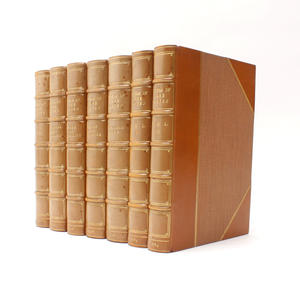
Lot 26:  AUSTEN (JANE) The Novels…Based on Collation of the Early Editions by R.W. Chapman. 5 vol., second edition, Oxford, Clarendon Press, 1926; together with The Letters of Jane Austen, 2 vol., frontispieces, uniform half calf by Hatchards, gilt panelled spines, faded, 8vo, Richard Bentley, 1884 (7)

Estimate: £300 – 500 ( US$ 480 – 810); (€380 – 630) – SOLD: £525  ($844.) (incl. buyer’s premium)

**************************

December 7, 2012. Christies. Fine Printed Books and Manuscripts Including Americana. New York. Sale 2607.
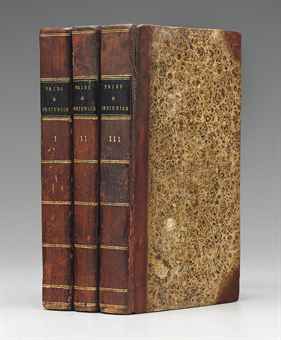
 Lot 140: [AUSTEN, Jane (1775-1817)]. Pride and Prejudice. London: Printed for T. Egerton, 1813.

Lot Description:

[AUSTEN, Jane (1775-1817)]. Pride and Prejudice. London: Printed for T. Egerton, 1813.

Three volumes, 8o (171 x 101 mm). Contemporary half calf and marbled boards, spines gilt-ruled, black morocco lettering pieces (a few stains and some rubbing); cloth folding case. Provenance: H. Bradley Martin (bookplate; his sale Sotheby’s New York, 30 April 1990, lot 2571).

FIRST EDITION. Originally titled First Impressions, Pride and Prejudice was written between October 1796 and August 1797 when Jane Austen was not yet twenty-one, the same age, in fact, as her fictional heroine Elizabeth Bennet. After an early rejection by the publisher Cadell who had not even read it, Austen’s novel was finally bought by Egerton in 1812 for £110. It was published in late January 1813 in a small edition of approximately 1500 copies and sold for 18 shillings in boards. In a letter to her sister Cassandra on 29 January 1813, Austen writes of receiving her copy of the newly publishing novel (her “own darling child”), and while acknowledging its few errors, she expresses her feelings toward its heroine as such: “I must confess that I think her as delightful a creature as ever appeared in print, & how I shall be able to tolerate those who do not like her at least, I do not know.” Gilson A3; Grolier English 69; Keynes 3; Sadleir 62b. (3)

Estimate: $30,000 – $50,000 –  SOLD:  $68,500  (incl buyer’s premium)

***********************

Lot 86: Presentation copy of Emma. Provenance: Anne Sharp (1776-1853) “Anne Sharp” in vol. 1 and “A. Sharp” in vol. 2 and 3.

Lot Description:

One of twelve presentation copies recorded in the publisher’s archives and presented to Jane Austen’s “excellent kind friend”: the only presentation copy given to a personal friend of the author.

In a letter to the publisher John Murray dated 11 December 1815, Austen noted that she would “subjoin a list of those persons, to whom I must trouble you to forward a Set each, when the Work is out; – all unbound, with From the Authoress, in the first page”. Most of these copies were for members of Austen’s family. David Gilson in his bibliography of Austen lists these presentation copies, based on information in John Murray’s records, as follows:

  • two to Hans Place, London (presumably for Jane Austen and Henry Austen)
  • Countess of Morley
  • Rev. J.S. Clarke (the Prince Regent’s librarian)
  • J. Leigh Perrot (the author’s uncle)
  • two for Mrs Austen
  • Captain Austen (presumed to be Charles Austen)
  • Rev. J. Austen
  • H.F. Austen (presumed to be Francis)
  • Miss Knight (the author’s favourite niece Fanny Knight)
  • Miss Sharpe [sic]

Anne Sharp (1776-1853) was Fanny-Catherine Knight’s governess at Godmersham in Kent from 1804 to 1806. She resigned due to ill-health and then held a number of subsequent positions as governess and lady’s companion. Deirdre Le Faye notes that by 1823 she was running her own boarding-school for girls in Liverpool (see Jane Austen’s Letters, third edition, 1995, p. 572). She retired in 1841 and died in 1853.

In 1809 Austen wrote to her sister Cassandra Austen that “Miss Sharpe… is born, poor thing! to struggle with Evil…” Four years later Jane wrote to Cassandra that “…I have more of such sweet flattery from Miss Sharp! – She is an excellent kind friend” (which may refer to Anne Sharp’s opinion of Pride and Prejudice). It is known that Anne Sharp thought Mansfield Park “excellent” but she preferred Pride and Prejudice and rated Emma “between the two” (see Jane Austen’s Letters, third edition, 1995, p. 573).

There is one known extant letter from Jane Austen to Anne Sharp, dated 22 May 1817. She is addressed as “my dearest Anne”. After Jane Austen’s death, Cassandra Austen wrote to Anne Sharp on 28 July 1817 sending a “lock of hair you wish for, and I add a pair of clasps which she sometimes wore and a small bodkin which she had had in constant use for more than twenty years”.

“In Miss Sharp she found a truly compatible spirit… Jane took to her at once, and formed a lasting relationship with her… [she occupied] a unique position as the necessary, intelligent friend” (Claire Tomalin, Jane Austen: A Life, 2000).

Anne Sharp is known to have visited Chawton on at least two occasions: in June 1815 and in August-September 1820. Deirdre Le Faye notes that James-Edward Austen-Leigh described her as “horridly affected but rather amusing” (see Jane Austen’s Letters, third edition, 1995, p.573)

Estimate: 150,000-200,000 GBP* UPDATE: UNSOLD

[*Now this confuses me: this copy of Anne Sharp’s Emma sold at Bonhams for a record £180,000 in 2008, and was subsequently sold to an undisclosed buyer for £325,000. in 2010 [see my post here and here on these sales] – I have got to hit the calculator to see what’s up with this…]

 ************************

Also in this sale:

Lot 87:  Austen, Jane. Northanger Abbey and Persuasion. John Murray, 1818.

Lot Description:

A set of Austen’s posthumously published novels in an attractive binding to a contemporary design. It appears that this set was the property of the Revd Fulwar-Craven Fowle (1764-1840). He was a pupil of Rev. George Austen at Steventon between 1778 and 1781. He is occasionally mentioned in Austen’s letters; it appears he participated in a game of vingt-un in 1801 and sent a brace of pheasants in 1815. Fulwar-Craven Fowle’s brother, Thomas (1765-1797) had been engaged to Cassandra Austen in 1792.

Deirdre Le Faye notes that he had “an impatient and rather irascible nature” and “did not bother to read anything of Emma except the first and last chapters, because he had heard it was not interesting” (see Jane Austen’s Letters, 1995, p. 525).

 Estimate: 4,000 – 6,000 GBP UPDATE: UNSOLD

**********************

And a few from Austen’s Circle I could not resist reporting on: these are all in the Swann Auction on November 20th – lots of other finds, so take a look:

Swann Sale 2295 Lot 40
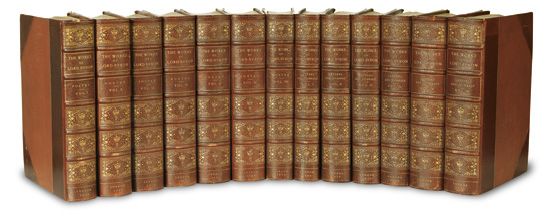
BYRON, LORD GEORGE GORDON NOEL. Works. 13 volumes. Titles in red and black. Illustrated throughout with full page plate engravings. 4to, contemporary 1/4 brown crushed morocco, spines handsomely tooled and lettered in gilt in compartments, shelfwear to board extremities with some exposure, corners bumped; top edges gilt, others uncut. London, 1898-1904
Estimate $1,000-1,500   SOLD: $1200. (incl buyer’s premium)

limited edition, number 97 of 250 sets initialed by the publisher. This set includes a tipped-in ALS (8vo, one folded sheet. April 7, 1892) by the editor of this edition, Ernest Hartley Coleridge, the grandson of Samuel Taylor Coleridge, to a Mr. Tours[?], recounting a lecture he had recently given in Minneapolis.

********************


Swann  Sale 2295 Lot 204:
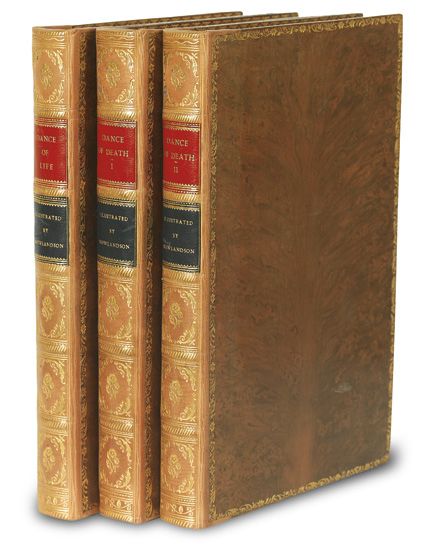
(ROWLANDSON, THOMAS.) The English Dance of Death. 2 volumes. * The Dance of Life. Together, 3 volumes. Engraved colored title-page and 37 hand-colored engraved plates in each volume of the Dance of Death, 25 hand-colored plates in the Dance of Life, by Rowlandson. Tall 8vo, later full tree calf gilt, spines tooled in gilt in 6 compartments with morocco lettering pieces in 2, rebacked; top edges gilt; occasional offsetting to text from plates and spotting to preliminaries; leather bookplates of Stephen M. Dryfoos mounted to front pastedown of 2 volumes; the whole slipcased together. London: R. Ackerman, 1815-16; 1817
Estimate $1,000-1,500 – SOLD: $3600. (incl buyer’s premium)

first editions in fine condition. “Indispensable to any Rowlandson collection, one of the essential pivots of any colour plate library, being one of the main works of Rowlandson”–(Tooley 410-411); Hardie 172; Abbey Life, 263-264; Prideaux 332; Grolier, Rowlandson 32.


Swann Sale 2295 Lot 205:
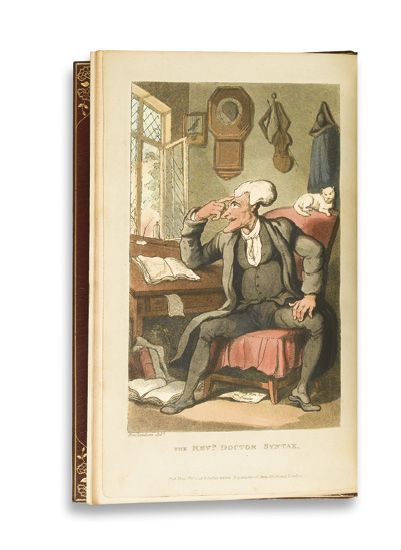
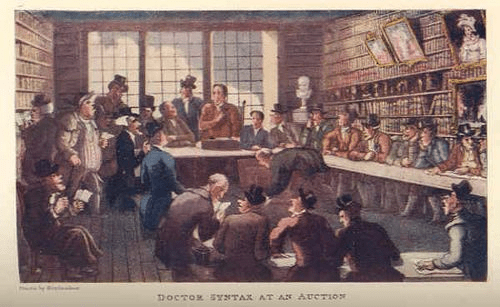
ROWLANDSON, THOMAS.) [Combe, William.] The Tour of Doctor Syntax, in Search of the Picturesque * In Search of Consolation * In Search of a Wife. Together, 3 volumes. Colored aquatint frontispiece in each volume, volumes 1 and 3 with additional aquatint title-page, and 75 colored plates by Rowlandson, colored vignette at end of vol. 3. Large 8vo, uniform full crimson crushed morocco blocked in gilt with corner floral ornaments, spines richly gilt in 4 compartments, titles in 2; turn-ins; by Root & Son, top edges gilt; bookplates of Edward B. Krumbhaar (vol. 1 only) and Christopher Heublein Perot (with his autograph). first edition in book form, second state, handsomely bound. London: R. Ackerman, 1812-20-(21)
Estimate $600-900 – SOLD: $960. (incl buyer’s premium)

 ***************************

And despite my love of Austen, I do periodically enter the 20th century [sometimes the 21st!] and I still harbor my great admiration and love of John Steinbeck, so this I share because it is so rare and lovely to behold:

Swann Sale 2295 Lot 234 John Steinbeck. Cup of Gold.
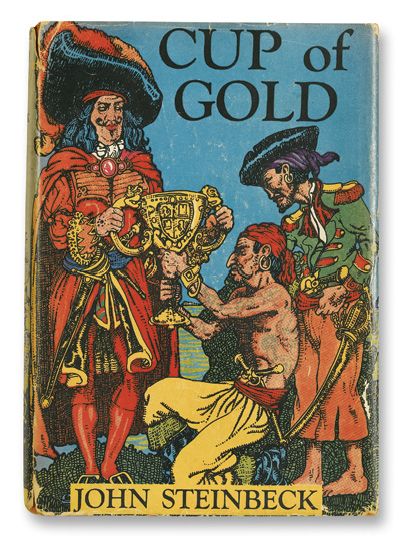
STEINBECK, JOHN. Cup of Gold. 8vo, original yellow cloth lettered in black; pictorial dust jacket, spine panel evenly faded with minor chipping to ends with slight loss of a few letters, light rubbing along folds, small rubber inkstamp on front flap; bookplate with name obscured in black pen on front pastedown. New York: Robert M. McBride & Co., 1929
Estimate $8,000-12,000 – SOLD: $14,400 (incl buyer’s premium)

scarce first edition, first issue of steinbeck’s first book with the McBride publisher imprint and “First Published, August 1929” on copyright page. Jacket flap corners evenly clipped as issued with “$2.50” printed price present. The publisher printed only 2476 copies, 939 of which were remaindered as unbound sheets and evidently sold to Covici-Friede who issued them with new preliminaries, preface, binding, and jacket in 1936. Variant copy (no priority) with the top edges unstained. Goldstone-Payne A1.a.

**********************

All images are from the respective auction houses with thanks.

Have fun browsing, and bidding if you wish!
 c2012 Jane Austen in Vermont
Literature

Guest Post: Shakespeare’s Much Ado About Nothing at the Courtyard Theatre, by Chris Sandrawich

Gentle Readers: I have posted previously a review of Shakespeare’s Richard III, a review written by Chris Sandrawich of the JAS-Midlands Branch in the UK [ you can read this review here], and I welcome Chris back today with his review of another play in this year’s World Shakespeare Festival. This festival has been an outstanding, stunning event, and because I live Here [and alas! have not seen a single one] and Chris lives There, I am most pleased to have him share his witty and brilliant analysis of the plays he has attended… [the delay in posting entirely my fault – blaming this like everything else on Moving…] – so herewith, without further ado and with my heartfelt Thanks, is Chris on Much Ado About Nothing.

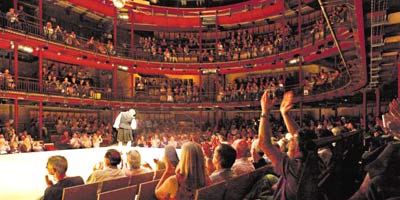
[image: Courtyard Theatre, Stratford – wikipedia]

Much Ado About Nothing at The Courtyard Theatre on 9th August 2012.

Driving south and approaching Stratford we felt an element of sadness that this Play was to be our penultimate visit in the series of six that we had booked and this one would be the only play showing at The Courtyard Theatre.

Getting there in good time is a must for car-parking in Stratford and as we strolled in good time into the paved courtyard space dividing the theatre building from the road the first signs of an Indian influence and a different flavour to the evening were evident as an impending “assault on our senses.” There was a caterwauling of car horns, bangs and shrieks layered with sitars, tablas, as well as western drum kits and reed instruments too varied for my limited musical ear to distinguish which ones, all emerging as a wall of sound from inside the theatre proper. The whiff of spices and burning joss-sticks made me feel once again that I was in my youthful days of the South Kensington of our swinging sixties. The aromas were doing their best but any olfaction was losing against an off-putting drift of a zephyr sufficiently persistent to ruin the overall effect of “something in the air” on what was, for this very wet unseasonable season, a beautifully rare azure skied summer’s evening. Directly in the centre stood a man with a tray selling freshly baked pakoras and samosas, and although we had eaten earlier they seemed too tempting to resist. Just like Oscar Wilde we can resist anything except temptation and gave in gratefully.  We sat on a bench to one side and enjoying the evening sunshine ate these delicious starters. The fascination of the British with Indian food is now remarkably well-entrenched for something which was so negligible it did not exist when I was born in the baby-boom. The relationship of the British with the subcontinent had run for over two centuries without much of an encroachment of curries into a land of roast beef and three veg. At the time I was ushered into the world there were only three, very expensively posh, London West End, Indian restaurants (or so I am informed) and all essentially serving food to those who had been in the Armed Forces based in India or who had lived through the days of the Raj. Even at half my present years, there were easily more fish and chip shops than all the rest put together, and any Briton wanting a taste of the East went to a Chinese Restaurant. Now, and nobody is quite sure why, except that Indian food tastes great, two-thirds of all restaurants are Indian (over 10,000) and they serve over two and a half million customers a week generating a yearly turnover of well over £3 Billion pa. The taste of India is here to stay. Of course, when the British say “Indian food” they include without any discrimination indigenous Pakistani foods, especially Balti dishes. Neither is there any great distinction between the types of Indian food originating in India which varies as does the availability of foodstuffs and spices determined by the sea, forests, plains and mountains that are nearby and the endless variety of cultural and regional differences. From the Andaman and Nicobar Islands to West Bengal these thirty-three distinctively different types of Indian Cuisine (see Wikipedia http://en.wikipedia.org/wiki/Indian_cuisine) are all merged into an “Indian” for the mostly unknowing but very ‘hungry for a curry’ British. We, the British, do have very cosmopolitan tastes these days. To somebody of my parents’ generation such a description of the amounts of Indian food consumed in these Islands would have seemed as far-fetched as landing a one-ton atomic-powered vehicle on Mars which can motor up a 3000 metre high mountain and which sends back pictures, performs experiments and tests rock samples remotely with a laser gun. Or as the bizarre and outlandish events of seeing in the same wet English summer a winner of the Tour de France and a winner of a men’s Tennis Grand Slam tournament by Britons.

[Samosas at Indian Foods Co]

Polishing off these snacks we idly watched other theatre goers wander about and chatted, as is my wont, to some of them about their experience of The World Shakespeare Festival 2012.  Everyone was very positive and had something good to say about the plays they had chosen to go to. There was this communal feeling of yearning to be able, subject to the constraints of time and expense, to see all the Plays and at all venues. We may not like to concede inevitable defeat in the face of such a commitment, but we all had to choose only some, and give up many, to see. We did so with some regret at what we were missing as well as the great pleasure in what we had seen and heard. There is no doubting the overall success of this venture and I do hope that in future years this “International Flavour” is encouraged and nurtured alongside home-grown talent. We must recognise that Shakespeare is owned by the whole world these days and is studied and played everywhere, phenomenal though that thought is. Normally the British are more tight-lipped than seemed the case in these discussions and I wondered whether there was some overspill of general bonhomie from the feel-good factor of the Olympics. I rather think there was, and I hope it lasts.

Meera Syal as Beatrice

Deciding that, interesting as chatting proved to be, we could wait no longer to explore what this cacophony of sounds was all about we wandered in to look and lurk on a slow dawdle to our seats. The cast, with many associates, were doing their level best to recreate Indian City street scenes (I assume successfully but I have not had any first-hand experience) with vendors, musicians, singer sewing machines, comestibles, bright colours and a generous dollop of paraphernalia seeping in all directions. As the zephyr’s powers failed at the portal we got a lovely whiff of spices and joss-sticks so that our eyes, ears and nostrils were acutely aware of all things Indian. There were no elephants or sacred cows lumbering about but I suppose there are limits! Enjoying the scene we ambled down aisle 5 into seats 20 and 21 on the end of Row A which put us in the stalls front centre. The stage came right up to us, of course, and directly in front of us were steps up onto the stage and so we could surreptitiously hang our feet out onto the first steps and later claim we were onstage, treading those Shakespearean boards at Stratford, during a live performance. It has a similar ring to my saying I was “up at Oxford in the sixties” when in reality I was only there to see Boro play Oxford Town in the third round of the FA Cup in a cold snowy January.

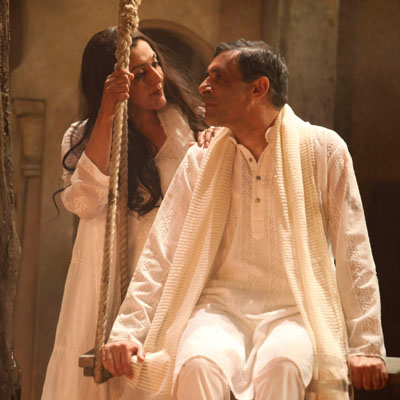
To get a flavour of just how well the cast play and look, and how they dress, and to hear “Benedick” speaking against a background of Indian rhythms then go to http://www.rsc.org.uk/whats-on/much-ado-about-nothing/ and press play.

Much Ado About Nothing

Whenever I think about Much Ado About Nothing I think about another kind of nothing associated with the Play and wonder about what Shakespeare originally intended. The original versions of the Play have many stage directions and in the opening directions there is a mention of Leonato’s wife Innogen. However, she never appears or says anything and so in most versions of the Play in modern times she does not even rate a mention. Shakespeare in his creative passion must originally have had a role in mind, but later found the plot and dialogue had no way of including her and so she is left as much ado about nothing, as well. I still wonder though.

The stage looked magnificent with an imposing edifice at the back of the stage of a family house of someone well-to-do if the numbers of doors, windows and balconies were any indicator. There was an enormous (artificial, of course but nonetheless imposing) tree on the right and around the tree, which is exactly how it has been described to me, depicting the rapid growth of technological industries and usage in India without the necessary time or money to build an infrastructure that keeps such things out of sight; were the coiled wrappings of cables thick and thin and of many colours. This is typical of the pragmatism that makes do whilst allowing the flow of commerce and telecommunications unabated. Actors on stage were involved in comings, goings and all the minutia of filling in the time until the Play proper could begin whilst giving the early arrivals something to look at and listen to.

Courtyard Theatre – image: The Guardian

Chatting to the couple just behind us we learned that this was their third visit this year to see this Play alone and that they simply loved it, especially this production. They had tried sitting both left and right and were now viewing from front and centre. They lived locally and wished to see other plays but each time the subject arose between them they kept returning just like frogs to a pond to see this one again. The lady did say that although the Play had received rave notices she had thought the Times Critic a little picky for adversely commenting that Paul Bhattacharjee (Benedick) and Meera Syal (Beatrice) were a little too ‘long in the tooth’ for the parts suggested. We were unable to establish just how much we could agree on about the critic being mistaken when the Play started. Have you noticed how they never seem to worry about an interesting conversation or two going on out there but just start when they want to? Later, I pondered on the merits of the Times critic’s attack (although I did not actually read what he said) and found that although I could see where he might be coming from I did not agree.

Beatrice and Bendick

Unlike Romeo and Juliet there are no exact mentions of age with Beatrice and Benedick, and although Claudio and Benedick are described as “young lads” of Florence and Padua respectively they do not have to be of the same age bracket. There are many suggestions of Benedick being older than Claudio. When Beatrice says, “Scratching could not make it worse, an ‘twere such a face as yours were” is she describing a young visage? When she later says, “You always end with a jade’s trick: I know you of old” she is not talking of a brief acquaintance. When Benedick says to Claudio, “I can see yet without spectacles . . . . .” is not that a reference to advancing years and an age difference between them? There is also references to Benedick regularly taking up the company of young(er) men, the latest being Claudio, and there is in Elizabethan times (and even with Shakespeare himself it seems) as shown in The Merchant of Venice with Antonio and Bassanio the examples of “close relationships” between an older and a younger man. There are as a counter argument references to “young” or “youth” in the play but such terms are relative. All I know is that having Beatrice and Benedick older than Claudio and Hero as with the Kenneth Branagh and Emma Thompson film version worked very well and our two leads were brilliant.

Emma Thompson and Kenneth Branagh as Beatrice and Benedick

The naming of Hero as “Hero” is quite deliberate by Shakespeare to foreshadow her “doubtful chastity” which is part of his plot. The myth of “Hero and Leander” was well known to Elizabethans and Shakespeare himself uses references to them in many of his plays, and Christopher Marlowe had written a poem Hero and Leander in 1598, and the timing of Much Ado About Nothing is generally fixed as 1599, so as usual Shakespeare borrowed from ancient and modern and just about any good story he could get his hands on. What he did with these stories is the real mark of his genius. In the same way with naming characters it is no coincidence, we can infer, that Don John is chosen as our villain when the bastard brother of Phillip II was also called Don John and was a personage well known to Elizabethans.

The Play transfers very well from Italy to India and to Delhi. Messina, Padua and Florence are kept in the text but references to Italy are simply replaced with India and all the rest unchanged with the obvious notable exception of the Friar replaced by the Panditji.

Well the Play rattled along with its wonderful set and fine troupe of actors but as mentioned above Meera Syal and Paul Bhattacharjee were scintillating as the brightly sparkling duellists in language that prickles with the heat of their exchanges and they displayed a great chemistry between them as sparks flew off in their verbal sparring sessions. Whilst tearing down each other’s reputations they did take careful note of exactly what the other was up to at all times and demonstrated a fulsome ambiguity throughout of the real nature of their interest in each other.

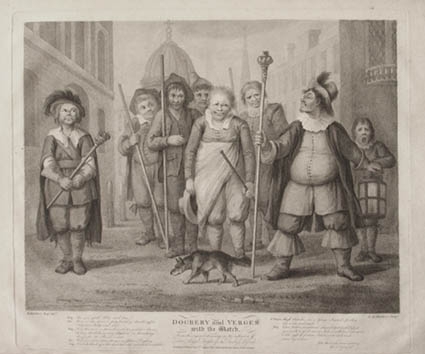
In the Kenneth Branagh film alluded to above the parts of Dogberry and Verges are wonderfully played and sent up to the moon and back by Michael Keaton and Ben Elton (who can ever forget their boyishly ‘pretend’ horses and dismounts) and they have ruined forever in Olivier fashion these parts for a generation of actors. Simon Nagra and Bhati Patel did their best, I suppose; but I was unimpressed. Long before Richard Brinsley Sheridan invented Mrs Malaprop in the The Rivals we have Dogberry butchering the English Language and uncannily substituting a similar but wrong word for the one intended. This misuse reaches a high art form as Dogberry urges his charges to be “vigitant” and expressed his hopes that they remain “senseless” of it! For me this difficult part did not quite work for Simon Nagra’s skills, and a lot of the humour was lost in the lack of emphasis and facial expressions needed to bring the audience along with each new twisting verbal cudgel swiped at the passing words.

“Dogberry and Verges with the Watch.” Engraving by Robert Mitchell Meadows, before 1812. Public domain.

The parts of Dogberry and Verges are important enough to require more powerful actors than we saw here to not only make them memorable but to extract all the humour their use of language brings to the play. These absurd officials were stretched by Shakespeare into seemingly unlikely “real people” but the audience of the time recognised only too clearly that these sorts of constables could be met with everywhere. “Hazlitt praised Dogberry, regularly hailed since as an all too convincing depiction of petty officialdom” (as taken from page 309 of The Oxford Companion to Shakespeare Edited by Michael Dobson & Stanley Wells – which Dame Judi Dench describes (and I warmly agree) “A wonderful treasure-house of information and insight”). As further supporting evidence of just how “real” Dogberry and Verges are to their time my Annotated Shakespeare by A L Rowse offers on page 394 a letter from Lord Burghley to Walsingham (Elizabeth’s principal Ministers at the time of the hue and cry over the search for the Babington Conspirators who intended Elizabeth’s death and her replacement by Mary Stuart) which says:

Sir, As I came from London homeward in my coach. I saw at every town’s end the number of ten or twelve standing with long staves, and until I came to Enfield I thought no other of them but that they had stayed for avoiding of the rain, or to drink at some alehouse, for so they did stand under pentices at alehouses. But at Enfield finding a dozen in a plump, when there was no rain, I bethought myself that they were appointed as watchmen, for the apprehending of such as are missing. And thereupon I called some of them to me apart, and asked them wherefore they stood there. And one of them answered, “To take three young men.” And demanding how they should know the persons, one answered with these words, “Marry, my Lord, by intelligence of their favour.” “What mean you by that?” quoth I. “Marry”, said they, “one of the parties hath a hooked nose.” “And have you,” quoth I, “no other mark?” “No,” saith they. And then I asked who appointed them. And they answered one Banks, a head constable, whom I willed to be sent to me. “Surely, sir, whoever had the charge from you hath used the matter negligently. For these watchmen stand so openly in plumps as no suspected person will come near them; and if they be no better instructed but to find three persons by one of them having a hooked nose, they may miss thereof.”

You get from this slice of Elizabethan writing (don’t you just love the ‘standing in plumps’) and reported speech a pretty picture of “idiots in charge”.

It is interesting to note that “pentices”, mentioned by Lord Burghley, is normally used in modern usage to signify Penthouses but in Tudor times it meant a ‘hipped building’ where the upstairs was larger than the ground floor and so there would be an overhang that offered shelter from inclement weather. Don John’s agent in malice, Borachio, actually says to Conrad, “Stand thee close then under this pent-house, for it drizzles rain, and I will, like a true drunkard, utter all to thee.” And confesses to the trick played on Hero whilst the Watch listen. This shows some change of meaning to the word “penthouse” over the centuries, unless the original Penthouses also had an overhang being on the topmost floor. Anyone out there know?

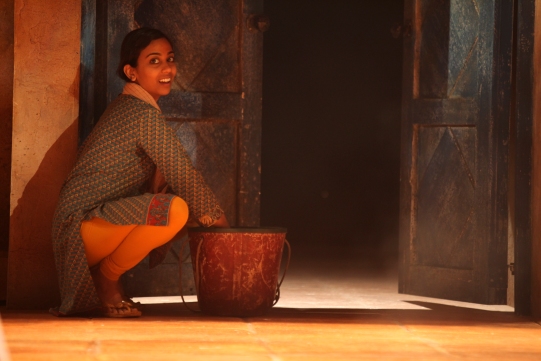
One of the cameos of the evening’s entertainment was the brilliant acting of Anjana Vasan (the maid) who they used instead of the ‘boy’ bid by Benedick to fetch his book from his chamber window to bring to the orchard. She arrives back but is unable to find Benedick hidden as he is from the others. She kneels down in the front centre of the stage in order to get away from the others and not attract their attention or distract them as they circle and try in loud conversation to catch Benedick’s ear.

Anjana Vasan as Maid in Much Ado About Nothing. Photo by Ellie Kurtz.

[Image: RSC website]

Wide-eyed she kneels there drinking in and believing every word of their overblown description of how much Beatrice is fancied to be in love with Benedick. This maid’s face reflects the action as she enters more and more into the supposed turmoil of Beatrice’s mind as her excitement grows and reveals a most delightful range of high-flown passionate expressions as in a crescendo Claudio gets to his speech

Hero thinks surely she will die, for
She says she will die, if he love her not, and
She will die, ere she make her love known,
And she will die, if he woo her, rather than
She will bate on breath of her accustomed crossness

And at each belling of the word die the lovely Anjana’s face was a picture to behold, riven through with Beatrice’s living pain, whilst holding onto Benedick’s book as a kind of talisman in defence all the while, and finally collapsing in a heap as the rest take absolutely no notice of her whatsoever. A marvellous piece of unwritten addition to the Play and the Director and cast should be well pleased with themselves for its inclusion. Well done Anjana Vasan.

When the entire Play was done the cast received from a full house a most rapturous and fully deserved burst of applause. They (apart from my gripes about Dogberry and Verges) were simply wonderful. On the way home we discussed how well the play had worked and just where we had seen the actors perform in other areas. We really could not call anything to mind for the excellent Paul Bhattacharjee although he seemed very familiar to us indeed. As luck would have it and without even planning to have an Indian theme to our week we saw the film, “The Best Exotic Marigold Hotel” the next night and whilst enjoying the main parts we noted how so many of the smaller roles in this film were also being played by first class performers. If you have seen the film there is a wonderful hospital scene in which Maggie Smith’s character is displaying rampant racism and insists upon an English doctor. The Staff Nurse brings her one speaking perfect English and lo and behold there in his pin-stripe suit stood our Benedick from the previous night, Paul Bhattacharjee, this time playing a hospital doctor.  We were also able to compare the attempts at giving us a flavour of a city in India with those from the film and found them, space and expense permitting, pretty close.

Another Triumph seen and heard and once more worth every penny of the £48 per seat, and as we had booked six for a ‘Stratford Pass’ we got 20% off as well.

Chris Sandrawich, 14th September 2012.

The Schedule:

  • 26 July – 15 September (The Courtyard Theatre, Stratford-upon-Avon) – alas! it has already moved to London!
  • 22 September – 27 October (The Noël Coward Theatre, London)
c2012 Jane Austen in Vermont