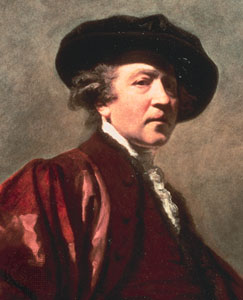
“We have been both to the Exhibition & Sir J. Reynolds’, – and I am disappointed, for there was nothing like Mrs. D. [Darcy] at either. – I can only imagine that Mr. D. prizes any Picture of her too much to like it should be exposed to the public eye. – I can imagine he w’d have that sort [of omitted] feeling – that mixture of Love, Pride & Delicacy.- Setting aside this disappointment, I had great amusement among the Pictures…”
[Jane Austen, Letter 85, Monday 24 May 1813]
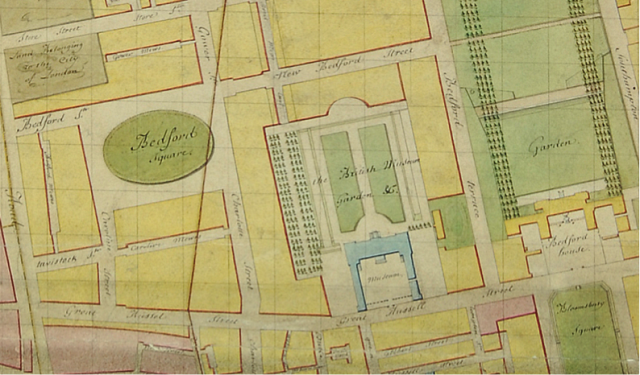
Those who have read Jane Austen’s letters are familiar with her comments on visiting London. It has been an ongoing project of mine to figure out where she went and what she did and how she uses the pieces of her London treks in her novels. One of the more interesting and frustrating is her reference to the art exhibit of Sir Joshua Reynolds – what did she see there, other than not finding a portrait of Mrs. Darcy? It has been revealed today that we will now have a chance to see exactly that, sort of following Jane herself around the galleries, as Professor Janine Barchas of the University of Texas at Austin launches What Jane Saw – a complete reconstruction of that exhibit. You will surely want to bookmark this new website and mark your calendars to view the happening on May 24, 2013!
From the website:
On 24 May 1813, Jane Austen visited an art exhibit at the British Institution in Pall Mall, London. The popular show was the first-ever retrospective of the works of Sir Joshua Reynolds (1723-1792), England’s celebrated portrait painter. On 24 May 2013, two centuries to the day that Austen viewed the 141 paintings in that exhibit, this site will open its doors as a public e-gallery, offering the modern visitor a precise historical reconstruction of that long-lost Regency blockbuster.
“La! You are so strange! But I must tell you how it went off. We were married, you know, at St. Clement’s, because Wickham’s lodgings were in that parish. And it was settled that we should all be there by eleven o’clock. My uncle and aunt and I were to go together; and the others were to meet us at the church. Well, Monday morning came, and I was in such a fuss! I was so afraid, you know, that something would happen to put it off, and then I should have gone quite distracted. And there was my aunt, all the time I was dressing, preaching and talking away just as if she was reading a sermon. However, I did not hear above one word in ten, for I was thinking, you may suppose, of my dear Wickham. I longed to know whether he would be married in his blue coat.
“Well, and so we breakfasted at ten as usual; I thought it would never be over; for, by the bye, you are to understand, that my uncle and aunt were horrid unpleasant all the time I was with them. If you’ll believe me, I did not once put my foot out of doors, though I was there a fortnight. Not one party, or scheme, or any thing. To be sure London was rather thin, but, however, the Little Theatre was open. Well, and so just as the carriage came to the door, my uncle was called away upon business to that horrid man Mr. Stone. And then, you know, when once they get together, there is no end of it. Well, I was so frightened I did not know what to do, for my uncle was to give me away; and if we were beyond the hour, we could not be married all day. But, luckily, he came back again in ten minutes time, and then we all set out. However, I recollected afterwards that if he had been prevented going, the wedding need not be put off, for Mr. Darcy might have done as well.”
“Mr. Darcy!” repeated Elizabeth, in utter amazement.
Pride and Prejudice, v. III, ch. IX
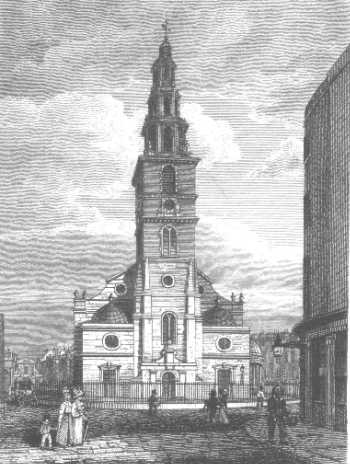
St Clement Danes – Strand (London Views)
Jane Austen often gives clues to the whereabouts of her locations, especially in her London passages – we know she knew London well and placed her characters in just the right spot to tell her readers who they were by where they lived. We famously have a few “____shire”s scattered about regarding the militia, for an element of secrecy one might assume? But in Pride and Prejudice there are two locations that she specifies that bring only confusion, and both involve Wickham and Lydia: St. Clement, where they were married, and Edward Street, home to Mrs. Younge, Georgiana’s former governess and friend and devious helper to Wickham. Today I will deal with the former…
When Lydia remarks that “We were married, you know, at St. Clement’s, because Wickham’s lodgings were in that parish.” – she gives a clue that perhaps contemporary readers would not have found confusing, but we are left with not being completely sure which St. Clements she is referring to: St Clement Danes in the Strand, or St. Clement Eastcheap. Neither is mentioned in her extant letters.
Pat Rogers notes in her 2006 Cambridge edition of Pride and Prejudice that the fairly large parish of St. Clement Danes had a population of 12,000 in 1801 and “contained areas of cheap lodgings and some raffish districts, notably a part of Drury Lane” (531-32). Most who have written on this would agree (see Kaplan and Fullerton cites below), largely because the other St. Clement (Eastcheap), on St. Clement’s Lane between Lombard Street and Great Eastcheap, would have been too close to the Gardiner’s who lived on Gracechurch Street [see maps for location of both churches]. Wickham would not have placed himself in such a smaller parish, with a population of 350 in 1801 (Rogers, 531), and so close to those who might find him out. Another reason that Rogers selects this as the best option is that in order to marry in this parish, one of the parties had to have residence there for fifteen days (Rogers, 532). Laurie Kaplan adds that “the length of time required for residency functions perfectly for the elopement plot of the novel, for tension increases the longer Lydia and Wickham remain unmarried” (Kaplan, 7). But we know Wickham had no mind to marry Lydia … .another story entirely… (the text is very clear on this: Mrs. Gardiner relates to Elizabeth: “…it only remained, he [Darcy] thought, to secure and expedite a marriage, which in his very first conversation with Wickham, he easily learnt, had never been his design.” (357).
But perhaps in the end, we should just abide by Susannah Fullerton, where in her Celebrating Pride and Prejudice, she blames Lydia for the whole confusing mess: “How typical of Lydia to be inexact in her information!” (p. 94-95)
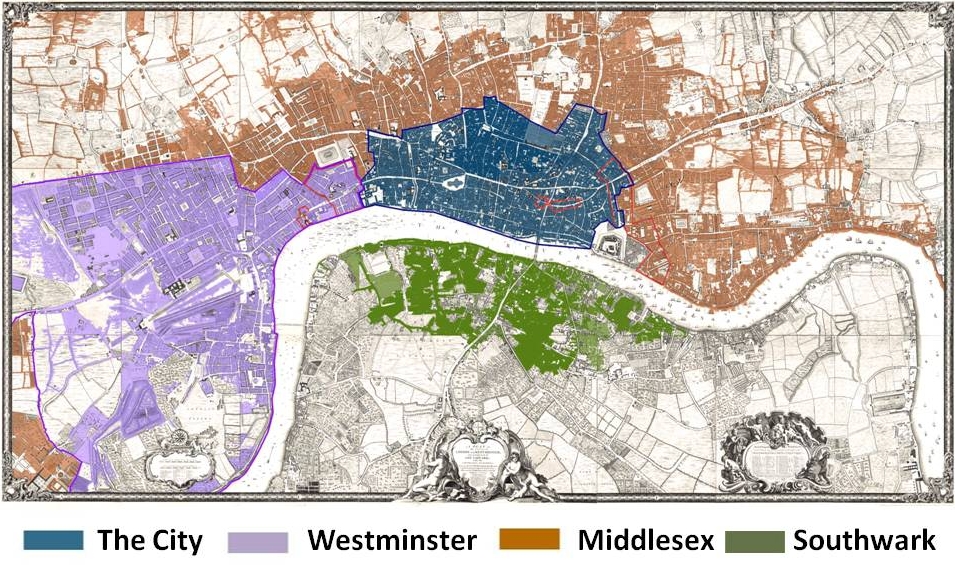
Horwood Map panel 14. [RICHARD HORWOOD – MAP OF LONDON, WESTMINSTER AND SOUTHWARK, 1813] St Clement Danes is located at the heart of London, placed on an island in the middle of the Strand,
opposite the Royal Courts of Justice, the Temple and Fleet Street – on the map above circled in purple.
(Click on map and zoom in; map courtesy of Sue Forgue at Regency Encyclopedia, from the Guildhall Library, London)
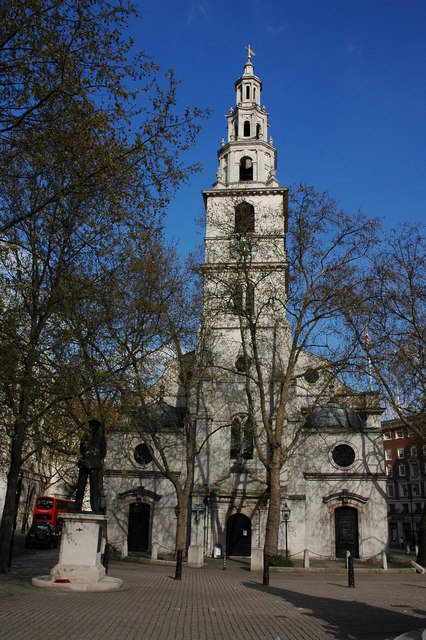
St. Clement Danes: The first church on the site was founded by Danes in the 9th century, and named after St. Clement, patron saint of mariners. It has been rebuilt by William the Conqueror, later again in the Middle Ages, and rebuilt yet again in 1680-82 by Christopher Wren, a steeple added in 1719-20. It was gutted during the blitz, only the walls and tower left standing, and since reconstruction has served as the central church for the Royal Air Force.
An early street view of the Strand and St Clement Danes Church, 1753. On the right is the original entrance to the building.
cTrustees of the British Museum; image from Christina Parolin, Radical Spaces (ANU, 2010).
St Clement Danes today: when in London in May 2011 I visited the Church for the first time, finding it a quite lovely and peacful setting on its little island in the midst of bustling London – here are a few shots, alas! not that well focused and no exterior shots of the facade, so I include one from Geograph.org.uk, with thanks.
St Clement DanesSt Clement Danes, interiorSt Clement Danes ceilingflag in St Clement Danes
St Clement Danes exterior – cPhilip Halling, Geograph.org.uk
[A movie aside: You will notice that there are no entrance steps, as there are no steps for St Clements Eastcheap – if you recall from the 1995 movie, Lydia is running up the steps to the church, so neither of these sites were used in the movie [and I find no picture of this scene – if anyone knows where that exterior shot was filmed, please let me know!]
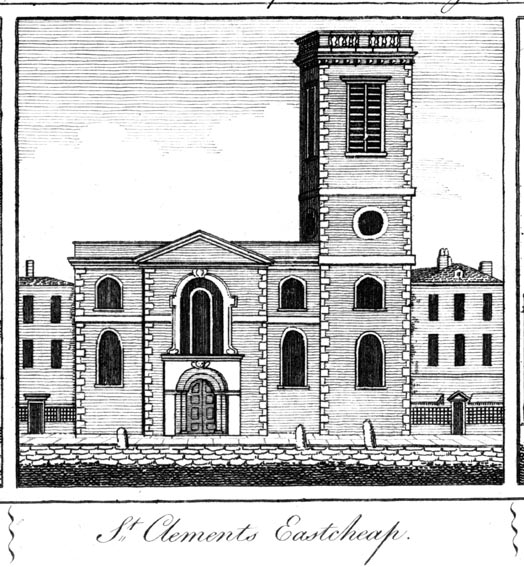
Facade St Clement Eastcheap
c.1760, from Walter Harrison’s History of London (1777) – wikipedia
******************
St. Clement Eastcheap: located on St. Clement’s Lane between Lombard Street and Great Eastcheap [today on Clement’s Lane, off King William Street] and close to London Bridge and the River Thames – see here on the Horwood panel 15:
Horwood Map panel 15. [RICHARD HORWOOD – MAP OF LONDON, WESTMINSTER AND SOUTHWARK, 1813]
The purple marks Gracechurch Street, home ot the Gardiners, and ends at the botton at Great Eastcheap,
go one block to the left to find St. Clement’s Lane, the Church is on the right.
(Click on map and zoom in; map courtesy of Sue Forgue at Regency Encyclopedia, from the Guildhall Library, London)
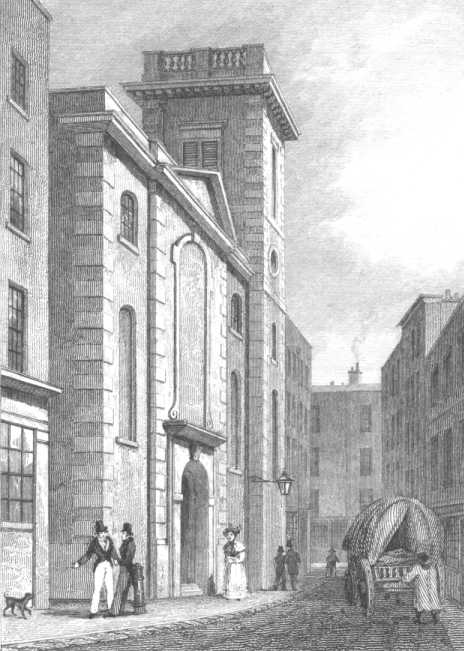
Though we are quite sure that this is not where Austen had Lydia and Wickham marrying, it is still worth noting – perhaps we are wrong in our assumptions after all, and Wickham was just “hiding in plain sight”? This St. Clement has possible Roman origins; it was destroyed in 1666 in the Great Fire of London, and rebuilt in the 1680s and also designed by Wren. And one should note that “cheap” is an old Saxon word meaning “market” and does not mean “cheap” as we associate it today. Here are a few images:
St Clement Eastcheap – London ViewsSt Clement Eastcheap today – wikipedia
The St Clement argument does not just revolve around Jane Austen [and indeed may she just been throwing out a very sly reference to her sailor brothers? – just a thought, St. Clement being the patron saint of sailors] … The Churches apparently have a long-standing “quibble” over which is the St. Clement referred to in the nursery rhyme “Oranges and Lemons” – here is the full rhyme: [the long version from wikipedia: http://en.wikipedia.org/wiki/Oranges_and_Lemons ]. It is the bells of St. Clement Danes that ring out the tune of the rhyme three times a day.
“Oranges And Lemons”, Nicholl Bouvier Games 1874, “The Pictorial World” by Agnes Rose Bouvier (1842 – 1892) – wikipedia
Gay go up and gay go down, To ring the bells of London town.
Oranges and lemons, Say the bells of St. Clements.
Bull’s eyes and targets, Say the bells of St. Margret’s.
Brickbats and tiles, Say the bells of St. Giles’.
Halfpence and farthings, Say the bells of St. Martin’s.
Pancakes and fritters, Say the bells of St. Peter’s.
Two sticks and an apple, Say the bells of Whitechapel.
Pokers and tongs, Say the bells of St. John’s.
Kettles and pans, Say the bells of St. Ann’s.
Old Father Baldpate, Say the slow bells of Aldgate.
You owe me ten shillings, Say the bells of St. Helen’s.
When will you pay me? Say the bells of Old Bailey.
And finally, to bring this back to Jane Austen, where all begins and ends after all, there is behind the St Clement Danes church a statue, by Percy Hetherington Fitzgerald and erected in 1910, of all people, Jane Austen’s very own Dear Dr. Johnson. I think she would be pleased, don’t you?
Enquiring Readers: Last week I had posted a comment about Macbeth during the hoopla about Richard III; Ron Dunning [of the Jane Austen Family Tree fame] and I have been in communication since about how everything it seems comes back to Jane Austen, further evidenced by a recent tour he took of Canonbury Tower…. read on for yet another connection to Jane Austen!
****************
Canonbury on the map: Londontown.com
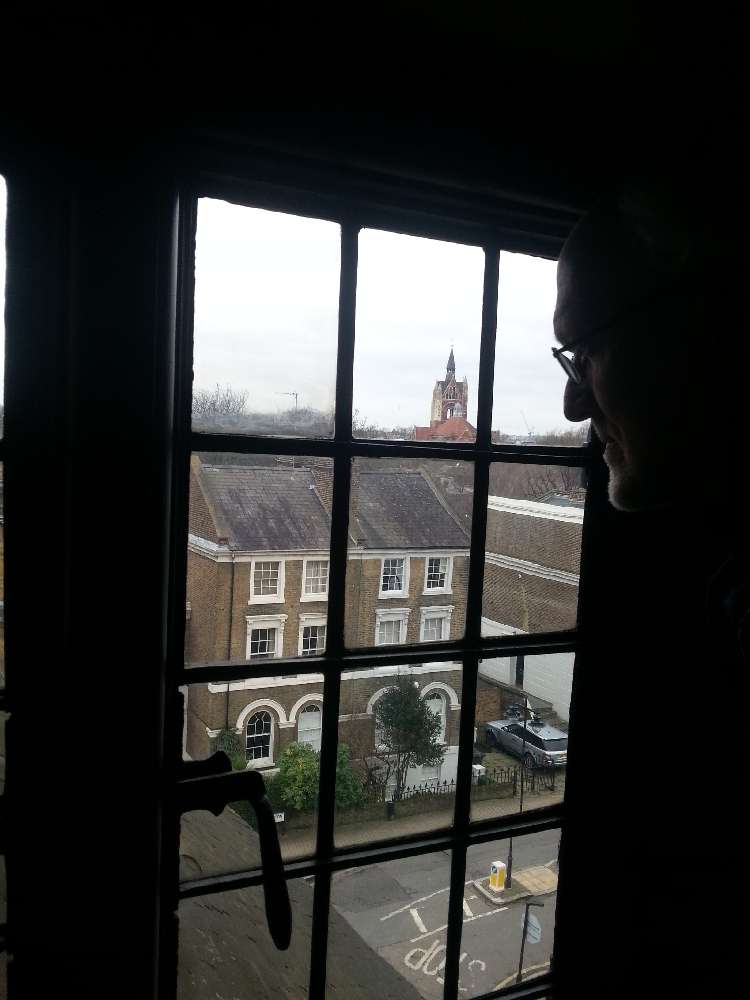
Our esteemed [blush…] blogiste and editrix remarked a few days ago, in reference to the fact that Macbeth’s victim Duncan I was an ancestor of Jane Austen, that “ALL in life that one thinks or does comes back to Jane Austen”. It’s true – it does. Earlier in the week, I went on a guided tour of Canonbury Tower, in the Islington area of London, with my accomplice in exploration, Catherine Delors. [Ed. note: Catherine is the much moreso esteemed historical novelist who blogs at Versailles and More]. For all we knew, it would be no more than a fascinating view of one of London’s few remaining precious Tudor residences, little suspecting that there would turn out to be an Austen connection.
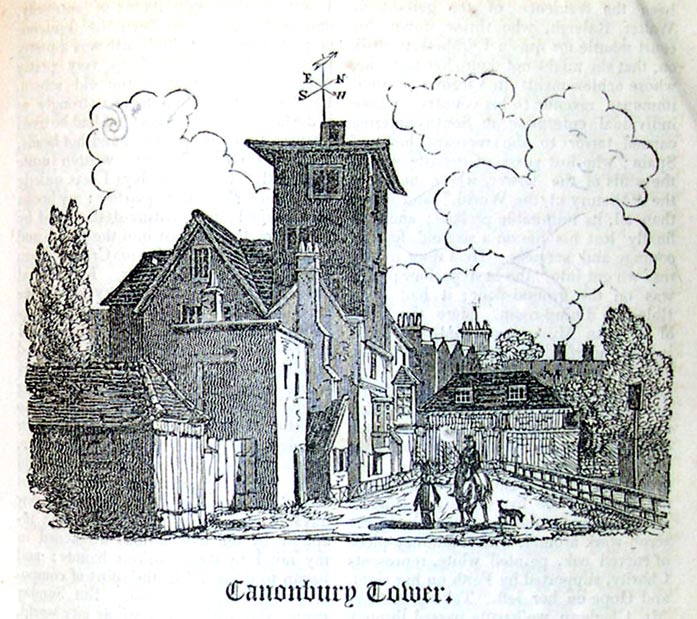
Canonbury Tower – wikipedia
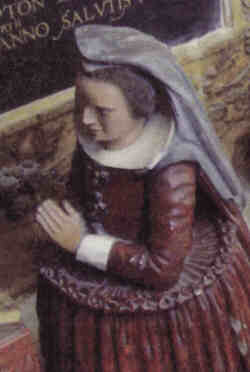
Canonbury was a Saxon manor, and after 1066 was awarded by William the Conqueror to the de Berners family. It was only a brief horse ride from the centre of London, and even walkable, so it became the residence of various abbots and other dignitaries. In the late 1500’s the manor was owned by Sir John Spencer (d. 1610), a very wealthy merchant and sometime Lord Mayor of London – who had a pretty young daughter, Elizabeth.More to the point, she was worth £40,000 on her marriage – some five million pounds today. Her father had promised her to several men, in consideration of the usual dynastic criteria, but she met and fell in love with the spendthrift William Compton, Lord Compton (and later to become Earl of Northampton, d. 1630). John Spencer was vehemently opposed to this match, not least because William owed him money. She managed somehow to elope with William, one version of the story claiming that he disguised himself as a baker’s boy and smuggled Elizabeth out of the house in a blanket.
John Spencer refused to be reconciled to this marriage, until Queen Elizabeth intervened. When he and his wife died intestate (not without suspicions of subterfuge on that score), William and Elizabeth inherited the entire estate, then valued at between £300,000 and £800,000. William immediately spent over £70,000 on horses and gambling, and it appears that Elizabeth had no qualms about spending money, either.
So far, I haven’t told you what the Austen connection was. I knew that William and Elizabeth were in my Austen database but with 13,500 people in it, I couldn’t remember their connection. Checking when I got home I realized that they were ancestors of Adela Portal, the wife of Edward Knight (the younger), Jane’s nephew. Among others, the current doyenne of the Austen family, Diana Shervington, is a descendant of that line.
There is a further literary connection, in that William and Elizabeth were also the ancestors of Vita Sackville-West. The time has long since passed when I was surprised that almost anyone that you could name was connected with the Austens, but the particular individuals and their stories continue to fascinate!
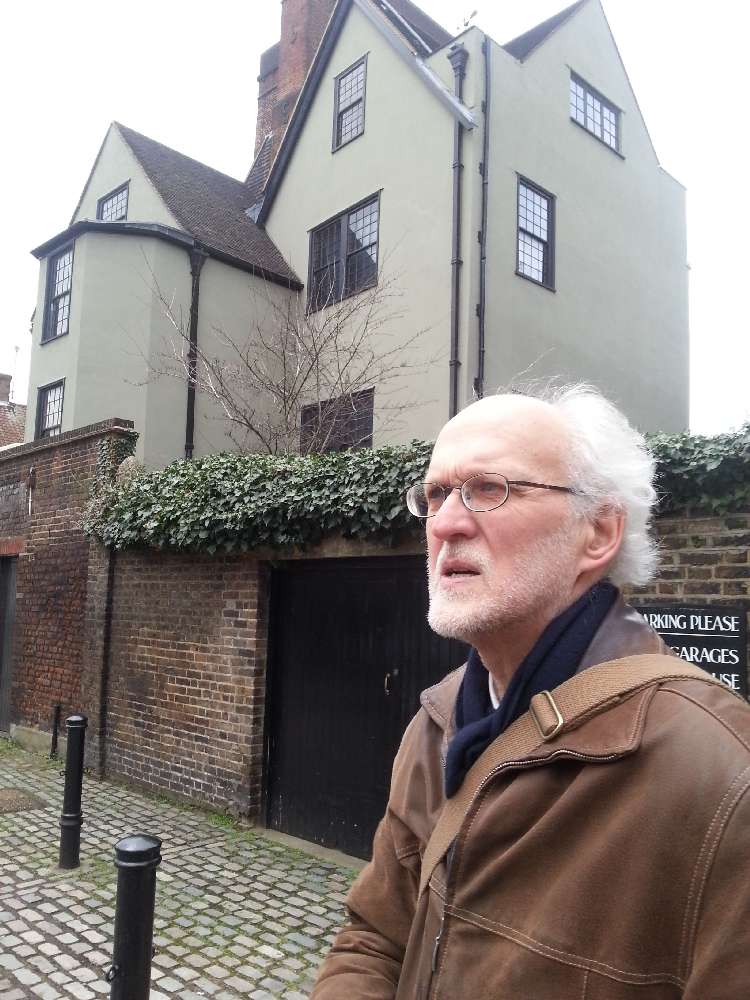
Ron Dunning outside Canonbury Tower
[image: c2013, Catherine Delors]
Catherine Delors
Wish I had been there with the two of you! Thank you Ron for your continued insights on all things in the Austen family!
******************
Further reading: the problem with these sort of postings is that one can spend an inordinate amount of time researching all these new connections! – here are a few places to start, Elizabeth Spencer having quite the interesting story!
Thomas Cromwell, Lord Privy Seal, lived in Canonbury Tower from 1533. His residency ended abruptly in 1540 when he was beheaded by King Henry VIII. Cromwell has been the subject of Hilary Mantel’s critically-acclaimed Wolf Hall and Bring up the Bodies.
Sir Francis Bacon, King James I’s Lord Chancellor, lived in Canonbury Tower, 1616-1626.
Chimney-piece and panelling in the Compton Oak Room, late 16th-century. Image: ‘Plate 102: Islington: Canonbury Tower’,
An Inventory of the Historical Monuments in London,
Volume 2: West London (1925), pp. 102. British History Online.
And finally, and again from the William Hone (1780-1842) archive:
Those who have been before and not lately, will view “improvement” rapidly devastating the forms of nature around this once delightful spot; others who have not visited it at all may be amazed at the extensive prospects; and none who see the “goings on” and “ponder well,” will be able to foretell whether Mr. Symes [the resident when Hone visited] or the tower will enjoy benefit of survivorship.
To Canonbury Tower
As some old, stout, and lonely holyhock,
Within a desolate neglected garden,
Doth long survive beneath the gradual choke
Of weeds, that come and work the general spoil;
So, Canonbury, thou dost stand awhile:
Yet fall at last thou must; for thy rich warden
Is fast “improving;” all thy pleasant fields
Have fled, and brick-kilns, bricks, and houses rise
At his command; the air no longer yields
A fragrance—scarcely health; the very skies
Grow dim and townlike; a cold, creeping gloom
Steals into thee, and saddens every room:
And so realities come unto me,
Clouding the chambers of my mind,
and making me—like thee.
*****************
And so here we are almost 200 years later, still visiting Canonbury Tower!
Enquiring Minds: Tony Grant of London Calling, and a regular contributor to Jane Austen’s World, had written a post for me on Marble Hill House in Twickenham– but alas! I have been so delayed in getting this on the blog that we agreed he should post it himself and I will link to it… so herewith the tale of Marble Hill House, home to Henrietta Howard, mistress of George II. This all started with a conversation over Joshua Reynolds’s house, which led to Richmond Hill, and then on to Henrietta Howard and Marble Hill House, and then Pope and Swift, Horace Walpole, John Gay and the Scriblerus Club, a bit on Wordsworth and Sir Walter Scott and on to Dickens and Virginia and Leonard Woolf, and of course Jane Austen gets her required mention – you get the idea – this is cram-packed with literary tourism and as always, Tony’s fine photographs…
****************
The Thames from Richmond Hill
The River Thames wends its tortuous way across England from Thames Head in Gloucestershire until it reaches the southernmost part of the North Sea. Its journey stretches for 215 miles. Finally the wide Thames Estuary which pours its contents into The North Sea is bordered on the north bank by the Essex coast and Southend on Sea and at its southern bank by the Kent coast, Sheerness and the entrance to the Medway.
Along its course The Thames passes though some beautiful English countryside before it enters the Greater London area passing by Sunbury and on to Hampton, then Hampton Court, Kingston upon Thames, Twickenham and Richmond. At last it reaches the centre of London with its iconic landmarks. The Thames, from London along its whole length, has a long history of Iron Age villages, Roman habitation, Saxon towns, and mediaeval settlements, Tudor Palaces and Georgian and Victorian Villas. London itself began as a Roman settlement for trade, built at the nearest bridging point to the coast where they had their port called Ritupiae (Richborough). They wanted to penetrate the hinterland north of the Thames. Indeed the names Thames which was Celtic in origin but had its Roman equivalent (Tamesas recorded in Latin as Tamesis) and London (Londinium) come to us from Roman times.
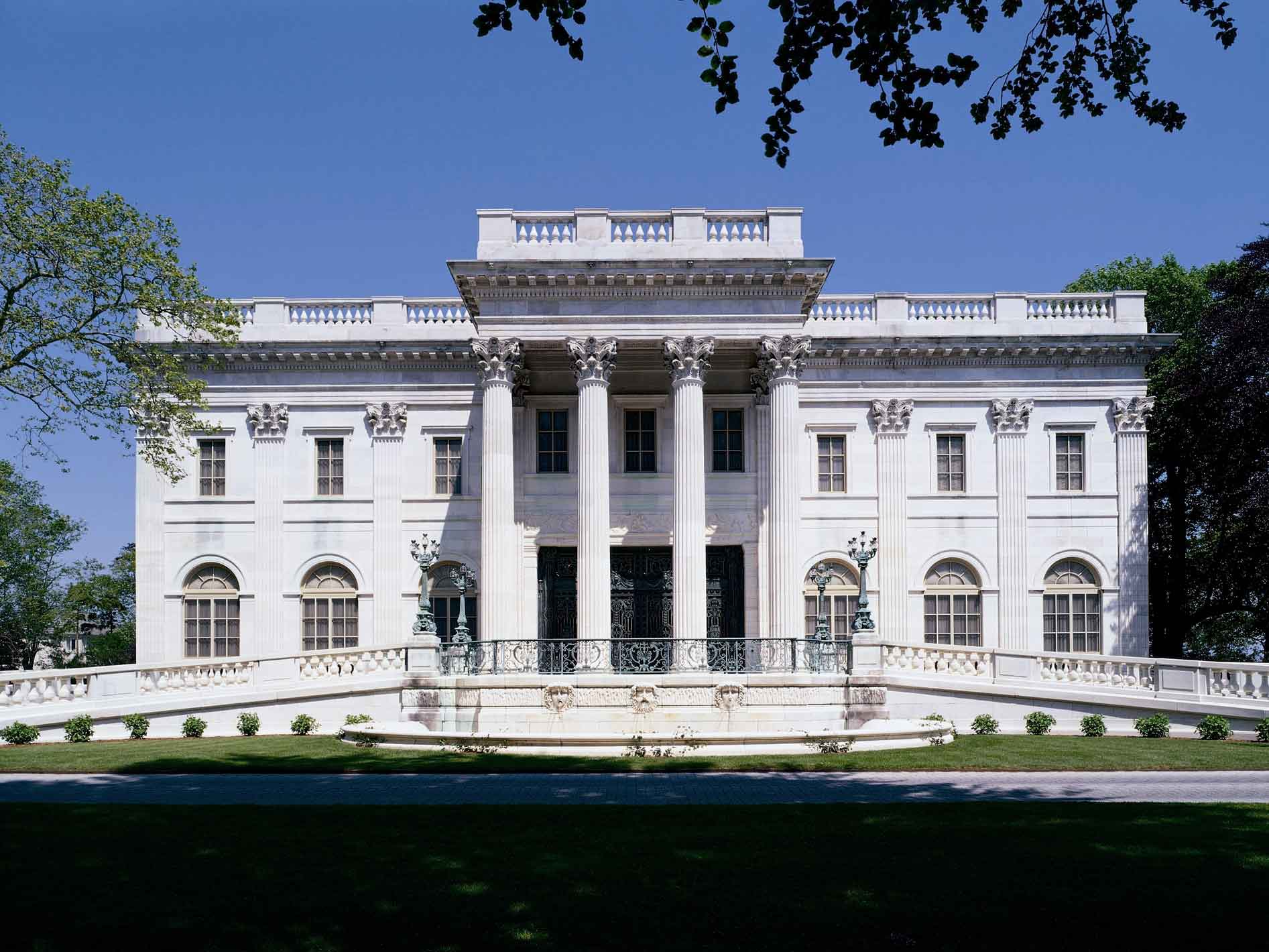
Over the centuries the Thames outside of London has provided a beautiful Arcadian retreat for the wealthy, the famous, the aristocracy and the monarchy away from the stench and diseases prevalent in many periods of London’s history. They built palaces and grand houses and villas with adjoining estates and landscaped parks to relax and take their leisure in. Marble Hill House is a Palladian Villa built between 1724 and 1729, very close to Richmond upon Thames but on the northern bank of the Thames near Twickenham. It was built for George II’s mistress, Henrietta Howard….
Today I again welcome Stuart Bennett, for Part II of our interview where we discuss his new book The Perfect Visit, a time-travel tale, a romance, and a pure escape into the Regency world of Jane Austen and the Elizabethan world of William Shakespeare! [Please go to this link for Part I of the interview.]
You can enter the book giveaway by commenting on either postbefore 11:59 pm 15 April 2012. Winner will be announced on Monday April 16, 2012. [worldwide eligibility]
Talking about the Feminist Question: [because I always have to ask…]
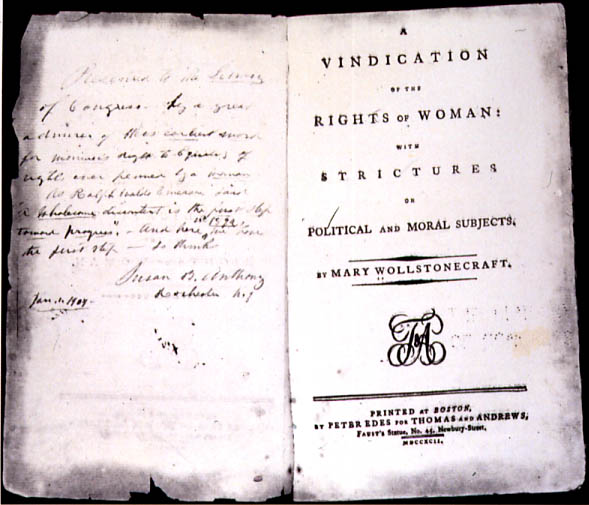
JAIV: Vanessa is in all ways a 21st century woman, yet when she finds herself stranded in the early 19th century England she is “visiting” she must, I assume, “just fit in” – she even goes to the lengths of wanting marriage for protection alone – she cannot earn a living as she would have done here in the present – she is trapped and at times just so incredibly sad. You do have her debating women’s rights and voting and the realities for women publishing, and she does stand up for herself innumerable times – and you did create Meg, a lovely character, true to her time and herself – but I am perhaps taking Vanessa and her story too much to heart here? – she feels very real to me [and I thought only Jane Austen’s characters are really real!] – and I felt that if I were there, I would be pushing Wollstonecraft’s Vindication on every passer-by, screaming for equality, hanging out with the bluestockings! – yet you have her taking such a back seat in these socio-political conversations of the day. I just see that as a difficult issue for you as a writer – making her a very modern woman living in an earlier time and not scaring all the people around her! Did you feel this in creating her? – needing to make her an almost “invisible” being, with your own time travel rules at play to not change things, to lay-low so to speak, to not bring too much attention to oneself? … And did you find her enforced silence painful as well? Or is this more my response as a female reader moved by her inability to speak out – more so than even for you who created her? [you might just answer ‘yes’ or ‘no’ and head on to the next question!]
[Image: wikipedia]
SB: It is tempting just to say “yes” and move along. But a question that shows such close and sympathetic reading deserves better than that. Vanessa is young at the beginning of The Perfect Visit. Resourceful and tough as she is, she still has to deal with the triple-whammy of being trapped in another time, imprisoned, and ill. Without Meg (and other interventions which I hope readers will discover for themselves) Vanessa would surely have died.
And so she does her best to lie low, to get by, to fit in. And at times it all makes her feel like she is about to explode. This is the Vanessa who came alive for me, and as a writer it brings me joy to know that she came alive for you too. Thank you!
Talking about Books:
JAIV: All references to book titles, authors, prices, etc. are you say valid – in your words, you may have “tinkered a little with history, but I have done my best not to tinker with bibliography.” [p.341] – and this book abounds in Bibliography! I love to come away from such a story with pages of things, people and places, and books to research! – And I thank you for your “Historical postscript – the truth in Jane Austen’s life and her fiction, and the amalgamations of real people to create your heroine and hero and all the various booksellers… [though I did miss the Godwin reference I am ashamed to say! – so clear after reading your postscript…]
So I would ask, can your story be enjoyed by the non-Austen aficionado? The non-bookseller? The person little acquainted with Shakespeare bibliography? – What can you tell us about your basic plot without all these fabulous extras that give the book such depth and meaning…?
SB: I suspect most authors, like me, have readers they can count on for honest opinions. Several of my readers, warned that the typescript was on its way, voiced advance worries about the time-travel, others about the bibliographical elements. Virtually all reported that neither got in the way of what I wanted above all to be a romance: a romance for those who wish we could meet the authors we love, and for those who love (or wish they could love) someone as bookish as they are. The rest of the novel could perhaps be seen as illustrating the old adage “be careful what you wish for. . . .”
JAIV: The value of Jane Austen’s books today either seems outrageous [to those who know that she received so little for her labors] or a fair accounting of what the market will bear… what are your thoughts on this, as a bookseller and an author?
SB: First, I don’t think Jane Austen fared too badly in the context of the commercial publishing world of her day. It may have helped (here comes the gender discrimination again) that she had her father and brothers on her side in dealing with publishers, and she certainly had the last laugh when in 1816 (through her brother Henry) she bought back the manuscript and copyright of what became Northanger Abbey, for the same ten pounds a neglectful publisher had paid for it in 1803. The net proceeds to JA’s heirs from the first edition of Northanger Abbey and Persuasion amounted to a hefty £453.14.11 – somewhere (by my rough reckoning) on the order of £35,000 in today’s money.
Second, I suppose if JA’s first editions are selling at today’s hefty prices (a nice Sense and Sensibility or Pride and Prejudice, the two most difficult first editions, might well appear on the market for the same £35,000 I just mentioned) then those prices must surely be judged a fair accounting.
But I’m not sure those prices are sustainable. When I was selling J.A. first editions in the early 1980s, auction prices were normally in the mid-hundreds of pounds, and my copies – almost never more than £1,000 – flew off the shelf. When the modern movies came along prices went up, and up, and up – and now many high-end antiquarian booksellers have copies of the first editions that have lingered for years.
JAIV: You have published the book Trade Bookbinding in the British Isles (2004), which surely comes into this story with the variety of publishers and booksellers and Vanessa’s publication of children’s books. What were the realities of publishing in the Regency period? And how different from today? …
Indeed, you created your own press [the aptly named Longbourn Press!] to publish your book, as well as offer it as a kindle ebook. Did you try to publish with a traditional publisher? And how is this form of publishing any different from what was available to Jane Austen as a first time novel-writer [sell her copyright outright or pay for printing and marketing costs herself, etc.]?
SB: I’ve given a couple of clues about Regency publishing in my previous answer. “How different from today?” Well, today’s publishing, with Kindle etc., seems to me to be reverting more to the Regency model than otherwise, with those able to pay for self-publication able to get their books printed and distributed more easily than in the last half-century or so.
Regency publishers were, of course, always on the lookout for potential blockbusters, especially if they could buy the copyrights outright (often for small sums, like the ten pounds originally paid for Northanger Abbey – then titled Susan). Many women writers, often publishing anonymously, produced novels and other works, especially children’s books, at their leisure; others were desperate for money and sold manuscripts and copyrights for whatever they could get. Those (men and women) able to pay the cost of their own publications could negotiate commissions with commercial publishers. John Murray took only ten percent of the net proceeds of Jane Austen’s later novels, a deal which if available to J.K. Rowling might have made her a whole, whole lot richer than the Queen of England.
The Perfect Visit had wonderful literary agents in London and New York who offered the manuscript to commercial publishers in the even-darker-than-usual publishing days of early 2009. There were no takers; one London publisher described it as a nice “potential mid-list” novel, but not the blockbuster they were looking for. But some wayward typescripts kept bringing notes and e-mails, and when a couple of enthusiastic ones came from perfect strangers as far away asAustralia, I decided to consider the Amazon route. Another bonus, as a much-published friend observed: printing the book meant I had to stop revising.
JAIV: Well, I for one am certainly glad you listened to those perfect strangers! And yes, it is interesting to read about Austen’s publication history – very ironic that the only work for which she sold the copyright outright was Pride and Prejudice, always her most popular and enduring work.
One question I have about the story: what might the ethical issues be about this bringing of old manuscripts and books into the present to sell? even if the resulting profit is for a good cause?
SB: I think any reader’s guess is as good as mine. Would it be unfair to the original author? If so, how? Certainly if I could go back to Jane Austen’s time (not to mention Shakespeare’s) and buy new copies of her first editions to bring back to sell in 2012, I could also undercut the prices of my high-end bookselling colleagues. Does caveat emptor apply in such circumstances?
But of course the paramount ethical issue involves time-travel itself. Surely time-traveller appearances would change the past, à la Ray Bradbury’s “Sound of Thunder,” and so skew subsequent history. People who should have been born might not be, and vice versa.
Someone once wrote an apocalyptic story where only the very rich could afford to travel back in time to escape the end of the world. Against those kinds of fantasy possibilities, surely sneaking a few otherwise-vanished books and manuscripts out of their own times seems comparatively harmless. Or not?
JAIV: Yes, it is an interesting question – one way to look at it is to believe you might be preserving a work that would have been destroyed in a fire or such, and otherwise lost to posterity…. [and I do have to remember, this is a fiction, after all!]
Here is a very specific question about a book you mention: You place your heroine in a library reading The Invisible Gentleman– I had to research this one I confess – written in 1833 by J. Dalton, author of Chartley the Fatalist, and The Robber, all published by Edward Bull of Holles St, London… you call it “a heavy-handed historical romance set in the twelfth century” [p. 312]… no wonder Vanessa tossed it aside! – So I ask, why this book for that scene?? –
SB: Because Vanessa wished she were invisible – and because I found it on an 1833 list of novels “just published” and couldn’t resist.
JAIV: Oh good! glad I don’t have to add this to my TBR pile!
Can you share anything about your writing process? – When, Where, and How [and maybe even Why?] – any advice for budding writers?
SB: I don’t think this is any kind of advice for budding writers, but here’s the truth behind my Perfect Visit process. I’d written a couple of non-fiction books, lots of magazine articles on rare books and auctions, and during the 1980s attempted and abandoned a couple of novels. I knew a little bit about sitting down and writing, and even writing with deadlines. This helps.
But the inspiration for The Perfect Visit and its (unpublished) sequels came as a surprise. I have George R.R. Martin to thank – and if your readers aren’t sure who he is, the ubiquitous advertisements for the television version of his Game of Thrones gives the clue.
[SPOILER ALERT re: Game of Thrones] At the beginning of 2006 I started reading Martin’s “Fire and Ice” series (Game of Thrones is Book One). Initially I was hooked, but I started having doubts somewhere in Book Two. By the middle of Book Three (I’ve repressed the books’ individual names) I felt like I was being had, that the author had realized he was onto a cash cow and decided to turn what might have been a trilogy into a five-parter (is there a name for that?)
And Martin also killed off the one character I felt close to, whose name happened to be Ned. Sometime towards the end of January 2006 – I remember the moment – I flung Martin’s Book Three across the room, stood up, and said “I’m going to write a book I’d want to read.” The result was The Perfect Visit, central male character by name of Ned Marston.
I should add, in case I appear delusional, that I am in no doubt Mr. Martin’s formula has a much broader appeal than mine.
Are there any nuggets of gold here for budding writers? I don’t know. All I can say is that once I started, my characters took over large parts of my life. They woke me up in the middle of the night with their dialogues; I started walking to work with bits of paper in my pockets so I could write down what they were doing and more of what they had to say. And I would scribble, or clatter away on the computer most mornings, until I thought I’d done them some kind of justice. Then I’d work at my business until the characters interrupted all over again. The original typescript of The Perfect Visit went on, and on. . . .
JAIV: I love this story of your inspiration! [I have always thought a really good blog post would be to question people about the one book they most remember throwing across the room!] I have not read the “Fire and Ice” books but do admit to being quite absorbed with the Game of Thrones on HBO, and like you, stunned at the outcome of Book I – indeed the only character I liked as well [being Sean Bean helps too!]
You mention above other books revolving around The Perfect Visit. Can you tell us more about these? A sequel to this tale, or another time-travel book to another time? And if so where would you next most like to go?
SB: Oh yes, there are a couple of sequels, one close to finished, and a kind of “part-prequel” set in 1823 in which Vanessa discovers the “truth” behind a lost episode in Jane Austen’s life. There’s even, for better or worse, a half-written (maybe “half-baked” would be a better term) prequel about Ned Marston’s adventures in classical Greece.
JAIV: Can’t wait!
And finally, in your answer to my question on London – because it was so convoluted and actually contained four questions, so no guilt please for missing it! – I asked what is your favorite London haunt, other than perhaps the British Library?
SB: I confess I love the London Library more than the British. It’s climbing around in the stacks that does it, and all the books you find that way that you’d otherwise never known existed.
London Library - Geograph.uk
London Library label – wikipedia
But you asked my favorite London haunt, and I have to confess a hopelessly bourgeois affection for the Wolseley restaurant on Piccadilly. I take myself there for breakfast whenever I can, all alone, reveling in perfectly-cooked bacon and eggs, and the best pastries in the universe. People-watching there brings me as close as I can get to the way I think Vanessa must have felt at Molland’s Tea-Rooms in Bath.
The Wolseley, London
JAIV: You make me want to go back to 1833! Just for a cup of tea!
Thank you Stuart for answering all my questions – you have been a gentleman and a scholar and I appreciate it!
Readers, please ask any question you might have for Stuart or leave a comment on either this post or the Part I post, and you will be entered into the random drawing for a copy of The Perfect Visit. Please do so by 11:59 pm, April 15, 2012. The winner will be announced on Monday April 16, 2012 – all are welcome to particpate, i.e. worldwide eligibility.
*******************
Stuart Bennett was an auctioneer at Christie’s inLondon before starting his own rare book business. He is the author of the Christie’s Collectors Guide How to Buy Photographs (1987), Trade Binding in the British Isles (2004) which the London Times Literary Supplement called “a bold and welcome step forward” in the history of bookbinding, and many publications on early photography, auctions and auctioneers, and rare books. He currently lives and works near Boston, Massachusetts.
The Perfect Visit, by Stuart Bennett
Longbourn Press, 2011
ISBN: 9780615542706
The Perfect Visit (Longbourn Press, 2011) is, no way to say it otherwise, a perfect treat – who of us would not want to spend a few days [or pull an all-nighter!] in the company of a time-travelling couple who are each in turn lovers of books, Jane Austen, Shakespeare, and just possibly each other? –
Today I welcome the author Stuart Bennett for a blog interview where we talk about how a rare bookseller became a writer of a first novel that brings to life both Jane Austen and Shakespeare, takes us on a whirlwind tour of their times, regales us with book history as we trek about the bookstalls of London and Bath, and all this in a mere 342 pages, a book sure to take a prime spot on your bookshelf. So join us today for Part I of the interview, stay tuned for Part II this weekend, and enter the Book Giveaway by commenting or asking a question on either post before 11:59 pm 15 April 2012. Winner will be announced on Monday April 16, 2012 (worldwide eligibility).
************************
Welcome Stuart! Thank you so much for joining us here at Jane Austen in Vermont. I have known of you for a good number of years as a rare bookseller and for a time president of the ABAA [Antiquarian Booksellers’ Association of America] – needless to say when I discovered you had recently published this book on Jane Austen [the title even comes from Emma: “It was a delightful visit; – perfect in being much too short.” [Vol. I, Ch. XIII]] – I saw my two worlds colliding in the most marvelous of cosmic alignments! I was so greedy to begin, I immediately downloaded it on my kindle, my hardcopy order far too slow to arrive, and was happily transported to the various times in your tale. So lets talk a bit about your background as a rare bookseller, your love of Jane Austen and Shakespeare [and how you dared to put both in the same tale!], the history of books, the time-travel bits, the woman-issue, and of course, just the sheer pleasure of a really nice romance…
*****************************
Talking about the story:
JAIV: To start, please explain the premise of your tale – a time-travel, book-loving love story that you say was first titled “A Bibliographical Romance” – so tell us about “The Project,” or at least a quick synopsis without giving too much away!
SB:It starts as the tale of two bibliophiles planning to go back in time to rescue lost books and manuscripts. Vanessa decides on Regency England; Ned goes to Shakespeare’s. But they both have their own agendas as well. Vanessa wants to rewrite history. And Ned wants to meet the Bard himself.
Vanessa falls foul of the law, transported from Jane Austen’s genteel world to the dark underbelly of a Regency prison. 1607 London shows an equally black side to Ned when he antagonises one of Shakespeare’s rivals, escaping with his life only to find that an accident of time takes him only halfway home.
Talking about Jane Austen:
“It was a delightful visit; – perfect, in being too short.” [Emma, vol. 1, ch. 13]
JAIV: I know of your background as an antiquarian bookseller and former ABAA president – you have spent most of your life in books published before 1850. So why Jane Austen for you? And why Shakespeare? Why not Frances Burney or Chaucer? Is it their times or their works, their continuing popularity today?
SB:Jane Austen and Shakespeare are central to my book because I love them. A bookseller writing a “bibliographical romance” is committing a self-indulgent act – the more so with the presence of time-travel – and these two authors are part of it. Frances Burney is intriguing, but I confess that had Jane Austen never written (could I have written any kind of Perfect Visit without J.A.? – I doubt it) I might have been more tempted by Maria Edgeworth as a character. Or maybe Hester Lynch Piozzi. Chaucer and his world needs a true mediaevalist: I don’t have the knowledge of or empathy to go there.
JAIV: You say in your postscript: “It is a presumption of a very high order to bring both Jane Austen and William Shakespeare into a single work of fiction, let alone a first novel … of the two, somehow Jane Austen intimidates me more, even though Shakespeare is perhaps the greater genius.” Explain your thoughts on the intimidating Miss Austen!
SB:Wonderful question. What is it that’s so intimidating? I think it may be that, compared to Shakespeare, we really know quite a bit about Jane Austen’s life, notwithstanding the wholesale destruction of her letters by her sister and niece. And what we know seems domesticated and uneventful.
So how and why did she become, as I see her, the greatest novelist ever to write in English? One could ask a similar question about Shakespeare and his plays: how did the grammar-school boy from provincial Stratford manage those. And of course the fact that we know so little about Shakespeare’s life allows those in Shakespeare-denial (Oxfordians and similar snobs) scope for their own inventions. What we have of Jane Austen’s personal history is secure.
As a novelist it’s a relief to have no sense of what Shakespeare was like as a man, let alone as a conversationalist. I could invent quite freely. The real Jane Austen, on the other hand, survives in family memoirs and letters, and I considered it my job to try to be true to her. All I felt confident about at the time went into The Perfect Visit , but she haunts me still, and features much more largely in one of the two sequels/prequels to P.V. which are complete in first drafts but still have a long way to go.
JAIV: How and when did you first discover Jane Austen? – as a reader or a collector or as a bookseller? Or was your name [despite that extra “t”!] the impetus behind reading and writing about Jane Austen?!
SB:No to the last – I didn’t know there was a character in Jane Austen with my name mis-spelled until I was in my early twenties. J.A. wasn’t quite the household name she’s become in the last thirty years, and I think I was lucky in being no younger than twenty-one, at university in England, when first introduced to the novels via Emma. I couldn’t put it down.
(I should add, however, that I take comfort in the fact that my spelling of “Bennett” is the same as the street in Bath. Perhaps J.A. – or so I like to think – was recollecting the street as a good character name and simply forgot the last “t”.)
JAIV: I don’t like to ask this question because who can ever work through such a dilemma, but I always do because the answers are so enlightening – but first I would ask if Persuasion is your favorite Austen novel? – it figures prominently in your story: Ned’s reading Persuasion; he and Vanessa are in Bath and literally take a Persuasion tour [which was great fun!]; and their romance has echoes of the Anne / Wentworth story. ….
SB:Your question – I’m sure this won’t surprise you – contains its own answer. All the elements you describe in my book derive from my love of Persuasion. which seems to me to express most clearly Jane Austen’s own longings and losses, as the most autobiographical of all her novels.
JAIV: A lovely answer! Persuasion is my own favorite, and it is wonderful how you weave Anne Elliot’s tale into your own.
Is it every antiquarian bookseller‘s dream to actually visit the time of their literary hero[es]? To meet them as Vanessa meets Jane Austen and Ned William Shakespeare – is this your own vicarious dream? And has this time-travel story been in your head for the longest time? I know you have written non-fiction works on book collecting, but have you written other yet-unpublished novels or fictional pieces?
SB:I think I may have answered the salient points of this great question in the course of dealing with other questions, but I would add this: The most successful antiquarian booksellers I know don’t spend time dreaming about time-travel. Instead they get to the auctions and flea-markets I didn’t know existed, woo wealthy collectors, and have healthier bottom lines.
JAIV: Yes! That bottom line does get in the way of day-dreaming and novel-writing, doesn’t it?! Jane Austen’s very own problem as well!
We find, along with your heroine, that we are soon to be in Jane Austen’s presence:
“The first response to Vanessa’s knock was a rustle of papers, receding footsteps, and the creak of an interior door.” [p.5]
– and we know we are in Jane Austen’s house in Chawton! … and we are there almost holding our breath as Vanessa first meets her, describes her – how difficult was she to create on your page, knowing readers all have their very own Jane Austen in their head?
Chawton Cottage
SB:I did my very best to describe the physical J.A., and also Martha Lloyd, that emerge from contemporary accounts. As to that first conversation, as well as later ones, the Jane Austen I hear is graceful, a little shy, with a ready wit and even sarcasm, but fundamentally kind. Can any J.A. aficionado really demur to that?
JAIV: Your heroine Vanessa Horwood is what Mr. Darcy would call an “accomplished woman” – even your Jane Austen character says “I have, it seems, in one young woman a literary critic, a musician, a financier, and an apothecary.” [p. 7]. Is it fair to ask a male writer with a female protagonist, for a good part of the book at least – are you a little bit in love with your Vanessa?
SB:All’s fair, and of course I am. But I was also a little taken aback when many who know me best said that my Vanessa reminds them of me, and not always my most lovable side.
JAIV: Aah – you have created your own better half it seems!
The description of clothing is very exact! – may I ask if you tend toward Henry Tilney in “understand[ing] your muslins, sir”?
Morning Dress @1819, R. Ackermann [wikicommons]
SB:I hope so. But Ackermann’s Repository and other contemporary sources are a great help too, not to mention the modern books by the Cunningtons, e.g. Handbook of English Costume in the Nineteenth Century.
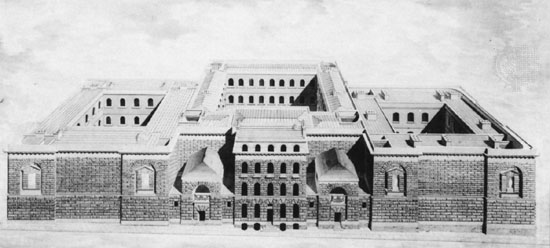
JAIV: As you mention above, these times had heavy realities that Austen kept in the background for the more astute reader to find – but they are there – your heroine is jailed for forgery and will likely hang or will be transported – so this part of your story tells this darker side, the underbelly of Regency life, especially for women. What was prison like and what resources did you use to make this seem so real?
Newgate Prison - eb.com
SB:I’ve read, and also bought and sold, so many accounts of English malefactors and their punishments in Regency and earlier times that I can’t really cite many of the sources that contributed to my sense of what a prison must have been like at that time. Did I get it right? Perhaps partly so, but I suspect the reality of most female penitentiaries was worse than I describe.
Two essential sources for the Regency period are those to which Elizabeth Fry (who makes an appearance in The Perfect Visit) contributed: Notes on a Visit to some of the Prisons in Scotland and the North of England with Elizabeth Fry (this was published by Elizabeth Fry’s brother Joseph John Gurney) and Observations, on the Visiting, Superintendence and Government of Female Prisoners.
Elizabeth Fry, by Charles Robert Leslie - wp
Talking about Time-Travel:
“Thus the whirligig of time brings in his revenges.” [Twelfth Night, Act V, Sc. 1] – [p. 113]
JAIV: This is a time-travel book: and filled with “Rules of Time –Travel” – are these of your own creation for this story or from other sources? A few of the “rules” for example:
-you cannot kill anyone
-cannot play modern music [in this case Vanessa playing Rachmaninoff if anyone is present]
-only organic clothing and material will pass through the time portal, so books, coins of the times, etc. will go, but no illuminated manuscripts
– the loss of the language of our 21st century life
-can only go the past, no travel into the future
SB:As a child I watched, and was haunted by an episode of The Twilight Zone in which (as I recall from my single viewing close to fifty years ago) a criminal transports to the past, remains a criminal, and murders his own grandfather.
Was it in the Wild West? I’m not sure. But what I remember is the image at episode’s end where the onscreen modern criminal dissolves saying something like “If I’ve just killed my grandfather, then how” [more dissolve] “can I” [almost gone] “exist?” That was the origin of the first rule. The others I developed as I sought consistency.
JAIV: Yikes! I remember that Twilight Zone episode! [also quite a faded memory!]. My other favorite was the 2-part Star Trek tale when Captain Kirk goes back in time and falls in love with Joan Collins – her character dies in “real life” and he must watch this and not step in to help so as not to completely alter the socio-political history of the future – I think I’ve seen that show 10 times! And it breaks my heart every time…
So, I must assume you are a fan of time-travel literature? Your favorite?
SB:As a kid I loved Robert A. Heinlein’s Door into Summer. And Ray Bradbury wrote perhaps the greatest of all time-travel short stories, “A Sound of Thunder,” from which “the butterfly effect” has become a scientific term of art. Alison Uttley’s Traveller in Time is a children’s book that transcends the genre (but then so do many of the best children’s books). More recently I sobbed my way through The Time Traveler’s Wife (too bad about the movie though).
JAIV: I haven’t watched the movie because I heard it was so dreadful – and yes, the book was sob-city-central!
Shakespeare’s time reads like a gazetteer of London as Ned tours around looking for booksellers and all things Shakespeare, with detailed street names and historical sites and bookseller stalls – You must be familiar with London, so I must ask what is your favorite book on London? And London during the Elizabethan period? The Regency period? And your favorite London haunt? [other than perhaps the British Library?!]
SB:Oh dear, I didn’t want to sound like a gazetteer. I lived more than ten years in London, and three in Bath, so much of what I wrote was from recollection. Then I went back, retracing my characters’ steps with period maps and other clues to get the street names right, and to remove bridges and buildings that weren’t there at the times I was writing about. I consulted all kinds of odd books, especially Regency ones, that I’d put aside during the course of my bookselling. Pierce Egan’s Walks through Bath (1819) is a good example, and a useful one too. For a modern book on London in Shakespeare’s time, the Oxford compendium Shakespeare’s England, first published in 1916, is still (I think) as good as it gets.
JAIV: On no! I meant that your book reading in parts like a gazetteer was a GOOD thing! I love the old London maps and had great fun following Ned around!
The topic of carriages interests me very much, and the question of calculating distances and times is a difficult one: you say a coach traveling to London from Winchester in 1817 [50 miles] took 7 hours. What sources did you use for those calculations?
SB:Contemporary travel guides are not easy to come by, and sometimes even give conflicting information, but quite a few of the Regency and later guides to London have appendices of travel times. I did the best I could with several of these.
JAIV: I love the little bit about Fanny Dickens, Charles’s oldest sister, though you do say you muddled the dates a bit – why Fanny and not other characters from the London or Bath of the time?
SB:My brain accumulates trivia, and from somewhere or other I knew Fanny Dickens was a talented pianist. That scene in Perfect Visit (I love it too – thank you) unexpectedly wrote itself one afternoon in the London Library where I was supposed to be doing other things. I couldn’t let go of that scene, even when I found out I’d muddled the dates. But with Fanny, Jane Austen, Elizabeth Fry, John Payne Collier, et al., already in the Regency parts of the novel, I felt that cluttering it up with even more celebrities would be too much of a good thing.
JAIV: Your Part III and IV are set in September 1833 [I will not ruin the plot and tell anyone the how and why!] – so without giving too much away, why this date?
SB:Touché! September 1833 imposed itself on an early draft of the novel when I was trying to figure out a way to get Ned to the early 19th century. My justification seemed compelling at the time, and then, quite suddenly, didn’t much matter at all. But I’d gone to a lot of trouble getting the topography and costume of 1833 London as close to right as I could, so I kept Ned there. I could invoke other reasons too, but I agree they would spoil the plot.
*****************************
Thank you Stuart! – we will continue our conversation this weekend – Gentle Readers, please ask any question you might have for Stuart or leave a comment on either this post or the Part II post, and you will be entered into the random drawing for a copy of The Perfect Visit. Please do so by 11:59 pm, April 15, 2012.
Stuart Bennett was an auctioneer at Christie’s in London before starting his own rare book business. He is the author of the Christie’s Collectors Guide How to Buy Photographs (1987), Trade Binding in the British Isles (2004) which the London Times Literary Supplement called “a bold and welcome step forward” in the history of bookbinding, and many publications on early photography, auctions and auctioneers, and rare books. He currently lives and works near Boston, Massachusetts.
The Perfect Visit, by Stuart Bennett
Longbourn Press, 2011
ISBN: 9780615542706
I was saddened today to read about the death of Vera Quin. A message was sent to various JASNA contacts from Louise West, curator of the Jane Austen House Museum in Chawton.
Claire Bellanti, Margaret Chittick & Vera Quin at JASNA’s 2011 AGM in Fort Worth,Texas
[photograph from Kerri S. with thanks]
I had the pleasure these past few years of hearing Ms. Quin and her friend Margaret Chittick speak on all things Jane Austen at the JASNA AGMs:
in 2008 in Chicago, we saw “Looking at Landscape with Austen in Her Time and Ours”
in 2009 inPhiladelphia, we discovered how “Marginal Siblings Stir the Plot”
In 2011 in Fort Worth, we heard that indeed “Sense and Sensibility is Full of Surprises”!
…all three offering a great interchange between Vera and Margaret as they shared their knowledge and love of Jane Austen with an abundance of information, insight and laughter!
And two of my favorite books in my Jane Austen collection are by Vera Quin:
Most of the thirty surviving letters that Jane Austen wrote during her visits to London between 1796 and 1815 were written to her sister Cassandra. They provide a detailed account of the people she met and the many events she attended.
Vera Quin gives particulars of the houses where she stayed and Jane’s relationship with her London relatives, especially her brother Henry, who started in business as a banker and then became a parish priest. Despite their length and wealth of information, the letters reveal very little of Jane’s feelings, although there is more than a hint of a flirtation with the young Tom Lefroy. [from the publisher’s website]
and…
In Paris with Jane Austen. Cappella Archive, 2005. 250pp.
HB:1-902918-22-3: £17.00; PB: 1-902918-32-0: £12.00
One fascinating byway of English Literature is how quickly pirated versions of Jane Austen’s novels were translated into French and made available in Paris so soon after their publication in England. Despite the Napoleonic Wars a variety of English books and scientific papers was smuggled to France for translation, sometimes on cartel ships exchanging French and English prisoners of war.
Vera Quin has writen an engaging guide book to those streets in Geneva and Paris where Jane’s Austen’s novels were translated; where the printers and booksellers lived, and the libraries from which copies were borrowed.
She considers the differences between the English and French versions whereby, much like modern television adaptations, subtlety of language was lost but romantic appeal was amplified. She includes much background material, providing a very clear account of the French Revolution and details of the work of contemporary female novelists who were Jane Austen’s continental literary competitors. [from the publisher’s website]
[You can find copies at Cappella Archive; the London book is also available at Jane Austen Books [call to see if they might have the Paris book as well…] ]
Vera did much for her Jane Austen Society in the UK and we have been fortunate to have her attend and participate in our own JASNA gatherings where she brought much grace and humor. I am most grateful to have seen her and to have these two book gems to remember her by – she shall be greatly missed…
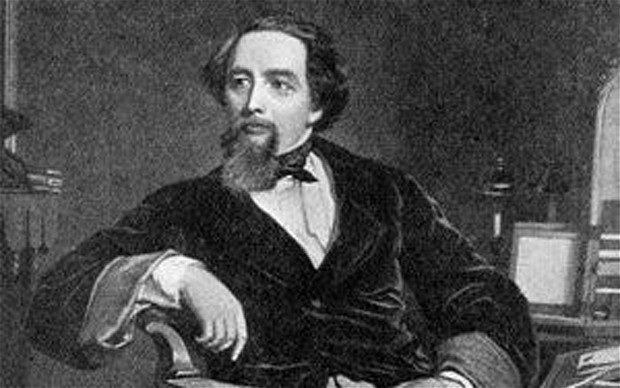
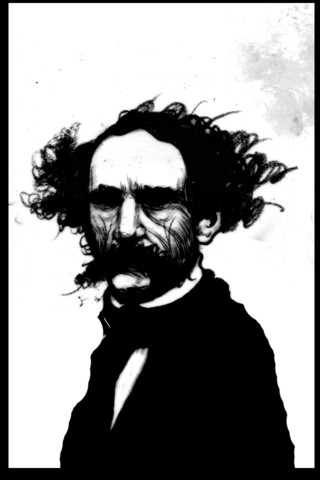
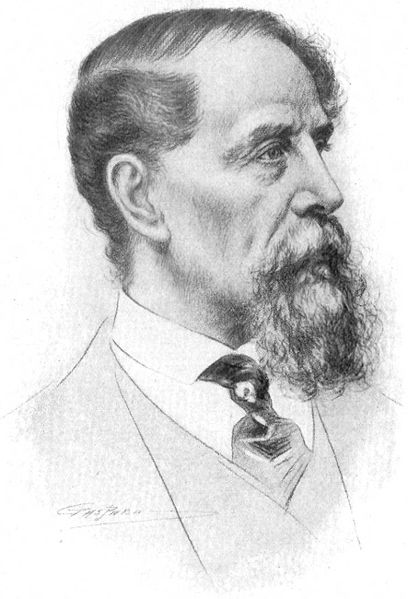
*The Yale Center for British Art begins its 2012 film tribute to Dickens with the first film in the series “Dickens’London”, a 1924 12-minute silent film:
*The DeGoyler Library at Southern Methodist University is hosting a Dickens exhibit:
Charles Dickens: The First Two Hundred Years. An Exhibition from the Stephen Weeks Collection. January 19-May 12, 2012 – a catalogue is available for purchase: http://smu.edu/cul/degolyer/exhibits.htm
* A bookseller’s list of some of his works that they have for sale [Tavistock Books]: http://tinyurl.com/7c2t2y3
* This one is very exciting as it combines my love of Dickens and my love of London and makes full use of my iphone capabilities: Dickens Dark London from The Museum of London:
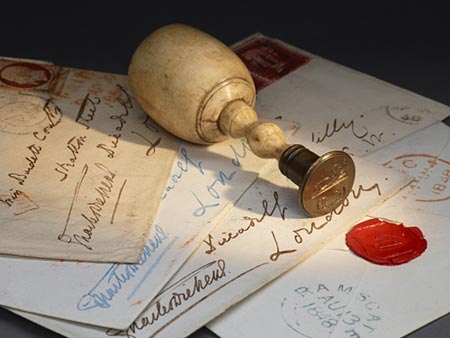
*There is also the Dickens Exhibition at The Morgan Library. Here is the online component you can visit without leaving home: you can view 20 pages of A Christmas Carol and read a letter penned by Dickens…
February 26, 2012 at 9pm (Check local listings) The Old Curiosity Shop One 90-minute episode
A teenage girl and her grandfather lose everything to a maniacal moneylender and flee his relentless pursuit. Derek Jacobi (I, Claudius) stars as Grandfather, with Sophie Vavasseur (Northanger Abbey) as Nell and Toby Jones (Tinker Tailor Soldier Spy) as Quilp.
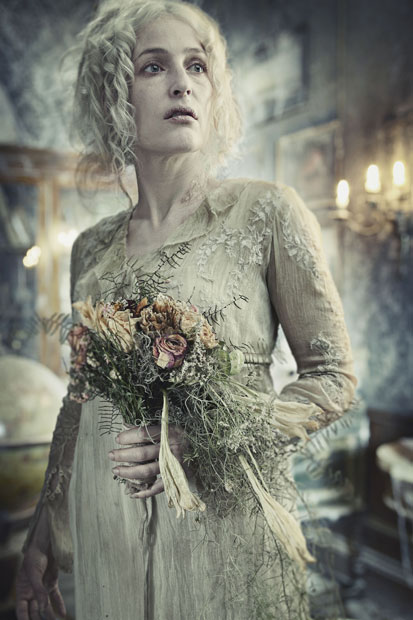
Gillian Anderson - Great Expectations
April 1 & 8, 2012 Great Expectations
Gillian Anderson, David Suchet and Ray Winstone star in this new adaptation of Great Expectations, widely considered one of the greatest novels by Charles Dickens. Great Expectationsfollows orphan boy Pip as he rises from an apprentice to a gentleman.
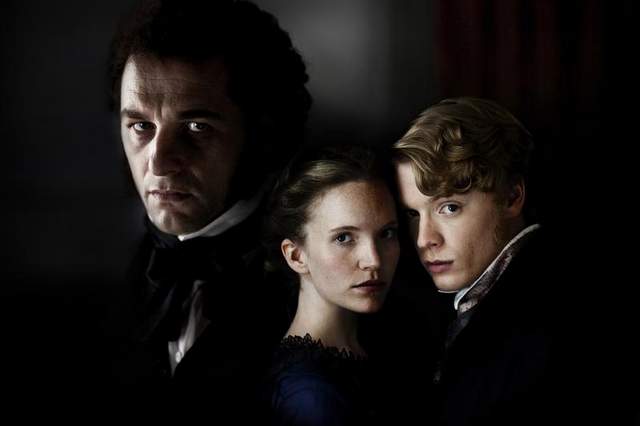
Masterpiece - Edwin Drood
April 15, 2012 The Mystery of Edwin Drood The Mystery Of Edwin Drood is a psychological thriller about a provincial choirmaster’s obsession with 17-year-old Rosa Bud and the lengths he will go to attain her. The cast includes Matthew Rhys (Brothers & Sisters) and Julia MacKenzie (Miss Marple).
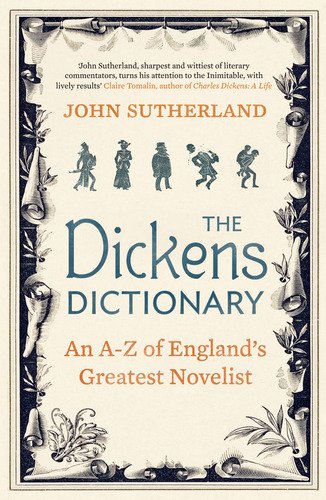
I am currently reading Bleak House, one of those books on my TBR pile literally for the past 40 years! I have signed up for a four-session class on “Dickens and the Law” and figure I should be at least somewhat up to speed on Jarndyce and Jarndyce! – What better gift to an author than this – reading and re-reading their works 200 years after they were born! Anyone else reading Dickens this year of his bicentennial? Please share!
This article and book is generating so much online chat that I had to link to it:
“The First Sexual Revolution: Lust and Liberty in the 18th Century.” Adulterers and prostitutes could be executed and women were agreed to be more libidinous than men – then in the 18th century attitudes to sex underwent an extraordinary change… by Faramerz Dabhoiwala in The Guardian:
-and perhaps this whole book on the subject: The Covent Garden Ladies: Pimp General Jack and The Extraordinary Story of Harris’s List by Hallie Rubenhold – Tempus Publishing, 2005:
Visit The Library as Incubator Project for an interview with Kristin Hammargren on her upcoming one woman show, Discovering Austen (running Thursday, January 26 – Saturday, January 28, 7:30 p.m. at the Hemsley Theatre,821 University Avenue in Madison,WI).
[this lovely image from the article : by Miles Cole]
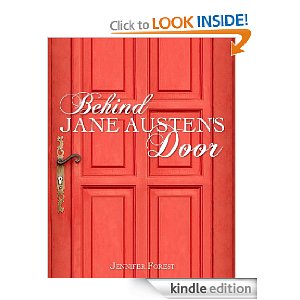
*Behind Jane Austen’s Door by Jennifer Forest – an ebook, sort of a cross between Bill Bryson’s At Home and Amanda Vickery’s works on Georgian homelife, but lots shorter: – have just started it, will report when done…
After retiring from a lifetime of teaching literature, Patricia Meyer Spacks embarked on a year-long project of rereading dozens of novels: childhood favorites, fiction first encountered in young adulthood and never before revisited, books frequently reread, canonical works of literature she was supposed to have liked but didn’t, guilty pleasures (books she oughtn’t to have liked but did), and stories reread for fun vs. those read for the classroom. On Rereading records the sometimes surprising, always fascinating, results of her personal experiment.
Spacks addresses a number of intriguing questions raised by the purposeful act of rereading: Why do we reread novels when, in many instances, we can remember the plot? Why, for example, do some lovers of Jane Austen’s fiction reread her novels every year (or oftener)? Why do young children love to hear the same story read aloud every night at bedtime? And why, as adults, do we return to childhood favorites such as The Hobbit, Alice in Wonderland, and the Harry Potter novels? What pleasures does rereading bring? What psychological needs does it answer? What guilt does it induce when life is short and there are so many other things to do (and so many other books to read)? Rereading, Spacks discovers, helps us to make sense of ourselves. It brings us sharply in contact with how we, like the books we reread, have both changed and remained the same.
*The final book in Michael Thomas Ford’s trilogy of Jane as Vampire will be released on February 28, 2012:
Here is a review from Library Journal:
Ford, Michael Thomas. Jane Vows Vengeance. Ballantine. Feb. 2012.
c.288p. ISBN 9780345513670. pap. $15.
Author-turned-vampire Jane Austen wants to marry Walter, but fending off her soon-to-be mother-in-law and fear of revealing her Big Secret are sucking the fun out. Walter’s invitation to join colleagues on an architectural tour of Europe leads him to suggest a wedding-slash-honeymoon. The wedding party—including their friends Lucy and Ben and Walter’s mom, Miriam, and her dog—arrive in London anticipating the happy event, but it’s not to be. A guest from Jane’s far past arrives to object, and the remainder of the trip continues this inauspicious start, including the search for Crispin’s Needle, said to return a vampire’s soul. If the needle can be found, would it deliver a soul or kill the vampire trying?
Verdict: Ford’s final book in the trilogy (Jane Bites Back; Jane Goes Batty) is nicely connected with characters and ideas to the previous books, but it can also be read as a stand-alone. More architectural detail than literary asides, a fabulous back story for Miriam, and a sometimes overwhelming number of additional elements will surprise readers. Still, the key elements of a charmingly reluctant vampire, supportive friends, and flashes of brilliance offset by poor undead life-skills remain in full force. [Library marketing.]—Stacey Hayman, Rocky River P.L., OH
*Coming in June 2012: London: A History in Verse, edited by Mark Ford (Belknap, 2012)
Called “the flour of Cities all,” London has long been understood through the poetry it has inspired. Now poet Mark Ford has assembled the most capacious and wide-ranging anthology of poems about London to date, from Chaucer to Wordsworth to the present day, providing a chronological tour of urban life and of English literature.
Nearly all of the major poets of British literature have left some poetic record of London: Chaucer, Spenser, Shakespeare, Donne, Milton, Dryden, Pope, Johnson, Wordsworth, Keats, Byron, and T.S. Eliot. Ford goes well beyond these figures, however, to gather significant verse of all kinds, from Jacobean city comedies to nursery rhymes, from topical satire to anonymous ballads. The result is a cultural history of the city in verse, one that represents all classes of London’s population over some seven centuries, mingling the high and low, the elegant and the salacious, the courtly and the street smart. Many of the poems respond to large events in the city’s history—the beheading of Charles I, the Great Fire, the Blitz—but the majority reflect the quieter routines and anxieties of everyday life through the centuries.
Ford’s selections are arranged chronologically, thus preserving a sense of the strata of the capital’s history. An introductory essay by the poet explores in detail the cultural, political, and aesthetic significance of the verse inspired by this great city. The result is a volume as rich and vibrant and diverse as London itself.
*Shannon Hale has a new book coming out on January 31, 2012 – Midnight in Austenland – another story with a different heroine set in the fictional Austenland as in her first Austen book… I liked that book, thought it was great fun, so will give this a try as well… $9.99 on my kindle
*World Book Night is taking shape for April 23, 2012. You can see the 25 titles that will be distributed to people in participating countries: Jane Austen’s Pride and Prejudice is among them! – for the other titles [and a fabulous book list], go here: http://www.worldbooknight.org/about-world-book-night/wbn-2012/the-books
NEH Seminar for college and university teachers: “Jane Austen and Her Contemporaries” June 18-July 20, 2012 http://nehseminar.missouri.edu/
“We will read four Austen novels (Pride & Prejudice, Sense & Sensibility, Emma, and Northanger Abbey) and several novels by her contemporaries, including Anna Maria Porter, Jane West, and Mary Brunton. We will have several speakers join us in person or via Skype, including Jay Jenkins of Valancourt Books, who will talk to us about selecting, editing, and getting published a scholarly edition of an eighteenth- or nineteenth-century novel. We will also be taking a group day-trip to the Spencer Library at the Universityof Kansas.”
Museum Musings – Exhibition Trekking:
*The Cambridge University Library has just opened an exhibition Shelf Lives: Four Centuries of Collectors and their Books January 18 – June 16, 2012
the bookshelf of Sir Geoffrey Keynes, noted bibliographer of Jane Austen (1929) – if you look closely at this bookshelf, you may notice a familiar spine or two of Austen’s works!
A New & Correct Plan of London [London, 1760], folding silk fan engraved by Richard Bennett.. Travel, Atlases, Maps & Natural History [L11405] Estimate: 4,000 – 6,000 GBP – Sold for: 11,875 GBP
Women’s dress retains a great similarity from age to age, together with a great instability in details, and therefore does not afford so much subject for remark as does men’s dress.
[excuse me? – a great similarity? an instability in detail? ]
*The Yale Center for British Art begins its 2012 film tribute to Dickens with the first film in the series “Dickens’London”, a 1924 12-minute silent film:
*The DeGoyler Library at Southern Methodist University is hosting a Dickens exhibit:
Charles Dickens: The First Two Hundred Years. An Exhibition from the Stephen Weeks Collection. January 19-May 12, 2012 – a catalogue is available for purchase: http://smu.edu/cul/degolyer/exhibits.htm
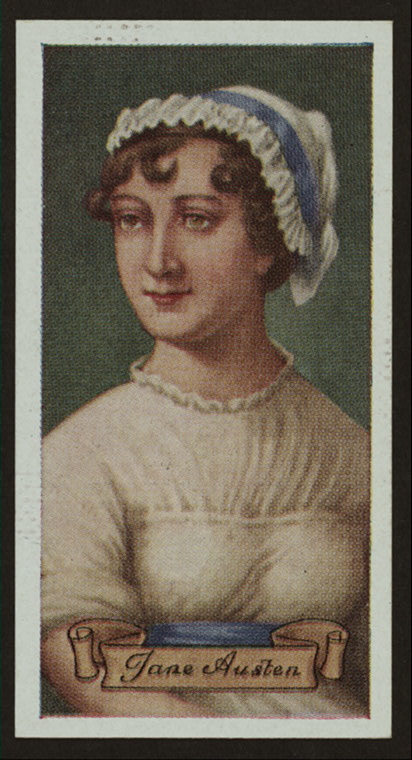
*Another image of Jane! A cigarette card from the NYPL Digital Gallery, from a collection of 50 cards of “Celebrities of British History” – here is the Jane Austen card and the verso with a short biography of Austen. You can see her illustrious company on the 49 other cards at the link below:
Specific Material Type: Photomechanical prints
Source: [Cigarette cards.] / Celebrities of British history : a series of 50
Location: Stephen A. Schwarzman Building/ George Arents Collection
Sometimes, entries from 18th century newspapers read more like the introduction to a Jane Austen novel than a Jane Austen Novel. Take this entry from the Gloucester Journal of 17 April 1797:
“Glocester, April 17 – Tuesday last was married at North Nibley, in this county, Mr John Parradice, of Wick, to Miss Sarah Knight, ofNorth Nibley, an agreeable young lady, with a large fortune.”
A groom named Paradise (almost), and a pleasant, rich lady; this story has the potential to make a rather good novel.





























 Jane Austen in Vermont