You are Cordially Invited to JASNA-Vermont’s March Meeting
~Jane Austen’s London in Fact & Fiction ~
with Suzanne Boden* & Deborah Barnum**
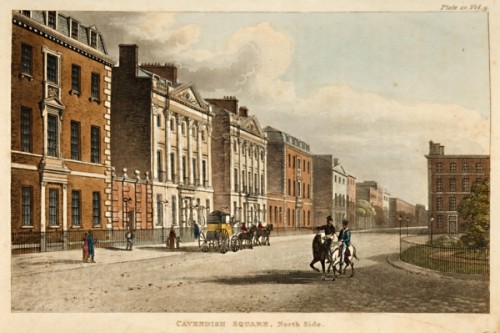
Jane Austen and London! ~ Why did she go & How did she get there? ~ Where did she stay & What did she do? ~ Was it a ‘Scene of Dissipation & Vice’ or a place of lively ‘Amusement’ filled with Shopping, the Theatre, Art Galleries & Menageries? ~ And her fiction? ~ How does Mr. Darcy know where to find Lydia and Wickham? And Why does nearly everyone in Sense & Sensibility go to Town? To find out all this & more absolutely essential Austen biographical & geographical trivia, please…
Join Us for a Visual Tour of Regency London!
*****
Sunday, 27 March 2011, 2 – 4 p.m.
Champlain College, Hauke Conference Center, 375 Maple St Burlington VT
Free & Open to the Public
Light refreshments served
Suzanne & Deb will share their mutual love of London! ~ *Suzanne Boden is the well-traveled proprietress of The Governor’s House in Hyde Park, where she regularly holds Jane Austen Weekends: http://www.onehundredmain.com/ ; **Deb Barnum is the owner of Bygone Books, a shop of fine used & collectible books, the Regional Coordinator for the Vermont Region of JASNA, author of the JASNA-Vermont blog, and compiler of the annual Jane Austen Bibliography.
Upcoming: June 5: A Lecture & Organ Recital on ‘The Musical World of Jane Austen’ with Professor William Tortolano. At Vermont College of Fine Arts, Montpelier. See blog for details.
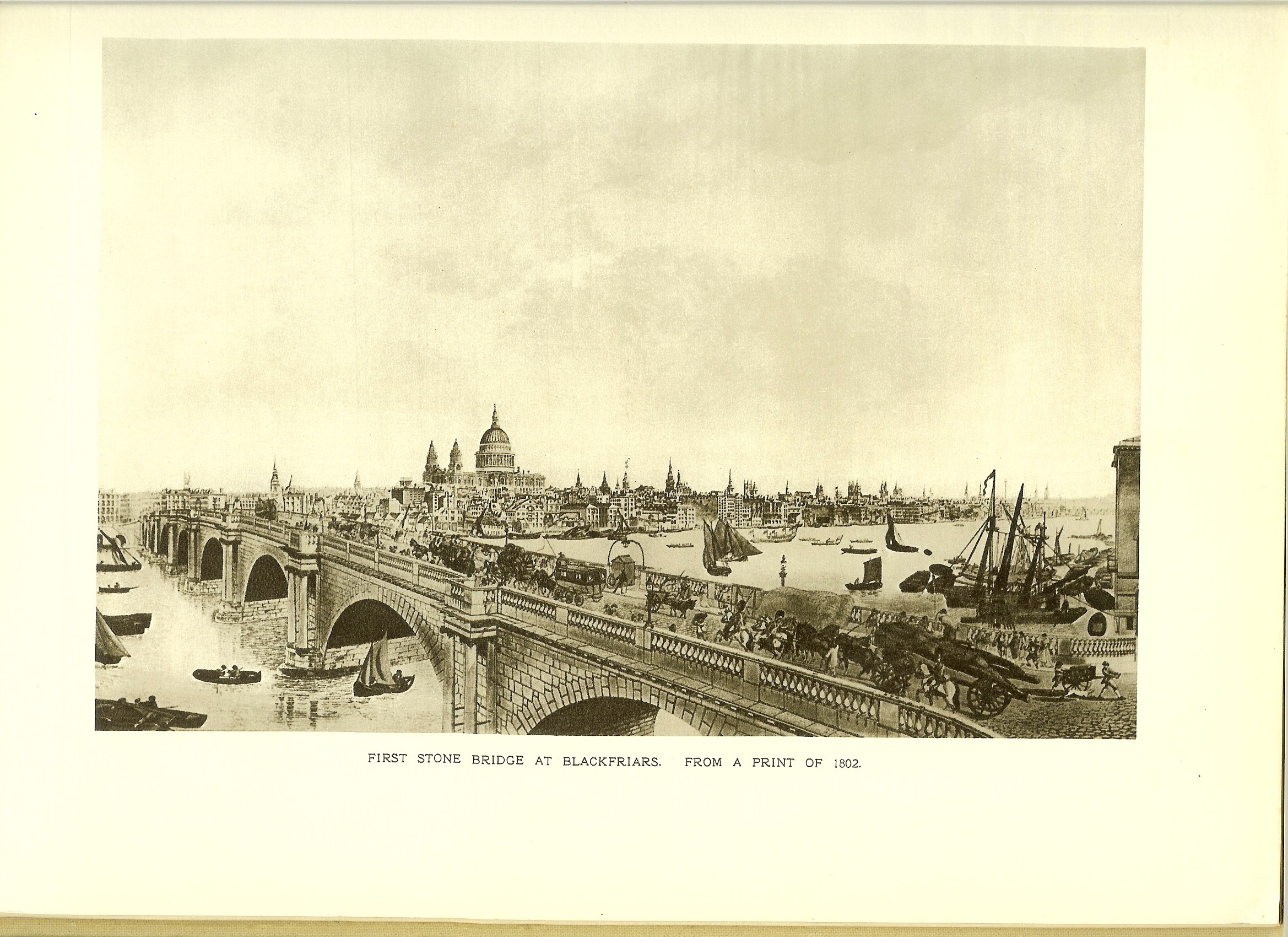
[Image: Blackfriars Bridge, 1802. The City of London. London: The Times, circa 1928, facing p. 192]
Copyright @2011, by Deb Barnum, at Jane Austen in Vermont
In Fashion comprises over 75 costumes from the Museum’s permanent collection plus a select number of borrowed works from today’s top designers and design houses including Karl Lagerfeld, Oscar de la Renta, Carolina Herrera, Giambattista Valli, Giovanni Bedin, Balenciaga, Christian Siriano and others. The exhibit is presented in several sections: Haute Couture, Complete the Look, Fashionable 50’s, and Head to Toe.
In addition to including established names in the industry, the exhibit includes work by fashion design students from the Fashion Institute of Technology in New York City. FIT students competed for the chance to have their designs included in the exhibit. They were asked to create pieces that complement a select number of bodices from the Museum’s historic collection.
Haute Couture: Pieces from the 19th-century by Parisian designers House of Worth and Emile Pingat exhibited alongside pieces from several of the most established and well-known contemporary designers.
Complete the Look: Eight late-19th and early- 20th century bodices from incomplete high-style garments drawn from the collection. Displayed with these pieces are pieces designed by students from the prestigious Fashion Institute of Technology in New York City. FIT students competed to be a part of the exhibit. [See the Complete the Look website for the 8 wining submissions – this is great fun to see what the students have done with the various bodices!]
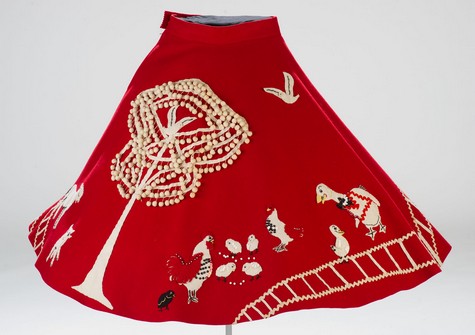
Fashionable ‘50s: Clothing from the 1950’s represents one of the great strengths of the Museum’s collection. Poodle skirts and bespoke dresses by Hattie Carnegie for Museum founder Electra Havemeyer Webb are interpreted from a design, materials, and historical point of view.
Head to Toe: Accessories Hats to Heels includes handbags, hats, shoes and fans reflecting the glamor of the Gilded Age. Clothes to the Vest showcases men’s vests dating from the late 18th and early 19th century. Coat Couture features a selection of high end outerwear.
[Text and images from the Shelburne Museum website]
You can view the online gallery here – click on “View Gallery” link to scroll through 22 images.
I’ll be reporting more on this exhibit once it opens. The Shelburne Museum is one of Vermont’s many treasures, famous for its quilts, decorative arts, carriages, and art masterpieces. It is not-to-be-missed if you are visiting us. And if you are afraid that spring will never come after the record snowfalls we have suffered through this winter, do not fear – here is the surest sign of hope!:
I am posting this at the request of Jane Odiwe, author of Lydia Bennet’s Story, Willoughby’s Return, and most recently Mr. Darcy’s Secret. She has been involved in the interesting detective work of trying to locate the whereabouts of a painting that appears in a Christie’s catalogue from 1983, a “Conversation Piece” pen and watercolor drawing that might be a portrait of Jane Austen’s family. There are similarities to the silhouette illustration we are familiar with:
I append Jane Odiwe’s post in its entirety – you can also go to her blog for further information and read her posts on the artist Ozias Humphrey and his possible connection to the Austen family. [I suggest you print out the family portrait below and then follow along with Jane’s detailed commentary.]
**************************
The ‘Conversation Piece’: Is this a painting of the Austen Family in 1781? [by Jane Odiwe]
Whilst conducting research into the ‘Rice’ portrait, Mr. Robin Roberts discovered a very interesting picture, which seems to have gone unnoticed in a Christie’s catalogue. The sale of the property of Mrs. Robert Tritton took place at Godmersham Park, Kent, between Monday, June 6th and Thursday, June 9th, 1983. Elsie Tritton and her husband had bought the estate in 1936, and the catalogue notes how she and her husband had lovingly rescued the house, and how Elsie, a New Yorker by birth, wished that after her death, their wonderful collection of furniture and clocks, English Conversation Pieces, objets d’art and textiles should be available for others to buy for their own collections. This is a fascinating catalogue to see, and I think the fact that the painting came out of the sale of Godmersham Park is most exciting!
The painting is described in the catalogue as belonging to the English School, circa 1780, pen, and black ink and watercolour, measuring 15½ by 19½ inches. It depicts a family sitting round a table, the adults at opposite ends, with four children beyond.
I think what’s so interesting about the picture is that the more you study it; the more the details become fascinating. It appears to be a wonderful allegorical puzzle, full of the humour and charade that the Austen family loved, reflecting so much of what we know about their family history, finances, with all the literary symbolism they would have enjoyed so much. There are some significant allusions connected with the Austen family, and I am thrilled to share Mr. Roberts’ discoveries with you.
He wonders if it could possibly be by Ozias Humphry painted to commemorate the adoption of Edward Austen by the Knight family who were childless relatives, and there are striking similarities between this painting and the commemorative silhouette drawn up at a similar date. There are what could be the monogram symbols of Ozias Humphry scattered in several places about the painting, on the figures, in a curlicue above the mantelpiece, and a possible signature in the right hand corner, though it is difficult to be certain without seeing the original, and unfortunately, it is impossible to show all the small details on a blog.
If we assume that this is a painting of the Austen family, the central figure shows a young boy who is most likely to be Edward Austen. The family all have their attention turned towards him, and more importantly, their eyes are concentrated on the bunch of grapes, which he holds high up in the air, almost as if being presenting to the viewer. You can almost hear him say, “Look at me, am I not the most fortunate boy in the world? Look what I have!”
Surely the grapes represent the good fortune and wealth that Edward is about to inherit, and the whole family who look as pleased as punch are celebrating with him.
George Herbert makes the connections between grapes, fruit, and inheritance in his poem, The Temple. [see Jane’s blog for the complete poem]
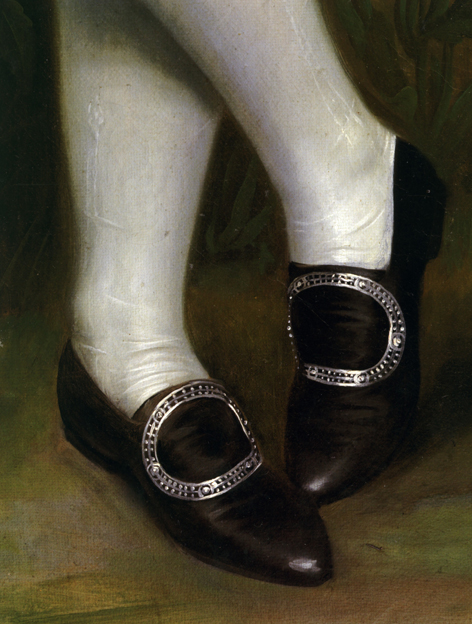
As we observe the painting, the small girl with round cheeks to the left of Edward must be Jane Austen herself! This is also one of the most significant parts to the puzzle, I think. She appears to be clutching what could be a horseshoe nail in her hand, which she points towards Edward, her arm held high in the same way as he holds his grapes aloft. This is where it gets most exciting, and where another connection to Edward Austen is made. On the painting of Edward Austen at Chawton House, there is most distinctly, a horseshoe nail on the ground pointing towards Edward’s feet. This little nail is a symbol, an allusion to the fact that the Knights adopted him. Most interestingly, Jane makes a reference to the horseshoe nail in a letter dated Tuesday, 9th February, 1813. She is talking about Miss Clewes, a new governess that Edward has engaged to look after his children.
shoe detail
Miss Clewes seems the very Governess they have been looking for these ten years; – longer coming than J. Bond’s last Shock of Corn. – If she will but only keep Good and Amiable and Perfect! Clewes & (sic) is better than Clowes. And is it not a name for Edward to pun on? – is not a Clew a nail?
Jane was punning on the word clew (or clue) and the Old French word, clou (de girofle), which in its turn was derived from the Latin, clavus, meaning nail (of the clove tree). The dried flower bud of the clove tree resembles a small nail or tack. Of course, it was a name for Edward to pun on because of his own associations with a small horseshoe nail. This seems to be one of the most significant pieces of the puzzle in the painting!
Now we turn to the gentleman on the left of the painting who is dressed exactly as Mr. Austen in the silhouette attributed to Wellings of Edward’s presentation to the Knight family. He is seated, hands clasped together as though offering up a grateful prayer for their good fortune. Within his grasp it appears he is holding a prayer book, or missal, the silk ribbon of which is draped over his fingers, an indication perhaps of his status as rector, and a man of the cloth. Interestingly, he is the only figure whose eyes are not concentrated on the bunch of grapes, but perhaps this is to indicate he is more concerned with offering grateful thanks in his role of clergyman.
In between Mr. Austen and Jane is Cassandra who rests her hand protectively on her sister’s shoulder, whilst also providing an excellent compositional device leading the eye along through to Jane’s arm to the tip of the Golden Triangle where the bunch of grapes are suspended. The painting follows the traditional composition based on a triangle for optimum placing of the main interest of the work. I also think it interesting to note that the girls’ dresses are of the simple muslin type usually worn by children at this time. Mostly white, they were worn with a ribbon sash, at waist height or higher as in Jane’s case.
On the other side of Edward, it is thought this child most likely to be Francis. James would have been at school at this time, and Henry could also have been away. Charles was too young to be depicted, and would still have been lodged with the family who looked after the infant Austens, as was the custom.
To the far right, as we look at the painting is the formidable figure of Mrs. Austen dressed for the occasion with a string of pearls and a ribbon choker around her neck, complete with more than one ‘feather in her cap’, which must represent her pride and pleasure at the whole event, and by extension, the symbols of nobility and glory. She is further emphasizing Edward’s importance by pointing in his direction, and I think it would be hard to imagine a more pleased mama, in her elegant air, and her smile.
On the table is a further connection with Mrs. Austen. The pineapple, a prized fruit, representing health and prosperity, was first introduced to England in 1772, and the Duke of Chandos, Mrs. Austen’s great uncle, was the first to grow them. The symbolism of the pineapple represents many things, not least the rank of the hostess, but was also associated with hospitality, good cheer, and family affection.
Other dishes of food illustrate further abundance, wealth, and the spiritual associations of Christian values. There is bread and wine on the table; Christian symbols, which represent not only life, and the Communion, but also show there is cause for thankfulness and celebration. The glasses are not yet filled, but there are glasses placed before the adults for a toast. Nearest to us in the foreground, there is another fruitful dish, perhaps plum pudding, representing not only the wealth to come, but also a plentiful future. Placed before Edward, another dish, which also appears to suggest the image of a spaniel dog, may be an allusion to Edward’s love of hunting.
The background to the painting holds its own clues. It’s been suggested that the painting above the mantelpiece could be Zeus abducting Ganymede to the Gods, another reference to the luck of young Edward who has been adopted by the Knight family, and on the opposite wall, could this be a reference to the miniature portrait of George Austen, the handsome proctor, even if this appears to be a larger portrait? In the carpet, the patterns suggest the date may again be replicated, and also an M to symbolize the fact that the couple in the painting are married. Above the looking glass is a crest with what appears to be the date. It would be lovely to have a look at the original to see everything in more detail!
Unfortunately, there appears to be no record of the sale of the painting, and I know that Mr. Roberts, and his sister, Mrs. Henry Rice, would be interested to learn more about the painting. I’d like to make an appeal on their behalf for any information, and if anyone knows of the painting’s whereabouts or can tell us anything about it, please do get in touch with me or with Jane Austen’s House Museum.
I hope you’ve enjoyed this blog as much as I’ve enjoyed hearing all about this little painting. Don’t you think the Austen family would have enjoyed this allegorical puzzle? I’d love to hear your thoughts!
*******************************
All very interesting! – and as with any detective work, one has more questions than can be currently answered. If the original drawing could be located it would certainly help! There is also more information soon to be released about the controversial Rice ‘Jane Austen’ Portrait. Stay tuned! And in the meantime if you have any knowledge of the whereabouts of the “conversation piece” that Jane Odiwe writes about, please contact her via her Jane Austen Sequels Blog.
Copyright @2100, by Deb Barnum, at Jane Austen in Vermont
Want to understand more about the life of a Regency-era woman? Nancy Mayer of Regency Researcher fame will be offering an online workshop on “The Regency Woman.” The class is offered through the Colorado Romance Writers and will run from April 4 – 29, 2011. Cost is $25. for non-members, $20. for members.
The Regency Woman: Online Workshop at Colorado RomanceWriters
April 4 – 29, 2011
DESCRIPTION: The Regency woman. She was a woman of stern morals and little laughter. A governess who didn’t feel oppressed and a governess who did. She owned her own business. She was an author, a poet, a scientist, a runaway. She lived a discreet and quiet life and she was notorious. She was the faithful wife and the mother of many children, or a divorced woman who had to give up her children to escape her husband.
No one pattern, not even a pattern card of propriety, fits all the women but despite their differences there were some things they had in common. The class will look at the world of the Regency woman from the domestic, political, social, and economic angles, using the lives of real women as examples. While I will try to include a great deal of new material, some of the information I have presented before has to be repeated.
BIO: Nancy Mayer has been trying to write Regency romances for more years than she wants to remember. She is always getting distracted and sidetracked by research.
*******************
[text and image from CWR]
Visit the website for more information and to sign-up. Scroll down to find Nancy’s class and read about the other interesting workshops as well! [The class is run as a Yahoo Group.]
Copyright @2011, by Deb Barnum, of Jane Austen in Vermont
Novelist Sarah Burney’s Copy of Jane Austen’s Pride and Prejudice
[Jane Austen].Pride and Prejudice: A Novel. In Three Volumes. By the Author of “Sense and Sensibility.” London: Printed for T. Egerton, 1813.
First edition. Three twelvemo volumes (7 3/8 x 4 1/2 inches). [4], 307, [1, blank]; [4], 239, [1, blank]; [4], 323, [1, blank] pp. Half-titles present but that for the first volume is in facsimile. Most sheets watermarked 1808.
Contemporary half green roan over marbled boards, smooth spines with gilt rules and lettering, edges sprinkled red. Some rubbing to joints and extremities. Scattered foxing. A very good copy with a fine association.
Sarah Harriet Burney’s copy, with her signature on the title of all three volumes. English novelist Sarah Harriet Burney (1772-1884), half-sister of Fanny Burney, published five novels during her lifetime. Among her more famous works are Tales of Fancy and Geraldine Fauconberg. Her work was admired by Jane Austen who, in one of her letters, remarks that she is reading one of Sarah Burney’s novels for the third time. In turn, Sarah Harriet Burney received Jane Austen’s novels from her publisher, and was one of the earliest readers to publicly recognize her genius. Sarah Burney’s life has strong echoes of Jane Austen’s fiction, but with scandalous overtones. In 1798, she eloped with her half-brother Captain James Burney, 22 years her senior, settling eventually in lodgings in Tottenham Court Road, “living in the most groveling mean style.” In 1803 James went back to live with his wife. Sarah then took a job as a governess, wrote novels as a means of earning money to support herself, and eventually left England for Florence, where she mixed with a circle or artists and authors including Henry Crabb Robinson. She received great sympathy from her three remaining half-sisters, Esther, Fanny, and Charlotte, on the death of James Burney in 1821. In 1822 she gained the post of governess to the grandchildren of Lord Crewe, with her own house and a salary of 300 pounds a year. She spent the last years of her life in ill health at a boarding house in Bath. In 1840, on the death of Fanny D’Arblay, Henry Crabb Robinson wrote that she bequeathed Sarah “1,200 per annum for her life.” She continued to socialize with Robinson and his friends until her death at Cheltenham on February 8, 1844. Some of her property was left to her half-nephew, Martin Charles Burney, James Burney’s son.
It seems there has been a publisher’s bidding war for yet another Austen-inspired novel to be released in 2012. Hodder acquired the rights to what reads like a Jane Austen marriage guide – indeed the title is The Jane Austen Marriage Manual, by Kim Izzo:
Hodder has acquired a chick lit novel about a heroine who uses the novels of Jane Austen to help her find a rich husband.
Women’s fiction editor Isobel Akenhead acquired British Commonwealth excluding Canada rights in a “heated” auction from Diana Beaumont at Rupert Heath Literary Agency to The Jane Austen Marriage Manual by Kim Izzo. Jennifer Lambert at HarperCollins acquired Canadian rights in a pre-empt, while Brenda Copeland of St Martin’s Press acquired US rights. Gráinne Fox at Fletcher & Company handled the US and Canada rights for Beaumont, the main agent.
The novel follows Kate, the beauty editor at a fashion magazine, who finds herself unemployed, single, homeless and about to turn 40. When she is asked to write a freelance article about whether it is possible to marry for money, she decides to use the novels of Jane Austen to find herself an eligible match.
Akenhead said “It is brilliantly written, laugh-out-loud funny and has the most unforgettable heroine, and I feel confident it will appeal to fans of chick-lit favourites such as Bridget Jones’s Diary and Alexandra Potter’s Me and Mr Darcy, not to mention all the ‘Janeites’ out there.”
Hodder will publish in 2012.
You can follow the author Kim Izzo on Twitter here.
Ok, a silly story – but Jane Austen is the reason, so must pass on.
Setting: Starbucks in Simsbury, Connecticut Time: late Sunday morning Reason: meeting a friend as I pass through town for a quick cup of tea with a pastry
Order: 2 medium cups of tea, 2 blueberry muffins
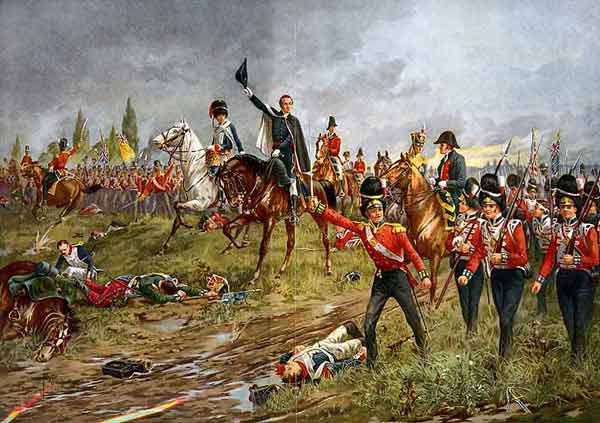
Posted Question of the Day:“In What Country was the Battle of Waterloo fought?”
Prize: 20 cents off each cup of tea
So, I know this answer, say that I do to the young man behind the counter, who eyes me with a quizzical “yea, like pigs fly” look;
“Yea, where then?” he says;
“Belgium” I say – he is dumbstruck – says “Not one person has gotten it right all day. ”
I proudly comment to my friend “I know this of course because of Jane Austen” –
She gives me the usual, “Oh here comes the Jane Austen stuff roll-of-the-eyes-look” – the young man looks at me as though I am from another planet – but I can tell he is impressed – “everyone says France” he says…
So I get my 20 cents off, then proceed to bore my friend with the whole tale, that if you read Jane Austen, you then must learn about the Napoleonic Wars even though she frustrates all her readers of a historical bent for not even giving a mention to the fact that England and France were largely at war during her entire lifetime [not to mention those pesky colonies] …
And one of course must confess that if you have come to discover Georgette Heyer just in order to stay connected to Austen’s Regency times, then you will have read An Infamous Army, which teaches more about the ‘Battle of Waterloo’ than most textbooks on the subject…
So you see how Jane Austen widens your world?! and can save you 20 cents in the bargain?
Copyright @ 2011, by Deb Barnum at Jane Austen in Vermont
Well, we are all quite aware that Jane Austen invented Baseball, but it is nice to know that she can also be of service in one’s understanding of the various international combatants in a World Cup game of Cricket.
[Image: Sparosport.com]
I append here the whole text of this post by Ben Roberts on the World Cricket Watch website – this fellow has his Pride & Prejudice down pat (except for that “Victorian Tale” piece – we will forgive him for this common mistake and send him an ebook of Jane Eyre so he understands the difference] – as for the international issues, I will have to take his word for it…
*********************
by Ben Roberts
For Anita, a Jane Austen lover and wife of a cricket tragic.
It is often said that sporting teams will take on individual characteristics that differentiate them from others. Describing these characteristics need not be limited merely to the mundanely clichéd terms of sport; they can come from the literary world.
Lying in bed thinking of how best to describe each of our World Cup challengers I realised how each of them fit seamlessly (in my own mind) into Jane Austen’s Victorian tale of Pride & Prejudice. See below, team’s are in alphabetical order.
Australia – Lydia Bennett: Gets what they desire in the end, however do not please others with the manner in which they do so, including their own ‘family’.
Bangladesh – Mr Bennett: Have some talent within them but are rarely taken seriously.
Canada & Kenya – The Bingley Sisters: Serve no purpose in the tournament except to ruin the future ambitions of Ireland.
England – Elizabeth Bennett: Like Lizzy, the English supporter lives a life of undue frustration and complication.
Ireland – Jane Bennett: With their coloured hair and pure joy in victory they are the simple souls of this competition.
India – Mr Wickham: Describe their motives as being pure however are believed by many to just be in it for the money.
Netherlands – Mr Collins: Existence is based purely on the patronage of one individual.
New Zealand – Mary Bennett: The poorer sibling of many, they have little talent but try hard.
Pakistan – Mrs Bennett: Can hold it together for short periods of time but likely to collapse into tantrum at any moment.
South Africa – Mr Darcy: The look and resource of a champion team however regularly cock it up at inappropriate moments.
Sri Lanka – Mr Bingley: Talent and riches and a zest for the game.
West Indies – Charlotte Lucas: Well past their glory years now, will settle for anything resembling success.
Zimbabwe – Lady Catherine de Burgh: More a reflection on the administrative leader of Zimbabwean cricket, a dictatorial and manipulative individual only concerned about their own end.
Like Austen’s tale we already seen the Netherlands bother England with more attention than one would feel comfortable about, and seemingly Ireland have a greater ability to woo victory than the English.
Do these undoubted parallels mean that England and South Africa or Ireland and Sri Lanka will be tied together at the end of the story…I mean tournament? Or will Australia and India elope in the final act of debauchery? This story is still to be written.
Ben also contributes regularly to the following two Blogs:
Lot No: 6 – A Portrait of Jane Austen BY AN UNKNOWN ARTIST, half-length, wash and pencil, highlighted with chalk, on vellum, inscribed on the verso in a small contemporary hand ‘Miss Jane Austin’ (sic) and with the location or inventory number ‘A76’, contemporary gilt frame with attached identification label ‘Jane Austen B. 1775 – D. 1817’, chalk numbers on verso of frame ‘166 8234’ and inscribed on the old backing board in an early nineteenth-century hand ‘Price £3-3s 0d Frame £0 5s 0d.’ and with chalk mark ‘A68’, size of image 5¾ x c. 4½ inches (14. 5 x c. 12 cm), overall size 11¾ x 10½ inches (30 x 27 cm), no date [but ?1818]
Estimate: £1,000 – 2,000, € 1,200 – 2,400
Footnote: THIS IS THE EARLIEST OF THE SO-CALLED ‘IMAGINARY’ PORTRAITS OF JANE AUSTEN, thus listed by Deirdre Le Faye in her article ‘Imaginary Portraits of Jane Austen’ in Jane Austen Society Report, 2007, pp. 42-52 (a copy of which is included with the lot).
Le Faye suggests that the portrait ‘could be as early as 1818’, one year after Austen’s death. Le Faye comments: ‘This might well be a creation by the Revd William Jones (1777-1821), curate and vicar of Broxbourne and Hoddesdon – or if not him, someone with very similar interests. On 17th April 1818 Mr Jones confided to his diary: “Whenever I am much ‘taken with’ an author, I generally draw his or her likeness in my own fancy…” The artist, whoever he/she may have been, seems to have read Henry’s “Biographical Notice [of the Author”, by Jane Austen’s brother Henry in the four-volumes of Northanger Abbey and Persuasion in 1817] and invented the portrait accordingly, depicting a thin, large-nosed, well-dressed middle-aged lady set against a background of a swagged curtain, classical columns, and cathedral tower. She is sitting at a small round table, quill and notebook in hand and with eyes upraised apparently seeking literary inspiration from the heavens. The elements of the portrait are symbolic – her closely-fitting long-sleeved dress suggests sober respectability; and her various rings and necklaces demonstrate likewise that she was well off, not a poor hack writer starving in a garret. The sleeping cat on the table beside her implies spinsterhood – a pet instead of a child – and the cathedral tower in the background, vaguely reminiscent of Canterbury, harks back to Henry’s statement in his last paragraph that “She was thoroughly religious and devout.”‘
Jane Austen was noted for wearing caps, largely out of fashion by the time of this portrait, as her niece Caroline Austen noted: ‘She always wore a cap – Such was the custom with ladies who were not quite young…I never saw her without one…either morning or evening’ (G.H. Tucker, Jane Austen the Woman, 1994, p. 10). Jane Austen herself commented that wearing a cap ‘saves me a world of torment as to hair-dressing’.
There is no professional portrait of Jane Austen and the only authentic representation of her is a watercolour sketch drawn by her sister Cassandra, probably about 1810, which is now in the National Portrait Gallery; it was described by R.W. Chapman as a ‘disappointing scratch’ (Jane Austen: Facts and Problems, 1946, p. 212).
In this cataloguer’s view the present portrait goes beyond Henry Austen’s description of his sister in catching Austen family characteristics, including the somewhat elongated large nose and somewhat pointed chin. The sitter is clearly above middle height (Henry said ‘It could not have been increased without exceeding the middle height’) and thin, as was Jane Austen. Despite what is stated above by Deirdre Le Faye, Henry Austen did not mention in his account that his sister was thin and large-nosed. Mrs Beckford, a friend of Jane’s, however, described her in a letter as ‘a tall thin spare person…the face by no means so broad & plump as represented…’ (Tucker, op. cit., pp. 11-12).
[An image of the Portrait can be found in the JAS Report 2007, opp. p 64, as well as the Bonham’s catalogue linked above; the text is from Bonhams catalogue]
With thanks to Marsha and Kerri for the information.
Copyright @2011, by Deb Barnum at Jane Austen in Vermont
The first issue of Marvel Comic’s rendition of Austen’s Emma is on the stands at your local comic book shop!
As in the previous Marvel editions, Pride and Prejudice and Sense and Sensibility, Nancy Butler writes the text, but there are newcomers to the artwork: Janet K. Lee illustrates, and Nate Piekos pens the script.
My only complaint is it seems to lack depth – it is perhaps a little “too light bright and sparkling” – Emma and Harriet look too much alike to differentiate without reading the dialogue, and everyone but Knightley is blond or white-haired, and Emma seems to scowl in sort of a snobbish condescending way, though many would agree that is the way she should look! [and I do love Emma’s scarlet pelisse!] But Ms. Butler does gets the dialogue just right.
[Emma] You have forgotten one matter of joy to me – that I made the match myself. And I accomplished it when everyone said Mr. Weston would never marry again. But I determined that he should four years ago when we met him in the rain and Miss Taylor borrowed his umbrella. — When such success has blessed me, I cannot think I will leave off match-making.
Success?[says Mr. Knightley] – A straightforward man like Mr. Weston and a rational woman like Miss Taylor can surely be left to manage their own concerns. Where is your merit in this, Emma?
Will see if this series grows on me as the others have done … Issue 2 will be released April 6, 2011. All five issues and the hardcover: certainly another edition of Emma you must add to your Austen Library!
[Images from Marvel Comics, Jane Austen’s Emma, No. 1]











 Jane Austen in Vermont