I am on the road, so not able to connect to all my Austen “feeds” on a daily basis, so I was grateful to hear from Janeite Marti who sent me the information on this latest kerfuffle in Austenland – it seems that Professor Kathryn Sutherland has, in her releasing the latest digital editions of Austen’s fiction manuscripts [see the link here Jane Austen Fiction Manuscripts], made comments on Austen’s spelling and punctutaion and the need for a proper editor to clean everything up for publication – how the press has picked up on this in a world-class endeavor to bring Austen down a peg or two, tossing her from her very high literary pedestal! Vic at Jane Austen’s World has addressed the issue most adequately, so I send you there to read her near perfect defense of “Dear Jane.”
I will add this – we have long known that Austen was no Marian Grammarian – her spelling WAS appalling [thankfully spelling is not a requirement for imaginative thinking, brilliant characterization and comic timing] – and we do know, if you are at all conversant with her letters, that she worked diligently with her publishers [and likely an editor as well! alas!] correcting proofs of her novels. And those of us who have seen any of her working manuscripts, or indeed have read Sanditon or The Watsons in their unpunctuated, unparagraphed state have also long known how Austen wrote – we should also take into account her need to conserve paper – her letters attest to this – the cross-writing, the writing on all available edges – but these mentions of her unruly notetaking, scribbling, lack of paragraph formation and quotation marks and obvious need of an editor, is not all that Sutherland had to say, and the media emphasis on this is unfair to both her and Austen. One should read further:
Still more interesting to her, however, is the authorial voice one hears in the manuscripts. She calls it “a more innovative, more experimental voice” than Austen gets credit for. “By not working with the grammatical form, she’s actually coming much closer to writing real conversation” than in the printed versions where “she’s pulled back into a more conventional form,” the scholar said. “It’s a voice you’re perhaps not hearing again until the early 20th century.”
Ms. Sutherland thinks the digital edition will give a push to “beginning a new kind of work on Jane Austen, which is how she actually wrote.”
So let’s embrace this gift of seeing Austen at work and instead of quibbling about commas and quotation marks that make it look like some male editor made the Austen we all admire, do as Sutherland suggests and take Austen’s works to yet another level… what an opportunity we have!
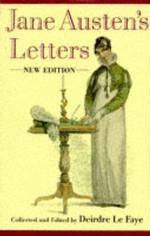
One of my favorite letters in the collection Jane Austen’s Letters, ed. by Deirdre Le Faye (Oxford, 1995) is Letter No. 122 (A)(D), 21 October 1815. This is a draft of a letter from Henry Austen to John Murray on his sister’s behalf and it gives us the rare direct glimpse into the wit of Henry Austen. Jane Austen is in Town and working on negotiations with John Murray for the publication of Emma. This is the visit of her famous meeting with the Prince Regent’s Librarian James Stanier Clarke and his request for Austen to dedicate her next work to the Regent. The amusing correspondence between Austen and Clarke follow this letter, as well as Austen’s own letters to Murray, written directly to the publisher due to Henry’s grave illness and his inability to correspond. These, plus her few letters to Cassandra during this time, are strong evidence of Austen’s direct involvement and concerns in the negotiations and publication of her work – all these letters make great reading! But today, let’s just look at Henry’s letter:
?Friday 20 / Saturday 21 October 1815
[A Letter to Mr. Murray which Henry dictated a few days after his Illness began, & just before the severe Relapse which threw him into such Danger. – ]
Dear Sir
Severe illness has confined me to my Bed ever since I received Yours of ye 15th – I cannot yet hold a pen, & employ an Amuensis [sic]. – The Politeness & Perspicuity of your Letter equally claim my earliest Exertion. – Your official opinion of the Merits of Emma, is very valuable & satisfactory. – Though I venture to differ occasionally from your Critique, yet I assure you the Quantum of your commendation rather exceeds than falls short of the Author’s expectation & my own. – The Terms you offer are so very inferior to what we had expected, that I am apprehensive of having made some great Error in my Arithmetical Calculation. – On the subject of the expense & profit of publishing, you must be much better informed that I am; – but Documents in my possession appear to prove that the Sum offered by you, for the Copyright of Sense & Sensibility, Mansfield Park & Emma, is not equal to the Money which my Sister has actually cleared by one very moderate Edition of Mansfield Park –(You Yourself expressed astonishment that so small an Edit. of such a work should have been sent into the World) & a still smaller one of Sense & Sensibility…
*******************************
Such a Brother was he! – a good businessman and witty in the process! an ‘error in my Arithmetical Calculation’ indeed!
Henry’s very serious illness prompted Austen to call all her family members to his bedside, and it was not until a few weeks later that Austen herself takes on the writing of letters to Murray to complete the Emma negotiations – she writes requesting him to call on her in Hans Place because “a short conversation may perhaps do more than much Writing.” [Ltr. 124, Nov. 3, 1815; To John Murray]
[Henry’s Draft letter in Austen’s hand is in the Bodleian Library; a facsimile is in Modert, F-361 and F-362]
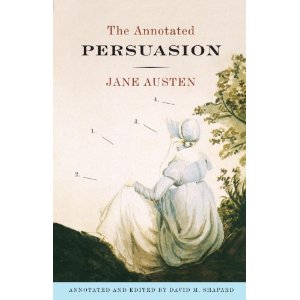
Last week I ran into Barnes & Noble to pick up the latest annotated Pride and Prejudice, edited by Patricia Meyer Spacks, and since then I have been “gadding about” as Austen would say – so no time to really give it a complete read and review; but in another trek yesterday into yet another Barnes & Noble [no worries, I also have haunted the local USED booksellers!], my husband stumbled upon the just published [as in October 5, 2010] The Annotated Persuasion, annotated and edited by David M. Shapard [New York: Anchor Books, 2010; paperbound; ISBN: 978-0-307-39078-3] – and I have discovered a veritable feast!
Shapard is known for his annotated edition of Pride and Prejudice [which I have but it is not in hand, as I am in “gadding about” mode as mentioned above…] – so I cannot compare this book to that edition [his annotated Sense & Sensibility is to be, I believe, published in April 2011] – though I have found that work quite useful as a reliable reference source – it was first published in hardcover followed by a paperback edition; this Persuasion is only in paperback… it is also a smaller format, likely because the novel is so much shorter, but this renders the many illustrations quite small – but I quibble about these few drawbacks …. publishers decisions do not always make the most sense…
I first look for the extras:
An Introduction which gives a brief history of the publishing of Persuasion, and the differences in this final novel from Austen’s other works
Maps of sites that relate to the characters and storyline: the world, England, Somerset, Lyme, and two of Bath
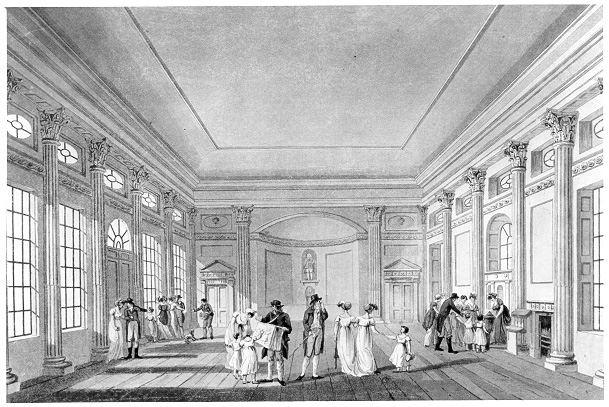
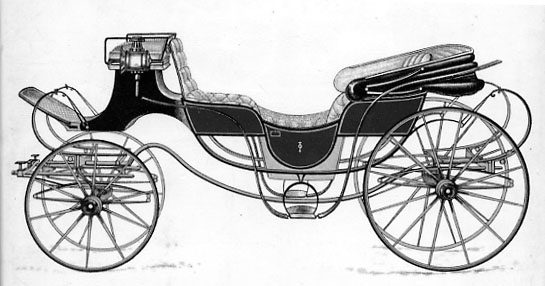
A good number of b/w Illustrations – there is unfortunately no listing of these; the source is indicated under each picture, but a listing would have served as an index to the subjects, which cover all manner of Regency life: architecture such as that in Bath with interior and exterior scenes of the Assembly Rooms; various carriages; fashion; furniture; Naval life; the Cobb in Lyme Regis; etc. – many of these illustrations will be familiar to most readers with a modicum of knowledge about the period – and color would have been nice – but the point here of these illustrations is to serve as a starting reference for further research, and it is an added plus to have any of these included.
Bibliography: this also serves as a starting point – it is in no way a complete listing of sources, but likely those sources that Shapard relied on for his research. How complete can a bibliography of Austen be without mention of Claire Tomalin’s biography under that category, or Claudia L. Johnson’s Jane Austen: Women, Politics and the Novel or Kaplan’s Jane Austen Among Women nowhere to be found – but as Shapard is an historian, it is that strength that resides in this bibliography, again a great starting point for further study – it is organized by broad subjects: language; cultural and literary background; marriage and the family; position of women; children; housekeeping and servants; entails and estates and the landed gentry; rural and urban life; the military; medicine; the law; education; books, media, libraries; writing; postal service; transportation; theater [but no mention of the two works Jane Austen and the Theatre – two works with the same title and both quite comprehensive]; music and dance; sports; weather; the seaside resorts; houses and gardens; fashion; food; etiquette and female conduct books; and others – again, a good select listing of resources on various topics.
The Literary commentary and annotations: Shapard begins with the caveat that “the comments on the techniques and themes of the novel represent the personal views and interpretations of the editor…such views have been carefully considered, but inevitably they will still provoke disagreement among some readers “ [xi] – which Shapard encourages…; these annotations include such literary commentary, historical context, and definitions of words in context if they had a different meaning in Austen’s time, some repeated when necessary or cross-references provided.
The book is arranged with the original text on the verso, the annotations and illustrations on the recto – the annotations are extensive as the following few very random examples show:
Persuasion starts with the full description of Sir Walter Elliot’s obsession with both his own personal charms and his listing in the baronetage – Shapard here provides information on that book and others of the time and the definition of “baronet” and how Sir Walter acquired his own status…
Gout is fully described on pages 311 and 315, when Anne learns that the Crofts are removing to Bath dues to the Admiral’s “gouty” condition.
“replaced” – [p. 103] – “they suspected great injury, but knew not where; but now the collar-bone was soon replaced” – the annotation explains that the word “replaced” had the meaning in Austen’s time of “to be put back in its original position” rather than “to take the place of” – there is also a description of anatomical knowledge as understood at the time.
Carriages get much attention whenever they are mentioned in the text – so we have descriptions and illustrations of barouches and chaise and fours, and chairs and of course Anne’s pretty little “landaulette” [p. 483] a barouche
Money and wealth – Wentworth’s income explained [p. 145]
Servants: various duties outlined [p. 87]
Street names, shops, locations explained throughout; e.g. The Cobb; Tattersall’s [a mention on p. 14 with an illustration]; Milsom Street; Westgate Buildings;…etc…
The Clergy in Austen’s time
Austen’s language as delineating character: as in the following: “Lady Russell had only to listen composedly, and wish them happy; but internally her heart reveled in angry pleasure, in pleased contempt” [p. 232] – and the annotation reads: “Her reveling in such emotions indicates her moral inferiority to Anne, who never derives pleasure from anger or contempt.” [p. 233]
Social rules and strictures: some examples – Sunday traveling [p. 305]; shaking of hands between men and women [p. 427]; not using first names, even those of friends such as Anne and Mrs. Smith
A look at a few key scenes will also illustrate Shapard’s invaluable commentary:
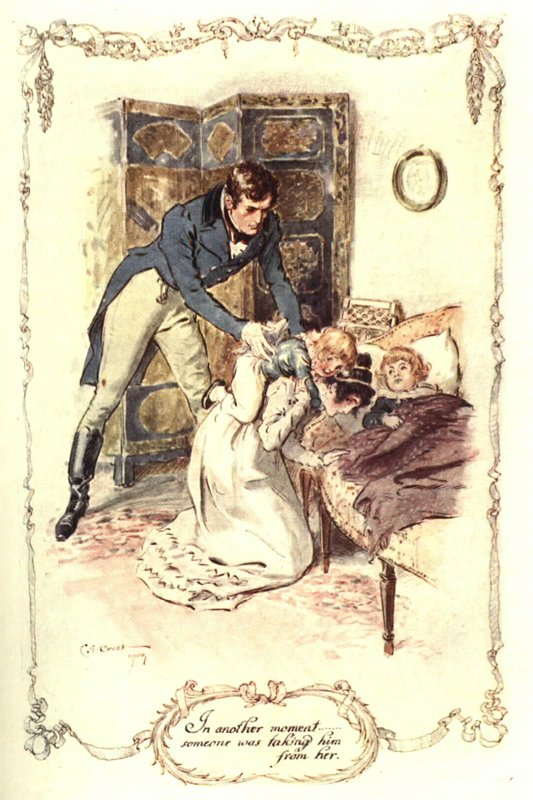
Wentworth removing young Walter Musgrove from around Anne’s neck [pp. 152-5]: Shapard emphasizes the importance of this scene in displaying both Anne’s and Wentworth’s feelings – he quotes William Dean Howell’s how “this simple, this homely scene, is very pretty, and is very like things that happen in life, where there is reason to think that love is oftener shown in quality than quantity, and does its effect as perfectly in the little as in the great events. [from Heroines of Fiction]. Shapard also suggests that Wentworth’s reluctance to converse with Anne about what has just happened is as much due to his efforts to remain aloof as it is to a “simple dislike of thanks,” [p. 155], as is true of Mr. Knightley in Emma. Brock illus - from Molland's
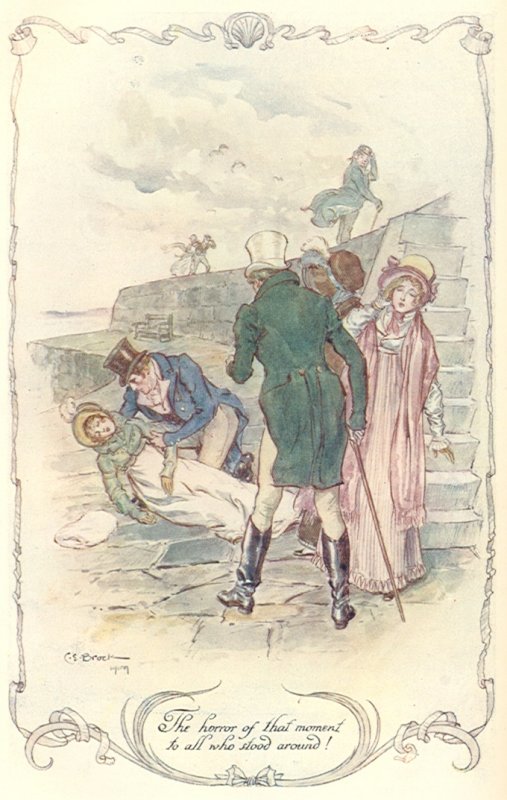
Louisa’s fall in Lyme Regis [p. 210-15]: Shapard describes the Cobb, the steps that were the scene of The Fall, comments on the feelings of Anne and Wentworth, the strength of the former and the uncharacteristic weakness of the latter; Anne’s carrying the “salts” [have you ever wondered why Anne IS carrying smelling salts and conveniently has them in her possession? – “here are salts – take them, take them.” [p. 210]]; the calling for the surgeon and the differences between he and an apothecary; the comic relief of “the sight of a dead young lady, nay, two dead young ladies, for it proved twice as fine as the first report.” [p. 213-4]
"The horror of the moment" - from Molland's
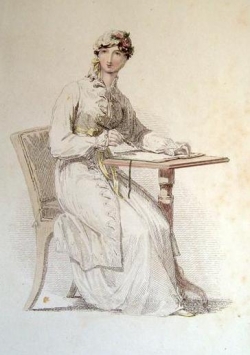
and of course, The Letter! [p. 452] – Shapard so rightly states that “Wentworth’s passionate language contrasts him with other Jane Austen heroes, who are often much cooler and more rational. It also fits with the more intense emotional tone of this novel … the letter itself is arguably the moment of highest emotion in her works…” [p. 453] – and we are given a picture of a writing table of the time [p. 457] – there is also extensive commentary on the conversation between Capt. Harville and Anne.
As referred to above, there are disappointments in this work – I would most wish for an index to the annotations – these could be just general subject areas, such as similar divisions as in the bibliography – so for instance – all annotations which discuss medicine could be cited, or any references to carriages, or fashion, or Bath locations, the Navy, or examples of Free Indirect Discourse, the literary allusions such as Byron’s The Corsair and Matthew Prior’s poem “Henry and Emma”, etc. As it is, one needs to read through the entire work to find the references, and as Shapard wishes for this to be a work for reference purposes, this addition of an index would seem to be a necessity. A index of Characters would have also been a helpful addition – one must reach for their Chapman for this information; and finally there is also no “note on the text”, important information in any such reference source – the bibliography lists Chapman’s 1933 edition, Spacks’s Norton critical edition [1995]; and the latest Cambridge edition edited by Janet Todd and Antje Blank [2006] – but I would have liked to see from whence he took the exact text…
That all said – this is a delightful and fact-filled addition to your Austen Library – and if you are already fairly well-versed in the Regency period and Austen criticism, this will serve as a copy of Persuasion where much of this information is at your fingertips; if you are just starting your adventure in reading Austen, this will be a great introduction to the very rich world of her writings, her world, and her literary themes – what more can we ask for! [other than a hardcover with an index!]
4 full inkwells out of 5
[please note that the illustrations are meant to illustrate this post and are not illustrations in the work being reviewed]
Sotheby’s has just announced the following October 28th auction in London:
The Library of an English Bibliophile, Part I. Jane Austen is duly represented and is among the great company of the Brontes, Burney, Chaucer, Shakespeare, Gaskell, Eliot (George and T. S.), Darwin, Fielding, Hardy, James, Joyce, Keats, Mary Shelley, Wollstonecraft, and many more, and interesting in only having ONE Dickens [Lot 40, A Christmas Carol, est. 150,000 – 200,000 GBP]
Here are the five Austen lots: [# 1-5]
SENSE AND SENSIBILITY: A NOVEL… BY A LADY. AND PUBLISHED BY T. EGERTON, 1811. LONDON: PRINTED FOR THE AUTHOR BY C. ROWORTH
12mo (187 x 114mm.), 3 volumes, first edition, half-titles, watermarks, uncut in the original publisher’s boards, original pink paper labels on spines, preserved in folding brown cloth chemises and quarter brown morocco slipcase, rebacked preserving most of the original spines, occasional spotting and foxing, some slight marginal stains on D10-D11 in volume 1, minor discolouration and staining of a few gatherings in volumes 2 and 3, short tears on B11 and H5 in volume 2 (affecting three lines and two lines respectively), tiny paper flaw on I2 in volume 2, some slight wear to boards.
ESTIMATE 40,000 – 60,000 GBP
PRIDE AND PREJUDICE: A NOVEL. LONDON: G. SIDNEY FOR T. EGERTON, 1813
12mo (182 x 110mm.), 3 volumes, first edition, watermarks, uncut in the original publisher’s drab boards, half-titles, advertisements dated November 1812 inserted at the beginning of volume 1, preserved in folding blue cloth chemises and quarter blue morocco folding box by Zaehnsdorf, spines repaired (some cracks and slight tears present), upper joint of volume 3 slightly split, without spine labels (volume numbers stamped on spine), skilful repairs to inner margin of half-title, title-page and first text leaf of volume 1.
ESTIMATE 75,000 – 100,000 GBP
EMMA: A NOVEL. LONDON: C. ROWORTH FOR JOHN MURRAY, 1816
12mo (186 x 110mm.), first edition, half-titles, uncut in the original publisher’s blue-grey boards with grey-brown spines, preserved in quarter brown morocco folding box, rebacked preserving significant portions of the spines, original spine labels, tear to lower corner of P1 in volume 1 (not affecting text), occasional spotting, some slight further wear to binding.
ESTIMATE 20,000 – 30,000 GBP
MANSFIELD PARK: A NOVEL. LONDON: FOR J. MURRAY, 1816
12mo (176 x 104mm.), 3 volumes, second edition, half-titles, contemporary or near contemporary blue half morocco, marbled boards, speckled edges, leaves C6-7 in volume 1 partially loose, some slight foxing and spotting, one gathering in volume 3 crudely opened, some slight wear to edges of binding.
ESTIMATE 1,500 – 2,000 GBP
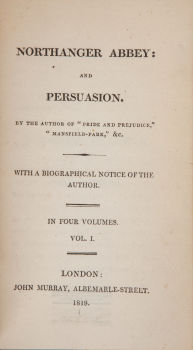
NORTHANGER ABBEY: AND PERSUASION…WITH A BIOGRAPHICAL NOTICE OF THE AUTHOR. LONDON: JOHN MURRAY, 1818
12mo (189 x 112mm.), 4 volumes, first edition, watermarks, half-titles as called for by Gilson, uncut in the original grey-brown boards, original spine labels, preserved in red quarter morocco folding box, some spotting and foxing, neat repairs to a few minor tears on spines, some wear to labels and edges and extremities of binding, boards slightly spotted, corners very slightly bumped.
ESTIMATE 20,000 – 30,000 GBP
************************
You can view the entire catalogue with pictures and fuller description online at the Sotheby’s website. An Exhibition is to be held in Paris, then London prior to the auction on October 28th [see site for details]; a catalogue can be purchased for $53.
Can’t wait to see Part II!
[Image of Thomas Rowlandson’s “Doctor Syntax at an Auction” from The Private Library] [Posted by Deb]
Auction Alert! Heritage Auction Galleries has announced its upcoming “Signature Rare Books Auction”, October 14-16 – Beverly Hills, CA. Auction #6048. You will all be happy to see that all of Jane Austen’s first editions will be on the block! – all in lovely bindings and now viewable online and open for bidding: [note the opening bid and estimated value, and buyer’s premium; if there is a reserve it has not been noted]
*First Edition of Jane Austen’s Fourth Novel in a Full Morocco Binding by Rivière & Son:
[Jane Austen]. Emma: A Novel. In Three Volumes. By the Author of “Pride and Prejudice,” &c. &c. Vol. I. [II. III.] London: Printed for John Murray, 1816. Opening bid: $7500. [estimated value = $15,000+]
*
*First Edition of Jane Austen’s Mansfield Park in an Attractive Full Morocco Binding by Rivière & Son:
[Jane Austen]. Mansfield Park: A Novel. In Three Volumes. By the Author of “Sense and Sensibility,” and “Pride and Prejudice.” Vol. I [II. III.]. London: Printed for T. Egerton, 1814 (Volume II with imprint: London: Printed for T. Egerton, Whitehall, 1814). Opening bid: $5,000. [est. $10,000+]
*
*First Edition of Jane Austen’s Posthumously Published Northanger Abbey and Persuasion Attractively Bound in Full Morocco Gilt by Rivière & Son:
[Jane Austen]. Northanger Abbey: and Persuasion. By the Author of “Pride and Prejudice,” “Mansfield-Park,” &c. With a Biographical Notice of the Author. In Four Volumes. Vol. I. [II. III. IV.]. London: John Murray, 1818. Opening bid: $3,750. [est.$7500+]
*
*A Lovely First Edition of Jane Austen’s Pride and Prejudice:
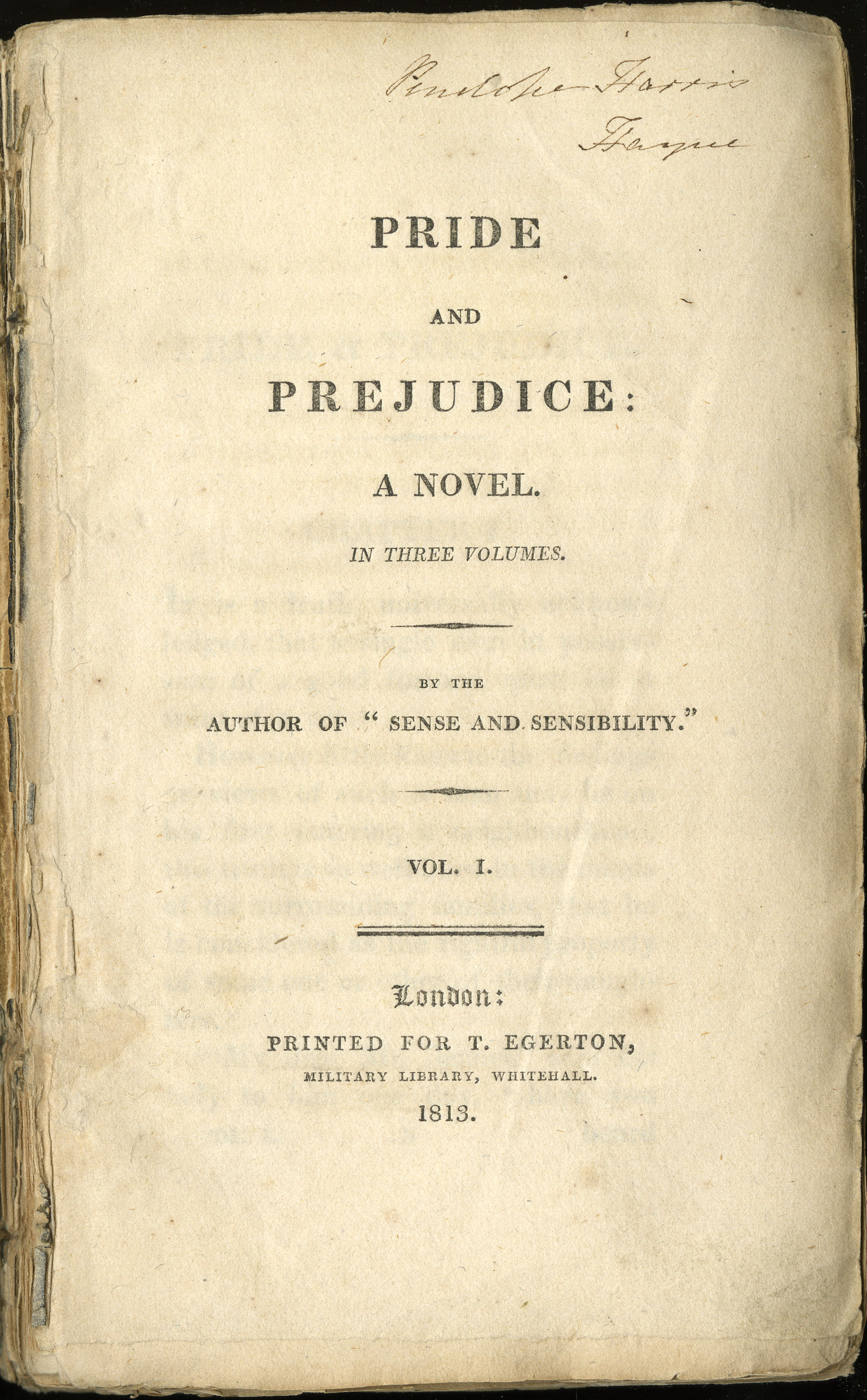
[Jane Austen]. Pride and Prejudice: A Novel. In Three Volumes. By the Author of “Sense and Sensibility.” Vol. I. [II. III.] London: Printed for T. Egerton, Military Library, Whitehall, 1813. Opening bid: $15,000. [est. $30,000+]
*
*Scarce First Edition of Jane Austen’s First Published Novel, in a Full Morocco Binding by Rivière & Son:
[Jane Austen]. Sense and Sensibility: A Novel. In Three Volumes. By a Lady. Vol. I. [II. III.]. London: Printed for the Author, By C. Roworth, Bell-yard, Temple-bar, and Published by T. Egerton, Whitehall, 1811. Opening bid: $20,000. [est. value $40,000+]
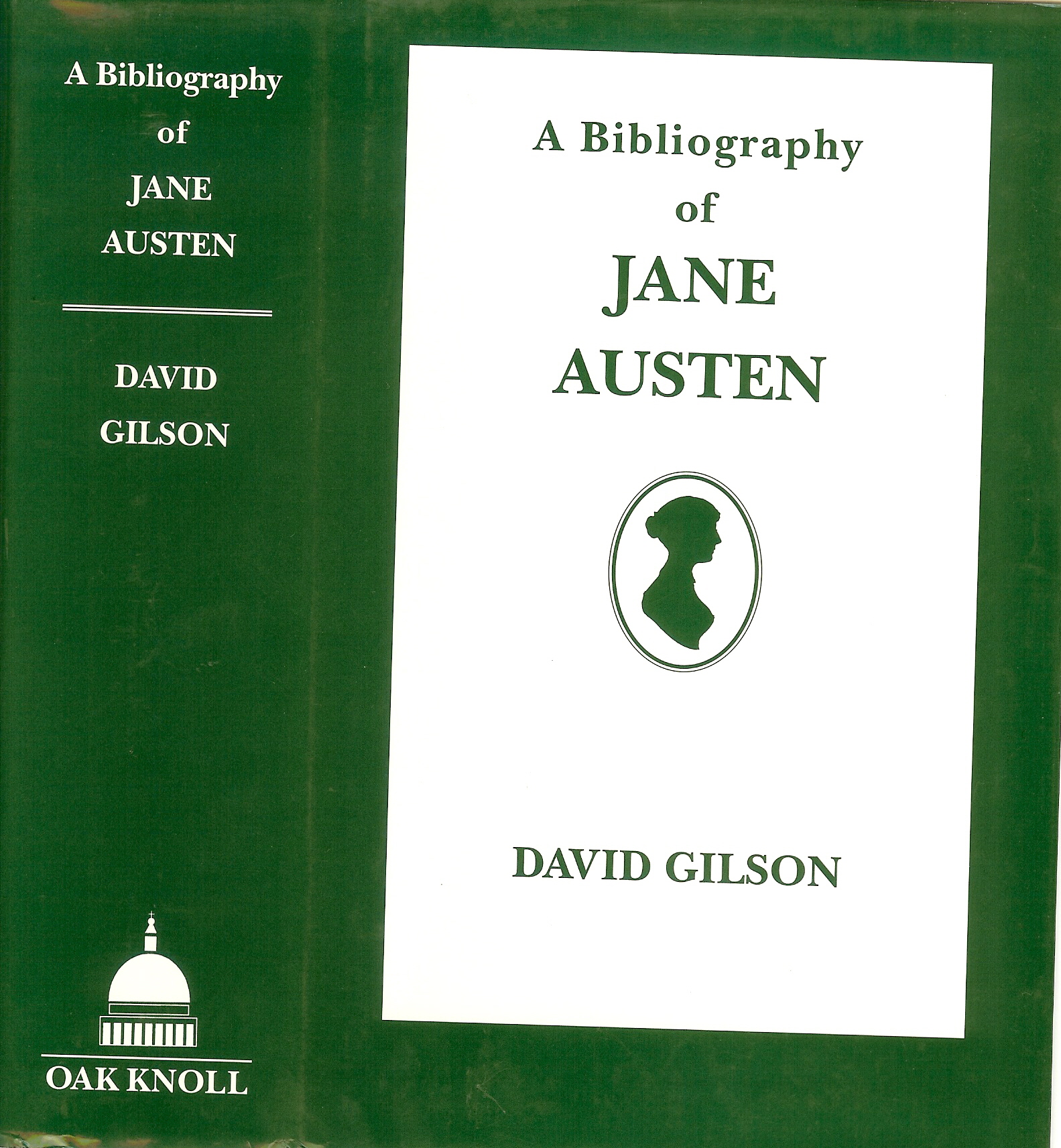
Gilson, David. A Bibliography of Jane Austen. New Introduction andCorrections by the Author. Winchester: St. Paul’s Bibliographies / New Castle, Delaware: Oak Knoll Press, 1997.
***********************
I am often asked what I would consider the most important book to add to ones own “Jane Austen Library.” Primary sources of course, the Chapman Oxford set of all the novels, minor works, juvenilia, etc – these volumes remain the source for citation in any scholarly work. The new Cambridge edition would be lovely, but presently beyond my pocketbook, so the local University Library suffices for this ; though I do wonder when this edition of the works will supplant the Chapman for citation purposes – shall start saving now…
But after that, what? I would choose and most highly recommend David Gilson’s Bibliography of Jane Austen. Originally published in 1982, Gilson had set out to revise and update the Sir Geoffrey Keynes’ 1929 Nonesuch Press Austen bibliography, after discovering the lack of information in the Keynes relating to the early American editions of Austen’s works. Gilson wrote about these and other discoveries of the various early translations in his articles for The Book Collector. At Keynes’ suggestion, Gilson began a second edition but found it best to present a whole new work based on Keynes but with much additional information and to include the work of Chapman in his 1955 Austen bibliography. The 1997 edition is not a revision of the 1982 work but does include a new introduction, corrections, some additions, and a brief bibliographic essay on material published since 1978. It is less physically attractive and lacks the frontispiece illustrations of the 1st edition, but I consider this very comprehensive work [at 877 pages!] the starting point for all Austen research. Gilson writes a very informative essay prefacing each of the twelve chapters, includes a chronological listing of editions and reprints and an exhaustive index that links back to all the entries.
I offer here a brief capsule of each of these chapters:
A. The Original Editions: Gilson follows the principles set down by Philip Gaskell in his New Introduction to Bibliography [1972] and the entry for each original edition is exhaustive: full bibliographical details of the physical book [title; collation; contents; technical notes on the paper, printing, headlines, chapter headings and endings, binding; etc]; its publishing history; reviews and contemporary comments; later publishing history; auction records [fascinating!]; listing of copies examined; and other copies known to exist. [I LOVE this stuff!]
B. First American Editions: as Austen mentions nothing about foreign editions of her work, Gilson assumes she knew nothing about the Emma that was published by Matthew Carey in 1816, a very rare edition, and unknown of by the earlier bibliographers – [Gilson B1]. Gilson again gives full bibliographical data as for the original editions, noting the textual variations in punctuation and spelling.
C. Translations: as Gilson states, despite that “JA’s opinion of the French seems not to have been high [citing her letter of Sept 8, 1816]…the French first paid her the compliment of translating her novels in 1813 and 1815.” [Gilson, p. 135] Same full bibliographic details here for the various translations.
D. Editions Published by Richard Bentley: no reissue of Austen’s novels is known after 1818 until 1832 when Richard Bentley decided to include them in his series of Standard Novels [quoting Chapman]. The copyrights had been sold to him by Cassandra for £210 and the P&P copyright was purchased from Egerton for £40. [Gilson, p. 211] Covers all the Bentley editions through 1882, with bibliographical details.
E. Later Editions and Selections: lists “as far as it has been practicable” all other later editions of the novels from the 1830s onwards, with cursory bibliographical details and a focus on the statistical details for these editions, excepting the “textually significant edition edited by Chapman (E150)” [Gilson, p. 238] – there are 425 entries in this section.
F. Minor Works: great literary history here! – with complete bibliographical details for Lady Susan, The Watsons, Charades, Love & Freindship, Sanditon, “Plan of a Novel”, Persuasion chapters, Prayers, the Juvenilia, etc.
G. Letters: Brabourne, Bodley Head, Chapman editions, Le Faye coming later [the new 3rd edition, in 1995]
H. Dramatisations: Gilson states that in 1929 Keynes could only find three dramatic adaptations, but fifty are listed here, and only those that are published works, and surprise of surprises, P&P being the most popular. [Gilson, p. 405]
J. Continuations and Completions [no “I” so not skipping anything]: Gilson lists 14, adds a good number in his 1997 update, but since then the world has been inundated with all manner of sequels, prequels, and mash-ups – this chapter is a good starting point for some of the less known early sequels that have gotten lost in the back room library stacks – some are quite good [Brinton and Bonavia-Hunt for example]
K. Books Owned by Jane Austen: there is much evidence of what Austen actually read – in Chapman’s indexes and other studies on literary influences on her – but as Gilson states, “the actual copies prove more elusive” [p. 431], so these twenty entries listed are noted in some way to have been subscribed to by her or inscribed in some way – the essay here is very informative and great to learn of the provenance of some of these titles Austen owned and read. [Note: I have set up a page in the Bibliography section on this blog titled Jane Austen’s Reading ~ a Bibliography – a list of all the books that Austen owned or is known to have read, compiled from various sources – it makes a great reading list! – (it is still a work in progress…)]
L. Miscellaneous: the ever-needed catch-all and quite a little find, as Gilson says “unclassifiable miscellanea (with yet a curious fascination of their own!) [p. 449] – for example an Elizabeth Goudge short story “Escape for Jane”, a romanticized re-telling of the Harris Bigg-Wither episode (L24), a number of works adapted for children, and a few works on the Leigh-Perrot trial.
M. Biography and Criticism: everything from 1813 on, to include books, journal articles, reviews, etc, chronologically arranged and annotated [though not consistently], 1814 items in total, with a bibliographical essay in the updated version to touch on recent resources, ALL examined by Gilson personally. No words here to adequately explain this section – just an amazing piece of scholarship –
Appendix: ca chronological listing of all editions, reprints and and adaptations of JA’s works recorded in the bibliography
Index: pp. 753-877 – exhaustive!
… but here of course is where any printed book falls short – before it hits the stands, it is outdated. Recent efforts to keep Austen bibliography current have been largely produced by Barry Roth in his three works:
Roth, Barry and Joel Clyde Weinsheimer. An Annotated Bibliography of Jane Austen Studies, 1952-1972. Charlottesville, VA: University Press of Virginia, 1973.
Roth, Barry. An Annotated Bibliography of Jane Austen Studies, 1973-1983. Charlottesville, VA: University Press of Virginia, 1985.
__________. An Annotated Bibliography of Jane Austen Studies, 1984-1994. Ohio University Press, 1996.
__________ . bibliographies in Persuasions and Persuasions On-Line published annually by the Jane Austen Society of North America [JASNA]: each annual issue has a bibliography titled “Jane Austen Works and Studies” [and later the “Jane Austen Bibliography”] and is available online since the 1999 bibliography appeared in the 2001 Persuasions On-Line. [Note that the bibliographies in the earlier issues of Persuasions were compiled by Patricia Latkin, and later by Latkin and Roth together, then just by Professor Roth.]
And now the Internet with such immediate access to journals and books, tons of bibliographies, etc. has made all of us capable of being completely on top of everything every minute of the day – but for me, there is nothing quite like going to my Gilson to get back to those earlier days of bibliography, when a scholar such as he lovingly handled each work and made the effort to describe with such fullness each edition so it may become present before you [because you certainly cannot afford them!] and thus we are brought a little bit closer to the Austen we all love and admire – indeed, we can feel as excited as she did upon receipt of her own first copy of Pride & Prejudice as she exclaimed to Cassandra “ I want to tell you that I have got my own darling Child from London “ [Le Faye, Letter 79, p. 201]
If you don’t have this book, get it – it makes for fascinating reading! [I confess to being a librarian and I know we are all a little bit weird about this bibliography and classification thing, but this book will give you much to ponder, trust me…]
Further Reading:
Chapman, R.W. Jane Austen: A Critical Bibliography. 2nd ed. London: Oxford University Press, 1969.
Keynes, Geoffrey. Jane Austen: A Bibliography. NY: Burt Franklin, 1968 [originally published in London, 1929]
The Roth bibliographies noted above
A few other sources, mostly Gilson, though not a complete list:
Gilson, David. “Auction Sales,” in A Jane Austen Companion, ed. J. David Grey. NY: Macmillan, 1986. See also his “Editions and Publishing History,” “Obituaries, “ and “Verses” in this same volume.
____________. “Books and Their Owners: Some Early American Editions of Jane Austen.” Book Collector 48 (1999): 238-41.
___________. “The Early American Editions of Jane Austen.” The Book Collector 18 (1969): 340-52.
___________. “Henry Austen’s ‘Memoir of Miss Austen,” Persuasions 19 (1997):12-19.
___________. “Later Publishing History with Illustrations” in Jane Austen in Context, ed. Janet Todd. The Cambridge Edition of the Works of Jane Austen, Cambridge University Press, 2005.
____________. Putting Jane Austen in Order. Persuasions 17 (1995):12-15
____________. “Serial Publication of Jane Austen in French,” The Book Collector 23 (1974): 547-50.
* I will be posting occasional reviews of books recommended “For Your Austen Library” – these will be listed on the bibliography page so titled. You can also visit the the other Bibliography pages for more reading recommendations.
I refer you to my post from July 15th, 2009, Austen on St. Swithin’s Day – three days before Austen died, she penned her humorous poem “Venta” – read all about the writing and publishing of the poem, St. Swithin, and the Winchester Races…
[And like last year, our June here in Vermont has been cold and rainy – followed by the grueling heat wave of the last two weeks….!]
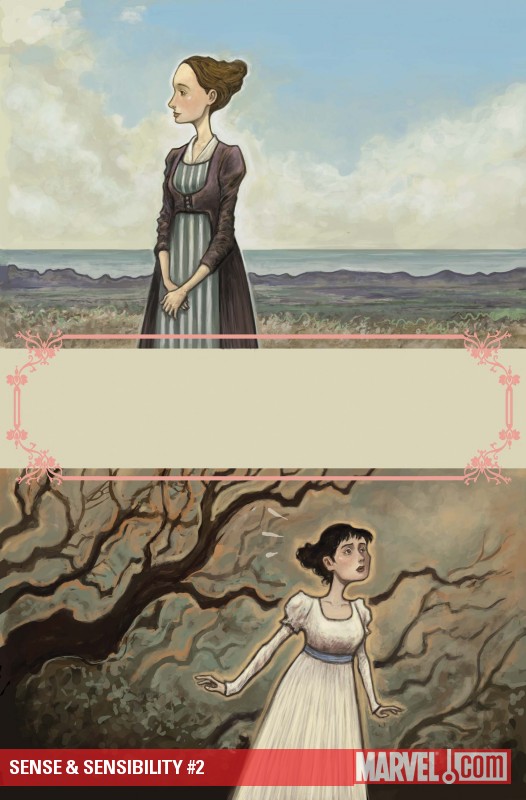
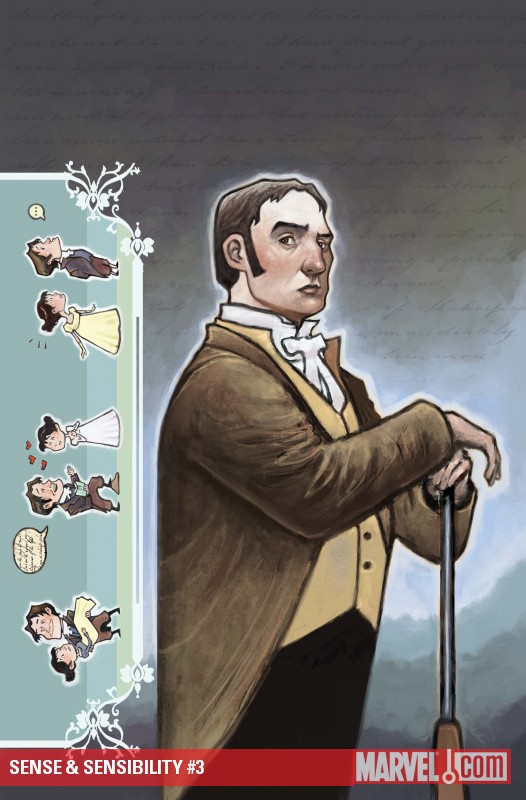
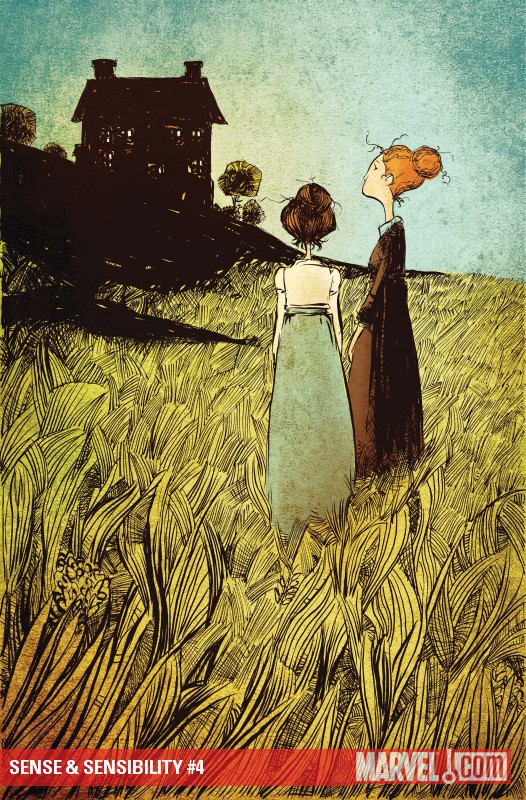
Marvel Comics has done it again – this time with Sense & Sensibility!
Here are the covers for the five issues: go the Marvel Comics website for more information and release dates [May 26 – Sept. 22, 2010]
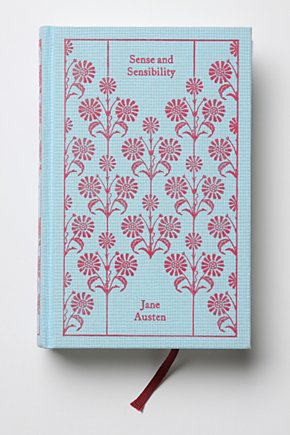
And here’s one other S&S in the shops: Anthropologie offers this edition of S&S as the latest must-have in their literature collection published by Penguin:
Literature’s great works ditch their stuffy dust jackets for smartly embossed canvas covers. Perfect for replacing well-thumbed favorites or creating a bookshelf piece de resistance.
See Anthropologie.com – also available: Pride & Prejudice, Emma, Jane Eyre, Wuthering Heights, Great Expectations, The Woman in White, and more… click here for the full list] – each about $20.
Laurel Ann at her Austenprose blog is currently posting a month-long group read through Pride & Prejudice – do visit and join in the discussion! – she is as always an insightful reader and discussion leader, and what better way to spend the first month of summer musing on P&P and the finer points of Austen’s magic!
The publishing history of P&P, Austen’s most popular book, then and now, is an interesting study in the book trade of early 19th century England. First completed in 1797 [and called First Impressions] and rejected by the publisher her father took the manuscript to, Austen reworked P&P and submitted it to Thomas Egerton, the publishing house of her Sense & Sensibility, in 1812 [published January 28, 1813]. She sold the copyright outright for £110, and did not incur other expenses in its publication, as in the three other works published in her lifetime [see links below for more information.] How we would love to know her thoughts on this road to publication! – how we would love to have her letters written while in the process of the writing to give us some idea of her imagination at work [where WAS the model for Pemberley? was Mr. Darcy someone REAL? was Elizabeth Bennet her alter ego? was MR COLLINS drawn from life?], or to have the letters to her brother Henry and his to Egerton – but alas! we have nothing, just a few comments scattered among the surviving letters.
Austen does not give us much in her letters as to her writing practices or narrative theory [and thus such a disappointment when they were first published, criticized for their “mundaneness,” their focus on domestic nothings and neighborhood gossip!] – but if you dig for diamonds you will find them, and these scattered mentions are certainly diamonds – it is the feeling of having her right over your shoulder when you read that she is “disgusted” with the way her mother is reading her book aloud, or that she REALLY likes this earning money for her labors, or being miffed [but also full of pride!] with Henry for telling her Secret to one and all – we see Jane Austen here in her own words – the funny, ironic, brilliant Jane Austen – never enough, but this is as good as it is going to get.
So in this post I offer all the references she makes to Pride & Prejudice, her “own darling Child” – read them and enjoy!
[NOTE: page references are to Deirdre Le Faye, ed., Jane Austen’s Letters, 3rd ed., Oxford, 1997; all abbreviations and spelling errors are retained]
Letter 17. January 8-9, 1799 to Cassandra, from Steventon
I do wonder at your wanting to read first impressions again, so seldom as you have gone through it, & that so long ago.[page 35]
[Le Faye notes that this is the first surviving mention of Austen’s literary work, this prototype of P&P having been finished in August 1797; Note, p. 366]
Letter 21. June 11, 1799, To Cassandra, from Bath
I would not let Martha read First Impressions again upon any account, & I am very glad that I did not leave it in your power. – She is very cunning, but I see through her design; – she means to publish it from Memory, & one more perusal must enable her to do it.[p.44]
Letter 77. November 29-30, 1812, to Martha Lloyd from Chawton
P.& P. is sold. – Egerton gives £110 for it. – I would rather have had £150, but we could not both be pleased, & I am not at all surprised that he should not chuse to hazard so much. – It’s being sold will I hope be a great saving of Trouble to Henry, & therefore must be welcome to me. – The Money is to be paid at the end of the twelvemonth. [p. 197]
Letter 79. January 29, 1813, to Cassandra from Chawton
I want to tell you that I have got my own darling Child from London; – on Wednesday I received one Copy, sent down by Falknor, with three lines from Henry to say that he had given another to Charles & sent a 3d by the Coach to Godmersham; just the two Sets which I was least eager for the disposal of. I wrote to him immediately to beg for my own two other Sets, unless he would take the trouble of forwarding them at once to Steventon & Portsmouth – not having any idea of his leaving Town before today; – by your account however he was gone before my Letter was written. The only evil is the delay, nothing more can be done till his return. Tell James & Mary so, with my Love. – For your sake I am as well pleased that it shd be so, as it might be unpleasant to you to be in the Neighborhood at the first burst of the business. – The Advertisement is in our paper to day [the Morning Chronicle of January 28, 1813]. – 18s – He shall ask £1-1- for my two next, & £1-8 – for my stupidest of all. I shall write to Frank, that he may not feel himself neglected. Miss Benn dined with us on the very day of the Books coming, & in the eveng we set fairly at it & read half the 1st vol. to her – prefacing that having intelligence from Henry that such a work wd soon appear we had desired him to send it whenever it came out – & I beleive it passed with her unsuspected. – She was amused, poor soul! that she cd not help you know, with two such people to lead the way [JA and her mother]; but she really does seem to admire Elizabeth. I must confess that I think her as delightful a creature as ever appeared in print, & how I shall be able to tolerate those who do not like her at least, I do not know. – There are a few Typical errors – & a “said he” or a “said she” would sometimes make the Dialogue more immediately clear – but “I do not write for such dull Elves” “As have not a great deal of Ingenuity themselves.” [from Scott’s Marmion] – The 2d vol. is shorter than I cd wish – but the difference is not so much in reality as in look, there being a a larger proportion of Narrative in that part. I have lopt & cropt so successfully however that I imagine it must be rather shorter than S. & S. altogether. – Now I will try to write of something else; – it shall be a complete change of subject – Ordination.[p. 201-2]
Letter 80. February 4, 1813, to Cassandra from Chawton
Your letter was truely welcome & I am much obliged to you all for your praise; it came at a right time, for I had had some fits of disgust. – our 2d evening’s reading to Miss Benn had not pleased me so well, but I beleive something must be attributed to my Mother’s too rapid way of getting on – & tho’ she perfectly understands the Characters herself, she cannot speak as they ought. – upon the whole however I am quite vain enough & well satisfied enough. – The work is rather too light & bright & sparkling; – it wants shade; – it wants to be stretched out here & there with a long Chapter – of sense if it could be had, if not of solemn specious nonsense – about something unconnected with the story; an Essay on Writing, a critique on Walter Scott, or a history of Buonaparte – or anything that would form a contrast & bring the reader with increased delight to the playfulness & Epigrammatism of the general stile. – I doubt your quite agreeing with me here – I know your starched Notions. – The caution observed at Steventon with regard to the possession of the book is an agreable surprise to me, & I heartily wish it may be the means of saving you from everything unpleasant; – but you must be prepared for the Neighbourhood being perhaps already informed of there being such a Work in the World, & in the Chawton World! Dummer will do that you know. – It was spoken of here one morng when Mrs. D. [Digweed] called with Miss Benn. – The greatest blunder in the Printing that I have met with is in Page 220 – Vol.3 where two speeches are made into one. – There might as well have been no suppers at Longbourn, but I suppose it was the remains of Mrs. Bennet’s old Meryton habits.[p. 203]
Mrs. George Austen
I had a letter from Henry yesterday, written on Sunday from Oxford; mine had been forwarded to him… he says that copies were sent to S. [Steventon] & P. [Portsmouth] at the same time as the others. [p. 204]
Letter 81. February 9, 1813, to Cassandra from Chawton
I am exceedingly pleased that you say what you do, after having gone thro the whole work – & Fanny’s praise is very gratifying; – my hopes were tolerably strong for her, but nothing like a certainty. Her liking Darcy & Elizabeth is enough. She might hate all the others, if she would. I have her opinion under her own hand this morning, but your transcript of it which I read first, was not & is not the less acceptable. – To me, it is of course all praise – but the more exact truth which she sends you is good enough. [p. 205]
Yes, I beleive I shall tell Anna – & if you see her, & donot dislike the commission, you may tell her for me. You know I meant to do it as handsomely as I could. But she will probably not return in time[p. 205, referring to telling her niece Anna that she is the author of S&S and P&P, note p. 414]
…- there is still work for one evening more.[p. 206, to finish reading P&P aloud, note p. 414]
Letter 85. May 24, 1813, to Cassandra from London
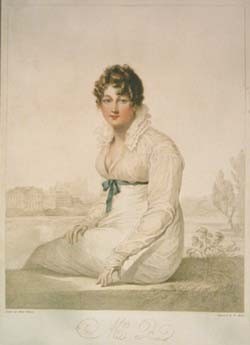
…Henry & I went to the Exhibition in Spring Gardens. It is not thought a good collection, but I was very well pleased – particularly [pray tell Fanny] with a small portrait of Mrs. Bingley, excessively like her. I was in hopes of seeing one of her Sister, but there was no Mrs. Darcy; – perhaps however, I may find her in the Great Exhibition which we shall go to, if we have time; – I have no chance of her in the collection of Sir Joshua Reynolds’s Paintings which now is shewing in Pall Mall & which we are also to visit. – Mrs. Bingley is exactly herself, size, shaped face, features and sweetness; there never was a greater likeness. She is dressed in a white gown, with green ornaments, which convinces me of what I have always supposed, that green was a favourite colour with her. I dare say Mrs. D. will be in Yellow. [p. 212]
[Portrait of a Lady, by J.F.M. Huet-Villiers]
a.k.a. Mrs. Bingley
I am very much obliged to Fanny for her Letter; – it made me laugh heartily; but I cannot pretend to answer it. Even had I more time, I should not feel at all sure of the sort of Letter that Miss D. would write…[p. 213, referring to a letter from Fanny written to and expecting a response from Georgiana Darcy – Note p. 417]
We have been to both the Exhibition & Sir J. Reynolds’, – and I am disappointed, for there was nothing like Mrs. D. at either. – I can only imagine that Mr. D. prizes any Picture of her too much to like it should be exposed to the public eye. – I can imagine he wd have that sort [of, omitted] feeling – that mixture of Love, Pride & Delicacy. [p. 213]
Letter 86. July 3-6, 1813, to Francis Austen from Chawton
You will be glad to hear that every Copy of S.&S. is sold & that it has brought me £140 – besides the Copyright, if that shd ever be of any value. – I have now therefore written myself into £250. – which only makes me long for more. – I have something on hand – which I hope on the credit of P. & P. will sell well, tho’ not half so entertaining…[referring to Mansfield Park] [p. 217]
Letter 87. September 15-16, 1813, to Cassandra from London
Lady Robert [Kerr, nee Mary Gilbert] delighted with P. & P – and really was so I understand before she knew who wrote it – for, of course, she knows now. – He [Henry] told her with as much satisfaction as if it were my wish. He did not tell me this, but he told Fanny. And Mr. Hastings – I am quite delighted with what such a Man writes about it. – Henry sent him the Books after his return from Daylesford – but you will hear the Letter too. // Let me be rational & return to my two full stops. [p. 218]
I long to have you hear Mr. H’s [Warren Hastings] opinion of P&P. His admiring of Elizabeth so much is particularly welcome to me. [p. 221]
Letter 89. September 23-24, 1813, to Cassandra from Godmersham Park
Poor Dr. Isham is obliged to admire P.&P. – & to send me word that he is sure he shall not like Mde. Darblay’s new Novel half so well.– Mrs. C. [Cooke] invented it all of course.[referring to Frances Burney’s The Wanderer, published in 1814] [p. 227]
Letter 90. September 25, 1813, to Francis Austen from Godmerhsam Park
I thank you very warmly for your kind consent to my application & the kind hint that followed it. [asking Frank if she can use the names of his old ships in her her current work, MP] – but the truth is that the Secret has spread so far as to be scarcely the Shadow of a secret now – & that I beleive whenever the 3d appears I shall not even attempt to tell Lies about it. – I shall rather try to make all the Money than all the Mystery I can of it. – People shall pay for their knowledge if I can make them. – Henry heard P. & P. warmly praised in Scotland, by Lady Robt Kerr & another Lady; – and what does he do in the warmth of his Brotherly vanity & Love, but immediately tell them who wrote it! – A Thing once set going in that way – one knows how it spreads! – and he, dear Creature, has set is going so much more than once. I know it is done from affection & partiality – but at the same time, let me here again express to you & Mary my sense of the superior kindness which you have shewn on the occasion, in doing what I wished. – I am trying to harden myself. – After all, what a trifle it is in all its Bearings, to the really important points of one’s existence even in the World![p. 231]
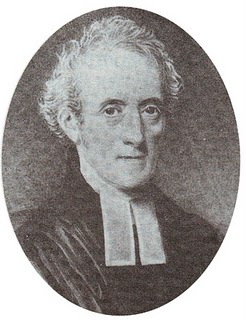
Henry Austen
There is to be a 2d Edition of S.&S. Egerton advises it.[p. 232, referring to her publisher]
Letter 104. August 10-18, 1814, to Anna Austen from Chawton
Now we have finished the 2d book – or rather the 5th – I do think you had better omit Lady Helena’s postscript; to those who are acquainted with P.&P it will seem an Imitation. [p. 268, referring to Anna’s manuscript sent to JA for advice]
Letter 128. November 26, 1815, to Cassandra from London
Mr. H is reading Mansfield Park for the first time & prefers it to P&P.[p. 301, referring to Mr. Haden, London surgeon, “who brought good Manners & clever conversation” ]
Letter 132(Draft). December 11, 1815, to James Stanier Clarke from London
My greatest anxiety at present is that this 4th work [Emma] shd not disgrace what was good in the others. But on this point I will do myself the justice to declare that whatever may be my wishes for its’ success, I am very strongly haunted by the idea that to those readers who have preferred P&P. it will appear inferior in Wit, & to those who preferred MP. very inferior in good sense… [p. 306]
Letter 134(A). December 27, 1815, from the Countess of Morley to JA at Chawton
I am most anxiously waiting for an introduction to Emma…. I am already become quite intimate in the Woodhouse family, & feel that they will not amuse & interest me less than the Bennetts [sic], Bertrams, Norriss & all their admirable predecessors – I can give them no higher praise-[p. 308]
************************************
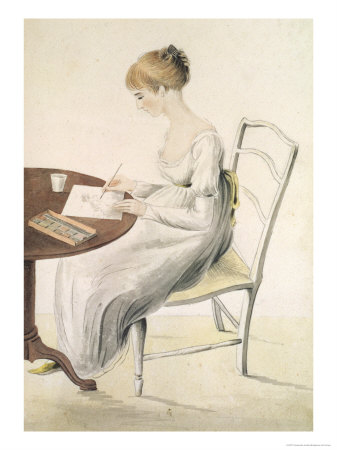
[a letter-writing Fanny Austen-Knight by Cassandra]
The set of Jane Austen’s novels published by Bentley in 1833 and up for auction at Bonham’s sale today [June 8, 2010] has come under the gavel and has sold for £3,360 [= @ $4827.] [the estimate was for £2000 – £3000 ]
Here are the details:
AUSTEN, Jane. Works, Bentley’s Standard Novel edition, 6 vol. in 5, 5 engraved frontispieces and additional titles, some light spotting to first and final few leaves, small corner tear to printed title “Pride and Prejudice”, without half-titles, ownership inscription of Eularia E. Burnaby (1856) on printed titles, bookplate of Henry Vincent, bookseller’s label of H.M. Gilbert, Southampton, uniform contemporary half calf, red and dark green morocco labels, extremities lightly rubbed [Gilson D1-D5], 8vo, R. Bentley, 1833
Sold for £3,360 inclusive of Buyer’s Premium
Footnote:
“No English reissue of JA’s novels is known after 1818 until in 1832 Richard Bentley decided to include them in his series of Standard Novels” (Gilson, p.211). See illustration on preceding page.
See the Bonham’s site here for details and other auction items in this ‘Printed Books, Maps and Manuscripts’ auction [Sale No. 17809]
See Laurel Ann’s post analyzing this set [along with her super sleuthing as to the provenance!] atAustenprose
Someone has gone home very happy today! [and hopefully this has gone to either a fine institution or a fine home with an Austen-loving owner…]
 I am on the road, so not able to connect to all my Austen “feeds” on a daily basis, so I was grateful to hear from Janeite Marti who sent me the information on this latest kerfuffle in Austenland – it seems that Professor Kathryn Sutherland has, in her releasing the latest digital editions of Austen’s fiction manuscripts [see the link here Jane Austen Fiction Manuscripts], made comments on Austen’s spelling and punctutaion and the need for a proper editor to clean everything up for publication – how the press has picked up on this in a world-class endeavor to bring Austen down a peg or two, tossing her from her very high literary pedestal! Vic at Jane Austen’s World has addressed the issue most adequately, so I send you there to read her near perfect defense of “Dear Jane.”






 Jane Austen in Vermont