There are a number of Jane Austen courses and conferences this summer, many in celebration of the 200 years of Pride and Prejudice. How I wish I had a clone to send to any and all of these events! But alas! I shall have to content myself with reading about others’ adventures of “summering with Jane” and hope that at least some of the talks will be published somewhere soon. Today I start with a first of several posts on the various offerings – on the weekend course at the University of North Carolina, the Jane Austen Summer Program: [ http://humanities.unc.edu/programs/jasp/ ]
Don’t miss the first Jane Austen Summer Program —
held on UNC’s campus June 27-30, 2013!
Organized by UNC’s Department of English and Comparative Literature in conjunction with the Program in the Humanities, this four-day summer program celebrates the 200th anniversary of the publication of Pride and Prejudice.
Learning experiences include lecture formats and discussion groups daily. Discussions will focus on Pride and Prejudice in its historical context as well as its many afterlives in fiction and film.
Additional events include a Regency ball, the chance to partake in an English tea, a silent auction of Austen-related items, and the opportunity to view special exhibits tailored to the conference.
But here are the basics: please no drooling on your keyboard … [note that Ihave left out all the mealtimes – there will be time for food!]
Thursday, June 27: Welcome and check-in
3:15 – 3:30: Introduction and Welcome: Dr. Terry Rhodes, Senior Associate Dean of the Fine Arts & Humanities, UNC-CH
3:30 – 4:30: Plenary Lecture and Discussion, “Manners Envy in Pride and Prejudice” – James Thompson, Professor of English and Comparative Literature, UNC-CH
4:45 – 5:45: Context Class sections I: Money and Land – With Maria Wisdom and Danielle Coreale; Beverly Taylor and Laurie Langbauer; Doug Murray and Jessica Richard; Susan Allen Ford and Sarah Marsh
7:00 – 8:00: Plenary Lecture, “The Networked Novel and what it did to Domestic Fiction” – Nancy Armstrong, Gilbert, Louis, and Edward Lehrman Professor of English and Editor, Novel: A Forum on Fiction, Duke University
Friday, June 28: Romantic Education
9:15 – 10:00: Context Class sections II: Mothers and Daughters
10:15 – 11:00:Plenary Panel on Jane Austen and Romance – Sarah Frantz, Associate Professor of English, Fayetteville State University; Emma Calabrese, Teaching Assistant, English, UNC-CH; Phil Stillman, Graduate Student, English, Duke University; Kumarini Silva, Assistant Professor of Communications Studies, UNC-CH
11:15 – 11:45: Elevenses and
Presentation of Collection of Editions of Pride and Prejudice – Virginia Claire Tharrington, Independent Scholar
12:00 – 12:45: Response discussion sessions I – With Phil Stillman and Suzanna Geiser; Whitney Jones and Jane Lim; Doreen Theirauf and Meghan Blair; Michele Robinson and Ashley Guy
2:15 – 3:15: Plenary Lecture, “Education and Experience in Pride and Prejudice” – Jessica Richard, Associate Professor of English, Wake Forest University
3:30 – 4:15: Response discussion sessions II
4:30 – 5:30: Dance Instruction, Session 1 – Mr. Jack Maus and the NC Assembly Dancers
7:30 – 10:00: Production of Austen’s Juvenilia by Ashley Guy, Ted Scheinman, and Adam McCune, and Showing of Wright’s Pride and Prejudice
Saturday, June 29: Pride and Prejudice’s Afterlives
9:15 – 10:00: Context Class sections III
10:15 – 11:00: Plenary Roundtable Panel on Jane Austen and Film Adaptation – Inger Brodey, Bank of America Distinguished Term Professor of Honors, Associate Professor of Comparative Literature, Asian Studies, and Global Studies, and Director of the Comparative Literature Program, UNC-CH; Suzanne Pucci, Professor of French and Italian Studies; Director of the Committee on Social Theory, University of Kentucky; Ellen Moody, English, George Mason University; Ted Scheinman, Research Assistant, English, UNC-CH
11:00 – 11:30: Elevenses
11:30 – 12:15: Response discussion sessions III
1:30 – 2:30: Dance Instruction, Session 2
2:45 – 4:00: Plenary Lecture and Discussion, “The Placement of a Waist – Character through Costume in Pride and Prejudice” – Jade Bettin, Adjunct Assistant Professor of Dramatic Arts, UNC-CH
7:00 – 9:00: Regency Ball: Refreshments, Whist, and Silent Auction – Jack Maus, Caller; Ted Earhard, Fiddle; Julie Gorka, Piano
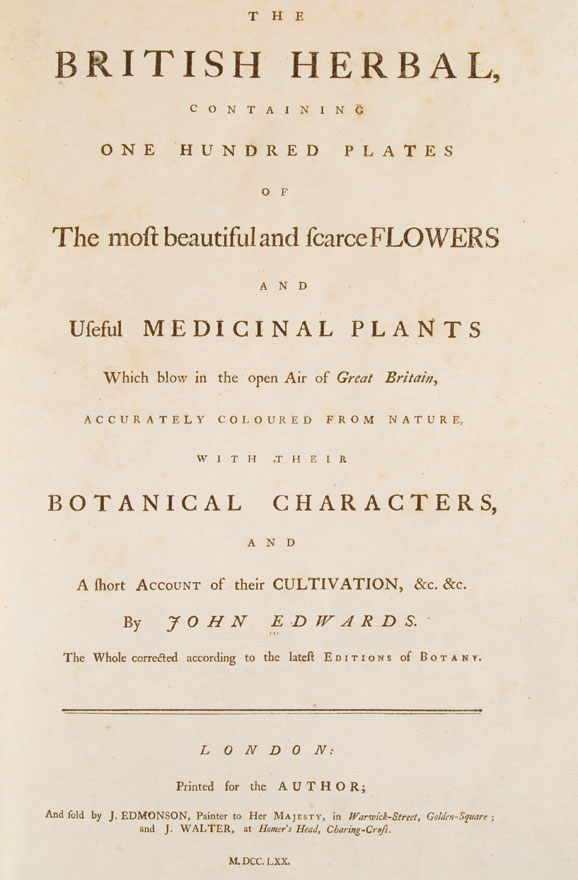
Well now that Spring finally feels like it has arrived, one’s thoughts head into dirt and gardens and plants and herbs, so wanted to share this article from the most recent issue of Colonial Williamsburg: “Uncommon and Expensive” by Mary Miley Theobald, on John Edwards’s The BritishHerbal – you can read it online here:
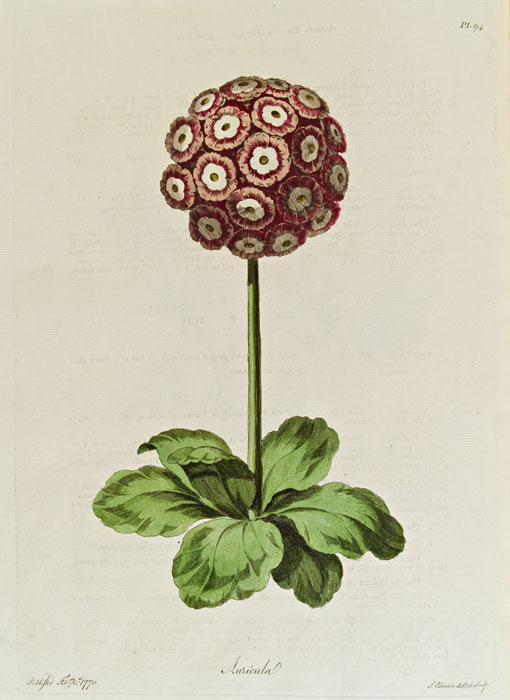
There may be no better guide to the plants that grew in eighteenth-century gardens than The British Herbal, a rare collection of botanicals by artist John Edwards, published in 1770. “It’s one of the most valuable books we have,” said Wesley Greene, garden historian in Colonial Williamsburg’s historic trades department. “It lets us document the sort of plants that were available in the colonial era.” Edwards referenced Linnaeus for every plant, allowing Greene and others to identify species precisely.
Edwards, John. The British Herbal, containing one hundred plates of the most beautiful and scarce flowers and useful Medicinal Plants which blow in the open air of Great Britain, accurately coloured from nature with their Botanical Characters, and a short account of their cultivation. London: Printed for the Author; and sold by J. Edmonson…and J. Walter, 1770.
One wonders if Jane Austen knew this work – there is no mention of it in her letters or novels, nor is it in Gilson’s bibliography as a work known to have been owned by her.
The story of Elizabeth Blackwell’s (1707-1758) creation and publication of this work is an interesting tale – she drew, engraved and colored all the illustrations to accompany the botanical descriptions of her doctor husband in order to pay his debts and effect his release from prison. Many of the plant specimens were from the Chelsea Physic Garden in London. A copy sold at Christies in 2009 for $17,500, and various plates appear at auction periodically.
We do know that Jane Austen knew of Gilbert White, author of The Natural History of Selborne (1789), and whose house, now a museum, was near the Austen’s home in Chawton. The herb garden at White’s house is depicted in Kim Wilson’s In the Garden with Jane Austen [page 98] with a list of the herbs, and you can visit the house and garden site here.
So now into the garden and away from the computer … but will ask, What is your favorite herbal book?
You are Cordially Invited to JASNA-Vermont’s June Meeting
“Trickle-Down Economics in Pride and Prejudice;
Or, Why ‘Mr. Darcy Improves upon Acquaintance’!”
withSheryl Craig*
Sheryl Craig
What Jane Austen’s first readers did not need to be told was that a man named Fitzwilliam Darcy had to be a moderate Whig, one who supported Tory Prime Minister William Pitt’s tax and Poor Law reform proposals, and that Darcy’s home county, Derbyshire, paid high wages, provided generous welfare benefits, and funded the best system of poor houses in England. Thus, Darcy, and moderate Whigs like him, were worthy of both Elizabeth Bennet’s and the reader’s esteem and served as role models to be emulated throughout Georgian Britain and, as it turns out, throughout time.
*****
Sunday, 2 June 2013, 2 – 4 p.m.
Champlain College, Hauke Conference Center,
375 Maple St Burlington VT
~Free & open to the Public~ ~Light refreshments served~
* Sheryl Craig has published articles in Jane Austen’s Regency World, Persuasions, Persuasions On-Line, and The Explicator. She has also written film reviews for the Jane Austen Centre in Bath. Sheryl was JASNA’s International Visitor in 2008, is the editor of JASNA News, and was JASNA’s Traveling Lecturer for the Central region in 2012. She has a Ph.D. in Nineteenth-century British literature from the University of Kansas, has taught at the University of Central Missouri for over twenty years, and is a life member of JASNA.
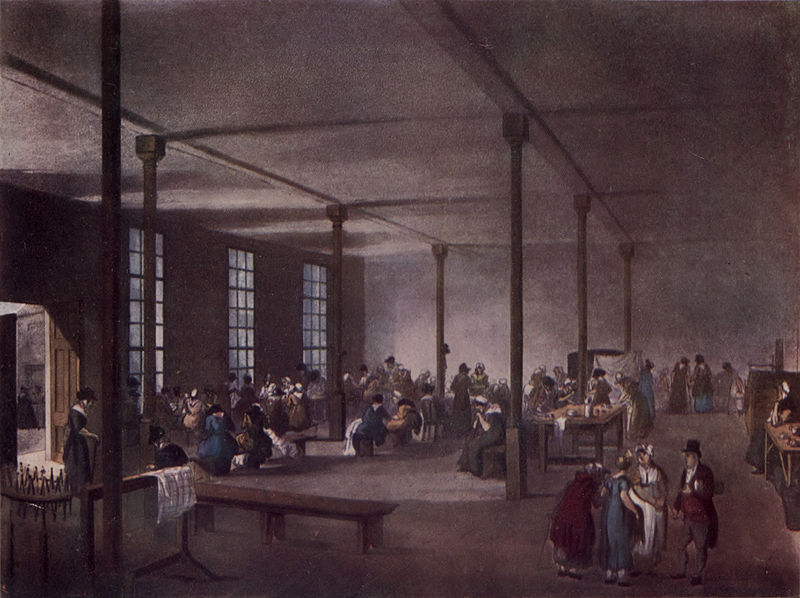
Workhouse at St. James’s Parish – from The Microcosm of London, 1810, [wikipedia commons]
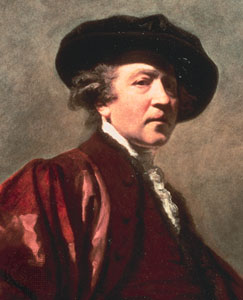
“We have been both to the Exhibition & Sir J. Reynolds’, – and I am disappointed, for there was nothing like Mrs. D. [Darcy] at either. – I can only imagine that Mr. D. prizes any Picture of her too much to like it should be exposed to the public eye. – I can imagine he w’d have that sort [of omitted] feeling – that mixture of Love, Pride & Delicacy.- Setting aside this disappointment, I had great amusement among the Pictures…”
[Jane Austen, Letter 85, Monday 24 May 1813]
Those who have read Jane Austen’s letters are familiar with her comments on visiting London. It has been an ongoing project of mine to figure out where she went and what she did and how she uses the pieces of her London treks in her novels. One of the more interesting and frustrating is her reference to the art exhibit of Sir Joshua Reynolds – what did she see there, other than not finding a portrait of Mrs. Darcy? It has been revealed today that we will now have a chance to see exactly that, sort of following Jane herself around the galleries, as Professor Janine Barchas of the University of Texas at Austin launches What Jane Saw – a complete reconstruction of that exhibit. You will surely want to bookmark this new website and mark your calendars to view the happening on May 24, 2013!
From the website:
On 24 May 1813, Jane Austen visited an art exhibit at the British Institution in Pall Mall, London. The popular show was the first-ever retrospective of the works of Sir Joshua Reynolds (1723-1792), England’s celebrated portrait painter. On 24 May 2013, two centuries to the day that Austen viewed the 141 paintings in that exhibit, this site will open its doors as a public e-gallery, offering the modern visitor a precise historical reconstruction of that long-lost Regency blockbuster.
The Jane Austen in Vermont blog has been silent for the past month, for which I apologize, but as I have now returned somewhat to a “normal” life, I can begin again to obsess on “all things Jane” – blogging, twittering, facebooking, researching, writing, and best of all Reading!
Moving is a nightmare, no matter how organized one might be, and of all my various strengths and weaknesses, the will to organize has always been the driving force; so take the contents of one old house, pack it all up and put it all in storage, and six months later, move all into a new maintenance-free house, and spend the next 3+ weeks unpacking, overdosing on cardboard and paper, as 25,000 pounds (or so the mover tells me) of “stuff” (including my own book collection) finds a place in the new home … so bad back notwithstanding, the deed is done, my books are on the shelves (though alas! not yet fully alphabetized, she says shame-faced), all the drawers and closets are organized, the kitchen is in fine working order (surviving on take-out has become a very nice habit – whoever said I actually needed a kitchen in this new place?), and all the pictures are hung – so “normal” returns in a fashion, and time to get back to real life…
What have I done these past 3+ weeks for my sanity? – the quick break from unpacking, organizing and hammering? I have existed, not only on take-out, but also on the comfort-food of reading mysteries and romance novels – my mind might now be a tad mushy, as I fear the worst in trying to get my head around “game theory” in reading the grandly enlightening Jane Austen, Game Theorist (I promise an author interview shortly, but see in the meantime Michael Chwe’s website here: http://www.sscnet.ucla.edu/polisci/faculty/chwe/austen/ ) – but it has been great fun – so here is my list, all highly recommended as just great reads, and even Jane might approve, as they are each and every one, “only a novel”!
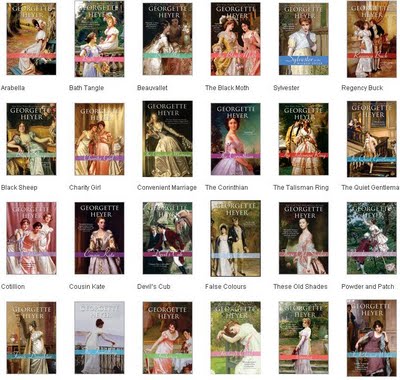
Georgette Heyer: I should add here that for the packing-up part last fall, I re-read all my favorite Georgette Heyers – hard to choose, but I read at least ten all in a row, and can now safely say that I can barely tell one from the other, but the joy of the moment of reading is nearly perfection!
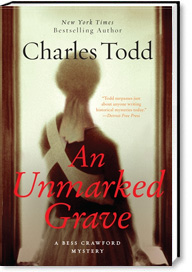
Charles Todd, the Bess Crawford mysteries: I am a fan of the Jacqueline Winspear Maisie Dobbs series , largely because I love the time between the two World Wars, so was happy to discover that the Charles Todd mother-son duo (of Ian Rutledge fame) had started a similar series a few years ago – have read the first three and have just started the latest. The titles in order:
A Duty to the Dead
An Impartial Witness
A Bitter Truth
An Unmarked Grave
– all featuring Bess Crawford, a nurse during WWI, who seems to forever be stumbling headlong into murder and mayhem, as well as the very-helpful-in-a-murder-mystery-plot-device of having veritable strangers tell her the most amazing things – great fun – you must read them in order… and the fact that there is a very close family friend who seems to always be there when needed adds a little spice and anticipation – his name is Simon Brandon, so nice to know that Jane Austen, as always, is in the mix somehow… [I think Knightley would have been too obvious…]
Julie Klassen’s The Tutor’s Daughter: I have read a few of Klassen’s books and find them to be the perfect read, so was happy to take on her latest The Tutor’s Daughter. It does not disappoint: raging Cornwall weather; two brothers with opposite personalities and each with a history with the lively heroine, the nearly-on-the-shelf daughter of the live-in tutor to the two younger sons of the new wife of Sir Giles; add in an old-rambling castle-like home with a wing one is to stay out of and some ghostly goings-on, and you have a fine historical romance that combines Northanger Abbey and Jane Eyre into one delightful confection……
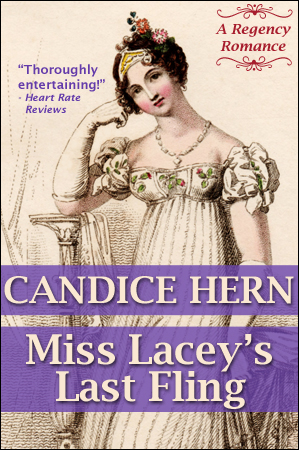
Candice Hern: Thanks to Laurel Ann and her mentions of Ms. Hern, I have read most of the books in the Reading Challenge at Austenprose (though I did not sign up, didn’t think I would have the time! – no matter, it is the reading that counts!): again, each tells a fine regency-era tale with the requisite heroines, rakes, fashions, and settings you will be sure to savor:
A Proper Companion
A Change of Heart
An Affair of Honor
A Garden Folly
The Best Intentions
“Desperate Measures”
“Lady Ann’s Excellent Adventure”
For more information, visit Hern’s website here: http://candicehern.com/ – and be sure to click on the “Regency World” section of her website for a wealth of information about the times of which she writes. And for those attending the Jane Austen JASNA AGM in Minneapolis this year, you will be fortunate to see Ms. Hern’s collection of Regency artifacts on display – she wrote an article on vinaigrettes for the Mar/Apr issue of Jane Austen’s Regency World magazine.
****************
Ok, so all of this made the joys of moving more than bearable – I am almost disappointed to have to return to real life after all – but I am not quite done yet: I will be moving all my Bygone Books business back into the house in the next 2 weeks, so I can keep reading these delightful escapist tales after all – Hern’s Miss Lacey’s Last Fling and Todd’s Unmarked Grave await! and then I shall return to Austen and celebrating Pride and Prejudice, so stay-tuned…
What do you like to read when going through a stressful, energy-intensive time?
Enquiring Readers: Ron Dunning has previously posted here at Jane Austen in Vermont about his invaluable Jane Austen genealogy website. As he continues to research the connections, he is discovering amazing coincidences and some very familiar names. Today he gives some insight into a marriage that took place between a Darcy and a de Burgh in 1329 and speculates on whether Jane Austen could possibly have known about this…
***************
What Jane Might Well Have Known, and What She Couldn’t Possibly Have Known, About Her Ancestors
I’m against making any assumption based on slim evidence, but I’m about to make two; first of all, concerning a great coincidence about which Jane can’t have known anything. In 1329 a marriage took place between John Darcy, 1st Lord Darcy of Knaith, and Joan de Burgh. (The spelling doesn’t matter – even up to the 18th century spellings hadn’t been fully standardised.) Joan’s father Richard de Burgh, 2nd Earl of Ulster, was a direct ancestor of Mrs Austen through her brother John.
Last summer when my Akin to Jane [ www.janeaustensfamily.co.uk ] website was launched one or two people, with admirable perseverance, trawled through my separate family tree [ http://wc.rootsweb.ancestry.com/~janeausten ] and on discovering this marriage, insisted that Jane must have known. I was never in any doubt that she couldn’t possibly have known. This was also the opinion of the only other person who has studied the Austen pedigree extensively, Anielka Briggs.
Dugdale Baronage – Skinnerinc.com
While Baronetages were readily available in the late 1700s, the dignity having been created only in 1611, there were very few studies of the Peerage and all of those were very primitive. William Dugdale’s Baronage of England of 1675 covered only England. (Remember that Joan’s father John de Burgh was the Earl of Ulster; the marriage in question is said to have taken place in County Kildare.)
The Rev. Barlow’s Complete English Peeragewas printed in 1772, so might just have been in George Austen’s library, but again deals just with English peerages. Another possibility, Arthur Collins’s Peerage series*, was first published in 1709, with reprints every few years and frequent new editions. Even he appears not to have included Irish peerages, and in the eight editions that I was able to search, not a single de Burgh featured in the indexes.
Barlow Peerage – Open Library
A further obstacle in the way of Jane’s knowing (or for that matter anyone at the time) is that there was no direct male descent from the de Burghs to the Austens – the surname soon disappeared from Jane’s pedigree, through a series of female links. Traditional pedigrees concentrate on the direct male line.
However, John Darcy did himself play a role in the Austen pedigree – he was a many-greats-grandfather of Charles Austen’s wives, the sisters Frances and Harriet Palmer. John and his first wife, Emmeline Heron, were the ancestors of four generations of male Darcys; Elizabeth Darcy, in the fifth generation, married James Strangeways; and that surname continued down to the Palmer girls’ paternal grandmother, Dorothy Strangeways. In Charles’s children, the Darcy and the de Burgh lines were finally united.
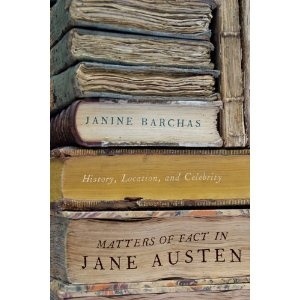
My second assumption concerns what Jane might well have known. Janine Barchas, in her Matters of Fact in Jane Austen, speculates that she, in choosing the names of Darcy, Wentworth, Woodhouse, FitzWilliam, Tilney, etc., was alluding “to actual high-profile politicians and contemporary celebrities as well as to famous historical figures and landed estates.” In the words of Juliet McMaster in the blurb, she was “a confirmed name dropper who subtly manipulates the celebrity culture of her day.” On page 118 Janine Barchas wrote, “Cassandra Willoughby (…) the supposed ancestor of Mrs Austen.” Yes – she’s almost got it. Cassandra was Mrs Austen’s 1st cousin, twice removed.
I think that Jane may well have known about the family relationship and its relevance. Cassandra’s mother Emma (Willoughby and then Child, née Barnard) was Cassandra Leigh’s great-great-aunt; it was Emma’s sister Elizabeth (Brydges, née Barnard) who was her great-grandmother. Elizabeth was also the mother of James Bridges, the Duke of Chandos, who married Cassandra Willoughby – the two were cousins. Emma’s first husband was the noted naturalist, Francis Willoughby; after his death she remarried, to Sir Josiah Child – supreme governor of the East India Company, an early monetarist, and a rapaciously wealthy financier to 17th century royalty. Emma and Sir Josiah’s son Richard Child became the Earl Tylney of Castlemaine, and one of his great-granddaughters was Catherine Tylney-Long.
Barchas speculates that Jane, in naming her Catherine Tilney, had this other Catherine in mind. This lady had inherited a vast estate and fortune in 1794 at the age of 5, and at 18 was reputedly the richest commoner in England. Catherine Tylney was Jane Austen’s 4th cousin. Very few of us have any idea about our fourth cousins, but based on the following circumstantial evidence, I suspect that Jane did know that they were distantly related.
Catherine Tylney-Long – Wanstead HouseWanstead House
There is a strong tradition in the Warwickshire village of Middleton, the seat of Francis Willoughby, that Jane visited there on the trip to Staffordshire in 1806 with her mother and sister. Middleton certainly lies in a direct line, as the crow flies, from their stop at Stoneleigh to Hamstall Ridware, where her cousin was the Rector. If they did visit, it may have been because Mrs Austen knew of the family relationship – she was certainly considered to have been proud of her aristocratic ancestors. The Austens preserved a letter written by Elizabeth Brydges in the 1680s from Constantinople, giving advice to her daughter who had been left behind; I think it likely that she’d have known about Elizabeth’s sister Emma’s illustrious marriages, and have told her daughters.
*********************
Thank you Ron! for all this information [my head is spinning!] – I do wonder what Lady C might say to all this – would she be concerned about the “Shades of Pemberly [being] thus polluted” by any of these illustrious ancestors?
If you have questions for Ron, please comment below.
Just again to prove once again that all roads lead back to Jane Austen, it is interesting here to note that Egerton Brydges edited this 1812 edition of the Collins Peerage – this is Jane Austen’s very own Mr. Brydges, brother to her friend Madame Lefroy. Austen makes much of his novel Arthur Fitz-Albini (1798) in her letter of 25 November 1798:
We have got Fitz-Albini; my father has brought it against my private wishes, for it does not quite satisfy my feelings that we should purchase the only one of Egerton’s works of which his family are ashamed. That these scruples, however do not at all interfere with my reading it, you will easily believe. We have neither of us yet finished the first volume. My father is disappointed – I am not, for I expected nothing better. Never did any book carry more internal evidence of its author. Every sentiment is completely Egerton’s. There is very little story, and what there is [is] told in a strange unconnected way. There are many characters introduced, apparently merely to be delineated. We have not been able to recognize any of them hitherto except Dr and Mrs Hey and Mr. Oxenden, who is not very tenderly treated…. [Letters, No. 12]
“I do not write for such dull elves As have not a great deal of ingenuity themselves.”
– Letters, No. 79
Jane Austen wrote the above to her sister Cassandra on January 29, 1813, the day after Pride and Prejudice is published:
There are a few Typical errors – & a “said he” or a “said she” would sometimes make the Dialogue more immediately clear – but “I do not write for such dull elves As have not a great deal of ingenuity themselves.” [the notes remark that this is from Scott’s Marmion: “I do not rhyme to that dull elf / Who cannot image to himself…”]
She could have as soon written “stupid” for her dull elves, as she does in another place in this letter:
The Advertisement is in out paper to day for the first time; – 18s – He shall ask £1-1 for my two next, & £1-8 for my stupidest of all.
I think Jane Austen liked the word “stupid” – it appears in all her writings: the juvenilia, the novels, the letters – and she uses it to great effect. But I would argue that today the word has a more negative connotation, especially when used to describe a person, as in “he is a really stupid man” vs. “this is a stupid movie.” I have been re-reading Pride and Prejudice very SLOWLY and as always, even on this umpteenth read, I find things that amaze – and this time I find myself dwelling on Austen’s “stupids.”
Rowlandson -VADS online
Many of us can call quickly to mind a few of her more famous lines: You can comment below in the “comments” section with: Which book / who said it / to or about whom:
1. “Not that ______ was always stupid — by no means; she learnt the fable of ‘The Hare and Many Friends’ as quickly as any girl in England.”
2. “The person, be it gentleman or lady, who has not pleasure in a good novel, must be intolerably stupid.”
3. “She is a stupid girl, & has nothing to recommend her.”
4. “She had never seen _______ so silent and stupid.”
5. “_____ is as stupid as the weather.”
6. “I feel quite stupid. It must be sitting up so late last night. _____, you must do something to keep me awake. I cannot work. Fetch the cards; I feel so very stupid. ”
7. “If this man had not twelve thousand a year, he would be a very stupid fellow.”
8. “…that he had been sent to sea, because he was stupid and unmanageable…”
********************
And these are only a small sample of Austen’s ‘stupids’ – there are a number more in each novel – it has been interesting to see how and why she uses this term, more freely thrown about in her letters: – just these few here by way of example:
-“We met not a creature at Mrs. Lillingstone’s, & yet were not so very stupid, as I expected, which I attribute to my wearing my new bonnet & being in good looks” [Ltr. 36],
-“And now, that is such a sad, stupid attempt at Wit, about Matter, that nobody can smile at it, & I am quite out of heart. I am sick of myself, & my bad pens.” [Ltr. 53], and
-“I expect a very stupid Ball, there will be nobody worth dancing with, & nobody worth talking to but Catherine; for I believe Mrs. Lefroy will not be there…”[Ltr. 14]
***************
But today I will focus only on Pride and Prejudice, continuing my closer look at the novel throughout this bicentenary year.
We begin by going back to the source, the OED to see how it has been used and its meanings as Jane Austen would have seen it used: [Oxford English Dictionary: www.OED.com ]
Wits Magazine – illus G. Cruikshank – Project Gutenberg
Adj.
1. a.Having one’s faculties deadened or dulled; in a state of stupor, stupefied, stunned; esp. hyperbolically, stunned with surprise, grief, etc. Obs. exc. arch. (poet.). As in Shakespeare’s Winter’s Tale (1623): Is not your Father growne incapeable Of reasonable affayres? Is he not stupid With Age, and altring Rheumes? Can he speake? heare? Know man, from man?
1. b. Belonging to or characterized by stupor or insensibility. Obs. As in Keats Endymion (1818): “My sweet dream Fell into nothing—into stupid sleep.”
1. c. Of a part of the body: Paralysed. Obs.
1. d. Emotionally or morally dull or insensible; apathetic, indifferent. Const. to [compare French stupide à] – As in Steele in the Guardian (1713): “It was a Cause of great Sorrow and Melancholy to me…to see a Crowd in the Habits of the Gentry of England stupid to the noblest Sentiments we have.”
2. As the characteristic of inanimate things: Destitute of sensation, consciousness, thought, or feeling. Obs. As in 1722 W. Wollaston Religion of Nature (1722) – “Matter is incapable of acting, passive only, and stupid.”
3. a. Wanting in or slow of mental perception; lacking ordinary activity of mind; slow-witted, dull. As in J. Addison Spectator (1712) “A Man, who cannot write with Wit on a proper Subject, is dull and stupid.” And Frances Burney in Evelina (1778): “‘Why is Miss Anville so grave?’ ‘Not grave, my Lord,’ said I, ‘only stupid.’”
3. b. Of attributes, actions, ideas, etc.: Characterized by or indicating stupidity or dullness of comprehension. As in J. Jortin Sermons (1771): “Great reason have we to be thankful that we are not educated in such stupid and inhuman principles.”
3. c. Of the lower animals: Irrational. Also of an individual animal, its propensities, etc.: Lacking intelligence or animation, senseless, dull. Obs. As in Goldsmith History of the Earthand Animated Nature (1774): “[The badger] is a solitary stupid animal.”
4. Void of interest, tiresome, boring, dull. As in: Burney, Evelina (1778): “Of all the stupid places ever I see, that Howard Grove is the worst! there’s never no getting nothing one wants.”
5. Obstinate, stubborn. (north. dial.)
B. noun. A stupid person. Colloq. As in Steele Spectator (1712): “Thou art no longer to drudge in raising the Mirth of Stupids…for thy Maintenance.”
******
If we look at the stupids of Pride and Prejudice, we see all of these definitions in their great variety, but the emphasis is on being tiresome, boring as in number 4 above:
CE Brock – Mollands.net
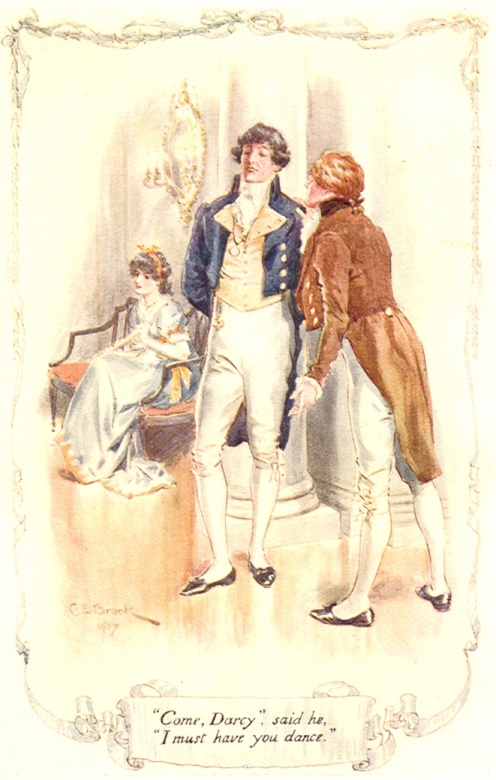
1. “Come, Darcy,” said he, “I must have you dance. I hate to see you standing about by yourself in this stupid manner. You had much better dance.” [vol. I, ch. III]
2. She had been watching him the last hour, she said, as he walked up and down the street, and had Mr. Wickham appeared, Kitty and Lydia would certainly have continued the occupation, but unluckily no one passed the window now except a few of the officers, who, in comparison with the stranger, were become ‘stupid, disagreeable fellows.’ [vol. I, ch. XV]
3. “ Oh! if that is all, I have a very poor opinion of young men who live in Derbyshire; and their intimate friends who live in Hertfordshire are not much better. I am sick of them all. Thank Heaven! I am going to-morrow where I shall find a man who has not one agreeable quality, who has neither manner nor sense to recommend him. Stupid men are the only ones worth knowing, after all.” [vol. II, ch. IV]
from Georgian Index
4. When the gentlemen had joined them, and tea was over, the card-tables were placed. Lady Catherine, Sir William, and Mr. and Mrs. Collins sat down to quadrille; and as Miss De Bourgh chose to play at cassino, the two girls had the honour of assisting Mrs. Jenkinson to make up her party. Their table was superlatively stupid. Scarcely a syllable was uttered that did not relate to the game, except when Mrs. Jenkinson expressed her fears of Miss De Bourgh’s being too hot or too cold .… [vol. II, ch. VI]
5. “Well, he certainly is very agreeable, and I give you leave to like him. You have liked many a stupider person.” [vol. I, ch. IV]
CE Brock – Mollands.net
6. The stupidity with which he was favoured by nature must guard his courtship from any charm that could make a woman wish for its continuance [vol. I, ch. XXII]
7. But why Mr. Darcy came so often to the Parsonage it was more difficult to understand. It could not be for society, as he frequently sat there ten minutes together without opening his lips; and when he did speak, it seemed the effect of necessity rather than of choice — a sacrifice to propriety, not a pleasure to himself. He seldom appeared really animated. Mrs. Collins knew not what to make of him. Colonel Fitzwilliam’s occasionally laughing at his stupidity proved that he was generally different, which her own knowledge of him could not have told her… [vol. II, ch. IX]
8. Wickham will soon be gone; and therefore it will not signify to anybody here what he really is. Some time hence it will be all found out, and then we may laugh at their stupidity in not knowing it before. At present I will say nothing about it.” [vol. II, ch. XVII]
9. Elizabeth was distressed. She felt that she had no business at Pemberley, and was obliged to assume a disinclination for seeing it. She must own that she was tired of great houses; after going over so many, she really had no pleasure in fine carpets or satin curtains. … Mrs. Gardiner abused her stupidity. “If it were merely a fine house richly furnished,” said she, “I should not care about it myself; but the grounds are delightful. They have some of the finest woods in the country.” [vol. II, ch. XIX]
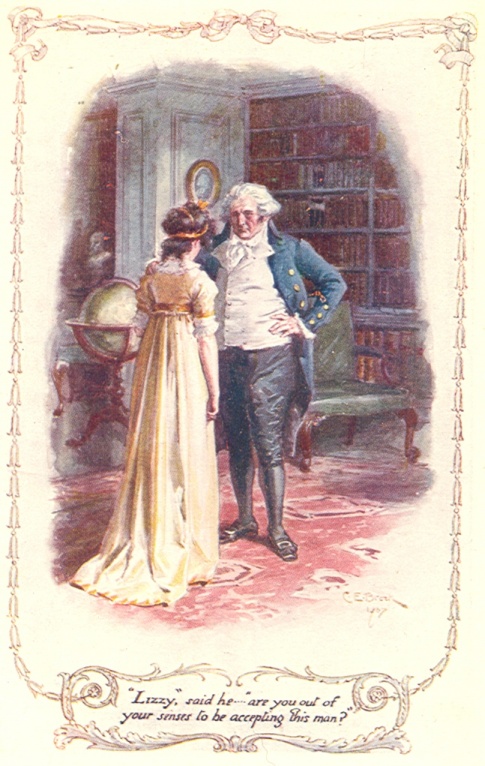
And finally when Mr. Bennet asks Lizzy: “Lizzy,” said he, “what are you doing? Are you out of your senses, to be accepting this man?” – he could as well have called her stupid… [vol. III, ch. XVII]
Note your answers to the eight non Pride and Prejudice quotes at the beginning of this post in the comment area below: how did you do? we shall have no dull elves around here…
“La! You are so strange! But I must tell you how it went off. We were married, you know, at St. Clement’s, because Wickham’s lodgings were in that parish. And it was settled that we should all be there by eleven o’clock. My uncle and aunt and I were to go together; and the others were to meet us at the church. Well, Monday morning came, and I was in such a fuss! I was so afraid, you know, that something would happen to put it off, and then I should have gone quite distracted. And there was my aunt, all the time I was dressing, preaching and talking away just as if she was reading a sermon. However, I did not hear above one word in ten, for I was thinking, you may suppose, of my dear Wickham. I longed to know whether he would be married in his blue coat.
“Well, and so we breakfasted at ten as usual; I thought it would never be over; for, by the bye, you are to understand, that my uncle and aunt were horrid unpleasant all the time I was with them. If you’ll believe me, I did not once put my foot out of doors, though I was there a fortnight. Not one party, or scheme, or any thing. To be sure London was rather thin, but, however, the Little Theatre was open. Well, and so just as the carriage came to the door, my uncle was called away upon business to that horrid man Mr. Stone. And then, you know, when once they get together, there is no end of it. Well, I was so frightened I did not know what to do, for my uncle was to give me away; and if we were beyond the hour, we could not be married all day. But, luckily, he came back again in ten minutes time, and then we all set out. However, I recollected afterwards that if he had been prevented going, the wedding need not be put off, for Mr. Darcy might have done as well.”
“Mr. Darcy!” repeated Elizabeth, in utter amazement.
Pride and Prejudice, v. III, ch. IX
St Clement Danes – Strand (London Views)
Jane Austen often gives clues to the whereabouts of her locations, especially in her London passages – we know she knew London well and placed her characters in just the right spot to tell her readers who they were by where they lived. We famously have a few “____shire”s scattered about regarding the militia, for an element of secrecy one might assume? But in Pride and Prejudice there are two locations that she specifies that bring only confusion, and both involve Wickham and Lydia: St. Clement, where they were married, and Edward Street, home to Mrs. Younge, Georgiana’s former governess and friend and devious helper to Wickham. Today I will deal with the former…
When Lydia remarks that “We were married, you know, at St. Clement’s, because Wickham’s lodgings were in that parish.” – she gives a clue that perhaps contemporary readers would not have found confusing, but we are left with not being completely sure which St. Clements she is referring to: St Clement Danes in the Strand, or St. Clement Eastcheap. Neither is mentioned in her extant letters.
Pat Rogers notes in her 2006 Cambridge edition of Pride and Prejudice that the fairly large parish of St. Clement Danes had a population of 12,000 in 1801 and “contained areas of cheap lodgings and some raffish districts, notably a part of Drury Lane” (531-32). Most who have written on this would agree (see Kaplan and Fullerton cites below), largely because the other St. Clement (Eastcheap), on St. Clement’s Lane between Lombard Street and Great Eastcheap, would have been too close to the Gardiner’s who lived on Gracechurch Street [see maps for location of both churches]. Wickham would not have placed himself in such a smaller parish, with a population of 350 in 1801 (Rogers, 531), and so close to those who might find him out. Another reason that Rogers selects this as the best option is that in order to marry in this parish, one of the parties had to have residence there for fifteen days (Rogers, 532). Laurie Kaplan adds that “the length of time required for residency functions perfectly for the elopement plot of the novel, for tension increases the longer Lydia and Wickham remain unmarried” (Kaplan, 7). But we know Wickham had no mind to marry Lydia … .another story entirely… (the text is very clear on this: Mrs. Gardiner relates to Elizabeth: “…it only remained, he [Darcy] thought, to secure and expedite a marriage, which in his very first conversation with Wickham, he easily learnt, had never been his design.” (357).
But perhaps in the end, we should just abide by Susannah Fullerton, where in her Celebrating Pride and Prejudice, she blames Lydia for the whole confusing mess: “How typical of Lydia to be inexact in her information!” (p. 94-95)
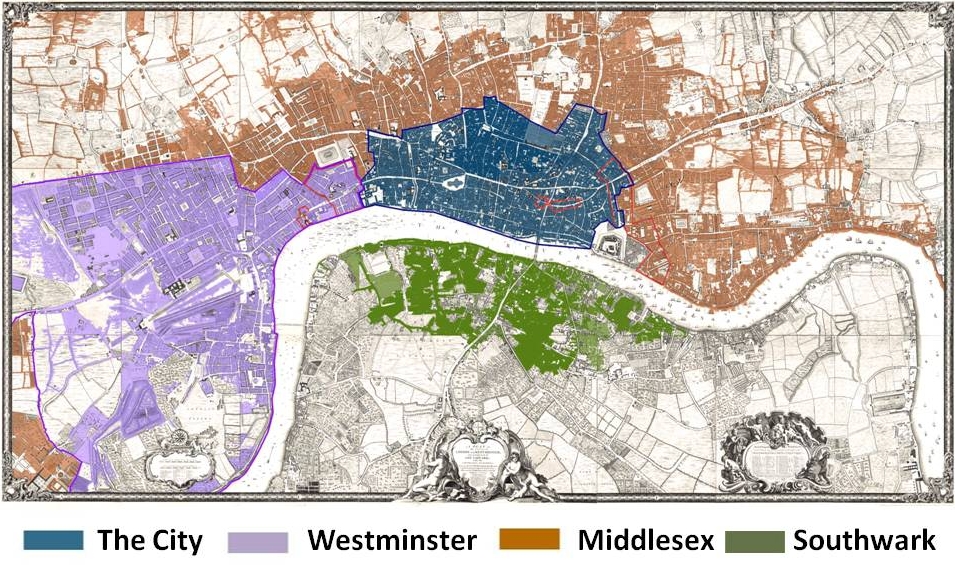
Horwood Map panel 14. [RICHARD HORWOOD – MAP OF LONDON, WESTMINSTER AND SOUTHWARK, 1813] St Clement Danes is located at the heart of London, placed on an island in the middle of the Strand,
opposite the Royal Courts of Justice, the Temple and Fleet Street – on the map above circled in purple.
(Click on map and zoom in; map courtesy of Sue Forgue at Regency Encyclopedia, from the Guildhall Library, London)
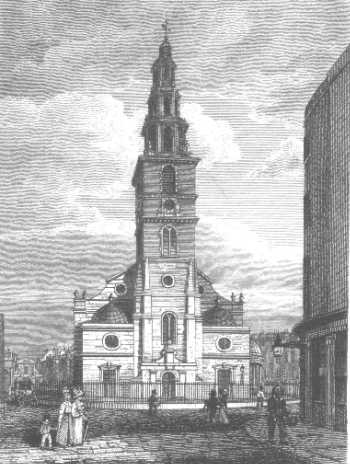
St. Clement Danes: The first church on the site was founded by Danes in the 9th century, and named after St. Clement, patron saint of mariners. It has been rebuilt by William the Conqueror, later again in the Middle Ages, and rebuilt yet again in 1680-82 by Christopher Wren, a steeple added in 1719-20. It was gutted during the blitz, only the walls and tower left standing, and since reconstruction has served as the central church for the Royal Air Force.
An early street view of the Strand and St Clement Danes Church, 1753. On the right is the original entrance to the building.
cTrustees of the British Museum; image from Christina Parolin, Radical Spaces (ANU, 2010).
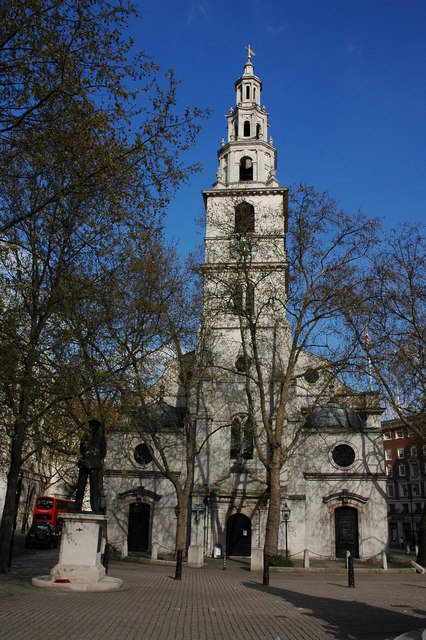
St Clement Danes today: when in London in May 2011 I visited the Church for the first time, finding it a quite lovely and peacful setting on its little island in the midst of bustling London – here are a few shots, alas! not that well focused and no exterior shots of the facade, so I include one from Geograph.org.uk, with thanks.
St Clement DanesSt Clement Danes, interiorSt Clement Danes ceilingflag in St Clement Danes
St Clement Danes exterior – cPhilip Halling, Geograph.org.uk
[A movie aside: You will notice that there are no entrance steps, as there are no steps for St Clements Eastcheap – if you recall from the 1995 movie, Lydia is running up the steps to the church, so neither of these sites were used in the movie [and I find no picture of this scene – if anyone knows where that exterior shot was filmed, please let me know!]
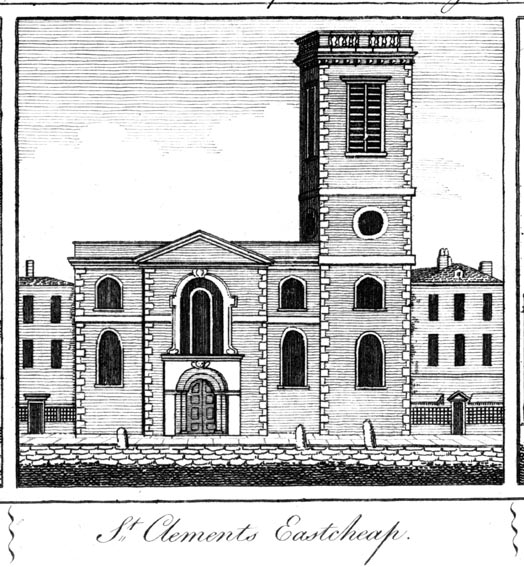
Facade St Clement Eastcheap
c.1760, from Walter Harrison’s History of London (1777) – wikipedia
******************
St. Clement Eastcheap: located on St. Clement’s Lane between Lombard Street and Great Eastcheap [today on Clement’s Lane, off King William Street] and close to London Bridge and the River Thames – see here on the Horwood panel 15:
Horwood Map panel 15. [RICHARD HORWOOD – MAP OF LONDON, WESTMINSTER AND SOUTHWARK, 1813]
The purple marks Gracechurch Street, home ot the Gardiners, and ends at the botton at Great Eastcheap,
go one block to the left to find St. Clement’s Lane, the Church is on the right.
(Click on map and zoom in; map courtesy of Sue Forgue at Regency Encyclopedia, from the Guildhall Library, London)
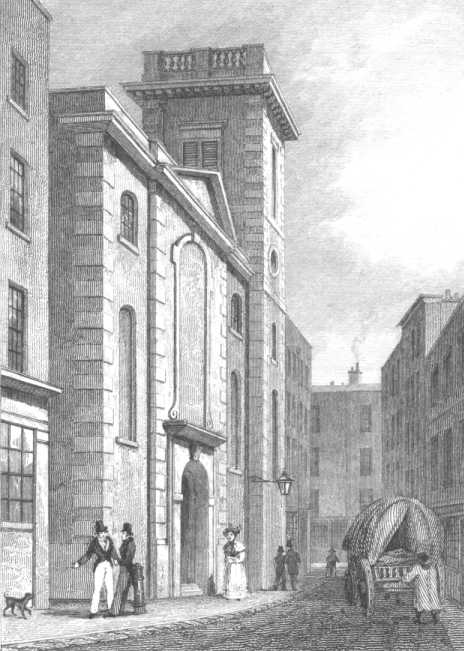
Though we are quite sure that this is not where Austen had Lydia and Wickham marrying, it is still worth noting – perhaps we are wrong in our assumptions after all, and Wickham was just “hiding in plain sight”? This St. Clement has possible Roman origins; it was destroyed in 1666 in the Great Fire of London, and rebuilt in the 1680s and also designed by Wren. And one should note that “cheap” is an old Saxon word meaning “market” and does not mean “cheap” as we associate it today. Here are a few images:
St Clement Eastcheap – London ViewsSt Clement Eastcheap today – wikipedia
The St Clement argument does not just revolve around Jane Austen [and indeed may she just been throwing out a very sly reference to her sailor brothers? – just a thought, St. Clement being the patron saint of sailors] … The Churches apparently have a long-standing “quibble” over which is the St. Clement referred to in the nursery rhyme “Oranges and Lemons” – here is the full rhyme: [the long version from wikipedia: http://en.wikipedia.org/wiki/Oranges_and_Lemons ]. It is the bells of St. Clement Danes that ring out the tune of the rhyme three times a day.
“Oranges And Lemons”, Nicholl Bouvier Games 1874, “The Pictorial World” by Agnes Rose Bouvier (1842 – 1892) – wikipedia
Gay go up and gay go down, To ring the bells of London town.
Oranges and lemons, Say the bells of St. Clements.
Bull’s eyes and targets, Say the bells of St. Margret’s.
Brickbats and tiles, Say the bells of St. Giles’.
Halfpence and farthings, Say the bells of St. Martin’s.
Pancakes and fritters, Say the bells of St. Peter’s.
Two sticks and an apple, Say the bells of Whitechapel.
Pokers and tongs, Say the bells of St. John’s.
Kettles and pans, Say the bells of St. Ann’s.
Old Father Baldpate, Say the slow bells of Aldgate.
You owe me ten shillings, Say the bells of St. Helen’s.
When will you pay me? Say the bells of Old Bailey.
And finally, to bring this back to Jane Austen, where all begins and ends after all, there is behind the St Clement Danes church a statue, by Percy Hetherington Fitzgerald and erected in 1910, of all people, Jane Austen’s very own Dear Dr. Johnson. I think she would be pleased, don’t you?
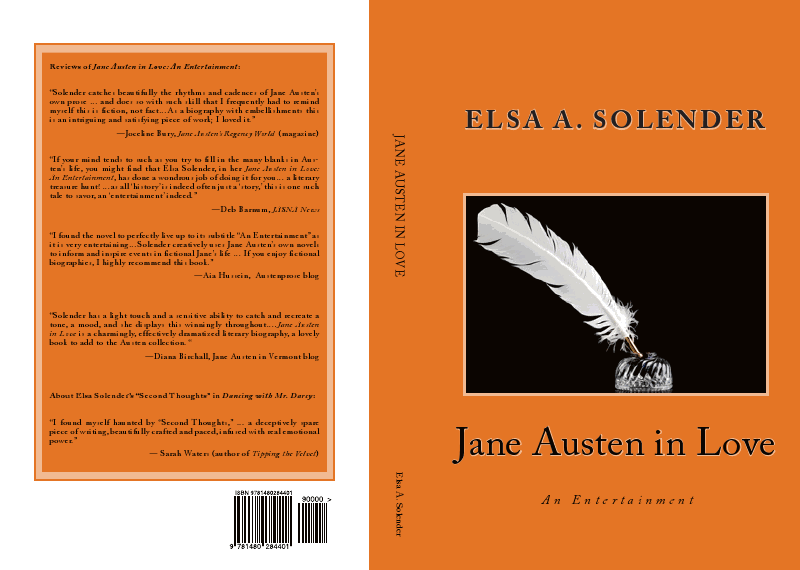
What better way to celebrate Valentine’s Day than to think of Love in Jane Austen terms. I think we can say that it is a “truth universally acknowledged” that Captain Wentworth’s letter to Anne in Persuasion* is the grandest expression of Love in all of literature – who would not want to receive such a letter as this? But what of Love in Jane Austen’s own life? – we know so little; where did Mr. Darcy come from, or any of her other heroes? What of True Love in her own life? We can only imagine… so I lead you to a fine imaginative rendering of ‘Jane Austen in love’ in Elsa Solender’s Jane Austen in Love: An Entertainment. When published last February, it was only available as an ebook, delightful to read but nothing to put upon the shelf. We had to wait until this past December to see it finally published in real book form at Amazon.com.
book cover
At the time of its release as a kindle book, Elsa graciously “sat” for an interview here at Jane Austen in Vermont – you can read that here. And as my review was to be published in the JASNA News (just out in the Winter 2012 issue), I did not post a review of the book on this blog; Diana Birchall very graciously did so for me here. But as my review is now published and available online, I append it here in part and then direct you to the JASNA site for the remainder [Note: all book reviews in the JASNA News are available online from 1998 to the present: click here.] – and Elsa has offered a copy for a book giveaway [see below] in celebration of Valentine’s Day!
Jane Austen in Love: An Entertainment, by Elsa Solender.
Review by Deborah Barnum
Imagine a young Jane Austen reading aloud her History of England, Cassandra sketching Henry as Henry V, their Mother as Elizabeth I, and Jane as Mary Queen of Scots; or young Jane at school nearly dying of typhus; or hearing Jane’s thoughts on first encountering Madame Lefroy; or sparking a laugh from the intimidating Egerton Brydges. Imagine the suitor you might like your Jane Austen to meet by the seaside, she falling madly in love but destined to suffer the pangs of lost love, forever irreplaceable. If your mind tends to such as you try to fill in the many blanks in Austen’s life, you might find that Elsa Solender, in her Jane Austen in Love: An Entertainment, has done a wondrous job of doing it for you.
Ms. Solender, former president of JASNA and a prize-winning journalist, has taken her story “Second Thoughts,” runner-up in the 2009 Chawton House Library Short Story Contest, and expanded this one moment in Austen’s life to other places and times, all through the lens and voice of Cassandra Austen—it is part real, part imaginary, and part Austen’s own fiction, dialogue and story all beautifully woven together in this tribute to love in the life of Jane Austen—her love for her sister, her family, her cousin Eliza, and her mentor and friend Madam Lefroy; her flirtation with Tom Lefroy; the proposal from Bigg-Wither; and her Mysterious Suitor of the Seaside.
About the author: Elsa A. Solender, a New Yorker, was president of the Jane Austen Society of North America from 1996-2000. Educated at Barnard College and the University ofChicago, she has worked as a journalist, editor, and college teacher in Chicago, Baltimore and New York. She represented an international non-governmental women’s organization at the United Nations during a six-year residency in Geneva. She wrote and delivered to the United Nations Social Council the first-ever joint statement by the Women’s International Non-Governmental Organizations (WINGO) on the right of women and girls to participate in the development of their country. She has published articles and reviews in a variety of American magazines and newspapers and has won three awards for journalism. Her short story, “Second Thoughts,” was named one of three prizewinners in the 2009 Chawton House Library Short Story Competition. Some 300 writers from four continents submitted short stories inspired by Jane Austen or the village of Chawton, where she wrote her six novels. Ms. Solender was the only American prizewinner, and she is the only American writer whose story was published in Dancing With Mr. Darcy, an anthology of the twenty top-rated stories of the contest.
Ms. Solender’s story “A Special Calling” was a finalist in the Glimmer Train Short Short Story Competition. Of more than 1,000 stories submitted, Ms. Solender’s story was ranked among the top fifty and was granted Honorable Mention. She has served on the boards of a non-profit theater, a private library and various literary and alumnae associations. Ms. Solender is married, has two married sons and seven grandchildren, and lives in Manhattan.
****************
For Valentine’s Day, Elsa has graciously offered a copy of her book [as she did with her ebook] to the winner of a random drawing – please comment below on what reading Jane Austen has taught you about Love. Or you can pose a question to Ms. Solender. Deadline is Thursday February 21, 2013 at 11:59 pm; winner will be announced the next day. Domestic mailings only [sorry global readers, but our postal service has skyrocketed their overseas prices!]
Thank you Elsa, and good luck everyone!
*********************
‘Placed it before Anne’
[Image: C. E. Brock, Persuasion, vo. II, ch. XI; from Mollands.net]
*Captain Wentworth’s letter: [because I cannot resist]
‘I can listen no longer in silence. I must speak to you by such means as are within my reach. You pierce my soul. I am half agony, half hope. Tell me not that I am too late, that such precious feelings are gone for ever. I offer myself to you again with a heart even more your own than when you almost broke it, eight years and a half ago. Dare not say that man forgets sooner than woman, that his love has an earlier death. I have loved none but you. Unjust I may have been, weak and resentful I have been, but never inconstant. You alone have brought me to Bath. For you alone I think and plan. – Have you not seen this? Can you fail to have understood my wishes? – I had not waited even these ten days, could I have read your feelings, as I think you must have penetrated mine. I can hardly write. I am every instant hearing something which overpowers me. You sink your voice, but I can distinguish the tones of that voice when they would be lost on others. – Too good, too excellent creature! You do us justice, indeed. You do believe that there is true attachment and constancy among men. Believe it to be most fervent, most undeviating, in
F. W.
‘I must go, uncertain of my fate; but I shall return hither, or follow your party, as soon as possible. A word, a look will be enough to decide whether I enter your father’s house this evening or never.’ [Perusasion, Vol. II, ch. XI]
 Don’t miss the first Jane Austen Summer Program —
























 Jane Austen in Vermont
