Author Interviews · Book reviews · Books · Jane Austen · Jane Austen Popular Culture · Regency England

Interview with Louise Allen, Part II ~ Regency Romance, Heroes, and Thoughts on Writing

Book Giveaway! ~ See details at the end of this post.

I welcome again Louise Allen for the second part of my interview about her new book Walks Through Regency London ~ [click here for Part I]

JAIV:  Hello again Louise! – now let’s talk about your fiction: I have to make the embarrassing confession that I have not read any of your Regency romances! Your website says you write “Scandalously witty Regency romance” – how are you different from the other writers in this genre?

LA: I write romance, so obviously there is emotional intensity, but I have a well-developed sense of humour and I don’t enjoy writing about people who can’t laugh at themselves and the situation they find themselves in. A hero who isn’t witty isn’t quite a hero for me and my heroines, who all have a bit of me in them somewhere, are more likely to find the light side of any disaster, pick themselves up and carry on. And scandalous? Well, I’m told I write “hot” historicals – which means that I tend to have slightly older, more experienced and/or less conventional heroines who might have convincingly amorous encounters.

JAIV: What book would you suggest a “newbie” start with? [I promise to order a copy right away!]

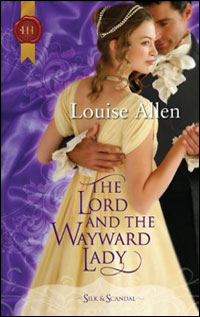
LA:  Well, I’ve just won a CataRomance Reviewer’s Choice Award for The Lord & the Wayward Lady which is the first of a series of eight books I wrote with five other authors. I also wrote the seventh in the series, The Officer and the Proper Lady which I have to confess is a favourite of mine. Or you might like to start with a trilogy which comes out in the States later this year (August, September, November) – “The Transformation of the Shelley Sisters.” The first one is Practical Widow to Passionate Mistress.

JAIV:  You have several stand-alone titles and several titles in series – which do you prefer to write? Is it hard to let a character go when there is no sequel in the wings?

LA:  I do enjoy being able to stretch myself over a series and I love revisiting characters from earlier books. And yes, I hate letting my characters go! But it does make scheduling problems and there is more flexibility and variety with stand-alone books. My next one will be a singleton and I’m just starting it. Mills & Boon is producing a series set in historical houses owned by the National Trust, linking a fictional romance with real events and people, and I’m lucky enough to have been asked to do one. I’ve chosen Wimpole Hall in Cambridgeshire. When I’ve completed that I’ll be writing one set entirely in India in the 1790s.

JAIV:  This National Trust series sounds intriguing! Are any of your other characters based on historical figures?

LA:  I will occasionally have real characters “walking on” – the Prince Regent or Wellington for example – but all my heroes and heroines are entirely fictitious. I try very hard to make sure historical events take place as the records show and I’m not making people act out of character.

JAIV:  What is your writing process? – do you plan ahead or as you have said yourself do “the Hero and Heroine take over and sabotage all your efforts at discipline”?

LA:  I’m what is known in the business as a “pantser” – I fly by the seat of my pants into the fog – rather than being a planner. But I need to know my characters very well before I start, then I put them in a situation and I hope I can keep control of them!

JAIV:  Do you have a favorite character? – the Hero? The Heroine?

LA:  I need to be able to identify with the heroine – and hope my readers will too. And I have to be a little bit in love with the hero (luckily my husband is secure about this!). Some heroes though, stay with me – Hal Carlow in The Officer and the Proper Lady and Jack Ryder in The Dangerous Mr Ryder for example.

JAIV:  What makes a great Hero? A great Heroine?

LA:  My heroes have to be men of honour, even if sometimes that is buried rather deeply. They must have courage – physical and moral – and they need an edge of darkness, of danger. And a sense of humour, of course! Great heroines have the reader living the book with them – and I wish there was a recipe for achieving that. I know I’ve succeeded when my editor says (in a good way) “ was in tears over x or y”.

JAIV:  Do you believe in the transformation of the Rake, his redemption? –

LA:  That depends on the rake. There were some genuinely unpleasant and vicious Regency rakes. I believe that a man who has, for good reason, become cynical and cold and destructive can be redeemed by love, but there are things I wouldn’t countenance in one of my heroes.

JAIV:  How do you come up with names? Ravenhurst, Carlow, etc…

LA:  What a good question – I wish I knew the answer! I tell my subconscious to get on with it and end up with lists and jotted notes on every scrap of paper. Then I have to try them out and see what works. Sometimes a character insists on a different name and I have to give in.

JAIV:  If you were giving advice to budding writers, what would it be?

LA:  Write, write, write – you have to learn technique and you have to build your writing “muscles”. Listen to constructive advice from agents, publishers, published writers and think about what they are saying. But never over-polish your work so that you lose you unique “voice”.
JAIV:  Your covers – do you have input or is this out of your hands?

LA:  Out of my hands!


UK cover


US cover


                                                                   JAIV:  You mention that your last work is part of a “continuity series” of eight books written by six different authors. How ever did you all come together in such a task? And how different was the writing process for your two books in this series? – what are the other titles and authors, and should the series be read in order?

LA:  The editors at HMB in Richmond, London, put us together – we didn’t know each other so it was a sharp learning curve. Fortunately we got on very well together, which was a good thing as we had to come up with the over-arching mystery that links the books, all the characters and eight plots ourselves, subject to editorial approval. For me it meant I had to plan far more than I usually do and the process was slower as we were all writing at the same time and constantly checking back and forth to ensure continuity of plot and characterization, especially as we were all using each other’s characters. But it was a wonderful experience and we are still firm friends. The books can be read alone, but if read in order you also get to follow the mystery through to its conclusion. In order they are:

The Lord & the Wayward Lady (Louise Allen)

Paying the Virgin’s Price (Christine Merrill)

The Smuggler & the Society Bride (Julia Justiss)

Claiming the Forbidden Bride (Gayle Wilson)

The Viscount & the Virgin (Annie Burrows)

Unlacing the Innocent Miss (Margaret McPhee)

The Officer & the Proper Lady (Louise Allen)

Taken By the Wicked Rake (Christine Merrill)

JAIV: I am interested in your current “work in progress” – to be set in India – you have recently visited to inspire you and help in your research – I had the good fortune to visit India a few years ago and was so moved by the beauty of the people and the culture – what were your impressions? And what works are your reading for your historical research?

LA:  As I said above, this is now the book after next. I went to India last year and used some of that experience in my “Danger & Desire” trilogy (out in the States next year) but I wanted to do one set there entirely, and rather earlier than I usually write – the late 1700s. I love India, even at its most chaotic, and Rajasthan where we were in January had the most incredible palaces and forts, many of which we stayed in. I’m reading through a pile of quite academic material on the East India Company but I found William Dalrymple’s The White Moghuls very inspiring and for light relief there is always William Hickey – Memoirs of a Georgian Rake.

JAIV:  What is the most essential tool in marketing your work?

LA:  Constant contact with readers is paramount. I keep my website up to date, I tweet and I’ll do talks wherever and whenever I can. Next week I’m speaking at a US base in Norfolk!

JAIV:  And finally a question about the publishing aspect of books vs. Kindle [etc.] – I see that many of your works are available in the ebooks format – have you seen an increase in sales because of this?

LA:  I love books, but I love my Kindle too and I’m really pleased that many of my out of print books are becoming available in e-formats. It is too early to say what impact it is having on sales, but I don’t think there is any option other than to go along that route. Having said that, I can’t see the paper book dying any time soon, thank goodness.

JAIV:  And finally, what do you like to do when not writing??!

LA:  I read voraciously, travel, go antiquing, garden and talk endlessly to other writers.

JAIV:  Anything else you would like to say?

LA:  Thank you very much for having me! And do get in touch if you are coming to London – I’d love to meet members of your Society.

JAIV:  Thank you Louise for sharing your thoughts with us – You have been most generous with your time!  To All: Please look for my review of  Walks Through Regency London in Friday’s post.

Your turn! – if anyone has any questions of Louise, please ask away! – see details for the book giveaway below… You can visit Louise’s website here  and find her on Twitter @LouiseRegency

If you would like to order the Regency Walks book, you can do so directly from her website – I can attest to the book being mailed right away, arriving safe and sound and very quickly!

Book Giveaway:  Please enter the drawing for a copy of Walks Through Regency London, compliments of ‘Jane Austen in Vermont’, by asking Louise a question or commenting on any of the three posts about this book.  Drawing will take place next Wednesday 2 March 2011; comments accepted through 11 p.m. EST March 1st.  [Delivery worldwide.]

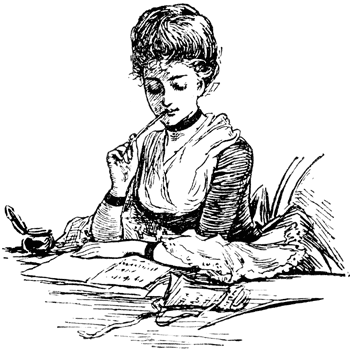
[All images from Louise Allen’s website, except the letter-writing sketch which seems to be everywhere…]

Copyright @2011, Deb Barnum, at Jane Austen in Vermont.

Author Interviews · Book reviews · Books · Jane Austen · Jane Austen Popular Culture · Regency England

Interview: Part I ~ Walking around Regency London with Louise Allen

NOTE:  Book giveaway! ~ see the end of this post for details!

 Please welcome author Louise Allen today as she answers questions about her new book on Regency London.  Louise is a very successful writer of historical Regency romances, over thirty-five titles to date!  Her interest in all things Regency is fed by constant research into the period, as well as the development of a fine collection of prints and ephemera from the era – all this to help in her writing. In December 2010 she released her first non-fiction work titled Walks Through Regency London [available direct from her at louiseallen [dot] regency [at] tiscali [dot] co [dot] uk


JAIV:  Thank you Louise for joining us here in Vermont today! I was so pleased to get your new book on Regency London hot off the press! – I ordered two copies and gave one to another London-obsessed friend and she is most enjoying your book!…we only wish we could both be in London together and exploring Town with your book in hand, rather than this armchair traveler thing! – hopefully, sometime soon…we’re working on it!

JAIVSo first, tell us something about yourself.

LA:  Thank you very much for inviting me to join you – it is great to be in Vermont, even if only in cyberspace! I live in the East of England with my husband and we are about to move even further east, to a cottage on the North Norfolk coast. I was first published back in 1985 and for years I wrote alongside my full-time job as a property manager, but for the last three years I’ve been writing full-time and I love it.

JAIV:  When did you first discover your love of the Regency period? Why this time and place?

LA:  I think I first became aware of it when reading Georgette Heyer as a teenager. I’ve always been an historian – I studied landscape history, historical geography and archaeology at university – but it took me a while to settle on the “long” Regency as a period to write in. My first book was set during the English Civil War of the 17thc but my editor encouraged me to look at the Regency and I fell in love with it. I think it is because it occupies a transitional place between the agricultural and aristocratic world of the 18thc and the rapid technological change and urbanization of the Victorian era. Boundaries are always interesting and complex and it is also sufficiently different and yet recognizable, which makes it fascinating to write about. And I’m English, so English history felt right.

JAIV:  Did you read Jane Austen as well as Georgette Heyer? – do you re-read them? Which are your favorite titles, if it is possible to choose?

LA:  Yes, to both authors and yes to re-reading. Austen – I love Pride & Prejudice, but I find Sense & Sensibility more interesting. I was at Jane Austen’s house at Chawton last year and it was very moving to walk in her garden and to see her tiny writing table. Heyer favourites? The Grand Sophy and also The Toll Gate, which isn’t everyone’s choice, but I’m tall, so I identify with the heroine!

JAIV: You obviously use London and the London social scene in your fiction, and the need to be accurate has led you to amass a great deal of research through the years – hence your “Walks” book – what first prompted you to pull all this together and publish it?

LA:  My husband and I love walking, and we love London, so it was no hardship to start exploring when I wanted to check details. Then we got hooked and started exploring specific areas – when I looked at my notes and our photos I realized that I had the makings of a book.

JAIV:  You cite the 1807 The Picture of London guidebook as your main source. What other books did you use? – there are so many works on London – which are your favorite and why?

LA:  I use the 1807 guide because it is fun to take it for a walk where it must once have gone with its Regency owner – it is the real thing, much used and slightly battered. We also take the invaluable A-Z of Regency London published by the London Topographical Society. Their historical A-Zs are a brilliant resource. When I checked my shelves just now I found I have 55 reference books on London, so it is a problem to pick out just a few, but I would say The London Encyclopedia (published by Macmillan) is an essential. Peter Ackroyd’s London: The Biography is full of fascinating, unusual and often downright weird information and Dan Cruickshank’s book on the sensual life of London The Secret History of Georgian London is about so much more than sex.

JAIV:  What are your favorite haunts in London, for both Regency times and the present?

LA:  The St James’s area is the best preserved Georgian/Regency quarter. Soho is endlessly fascinating – so many layers of history. The City, although it has been leveled by the great fire and then again by the Blitz still preserves its medieval street patterns and modern office blocks must contort themselves to fit the shape of some ancient workhouse or monastery cloister. You can even see the curved walls of Newgate Prison fossilized in the shape of an ultra modern building. But it is hard to find a part of London that isn’t interesting if you are prepared to be very nosy!

JAIV:  The book is fact-filled and anecdotal, and culled from so much available information – how did you decide what to include and what not to include?

LA:  It was a nightmare! I had enough material for twenty walks, but I tried to chose ones that gave a variety of experiences, which were all about 2 miles long and which could be split up if walkers wanted to have a shorter route or spend more time in a museum.

JAIV:  Did you discover anything surprising in your research and exploration? Something you did not already know?

LA:  It wasn’t so much new facts that I found but places which gave me a real frisson of excitement: the 1820s operating theatre where you can see the marks of the surgeons’ saws on the table; the last galleried coaching inn left in London; the great scales in Berry Bros & Rudd where Byron used to weigh himself; having a drink in Tom Cribb’s own pub and exploring the back alleys behind Almack’s which were once filed with high-class brothels and gambling dens. Perhaps the most unexpected discovery was in a Chinese supermarket in Soho – walk past stacks of dried herbs and fish, bags of rice and look up and realize you are in a very old house indeed – and in the back is still the sweeping 18thc staircase. This is the Turk’s Head coffee-house and Dr Johnson and Joshua Reynolds were just two of the great men who  socialized here.

[Image of Samuel Johnson: Johnsonese.com]

JAIV:  The illustrations in your book are from your own collection. What other ephemera from the era do you look for? When did you start becoming a serious collector? – and did your writing come first or vice versa?

LA:  The writing came first then the more I wanted to know about the period, the more I would look for items from it. I collect fashion prints 1790-1820, prints of London from Ackermann’s Repository, coaching and sporting prints, bills and invoices, playbills and anything else that I can get my hands on. I started buying fashion prints when I stubbed my toe on a box of over thirty, all framed, under the table at an auction. I got them for a song and as the porter staggered out to the car with them he said, ‘Bloody hell, madam, you don’t half buy in bulk!’ He didn’t know how true it was, I’m afraid – I’ve got about 1,000 prints now.

[Charles Street]

JAIV:  Where are your favorite haunts to find items? How do you categorize and store them?

LA:  On-line and live auctions, antique fairs and antique shops are all good places to search, but auctions are the most productive. I store them in archival-quality binders on acid free paper, or have them framed by a specialist framer using acid-free mounts. I arrange the fashion prints by date, the London prints by street and everything else by subject.

JAIV:  You bring the Regency so to life! – better to have this guide while actually walking around London – but even so this journey of readinghas been delightful… Which of your walks is your favorite? – what is your favorite part of London?

LA:  Thank you! I enjoy them all – it depends on my mood. If I am feeling like high society and shopping, Mayfair and St James’s are best. Hyde Park is great for a good walk, Soho is vibrant and slightly edgy and the City surprisingly dark and sinister.

JAIV:  The process of writing fiction and non-fiction is quite different – explain the process for writing this Walks book.

LA:  I was very conscious the whole time that I had to make this crystal-clear for people to follow. It would have more than doubled the cost if I’d included maps, so users needed to be able to do without, or use it in conjunction with an ordinary pocket map. Then, once I had plotted each walk out on a modern map it was a question of picking out the relevant points of interest or short snippets of interesting information and weaving them in with the directions – and then re-walking to check every turning and fact.

JAIV:  Do you have another non-fiction Regency-era book in the works?

LA:  We are tracing the original route of the Great North Road, the main coaching route between Edinburgh and London – but not on foot! This is great fun and needs a lot of detective work and old maps. I see this one as possibly being a Kindle book rather than a print one.

JAIV:  Thank you Louise for joining us today for Part I of this interview! Louise is happy to answer any of your questions, so please ask away!

Stay tuned: Part II  tomorrow where I continue this interview with Louise on her Regency Romances and her thoughts on writing; followed by Part III, a book review of Walks Through Regency London

You can visit Louise’s website here and find her on Twitter @LouiseRegency

If you would like to order the Regency Walks book, you can do so directly from her website – I can attest to the book being mailed right away, arriving safe and sound and very quickly!

Thank you again Louise for joining us today – looking forward to continuing our discussion  tomorrow!

Book Giveaway:  Please enter the drawing for a copy of Walks Through Regency London, compliments of ‘Jane Austen in Vermont’, by asking Louise a question or commenting on any of the three posts about this book.  Drawing will take place next Wednesday 2 March 2011; comments accepted through 11 p.m. EST March 1st.  [Delivery worldwide.]

[All images excepting Dr. J from Louise Allen’s website]

Copyright @2011, Deb Barnum, at Jane Austen in Vermont.

Jane Austen · Regency England · Social Life & Customs

Travel in Sense & Sensibility ~ Part V ~ Carriages ~ Regency Sports Cars!

We have looked at travel and the various carriages of the Regency Period in four previous posts.  You can re-visit them here:

R. Havell – Roe, Sporting Prints

Now the fun part – on to the Regency sports cars! – those carriages that Austen assigns her young men and her rakes, those vehicles that Georgette Heyer made famous in her works, driven by all manner of her Regency bucks, and in many cases by her independent heroines.  We start with the Phaeton, the last of the four-wheeled vehicles but much more stylish than the larger, practical coaches we have looked at previously…    


Phaeton (Georgian Index)


The Phaeton:   termed “deliciously dangerous”

  • from the Greek “to shine” – in Greek mythology, the boy who tried to drive the sun chariot
  • a light 4-wheeled carriage with open sides in front of the seat; the front wheels were usually smaller that the rear
  • sleigh-like single body, for two passengers, luggage below
  • some had a folding top [a calash or callech = folding top] – a fair-weather carriage
  • for pleasure driving, it is owner-driven with no box or postillion
  • usually 1-2 horses or ponies
  • the largest and most varied of all pleasure carriages, the phaeton remained popular until the end of the carriage era
  • often called a “chaise” in England, a “cabriolet” in France
  • variations:  High-Perch Phaeton or “High-Flyer” – fast, sport driving with two horses – the favorite of the Prince Regent, later George IV who had six horses!  –  he used a low Phaeton after his weight increased to such a degree that he could not get into the high carriage!
  • Who in Austen?:  only Miss DeBourgh who has a pony phaeton; Mrs. Gardiner wants “a low phaeton with a nice little pair of ponies”  
Phaeton – NY Coachmakers

Two fashionable ladies in a “high-Perch Phaeton” driving about to see and “be seen”: 


High-Perch Phaeton


************ 

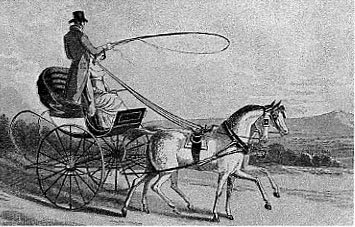
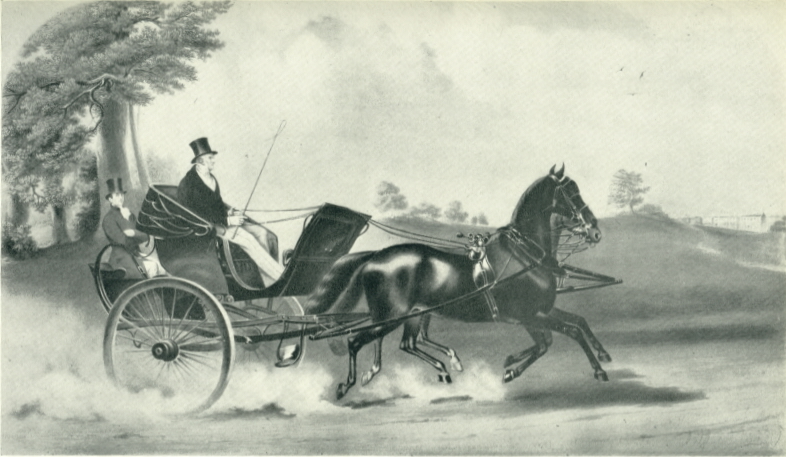
The Curricle: [only English] – the “Regency sports-car”

  • name from the Latin: curriculum = running course, a (race) chariot
  • a two-wheeled vehicle driven by a pair of horses that are perfectly matched, a bar across the back of the horses to carry the pole
  • has a folding hood
  • owner-driven, holds two passengers
  • C-springs – after 1804, equipped with elliptical springs
  • the popular Regency show-off vehicle – for long distances or park rides
  • cost @ 100 pounds
Curricle

A picture of the Marquis of Anglesey:


Curricle (Georgian Index)


In Sense & Sensibility: Willoughby has a curricle though he cannot afford it:

-Willoughby on Colonel Brandon:  “He has found fault with the hanging of my curricle…”     

-Narrator on the carriage drives:  …they might procure a tolerable composure of mind by driving about the country.  The carriages were then ordered.  Willoughby’s was first, and Marianne never looked happier that when she got into it.  He drove through the park very fast, and they were soon out of sight; and nothing more of them was seen till their return, which did not happen till after the return of the rest.   “Did not you know,” said Willoughby, “that we had been out in my curricle?” 
[Willoughby to Mrs. Jennings]

-then later, Marianne explains the impropriety to Elinor: “We went in an open carriage, it was impossible to have any other companion.”

Who else in Austen? – Mr. Darcy, Henry Tilney [sigh!], Charles Musgrove, Walter Elliot, Mr. Rushworth, and Charles Hayter; and Austen’s brother Henry Austen [see Letter 84, where Henry drives Austen back to London in his “Curricle”].


********** 

The Gig:  

“Many young men who had chambers in the Temple made a very good appearance in the first circles and drove about town in very knowing gigs” 


Chair back gig


  • Similar to the curricle, but more popular and economical; women could easily drive
  • Two-wheeled, but pulled by one horse, two passengers, owner-driven
  • Better suspension, easy to turn, more sophisticated than a chaise [often called a “one-horse chaise”]
  • Had various names and modifications:  the Dennet, Tilbury, Stanhope
  • one common variation:   a single seat behind the box for a groom, or a tiger
  • cost:  about 58 pounds
  • Who else in Austen?  the Crofts in Persuasion– they offer Anne a ride in their 2-passenger seat; Mr. Collins, Sir Edward Denham in Sanditon  
Persuasion – Croft’s gig (Jane Austen’s World)

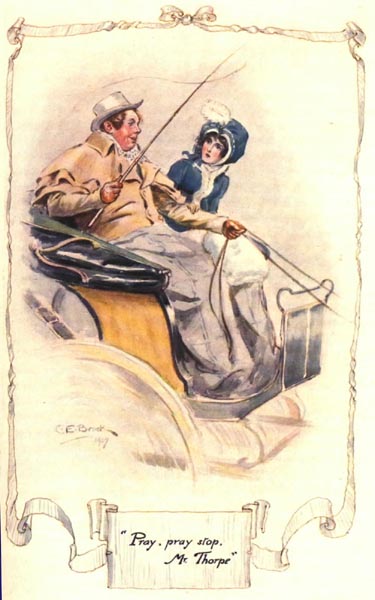
-and of course, John Thorpe in Northanger Abbey, the most horse-obsessed character in all of English literature!

Brock – NA (Molland’s)

“I defy any man in England to make my horse go less than ten miles an hour in harness… look at his forehead; look at this loins; only see how he moves; that horse cannot go less than ten miles an hour: tie his legs and he will get on.  What do you think of my gig, Miss Morland? a neat one, is not it?  Well hung; town built; I have not had it a month… curricle hung you see; seat, trunk, sword-case, splashing boards, lamps, silver moulding, all you see complete; the iron-work as good as new, or better… etc. on and on! 

-And the Narrator who must have her say, so we know just how Catherine and the Narrator feel about John Thorpe [and Henry Tilney!]:

“A very short trial convinced her that a curricle was the prettiest equipage in the world…But the merit of the curricle did not all belong to the horses; – Henry drove so well, – so quietly – without making any disturbance, without parading to her, or swearing at them; so different from the only gentleman-coachman whom it was in her power to compare him with! – To be driven by him, next to being dancing with him, was certainly the greatest happiness in the world.”

[ Brock, Northanger Abbey (Molland’s)]
————————–
In Sense & Sensibility, there are many instances where Austen does not name the specific carriage:  we can assume by the context that it was a post-chaise or owner-owned chaise:

-the Narrator on Colonel Brandon when he leaves to get Mrs. Dashwood: “The horses arrived before they were expected, and Colonel Brandon…hurried into the carriage; it was then about twelve o’clock” [he returns the following day sometime after 8pm]

When Willoughby travels from London to Cleveland, a distance of about 124 miles, he is in a chaise with four horses, it takes 12 hours, 8am – 8pm, a trip that would normally take two days:

-the Narrator on Elinor:  …she heard a carriage driving up to the house … the flaring lamps of a carriage were immediately in view.  By their uncertain light she thought she could discern it to be drawn by four horses; and this, while it told the excess of her poor mother’s alarm, gave some explanation to such unexpected rapidity.  – [and she runs downstairs to find it is Willoughby…!


******

Other Carriage terms:  not all are found in Austen 

  • Hackney = for hire, often discarded carriages of the wealthy
  • Dog Cart = a gig with a ventilated locker for dogs; for 4 people, 2 behind the driver seat back-to-back
  • Sulky = driver-only – one passenger, one horse
  • Tandem = a two-wheeled carriage drawn by 2 horses one in front of the other – Sidney Parker in Sanditon 
  • Whiskey or Chair – an early chaise; a light 2-wheeled vehicle without a top, in The Watsons 
  • Sedan-Chairs  – a seat in a box with 2 poles 10-12 ft long, carried by two men. In efforts to lessen the crowded streets in London, but by 1821 there were only a half dozen public sedans, by 1830 there were none.

  • “Britzochka” = German origin, most common of all carriages, for traveling [ called a “Brisker” or “Briskey”]
  • “Droitzeschka” = “Drosky” – Russian origin, low to ground for “the aged, languid, nervous persons and children”

 And finally, what did Jane Austen have? 

  • At Chawton she had a donkey cart
  • Henry Austen had a curricle and a barouche:  

“The Driving about, the Carriage [being] open, was very pleasant. – I liked my solitary elegance very much, & was ready to laugh all the time, at my being where I was. – I could not but feel that I had naturally small right to be parading about London in a Barouche.”  [Ltr. 85, 24 May 1813, p. 213-14] 

I love to think of Austen “parading” around London and enjoying her “solitary elegance” and laughing all the while! – one of my favorite passages from her letters…

Final post:  a Carriages Bibliography ~ Stay tuned!

Copyright @ 2011, Deb Barnum, of Jane Austen in Vermont

Austen Literary History & Criticism · Books · Jane Austen · Jane Austen Popular Culture · Regency England · Social Life & Customs

In Praise of Margaret Sullivan (and Her Henry Tilney)

A few words of praise for Margaret Sullivan, famed “Editrix” of Austenblog, developer of Molland’s, personal blogger at Tilney and Trap Doors, and authoress: 

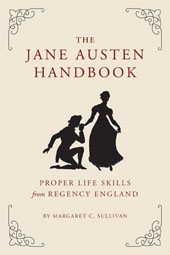
Her Jane Austen Handbook, first published in 2007 will be re-released in early March 2011 by Quirk Books.  Note that this is not a new edition; it has the same content with just a change in the subtitle from “A Sensible Yet Elegant Guide to Her World” to “Proper Life Skills from Regency England”.  There is a new cover design and a change from turquoise to a cocoa brown for text and illustations.  The illustrations by Kathryn Rathke are a delight.  All text and references are exactly the same, alerting you to such important concerns as:

  • How to Become an Accomplished Lady
  • How to Identify the Quality
  • How to Write a Letter [with directions on the proper fold]
  • How to Become Known as a Valuable Neighbor
  • How to Marry Off Your Daughter
  • How to Decline an Unwanted Proposal of Marriage
  • How to Behave at a Dinner Party 
  • How to Get Rid of Unwanted Guests

Certainly all necessary rules of etiquette we could all still learn and apply today ~ I for one do lament the loss of the letter-writing culture…!

An Appendix includes a short biography of Austen, a page summary of the novels and other works, and a few words on the film adaptations.  A short list of Resources, a very select Bibliography, a Glossary and index round it all out. 

If you didn’t get this book the first time around, don’t miss out again – it is a  must-have addition to your Austen collection – fun and informative [card games, dances, fashion, needlework, all manner of Regency social life and customs!], and filled with Sullivan’s well-known wit:

It is a truth universally acknowledged that in this world there are haves and have-nots.  Some are born to marry a man with ten thousand a year and have jewels and pin money second to none; some are destined to teach that woman’s children and be patronized by her servants.  In the sad event that you are forced to seek employment, here are a few acceptable ways for you to do so.  All are ill-paid and unpleasant in their own way and should be avoided if at all possible.   [She then outlines the following]

  •  Governess
  • Schoolteacher
  • Companion
  • Lady’s Maid
  • Authoress

[The Jane Austen Handbook, p. 87-88] 

Fortunately for us, Sullivan chose the latter, perhaps because, as her dedication so lovingly conveys, “For my mother, who let me read everything.”  We should all follow such sage advice!

**********************

I am late to the table one this one, but here ‘s another shout-out about Sullivan’s also recently re-published novella There Must Be Murder, a sequel to Northanger Abbey – as noted in her article in the latest JASNA News (Vol. 26, No. 3, Winter 2010), it is available from Librifiles.com  as a hardcopy [also at Amazon] and as a free ebook from Girlebooks.com  .  [It is also available on the Jane Austen Centre website where it was first published.]

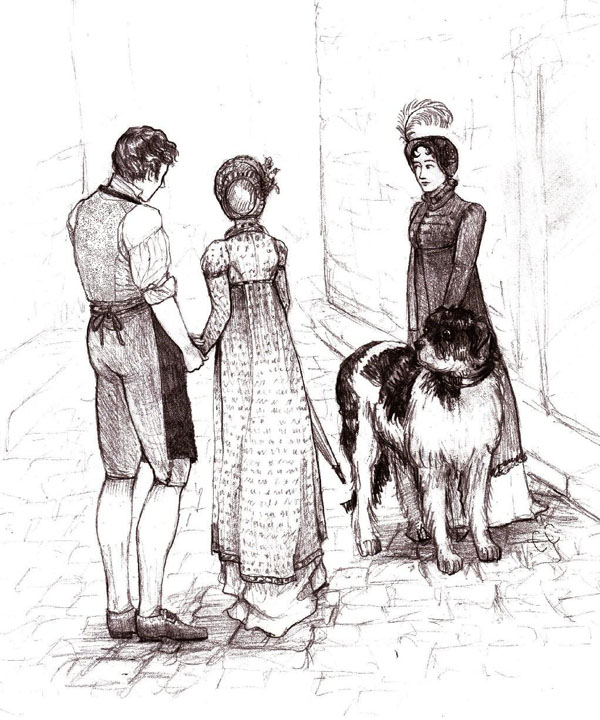
So I added this to my Kindle and have had the most enjoyable time with Henry and Catherine as they return to Bath shortly after their marriage – filled with Tilney’s expected wit and humor, Catherine’s laughing at her own efforts to not be temped into gothic thinking, an almost romantic General Tilney pursuing a lovely Bath widow, a possible rival for Henry’s attentions, a fair bit about Henry’s newfoundland much appreciated by dog-lovers everywhere, and a possible murder indeed [no spoilers here!].  The illustrations by Cassandra Chouinard are a perfect accompaniment to this fun read – who can resist a few hours with Henry Tilney! ~  highly recommended.

[illustration from the Jane Austen Center website]

 Further reading:

Copyright @2011, by Deb Barnum, at Jane Austen in Vermont

Jane Austen · Jane Austen Circle · Regency England · Social Life & Customs

Thomas Lawrence Visits Yale in New Haven

The “Thomas Lawrence: Regency Power and Brilliance”  exhibit that closed in late January at the National Portrait Gallery in London, will be opening on February 24 [through June 5, 2011] at the Yale Center for British Art in New Haven, CT.  For those of you, like me, who were unable to catch this in London, now is your chance – not to be missed, certainly for any Jane Austen fan in good standing!  – [and thankfully, not too far from me! – I will post my thoughts after seeing it…]

Sarah Barrett Moulton - Pinkie

This is from the Yale Center for British Art website:

Thomas Lawrence: Regency Power and Brilliance will be the first substantial examination of the artist in the United States since 1993 and the first Lawrence exhibition in the United Kingdom since 1979. It will include the artist’s greatest paintings and drawings alongside lesser-known works in order to provide a fresh understanding of Lawrence and his career. The show will also contrast his approach to sitters according to age and gender; juxtapose his public identity with the private world of the artist’s studio; explore Lawrence’s technical innovations as a draftsman and painter; and place him within the broader contexts of the aesthetic debates, networks of patronage, and international politics of his day. The exhibition will bring visitors “behind the scenes” to explore Lawrence’s working methods and the importance of his studio as a workspace, a social space in London, and a space for the display of Lawrence’s own works and his stellar collection of Old Master drawings.

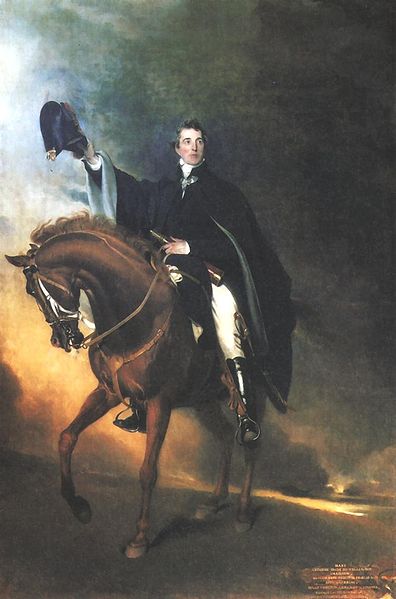
Spanning the scope of the artist’s career, the exhibition closely examines the Regency period, a time defined by the political and cultural role played by George IV (1762-1830), who was Prince of Wales between 1789 and 1811, and then, successively, Prince Regent (during his father’s illness between 1811 and 1820), and crowned king after his father’s death. The exhibition begins with a restaging of Lawrence’s first definitive Royal Academy success in 1790, where he showed Elizabeth Farren (Metropolitan Museum of Art) and Queen Charlotte (National Gallery of Art, London). A display of works from Lawrence’s controversial exhibitions from the 1790s will follow, including Arthur Atherley (Los Angeles County Museum of Art), which challenged traditional notions of masculinity. The next section will examine the period from 1805 to 1815, during which the artist experienced financial and emotional turmoil and created his most innovative and experimental group portraits and half-history portraits. Lawrence was sent abroad by the Prince Regent to paint the victors of Waterloo between 1818 and 1820, and a section of the exhibition will feature portraits such as Arthur Wellesley, 1st Duke of Wellington (private collection) and Charles William (Vane-)Stewart, later 3rd Marquess of Londonderry (National Portrait Gallery, London), as well as the innovative chalk-on-canvas drawings he made during his travels. 

Duke of Wellingon on Copenhagen

Another display will include some of his best works on paper, ranging from friendship portraits and commissioned portrait drawings to sketches of historical events, such as the treason trial of John Thelwall (National Portrait Gallery, London). Sparked by a drawing of his studio in 1824 (Yale Center for British Art), the last section of the exhibition will explore new paradigms of masculinity and femininity in Lawrence’s later work and also examine the importance of his portraits of children. The section proves definitively that Lawrence continued to challenge himself as an artist even in the last decade of his career. This display will also highlight an important portrait of the young Julia Peel (private collection), which will be shown exclusively in New Haven. Yale Center for British Art Director, Amy Meyers, asserts, “A critic once wrote of Lawrence’s work that ‘The magic of his art is thrown around the representations of the most ordinary things.’ We are thrilled to be able to share this magic with visitors drawn to the show by the beauty of Lawrence’s paintings, by interest in the period of the Napoleonic wars, and by the changing representations of gender roles in Lawrence’s work.” 

Beginning as a child prodigy working in pastels, Thomas Lawrence succeeded Sir Joshua Reynolds as Britain’s greatest portrait painter. While lacking in formal and artistic education, he rose to the highest ranks of his profession and was appointed President of the Royal Academy in 1820. With the temperament and flair to capture the glamour of the age, Lawrence created the image of Regency high society with dazzling brushwork and innovative use of color. He became not only the most popular chronicler of fashionable London society, but also one of the most lauded (and imitated) portraitists in Europe. Under his brush, portraits emerged that were both startlingly modern, yet grounded in historical forms. They owed their popularity to the fact that Lawrence represented his sitter’s idealized social persona, and also attempted to capture in paint a visual representation of their inner life and character. 

Thomas Lawrence: Regency Power and Brilliance has been curated by A. Cassandra Albinson, Associate Curator of Paintings and Sculpture at the Yale Center for British Art, and Peter Funnell, 19th Century Curator and Head of Research Programmes, and Lucy Peltz, 18th Century Curator, at the National Portrait Gallery, London. 

The exhibition is accompanied by a fully illustrated book, edited by A. Cassandra Albinson, Peter Funnell, and Lucy Peltz, with essays by Albinson, Funnell, and Marcia Pointon. The book has been published by the Yale Center for British Art in association with Yale University Press and will be available for purchase in the museum shop.

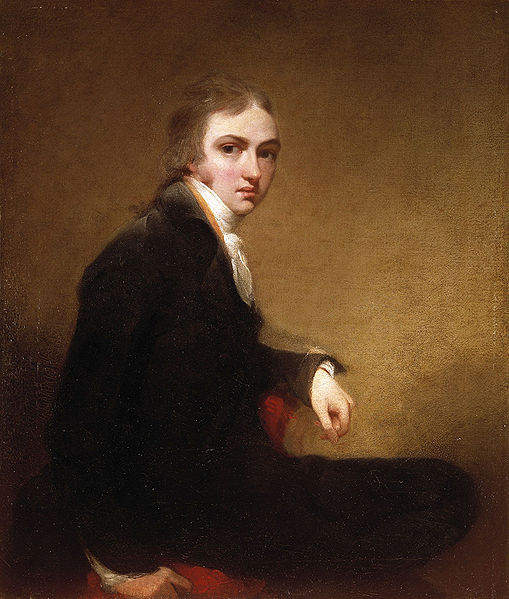
Self-Portrait - Thomas Lawrence

 [Images from Wiki-Commons]

Further reading:

Copyright @2011 Deb Barnum of Jane Austen in Vermont

Jane Austen · Jane Austen's Letters · Regency England

Snow on the Ground! ~ ‘What is to Become of Us?’

Jane Austen on March 7, 1814, from London to Cassandra in Chawton:

Monday.  Here’s a day! – The Ground covered with snow!  What is to become of us? – We were to have walked out early to near Shops, & had the Carriage for the more distant. – Mr. Richard Snow* is dreadfuly fond of us.  I dare say he has stretched himself out at Chawton too.

Ltr. 98, 5-8 March 1814, p. 259 [Le Faye]

*Le Faye notes Austen’s use of the mythical personifications of winter weather: Jack Frost and Dick Snow [perhaps another reason she does not like the name “Richard”?] 

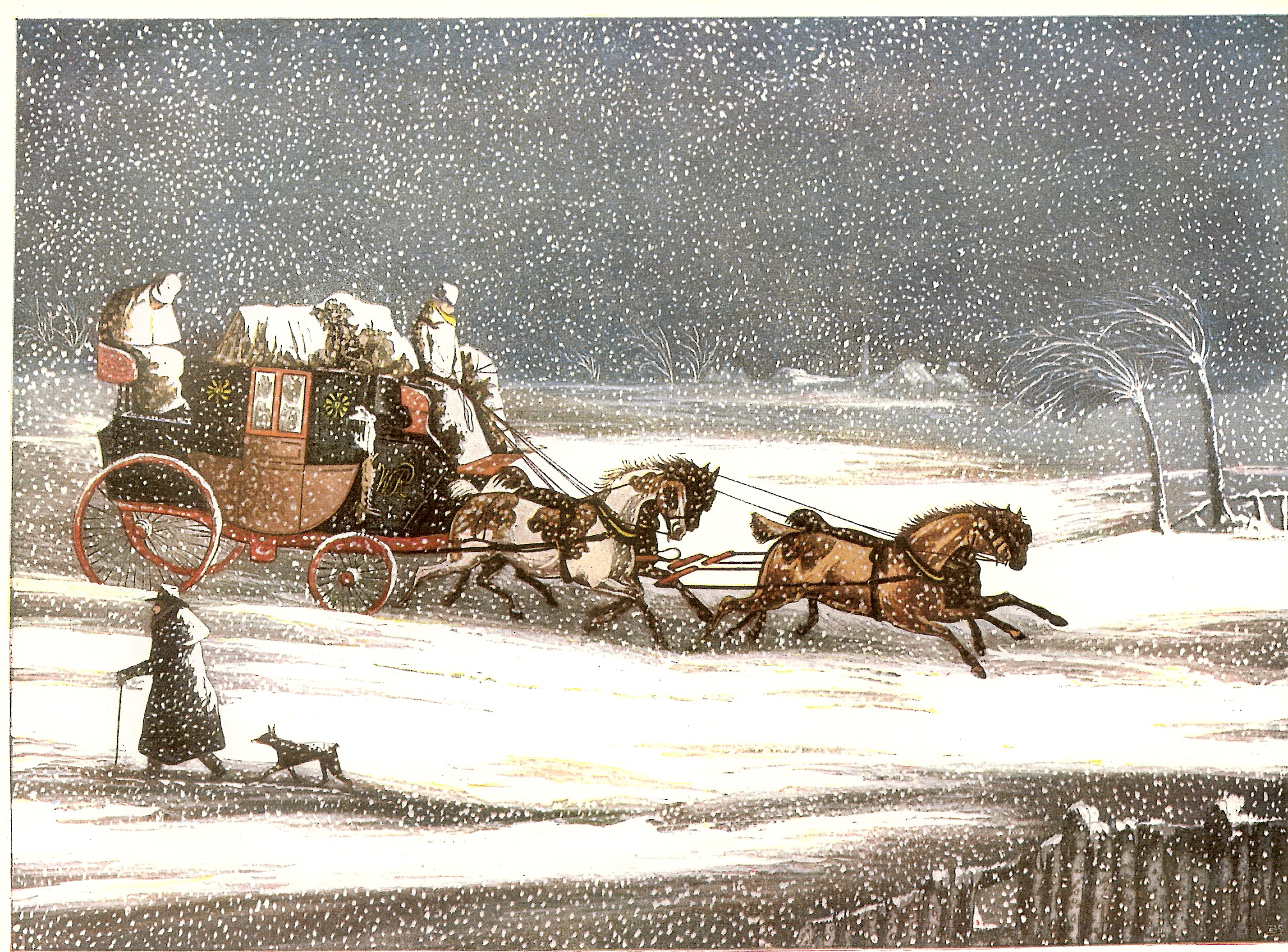
The Brighton Mail, Sunday, December 25th 1836 (R. Havell)


Here’s my own take on the “Ground covered in snow! – What is to become of us?” indeed!”

Picnic anyone?


Image:  F. Gordon Roe, Sporting Prints of the Eighteenth and Early Nineteenth Centuries.  NY: Payson & Clarke, 1927.

Copyright @2011, Deb Barnum, of Jane Austen in Vermont

Austen Literary History & Criticism · Jane Austen · Regency England · Social Life & Customs

The ‘Sense & Sensibility’ Bicentenary Celebration

Maria Grazia at My Jane Austen Book Club is hosting a year-long celebration of the 200 year anniversary of the publication of Sense & Sensibility. Maria has invited twelve other Austen bloggers [including yours truly] to each post an article on Austen’s first published work.  Here is Maria’s invitation and the schedule:

October 2011 will mark the bicentenary of the publication of Jane Austen’s Sense and Sensibility. This is why ‘My Jane Austen Book Club’ wants to  dedicate a special space to the celebration and discussion of Austen’s first achievement as a published writer. I have invited some expert Janeites to contribute to the discussion and they have kindly and generously accepted . Katherine at November’s Autumn  and Gaskell Blog contributed the cute button on the left. Each month one of them will deal with a theme, a character, a topic somehow linked to Sense and Sensibility. The discussion will be open to you all with your comments, questions and suggestions. There will be a monthly giveaway and you will have the chance to win a book or DVD connected to our celebration. Here’s the schedule of our  virtual meetings. Take notes.

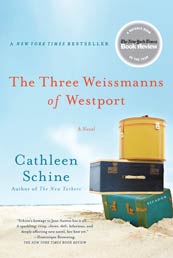
 1.  January“Marriage & Money in Sense & Sensibility” by Jennifer Becton – this article is now live on Maria’s site – If you comment  and leave your e-mail address on this first post or/and on the announcement of the Grand Event for Sense and Sensibility Bicentenary, you’ll be entered in the giveaway of The Three Weissmans of Westport by Cathleen Shine. This novel,  published by Picador,  is a new modern re-telling of Jane Austen’s Sense and Sensibility – this giveaway is for US readers only  but there will be others open worldwide. It ends 31st January.

  Stay tuned for:

2.  February – “Sense and Sensibility on Screen” by Alexa Adams

3.  March – “Inheritance Laws & Their Consequences in Sense & Sensibility” by C. Allyn Pierson

4.  April – “Lost in Sense & Sensibility” by Beth Patillo

5.  May – “Willoughby: A Rogue on Trial” by Jane Odiwe

6.  June – “Secrets in Sense & Sensibility” by Deb Barnum of Jane Austen in Vermont

7.  July – “Interview with Lucy Steele” by Laurie Viera Rigler  

8.  August – “Settling for the Compromise Marriage” by Regina Jeffers

9.  September – “The Origins of S&S: Richardson, Jane Austen, Elinor & Mariannne”  by Lynn Shepherd                           

10.  October – “Sense & Sensibility Fanfiction” by Meredith of Austenesque Reviews 

11. November – “Minor Characters in Sense & Sensibility” by Vic of Jane Austen’s World

12.  December – “Marianne Dashwood: A Passion for Dead Leaves & Other Sensibilities”  by Laurel Ann of Austenprose  

********************

A  year chock full of  S&S insights! – so check back to read these sure-to-be-interesting posts on S&S and a chance each month to win the latest giveaway.

There are also other Sense & Sensibility celebrations and blog tours – I will post on these another day – in the meantime, check out Jennifer Becton’s post on  “Marriage & Money in Sense & Sensibility”  at My Jane Austen Book Club.  With hearty thanks to Maria for setting this up!

Copyright @ 2011, Deb Barnum at Jane Austen in Vermont.
Books · Jane Austen Circle · Regency England · Social Life & Customs

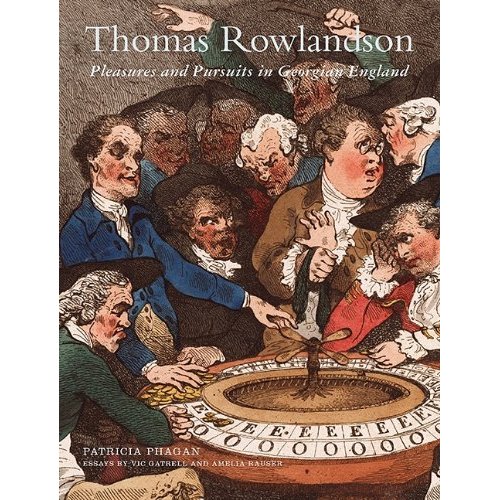
Book thoughts ~ ‘Thomas Rowlandson: Pleasures and Pursuits in Georgian England’

On my TBO* list:  with a release date of January 16, 2011 [as per Amazon; publisher release date is February 2011]

Thomas Rowlandson: Pleasures and Pursuits in Georgian England, by Patricia Phagan; essays by Vic Gatrell and Amelia Rauser.  Published by D Giles LTD in association with the Frances Lehman Loeb Art Center, Vassar College, Poughkeepsie, NY, 2011.

This illustrated volume which presents 72 watercolors, drawings, prints and illustrated books to reassess the legacy of this renowned 18th-century satirist. Accompanies the first major exhibition of Rowlandson’s work in North America for twenty years, showing at the Mary and Leigh Block Museum of Art, Northwestern University, Evanston, Illinois, Jan 14, 2011 – March 13, 2011 and the Frances Lehman Loeb Art Center, Vassar College, Poughkeepsie, April 8, 2011 – June 11, 2011 [Click here for information on the exhibit]  

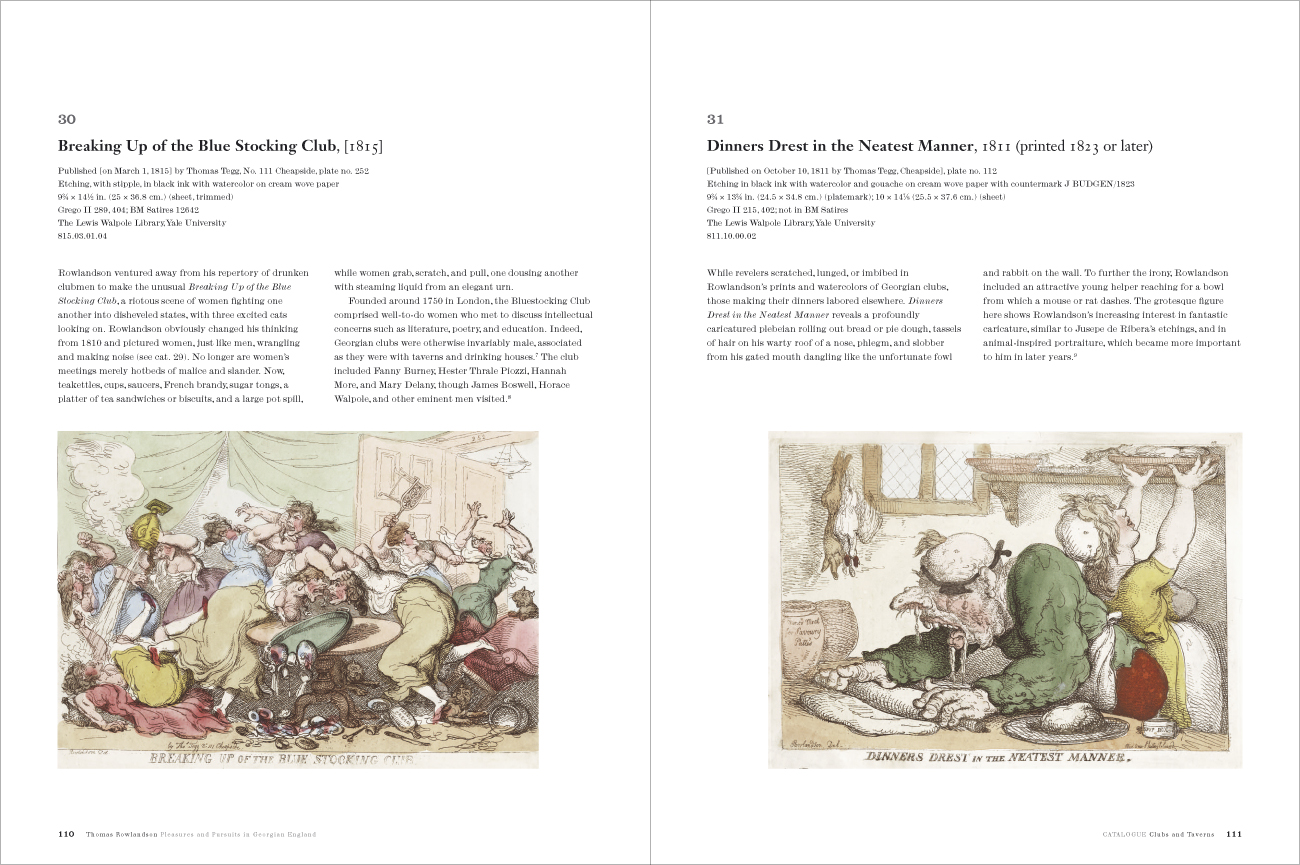
Thomas Rowlandson - Pages 110-11

[Click on to enlarge]

About the authors: 

Patricia Phagan is Philip and Lynn Straus Curator of Prints and Drawings at the Frances Lehman Loeb Art Center and the co-author of ‘The American Scene and the South: Paintings and Works on Paper, 1930-1946’ (1996) and ‘Images of Women in Seventeenth-Century Dutch Art: Domesticity and the Representation of the Peasant’ (1996).

Vic Gatrell is Life Fellow of Gonville and Caius College, Cambridge, and the author of ‘City of Laughter: Sex and Satire in Eighteenth-Century London’ (2006) [fabulous book!] and ‘The Hanging Tree: Execution and the English People 1770-1868‘ (1994).

Amelia Rauser is Associate Professor of Art History at Franklin and Marshall College, Lancaster, Pennsylvania, and author of ‘Caricature Unmasked: Irony, Authenticity and Individualism in Eighteenth-Century English Prints’ (2008). [from Amazon]

 See the publisher’s website at:  D Giles LTD; and Amazon.com   

            ISBN-10: 1904832784
            ISBN-13: 978-1904832782

*To Be Ordered

Copyright @ 2011, Deb Barnum, Jane Austen in Vermont

Fashion & Costume · Jane Austen · Regency England · Social Life & Customs

How the Fashion-obsessed Jane Austen Would Love What’s Under My Christmas Tree!

Two books I have wanted found their way under my Christmas tree by way of Santa and his sleigh.  These are books to savor, perhaps even drool over on these cold dark winter nights! Here is just a quick summary: 

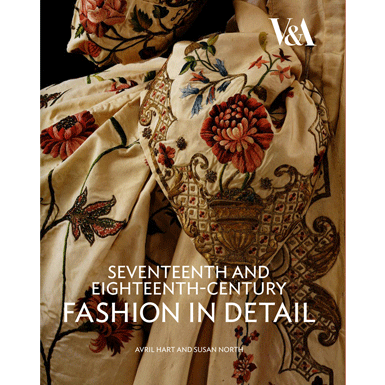
Seventeenth and Eighteenth-Century Fashion in Detail, by Avril Hart and Susan North.  Photographs by Richard Davis; Drawings by Leonie Davis.  London:  V&A Publishing, 2009.  [First published by V&A in 1998 as Historical Fashion in Detail from the 17th  and 18th Centuries].  ISBN 978 185177 567 5

From the introduction:  

These remarkable photographs of the V&A’s collection of historical dress capture the essence of each stylish garment, opening up new perspectives on high fashion between 1600 and 1800.  Offering a lively survey of fashionable patterns, fabrics and colours, the images depict a wide variety of styles and effects, from the minimalism of mid-18th-century white-work to the flamboyant excesses of high Baroque flowered silks…

Each chapter offers close-up photographs showing the varied details of dress, accompanied by line drawings and a full description of each piece.  I give as an example the description of “long sleeves” in the chapter on “Collars, Cuffs and Pockets”:   

Long sleeves in women’s dress became fashionable in the 1780s, and with them, new ways of fastening and decoration at the wrists.  In this very simple cotton gown from the late 1790s, the sleeve is closed with a narrow band of fabric, edged with piping, which fastens with hook and eye. 

While the pattern of the fabric is similar to that of the jacket on the left, the crispness and precision of the English printed cotton seen contrasts with the loose, flowing execution of the Indian printed fabric.  Block-printing on cotton began in England in the 1750s, imitating designs of imported Indian fabrics.  The pattern of floral trails seen here exhibits a blend of influences from Indian-painted and printed textiles, and rococo woven silks, a style which remained popular until the end of the century.  [Pictured is a woman’s gown of printed cotton, English, 1795-1799, followed by sleeve detail]  [p. 94-95]


Austen of course was concerned about her longs sleeves:  “I wear my gauze gown today, long sleeves & all; I shall see how they succeed, but as yet I have no reason to suppose long sleeves are allowable … [and later] … Mrs. Tilson has long sleeves too, & assured me that they are worn in the evening by many.  I was glad to hear this.– ” [Ltr. 99, 9 March 1814]

Chapters included: 

  • Stitching, Seams, Quilting and Cording
  • Gathers, Pleats and Looped Drapery
  • Collars, Cuffs and Pockets
  • Buttons
  • Trimmings
  • Applied Decoration
  • Slashing, Pinking and Stamping
  • Knitting, Lace and Openwork
  • Stomachers
  • Gloves and Shoes
  • Glossary and Select Bibliography 

**************** 

The great overlap of the 18th and 19th centuries meant that Santa had to do double duty and also leave the Nineteenth-Century Fashion in Detail, by Lucy Johnston, with Marion Kite and Helen Persson.  Photographs by Richard Davis; Drawings by Leonie Davis.  London:  V&A Publishing, 2009 [first published, 2005].  ISBN: 978 18177 572 9. 

Many of the Influences, innovations and stylistic changes that shaped nineteenth-century fashion are brought to life by the garments illustrated in this book.  The delicate embroidery on neo-classical gowns, elegant tailoring on men’s coats, vibrant colours of artificial dyes and profusion of ornate trimmings reveal some of the details which make this period so rich.  They also show how a woman’s silhouette was transformed during this era through whalebone corsets, cage crinolines, bustles and skilful garment construction…. [Introduction, p. 7]

Again, each piece of clothing is presented with a photograph, a line drawing, and a full description .  Chapters included: 

  • The Male Image
  • Historicism
  • Romantic Styles
  • Exoticism
  • Innovations
  • Construction Details
  • The Natural World
  • Glossary and Select Bibliography 

Two quite amazing books, filled with sumptuous detail, lovely patterns and fabrics, showing the clothing of the fashion-conscious middle and upper class men and women of these times.  If you have any interest in fashion, these definitely need to be added to your collection!  Thank you Santa for paying attention and seeing how much I needed these!  Makes one want to drag out the sewing machine…

P.S. There is another book in this series, titled, Underwear Fashion in Detail – [V&A Publishing, 2010] perhaps Santa was too embarrassed to bring this one?

Illustrations from the V&A website.  Books are available at the V&A online Shop, and also available at other booksellers.

Copyright @Jane Austen in Vermont, 2008-2010.

Austen Literary History & Criticism · Book reviews · Books · Collecting Jane Austen · Jane Austen · Literature · Regency England · Social Life & Customs

Book Review ~ “Jane Austen and Children” by David Selwyn

To be at the beginning of life, one must start at the end of the novel.  For although Jane Austen concludes her books with the marriage of the hero and heroine to which the whole thrust of the narrative has been leading, and the reader rejoices in the perfect happiness of the union, in reality the best is yet to come: they will have children – procreation  being not only the natural and desirable end of marriage, but also an economic and dynastic necessity.  And those children will have their own stories…What will become of the Darcy children?…”  (Ch. 1, Confinement, p. 5)

And thus does David Selwyn begin his treatise on Jane Austen and Children (Continuum, 2010), a most enjoyable journey through the world of childhood and parenting and education and growing-up in the life of Jane Austen, and the lives of her fictional characters.  If you are perhaps one of those people who think that Jane Austen does not like children, an idea certainly fed buy such comments about women “breeding again” or the child-generated “dirt and noise” or “the two parties of Children is the cheif Evil” [Ltr. 92], or the proper child-rearing “Method has been wanting” [Ltr. 86], etc. – you need to read this book!

Selwyn takes his reader essentially through the nine ages of man [with apologies to Shakespeare] beginning with confinement and birth, through infancy, childhood, parenting, sibling relations, reading and education, and finally maturity, as Selwyn says, the “end of the novel” when the Hero and Heroine come together, after all manner of trial and tribulation, to begin their own family.

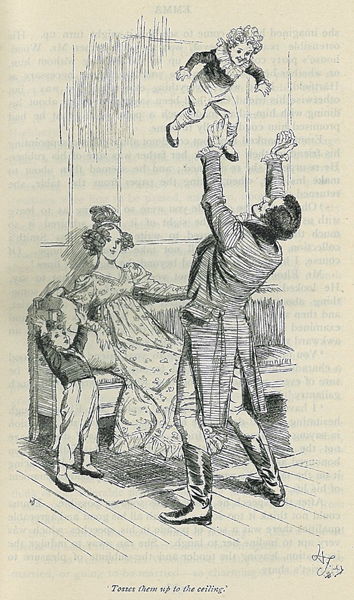
We are given a general survey of the shift in the attitudes toward children, that late eighteenth – early nineteenth century view that fell between viewing children as not just “little adults” to the Victorian view of “seen but not heard”, following Locke and Rousseau and believing children to be natural innocents.  In each chapter Selwyn seamlessly weaves pieces of Austen’s life as gleaned from her letters and scenes from all her writings – and it is masterly done, all with a historical perspective.  We see Jane as a child, as a madly composing adolescent, a loving and humorous Aunt imaginatively interacting with her nieces and nephews, and as an accomplished writer whose fictional children are far more worthy of our notice than we have previously supposed: the frolicsome Walter hanging on Anne’s neck in Persuasion; the spoiled Middletons; the noisy and undisciplined Musgroves; the grateful and engaging Charles Blake in The Watsons; the John Knightley brood in the air courtesy of their Uncle George; the dynamics of the five Bennet sisters; Henry Dashwood the center of attention for the manipulative Steele sisters; the reality-based scenes of Betsy and Susan Price at Portsmouth; and finally Fanny Price, Austen’s only heroine we see grow up from childhood, having an elegant come-out, finding true-live and ends “needing a larger home.”

In all her works, Austen uses children as “a resource for her narrative strategies” (p. 4), be that comedy, a plot device to further the action, or a means of revealing attitudes and responses of the adults around them (p. 3).  Austen’s children are easy to miss – they won’t be after reading this book – here they are brought to life, given character and meaning, and you will see what Selwyn terms “Austen’s satirical delight in children behaving in character” (p. 73)

If Austen’s fiction seems to gloss over the reality of childbirth [the exception is Sense and Sensibility’s two Elizas], her letters tell the tale of its dangers [Austen lost three sisters-in-law to death in childbirth], and Selwyn links all to the social structure of the day, the nursing of babies and swaddling practices, to child rearing theories and moralizing tracts, and governesses and Austen’s ambivalence toward them. We visit boarding schools along with Jane and her characters and we hear the voices of a number of contemporary diarists (Agnes Porter, Sophia Baker, Susan Sibbald, Elizabeth Ham and Sarah Pennington).  There is a lovely in-depth chapter on the reading materials written especially for children and Austen’s first-hand knowledge of these titles.  The discussion on sisters and brothers, those so important in Austen’s own life, and those in her fiction, for example, characters with confidants (Lizzy and Jane, Elinor and Marianne), those isolated (Fanny, Anne Elliot, Emma Watson, Mary Bennet), and those with younger sisters (Margaret Dashwood and Susan Price).  As part of the growing-up process, Selwyn uncovers much on “coming-out” as Austen herself writes of in her “Collection of Letters” [available online here] – with the emphasis here on Fanny as the only heroine to have a detailed “coming-out” party.

The chapter on “Parents” starts with the premise that “in Jane Austen’s novels the parents best suited to bringing up children are dead” (p.95) and Selwyn takes us from the historical view of parenting, through Dr. Johnson’s “Cruelty of Parental Tyranny” [shadows of Northanger Abbey] to a full discussion of the marriage debate in the 18th-century – that between the worldly concerns of wealth vs. choice of partner based on emotional love as personified in Sir Thomas and Fanny Price respectively.  Excerpts are included from James Austen’s very humorous Loiterer piece   “The Absurdity of Marrying from Affection.” (p. 207) and Dr. John Gregory’s A Father’s Legacy to his Daughters (1774) [viewable at Google Books here] , and the Edgeworth’s Practical Education (1798) [Vol. III at Google Books here].  One finds that in reading all of Austen’s letters and all the works you can indeed discover a complete instruction manual for good parenting!

Jane Austen and Children appropriately ends with Selwyn’s speculation on what sort of parents her Heroes and Heroines will be, all of course based on the subtle and not-so-subtle clues that Austen has given us throughout each work – conjecturing on this is perhaps why we have so many sequels with little Darcys, Brandons, Bertrams, Knightleys, Tilneys, and Ferrars running about!

Just as in his Jane Austen and Leisure, where Selwyn analyzes the various intellectual, domestic and social pursuits of the gentry as evidenced in Austen’s world and her works, he here gives us an accessible and delightful treatise on Austen’s children, culling from her works the many quotes and references related to children and linking all to the historical context of the place of children in the long eighteenth century.  The book has extensive notes, a fine bibliography of sources on child-rearing, contemporary primary materials, children’s literature, and literary history, and several black and white illustrations.  (I did note that there are a few mixed up footnotes in chapter 3, hopefully to be corrected in the next printing).  What will this book give you? – you will never again miss the importance of Austen’s many children, peaking from behind the page, there for a set purpose to show you what great parents the Gardners are, or just to make certain you see how very selfish the John Dashwoods and the Miss Steeles are, or to see the generosity of an Emma Watson in her rescue of Charles Blake, or to feel the lack for the poor Musgrove boys having Mary for a mother, the playfulness of an otherwise conservative Mr. Knightley, and the unnerving near touch of Captain Wentworth as he relieves Anne of her burden –  thank you David Selwyn for bringing all these children to life for Austen’s many readers – you have given us all a gift!

Emma – ‘Tosses them up to the ceiling’
[by Hugh Thomson, print at Solitary Elegance]

 __________________

Jane Austen and Children
Continuum, 2010
ISBN:  978-1847-250414

David Selwyn is a teacher at the Bristol School in Bristol, UK.  He has been involved with the Jane Austen Society [UK] for a number of years, has been the Chairman since 2008,  the editor of the JAS Report since 2001, and has written and edited several works on Austen.  He very graciously agreed to an “interview” about this latest work that you can find by clicking here.  See also the post on the various illustrations of Austen’s children by the Brocks and Hugh Thomson.  And finally, I append below a select bibliography of Selwyn’s writings on Jane Austen and her family.

 Select Bibliography:  

  1. Lane, Maggie, and David Selwyn, eds.  Jane Austen: A Celebration.  Manchester: Fyfield, 2000. 
  2. Selwyn, David, ed.  The Complete Poems of James Austen, Jane Austen’s Eldest Brother. Chawton: Jane Austen Society, 2003. 
  3. _____. “Consumer Goods.” Jane Austen in Context. Ed. Janet Todd. Cambridge Ed. of the Works of Jane Austen. New York: Cambridge UP, 2005. 215-24. 
  4. _____, ed.  Fugitive Pieces: Trifles Light as Air: The Poems of James Edward Austen-Leigh.  Winchester: Jane Austen Society, 2006. 
  5. _____. “A Funeral at Bray, 1876.” Jane Austen Society, Collected Reports V (1998): 480-86. 
  6. _____. “Games and Play in Jane Austen’s Literary Structures.” Persuasions 23: 15-28 
  7. _____. “Incidental closures in Mansfield Park.”  [Conference on “Jane Austen and Endings”, University of London, 17 November 2007] – unpublished paper. 
  8. _____. “James Austen – Artist.” Jane Austen Society Report 1998. 157-63. 
  9. _____.  Jane Austen and Leisure.  London: Hambledon Continuum, 1999. 
  10. _____, ed.  Jane Austen: Collected poems and Verse of the Austen Family.  Manchester:  Carcanet / Jane Austen Society, 1996. 
  11. _____, ed.  Jane Austen Society Report, 2001 – present. 
  12. ­_____. “Poetry.” Jane Austen in Context. Ed. Janet Todd. Cambridge Ed. of the Works of Jane Austen. New York: Cambridge UP, 2005. 59-67. 
  13. _____. “Shades of the Austens’ Friends.” Jane Austen Society Collected Reports V (2002): 134. 
  14. _____. “Some Sermons of Mr Austen.” Jane Austen Society Collected Reports V (2001): 37-38.