Book reviews · Fashion & Costume · Jane Austen · Regency England · Social Life & Customs

Book Review ~ Jane Austen’s Sewing Box

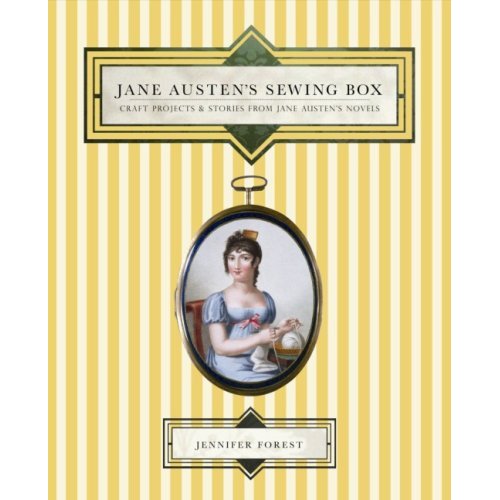
book cover jane austens sewing boxJane Austen’s Sewing Box: Craft Projects & Stories from Jane Austen’s Novels. 

by Jennifer Forest.  Murdoch Books Australia, 2009 

ISBN:  9781741963748, paperback, 224 pages.


 This is a lovely, sumptuous book.  When it first arrived, I did a quick skim – it is filled with photographs, decorated papers, fashion plates, quotes from Austen, and a good number of handiwork projects – hmmm, I thought, maybe one of those books that just looks nice but is of little substance – a coffee table [albeit a small one] book you look at once and then relegate it to collect dust in the “parlor” –  But on further study I found within these 224 pages a wealth of information – a brief but amazingly thorough introductory commentary on Regency historic and social life, the world of “women’s work” in Austen’s time, and the references to Austen’s many mentions of these real-life activities in her novels and letters.

 Ms. Forest has a background in history and cultural heritage, and combining this knowledge, her love of Austen and a “passion for fabric arts and crafts,” she has given us a treasure of a book.  With a starting point of finding Austen’s references to handi- and fancy work, Forest puts these quotes in their historical context, explains the meaning and use of the piece, and then provides instructions for each project – each of varying skill level, each a different task – there is knitting, sewing, embroidery, netting, paperwork, glasswork, and canvas-work, a total of eighteen different projects – from a letter case, linen cravat, fur tippet, to a pin cushion, reticule, bonnet and muslin cap – all mentioned by Jane Austen, and here lovingly replicated, with photographs of Regency era decorative arts and Ackermann’s fashion plates interspersed throughout. 

Best to show an example, so I will choose the huswife [page 100ff]  [ “the huswife was a small fabric case with pockets to hold all those tools for sewing and needlework – scissors, tape measure, thread, pins, and pin cushion”( page 104)]: 

This is a sewing task for beginners, with two pages of photographs of the finished piece, a short history of the huswife and its uses, a quote [all the quotes are written in script] from Emma where Austen uses the term [there is also a second quote from Sense & Sensibility spoken by Anne Steele] – here Miss Bates has misplaced a letter from Jane Fairfax that she later reads to Emma:

 “Thank you. You are so kind!” replied the happily deceived aunt, while eagerly hunting for the letter. “Oh here it is.  I was sure it could not be far off, but I had put my huswife on it, you see, and without being aware, and so it was hid.”  [page 104, quoting Emma]

 This is followed by a full page of blue decorated paper with a part of the quote, a full page fashion plate from Ackermann’s, and a full page of an art reproduction depicting a woman at her fancy work, then a full page photograph of a detail from a piece of Regency furniture [all photographs are from the Johnston Collection *], and then three pages of project instructions with black and white drawings, and a final photograph of a furniture detail.  This format and sequence is followed for each of the eighteen projects, ending with a list of suppliers, references and an index.
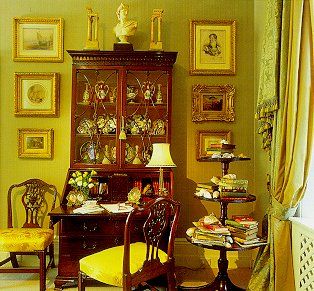
johnston collection desk
from The Johnston Collection


All these Austen quotes, taken out of context, are quite a wonderful discovery! – they can so easily be passed over in the reading – what indeed IS a huswife? or a tippet? [“Jane, dear Jane, where are you? here is your tippet.  Mrs. Weston begs you to put on your tippet.”]  Or a transparency? [“and its greatest elegancies and ornaments were a faded footstool of Julia’s work, too ill done for the drawing room, three transparencies, made in a rage for transparencies…”] or a reticule? [“…a letter which she [Mrs. Elton] had apparently been reading aloud to Miss Fairfax, and return it into the purple and gold reticule by her side.”]  or “netting” for that matter [“They all paint tables, cover screens and net purses” says Charles Bingley]; and then of course Lady Bertram’s carpet-work and “yards of fringe!” 

This book opened up a whole new awareness of Austen’s writing in the NOW – her knowing what her readers would glean from these almost off-hand references [as in Mrs. Elton’s purple and gold reticule, “expensive colours that Austen possibly chose to sketch her character’s pretensions to grandeur, associated as they were with royalty and luxury.” [page 182] – and as always one is awed by Austen’s use of such fine details to delineate character.

fashion plate yellow dress
from Costumes.org

 The book is by no means comprehensive on the subject – but there are so many tidbits of Regency social life and customs, coupled with Austen’s words – I found in the reading an “oasis of calm”, a slowing down, a return to a time of sewing for the poor, or making your brother’s shirts (done in private), and your embroidery and fancy work and painting put on public display to show yourself as “an accomplished woman” [a la Mr. Darcy] – and the exquisite paper and decoration, the furniture details, and the fashion illustrations all combine to create this time-warp, invoking the Regency era and “its enthusiastic appreciation of design in all forms – dress, architecture, interiors, furniture, wallpaper and fabric” [page 17] – the whole sphere is beautifully presented in these pages and makes this a wonderful addition to your Jane Austen collection and a great starting point for your creative endeavors! 

5 full inkwells [out of 5]

* The Johnston Collection is “a Fine and Decorative Arts Museum, Gallery and Reference Library in East Melbourne, Australia.  It is no ordinary museum with roped off exhibits, but presents an astonishing and diverse collection arranged in the English Country House Style.”  Visit their website for the history, gallery exhibits, and a sampling of the treasures in the collection.

Posted by Deb

Book reviews · Books · Fashion & Costume · Jane Austen · Regency England · Social Life & Customs

Interview with Jennifer Forest, author of “Jane Austen’s Sewing Box”

book cover jane austens sewing box


Today we have Jennifer Forest joining us to share her thoughts on her new book Jane Austen’s Sewing Box: Craft Projects & Stories from Jane Austen’s Novels [NSW, Australia: Murdoch Books, 2009]:

What inspired Jane Austen’s Sewing Box? 

I love Jane Austen, history and craft so it seemed quite natural for me to join these  interests.  A few years ago, re-reading Jane Austen’s novels I noticed that she makes quite a few references to craft including sewing, knotting, painting and netting. It spurred me on to start digging around to find out what the crafts were that Jane Austen’s women were doing.  The Regency left a strong design legacy and there are many examples of the beautiful craft worked by women during this great period for arts and craft. 

What types of projects are in the book?  

Just as Jane Austen includes a range of craft references in her novels, there are also a range of projects in the book.  All projects are based on her novels and letters, so there’s everything from making paper flowers, to embroidery, sewing, painting, knitting and those lost arts of netting and knotting.  

What skills do you need to do the projects? 

I really believe that craft should be something you can do, not something you struggle with to the end! So there is something for all skill levels from beginner and intermediate projects to more advanced projects for experienced crafty people.  I also used materials and tools true to the period that can be sourced from shops today. 

How did you use original objects from the Regency for Jane Austen’s Sewing Box? 

I have been fortunate to work in museums where I was surrounded by beautiful objects from the past, so I knew there was a collection of Regency items available for research. Each project is based on original examples from the Regency period, from the overall design right down to details like the actual size of a finished piece, colours and materials. 

Were Regency women the original “domestic goddess”?

Well, the home was their empire in the Regency and craft skills were so important to the management of a household that it was called “women’s work”.  The ability of women to hand sew was crucial to clothing the family and helping support the poor in their village.  This was a time before sewing machines and shopping malls, when it wasn’t so easy to buy what ever you needed.  Even when tailors and dressmakers were used, women’s work in many families provided the men’s shirts, children’s clothes, nightwear, towels, sheets and bedding.  

How long would she spend on “women’s work”?

A Regency woman either alone or in a work party could easily spend 4 to 5 hours a day working.  Jane and Cassandra Austen often made their brother’s shirts, even when they had left home, married and in Charles’ case, joined the navy.  Jane Austen was proud of her neat running stitch in making up her brother’s shirts!

 Was it all sewing shirts and making towels?

No, craft skills gave women a way to show their creative talents.  Much of the professional world, including art, was only really open to men.  But Regency women also loved arts and design. Craft skills allowed a woman to express her creativity and design abilities, whether that was in a handmade huswife or purse to be given as a gift or in painted pieces like the firescreens made by Elinor Dashwood in Sense and Sensibility.  

Why do you love Jane Austen? 

I think every time I read her novels my reasons for liking them change!  Her character portrayals are far better than most writers.  I think most of us today still recognise her characters in people we know – we’ve all known an ‘Emma Woodhouse’, a ‘Miss Bates’ or a ‘Fitzwilliam Darcy’.  She is actually quite funny and witty in a beautiful and clever way.  But at the same time I think she was an acute observer and sharp commentator on her times. 

What handiwork / craft do you do? 

I love trying out new crafts skills so I’ve experimented with a range of different things. What I keep coming back to though is screen printing (love combining paint and fabric), felting, sewing and embroidery.

*******************************************************

Thank you Jennifer for joining us today!  If anyone has any questions, please send a comment and I will get those answered for you.  I received the book in the mail yesterday and will be posting a review of it tomorrow – it is a wonderful compilation of history, Austen quotes, visual treats and, of course, the crafts!  The book is now available for ordering on amazon.co.uk ; there are several available copies from independent sellers on the US Amazon site, but is not actually available yet in the US.

Further reading:

Posted by Deb

Books · Fashion & Costume · Jane Austen · Regency England · Social Life & Customs

On My Bookshelf ~

I love my mailman!  He brings me such gifts almost on a daily basis – yesterday he brought these two books:

book cover ja unrequited love 

Jane Austen: an Unrequited Love, by Andrew Norman [The History Press, 2009] – where the author proposes “that Jane and Cassandra had a falling out over a young clergyman, whom he identifies for the first time.  He also suggests that along with the Addison’s disease that killed her, Jane Austen suffered from TB.”  [from the jacket]


book cover jane austens sewing boxJane Austen’s Sewing Box: Craft projects and stories from Jane Austen’s Novels,  by Jennifer Forest [Murdoch Books, 2009] [see Janiete Kelly’s post on this title] – it is a sumptuous book! 
Please join us tomorrow when I will post an interview with the author, as well as review the book. ~

[I am now going in search of my long-abandoned embroidery supplies… ]


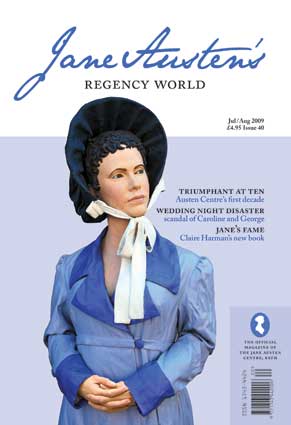
 … and today he brought me the latest issue of Jane Austen’s Regency World [July/August 2009] – as always cram-packed with interesting articles and lovely illustrations – on Austen, Mary Shelley, Queen Caroline, global warming in JA’s time, book reviews, and much more [I will post the full contents tomorrow], but you can see hightlights of the issue as well as download a sample article from a previous issue at the magazine’s website [note that this is the NEW website for JARW, so change your links in your “favorites.”]

JARW_40_Cover_small


How sad to be burdened with a day-job with all this reading to be done!

Posted by Deb

Fashion & Costume · Jane Austen · JASNA-Vermont events · Regency England · Social Life & Customs

Better Late than Never – Part II: Fashion in Jane Austen’s World

Please see Kelly’s post below this for Part I – we have both been swamped these past two weeks and FINALLY getting to our respective posts on Hope Greenberg’s fabulous talk on fashion at our June 7th  JASNA-Vermont gathering …  with the beautiful backdrop of the Chapel at the Vermont College of Fine Arts, and a capacity crowd …

First I append a guest post from our own Janeite Marcia: 

Fashionable Sunday in Montpelier

 Hope Greenberg’s presentation on Sunday June 7, 2009 provided much, much more than I imagined.  Who knew fashion was so complex? 

 For me, the most fascinating part was learning about how Austen used references to clothing and fashion to develop her characters.  While reading Sense and Sensibility, it was clear that Lucy Steele’s manners were lacking, her behavior even tacky.  Hope used the scene where Lucy inquires of Marianne regarding her clothing, and even her clothing allowance, to illustrate how Lucy is revealed as crass and ill-mannered. 

As Hope Greenberg described, in addition to Lucy’s inquires of Marianne, from Wickham’s (Pride and Prejudice) only needing regimentals, to Mrs. Allen (Northanger Abbey) talking of little but clothing, we are treated to exquisite development of many of the Austen characters by these brief, but powerful, references to wardrobe, clothing, and fashion.  We all accept that Lucy is uncultured, Wickham is without depth of character, and Mrs. Allen is a mere silly airhead.  These are the perfect, subtle, understated Jane Austen descriptions which leave the reader with no doubt of the author’s meaning, while wondering where the impression came from.  

While there are few enough references in the Austen novels regarding fashion and clothing, each of those mentioned by Hope Greenberg is amazingly revealing and powerful.  Thanks to Hope, those of us who attended on Sunday will be more aware of such references and techniques as we reread Austen and will certainly be able to better appreciate the genius of Jane Austen. 

It was a lovely way to spend a Sunday afternoon.  Thank you to JASNA-Vermont!

***********************************************************

fashion plate walking dress

Thank you Marcia for your thoughts!   We were most fortunate to have Hope spend a few hours with us – as a Humanities Computing Specialist at the University of Vermont, Hope has combined her love of history and 19th-century material and literary culture with her love of historic clothing and English Country Dance – she offered us a visual feast [with a new Macintosh program that presented all the fashion illustrations in the mode of flipping the pages of a book!] taking us through the process of dressing a lady of fashion from her linen shifts, corsets, petticoats, dresses, pelisses /spencers, to her shawls, hats and muffs, reticules, and other accessories; and dressing the man of fashion with his shirts, breaches / trousers, weskits, cravats, jackets and the glorious greatcoat – all this shown in the various fabrics and textiles of the time, with Hope’s actual dresses, fashion illustrations, and photographs from the trove of 18th and 19th century clothing in the UVM Fleming Museum.  Hope ended her talk with a quick run through the various changes in fashion over the short period from the late 1780s to the 1820s – the French influence; the military influence; the return to the classical Egyptian and Grecian styles; the waist going up; the waist going down; the petticoat as an undergarment to the petticoat as part of the main dress; Beau Brummel’s affect on male fashion; the central role of the fashion magazines – all this in a short 2-hour whirlwind of muslin, linen and silk!  [alas!  we did go over a bit!]

And as Marcia mentions above – I too learned much from Hope’s references to Austen’s use of clothing details [or lack thereof] to delineate character – Willoughby’s shooting jacket; Nancy Steele’s obsession with her appearance; the lack of description of Bingley and Darcy, yet the emphasis on Wickham’s “regimentals”; Mrs. Bennet’s ridiculous concerns with wedding clothes and carriages; Lydia’s silliness about her bonnet; Mrs. Elton in Emma [no more need be said!]; Mrs. Allen in Northanger Abbey – and only Henry Tilney [dear Henry!] being “forgiven” for his extensive clothing musings!

So we heartily thank Hope for sharing her expertise with us – we are all alot wiser about Regency fashion and more attuned to Austen’s brilliant commentary.

*******************************************************************

Ditto Kelly’s thanks for a gracious afternoon in Montreal, a la Donwell Abbey and strawberry picking; hearing a fascinating preview of Jan Fergus’s upcoming AGM talk on “Tensions between Brothers and Sisters in Austen’s Novels”; and sharing a delicious tea with other JASNA-Montreal members [my daughter joined me for this trek to Montreal – and she loved all the Austen chatter – it is my daughter after all who got me re-reading Austen when she was studying Emma in college nearly 20 years ago – she called me up to say she seemed to be the only one in the class who thought Emma was FUNNY – I knew then and there we had raised her right!]  Anyway, I digress – a huge thank you to Elaine Bander for a wonderful afternoon!

**************************************************************

And a little counterpoint to my blogging partner and cohort in JASNA-Vermont – who ever said that Knightley was a “namby-pamby”??  – I always viewed him as a very strong character – so we need to have a lively discussion about this!  And of course lots to discuss about Mr. Collins – I agree that the 1995 makes him out to be SUCH a dolt [and the Lost in Austen character is just too CREEPY!] – the Elizabeth Garvie P&P rendition is much truer to the book [the music alone captures his essence] – but think we need to go back to the novel to see what Austen really says about him – and she makes no bones about making him out to be quite ridiculous.  Kelly, we should have a session JUST on Mr. Collins – I think we could get a rousing discussion going! [there is also a book just on him by the way, titled “Mr. Collins Considered” – a great place to start, as well as the Irene Collins [no relation!] book on Austen and the clergy…]

mr collins brock illus

[illustration from Pemberley.com]

Posted by Deb

Books · Jane Austen · News · Regency England · Social Life & Customs

New Release ~ “Behind Closed Doors: At Home in Georgian England”

Just a heads-up on this book to be released October 12, 2009: 

Behind Closed Doors: at Home in Georgian England, by Amanda Vickery.  Yale University Press, 2009. [can be pre-ordered for $45.00]

Here is what the Yale University Press website has to say:

In this brilliant new work, Amanda Vickery unlocks the homes of Georgian England to examine the lives of the people who lived there. Writing with her customary wit and verve, she introduces us to men and women from all walks of life: gentlewoman Anne Dormer in her stately Oxfordshire mansion, bachelor clerk and future novelist Anthony Trollope in his dreary London lodgings, genteel spinsters keeping up appearances in two rooms with yellow wallpaper, servants with only a locking box to call their own.


Vickery makes ingenious use of upholsterer’s ledgers, burglary trials, and other unusual sources to reveal the roles of house and home in economic survival, social success, and political representation during the long eighteenth century. Through the spread of formal visiting, the proliferation of affordable ornamental furnishings, the commercial celebration of feminine artistry at home, and the currency of the language of taste, even modest homes turned into arenas of social campaign and exhibition.


Amanda Vickery is reader in history, Royal Holloway University of London, and the author of The Gentleman’s Daughter: Women’s Lives in Georgian England, which won the Whitfield, Wolfson, and Longman-History Today prizes. She is also the co-editor, with John Styles, of Gender, Taste and Material Culture in Britain and North America, 1700–1830.

… a definite addition to your want list – and if you don’t already have it, you must also add Vickery’s previous work …

book cover - gentleman's daughter

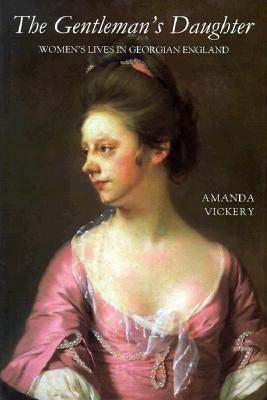
The Gentleman’s Daughter: Women’s Lives in Georgian England [Yale University Press, 1998; softbound edition, 2003] is already on my toppling TBR pile(s).  Here are a few [of the many] reviews of this earlier work, the winner of several history/ literary awards:

Jane Austen · News · Regency England

In My Mailbox ~ ‘Jane Austen’s Regency World’

JARW_39_Cover


The latest issue [ May / June 2009, No. 39] of Jane Austen’s Regency World showed up in my mailbox the other day ~ always a happy occasion ~ and cram-packed with great articles:


GUEST ESSAY-   Dr. Andrew Norman on “Jane’s Demon Lover”   [Norman is the author of Jane Austen: an Unrequited Love] – he posits that perhaps the large gap in Austen’s letters to her sister between 1801 and 1804 may be due to Austen and Cassandra having had a falling out … all over a man of course…

HOW DO YOU SOLVE A PROBLEM LIKE MARIA -The Prince and Mrs Fitzherbert – the Royal mistress who refused to keep quiet  [Pictured on the cover of the new issue is Maria Fitzherbert, the not-so-secret wife of the future King George IV]

PRIDE & PREJUDICE & ZOMBIES – Read Joc Bury’s review of the controversial new book

TAKING A PEEK – Regency erotica revealed – is our image of Georgian morals tainted by Victorian values?

JANE’ S JUVENILIA – Publishing Jane’s early writing

BETWEEN THE COVERS – Sue Wilkes on Regency women’s magazines  – were they saucy or sermonizing?

Also in this issue:

  • Vote for the Regency World Awards 
  • The new educational facility at Jane Austen’s House Museum
  •  Maggie Lane looks at openness and reserve in Jane’s writing
  • Tom Lefroy’s enthusiasm for white coats and Tom Jones
  • JASNA’s Susan Allen Ford on “Elegant Extracts”
  • and all the usual informative regular features

For more information or to subscribe, see the Jane Austen Magazine at the Jane Austen Centre website; the Centre’s online newsletter has also just been released  [and also see the magazine’s new website at Jane Austen’s Magazine.co.uk  [though this seems to not be up to date with the latest issue]]

Books · Jane Austen · News · Rare Books · Regency England · Social Life & Customs

Hot off the Press!

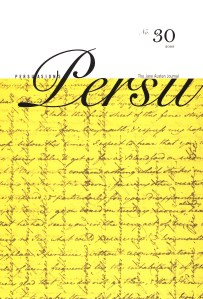
persuasions-cover30Yesterday, a FedEx box left on my stoop prior to lunch yielded up a BIG surprise: my contributor’s copies of JASNA’s annual journal PERSUASIONS, vol. 30 (2008). A brief email to Susan Allen Ford, the journal editor, to congratulate her on an ‘awesome’ volume, was answered by an email which said she hadn’t received her copies yet! Vermont’s good fortune (and mine) to be located next door to New Hampshire — from where the packages seem to have originated…
The first article I read was Edith Lank‘s telling of her annotated Brabourne edition of Austen letters. One curious thing: how could the books languish EIGHT years on her shelves, unopened?! A used book never passes my threshold without a thorough perusal! There is more on Miss Lank’s edition in Persuasions-Online.

Joan Klingel Ray offers up an interesting look at Victorian era perceptions of Austen, though I must comment that to Edward — a nephew who was in his late teens when his aunt died — Jane would surely have remained, over the 50 ensuing years, his “dear Aunt Jane”. Joan and I take differently, I think, to James-Edward Austen-Leigh’s Memoir of Jane Austen. Joan knows the descendents; but I’ve come to know Edward and Emma through their own words! So: a discussion to look forward to when Joan Klingel Ray visits Vermont in September (see our EVENTS page).

I would be telling a lie if I didn’t confess that the very first article I checked out was my own… Oh, the pictures look lovely! (They come via the collection of The British Museum.) I had been so worried after seeing the proofs. Susan Allen Ford has been very positive in her reaction (the anonymous reader, too) to this article, in which I examine an Emma Austen 1833 trip to Derbyshire in the steps of Elizabeth Bennet. The article was only improved by their wishes for a lengthier piece and some illustrations.

The Chicago AGM’s theme of Austen’s legacy brings up many fascinating ideas: Jocelyn Harris invokes Dr. Johnson; Deb will surely be interested in turning straightaway to Janine Barchas‘ article on Gaskell’s North & South (Deb highly recommends the new TV series, which she’s been watching) — but what will she think of the author’s assumption that it is a veiled recreation of P&P??? Sarah Parry‘s article on “The Pemberley Effect: Austen’s Legacy to the Historic House Industry” is surely next on my list.

A special ‘legacy’: the writing desk that once belonged to Austen, has been in the family, and now has been donated to The British Library. Freydis Welland‘s personal take on this piece of history opens the always pleasurable MISCELLANY section of Persuasions. Although I’ve not seen Lost in Austen, Laurie Kaplan‘s article which closes the journal has the oh-so-tempting title “‘Completely without Sense’: Lost in Austen“.

More comments than this — teasing tantalizers or tantalizing teasers, since the journal (according to the JASNA website) is schedule to mail out on May 1st — will have to wait. The one thing that keeps me from delving deep into my copy is an article I’m working on, and I must get back to work.

Austen Literary History & Criticism · Books · Jane Austen · News · Rare Books · Regency England

Austen on the Block ~ Bloomsbury Auctions

Bloomsbury Auctions-New York  announces the exhibition and auction of


The Paula Peyraud Collection, Samuel Johnson

and

 Women Writers in Georgian Society


Wednesday, 6 May, 2009 • 10:00 am


Bloomsbury Auctions, the world’s leading auction house for rare books and works on paper, announces The Paula Peyraud Collection, Samuel Johnson and Women Writers in Georgian Society with over 480 lots of books, manuscripts and paintings tells the fascinating story of English society in the middle and late Georgian periods. This extraordinary sale focuses on the artistic and literary women who came to the fore in the period 1750-1840.


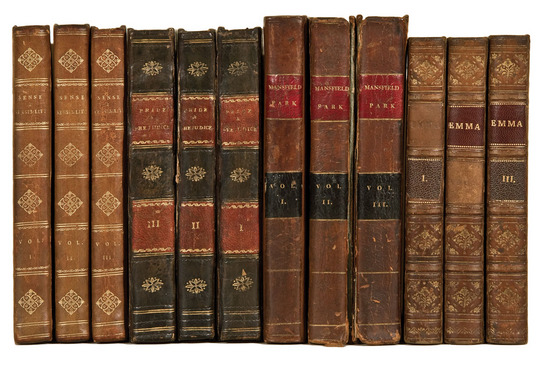
 A highlight in the sale are the following five titles from Jane Austen: 

bloomsbury-auction-austen

  • Emma-1816- 3 volumes: $8,000-12,000
  • Mansfield Park-1814- 3 volumes: $7,000-10,000
  • Northanger Abbey-1818- 4 volumes: $5,000-8,000
  • Pride and Prejudice-1813- 3 volumes Carysfort copy: $20,000-30,000
  • Sense and Sensibility-1811- 3 volumes: $25,000-35,000 


There are a total of 483 lots for sale, to comprise books, autograph letters, engravings and watercolors of the era:  Johnson and Boswell, and Walpole, etc., and many women writers are represented:  Frances Burney, Maria Edgewoth, Hannah More, Hester Thrale Piozzi, Charlotte Lennox, Charlotte Smith, Charlotte Bronte, Ann Radcliffe, Marguerite Blessington, to name a few.


And see this watercolor of Elizabeth Bridges, Austen’s sister-in-law:

elizabeth-bridges-watercolor
Bloomsbury Auction - May 6, 2009 Lot No.127


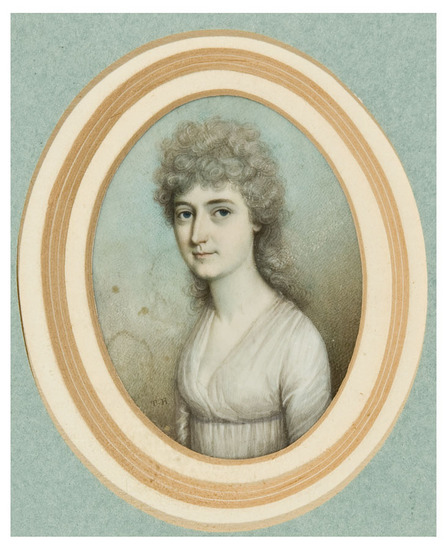
127. [AUSTEN, Jane (1775-1817)] – Thomas Hazlehurst (1740 – 1821). Portrait miniature of Elizabeth Bridges Knight wearing a white dress with a blue ribbon tied under corsage. Watercolor on ivory, oval.
2 1/2 x 2 inches (6.5 x 5 cm).
Initialed “T.H.” (lower right).
A fine portrait miniature of Jane Austen’s sister in law, Elizabeth Bridges (1773-1808) who married Edward Austen, the brother of Jane Austen. Edward took the name of his second cousin Mr. Knight on inheriting in 1812 his estates in Kent at Godmersham Park. They had 11 children.
This lot sold with an uncolored print of Godmersham Park by Watts.
Literature: Country Life. 27 July 1987, ill. p.111.  Est. $2000 – 3000.

 *********************************************

Location:  Bloomsbury Auction Gallery, 6 West 48th Street New York 10019

Viewing hours:  

  • Friday May 1- By appointment
  • Saturday May 2- 10-5 p.m.
  • Monday May 4- 10-7 p.m.
  • Tuesday May 5- 10-5 p.m.

Bloomsbury Auctions is the world’s leading auction house for rare books and works on paper and is headquartered in London with salerooms in New York and Rome.


 For further information call Bloomsbury:  212-719-1000 or email at newyork@bloomsburyauctions.com


You can view the full catalogue at the Bloomsbury website.


Book reviews · Jane Austen · Regency England

Book Review ~ “Regency Buck” by Georgette Heyer

regency-buck-cover2

Georgette Heyer had a bit of a formula for many of her Regency novels – the established man in his mid-30s, often a fashionable dandy, and the younger woman he somehow becomes responsible for, and against all odds and all possible personality conflicts, they come together and all ends well.  Indeed, quite funny along the way, and filled with period details of such accuracy, the reader wonders how Heyer wrote these in the early 20th century and was not herself a “Lady of Quality” in early 19th century England!

So I began Regency Buck thinking I may have already read it – had to indeed check my list to be sure! – but a few pages in, I knew that, though it all seemed familiar enough, Heyer had succeeded yet again in setting a scene and telling a tale peopled with well-drawn characters [really, who can resist a character with the name of Mrs. Scattergood?], abounding in witty repartee, bringing the Regency period to life, and this time with a bit of a mystery thrown in for good measure.

The wealthy Judith Taverner, a feisty, independent almost-of-age beauty and her brother Peregrine, a year younger and the inheritor of a large estate, are on the way to London to settle in town after the death of their father to meet their unknown guardian, the Fifth Earl of Worth, and expecting one of their father’s gout-ridden comrades are shocked to discover Lord Worth to be a young handsome man of fashion and great friend to a select group of higher ups in London society .  Due to a previous encounter with him involving a hair-raising road accident and for Judith a less than appropriate embarrassing kiss, the young Taverners take an instant dislike to their guardian and he in turn makes it quite clear that he is not amused by suddenly having two wards foisted upon him. 

Here is Judith as we first see her~

She was a fine young woman, rather above the average height, and had been used for the past four years to hearing herself proclaimed a remarkably handsome girl.  She could not, however, admire her own beauty, which was of a type she was inclined to despise.  She had rather had black hair; she thought the fairness of her gold curls insipid.  Happily, her brows and lashes were dark, and her eyes which were startlingly blue (in the manner of a wax doll, she once scornfully told her brother) had a directness and a fire which gave a great deal of character to her face.  At first glance one might write her down a mere Dresden china miss, but a second glance would inevitably discover the intelligence in her eyes, and the decided air of resolution in the curve of her mouth.

And here is Lord Worth as first seen by Miss Taverner ~

From the first moment of setting eyes on him she knew that she disliked him…He was the epitome of a man of fashion.  His beaver hat was set over black locks carefully brushed into a semblance of disorder; his cravat of starched muslin supported his chin in a series of beautiful folds; his driving-coat of drab cloth bore no less than fifteen capes, and a double row of silver buttons. Miss Taverner had to own him a very handsome creature, but found no difficulty in detesting the whole cast of his countenance.  He had a look of self-consequence; his eyes, ironically surveying her from under weary lids, were the hardest she had ever seen, and betrayed no emotion but boredom.  His nose was too straight for her taste.  His mouth was very well-formed, firm but thin-lipped.  She thought it sneered….. His driving had been magnificent; there must be unsuspected strength in those elegantly gloved hands holding the reins in such seeming carelessness, but in the name of God why must he put on an air of dandified affectation?

And thus we are introduced.  Heyer serves up her usual mix of shenanigans, the endless clashing of wills, and the historically accurate Regency social life so well portrayed, such as this detailed description of the Royal Pavilion in Brighton, that you, the reader are instantly transported ~

royal_pavilion_brighton_3

At first site it was all a blaze of red and gold, but after her [Miss Taverner] first gasp of astonishment she was able to take a clearer view of the whole, and to see that she was standing, not in some fantastic dream-palace, but in a square apartment with rectangular recesses at each end, fitted up in a style of Oriental splendour.  The square part was surmounted by a cornice ornamented with shield-work, and supported by reticulated columns, shimmering with gold-leaf.  Above this was an octagon gallery formed by a series of elliptical arches, and pierced by windows of the same shape.  A convex cove rose over this, topped by leaf ornaments in gold and chocolate; and above this was the central dome, lined with scale-work of glittering green and gold.  In the middle of it a vast foliated decoration was placed, from whose calyx depended an enormous luster of cut-glass in the shape of a pagoda.  To this was attached by chains a lamp made to resemble a huge water-lily, coloured crimson and gold and white.  Four gilded dragons clung to the under-side of the lamp, and below them hung a smaller glass water-lily… still more dragons writhed above the window draperies, which were of blue and crimson satin and yellow silk.  The floor was covered by a gigantic Axminster carpet where golden suns, stars, serpents, and dragons ran riot on a pale blue background; and the sofas and chairs were upholstered in yellow and dove-coloured satin….

We are treated to various episodes of cock-fighting, boxing, horse racing, and carriage rides of all sorts; fashion displays of the first quality; and gatherings with the real life characters of Beau Brummell and the Prince Regent himself!  and with further references to Byron’s poetry and Austen’s Sense & Sensibility!  we are truly comforted by the authenticity of the times. 

cockfighting

But danger lurks – the Taverner’s wealth make them both targets in their new London environment and Heyer juxtaposes the humor of the avaricious suitors for Judith’s hand [to include nearly every eligible young man within striking distance and a few skin-crawling efforts [to this reader!] by the over-zealous Prince Regent!] – all this set against the apparent attempts to murder Peregrine – who would most benefit from his death? – his own sister? a long-lost on-the-skids cousin who begins to fall in love with Judith? or their guardian’s brother Charles, the second son in the military with no money of his own who becomes immediately smitten with his brother’s comely and wealthy ward? or indeed, Lord Worth himself, with his expensive tastes and a penchant for gambling and horse-racing?

And who of the lot will capture the heart of the lovely Judith? and can she withstand her guardian’s efforts to keep her in line according to HIS rules of a lady’s behavior for the very long year before her 21st birthday?   Worth is insufferable and rude and nearly cruel on one too many occasions to keep this reader from cringing a bit with my feminist sensibilities on high alert…  but Heyer, as expected, brings it all to a fine conclusion,  all in fun and with a satisfying end where all are accorded their just dues, a great ride! … definitely add this gem of a read to your TBR pile!

 4 full inkwells [out of 5]

Regency Buck, by Georgette Heyer.  Sourcebooks, 2008 [originally published in 1935]

[also available in the UK from Arrow Books, 2004]

For further reading, see my review of Faro’s Daughter, which appends reading lists, etc. about Heyer.

Book reviews · Literature · Regency England

Book Review ~ ‘Whom the Gods Love’

book-cover-whom-gods-loveJulian Kestrel is back in this third Kate Ross mystery, Whom the Gods Love [Viking 1995], again faced with a murder the authorities cannot solve.  The larger than life Alexander Falkland, one of the leaders of The Quality, young, handsome, with a beautiful wife, elegant home and many admirers, is found murdered in his study, bludgeoned with a fireplace poker during a house party.  Falkland’s father, Sir Malcolm, so frustrated by the dead-end investigations of the Bow Street Runners, turns to Kestrel to find his son’s killer.  Faced with a good number of suspects among family, friends and servants (so many in fact, that Ross prefaces the work with a listing of the cast of characters!), Kestrel falls whole-heartedly into his role as amateur sleuth.  A dandified man of fashion [but we the reader know him to be so much more], Kestrel knows many of Falkland’s set and embarks on his questioning of all suspects in his charming way, all the while wondering if Alexander Falkland may not be all that he seems. 

Ross is a master of plot and character – even the minor parts are well-fleshed out, and as the story turns and clues are uncovered with each chapter (Ross’s chapter headings alone are perfectly tuned), the reader is drawn deeper and deeper into the complicated mystery surrounding Falkland’s death.  Kestrel stumbles upon another murder, and as in Ross’s previous two mysteries, Cut to the Quick and A Broken Vessel, Kestrel needs to identify an unknown woman as well as unravel the mystery of who had reason to kill her. 

We are again transported into Regency London, with all the social life at Almacks, Tattersalls, Cornhill, Rotten Row, the Grand Strut in Hyde Park, and various outlying Inns, all portrayed as it would have been.  The language of the lower classes and the “Beau Monde” is spot-on [blue-deviled, missish], the carriages: gigs, cabriolets, hackneys, etc.; architectural details abound; fashion description is so exact, you feel you are there, sitting in the room:  in this passage, one of the “Quality” suspects is thusly described:

 Felix was about Julian’s age, the son of an autocratic peer from the bleak northeastern counties.  Julian suspected that the grey, barren landscapes of his childhood accounted for his taste in clothes, which certainly needed excusing.  Today he was wearing a canary-yellow tailcoat, white trousers, and two waistcoats, the inner of scarlet satin, the outer with black and white stripes.  His neckcloth was a cherry-coloured India print, splashed with blue and yellow flowers.  A bunch of gold seals, all shaped like chessmen, dangled from his watch-chain.  He had an amiable rangy figure and curly brown hair that tended to stand on end.  [p. 132]

[Yikes!]

regency-male-fashion

[from The Regency Fashion Page]

Ross depicts the legal system in England at the time – Lincoln’s Inn figures prominently, and Kestrel is often critical of the lack of a strong police force and the present state of law enforcement [the magistrate system and the Bow Street Runners].  There is much scholarly discussion between the characters, with references to Wollstonecraft’s “A Vindication of the Rights of Women” and the state of the woman’s position in society; there is even a bit of phrenology thrown in! 

But it is Julian Kestrel who pulls all these diverse goings-on together.  He is witty [“I’m afraid I’m obliged to trample on your sensibilities”], with a ready retort always at hand to put one on edge, but also sensitive and sympathetic, always with a kind word or deed to put one at ease.  And, as in the previous two books, Ross gives us fleeting glimpses of Kestrel’s own past, his background as mystifying to the other characters and to us readers as the mystery he is set on solving.  In this book, we hear only a faint mention of Sally from A Broken Vessel; we learn that he and his father went to London plays; that he gained his wide knowledge from his own stay on the Continent where he read the controversial Wollstonecraft in French translation; and we learn more about his actress mother and his disinherited father.  Kestrel remains the most loveable enigma, with all his shadowy past life, his apparent shallow present life of leader of fashion extraordinaire:

      In the afternoon, Julian went home for a session with his tailor.  His hobby of detection could not be allowed to interfere with his profession of dress.  The tailor measured him for some sporting garments for the autumn and made yet another attempt to persuade him to pad his coats.  ‘The very latest fashion, Mr. Kestrel!’ he pleaded.

      ‘My dear man, if I followed the fashions, I should lose any power to lead them.  And not for you nor anyone else will I consent to look like a pincushion with legs.’ [p. 169] 

With all this, Kestrel masterfully guides us along in solving the murders, feeling at home in the halls of the Quality, as well as in the environs of the poorer classes. I will tell no more of the plot – it is a fabulous journey, and leaves me quite anxious to get on to the next book!

5 full inkwells

 See my reviews of Cut to the Quick and A Broken Vessel