Jane Austen · Regency England · Social Life & Customs

Letter no. 3 ~ “Scene of Dissipation & Vice”

Letter No. 3. 

  • August 23, 1796
  • Jane (in Cork Street, London) to Cassandra (Steventon? not noted)
  • Boston Public Library (since 1966)

There has been a gap of seven months since Letter no. 2 (of January 1796), but Letter 3 finds Jane in London, likely staying at at the home of Benjamin Langlois in Cork Street (see below) and she hurriedly pens a quick letter to Cassandra.  She begins with her oft-quoted

Here I am once more in this Scene of Dissipation & vice, and I begin already to find my Morals corrupted.
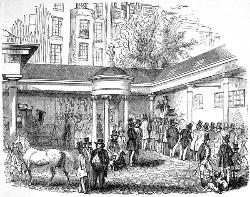
                                                         

and “hoping you are all alive after our melancholy parting.”  She reports on the trip in a Chaise and “without suffering so much from the heat as I had hoped to do.”  She has traveled with her brothers Edward and Frank and “they are both gone out to seek their fortunes; the latter is to return soon & help us to seek ours.  The Former we shall never see again.”

They are off to “Astley’s” to night” [ Astley’s Amphitheatre near Westminster Bridge, an equestrian circus open from Easter through November or so]  See Emma chapters 54 and 55 for references to Astley’s.

Then a reference to Henry driving his then fiance Miss [Mary] Pearson to Rowling, where Jane is headed on Thursday, so her visit to London is a short one [Rowling is in Kent, and the home of the Bridges family; Jane’s brother Edward married Elizabeth Bridges]; and Austen signs off with hopes that Cassandra “pursued your intended avocation with Success.-” not sure what this refers to…will see if mention is made in a subsequent letter.

 An interesting note about this letter is in the viewing of it in Modert’s compilation of facsimiles; one finds Austen’s writing  much larger and sprawling than most of her other letters…. she perhaps had no concerns here about the costs of posting, or wrote it very quickly and just wanted to send it off without thinking of adding more the next day, as she often did…


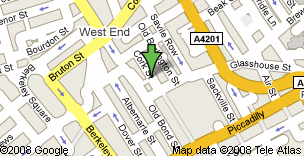
 One of my great finds at the AGM was this book titled Jane Austen Visits London by Vera Quin.  Ms. Quin was one of the presenters, giving a delightful talk on Austen’s Landscape.  In this book, just published in 2008 by Cappella Archive, Quin takes us through Austen’s letters from London, numbering thirty out of the 160 or so extant letters.  So I will return to this book again and again as I read the letters.  But here I am interested in what she says about this letter and Austen’s stay at Cork Street.  Quin takes us along the street to identify what was there during Austen’s time…and the house she likely stayed in was that of Benjamin Langlois, an MP and Under-Secretary, and a bachelor who lived alone in this small house at 18 Cork Street, but more importantly the Uncle to Tom Lefroy, the subject of Jane’s previous two letters, and this home is where Tom stayed when he was in London.  Ms. Quin references the theory, albeit she adds with no evidence, that Jane stayed here with perhaps the intention of seeing Tom and seeking his Uncle’s approval for a possible engagement… (p. 9)

…but that not forthcoming, Quin continues with her thoughts that Jane would have walked the streets of the surrounding squares and perhaps put her imagination to work…this is where you find Mrs. Ferrars, Mrs. Jennings and her daughters, John and Fanny Dashwood, all of S&S and the Hursts of P&P. (p. 10)  Austen’s later trips to London found her at her brother Henry’s.  All speculation aside, it is an interesting question as to why Jane spent these two days at this house, noted as being too small to house guests comfortably…is there any more thought or research on this?  I know that Joan Ray’s article on Austen and Lefroy makes it clear that Tom would not have been there at this time because his classes were not in session.  And I agree wth Ray that there is no reason to link the comment about her “morals being corrupted” with Lefroy being there… this is just Austen making fun of the prevailing take on London as a place of lose morals….
Further reading: there is no beginning with links to Regency London; I collect books on London and am well-aware that it is a lifetime commitment!  Here are just a few of the good sources out there.  I will refer to more of them as I come upon other Austen letters sent from London.

  • Wikipedia on Philip Astley
  • Ray, Joan Klingel.  “The One-Sided Romance of  Jane Austen and Tom Lefroy” Persuasions Online, vol.28, no. 1 (Winter 2007)
  • There are a number of good books on London at this time, notably Liza Picard’s Dr. Johnson’s London [St. Martins Press, 2000] with its tantalizing sub-title:  “coffee-houses and climbing boys, medicine, toothpaste and gin, poverty and press-gangs, freakshows and female education.”
  • Also Roy Porter, London: A Social History [Penguin, 1996] and Stella Margetson Regency London [Cassell / Praeger, 1971]; and Peter Thorold, The London Rich, the Creation of a Great City, from 1699 to the Present [ St Martin’s, 2000]
  • and there is an excellent collection of essays on Jane Austen in London at the JASA website, which covers a number of topics on life in London during the Regency.
  • Regency London Tour at Sara Freeze’s Romancing the Regency page.
Jane Austen · News · Regency England

Just hafta share

In a comment sent to my research blog on Mary Gosling and Emma Smith, Dinah at the Priaulx Library on the island of Guernsey sent a link for the library’s delightfully informative article on the Le Marchants. Denis Le Marchant married Emma’s sister Eliza, but his father was a famed Peninsular war hero (and a founder of Sandhurst! I never realized…). Major-General Gaspard Le Marchant wrote to his daughter (Denis’ sister) Katherine during these years – and one has such a ring of something Jane Austen would have included in a novel (or even a letter!) that I just had to copy and share it here:

The Priaulx Library has some of the letters that Gaspard wrote from Spain to his daughter, Katherine (1796-1881). Her grandaughter says of her in a letter that she was like a mother to the younger children.  She went on to marry a parson, Basil Fanshawe, and lived in Essex.  Gaspard took great care over her education at Mrs de Minibus’ establishment, especially her musical education, and the end of his last letter to her, written on 5 July 1812, about two weeks before his death at Salamanca, reads thus:


Beauty, education and money, are separately capable of obtaining an advantageous marriage.  As you have not the money, nor the beauty, your whole reliance is on an excellent education.


Father sometimes knows best…

Book reviews · Books · Jane Austen · Regency England

Some reading thoughts…. Austen, etc.

Here are a few of the books lately graduated from my bedside table along with a other few random thoughts for YOUR bedside table ~

First on my list, and as soon as I get the book, will find me engrossed in the latest Keats’ biography, Posthumous Keats:  A Personal Biography, by Stanley Plumly [Norton, 2008]  Click here for the NYTimes review, and run to your local bookstore to pick up a copy…. 

I was in Rome last year and the one thing on the top of my “to-do” list was a visit to the Protestant Cemetery where Keats’s grave was covered in fresh flowers (a daily occurrence) by a still-mourning public… I was quite overcome (to the embarrassment of my husband!)…and not to mention the meandering walk to Shelley’s grave site through this haunting enclave in the center of the City, and then this followed by a lengthy visit to the Keats-Shelley House [right next to the Spanish Steps] where Keats died on February 23, 1821.  Plumly’s book is a loving tribute to Keats’s poetry and his immortality…

…but now back to Austen….

Laurel Ann at Austenprose had recommended these two books, and I quickly added them to my pile and just as quickly finished them off!

Enthusiasm by Polly Shulman [Putnam’s 2006] (see the Austenprose review):  I have been reading several sequels lately in prep for the Chicago AGM, and I find that of late I am confusing the stories!  All these Austen characters who have taken on lives of their own now have these MULTIPLE lives with varying outcomes and I suppose I am left with the ability to choose which “ending” I prefer for any of them…I think perhaps this is why one takes up a pen to write ones own adventure for a given character!  So it was with all these sequels swimming in my head, as well as Laurel Ann’s glowing review that sent me to the library shelves to find Polly Shulman’s Enthusiasm, a book for young adults with the aura of Pride & Prejudice.  This has to be one of the most refreshing reads I have encountered in a long time!  I don’t want to spoil the story for you, but will quote the jacket blurb:

…equal parts romance and comedy as a series of misinterpreted messages and super-awkward incidents, not to mention some rather mystifying poetry tacked to a tree and a valiant foray onto the stage, makes Julie wonder whether she is cut out for Enthusiasm – or True Love – at all…

With characters the likes of Ashleigh, the Enthusiast (whose latest “enthusiasm” is P&P), Ned the Noodle, Amy (the semi-wicked stepmother dubbed “IA”, a.k.a. “Irresistible Accountant”) and the to-die-for Charles Grandison Parr (love the name!), this lovely tribute to P&P sent this reader back to all those wonderful and awful moments as a teenage girl that for some reason we never forget!  And I think what most surprised and pleased me was to find this library book much used!  I recommend highly that you find your way to this book as soon as possible….

Mr. Darcy’s Diary by Maya Slater [Phoenix, 2007] (see the Austenprose review):  Gentle Reader, here is the tale all told from Darcy’s point of view, thanks to the diary he so meticulously kept, and we learn of his love and concern for his sister (and what really happened with Wickham), his escapades with Byron (!), his periodic “tumbling” of the maid,  his growing obsession wih Miss Elizabeth Bennet, and his endless fencing and fisticuffs to overcome his mood swings.  Darcy is so human in this book…Ms. Slater is at turns witty and wise in portraying him in all his glory…. I liked this book more than any other of the sequels I have read so far…this is the Darcy who stays with me the most….the Darcy I had imagined off the pages of P&P.

I skimmed again through The Lost Memoirs of Jane Austen by Syrie James in order to answer my co-blogger’s rather scathing review…(see the two reviews on this blog:  Kelly’s and mine and then contribute to the fray if you will!)…. this book seems to have generated a wide range of opinion…

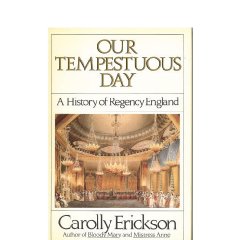
Carolly Erickson’s Our Tempestuous Day [Morrow 1986] is a rapid trek through Regency England.  Erickson, the author of biographies of Elizabeth 1, Anne Boleyn, Bloody Mary, Henry VIII, Empress Josephine and many others…., Erickson here tells the tale of the times not as a linear chronological history, but rather a series of vignettes of events, people, and places, that after you are done you have a much better understanding of the times that Jane Austen was living and writing in… and really a whole new list of books to read! [I will review this book more fully in another post…] 

Charlotte & Leopold: the true story of the original people’s princess,  by James Chambers, a biography of the daughter of King George IV and Caroline, and their Regency times ….here is the blurb from Amazon:

The tragic story of the doomed romance between Charlotte, heir to the English throne, and Leopold, uncle of Queen Victoria and first King of the Belgians. A story that Jane Austen famously declined to tell, declaring: “I could no more write a romance than an epic poem.”

Charlotte was the only legitimate royal child of her generation, and her death in childbirth resulted in a public outpouring of grief the like of which was not to be seen again until the death of Diana, over 150 years later. Charlotte’s death was followed by an unseemly scramble to produce a substitute heir. Queen Victoria was the product.

James Chambers masterfully demonstrates how the personal and the political inevitably collide in scheming post-Napoleonic Europe, offering a vivid and sympathetic portrait of a couple whose lives are in many ways not their own. From the day she was born, Charlotte won the hearts of her subjects and yet, behind the scenes, she was used, abused, and victimized by rivalries-between her parents; between her father (the Prince Regent, later King George IV) and (Mad) King George III; between her tutors, governesses, and other members of her discordant household; and ultimately between the Whig opposition and the Tory government.

Set in one of the most glamorous eras of British history, against the background of a famously dysfunctional royal family, Charlotte & Leopold: The True Story of The Original People’s Princess is an accessible, moving, funny, and entertaining royal biography with alluring contemporary resonance.

A new book out in March by Peter Graham, titled Jane Austen and Charles Darwin: naturalists and novelists (click for the table of contents), and a tad pricey at $99.  reads “3 or 4 families in a country village” : this phrase by which Jane Austen identifies the most congenial subject matter for novels as she chose to write them can also serve to characterize the environment that proved ideal for Charles Darwin’s naturalist observations.” 

Lady Anne at Jane Austen Today has nicely reviewed the new book Jane Eyre’s Daughter, by Elizabeth Newark.

As for the Austen sequels, head over to Austenprose for a review of several being published this September: Pemberley Shades, by Dorothy Bonavia-Hunt [I have just finished this book and will post a review this week; see Laurel Ann’s review hot off the press today!]; Netherfield Park Revisited by Rebecca Ann Collins (Book 3 of the “Pemberley Chronicles”); The Darcys and the Bingleys by Marsha Altman [see Ms. Altman’s post here; I will be reviewing this book shortly], and Impulse and Initiative, a Pride & Prejudice Variation by Abigail Reynolds. 

Just Jane: A Novel of Jane Austen’s Life, by Nancy Moser is given a lengthy review at the BC Blog Critics magazine site.

Ms. Place interviews Diana Birchall on her new book Mrs. Elton in America.

A short blurb on a fantasy fiction book which should excite Austen and Bronte fans:The Magicians and Mrs. Quent,” by Galen Beckett. (Bantam Spectra; $23)

Fans of Jane Austen and the Bronte sisters will be in a familiar landscape reading “The Magicians and Mrs. Quent.” Click here to find out more!

 This fantasy debut uses those authors’ famous works as a template. Does the place name Heathcrest Hall ring any chimes? 
Ivy Lockwell is the eldest of three sisters. It is Ivy who is caught in polite society between holding the family together, after the reclusion of the sisters’ father in his library, and her chafing against the stricture of not being able to use magic (or magick, to use the genre spelling). She is female, after all, and magic also is seen as the cause of her father’s reclusiveness. Of the novel’s three parts, the second, “Heathcrest,” limns relationships nicely from Ivy’s point of view. She applies for governess to Mr. Quent and thinks her troubles eased when hired. If only she had not uncovered an ancient tome about magic still afoot in the world, she would not have met its willful protectors. [quoted from Macon.com]
But also see this glowing review from Rick Kleffel on NPR, and click here for an excerpt from the book:
Though this may look like the sort of book you’d find nestled in a shelf of paperback potboilers at a beach rental, don’t judge The Magicians and Mrs. Quent by its cover. Galen Beckett’s debut cleverly mixes fantasy and literary in a novel that imagines the social strictures that hemmed in Austen’s and Bronte’s heroines are the result of magical intervention. The novel’s supernatural elements and imaginary (but familiar-seeming) setting allow Beckett to examine class and economic conflicts from the outside, without resorting to polemics. The result is a work that mixes the rich pleasures of a Victorian epic with elements of the fantastic, an imaginative eye and a dry sense of humor.

  Kleffel rates this as one of his “nine first books that make a lasting impression,” with a heroine who had a peculiar habit of reading while walking]…now there’s a heroine I can identify with! 

And on that happy note, I should get back to my reading…hope this gives you a few ideas…

Jane Austen · News · Regency England · Social Life & Customs

Queen Victoria and her rather large “unmentionables”… Royal Undergarments on the Block

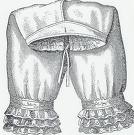
In a follow up to the BBC news a few weeks ago that several pieces of Queen Victoria’s undergarments were being offered at auction, there was some speculation that her bloomers might fetch £500.  So it comes as a surprise that they sold for £4500 ($9,000. !)….  Her chemise, with a 66″ bust, sold for $8,000. and her nightgown sold for $11,000.  See the full article from the Guardian where it is revealed that the bloomers had a 50″ waist: Queen Victoria’s bloomers, and here at Yahoo News with a picture…

The history of undergarments is fascinating…. I offer up a few links to start your study: