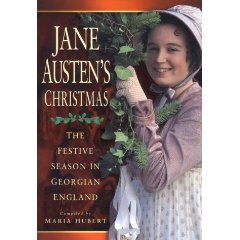
And on my bookshelf … I highly recommend the book Jane Austen’s Christmas: the Festive Season in Georgian England, compiled by Maria Hubert [Sutton Publishing, 1996] (the book is out of print: search at www.biblio.com or www.abebooks.com; available copies are mostly in the UK).
Hubert offers a mix of selections from Austen’s novels and letters, and from other contemporary writers; there are poems about Christmas, along with games and dances and recipes ~ all accompanied by black and white illustrations from various sources. It is a must-have addition to your Austen collection.
You can visit this link at The Christmas Archives for a few excerpts from the book, as well as information on several of the author’s other books on Christmas (Shakespeare’s Christmas; Brontes’ Christmas; Christmas in Wartime are a few examples.]
Here is one of the excerpts ~ a recipe for
BLACK BUTTER
Black Butter would have been a novel recipe indeed, which one of the Austen’s wide circle of seafaring family and friends might have brought them.
Take 4 pounds of full ripe apples, and peel and core them. Meanwhile put into a pan 2 pints of sweet cider, and boil until it reduces by half. Put the apples, chopped small, to the cider. Cook slowly stirring frequently, until the fruit is tender, as you can crush beneath the back of a spoon. Then work the apple through a sieve, and return to the pan adding 1lb beaten (granulated) sugar and spices as following, 1 teaspoon clove well ground, 2 teaspoons cinnamon well ground, 1 saltspoon allspice well ground. Cook over low fire for about ¾ hour, stirring until mixture thickens and turns a rich brown. Pour the butter into into small clean jars, and cover with clarified butter when cold. Seal and keep for three months before using. By this time the butter will have turned almost black, and have a most delicious flavour.
Copyright Maria Hubert von Staufer March 1995
[I will be posting more on the holidays in Jane Austen’s time after our tea this weekend!]
I may be late to the table, but just discovered this morning a new Regency site: Nancy Mayer ~ Regency Researcher. Nancy is gradually putting all her many-years worth of Regency and Jane Austen expertise onto her website, and we will be the grateful benefactors of her knowledge. There is an excellent bibliography, a series of links, and the option to ask her any question you might have on the period.
And remember to check back often as she continues to add information.
Thank you Nancy, for this lovely new addition to the online Regency world! [and a thank you to Susanna Ives for hosting Nancy on her website: Susanna Ives ~ Regency Romance Writer!]
Jane Austen loved a garden. She took a keen interest in flower gardening and kitchen gardening alike. The Austens grew their own food whenever they could and had flower gardens wherever they lived, at their parsonage at Steventon in Hampshire, their town gardens at Bath and Southampton, and when they returned to Hampshire, at their cottage garden at Chawton. In Jane’s letters to her sister Cassandra, we see her planning the details of these family gardens, discussing the planting of fruit, flowers, and trees with enthusiasm. In the course of her life, she also had the opportunity to visit many of the grander gardens of England: her brother’s two estates at Chawton and Godmersham, the manor houses of friends and family, and probably even the great estate at Chatsworth, assumed by many to be the inspiration for Pemberley…
So begins the new book “In the Garden with Jane Austen,” by Kim Wilson, author of Tea with Jane Austen, published by Jones Books [2008], one of my purchases at the AGM Emporium in Chicago, and for those of you enamored of the traditional English garden, a lovely addition to your bookshelf.
Wilson takes us on a visual journey through various gardens Austen would have created for herself, visited, or imagined in her novels, all interspersed with photographs, quotes from her works and letters, and vignettes of engravings and poetry from her contemporaries.
We begin at Chawton Cottage, Austen’s home from 1809-1817, and the setting of the cottage and kitchen gardens that she wrote about so lovingly… “You cannot imagine – it is not Human Nature to imagine what a nice walk we have round the orchard” [31 May 1811], and then references to farm and parsonage gardens, which we see in Emma (Robert Martin’s summer house in his farm garden), and who can forget Mr. Collins day-long labors in his garden, much to Mrs. Collins’s satisfaction!
The chapter on Mansion and Manor House Gardens takes us to Godmersham Park and Chawton House, Austen’s brother Edward’s estates in Kent and Hampshire, Blenheim Palace, Chatsworth, and Stoneleigh Abbey [in Warwickshire] and the Vyne where “every park has its beauty and its prospects” where “one likes to get out into a shrubbery,” and we are reminded of Mr. Rushworth and his “improvements,” and the settings of Pemberley, Rosings, Mansfield Park, and in Emma, where the garden is nearly the heroine’s only place for solace, and Fanny with her own geraniums in her room (but she cuts roses for Mrs. Norris! …and a nice touch here … “Recipes for Mrs. Norris’s Dried Roses”)
Gilbert White's House, Selborne
Austen’s life in the cities of her times was confining, and one of her joys was the City Gardens. Wilson travels through the gardens of Georgian Bath, a variety of London’s garden squares (Henry Austen lived in several places in London and the areas surrounding these show up in her novels as the London homes of her characters:, Brunswick Square in Emma, Hanover Square and Portman Square in S&S), the garden at the Royal Pavilion in Brighton (where Austen’s characters visited, if not Jane herself), and the small town garden the Austens had in Southampton.
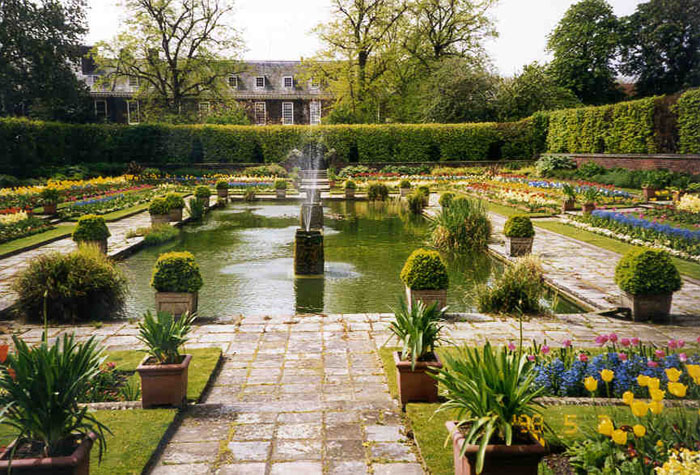
We all know that Austen was a self-described “desperate walker” much as she imagined Elizabeth Bennet, so her love of Public Gardens & Parks is apparent in her novels and letters: Kensington Gardens, St. James and Hyde Park in London, Sydney Gardens and Alexandra Park at Beechen Cliff in Bath, Box Hill (made famous in Emma), and the tours of the picturesque (as Elizabeth’s tour through Derbyshire in P&P), and Netley Abbey near Southampton.
Kensington Gardens
The chapter on Recreating Jane Austen’s Garden offers plans on the Chawton Cottage kitchen garden and flower border, the border garden of Houghton Lodge, the herb garden at Gilbert White’s House (in Selborne, near Chawton), and a Georgian garden with plans of the Kennard Hotel garden in Bath.
Gardens featured in Austen film adaptations closes the book with a list of the various real-life houses, gardens and parks that breath life into Austen’s stories…many are open for tours and how better to experience the places that Austen herself created for us than to take a leisurely walk around the grounds of these locations.
Wilson provides a bibliography to entice the reader with yet more books to peruse: they run the gamut from “The Formal Garden in England” [R. Blomfield, 1901] to Cowper’s “Poems” to “Hints for the Preservation of Wood-Work Exposed to the Weather” [J. Crease, 1808] and “The Juvenile Gardener, Written by a Lady for the Use of her Own Children” [London, 1824]
So this quick summary is of course lacking in what makes this book so charming – the many photographs, the quotes from the novels, the flowers! Ms. Wilson has given us a gift! I live in an English cottage cape, surrounded by what were once charming gardens…I struggle to keep them looking as I know they must have in some long-gone past, … I have many books on cottage and English gardening, perennials and borders, herb gardens, Gertrude Jekyll’s gardens, Penelope Hobhouse on all manner of gardens, even how to make an all-white garden … so this book is a delight to add to my collection, combining as it does my love of an English garden and my love of Austen….it is a visual feast, a good quick read that brings so many elements to the table…it is unfortunate that we are now upon the winter scene here in Vermont, and though I cling to my last rose struggling mightily against the frost that visits us every night, I can perhaps make some new plans through the long winter, or better yet, plan a garden tour through the English countryside next spring…or at least do a re-read of this lovely book……
Thanks to Georgie Lee’s blog for this mention: for information on the “Ghosts of Bath”, visit Hollow Hill, one of the web’s oldest sites for Ghosts and all things spooky… the man in the black hat in the Assembly Rooms; the coach drawn by four horses in the Royal Crescent; the ghost of the Theatre Royal and Garrick’s Head Pub; a hooded figure at the Crystal Palace Tavern; a jilted bride of Queen’s Square… and many more…
and for some additional holiday reading, try this book by John Brooks:
Jane (in Cork Street, London) to Cassandra (Steventon? not noted)
Boston Public Library (since 1966)
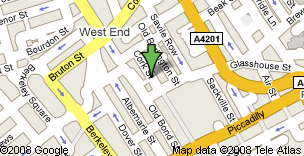
There has been a gap of seven months since Letter no. 2 (of January 1796), but Letter 3 finds Jane in London, likely staying at at the home of Benjamin Langlois in Cork Street (see below) and she hurriedly pens a quick letter to Cassandra. She begins with her oft-quoted
Here I am once more in this Scene of Dissipation & vice, and I begin already to find my Morals corrupted.
and “hoping you are all alive after our melancholy parting.” She reports on the trip in a Chaise and “without suffering so much from the heat as I had hoped to do.” She has traveled with her brothers Edward and Frank and “they are both gone out to seek their fortunes; the latter is to return soon & help us to seek ours. The Former we shall never see again.”
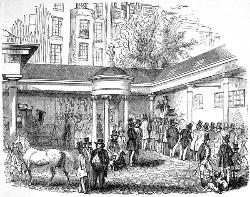
They are off to “Astley’s” to night” [ Astley’s Amphitheatre near Westminster Bridge, an equestrian circus open from Easter through November or so] See Emma chapters 54 and 55 for references to Astley’s.
Then a reference to Henry driving his then fiance Miss [Mary] Pearson to Rowling, where Jane is headed on Thursday, so her visit to London is a short one [Rowling is in Kent, and the home of the Bridges family; Jane’s brother Edward married Elizabeth Bridges]; and Austen signs off with hopes that Cassandra “pursued your intended avocation with Success.-” not sure what this refers to…will see if mention is made in a subsequent letter.
An interesting note about this letter is in the viewing of it in Modert’s compilation of facsimiles; one finds Austen’s writing much larger and sprawling than most of her other letters…. she perhaps had no concerns here about the costs of posting, or wrote it very quickly and just wanted to send it off without thinking of adding more the next day, as she often did…
One of my great finds at the AGM was this book titled Jane Austen Visits London by Vera Quin. Ms. Quin was one of the presenters, giving a delightful talk on Austen’s Landscape. In this book, just published in 2008 by Cappella Archive, Quin takes us through Austen’s letters from London, numbering thirty out of the 160 or so extant letters. So I will return to this book again and again as I read the letters. But here I am interested in what she says about this letter and Austen’s stay at Cork Street. Quin takes us along the street to identify what was there during Austen’s time…and the house she likely stayed in was that of Benjamin Langlois, an MP and Under-Secretary, and a bachelor who lived alone in this small house at 18 Cork Street, but more importantly the Uncle to Tom Lefroy, the subject of Jane’s previous two letters, and this home is where Tom stayed when he was in London. Ms. Quin references the theory, albeit she adds with no evidence, that Jane stayed here with perhaps the intention of seeing Tom and seeking his Uncle’s approval for a possible engagement… (p. 9)
…but that not forthcoming, Quin continues with her thoughts that Jane would have walked the streets of the surrounding squares and perhaps put her imagination to work…this is where you find Mrs. Ferrars, Mrs. Jennings and her daughters, John and Fanny Dashwood, all of S&S and the Hursts of P&P. (p. 10)Austen’s later trips to London found her at her brother Henry’s. All speculation aside, it is an interesting question as to why Jane spent these two days at this house, noted as being too small to house guests comfortably…is there any more thought or research on this? I know that Joan Ray’s article on Austen and Lefroy makes it clear that Tom would not have been there at this time because his classes were not in session. And I agree wth Ray that there is no reason to link the comment about her “morals being corrupted” with Lefroy being there… this is just Austen making fun of the prevailing take on London as a place of lose morals….
Further reading: there is no beginning with links to Regency London; I collect books on London and am well-aware that it is a lifetime commitment! Here are just a few of the good sources out there. I will refer to more of them as I come upon other Austen letters sent from London.
Ray, Joan Klingel. “The One-Sided Romance of Jane Austen and Tom Lefroy” Persuasions Online, vol.28, no. 1 (Winter 2007)
There are a number of good books on London at this time, notably Liza Picard’s Dr. Johnson’s London [St. Martins Press, 2000] with its tantalizing sub-title: “coffee-houses and climbing boys, medicine, toothpaste and gin, poverty and press-gangs, freakshows and female education.”
Also Roy Porter, London: A Social History [Penguin, 1996] and Stella Margetson Regency London [Cassell / Praeger, 1971]; and Peter Thorold, The London Rich, the Creation of a Great City, from 1699 to the Present [ St Martin’s, 2000]
and there is an excellent collection of essays on Jane Austen in London at the JASA website, which covers a number of topics on life in London during the Regency.
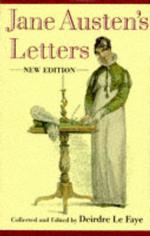
I have read many of Austen’s letters through the years, and certainly know the majority of quotes that are repeated over and over…but I am finally committing myself to going through each letter in chronological order and reading through all the accompanying notes and references ( my source and Essential Austen title: Jane Austen’s Letters, collected and edited by Deirdre Le Faye, 3rd edition, Oxford University Press, 1997)…. and I invite you all to take this journey with me, one letter at a time, one day at a time.
So often these letters, and the sentences or words from them, are quoted out of context, and I feel compelled to make some sense of it all, to go back to the original source and get a feel for what Austen was really saying. There are so many gaps in the letters, either from Cassandra’s choice to edit and / or destroy many of her sister’s writings, or because the sisters were not apart and hence no need to write (and of course there are only a few letters from Cassandra herself, and because Austen often refers back to a received letter, and with her constant comments on her sister’s writing abilities and humor, the reader is saddened by this loss.)
There are also many primary and secondary sources on the letters and I will discuss these periodically (see also the Letters Page, which I will continually add to), but I think I better just start the process and let it evolve from there. I encourage you to comment, suggest sources, offer suggestions or interpretation, so please visit often and participate. For those of you who know the letters backwards and forwards, and for those just discovering them, please take this journey with me. I think all of us might learn something new along the way. I know I already have….
Jane (Steventon) to Cassandra (Kintbury, Newbury [Rev. Fowles home])
Original MS untraced
This is Austen’s first documented letter and one of the most quoted. It is here that Jane writes of her attachment to Tom Lefroy and she refers to him often in this letter…”I am almost afraid to tell you how my Irish friend and I behaved. Imagine to yourself everything most profligate and shocking in the way of dancing and sitting down together.” She tells of the balls- “we had an exceedingly good ball last night”, who she danced with (Warren, Charles Watkins, and “fighting hard” to escape John Lyford), commenting on Miss Heathcote (“[she] is pretty, but not near so handsome as I expected”), and the many references to friends that we meet again and again in her letters. We read of her latest fashion thoughts, the silk stockings she cannot afford but the white gloves and pink persian (silk) she can, and much on her brother Charles and brother Henry and his latest plan to obtaining a lieutenancy.
The letter ends with another lengthy reference to Tom Lefroy: “he has but one fault…his morning coat is a great deal too light. He is a great admirer of Tom Jones, and therefore he wears the same coloured clothes, I imagine, which he did when he was wounded.”
So in this first letter, (Jane was 20 years old writing this letter on Cassandra’s 23rd birthday and the letter opens with “In the first place I hope you will live twenty-three years longer”) we are introduced into Austen’s life, her family and friends, her likes and dislikes, and her biting wit, her poking fun at others and so very often herself. Her letters to her sister were entertainment for both of them when they were apart, and in just these few pages we are drawn into this late 18-century world, with all its domestic goings-on, and we are glad to be in such company. These letters are a veritable feast!
The Hampshire Record Office, located in the city of Winchester, houses a treasure trove of primary artifacts, from original letters to period photographs, from local newspapers to public records. Its atmosphere is friendly, its staff helpful. Actual items, kept in the strong room in the bowels of the building, are highly accessible: HRO’s web-based catalogue makes it easy for visitors to know beforehand what HRO holds, and minimal paperwork gets the visitor entry into the reading room. So one would think that HRO would have a thorough knowledge of items within their vast collection… It seems, however, that at least one minor tidbit had gone unaccounted for – until now.
A letter in Friday’s post from a Winchester-based friend contained the following exciting news:‘I was startled to find from our Record Office Annual Report that during reorganization a playbill for a performance of Lovers’ Vows 11 August 1809 had come to light among a collection.’[HRO had been closed several months for renovations and reorganziation; they reopened Spring 2008.]
It will be remembered that Mrs Austen and the girls had only that May settled at Chawton.
As yet – there is no evidence that the Austens came to see the play. My friend thinks it ‘unlikely’ they would have attended, but she’s digging to see what further clues might be out there. She continues, ‘The theatre put on mixed entertainments, at 7 pm. I haven’t found that particular evening advertised in The Chronicle[Winchester’s newspaper]… [W]ith the horse races on, it was high season in August.’
Going online, we find other (later) playbills/handbills for LOVERS’ VOWS, so it was a play in demand – from Winchester to Edinburgh, even as late as 1820.
There are many possibilities for this particular appearance of the play, including a troop of actors just passing through. They perhaps did offer a very limited number of performances (either of one play, or a couple different plays over several nights). That no advance notice was given via The Chronicle may be accounted for in several ways: advertising was last-minute; the acting company may have ‘rented’ the theater for the evening; due to the races, a full-up Winchester might have given hawkers with handbills a good turnout based solely on word of mouth; it may have been a last-minute addition or change to a ‘mixed entertainments’ line-up. And we have all been visitors willing to sit through anything just to have a night out on the town, so tickets for any entertainment, for any play, will always sell when the ‘season’ is in swing. Handbills exist because it was easy to post ‘today’s’ lineup at the theater, or have people handing notices out to passers-by.
So this all begs the ultimate question: Could Jane Austen have attended, would she have heard about this play, offered in Winchester?
Family and friends did attend racing meets, at Winchester and elsewhere. Nephews brought Winchester within the Austen-sphere, as evidenced by a letter dated 9 February 1807, when Jane writes ‘We shall rejoice in being so near Winchester when Edward belongs to it’. At the time living in Southampton, thirteen miles were seen as ‘no distance’ once fourteen-year-old nephew Edward (Edward Austen Knight’s eldest son) enrolled at Winchester College; other nephews attended the same school, including James-Edward Austen (James’ son). A handful of Jane’s letters exist for 1809 – but none dated after July 26 (and the series doesn’t pick up again until 1811!). Winchester is sixteen miles from Chawton; it is conceivable that, after an absence of several years, the Austens planned to spend a day at the races or journeyed simply to enjoy the atmosphere of Winchester en fete.
Somewhere along this route, surely, the play and JANE AUSTEN crossed paths, even if only after the fact: she may have heard about its ‘local’ performance, or met up with someone who had been in attendance.
I will give more news as I hear of it.
* * * * *
More playbill information; some commentary (and a second) on Austen’s use of the play in Mansfield Park; synopsis, cast, and play at Austen.com and Digital Library (includes ‘The Mansfield Casting’); Susan Allen Ford‘s Persuasions (2006) article on the play and the players from Mansfield Park.
WHIST is a card game well associated with the 18th and 19th centuries. But here is a game which sounds so much more up Jane Austen’s alley; it is called Conversation. The description of the game comes from the two-volume set of diaries (edited by Andrew Oliver) of Samuel Curwen. Curwen was an American, but he spent much time in England – hence the name of the book published by Harvard University Press in 1972: The Journal of Samuel Curwen, Loyalist.
It is March 1784, and Curwen is in London:
28. Fair but very cold sharp air… Dined at Mr. Charles Brand’s in Lambs Conduit street with our whole family, by invitation given 10 days ago. Drank tea and passed evening till near 12 o’clock there, the younger part playing at a game called Conversation Cards, which is done in the following manner. To each person is dealt 9, by 3 at each time, on each card is inscribed a word as King, Queen, Gentleman, Lady, Night, Morning, or any short sentence. The person on the dealer’s left hand throws one and addresses or speaks it, and so each peson successively adding some pertinent as he can invent till all being out of hand, the cards are [one word {ie, illegible or missing word; I wonder: gathered?} ] and the person who first threw a card down forms a story from his hand taking the words on his card for the text filling up the interval in the best manner he can till each has told his story; these being laid aside a new parcel is dealt as before &c. &c.
— The Journal of Samuel Curwen, Loyalist (vol 2), pp. 979-80
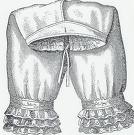
In a follow up to the BBC news a few weeks ago that several pieces of Queen Victoria’s undergarments were being offered at auction, there was some speculation that her bloomers might fetch £500. So it comes as a surprise that they sold for £4500 ($9,000. !)…. Her chemise, with a 66″ bust, sold for $8,000. and her nightgown sold for $11,000. See the full article from the Guardian where it is revealed that the bloomers had a 50″ waist: Queen Victoria’s bloomers, and here at Yahoo News with a picture…
The history of undergarments is fascinating…. I offer up a few links to start your study:
 And on my bookshelf … I highly recommend the book Jane Austen’s Christmas: the Festive Season in Georgian England, compiled by Maria Hubert [Sutton Publishing, 1996] (the book is out of print: search at www.biblio.com or www.abebooks.com; available copies are mostly in the UK).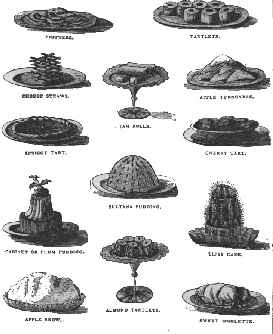








 Jane Austen in Vermont