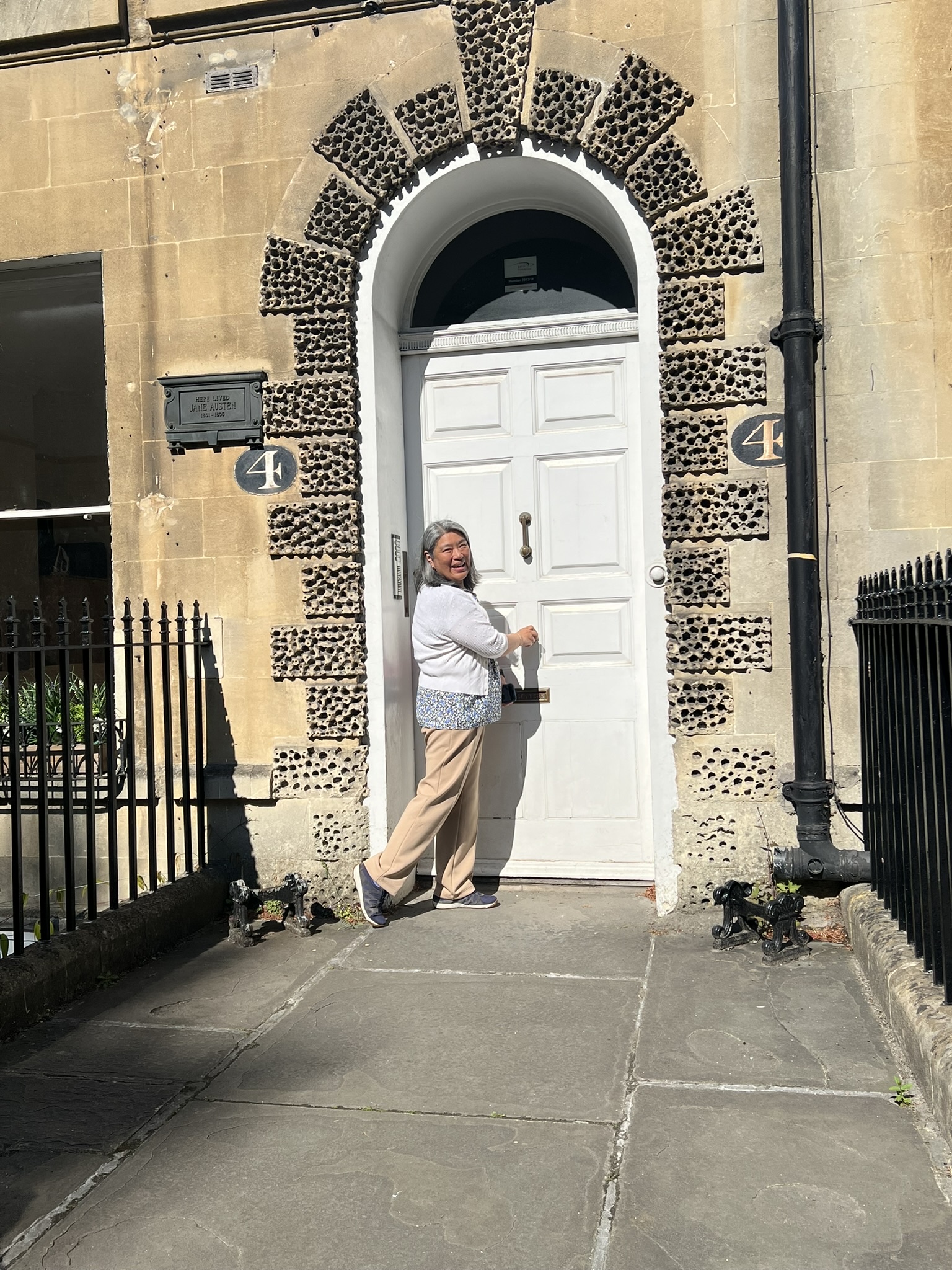
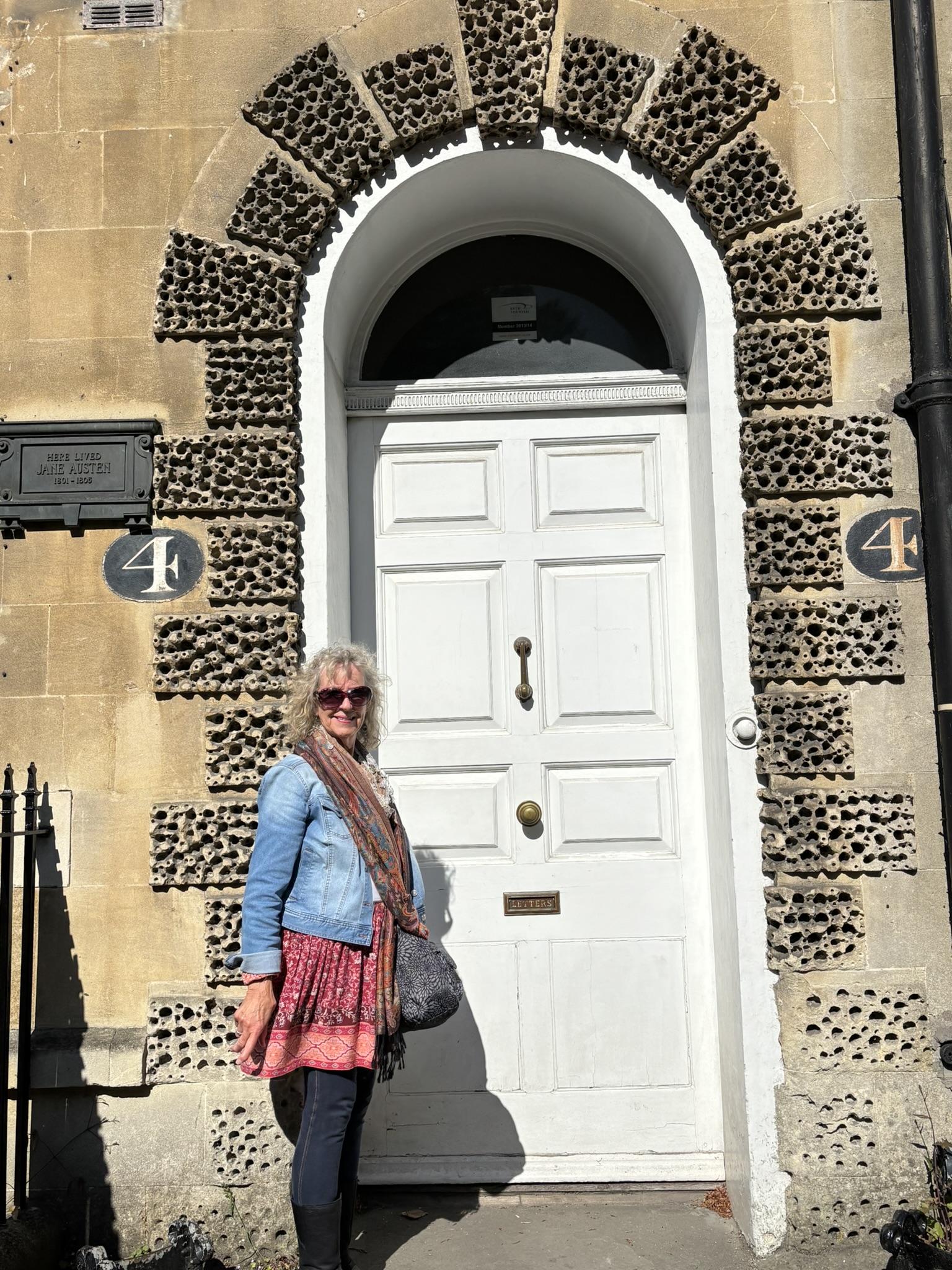
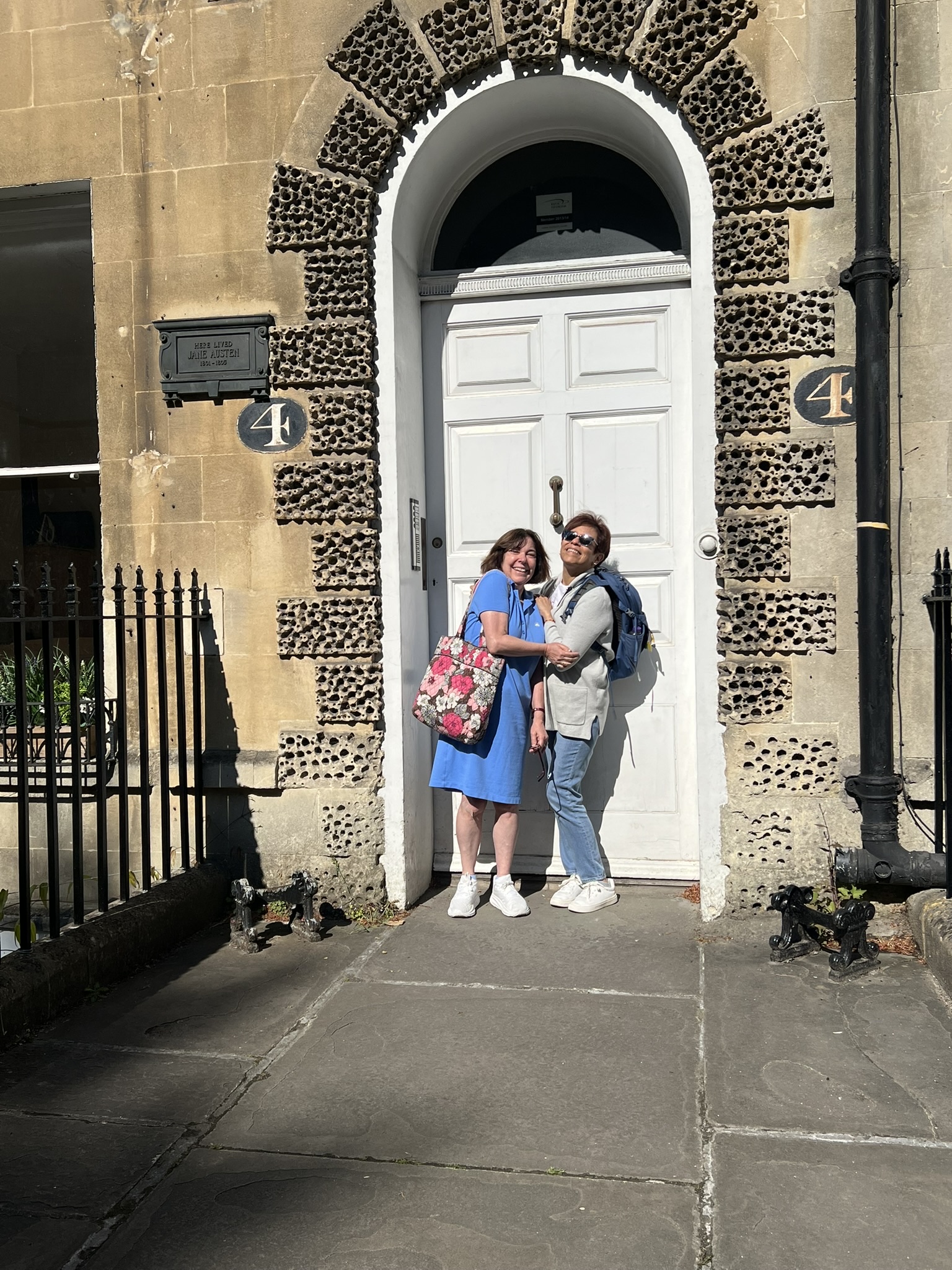
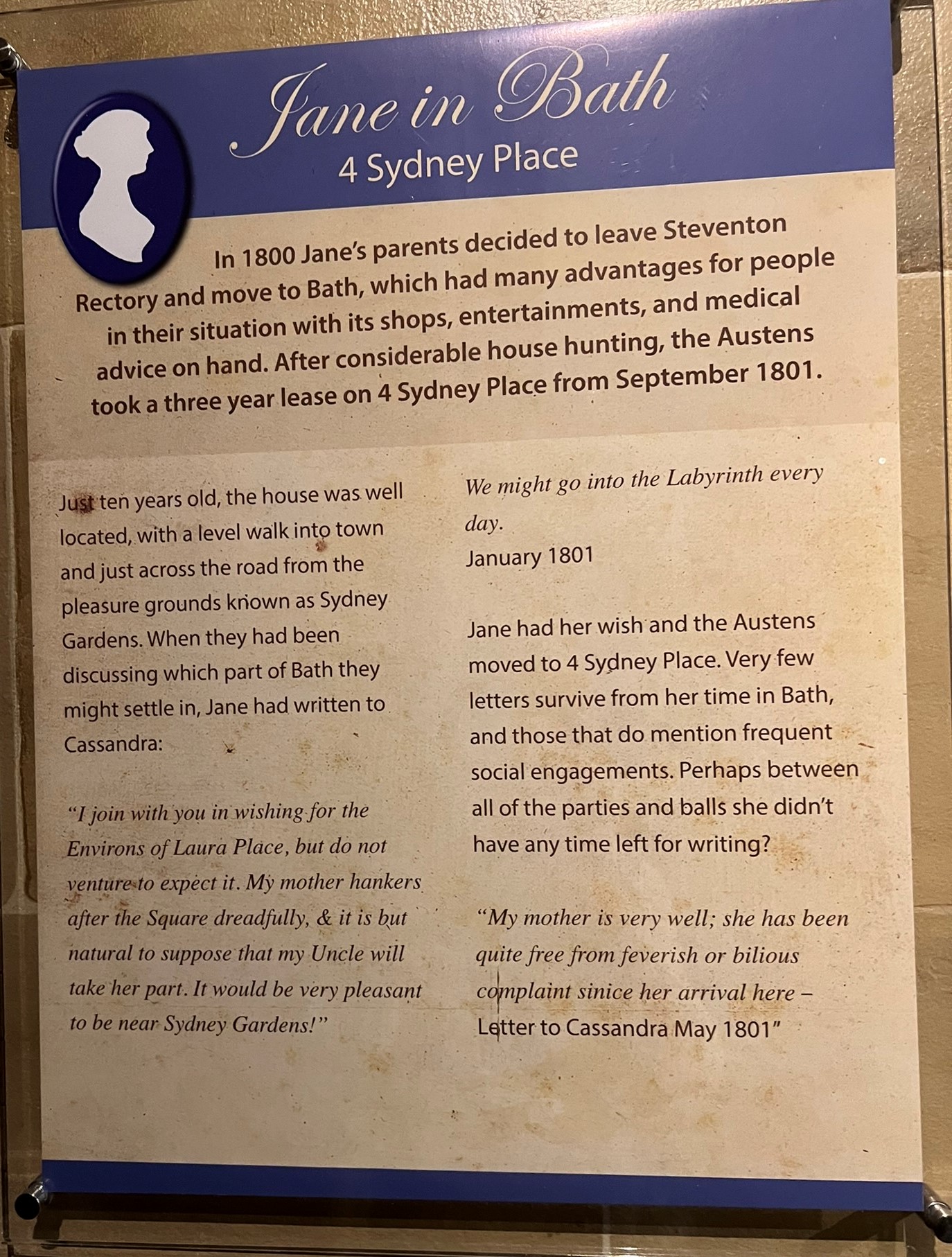
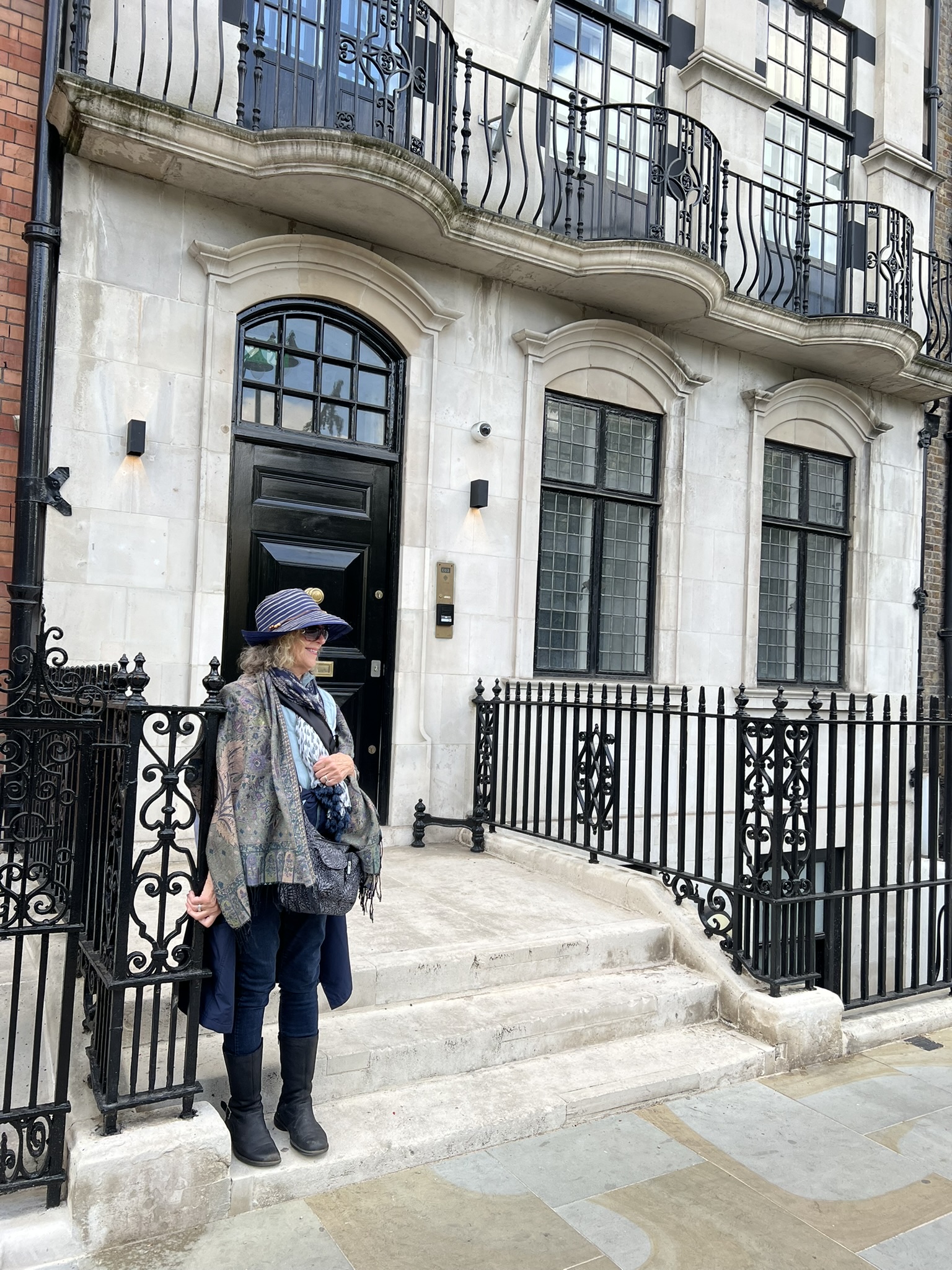
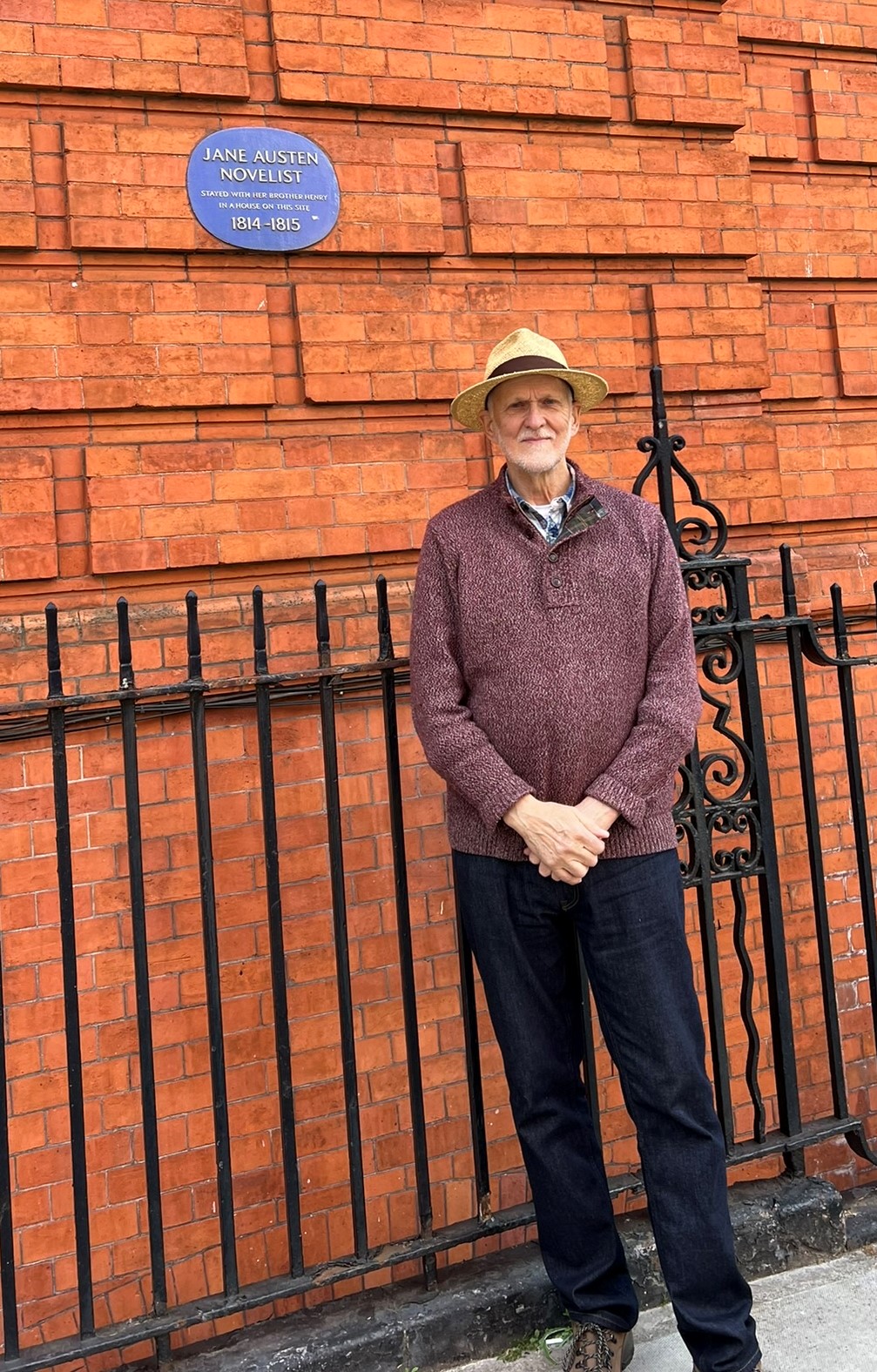
But now we are off first thing to the Holburne Museum – with a stop along the way to No. 4 Sydney Place, at the end of Great Pulteney Street, where Jane and her sister and parents lived for their first three years in Bath – it is also the only house in Bath to have a plaque telling us that she had lived here: here are Joy and I, and Michele and Vicki in the required photos at the front door [people who live here must love this constant invasion of their doorstep…]
**************
Then into the Museum, with again a terrific guide, who pointed out the salient pieces to see on a fairly quick tour – so much here to ponder over: the artwork, decorative arts, and history of the owner:
At the heart of the Holburne Museum is the collection of Sir William Holburne (1793-1874), fifth baronet of Menstrie. William seemed destined for a naval career but, following the death of his elder brother Francis, he inherited the family title and a modest fortune. He left the navy and embarked on an eighteen-month Grand Tour of Europe, visiting Italy, the Alps and the Netherlands. This sparked a life-long interest in art and his enthusiasm for collecting. He particularly loved bronze sculptures, silver, porcelain and Dutch landscapes.
Sir William never married. He lived with his growing collection and his three unmarried sisters on the North side of Bath. It was his wish that his collection be left to the City of Bath for everyone to enjoy. Since his death, more than 9,000 items have been added to his collection including portrait miniatures, porcelain, embroideries and portraits by some of the greatest artists of the eighteenth century.” [from the website]
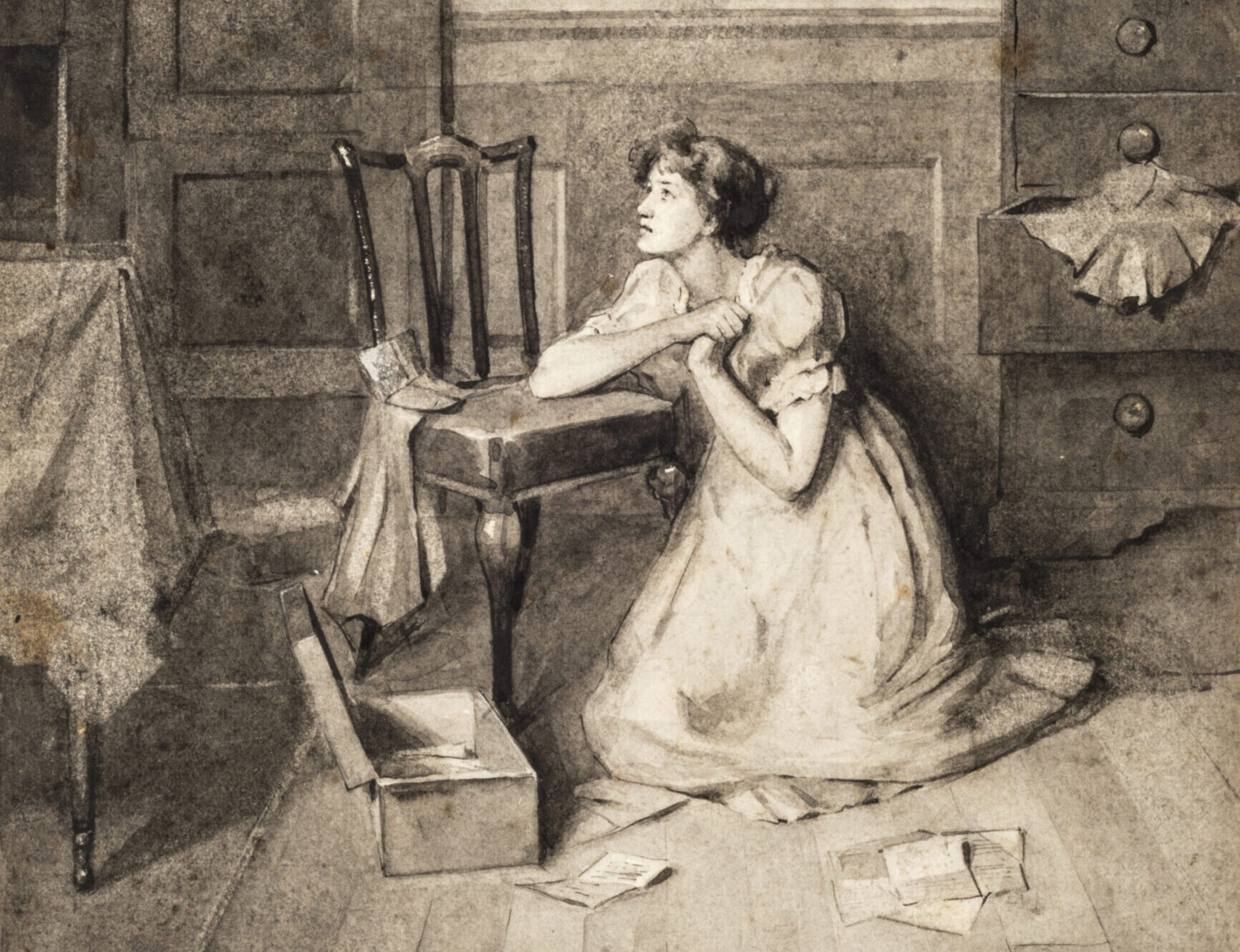
We just missed the Turner watercolor exhibit which was to open on May 23 – but to celebrate Austen in this 250th year, coming up are two evenings of adaptations – the 1995 Emma and 1995 Sense and Sensibility. And from Sep 11, 2025 – Jan 11, 2026, an exhibit on “Illustrating Austen”:
[Marianne Dashwood, by William C. Cooke, S&S, 1892]
I could have stayed here all day taking photos – so here just a few of my favorites:
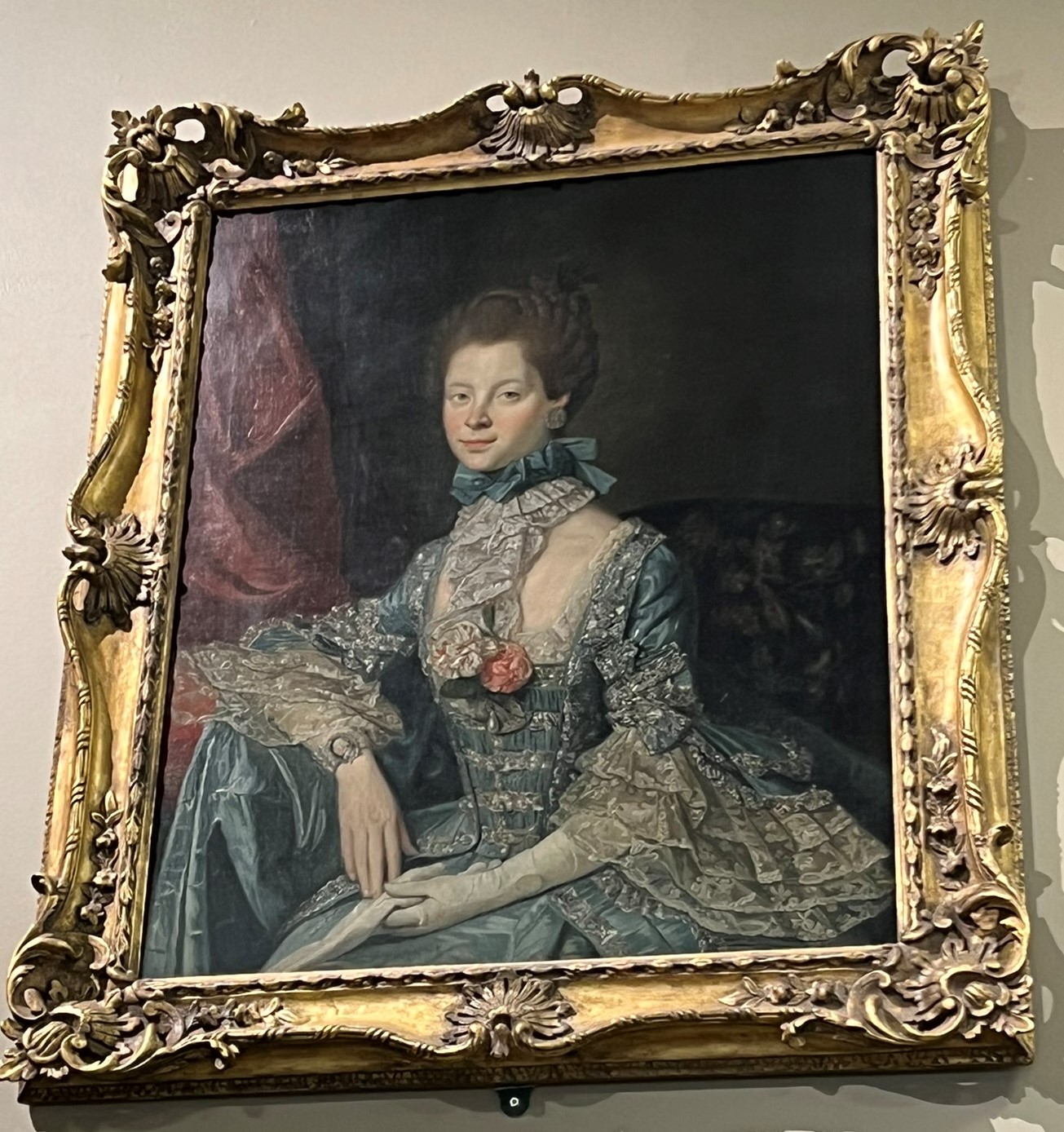
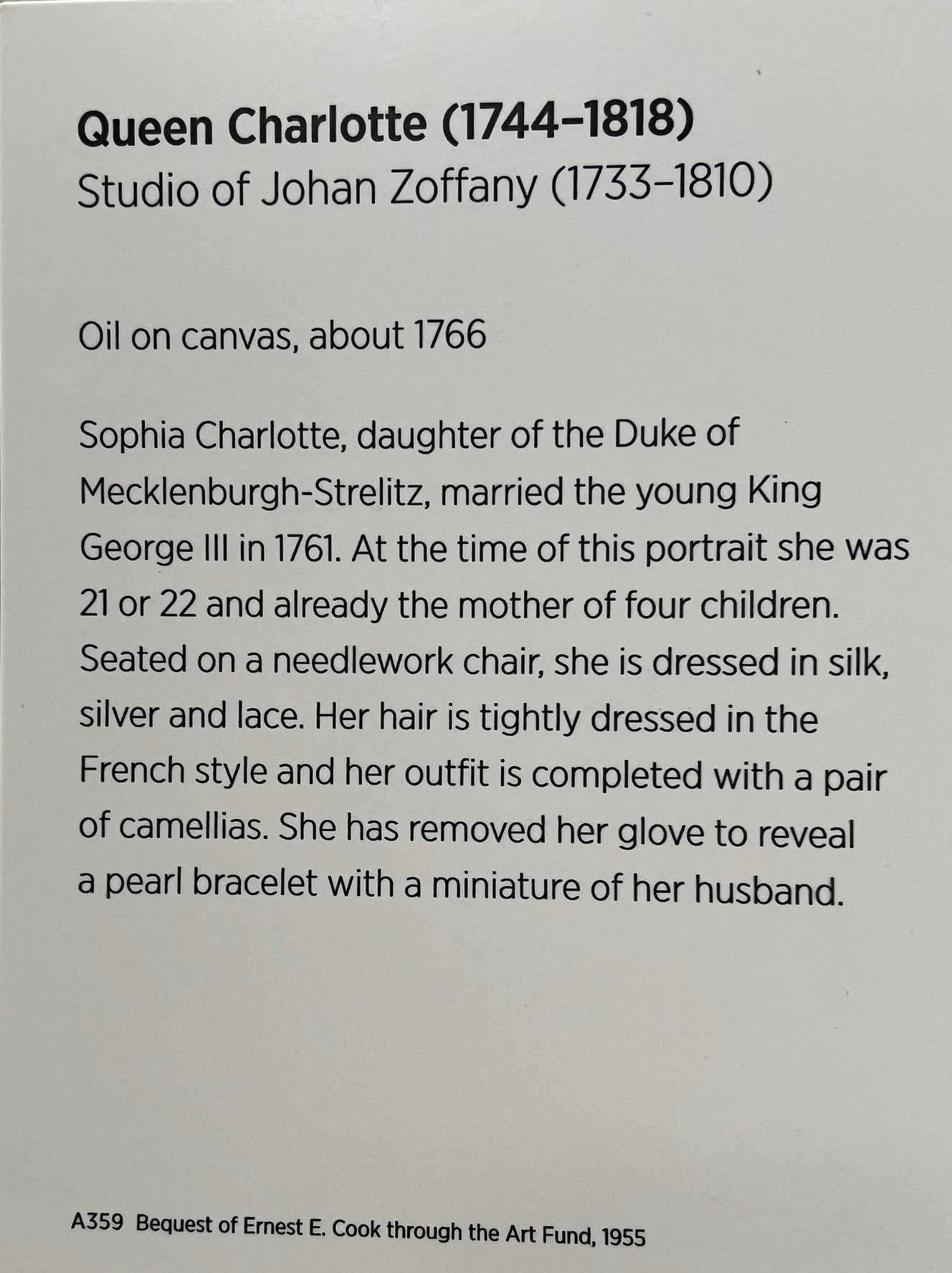
Queen Charlotte:
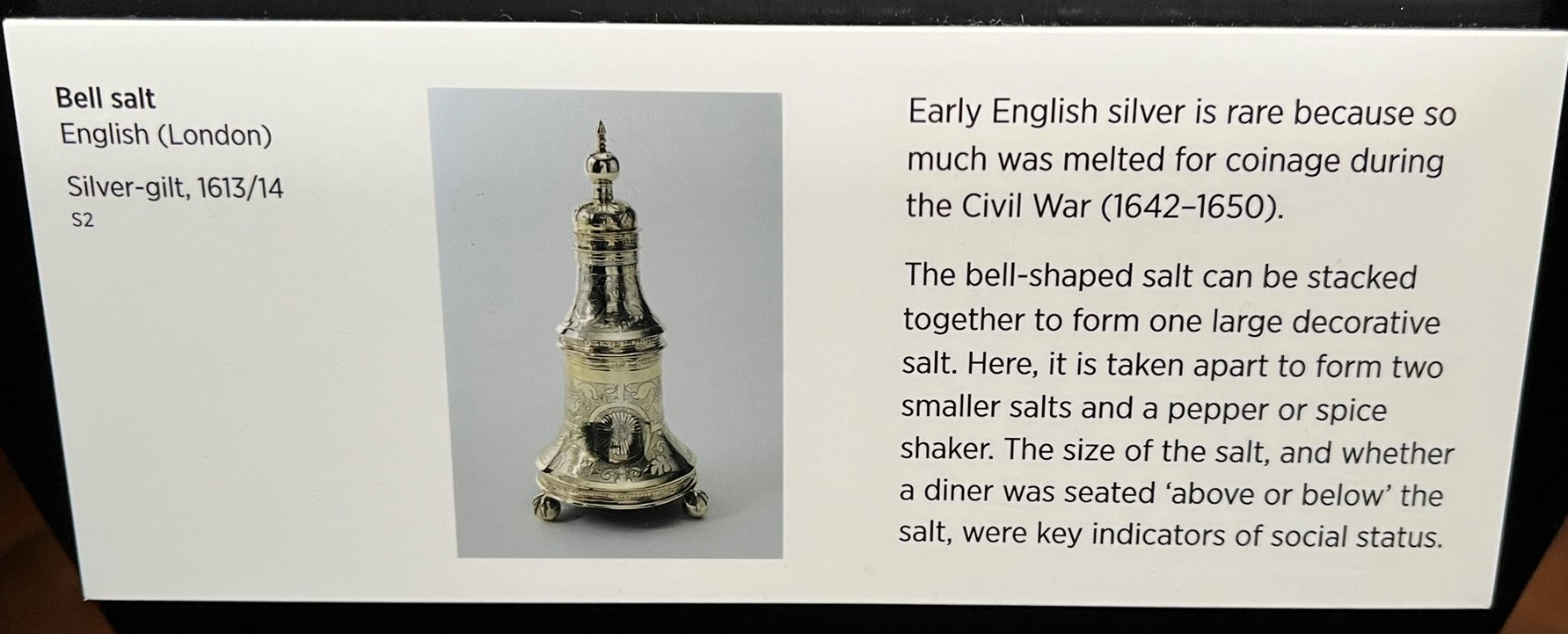
English silver:
A chamber pot designed as a planter:
More porcelain:
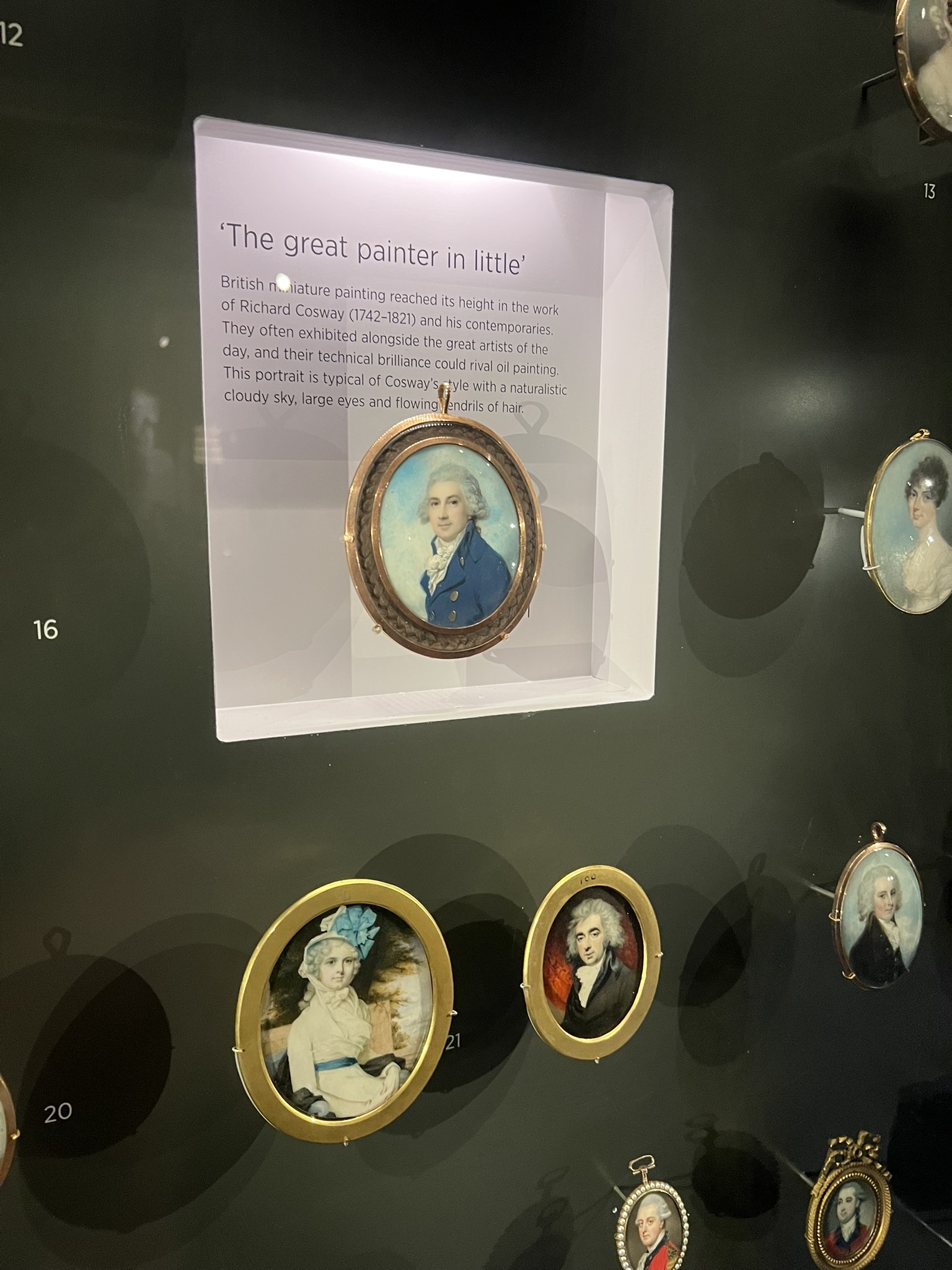
Richard Cosways’ miniatures:
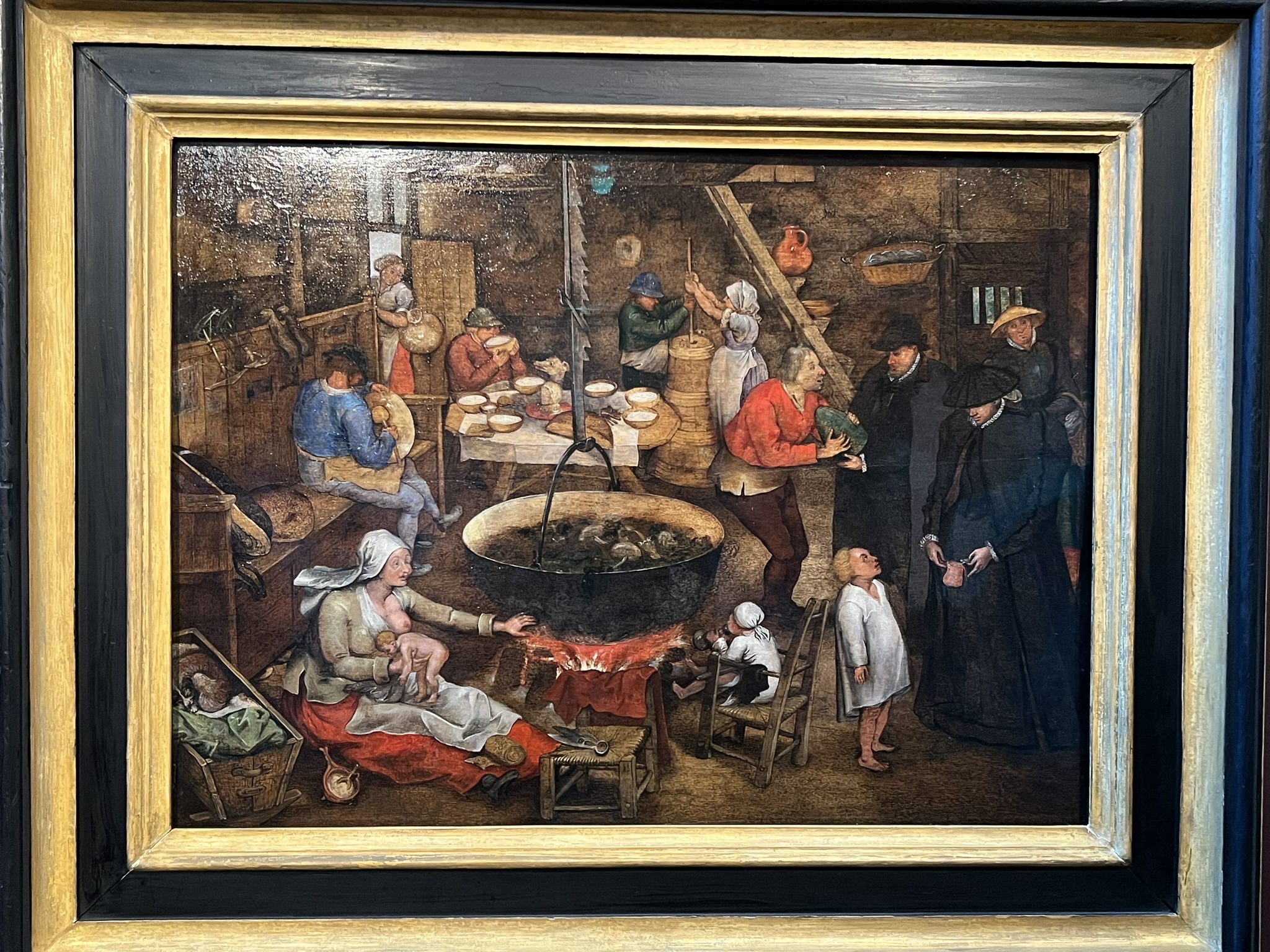
I was interested in these Bruegels because I was heading off to Belgium on a Flemish art trip at the end of June – apparently this one is definitely attributed to him, the one below has not…:
And, where there is a harp, can Mary Crawford be far behind??
**************
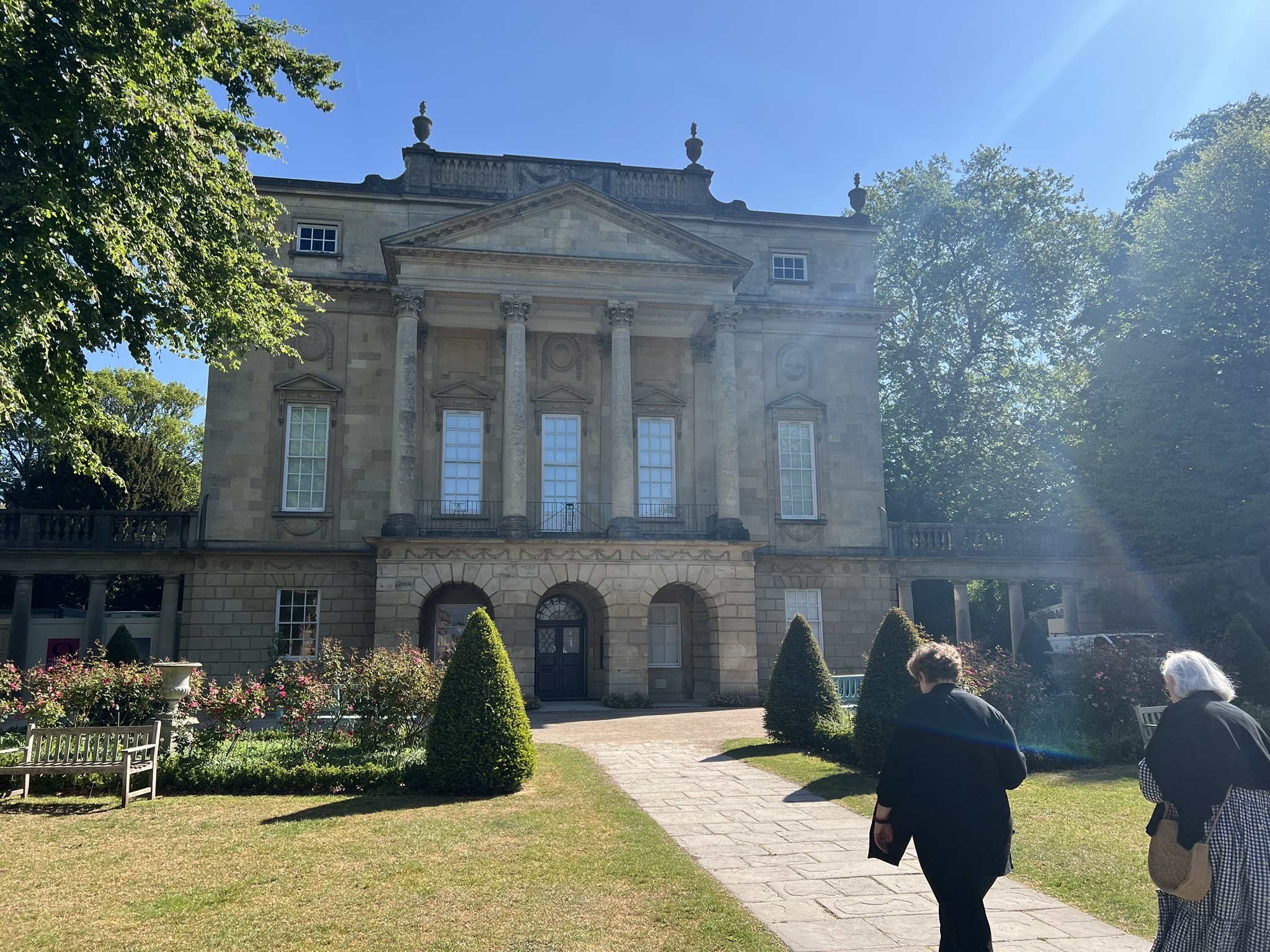
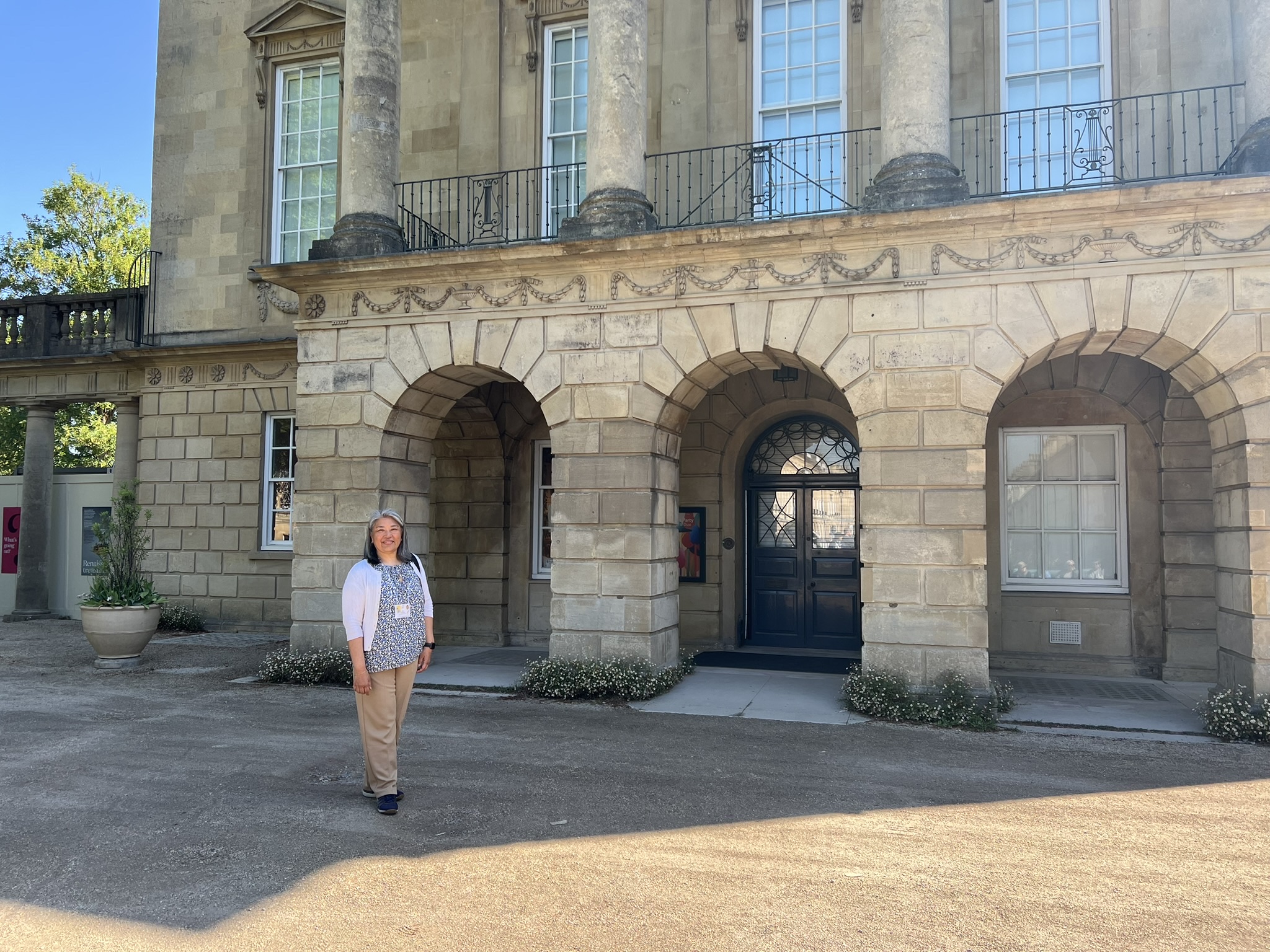
And must make a note of the setting of the Holburne Museum as Lady Danbury’s house in the Netflix series Bridgerton – it appears in all three seasons and also in Queen Charlotte: A Bridgerton Story. The museum’s exterior is particularly recognizable when guests arrive at balls, and it’s also the setting for a scene in season 3 where Penelope is upset with Colin.
Then more walking around Bath – across the Great Pulteney Bridge with its great shops – here Joy and I found the perfect spot for tea: Pulteney Bridge Coffee where we had “lemon drizzle” – yum…
And where you then come upon Laura Place, the widest street in Bath, and where Lady Dalrymple lives – the very upper-class (and expensive) location and where Sir Walter is chuffed to bits to be invited…
Here is a great summary of places in Bath that show up in Persuasion:
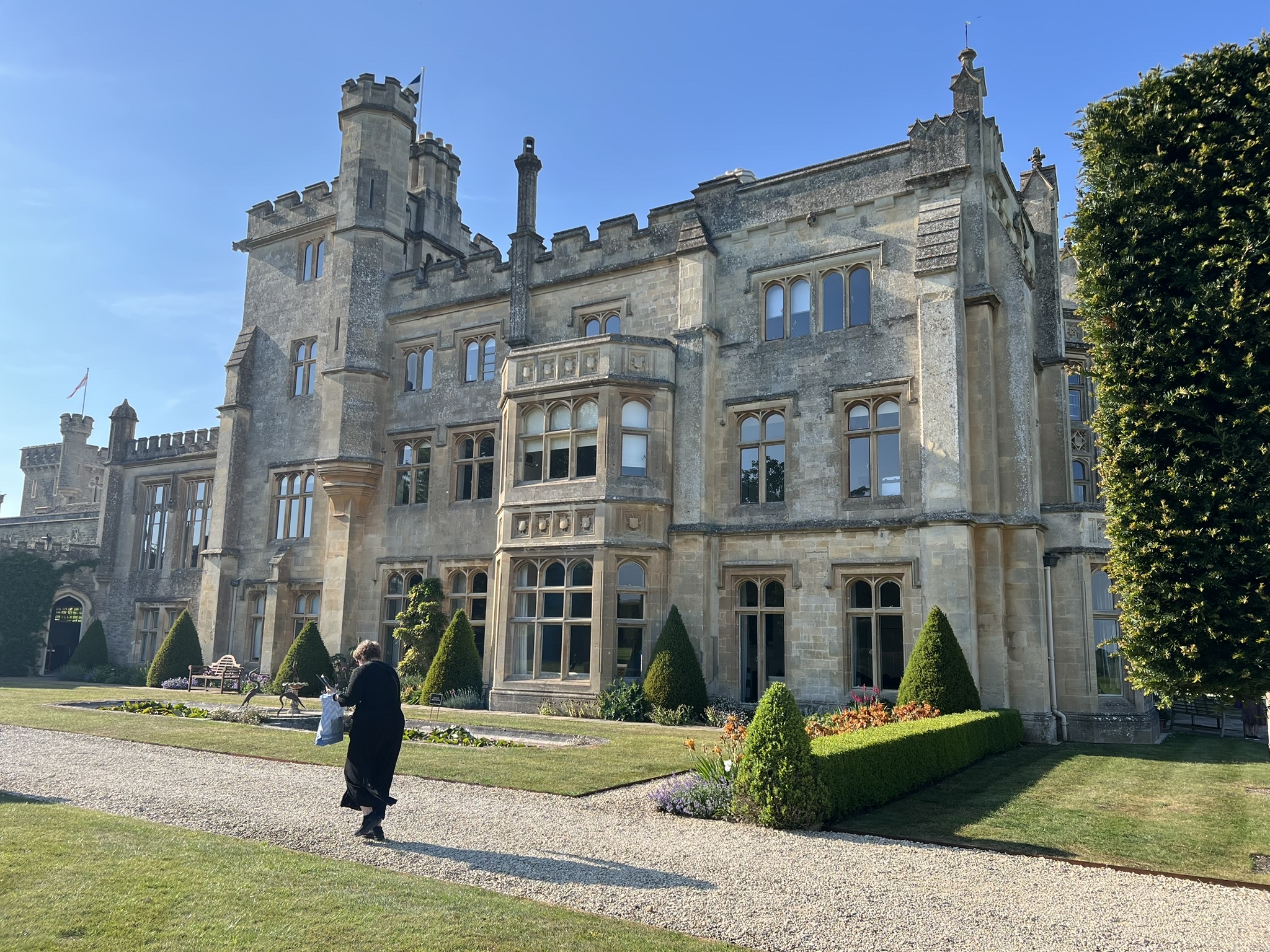
If you want to get married here or throw yourself an elegant party [and I highly recommend it!}, go here: https://www.farleigh.house/
I was most interested in the rugby! My husband played rugby in college and later for a club in Washington DC – but alas! no rugby players in sight, only some views of the playing fields – more about them here: https://www.bathrugby.com/
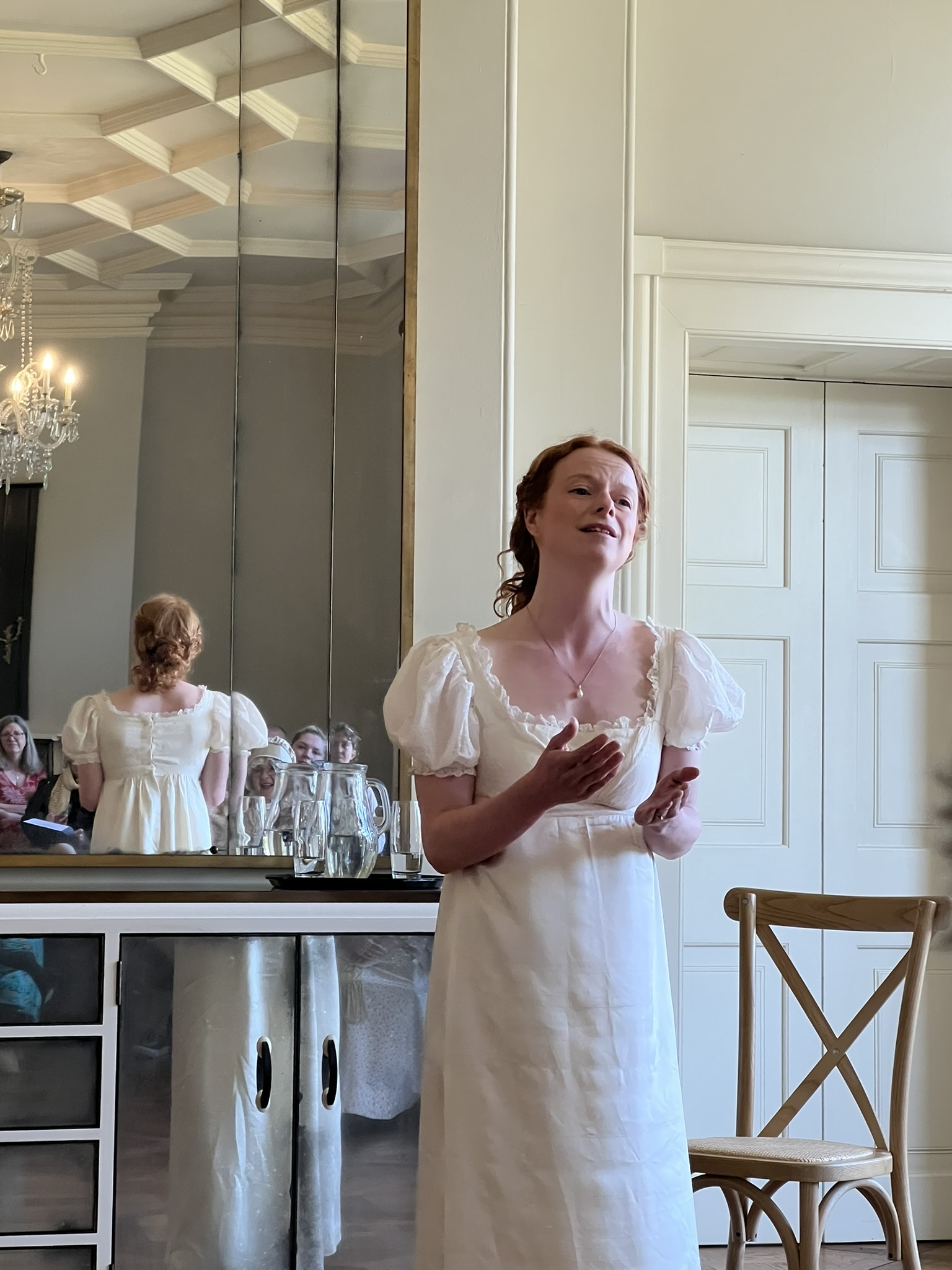
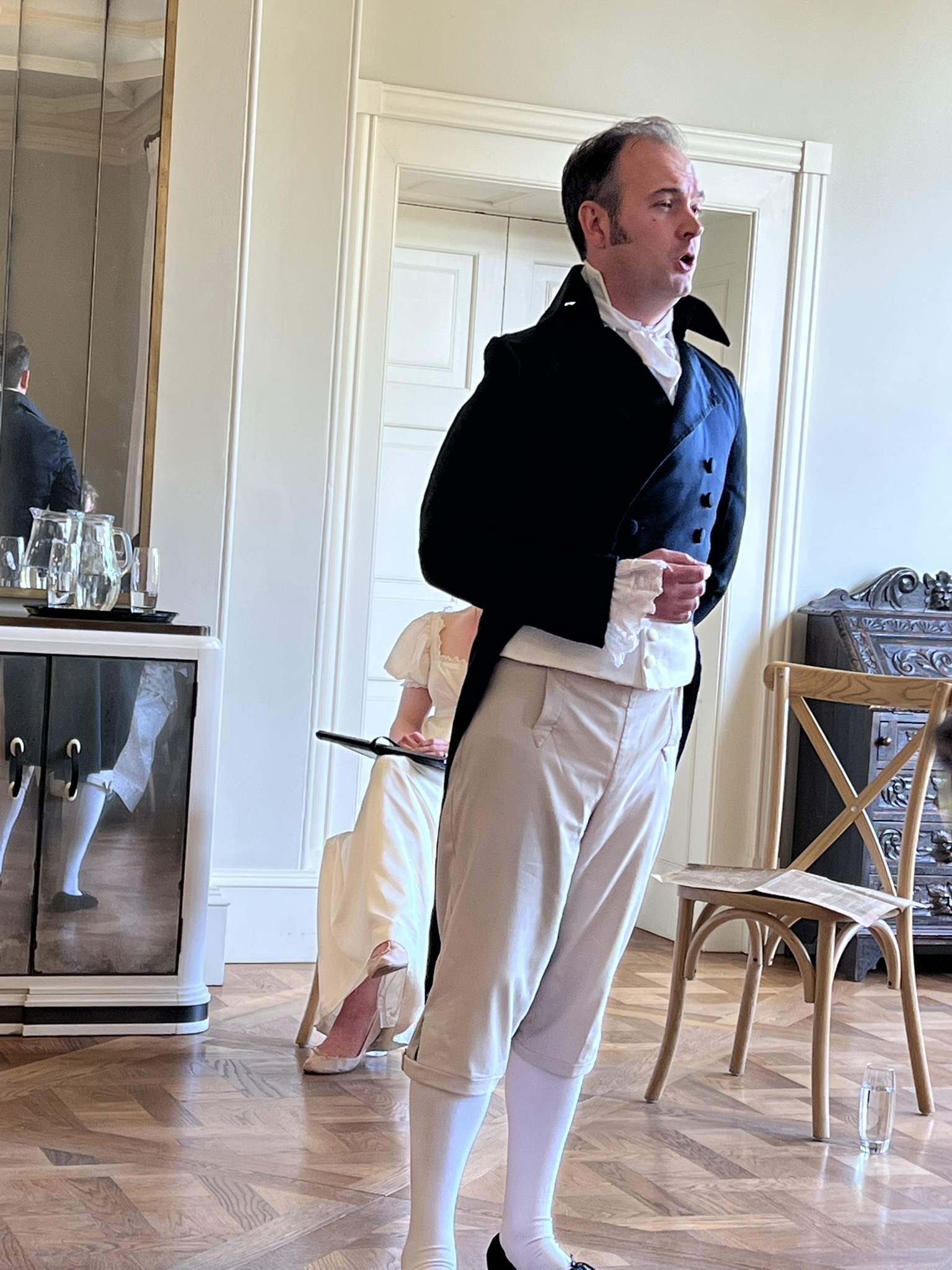
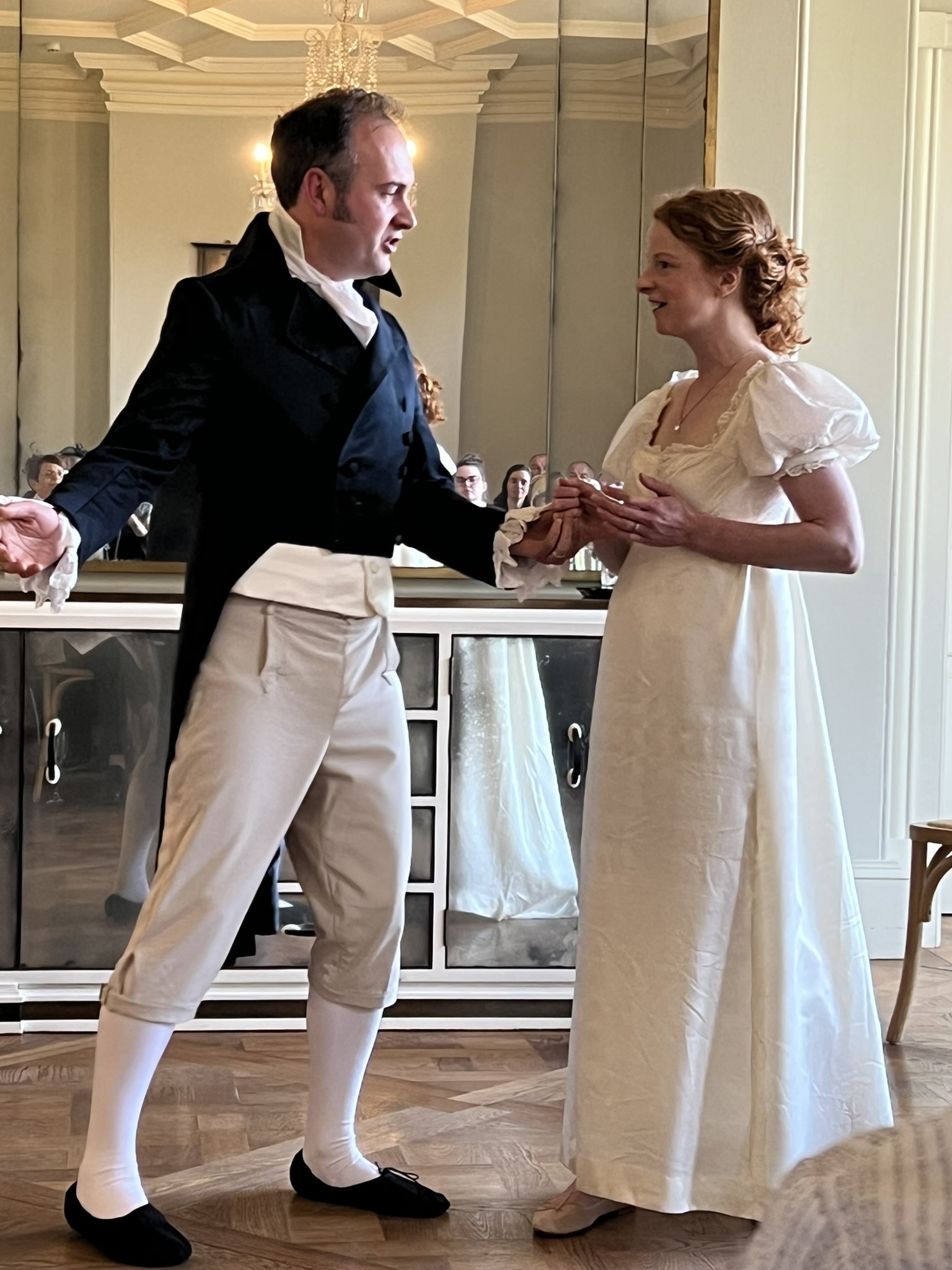
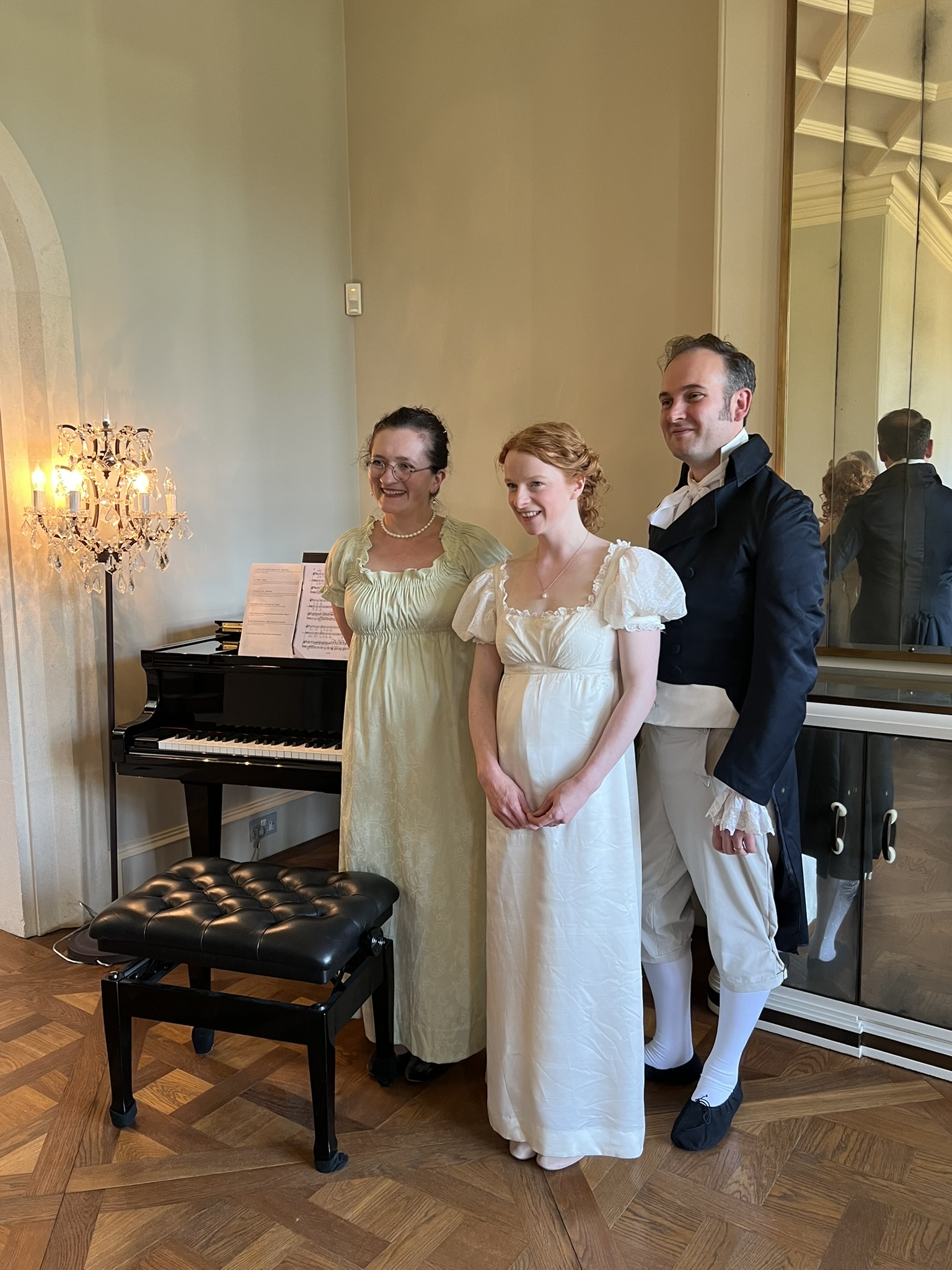
On entering the house, we were vastly and beautifully entertained by a Regency Ensemble of three: pianist and two singers singing Jane Austen-era songs: “A Delightful Diversion” performed by The Literary Music Ensemble:
**************
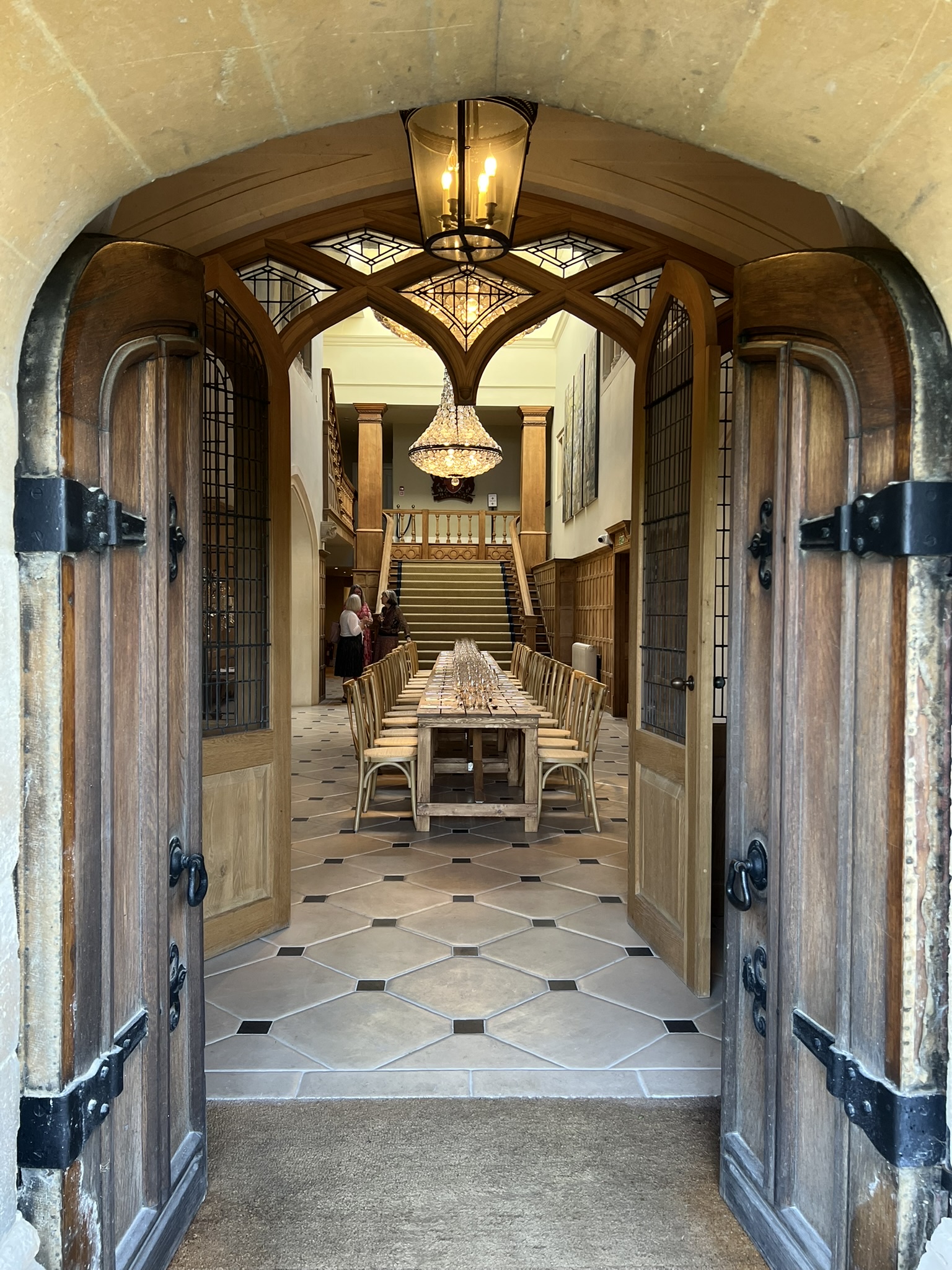
Then into the main hall that serves as the VERY large dining room – on offer was a delicious buffet…
No going upstairs, but one could wish…
Dessert!!
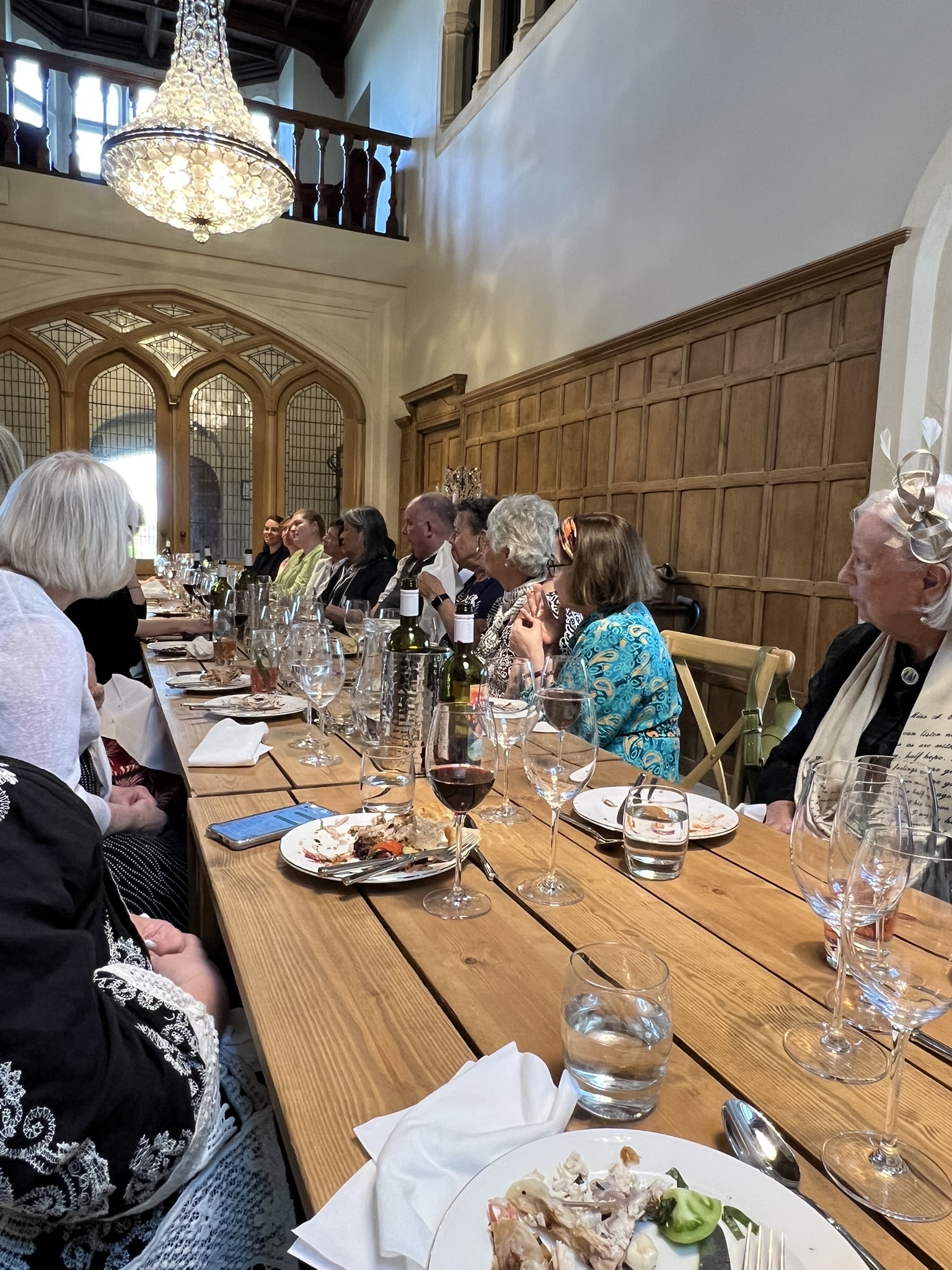
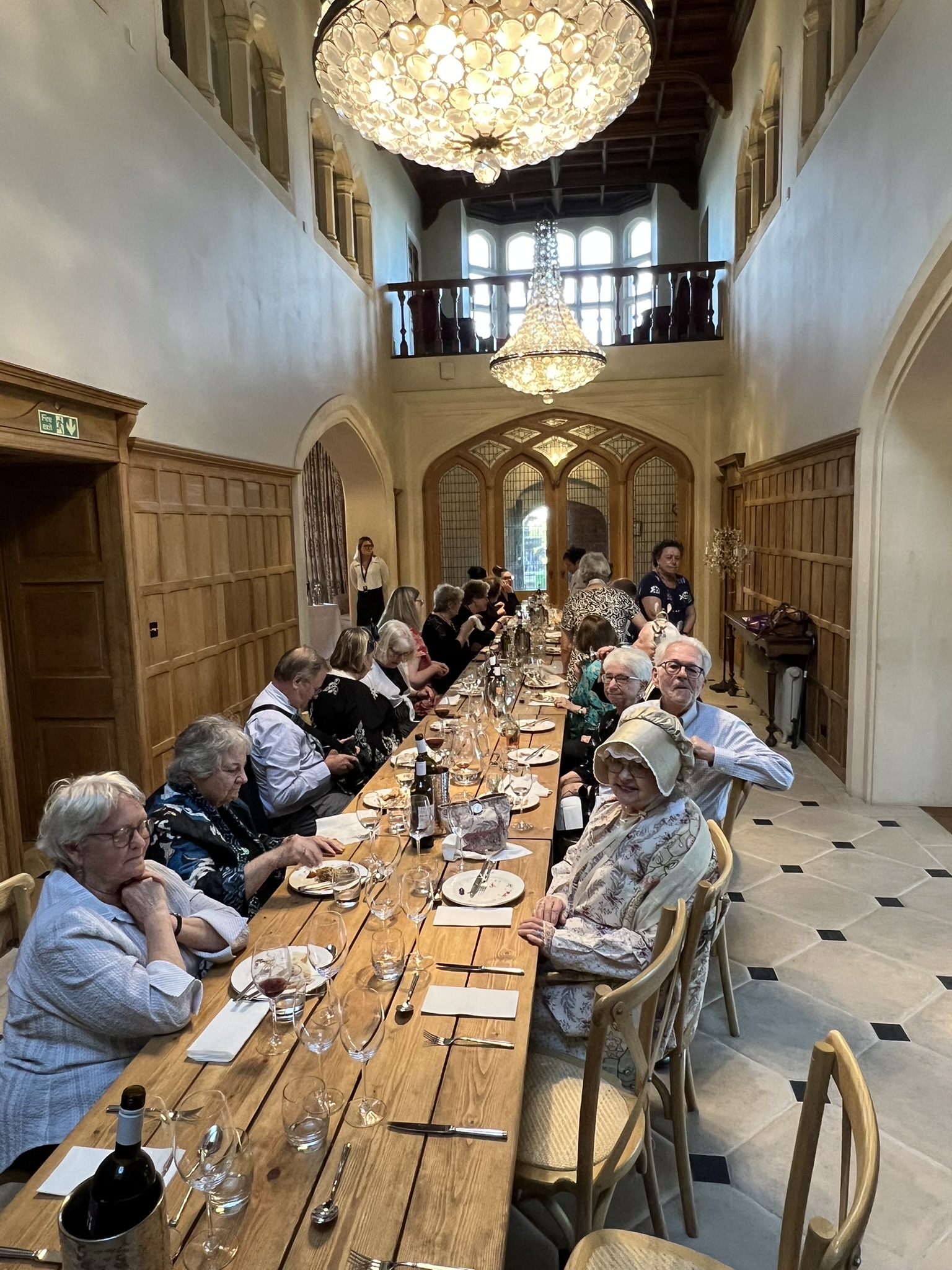
A perfect place for a Regency gathering of like-minded souls – JASNA went all out here for our last evening together:
Claire and Marcia!
Back on the bus heading back to the hotel on a beautiful evening, all very well-fed, very well-entertained, and quite sad to be bidding adieu to each other…:
So, today I messed up Royally – was supposed to meet a friend, but misplaced days of the week in my head – travel can do that to you [anyone else out there have this happen??]. To me, today was a Monday, because yesterday felt like a Sunday – everything contrived against my really knowing today is a Tuesday, the day set up to meet my friend – it was to be my second day in Bath, but I didn’t count the first day because we only got there in the evening – I am still trying to make sense of it – my only consolation is that we shall see each other in Baltimore!
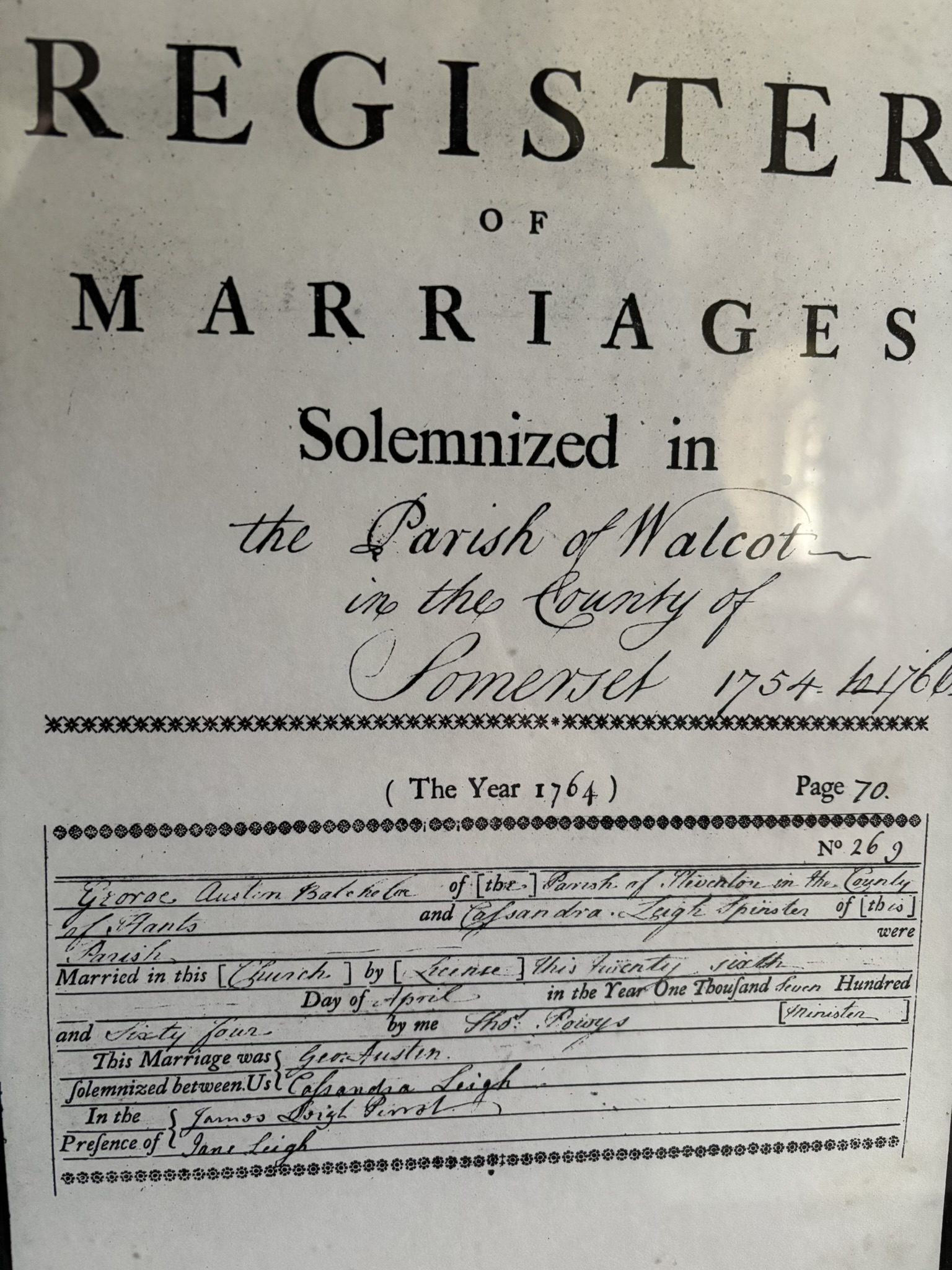
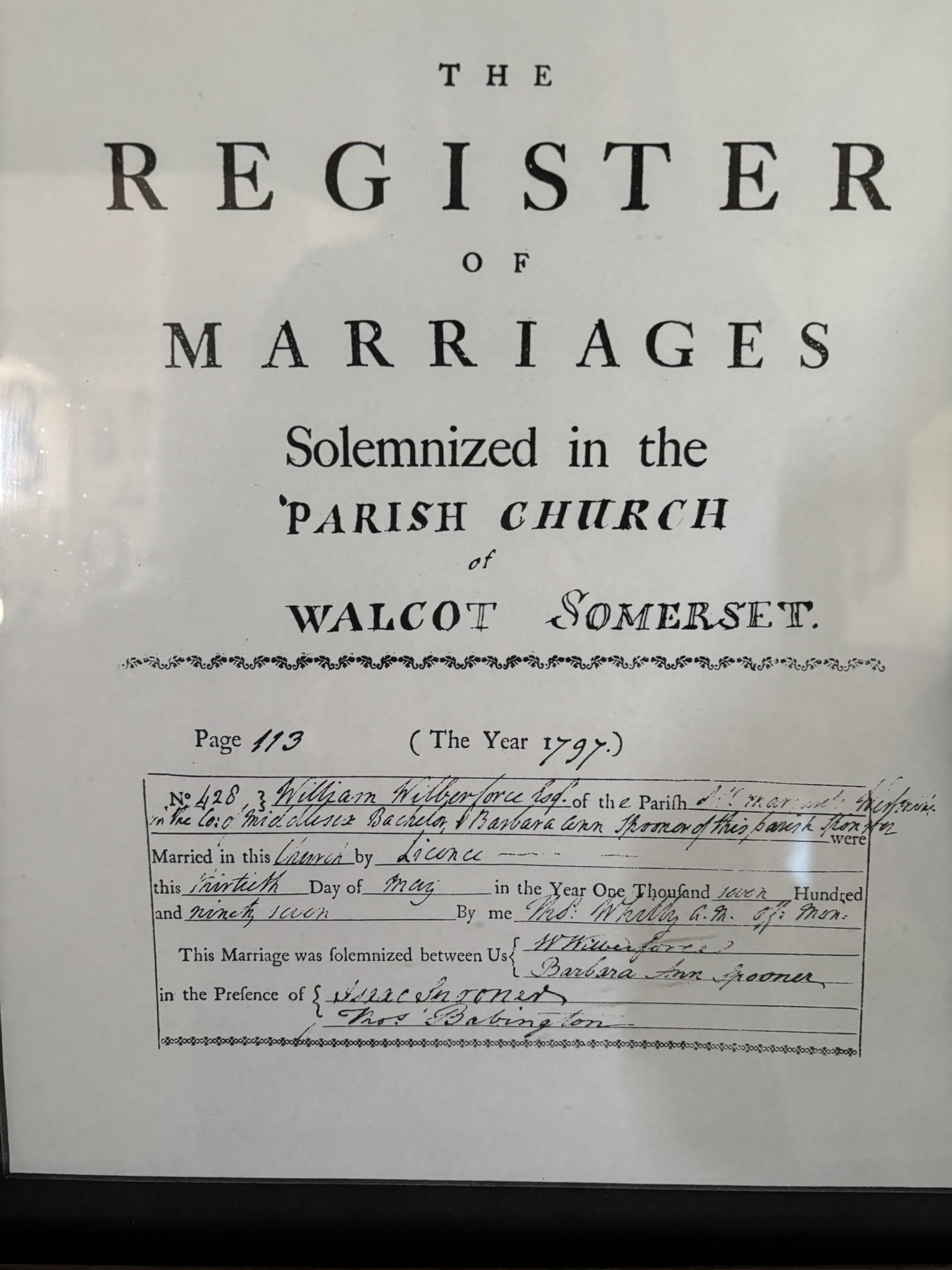
So to carry on – today started with the usual to-die-for English breakfast (Tea + everything else) – then off on a walking tour of Bath – with a Terrific guide starting at St. Swithin’s Church where George Austen is buried – and also where he and Cassandra Leigh were married in 1754, their register below – and for those interested, William Wilberforce was married here also in 1797:
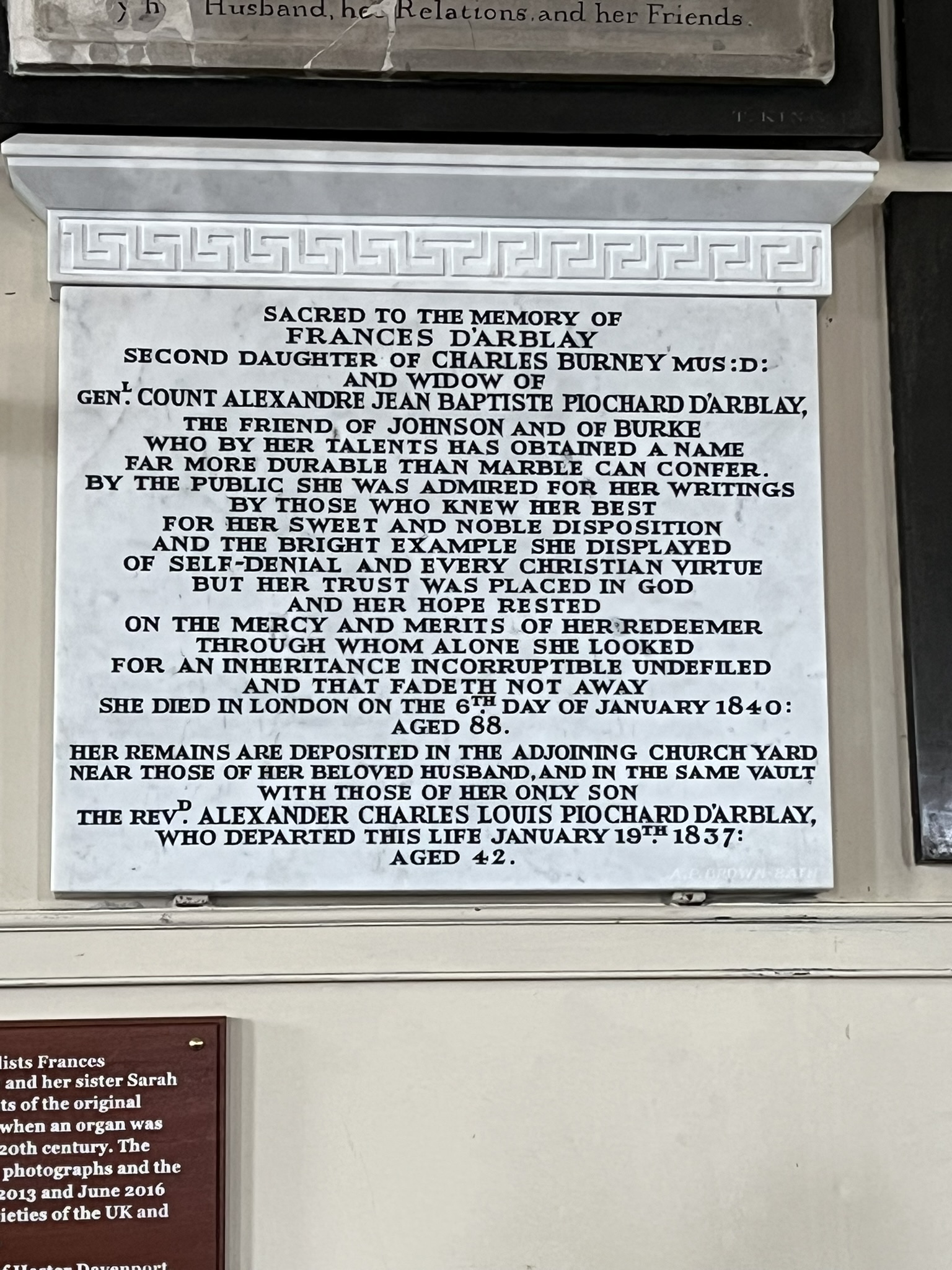
And of great interest to me, this is where Frances Burney is also buried, her grave in the churchyard, along with the remains of her husband Alexandre D’Arblay and their son. Burney had lived in Bath for a number of years and died here in 1840.
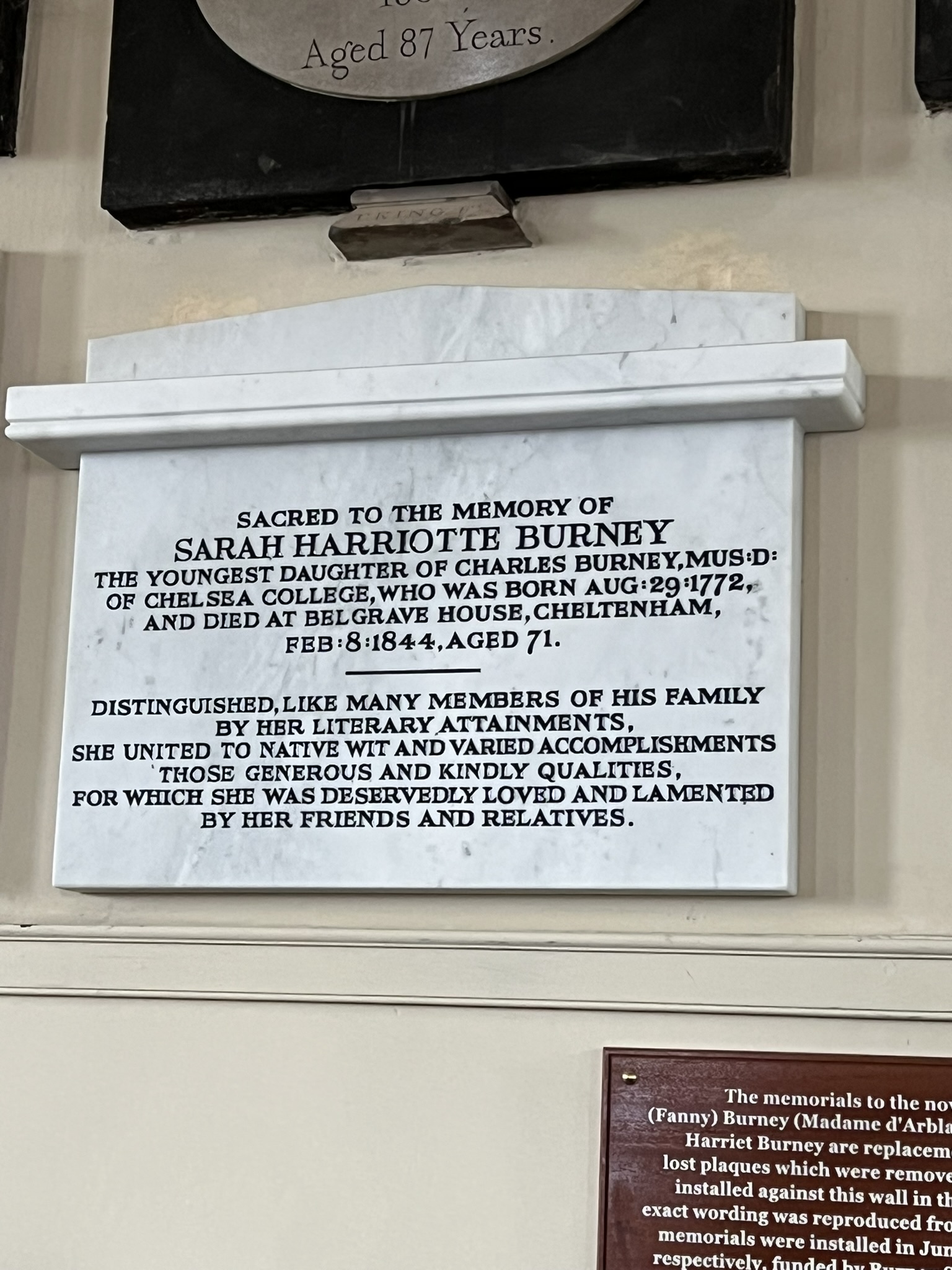
There is this memorial to her on the wall, and one to her sister and also novelist Sarah Harriet Burney:
These plaques were installed in 2013, replacing the originals what disappeared in 1958 during renovations to the church organ [are they perhaps somewhere with Jane Austen’s missing head??]
***********
From there we walked to the Royal Crescent, perhaps one of the most photographed spots in all of England? – completed by John Wood in 1775, Mrs. Austen’s sister Jane Cooper lived at number 12.
We hit all the mentioned locations in both Northanger Abbey and Persuasion – and easy to imagine Catherine Morland and Henry Tilney and Ann Elliot and Captain Wentworth wandering along the streets – the movies have made them all very real to us, and nothing has much changed really, other than the errant car or two, or people holding cell phones and wearing flip-flops…
The Queen’s Parade, the Gravel Walk [Ann and the Captain along with us]…we walked it, but in those early days it was a way for the gentry to be transported to the baths in their sedan chairs.
We passed the World War I Memorial which features the “Cross of Sacrifice” and erected in 1923, now has the additional names of WWII fallen, including civilian deaths – you can read more about it her: http://bath-heritage.co.uk/war-memorial.html
We followed around former haunts of the Austens and family:
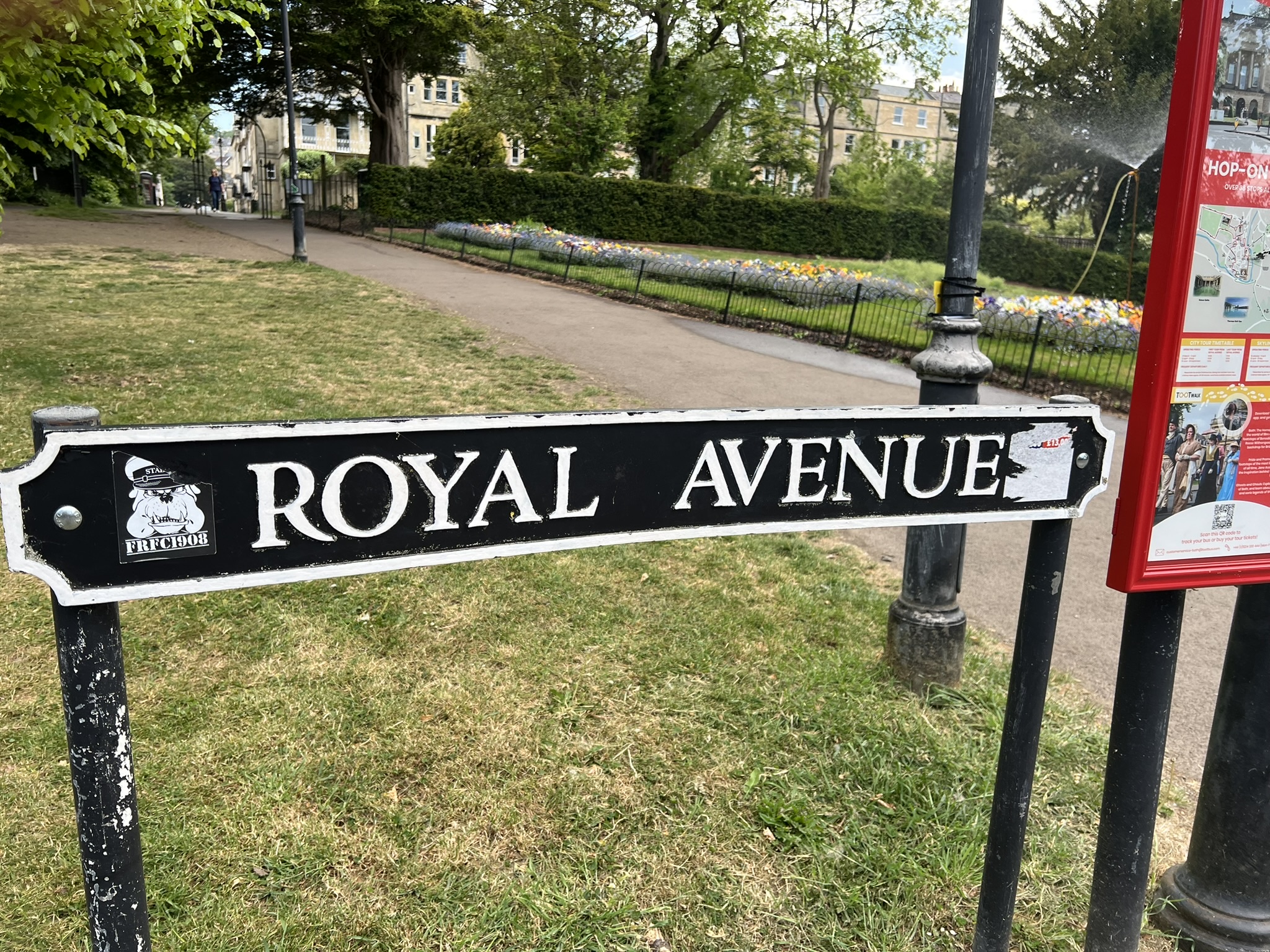
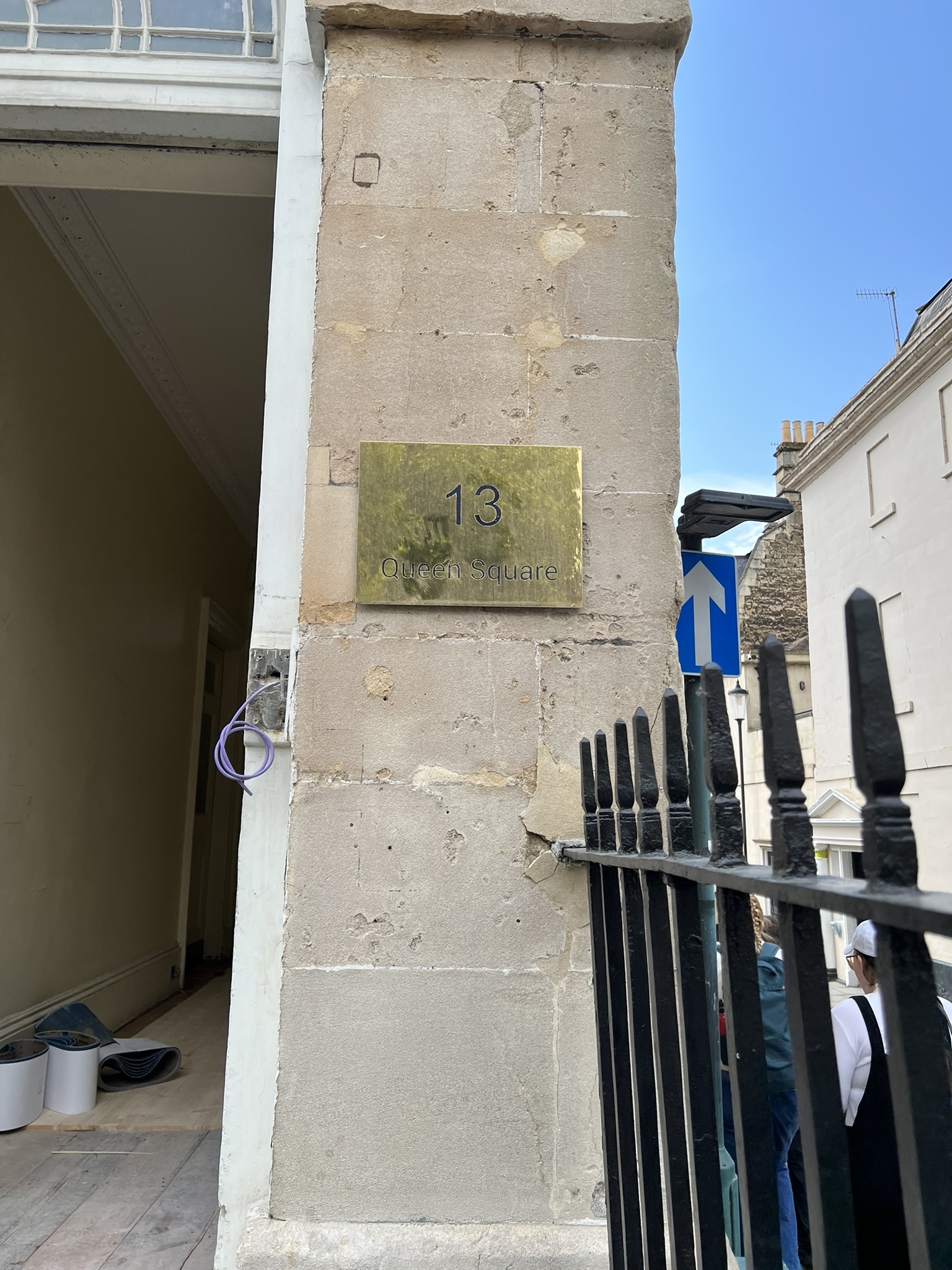
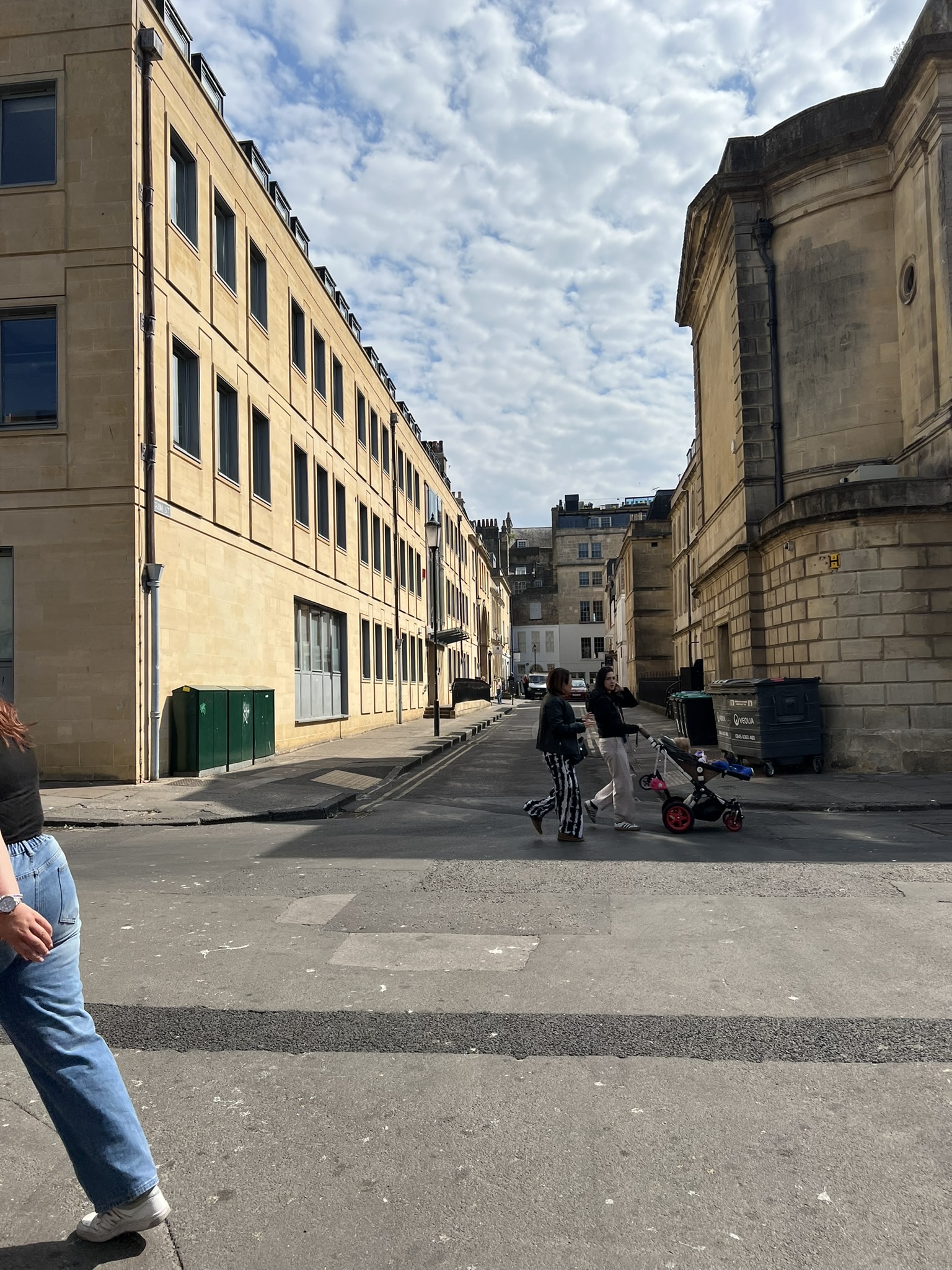
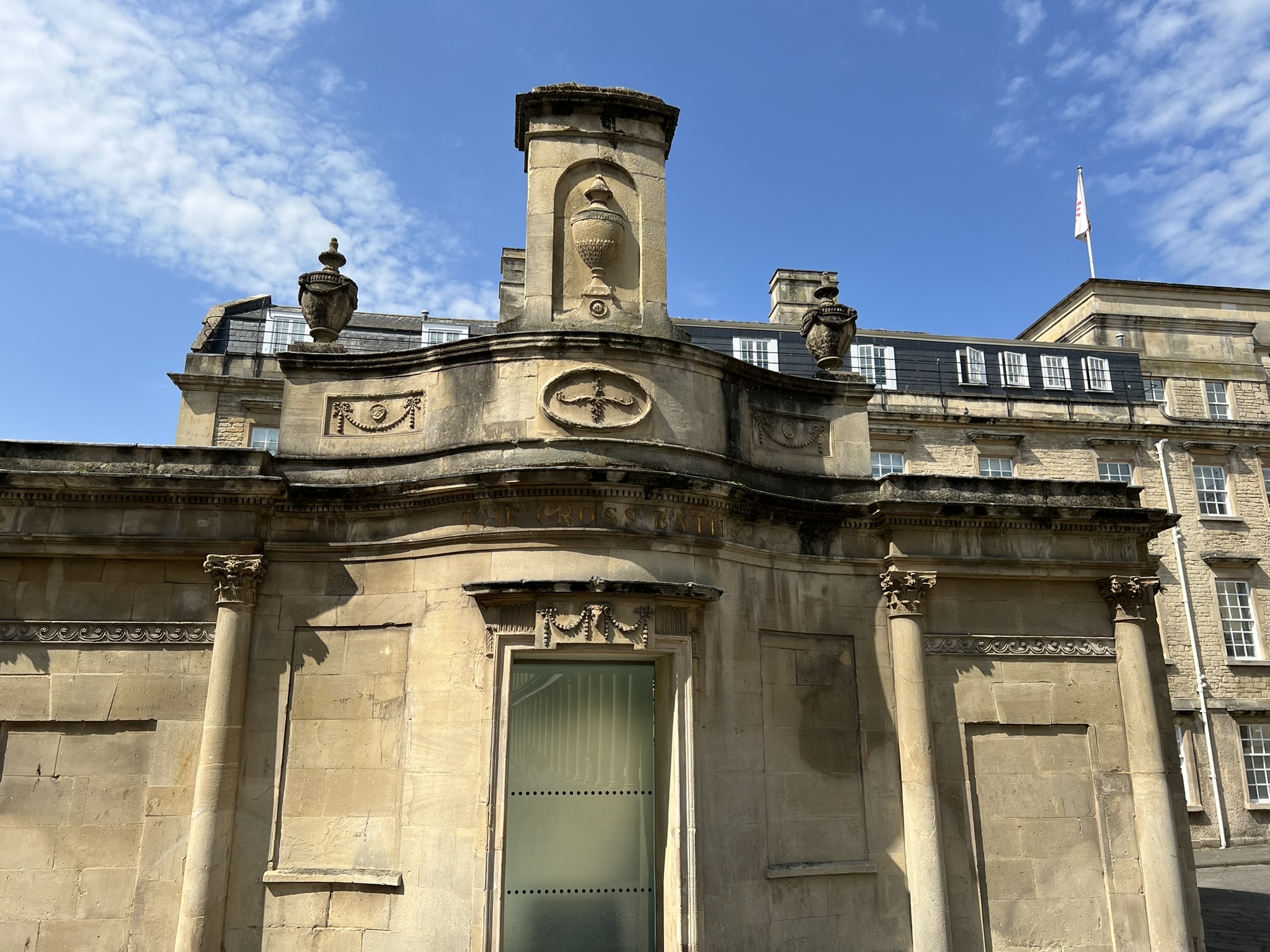
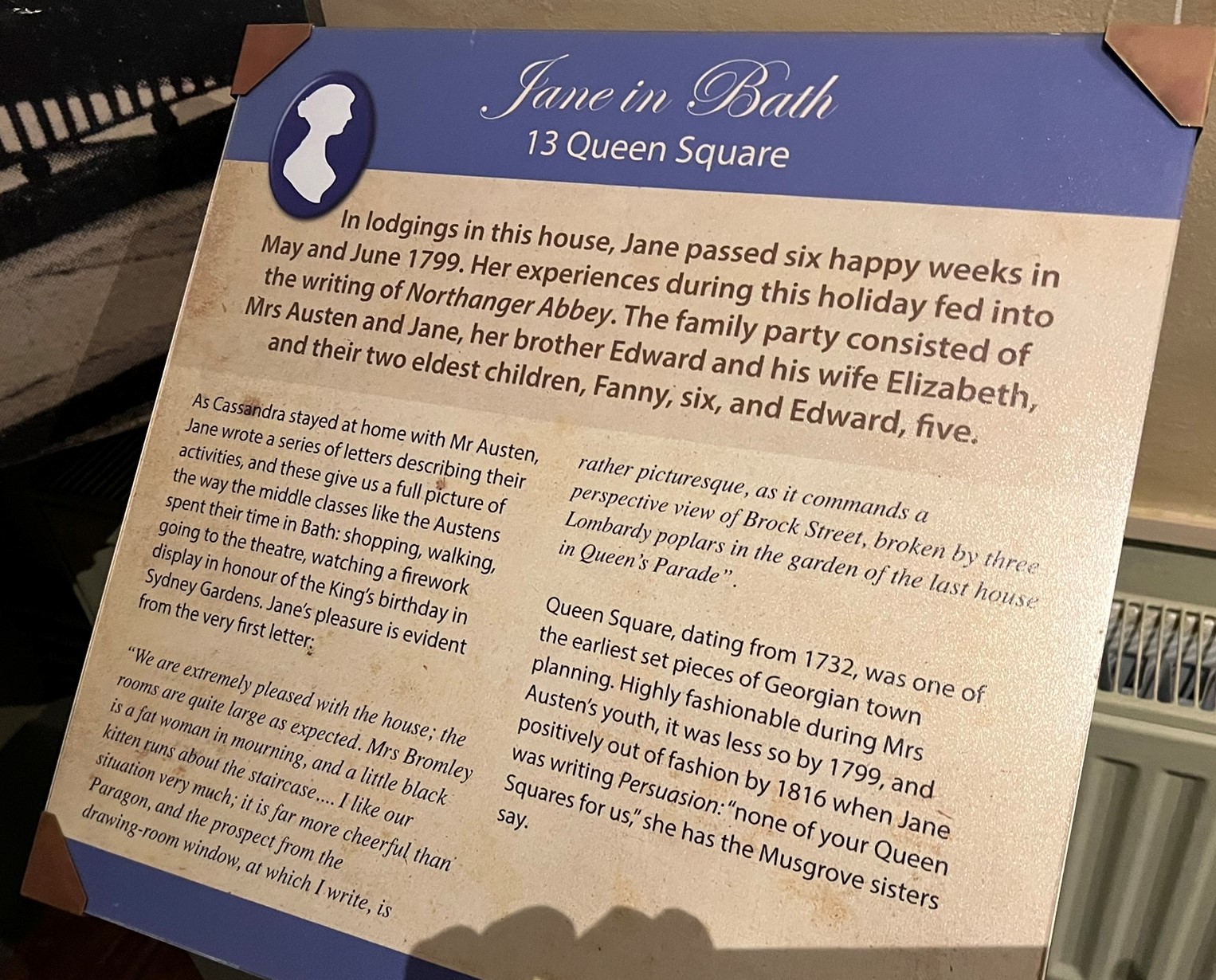
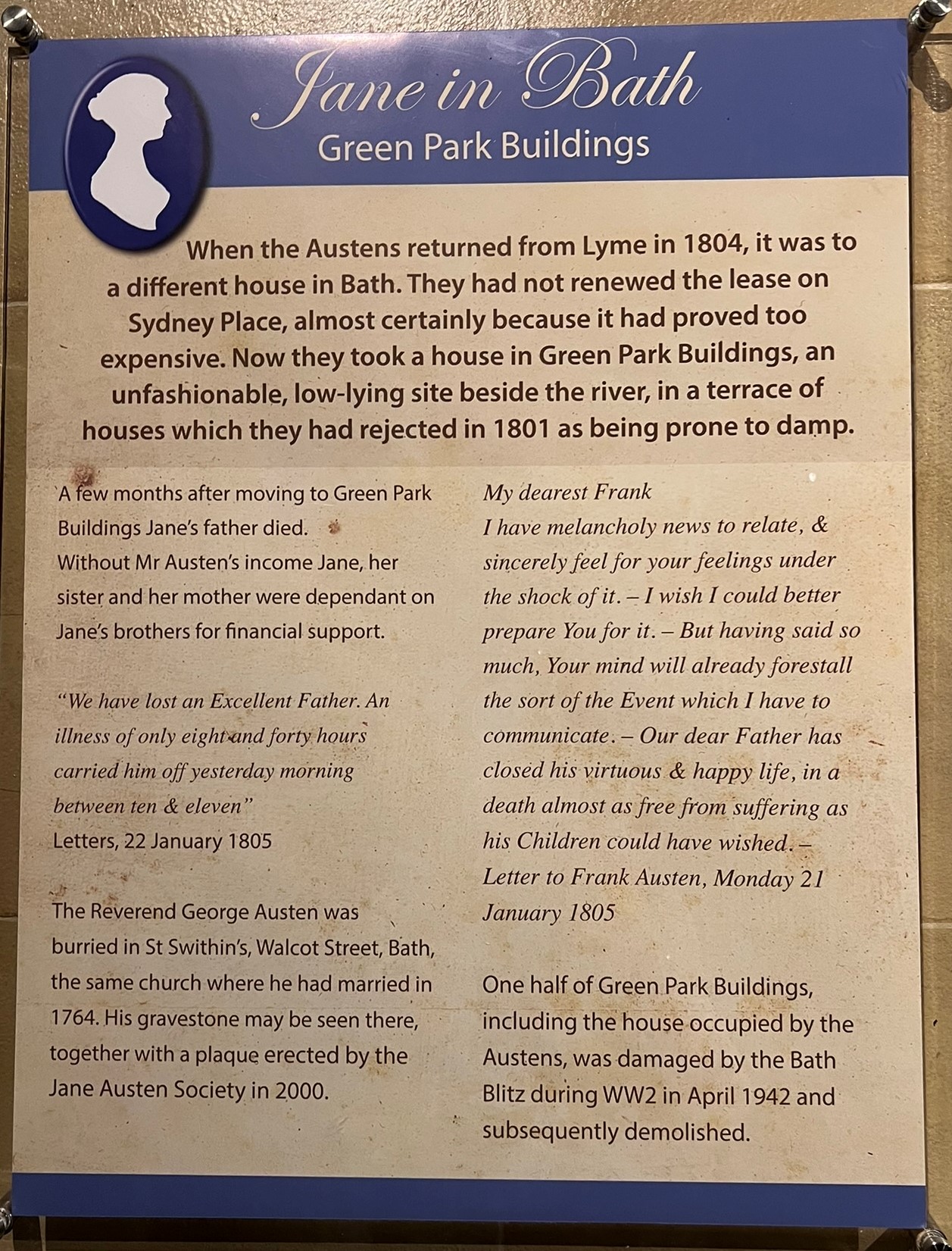
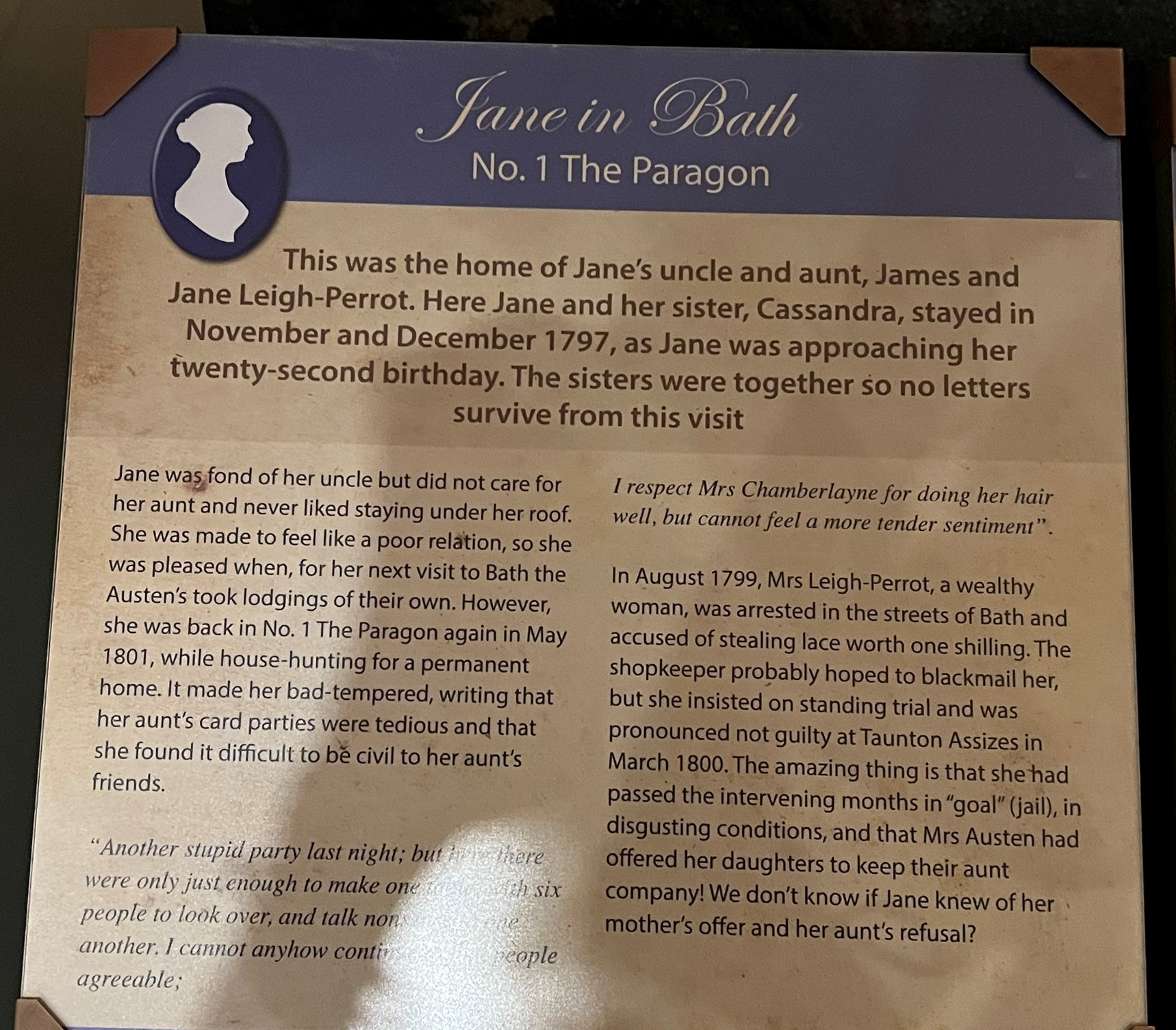
No. 13 Queen Square is where Jane stayed with her mother and Edward in 1799 – he had come to take the waters… [it is now being renovated…] – and then along to Trim St, the final lodging of the Jane, Cassandra, and Mrs. Austen, and the “very bottom of the social scale, populated by prostitutes, beggars, and thieves.” [Jane Austen’s Bath, JA Centre]
25 Gay Street, just down from the Jane Austen Centre, is where the Austen’s lived following Mr. Austen’s death – [the Jane Austen Center is at #40]
And here several photos of various sites as we walked around:
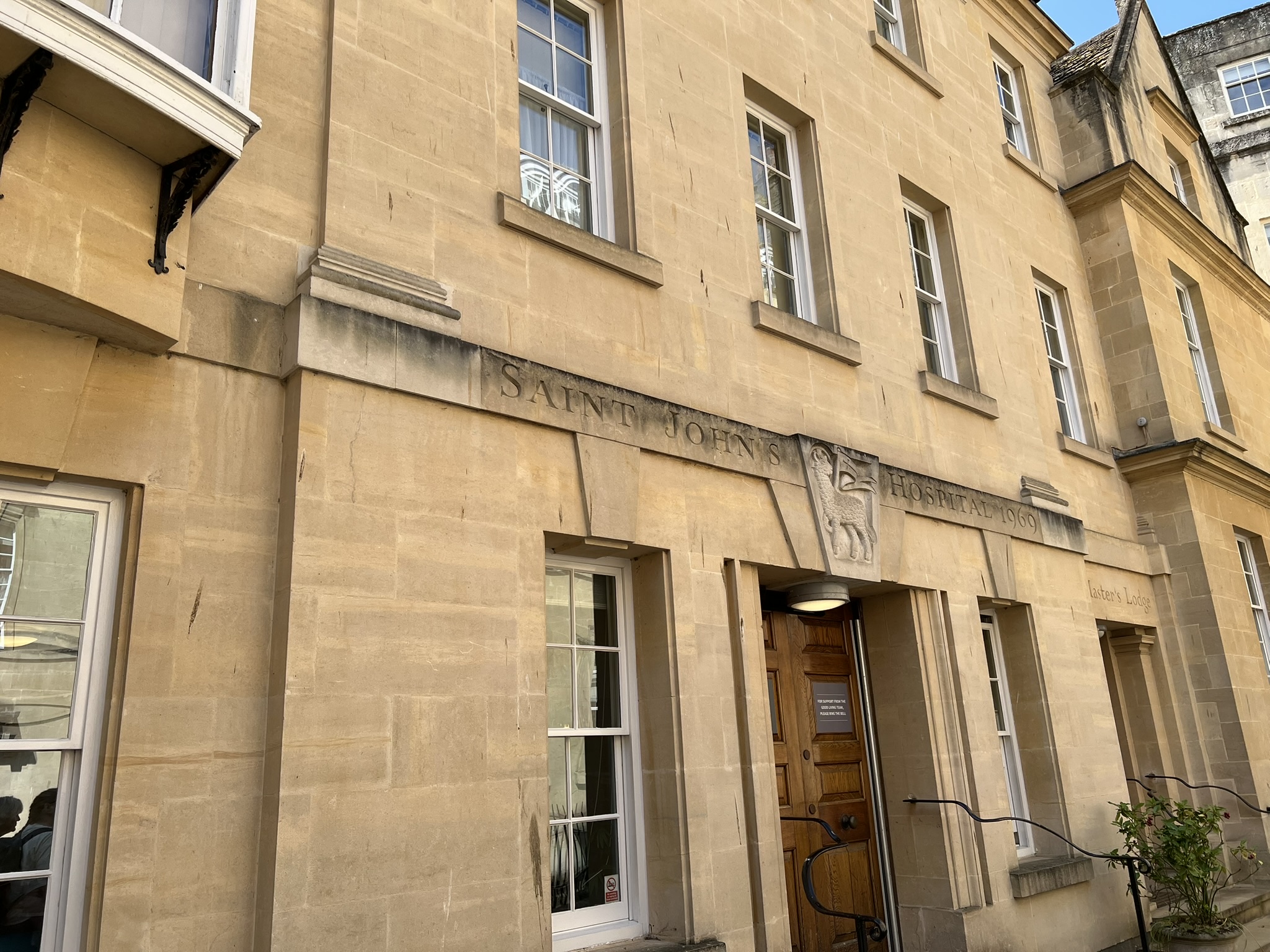
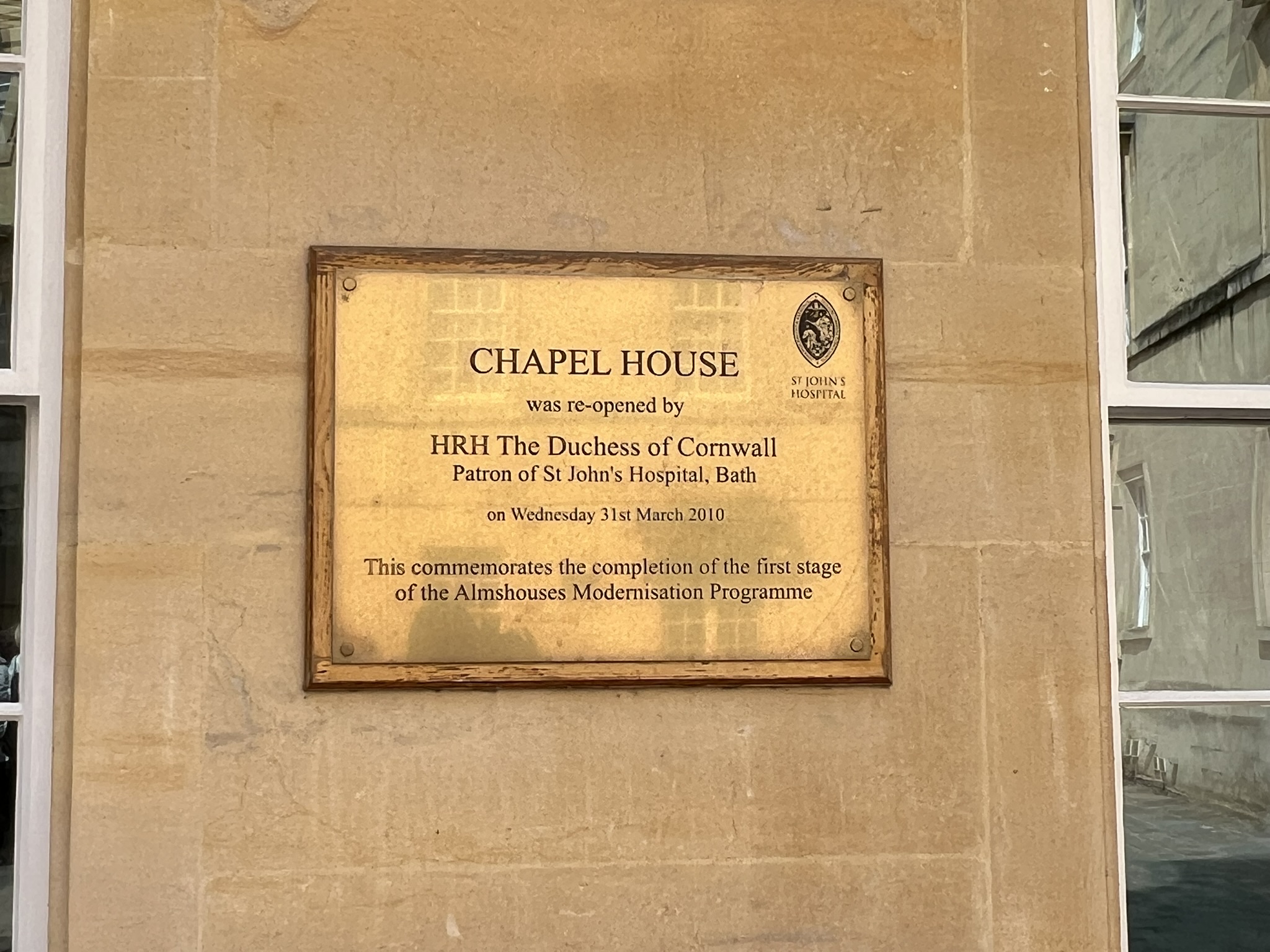
The St. John’s Hospital, recently dedicated by the then Duchess of Cornwall [now Queen Camilla],
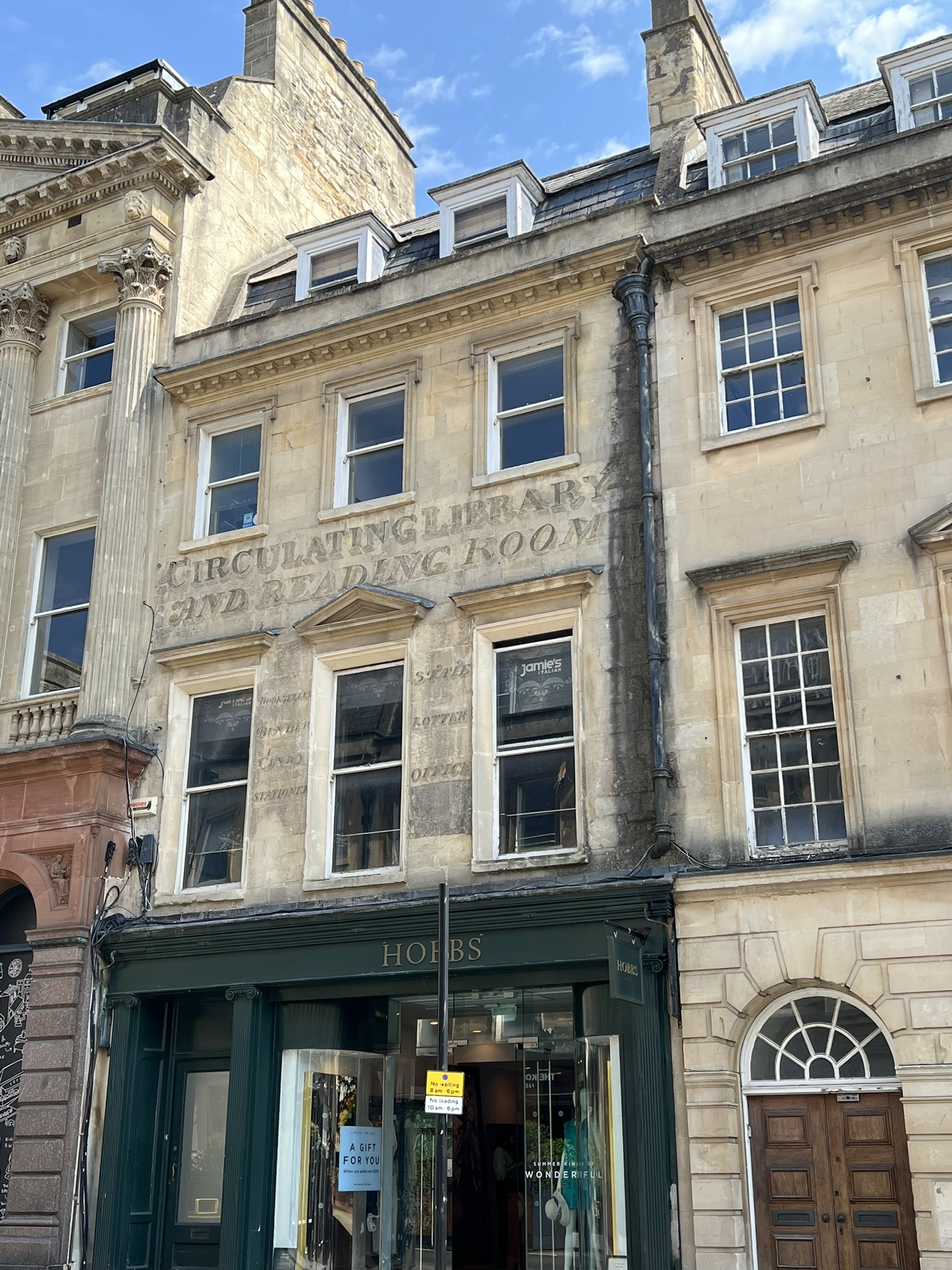
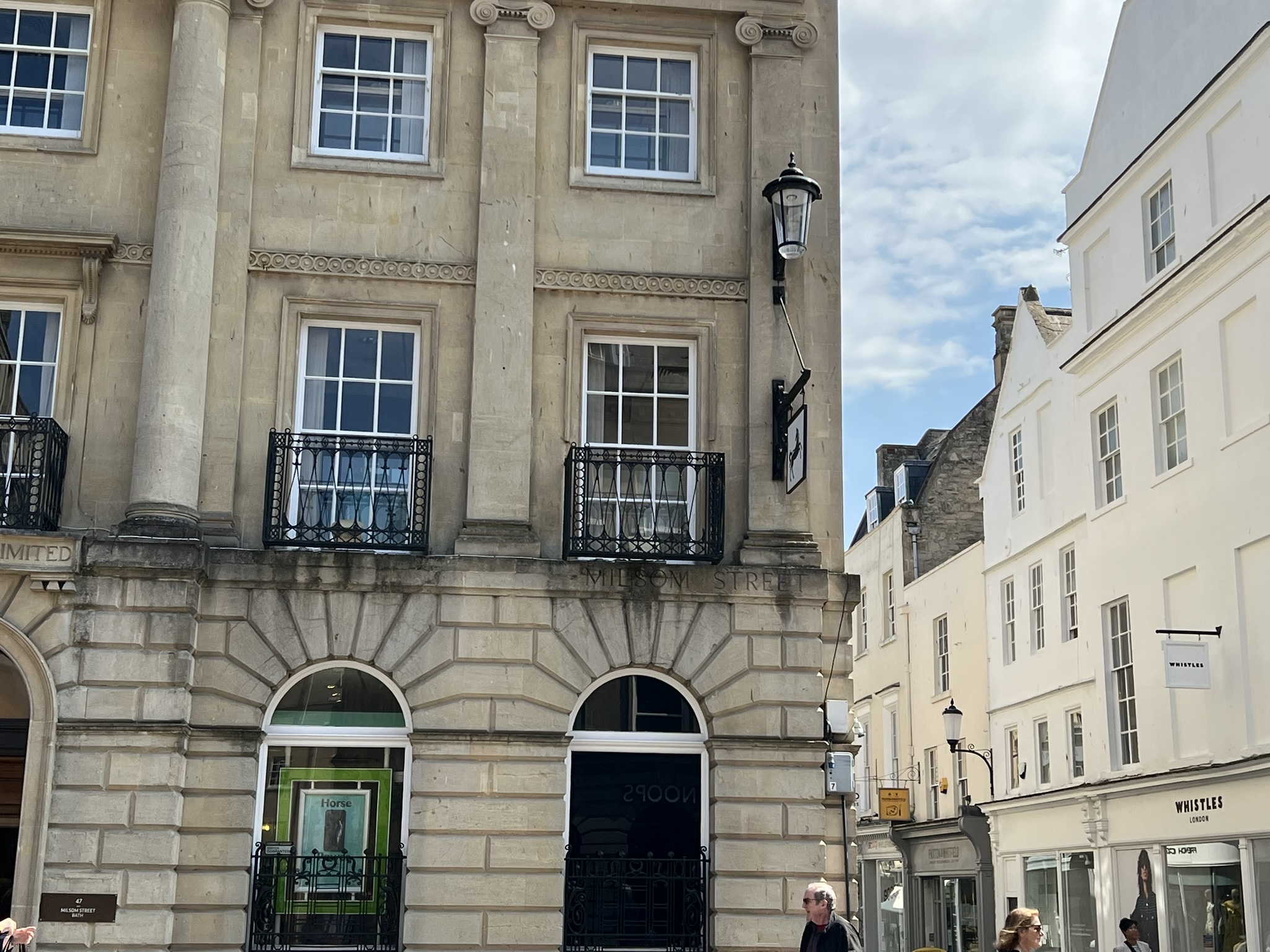
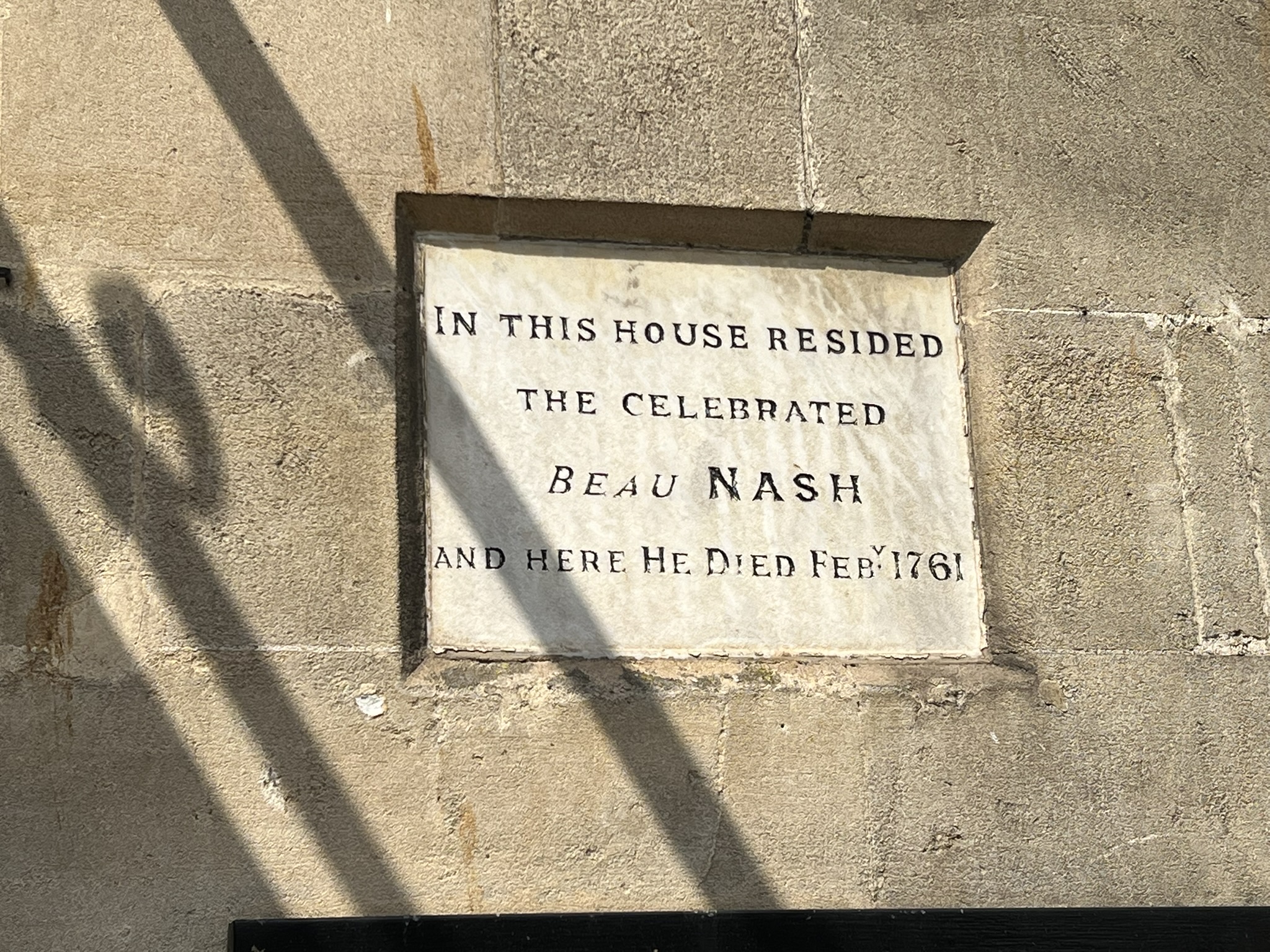
The all-important Circulating Library and Milson Street, Beau Nash, the baths, and shopping!:
and a sign worth a photo:
**********
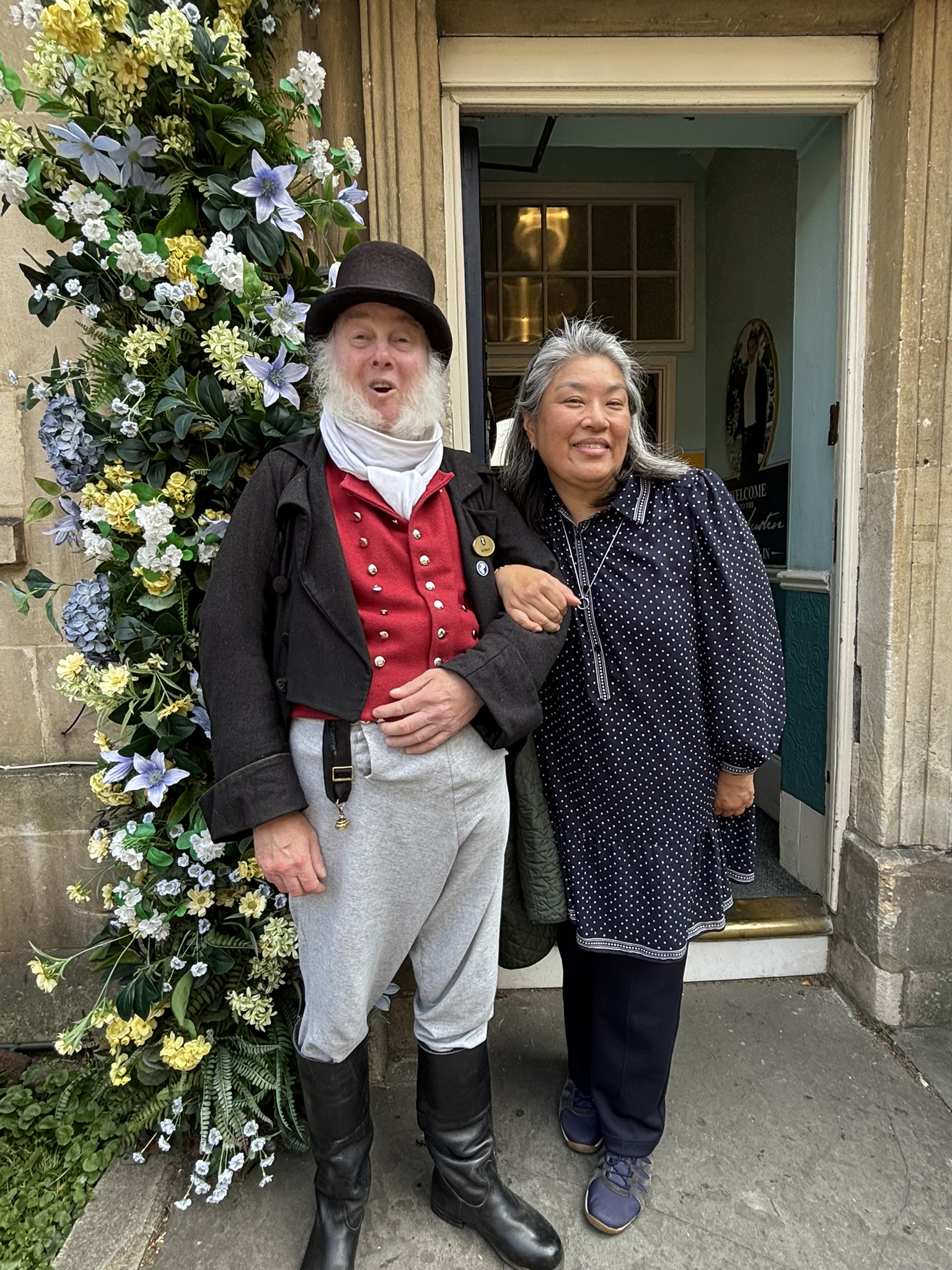
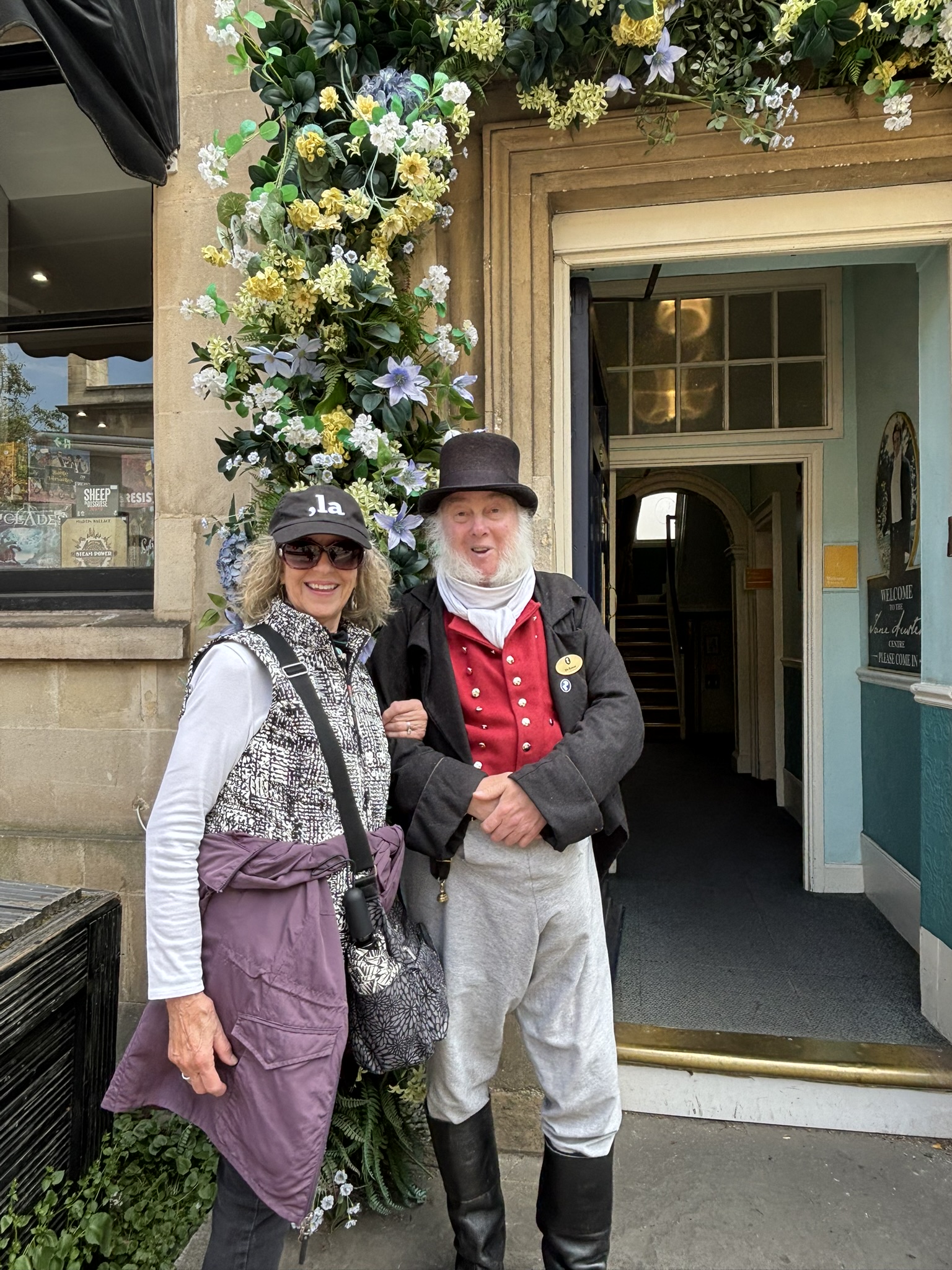
After the tour, Joy and I went to the Jane Austen Centre – I had visited this several years ago when it was first starting out – much improved, and they do a terrific newsletter, and the long-time greeter Martin Salter is worth the price of admission… [these pictures from Joy]:
And some pictures from there worth sharing [I didn’t take many! – see the website for a great collection]:
And Joy found this in the WC!
**************
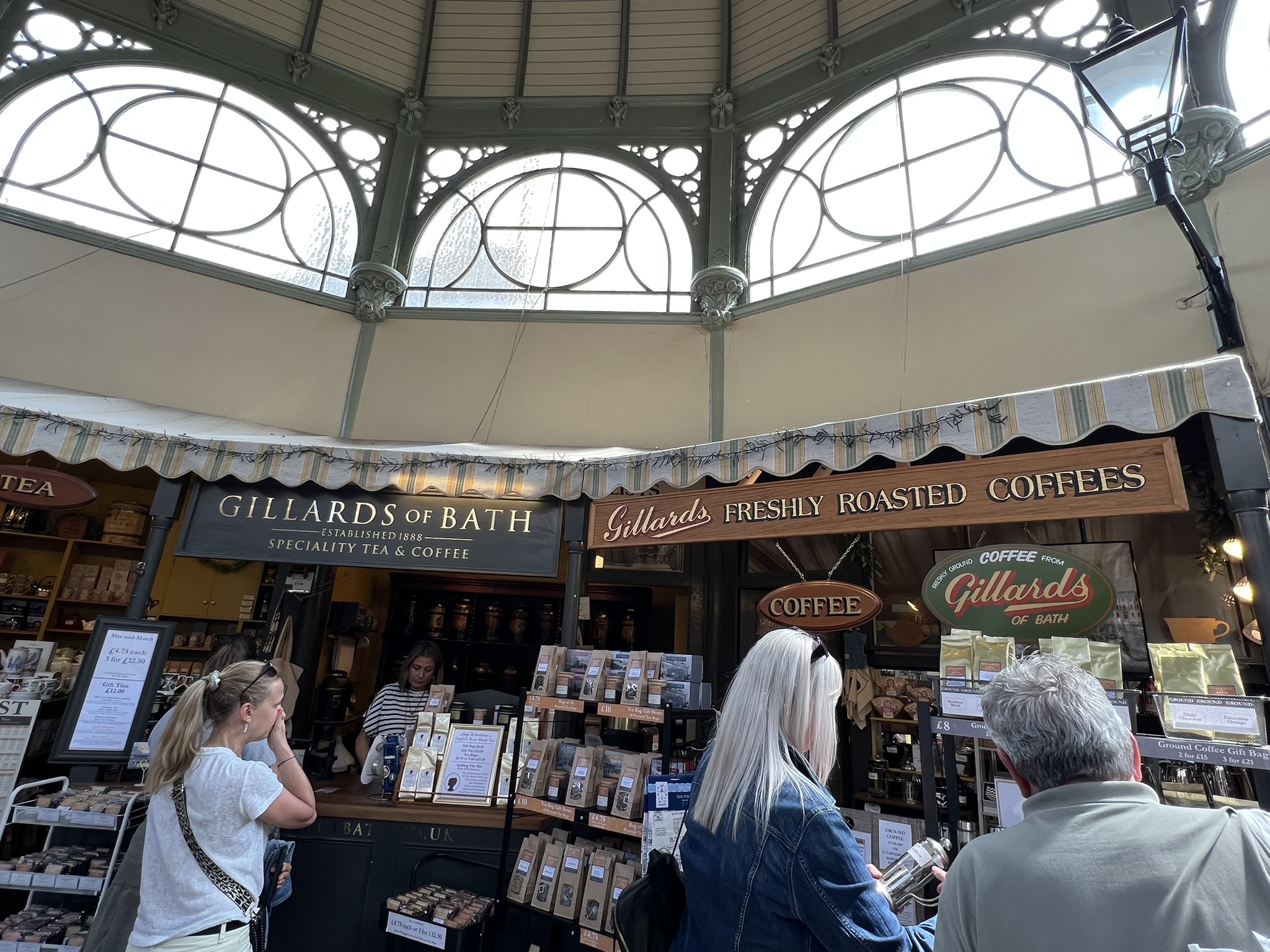
We visited the main Marketplace as Joy was in dire need of Gillards of Bath teas, and I spot a Snoopy:
***********
And then we went our separate ways – me finding it ironic that though I was supposed to be meeting my friend, I felt quite foot-loose and fancy-free and wandered all around Bath with no itinerary – what an idiot! And here is the final glitch – I did not stop to eat or go anywhere where I connected to the internet – if I had I would have seen the various messages from my friend asking where I was!
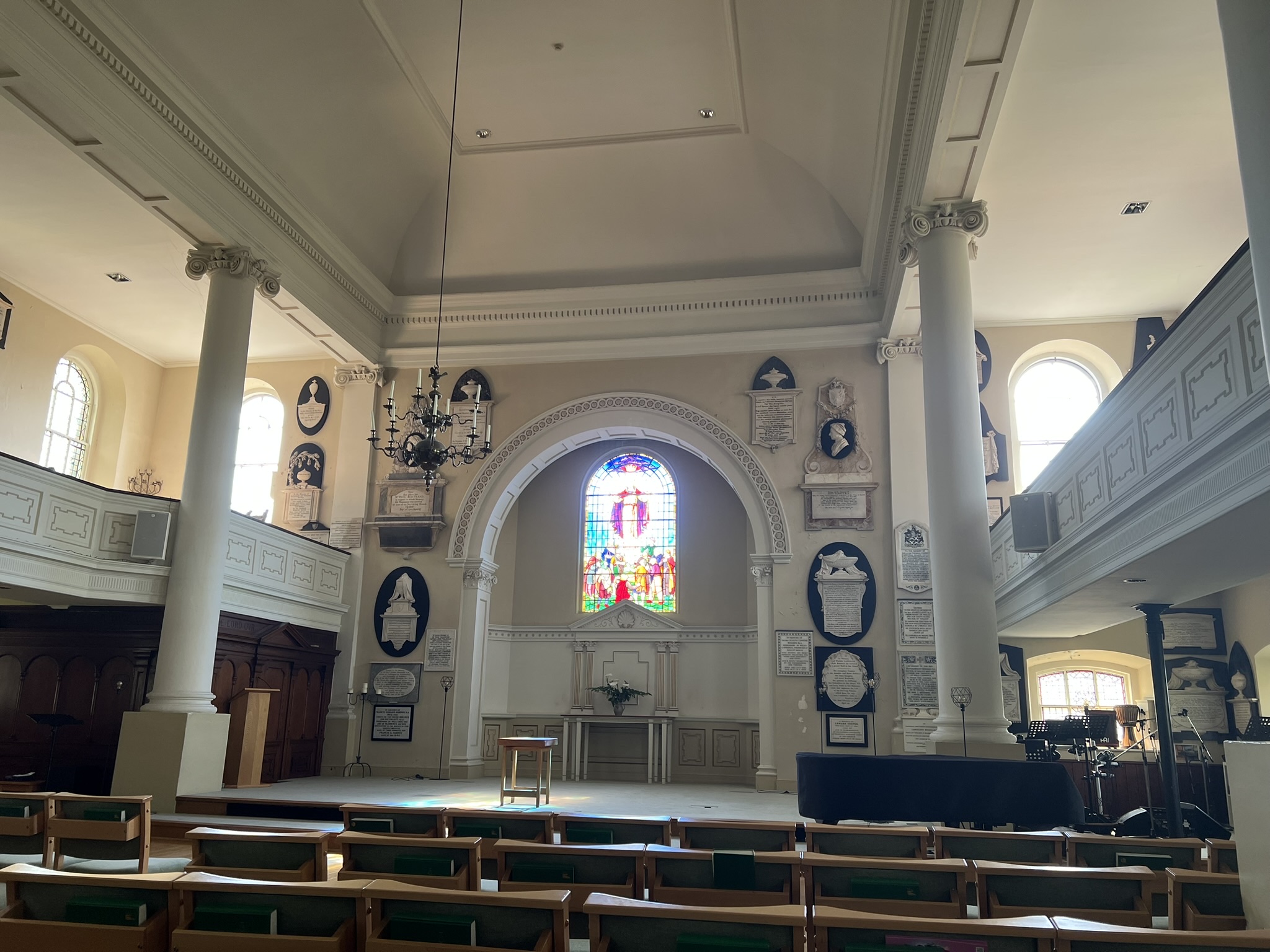
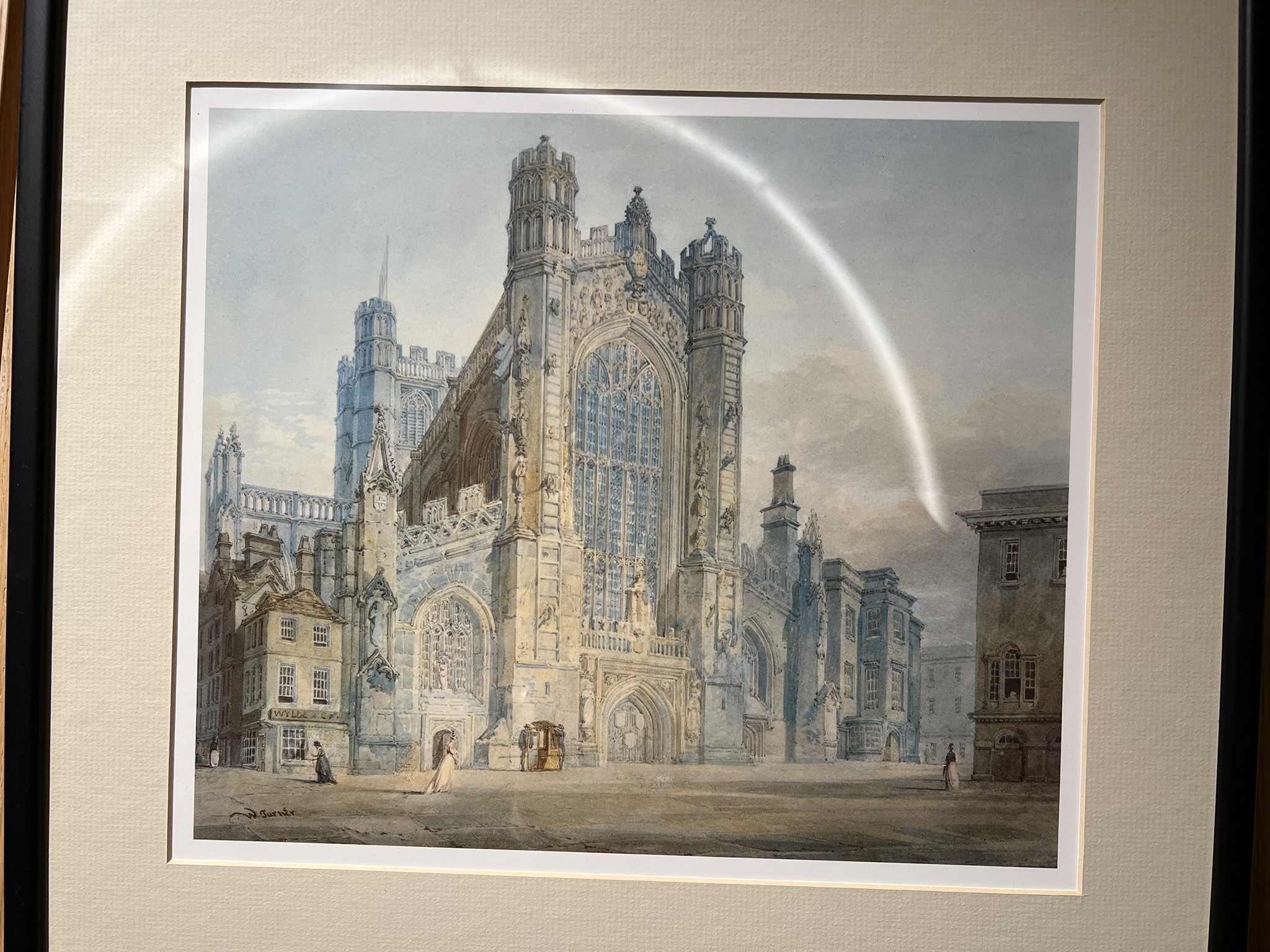
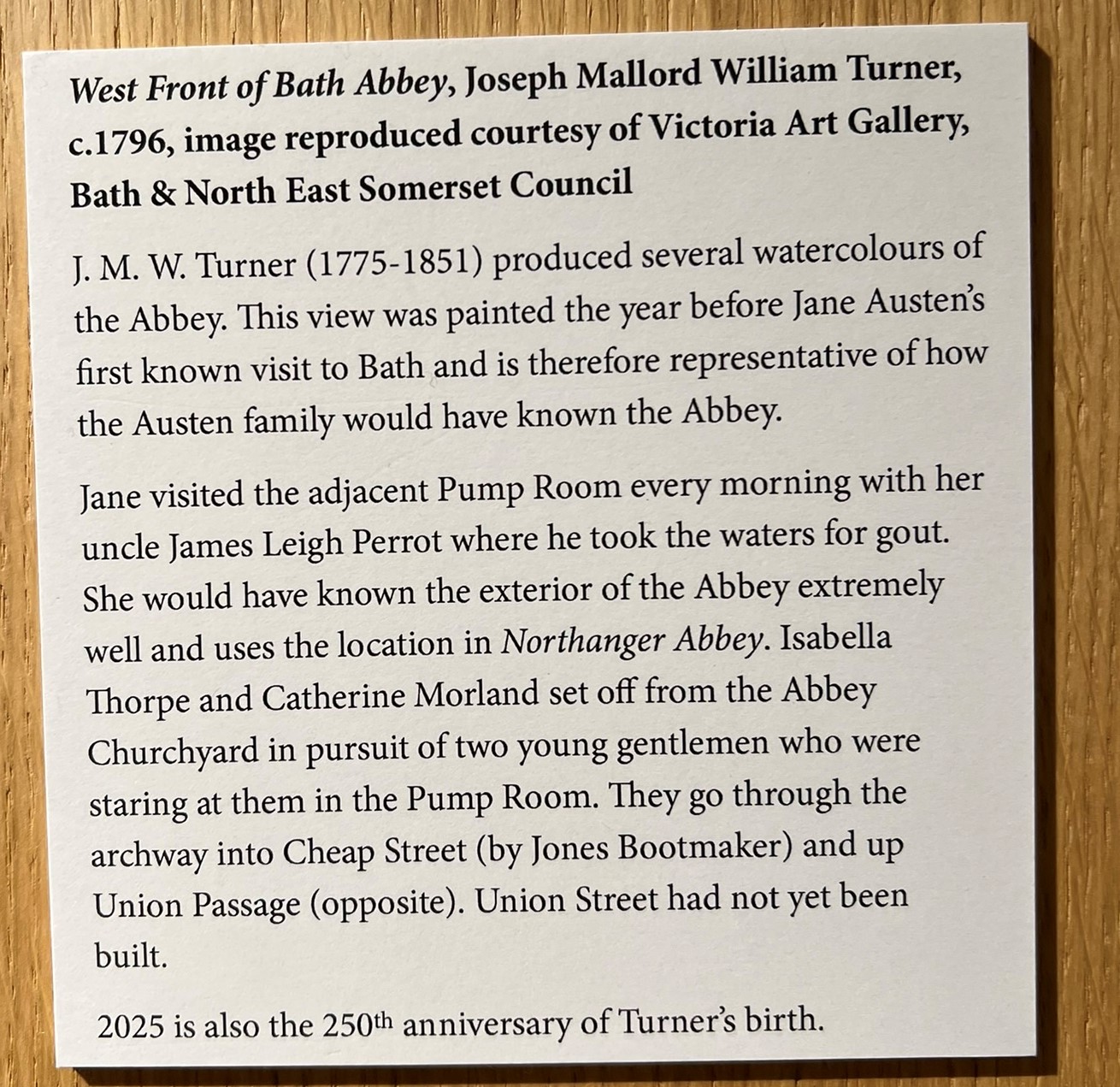
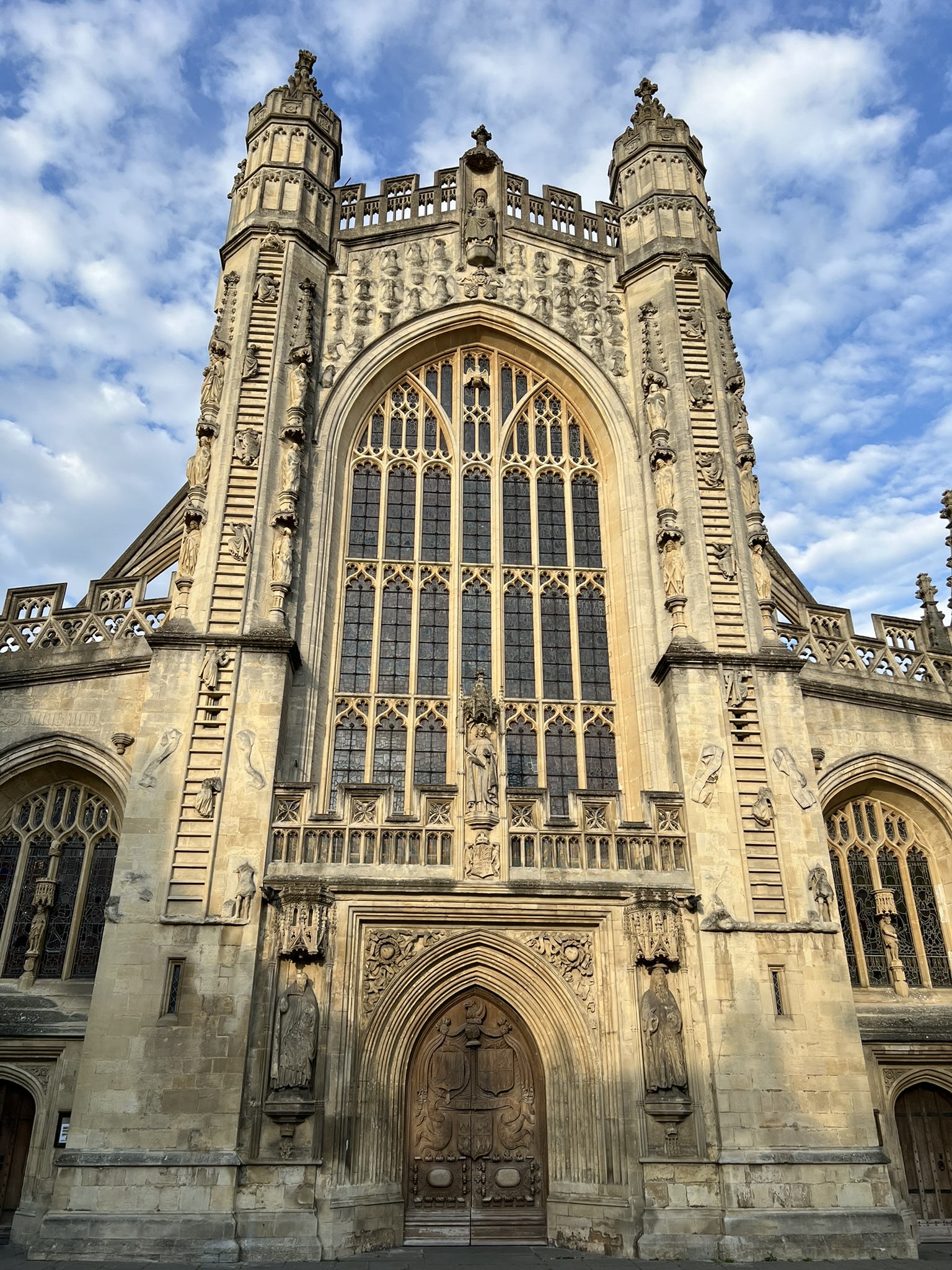
So off to Bath Abbey for an in-depth visit – and started it with a tour of the Jane Austen-related memorials – and here I found Stephen Herring of Jane Austen’s Regency World magazine * giving tours at the Abbey! What a grand surprise! Though disappointed to not see Jackie as well – but Stephen was great taking a small group of us all around the Abbey – I took notes but took NO PHOTOS! – but we did learn about:
The Nibbs Family [James Langford Nibbs]
Dr. William Bowen – doctor to Mrs C Auysten in 1804
William Siddons, husband to Sarah
Admiral Sir William Hargood [Francixs Austen’s Canoppus
Caleb Hillier Parry
The Famous Castrata Rauzzioni
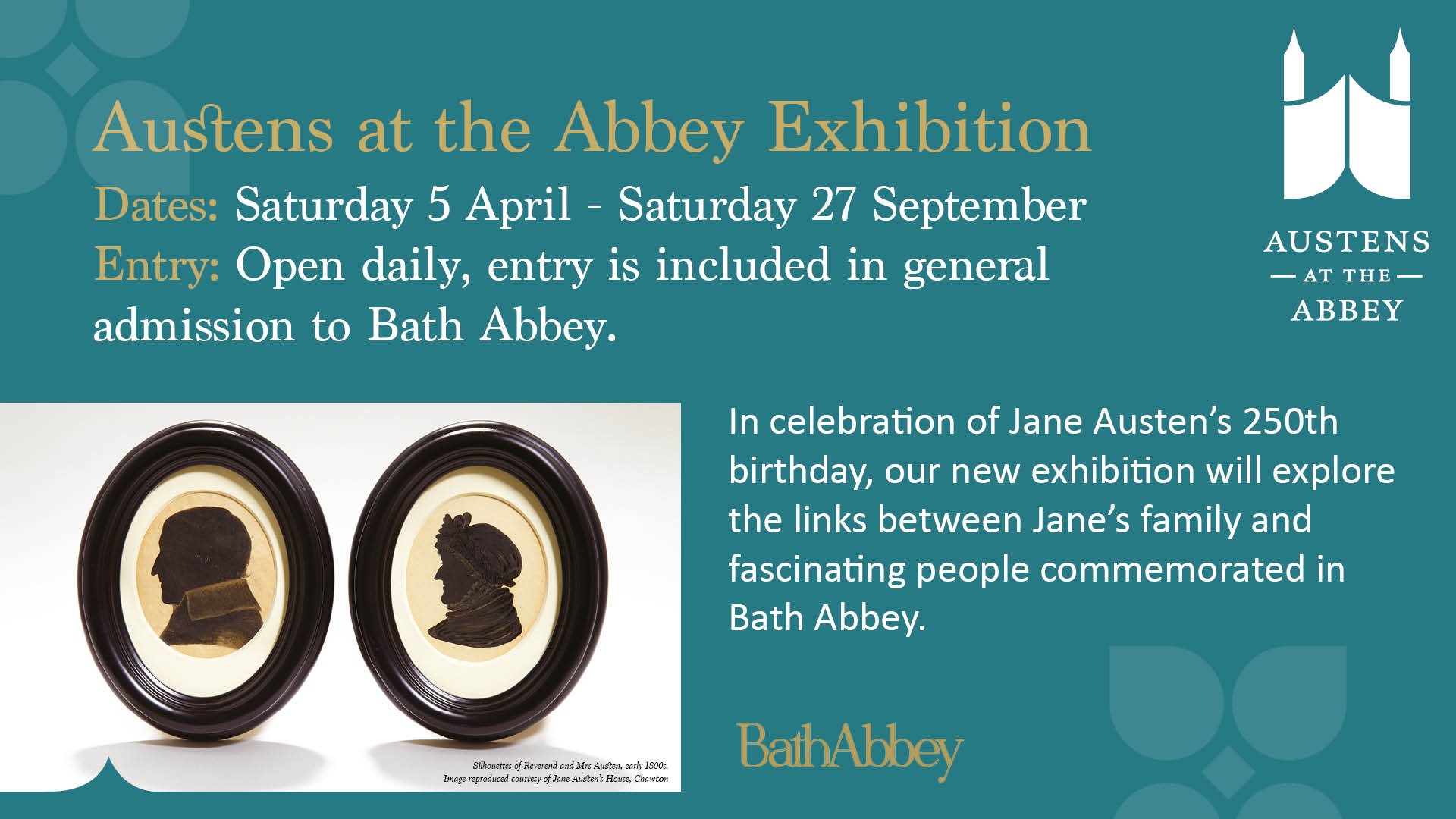
The Abbey also has an exhibit on through September 27, Austens at the Abbey – Jackie Herring is on the video and it covers much of what I had just learned on the tour with Stephen.
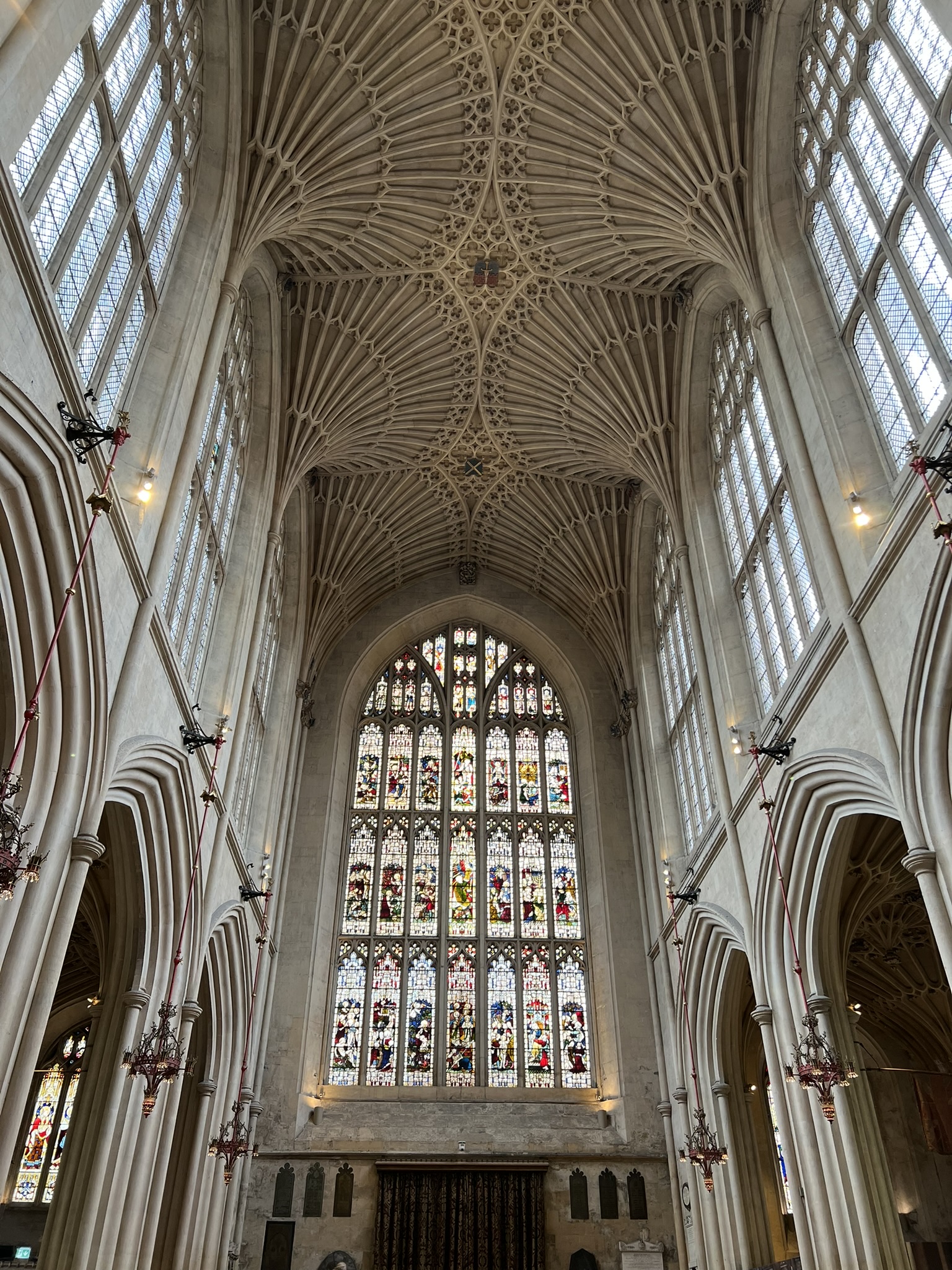
Wandered around the other exhibits at the Abbey, hit the bookshop (of course) and then wandered back to the hotel which was very nearby – and when I found the note from my friend letting me know I had missed her – it was too late as she was already on the train heading home – a lost adventure with a friend… but Marcia DID see Hazel in the Topping bookshop…so that was something I suppose…
*************
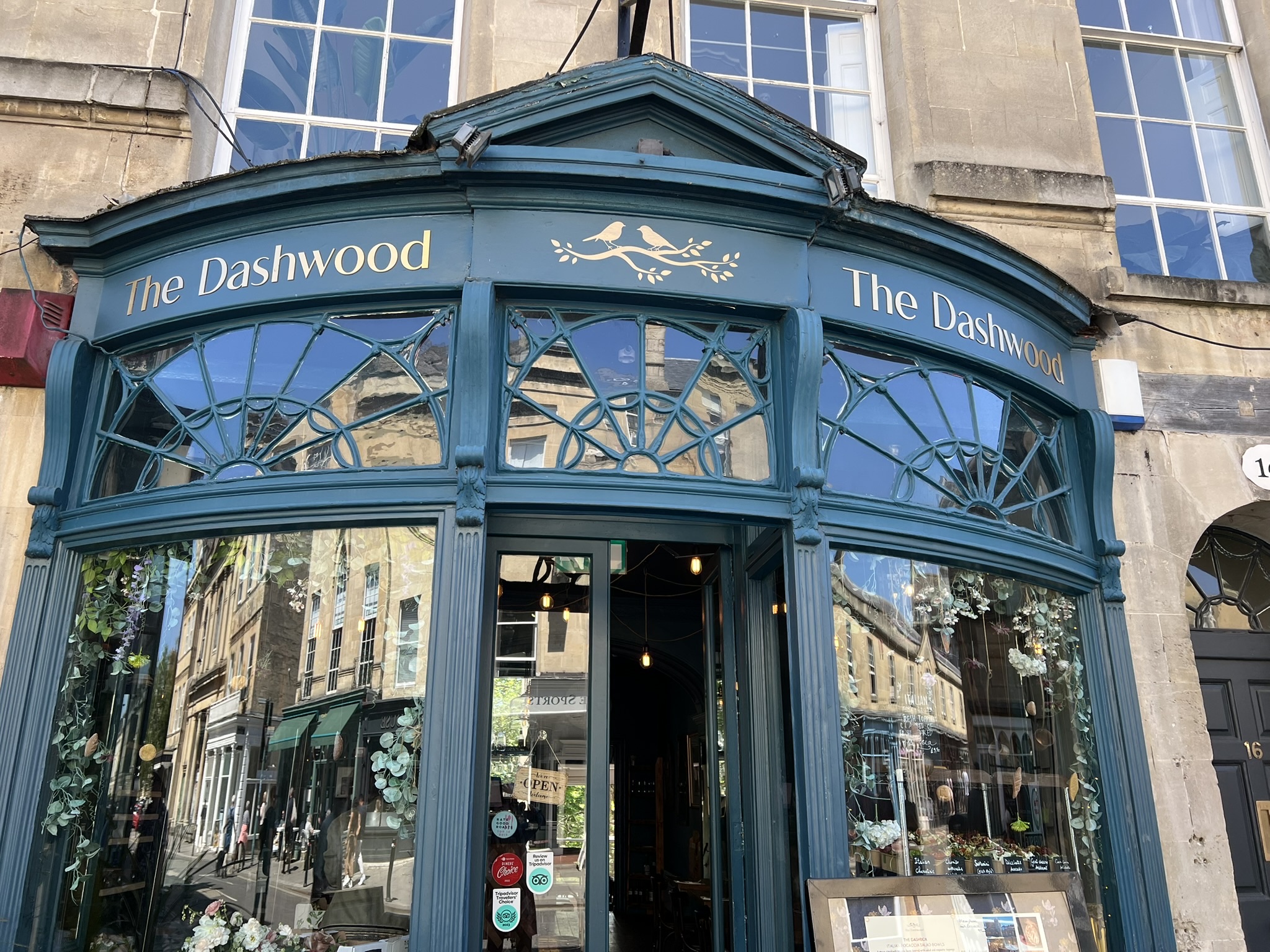
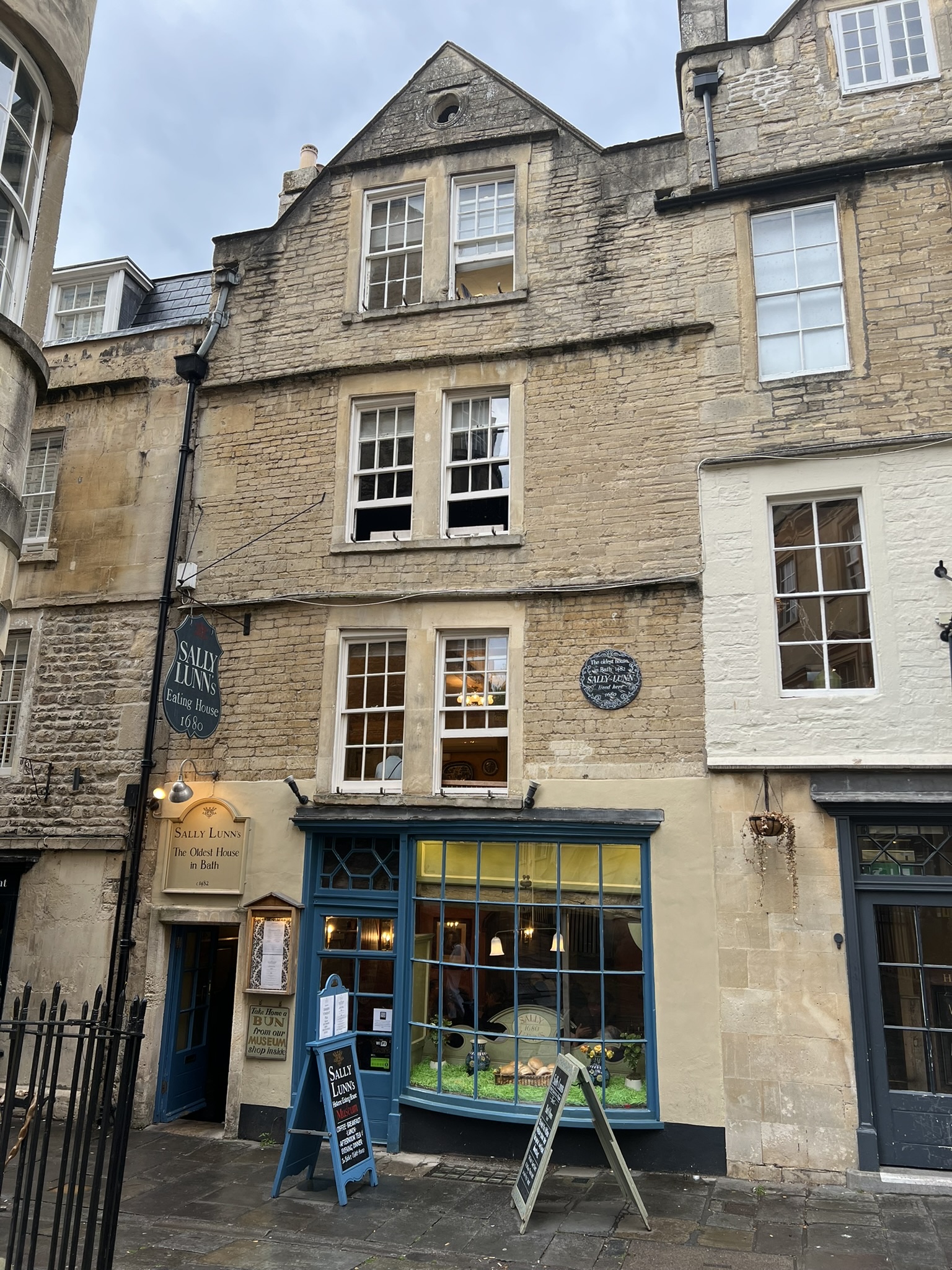
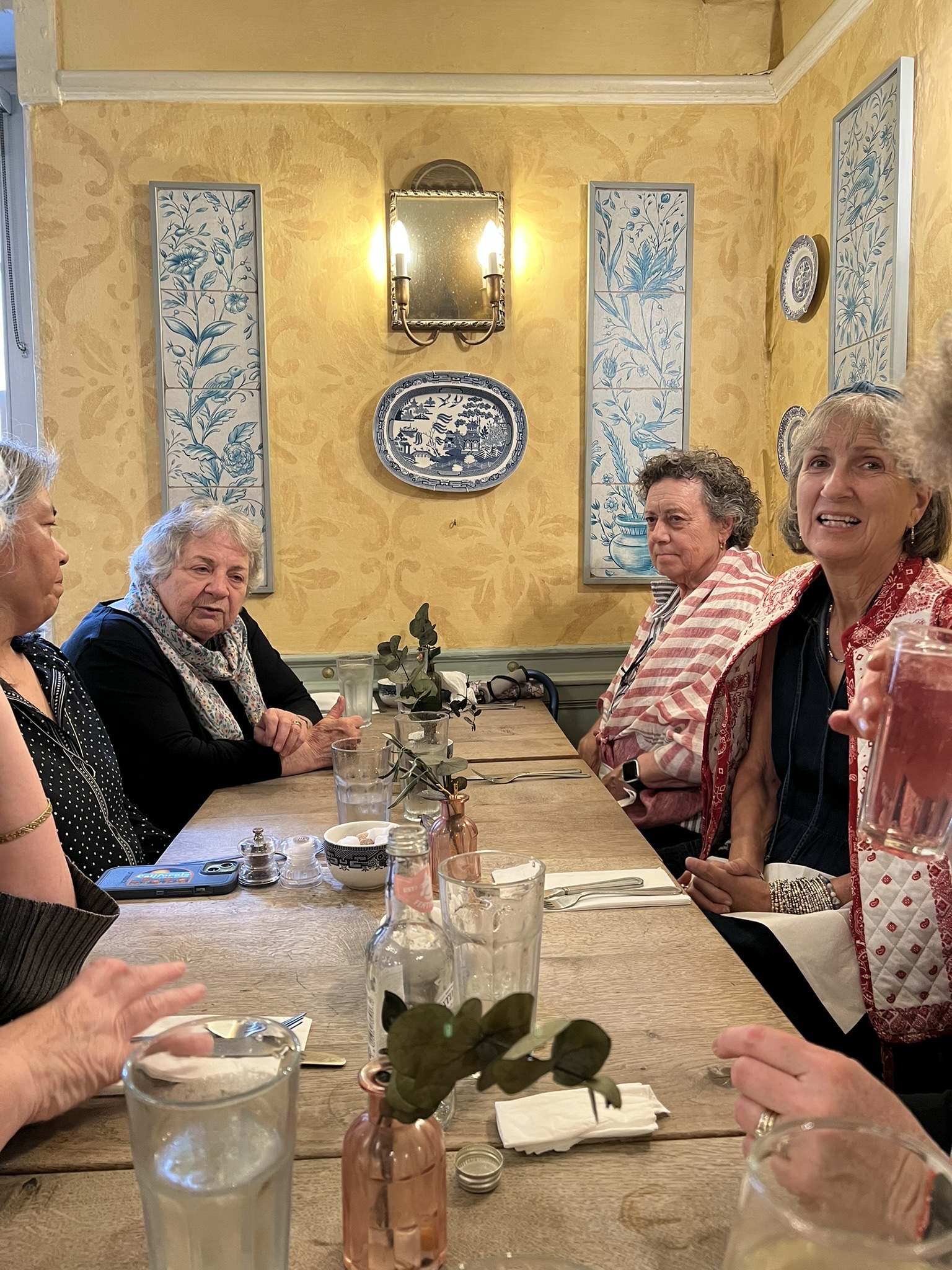
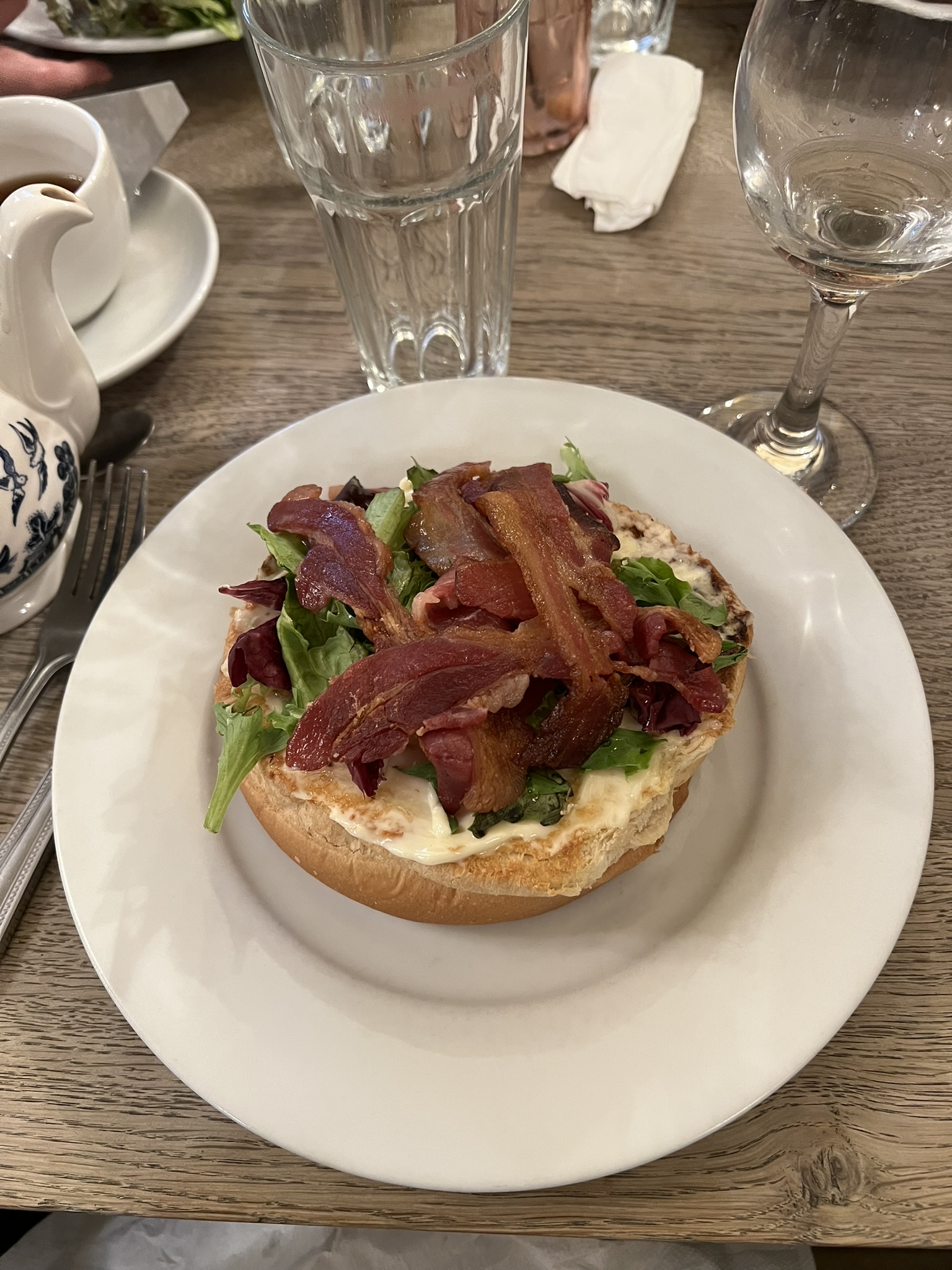
Dinner on our own and several of us headed to the absolutely required eating spot in Bath: Sally Lunn’s – a few photos for your pleasure!
And another day is done…
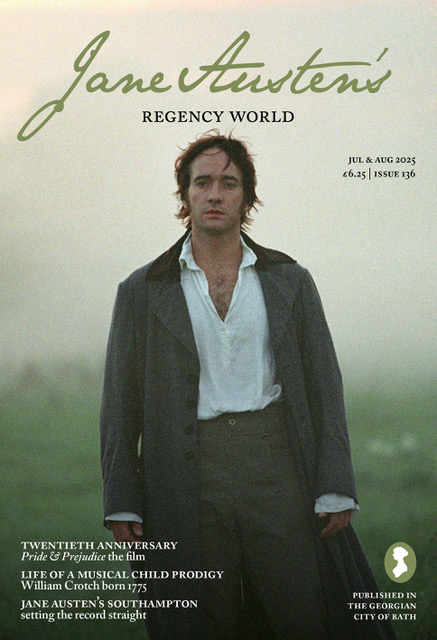
* Latest issue of JARW: [always a pleasure to see Mr. Darcy in the fog…]
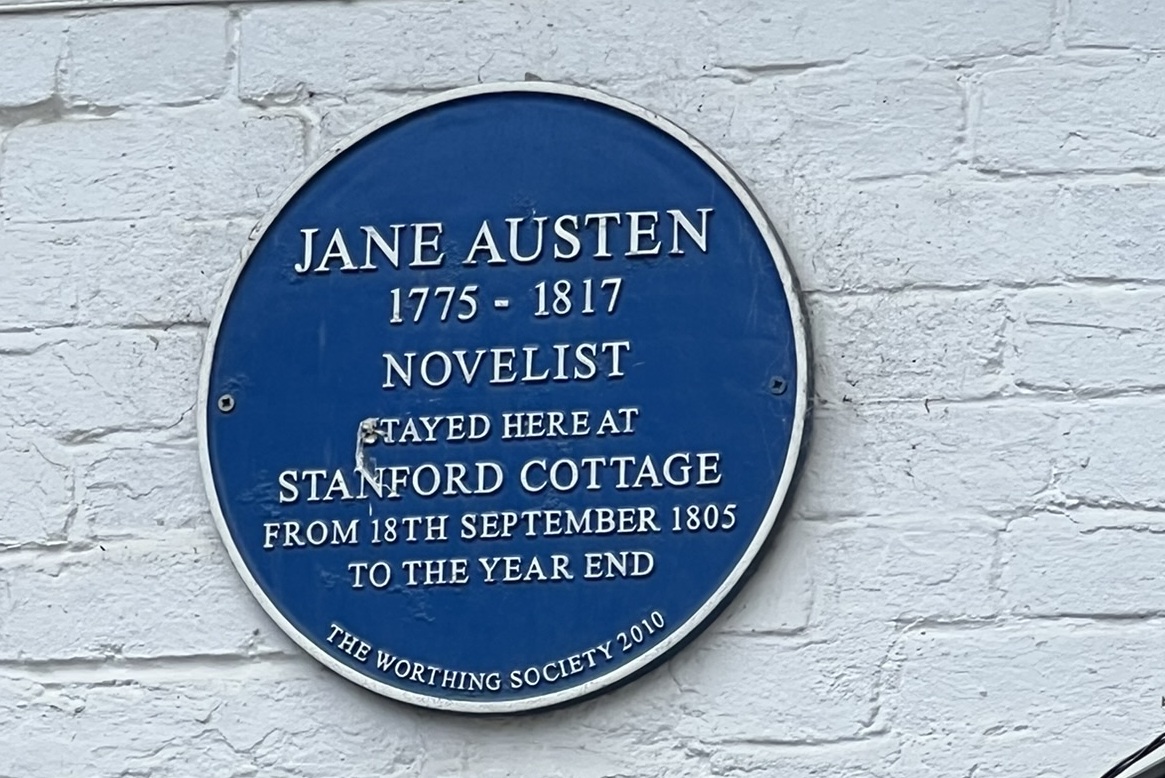
This morning we headed off once again after our last English breakfast at Culpeper’s Restaurant at the Chilston Park Hotel… for a two-hour trek to Worthing, at the seaside, and where Jane Austen stayed in September 1805 ’til at least early November [Le Faye, Chronology, 319]. I have read about this time of her life and her extended stay here – the must-read book is the Antony Edmonds’ Jane Austen’s Worthing: The Real Sanditon (Amberley, 2013):
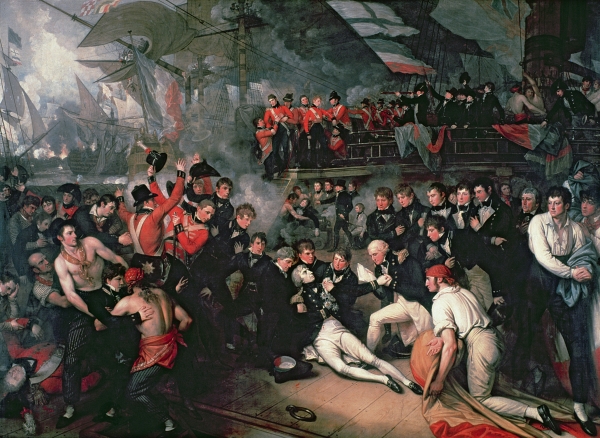
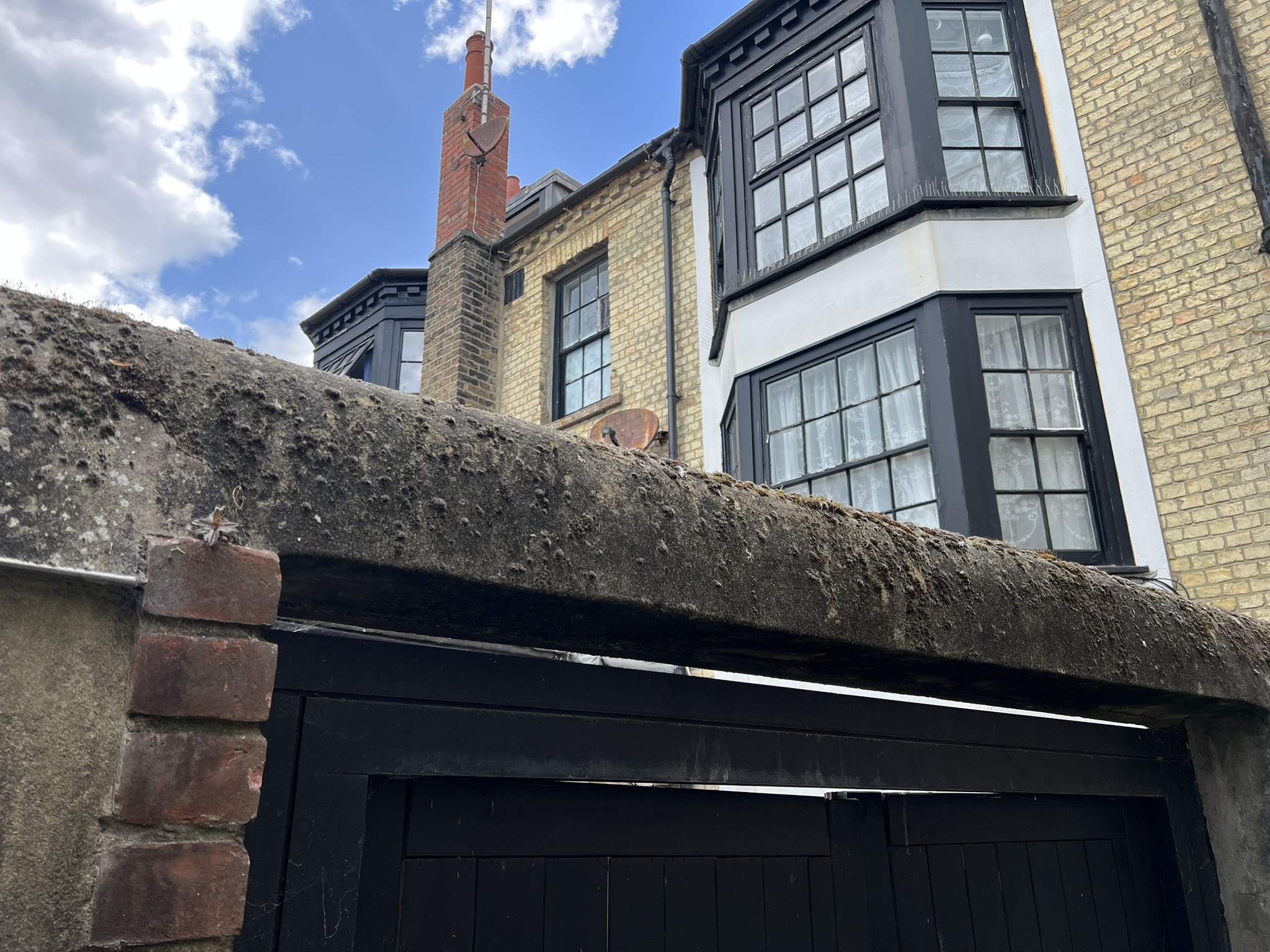
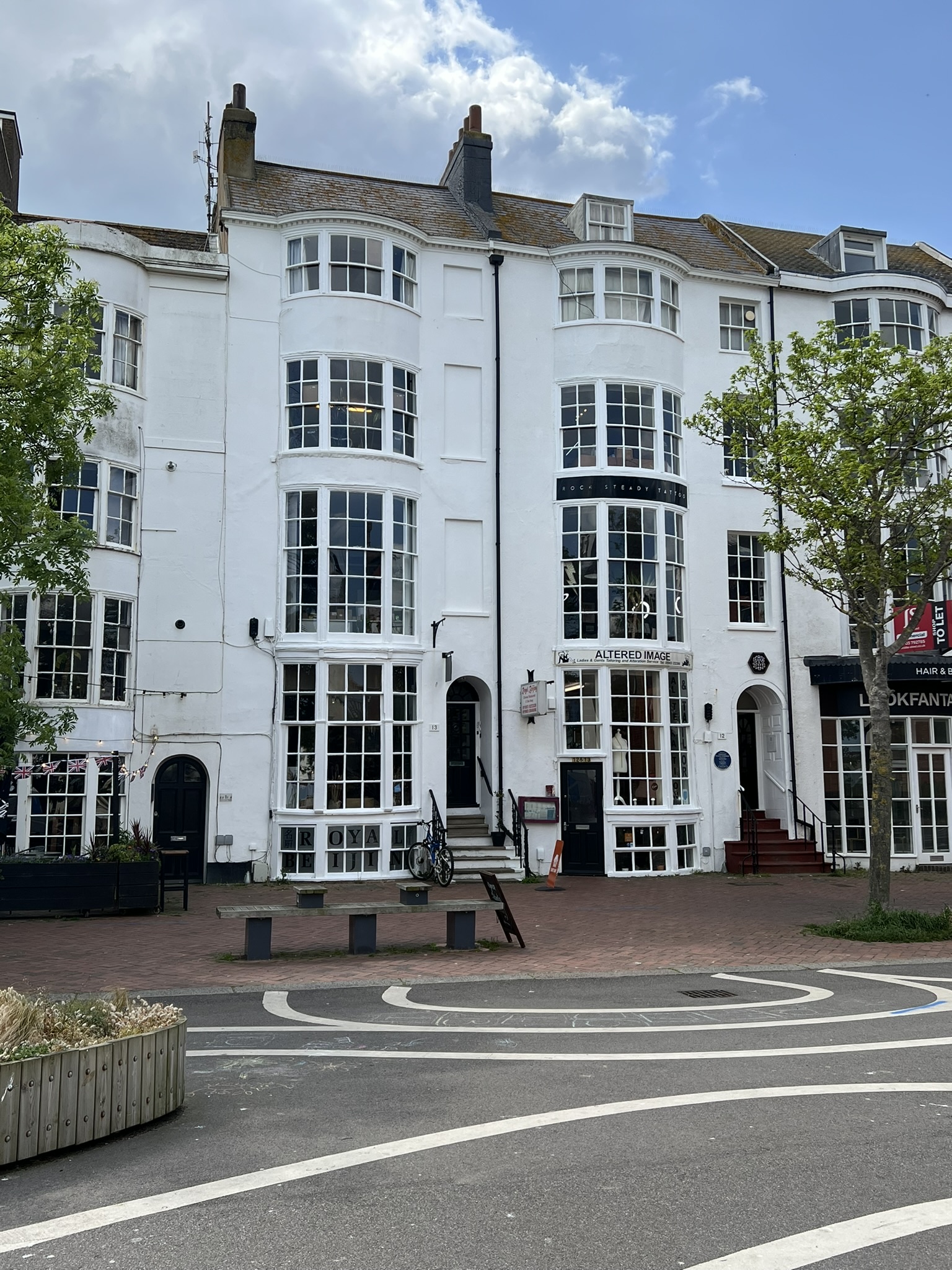
Profusely illustrated, Edmonds tells all about the history of Worthing and what it was like in 1805 as Jane would have experienced it. She was here with her mother, sister Cassandra, Martha Lloyd, niece Fanny Austen [later Knight], and Miss Sharpe – they stayed in Stanford Cottage, now a Pizza Express, and where we were met by members of the Worthing Society. They were terrific – gave a powerpoint lecture on Austen’s time here [interesting to learn that they were here in October 21, 1805, the date of the Battle of Trafalgar and the death of Nelson [and they were likely all worried about where Frank was then located – did they know then that he was not part of the battle?]]
[Death of Nelson, by Benjamin West – Wikipedia]
*******
Stanford Cottage:
And this from the lecture on the route the Austens et al would have traveled to Worthing:
*******
Worthing was a place made famous by the arrival of Princess Amelia, youngest daughter of George III, who came here for sea-bathing to improve her health [to no avail: she died of tuberculosis in 1810]. Other notables who either visited or lived for a time in Worthing were Percy Bysshe Shelley, Lord Byron, Charles Lamb, the poet Robert Bloomfield, the poet and critic Horace Smith, and the actor Colonel Berkeley and actress Mrs. Bunn (Margaret Somerville, and a bit after Austen). There are a number of “Blue Plaques” scattered around town noting other people of historical interest [including Harold Pinter, who wrote “The Homecoming” while living here from 1962-64]. One an only conjecture if Austen ran into any of these people… or if she would have liked Pinter’s turn as Sir Thomas in the 1999 Patricia Rozema Mansfield Park…?]
[House where Princess Amelia stayed]
One is easily sidetracked from the main event: Jane Austen in Worthing.
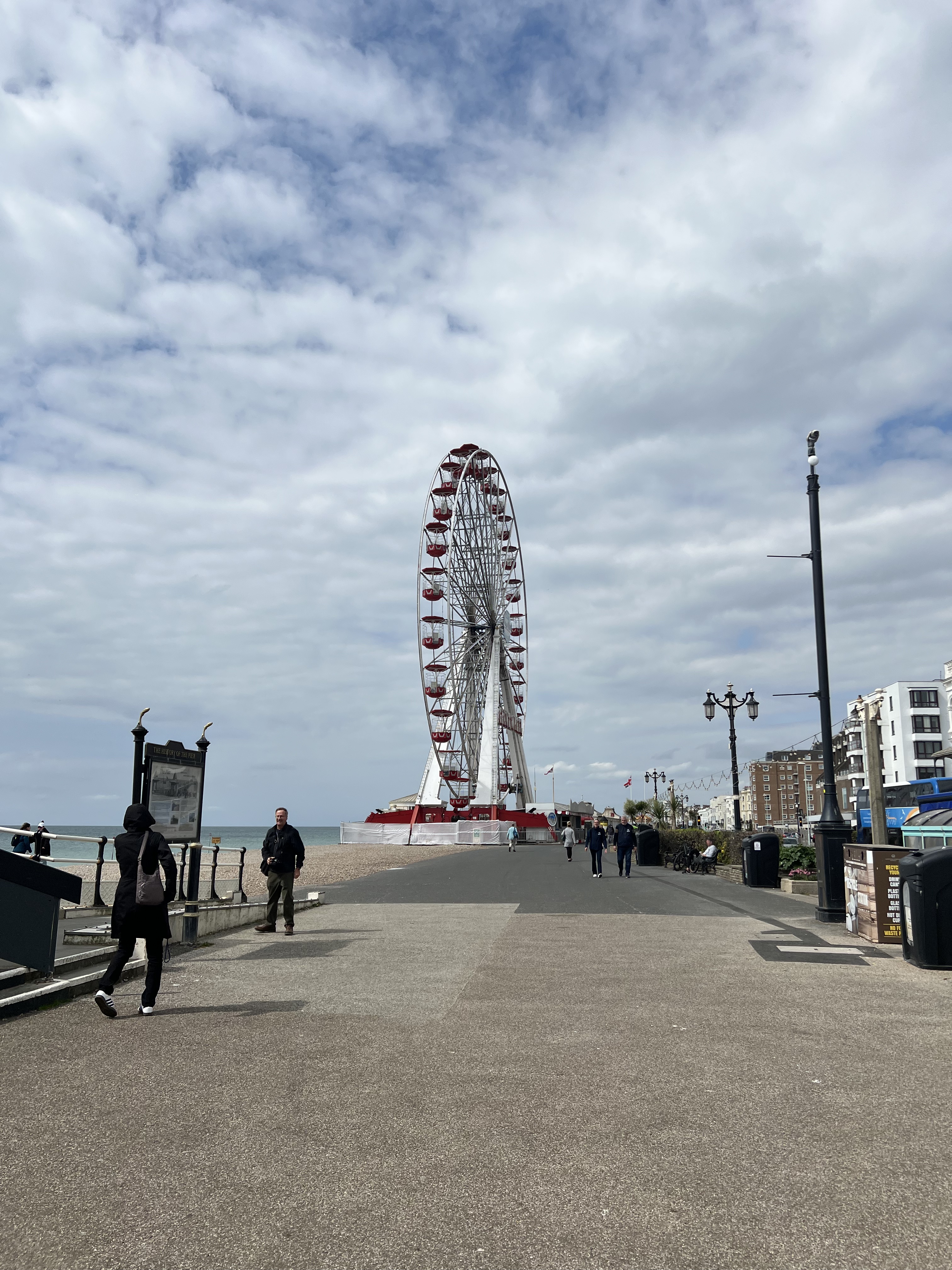
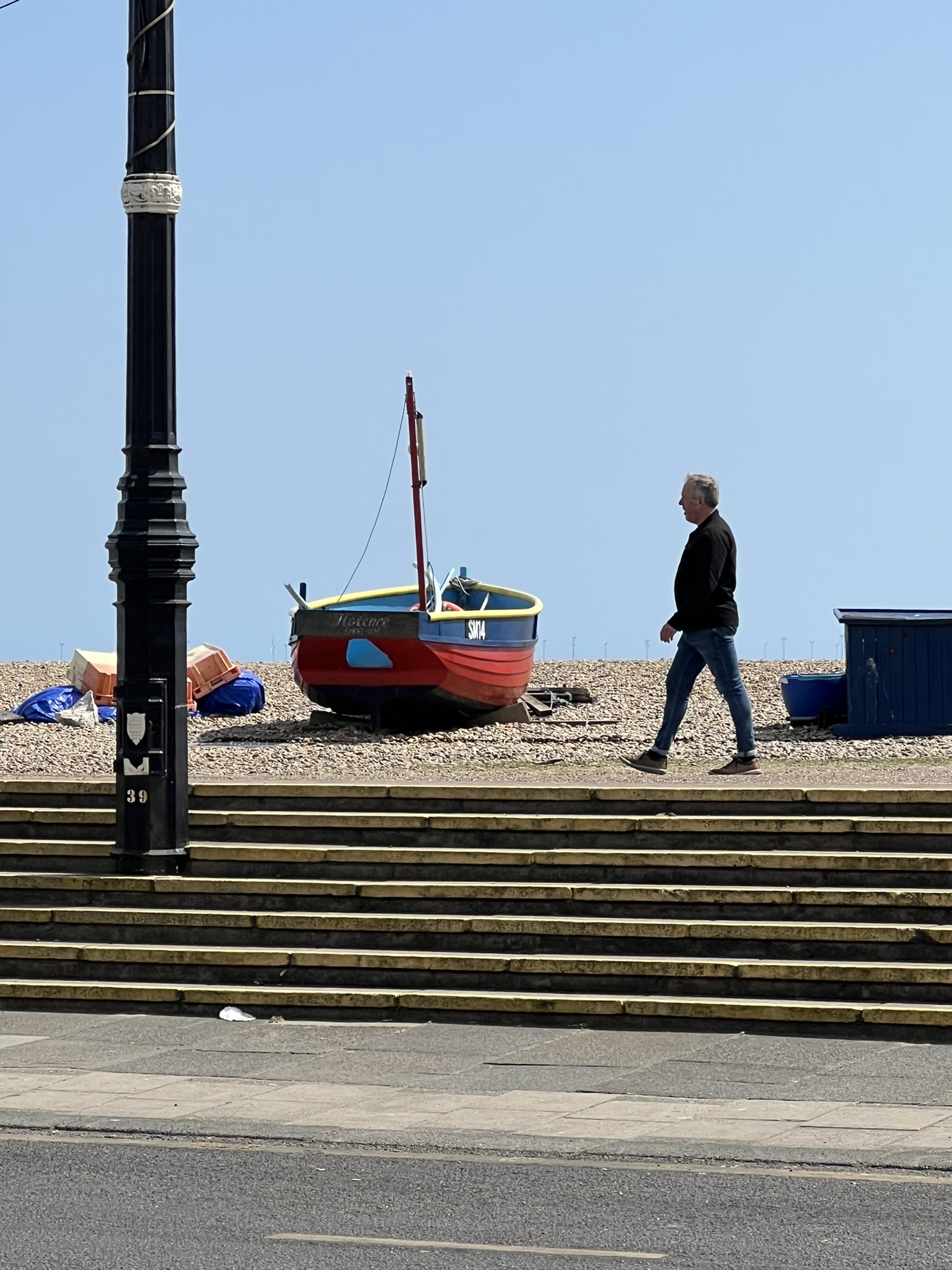
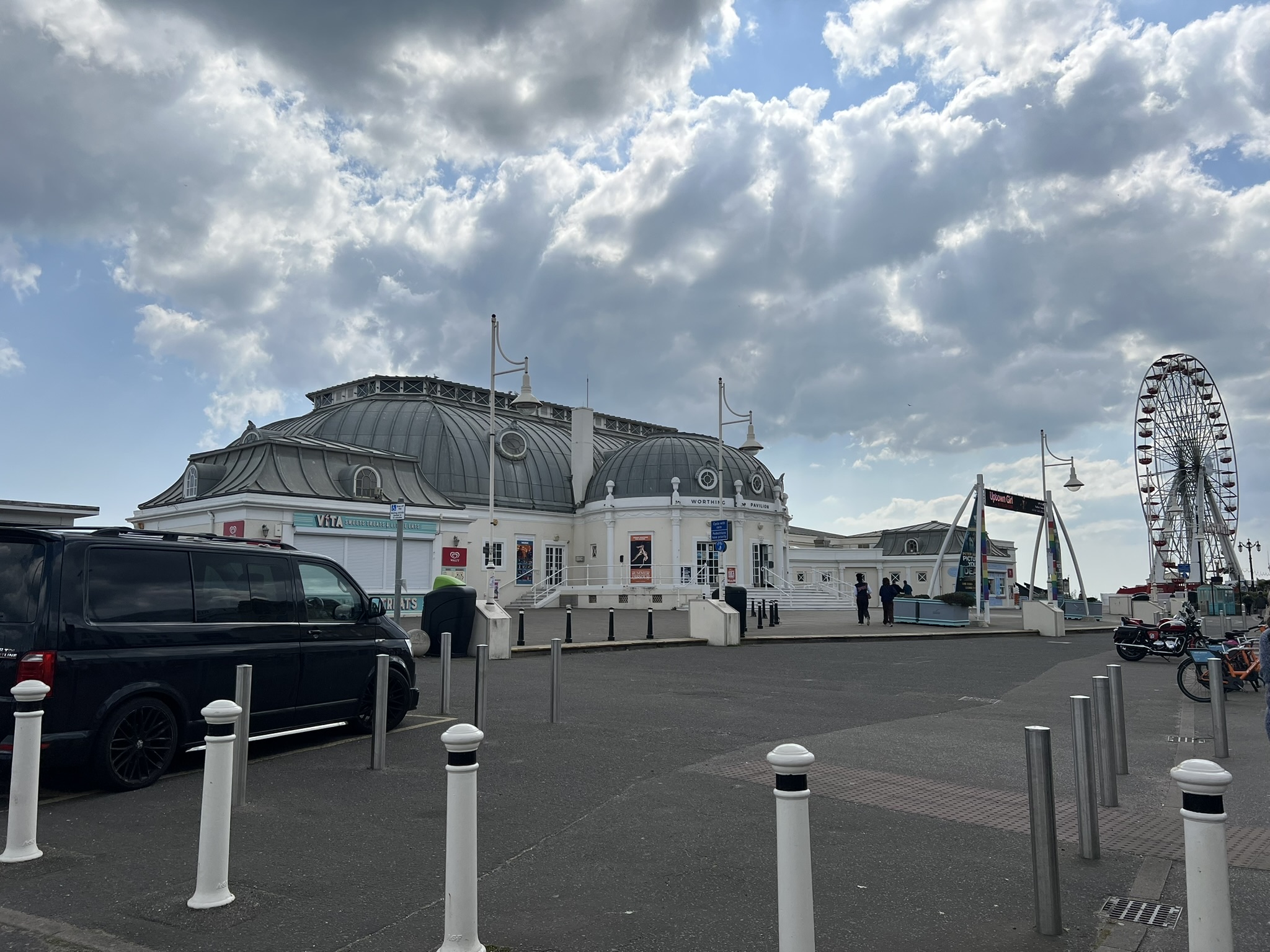
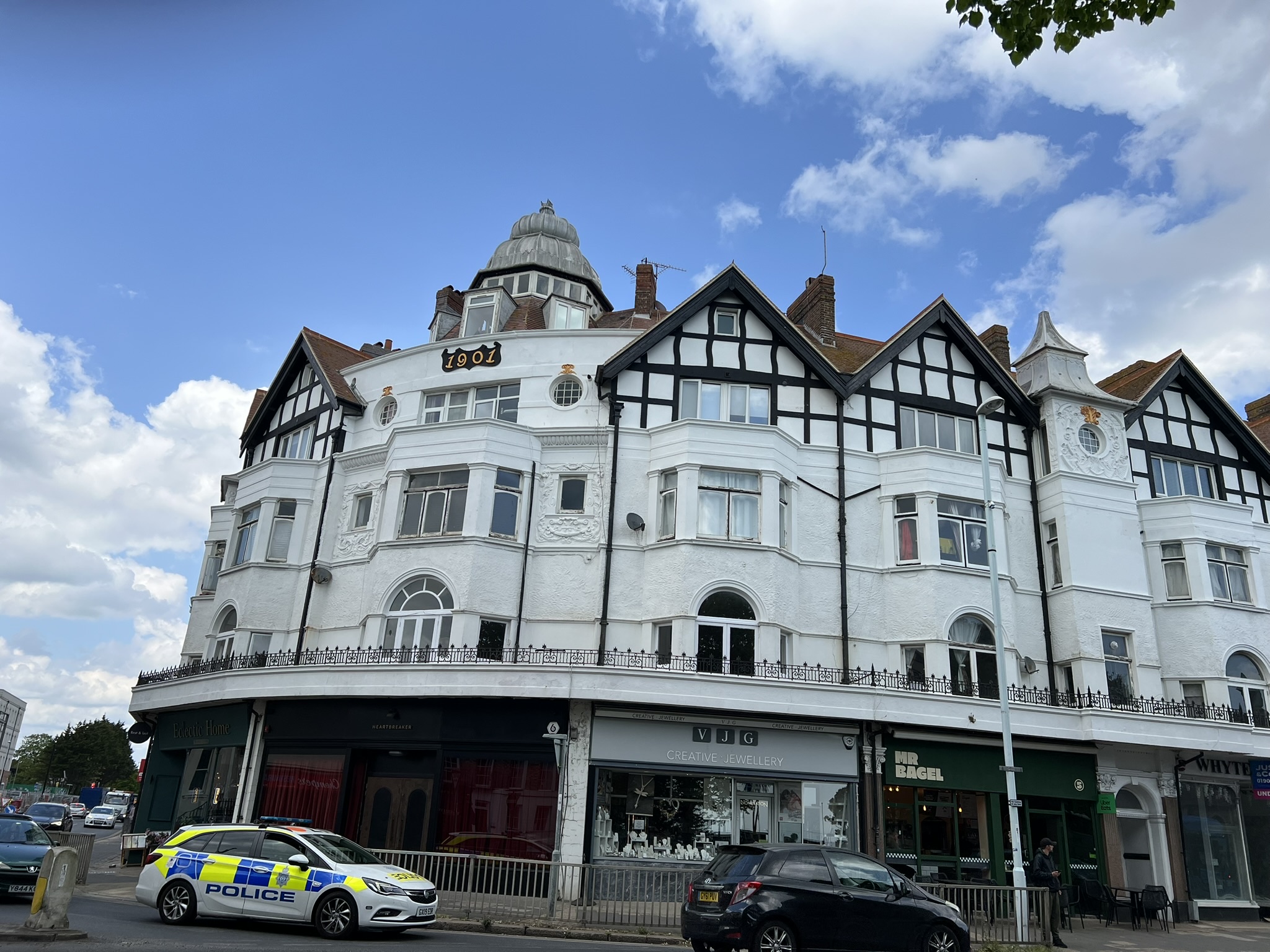
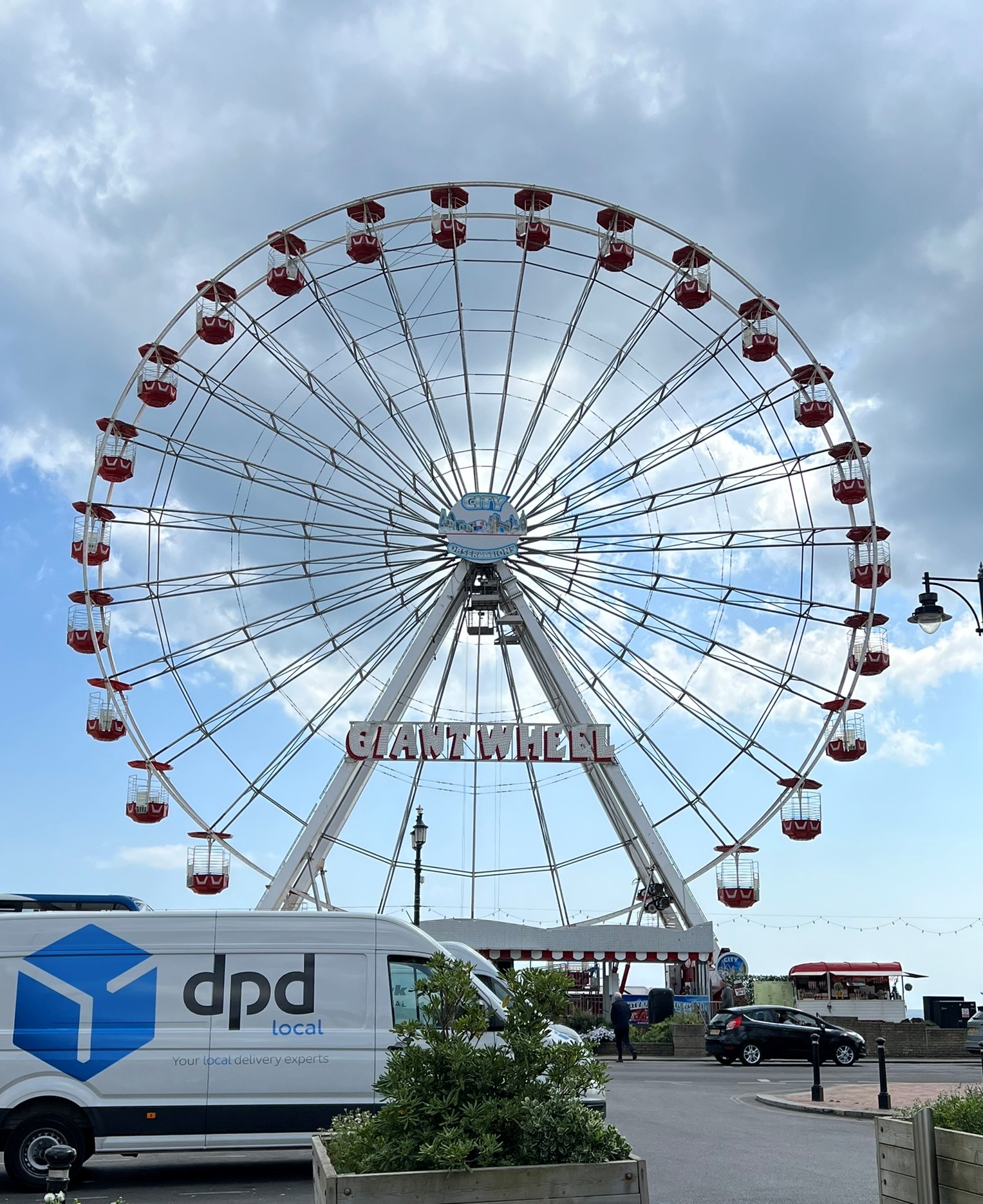
I was quite taken with the town, between the seaside, the Ferris Wheel, the beach, the enchanting streets, and by the graciousness of our hosts. After the lecture, we inhaled pizza, then took a walking tour guided by our Worthing Society hosts that followed Austen’s time here:
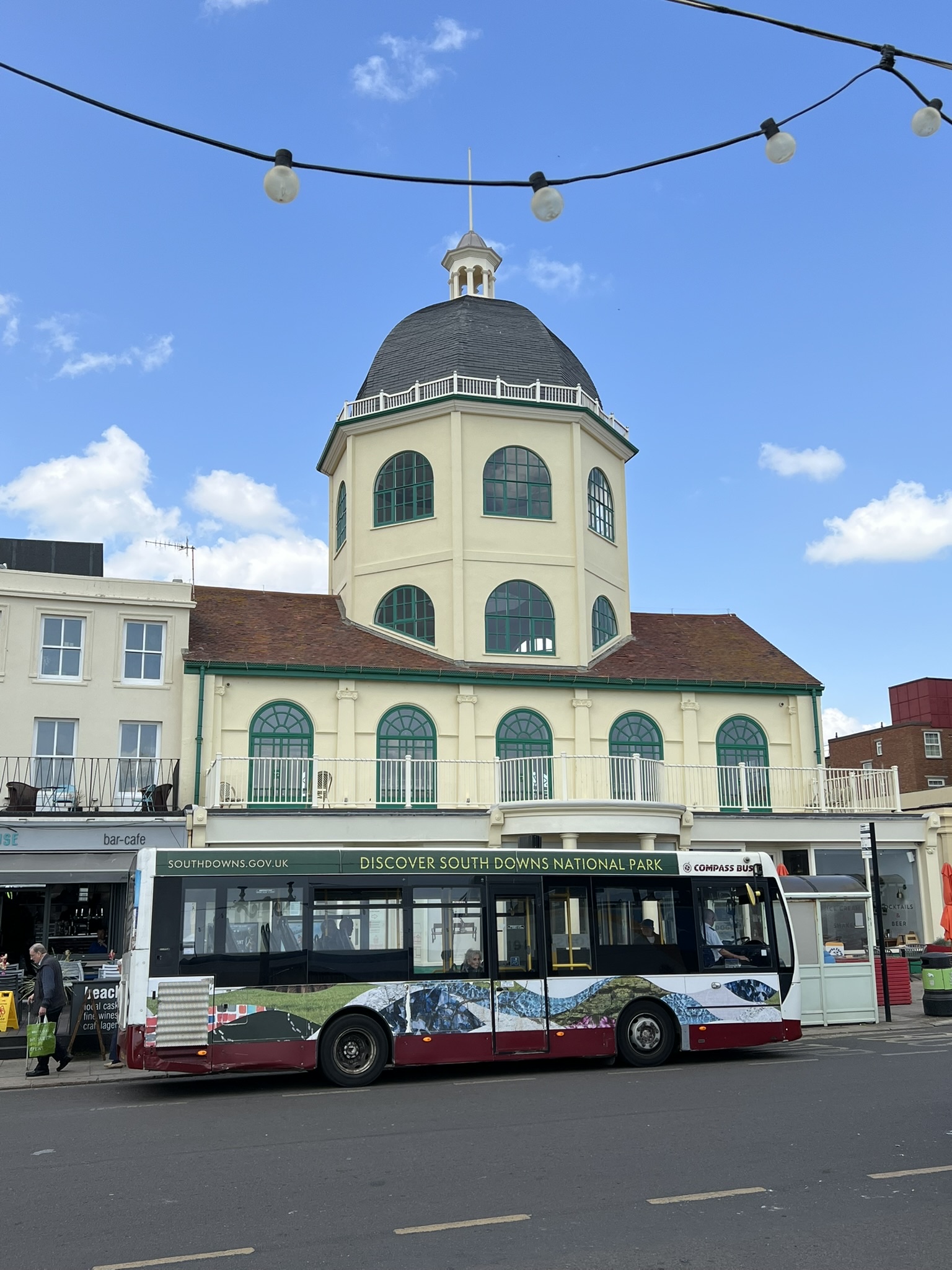
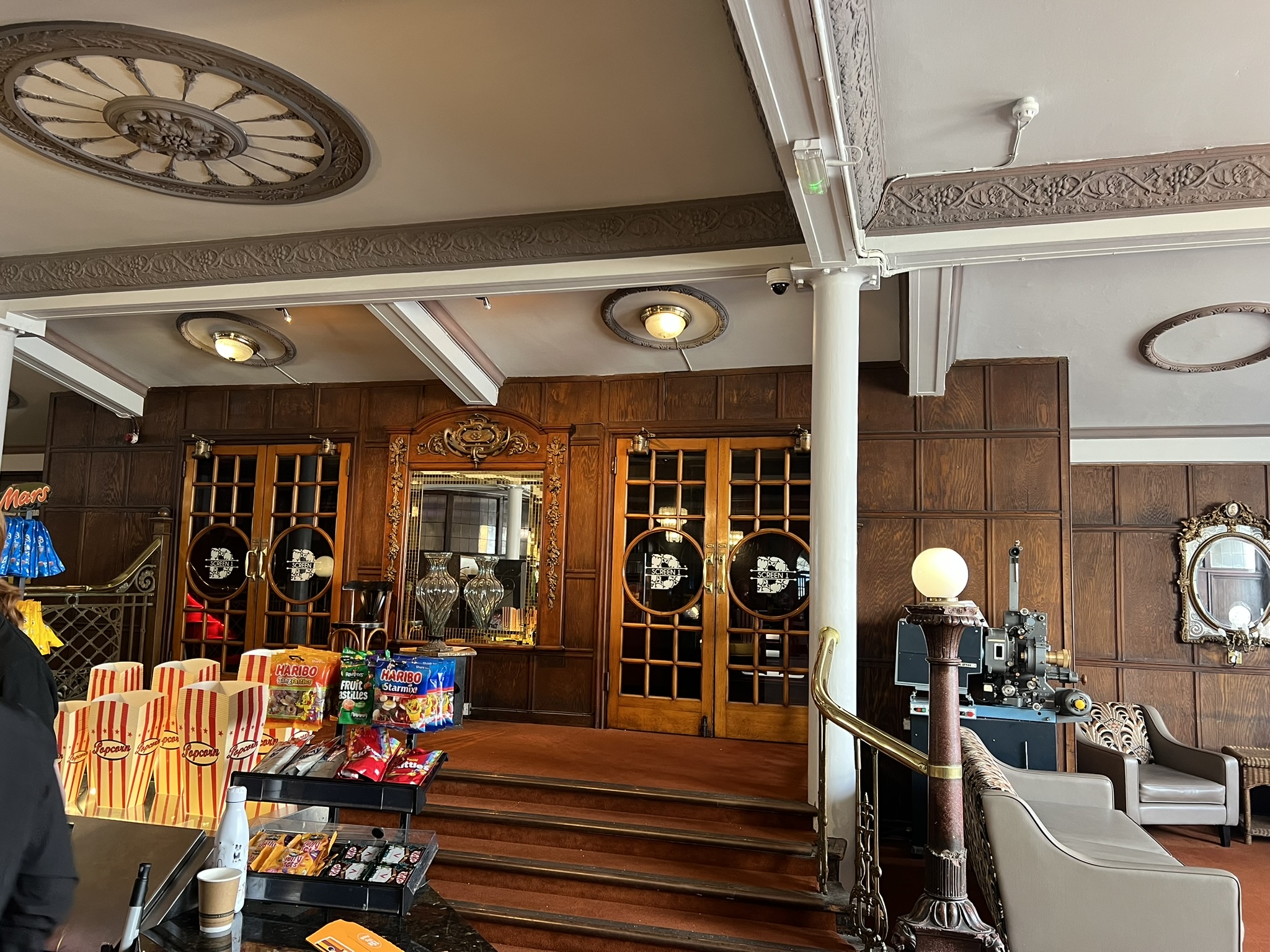
[The Dome Cinema, 1911]
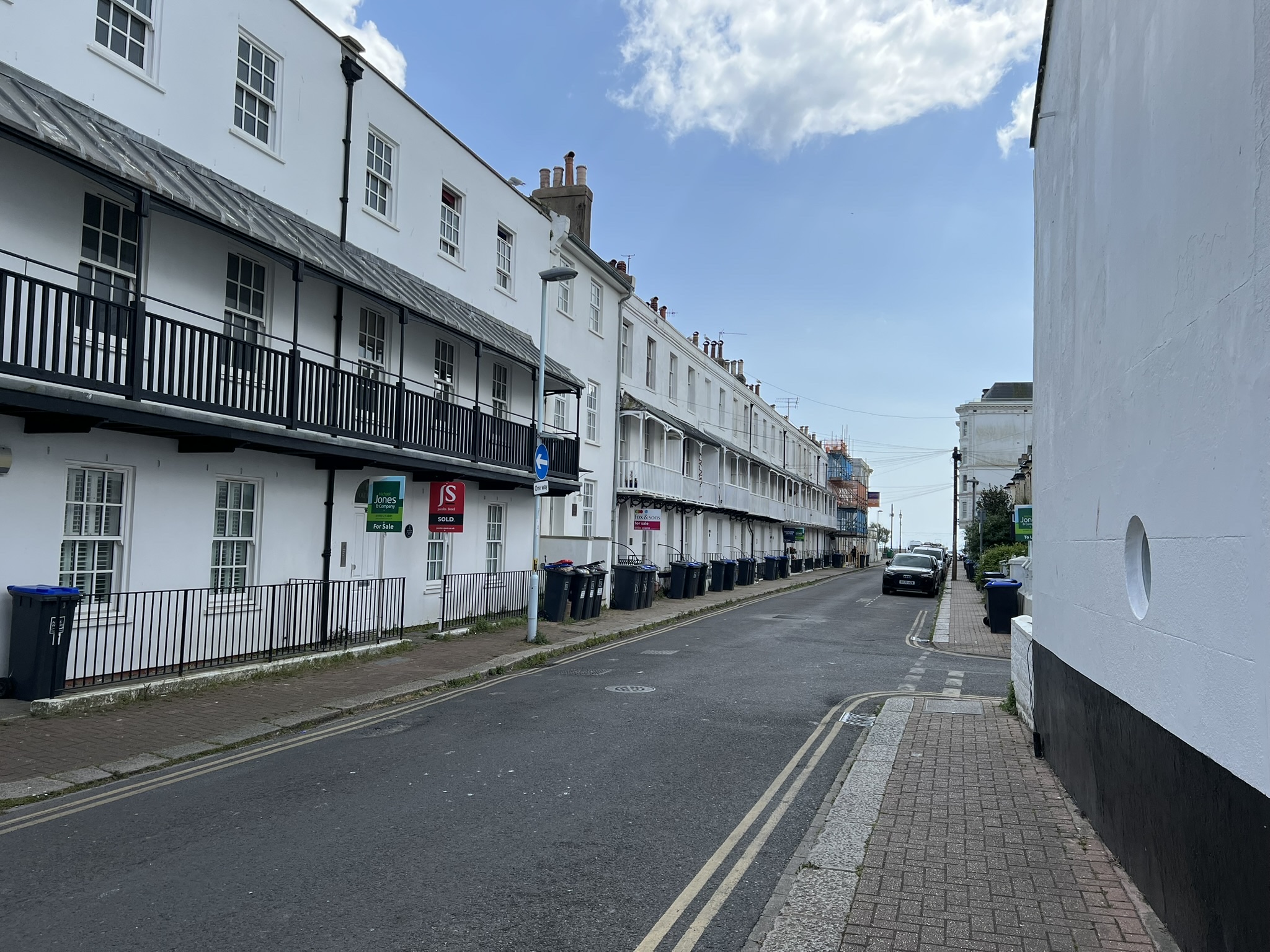
[a street just as Austen would have seen it…well, without the signs, the asphalt, the cars, the trash cans…but the buildings remains as they were then…]
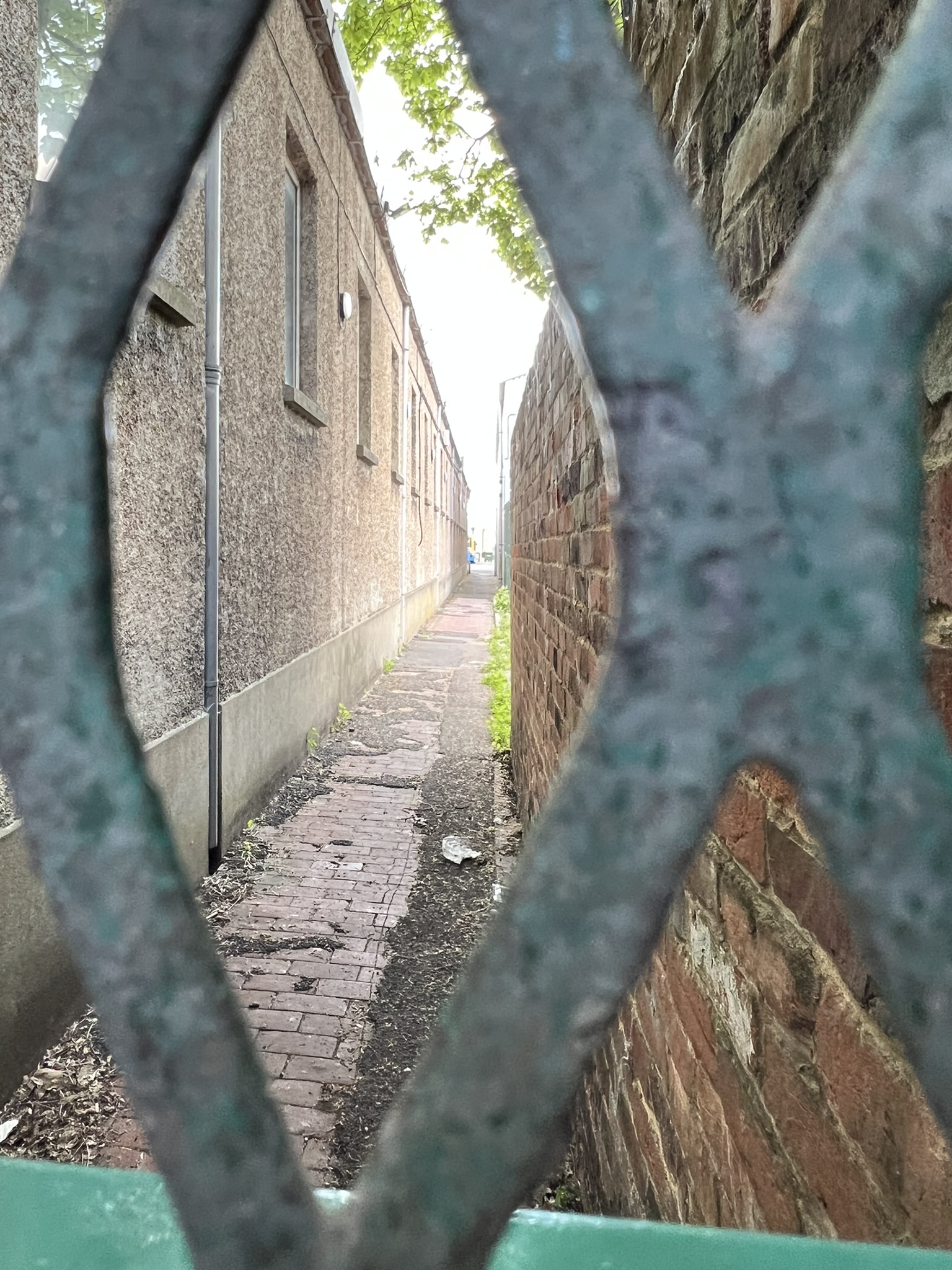
And her path to the circulating library, which is now closed to walkers…
…. and the path to the water for a refreshing dip [there were 30 bathing machines at the time, and “were, according to the 1805 town guide, segregated, so that ‘every proper attention is paid to decency’.”] [Worthing Society Heritage Leaflet No. 2, “Jane Austen” (c2013, Janet Clarke)]
Venus’s Bathing (Margate): Hand-coloured etching, 1790 By: Thomas Rowlandson courtesy of the Wellcome Collection
All that is known about this family trip is through Fanny Austen’s notebook jottings – there are no letters from this time, and indeed no letters from Jane from 30 August 1805 until 7-8 January 1807 (Letter 48(C) is a July 24, 1806 poem to Fanny and is only a copy written out by Anna Lefroy) – what happened in those years remains a mystery … and ripe for fictional interpretation.
But Edmonds makes a strong case for Austen’s visit to Worthing as being the foundation of her last novel Sanditon – all the characters of the town are in place in her story, sadly never finished, and also ripe for fictional completions, of which there are several [as well as the over-the-top-but-beautiful-to-look-at 3-season TV series].
We thanked our new-found friends in Worthing and were then on our way to Winchester, from where we will spend the next 4 days journeying from there to take in the Jane-in-Hampshire sites…
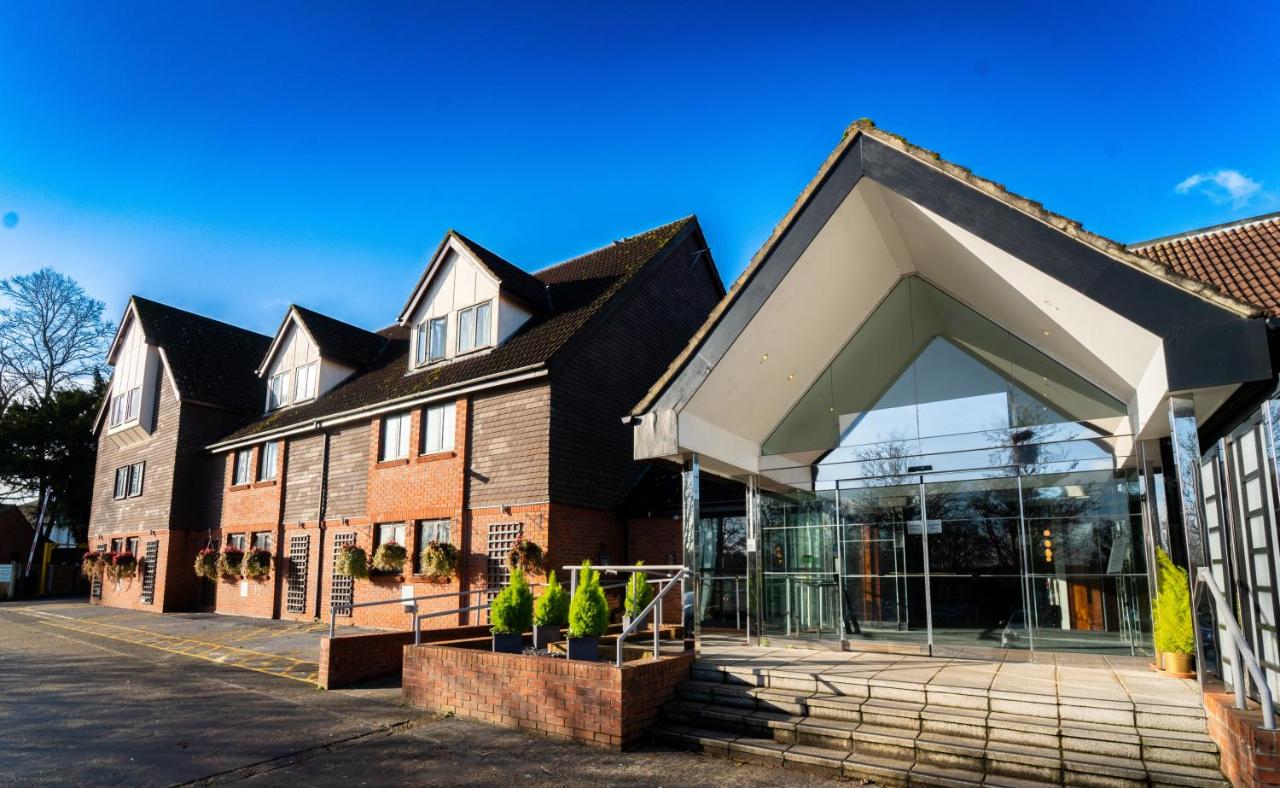
In the meantime, dinner at our hotel, the Winchester Hotel & Spa:
[from the hotel website as I failed ot take a picture!]
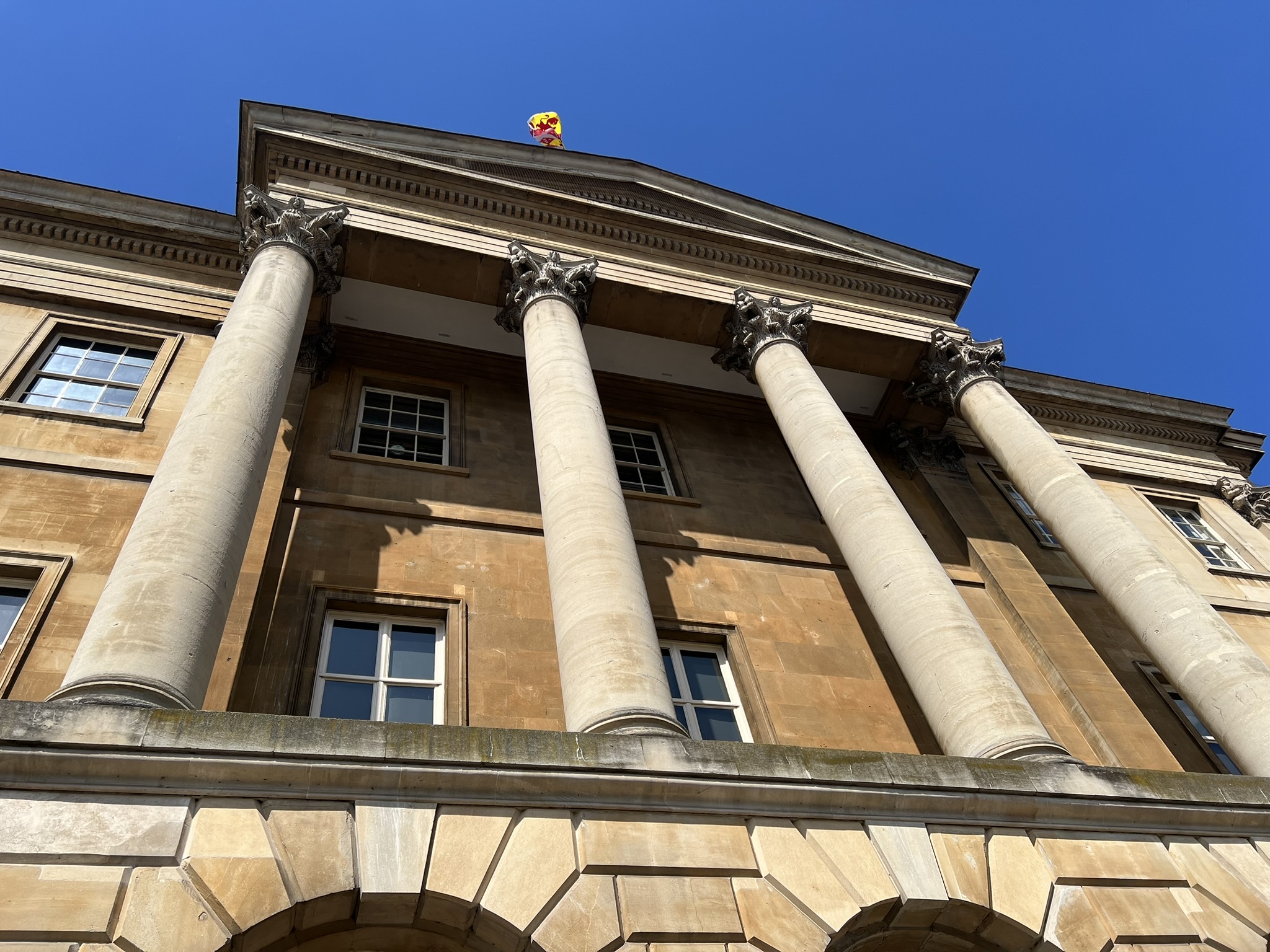
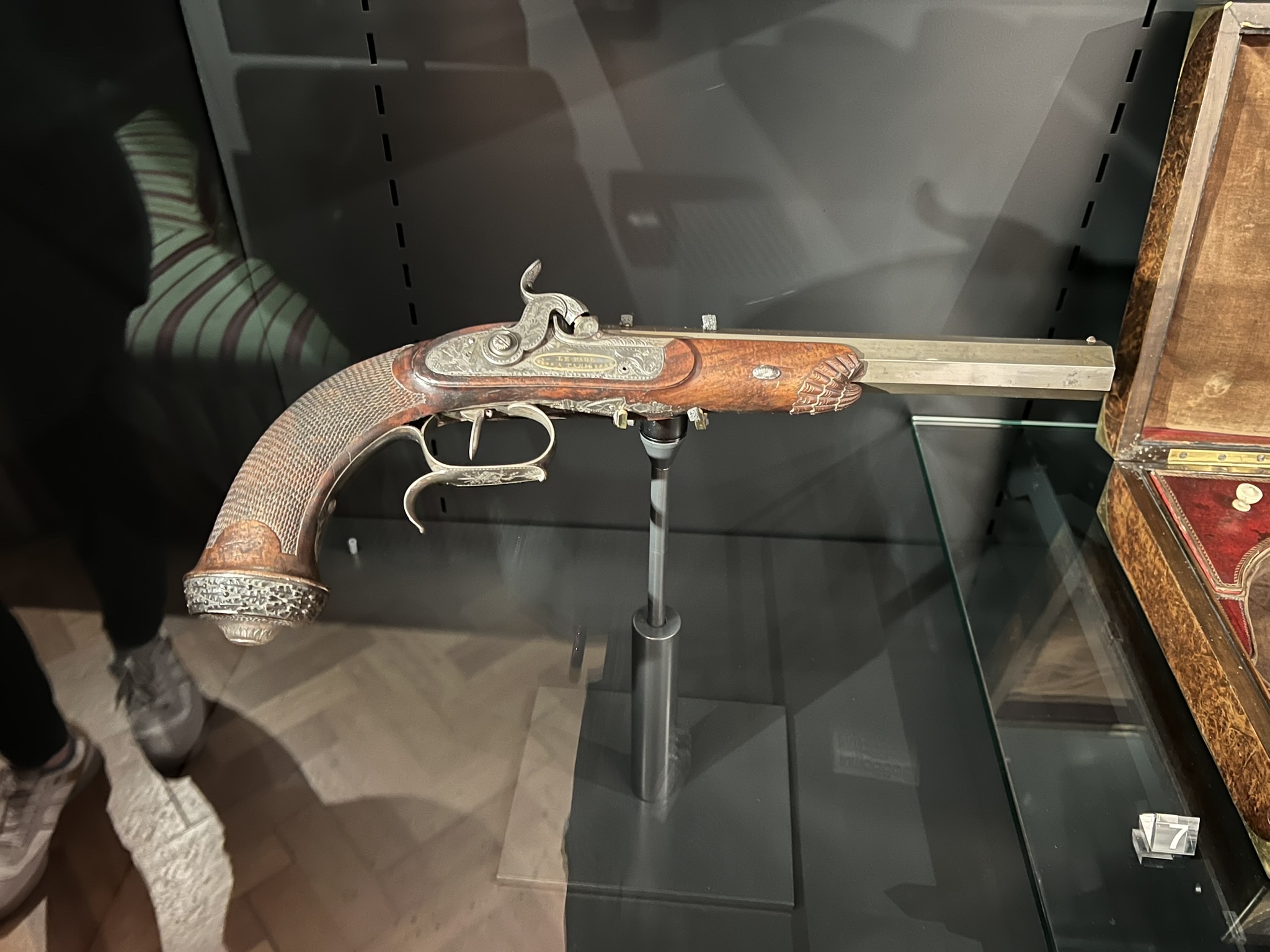
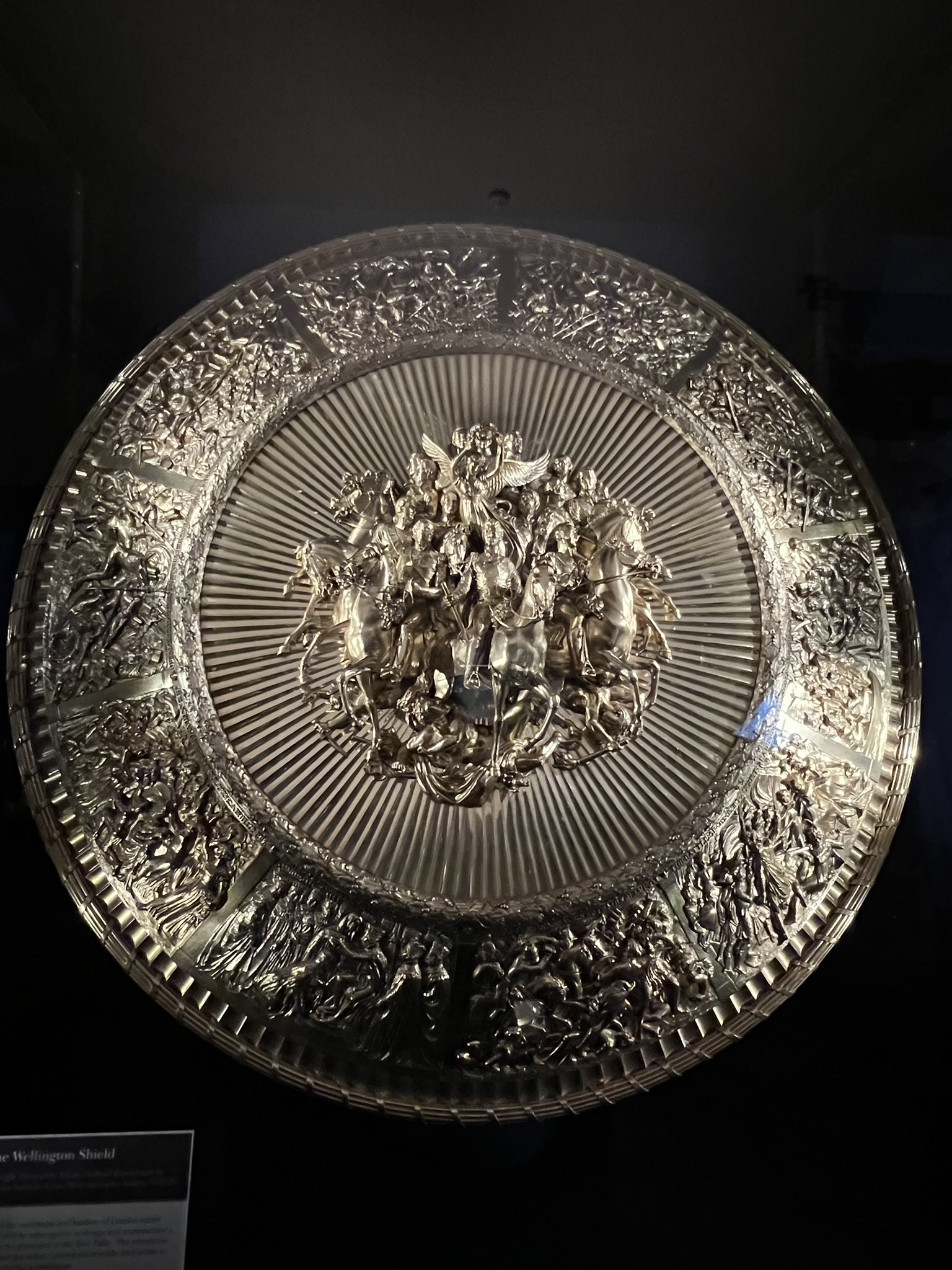
I am ashamed to say I have never been to Apsley House, home of the Duke of Wellington, so that was my goal this day – Ron had never been either, so we met there [right at the Hyde Park Gate, address is One London as you exit from Hyde Park] – and if you had a doubt as to whose home this was [and is], the number of portraits, sculptures, and paraphernalia of the Duke would certainly give you a hint… not to mention the statue of said Duke in the park across the street…
And the Wellington Arch: it is crowned by the largest bronze sculpture in Europe: the Angel of Peace descending on the Chariot of War. You can read about its history [and controversy] here.
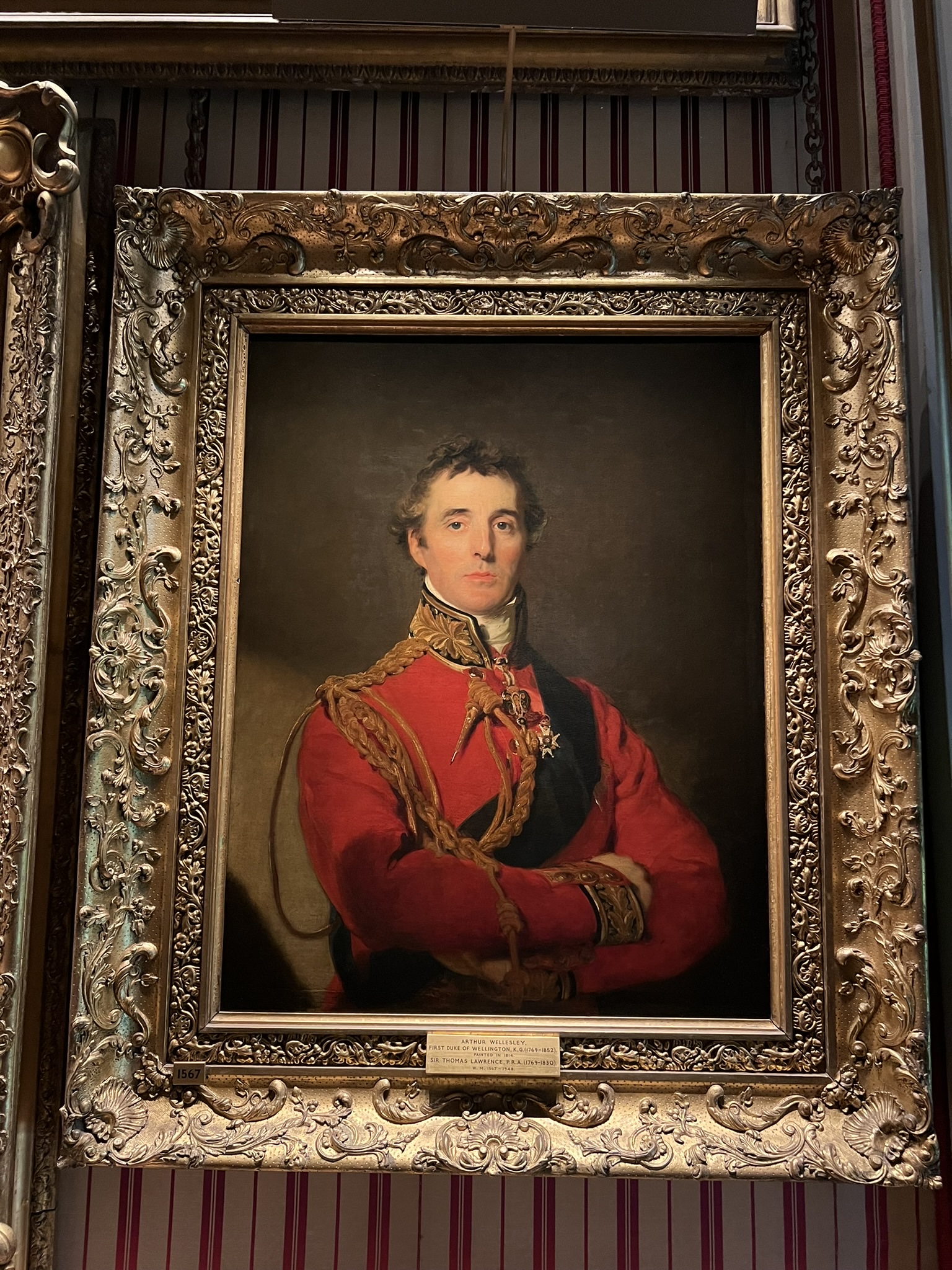
One of the many portraits of the Duke
Your basic dining room…
*****************
I loved it here – and art collection beyond compare – I could have spent many more hours. But for a man who by all accounts liked the simple life of being on a campaign, the extent of elaborate decorative arts and sumptuous décor seems to belie that – the color RED everywhere, and YELLOW…
************
One of two great surprises at Apsley is the extensive Spanish art collection in the Waterloo Gallery, “one of the great palatial interiors of Britain” [the Apsley House Guidebook by English Heritage] – a gift of King Ferdinand of Spain in 1816, the 165 paintings were found in an abandoned baggage carriage of Napoleon’s brother Joseph Bonaparte, then King of Spain. I give one fine example: “The Gambler,” by “a follower of Caravaggio”:
–
The other grand surprise was to find on entering the house a large nude statue of all people Napoleon! Napoleon as Mars the Peacemaker by Canova. It had been commissioned by Napoleon but had been covered up at the Louvre – after Waterloo Britain bought it for 66,000 francs and the Prince Regent [George IV] gifted it to Wellington. The entry stairwell was the only possible location and the floor had to be reinforced to support the great weight. Wellington admired Napoleon and there are several paintings of him in the art collection here. You can see the stairwell and the size in my more modest photo (!) here – this better picture of the whole statue is from the guidebook [it actually looks much larger than this image conveys – I did burst out laughing when I saw it was Napoleon…]
A friend of mine went several years ago to Apsley House for one of their occasional Regency balls – I can only imagine the swoosh of the dresses and music all around … you can see such a one in this youtube: https://www.facebook.com/ApsleyHouse/videos/2444115022311548
Alas! I had to content myself with an audio guide and a vivid imagination…
**************
Next up was Henry Austen! Ron and I were off to Sloane Square, where I served as a grateful listener for one of Ron’s walking tours of Austen sites. I had done this part of Henry Austen’s life before but Ron’s history of it all added much to my knowledge, not to mention another glorious weather day… all followed by lunch in a crowded outside eatery right in the middle of the weekend Sloane Square market – made one feel like a real Londoner!
Henry’s house in Hans Place…
What Henry’s house would have looked like then…
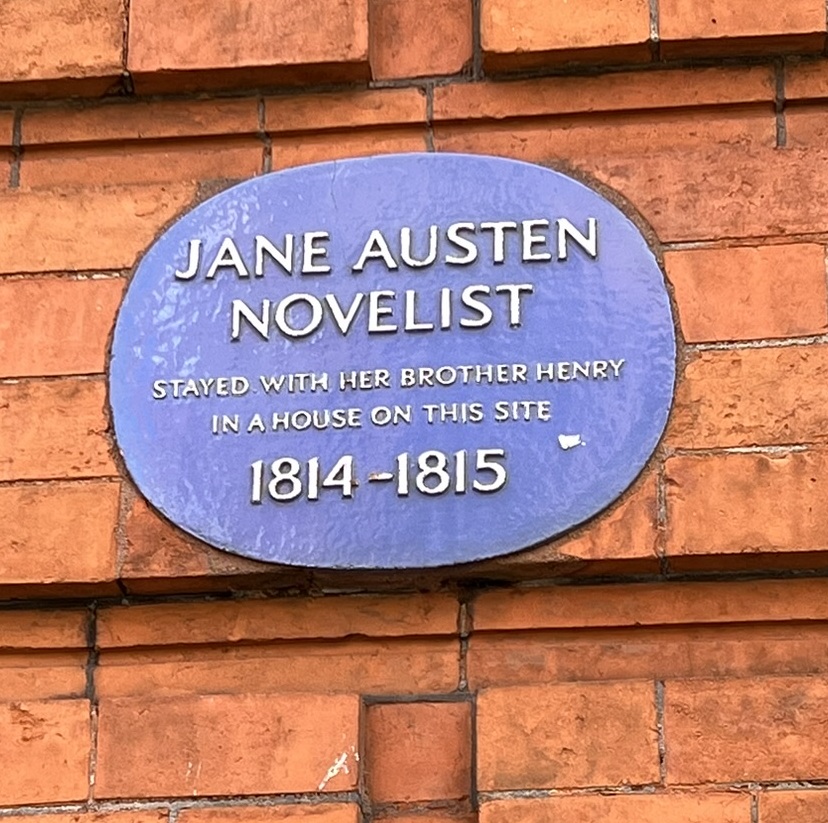
And the requisite Blue Plaque so we know it’s true…
adding this sketch from Constance Hill’s book JA: Her Homes and Her Friends (1902):
**************
Another great day with Ron…we bid adieu ’til a next visit [we have already lined up an itinerary…] – and I had a fine dinner later at my hotel [that is water not vodka!]:
Next up: the beginning of the JASNA Tour starting in Windsor!
Dear Readers: Please welcome Tony Grant today, as he gives us a bit of a travelogue through the village of Shere in Surrey. This all came about because of the holidays – and the holidays always brings the need to re-watch The Holiday with Kate Winslet, Jude Law, Cameron Diaz and Jack Black. And whenever you watch this movie, you want to immediately move to England and live in Kate Winslet’s cottage (and having Jude Law around would not be a bad thing either…) – so then you start looking into where that cottage actually is, and then you find out it doesn’t actually exist at all, and then you start researching thisvillage of Shere and looking for real real estate, so then you realize you have a better person to help with this, and who better to ask to do a blog piece on it but Tony Grant, who with his love of history, great photography skills, and the fact he doesn’t live all that far away, made it a no-brainer to implore him to write something… here is the result – please note that many of the pictures are shots of the village and surrounding area, randomly scattered throughout the post unless specifically identified, and all by Tony Grant. Hope you enjoy this travel adventure – and be sure to put Shere on your itinerary when next you are in England (whenever that will be … we can only live in Hope).
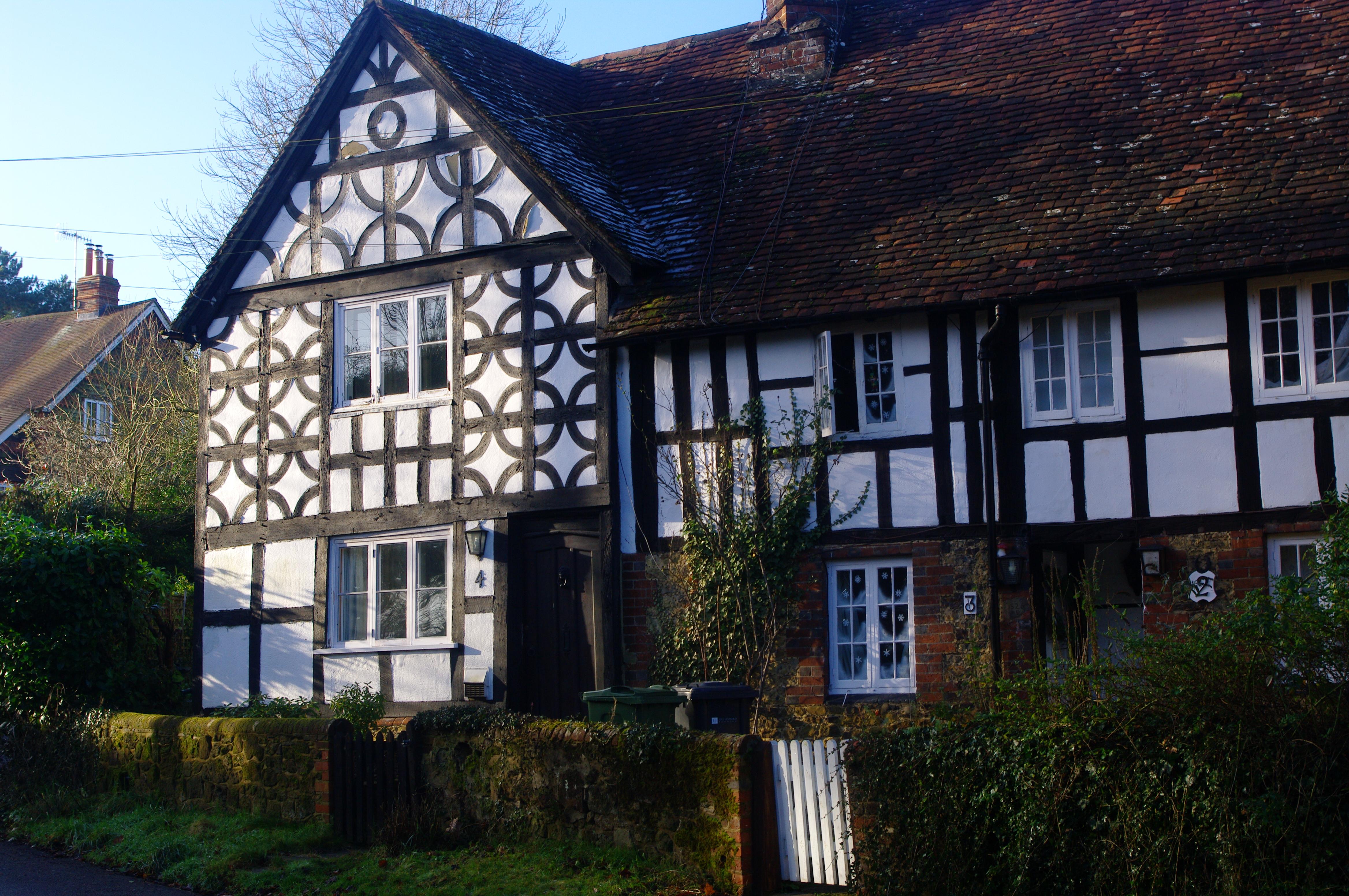
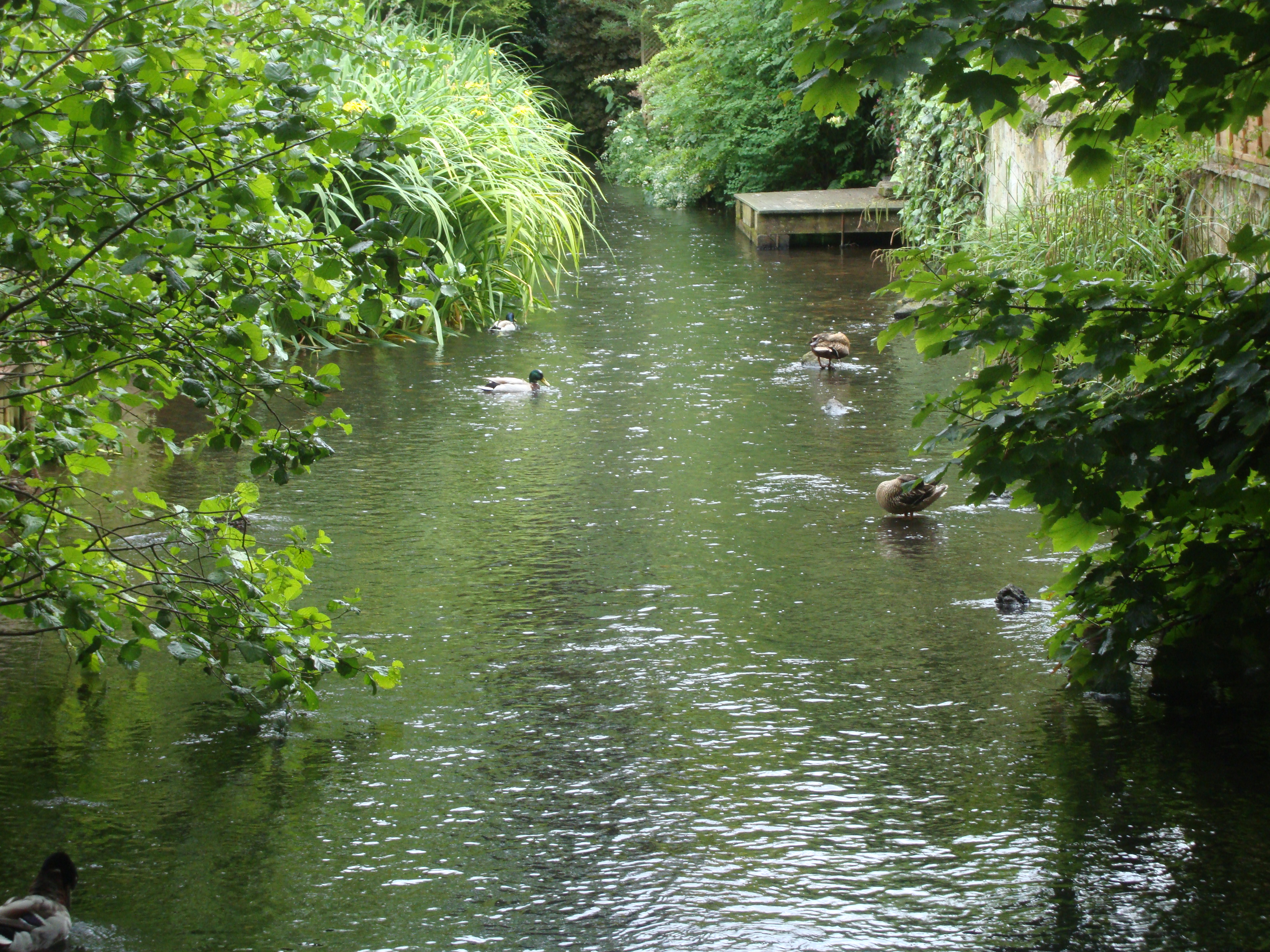
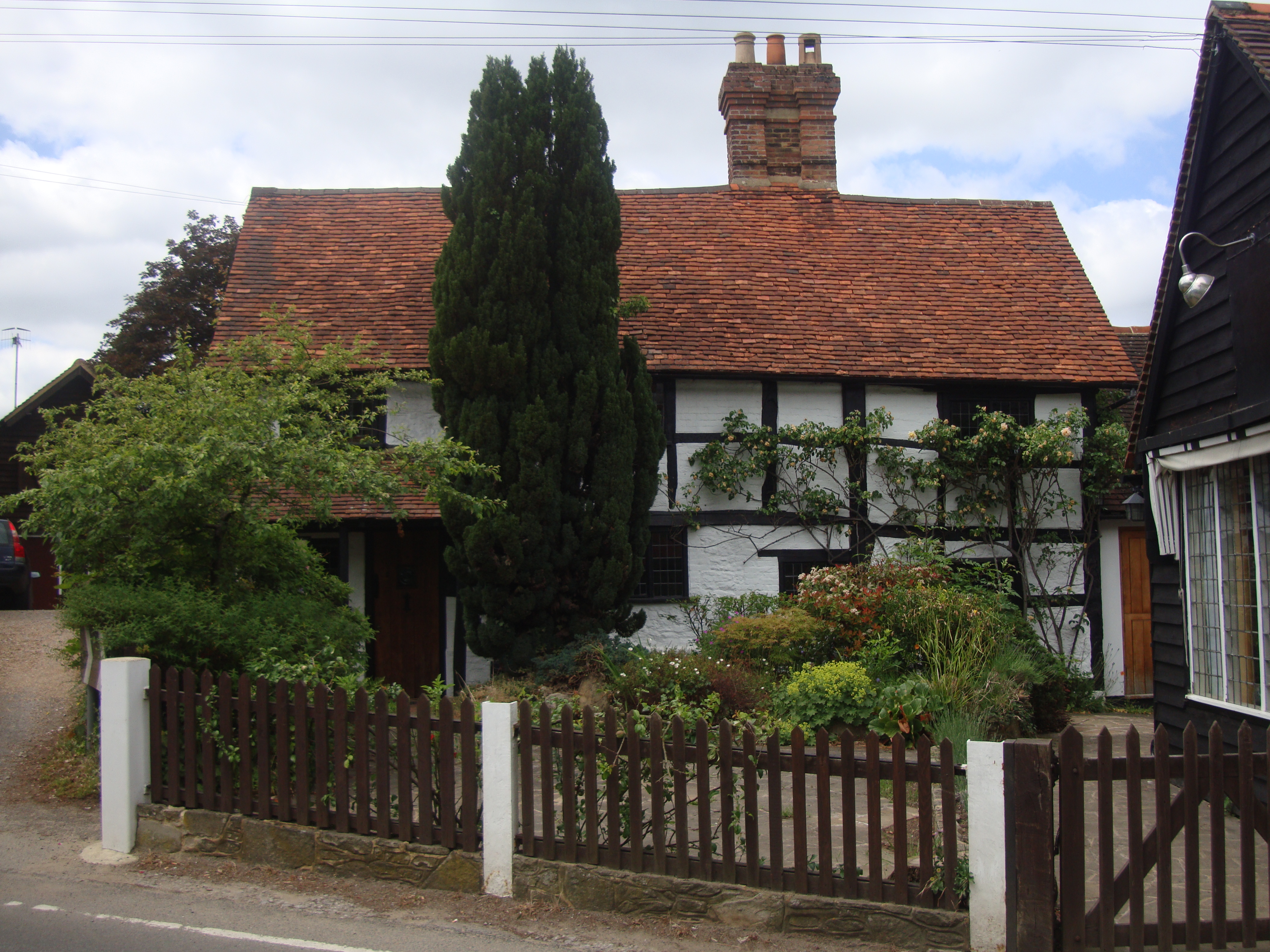
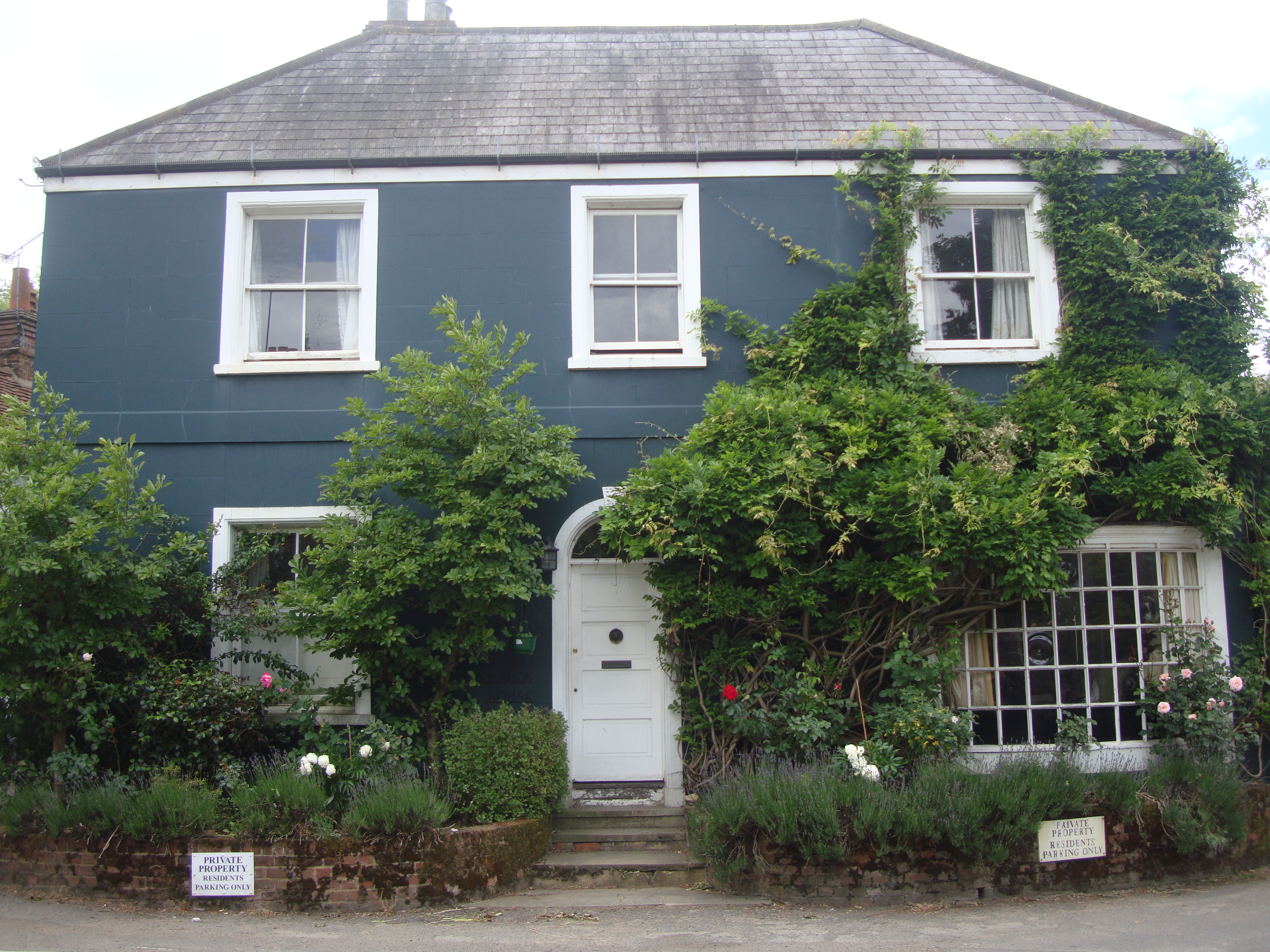
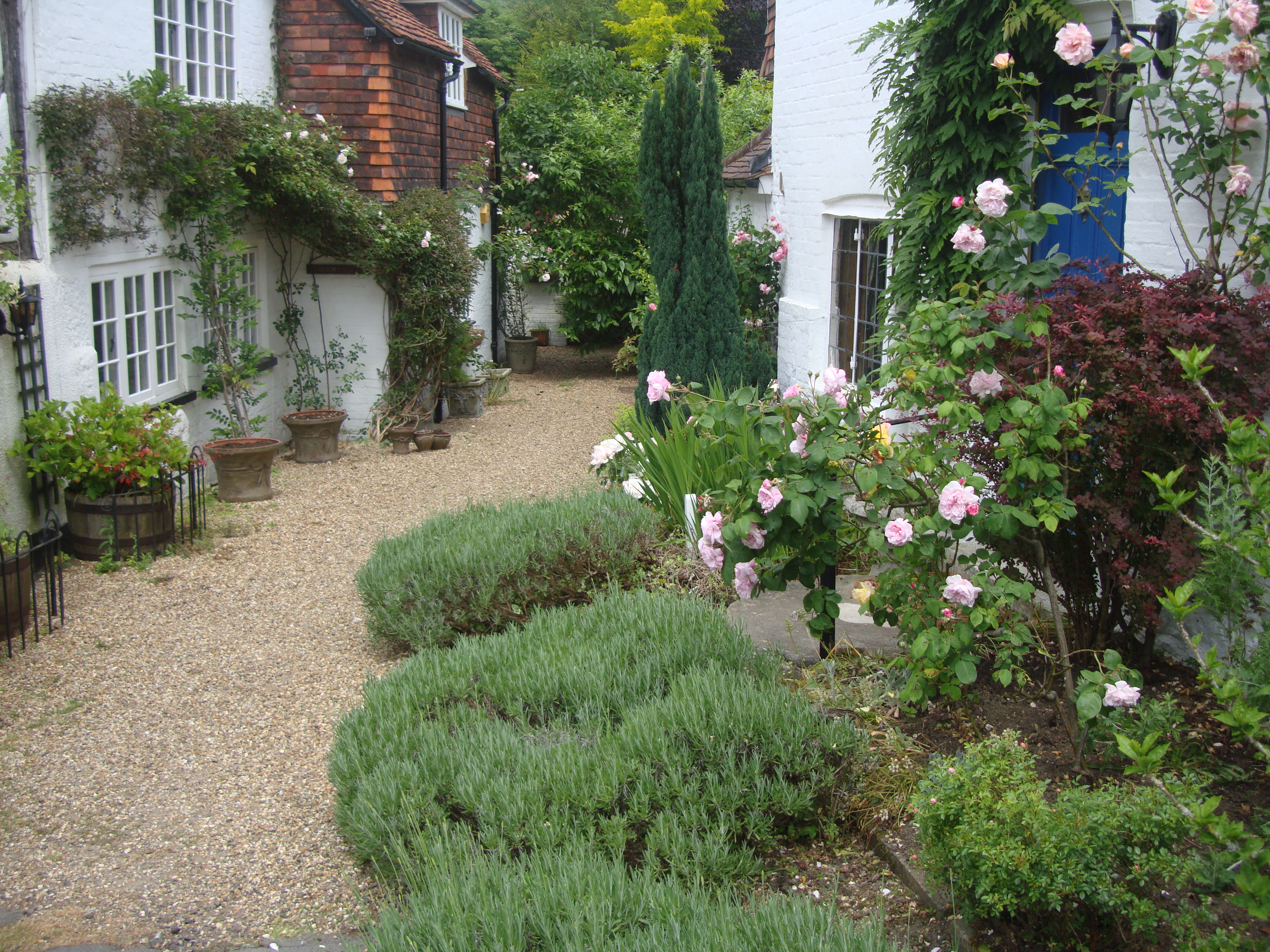
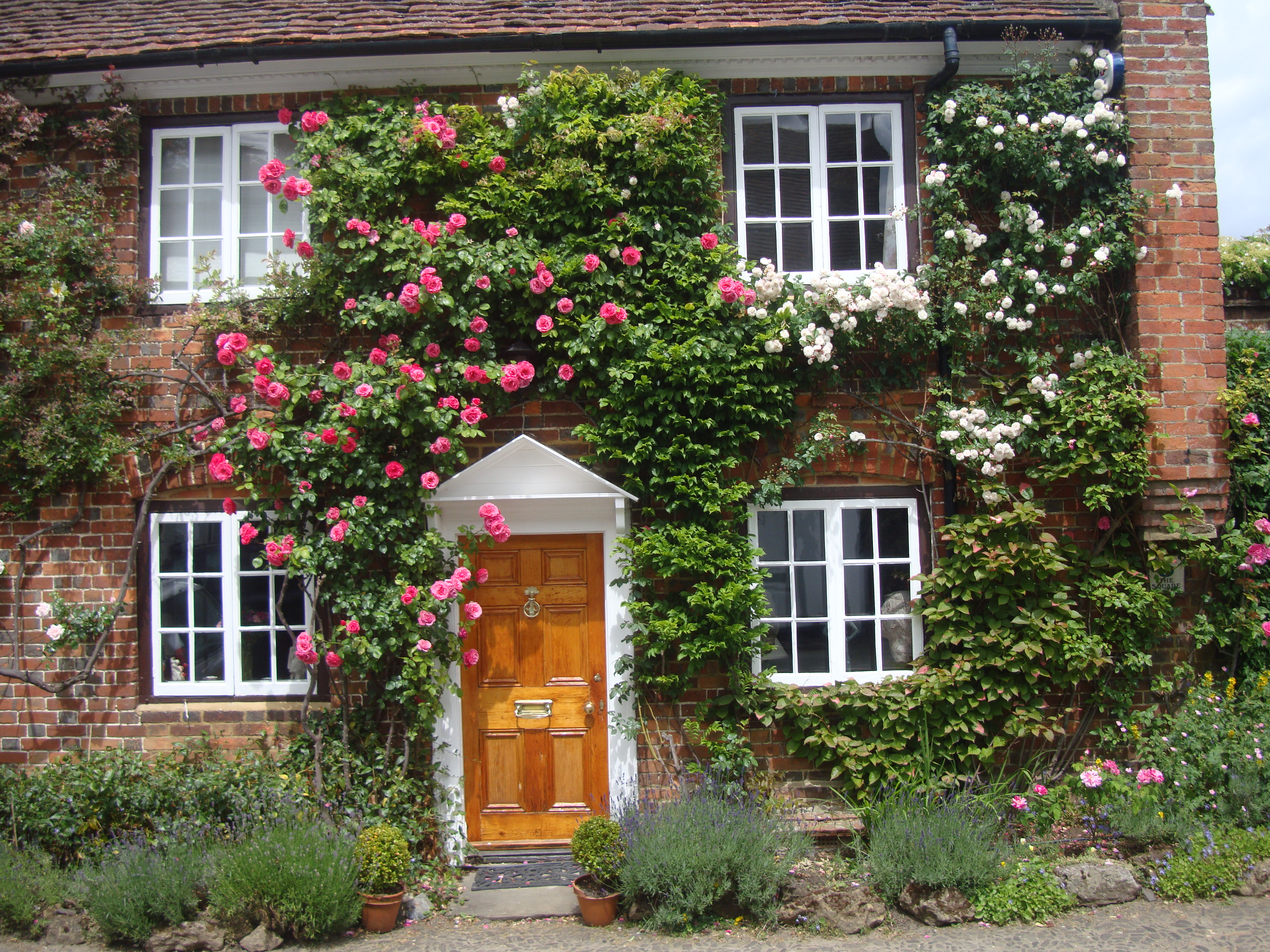
For as long as I can remember, my family and I have visited Shere Village in Surrey every Summer. When the children were really small and we only had Sam and Alice as toddlers in those days, Shere Village with the river Tillingbourne rippling its cool glassy way behind the backs of shops and under the low bridge in the High Street always had its fascinations. Ducks and geese in abundance swam in the river or stood on the river bank and Sam and Alice were very excited and interested in feeding them with bits of bread and just being able to look at them and see how they behaved. After Emily was born and later Abigail came along, we continued our tradition of going to Shere. We loved walking round the village, being in amongst ancient buildings, some timber framed with whitewashed walls, some constructed from the local greensand stone, wisteria and climbing roses draping themselves over and festooning the houses. It is the quintessential English country village.
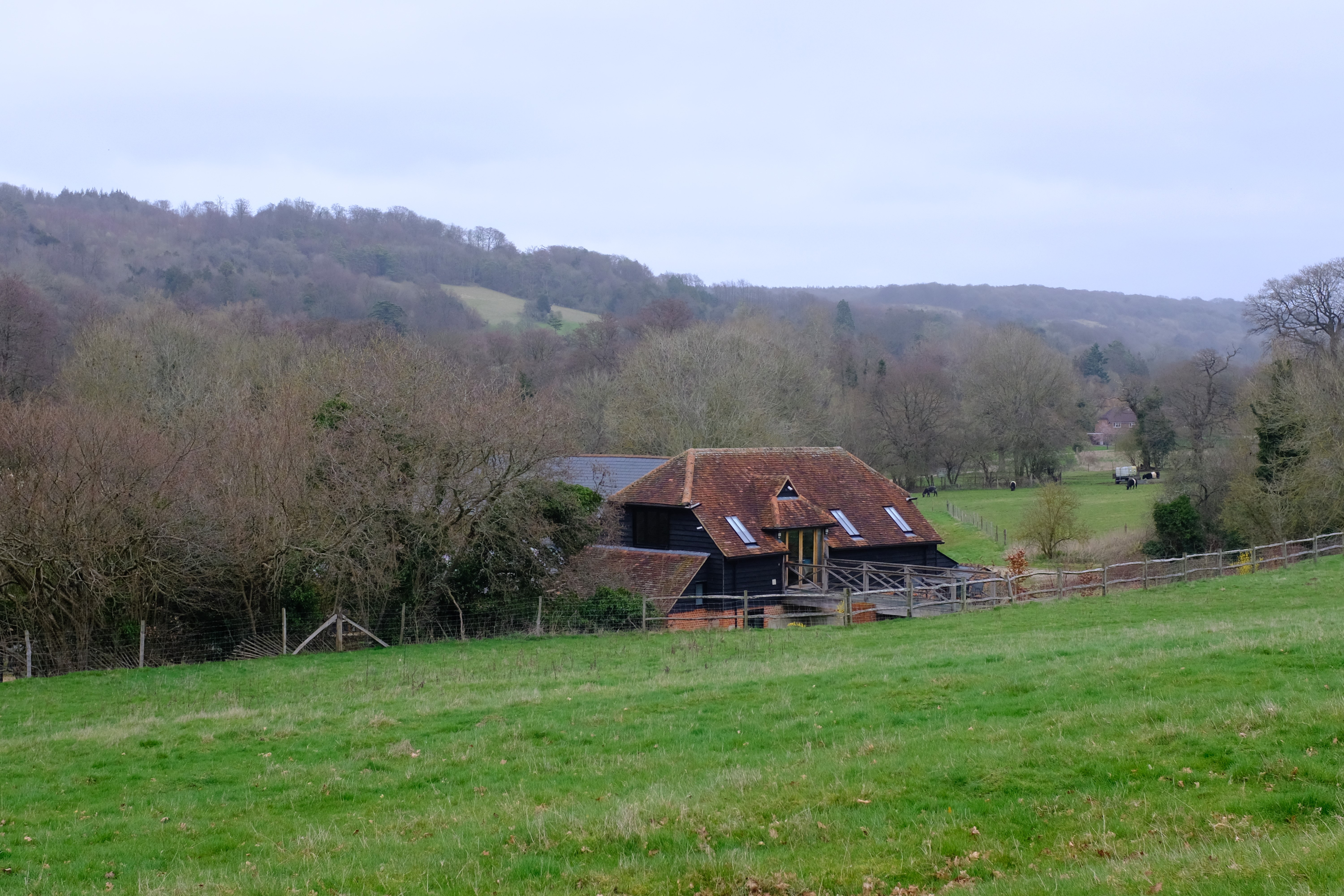
When we visit Shere we often walk further afield, up into the hills and valleys around Shere. Shere is set in that part of Surrey where Chalk downland to the north provides a vista of smoothly rounded and curving steep sided hills, voluptuous in their contours. Sculptors such as Barbara Hepworth were inspired by the contours of the English countryside. To the south and west stretches the Greensand Ridge consisting of hard Bargate Stone, ironstones and soft sandstones. These rock formations are part of the western extremities of The Weald anticline. Greensand was laid down in the Cretaceous period over 145 million years ago and the chalk downland was also laid down in the Cretaceous period about 65 million years ago. These two geological formations are apparent in the landscape, buildings and farming in the area around Shere.
Driving to Shere is always a very pleasant experience. We live about 20 miles north of Shere in a straight line within the London Borough of Merton. According to Google maps, when I type in Motspur Park to Shere by car, it gives me 23 miles as the distance and times the driving journey at 37 minutes. I always think the time GOOGLE gives is a useless bit of knowledge. If the roads are clear I can get there much quicker and if there are road works, need I say more? Driving down the A3, a major road, from South London towards Portsmouth usually has a lot of traffic on it. The A3 takes us over the M25, that motorway that encircles London and what a sight that always is, a continuous flow of multi lane traffic that goes on for ever and ever like a gigantic sinuous serpent. Not that the A3, a three lane highway, doesn’t have its attractive features. Most of it passes south through silver birch, oak and ash woodland. Oxshott Woods, a vast area of heathland , wild water ponds and trees, is a haven for horse riding, running , cycling and walking, if that is what you want.
Along the A3 we pass the turn off for Painshill, which incidentally Jane Austen mentions in letters. She passed the Painshill Estate on her way to London. Painshill once had a great house attached to it but the park has been restored to its 18th century glory. The landscaping is amazing with lakes, temples, grottos and pagodas. An 18th century pleasure garden. But, we are not going there today.
It is not far until we turn off for Ockham on the left. Immediately we get on to single track country roads between fields and more woodland. We soon drive along a road that borders a large estate. High brick walls enclose it for miles with attractive gate houses and cottages positioned along the perimeter here and there. It encloses an 18th century deer park, where also horse breeding and sheep farming are practiced today. We pass medieval stone built, All Saints Church on the right, set back amongst trees with its lichen covered gravestones, some dating back centuries.
Surrey is a beautiful county. It has much woodland and is famous for its bluebell woods which are carpeted with bluebells in the spring. You also come across fields which grow oilseed rape. You can’t miss them. A field of oilseed rape is bright yellow. The oilseeds are used to make vegetarian butters and spreads. It is also a natural product that is put into shampoos and soaps. Another crop Surrey is famous for are its lavender fields. Lavender has such a lovely powerful scent. Walking through a field of lavender can give you quite a high. The lavender is used in perfumes and medicines. It is great for a bouquet to hang in your kitchen or even in your bedroom.
Surrey has mostly mixed farming. You come across fields with dairy cows grazing in them, horse breeding is prevalent, there are some wheat fields and a lot of sheep are bred on the grassland that grows well on the chalky soils of the chalk downs. Grassland, for sheep and cattle is what you find around the environs of the village of Shere.
From Ockham we drive on through some of those bluebell woods and dipping into shallow valleys in some places but mostly climbing higher onto the chalk downs above Shere. From the top of the downs leading into the Village itself, we pass along a narrow valley down a steep road called Combe Lane. The valley begins as a small indentation in the land at the top of the downs and continues making a long deepening cut into the hills and drops, to the lower level near Shere.
What is interesting about this small, long valley is what is in it. On the far side you can catch a glimpse of a small concrete building nestling into the valley side. It has two narrow slits facing down the valley. During World War II when Britain thought Germany might invade, all sorts of preventative defensive measures were put in place all over the British countryside. You can still come across areas with tank traps in Surrey and other southern counties. Near where I was born in Southampton you can come across large concrete foundations built at various places along the side of Southampton Water reaching from the Hamble River right up to the River Itchen. These were the foundations for the massive anti- aircraft guns that were located on these sights. However the small hidden concrete boxes, called pill boxes, were the most prolific constructions. Railway lines, major roads and as it seems some valleys were provided with them. They were machine gun installations and artillery positions, partly hidden and would only have been seen at close quarters and of course by then they would have spewed out shells and machine gun bullets at quite a rate. They could only be thought of as a slowing tactic. The shell from a Tiger Tank would have destroyed a concrete pill box in an instant. I grew up with these sort of military emplacements dotted about where I lived in Southampton. They were manned by what was termed ,The Home Guard. The Home Guard were men too old to join the regular army. They had served in the trenches of the First World War in France and they were retrained to defend Britain if ever it was invaded.
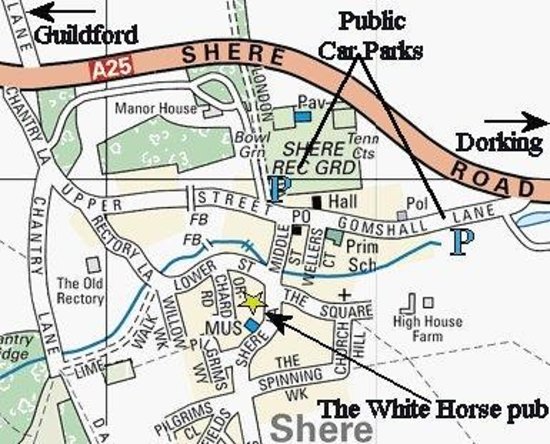
So eventually we drive into SHERE Village itself after crossing the main Shere Road along Upper Street. It has buildings of many periods. The oldest are the timber framed with their black tarred timbers highlighted against the white plaster infills of wattle and daub. It is a long road bordered by cottages that leads into the centre. At one point we drive under an intricately constructed wooden footbridge. We arrive at a junction. Ahead is Gomshall Lane. To the right Middle Street passes through the centre of the village. However, to the left is a large car park in a field near the cricket ground over looked by the high rolling chalk downs. This is where we park our car.
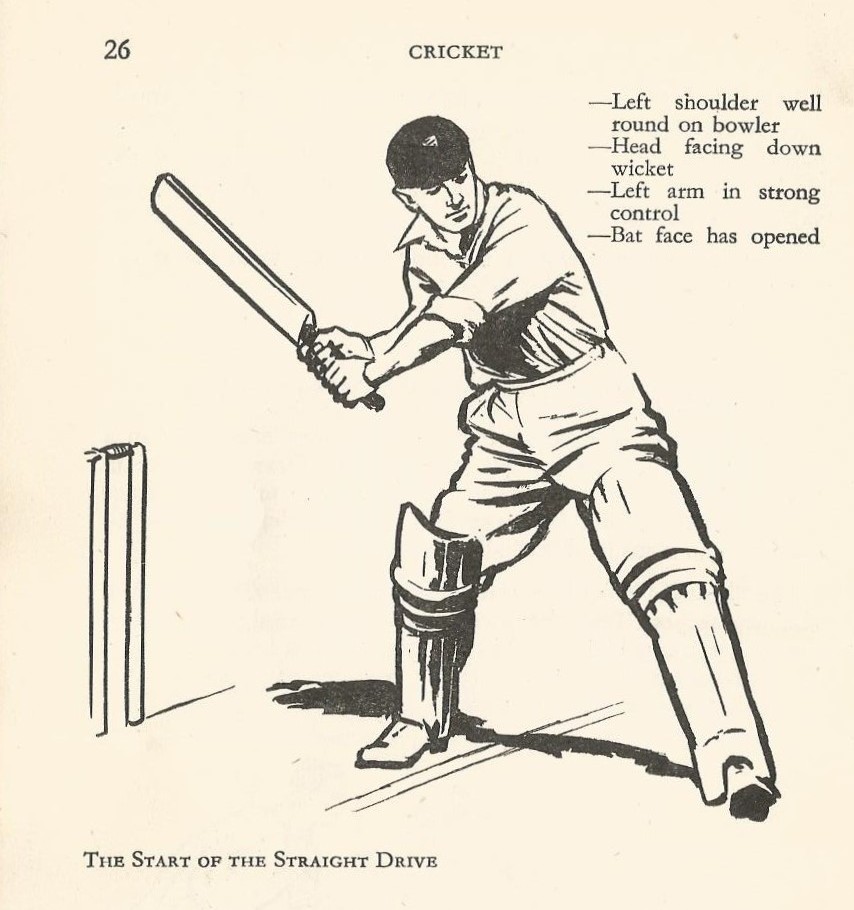
The Shere Cricket Club likes to think its roots began in 1671, when a game of cricket is recorded in the village. Cricket as we know it better today, began when village teams began to compete on a regulated basis in 1744. Rules were written down and later in 1788 The Marylebone Cricket club revised the rules. You will find cricket being played on Saturdays and sometimes Sundays at the weekend in Shere. [Ed. You can read Tony’s post on Cricket here]. Once we have parked we are free to saunter into the village and enjoy the ambience and timelessness of this incredible place.
To the left of the car park, a little along Gomshall Lane, is the old working men’s club next to the Village Hall. The Working Mens Club is no longer used for its original purpose. The social mix of Shere and those who live in Shere has changed over the years. The Working Mens Club, originally for those who worked on the land locally is now Shere Museum. It records daily rural life over the centuries. The museum covers a broad period of history from Victorian times up to the 1950s. A large display commemorates the RAF Dambusters raid in World War II. We can learn about the exploits of Flight Lieutenant John Vere Hopgood DFC who was a pilot in the Dambusters Raid. He was born and brought up in Shere. Displays show objects of daily life with tools, toys, domestic items and clothing mainly from the time the Museum covers.
St James’ Church Lych Gate – wikipedia
The life and works of architect Edwin Lutyens is also featured. He designed and built the war memorial and the Lych Gate that mark the entrance to St James’s Church in the village. There is also an extensive collection of archival and reference material which includes old photographs, records, maps, society records, parish magazines that recall the people of Shere and the local history of the surrounding area. We always take time to explore the incredible objects and stories the museum tells.
Shere Village Hall
The Village Hall next door, along with the church, is the hub of the village still. Music concerts, parties, wedding receptions, birthdays, village dances and all manner of village and local gatherings make use of the village hall. And across the road from the Village Hall is the Shere Infant and Nursery School, which has been serving the local community since 1852, The school building is the original Victorian building with new additions. Recently OFSTED [Office for Standards in Education, Children’s Services and Skills] awarded it OUTSTANDING. That means it offers fantastic learning opportunities with great facilities and an excellent standard of teaching [see below for a link].
From the museum, we walk on into Middle Street, the heart of the village. Marilyn likes to go into a shop called “Cuckoo Corner.” It is an ancient timber frame building and going into it is like walking into the carcass and bones of some ancient creature. Massive oak beams support the building as uprights and create the enclosed spaces with large powerful cross beams. Walking around the shop is an adventure in itself, from one level to another up and down and walking from one small room to another with all the nooks and crannies. It is womb-like. Be careful of cracking your skull on the overhead oak beams. It is a gift shop and is full to the brim with rural artefacts, pottery, weaving, cloth prints, cards, local paintings and photographs. We look around the shop and then walk out. I don’t think we have ever bought anything from it. It’s a very pleasant adventure just looking at the things.
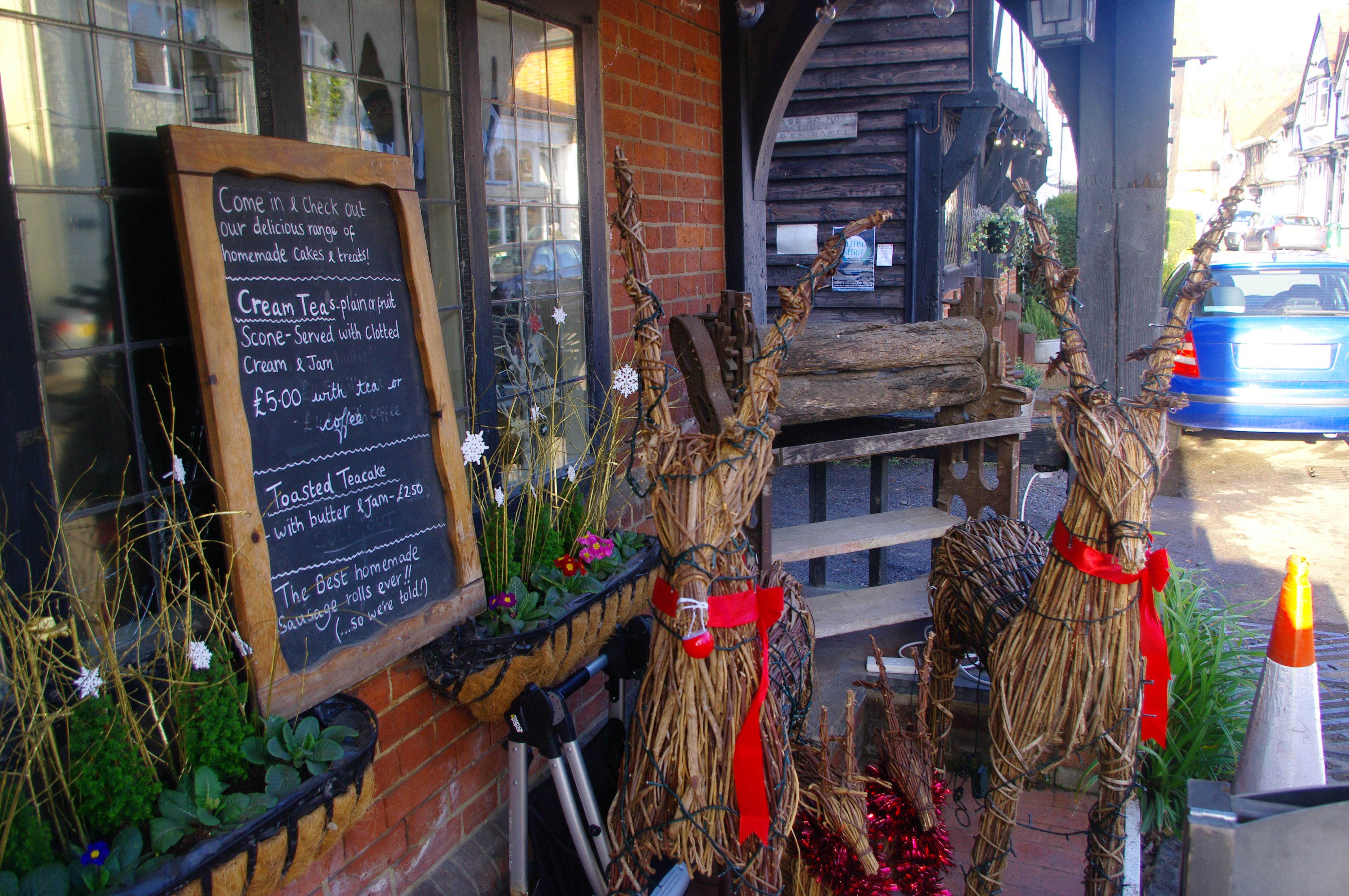
Then on down Middle Street past Mad Jacks that sell fabrics, the Coop (Cooperative Stores) is on the left where you can buy your groceries. Surrey Hills off licence is on the left too where you can stock up with beer, wine and gin, if that is your preference. Tim Clarkes Photography is on the opposite side of the road alongside Favourite Things, a baby shop, and then the Dabbling Duck Café which is beside the River Tillbourne that wends its silvery way through the village. It is here, when the children were younger, where we would stop and spend time with the ducks and geese floating on the river. Just across The Tillbourne on the right is the forge, still used as a forge today, next to the wooden construction of the old fire station. The White Horse public house comes next. Opposite the pub at this part of Middle Street is The Square, with an island of grass and a massive tall oak tree growing in the middle of it. Timber frame and stone cottages encircle the square which leads towards the Lutyens war memorial and the Lych Gate leading into the church yard of St James’s Church.
St James’ Church, Shere
St James’ has a tall spire reaching to the sky above a stone built nave. St James is in the Early English style, mostly 12th, 13th and 14th century. It replaced an earlier Anglo-Saxon church mentioned in the Domesday Book. It is constructed of ironstone rubble with sandstone buttresses. The materials for building all the cottages, houses and indeed the church itself come from the geology and soil beneath our feet. Bricks from local clay deposits, the sandstones from the Greensand intrusions, the oak beams of the timber frame buildings from the local forests, wattle and daub, a mixture of fencing constructed with thin copparded branches of beech and ash, the daub from cow dung and lime deposits from the ground. It is interesting to think that humans have constructed their built world from the earth and rocks from which the very Earth is made. It as though our habitations have grown out of the ground beneath, which indeed they have.
Shere is mentioned in the “Domesday Book” of 1086. The area was owned by William the Conqueror himself. The Domesday Book describes two mills, 14 ploughs, 3 acres of meadow and woodland worth 50 hogs. It provided £15 per annum to its overlords. The Domesday Book is the “Great Survey,” of much of England and parts of Wales and was completed in 1086. William the Conqueror wanted to know what he had conquered and how much it was worth. Taxation of the land and communities had begun. “Doomsday” indeed.
During the 16th, 17th and really up to the 19th century this part of Surrey, protected by the surrounding hills and its remoteness from large local towns was considered the wildest part of Surrey. It was well known for its sheep stealing, smuggling exploits, and the poaching of the local estates. Some cottages and indeed The White Horse pub have large cellars that previously were used for storing smuggled and stolen goods.
One of Shere’s most intriguing and interesting inhabitants was Christine Carpenter, who lived in Shere in the 14th century. She was born and brought up here. In 1329, she requested from the local Bishop the right to become an anchoress. The Bishop granted her wish. The people of Shere built a small stone cell into the north wall of St James near the high altar of the church for her. Christine was incarcerated in the cell and spent her time praying for the people of Shere. The local people would come to talk to Christine about their problems and ask for her prayers. She would listen, give her advice and pray for them.
Christine Carpenter – anchoress at St. James’ Church
Inside the church today, near the high altar, you can still see the spy hole that enabled her to watch mass being said by the priest. There is also a quatrefoil window where people could come to visit Christine and talk to her. At one time she requested to come out of the cell to live in the village again. After some time she again asked to go back into the cell. On the wall above the spy hole in the church are encased some documents referring to Christine and her life. Almost contemporary with the life of Christine is that of Julian of Norwich who was an anchoress attached to St Julian’s Church in Norwich. Lady Julian became famous throughout Medieval Europe for her wisdom and her spiritual writings concerning her relationship with Jesus. Her Revelations of Divine Love is still in print today. People still use it as a spiritual source for prayer and meditation. Margery Kempe, another mystic, was taught and influenced by Julian and Margery’s writings are also still available [see below for links].
Now to the point: Shere in recent decades has become a film set. Forty-one films have been made here over the past 100 years. Among the most recent being Bridget Jones: The Edge of Reason (2004), where a wedding ceremony takes place in St James’ Church. Four Weddings and Funeral filmed in (1994) and of course, as we’ve seen, the Christmas classic, The Holiday (2006) starring, Cameron Diaz, Jude Law, Kate Winslet and Jack Black. [you can find a list of all the films shot in Shere here.
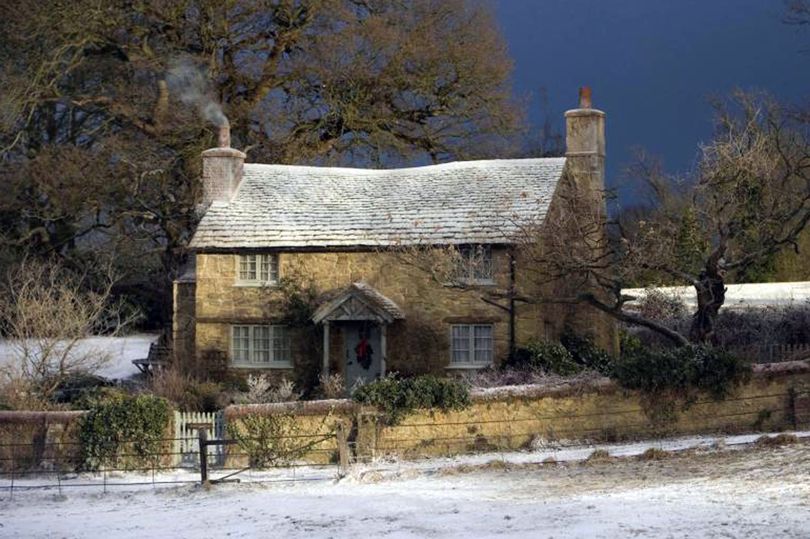
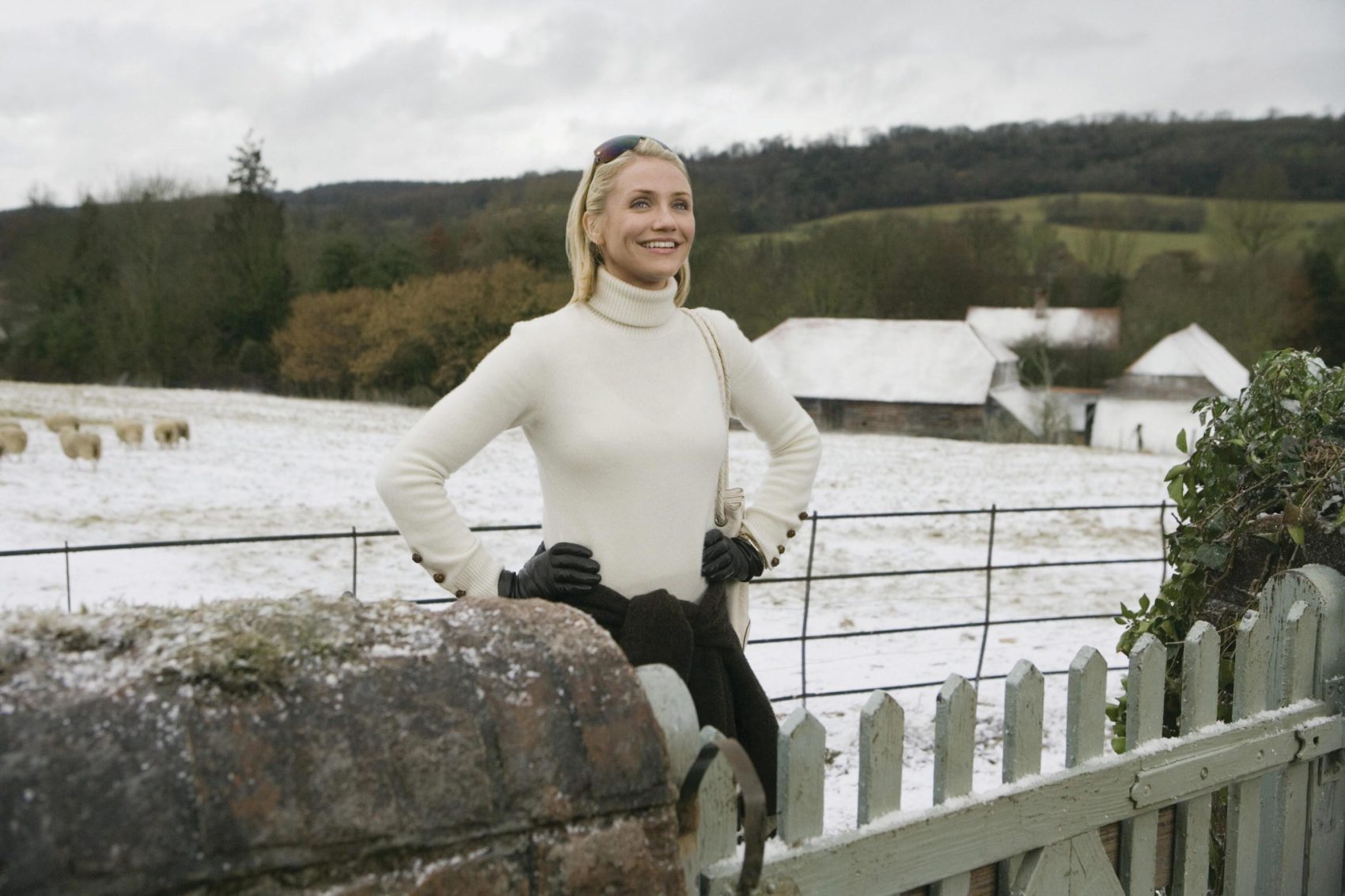
In The Holiday [Ed. and what prompted this post!], Shere is the location of Kate Winslet’s cottage that she swaps with Cameron Diaz’s LA mansion. Scenes in Shere include Cameron Diaz arriving in a taxi. The driver leaves her next to the church because he cannot drive up the narrow lane to the cottage. Her first sites of Shere are the grave stones in the cemetery. From the Church Cameron Diaz drags her heavy luggage up the lane to the cottage which was constructed for the film in a field on the chalk doenland overlooking Shere and the spire of St James church. The White Horse pub in Shere is where Jude Law takes Cameron Diaz for a drink. We also see Cameron Diaz driving Kate Winslet’s Mini Cooper [Ed. yay for mini-coopers!] through the village and along the surrounding sunken lanes. These lanes are difficult to drive along. They have been cut into the local sandstone and have high vertical sides. I too have gasped driving past oncoming traffic just as Cameron Diaz does in the film.
the lane to Rosehill Cottage…
The White Horse pub in Shere
CAMERON DIAZ stars as Amanda in THE HOLIDAY, a film by Nancy Meyers.
Shere today is very different from its historical past. A significant minority of the people living in Shere nowadays are London Commuters. In the 2001 census self-employed people constituted 36% of the population, retirees 16%. 48% are employees working for shopkeepers, farmers and small local grass roots high tech companies. The village today, as illustrated by its local sports clubs such as the cricket club, the vibrant life of the Village Hall and the thriving local junior school that has been graded as outstanding by OFSTED, shows that it is a village for today and not just a relic of the past. It is fit for the 21st century.
*************************
Images of Shere for your viewing pleasure: [Ed. I will take any one of these houses!]
Church Cottage, Shere Village
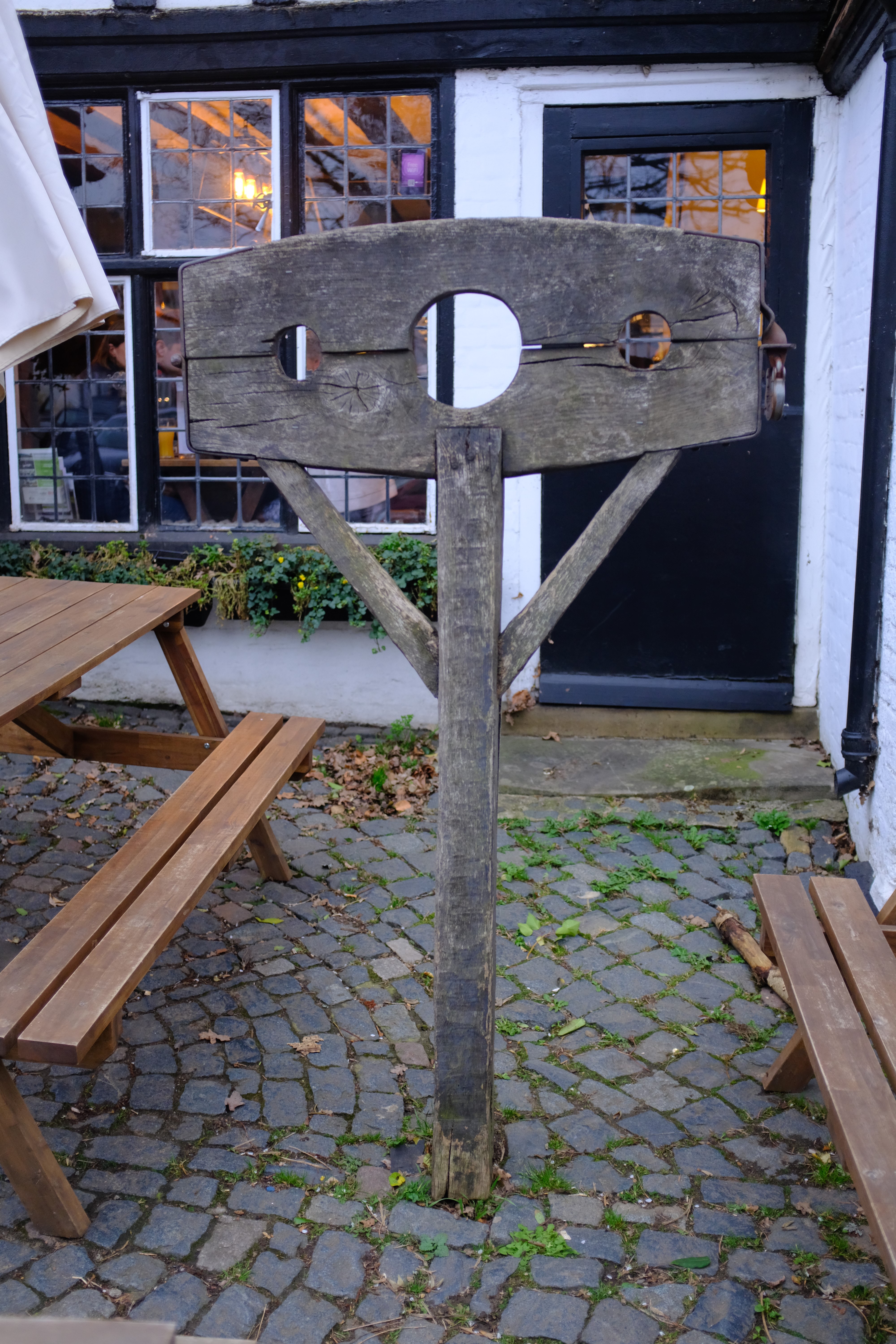
For misbehaving Shereites…
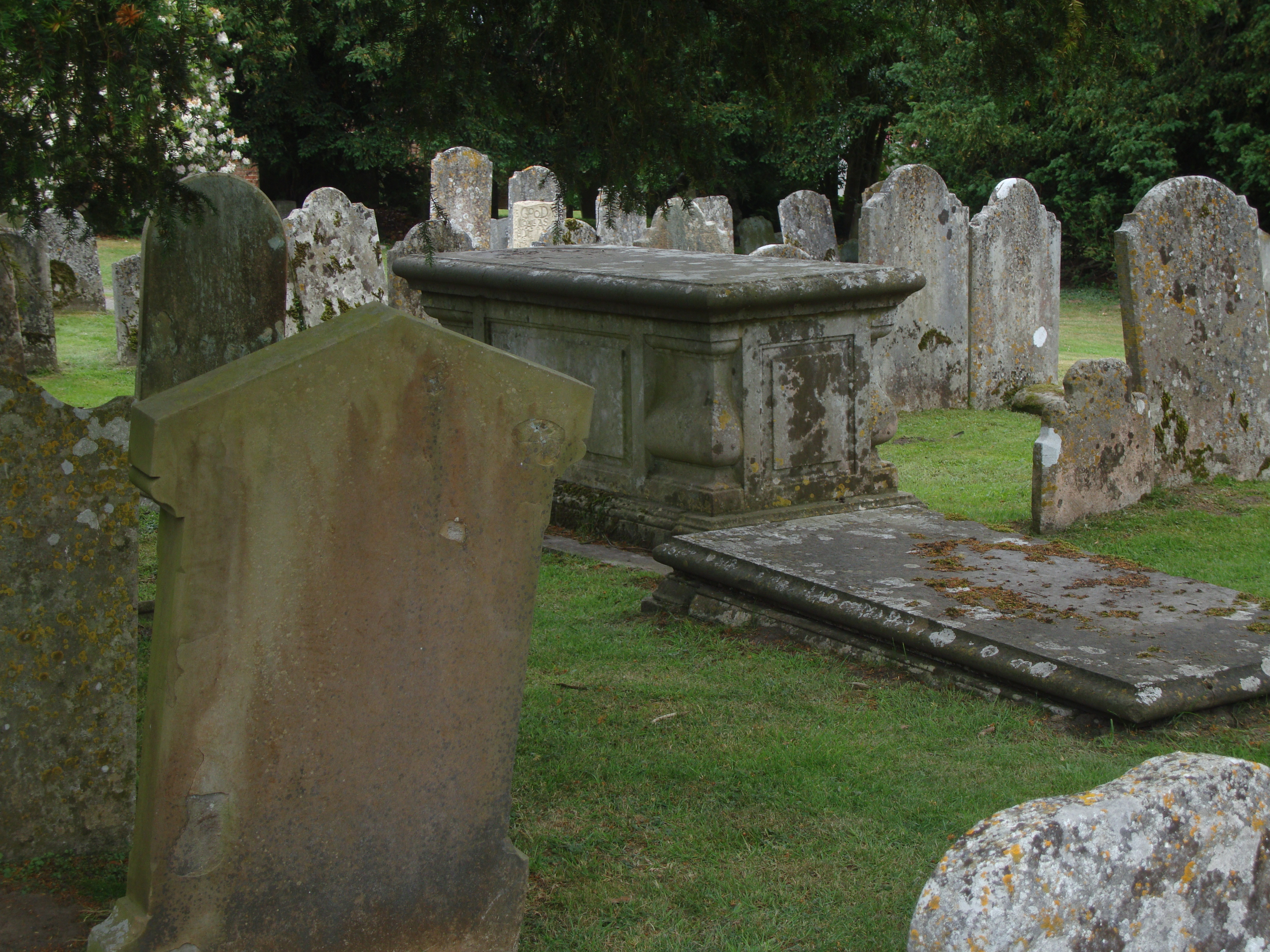
Slightly drunken gravestones [too much time perhaps at the White Horse ?..]
All you need to know about copparding: The wattle part of wattle and daub is constructed by weaving the thin branches cut from copparded trees. The wattle is a sort of woven fencing onto which the cow dung, lime and straw mix is stuck and when dried out together becomes the wattle and daub infill for timber framed buildings. https://www.google.com/amp/s/jatehorticulture.wordpress.com/2016/03/03/copparding/amp/
So, since the pandemic has changed all our lives to the point of near insanity (thanks goodness for all the efforts of museums and libraries and educational institutions to provide all sorts of virtual activities – who can keep up with it all!) – I am off the grid for awhile in an RV traveling across the country and back again, and though Celebrity Jane is accompanying us on this journey, Jane Austen and all our interest in her Regency world is put on hold while we try to find a certain amount of joy (or anything!) by seeing a bit of the country and remaining completely safe in our isolated life in an RV.
Trooper writes! he drives too!
And so I don’t have to think or write a thing, our dog Trooper (a two-year old English Springer Spaniel) has taken up the mantle and has been rattling on about the trip from his point of view (which is more interesting than ours I do believe). You can follow him here:
JASNA offers an annual tour of Jane Austen’s England, this past summer one that focused on Persuasion, with trips to Portsmouth, Lyme Regis, and Bath (you can see the itinerary here: http://www.jasna.org/conferences-events/tour/itinerary/] and pine over the fact you missed it! (I still am!) Next year’s tour will again be in July, details not yet announced, but expecting it will have some sort of Gothic theme to celebrate Northanger Abbey. I highly recommend these tours, as they bring JASNA members from all over together, as well as help to support JASNA.
But sometimes you cannot go when these JASNA tours are offered, or it sells out before you register, or your best friend can’t go when you can … We know there are all manner of tours evoking Jane Austen – I have created my own tours on a few occasions to try to see the salient spots; and I’ve developed friendships in England with people happy to tour me around (thank you Tony Grant and Ron Dunning!!); and I’ve recommended to friends where they should go if they are touring on their own. The only drawback of such a plan is that there are places to see, people to meet, that only an organized tour can arrange for you – this is why every year I say “this is the year I will do the JASNA tour” – and every year something gets in the way. So I look to see what other tours are available, and right now I find that friends of mine who run a tour company out of Saratoga Springs, are offering an “English Heritage Tour with Jane Austen” next year, September 3-12, 2019.
I recently traveled with them this past summer to Switzerland – it was a terrific adventure (or “edventure” as they call their company), with a great group of fellow travelers; so I can highly recommend them! This Jane Austen tour was offered a few years ago with a different itinerary – I could not go then and I cannot go on this one either, much to my dismay and disappointment. But I did want to share the details with you in hopes YOU can go… the joy of this trip being not only the sites of Jane Austen’s England, but also that it is being led by David Shapard, the knowledgable and engaging author of the annotated editions of all six of Austen’s novels – David knows his Jane Austen!
Here are the details:
“English Heritage Tour with Jane Austen”
This tour uses the lens of one of England’s greatest writers to explore some of the finest examples of English heritage. These include the gorgeous eighteenth century city of Bath as well as other historic towns and villages, the cathedrals and churches of traditional England, the Royal navy, and the grand houses and gardens of the gentry and aristocracy. She knew all these places and institutions well and made them the principal settings for her novels and we will follow in her footsteps to get to know them ourselves.
Tour highlights:
—Begin with a two-night stay in Bath, the leading spa in England in the 18th century, known for its natural hot springs and Georgian architecture.
—Explore the city of Lacock, a 15th century village that retains its design and look of many centuries ago and served as the setting for a small town in the BBC’s 1995 Pride and Prejudice.
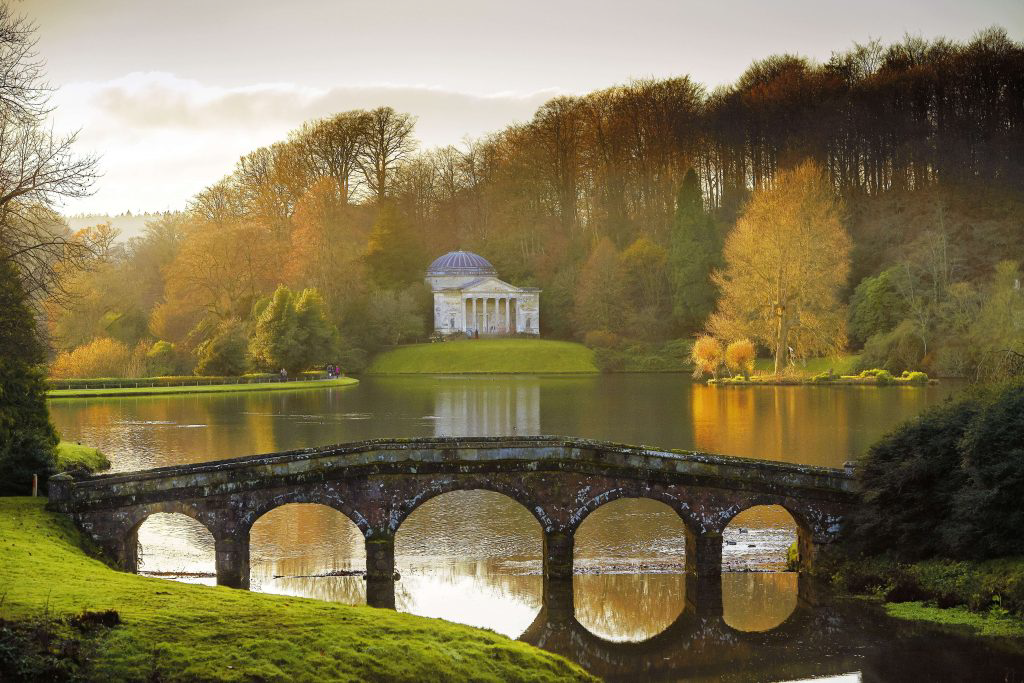
—Travel to Winchester for a five-night stay. On the way, visit Stourhead, whose grounds are perhaps the finest examples of the new style of irregular landscaping that emerged in England in the18th century. A renowned temple on the ground was used for the proposal scene in the 2005 film version of Pride and Prejudice. —In Winchester we will visit its cathedral, and from there explore the Austen family cottages and estates in Chawton and Steventon. In what is now the Jane Austen House Museum, Austen composed Mansfield Park, Emma, and Persuasion.
—Explore the Portsmouth Historic Dockyard for harbor tours and a close look at the celebrated warships and seamen of Britain’s naval history.
—Visit Salisbury with its stunning cathedral and Mompesson House, a Queen Anne house used for the film Sense and Sensibility.
Meals: Daily Breakfast, 3 lunches, 2 dinners
Tour Leader: In keeping with Edventure’s mission of “Adventure Travel That Educates,” the trip will be led by Dr. Shapard, a historian and scholar. David is the author of The Annotated Pride and Prejudice as well as annotated versions of Persuasion, Sense and Sensibility, Northanger Abbey, Mansfield Park, and Emma. He has given numerous talks about Jane Austen to Austen societies and other groups and has undertaken several trips to England to study gardens, estates, and other sites on the tour. Travelers will benefit from his vast knowledge of the areas we will visit as well as his enthusiasm and his expertise in English history.
Price: $3260 land only double occupancy Single supplement: $799
For a complete itinerary contact: goedventures [at] gmail.com
Most of the photos are of those few who dressed for the occasion, though there were many others there – our dressed ladies created quite a stir among other visitors to the Museum – perhaps we should all visit every weekend!
With thanks Margaret H for the photos!
*
****************************
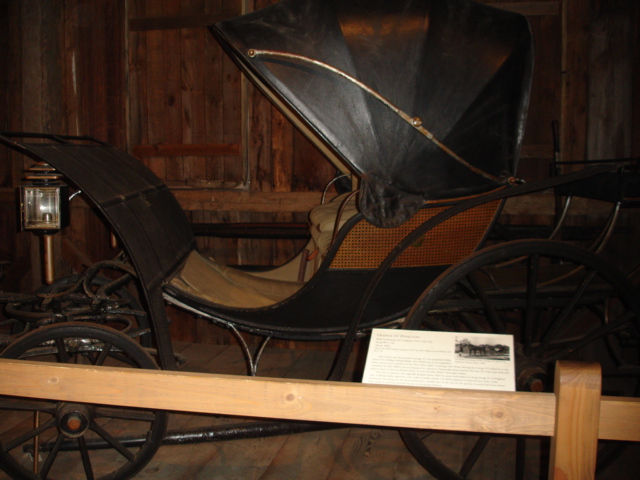
JASNA-Vermont will be taking a field trip!* On July 29th we will be visiting the Shelburne Museum for a curated tour of their Carriage Collection, many from Jane Austen’s era. The tour will be followed by lunch (all together but on your own) at the Museum Café (prepared by The Skinny Pancake!)
This is one of many in their collection – will post more photos after the event…
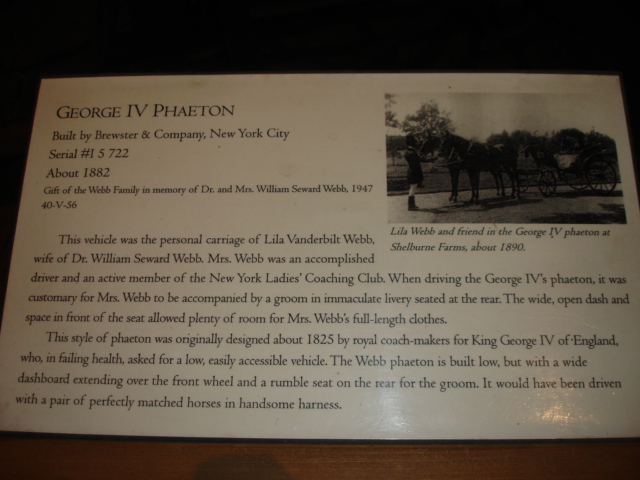
As a teaser, here is the King George IV low phaeton owned by Lila Vanderbilt Webb:
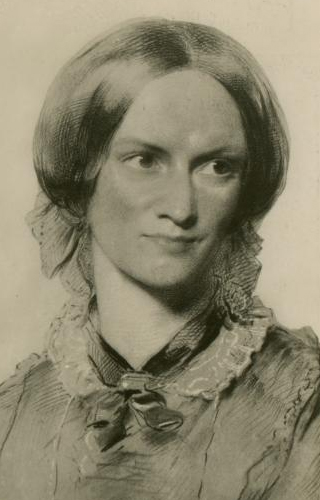
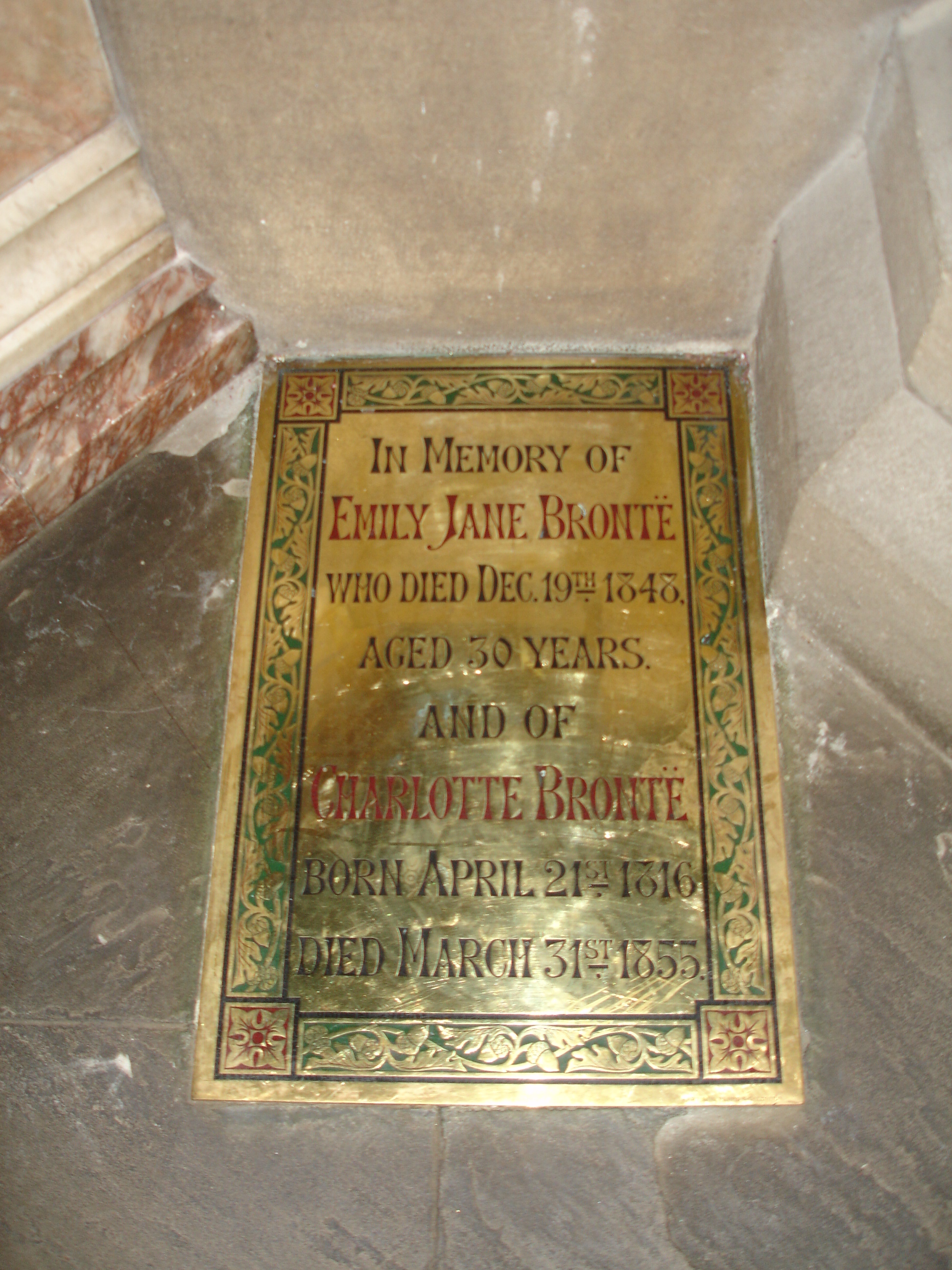
[I first posted this in 2009 – here it is again, in celebration of Bronte’s birthday!]
Happy Birthday to Charlotte Bronte, born April 21, 1816 in Thornton, Yorkshire.
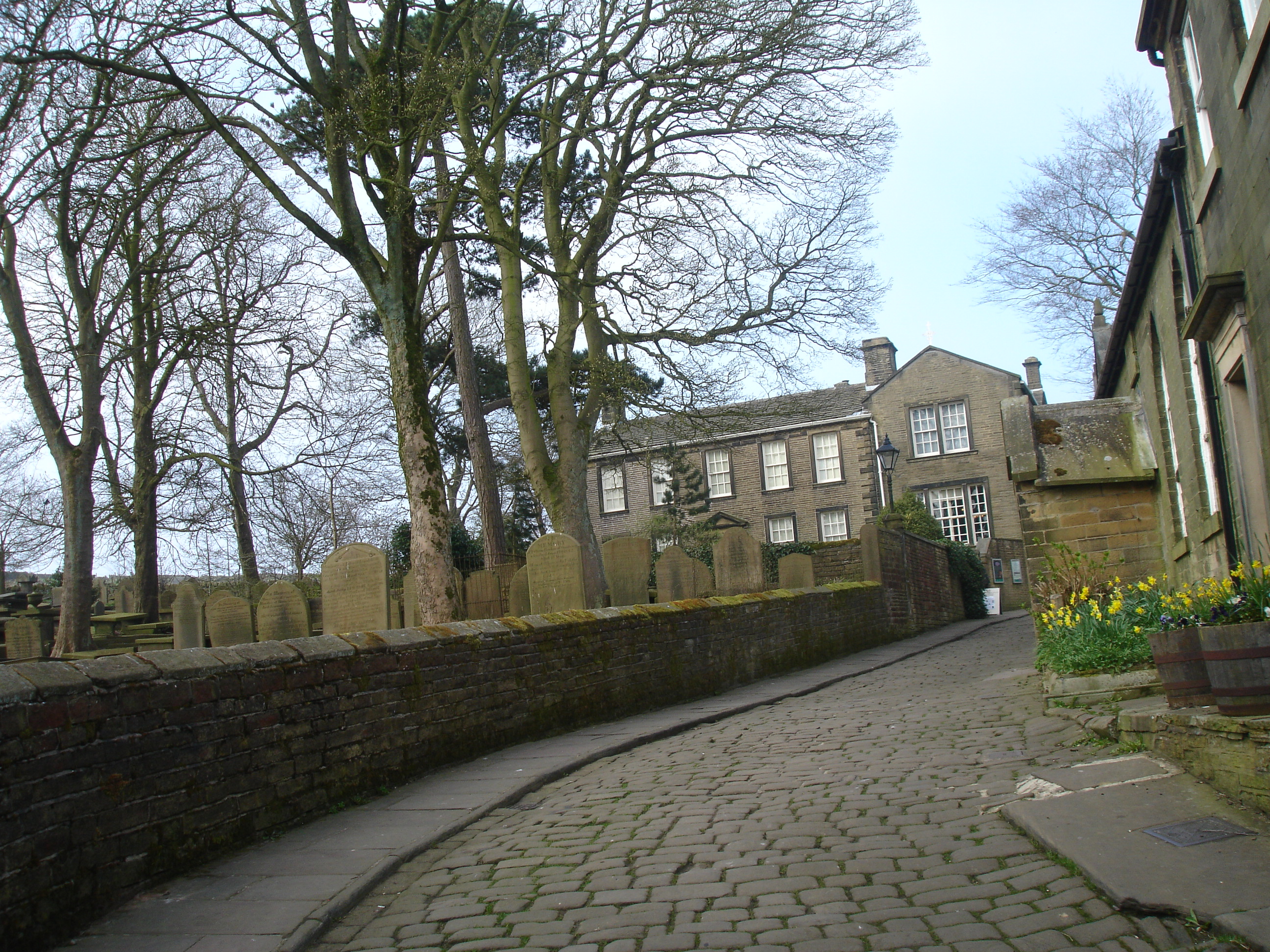
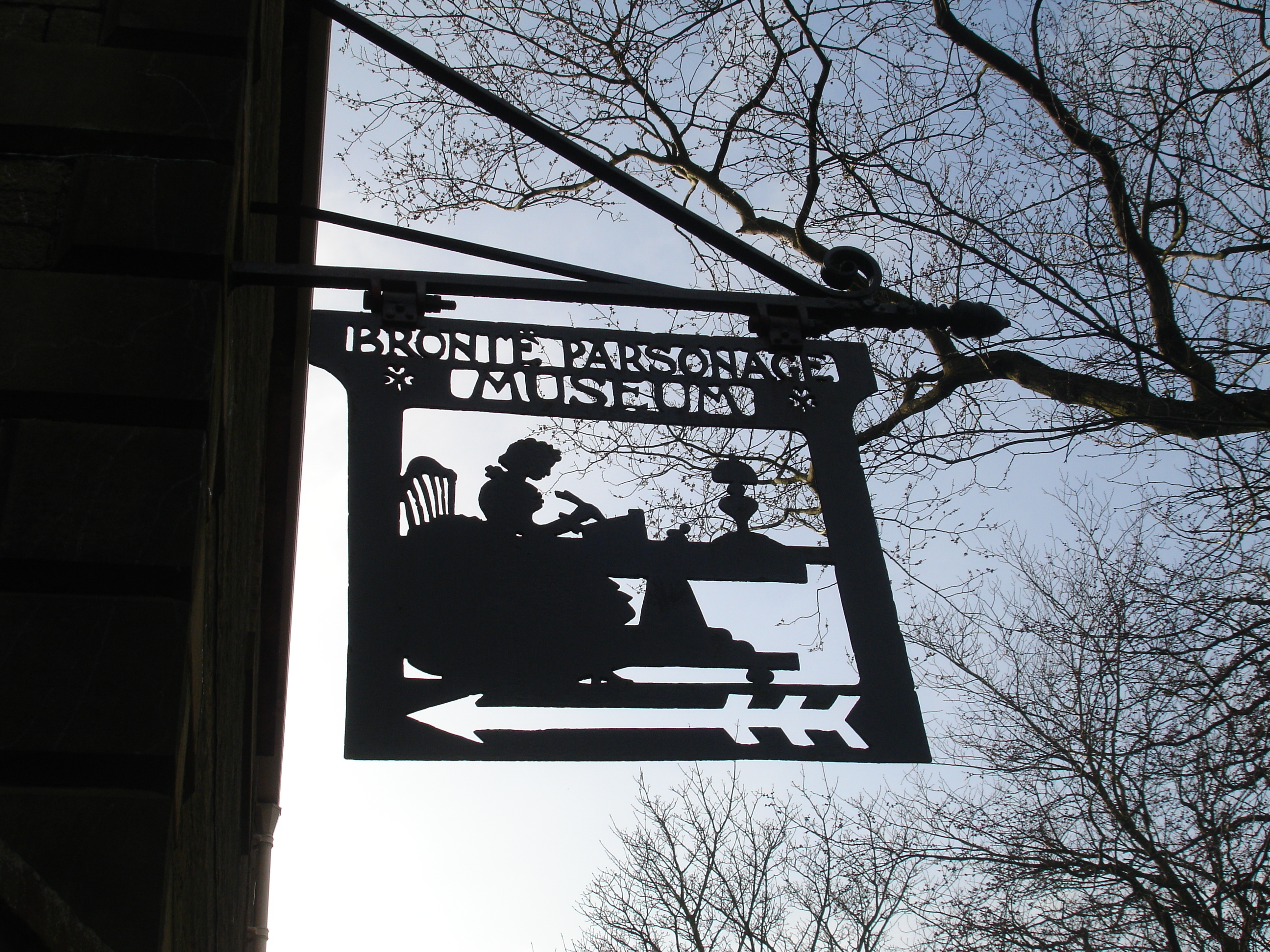
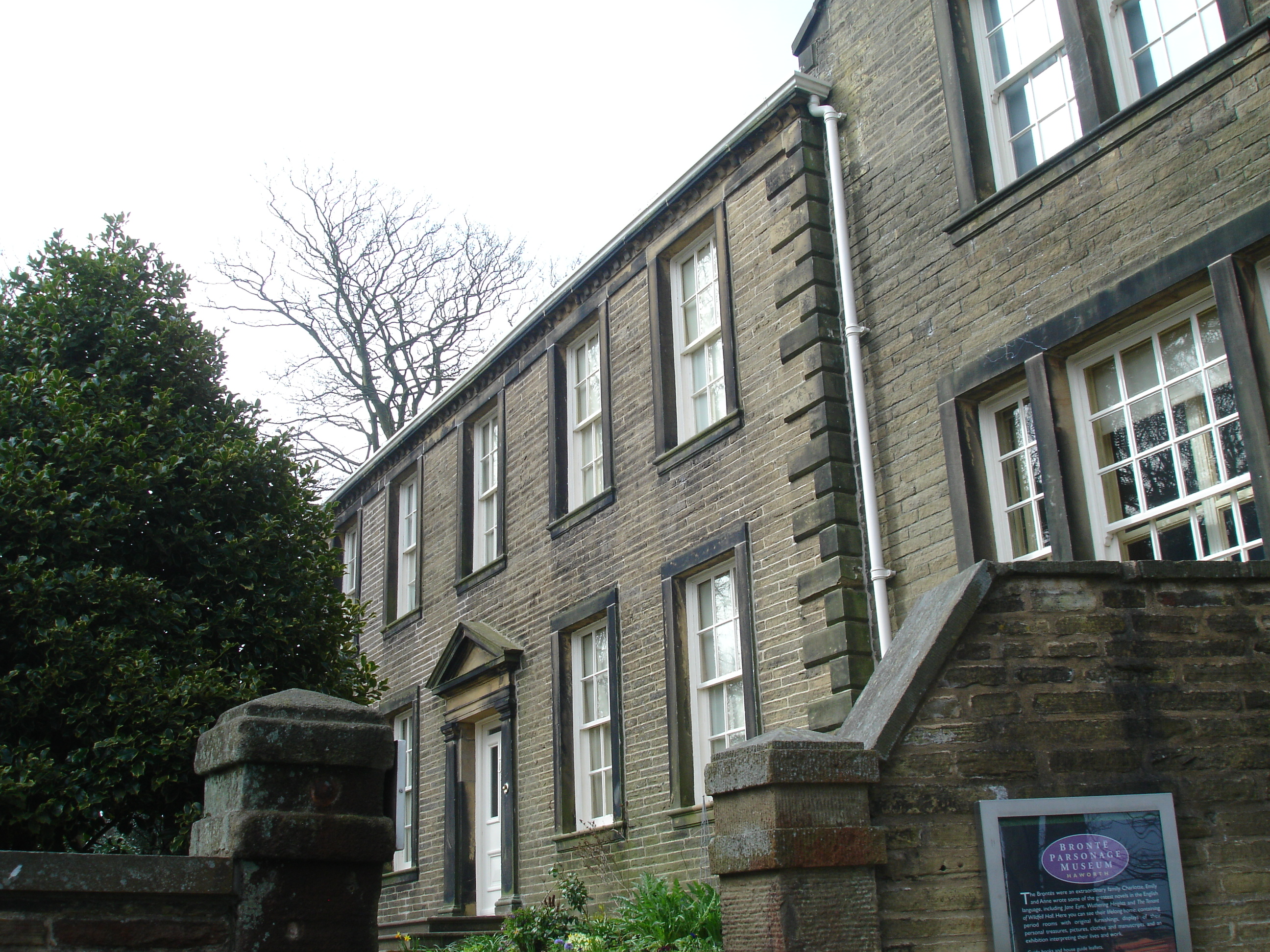
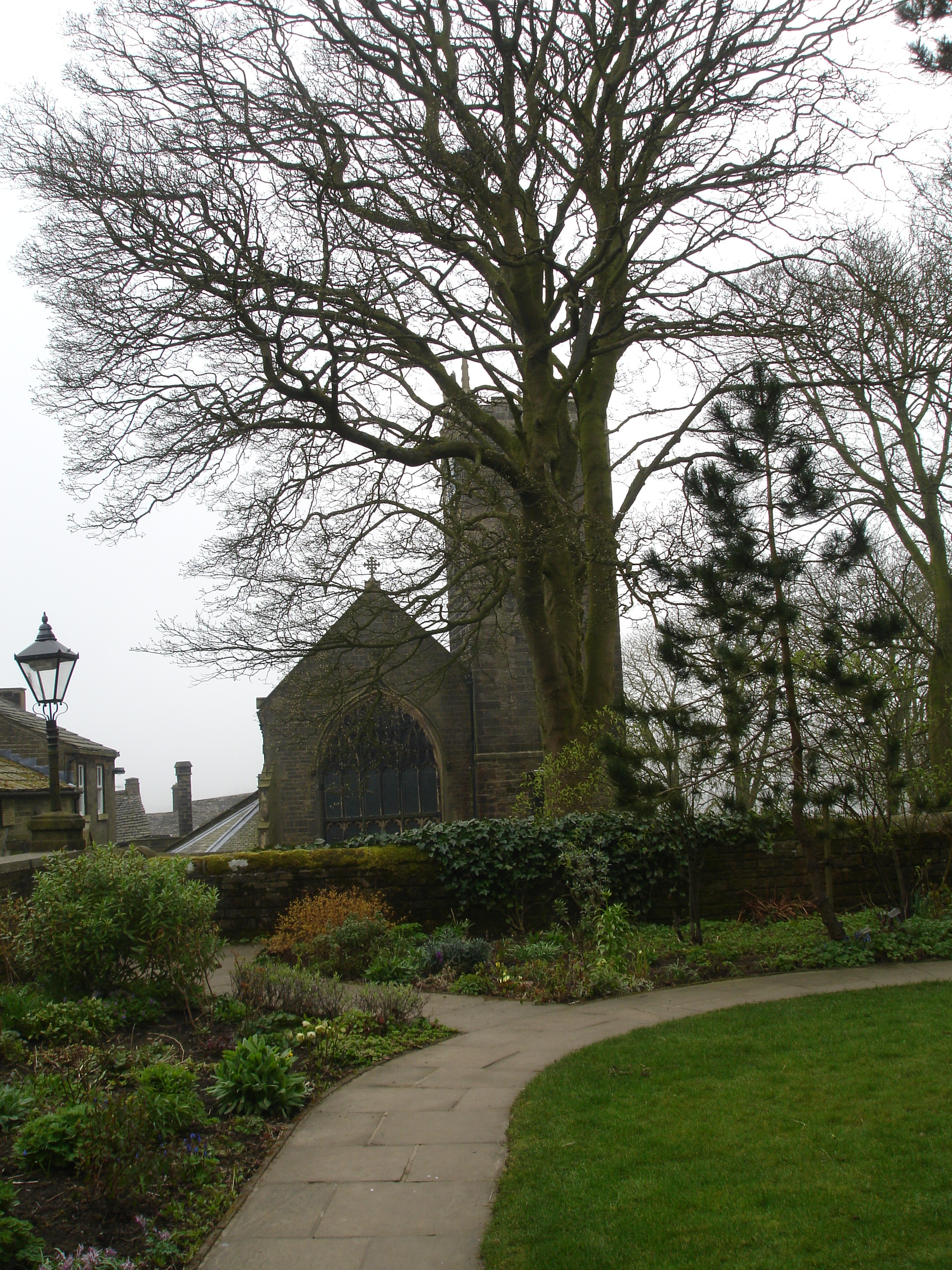
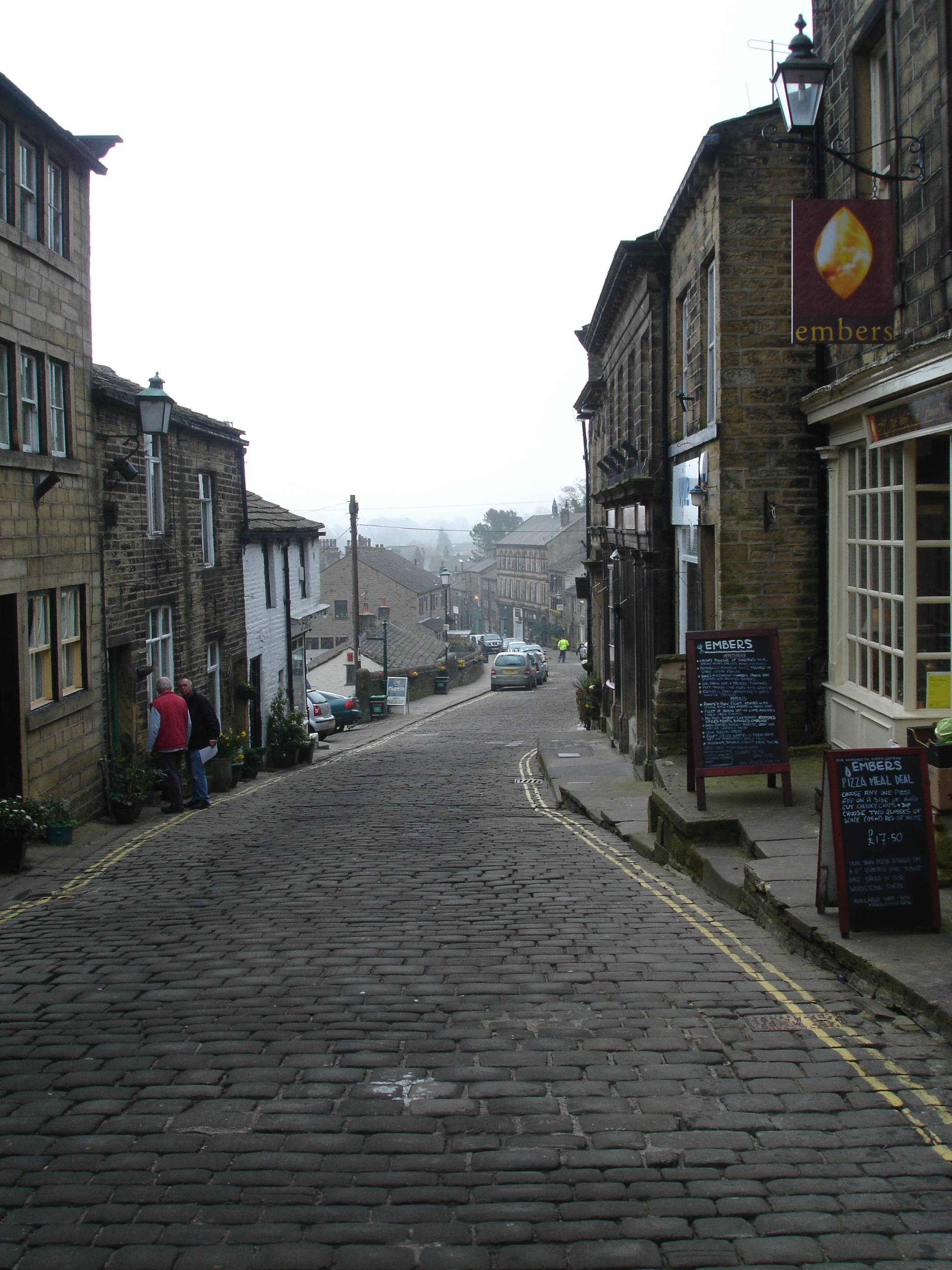
I just had the good fortune to finally visit Haworth and tour the Bronte Parsonage. One of the special extras was the display of the various costumes worn in the latest BBC production of Wuthering Heights [but alas! no pictures allowed!]
I append here a few of my photographs of the Parsonage as well as several links for further reading…
Main Street, Haworth
Further Reading:
The Bronte Blog, an excellent source for all things Bronte – various links to the e-texts, other web sites, a bibliography of sources, etc.
Gentle Readers: Today I welcome Tony Grant who has written for us a post on Box Hill. I had the pleasure this spring to spend a day with Tony, as he squired me around Southampton, Portsmouth and Box Hill – it was a rainy, quite miserable day, but the touring was grand, the company terrific! I’ve been to most of the Jane Austen sites – but not to anything we saw this day, from the Dolphin Inn to The Victory, and to the top of Box Hill – it was a world-wind tour of Jane, History, and Geology all rolled into one – Tony here tells of Box Hill, the infamous location that Austen chooses to place her Emma in one of her more self-illuminating “badly-done” scenes… with heartfelt thanks to Tony for the tour to the heart of it all…
**************
A view of Box Hill, Surrey – George Lambert
Box Hill in Jane Austen’s Emma
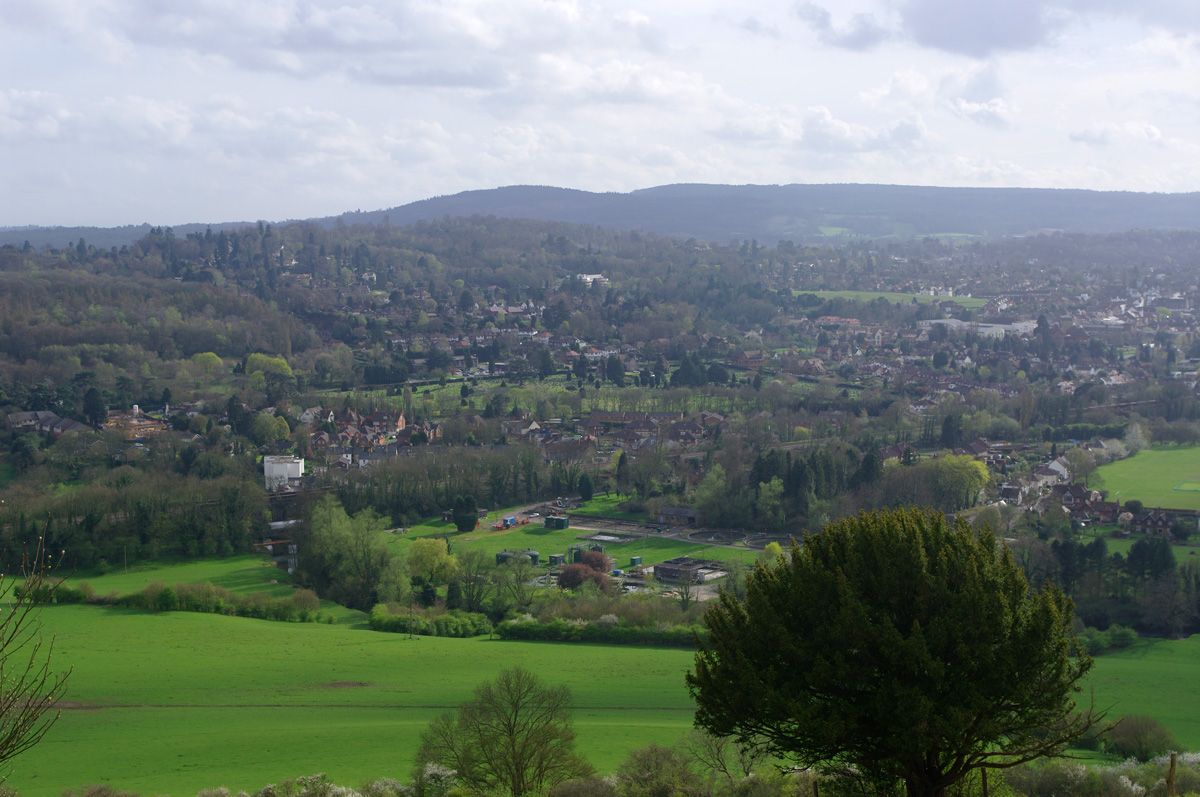
On Monday 26th May this year, Deb Barnum [a.k.a. Jane Austen in Vermont] and I drove up to the top of Box Hill. The quickest route is to come off The London Road, known as the A24, which sweeps past the base of Box Hill, paralleling the River Mole, which itself, arcs around Box Hill to the south and west. The A24 leads south from Epsom towards Dorking. A mile before Dorking we turned left at Rykas Café, which is a popular venue for motorcyclists. We took a small B road, overhung with trees. An old rusty sign leaning out of the hedgerow on the left pointed its finger to the summit of Box Hill. We turned into a wooded and high hedged lane which began to immediately rise steeply, bending towards the right. We passed a weathered red brick cottage on the left, set within a ragged, vibrant country garden surrounded by high, smoothly manicured hedges bulging and swelling outwards in billowing shapes. The road soon opened out onto steeply rising chalk grassland. A precipitous drop on our right formed and a steep incline to our left reached upwards.
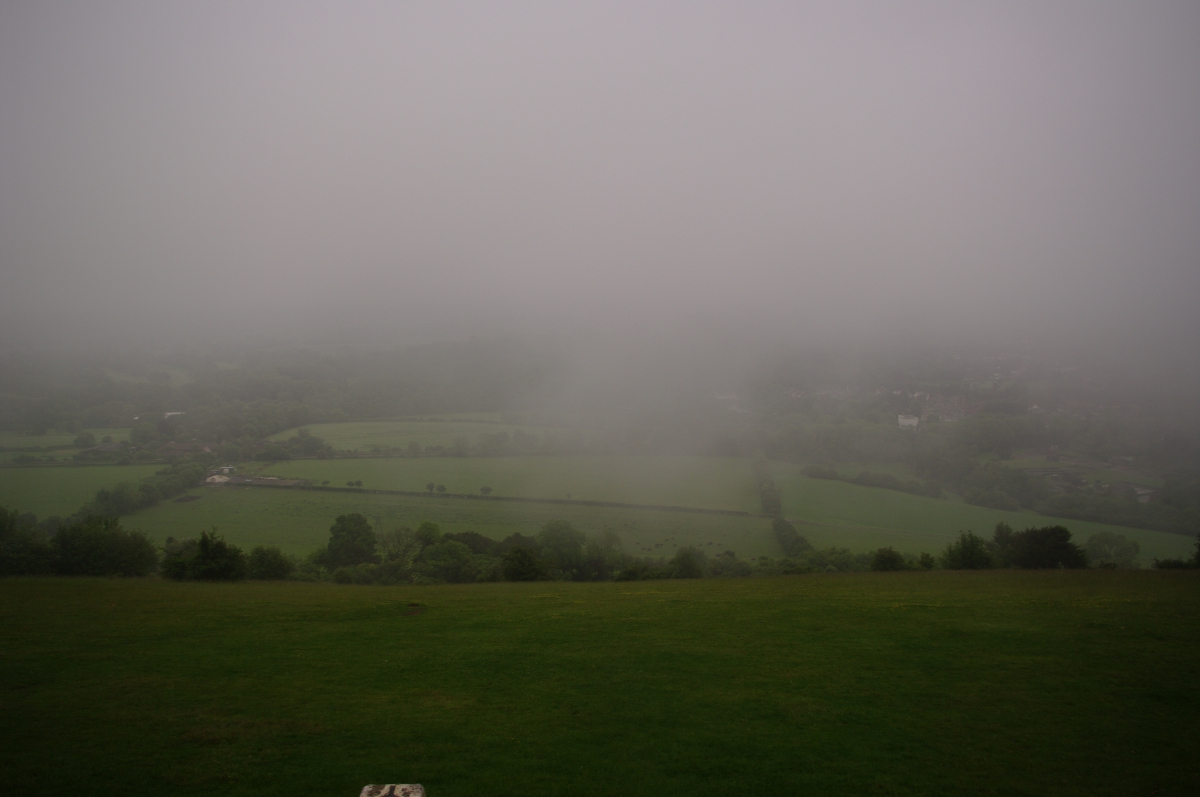
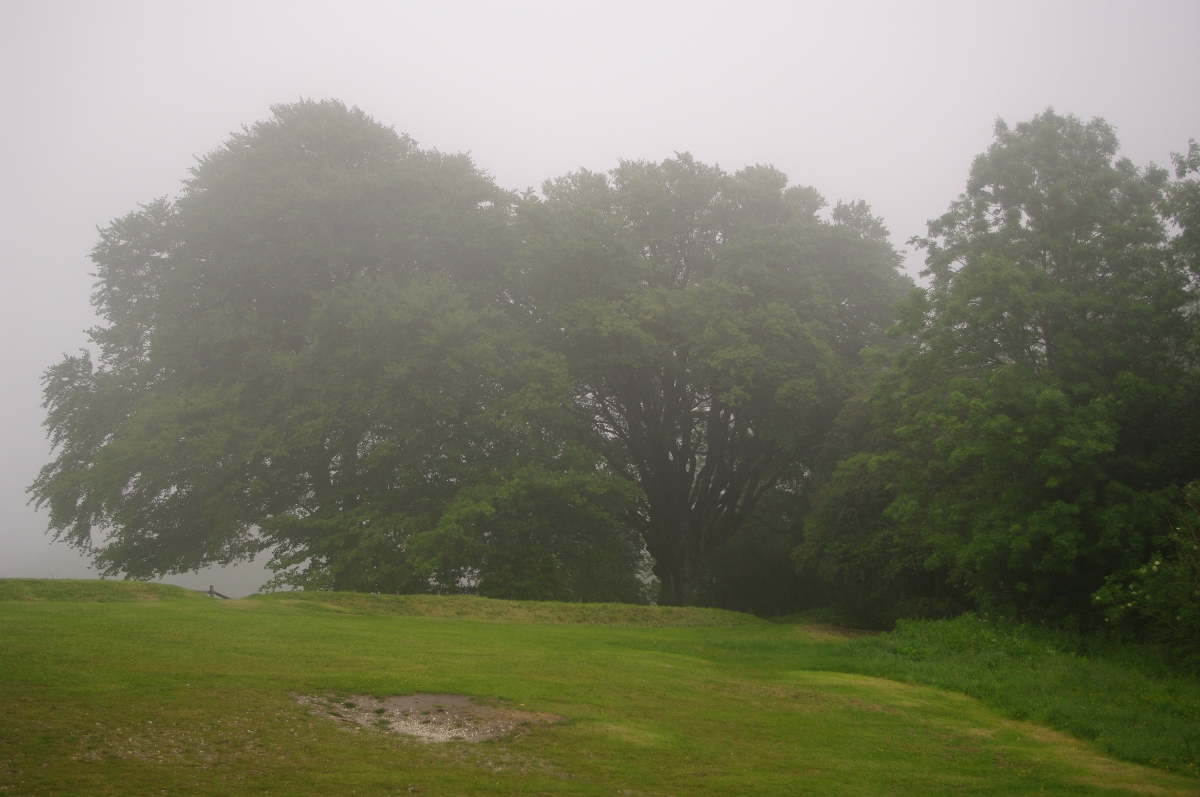
Mist and cloud swirled around us as we mounted the hill along the switch back road. The corners made us turn almost back on ourselves but always took us to steeper and higher levels. The drop to the right revealed hedges of box and scrub, clinging tightly to the side of the hill, interspersed with finely cropped grasses. Chalky outcrops appeared to our left as we rose higher and higher amongst the mist and low clouds. As we neared the summit, trees and woodland gathered around us again. The squat whitewashed National Trust shop and café appeared in front of us and a car park was situated on the left amongst Scots Pines and firs.
We parked the car and I showed Deb the way to the viewpoint we had come to see. We were seven hundred and thirty-five feet above the River Mole and Dorking town was to our right. We could see far into the distance across the
Town of Dorking below
woodlands and fields of Surrey. I suggested Deb take the part of Emma Woodhouse, who in Jane Austen’s novel of that name, visited this very spot with her friends and neighbours but she would have nothing of it. She would be Mrs Elton and nobody else. Deb stood and acclaimed the world standing high on the stone viewing plinth Leopold Salomons had erected in 1914, arms wide to the sky.
It was very near here that Emma Woodhouse and Mrs Elton and their party of friends alighted to picnic at the top of Box Hill in Jane Austen’s novel, Emma. The groups from Highbury and Hartfield, in the novel, have an inauspicious start to their trip, an inauspicious execution of it and an inauspicious end to it. It is a turning point in all their lives. The surface veneer begins to slip from various relationships. Reality begins to poke through Emmas carefully stage managed attempts of conducting other people’s lives. Nothing becomes certain. The Sucklings do not arrive at Hartfield and Mrs Elton’s plan of visiting Box Hill to show the Sucklings the views seems to lose its purpose but she has another thought and becomes adamant about the trip going ahead. The Sucklings can go another time. Mrs Elton’s idea about a trip to Box Hill has an effect on Emma. Emma does not want to be outdone. She has never visited Box Hill before and decides that,
“she wished to see what everybody found so well worth seeing…”
She discusses the trip with the amiable Mr Weston. He is perhaps too amenable and accommodating. In discussion with Mrs Elton he gets the approval of that lady that the two parties, hers and Emma’s join together for one combined trip to Box Hill. Emma is unhappy with the arrangement but as they will all go in different carriages with the people of their own choice perhaps it will not be so bad, she reasons. It would have been better if the horse that was to pull Emma’s carriage had stayed lame of course and so preventing Emma from going, but a quick recovery from this condition, inconveniently perhaps, gave no excuse for Emma not to proceed. A lame horse is a rather lame Jane Austen joke, I think, sprung in the midst of such serious matters. Tongue in cheek comes to mind – a joke at Emma’s expense between Austen and the reader.
Seven miles were travelled in expectation of enjoyment, and everybody had a burst of admiration on first arriving; but in the general amount of the day there was deficiency. There was a languor, a want of spirits, a want of unison, which could not be got over. They separated too much into parties.
This is an interesting passage because Jane Austen seems uncertain. She lists a litany of possible causes for the lack of harmony. She can’t herself decide on one exact cause. This adds realism to the situation. We cannot explain everything in real life and neither can Austen in this scene in Emma.
Austen has Frank Churchill perpetrate, perhaps, a cruel joke, to divert attention from himself and Emma. He asks the ultimate psychoanalysts question, in Emma’s name of course. He whispers to her:
“Our companions are excessively stupid. What shall we do to rouse them? Any nonsense will serve. They shall talk….”
And then for all to hear,
“Ladies and gentlemen, I am ordered by Miss Woodhouse (who, wherever she is, presides,) to say that she desires to know what you are all thinking of.”
Emma immediately tries to nervously laugh the question off. She is taken unawares by this and denies she has anything to do with any such request. There is a desperation in her voice. There is almost fear. She knows she could not, “stand the brunt,” of such raw honesty.
“Let me hear any thing rather than what you are all thinking of.”
There are one or two perhaps, (glancing at Mr Weston and Harriet,) whose thoughts I might not be afraid of knowing.”
Who can or would want to express their real thoughts at the drop of a hat? Is it possible for anybody to express their exact thoughts as they are thinking them? Our relationships would be very strange and probably be put under incredible stresses if we did. Emma is naïve to think even that the thoughts of Mr Weston and Harriet would bear hearing. Our subconscious level is below manners and the social veneer we all carry. It would be delving into our primal depths. This is the sort of thing that Sigmund Freud tried to study and explore. Frank Churchill is being cruel and he knows that nobody would answer this, certainly not himself. Imagine what sort of story would be written if everybody told their thoughts? It is almost the final nail in the coffin of harmony and wellbeing amongst the group on Box Hill.
Deb as Mrs Elton
Deb and I certainly didn’t even approach such a question. Deb, as I said before was just happy to be Mrs Elton and of course Mrs Elton and Mr Elton walked away on their own at Frank Churchill’s question. I wonder what Mrs Elton thought about it? Maybe Deb knows. As for my first suggestion to Deb to play Emma on the top of Box Hill; Emma is obviously an anti-hero. Neither Deb nor anybody else I have spoken to, would willingly be an Emma.
Geology:
Standing high on Box Hill you notice the thinness of the grass under your feet. You see flints sticking out of the pathways and white chalk is revealed in patches everywhere. Box Hill is a geological phenomenon. The cretaceous chalk that comprises Box Hill, was laid down as the microscopic calcareous bodies of plankton on the floor of a tropical sea between 100 and 65 million years ago. Globally chalk is a rare rock formation so it makes the North Downs, of which Box Hill is part, a unique geological area. Originally it was laid as a horizontal chalk platform of uniform thickness. During the period the Alps were formed, about 50 million years ago, upheavals in the Earth’s crust forced this chalk layer into a vast dome. The northern most edge was where the North Downs are now. The dome stretched over to France. The British Isles were joined to the mainland of Europe then. Chalk, being a porous and relatively soft rock, it has been eroded and worn down by the actions of water. All that remains are the North Downs stretching from Guildford in Surrey, just south of London into the northern part Kent and The South Downs stretching from a line formed by the Itchen River between Southampton and Winchester in the west to The Cliffs of Dover on the coast of Kent in the East.
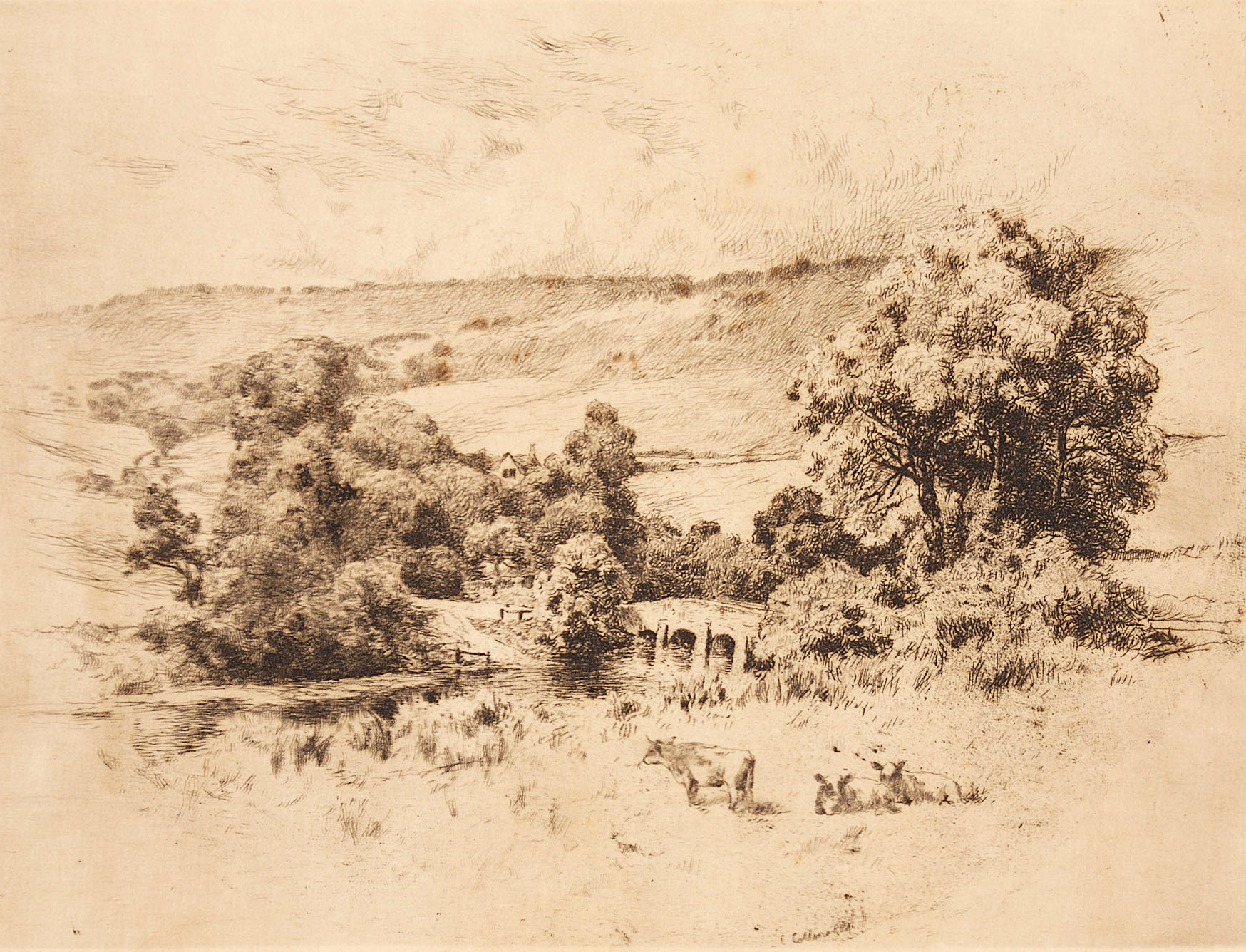
Box Hill Bridge, Dorking – by Alfred Charles Jerome Collins
image: Dorking Museum
On the steep chalk slopes of Box Hill, the 394 feet escarpment and on the sides of the surrounding valleys, downland plants flourish. Because chalk is porous it hardly ever dries out, even in drought conditions which might affect the surrounding landscape. This means plants always have a ready water supply. It is said that plants on chalk downland have a brighter richer colour because of this. Plants such as hawk weed rock rose, bird’s foot trefoil, milkwort, squinancywort and dwarf thistle all thrive in this environment. Box woodland, which is extremely ancient, grows on the steep chalky, thin soiled slopes. It is one of the only trees that will grow in these conditions. The escarpments and valley sides face southwards which means it is often a hot exposed environment. Box Hill derives its name from the box that grows on it. Box has been around since probably the end of the Ice Age and perhaps before that. The characteristics of chalk downland are unique to Box Hill’s geology. There are dry valleys cut into the north side of the hill. This is where the River Mole, which runs under the escarpment of Box Hill has cut its course in the past and where drainage streams and rivulets flowed into it, but because the rocks are porous any streams and rivulets that remain are no longer on the surface but underground. Chalk is easily eroded so it gives a gentle undulating quality to the general landscape. On the steep slopes there are patches of bare chalk and these can gleam white in the sunshine.
Chalk from the North Downs has been quarried in the past. Surrey County Council had a quarry at Brockham nearby to Box Hill. It was used to quarry chalk that could be burned in kilns to produce lime and cement. These quarries, many of them now abandoned have been left to regenerate, plants and wild life and some are now places of special scientific interest. The quarries, because they have sides cut into the chalk, show the structure of the chalk particularly well.
Chalk Down land is a special type of grassland habitat that is actually man made. Over centuries, sheep and cattle have been grazed on them. This has deforested the downland to a certain extent allowed unique wild flowers and animals, only found on downland, to flourish. To keep Box Hill’s downland quality a flock of sheep and a herd of cattle are grazed on it. The sheep on Box hill are Black Welsh Mountain sheep. There are twenty eight sheep, which are moved around the hill on a rotation. Because sheep are ‘nibblers’ they leave the grass short and even. There are also cattle, which graze very differently. Cows use their tongues to rip plants up, which leads to more tufted grassland. The breed used on Box Hill are called Belted Galloway cattle. They can be recognised by their fluffy black bodies with a thick white belt around their middles. Four males graze Box Hill and nearby Headley Heath is grazed by three males and nine females. The animals are moved around Box Hill all the time. If it ceased to be a grassland habitat, trees and woodland would take over and cover it. This would occur through a natural process called succession. This downland supports a great diversity of invertebrates including fourty one species of rare butterflies. The soil is good for snails too. Snails require the calcium in the chalk to form shells.
History:
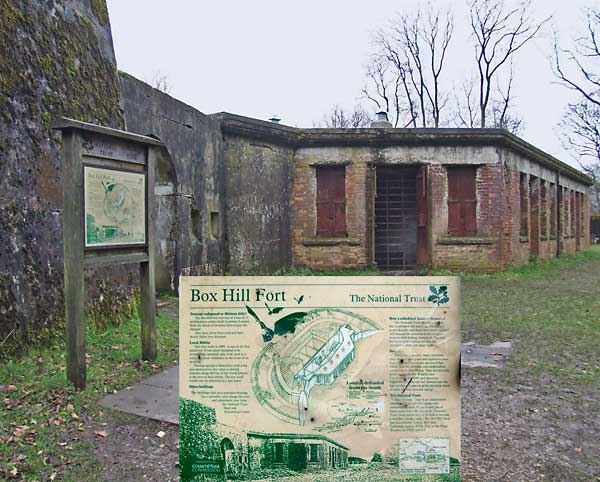
Box Hill has a varied history. The old fort, that can still be seen at the top of Box Hill, was built in the 1890’s and is one of thirteen that were built across the North Downs, collectively known as the London Defence System.. They were to be the last defence of London if Britain was ever invaded. In the late 1890’s there was a treaty with France called the entente cordial but Germany was beginning to increase its strength and many of the stresses and strains that eventually lead to the first world war were beginning to stir. Previously, in the 1860’s, during Palmerstone’s premiership, many forts had also been built around the coast of Britain to defend from a perceived threat from France then. The forts on Box Hill and across the North Downs were never used. I have visited and actually stayed in one of the forts, the fort on The Hogsback just outside of Guildford. It is owned by Surrey County Council and is used for parties of school children to stay at to enable them to explore and study wildlife and local history. The fort on The Hogs back contained officers quarters just outside the ramparts of the fort and a barracks for a small contingent of soldiers inside. The forts were basically armouries for storing shells, and explosives. They comprised of strongly reinforced chambers with specially constructed shelving. The one on The Hogsback had a large area of flat land in front of it on which artillery could be positioned if required. These forts were situated high on the downs,as much as seven hundred feet above the surrounding countryside. The one on the top of Box Hill is dilapidated now and barred from entry. A rare breed of bats has lodged itself inside the fort and cannot be disturbed. To continue the military theme, there are stepping stones that cross the River Mole at the base of Box Hill. During the second world war they were removed to impede invading forces crossing the river. In the area you can also see examples of pill boxes, which were concrete bunkers installed with heavy machine guns and concrete tank traps. Interestingly at the top of Guildford High Street, next to the railway line cutting, hidden amongst dense trees, nowadays you can see a whole swathe of Second World War tank traps covered in ivy and moss.
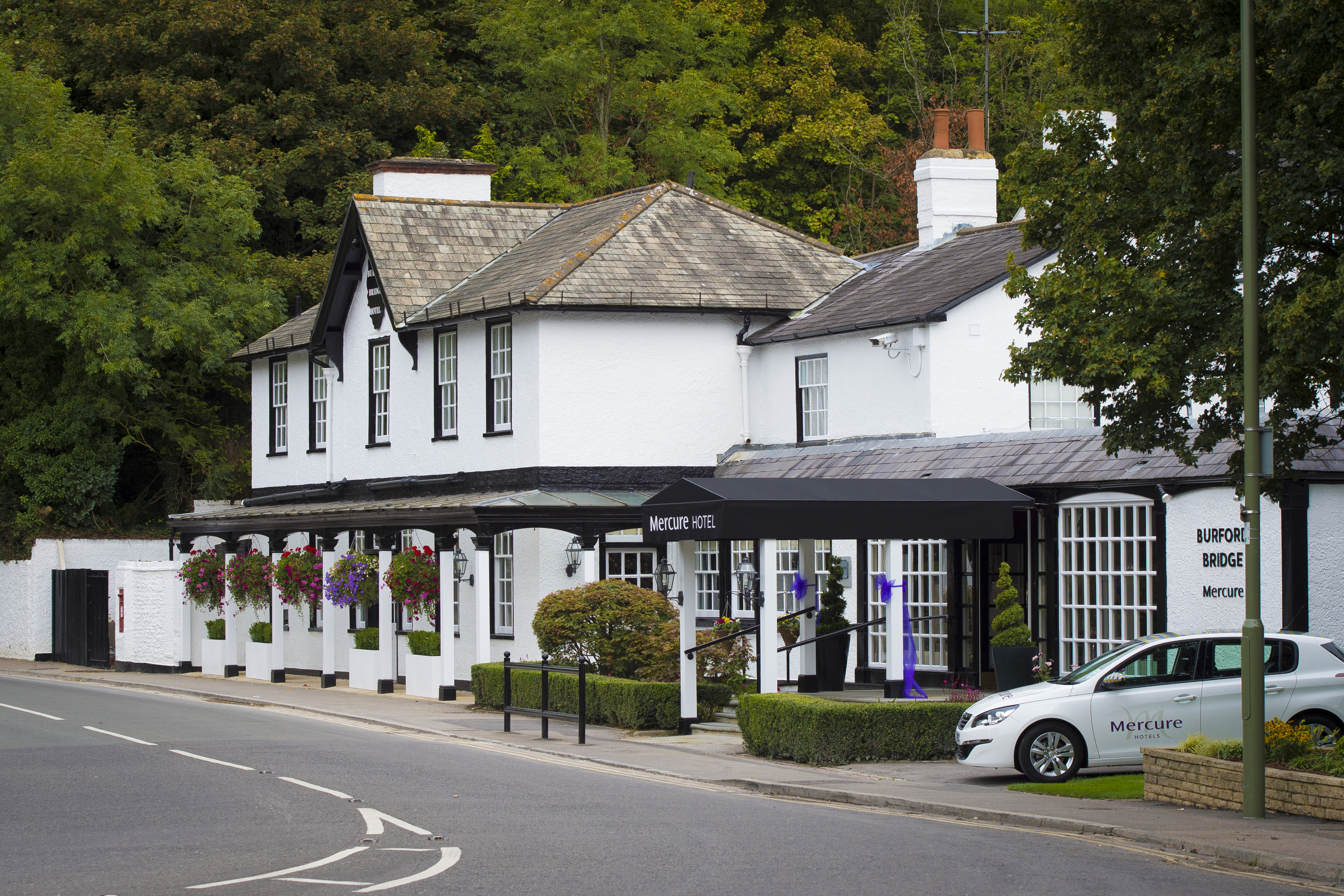
Burford Hotel
Literary Connections:
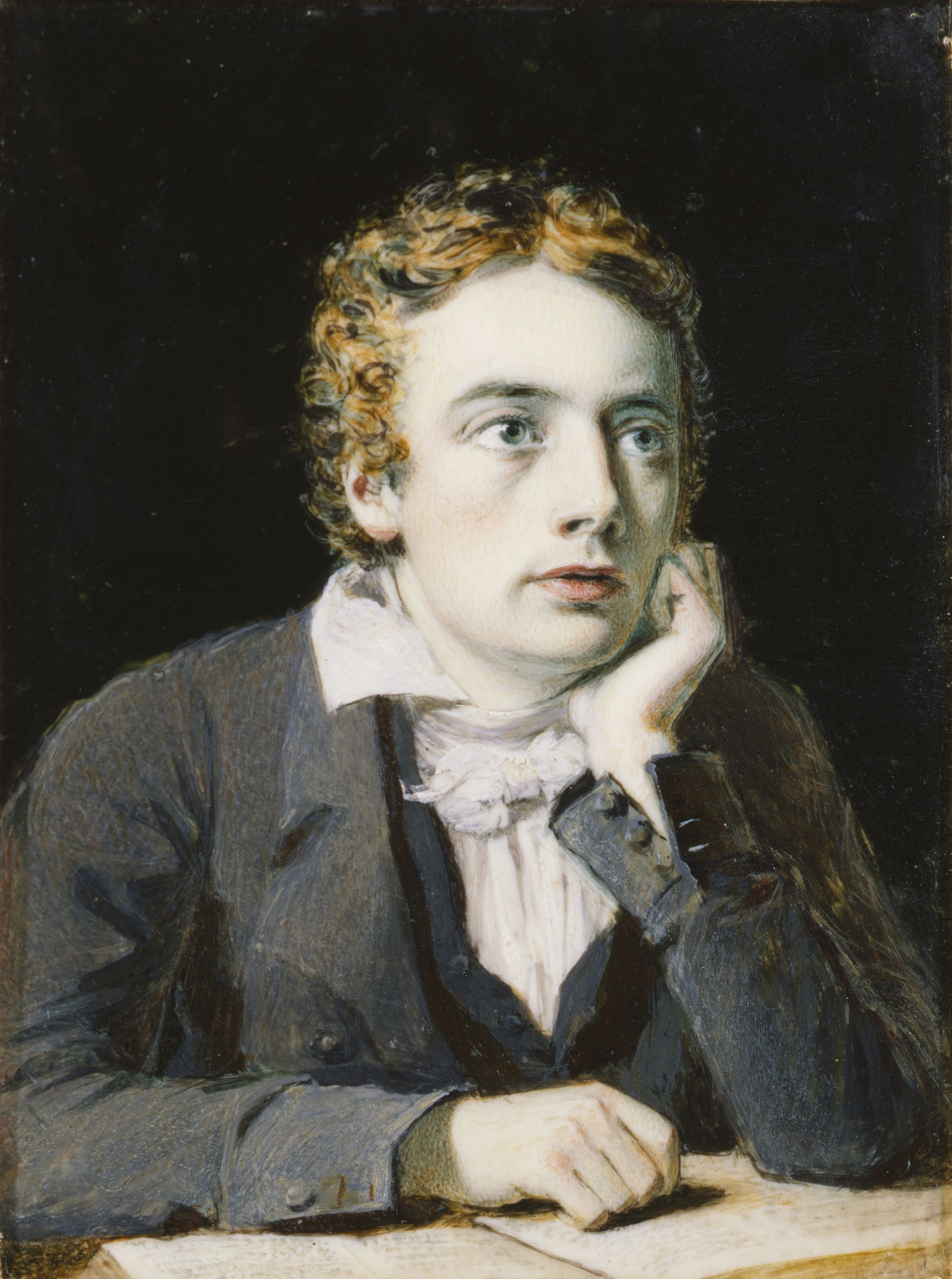
John Keats in 1819, by Joseph Severn – wikipedia
Box Hill has inspired a number of classic authors, not just Jane Austen as I mentioned at the start. John Keats, Daniel Defoe, George Meredith and Robert Louis Stevenson all visited Box Hill. J. M Barrie used to sit on one of the slopes of Box Hill getting inspiration for Peter Pan.
The Romantic Movement, led by William Wordsworth, popularised communing with nature and Box Hill became a popular place to visit. John Keats completed his poem Endymion (1816) while staying at the Burford Hotel next to Box Hill. Its famous opening lines have inspired generations,
“A thing of beauty is a joy forever
Its loveliness increases; it will never
Pass into nothingness; but still will keep
A bower quiet for us….”
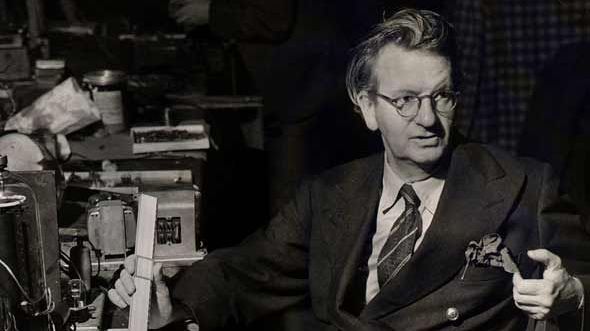
John Logie Baird, the inventor of television, lived in the Swiss Cottage at the top of Box Hill. In the 1930’s he conducted his early experiments in television from the top to the valley below.
John Logie Baird
The strangest individual connected with Box Hill is Major Peter Labelliere. He requested that he be buried upside down on the top of the hill. He believed that the world would go topsy-turvy and that one day he would be the right way up. His other dying wish was that youngest son and daughter of his land lady should dance on his coffin.
One thing you notice, as a driver, on Box Hill is when you descend, especially, winding along the switch back road on steep sided slopes and cliffs that the road surface has had strange, almost aboriginal markings painted on it. Here and there are the hoops of the Olympic movement. In 2012, The Olympics came to London. However, many events were not confined to the capital. The cycling road races were staged in the beautiful leafy, countryside of Surrey. Box Hill was the steepest part of the long distance cycling road race, hence the artistic markings that still adorn the road surface of the road..
On our way back to London, I drove Deb towards Kingston. We passed through an area called Malden Rushett, near the Chessington World of Adventures. There is a small industrial estate, farming land, a pub called The Blue Anchor and an extensive garden centre in Malden Rushett nowadays. The long straight road that passes through this area from Dorking to Kingston was a coaching road in the 18th century. Nothing apart from fields with cattle and maybe wheat growing would have existed there then. If you look on a map you can measure from Malden Rushett cross roads, seven miles to Box Hill, sixteen miles to London, twelve miles to Richmond and nine miles to Kingston – the exact distances from Highbury and Hartfield that Jane Austen reveals in Emma. I mentioned this to Deb as we drove along. I think she was impressed.
the view we saw in the mist
top of Box Hill in the mist
The Esteemed Author
All images c2014 Tony Grant unless otherwise noted.







































































 Jane Austen in Vermont