Dear Janeites and Other Readers: I welcome today Tony Grant. He has just read Virginia Woolf’s A Room of One’s Own and asked if I would post his review. Tony for a time wrote a blog on Virginia Woolf called “The Novels of Virginia Woolf”– he is hoping to do more on there now that he is re-inspired! There are endless resources out there on Woolf (see below for a few links), but here Tony is giving his personal view of what he learned in reading A Room of One’s Own, and how it relates to Jane Austen.
*****
“Virginia Woolf Made a Reference to Jane Austen,” by Tony Grant.
A ROOM OF ONE’S OWN by Virginia Woolf was first published in 1929. Woolf was invited in 1928 to give a talk to the female undergraduates at Girton College, Cambridge on the theme of women and fiction. She came up with the title for her talk as, A ROOM OF ONE’S OWN. The premise of her argument was that women needed a room of their own and time to write, provided by an independent income. Virginia Woolf suggested £500 a year.
Coincidently that was the same amount that an Aunt, who died in India, left Virginia Woolf in her will, allowing her to be independent of her husband. She was allowed time to think and write without the constraints of the straight jacket of wife, mother, and organizer of a great man’s home. She could afford a room of her own in which to write undisturbed. She argued that women writers in history had been far and few between because of the restrictions a patriarchal society put on them, a society that actively discouraged, insulted, and humiliated women’s abilities. Men thought that women were not capable of writing great fiction or write intelligently on any subject.
She references Aphra Behn, a playwright, poet and translator who lived in the 17th century, as the first woman writer to make money from writing. She goes on to explain that later in the 18th and 19th centuries, Jane Austen, The Brontës and George Elliot began to show what brilliant writers women can be, even if hidden behind anonymity or male pseudonyms. These few, early, great women writers were however, limited in their scope by their circumstances. Virginia Woolf’s hope is that a “Shakespeare’s Sister,” will emerge one day.
We are introduced to Mary Beton, her aunt who left Virginia the £500 per year inheritance and provided the means for her to become a writer; Mary Seton, a wife and mother who is constrained by her circumstances and has no chance of becoming a writer; Mary Carmichael, an author who does not write particularly well – her sentence structures are not those of Jane Austen, from whom she should have learned, but nonetheless begins to write about women in an extraordinary way from a woman’s perspective and begins to portray the subtleties of womanhood uninfluenced by a patriarchal society. These three characters represent three aspects of the lives of women.
Virginia Woolf’s bedroom at Monk’s House
Virginia Woolf argues that intellectual freedom depends upon the possession of material things (a room of one’s own and £500 per year), a good education and well-connected families. She thinks the education the poor receive will not raise them to equality with the upper levels of society. She decries that they will have no chance of their voice being heard. Women’s lives and the poor in society are a downtrodden second class group.
Nowadays there is a sort of worship and fan cult associated with Jane Austen. Virginia Woolf would be bemused and not understand this I think. Austen is a great writer, especially in exploring the relationships between men and women which is acutely highlighted in her writing because of the patriarchy of the 18th and 19th centuries.
But because of the constraints placed on by the male members of her family, no “room of her own,” and no independent income, Austen’s world was a very narrow world of drawing rooms. There was not enough global experience of women writers and women in other aspects of society, equal to that of men’s for Austen to build on. She was and is impressive for what she achieved, but she had her limitations. Austen was timid and protective about her writing. She didn’t experience life outside of a strict set of patriarchal boundaries. It does seem extraordinary nowadays there is so much fuss over her.
The aim for women writers, in the words of Virginia Woolf, is to become “Shakespeare’s Sister.” It must be said that Shakespeare did not have a sister as far as we know. What Virginia Woolf means is that in her view Shakespeare was the greatest male writer. He had the perfect balance of the “male-female” brain, creative and fertile with ideas derived from a wide experience of the world, male histories, male experiences and male writing through the centuries. If Shakespeare’s Sister had been able to become the female version of her brother, employing the “female male” brain alongside a wealth of women’s experiences in writing and society, we would have a female writer of equal brilliance and scope.
Virginia Woolf’s presentation to the Girton Undergraduates is nothing if not meant to encourage them all to become writers, not just of fiction but scientific treatises, histories, biographies, poetry, and more besides, because as Woolf states “books talk to books,” and with a rich history of women’s writing to draw on this “Shakespeare’s Sister” can finally emerge.
Jane Austen was a step along the way to the emergence of this “Shakespeare’s Sister.” Mary Carmichael, perhaps a pseudonym for Virginia Woolf herself, represents another important step along the way. They are only steps.
“Be yourself” is a slogan Virginia Woolf leaves her young female audience with. She describes what women need to do to become writers and become themselves: “They need to build their ideas and thoughts on those of other women.” She points out how near impossible it is to achieve that without an immense struggle and everyone doing their bit. Even ninety years later, Virginia Woolf’s treatise has a freshness about it.
Virginia Woolf’s writing shed, Monk’s House
*****
Thank you Tony for sharing your thoughts on Woolf and Austen! You can visit Tony’s regular blog “London Calling” here: http://general-southerner.blogspot.com/
Would love to hear your thoughts on A Room of One’s Own – do you think Woolf’s ideas remain relevant today? Do you agree that there was a dearth of women’s writing because of the patriarchal society and its subjugation of women? Since Woolf’s time there has been an ongoing effort to re-discover the early women writers that have been long forgotten, also a result of that subjugation, and many of these Woolf would have known nothing about. [You can visit the Library at Chawton House to read about many of these early authors: https://chawtonhouse.org/ – and especially the biographies and online novels].
Woolf references Austen in more than just A Room of One’s Own – she refers to Austen in many of her writings, and wrote several full-length essays – here are two.
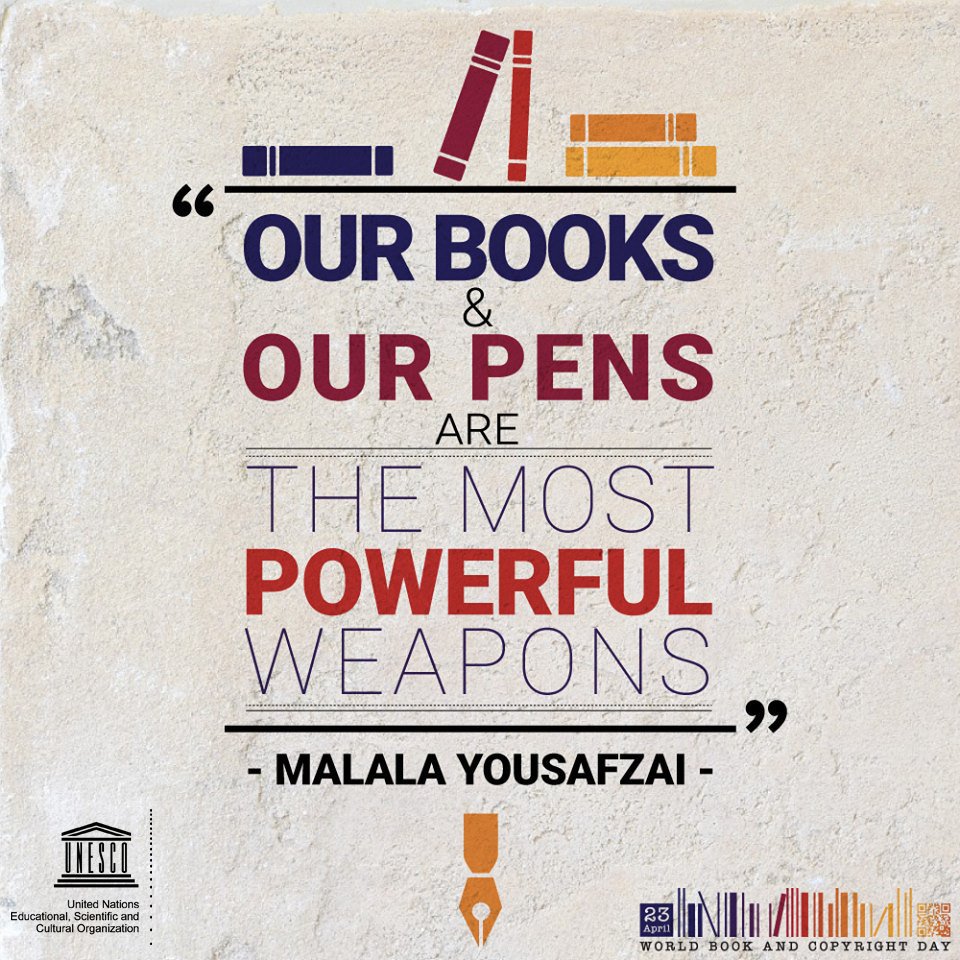
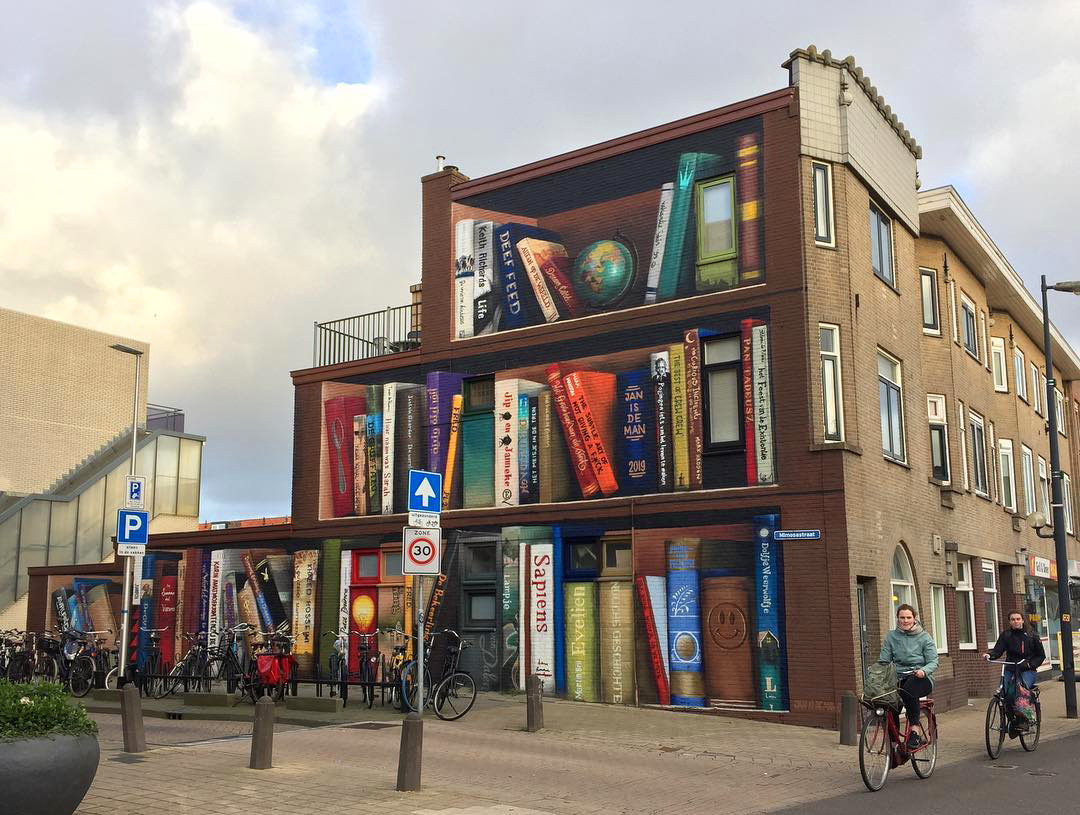
“23 April is a symbolic date in world literature. It is the date on which several prominent authors, William Shakespeare, Miguel Cervantes and Inca Garcilaso de la Vega all died. This date was a natural choice for UNESCO’s General Conference, held in Paris in 1995, to pay a worldwide tribute to books and authors on this date, encouraging everyone to access books – most beautiful invention for sharing ideas beyond the boundaries of humanity space and time as well as the most powerful forces of poverty eradication and peace building.”
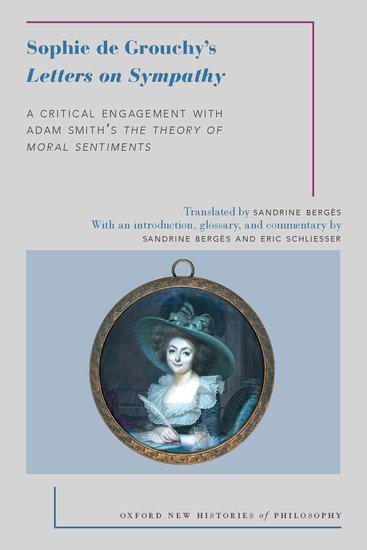
Sophie de Grouchy. Letters on Sympathy: A Critical Engagement with Adam Smith’s The Theory of Moral Sentiments.
Published in 1798 in French, now here translated.
*****
In case you are in need of some new reading material, the whole of the 2 volumes of the Mueller Report are available for free online (you DON’T need to buy it from Amazon): Notice all the redacted data…. https://www.justice.gov/storage/report.pdf
George Rodrigue’s “Absolut Statehood Louisiana” – bidding is already at $1800…
*****
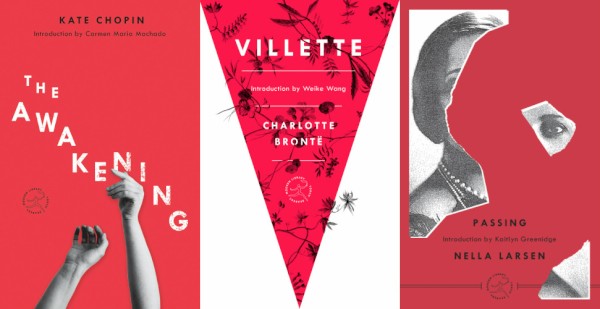
The Modern Library is launching a new trade paperback book series, Modern Library Torchbearers, that will “honor a more inclusive vision of classic books” by “recognizing women who wrote on their own terms, with boldness, creativity, and a spirit of resistance.” The books, all previously published, will be repackaged, and each will be introduced by a contemporary woman writer. The inaugural list for the series features:
American Indian Stories by Zitkála-Sá, with an introduction by Layli Long Soldier (May 21)
The Heads of Cerberus by Francis Stevens, with an introduction by Naomi Alderman (May 21)
Passing by Nella Larsen, with an introduction by Kaitlyn Greenidge (May 21)
The Awakening by Kate Chopin, with an introduction by Carmen Maria Machado (June 18)
Lady Audley’s Secret by Mary Elizabeth Braddon, with an introduction by Flynn Berry (June 18)
Villette by Charlotte Brontë, with an introduction by Weike Wang (June 18)
I can honestly say that the only thing I really have a fancy for that one might call over-the-top decorative arts are the stunning Faberge eggs – I’ve seen them in museums over the years and two years ago at the best place of all at The Hermitage – so here in celebration of Easter is a nicely done history from Barnaby’s: https://www.barnebys.com/blog/in-celebration-of-easter-we-look-back-on-the-history/
Orlando, the subscription database from Cambridge University Press on “Women’s Writings in the British Isles from the Beginnings to the Present” – is available for free for Women’s History Month starting tomorrow and throughout March.
The Orlando Project “provides entries on authors’ lives and writing careers, contextual material, timelines, sets of internal links, and bibliographies.”
Here is the login information: (no caps, no spaces)
Id: womenshistory19
pw: orlando19
As always, much new material has been added this past year: just as an example, Professor Isobel Grundy has shared with me that these four near-contemporaries of Jane Austen are now part of the database (or will be added shortly):
Mary Harcourt (later Countess Harcourt) (1750-1833), who was embedded with her husband while he commanded troops in the Low Countries during the War of the First Coalition against revolutionary France, and wrote an account of her experience and her gradual development of strongly anti-war views; and
Eglantine, Lady Wallace (died 1803), a dramatist and conduct-writer, a Scots aristocrat of rather dubious respectability who got caught up in part of the same war and was very friendly with a revolutionary leader. [entry is under Eglinton Wallace].
Jane Loudon (1807-1858), who published a science fiction novel called The Mummy, unfortunately a few years too late for Austen to read it. [to be added soon]
Anna Gordon (Mrs. Brown) (1747-1810), a Scottish ballad-collector and singer. [to be added soon]
***********
If you are wondering about the symbol of the Oak Tree, here is the explanation from the website:
“. . . a little square book bound in red cloth fell from the breast of her leather jacket—her poem The Oak Tree.” —Virginia Woolf, Orlando
Virginia Woolf’s Orlando, a Biography, 1928, inspires this work in literary history. Woolf’s biographical and historical fantasy explores the changing conditions of possibility for women writing in England from the time of Elizabeth I to her own day, and gives us a poet protagonist who is at work throughout the whole of this history on the composition of her poem “The Oak Tree”. The Orlando Project team sees in the oak tree a suggestion of the history of women’s writing in the British Isles, the growth of history from biography, and (in a kind of visual pun) the tree-like structure of our text encoding.
Fabulous resource – spend the month indulging in this feast of information!
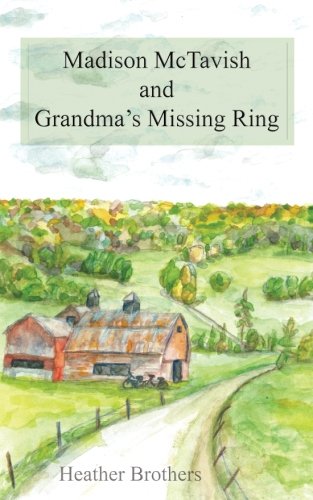
Dear Readers: Today I welcome Margaret Harrington, one of our JASNA-Vermont members, with her review of Madison McTavish and Grandma’s Missing Ring, a children’s mystery novel by Heather Brothers, also one of our JASNA-Vermont members. Heather had published a delightful Regency era novel in 2013 titled The Introduction of a Gentleman (you can read my interview with Heather here.)
Margaret posted this review of her latest book (published in June 2017) on Goodreads – but thought we should give Heather some press here as well. So thank you Margaret for sharing this review and to Heather, we wish you great success with this latest book! Heather will have copies for sale at our Jane Austen Birthday Tea on December 2, 2018.
As Margaret mentions, we hope that Madison McTavish will be returning for another adventure!
******************************
Madison McTavish and Grandma’s Missing Ring
by
Heather Brothers
Madison McTavish and Grandma’s Missing Ring by Heather Brothers is an engaging novel about a ten year old girl named Madison who lives in rural Vermont. Not only do readers get to see things through Madison’s eyes but we also get involved with her multi-generational extended family’s entanglements.
The relationship between Madison and her solid grandmother is central to the story and author Heather Brothers draws them with realistic description and believable dialogue. Readers are relieved of cliché in this finely crafted book and can be surprised just like in life when you do not know what is going to happen next but you look forward to whatever it may be.
Besides family relationships there are neighbors, friends and even suitors to Madison’s preferred aunt who populate and drive the story. The setting in rural Vermont is exquisitely visual and pungent with smells of baking, maple syrup, cow dung and roasted pumpkin seeds which bring you right into the rustic atmosphere. Most of all there is the convincing dialogue with people of all ages talking with each other.
There is a mystery to be solved and several sub-plots to the story that are written about with an incisive gentleness. This is a story well told.
I hope that Heather Brothers will continue to write about Madison McTavish because her debut story is refreshing and enjoyable to read.
Review by Margaret Harrington – Goodreads
*****************************
Synopsis: Madison McTavish has never really stolen anything. She’s never searched an old barn, investigated a mysterious Frenchman or had to be a real detective. Madison’s life has revolved around her grandparent’s farmhouse, baseball with her best friend, Santiago, and spending time with her quirky aunts, uncles and neighbor. She’s a regular, 10-year old Vermonter.
But all this is about to change when Madison’s grandma starts wearing an old ring; a ring Madison ends up stealing and losing. This begins Madison’s search to not only find a thief, help a neighbor and uncover family secrets, but to get herself out of trouble…if she can. [from back cover]
About the author: Heather Brothers lives with her husband and two young daughters in Vermont. She works in the student loan industry. She enjoys playing the piano, writing and imaginative play with her daughters. She also is on the Board of JASNA-Vermont and assists with Hospitality and the Austen Boutique. (And her daughter Claire is our official Janeite mascot!)
[I first posted this in 2009 – here it is again, in celebration of Bronte’s birthday!]
Happy Birthday to Charlotte Bronte, born April 21, 1816 in Thornton, Yorkshire.
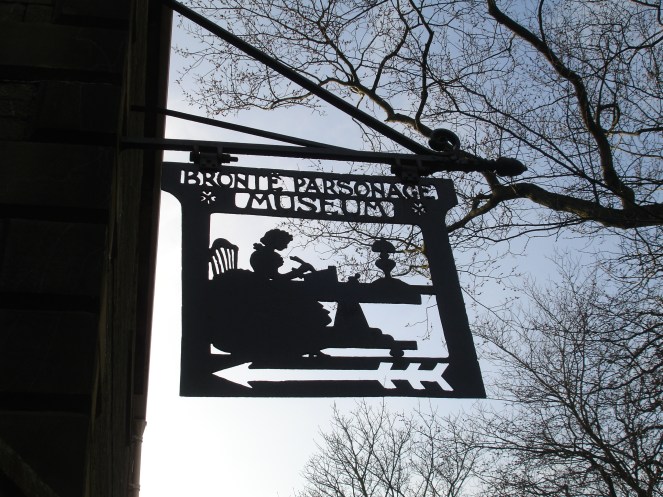
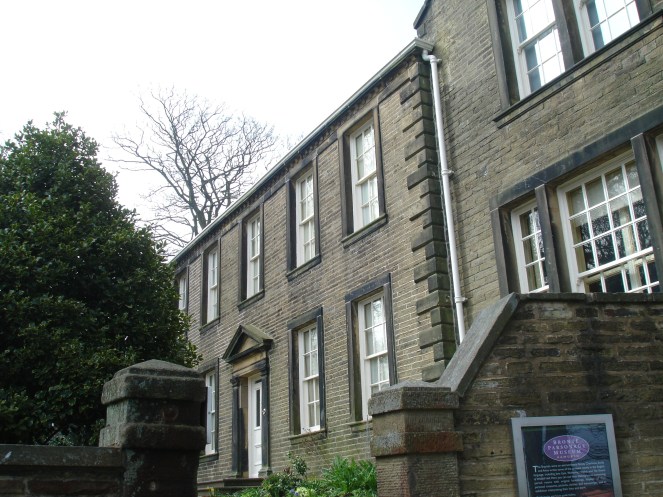
I just had the good fortune to finally visit Haworth and tour the Bronte Parsonage. One of the special extras was the display of the various costumes worn in the latest BBC production of Wuthering Heights [but alas! no pictures allowed!]
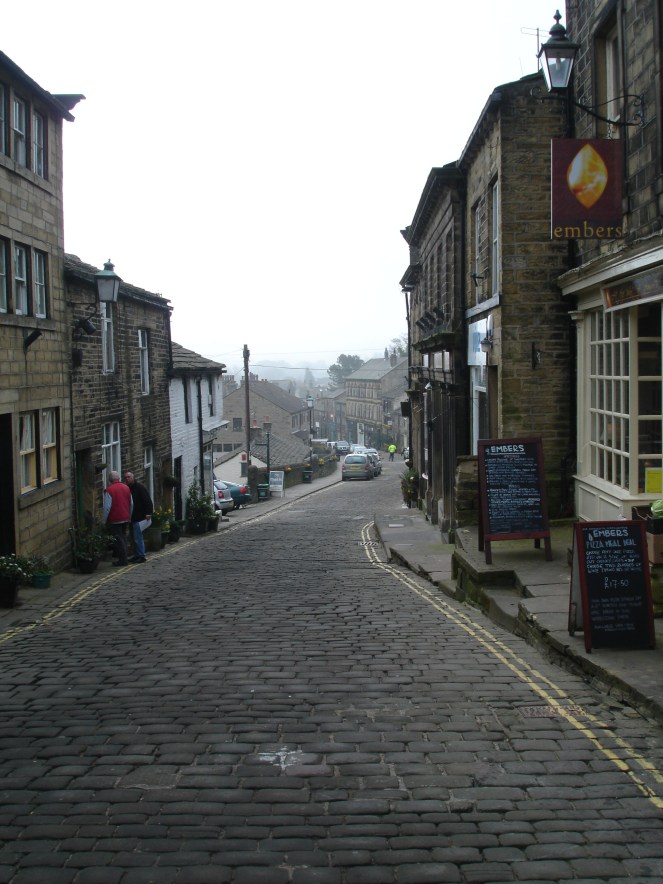
I append here a few of my photographs of the Parsonage as well as several links for further reading…
Main Street, Haworth
Further Reading:
The Bronte Blog, an excellent source for all things Bronte – various links to the e-texts, other web sites, a bibliography of sources, etc.
There has been a good deal to write about this year’s terrific JASNA AGM in Washington DC on Emma – but while it always takes me a good while to re-emerge into the 21st century after these events, little time has been accorded me to actually write anything about it. But I did want to give you a quick summary of the books and other “stuff” I bought this year – less than usual because I bought a DRESS and a SPENCER, which did my pocketbook some serious damage…(see the image below*).
But to the matter at hand, here are the books, etc. – most would make fine holiday gifts for your favorite Austen follower, or for your own stocking for that matter… except this first one which would not in any way fit:
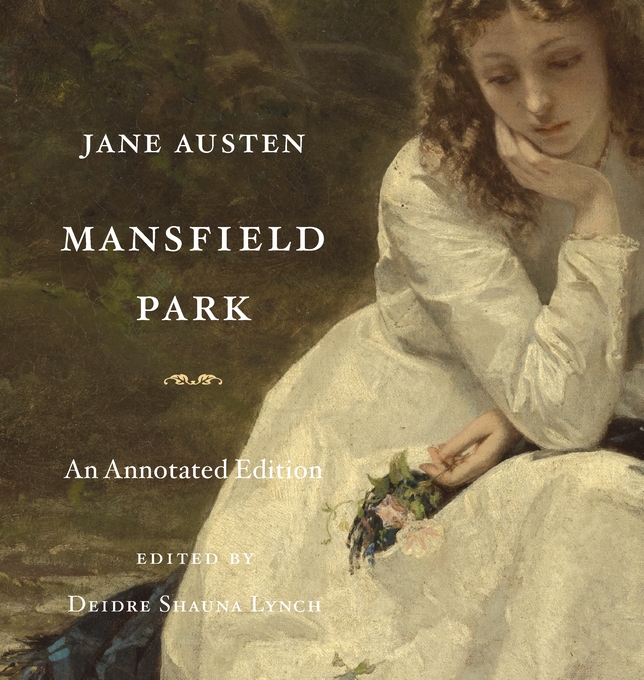
Jane Austen. Mansfield Park: An Annotated Edition. Edited by Deidre Shauna Lynch. Harvard UP, 2016.
Very excited to have this, completing my collection of these beautiful Harvard editions. The book was released during the AGM and thankfully Jane Austen Books had copies. I have only skimmed through it, but it promises to live up to the other Harvard editions with an insightful introduction and notes by Lynch, and color illustrations throughout that give you the sense of time, place, and history that surround the adventures of Fanny Price. A must have and a perfect holiday gift for your Austen friends (and at $35, this is the best book deal out there, bar none…)
2. Alden O’Brien, et al.‘An Agreeable Tyrant’: Fashion after the Revolution. Exhibition Catalogue. Washington DC: DAR Museum, 2016.
The catalogue that goes along with the fabulous exhibition at the DAR Museum that many of us at the AGM were privileged to see. Ms. O’Brien spoke at the AGM to take us through the history behind and the creation of this fashion exhibit – complete with characters from Jane Austen’s Pride and Prejudice found in the “Pemberley Room” – it runs from October 7, 2016 – April 29, 2017 and is described on the website as: “…displaying men’s and women’s clothing from 1780 to 1825 in a dozen period rooms throughout the museum. It considers how Americans fashioned a new identity through costume; on the one hand, Americans sought to be free from Europe, yet they still relied heavily on European manufacturing and materials.”
The catalogue is quite lovely, showing full page color illustrations of fashions of the time as well as photographs of costumes in the DAR Museum collection. A must-have for every good Janeite with any fashion sense and perhaps in need of a new dress idea…it also contains various patterns in the back. You can purchase the book through the Museum’s website here. And my friend Kelly has written about the exhibit on her blog Two Teens in the Time of Austen.
Here are a few of my shots of the exhibit:
Mr Darcy
A Man’s Banyan
Pemberley Ladies
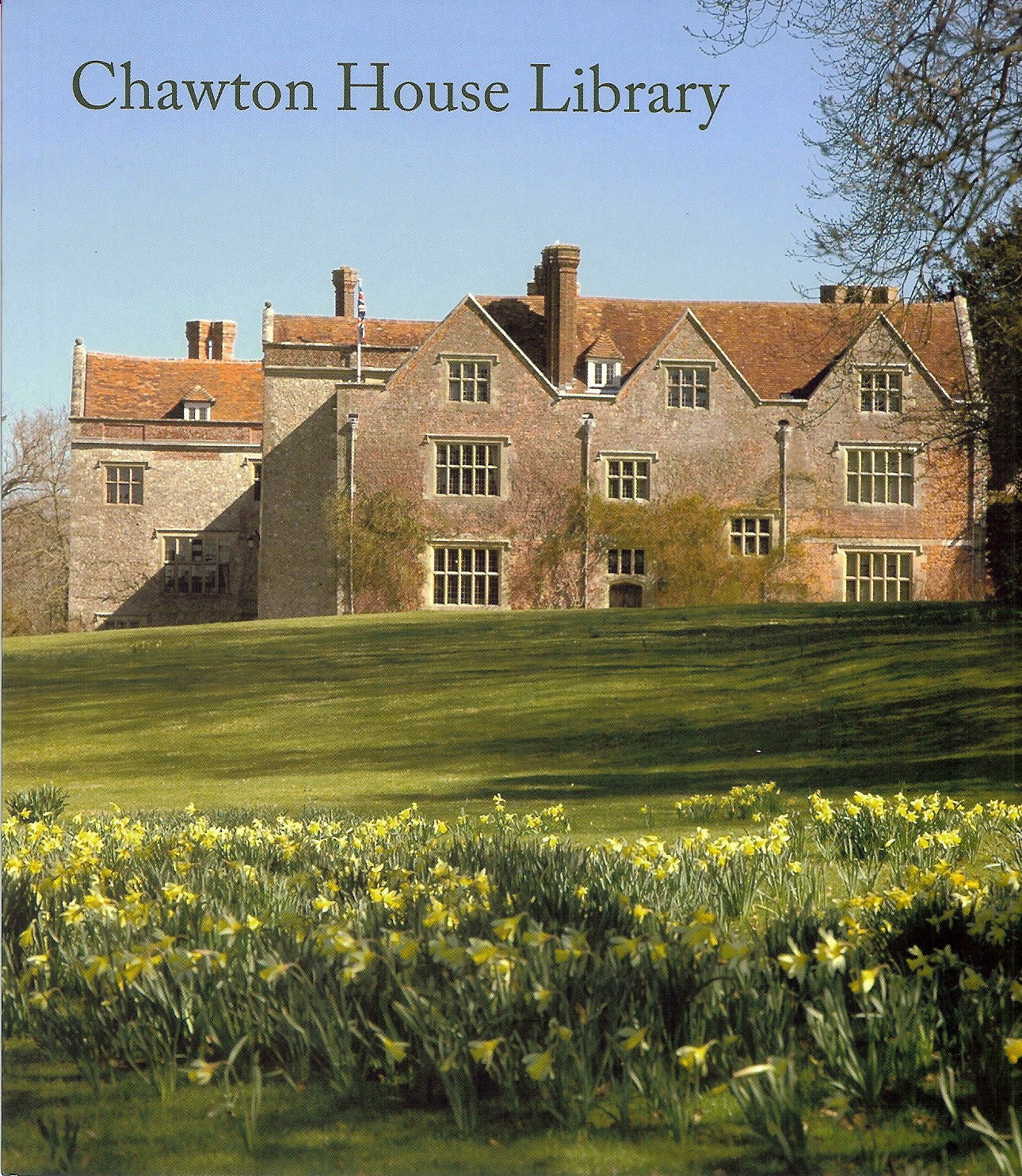
3. Chawton House Library – their new brochure and guide, text by Helen Cole, et al. CHL, 2016.
This is Lovely! It tells the history of the Chawton Great House, Jane Austen’s connection with it, the development of it as a learning centre for the study of early women’s writing from 1600 to 1830. There is much detail with fine illustrations of the house itself: the Library; the various rooms and staircases; exhibition and conference information; the furnishings, art and portraits; the gardens and grounds; and a bit of the history of women writers and their place in our literary heritage. For $12 you get to armchair-tour the house at leisure, and then you will add this to your next-trip-to-England itinerary, as well as a commitment to become a valued Friend of the Library (also a nice gift in a friend’s name).
[Note that the CHL online shop is currently experiencing the dreaded tech difficulties – if you would like a copy, please contact me and I will get one to you.]
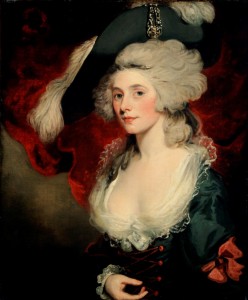
Portrait of Mary Robinson, by John Hoppner c1782 (at CHL)
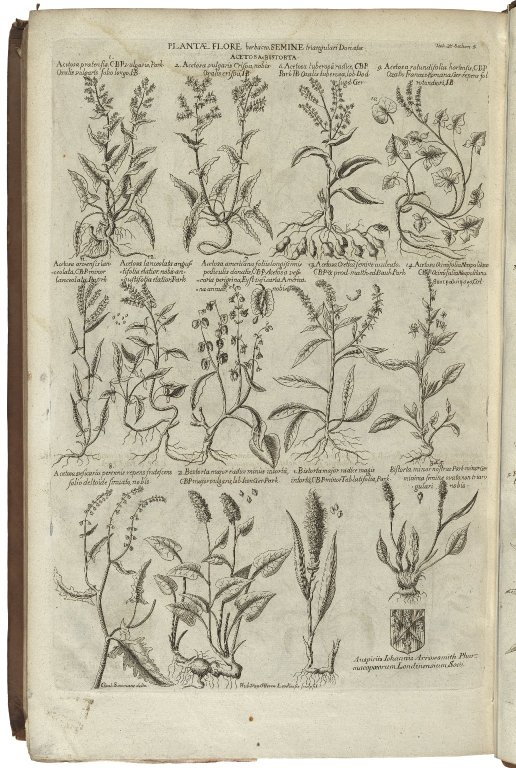
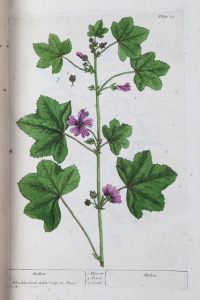
Also from the Chawton House Library – their table at the AGM was jam-packed with goodies – I bought their collection of 8 botanical cards from Elizabeth Blackwell’s A Curious Herbal (frameable!) – you can also “Adopt” this book as a way to support the Library!
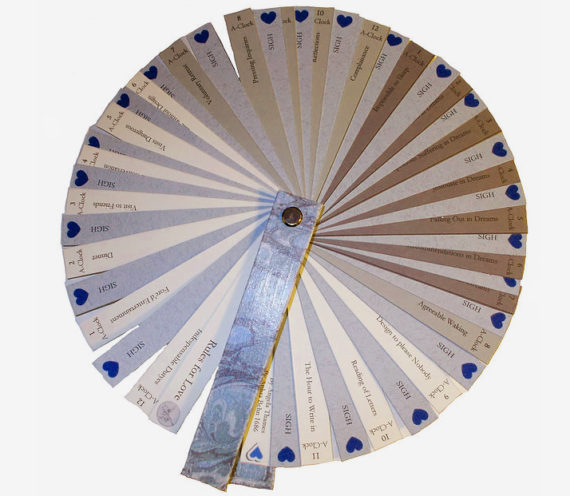
Also couldn’t resist this book-fan “The Rules for Love,” by book artist Angela Thames from Aphra Behn’s 1686 La Montre – (you can read about Ms. Thames as artist-in-residence at CHL here).
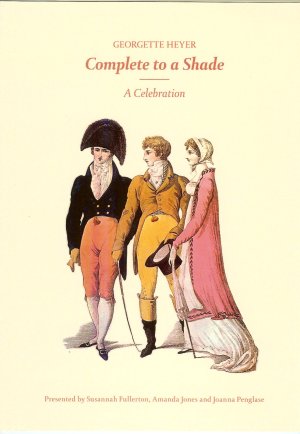
4. Susannah Fullerton, Amanda Jones, and Joanna Penglase, ed. Georgette Heyer: Complete to a Shade: A Celebration. JASA, 2016.
Exactly what the title tells us and another must-have – a collection of essays from various JASA folk who have long-been or are new to the joys of reading Georgette Heyer, based on their conference on Heyer in August 2016. Complete with lovely contemporary illustrations, this was just off the press in time for the AGM – $12 (I think) – you can contact JASA for information on how to purchase.
**************
Alas! I was very disappointed not to find a single book on London that I didn’t already have at either of the book stalls – but did find a few oldies worth perusing:
Lt. Col. W. P. Drury. A Regency Rascal. London: Collins, 1971.
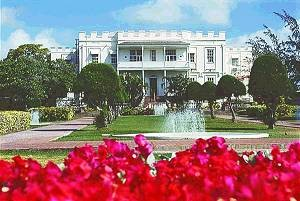
The tale of Jack Peregrine, a regency rascal to say the least, who arranges a marriage of convenience for himself to help him through a financial crisis, and then finds himself the heir to an estate in Barbados – all based on the true story of Sam Lord and his Castle (most recently a hotel in Barbados*) – who cannot resist a story of such a man (Heyer couldn’t)! First published in 1937 by Hutchinson, it gives a glimpse of Regency-era life in both London and the Colonies. Will see if it lives up to the hype… [*The property was run as an exquisite hotel for many years but unfortunately it was destroyed by fire in 2010 – it is currently being reconstructed and will open in 2018 as a Wyndham Grand Resort. The 450-room resort will feature 3 restaurants, meeting facilities and a luxury spa] – sign me up!
Sam Lord’s Castle, Barbados, pre-fire
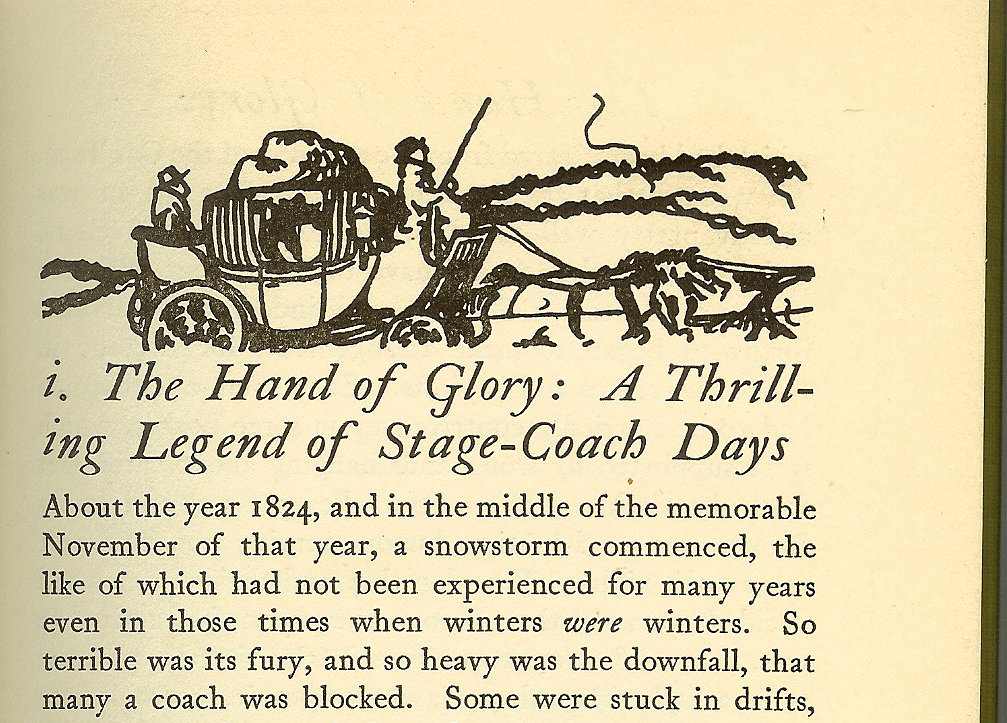
J. Fairfax Blakeborough, ed. Legends of Highwaymen and Others. New York: Frederick Stokes, 1924.
Just because I am a sucker for carriages and highwaymen tales!
(now, doesn’t that peak your interest just a little?)
Hazel Mews. Frail Vessels: Woman’s Role in Women’s Novels from Fanny Burney to George Eliot. U of London: Athlone Press, 1969.Why not? – adds to my collection on women writers – but it also had an inscription that I first thought read “Catherine Morland” and that cracked me up – heavy reading for Catherine! (it reads on close analysis “Catherine R. Harland”).
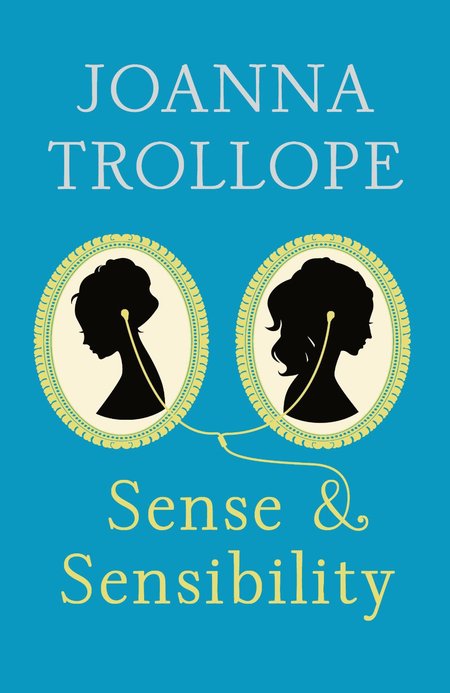
8. Joanna Trollope. Sense and Sensibility. New York: HarperCollins, 2013.
Only because I haven’t read this first of the Austen Project retellings and my Vermont Jane Austen book group has scheduled an S&S re-read this year and thought we would try this to compare…(though I know we will likely be gravely disappointed…)
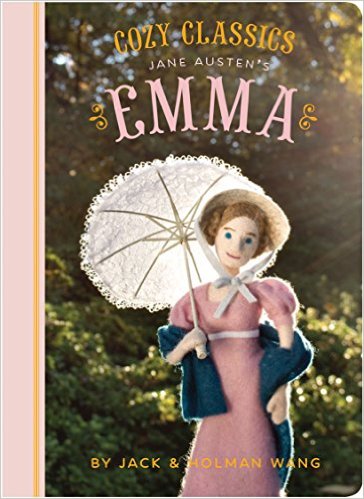
9. Jack and Holman Wang. Jane Austen’s Emma [Cozy Classics]. Chronicle Books, 2013.
This to add to my other board books, and a generous gift from the author. He attended my talk on “Illustrating Emma” and I could not have been more embarrassed to have not included this cover in my talk! (caveat: I did not include any of the covers of the many recent renditions due to lack of time – I have added them to the talk for those times where I can speak longer than the time-constrained AGM) – so with hearty apologies to Mr. Wang – this is of course a simply delightful addition to anyone’s Austen collection!
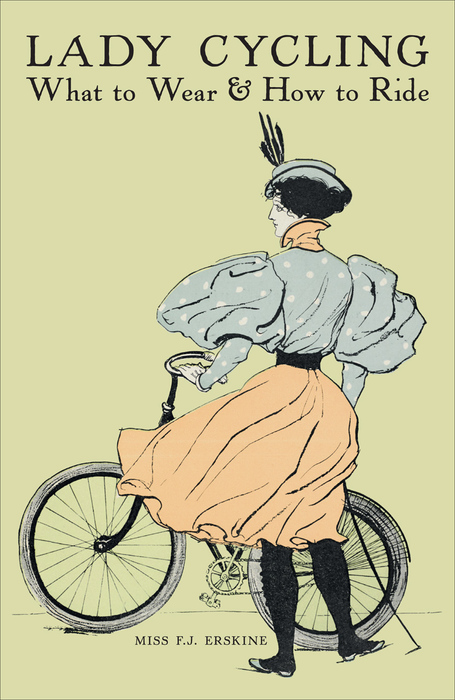
Erskine, Miss F. J. Lady Cycling: What to Wear and How to Ride. The British Library, 2014. Originally published by Walter Scott in 1897.
I have a friend who recently gave a talk on women and bicycles and my daughter is an avid cyclist – I bought this at The Folger Library shop (there seeing the simply amazing Will & Jane exhibit) as a gift but am now loth to give it away! Women and bicycles have an interesting joint history – here is a worthy account of the whole phenomenon here: http://www.annielondonderry.com/womenWheels.html
*******
So, as usual, I have my reading cut out for me – I would love to hear what YOU bought at the AGM this year…
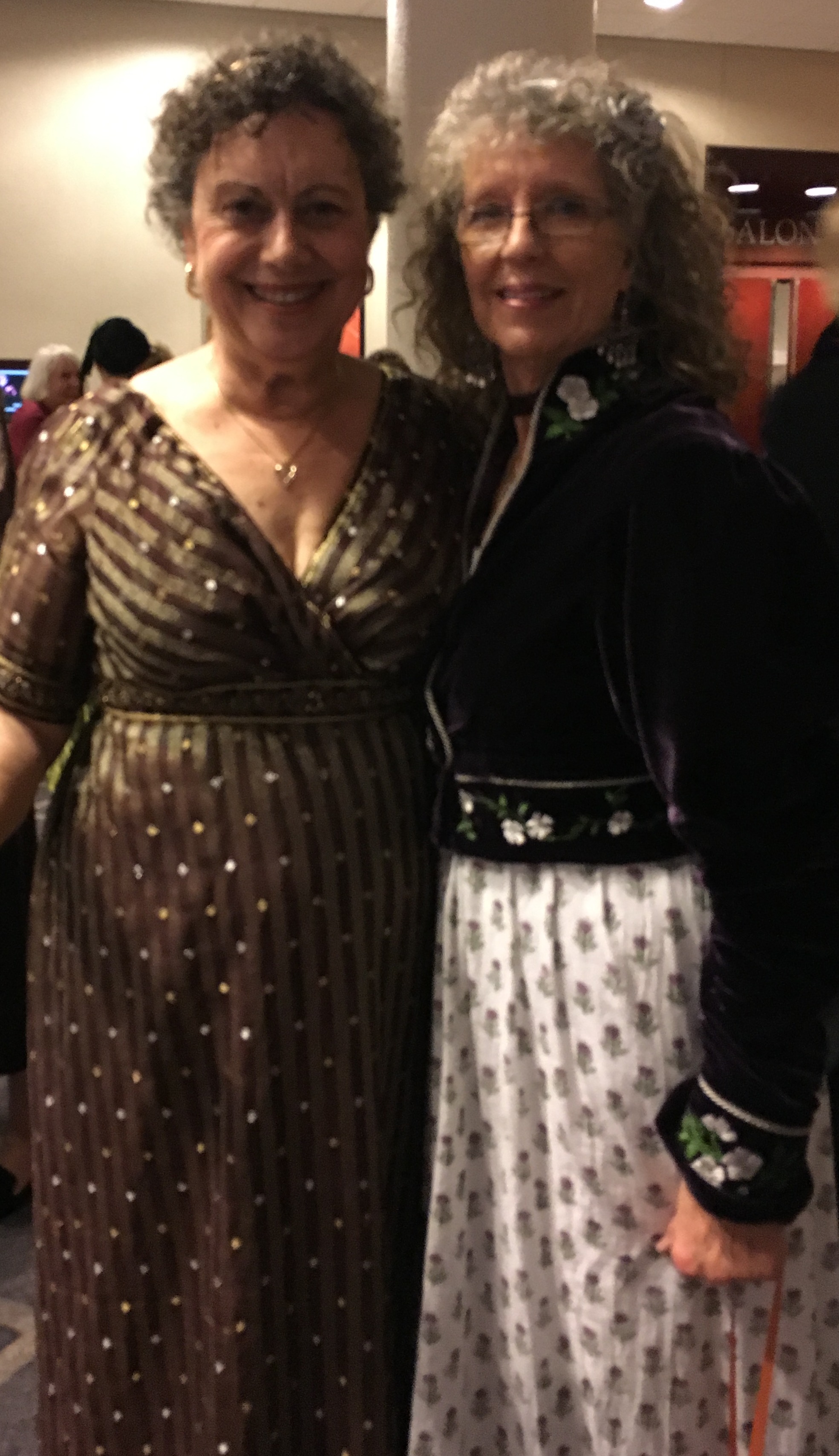
*and here is my new costume – I am with my Good Buddy Marcia, who is wearing a Regency dress for the FIRST TIME!! (we bought our fabulous fashions at Matti’s Millinery & Costumes (visit their site here and have fun shopping!)
Gentle Readers: I welcome this guest post by JASNA-Vermont member Margaret Harrington, as she offers a review of the lecture at our last meeting by Vermont author Nancy Means Wright (I would have posted this sooner, but Hurricane Matthew and the JASNA AGM last week kept me from my duties! – thank you Margaret for this write-up, and to Nancy for her terrific talk – see below for links, etc.)
**************
“Planting the Seed for the Austen Oeuvre ~
Mary Wollstonecraft and the Rights of Woman”
Presented by Nancy Means Wright,
Sept 18, 2016 to JASNA-Vermont
Nancy Means Wright
in the Morgan Room at Champlain College
When Nancy Means Wright started off her talk by saying that Mary Wollstonecraft was her alter ego, I knew an extraordinary experience was in store. Nancy brought up her own life and work experiences comparable to Mary Wollstonecraft’s, such as leaving home at a young age, coming from an impecunious family, all the while emphasizing the strength needed to keep trouble at bay. She quoted Mary Wollstonecraft’s early dictum, “I shall live independent or not at all.”
Mary Wollstonecraft, by John Opie 1790-91 (Wikipedia)
Then by using Mary Wollstonecraft’s own words in her letters, books, and beautiful illustrations in the power point presentation, Nancy projected us into a thrilling portrait of Mary Wollstonecraft as a caring young woman who made tremendous sacrifices for her family and friends. Concurrently Wollstonecraft formulated her revolutionary thought based on her own life experiences, her intellectual depth and daring, and her intolerance for sham and injustice.
The members of the Irish family with daughters for whom Mary worked as governess were elites of the Protestant Ascendancy. Only a few years older than her pupils, Mary labored to teach the girls to think. In a society which demanded that women obey their husbands and breed more Protestants, this was a revolutionary idea and eventually cost her that job.
William Blake frontispiece to “Original Stories from Real Life” (Wikipedia)
The moment when Nancy Means Wright brought up the William Blake illustrations for Wollstonecraft’s Original Stories from Real Life* was when I knew I was captured by a masterful storyteller. Step by step Wright transported me into the thoughts and feelings of the founder of modern feminism. She vividly set the scene for Mary’s time in Paris when three hundred people a day passed her window on the way to the guillotine.
I am grateful to Nancy Means Wright who wove so beautifully the tragic facts of Wollstonecraft’s life into a living tapestry. A particularly moving account of Mary’s attempt to drown herself, after being spurned by her lover Gilbert Imlay, was enhanced by Wright’s reading of her own poem which evoked the sorrow which Mary herself did not write ( leaving the task to Nancy as alter-ego).
Later, participants from the audience talked about the slender but strong connection between Jane Austen and Mary Wollstonecraft. Scholars weighed in on the lack of evidence that Austen had read or even had access to A Vindication of the Rights of Woman. There was consensus that Wollstonecraft’s work magnified our understanding of the struggles of Austen’s women who are constrained in the class system of primogeniture and who use their wits to manage the inevitable marriage plot.
Wollstonecraft wanted women to take power, not over men, but over themselves. At the same time, in Wright’s words, “She herself couldn’t balance her principles with her passion.” There are so many deep thoughts that arise from Wright’s talk on the immortal, dynamic woman, Mary Wollstonecraft.
*Full title: Original Stories from Real Life; with Conversations, Calculated to Regulate the Affections, and Form the Mind to Truth and Goodness – first published in 1788, with Blake’s illustrations in 1791. You can see all the illustrations at the Blake Archive here: http://www.blakearchive.org/exist/blake/archive/work.xq?workid=but244
Gentle Readers: Today I welcome Tony Grant as he writes about his visit this week to the “EMMA 200” exhibit at Chawton House Library, he being my feet on the ground so to speak as I am woefully not able to be there myself. Hope those of you who are able to go will do so – and send me pictures and your thoughts when you do!
[Update: please read Tony Grant’s post about walking around Chawton at the “Jane Austen’s World” Blog]
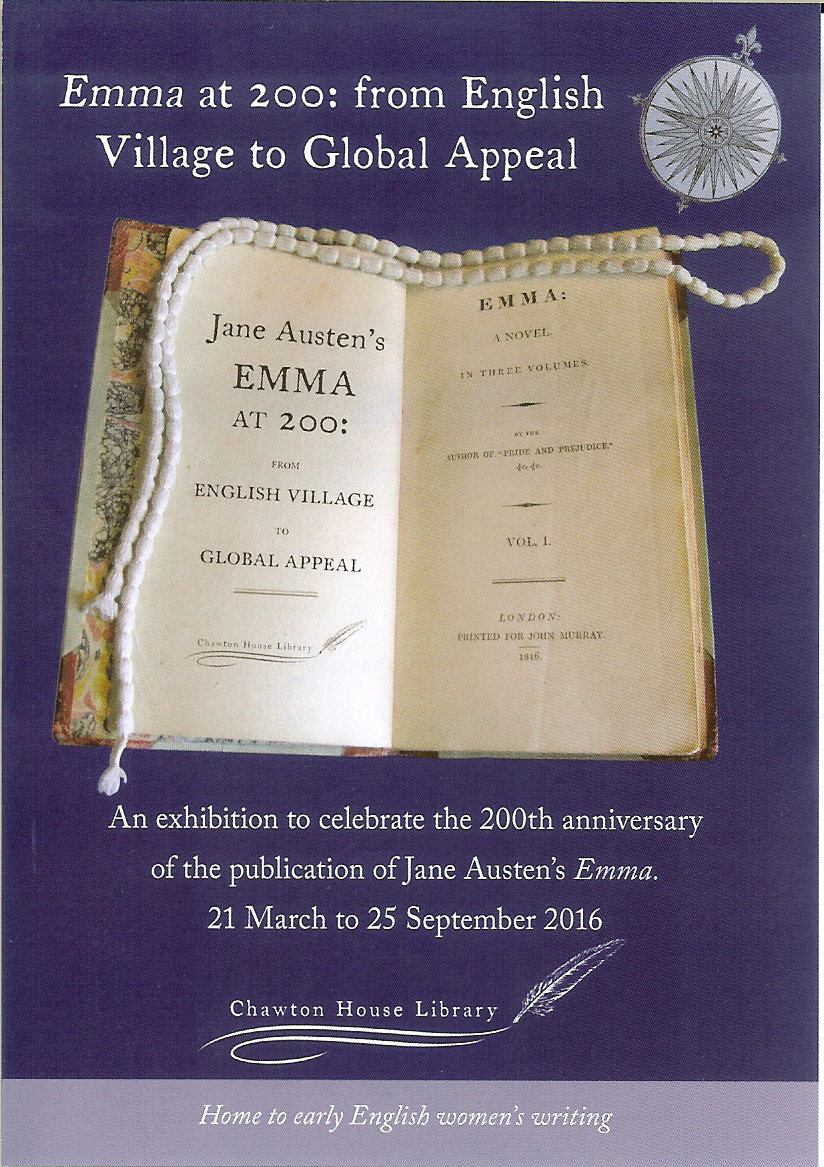
EMMA 200: English Village to Global Appeal
(Chawton House Library 21st March – 25th September 2016)
On Wednesday 20th April I drove from Wimbledon to Chawton in Hampshire over the Hogs Back with views stretching across Surrey into the distance. It was a bright sunny day and seeing the Surrey countryside green and pleasant and shining in the bright sunshine under blue skies was appropriate for my adventure. I was driving to Chawton House Library to visit the “Emma 200 exhibition.” Emma is Jane Austen’s Surrey novel and this year is the 200th anniversary of its publication and it is entirely set within that county.
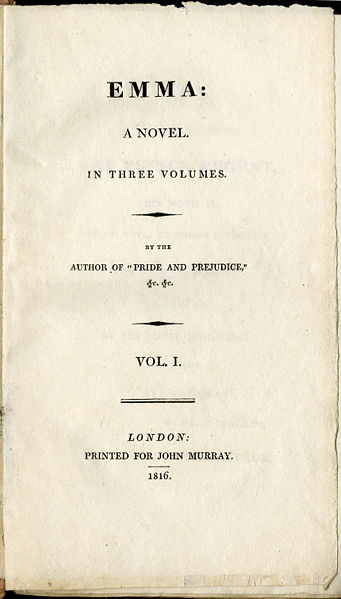
Emma was published by John Murray II of Albemarle Street on the 23rd December 1815, although its title page reads 1816. This exhibition has items from Chawton House’s own collection and from the Knight family collection, as well as other items on loan. The exhibition covers the reception of Emma through the nineteenth, twentieth and twenty first centuries; it also considers the country setting of the novel and the places that were possible influences. It covers the global appeal of Emma. It has a large section about John Murray II and nineteenth century publishing practices through letters and comments made by Jane herself and fellow authoresses also published by Murray. It highlights authors mentioned in the novel and nineteenth century ideas about female accomplishments such as music, embroidery and painting. It shows the connection with Shakespeare and has a section about the reception of the novel. In particular, there is a letter written by Charlotte Bronte to her own publisher, W.S. Williams, discussing her thoughts about Emma and Jane Austen as a writer.
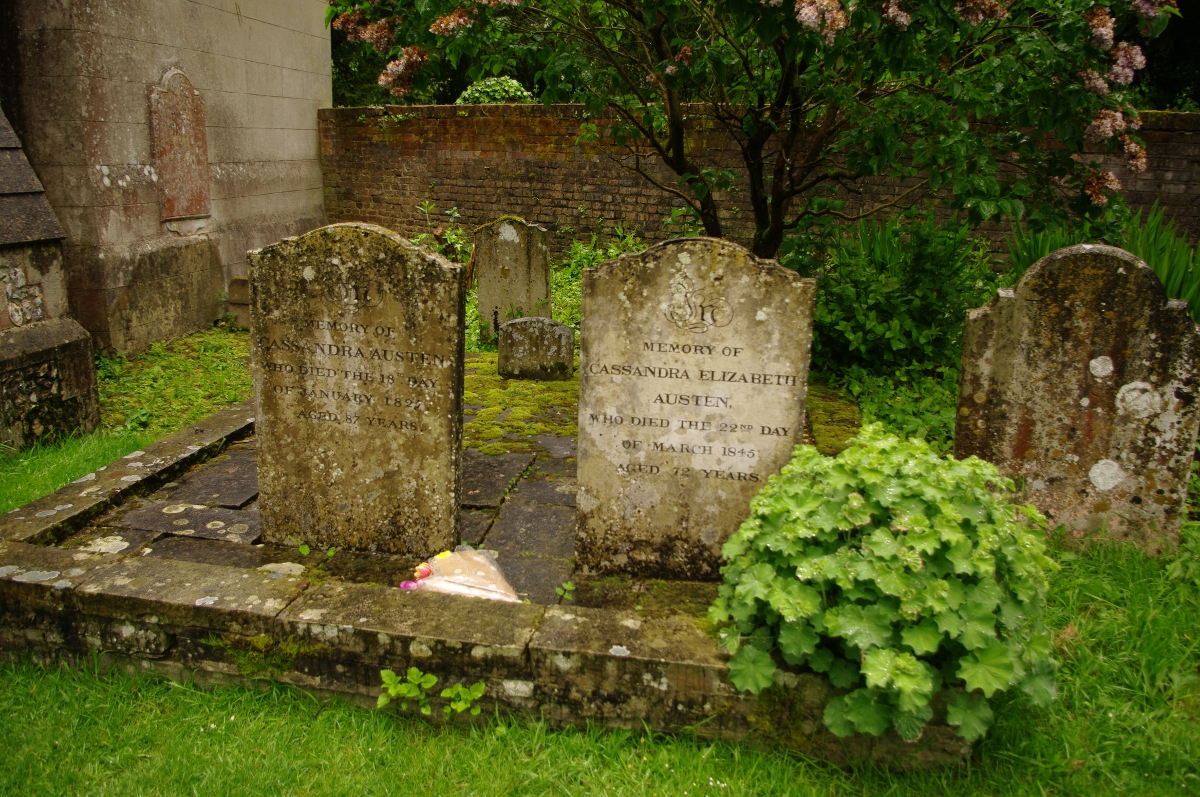
I arrived at the electronically operated gates early. The house opens at 1.30pm Monday to Friday. I was there promptly at 1.10pm. I decided to have a look around and inside of St Nicholas Church nearby, which is Chawton’s parish church and where Jane Austen and her family worshipped. The church we see today is not the church Jane knew. There was a fire sometime after Jane’s death and it had to be rebuilt, though some of the structure from the church that Jane knew remains. I read the memorials to the Austens and Knights within and then went round to the back of the church through an arbor of dark and gloomy ancient yew trees to see the side-by-side graves of Austen’s sister, Cassandra Elizabeth Austen, and mother, Cassandra Austen.
**************
Chawton House Library
It was such a nice day and I still had about ten minutes left so I sat on a stone bollard near the entrance gate and watched a gentleman sitting on a motor mower mowing the grass verges along the drive. As I sat there I noticed a smartly dressed lady leaving the front entrance of the great house with a dog on a lead. She approached the gate and opened it, placing a notice board on a stand giving the times and prices of entry. I asked jokingly if this meant I can go in. I pointed out it was still ten minutes to half past. She laughed and said by the time I walked up the driveway I should arrive at the door on time. “Just knock and they will let you in,” she told me. I knocked on the door with five minutes to and it was immediately opened by a smiling lady who ushered me in. The house is staffed by volunteers except in the kitchens where the official housekeeper keeps her domain but more about that nice lady later. I found everybody so enthusiastic and full of smiles and really, extremely welcoming. I paid my entrance fee and one lady took me into the great hall on the left of the entrance and showed me a map of the house with the route marked by numbered rooms. It is a self-guided tour so I was given the map to hold as I went round. There are volunteers in every room who you can talk to and ask information of.
**************
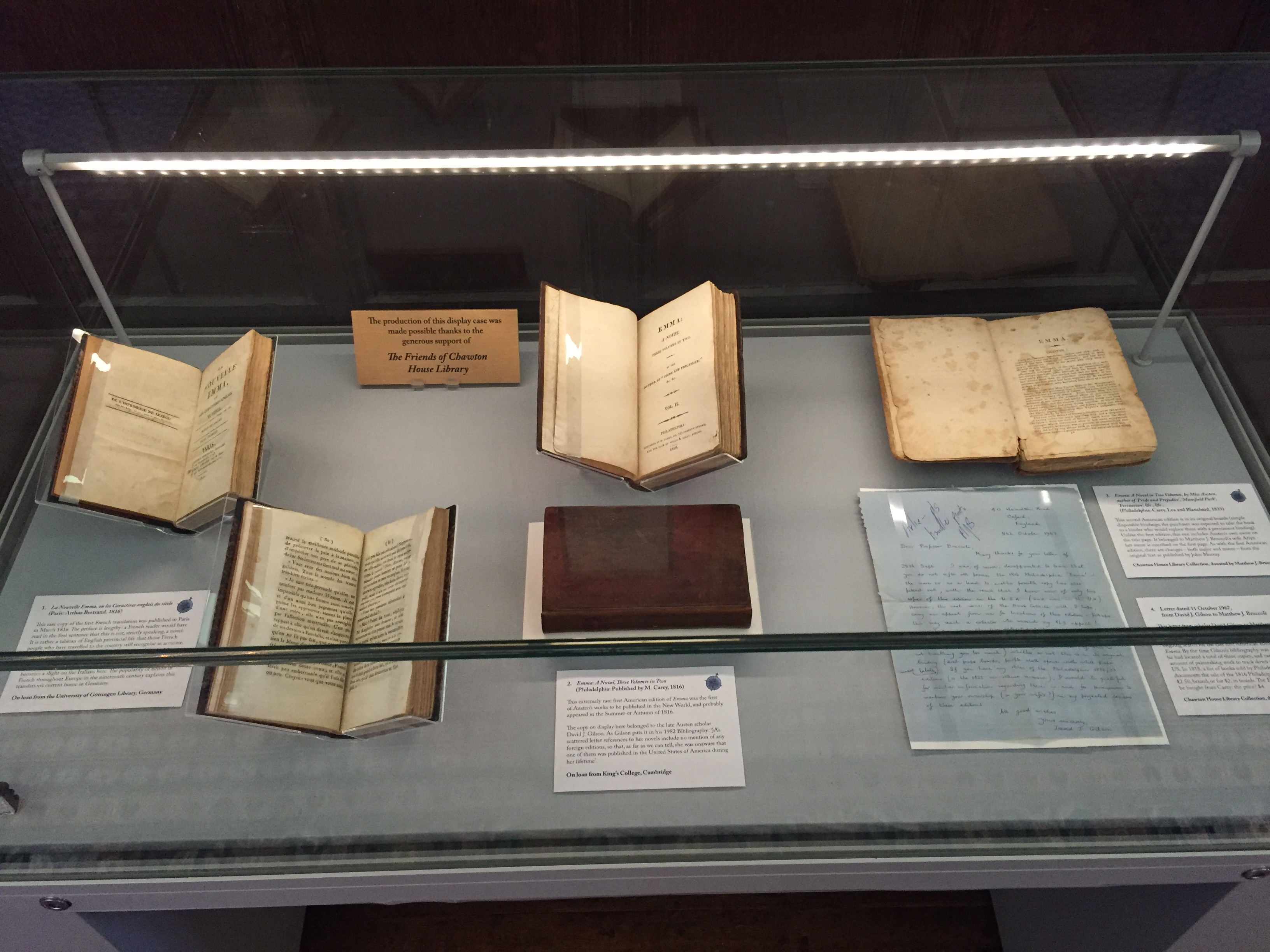
The exhibition began in the great hall. A glass case displays some first editions dated 1816. There was an edition in French as well as one published by Mathew Carey a publisher in Philadelphia. Somehow Carey had read Sir Walter Scott’s review of Emma and obviously liked it. He sold his version at a much cheaper price than John Murray’s London version. He produced a card backed version printed on cheap paper for $2. Murray’s London version, which was a much better quality, was twice the price. Very few American first editions have survived as a consequence of the poorer quality and the copy in this exhibition shows signs of much yellowing of the paper and black mold spots. It looks an inferior book to both the French and English versions. I felt honoured to able to lean over the glass case and read the opening few lines of the Murray edition.
“Emma Woodhouse, handsome, clever, and rich, with a comfortable home and happy disposition, seemed to unite some of the best blessings of existence:…”
There were no such things as copyright laws in those days and both the French and American versions, probably unknown to Jane Austen, brought her no income. Later in the nineteenth century Dickens went over to America and tried to do something about copyright laws in America but to no avail and to his great consternation. The fact that copies of Emma were being published abroad within the first year of its initial publication in England tells us something about publishing and the book trade at the time. Money could be made from books.
Emma 1st ed.
Dedication page
*****************
John Murray – NPG (Wikipedia)
John Murray II was the head of the foremost publishing company in Britain. He was a hard headed business man and if he could get an advantage, especially, it seems over the authors he published he would. I think Jane Austen had the measure of him. Her brother Henry who had dealt with publishers for Jane initially became ill and Jane took over negotiations with Murray herself. She was very direct and firm in her dealings. She said of Murray, “He is a Rogue, but a civil one.” In corresponding with Murray over the publication of Emma, for instance, on 3rd of November 1815, a month before the publication of Emma, she writes,
“…I am at the same time desirous of coming to some decision on the affair in question, I must request the favour of you to call on me here, on any day after the present that may suit you best, at any hour in the evening, or any in the morning except from eleven to one. – A short conversation may perhaps do more than much writing.”
It sounds as though Murray has been given his marching orders and she isn’t going to have any truck with being messed about. She is firm but polite with the “Rogue.” She knows the power of a face to face encounter. Some of her contemporaries were perhaps not quite so strong with Murray but learned a lesson.
Domestic Cookery, 1813 ed (Wikipedia)
One of the exhibits on display, putting Jane Austen’s publishing experiences with Murray in context, is a book called Domestic Cookery, published by Murray in 1806. It was very popular and made a lot of sales and presumably a lot of money for Murray. It was written by Maria Rundell. Rundell had been paid £150 by Murray. She regarded Murray as a friend but she was not aware at first that her book had become such a bestseller. When she found out she felt that Murray was not upholding the copyright agreement he had with her. Eventually Murray paid her £2100 but kept the right to continue publishing the book himself. Jane Austen’s comments about him being “a rogue but a civil one” come to mind. Murray was obviously a very astute business man and could make money from trouble.
Another exhibit displays copies of books written by the French authoress, Germaine de Stael. She wrote books about Rousseau, Revolutionary Politics and Marie Antoinette’s trial. She was virtually banned by Napoleon Bonaparte. He had her book, De L’Allemagne pulped. Murray saw a chance. He took her on. In 1813 he used three printers to publish the French original and English translations simultaneously. He relied on anti-French feelings to make Stael’s books best sellers.
Madame_de_Staël (Wikipedia)
Jane Austen had her critics who made both good and not so good comments about her work. She took notice of what people said about her books and noted down these various opinions. Sir Walter Scott, her illustrious contemporary, who was also published by John Murray, wrote of Emma,
“We bestow no mean compliment on the author of Emma, when we say that keeping close to common incidents, and to such characters that occupy the ordinary walks of life, she has produced sketches of such spirit and originality that we never miss the excitation which depends upon a narrative of uncommon events, arising from the consideration of minds, manners and sentiments greatly above our own.”
Sir Walter Scott (Wikipedia)
It appears that Murray regularly sent copies of newly published books to other writers he published for their comments. This can be seen as eliciting positive comments from people who wanted to keep in with Murray. Jane Austen mentions in her letters to Murray how thankful she is for the copy of Waterloo he sent her to read and actually asks him if he has any more she can have a look at. This suggests she knows how to play the publishing game. She is as astute as Murray himself it seems. In one way Scott’s positive comments could be read as keeping in with Murray. If Murray and his publishing house does well and sells lots of books it can only benefit himself after all, but there is more to Scott’s review. I think he has recognized what is original in her writing. She is a realist. Her style is about everyday common occurrences and everyday people and she makes them heroic. People reading Jane Austen can see themselves and people they know in her writing. It is said that reading a novel is good emotional and psychological therapy, and Austen hit a powerful vein.
Charlotte Bronte (Wikipedia)
The highlight of the whole exhibition for me, even more so than seeing and reading a first edition, is the actual letter Charlotte Bronte wrote to her publisher, W.S. Williams, on April 12, 1850, in which she writes a lengthy paragraph about her thoughts on Jane Austen and Emma. I found it easy to read Bronte’s small, thin, precise handwriting that flows clearly across the page.
“I have likewise read one of Miss Austen’s works—Emma—read it with interest and with just the degree of admiration which Miss Austen herself would have thought sensible and suitable. Anything like warmth or enthusiasm—anything energetic, poignant, heart-felt is utterly out of place in commending these works: all such demonstration the authoress would have met with a well-bred sneer, would have calmly scorned as outré and extravagant. She does her business of delineating the surface of the lives of genteel English people curiously well. There is a Chinese fidelity, a miniature delicacy in the painting. She ruffles her reader by nothing vehement, disturbs him by nothing profound. The passions are perfectly unknown to her; she rejects even a speaking acquaintance with that stormy sisterhood…”
Bronte continues:
“What sees keenly, speaks aptly, moves flexibly, it suits her to study; but what throbs fast and full, though hidden, what the blood rushes through, what is the unseen seat of life and the sentient target of death—this Miss Austen ignores. “
And she goes on. Charlotte Bronte is actually agreeing with Scott’s comments when he describes her writing as
“……close to common incidents, and to such characters that occupy the ordinary walks of life”
The difference is that Scott makes his view a positive while Bronte makes her view a negative. I agree with what she says. Austen writes about the ordinary. Bronte on the other hand and her sisters wrote about,
“what throbs fast and full, though hidden, what the blood rushes through, what is the unseen seat of life and the sentient target of death”
Charlotte Bronte is actually describing the differences between their two styles. I have read articles published on some blogs where the writer tries to pit Charlotte Bronte against Jane Austen. Who do you like the best? Who do you think is the better writer? And so on. These are a childish approach to comparing two great writers. Two geniuses. Their styles are different. Every one of us reads different types of books for different reasons at different times to fit, very often , our different moods. We can read a poem by Wordsworth one day and on other days a romantic comedy, a ghost story, a swashbuckling adventure, a horror story or maybe a present day thriller. We can enjoy each genre for what it is and what it brings to us. Austen and Bronte are not enemies, they are not one better than the other. They are different and we can enjoy both. I can imagine how Bronte could be critical. She had a harder life than Jane Austen. Her novels and those of her sisters, were full of passion and deep feelings and filled with great moral uncertainties testing the moral status quo to the limit. Their ideas made their lives worth living and helped them live their short lives with feeling. Jane Austen had a much easier existence. I can see how Charlotte Bronte might not understand Austen’s standpoint. She probably could not bear to live the way Austen’s characters are portrayed. However, we can love them both.
The exhibition demonstrates many of the influences Jane Austen might have used in her writing of Emma. There is the suggestion, for instance, that the fictional places Highbury and Hartfield in Emma are modelled on Chawton and the local town Alton. These are in Hampshire but the novel is set in Surrey. Others I know would not agree. Some say Leatherhead in Surrey, which is near Box Hill, a major location in the book. Others suggest Highbury is a generic English village, and I think this more likely.
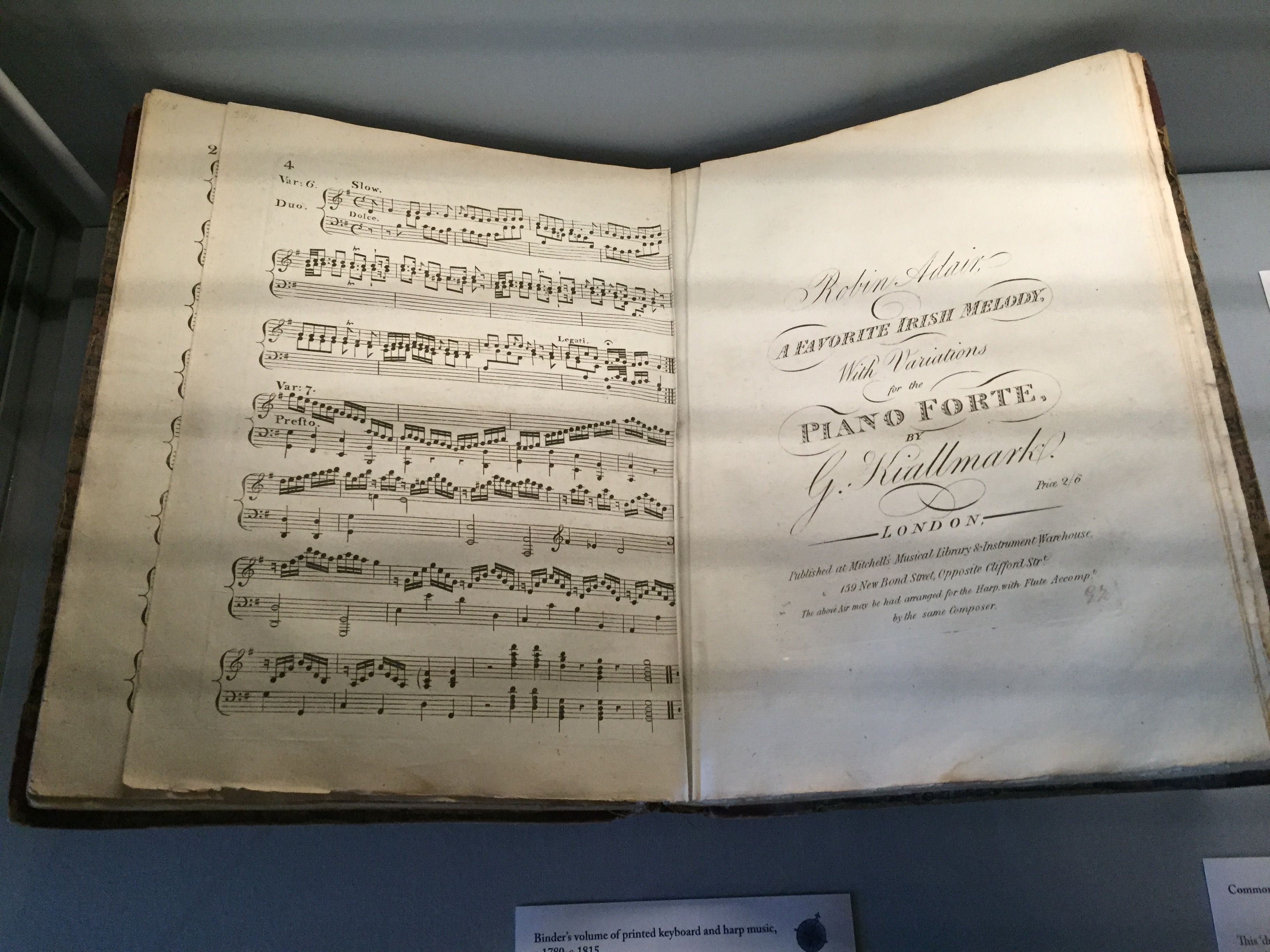
In Emma Jane Fairfax plays a tune called “Robin Adair” on the newly arrived pianoforte. There is on display a copy of “Binder’s volume of printed keyboard and harp music, 1780-1815,” annotated and autographed by Jane’s sister Cassandra. It includes the music to “Robin Adair.” [Ed. You can read this online here: https://archive.org/details/austen1677439-2001 ]
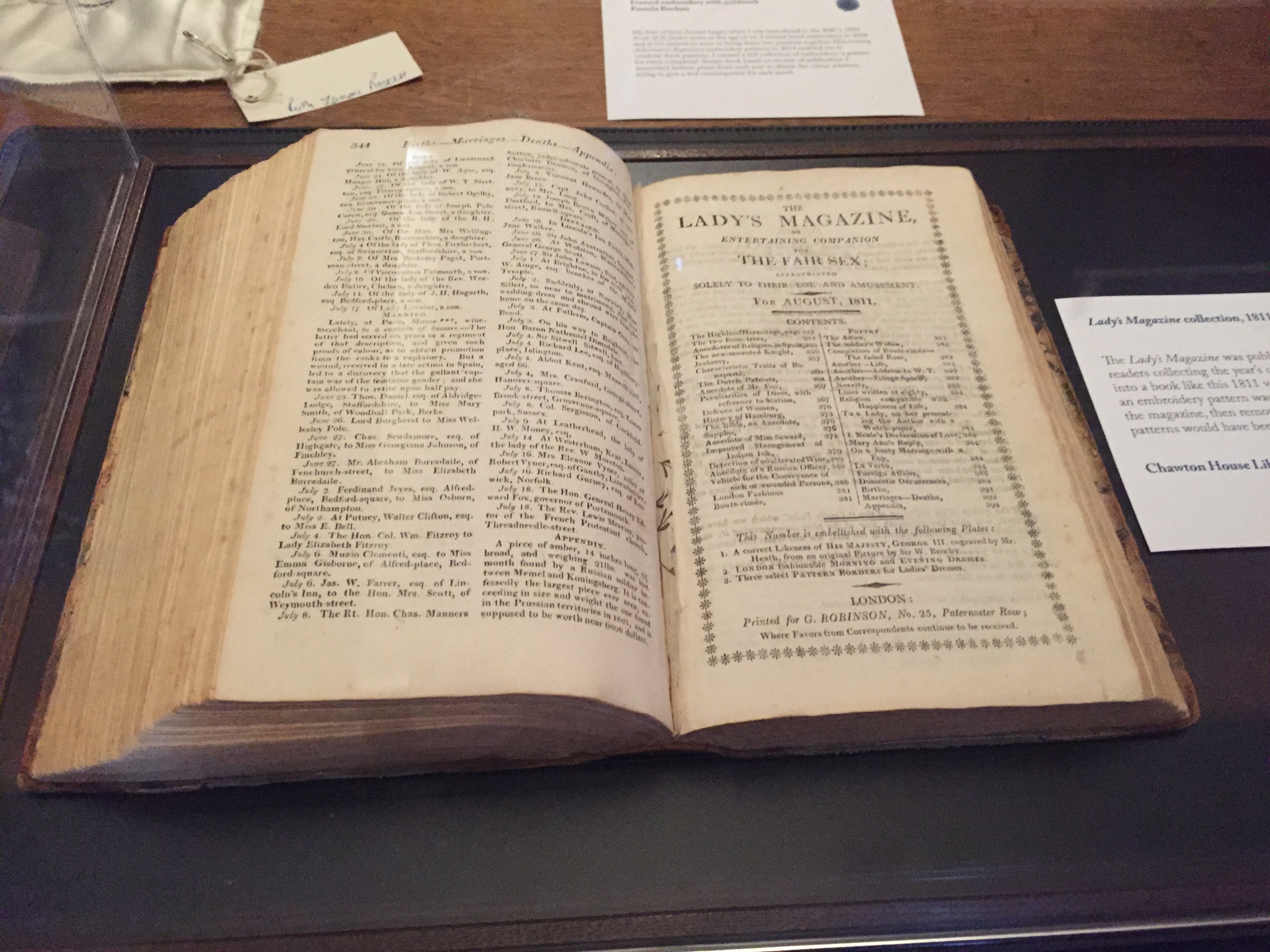
There is a bound set of The Ladies Magazine (1770-1832) which provides sewing patterns for young ladies. It is the sort of magazine that Jane Austen had access too. In Emma, sewing and painting are pastimes for young ladies.
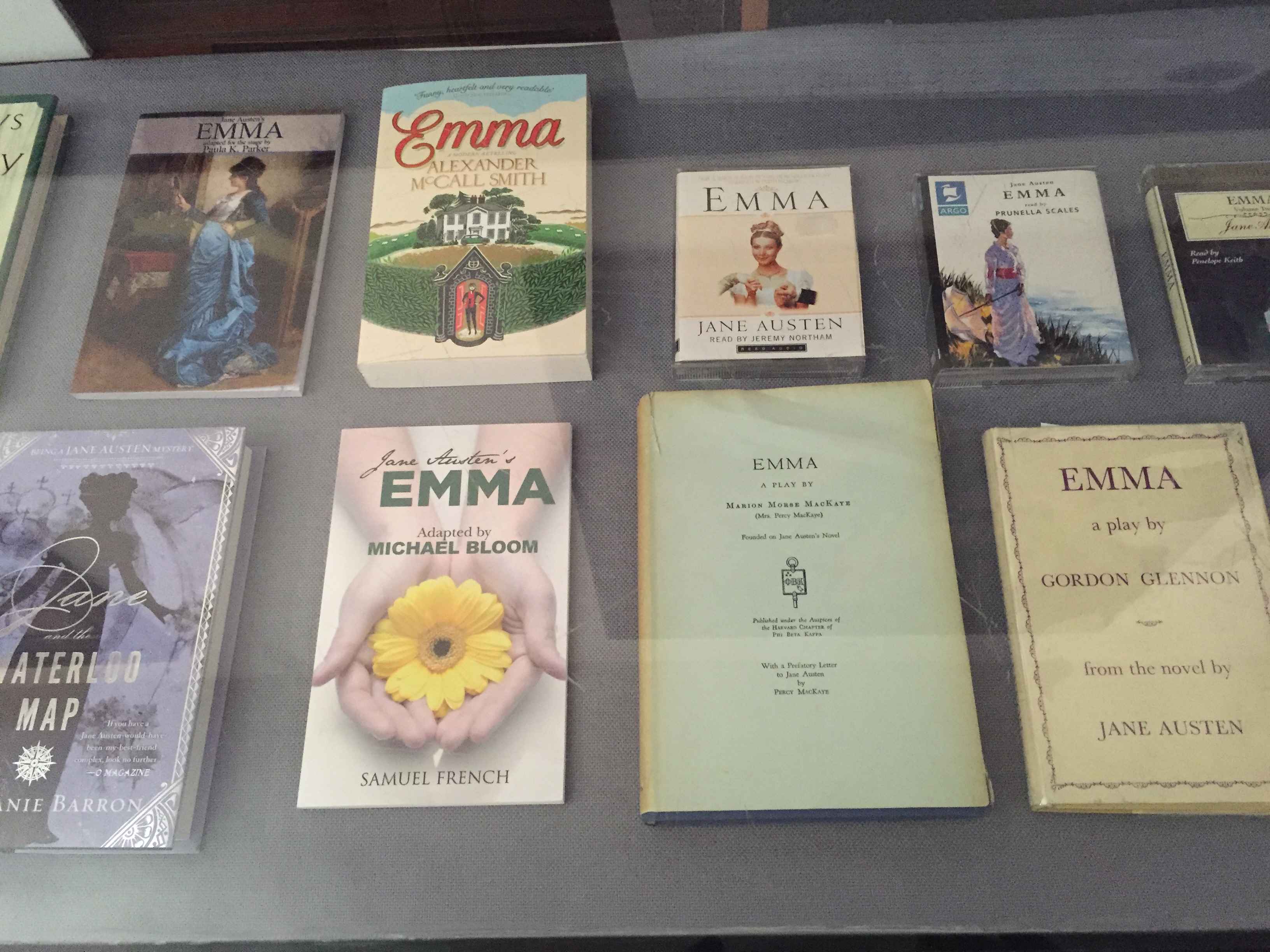
A final display cabinet shows the influences that Emma has had on culture over the centuries. There are various spin-off novels, including the latest modern version of Emma written by Alexander McCall Smith. There are play scripts written by various playwrights turning Emma into a stage version. These include plays by Gordon Glennan and Marion MacKaye. There are a number of radio adaptations. One read by Prunella Scales, another by Jeremy Northam. There are the film versions and the films influenced by Emma such as Clueless set in modern times. Spin-off novels are represented by a copy of the latest Stephanie Barron mystery The Waterloo Map. [Ed. Note that this latest Barron mystery has Jane visiting Carlton House where she meets with the Prince Regent’s Librarian – this all really took place on 13 November 1815; he “suggests” that she dedicate her newest book, Emma, to the Prince Regent – Barron has her also coming upon a dead body in the Library…]
****************
The exhibition is definitely worth seeing and just as much is the opportunity to walk around Chawton House where Jane Austen herself and her family lived and breathed. I also took the opportunity to take a walk in the gardens. I came across a snake lying across my path as I walked up to the walled gardens. I must tell you that in all my life I only recall seeing two other snakes in Britain in the wild. This was a grass snake and was totally harmless. The adder is the only poisonous snake in Britain and they are very shy creatures. I think I saw one once in the New Forest.
*************
“Portrait of a Lady” at CHL
The people who volunteer at Chawton are wonderful. They want to talk to you and tell you things. I had a very amusing moment with an elderly gentleman volunteer at the top of the great staircase. He was sitting on the landing. When I approached he showed me an information leaflet and we discussed its contents. One thing it mentioned was the original William Morris wallpaper. I looked around and couldn’t see any. “Well, then where’s the wallpaper?” I joked. He laughed and said “come with me.” We walked half way down the staircase and then turned and got on our hands and knees. There indeed, almost hidden behind the balustrade, was a patch of darkened William Morris print. He also kindly showed me the large 1714 map of London displayed on the folding panels of a screen.
We found Henrietta Street and other places associated with Jane Austen when she visited London. Then I went into the old kitchen which is used as a shop and cafe and met a lovely lady who told me she was the housekeeper. I had a delicious chocolate cake and a cup of coffee. All together I had a wonderful visit to the “Emma 200 exhibition.”
Orlando, the subscription database from Cambridge University Press on “Women’s Writings in the British Isles from the Beginnings to the Present” – is available for free for Women’s History Month thoughout March.
The Orlando Project “provides entries on authors’ lives and writing careers, contextual material, timelines, sets of internal links, and bibliographies.”
If you are wondering about the symbol of the Oak Tree, here is the explanation from the website:
“. . . a little square book bound in red cloth fell from the breast of her leather jacket—her poem The Oak Tree.” —Virginia Woolf, Orlando
Virginia Woolf’s Orlando, a Biography, 1928, inspires this work in literary history. Woolf’s biographical and historical fantasy explores the changing conditions of possibility for women writing in England from the time of Elizabeth I to her own day, and gives us a poet protagonist who is at work throughout the whole of this history on the composition of her poem “The Oak Tree”. The Orlando Project team sees in the oak tree a suggestion of the history of women’s writing in the British Isles, the growth of history from biography, and (in a kind of visual pun) the tree-like structure of our text encoding.
Fabulous resource – spend the month indulging in this feast of information!
Very Exciting news just in! Sandy Lerner, the force behind the turning Chawton House, home to Jane Austen’s brother Edward Knight, into the Chawton House Library, has been awarded an Honorary OBE – “honorary” being the term for the OBE presented to a non-UK national [read here about the OBE, Order of the British Empire]. Here is the info on the event and celebration that took place yesterday at Chawton House!
CHL Founder Awarded Honorary OBE
for Services to UK Culture
Award recognises importance of our unique Library of women’s writing
Today at Chawton House Library a very special event took place: our founder and Chairman, Dr Sandy Lerner, was awarded an Honorary OBE.
As a foreign national, the award of an OBE by Her Majesty the Queen recognises the significance of Dr Lerner’s cultural contribution to the UK in restoring the house an estate and establishing the Library. Although such awards are usually recognised at the British Embassy in the recipient’s country of residence, when Dr Lerner was first advised of the award over a year ago, she requested permission to delay announcing the honour and wait to be presented with the award at Chawton House Library itself.
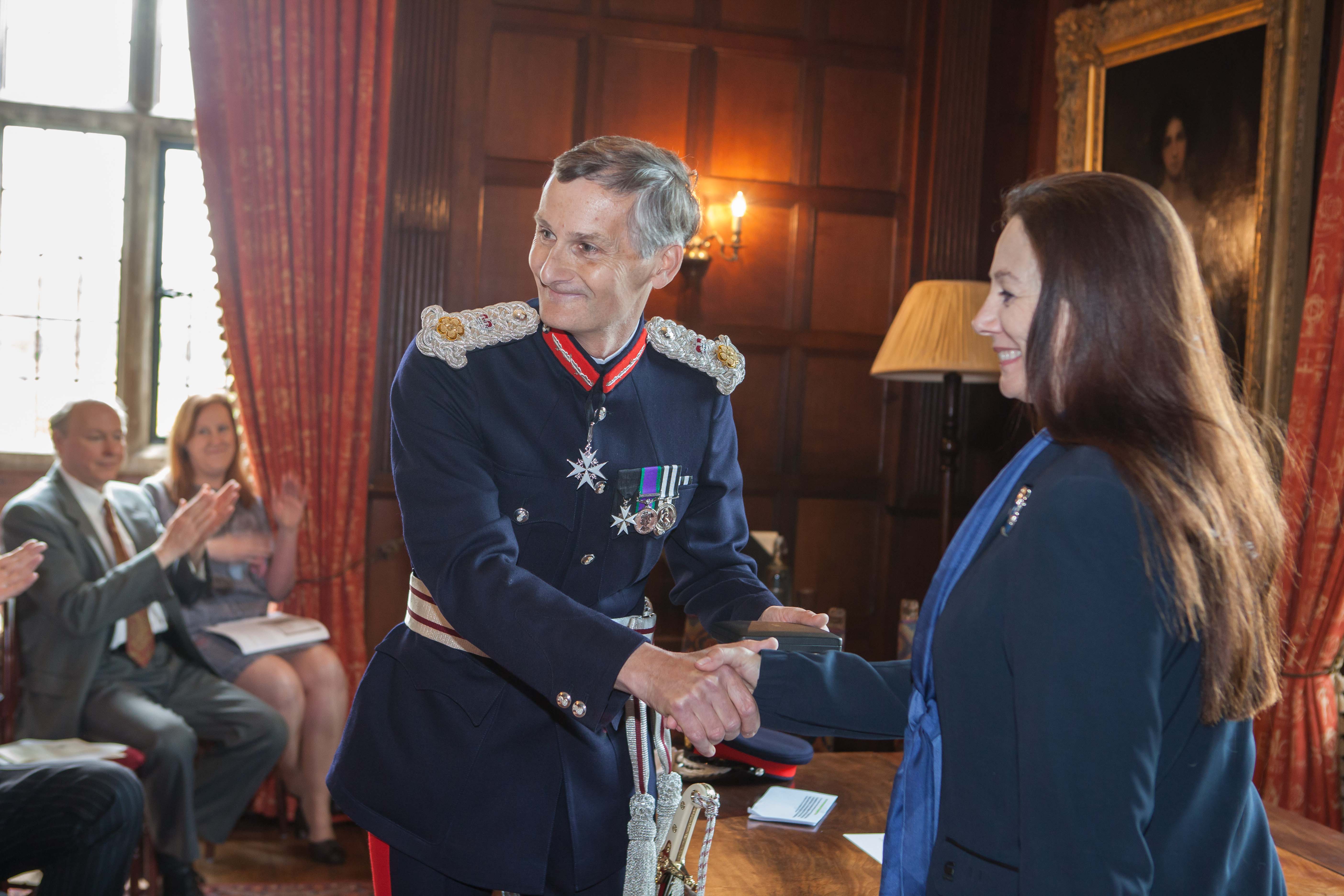
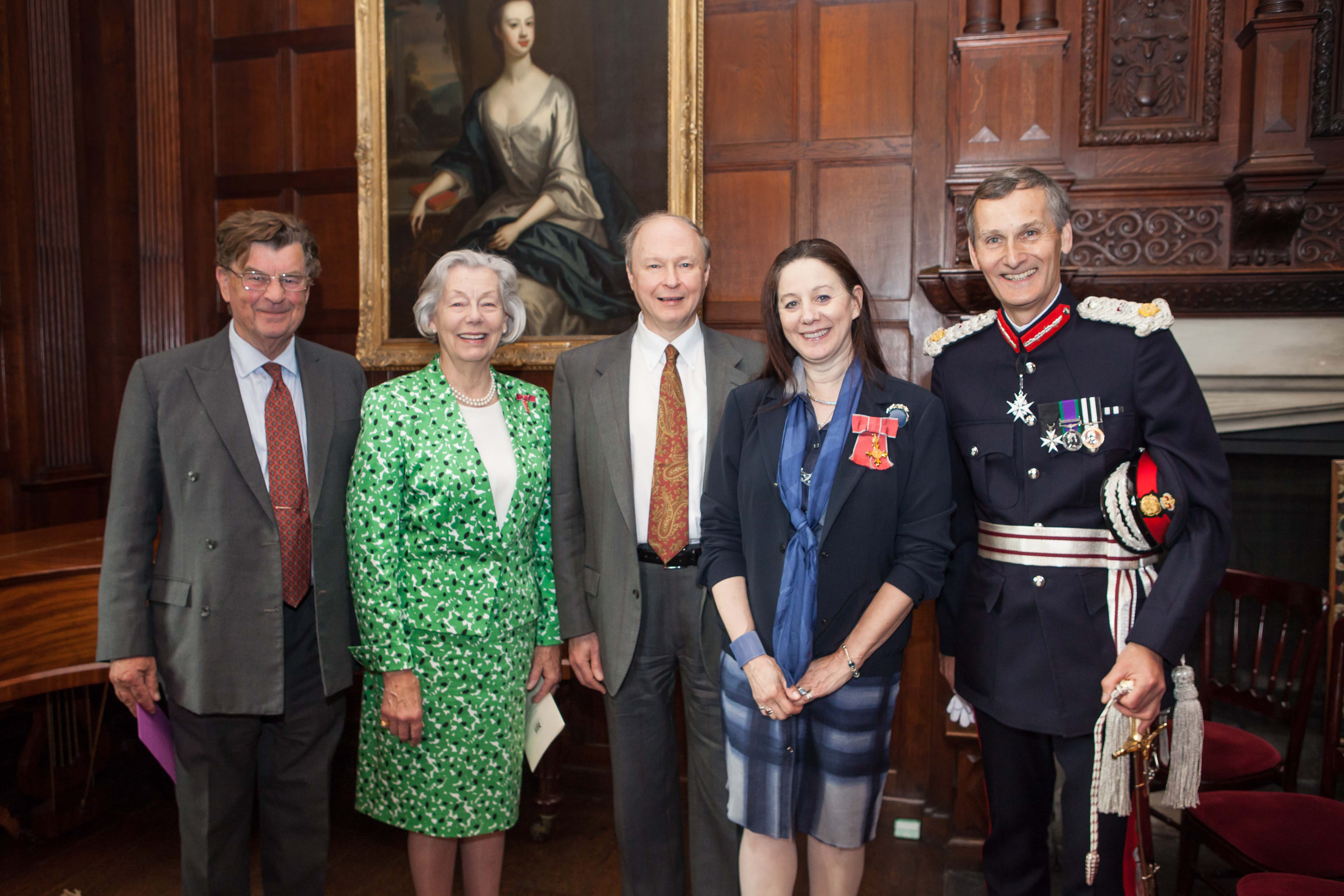
Hampshire’s Lord-Lieutenant, Mr Nigel Atkinson Esq, presented the award to Dr Lerner in the Dining Room where Jane Austen would have dined with her brother, Edward. Dr Lerner, like many avid readers, loves the work of Jane Austen.
And here are two pictures from yesterday’s celebration:
Hampshire’s Lord-Lieutenant, Mr Nigel Atkinson Esq, with Sandy LernerCHL Board of Trustees Members Richard Knight (descended from Edward Austen Knight), Gilly Drummond, and Len Bosack with Sandy Lerner and Nigel Atkinson
[Images courtesy of Chawton House Library, with thanks.]
We were very fortunate at JASNA-Vermont to have had Sandy visit us for our December tea in 2012 – she spoke about her book Second Impressions, a sequel of sorts to Pride and Prejudice. Here she is signing her book for our member Thierry Guerlain:
All our members here in Vermont send our hearty congratulations to Sandy! – a very much deserved award for all her efforts on behalf of Jane Austen and the many other women writers too long neglected. They all have a “home of their own” at last.
*****************
You can learn more about supporting the Chawton House Library by visiting their “Get Involved” page. You can:
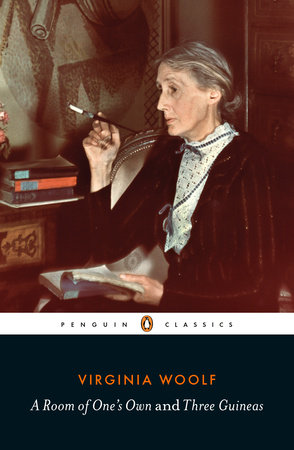 A ROOM OF ONE’S OWN by Virginia Woolf was first published in 1929. Woolf was invited in 1928 to give a talk to the female undergraduates at Girton College, Cambridge on the theme of women and fiction. She came up with the title for her talk as, A ROOM OF ONE’S OWN. The premise of her argument was that women needed a room of their own and time to write, provided by an independent income. Virginia Woolf suggested £500 a year.
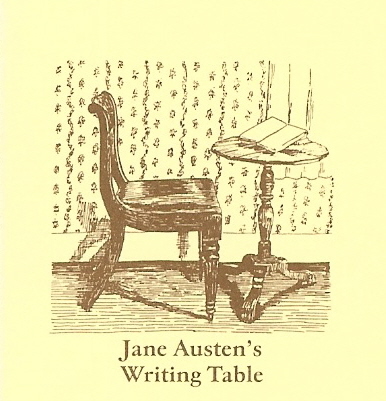 Nowadays there is a sort of worship and fan cult associated with Jane Austen. Virginia Woolf would be bemused and not understand this I think. Austen is a great writer, especially in exploring the relationships between men and women which is acutely highlighted in her writing because of the patriarchy of the 18th and 19th centuries.













 4. Susannah Fullerton, Amanda Jones, and Joanna Penglase, ed. Georgette Heyer: Complete to a Shade: A Celebration. JASA, 2016.












 Jane Austen in Vermont
