Gentle and Fun-Minded Readers: today I welcome Vanessa Paugh, creator of Pride and Prejudice RPG*, a mind-challenging Jane Austen-related game for your iphone. I have downloaded it, but alas! have not had the time to really become “accomplished” [one must practice as Elizabeth so wisely reprimands herself and Mr. Darcy] – but I invite you to read what Vanessa has to say about why she created this game – you can find it at the iTunes store for 99c – try it out and let me know how you fare! – and Thank You Vanessa for sharing your game with us today!
[*for the uninitiated: RPG = role-playing game]
*****************************
Pride and Prejudice RPGis a musical, fashion role playing game based on the first part of Jane Austen’s novel. The player becomes Elizabeth Bennett and strives to complete the accomplishments that will lead her to Mr. Darcy. There are four sections in the game: Pianoforte, Hertfordshire, Shoppe and Closet.
In the Pianoforte section, the player earns musical note points by practicing classical songs.
The player uses the notes in the Hertfordshire section to complete accomplishments such as “suffer Mother’s nerves” and “ascertain a blue coat” and to earn fortune points.
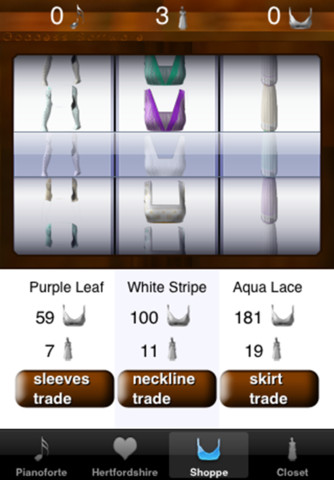
The Shoppe section allows the player to buy parts with her fortune that can be used to make gowns in…
…the Closet section. The more gowns the player makes, the more accomplishments she can do and finishing all the accomplishments wins the game.
With Pride and Prejudice RPG, the player can enjoy literature, fashion and music, and painlessly improve her math skills at the same time.
Pianoforte section
The primary reason that I created Pride and Prejudice RPG was to ultimately increase the numbers of women in Science Technology Engineering and Math (STEM). As Ghandi said, “be the change you want to see.” Studies have shown that many gamers become interested in STEM from curiosity about the inner workings of the games they play. Subsequently, they want to make games themselves and eventually choose programming or other STEM fields as careers. In addition, when many women see how technology can solve problems which interest them, they realize that STEM fields don’t have inherent gender association.
Currently, many concerned woman are debating the best methods to increase the numbers of women in STEM. Some say that gender neutral toys, clothes, media and attitudes are the only way to go. Others are trying the girly geek route with perfume chemistry sets, pink Legos, computer engineer Barbie and glamourous magazine style math books. The problem comes when these groups forget the goal and end up fighting each other. STEM fields don’t have to be limited by gender and cultural gender norms don’t have to limit careers in STEM fields. According to Kim Tolley’s research, in the 1830’s, Americans debated whether women could study classics, because many “experts” thought they should continue to study science. In 2005, Americans debated whether woman could study science because some “experts” thought they should continue to study classics. It’s time to take the gender limitations out of academics, period. I hope Pride and Prejudice RPG is one step in that direction. It includes literature, musical math, historical fashion and creative experimentation. These are the four main subjects that we require all students to learn: Language Arts, Mathematics, History and Science. When roadblocks are removed and encouragement is not withheld, woman can learn all of them.
Although I had played many computer games, I never considered becoming a game designer until I heard about Brenda Laurel and Purple Moon’s “Rocket’s New School.” Janet H. Murray’s “Hamlet on the Holodeck” inspired me to read all of Austen’s work and start turning “Pride and Prejudice” into a game. I was enlightened by Sherri Graner Ray’s “Gender Inclusive Gaming” and investigated redesigning traditional violent gameplay into other game playing mechanisms. Talking with Julienne Gehrer, the developer of thePride and Prejudice board game, inspired me to focus on selecting the genre of the game first. Emma Campbell Webster’s “Lost in Austen” confirmed my research that a role-playing game would be the most appropriate genre. I was also inspired by the mommy iPhone game company Appsnminded and intrigued by some iPhone task based RPGs, which led me to discover the right game mechanisms to trade narrative accomplishments for violent acts. A post on Balancing Jane’s blog gave me the idea to combine music and math. And after reading Peggy Orenstein’s “Cinderella Ate My Daughter” and debating on Reel Girl’s blog, I refined Pride and Prejudice RPG’s presentation, so that it was more about accomplishment and less reflective of cultural gender biases.
Hertfordshire section
I started designing my Pride and Prejudice game in 2004 with girls in mind, continuing in the footsteps of the girl games movement from ten years before. However, at the Women’s Game Conference in 2004, I heard a woman ask when games that reflected her fantasies would be addressed by the game industry. A man on the panel dismissed her question, so I started focusing on software for women. My research predicted that Jane Austen readers who hadn’t played games might try my game if the text was fairly literal. It also indicated that gamers who hadn’t read Austen might read her work as a result of playing a literal Pride and Prejudice game. Realizing that there had been a lot of debate among women over video game violence, I excluded weapons, stereotypes, and moving targets from my game. I also left out timed challenges, timed energy replacement, and long written passages from Pride and Prejudice RPG to make it more fun for novice gamers.
Shoppe section
Closet section
The current version of Pride and Prejudice RPG covers the first part of Jane Austen’s novel up to the end of the Meryton Assembly. In future updates, I want to add accomplishments for Elizabeth’s adventures in Kent and Derbyshire, and important events such as refusing Mr. Collins and Mr. Darcy. I also plan to include more challenging songs, and of course, Elizabeth will need more shoes, gowns and bonnets. If women who play my game and love it let me know, I will be very glad to hear from them. However, I really challenge anyone who wishes Pride and Prejudice RPG were different to seriously consider making her own game. There are only three other electronic Jane games out there so far: Matches and Matrimony, Rogues and Romance, and Hidden Anthologies. There are millions of Jane Austen fans and thousands of openings in STEM fields waiting.
About the Author:
Dr. Vanessa Paugh is a college professor and indie game developer in Dallas, Texas.
She holds a Bachelor’s in Electrical Engineering,
an MFA in Arts and Technology and a Ph.D in Aesthetic Studies.
Images and text courtesy of Vanessa Paugh, with thanks!
Hello all! Today I have invited Vera Nazarian, now a Vermonter!, and author of a series of supernatural novels that expand upon Jane Austen, to write a little something about her latest book Pride and Platypus: Mr. Darcy’s Dreadful Secret – whatever would Jane think you might ask? – well for the next two days you can download Vera’s latest book onto your kindle for free [details below] – so give her a try, the least one Vermonter can do for another! I look forward to having Vera speak to us at one of our future gatherings, so stay tuned!
*********************
Greetings, Gentle Vermont Janeites!
I am thrilled to be here, and to be able to say that I am now a proud Vermont resident. I would like to introduce myself as the Harridan—ahem—the author and illustrator of the Supernatural Jane Austen Series of books, which are witty and hilarious (and slightly insane) fantasy parodies of our beloved Austen classics.
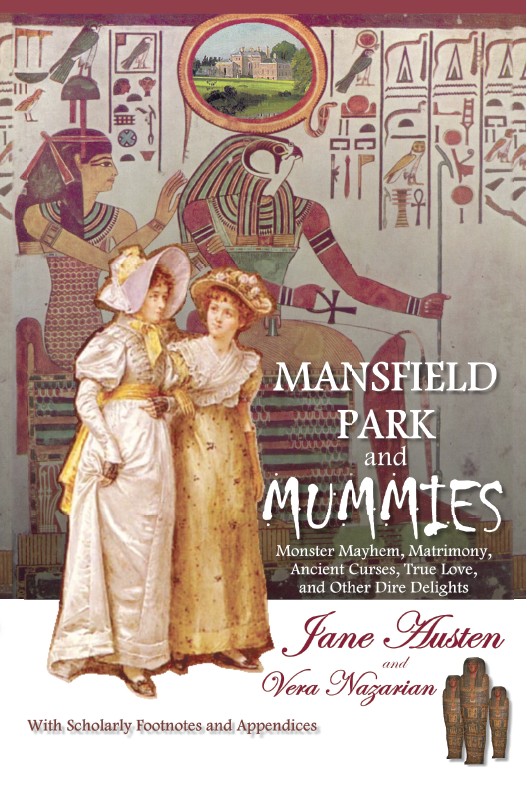
The books in the series so far are Mansfield Park and Mummies, Northanger Abbey and Angels and Dragons, and, my most recent release this June—the third book, Pride and Platypus: Mr. Darcy’s Dreadful Secret.
I look forward to getting to know you better and sharing all kinds of things (such as the true nature of the Brighton Duck—you do know about this infernal and mystical duck, right? No? Aha! Stay tuned!). But today I will be brief and just let you know that if you’ve never had a chance to read any of my books yet, and have no idea who I am, well, this is your lucky day. . . .
Because you can try one of my books for free!
Yes, absolutely free on Amazon Kindle all this weekend, and until midnight on August 12th, is none other than Pride and Platypus: Mr. Darcy’s Dreadful Secret!
And even if you do not own a Kindle, you can easily grab a free Kindle Reader App for your PC, Mac, smartphone, or other online device here, and then read the novel on pretty much anything short of an Etch-a-sketch!
Enjoy the free book with all my compliments! And be sure you are sufficiently equipped (and properly attired) to survive the effects of unbridled laughter!
When the moon is full over Regency England, all the gentlemen are subject to its curse.
Mr. Darcy, however, harbors a Dreadful Secret…
Shape-shifting demons mingle with Australian wildlife, polite society, and high satire, in this elegant, hilarious, witty, insane, and unexpectedly romantic supernatural parody of Jane Austen’s classic novel.
The powerful, mysterious, handsome, and odious Mr. Darcy announces that Miss Elizabeth Bennet is not good enough to tempt him. The young lady determines to find out his one secret weakness—all the while surviving unwanted proposals, Regency balls, foolish sisters, seductive wolves, matchmaking mothers, malodorous skunks, general lunacy, and the demonic onslaught of the entire wild animal kingdom!
What awaits her is something unexpected. And only moon, matrimony, and true love can overcome pride and prejudice!
Gentle Reader—this Delightful Illustrated Edition includes Scholarly Footnotes and Appendices.
***************************
And now, here is a bit more word-of-mouth about the novel, including “authentic testimony” from the splendid mouth of Mr. Darcy himself:
REGENCY ERA PRAISE FOR…
Pride and Platypus: Mr. Darcy’s Dreadful Secret
“A sufficiently pleasing literary trifle. Only, might one be kind enough to explain why a certain gentleman constantly finds himself in wet shirtsleeves for no apparent reason?” —A Gentleman of Impeccable Attire
“I require an introduction to this Mr. Darcy, in all haste. Does the gentleman possess a male unattached sibling? Preferably, with a proper beastly Affliction, in place of what the gentleman himself suffers?” —A Lady of Elegance
“An outrage indeed! My own person and relations, to be thus referenced in this vile compendium of vulgarity! Why, this is not to be borne! Also, I recommend emu oil for polishing wooden surfaces.” —A Certain Lady of Rosings
“I would have it known that, in my present condition, I am not altogether concerned with pollution.” —A Shade of Pemberley
“There is entirely no excuse for the unseemly public behavior of some people’s gauche relations. I have returned this distasteful tome to the Lending Library, and shall henceforth endeavour to forget all of which I have inadvertently read in one sitting.” —A Gentleman of Distinction
“I have been placed in numerous sequels, adored and worshiped by millions, scrutinized, analyzed, satirized, undressed, dressed again and soaked in various water reservoirs, and parodied in every manner possible, but never quite so audaciously as in this tome!” —Mr. Fitzwilliam Darcy
“The gentleman with the satirical eye is being entirely too modest. Furthermore, for inexplicable reasons, he has also been seen in more wet shirtsleeves than all the Royal Navy on the high seas and the House of Lords after a London downpour, and I am yet to understand the mystery behind it.” —Miss Elizabeth Bennet
“QUACK!” —The Brighton Duck
***********************
Pride and Platypus: Mr. Darcy’s Dreadful Secret by Jane Austen and Vera Nazarian
Trade Paperback (First Edition): Curiosities (an imprint of Norilana Books) June 15, 2012
Retail Price: $16.95 USD – £12.50 GBP
ISBN-13: 978-1-60762-078-5 ISBN-10: 1-60762-078-2
500 pages
*************************
About the Authors:
Jane Austen is an author of classic immortal prose.
Vera Nazarian is a shameless Harridan who has taken it upon herself
to mangle Jane Austen’s classic immortal prose.
Hello Dear Readers: a guest post today from Melody, a young woman on her first adventure at the Jane Austen Festival in Louisville, Kentucky last weekend – she has shared her thoughts and several pictures of the her time there, so enjoy – and perhaps plan to go next year – she highly recommends it!
****************************************
The Louisville, Kentucky fifth annual Jane Austen Festival was held at Locust Grove. I wasn’t aware of the history behind this historical house. The home belonged to Maj. William and Lucy Clark Croghan. When George Rogers Clark was injured, Lucy invited her brother to stay at Locust Grove. So who is George? He was the older brother of William Clark, (who was part of the Lewis and Clark expedition), he founded Louisville, and quite a few other notable things important to the nation.
This is the North facing side of Locust Grove. It has a nice size porch. The south side, which I would think
visitors would enter wasn’t as grand imo.
One of the notable items in the house that stands out is the fact the descendants painted over a regency era portrait. Apparently they felt the red dress was gaudy and a black dress was painted on. This was found out in the restoration and they put back to the original regal red regency dress.
The portrait that was painted over
Another fascinating fact was the entertaining parlor was on the second floor, where today, upstairs is reserved for family and entertaining is done on the main floor or possibly even the basement for those who have one.
The entertaining parlor on the second floor
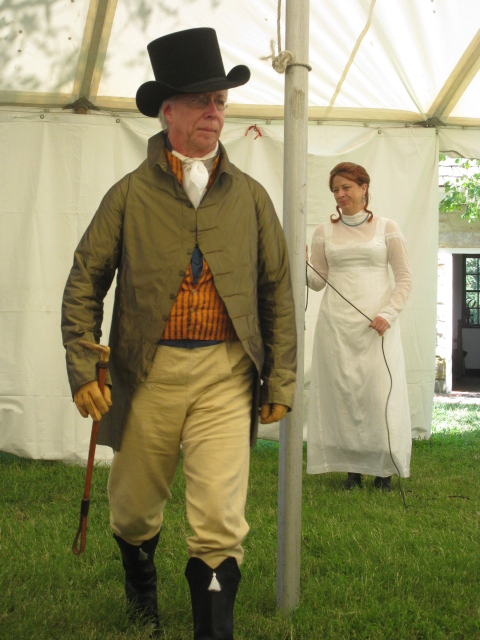
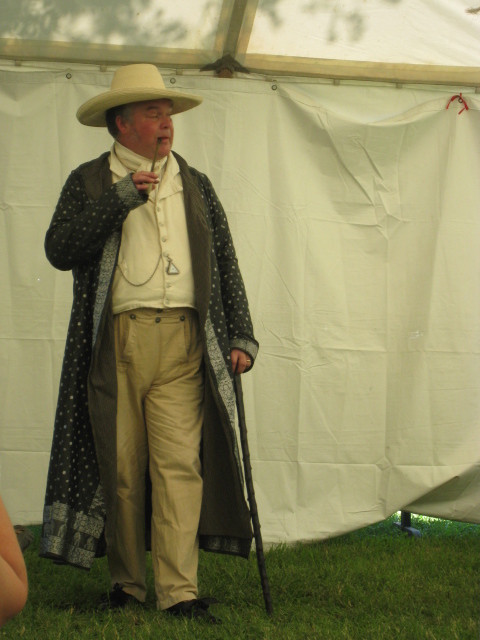
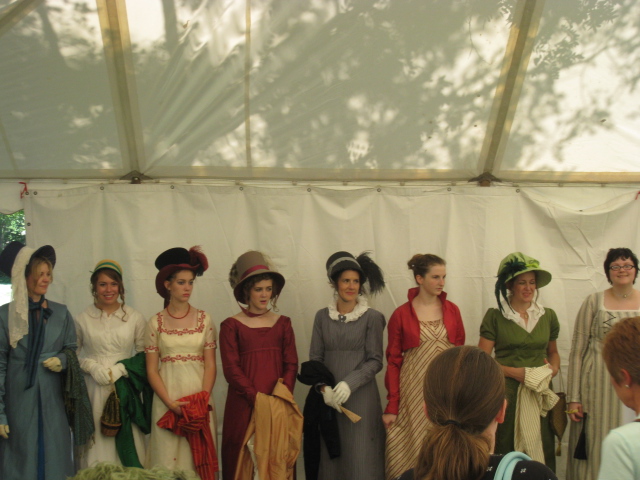
Now for the Jane Austenites that want to hear about the festival. There were a great many visitors dressed in period reproductions that were all amazing! There was even a Regency style fashion show. The clothes were delicious and went in order according to the years they were popular. The speaker gave information on the clothes and where to find the patterns. Who knew men carried fans? The women carried cute reticules, wore pretty hats or had dainty parasols, and of course wore gloves, either long or short. The men were dashing in their finery as well.
This lovely lady is a member of JASNA
with loads of information.
She was also in the fashion show.
Tailored/fitted clothing for a man
(something that was mentioned during the fashion show was women
didn’t seem to be as concerned with gaping or perfect fits as we are today)
A man’s banyan
I loved the detail in this purple dress. (same lady as above]
Now don’t think for a moment that this is an event purely for women. NO! There was a Gentleman’s duel. I do not know what caused the men to find it necessary to shoot at each other, but the first man to fire was the man to die. It was over within a minute. The gentleman remaining had been injured in the shoulder and was quite irked with the doctor for spending so much time with the dead man saying, “stop spending so much time with the dead man and tend to my wound!” (the duel the next day lasted longer than a minute).
Gentleman’s duel
There was also a bare knuckle boxing match that women obviously would not have attended. Or at least not women of any gentility. The ring leader gave the history of the gambling of the sport and the numerous exchange of money as the odds would change throughout. When he removed a pad of paper from his pants he wrote names and odds of the betting men. The winner of the boxing match had won a substantial amount of money.
There were fencing lessons and a demonstration on riding side saddle. It was very important what horse a gentleman rode. It reminded me of the status of the type of car one drives. There were special pay classes for how to paint a fan, and two discussions. On Saturday evening there was a ball, but since my companion is just 9 we forego that event.
Side saddle demonstration
If you made reservations ahead of time there was afternoon tea. I recommend the lavender cake for dessert. It was deliciously moist and not overly powerful in taste.
Dr. Cheryl Kinney discussed Jane Austen’s illness and Jane’s opinion of illness and her characters’ woes. Who knew that green dresses were toxic?! It wasn’t just the clothing, but wall paper and paint as well. Green was very fashionable at that time too. Dr. Kinney asked how many people were wearing green at the event; there were quite a few! (of course they didn’t need to worry about the copper arsenic).
The final event on Sunday was “Dressing Mr. Darcy.” However, it was in reverse and he ended in a state that could make a grown woman blush. There was quite a bit of fanning happening in the audience.
Dressing Mr. Darcy
Finally, what made the event so special were the people. Everyone was so nice and the vendors were helpful. One young lady took the time to show my son a Spanish pistol’s workings with the full knowledge we were not going to buy. She even showed him how to salute with a rifle British style and American style.
One of the vendors made marbled papers that were amazing. After each one people would ooh and ahh. Of course everyone is unique. I was able to speak to the vendor on the last day and he showed me an antique book someone had given him with the marbling technique on the outside, inside, and on the edges of the pages. But the coloring was more indicative to the Victorian era, (darker, not as pretty as the Regency era).
The children gathered together and had their own fun in the meadow playing sword fights and just plain running around. I asked my son what his favorite parts were and after thinking about it he replied, “playing with the kids and the vendors.” I was surprised. What kid enjoys shopping?
If you ever get the chance to attend a Jane Austen festival, I highly recommend it.
***********************************
About the Author ~ Melody writes:
Jane Austen came into my life, because I love history; the manners, fashion, and lifestyle. I also happen to be a book enthusiast and I like that Jane Austen tells things to the reader that makes the reader think. You must read between the lines, she doesn’t just come out and molly coddle the reader. Truth be told, I’d never been to a Jane Austen festival. I didn’t even know they took place. My son and I decided to give it a go, only because they offered so many fun “guy” events. I would not have gone otherwise. We are both happy for the adventure. We may make a tradition of it. Perhaps in period reproductions next time.
*****************************
Thank you Melody for sharing with us your observations of the Festival – maybe I will see you there next year myself!
Further Reading: from the Locust Grove website
You can see a performance of the bare-knuckled boxing here.
Ron Dunning has asked me to update this blog post to reflect changes to the RootsWeb WorldConnect family trees, which were retired on 15 April 2023. Ancestry.com, which owns the RootsWeb site, has promised to migrate the WorldConnect genealogical collection to a new free-access site later in the year. Ron asks that you be cognizant that none of his own research is available at present, though his website janeaustensfamily.co.uk, and its component, Akin to Jane, has not been affected. The hope is that once the migration of the genealogical collection is complete, all will fall back into place – including many additions and corrections which had not been available on the old WorldConnect site. Please email Ron if you have questions.
*****************
Some of you may be familiar already with the Ancestry.com Jane Austen Family Tree created by Ronald Dunning. It is quite the amazing compilation of ancestors and descendants of “Dear Aunt Jane” – a resource for Austen fans and scholars alike the world over.
So we are happy to announce that Mr. Dunning has continued with his Austen genealogical work and his new and improved website is to be “unveiled” at the Jane Austen Society meeting tomorrow (21 July 2012) at the Chawton House Library [an article about the history of the website will appear in the next JAS Report] – details of the meeting are here: http://www.janeaustensoci.freeuk.com/pages/AGM_details.htm.
The link to the new website is here: http://www.janeaustensfamily.co.uk/ where you will find new content, the complete transcribed text of the manuscript of Akin to Jane, and links to the original RootsWeb site noted above [see below for information on how best to access the data.]
Ron has been very kind to answer a few of my questions about how and why he took on this monumental research project, so hope you enjoy learning more about it – then you must take some time to search the database – it is great fun to poke around in when you might have an extra minute or two on any given day – you might even find that somewhere deep in the listings some of your very own relatives share a connection to Jane!
********************************
A hearty welcome to you Ron – with thanks for sharing with us the history of your website!
JAIV: What prompted you to get involved with this Austen family research project to begin with?
RD: I grew up in Toronto, a city, and a wonderful city it is, whose civilised history only goes back for two centuries. All of my grandparents were English, but the thought of having interesting ancestors would have seemed too ridiculous to entertain. My paternal grandmother was the sort who wrote regularly to every English member of her and my grandfather’s families, and was always nattering about their current situations. In 1972, aged 25, I left Toronto to find work as a classical musician, and the idea of going to England, where there would be a ready-made family, was deeply appealing. Just before my departure, my grandmother told me that we had some sort of connection with the Austens, though she didn’t know what.
We must have been almost the only branch of descendants who’d lost sight of it! I was pleased to be able to tell her, before she died, that Frank Austen [Jane’s brother] was her great-great-grandfather. It was difficult to get much further back than that in the 1970s, so I gave up the search to get on with work, and to raise my own brace of descendants. In 1998 my wife bought a computer for our kids and, Luddite that I am, I grumbled and scowled in the background – till I thought that I might just see what it’s like.
I was soon drawn back to family history. The kids were old enough that they preferred neglect to parental attention, though we did meet occasionally to fight over whose turn it was to use the computer. At the time I thought that it would stand to reason that the Austen genealogy had been exhausted, so for the next five years I worked through the seven non-Austen great-grandparents’ lines, and just copied the charts in the backs of Jane Austen biographies.
When that was thoroughly exhausted I was addicted, and needed a fix! Simultaneously it became evident that the authors of the biographies had all copied the family charts from one another, and there was a lot further to go. In particular they mainly recorded the male lines, dishonouring the women. I’ve found that not just Cassandra Leigh but George Austen too had eminent ancestors, which means that their records go back, potentially, to the beginning of recorded history.
Now I have a lifetime’s supply of fixes, and in retirement, a full time job. Do not call it a hobby. And don’t say that I’m obsessed. Oh well, all right, perhaps I am. This study means a lot more to me than just a growing collection of names – it makes me feel organically connected, not just to the Austen family (and I don’t feel at all proprietorial about Jane) but to the whole of English history.
JAIV: Tell us something about Joan Corder and her manuscript, Akin to Jane – how and when and where did you first come upon it – what a find! – and why did she not publish her research?
RD: Joan Corder was born and lived through her life in the English county of Suffolk. She served as a young woman, during World War 2, in intelligence as a plotter, then moved back home to look after her widowed mother. She didn’t marry. Over the course of her life she became a distinguished herald and genealogist; Akin to Jane was her first big project.
It was to her enduring disappointment that she couldn’t interest a publisher – so only two copies of the manuscript were made. One was presented to the Jane Austen Society and can be seen at the Jane Austen’s House Museum at Chawton, where it has been, presumably, consulted by most if not all of Jane Austen’s later biographers.
With use, the manuscript has become increasingly fragile; people still visit the Museum to inspect it. My Austen cousin Patrick Stokes scanned the work to help preserve it for posterity, and it’s his scans that are displayed on the website. The museum curator is pleased that she can now refer interested parties to the web, and retire the original.
[Ron says on the website: “I would like to acknowledge and thank my Austen cousin, Patrick Stokes, who first brought the manuscript of Akin to Jane to my attention, and gave me a copy.”]
Joan Corder
JAIV: What, of all the discoveries in your research, surprised you the most?
RD: So many discoveries! They constantly amaze, but no longer surprise. I’ve been making a list, and intend to write articles about them. Here is a sample and though many of them seem improbable, they are all true.
Direct Ancestors
1. William IX, Duke of Aquitaine. William was a leader of the 1101 Crusade. He is best known today as the earliest troubadour – a vernacular lyric poet in the Occitan language – whose work has survived. Grandfather of Eleanor of Aquitaine, and Jane Austen’s 19th-great-grandfather. 2. Owain Glyndwr, Prince of Wales. Shakespeare’s Owen Glendower. Jane’s 13th-great-grandfather.
Owain Glyndwr – the BBC
3. John King, Bishop of London, from 1611 (the year of the King James Bible) to 1621. John King ordained John Donne. Jane’s 4th-great-grandfather.
John King, Bishop of London (1611-1621)
4. Faith Coghill, the wife of Sir Christopher Wren. The 1st cousin once removed of George Austen.
5. Lizzie Throckmorton, the wife of Sir Walter Raleigh. A distant cousin of Cassandra Leigh.
6. Katherine Leigh, the wife of Robert Catesby, the Gunpowder plotter, another distant cousin.
7. Both of Jane’s parents were descended from royalty. Cassandra was descended from John of Gaunt, the son of Edward III, so every previous English king, back to William the Conqueror, and some beyond, was her ancestor. For George we have to go back two generations further, to Edward I.
8. Some Scottish royalty – the real-life Duncan I of Scotland who was either murdered by his cousin, the real-life Macbeth, or killed in battle against him. Macbeth, as we know, succeeded him as King. Duncan was Jane’s 21st-great-grandfather.
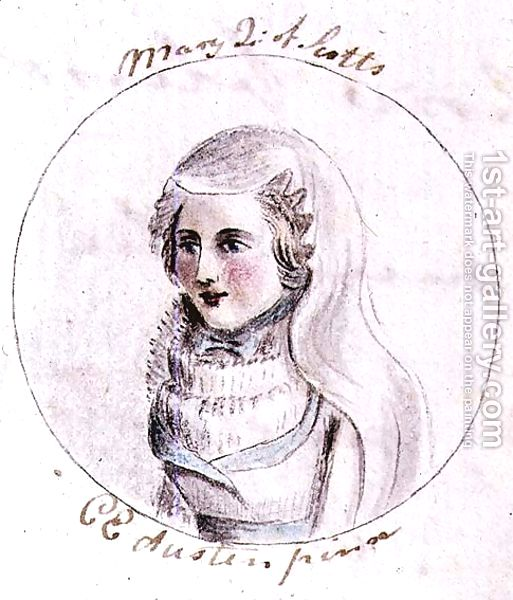
9. By the way, we all know from Jane’s juvenilia that she “preferred” Mary Queen of Scots to Queen Elizabeth. Well – not only was she related to both, but in Jane Austen’s Sailor Brothers she is quoted favourably comparing her brother Frank with Queen Elizabeth.
Cassandra Austen’s Mary Queen of Scots – The History of England
JAIV: This is all wonderful!But I must ask, any real gossip – things hidden for generations?
RD: Ooh – I’d be banished from the family if I revealed any of those!
JAIV:Oh, but the story of Elizabeth and Herbert is quite an interesting one! All hidden from the family and worthy of a Victorian novel! – or at least akin to the writers of Victorian novels, as the lives of Charles Dickens and Wilkie Collins can attest! [see below for the link!]
JAIV: Where do you go from here?
RD: I began the web project thinking that I would be producing a revision of Akin to Jane , but it eventually became obvious that the plan was unworkable. I want the reader to be drawn to my research, and not to think that Joan Corder’s work was the end of it. She managed to record a little over 300 of George and Cassandra Austen’s descendants, and gave ancestors no attention. My genealogical database contains more than 1200 descendants – that is, another 900 – and another ten thousand people, who include ancestors, collateral families, and families of social connections. The address of that, by the way, is http://wc.rootsweb.ancestry.com/~janeausten.
There is a link beneath each individual in Akin to Jane to that database, but in the long run I plan to organise things better. I’ll spend next winter learning the html to create a proper design (you won’t know it, but the current one is improper), and intend to do wondrous things with a sidebar. That will take care of technicalities. I have only just begun thinking beyond the current content, and have decided that I will add more original family history source material. I believe that one can jinx plans by talking about them too soon, so I’ll do that when I know that the material can be used.
JAIV: Is there a book in the works?
RD: I’m sorry. No book. Articles, yes. Though I’ve really enjoyed building the Jane Austen’s Family website, it has absorbed an immense amount of time – time taken away from research, my first love.
Thank you Ron for joining us here today! [well, really you are at the JAS meeting at the Chawton House Library, and I am here in Vermont, but we can pretend, can’t we?] – it has been delightful getting to know you via emails! and I very much appreciate you sharing all this with us. What a gift of research you have given the Jane Austen world…
Now Dear Readers, it is time for you to journey through these ancestry files, both those of Joan Corder’s Akin to Jane manuscript, now transcribed for all to see on the website, as well as the expanded genealogical research at the Ancestry.com site that Ron has lovingly put together over these past how many years?! Ron makes it clear that this is still a work in progress [isn’t everything?] and he will continue to make changes to the set-up and continuously add content. But it is best to just dive in and see all that is there – [as an aside, so please forgive the intrusion, I must say that I put in several of my family names (both my parents were born in England, so I knew there was a chance of some connection somewhere), and find that the mother of Sir Christopher Wren has my maiden name, and his wife, mentioned above [Faith Coghill] was a direct cousin to George Austen! – now I have some serious sleuthing to do to find the exact connection – but I have been quite annoying to friends and family these past few days since my discovery – and not sure in any given minute whether to sit down and write a Novel, or get out my drafting table and design a Cathedral – this genealogy stuff can be quite daunting!]
So back to the matter at hand – let’s head into the Austen genealogy: to begin, go first to the main page: where you will see these links:
1. Akin to Jane – Joan Corder’s original and transcribed manuscript – click on this and you will find these links:
Akin to Jane title page
Jane Austen’s Family– Index of Names, and Lists: Corder’s notes on the Austen family, indexed by Austen family members, all surnames of the extended family – you will find links to:
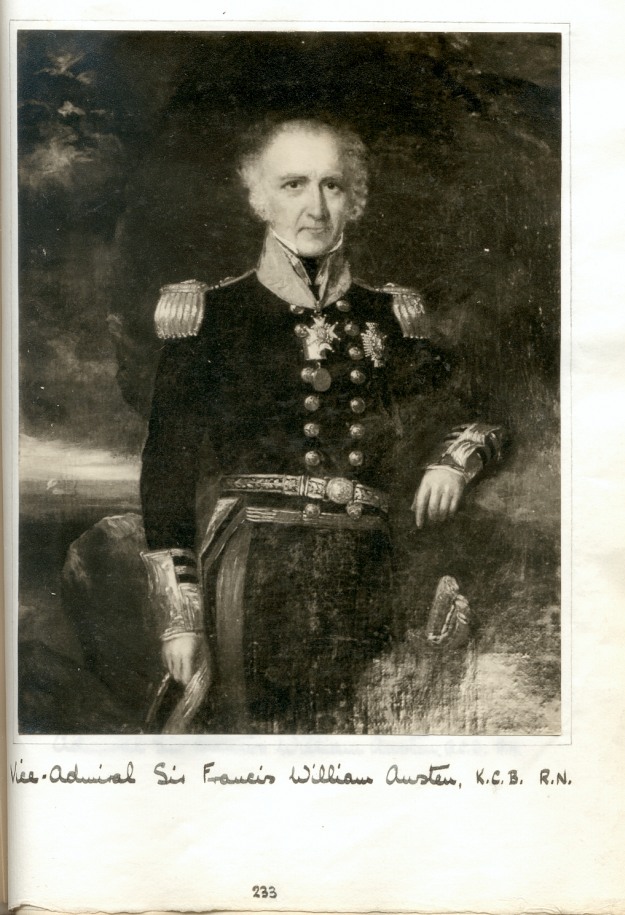
1. Jane’s family and their descendants: George and Cassandra Austen; James Austen; George Austen; Edward Austen, later Knight; Henry Thomas Austen; Cassandra Elizabeth Austen; Francis William Austen; Jane Austen; and Charles John Austen
2. Index of people by surname: Austen Family; Austen-Leigh; Bradford, Hill and Hubback; Knatchbull; Knight; Lefroy and Purvis; and Rice
Highlights page – oh! much here and much more to be added:
“There is good reason for the general reader to delve into this manuscript. One of Joan Corder’s informants, Miss Marcia Rice, who was 84 in 1954 when the work was written, was the granddaughter of Edward Knight’s daughter Elizabeth, and her husband Edward Royd Rice. Miss Rice wrote extensive memoirs of her family, which Joan Corder copied. Her recollections of her distant childhood were refracted through the most rosy of tinted spectacles; few could read those for her grandmother without needing the discreet use of a tissue. Here is a direct link to Elizabeth.
Please don’t stop with Elizabeth – Miss Rice didn’t. She left a wonderful record immortalising her entire Rice family, from aunts who could be quirky or intellectual, to uncles who could be courageous or reckless. For many of them there are links in the text to portraits. Be sure not to neglect reading Miss Rice’s personal memories, on page 115; and those following, on her great-aunt Marianne Knight.” –
Heraldry – Eleven Coats of Arms: these are worthy of a website all their own!
Austen Coat-of-Arms
Joan Corder – author of Akin to Jane: information on the author of the original family tree.
Author’s and Editor’s Notes: notes from both Corder and Dunning with explanations on how to use the Akin to Jane database and links to Dunning’s Roots Web database.
Contact Me – Ronald Dunning: he would love to hear from you!
3. Articles – there are three articles now, more to be added:
“An Unconventional Love Match”
“The Last Welsh Prince of Wales – Jane Austen’s Welsh Ancestry”
“Latitude and Longitude”
Be sure to read all the extra links – these often explain the contents and how the database works; and do not miss all the illustrations that appear throughout the website:
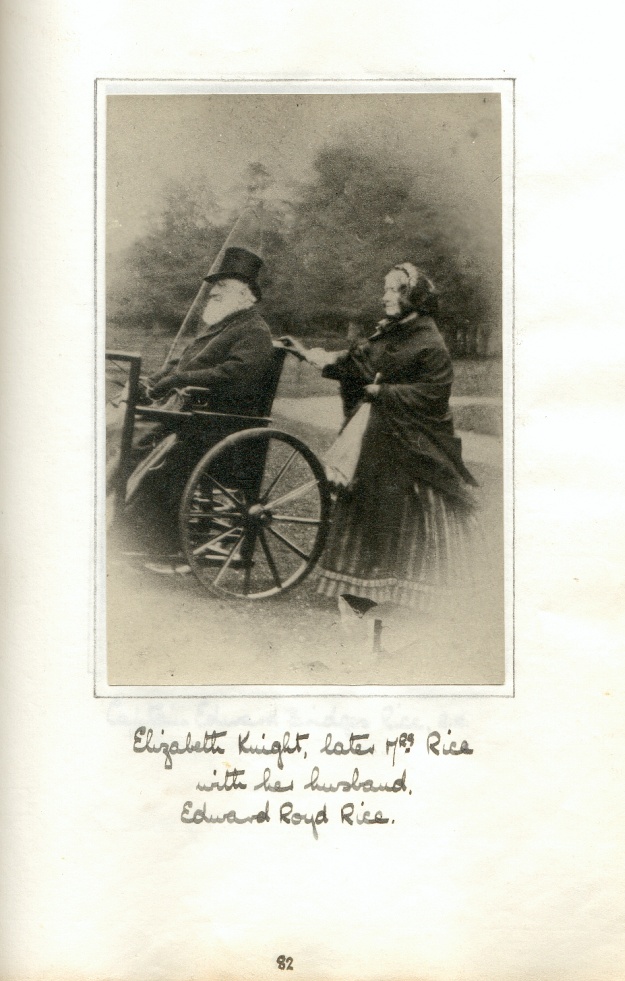
Now the fun part: you really do need to explore – but I shall give you this start – the wonderful story noted on the “Highlights Page” above of Elizabeth Austen [later Knight], daughter of Jane Austen’s brother Edward, from her grand-daughter Marcia Alice Rice, as written for Joan Corder in 1953:
Image of Elizabeth Austen-Knight Rice and her husband Edward Royd Rice
and then this quite romantic tale that I mentioned above of another Elizabeth and her husband Herbert: Herbert was the last child of Fanny Catherine Austen Knight Knatchbull (Jane Austen’s favorite niece – quite the mouthful! – and later on they added Hugessen to the name!) – here we have a tale of a secret marriage, he and his wife Elizabeth living under an assumed name, Herbert never telling his mother, never telling his colleagues in Parliament, having many children – all right out of a Victorian novel! : you can find it here on the ancestry.com website:
So just dig around – click on any link of interest – there are treasures to be discovered lurking behind those links! – whatever would Jane Austen make of all this do you think? – would she be absolutely appalled to discover she was related to Queen Elizabeth?? I now wonder after all if even I am related to Queen Elizabeth … and maybe you are too!
If you have any questions for Ron, please leave a comment here – he is happy to respond to any queries or suggestions…
Well, another year and yet again I am not attending The Annual Jane Austen Festival in Louisville, Kentucky that begins tomorrow; so I thought I would share the schedule so you all can be as depressed as I over what we shall be missing… you can watch this video to get into the spirit of things:
The 5th ANNUAL JANE AUSTEN FESTIVAL
JULY 21 & 22, 2012-10 a.m. – 4:30 p.m. each day
Historic Locust Grove-561 Blankenbaker Lane, Louisville, KY 40207
Sponsored by: Jane Austen Society of North America, Greater Louisville
Locust Grove, a circa 1790 Georgian home and farm is just
six miles from downtown Louisville, KY.
Each day of the festival you can:
Enjoy a Four-Course Afternoon Tea (several sittings each day),
Shop in the Regency Emporium inside and in the Shoppes of Meryton outside
(fabric, patterns, bonnets, pre-made dresses, chemisettes, men’s waistcoats, trousers &
tail coats, tea sets, tea, jewelry, antiquarian books, shawls, silhouette cuttings,
miniatures painted & lots more!)
See a Regency Style Show,
Watch a bobbin lace making demonstration inside the historic home and
See Regency fashions on mannequins in each room of the second floor of the house.
The last tea of the day on Sunday is reserved as a special Children’s Tea with a menu to appeal to children.
Perks include goodies such as a cup and saucer to take home.
Outside, under the tent hear interesting talks such as
* A Dangerous Indulgence:
Jane Austen’s Illness and Her Doctors – this reviews possible causes of Jane Austen’s death,
her letters, the doctors that cared for her, and how updates in genetic mapping may
help us determine what caused her death. Also
*Austen-itis: Sickness and Health in the Novels of Jane Austen –
reviews characters in the novels that suffer from illness (real and imagined).
*A one-woman theatrical performance about Fanny Kemble called, Shame the Devil : An Audience with Fanny Kemble will be performed under the Big Top Tent. Fanny Kemble was a member of the famous English Kemble-Siddons acting dynasty
who married an American and moved to the American South.
She became active in the early anti-slavery movement.
*New this year, will be the Earl of Sandwich Tea Shop located near the Shoppes of
Meryton and the Big Top Tent with simple libations such as –
sandwiches, scones, cookies and drinks.
Meanwhile out on the Village Green you can expect to see:
*Side-Saddle Demonstration
*A Duel Between Gentlemen
*Tutorial on Fencing
*A Bare Knuckle Boxing Demonstration
Roving musician Jack Salt will entertain as will Commonstock Entertainment with
shadow stories and their Potato Wagon of Wonders!
Workshops will involve learning about Tea
(Tea, Anyway you Steep it! and Play with your Leaves),
offered by Bingley’s Teas,
and How to Paint a Fan taught by Jenni Miller.
The Grand Ball will take place on Saturday evening at Spalding University in downtown
Louisville. The ball room is reminiscent of a Georgian Assembly Room. A practice
session will be held in the afternoon.
Admission is $10 each day which admits you to the Emporium, Shoppes, most
everything under the Big Top Tent and tours of the 1790 Georgian home (usually $8).
The Afternoon Tea is $20 per person, the workshops are $25 each, the theatrical
performance is $10 and the Grand Ball is $20 per person.
Advance reservations are highly recommended and begin on-line June 1st at
For those traveling from out-of-town, please contact Regional Coordinator Bonny Wise for a list of recommended B&Bs and hotels.
Answers to frequently asked questions: You do not have to be a member of the Jane
Austen Society of North America to attend the festival. Regency attire is not required,
[I append here the post I wrote in 2010 on this day]
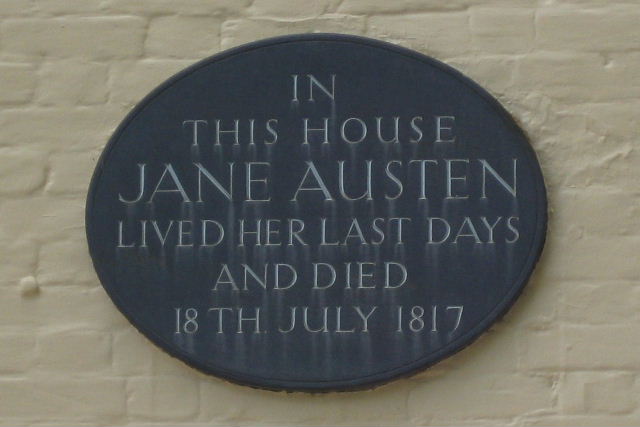
July 18, 1817. Just a short commemoration on this sad day…
No one said it better than her sister Cassandra who wrote
I have lost a treasure, such a Sister, such a friend as never can have been surpassed,- She was the sun of my life, the gilder of every pleasure, the soother of every sorrow, I had not a thought concealed from her, & it is as if I had lost a part of myself…”
(Letters, ed. by Deidre Le Faye [3rd ed, 1997], From Cassandra to Fanny Knight, 20 July 1817, p. 343; full text of this letter is at the Republic of Pemberley)
There has been much written on Austen’s lingering illness and death; see the article by Sir Zachary Cope published in the British Medical Journal of July 18, 1964, in which he first proposes that Austen suffered from Addison’s disease. And see also Claire Tomalin’s biography Jane Austen: A life, “Appendix I, “A Note on Jane Austen’s Last Illness” where she suggests that Austen’s symptoms align more with a lymphoma such as Hodgkin’s disease.
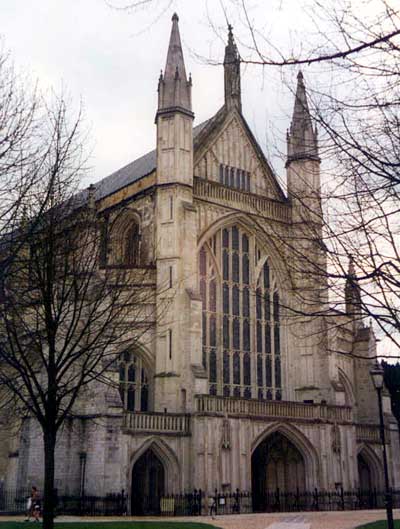
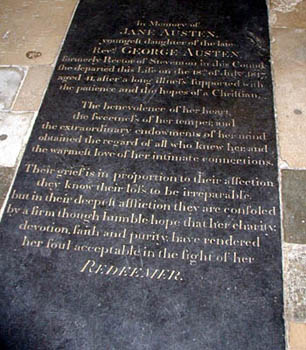
….where no mention is made of her writing life on her grave:
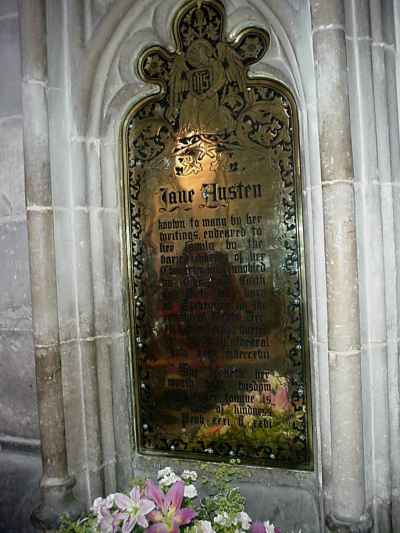
It was not until after 1870 that a brass memorial tablet was placed by her nephew James Edward Austen-Leigh on the north wall of the nave, near her grave:
It tells the visitor that:
Jane Austen
[in part] Known to many by her writings,
endeared to her family
by the varied charms of her characters
and ennobled by her Christian faith and piety
was born at Steventon in the County of Hants.
December 16 1775
and buried in the Cathedral
July 18 1817.
“She openeth her mouth with wisdom
and in her tongue is the law of kindness.”
The Obituaries:
David Gilson writes in his article “Obituaries” that there are eleven known published newspaper and periodical obituary notices of Jane Austen: here are a few of them:
Hampshire Chronicle and Courier (vol. 44, no. 2254, July 21, 1817, p.4): “Winchester, Saturday, July 19th: Died yesterday, in College-street, Miss Jane Austen, youngest daughter of the late Rev. George Austen formerly Rector of Steventon, in this county.”
Hampshire Telegraph and Sussex Chronicle (vol. 18, no. 928, p. 4)…”On Friday last died, Miss Austen, late of Chawton, in this County.”
Courier (July 22, 1817, no. 7744, p. 4), makes the first published admission of Jane Austen’s authorship of the four novels then published: “On the 18th inst. at Winchester, Miss Jane Austen, youngest daughter of the late Rev. George Austen, Rector of Steventon, in Hampshire, and the Authoress of Emma, Mansfield Park, Pride and Prejudice, and Sense and Sensibility. Her manners were most gentle; her affections ardent; her candor was not to be surpassed, and she lived and died as became a humble Christian.” [A manuscript copy of this notice in Cassandra Austen’s hand exists, as described by B.C. Southam]
The Hampshire Telegraph and Sussex Chronicle published a second notice in its next issue (July 28, 1817, p. 4) to include Austen’s writings.
There are seven other notices extant, stating the same as the above in varying degrees. The last notice to appear, in the New Monthly Magazine (vol. 8, no. 44, September 1, 1817, p. 173) wrongly gives her father’s name as “Jas” (for James), but describes her as “the ingenious authoress” of the four novels…
[from Gilson’s article “Obituaries”, THE JANE AUSTEN COMPANION [Macmillan 1986], p. 320-1]
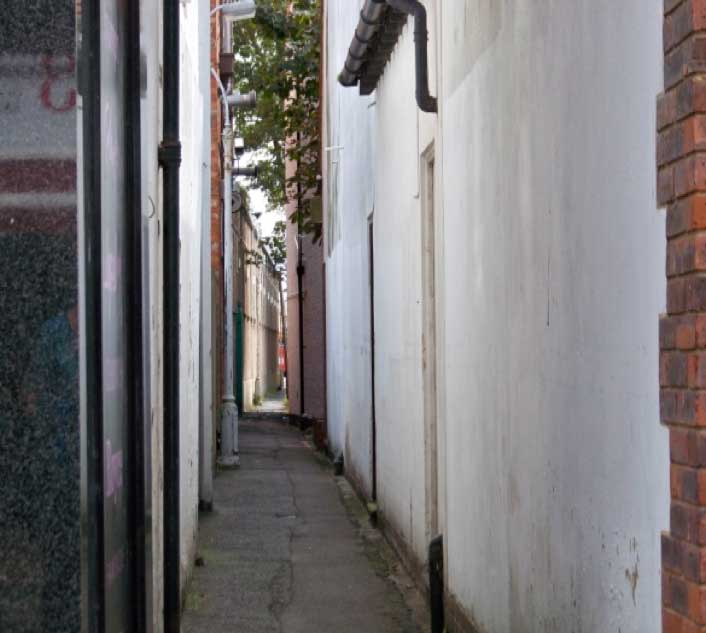
Dear Readers: You might recall a post from several months ago [March 2012] alerting all to the impending closure of the twitten [called the “Library Passage”] in Worthing – a place associated with Jane Austen as she visited there in 1805 for several months – and it is very likely one of the main sources for the setting of her seaside spa in Sanditon. See these two posts for more information:
I have just heard from Janet Clarke who had spearheaded the effort to thwart the closure in hopes that the site with its literary connection would have some sway with the powers that be. Well, sad to report, safety issues have won out over historical significance, and even the many voices of Austen fans did little to move the decision-makers.
One good bit of news from Janet however: Stagecoach (the bus company who owns the building and wants to close the passage for safety reasons) has “agreed to make special provision for Austen fans to walk the route, provided they receive reasonable notice.”
So, take note and if you perchance have Worthing on your itinerary [and you must!], then please take Stagecoach up on their offer – I am hoping that they will provide TEA as well – the least they could do, don’t you think?
Found in my research travels for the 2008 Persuasions “Jane Austen Bibliography”: a poem by X. J. Kennedy on Jane Austen. Mr. Kennedy is a “poet, translator, anthologist, editor, and author of children’s literature and textbooks on English literature and poetry.”
Jane Austen’s Donkey Cart – Chawton
Jane Austen Drives to Alton in Her Donkey Trap
Disappointing waters at Cheltenham Spa
Hadn’t erased dark patches from her skin,
Nor could she still walk miles untiringly.
Well, then. Out back she harnessed Polly Sue
And set off into kindled warmth that May
Squandered on the dregs of day.
“Composition seems to me impossible,” she said,
“With a head full of doses of rhubarb
And joints of mutton”—
Nevertheless, on the rough road back to Chawton,
She closed a stubborn sentence in her mind
As one might fasten a button.
Looming, the near-horizon wore a hue
Softer than garnet’s, fullness she might carry,
The first shy sycamore leaves
Uncertainly poking through
Like the affections of a girl
Whose mother hadn’t decreed a man to marry.
With faithful clop her donkey drew the load
Of oolong, sugar, pink embroidery thread,
Her quiet drive portending one last story.
Today, our rented compact squeezes left,
Scrapes weeds and fenceposts while around the road’s
Blind bend there thunderstorms a ten-ton lorry.
_________________________
From:
Kennedy, X. J. “Jane Austen Drives to Alton in Her Donkey Trap, and: Temps Perdu, and: The Odors of New Jersey.” Hopkins Review 1.3 (2008): 413-15.
Mr. Kennedy is scheduled tonight, Tuesday, July 17, 6:30 p.m, for a reading at the Center for the Arts, Cafe at the Somerville Armory, 119 Highland Ave., Somerville, MA. Two other poets to be announced; open mike. Admission $4.
This heart confetti is made from your favourite romantic book – Pride & Prejudice.
This is perfect for your wedding and makes a unique table decoration. *
Presented in a pretty ivory envelope ready for giving (or keeping!)
Bring Darcy and Lizzie, and all your other favourite characters, to your wedding today! Only £3 per pack
[* or you can sit around on a rainy day and try to piece the book back together? – wedding or not, I think this is a must-have for any true Austen fan…]
Text and image from the Jane Austen Centre (except for the last bit…)















 Jane Austen in Vermont