Books · Jane Austen

Henry Tilney’s Gothic Parody

Today [March 20] is the day that the Tilneys and Catherine leave Bath for Northanger Abbey – Catherine is riding with the innumerably-caped- greatcoated Henry:

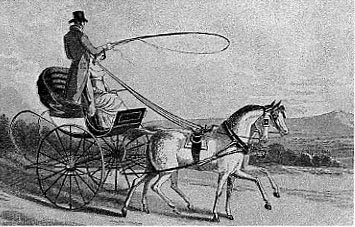
“…she found herself with Henry in the curricle, as happy a being as ever existed. A very short trial convinced her that a curricle was the prettiest equipage in the world… the merit of the curricle did not all belong to the horses; Henry drove so well — so quietly — without making any disturbance, without parading to her, or swearing at them: so different from the only gentleman–coachman whom it was in her power to compare him with! And then his hat sat so well, and the innumerable capes of his greatcoat looked so becomingly important! To be driven by him, next to being dancing with him, was certainly the greatest happiness in the world.”

[NA, vol. II, ch. V] 


…and Henry begins his gothic tale setting Catherine well on her way to having her own imagination run wild.  Here is the full text, as you must read the whole!:

“….you must be so fond of the abbey! After being used to such a home as the abbey, an ordinary parsonage–house must be very disagreeable.” 

He smiled, and said, “You have formed a very favourable idea of the abbey.”

 “To be sure, I have. Is not it a fine old place, just like what one reads about?”

 “And are you prepared to encounter all the horrors that a building such as ‘what one reads about’ may produce? Have you a stout heart? Nerves fit for sliding panels and tapestry?”

 “Oh! yes — I do not think I should be easily frightened, because there would be so many people in the house — and besides, it has never been uninhabited and left deserted for years, and then the family come back to it unawares, without giving any notice, as generally happens.”

 “No, certainly. We shall not have to explore our way into a hall dimly lighted by the expiring embers of a wood fire — nor be obliged to spread our beds on the floor of a room without windows, doors, or furniture. But you must be aware that when a young lady is (by whatever means) introduced into a dwelling of this kind, she is always lodged apart from the rest of the family. While they snugly repair to their own end of the house, she is formally conducted by Dorothy, the ancient housekeeper, up a different staircase, and along many gloomy passages, into an apartment never used since some cousin or kin died in it about twenty years before. Can you stand such a ceremony as this? Will not your mind misgive you when you find yourself in this gloomy chamber — too lofty and extensive for you, with only the feeble rays of a single lamp to take in its size — its walls hung with tapestry exhibiting figures as large as life, and the bed, of dark green stuff or purple velvet, presenting even a funereal appearance? Will not your heart sink within you?”

“Oh! But this will not happen to me, I am sure.”

 “How fearfully will you examine the furniture of your apartment! And what will you discern? Not tables, toilettes, wardrobes, or drawers, but on one side perhaps the remains of a broken lute, on the other a ponderous chest which no efforts can open, and over the fireplace the portrait of some handsome warrior, whose features will so incomprehensibly strike you, that you will not be able to withdraw your eyes from it. Dorothy, meanwhile, no less struck by your appearance, gazes on you in great agitation, and drops a few unintelligible hints. To raise your spirits, moreover, she gives you reason to suppose that the part of the abbey you inhabit is undoubtedly haunted, and informs you that you will not have a single domestic within call. With this parting cordial she curtsies off — you listen to the sound of her receding footsteps as long as the last echo can reach you — and when, with fainting spirits, you attempt to fasten your door, you discover, with increased alarm, that it has no lock.”

 “Oh! Mr. Tilney, how frightful! This is just like a book! But it cannot really happen to me. I am sure your housekeeper is not really Dorothy. Well, what then?”

 “Nothing further to alarm perhaps may occur the first night. After surmounting your unconquerable horror of the bed, you will retire to rest, and get a few hours’ unquiet slumber. But on the second, or at farthest the third night after your arrival, you will probably have a violent storm. Peals of thunder so loud as to seem to shake the edifice to its foundation will roll round the neighbouring mountains — and during the frightful gusts of wind which accompany it, you will probably think you discern (for your lamp is not extinguished) one part of the hanging more violently agitated than the rest. Unable of course to repress your curiosity in so favourable a moment for indulging it, you will instantly arise, and throwing your dressing–gown around you, proceed to examine this mystery. After a very short search, you will discover a division in the tapestry so artfully constructed as to defy the minutest inspection, and on opening it, a door will immediately appear — which door, being only secured by massy bars and a padlock, you will, after a few efforts, succeed in opening — and, with your lamp in your hand, will pass through it into a small vaulted room.”

“No, indeed; I should be too much frightened to do any such thing.”

 “What! Not when Dorothy has given you to understand that there is a secret subterraneous communication between your apartment and the chapel of St. Anthony, scarcely two miles off? Could you shrink from so simple an adventure? No, no, you will proceed into this small vaulted room, and through this into several others, without perceiving anything very remarkable in either. In one perhaps there may be a dagger, in another a few drops of blood, and in a third the remains of some instrument of torture; but there being nothing in all this out of the common way, and your lamp being nearly exhausted, you will return towards your own apartment. In repassing through the small vaulted room, however, your eyes will be attracted towards a large, old–fashioned cabinet of ebony and gold, which, though narrowly examining the furniture before, you had passed unnoticed. Impelled by an irresistible presentiment, you will eagerly advance to it, unlock its folding doors, and search into every drawer — but for some time without discovering anything of importance — perhaps nothing but a considerable hoard of diamonds. At last, however, by touching a secret spring, an inner compartment will open — a roll of paper appears — you seize it — it contains many sheets of manuscript — you hasten with the precious treasure into your own chamber, but scarcely have you been able to decipher ‘Oh! Thou — whomsoever thou mayst be, into whose hands these memoirs of the wretched Matilda may fall’ — when your lamp suddenly expires in the socket, and leaves you in total darkness.”

“Oh! No, no — do not say so. Well, go on.”

 But Henry was too much amused by the interest he had raised to be able to carry it farther; he could no longer command solemnity either of subject or voice, and was obliged to entreat her to use her own fancy in the perusal of Matilda’s woes. Catherine, recollecting herself, grew ashamed of her eagerness, and began earnestly to assure him that her attention had been fixed without the smallest apprehension of really meeting with what he related. “Miss Tilney, she was sure, would never put her into such a chamber as he had described! She was not at all afraid.”

[NA, vol II, ch. V]

[Illustration, The Mysteries of Udolpho, Vol. 4, p. 217 (London: Longman, Rees, Orme, Brown and Green, 1830).  From wwnorton.com]

**********************************

 Sleep well! – hope to see many of you tomorrow at our gathering to celebrate Northanger Abbey!

[Posted by Deb]

Austen Literary History & Criticism · Books · Jane Austen · JASNA-Vermont events

You are Cordially Invited! ~ JASNA-Vermont March 21st

You are Cordially Invited to JASNA-Vermont’s* March Meeting

 Ingrid Graff 

on 

~ Learning to Love a Hyacinth:
Emotional Growth in Northanger Abbey ~  

Sunday, March 21, 2010  2 – 4 pm 
Champlain
College, Hauke Conference Center
375 Maple St
 
Burlington VT  

Free & Open to the Public! 

*******************************************

Ingrid Graff is a great friend of mine and will offer us all a most entertaining talk on Northanger Abbey – so if this is not one of your favorite Austen novels [and how can it not be with Henry Tilney as the hero?!], please join us – it will become so after listening to Ingrid!

**************************************************

Upcoming Events: 
June 6, 2010:  Box Hill Picnic* Kelly McDonald on “Austen – Adams ~ Journeys with Jane &  Abigail” [Deb Barnum’s garden]
September 26:  JASNA President Marsha Huff on “Viewing Austen through Vermeer’s Camera Obscura” [Champlain College]
December 5: Annual Birthday Tea with Professor Peter Sabor of McGill University on the Juvenilia [Champlain College]
March 28:  “Jane Austen’s London in Fact & Fiction” with Suzanne Boden & Deb Barnum [Champlain College]

*Please contact us to be put on our mailing list for all future events

Books · Jane Austen · Jane Austen Circle · Regency England · Social Life & Customs

In My Mailbox…

The most recent issue of Jane Austen’s Regency World [March / April 2010, Issue 44], this issue titled “Jane Austen’s Musical World,” brought a delightful surprise – a free cd containing the six works by composers who were working in Bath in the late 18th century [see a list of the selections below], as well as  several articles on the music of Austen’s time:

~ the guest essay by Franz Joseph Hayden describing his visit to Bath in 1794

~ Maggie Lane on Jane Austen, Music Lover? where Ms. Lane posits that “Jane’s attitude toward music seems to have been occasionally hostile, often ambivalent, and only rarely enthusiastic.”

~ David Owen Norris on What was on Jane’s Ipod? on newly discovered music within the Austen family, suggesting that Eliza de Feuillide was an even more considerable pianist than previously thought, as well as the discovery of a hand-written piece possibly composed by Austen herself!

~ Patrick Wood on Thomas Linley, Mozart’s boyhood rival [and subject of one of Gainsborough’s famous paintings]

~ Mike Parker, Tidings of My Harp, “argues that Jane Austen uses the harp in her novels to identify privileged and spoilt women, while knowing little of the mechanics of the instrument herself.”  [think Mary Crawford, the Musgrove sisters and Georgiana Darcy]

~ our very own JASNA-Vermont ‘s Kelly McDonald in A Golden Time, tells of the diaries of Emma Austen-Leigh, wife of Austen’s nephew James Edward Austen-Leigh, which provide valuable insight into London’s music scene during the Regency – here focusing on the Knyvett family of musicians. 

~ Gillian Dooley considers the question of taste in Sense & Sensibility in Matters of Taste and its relationship to moral worth.

~ an interview with Austen scholar Richard Jenkyns – who enlightens us with admitting a special affection for Mansfield Park, thinking the latest BBC adaptation of MP “wins the competition for the worst ever adaptation of any classic novel by a mile”, and wanting most to be like Henry Tilney [but would like to marry Lizzy Bennet]!  [and I add that Jenkyns book A Fine Brush on Ivory: an Appreciation of Jane Austen (2004) is a wonderful read…]

~ articles from JASNA’s Carol Adams on the score for the 1995 P&P; JASA’s Ann Bates on their one-day symposium on Jane and Occupations; reviews of cds, letters, news from 1802, and as always, a great number of fabulous illustrations…

The enclosed cd contains works by:

  • Thomas Linley the Elder : Cantata: Awake my lyre and Invocation: Fly to my aid, O mighty love
  • Henry HarringtonEnchanting Harmonist
  • Thomas Linley the YoungerTo heal the wound a bee had made
  • William Jackson after Thomas ArneWhere the bee sucks
  • William HerschelSonata in D

Subscribe and enjoy!  Jane Austen’s Regency World Magazine

[Posted by Deb]

Jane Austen · News

“Scene of Dissipation & vice”…

I am lately returned from said “Scene of Dissipation & vice” i.e. London, quoting Austen’s letter of August 23, 1796 [Le Faye, Letters, no. 3], telling of her arrival in Town and finding already her “Morals corrupted” – and where I, currently re-reading Mansfield Park, saw a good number of delightful Henry and Mary Crawfords! 

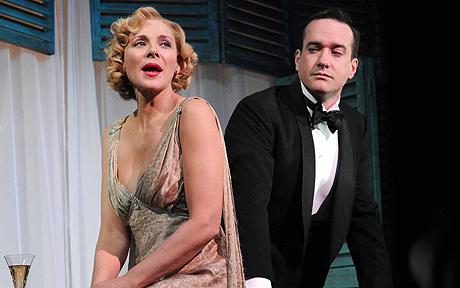
 So much to tell [mostly having nothing to do with Jane Austen, I am afraid to say…] – so mainly here just want to share about one night at the theatre, where we had the privilege of seeing Private Lives, with Kim Cattrall and Matthew MacFadyen of Mr. Darcy fame, and directed by Sir Richard Eyre.  The show was in previews starting February 24, and how lucky my daughter and I were to get tickets for the 26th.  What a treat to sit in the fifth row, dead center and watch them do their magic, passion abounding both of the sexual kind and the throwing things kind! – it seems that every night in Act II the set is nearly demolished during a violent quarrel between the major parties where far more than mere words are flung at each other.

I confess wanting to go to this play largely to see “Mr. Darcy” up close and personal [who looks quite fine in a tuxedo as you can see…] – my daughter more than happy to oblige, and as she is a huge fan of both Mr. Darcy and Sex and the City’s Kim Cattrall, the evening could only be a delight for all.  This production began its life in Bath and will be in London for a ten-week run – and what great fun it is!   Noel Coward’s Private Lives has been revived numerous times, first perfomed in 1930 with Noel Coward and Gertrude Lawrence [and a young Laurence Olivier in the supporting actor role], and most recently in 2001/2 with Lindsay Duncan and Alan Rickman, and as has been universally discussed, there must be a grand spark and chemistry between the leads or one should just get up and leave, the play after all being about the nature of sexual attraction!  And this works very well with  MacFadyen and Cattrall, despite a huge gap in their ages in real time [Ms. Cattrall is 53, MacFadyen a mere 35] – they play the formerly married-to-each-other Amanda and Elyot, who while honeymooning with their new spouses in the south of France discover their hotel rooms share adjoining balconies.  And from there it is all fireworks and love and lust and anger as they abandon their new spouses and perhaps their better selves for a Part II performed largely in a pajama-clad semi-drunken state as they try to figure out what to do with this nearly debilitating passion… watch out if you are in the front row! [An article from yesterday tells of Ms. Cattrall’s bruising her legs on falling into a table after a hefty shove by MacFadyen – can this be our gentlemanly Mr. Darcy??!] – these are two very self-absorbed people you would barely tolerate in real life, but thankfully for the biting wit and constant edge of Mr. Coward’s words, and the acting of all, you have sympathy for this couple in search of themselves [there was a more than audible gasp from the audience when Elyot smacks Amanda, so sympathies only go so far…]

Ms. Cattrall pulls off an English accent far better than I would have expected [one woman I talked to during intermission felt her only misstep was pronouncing a French word incorrectly!] and her comic-timing is perfect, and as expected, her clothing is fabulous – putting the play in its time frame, which perhaps helps us deal with the chauvinistic Elyot.  Act II, as mentioned, finds Amanda and Elyot in their elegant silk pajamas through nearly the end of the play, and lovely pajamas at that!  [with memories of a partially bare-chested Mr. Darcy in the mists..] – MacFadyen and Cattrall also sing quite credibly, and though it appears that Elyot is playing the piano [and I was impressed that MacFadyen has such skills!] – it seems that it was play-acted after all, but I was certainly fooled as was most everyone else!  And I must add that, as he fully displayed in the hilarious Death at a Funeral, MacFadyen’s comic timing is spot-on…

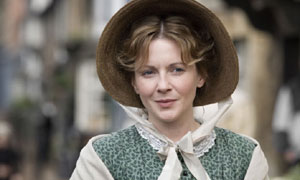
…and for another costume drama aside, Lisa Dillon plays the hapless new spouse of Elyot – poor girl and what a mess she gets herself into with this cad – and certainly a far different role than her part in Cranford  as Mary Smith:


And one other aside that does bring Austen into focus.  The woman next to me and I began  chatting about why we came to see this play –  for me, because I was a fan of MacFadyen’s for his Spooks work and the 2005 P&P – she was astonished as Austen is her favorite writer, etc, etc. – you all know the conversation that follows after that connection is established! – and the “what is your favorite book?’ was answered on her part with an almost embarrassing “Oh! I love most the one few people even like or worse have not even read – Northanger Abbey!” – well, here we were two complete strangers from two different countries, suddenly bonding over Henry Tilney, and only needing to stop talking in order to watch “Mr. Darcy” continue in his play – how bad is that for an evening in London!

Playing at:

Vaudeville Theatre
The Strand, London WC2
February 24 – May 1, 2010

Further reading and reviews:

[Posted by Deb]

Jane Austen · Movies

Final Thoughts ~ Emma Part III

OK, I confess, I watched it again [remember our PBS here in Vermont showed the last episode LAST week right after Part II; this week our PBS re-ran Miss Austen Regrets] – but I did watch it again, just to be sure I hadn’t missed anything – they do take us on a rather quick ride from Box Hill to three marriages and Mr. Woodhouse’s fear of turkie robberies…

My major and final thought is “Thank you Jonny Lee Miller” – he redeemed this show in almost every way. And also with thanks to Sandy Welch who whacked the dialogue throughout to fit her own take on a 21st century Emma – but at least she left the proposal scene relatively intact, and despite THE KISS, it finished off quite nicely.

As mentioned above, this third part starts with Emma sitting with her father at Donwell Abbey – so nice to see the fine Donwell interior, and Emma’s unfaltering consideration of her father’s comfort. Mr. Knightley proud to bring Emma to his home, “the first time in eighteen months,” he tellingly points out. And there is a moment when he suggests to Emma that she looks almost the mistress of Donwell in her tender assistance to an “exhausted” Jane Fairfax. […more of those now obvious hints, but what is a screenwriter to do?].  Mr. Elton is seen dragging his darling wife to the Donwell strawberry picking on a donkey – seems a bit much for the local pastor but conveys all of their high-browed-ness in a few short minutes, Mrs. E. as per usual, “overly trimmed.”

We witness yet another spoiled-brat fit of Frank Churchill’s – the heat, the company, “sick of England,” all setting him off – but charmingly brought out of his bad humor by Emma, seen draping yet again all over the sofa. And then on to their scene at Box Hill – well done indeed! – [but really, would even the childish Emma and the anti-propriety Frank be so very bold in their display of affection at the picnic?! – I was embarrassed sitting in my own living room for this breach of 19th-century etiquette! – his head in her lap?! Yikes!- lavender water please…]

From here on, everything moves very quickly: Miss Bates of course is soundly insulted by Emma, and though a bit more morose than in other productions, the effects of this is well presented as all scatter to their separate corners of the hill, preferring solitude over such a gathering of mis-matched spirits. And here again, Mr. Knightley, all-seeing, performs his “badly done” absolutely perfectly – Emma seeing herself as others might see her for the first time, “anger against herself, mortification and deep concern,” the pivotal scene in the book, and here shown with Emma having what might be her first-ever sleepless night [lovely music here]… A visit the following day to Miss Bates, the farewell of Mr. Knightley with the attempted kiss to her hand [nicely done – an important scene…and glad this was not left out]; Mr. Woodhouse’s lament of “wanderlust” [I loved this!]; and then the news of Frank and Jane Fairfax, acquiring another “badly done indeed” from Emma, this scene also well done with Mr. Weston looking on, concern for Emma; a sort of bizarre set-piece with Frank and Jane kissing and dancing in the street; a few scenes with the perfectly cast John Knightleys worried about George’s bad humor; then the Harriet chat where Emma discovers to her horror that it is not Frank Churchill but MR. KNIGHTLEY that Harriet has been obsessing over, after which Emma really kicks her out of the house; and finally Emma’s wrenching monologue that it is “too late, too late” as she discovers her own heart after all….

All the above with the same wonderful decorations, gardens, fashions and food we have come to expect – and we are not disappointed – I am all forgiveness of nearly everything you see, because of all this loveliness – and also because they got the ending right, a very nice surprise, and with only a few caveats….

You all know [and I am almost sick of saying this myself] that Richard Armitage was born for this role of Mr. Knightley – so it took awhile for me to get over it [as well as Romola Garai’s eye-popping emotionals, but enough of that – she grows on you…] But Jonny Lee Miller pulled it off after all – nearly perfectly really – and this scene was given the time it needed [though why Emma had to be hiding behind a tree just added to her childishness – I thought she had perhaps grown up at this point?…] – my only real quibble with this whole proposal being so: in the book, Mr. Knightley, thinking that Emma is suffering the pangs of lost love over Frank Churchill, takes her arm [no contact in the movie and why not, I ask?]

 …till she found her arm drawn within his, and pressed against his heart and heard him thus saying, in a tone of great sensibility, speaking low, ‘Time my dearest Emma, time will heal the wound…’

And they continue to talk, until Knightley begins to say what in the movie is “his secret is out at least” in the book is “you will not ask me what is the point of envy” – Emma silences him and he says “I will obey you” and walks away [not so in the book – He is silenced “in deep mortification” – they walk to the house together and then take another turn when she wishes him to continue] – but here thankfully they keep most of the language. Either direct or in spirit:

          “As a friend!” repeated Mr. Knightley. “Emma, that I fear is a word — No, I have no wish — Stay, yes, why should I hesitate? I have gone too far already for concealment. Emma, I accept your offer, extraordinary as it may seem, I accept it, and refer myself to you as a friend. Tell me, then, have I no chance of ever succeeding?”
           He stopped in his earnestness to look the question, and the expression of his eyes overpowered her.
          “My dearest Emma,” said he, “for dearest you will always be, whatever the event of this hour’s conversation, my dearest, most beloved Emma — tell me at once. Say ‘No,’ if it is to be said.” She could really say nothing. “You are silent,” he cried, with great animation; “absolutely silent! at present I ask no more.”
           Emma was almost ready to sink under the agitation of this moment. The dread of being awakened from the happiest dream, was perhaps the most prominent feeling.
          “I cannot make speeches, Emma,” he soon resumed; and in a tone of such sincere, decided, intelligible tenderness as was tolerably convincing. “If I loved you less, I might be able to talk about it more. But you know what I am. You hear nothing but truth from me. I have blamed you, and lectured you, and you have borne it as no other woman in England would have borne it. Bear with the truths I would tell you now, dearest Emma, as well as you have borne with them. The manner, perhaps, may have as little to recommend them. God knows, I have been a very indifferent lover. But you understand me. Yes, you see, you understand my feelings — and will return them if you can. At present, I ask only to hear, once to hear your voice.”
[Emma, vol. III, ch.XIII]

Austen of course, gives her usual narrated proposal scene –

-What did she say? – Just what she ought, of course. A lady always does.-

We do get a little more here – a gentle, tender avowal of love and sealed with a kiss. Very nicely done, of course…and from here on in they only hold hands… And all ends with the news being broken to Mr. Woodhouse [Emma’s crying-jag scene, so much shown in the trailer, was blessedly short-lived and Mr. Knightley’s generosity of moving to Hartfield lovingly accepted]; Harriet and Robert Martin are united under the eye of Mr. Elton’s withering gaze; the turkies are thankfully “pilfered” and Emma and her Mr. Knightley ride off in a lovely carriage [holding hands] to their “ fortnight’s absence in a tour to the seaside”, ending thus gazing out to the sea, rather than with a wedding and the uninvited Mrs. Elton’s pronouncement on the “shabbiness” of the proceedings…

So the real test is will I buy the movie? – aah yes, I will, but then an Austen fan always does…

All the episodes of Emma will be available online through March 9, 2010 at the Masterpiece Classic website [lots of other great things there also!]

[Posted by Deb]

Jane Austen · Movies

More Random Thoughts ~ Emma Part II

Well, not sure what happened here Sunday night in the North Country, but my PBS-HD station played not only Episode II, but also Episode III! – This was not on the online schedule, but I went in to DVR the 9pm program and saw that the 10-11 slot also said “Masterpiece Classic” – I assumed it was a re-run, but the “info” button suggested the final episode – did anyone else have this delightful gift from PBS??  So that said, I am only going to share a few thoughts about the second show, those certainly being colored by the final chapter … especially by the filming of the pivotal scene at Box Hill.

 I agree with most everything that I said above:

The Good: the fabulous clothing, museum-like houses and their decorative accessories, the gardens, the ornate flower arrangements, the finely-done cinematography, the music, and most of the characters with noted caveats [see more below]…

The Bad, but not so bad really: the language is still off, so forgetting largely that this is set in the early 19th century, we have 21st century teenagers who like to dress up – sort of a Regency House Party rather than authentic Austen with people who couldn’t remember their lines… … but enjoyable anyway. I am, you may have noticed, not a purist in the sense of everything must be Austen or relegated to the trash bin – the spirit of Austen is here in so many ways, and coupled with great views, and a liveliness that cannot help but draw you in…

So the Good, the Bad, and thankfully nothing ugly… but some new scenes, new characters, and new suggested plot lines to be explored:

Characters:

Mrs. Elton and Mr. Elton – Christina Cole brings the right amount of snobbishness, status-obsession, and manipulative machinations as Austen created her – she is sufficiently overdone in manner and clothing [though she “dislikes being overtrimmed”, this said while verily dripping in ribbons and yellow feathers], and seems the perfect match for Mr. Elton, who appears more foppish than ever… what a pair! I am glad they found each other and spared others such a match.  And nice to see Mr. Elton actually preaching a sermon, the serious and obviously-needed-in-Highbury “let deceitful lips be dumb” … [I did however find Mrs. Elton’s ridiculous curls more appropriate for her rather than Harriet, whose hair continues to be all wrong for the character, despite liking this Harriet in every other sense…]

We see more of Frank Churchill [not quite right for the part and I am not sure why – should he have been more dashing and elegant? rather than so hyper-active and immature, one minute dancing around, the next sulking like a spoiled brat – is this maybe more true to what Austen wrote? [I need to re-read the book yet again on this one!]- I do wonder though why he felt the need to fling himself off his horse on each dismount – quite funny really!

Jane Fairfax is all wrong – she looks and acts like a waif about to fall into a swoon and drift away – she IS supposed to be more lovely than Emma, strikingly handsome, albeit a little pale, accomplished in all things; I could see Mr. Knightley more interested in Harriet Smith than this Jane…so this key part of the plot seems to fall flat…

Miss Bates just doesn’t get enough screen time to give us more of her comedic babbling… Tamsin Greig is currently the star in the London play, The Little Dog Laughed, where evidently she is stealing the show with her humor – more of that needed here perhaps?

Emma’s eyes continue to pop and bulge at every possible moment of surprise, awe, sadness, anger, concern, fear – but Romala Garai is growing on me – the further I move away from the Emma “as she was wrote,” I begin to find this almost child-like Emma endearing – but I do hope she grows up some in Episode III…or Knightley just might rightly decide to stay in London…  One plus, the male narrator who speaks in the first part seems to have been fired after all, and we do hear Emma’s thoughts as she begins to doubt her own long-held belief that she knows EVERYTHING – her reasoning that this lethargy and listlessness MUST be the love of Frank Churchill begins her much-needed introspection – she IS hopefully growing up… [her absolute hissy-fit when she walks home from Mrs. Elton’s, raging about her calling him “Knightley” is spot-on:

“Insufferable woman!” was her immediate exclamation. “Worse than I had supposed. Absolutely insufferable! Knightley! I could not have believed it. Knightley! never seen him in her life before, and call him Knightley! and discover that he is a gentleman! A little upstart, vulgar being, with her Mr. E., and her caro sposo, and her resources, and all her airs of pert pretension and under-bred finery. Actually to discover that Mr. Knightley is a gentleman! I doubt whether he will return the compliment, and discover her to be a lady. I could not have believed it!

[Emma, vol. II, ch 32]  – this is Emma in teenage mode – and funny – the first time I think she sees Knightley as someone other than her father’s daily visitor, someone who other people relate to, have thoughts about… and Emma does not like it. Well done in the movie!

Mr. Knightley also continues to improve for me – Miller’s furrowed brow, his vigilant observation of everything going on around him, his good sense and steady presence serves to act as a foil to this Emma who is in such need of his good guidance. And this is countered with Knightley’s apparent change in feelings toward Emma – a shift in his own world that unnerves him, he often looking quite grave – this of course not so clearly shown in the book [but there if you are looking for the clues!] – so though some of the “mystery” of Emma is lost in these glimpses into Mr. Knightley’s feelings – it does make it so clear that they must and will end up together…

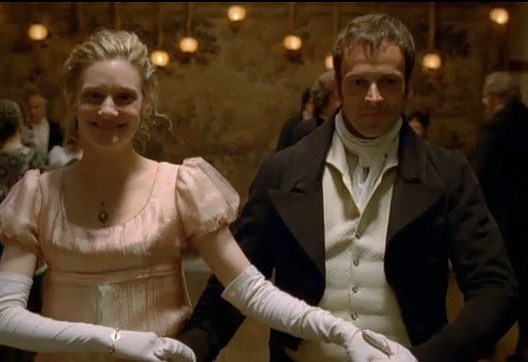
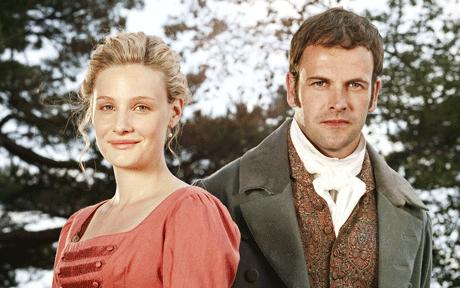
 Emma [Garai] & Mr. Knightley [Miller]

The Dance is fabulous! – the extravagant fashions [Emma’s dress is so lovely!] – the bouncing jaunty hand-clapping country dances are just great fun; the Harriet as wallflower / Mr. Elton snub, with Mr. Knightley to the rescue rightly sets Emma on the path to seeing him in a different light – and their dance together is, as in all the Austen adaptations, such a turning point in the story [recall the 1995 P&P Elizabeth and Darcy dance; the 2005 same scene where all disappears as Elizabeth and Darcy focus only on each other] – the dance in the 18th-19th century was the only way men and women could flirt, touch, and get to know each other – and here it seems is the first time that Knightley and Emma actually do connect in this way – the feelings of both undergoing some fundamental change. But major complaint here! – one of the most telling lines in the book is when Emma suggests Mr. Knightley dance with her:

Emma was extremely gratified. – They were interrupted by the bustle of Mr. Weston calling on every body to begin dancing again.
“Come Miss Woodhouse, Miss Otway, Miss Fairfax, what are you all doing? -Come Emma, set your companions the example. Every body is lazy! Every body is asleep!”
“I am ready,” said Emma, “whenever I am wanted.”
“Whom are you going to dance with?” asked Mr. Knightley.
She hesitated a moment, and then replied, “With you, if you will ask me.”
“Will you?” said he, offering his hand.
“Indeed I will. You have shown that you can dance, and you know we are not really so much brother and sister as to make it at all improper.”
“Brother and sister! no, indeed.”

[Emma, vol. III, ch, 38, p. 332] – a prime piece of dialogue and should have been included…

I am feeling like Mr. Woodhouse is not in the movie enough, so does not show this very generous and compassionate side of Emma [but just as I was thinking this – Part III starts with such a scene – so ok after all…I will say no more].  Also I did check about the John Knightleys – they indeed do have FIVE children: Henry, John, Bella, George, and Emma.

One other scene that is changed from the book is at the beginning of Part II – [vol. II, ch. 10, 244 ff] Mr. Knightley is called in from the street by Miss Bates to visit them – he is ready to do so until Miss Bates tells him Frank Churchill is there as well – he immediately changes his mind and raises his voice for all to hear his comments about Jane Fairfax – in the movie he comes in – a fine difference, but a telling point in this change of Knightley’s feelings toward Emma.

Laura Linney begins this second episode suggesting that Jane Austen’s works might be considered “too ordinary and narrow” for today’s world of super-human action stories the likes of Spiderman and the extremes of techno-thrillers and special effects – what can Austen give us in this non-magical world of Emma Woodhouse? She concludes that we are given a view into the world of people who are really just like you and me – the steady ones, the loving, the amusing, the annoying, the manipulating and greedy, all the believable characters that make up our daily lives – Emma is an “authentic human being” says Linney, who with an over-developed sense of her own importance has created quite the mess. We see her grow and become aware and realize that she does live in a very closed world and that perhaps her ideas are limited – I am enjoying seeing her come to these realizations, her blinders slowing slipping away, extravagant eye-popping or not! – and there are still those lovely costumes and decorating ideas to ponder…

The Masterpiece website for all things Emma; you can also watch the first two episodes online until March 9th here.

Stay tuned for Part III…

[photo from Costume Drama Reviews]

[Posted by Deb]

Jane Austen · News · Regency England · Social Life & Customs

A Jane Austen Weekend in Vermont!

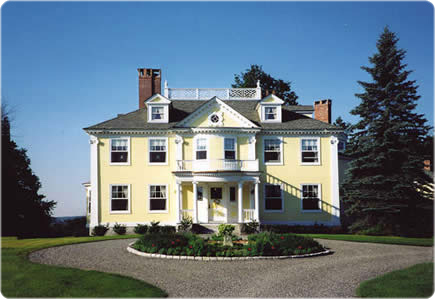
The Governor’s House in Hyde Park will be hosting another Jane Austen event this coming weekend on January 29 31 ~ topic is Sense and Sensibility.

governors inn

[imagine snow! – bring your woolies!]

Jane Austen Weekend: Sense & Sensibility
The Governor’s House in Hyde Park
Friday to Sunday, Jan 29-31 **

http://www.OneHundredMain.com/jane_austen.html
802-888-6888, tollfree 866-800-6888 or info@OneHundredMain.com

 Reservations are required! 

A leisurely weekend of literary-inspired diversions has something for every Jane Austen devoteé. Slip quietly back into Regency England in a beautiful old mansion. Take afternoon tea. Listen to Mozart. Bring your needlework. Share your thoughts at a discussion of Sense & Sensibility and how the movies stand up to the book.  Attend the talk entitled ~ “Making Sense of Jane Austen’s World” * ~  Test your knowledge of Sense & Sensibility and the Regency period and possibly take home a prize. Take a carriage ride or sleigh ride. For the gentleman there are riding and fly fishing as well as lots of more modern diversions if a whole weekend of Jane is not his cup of tea. Join every activity or simply indulge yourself quietly all weekend watching the movies. Dress in whichever century suits you. It’s not Bath, but it is Hyde Park and you’ll love Vermont circa 1800. 

  **************************

* “Making Sense of Jane Austen’s World” – Inn owner Suzanne Boden will be talking on the architecture, furnishings and other decorative arts of the Regency Period; Deb Barnum of JASNA-Vermont [yours truly] will be talking about travel in the late 18th and early 19th century – the horse and carriage era – and how Austen’s characters travelled in Sense & Sensibility – [and there is a lot of moving about in this book!]


*Or come for just an afternoon or evening and choose from these activities:

  • Informal Talk with Coffee and Dessert, Friday, 8:00 p.m., $14.00
  • Afternoon Tea, Saturday, 3:00 p.m., $20.00
  •  Book Discussion and Dinner, Saturday, 7:00 p.m., $35.00
  •  Jane Austen Quiz and Sunday Brunch, Sunday, 11:30 a.m., $15.00
  • All four activities: $75.00

The Governor’s House in Hyde Park
100 Main St
Hyde Park, VT 05655
http://www.OneHundredMain.com/jane_austen.html
802-888-6888, tollfree 866-800-6888 or info@OneHundredMain.com

**If you cannot make this weekend, make a note on your calendars of the  following dates as well:

series 3: Sense and Sensibility
Friday evening talk: Making Sense of the Regency World

Friday – Sunday, August 13 – 15, 2010
Friday – Sunday, September 10 – 12, 2010
Friday – Sunday, January 7 – 9, 2011

[Posted by Deb]

Jane Austen · Movies

Random Thoughts on the Masterpiece ‘Emma’

So, some VERY random thoughts – no time really to actually write anything, but figure this is better than nothing…[maybe…] – no pictures either… [ok, maybe one…]

First, I had the opportunity to watch this new Emma when it first came out – decided against viewing it on my computer screen, as I figured the best part of it would likely be the settings, so very glad I was patient [I am not known for my patience…] and I dutifully watched Part I last night.  It did not disappoint, either in the above-mentioned setting category, or in the expectation – long gleened from the various other reviews out there – that this was not an Emma of the early 19th century, but rather some 21st century rendition of how Austen might translate her own work to be understood by the watching masses… so here are my random thoughts:

The Past:  the whole movie starts with a rapid foray into the past to see how Emma’s mother dies [did we really need to see her in her coffin?]; how she and her sister are raised by the lovely Miss Taylor, and coddled and over-protected by their father; how little Frank Churchill is sadly sent off to live with his aunt; how John Knightley and Isabella are seen in a pre-marriage cavorting about in the garden while Emma and George [and we learn his name right at the beginning] look on; how Emma puts Miss Taylor and Mr. Weston together under an umbrella where love blooms; and FINALLY we get to the beginning of the book where the marriage has just taken place… none of this is in the book, only inferred, but its sets the story in time and place and we now know all… this is all necessary I suppose for those who have not read the book [to which I say, GO READ THE BOOK…]

The Fashions are to die for, and I like that Emma actually wears the same dress on different days, albeit with some ribbon-changing  – I especially liked the turquoise – just lovely… I liked all the clothing, even Mr. Martin had on a fine pair of pants and boots…Mr. Knightley of course looked fabulous…

The Houses, exterior and interior are absolutely superb – I have a gold damask Chippendale sofa in my living room and thus was especially pleased to see several of them scattered about.  I wanted to pause each frame and take notes.  I want to go on a tour of the actual houses – but now unfortunately I want redecorate my whole house, and this will not do [or so my husband informs me…]… Donwell Abbey was a treat to see – a tad forbidding – no wonder Mr. Knightley puts his coat on every day, opens the door, takes in a breath of fresh air, puts on his hat, and heads over to the Woodhouses.  And I liked the “Sed Semper Amico” over his inner door – seems to mean “but always for a friend” and was often on the entryways of country houses [and why does Google Translator not offer LATIN as a translation option?]

The Gardens – perfect specimens –  Mr. Ripton would be pleased – again, I want to freeze-frame them all, especially those at Hartfield – and thus need also to redo my gardens once they are uncovered of snow…

The Carriages, Horses: again, a visual feast – one thought is that Mr. Elton seems to be on his horse a lot… but rightly so, Mr. Knightley rarely uses his carriage…

The Town – it was nice to see the very real dirty streets – complete with horse pooh and working men – that said, it still seemed a bit manicured and one could almost imagine the camera men off to the side – but the pooh was a nice touch…

The Narrator: not sure why Miss Austen’s all-seeing narrator [who is obviously female] wasn’t hired for the job, but we seem to have a man’s voiceover that sounds suspiciously like Mr. Knightley, which sort of skews the content a bit [like who actually knows any of the upcoming “secrets”?]

The Language – well, this is the kicker really – now we know for sure we are in the 21st century with a group of people who just like to dress up funny – I thought for awhile that since it is so visually beautiful and as I do know the story after all, that I could just sit there for the two hours and watch – no sound…

The Music – well, I liked this – it added to the comic effect… can’t wait for the dancing part….

Production discrepancies:  there is snow all over Highbury on Christmas Eve, but all is green when Emma next visits Harriet only a few days later at Miss Goddards [I confess I need to check how much later she does this…] – there are likely more but I did not dwell on this…

Characters:

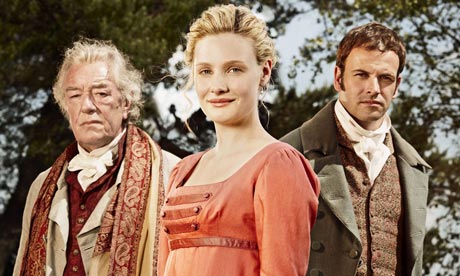
 Mr. Woodhouse – Michael Gambon a delight! – though he did indeed look a tad TOO hardy, it really just added to the humor of his being so obsessed with his body – I did, however, have a few fears that he might choke on all those scarves and shawls hanging about him…

Miss Bates – too early to tell anything about her, so I await Part II to decide.  She is certainly not as silly as the Paltrow version [though I liked Sophie Thompson in this very much – she gave her Miss Bates a poignancy that rang true to Austen’s text] –  the emphasis here seems to be more pathetic than comic.  And I was appalled at the scene where she leaves Hartfield pushing her mother in a wheelchair down the road – surely even the self-absorbed Emma would not have just waved goodbye and turned into her house! – this doesn’t bode well for Box Hill…

Miss Taylor / Mrs. Weston – I love Johdi May [she is brilliant in both Daniel Deronda and The Mayor of Casterbridge], but she seems wasted here, with just a few scenes of her knowing smirks and smiles – but she has several lovely outfits… [oh, and Mr. Weston seems a fine fellow…]

Frank Churchill – Rupert Evans is great so far – but not enough to judge by yet.  I do wonder why they had to put that scene in there of his meeting Emma on the road – it adds too soon to the watcher that he is not all that he seems, and unnecessary to the tale…

The John Knightleys – they seem to be well drawn in their small roles to convey the basics of their characters, so well-done on this score [I need to look again – do they have FIVE children??]

Robert Martin – he is physically perfect for the role – so this works too…

Harriet Smith – much better than in previous Emmas – Louise Dylan’s Harriet is not such a blank slate, just very sweet and indecisive and all obliging, with way too many curls.  The scene of her portrait painting is hysterical…

Mr. Elton – with his rather odd over attachment to his horse, Blake Ritson nails the simpering, over-zealous, pompous Mr. Elton perfectly – he just slithers onto the screen! – loved the coach scene – look forward to his return to Highbury with his £20,000 wife next week [and if anyone is getting their Austen confused at this point, it is likely because we have TWO Edmund Bertrams in this Emma – Ritson and Miller both have portrayed Austen’s least-likely (or is that least-liked) hero on the screen …]

Mr. Knightley – ok, the one you have been waiting for… I still cannot let go of my wish for Richard Armitage in this role – now lost forever in screen history as who knows when the next Emma will be made [perhaps he can play Mr. Woodhouse in a few years?] – but once I got into the swing of this 21st century Emma, I see that Jonny Lee Miller passes muster in this role – more like a big affectionate brother, always correcting, the great overseer, a pleasant sort of fellow, but not the Knightley [Knightley, she calls him Knightley!] on the page, who is much more austere and mature and distant.  But since they changed the story to the extent they have, Miller works for me – will see about next week, as I hear he gets better…

Emma – drum roll please: aahh! Emma – can anyone get this right?? Austen could not have imagined a world filled with moving pictures trying desperately to put her enigmatic Emma to a visual test…can’t be done I think…. So we have Romola Garai, like Miller, playing this role exactly as the writer [not Austen] and director wanted her to be – i.e. an early 19th century woman, dressed appropriately but acting like a 21st century teenager [and Emma is NOT a teenager] – the intention stated early on that this movie is to bring in another generation of watchers [and hopefully readers] – so Emma is annoying – she is playful to be sure, but rarely acts like the lady she is, always sort of draping herself over the furniture – I had difficulty with Garai in Daniel Deronda – she kept stooping forward and turning her head in the oddest way – and here, she seems to be suffering from a nervous “tic” of some sort, with these bizarre facial expressions that would have been unseemly in a time where one kept these personal feelings to themselves, certainly not baring them openly for all to see.  But again, if I step back from the page and just accept what is on the screen, she is endearing enough I suppose…. More thoughts on her after Part II airs…

So my final grade? – oh, I am afraid I am much too easy, despite my dislike of all this Austen stuff that isn’t Austen at all, I think I just know that a film of any Austen will not work to our satisfaction [recall the brouhaha after the 2005 P&P!] – so I will just sit back and enjoy this visual feast, hone my decorating and fashion skills, and go to bed early and re-read the real thing…

 what are some of YOUR random thoughts?

[Posted by Deb]

ps – oh dear, I completely forgot Jane Fairfax! a bit of a mouse really, that’s why – more after Part II… [lovely voice though…]

ps2 – completely forgot to comment on the cinematography, which, like all the settings was first rate and really makes the film.  The scene with Emma at the window looking back at her past imagining herself and her sister playing in the hallway, juxtaposed with the scene in the window of Mr. Knightley jaunting his way down the path to visit is a beautiful frame – though this does imply her future and thus gives away the plot – but since all the secrets have been mostly let out of the bag, I suppose we can just enjoy its loveliness?

Jane Austen · Movies · News

A Web Round-up ~ All Things Austen [and a little bit of Bronte]

Since I am flunking blogging this week, I will just share some links that I have seen or heard about in the past week  “all things Austen” of course with a few others thrown in for interest:

An article at Salon.com by Laura Miller:  The battle for Jane Austen: Great novelist, chick-lit pioneer, vampire. Will the real Miss Austen please stand up?  [are YOU sick of zombies and sea-monsters and vampires?] [and thanks to Ellen M for the link]

Penguin Classics On Air has  interviews with Sheila Kohler, author of Becoming Jane Eyre, and the Austen scholar Juliette Wells, who speaks on the Brontes, their contribution to literature, and her love of teaching the writings of the Victorian era.

Visit the Austenonly blog and scroll down through the almost daily posting on Emma in celebration of the new Masterpiece Classic’s BBC Emma to be shown FINALLY in the US starting tomorrow night [Sunday January 24, 2010] and then see of course…

 The Masterpiece Classic Emma site which offers previews, reviews, background story, cast bios, and online viewings of the film [which will debut Monday the 25th].  Masterpiece will also be hosting a wild and crazy “Twitter Party” on Sunday night during the show- click here for more information on how to participate [reason enough to finally register yourself on Twitter and join the “tweeting” world at last!]

JASNA-NY co-sponsored the Morgan Library Masterpiece Emma event this past Wednesday night.  There are three videos from this evening’s events now on YouTube for your viewing pleasure [with thanks to Janeite Kerri from JASNA-NY for the tip and links!]:

the Morgan Library curators Declan Kiely and Clara Drummond on Austen’s letters in the exhibition:

and Rebecca Eaton, executive producer of Masterpiece Classic on Emma:


And Alessandra Stanley at the New York Times weighs in on this latest Emma – see her review “It’s Still Mostly Sunny at Hartfield”.

[Posted by Deb]

Jane Austen

Studying Jane ~

I have a number of half-started posts to share but have not the time – so they remain unfinished  – they run the gamut from book reviews to old S&S movies, to Georgette Heyer, to whether Jane Austen ever rode in a barouche [yes, she did, and laughed the whole way…!] – so I have been busy, just no time to share…

To explain:  for the past few years I have periodically searched to see if there were any Jane Austen courses I could take online – the ones I found never fit my timetable [or pocketbook!], so I was overjoyed last September to find a course offered by Oxford University just on Jane, affordable and in the winter when one really wants to hibernate anyway, so why not a full Austen immersion.  I’ve been out of college for a great number of years, but as a former graduate student of English Literature who took a fork in the road to get an MLS degree instead, I thought I would always keep those skills of reading critically that came so easily back then.  HA! little did I realize how completely real life gets in the way of critical thinking…

I can almost pinpoint the day when I realized that what I really wanted to be when I grew up was be a professional student!, something that struck my father [who lived through the depression] nearly dumb.  But I just loved to read and study and to be doing the “detective” research thing [you know what they say about librarians – they really don’t KNOW anything, but they do know where to find it…].

Interestingly enough, this epiphany happened in math class, 10th grade geometry to be exact.  I loved math, especially geometry, loved drawing all the angles, using graph paper, calculating, but I had this talking out-of-turn problem, and one day the teacher had just had it and sentenced me to write a 1000 word essay on Euclid, I mean THE Euclid, the “Father of all Geometry”! – so off I went after school to hit the encyclopedias – and I discovered there were not a lot of words on Euclid, and I needed a thousand of them in 24 hours.  “Semi-brilliant” [in my own 10th grade mind at least], very annoying teenager that I was, I hit on a plan – “a picture tells a thousand words” – so oft-quoted, but what did it mean? For me it meant I only needed to find a PICTURE of Euclid, which is exactly what I handed to the teacher the next day.  He was not amused, assigned me to TWO THOUSAND words on Euclid, and therein a professional was born, right there in geometry class.  I fell in love with Euclid, Euclidian geometry and RESEARCH.  AND stopped talking in class….

I’ve taken many classes [none in math I might add!] through the years, time permitting, but after all the Austen reading I have done, various Austen-related workshops, weekend gatherings, book groups, JASNA events, what I want is the “fun” of really just focusing on her from an academic standpoint, to give some much-needed direction to my self-study, reconnecting with that critically-reading person I used to be, but really perhaps to just be in a classroom yet again, even if that classroom is sitting in front of my own computer, chatting away with other Austen-lovers from all over the world.  So I did it, signed up for this class – it started yesterday  – and hence the reason that my allotted blogging time will be drastically cut, and why you tonight have to “listen” to my story of Euclid.

So, I am putting you all on high alert that I shall be seriously out of the loop of my usual trying to keep up with “all things Austen” – I will post when I can of something that comes into my view, or something I might want to share about the class. It seems to be a wonderful group, indeed they ARE from all over the world, women and men, a full range of ages and the full spectrum of Austen-knowledge.  It will be great…

I encourage you to look at this Oxford University site – there are a number of other courses offered just in English Literature, as well as in Archaeology, Art, History, Creative Writing, Economics and Philosophy – sign me up, I am hooked… [and I haven’t even done anything yet but figure my way around the website!]

Here are the Literature courses:

Literary Theory: An Introduction: This course is for anyone interested in developing their critical reading skills, learning more about literary theory, and using literary theory to understand and enjoy literature more deeply.

Ancestral Voices: the earliest English Literature:  Old English literature isn’t all about battles and boozing: find out more.

Brontës:  How did three sisters living an apparently secluded and eventless life write some of the most original, passionate and dramatic novels and poetry in the English language?

Contemporary British Fiction:  If you enjoy reading and discussing novels; you read reviews of fiction, you have opinions and ideas about novels; if you have ever thought ‘so many books, so little time’, and wondered how to decide which authors to try…

Critical Reading: an introduction to literary studies:  Learn to analyse, write about, appreciate, and above all enjoy literary texts.

English Poetry of the First World War:  Some of the most powerful and moving English poetry of the modern period was written during or about the First World War.

Fiction by Victorian Women: George Eliot, Elizabeth Gaskell, Margaret Oliphant, and others:  Some of the greatest writers of the Victorian period were women. [really?!]

Jane Austen:  There’s more to Austen than bonnets and romance. Much more. [what, no chick-lit?]

Trollope, Eliot, Dickens and Hardy: Reading Victorian Fiction:  Madness, hilarity, doubt and devotion. [Marcia, are you listening?]

[from the Oxford University Continuing Education website]

FYI:  the next Austen class starts April 26 and runs 10 weeks.

I have more to post on other online courses available elsewhere, so stay tuned …. in the meantime, here are those “thousand words” on my buddy Euclid [with the compliments of Wikipedia – a mere science fiction fantasy when I was in the 10th grade!]

[Posted by Deb]