JASNA-Vermont events · News

JASNA-Vermont on Vermont Public Radio!

Tune in on Thursday July 3rd to your local Vermont Public Radio station (107.9 in the Burlington area) and hear JASNA and our own local chapter discussed on Vermont Edition, with host Jane Lindholm. The program will air beginning approximately 12:08 pm (after the noon news and weather); a call-in show, our Vermont Edition segment will last until approximately 12:40.

* * *

UPDATE (July 2nd): Deb and I spoke via phone to Vermont Edition producer Sarah Ashworth today, anticipating our segment on tomorrow’s show (see their website for a Jane-preview!). One question we were asked was, ‘Who is your favorite Austen couple?’ Having just this morning watched the Knightley-Macfadyen Pride and Prejudice, my thoughts immediately flew to Elizabeth and Darcy. B-U-T… taking a second to think about it, can anything grab a reader more than love recaptured. The idea of a second chance when you believed yourself to have been passed by… That, of course, leads to a discussion of Anne Elliot and Capt. Wentworth in Austen’s last completed novel, Persuasion. Not only a love story, Persuasion gives us all hope that life, in the end, does sometimes work out happily. What better legacy could Austen have left us with?

If you have thoughts and observations on Austen, her novels, the films give a call to VPR tomorrow during our show: 1-800-639-2211 or email vermontedition@vpr.net.

Should you miss our segment, you too will get a second chance: look up the online podcast at www.vpr.net.


Books · News

A Signed “Emma” on the block…

I append the following story from BBC News:   

“From BBC News:  Record price for inscribed Austen

An inscribed first edition of Jane Austen’s novel Emma has fetched a record £180,000 at a London auction.  The three-volume set inscribed on behalf of Austen to Anne Sharp, her friend and governess to her niece, was sold at Bonhams to a telephone bidder.  Of 12 presentation copies sent by Austen’s publisher, it was the only one given to a friend of the author. The book, first published in 1816, tells the story of Emma Woodhouse and her matchmaking exploits.  The price was a new world record auction price for a printed book by Austen. 


The British vendor, who wants to remain anonymous, is descended from a family that married into the family of Richard Withers, who was left property belonging to Ms Sharp when she died. They said: “The family are delighted with the price fetched today. The novel had been sitting in my family library for at least three generations.”


‘Slightly spoiled’

Austen gave nine presentation copies of Emma to family, one to the library of the Prince Regent and one to a countess. Ms Sharp’s was the only one given to a personal friend – a demonstration of the bond between the two women.  They became friends while Ms Sharp was working as governess to the author’s brother Edward, and remained close for many years.  For the novel, Austen created a governess character called Miss Taylor.  Set in Regency England, the novel’s heroine, a young woman aged 21, is described in the opening paragraph as “handsome, clever and rich”, but also “slightly spoiled”.


In March, Bonhams sold a rare, inscribed first edition of JRR Tolkien’s The Hobbit for a world record-breaking £60,000.  And in November last year, it sold a first edition of Emily Bronte’s Wuthering Heights for £114,000. “

Story from BBC NEWS:
http://news.bbc.co.uk:80/2/hi/uk_news/7470543.stm
 

See also:  Laurel Ann’s wonderful post on Jane Austen’s Dearest Friendship on “Austenprose” for more information and a list of resources about Austen’s friendship with Anne Sharp.

JASNA-Vermont events · News

June 22, JASNA-Vermont meeting on “Northanger Abbey”

REMINDER ABOUT OUR NEXT MEETING

June 22: 2-4 pm

“BEGINNINGS”
Northanger Abbey
~ Dramatic Readings and Discussion
& JASNA ~ A Short History (roundtable discussion)

Place:  Champlain College, Hauke Center, Maple St, Burlington, VT

We open with a roundtable discussion of JASNA’s beginnings. Lorraine Hanaway and Mildred Darrow both joined JASNA in its earliest years; Lorraine also served as president (1984-88). JASNA-VT members will then dramatize three scenes from Northanger Abbey and general discussion follows. We end with our Northanger Abbey QUIZ (see our page on Northanger Abbey with links to the novel and articles; the Quiz is at the end.) 

This meeting will be very informal. Light refreshments, and lots of time to meet, greet and talk. Free and open to the public.  Please contact us if you have questions. 

Book reviews · News

In the mailbox…

Finally, on Tuesday, PERSUASIONS (the annual journal of the Jane Austen Society of North America) hit the mailbox. And what a wonderful array of articles – with so many more online!

I’ve not had a lot of time, and definitely haven’t read the journal cover to cover, but a few interesting tidbits have already surfaced. On page 10, Marcia Huff alludes to 2006’s AGM (in Tucson), which of course was on Mansfield Park. In just a few sentences, she has made me reassess Fanny Price and her role in this novel. Living in Vermont, which has its corn crop and apple crop, as well as the celebrated maple-sugaring season, I was most intrigued to see how Shannon Campbell would ‘vindicate’ Jane Austen’s allusion to an apple orchard in blossom in July (for which Jane’s brother took her to task) — but what an entertaining article! It must, indeed, have been fascinating to work with the National Fruit Collection at Brogdale. And I personally am grateful to have some hints of where to look for meteorological information on London in 1814…

I met Alice Villaseñor in Winchester last summer, and was particularly interested to read about her finds at the Chawton House Library; she studied the contents of the Knight Collection, which is currently housed there; it formed part of the library of books owned by Jane’s brother, Edward Knight. I had a chuckle over the conclusions drawn by Phyllis Ferguson Bottomer – though I ask: must everyone be diagnosed with some syndrome nowadays??

One of the most noteworthy of the articles read so far has to be Douglas Murray and his routing out several ‘portraits’ of George, the Prince of Wales in the novel dedicated (reluctantly?) to him: Emma. Fascinating. And, very a propos to our June 22nd meeting: a persuasive article by Tenille Nowak on one of the ‘horrid novels’ in Northanger Abbey. Recommended reading for anyone planning to attend our meeting in a couple weeks.

I am in the middle of an eye-opening look at Mr Knightley written by Theresa Kenney. And next up, I think, must be Margie Burns‘ look at ‘George and Georgiana’, aka: Mr Wickham and Miss Darcy.

While I hesitate to toot my own horn (but who else will, if I don’t?), I do want to say that I hope readers find some interest in the courtship of Emma Smith and James-Edward Austen (Jane’s nephew), as well as Emma’s possible involvement, a la Emma Woodhouse, in the courtship of her own brother Sir Charles Joshua Smith and his second wife, Mary Gosling. The article is ‘Edward Austen’s Emma Reads Emma.’ I’ve just begun a blog of my own, relating to Emma and Mary, as I try to track down more diaries and letters of all the families involved (Emma and Mary both came from substantial families).

A full table of contents for Persuasions, vol. 29 (2007) is available online at JASNA. And don’t forget the offerings at Persuasions-Online, including the ‘new’ vol. 28, No. 2 issue: Global Jane Austen. There is also Barry Roth’s 2006 Jane Austen bibliography, if you’re looking for something new to read on JA.

* * *

Also in the mailbox: a copy of Jane Odiwe‘s Lydia Bennet’s Story. Right now, Lydia has just hit the town of Brighton – and she seems to have an eye for a certain young man who is NOT Mr Wickham… It is fun to read the little hints of what has been going on in Pride and Prejudice (so I would say a knowledge of that book is useful), but Ms. Odiwe goes her own direction with this storyline and it can certainly be enjoyed on its own terms. Will post a full review of the book once it’s been read.

Book reviews · Books

Book Review: Mrs. Darcy’s Dilemma

I am no lover of sequels. I just shut down really, when, in anticipation of a beloved author’s continued words on a character or plot or unfolding event, I run smack into a wall of some stranger’s thoughts.  I want JANE AUSTEN’s words, I want new works from her, something more to read, to savor, not a return to or a rehashing of any of the nearly perfect worlds of her six novels.  Those are complete to me, and I want them left alone, I want to protect her characters from someone else’s mutterings.  So I confess to not reading any of the many sequels and much prefer to just re-read Austen, who says most everything better than anyone. [After writing this, I was looking at Joan Klingel Ray’s Jane Austen for Dummies and find her words on pg 297, almost mine exactly…”  I have to admit that when I need more Jane Austen, I just reread Jane Austen….I am not a fan of sequels…and I would never attempt to convince [others] not to read the sequels…but I am content to let Austen’s characters’ lives end with her novels…” (p297)  So I am in good company I think!  ]… Continue reading “Book Review: Mrs. Darcy’s Dilemma”

Books

Rejecting Jane

Finally got around to reading the article by David Lassman entitled REJECTING JANE (published in Jane Austen’s Regency World; issue 28, July-August 2007). An experiment whereby chapters of actual Jane Austen novels were sent to publishers and agents! As an aspiring writer myself, what could be more daunting than to read of these rejections – for rejections are what came back.

For each query (18 in total), four publishers and two agents were sent sample chapters from one of three Austen novels: Northanger Abbey – very apropos to our June 22nd meeting; Persuasion; and Pride and Prejudice. The novels were all submitted by a Miss Alison Laydee, a resident of Bath, with their titles changed (ditto lead character names) to, respectively, Susan, The Watsons, and First Impressions. Gotta laugh when the “First Impressions” packets went out unchanged as to the first line of the opening paragraph… and still no one caught on – with one possible exception (though this person may have been more fixated upon the opening pages).

Responses to these queries (15 out of 18 received at the time of publication) were nail-bitingly quick, though with the usual result: thanks, but no thanks. I would quibble, however, as to why packets were mailed to publishers NOT accepting unsolicited manuscripts, or to the agent who dealt only with TV and film writers; these circumstances surely were known by the submitter – or should have been better researched.

No need to condense the story; read it yourself at Regency World. And ‘thanks, David’ for the best laugh I’ve had this week!

Query

Why is Jane Austen so Popular?

I was having dinner with a great buddy the other night and we of course got talking about Jane Austen, as we are wont to do….we have both been reading Austen for a good number of years, attend the annual JASNA meetings together, and discuss the latest movies, occasionally disagreeing, but have terrific conversations nonetheless.  We most often quibble over Fanny Price and Mansfield Park (she dislikes Fanny with a passion, loves Mary & Henry Crawford and hence the whole book tends to lose its bite!) … I have told her that there is now a wonderful new Blog just about Mansfield Park, but alas! she does not care….

But our discussion the other night, with my very NOT Austen-loving husband in rapt attention, tended to the very basic question of “why is Jane Austen so popular right now?”  We can say that the movies and Hollywood are driving the popular culture, that Colin Firth as Darcy has changed the face of the romantic hero for all time, that she has always been popular so what’s all the fuss, that she gives us a respite in the world of computers and television and cell phones and ipods always THERE demanding our attention, that her writing is so superb we cannot but read and re-read because there is nothing to compare, her wit and social commentary are unparalleled, etc., etc. …. there is no one answer for sure….but I thought I would put this to the blog test and see what sort of response we can get from the cyberspace world out there that is filled with Austen blogs, sites, comments, articles…and just give you all a chance to wax poetic on this very basic thought:  why IS Austen so popular now? and why are her 6 novels (plus all the other wonderful jottings) on YOUR reading pile?  Any thoughts and comments appreciated….especially from those who might be better than me at convincing my friend that Mansfield Park is quite a delightful book after all!

[there is a great article on this question at the Masterpiece Theatre site, titled Why Jane? Why Now? ]

Movies · News

So much out there!

Ok, I admit it!… I cannot keep up with it all!…but just in case others of you want to know what’s actually going on in cyberspace but don’t have the time to search it out each day…here is a sampling!… Jane is indeed, everywhere!

As “Miss Austen Regrets” recently aired in the U.K., there have been numerous postings about it all over again…here are a few:  Guardian online, several other links to articles in the U.K.,  and at Jane Austen’s World (where there are a few posts on the movie)  And I remind you to look again at the article on the JASNA site about the kernels of truth in the story…

And check out the Conversation Blog on the Jane Austen Addict site to learn about  The Jane Austen – MI-5 connection:  now I LOVE seeing this in writing…there are SO many connections to one of my favorite shows, MI-5 (Spooks in the U.K.) and the Austen adaptations that my head has been spinning for weeks!  Thank you Ms. Rigler for putting this all together so well! 

On the Becoming Jane Fansite, there is a post on Favorite movies and books…always fun to read someone else’s opinions… and also scroll down for a great interview with Andrew Davies done with Masterpiece Theatre  (and I too don’t agree with him about the P&P 1995 2nd proposal scene…this I think was perfectly done, exactly as Austen wrote it….not any words…and we were not privy to the passion….)

Ms. Place, as always, has penned a great article on Drinking tea, wine, and other spirits in Jane Austen’s Day.  And while you are there…look at her story from a few days ago about the Wedding Procession in the 1995 S&S.  And on her Jane Austen Today Blog, there is a great post on Fashionable Websites Jane Austen Would have liked to Visit!  THANK YOU Ms. Place for sharing your ever-interesting wealth of information!

On Austenblog there is a book giveaway contest…submit by May 2.

And Jane Odiwe  writes of Fanny Price’s room in Mansfield Park, with some lovely drawings.

And over on Austenprose Laurel Ann gives us 10 top (and very humorous) reasons to re-read Confessions of a Jane Austen Addict (it is being released in paperback…)  [For a nice new review of Confessions go to the Historical Fiction site ]

and I am sure this is not the half of it…. yikes!

Book reviews · News

A Few Words on Elizabeth Gaskell

PBS Masterpiece will be showing Cranford May 4, 11 & 18.  It has an all-star cast, to include Judi Dench, Eileen Atkins, Imelda Staunton and others. [see PBS Masterpiece for a preview and cast information.]   Elizabeth Cleghorn Gaskell (1810-1865) is most known to us as the author of the then-controversial biography of Charlotte Bronte, where she laid bare the oddities of the Bronte household, publicizing the behavior of the semi-mad father and the destructive life and affairs of the son .   But she was a well-respected and popular author in her own day and we are now perhaps seeing a resurgence of that popularity with the broadcast of Wives & Daughters, North & South, and the soon-to-be-seen Cranford.  So I give a brief outline of her life and works, with a few references for further reading.

Born in Cheshire to William Stevenson, a Unitarian minister, Elizabeth was raised by her aunt, the sister of her mother who died shortly after her birth.  The town of Knutsford and the country life she experienced there became her setting in Cranford and her “Hollingford” in Wives and Daughters.  She married William Gaskell of Manchester, also a Unitarian minister, in 1832, had four daughters and one son, who died in infancy.  The loss of her son had a devastating effect on her and to keep herself from sinking into an ever-deeper depression, she took pen in hand and started to write.  She published her first book Mary Barton in 1848 (using the pseudonym Cotton Mather Mills), though there is some speculation that she actually started to write Sylvia’s Lovers (1863) first but put it aside to write the more socially-conscious Mary Barton.  Gaskell, according to Lucy Stebbins, was chiefly concerned with the ethical question of “The Lie”, i.e a belief that “deception was the greatest obstacle to the sympathetic understanding which was her panacea for individual and class quarrels.” (1)  This reconciliation between individuals of different classes and between the wider world of masters and workers was her hope for humanity and it was this zeal that often led her into false sentiment in her novels and stories.(2)  But because she saw both sides of the labor question and pitied both the oppressor and the oppressed, she was thus able to portray with often explicit candor the realities of her world.  But Stebbins also says that life was too kind to her as a woman to make her a great artist.  Her tales of vengeance and remorse were written more to satisfy public taste, after she started publishing in Dickens’ Household Words.  And David Cecil calls Gaskell “a typical Victorian woman….a wife and mother”….he emphasizes her femininity, which he says gives her the strengths of her detail and a “freshness of outlook” in her portrayals of the country gentry, while at the same time this femininity limits her imagination.  In comparing her to Jane Austen, Cecil writes:

“It is true Mrs. Gaskell lived a narrow life, but Jane Austen, living a life just as narrow, was able to make works of major art out of it.  Jane Austen…was a woman of very abnormal penetration and intensity of genius. ….. [Gaskell] cannot, as Jane Austen did, make one little room an everywhere; pierce through the surface facts of a village tea-party to reveal the universal laws of human conduct that they illustrate.  If she [Gaskell] writes about a a village tea-party, it is just a village tea-party…”(3)

   Cecil is critical of her melodrama, her “weakness for a happy ending”, her overlong works that lack imagination and passion.  But he does credit her four major works (Sylvia’s Lovers, Cranford, Wives & Daughters, and Cousin Phillis) as classic and worthy English domestic novels. 

Anne Thackeray Ritchie, in her introduction to Cranford, published in 1891, also compares Gaskell to Austen, and finds the latter lacking:

Cranford is farther removed from the world, and yet more attuned to its larger interests than Meryton or Kellynch or Hartfield….Drumble, the great noisy manufacturing town, is its metropolis, not Bath with its successions of card parties and Assembly Rooms.” …. and on love, “there is more real feeling in these few signs of what once was, than in all the Misses Bennett’s youthful romances put together…only Miss Austen’s very sweetest heroines (including her own irresistible dark-eyed self, in her big cap and faded kerchief) are worthy of this old place….”  and later, “it was because she had written Mary Barton that some deeper echoes reach us in Cranford than are to be found in any of Jane Austen’s books, delightful though they be.” (4)

Margaret Lane in her wonderful book of essays on biography, Purely for Pleasure [which also includes the essay “Jane Austen’s Sleight-of-hand”], has two essays on Mrs. Gaskell.  Lane calls her one of the greatest novelists of the time, and especially praises Wives & Daughters over Cranford for its stature, sympathies, mature grasp of character and its humour, and its effect of “creating the illusion of a return to a more rigid but also more stable and innocent world than ours” and we feel refreshed in spirit after a reading. (5)
Wives & Daughters, Gaskell’s last work, and considered her finest, was published as a serial novel in Cornhill, the last unfinished part appearing in January 1866.  Gaskell had literally dropped dead in the middle of a spoken sentence at the age of 55, and the work remained unfinished, with only a long note from the Cornhill editor following the last serial installment.  Wives and Daughters tells the story of Molly Gibson and her new stepsister Cynthia, and their coming of age in the male-dominated mid-Victorian society of “Hollingford.”

But it is Lane’s essay on “Mrs. Gaskell’s Task” in which she so highly praises Gaskell’s achievement in her biography of Charlotte Bronte.  While Gaskell obviously suppressed some facts (the letters to M. Heger) and exaggerated others (Mr. Bronte as a father and Branwell as a son), Lane says “her great biography remains a stirring and noble work, one of the first in our language…. and it is in essence ‘truer’ than anything about the Brontes which has been written since…”(6)

Such contrary opinions!…certainly reminiscent of Austen’s admirers and critics!    Perhaps as Pam Morris says in her introduction to W&D, “Gaskell resists any simple categorization…her work ranges across the narrative forms of realism and fairytale, protest fiction and pastoralism, melodrama and the domestic novel.” (7)  I confess to having only read the Bronte biography and that years ago…but I have also had three of her novels (MB, C and W&D) sitting on my TBR shelf for many a year….I see a great task ahead in order to give Gaskell her just due! (or do I dare just see the movies??!)

________________________________________

Notes:

1.  Stebbins, Lucy Poate. A Victorian Album: Some lady Novelists of the Period (Columbia, 1946) p. 96.

2.  Ibid.

3.  Cecil, David.  Victorian Novelists: Essays in Revaluation (Chicago, 1962) p. 187.

4.  Ritchie, Anne Thackeray.  Preface to Cranford (Macmillan, 1927) pp. vii, xix.

5.  Lane, Margaret.  Purely for Pleasure (Hamish Hamilton, 1966)  p. 153.

6.  Ibid, p. 170.

7.  Morris, Pam.  Introduction to Wives and Daughters (Penguin, 2001) p. vii.

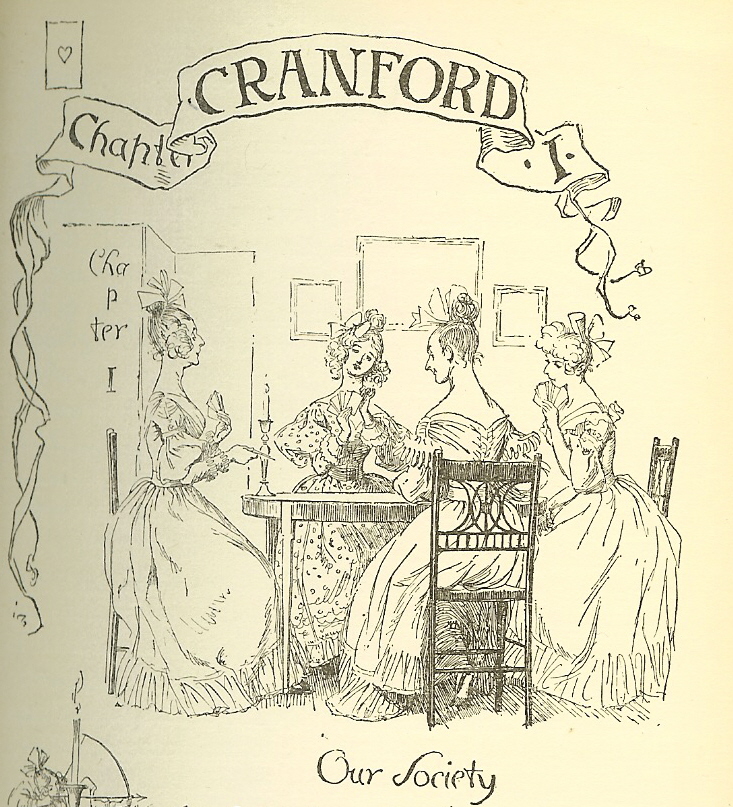
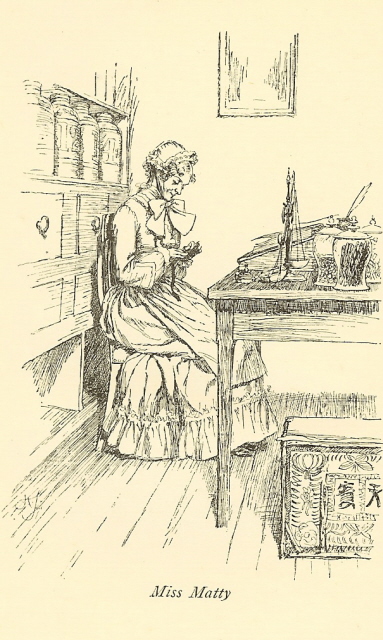
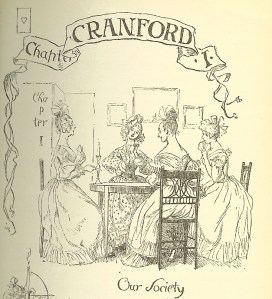
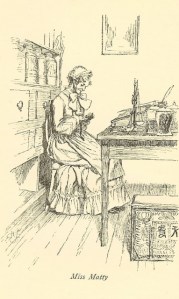
* Both illustrations above are from the London Macmillan edition of Cranford, illustrated by Hugh Thomson (originally published in 1891). This copy is also available at the Illustrated Cranford site.

Further references:

The Gaskell Information Page which includes many links to other information, societies, etc.

The E-Texts of all her works.

A few biographies: by Angus Easson (London, 1979); Winifred Gerin (Oxford, 1980); Aina Rubenius, The Woman Question in Mrs. Gaskell’s Life and Work (Upsala, 1950); Jenny Uglow, Elizabeth Gaskell: A Habit of Stories (London, 1993)1

And see also the recent Jane Austen Today Blog where Ms. Place discusses Cranford along with an interview with Judi Dench.

Mrs. Gaskell’s Works:

  1. Mary Barton: A Tale of Manchester Life, anonymous (2 volumes, London: Chapman & Hall, 1848; 1 volume, New York: Harper, 1848);
  2. Libbie Marsh’s Three Eras: A Lancashire Tale, as Cotton Mather Mills, Esquire (London: Hamilton, Adams, 1850);
  3. Lizzie Leigh: A Domestic Tale, from “Household Words,” attributed to Charles Dickens (New York: Dewitt & Davenport, 1850);
  4. The Moorland Cottage, anonymous (London: Chapman & Hall, 1850; New York: Harper, 1851);
  5. Ruth: A Novel, anonymous (3 volumes, London: Chapman & Hall, 1853; 1 volume, Boston: Ticknor, Reed & Fields, 1853);
  6. Cranford, anonymous (London: Chapman & Hall, 1853; New York: Harper, 1853);
  7. Lizzie Leigh and Other Tales, anonymous (London: Chapman & Hall, 1855; Philadelphia: Hardy, 1869);
  8. Hands and Heart and Bessy’s Troubles at Home, anonymous (London: Chapman & Hall, 1855);
  9. North and South, anonymous (2 volumes, London: Chapman & Hall, 1855; 1 volume, New York: Harper, 1855);
  10. The Life of Charlotte Brontë; Author of “Jane Eyre,” “Shirley,” “Villette” etc., 2 volumes (London: Smith, Elder, 1857; New York: Appleton, 1857);
  11. My Lady Ludlow, A Novel (New York: Harper, 1858); republished as Round the Sofa (2 volume’s, London: Low, 1858);
  12. Right at Last, and Other Tales (London: Low, 1860; New York: Harper, 1860);
  13. Lois the Witch and Other Tales (Leipzig: Tauchnitz 1861);
  14. Sylvia’s Lovers (3 volumes, London: Smith, Elder, 1863; 1 volume, New York: Dutton, 1863);
  15. A Dark Night’s Work (London: Smith, Elder, 1863; New York: Harper, 1863);
  16. Cousin Phillis: A Tale (New York: Harper, 1864); republished as Cousin Phillis and Other Tales (London: Smith, Elder, 1865);
  17. The Grey Woman and Other Tales (London: Smith, Elder, 1865; New York: Harper, 1882);
  18. Wives and Daughters: An Every-Day Story (2 volumes, London: Smith, Elder, 1866; 1 volume, New York: Harper, 1866).

(this list from the Edgar Wright Gaskell Page)