* The Godmersham Lost Sheep Society (GLOSS) is a research group of scholars and bibliophiles searching for all books that were originally in the libraries of Godmersham Park and later Chawton House, both estates of Jane Austen’s brother Edward Austen Knight.
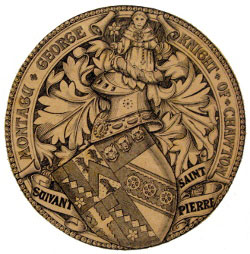
**The three Knight bookplates were all designed by Charles Sherborn in 1900 / 1901:
Bookplate 1
Bookplate 2
Bookplate 3
***********
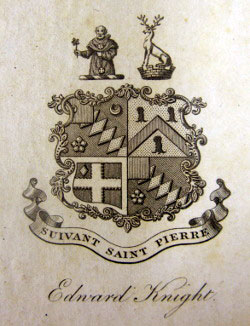
We note here that there are also the bookplates of Thomas Knight (1701-1781) and Edward Knight (1767-1852) and his son, also named Edward (1794-1879) – it is unclear if the bookplate was father or son’s, or if they both used the same bookplate – these bookplates are also to be found in some of the Godmersham library books, so we are searching for these as well, especially if they are listed in the original 1818 catalogue:
Thomas Knight bookplate
Edward Knight bookplate
***********************
1. The History:
Edward Austen Knight inherited three estates from his adoptive family the Thomas Knights: Godmersham Park in Kent, and Chawton House and Steventon in Hampshire. Godmersham and Chawton had large extensive libraries typical of the gentry of the time. Edward had a catalogue of the Godmersham Library compiled in 1818, listing about 1250 titles. These books were later combined with the Chawton House Library when Godmersham was sold in 1874, with many of the volumes sold or otherwise distributed over the years. [Montagu George Knight, grandson of Edward Knight, placed his bookplates in most of the books of this combined library, as well as in the books he added to it. The remaining library (called the “Knight Collection” and still in the family) is now housed at Chawton House Library, which serves as an important literary heritage site and a center for the study of early women writers]. We know Jane Austen spent a considerable amount of time in both these libraries – and an ongoing project has been to try to locate the missing volumes that have wandered away and might still be extant in libraries, in book collectors’ homes, or on bookseller shelves – the “Lost Sheep” of Godmersham Park.
2. The Digital Godmersham Project:
Initiated and run by Professor Peter Sabor (Canada Research Chair in Eighteenth-Century Studies and Director of the Burney Centre at McGill University), this is a web-based open-source project that will include the Knight family books that are recorded in the catalogue of 1818, as they were on the shelves – a virtual library so to speak. It will be called “Reading with Austen.” This Phase I of the project will launch in 2018, the bicentenary of the original catalogue. While it would be a final goal to locate all the missing titles that are out there, this digital project will create for us what Jane Austen would have seen and read when visiting her brother.
3. What we need:
If you have or locate any books with any of the three Montagu George Knight bookplates, or the Thomas or Edward Knight bookplates, please contact us – we would like good pictures of:
a.) the binding/cover;
b.) the inside cover of the book, where Montagu Knight’s bookplate should be attached, often together with a small shelf ticket from Chawton House Library; and
c.) the title page of the book;
d.) any marginalia
These images would be used on the website, with or without your name as the book’s current owner/location (this is up to you).
4. Donation / sell options:
Some of those found thus far have been privately purchased and donated back to the Chawton House Library (they do not have funds for this project). If you would like to “return” the book to Chawton to be part of their permanent collection, you would become one of GLOSS’s Team Heroes and we would be forever grateful. All donations are tax-deductible. Or, if you would consider selling the book back to CHL now or in the future (or making a donation to the cause so we can purchase books as they become available), we would add it to our wish-list of purchases and ask that you send the pictures noted above so it can be added to the website. Progress is slow, and because every book may not be able to return home, we hope this virtual library will serve as a useful research tool for future studies of reading habits in the 18th and 19th centuries.
Peter Sabor – Professor, Canada Research Chair in Eighteenth-Century Studies, Director of the Burney Centre, McGill University: peter.sabor [at] mcgill.ca
You are Cordially Invited to JASNA-Vermont’s June Meeting
with
JASNA President Claire Bellanti*
“‘You Can Get a Parasol at Whitby’s:’
Circulating Libraries in Jane Austen’s Time”
Sunday, 4 June 2017, 2:00 – 4:00 p.m.
Morgan Room, Aiken Hall, 83 Summit Street Champlain College,
Burlington VT**
********
Join us for an illustrated talk about an 18th century social institution that was very important to Jane Austen in her own life and her fiction, the Circulating Library. Claire will present its history and then, with references to Austen’s novels and letters, show how central such libraries were in the reading and sharing of books in Regency England.
*Claire Bellanti holds an M.A. in History (UNLV) and an M.B.A (UCLA). She is retired from a 35 year career as a library professional at UCLA. She is currently President of the Jane Austen Society of North America, and has served in other capacities on the Board of JASNA SW and the Board of JASNA since 1994. She has written and lectured frequently about the UCLA Sadleir Collection of 19th Century Literature, including the Jane Austen contents and Silver Fork portions of the collection.
~ Free & open to the public ~ ~ Light refreshments served ~
Gentle Readers: Today I welcome Tony Grant as he writes about his visit this week to the “EMMA 200” exhibit at Chawton House Library, he being my feet on the ground so to speak as I am woefully not able to be there myself. Hope those of you who are able to go will do so – and send me pictures and your thoughts when you do!
[Update: please read Tony Grant’s post about walking around Chawton at the “Jane Austen’s World” Blog]
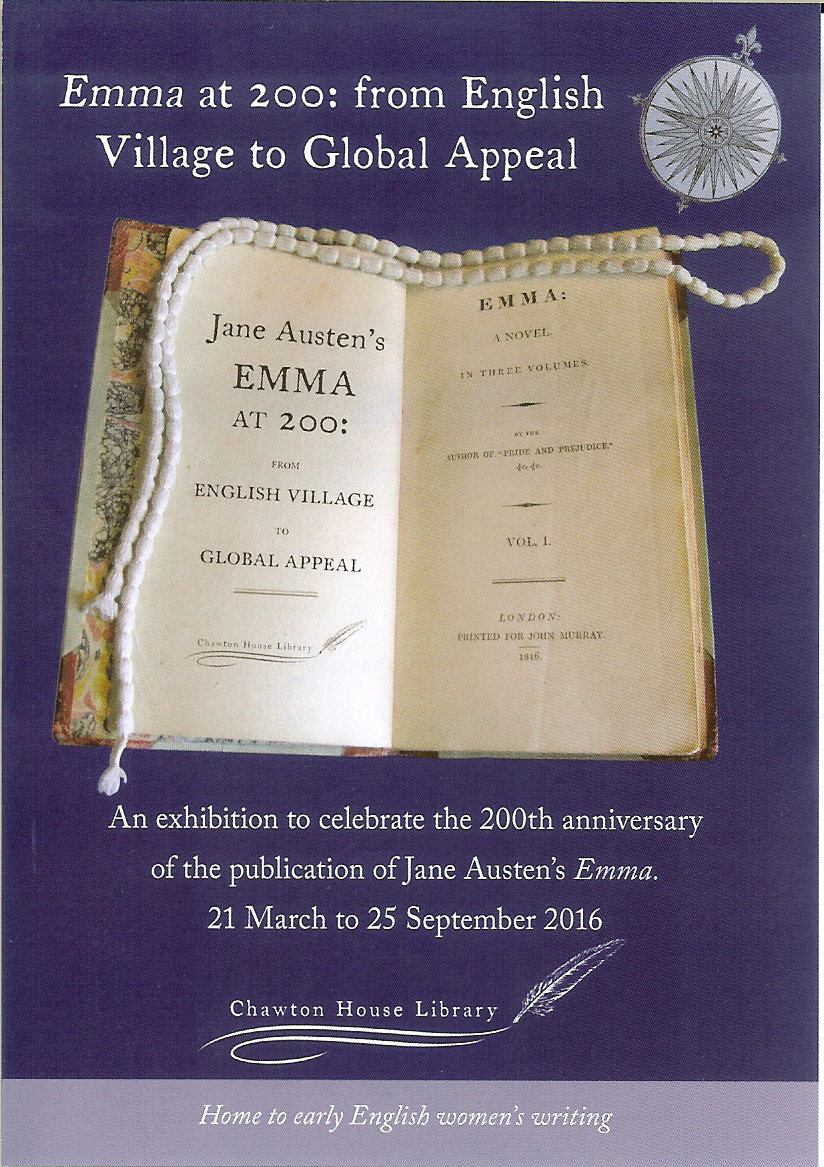
EMMA 200: English Village to Global Appeal
(Chawton House Library 21st March – 25th September 2016)
On Wednesday 20th April I drove from Wimbledon to Chawton in Hampshire over the Hogs Back with views stretching across Surrey into the distance. It was a bright sunny day and seeing the Surrey countryside green and pleasant and shining in the bright sunshine under blue skies was appropriate for my adventure. I was driving to Chawton House Library to visit the “Emma 200 exhibition.” Emma is Jane Austen’s Surrey novel and this year is the 200th anniversary of its publication and it is entirely set within that county.
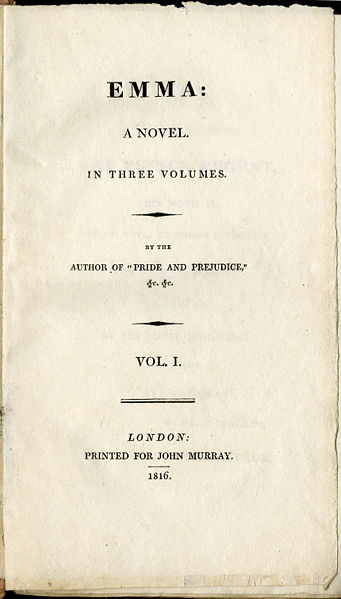
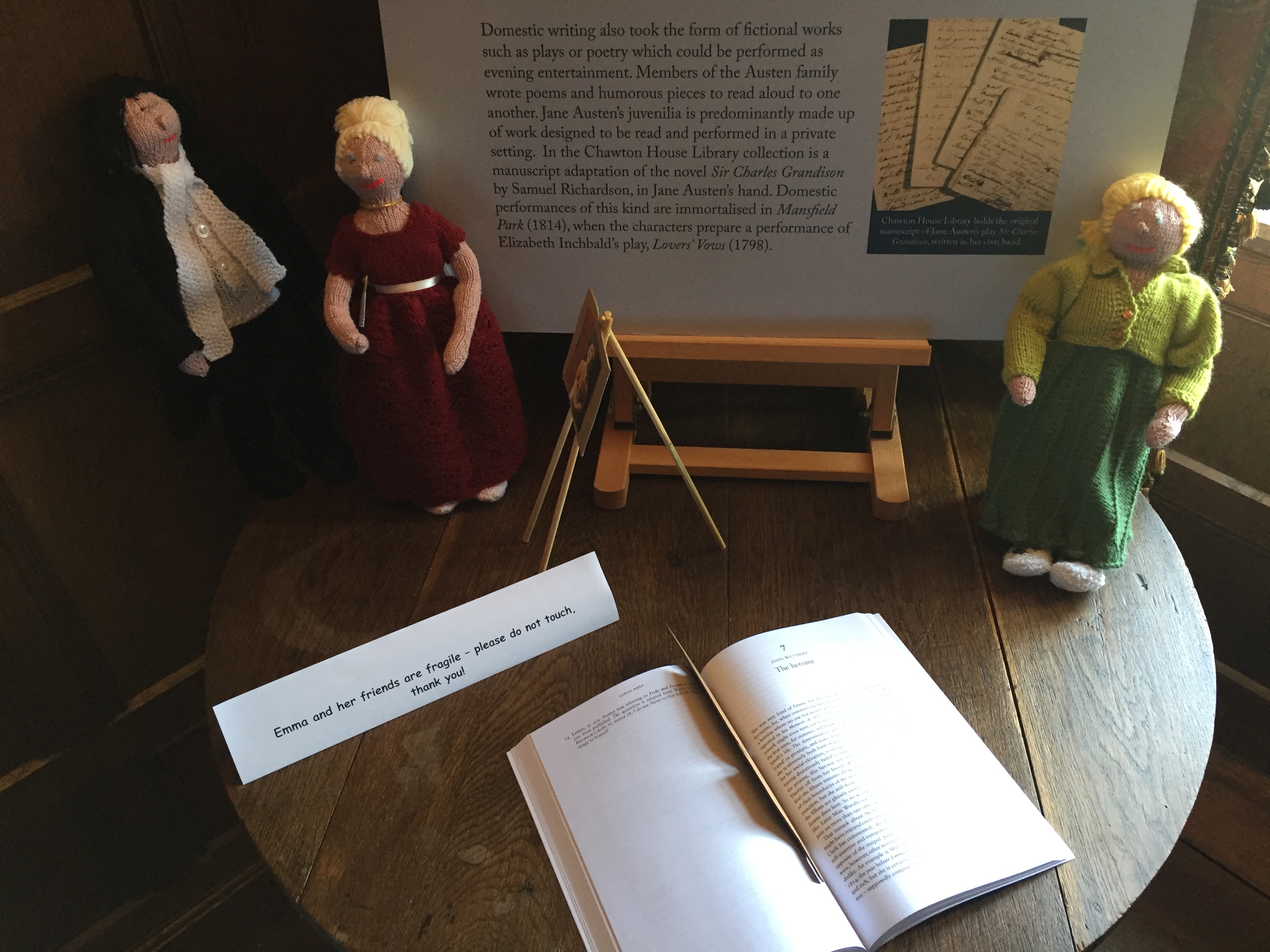
Emma was published by John Murray II of Albemarle Street on the 23rd December 1815, although its title page reads 1816. This exhibition has items from Chawton House’s own collection and from the Knight family collection, as well as other items on loan. The exhibition covers the reception of Emma through the nineteenth, twentieth and twenty first centuries; it also considers the country setting of the novel and the places that were possible influences. It covers the global appeal of Emma. It has a large section about John Murray II and nineteenth century publishing practices through letters and comments made by Jane herself and fellow authoresses also published by Murray. It highlights authors mentioned in the novel and nineteenth century ideas about female accomplishments such as music, embroidery and painting. It shows the connection with Shakespeare and has a section about the reception of the novel. In particular, there is a letter written by Charlotte Bronte to her own publisher, W.S. Williams, discussing her thoughts about Emma and Jane Austen as a writer.
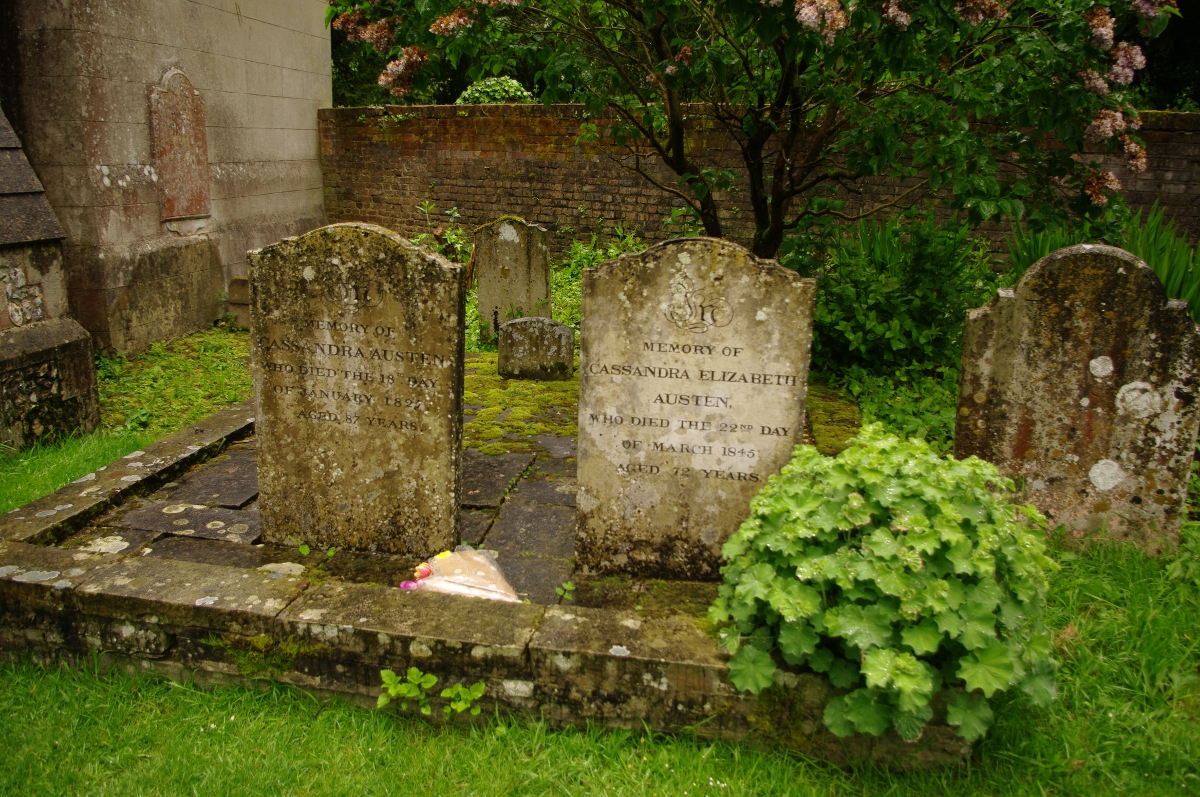
I arrived at the electronically operated gates early. The house opens at 1.30pm Monday to Friday. I was there promptly at 1.10pm. I decided to have a look around and inside of St Nicholas Church nearby, which is Chawton’s parish church and where Jane Austen and her family worshipped. The church we see today is not the church Jane knew. There was a fire sometime after Jane’s death and it had to be rebuilt, though some of the structure from the church that Jane knew remains. I read the memorials to the Austens and Knights within and then went round to the back of the church through an arbor of dark and gloomy ancient yew trees to see the side-by-side graves of Austen’s sister, Cassandra Elizabeth Austen, and mother, Cassandra Austen.
**************
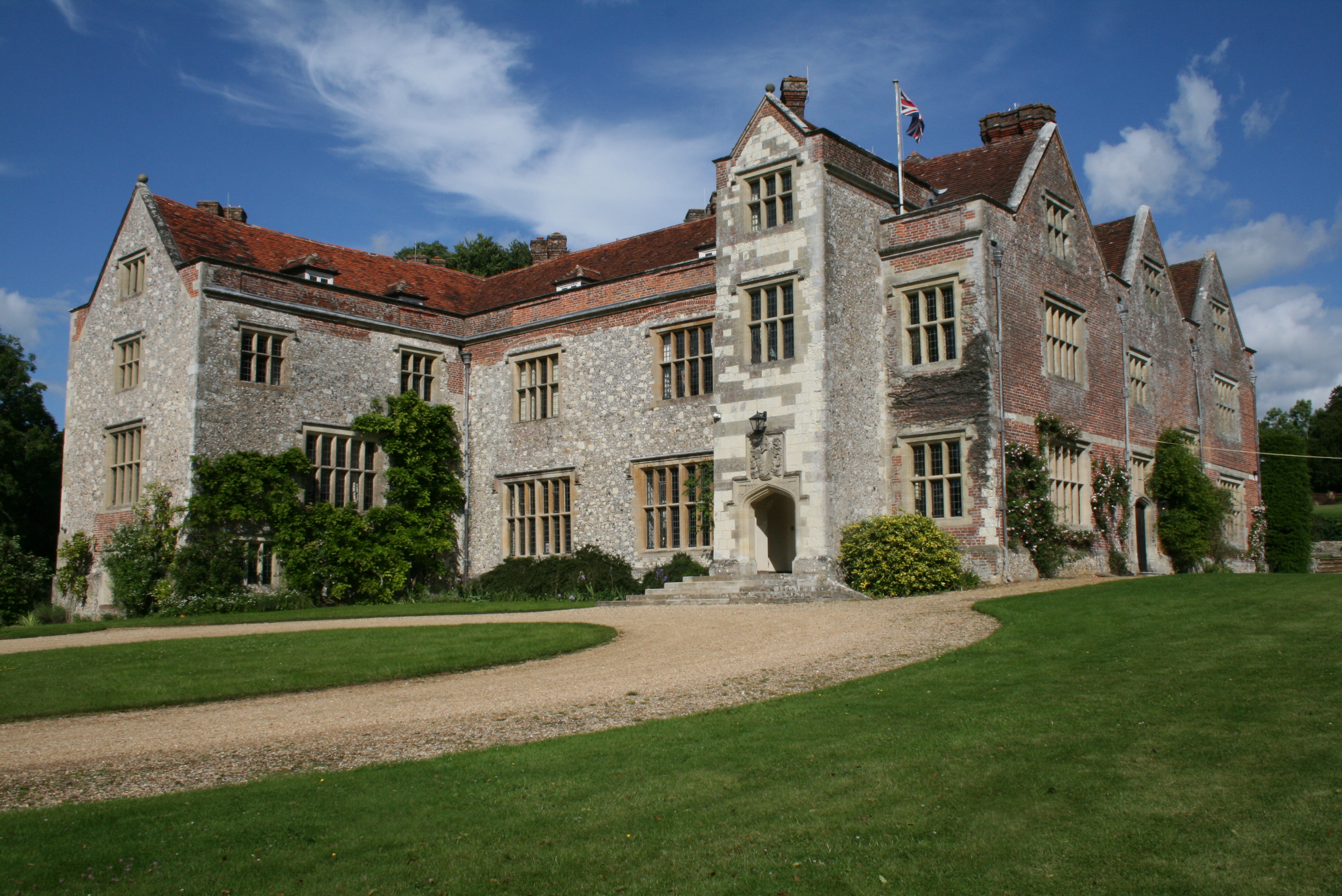
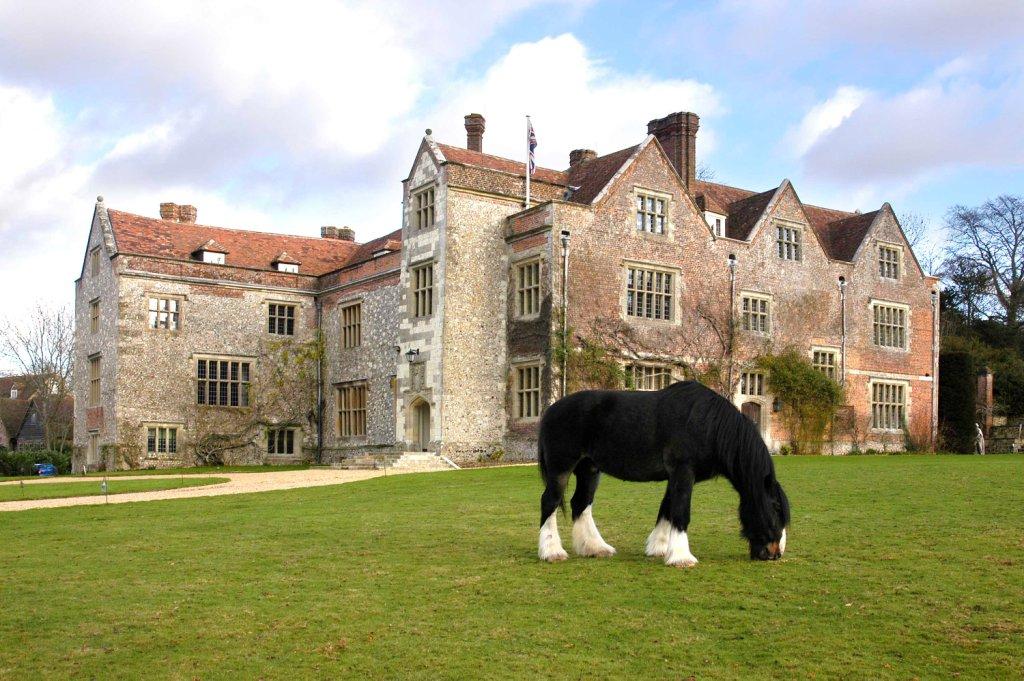
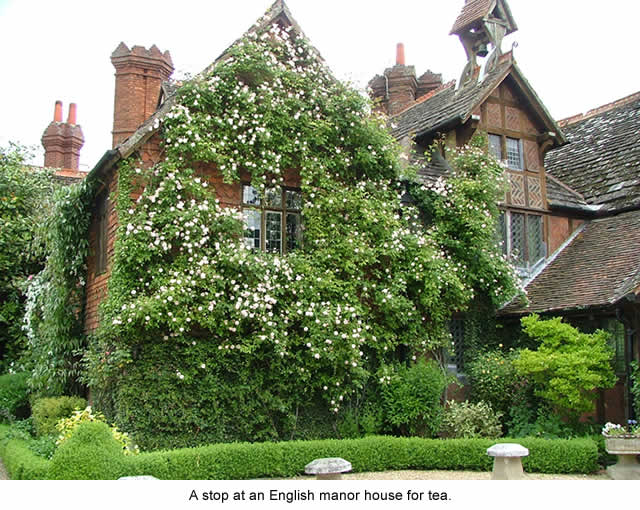
Chawton House Library
It was such a nice day and I still had about ten minutes left so I sat on a stone bollard near the entrance gate and watched a gentleman sitting on a motor mower mowing the grass verges along the drive. As I sat there I noticed a smartly dressed lady leaving the front entrance of the great house with a dog on a lead. She approached the gate and opened it, placing a notice board on a stand giving the times and prices of entry. I asked jokingly if this meant I can go in. I pointed out it was still ten minutes to half past. She laughed and said by the time I walked up the driveway I should arrive at the door on time. “Just knock and they will let you in,” she told me. I knocked on the door with five minutes to and it was immediately opened by a smiling lady who ushered me in. The house is staffed by volunteers except in the kitchens where the official housekeeper keeps her domain but more about that nice lady later. I found everybody so enthusiastic and full of smiles and really, extremely welcoming. I paid my entrance fee and one lady took me into the great hall on the left of the entrance and showed me a map of the house with the route marked by numbered rooms. It is a self-guided tour so I was given the map to hold as I went round. There are volunteers in every room who you can talk to and ask information of.
**************
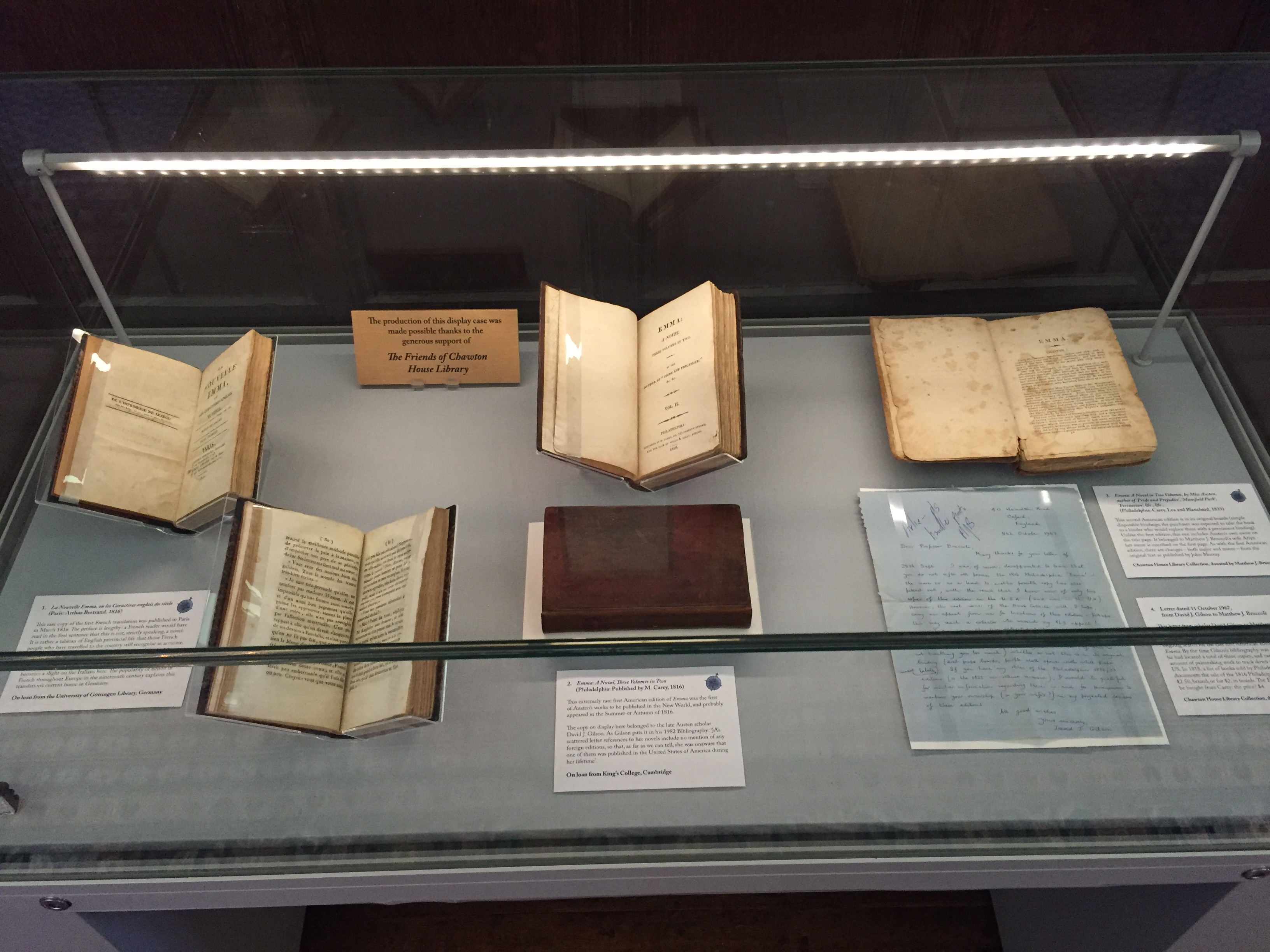
The exhibition began in the great hall. A glass case displays some first editions dated 1816. There was an edition in French as well as one published by Mathew Carey a publisher in Philadelphia. Somehow Carey had read Sir Walter Scott’s review of Emma and obviously liked it. He sold his version at a much cheaper price than John Murray’s London version. He produced a card backed version printed on cheap paper for $2. Murray’s London version, which was a much better quality, was twice the price. Very few American first editions have survived as a consequence of the poorer quality and the copy in this exhibition shows signs of much yellowing of the paper and black mold spots. It looks an inferior book to both the French and English versions. I felt honoured to able to lean over the glass case and read the opening few lines of the Murray edition.
“Emma Woodhouse, handsome, clever, and rich, with a comfortable home and happy disposition, seemed to unite some of the best blessings of existence:…”
There were no such things as copyright laws in those days and both the French and American versions, probably unknown to Jane Austen, brought her no income. Later in the nineteenth century Dickens went over to America and tried to do something about copyright laws in America but to no avail and to his great consternation. The fact that copies of Emma were being published abroad within the first year of its initial publication in England tells us something about publishing and the book trade at the time. Money could be made from books.
Emma 1st ed.
Dedication page
*****************
John Murray – NPG (Wikipedia)
John Murray II was the head of the foremost publishing company in Britain. He was a hard headed business man and if he could get an advantage, especially, it seems over the authors he published he would. I think Jane Austen had the measure of him. Her brother Henry who had dealt with publishers for Jane initially became ill and Jane took over negotiations with Murray herself. She was very direct and firm in her dealings. She said of Murray, “He is a Rogue, but a civil one.” In corresponding with Murray over the publication of Emma, for instance, on 3rd of November 1815, a month before the publication of Emma, she writes,
“…I am at the same time desirous of coming to some decision on the affair in question, I must request the favour of you to call on me here, on any day after the present that may suit you best, at any hour in the evening, or any in the morning except from eleven to one. – A short conversation may perhaps do more than much writing.”
It sounds as though Murray has been given his marching orders and she isn’t going to have any truck with being messed about. She is firm but polite with the “Rogue.” She knows the power of a face to face encounter. Some of her contemporaries were perhaps not quite so strong with Murray but learned a lesson.
Domestic Cookery, 1813 ed (Wikipedia)
One of the exhibits on display, putting Jane Austen’s publishing experiences with Murray in context, is a book called Domestic Cookery, published by Murray in 1806. It was very popular and made a lot of sales and presumably a lot of money for Murray. It was written by Maria Rundell. Rundell had been paid £150 by Murray. She regarded Murray as a friend but she was not aware at first that her book had become such a bestseller. When she found out she felt that Murray was not upholding the copyright agreement he had with her. Eventually Murray paid her £2100 but kept the right to continue publishing the book himself. Jane Austen’s comments about him being “a rogue but a civil one” come to mind. Murray was obviously a very astute business man and could make money from trouble.
Another exhibit displays copies of books written by the French authoress, Germaine de Stael. She wrote books about Rousseau, Revolutionary Politics and Marie Antoinette’s trial. She was virtually banned by Napoleon Bonaparte. He had her book, De L’Allemagne pulped. Murray saw a chance. He took her on. In 1813 he used three printers to publish the French original and English translations simultaneously. He relied on anti-French feelings to make Stael’s books best sellers.
Madame_de_Staël (Wikipedia)
Jane Austen had her critics who made both good and not so good comments about her work. She took notice of what people said about her books and noted down these various opinions. Sir Walter Scott, her illustrious contemporary, who was also published by John Murray, wrote of Emma,
“We bestow no mean compliment on the author of Emma, when we say that keeping close to common incidents, and to such characters that occupy the ordinary walks of life, she has produced sketches of such spirit and originality that we never miss the excitation which depends upon a narrative of uncommon events, arising from the consideration of minds, manners and sentiments greatly above our own.”
Sir Walter Scott (Wikipedia)
It appears that Murray regularly sent copies of newly published books to other writers he published for their comments. This can be seen as eliciting positive comments from people who wanted to keep in with Murray. Jane Austen mentions in her letters to Murray how thankful she is for the copy of Waterloo he sent her to read and actually asks him if he has any more she can have a look at. This suggests she knows how to play the publishing game. She is as astute as Murray himself it seems. In one way Scott’s positive comments could be read as keeping in with Murray. If Murray and his publishing house does well and sells lots of books it can only benefit himself after all, but there is more to Scott’s review. I think he has recognized what is original in her writing. She is a realist. Her style is about everyday common occurrences and everyday people and she makes them heroic. People reading Jane Austen can see themselves and people they know in her writing. It is said that reading a novel is good emotional and psychological therapy, and Austen hit a powerful vein.
Charlotte Bronte (Wikipedia)
The highlight of the whole exhibition for me, even more so than seeing and reading a first edition, is the actual letter Charlotte Bronte wrote to her publisher, W.S. Williams, on April 12, 1850, in which she writes a lengthy paragraph about her thoughts on Jane Austen and Emma. I found it easy to read Bronte’s small, thin, precise handwriting that flows clearly across the page.
“I have likewise read one of Miss Austen’s works—Emma—read it with interest and with just the degree of admiration which Miss Austen herself would have thought sensible and suitable. Anything like warmth or enthusiasm—anything energetic, poignant, heart-felt is utterly out of place in commending these works: all such demonstration the authoress would have met with a well-bred sneer, would have calmly scorned as outré and extravagant. She does her business of delineating the surface of the lives of genteel English people curiously well. There is a Chinese fidelity, a miniature delicacy in the painting. She ruffles her reader by nothing vehement, disturbs him by nothing profound. The passions are perfectly unknown to her; she rejects even a speaking acquaintance with that stormy sisterhood…”
Bronte continues:
“What sees keenly, speaks aptly, moves flexibly, it suits her to study; but what throbs fast and full, though hidden, what the blood rushes through, what is the unseen seat of life and the sentient target of death—this Miss Austen ignores. “
And she goes on. Charlotte Bronte is actually agreeing with Scott’s comments when he describes her writing as
“……close to common incidents, and to such characters that occupy the ordinary walks of life”
The difference is that Scott makes his view a positive while Bronte makes her view a negative. I agree with what she says. Austen writes about the ordinary. Bronte on the other hand and her sisters wrote about,
“what throbs fast and full, though hidden, what the blood rushes through, what is the unseen seat of life and the sentient target of death”
Charlotte Bronte is actually describing the differences between their two styles. I have read articles published on some blogs where the writer tries to pit Charlotte Bronte against Jane Austen. Who do you like the best? Who do you think is the better writer? And so on. These are a childish approach to comparing two great writers. Two geniuses. Their styles are different. Every one of us reads different types of books for different reasons at different times to fit, very often , our different moods. We can read a poem by Wordsworth one day and on other days a romantic comedy, a ghost story, a swashbuckling adventure, a horror story or maybe a present day thriller. We can enjoy each genre for what it is and what it brings to us. Austen and Bronte are not enemies, they are not one better than the other. They are different and we can enjoy both. I can imagine how Bronte could be critical. She had a harder life than Jane Austen. Her novels and those of her sisters, were full of passion and deep feelings and filled with great moral uncertainties testing the moral status quo to the limit. Their ideas made their lives worth living and helped them live their short lives with feeling. Jane Austen had a much easier existence. I can see how Charlotte Bronte might not understand Austen’s standpoint. She probably could not bear to live the way Austen’s characters are portrayed. However, we can love them both.
The exhibition demonstrates many of the influences Jane Austen might have used in her writing of Emma. There is the suggestion, for instance, that the fictional places Highbury and Hartfield in Emma are modelled on Chawton and the local town Alton. These are in Hampshire but the novel is set in Surrey. Others I know would not agree. Some say Leatherhead in Surrey, which is near Box Hill, a major location in the book. Others suggest Highbury is a generic English village, and I think this more likely.
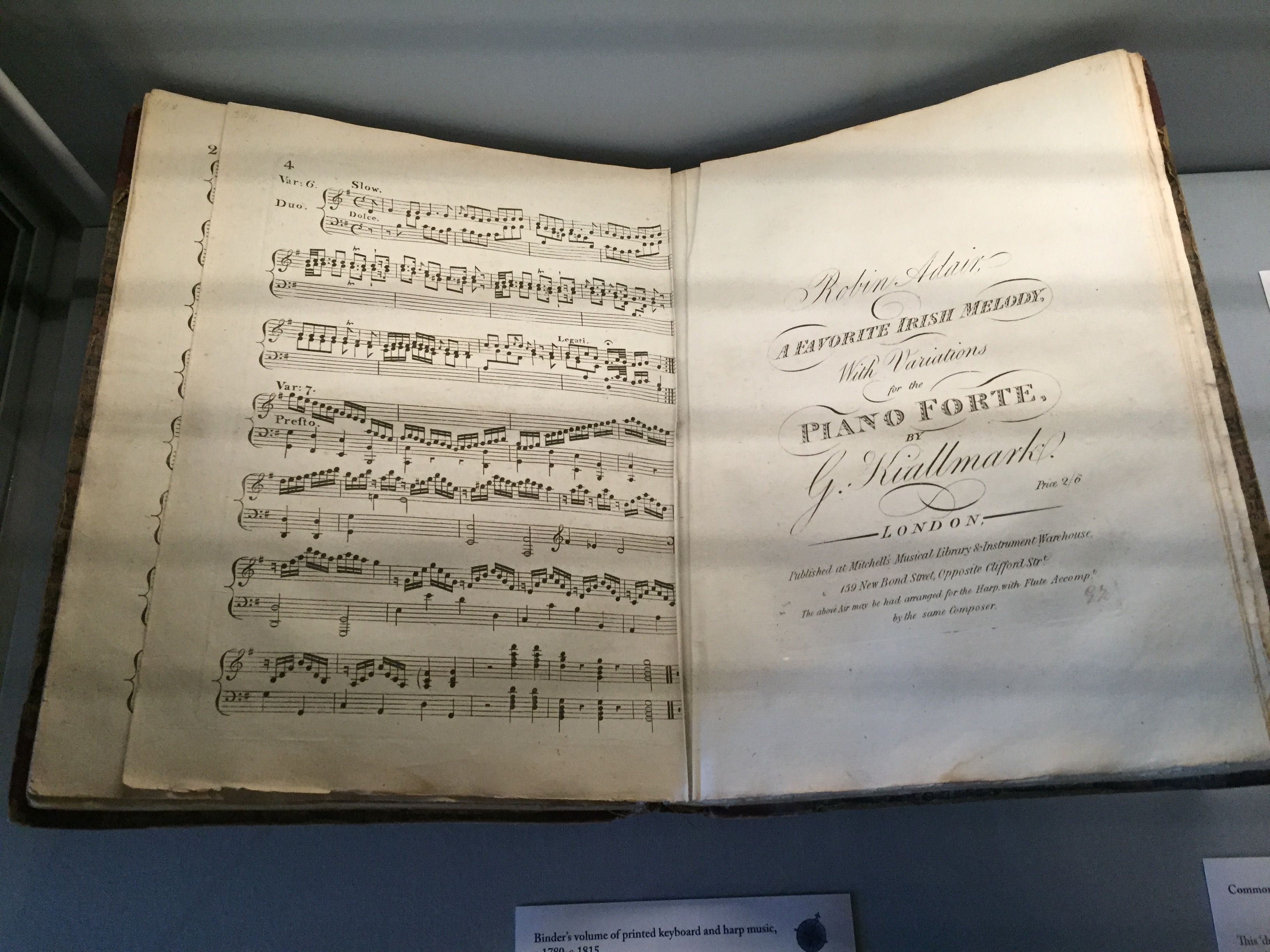
In Emma Jane Fairfax plays a tune called “Robin Adair” on the newly arrived pianoforte. There is on display a copy of “Binder’s volume of printed keyboard and harp music, 1780-1815,” annotated and autographed by Jane’s sister Cassandra. It includes the music to “Robin Adair.” [Ed. You can read this online here: https://archive.org/details/austen1677439-2001 ]
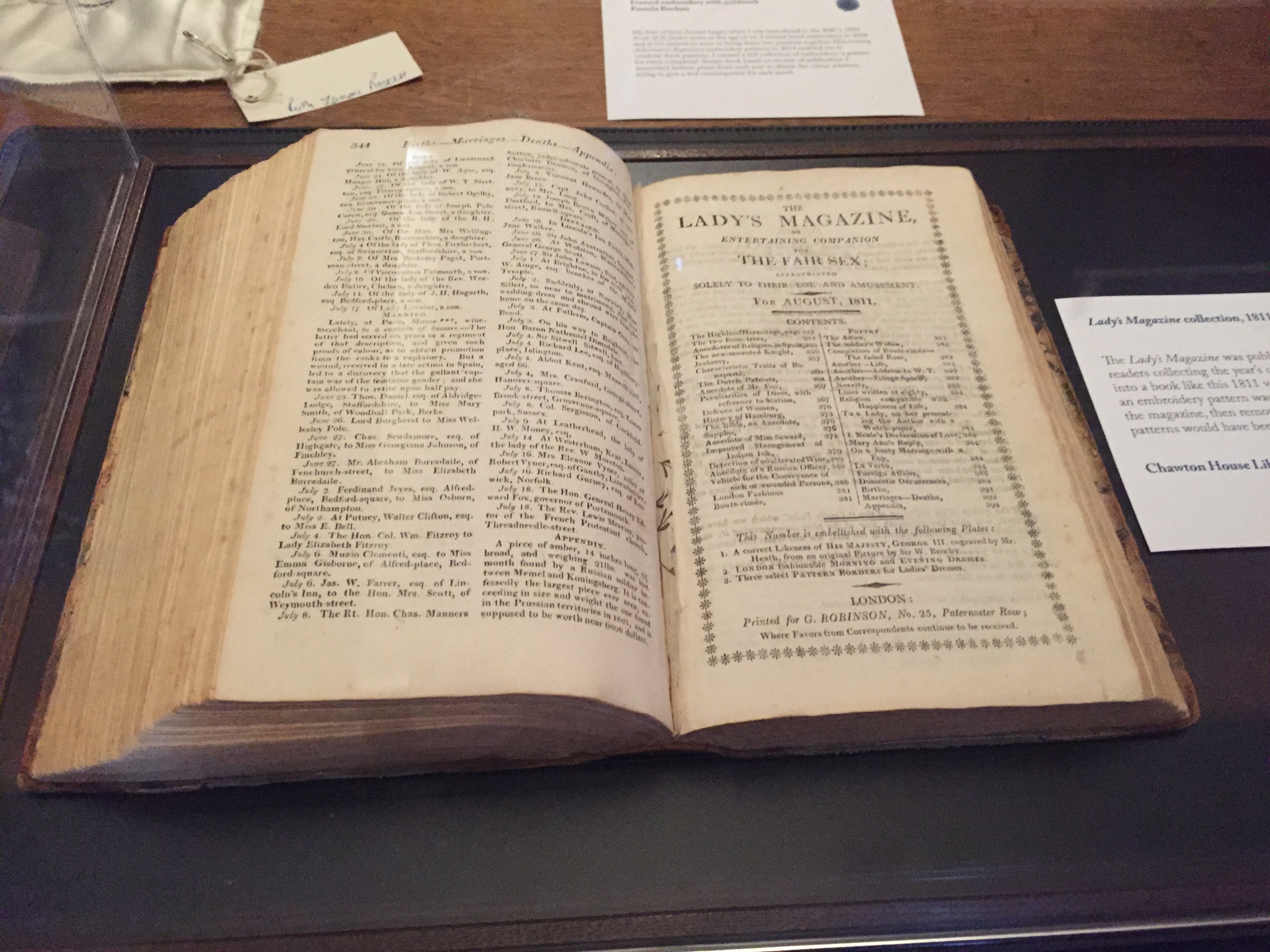
There is a bound set of The Ladies Magazine (1770-1832) which provides sewing patterns for young ladies. It is the sort of magazine that Jane Austen had access too. In Emma, sewing and painting are pastimes for young ladies.
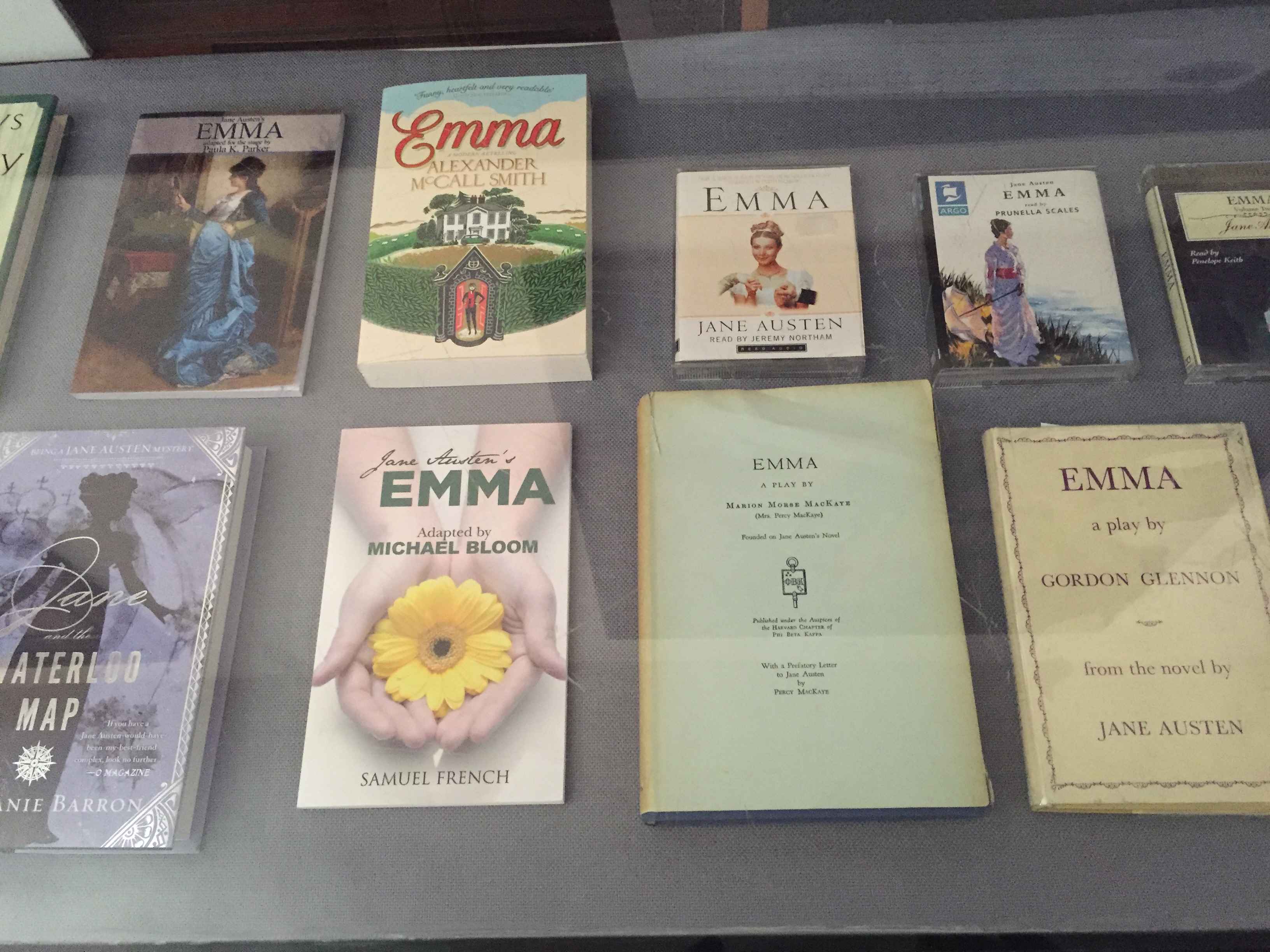
A final display cabinet shows the influences that Emma has had on culture over the centuries. There are various spin-off novels, including the latest modern version of Emma written by Alexander McCall Smith. There are play scripts written by various playwrights turning Emma into a stage version. These include plays by Gordon Glennan and Marion MacKaye. There are a number of radio adaptations. One read by Prunella Scales, another by Jeremy Northam. There are the film versions and the films influenced by Emma such as Clueless set in modern times. Spin-off novels are represented by a copy of the latest Stephanie Barron mystery The Waterloo Map. [Ed. Note that this latest Barron mystery has Jane visiting Carlton House where she meets with the Prince Regent’s Librarian – this all really took place on 13 November 1815; he “suggests” that she dedicate her newest book, Emma, to the Prince Regent – Barron has her also coming upon a dead body in the Library…]
****************
The exhibition is definitely worth seeing and just as much is the opportunity to walk around Chawton House where Jane Austen herself and her family lived and breathed. I also took the opportunity to take a walk in the gardens. I came across a snake lying across my path as I walked up to the walled gardens. I must tell you that in all my life I only recall seeing two other snakes in Britain in the wild. This was a grass snake and was totally harmless. The adder is the only poisonous snake in Britain and they are very shy creatures. I think I saw one once in the New Forest.
*************
“Portrait of a Lady” at CHL
The people who volunteer at Chawton are wonderful. They want to talk to you and tell you things. I had a very amusing moment with an elderly gentleman volunteer at the top of the great staircase. He was sitting on the landing. When I approached he showed me an information leaflet and we discussed its contents. One thing it mentioned was the original William Morris wallpaper. I looked around and couldn’t see any. “Well, then where’s the wallpaper?” I joked. He laughed and said “come with me.” We walked half way down the staircase and then turned and got on our hands and knees. There indeed, almost hidden behind the balustrade, was a patch of darkened William Morris print. He also kindly showed me the large 1714 map of London displayed on the folding panels of a screen.
We found Henrietta Street and other places associated with Jane Austen when she visited London. Then I went into the old kitchen which is used as a shop and cafe and met a lovely lady who told me she was the housekeeper. I had a delicious chocolate cake and a cup of coffee. All together I had a wonderful visit to the “Emma 200 exhibition.”
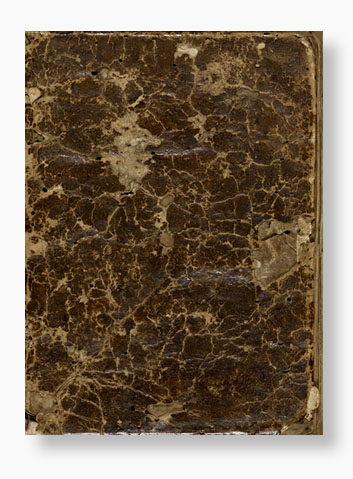
When I was in Library School, one of my favorite classes was a study of book conservation and visit to the NEDCC (the Northeast Document Conservation Center) – this I thought was the place where the things I most loved were given the care they sorely needed. Sadly, I didn’t go into that field [hindsight is a dreadful thing!] – I was more into reading and making sure the right book got into the right person’s hands, believing that our system of free libraries was the grandest example of a free world. I remember as a 15 year-old page in our hometown library, roaming the shelves and discovering the Brownings, and rather than doing my job of re-shelving (I confess this now many years later), I was secretly discovering Poetry, finding Love and Words in the pages of these old books. I’ve never lost that love of an old book – the smell, the touch, the beauty of bindings and paper, the scribbled notes or bookplates or inscriptions of previous owners – not to mention the story being told. That I ended up a used bookseller was likely destiny at work – my favorite set of books in my home was an 1890 Encyclopedia Britannica! (I was not the most current student in history class!)
We now live in a world where the physical book is being rejected for the joy of carrying around 1500 titles on a small tablet that we can also use for all manner of interruptive connections to the real world. This escape into a book can be initiated wherever you are, whenever you want, without the inconvenience of lugging around poundage – I readily admit to loving my kindle! – But it is not the same, no matter how many people argue the point. I don’t remember the books I read this way – I don’t retain where such and such was on a particular page, I miss that smell, that touch, that communion with a physical object that has a history that somehow brings me closer to the author or a binder or papermaker or some previous owner or owners.
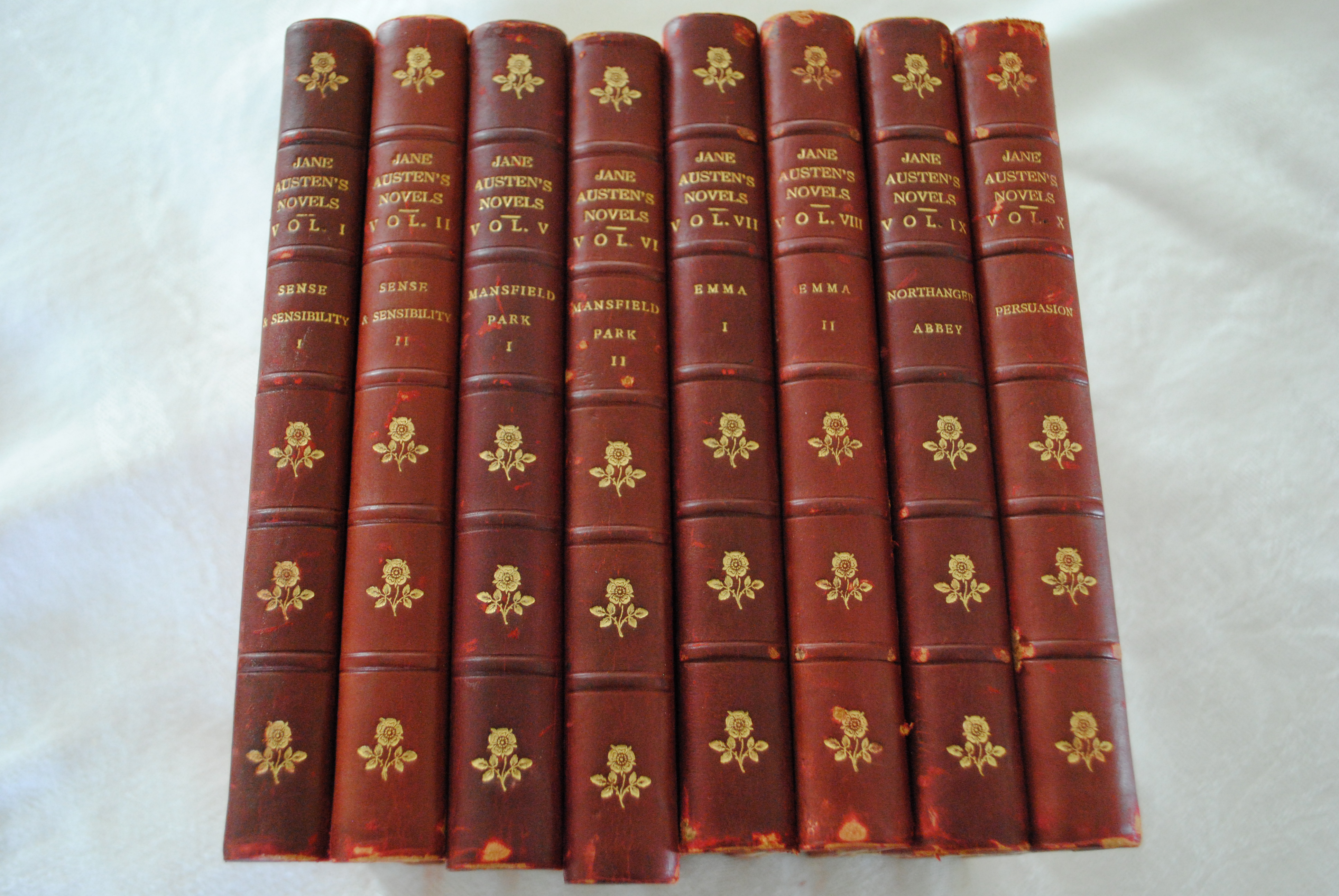
[1898 Dent edition of Jane Austen’s novels – trivia: what is missing??]
I think, I have to believe that the book is not Dead, that an appreciation for the book as an object of beauty and worth may even be stronger than ever, fear of it all disappearing making it all the more valuable to us. And this then brings us to Book Conservation. Because if we don’t take care we shall be losing our very own heritage. I have had any number of books come across my desk that are in appalling states, either too well loved through the years, or just left to disintegrate in some old attic or basement – it is one of the saddest things to encounter really – a book of special significance that is rendered nearly worthless by its poor condition. Enter the conservationist! – Magic can happen! I have been fortunate in finding the most brilliant of these magicians, who has salvaged many a book for me and my customers … And though the value of a repaired work can be affected by such tampering, it is the return to its former state that is the end result, to preserve, protect and savor for the future… The digitizing efforts of so many of our libraries is a glorious thing – making so much accessible to all – I marvel at what is only a keystroke away – but preserving the original must and should be part of this plan.
Chawton House Library
And this brings us to Chawton House Libraryand their appeal for their book conservation program – they need our help!
The history of the Chawton House Library [CHL] is a well-known story, at least among most of my readers here, who perhaps have come to know of CHL because Jane Austen brought us there. Read its history if you don’t know it, and you will come away with unending gratitude to Sandy Lerner for making it all possible. If you have read Dale Spender’s classic Mothers of the Novel: 100 Good Women Writers before Jane Austen (Pandora 1986), and other various titles on the subject, you know that the entire literary tradition of women writers has been essentially silenced – if you are over 50, how many women writers did you read in college? How many did you even know about? The foundation and purpose of CHL has been to correct that horrible omission in our collective history, to give these women writers a home of their own, and to make sure none of them are ever again consigned to the neglected heap of second-class literature.
The CHL website offers a wealth of information on many of these women writers:
[for example: Aphra Behn’s The Rover; or, the Banish’d Cavaliers (1729), and Penelope Aubin’s The Inhuman Stepmother, or the History of Miss Harriot Montague (1770)]
The quarterly publication The Female Spectator is mailed to those who become Friends of the Library. Some of the past issues are available online from 1995 – 2010 here: http://www.chawtonhouse.org/?page_id=55522
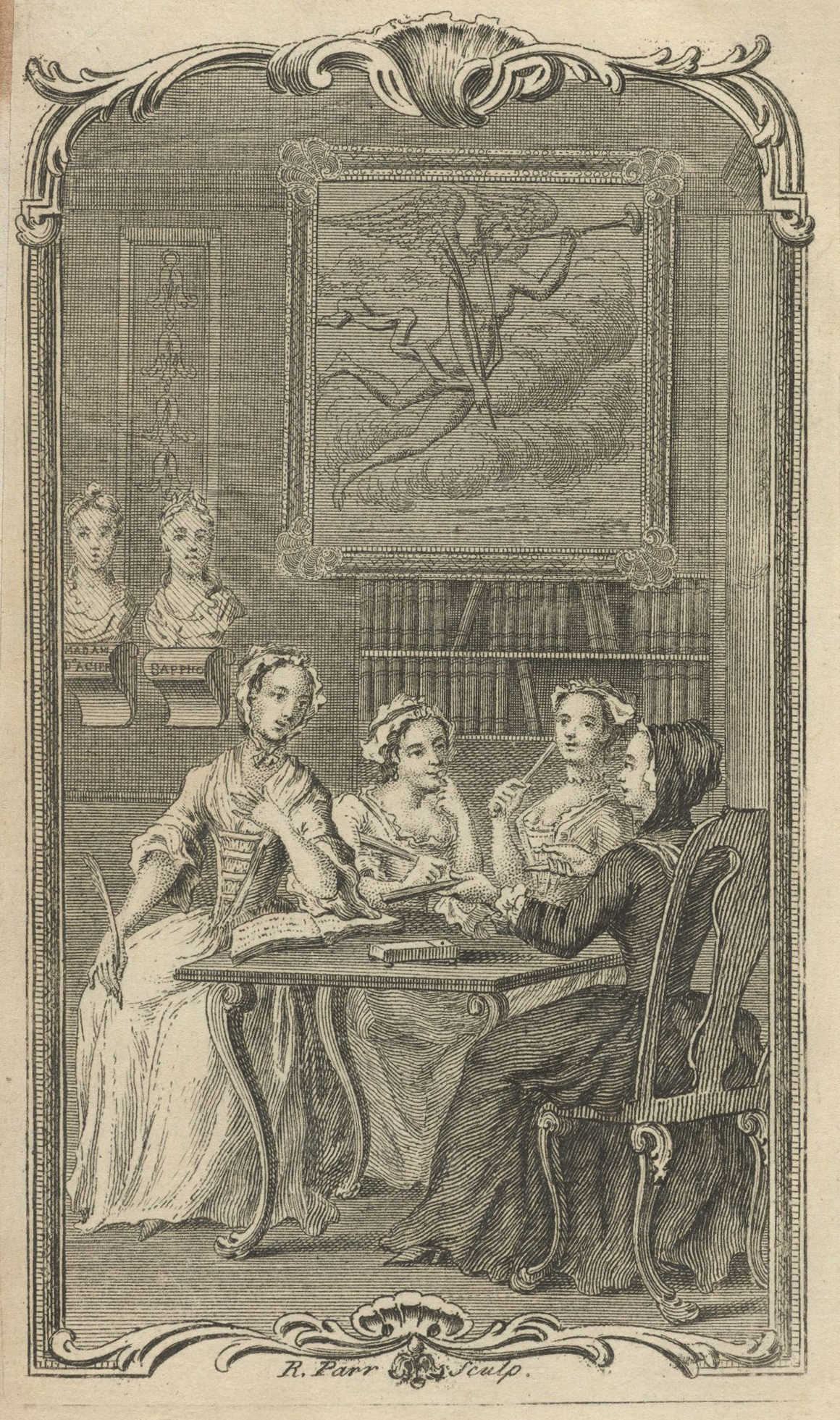
Frontispiece, vol. 1 The Female Spectator, by Eliza Haywood (1744-46) – the title CHL now uses for its quarterly newsletter [image: wikipedia]
_________________
More books in need at Chawton House Library
But the books themselves, the majority really, are in need of repair. Keith Arscott, the Development Director of CHL, in the kick-off for this fund-raising effort, writes:
Thanks to our first and biggest single donation to date – over $3,000 from the George Cadbury Quaker Foundation – we have been able to organise our first conservation skills training day for 10 of our library volunteers to be run by a professional conservator. The donation also covers the first purchase of materials to enable our first volunteers to make a start. And for those of you that don’t know, we also had two generous donations at the reception – one from a red rose and the other from a yellow![the reception for CHL members at the JASNA AGM in Montreal – we were all given roses!] But it is only a start – the Book Condition Survey that we were able to commission after a number of successful funding initiatives concluded that the cost of such a conservation programme would be easily a very large six figure sum – if all the conservation work was undertaken by professional conservators in studio conditions. However, the tremendous interest that our appeal has had with volunteers and their willingness to give their time to help with much of the work – means we have an appeal target in mind of something in the $90,000 range.
And so this is where your help is needed. Gillian Dow, the Executive Director, writes on the website that “small amounts of money can make a very big difference to our programme” and outlines how any donation can contribute to protecting this unique collection:
£1 / $1.70 can buy document repair tape
£6 / $10 can buy unbleached cotton archival ribbon
£10 / $17 can buy an archival box to protect a fragile book
£100 / $162 can pay for a full set of conservation equipment including unbleached cotton archival ribbon, document repair tape and archival boxes
£300 / $486 can pay for a volunteer training day, giving a whole team the necessary skills to carry out vital conservation work
*And here, some great PR from the BBC: last November, they visited CHL and produced a video on the appeal, where Frankenstein and Sense & Sensibility are featured among other titles: http://www.bbc.com/news/uk-england-hampshire-29949168
How to donate? For those of you living in the States, you can donate online directly to the North American Friends of Chawton House Library (NAFCHL) [NAFCHL is a U.S. 501 (c) (3) tax-exempt organization and all donations are deductible for purposes of U.S. income taxes]. NAFCHL will acknowledge U.S. donations as being specifically allocated to our Book Conservation Appeal. See the link on the right sidebar on this page: http://www.chawtonhouse.org/?page_id=58943 . [Everyone else can donate by visiting the same page and choosing the “Virgin Money Giving” link.]
______________
Mary Brunton (1778-1818) – Jane Austen writes about Brunton in her letters [image: wikipedia]
You will find if you spend a bit of time on the CHL website just how many of these women writers have been resurrected from their centuries-long oblivion. They are being studied more than ever as our female literary tradition finds its rightful place in the history of literature. The Chawton House Library has been and continues to be instrumental in finding and keeping these materials – the books, manuscripts, diaries, letters, and artifacts – and we need to preserve it all as best we can so that the Book as we now know it will be there for future generations of readers and scholars. Any donation will be greatly appreciated…hope you can help!
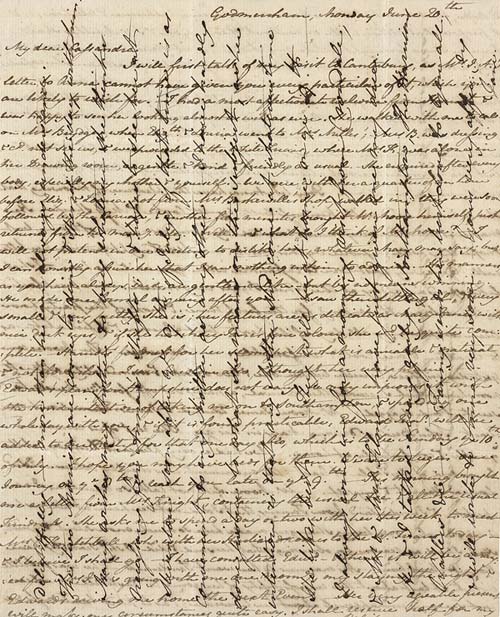
And to end with something about Jane Austen, an essay from the Conservation Center at the Morgan that tells the tale of Austen’s letters and what has been learned in the process of their preservation: “Jane Austen’s Writing: A Technical Perspective” http://www.themorgan.org/blog/jane-austens-writing-technical-perspective
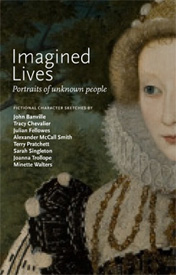
Eight internationally acclaimed authors have invented imaginary biographies and character sketches based on fourteen unidentified portraits. Who are these men and women, why were they painted, and why do they now find themselves in the Collection of the National Portrait Gallery? With fictional letters, diaries, mini-biographies and memoirs, Imagined Lives creates vivid stories about these unknown sitters from the sixteenth and seventeenth centuries.
For your iphone, ipad and such: Ebook Treasures: We already know that Austen’s History of England is available from the British Library, but look at this, a 14th Century Cookbook:
“The Forme of Cury is the oldest surviving cookbook in the world, dating from the late 14th century. Originally made by the cooks of the court of Richard II, very few copies survive, and this one, from the John Rylands Library in Manchester, is probably the best and earliest. Written in Middle English, the script can be hard to interpret, and some of the recipes unfamiliar. The book gives an incredible insight into medieval kitchens, as well as medieval life itself. The book contains one hundred and ninety-four recipes which reveal the amazing variety and elaboration of the dishes available to the elite, including stews, roast dishes, jellies, tarts and custards. Among the recipes are ‘Chyckens in gravey’, ‘Blank manger’ (a white savory stew, from which the word ‘blancmange’ derives),‘Furmente with porpays’ (porpoise in wheat porridge), and ‘Crypses’ (fried pastries).
The manuscript is still in a very worn, and possibly original, binding and it may well have been used as a practical cookery book in an aristocratic or royal kitchen. However, unlike modern recipe books, the Forme of Cury doesn’t give exact quantities or cooking times, so a lot is left to the skill and imagination of the cook.
This iBook contains the complete manuscript along with transcriptions from the Middle English. iTunes £3.99 ” [from the website]___________________________________
Michael Dirda of the Washington Post reviews Death Comes to Pemberley – this is on the top of my TBR pile…
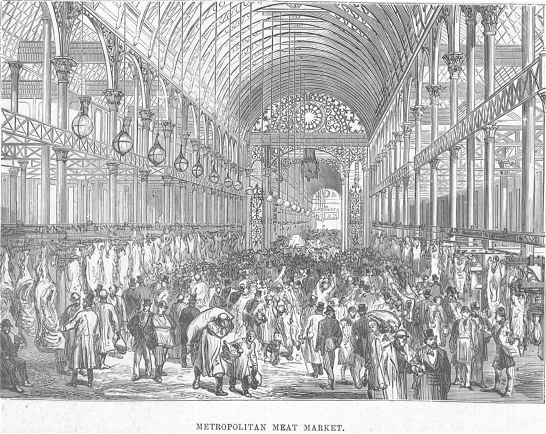
For those non-vegetarians out there with an interest in the Meat of London, here is a tasty read [and perhaps an unsettling one?]:
Meat, Commerce and the City: The London Food Market, 1800–1855 by Robyn Metcalfe – all you ever wanted to know about the Smithfield Meat Market, due out in March 2012 from Pickering & Chatto.
[image from Victorian London.org]
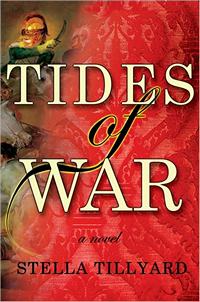
Tides of War, by Stella Tillyard
An epic novel about love and war, set in Regency England and Spain during the Peninsular War (1812-15), by the acclaimed historian and bestselling author of “Aristocrats.” Tides of War opens in England with the recently married, charmingly unconventional Harriet preparing to say goodbye to her husband, James, as he leaves to join the Duke of Wellington’s troops in Spain….
A book about the plague, Ralph Tailor’s Summer by Keith Wrightson – visit the publisher Yale Books where you can read a fascinating extract from the preface.
Charles Dickens is getting a good number of exhibitions all over in celebration of his 200th birthday: you can check the various happenings at the Dickens 2012 website.
*There is also the Dickens Exhibition at The Morgan Library. Here is the online component you can visit without leaving home: you can view 20 pages of A Christmas Carol and read a letter penned by Dickens…
Organized to complement the Center’s major exhibition on Johan Zoffany, who spent six productive years in India, Adapting the Eye explores the complex and multifaceted networks of British and Indian professional and amateur artists, patrons, and scholars in British India in the later eighteenth and early nineteenth centuries, and their drive to create and organize knowledge for both aesthetic and political purposes. Selected from the Center’s rich holdings, the exhibition includes a diverse range of objects from both high art and popular culture, including albums, scrapbooks, prints, paintings, miniatures, and sculpture, demonstrating how collecting practices and artistic patronage in India during that period constituted a complex intersection of culture and power.
Auction News
At auction this coming week: Bonham’s Fine Books and manuscripts, December 15, 2011:
Lot No: 5159WALKER, MRS. ALEXANDER.Female Beauty, as Preserved and Improved by Regimen, Cleanliness and Dress. London: Thomas Hurst, 1837.
8vo (183 x 107mm). With 11 lithographed illustrations, 10 hand-colored, each with hand-colored overlay, showing how physical characteristics (thick waist, broad jaws, short limbs, etc.) can be camouflaged in order to enhance one’s appearance. Later morocco by Sangorski & Sutcliffe, spine gilt, a.e.g. Custom slipcase. Some staining to spine, minor foxing throughout, offset from plates. Estimate: US$500 – 700.
And more of Mr. Dickens! Lot No: 5177: DICKENS, CHARLES. 1812-1870.
A Christmas Carol. In Prose. Being a Ghost Story of Christmas. London: Chapman & Hall, 1843.
8vo. [viii], 166, [2] ad pp. Hand-colored engraved frontispiece and 3 hand-colored plates. Original cloth blindstamped and gilt, a.e.g. Custom morocco pull-off case by Scroll Club Bindery. Pp 64-70 lightly foxed, binding slightly cocked and faded.
Provenance: Jerome Kern (morocco book label); Frank Brewer Bemis [1861-1935],Bostoncollector, whose collection was dispersed by Rosenbach and Goodspeed (bookplate).
FIRST EDITION, THE KERN-BEMIS COPY. Second issue of the text, with “Stave One” on page [1], title page in red and blue dated 1843, and yellow endpapers, but first state of the binding (the closest interval between blindstamped border and gilt holly wreath being 14-15 mm not 12 mm, and the upper left serif of D intact). Todd calls this binding point a “desideratum … encompassing all the others,” and of greater importance in priority than the textual points (The Book Collector, 1961, pp 449-454). Eckel, p 116; Sadleir 684. Estimate: US$4,000 – 6,000.
Lot No: 5284 : GEORGE III. 1738-1820.
Document Signed (“George R.”), 1 p (with conjoined docketed blank), folio, St. James’s, May 25, 1781, being a pay warrant for General Henry Seymour Conway for the Royal Horse Guards for the year 1779, additionally signed by CHARLES JENKINSON, Earl of Liverpool, toned, tape stains at upper and lower right corners, small chips at edges, matted and framed.
Provenance: with Thomas F. Madigan,New Yorkautograph dealer (signed letter of authenticity, October 26, 1935). Estimate: US$800 – 1,200.
Prices Realized at Auction:
Mr. Dickens yet again!: A complete set in fine bindings of the first editions of Charles Dickens’s Christmas Books. Five volumes, uniformly bound, London, 1843-1848. Includes A Christmas Carol. Sold for $6,480. [Swann]
***********************
Dance Card for the Union Ball in Honor of the Inauguration of Abraham Lincoln, $3,840 at Swann Galleries of New York on December 1.
A dance card issued to the guests atLincoln’s inaugural ball in 1861. Courtesy of Swann Galleries.These cards, with die-cut decorative border and a ribbon through one corner, were issued to guests at the inauguration ball inWashington,D.C.on March 4, 1861. On the second of the four pages are listed the twenty-three planned dances that will take place to the music provided by L. F. Weber’s band, while on the third is space to write in one’s partner for each dance. On the rear panel are printed the names of Lincoln and his vice president, Hannibal Hamlin, around an illustration of a bald eagle, captioned “The Constitution.” [Invitations to the ball appear from time to time and sell for upwards of $8,000, but Swann could find no previous record of a dance card at auction.]
If you are into hair collecting [a little late for our Regency tastes, but what good Victorianist is not into hair…], here is a short essay on the topic at Paul Fraser Collectibles.
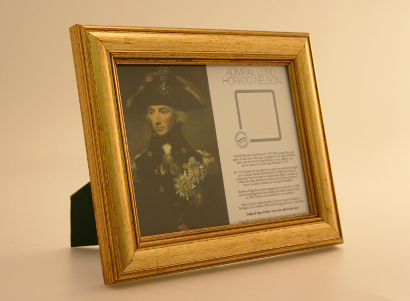
And then you might like to add this to your collection: Lord Nelson’s hair for £49.95, or Napoleon, and the Duke of Wellingon, all the same price – also Dickens and Steinbeck and Paul McCartney, etc – but alas! – no Jane Austen!
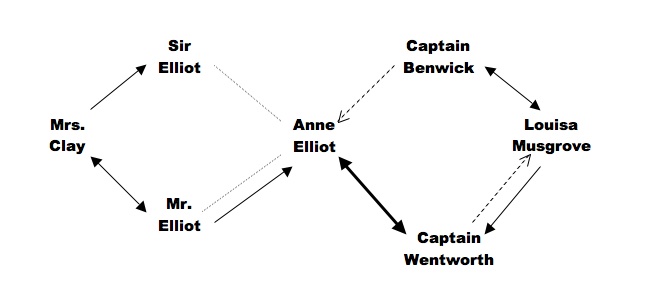
And this is way too much fun to look at – The Love Diagrams of Jane Austenat Diana Peterfreund’s website: [visit her site for diagrams of the other novels]
And finally, this is all over the airwaves, and we will have to wait until December 16th for it all to be unveiled, but visit the website of The Austen Games.com to whet your appetite and ponder.…
JASNA.org in celebration of and preparation for the Fort Worth AGM on Sense and Sensibility has posted a partial bibliography of readings in Persuasions and Persuasions On-Line – http://jasna.org/agms/news-articles/about-ss-reading.html
The British Library announces an iPad app accessing 19th century books http://www.bibliolabs.com/. Users can experience the British Library 19th Century Historical Collection App for free from the App Store on iPad or at www.itunes.com/appstore/.
Victorian Secrets revives the works of neglected nineteenth-century writers and makes them available to the modern reader. Although over 60,000 novels were published during the 19th century, only a very small number have remained in print. See here for their catalogue: http://www.victoriansecrets.co.uk/
Notable Women Authors of the Day by Helen C. Black
A Book List: if you are looking for a book list, go no further that “Best Holiday Reads” at The Guardian where writers share their favorite works – no Austen I’m sorry to say, but read Antonia Fraser’s account of reading Anthony Powell’s Dance to the Music of Time – just a great story! http://www.guardian.co.uk/books/2011/jun/17/best-holiday-reads?INTCMP=SRCH
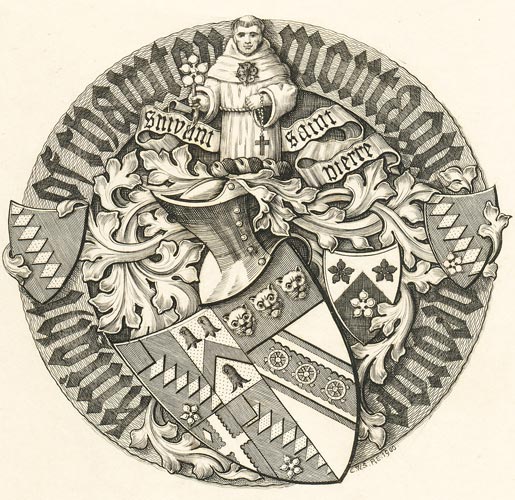
 Bookplate 2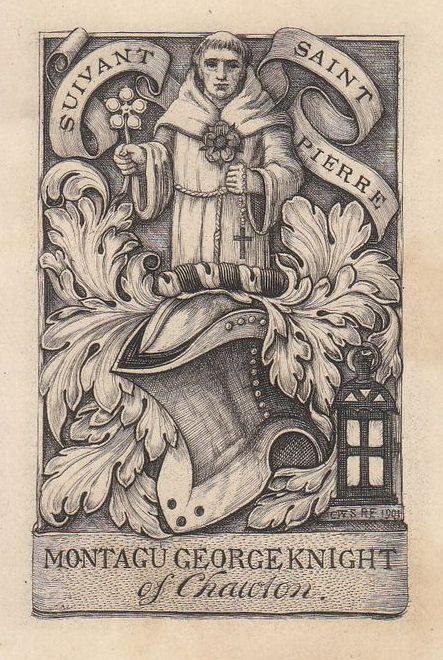

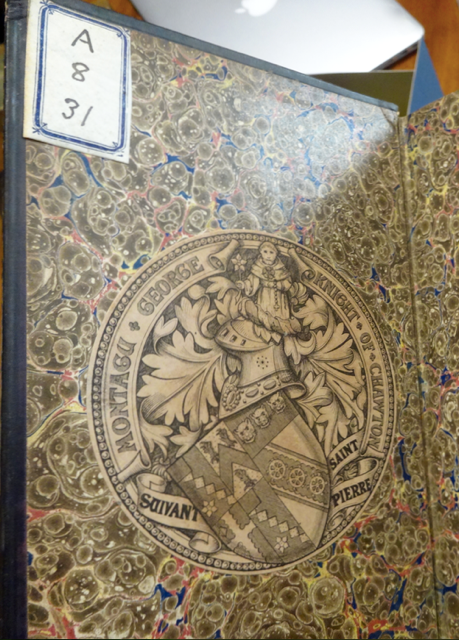 [CHL book with bookplate and shelf ticket]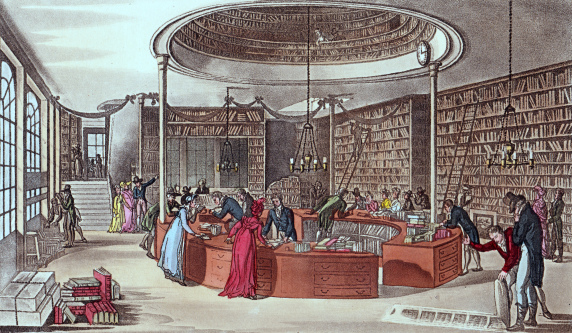


























 Jane Austen in Vermont