Austen Literary History & Criticism · Book reviews · Books · Collecting Jane Austen · Jane Austen · Literature · Publishing History · Regency England

Book Review ~ ‘The Annotated Persuasion’

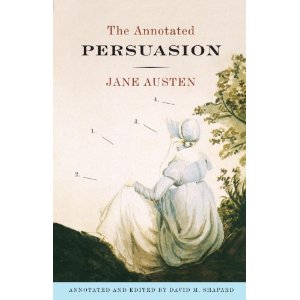
Last week I ran into Barnes & Noble to pick up the latest annotated Pride and Prejudice, edited by Patricia Meyer Spacks, and since then I have been “gadding about” as Austen would say – so no time to really give it a complete read and review; but in another trek yesterday into yet another Barnes & Noble [no worries, I also have haunted the local USED booksellers!], my husband stumbled upon the just published [as in October 5, 2010]  The Annotated Persuasion, annotated and edited by David M. Shapard [New York: Anchor Books, 2010; paperbound; ISBN:  978-0-307-39078-3] – and I have discovered a veritable feast! 

Shapard is known for his annotated edition of Pride and Prejudice [which I have but it is not in hand, as I am in “gadding about” mode as mentioned above…] – so I cannot compare this book to that edition [his annotated Sense & Sensibility is to be, I believe, published in April 2011] – though I have found that work quite useful as a reliable reference source – it was first published in hardcover followed by a paperback edition; this Persuasion is only in paperback… it is also a smaller format, likely because the novel is so much shorter, but this renders the many illustrations quite small – but I quibble about these few drawbacks …. publishers decisions do not always make the most sense… 

I first look for the extras:  

An Introduction which gives a brief history of the publishing of Persuasion, and the differences in this final novel from Austen’s other works

A Chronology of the novel [will compare this to Ellen Moody’s calendar 

Maps of sites that relate to the characters and storyline: the world, England, Somerset, Lyme, and two of Bath 

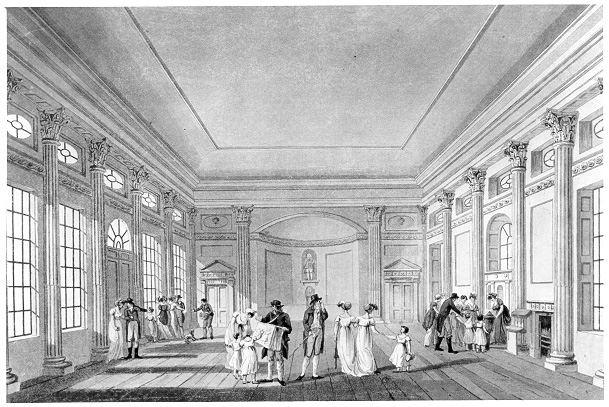
A good number of b/w Illustrations – there is unfortunately no listing of these; the source is indicated under each picture, but a listing would have served as an index to the subjects, which cover all manner of Regency life:  architecture such as that in Bath with interior and exterior scenes of the Assembly Rooms; various carriages; fashion; furniture; Naval life; the Cobb in Lyme Regis; etc.  – many of these illustrations will be familiar to most readers with a modicum of knowledge about the period – and color would have been nice – but the point here of these illustrations is to serve as a starting reference for further research, and it is an added plus to have any of these included. 
Bibliography:  this also serves as a starting point – it is in no way a complete listing of sources, but likely those sources that Shapard relied on for his research.  How complete can a bibliography of Austen be without mention of Claire Tomalin’s biography under that category, or Claudia L. Johnson’s Jane Austen: Women, Politics and the Novel or Kaplan’s Jane Austen Among Women nowhere to be found – but as Shapard is an historian, it is that strength that resides in this bibliography, again a great starting point for further study – it is organized by broad subjects:  language; cultural and literary background; marriage and the family; position of women; children; housekeeping and servants; entails and estates and the landed gentry; rural and urban life; the military; medicine; the law; education; books, media, libraries; writing; postal service; transportation; theater [but no mention of the two works Jane Austen and the Theatre – two works with the same title and both quite comprehensive]; music and dance; sports; weather; the seaside resorts; houses and gardens; fashion; food; etiquette and female conduct books; and others – again, a good select listing of resources on various topics.   

The Literary commentary and annotations:  Shapard begins with the caveat that “the comments on the techniques and themes of the novel represent the personal views and interpretations of the editor…such views have been carefully considered, but inevitably they will still provoke disagreement among some readers “ [xi] – which Shapard encourages…; these annotations include such literary commentary, historical context, and definitions of words in context if they had a different meaning in Austen’s time, some repeated when necessary or cross-references provided.  

The book is arranged with the original text on the verso, the annotations and illustrations on the recto – the annotations are extensive as the following few very random examples show: 

  1. Persuasion starts with the full description of Sir Walter Elliot’s obsession with both his own personal charms and his listing in the baronetage – Shapard here provides information on that book and others of the time and the definition of “baronet” and how Sir Walter acquired his own status…
  2. Gout is fully described on pages 311 and 315, when Anne learns that the Crofts are removing to Bath dues to the Admiral’s “gouty” condition.
  3. “replaced” – [p. 103] – “they suspected great injury, but knew not where; but now the collar-bone was soon replaced”   – the annotation explains that the word “replaced” had the meaning in Austen’s time of “to be put back in its original position” rather than “to take the place of” – there is also a description of anatomical knowledge as understood at the time.
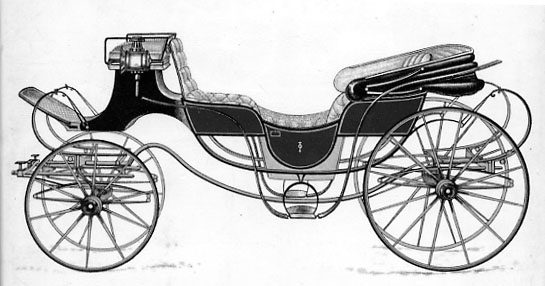
  4. Carriages get much attention whenever they are mentioned in the text – so we have descriptions and illustrations of barouches and chaise and fours, and chairs and of course Anne’s pretty little “landaulette” [p. 483]                                                                         
         

    a barouche


  5. Money and wealth – Wentworth’s income explained [p. 145]
  6. Servants:  various duties outlined [p.  87]
  7. Street names, shops, locations explained throughout; e.g. The Cobb; Tattersall’s [a mention on p. 14 with an illustration]; Milsom Street; Westgate Buildings;…etc…
  8. The Clergy in Austen’s time
  9. Austen’s language as delineating character:  as in the following: “Lady Russell had only to listen composedly, and wish them happy; but internally her heart reveled in angry pleasure, in pleased contempt” [p. 232] – and the annotation reads:  “Her reveling in such emotions indicates her moral inferiority to Anne, who never derives pleasure from anger or contempt.” [p. 233]
  10. Social rules and strictures:  some examples – Sunday traveling [p. 305]; shaking of hands between men and women [p. 427]; not using first names, even those of friends such as Anne and Mrs. Smith
 A look at a few key scenes will also illustrate Shapard’s invaluable commentary: 

  1. Wentworth removing young Walter Musgrove from around Anne’s neck [pp. 152-5]:  Shapard emphasizes the importance of this scene in displaying both Anne’s and Wentworth’s feelings – he quotes William Dean Howell’s how “this simple, this homely scene, is very pretty, and is very like things that happen in life, where there is reason to think that love is oftener shown in quality than quantity, and does its effect as perfectly in the little as in the great events. [from Heroines of Fiction].  Shapard also suggests that Wentworth’s reluctance to converse with Anne about what has just happened is as much due to his efforts to remain aloof as it is to a “simple dislike of thanks,” [p. 155], as is true of Mr. Knightley in Emma. 
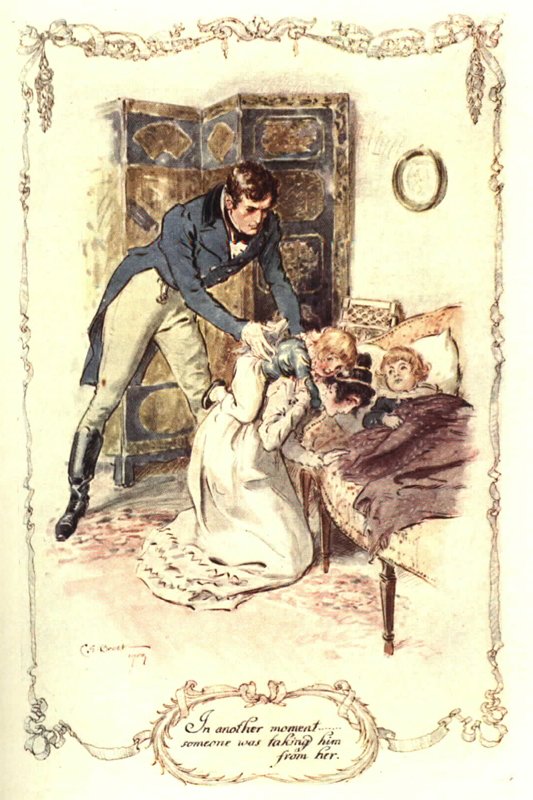
                                                                                                        

    Brock illus - from Molland's


  2. Louisa’s fall in Lyme Regis [p. 210-15]:  Shapard describes the Cobb, the steps that were the scene of The Fall, comments on the feelings of Anne and Wentworth, the strength of the former and the uncharacteristic weakness of the latter; Anne’s carrying the “salts” [have you ever wondered why Anne IS carrying smelling salts and conveniently has them in her possession? – “here are salts – take them, take them.” [p. 210]]; the calling for the surgeon and the differences between he and an apothecary; the comic relief of “the sight of a dead young lady, nay, two dead young ladies, for it proved twice as fine as the first report.” [p. 213-4] 
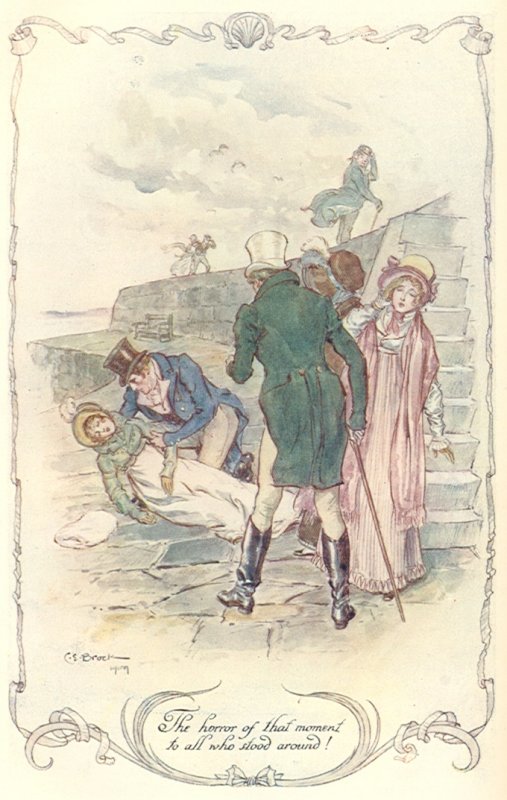
    "The horror of the moment" - from Molland's


  3. and of course, The Letter! [p. 452] – Shapard so rightly states that “Wentworth’s passionate language contrasts him with other Jane Austen heroes, who are often much cooler and more rational.  It also fits with the more intense emotional tone of this novel … the letter itself is arguably the moment of highest emotion in her works…” [p. 453]  – and we are given a picture of a writing table of the time [p. 457] – there is also extensive commentary on the conversation between Capt. Harville and Anne. 
As referred to above, there are disappointments in this work – I would most wish for an index to the annotations – these could be just general subject areas, such as similar divisions as in the bibliography – so for instance – all annotations which discuss medicine could be cited, or any references to carriages, or fashion, or Bath locations, the Navy, or examples of Free Indirect Discourse, the literary allusions such as Byron’s The Corsair and Matthew Prior’s poem “Henry and Emma”, etc.  As it is, one needs to read through the entire work to find the references, and as Shapard wishes for this to be a work for reference purposes, this addition of an index would seem to be a necessity.  A index of Characters would have also been a helpful addition – one must reach for their Chapman for this information; and finally there is also no “note on the text”, important information in any such reference source – the bibliography lists Chapman’s 1933 edition, Spacks’s Norton critical edition [1995]; and the latest Cambridge edition edited by Janet Todd and Antje Blank [2006] – but I would have liked to see from whence he took the exact text…

That all said – this is a delightful and fact-filled addition to your Austen Library – and if you are already fairly well-versed in the Regency period and Austen criticism, this will serve as a copy of Persuasion where much of this information is at your fingertips; if you are just starting your adventure in reading Austen, this will be a great introduction to the very rich world of her writings, her world, and her literary themes – what more can we ask for!  [other than a hardcover with an index!]

 4 full inkwells out of 5

[please note that the illustrations are meant to illustrate this post and are not illustrations in the work being reviewed] 
Jane Austen · News · Publishing History

Sold! On the Block: Brock’s Illustrations for ‘Persuasion’

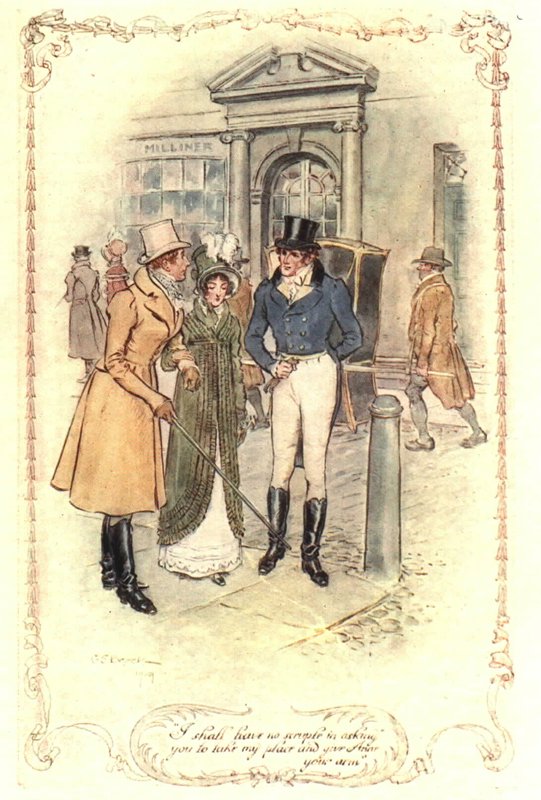
Sold at Christie’s London on June 2nd:  14 of C.E. Brock’s illustrations for Persuasion [plus J.M. Dent’s file copy of the 1909 edition of the novel!]


“I shall have no scruple in asking you to take my place, and give Anne your arm” ~ Volume II, Chapter XI (23)  [illustration from Molland’s]

Lot Description

BROCK, Charles Edmund, R.I. (1870-1938). A series of fine ink and watercolour drawings for Jane Austen’s Persuasion, 1909.

14 pen and ink and watercolour drawings including one for the title-page (most c.280 x 180mm) on paper (390 x 270mm), and later mounted on card. Provenance: J.M. Dent and Co. (sold, part lot 769, 19 June 1987, £33,000).

14 ORIGINAL DRAWINGS FOR AUSTEN’S PERSUASION published by J.M. Dent and Co. in 1909. Together with J.M. Dent and Co.’s stamped file copy, in the original cloth, of a 1909 edition of Persuasion in which the drawings were published. (15)

Estimate:   £7,000 – £9,000  ($10,108 – $12,996)   

Price Realized:   £10,000 ($14,710) [Price includes buyer’s premium]

Sale Information:  Christie’s Sale 7854 ,Valuable Manuscripts and Printed Books , 2 June 2010 , London, King Street

Click here for further information.

There are 23 illustrations + the title page in this edition of Persuasion, so this is not a complete lot – but still I would have been happy to add all this to my Austen collection! 

Further Reading:

*Visit Molland’s to view all of Brock’s illustrations: [these links are under “e-texts”]

Illustrations for Sense and Sensibility
Illustrations for Pride and Prejudice
Illustrations for Mansfield Park
Illustrations for Emma
Illustrations for Northanger Abbey
Illustrations for Persuasion

*Visit Pemberley.com for more information on C.E. Brock.
*Keiko Parker’s
“Illustrating Jane Austen” in Persuasions 11 (1985)
*
Jane Austen’s World Blog on the Brock brothers


[Posted by Deb] 

Jane Austen · News

Follow-up ~ A Talk on ‘Persuasion’

[see our follow-up to the talk below…]

Kellogg-Hubbard Library,  135 Main St, Montpelier, Vermont

Wednesday, May 6, 2009 7pm

Powers of “Persuasion” a Vermont Humanities Council First Wednesdays 2008-2009 Classic Book Program by Bennington College Professor April Bernard

In her final superb novel, Persuasion, Jane Austen combined social satire with profound feeling. Why does this “fairy tale for grown-ups” continue to compel readers? How does Austen hold our attention and sympathy? And finally, who are some contemporary writers who might have learned some of Austen’s lessons?

April Bernard is a poet, novelist, and essayist who teaches literature and writing at Bennington College. Her most recent book is a collection of poems, Swan Electric.

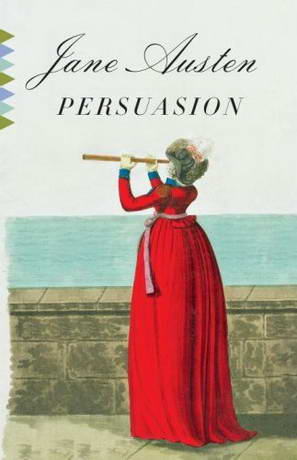
persuasion-cover-vintage

Follow-up to the gathering from Janeite Kelly:

Thanks to the Vermont Humanities Council and the Kellogg-Hubbard Library, this event drew a nice little crowd of readers interested in Persuasion and Austen. The Q&A session was amazingly robust!

Prof. Bernard brought up some useful and though-provoking points — including this comment on Austen novels: THEY’RE NOT JUST GIRLS’ BOOKS!! And that was undoubtedly bourne out, if not in her Bennington College classrooms, in the men comprising a portion of the audience for this evening’s lecture!

Some points brought up for discussion: The narcissism of Sir Walter Elliot; the brilliance of Samuel Johnson’s writing (admired by many Austens, including – of course! – Jane); how writers are also avid readers; and some tricks whereby Prof. Bernard teaches writing to her students.

She introduced some ‘nuggets’:

In Austen’s novels the YOUNG end up showing the ELDER generation how one should act and react in life; the ‘old’ versus ‘new’ order, if you will.

One point I had never thought about before, that the NAVY in the characters of Admiral and Mrs Croft – self-made, responsible, wealthier – in essence TAKE OVER from where the gentry, in the form of Sir Walter, have left off (’abondoned ship’, if I can be allowed to think of it that way!). Austen, of course, had her own Naval brothers – men who pulled themselves up through the ranks, and ended up with rank, a title, and some amount of wealth.

One audience member asked where the idea of ‘a fairy tale for adults’ (used in the advertising) fit into her idea of Persuasion. Prof Bernard responded: Second chances at happiness. Children, she said, know fear, hunger (the subjects of traditional fairy tales, yes?) — but children do NOT know disappointment. Anne knew just such a debilitating feeling, and Austen gave this ‘past her bloom’ woman a second chance. We should all live such ‘fairy tale’ lives!

Follow-up from Janeite Deb:

Kelly summarizes nicely some of the main points of Prof. Bernard’s talk on Persuasion – the younger generation proving the older generation wrong [in most of Austen’s writings,  but esp. in Persuasion] by criticizing the establishment; the “fairy-tale” quality of Anne and Wentworth’s second chance at happiness; the Crofts taking over Kellynch Hall as a symbol of Austen’s democratic view of men being able to rise in society by their own efforts.

Prof Bernard emphasized Austen as a “conservative” writer, i.e. as a follower of Johnson, Austen writes of a conventional reality, her code of conduct and moral compass clearly defined in her novels [with Mansfield Park being her most conservative work].  But Berhard views Persuasion as a departure from this for Austen, with this more “democratic” view of society’s changing possibilities, her criticism of the Peerage in the guise of Sir Walter and the rise of the Navy which makes Wentworth an eligible partner for Anne, a lateral social move so to speak.  Bernard also points out how for the first time, Austen has Anne speak in quite radical terms in her speech to Harville that Wentworth [thankfully!] overhears [though not radical for the times, this feminist-speak IS radical for Austen].

Austen’s writing technique is what interests Bernard –  her creative writing classes must be fabulous! – She believes that Austen in this her last completed work was experimenting with her writing, her use of direct vs. indirect discourse most pronounced here.  And Bernard makes a great point about Austen as a creator of the “surrogate writer” in her works, as in Emma, where Emma is writing her own “bad” novels with all her matchmaking stories; and in Persuasion when Anne becomes annoyed with Mr. Elliot for trying to write her own story or to tell her who she is. 

Bernard does make one point that I would like to put out there as a query and field your thoughts:  All of Austen’s books have the “happy ending” we like to see in our “fairy-tale” romances [and in Persuasion we are given her only equal and nearly perfect union in the marriage of Admiral and Mrs. Croft], but Bernard does say quite strongly that these pleasing endings do not all end in happy marriages:  Emma, she says, married her father in Mr. Knightley, and she will spend a lifetime being told what to do by him; and in Mansfield Park, Fanny and Edmund will not live happily ever after because Edmund clearly does not really love Fanny.  [this is perhaps why there are such a spate of sequels?!] – [and I should also add that I do not agree with this outcome for Emma and Fanny, but that is why I request your musings…and Kelly and I will post more on this later…]

So please share with us your thoughts on the “happily ever after” of Austen’s marriages? 

Books · Jane Austen · JASNA-Vermont events · Publishing History

Publishing ‘ Persuasion ‘

persuasion-cover-vintageWe had our JASNA-Vermont gathering last Sunday and Mary Ellen Bertolini of Middlebury College spoke on Persuasion [see Kelly’s post below on our event]
Mary Ellen brought Austen’s final novel to life for us all.  In speaking on “The Grace to Deserve” and taking as her starting point Captain Wentworth’s last spoken words in the book, “I must learn to brook being happier than I deserve.”  [Persuasion, ch. 23], she addressed the issue of “deserving” and “earning ones’ blessings”  in the context of the social and political realities of the time – the war in France and the role of the Navy; an analysis of the criteria of WHO deserves; and finally in the linguistics of the work – whose words deserve to be heard?  The plot centers on Anne moving from “nothingness” and” carrying “no weight” to realizing her own worth, and Wentworth moving from anger and disappointment to deserving to hear Anne’s words – their individual growth bringing them together at last. 

Prof. Bertolini’s insightful, dramatic and often humorous presentation on how Austen tells her tale around these three words “the grace to deserve” gave all in attendance much to think about and surely most of us went right home to begin a re-read of the novel!  So we thank you Mary Ellen for sharing your affection for this book with all of us, and turning a very cold winter day into a fabulous afternoon! 

**************************************

As a bookseller and librarian I am interested in the publishing history of the literature of the 18th and 19th centuries, and I spoke very briefly on the publishing journey of Persuasion;  I append that here:

 We know from Cassandra’s Memorandum [see Minor Works, facing pg.  242 ] in which she wrote the dates of Austen’s composition of each of her novels, that Jane Austen began Persuasion on August 8, 1815; it was finished July 18, 1816 – i.e. her first draft. We know she was unhappy with the ending, she thought it “tame and flat” and rewrote chapter 10 [i.e.chapter 10 of volume 2], added chapter 11, and retained chapter 12 (which had been the final chapter 11).  This final version was finished on August 6, 1816.  The manuscript of the original two chapters are the ONLY extant manuscripts of Austen’s novels.  These were first printed in the second edition of James Edward’s Austen-Leigh’s Memoir of 1871, and this was the accepted text until the actual MS became available on December 12, 1925  [ published separately by Chapman in 1926 under the title Two Chapters of Persuasion [Oxford, 1926]; the manuscripts are housed in the British Library].  This text is different from the printed cancelled chapter in the Memoir – so it is believed that Austen made a fresh copy of her final draft and this is what went to the printer. [Chapman,  NA & P, p. 253 ]

I am assuming that most everyone has read these cancelled chapters, as they are usually included in most printings of the novel.  But to summarize:  Austen has Anne meeting Admiral Croft on her way home from Mrs. Smith’s [where she has just learned the true nature of William Elliot] – she is invited to visit Mrs. Croft, and assured of her being alone, she accepts, and to her consternation finds Capt. Wentworth at home.  Admiral Croft has asked Wentworth to find out from Anne if the rumors are true she is to marry her cousin and thus might want to live at Kellynch Hall ~ and with Anne’s adamant denial of this, Wentworth and Anne had a 

 silent but very powerful Dialogue;- on his side, Supplication, on hers acceptance. – Still, a little nearer- and a hand taken and pressed – and “Anne, my own dear Anne!” – bursting forth in the fullness of exquisite feeling – and all Suspense & Indecision were over. – They were reunited.  They were restored to all that had been lost.

 Etc. etc… and then one more chapter of explanation and future plans.

 It is not my intention here to talk about these changes – we can argue the point of why she made them:  the need to pull all the characters together – the Musgroves, Benwick, & Harville, the Crofts, and the Elliots; the increased tension and suspense between Anne and Wentworth; Anne’s conversation with Harville overheard by Wentworth; and of course the LETTER – what would Persuasion be without “you pierce my soul” ? !

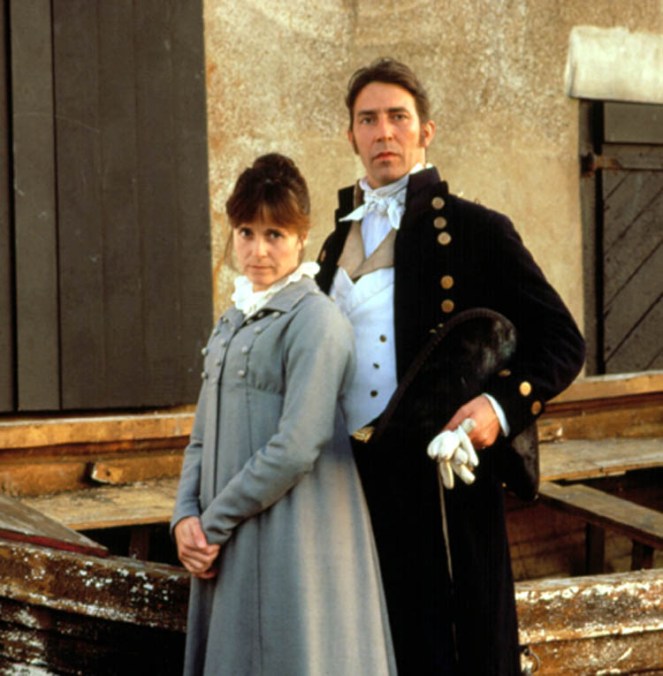
 However, in the movie version [Amanda Root – Ciaran Hinds, Sony/BBC 1995] a part of this scene with Wentworth confronting Anne is added to the plot – this is worthy of some further conversation!  

508950F

But one of Austen’s classic lines is not in the final novel – the first draft is a bit more comic in nature, and perhaps she thought it not fitting the rest of the work:

It was necessary to sit up half the Night & lie awake the remainder to comprehend with composure her present state, & pay for the overplus of Bliss, by Headake & Fatigue.

____________________________________________

That Austen made these changes was a gift to later generations, as it is in this manuscript that we have the only documentation of how meticulous she was in her writing and editing methods.  And what I find most fascinating is what she was working on at the same time:

 *In 1815, she was drafting Emma; began Persuasion in August; revised Mansfield Park  for its 2nd edition; and finished and passed Emma through publication [it was published in December 1815]

 *In 1816:  she was drafting and finalizing Persuasion; she wrote her very funny “Plan of a Novel”; she made revisions to “Susan” [later Northanger Abbey]; AND she was working with the publisher on the 3rd edition of Pride & Prejudice.

 As an aside:  in the context of the wider world, there was the ever-expanding and more competitive market for publishing novels in Austen’s time.  In 1775, the year she was born, 31 new novels were published; in 1811, when Sense & Sensibility appeared, 80 new fiction works appeared; for the year 1818, Northanger Abbey and Persuasion were published along with 61 other novels.  Altogether, 2,503 new novels were published in the years between 1775 and 1818. [Raven, p. 195-6]

We know little about Persuasion from Austen herself:  it is only mentioned in her Letters twice, though not by name: 

 On March 13, 1817, she wrote to her niece Fanny Knight:  

“I WILL answer your kind questions more than you expect. – Miss Catherine [meaning Northanger Abbey] is put upon the Shelve for the present, and I do not know if she will ever come out; – but I have a something ready for Publication, which may perhaps appear about a twelvemonth hence.  It is short, about the length of Catherine – This is for yourself alone…”  [Letter 153, Le Faye]

 And again on March 23, 1817: 

Do not be surprised at finding Uncle Henry acquainted with my having another ready for publication.  I could not say No when he asked me, but he knows nothing more of it. – You will not like it, so you need not be impatient.  You may PERHAPS like the Heroine, as she is almost too good for me. [Letter 155, Le Faye]

The working title for Persuasion was “The Elliots” – there is no evidence that Austen chose the titles for either Northanger Abbey [it is accepted that her brother Henry did this] or Persuasion [though the word is mentioned in one form or another more than 20 times – you can go to this link at the Republic of Pemberley for all the occurrences] 


So, the details of the book:


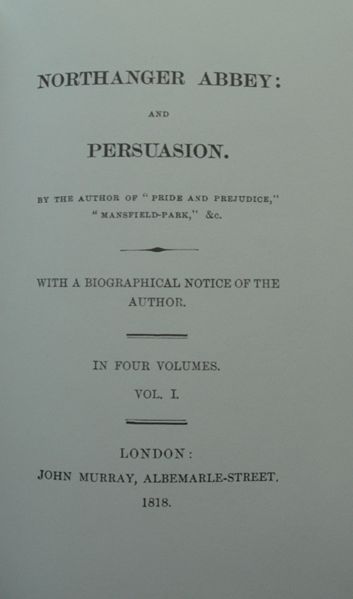
na-title-page

 [Title Page, 1st edition]

-It was published posthumously in December 1817 [though the title page says 1818] with Northanger Abbey

Title page states:  “By the Author of Pride & Prejudice, Mansfield Park, etc.”; With a Biographical Notice of the Author [dated Dec. 20, 1817, by Henry Austen, thus identifying his sister as the author to the public for the first time]

 -Included is the “Advertisement to Northanger Abbey by The Authoress [we discussed this at our NA gathering, where Austen “apologizes” for the datedness of the story, and zings the dastardly publisher for withholding the book for 10 years…]

Published by John Murray, London; 1818; in four volumes:  the two Northanger Abbeyvolumes printed by T. Davison; the two Persuasion volumes by C. Roworth. 

Advertised in the Morning Chronicle, Dec. 19 & 20, 1817

-Physical description:blue-grey boards, brown paper backstrips, white paper labels (there are a few variants)

Size of book:  about 19cm x 10.5 cm [ 7.5 x 4.25″]

Size of run: @ 1750 copies [various opinions on this] – 1409 copies sold very quickly [majority to circulating libraries]

Cost:  24 shillings for 4 volumes

Profit:  £515 [like Austen’s other works, Persuasion was published on commission:  Austen paid for costs of production and advertising and retained the copyright; the publisher paid a commission on each book sold – exception was Pride & Prejudice for which she sold the copyright] 

-Reviews:  minor notices until the first extensive review in January 1821. 

-Worth today:  a quick search brought up 7 copies of the 4-vol. first edition, all have been rebound in leather, range $9500. – $15,000. 

-Tidbit:  the Queen has in her personal library  Sir Walter Scott’s copy of the 1st edition.

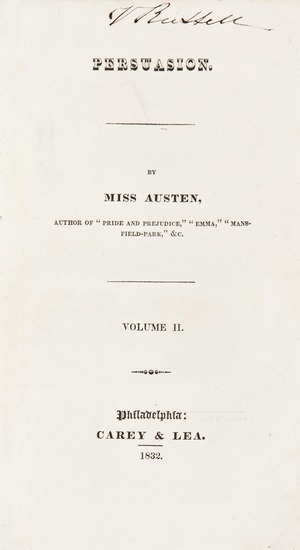
First American edition:  not published until 1832 in Philadelphia; the title page says “by Miss Austen, author of P&P and MP, etc.” 

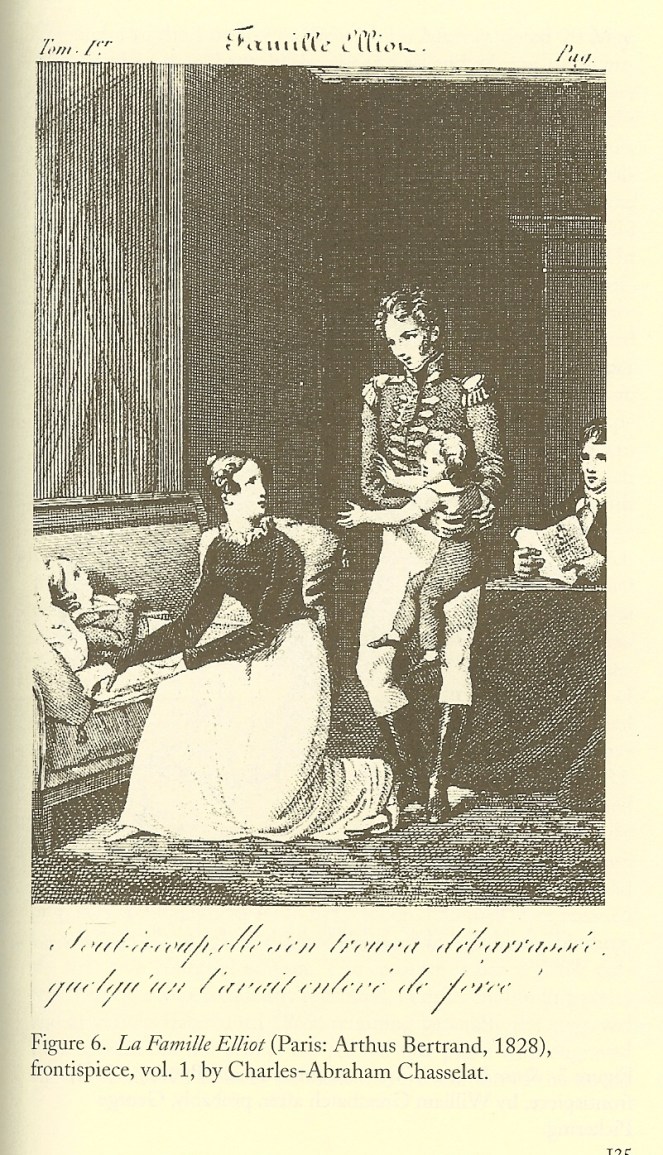
-French TranslationLa Famille Elliot ou “L’Ancienne Inclination” [ the old or former inclination] translated by Isabelle de Montolieu, Paris, 1821 :  this is the first published Austen work to have her full name on the title page and to include illustrations:  in vo1 1, Wentworth removing Walter Musgrove from Anne [see below]; vol 2:  Wentworth placing his letter before Anne.

persuasion-french-illus

[Source:  Todd, p. 125] Anne was called Alice; one aside about these translations:  Baroness de Montolieu took liberties with the text :  made them more sentimental for the French audience – but this too is a topic for another discussion!

Sources: 

  1. Chapman, R.W.  The Novels of Jane Austen: the Text Based on Collation of the Early Editions.  3rd ed. Vol. V, Northanger Abbey & Persuasion, Oxford, 1933. [with revisions]  Introductory material.
  2. Gilson, David.  A Bibliography of Jane Austen.  Oak Knoll Press, 1997.
  3. Raven, James. “Book Production.” in Janet Todd, ed. Jane Austen in Context.  Cambridge, 2007.
Jane Austen · Movies · News · Schedule of Events

from Persuasion to Pride & Prejudice

Our chapter must thank – and congratulate – Prof. Mary Ellen Bertolini (Middlebury College) for a stimulating talk March 1st on “The Grace to Deserve: Weighing Merit in Jane Austen’s Persuasion“. She brought up points that really made us all see aspects of the novel that we might not otherwise have ever contemplated. One new JASNA member, David from Montpelier, put into succinct words this reaction:

meb

“I did find the meeting well worth the drive. Professor Bertolini gave an impassioned, even dramatic lecture, and the insights she brought forth only enhanced my appreciation of Persuasion.”

About JASNA, and our Vermont meetings in general, David said, “I am an instructor in Political Science at the Community College of Vermont, and wish there were a study group for the US Constitution which approached that subject with the same thoughtful ease and depth that your group accomplishes with the works of Jane Austen.  …[C]onsider yourself an excellent resource – even oasis…”

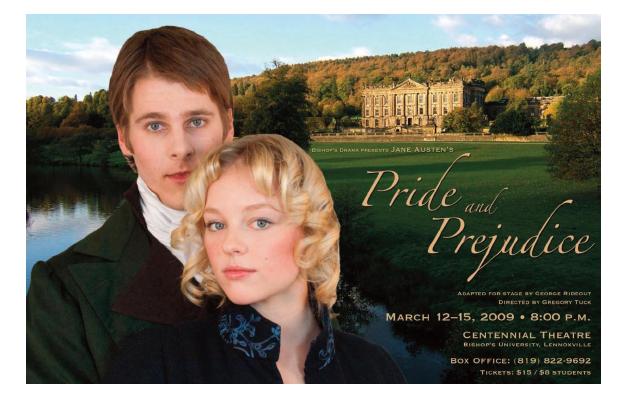
At Sunday’s meeting, we announced a terrific upcoming event: A Pride & Prejudice Weekend at Bishop’s University in the Sherbrooke, Quebec area of Lennoxville. Saturday March 14th will feature:

ppDr. Peter Sabor (McGill), a member of JASNA,  on “Portraying Jane Austen: How Anonymous became a Celebrity

Dr. Robert Morrison (Queen’s), on “Getting Around Pride & Prejudice: Gothicism, Fairy Tales & the Very World of all Us

Dr. Steven Woodward (Bishop’s), on “Austen’s Narrative Voice: Film Adaptations of Pride & Prejudice“.

The symposium, running from 1-4 pm, will be followed by an English Tea with musical accompaniment by students from Bishop’s Music Department.

Then join the Drama Department in the 550-seat Centennial Theatre for its presentation of George Rideout’s new adaptation of Pride & Prejudice (8 pm). [Note: the play itself runs from 12-15 March, all at 8.]

Stay overnight, if you wish, at the university – and join them for Mass on Sunday, March 15 in the campus chapel. Then come to an informal gathering with writer George Rideout and director Gregory Tuck.

Cost (in Canadian dollars): General public: Symposium – $10 and Theater $15 (total for both: $25); students: Symposium $2 and Theater $8 (total for both: $10). Accommodation prices begin at $55. Tickets for both available through the Centennial Theatre box office: (819) 822-9692; campus accommodations through (819) 822-9651.

See their pp_press for full details and contact information. There will be costume prizes (!!) and a P&P quiz for participants to enter.

Jane Austen · JASNA-Vermont events · News

Join Us! ~ JASNA-Vermont ~ Sunday March 1st

mebMARY ELLEN BERTOLINI
(Middlebury College)
“THE GRACE TO DESERVE: WEIGHING MERIT IN JANE AUSTEN’S PERSUASION


Following Waterloo, rich naval officers vied with impoverished aristocrats for position and importance. Against this political drama, Jane Austen unfolds her story of Anne Elliot, who pines for Frederick Wentworth, the Naval Captain she rejected. Wentworth’s final words in the novel, “I must learn to brook being happier than I deserve” are no coincidence, for the idea of deserving, of earning one’s blessings, is at the very core of Persuasion, Austen’s last completed novel.

Read here  on Mary Ellen’s blog, her comments on her talk to us last week.

Sunday, 1 March 2009
2:00 p.m.
Champlain College
Hauke Family Campus Center (375 Maple St.)
Burlington, VT

free and open to the public ~ light refreshments served

persuasion-cover-vintage

Books · News

A Gift

“Happy Christmas” from Jane Austen in Vermont!

Our gift today shares short comments from a reader of Austen in 1836. Thanks to R.W. Chapman, we possess the reactions of family and friends that Jane Austen herself collected (printed in his volume of Austen Juvenilia). Here – in the diary of Ellen Tollet of Betley Hall (edited by Mavis E. Smith and newly published) – we see reactions to the novels from a reader with no ties to Austen. Miss Tollet perhaps treasured copies of the first edition, but likely came to read Austen because of the reprintings of the 1830s (for instance, see our 1833 copy of Sense and Sensibility). She does, however, mention “volumes” which indicates the sets – three volumes for all except Northanger Abbey and Persuasion (which appeared together in four volumes) – of the originals printed during Austen’s lifetime.

The first reference Miss Tollet makes of Austen is this entry of Saturday, 2 January 1836:

Cold, bad day – snow on the ground. Set Charles [her brother] to read ‘Mansfield Park’. How I delight in that book! I fancy all the people so well. I confess I think Edmund and Fanny too much alike to marry. I think he is something like W. Egerton [a family friend] though, of course, taller or more like a hero rather. [page 99]

Miss Tollet notes more Austen at the end of February:

Began to read ‘Pride and Prejudice’ to Mary [her sister-in-law]. A very good book for the purpose, but I don’t like it so well as ‘Mansfield Park’ or ‘Persuasion’. It is a broad farce and the humour less delicate, and the story not so feeling or pretty. [p. 118: Thursday, 25 February 1836]

Days later she expounds on her views, and we perceive something of the reading habits of this young woman (born in 1812):

Read for the tenth time [!] the third volume of ‘Pride and Prejudice’. How excellent it is! Mr Bennet is enchanting, but Lydia’s disgrace far too bad. Great want of taste and delicacy towards her heroines. [p. 120: Tuesday, 8 March 1836]

In this day of television and film adaptations, it is refreshing to read (however short) comments about and reactions to Austen’s characters and situations (see also the post on Miss Russell Mitford). We invite readers to share with us their finds, among nineteenth century letters and diaries, revealing just what Austen’s early crop of readers thought and felt.

Jane Austen · News

Jane Austen this Weekend ~ Persuasion

governors-inn1 


You MUST make a reservation:  please call the number below 


Jane Austen Weekends

The Governor’s House in Hyde Park

100 Main Street

Hyde Park, Vermont

series 1: Persuasion

Friday – Sunday, August 15 – 17, 2008

Friday – Sunday, September 5 – 7, 2008

Friday – Sunday, December 12 – 14, 2008

Friday – Sunday, January 9 – 11, 2009

series 2: Pride and Prejudice

Friday – Sunday, January 30 – February 1, 2009

other dates to be announced

call or E-mail for reservations

http://www.OneHundredMain.com

802 888-6888 info@OneHundredMain.com


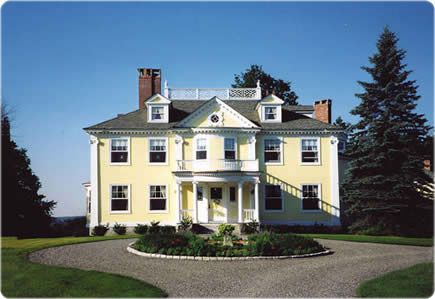
A leisurely weekend of literary-inspired diversions has something for every Jane Austen devoteé. Imagine a literary retreat that will slip you quietly back into Regency England in a beautiful old mansion where Jane herself would feel at home. Take afternoon tea. Listen to Mozart. Bring your needlework. Share your thoughts at a book discussion of Persuasion or Pride and Prejudice and how the movies stand up to the books. Attend the talk entitled “The Time of Jane Austen”. Test your knowledge of Persuasion, Pride and Prejudice and the Regency period and possibly take home a prize. Take a carriage ride. For the gentleman there are riding and fly fishing as well as lots of more modern diversions if a whole weekend of Jane is not his cup of tea. Join every activity or simply indulge yourself quietly all weekend watching the movies. Dress in whichever century suits you. And imagine the interesting conversation with a whole houseful of Jane’s readers under one roof. Weekend guests have commented that they wish there had been a tape recorder under the dinner table so they could replay the evening again and again. It won’t be good company; it will be the best! It’s not Bath, but it is Hyde Park and you’ll love Vermont circa 1800.

Jane Austen Weekend rates start at $295 for singles, $260 per person for doubles, $235 per person for triples, and include two nights’ lodging, Friday evening’s talk over dessert and coffee, full breakfast on Saturday morning, Saturday afternoon tea, Saturday dinner and book discussion, early Sunday Continental breakfast, and the Jane Austen quiz with Sunday brunch. Add Thursday night or Sunday night or both and get the room for half the regular rate. 9% Vermont tax is additional. The usual cancellation policy applies.

Please inquire about the special rate for book groups which can also reserve a Jane Austen weekend on dates other than those regularly scheduled as availability permits.

Or come for just an evening and choose from these activities:


  Informal Talk with Coffee and Dessert, Friday, 8:00 p.m., $14.00

  Afternoon Tea, Saturday, 3:00 p.m., $20.00

  Book Discussion and Dinner, Saturday, 7:00 p.m., $35.00

  Jane Austen Quiz and Sunday Brunch, Sunday, 11:30 a.m., $15.00

  All four activities: $75.00


Please call or write for more information and book directly with the inn at 866-800-6888 or info@OneHundredMain.com.  


100 Main Street • Hyde Park, VT 05655
phone: 802-888-6888 • toll free: 866-800-6888
email: info@onehundredmain.com

Books · Jane Austen

Austen on the block ~

A copy of Austen’s Persuasion, a first American edition, sold at a Bloomsbury auction on December 10 for $3000.  Here are the details:

88. AUSTEN, Jane (1775-1817). Persuasion. Philadelphia: Carey & Lea, 1832. 2 volumes. 8vo (193 x 116 mm). Publisher’s linen-weave cloth-backed boards, paper spine labels, uncut. Condition: rear endpaper lacking in second volume, loss to lower corner of same in first volume, some very light scattered spotting in first volume; labels chipped to remnants, light shelfwear with some minor exposure to board edges. Provenance: J. Kellog and Co., Mobile, Alabama (contemporary bookseller’s label to front pastedown); V. Russell (contemporary owners signature in top margin of titles).   a wholly unsophisticated copy of the first american edition, unut and in original boards. Austen’s last completed novel, originally published with Northanger Abbey in 1818, here making it’s first appearance in United States. A scarce edition, of which only 1250 copies were printed. “Relatively few copies of the 1832-33 Philadelphia editions are known to survive” (See Gilson p.98). This copy without the publisher’s catalogue, but Gilson states that not all copies had them. Gilson: B3

 Sold for $3000
Sale NY022, 10th December 2008

persuasion-auction

Jane Austen · News · Schedule of Events

Jane Austen Weekend in Vermont ~ Persuasion

 The Governor’s House in Hyde Park, Vermont is offering several “Persuasion” related Jane Austen Weekends…you can sign up for the whole weekend or just take part in one or more of the activities.  Please see below for all the information.  This coming weekend September 5-7 is the next gathering!


Jane Austen Weekends

The Governor’s House in Hyde Park

100 Main Street

Hyde Park, Vermont

Friday – Sunday, September 5 – 7 [ December 12-14; January 9-11, 2009 ]

Reservations required:  call 802-888-6888

http://www.OneHundredMain.com

802 888-6888 info@OneHundredMain.com


A leisurely weekend of literary-inspired diversions has something for every Jane Austen devotee. Slip quietly back into Regency England in a beautiful old mansion where Jane herself would feel at home. Take afternoon tea. Listen to Mozart. Bring your needlework. Share your thoughts at a discussion of Persuasion and how the movie stands up to the book. Attend the talk entitled “The Time of Jane Austen”. Test your knowledge of Persuasion and the Regency period and possibly take home a prize. Take a carriage ride. For the gentleman there are riding and fly fishing as well as lots of more modern diversions if a whole weekend of Jane is not his cup of tea. Join every activity or simply indulge yourself quietly all weekend watching the movies. And imagine the interesting conversation with a whole houseful of Jane’s readers under one roof. Dress in whichever century suits you. It’s not Bath, but it is Hyde Park and you’ll love Vermont circa 1800.

Jane Austen Weekend rates start at $295 for singles and $260 per person for doubles and include two nights’ lodging, Friday evening’s talk over dessert and coffee, full breakfast on Saturday morning, Saturday afternoon tea, Saturday dinner and book discussion, early Sunday Continental breakfast, and the Jane Austen quiz with Sunday brunch. 9% Vermont tax is additional. The usual cancellation policy applies.

Or come for just a single event and choose from these activities this weekend: [reservations required 802-888-6888]


*Informal Talk with Coffee and Dessert, Friday, 8:00 p.m., $14.00:  “Jane Austen’s Royal Navy and its importance in the novel Persuasion


*Afternoon Tea, Saturday, 3:00 p.m., $20.00


*Book Discussion and Dinner, Saturday, 7:00 p.m., $35.00: Persuasion and how the Movies Stand up to the Book”


*Jane Austen Quiz and Sunday Brunch, Sunday, 11:30 a.m., $15.00  


[All four activities: $75.00]

100 Main Street • Hyde Park, VT 05655
phone: 802-888-6888 • toll free: 866-800-6888
email: info@onehundredmain.com