And now doubly delighted to hear from Tony that he is planning a similar miniature edition of Pride and Prejudice – perfect timing for this bicentenary year. It will be another triple-decker, as was the original, in the same format and size as Emma with the same typeface. Each of the three volumes is to be published separately, in April, June, and August; the third volume will include a slipcase for the set.
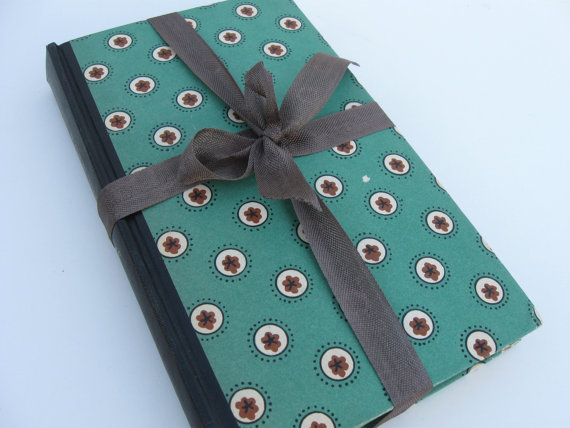
Volume I and II will contain 240 pages, and 260 pages for Vol. III, all bound in a lovely soft faux leather, in a pretty butterscotch color. The endpapers will be decorated with colored illustrations from the 1907 Dent edition, four different pictures in each volume. The slipcase will be decorated with some of the same illustrations. It will be a limited edition of 15 copies. [no image is yet available]
C. E. Brock – ‘Pride and Prejudice’ – Dent 1907 – Mollands
The first volume will be available near the end of April; price is $35. / volume, the complete set with slipcase, $105. You can order either by volume as they become available or wait for the complete set in August, but with only 15 sets available, you best get your order in soon! [There was a second edition of Emma, and there are copies still available.]
Other titles that Tony has published in this miniature format: [see his website for more information on each]
Priestley: Experiments and Observations of Different Kinds of Air
In the United States, a miniature book is usually considered to be one which is no more than three inches in height, width, or thickness. Some aficionados collect slightly larger books while others specialize in even smaller sizes. Outside of the United States, books up to four inches are often considered miniature.
“I do not write for such dull elves As have not a great deal of ingenuity themselves.”
– Letters, No. 79
Jane Austen wrote the above to her sister Cassandra on January 29, 1813, the day after Pride and Prejudice is published:
There are a few Typical errors – & a “said he” or a “said she” would sometimes make the Dialogue more immediately clear – but “I do not write for such dull elves As have not a great deal of ingenuity themselves.” [the notes remark that this is from Scott’s Marmion: “I do not rhyme to that dull elf / Who cannot image to himself…”]
She could have as soon written “stupid” for her dull elves, as she does in another place in this letter:
The Advertisement is in out paper to day for the first time; – 18s – He shall ask £1-1 for my two next, & £1-8 for my stupidest of all.
I think Jane Austen liked the word “stupid” – it appears in all her writings: the juvenilia, the novels, the letters – and she uses it to great effect. But I would argue that today the word has a more negative connotation, especially when used to describe a person, as in “he is a really stupid man” vs. “this is a stupid movie.” I have been re-reading Pride and Prejudice very SLOWLY and as always, even on this umpteenth read, I find things that amaze – and this time I find myself dwelling on Austen’s “stupids.”
Rowlandson -VADS online
Many of us can call quickly to mind a few of her more famous lines: You can comment below in the “comments” section with: Which book / who said it / to or about whom:
1. “Not that ______ was always stupid — by no means; she learnt the fable of ‘The Hare and Many Friends’ as quickly as any girl in England.”
2. “The person, be it gentleman or lady, who has not pleasure in a good novel, must be intolerably stupid.”
3. “She is a stupid girl, & has nothing to recommend her.”
4. “She had never seen _______ so silent and stupid.”
5. “_____ is as stupid as the weather.”
6. “I feel quite stupid. It must be sitting up so late last night. _____, you must do something to keep me awake. I cannot work. Fetch the cards; I feel so very stupid. ”
7. “If this man had not twelve thousand a year, he would be a very stupid fellow.”
8. “…that he had been sent to sea, because he was stupid and unmanageable…”
********************
And these are only a small sample of Austen’s ‘stupids’ – there are a number more in each novel – it has been interesting to see how and why she uses this term, more freely thrown about in her letters: – just these few here by way of example:
-“We met not a creature at Mrs. Lillingstone’s, & yet were not so very stupid, as I expected, which I attribute to my wearing my new bonnet & being in good looks” [Ltr. 36],
-“And now, that is such a sad, stupid attempt at Wit, about Matter, that nobody can smile at it, & I am quite out of heart. I am sick of myself, & my bad pens.” [Ltr. 53], and
-“I expect a very stupid Ball, there will be nobody worth dancing with, & nobody worth talking to but Catherine; for I believe Mrs. Lefroy will not be there…”[Ltr. 14]
***************
But today I will focus only on Pride and Prejudice, continuing my closer look at the novel throughout this bicentenary year.
We begin by going back to the source, the OED to see how it has been used and its meanings as Jane Austen would have seen it used: [Oxford English Dictionary: www.OED.com ]
Wits Magazine – illus G. Cruikshank – Project Gutenberg
Adj.
1. a.Having one’s faculties deadened or dulled; in a state of stupor, stupefied, stunned; esp. hyperbolically, stunned with surprise, grief, etc. Obs. exc. arch. (poet.). As in Shakespeare’s Winter’s Tale (1623): Is not your Father growne incapeable Of reasonable affayres? Is he not stupid With Age, and altring Rheumes? Can he speake? heare? Know man, from man?
1. b. Belonging to or characterized by stupor or insensibility. Obs. As in Keats Endymion (1818): “My sweet dream Fell into nothing—into stupid sleep.”
1. c. Of a part of the body: Paralysed. Obs.
1. d. Emotionally or morally dull or insensible; apathetic, indifferent. Const. to [compare French stupide à] – As in Steele in the Guardian (1713): “It was a Cause of great Sorrow and Melancholy to me…to see a Crowd in the Habits of the Gentry of England stupid to the noblest Sentiments we have.”
2. As the characteristic of inanimate things: Destitute of sensation, consciousness, thought, or feeling. Obs. As in 1722 W. Wollaston Religion of Nature (1722) – “Matter is incapable of acting, passive only, and stupid.”
3. a. Wanting in or slow of mental perception; lacking ordinary activity of mind; slow-witted, dull. As in J. Addison Spectator (1712) “A Man, who cannot write with Wit on a proper Subject, is dull and stupid.” And Frances Burney in Evelina (1778): “‘Why is Miss Anville so grave?’ ‘Not grave, my Lord,’ said I, ‘only stupid.’”
3. b. Of attributes, actions, ideas, etc.: Characterized by or indicating stupidity or dullness of comprehension. As in J. Jortin Sermons (1771): “Great reason have we to be thankful that we are not educated in such stupid and inhuman principles.”
3. c. Of the lower animals: Irrational. Also of an individual animal, its propensities, etc.: Lacking intelligence or animation, senseless, dull. Obs. As in Goldsmith History of the Earthand Animated Nature (1774): “[The badger] is a solitary stupid animal.”
4. Void of interest, tiresome, boring, dull. As in: Burney, Evelina (1778): “Of all the stupid places ever I see, that Howard Grove is the worst! there’s never no getting nothing one wants.”
5. Obstinate, stubborn. (north. dial.)
B. noun. A stupid person. Colloq. As in Steele Spectator (1712): “Thou art no longer to drudge in raising the Mirth of Stupids…for thy Maintenance.”
******
If we look at the stupids of Pride and Prejudice, we see all of these definitions in their great variety, but the emphasis is on being tiresome, boring as in number 4 above:
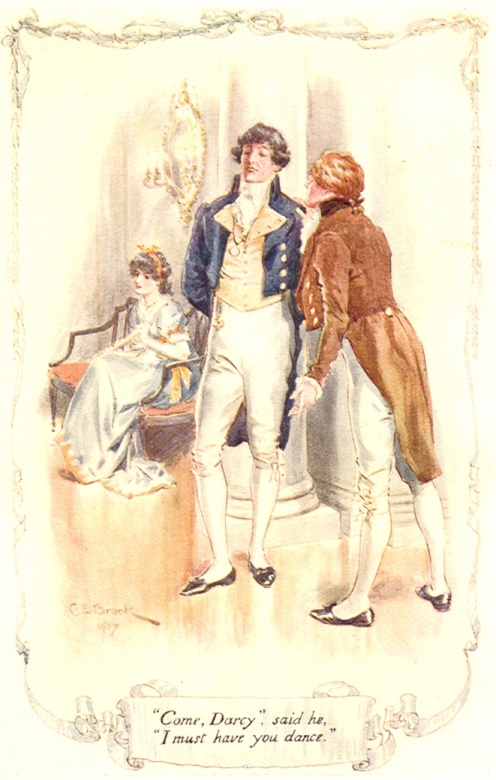
CE Brock – Mollands.net
1. “Come, Darcy,” said he, “I must have you dance. I hate to see you standing about by yourself in this stupid manner. You had much better dance.” [vol. I, ch. III]
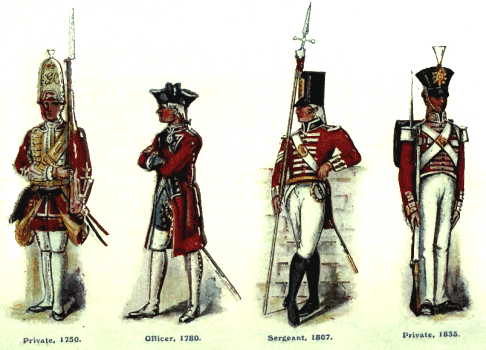
2. She had been watching him the last hour, she said, as he walked up and down the street, and had Mr. Wickham appeared, Kitty and Lydia would certainly have continued the occupation, but unluckily no one passed the window now except a few of the officers, who, in comparison with the stranger, were become ‘stupid, disagreeable fellows.’ [vol. I, ch. XV]
3. “ Oh! if that is all, I have a very poor opinion of young men who live in Derbyshire; and their intimate friends who live in Hertfordshire are not much better. I am sick of them all. Thank Heaven! I am going to-morrow where I shall find a man who has not one agreeable quality, who has neither manner nor sense to recommend him. Stupid men are the only ones worth knowing, after all.” [vol. II, ch. IV]
from Georgian Index
4. When the gentlemen had joined them, and tea was over, the card-tables were placed. Lady Catherine, Sir William, and Mr. and Mrs. Collins sat down to quadrille; and as Miss De Bourgh chose to play at cassino, the two girls had the honour of assisting Mrs. Jenkinson to make up her party. Their table was superlatively stupid. Scarcely a syllable was uttered that did not relate to the game, except when Mrs. Jenkinson expressed her fears of Miss De Bourgh’s being too hot or too cold .… [vol. II, ch. VI]
5. “Well, he certainly is very agreeable, and I give you leave to like him. You have liked many a stupider person.” [vol. I, ch. IV]
CE Brock – Mollands.net
6. The stupidity with which he was favoured by nature must guard his courtship from any charm that could make a woman wish for its continuance [vol. I, ch. XXII]
7. But why Mr. Darcy came so often to the Parsonage it was more difficult to understand. It could not be for society, as he frequently sat there ten minutes together without opening his lips; and when he did speak, it seemed the effect of necessity rather than of choice — a sacrifice to propriety, not a pleasure to himself. He seldom appeared really animated. Mrs. Collins knew not what to make of him. Colonel Fitzwilliam’s occasionally laughing at his stupidity proved that he was generally different, which her own knowledge of him could not have told her… [vol. II, ch. IX]
8. Wickham will soon be gone; and therefore it will not signify to anybody here what he really is. Some time hence it will be all found out, and then we may laugh at their stupidity in not knowing it before. At present I will say nothing about it.” [vol. II, ch. XVII]
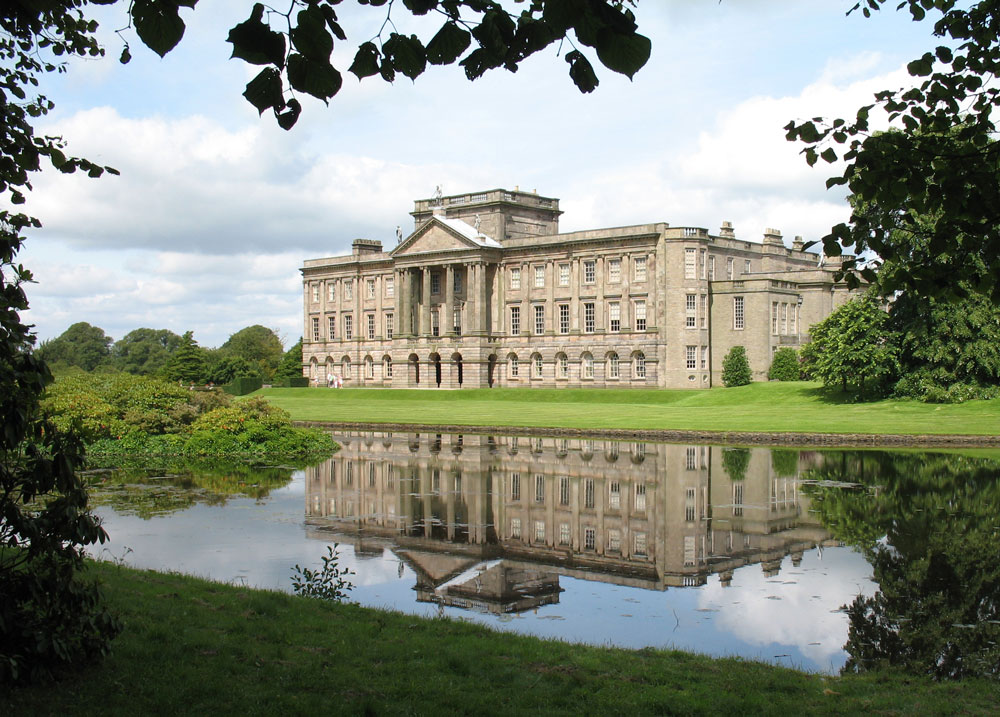
9. Elizabeth was distressed. She felt that she had no business at Pemberley, and was obliged to assume a disinclination for seeing it. She must own that she was tired of great houses; after going over so many, she really had no pleasure in fine carpets or satin curtains. … Mrs. Gardiner abused her stupidity. “If it were merely a fine house richly furnished,” said she, “I should not care about it myself; but the grounds are delightful. They have some of the finest woods in the country.” [vol. II, ch. XIX]
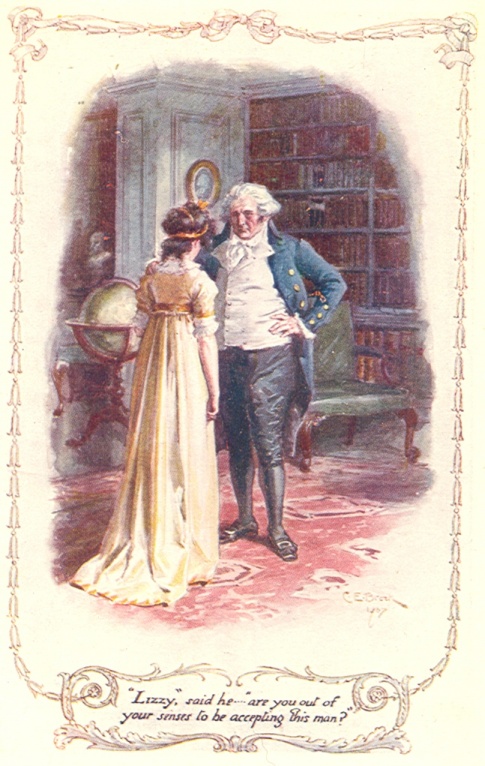
And finally when Mr. Bennet asks Lizzy: “Lizzy,” said he, “what are you doing? Are you out of your senses, to be accepting this man?” – he could as well have called her stupid… [vol. III, ch. XVII]
Note your answers to the eight non Pride and Prejudice quotes at the beginning of this post in the comment area below: how did you do? we shall have no dull elves around here…
“La! You are so strange! But I must tell you how it went off. We were married, you know, at St. Clement’s, because Wickham’s lodgings were in that parish. And it was settled that we should all be there by eleven o’clock. My uncle and aunt and I were to go together; and the others were to meet us at the church. Well, Monday morning came, and I was in such a fuss! I was so afraid, you know, that something would happen to put it off, and then I should have gone quite distracted. And there was my aunt, all the time I was dressing, preaching and talking away just as if she was reading a sermon. However, I did not hear above one word in ten, for I was thinking, you may suppose, of my dear Wickham. I longed to know whether he would be married in his blue coat.
“Well, and so we breakfasted at ten as usual; I thought it would never be over; for, by the bye, you are to understand, that my uncle and aunt were horrid unpleasant all the time I was with them. If you’ll believe me, I did not once put my foot out of doors, though I was there a fortnight. Not one party, or scheme, or any thing. To be sure London was rather thin, but, however, the Little Theatre was open. Well, and so just as the carriage came to the door, my uncle was called away upon business to that horrid man Mr. Stone. And then, you know, when once they get together, there is no end of it. Well, I was so frightened I did not know what to do, for my uncle was to give me away; and if we were beyond the hour, we could not be married all day. But, luckily, he came back again in ten minutes time, and then we all set out. However, I recollected afterwards that if he had been prevented going, the wedding need not be put off, for Mr. Darcy might have done as well.”
“Mr. Darcy!” repeated Elizabeth, in utter amazement.
Pride and Prejudice, v. III, ch. IX
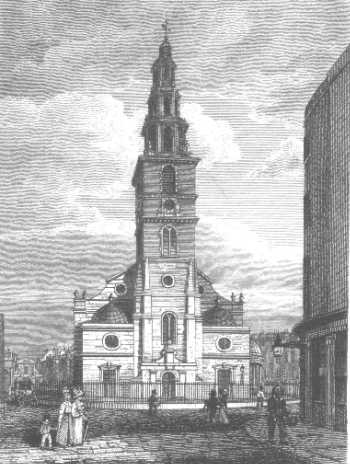
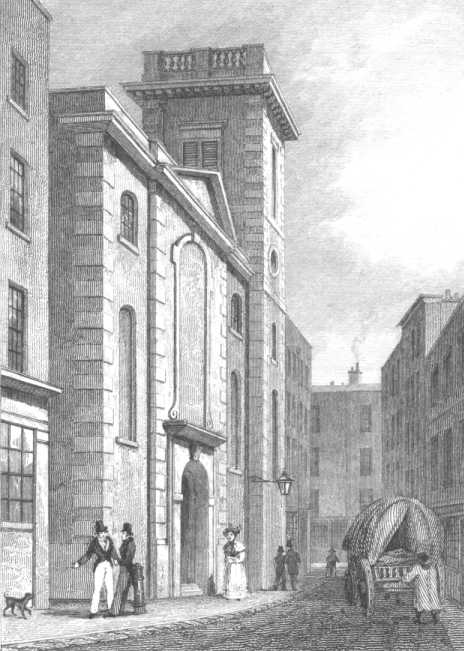
St Clement Danes – Strand (London Views)
Jane Austen often gives clues to the whereabouts of her locations, especially in her London passages – we know she knew London well and placed her characters in just the right spot to tell her readers who they were by where they lived. We famously have a few “____shire”s scattered about regarding the militia, for an element of secrecy one might assume? But in Pride and Prejudice there are two locations that she specifies that bring only confusion, and both involve Wickham and Lydia: St. Clement, where they were married, and Edward Street, home to Mrs. Younge, Georgiana’s former governess and friend and devious helper to Wickham. Today I will deal with the former…
When Lydia remarks that “We were married, you know, at St. Clement’s, because Wickham’s lodgings were in that parish.” – she gives a clue that perhaps contemporary readers would not have found confusing, but we are left with not being completely sure which St. Clements she is referring to: St Clement Danes in the Strand, or St. Clement Eastcheap. Neither is mentioned in her extant letters.
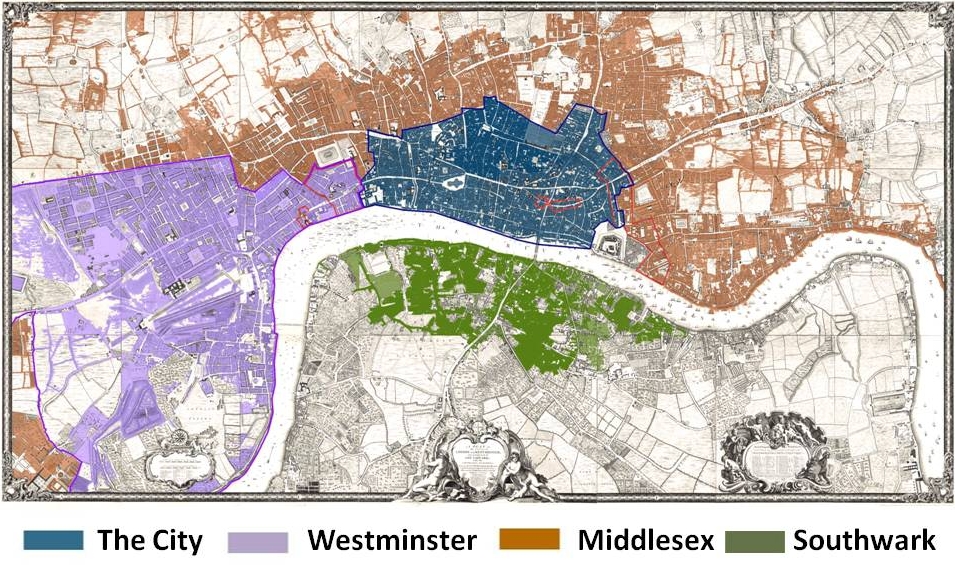
Pat Rogers notes in her 2006 Cambridge edition of Pride and Prejudice that the fairly large parish of St. Clement Danes had a population of 12,000 in 1801 and “contained areas of cheap lodgings and some raffish districts, notably a part of Drury Lane” (531-32). Most who have written on this would agree (see Kaplan and Fullerton cites below), largely because the other St. Clement (Eastcheap), on St. Clement’s Lane between Lombard Street and Great Eastcheap, would have been too close to the Gardiner’s who lived on Gracechurch Street [see maps for location of both churches]. Wickham would not have placed himself in such a smaller parish, with a population of 350 in 1801 (Rogers, 531), and so close to those who might find him out. Another reason that Rogers selects this as the best option is that in order to marry in this parish, one of the parties had to have residence there for fifteen days (Rogers, 532). Laurie Kaplan adds that “the length of time required for residency functions perfectly for the elopement plot of the novel, for tension increases the longer Lydia and Wickham remain unmarried” (Kaplan, 7). But we know Wickham had no mind to marry Lydia … .another story entirely… (the text is very clear on this: Mrs. Gardiner relates to Elizabeth: “…it only remained, he [Darcy] thought, to secure and expedite a marriage, which in his very first conversation with Wickham, he easily learnt, had never been his design.” (357).
But perhaps in the end, we should just abide by Susannah Fullerton, where in her Celebrating Pride and Prejudice, she blames Lydia for the whole confusing mess: “How typical of Lydia to be inexact in her information!” (p. 94-95)
Horwood Map panel 14. [RICHARD HORWOOD – MAP OF LONDON, WESTMINSTER AND SOUTHWARK, 1813] St Clement Danes is located at the heart of London, placed on an island in the middle of the Strand,
opposite the Royal Courts of Justice, the Temple and Fleet Street – on the map above circled in purple.
(Click on map and zoom in; map courtesy of Sue Forgue at Regency Encyclopedia, from the Guildhall Library, London)
St. Clement Danes: The first church on the site was founded by Danes in the 9th century, and named after St. Clement, patron saint of mariners. It has been rebuilt by William the Conqueror, later again in the Middle Ages, and rebuilt yet again in 1680-82 by Christopher Wren, a steeple added in 1719-20. It was gutted during the blitz, only the walls and tower left standing, and since reconstruction has served as the central church for the Royal Air Force.
An early street view of the Strand and St Clement Danes Church, 1753. On the right is the original entrance to the building.
cTrustees of the British Museum; image from Christina Parolin, Radical Spaces (ANU, 2010).
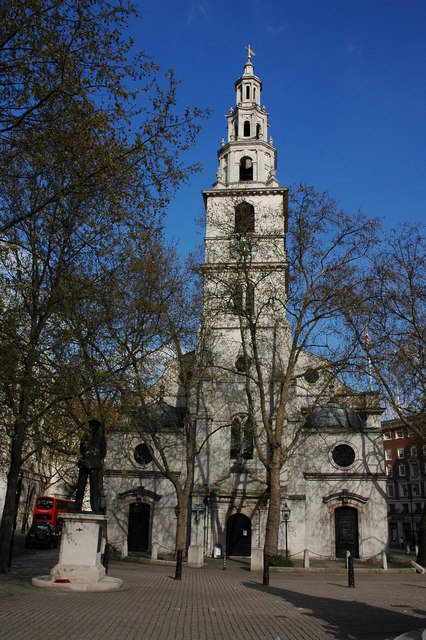
St Clement Danes today: when in London in May 2011 I visited the Church for the first time, finding it a quite lovely and peacful setting on its little island in the midst of bustling London – here are a few shots, alas! not that well focused and no exterior shots of the facade, so I include one from Geograph.org.uk, with thanks.
St Clement DanesSt Clement Danes, interiorSt Clement Danes ceilingflag in St Clement Danes
St Clement Danes exterior – cPhilip Halling, Geograph.org.uk
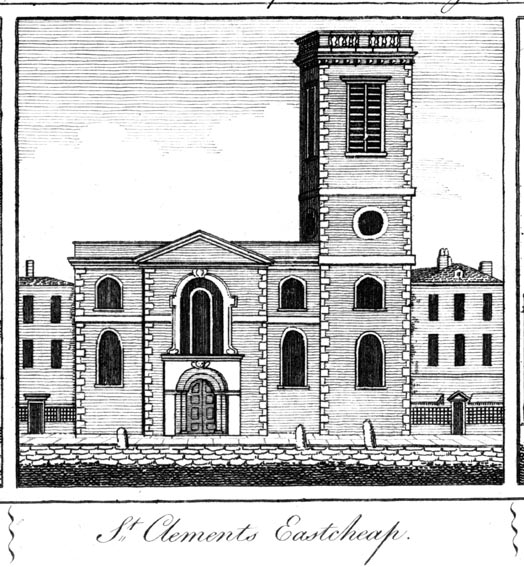
[A movie aside: You will notice that there are no entrance steps, as there are no steps for St Clements Eastcheap – if you recall from the 1995 movie, Lydia is running up the steps to the church, so neither of these sites were used in the movie [and I find no picture of this scene – if anyone knows where that exterior shot was filmed, please let me know!]
Facade St Clement Eastcheap
c.1760, from Walter Harrison’s History of London (1777) – wikipedia
******************
St. Clement Eastcheap: located on St. Clement’s Lane between Lombard Street and Great Eastcheap [today on Clement’s Lane, off King William Street] and close to London Bridge and the River Thames – see here on the Horwood panel 15:
Horwood Map panel 15. [RICHARD HORWOOD – MAP OF LONDON, WESTMINSTER AND SOUTHWARK, 1813]
The purple marks Gracechurch Street, home ot the Gardiners, and ends at the botton at Great Eastcheap,
go one block to the left to find St. Clement’s Lane, the Church is on the right.
(Click on map and zoom in; map courtesy of Sue Forgue at Regency Encyclopedia, from the Guildhall Library, London)
Though we are quite sure that this is not where Austen had Lydia and Wickham marrying, it is still worth noting – perhaps we are wrong in our assumptions after all, and Wickham was just “hiding in plain sight”? This St. Clement has possible Roman origins; it was destroyed in 1666 in the Great Fire of London, and rebuilt in the 1680s and also designed by Wren. And one should note that “cheap” is an old Saxon word meaning “market” and does not mean “cheap” as we associate it today. Here are a few images:
St Clement Eastcheap – London ViewsSt Clement Eastcheap today – wikipedia
The St Clement argument does not just revolve around Jane Austen [and indeed may she just been throwing out a very sly reference to her sailor brothers? – just a thought, St. Clement being the patron saint of sailors] … The Churches apparently have a long-standing “quibble” over which is the St. Clement referred to in the nursery rhyme “Oranges and Lemons” – here is the full rhyme: [the long version from wikipedia: http://en.wikipedia.org/wiki/Oranges_and_Lemons ]. It is the bells of St. Clement Danes that ring out the tune of the rhyme three times a day.
“Oranges And Lemons”, Nicholl Bouvier Games 1874, “The Pictorial World” by Agnes Rose Bouvier (1842 – 1892) – wikipedia
Gay go up and gay go down, To ring the bells of London town.
Oranges and lemons, Say the bells of St. Clements.
Bull’s eyes and targets, Say the bells of St. Margret’s.
Brickbats and tiles, Say the bells of St. Giles’.
Halfpence and farthings, Say the bells of St. Martin’s.
Pancakes and fritters, Say the bells of St. Peter’s.
Two sticks and an apple, Say the bells of Whitechapel.
Pokers and tongs, Say the bells of St. John’s.
Kettles and pans, Say the bells of St. Ann’s.
Old Father Baldpate, Say the slow bells of Aldgate.
You owe me ten shillings, Say the bells of St. Helen’s.
When will you pay me? Say the bells of Old Bailey.
And finally, to bring this back to Jane Austen, where all begins and ends after all, there is behind the St Clement Danes church a statue, by Percy Hetherington Fitzgerald and erected in 1910, of all people, Jane Austen’s very own Dear Dr. Johnson. I think she would be pleased, don’t you?
Let’s just be honest about our superficiality. Even when it comes to the high-minded business of literature, people do judge books by their covers. Perhaps that’s why Amazon produces glossy mock “covers” for its disembodied e-books, to be inspected and decided upon alongside the traditional print offerings.
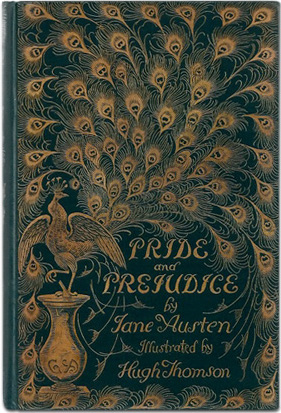
Book covers may be especially important when it comes to the classics. After all, many of us have a general sense of, if not a thorough familiarity with, the contents within. Perhaps more than anything else, these covers show what matters to prospective buyers. Two centuries of Jane Austen’s “Pride and Prejudice” are particularly revealing about the novel’s broad and sustained popular reach….
Actually my first experience with P&P ever was watching last 5 minutes of episode 4 in mini series of 1995 when I was 13 or 14. Those 5 minutes intrigued me so much, that I watched all the remaining episodes and then went in search for the original. I remember reading it the same year during my summer vacation. I loved everything about the book, its plot and style, its heros and heroines, and since that time P&P has become the best love story for me: witty, humorous, illustrative of different human characters, satisfying and with wonderful happy end. After P&P I read other works by Jane Austen, and some of them I liked, some of them I liked very much, but P&P was and still remains the best for me.
Congratulations Oloore! – Please send me your contact information [full name, address, phone, email] as soon as you can and I will get the book off to you right away. So glad you went from the 1995 movie to the book and discovered even more of its treasures!
Again, many thanks to all who commented with their stories of first encountering Pride and Prejudice – an interesting study in itself, and illustrative of the power of this book that so many remember the joys of that first reading! I included all the comments on this post on the Pride and Prejudice anniversary posted on January 28th: you can read all the “first impressions of P&P” from members of JASNA-Vermont here.
And hearty thanks to Susannah Fullerton for joining us, and for writing the book! and to Voyageur Press for generously supplying the giveaway copy!
Letter 79. January 29, 1813, Jane Austen to her sister Cassandra, from Chawton
I want to tell you that I have got my own darling Child from London; – on Wednesday I received one Copy, sent down by Falknor, with three lines from Henry to say that he had given another to Charles & sent a 3d by the Coach to Godmersham; just the two Sets which I was least eager for the disposal of. I wrote to him immediately to beg for my own two other Sets, unless he would take the trouble of forwarding them at once to Steventon & Portsmouth – not having any idea of his leaving Town before today; – by your account however he was gone before my Letter was written. The only evil is the delay, nothing more can be done till his return. Tell James & Mary so, with my Love. – For your sake I am as well pleased that it shd be so, as it might be unpleasant to you to be in the Neighborhood at the first burst of the business. – The Advertisement is in our paper to day [the Morning Chronicle of January 28, 1813]. – 18s – He shall ask £1-1- for my two next, & £1-8 – for my stupidest of all. I shall write to Frank, that he may not feel himself neglected. Miss Benn dined with us on the very day of the Books coming, & in the eveng we set fairly at it & read half the 1st vol. to her – prefacing that having intelligence from Henry that such a work wd soon appear we had desired him to send it whenever it came out – & I beleive it passed with her unsuspected. – She was amused, poor soul! that she cd not help you know, with two such people to lead the way [JA and her mother]; but she really does seem to admire Elizabeth. I must confess that I think her as delightful a creature as ever appeared in print, & how I shall be able to tolerate those who do not like her at least, I do not know. – There are a few Typical errors – & a “said he” or a “said she” would sometimes make the Dialogue more immediately clear – but “I do not write for such dull Elves” “As have not a great deal of Ingenuity themselves.” [from Scott’s Marmion] – The 2d vol. is shorter than I cd wish – but the difference is not so much in reality as in look, there being a a larger proportion of Narrative in that part. I have lopt & cropt so successfully however that I imagine it must be rather shorter than S. & S. altogether. – Now I will try to write of something else; – it shall be a complete change of subject – Ordination.[p. 201-2]
On this day that celebrates the publication of Jane Austen’s Pride and Prejudice 200 years ago, I asked members of our JASNA-Vermont region to share a few words on what their “first impressions” were on reading Austen’s “light, bright and sparkling … own darling Child.” I will be posting throughout this year a number of thoughts on Pride and Prejudice, but today it seems more important to see what this book has done for so many of us across years and generations, how some of us moved from a force-fed dislike to just plain awe, how some of us recall that first reading as feeling the earth shift, how multiple readings have enlarged our life in immeasurable ways.
I love Jane Austen, and even I am nearly exhausted with all the hoopla about this 200th bicentenary! – numerous new books on Austen and a number specific to this work; journals and newspapers from all corners of the earth have published articles; blogs, twitter and facebook abound in it; there are special websites, conferences, festivals – I must assume that the non-Austen folk out there are quite sick of it! But the one thing I am most enjoying is the slow re-read of Pride and Prejudice in the quiet of my study – no movies, no scholarly interpretations, no internet babblings – I just want to go back to Jane Austen and closely look at every word, every sly comment, every character brought to life on the page, every laugh-out-loud moment – and try to remember the first time I read her, a teenager lost in the corner of a library discovering the beauties of the English language from such a pen as Miss Austen’s….
Here now are a number of wonderful Pride and Prejudice memories from our JASNA-Vermont members – I have so enjoyed reading these, so hope you do too – and then please share yours with us in the comment section below…
************************
Believing Elizabeth: My First Reading of Pride and Prejudice
I was in the middle of Spring final exams, my third year at the City College of New York when I read Pride & Prejudice for the first time. I turned to it for relief because my exams were felt endless and relentless and I was desperate to read something, anything which wasn’t school work. I had fallen in love with Jane Eyre at age 16 and I was aware of the name Jane Austen. The phrase ‘pride and prejudice,’ was like ‘war and peace,’ an esteemed part of the language.
Around the corner from where I lived there was a warm, dark paneled public library called The Ottendorfer; it was either an old mansion or had been built to look and feel like an old mansion. So there I went, found Pride & Prejudice and was hooked from the first line.
In this first reading I saw the world completely as Elizabeth was seeing it. This meant that when Wickham told the story that outraged Elizabeth I heard it as she heard it, with outrage. Farther on in the novel I was as shocked as she was when I learned that Wickham was a liar and a scoundrel. My exams were finally over, a year later I graduated and life happened. When I next picked up Pride & Prejudice – many years later – I understood with some sadness that I could never again read it with that unconscious merging naivete.
-Michele C.
****************
I didn’t read Pride and Prejudice until I was 40, more than a decade after finishing everything Georgette Heyer had written. I had been enchanted with the words and manners of Heyer’s characters, often thinking that I might have been quite content to live in their society. And with Heyer I could always count on laughing out loud. In desperation when there were no Heyers left, I even tried writing my own, but got only half way through the second chapter.
Collecting books has always seemed the most natural thing for me and I bought a three-volume set of Austen along with a similar set of Bronte, thinking I couldn’t go wrong with something routinely labeled a classic. Trying a Bronte first, all six were immediately relegated to a distant corner of my brain if not a distant corner of my library.
I don’t remember what prompted me, years later, to finally reach for Pride and Prejudice, but I knew on page one that it was perfect. Heyer had been only an appetizer; this was Christmas dinner. As they say, life begins at 40!
Now, more than 20 years further along, I’ve discovered happily that I’ve forgotten enough of Georgette Heyer’s books to reread them with pleasure. But the real magic is that I don’t have to wait until I forget a plot to reread Jane Austen. I can start right over again and slip comfortably into a world I know well and always find a new delight. And I’m still laughing out loud.
-Susanne B.
***********
I believe I first read P&P in 1996. I had watched P&P 95 on video, as well as the movies for S&S and Emma. Alas, I can’t remember which came first. I love sweet Jane Bennet, especially when played by Rosamund Pike in 2005. I wish I could be a 10th as good as sweet Jane Bennet.
Cheers!
Kirk C.
*****
Pride and Prejudice has provided ongoing lessons in my life. I am seeking yet another lesson from this story. I met someone recently, and my first impression of this person was very unsettling. I found myself quick to judge and assumed things about the person, due to behavior I observed. I am seeking ways to better understand this person, who may be an extended part of my life for a long time. Being open to possibilities of accepting his person will take time and understanding. The following exchanges from the book give me hope that my first impressions may not remain as they are, at present.
I look to Elizabeth Bennet, whose initial thoughts of Mr. Darcy, changed dramatically in the plot of Pride and Prejudice. Elizabeth is touring Pemberly with housekeeper, Mrs. Reynolds, along with her aunt and uncle, the Gardiners. Mrs. Reynolds says of Mr. Darcy, “I have never had a cross word from him in my life, and I have known him ever since he was four years old.” Elizabeth’s own thoughts of Mr. Darcy begin to shift:
“This was praise, of all others most extraordinary, most opposite to her ideas. That he was not a good tempered man, had been her firmest opinion. Her keenest attention was awakened: she longed to hear more, and was grateful to her uncle for saying, “There are few people of whom so much can be said. You are lucky in having such a master.”
“Yes, sir, I know I am. If I was to go through the world, I could not meet with a better. But I have always observed, that they who are good-natured when children, are good-natured when they grow up: and he was always the sweetest-tempered, most generous-hearted, boy in the world.”
“Elizabeth almost stared at her. “Can this be Mr. Darcy!” thought she.
“His father was an excellent man,” said Mrs. Gardiner.
“Yes, ma’am, that he was indeed; and his son will be just like him- just as affable to the poor.”
“Elizabeth listened, wondered, doubted, and was impatient for more.”
A few pages later in the book, Mr. Darcy returned home a day early, and encountered Elizabeth, her aunt, and uncle, on the grounds at Pemberley. Darcy held his composure and spoke kindly with the party. Elizabeth was overwhelmed after the initial meeting.
“She blushed again and again over the perverseness of the meeting. And his behavior, so strikingly altered-what could it mean? That he should even speak to her was amazing!-but to speak with such civility, to enquire after her family? Never in her life had she seen his manners so little dignified, never had he spoken with such gentleness as on this unexpected meeting. What contrast did it offer to his last address in Rosings Park, when he put his letter into her hand! She knew not what to think, nor how to account for it.”
I’m hoping for greater understanding in this new relationship.
-Barb F.
******
I first read P&Pat a time when I could be said to have been “on the marriage mart”—I had just graduated from college and was deciding where to go from there. My mother was no Mrs. Bennet, but still the push to marry young (coming not so much from her as from the social standards of the time) was strong.
As I saw it, the two main approaches outlined in the book were 1) Elizabeth Bennet’s, in which a woman holds to her own views and doesn’t dismiss her feelings or trim her remarks and actions to fit the goal of catching (tricking actually) and marrying the most eligible man of her acquaintance whether she likes him or not, and would much rather be a despised spinster than to settle for a marriage void of love and respect; and 2) Caroline Bingley’s, in which a woman tracks, traps, and bags her prize using whatever means necessary, with no thought given to the probability that she’s also trapping herself in a lifetime of mutual loathing between herself and the man whose proposal she’s so desperate to win. Integrity versus flattery and deceit.
Two extremes, sure, but the contrast is a helpful reminder when navigating among the shoals on the way to finding a life partner—or indeed when working toward any kind of goal.
-Donna G.
*****
I first ready P&P in 10th grade English class for a book report…my teacher had recommended it to me. I don’t remember much from that first reading, except that I did enjoy it. I’ll be giving away my age, but that was in the 1960’s. In 1992, we moved just outside London for about 2 years, and I stopped in the local bookshop for something to read. I prefer better literature, and they had a display of all of Jane Austen’s works. I remember thinking that I had enjoyed P&P, but I chose Emma, not knowing anything about it. I couldn’t put it down and read it so fast, I turned right around and read it a second time in 2 days, much slower the 2nd time. Then I chose Persuasion, and then the rest of the novels, and love some of the stories in the book of her juvenilia. I love her History of England! I couldn’t get enough of them and have since read all them at least 3 times and get something new from them every time.
I was able to visit Chawton, Lyme Regis, and Winchester Cathedral. I’ll always cherish my time in England. Living there certainly has given me new insight into the locations of Jane’s novels.
Now I keep the books in various places around the house so I can always pick one up to read again or peruse my favorite passages. In P&P, my favorite part is when Elizabeth is reading Mr. Darcy’s letter and the descriptions as she realizes she’s made a big mistake and is starting to change her mind. I find that an incredible piece of writing.
-Phyllis G.
*****
Pride & Prejudice was the first high school play I was in at a small Catholic academy for girls on the upper east side in NYC. There were 20 students each class, total 80 students in the high school. It was in my freshman year and it was the play before Christmas. The year was 1956 and I was 13 years old.
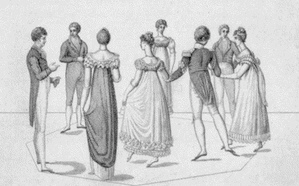
Although the stage was small, the production was opulent enough. I had a non-speaking role as a minuet dancer at an assembly. I wore a perruque, a beautiful blue ball gown, carried a reticule and sported a beauty spot. My partner was another girl in white stockings, silk breeches and waistcoat and dancing slippers. We wore lots of makeup which was professionally applied. It was a complete minuet lasting several minutes. I enjoyed rehearsals immensely and we dazzled the audience. We had only two performances.
I never got the chance to watch the whole play but I did rehearse lines with the senior girl, Sheila C., all of 17 or 18 years old, who played Elizabeth Bennet. We travelled home on the same hour long subway ride to the Bronx. We were both academic scholarship students. I would give her the cue from the sides. When you rehearse from sides you get only the lead in line. So I would say, “….but he believes that it was left to him conditionally only.” Sheila-Elizabeth replied, “I have no doubt of Mr. Bingley’s sincerity, but you must excuse my not being convinced by assurances only. Mr. Bingley’s defense of his friend was a very able one, I dare say; but since he is unacquainted with several parts of the story, and has learnt the rest from that friend himself, I shall venture to still think of both gentlemen as I did before.”
Did we have an audience as we stood on the subway train dressed in our blue uniforms, white blouses, white gloves, blue, ground gripper shoes and blue hats? I don’t remember because I was so transfixed by what Elizabeth said and how Sheila’s skin changed color from pale to pink as she spoke the lines so forcefully. That following summer I would read P&P for the first time, but nothing can compare to the full dose of Elizabeth Bennet given to me by a senior girl whom I stood in awe of and who befriended me so kindly albeit with a good dose of arch humor.
(I’m enjoying rereading P&P and it’s fun to take part in this 200th celebration)
-Margaret H.
*****
I found Pride and Prejudice in a local bookstore when I was in high school. It was my first reading of Austen, and I soon decided that this book was different. From that reading, I have been in awe of Austen’s ability to create characters. What stood out for me as a teenager was the description of Elizabeth’s dawning self-awareness over many chapters. At the mid-point of the novel, for example, she must grapple with Mr. Darcy’s letter: “…she was in a fair way of soon knowing [the letter] by heart. She studied every sentence; and her feelings towards its writer were at times widely different. When she remembered the style of his address, she was still full of indignation; but when she considered how unjustly she had condemned and upbraided him, her anger was turned against herself…” Here, and throughout the novel, Austen never rushes to get to her point. Many years later, I am still in awe!
-Lynne H.
*****
I once read a single passage of Pride and Prejudice and Zombies in a bookshop which lingers in memory and somehow makes me love Jane Austen’s original all the more. Don’t ask me if I remember it right; I don’t care. I didn’t buy the book. But what I recall is one blissful moment when Jane and Elizabeth launch themselves at Mr. Collins and tear out his throat.
Isn’t that secretly what we all long for?
-Stuart B.
*****
By the time I was 12 years old I had become an ardent fan of the works of Georgette Heyer. I don’t remember if I swooned over the romance or the costume descriptions and hilarious cant, but I do remember being intrigued with Heyer’s version of the Georgian and Regency world. I was happy, therefore, to find out that there was ‘another writer’ who wrote about this time period—and one that had actually lived in it. This Jane Austen person would surely make for a fun read. I found Pride and Prejudice. I now admit, to my secret shame, that I found it overlong, too wordy, with heavy-handed irony, and rather too slow a pace. I even tried a couple more Austen’s to no avail.
Fortunately I gave her one more try, this time in a literature course in college. Thank goodness! I had grown up just enough in the intervening years to realize that P&P was not long at all, had just the right amount of irony, lots more subtle wit, and was paced to perfection. My only complaint at that, and subsequent, readings was that it was too short! I could have spent much more time among the residents of Longbourn (and Mansfield, and Highbury and…). And as I am sure so many have found, subsequent readings always bring something new.
-Hope G.
*****
I first tried reading P&Pwhen I was in the eighth grade. I knew it was a “classic,” but I found it terribly dull. I decided to try again when I was sixteen, and this time I saw all of the humor that I had missed in my first attempt. That was it–I was hooked! It’s still my overall favorite of JA’s books.
-Christie M.
*****
With varying degrees of intensity, all of Jane Austen’s novels are propelled by her almost unerring instinct for counter-balance in a scene. Rarely does Austen’s passionate story-telling NOT pair satire with fear, or irony with kindness, or absurdity with melancholy, or self-knowledge with self-deception. With a razor-sharpened pen and a delicately calibrated scale, Austen dissects and weighs the hearts of her characters as they do battle with the expectations of their closely-knit societies.
In Austen’s earlier novels, the tone tends toward lightness. Her later works more heavily embrace the seriousness of the human condition. In the deftness of PRIDE & PREJUDICE we see Austen performing her most virtuosic balancing act: each barb is followed by a balm.
Because of this ameliorating rhythm, we may first worry, but we ultimately smile as we ponder her tale about the indignities faced by women who are NOT in possession of a good fortune, but who are VERY much in want of a husband.
-Nan Q.
*****
Loving Pride and Prejudice
I’m not going to lie and say I loved Pride and Prejudice the first time I read it. I was a senior in high school and just didn’t get what the fuss was about. What I did understand, however, was that my English teacher loved Jane Austen. Even after I went to college and became an English major, Ms. Henry remained my favorite English teacher and her love of Austen forever put those six novels on my radar. Like so very many of us, I am indebted to a teacher’s passion and enthusiasm.
It’s true that now that I love Pride and Prejudice best of Austen’s novels and of nearly all others entirely. It has become the standard against which I compare much of what I read. I happen to love its “bright and sparkling” quality and the packed action of “one country village.” There’s something about her work that makes my life better because I’ve read it.
My love for Jane Austen’s work has led me to join JASNA and to book a weekend at a bed and breakfast here in Vermont with the weekend focus of this great novel. I can’t wait to discuss Pride & Prejudice over afternoon tea and maybe play a little trivia. I get what the fuss is about, finally, and it never gets old.
Jane Austen weekend at Governor’s House
I love this line by Caroline Bingley: “To walk three miles, or four miles, or five miles, or whatever it is, above her ancles in dirt, and alone, quite alone! what could she mean by it? It seems to me to shew an abominable sort of conceited independence, a most country town indifference to decorum.”
Michelle S.
*****
Mr. Collins is certainly not my favorite character (!) ….but Elizabeth, of course, is. I was moved by her strength, wisdom and insight when I first encountered her in Freshman English…and then I became an even greater admirer more than 60 years later when I made her acquaintance once again…..this time via an audio recording as I made daily automobile trips around Vermont this past summer.
-Sallie S.
*****
When I was twelve, my mother gave me a beautiful edition of “Pride and Prejudice” with leather ends and sprigged wall paper covers; it is charming. I read it then with the intellect of a twelve year old and re-read each year unto my current 75th year with delight, awe and the greatest pleasure. My husband, of fifty five years, held the Darcy conversation, sprightly, ironic, engaged and bountiful, to my Elizabeth, for fifty-five years. I have been enriched on both counts. Each of my granddaughters has a beautiful copy to read when she is ready. I spoke of Austen often during forty years of my teaching life. Bravo for Miss Austen.
ladysusanpdx: I first read Pride & Prejudice when I was 13, when my grandmother gave it to me. Seeing how struck I was by the story and especially Elizabeth Bennet, my father surprised me by letting me stay up very late to watch the 1940 movie version with Greer Garson and Lawrence Olivier. That was 50 years ago and it remains my favorite novel and an important part of my life.
Stefanie Henry: Although I teach Pride and Prejudice every year, I never grow tired of discovering some unknown nuance, and I always enjoy the faces of my students as they fall in love. The classes celebrate Austen by preparing and dressing for high tea. Hopefully, my love of Austen will continue to inspire students to read more and more.
Sharon Henson: I was an avid reader from the moment that letters formed words for me, but I didn’t have to read Austen in high school–or in college. I picked up Pride and Prejudicewhile living in London, England, where my husband was a Fulbright Scholar. From then on I was hooked, reading the rest of Austen’s books, and seeing all of the films based on her books. I’ve read books based on her characters, and various biographies on Austen and, still, over 40 years later, can’t get enough Austen.
Oloore: Actually my first experience with P&Pever was watching last 5 minutes of episode 4 in mini- series of 1995 when I was 13 or 14. Those 5 minutes intrigued me so much, that I watched all the remaining episodes and then went in search for the original. I remember reading it the same year during my summer vacation. I loved everything about the book, its plot and style, its heroes and heroines, and since that time P&P has become the best love story for me: witty, humorous, illustrative of different human characters, satisfying and with wonderful happy end. After P&P I read other works by Jane Austen, and some of them I liked, some of them I liked very much, but P&P was and still remains the best for me.
Mary Preston:I can’t remember the very first time I read PRIDE AND PREJUDICE. It’s been a very long time. What I do know is that I appreciate it more with each reading.
Pinterest – JA International
Monica: I also can’t remember when I read P&P for the first time. I must have been in my early teens and it was an Italian translation. Maybe it didn’t make a great impression on me then. I reread it later and read also the other Austen novels and liked them very much. I have just reread P&P to celebrate this bicentenary and am really enjoying all the attention it is currently receiving. I will definitely read Celebrating Pride & Prejudice!
esolender: First time? Well, I was 15, I think, when my mother gave P&P to me for a second time — I had tried it once at 12, was too young, and left it unfinished. But this time, I read it through, loved it and then gulped down the additional five — all in one insatiable summer treat. Couldn’t get enough Jane so I read P&P a SECOND time that magical summer. But it was the THIRD reading —in college at age 17— that was truly a revelation: It was as if I were reading an entirely new and wonderful novel. That’s because I was two years older, brought more to the reading, and saw nuances and wit and wonder that I had missed the first time. It was also because Jan Ferrers Weeks (later Thaddeus) was my guide through the novel this time in freshman English at Barnard. I suspected —accurately, it turned out— that I could read it again and again with pleasure — and shall again this celebratory year.
Tanya: Oh I would love to win a copy of this book – I just saw notice of it on Amazon yesterday and HAVE to have it. I adore Jane … all things Jane. Pride and Prejudice is well, tops! I design needlework inspired by Miss Austen’s novels. Never can get enough out of such few books!!I actually put a free pattern on the blog today to also mark the 200th Anniversary of this wonderful novel, P&P. If you do needlework, please do stop by and print a copy of it for your stitching basket: http://atthehoneysuckletree.blogspot.com/2013/01/literary-love-2013-souvenir-of-1813.html
Katherine: I also can’t remember the first time I read P&P. I do remember the first time I read it critically (as literature, not strictly entertainment) – in a class on the English Novel in college. My professor considered Jane the greatest of English novelists, with which I heartily agree. I would love to have a copy of this book!
Ruth B.: My friend thinks that the first line of P and P is one of the best known of all first lines. I agree with her and know that it is certainly MY favorite first line. I will be happily reading your book soon, I hope. It sounds fantastic.
gongjumonica: A question for Susannah. If you could change a scene in Pride and Prejudice, what would it be and why?
Susannah Fullerton: It has been fascinating to read about the first reading of P & P for other people. We are all so lucky to have had our lives enriched by this book. Gongjumonica asked me if there was any scene I would change. The answer is NO, I do not want to change any scene at all. I adore it just as it is. Does anyone else think any scene should be changed? I do hope that whoever wins my book loves reading it.
Felicia: I remember the first time I read Pride and Prejudice, I just loved Elizabeth Bennet so much, I wanted to be her. It was not until the second reading that I truly appreciated Mr. Darcy. Maybe I was too prejudice?? :)
Tiffany: I first read P&P in 8th grade… I remember desperately wanting to be a Bennet – crazy family and all. I agree with Felicia – Mr. Darcy didn’t catch on until I was a little older :).
A. Marie: It was the summer I turned 16. I was at a low ebb, for various reasons: the usual too homely/too bright teenager angst, plus serious family dysfunction (frankly, the Bennets looked pretty good to me at that point). In addition, I’d just read Eugene O’Neill’s Long Day’s Journey into Night because someone thought I should, and I felt about the way anyone feels after reading that one. So I happened to pick up the battered old Everyman P&P that had belonged to my step-grandfather (bless you, Grandpa Bill, for throwing me a lifeline!). I was instantly hooked. I remember thinking before I finished the first chapter, “Jeez, I didn’t know it was OK to be funny in the early 19th century,” and I finished the book before bed that night–not just to find out whether Elizabeth and Darcy finally got together, but because I was completely drawn in and along by the language. And I still am, after too many readings to count.
Hugh Thomson – Elizabeth Bennet
Danielle C.: I fell in love with Austen when I was a young girl. I have found that as I got older and understood more about love and life I now fully appreciate what a great writer she was. Can’t wait to read this book.
Lúthien84: My mum introduced it to me when I was 12. She borrowed an abridged edition and having nothing else to do because school’s over and it was the holidays, I decided to read it. I’m joining the P&P 200th Anniversary blog hop party organised by Alyssa Goodnight so stop by on my blog to read my experience on Monday. I’ll also be giving away a copy of an Austenesque novel. Hope to see you there.
Kim W.: I came to Jane Austen late in life–I was in my early thirties when I started enjoying her movies–Emma was my first!!–and then my mid thirties when I started to read her books. Pride and Prejudice was the first book I read, which I got out of the library, and I was so surprised how easy it was to read! No memories of hard assignments by my 9th grade English teacher here!! I think that if I had met Jane earlier in life and understood her gentle sisterly advice, I could have avoided a lot of heartache. She is a truth teller even 200 years later!! Fingers crossed and Huzzah! for the publication of Ms. Fullerton’s book!
********
********
Thank you one and all for sharing your Pride and Prejudice stories! – would love to hear from others, so please comment below on:
1. when you first read P&P and what it meant to you at the time / or how subsequent readings have influenced your life; or,
2. your favorite passage from the book and why; or,
3. thoughts on your favorite character in P&P and why.
Or, all three of the above!
Note: I will continue to post on Pride and Prejudice throughout 2013: next up will be “Places of Pride and Prejudice: St. Clements”, so stay tuned!
Gentle Readers All: Please see below to enter into the Giveaway for a copy of Susannah Fullerton’s Celebrating Pride and Prejudice.
**********************
Today I welcome Susannah Fullerton, president of JASA,author of numerous articles on Jane Austen, a leader of literary tours , and author of Jane Austen and Crime (2006), A Dance with Jane Austen (2012), and most recently the author of Celebrating Pride and Prejudice: 200 Years of Jane Austen’s Masterpiece [Happily Ever After in the UK].
Susannah shares with us a few thoughts on the her new work and the joys of discovering and re-discovering Austen’s most popular novel – and out just in time as we all celebrate the 200th bicentenary of Pride and Prejudice this year, all beginning on January 28th. I highly recommend this book, a must-have for your Austen Library, a perfect companion to the novel, and a lovely work in its own right.
And now Susannah:
______________________
I was about 11 years old when my mother first read me Pride and Prejudice. We were away on a family holiday in Christchurch, New Zealand, and the only thing I remember of the visit there was lying at the end of a double bed while my Mum read aloud. It was not all joy – I did get very frustrated when she stopped to laugh. I was too young to appreciate the irony of the novel and just wanted to know what would happen to Elizabeth and Darcy. Now of course I know exactly why my mother laughed. In spite of my mother’s ‘interruptions’, I loved the story, and soon went back to read it by myself.
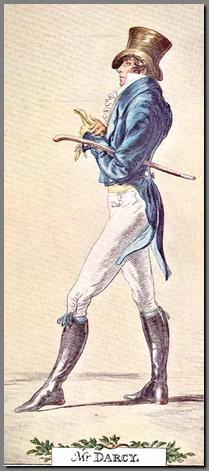
Mr Darcy, by Robert Ball. Pride and Prejudice (Doubleday 1945)
[image from Austenprose.com]
So for just over 40 years Pride and Prejudice has been a vital part of my life. That first reading has been followed by countless others. Sometimes I have just picked up the book and it has fallen open in just the right place (any place is the right place) and I’ve read of the Meryton Ball, or one of Darcy’s proposals, or a scene with Mr Collins making a fool of himself. Even a ‘one page reading’ has always left me feeling better. Again and again I have picked it up and started with that brilliant opening sentence (to which I devote a whole chapter in my book!) and gone through to the end, knowing exactly what would happen but loving it more every single time.
And I have read ‘P & P’ in other ways – I adore unabridged audio versions, I’ve read it as a comic book, I’ve read it on my Kindle, and of course I’ve seen film versions and loved them too. Elizabeth and Darcy are my dear friends and while I would not want to actually meet Mr Collins, I always delight in his company within the pages of Jane Austen’s great novel.
It has been said that you never read the same book twice! Every re-reading is a different experience – you know what is going to happen within the plot and so you look out for other things. And with ‘P & P’ there are always other things – some slight nuance you missed last time you read it, a different inflection by an audio book reader can make you react to a sentence you know well in a different way, and you pick up on the tiny details of setting or character that you failed to notice last time. And the other thing that means you are not reading exactly the same novel, is that you yourself have changed. You have grown older and wiser, experienced things in your own life that have slightly altered you from the person you were on the first reading. I groaned over Mrs Bennet when I first met her – she was so vulgar and embarrassing and I pitied Elizabeth for having to put up with her. But now I’m a mother myself, with children who are forming romantic partnerships, and I have so much more sympathy for Mrs Bennet. And as a wife, I can understand her frustration when Mr Bennet goes off to the library and shuts the door, leaving the worries of 5 unmarried daughters totally up to her. Reading Pride and Prejudice changes your life, but your life also changes each re-reading of Pride and Prejudice.
With such a deep love of this novel, you can imagine what a joy it was for me to sit down and write a book about its incredible 200 years. I could not think of a nicer way to celebrate this important literary anniversary. For months I was immersed in its pages, learning even more about the book and its characters as I worked on my own book. I was so fascinated by the translations of it – how very quickly it was translated into another language and what a mess was made of that first translation, and what huge challenges it gives a translator (do you think Mr and Mrs Bennet should say ‘vous’ or ‘tu’ to each other in a French translation – I’d love to hear your opinion?). I especially loved writing my chapter on Elizabeth, trying to analyse what it is that makes her so charming and lovable, while not making her a ‘goody-goody’ in whom we can’t believe. I had lots of fun with my chapter on all the merchandise inspired by this novel – don’t you just love the idea of a BBQ apron that announces ‘Let’s BBQ Wickham!’ And I was fascinated by the responses to ‘P & P’ over 200 years from famous people. A.A. Milne quite rightly judged people by their reactions to this book, while Robert Louis Stevenson wanted to go down on his knees and worship Elizabeth Bennet whenever she opened her mouth.
My book is very gorgeously illustrated and has pictures that may be unfamiliar to many. It is available in two editions – the American edition is Celebrating Pride and Prejudice: 200 Years of Jane Austen’s Masterpiece and the UK edition is Happily Ever After: Celebrating Jane Austen’s Pride and Prejudice. I do hope my book gives pleasure to those of you who read it, and also teaches you new things about this much-loved novel.
HAPPY PRIDE AND PREJUDICE ANNIVERSARY YEAR!
********************
About the Author:
Susannah Fullerton is President of JASA, and author of Jane Austen – Antipodean Views, Jane Austen and Crime, A Dance with Jane Austen, and her latest Celebrating Pride and Prejudice: 200 Years of Jane Austen’s Masterpiece – note that the UK title of this work is Happily Ever After: Celebrating Jane Austen’s Pride and Prejudice (Frances Lincoln, 2012).
Celebrating Pride and Prejudice
Voyageur Press, January 1, 2013
ISBN-10: 0760344361; ISBN-13: 978-0760344361
$25.99
Contents: (I have abbreviated the title to P&P)
‘My Own Darling Child’- The Writing of P&P
‘A Very Superior Work’ – Reactions to P&P
‘A Truth Universally Acknowledged’ – The Famous First Sentence
‘Bright and Sparkling’ – The Style of P&P
‘As Charming a Creature’ – The Heroine, Elizabeth Bennet
‘Mr Darcy … is the Man!’ – The Hero, Fitzwilliam Darcy
‘The Female Line’ – Her Relations
‘The Same Noble Line’ – His Relations
‘Delighting in the Ridiculous’ – Other Characters
P&P Goes Overseas – The Translations
‘Pictures of Perfection’ – Illustrating and Covering P&P
Did They Live Happily Ever After? – Sequels and Adaptations
Bonnets and Bosoms – Film and Theatrical Versions
Mugs and Skateboards – Selling P&P
‘Behold Me Immortal’ – P&P Now and in the Future
Bibliography and Index
_____________________________________
Please enter into the drawing for a copy of Celebrating Pride and Prejudice by commenting below: either by asking Susannah a question or telling us of your first experience in reading Pride and Prejudice [or like Susannah, perhaps being read to?]. Deadline is Tuesday January 29, 2013 11:59 pm; winner will be announced on Wednesday January 30th. Worldwide eligibility. Good luck all, and thank you to the publisher for donating the book for the giveaway [please note that I happily purchased my own copy].
The January/February issue (No. 61) of Jane Austen’s Regency World magazine, marking the bicentenary of Pride & Prejudice, has just been published and is being mailed to subscribers over the holiday period.






















 Jane Austen in Vermont