Jane Austen · Regency England · Social Life & Customs

Travel in Sense & Sensibility ~ Part V ~ Carriages ~ Regency Sports Cars!

We have looked at travel and the various carriages of the Regency Period in four previous posts.  You can re-visit them here:

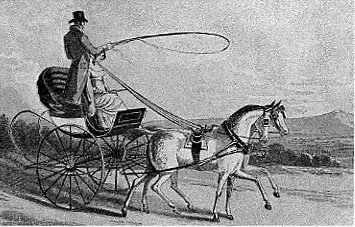
R. Havell – Roe, Sporting Prints

Now the fun part – on to the Regency sports cars! – those carriages that Austen assigns her young men and her rakes, those vehicles that Georgette Heyer made famous in her works, driven by all manner of her Regency bucks, and in many cases by her independent heroines.  We start with the Phaeton, the last of the four-wheeled vehicles but much more stylish than the larger, practical coaches we have looked at previously…    


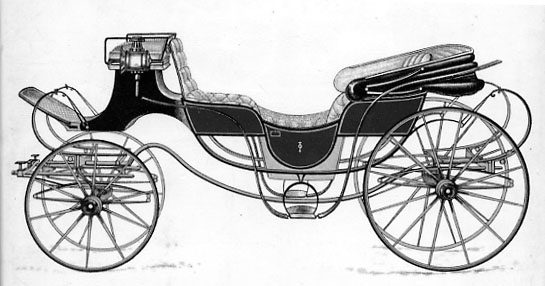
Phaeton (Georgian Index)


The Phaeton:   termed “deliciously dangerous”

  • from the Greek “to shine” – in Greek mythology, the boy who tried to drive the sun chariot
  • a light 4-wheeled carriage with open sides in front of the seat; the front wheels were usually smaller that the rear
  • sleigh-like single body, for two passengers, luggage below
  • some had a folding top [a calash or callech = folding top] – a fair-weather carriage
  • for pleasure driving, it is owner-driven with no box or postillion
  • usually 1-2 horses or ponies
  • the largest and most varied of all pleasure carriages, the phaeton remained popular until the end of the carriage era
  • often called a “chaise” in England, a “cabriolet” in France
  • variations:  High-Perch Phaeton or “High-Flyer” – fast, sport driving with two horses – the favorite of the Prince Regent, later George IV who had six horses!  –  he used a low Phaeton after his weight increased to such a degree that he could not get into the high carriage!
  • Who in Austen?:  only Miss DeBourgh who has a pony phaeton; Mrs. Gardiner wants “a low phaeton with a nice little pair of ponies”  
Phaeton – NY Coachmakers

Two fashionable ladies in a “high-Perch Phaeton” driving about to see and “be seen”: 


High-Perch Phaeton


************ 

The Curricle: [only English] – the “Regency sports-car”

  • name from the Latin: curriculum = running course, a (race) chariot
  • a two-wheeled vehicle driven by a pair of horses that are perfectly matched, a bar across the back of the horses to carry the pole
  • has a folding hood
  • owner-driven, holds two passengers
  • C-springs – after 1804, equipped with elliptical springs
  • the popular Regency show-off vehicle – for long distances or park rides
  • cost @ 100 pounds
Curricle

A picture of the Marquis of Anglesey:
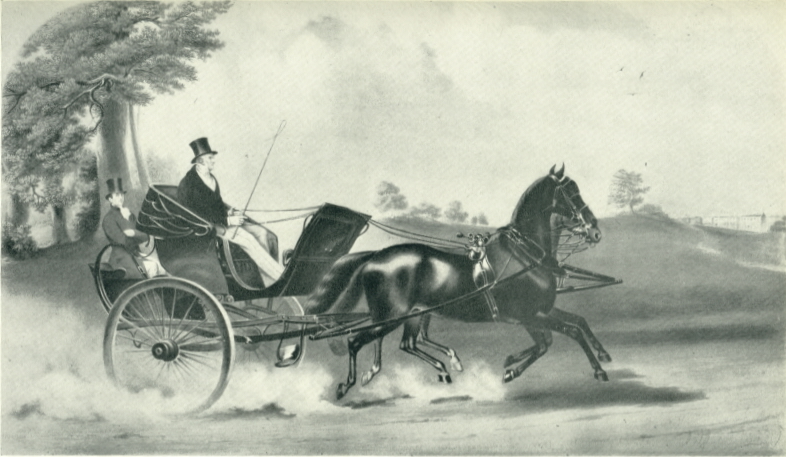


Curricle (Georgian Index)


In Sense & Sensibility: Willoughby has a curricle though he cannot afford it:

-Willoughby on Colonel Brandon:  “He has found fault with the hanging of my curricle…”     

-Narrator on the carriage drives:  …they might procure a tolerable composure of mind by driving about the country.  The carriages were then ordered.  Willoughby’s was first, and Marianne never looked happier that when she got into it.  He drove through the park very fast, and they were soon out of sight; and nothing more of them was seen till their return, which did not happen till after the return of the rest.   “Did not you know,” said Willoughby, “that we had been out in my curricle?” 
[Willoughby to Mrs. Jennings]

-then later, Marianne explains the impropriety to Elinor: “We went in an open carriage, it was impossible to have any other companion.”

Who else in Austen? – Mr. Darcy, Henry Tilney [sigh!], Charles Musgrove, Walter Elliot, Mr. Rushworth, and Charles Hayter; and Austen’s brother Henry Austen [see Letter 84, where Henry drives Austen back to London in his “Curricle”].


********** 

The Gig:  

“Many young men who had chambers in the Temple made a very good appearance in the first circles and drove about town in very knowing gigs” 


Chair back gig


  • Similar to the curricle, but more popular and economical; women could easily drive
  • Two-wheeled, but pulled by one horse, two passengers, owner-driven
  • Better suspension, easy to turn, more sophisticated than a chaise [often called a “one-horse chaise”]
  • Had various names and modifications:  the Dennet, Tilbury, Stanhope
  • one common variation:   a single seat behind the box for a groom, or a tiger
  • cost:  about 58 pounds
  • Who else in Austen?  the Crofts in Persuasion– they offer Anne a ride in their 2-passenger seat; Mr. Collins, Sir Edward Denham in Sanditon  
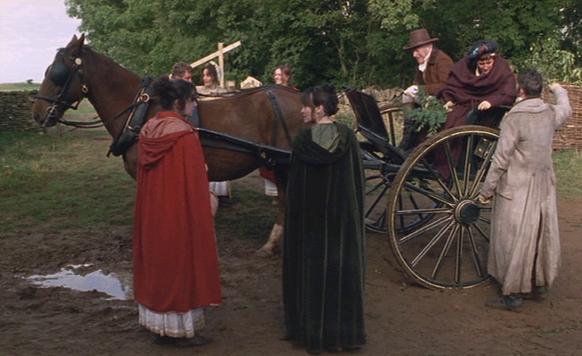
Persuasion – Croft’s gig (Jane Austen’s World)

-and of course, John Thorpe in Northanger Abbey, the most horse-obsessed character in all of English literature!
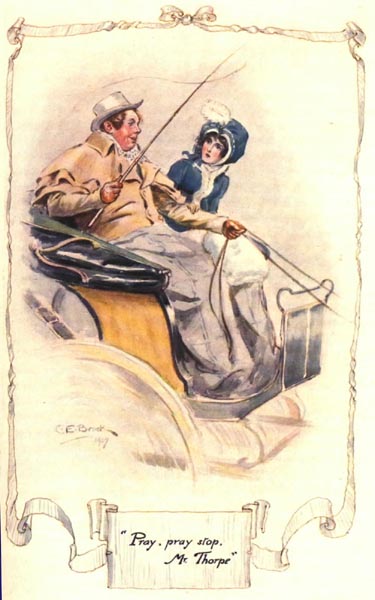
Brock – NA (Molland’s)

“I defy any man in England to make my horse go less than ten miles an hour in harness… look at his forehead; look at this loins; only see how he moves; that horse cannot go less than ten miles an hour: tie his legs and he will get on.  What do you think of my gig, Miss Morland? a neat one, is not it?  Well hung; town built; I have not had it a month… curricle hung you see; seat, trunk, sword-case, splashing boards, lamps, silver moulding, all you see complete; the iron-work as good as new, or better… etc. on and on! 

-And the Narrator who must have her say, so we know just how Catherine and the Narrator feel about John Thorpe [and Henry Tilney!]:

“A very short trial convinced her that a curricle was the prettiest equipage in the world…But the merit of the curricle did not all belong to the horses; – Henry drove so well, – so quietly – without making any disturbance, without parading to her, or swearing at them; so different from the only gentleman-coachman whom it was in her power to compare him with! – To be driven by him, next to being dancing with him, was certainly the greatest happiness in the world.”

[ Brock, Northanger Abbey (Molland’s)]
————————–
In Sense & Sensibility, there are many instances where Austen does not name the specific carriage:  we can assume by the context that it was a post-chaise or owner-owned chaise:

-the Narrator on Colonel Brandon when he leaves to get Mrs. Dashwood: “The horses arrived before they were expected, and Colonel Brandon…hurried into the carriage; it was then about twelve o’clock” [he returns the following day sometime after 8pm]

When Willoughby travels from London to Cleveland, a distance of about 124 miles, he is in a chaise with four horses, it takes 12 hours, 8am – 8pm, a trip that would normally take two days:

-the Narrator on Elinor:  …she heard a carriage driving up to the house … the flaring lamps of a carriage were immediately in view.  By their uncertain light she thought she could discern it to be drawn by four horses; and this, while it told the excess of her poor mother’s alarm, gave some explanation to such unexpected rapidity.  – [and she runs downstairs to find it is Willoughby…!


******

Other Carriage terms:  not all are found in Austen 

  • Hackney = for hire, often discarded carriages of the wealthy
  • Dog Cart = a gig with a ventilated locker for dogs; for 4 people, 2 behind the driver seat back-to-back
  • Sulky = driver-only – one passenger, one horse
  • Tandem = a two-wheeled carriage drawn by 2 horses one in front of the other – Sidney Parker in Sanditon 
  • Whiskey or Chair – an early chaise; a light 2-wheeled vehicle without a top, in The Watsons 
  • Sedan-Chairs  – a seat in a box with 2 poles 10-12 ft long, carried by two men. In efforts to lessen the crowded streets in London, but by 1821 there were only a half dozen public sedans, by 1830 there were none.

  • “Britzochka” = German origin, most common of all carriages, for traveling [ called a “Brisker” or “Briskey”]
  • “Droitzeschka” = “Drosky” – Russian origin, low to ground for “the aged, languid, nervous persons and children”

 And finally, what did Jane Austen have? 

  • At Chawton she had a donkey cart
  • Henry Austen had a curricle and a barouche:  

“The Driving about, the Carriage [being] open, was very pleasant. – I liked my solitary elegance very much, & was ready to laugh all the time, at my being where I was. – I could not but feel that I had naturally small right to be parading about London in a Barouche.”  [Ltr. 85, 24 May 1813, p. 213-14] 

I love to think of Austen “parading” around London and enjoying her “solitary elegance” and laughing all the while! – one of my favorite passages from her letters…

Final post:  a Carriages Bibliography ~ Stay tuned!

Copyright @ 2011, Deb Barnum, of Jane Austen in Vermont

Austen Literary History & Criticism · Book reviews · Collecting Jane Austen · Jane Austen · Regency England

Author Interview ~ David Selwyn on ‘Jane Austen and Children’

David Selwyn had graciously offered to answer my questions about his newest book, Jane Austen and Children (Continuum, 2010).  David is the current Chairman of the Jane Austen Society, editor of the Annual JAS Report since 2001,  and author of numerous works and articles on Austen.  His previous Jane Austen and Leisure (Hambledon Continuum, 1999)) is a must-read treasure trove of social and domestic activities that Austen engaged in and referred to in her novels. His current work is another must-read that weaves the historical, the factual and the fictional world of Austen and her works, all relating to children.  I will post a review of the book in a few days [after the 16th Birthday celebration] –  but I will say now that I most highly recommend this book, and suggest that you add this to your holiday “want” list and hope it may be found under your tree on Christmas morn…!

 Welcome David! 

JAIV:  I think when reading the novels, it is so very easy to overlook the number of children and how Austen’s presents them – but after reading your book one sees indeed how many children there are in her works and their importance to the narrative – is this what prompted you to write the book? the fact that too many people really do not see?

DS:      Yes, and I was struck by the fact that nobody had written on the subject, nor as far as I knew lectured on it. 

JAIV:  Jane Austen is often said to have not been particularly fond of children – was this another main reason in writing your book? – to show that as not the case? – 

DS:      As regards the novels, it always seemed to be assumed that her world was essentially an adult one (which I suppose largely it is) and the crucial role that children play in her exploration of it had been missed. As regards her own feelings about children, nobody who reads the letters can be in any doubt as to her fondness for her nephews and nieces.

JAIV:  Did anything surprise you in your research? 

DS:      How sensible she was about the bringing up of children – but then, I suppose one ought never to be surprised by JA’s wisdom on any matter!

JAIV:  And such extensive research! – the references in her letters, other family reminiscences, all the novels and minor works, and the historical context of child rearing in the long 18th century! – how long have you been working on this? 

DS:      For some years, but the editing of JEAL’s poems (Fugitive Pieces) intervened.

JAIV:  And this book presents such a seamless weaving of this real life, historical and fictional contexts – what are your working habits, writing process to achieve this?

DS:      I re-read the novels, minor works and letters, making notes of anything relevant in notebooks (one for each text) and highlight the notes in different colours according to theme. I did this for Jane Austen and Leisure and found that it worked. You’ll notice that at this stage I don’t use a computer. I also do a lot of background reading in social history, biography etc, and make notes on those books too of course.

JAIV:  You say that Jane Austen “makes use of her children to reveal aspects of her adult characters” – what is your favorite example of this?

DS:      It is difficult to choose, because each time she does it it is so wholly convincing. Annamaria Middleton and the naughty little Musgrove boy are the funniest, and the latter creates the most delicately balanced mood of comedy and emotion in any scene with children in it; but I love the little Gardiners, whose charming behaviour shows just how children should be brought up.

JAIV:  And then secondly, that Austen uses children as a means of advancing the plot – what is the best example of this?

DS:      It would certainly have been Charles Blake in ‘The Watsons’ had JA finished the novel.

JAIV:  There is much on Mansfield Park, perhaps because unlike the other heroines [other than the quick summary of Catherine Morland’s childhood], Fanny is presented to us as a child – but you seem to write most fondly of this novel, indeed, you end your book with thoughts on Fanny and Edmund making the best parents.  Is Mansfield Park your favorite among the novels? Or is this an unfair question! [who can ever choose!]

DS:      As you say, an impossible question. Yes, I do admire MP very much (and think that Fanny is often under-rated: she knows exactly what she wants and in the end gets it); but ultimately my favourite is Emma, partly because it is surely the subtlest and cleverest novel before Henry James, and partly because I think Miss Bates is, as well as being very funny, one of the most moving examples of human goodness in any literary work – JA touches us profoundly with the portrayal of a single woman who centres all the energy of a loving heart on her mother and niece (which is why the scene at Box Hill is so truly climactic – Emma’s thoughtless crushing of such a good heart is appalling, as she herself soon realises). By the way, another thing about Miss Bates: how brilliant of JA to be able to create such a wholly imagined voice that another character (Emma) can mimic it – flannel petticoats etc. 

JAIV:  It has always “troubled” me that Jane is the only child in this Austen family with only one given name – you speak of her having two godmothers both named “Jane” – do you think this is the reason? or do you have other thoughts? 

DS:      But she wasn’t: James, George and Edward had no second names, and nor did their parents. It may well be that the habit of giving two Christian names was becoming more fashionable during this period. 

JAIV:  One of the most famous child-based scenes in Austen is in Persuasion when Captain Wentworth helps Anne by the swift removal of her troublesome nephew – why is this scene so important to the plot? 

DS:      It brings Anne and Captain Wentworth intimately close for the first time in the novel – though JA is delicate enough to depict that intimacy with the child’s hands preventing direct physical contact between them.

JAIV:  Where much of The Watsons can be seen to appear in her other works, the most marvelous piece, when Emma Watson engages young Charles Blake in the dance, is nowhere to be found anywhere else [though it has been said that Mr. Knightley’s dancing with Harriet Smith is Austen’s reworking of this scene].  Do you think Austen could have placed this somewhere in her surviving novels? 

DS:     No, I don’t think she was ever to give a child quite such individual prominence again. 

JAIV:  You start your chapter on “Parents”: “In Jane Austen’s novels the parents best suited to bringing up children are dead.”  Who of the living parents do you think are the most effective? Who the least?  

DS:      The Gardiners are far and away the best. Sir Walter Elliot (though not of course the late Lady Elliot) is a disgrace to the Baronetage in which he takes such pride!

JAIV:  You so obviously love Jane Austen!  – when did this begin for you? 

DS:      In  picking up a stray copy of Emma when I was at home ill once, when I was a (music) student. But I was also thrilled to see a real live JA MS which used to be on display in the Pump Room at Bath (it is now safely tucked away in the offices of Bath City Council); it was the ‘headache’ poem, and it was hung in a hinged frame enabling you to see the reverse, on which there was one of the versions of the ‘Gill-Gell’ verse. I remember noting in the Minor Works volume that Chapman (re-edited by Brian Southam) said that he did not know where that particular version of the Gill’ Gell poem was, and I gleefully thought to myself, ‘I do – it’s in Bath!’ I seem to remember writing to OUP, but I didn’t get a reply.

JAIV:  You say that “it is highly unlikely that Jane Austen ever read a word of Mary Wollstonecraft (though she did read the novels of her radical husband, William Godwin)” – how are you so sure she did not read Wollstonecraft, and how so sure she did read Godwin? 

DS:      This is, I concede, speculation. JA refers to Godwin in a letter and Deirdre Le Faye suggests that she ‘was probably acquainted with Caleb Williams’; I am not sure she didn’t read Hannah More, but I think it unlikely.

JAIV:  One of the many things I took from your book in its focus, its seeing all through the lens of childhood, was a pattern of new themes emerging in all the novels – for instance, the theme in Emma of unconditional love, the love parents have for children, but in Emma, this love that Emma has for her father, Miss Bates for her mother and Jane Fairfax, Mr. Knightley for Emma – i.e. as you say “the unconditional love for people who may, consciously or unconsciously, require sacrifices to be made for them.” [p.111]. What are some other themes that became clearer for you since approaching the novels from this viewpoint? 

DS:      Not so much themes as procedures, and in particular the technique of introducing children not really for their own sake but as a contrivance for some aspect of plot or characterisation – and in the process, being JA, to bring them wonderfully to life.

JAIV:  One could read your book, re-read all of Austen, and get a very lucid and valuable instruction manual for good parenting! – did you have this perception yourself before reading and studying the books through this lens? 

DS:      No, it had never occurred to me that JA could be seen in such a light until I looked closely and specifically at what she says about children and parents.

JAIV:  Your book on Jane Austen and Leisure also offered a very valuable (and very enjoyable!) contribution to an understanding of Austen in the context of social history, her reading, her novels and her life and letters – again in many instances taking a few well-placed words in Austen and giving them such meaning.  What is up next for you?? 

DS:      I hope to do some more editing for a JA Society book. What a pity that JEAL’s sister Caroline destroyed the MSS of her poems; I should like to have brought those out.    

********************

Thank you so much David for answering all my questions!  Stay tuned for my review and a select bibliography on David Selwyn’s other Austen-related works. 

 [Getty Images.com]

Austen Literary History & Criticism · Book reviews · Books · Collecting Jane Austen · Jane Austen · Literature · Publishing History · Regency England

Book Review ~ ‘The Annotated Persuasion’

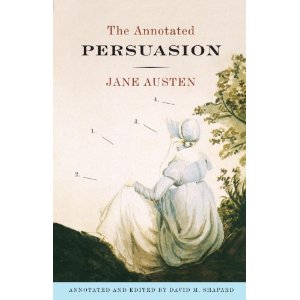
Last week I ran into Barnes & Noble to pick up the latest annotated Pride and Prejudice, edited by Patricia Meyer Spacks, and since then I have been “gadding about” as Austen would say – so no time to really give it a complete read and review; but in another trek yesterday into yet another Barnes & Noble [no worries, I also have haunted the local USED booksellers!], my husband stumbled upon the just published [as in October 5, 2010]  The Annotated Persuasion, annotated and edited by David M. Shapard [New York: Anchor Books, 2010; paperbound; ISBN:  978-0-307-39078-3] – and I have discovered a veritable feast! 

Shapard is known for his annotated edition of Pride and Prejudice [which I have but it is not in hand, as I am in “gadding about” mode as mentioned above…] – so I cannot compare this book to that edition [his annotated Sense & Sensibility is to be, I believe, published in April 2011] – though I have found that work quite useful as a reliable reference source – it was first published in hardcover followed by a paperback edition; this Persuasion is only in paperback… it is also a smaller format, likely because the novel is so much shorter, but this renders the many illustrations quite small – but I quibble about these few drawbacks …. publishers decisions do not always make the most sense… 

I first look for the extras:  

An Introduction which gives a brief history of the publishing of Persuasion, and the differences in this final novel from Austen’s other works

A Chronology of the novel [will compare this to Ellen Moody’s calendar 

Maps of sites that relate to the characters and storyline: the world, England, Somerset, Lyme, and two of Bath 

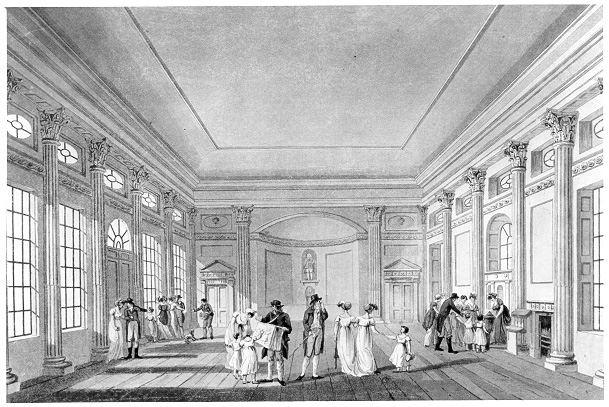
A good number of b/w Illustrations – there is unfortunately no listing of these; the source is indicated under each picture, but a listing would have served as an index to the subjects, which cover all manner of Regency life:  architecture such as that in Bath with interior and exterior scenes of the Assembly Rooms; various carriages; fashion; furniture; Naval life; the Cobb in Lyme Regis; etc.  – many of these illustrations will be familiar to most readers with a modicum of knowledge about the period – and color would have been nice – but the point here of these illustrations is to serve as a starting reference for further research, and it is an added plus to have any of these included. 

Bibliography:  this also serves as a starting point – it is in no way a complete listing of sources, but likely those sources that Shapard relied on for his research.  How complete can a bibliography of Austen be without mention of Claire Tomalin’s biography under that category, or Claudia L. Johnson’s Jane Austen: Women, Politics and the Novel or Kaplan’s Jane Austen Among Women nowhere to be found – but as Shapard is an historian, it is that strength that resides in this bibliography, again a great starting point for further study – it is organized by broad subjects:  language; cultural and literary background; marriage and the family; position of women; children; housekeeping and servants; entails and estates and the landed gentry; rural and urban life; the military; medicine; the law; education; books, media, libraries; writing; postal service; transportation; theater [but no mention of the two works Jane Austen and the Theatre – two works with the same title and both quite comprehensive]; music and dance; sports; weather; the seaside resorts; houses and gardens; fashion; food; etiquette and female conduct books; and others – again, a good select listing of resources on various topics.   

The Literary commentary and annotations:  Shapard begins with the caveat that “the comments on the techniques and themes of the novel represent the personal views and interpretations of the editor…such views have been carefully considered, but inevitably they will still provoke disagreement among some readers “ [xi] – which Shapard encourages…; these annotations include such literary commentary, historical context, and definitions of words in context if they had a different meaning in Austen’s time, some repeated when necessary or cross-references provided.  

The book is arranged with the original text on the verso, the annotations and illustrations on the recto – the annotations are extensive as the following few very random examples show: 

  1. Persuasion starts with the full description of Sir Walter Elliot’s obsession with both his own personal charms and his listing in the baronetage – Shapard here provides information on that book and others of the time and the definition of “baronet” and how Sir Walter acquired his own status…
  2. Gout is fully described on pages 311 and 315, when Anne learns that the Crofts are removing to Bath dues to the Admiral’s “gouty” condition.
  3. “replaced” – [p. 103] – “they suspected great injury, but knew not where; but now the collar-bone was soon replaced”   – the annotation explains that the word “replaced” had the meaning in Austen’s time of “to be put back in its original position” rather than “to take the place of” – there is also a description of anatomical knowledge as understood at the time.
  4. Carriages get much attention whenever they are mentioned in the text – so we have descriptions and illustrations of barouches and chaise and fours, and chairs and of course Anne’s pretty little “landaulette” [p. 483]                                                                         
         

    a barouche


  5. Money and wealth – Wentworth’s income explained [p. 145]
  6. Servants:  various duties outlined [p.  87]
  7. Street names, shops, locations explained throughout; e.g. The Cobb; Tattersall’s [a mention on p. 14 with an illustration]; Milsom Street; Westgate Buildings;…etc…
  8. The Clergy in Austen’s time
  9. Austen’s language as delineating character:  as in the following: “Lady Russell had only to listen composedly, and wish them happy; but internally her heart reveled in angry pleasure, in pleased contempt” [p. 232] – and the annotation reads:  “Her reveling in such emotions indicates her moral inferiority to Anne, who never derives pleasure from anger or contempt.” [p. 233]
  10. Social rules and strictures:  some examples – Sunday traveling [p. 305]; shaking of hands between men and women [p. 427]; not using first names, even those of friends such as Anne and Mrs. Smith

 A look at a few key scenes will also illustrate Shapard’s invaluable commentary: 

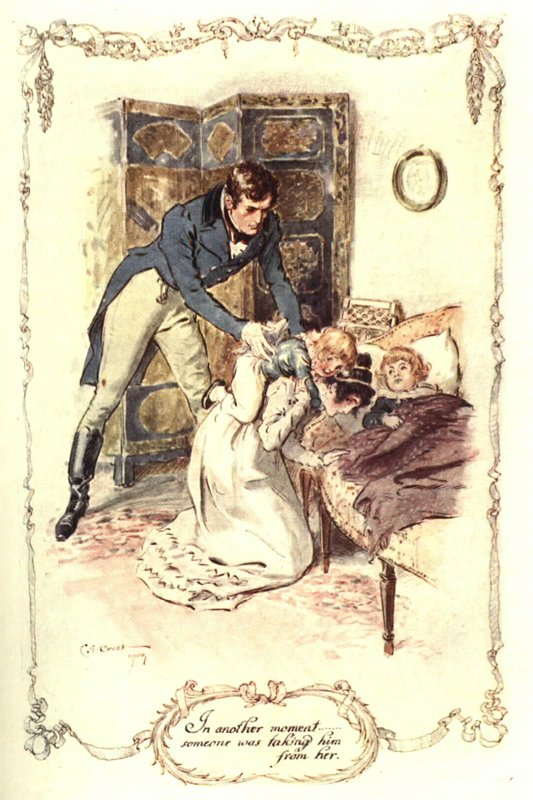
  1. Wentworth removing young Walter Musgrove from around Anne’s neck [pp. 152-5]:  Shapard emphasizes the importance of this scene in displaying both Anne’s and Wentworth’s feelings – he quotes William Dean Howell’s how “this simple, this homely scene, is very pretty, and is very like things that happen in life, where there is reason to think that love is oftener shown in quality than quantity, and does its effect as perfectly in the little as in the great events. [from Heroines of Fiction].  Shapard also suggests that Wentworth’s reluctance to converse with Anne about what has just happened is as much due to his efforts to remain aloof as it is to a “simple dislike of thanks,” [p. 155], as is true of Mr. Knightley in Emma. 
                                                                                                        

    Brock illus - from Molland's


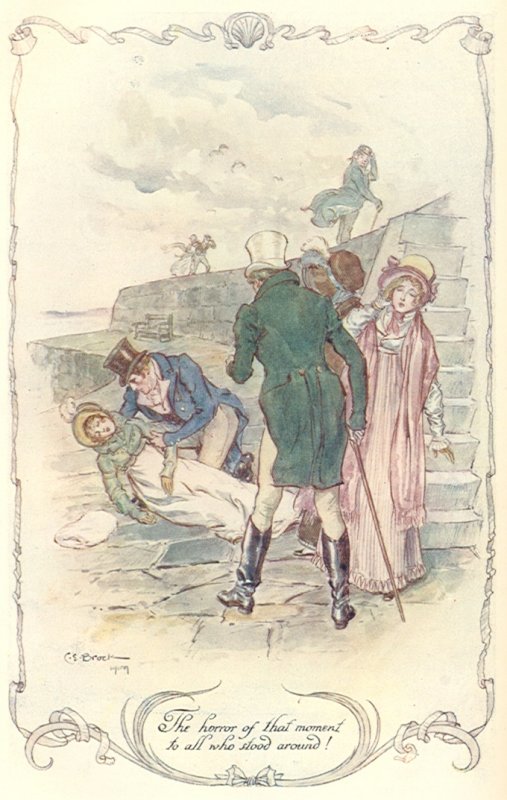
  2. Louisa’s fall in Lyme Regis [p. 210-15]:  Shapard describes the Cobb, the steps that were the scene of The Fall, comments on the feelings of Anne and Wentworth, the strength of the former and the uncharacteristic weakness of the latter; Anne’s carrying the “salts” [have you ever wondered why Anne IS carrying smelling salts and conveniently has them in her possession? – “here are salts – take them, take them.” [p. 210]]; the calling for the surgeon and the differences between he and an apothecary; the comic relief of “the sight of a dead young lady, nay, two dead young ladies, for it proved twice as fine as the first report.” [p. 213-4] 
    "The horror of the moment" - from Molland's


  3. and of course, The Letter! [p. 452] – Shapard so rightly states that “Wentworth’s passionate language contrasts him with other Jane Austen heroes, who are often much cooler and more rational.  It also fits with the more intense emotional tone of this novel … the letter itself is arguably the moment of highest emotion in her works…” [p. 453]  – and we are given a picture of a writing table of the time [p. 457] – there is also extensive commentary on the conversation between Capt. Harville and Anne. 

As referred to above, there are disappointments in this work – I would most wish for an index to the annotations – these could be just general subject areas, such as similar divisions as in the bibliography – so for instance – all annotations which discuss medicine could be cited, or any references to carriages, or fashion, or Bath locations, the Navy, or examples of Free Indirect Discourse, the literary allusions such as Byron’s The Corsair and Matthew Prior’s poem “Henry and Emma”, etc.  As it is, one needs to read through the entire work to find the references, and as Shapard wishes for this to be a work for reference purposes, this addition of an index would seem to be a necessity.  A index of Characters would have also been a helpful addition – one must reach for their Chapman for this information; and finally there is also no “note on the text”, important information in any such reference source – the bibliography lists Chapman’s 1933 edition, Spacks’s Norton critical edition [1995]; and the latest Cambridge edition edited by Janet Todd and Antje Blank [2006] – but I would have liked to see from whence he took the exact text…

That all said – this is a delightful and fact-filled addition to your Austen Library – and if you are already fairly well-versed in the Regency period and Austen criticism, this will serve as a copy of Persuasion where much of this information is at your fingertips; if you are just starting your adventure in reading Austen, this will be a great introduction to the very rich world of her writings, her world, and her literary themes – what more can we ask for!  [other than a hardcover with an index!]

 4 full inkwells out of 5

[please note that the illustrations are meant to illustrate this post and are not illustrations in the work being reviewed] 

Book reviews · Books · Fashion & Costume · Jane Austen · Regency England · Social Life & Customs

Interview with Jennifer Forest, author of “Jane Austen’s Sewing Box”

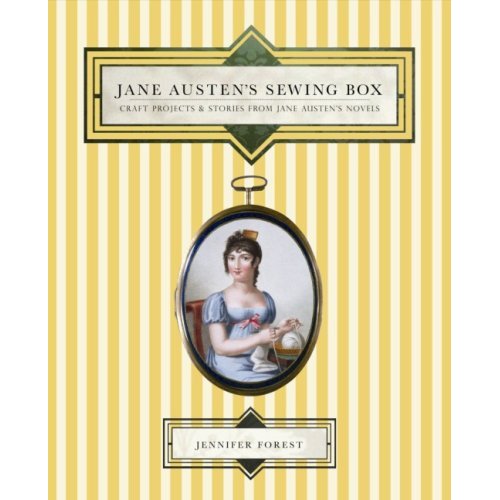
book cover jane austens sewing box


Today we have Jennifer Forest joining us to share her thoughts on her new book Jane Austen’s Sewing Box: Craft Projects & Stories from Jane Austen’s Novels [NSW, Australia: Murdoch Books, 2009]:

What inspired Jane Austen’s Sewing Box? 

I love Jane Austen, history and craft so it seemed quite natural for me to join these  interests.  A few years ago, re-reading Jane Austen’s novels I noticed that she makes quite a few references to craft including sewing, knotting, painting and netting. It spurred me on to start digging around to find out what the crafts were that Jane Austen’s women were doing.  The Regency left a strong design legacy and there are many examples of the beautiful craft worked by women during this great period for arts and craft. 

What types of projects are in the book?  

Just as Jane Austen includes a range of craft references in her novels, there are also a range of projects in the book.  All projects are based on her novels and letters, so there’s everything from making paper flowers, to embroidery, sewing, painting, knitting and those lost arts of netting and knotting.  

What skills do you need to do the projects? 

I really believe that craft should be something you can do, not something you struggle with to the end! So there is something for all skill levels from beginner and intermediate projects to more advanced projects for experienced crafty people.  I also used materials and tools true to the period that can be sourced from shops today. 

How did you use original objects from the Regency for Jane Austen’s Sewing Box? 

I have been fortunate to work in museums where I was surrounded by beautiful objects from the past, so I knew there was a collection of Regency items available for research. Each project is based on original examples from the Regency period, from the overall design right down to details like the actual size of a finished piece, colours and materials. 

Were Regency women the original “domestic goddess”?

Well, the home was their empire in the Regency and craft skills were so important to the management of a household that it was called “women’s work”.  The ability of women to hand sew was crucial to clothing the family and helping support the poor in their village.  This was a time before sewing machines and shopping malls, when it wasn’t so easy to buy what ever you needed.  Even when tailors and dressmakers were used, women’s work in many families provided the men’s shirts, children’s clothes, nightwear, towels, sheets and bedding.  

How long would she spend on “women’s work”?

A Regency woman either alone or in a work party could easily spend 4 to 5 hours a day working.  Jane and Cassandra Austen often made their brother’s shirts, even when they had left home, married and in Charles’ case, joined the navy.  Jane Austen was proud of her neat running stitch in making up her brother’s shirts!

 Was it all sewing shirts and making towels?

No, craft skills gave women a way to show their creative talents.  Much of the professional world, including art, was only really open to men.  But Regency women also loved arts and design. Craft skills allowed a woman to express her creativity and design abilities, whether that was in a handmade huswife or purse to be given as a gift or in painted pieces like the firescreens made by Elinor Dashwood in Sense and Sensibility.  

Why do you love Jane Austen? 

I think every time I read her novels my reasons for liking them change!  Her character portrayals are far better than most writers.  I think most of us today still recognise her characters in people we know – we’ve all known an ‘Emma Woodhouse’, a ‘Miss Bates’ or a ‘Fitzwilliam Darcy’.  She is actually quite funny and witty in a beautiful and clever way.  But at the same time I think she was an acute observer and sharp commentator on her times. 

What handiwork / craft do you do? 

I love trying out new crafts skills so I’ve experimented with a range of different things. What I keep coming back to though is screen printing (love combining paint and fabric), felting, sewing and embroidery.

*******************************************************

Thank you Jennifer for joining us today!  If anyone has any questions, please send a comment and I will get those answered for you.  I received the book in the mail yesterday and will be posting a review of it tomorrow – it is a wonderful compilation of history, Austen quotes, visual treats and, of course, the crafts!  The book is now available for ordering on amazon.co.uk ; there are several available copies from independent sellers on the US Amazon site, but is not actually available yet in the US.

Further reading:

Posted by Deb