Books · News

RED-The Reading Experience Database 1450-1945

The Reading Experience Database 1450-1945 is a project the Open University (UK) launched in 1996, with the aim of accumulating data about the reading experience of British subjects.  It is a searchable database of all citations in printed materials (i.e. letters, memoirs, diaries, journals, reading notebooks, autobiographies, court records, annotations, marginalia, etc.) linking an individual to their reading.  An example is Susan Ferrier, who commented in a letter on reading Jane Austen’s Emma in 1816, and there are many citations to Jane Austen’s own reading.  This material is already prompting the need for a reassessment of the opinions about 18th and 19th century reading practices.  For instance, the belief that 19th-century women read nothing but novels is disputed by the findings that women of this period read an extremely wide range of genres, including philosophy, mathematics and the Classics.  You can find the link at:  http://www.open.ac.uk/Arts/RED/index.html (the link is also in our ‘Literary Resources” list.) And note that RED actively solicits contributions of material for inclusion in the database. 1

[1.  See The Female Spectator, vol.11, no.1, Spring 2007]

Books

A different Jane: Jane Welsh Carlyle

My interests are drawn by letters and diaries – especially of English women, from a broad range of times. Mid-18th century, to complement my love of Mozart (his letters make for wonderful reading; I highly recommend the Anderson translation); early-19th century to complement my research into the lives of Emma Smith and Mary Gosling; I value my Queen Victoria collection of letters and journals; World War I and World War II – nothing of politics or “war,” but personal responses to these adverse times. 

Therefore, I had long ago bookmarked a wonderful website dealing with the letters of Thomas and Jane Carlyle. Jane is the half of this pair who interests me, especially after having read Thea Holme’s delightful The Carlyles at Home (a terrific piece of writing). This Duke University Press-related website has FULL TEXT letters, searchable, browseable. I cannot praise the site more highly. And looking at it today, I put in AUSTEN just to see what would turn up; my findings are what I want to share.

The first letter was written by Jane to Thomas on 5 August 1852. Jane is on the road, and recounts a little of her journey to her husband:

‘Some twenty minutes after; I started myself, in a little gig, with a brisk little horse, and silent driver— Nothing could be more pleasant—than so pirring thro’ quiet roads in the dusk—with the moon coming out—I felt as if I were reading about myself in a Miss Austin novel!  (Could she have been thinking of NORTHANGER ABBEY??) But it got beyond Miss Austin when at the end of some three miles before a sort of Carrier’s Inn, the gentleman of the barouchette stept into the middle of the road, making a sort of military signal to my driver, which he repeated with impatience when the man did not at once draw up!— I sat confounded—’ (And there, I’m afraid, we must leave poor Jane, in the middle of the thoroughfare and about to be accosted by who knows what sort of man… to find out the end of her tale and WHY he waved Jane’s carriage down, take a look at the complete letter.)

The second letter, and so comical, was written by Jane to Helen Welsh on 27 February 1843. It concerns Jane’s uncle, whom she visits:

‘My dearest Helen

After (in Dumfries & Galloway-courier phraseology) “taking a birds-eye view” of all modern literature, I am arrived at the conclusion; that to find a book exactly suited to my Uncle’s taste I must—write it myself! and alas, that cannot be done before tomorrow morning!

“La Motte Fouque’s Magic Ring”? suggests Geraldine—“too mystical! My Uncle detests confusion of ideas”—

Paul de Kock?  HE is very witty”— “Yes but also very indecent!—and my Uncle would not relish indecencies read aloud to him by his daughters.”—

“Oh!— Ah!— Well! Miss Austin?”— “Too washy—watergruel for mind and body at the same time were too bad”—

Timidly and after a pause— “Do you think he could stand Victor Hugo’s Notre Dame? “— The idea of my uncle listening to the sentimental monstrosities of Victor Hugo!— a smile of scorn was this time all my reply.’
 

Book reviews · Books

Recent Reading…

In need of something entertaining to read, I searched my library and came up with EVELINA, by Fanny Burney. I own a few Burney items: two biographies, her Cecilia (nearly as large and thick as Richardson’s Clarissa), and a journal volume. EVELINA came from TUTTLE’s Antiquarian Books in Rutland — now sadly gone (and one less reason to travel from Burlington to Rutland!).

Who knows if I will finish EVELINA. Burney’s epistolary novel holds my interest, but at the same time I have to say I find nine-tenths of the characters thoroughly obnoxious! Early on, this novel feels a genuine precursor to Austen in several ways: the young girl entering society (Catherine in Northanger Abbey; though Bath vs London society); the odious suitor (Evelina’s Sir Clement Willoughby; Catherine’s Mr Thorpe or Elizabeth Bennet’s Mr Collins); the eligible hero (Evelina’s Lord Orville and Elizabeth’s Mr Darcy). Or IS Orville a ‘hero’?? Part of me wants to peek at the end to see if he turns out to be Lovelace-like instead!

Austen’s crowd of characters are funny, endearing, even when they slightly annoy (I’m talking about the BOOKS, not films; a little Lydia sometimes goes a long way…), while Burney’s cast here seems black or white – innocent Evelina; obnoxious Capt. Mirvan; lovely Mrs Mirvan; odious Mme Duval, etc. etc; and the scenes chatter on at such length. This would undoubtedly make for entertaining reading aloud, as would have often been done in Austen’s day. It reads VERY like a play, with a VAST amount of dialogue. Poor Evelina must surely have gotten writer’s cramp after penning some of her missives! (Was Les liaisons dangereuses as wordy w/o plot movement? Hardly… Short, pithy letters that feel like correspondence; in fact, the letters become the dialogue.)

Trying to get some AUSTEN research read, I took out from the library the second edition of Deirdre Le Faye’s Jane Austen: A Family Record. One interesting thing about it is the amount of family diaries and letters Le Faye culls in order to fill in the narrative of Austen’s life, whereabouts, and actions. I was telling Deb about the references to SUSAN, Austen’s original title for Northanger Abbey (‘til another novel of the same title got published in 1809): Publisher buys it, promises to publish quickly — then sits and sits and sits on the manuscript. How frustrating for her! So with great joy, one reads this paragraph: “It was probably early in 1816, ‘when four novels of steadily increasing success had given the writer some confidence in herself’, that Jane decided to recover the manuscript of Susan from Crosby & Co. Henry undertook the negotiation, and ‘found the purchaser very willing to receive back his money, and to resign all claim to the copyright. [Crosby had paid Jane a mere £10.] When the bargain was concluded and the money paid, but not till then, the negotiator had the satisfaction of informing him that the work which had been so lightly esteemed was by the author of “Pride and Prejudice”.’”

This is not my favorite Austen biography, there are a few too many phrases containing ‘maybe, perhaps, probably’ tossed into the narrative; but Le Faye includes much primary information, from published and unpublished sources, not found in a lot of other biographies, and therefore she presents a fleshed-out picture of Austen’s life, even when the evidence for a particular period is a bit thin. For an interesting evaluation of SEVERAL Austen biographies, see Keiko Parker, ‘Sense and “Non-Sense” in Eight Jane Austen Biographies.’

News · Schedule of Events

JASNA – Massachusetts: May 4 meeting

Sunday, May. 4th at 2 p.m.
Wheelock College, Brookline Campus
43 Hawes Street, Brookline, MA
                                                                                          
                                                                                                                                        
 His and Hers: The Politics of Domestic Space
 in Austen’s Novels

Dr. Joan R. Vredenburgh
Naval Academy Preparatory School in Newport RI 

Pre-meeting roundtable discussion of PBS Austen film series:
Those who would like to join a roundtable discussion of the PBS film series are invited to come a half hour before the regular meeting time at 1:30 p.m.

Wheelock’s Brookline Campus is easily accessible. By subway, take the “C” line to Hawes Street (after St. Mary’s Street) or “D” line to Longwood Avenue. See reverse for driving directions. Additional driving and subway information:  http://www.wheelock.edu/about/abodirections_brookline.asp
$5.00 per person  (*Massachusetts Chapter members free) 


For more information, you may contact:  The Jane Austen Society of North America, Nancy Yee, Regional Coordinator, 82 Collins Road, Waban, 02468, (617) 965-5699.

 
News · Schedule of Events

Jane Austen in Brookline

News from JASNA – Massachusetts:  This Sunday (April 13th) Sarah Emsley, a Jane Austen scholar in our midst, will give a talk on Jane Austen to the adult education group at the Church of Our Saviour (Episcopal) in Brookline.  It’s at 10 a.m. in the church hall, and the church is on Monmouth Street, next to the building where we have our JASNA meetings.  She’s going to focus on Mansfield Park as she gave a general talk last Sunday.  It’s free, and you are welcome to attend.  If any of you have been fortunate enough to hear Sarah Emsley speak at a JASNA event, you know that this should be a memorable occasion.
JASNA-Vermont events

JASNA-Vermont’s Robyn Warhol-Down in Burlington Free Press

In today’s Free Press is a story on Prof. Warhol-Down’s involvement with editing the text Women’s Worlds: The McGraw-Hill Anthology of Women’s Writings, which came out in December 2007.

Prof. Warhol-Down, guest speaker on the subject of Jane Austen’s Narrative Refusals at JASNA-Vermont’s inaugural meeting on 30 March 2008, was given a ‘thank-you’ membership to JASNA, thereby becoming our chapter’s eighteenth member.

News

Chawton House

News

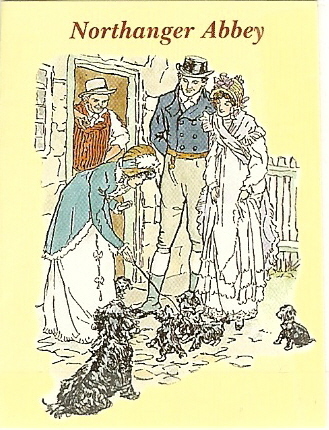
Northanger Abbey

Just finished Northanger Abbey (not for the first time I must add, but a closer reading than ever before)…so I invite conversation!

Movies · News

PBS’s “Sense & Sensibility”

Remember to watch the 2nd part of PBS’s Sense & Sensibility,  Sunday April 6, 2008 at 9pm.
You can check out the PBS blog at Remotely Connected  and the PBS Jane Austen Blog.

Here are a few links to other Austen blogs with lots of commentary on PBS’s new “Sense & Sensibility”… these are so worth sharing!

At Austenprose  Laurel Ann has several posts:

* Puzzling Legal Nonsense in Austen’s Sense and Sensibility
* Austen’s Willoughby: Truly a Byronic Hero, or Libertine? Part One
* Withstanding Sense, or Sensibility: Review of Episode One
* Sense and Sensibility: Cast Preview

At Jane Austen’s World see Ms. Place’s posts:

* S&S Soaked
* Footmen in JA’s Movie Adaptations
* S&S 2008 Makes Wonderful Sense, for the Most Part…

News

Jane in the Information Age: a Super Regional in Rochester

iJane:  Jane Austen in the Information Age  a seminar featuring Maggie Sullivan of Austen Blog and Myretta Robens of The Republic of Pemberley will take place on May 3, 2008 from 10-4 in Rochester, NY.   There will also be a Jane Austen Ball the following day, with English Country dances of the Jane Austen era.  This Multi-Regional Conference is co-sponsored by JASNA-Rochester and JASNA-Syracuse.  For more complete information, go to our events page and follow the links.