I have been reader of Austen for many years; was re-introduced when my daughter was in college and reading "Emma" and I read it along with her, and thus re-discovered Austen with a whole new appreciation! Happily my daughter, Jess, "got" that "Emma" was quite funny, the only one to do so in her class, I might add.
I re-read the books periodically and find them a tonic for the soul, as well as the best gauge of humanity I have ever encountered....and the humor helps immensely (not to mention Darcy!) My favorite book is Persuasion, I find Fanny the truest of feminists, NOT the major milktoast of all fiction characters, Elizabeth is a delight, and I often forget that these people ARE NOT REAL!
I have a group of friends scattered around New England who gather together several times a year to discuss books, most often Austen, as she is really the anchor (all due to the delightful, wonderful Ingrid G. of New Hampshire, who started this all many years ago with a weekend at Pinkham Notch at the base of Mount Washington in NH with a workshop "I'd Rather be Reading Jane Austen"!)...we call ourselves the Wild Women, but really, how can that be possible, trekking about the White Mountains, sipping tea and conversing about Austen!
And it all helps that I have a used bookstore called Bygone Books, now only an online presence. Every booklover's dream is to own a bookstore....and I challenge each and everyone of you to try it for a week!
I am currently the Advisory Chair for the JASNA-South Carolina Region. I post information about both this region and the JASNA-Vermont Region and its events on this blog.
On my TBO* list: with a release date of January 16, 2011 [as per Amazon; publisher release date is February 2011]
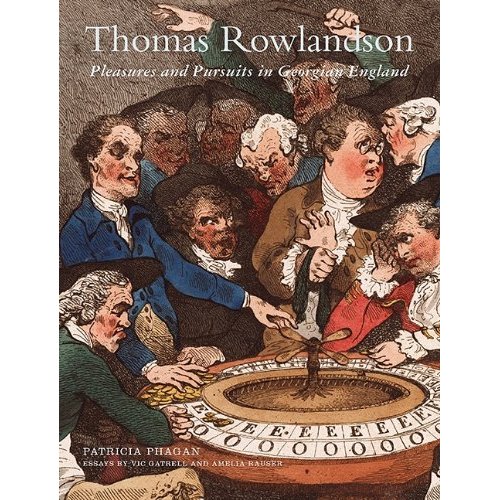
Thomas Rowlandson: Pleasures and Pursuits in Georgian England, by Patricia Phagan; essays by Vic Gatrell and Amelia Rauser. Published by D Giles LTD in association with the Frances Lehman Loeb Art Center, Vassar College, Poughkeepsie, NY, 2011.
This illustrated volume which presents 72 watercolors, drawings, prints and illustrated books to reassess the legacy of this renowned 18th-century satirist. Accompanies the first major exhibition of Rowlandson’s work in North America for twenty years, showing at the Mary and Leigh Block Museum of Art, Northwestern University, Evanston, Illinois, Jan 14, 2011 – March 13, 2011 and the Frances Lehman Loeb Art Center, Vassar College, Poughkeepsie, April 8, 2011 – June 11, 2011 [Click here for information on the exhibit]
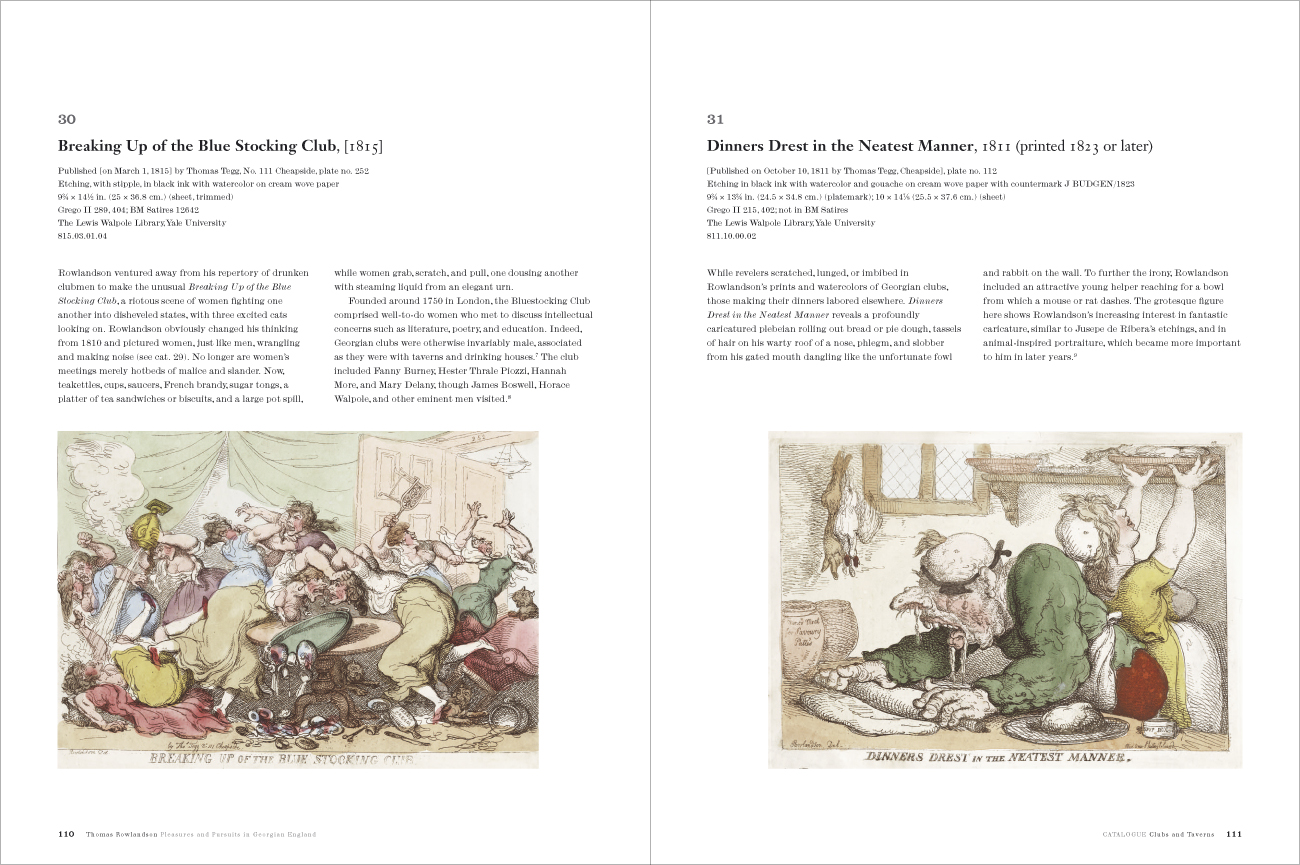
Thomas Rowlandson - Pages 110-11
[Click on to enlarge]
About the authors:
Patricia Phagan is Philip and Lynn Straus Curator of Prints and Drawings at the Frances Lehman Loeb Art Center and the co-author of ‘The American Scene and the South: Paintings and Works on Paper, 1930-1946’ (1996) and ‘Images of Women in Seventeenth-Century Dutch Art: Domesticity and the Representation of the Peasant’ (1996).
Vic Gatrell is Life Fellow of Gonville and Caius College, Cambridge, and the author of ‘City of Laughter: Sex and Satire in Eighteenth-Century London’ (2006) [fabulous book!] and ‘The Hanging Tree: Execution and the English People 1770-1868‘ (1994).
Amelia Rauser is Associate Professor of Art History at Franklin and Marshall College, Lancaster, Pennsylvania, and author of ‘Caricature Unmasked: Irony, Authenticity and Individualism in Eighteenth-Century English Prints’ (2008). [from Amazon]
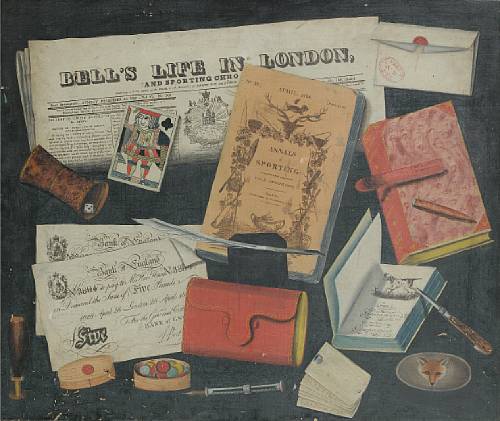
Auction News: see the upcoming Bonham’s Gentleman’s Library Sale, January 19, 2011, New Bond St in London, for all manner of library furniture, desk sets, globes, cabinets, and portraits and paintings that may have been housed in the libraries of the Gentlemen of the Victorian and earlier periods. The online catalogue is available for viewing and bidding!
A Gentleman's Tromp L'oeil - Bonham's Lot 183
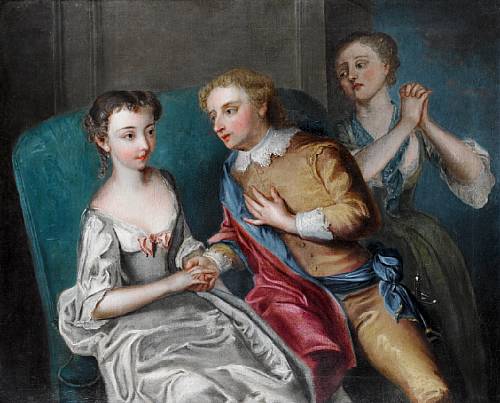
or I love this one – “The Proposal” with Mom listening in and clasping her hands in prayer in the doorway!
'The Proposal' (Circle of Philippe Mercier) - Bonham's Lot 230
Lots more in the catalogue – take a look if you can!
And see this article at Victoriana Magazine for more information on the Victorian Library.
[Images from the Bonham’s Gentleman’s Library Sale, No. 18544]
Copyright @ 2011 Deb Barnum, at Jane Austen in Vermont
I made a promise to myself back in August 2010 to finally read Samuel Richardson’s Clarissa, this promise made after reading Laurel Ann’s Austenprose interview with Lynn Shepherd. Shepherd is the author of the Austen-inspired mystery Murder at Mansfield Park, but also a Samuel Richardson scholar and author of Clarissa’s Painter: Portraiture, Illustration, and Representation in the Novels of Samuel Richardson (Oxford University Press, 2009].
I have had Clarissa sitting on my bedside table for years – a friend gave it to me as a joke, daring me to read the thing – I was tempted to tear it into nine parts [an easy thing to do!] and have each of my book group buddies read their piece of the book and report on it – an easy way to lessen the pain of reading this rather large tome – my copy [the Penguin edition of 1985 with introduction and notes by Angus Ross] measures 9 x 6 x 2.75″ with a total of 1534 pages, a heady feast of endless words in very small print! But alas! I could not go the book destruction route, it’s not in my genetic makeup, and so have just stared at this thing for years, dusting it occasionally, contemplating its use as a doorstop or such [it weighs 2 lbs, 11oz!], but somewhat guilty all the while… an English major who cleverly avoided this book or any Richardson for that matter because everything is just so long and not to mention depressing! And despite Richardson being Jane Austen’s favorite author, and that she read and re-read his works and was greatly influenced by him, I just haven’t done it… until now…
So when I read Lynn Shepherd’s post and saw the brilliant suggestion to read Clarissa in ‘real time’, starting on January 10th, and finishing on December 18th, I thought this was a perfect solution, nearly a whole year to finish the thing, not much time to be spent on a daily basis – how bad can it possibly be? So, Dear Readers, I have begun – January 10th, with already a welcome reprieve as the next letter is not until January 13th…
When I told my gifting friend that I was finally going to read the thing – she wondered how I would be able to put it down and not read ahead – I told her I did not think that would be a problem in this case – and indeed it seems not to be so far!
I welcome anyone else who would like to join me in this – there have been group reads of Clarissa on other listservs – I am not going to post about the book, just periodic updates of my reading progress. My only concern is I am already looking forlornly at Richardson’s other book on my shelf, Pamela, a much shorter and happier exercise in reading what Jane Austen read… – so wish me luck and join me if you can!
Article on Richardson and Austen: “The Source of “dramatized consciousness”: Richardson, Austen, and Stylistic Influence ” by Joe Bray, Style, Spring, 2001.
Sense and Sensibility was first published in October 1811, hence all manner of this 200 year anniversary celebration will be literally taking over the world, or at least the blog-sphere world, for this entire year! [See the JASNA site for information on the next AGM in October in Fort Worth]
There are already a number of blog events in place [I will be posting on these shortly], but I hope this year at Jane Austen in Vermont to do a number of posts on S&S, starting with its very interesting publishing history. So today, Part I – a compilation of what Jane Austen wrote in her letters about her first published work – there is not as much as on Pride & Prejudice or Mansfield Park and Emma, but she did make a number of comments that are worth noting. The upcoming Part II will outline the details of its publication and how it was received by her contemporaries. [You can also re-visit my previous posts on “Travel in S&S” – Part I, Part II, and Part III, and more to come regarding the types of carriages in use during Austen’s time.]
Note that all references in the letters are to: Deirdre Le Faye, ed. Jane Austen’s Letters. 3rd Edition. NY: Oxford, 1997, c1995.
Jane Austen on Sense & Sensibility:
Ltr. 71. 25 April 1811, to Cassandra, from Sloane St, London
No indeed, I am never too busy to think of S&S. I can no more forget it, than a mother can forget her suckling child; & I am much obliged to you for your enquiries. I have had two sheets to correct, but the last only brings us to W.s [Willoughby] first appearance. Mrs. K [Mrs. Knight, Edward’s adoptive aunt] regrets in the most flattering manner that she must wait till May, but I have scarcely a hope of its being out in June. – Henry does not neglect it; he has hurried the Printer, & says he will see him again today. – It will not stand still during his absence, it will be sent to Eliza. – The Incomes remain as they were, but I will get them altered if I can. – I am very much gratified by Mrs. K.s interest in it; & whatever may be the event of it as to my credit with her, sincerely wish her curiosity could be satisfied sooner than is now probable. I think she will like my Elinor, but cannot build on anything else.
[Note: S&S was actually not published until 23 October 1811]
Ltr. 79. 29 Jan 1813, to Cassandra, from Chawton
[Talking about P&P after its publication] – I have lopt & cropt so successfully however that I imagine it must be rather shorter than S&S altogether. – Now I will try to write of something else…
Ltr. 86. 3-6 July 1813, to Francis Austen, from Chawton
You will be glad to hear that every Copy of S&S is sold & that is has brought me £140 – besides the Copyright, if that should ever be of any value.* – I have now therefore written myself into £250. – which only makes me long for more. – I have something in hand – which I hope on the credit of P&P will sell well, tho’ not half so entertaining. [i.e. Mansfield Park]
*My note: this is the world’s most perfect example of understatement!
Ltr. 87. 15-16 Sept 1813, to Cassandra, from Henrietta St, London
Nothing has been done as to S&S. The Books came to hand too late for him to have time for it, before he went. [i.e send the books to Warren Hastings]
Ltr. 90. 25 Sept 1813, to Francis Austen, from Godmersham Park
[On the secret of her authorship]
I was previously aware of what I should be laying myself open to – but the truth is that the Secret has spread so far as to be scarcely the Shadow of a secret now – & that I believe whenever the 3rd appears, I shall not even attempt to tell Lies about it. – I shall rather try to make all the Money than all the Mystery I can of it. – People shall pay for their Knowledge if I can make them. – Henry heard P&P warmly praised in Scotland, by Lady Robt Kerr & another Lady; – and what does he do in the warmth of his Brotherly vanity & Love, but immediately tell them who wrote it! – A Thing once set going in that way – one knows how it spreads! – and he, dear Creature, has set it going so much more than once. I know if is all done from affection & partiality – but at the same time, let me here again express to you & Mary my sense of the superior kindness which you have shewn on the occasion, in doing what I wished. – I am trying to harden myself. – After all, what a trifle it is in all its Bearings, to the really important points of one’s existence even in this World!
[postscript] There is to be a 2d Edition of S&S. Egerton advises it.
[Note: the 2nd edition was published 29 October1813]
Henry Austen
Ltr. 91. 11-12 Oct 1813, to Cassandra, from Godmerhsam Park
I dined upon Goose yesterday – which I hope will secure a good Sale of my 2d Edition.
[Note: Le Faye cites a poem from 1708: Old Michaelmas Day was October 11]
“That who eats Goose on Michael’s Day
Shan’t money lack, his Debts to pay.”
Ltr. 95. 3 Nov 1813, to Cassandra in London from Godmersham Park.
Your tidings of S&S give me pleasure. I have never seen it advertised. …
…I suppose in the meantime I shall owe dear Henry a great deal of Money for Printing, etc. – I hope Mrs. Fletcher will indulge herself with S&S.
[Note: Mrs. Fletcher was the wife of William Fletcher, of Trinity College Dublin – Austen notes that” Mrs. Fletcher, the wife of a Judge, an old Lady & very good & very clever, who is all curiosity to know about me…”. The 2nd edition of S&S, advertized on 29 October 1813, was published at the author’s expense, thus Henry likely paid for it]
Ltr. 96. 6-7 Nov 1813, to Cassandra in London, from Godmersham Park
Since I wrote last, my 2d Edit. has stared me in the face. – Mary tells me that Eliza [Mrs. Fowle] means to buy it. I wish she may. It can hardly depend upon any more Fyfield Estates [sale of Fowle property] – I cannot help hoping that many will feel themselves obliged to buy it. I shall not mind imagining it a disagreeable Duty to them, so as they do it. Mary heard before she left home, that it was very much admired at Cheltenham, & that it was given to Miss Hamilton [the writer Elizabeth Hamilton]. It is pleasant to have such a respectable Writer named. I cannot tire you I am sure on this subject, or I would apologise.
Elizabeth Hamilton - Wikipedia
Ltr. 100 21 Mar 1814, to Francis Austen, from London
Perhaps before the end of April, Mansfield Park by the author of S&S – P&P may be in the world. Keep the name to yourself. I should not like to have it known beforehand. [i.e. about MP]
Ltr. 121. 17-18 Oct 1815, to Cassandra, from Hans Place in London
Mr. Murray’s Letter is come; he is a Rogue of course, but a civil one. He offers £450 – but wants to have the Copyright of MP & S&S included. It will end in my publishing for myself I dare say. – He sends more praise however than I expected. It is an amusing Letter. You shall see it.
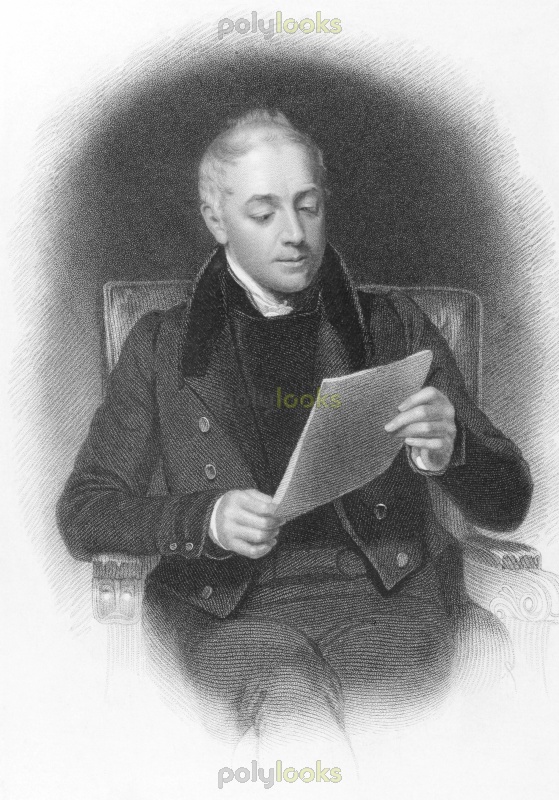
John Murray II
Ltr. 122(A)(D). 20-21 Oct 1815, draft of letter from Henry Austen to John Murray, in London
On the subject of the expence & profit of publishing, you must be better informed than I am; – but Documents in my possession appear to prove that the Sum offered by you for the Copyright of Sense & Sensibility, Mansfield Park & Emma, is not equal to the Money which my Sister has actually cleared by one very moderate Edition of Mansfield Park – (You Yourself expressed astonishment that so small an Edit. of such a work should have been sent into the World) & a still smaller one of Sense & Sensibility.- …
[Note: the 1st edition of S&S was 750 or 1000 copies; MP was probably 1,250, and Emma was 2,000 copies.]
Ltr. 154. 13 Mar 1817, to Caroline Austen, from Chawton
I have just recd nearly twenty pounds myself on the 2d Edit: of S&S* – which gives me this fine flow of Literary Ardour.
* Sense and Sensibility [footnoted by Austen in pencil]
*********************
Isn’t it such a delight to hear Austen’s very own words on her writing! Stay tuned for Part II on how it all came to be…
Anyone who reads Georgette Heyer or other Regency-era historical fiction is surely familiar with the phrase “outside of enough” – one of those “cant” phrases that is self-explanatory, doesn’t need a lexicon or such to figure out its meaning. It is a great turn of words, isn’t it? and so much more effective that “that’s enough” or “enough is enough” or “I’ve had enough” or “more than enough”, or “this is too much” or “enough already”!
But where did it come from? When was it first used? I don’t currently have access to the OED and it does not show up in the phrase reference sources I have or in online sources. Joanna Waugh on her website says it came into use around 1887. It now seems overly used – certainly in every historical romance novel, but also in political writings, general conversation [just ‘google’ it!]. I am reminded of the phrase “gone missing”- a term I first heard in England years ago and needed to have it explained to me! – I later heard it on Canadian news programs, but now I hear it everywhere, read it in the newspapers, definitely a British turn of phrase adopted here in the US.
But back to “outside of enough” – I have assumed this was a term that Heyer perhaps had made up – she did do that with some of her Regency cant phrases so prevalent in her dialogue. So I was quite surprised and delighted to discover this dialogue between Lucy Steele and Elinor in a recent re-read of Sense and Sensibility:
[Lucy Steele] : “And what a charming little family they have! I never saw such fine children in my life. I declare I quite doat upon them already, and indeed I am always distractedly fond of children.”
“I should guess so,” said Elinor with a smile, “from what I have witnessed this morning.”
“I have a notion,” said Lucy, “you think the little Middletons rather too much indulged; perhaps they may be the outside of enough; but it is so natural in Lady Middleton; and for my part, I love to see children full of life and spirits; I cannot bear them if they are tame and quiet.”
“I confess,” replied Elinor, “that while I am at Barton Park, I never think of tame and quiet children with any abhorrence.”
[S&S, Vol. 1, Ch. xxi ]
Two Brock illustrations of “sweet” Lucy…
Fig. 1 "We have been engaged these four years"
Fig. 2 "She could have no doubt of its being Edward's face"
So we might think that Austen was the first writer to use the phrase, albeit putting it into the mouth of one of her more vulgar characters. But a quick search of Google Books brings up the following sources:
1. Algernon Sidney. Of the Use and Abuse of Parliaments: In Two Historical Discourses. 1744 – a reference is made to “outside of enough” as somewhere expressed by Shakespeare. [I did search the Shakespeare Concordance and the term “outside” comes up 14 times in Shakespeare’s texts, but alas! all lacking the necessary “of enough”]
2. Colley Cibber. The Dramatic Works of Colley Cibber. 1777. “…I’ll have everything on the outside of enough today.”
3. Joseph Gwilt, et al. An Encyclopaedia of Architecture. 1842. re: “premising, that if the caution whereof we speak be taken, the thickness resulting from the following investigations will be much more than the outside of enough.” [p. 410]
4. Henry C. K. Wyld. A History of Modern Colloquial Idiom. 1920. Wyld cites the above Austen passage as “largely the way of speech of the better society of an earlier age, which has come down in the world, and survives among a pretentious provincial bourgeoisie.” [p. 376] [which seems to indicate the term was used in an earlier period and Austen would have been familiar with that…]
So, I must carry on and dig deeper and find a better reference – if anyone has any thoughts, please comment – but shan’t we at least credit Austen (via Heyer I would think) with what appears to be the source for the excessive use of the term today? – I do feel the need to nearly scream, “all right, all right, the constant use of this phrase is really the outside of enough”!
Wishing you all a very Happy New Year, with gratitude to all for your visits, your comments, and your discussions of all things Jane! ~ Thank you for including Jane Austen in Vermont in your daily blog surfing! See you all in 2011!
Today in Jane Austen’s life: Henry Austen married his cousin Eliza de Feuillide on this day, December 31, 1797.
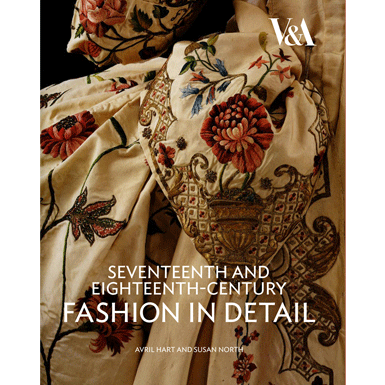
Two books I have wanted found their way under my Christmas tree by way of Santa and his sleigh. These are books to savor, perhaps even drool over on these cold dark winter nights! Here is just a quick summary:
Seventeenth and Eighteenth-Century Fashion in Detail, by Avril Hart and Susan North. Photographs by Richard Davis; Drawings by Leonie Davis. London: V&A Publishing, 2009. [First published by V&A in 1998 as Historical Fashion in Detail from the 17th and 18th Centuries]. ISBN 978 185177 567 5
From the introduction:
These remarkable photographs of the V&A’s collection of historical dress capture the essence of each stylish garment, opening up new perspectives on high fashion between 1600 and 1800. Offering a lively survey of fashionable patterns, fabrics and colours, the images depict a wide variety of styles and effects, from the minimalism of mid-18th-century white-work to the flamboyant excesses of high Baroque flowered silks…
Each chapter offers close-up photographs showing the varied details of dress, accompanied by line drawings and a full description of each piece. I give as an example the description of “long sleeves” in the chapter on “Collars, Cuffs and Pockets”:
Long sleeves in women’s dress became fashionable in the 1780s, and with them, new ways of fastening and decoration at the wrists. In this very simple cotton gown from the late 1790s, the sleeve is closed with a narrow band of fabric, edged with piping, which fastens with hook and eye.
While the pattern of the fabric is similar to that of the jacket on the left, the crispness and precision of the English printed cotton seen contrasts with the loose, flowing execution of the Indian printed fabric. Block-printing on cotton began in England in the 1750s, imitating designs of imported Indian fabrics. The pattern of floral trails seen here exhibits a blend of influences from Indian-painted and printed textiles, and rococo woven silks, a style which remained popular until the end of the century. [Pictured is a woman’s gown of printed cotton, English, 1795-1799, followed by sleeve detail] [p. 94-95]
Austen of course was concerned about her longs sleeves: “I wear my gauze gown today, long sleeves & all; I shall see how they succeed, but as yet I have no reason to suppose long sleeves are allowable … [and later] … Mrs. Tilson has long sleeves too, & assured me that they are worn in the evening by many. I was glad to hear this.– ” [Ltr. 99, 9 March 1814]
Chapters included:
Stitching, Seams, Quilting and Cording
Gathers, Pleats and Looped Drapery
Collars, Cuffs and Pockets
Buttons
Trimmings
Applied Decoration
Slashing, Pinking and Stamping
Knitting, Lace and Openwork
Stomachers
Gloves and Shoes
Glossary and Select Bibliography
****************
The great overlap of the 18th and 19th centuries meant that Santa had to do double duty and also leave the Nineteenth-Century Fashion in Detail, by Lucy Johnston, with Marion Kite and Helen Persson. Photographs by Richard Davis; Drawings by Leonie Davis. London: V&A Publishing, 2009 [first published, 2005]. ISBN: 978 18177 572 9.
Many of the Influences, innovations and stylistic changes that shaped nineteenth-century fashion are brought to life by the garments illustrated in this book. The delicate embroidery on neo-classical gowns, elegant tailoring on men’s coats, vibrant colours of artificial dyes and profusion of ornate trimmings reveal some of the details which make this period so rich. They also show how a woman’s silhouette was transformed during this era through whalebone corsets, cage crinolines, bustles and skilful garment construction…. [Introduction, p. 7]
Again, each piece of clothing is presented with a photograph, a line drawing, and a full description . Chapters included:
The Male Image
Historicism
Romantic Styles
Exoticism
Innovations
Construction Details
The Natural World
Glossary and Select Bibliography
Two quite amazing books, filled with sumptuous detail, lovely patterns and fabrics, showing the clothing of the fashion-conscious middle and upper class men and women of these times. If you have any interest in fashion, these definitely need to be added to your collection! Thank you Santa for paying attention and seeing how much I needed these! Makes one want to drag out the sewing machine…
P.S. There is another book in this series, titled, Underwear Fashion in Detail – [V&A Publishing, 2010] perhaps Santa was too embarrassed to bring this one?
Illustrations from the V&A website. Books are available at the V&A online Shop, and also available at other booksellers.
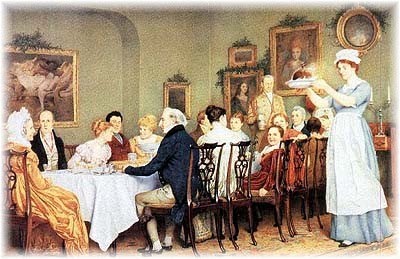
It is a rare date that Austen mentions in her works, but one of them is today, December 24: Christmas Eve, “(for it was a very great event that Mr. Woodhouse should dine out, on the 24th of December)” [Emma Vol. I, Ch. xiii]
While we usually associate Mr. Woodhouse with often curmudgeonly weather-obsessed behavior, here he is most eager to get all wrapped up and head over to Randalls:
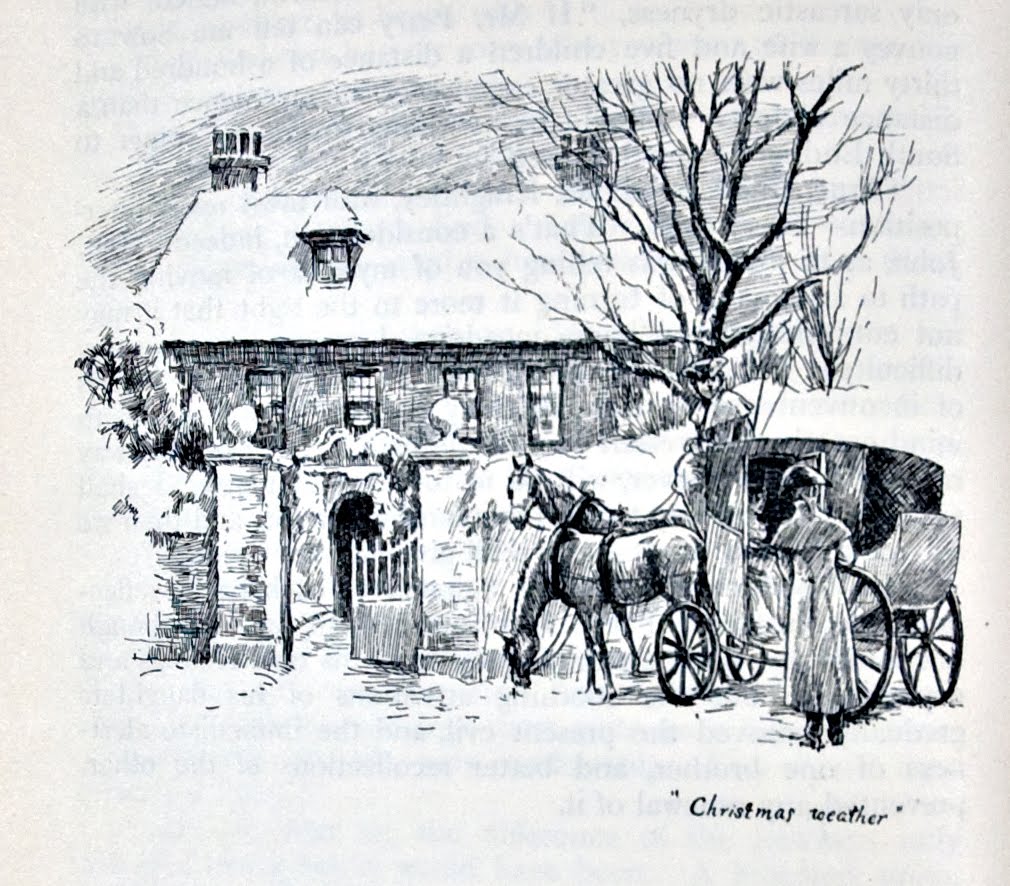
Mr. Woodhouse had so completely made up his mind to the visit, that in spite of the increasing coldness, he seemed to have no idea of shrinking from it, and set forward at last most punctually with his eldest daughter in his own carriage, with less apparent consciousness of the weather than either of the others; too full of the wonder of his own going, and the pleasure it was to afford at Randalls to see that it was cold, and too well wrapt up to feel it. [E, Vol. I, Ch. xiii]
Fig. 2
So it is not dear Mr. Woodhouse who is Scrooge this Christmas Eve, but Austen is adept at creating one, and long before Dickens ever did:
‘A man,” said he, ‘must have a very good opinion of himself when he asks people to leave their own fireside, and encounter such a day as this, for the sake of coming to see him. He must think himself a most agreeable fellow; I could not do such a thing. It is the greatest absurdity — Actually snowing at this moment! The folly of not allowing people to be comfortable at home, and the folly of people’s not staying comfortably at home when they can! If we were obliged to go out such an evening as this, by any call of duty or business, what a hardship we should deem it; — and here are we, probably with rather thinner clothing than usual, setting forward voluntarily, without excuse, in defiance of the voice of nature, which tells man, in every thing given to his view or his feelings, to stay at home himself, and keep all under shelter that he can; — here are we setting forward to spend five dull hours in another man’s house, with nothing to say or to hear that was not said and heard yesterday, and may not be said and heard again to-morrow. Going in dismal weather, to return probably in worse; — four horses and four servants taken out for nothing but to convey five idle, shivering creatures into colder rooms and worse company than they might have had at home.” [E, Vol. I, Ch. xiii]
Well, “Bah! Humbug!” to you too, John Knightley! – he is our Scrooge this Christmas Eve [indeed, I believe that Isabella has married her father!] and his ill humor continues throughout the evening – ending of course with his gloomy and overblown report of the worsening weather that sets off three full pages of discussion on the risks of setting out, on the possibility of being snowed-in, on the cold, on the danger to the horses and the servants – “‘What is to be done, my dear Emma? – what is to be done?’ was Mr. Woodhouse’s first exclamation…” and it all is finally “settled in a few brief sentences” by Mr. Knightley and Emma, certainly foreshadowing their success as a companionable couple.
Fig. 3 'Christmas Weather'
And this leads to one of Austen’s most comic scenes – the proposal of Mr. Elton, Emma trapped in the carriage alone with him believing that “he had been drinking too much of Mr. Weston’s good wine, and felt sure that he would want to be talking nonsense…” – which of course he does…
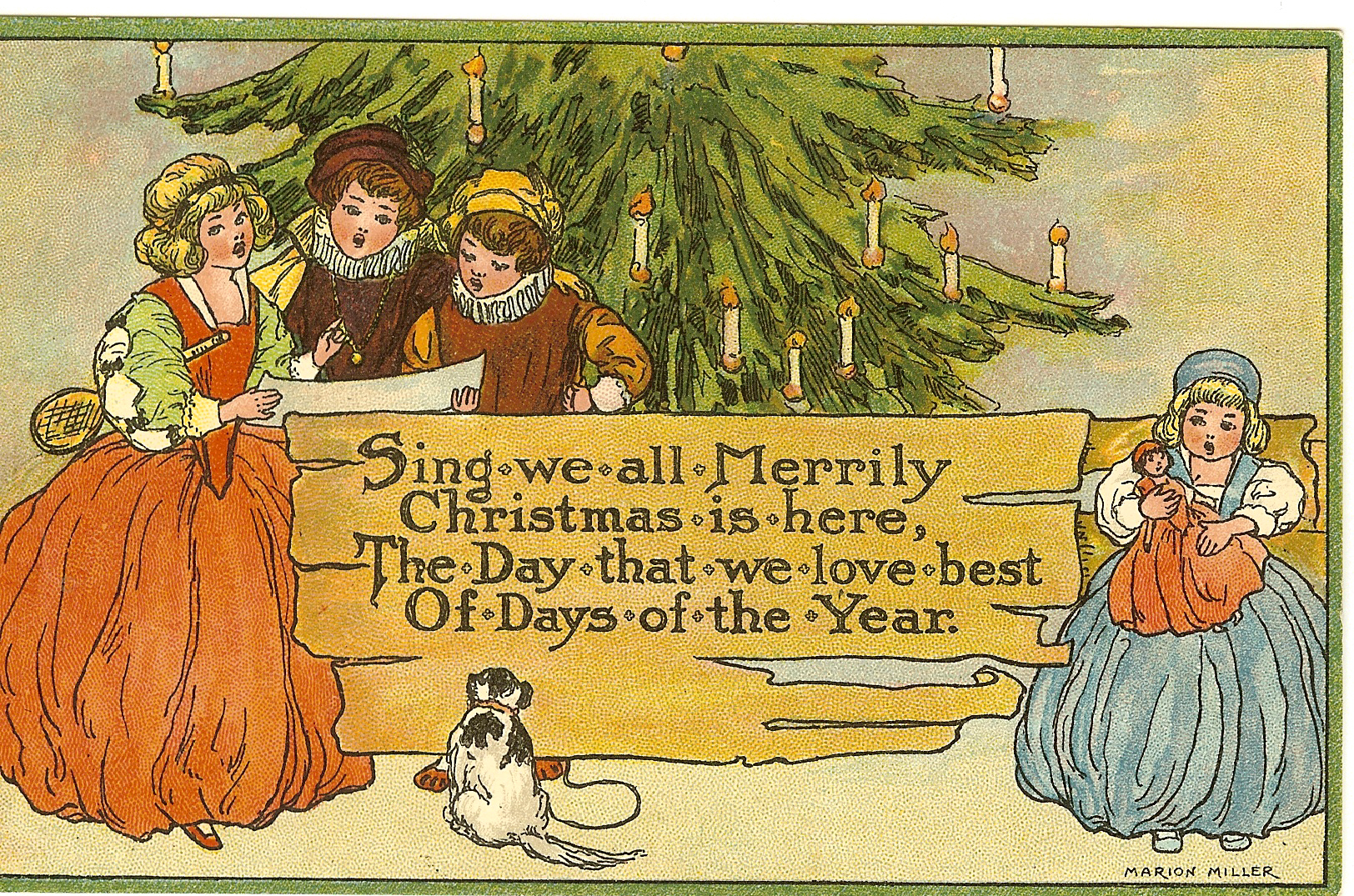
Wishing you all a very Merry Christmas, with much snow on the ground (but not enough to trouble your carriage), some song and wine (but not enough to induce unwanted and overbearing offers of love and marriage), and the pleasure of good company (with hopefully no Scrooge-like visitors to whom you must either “comply” or be “quarrelsome” or like Emma, have your “heroism reach only to silence.” )
P.S. – And tonight pull your Emma off the shelf and read through these chapters in volume I [ch, 13-15] for a good chuckle! – this of course before your annual reading of A Christmas Carol.
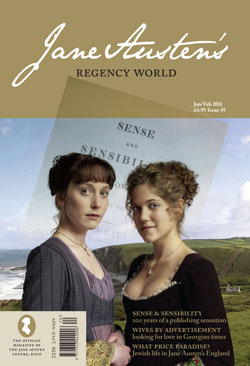
Will await this showing up in my mailbox [though see the publisher’s note about weather-induced delivery delays] – here is the latest table of contents from Jane Austen’s Regency Worldmagazine, the January/February 2011 issue No. 49:
Sense & Sensibility at 200 ~ Leading writers look at the history, relevance, importance and morality of Jane Austen’s first published novel
What price Paradise? ~ Life as a Jewish person in Regency England
Wives by Advertisement ~ The risks and rewards of Georgian lonely hearts’ adverts
Jane Austen and Robert Burns ~ What she really thought about the Scottish poet
Jane Austen edited by a man ~ One writer’s angry response to recent news reports
*Plus: All the latest news from the world of Jane Austen, as well as letters, book reviews, quiz, competition and news from JAS and JASNA
Wondering what to ask Santa for Christmas? Well if you have been “good” and “nice” and not “naughty” or “shouting” or “crying” the whole year through, then you deserve a subscription to JARW! For further information, and to subscribe, visit: http://www.janeaustenmagazine.co.uk/index.html
[PLEASE NOTE:
1. The March/April 2011 issue of Jane Austen’s Regency World magazine will be the FIFTIETH issue!
2. Overseas subscribers, especially in the US and Canada: be advised that the January/February issue may be delayed by 7-10 days because of a backlog of cargo in the UK following recent bad weather, and sorting difficulties in both the US and Canadian postal services. We apologise for any delay or inconvenience this may cause. Jane Austen’s Regency World ~ well worth waiting for!
*****
Chawton House Library has published the latest issue of its newsletter The Female Spectator, Vol. 14, No. 3 (Autumn 2010) [and thankfully, this has arrived in my mailbox!] :
“Chawton Chronicles” from CEO Steve Lawrence re: Edward Austen Knight’s silk suit
“Brian Charles Southam”, an obituary – by Gillian Dow
“Reading and Re-reading in Sarah Fielding’s The Countess of Dellwyn” – by Louise Curran
“Aspects of Household Management during the Long Eighteenth Century: The Invalid’s Dietary” – by Catherine Morley
“Stories behind the Paintings” by Jacqui Grainger – this essay on the portrait of Mary Robinson, actress and mistress of the Prince Regent, that hangs in the Great Hall of the Chawton House Library [with a heads-up re: the National Portrait Gallery [the UK NPG- sorry folks!] exhibition entitled “The First Actresses: Nell Gwyn to Sarah Siddons” set for 20 Oct 2011 – 8 Jan 2012]
“The Shire Horses” – by Angie McLaren
“House and Estate News”: Conservation Projects – by Paul Dearn; The Park and Gardens – by Alan Bird
“Dates for Your Diary” – as always, lovely to see what is coming up, and, as always, quite depressed that I am on this side of the world…
You too can receive this quarterly newsletter in your mailbox [weather notwithstanding…] by becoming a member of the CHL – information is here: Chawton House Library membership [see link for North American members]. See also the several links to full-text [pdf] past newsletters here, and a contents listing of all issues here.
And please check out the latest news on the CHL website – there is a new short story competition in the offing – so start mending your pens and submit your creation by March 31, 2011 – guidelines are here.
To be at the beginning of life, one must start at the end of the novel. For although Jane Austen concludes her books with the marriage of the hero and heroine to which the whole thrust of the narrative has been leading, and the reader rejoices in the perfect happiness of the union, in reality the best is yet to come: they will have children – procreation being not only the natural and desirable end of marriage, but also an economic and dynastic necessity. And those children will have their own stories…What will become of the Darcy children?…” (Ch. 1, Confinement, p. 5)
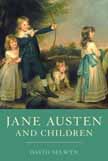
And thus does David Selwyn begin his treatise on Jane Austen and Children (Continuum, 2010), a most enjoyable journey through the world of childhood and parenting and education and growing-up in the life of Jane Austen, and the lives of her fictional characters. If you are perhaps one of those people who think that Jane Austen does not like children, an idea certainly fed buy such comments about women “breeding again” or the child-generated “dirt and noise” or “the two parties of Children is the cheif Evil” [Ltr. 92], or the proper child-rearing “Method has been wanting” [Ltr. 86], etc. – you need to read this book!
Selwyn takes his reader essentially through the nine ages of man [with apologies to Shakespeare] beginning with confinement and birth, through infancy, childhood, parenting, sibling relations, reading and education, and finally maturity, as Selwyn says, the “end of the novel” when the Hero and Heroine come together, after all manner of trial and tribulation, to begin their own family.
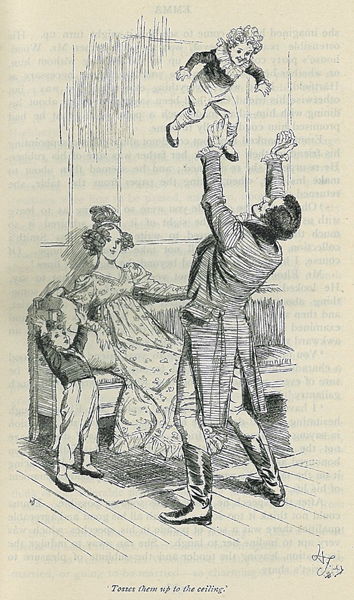
We are given a general survey of the shift in the attitudes toward children, that late eighteenth – early nineteenth century view that fell between viewing children as not just “little adults” to the Victorian view of “seen but not heard”, following Locke and Rousseau and believing children to be natural innocents. In each chapter Selwyn seamlessly weaves pieces of Austen’s life as gleaned from her letters and scenes from all her writings – and it is masterly done, all with a historical perspective. We see Jane as a child, as a madly composing adolescent, a loving and humorous Aunt imaginatively interacting with her nieces and nephews, and as an accomplished writer whose fictional children are far more worthy of our notice than we have previously supposed: the frolicsome Walter hanging on Anne’s neck in Persuasion; the spoiled Middletons; the noisy and undisciplined Musgroves; the grateful and engaging Charles Blake in The Watsons; the John Knightley brood in the air courtesy of their Uncle George; the dynamics of the five Bennet sisters; Henry Dashwood the center of attention for the manipulative Steele sisters; the reality-based scenes of Betsy and Susan Price at Portsmouth; and finally Fanny Price, Austen’s only heroine we see grow up from childhood, having an elegant come-out, finding true-live and ends “needing a larger home.”
In all her works, Austen uses children as “a resource for her narrative strategies” (p. 4), be that comedy, a plot device to further the action, or a means of revealing attitudes and responses of the adults around them (p. 3). Austen’s children are easy to miss – they won’t be after reading this book – here they are brought to life, given character and meaning, and you will see what Selwyn terms “Austen’s satirical delight in children behaving in character” (p. 73)
If Austen’s fiction seems to gloss over the reality of childbirth [the exception is Sense and Sensibility’s two Elizas], her letters tell the tale of its dangers [Austen lost three sisters-in-law to death in childbirth], and Selwyn links all to the social structure of the day, the nursing of babies and swaddling practices, to child rearing theories and moralizing tracts, and governesses and Austen’s ambivalence toward them. We visit boarding schools along with Jane and her characters and we hear the voices of a number of contemporary diarists (Agnes Porter, Sophia Baker, Susan Sibbald, Elizabeth Ham and Sarah Pennington). There is a lovely in-depth chapter on the reading materials written especially for children and Austen’s first-hand knowledge of these titles. The discussion on sisters and brothers, those so important in Austen’s own life, and those in her fiction, for example, characters with confidants (Lizzy and Jane, Elinor and Marianne), those isolated (Fanny, Anne Elliot, Emma Watson, Mary Bennet), and those with younger sisters (Margaret Dashwood and Susan Price). As part of the growing-up process, Selwyn uncovers much on “coming-out” as Austen herself writes of in her “Collection of Letters” [available online here] – with the emphasis here on Fanny as the only heroine to have a detailed “coming-out” party.
The chapter on “Parents” starts with the premise that “in Jane Austen’s novels the parents best suited to bringing up children are dead” (p.95) and Selwyn takes us from the historical view of parenting, through Dr. Johnson’s “Cruelty of Parental Tyranny” [shadows of Northanger Abbey] to a full discussion of the marriage debate in the 18th-century – that between the worldly concerns of wealth vs. choice of partner based on emotional love as personified in Sir Thomas and Fanny Price respectively. Excerpts are included from James Austen’s very humorous Loiterer piece “The Absurdity of Marrying from Affection.” (p. 207) and Dr. John Gregory’s A Father’s Legacy to his Daughters (1774) [viewable at Google Books here] , and the Edgeworth’s Practical Education (1798) [Vol. III at Google Books here]. One finds that in reading all of Austen’s letters and all the works you can indeed discover a complete instruction manual for good parenting!
Jane Austen and Children appropriately ends with Selwyn’s speculation on what sort of parents her Heroes and Heroines will be, all of course based on the subtle and not-so-subtle clues that Austen has given us throughout each work – conjecturing on this is perhaps why we have so many sequels with little Darcys, Brandons, Bertrams, Knightleys, Tilneys, and Ferrars running about!
Just as in his Jane Austen and Leisure, where Selwyn analyzes the various intellectual, domestic and social pursuits of the gentry as evidenced in Austen’s world and her works, he here gives us an accessible and delightful treatise on Austen’s children, culling from her works the many quotes and references related to children and linking all to the historical context of the place of children in the long eighteenth century. The book has extensive notes, a fine bibliography of sources on child-rearing, contemporary primary materials, children’s literature, and literary history, and several black and white illustrations. (I did note that there are a few mixed up footnotes in chapter 3, hopefully to be corrected in the next printing). What will this book give you? – you will never again miss the importance of Austen’s many children, peaking from behind the page, there for a set purpose to show you what great parents the Gardners are, or just to make certain you see how very selfish the John Dashwoods and the Miss Steeles are, or to see the generosity of an Emma Watson in her rescue of Charles Blake, or to feel the lack for the poor Musgrove boys having Mary for a mother, the playfulness of an otherwise conservative Mr. Knightley, and the unnerving near touch of Captain Wentworth as he relieves Anne of her burden – thank you David Selwyn for bringing all these children to life for Austen’s many readers – you have given us all a gift!
Emma – ‘Tosses them up to the ceiling’
[by Hugh Thomson, print at Solitary Elegance]
__________________
Jane Austen and Children Continuum, 2010 ISBN: 978-1847-250414
David Selwyn is a teacher at the Bristol School in Bristol, UK. He has been involved with the Jane Austen Society [UK] for a number of years, has been the Chairman since 2008, the editor of the JAS Report since 2001, and has written and edited several works on Austen. He very graciously agreed to an “interview” about this latest work that you can find by clicking here. See also the post on the various illustrations of Austen’s children by the Brocks and Hugh Thomson. And finally, I append below a select bibliography of Selwyn’s writings on Jane Austen and her family.
Select Bibliography:
Lane, Maggie, and David Selwyn, eds. Jane Austen: A Celebration. Manchester: Fyfield, 2000.
Selwyn, David, ed. The Complete Poems of James Austen, Jane Austen’s Eldest Brother. Chawton: Jane Austen Society, 2003.
_____. “Consumer Goods.” Jane Austen in Context. Ed. Janet Todd. Cambridge Ed. of the Works of Jane Austen. New York: Cambridge UP, 2005. 215-24.
_____, ed. Fugitive Pieces: Trifles Light as Air: The Poems of James Edward Austen-Leigh. Winchester: Jane Austen Society, 2006.
_____. “A Funeral at Bray, 1876.” Jane Austen Society, Collected ReportsV (1998): 480-86.
_____. “Games and Play in Jane Austen’s Literary Structures.” Persuasions 23: 15-28
_____. “Incidental closures in Mansfield Park.” [Conference on “Jane Austen and Endings”, University of London, 17 November 2007] – unpublished paper.
_____. “James Austen – Artist.” Jane Austen Society Report 1998. 157-63.
_____. Jane Austen and Leisure. London: Hambledon Continuum, 1999.
_____, ed. Jane Austen: Collected poems and Verse of the Austen Family. Manchester: Carcanet / Jane Austen Society, 1996.
_____, ed. Jane Austen Society Report, 2001 – present.
_____. “Poetry.” Jane Austen in Context. Ed. Janet Todd. Cambridge Ed. of the Works of Jane Austen. New York: Cambridge UP, 2005. 59-67.
_____. “Shades of the Austens’ Friends.” Jane Austen Society Collected Reports V (2002): 134.
_____. “Some Sermons of Mr Austen.” Jane Austen Society Collected Reports V (2001): 37-38.







 Jane Austen in Vermont