Austen Literary History & Criticism · Collecting Jane Austen · Jane Austen · Jane Austen Societies · JASNA · Literature

JASNA Persuasions 33 and Persuasions 32.2 ~ It’s All About Sense & Sensibility!

News from JASNA:

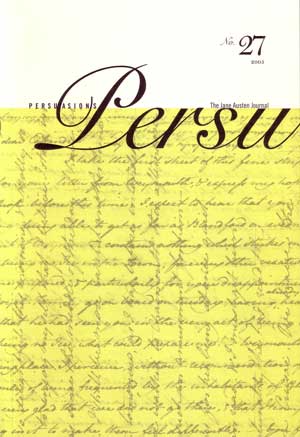
The latest issue of Perusasions – volume 33 [not as the image indicates!], papers from the Fort Worth AGM on 200 Years of Sense and Sensibility has been mailed to members [and like me you hopefully already have received it!]  The journal is not online – you must be a JASNA member to receive it.  Here is the table of contents:

http://jasna.org/persuasions/printed/pers33.html

And Persuasions On-Line 32.2(Summer 2012) is now available – and this is online:

200 Years of Sense and Sensibility
Selected Essays from the Conference at the University of St. Andrews

 Here is the index page: http://jasna.org/persuasions/on-line/vol32no2/index.html

Certainly enough interesting reading for the weekend!

@2012 Jane Austen in Vermont
Austen Literary History & Criticism · Books · Jane Austen · Jane Austen Popular Culture · Regency England

Hot off the Press! ~ Jane Austen’s Regency World Magazine No. 58

The July/August issue of Jane Austen’s Regency World magazine is published this weekend and will be mailed to subscribers next week. In it you can read about: 

*A Royal Affair: a new film depicts the scandal that rocked a European monarchy 

*Olympic Jane: as the 2012 Games open in London, we look at the sports that Jane might have played

*Bath Jane Austen Festival: an exclusive preview of the fun planned for September

*Stand and deliver! the terror of highwaymen that threatened Jane’s friends and family

*Gothic horror: how Jane Austen satirised the latest literary fashion

*Plus News, Letters, Book Reviews and information from Jane Austen Societies in the US, UK and Australia

To subscribe now click here – and make sure that you are among the first to read all the news from Jane Austen’s Regency World.

Text and image from JARW – you can now read more about Jane’s world on the magazine’s new website, blog, and facebook pages here:

@2012 Jane Austen in Vermont
Austen Literary History & Criticism · Books · Jane Austen · Jane Austen Popular Culture · JASNA-Vermont events · News

Reminder! JASNA-Vermont ~ June 3, 2012 ~ Rachel Brownstein on Why Jane Austen?

Read my interview with Professor Brownstein here:
Part I and Part II

You are Cordially Invited to JASNA-Vermont’s June Meeting 

~ ‘Why Jane Austen?’ ~

with 

Rachel Brownstein* 

What do we want from Jane Austen? ~
Why do we want it? ~
and What do we get from the movies, the fan fiction,
and the Novels? 
 

*****
Sunday, 3 June 2012, 2 – 4 p.m. 

 Champlain College, Hauke Conference Center
375 Maple St Burlington VT 
 

~Free & Open to the Public~
 ~Light refreshments served~ 

For more information:   JASNAVermont@gmail.com  
Please visit our blog at: http://JaneAustenInVermont.wordpress.com

the June 3 2012 flyer: share with your friends!

****************************

*We are honored to welcome Professor Rachel Brownstein, author of Becoming a Heroine (1982), Tragic Muse: Rachel of the Comedie-Francaise (1993), and Why Jane Austen? (2011). Films, feminism, and popular fetishes are among the subjects of her new work,  an engaging treasure-filled meditation on Jane Austen as writer, woman, social commentator, and 21st-century icon. But most of all it is about reading, which Brownstein has been encouraging people to do, at Brooklyn College and the Graduate School of CUNY, for several decades. 

**********************

Please Join Us!

*********************************

~ Upcoming in 2012 and beyond ~

Sept. 23: Burlington Book Festival: ‘An Afternoon with Jane Austen’: authors Elsa Solender on Jane Austen in Love: An Entertainment,
 Stuart Bennett on The Perfect Visit; and
Hope Greenberg on “Dressing Jane”!

Dec. 2: Annual Birthday Tea with Paul Monod of Middlebury College on
                “The Royal Navy in the Age of Nelson, 1775-1815”

Mar. 2013 [TBA]: “’Fifty Miles of Good Road’: Travelling in Jane Austen” with Deb Barnum

Auctions · Austen Literary History & Criticism · Books · Jane Austen · News · Rare Books

Austen On the Block! ~ Northanger Abbey and Persuasion 1st edition

Auction Alert! 

Christie’s Sale 5334: Valuable Printed Books and Manuscripts
13 June 2012, London, King Street

Lot 169: 

Austen, Jane.  Northanger Abbey and Persuasion. With a Biographical Notice of the Author [by Henry Austen].London: C. Rowarth [vols I-II], and T. Davison [vols III- IV] for John Murray, 1818 [but ca. 20 December 1817].

Estimate: £5,000 – £8,000  ($7,975 – $12,760) Price Realized: £5,625 ($8,696)

Description

4 volumes, 12° (172 x 103mm). (Some light spotting, without half-titles in vols. II-IV and final blanks P7-8 in vol. IV.) Near contemporary half calf over marbled boards by J. Seacome, Chester, with his yellow or pink ticket in each volume, flat gilt spines divided by greek key rolls between double fillets, and with red morocco lettering-pieces in two compartments (extremities lightly rubbed, spine heads slightly chipped, minor paper loss to one cover). Provenance: Jane Panton (early inscriptions on all titles, trimmed by binder) — Bernard Quaritch, bookseller (pencilled collation note at the end of vol. I).

FIRST EDITION OF BOTH NOVELS IN AN EARLY 19TH-CENTURY BINDING BY J. SEACOME OF CHESTER. According to the author’s sister, Cassandra, Northanger Abbey was written in the years 1798-1799, although it has been suggested ‘a first version may have been written as early as 1794’ (Gilson, p. 82). This gentle parody* of the gothic novel represents her style in its earliest public form. Sense and Sensibility and Pride and Prejudice, though earlier in origin, were far more drastically revised before publication. In 1803 she had sold the novel then entitled Susan, to Richard Crosby and Son, a London publisher, for £10. When it failed to appear after six years, she asked Mr Crosby for information, to be told that he was under no obligation to publish it, and that she could have it back for the amount he had paid her. The novelist waited until 1816 to accept the offer, but despite preparing the manuscript for publication once more, and changing the title from Susan to Catherine, still held it back. As a result, it only appeared posthumously with Persuasion in December 1817, the eventual title possibly supplied by Henry Austen. Persuasion, her last novel, was begun on 8 August 1815 and completed a year later. The two works were printed in varying specimens of Caslon Pica roman, and published by John Murray in an edition of 1750 copies. Gilson A9; Keynes 9 (collation corrected by 1931 errata); Sadleir 62e. (4)

___________________________________

  • Text and image from the Christie’s website
  • Click here for the full sale catalogue: there is a Dickens (David Copperfield) and also three works by Humphry Repton, who was read by Jane Austen:

Lot 119: REPTON, Humphry (1752-1818). Observations on the Theory and Practice of Landscape Gardening.London: T. Bensley for J. Taylor, 1803.

Estimate: £4,000 – £6,000 ($6,380 – $9,570)

Description:

FIRST EDITION OF REPTON’S ‘MOST IMPORTANT WORK’ (RIBA). Repton’s second treatise reflects the increasing refinement of his theories on landscape and architecture, and answers the criticisms of Uvedale Price and Payne Knight. ‘Perhaps [Repton’s] most significant and influential publication overall’ (Archer). It contains information from several ‘Red Books’ now lost. Abbey, Scenery, 390; Archer 279.1; RIBA 2734 (second edition); Tooley 399.

The other two Repton works are:

Lot 118: REPTON, Humphry (1752-1818). Sketches and Hints on Landscape Gardening.London: W. Bulmer and Co., for J. & J. Boydell, [1795]. Estimate  £8,000 – £12,000 ($12,760 – $19,140)

Lot 120: REPTON, Humphry (1752-1818) & John Adey REPTON (1775-1860). Fragments on the Theory and Practice of Landscape Gardening. Including some remarks on Grecian and Gothic Architecture.London: T. Bensley & Son for J. Taylor, 1816. Estimate: £6,000 – £9,000 ($9,570 – $14,355)

_____________________________

*Would you call Northanger Abbey “a gentle parody”?

Copyright @2012 Jane Austen in Vermont
Austen Literary History & Criticism · Jane Austen · JASNA · JASNA-Vermont events

Guest Post: Jane Austen’s Sanditon ~ A Talk by Eric Lindstrom for JASNA-Vermont

Gentle Readers: I welcome today Theodora Ziolkowski, * a student at the University of Vermont, who attended our JASNA-Vermont event on April 15, a talk on “Jane Austen’s Sanditon” by UVM Professor Eric Lindstrom.

Theodora wrote a piece for the UVM student newspaper The Cynic, and I append it here with her permission.  Always joyful to see young people at these events, and Theodora brought her friend Dan Bishop along as well – a young man with an interest in Jane is not an everyday occurance, so we were all doubly pleased to have them both in attendance!

The day started off with what is every organizer-of-an-event’s worst nightmare:  a major misspelling in the sandwich board signage that announces the talk on the street [on three corners of the campus] – I did not at first notice the signs while I was busy setting up for the day, but it was pointed out to me by some early-birds, and the inital shock of realizing my error of giving signage info over the phone rather than by email hit home hard – so

 “Jane Austen’s Sanditon”

was broadcast to the world as

 “Jane Austen’s Fanditon”

– that old “S” and “F” confusion over the phone, now permanently in print for all the world – and thankfully here photographed by one of our members – it did of course end up being the hit of the day – people thinking we had a full fan-fest in the works!  – and now I am thinking it would make for a great title for such an all-day event!

[Courtesy of Sarah at Two Girls Fishing]

Now on to Theodora’s essay on the talk, with thanks for her insightful commentary!:

**************************

Jane Austen’s “Sanditon”  –  A Talk by UVM Professor Eric Lindstrom for the Jane Austen Society of North America, Vermont Region – April 15, 2012.

by Theodora Ziolkowski 

Soft chamber music, peppermint bonbons, cucumber sandwiches and steaming cups of English breakfast tea: all means of transporting a community of Jane Austen fans to rural nineteenth century England.   

On Sunday, April 15th, the Hauke Conference Center at Champlain College held yet another event for the Vermont chapter of “JASNA,” the Jane Austen Society of North America. “Janeites,” or declared Austen enthusiasts, gathered in the Champlain College building to celebrate a shared admiration for a beloved writer.

The sunny afternoon event began with students and JASNA members filling up their plates and mugs for the talk.  Many milled about the tables of Austen memorabilia items for sale, including calendars, paper dolls, bookmarks and notecards.  Others stood in tea-drinking circles to speak with fellow Austen enthusiasts. 

Deb Barnum, JASNA-Vermont Regional Coordinator, introduced the event, the novel and UVM Professor Lindstrom, the event speaker.  Lindstrom’s talk, “How to Love ‘Sanditon’” revolved around Austen’s last and unfinished novel.  The [twelve]-chapter manuscript was first published by editor R. W. Chapman in 1925, many years after Austen’s death in 1817. 

Eric Lindstrom

Lindstrom began his talk sharing internet clips of Austen-related interviews and pictures, including a photograph of a Peep diorama entered for the competition held by the Washington Post

Peep Show – Pride and Prejudice and Zombies

 [image from Jane Austen Today]

Lindstrom also showed a watercolor of Austen painted by her sister, Cassandra, in which Austen is seen only from the back.  The “history and mystery” of this faceless Jane, Lindstrom said, contributes to the appeal of this visual representation of the novelist. 

For a novel boasting a brief fifty pages, “Sanditon” offers an unavoidable contrast to the marriage plot typical of Austen novels.  The absence of the marriage plot leaves room for readers to study Austen’s temperament, Lindstrom contended.     

In “Sanditon,” we find a more ironic vision—a “book that might leave Austen readers cold,” Lindstrom said in his opening remarks.  In the novel, two towns echo one another, a trait indicative of the changing English national character, Lindstrom said.  “Sanditon” can thus be considered a “condition of England novel,” or a storyline where housing and the quest for perfect health exist at its heart.   

The novel’s characters themselves are caricatures, and the thematic obsession with illness and the decaying body can be seen as contributing to what Lindstrom depicted as the “menacing” mood of the novel.

Lindstrom described “Sanditon” as understanding beyond its limitations of England. Even the name, “Sanditon,” suggests an “un-foundational” place –   Austen, he pointed out, is discreet in the novel: she had to pretend the world was better than it was at the time. 

The Vermont branch of JASNA hosts many events throughout the year, including talks and an annual birthday tea. 

[This article also appeared in the online version of The Cynic here.]

********************

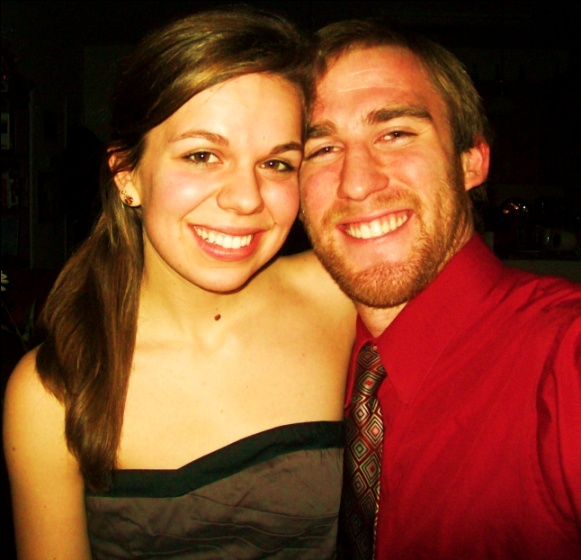
Theodora and Dan

Theodora Ziolkowski, an English major and Film and Television Studies minor, will graduate in May from the University of Vermont (UVM). Theodora has served her four years as an undergraduate as an editor for Vantage Point, the student-run arts and literary journal at UVM. She recently began writing for The Cynic, the UVM student newspaper, for which she writes reviews and a poetry column for the Arts pages. A lover of writing, books and good coffee, Theodora wrote a manuscript of poetry for her senior honors defense. Her love for Jane Austen began in high school when she became enchanted by Elizabeth Bennet and her world of sisters, elegant dances, piano-playing, and romance.

[Theodora tells me that her first date with Dan was watching the DVD of her favorite Austen novel – Emma Thompson’s adaptation of Sense and Sensibility! ]

Copyright @2012 Jane Austen in Vermont 
Austen Literary History & Criticism · Jane Austen · Jane Austen Popular Culture · JASNA-Vermont events · News

JASNA-Vermont ~ June 3, 2012 ~ Rachel Brownstein on Why Jane Austen?

You are Cordially Invited to JASNA-Vermont’s June Meeting 

~ ‘Why Jane Austen?’ ~

with 

Rachel Brownstein* 

What do we want from Jane Austen? ~
Why do we want it? ~
and What do we get from the movies, the fan fiction,
and the Novels? 
 

*****
Sunday, 3 June 2012, 2 – 4 p.m. 

 Champlain College, Hauke Conference Center
375 Maple St Burlington VT 
 

~Free & Open to the Public~
 ~Light refreshments served~ 

For more information:   JASNAVermont@gmail.com  
Please visit our blog at: http://JaneAustenInVermont.wordpress.com

the June 3 2012 flyer: share with your friends!

****************************

*We are honored to welcome Professor Rachel Brownstein, author of Becoming a Heroine (1982), Tragic Muse: Rachel of the Comedie-Francaise (1993), and Why Jane Austen? (2011). Films, feminism, and popular fetishes are among the subjects of her new work,  an engaging treasure-filled meditation on Jane Austen as writer, woman, social commentator, and 21st-century icon. But most of all it is about reading, which Brownstein has been encouraging people to do, at Brooklyn College and the Graduate School of CUNY, for several decades. 

**********************

Please Join Us!

*********************************

~ Upcoming in 2012 and beyond ~

Sept. 23: Burlington Book Festival: ‘An Afternoon with Jane Austen’: authors Elsa Solender on Jane Austen in Love: An Entertainment,
 Stuart Bennett on The Perfect Visit, and more!

Dec. 2: Annual Birthday Tea with Paul Monod of Middlebury College on
                “The Royal Navy in the Age of Nelson, 1775-1815”

Mar. 2013 [TBA]: “’Fifty Miles of Good Road’: Travelling in Jane Austen” with Deb Barnum

Austen Literary History & Criticism · Collecting Jane Austen · Jane Austen · Literature · News

In My Mailbox! ~ The Female Spectator Vol. 16, No. 1 ~ Chawton House Library

The Female Spectator, Vol. 16, No. 1 (Winter 2012) , the newsletter of the Chawton House Library is out!
Here are the contents to whet your appetite:    

  • “Some Treasures in the Chawton House Library Collection” by Margaret S. Yoon, about her “discovery” at the CHL of two very important books for her studies. 
  • “The Suit for a Case; Or, A Case for a Suit” – by Eleanor Marsden – on the recently restored suit belonging to Edward Austen Knight, and the need for a conservation-grade display case.  [Lovely to see that JASNA member Sue Forgue of the JASNA-Greater Chicago Region, and author of the website Regency Encyclopedia , has already made a generous donation to the cause!] – if your are interested in helping, please email the Development Director at eleanor.marsden@chawton.net
  •  “The Sheridan Trial” – by Helen Cole – an account of the 1787  Trial of Mrs. Lydia Sheridan, wife of Major Henry Sheridan, for adultery with Francis Newman, Esq., and the inclusion of an engraving in the CHL copy that does not seem to fit the tale…
  •  “A Conference of Our Own: On the 20th Anniversary of the BWWA” – by Pamela Corpron Parker – on the upcoming conference of the British Women Writers Association, June 7-10, 2012 at the University of Colorado, Boulder.  See here for more details: http://www.bwwc2012.com/
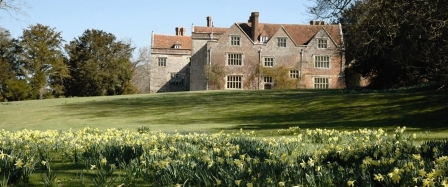
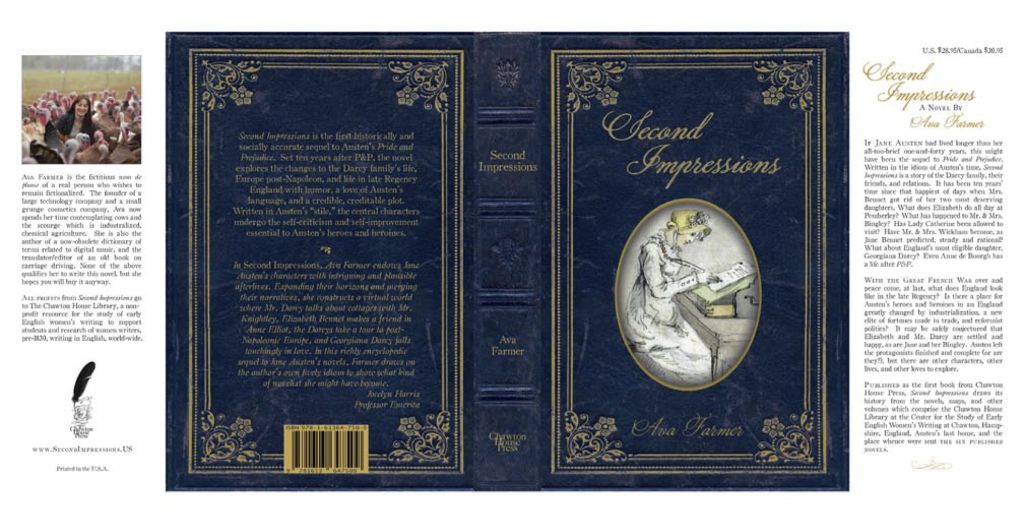
  •  “Second Impressions by Ava Farmer: A History of a Novel” – by Sandy Lerner – on the writing and publication of her recently published Second Impressions, a sequel to Pride and Prejudice, and 26 years in the making…[see more at the Chawton House Press website
  • “‘Poetry of Taste and Refinements’: Consumer Literature in Nineteenth-Century Annuals” – by Serena Baiesi – on the fashionable gift-books with their collection of engravings and literary pieces, published between 1822 and 1850. 
  • And, “The Chawton Chronicles” – the letter from the CEO Stephen Lawrence [with the very exciting news that Dr. Gillian Dow will be taking on a broader role at CHL as Deputy Chief Executive and Director of Research!]; this issue’s “Faces of Chawton” column on Ray Clarke, the Maintenance Technician at CHL and his appreciation of CHL for his own and future generations; and the always-depresses-me because-I-live-over-here-and-not-over-there “Dates for your Diary” feature of upcoming lectures, tours, and conferences [you can look here on the website for upcoming events: http://www.chawton.org/news/index.html ]

You can visit the Chawton House Library here  and their blog here

If you are interested in membership, you can look here if you are in the US [North American Friends of the Chawton House Library] and here is you are in the UK [Friends of Chawton House Library.

Pickering & Chatto header

Note that Pickering & Chatto is re-publishing a number of the rare books housed in the Chawton House Library collection in new scholarly editions.  This Chawton House Library Series is organized into three areas: Women’s Memoirs, Women’s Travel Writings, and Women’s Novels.  How lovely it would be to buy at least ALL the 10 novels for $675  / £395 ! 

Copyright @2012 Jane Austen in Vermont
Austen Literary History & Criticism · Jane Austen · Jane Austen Popular Culture

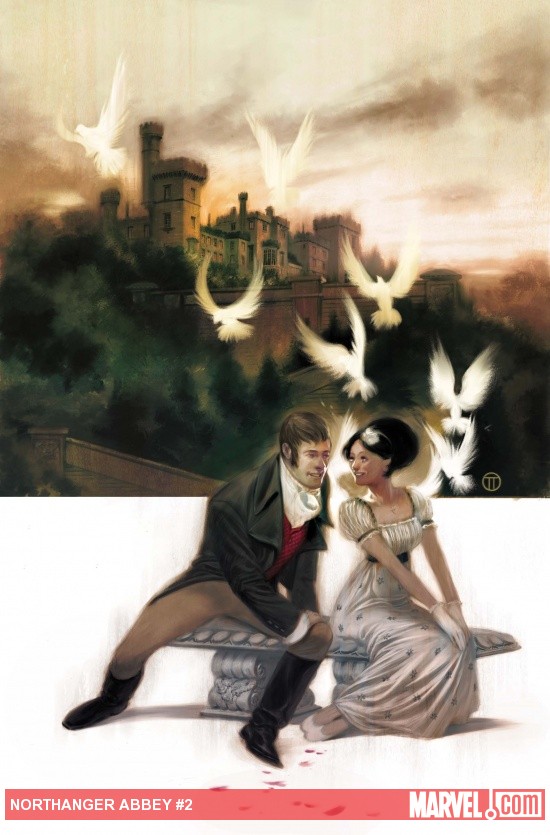
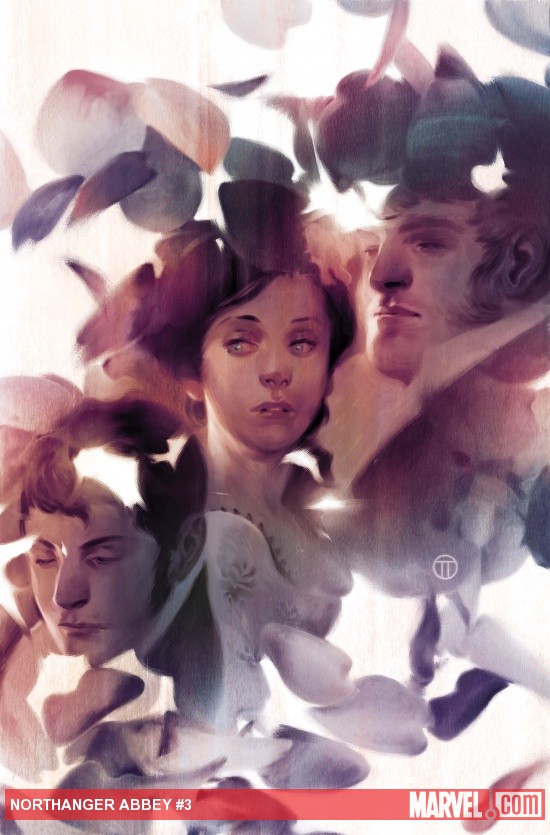
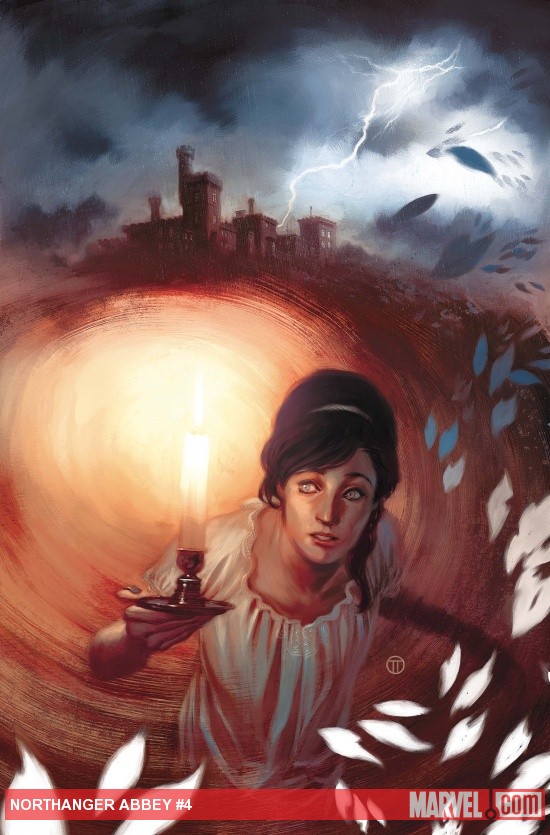
Northanger Abbey ~ Marvel Comic #5 is out!

 Jane Austen’s Northanger Abbey via Marvel Comics – all five issues are now released [No. 5 came out on March 14, 2012]~  Get thee hence to your nearest comic book shop! – Here are the five covers:

For more information on this five issue series of Northanger Abbey, visit the Marvel Comics website and scroll through the images….

[all images from the Marvel Comics website

@2012 Jane Austen in Vermont
Austen Literary History & Criticism · Jane Austen · Jane Austen Popular Culture · Jane Austen Sequels · Query

A Colonel Brandon by any Other Name?

One of the funnier lines in Emma is when Mr. Knightley asks Emma to call him “George” after he has proposed to her. We of course know he is named George because the narrator tells us so, but while we are introduced to him in Chapter 1, we do not learn his full name until Chapter 12, in this very off-hand remark: 

when John Knightley made his appearance, and “How d’ye do, George?” and “John, how are you?” succeeded in the true English style… [Emma, vol. 1, ch 12.]

We are given an earlier hint in Chapter 6 when one of John Knightley’s children is called “George”, but if you haven’t been paying attention to these very easy to miss throwaway lines, you will be happy to learn his name in vol. 3, ch. 17. 

    ‘Mr. Knightley.’ You always called me, ‘Mr. Knightley;’ and, from habit, it has not so very formal a sound. And yet it is formal. I want you to call me something else, but I do not know what.”

    “I remember once calling you ‘George,’ in one of my amiable fits, about ten years ago. I did it because I thought it would offend you; but, as you made no objection, I never did it again.”

    “And cannot you call me ‘George’ now?”

    “Impossible! I never can call you any thing but ‘Mr. Knightley.’ I will not promise even to equal the elegant terseness of Mrs. Elton, by calling you Mr. K. But I will promise,” she added presently, laughing and blushing, “I will promise to call you once by your Christian name. I do not say when, but perhaps you may guess where; — in the building in which N. takes M. for better, for worse.” [Emma vol. 3, ch. 17]
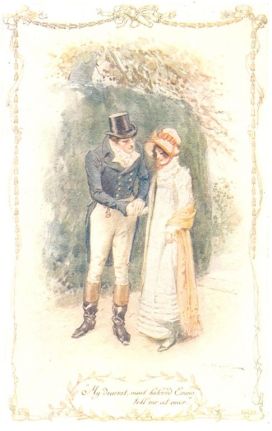
“My dearest most beloved Emma, tell me at once…” – C. E. Brock, Emma at Molland’s

But what of the other Austen heroes and their given names?:  we have George, and Edward, Edmund, Fitzwilliam, Henry, Charles, Frederick, and even Willoughby is named “John” – but it seems that Colonel Brandon is alone among her men to be first-nameless … though as you will see, no one seems to actually know this!

When I attended several of the Sense and Sensibility weekends at the Governor’s House in Hyde Park , one of the questions on the innkeeper’s very-hard-to-score-well-quiz during the brunch on Sunday, is What is Col. Brandon’s first name?  Every weekend ended with the majority of people saying “Christopher” – but it is of course a trick question:  Austen does not give her Col. Brandon a first name: you can re-read / search the book, but the surest proof is Chapman’s index of characters, where it notes thus:

Colonel BRANDON, of Delaford in Dorsetshire; thirty-five (34, 37); thirty-six (369); 2,000£ a year (196); m. Marianne Dashwood.

Now we trust Chapman because he names some of the most obscure of Austen’s characters that many of us would be at a loss to even say which book they are from …  he must be right, so why then is  “Christopher” so commonly thought of as his first name…?

Enter Popular Culture:

I was surprised a few weeks ago, and the reason I started to write this post, to notice this on Wikipedia:

Colonel Christopher Brandon — a close friend of Sir John Middleton. In his youth, Brandon had fallen in love with his father’s ward, but was prevented by his family from marrying her because his father was determined to marry her to his older brother. He was sent into the military abroad to be away from her, and while gone, the girl suffered numerous misfortunes partly as a consequence of her unhappy marriage, finally dying penniless and disgraced, and with a natural (i.e., illegitimate) daughter, who becomes the ward of the Colonel. He is 35 years old at the beginning of the book. He falls in love with Marianne at first sight as she reminds him of his father’s ward. He is a very honorable friend to the Dashwoods, particularly Elinor, and offers Edward Ferrars a living after Edward is disowned by his mother.

[From Wikipedia on S&S the Book]

Now one knows to read everything on the internet and especially Wikipedia with a wary eye, but this is a glaring error… 

If you go to The Republic of Pemberley, and its Genealogy of Characters in S&S, a very trusted source, it is very clear that his name is only Col. Brandon, as Austen wrote him.

 And what of the Sequels and Fan-Fiction?  I show here only a few, but now we are in a bit of a naming muddle…
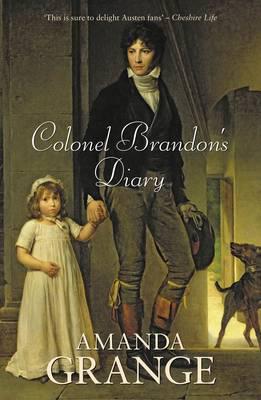
Amanda Grange calls him “James” in her Col. Brandon’s Diary
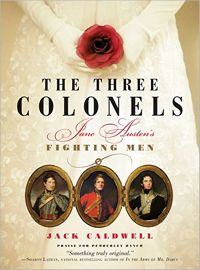
And in the new book The Three Colonels: Jane Austen’s Fighting Men, by Jack Caldwell,
we are given a very romantic Brandon complete with a “Christopher.”

 And see this Fan Fiction.net site we find Col and Mrs. Brandon by Drusilla Dax – where he is also named “Christopher.” 
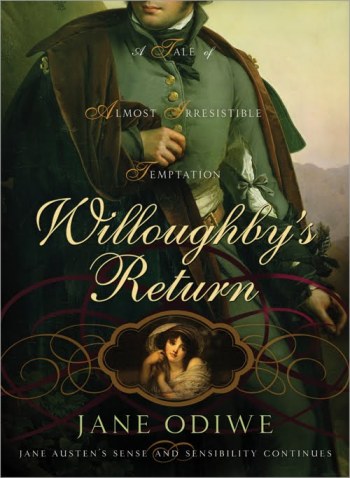
And Jane Odiwe in her Willoughby’s Return? She names her Col. Brandon “William.”

I asked her why?: 

 I named him William in Willoughby’s Return – just because I like the name, and it’s one that Jane used (William Price). I’ve always been fascinated by the fact that she used the same names for completely different characters.

I like this answer from Ms. Odiwe – she has been thoughtful in choosing a name for her Brandon. But I also want to share with you a very nasty review from an irate reader of Odiwe’s sequel – you can read the whole piece on Amazon.co.uk but here is the relevant rant [which makes the whole review seem quite ridiculous]: 

…. and not even well researched. Marianne is married to William Brandon – whoever he may be – Colonel Brandon’s Christian name was Christopher…..

I had to comment on this – I am not a big fan of really nasty reviews – I would rather say nothing at all, so I blanche at such negativity, but here I wonder if the woman has ever actually read Sense & Sensibility The Book by Jane Austen at all – she has perhaps only seen the movie? wherein we find our illusive “Christopher”…. 

… courtesy of Emma Thompson, her Col. Brandon the “Christopher” most of us seem to want!
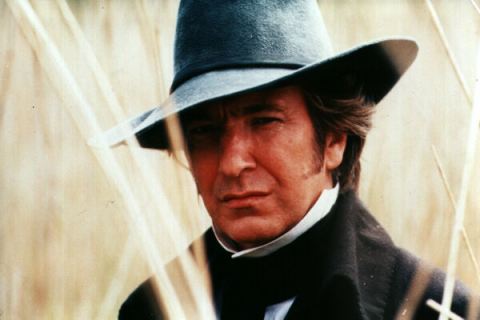
 IMDB:  Emma Thompson’s S&S

 and her Brandon, a.k.a. Alan Rickman, even has a Facebook presence as Colonel Christopher Brandon !

 So on to Andrew Davies 2008 Sense & Sensibility with David Morrissey in the role – though Davies succeeds in “sexing” up his Brandon, he does get this right – his Brandon has no first name…
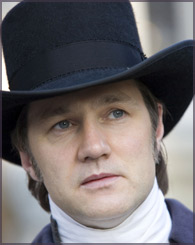
At the Masterpiece Theatre S&S site, click on Col. Brandon and “Christopher” is nowhere in sight…

We can ask what were the most used names in late 18th century England?

 Common 18th Century Male Names [from the Official Fanfiction Universityof the Caribbean website ( ! )]

Alexander, Andrew, Benjamin, Bernard, Charles, David, Edmund, Edward, Emmett, Francis, Frederick, George, Harold, Henry, Hugh, James (Jim, Jimmy, Jem), John (Johnny, Jack), Jonathan, Joseph, Julian, Louis, Matthew, Nicholas, Oliver, Paul, Peter, Phillip, Richard, Robert, Rupert, Samuel, Sebastian, Seymour, Simon, Stephen, Stuart, Thaddeus (Tad), Theodore, Thomas, Timothy, Tobias, Walter, Wesley, William

Notice how many of the names are those used by Austen!  but alas! no “Christopher” – though I am perhaps not being fair – the name has been a common one in England since the 15th century. 

So, these are just some thoughts – I am without my research tools as I write this, so wonder if in Emma Thompson’s screenplay and diaries to her Sense & Sensibility, does she mention baptizing her Brandon with the Christian name of Christopher? – does it appear in any earlier sequels, other movies? –  and the most interesting question of all? – why did Jane Austen not give him a name? – and why are we all so compelled to do so?

Please comment if you can add anything to this dilemma – and do tell us if you wanted to give Brandon a first name, what might you name him?? – just  please do not let it be “Richard”!*
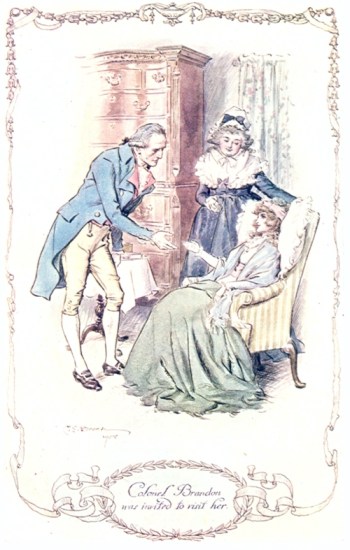
“Colonel Brandon was invited to visit her” – a C. E. Brock illus from S&S at  Molland’s

******************

*Note: Austen’s commentary on the name Richard is from Northanger Abbey: Catherine’s father is “a very respectable man, though his name was Richard.” [NA vol. 1, ch. 1]

 Copyright @2012 Jane Austen in Vermont 
Austen Literary History & Criticism · Jane Austen · JASNA-Vermont events · News · Schedule of Events

JASNA-Vermont ~ “How to Love Jane Austen’s Sanditon” ~ April 15, 2012


You are Cordially Invited to JASNA-Vermont’s April Meeting

 ~ How to Love ‘Sanditon’ ~

with


  Eric Lindstrom* 

A celebration of Jane Austen’s last unfinished work: Many readers find it difficult to “love” Sanditon. Critics and readers alike can find it alternately boring, bitter and uproariously wild, either likening it to her juvenilia or seeing only the morose shadow of her impending death. Join us as UVM Professor Eric Lindstrom helps us relate to and learn to love this text, even though it does not offer the typical Austen marriage plot. 

*****

Sunday, 15 April 2012, 2 – 4 p.m. 

 Champlain College, Hauke Conference Center, 375  Maple St Burlington VT  

Free & Open to the Public
Light refreshments served 

For more information:   JASNAVermont@gmail.com 
Please visit our blog at: http://JaneAustenInVermont.wordpress.com

************************************ 

*We are honored to welcome Eric Lindstrom, an Assistant Professor at the University of Vermont where he teaches courses primarily on Romantic Literature and Critical Theory.  He is the author of Romantic Fiat (2011), and is currently working on a study of Austen’s canny relation to philosophical developments since her time, tentatively titled “Jane Austen and  Other Minds.”

Eric Lindstrom

Please Join Us!

**************

**Upcoming in 2012 ~ see blog for details and mark your calendars!**

Ju
ne 3: Brooklyn College Professor Rachel Brownstein on her book Why Jane Austen?
Sept. 23: Author Elsa Solender on her book Jane Austen in Love: An Entertainment
Dec. 2: Annual Birthday Tea with Paul Monod of Middlebury College on
                “The Royal Navy in the Age of Nelson, 1775-1815”

*****************************

I will be shortly posting more information on Sanditon – its publishing history and criticism, and the continuations, and various links.  But please try to read this short fragment for the meeting – we promise lively discussion, but thankfully no quizzes! – think about how Austen might have completed this last work – who is the heroine, the hero? what was she trying to convey about the seaside? – many thoughts to consider, so bring your questions and ideas!

Copyright @2012 Jane Austen in Vermont