Austen Literary History & Criticism · Jane Austen · Literature · News

CFP: 200 Years of Sense & Sensibility ~ St. Andrews Conference

I am posting this on behalf of the conference organizer:  please email her directly if you have questions.

CALL FOR PAPERS:  200 YEARS OF SENSE AND SENSIBILITY
a Two Day Conference
SCHOOL OF ENGLISH, UNIVERSITY OF ST ANDREWS,
9–10 S
EPTEMBER 2011

Keynote speakers:

Kathryn Sutherland (St Anne’s College, Oxford) 

and

Paula Byrne (author of the new Harper Collins Jane Austen biography).

‘I am never too busy to think of S&S’, Jane Austen wrote to her sister, Cassandra in April 1811. The year saw the publication of her first novel and to mark the anniversary, we are hosting a conference that reflects upon two hundred years of readership and opens up new interpretations of the novel. We invite proposals for 20-minute papers and round table panels on any aspect of the novel.

Possible topics may include but are not limited to:

  • Social and historical context
  • Reception
  • Tradition of Sensibility/contemporary aesthetic theory
  • Literary influences
  • Sibling relationships
  • Feminist readings
  • Adaptations and appropriations
  • Re-writings and sequels
  • The novel’s place in the canon

Please send abstracts of no more than 250 words to the conference organisers, Marina Cano López and Rose Pimentel, at 200sensibilities [at] gmail [dot] com

Please also email us with any questions at the above address. The deadline for proposals is 30 June 2011

For more information, please visit:

http://www.st-andrews.ac.uk/200sensibilities 

University of St. Andrews
Austen Literary History & Criticism · Jane Austen

Secrets in Sense & Sensibility at ‘My Jane Austen Book Club’

The year of celebrating Sense & Sensibility at the blog My Jane Austen Book Club continues this month with my post on “Secrets in Sense & Sensibility”:

“Come, come, let’s have no secrets among friends.”


[Image: Vintage Classics cover]

Mrs. Jennings may request “no secrets among friends,” and Marianne may “abhor all concealment” (p. 53), but Sense and Sensibility is chock full of both – many secrets, much concealed – within each character, between characters, and between the author and the reader

P. D. James, in her essay “Emma Considered as a Detective Story,” defines the detective story as one “requiring a mystery, facts which are hidden from the reader but which he or she should be able to discover by logical deduction from clues inserted in the novel with deceptive cunning but essential fairness.  It is about evaluating evidence…it is concerned with bringing order out of disorder and restoring peace and tranquility to a world temporarily disrupted by the intrusions of alien influences” (James, p. 243-44)  

Such is Emma, truly a mystery, where Jane Austen gives us clues and puzzles and hints along the way, whereby we the reader can solve the underlying mystery right along with Mr. Knightley, who gets awfully close, but not quite close enough, to the solution….

… Continue reading at My Jane Austen Book Club

***************************

The Giveaway: You can comment either here or on Maria Grazia’s blog to be entered into the giveaway:

Can you remember the first time you read Sense and Sensibility? What secret in the novel most surprised you?
 
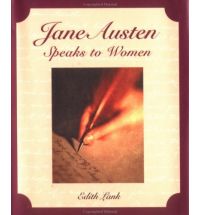
Random drawing for one of my favorites of the numerous Jane Austen gift books:  Jane Austen Speaks to Women, by Edith Lank (2000) . As usual, please, don’t forget to add your e-mail address to your comment.
 
The giveaway is open worldwide . Winner will be announced on June 30th.


“Elinor agreed to it all, for she did not think he deserved the compliment of rational opposition.”  [Elinor in Sense & Sensibility
 
*******************************

The monthly S&S posts on Maria’s blog can be viewed here:

1. January:  Jennifer Becton    Men, Marriage and Money in Sense and Sensibility
2. February:  Alexa Adams        Sense and Sensibility on Film
3. March:  C. Allyn Pierson   Property and Inheritance Law in S &S
4. April:  Beth Pattillo    Lost in Sense and Sensibility
5. May:    Jane Odiwe   Willoughby: a rogue on trial
6. June:   Deb @JASNA Vermont  Secrets in Sense and Sensibility
7. July:   Laurie Viera Rigler   Interview with Lucy Steele
8. August:  Regina Jeffers     Settling for the Compromise Marriage
9. September:   Lynn Shepherd The origins of S&S: Richardson, Jane Austen, Elinore & Marianne                            
10. October:   Meredith @Austenesque Reviews   Sense and Sensibility fanfiction
11. November:  Vic @Jane Austen’s World  Minor characters in Sense and Sensibility
12. December:   Laurel Ann @Austenprose  Marianne Dashwood: A passion for dead Leaves and other Sensibilities                

[Copyright @2011 by Deb Barnum of Jane Austen in Vermont]

Austen Literary History & Criticism · Books · Jane Austen · Literature · Publishing History · Rare Books

Austen on the Block! ~ Sotheby’s June 17, 2011

The exciting news this past week on the impending sale of the manuscript pages of Jane  Austen’s The Watsons certainly sent most us into a mild depression about how unattainable such a piece is for most of us. But today, Sotheby’s has made its New York June 17th auction of Fine Books and Manuscripts available online, and I see there are several Austen titles up for sale, still perhaps unattainable for most of us, but a little more reasonable just the same… again, one can only lament how Austen struggled to earn a pittance for her labors, and how Cassandra sold all the copyrights believing that her sister’s popularity had crested as she sank rather rapidly into obscurity!  Aah! Hindsight!

Here are the six lots for sale ~ you can go to the Sotheby’s website for more information on these lots and how to bid online:   

 Sotheby’s Sale No. NO8755: Fine Books and Manuscripts

LOT 5

Pride and Prejudice: A Novel. London: T. Egerton, 1813

3 volumes, 12mo (6 3/4 x 4 in.; 170 x 100 mm). Half-titles; light, scattered staining in all 3 vols. but withal a clean copy, a few short marginal tears in vol. 1, oxidized catchword in 1:O8, paper creased in lower right corner of 2:F1 and so printed. Contemporary mottled calf, smooth spines with gilt rules resembling chained links; spine labels lacking on vols. 1–2, vol. 1 boards detached, joints starting on vols. 2–3, craquelure on spines, minor loss to head of spine of vol. 3.   25,000—35,000 USD

 LOT 50


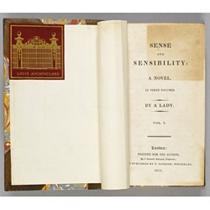
Sense and Sensibility. London: Printed for the Author and published by T. Egerton, 1811 

3 volumes, 12mo (6 3/8 x 3 7/8 in.; 161 x 98 mm). Lacks half-title in vol. 1 and terminal blanks in all 3 vols., half-title guarded in vol. 3, strong offsetting from morocco library label in vol. 1 to title-page, washed and pressed with residual foxing and staining throughout vol. 1, quires A–F in vol. 2, and quire B in vol. 3. Sympathetically bound in half mottled calf antique over marbled boards, spines in 6 compartments, russet and black lettering and numbering pieces, plain endpapers, edges uniformly marbled with boards.  15,000—25,000 USD

LOT 51

Pride and Prejudice: A Novel. London: T. Egerton, 1813

3 volumes, 12mo (6 3/4 x 4 1/16 in.; 170 x 104 mm). Lacks all half-titles, washed and pressed with residual staining and browning but less pronounced in vols. 2–3, strong offsetting from morocco label and binding to title-page and B1 in vol. 1, offsetting from binding to title-pages and terminal leaves in vols 2–3, short tears to inside lower left corners in vol. 1, quire B. Modern half black calf over marbled boards, spines in 6 compartments, red morocco labels, endpapers and edges plain.  10,000—15,000 USD

 LOT 52
Mansfield Park.London: Printed for T. Egerton, 1814

3 volumes, 12mo (7 x 4 in.; 175 x 100 mm). Lacking final blanks in vols. 2–3 and all 3 half-titles, long tears at 1:P12 costing at least 4 words, quire 1:Q loose, long tear in 2:C1 touching 5 lines, small perforations in gutters of 3:C3–6, title-page tipped in vol. 3, occasional light staining, chiefly marginal, a few short tears. Modern brown buckram, black morocco spine labels, plain endpapers and edges.  6,000—8,000 USD

 LOT 53

Emma: A Novel. London: Printed for John Murray, 1816

3 volumes, 12mo (6 3/4 x 4 1/8 in.; 170 x 104 mm). Half-titles; washed and pressed with some residual foxing and staining, particularly to half-titles, short split to vol. 1 half-title near gutter. Half mottled calf, marbled boards, spines in 6 compartments (2 reserved for lettering pieces), the others ornamented with gilt marguerites and floral cornerpieces, plain endpapers, top edges gilt; joints and spine ends a trifle rubbed, endpapers renewed. Blue holland paper slipcase; faded and stained.  10,000—15,000 USD

LOT 54

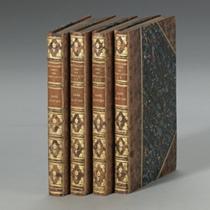
Northanger Abbey: and Persuasion. London, John Murray, 1818

4 volumes, 12mo (6 3/4 x 4 1/8 in.; 170 x 104 mm). Lacking half-titles in vols. 2–4 and blanks P7,8 in vol. 4 called for by Gilson, marginal offsetting to title-pages from bindings, washed and pressed with some residual toning and foxing. Uniformly bound with Emma (see previous lot); joints rubbed. Blue holland paper slipcase; faded and stained.   6,000—8,000 USD

Go in and browse the online catalogue – there are amazing items in this sale: Dickens, Bronte, Dickinson, Beatrix Potter and Arthur Rackham, Steinbeck letters,  Mark Twain, and so much more !

[Images and description text from the Sotheby’s catalogue]

Copyright @2011 by Deb Barnum, of Jane Austen in Vermont 
Austen Literary History & Criticism · Jane Austen · Literature · News · Rare Books

On the Block! ~ Jane Austen’s The Watson’s

Breaking news from The Guardian:  [and now all over the blogsphere!]

Jane Austen rare manuscript
up for sale

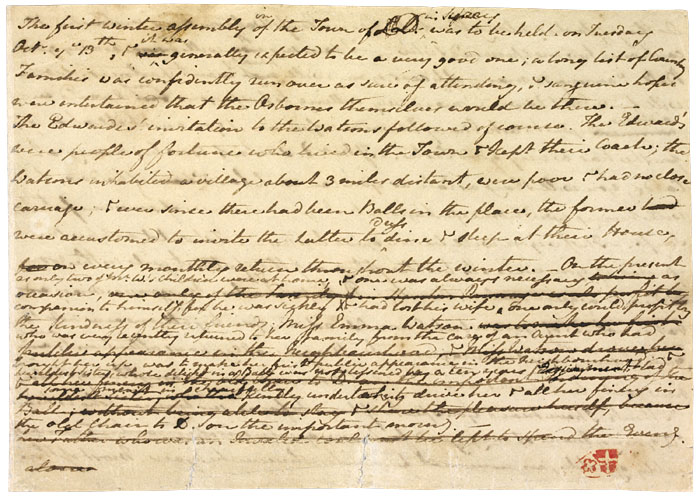
A rare, handwritten manuscript of Jane Austen’s unfinished novel The Watsons is to be sold at auction at Sotheby’s in London.

by Mark Brown, The Guardian, May 20, 2011

An incredibly rare handwritten manuscript of an unfinished novel by Jane Austen – the only one that is still in private hands – is to appear at auction inLondon.

The neatly written but heavily corrected pages are for her unfinished work The Watsons, a novel which many believe could easily have been as good as her six completed works.

Gabriel Heaton, Sotheby’s senior specialist in books and manuscripts, said it was “a thrill and privilege” to be selling it: “It is very exciting. This is the most significant Austen material to come on the market since the late 1980s.”

It is unquestionably rare. Original manuscripts of her published novels do not exist, aside from two cancelled chapters of Persuasion in the British Library.

The novel is considered around a quarter completed and the manuscript has 68 pages – hand-trimmed by Austen – which have been split up into 11 booklets.

It is most but not all of Austen’s unfinished novel. The first 12 pages were sold by an Austen descendent during the first world war to help the Red Cross and are now in New York’s Pierpont Morgan Library, while the next few pages were inexplicably lost by Queen Mary, University of London which has been looking after the manuscript.

The college’s director of library services Emma Bull said it happened six years ago, before she arrived, and had resulted in a full investigation which, alas, “did not really come to any firm conclusions about what specifically happened.” There had been a hope that they would turn up, but clearly that is now highly unlikely.

The Watsons manuscript shows how Austen’s other manuscripts must have looked. It also shines an interesting light on how she worked. Austen took a piece of paper, cut it in two and then folded over each half to make eight-page booklets. Then she would write, small neat handwriting leaving little room for corrections – of which there are many. “You can really see the mind at work with all the corrections and revisions,” said Heaton.

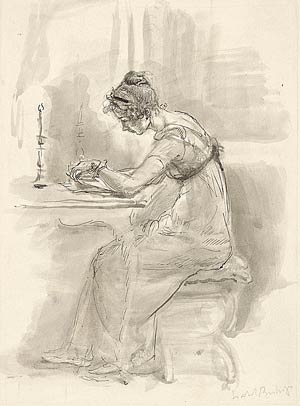
Scene from Pride & Prejudice, by Isabel Bishop - Morgan Library

At one stage she crosses so much out that she starts a page again and pins it in. It seems, in Austen’s mind, her manuscript had to look like a book. “Writers often fall into two categories,” said Heaton. “The ones who fall into a moment of great inspiration and that’s it and then you have others who endlessly go back and write and tinker. Austen is clearly of the latter variety. It really is a wonderful, evocative document.”

The Watsons was written in 1804, not a hugely happy time for Austen professionally – she had one novel rejected and another bought by a publisher who failed to print it.

It was also a difficult time personally and one reason it was not finished may be because fact came too close to the fiction. The Watsons heroine is Emma, one of four sisters who are daughters of a sick and widowed clergyman. The novel would have had the father die leaving Emma in a precarious financial position. In real life, Austen’s clergyman father died leaving her in a similar pickle to her fictional heroine.

Had Austen completed The Watsons there are many who believe it would have been a classic. Margaret Drabble described it as “a tantalising, delightful and highly accomplished fragment, which must surely have proved the equal of her other six novels, had she finished it.”

The manuscript was bought by the present owner in 1988 when it was sold by the British Rail Pension Fund. It had been bought from Austen descendents in the 1970s when manuscripts, rare books and fine art seemed like perfectly sensible things for nationalised pension funds to buy.

The manuscript has been valued at £200,000 to £300,000 and will be sold at Sotheby’s in London on 14 July.

You can see this page from The Watsons at the Pierpont Morgan Library’s online exhibition A Woman’s Wit: Jane Austen’s Life and Legacy:

[Image:  The Watsons,  Pierpont Morgan Library Online Exhibition]

The Sotheby’s auction page is here, English Literature & History, Sale No. L11404, though there are no details yet online.  I will keep you posted! – and more on The Watsons in the coming weeks… you can read it online here at The Republic of Pemberley or a PDF version here,  or learn more about it here at Jane Austen’s Fiction Manuscripts where you can also read along with the digitized copy.

Copyright @2011 by Deb Barnum, of Jane Austen in Vermont
Austen Literary History & Criticism · Books · Jane Austen · Regency England · Social Life & Customs

Susannah Fullerton on Jane Austen and Crime ~ An Audio Lesson

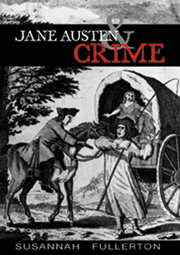
The ABC Sydney, Australian Broadcasting Corporation, has posted online its weekly “Self-Improvement Wednesday.”  This week’s lesson is an 11 minute chat on “Jane Austen’s  Crime” with Susannah Fullerton, the JASA President and author of the fabulous Jane Austen & Crime.

You can listen to the audio and then take the quiz to test your retention skills here:  http://www.abc.net.au/local/audio/2011/05/04/3207499.htm?site=sydney

Enjoy this very quick and entertaining run through all the possible crimes in Georgian England as seen in Austen’s writings:  adultery and crim con, dueling, prostitution, murder, elopement, rape, theft, smuggling, gaming, and the various punishments.  Better yet, read the book! [you can read my review here.]

Copyright @2011 by Deb Barnum, of Jane Austen in Vermont
Austen Literary History & Criticism · Jane Austen · Jane Austen Popular Culture · News · Regency England · Social Life & Customs

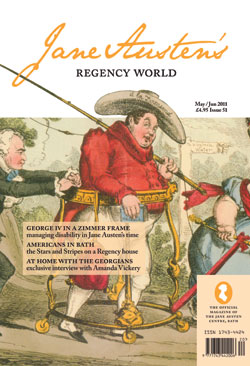
Coming Soon to Your Mailbox! ~ Jane Austen’s Regency World Magazine Issue 51

The May/June 2011 issue [ Number 51] of Jane Austen’s Regency World magazine is now on sale and has been mailed to subscribers.

In the new issue: 

  • Americans in Bath ~ Celebrating 50 years of the American Museum in Britain
  •  Battle Wounds and Bedlam ~ Living with illness in Georgian times 
  •  Loitering with James ~ Maggie Lane asks if Jane Austen helped her brother with his periodical, The Loiterer
  •  Amanda Vickery Interview ~ Meet the academic who has brought the Georgians to life on TV
  •  Correspondence Culture ~ Kelly M McDonald* on the art of letter writing
  •  Our Chawton Home ~ Louise West on her plans for Jane Austen’s House Museum
  •  Fantastic Ferens ~ The Canaletto on display in the Ferens Gallery, Hull

Plus: All the latest news from the world of Jane Austen, as well as Letters, Book Reviews, the always difficult Quiz, a Competition,  and Jottings from JAS and JASNA.

For further information, and to subscribe, visit: www.janeaustenmagazine.co.uk

*We are very pleased to see that our very own JASNA-Vermont member Kelly McDonald has another article in JARW – congratulations Kelly! You can follow Kelly on her blog Two Teens in the Time of Austen.

Copyright @2011 by Deb Barnum, of Jane Austen in Vermont
Austen Literary History & Criticism · Books · Collecting Jane Austen · Jane Austen · Literature · News

Your Austen Library ~ ‘A Jane Austen Education’


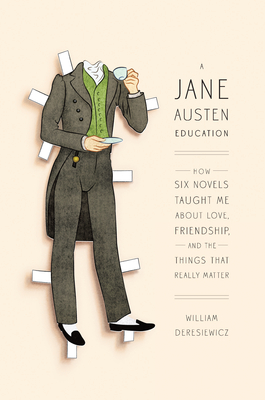
In A Jane Austen Education, Austen scholar William Deresiewicz turns to the author’s novels to reveal the remarkable life lessons hidden within. With humor and candor, Deresiewicz employs his own experiences to demonstrate the enduring power of Austen’s teachings. Progressing from his days as an immature student to a happily married man, Deresiewicz’s A Jane Austen Education is the story of one man’s discovery of the world outside himself.

A self-styled intellectual rebel dedicated to writers such as James Joyce and Joseph Conrad, Deresiewicz never thought Austen’s novels would have anything to offer him. But when he was assigned to read Emma as a graduate student at Columbia, something extraordinary happened. Austen’s devotion to the everyday, and her belief in the value of ordinary lives, ignited something in Deresiewicz. He began viewing the world through Austen’s eyes and treating those around him as generously as Austen treated her characters. Along the way, Deresiewicz was amazed to discover that the people in his life developed the depth and richness of literary characters-that his own life had suddenly acquired all the fascination of a novel. His real education had finally begun.

Weaving his own story-and Austen’s-around the ones her novels tell, Deresiewicz shows how her books are both about education and themselves an education. Her heroines learn about friendship and feeling, staying young and being good, and, of course, love. As they grow up, they learn lessons that are imparted to Austen’s reader, who learns and grows by their sides.

A Jane Austen Education is a testament to the transformative power of literature, a celebration of Austen’s mastery, and a joy to read. Whether for a newcomer to Austen or a lifelong devotee, Deresiewicz brings fresh insights to the novelist and her beloved works. Ultimately, Austen’s world becomes indelibly entwined with our own, showing the relevance of her message and the triumph of her vision.

A Jane Austen Education: How Six Novels Taught Me About Love, Friendship, and the Things That Really Matter

ISBN 9781594202889
272 pages
Release date: 28 Apr 2011
The Penguin Press:  available in hardover for $25.95;  ebook / adobe reader for $12.99

About the author:   

William Deresiewicz was an associate professor of English at Yale University until 2008 and is a widely published literary critic who writes for a popular audience. His reviews and criticism regularly appear in The New Republic, The Nation, The American Scholar, the London Review of Books, and The New York Times. In 2008 he was nominated for a National Magazine Award for reviews and criticism.

Text From the  publisher’s website:  Penguin Press

Deresiewicz also authored Jane Austen and the Romantic Poets  (Columbia UP, 2005)

He will be conducting a blog tour as follows:  info from TLC Book Tours]

Copyright @2011 by Deb Barnum, at Jane Austen in Vermont
Austen Literary History & Criticism · Jane Austen

Auden on Austen

No April Fool’s Day post here – just the usual first day of the month “Rabbit, Rabbit, Rabbit'” salute to one and all!

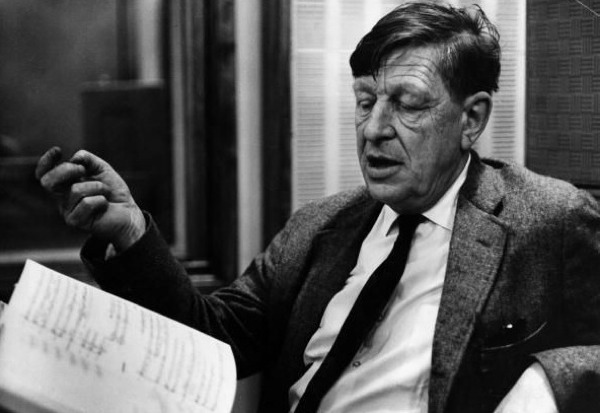
Will share this very oft-quoted poem of W. H. Auden where he expresses his views on Jane Austen : 

**********************

Letter to Lord Byron

…There is one other author in my pack
For some time I debated which to write to.
Which would least likely send my letter back?
But I decided I’d give a fright to
Jane Austen if I wrote when I’d no right to,
And share in her contempt the dreadful fates
Of Crawford, Musgrove, and of Mr. Yates.

Then she’s a novelist. I don’t know whether
You will agree, but novel writing is
A higher art than poetry altogether
In my opinion, and success implies
Both finer character and faculties
Perhaps that’s why real novels are as rare
As winter thunder or a polar bear.

The average poet by comparison
Is unobservant, immature, and lazy.
You must admit, when all is said and done,
His sense of other people’s very hazy,
His moral judgements are too often crazy,
A slick and easy generalization
Appeal too well to his imagination.

I must remember, though, that you were dead
Before the four great Russians lived, who brought
The art of novel writing to a head;
The help of Boots had not been sought.
But now the art for which Jane Austen fought,
Under the right persuasion bravely warms
And is the most prodigious of the forms.

She was not an unshockable blue-stocking;
If shades remain the characters they were,
No doubt she still considers you as shocking.
But tell Jane Austen, that is if you dare,
How much her novels are beloved down here.
She wrote them for posterity, she said;
‘Twas rash, but by posterity she’s read.

You could not shock her more than she shocks me;
Beside her Joyce seems innocent as grass.
It makes me most uncomfortable to see
An English spinster of the middle-class
Describe the amorous effects of ‘brass’,
Reveal so frankly and with such sobriety
The economic basis of society…

***************

Auden ends this lengthy poem with:

 …I hope this reaches you in your abode,
This letter that’s already far too long,
Just like the Prelude or the Great North Road;
But here I end my conversational song.
I hope you don’t think mail from strangers wrong.
As to its length, I tell myself you’ll need it,
You’ve all eternity in which to read it.

*****************

From “Letter to Lord Byron”, Letters from Iceland, London: Faber and Faber, 1937.  Revised text in Longer Contemporary Poems, Penguin, 1966.

You can read the full text here.

Copyright @2011, by Deb Barnum, of Jane Austen in Vermont. 
Austen Literary History & Criticism · Books · Jane Austen · Jane Austen Popular Culture · News · Publishing History

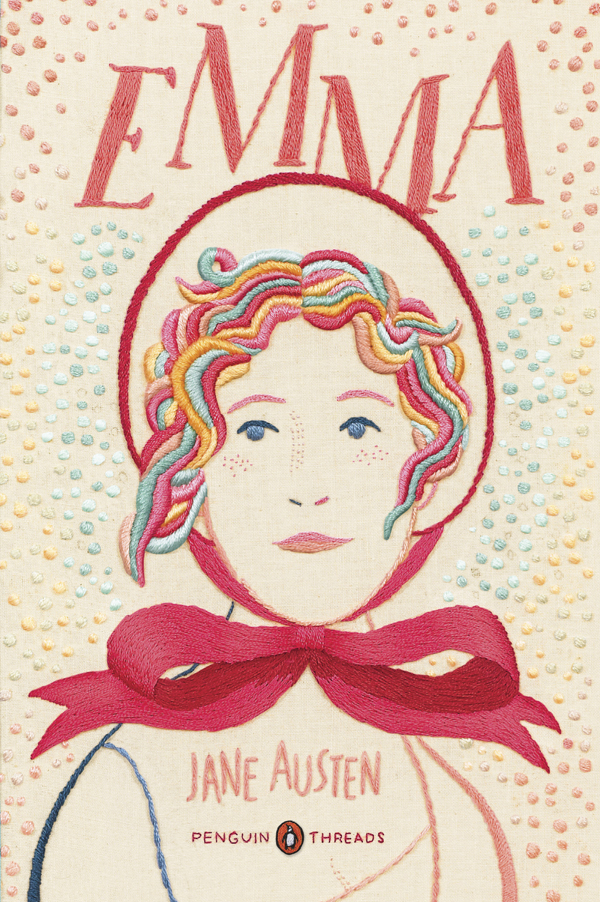
Penguin’s Newest ‘Emma’ ~ the Thread Series

Penguin Classics will be publishing a new edition of Emma in the Fall, this time with cover art by Jillian Tamaki, as part of its Penguin Threads series [Black Beauty and A Secret Garden will also be released.]

and just the front with more detail:

[Source:  Atlantic.com]

See also Tamaki’s “Sketchblog” for details on the process and the other book covers.  Just lovely, don’t you think? [especially if you do handiwork…]

Copyright @2011, by Deb Barnum at Jane Austen in Vermont
Austen Literary History & Criticism · Books · Collecting Jane Austen · Jane Austen · Jane Austen Popular Culture · Literature · Publishing History

An ‘Enhanced’ Pride & Prejudice ebook

OOPS! – I got this news as a ‘google alert’, and now thanks to Raquel see that it came out in 2008!  I had checked the Penguin site and saw nothing of this “news” and now see that it did indeed come out in May 2008! – Sorry for the error – in a rush – thought it was great news! Still might be for those who don’t already know this! [like me! – I don’t use my ebook reader a whole lot as you can tell!]

So here is the very interesting but old news!:
_____________________________________________

Penguin launches ‘enhanced’ e-book classics:

Penguin Group (USA) is to launch an e-book of Jane Austen’s Pride and Prejudice with multiple added features as the first title in its Penguin enhanced e-books classics list. The e-book, coming in May, will feature:

  • Filmography
  • Nineteenth-Century Reviews
  • Chronology
  • Further Reading
  • What Austen Ate
  • How to Prepare Tea
  • Austen Sites to Visit in England
  • Map of Sites from the Novel
  • Behaving Yourself: Etiquette and Dancing in Austen’s Day
  • Illustrations of Fashion, Home Décor, Architecture, and Transportation
  • Enriched eBook Notes

The publisher says it will offer “a wonderful e-book reading experience”. Nine further classics titles, including Wuthering Heights, Frankenstein and Great Expectations, will follow in the autumn, with plans “underway” to launch the list in the UK.

John Makinson, chair and c.e.o. of the Penguin Group, said: “The e-book is gaining acceptance as an alternative to the printed text and we are keen to test the possibilities of the electronic format. Penguin Classics is a great place to start. We shall invite readers beyond the pages of these much-loved books, offering additional background, context and insight into the work.”

[Text from The Bookseller.com and Penguin]

Guess I should fire up my Kindle…

Copyright @2011, by Deb Barnum, at Jane Austen in Vermont