Book reviews · Books · Jane Austen · Jane Austen Sequels

Guest Post ~ Author Maya Slater

book cover private diary darcyGentle Readers:   Maya Slater has penned a guest post for us on her book The Private Diary of Mr Darcy  – and as I mention in my previous post, it is quite an entertaining read!  Thank you Ms. Slater for sharing your thoughts with us [and those of Mr. Darcy!]


INTRODUCING:  The Private Diary of Mr Darcy, the American edition to be published on June 15th by W.W.Norton.

 ‘What book would you most love to read, if only it had been written?’

I found myself answering, without hesitation, ‘Oh, Mr Darcy’s diary.’ Everyone round the table laughed, and the moment passed. But the idea stayed with me for months, till finally I had to give in to it, and start writing.

It’s not as though Mr Darcy was the kind of man to have kept an intimate diary of his own volition. He started it as a child when his mother gave him a moleskin notebook, gently suggesting he should make it his confidant. A few days later she was dead, and keeping a diary became a sacred duty to him.

The final volume of his diary, published under the title The Private Diary of Mr Darcy*, begins on the day that he first sets eyes on Elizabeth Bennet – although she makes no impression on him whatsoever. It concludes as they happily plan their wedding. In between, he unburdens himself of many secrets, and lives through the weeks and months when he is absent from Pride and Prejudice: that first winter when Mr Bingley has deserted Jane, the following summer when Elizabeth has turned him down, the anxious search for Lydia and Wickham.

 Of course the diary is private. Much of what it contains would shock his female acquaintance, describing as it does his life as a rich bachelor about town.   His gentlemen friends too would be astonished – at the uncertainties, weaknesses and powerful emotions confided by this politely reticent and formal young man. It is not surprising that he decides to abandon it when he marries: it would not do for his wife to discover it.

Throughout, it is Mr Darcy who has directed operations; I have merely followed where he led.

 MAYA SLATER 

*The British edition (Phoenix, 2007) was titled Mr Darcy’s Diary.

[ See also the full Maya Slater interview at Bookzone.tv  [type in < Maya Slater > in the “search video” box and click on the book cover]  and my previous post with additional links here ]

The opening question, by the way, is quite thought-provoking – anyone want to add their thoughts? –

What book would you most love to read, if only it had been written?

Book reviews · Jane Austen · Literature · Women Writers

Book Review ~ ‘North and South’ by Elizabeth Gaskell [with special thanks to Richard Armitage]

North-and-South cover

I think I must be the only costume-drama-loving-female in all of America who did not see the 2004 (2005 USA) adaptation of Elizabeth Gaskell’s North and South – where my head was that year I do not know – and add to that a further confession of never having read the book! – I am ashamed of myself!  Can I have lived this long so in the dark?  Are my English degrees so worthless in the light of this omission? 

I have a good number of Gaskell’s books on my shelves, but there they sit awaiting that future day to begin my Gaskell immersion.  But all this endless chatter on the airwaves [as well as a few friends imploring me to see the movie – largely a Richard Armitage thing…],  I finally broke one of my cardinal rules – I saw the movie before reading the book.  There were advantages of course to this sequence – every appearance of John Thornton on the page most pleasantly brought the absolutely lovely Mr. Armitage to mind – not a bad punishment for breaking this long-held rule of mine! – but I digress…

 The story [for those of you more in the sand than me…] – Margaret Hale, a young woman from rural southern England [Austen’s Hampshire to be exact], daughter of a clergyman, proud of her roots and her class, must adjust to the changes in her life when her father resigns from his clerical post and moves the family to the northern industrial town of Milton [Gaskell’s fictitonalized Manchester].  Margaret gradually discovers her own strengths in taking on the many domestic duties of her now ill mother and those of their former servants.  But Margaret carries with her the prejudices of the gentrified South with her “queenly” snobbish views of the industrial North and the manufacturers and tradesmen who run the mills.  She is soon introduced to John Thornton, a self-made “Master” of one of the cotton mills and a local magistrate, well respected by his peers and his employees, yet aware of his shortcomings in the social and intellectual worlds outside of Milton.  He comes to Reverend Hale for tutoring and intellectual stimulation – but it is Margaret who soon captures his heart, his passions aroused in spite of himself, all too sure of his own unworthiness in her eyes…

n&s- margaret

Margaret opened the door and went in with the straight, fearless, dignified presence habitual to her.  She felt no awkwardness; she had too much the habits of society for that.  Here was a person come on business to her father; and, as he was one who had shown himself obliging, she was disposed to treat him with a full measure of civility.  Mr. Thornton was a good deal more surprised and discomfited than she.  Instead of a quiet, middle-aged clergyman, a young lady came forward with frank dignity – a young lady of a different type to most of those he was in the habit of seeing.  Her dress was very plain: a close straw bonnet of the best material and shape, trimmed with white ribbon; a dark silk gown, without any trimming or flounce; a large Indian shawl, which hung about her in long heavy folds, and which she wore as an empress wears her drapery.  He did not understand who she was, as he caught the simple, straight, unabashed look, which showed that his being there was of no concern to the beautiful countenance, and called up no flush of surprise to the pale ivory of the complexion.  He had heard that Mr. hale had a daughter, but he had imagined that she was a little girl …  Mr. Thornton was in habits of authority himself, but she seemed to assume some kind of rule over him at once…. [p 72-3]   He almost said to himself that he did not like her, before their conversation ended; he tried so to compensate himself for the mortified feeling, that while he looked upon her with an admiration he could not repress, she looked at him with proud indifference, taking him, he thought for what, in his irritation, he told himself he was – a great rough fellow, with not a grace or a refinement about him.  Her quiet coldness of demeanour he interpreted into contemptuousness, and resented it is his heart … [p.74]

 And Margaret’s view of Thornton:

 “Oh! I hardly know what he is like,” said Margaret lazily; too tired to tax her powers of description much.  And then rousing herself, she said, “He is a tall, broad-shouldered man, about- how old, papa?”…  “About thirty, with a face that is neither exactly plain, nor yet handsome, nothing remarkable – not quite a gentleman; but that was hardly to be expected.”… “altogether a man who seems made for his niche, mamma; sagacious and strong, as becomes a great tradesman.”
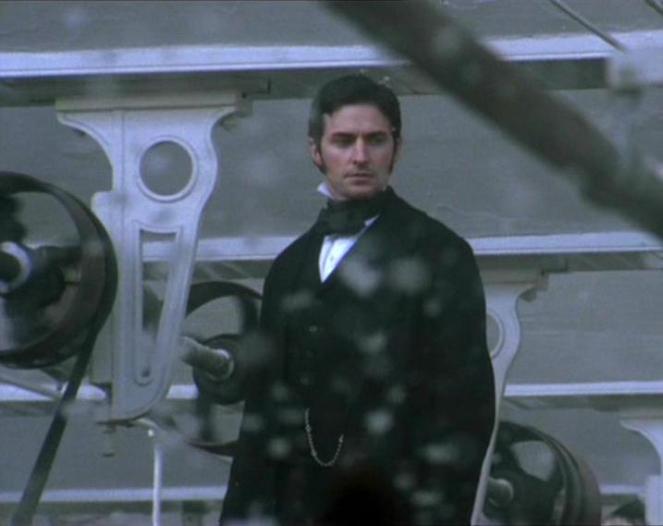
n&s first look


 Ahh!  the pride and prejudices are set on each side, each thwarting their developing relationship – and a scenario not unlike Austen’s Pride & Prejudice unfolds.  Margaret’s ingrained dislike of northern ways are gradually tempered by her sympathetic friendship with a family of mill workers and her growing appreciation for Thornton’s true nature;  and Thornton’s own views of his employees and his responsibility to them are enlarged by Margaret’s very “democratic” views of an industrialized social system gone awry.  It is a compelling read – [alert! there are some spoilers here ]– 

Gaskell wrote North and South in 1854-5 – it appeared in serialized novel form in Dickens’s Household Words [Gaskell felt the ending was “unnatural” and “deformed” (1) – she added and edited for its publication as a book in 1855].  North and South is another of her works to focus on the social ills of the day – religious doubt; “Master” vs. hands and accompanying union struggles; male vs. female in the male-dominated industrial world; the responsibility of the owner / ruling classes to involve themselves in the lives of the less fortunate.  But this novel has a more romantic telling than her previous works and perhaps why it remains one of her most enduring titles.. [ See my previous post on Gaskell for some background.] 

And this comparison to Austen’s Pride & Prejudice cannot be ignored [just the title alone echoes Austen’s work] — Jenny Uglow in her introduction to the book (2) and in her fabulous biography of Gaskell (3) called North and South an “industrialized Pride & Prejudice,” “sexy, vivid and full of suspense” (4) – and indeed this states the case most eloquently.  At last year’s JASNA AGM in Chicago on Austen’s legacy, Janine Barchas spoke on Gaskell’s North and South being the first of many Pride & Prejudice clones (5).  The basic formula of P&P is what keeps people coming back for more, an annual re-read one of life’s many pleasures – and one can readily make a list of the similarities, all too clear despite Gaskell’s never making mention of her debt to Austen – this conflict of pride and prejudices, though often a gender reversal in Gaskell’s work [see Barchas’s article for a complete analysis of Margaret as Darcy and Thornton as Elizabeth], the awakening of their passions, and the emotional growth of Margaret and Thornton, the similarities in the secondary characters [Thornton’s sister Fanny is certainly as silly as Lydia; Mrs. Thornton’s visit to Margaret is almost a word for word Lady Catherine exhorting Elizabeth]; Thornton anonymously saving Margaret from a shameful exposure just as Darcy saves Elizabeth by forcing Wickham to do right by Lydia; and a final resolution of two people who finally overcome their own limited mindsets;  and of course the turning point in both novels is the proposal scene, halfway through each book, the language similar, the devastating results the same.

But in Austen, who never felt comfortable with writing what she did not know, the mind of Darcy is never fully exposed to the reader [and the reason for the endless stream of sequels from Darcy’s point of view! –  and also why the Andrew Davies adaptation with a glaring, agonized Colin Firth has such a strong hold on us all…] – but Gaskell was no prim Victorian in bringing the thoughts of Thornton to the page – he is clearly obsessed with Margaret from their first meeting noted above –  and when he is visiting the Hales for tea, he focuses relentlessly on her arm and her bracelet: 

She stood by the tea-table in a light-coloured muslin gown, which had a good deal of pink about it.  She looked as if she was not attending to the conversation, but solely busy with the tea-cups, among which her round ivory hands moved with pretty, noiseless daintiness.  She had a bracelet on one taper arm, which would fall down over her round wrist.  Mr. Thornton watched the replacing of this troublesome ornament with far more attention that he listened to her father.  It seemed as if it fascinated him to see her push it up impatiently until it tightened her soft flesh; and then to mark the loosening – the fall.  He could almost have exclaimed – “there it goes again!”  [p. 95]

Thornton watches her, listens to her, seeks her out, thinks of her all the time, and only when he believes he must protect her virtue does he express these pent-up feelings to her.  Her rejection of him is devastating, though only unexpected because he believes she can do no less than submit to him – Gaskell clearly gives us a picture of a passionate, inconsolable man, almost beautiful in his agony – we do not need an Andrew Davies to draw this picture for us.  It is as though Gaskell needed to put some finishing touches on the Darcy of our imaginations…

His heart throbbed loud and quick.  Strong man as he was, he trembled at the anticipation of what he had to say, and how it might be received.  She might droop, and flush, and flutter to his arms, as her natural home and resting-place.  One moment he glowed with impatience at the thought that she might do this – the next he feared a passionate rejection, the very idea of which withered up his future with so deadly a blight that he refused to think of it…

He offers his love, she rejects him:

 “Yes, I feel offended.  You seem to fancy that my conduct of yesterday was a personal act between you and me; and that you come to thank me for it, instead of perceiving, as a gentleman would – yes! a gentleman,” she repeated….. – he says she does not understand him; she says “I do not care to understand” –  [p.242-3] … and she afterward thinks, “how dared he say that he would love her still, even though she shook him off with contempt?” [p.245]


As only Hollywood [and the BBC] can do, there is the usual mucking about with the novel – a few changes [how they first meet, how they at last connect for starters!],  deletions and insertions, a few character shifts, to make the movie more palatable to a contemporary audience – and though one can always quibble with the results of these probable midnight discussions [and I so often ask – WHY did they DO that?  Why not just leave the book as it is, PLEASE!] – but that all aside, this movie is just lovely, no way around it… Daniela Denby-Ashe is a beautiful heroic and compassionate Margaret, and Richard Armitage SO perfect as John Thornton – he brings Thornton’s internal life so beautifully to the screen – it is a pitch-perfect performance [and the spring-board for his subsequent career – not to mention the Armitage online sites, the Facebook pages, YouTube concoctions, endless bloggings, women the world over in a communal swoon about this man!] [and alas! we ALL suffer for his NOT being the latest now-in-production Knightley incarnation…]  Really, this all makes the 1995 Darcy-fever / Colin Firth insanity look like a kindergarten flirtation.  I should just do an Armitage post with all the many links, pictures, readings – but I AM struggling here to stick to the book! 

[but as an aside, if you haven’t seen Armitage as the evil Guy of Gisborne in BBC’s latest Robin Hood, get thee hence to your nearest video store and see the first two seasons now – there was never such fun in obsessing over the ultimate bad guy – a man just shouldn’t look and sound this lovely! – and after that, see The Impressionists [he is the young Monet], and then for a complete hoot see the last two shows of The Vicar of Dibley…] – but back to North and South [who can resist?], is there any scene in ANY movie to compare to “Look back – Look back at me” ?? !

N&S look back at me

[though even I have to admit it has to run a close second to Cary Grant in An Affair to Remember at his wrenching discovery of the painting in Deborah Kerr’s bedroom]…

But again, I digress! –  Gaskell has given us a story similar to Pride & Prejudice in the basics, but set in the northern Victorian world she depicts so graphically – this is darker than Austen, without her language and ironic wit, there are certainly no Mr. Collinses around to give us needed comic relief [though on second thought, Fanny Thornton jumps right off the page as a very real self-absorbed very ridiculous girl and there are indeed many moments of humor] – this is a fabulous read, not easily forgotten with its powerful romance with its strong sexual tensions and the very real social issues of the time with such engaging characters in the lower class world of the mill workers.  Read this book – then buy the movie [you will want to see it more than once!] – and thank you Richard Armitage for bringing me to this book in the most delightful roundabout way!

N&S kiss


Notes and Further reading: 

1.  Uglow, Jenny.  Elizabeth Gaskell: A Habit of Stories.  NY:  Farrar Straus Giroux, 1993, p. 368.

2.  Gaskell, Elizabeth.  North and South, with an introduction by Jenny Uglow.  London:  Vintage Books, 2008. [page numbers cited are to this edition]

north and south vintage cover

3.  Uglow, Jenny. 1993 biography.

4.  Gaskell, Elizabeth.  North and South, 2008 edition, p. xvi.

5.  Barchas, Janine.  “Mrs. Gaskell’s North and South: Austen’s Early Legacy.”  Persuasions, No. 30, 2008, pp. 53-66.

 Movies: 

1. North and South, BBC 2004 [2005 USA] starring Daniela Denby-Ashe and Richard Armitage [see Imdb.com]

2. North and South, BBC 1975, starring Rosalie Shanks and Patrick Stewart [see Imdb.com]

Links: [a very select few to Gaskell, the book, the movie, and finally Richard Armitage, who indeed requires a post all his own…]
Austen Literary History & Criticism · Book reviews · Jane Austen · News

“Jane’s Fame” ~ the Reviews

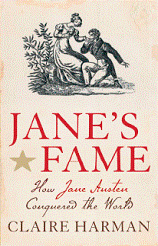
book-cover-janes-fame

The reviews are in on Claire Harman’s Jane’s Fame: How Jane Austen Conquered the World [Canongate, 2009]


I list several of them for your perusal.  [I am fortunate indeed to have just been in the UK – I went into every Waterstone’s I came across until finally the date of release arrived and a very helpful shop-keeper found it sitting on a to-be-shelved cart!  – so I am almost finished and will post my thoughts shortly…]


The Telegraph, by Frances Wilson

The Independent, by Elspeth Barker

Times Online, by John Carey

The Guardian, by Kathryn Hughes

The Spectator Book Club, by Philip Hensher

The Literary Review, by Mark Bostridge

A preview of the book at Austenprose

My previous post at JAIV about the Jane’s Fame controversy

Book reviews · Jane Austen · Regency England

Book Review ~ “Regency Buck” by Georgette Heyer

regency-buck-cover2

Georgette Heyer had a bit of a formula for many of her Regency novels – the established man in his mid-30s, often a fashionable dandy, and the younger woman he somehow becomes responsible for, and against all odds and all possible personality conflicts, they come together and all ends well.  Indeed, quite funny along the way, and filled with period details of such accuracy, the reader wonders how Heyer wrote these in the early 20th century and was not herself a “Lady of Quality” in early 19th century England!

So I began Regency Buck thinking I may have already read it – had to indeed check my list to be sure! – but a few pages in, I knew that, though it all seemed familiar enough, Heyer had succeeded yet again in setting a scene and telling a tale peopled with well-drawn characters [really, who can resist a character with the name of Mrs. Scattergood?], abounding in witty repartee, bringing the Regency period to life, and this time with a bit of a mystery thrown in for good measure.

The wealthy Judith Taverner, a feisty, independent almost-of-age beauty and her brother Peregrine, a year younger and the inheritor of a large estate, are on the way to London to settle in town after the death of their father to meet their unknown guardian, the Fifth Earl of Worth, and expecting one of their father’s gout-ridden comrades are shocked to discover Lord Worth to be a young handsome man of fashion and great friend to a select group of higher ups in London society .  Due to a previous encounter with him involving a hair-raising road accident and for Judith a less than appropriate embarrassing kiss, the young Taverners take an instant dislike to their guardian and he in turn makes it quite clear that he is not amused by suddenly having two wards foisted upon him. 

Here is Judith as we first see her~

She was a fine young woman, rather above the average height, and had been used for the past four years to hearing herself proclaimed a remarkably handsome girl.  She could not, however, admire her own beauty, which was of a type she was inclined to despise.  She had rather had black hair; she thought the fairness of her gold curls insipid.  Happily, her brows and lashes were dark, and her eyes which were startlingly blue (in the manner of a wax doll, she once scornfully told her brother) had a directness and a fire which gave a great deal of character to her face.  At first glance one might write her down a mere Dresden china miss, but a second glance would inevitably discover the intelligence in her eyes, and the decided air of resolution in the curve of her mouth.

And here is Lord Worth as first seen by Miss Taverner ~

From the first moment of setting eyes on him she knew that she disliked him…He was the epitome of a man of fashion.  His beaver hat was set over black locks carefully brushed into a semblance of disorder; his cravat of starched muslin supported his chin in a series of beautiful folds; his driving-coat of drab cloth bore no less than fifteen capes, and a double row of silver buttons. Miss Taverner had to own him a very handsome creature, but found no difficulty in detesting the whole cast of his countenance.  He had a look of self-consequence; his eyes, ironically surveying her from under weary lids, were the hardest she had ever seen, and betrayed no emotion but boredom.  His nose was too straight for her taste.  His mouth was very well-formed, firm but thin-lipped.  She thought it sneered….. His driving had been magnificent; there must be unsuspected strength in those elegantly gloved hands holding the reins in such seeming carelessness, but in the name of God why must he put on an air of dandified affectation?

And thus we are introduced.  Heyer serves up her usual mix of shenanigans, the endless clashing of wills, and the historically accurate Regency social life so well portrayed, such as this detailed description of the Royal Pavilion in Brighton, that you, the reader are instantly transported ~

royal_pavilion_brighton_3

At first site it was all a blaze of red and gold, but after her [Miss Taverner] first gasp of astonishment she was able to take a clearer view of the whole, and to see that she was standing, not in some fantastic dream-palace, but in a square apartment with rectangular recesses at each end, fitted up in a style of Oriental splendour.  The square part was surmounted by a cornice ornamented with shield-work, and supported by reticulated columns, shimmering with gold-leaf.  Above this was an octagon gallery formed by a series of elliptical arches, and pierced by windows of the same shape.  A convex cove rose over this, topped by leaf ornaments in gold and chocolate; and above this was the central dome, lined with scale-work of glittering green and gold.  In the middle of it a vast foliated decoration was placed, from whose calyx depended an enormous luster of cut-glass in the shape of a pagoda.  To this was attached by chains a lamp made to resemble a huge water-lily, coloured crimson and gold and white.  Four gilded dragons clung to the under-side of the lamp, and below them hung a smaller glass water-lily… still more dragons writhed above the window draperies, which were of blue and crimson satin and yellow silk.  The floor was covered by a gigantic Axminster carpet where golden suns, stars, serpents, and dragons ran riot on a pale blue background; and the sofas and chairs were upholstered in yellow and dove-coloured satin….

We are treated to various episodes of cock-fighting, boxing, horse racing, and carriage rides of all sorts; fashion displays of the first quality; and gatherings with the real life characters of Beau Brummell and the Prince Regent himself!  and with further references to Byron’s poetry and Austen’s Sense & Sensibility!  we are truly comforted by the authenticity of the times. 

cockfighting

But danger lurks – the Taverner’s wealth make them both targets in their new London environment and Heyer juxtaposes the humor of the avaricious suitors for Judith’s hand [to include nearly every eligible young man within striking distance and a few skin-crawling efforts [to this reader!] by the over-zealous Prince Regent!] – all this set against the apparent attempts to murder Peregrine – who would most benefit from his death? – his own sister? a long-lost on-the-skids cousin who begins to fall in love with Judith? or their guardian’s brother Charles, the second son in the military with no money of his own who becomes immediately smitten with his brother’s comely and wealthy ward? or indeed, Lord Worth himself, with his expensive tastes and a penchant for gambling and horse-racing?

And who of the lot will capture the heart of the lovely Judith? and can she withstand her guardian’s efforts to keep her in line according to HIS rules of a lady’s behavior for the very long year before her 21st birthday?   Worth is insufferable and rude and nearly cruel on one too many occasions to keep this reader from cringing a bit with my feminist sensibilities on high alert…  but Heyer, as expected, brings it all to a fine conclusion,  all in fun and with a satisfying end where all are accorded their just dues, a great ride! … definitely add this gem of a read to your TBR pile!

 4 full inkwells [out of 5]

Regency Buck, by Georgette Heyer.  Sourcebooks, 2008 [originally published in 1935]

[also available in the UK from Arrow Books, 2004]

For further reading, see my review of Faro’s Daughter, which appends reading lists, etc. about Heyer.

Book reviews · Literature · Regency England

Book Review ~ ‘Whom the Gods Love’

book-cover-whom-gods-loveJulian Kestrel is back in this third Kate Ross mystery, Whom the Gods Love [Viking 1995], again faced with a murder the authorities cannot solve.  The larger than life Alexander Falkland, one of the leaders of The Quality, young, handsome, with a beautiful wife, elegant home and many admirers, is found murdered in his study, bludgeoned with a fireplace poker during a house party.  Falkland’s father, Sir Malcolm, so frustrated by the dead-end investigations of the Bow Street Runners, turns to Kestrel to find his son’s killer.  Faced with a good number of suspects among family, friends and servants (so many in fact, that Ross prefaces the work with a listing of the cast of characters!), Kestrel falls whole-heartedly into his role as amateur sleuth.  A dandified man of fashion [but we the reader know him to be so much more], Kestrel knows many of Falkland’s set and embarks on his questioning of all suspects in his charming way, all the while wondering if Alexander Falkland may not be all that he seems. 

Ross is a master of plot and character – even the minor parts are well-fleshed out, and as the story turns and clues are uncovered with each chapter (Ross’s chapter headings alone are perfectly tuned), the reader is drawn deeper and deeper into the complicated mystery surrounding Falkland’s death.  Kestrel stumbles upon another murder, and as in Ross’s previous two mysteries, Cut to the Quick and A Broken Vessel, Kestrel needs to identify an unknown woman as well as unravel the mystery of who had reason to kill her. 

We are again transported into Regency London, with all the social life at Almacks, Tattersalls, Cornhill, Rotten Row, the Grand Strut in Hyde Park, and various outlying Inns, all portrayed as it would have been.  The language of the lower classes and the “Beau Monde” is spot-on [blue-deviled, missish], the carriages: gigs, cabriolets, hackneys, etc.; architectural details abound; fashion description is so exact, you feel you are there, sitting in the room:  in this passage, one of the “Quality” suspects is thusly described:

 Felix was about Julian’s age, the son of an autocratic peer from the bleak northeastern counties.  Julian suspected that the grey, barren landscapes of his childhood accounted for his taste in clothes, which certainly needed excusing.  Today he was wearing a canary-yellow tailcoat, white trousers, and two waistcoats, the inner of scarlet satin, the outer with black and white stripes.  His neckcloth was a cherry-coloured India print, splashed with blue and yellow flowers.  A bunch of gold seals, all shaped like chessmen, dangled from his watch-chain.  He had an amiable rangy figure and curly brown hair that tended to stand on end.  [p. 132]

[Yikes!]

regency-male-fashion

[from The Regency Fashion Page]

Ross depicts the legal system in England at the time – Lincoln’s Inn figures prominently, and Kestrel is often critical of the lack of a strong police force and the present state of law enforcement [the magistrate system and the Bow Street Runners].  There is much scholarly discussion between the characters, with references to Wollstonecraft’s “A Vindication of the Rights of Women” and the state of the woman’s position in society; there is even a bit of phrenology thrown in! 

But it is Julian Kestrel who pulls all these diverse goings-on together.  He is witty [“I’m afraid I’m obliged to trample on your sensibilities”], with a ready retort always at hand to put one on edge, but also sensitive and sympathetic, always with a kind word or deed to put one at ease.  And, as in the previous two books, Ross gives us fleeting glimpses of Kestrel’s own past, his background as mystifying to the other characters and to us readers as the mystery he is set on solving.  In this book, we hear only a faint mention of Sally from A Broken Vessel; we learn that he and his father went to London plays; that he gained his wide knowledge from his own stay on the Continent where he read the controversial Wollstonecraft in French translation; and we learn more about his actress mother and his disinherited father.  Kestrel remains the most loveable enigma, with all his shadowy past life, his apparent shallow present life of leader of fashion extraordinaire:

      In the afternoon, Julian went home for a session with his tailor.  His hobby of detection could not be allowed to interfere with his profession of dress.  The tailor measured him for some sporting garments for the autumn and made yet another attempt to persuade him to pad his coats.  ‘The very latest fashion, Mr. Kestrel!’ he pleaded.

      ‘My dear man, if I followed the fashions, I should lose any power to lead them.  And not for you nor anyone else will I consent to look like a pincushion with legs.’ [p. 169] 

With all this, Kestrel masterfully guides us along in solving the murders, feeling at home in the halls of the Quality, as well as in the environs of the poorer classes. I will tell no more of the plot – it is a fabulous journey, and leaves me quite anxious to get on to the next book!

5 full inkwells

 See my reviews of Cut to the Quick and A Broken Vessel

Book reviews · Jane Austen · Regency England · Social Life & Customs

On My Booklist ~ ‘Jane Austen & Marriage’

A new book alert:  Jane Austen & Marriage by Hazel Jones, to be published in July 2009, is now available for pre-order.

jane-austen-marriage-cover1 

Jane Austen & Marriage

by Hazel Jones

Continuum Books, 2009

 “It is a truth universally acknowledged, that a single man in possession of a good fortune must be in want of a wife.” –Pride and Prejudice

Description:

The question of marriage lies at the center of Jane Austen’s novels. The issues bound up in the pursuit of love, happiness, money, and status were those of her day and informed the plots and morals of her work. In this fascinating book, Hazel Jones explores the ways in which these themes manifest themselves in Jane Austen’s life and fiction, against the backdrop of contemporary conduct manuals, letters, diaries, journals and newspapers. Drawing on original research, this entertaining and detailed study provides a charming and profound insight into the world of Jane Austen. 


Table Of Contents:


Acknowledgements


Introduction

1: The Advantage of Choice

2: The Power of Refusal

3: An Acquaintance Formed in a Public Place

4: White Satin and Lace Veils

5: Where N Takes M, For Better, For Worse

6: Wedding Journeys

7: Scandal and Gossip

8: A Contract of Mutual Agreeableness

9: Domestic Happiness Overthrown

10: The Simple Regimen of Separate Rooms

11:The Years of Danger

12:  An Old Maid at Last


Notes

Bibliography

Index

Review at Continuum Books:

Hazel Jones has written a masterful accounting of the crucial role played by marriage in Jane Austen’s novels and the world she and her characters lived in. Brilliantly researched and documented  — including information taken from the fascinating and sometimes troubling “conduct manuals” on the proper interaction between the sexes — Jane Austen and Marriage offers deep insights that inform not only one’s reading of Austen’s novels but of the treacherous social bedrock underlying the lives of women living in that time. And in so doing, Hazel Jones has presented the reader with another testament to the long, hard march of women throughout history. It is a book that reflects Jane Austen’s own penetrating gaze and insight into Regency society and no doubt will find a place in the library of even the most sophisticated “Janeite”.’  

[Alice Steinbach, Pulitzer Prize-winning journalist and author of Without Reservations: The Travels of an Independent Woman.]

About the Author:


Hazel Jones taught English at Exeter University, specializing in Jane Austen. She tutored courses on the novelist for the thriving Summer Academy Programme, which attracted students from all over the world. She continues to organize Jane Austen residential courses for adults at various venues in the UK, focusing on her novels and her life and times.


Pre-order at Continuum Books [$29.95] or Amazon.com [$19.77]

Book reviews · Jane Austen · News

Zombies & Aliens in Austenland??

This is just too good not to print the whole thing right here.  Much has been made the past few weeks about the zombied-out Pride & Prejudice and Elton John’s latest foray into a literary alien-infested monster-land – I’ve not commented on it, just  taking it all in and wondering what to make of it really!  But today in the New York Times, Jennifer  Schuessler writes on this so perfectly, I copy it all here for your delight and save you the need to even click on a link:

I Was a Regency Zombie

By JENNIFER SCHUESSLER

These days, America is menaced by zombie banks and zombie computers. What’s next, a zombie Jane Austen?

In fact, yes. Minor pandemonium ensued in the blogosphere this month after Quirk Books announced the publication of “Pride and Prejudice and Zombies,” an edition of Austen’s classic juiced up with “all-new scenes of bone-crunching zombie mayhem” by a Los Angeles television writer named Seth Grahame-Smith. (First line: “It is a truth universally acknowledged that a zombie in possession of brains must be in want of more brains.”) 

Then, last week, the monster alert at Meryton went from orange to red when it was reported that Elton John‘s Rocket Pictures was developing a project called “Pride and Predator,” in which the giant alien from the 1987 cult classic pays a call on the Bennet family. 

Holy Northanger Abbey! Is this some mutant experiment in intellectual property law escaped from the lab? Proof of the essentially vampiric nature of today’s culture industry? Or an attempt to make Austen safe for audiences – read “boys” – raised on “Mortal Kombat” and “Evil Dead”? 

According to Mr. Grahame-Smith, who confessed to being “bored to tears” by “Pride and Prejudice” in high school, the idea was mostly to sell resistant readers on the joys of Jane while having a bit of fun. The book, probably the first Austen/horror mashup to make it into print, is roughly 85 percent Austen’s original text, with references to monsters, putrefying flesh and ninja swordplay added on just about every page.

 “I think Austen would have a sense of humor about it,” said Mr. Grahame-Smith, whose previous books include “How to Survive a Horror Movie.” (Rule No. 1 in a zombie attack: “Stop Being So Pathetic.”) “Or maybe she’s rolling in her grave. Or climbing out of it.”

 But not everyone in the Austen world relishes the idea of Elizabeth Bennet, action hero. Myretta Robens, site manager and co-founder of the Austen fan site Republic of Pemberley, pemberley.com, (and herself the author of two Regency romance novels), said she was cautiously pessimistic about the forthcoming zombie invasion. 

“I’m interested in anything relating to Jane,” she said. “But to me this is like Jane Austen jumping the shark.” 

To some scholars, however, it’s a short leap from verbal sparring to real swordplay. “It makes sense to give Lizzie a grander scope for her action,” said Deidre Lynch, an associate professor of English at the University of Toronto and editor of “Janeites,” a collection of scholarly essays about Austen devotees. “It goes with the muddy petticoats and the rambling across the countryside in this unladylike way. The next step is ninja training.”

 In fact, “Pride and Prejudice” may already be a zombie novel, contends Brad Pasanek, a specialist in 18th-century literature at the University of Virginia.

“The characters other than the protagonist are so often surrounded by people who aren’t fully human, like machines that keep repeating the same things over and over again,” Professor Pasanek said. “All those characters shuffling in and out of scenes, always frustrating the protagonists. It’s a crowded but eerie landscape. What’s wrong with those people? They don’t dance well but move in jerky fits. Oh, they are headed this way!”

 While the vast industry of Austen sequels and pastiches runs heavily toward the romance-novel end of the literary spectrum – see “The Private Diary of Mr. Darcy” by Maya Slater, to be published in the United States in June – scholars have long emphasized the mean-girl side of Jane’s personality. Professor Pasanek, who has collaborated on a project that uses spam-detection software to analyze Austen fan fiction, cites the psychologist D. W. Harding’s 1940 essay “Regulated Hatred,” which sounds more like a death-metal band than a piece of influential Austen scholarship.

“Most people try to ignore the fact that Austen’s novels are sort of acid baths,” Professor Pasanek said. “She’s so much better, deeper, more sensitive and intelligent than everyone around her that she has to regulate her own misanthropy. Her novels are hostile environments.”

Despite her own reservations, Ms. Robens acknowledged that Austen would probably be “laughing her head off” at the new mashups. 

Or maybe plotting delicious revenge. Next year, Ballantine Books will publish Michael Thomas Ford’s novel “Jane Bites Back,” in which Austen turns into a vampire, fakes her own death and lives quietly as a bookstore owner before finally driving a stake through the heart of everyone who has been making money off her for the last two centuries. 

“She’s a woman who has been middle-aged for 200 years and is fed up,” Mr. Ford said. “She finally gets to restart her life and reclaim her literary fame.”

The undead Austen also settle scores with some old literary rivals, though Mr. Ford declined to name names. Another mashup in the making? 


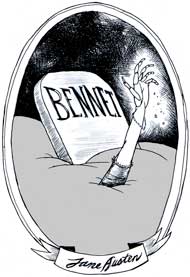
bennet-zombie-pic[Leah Hayes]


Book reviews · Collecting Jane Austen · Jane Austen · Regency England · Social Life & Customs

Book Review ~ Jane Austen & Crime

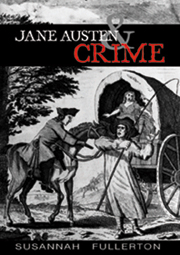
Jane Austen & Crime, by Susannah Fullerton.  3rd edition.  Jones Books, 2006 [Fullerton is the President of the Jane Austen Society of Australia]

ja-crime-coverA new approach to Jane Austen seemed impossible, but Susannah Fullerton . . . has brilliantly hit on the theme of crime and punishment in Austen. Fullerton shows how the Regency world . . . was really a dangerous place with a fast rising crime rate and a legal system that handed out ferocious sentences. Her book will be essential reading for every Janeite.”-Claire Tomalin, author of Jane Austen: A Life


I admit to passing over this book when it was first available – somehow, I just didn’t want to sully my love of Austen and the “pictures of perfection” the world of her novels presents.  One knows, of course, that it is there, lurking behind the scenes, with a brief reference here, or a shady character there; and as readers of Jane Austen know, these references would have been better understood by her contemporaries than by us today, unless we are well-versed in the social history of Georgian and Regency England.

My interest peaked with my recent absorption in several detective novels set in the Regency period (the Julian Kestrel series by Kate Ross) –  these mysteries evoke the time beautifully – the lovely clothes, the balls, the always proper social behaviors – but also the underbelly of this world – the crime, the poverty, the seedy desperate lives, the world that Dickens and his characters inhabited. Indeed there are many non-fiction books on this subject, just on London alone [see below for further reading], but I turned to Fullerton’s book to get not only a quick overview of the crime of the time, but to see it in the context of Jane Austen’s life and works.  As Fullerton begins:

 Why Jane Austen and Crime?  Why the juxtaposition of these seemingly disparate concepts? Simply put, because the relationship is there. Crimes against human life, crimes against property, crimes of passion, social crimes, grim punishments, and even fictional (Gothic) crime were very much a part of the Georgian world.  Ever the perceptive observer of her society, Jane Austen does indeed include comments on crime and the effects of crime in her letters, in her juvenilia and, treated very differently, in her mature novels.  An examination of crime in Jane Austen’s world and fiction suggests many new perceptions of her work and gives a greater understanding of her genius. [p.3]

And Fullerton ends with:

 Jane Austen was not a reformer.  She suggests no solution to these problems.  Rather she was a highly perceptive observer of her society who commented incisively on the behaviour of men and women.  She included criminal behavior in her works and she included punishment even, if unlike Dickens, she never made crime the climax of her story or chose a prison as the setting for a novel.  She was aware of the confused laws which governed the Georgian age, she knew of the debates concerning the softening or abolishing of these laws, she wove her knowledge into the fabric of her writing.  Crime became a part of her plots, crime revealed character, crime emphasized duty and responsibility, and crime even united some of the heroines and heroes.  She examined the inclination to do evil, analysed the faulty propensity which drives a man to wrong-doing, depicted the damage cause by doing wrong and described criminal feelings in her characters.  In doing so she reflected and commented on the Georgian criminal scene with accuracy and sharp intelligence.  [p. 217]

And in between, Fullerton neatly presents the subject in fine organized fashion:

  • Crime against life (murder and suicide)
  • Crime against property (theft)
  • Crimes of passion (adultery, elopement, prostitution, rape, bastards)
  • Social crime (duelling, poaching, smuggling, gaming)
  • Gothic crime
  • Punishment and the law (gaols, hanging, other punishments, men of the law)

Within each section, the subject is analyzed in its historical context with many factual references to the laws and the notable crimes of the time, then in the context of Austen’s life; for example, her Aunt Leigh Perrot on trial for theft; her brother Edward Knight a magistrate at Godmerhsam.  Fullerton then takes us through the novels and letters to show by example how any specific crime drives the plot or shapes a character – we see John Dashwood clearly painted as the thief he is; Willoughby as a serial seducer; the gravity of Wickham’s intended “elopement” with Georgiana and the actual with Lydia; even Mrs. Norris’s petty thefts, rather glossed over in Mansfield Park, but there for the close reader to see;  we learn that Harriet Smith’s talking to the gypsies in Emma was actually a crime punishable by death by hanging!; how the theft of the chickens in Emma, actually brings about the marriage of Emma and Knightley; the smuggling of tea and other luxuries, a crime more serious than murder [London tea smugglers operated in gangs of up to 50!, and most of London enjoyed this favored beverage in its smuggled form [p. 142], certainly Jane loved her tea as did many of her characters]; the very brief reference to Brandon’s duelling with Willoughby in Sense & Sensibility, so deftly written by Austen that we barely know of it:  “We met by appointment, he to defend, I to punish his conduct.”  [Fullerton points out that with this one sentence, Brandon becomes the only one of Austen’s heroes to engage in criminal activity. [p.124]].  We see Emma’s slight of Miss Bates as more than just an uncomfortable rudeness, but really a crime of bad manners, a wickedness [p.217] on Emma’s part that tells us more about her than almost anything else in the book – it is the turning point in the story when Emma finally sees herself.  And what of John Thorpe?- his lies and holding Catherine in his carriage against her will; the issues of adultery and imprisonment in Mansfield Park; the gaming laws that allowed only the wealthy to own sporting dogs, as John Middleton and Mr. Darcy.  The list goes on with these references, some obvious, some mere mention, Fullerton pulling it all together, and by giving us a better understanding of the contemporary social and moral expectations, we better understand what Austen was speaking of…


”]The three villains in horsemen's greatcoats [Thomson, NA]I most appreciated Fullerton’s many references to the juvenilia – it is in these works that Austen shows us the realities of her greater society, all indeed presented in an exaggerated manner with her youthful humor, but we do see how she understood this underside of life in both London and her country villages, a knowledge also apparent in the quick, short references in her letters.  For instance, in this short passage from Letter 95 [Le Faye, p. 248], Austen writes her sister from Godmersham Park:
 

Edward and I had a delightful morn for our drive there…. He went to inspect the Gaol, as a visiting Magistrate, & took me with him. – I was gratified – & went through all the feelings which People must go through I think in visiting such a Building.” 

Austen then goes on to talk of shopping and a party, etc., but what did she actually SEE on that visit, and how frustrating she tells no more!  Here Fullerton gives us what Jane doesn’t – she explains exactly what the Canterbury Gaol would have been like, exactly what Austen would have experienced. Austen’s reference to being “gratified” takes us back to the juvenilia where crimes are everywhere, punishment handily doled out, all in high humor.

 I highly recommend this book –  with all the factual references linked so well to Austen’s world, the many contemporary illustrations, helpful notes and bibliography aside – it is actually a fabulous and entertaining read!  This is not a long book or a great scholarly analysis of Austen and how crime figures in her works, but the interweaving of the laws of the day, real crimes and punishments, with the innumerable references to the fiction and letters, some so easy to miss on a casual reading, all this gives us a heightened awareness of how while Austen seems to present a nearly perfect social order on a very tiny scale, that not far behind the scene are some very serious worldly concerns, frighteningly real and not so pretty. 

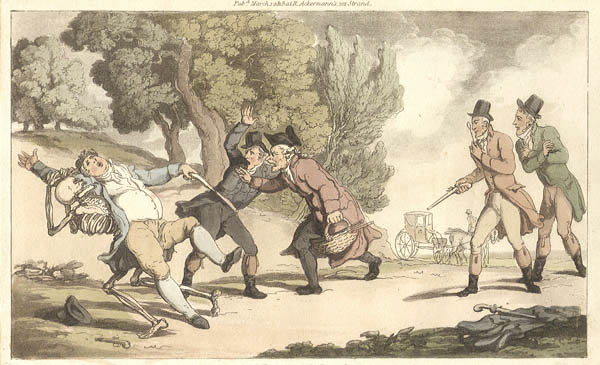
Thomas Rowlandson - The Duel

 5 Full inkwells (out of 5)

The book is available from Jones Books.  However, the JASNA-Vermont Chapter has several copies for sale, so, if you would like to support our local group, please contact us directly.

 Further Reading:

Fullterton provides a bibliography on the many aspects of crime of the period.  I list here only a few:

  1. Bovill, E.W.  English Country Life: 1780-1830 [Oxford, 1962]
  2. Collins, Philip.  Dickens and Crime [Macmillan, 1962]
  3. Emsley, Clive.  Crime and Society in England 1750-1900[ Longman 1987]
  4. Harvey, A.D.  Sex in Georgian England [St Martin’s, 1994]
  5. Hibbert, Christopher. Highwaymen[Weidenfeld & Nicolson, 1967]
  6. Ives, Sidney.  The Trial of Mrs. Leigh Perrot [Stinehour, 1980]
  7. Low, Donald.  The Regency Underworld [Sutton, 1999]
  8. McLynn, Frank.  Crime and Punishment in Eighteenth Century England [Routledge, 1989]
  9. Murray, Venetia.  An Elegant Madness:  High Society in Regency England [Viking, 1999]; published as High Society: A Social History of the Regency Period 1788-1830 in the UK in 1998]
  10. Picard, Liza.  Dr. Johnson’s London [St. Martin’s, 2002]
  11. Sinclair, Olga.  Gretna Green: A Romantic History [Chivers, 1989]

Online references:

Book reviews · Books · Regency England

Book Review ~ “A Broken Vessel”

ross-broken-vessel-coverJulian Kestrel returns in this second mystery by Kate Ross [Viking 1994], A Broken Vessel.  Several months after his amateur but superior sleuthing at Bellegarde, home of the Fontclairs, [see Ross’s first book, Cut to the Quick, and my review] Kestrel is again thrown into the mix of murder and mayhem when the sister of his manservant, Dipper, shows up in her brother’s life after a two-year absence.  Sally Stokes is a prostitute and a thief, made of the same cloth as her now-reformed [hopefully] pick-pocket brother. After an evening of turning tricks with three very different “coves,” from each of whom she steals a handkerchief,  she discovers a letter written by an unknown woman, mysteriously locked up in an unnamed place, begging forgiveness and help from her family.  But whose pocket did Sally lift the letter from? – Bristles, the middle-aged skittish man; Blue Eyes, the elegant and handsome gentleman of the “Quality”; or Blinkers, the be-speckled young man who played all too rough with Sally, leaving her sore, battered and frightened. 

Here is how we first see Sally: 

She pulled the pins out of her hair and put them on the washstand for safe-keeping; she was always losing hairpins.  Her nut-brown hair tumbled over her shoulders: long at the back, but curling at the front and sides, in imitation of the fashion plates in shop windows.  Not that she would ever look like one of them, with their fair skins, straight noses, and daintily pursed lips.  She had a brown complexion, a snub nose and a wide mouth, with a missing tooth just visible when she smiled.  Still, she was satisfied with her face.  There was not much an enterprising girl could not do with a little cunning and a pair of liquid brown eyes.

So Dipper brings Sally to his apartment to get her off the street and give her a chance to heal.  He shares this apartment with his employer, Julian Kestrel, the Regency dandy, known far and wide for his fashion and manners, the man everyone emulates in all things dress and gentlemanly behavior.  We have already learned in Ross’s first book that there is so much more to Kestrel than this dandified appearance – his growing friendship with Dr. MacGregor serves as a foil for the reader to see Kestrel in more human terms, and MacGregor’s unasked questions become ours: all we know is that Kestrel’s father was a gentleman, disinherited upon marrying an actress, and that Kestrel has been an orphan for a good many years.  Although he appears to have money and is viewed as such by his cohorts, we, the reader, and Dipper know this not to be the case – but where DOES he get the funds to lead this gentleman’s life, buy these fine clothes, live in France and Italy for years before settling in London?  We learn a bit more in this book…but not much!

 Here is Dr. MacGregor, not of London and critical of all the goings-on there, learning about the gentlemanly art of duelling:

 ‘If you thought he was lying or hiding something. Why didn’t you tax him with it?’ asks MacGregor.

[Kestrel]  ‘If I called him a liar point-blank, I should have had to stand up with him, which would have been deuced inconvenient, and not at all part of my plans.’

‘Do you mean to say you’d have exchanged pistol shots with him over a mere matter of words?’

‘Not if there were any honourable way to avoid it.  But accusing a gentleman of lying is the deadliest of insults. If he’d insisted on receiving satisfaction, I should have had no choice but to give it to him.”

‘But that’s preposterous! It’s criminal!  I don’t understand you at all.  One minute you’re investigating a possible murder with all the seriousness it deserves – and the next minute you say you’d stand up and shoot at a man because he took offence at something you said!’

‘Duelling isn’t murder, whatever the press and pulpit say about it.  If one gentleman insults another, he knows what the consequences will be: they’ll fight according to the laws of honour, as nations fight according to the laws of war.  Killing an unarmed man, or -God forbid!- a woman, is completely different.’

‘Well, I suppose you can’t help those wrong-eaded notions.  You probably learned them at your father’s knee before you were old enough to know better.’

‘Oddly enough, my father had much the same view of duelling as you do.  But then, my father was too good to live.’ He added quietly,  ‘And he didn’t.’


 The discovery of the letter wrapped up in one of Sally’s stolen handkerchiefs sets the plot in motion – they must find which of the three men carried the letter, who the woman is, and where she is being held.  Many plot twists, many characters appearing, each with a tale to tell – are they all connected in some way, or are they all separate unrelated but oh so interesting mysteries of their own?  When Sally finally discovers that the woman who wrote the letter was an “inmate” of the Reclamation Society’s prison-like home for recovering prostitutes and has been found dead from an apparent suicide, Kestrel’s shackles are raised, his detective skills in high gear, and he, Sally and Dipper pursue the three men to find out the truth.  And along the way, we see Dr. MacGregor’s astute eye upon Sally and her effect on Kestrel – can this street-wise, sharp little spitfire possibly soften the edges of the leader of the ton?  Or is Kestrel immune to such feminine wiles? (and those “liquid brown eyes!) 

Ross writes a compelling tale, her research into Regency England, its language (she is adept at presenting the dialect of the streets and the Regency-speak of the “Quality”), the manners and mores, evident on every page; her knowledge of the underside of London life makes the telling very graphic and realistic – you will learn much about prostitution on the streets of London, the religious zealots who acted against it (indeed, the title is from a Psalm), the Bow Street Runners and the all too-ineffective police forces of the time, and best of all, the mystery is excellent!  and while I often “figure” these things out, I was most pleased to have the various side stories pull together with a few surprises along the way.  All in all, a fine mystery, with wonderfully drawn characters, and enough tidbits about Kestrel’s background to more than gently coax this reader into the third book in the series, Whom the Gods Love.

 4 1/2 full inkwells (out of 5)

Book reviews · Jane Austen · Movies · News · Regency England · Social Life & Customs

In My Mailbox ~

I love my mailman ~ it seems he brings me a surprise almost daily!  Today, I find the latest issue of Jane Austen’s Regency World  [Jan/Feb 2009, Issue 37], and here give you some thoughts on the contents:

jarw_37_cover

“End of the Regency” about the soon to be released film on young Queen Victoria [March 2009 in Britain], starring Emily Blunt (on the cover above) as Victoria and Rupert Friend as Prince Albert (he starred in the 2005 P&P as Wickham and was fabulous in Mrs. Palfrey at the Claremont

“Write-on” about the importance of correspondence and the ways of letter-writing in Jane Austen’s time

“Why I Dig Jane” a talk with Alan Titchmarsh, popular British TV personality, gardener, and novelist [his latest book, Folly, is set in Bath and currently on the British best-selling fiction list] ~ He confesses that his favorite character is Emma.

“Illustrating Jane Austen” an article on the incomparable Hugh Thomson

“Playing Mary Bennet” on the actress Ruby Bentall, who acted the role of Mary Bennet in the Lost in Austen series (“with spindly glasses and horrible hair”…)

“Pottery and Poetry” which traces the life of Thomasina Dennis, 1770-1809, a comtemporary of Austen’s who worked for the Wedgwood Pottery family.  The article includes some history of Josiah Wedgwood and his business [ironically, this week the Waterford / Wedgwood company announced it is filing for bankruptcy]

“Petticoat Politics” looks at the complex nature of Regency undergarments, never mentioned, but a large part of “dressing Jane” and her contemporaries

“Madame de Stael” and the story of why perhaps Jane Austen refused to attend a London literary salon at which Madame de Stael was to be present (could it have been her tempestuous love-life??)

“My Jane Austen” the column this month by Virginia Claire Tharrington on her months as an intern at the Jane Austen Centre in Bath (she also posted several weekly articles on Austenprose while she was there)

“A Goodly Heritage” by Marsha Huff, President of JASNA, on this past year’s Annual JASNA AGM in Chicago

“Portrait of a Lady” on the Jane Austen Society of the U.K. and the event presented in the fall by History Wardrobe on the fashion of Austen’s time

And Joceline Bury offers three book Reviews:  An Aristocratic Affair by Janet Gleeson, a biography of Henriette Ponsonby, Countess of Bessborough and sister of Georgiana, Duchess of Devonshire [The American title is: Privilege and Scandal: The Remarkable Life of Harriet Spencer, Sister of Georgiana];  The Immortal Jane Austen by Maggie Lane, a no-frills biography of a mere 50 pages, but laced with many illustrations and highly recommended by the reviewer; and Jane Austen Visits London by Vera Quinn, the charming little book that concentrates only on Austen’s travels to and writings about London [see my comments on this book here.]

So all in all a fine issue, and a perfect way to spend the upcoming weekend, immersed in all things Regency!