Books · Jane Austen · News

Pride & Prejudice ~ the Comic Book

marvel-comic-pp

Late to the table, but here is a reminder about the first issue of the Marvel Comic’s Pride & Prejudice  due out April 1st.  See the story and images from the first issue at Marvel.com :

Two-time Rita Award-Winner Nancy Butler and acclaimed artist Hugo Petrus bring PRIDE & PREJUDICE #1 to life—and we’ve got an exclusive preview for you! Follow the gripping story of Lizzy Bennet and her loveable, yet eccentric, family as they navigate the treacherous waters of British high society, in this faithful adaptation of the seminal Jane Austen novel.

Further reading:

Books · Collecting Jane Austen · Jane Austen

Novels & Letters (1906) now complete

mpFINALLY!

Internet Archive now has all twelve volumes of the 1906 edition entitled “The Novels & Letters of Jane Austen”. Especially, I was happy to see the second part of Mansfield Park (the illustration is the volume’s frontispiece).

The search is still on to provide our audience with the missing volume of Pride & Prejudice‘s first edition; ditto the entire three-volume set of Sense & Sensibility.

Find all the online editions via our bibliography, or click on the tabs above to go to the individual works.

Books · Jane Austen · Literature · News

An Austen-Inspired Author ~

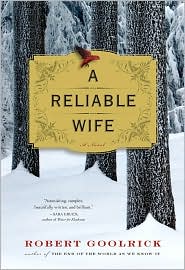
Robert Goolrick, author of the upcoming book A Reliable Wife, has this to say about Jane Austen:

If anything, I was inspired by earlier writers. I’m always inspired by Jane Austen, curiously enough. She has a great thing that she does, which is her novels are about complicated, romantic situations in which all the happiness comes at the very end—like a magic trick. I love that about her, and I wanted to write a novel in which people seemingly unable to be happy suddenly find redemption and happiness all in a second.

[Quoted from Publisher’s Weekly]

book-cover-reliable-wife 


Goolrick’s new work, following his memoir The End of the World as We Know It, will be released on March 31, 2009….


Synopsis:

Rural Wisconsin, 1909. In the bitter cold, Ralph Truitt, a successful businessman, stands alone on a train platform waiting for the woman who answered his newspaper advertisement for “a reliable wife.” But when Catherine Land steps off the train from Chicago, she’s not the “simple, honest woman” that Ralph is expecting. She is both complex and devious, haunted by a terrible past and motivated by greed. Her plan is simple: she will win this man’s devotion, and then, ever so slowly, she will poison him and leave Wisconsin a wealthy widow. What she has not counted on, though, is that Truitt — a passionate man with his own dark secrets —has plans of his own for his new wife. Isolated on a remote estate and imprisoned by relentless snow, the story of Ralph and Catherine unfolds in unimaginable ways.

With echoes of Wuthering Heights and Rebecca, Robert Goolrick’s intoxicating debut novel delivers a classic tale of suspenseful seduction, set in a world that seems to have gone temporarily off its axis.

[from the Barnes & Noble website]

[BTW, the book has already been optioned for a movie and is hitting various favorite lists, so this is not the first you will hear about this book…]

Austen Literary History & Criticism · Books · Jane Austen · Literature

Discord in Austen Land

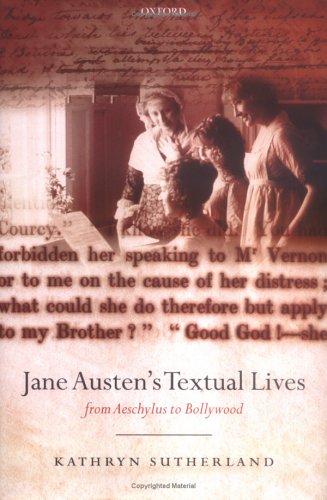
Here is an interesting article at the Guardian.co.uk about a new book on Austen by Claire Harman (author of the 2001 biography Fanny Burney) ~ Jane’s Fame: How Jane Austen Conquered the World, to be published next month, and a conflict with the academic writings of Professor Kathryn Sutherland, author of the ground-breaking 2005 Jane Austen’s Textual Lives, from Aeschylus to Bollywood.  It’s quite the kerfuffle….

book-cover-janes-fame

book-cover-ja-textual-lives

Further reading:

[Adding here 3/17/09:  I had noted in my comments below that Ellen Moody has addressed this issue in more depth on Austen-L and Janeites as well as her blog, so I add here the link to her post: 

http://server4.moody.cx/index.php?id=1016#comment

 NB: scroll down further on her blog as there is quite a bit more after the reference to Emily Hahn’s book on Fanny Burney]

Books · Jane Austen · JASNA-Vermont events · Publishing History

Publishing ‘ Persuasion ‘

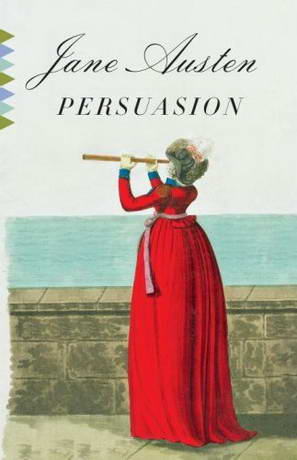
persuasion-cover-vintageWe had our JASNA-Vermont gathering last Sunday and Mary Ellen Bertolini of Middlebury College spoke on Persuasion [see Kelly’s post below on our event]

Mary Ellen brought Austen’s final novel to life for us all.  In speaking on “The Grace to Deserve” and taking as her starting point Captain Wentworth’s last spoken words in the book, “I must learn to brook being happier than I deserve.”  [Persuasion, ch. 23], she addressed the issue of “deserving” and “earning ones’ blessings”  in the context of the social and political realities of the time – the war in France and the role of the Navy; an analysis of the criteria of WHO deserves; and finally in the linguistics of the work – whose words deserve to be heard?  The plot centers on Anne moving from “nothingness” and” carrying “no weight” to realizing her own worth, and Wentworth moving from anger and disappointment to deserving to hear Anne’s words – their individual growth bringing them together at last. 

Prof. Bertolini’s insightful, dramatic and often humorous presentation on how Austen tells her tale around these three words “the grace to deserve” gave all in attendance much to think about and surely most of us went right home to begin a re-read of the novel!  So we thank you Mary Ellen for sharing your affection for this book with all of us, and turning a very cold winter day into a fabulous afternoon! 

**************************************

As a bookseller and librarian I am interested in the publishing history of the literature of the 18th and 19th centuries, and I spoke very briefly on the publishing journey of Persuasion;  I append that here:

 We know from Cassandra’s Memorandum [see Minor Works, facing pg.  242 ] in which she wrote the dates of Austen’s composition of each of her novels, that Jane Austen began Persuasion on August 8, 1815; it was finished July 18, 1816 – i.e. her first draft. We know she was unhappy with the ending, she thought it “tame and flat” and rewrote chapter 10 [i.e.chapter 10 of volume 2], added chapter 11, and retained chapter 12 (which had been the final chapter 11).  This final version was finished on August 6, 1816.  The manuscript of the original two chapters are the ONLY extant manuscripts of Austen’s novels.  These were first printed in the second edition of James Edward’s Austen-Leigh’s Memoir of 1871, and this was the accepted text until the actual MS became available on December 12, 1925  [ published separately by Chapman in 1926 under the title Two Chapters of Persuasion [Oxford, 1926]; the manuscripts are housed in the British Library].  This text is different from the printed cancelled chapter in the Memoir – so it is believed that Austen made a fresh copy of her final draft and this is what went to the printer. [Chapman,  NA & P, p. 253 ]

I am assuming that most everyone has read these cancelled chapters, as they are usually included in most printings of the novel.  But to summarize:  Austen has Anne meeting Admiral Croft on her way home from Mrs. Smith’s [where she has just learned the true nature of William Elliot] – she is invited to visit Mrs. Croft, and assured of her being alone, she accepts, and to her consternation finds Capt. Wentworth at home.  Admiral Croft has asked Wentworth to find out from Anne if the rumors are true she is to marry her cousin and thus might want to live at Kellynch Hall ~ and with Anne’s adamant denial of this, Wentworth and Anne had a 

 silent but very powerful Dialogue;- on his side, Supplication, on hers acceptance. – Still, a little nearer- and a hand taken and pressed – and “Anne, my own dear Anne!” – bursting forth in the fullness of exquisite feeling – and all Suspense & Indecision were over. – They were reunited.  They were restored to all that had been lost.

 Etc. etc… and then one more chapter of explanation and future plans.

 It is not my intention here to talk about these changes – we can argue the point of why she made them:  the need to pull all the characters together – the Musgroves, Benwick, & Harville, the Crofts, and the Elliots; the increased tension and suspense between Anne and Wentworth; Anne’s conversation with Harville overheard by Wentworth; and of course the LETTER – what would Persuasion be without “you pierce my soul” ? !

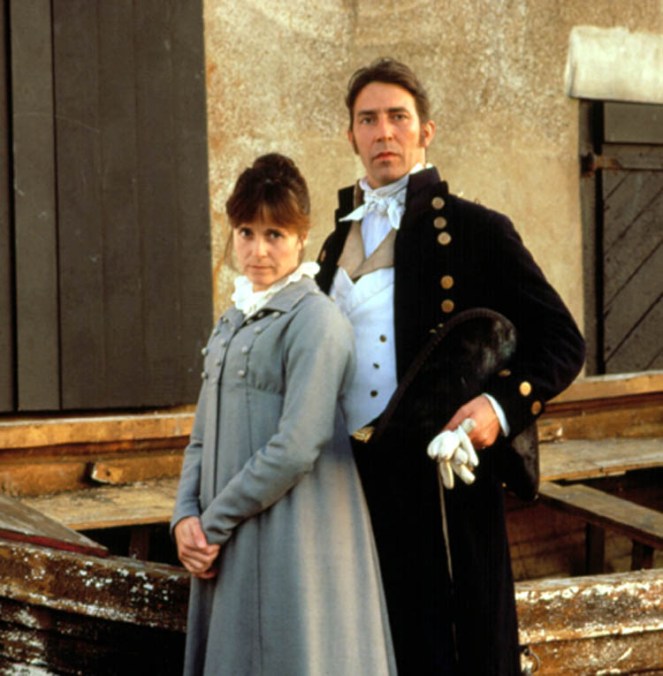
 However, in the movie version [Amanda Root – Ciaran Hinds, Sony/BBC 1995] a part of this scene with Wentworth confronting Anne is added to the plot – this is worthy of some further conversation!  
508950F

But one of Austen’s classic lines is not in the final novel – the first draft is a bit more comic in nature, and perhaps she thought it not fitting the rest of the work:

It was necessary to sit up half the Night & lie awake the remainder to comprehend with composure her present state, & pay for the overplus of Bliss, by Headake & Fatigue.

____________________________________________

That Austen made these changes was a gift to later generations, as it is in this manuscript that we have the only documentation of how meticulous she was in her writing and editing methods.  And what I find most fascinating is what she was working on at the same time:

 *In 1815, she was drafting Emma; began Persuasion in August; revised Mansfield Park  for its 2nd edition; and finished and passed Emma through publication [it was published in December 1815]

 *In 1816:  she was drafting and finalizing Persuasion; she wrote her very funny “Plan of a Novel”; she made revisions to “Susan” [later Northanger Abbey]; AND she was working with the publisher on the 3rd edition of Pride & Prejudice.

 As an aside:  in the context of the wider world, there was the ever-expanding and more competitive market for publishing novels in Austen’s time.  In 1775, the year she was born, 31 new novels were published; in 1811, when Sense & Sensibility appeared, 80 new fiction works appeared; for the year 1818, Northanger Abbey and Persuasion were published along with 61 other novels.  Altogether, 2,503 new novels were published in the years between 1775 and 1818. [Raven, p. 195-6]

We know little about Persuasion from Austen herself:  it is only mentioned in her Letters twice, though not by name: 

 On March 13, 1817, she wrote to her niece Fanny Knight:  

“I WILL answer your kind questions more than you expect. – Miss Catherine [meaning Northanger Abbey] is put upon the Shelve for the present, and I do not know if she will ever come out; – but I have a something ready for Publication, which may perhaps appear about a twelvemonth hence.  It is short, about the length of Catherine – This is for yourself alone…”  [Letter 153, Le Faye]

 And again on March 23, 1817: 

Do not be surprised at finding Uncle Henry acquainted with my having another ready for publication.  I could not say No when he asked me, but he knows nothing more of it. – You will not like it, so you need not be impatient.  You may PERHAPS like the Heroine, as she is almost too good for me. [Letter 155, Le Faye]

The working title for Persuasion was “The Elliots” – there is no evidence that Austen chose the titles for either Northanger Abbey [it is accepted that her brother Henry did this] or Persuasion [though the word is mentioned in one form or another more than 20 times – you can go to this link at the Republic of Pemberley for all the occurrences] 


So, the details of the book:
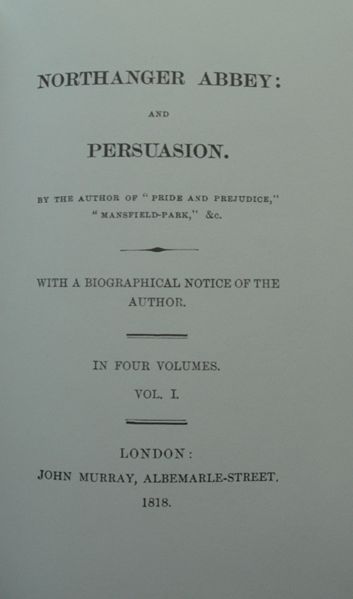


na-title-page

 [Title Page, 1st edition]

-It was published posthumously in December 1817 [though the title page says 1818] with Northanger Abbey

Title page states:  “By the Author of Pride & Prejudice, Mansfield Park, etc.”; With a Biographical Notice of the Author [dated Dec. 20, 1817, by Henry Austen, thus identifying his sister as the author to the public for the first time]

 -Included is the “Advertisement to Northanger Abbey by The Authoress [we discussed this at our NA gathering, where Austen “apologizes” for the datedness of the story, and zings the dastardly publisher for withholding the book for 10 years…]

Published by John Murray, London; 1818; in four volumes:  the two Northanger Abbeyvolumes printed by T. Davison; the two Persuasion volumes by C. Roworth. 

Advertised in the Morning Chronicle, Dec. 19 & 20, 1817

-Physical description:blue-grey boards, brown paper backstrips, white paper labels (there are a few variants)

Size of book:  about 19cm x 10.5 cm [ 7.5 x 4.25″]

Size of run: @ 1750 copies [various opinions on this] – 1409 copies sold very quickly [majority to circulating libraries]

Cost:  24 shillings for 4 volumes

Profit:  £515 [like Austen’s other works, Persuasion was published on commission:  Austen paid for costs of production and advertising and retained the copyright; the publisher paid a commission on each book sold – exception was Pride & Prejudice for which she sold the copyright] 

-Reviews:  minor notices until the first extensive review in January 1821. 

-Worth today:  a quick search brought up 7 copies of the 4-vol. first edition, all have been rebound in leather, range $9500. – $15,000. 

-Tidbit:  the Queen has in her personal library  Sir Walter Scott’s copy of the 1st edition.

First American edition:  not published until 1832 in Philadelphia; the title page says “by Miss Austen, author of P&P and MP, etc.” 

-French TranslationLa Famille Elliot ou “L’Ancienne Inclination” [ the old or former inclination] translated by Isabelle de Montolieu, Paris, 1821 :  this is the first published Austen work to have her full name on the title page and to include illustrations:  in vo1 1, Wentworth removing Walter Musgrove from Anne [see below]; vol 2:  Wentworth placing his letter before Anne.
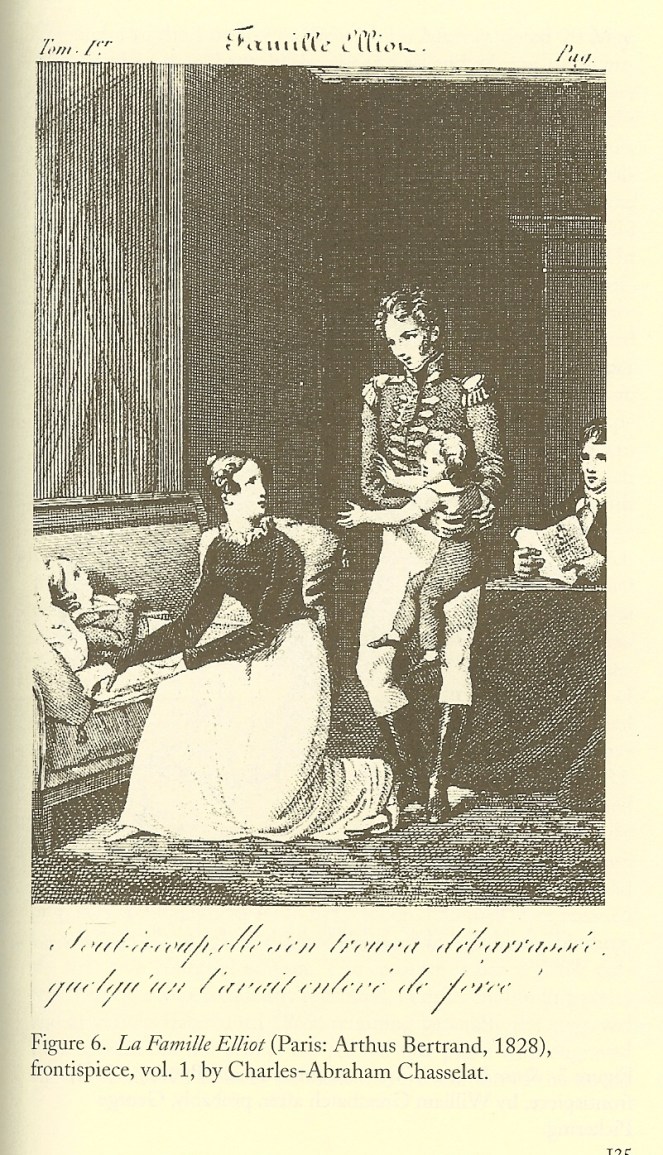
persuasion-french-illus

[Source:  Todd, p. 125] Anne was called Alice; one aside about these translations:  Baroness de Montolieu took liberties with the text :  made them more sentimental for the French audience – but this too is a topic for another discussion!

Sources: 

  1. Chapman, R.W.  The Novels of Jane Austen: the Text Based on Collation of the Early Editions.  3rd ed. Vol. V, Northanger Abbey & Persuasion, Oxford, 1933. [with revisions]  Introductory material.
  2. Gilson, David.  A Bibliography of Jane Austen.  Oak Knoll Press, 1997.
  3. Raven, James. “Book Production.” in Janet Todd, ed. Jane Austen in Context.  Cambridge, 2007.
Books · Jane Austen · News

“Prada & Prejudice” ~ a preview

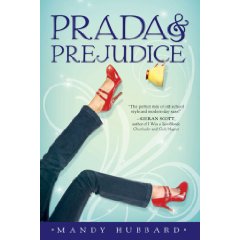
prada-prejudice-cover

 A new Pride & Prejudice knock-off, this time for the younger set and with all the proper ingredients of a rousing romantic plot, a time-travel adventure, and a setting in our favorite place, Regency England.  The book, Prada & Prejudice, by Mandy Hubbard, and due out June 11, 2009, is what one author calls “Pride and Prejudice meets The Wizard of Oz meets The Princess Diaries.”  Here’s the publisher’s blurb: 

Fifteen-year-old Callie buys a pair of real Prada pumps to impress the cool crowd on a school trip to London. Goodbye, Callie the clumsy geek-girl, hello popularity! But before she knows what’s hit her, Callie wobbles, trips, conks her head… and wakes up in the year 1815!

She stumbles about until she meets the kind-hearted Emily, who takes Callie in, mistaking her for a long-lost friend. Sparks soon fly between Callie and Emily’s cousin, Alex, the maddeningly handsome—though totally arrogant—Duke of Harksbury. Too bad he seems to have something sinister up his ruffled sleeve…

From face-planting off velvet piano benches and hiding behind claw-foot couches to streaking through the estate halls wearing nothing but an itchy blanket, Callie’s curiosity about Alex creates all kinds of trouble.

But the grandfather clock is ticking on her 19th Century shenanigans. Can Callie save Emily from a dire engagement, win a kiss from Alex, and prove to herself that she’s more than just a loud-mouth klutz before her time there is up?

[Click here for the author’s website ]


….hmmm!  who knows? but if it is even half as good as Polly Shulman’s  Enthusiasm, this P&P “Clueless”-like confection should be a great summer read for teens, and some of us oldsters besides! 

Books · Jane Austen · Publishing History

“Pride & Prejudice” Cover Art

Check out this post at Belle of the Books ~ she has pulled together a variety of Pride & Prejudice covers that have been published through the years…. vote on your favorite!

pride_and_prejudice-cover

Books · Jane Austen · Movies

Other P&Ps

ppAfter spending last weekend (see the post about Hyde Park) in an atmosphere dedicated to Austen’s Pride and Prejudice – where other B&Bers made use of the 1995 A&E video as well as the 1980 BBC DVD, I felt compelled to track down a copy of the Rintoul/Garvie TV miniseries from 1979/1980 produced by the BBC and aired here on Masterpiece Theatre. Was this what started off my own exploration into the life and works of Austen?? Bet it was! The theme music is oh-so familiar (from an album of Masterpiece Theatre themes now bundled away in a closet, or my own crude off-air tape recording??); the actors are also familiar, either by name or face. A few years younger than Garvie herself, I surely was captivated by this Austen adaptation.
Looking at the Internet Movie Database, we find these versions of Pride & Prejudice; everyone at the B&B wondered what else was out there, but we could not come up with a more definitive list than the usual suspects of 1940, 1980, 1995 and 2005:

1967 (UK; TV); Celia Bannerman as Elizabeth and Lewis Fiander as Mr Darcy. (6 episodes)

1958 (UK; TV); Alan Badel as Darcy and Jane Downs as Elizabeth. (6 episodes)

1952 (UK; TV); Thea Holme (!) is listed as Jane Austen (she wrote a delighful book on Jane Carlyle); Daphne Slater – Elizabeth; Peter Cushing (!) – Darcy (6 episodes); I’d give a lot to see Prunella Scales as Lydia!

1938 (TV???!! ; UK): Curigwen Lewis (Lizzy); Andrew Osborn (Darcy ) (55 minutes – oh my!)

An updating of P&P in 2003: with Lizzy (Kam Heskin) as a college student; Orlando Seale is her ‘Will’ Darcy; the 1940 film; 1980 and 1995 mini series; the newest film (2005), and of course the boisterous Bride & Prejudice, part of which I watched when in England in summer 2007. Don’t think that I’ve forgotten the Bridget Jones series — just not enough room or time to discuss this type of P&P.

In the BBC version, Moray Watson plays Mr Bennet – a familiar face from the likes of Rumpole of the Bailey. Somehow Mrs Bennet (Priscilla Morgan) reminds me of Prunella Scales as Mrs Fawlty, though toned-down. Mr Wickham (Peter Settelen) seemed a face recognized from somewhere: IMDB solved that one: he was Sandy in Flambards, which played here about the same time period as this P&P.

David Rintoul brings a hauteur rarely seen in Darcy — and not out of character. And those long, lingering looks at Lizzy! Charlotte Lucas is oh so right in noticing that this Darcy admires Miss Elizabeth Bennet, almost from the start. (Rintoul is possibly best remembered for his Doctor Finlay series in the 90s.) And Elizabeth Garvie is a quiet, but on-point Elizabeth Bennet. [I hadn’t realized that she lost her husband, actor Anton Rodgers, in December 2007…. he was in so many Britcoms that ran here in Vermont.]

I must agree with one Netflix reviewer who thought this version’s comic characters less over the top than the A&E series. How true: Mr Collins (Malcolm Rennie) is a delight as the silly and long-winded clergyman (can you imagine him in the pulpit???). I’ve yet to experience Judy Parfitts’ Lady Catherine, but have loved her in many shows, including The Jewel in the Crown. Charlotte Lucas (Irene Richard) is the voice of reason here, just as she is in the book. A wise head on those young shoulders (I will blog later on my thoughts that Charlotte at 27 is not quite ‘past it’…). And Lydia (Natalie Ogle) is sweet and flighty without being cloyingly annoying; Mary (Tessa Peake-Jones) is a talented-yet-can’t-really-play-or-sing-well middle sister who here DOES seem rather the obvious (and willing) choice for Mr Collins — she even reads Fordyce’s Sermons!; something Joe Wright and his screenwriter picked up on for their 2005 film. How much more conniving this Miss Bingley (Marsha Fitzalan) seems – you really feel her sticking the knife in. How REAL the characters seem when they are not caricatures.

Coincidently, Deb is also watching this version (actually, she’s comparing it to the 1995 version) — so you will be hearing more about Rintoul, Garvie et al quite soon.

Alistair Cooke’s thoughts on the series can be found in his A DECADE OF MASTERPIECE THEATRE MASTERPIECES (1981). Gosh!! how well I remember buying this large hardcover at Capitol Stationers on Burlington’s Church Street. Such memories… Cooke cattily comments that this series is “so squeakily clean as to suggest at times a doll’s house with doll-like emotions” but he goes on to praise Fay Weldon’s script which “was dramatized, over four careful years”. That care shows in so many lines from the novel expertly utilized. And who doesn’t know Weldon’s own work. Cooke quotes Weldon in a thought-provoking passage — “Miss Weldon explained why Jane Austen appears to many young readers remote and bewildering: ‘Partly because of the way in which it is written, partly because of the subtlety with which she examines the intricacies of human behavior, and mainly because the society she describes has gone forever. She anatomizes a world where women of a certain class can survive only through men…’.” Cooke again: “In all her novels, Jane Austen’s narrator is a dual character: the heroine as participant and the heroine (J.A.?) as onlooker.” A succinct description of Austen’s narrator, which here sides with Lizzy (and changes as Lizzy changes opinions) in how the reader is presented the world contained in the novel. Weldon’s “adaptation demonstrated a fine ear for the spare, exquisite language of the original and a ready talent for taking Jane’s maliciously cheerful view of social pretension.” Cooke goes so far as to say: “Viewers who dislike this Pride and Prejudice do not like Jane Austen”! I end with one Cooke comment that says something few would have dared think: “Dickens, the author-hero of his time, ends most of his romances on a love-dovey note that Jane would have giggled at.” Touché!

8 Feb 2009 update: after reading Joan’s email, I went back to IMDB – looking for Austen-related series and films. There turned up a De Vier dochters Bennet (1961). In German Vier is four, so the same undoubtedly holds for Dutch. So who got axed?? From the cast credits: Kitty!

I love that the 1967 production ‘labeled’ their episodes, thus: Pride (episode one); Proposal (2); Prejudice (3); Elopement (4); and (5) Destiny.

I am most surprised to see a new EMMA in the works! (listed as in pre-production, for television in 2009); the ‘trivia’ lists this a as production begun in 1995 – but put on hold because Miramax and Meridient were producing the same novel for film and TV. No cast announced.

Books · Jane Austen

A Happy Day Indeed!

Oh, be still my heart! ~  it is on this day,  February 6th,  that Catherine meets Henry Tilney in the Lower Rooms in Bath:

Bath, Lower Rooms
Bath, Lower Rooms

They made their appearance in the Lower Rooms; and here fortune was more favourable to our heroine. The master of the ceremonies introduced to her a very gentlemanlike young man as a partner; his name was Tilney. He seemed to be about four or five and twenty, was rather tall, had a pleasing countenance, a very intelligent and lively eye, and, if not quite handsome, was very near it. His address was good, and Catherine felt herself in high luck. There was little leisure for speaking while they danced; but when they were seated at tea, she found him as agreeable as she had already given him credit for being. He talked with fluency and spirit – and there was an archness and pleasantry in his manner which interested, though it was hardly understood by her. After chatting some time on such matters as naturally arose from the objects around them, he suddenly addressed her with – “I have hitherto been very remiss, madam, in the proper attentions of a partner here; I have not yet asked you how long you have been in Bath; whether you were ever here before; whether you have been at the Upper Rooms, the theatre, and the concert; and how you like the place altogether. I have been very negligent – but are you now at leisure to satisfy me in these particulars? If you are I will begin directly.”

and followed by a lively discussion of Bath, and concerts, and journals and writing and muslins, the reader is left with the narrator’s thoughts…:

…for if it be true, as a celebrated writer has maintained, that no young lady can be justified in falling in love before the gentleman’s love is declared, it must be very improper that a young lady should dream of a gentleman before the gentleman is first known to have dreamt of her…

[Northanger Abbey, ch. 3]

And Henry leaves Bath the very next day for a WHOLE week, Catherine completely distraught at the loss.  I always thought this was quite enterprising of Henry!

We all have our own view of Henry Tilney … certainly Mags at Austenblog has single-handedly brought Tilney the attention he so richly deserves! [see also her site Tilneys and Trapdoors].  When I first read Northanger Abbey, I thought Henry was a condescending bore, on a second reading I thought he was quite funny, on subsequent readings, Henry becomes more and more delightful, ever more charming on every re-reading, really quite to die-for – who needs the proud, socially awkward Mr. Darcy when there is a Henry Tilney about?!

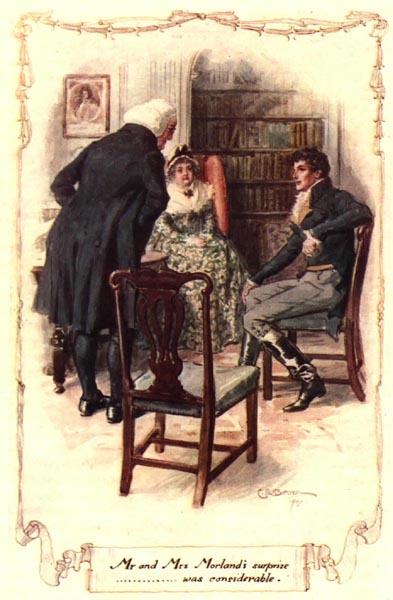
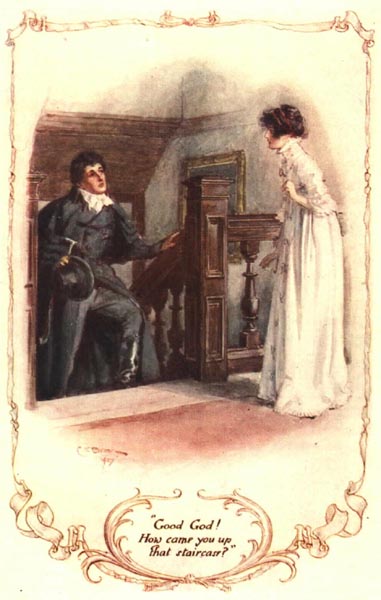
So I bring you ~  the many faces of Henry Tilney ~

C.E. Brock
C.E. Brock

C.E. Brock
C.E. Brock

"Bath Compared with London," said Mr. Tilney, "has little variety."  [Paul Hardy]”]”]Joan Hassall [Folio Society, 1975]

“]”]Shades from Jane Austen [1975]
Shades from Jane Austen, 1975
”]”]Peter Firth as Henry [1986]

”]”]J.J. Feild as Henry [2008]


Further reading:

[Note:  Brock images courtesy of Molland’s

So what does YOUR Henry Tilney look like?? [all comments  and pictures most welcome!]

Books · Jane Austen · News

All-Weekend Pride & Prejudice…

It is later-evening and S&S (back on PBS) is playing in the background as I write, but I had to take a few moments to write on the weekend I just spent in Hyde Park (Vermont). It was a Jane Austen Weekend, held at The Governor’s House at Hyde Park, a Bed & Breakfast run by JASNA member Suzanne Boden.

We were an intimate party that gathered Friday night – Wednesday’s foul weather caused a couple cancellations. Myself and three others stayed the entire weekend, participating in all the events: tea, book discussion, and breakfast-quiz.

On Friday night, I talked (rather at length, I’m afraid!) on Georgiana Darcy and the early-nineteenth century lady-artists Mary Yelloly, Diana Sperling, and Lili Cartwright. Given the intimate setting, I passed the books containing the albums of these ladies. Time went so quickly.

On Saturday there was free time in the morning and early afternoon, then a tea which brought such familiar faces as Hope Greenberg, who – as a member of the Burlington Country Dancers – danced at our December Austen Birthday Tea, and her daughter, and JASNA member Debbie Lynde, who came with a friend. Some delicious tea, served with a diverse variety of sandwiches, scones, breads. Suzanne read some excerpts on Tea and serving tea.

Saturday night our B&Bers were joined by an even larger group, and I was happy to meet the Olivers – who joined our JASNA chapter not too long ago. Jim is one of our three male members! Time passed quickly this evening too, and the dinner was extensive and very well received by all. The “book” discussion, of course, included many references to and comments about the Ehle-Firth P&P. One B&Ber watched the entire mini-series over the three days!

Sunday began with a quick muffin & tea/coffee breakfast, but concluded with a lovely brunch. The Austen quiz help point out that so many Jeopardy-type of questions can come out of Austen’s writing! (I never do well on such brain-picking quizzes…).

Have laundry to do, and a work-week to begin – so will log off tonight. But I hope to add some more thoughts in the coming days… stay tuned!