With women predominating JASNA-Vermont’s chapter, one question that continually arises is: What do MEN have to say about Jane Austen’s novels?? In the end, according to TWO GUYS READ JANE AUSTEN, the answer is multi-faceted and not always gender-specific.
TWO GUYS READ JANE AUSTEN is a delight, guaranteed to make the reader chuckle – and read certain sections out loud to anyone who will listen. Being quickly published proves a boon, as timely topics like Anne Hathaway and Becoming Jane are subjects of the first letters:
“…I was hoping you and Kathy could weigh in with an opinion. We just saw Anne in the film Becoming Jane ….Miranda didn’t much like her, but then, in my experience, Anne Hathaway is a bit of a litmus test. If you like her, you’re a man; if you don’t you’re a woman.”
The epistolary style of the book (email versus letters) recalls 84, Charing Cross Road, although the poignancy of that novel is missing. While readers will learn a bit about the lives of authors Steve Chandler and Terry Hill, it is for their quips and deeper thoughts on Jane Austen and Pride and Prejudice that will have you pulling this off the shelf for a re-read every once in a while. TWO GUYS READING JANE AUSTEN would be useful to many book groups; it would engender discussion on (especially) Pride and Prejudice. Continue reading “Two Guys Read Jane Austen (a review)”→
Jane Odiwe tells of her new book: a sequel to S&S, Mr. Willoughby Returns: (see her blog for more info)
When Marianne Dashwood weds Colonel Brandon both are aware of the other’s past attachments; Marianne’s grand passion for the charming but ruthless John Willoughby and Brandon’s tragic amour for his lost love Eliza. Three years on Marianne is living with her husband and child at Delaford Park, deeply in love and contented for the most part, although Marianne’s passionate, impulsive and sometimes jealous behaviour is an impediment to her true happiness. News that John Willoughby and his wife have returned to the West Country brings back painful memories for Marianne and with the demise of Mrs Smith of Allenham Court comes the possibility of Mr Willoughby and his wife returning to live near Barton and the surrounding area of Devon and Dorset, a circumstance which triggers a set of increasingly challenging, yet often amusing perplexities for Marianne and the families who live round about.
Alert Janeite Nancy M. has posted about The Lost Years of Jane Austen, by Barbara Ker Wilson [Ulysses Press, Nov. 2008]
“Thanks to her meticulous diaries and frequent letters, Jane Austen’s life is well documented. Except for a mysterious period in her early 20s , when, for unknown reasons, her sister Cassandra burned all of Jane’s personal writings.”
A fantasy of what could have happened in the lost years.
Australia and Wentworth are mentioned [but as Laurel Ann proposes, is the a book written in 1984 titled Jane in Australia ?]
Peter Ackroyd, author of many a British literary tome – novels and all manner of non-fiction, has a new book, The Thames: A Biography [Nan Talese, 2008] to follow his London: A Biography of 2000. Published last year in the U.K. under the title Thames: Sacred River, and now available in the US, this is a must for my London collection! Here is a review from Publisher’s Weekly:
For a river with such a famous history, England’s Thames measures only 215 miles. Acclaimed novelist and biographer Ackroyd (Hawksmoor; Shakespeare) invites readers on an eclectic, sprawling and delightful cruise of this important waterway. The Thames has been a highway, a frontier and an attack route; it has been a playground and a sewer, a source of water and a source of power, writes Ackroyd. Historians believe the river may have been important for transport and commerce as early as the Neolithic Age. The ancient Egyptian goddess Isis has a long association with the Thames, which was used for baptisms, both pagan and Christian, during the Roman Empire. The British tribes tried to use the Thames as a defense against Julius Caesar’s invasion, and the Normans built the Tower of London and Windsor Castle on the Thames as symbols of military preeminence. The royal waterway carried Anne Boleyn to both her coronation and her beheading, and famously served as inspiration for paintings by Turner and Monet and for Handel’s Water Music, commissioned to associate the German-born George I with a potent source of English power. Elegant and erudite, Ackroyd’s gathering of rich treats does the famed tributary proud. Illus., maps. (Nov. 4) See this LA Times review
The Lady’s Stratagem: A Repository of 1820s Directions for the Toilet, Mantua-Making, Stay-Making, Millinery & Etiquette
Edited, translated, and with additional material by Frances Grimble
Publication date: November 3, 2008
755 pages; 98 line drawings, 36 halftones
Glossary, bibliography, and index
ISBN: 978-0-9636517-7-8
Cover price: $75.00
Lavolta Press
20 Meadowbrook Drive
San Francisco, California 94132
415/566-6259 www.lavoltapress.com
The Books Please blog reviews Georgette Heyer’s Friday’s Child. [Margeret has created a very thoughtful reading blog and is one you should visit often…] for this, her first Heyer read, she links to the Georgette Heyer Reading Challenge Blog. I confess to just starting MY first Heyer, Faro’s Daughter, and will post a review soon.
And finally a visit to Austenprose for her November booklist… [some duplicates I fear, but we are always looking for the same thing!]
For those of you interested in textiles, visit R. John Howe’s blog on Textiles and Text where he reports on the recent textile symposium in Washington DC… many lovely photographs to view!
And for those of you who are hungry, Regency Reader Blogwrites about the typical Regency breakfast; and while you are there, look at the other recent posts on Bath, Tattersall’s, and various historical Regency novels that have been reviewed.
And finally for a bit of end-of- the-week humor (or maybe not…), take a quick look at the results of the Guardian.co.uk contest on redesigning covers of literary classics for a “dumbed-down” age. Dickens had the most entries it seems, but as you can see, Jane made the list!
This cannot wait for the weekly round-up! See this article in today’s CNN.com edition :
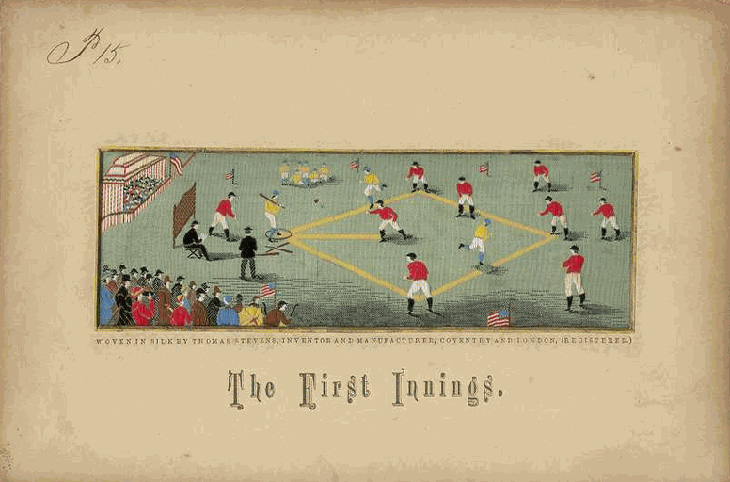
According to author Julian Norridge baseball originated in Britain, and part of his proof comes from a reference in Jane Austen’s novel “Northanger Abbey.”
Norridge, whose book “Can we Have our Balls Back, Please?” focuses on Britain’s role in writing the rulebooks for a long list of sports, says Austen mentioned baseball in the opening pages of “Northanger Abbey,” which was written in 1797-98.
Norridge says that Austen referenced the sport while introducing her tomboy heroine Catherine Morland, writing: “It was not very wonderful that Catherine, who had nothing heroic about her, should prefer cricket, baseball, riding on horseback, and running about the country at the age of 14, to books.”
He argues in his book that the reference indicates British people were familiar with the sport prior to its supposed invention much later in the United States.
Can I have read this book so many times without that word jumping off the page?? Baseball is spelled “base ball” in my text …. but as a die-hard Yankees fan [OMG, what an admission!], I should have certainly at least noticed this! …. so I put this out to you, Kind Readers, and ask for your thoughts … and has anyone written about this before??
Jane Austen loved a garden. She took a keen interest in flower gardening and kitchen gardening alike. The Austens grew their own food whenever they could and had flower gardens wherever they lived, at their parsonage at Steventon in Hampshire, their town gardens at Bath and Southampton, and when they returned to Hampshire, at their cottage garden at Chawton. In Jane’s letters to her sister Cassandra, we see her planning the details of these family gardens, discussing the planting of fruit, flowers, and trees with enthusiasm. In the course of her life, she also had the opportunity to visit many of the grander gardens of England: her brother’s two estates at Chawton and Godmersham, the manor houses of friends and family, and probably even the great estate at Chatsworth, assumed by many to be the inspiration for Pemberley…
So begins the new book “In the Garden with Jane Austen,” by Kim Wilson, author of Tea with Jane Austen, published by Jones Books [2008], one of my purchases at the AGM Emporium in Chicago, and for those of you enamored of the traditional English garden, a lovely addition to your bookshelf.
Wilson takes us on a visual journey through various gardens Austen would have created for herself, visited, or imagined in her novels, all interspersed with photographs, quotes from her works and letters, and vignettes of engravings and poetry from her contemporaries.
We begin at Chawton Cottage, Austen’s home from 1809-1817, and the setting of the cottage and kitchen gardens that she wrote about so lovingly… “You cannot imagine – it is not Human Nature to imagine what a nice walk we have round the orchard” [31 May 1811], and then references to farm and parsonage gardens, which we see in Emma (Robert Martin’s summer house in his farm garden), and who can forget Mr. Collins day-long labors in his garden, much to Mrs. Collins’s satisfaction!
The chapter on Mansion and Manor House Gardens takes us to Godmersham Park and Chawton House, Austen’s brother Edward’s estates in Kent and Hampshire, Blenheim Palace, Chatsworth, and Stoneleigh Abbey [in Warwickshire] and the Vyne where “every park has its beauty and its prospects” where “one likes to get out into a shrubbery,” and we are reminded of Mr. Rushworth and his “improvements,” and the settings of Pemberley, Rosings, Mansfield Park, and in Emma, where the garden is nearly the heroine’s only place for solace, and Fanny with her own geraniums in her room (but she cuts roses for Mrs. Norris! …and a nice touch here … “Recipes for Mrs. Norris’s Dried Roses”)
Gilbert White's House, Selborne
Austen’s life in the cities of her times was confining, and one of her joys was the City Gardens. Wilson travels through the gardens of Georgian Bath, a variety of London’s garden squares (Henry Austen lived in several places in London and the areas surrounding these show up in her novels as the London homes of her characters:, Brunswick Square in Emma, Hanover Square and Portman Square in S&S), the garden at the Royal Pavilion in Brighton (where Austen’s characters visited, if not Jane herself), and the small town garden the Austens had in Southampton.
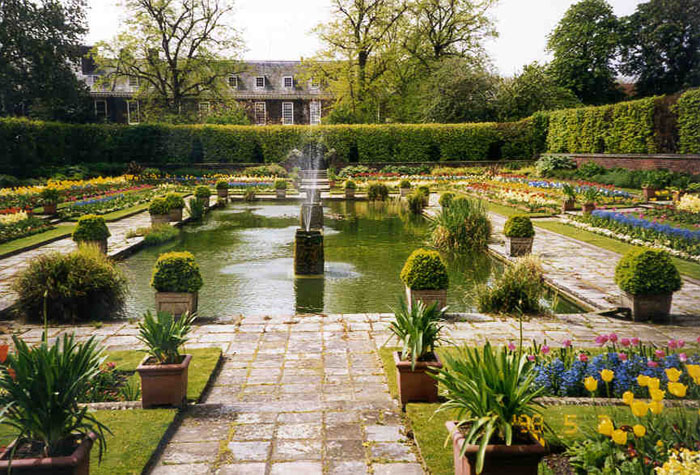
We all know that Austen was a self-described “desperate walker” much as she imagined Elizabeth Bennet, so her love of Public Gardens & Parks is apparent in her novels and letters: Kensington Gardens, St. James and Hyde Park in London, Sydney Gardens and Alexandra Park at Beechen Cliff in Bath, Box Hill (made famous in Emma), and the tours of the picturesque (as Elizabeth’s tour through Derbyshire in P&P), and Netley Abbey near Southampton.
Kensington Gardens
The chapter on Recreating Jane Austen’s Garden offers plans on the Chawton Cottage kitchen garden and flower border, the border garden of Houghton Lodge, the herb garden at Gilbert White’s House (in Selborne, near Chawton), and a Georgian garden with plans of the Kennard Hotel garden in Bath.
Gardens featured in Austen film adaptations closes the book with a list of the various real-life houses, gardens and parks that breath life into Austen’s stories…many are open for tours and how better to experience the places that Austen herself created for us than to take a leisurely walk around the grounds of these locations.
Wilson provides a bibliography to entice the reader with yet more books to peruse: they run the gamut from “The Formal Garden in England” [R. Blomfield, 1901] to Cowper’s “Poems” to “Hints for the Preservation of Wood-Work Exposed to the Weather” [J. Crease, 1808] and “The Juvenile Gardener, Written by a Lady for the Use of her Own Children” [London, 1824]
So this quick summary is of course lacking in what makes this book so charming – the many photographs, the quotes from the novels, the flowers! Ms. Wilson has given us a gift! I live in an English cottage cape, surrounded by what were once charming gardens…I struggle to keep them looking as I know they must have in some long-gone past, … I have many books on cottage and English gardening, perennials and borders, herb gardens, Gertrude Jekyll’s gardens, Penelope Hobhouse on all manner of gardens, even how to make an all-white garden … so this book is a delight to add to my collection, combining as it does my love of an English garden and my love of Austen….it is a visual feast, a good quick read that brings so many elements to the table…it is unfortunate that we are now upon the winter scene here in Vermont, and though I cling to my last rose struggling mightily against the frost that visits us every night, I can perhaps make some new plans through the long winter, or better yet, plan a garden tour through the English countryside next spring…or at least do a re-read of this lovely book……
Thanks to Georgie Lee’s blog for this mention: for information on the “Ghosts of Bath”, visit Hollow Hill, one of the web’s oldest sites for Ghosts and all things spooky… the man in the black hat in the Assembly Rooms; the coach drawn by four horses in the Royal Crescent; the ghost of the Theatre Royal and Garrick’s Head Pub; a hooded figure at the Crystal Palace Tavern; a jilted bride of Queen’s Square… and many more…
and for some additional holiday reading, try this book by John Brooks:
Tonight is the start of the BBC production of Dickens’ Little Dorrit [BBC 1, 8pm]. Andrew Davies, in yet another lavish costume drama of a classic, brings to the small screen Dickens’ tale of financial ruin, love, and mystery all rolled into one … one hopes that by bringing this long-forgotten masterpiece back to life, Davies will do what he has done for Austen and Gaskell among others, and inspire viewers to return to the books!
I have seen the Derek Jacobi 1988 BBC version several times, so looking forward to this new rendition with Matthew MacFadyen as Arthur Clennam and Claire Foy as Little Dorrit, along with quite the star-studded cast… see this short review from Digial Spy:
Often shows boast of having an “all-star cast” but in the case of Little Dorrit they really mean it. The roster includes (deep breath): Matthew Macfadyen, Freema Agyeman, Ruth Jones, Pam Ferris, Eve Myles, Andy Serkis, Amanda Redman, Russell Tovey, Bill Paterson, Maxine Peake, Annette Crosbie, Alun Armstrong and Mackenzie Crook, to name but a few. Surprisingly Judi Dench isn’t on the list.
So, the key question: is it any good? Well, it’s a veeery slow starter – with fourteen episodes in the series, we should probably expect a bit of padding here and there – but once it gets going it’s reasonably intriguing. Personally I’m just pleased to see Mr Macfadyen back on the box in a regular role. [from Digital Spy.co.uk]
Further reading: [a small sampling of the many articles…]
There is a new exhibition at the Women’s Library in East London: “Between the Covers: Women’s Magazines and their Readers” chronicling the history of women’s magazines since 1600 in the U.K.. See this article on the exhibit at the Newham Recorder, and then visit the Library. Hopefully there will be a catalogue of the exhibition which opens on November 1st.
and what magazines did Jane Austen read? ….. aah! another post in the offing perhaps?? …. but in the meantime, you might want to start with this Lady’s Magazinesite…
Diary ~ Day Four: Brunch & Music & Darcy & Farewells / Final Thoughts
Early morning RC meeting, another helpful gathering…I am returning home with a suitcase full of ideas (not to mention those books!)
Off to Brunch and “A Conversation about Creativity, Collaboration, and Creaking Doors”
JASNA announcements including awarding prizes for the Young Writers Workshop ~ you can see the list of winners and read the winning essays at the JASNA website…all excellent and insightful! And then the Philadelphia entourage took the stage for a humorous skit and the passing of the JASNA banner from Chicago’s William Phillips to the coordinators of the next AGM, “Jane Austen’s Brothers and Sisters in the City of Brotherly Love“ October 9-11, 2009 in Philadelphia. Mark your calendars!
Lindsay Baker & Amanda Jacobs
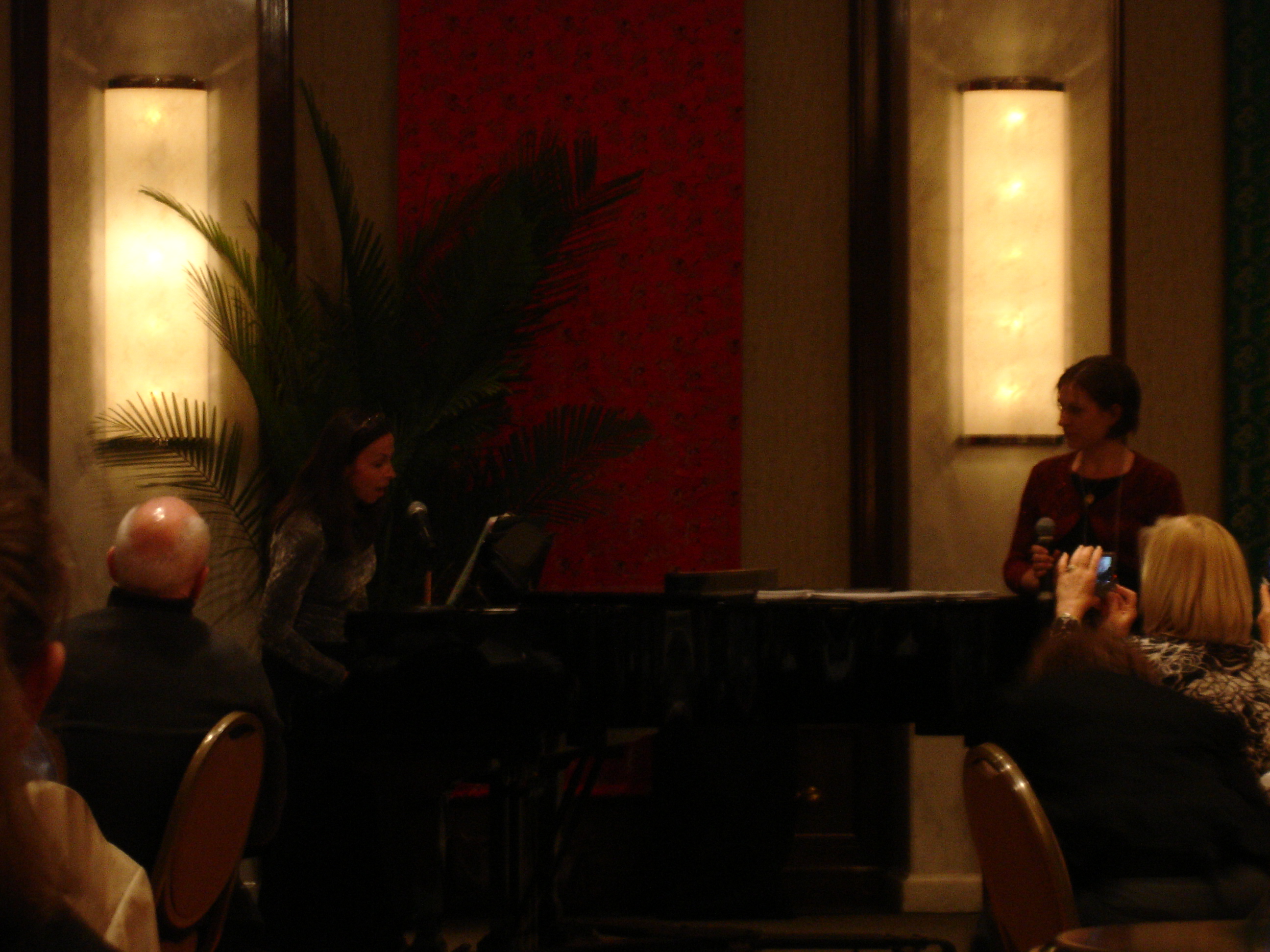
Lindsay Baker, Arlene Crewdson, Colin Donnell and Amanda Jacobs then thoroughly delighted the audience of rapt Janeites with the story of bringing Pride & Prejudice, the Musical to the Broadway stage. A fascinating account of their collaboration on music and lyrics, their years of work and their efforts to remain true to Austen’s story – they returned over and over to the book throughout this musical journey (and a very well worn and loved copy it was!)
The audience could not contain itself in wanting to see and hear from Colin Donnell (can his name REALLY be COLIN?!) – in their search for the perfect Mr. Darcy, they propped up all the head-shots of possibles on the kitchen counter and chose the one who most looked like Darcy to them…hoping fervently that he could SING! Which he quickly showed us all that indeed he could! Two songs from the show, Elizabeth’s “When I Fall in Love” and Darcy’s “Fine Eyes”gave us a taste of what is to come….just lovely, and everyone snapping pictures of this latest Darcy incarnation. Mr. Donnell was all accommodation – though he did admit that standing before all of us obsessed Janeites was quite a “daunting” task! [no worries, ” you had us at ‘hello’ “!]
The show is having its grand pre-Broadway debut on October 21 in Rochester, NY, the place where it all began. See their website at http://www.prideandprejudicebroadway.com/ for updates and information (and pictures!) about the cast. (I append two pictures here that I was able to get of Mr. Donnell, albeit a disappointment (the picture, not him!), but I did get to ask him what his Mom thought about his being Mr. Darcy…he said she has been very supportive and having fun with the whole idea, so kudos to her!) [I am not sure I could handle my son being Mr. Darcy…though he could be, or so I am told; but I do know that nothing on earth would get him to put on those leggings!]
Final Thoughts upon departing Chicago ~
So off to the airport and a moment to reflect, and notes on a few of the Emporium tables not posted on above that you can visit online…
A visit to the Chawton House Library table, manned by Gillian Dow, was the annual reminder of how important this resource library is, how much I love receiving their great publication The Female Spectator, and how even the smallest contribution is appreciated by them. See their website to learn more about their collection of books on women’s writing in English from 1600 to 1830 and upcoming events.
The Goucher College table had paper dolls for sale – all the heroes of Austen’s novels, designed by Donald Hendricks. I was most lucky to get there early, as my favorite Captain Wentworth was still available (though a tough choice between him, Darcy, and Henry Tilney!) Amused to find the following day that they were all gone except one –
Edmund Bertram rested alone on the table with no takers ~ perhaps it IS only Fanny who has eyes for Austen’s Mansfield Park hero! (and hopefully someone rescued him before the end of the day…)
Mr. Hendricks Paper Doll Gallery at Legacy Designs has many of the characters from Austen’s novels, and many more besides (perfect for holiday gifts…!)
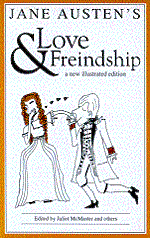
Another table of must-have treats was the Juvenilia Press, with Juliet McMaster – this collection of the youthful writings of Austen as well as other authors, accompanied by McMaster’s engaging illustrations, should be added to everyone’s Austen library. See their website for information on ordering.
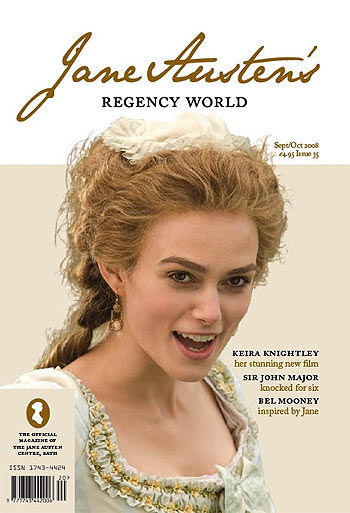
The new publisher of Jane Austen’s Regency World Magazine, Tim Bullamore, was present to show us all the latest issue (Sept / Oct 2008) with its many changes. He is offering a 20% discount to all JASNA members, and though it is costly when coupled with the shipping, it is well worth the investment and another fine addition to your Austen collection. I will post more on this cram-packed issue, but in the meantime, you can read the free articles from previous issues available online at their website and news on the upcoming Nov / Dec issue.
So back to the real world! I am most thankful to the Chicago Chapter and especially William Phillips, and JASNA President Marsha Huff, and all the many other volunteers who made this such a terrific AGM! Four days of intelligent musings, good company, lovely fashions, laughter all around, tons of BOOKS and other Austen-inspired goodies, and time to ramble about in this bygone time…it just doesn’t get any better than this!
“When I am gone…,” Jill Pitkeathley’s Cassandra Austen muses on the letters written to her by her sister Jane. “When I am gone, perhaps before, they will want them, they will pour over them, examine them in detail and discuss them without limit.” Who would Cassandra’s they have been? She may immediately have thought of family, but how apt that they can be broadened to include, yes, this very reader. For ‘pour over’ and ‘examine’ is exactly what Austen-lovers do with her extant letters. James Edward Austen-Leigh utilized letters in his early biography; Lord Brabourne published (though not entirely verbatim) the letters in his possession; the son and grandson of Austen-Leigh included them in their family biography; Deirdre Le Faye brought out editions of both that biography and the letters themselves. Romanticists invent romances; writers cite Austen’s few references regarding writing and publishing; historians pluck from them pictures of England and London during the reign of George III and the Prince Regent. We all mine Austen’s letters for what they can tell us about what we most want to know, be it her life, her art, her world.
When I opened the door to go to the library today (I’m desperately in search of the audio version of Pride and Prejudice as read by Emilia Fox; damned thing is always CHECKED OUT!), I spied a large-ish padded manila envelope that had just gotten delivered with a few too many bills and junk mail… Anyway, while it wasn’t my long-long awaited CD from Oxford University with Drummond Smith letters, it was still a ‘gift’ from out of the blue: a book!
TWO GUYS READ JANE AUSTEN – and it’s written as letters between the two authors, Steve Chandler and Terrence N. Hill. What could be more of interest!
I grabbed the cover from Amazon, where there’s a 4-7 week wait; so you might want some publisher information: Robert D. Reed Publishers; P.O. Box 1992; Brandon, OR 97411. email: 4bobreed@msn.com; web: www.rdrpublishers.com. Its cover price is $11.95.
Let’s take a moment to dip inside it…
Page 47, the letter is from Steve to Terry (12 Dec 2007): ‘Sisters! A great song from the movie White Christmas … Sisters! (Jane Austen writes about complex family dynamics so well, so bitingly funny.) … So I remember my girls and what sisters they were and are to each other. How sweet it was and has been. And I agree with you, it’s a lot like Jane and Elizabeth in our book . . . maybe easier to do than brothers who are taught a more competitive approach. Scrapping for attention and approval.’
The back cover reads: This is the third book in the critically-acclaimed TWO GUYS series [the others being: Two Guys Read Moby-Dick and Two Guys Read the Obituaries]… This time the two guys take on the biggest challenge yet — Jane Austen. Follow their wild and often hilarious exchanges as they fly through Pride and Prejudice and the darker, more complex Mansfield Park.
Deb, for one, will undoubtedly welcome that they read Mansfield Park !










 “When I am gone…,” Jill Pitkeathley’s Cassandra Austen muses on the letters written to her by her sister Jane. “When I am gone, perhaps before, they will want them, they will pour over them, examine them in detail and discuss them without limit.” Who would Cassandra’s they have been? She may immediately have thought of family, but how apt that they can be broadened to include, yes, this very reader. For ‘pour over’ and ‘examine’ is exactly what Austen-lovers do with her extant letters. James Edward Austen-Leigh utilized letters in his early biography; Lord Brabourne published (though not entirely verbatim) the letters in his possession; the son and grandson of Austen-Leigh included them in their family biography; Deirdre Le Faye brought out editions of both that biography and the letters themselves. Romanticists invent romances; writers cite Austen’s few references regarding writing and publishing; historians pluck from them pictures of England and London during the reign of George III and the Prince Regent. We all mine Austen’s letters for what they can tell us about what we most want to know, be it her life, her art, her world.
 Jane Austen in Vermont