Book reviews · Books

And yet another item in my mailbox….

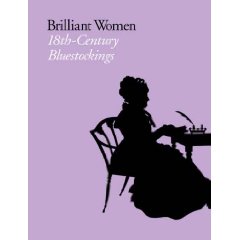
…but this time in my REAL mailbox!  I am thrilled to find in the mail today a book I ordered,  titled Brilliant Women:  18th-Century Bluestockings, a book published to accompany the exhibition of the same name held at the National Portrait Gallery, London, from March 13 – June 15, 2008.  Unhappily not in London to see this exhibit, I find that this book must suffice…and a quick skim through its pages proves it will not disappoint.  Written by Elizabeth Eger and Lucy Peltz, these are the chapters:

  • The Bluestocking Circle:  friendship, patronage and learning
  • Living Muses:  constructing and celebrating the professional woman in literature and the arts
  • ‘A Revolution in Female Manners’:  women, politics, and reputation in the late 18th-century
  • The Bluestocking Legacy

and all accompanied by the fabulous portraits of the women of the circle and paintings of their time: Mary Wollstonecraft, Hannah More, Catharine Macauley, Madame de Stael, Elizabeth Monatgu, Elizabeth Vesey, Frances Boscawen, Anna Seward, Elizabeth Carter, Maria Edgeworth, Mary Shelley, Fanny Burney, and many more.

Dear Jane shows up in the last chapter, with the portrait by Cassandra displayed (this likeness is housed in the National Portrait Gallery), and a short paragraph on Austen’s novel writing and her references to it in Northanger Abbey (though the writers make the oft-published mistake of calling NA her “earliest” work), and the importance of Austen writing in the wake of the changing times wrought by the Bluestockings.

So this book heads to the top of my already toppling TBR pile… this needs a close reading and time to savor the lovely illustrations!  

Further reading: see my previous post on the “Bluestockings” where there are several links to more information.

Book reviews · Books · Jane Austen · Regency England

Some reading thoughts…. Austen, etc.

Here are a few of the books lately graduated from my bedside table along with a other few random thoughts for YOUR bedside table ~

First on my list, and as soon as I get the book, will find me engrossed in the latest Keats’ biography, Posthumous Keats:  A Personal Biography, by Stanley Plumly [Norton, 2008]  Click here for the NYTimes review, and run to your local bookstore to pick up a copy…. 

I was in Rome last year and the one thing on the top of my “to-do” list was a visit to the Protestant Cemetery where Keats’s grave was covered in fresh flowers (a daily occurrence) by a still-mourning public… I was quite overcome (to the embarrassment of my husband!)…and not to mention the meandering walk to Shelley’s grave site through this haunting enclave in the center of the City, and then this followed by a lengthy visit to the Keats-Shelley House [right next to the Spanish Steps] where Keats died on February 23, 1821.  Plumly’s book is a loving tribute to Keats’s poetry and his immortality…

…but now back to Austen….

Laurel Ann at Austenprose had recommended these two books, and I quickly added them to my pile and just as quickly finished them off!

Enthusiasm by Polly Shulman [Putnam’s 2006] (see the Austenprose review):  I have been reading several sequels lately in prep for the Chicago AGM, and I find that of late I am confusing the stories!  All these Austen characters who have taken on lives of their own now have these MULTIPLE lives with varying outcomes and I suppose I am left with the ability to choose which “ending” I prefer for any of them…I think perhaps this is why one takes up a pen to write ones own adventure for a given character!  So it was with all these sequels swimming in my head, as well as Laurel Ann’s glowing review that sent me to the library shelves to find Polly Shulman’s Enthusiasm, a book for young adults with the aura of Pride & Prejudice.  This has to be one of the most refreshing reads I have encountered in a long time!  I don’t want to spoil the story for you, but will quote the jacket blurb:

…equal parts romance and comedy as a series of misinterpreted messages and super-awkward incidents, not to mention some rather mystifying poetry tacked to a tree and a valiant foray onto the stage, makes Julie wonder whether she is cut out for Enthusiasm – or True Love – at all…

With characters the likes of Ashleigh, the Enthusiast (whose latest “enthusiasm” is P&P), Ned the Noodle, Amy (the semi-wicked stepmother dubbed “IA”, a.k.a. “Irresistible Accountant”) and the to-die-for Charles Grandison Parr (love the name!), this lovely tribute to P&P sent this reader back to all those wonderful and awful moments as a teenage girl that for some reason we never forget!  And I think what most surprised and pleased me was to find this library book much used!  I recommend highly that you find your way to this book as soon as possible….

Mr. Darcy’s Diary by Maya Slater [Phoenix, 2007] (see the Austenprose review):  Gentle Reader, here is the tale all told from Darcy’s point of view, thanks to the diary he so meticulously kept, and we learn of his love and concern for his sister (and what really happened with Wickham), his escapades with Byron (!), his periodic “tumbling” of the maid,  his growing obsession wih Miss Elizabeth Bennet, and his endless fencing and fisticuffs to overcome his mood swings.  Darcy is so human in this book…Ms. Slater is at turns witty and wise in portraying him in all his glory…. I liked this book more than any other of the sequels I have read so far…this is the Darcy who stays with me the most….the Darcy I had imagined off the pages of P&P.

I skimmed again through The Lost Memoirs of Jane Austen by Syrie James in order to answer my co-blogger’s rather scathing review…(see the two reviews on this blog:  Kelly’s and mine and then contribute to the fray if you will!)…. this book seems to have generated a wide range of opinion…

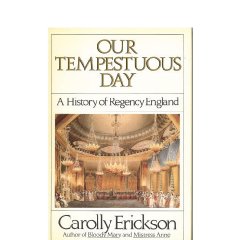
Carolly Erickson’s Our Tempestuous Day [Morrow 1986] is a rapid trek through Regency England.  Erickson, the author of biographies of Elizabeth 1, Anne Boleyn, Bloody Mary, Henry VIII, Empress Josephine and many others…., Erickson here tells the tale of the times not as a linear chronological history, but rather a series of vignettes of events, people, and places, that after you are done you have a much better understanding of the times that Jane Austen was living and writing in… and really a whole new list of books to read! [I will review this book more fully in another post…] 

Charlotte & Leopold: the true story of the original people’s princess,  by James Chambers, a biography of the daughter of King George IV and Caroline, and their Regency times ….here is the blurb from Amazon:

The tragic story of the doomed romance between Charlotte, heir to the English throne, and Leopold, uncle of Queen Victoria and first King of the Belgians. A story that Jane Austen famously declined to tell, declaring: “I could no more write a romance than an epic poem.”

Charlotte was the only legitimate royal child of her generation, and her death in childbirth resulted in a public outpouring of grief the like of which was not to be seen again until the death of Diana, over 150 years later. Charlotte’s death was followed by an unseemly scramble to produce a substitute heir. Queen Victoria was the product.

James Chambers masterfully demonstrates how the personal and the political inevitably collide in scheming post-Napoleonic Europe, offering a vivid and sympathetic portrait of a couple whose lives are in many ways not their own. From the day she was born, Charlotte won the hearts of her subjects and yet, behind the scenes, she was used, abused, and victimized by rivalries-between her parents; between her father (the Prince Regent, later King George IV) and (Mad) King George III; between her tutors, governesses, and other members of her discordant household; and ultimately between the Whig opposition and the Tory government.

Set in one of the most glamorous eras of British history, against the background of a famously dysfunctional royal family, Charlotte & Leopold: The True Story of The Original People’s Princess is an accessible, moving, funny, and entertaining royal biography with alluring contemporary resonance.

A new book out in March by Peter Graham, titled Jane Austen and Charles Darwin: naturalists and novelists (click for the table of contents), and a tad pricey at $99.  reads “3 or 4 families in a country village” : this phrase by which Jane Austen identifies the most congenial subject matter for novels as she chose to write them can also serve to characterize the environment that proved ideal for Charles Darwin’s naturalist observations.” 

Lady Anne at Jane Austen Today has nicely reviewed the new book Jane Eyre’s Daughter, by Elizabeth Newark.

As for the Austen sequels, head over to Austenprose for a review of several being published this September: Pemberley Shades, by Dorothy Bonavia-Hunt [I have just finished this book and will post a review this week; see Laurel Ann’s review hot off the press today!]; Netherfield Park Revisited by Rebecca Ann Collins (Book 3 of the “Pemberley Chronicles”); The Darcys and the Bingleys by Marsha Altman [see Ms. Altman’s post here; I will be reviewing this book shortly], and Impulse and Initiative, a Pride & Prejudice Variation by Abigail Reynolds. 

Just Jane: A Novel of Jane Austen’s Life, by Nancy Moser is given a lengthy review at the BC Blog Critics magazine site.

Ms. Place interviews Diana Birchall on her new book Mrs. Elton in America.

A short blurb on a fantasy fiction book which should excite Austen and Bronte fans:The Magicians and Mrs. Quent,” by Galen Beckett. (Bantam Spectra; $23)

Fans of Jane Austen and the Bronte sisters will be in a familiar landscape reading “The Magicians and Mrs. Quent.” Click here to find out more!

 This fantasy debut uses those authors’ famous works as a template. Does the place name Heathcrest Hall ring any chimes? 
Ivy Lockwell is the eldest of three sisters. It is Ivy who is caught in polite society between holding the family together, after the reclusion of the sisters’ father in his library, and her chafing against the stricture of not being able to use magic (or magick, to use the genre spelling). She is female, after all, and magic also is seen as the cause of her father’s reclusiveness. Of the novel’s three parts, the second, “Heathcrest,” limns relationships nicely from Ivy’s point of view. She applies for governess to Mr. Quent and thinks her troubles eased when hired. If only she had not uncovered an ancient tome about magic still afoot in the world, she would not have met its willful protectors. [quoted from Macon.com]
But also see this glowing review from Rick Kleffel on NPR, and click here for an excerpt from the book:
Though this may look like the sort of book you’d find nestled in a shelf of paperback potboilers at a beach rental, don’t judge The Magicians and Mrs. Quent by its cover. Galen Beckett’s debut cleverly mixes fantasy and literary in a novel that imagines the social strictures that hemmed in Austen’s and Bronte’s heroines are the result of magical intervention. The novel’s supernatural elements and imaginary (but familiar-seeming) setting allow Beckett to examine class and economic conflicts from the outside, without resorting to polemics. The result is a work that mixes the rich pleasures of a Victorian epic with elements of the fantastic, an imaginative eye and a dry sense of humor.

  Kleffel rates this as one of his “nine first books that make a lasting impression,” with a heroine who had a peculiar habit of reading while walking]…now there’s a heroine I can identify with! 

And on that happy note, I should get back to my reading…hope this gives you a few ideas…

Book reviews · Books · Collecting Jane Austen · Jane Austen · Uncategorized

ESSENTIAL AUSTEN: A Chronology of Jane Austen and Her Family (a review)

Writers necessarily edit as they write; to make paragraphs and resultant chapters coherent, some information has to be gone into in depth, while other information reluctantly or automatically must be jettisoned. Too much information, unskillfully crafted, will leave readers in the dust. A skillful author, however, molds the story with the facts at hand, picking and choosing what to include, and how to phrase or emphasize those inclusions. This is particularly true of biography.

Take, for instance, the prize-winning A MIDWIFE’S TALE, by Laurel Thatcher Ulrich. While confronted with an entire decades-long diary (spanning 1785-1812), Dr Ulrich carefully chose certain illustrative sections in which to pinpoint aspects of Martha Ballard’s life. Reader’s interested in the minutiae of that life, as described by its protagonist, must unearth a copy of the published diary or go to the copy online.

The minutiae of life is exactly what Deirdre Le Faye gives readers in her superb and invaluable A CHRONOLOGY OF JANE AUSTEN AND HER FAMILY. This is certainly not the type of book one takes to bed, but it is nevertheless an engrossing read. Within its pages are the lives of not only Jane Austen, but also her forebears, immediate family, cousins, aunts and uncles, nieces and nephews – a three-hundred-year span from 1700 to 2000. This result of Le Faye’s digging through archives, private collections and published works provides Austen fans the bones with which to build biographies all our own. Through it, you can uncover the additions and deductions of Austen bank accounts; follow the rise and fall of Henry Austen’s partnership with Tilson; chart the Hampshire weather utilizing the notations in neighbor Eliza Chute’s diaries; and find the private thoughts of girls like Fanny Austen Knight.

Some random samples:

In 1796 [p. 187]

September 2, Friday

Rowling: HTA leaves to return to Great Yarmouth. He will write soon to Steventon.
Hampshire: A ball is held in the Steventon district, possibly today (or possibly it is the next assembly ball at Basingstoke, on 8 September, Thursday), at which CEA is present. Other dancers include a large party from the Terry family of Dummer, Mr John Lovett, Mr Tincton, Mr John Harwood, Mary Lloyd, Mary Harrison and James Austen.
[Letters 4, 5]

September 3, Saturday

Rowling: EAK, Elizabeth, JA and FWA, dine at Goodnestone and have an impromptu dance afterwards. Others present are Lady Bridges and her children Edward, Harriet, Louisa and George, as well as Fanny and Lewis Waltham, the Misses Anne and Mary Finch. The invalid Marianne Bridges does not appear. The Rowling four walk home afterwards.
[Letters 5]


In 1802 [p. 267]

January 18, Monday

Dummer: ‘Miss Terry, Anne & I rode & called at Worting, Manydown, Oakley Hall, & Deane.’
[Powlett journal 119A00/1]

January 21, Thursday

London: Army agents Cox & Greenwood debit Major Thomas Austen’s account: ‘Cash paid freight of a Hogshead of rum from Jamaica, £2.8s.11d.’
[Cox & Greenwood ledger, fo. 33]

January 24, Sunday

London: Army agents Cox & Greenwood credit Major Thomas Austen’s account: ‘By 31 days Pay to 24 January 1802, £21.16s.7d.’
[Cox & Greenwood ledger fos. 33, 212]
The Vyne: ‘Misling small rain most of the day. Church. Mr. Austin to dinner.’
[Chute pb 23M93/70/1/9]


In 1809 [p. 369]

mid-June

Alton: MLA goes to stay with Mary Gibson in Rose Cottage for about a month, while Mary G is expecting her second child.
[CMCA Rems 19]

June 14, Wednesday

Canterbury: ‘Aunt Louisa came & dressed here & dined with [three words illegible] where we met G.M. Bridges, Uncle B. & Mr. Champneys. Papa & Aunt J. with G.M. [Austen] & Aunt C. from Godmersham dined with Mrs Knight & called here in the morning. Mr. & Mrs. E. Cage & Annetta called. Aunt Louisa slept here. Little George Moore not very well went to stay at Goodnestone Farm for change of air.’
[FCKpb U.951/F.24/6]

June 15, Thursday

Canterbury: ‘Uncle & Aunt M. dined at Dr. Walsby’s & Aunt L. & I with Mrs. Knight where we met G.M. Bridges again & Aunt L. went back with her. Walked about the town in the morning. Fine & hottish.’
[FCKpb U.951/F.24/6]

The abbreviations utilized (fully explained at the front of the book) are, most of them, the typical used for personages and already well known: CEA = Cassandra Elizabeth Austen [Jane’s sister]; EAK = Edward Austen Knight [Jane’s brother]; CMCA = Caroline Mary Craven Austen [Jane’s niece, younger daughter of James]. Pb = pocket book. Entries are arranged with the geographic (town, estate, etc) in italics; and the source is clearly marked on the side margin [they appear below entries only in this review].

The sources for these listings are astounding: letters, diaries (pocket books), accounts books, taxation records, published memoirs and biographies, privately-held papers.

The one minus: while readers will be grateful for the extensive Personal Names index (which runs from pages 757-776, three columns per page), you do end up searching for references because, rather than indexed by page number, everyone is indexed by year. For instance:

Knatchbull, Joan: 1796
Knatchbull, Mary Dorothea, see Knight
Knatchbull, Wadham: 1813
Knatchbull, Wyndham: 1784, 1805, 1808, 1810-14 [page 768]

This obviously works best for people who occur multiple times within a given year; it does give a quick indication of which ‘periods someone appears in; and must have provided the publisher with a space-savings.

The structure of the book includes a substantial bibliography (712-724); thirty-two family trees (725-756); a frontispiece map and several illustrations. This is truly a publication of Le Faye’s DECADES of research into the Austen family; readers will feel as if they are sitting down with the scholar and picking her brain. In her preface, she says: ‘I hope that this uniquely detailed chronology will be of the greatest use to all future biographers, literary critics and historians, providing as it does accurate documented facts gathered from a wide variety of sources.’ We all owe her a debt of gratitude (to Cambridge University Press as well; although the steep $168 price tag does seem more geared towards library rather than individual purchase) for sharing the results of her researches with us all. It represents Le Faye’s gift to serious scholars, making this an Essential Austen volume.

* * *

ESSENTIAL AUSTEN is a series we will continue, which will introduce or earmark those books (and other items?) essential to an Austen collection.
Book reviews · Books · News

Hot off the Presses: Cassandra and Jane

It was with great expectation that I awaited the arrival of a reviewer’s copy of Jill Pitkeathley’s CASSANDRA & JANE: A Jane Austen Novel (Harper-Collins, 2008; published in the UK by Copperfield Books in 2004). As Deb can attest, I have a great regard for Jane’s sister Cassandra – a woman literally kept in the shadows by time and her sister’s posthumous fame.  It was with delight that I handled and read a couple letters penned by Cassandra – then an aging aunt – sent to James-Edward Austen and kept within the Austen-Leigh archive at the Hampshire Record Office.

The publishers have promised a sample chapter; but I’ve yet to see anything up on their website. A link will be posted when one is received, since we all love sample chapters!

I’m in the midst of writing two reviews for JASNA News (on Carrie Bebris’ newest Mr. & Mrs. Darcy mystery, The Matters at Mansfield and Jane Odiwe’s Lydia Bennet’s Story, which now comes in a US edition – both due in stores soon), have been reading the first novels in ELIZABETH PETERS’ Amelia Peabody series (am on book two, having bought a used boxed set of the first four novels), and recently received from a friend the first of the six Lymond Chronicles, The Game of Kings by Dorothy Dunnett (originally published in 1961), which she heartily recommends. But Cassandra & Jane heads to the top of the list now that it’s finally here – so I hope to post a review soon.

Book reviews · Books · Jane Austen · Query

“The Darcys and the Bingleys”… a visit from Marsha Altman!

Sourcebooks Inc. has several new Austen-related books coming out this month, but one by debut author Marsha Altman, gives us new insights into the Darcy – Bingley relationship:  The Darcys & the Bingleys, a Tale of Two Gentlemen’s Marriages to Two Most Devoted Sisters.  I have just started to read it and hope to do a full review by weeks end, but am delighted to find already in the first few chapters that Ms. Altman has perfectly presented the Darcy I most love [the young proud man bound to his family duties, but oh so endearingly socially inadequate, unable to “perform before strangers”….], as well as giving Mr. Bingley a voice of his own…

So today we offer you a post from the author as well as a CONTEST for a free giveaway of the book, courtesy of Sourcebooks.  Ms. Altman has been most generous in sending us her thoughts on writing this sequel to Jane Austen’s Pride & Prejudice, and I append her post forthwith…  and we invite your questions and comments over the next week with Ms. Altman answering your queries!  On September 10, we will randomly draw a name from those commenting and the happy winner will receive a copy of this latest addition to the Austen legacy.  So PLEASE JOIN IN AND COMMENT!… and thank you Ms. Altman for joining us here this week! [ and for more information on the author and her book, go to the Marsha Altman.com website ]

**************************************

My name is Marsha Altman and I’m the author of the Pride and Prejudice sequel, The Darcys and the Bingleys

We’re currently enjoying a wave of Austen sequels, continuations, paraliterature, or whatever fancy term you want to give fan fiction. This shouldn’t be a huge surprise – Jane Austen is very much in vogue right now, and these floods generally follow a major adaptation by a year or two. The 1995 Pride and Prejudice miniseries gave way to a lot of sequels, mostly self-published around 1997-98. With the 2005 movie, it’s not surprising that we’re in 2008 and talking about sequels again. Because publishing is sometimes based on speed and convenience, much of the current stock is composed of formerly self-published books, purchased and republished by a larger company. However, with new technologies and the internet, anyone can be an author and the potentials are therefore limitless. 

That doesn’t explain away the compulsive need to read and produce this spin-off literature, just proves the timing of production. The answer to the question of “What is all this nonsense?” in response to a torrent of fan fiction about the work of one of the greatest English novelists is simple: We can’t leave it behind. The book ends, the movie credits roll, the miniseries comes out with the definitive DVD edition and companion book, and we’re not ready to let go yet. Austen’s characters are too compelling. We want to stay with them a little longer, whatever the diminished literary quality. It’s the only way to explain how Emma Tennant’s Pemberley, a book I have never met a fan of, has stayed in print for 15 years – about 12 years beyond the shelf life of good books. 

Every sequel – and for brevity, let’s call them all sequels, as no one has written a prequel, just many books from Darcy’s POV – faces the same existential challenge: How to keep Austen on her well-deserved pedestal but take the characters down without having appeared to. The result is haphazard. Loyalists merely rewrite the story from Darcy’s perspective (or occasionally someone else’s), without adding any unexpected color that might offend purists, and lifting a lot of dialogue from Pride and Prejudice. There are sequels – actual continuations – that attempt to copy Austen’s style. Dorothy Hunt’s Pemberley Shades was probably the best attempt at that, but generally these things can fall flat because our task is different. Austen wrote contemporary fiction; we’re writing historical fiction while attempting to imitate the style of the Regency period. She wrote what she knew; we’re writing what we think she may have known. And let’s face it. None of us are Jane Austen, and no one’s claiming to be. We’re just using her public domain characters because we love them.

 Then there are authors who let themselves go and tell the story they want to tell, staying relatively within the lines when it suits them and moving into fantasy when it does not. Darcy has a scandalous past, Darcy and Elizabeth solve crimes, Elizabeth has magic powers, Darcy and Elizabeth have the best sex life in the history of mankind and the author isn’t short in the details. Purists rant and rave, but that’s usually because they’ve bought the book and read it, which meant, well, they bought the book. Linda Berdoll is reviled by many, but she’s the best-selling author of all time in this genre and she knows it. She wrote the story she wanted to write and she’s not ashamed of it.

 When I started writing Jane Austen fanfic (and I’m not going to distinguish between published work and fanfic, because much of the work on shelves was originally fan fiction), I had a story I wanted to tell. When I first read Pride and Prejudice in high school, I thought Mr. Bingley was shortchanged. If you read the story without knowing the plot ahead of time, you think for the first hundred pages or so that the story is about the Bennet sisters trying to marry off Jane to Mr. Bingley, and things go so well you wonder why there seem to be another 300 pages left. Darcy is a sucker-punch protagonist, the one you don’t see coming until Hunsford. That doesn’t mean I don’t think Darcy isn’t the ultimate romantic hero, but Bingley has been pretty ignored in sequels and even Darcy stories, which logically should contain a lot of Bingley. Precisely, there’s often no discussion – or just a throwaway line – to how they met, and as their friendship is so crucial to Darcy’s introduction to Elizabeth, I felt there was material there I wanted to play around with. That is how “A Bit of Advice” – the first of the two stories in my book – came about. Darcy and Bingley can be as much dramatic foils as Elizabeth and Darcy, just without the romance. 

The story was put up online and some people seemed to like it, so I rode that wave of confidence and decided to set up the ultimate challenge – making Miss Bingley a sympathetic character without making her pathetic or unrealistic. With so much ink devoted to different scenarios with Georgiana, Kitty Bennet, and Elizabeth’s life at Pemberley after their marriage, I wanted to do something that hadn’t been done yet except in a few obscure fanfics. Whether I did it successfully or not is up to the reader to decide. 

What are you looking for in a sequel? What stories do you feel are left untold?

Book reviews · Books · News

New from Sourcebooks! The Darcy’s & the Bingleys

The latest sequel from Sourcebooks by Marsha Altman is titled The Darcy’s & the Bingleys: a Tale of Two Gentlemen’s Marriages to Two Most Devoted Sisters (Sourcebooks September 2008)


Three days before their double wedding, Charles Bingley is desperate to have a word with his dear friend Fitzwilliam Darcy, seeking advice of a most delicate nature. Bingley is shocked when Darcy gives him a copy of The Kama Sutra—but it does tell him everything he needs to know.

 Eventually, of course, Jane finds this remarkable volume and in utmost secrecy shows it to her dear sister Elizabeth, who goes searching for a copy in the Pemberley library…

By turns hilarious and sweet, The Darcys & the Bingleys follows the two couples and the cast of characters surrounding them. Miss Caroline Bingley, it turns out, has such good reasons for being the way she is that the reader can’t help but hold her in charity. Delightfully, she makes a most eligible match, and in spite of Darcy’s abhorrence of being asked for advice, he and Bingley have a most enduring and adventure-prone friendship.

(quoted from Sourcebooks) 

Please join us on Tuesday September 2nd to view a guest post from the author Marsha Altman on the recent appeal and abundance of Austen sequels!  We will also be giving away a copy of her book, courtesy of Sourcebooks, to the winner of a random drawing…so please visit and post a comment or ask a question of the author to enter the drawing!

Book reviews · Books

The Lost Memoirs of Jane Austen (a review)

THE LOST MEMOIRS OF JANE AUSTEN by Syrie James boasts a classic set-up: a hidden trunk discovered in the attics of Chawton House Library is found to contain a ring and a batch of manuscript booklets that read like memoirs and journals. The first chapter sets the scene well: Jane confesses why she writes these memoirs, then relates the occasion of her well-known swoon after Mama Austen announces their removal from Steventon upon Papa Austen’s retirement. When you read these few pages in the bookstore, or online, you want this novel. Continue reading “The Lost Memoirs of Jane Austen (a review)”

Books

The “Northanger Canon”: Jane Austen’s Booklist

Most of us who read Jane Austen are always seeking new titles to read, and ways to answer the 200-year old question of “what to read when you have finished all of Jane Austen.”  Other than the almost mandatory requirement to RE-READ Austen whenever possible, it is a “truth universally acknowledged” that an Austen reader will be soon in want of another book!   I have seen many such lists and though always subjective to the list-maker, they are a great start.  But what about Austen’s own reading?  A number of articles have been written on this, as much is known from her letters, but as our JASNA-Vermont Chapter recently had a meeting and discussion on Northanger Abbey, and we know that NA was Austen’s tribute to the novel and reading, I would like to provide a list of books she actually cites throughout NA….it is an illuminating compilation and should keep us all busy for the next year at least!  [ please note that there is no particular order to this list…. and if I have left anything out, please let me know!]

The Northanger Canon [ i.e. the “Horrid” Novels as referenced by Isabella Thorpe in Chapter 6 of NA]; also see the article describing each book in more detail at The University of Virginia’s Gothic Books Collection.

  • THE MYSTERIES OF UDOLPHO.  by Ann Ward Radcliffe.  London, 1794.
  • THE CASTLE OF WOLFENBACH.  by Mrs. Eliza Parsons. London, 1793.
  • CLERMONT: A TALE.  by Regina Maria Roche.  London, 1798.
  • THE MYSTERIOUS WARNING.  by Mrs. Eliza Parsons.  London, 1796.
  • THE NECROMANCER; OR THE TALE OF THE BLACK FOREST, FOUNDED ON FACTS.  Translated from the German of Lawrence Flammenberg by Peter Teuthold.  London, 1794.
  • THE MIDNIGHT BELL, A GERMAN STORY.  by Francis Lathom.  London, 1798.
  • THE ORPHAN OF THE RHINE: A ROMANCE.  by Mrs. Eleanor Sleath.  London, 1798.
  • THE HORRID MYSTERIES, A STORY FROM THE GERMAN OF THE MARQUIS OF GROSSE.  by P. Will.  London, 1796.
  • THE ITALIAN.  by Ann Ward Radcliffe.  London, 1797.

Other titles cited in Northanger Abbey:                          

  1. Burney, Fanny.  CECELIA, OR MEMOIRS OF AN HEIRESS  (1782)
  2. ____________.   CAMILLA, OR A PICTURE OF YOUTH (1796)
  3. Edgeworth, Maria.  BELINDA  (1801)
  4. Fielding, Henry.  TOM JONES  (1749)
  5. Richardson, Samuel.  SIR CHARLES GRANDISON (1753-4)
  6. _________________.  #97 THE RAMBLER  (quoted)
  7. Lewis, Matthew Gregory. THE MONK  (1796)
  8. Johnson, Samuel.  JOHNSON’S DICTIONARY (1755)
  9. Blair, Hugh.  LECTURES OF RHETORIC  (1783)
  10. Hume, David.  HISTORY OF ENGLAND  (1754-62)
  11. Robertson, William.  HISTORY OF SCOTLAND  (1759)
  12. “The Mirror”, an essay by John Homespun, March 6, 1779.
  13. Cowper, William [noted in the Biographical Notice by Henry Austen as JA’s favorite poetic moralist]
  14. Gilpin, William. Three essays on the Picturesque: Beauty, Travel, Sketching Landscape (1792)
  15. Gay, John. FABLES: “The Hare and Many Friends” (1727)
  16. Pope, Alexander.  “Elegy to the Memory of an Unfortunate Lady” (1717)
  17. Gray, Thomas.  [his ELEGY is misquoted]
  18. Shakespeare, William.  [misquoted OTHELLO, MEASURE FOR MEASURE, TWELFTH NIGHT ]
  19. Thompson… “The Seasons” [misquoting “The Spring” ]
  20. Milton, John.  [ mentioned ]
  21. Moss, Rev. Thomas.  “The Beggars Petition” from POEMS ON SEVERAL OCCASIONS  (1769)
  22. Prior, Matthew.  [there is an undocumented reference to Prior in the “Literary Allusions” listing noted below for NA; Prior’s HENRY AND EMMA (1709) is alluded to in Persuasion]
  23. THE SPECTATOR
  24. Sterne, Laurence.  A SENTIMENTAL JOURNEY
William Gilpin's "Picturesque" View of Tintern Abbey

Sources: 

1. “Literary Allusions in Jane Austen’s Writings” at The Republic of Pemberley (mostly compiled from Chapman’s indexes)

2. Ehrenpreis, Anne Henry.  “Introduction to Northanger Abbey“ [ Penguin, 1972 ].  An excellent introduction to the novel, with notes on all the books cited by Austen, with a nice discussion of the “horrid” novels as well as references to other works cited in the novel.

3.  Chapman, R.W.  Indexes to Northanger Abbey and Persuasion [ volume 5 of his edition ]

Book reviews · Books

Some Reading Thoughts…

Not that we all don’t have a full bedside table, but here are a few random thoughts, so make room for more…and don’t forget to look at the list of 100 books posted here last week…  and I welcome any of your suggestions for a great read, so please comment….

  • Nella Last’s War:  see our own Janeite Kelly’s short blurb on this diary on her other blog, Two Teens in the Time of Austen.
  • Laurel Ann and Ellen Moody offer up book reviews on the 2008 Oxford edition of Pride & Prejudice  at Austenprose.  See also their previous review of the Oxford edition of Sense & Sensibility. 
  •  Ms. Place at Jane Austen’s World has a post on the Oxford re-issue of A Memoir of Jane Austen by her  nephew James Edward Austen-Leigh. She also appends a link to the “Dummies” article on “Tracing Jane Austen’s Popularity.”
  • Cassandra and Jane, by  Jill Pitkeathley. Harper, 2008Following Jane Austen’s untimely death in 1817 at age 41, her “most beloved sister” destroyed most of their correspondence; in her first novel, House of Lords peer Pitkeathley attempts to fill in the gaps through the eyes of Cassandra, Jane’s closest confidante and sharpest critic. Cassandra tells of the Austen family’s precarious position on the lowest tier of Hampshire’s aristocracy, Jane’s early attempts at “scribbling” and the crushing romantic disappointments of the two. Throughout, Cassandra’s detailed look at her younger sister showcases not only Jane’s literary accomplishments and “the low spirits, the anger, even the bitterness in her,” but also her indefatigable romanticism. Cassandra’s voice is perfectly pitched, true to Austen’s England, and jam-packed with Austen trivia. Descriptions of known events in the sisters’ lives, however, tend toward the didactic, especially compared to Pitkeathley’s imaginative leaps regarding the sisters’ secrets; as such, the seams between actual and imagined history are entirely too visible. Ardent Austen devotees will be undeterred by the uneven narrative, but casual fans may want to pass.
  • “The Spanish Bride” by Georgette Heyer :  see a review on Jane Austen Today, posted by Miss Anne.
  • a Blog reviewing Sense & Sensibilityhttp://danitorres.typepad.com/workinprogress/2008/07/jane-austens-se.html
  • Five Austen-related audiobook reviews:  http://www.audiobookss.com/2008/07/jane-austen-5-top-audiobooks/
  • A review of another Darcy book (have we had enough?)…. “Seducing Mr. Darcy”    this one with a bodice-ripper cover.  Author Gwen Cready posts about her book on the Jane Austen Today blog. 
  • Austenblog’s review of “The Darcys Give a Ball” from March 2008, and another at Amazon with several customer reviews
  • Laurie Viera Rigler posts a Q&A by Booking Mama Blog on her book Confessions of a Jane Austen Addict.  Ms. Rigler will also be on a live chat at Jane Austen’s World on August 12 at 7pm Pacific time and 10pm EST (and check out the site for a free book giveaway…)
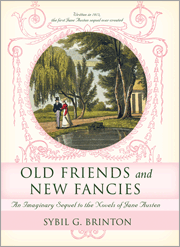
  • Old Friend and New Fancies, by Sylvia Brinton (noted on both the Austen-tatious and Jane Austen Today blogs), is quite a delightful read.  In this current world of Austen sequels, this was the first to take on the continued life of Austen’s characters; originally written in 1913 and published by Hodder & Stoughton, London in 1914….it has now been republished by Sourcebooks.  But Brinton takes it all a step further, as ALL the couples in ALL the novels make an entrance in this magical confection… I enjoyed it very much (and had intended to write a review, but alas! there are so many out there! –  at A Lady’s DiversionsAustenblog, and numerous others found on a google search; it is also referred to in the Persuasions (vol 11, 1989) article by Kathleen Glancy “The Many Husbands of Georgiana Darcy“)
  •  a current list of Austen sequels for sale at Sourcebooks(a wonderful reading list if you are looking for somewhere to start on your sequels read (remember that the AGM in Chicago this year is on Austen’s Legacy….)
  • Jane Austen’s Sailor Brothers, by J.H. Hubback (published in 1906) is now available as a free e-book at Manybooks.net (Jane Austen, a Family Record, and the Memoir by James Edward Austen-Leigh are also available for download…)
  • A booklist perfect for summer reading from The Guardian.UK:  10 best romps and romances
  • Conviction: a sequel to P&P by Skylar Hamilton Burris (2006) has received some favorable reviews at Amazon.com (has anyone out there read this?….please comment!)

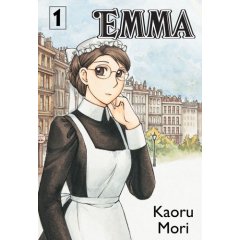
And finally, a review of another Emma, this one by Kaoru Mori, translated by Sheldon Drzka, and set in Victorian London (this is a 7 volume comic book, each available on Amazon for $9.99)

Books · News

Cassatt/Austen

As I find my pose, I think about how, when I first met Degas, he gave me the impression of an intelligent but fierce dog…
     And yet, something else emerged as he asked me questions. ‘Had I begun to feel better?,’ he asked, and ‘What was I reading?’ When I told him, ‘Jane Austen,’ he looked curious. ‘Ah, lequel?’ ‘Persuasion,’ I said, and then, surprisingly, his eyes lit on mine. A feeling connected us, quickly and with an absorbing depth.” (pp. 16-17)

I have just finished Lydia Cassatt Reading the Morning Paper by Harriet Scott Chessman. It is a small book, but I read slowly … to savor it.

It is a book I bought (used) some years ago (published date is 2001) after having read a library copy. It tells the compelling story of Mary Cassatt and her sister Lydia, through Lydia’s words and strung out in scenes centering on her modeling for several of Mary’s paintings. One of the paintings lends it name to the book: Lydia is shown reclining in a green chair, reading the newspaper. But this quiet little story has great depth. Lydia (like Austen one might be tempted to say) faces her past, her present, and the shortness of her future – for the action begins in September 1878, ends in June 1881, and Lydia died (of Bright’s disease) in November 1882. So it confronts death, sisterly-affection, sibling-rivalry, lovers lost and gained. An exquisite book.

It is particularly a propos at this moment, for the Shelburne Museum (Shelburne, VT) is hosting a Cassatt exhibition. Entitled “Mary Cassatt: Friends and Family,” the retrospective offers more than 60 works, gathered together from many sources. The guest curator is Cassatt ‘authority’, Dr. Nancy Mowll-Mathews. Highly recommended, and on until 26 October 2008.