Austen Literary History & Criticism · Book reviews · Books · Collecting Jane Austen · Jane Austen · Literature · Regency England · Social Life & Customs

Book Review ~ “Jane Austen and Children” by David Selwyn

To be at the beginning of life, one must start at the end of the novel.  For although Jane Austen concludes her books with the marriage of the hero and heroine to which the whole thrust of the narrative has been leading, and the reader rejoices in the perfect happiness of the union, in reality the best is yet to come: they will have children – procreation  being not only the natural and desirable end of marriage, but also an economic and dynastic necessity.  And those children will have their own stories…What will become of the Darcy children?…”  (Ch. 1, Confinement, p. 5)

And thus does David Selwyn begin his treatise on Jane Austen and Children (Continuum, 2010), a most enjoyable journey through the world of childhood and parenting and education and growing-up in the life of Jane Austen, and the lives of her fictional characters.  If you are perhaps one of those people who think that Jane Austen does not like children, an idea certainly fed buy such comments about women “breeding again” or the child-generated “dirt and noise” or “the two parties of Children is the cheif Evil” [Ltr. 92], or the proper child-rearing “Method has been wanting” [Ltr. 86], etc. – you need to read this book!

Selwyn takes his reader essentially through the nine ages of man [with apologies to Shakespeare] beginning with confinement and birth, through infancy, childhood, parenting, sibling relations, reading and education, and finally maturity, as Selwyn says, the “end of the novel” when the Hero and Heroine come together, after all manner of trial and tribulation, to begin their own family.

We are given a general survey of the shift in the attitudes toward children, that late eighteenth – early nineteenth century view that fell between viewing children as not just “little adults” to the Victorian view of “seen but not heard”, following Locke and Rousseau and believing children to be natural innocents.  In each chapter Selwyn seamlessly weaves pieces of Austen’s life as gleaned from her letters and scenes from all her writings – and it is masterly done, all with a historical perspective.  We see Jane as a child, as a madly composing adolescent, a loving and humorous Aunt imaginatively interacting with her nieces and nephews, and as an accomplished writer whose fictional children are far more worthy of our notice than we have previously supposed: the frolicsome Walter hanging on Anne’s neck in Persuasion; the spoiled Middletons; the noisy and undisciplined Musgroves; the grateful and engaging Charles Blake in The Watsons; the John Knightley brood in the air courtesy of their Uncle George; the dynamics of the five Bennet sisters; Henry Dashwood the center of attention for the manipulative Steele sisters; the reality-based scenes of Betsy and Susan Price at Portsmouth; and finally Fanny Price, Austen’s only heroine we see grow up from childhood, having an elegant come-out, finding true-live and ends “needing a larger home.”

In all her works, Austen uses children as “a resource for her narrative strategies” (p. 4), be that comedy, a plot device to further the action, or a means of revealing attitudes and responses of the adults around them (p. 3).  Austen’s children are easy to miss – they won’t be after reading this book – here they are brought to life, given character and meaning, and you will see what Selwyn terms “Austen’s satirical delight in children behaving in character” (p. 73)

If Austen’s fiction seems to gloss over the reality of childbirth [the exception is Sense and Sensibility’s two Elizas], her letters tell the tale of its dangers [Austen lost three sisters-in-law to death in childbirth], and Selwyn links all to the social structure of the day, the nursing of babies and swaddling practices, to child rearing theories and moralizing tracts, and governesses and Austen’s ambivalence toward them. We visit boarding schools along with Jane and her characters and we hear the voices of a number of contemporary diarists (Agnes Porter, Sophia Baker, Susan Sibbald, Elizabeth Ham and Sarah Pennington).  There is a lovely in-depth chapter on the reading materials written especially for children and Austen’s first-hand knowledge of these titles.  The discussion on sisters and brothers, those so important in Austen’s own life, and those in her fiction, for example, characters with confidants (Lizzy and Jane, Elinor and Marianne), those isolated (Fanny, Anne Elliot, Emma Watson, Mary Bennet), and those with younger sisters (Margaret Dashwood and Susan Price).  As part of the growing-up process, Selwyn uncovers much on “coming-out” as Austen herself writes of in her “Collection of Letters” [available online here] – with the emphasis here on Fanny as the only heroine to have a detailed “coming-out” party.

The chapter on “Parents” starts with the premise that “in Jane Austen’s novels the parents best suited to bringing up children are dead” (p.95) and Selwyn takes us from the historical view of parenting, through Dr. Johnson’s “Cruelty of Parental Tyranny” [shadows of Northanger Abbey] to a full discussion of the marriage debate in the 18th-century – that between the worldly concerns of wealth vs. choice of partner based on emotional love as personified in Sir Thomas and Fanny Price respectively.  Excerpts are included from James Austen’s very humorous Loiterer piece   “The Absurdity of Marrying from Affection.” (p. 207) and Dr. John Gregory’s A Father’s Legacy to his Daughters (1774) [viewable at Google Books here] , and the Edgeworth’s Practical Education (1798) [Vol. III at Google Books here].  One finds that in reading all of Austen’s letters and all the works you can indeed discover a complete instruction manual for good parenting!

Jane Austen and Children appropriately ends with Selwyn’s speculation on what sort of parents her Heroes and Heroines will be, all of course based on the subtle and not-so-subtle clues that Austen has given us throughout each work – conjecturing on this is perhaps why we have so many sequels with little Darcys, Brandons, Bertrams, Knightleys, Tilneys, and Ferrars running about!

Just as in his Jane Austen and Leisure, where Selwyn analyzes the various intellectual, domestic and social pursuits of the gentry as evidenced in Austen’s world and her works, he here gives us an accessible and delightful treatise on Austen’s children, culling from her works the many quotes and references related to children and linking all to the historical context of the place of children in the long eighteenth century.  The book has extensive notes, a fine bibliography of sources on child-rearing, contemporary primary materials, children’s literature, and literary history, and several black and white illustrations.  (I did note that there are a few mixed up footnotes in chapter 3, hopefully to be corrected in the next printing).  What will this book give you? – you will never again miss the importance of Austen’s many children, peaking from behind the page, there for a set purpose to show you what great parents the Gardners are, or just to make certain you see how very selfish the John Dashwoods and the Miss Steeles are, or to see the generosity of an Emma Watson in her rescue of Charles Blake, or to feel the lack for the poor Musgrove boys having Mary for a mother, the playfulness of an otherwise conservative Mr. Knightley, and the unnerving near touch of Captain Wentworth as he relieves Anne of her burden –  thank you David Selwyn for bringing all these children to life for Austen’s many readers – you have given us all a gift!
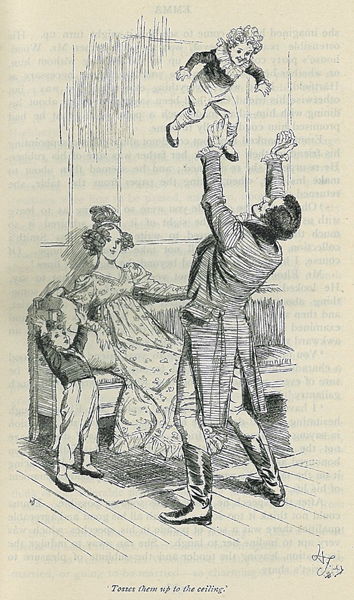
Emma – ‘Tosses them up to the ceiling’
[by Hugh Thomson, print at Solitary Elegance]

 __________________

Jane Austen and Children
Continuum, 2010
ISBN:  978-1847-250414

David Selwyn is a teacher at the Bristol School in Bristol, UK.  He has been involved with the Jane Austen Society [UK] for a number of years, has been the Chairman since 2008,  the editor of the JAS Report since 2001, and has written and edited several works on Austen.  He very graciously agreed to an “interview” about this latest work that you can find by clicking here.  See also the post on the various illustrations of Austen’s children by the Brocks and Hugh Thomson.  And finally, I append below a select bibliography of Selwyn’s writings on Jane Austen and her family.

 Select Bibliography:  

  1. Lane, Maggie, and David Selwyn, eds.  Jane Austen: A Celebration.  Manchester: Fyfield, 2000. 
  2. Selwyn, David, ed.  The Complete Poems of James Austen, Jane Austen’s Eldest Brother. Chawton: Jane Austen Society, 2003. 
  3. _____. “Consumer Goods.” Jane Austen in Context. Ed. Janet Todd. Cambridge Ed. of the Works of Jane Austen. New York: Cambridge UP, 2005. 215-24. 
  4. _____, ed.  Fugitive Pieces: Trifles Light as Air: The Poems of James Edward Austen-Leigh.  Winchester: Jane Austen Society, 2006. 
  5. _____. “A Funeral at Bray, 1876.” Jane Austen Society, Collected Reports V (1998): 480-86. 
  6. _____. “Games and Play in Jane Austen’s Literary Structures.” Persuasions 23: 15-28 
  7. _____. “Incidental closures in Mansfield Park.”  [Conference on “Jane Austen and Endings”, University of London, 17 November 2007] – unpublished paper. 
  8. _____. “James Austen – Artist.” Jane Austen Society Report 1998. 157-63. 
  9. _____.  Jane Austen and Leisure.  London: Hambledon Continuum, 1999. 
  10. _____, ed.  Jane Austen: Collected poems and Verse of the Austen Family.  Manchester:  Carcanet / Jane Austen Society, 1996. 
  11. _____, ed.  Jane Austen Society Report, 2001 – present. 
  12. ­_____. “Poetry.” Jane Austen in Context. Ed. Janet Todd. Cambridge Ed. of the Works of Jane Austen. New York: Cambridge UP, 2005. 59-67. 
  13. _____. “Shades of the Austens’ Friends.” Jane Austen Society Collected Reports V (2002): 134. 
  14. _____. “Some Sermons of Mr Austen.” Jane Austen Society Collected Reports V (2001): 37-38. 
Austen Literary History & Criticism · Book reviews · Collecting Jane Austen · Jane Austen · Regency England

Author Interview ~ David Selwyn on ‘Jane Austen and Children’

David Selwyn had graciously offered to answer my questions about his newest book, Jane Austen and Children (Continuum, 2010).  David is the current Chairman of the Jane Austen Society, editor of the Annual JAS Report since 2001,  and author of numerous works and articles on Austen.  His previous Jane Austen and Leisure (Hambledon Continuum, 1999)) is a must-read treasure trove of social and domestic activities that Austen engaged in and referred to in her novels. His current work is another must-read that weaves the historical, the factual and the fictional world of Austen and her works, all relating to children.  I will post a review of the book in a few days [after the 16th Birthday celebration] –  but I will say now that I most highly recommend this book, and suggest that you add this to your holiday “want” list and hope it may be found under your tree on Christmas morn…!

 Welcome David! 

JAIV:  I think when reading the novels, it is so very easy to overlook the number of children and how Austen’s presents them – but after reading your book one sees indeed how many children there are in her works and their importance to the narrative – is this what prompted you to write the book? the fact that too many people really do not see?

DS:      Yes, and I was struck by the fact that nobody had written on the subject, nor as far as I knew lectured on it. 

JAIV:  Jane Austen is often said to have not been particularly fond of children – was this another main reason in writing your book? – to show that as not the case? – 

DS:      As regards the novels, it always seemed to be assumed that her world was essentially an adult one (which I suppose largely it is) and the crucial role that children play in her exploration of it had been missed. As regards her own feelings about children, nobody who reads the letters can be in any doubt as to her fondness for her nephews and nieces.

JAIV:  Did anything surprise you in your research? 

DS:      How sensible she was about the bringing up of children – but then, I suppose one ought never to be surprised by JA’s wisdom on any matter!

JAIV:  And such extensive research! – the references in her letters, other family reminiscences, all the novels and minor works, and the historical context of child rearing in the long 18th century! – how long have you been working on this? 

DS:      For some years, but the editing of JEAL’s poems (Fugitive Pieces) intervened.

JAIV:  And this book presents such a seamless weaving of this real life, historical and fictional contexts – what are your working habits, writing process to achieve this?

DS:      I re-read the novels, minor works and letters, making notes of anything relevant in notebooks (one for each text) and highlight the notes in different colours according to theme. I did this for Jane Austen and Leisure and found that it worked. You’ll notice that at this stage I don’t use a computer. I also do a lot of background reading in social history, biography etc, and make notes on those books too of course.

JAIV:  You say that Jane Austen “makes use of her children to reveal aspects of her adult characters” – what is your favorite example of this?

DS:      It is difficult to choose, because each time she does it it is so wholly convincing. Annamaria Middleton and the naughty little Musgrove boy are the funniest, and the latter creates the most delicately balanced mood of comedy and emotion in any scene with children in it; but I love the little Gardiners, whose charming behaviour shows just how children should be brought up.

JAIV:  And then secondly, that Austen uses children as a means of advancing the plot – what is the best example of this?

DS:      It would certainly have been Charles Blake in ‘The Watsons’ had JA finished the novel.

JAIV:  There is much on Mansfield Park, perhaps because unlike the other heroines [other than the quick summary of Catherine Morland’s childhood], Fanny is presented to us as a child – but you seem to write most fondly of this novel, indeed, you end your book with thoughts on Fanny and Edmund making the best parents.  Is Mansfield Park your favorite among the novels? Or is this an unfair question! [who can ever choose!]

DS:      As you say, an impossible question. Yes, I do admire MP very much (and think that Fanny is often under-rated: she knows exactly what she wants and in the end gets it); but ultimately my favourite is Emma, partly because it is surely the subtlest and cleverest novel before Henry James, and partly because I think Miss Bates is, as well as being very funny, one of the most moving examples of human goodness in any literary work – JA touches us profoundly with the portrayal of a single woman who centres all the energy of a loving heart on her mother and niece (which is why the scene at Box Hill is so truly climactic – Emma’s thoughtless crushing of such a good heart is appalling, as she herself soon realises). By the way, another thing about Miss Bates: how brilliant of JA to be able to create such a wholly imagined voice that another character (Emma) can mimic it – flannel petticoats etc. 

JAIV:  It has always “troubled” me that Jane is the only child in this Austen family with only one given name – you speak of her having two godmothers both named “Jane” – do you think this is the reason? or do you have other thoughts? 

DS:      But she wasn’t: James, George and Edward had no second names, and nor did their parents. It may well be that the habit of giving two Christian names was becoming more fashionable during this period. 

JAIV:  One of the most famous child-based scenes in Austen is in Persuasion when Captain Wentworth helps Anne by the swift removal of her troublesome nephew – why is this scene so important to the plot? 

DS:      It brings Anne and Captain Wentworth intimately close for the first time in the novel – though JA is delicate enough to depict that intimacy with the child’s hands preventing direct physical contact between them.

JAIV:  Where much of The Watsons can be seen to appear in her other works, the most marvelous piece, when Emma Watson engages young Charles Blake in the dance, is nowhere to be found anywhere else [though it has been said that Mr. Knightley’s dancing with Harriet Smith is Austen’s reworking of this scene].  Do you think Austen could have placed this somewhere in her surviving novels? 

DS:     No, I don’t think she was ever to give a child quite such individual prominence again. 

JAIV:  You start your chapter on “Parents”: “In Jane Austen’s novels the parents best suited to bringing up children are dead.”  Who of the living parents do you think are the most effective? Who the least?  

DS:      The Gardiners are far and away the best. Sir Walter Elliot (though not of course the late Lady Elliot) is a disgrace to the Baronetage in which he takes such pride!

JAIV:  You so obviously love Jane Austen!  – when did this begin for you? 

DS:      In  picking up a stray copy of Emma when I was at home ill once, when I was a (music) student. But I was also thrilled to see a real live JA MS which used to be on display in the Pump Room at Bath (it is now safely tucked away in the offices of Bath City Council); it was the ‘headache’ poem, and it was hung in a hinged frame enabling you to see the reverse, on which there was one of the versions of the ‘Gill-Gell’ verse. I remember noting in the Minor Works volume that Chapman (re-edited by Brian Southam) said that he did not know where that particular version of the Gill’ Gell poem was, and I gleefully thought to myself, ‘I do – it’s in Bath!’ I seem to remember writing to OUP, but I didn’t get a reply.

JAIV:  You say that “it is highly unlikely that Jane Austen ever read a word of Mary Wollstonecraft (though she did read the novels of her radical husband, William Godwin)” – how are you so sure she did not read Wollstonecraft, and how so sure she did read Godwin? 

DS:      This is, I concede, speculation. JA refers to Godwin in a letter and Deirdre Le Faye suggests that she ‘was probably acquainted with Caleb Williams’; I am not sure she didn’t read Hannah More, but I think it unlikely.

JAIV:  One of the many things I took from your book in its focus, its seeing all through the lens of childhood, was a pattern of new themes emerging in all the novels – for instance, the theme in Emma of unconditional love, the love parents have for children, but in Emma, this love that Emma has for her father, Miss Bates for her mother and Jane Fairfax, Mr. Knightley for Emma – i.e. as you say “the unconditional love for people who may, consciously or unconsciously, require sacrifices to be made for them.” [p.111]. What are some other themes that became clearer for you since approaching the novels from this viewpoint? 

DS:      Not so much themes as procedures, and in particular the technique of introducing children not really for their own sake but as a contrivance for some aspect of plot or characterisation – and in the process, being JA, to bring them wonderfully to life.

JAIV:  One could read your book, re-read all of Austen, and get a very lucid and valuable instruction manual for good parenting! – did you have this perception yourself before reading and studying the books through this lens? 

DS:      No, it had never occurred to me that JA could be seen in such a light until I looked closely and specifically at what she says about children and parents.

JAIV:  Your book on Jane Austen and Leisure also offered a very valuable (and very enjoyable!) contribution to an understanding of Austen in the context of social history, her reading, her novels and her life and letters – again in many instances taking a few well-placed words in Austen and giving them such meaning.  What is up next for you?? 

DS:      I hope to do some more editing for a JA Society book. What a pity that JEAL’s sister Caroline destroyed the MSS of her poems; I should like to have brought those out.    

********************

Thank you so much David for answering all my questions!  Stay tuned for my review and a select bibliography on David Selwyn’s other Austen-related works. 

 [Getty Images.com]

Austen Literary History & Criticism · Book reviews · Books · Collecting Jane Austen · Jane Austen · Literature · Publishing History · Regency England

Book Review ~ ‘The Annotated Persuasion’

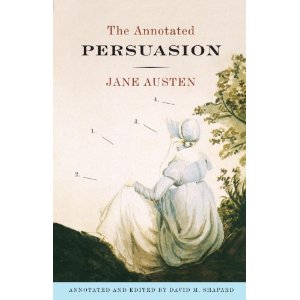
Last week I ran into Barnes & Noble to pick up the latest annotated Pride and Prejudice, edited by Patricia Meyer Spacks, and since then I have been “gadding about” as Austen would say – so no time to really give it a complete read and review; but in another trek yesterday into yet another Barnes & Noble [no worries, I also have haunted the local USED booksellers!], my husband stumbled upon the just published [as in October 5, 2010]  The Annotated Persuasion, annotated and edited by David M. Shapard [New York: Anchor Books, 2010; paperbound; ISBN:  978-0-307-39078-3] – and I have discovered a veritable feast! 

Shapard is known for his annotated edition of Pride and Prejudice [which I have but it is not in hand, as I am in “gadding about” mode as mentioned above…] – so I cannot compare this book to that edition [his annotated Sense & Sensibility is to be, I believe, published in April 2011] – though I have found that work quite useful as a reliable reference source – it was first published in hardcover followed by a paperback edition; this Persuasion is only in paperback… it is also a smaller format, likely because the novel is so much shorter, but this renders the many illustrations quite small – but I quibble about these few drawbacks …. publishers decisions do not always make the most sense… 

I first look for the extras:  

An Introduction which gives a brief history of the publishing of Persuasion, and the differences in this final novel from Austen’s other works

A Chronology of the novel [will compare this to Ellen Moody’s calendar 

Maps of sites that relate to the characters and storyline: the world, England, Somerset, Lyme, and two of Bath 

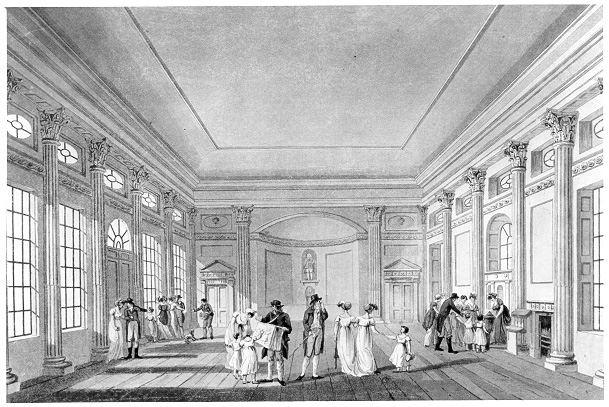
A good number of b/w Illustrations – there is unfortunately no listing of these; the source is indicated under each picture, but a listing would have served as an index to the subjects, which cover all manner of Regency life:  architecture such as that in Bath with interior and exterior scenes of the Assembly Rooms; various carriages; fashion; furniture; Naval life; the Cobb in Lyme Regis; etc.  – many of these illustrations will be familiar to most readers with a modicum of knowledge about the period – and color would have been nice – but the point here of these illustrations is to serve as a starting reference for further research, and it is an added plus to have any of these included. 

Bibliography:  this also serves as a starting point – it is in no way a complete listing of sources, but likely those sources that Shapard relied on for his research.  How complete can a bibliography of Austen be without mention of Claire Tomalin’s biography under that category, or Claudia L. Johnson’s Jane Austen: Women, Politics and the Novel or Kaplan’s Jane Austen Among Women nowhere to be found – but as Shapard is an historian, it is that strength that resides in this bibliography, again a great starting point for further study – it is organized by broad subjects:  language; cultural and literary background; marriage and the family; position of women; children; housekeeping and servants; entails and estates and the landed gentry; rural and urban life; the military; medicine; the law; education; books, media, libraries; writing; postal service; transportation; theater [but no mention of the two works Jane Austen and the Theatre – two works with the same title and both quite comprehensive]; music and dance; sports; weather; the seaside resorts; houses and gardens; fashion; food; etiquette and female conduct books; and others – again, a good select listing of resources on various topics.   

The Literary commentary and annotations:  Shapard begins with the caveat that “the comments on the techniques and themes of the novel represent the personal views and interpretations of the editor…such views have been carefully considered, but inevitably they will still provoke disagreement among some readers “ [xi] – which Shapard encourages…; these annotations include such literary commentary, historical context, and definitions of words in context if they had a different meaning in Austen’s time, some repeated when necessary or cross-references provided.  

The book is arranged with the original text on the verso, the annotations and illustrations on the recto – the annotations are extensive as the following few very random examples show: 

  1. Persuasion starts with the full description of Sir Walter Elliot’s obsession with both his own personal charms and his listing in the baronetage – Shapard here provides information on that book and others of the time and the definition of “baronet” and how Sir Walter acquired his own status…
  2. Gout is fully described on pages 311 and 315, when Anne learns that the Crofts are removing to Bath dues to the Admiral’s “gouty” condition.
  3. “replaced” – [p. 103] – “they suspected great injury, but knew not where; but now the collar-bone was soon replaced”   – the annotation explains that the word “replaced” had the meaning in Austen’s time of “to be put back in its original position” rather than “to take the place of” – there is also a description of anatomical knowledge as understood at the time.
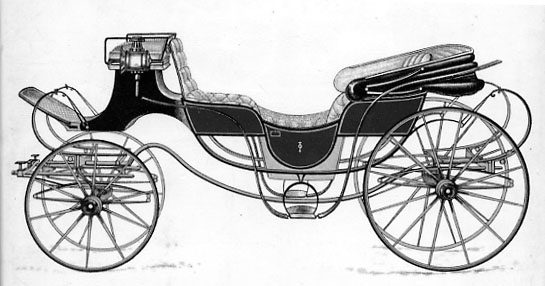
  4. Carriages get much attention whenever they are mentioned in the text – so we have descriptions and illustrations of barouches and chaise and fours, and chairs and of course Anne’s pretty little “landaulette” [p. 483]                                                                         
         

    a barouche


  5. Money and wealth – Wentworth’s income explained [p. 145]
  6. Servants:  various duties outlined [p.  87]
  7. Street names, shops, locations explained throughout; e.g. The Cobb; Tattersall’s [a mention on p. 14 with an illustration]; Milsom Street; Westgate Buildings;…etc…
  8. The Clergy in Austen’s time
  9. Austen’s language as delineating character:  as in the following: “Lady Russell had only to listen composedly, and wish them happy; but internally her heart reveled in angry pleasure, in pleased contempt” [p. 232] – and the annotation reads:  “Her reveling in such emotions indicates her moral inferiority to Anne, who never derives pleasure from anger or contempt.” [p. 233]
  10. Social rules and strictures:  some examples – Sunday traveling [p. 305]; shaking of hands between men and women [p. 427]; not using first names, even those of friends such as Anne and Mrs. Smith

 A look at a few key scenes will also illustrate Shapard’s invaluable commentary: 

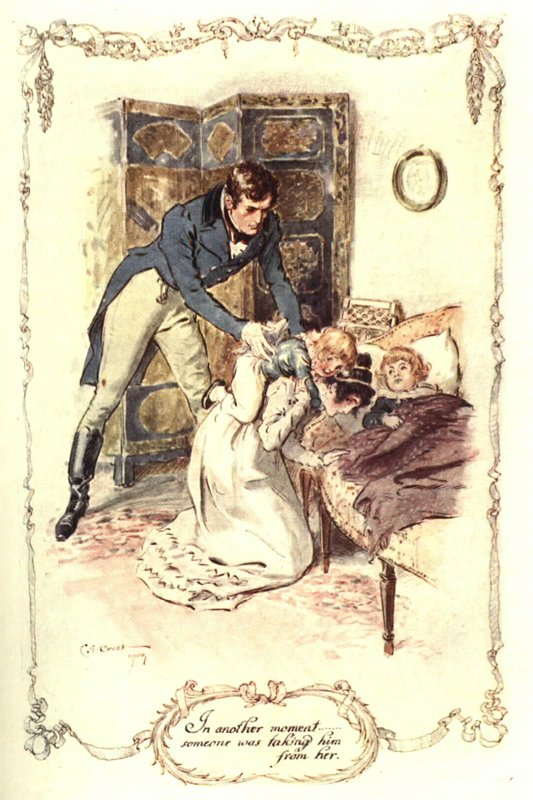
  1. Wentworth removing young Walter Musgrove from around Anne’s neck [pp. 152-5]:  Shapard emphasizes the importance of this scene in displaying both Anne’s and Wentworth’s feelings – he quotes William Dean Howell’s how “this simple, this homely scene, is very pretty, and is very like things that happen in life, where there is reason to think that love is oftener shown in quality than quantity, and does its effect as perfectly in the little as in the great events. [from Heroines of Fiction].  Shapard also suggests that Wentworth’s reluctance to converse with Anne about what has just happened is as much due to his efforts to remain aloof as it is to a “simple dislike of thanks,” [p. 155], as is true of Mr. Knightley in Emma. 
                                                                                                        

    Brock illus - from Molland's


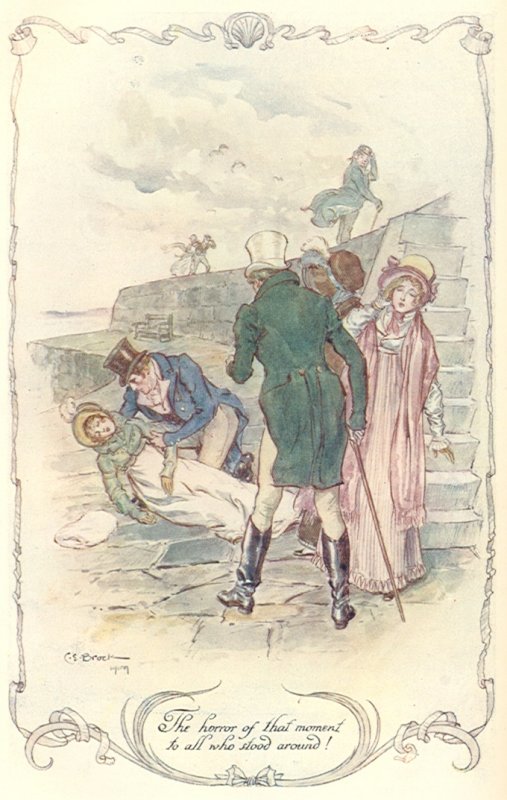
  2. Louisa’s fall in Lyme Regis [p. 210-15]:  Shapard describes the Cobb, the steps that were the scene of The Fall, comments on the feelings of Anne and Wentworth, the strength of the former and the uncharacteristic weakness of the latter; Anne’s carrying the “salts” [have you ever wondered why Anne IS carrying smelling salts and conveniently has them in her possession? – “here are salts – take them, take them.” [p. 210]]; the calling for the surgeon and the differences between he and an apothecary; the comic relief of “the sight of a dead young lady, nay, two dead young ladies, for it proved twice as fine as the first report.” [p. 213-4] 
    "The horror of the moment" - from Molland's


  3. and of course, The Letter! [p. 452] – Shapard so rightly states that “Wentworth’s passionate language contrasts him with other Jane Austen heroes, who are often much cooler and more rational.  It also fits with the more intense emotional tone of this novel … the letter itself is arguably the moment of highest emotion in her works…” [p. 453]  – and we are given a picture of a writing table of the time [p. 457] – there is also extensive commentary on the conversation between Capt. Harville and Anne. 

As referred to above, there are disappointments in this work – I would most wish for an index to the annotations – these could be just general subject areas, such as similar divisions as in the bibliography – so for instance – all annotations which discuss medicine could be cited, or any references to carriages, or fashion, or Bath locations, the Navy, or examples of Free Indirect Discourse, the literary allusions such as Byron’s The Corsair and Matthew Prior’s poem “Henry and Emma”, etc.  As it is, one needs to read through the entire work to find the references, and as Shapard wishes for this to be a work for reference purposes, this addition of an index would seem to be a necessity.  A index of Characters would have also been a helpful addition – one must reach for their Chapman for this information; and finally there is also no “note on the text”, important information in any such reference source – the bibliography lists Chapman’s 1933 edition, Spacks’s Norton critical edition [1995]; and the latest Cambridge edition edited by Janet Todd and Antje Blank [2006] – but I would have liked to see from whence he took the exact text…

That all said – this is a delightful and fact-filled addition to your Austen Library – and if you are already fairly well-versed in the Regency period and Austen criticism, this will serve as a copy of Persuasion where much of this information is at your fingertips; if you are just starting your adventure in reading Austen, this will be a great introduction to the very rich world of her writings, her world, and her literary themes – what more can we ask for!  [other than a hardcover with an index!]

 4 full inkwells out of 5

[please note that the illustrations are meant to illustrate this post and are not illustrations in the work being reviewed] 

Books · Collecting Jane Austen · Jane Austen · News · Publishing History · Rare Books

Austen on the Block!

Auction Alert!   Heritage Auction Galleries has announced its upcoming “Signature Rare Books Auction”, October 14-16 – Beverly Hills, CA.  Auction #6048.  You will all be happy to see that all of Jane Austen’s first editions will be on the block! – all in lovely bindings and now viewable online and open for bidding: [note the opening bid and estimated value, and buyer’s premium; if there is a reserve it has not been noted] 

*First Edition of Jane Austen’s Fourth Novel in a Full Morocco Binding by Rivière & Son:

 [Jane Austen]. Emma: A Novel. In Three Volumes. By the Author of “Pride and Prejudice,” &c. &c. Vol. I. [II. III.] London: Printed for John Murray, 1816.  Opening bid:  $7500.  [estimated value = $15,000+] 

*

*First Edition of Jane Austen’s Mansfield Park in an Attractive Full Morocco Binding by Rivière & Son:

 [Jane Austen]. Mansfield Park: A Novel. In Three Volumes. By the Author of “Sense and Sensibility,” and “Pride and Prejudice.” Vol. I [II. III.]. London: Printed for T. Egerton, 1814 (Volume II with imprint: London: Printed for T. Egerton, Whitehall, 1814).  Opening bid:  $5,000.  [est. $10,000+]

*

*First Edition of Jane Austen’s Posthumously Published Northanger Abbey and Persuasion Attractively Bound in Full Morocco Gilt by Rivière & Son:

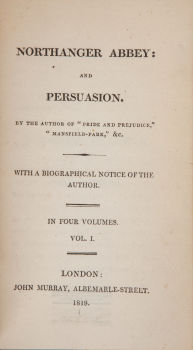
[Jane Austen]. Northanger Abbey: and Persuasion. By the Author of “Pride and Prejudice,” “Mansfield-Park,” &c. With a Biographical Notice of the Author. In Four Volumes. Vol. I. [II. III. IV.]. London: John Murray, 1818.   Opening bid: $3,750. [est.$7500+]

*

*A Lovely First Edition of Jane Austen’s Pride and Prejudice:

[Jane Austen]. Pride and Prejudice: A Novel. In Three Volumes. By the Author of “Sense and Sensibility.” Vol. I. [II. III.] London: Printed for T. Egerton, Military Library, Whitehall, 1813.  Opening bid:  $15,000.  [est. $30,000+]

*

*Scarce First Edition of Jane Austen’s First Published Novel, in a Full Morocco Binding by Rivière & Son:

[Jane Austen]. Sense and Sensibility: A Novel. In Three Volumes. By a Lady. Vol. I. [II. III.]. London: Printed for the Author, By C. Roworth, Bell-yard, Temple-bar, and Published by T. Egerton, Whitehall, 1811.  Opening bid:  $20,000.  [est. value $40,000+]

*

See the Heritage Auction Galleries website for full descriptions of each title.

*******************

 Oh Jane, whatever would you say?! – Let the bidding begin! 

[Posted by Deb]

Books · Collecting Jane Austen · Jane Austen

Austen’s Life Abridged for the Young

Lives of the Writers:  Comedies, Tragedies (and What the Neighbors Thought); written by Kathleen Krull; illustrated by Kathryn Hewitt. Harcourt Brace, 1994. ISBN:  0-15-201032-7

*******************

I picked up this book a few weeks ago because it had a chapter on Jane Austen, and so another book to add to my collection, as well as yet another Austen image – and now finally have taken a moment to read it:

Here are some quotes: 

…although she had several proposals, she never married.  She never met a man who appreciated her intelligence and education, and she couldn’t bear the idea of marrying just for money.

Austen was reserved with strangers, who found her arrogant or even fierce, but her family treated her as an agreeable mouse.  None of them thought much about the writing she was always doing; it was just something that kept Jane busy, like the needlework the other women did.

At dinner parties, she didn’t say much, but the next day she might write a letter about ‘another stupid party last night,’ or ‘I was as civil to them as their bad breath would allow.’

As much as she wanted to be a humble sister and obedient daughter, she was also extremely proud of the small sums she earned when her family persuaded her to start publishing her books.  She wrote, ‘If I am a wild beast, I cannot help it.’

She always wore a cap and her clothes were never quite in fashion.

Austen was a world-class aunt … [and to her nieces and nephews] she was a pretty, funny storyteller.

In her obituaries, she was revealed as the author of six novels. [me here: she had only published four at her death, P and NA published posthumously, and all the obituaries did not disclose the fact of her authorship – but I quibble]]

There are a few perfect thoughts expressed about Austen liking Pride & Prejudice better than any of her other books; and Emma being about “a heroine whom no one but myself will much like”; and how few in her own family knew she had written Sense & Sensibility; and how she practiced the “piano” in the morning and prepared breakfast.

I’ll let all this speak for itself – they certainly got some things right, but all this conjecture about her being arrogant and fierce and mouse-like at the same time and being unfashionable and never meeting a man who appreciated her intelligence [surely there must have been some – she just didn’t marry them!] – this is like the updated version of the Victorian view of Austen – I thought we were past all that, and what do we really know anyway? – I just hate to see it perpetuated for a new generation!  [the only source listed in the bibliography is Park Honan’s 1987 biography, Jane Austen: Her Life.] – and not to even mention the “bobble-headed” image [though she is kinda cute!]

If Austenblog’s cluebat is sitting around anywhere, I could surely put it to good use…

Any thoughts??  I’m off to read about Shakespeare…

[Other authors covered:  Murasaki Shikibu; Miguel de Cervantes; William Shakespeare; Hans Christian Andersen; Edgar Allen Poe; Charles Dickens; Charlotte and Emily Bronte; Emily Dickinson; Louisa May Alcott; Mark Twain; Frances Hodgson Burnett; Robert Louis Stevenson; Jack London; Carl Sandburg; E.B. White; Zora Neale Hurston; Langston Hughes; and Isaac Bashevis Singer.] – and the book by the way, won numerous literary awards:  Horn Book Honor Book; PW’s Best Book of the year; Booklist’s Editor’s Choice; SLJ Best Book of the Year; ALA Notable Book; etc…

All quotes from the book, pp.25-27; Austen illustration, p. 24; see the author’s website here.

[Posted by Deb]

Austen Literary History & Criticism · Books · Collecting Jane Austen · Jane Austen · News

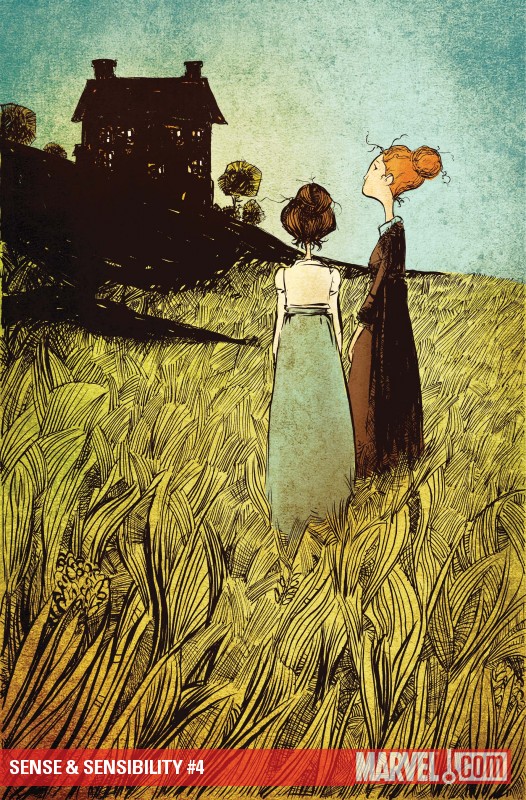
‘Sense & Sensibility’ Marvel edition ~ An Interview with Nancy Butler

This is today on the B&N Romance Blog  ~ Marisa O’Neill posts her interview with the Marvel Comics / Jane Austen adaptations writer Nancy Butler:

Marisa O’Neill: What gave you the idea to create graphic books from the Jane Austen classics?

Nancy Butler: I’ve been friends with Marvel senior editor Ralph Macchio for many years. Since we first met, I’ve been nagging him to create comics that would bring in more female readers. Whenever he described the Marvel Illustrated line, he kept bringing up “boy” books . . . Treasure Island, Moby-Dick, Three Musketeers, etc. I finally asked him why they didn’t do something that would appeal to female readers. “Like what?” he asked. Pride and Prejudice immediately popped into my head. He was a bit skeptical, but when he pitched it to marketing, they bit. And then they asked him if he knew someone who could write the adaptation. Ralph knew my background writing Regency romances, knew I had a fan following and contacts in the Austen world, so he suggested me.

MO: Why Pride and Prejudice?

NB:  I pointed out to Ralph that between the enduring BBC series with Colin Firth, the Bridget Jones movies, and the Kiera Knightly movie, P&P was hot, hot, hot. He thought I was exaggerating, but before the hardcover compilation was even available for sale, the Jane Austen Society had ordered enough copies to put the project in the black. The sales manager also reported that they were getting more emails about that comic than almost any other title on their list. Ultimately, P&P was reviewed in Entertainment Weekly, spent 13 weeks on the NY Times Graphic Novel bestseller list, and was the featured photo in an article on graphic adaptations in Publisher’s Weekly. I was also interviewed by Vanetta Rogers of Newsarama and by Bill Radford, the comics guru at the Colorado Springs Gazette. (Bill told me his column on P&P was among the most shared for 2009.) Naturally, after all this attention, Marvel was eager to do another Austen title and they chose Sense and Sensiblilty.

MO: How do you go about condensing each book to fit into the installments?

NB: This is the tricky part. First of all, I had never done an adaptation before. And I had to learn the Marvel style—which involves creating a detailed plot and then writing a script after the art is done. I knew I couldn’t condense every part of these complex novels into five 22-page comics. So I focused on the parts I knew people expected to see . . . all the favorite “beats”—the clever exchanges, the arguments, the catty comments, the heartfelt revelations. Once I built that basic framework of “must have” scenes, I filled in directly from Austen to flesh out the stories. Whenever possible, I use Austen’s dialogue and observations. I’m always amazed—after each issue is completed—by how much I was actually able to fit in there! My great hope is that readers don’t find the comics either crowded or choppy.

MO: Did you work closely with the graphic artist?

NB: Yes, it’s critical to have good communication with the artists, especially since they weren’t as familiar with the Regency era as I was. I worked with Hugo Petrus of Barcelona on P&P. Hugo has a very traditional comic style that some felt was wrong for Austen. But I liked his attention to detail. Sonny Liew of Singapore did three of the P&P covers . . . and based on favorable reader response, Marvel decided to have him do the interiors of S&S. His style is more lyrical and idiosyncratic, and I think it fits Austen very well.
___________________________________________________________

[see the full text at the BN Romance Blog]

Note that Issue # 4 [cover above] was released on August 25, 2010; Issue #5 will be released on September 22; and the hardcover edition on November 10th.  At $3.99 / comic and $19.99 for the hardcover, this might be the least expensive [and most fun!] addition to your Austen collection! so call your local comic book store today!  [in Burlington, this is Earth Prime Comics on Church Street].

[Posted by Deb]

Austen Literary History & Criticism · Book reviews · Books · Collecting Jane Austen · Jane Austen · Publishing History

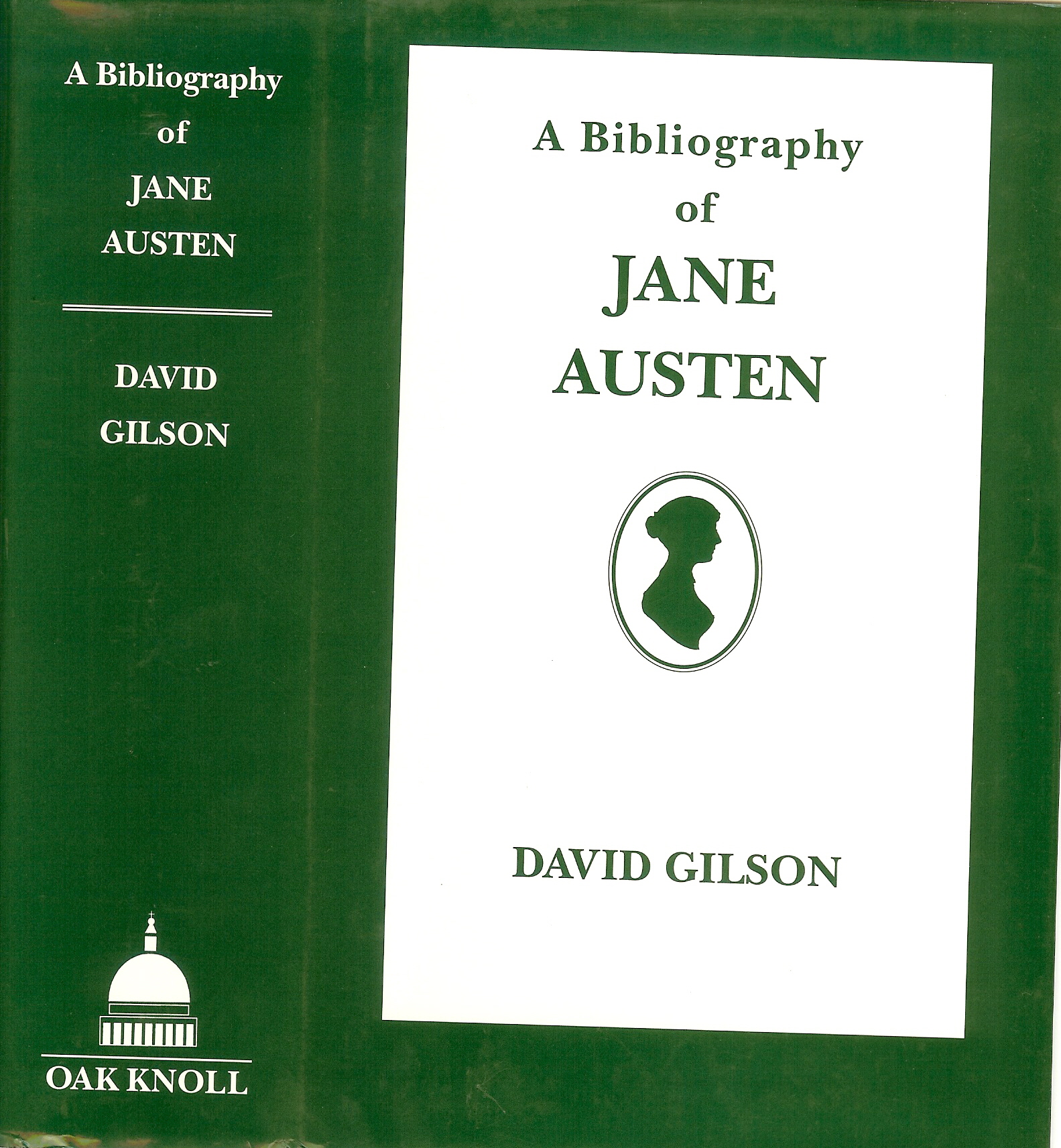
Your Jane Austen Library ~ Gilson’s Bibliography ~ a Review

Gilson, David.  A Bibliography of Jane AustenNew Introduction and Corrections by the Author.  Winchester: St. Paul’s Bibliographies  / New Castle, Delaware: Oak Knoll Press, 1997.

***********************

 I am often asked what I would consider the most important book to add to ones own “Jane Austen Library.”  Primary sources of course, the Chapman Oxford set of all the novels, minor works, juvenilia, etc – these volumes remain the source for citation in any scholarly work.  The new Cambridge edition would be lovely, but presently beyond my pocketbook, so the local University Library suffices for this ;  though I do wonder when this edition of the works will supplant the Chapman for citation purposes – shall start saving now…

But after that, what?   I would choose and most highly recommend David Gilson’s Bibliography of Jane Austen.  Originally published in 1982, Gilson had set out to revise and update the Sir Geoffrey Keynes’ 1929 Nonesuch Press Austen bibliography, after discovering the lack of information in the Keynes relating to the early American editions of Austen’s works.  Gilson wrote about these and other discoveries of the various early translations in his articles for The Book Collector.  At Keynes’ suggestion, Gilson began a second edition but found it best to present a whole new work based on Keynes but with much additional information and to include the work of Chapman in his 1955 Austen bibliography.  The 1997 edition is not a revision of the 1982 work but does include a new introduction, corrections, some additions, and a brief bibliographic essay on material published since 1978It is less physically attractive and lacks the frontispiece illustrations of the 1st edition, but I consider this very comprehensive work [at 877 pages!] the starting point for all Austen research. Gilson writes a very informative essay prefacing each of the twelve chapters, includes a chronological listing of editions and reprints and an exhaustive index that links back to all the entries.

I offer here a brief capsule of each of these chapters:  

A.  The Original Editions:  Gilson follows the principles set down by Philip Gaskell in his New Introduction to Bibliography [1972] and the entry for each original edition is exhaustive: full bibliographical details of the physical book [title; collation; contents; technical notes on the paper, printing, headlines, chapter headings and endings, binding; etc]; its publishing history; reviews and contemporary comments; later publishing history; auction records [fascinating!]; listing of copies examined; and other copies known to exist. [I LOVE this stuff!] 

B.  First American Editions:  as Austen mentions nothing about foreign editions of her work, Gilson assumes she knew nothing about the Emma that was published by Matthew Carey in 1816, a very rare edition, and unknown of by the earlier bibliographers – [Gilson B1].  Gilson again gives full bibliographical data as for the original editions, noting the textual variations in punctuation and spelling. 

C. Translations:  as Gilson states, despite that “JA’s opinion of the French seems not to have been high [citing her letter of Sept  8, 1816]…the French first paid her the compliment of translating her novels in 1813 and 1815.” [Gilson, p. 135]  Same full bibliographic details here for the various translations. 

D.  Editions Published by Richard Bentley:  no reissue of Austen’s novels is known after 1818 until 1832 when Richard Bentley decided to include them in his series of Standard Novels [quoting Chapman].  The copyrights had been sold to him by Cassandra for £210 and the P&P copyright was purchased from Egerton for £40.  [Gilson, p. 211]  Covers all the Bentley editions through 1882, with bibliographical details. 

E.  Later Editions and Selections:  lists “as far as it has been practicable” all other later editions of the novels from the 1830s onwards, with cursory bibliographical details and a focus on the statistical details for these editions, excepting the “textually significant edition edited by Chapman (E150)” [Gilson, p. 238] – there are 425 entries in this section. 

F.  Minor Works:  great literary history here! – with complete bibliographical details for Lady Susan, The Watsons, Charades, Love & Freindship, Sanditon, “Plan of a Novel”, Persuasion chapters, Prayers, the Juvenilia, etc. 

G.  Letters:  Brabourne, Bodley Head, Chapman editions, Le Faye coming later [the new 3rd edition, in 1995] 

H.  Dramatisations:  Gilson states that in 1929 Keynes could only find three dramatic adaptations, but fifty are listed here, and only those that are published works, and surprise of surprises, P&P being the most popular. [Gilson, p. 405]

J.  Continuations and Completions  [no “I” so not skipping anything]:  Gilson lists 14, adds a good number in his 1997 update, but since then the world has been inundated with all manner of sequels, prequels, and mash-ups –  this chapter is a good starting point for some of the less known early sequels that have gotten lost in the back room library stacks – some are quite good [Brinton and Bonavia-Hunt for example]

K.  Books Owned by Jane Austen:  there is much evidence of what Austen actually read – in Chapman’s indexes and other studies on literary influences on her – but as Gilson states, “the actual copies prove more elusive” [p. 431], so these twenty entries listed are noted in some way to have been subscribed to by her or inscribed in some way – the essay here is very informative and great to learn of the provenance of some of these titles Austen owned and read.  [Note:  I have set up a page in the Bibliography section on this blog titled Jane Austen’s Reading ~ a Bibliography –  a list of all the books that Austen owned or is known to have read, compiled from various sources – it makes a great reading list! – (it is still a work in progress…)]

L. Miscellaneous:  the ever-needed catch-all and quite a little find, as Gilson says “unclassifiable miscellanea (with yet a curious fascination of their own!) [p. 449] – for example an Elizabeth Goudge short story “Escape for Jane”, a romanticized re-telling of the Harris Bigg-Wither episode (L24), a number of works adapted for children, and a few works on the Leigh-Perrot trial.

M.  Biography and Criticism:  everything from 1813 on, to include books, journal articles, reviews, etc, chronologically arranged and annotated [though not consistently], 1814 items in total, with a bibliographical essay in the updated version to touch on recent resources, ALL examined by Gilson personally.  No words here to adequately explain this section – just an amazing piece of scholarship –

Appendix:  ca chronological listing of all editions, reprints and and adaptations of JA’s works recorded in the bibliography

Index:  pp. 753-877 – exhaustive!

… but here of course is where any printed book falls short – before it hits the stands, it is outdated. Recent efforts to keep Austen bibliography current have been largely produced by Barry Roth in his three works:

  • Roth, Barry and Joel Clyde Weinsheimer.  An Annotated Bibliography of Jane Austen Studies, 1952-1972.  Charlottesville, VA: University Press of Virginia, 1973.
  • Roth, Barry. An Annotated Bibliography of Jane Austen Studies, 1973-1983.  Charlottesville, VA: University Press of Virginia, 1985.
  • __________.  An Annotated Bibliography of Jane Austen Studies, 1984-1994.  Ohio University Press, 1996.
  • __________ .  bibliographies  in Persuasions and Persuasions On-Line published annually by the Jane Austen Society of North America [JASNA]: each annual issue has a bibliography titled “Jane Austen Works and Studies” [and later the  “Jane Austen Bibliography”] and is available online since the 1999 bibliography appeared in the 2001 Persuasions On-Line. [Note that the bibliographies in the earlier issues of Persuasions were compiled by Patricia Latkin, and later by Latkin and Roth together, then just by Professor Roth.]

And now the Internet with such immediate access to journals and books, tons of bibliographies, etc. has made all of us capable of being completely on top of everything every minute of the day – but for me, there is nothing quite like going to my Gilson to get back to those earlier days of bibliography, when a scholar such as he lovingly handled each work and made the effort to describe with such fullness each edition so it may become present before you [because you certainly cannot afford them!] and thus we are brought a little bit closer to the Austen we all love and admire – indeed, we can feel as excited as she did upon receipt of her own first copy of Pride & Prejudice as she exclaimed to Cassandra I want to tell you that I have got my own darling Child from London “ [Le Faye, Letter 79, p. 201]

If you don’t have this book, get it – it makes for fascinating reading! [I confess to being a librarian and I know we are all a little bit weird about this bibliography and classification thing, but this book will give you much to ponder, trust me…]

Further Reading:

  • Chapman, R.W.  Jane Austen:  A Critical Bibliography. 2nd ed.  London: Oxford University Press, 1969.
  • Keynes, Geoffrey.  Jane Austen:  A Bibliography.  NY:  Burt Franklin, 1968 [originally published in London, 1929]
  • The Roth bibliographies noted above 

A few other sources, mostly Gilson, though not a complete list:

  • Gilson, David.  “Auction Sales,” in A Jane Austen Companion, ed. J. David Grey.  NY:  Macmillan, 1986.  See also his “Editions and Publishing History,” “Obituaries, “ and “Verses” in this same volume.
  • ____________. “Books and Their Owners: Some Early American Editions of Jane Austen.” Book Collector 48 (1999): 238-41.
  • ___________. “The Early American Editions of Jane Austen.”  The Book Collector 18 (1969): 340-52.
  • ___________. “Henry Austen’s ‘Memoir of Miss Austen,” Persuasions 19 (1997):12-19.
  • ___________. “Later Publishing History with Illustrations” in Jane Austen in Context, ed. Janet Todd. The Cambridge Edition of the Works of Jane Austen, Cambridge University Press, 2005.      
  • ____________.  Putting Jane Austen in Order.  Persuasions 17 (1995):12-15
  • ____________.  “Serial Publication of Jane Austen in French,” The Book Collector 23 (1974): 547-50.
  • Latkin, Patricia.  “Looking for Jane in All the Wrong Places: Collecting Books in Gilson’s Category J.”   Persuasions 15 (1993):  63-68.       

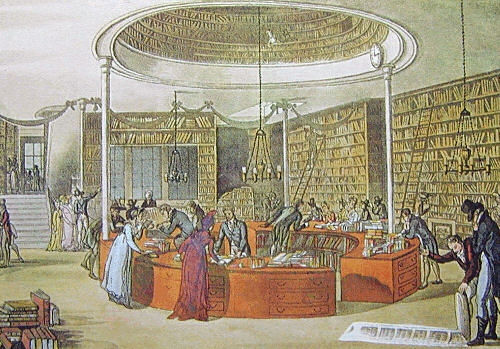
[Image from Ackermann’s via hibiscus-sinensis.com]

* I will be posting occasional reviews of books recommended “For Your Austen Library” – these will be listed on the bibliography page so titled.  You can also visit the the other Bibliography pages for more reading recommendations.

[Posted by Deb]

Austen Literary History & Criticism · Collecting Jane Austen · Jane Austen · News · Social Life & Customs · Women Writers

Janeites at the Morgan

A triple series of Janeite interest in the Pierport Morgan Library & Museum’s Austen Exhibit —

From Janeite Hope:

From now until March 14th the Morgan Library and Museum is exhibiting “A Woman’s Wit: Jane Austen’s Life and Legacy.” According to the website, the exhibition “explores the life, work, and legacy of Jane Austen (1775–1817), regarded as one of the greatest English novelists. Offering a close-up portrait of the iconic British author, whose popularity has surged over the last two decades with numerous motion picture and television adaptations of her work, the show provides tangible intimacy with Austen through the presentation of more than 100 works, including her manuscripts, personal letters, and related materials, many of which the Morgan has not exhibited in over a quarter century.”

There is an online exhibition that includes images of pages from the manuscript of “Lady Susan” along with a short documentary film commissioned for the exhibit. The film contains brief interviews with several writers, scholars, and actors (you’ll recognize Harriet Walker – Fanny Dashwood in the Thompson Sense and Sensibility). Though the interviews are interesting, what I like best about the documentary is watching the participants handle Austen’s letters and manuscripts. Bit of a vicarious thrill, there.

More at: www.themorgan.org/exhibitions/exhibition.asp?id=22


From Janeite Suzanne:

I’d never been to the Morgan, so I’m glad to have discovered it. There was a little film showing downstairs in the theater to introduce the JA exhibit. It had a variety of people giving their thoughts about the letters. It was ok, but seemed like rather a stretch to pad the exhibit and not particularly valuable. And it bothered me a bit to see someone actually handling the letters. They were also playing the movie, none too quietly, in the actual exhibit room which I found annoying because at that point I wanted to enjoy looking at the letters undisturbed.

They were hard to read, of course, but one could read much of it, even with cross writing and that was nice. Seeing the actual “JA” was a thrill. I was surprised that one letter had the JA squished right down to the edge of the paper and the “a” was a large lowercase a, not the one we think of as her signature and which was on everything else.

 There were period copies of the books she would have read and some delightful period satirical illustrations, but what I liked best was a letter she’d written to a youthful Cassy. It would have been better if the presenters hadn’t “translated” it for us because that was the fun. I felt that I gained some insight into J’s character from seeing how she wrote this to a child and also that she was able to form the words as smoothly as if they had been familiar letters sequences. I shall have to make up my own text, but it will give you the idea of her “code”.

Read Yssac,

Ew Era ta emoh yadot dna ti si gniniar. Spahrep ew lliw eb elba ot og rof  a egairrac edir siht noonretfa. I ylniatrec epoh os esuaceb ereht era ynam sgniht ew dluohs tisiv erofeb ew evael Thab.

Rouy gnivol tnua, Enaj

Now, wasn’t that fun! It’s much harder than simply writing backwards, especially the capitalization. Now I have to wonder if she thought it up herself.


from Janeite Bonnie:

JUST WANTED TO LET YOU KNOW:

Last night, I went to the Morgan Library and Museum’s exhibition “A Woman’s Wit: Jane Austen’s Life and Legacy”, and, oh, what I saw!! I didn’t know that the Morgan holds the world’s largest collection of Austen’s letters, 51 of the 160 known ones. The curators trotted out many of the more well-known letters, and it was thrilling to see them in the original hand. Among the Austenalia I got to examine:

–cross-hatched letters and letters with lines excised by Cassandra
–the backwards letter to her niece Cassy
–the letter in which she writes of the gentleman on which she “once doated”
–the letter in which she writes of having a shaking hand from having drunk so much wine, and mentions the woman with the diamond bandeau, pink husband, and fat neck, and James Digweed having made a gallant remark about the two elms falling down in grief over the absence of Cassandra (a particularly enjoyable letter, and dated November 20–serendipitously read by me 209 years to the day later)
–the letter in which she drew the pattern of the lace for her new cloak
–the letter in which she asks Cassandra to tell Fanny that she has found a portrait that looks “excessively like” how she pictures Mrs. Bingley
–the page on which she sums up her expenditures for a year
–her satirical “Plan of a Novel” (very difficult to read)
–Cassandra’s letter to Fanny describing Austen’s last days and her death
–some pages of the manuscript of “The Watsons” with much editing
–some pages of the manuscript of “Lady Susan” (of which the Morgan holds the entire manuscript)
–James Stanier Clarke’s letter to Austen, in which he tells her that it is not *incumbent* on her to dedicate her next novel to His Royal Highness the Prince of Wales, but…
–first editions of all six novels, including the spines of a three-volume set of “Emma” with the price on the original labels
–one of the books that Austen owned, “The Spectator”, with her signature and “Steventon” inscribed inside

There was other material on display related to Jane Austen, such as books by Richardson and Cowper, a copy of “Camilla” open to the page of subscribers where “Miss J. Austen, Steventon” is listed (believed to be the only time her name was in print before her death), Walter Scott’s original journal open to the page of his comment about Austen’s “exquisite touch” versus his “Big Bow-wow strain”, material by Yeats, Nabokov, and Kipling, an edition of Pride and Prejudice with a preface by George Saintsbury (he who coined the term “Janite”, now “Janeite”), and, to top it off, original prints by James Gillray interspersed among Austen’s letters to punctuate some of the trenchant comments she made in them.

As a little bonus, on the way out I stopped by Mr. Morgan’s library and took a peep at the original 1843 manuscript of “A Christmas Carol” and one of the three Gutenberg Bibles (1455) in the Morgan collection.

All I can say is, I’m so thankful for the Morgans’ use of their money in this manner.

in a second email, the following wonderful & exciting tidbit was added:

I have one more thing to tell. It happened during the question-taking portion of the gallery talk. One of the enthusiasts in the crowd questioned Declan Kiely, the curator of the exhibition, about the attribution of one of the documents — a scrap attributed to Jane Austen, with the titles of all her novels. The woman questioned whether it was actually Jane Austen who had written it, as the title “Persuasion” was listed, and she thought that that was the title Henry had given it after Jane’s death, and that she had always called it “The Elliots”. I had read that too, but I wasn’t sure that it had not been settled on before her death, as there are other theories out there.

Afterwards, a few of us compared it with the note that she wrote summing up some profits from her books, which was in the same frame, and we saw that the capital P’s didn’t match. However, now that I see the “Profits” scrap close up on the Morgan website, I do see two different ways that Austen wrote capital P on the same scrap

(See the P in “Mansfield Park”, then compare it to the P in “Profits from Emma” quite near the blot of ink.)

If it is the case that Jane Austen habitually wrote her capital P two ways, then the scrap with all the titles of her novels that is attributed to her would confirm that she intended the title of her last novel to be “Persuasion”, and all the speculation should be laid to rest.

I think it will require another trip to take a closer look and see if there are similarities of script in Cassandra’s letter to Fanny, and look for capital P’s in all of Jane Austen’s other letters…

I don’t know if people are aware of this, but the Morgan has no entrance fee from 7:00 PM and 9:00 PM on Fridays.

Austen Literary History & Criticism · Book reviews · Collecting Jane Austen · Jane Austen · Publishing History

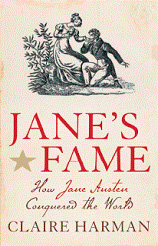
Book Review ~ “Jane’s Fame” by Claire Harman

book cover jane's fameMany of us who grew up in the late 40s – early 50s had our Jane Austen force-fed to us in high school (unless we were fortunate enough to be blessed with an Austen-loving mother or father!).  Pride & Prejudice was the standard text with little reference to the other works; followed by George Eliot’s Silas Marner, Dickens’s A Tale of Two Cities and / or Great Expectations, Shakespeare (hopefully!), and Hemingway, Steinbeck, Salinger for contemporary authors.  But I’ve often thought that Austen got a bum-rap with this “required-reading” status, the educational system’s way of compensating for what an early critic said in calling Austen “a critic’s novelist – highly spoken of and little read.” [p. 120]  And while I am the first to admit that Austen is not for everyone [their terrible loss!], I have long believed that this approach to Austen added to her suffering from the great reader-turnoff. 

For me, a voracious reader as a youngster and teenager, I went on to read some of her novels, but alas! not all, feeling more at home with Alcott, the Brontes, Dickens, and later Wilkie Collins, all those more accessible Victorian novelists.  So it was in later life that I returned to Austen – and I perhaps needed that distance of time (and some wisdom!) to re-appreciate her brilliance – the humor and irony, the language, that characterization, and of course, the age-old love stories.  So from my current vantage point I marvel at Austen’s ability to stay fresh, to speak to different generations, and to speak to each individual in different ways through one’s own life. And in these fifteen plus years of “re-Austenising” myself, I’ve gone much beyond the novels, to the biographies, criticism, her Regency / Georgian world, and the current surfeit of films, and sequels and continuations, and even the latest parodies, creating quite a book collection in the process – and I have really barely begun!  

So I was most excited to hear about the release of Claire Harman’s new book, Jane’s Fame: How Jane Austen Conquered the World [Canongate, 2009], stirring up controversy even before it hit the bookstores [see my previous post, “Discord in Austen Land”].  [Harman has authored Fanny Burney: A Biography (Knopf, 2001) and works on Sylvia Townsend Warner and Robert Louis Stevenson].   It is an engaging read – historical, biographical, critical and anecdotal, all rolled into a capsule of Austen’s claim to fame – and just why was she so popular?  “the public whipped into a frenzy” [p. 243]  in the late nineteenth century and again in the late twentieth? – by “[James Edward] Austen-Leigh’s Memoir in the first instance, and in the second, a man in a wet shirt” [p. 243] [with thanks to Colin Firth!] – simplified reasoning perhaps, but a good chuckle and that glimmer of truth. 

Harman explains that

…this book charts the growth of Austen’s fame, the changing status of her work and what it has stood for, or been made to stand for, in English culture over the past two-hundred years.  In the foreground is the story of Austen’s authorship, one of persistence, accident, advocacy, and sometimes surprising neglect.  Not only did Austen publish her books anonymously and enjoy very little success during her lifetime, but publication itself only came very late, after twenty years of unrewarded labor.  I have sought to reconstruct these pre-fame years in the spirit of uncertainty through which Austen lived them.  Her prized irony and famous manipulation of tone I believe owes much to it; part of the reason why she pleases us so much now is that she was, for years, pleasing only herself.  [p. 7-8]

Thus, Harman starts by placing Austen squarely in the context of her times – her family and friends as writers – her mother, brothers James and Henry, her friend Anne Lefroy’s brother Samuel Egerton Brydges, and her pride in her own quite delightful juvenile writings.  Incorporating a general account of Austen’s life [Harman assumes the reader brings much knowledge of Austen’s life and gives only a cursory telling], she presents us with a great summary of Austen’s writings, the publication history and early responses to each work, drawing heavily on Brian Southam’s Jane Austen, The Critical Heritage [London 1968], and emphasizing Austen’s literary ambitions. [for more on this, see Jan Fergus’s The Professional Woman Writer” in The Cambridge Companion to Jane Austen, one of the earlier scholarly arguments to clearly see Austen in this light, far removed from the portrait painted by her brother Henry and later her nephew.]

Following Austen’s death in 1817, her copyrights still owned by Cassandra were sold to Richard Bentley and his issue of all six novels in 1833 did much to keep Austen in print; but her popularity waned, the rise of the Victorian novel sending Austen to the shadows, not to mention Charlotte Bronte’s dislike of Austen, quoted by Elizabeth Gaskell in her Bronte biography in 1857 [but ironically, how close is Gaskell’s North & South to Pride & Prejudice!]  So Austen remained largely unread until the Austen-Leigh Memoir of 1870, followed by various new editions of the novels and the selected letters in 1890. 

Harman explores in her chapter on the “Divine Jane” [quoting W.D. Howells] the publishing of these new editions and the illustrated versions that sought to “fix the characters in one’s mind” [p.159], the biographies, and critical analyses in this first burgeoning fame-fest, and her new status as darling of the intellectual snobbish-elite, championed by the likes of Leslie Stephen, Henry James, George Saintsbury, and Howells [and of course, not to leave out Mark Twain’s adamant dislike!] – all this culminating in R.W. Chapman’s Oxford edition of her works in 1923, “the first complete scholarly edition of any English novelist.” [p. 192]. 

In “Canon and Canonisation,” Harman chronicles the scholarly critical analysis that continues unabated to the present – the vast extent of academic and non-academic writing – on the one hand, Austen as a pleasure-read, the writer “who wrote so clearly and simply, and who was so small scale” [p. 200] – and on the other, the critical study of Austen’s “unconsciousness and brilliance” and here we see her “easy passage into English literature courses” [p. 201].  Austen makes critical literary history as manuscripts and contemporary memoirs became available for study – resulting in library collections, various illustrated editions, Jane Austen Societies, interest in her “homes and haunts,” more biographies from various standpoints, new paths of criticism taking into account the political, sociological and historical elements, and the many works on the manners and mores, fashion and handiwork, cookery and letter-writing – all things Austen indeed! [A friend visiting my home recently asked me what could all these Austen-related books on my shelves possibly be about when she only wrote six books!] 

And finally to film and what she terms “Jane Austen TM”, Harman again summarizing all that came before the “wet shirt” and after – the movies, the sequels, the internet and YouTube concoctions, the blogsphere , the Societies, the fan-fiction sites, the costume-driven fanatics, etc.  And Harman ends with the question, “What would Austen have made of all this? [p. 278] – in answer, she cites the differing views of D.W. Harding, Lionel Trilling, Henry James, and E.M. Forster to prove to us that “the significance of Jane Austen is so personal and so universal, so intimately connected with our sense of ourselves and of our whole society, that it is impossible to imagine a time when she or her works could have delighted us long enough.” [p. 281]

 One of the criticisms of Harman’s book has been her light non-academic approach to Austen [and perhaps her re-working of others’ ideas into this “popular” framework] – but it all works so well for what and for whom it is intended.  Harman’s gift is taking an inordinate amount of primary and secondary material and presenting it into a very readable, information-packed and anecdotal whole – everything you would ever want to know about Jane Austen all put together in a neat little package of 342 pages.  This of course may be its greatest shortcoming – too neat a package with strong authorial opinions thrown in [and a feeling to this reader of all being rather rushed at the end – “let’s wrap this up, throw in a few final tales and get it published” sort of feeling…] –  it must needs be leaving something out! [Indeed, the 2005 Pride & Prejudice barely gets a mention, either an oversight or the expression of the author’s opinion of that film – but no matter what your views of that adaptation might be, it has to be praised for bringing Jane Austen and P&P  to yet another generation who do not find Colin Firth’s wet shirt scene all that WE make it out to be – and thus it is a clear topic for Jane’s current and ongoing “fame.”] 

But as a resource, with a terrific reading list to be gleaned from the text and bibliography [though I do quibble with the number of un-sourced quotations and overly shortened citations that are unclear (especially in regard to the letters – a number and date would have been most helpful!)], Jane’s Fame should be required reading [not force-fed please…] for anyone interested in the facts of Austen’s writing life and how she has risen to such heights and commands such a presence in so many people’s lives.  And you will likely take away new and interesting tidbits such as finding what Katherine Mansfield had to say about Emma:  “Mr. Knightley in the shrubbery would be something!” [p. 247] [aah! indeed!]

4 1/2 full inkwells [out of 5]

 Further Reading: [all page citations above are to Janes’ Fame]

  • See my post on the various Reviews of Jane’s Fame
  • Copeland, Edward, Juliet McMaster, eds.  The Cambridge Companion to Jane Austen.  Cambridge University Press, 1997.
  • Fergus, Jan.  “The Professional Woman Writer” in The Cambridge Companion, pp. 12-31, where Fergus summarizes and expands these arguments first presented in her Jane Austen: A Literary Life. London: Macmillan 1991.  These are must-reads…
  • Sutherland, Kathryn.  Jane Austen’s Textual Lives: from Aeschylus to Bollywood. Oxford, 2005, pb 2007.  Note that it is Professor Sutherland who started the controversy that Harman essentially lifted her ideas – I have this book and have skimmed it only, so cannot comment fully – but just looking at the table of contents, one finds the similarities a little alarming, and the Sutherland book has far more depth to the notes and bibliography – but again, I emphasize the “popular” nature of Harman’s book. 
  • Todd, Janet, ed.  Jane Austen in Context.  Cambridge University Press, 2005, 2007 with corrections. 
  • Claire Harman’s website with cites to reviews of Jane’s Fame
  • Austenblog:  Mag’s review of Jane’s Fame

Posted by Deb

Books · Collecting Jane Austen · Jane Austen

Novels & Letters (1906) now complete

mpFINALLY!

Internet Archive now has all twelve volumes of the 1906 edition entitled “The Novels & Letters of Jane Austen”. Especially, I was happy to see the second part of Mansfield Park (the illustration is the volume’s frontispiece).

The search is still on to provide our audience with the missing volume of Pride & Prejudice‘s first edition; ditto the entire three-volume set of Sense & Sensibility.

Find all the online editions via our bibliography, or click on the tabs above to go to the individual works.