When Jane Austen sold the copyright of her Pride and Prejudice outright to her publisher Thomas Egerton, she, we now know, made the biggest mistake of her life. But hindsight is a dangerous beast, and easy for us to lament this 200 years later. We could also regale Cassandra for selling all the remaining copyrights to Richard Bentley in 1832 for a meager £210 pounds (Bentley also paid the Egerton estate £40 for the P&P copyright). She must have thought it a good bargain at the time – how was she to know that her sister’s novels would continue to be read through the generations, thus granting heirs much in royalty checks.
We don’t really know why Jane Austen chose to sell the Pride & Prejudice copyright rather than publish on commission, the way she published her other works; in all likelihood she didn’t want to take the financial risk. But she really had four options to publish at the beginning of the 19-th century, as did other authors of this time:
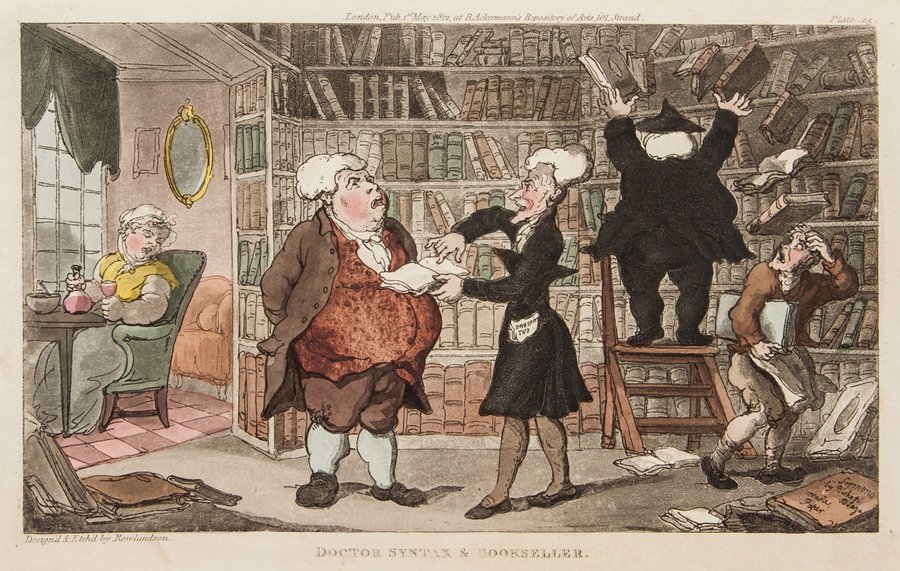
Thomas Rowlandson’s “Dr. Syntax & Bookseller” from William Combe’s The Tour of Dr. Syntax in Search of the Picturesque (1812)
Profit-sharing: the publisher paid for printing and advertising costs; these expenses were repaid as books sold and any profit above those production costs was shared with the author; any loss was absorbed by the publisher. This was a popular way of publishing for unknown authors. Jan Fergus notes that if Austen had used this method for the four novels published in her lifetime, she would have made more money than she did. (Fergus, p. 16)
–
Commission: the author was responsible for all publication expenses – paper, printing, advertising – the publisher distributed the books and took a 10% commission on all copies sold. The author took all the risk here, as if not enough copies sold to cover the costs, the author would be responsible. Austen published all her books this way, excepting her Pride and Prejudice… and from her letters we know that her brother Henry Austen was her financial backer. This seems to have been the most popular way to publish in the early 19-th century, especially for women writers. And it is interesting to note that this form of publishing is in vogue again! – just see all the number of self-published works that appear on Amazon!, this “vanity” publishing no longer less respected than publishing in the traditional way.
–
Sale of Copyright: the author sells the copyright outright to the publisher and is no longer involved. Here the publisher takes all the risk, especially for an unknown author, but also has control over any future editions and can benefit if the book sells well. In the case of P&P, sold to Egerton for £110, Austen would have done better to have published by commission – it went into three editions, though she had no further input in making changes to the text.
–
Subscription: the author would solicit subscribers, who would pay in advance for the promised work and have the privilege of seeing their name in print in the list of subscribers in the work itself. This option usually only worked for well-known and successful authors, or for a work that people might want to see their name identified with. We can look at the concept of modern-day “crowd-funding” as an example of how this works.
***************
It is this last option of publishing that holds our interest today. Jane Austen published anonymously, “By a Lady” (on Sense and Sensibility), or “By the Author of ‘Sense and Sensibility’” (on P&P) (see note below) – she was an unknown authoress and would have had difficulty finding enough willing and wealthy donors to publish by subscription. But Frances Burney, a very successful author at the time, did publish her Camilla (1796) by subscription, the only work she did this way – and this first edition is notable because among the list of 1,058 subscribers (Dow, p. 38) is the name of “Miss J. Austen, Steventon,” only one of two times that Austen’s name appeared in print during her lifetime. She likely paid a guinea for the privilege (Dow, p. 40), and just look at the list on this one page of the illustrious fellow-subscribers!
I have thought for a number of years that this was the only place to find Austen’s name, but Gillian Dow in her article on “Jane, the Subscriber” notes that there is another such title: the non-fiction work Two Sermons by the Rev. T. Jefferson, published in 1808, and where her name is listed as “Miss Jane Austen” and her brother and sister-in-law as “Mr and Mrs Edward Austen of Godmersham.” A look at her letters finds Austen’s references to this Thomas Jefferson (1760-1829) of Tonbridge:
I have read Mr. Jefferson’s case to Edward, and he desires to have his name set down for a guinea and his wife’s for another, but does not wish for more than one copy of the work. [Letter 52. Le Faye, Letters, 4th ed. (2011), p. 132-3.]
And later:
I have now some money to spare, & I wish to have my name put down as a subscriber to Mr. Jefferson’s works. My last Letter was closed before it occurred to me how possible, how right, & how gratifying such a measure would be.” [Letter 54, p. 138]
Thus, we see Jane Austen’s name in print again – one wonders if others might yet surface!
Becoming a Subscriber at Chawton House Library
Chawton House Library
The point of all this is to tell you about a program at Chawton House Library, where you too can become a subscriber! An age-old way of publishing, where you can see your name in print, acquire a copy of a reprint edition of an interesting old title, and support the Chawton House Library in the bargain. Slightly more than a guinea is required of you, but not too much more (a minimum of $50)… You can read about the program and how to donate at the Chawton House Library website here: http://www.chawtonhouse.org/?page_id=58839
“Further to the success of our most recent subscriber publication, The Knight Family Cookbook, which thrilled Subscribers and has proven to be one of the most purchased books in our shop, we are now seeking to progress our latest publication- The Duties of a Lady’s Maid; with directions for conduct, and numerous receipts for the toilette (1825). This facsimile edition, with a new introduction by Mary Ann O’Farrell, will be a fascinating book certain to entertain those who would welcome guidance on how to behave as maid to Lady Catherine De Bourgh – or indeed those who wish to emulate Downton Abbey’s Miss O’Brien. Originally published in 1825, it is a rather rare conduct book offering a unique insight into the lives and duties of servants, as well as the trends and tastes of the Georgian age. Readers can learn how religion should direct a maid in her work, which character traits are essential, and how to keep family secrets. Amusing practical instructions, such as how to dress your lady using padding and bandages to improve her figure and tips on the most advantageous way to display the forehead, are also to be enjoyed.”
[From the CHL website]
Let’s take a peek into this book that you can own in a facsimile edition – no author is noted as you can see: The Duties of a Lady’s Maid; with directions for conduct, and numerous receipts for the toilette (1825).
title pageFrontispiece
Now, I must tell you that you can find this book on Google Books, or at the Hathi Trust – but where is the fun in that? You need this book on your shelf, not only because it is a rare book (it only seems to have been published in this one edition of 1825), but also because you will find the most indispensable information in order to continue on with your life as you know it – after all, we most of us have become our own Ladys’ Maids, haven’t we? – if for any reason you don’t find this all completely relevant (the chapters on cleaning your wardrobe definitely remain so!), then at least it will be a daily reminder of exactly how far we have come. Take a look at the Contents:
CONTENTS _______________
1. DUTIES OF BEHAVIOUR.
-Religion 6
-Honesty and Probity 19
-Diligence and Economy 26
-Attention 39
-Familiarity with Superiors 43
-Good Temper and Civility 50
-Confidence in Keeping Family Secrets 57
-Vanity and Dress 70
-Amusements 84
-Vulgar and Correct Speaking 98
-Change of Place 123
-Courtship 128
2. DUTIES OF KNOWLEDGE AND ART.
-Taste in the Colours of Dress 135
-Carnation 145
-Florid 146
-Fair 147
-Pale 148
-Sallow 149
-Brunette 150
-Artificial Flowers 159
-Taste in the Forms of Dress 162
-Stays and Corsets 175
-Padding, Bandaging, &c, to Improve the Figure 184
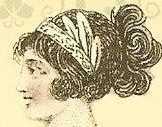
-Display of the Forehead 192
-Taste in Head Dresses 199
-Taste in Dressing the Hair 220
-Practical Directions for Hair Dressing, with Receipts. 233
-Cosmetics, &c. with. Receipts 256
-Paints, with Receipts for Rouge, Pearl White, &c 289
-Use and Abuse of Soap 306
-Dress-making and Fancy Needle-work 315
-Care of the Wardrobe, and the Method of Taking out Stains 321
-Method of Cleaning Silks and Chintz, and of Clear Starching, and Getting-up Lace and Fine Linen 324
******************
Some excerpts to entice you:
1. In case you perhaps don’t speak the King’s English – here are some pointers on correcting your shortcomings:
VULGARITIES PECULIAR TO ENGLAND.
The first vulgarity which I shall point out to you as prevalent among the lower orders in England, from Cumberland to Cornwall, is the practice of ending every thing they say with a question. For instance, instead of saying “the bonnet looks very smart,” an English girl will add the question, “an’t it?” or “don’t it?” If this practice of ending what is said by a question, were only employed occasionally, and when it appears necessary, it might be proper enough; but when it is repeated every time a person speaks, as you may observe is the case among the ill-educated all over England, it becomes extremely vulgar. You may thus hear a person say, “I went very quick, did’nt I?” for “I always do, don’t I?” or “Susan worked that very well, didn’t she? she is a good girl, an’t she? and I am very kind to her, an’t I?” You must carefully avoid this vulgar practice of ending what you say with a question, if you are desirous of speaking correctly….
Still more vulgar than either of these is a certain use of the words there and here, along with that and this, as when it is said “that there house,” instead of “that house,” or “this here book,” instead of “this book.” You may, however, without impropriety say “this book here,” or “that house there’s” but never, “this here” nor “that there.” …
One of the very common vulgarities prevalent in England is a peculiarly awkward way of bringing in the name of a person at the end of a sentence, with the words “is” or “was” before it. I cannot describe this more intelligibly, except by an example; for instance, you may hear an ill educated girl say “she was very kind to me, was Mrs. Howard,” instead of correctly saying “Mrs. Howard was very kind to me.” Again, “he is a very worthy man, is Mr. Howard” instead of “Mr. Howard is a very worthy man.” I say that such expressions are not only vulgar but uncouth and awkward, and more like the blunders of a foreigner than a person speaking in her mother tongue; yet nothing is more common than this awkward vulgarity, which I expect you, will never commit after it has been now pointed out to you….
The manner in which certain words are pronounced is also a very evident mark of vulgarity. One of the most remarkable instances of this kind in England is the sounding of an r at the close of words ending in a or o, as when you say “idear” for “idea,” or “fellor” for “fellow,” or “windor” for “window,” or “yellor” for “yellow.” This is extremely difficult to be corrected when once it has become a habit; and so regularly does it follow in every word of similar ending, that you may hear persons say “Genevar” for “Geneva,” as commonly as children say “mammar” and “papar.”
[etc, etc… the Author then goes on to cover the various “Vulgarities in Scotland”…]
***********
2. Mrs. Clay might find a solution to her unsightly freckles with these solutions, Sir Walter would be pleased to know:
CE Brock – Sir Walter Elliot (Mollands)
Freckles.—The sun produces red spots, which are known by the name of freckles. These have no apparent elevation but to the touch it may be perceived that they give a slight degree of roughness to the epidermis. These spots come upon the skin in those parts which are habitually exposed to the air. To prevent freckles, or sunburn, it is necessary to avoid walking abroad uncovered; a veil alone, or a straw hat, is sufficient for most women. There are however others whose more delicate skins require a more powerful preservative. The following is recommended by an intelligent physician:—
Take one pound of bullock’s gall, one drachma of rock alum, half an ounce of sugar candy, two drachms of borax, and one drachm of camphor. Mix them together, stir the whole for a quarter of an hour, and then let it stand. Repeat this three or four times a day, for a fortnight, that is to say, till the gall appears as clear as water. Then strain it through blotting paper, and put it away for use. Apply it when obliged to go abroad in the sunshine or into the country, taking care to wash your face at night with common water, those who have not taken the precautions mentioned above must resort to the means which art has discovered for removing these spots. The following process is recommended as one of the most efficacious for clearing a sunburnt complexion, and imparting the most beautiful tint to the skin ;—at night on going to bed, crush some strawberries upon the face, leaving them there all night and they will become, dry. Next morning wash with chervil water, and the skin will appear fresh, fair, and brilliant.
[Etc, etc – there are several other rather drastic directions…]
*************
3. I must say that the seven pages on “Display of the Forehead” is worth the price of admission alone! But this on making a French dressing for your hair is a must-learn:
Parisian Pomatum.—Put into a proper vessel two pounds and a half of prepared hog’s lard with two pounds of picked lavender flowers, orange flowers, jasmine, buds of sweet briar, or any other sweet scented flower, or a mixture according to your choice, and knead the whole with the hands into a paste as uniform as possible. Put this mixture into a pewter, tin, or stone pot, and cork it tight. Place the vessel in a vapour bath, and let it stand in it six hours, at the expiration of which time strain the mixture through a coarse linen cloth by means of a press. Now throw away the flowers which you have used as being useless, pour the melted lard back into the same pot, and add four pounds of fresh lavender flowers. Stir the lard and flowers together while the lard is in a liquid state, in order to mix them thoroughly, and repeat the first process. Continue to repeat this till you have used about ten pounds of flowers.[my emphasis]
After having separated the pomatum from the refuse of the flowers, set it in a cool place to congeal, pour off the reddish brown liquor, or juice extracted from the flowers, wash the pomatum in several waters, stirring it about with a wooden spatula to separate any remaining watery particles, till the last water remains perfectly colourless. Then melt the pomatum in a vapour bath, and let it stand in it about one hour, in a vessel well corked, then leave it in the vessel to congeal. Repeat this last operation till the watery particles are entirely extracted, when the wax must be added, and the pomatum melted for the last time in a vapour bath in a vessel closely corked, and suffered to congeal as before. When properly prepared it may be filled into pots, and tie the mouths of them over with wet bladder to prevent the air from penetrating. This pomatum will be very fragrant, and form an excellent preparation for improving the gloss and luxuriance of the hair.
[I’m exhausted just thinking about it…] – You might end up looking like this, flowers and all:
[Source: ‘The Flower Garden’ – hand-coloured etched engraving published by M Darly in 1777.
See Bibliodyssey for additional such outrageous hair-dos]
***************
So that gives you a very small inkling of what lies in store in this fascinating little book. You will find insights into the daily life and work of the many rarely seen but obviously-there-lurking-about servants in all of Austen’s novels – what was it like to be the lady’s maid to Lady Catherine or her daughter Anne – dreadful thought! Was it easier being maid to Mrs. Jennings with her overwhelming busyness, or Mrs. Bennet, despite her poor fluttering nerves? We watch Downton Abbey as much for the sometimes more interesting “below-stairs” life than anything that transpires upstairs – and indeed not much changed in servant’s lives from 1825 to the early 1900s. Certainly Anna would have been familiar with this book or something like it.
Think about adding this to your collection of conduct books [everyone should have a collection of conduct books, starting of course with Fordyce’s Sermons, Mr. Collins’ pride and joy in Pride and Prejudice, now published with an introduction by Susan Allen Ford and also available from the Chawton House Library: you can order it here through Jane Austen Books].
Hope I have convinced you of the need to become a subscriber to Duties of a Lady’s Maid – go to http://www.chawtonhouse.org/?page_id=58839 – click on the appropriate link for UK or US contributions. Or think what a great gift this would be for your favorite friend in need of a conduct book of her (or his) own!
The Library will be preparing for publication soon, as the list of subscribers is growing – don’t miss out in seeing your name, or a best friend’s, in print, just like Jane Austen….
1. Dow, Gillian. “Jane, the Subscriber.” Jane Austen’s Regency World 68 (Mar-Apr 2014), 38-43.
2. Fergus, Jan. The Professional Woman Writer.” Cambridge Companion to Jane Austen. Ed. Edward Copeland and Juliet McMaster. Cambridge UP, 1997. See this chapter in both editions of the Cambridge Companion, as well as her Jane Austen: A Literary Life. Macmillan, 1991.
3. The title pages of each of Austen’s works read as follows:
Sense and Sensibility: “By a Lady”
Pride and Prejudice: “By the Author of ‘Sense and Sensibility’
Mansfield Park: “By the Author of ‘Sense and Sensibility’ and ‘Pride and Prejudice’
Emma: “By the Author of ‘Pride and Prejudice,’ &c, &c.”
Northanger Abbey and Persuasion: “By the Author of ‘Pride and Prejudice,’ ‘Mansfield Park,’ &c.”
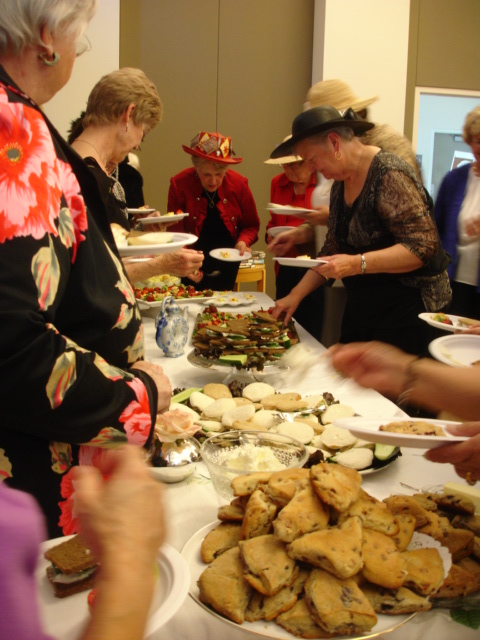
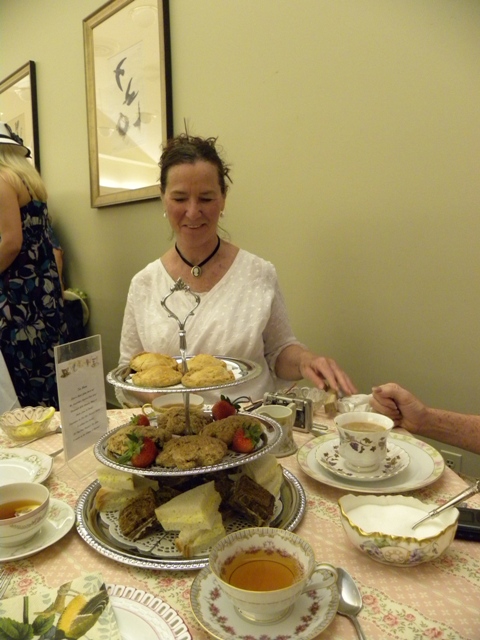
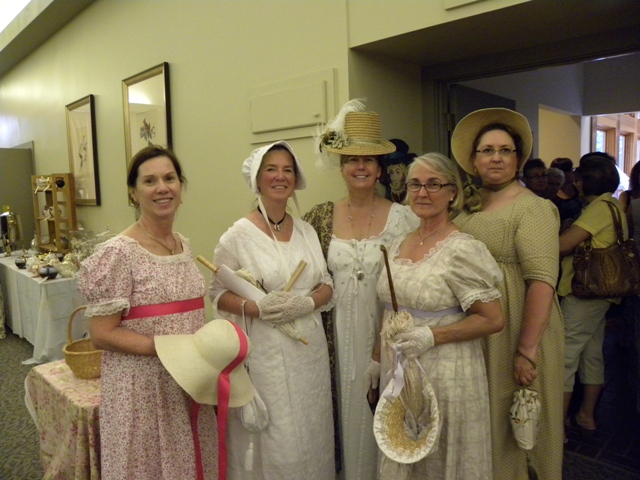
The local Library in Bluffton South Carolina has been having weekly Downton Abbey discussions since the first episode of Season 3, all culminating in an Afternoon Tea this past week. A Season recap, Delicious fare, Fine company, Gorgeous hats, and Games of trivia to test our Downton Abbey brain power! – all staged with perfect finesse by Amanda, our fearless leader and Reference Librarian, the intent to keep us all (over 70 of us!) from falling into a deep Downton Abbey depression. We toasted Julian Fellowes, bid our adieus to Sybil and Matthew and wondered aloud as to where the show shall take us next year, alas! eleven months of impatient waiting. We were asked which actor would we most like to have dinner with; which actor we would most like to be in a scene with; our favorite quotes; most memorable scene? and trivia questioned on our knowledge of all things Downton [like: Where does Lord Grantham sit at the dinner table? What is the proper dress for a dinner at home without guests? Where is the story set? Where is the actual Highclere Castle?, etc…] – most of us found we should have to re-watch all three seasons to get a a passing grade!
I append some pictures to share the day, with a Hearty Thanks to Amanda and the Friends of the Bluffton Library for all their efforts to prolong the Downton Abbey season as long as possible – I think even Violet would approve!
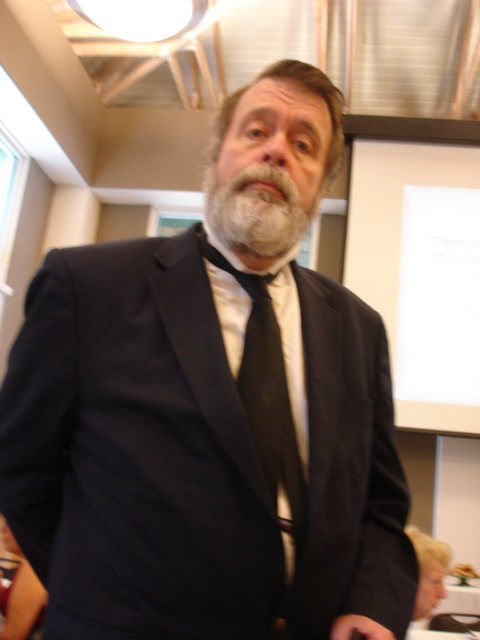
Delicious fare!Our Gracious Hostess Amanda…and her gorgeous hat!Our very own Mrs PatmoreOur very own Mr CarsonA bevy of Hats!Best hat for Afternoon Tea!The long wait until next January!
This past week’s Downton Abbey had its usual witty remarks from all quarters, Violet yet again leading the pack. But my favorite by far came from Mrs. Patmore, as she says to Ethel:
“Anyone who has use of their limbs can make a salmon mousse.”
************
My mother-in-law always made salmon mousse – I cannot recall a single family gathering where it was not upon the table, eye and all – and to keep me from forgetting these family gatherings, I actually inherited her much-used salmon mousse mold – but alas! have not put it to any use, despite having all limbs in fairly good working order.
But recipes abound if you should want to try – and if Ethel could pull this off, it should be easy sailing:
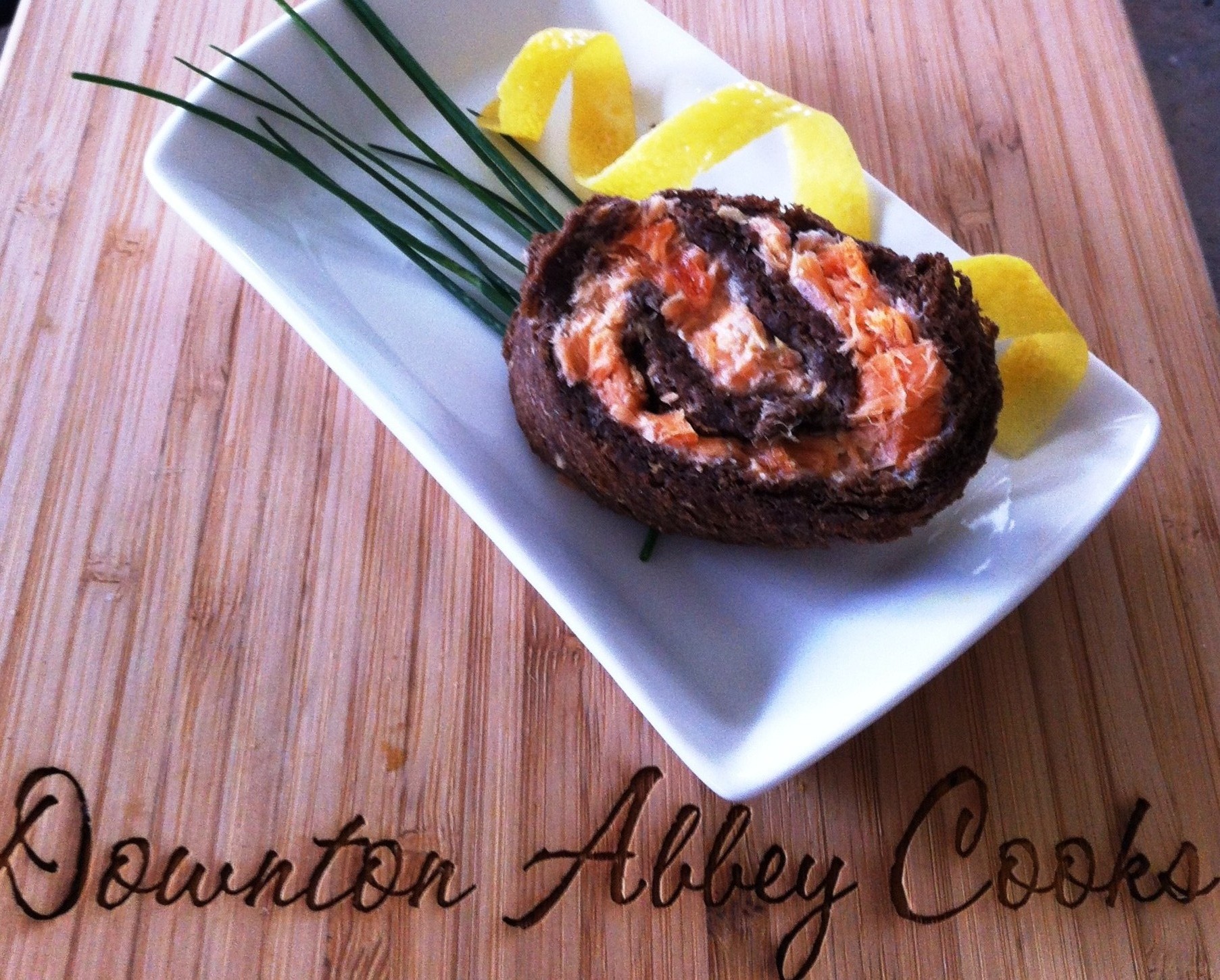
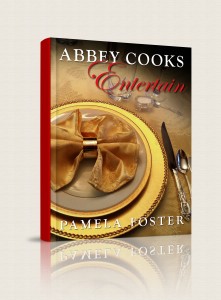
This is from the website Downton Abbey Cooks, worth a visit for the show’s food history and great recipes [there IS a great deal of cookikng and eating!], all from Pamela Foster, author of Abbey Cooks Entertain:
This sandwich adds a lovely punch of color to your tea tray, contrasting dark pumpernickel bread with deep orange smoked salmon. The Ritz London serves a similar version with whisky, but I like the fresh flavors of vodka and dill. You are only limited by your imagination.
Ingredients
1/3 cup non fat greek yoghurt
1 tbsp. minced chives
2 tbsp. whisky
4 ounces smoked salmon
1 1/2 tbsp. fresh lemon juice
For the Sandwiches
12 slices dark wheat or pumpernickel bread, crusts removed
2 ounces cold smoked salmon, cut into strips: you can also use hot smoked salmon as pictured above
Method
To make the mousse
Put the greek yoghurt, chives, vodka, salmon, lemon juice and pepper in a food processor and process for 20 to 30 seconds or until smooth. Cover and refrigerate for up to 2 days to let the flavours blend.
To make the sandwiches
Roll the bread slices flat with a rolling pin . Spread the salmon mousse on one side of each slice and arrange pieces of smoked salmon on top. Roll up and place seam side down on a serving plate. Cover with a damp tea towel or paper towels until ready to serve.
You can make larger pinwheels by cutting in half diagonally and stand on the flat edge. You can also cut into smaller bite sized 2 inch angled sections.
Makes 12 large or 24 mini pinwheels
**************
Here are links to other recipes, some made in the mold, some in bowls:
Perhaps Ethel’s praise-worthy attempts to be a cook who actually cooks something edible and Mrs. Patmore’s kindness in helping, despite the grousing of Mr. Carson, might indeed see “the return of the salmon mousse,” even in my house.
One often finds Jane Austen popping up in the oddest places; and this one that I stumbled upon the other day points out a scene in Emma that one can so easily pass by without much notice [Austen being such an expert at this – and the reason for repeated readings!] – this time in a book on of all things, “Buttons”!
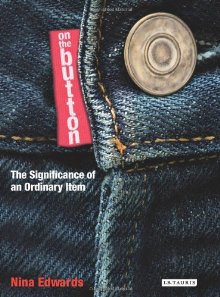
Nina Edwards new book, On the Button: The Significance of an Ordinary Item (London: Tauris, 2012), has this little gem in the introduction:
In Jane Austen’s Emma, when Emma contrives to find out if Mr. Knightley is considering Jane Austen romantically, buttons both betray his real affections to the reader and come to his aid by concealing his distress from Emma herself: (xix-xx, I have added a bit to the quoted text]
“I know how highly you think of Jane Fairfax,” said Emma. Little Henry was in her thoughts, and a mixture of alarm and delicacy made her irresolute what else to say.
“Yes,” he replied, “any body may know how highly I think of her.”
“And yet,” said Emma, beginning hastily and with an arch look, but soon stopping — it was better, however, to know the worst at once — she hurried on — “And yet, perhaps, you may hardly be aware yourself how highly it is. The extent of your admiration may take you by surprize some day or other.”
Mr. Knightley was hard at work upon the lower buttons of his thick leather gaiters, and either the exertion of getting them together, or some other cause, brought the colour into his face, as he answered,
“Oh! are you there? But you are miserably behindhand. Mr. Cole gave me a hint of it six weeks ago.”
He stopped. Emma felt her foot pressed by Mrs. Weston, and did not herself know what to think. In a moment he went on —
“That will never be, however, I can assure you. Miss Fairfax, I dare say, would not have me if I were to ask her; and I am very sure I shall never ask her.”
Emma returned her friend’s pressure with interest; and was pleased enough to exclaim,
“You are not vain, Mr. Knightley. I will say that for you.”
He seemed hardly to hear her; he was thoughtful, and in a manner which shewed him not pleased, soon afterwards said,
“So you have been settling that I should marry Jane Fairfax.”
(Emma, Vol. II, Ch. XV)
Here the gaiters seen to represent his morally dependable (but compared with the dashing Henry Crawford*) unexciting character; the buttons provide a refuge, the simple task of buttoning masking his emotion.
******************
what Mr. Knightley was so busily buttoning
image: Gaiters, 1805-10, British, the MetMuseum.org
(*I think she must mean Frank Churchill here, as Mansfield Park is nowhere in sight…!)
Isn’t this a wonderful passage? – one forgets how clearly Austen has strewn clues throughout the book as to Knightley’s true affections. Significant indeed! And it harks back to the scene with Emma contriving to repair her broken boot-lace to aid Mr. Elton and Harriet in their “courtship.”
Any thoughts?
The book, by the way, for anyone who has an interest in fashion and its cultural history, and especially the all-important button, looks quite wonderful:
What do you use every day that is small and large, worthless and beyond price? It’s easily found in the gutter, yet you may never be able to replace it. You are always losing it, but it faithfully protects you; sexy and uptight, it is knitted in to your affections or it may give you nightmares. It has led to conflict, fostered and repressed political and religious change, and epitomizes the great aesthetic movements. It’s Eurocentric, and is found all over the world.
On the Button is an inventive and unusual exploration of the cultural history of the button, illustrated with a multiplicity of buttons in black and white and color. It tells tales of a huge variety of the button’s forms and functions, its sometimes uncompromising glamour, its stronghold in fashion and literature, its place in the visual arts, its association with crime and death, and its tender call to nostalgia and the sentimental. There have been works addressed to the button collector and general cultural histories, but On the Buttonlinks the two, revealing why we are so attracted to buttons, and how they punch way above their weight.You can view it here: http://books.google.com/books/ibtauris?id=Rb46WTFfQAAC&dq=jane+austen&source=gbs_navlinks_s
Dear Gentle Readers: I had the pleasure of meeting Tess Quinn last year at one of the Jane Austen Weekends at the Governor’s House in Hyde Park Vermont. Tess then told me she had published her first short story in the compilation Road to Pemberley (Ulysses Press, 2011), which lay at home, unread, and obviously waiting for this sort of impetus! – Titled “A Good Vintage Whine”, I read it as soon as I got home and found it to be one of the more inventive of all of such stories that I have ever read… I still recall is very vividly, surely a tribute to its effect!
Tess has offered to write on her first-time visit to the Jane Austen Festival, to follow up Melody’s previous account – so here you can again visit vicariously with words and more pictures, the entire weekend – and this time we get to go to the Ball! And I do think we need to put next year’s adventure on our calendars right now! – and certainly all meet for Tea…
**********************************
The Louisville group
JANE AUSTEN FESTIVAL – LOUISVILLE, KY 21-22 JULY 2012
After hearing lovely things for the last few years about the Jane Austen Festival sponsored by the Louisville region of JASNA, I finally attended this event, the 5th Annual. Everything I had heard was not hype – this was a most delightful way to pass the weekend. The ladies and gentlemen of the Louisville chapter are commended for doing it right! Everything organized well, high quality entertainments of every variety – and fashion everywhere you looked!
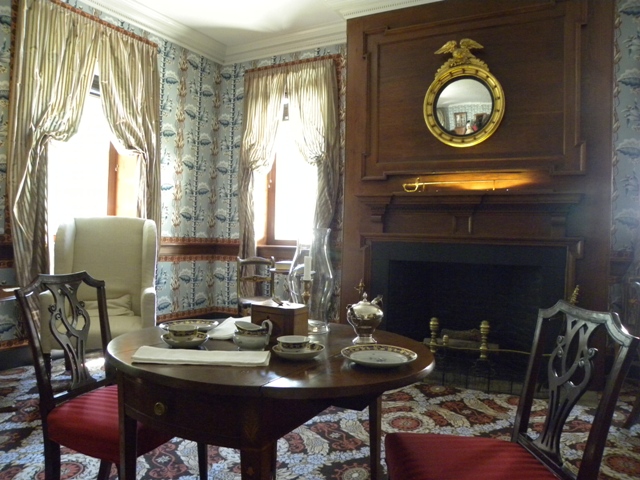
Flirting on the porchThe MarketThe Parlour
I attended with three fellow New York friends and we began the morning on Saturday with a stroll through the various shops of the market. (I was sorry we did not arrive soon enough for the fencing demonstration, which sadly was not repeated again during the festival, though most events were.) I was sorely tempted by many of the fashionable fabrics, bonnets, period games and trinkets – but managed to limit myself only to the purchase of some teas. Shortly afterwards, I headed off to blend my own with Julia of Bingley Teas, one of the session events available. Made a wonderfully aromatic (and quite tasty as I have since discovered) blend with black tea, roses and calendula, cranberry and apricot…and a few other additions. I am now ready to hit the markets confidently to find my own ingredients and develop my own signature blend! Following this session, I rejoined my friends for our scheduled tea time.
Tea Table
What a lovely tea it was! And how impressed was I to discover that all the china being put into service was the collection of one lady!—Bonnie Wise, the Regional Coordinator for Louisville and spearhead of this event. Truly amazing, and very gracious of her to trust us with her precious china. Our table tried several tea blends (all from the Bingley Tea line) but I must confess my favorite was “Marianne’s Passion” – it was delicious served hot, with a fruity under-taste; and even better when I later sampled it in iced tea form.
Tea-Time!
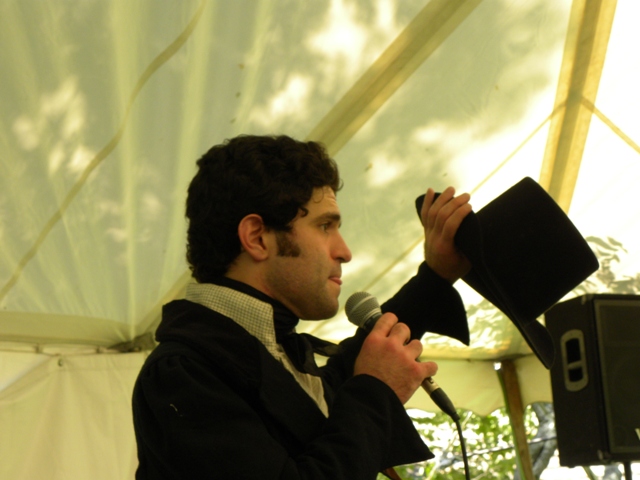
Well sated with sandwiches, scones and desserts (I agree with Melody, the lavender cake was delicious) we headed off to watch Mr Darcy undress. What better entertainment for ladies on a lazy summer afternoon! And judging by the crowd under the tent-top, I wasn’t alone in that opinion. Along the way to it we admired (and photographed) scores of wonderful Regency attire; of course, stopping to chat with ladies and gents alike about the construction of them (being a novice at making my own, I was most interested.) Brian Cushing (aka Mr Darcy) had an engaging presentation style as he peeled off his layers and his anecdotes were both humorous and instructive. A long collective chuckle rippled through the audience as he began to pull his shirt-tail out from his breeches to show us a typical shirt of the period… and it kept coming and coming. In the end it reached past his knees… as he asserted that this was one of the shorter ones of the day!
Darcy in shirtails
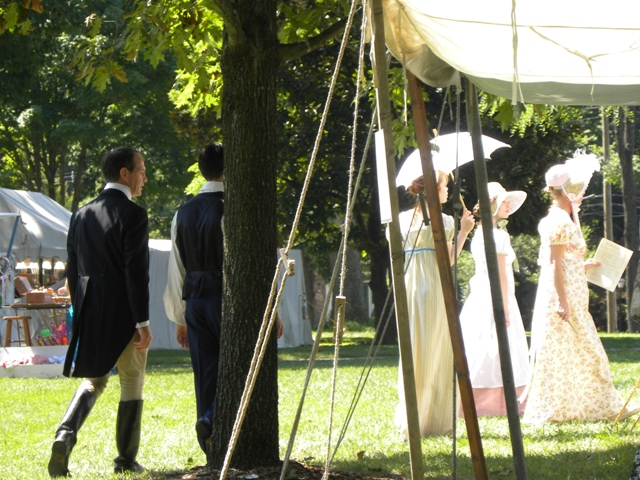
Now employing my fan assiduously (I shall not admit whether from the summer heat or seeing Mr Darcy’s shirt-tails! Such a fluttering came all over me!) we ventured to find a bit of shade and to capture in print our own fashions in the ‘grove’ –
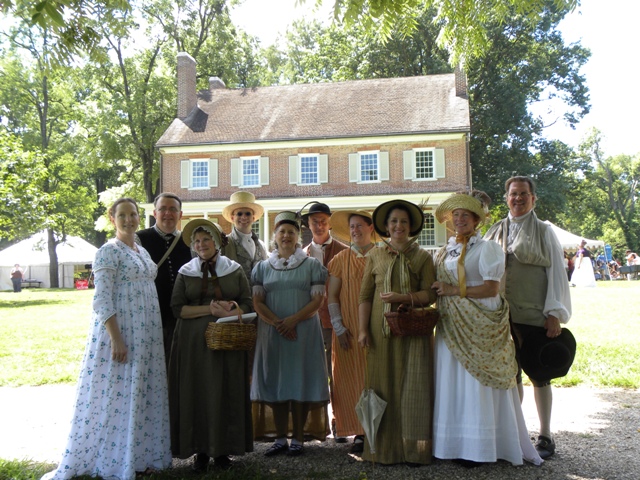
Ladies of Fashion in the Grove
and then back to the presentation tent for a lecture on Sickness and Health as depicted in Austen’s novels. It was a fascinating look at various characters and their ailments and a perspective you don’t often encounter – that Mr Woodhouse, despite his annoying solicitousness of everyone’s health, was actually seldom wrong. The whole of it illustrated wondrously Jane Austen’s own extensive understanding of illness and treatments and human nature, of course. Dr. Cheryl Kinney assembled a wonderful slide show of characters, treatments, film clips and anecdotes to support her lecture. It was so well done, I determined not to miss the second lecture she would offer on Sunday. After this one, I approached Dr. Kinney to ask her opinion of the ailment of Anne DeBourgh, as it had not been raised in this presentation. And, as a P&P fanfic author who often considers it when writing, I was thrilled to learn that Dr. Kinney has an entire session on Anne DeBourgh’s ailments planned for the 2013 AGM in Minneapolis. Count me in! I will come armed with interest and questions!
Shortly after this presentation, my group retired to our B&B (a most wonderful find) to rest before readying ourselves for the ball that evening.
The Ball!
I was amazed when we arrived for the dance at the attendance and the fact that nearly the entire company was in period attire. And what fashions there were to witness – each gown finer than the last! Although the acoustics in the hall were not perfect, we had a grand time, dancing almost every dance, and laughter abounded as we made sport (of ourselves and our neighbours, of course) at trying to learn the dance steps. Shame on us for not attending the afternoon practice session. The refreshments during the interval were extensive, and I was most amazed at the competence and administration once again of the Louisville organizers – replenishments were quick and smooth – truly well executed.
We slept very well after our busy day, and got a bit of a late start on Sunday; but arrived in time for a Bare Knuckle boxing demonstration. I, of course, averted my eyes from bare-chested as well as bare knuckled combatants.
Bare-Knuckle Boxing
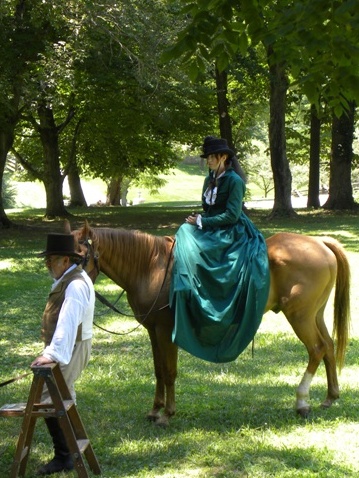
Following this, I enjoyed a demonstration of side-saddle riding from Ms Deborah Glidden and her assistants. The older gentleman (Bill Glidden) turned out to have spent a long career in Hollywood; he was Doug McClure’s riding double in The Virginian among other things. A few of us in the audience were of an age to recall that TV series very well.
While my friends attended tea again, I instead toured the inside of the house that Melody has already described so nicely. And in addition to the house and furnishings themselves, I truly enjoyed the fashions on display there – all part of Gayle Simmons’s collection and complete with accessories of every sort. Every room held a few ensembles, either on models or lovingly spread out on beds awaiting some young lady to prepare for a ball. Very impressive in all. Each room was manned by a volunteer to provide visitors with a short history, and the master bedroom in particular had a pair of girls who explained that they were in their parents’ room looking for a ribbon their younger brother had impishly hid from them, a particular one the older girl wanted to wear for her coming out. They stayed ‘in character’ throughout and were a delight.
Gayle Simmons Collection
There was also a lovely lady demonstrating bobbin lace making in the house. Oh, the patience required – I don’t think I’ll tackle that, but I will certainly appreciate it more when I encounter the finished item.
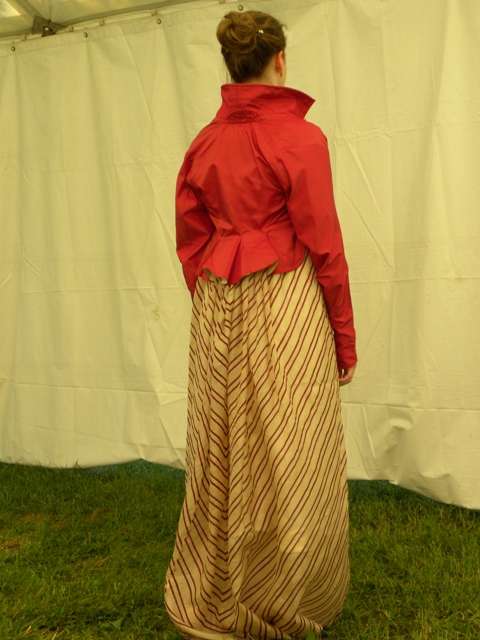
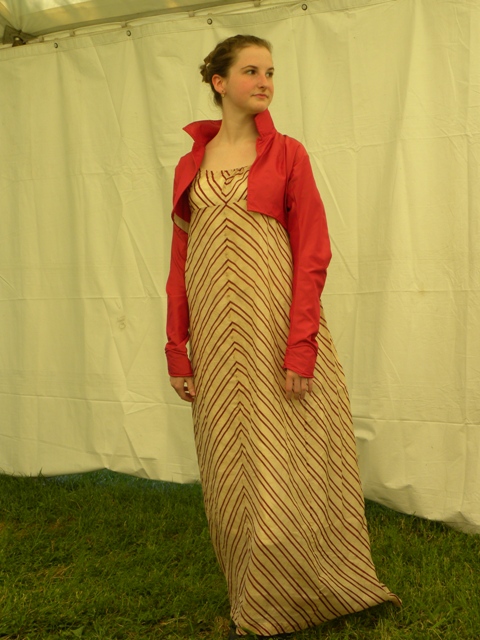
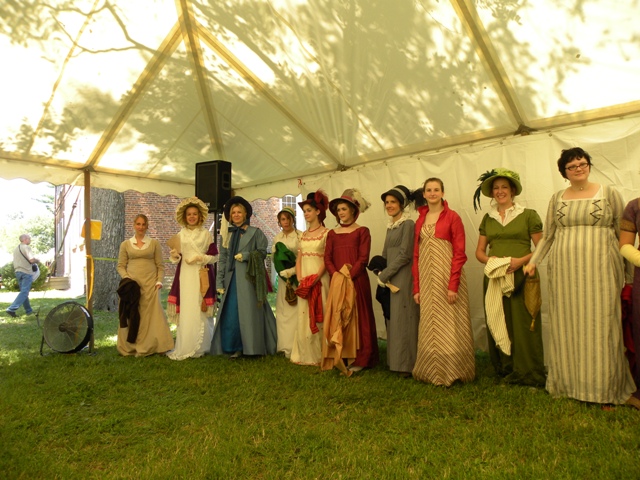
More fashion was to come as I attended Betsy Bashore’s fashion show in the large tent. Her creations are magnificent and all taken from either extent garments or pattern books of the era, ranging from mid-1790’s to about 1820. I learned a great deal in addition to just admiring the look – of bonnet veils, and cartridge pleats, and apron dresses and the like. And the fabrics – many of them from saris – were exquisite. It inspired me to continue with my own novice efforts. (My own gown that day included an overdress that I’d made from a $5 thrift shop tablecloth – hey! It worked!)
Tess’s day-dress
I loved all the gowns – the details in them amazing – but my favorites were this brown and cranberry silk ensemble from 1796 (coincidentally, the period I write); and this tissue-silk in a red stripe that was cut on the bias so that the striping was diagonally oriented. They both had the most delicious flow and drape when the young ladies walked. I could just imagine that taking a turn about the room in one of these would turn Caroline Bingley green with envy (as well as capture the admiring eye of Mr Darcy.)
Dr. Kinney’s lecture on Sunday was to do with Jane Austen’s illness, but encompassed so much more besides. It looked at Charles Hayden (whom JA described as something between a man and an angel) as well as Dr Matthew Baillie, a prominent physician in London. One of these two was likely the doctor that Jane Austen consulted about her failing health. The presentation also included ailments and cures of the day, a fascinating look at arsenic (if you wore green or painted your rooms with green paint you exposed yourself to the poisonous stuff), more wonderful slides and film clips as well as a hilarious video look at why we love Austen set to the tune of Connie Stevens’s “Sixteen Reasons.” Overall, another session that was entertaining, informative and engaging. (Yep, definitely looking forward next year to that session on Anne DeBourgh!)
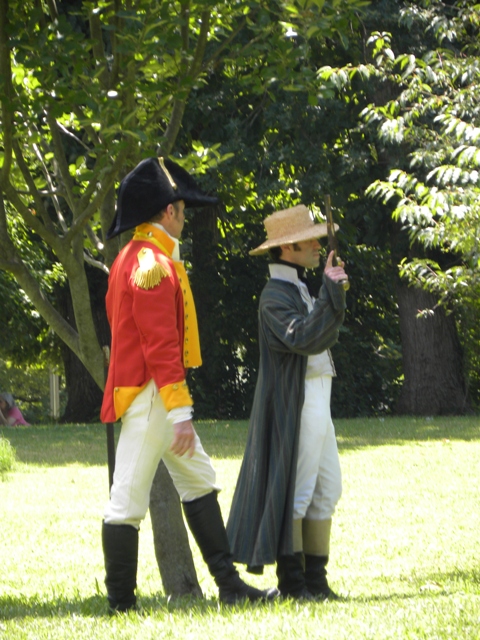
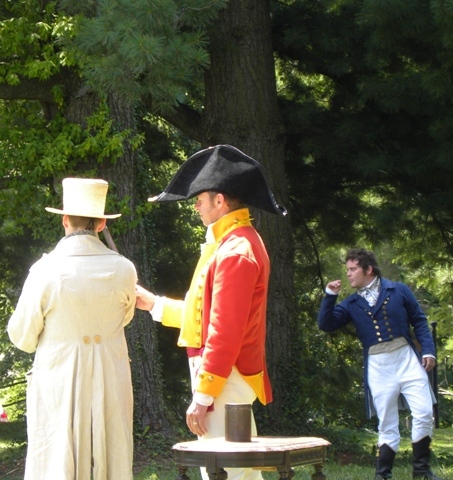
I witnessed a duel between two gentlemen. I learned that the purportedly injured party always shot first – in this case he wounded his opponent in the shoulder. But what a small victory it turned out to be when his opponent, shooting second, killed him in return!
The Duel!
I finished the afternoon at another of the special sessions, joining a group of ladies young and old to paint a fan. After a short historical talk on fans and seeing examples of extant designs, we were off to design our own. I must admit to admiring many of those around me as they took shape (and young ladies too of about fifteen, so accomplished for their age); but my own drawing and water color talents left something to be desired. What fun it was, though – and I have just ordered some blank fans so that I can practice and eventually make one worthy of appearing at a ball. After all, we all know that no excellence in [drawing] is to be acquired, without constant practice.
Nature DrawingLaying out clothesFashion Show
Despite dreadful hot days that kept us in a continual state of inelegance, this Festival was not to be missed! Picture perfect in setting, it was well attended by only the most fashionable of society; had much to offer in entertainments; and was very nicely done indeed! The 6th Annual Jane Austen Festival in Louisville is already on my calendar for next summer. Hmmm, I’d better start sewing if I’m to show well…
The gentlemen have spied some ladies…
********************************
About the Author: Tess Quinn (a nom de plume) read Pride and Prejudice years ago at the age of thirteen, and has been hooked on Jane Austen – and Mr Darcy, unsurprisingly – ever since. She has read all the novels multiple times and doesn’t plan to stop any time soon. Some time ago she was introduced to Austen-based fan fiction and, unsatisfied with some of the depictions and approaches, took up her own pen to try to carry on beloved characters in a manner consistent with Miss Austen’s originals. In 2011, her first short story was published in an anthology called A Road to Pemberley. With that encouraging milestone she is hoping shortly to publish another anthology, all her own stories, tentatively titled Pride Revisited. She has two completed P&P based novels (awaiting final edits and a willing publisher); and is nearing completion on her own darling child, a retelling of P&P from Georgiana Darcy’s perspective.
***********************************
Thank you Tess for sharing your weekend with us – I think of you and Melody passing each other various times throughout the weekend, and now connected in cyberspace! – we must all meet up next year for that cup of tea! I wish you the best with your Pride and Prejudice writings, and look forward one day soon I hope to interviewing you about your first published novel here!
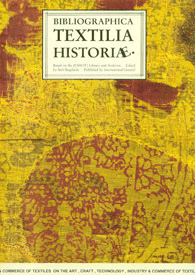
The Center for Social Research on Old Textiles [CSROT] is a research project founded in 1986 in France whose purpose is to contribute to the critical study of the history of textiles, especially by means of research concerning its bibliographic history. Its bibliographic publication, the Bibliographica Textilia Historiae, the first and only annotated general bibliography attempting to document all facets of the world history of textiles, contained over 5,000 titles —printed books and pamphlets, serials, articles and offprints, dissertations, royal decrees and laws— published in all languages, but mostly European, since the late fifteenth century to date, treating all aspects of the history of handwoven textiles, including woven and printed textiles, embroidery, lace, tapestry, dyeing, carpets, weaving and fiber technology, pattern books, and costume, among many other subjects.
This Bibliographica Textilia Historiae was published in the late 1990s and has been since enlarged to contain over 9,000 records with over 25,000 individual entries of authors, articles, reviews and books, of which over 500 titles are pre-1800. This enlarged database has now been catalogued with a full indexing program and is now available on this website as an free open-access database fully-searchable by multple keywords and criteria.
For eg.: if your interest is in Georgian textiles, search “georgian” for a listing of sources in the bibliography, or if like Henry Tilney, your thoughts run to “muslin” – here is a book that Jane Austen would likely have known:
* PACKER, Thomas. The dyer’s guide; being a compendium of the art of dyeing linen, cotton, silk, wool, muslin, dresses, furniture &c. &c. with the method of scouring wool, bleaching cotton &c. and directions for ungumming silk and for whitening and sulphuring silk and wool …. Second edition, corrected and materially improved. London: Sherwood, Gilbert and Piper, 1830. [ 1st edition: 1816]
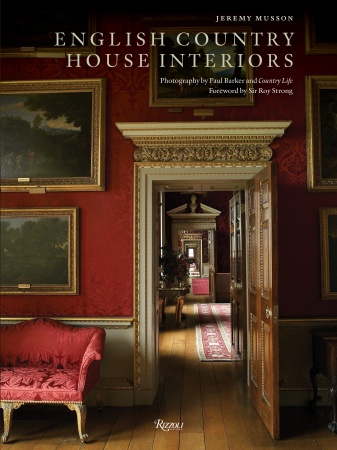
English Country House Interiors, by Jeremy Musson. Foreword by Sir Roy Strong; Photography by Paul Barker. New York: Rizzoli, 2011.
ISBN: 978-0-8478-3569-0
$60. [though Amazon has it for $38., much as I hate to say that…]
This book I should very much like to add to my collection on English architecture and stately homes [loud hint to my family…] – I discovered this at the UVM Library and have brought it home to peruse – extensive commentary and lovely photographs of the interior details of the fourteen houses included – here is the blurb from the publisher, Rizzoli:
A highly detailed look at the English country house interior, offering unprecedented access toEngland’s finest rooms. In this splendid book, renowned historian Jeremy Musson explores the interiors and decoration of the great country houses ofEngland, offering a brilliantly detailed presentation of the epitome of style in each period of the country house, including the great Jacobean manor house, the Georgian mansion, and the Gothic Revival castle. For the first time, houses known worldwide for their exquisite architecture and decoration–includingWilton, Chatsworth, and Castle Howard–are seen in unprecedented detail. With intimate views of fabric, gilding, carving, and furnishings, the book will be a source of inspiration to interior designers, architects, and home owners, and a must-have for anglophiles and historic house enthusiasts.
The fourteen houses included represent the key periods in the history of English country house decoration and cover the major interior fashions and styles. Stunning new color photographs by Paul Barker-who was given unparalleled access to the houses-offer readers new insights into the enduring English country house style. Supplementing these are unique black-and-white images from the archive of the esteemed Country Life magazine.
Among the aspects of these that the book covers are: paneling, textile hangings (silks to cut velvet), mural painting, plasterwork, stone carving, gilding, curtains, pelmets, heraldic decoration, classical imagery, early upholstered furniture, furniture designed by Thomas Chippendale, carved chimney-pieces, lass, use of sculpture, tapestry, carpets, picture hanging, collecting of art and antiques, impact of Grand Tour taste, silver, use of marble, different woods, the importance of mirror glass, boulle work, English Baroque style, Palladian style, neo-Classical style, rooms designed by Robert Adam, Regency, Gothic Revival taste, Baronial style, French 18th century style, and room types such as staircases, libraries, dining rooms, parlors, bedrooms, picture galleries, entrance halls and sculpture galleries.
The range is from the early 17th century to present day, drawn from the authenticated interiors of fourteen great country houses, almost all still in private hands and occupied as private residences still today. The book shows work by twentieth-century designers who have helped evolve the country house look, including Nancy Lancaster, David Hicks, Colefax & Fowler, and David Mlinaric.
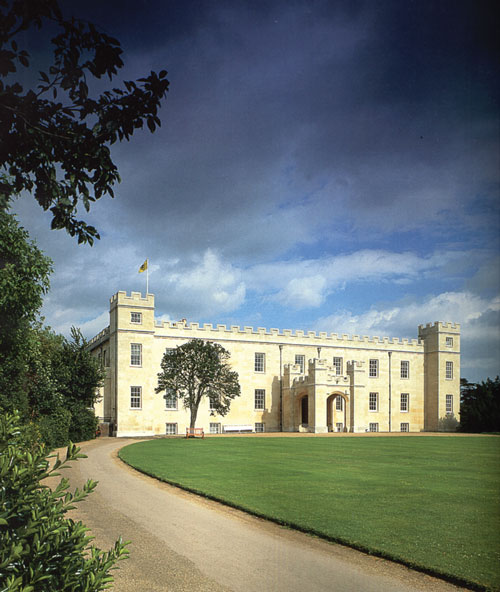
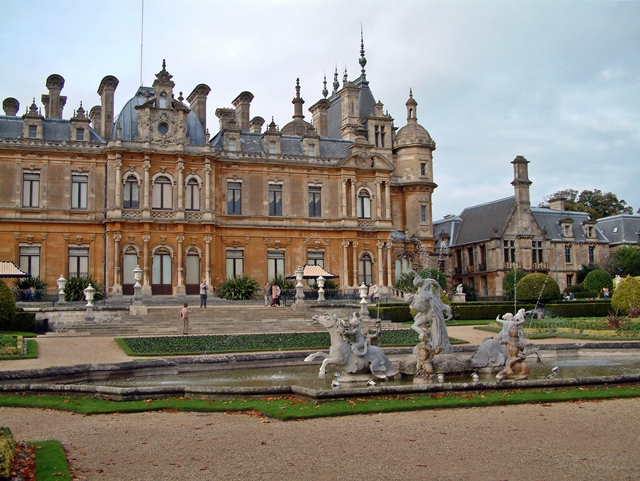
The Table of Contents: I’ve added some exterior shots and links for several of the houses – you will have to buy the book for the sumptuous interior adventure!
16. Living Interiors: The English Country House Interior Today
***********************
Not included is the house used in Downton Abbey, seen here, and certainly on everyone’s mind as we approach Season 2!:
Highclere Castle
And if you want another book to add to your collection that belongs on your shelf next to the above, you should add this to your list – hopefully Santa is listening, watching, and making his own list, and you have not been naughty but have only been nice the whole year long …
The English Country House: From the Archives of Country Life
Written by Mary Miers, Contribution by Jeremy Musson, Tim Richardson, Tim Knox and Marcus Binney. New York: Rizzoli, 2009.
ISBN: 978-0-8478-3057-2 , $85.
And here is one interior bit to whet your appetite all the more:
[Syon House – detail of the ceiling of the Red Drawing Room, p. 148]
What are your favorite English architecture / interior decoration books – ones you have or ones you want?
Gentle Readers! ~ I welcome today Janeite Lynne, a JASNA-Vermont member and occasional contributor to this site, as she writes on Jane Austen and knitting!
***********************
Jane Knits
They were entering the hall. Mr. Knightley’s eyes had preceded Miss Bates’s in a glance at Jane. From Frank Churchill’s face, where he thought he saw confusion suppressed or laughed away, he had involuntarily turned to hers; but she was indeed behind, and too busy with her shawl. [Emma]
*********************
Have you ever wanted to create the kind of shawl that Jane Fairfax might have hid behind or slippers that would have kept Elizabeth Bennet’s feet warm? If your answer to this question is yes!, then, like me, you may be both a Janeite and a knitter. I imagined that people with these two interests would be a very small subset of the larger groups, but this month Interweave Knits made me think I was wrong. They have released a special edition of their magazine: Jane Austen Knits.
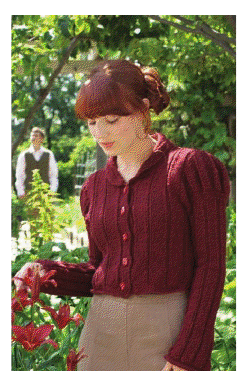
The patterns in the edition are organized around places: country, manor, garden, and town. There are over thirty patterns including: shawls, shrugs, scarves, handwarmers, slippers, reticules, Mr. Knightley’s Vest, and, of course, a tea cozy. If you are a lace knitter, you will be in heaven. Lace abounds!
Lydia Military Spencer
Jane Austen Knits goes beyond the patterns, though. There are articles about knitting during Austen’s time; both Mrs. Austen and Cassandra knit. People speculate that Austen herself probably knit, but there is no concrete evidence for this. We know that she did needlework. But knitting may have been one of the household chores that the family sheltered her from so that she could write. There are other articles in the special edition on regency fashion, muslin, a timeline of her life and the historical events that happened during her lifetime, and even suggestions for Austen-inspired movies and auidobooks to watch or listen to while you are knitting.
Knitting during the Regency Period was a utilitarian activity, and therefore was a job for those without money. Mrs. Bates in Emma, Mrs. Smith in Persuasion, and Mrs. Jennings in Sense and Sensibility all mention projects or engage in knitting. Of course, Mrs. Jennings would be undaunted by fashionable society’s prejudices and continue to knit even when she was wealthy. Still, I like to imagine that knitting not only served a necessary household function for the other characters but also gave them solace and satisfaction. As Mrs. Smith says about Nurse Rooke: “As soon as I could use my hands, she taught me to knit, which has been a great amusement.” I couldn’t agree with her more.
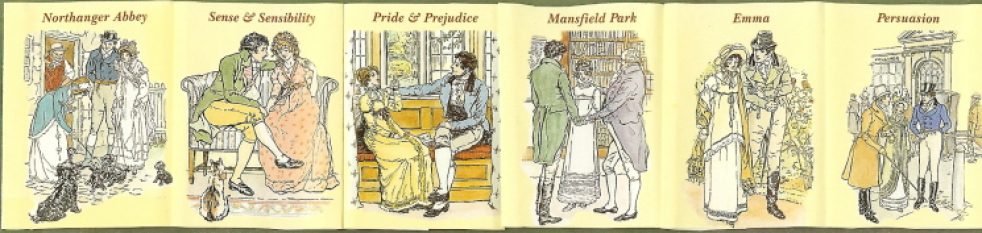


 “Further to the success of our most recent subscriber publication, The Knight Family Cookbook, which thrilled Subscribers and has proven to be one of the most purchased books in our shop, we are now seeking to progress our latest publication- The Duties of a Lady’s Maid; with directions for conduct, and numerous receipts for the toilette (1825). This facsimile edition, with a new introduction by Mary Ann O’Farrell, will be a fascinating book certain to entertain those who would welcome guidance on how to behave as maid to Lady Catherine De Bourgh – or indeed those who wish to emulate Downton Abbey’s Miss O’Brien. Originally published in 1825, it is a rather rare conduct book offering a unique insight into the lives and duties of servants, as well as the trends and tastes of the Georgian age. Readers can learn how religion should direct a maid in her work, which character traits are essential, and how to keep family secrets. Amusing practical instructions, such as how to dress your lady using padding and bandages to improve her figure and tips on the most advantageous way to display the forehead, are also to be enjoyed.”


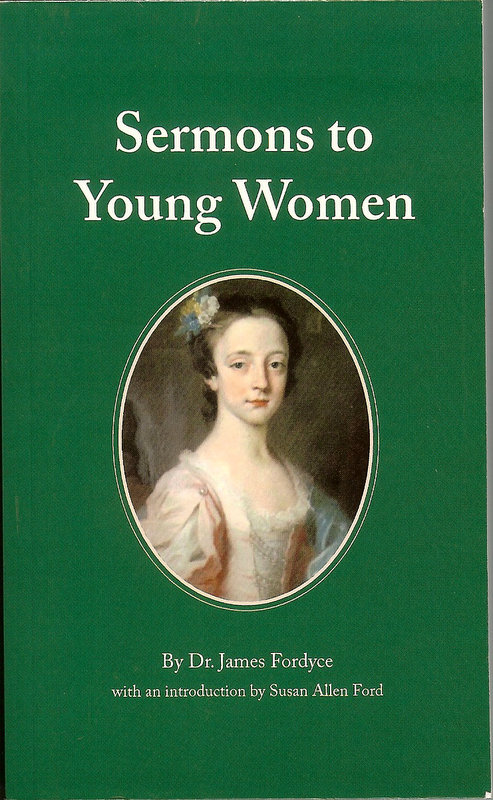 collection of conduct books [everyone should have a collection of conduct books, starting of course with Fordyce’s Sermons, Mr. Collins’ pride and joy in Pride and Prejudice, now published with an introduction by Susan Allen Ford and also available from the Chawton House Library: you can order it here through Jane Austen Books].



























 Jane Austen in Vermont