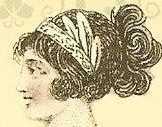
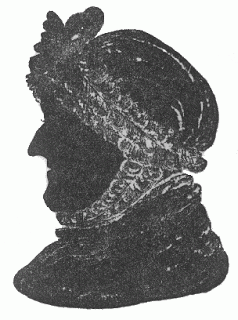
“A lady stands at her dressing-table (right), her hair in an enormous pyramid decorated with feathers torn from a peacock, an ostrich and a cock. A young girl wearing a hat holds the peacock by a wing; another wearing a cap tugs hard at one of its tail feathers (which are very unlike peacock’s feathers). An ostrich (left), which has lost most of its tail feathers, is about to pluck out those which ornament the lady’s hair. A cock stands in the foreground (right), having lost almost all its tail feathers, many of which lie on the floor. A black servant wearing a turban stands on his mistress’s right, handing feathers from a number which he holds in his left hand. The lady, who faces three-quarter to the right, is elaborately dressed in the fashion of the day. Her pyramid of hair is decorated with lappets of lace and festoons…
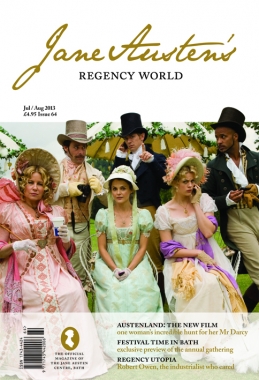
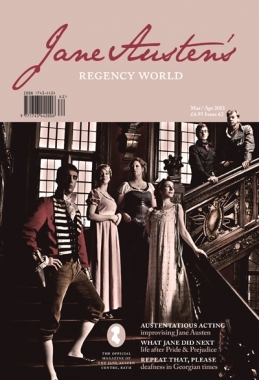
The July/August 2013 (No 64) edition of Jane Austen’s Regency World magazine is now out – watch out for it in your mailbox over the next few weeks. In the new issue you can read about:
Austenland: we speak to Jerusha Hess about her new film depicting one woman’s amazing hunt for her Mr Darcy
Read our exclusive preview of this year’s Jane Austen Festival in Bath
The Countess of Jersey, serial adulteress and debauchee is this issue’s Regency Rogue
Letters from Jane: a look at Austen’s correspondence
Plump cheeks and thick ankles: Jane Austen used appearance to size up her characters
A social reformer and a place called Harmony: the tale of Robert Owen
Subscribe today to Jane Austen’s Regency World, the full-colour, must-read, glossy magazine for fans of the world’s favourite author – delivered to your doorstep every two months direct from Bath, England. Plus reports from Austen societies in the UK, US and Australia; news, letters, book reviews, quiz and much, much more!
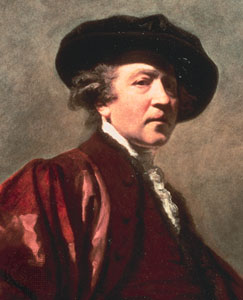
On 24 May 1813, Jane Austen visited an important and much-talked-about art exhibit at the British Institution in Pall Mall, London. The show was a retrospective of the works of Sir Joshua Reynolds (1723-1792), England’s celebrated portrait painter.
No visual record of this show is known to have survived, although it attracted hundreds of daily visitors during its much-publicized three-month run. However, many details of the exhibit can be reconstructed from the original 1813 “Catalogue of Pictures,” a one-shilling pamphlet purchased by visitors as a guide through the three large rooms where hung 141 paintings by Reynolds. Armed with surviving copies of this pamphlet, narrative accounts in nineteenth-century newspapers and books, and precise architectural measurements of the British Institution’s exhibit space, this website reconstructs the Reynolds show as Jane Austen (as well as any Jane Doe) saw it.
I. Why reconstruct this museum exhibit from 1813?
In truth, even if Jane Austen had not attended this public exhibit, it would still be well worth reconstructing. The British Institution’s show was a star-studded “first” of great magnitude for the art community and a turning point in the history of modern exhibit practices. The 1813 show amounted to the first commemorative exhibition devoted to a single artist ever staged by an institution. Although Reynolds, who had died a mere twenty-one years earlier, did not yet qualify as an Old Master, he was already hailed as the founder of the British School and celebrated as a model for contemporary artists to emulate. The preface to the exhibit catalogue, written by Richard Payne Knight, treats the work of Sir Joshua Reynolds as a national treasure in order “to call attention generally to British, in preference to Foreign Art” (Knight, 9). Knight allows that some of Reynolds’ paintings are better than others, likening the show to a pedagogical tool for artists and connoisseurs. He also insists upon the show’s modernity, hailing “the genuine excellence of modern” artists over the work of their forbearers (Knight, 9). In light of the coverage it received in the popular press and the London crowds that attended, the British Institution’s Reynolds exhibit presaged the modern museum blockbuster.
In the age before the photograph, portraits of the rich and famous were often reproduced by engravers as inexpensive prints. These black and white reproductions circulated Reynolds’ images of contemporary celebrities widely, providing pinups to the middling consumer. In this manner, Reynolds’ works functioned as the modern photographs of Annie Leibovitz do today, making it hard to say whether he recorded or created celebrity with his art. Wherever possible, the light-boxes in the e-exhibit therefore show an early engraving as well as the original canvas. Reynolds’ portraits of “abnormally interesting people” whom we now term celebrities offer concrete examples of just how someone like Austen, who did not personally circulate among the social elite, was nonetheless immersed in England’s vibrant celebrity culture (Roach, 1).
More questions are answered under the About WJS page:
Is there a connection between this exhibit and Jane Austen’s fiction?
Who, other than the Austens, attended this 1813 exhibit?
How did visitors in 1813 experience the British Institution?
Did the Catalogue function as a museum guide in 1813?
How historically accurate is this website?
Room for interpretation and improvement
Works Cited / Site Credits
It is a rainy weekend here in Vermont – what better way to spend a few hours but at such an exhibition as this!
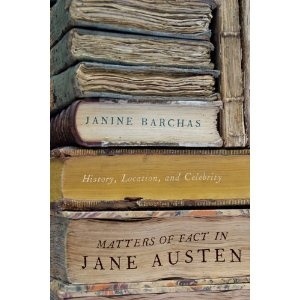
Janine Barchas is Associate Professor of English at the University of Texas at Austin. She is the author of Matters of Fact in Jane Austen: History, Location, and Celebrity (Johns Hopkins University Press, August 2012). Her first book, Graphic Design, Print Culture, and the Eighteenth-Century Novel (Cambridge UP, 2003), won the SHARP book prize for best work in the field of book history. Her newest project is the website What Jane Saw (www.whatjanesaw.org).
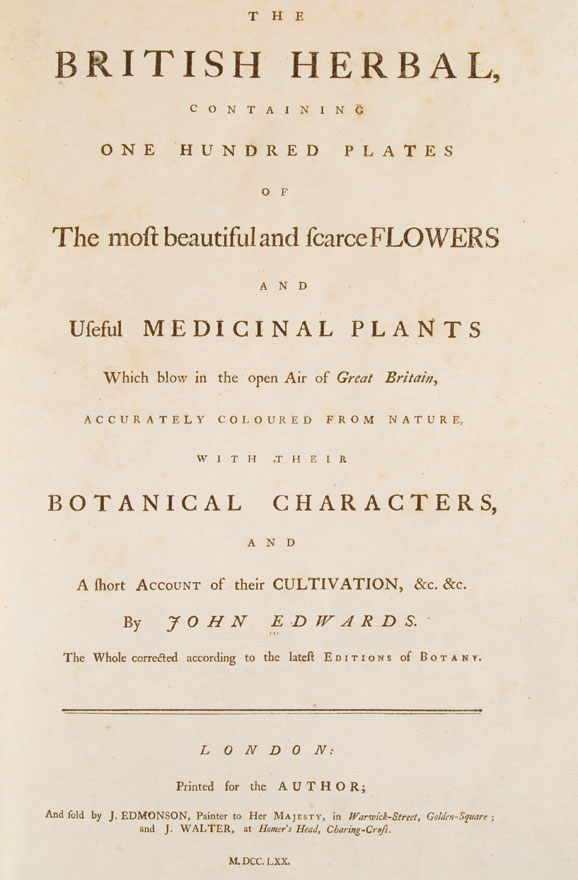
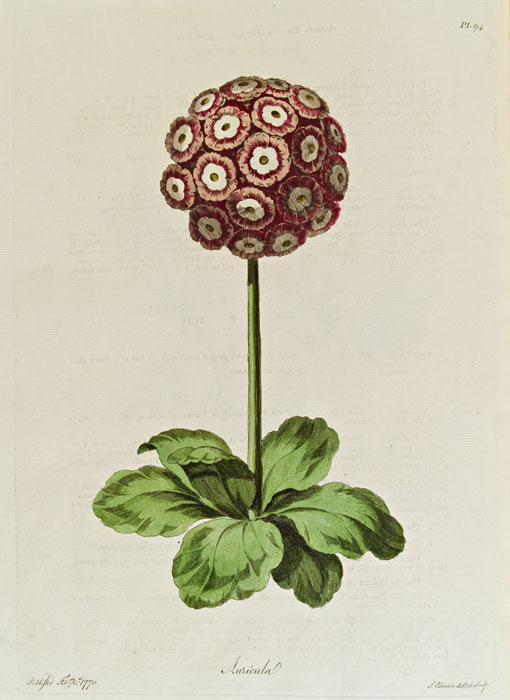
Well now that Spring finally feels like it has arrived, one’s thoughts head into dirt and gardens and plants and herbs, so wanted to share this article from the most recent issue of Colonial Williamsburg: “Uncommon and Expensive” by Mary Miley Theobald, on John Edwards’s The BritishHerbal – you can read it online here:
There may be no better guide to the plants that grew in eighteenth-century gardens than The British Herbal, a rare collection of botanicals by artist John Edwards, published in 1770. “It’s one of the most valuable books we have,” said Wesley Greene, garden historian in Colonial Williamsburg’s historic trades department. “It lets us document the sort of plants that were available in the colonial era.” Edwards referenced Linnaeus for every plant, allowing Greene and others to identify species precisely.
Edwards, John. The British Herbal, containing one hundred plates of the most beautiful and scarce flowers and useful Medicinal Plants which blow in the open air of Great Britain, accurately coloured from nature with their Botanical Characters, and a short account of their cultivation. London: Printed for the Author; and sold by J. Edmonson…and J. Walter, 1770.
One wonders if Jane Austen knew this work – there is no mention of it in her letters or novels, nor is it in Gilson’s bibliography as a work known to have been owned by her.
The story of Elizabeth Blackwell’s (1707-1758) creation and publication of this work is an interesting tale – she drew, engraved and colored all the illustrations to accompany the botanical descriptions of her doctor husband in order to pay his debts and effect his release from prison. Many of the plant specimens were from the Chelsea Physic Garden in London. A copy sold at Christies in 2009 for $17,500, and various plates appear at auction periodically.
We do know that Jane Austen knew of Gilbert White, author of The Natural History of Selborne (1789), and whose house, now a museum, was near the Austen’s home in Chawton. The herb garden at White’s house is depicted in Kim Wilson’s In the Garden with Jane Austen [page 98] with a list of the herbs, and you can visit the house and garden site here.
So now into the garden and away from the computer … but will ask, What is your favorite herbal book?
You are Cordially Invited to JASNA-Vermont’s June Meeting
“Trickle-Down Economics in Pride and Prejudice;
Or, Why ‘Mr. Darcy Improves upon Acquaintance’!”
withSheryl Craig*
Sheryl Craig
What Jane Austen’s first readers did not need to be told was that a man named Fitzwilliam Darcy had to be a moderate Whig, one who supported Tory Prime Minister William Pitt’s tax and Poor Law reform proposals, and that Darcy’s home county, Derbyshire, paid high wages, provided generous welfare benefits, and funded the best system of poor houses in England. Thus, Darcy, and moderate Whigs like him, were worthy of both Elizabeth Bennet’s and the reader’s esteem and served as role models to be emulated throughout Georgian Britain and, as it turns out, throughout time.
*****
Sunday, 2 June 2013, 2 – 4 p.m.
Champlain College, Hauke Conference Center,
375 Maple St Burlington VT
~Free & open to the Public~ ~Light refreshments served~
* Sheryl Craig has published articles in Jane Austen’s Regency World, Persuasions, Persuasions On-Line, and The Explicator. She has also written film reviews for the Jane Austen Centre in Bath. Sheryl was JASNA’s International Visitor in 2008, is the editor of JASNA News, and was JASNA’s Traveling Lecturer for the Central region in 2012. She has a Ph.D. in Nineteenth-century British literature from the University of Kansas, has taught at the University of Central Missouri for over twenty years, and is a life member of JASNA.
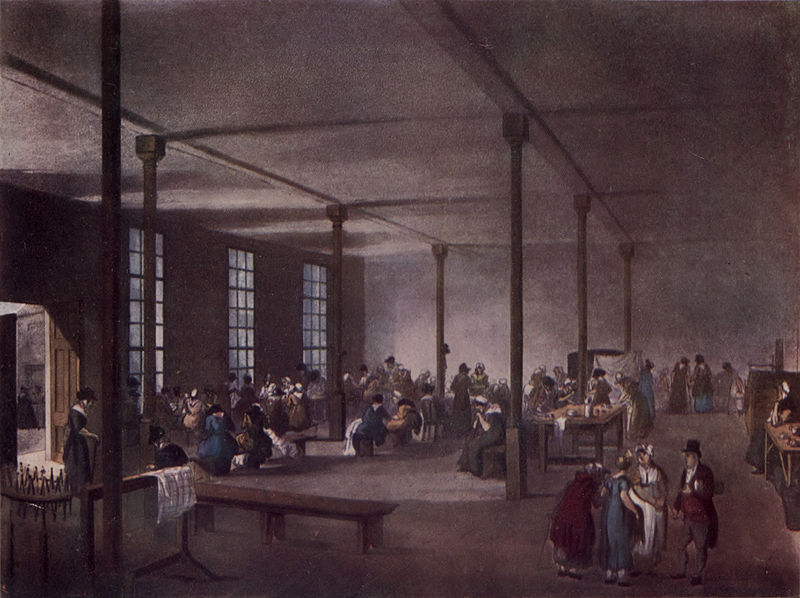
Workhouse at St. James’s Parish – from The Microcosm of London, 1810, [wikipedia commons]
“We have been both to the Exhibition & Sir J. Reynolds’, – and I am disappointed, for there was nothing like Mrs. D. [Darcy] at either. – I can only imagine that Mr. D. prizes any Picture of her too much to like it should be exposed to the public eye. – I can imagine he w’d have that sort [of omitted] feeling – that mixture of Love, Pride & Delicacy.- Setting aside this disappointment, I had great amusement among the Pictures…”
[Jane Austen, Letter 85, Monday 24 May 1813]
Those who have read Jane Austen’s letters are familiar with her comments on visiting London. It has been an ongoing project of mine to figure out where she went and what she did and how she uses the pieces of her London treks in her novels. One of the more interesting and frustrating is her reference to the art exhibit of Sir Joshua Reynolds – what did she see there, other than not finding a portrait of Mrs. Darcy? It has been revealed today that we will now have a chance to see exactly that, sort of following Jane herself around the galleries, as Professor Janine Barchas of the University of Texas at Austin launches What Jane Saw – a complete reconstruction of that exhibit. You will surely want to bookmark this new website and mark your calendars to view the happening on May 24, 2013!
From the website:
On 24 May 1813, Jane Austen visited an art exhibit at the British Institution in Pall Mall, London. The popular show was the first-ever retrospective of the works of Sir Joshua Reynolds (1723-1792), England’s celebrated portrait painter. On 24 May 2013, two centuries to the day that Austen viewed the 141 paintings in that exhibit, this site will open its doors as a public e-gallery, offering the modern visitor a precise historical reconstruction of that long-lost Regency blockbuster.
Enquiring Readers: Ron Dunning has previously posted here at Jane Austen in Vermont about his invaluable Jane Austen genealogy website. As he continues to research the connections, he is discovering amazing coincidences and some very familiar names. Today he gives some insight into a marriage that took place between a Darcy and a de Burgh in 1329 and speculates on whether Jane Austen could possibly have known about this…
***************
What Jane Might Well Have Known, and What She Couldn’t Possibly Have Known, About Her Ancestors
I’m against making any assumption based on slim evidence, but I’m about to make two; first of all, concerning a great coincidence about which Jane can’t have known anything. In 1329 a marriage took place between John Darcy, 1st Lord Darcy of Knaith, and Joan de Burgh. (The spelling doesn’t matter – even up to the 18th century spellings hadn’t been fully standardised.) Joan’s father Richard de Burgh, 2nd Earl of Ulster, was a direct ancestor of Mrs Austen through her brother John.
Last summer when my Akin to Jane [ www.janeaustensfamily.co.uk ] website was launched one or two people, with admirable perseverance, trawled through my separate family tree [ http://wc.rootsweb.ancestry.com/~janeausten ] and on discovering this marriage, insisted that Jane must have known. I was never in any doubt that she couldn’t possibly have known. This was also the opinion of the only other person who has studied the Austen pedigree extensively, Anielka Briggs.
Dugdale Baronage – Skinnerinc.com
While Baronetages were readily available in the late 1700s, the dignity having been created only in 1611, there were very few studies of the Peerage and all of those were very primitive. William Dugdale’s Baronage of England of 1675 covered only England. (Remember that Joan’s father John de Burgh was the Earl of Ulster; the marriage in question is said to have taken place in County Kildare.)
The Rev. Barlow’s Complete English Peeragewas printed in 1772, so might just have been in George Austen’s library, but again deals just with English peerages. Another possibility, Arthur Collins’s Peerage series*, was first published in 1709, with reprints every few years and frequent new editions. Even he appears not to have included Irish peerages, and in the eight editions that I was able to search, not a single de Burgh featured in the indexes.
Barlow Peerage – Open Library
A further obstacle in the way of Jane’s knowing (or for that matter anyone at the time) is that there was no direct male descent from the de Burghs to the Austens – the surname soon disappeared from Jane’s pedigree, through a series of female links. Traditional pedigrees concentrate on the direct male line.
However, John Darcy did himself play a role in the Austen pedigree – he was a many-greats-grandfather of Charles Austen’s wives, the sisters Frances and Harriet Palmer. John and his first wife, Emmeline Heron, were the ancestors of four generations of male Darcys; Elizabeth Darcy, in the fifth generation, married James Strangeways; and that surname continued down to the Palmer girls’ paternal grandmother, Dorothy Strangeways. In Charles’s children, the Darcy and the de Burgh lines were finally united.
My second assumption concerns what Jane might well have known. Janine Barchas, in her Matters of Fact in Jane Austen, speculates that she, in choosing the names of Darcy, Wentworth, Woodhouse, FitzWilliam, Tilney, etc., was alluding “to actual high-profile politicians and contemporary celebrities as well as to famous historical figures and landed estates.” In the words of Juliet McMaster in the blurb, she was “a confirmed name dropper who subtly manipulates the celebrity culture of her day.” On page 118 Janine Barchas wrote, “Cassandra Willoughby (…) the supposed ancestor of Mrs Austen.” Yes – she’s almost got it. Cassandra was Mrs Austen’s 1st cousin, twice removed.
I think that Jane may well have known about the family relationship and its relevance. Cassandra’s mother Emma (Willoughby and then Child, née Barnard) was Cassandra Leigh’s great-great-aunt; it was Emma’s sister Elizabeth (Brydges, née Barnard) who was her great-grandmother. Elizabeth was also the mother of James Bridges, the Duke of Chandos, who married Cassandra Willoughby – the two were cousins. Emma’s first husband was the noted naturalist, Francis Willoughby; after his death she remarried, to Sir Josiah Child – supreme governor of the East India Company, an early monetarist, and a rapaciously wealthy financier to 17th century royalty. Emma and Sir Josiah’s son Richard Child became the Earl Tylney of Castlemaine, and one of his great-granddaughters was Catherine Tylney-Long.
Barchas speculates that Jane, in naming her Catherine Tilney, had this other Catherine in mind. This lady had inherited a vast estate and fortune in 1794 at the age of 5, and at 18 was reputedly the richest commoner in England. Catherine Tylney was Jane Austen’s 4th cousin. Very few of us have any idea about our fourth cousins, but based on the following circumstantial evidence, I suspect that Jane did know that they were distantly related.
Catherine Tylney-Long – Wanstead HouseWanstead House
There is a strong tradition in the Warwickshire village of Middleton, the seat of Francis Willoughby, that Jane visited there on the trip to Staffordshire in 1806 with her mother and sister. Middleton certainly lies in a direct line, as the crow flies, from their stop at Stoneleigh to Hamstall Ridware, where her cousin was the Rector. If they did visit, it may have been because Mrs Austen knew of the family relationship – she was certainly considered to have been proud of her aristocratic ancestors. The Austens preserved a letter written by Elizabeth Brydges in the 1680s from Constantinople, giving advice to her daughter who had been left behind; I think it likely that she’d have known about Elizabeth’s sister Emma’s illustrious marriages, and have told her daughters.
*********************
Thank you Ron! for all this information [my head is spinning!] – I do wonder what Lady C might say to all this – would she be concerned about the “Shades of Pemberly [being] thus polluted” by any of these illustrious ancestors?
If you have questions for Ron, please comment below.
Just again to prove once again that all roads lead back to Jane Austen, it is interesting here to note that Egerton Brydges edited this 1812 edition of the Collins Peerage – this is Jane Austen’s very own Mr. Brydges, brother to her friend Madame Lefroy. Austen makes much of his novel Arthur Fitz-Albini (1798) in her letter of 25 November 1798:
We have got Fitz-Albini; my father has brought it against my private wishes, for it does not quite satisfy my feelings that we should purchase the only one of Egerton’s works of which his family are ashamed. That these scruples, however do not at all interfere with my reading it, you will easily believe. We have neither of us yet finished the first volume. My father is disappointed – I am not, for I expected nothing better. Never did any book carry more internal evidence of its author. Every sentiment is completely Egerton’s. There is very little story, and what there is [is] told in a strange unconnected way. There are many characters introduced, apparently merely to be delineated. We have not been able to recognize any of them hitherto except Dr and Mrs Hey and Mr. Oxenden, who is not very tenderly treated…. [Letters, No. 12]
“La! You are so strange! But I must tell you how it went off. We were married, you know, at St. Clement’s, because Wickham’s lodgings were in that parish. And it was settled that we should all be there by eleven o’clock. My uncle and aunt and I were to go together; and the others were to meet us at the church. Well, Monday morning came, and I was in such a fuss! I was so afraid, you know, that something would happen to put it off, and then I should have gone quite distracted. And there was my aunt, all the time I was dressing, preaching and talking away just as if she was reading a sermon. However, I did not hear above one word in ten, for I was thinking, you may suppose, of my dear Wickham. I longed to know whether he would be married in his blue coat.
“Well, and so we breakfasted at ten as usual; I thought it would never be over; for, by the bye, you are to understand, that my uncle and aunt were horrid unpleasant all the time I was with them. If you’ll believe me, I did not once put my foot out of doors, though I was there a fortnight. Not one party, or scheme, or any thing. To be sure London was rather thin, but, however, the Little Theatre was open. Well, and so just as the carriage came to the door, my uncle was called away upon business to that horrid man Mr. Stone. And then, you know, when once they get together, there is no end of it. Well, I was so frightened I did not know what to do, for my uncle was to give me away; and if we were beyond the hour, we could not be married all day. But, luckily, he came back again in ten minutes time, and then we all set out. However, I recollected afterwards that if he had been prevented going, the wedding need not be put off, for Mr. Darcy might have done as well.”
“Mr. Darcy!” repeated Elizabeth, in utter amazement.
Pride and Prejudice, v. III, ch. IX
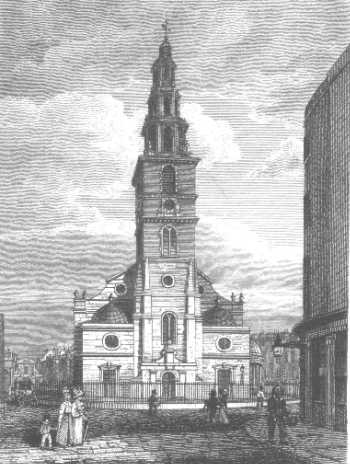
St Clement Danes – Strand (London Views)
Jane Austen often gives clues to the whereabouts of her locations, especially in her London passages – we know she knew London well and placed her characters in just the right spot to tell her readers who they were by where they lived. We famously have a few “____shire”s scattered about regarding the militia, for an element of secrecy one might assume? But in Pride and Prejudice there are two locations that she specifies that bring only confusion, and both involve Wickham and Lydia: St. Clement, where they were married, and Edward Street, home to Mrs. Younge, Georgiana’s former governess and friend and devious helper to Wickham. Today I will deal with the former…
When Lydia remarks that “We were married, you know, at St. Clement’s, because Wickham’s lodgings were in that parish.” – she gives a clue that perhaps contemporary readers would not have found confusing, but we are left with not being completely sure which St. Clements she is referring to: St Clement Danes in the Strand, or St. Clement Eastcheap. Neither is mentioned in her extant letters.
Pat Rogers notes in her 2006 Cambridge edition of Pride and Prejudice that the fairly large parish of St. Clement Danes had a population of 12,000 in 1801 and “contained areas of cheap lodgings and some raffish districts, notably a part of Drury Lane” (531-32). Most who have written on this would agree (see Kaplan and Fullerton cites below), largely because the other St. Clement (Eastcheap), on St. Clement’s Lane between Lombard Street and Great Eastcheap, would have been too close to the Gardiner’s who lived on Gracechurch Street [see maps for location of both churches]. Wickham would not have placed himself in such a smaller parish, with a population of 350 in 1801 (Rogers, 531), and so close to those who might find him out. Another reason that Rogers selects this as the best option is that in order to marry in this parish, one of the parties had to have residence there for fifteen days (Rogers, 532). Laurie Kaplan adds that “the length of time required for residency functions perfectly for the elopement plot of the novel, for tension increases the longer Lydia and Wickham remain unmarried” (Kaplan, 7). But we know Wickham had no mind to marry Lydia … .another story entirely… (the text is very clear on this: Mrs. Gardiner relates to Elizabeth: “…it only remained, he [Darcy] thought, to secure and expedite a marriage, which in his very first conversation with Wickham, he easily learnt, had never been his design.” (357).
But perhaps in the end, we should just abide by Susannah Fullerton, where in her Celebrating Pride and Prejudice, she blames Lydia for the whole confusing mess: “How typical of Lydia to be inexact in her information!” (p. 94-95)
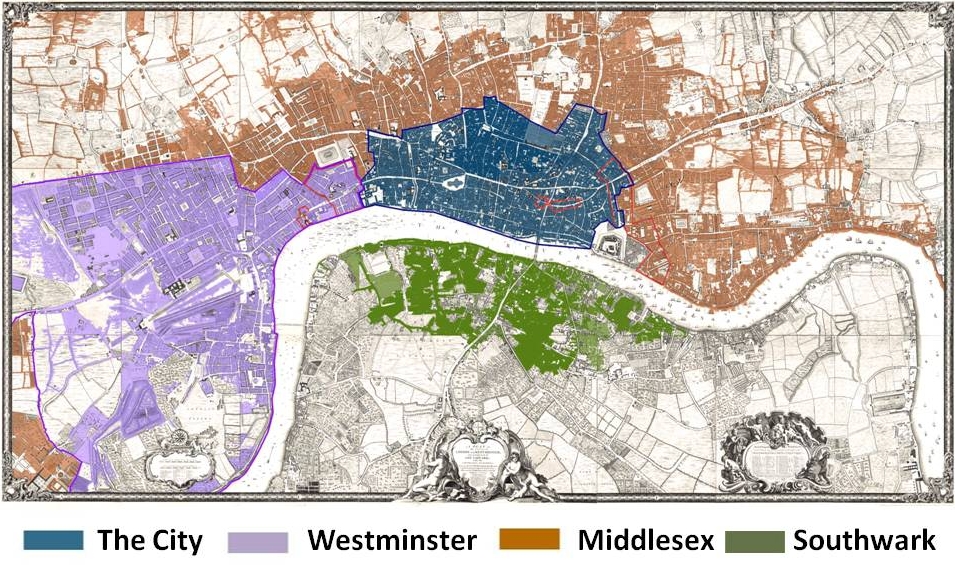
Horwood Map panel 14. [RICHARD HORWOOD – MAP OF LONDON, WESTMINSTER AND SOUTHWARK, 1813] St Clement Danes is located at the heart of London, placed on an island in the middle of the Strand,
opposite the Royal Courts of Justice, the Temple and Fleet Street – on the map above circled in purple.
(Click on map and zoom in; map courtesy of Sue Forgue at Regency Encyclopedia, from the Guildhall Library, London)
St. Clement Danes: The first church on the site was founded by Danes in the 9th century, and named after St. Clement, patron saint of mariners. It has been rebuilt by William the Conqueror, later again in the Middle Ages, and rebuilt yet again in 1680-82 by Christopher Wren, a steeple added in 1719-20. It was gutted during the blitz, only the walls and tower left standing, and since reconstruction has served as the central church for the Royal Air Force.
An early street view of the Strand and St Clement Danes Church, 1753. On the right is the original entrance to the building.
cTrustees of the British Museum; image from Christina Parolin, Radical Spaces (ANU, 2010).
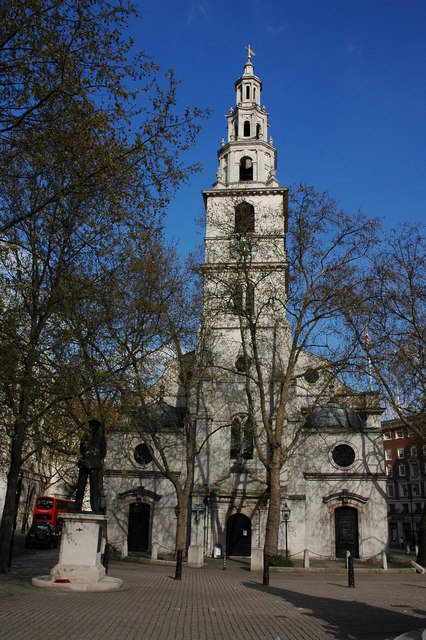
St Clement Danes today: when in London in May 2011 I visited the Church for the first time, finding it a quite lovely and peacful setting on its little island in the midst of bustling London – here are a few shots, alas! not that well focused and no exterior shots of the facade, so I include one from Geograph.org.uk, with thanks.
St Clement DanesSt Clement Danes, interiorSt Clement Danes ceilingflag in St Clement Danes
St Clement Danes exterior – cPhilip Halling, Geograph.org.uk
[A movie aside: You will notice that there are no entrance steps, as there are no steps for St Clements Eastcheap – if you recall from the 1995 movie, Lydia is running up the steps to the church, so neither of these sites were used in the movie [and I find no picture of this scene – if anyone knows where that exterior shot was filmed, please let me know!]
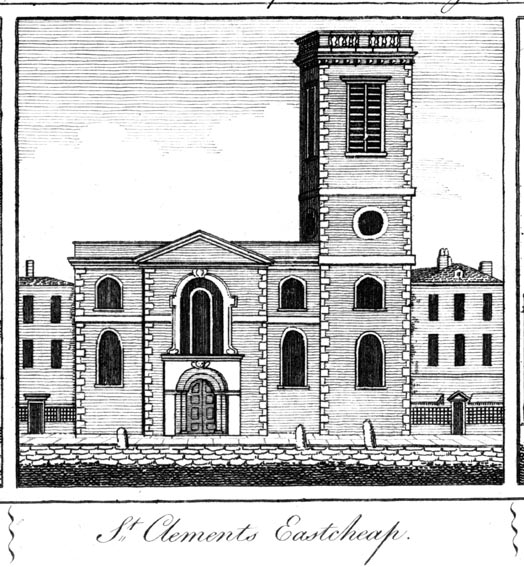
Facade St Clement Eastcheap
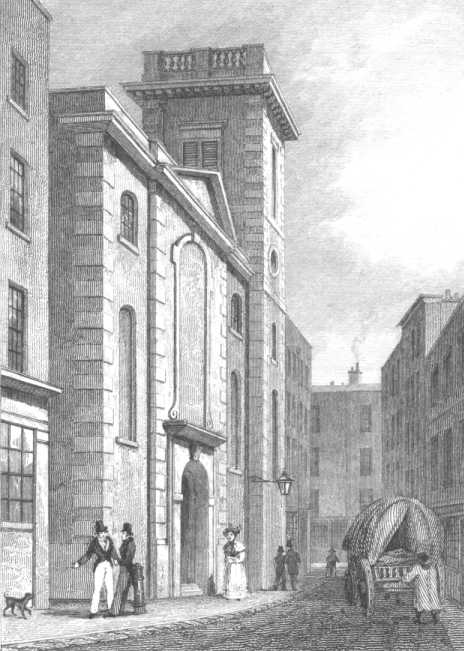
c.1760, from Walter Harrison’s History of London (1777) – wikipedia
******************
St. Clement Eastcheap: located on St. Clement’s Lane between Lombard Street and Great Eastcheap [today on Clement’s Lane, off King William Street] and close to London Bridge and the River Thames – see here on the Horwood panel 15:
Horwood Map panel 15. [RICHARD HORWOOD – MAP OF LONDON, WESTMINSTER AND SOUTHWARK, 1813]
The purple marks Gracechurch Street, home ot the Gardiners, and ends at the botton at Great Eastcheap,
go one block to the left to find St. Clement’s Lane, the Church is on the right.
(Click on map and zoom in; map courtesy of Sue Forgue at Regency Encyclopedia, from the Guildhall Library, London)
Though we are quite sure that this is not where Austen had Lydia and Wickham marrying, it is still worth noting – perhaps we are wrong in our assumptions after all, and Wickham was just “hiding in plain sight”? This St. Clement has possible Roman origins; it was destroyed in 1666 in the Great Fire of London, and rebuilt in the 1680s and also designed by Wren. And one should note that “cheap” is an old Saxon word meaning “market” and does not mean “cheap” as we associate it today. Here are a few images:
St Clement Eastcheap – London ViewsSt Clement Eastcheap today – wikipedia
The St Clement argument does not just revolve around Jane Austen [and indeed may she just been throwing out a very sly reference to her sailor brothers? – just a thought, St. Clement being the patron saint of sailors] … The Churches apparently have a long-standing “quibble” over which is the St. Clement referred to in the nursery rhyme “Oranges and Lemons” – here is the full rhyme: [the long version from wikipedia: http://en.wikipedia.org/wiki/Oranges_and_Lemons ]. It is the bells of St. Clement Danes that ring out the tune of the rhyme three times a day.
“Oranges And Lemons”, Nicholl Bouvier Games 1874, “The Pictorial World” by Agnes Rose Bouvier (1842 – 1892) – wikipedia
Gay go up and gay go down, To ring the bells of London town.
Oranges and lemons, Say the bells of St. Clements.
Bull’s eyes and targets, Say the bells of St. Margret’s.
Brickbats and tiles, Say the bells of St. Giles’.
Halfpence and farthings, Say the bells of St. Martin’s.
Pancakes and fritters, Say the bells of St. Peter’s.
Two sticks and an apple, Say the bells of Whitechapel.
Pokers and tongs, Say the bells of St. John’s.
Kettles and pans, Say the bells of St. Ann’s.
Old Father Baldpate, Say the slow bells of Aldgate.
You owe me ten shillings, Say the bells of St. Helen’s.
When will you pay me? Say the bells of Old Bailey.
And finally, to bring this back to Jane Austen, where all begins and ends after all, there is behind the St Clement Danes church a statue, by Percy Hetherington Fitzgerald and erected in 1910, of all people, Jane Austen’s very own Dear Dr. Johnson. I think she would be pleased, don’t you?
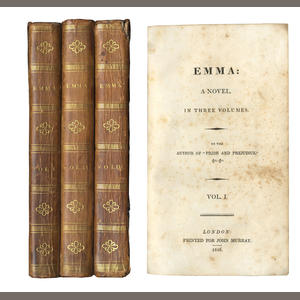
Emma, 3 vol., FIRST EDITION, half-titles in volumes 2 and 3, spotting, one gathering working loose and blank lower margin torn away from advertisement leaf at end of volume 3, one front free endpaper near detached, bookplate of “John Hawkshaw, Esq., Hollycombe”, contemporary half calf, gilt lettering on spines, headbands frayed (volume 2 with small loss at head and foot of backstrip) [Gilson A8; Keynes 8], 8vo, John Murray, 1816.
Now this appears to be the same copy that did not sell at the Bonham’s November 13, 2012 auction where the estimates were substantially higher:
£6,000 – 8,000; €7,400 – 9,900; US$ 9,500 – 13,000
********************
My interest lies in the bookplate of “John Hawkshaw, Esq., Hollycombe” – always curious to see where a book has been and where it heads, and who are the participants in the story; it is often hard to track this information accurately unless a written provenance accompanies the book. In this case it appears that all we have is this bookplate, and my research takes me thus, a very quick summary: [i.e how a whole afternoon can be spent tracing some stranger’s life and how it all can lead one down unimagined paths with only more extensive research to be undertaken …]
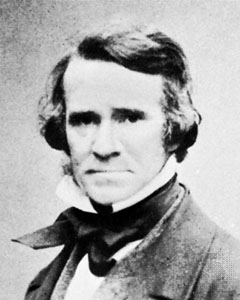
John Hawkshaw – wikipedia
John Hawkshaw (1811 – 1891) was a British civil engineer from Yorkshire who was the chief engineer of a number of the railway lines in the Manchester area, later London, as well as responsible (some say the “saviour”) for the completion of the Suez Canal. He was knighted in 1873. He lived at Hollycombe, his country estate in Liphook, Hampshire, purchased from Charles William Taylor in 1866. (To add to the confusion, the book titled A History of the Castles, Mansions, and Manors of Western Sussex, by Dudley George Cary Elwes, and Charles John Robinson (London, 1876), notes two other properties purchased by Hawkshaw from Taylor, so more research needed here.]
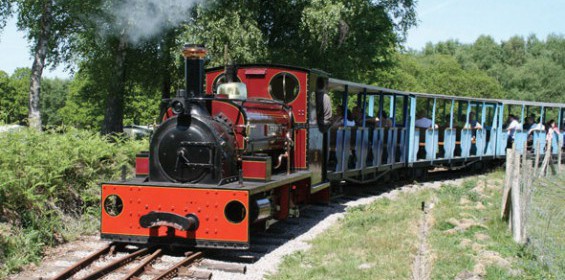
Hollycombe today is privately owned, but the pleasure gardens, expanded by Hawkshaw and more fully landscaped by his son [more on him below] are open to visitors, as is the nearby Hollycombe Steam Museum.
Hollycombe Steam Museum
Their London home was in Belgrave Mansions, St. John’s Wood High Street, close to Bond Street in the heart of the West End.
But did John Hawkshaw read his copy Jane Austen’s Emma, or was his bookplate just really an owner stamp, and the real reader in the house was his wife Ann Hawkshaw? (though it is nice to imagine them all reading it aloud.)
a modern reprint
Ann Hawkshaw (1812 – 1885) was an English poet. She published four volumes of poetry between 1842 and 1871. She married our John Hawkshaw in 1835 and they settled in Salford, near Manchester, where they mixed with the prominent thinkers of the day to include William and Elizabeth Gaskell. Her first volume of poetry ‘Dionysius the Areopagite’ with Other Poems was published in 1842, followed byPoems for My Children in 1847. Sonnets on Anglo-Saxon History was published in 1854, and retells the history of Britain up to the Norman Conquest.
John Clarke Hawkshaw
The Hawkshaws had six children, the most well-known was John Clarke Hawkshaw (1841-1921), who like his father was a civil engineer. In 1865 he married Cicely Wedgwood (1837-1917), daughter of Francis Wedgwood (1800-1880), grandson of Josiah Wedgwood, founder of the famed pottery firm. Francis’s sister Emma Wedgwood (1808-1896) married her cousin Charles Darwin (they were first cousins: Wedgwood’s daughter Susannah was Darwin’s mother). Emma was therefore Cicely’s Aunt and we can find this letter penned to her in the online Darwin Correspondence Project:
Hollycombe. | Liphook. | Hants.
Dear Aunt Emma
I am afraid it is too late to notice about the baby’s tears with any accuracy for I have repeatedly seen her eyes full of tears already but can give no nearer date than that I must have seen them so before she was 3 weeks old; about the tears overflowing onto her cheeks I can observe as I have never seen it happen yet, indeed it hardly happens in what one may call babydom does it?
We are having such a nice holiday here and as all the tiresome shooting is over I have Clarke to myself and we ride and walk about and don’t feel such strangers to the place as we did and the idle thoughtless life is doing Clarke good I am thankful to say.
Believe me dear Aunt Emma | Your affecte niece | Cicely M Hawkshaw
9th Feb. [1868]
Emma Darwin, 1840 – by George Richmond
****************
So from this letter we know that John Clarke Hawkshaw was known as Clarke and that he was able to get away to the family home and enjoy some “idle thoughtless life”! [images of Downton Abbey!]
Such a dizzying trip from a simple bookplate in a first edition of Jane Austen! – we have encountered various British luminaries ranging from railroad and canal engineers, to literary and Unitarian connections in Manchester, to country estates in Hampshire [Jane’s own territory], to the Wedgwood Potteries of London, and ending with Evolution, all in one family’s connections. It is comforting to think that this copy of Emma was read, enjoyed and discussed, and passed along to succeeding generations of this great family! I wonder where it will end up come March 19th? … stay tuned!

















 Jane Austen in Vermont
