The Folio Society has a long history of publishing Jane Austen’s novels – some as sets, some as stand-alone editions of individual novels – I have them all and marvel at their variety, the different illustrators who bring their own vision to Austen’s tales.
There is a new edition on the horizon, all in celebration of Austen’s 250th, a full box set, and limited to 750 copies – I give you the full press release from Folio – and may you be one of the fortunate ones to acquire this for your collection! – it will be available September 9, 2025.
The Complete Novels by Jane Austen, The Folio Society, 2025.
**************
THE COMPLETE NOVELS BY JANE AUSTEN
Illustrated by: Sarah Young Foreword by: Lucy Worsley
(The Folio Society | Six-Volume Box Set | Limited Edition: 750 copies | $1,250 | September 9, 2025)
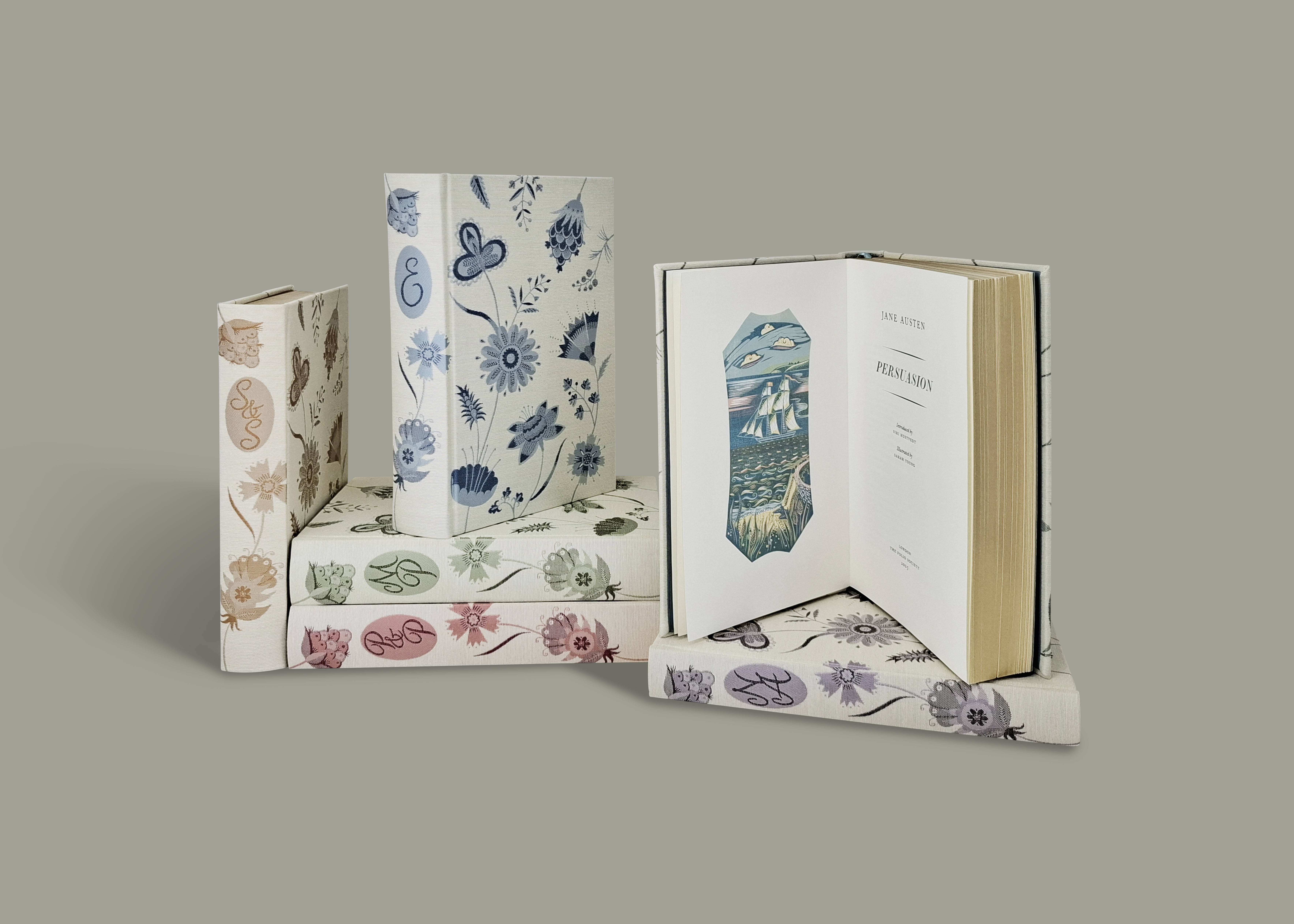
Featuring all six of Jane Austen’s major novels, encased in delicately woven, silk-and-cotton covers and reimagined with spectacular, original illustrations by Sarah Young, the latest limited edition from The Folio Society is guaranteed to bewitch readers, body and soul.
The Folio Society proudly presents The Complete Novels by Jane Austen—a landmark, six-volume limited edition of Austen’s major works, published to celebrate the 250th anniversary of her birth. With a new foreword by historian and bestselling author Lucy Worsley and breathtaking color illustrations by acclaimed artist Sarah Young, this edition is the definitive tribute to Jane Austen’s literary legacy.
Delightful, witty, and enduringly relevant, Jane Austen is one of the most beloved novelists in the English language. Her novels Sense and Sensibility, Pride and Prejudice, Mansfield Park, Emma, Northanger Abbey, and Persuasion have enchanted readers for generations and inspired countless retellings. Austen is peerless in her ability to blend sharp social commentary with unforgettable characters; her critiques on love, class, marriage, and gender remain relevant centuries later.
The Complete Novels by Jane Austen, The Folio Society, 2025.
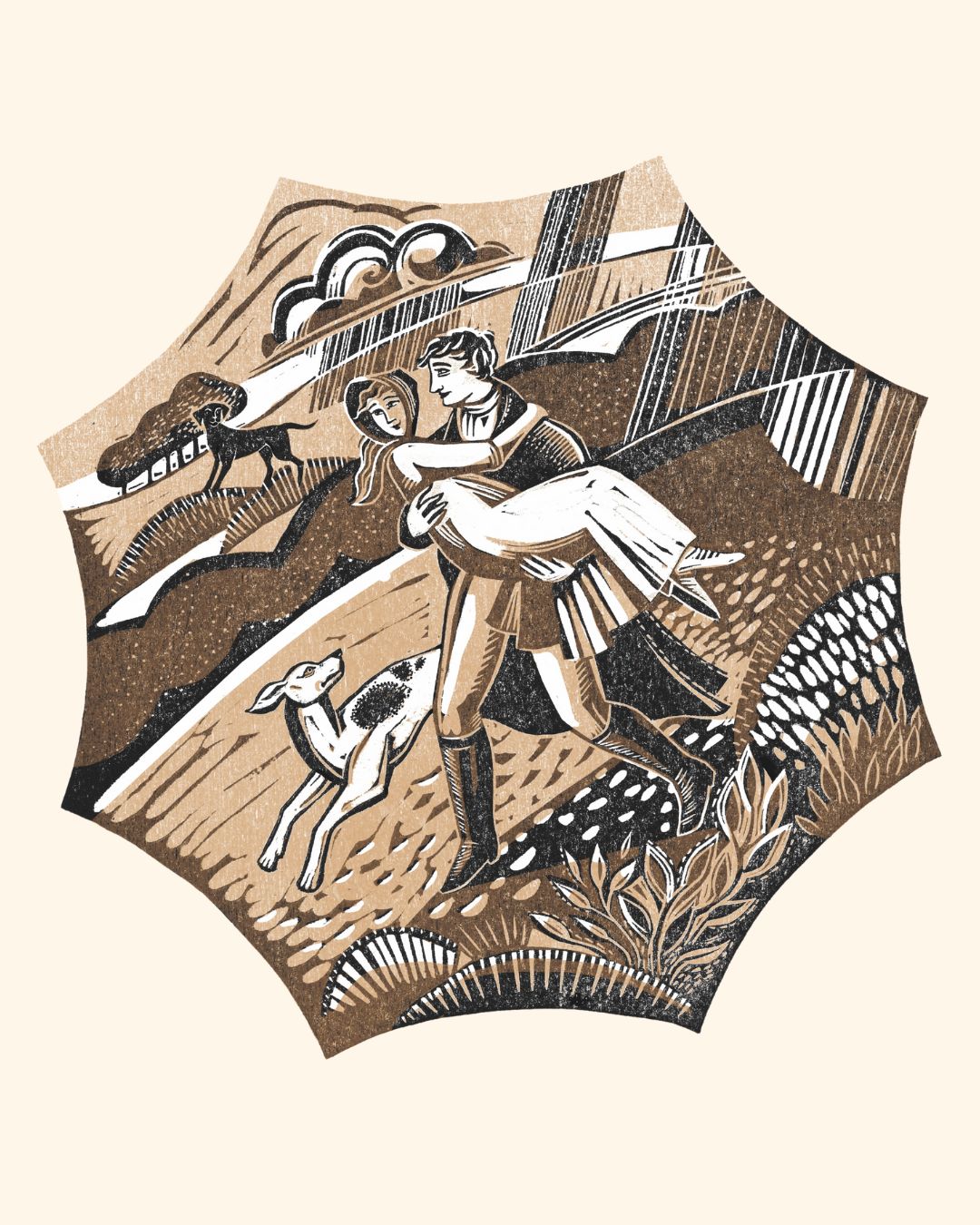
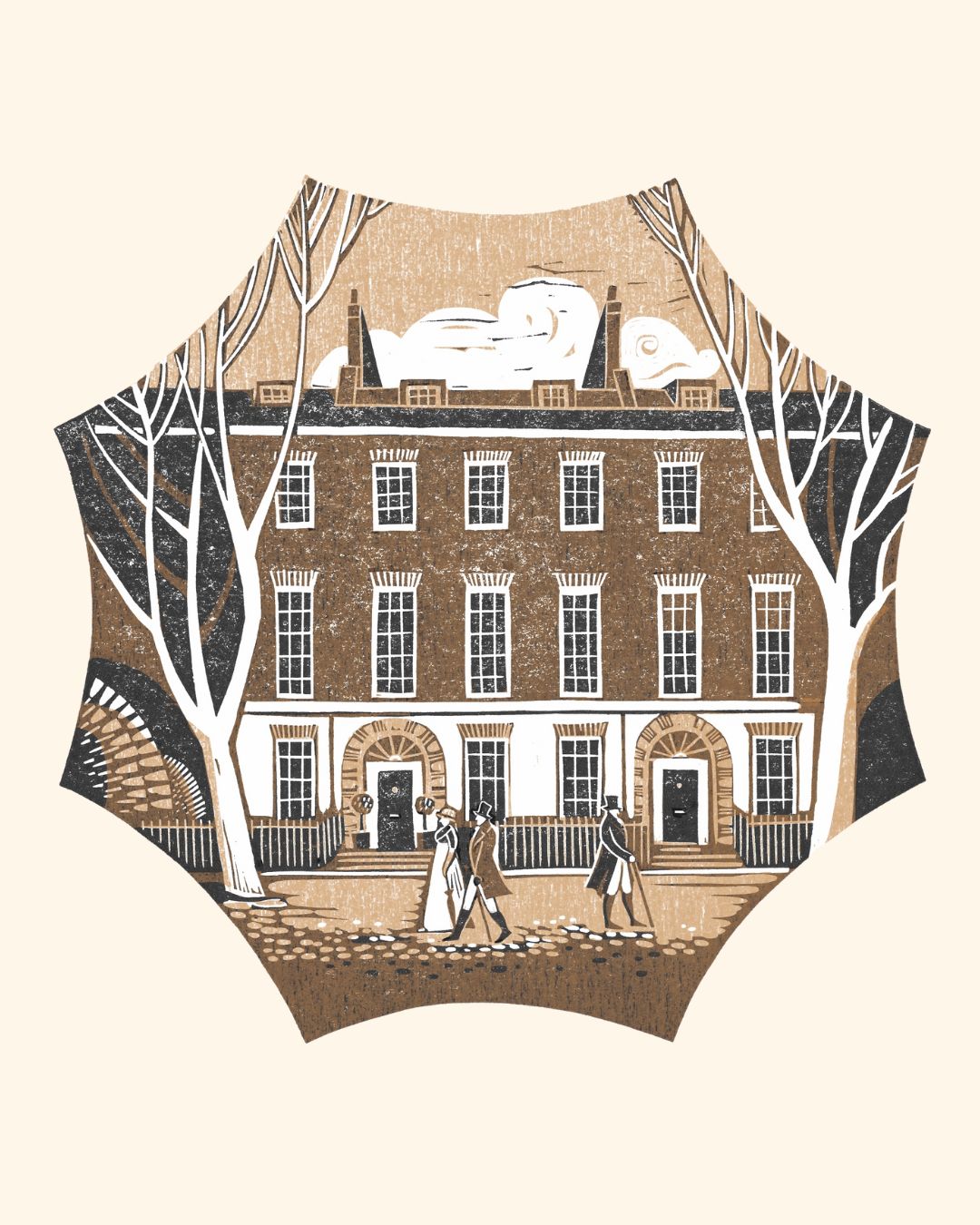
Every detail of this edition has been crafted with exceptional care. Each of the six novels will include a woodcut frontispiece, five linocut illustrations, and fifteen vignettes by Sarah Young, who brings a folkloric sensibility to Austen’s world; a monogram specially commissioned from prize-winning calligrapher Ruth Rowland; gilded edges; a ribbon maker; and first edition text, with introductions by Elena Ferrante, Sebastian Faulks, Lucy Worsley, Fay Weldon, Val McDermid, and Siri Hustvedt.
The novels will be covered in silk-and-cotton jacquard cloth specially woven by Stephen Walters—a luxury silk maker that weaves fabric for royal coronations and weddings, including the silk used in Princess Diana’s wedding dress. The six books will be housed in a gorgeous box designed by award-winning graphic designer Emily Benton.
The Complete Novels by Jane Austen is a true celebration of a master storyteller, and a treasure to be handed down from generation to generation.
PRODUCTION DETAILS
• Limited Box Set: 750 copies, $1,250 • Six volumes: Sense and Sensibility (392 pages); Pride and Prejudice (400 pages); Mansfield Park (476 pages); Emma (496 pages); Northanger Abbey (260 pages); Persuasion (268 pages) • Each volume includes a 2pp frontispiece, five illustrations, and fifteen vignettes spread throughout the text, illustrated in full color by Sarah Young • Full bound in jacquard silk-and-cotton cloth woven by Stephen Walters • Printed 4/4 throughout on Munken Pure paper • Gilded on 3 edges • Presented in a box designed by Emily Benton, covered in blocked cloth • Monograms commissioned from Ruth Roland • Limitation tip printed letterpress • Ribbon marker
Jane Austen was born in Hampshire in 1775, the seventh child and youngest daughter of George Austen, rector of Deane and Steventon, and his wife, Cassandra. She began writing poems, plays and stories for her family from a young age, and her first published novel, Sense and Sensibility, was released by Thomas Egerton to sell-out acclaim in 1811. Pride and Prejudice (1813), Mansfield Park (1814) and Emma (1815) followed, and these were the last of Austen’s works to come out in her lifetime. Her novels, including the posthumously published Northanger Abbey (1818) and Persuasion (1818), are today considered amongst the finest in the English language. She died at Winchester in 1817.
Sarah Young is a painter, printmaker, and illustrator. She is also the maker and originator, with Jon Tutton, of a traveling puppet theater. Her work is often narrative, drawing on folktales, myths, and fairytales, and has been shown in galleries throughout the UK, from the Shetland Islands to Cornwall. As an illustrator, she has most recently worked on book covers for Stephen Fry’s Mythos series, Pat Barker’s Trojan War novels, and the complete works of Shakespeare for Oxford University Press. Tutton and Young organize contemporary art and craft events, including Made London and the Brighton Art Fair, and run Atelier Beside the Sea—an art gallery, shop, and creative teaching space in Brighton.
Lucy Worsley OBE is a historian, author and television presenter. After studying history at New College, Oxford, she served for 21 years as Chief Curator at the charity Historic Royal Palaces, based at Hampton Court Palace. She won a BAFTA in 2018 for the BBC documentary Suffragettes with Lucy Worsley. She is the author of Jane Austen at Home, Queen Victoria, and the Sunday Times #1 bestselling book Agatha Christie: A Very Elusive Woman. Lucy is also the author of a historical novel for younger readers, The Austen Girls.
– ABOUT THE FOLIO SOCIETY
Foliois an employee-owned, independent publisher that has thrilled and delighted a band of dedicated readers across the globe since 1947. Today, from our workspace in the heart of London’s vibrant Shad Thames, Folio continues that tradition by crafting exquisite, illustrated books. Folio publishes many of the greatest names in publishing, in editions which reflect an extraordinary commitment to the craft of book-making and design. Folio’s award-winning books include George R. R. Martin’s A Game of Thrones, Madeline Miller’s A Song of Achilles, Alice Walker’s The Color Purple, and Diana Wynne Jones’s Howl’s Moving Castle. Proudly independent for over 75 years, in 2021 The Folio Society became an Employee Ownership Trust. Folio’s team of editors, designers and artisans will do whatever it takes to give each title everything it deserves, from outstanding intellectual firepower to extraordinary craftsmanship.
The Complete Novels by Jane Austen, The Folio Society, 2025.
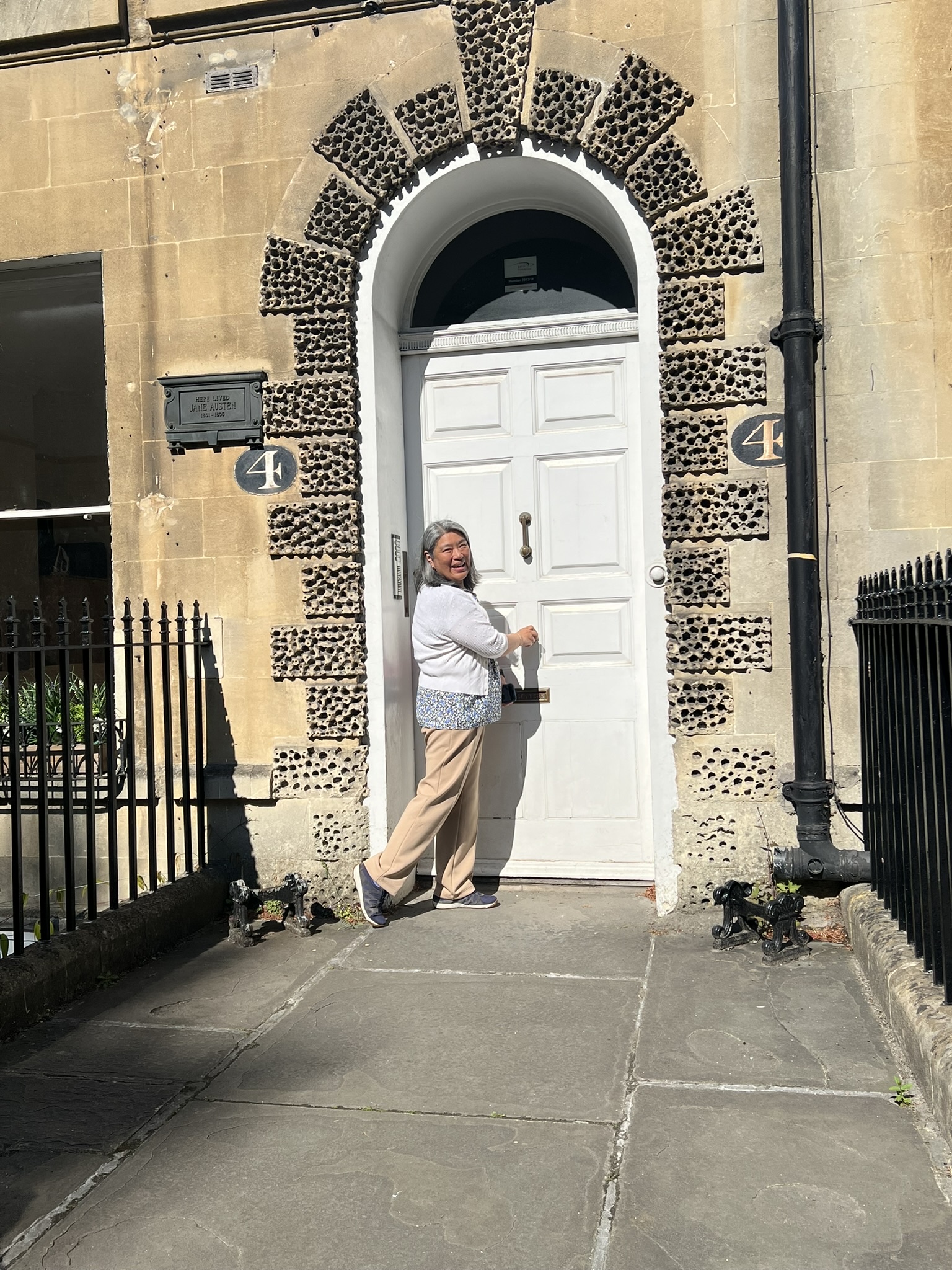
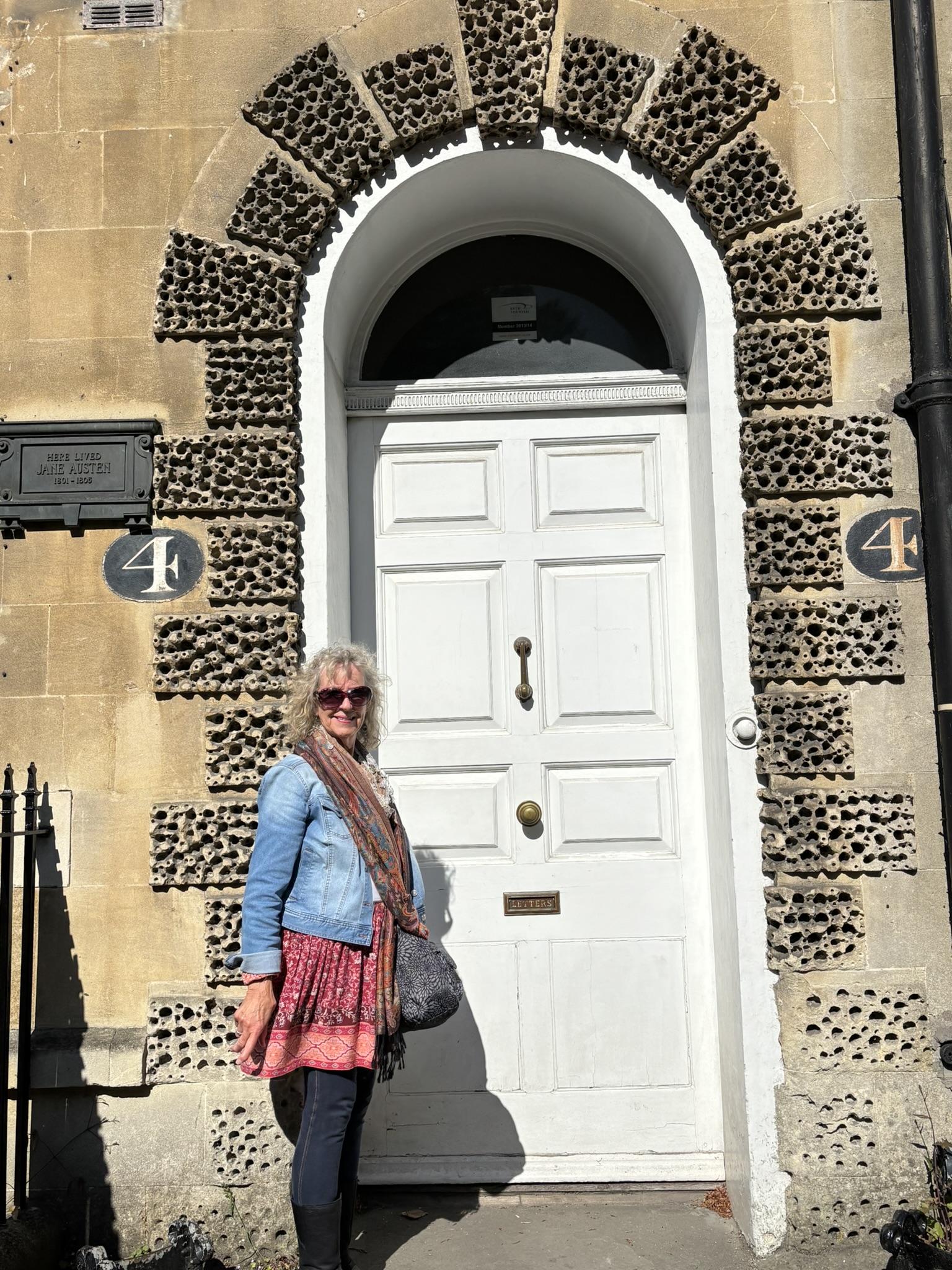
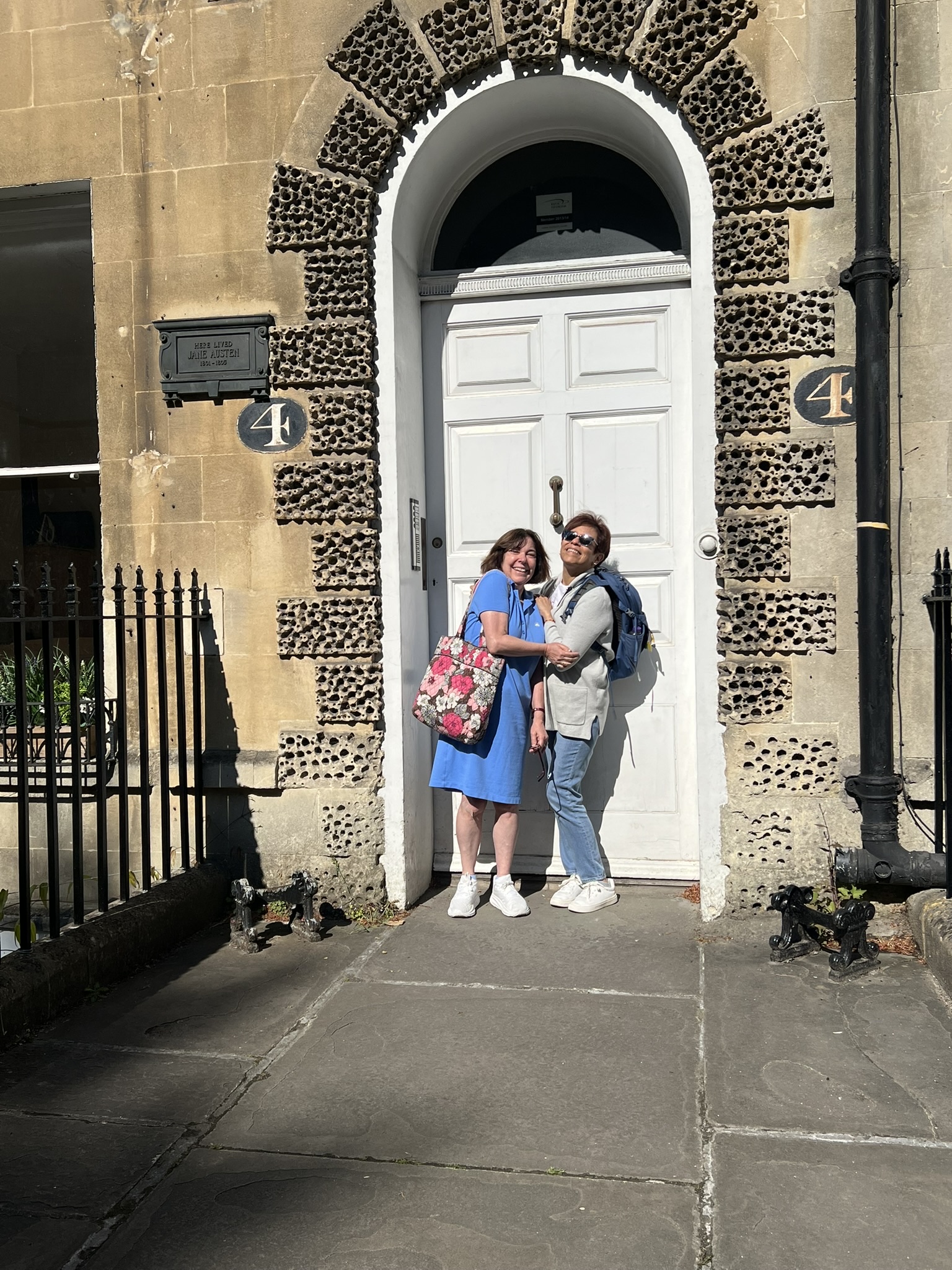
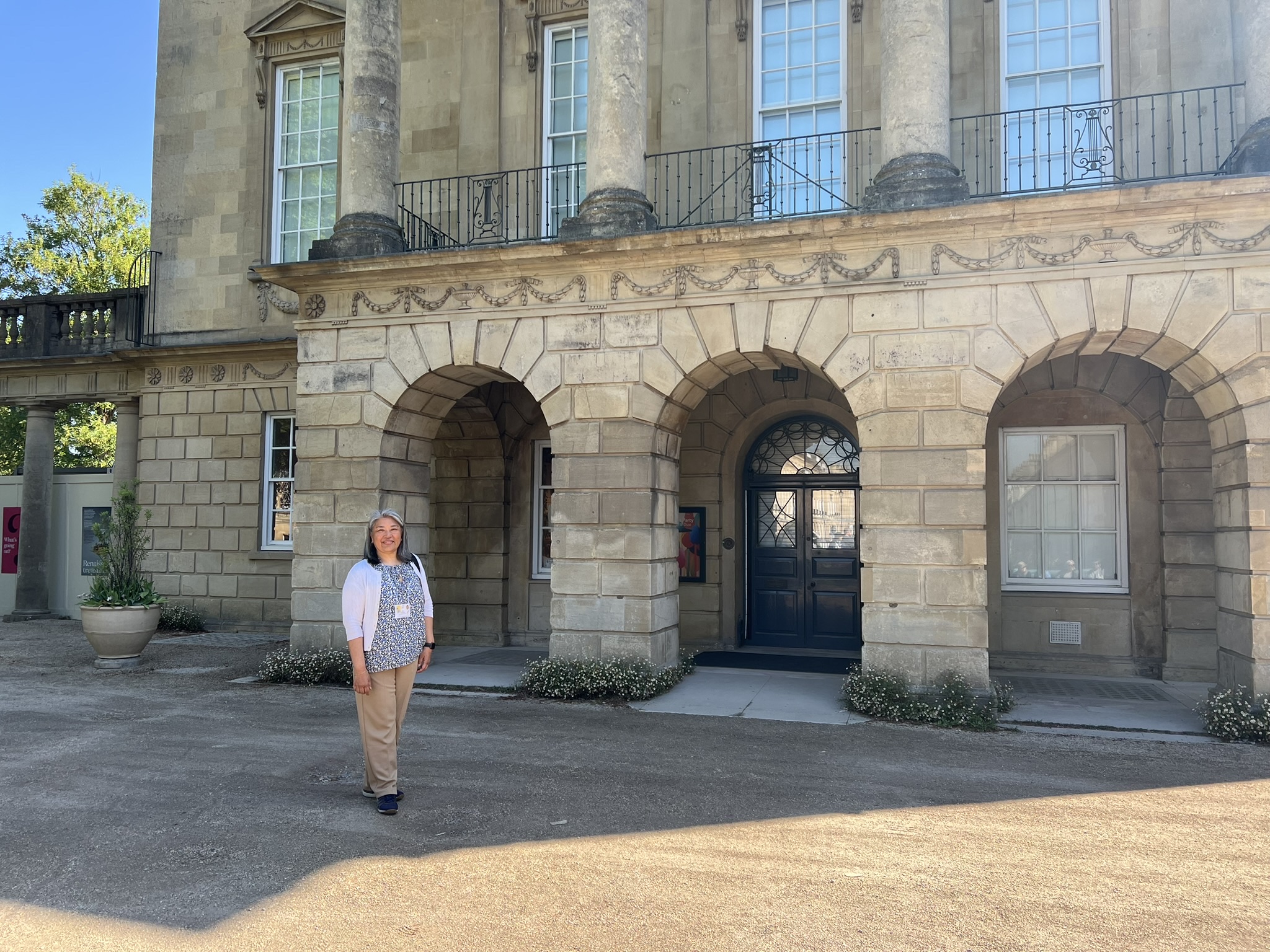
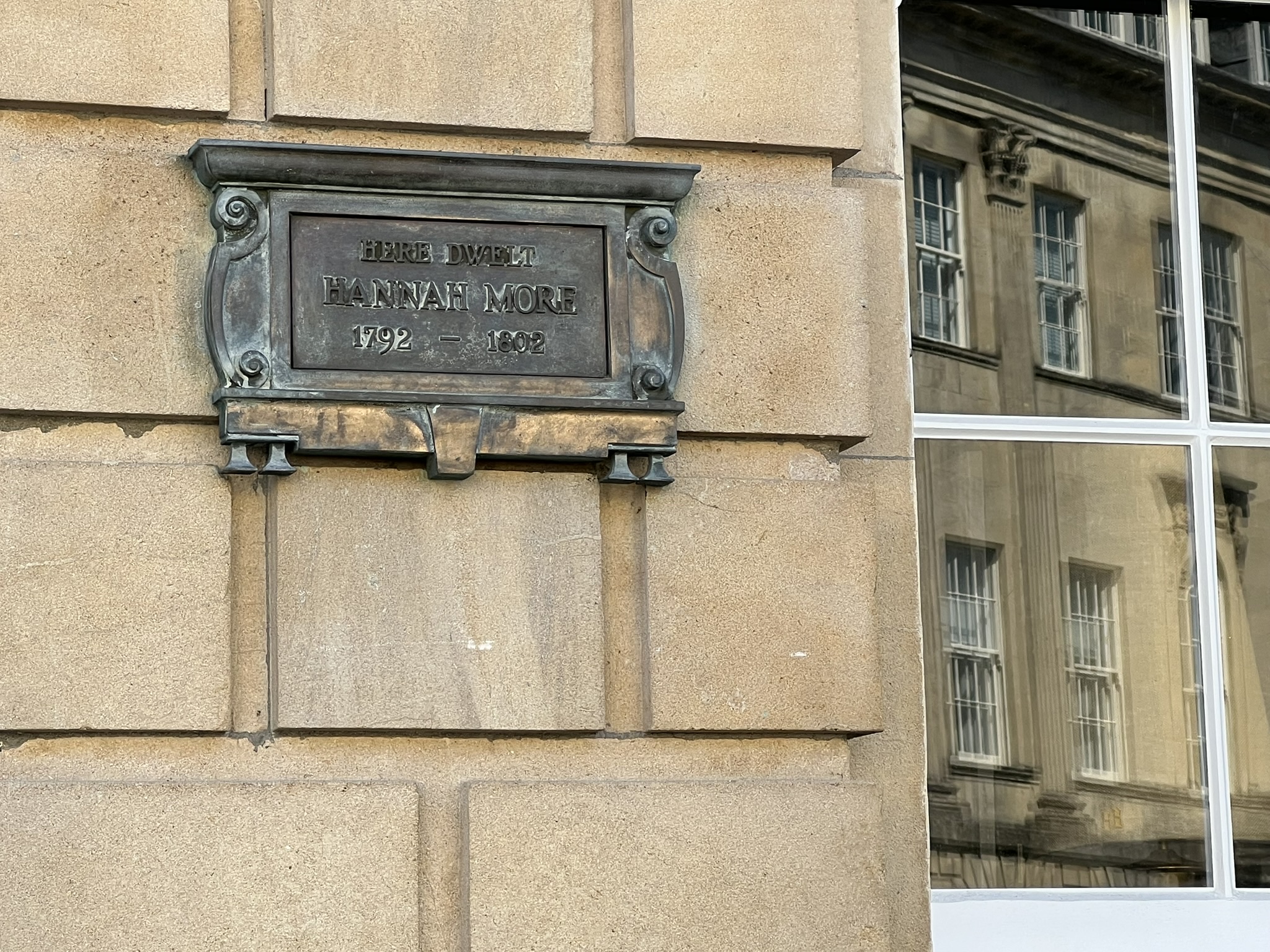
But now we are off first thing to the Holburne Museum – with a stop along the way to No. 4 Sydney Place, at the end of Great Pulteney Street, where Jane and her sister and parents lived for their first three years in Bath – it is also the only house in Bath to have a plaque telling us that she had lived here: here are Joy and I, and Michele and Vicki in the required photos at the front door [people who live here must love this constant invasion of their doorstep…]
**************
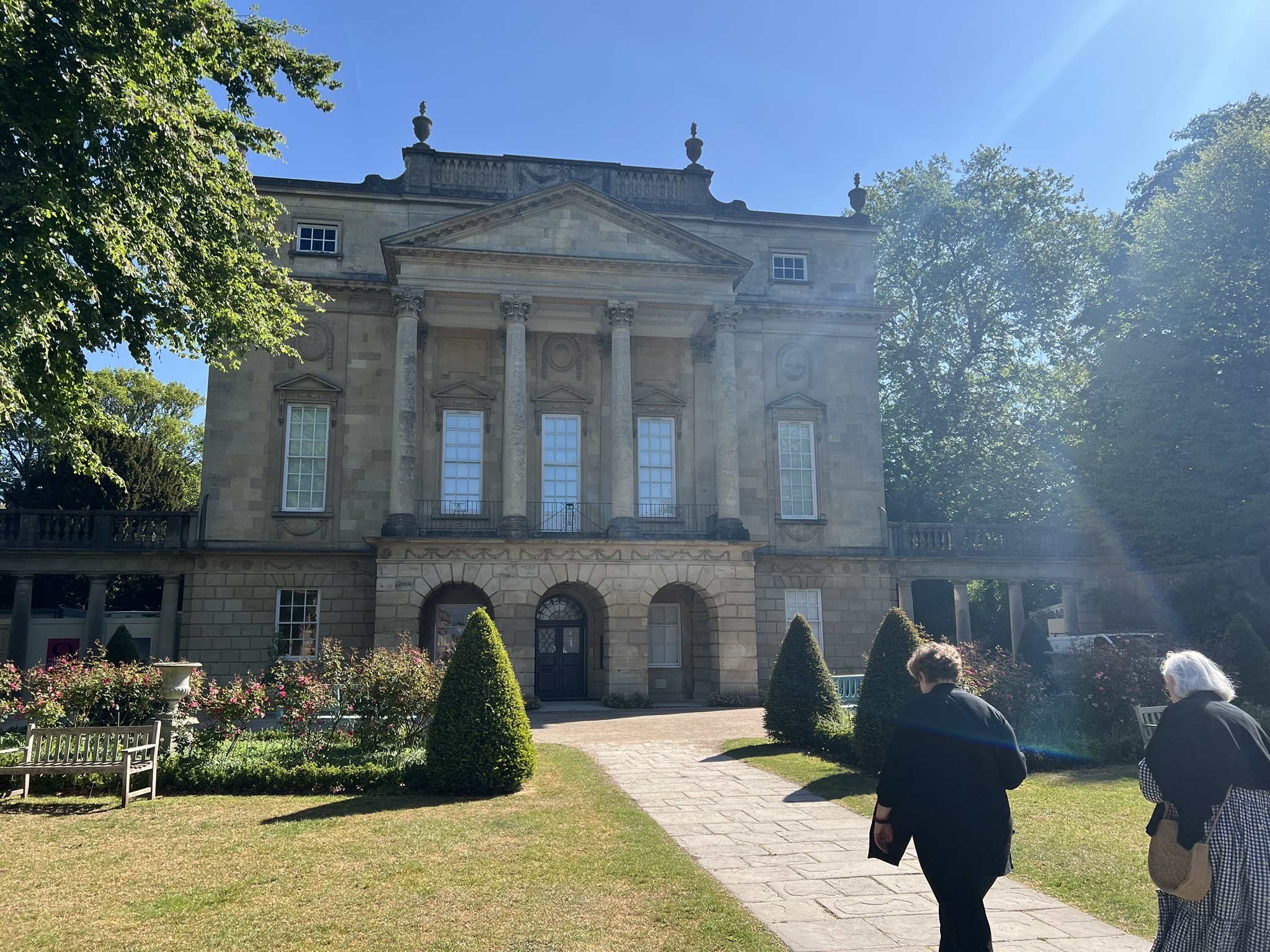
Then into the Museum, with again a terrific guide, who pointed out the salient pieces to see on a fairly quick tour – so much here to ponder over: the artwork, decorative arts, and history of the owner:
At the heart of the Holburne Museum is the collection of Sir William Holburne (1793-1874), fifth baronet of Menstrie. William seemed destined for a naval career but, following the death of his elder brother Francis, he inherited the family title and a modest fortune. He left the navy and embarked on an eighteen-month Grand Tour of Europe, visiting Italy, the Alps and the Netherlands. This sparked a life-long interest in art and his enthusiasm for collecting. He particularly loved bronze sculptures, silver, porcelain and Dutch landscapes.
Sir William never married. He lived with his growing collection and his three unmarried sisters on the North side of Bath. It was his wish that his collection be left to the City of Bath for everyone to enjoy. Since his death, more than 9,000 items have been added to his collection including portrait miniatures, porcelain, embroideries and portraits by some of the greatest artists of the eighteenth century.” [from the website]
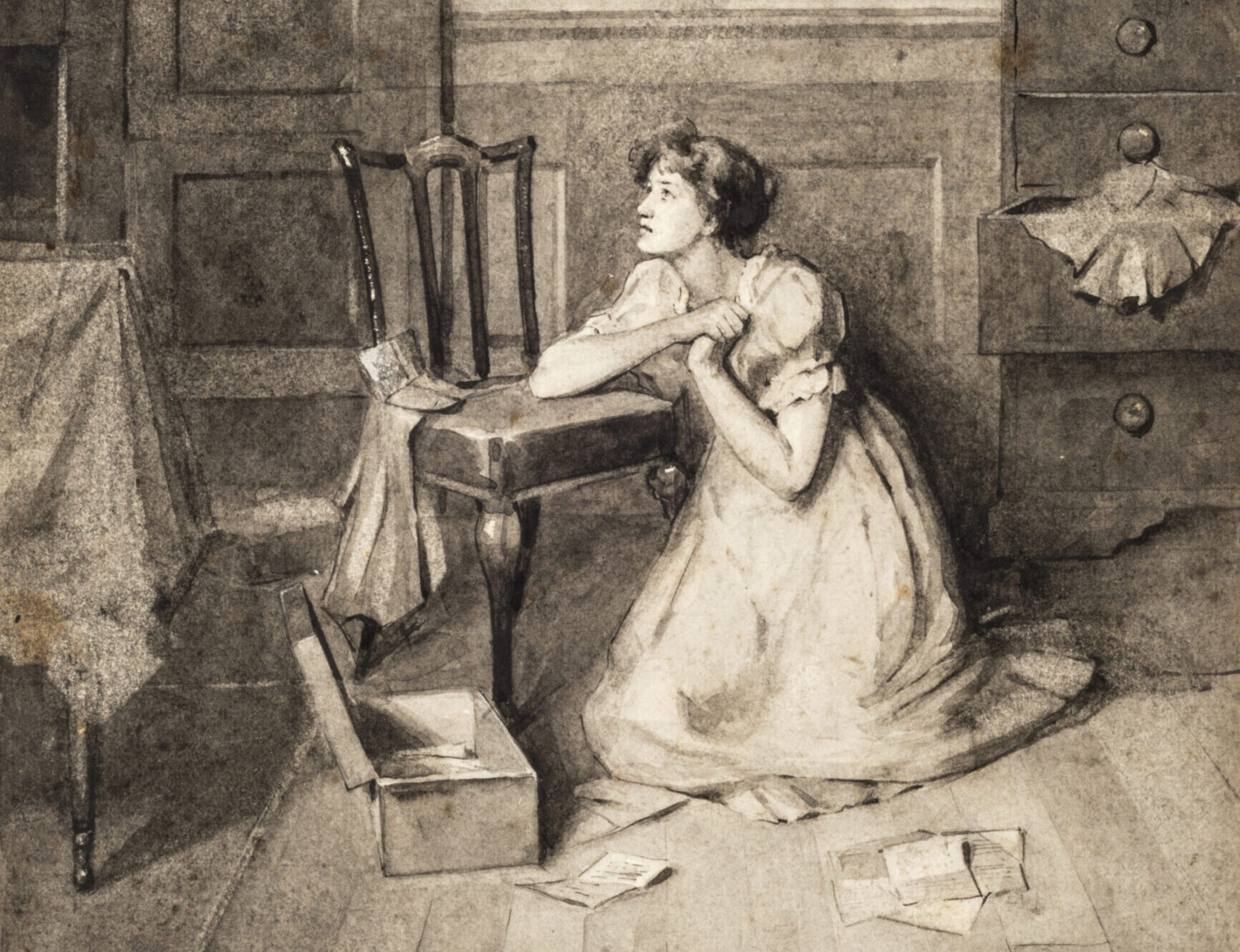
We just missed the Turner watercolor exhibit which was to open on May 23 – but to celebrate Austen in this 250th year, coming up are two evenings of adaptations – the 1995 Emma and 1995 Sense and Sensibility. And from Sep 11, 2025 – Jan 11, 2026, an exhibit on “Illustrating Austen”:
[Marianne Dashwood, by William C. Cooke, S&S, 1892]
I could have stayed here all day taking photos – so here just a few of my favorites:
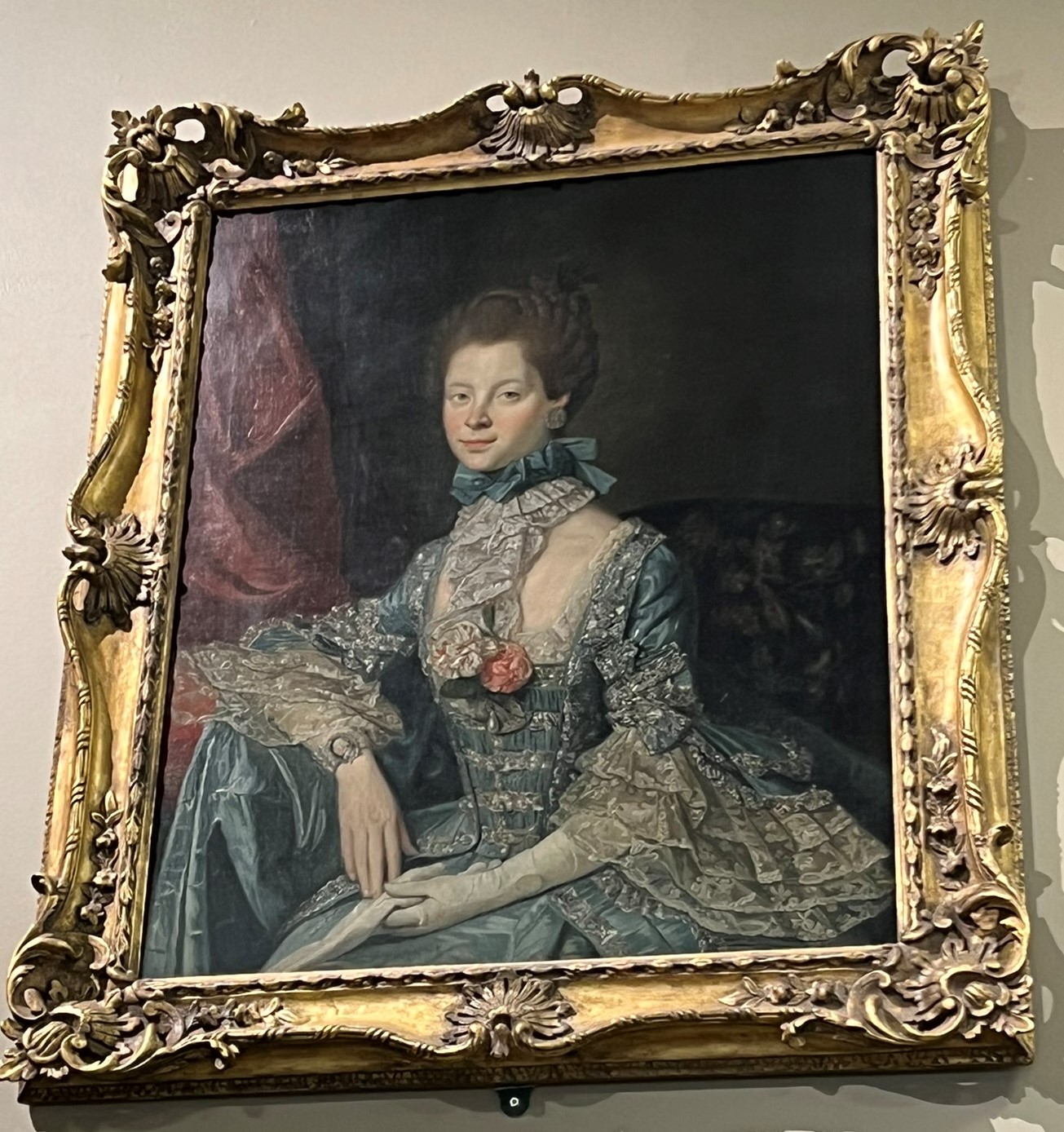
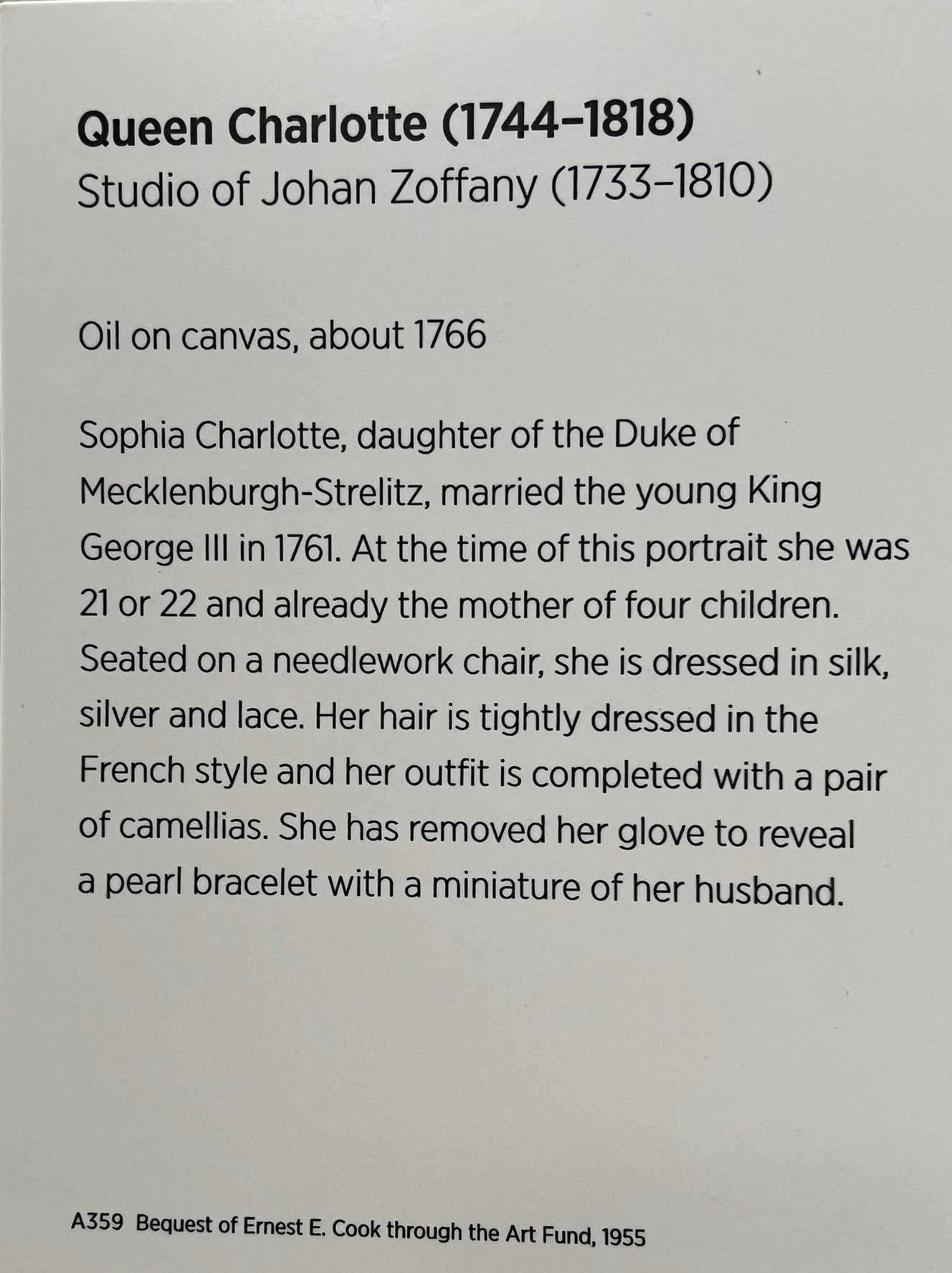
Queen Charlotte:
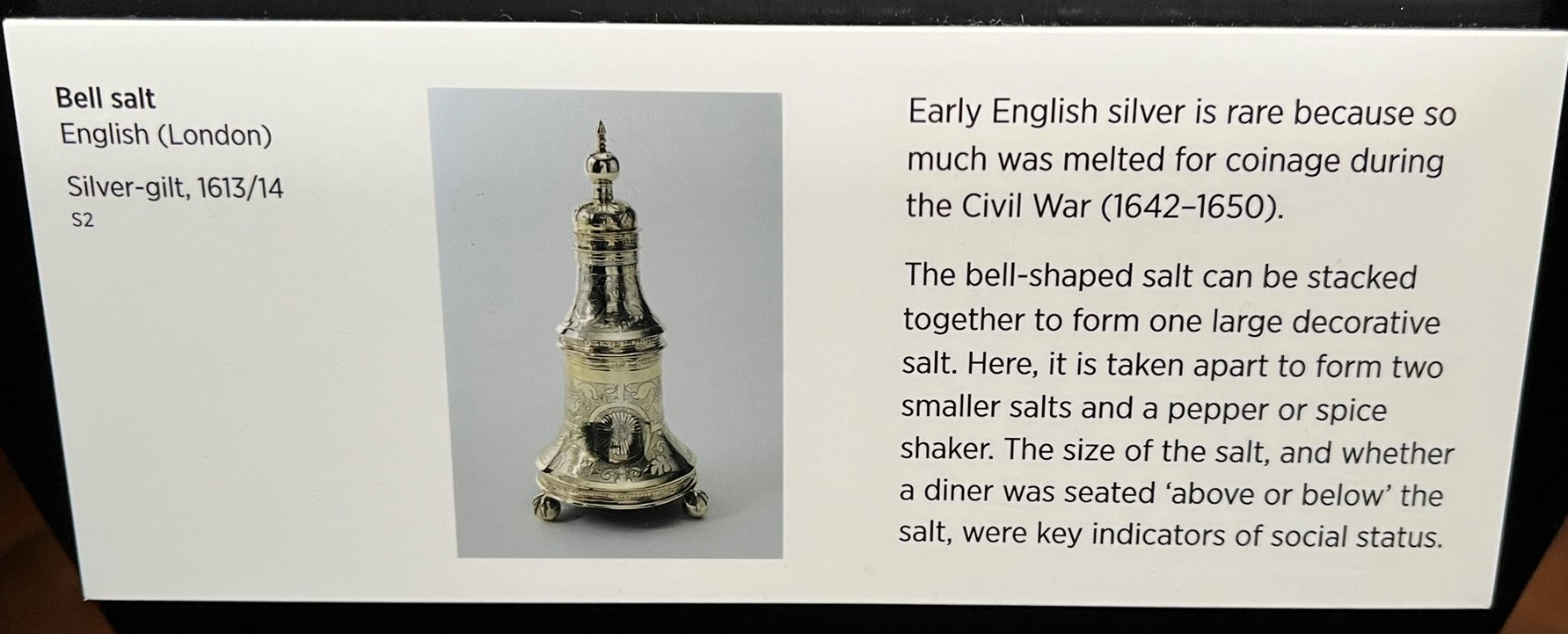
English silver:
A chamber pot designed as a planter:
More porcelain:
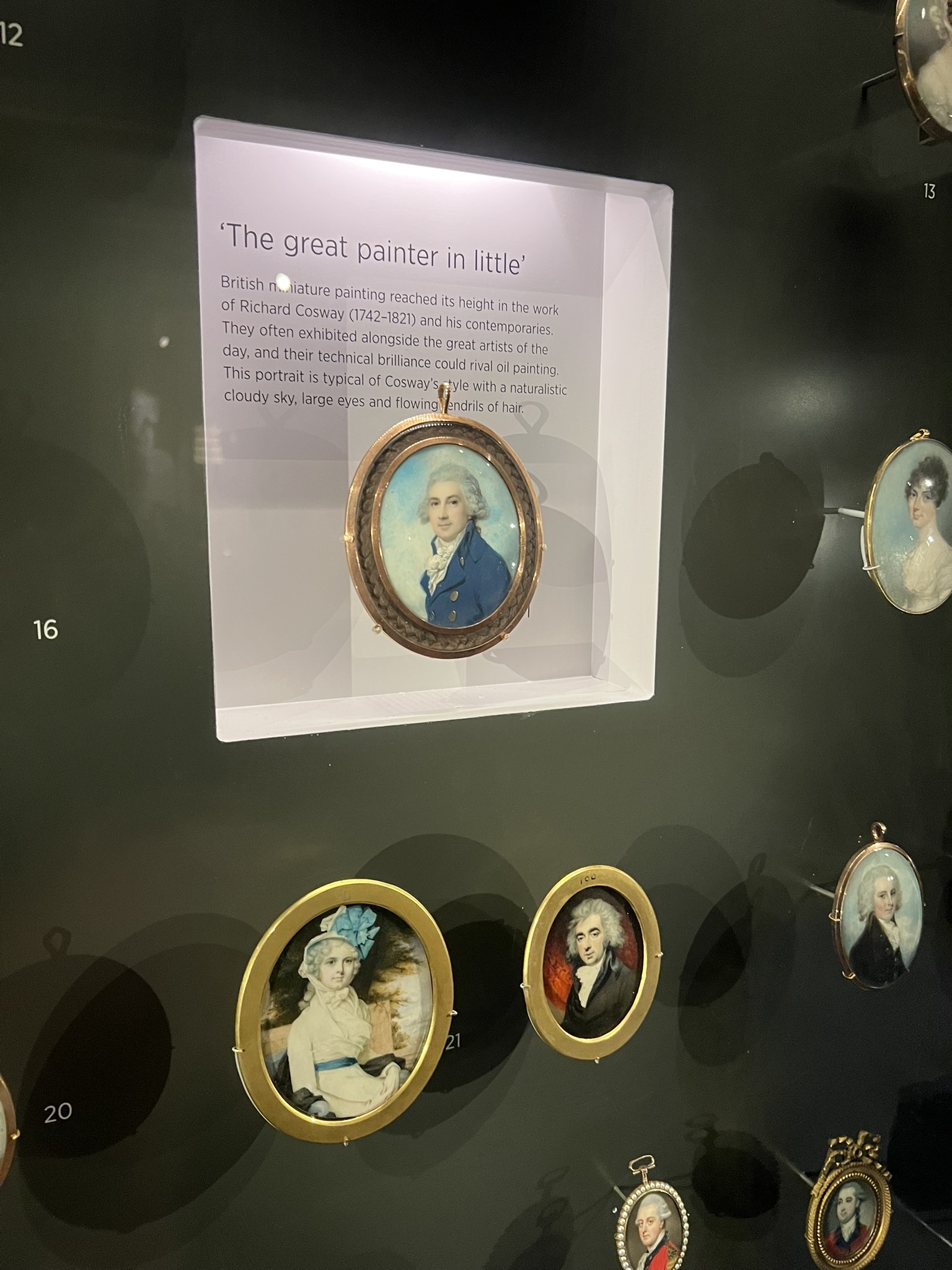
Richard Cosways’ miniatures:
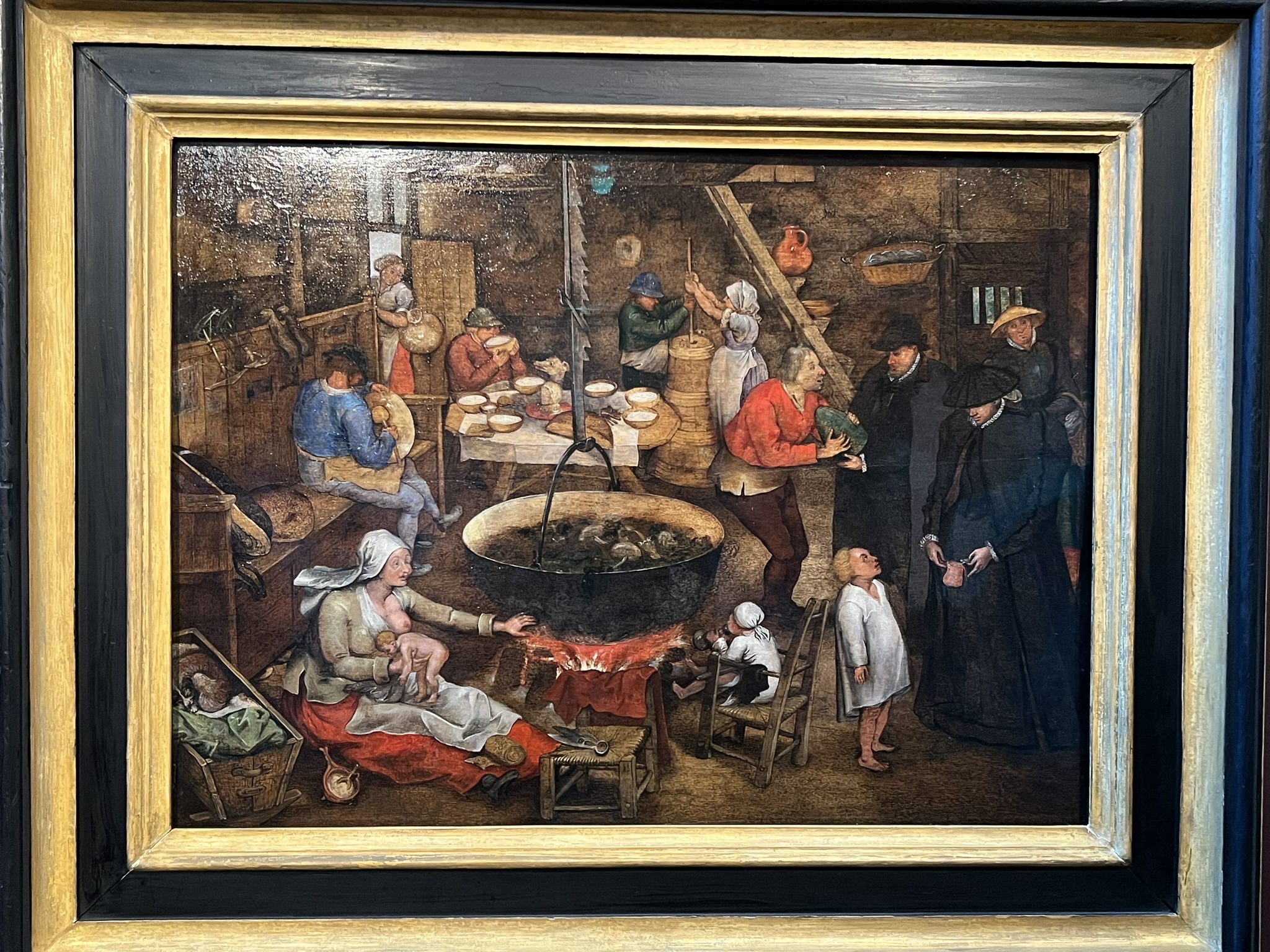
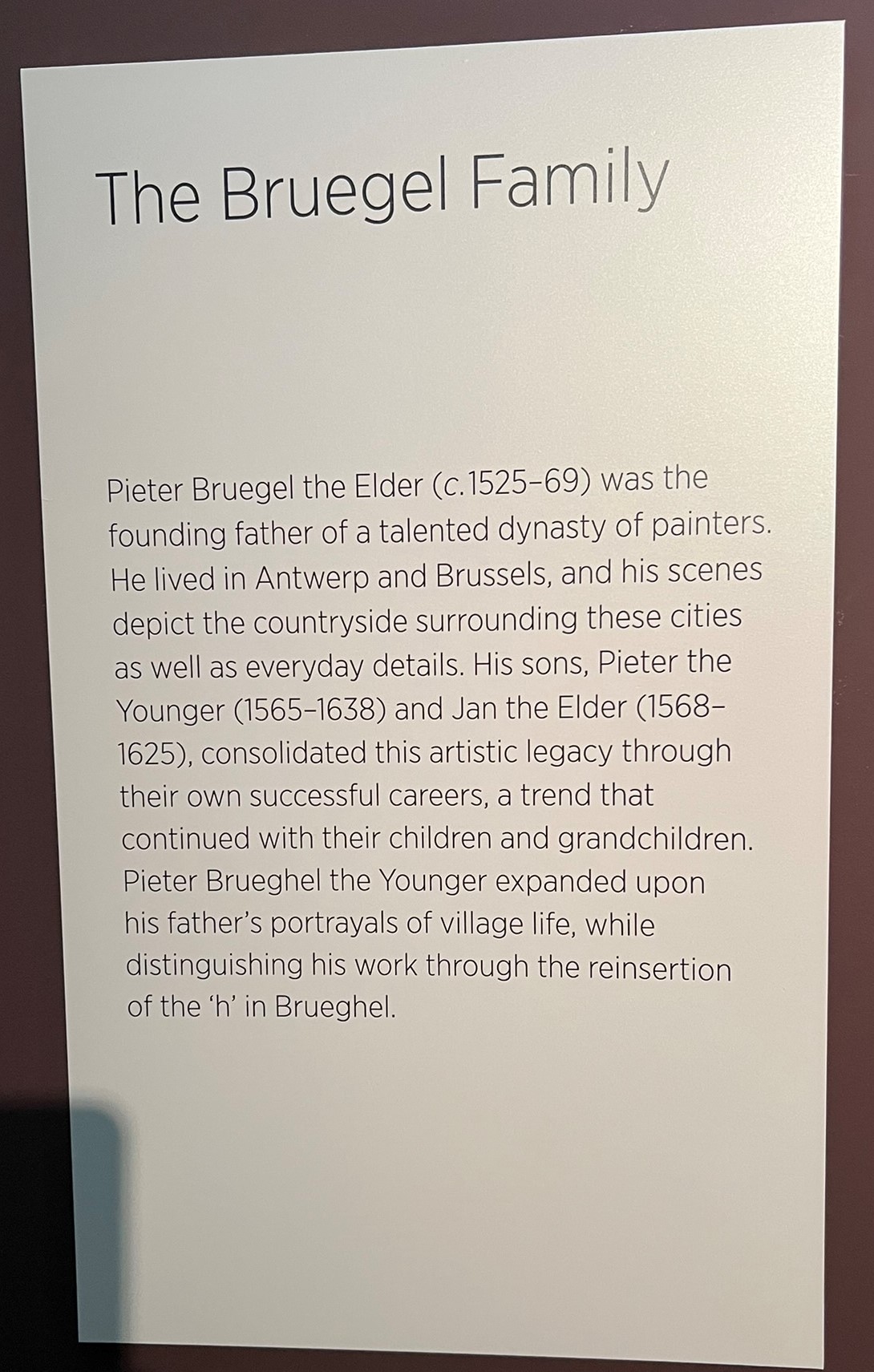
I was interested in these Bruegels because I was heading off to Belgium on a Flemish art trip at the end of June – apparently this one is definitely attributed to him, the one below has not…:
And, where there is a harp, can Mary Crawford be far behind??
**************
And must make a note of the setting of the Holburne Museum as Lady Danbury’s house in the Netflix series Bridgerton – it appears in all three seasons and also in Queen Charlotte: A Bridgerton Story. The museum’s exterior is particularly recognizable when guests arrive at balls, and it’s also the setting for a scene in season 3 where Penelope is upset with Colin.
Then more walking around Bath – across the Great Pulteney Bridge with its great shops – here Joy and I found the perfect spot for tea: Pulteney Bridge Coffee where we had “lemon drizzle” – yum…
And where you then come upon Laura Place, the widest street in Bath, and where Lady Dalrymple lives – the very upper-class (and expensive) location and where Sir Walter is chuffed to bits to be invited…
Here is a great summary of places in Bath that show up in Persuasion:
If you want to get married here or throw yourself an elegant party [and I highly recommend it!}, go here: https://www.farleigh.house/
I was most interested in the rugby! My husband played rugby in college and later for a club in Washington DC – but alas! no rugby players in sight, only some views of the playing fields – more about them here: https://www.bathrugby.com/
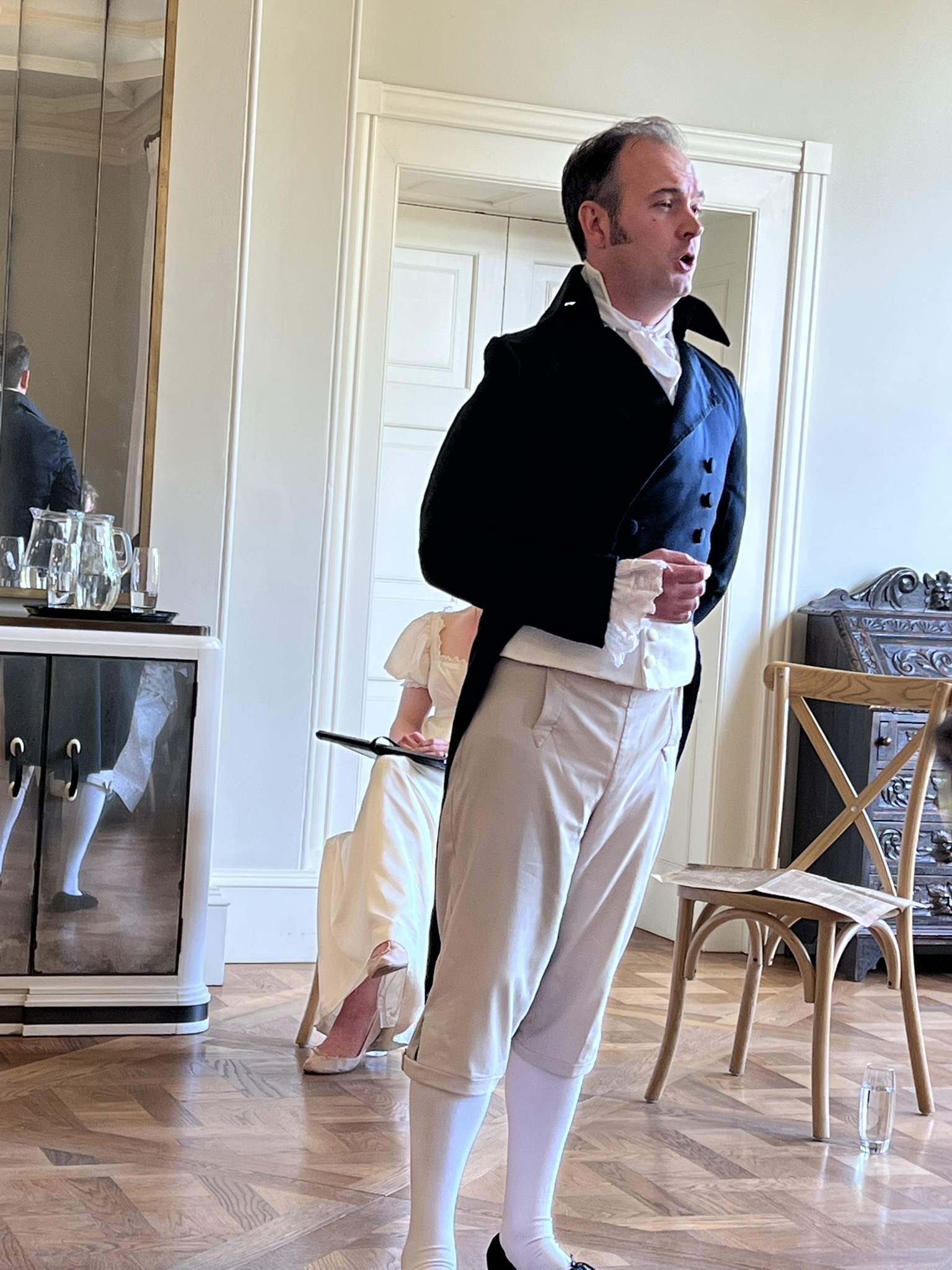
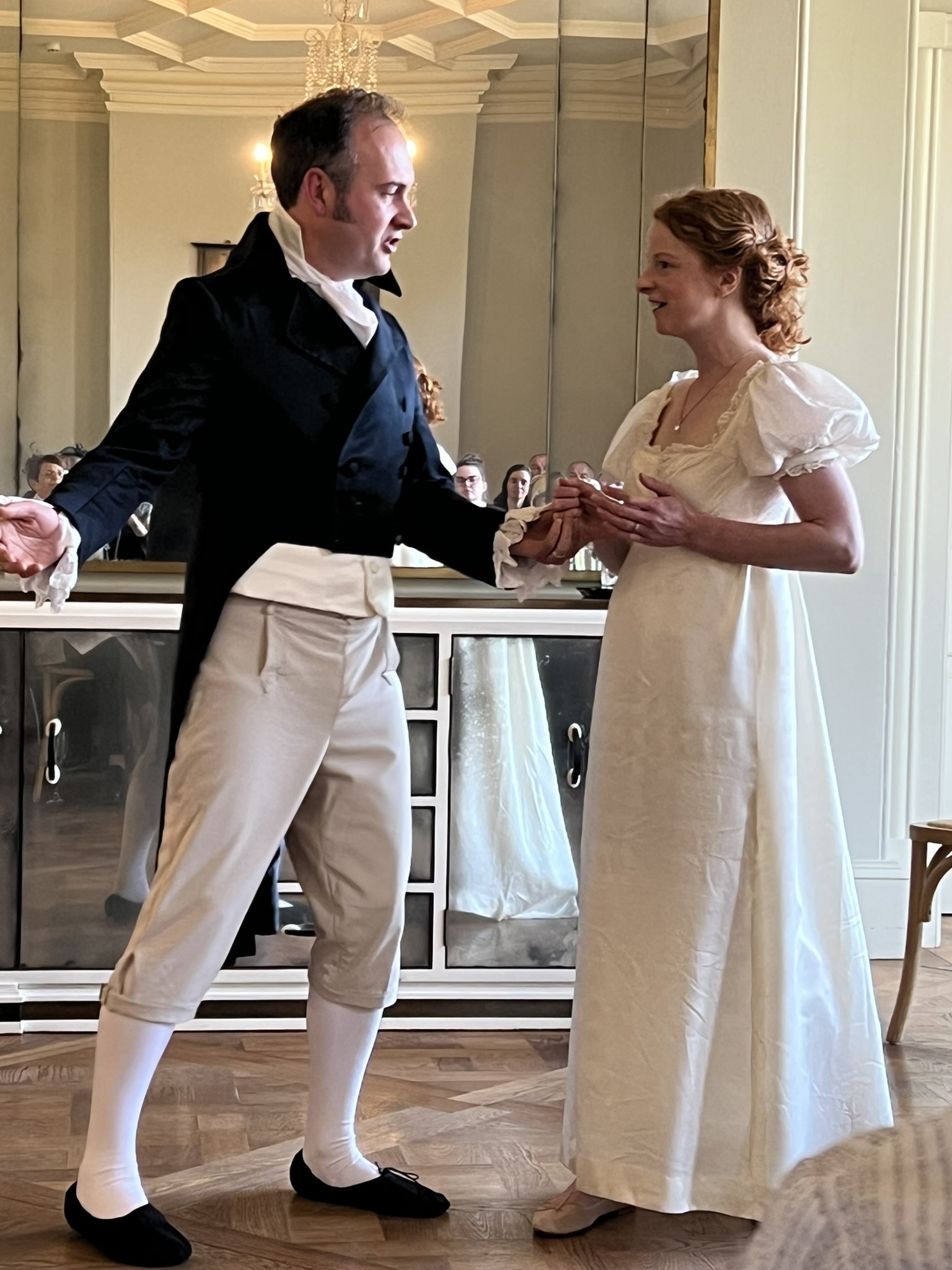
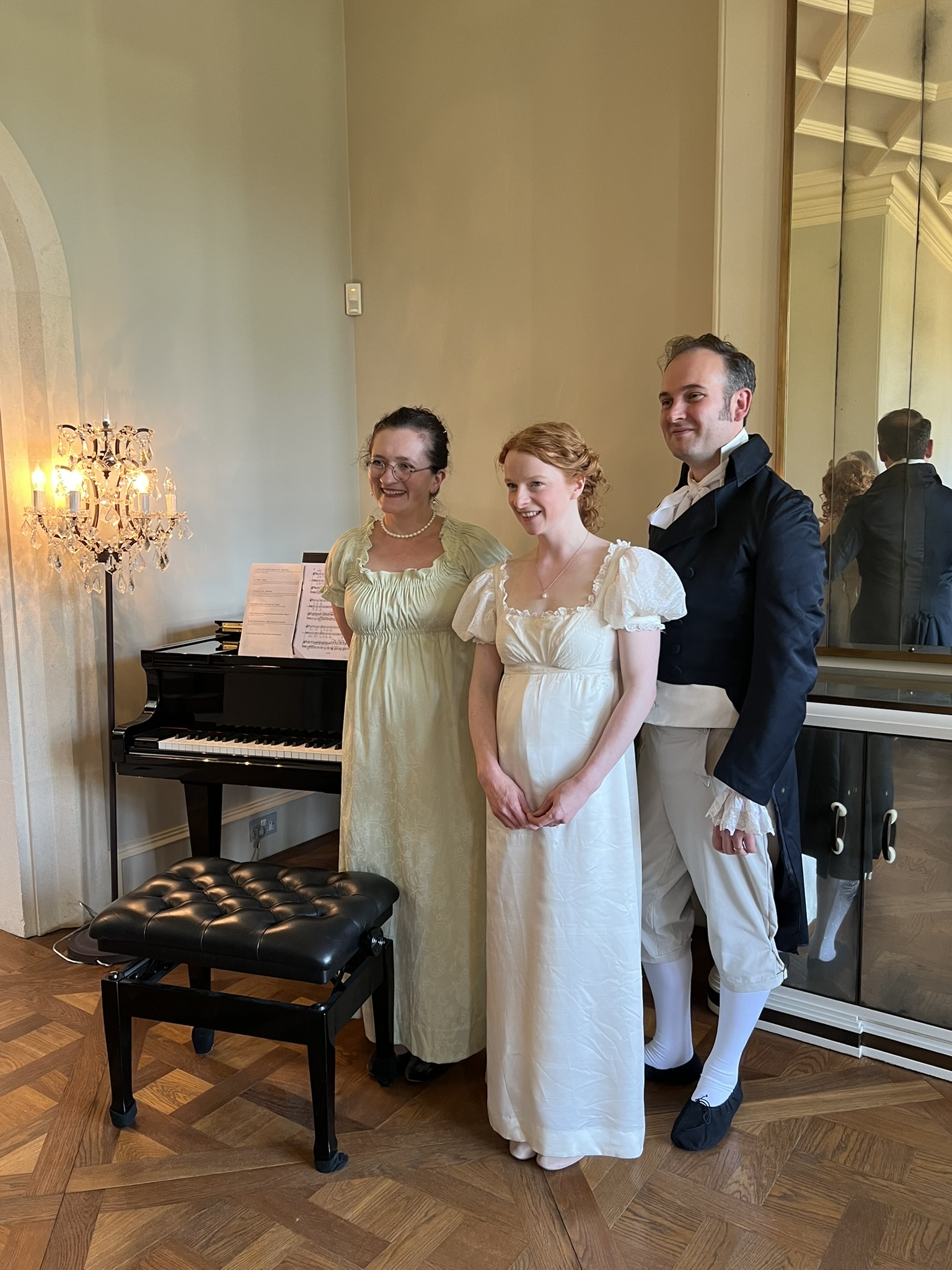
On entering the house, we were vastly and beautifully entertained by a Regency Ensemble of three: pianist and two singers singing Jane Austen-era songs: “A Delightful Diversion” performed by The Literary Music Ensemble:
**************
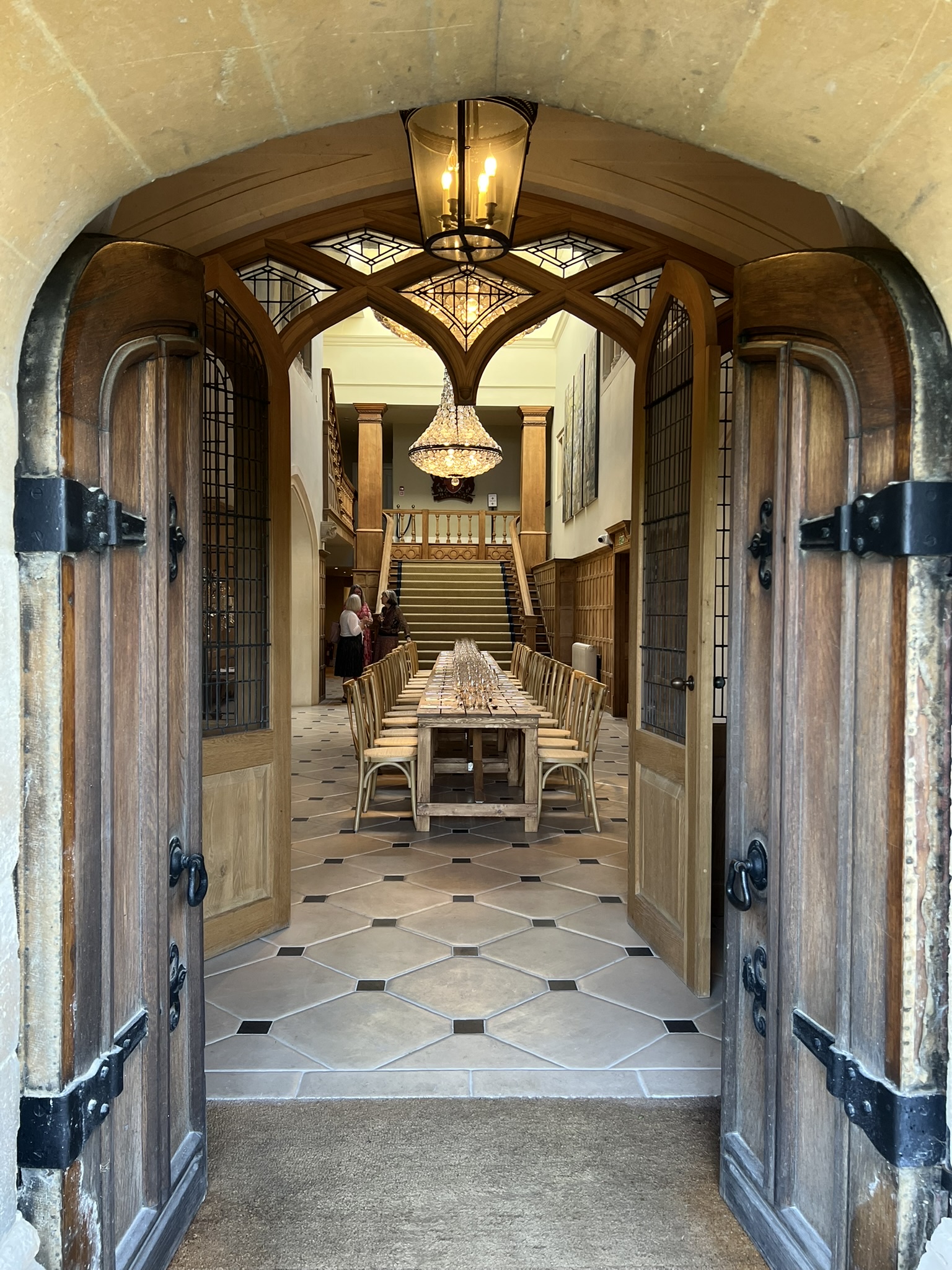
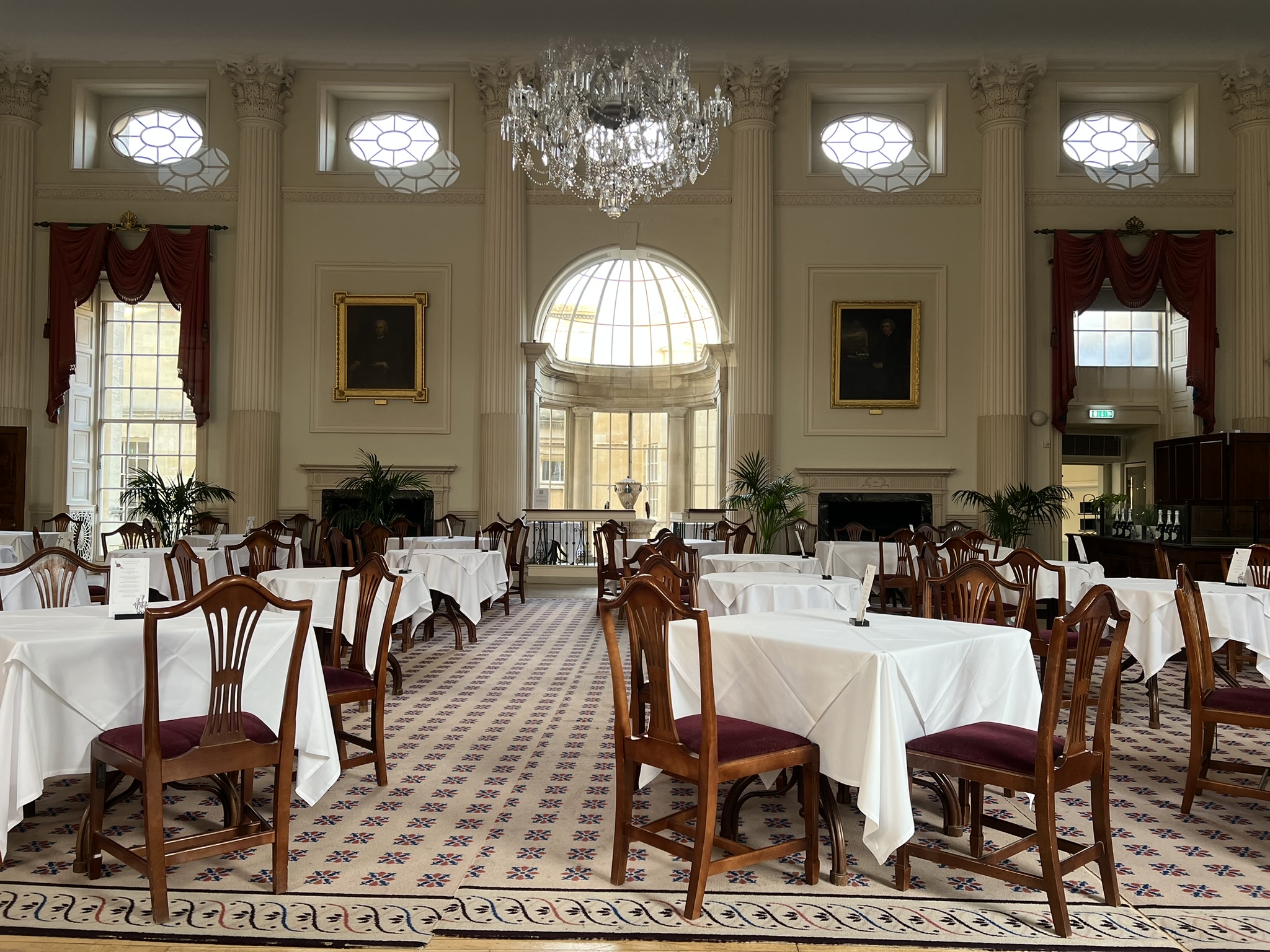
Then into the main hall that serves as the VERY large dining room – on offer was a delicious buffet…
No going upstairs, but one could wish…
Dessert!!
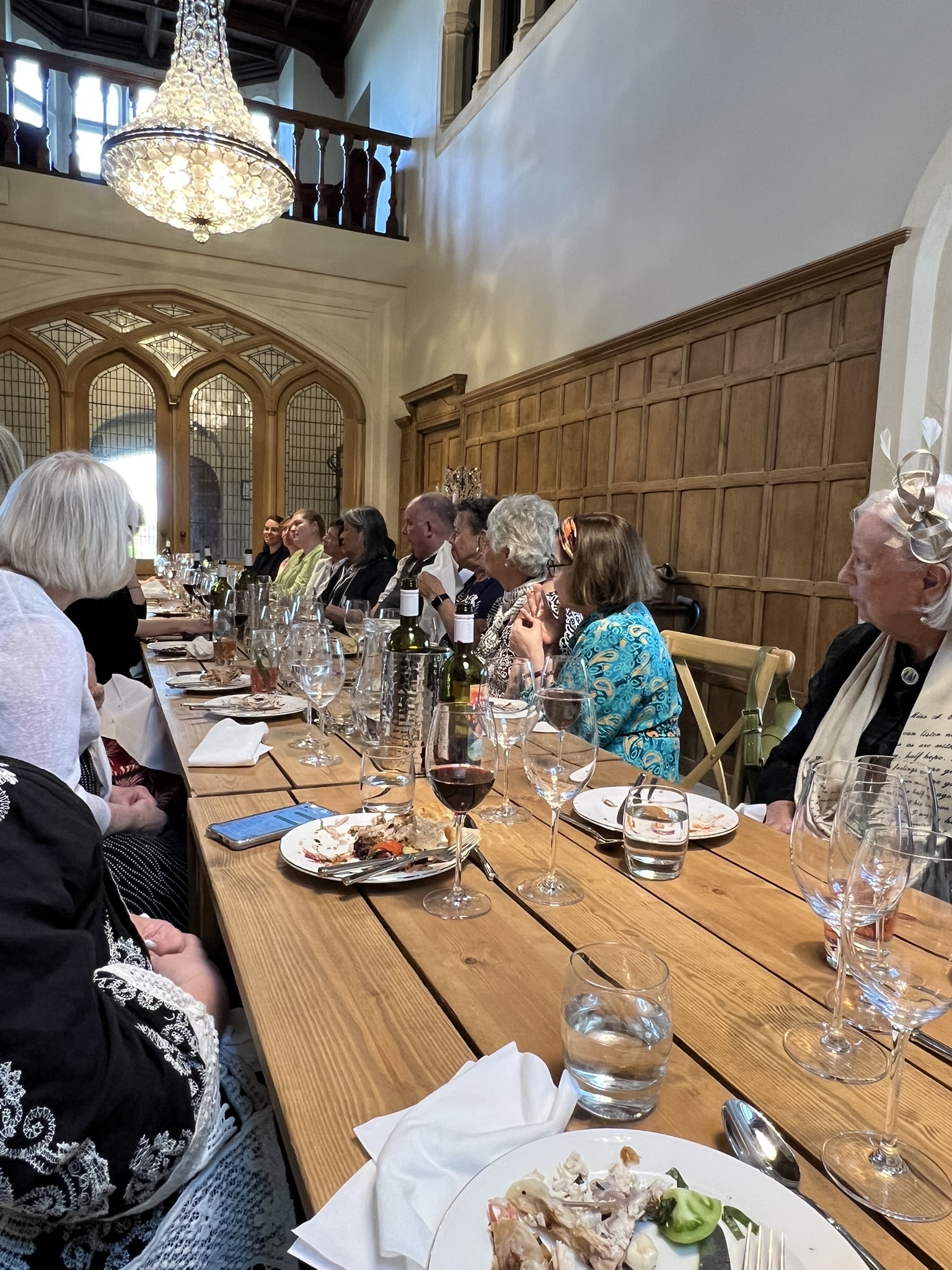
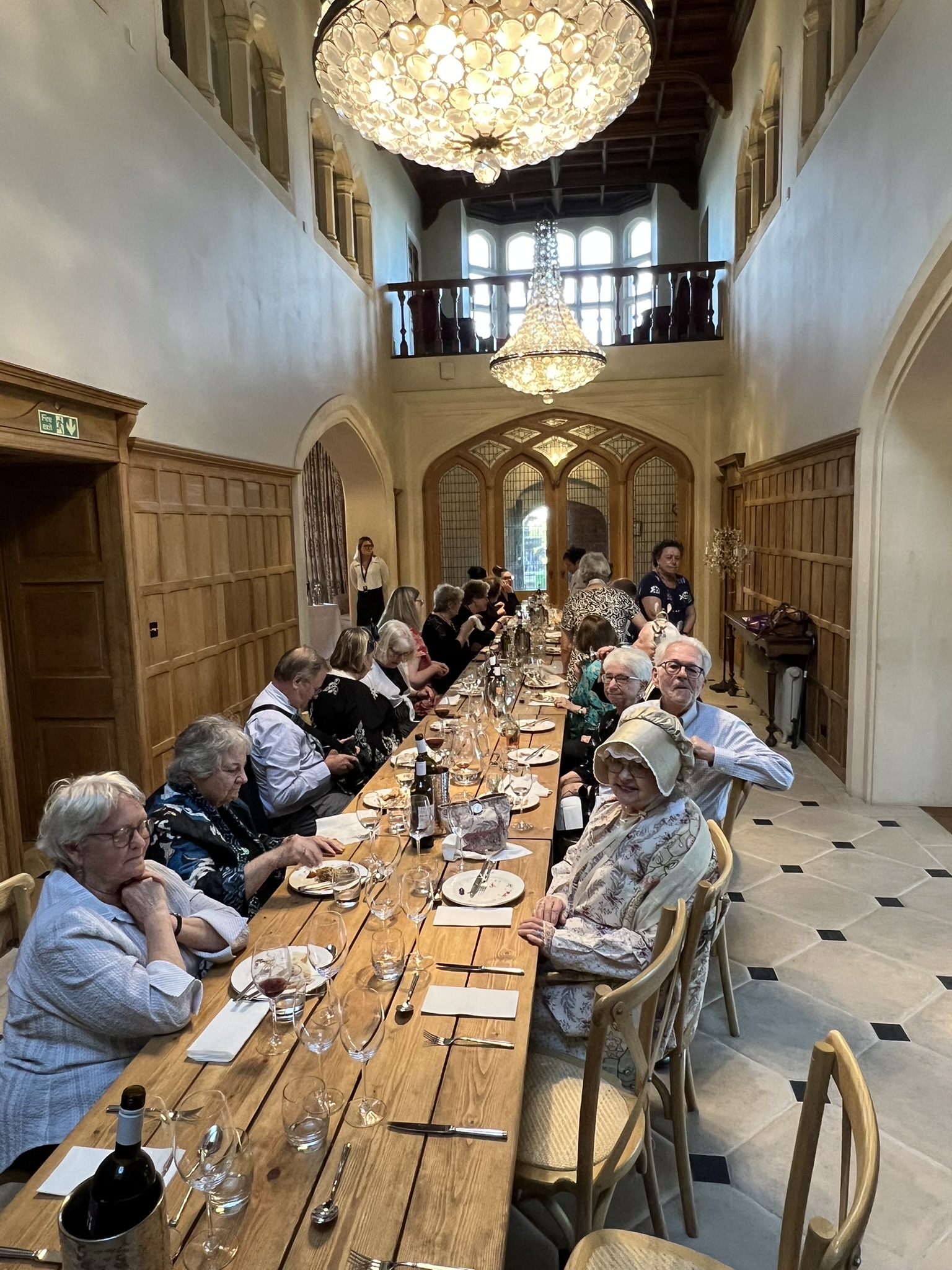
A perfect place for a Regency gathering of like-minded souls – JASNA went all out here for our last evening together:
Claire and Marcia!
Back on the bus heading back to the hotel on a beautiful evening, all very well-fed, very well-entertained, and quite sad to be bidding adieu to each other…:
Well, finally back to recounting this Jane adventure – I have been to London again and then to Belgium for a Flemish Art tour [fabulous trip with Martin Randall Travel] – so working on remembering the details of this JASNA tour while reentering from an immersion into the art world of the 14th – 16th centuries…with enough artist-rendered crucifixions to last a lifetime…
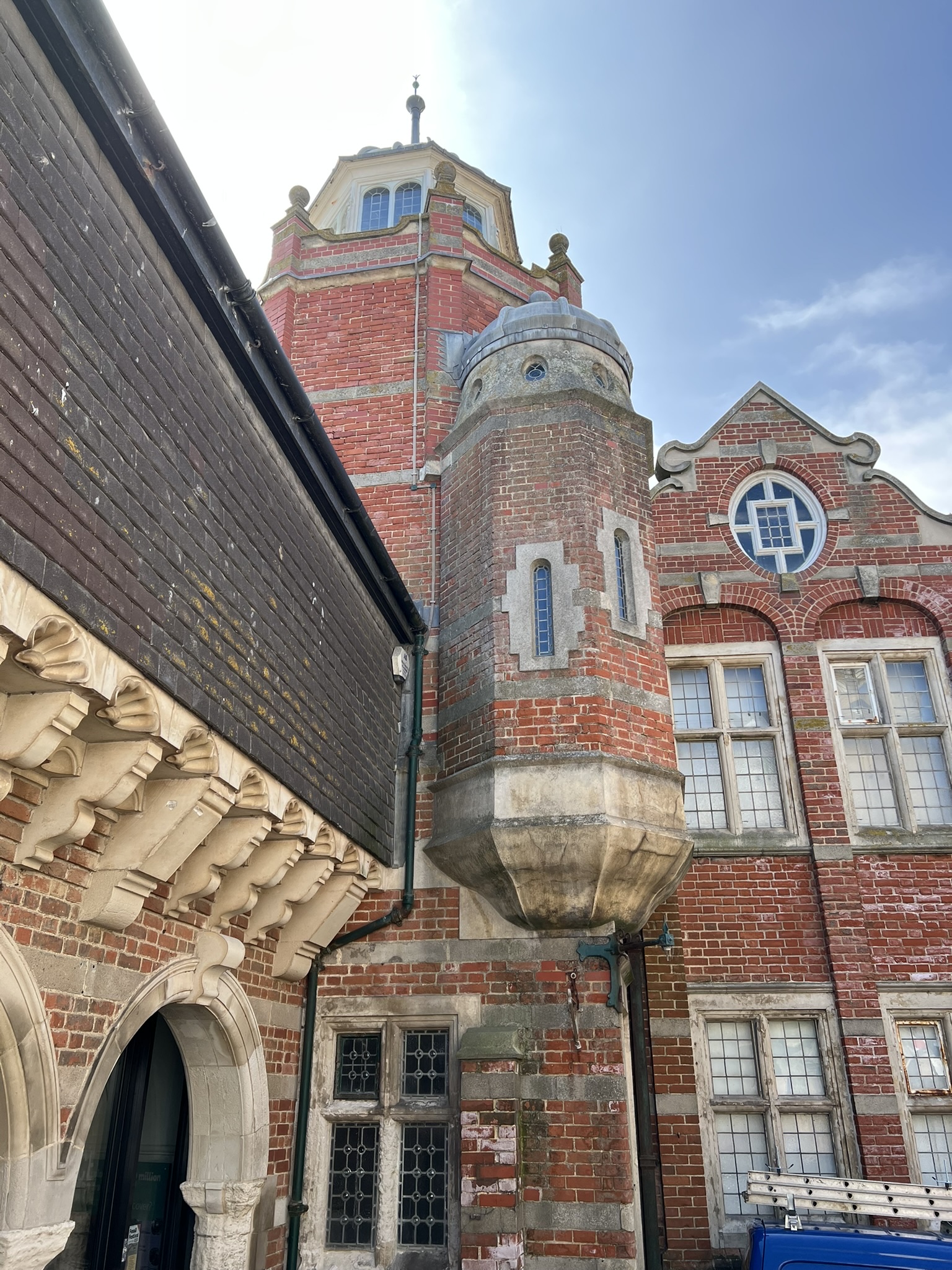
I left off with our visit to Chawton on Day 8 – now on to Day 9 when we left our excellent Winchester Hotel and headed on to Bath – with the absolutely required stop in Lyme Regis – no Wentworth in sight as yet, but one can only hope. Actually I was more on the lookout for Jeremy Irons, but that is another story entirely…
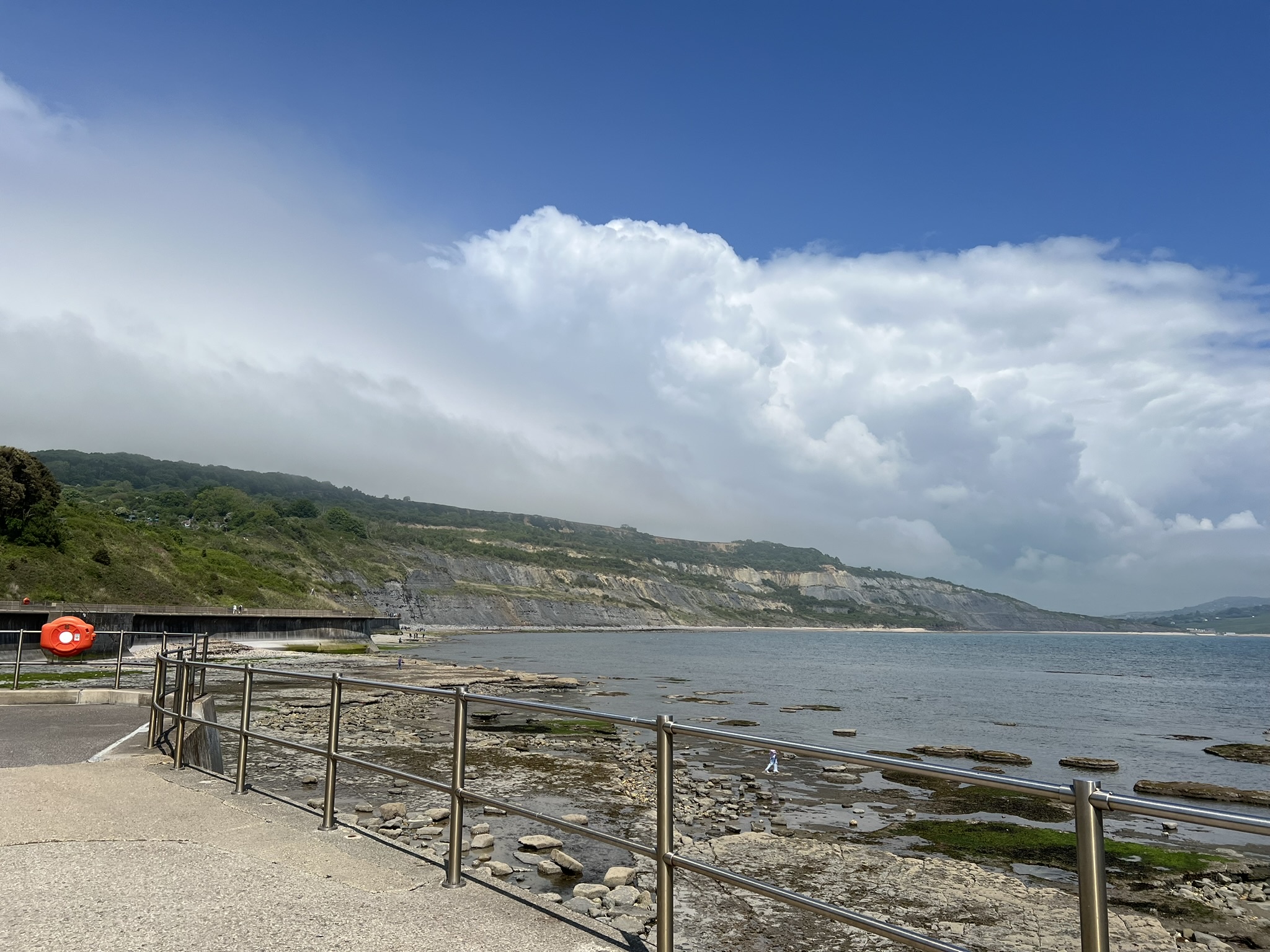
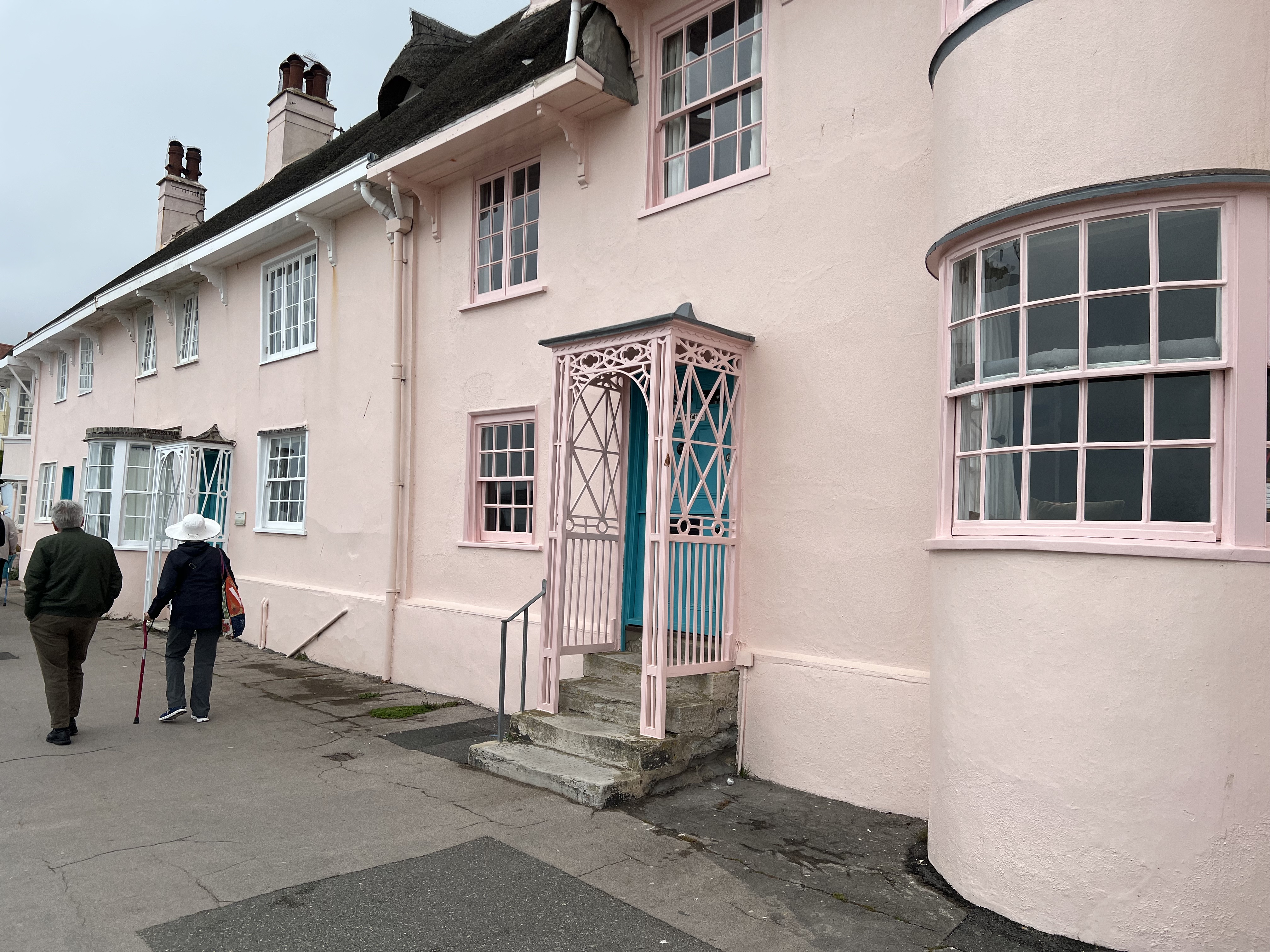
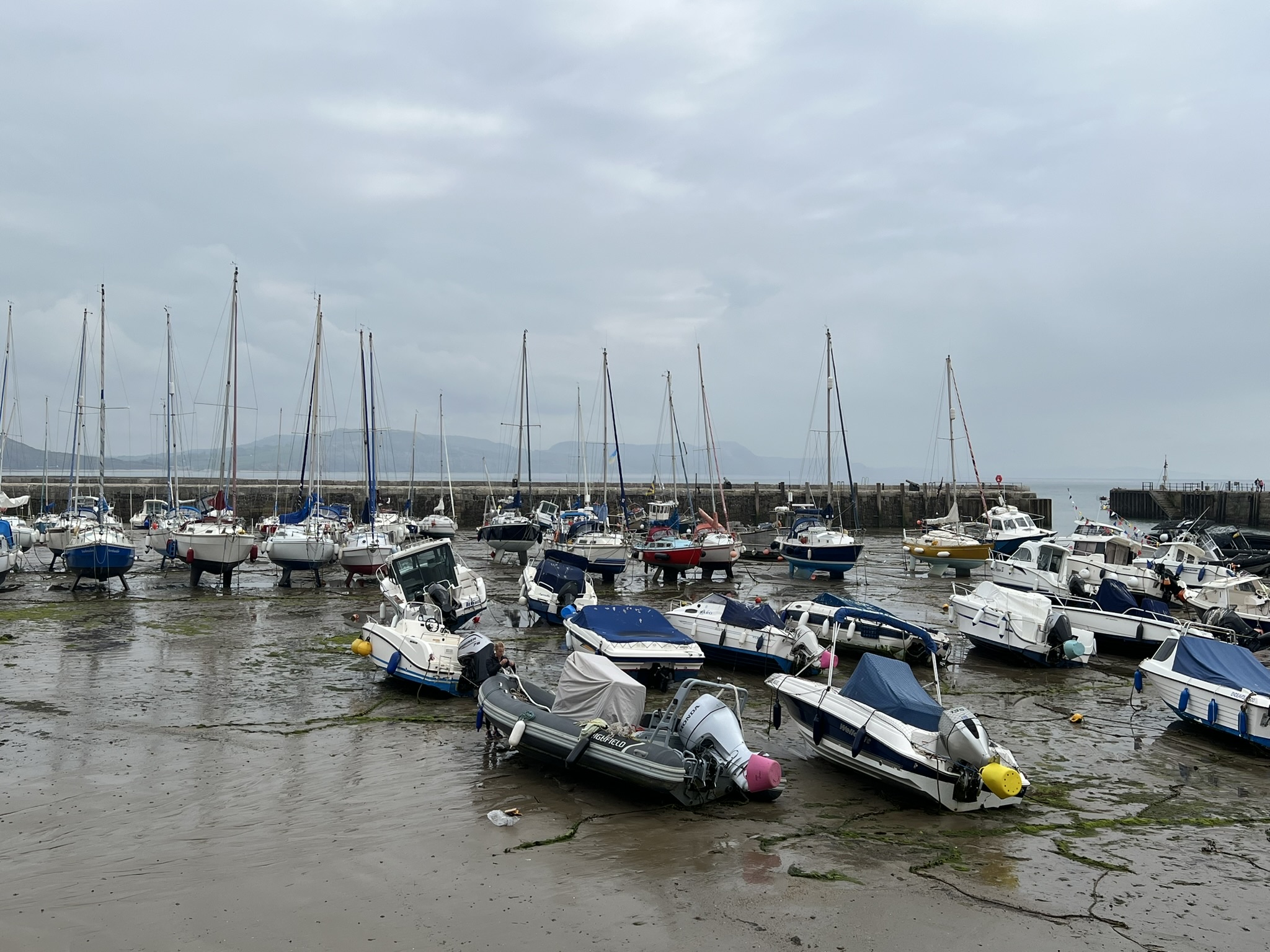
I have been to Lyme Regis before, where I stayed with friends in a bed & breakfast – the owner a sailor and the house fitted up like a ship – and with gorgeous views of the cliffs. Today was a perfect day, but very hazy and the cliffs barely visible the whole time we were there – unfortunate because it gives you a whole different perspective on this town, both now and when Austen would have visited.
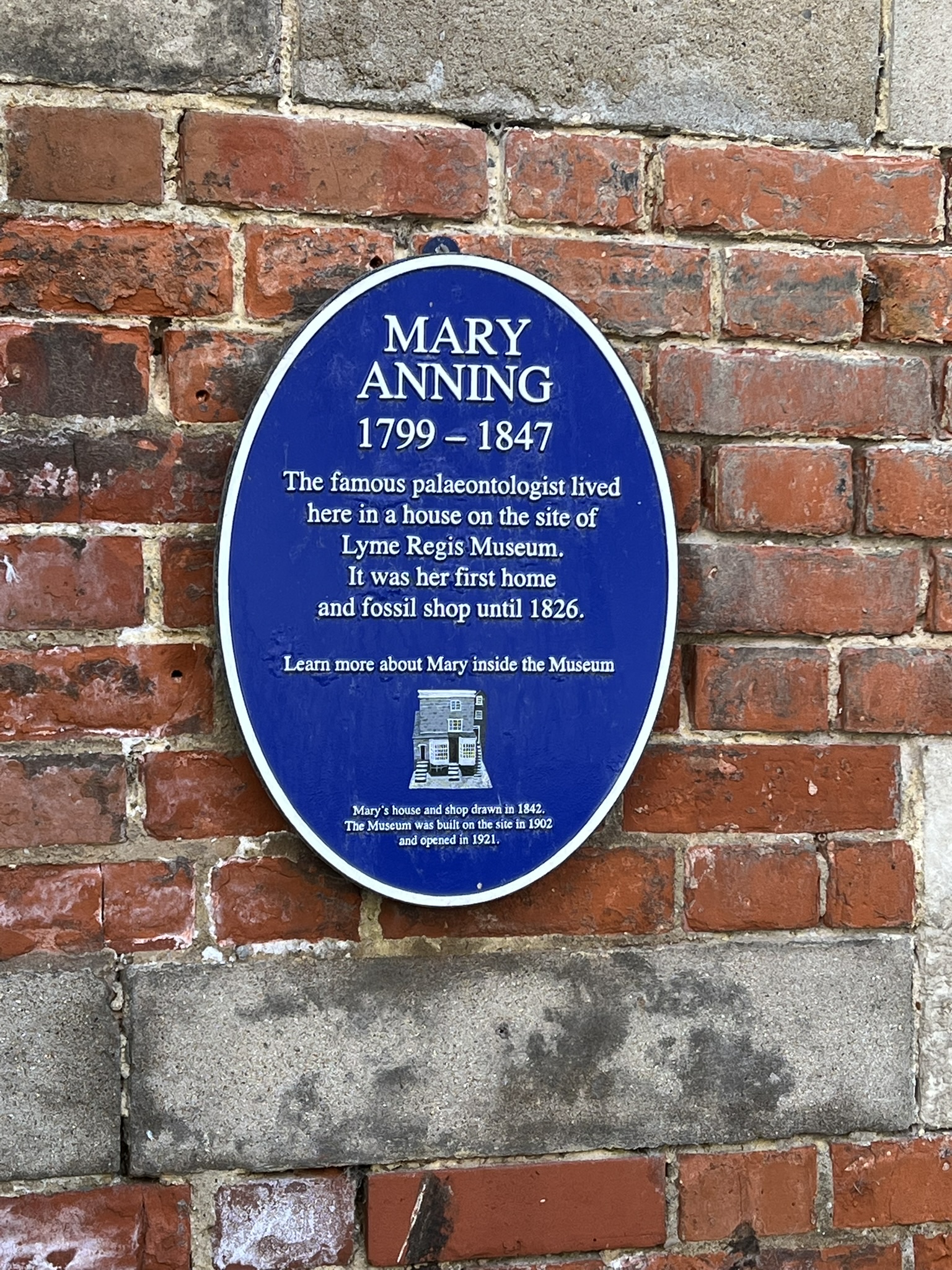
What does get prime attention here, and rightly so, is Mary Anning, famous for her fossil hunting and contributions to the study of paleontology. [You can read about her in Tracy Chevalier’s Remarkable Creatures for the historical fiction approach, but also here for a complete history lesson: https://www.nhm.ac.uk/discover/mary-anning-unsung-hero.html
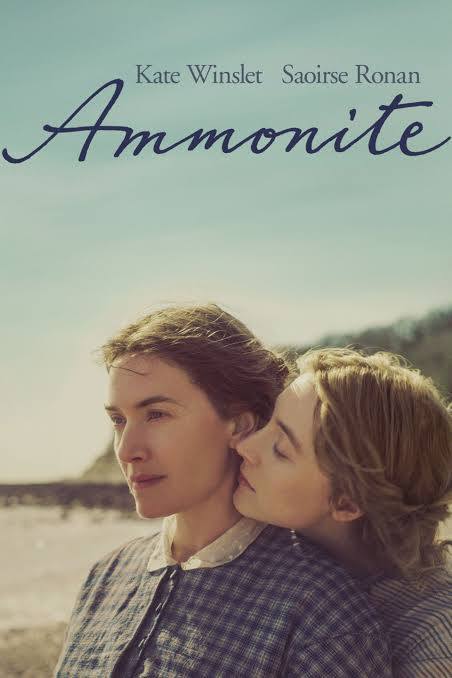
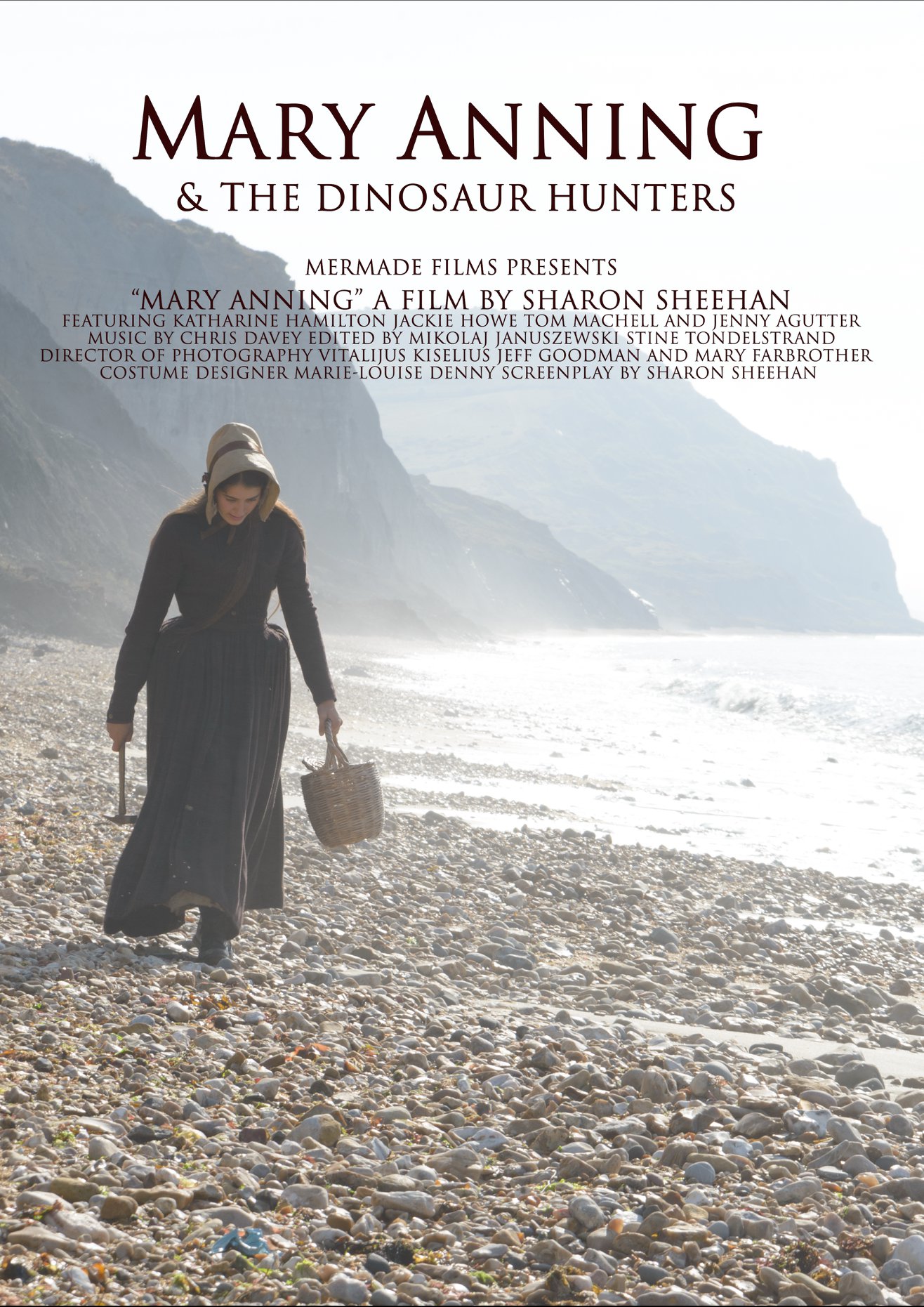
There is also the recent movie (2020) with Kate Winslet: Ammonite, which adds quite a bit to the historical record. And also the 2024 Mary Anning and the Dinosaur Hunters. Mary getting her just due finally!
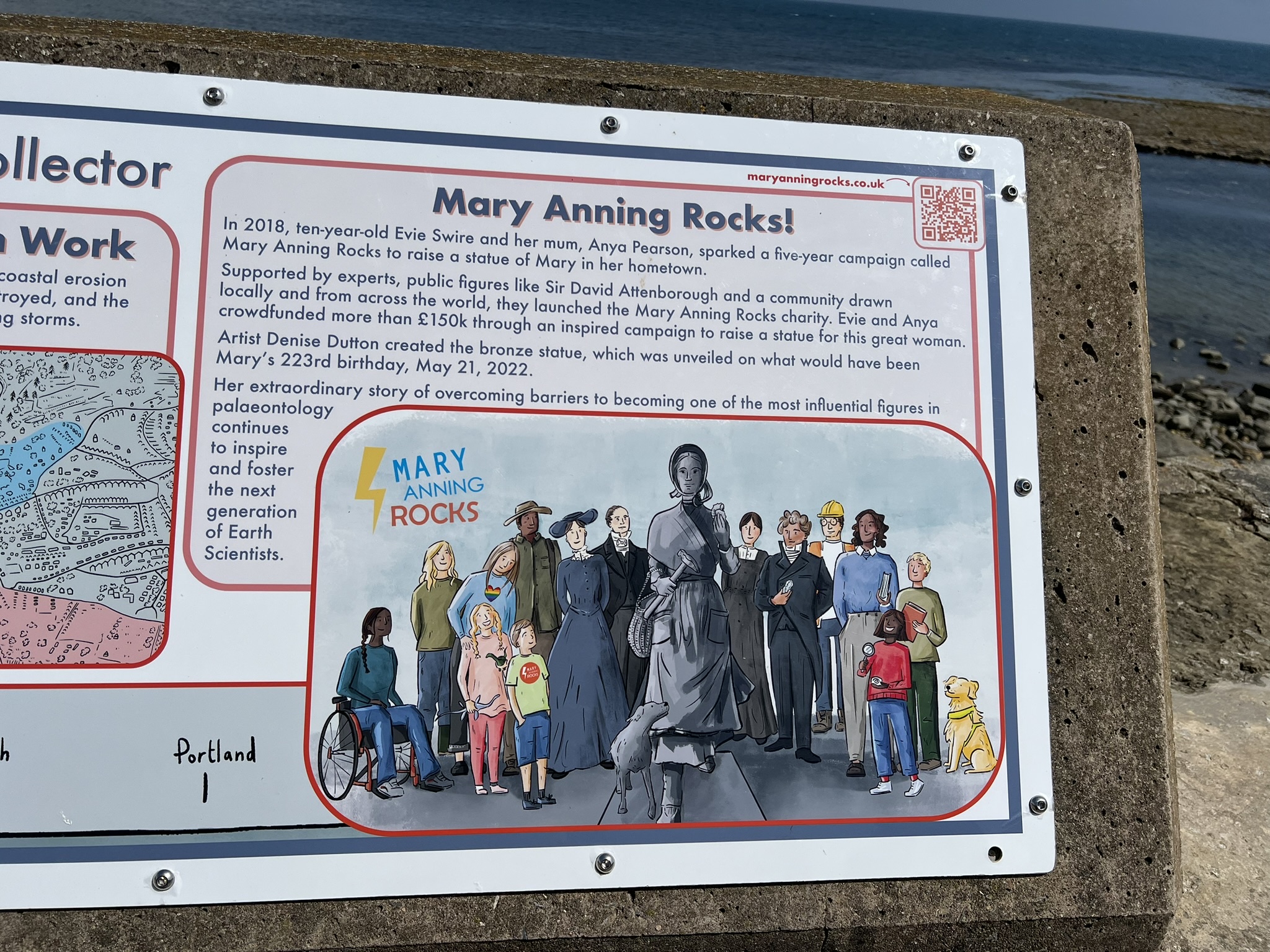
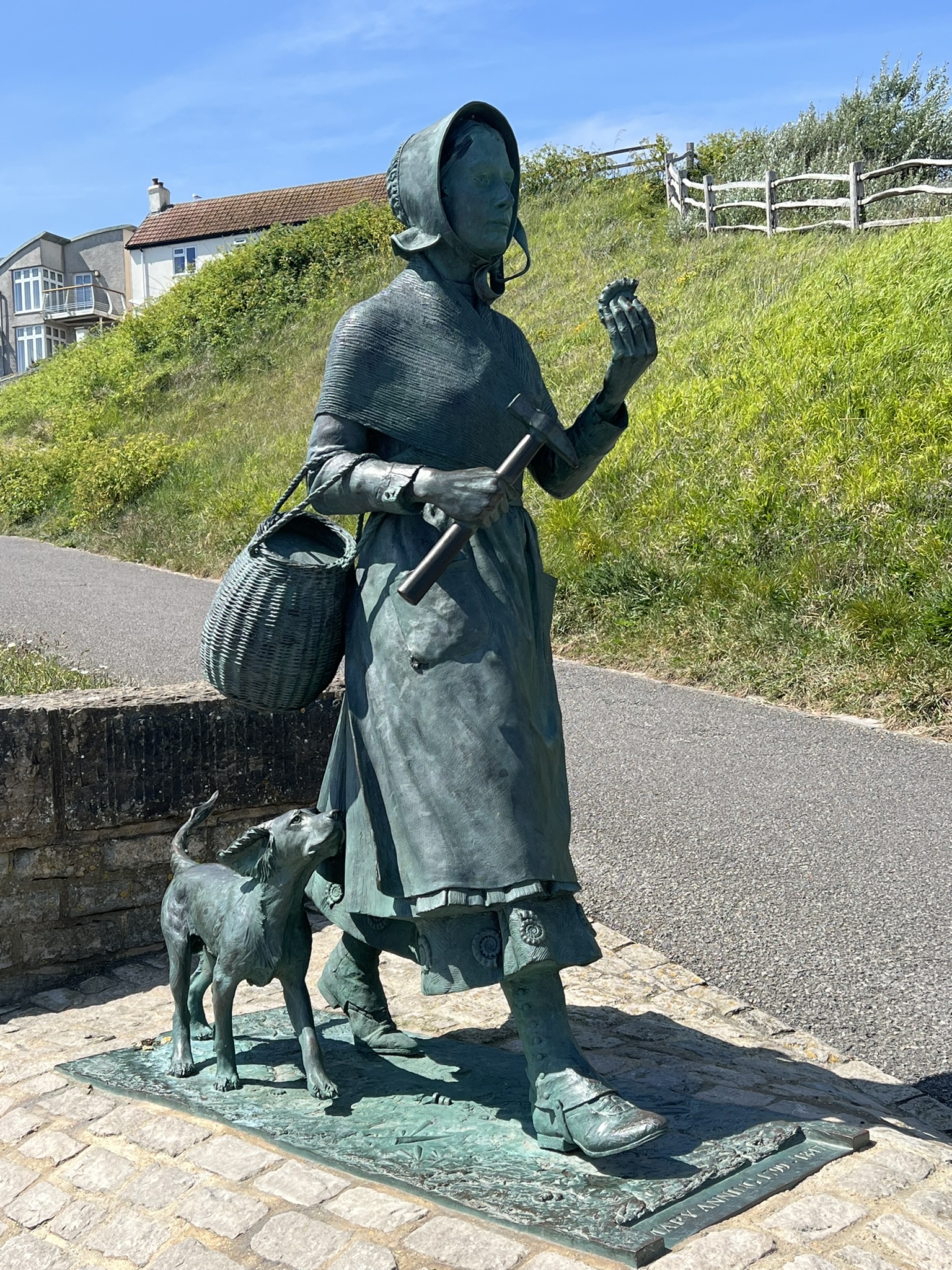
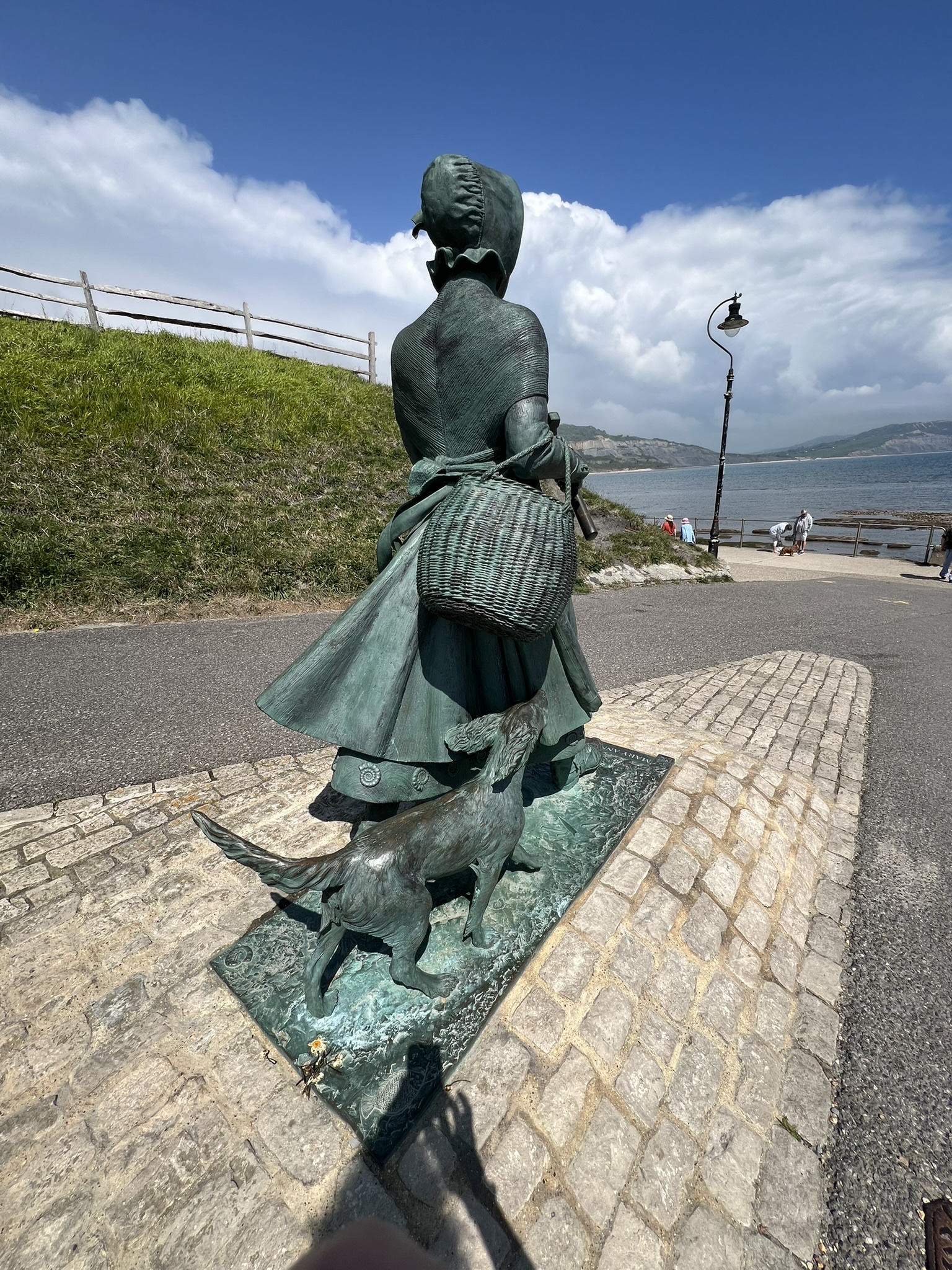
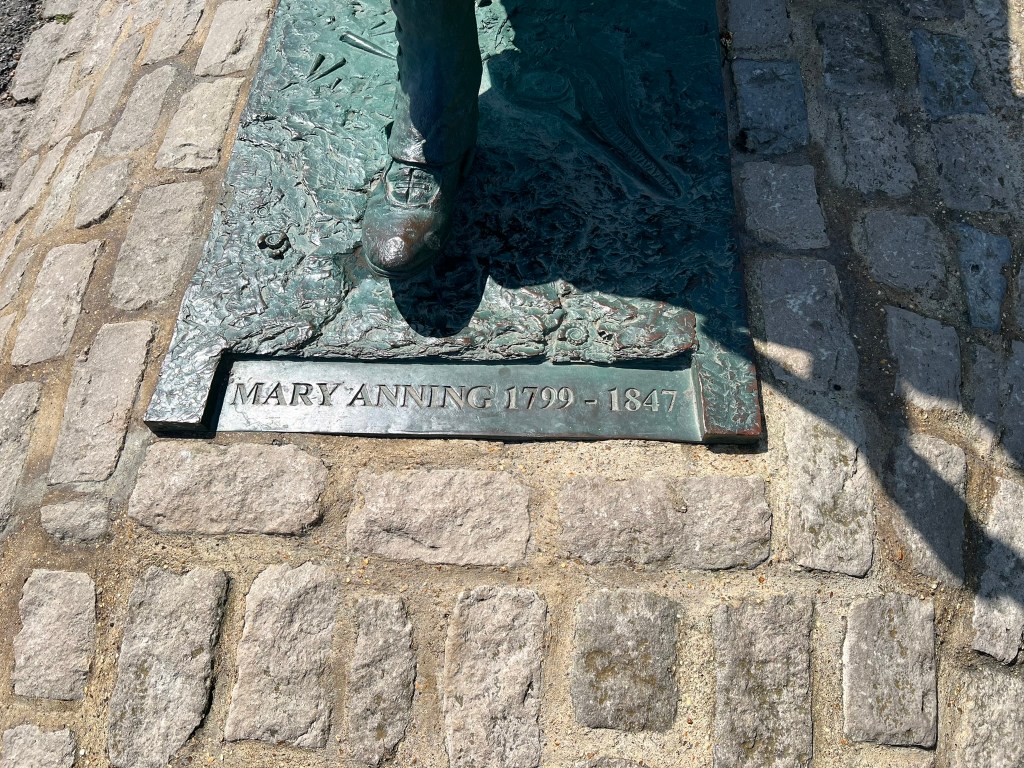
So, one of my main quests in our short visit to Lyme Regis was to see the Mary Anning statue, recently unveiled in 2022 – its creation a story in itself: a crowdfunding campaign called “Mary Anning Rocks” started by an 11-year old girl in Dorset – [did you know that 85% of the statues in the UK are of men??? Why am I not surprised…].
Designed by Denise Dutton, it is beautifully placed with a Mary in active pursuit looking out to sea with her dog in tow. It is quite lovely:
*****
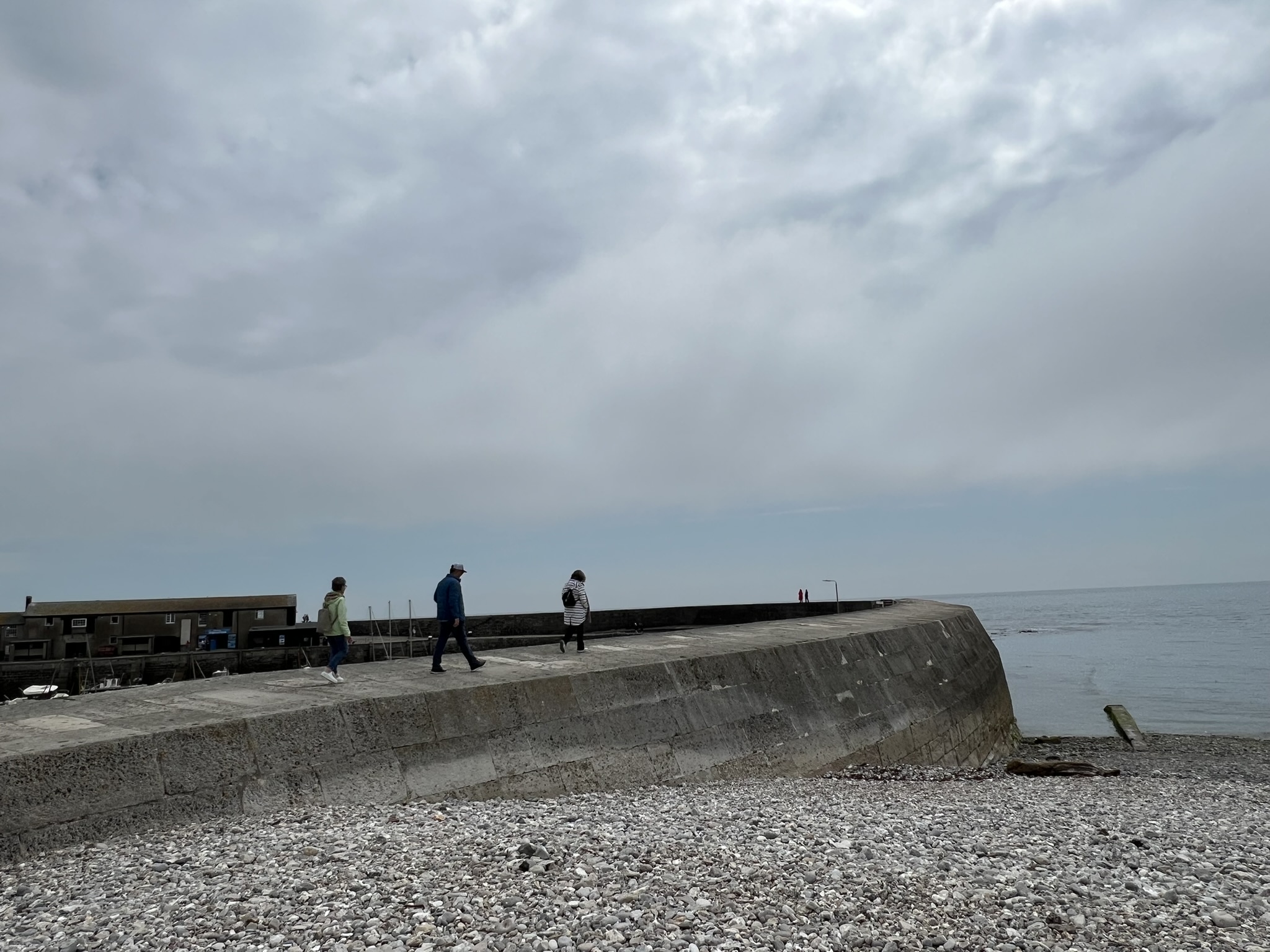
As for Jane here [and she is everywhere!]: we did a stroll on the Cobb – we listened to Marian [our tour manager] read the passage on Louisa Musgrove’s famous fall from the Cobb in Persuasion – we did this before attempting the treacherous Cobb itself as it was quite windy – we did not need a reenactment of anyone falling – especially as I have already noted that Wentworth was nowhere to be found…
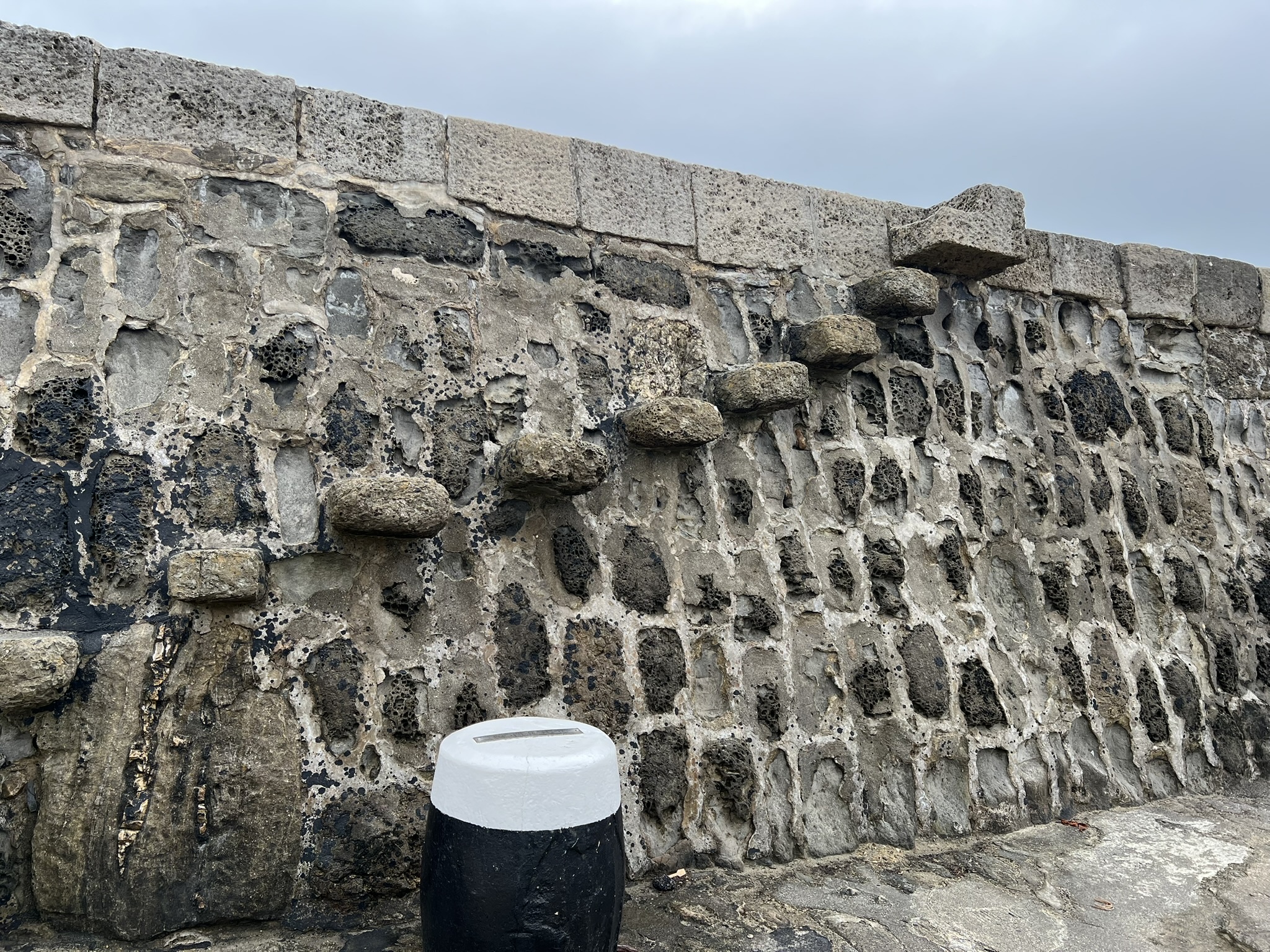
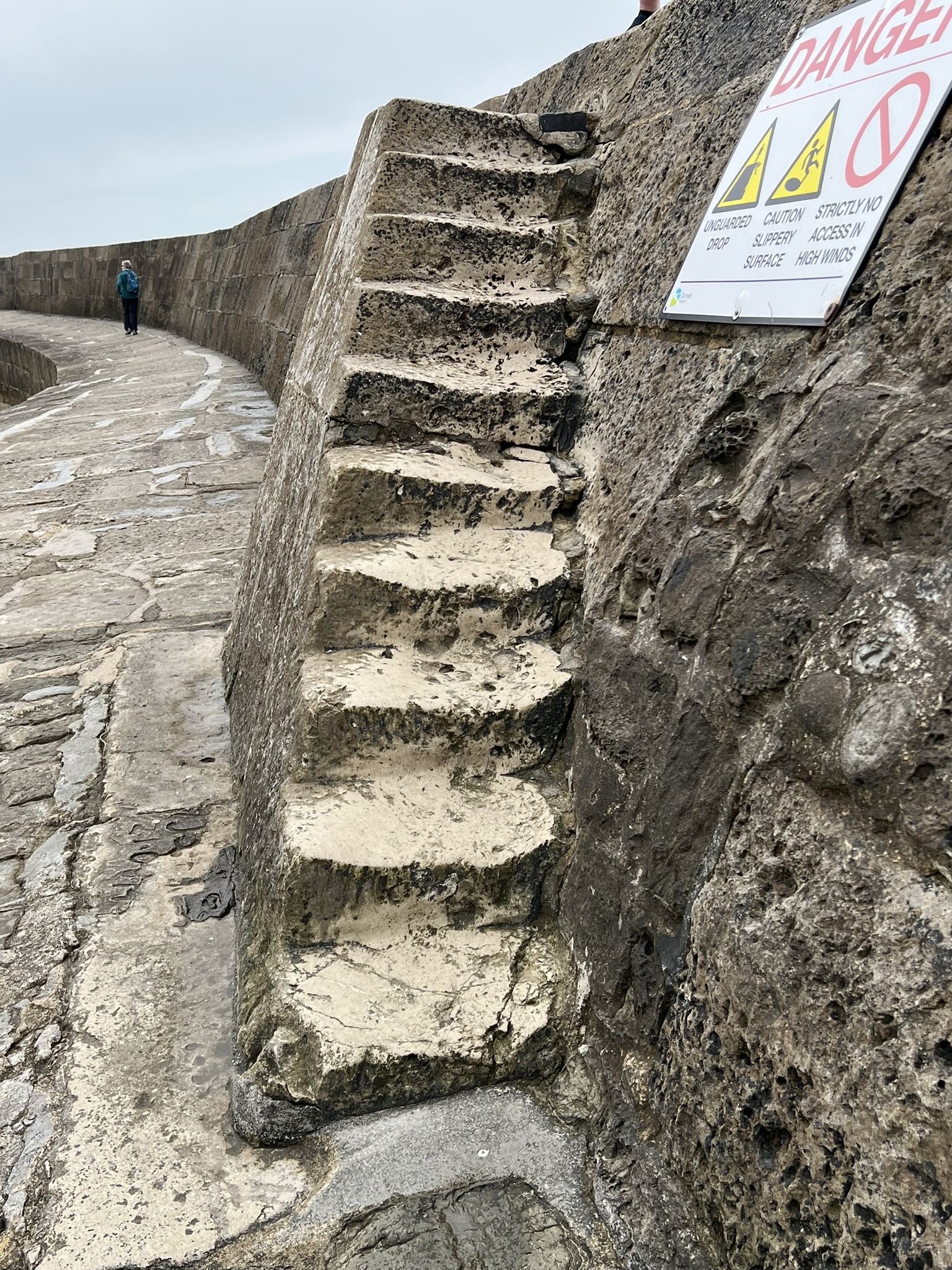
…and pictures do no justice to the extent of the slant on the Cobb – treacherous is too gentle a word…
Louisa’s fall is quite a tale, and it lives on in the imagination of us all, but none perhaps as renowned as these two:
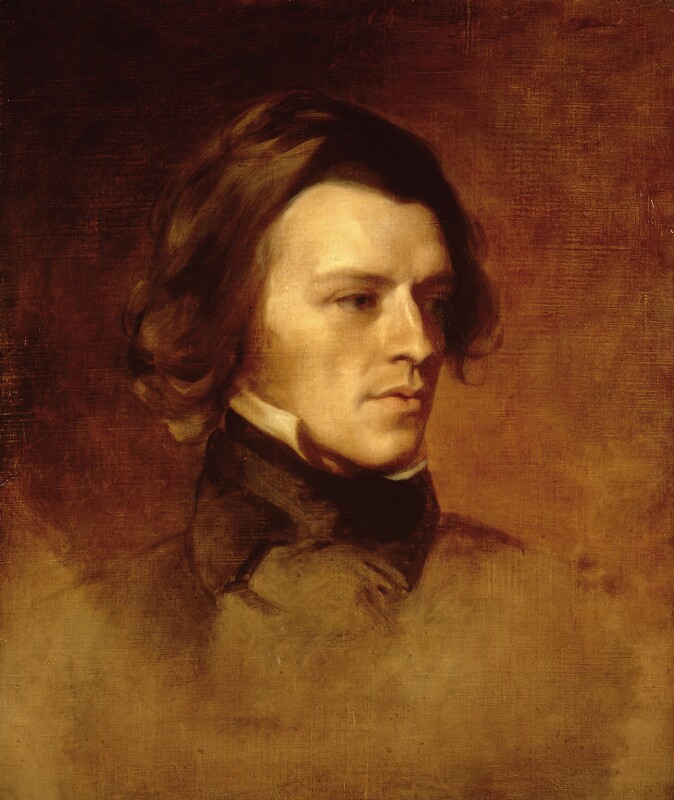
Alfred Lord Tennyson visited Lyme primarily for its Austen sites, walking the nine miles from Bridport to Lyme on 23 August 1867—“led on to Lyme by the description of the place in Miss Austen’s Persuasion.” Arriving, Tennyson called on his friend Francis Palgrave, and “refusing all refreshment, he said at once, ‘Now take me to the Cobb, and show me the steps from which Louisa Musgrove fell.’
Charles Darwin’s son Francis expounded a good deal on the actual location wondering how a strong man such as the Captain could have entirely failed to catch her – he hypothesizes that Wentworth slipped, as he did himself: “I quite suddenly and inexplicably fell down. The same thing happened to a friend on the same spot, and we concluded that in the surprisingly slippery character of the surface lies the explanation of the accident.” (see Peter Graham, “Why Lyme Regis?” Persuasions 26 (2004): https://jasna.org/publications-2/persuasions/no26/graham/ )
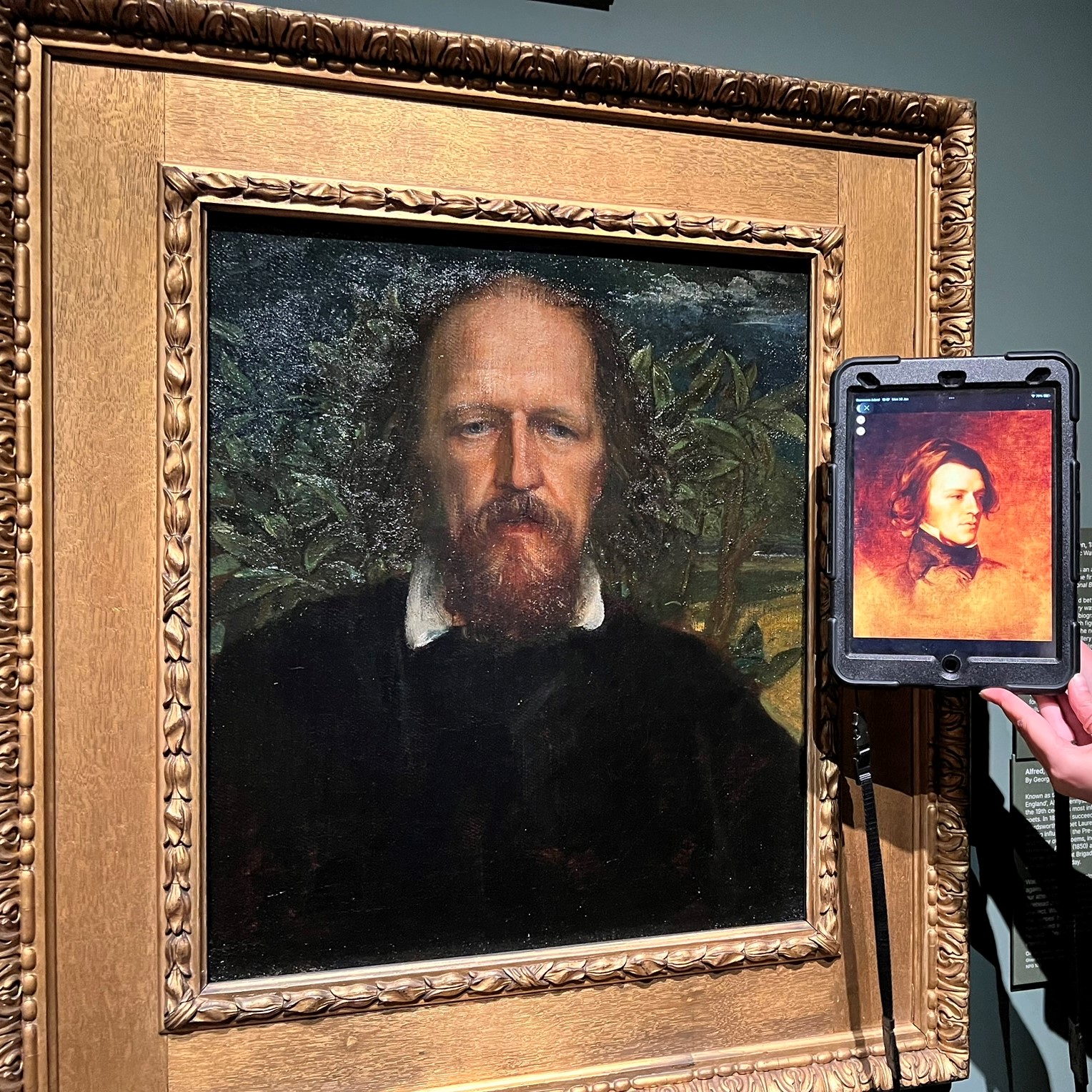
[This portrait at the NPG of a young quite-to-die-for Tennyson is no longer on display – here is the one there now – a shock to discover this when I just returned to London again last week and finally got to the renovated NPG:
I told the guard, here holding the earlier painting on her ipad, that she must speak to the powers that be and get young Tennyson back on view!]
But, back to the steps – the confusion continues as to which steps Louisa actually jumped from – “granny’s teeth” on the left being the most decided upon: but another treacherous walking adventure on the Cobb… two of my photos:
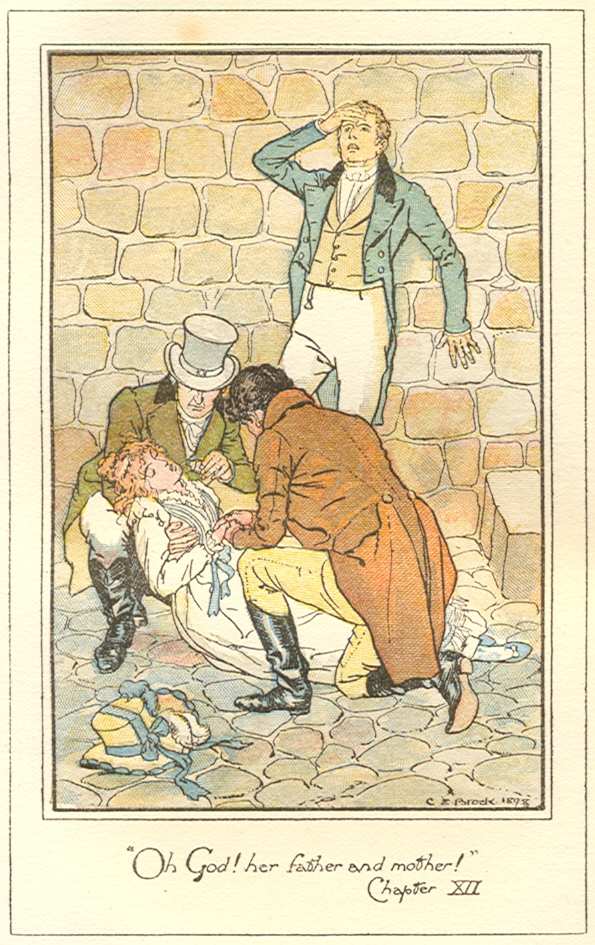
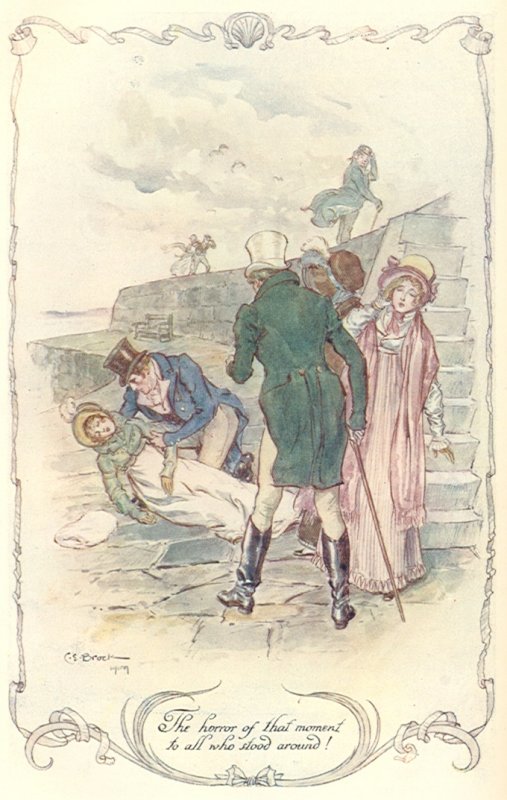
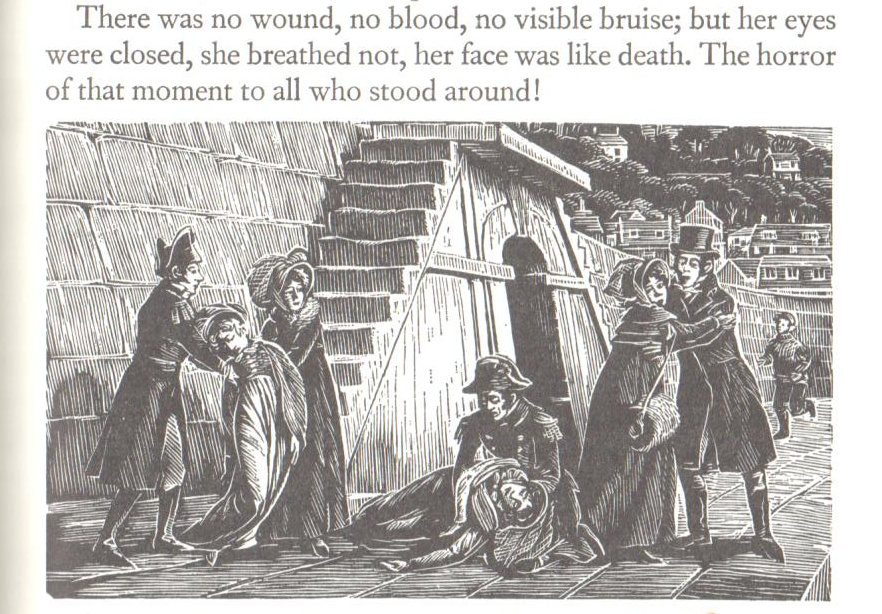
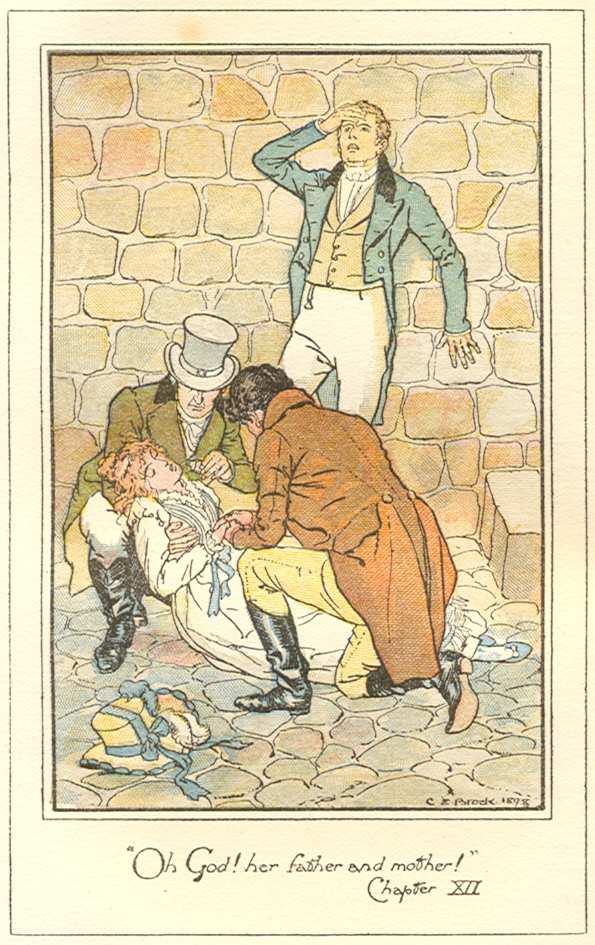
Illustrators of Austen’s Persuasion went wild with this scene, showing both options in their drawings: do you show her jumping?, or lying “lifeless” on the ground, Wentworth pleading “Is there no one to help me?” – here are just a few:
C. E. Brock – Dent, 1898 / Dent, 1909
Hugh Thomson – Macmillan, 1897
Joan Hassall – Folio Society, 1975, shows Henrietta in a swoon: “nay, two dead young ladies”!
Niroot Puttapipat – Folio Society, 2007, gives us an action image “I am determined I will” – perfect!
and the 1995 film of Persuasion is also perfect – the first jump when Wentworth catches her…:
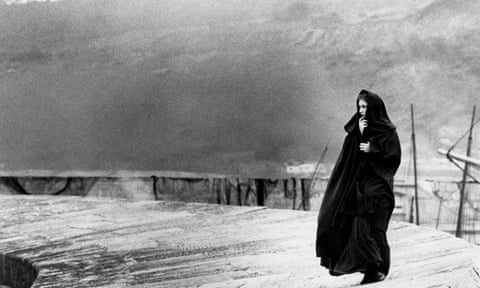
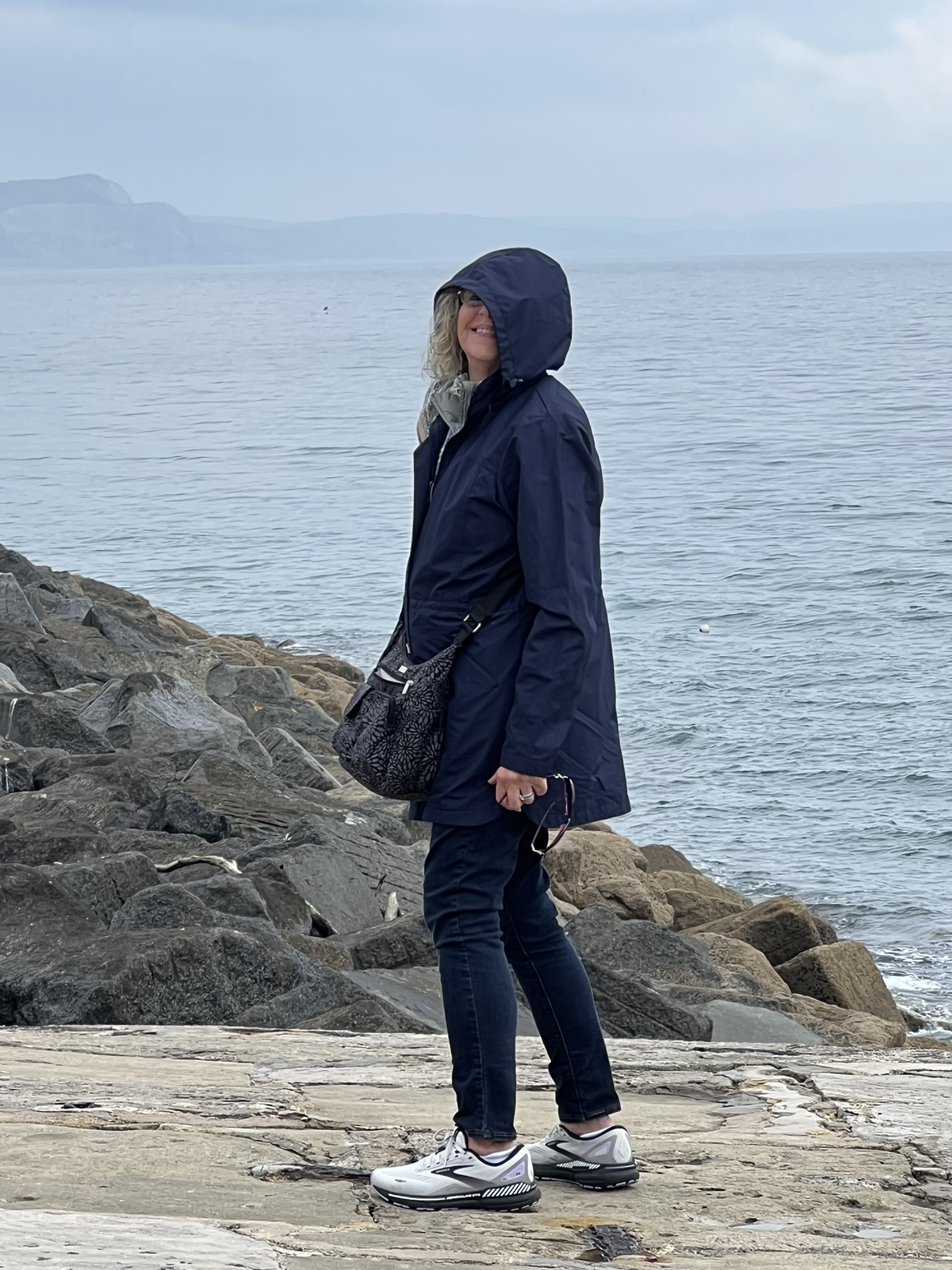
Despite all these dire images in our heads, Joy and I bravely trekked along the Cobb, and here as you can see I am channeling Meryl Streep in The French Lieutenant’s Woman – but again, no Jeremy Irons in sight to rescue me…a precarious place this Cobb…
Then we walked around town in our limited time here, in pursuit of the Anning statue, had lunch at a delightful restaurant, Rock Point, sitting outside on this now sunny day [still hazy…]
– and found that the Lyme Regis Museum was closed on Mondays so we were unable to see much of the local history: info here on the Museum
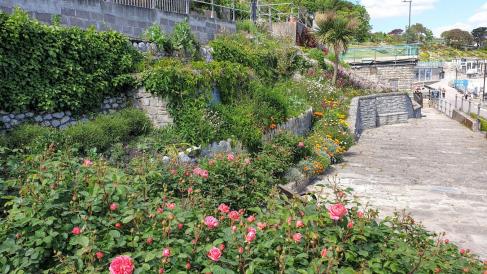
– we did just pass by the place where there is a Jane Austen Garden, but her stone bust disappeared a number of years ago, never to be seen again… sort of like the paintings in the Isabella Stewart Gardner Museum – I didn’t take any photos sorry to say, but here is one from their website:
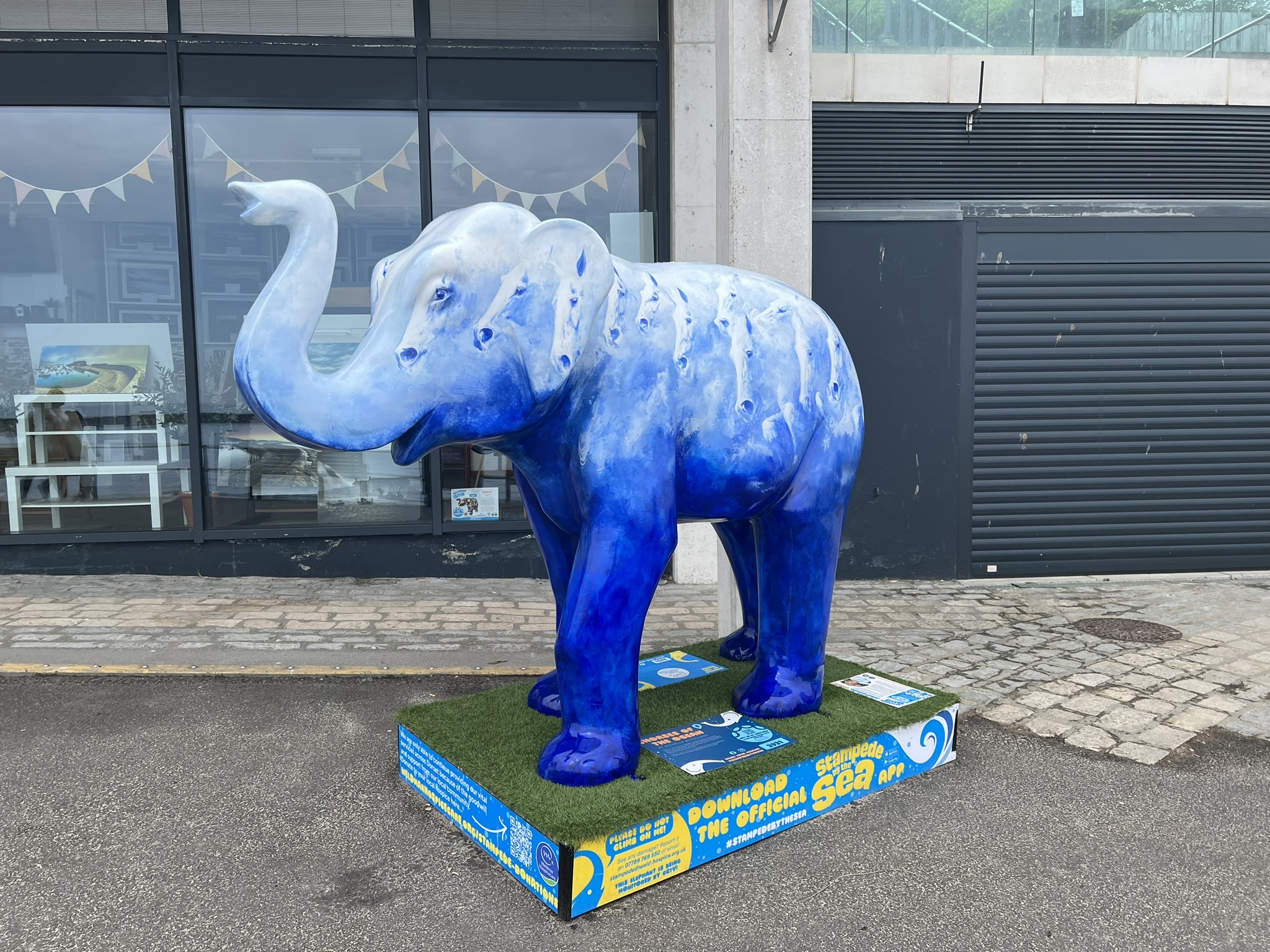
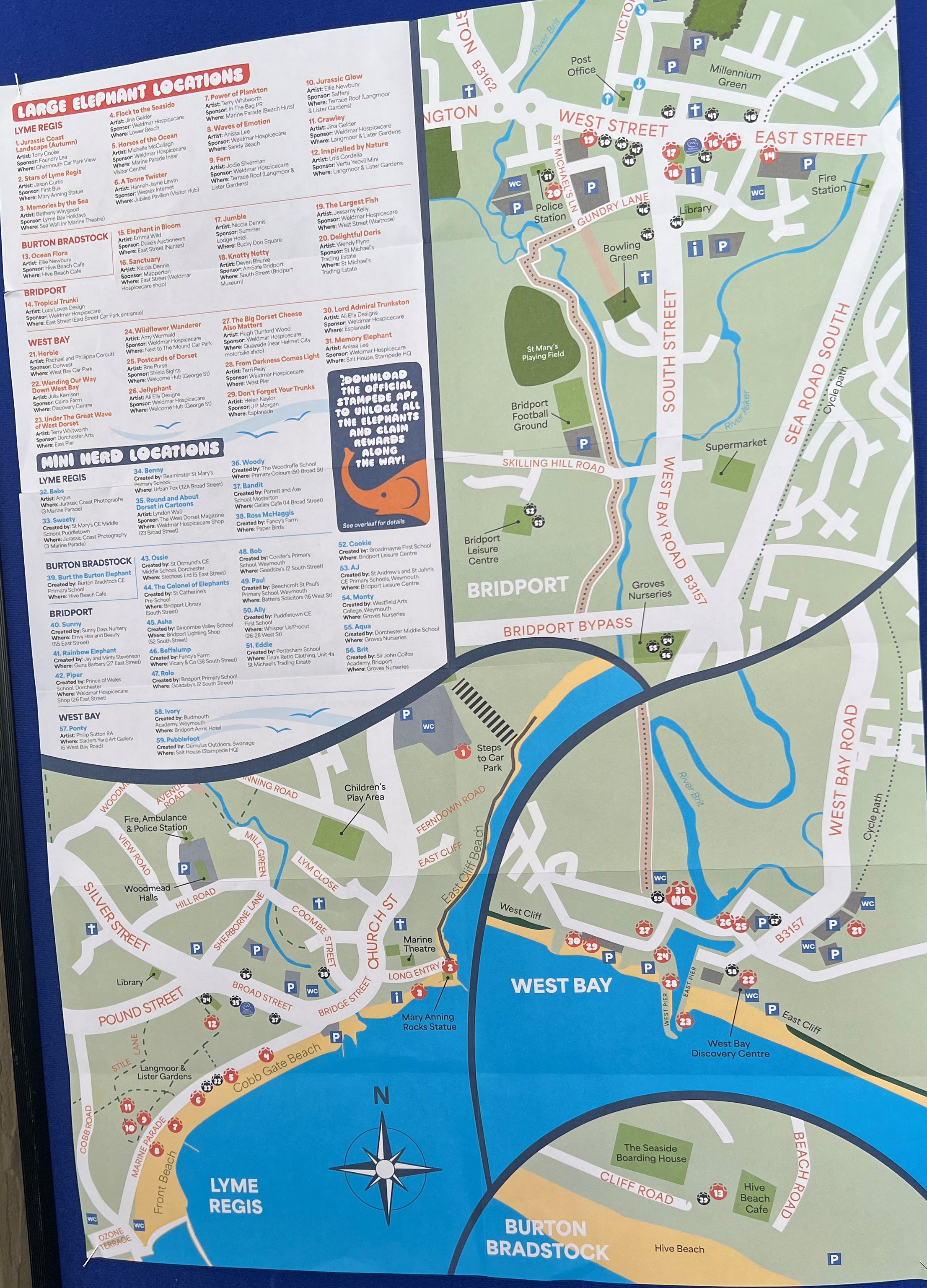
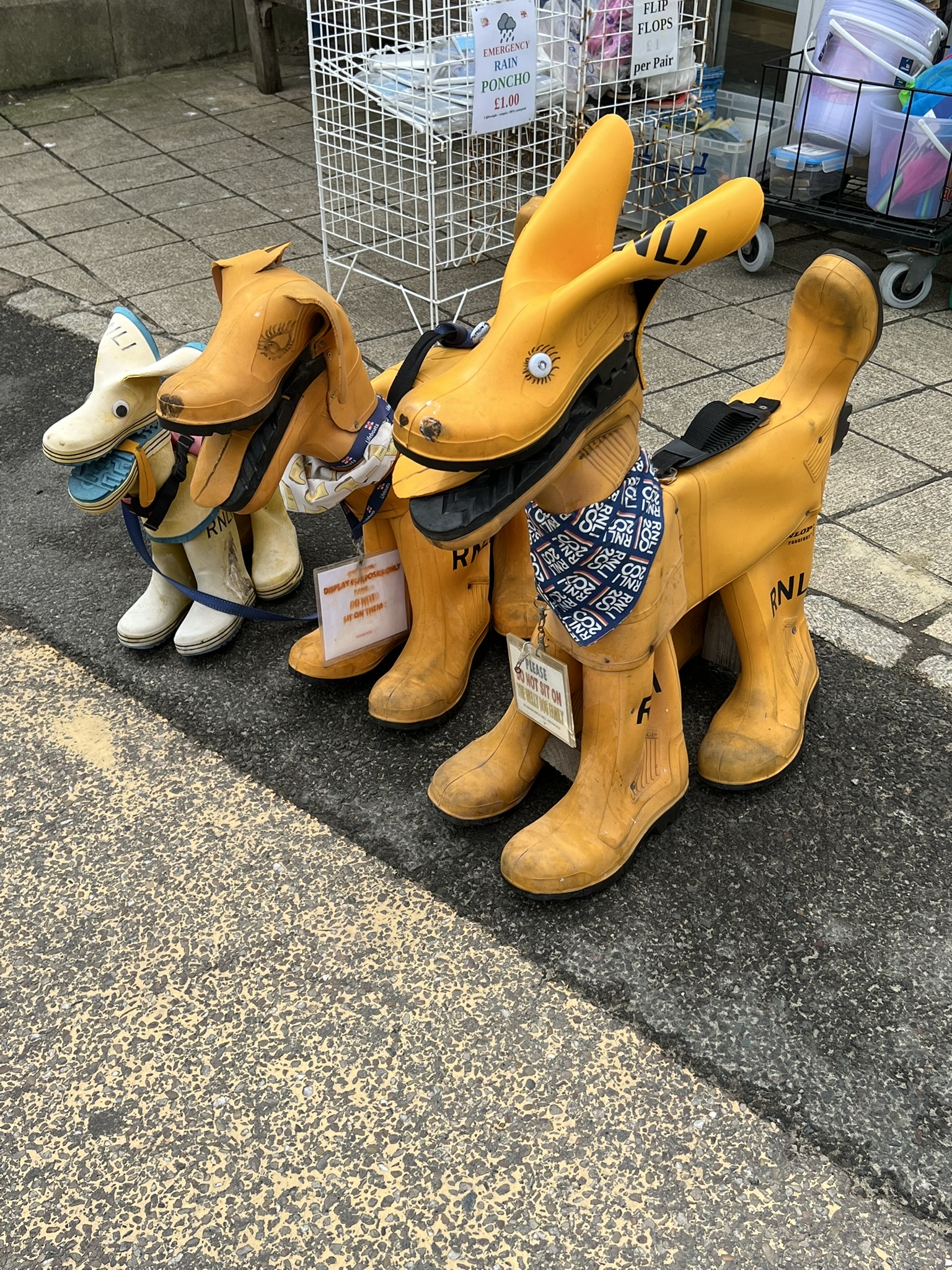
Also of interest walking around town is the current Stampede by the Sea – a collection of decorated painted elephants auctioned off for a charity event – you can find them all here on the map below, but here are two that captured my imagination: [look closely at this first one – what do you see??]
Map of all these hefty fellows about town – it is quite the fundraiser:
a farewell to Lyme Regis…the Cliffs just appearing…
************
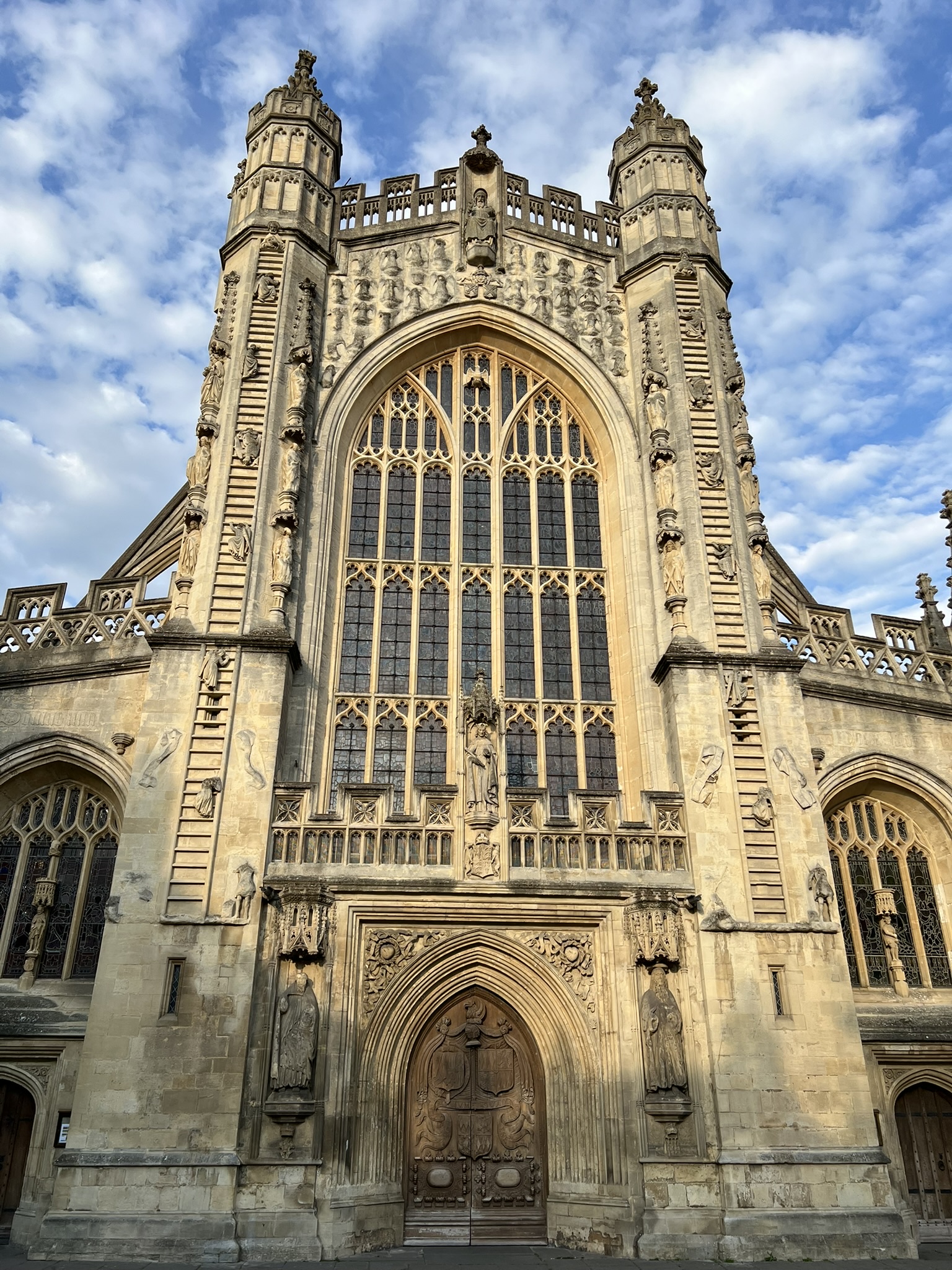
Then, back on the bus to head to Bath, home to some of the finest architecture in England, as well as a home to Jane Austen for several years, and as a plot-solving location in her book-end novels Northanger Abbey and Persuasion.
A very proper waistcoat on our “butler”…
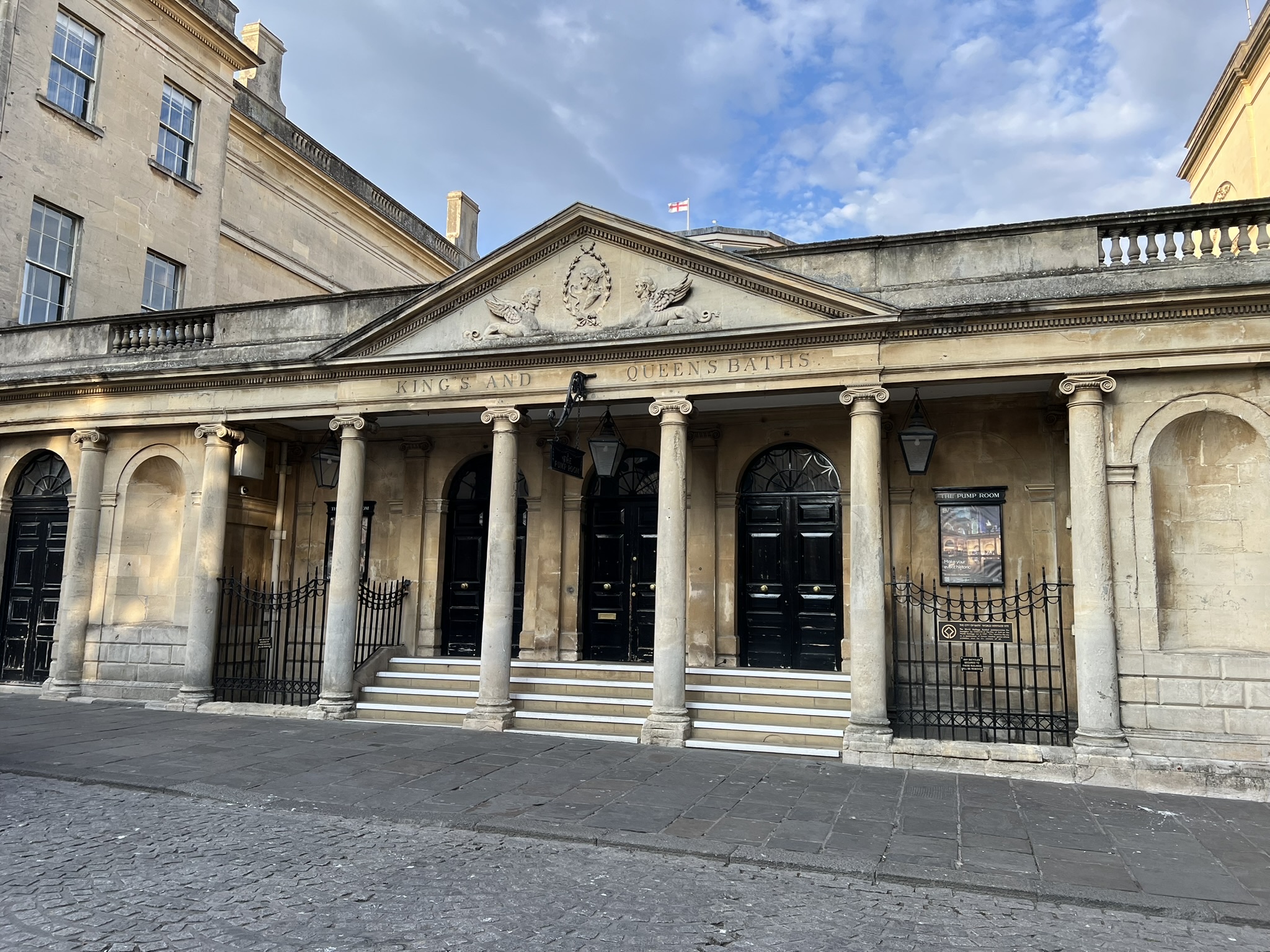
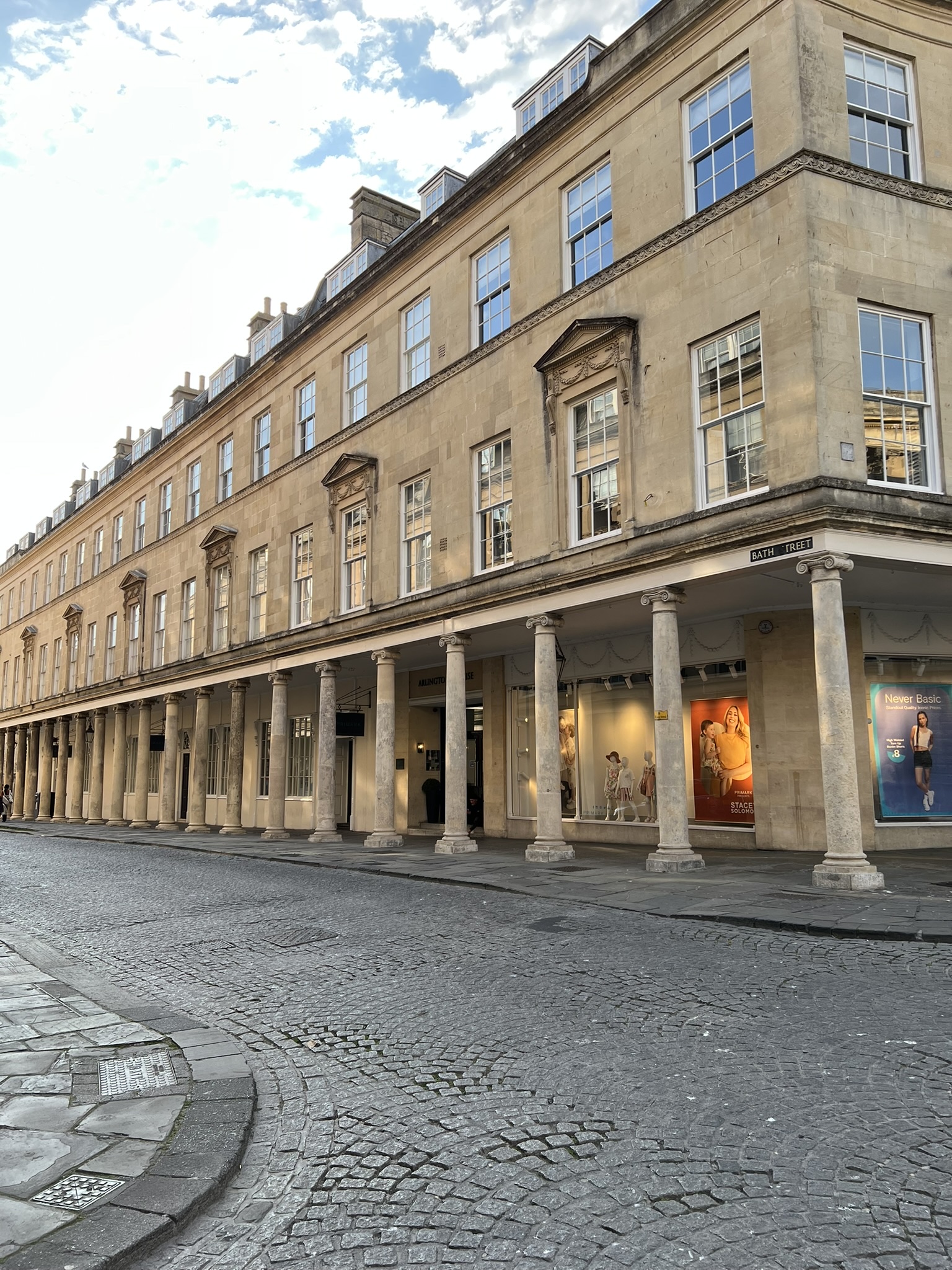
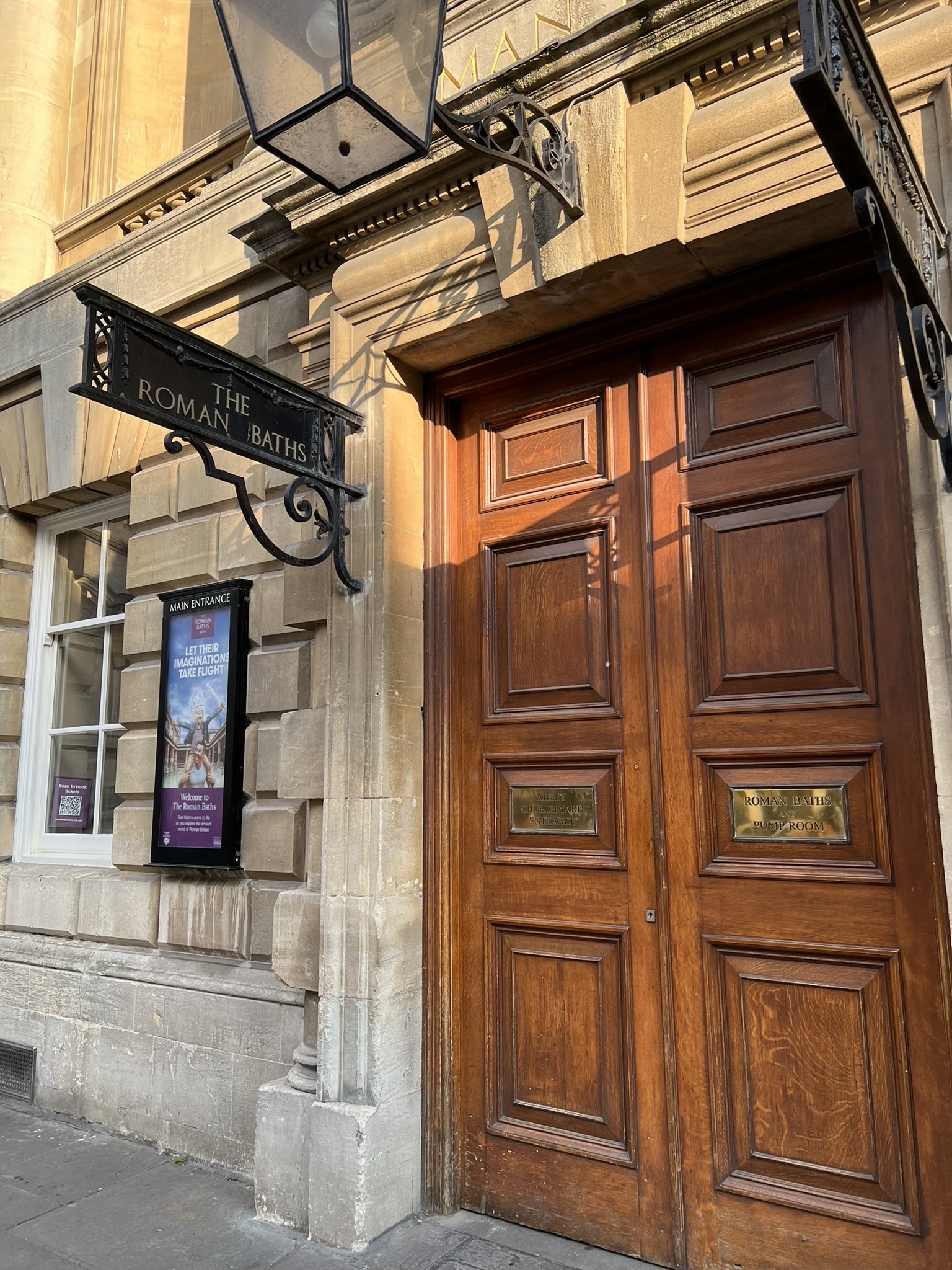
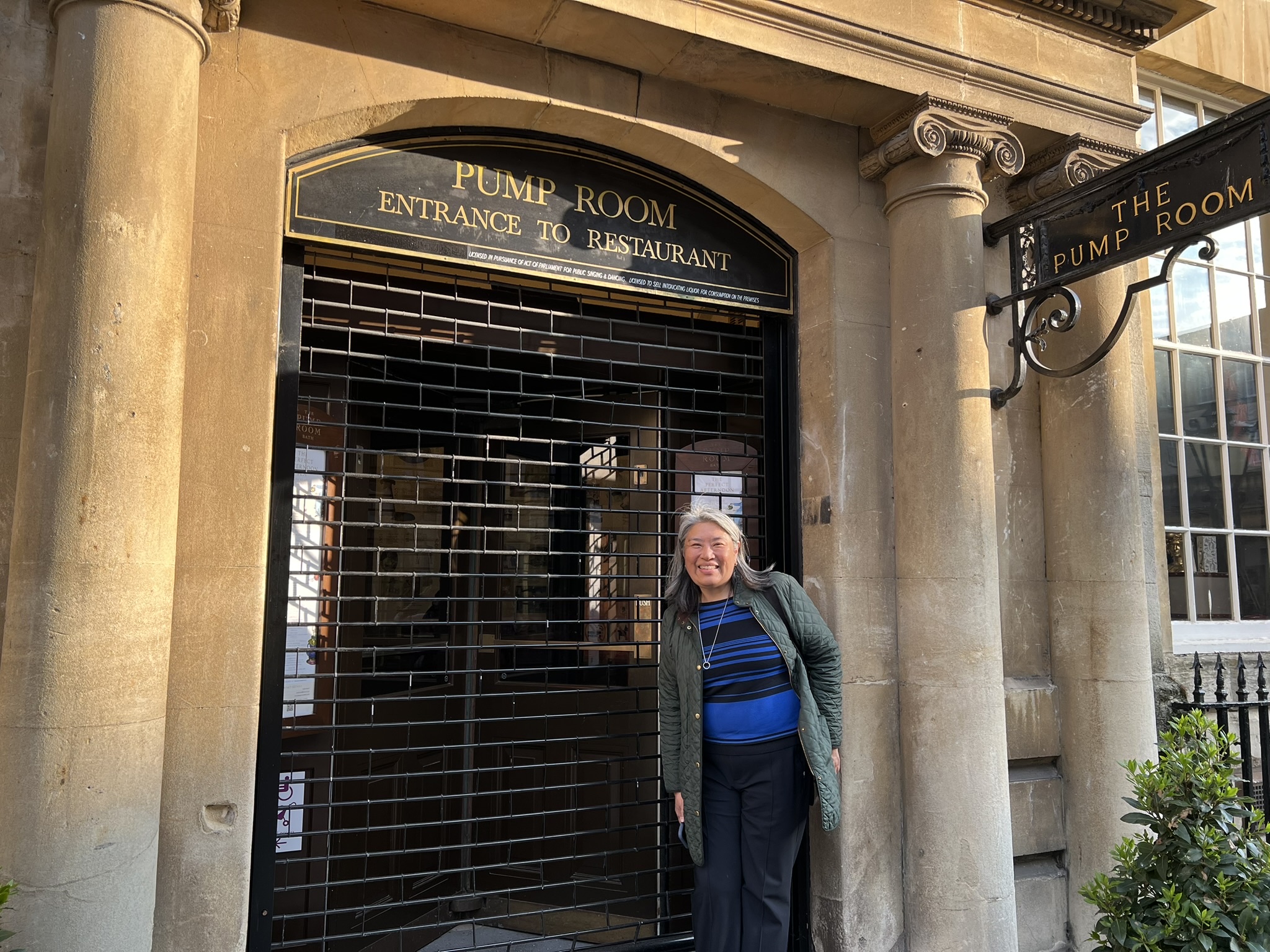
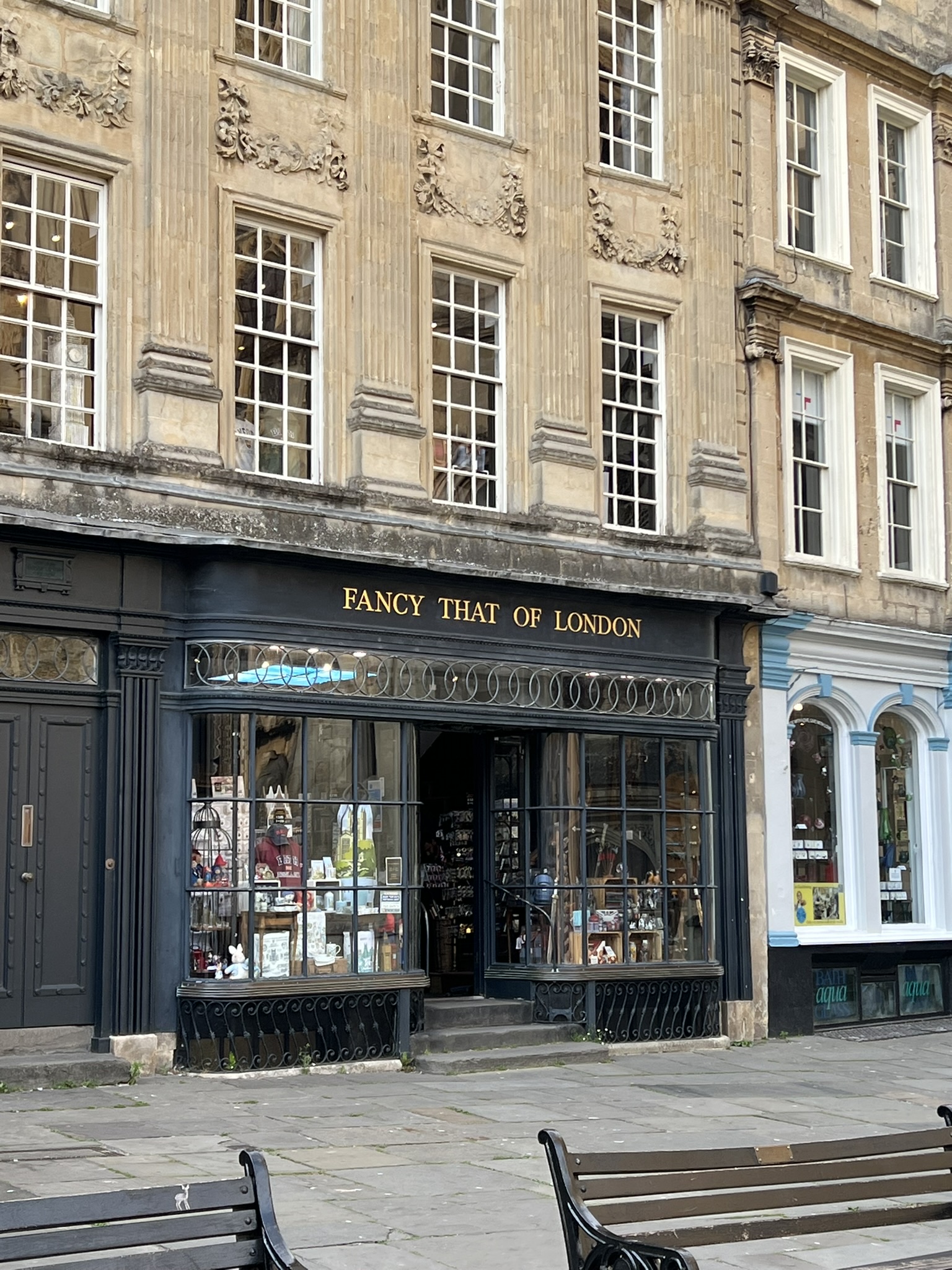
After settling into our room at the Hotel Indigo, perfectly located right downtown, Joy and I took a stroll around the places familiar to us and all the set locations for the various Austen films – a delightful walk as few people were around and most of the stores were closed, excepting our favorite Topping & Company Booksellers:
“Oh! what a Henry!…”
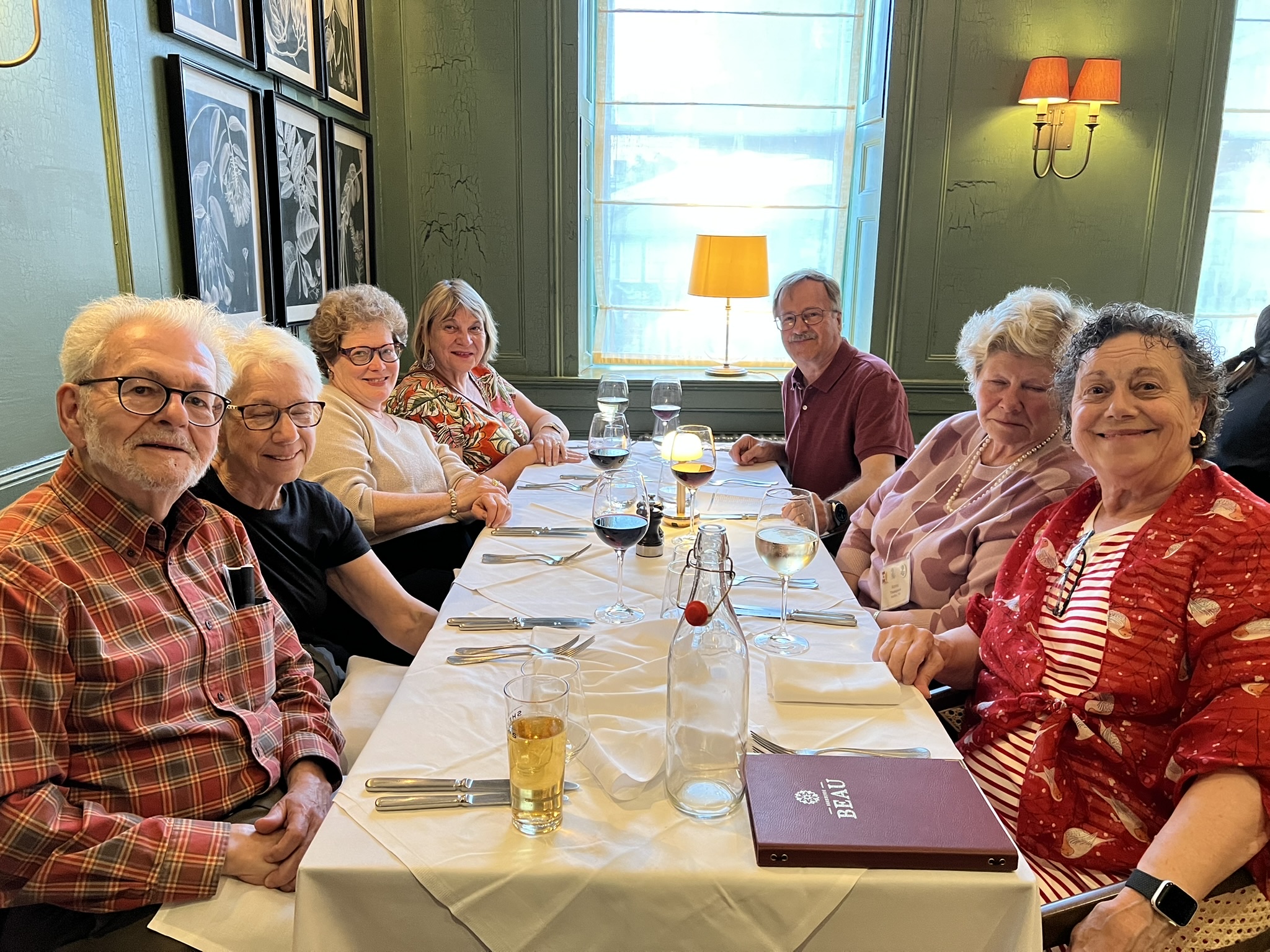
Dinner at the hotel restaurant to end a very full day, well-spent of course – Bath adventures will fill our next few days, can’t wait…
Gentle Readers: I welcome today, Hazel Mills, who has most generously written a post about one of Austen’s many illustrators, Philip Gough. I had written two posts on Gough [see below for links] but little was known about him personally. Hazel has done some extensive research into his life and works, and she shares this most interesting information with us here. Thank you Hazel!
***************
Philip Henry Cecil Gough
by Hazel Mills
The artist, Philip Henry Cecil Gough, was born on the 11th June 1908 in Warrington, Lancashire, England, the eldest of four children. He was born to Cyril Philip Gough and Winifred Mary Hutchings.
Philip was from a long line of leather tanners, curriers and bark factors, the latter using bark to soften leather. His family were wealthy owners of tanneries with evidence of his father travelling abroad to the USA in 1925 on business.
Philip’s paternal grandfather, also a Philip, had carried on the family business in Wem, Cheshire with two of his three brothers. It obviously provided a good income as all four brothers had been to private boarding schools. In 1880, the tannery company of grandfather, Philip, and his brother was dissolved and Philip continued alone.[1]
It is Philip’s maternal side that gives us the clue to his artistic side. His mother Winifred, also born into a family of tanners, travelled to Brussels to study Art and Music before her marriage. She also played the viola in various orchestras. [2]
Before 1914 the Gough family moved to Moore, near Runcorn in Cheshire [3] and then in 1921, at the age of 12, Philip was sent to Loretto School, just outside Edinburgh, Scotland, as a boarder.[4] On the 4th and 5th April of that year Philip assisted in the painting of the scenery in the staging of “Much Ado About Nothing” [5] in the gymnasium of the school. The art master he assisted was Colonel Buchanan-Dunlop, who, during the famous ceasefire at Christmas 1914, led the singing of the carols from a sheet sent to him from Loretto School. [6]
Again in 1924, Philip painted scenery for the school production of “A Midsummer Night’s Dream”, which was performed in aid of the Edinburgh Royal Infirmary, again assisting Col. Buchanan-Dunlop. [7]
Liverpool Art School record
Philip left school in 1925. [8] It is known that he attended art school in Cornwall and Liverpool. He entered Liverpool College of Art in February 1926 and a year later, while still at the college, designed the scenery for the pantomime, “Robinson Crusoe”, at the Garrick Theatre in London. In 1928, after leaving the Liverpool College of Art, he designed about 60 costumes for “A Midsummer Night’s Dream” for the Liverpool Playhouse with a photo being published in the “Graphic newspaper” on 19th January 1929 [9] It is also thought that he designed shop windows around this time.
Midsummer Night’s Dream – Gough scenery and costumes
1929 saw Philip working on a prestigious new project. He was responsible for all the scenery and costumes for A.A. Milne’s new play, “Toad of Toad Hall” at the Liverpool Playhouse, based on Kenneth Grahame’s book, “Wind in the Willows”. “The Stage” described Philip’s work as “both novel and extremely beautiful”. [10] At this time, Philip was still only twenty one years old. A.A. Milne also wrote a play of “Pride and Prejudice” called “Miss Elizabeth Bennet”. This was also produced at the Liverpool Playhouse. But sadly it was not Philip that did the scenery for this one, but a Charles Thomas. [11]
In September of the following year, Philip designed scenery and costumes for “Charlots’s Masquerade”, a variety show at the Cambridge Theatre in London. There is even some Pathé News footage of this in existence. [you can view it here:
****************
It must be around this time that Philip meets his first wife, Mary O’Gorman, as the London Electoral register of 1930 shows him living in what appears to be a lodging house at the same address as her. It’s not know if they were actually living together as the listing is just alphabetical. Over the next eight years Gough is involved in costume and set design for at least seven productions, the first two at the Liverpool Playhouse but the following ones were all in various locations in London.
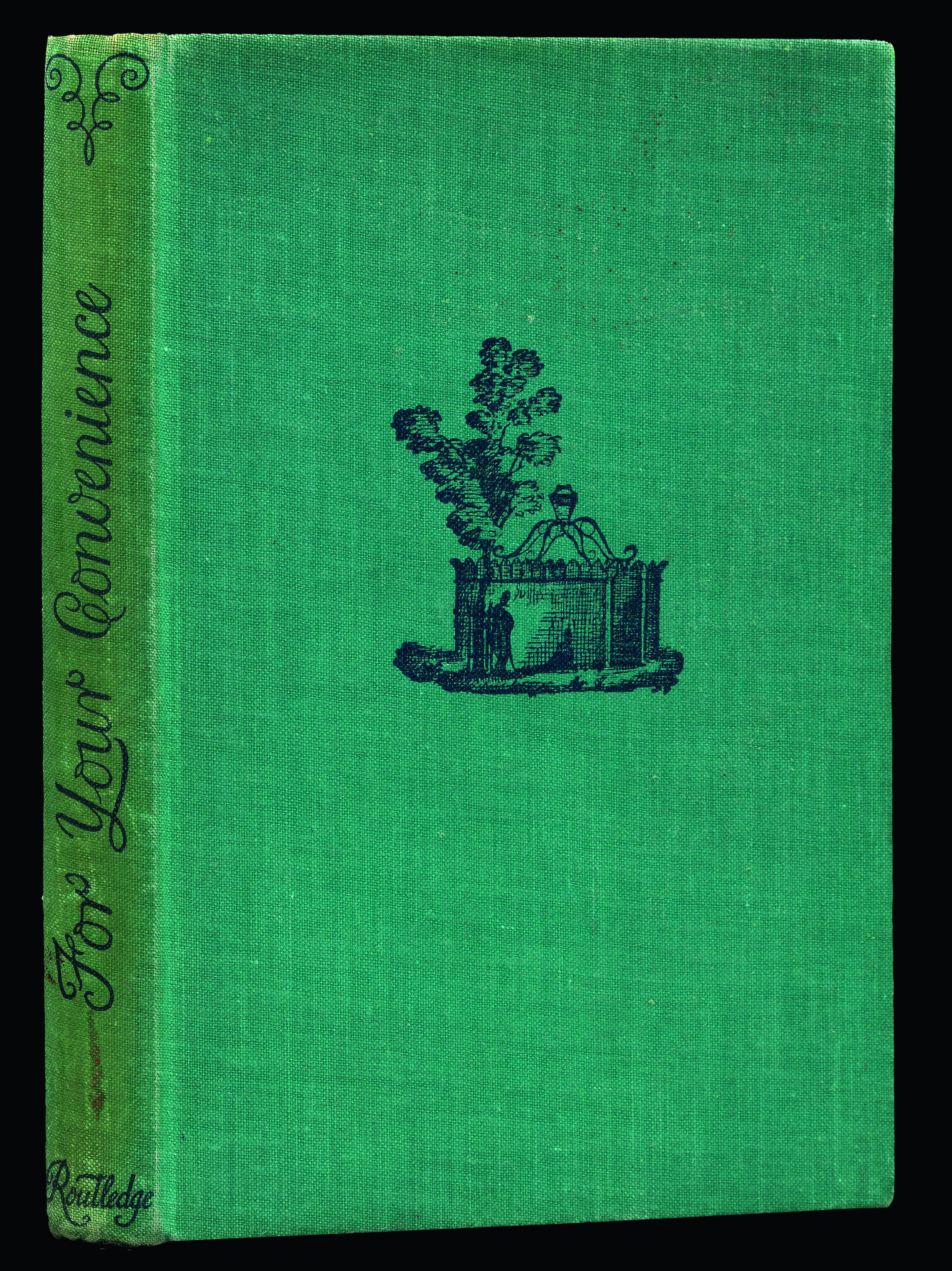
Towards the end of this time the first book illustrated by Gough that I could find was the wonderfully named*, For Your Convenience: a learned dialogue instructive to all Londoners & London visitors, overheard in the Thélème Club and taken down verbatim by Paul Fry, [pseudonym for Thomas Burke] and published by Routledge in 1937.
“For Your Convenience”
“For Your Convenience” endpaper map
[* this book is republished today as For Your Convenience: A Classic 1930’s Guide to London Loos – in 1937 it was a heavily disguised guide to London toilets for homosexual encounters.]
***********
In 1939 Philip married Mary Catherine O’Gorman in Chelsea. The 1939 England and Wales register shows the married couple living in elegant Walpole Street, Chelsea. The house is again the home of what appears to be boarders. Philip is described as working as an artist and designer of theatrical scenery, Mary is a secondary school teacher.
The following year Philip worked on “The Country Wife” at the Little Theatre, Haymarket, London and The Illustrated London News reported that the “décor by Mr. Philip Gough is the chief charm of this production.” [12]
“New Book of Days”
The next few years, over the time of the Second World War, seem to be a very quiet time for Philip. I can only find his illustration of a book by Eleanor Farjeon called The New Book of Days, an anthology of rhymes, proverbial tales, traditions, short essays, biographical sketches and miscellaneous information, one piece for each day of the year. In 1936, Philip had also designed the sets and costumes for a play by Eleanor and Hubert Farjeon, called “The Two Bouquets”.
Philip’s father died in 1946 when Philip was still living in Chelsea. In 1948 he appears to have left his wife and is now living at another address in Chelsea with a Joan Sinclair.
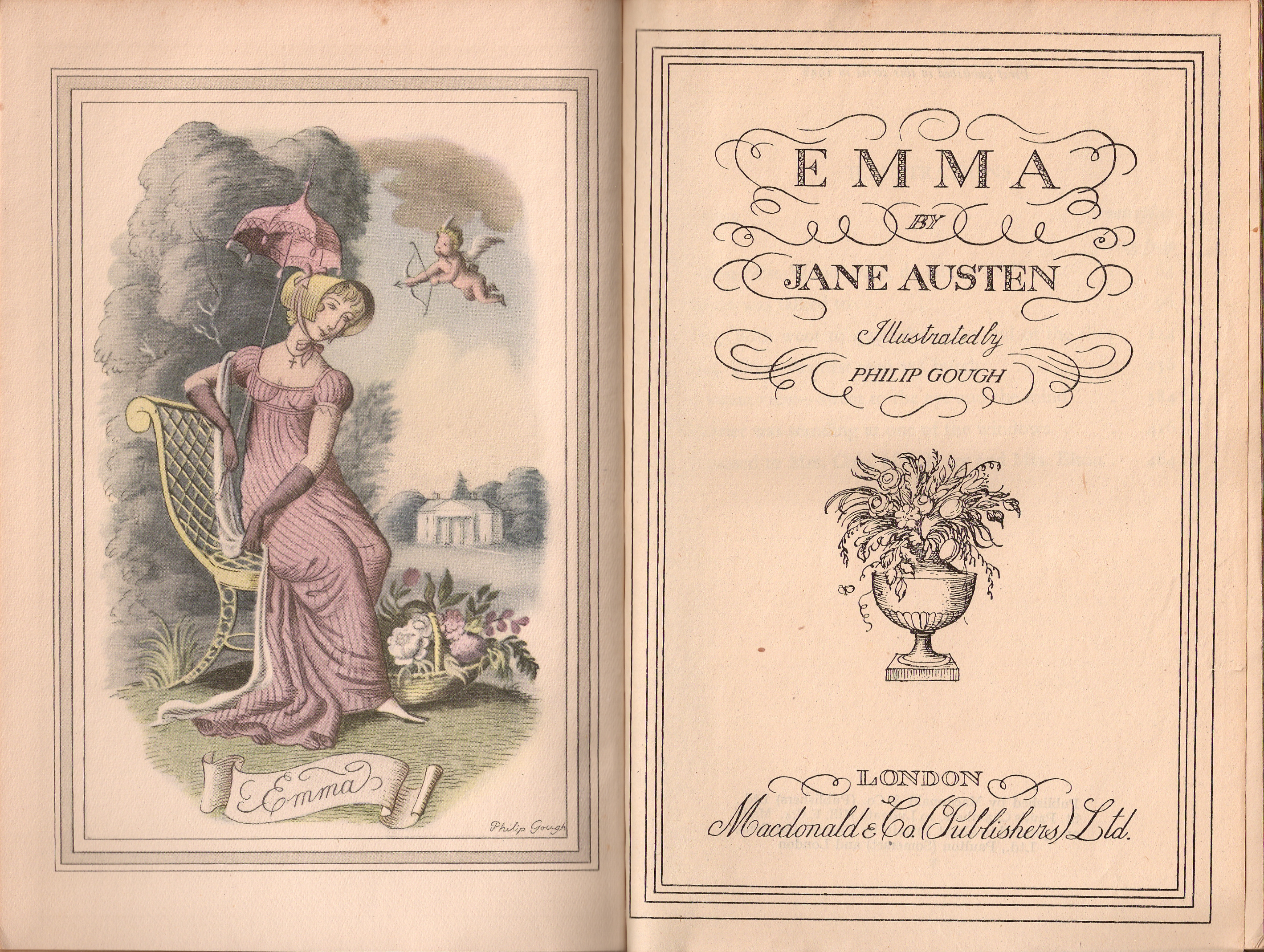
1947 was a prolific year as a book illustrator, with four books for Peter Lunn publishers including “Fairy Tales” by Hans Christian Andersen. The following year would be his foray into Jane Austen Novels with the 1948 publication of Emma, published by MacDonald for their Illustrated Classics series.
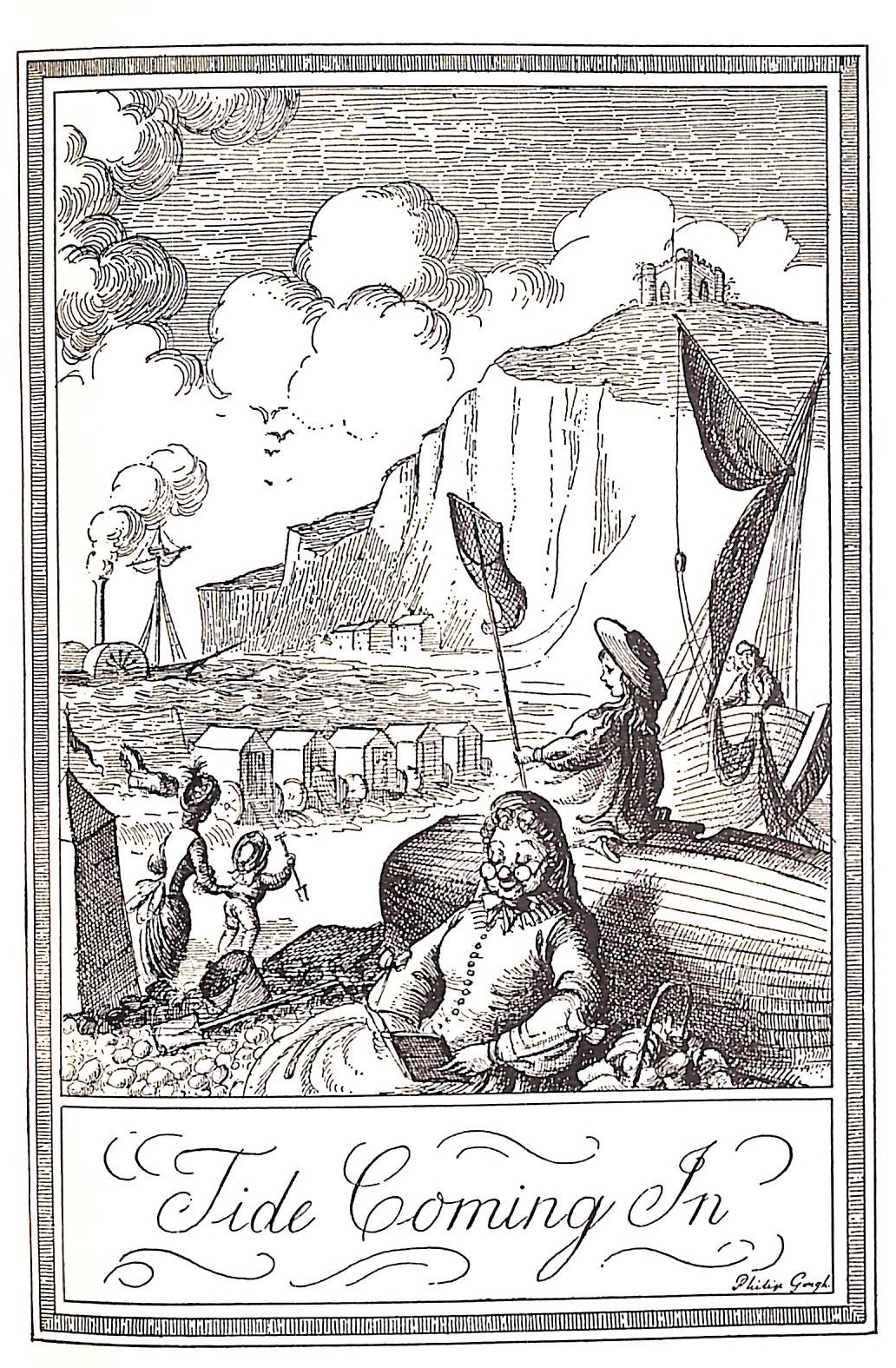
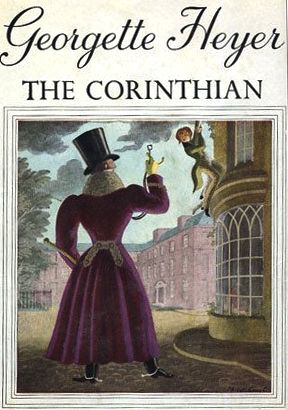
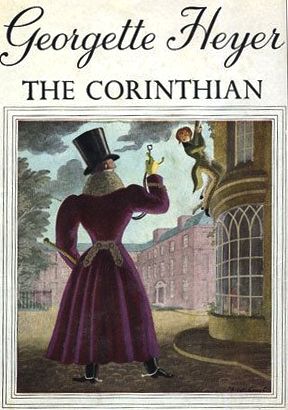
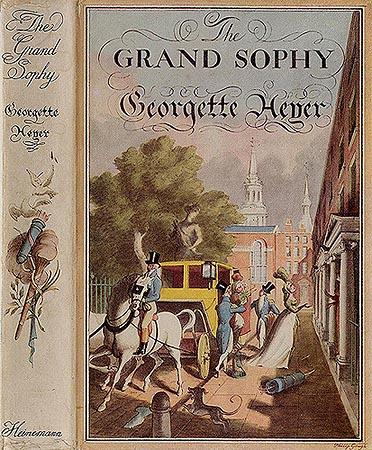
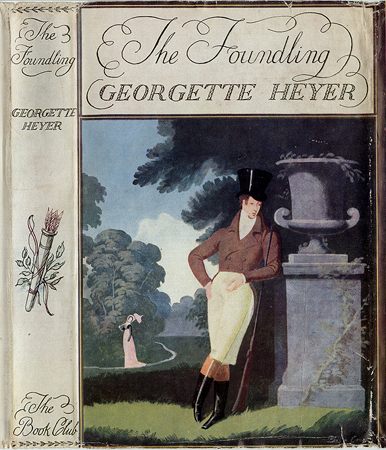
I have tracked down forty-two books between 1937 and 1973 where he drew illustrations throughout, but in addition Philip designed many, many more dust jackets for novels such as those of Georgette Heyer:
Georgette Heyer dust jackets by Philip Gough
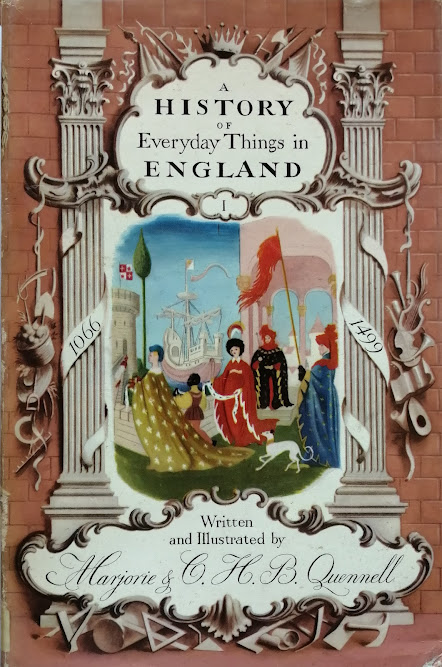
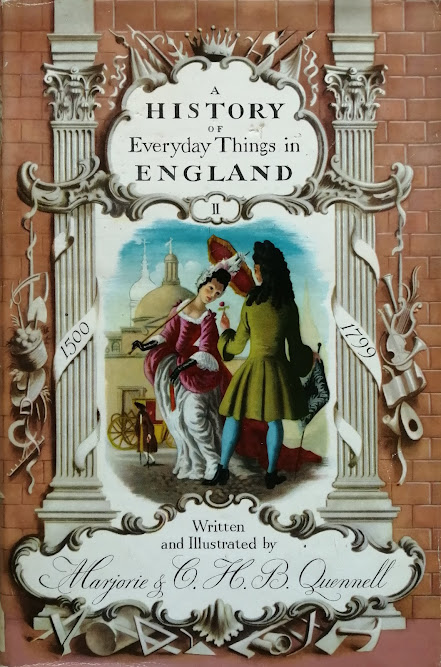
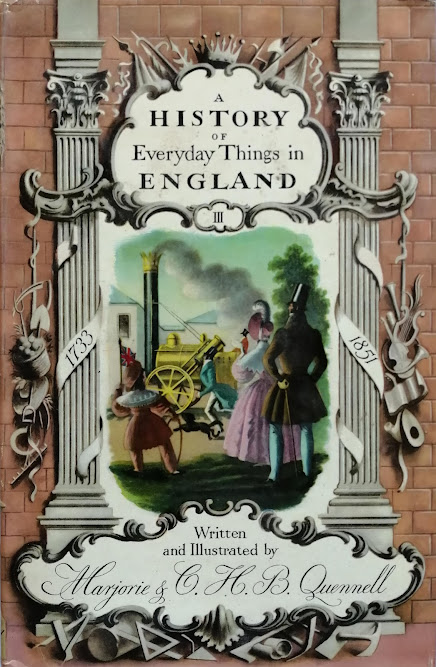
and non fiction tiles such as 1960s reprints of the four volume “A History of Everyday Things in England” that first appeared in 1918:
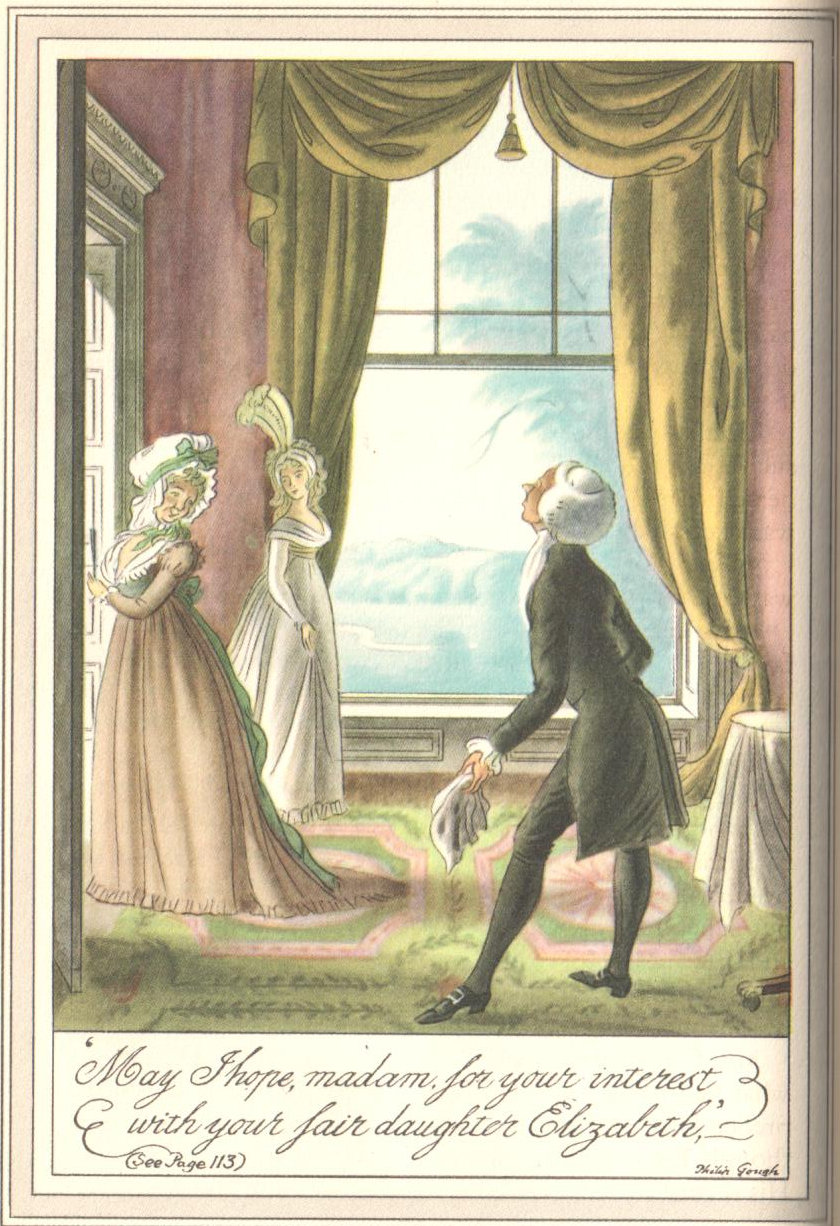
Philip also did a few more set designs in the 1950s but more of his time was spent illustrating books including Pride and Prejudice (1951), Mansfield Park (1957) and Sense and Sensibility (1958) for Macdonald. You can see many of the illustrations here:
In Philip’s personal life, tragedy hit when his mother was killed in an accident when she was hit by an army truck in 1952. Philip married Joan in 1953 which is the last year in which I can find any more set and costume designing.
Northanger Abbey
1961 saw the Macdonald publication of both Northanger Abbey and Persuasion with his illustrations and he continued to illustrate books until at least 1973.
Philip Gough died in London on 24th February 1986, leaving a fortune of £42,661.
Philip’s sisters also deserve a mention. Sheila May Gough was qualified as a nurse and during WWII joined the ‘Queen Alexandra’s Imperial Military Nursing Service’. She served in Europe before being posted to Malta. In 1943 Malta became the base for the invasion of Sicily. It was codenamed ‘Operation Husky’ and began on the night of 9 July and lasted for six weeks. Sheila was awarded the ‘Associate of the Royal Red Cross’ for “special devotion to duty…and complete disregard for her own safety”. [13] Sheila remained unmarried until the age of 58, in 1975, when she married Donald Verner Taylor C.B.E. who had been in the Army Dental Corps in Malta at the same time as her.
Less is known of his sister Gwendoline Winifred other than she was a school teacher at a boarding school in Nottingham in 1939 [14] but in 1941 sailed to South Africa where she stayed until 1946. [15] More is known of Brenda Irene, or rather Flight Officer Brenda Irene Gough. The 1939 register records that Brenda was working as a secretary for the Civil Nursing Reserve and living in Wimbledon. She joined the WAAF (The Women’s Auxiliary Air Force) after May 1941 . In 1943, Brenda was promoted to Section Officer in the Administrative and Special Services Branch and later promoted to Flying Officer. During the war women were paid two thirds of the salary of their male counterparts.
Philip Gough has left an enormous body of work and original works of his illustrations can achieve high prices today, for example, a signed original gouache artwork for the dust wrapper to Georgette Heyer’s The Foundling currently commands a price of around $2,500.
Liverpool College of Art Record -Liverpool College of Art Archives
Mid summer Night’s Dream Image courtesy of Mary Evans Picture Library (c) Illustrated London News/Mary Evans Picture Library.
For Your Convenience images – Care of Daniel Crouch Rare Books – crouchrarebooks.com
________________________________
Author bio:
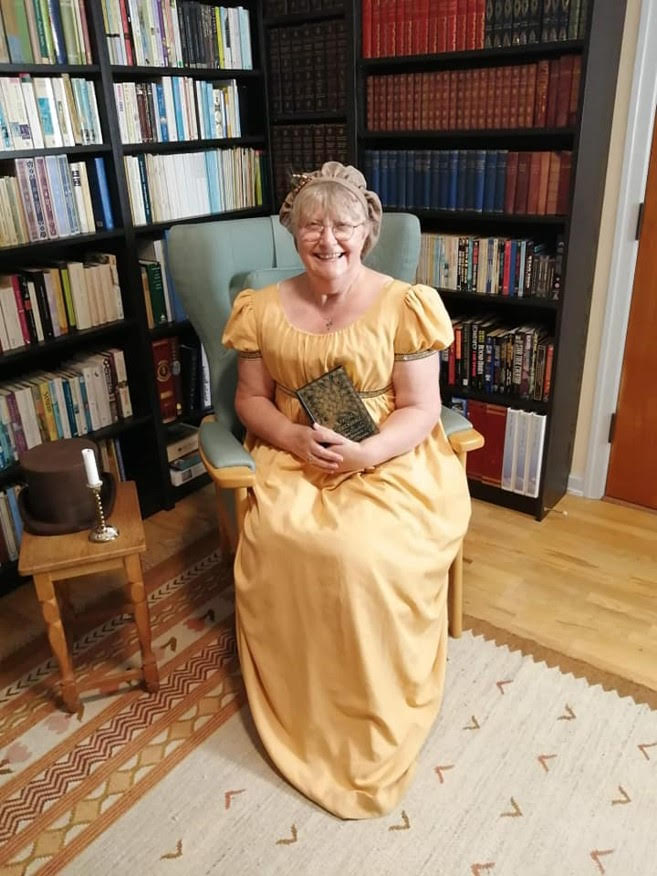
Hazel Mills is a retired science teacher and a founder member and Chair of the Cambridge Group of the UK Jane Austen Society. Until her move to Denmark, she was a Regional Speaker for the Society. Hazel discovered Austen as a thirteen year old Dorset schoolgirl when reading Pride and Prejudice and fell in love for the first time with Mr Darcy. She has researched the history of Jane Austen’s time, presenting illustrated talks, around England and Scotland, on diverse subjects including: Travel and Carriages in Jane Austen’s time; the Life of John Rawstorn Papillon, Rector of Chawton; Food production and Dining; Amateur Theatricals at Steventon, and the Illustrators of Austen’s novels. She lives in a lovely house overlooking the sea with her husband who built her a library to house her extensive Austen collection, which includes over 230 different copies of Pride and Prejudice.
Mansfield Park in Danish
***************
Do you have a favorite Philip Gough illustration?? Please leave a comment below.
So I am back from an RV trek up north – finally able to get to Vermont and visit with family and friends – almost SEVEN weeks with no stable or reliable internet connection on any given day – and I actually survived the deprivation. Thankfully Trooper was not writing his usual journal of this trip [ https://trooperslog.wordpress.com/ ] so did not need to be uploading all his commentary and pictures every day.
But now back home with access to my shelves and resuming posts on “Collecting Jane Austen” with a short post on one of my favorite sets of Jane Austen’s novels: The Macdonald Illustrated Classics (London, 1948-61), with illustrations by Philip Gough and introductions by various scholars for four of the six volumes.
When Macdonald & Co. (London) published its first volume of Jane Austen’s work in 1948, Emmawas the chosen work, with Philip Gough as illustrator. It was the 4thvolume in the Macdonald Illustrated Classics series. It is a small book, under 8 inches, bound in red leatherette, with a frontispiece and seven other full-page plates of watercolor drawings by Gough. There is no introduction. Macdonald published its next Jane Austen novel in this series in 1951 – Pride and Prejudice, with illustrations again by Gough and again no introduction. If you are lucky enough to have all the six volumes published by Macdonald, you will see that they appear to be a set, all with the same binding and all illustrated by Gough – but they were published over a period of years from 1948 to 1961 as follows – with the No. in the Macdonald series in ():
1948 – Emma (No. 4)
1951 –Pride & Prejudice(No. 23)
1957 – Mansfield Park (No. 34); introduction by Q. D. Leavis
1958 – Sense & Sensibility (No. 37), with Lady Susan and The Watsons; intro by Q. D. Leavis
1961 – Northanger Abbey (No. 40); intro by Malcolm Elwin
1961 –Perusasion (No. 41); intro by Malcolm Elwin
Not sure why Leavis did not do the other introductions – her essays on Jane Austen are magnificent, and a definite must-have for your Austen library. Her Mansfield Park introduction, after stating that MP is “now recognized as the most interesting and important of the Austen novels,” gives us a brief summary of Austen’s life and times, then writes of her theories that Lady Susan is the matrix of Mansfield Park, that Austen was “soaked in Shakespeare,” that the Sotherton sequence is one of the “most remarkable in any English novel” where all the action is symbolic and how its pattern of events is “exactly and awfully repeated” in the final outcome of the book, and finally how Mansfield Park is really a tragedy “in spite of the appearance of a happy ending.”
All of the novels were published with a stiff clear mylar wrapper with the title and “Illustrated by Philip Gough” in mustard yellow, and “By Jane Austen” in blue, with nothing on the spine but the gilt titles on the red backstrip showing through. These wrappers are nearly impossible to find. I only have the one for my Emma volume.
****************
There is little known about Philip Gough and I cannot find much researching the internet other than he was born in 1908, illustrated a number of children’s books (Alice in Wonderland, Hans Christian Andersen’s Fairy Tales are two examples); this Jane Austen series from Macdonald; and a goodly number of dust jackets for Georgette Heyer’s Regency novels (see below). There is a list of 14 books on Goodreads illustrated by him but this list is not complete – Jane Austen is not listed!) [ https://www.goodreads.com/author/list/1981672.Philip_Gough ]
It is worth noting that in the introduction to the 1961 Persuasion by Malcolm Elwin (and also quoted by David Gilson in his entry E327 on this edition in his A Bibliography of Jane Austen), Elwin states that the drawings of Hugh Thomson are said to be “too Victorian in their sentimentality to suit the spirit and period of the novels” – and that “Mr. Gough has shown himself a student of the Regency period, and many sound critics have judged him to have succeeded in conveying the subtlety of Jane Austen’s satiric humour.” Gilson also notes a TLS review of this edition (10 November 1961, 810), quoting that “Philip Gough’s illustrations have their own brand of sentimentality, this time of the pretty-pretty sub-Rex Whistler variety.”
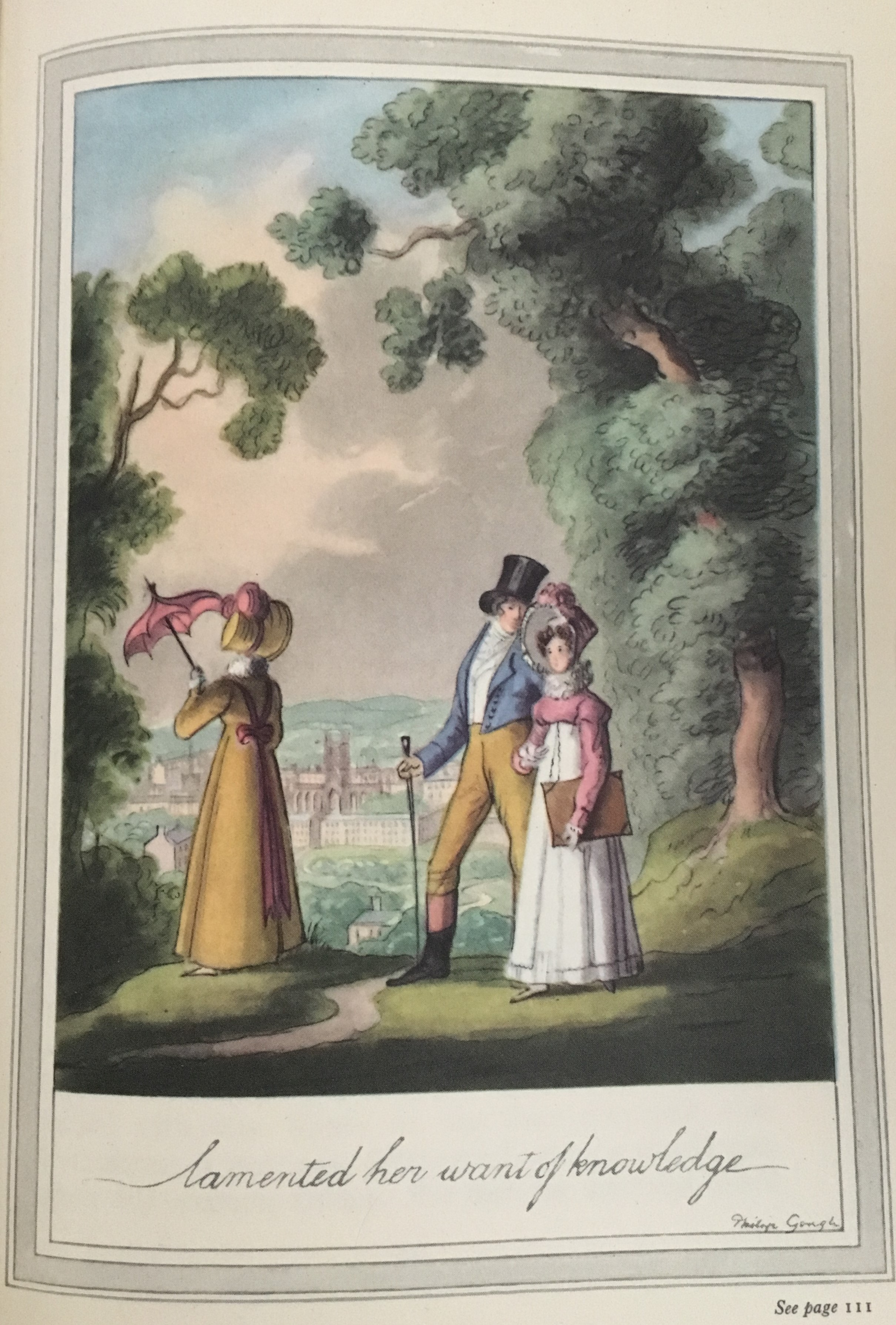
Each of the novels begins with a chapter I heading drawing in black and white as well as a drawing on the title page. Emma as the first published of the novels is an exception – there are chapter heading illustrations for each of the odd-numbered chapters; all the other novels have only the one heading chapter I as well as the title page. Each novel has 7 watercolors (Sense and Sensibility only has five; there is one watercolor each for Lady Susan and The Watsons and each begins with a black and white drawing.) I find these watercolor illustrations a little too precious – there is a tendency toward “Pretty in Pink”– as you will see in these examples from each novel in the order of publication below. There is also some rather odd scenes of what Gough chose to illustrate and they are often placed so far from the actual text being quoted that they serve more as a distraction rather than illuminating the story. But these are quibbles – I love this set and am privileged to have it on my shelf – it is almost impossible to find as a full set, and each volume can be quite expensive when located (Emma is the most elusive) – my advice is to buy them when you see them and grin and bear it.
So now for a few examples of Gough’s illustrations from each of the novels:
Emma (1948): Gough definitely equated the Regency period and Jane Austen with the feminine Pink – and in Emma there is a good deal of it!
“A sweet view…” with what appears to be a Mormon tabernacle standing in for Donwell Abbey
Pride and Prejudice (1951): I have always looked rather wide-eyed at the abundance of Pink in Gough’s Pride and Prejudice – especially in this portrait of Mr. Darcy at the pianoforte…!
And we must include Gough’s simpering Mr. Collins:
And of course it is indeed not Willoughby, but Edward…
Northanger Abbey (1961):
Persuasion: (1961)
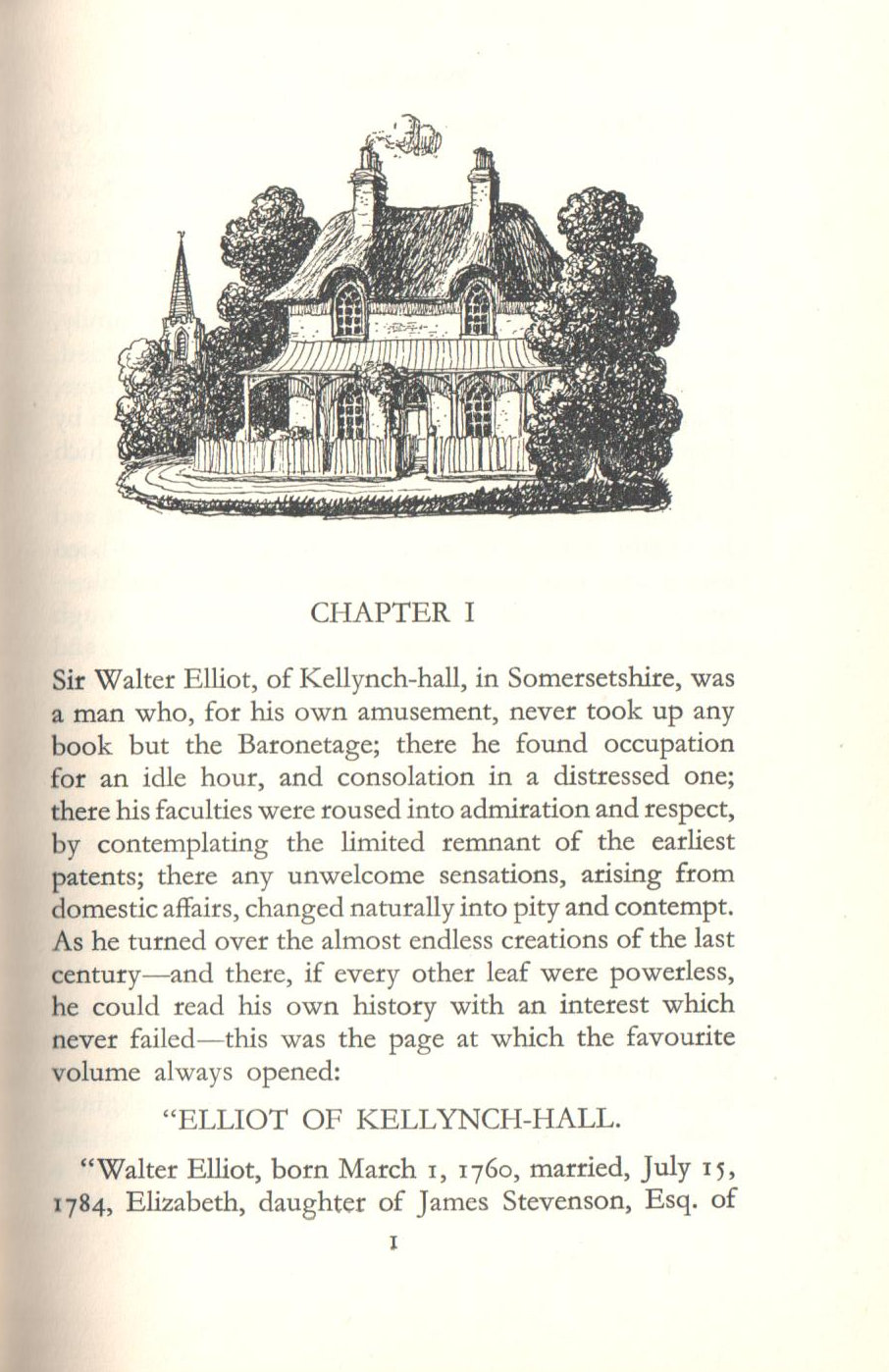
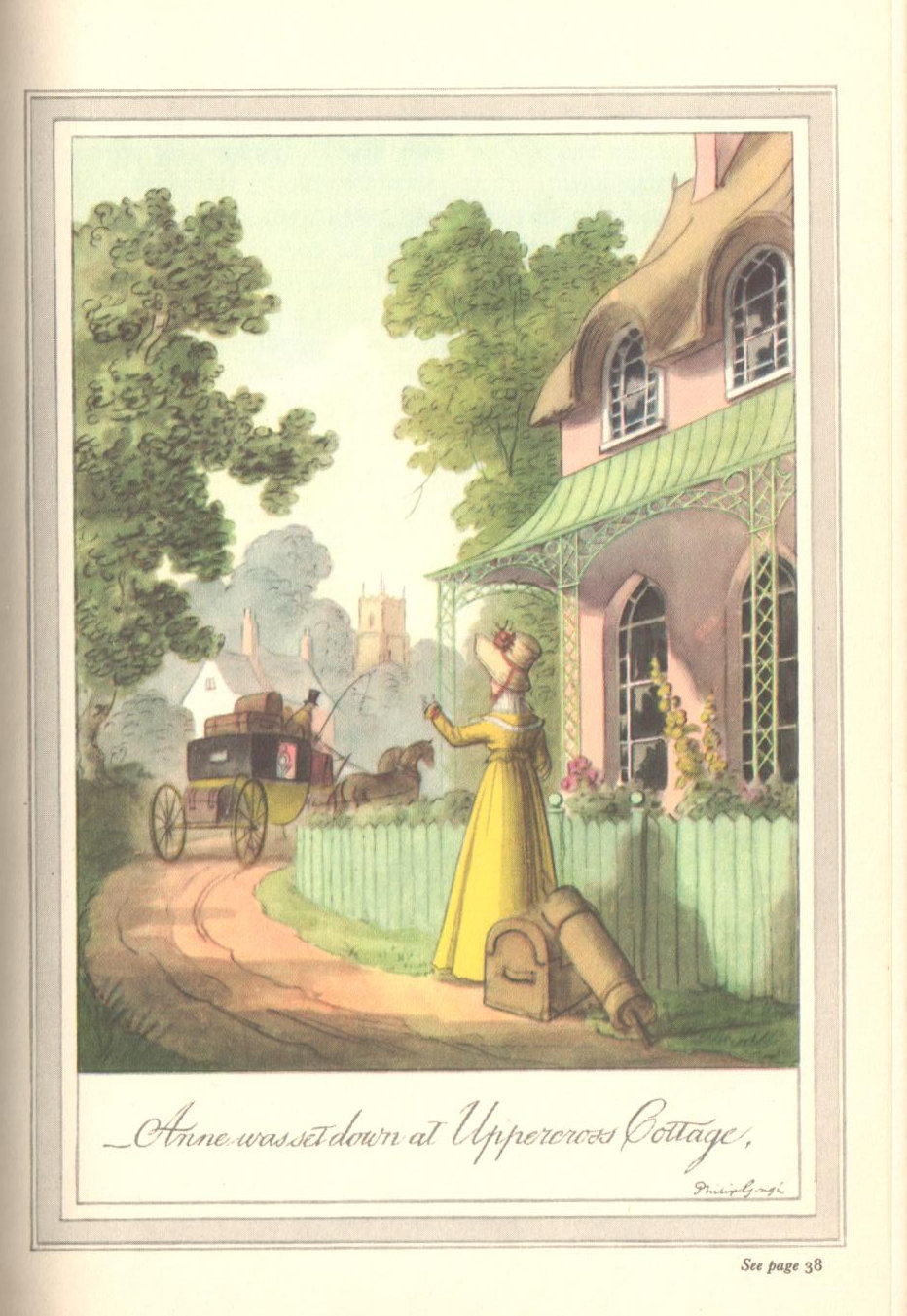
Chapter heading from Ch. I of Persuasion: you would think this should be Kellynch Hall at the start of the novel – but this is certainly not grand enough for Sir Walter! We find on page 42 that it is Uppercross Cottage and here we see it in full color:
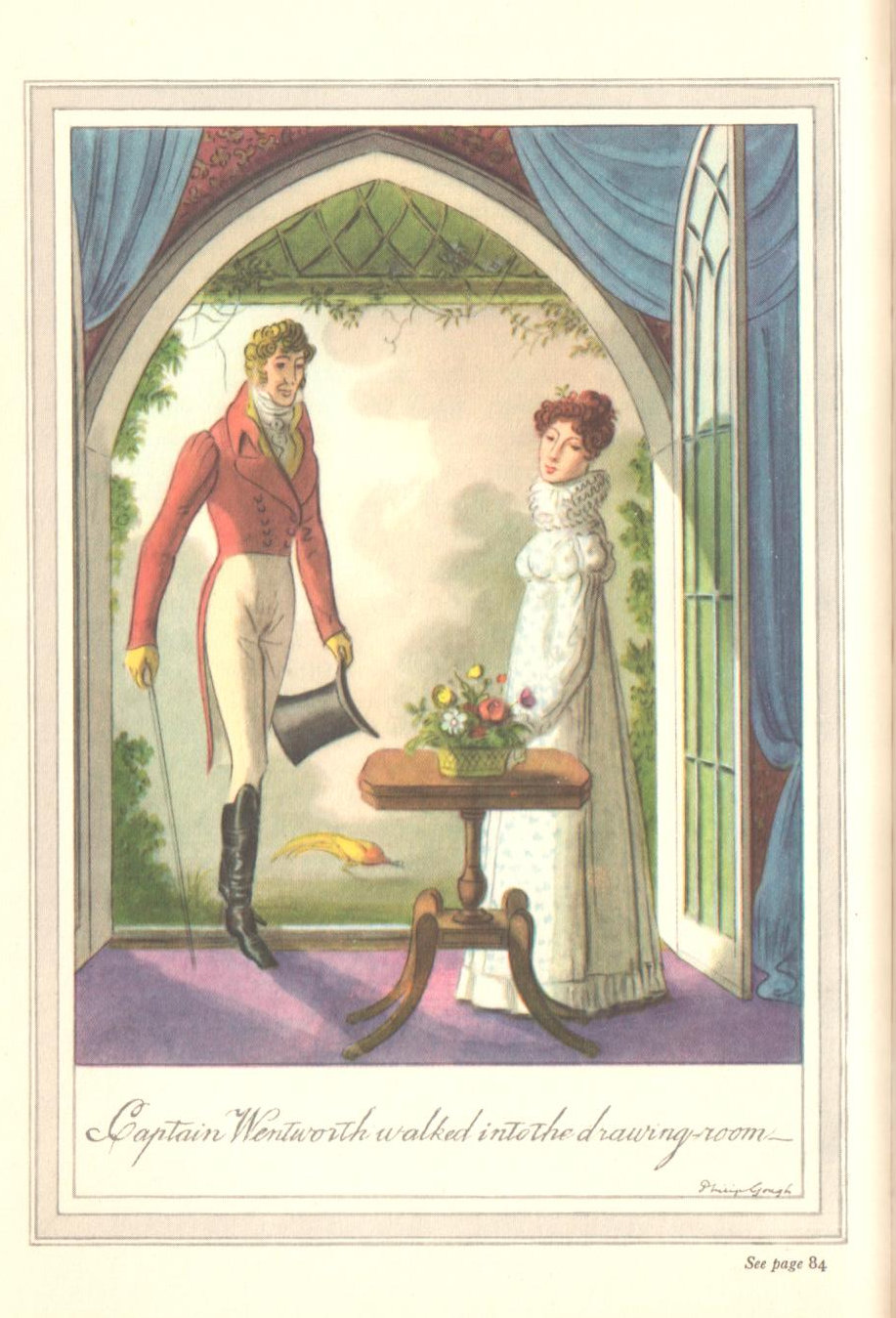
We shall end with Captain Wentworth, because, why not – we see him neither in a navy uniform (this is for another post – how many illustrators portray the good Captain in uniform??), nor is he in Pink, but an odd color nonetheless!
******************
Gough cover illustrations for Georgette Heyer – some examples (I LOVE these!):
Of all the Jane Austen sets, this Dent publication is probably the most well-known because of the Brock brothers illustrations – they have continued to be published over and over again, and the ones we think of when we think of “Jane Austen illustrated.”
The Novels of Jane Austen, J. M. Dent, 1898 [Molland’s]
1892 was a watershed year for Austen and the beginning of the many Dents – but today we will focus on this set published by J. M. Dent in 1898 in 10 volumes and edited by R. Brimley Johnson – it was the first to offer Jane Austen in color. You can find all the interesting information in Gilson at E90. But a quick summary and a few pictures will surely entice you to want this on your shelves – and if the set is hard to come by or beyond your price range, a fine adventure is trying to put a set together yourself, as individual volumes are often available.
Dent had originally published Austen’s novels in 1892, also edited by Johnson, but with sepia-toned illustrations by William C. Cooke [more on this set in another post]. But in 1898, Dent used the same text plates but deep-sixed the Cooke illustrations and took on the Brock brothers to render Austen in livelier watercolors reproduced by 6-color lithography with each volume having 6 illustrations. Charles Edmund Brock did Sense & Sensibility (vols. 1 and 2), Emma (vols. 7 and 8), and Persuasion (vol. 10). Henry Matthew Brock did Pride & Prejudice (vol. 3 and 4), Mansfield Park (vols. 5 and 6), and Northanger Abbey (vol. 9).
[You can read about the Brocks here at Molland’s with an excellent essay by Cinthia García Soria here: http://www.mollands.net/etexts/other/brocks.html ] You can also google their names and many of the Jane Austen blogs have posts on the Brocks and other illustrators.
CE Brock / HM Brock
The Brocks owned a number of Regency era furnishings and decorative arts, as well as a large collection of fashion prints – they had many costumes made, having family and friends model for them and perhaps why their illustrations seem so very authentic! Laura Carroll and John Wilshire call these Brock-illustrated editions “Chocolate-box” – gift-book quality, beautiful inside with delicate pen or brush drawings, and outside with gilt embossing and Arts and Crafts inspired design; another critic refers to the Brocks’ work as “delicate teacup and saucer primness”! [See their essay “Jane Austen, Illustrated” in A Companion to Jane Austen, Wiley-Blackwell, 2012, pp. 62-77.]
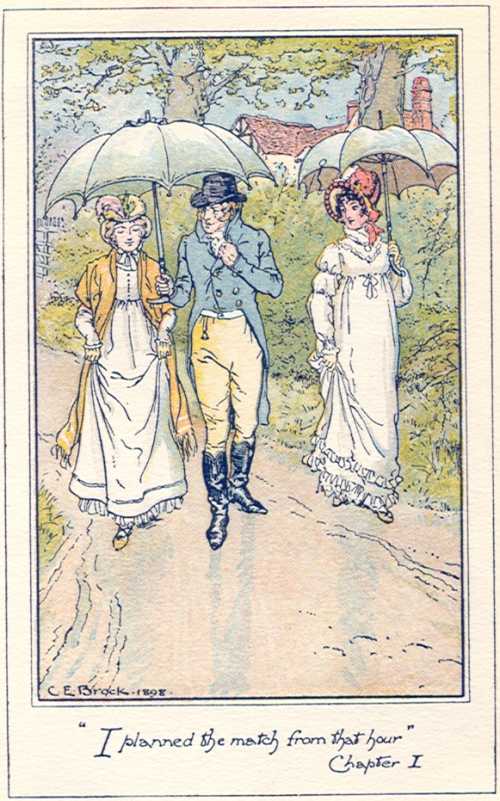
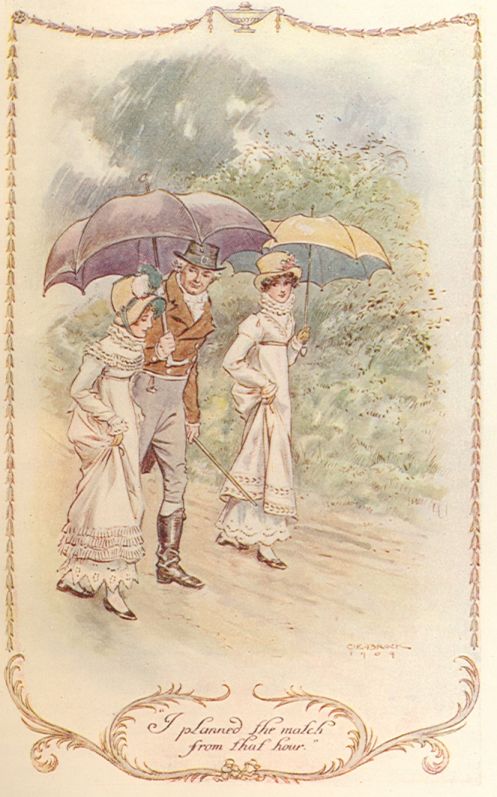
C. E. Brock had previously illustrated Pride and Prejudice with black and white line drawings – this was published by Macmillan in 1895. He would go on in the years 1907-09 to illustrate all the novels for another Dent publication, their Series of English Idylls (with 24 watercolor illustrations in each volume; they were all later published as a set with fewer illustrations in each volume.) To compare CE Brock’s two very different styles in these two editions is an interesting way to spend at least an afternoon! Here is one example from Emma, the infamous romance-inducing umbrella scene:
CE Brock, Emma. Dent, 1898 / CE Brock, Emma. Dent, 1909
******************
To follow all the wild publishing of Austen at the end of the 19th century and the beginning of the 20th requires a degree in bibliography, or at least a great deal of patience – and certainly you must have Gilson by your side. There were many, many reprints with many variations as to the number of illustrations, the quality of the reproductions, and binding types – it is great mess for the book buyer / collector – and all I can say is do your homework and buyer beware…!
American printings are another great mess, various publishers over a span of years, with varying number of illustrations, and in many cases a poorer reproduction quality. The most important thing to remember is that the earliest edition will have the higher price but also better quality printing and illustrations. As an example, compare these HM Brock 1898 and 1907 printings of Darcy giving Elizabeth his letter in Pride & Prejudice:
[this doesn’t show up very well in the scan – but there is a huge difference in the detail, color, and quality of the print]
Here are a few illustrations: I have various volumes and parts of the green cloth 1898 set, but also this 1898 set bound in leather – this one my favorite, but alas! it is missing something very important!
Dent 1898 – red leather – my set, lacking the all-important what? P&P!
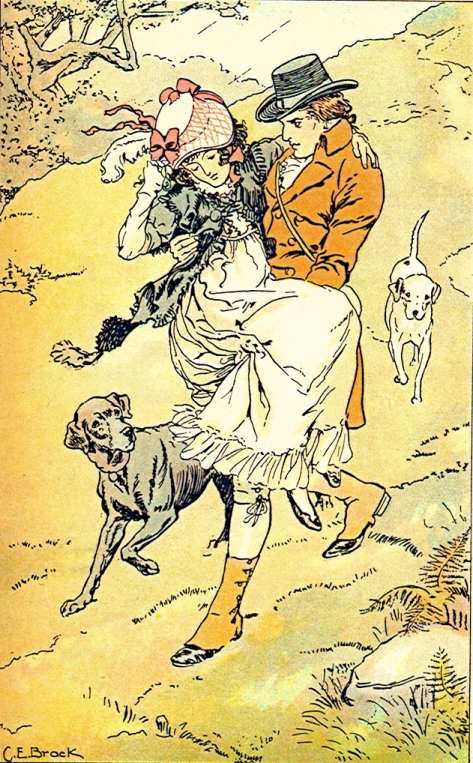
CE Brock, S&S – Willoughby rescuing Marianne
CE Brock, Persuasion, 1898: The Fall! / The Letter!
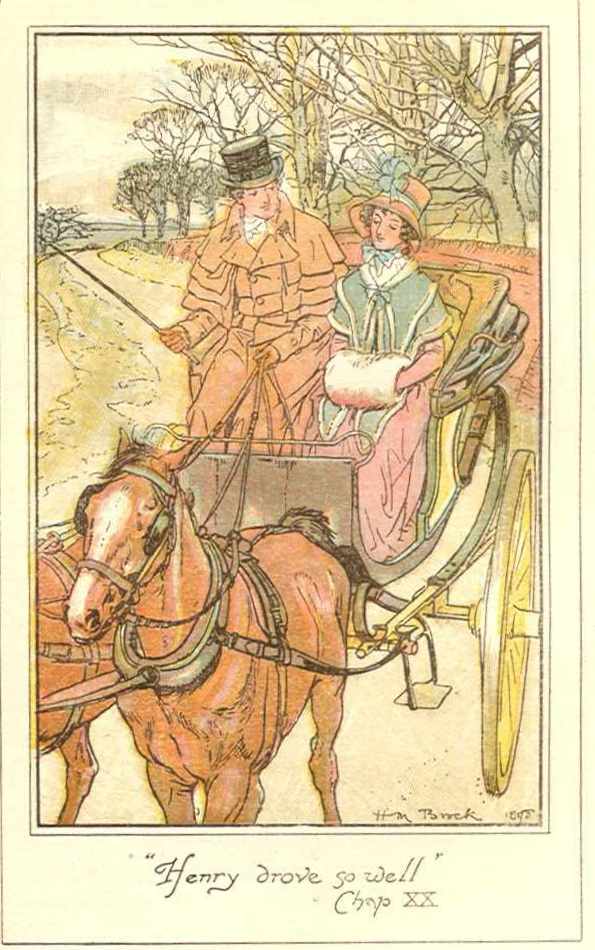
HM Brock, NA, Henry drove so well [Mollands]
HM Brock, MP, Mary and her Harp
********************
Compare:
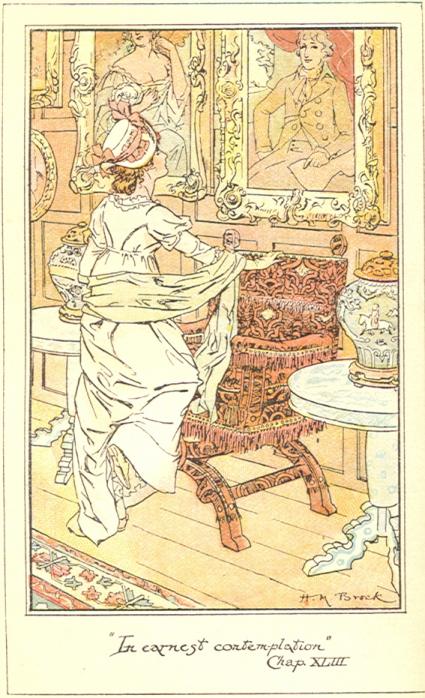
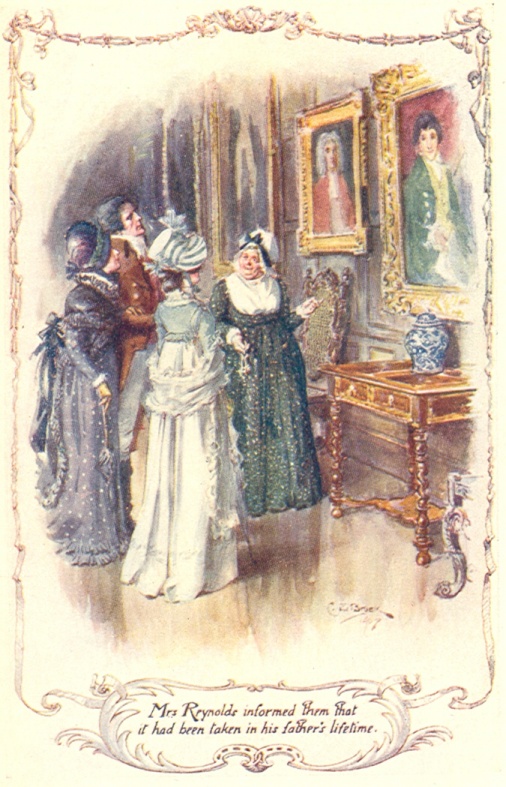
One of my favorite scenes in Pride & Prejudice is Elizabeth “in earnest contemplation” – here we can see CE Brock’s line drawing for Macmillan in 1895 and HM Brock’s in 1898, and CE Brock’s in 1907 [are you sufficiently confused yet??]
CE Brock, Macmillan, 1895 / HM Brock, Dent, 1898
CE Brock, Dent, 1907 [though this is not exactly the same quote you get the idea…]
*************
You can see the many Brock illustrations for the various editions of each novel by visiting the amazing Molland’s here: http://www.mollands.net/etexts/
******************
The Brocks are most often compared with Hugh Thomson: there are various critical interpretations of these two most popular Austen artists, some more approving of Thomson’s humor and his almost caricatured characters, while others preferring the more effective facial expressions and body language of the Brocks that seem more realistic despite the rather overdrawn borders and settings – do notice the detail in the fashion, the furnishings, and landscape, and what scenes are chosen – we can compare these to Thomson in future posts. The point is, you need them both…
Stay tuned for a post on Hugh Thomson and his several Jane Austen editions – in the meantime, tell me your favorite of the Austen illustrators – I haven’t posted about mine yet…
I shall take a little side road today with this discussion of must-haves in your Jane Austen collection – here an example of a book Jane Austen had read, referred to, satirized, and which then became the most interesting thing about Mr. Collins in Pride and Prejudice.
Part of collecting Jane Austen is to learn about and possibly add to your collection those books known to have been read by her, a fascinating list compiled from the many allusions in her novels and her letters. You can start with R. W. Chapman’s “Index of Literary Allusions, which you can find online.
Chapman’s list first appeared in the NA and P volume of the Oxford edition we looked at last week – more has been added to this – but this is a good start – you could spend the rest of your life just collecting “allusion” books and you will completely forget what you were collecting in the first place.
But Fordyce is one you must have, should read, for if nothing else it will give you a better idea of where Mr. Collins is coming from and what Austen has to say about both he AND Fordyce.
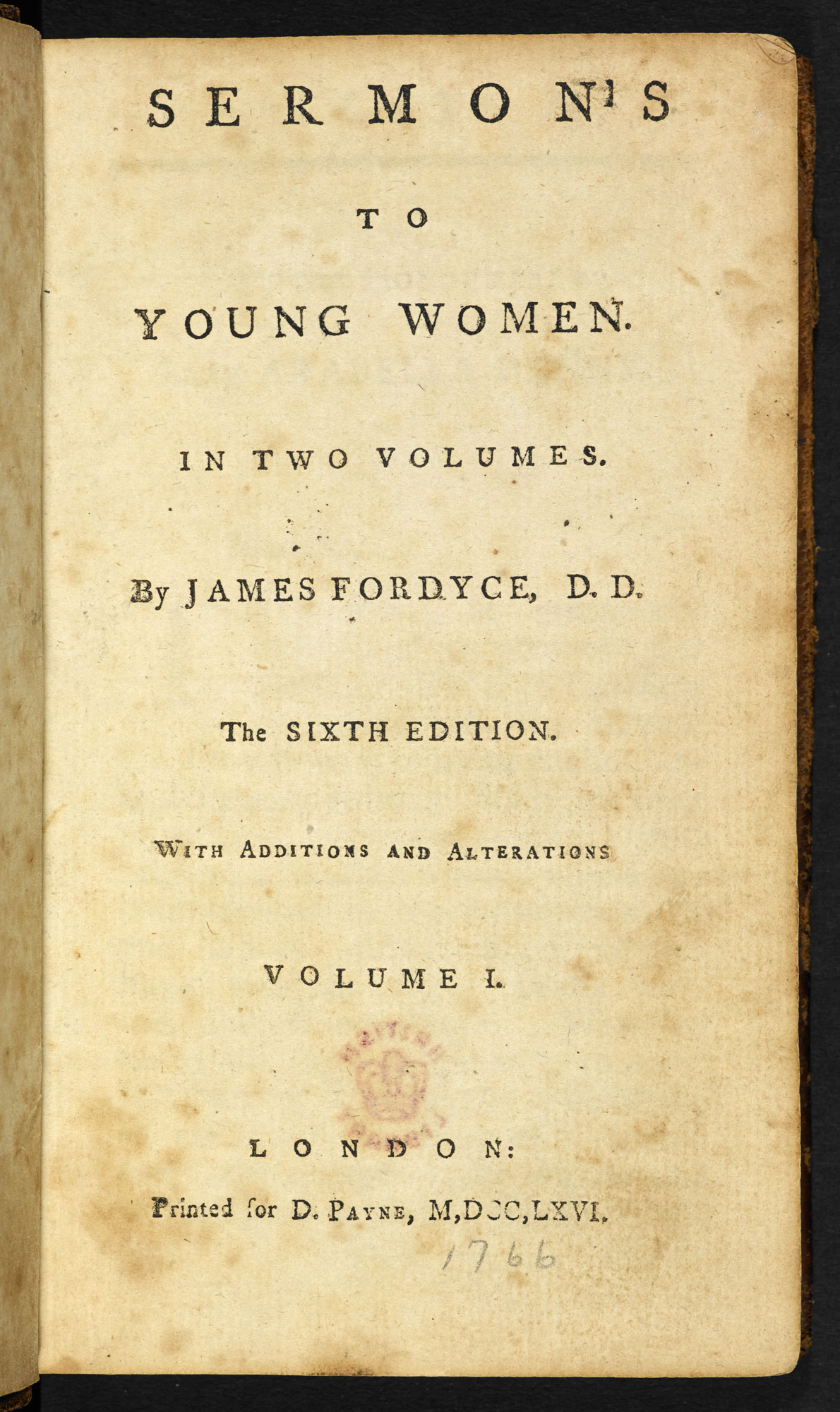
Sermons to Young Women, by Dr. James Fordyce, is certainly one the most well-known of all the various conduct manuals Austen would have had access to, published in London in 1766, “and by 1814, the year after Pride and Prejudice appeared, it had gone though 14 editions published in London alone.” [Ford, intro, i].
We all recall that in Pride and Prejudice, Mr. Collins chooses to read Fordyce’s Sermons aloud to the Bennet sisters, Lydia especially unimpressed:
By tea-time, however, the dose had been enough, and Mr. Bennet was glad to take his guest into the drawing-room again, and, when tea was over, glad to invite him to read aloud to the ladies. Mr. Collins readily assented, and a book was produced; but, on beholding it (for everything announced it to be from a circulating library), he started back, and begging pardon, protested that he never read novels. Kitty stared at him, and Lydia exclaimed. Other books were produced, and after some deliberation he chose Fordyce’s Sermons. Lydia gaped as he opened the volume, and before he had, with very monotonous solemnity, read three pages, she interrupted him with:
“Do you know, mama, that my uncle Philips talks of turning away Richard; and if he does, Colonel Forster will hire him. My aunt told me so herself on Saturday. I shall walk to Meryton to-morrow to hear more about it, and to ask when Mr. Denny comes back from town.”
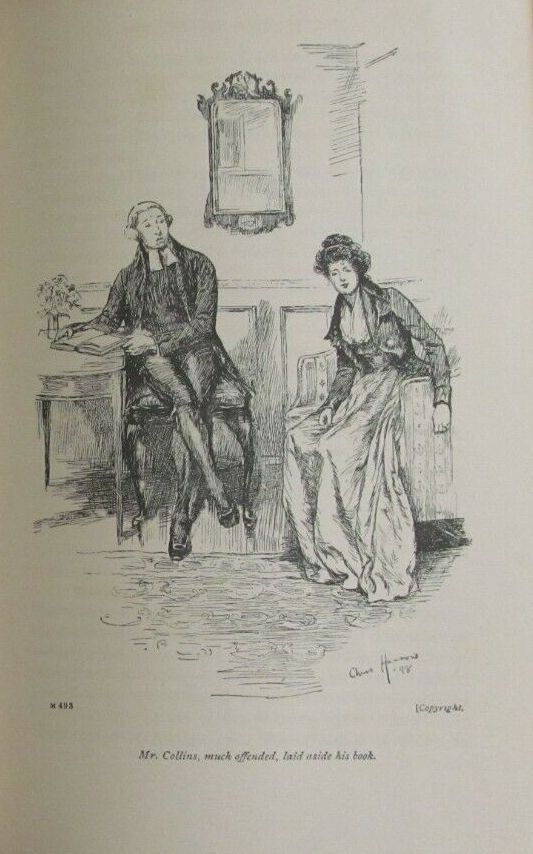
Lydia was bid by her two eldest sisters to hold her tongue; but Mr. Collins, much offended, laid aside his book, and said:
“I have often observed how little young ladies are interested by books of a serious stamp, though written solely for their benefit. It amazes me, I confess; for, certainly, there can be nothing so advantageous to them as instruction. But I will no longer importune my young cousin.” [P&P, Ch. XIV]
Collins, done with such young and frivolous young ladies, heads off for a game of backgammon with Mr. Bennet…
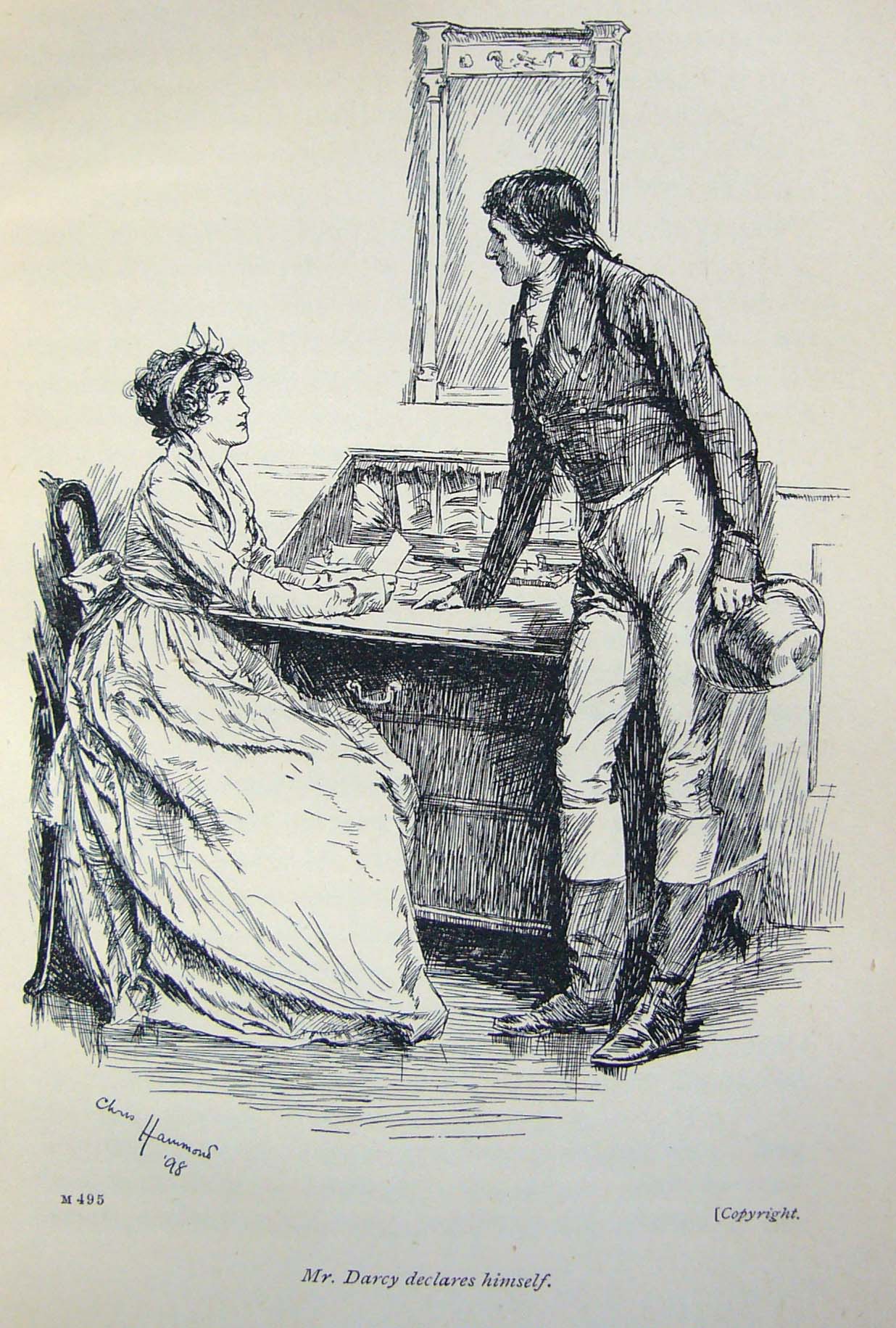
Illustrators of Pride and Prejudice have turned this scene into a visual treat:
Hugh Thomson, P&P (George Allen, 1894)
Chris Hammond, P&P, Gresham, 1900
**************
Fordyce (1720-1796) was a Scottish Presbyterian minister and a poet, but is most known for his Sermons. He also published Addresses to Young Men in 1777. But would we even be talking about him today if it weren’t for Jane Austen??!
As for his poetry, this is the only poem to be found on the Eighteenth-Century Poetry Archive, attesting to Fordyce’s seeming obsession with Female Virtue…
TRUE BEAUTY
The diamond’s and the ruby’s blaze Disputes the palm with Beauty’s queen: Not Beauty’s queen commands such praise, Devoid of virtue if she’s seen.
But the soft tear in Pity’s eye Outshines the diamond’s brightest beams; But the sweet blush of Modesty More beauteous than the ruby seems.
If your main concern is with “Female Virtue,” the University of Toronto has these two abstracts for your reading pleasure – From Sermon IV: On Female Virtue; and From Sermon V: On Female Virtue, Friendship, and Conversation: http://individual.utoronto.ca/dftaylor/Fordyce_Sermons.pdf
Much has been written about Austen and Fordyce – the point being, you need a copy. You can find it in one of its original editions on used bookstore sites for not over the top prices – or there are many, many reprints out there.
One of the best of these is the facsimile reprint of the 10th ed. of 1786 and published by Chawton House Press in 2012. Susan Allen Ford wrote the valuable introduction and it also includes a fine bibliography. This edition is unfortunately out-of-print and I am hoping that they will republish it in the near future. It was a best-seller in its time and again today! Who knew!
How Jane Austen revolutionized the way the world viewed women
by Jasmine A. Stirling
Author of A Most Clever Girl: How Jane Austen Discovered Her Voice
Readers looking for a little escapism might pick up a Jane Austen novel in search of light romantic comedy, not realizing how iconoclastic the beloved author’s books truly were.
This is in fact, by design. First of all, Austen’s work is above all, great art. It’s manifold purposes are intentionally disguised in delightfully fun and witty prose, designed to propel us through the story and entertain while also educating readers.
Secondly, Austen was writing at a time when women’s roles were strictly circumscribed. She knew that any overt critique of the patriarchal culture in which she and her characters lived would likely prevent her from being published, reviewed, and/or widely read. The trick was never to be too explicit about anything, so as not to alert the powers that be (wealthy men) that she might be poking holes in the system from which they derived their many privileges. Austen found a way to do just that in her novels—without transgressing the bounds of decorum, of good taste, of sound judgment, and equanimity.
But Austen’s critiques are there, in subtle and not-so-subtle ways. Let’s explore how Austen’s six beloved novels revolutionized the way the world viewed women.
Jane Austen’s heroines challenged the prevailing notion of the ideal woman as decorative, passive, emotional, and morally perfect.
When reading Austen, it is important to keep in mind that the ideal Regency lady was about as different from Lizzie Bennet as you can imagine. As one author wrote of the Regency ideal:
“The feminine ideal . . . may best be defined as an interesting compound of moral perfection and intellectual deficiency . . . She was required to be before all things a “womanly woman” meek, timid, trustful, clinging, yielding, unselfish, helpless and dependent, robust in neither body nor mind, but rather “fine by defect and amiably weak.” [She has not] laid aside the poetry of languor and the seductive debility that invested her with the allurement of a convalescent flower.”
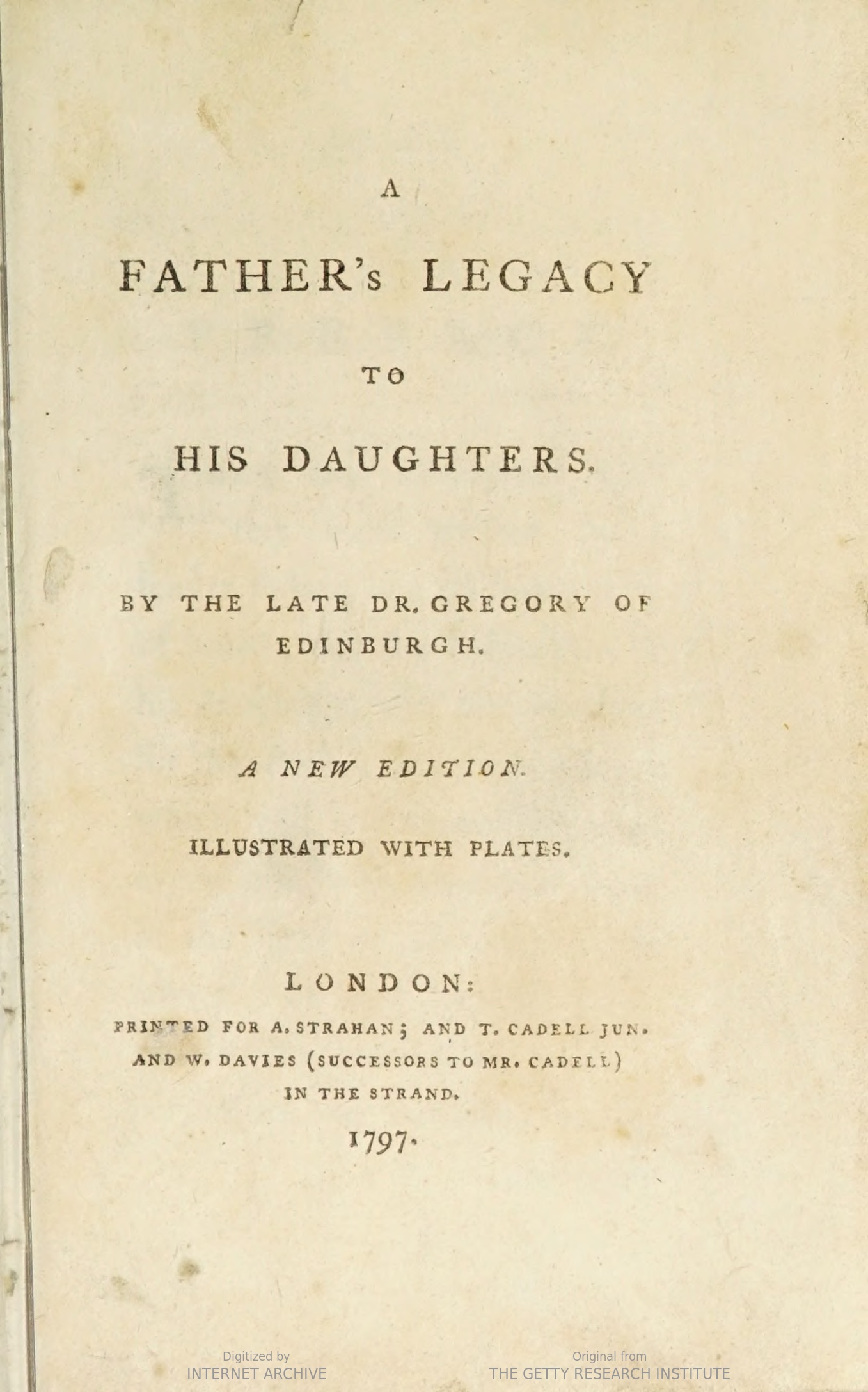
Or, as Scottish moralist John Gregory instructed his daughters in the 1770s: “Wit is the most dangerous talent you can possess . . . if you happen to have any learning, keep it a profound secret, especially from the men.”
In addition to being morally perfect and intellectually deficient, the ideal Regency bride was very young, and came with a large fortune—which her husband would take possession of immediately after the wedding.
It is not surprising, then, that in this time period (as in our own), female characters—written overwhelmingly by male authors—were often portrayed in one dimension. After all, as Anne Elliot wryly observed, “The pen has been in their hands.” In most novels and plays, women were caricatures: morally loose and wicked; virginal, demure, and sweet; saintly and motherly; scheming and power-hungry.
Not so Jane Austen’s heroines. Seen in this light, Lizzy Bennet is not only an incredibly charming, lovable leading lady filled with quirks and flaws; she is downright subversive. “When Austen allows Elizabeth to express critical attitudes,” scholar Judith Lowder Newton writes, “to act upon them without penalty, when she endows Elizabeth with the power to alter her lot, Austen is moving against traditional notions of feminine behavior and feminine fate.”
In fact, in one way or another, all of Austen’s heroines buck gender norms or fall far short of the Regency ideal. Yet are all rewarded handsomely at the end—with love and riches. Lizzy is cheeky and opinionated, Emma is insensitive and meddlesome. Elinor and Marianne are frightfully poor, while Fanny is both poor and low-born. Catherine is obsessed with novels, and Anne Elliot is old and no longer pretty. Most of Austen’s heroines (Emma being an exception) are intellectual and well-read.
Furthermore, it is taken absolutely for granted by Austen that each of her heroines is, or can become, able to make her own life decisions—without any reference to men, her parents, or her social betters. This alone is a radical assumption, coming from a culture in which gender, family honor, and class dictated nearly everything a woman was permitted to say, do, and think.
But Austen didn’t stop there. She also used humor to challenge notions of ideal femininity. In Mansfield Park, Lady Bertram is so passive that she is unable to rise from the sofa, let alone form her own thoughts. Entertaining, frivolous characters like Lydia Bennet and Mary Crawford are viciously satirized. Traditional Georgian accomplishments such as “netting a purse” are ridiculed. Furthermore, Austen’s most desirable male suitors have no interest in the ideal Regency woman. Mr. Darcy, for example, requires that his mate possess “the improvement of her mind by extensive reading.”
In fact, I am hard pressed to point to heroines in today’s novels, films and TV shows that shine quite as brightly or depict women quite as realistically as Jane Austen’s did more than 200 years ago.
By raising up complicated, unique, bright, obstinate, and flawed women, then showing us their struggles and journeys of transformation, and finally rewarding them with love and happiness, Jane Austen obliterated unrealistic (and frankly, disturbing) notions of perfect, monolithic femininity, forever upending the way the world viewed women.
Jane Austen’s heroines helped readers experience first-hand the shockingly precarious and brutally inhumane status of women in Regency England.
CE Brock – S&S, 1908
During the Regency period, marriage required a woman to give up everything to her husband—her money, her freedom, her body, and her legal existence. Husbands were legally permitted to beat their wives, rape them, imprison them, and take their children away without their consent.
Divorce in the Regency era could only be achieved by a private act of Parliament, and was exceedingly rare. Lower classes could sell their wives in the marketplace, which functioned as a form of divorce. The woman was led to market with a halter tied around her neck and sold to the highest bidder.
The laws of primogeniture and entailed property dictated that, upon his death, the bulk of a man’s inheritance typically be handed down to his eldest son or closest living male relative. If a woman inherited anything after her husband died, it was arranged at the time of the marriage and based on the assets she brought to the union. Often she got little or nothing at all.
Opting out of marriage was not a viable option for most women. Because most people believed that females were vastly intellectually inferior to males, there were no universities for women, and nearly all professions were reserved exclusively for men. A spinster often faced a life of poverty, ridicule, and dependence on the charity of her male relatives.
As a result, for Austen, “a story about love and marriage wasn’t ever a light and frothy confection.” Hidden in all that effervescent prose are subtle but seething critiques of Regency society, laws, and gender norms. Austen used romantic comedy to expose the incredibly high stakes of the marriage game for women who had no other options. She helped readers see the precariousness, anxiety and vulnerability of real women—showing the brutality of their situation more poignantly, entertainingly, and intimately than any political treatise could have achieved.
In Sense and Sensibility, we feel the injustice of inheritance laws when Henry Dashwood dies and his wife and children are forced to leave their home and live at the mercy of the heir, Mrs. Dashwood’s stepson, John. John chooses to give them little help, and overnight, Mrs. Dashwood goes from living in splendor to barely scraping by.
In Pride and Prejudice, the key context for the story is that the Bennet family home, Longborne, is entailed to the insufferable Mr. Collins. If his daughters do not marry before their father dies, they will be left to depend on the charity of their male relatives (a situation Austen knew well, as it was hers after her father died).
Although Austen’s heroines find both love and riches, unhappy and loveless marriages far outnumber happy ones in her novels. Wickham is bribed into marrying Lydia; she will have to endure a lifetime of his womanizing ways. Willoughby rejects Marianne, opting for Miss Grey’s £50,000. Charlotte Lucas, twenty-seven years old and superior in character, temperament, and intellect, to the pompous and revolting Mr. Collins, accepts his offer of marriage because “it was the only honourable provision for well-educated young women of small fortune,” thereby relieving her brothers of the burden of providing for her as an old maid. In fact, Charlotte “felt all the good luck of it.”
In these and many other examples, the reality of women’s narrow options, their shocking lack of personal freedom, and their extreme financial vulnerability ring loud and clear. For the first time in history, Austen’s novels humanized and personalized women’s issues in a revolutionary way, adding fuel to the fire for radical new ideas that were just beginning to circulate about women’s rights, education, and opportunities.
Chris Hammond, P&P, Blackie 1904
Jane Austen championed the radical idea of the ideal marriage as a match between two rational and emotional equals.
While the bleak fates of many of Austen’s female characters illustrate the limited options facing women in the Regency era, happy endings await her heroines. These happy endings also challenged mainstream Regency notions of marriage, which typically looked very unlike that of Lizzie Bennet and Mr. Darcy.
A middle or upper class Regency marriage was often a male-dominated exchange, dictated by two families coming together to consolidate their fortunes. When she married, a woman passed from the control of her father to that of her husband. She might have the opportunity to reject a suitor, or choose from a number of suitors; or she might be a passive participant in this exchange, depending on her circumstances and family culture. In either case, her submissiveness after the wedding was considered crucial to its success. Austen rejected this model of marriage as ideal in her novels and in her life, writing to her niece that “nothing can be compared to the misery of being bound without Love.”
Notions of marriage were changing rapidly in Austen’s era, inspired primarily by the Romantics—poets, authors and philosophers who believed that marriage should be fueled exclusively by romantic love—but Austen also rejected this ideal.
While the Romantics insisted that choosing a partner should be about unleashing one’s most passionate feelings, Austen championed the classical, Aristotelian philosophy of balance between emotion and reason when choosing a partner for life. The successful coming of age of an Austen heroine hinges on her learning to discern the true nature of a suitor, not simply the appearance he projects. It also often requires that she look beyond her emotional impulses and fall in love with a man’s character and temperament—as in the case of Marianne Dashwood and Elizabeth Bennet, who are initially attracted to handsome, romantic rakes.
Indeed, flashy romantic suitors like Mr. Wickham and John Willoughby often prove to be wicked, scheming, and insincere. By contrast, more subdued men like Colonel Brandon and Captain Wentworth attempt to restrain their emotions in order to preserve the honor of the women they admire, and wait to betray their feelings until they are certain they are ready to propose.
Furthermore, Austen’s heroines, although driven by love, do not neglect to consider the practical implications of marrying well. After all, it is only after seeing Pemberley with her own eyes that Lizzie finally relents and accepts Mr. Darcy’s proposal, famously thinking as she looks across the valley at his vast estate: “To be mistress of Pemberley might be something!”
In all of these respects, Austen was, and still is, a fresh voice on the topic of marriage. Our own era is still firmly in the grip of the Romantic frenzy—emotional love songs, extravagant courtships and proposals, an emphasis on being swept away in one’s feelings, and fairy tales with happy endings dominate popular culture.
For Austen, a classical reverence for balance—equal parts reason and emotion—reigned supreme, especially on the part of the woman, who had far more to lose in marriage than her male counterpart. Too much reason, and you have Elinor Dashwood, a woman who is initially a little too selfless and withdrawn. Too much emotion, and you have her sister Marianne, a woman who follows her feelings straight into the arms of a charlatan. To grow, each sister must learn a little bit from the other.
In this way, Austen again challenged the way the world viewed both marriage and a woman’s journey of self-discovery on her path towards finding love.
***
Jane Austen often compared herself to a miniature painter. In her work every situation, character name, snippet of dialogue, and location—matters. It is in these mundane details that Austen’s revolutionary ideas are expressed; it is here that we find the clues to the world Austen dreamed that women would one day occupy.
Viewed in this manner, Austen’s novels become much more than a parade of clever stories about romance and balls. They become, instead, a series of novels in which a brilliant, snarky woman unmasks the culture in which she lives—in ways that were, and still are, revolutionary.
In the end, Austen manages to write both about the real world—a world filled with greed, injustice, deceit, and hypocrisy—in which women’s roles are suffocatingly and terrifyingly limited—and a world of her own making—in which right prevails, and the smart, sassy, headstrong woman gets everything she could ever dream of, and more.
**********************
About Jasmine A. Stirling
Jasmine A. Stirling is the debut author of A Most Clever Girl: How Jane Austen Discovered Her Voice, a picture book biography of Jane Austen about persistence and creative mastery. Jasmine lives on a cheerful street in San Francisco with her husband, two daughters, and their dog. From a young age, she loved to write poems and stories and worked her way through nearly every children’s book (and quite a few for grownups, too) in her local library. When she’s not writing, Jasmine can be found hiking in the fog, singing songs from old musicals, and fiddling with her camera.
Jasmine first fell in love with Jane Austen as a student at Oxford, where she read her favorite of Jane’s six masterful novels, Persuasion. A Most Clever Girl is her dream project, done with her dream team—award-winning illustrator Vesper Stamper and Bloomsbury Children’s Publishing. Jasmine also has a YA/New Adult history of the women’s suffrage movement out soon, titled We Demand An Equal Voice.
Visit www.jasmineastirling.com to get a free Jane Austen paper doll kit with the purchase of A Most Clever Girl. While you’re there, enter to win a Regency tea party gift basket!
Follow Jasmine on Instagram and Facebook @jasmine.a.stirling.author where she posts about kidlit and life with two young girls.
BOOK GIVEAWAY:
Enter for a chance to win a glorious Jane Austen-themed picnic basket, including a hardcover copy of A Most Clever Girl autographed by Jasmine A. Stirling!
One (1) grand prize winner receives:
A picnic basket filled with:
A copy of A Most Clever Girl: How Jane Austen Discovered Her Voice, signed by author Jasmine A. Stirling
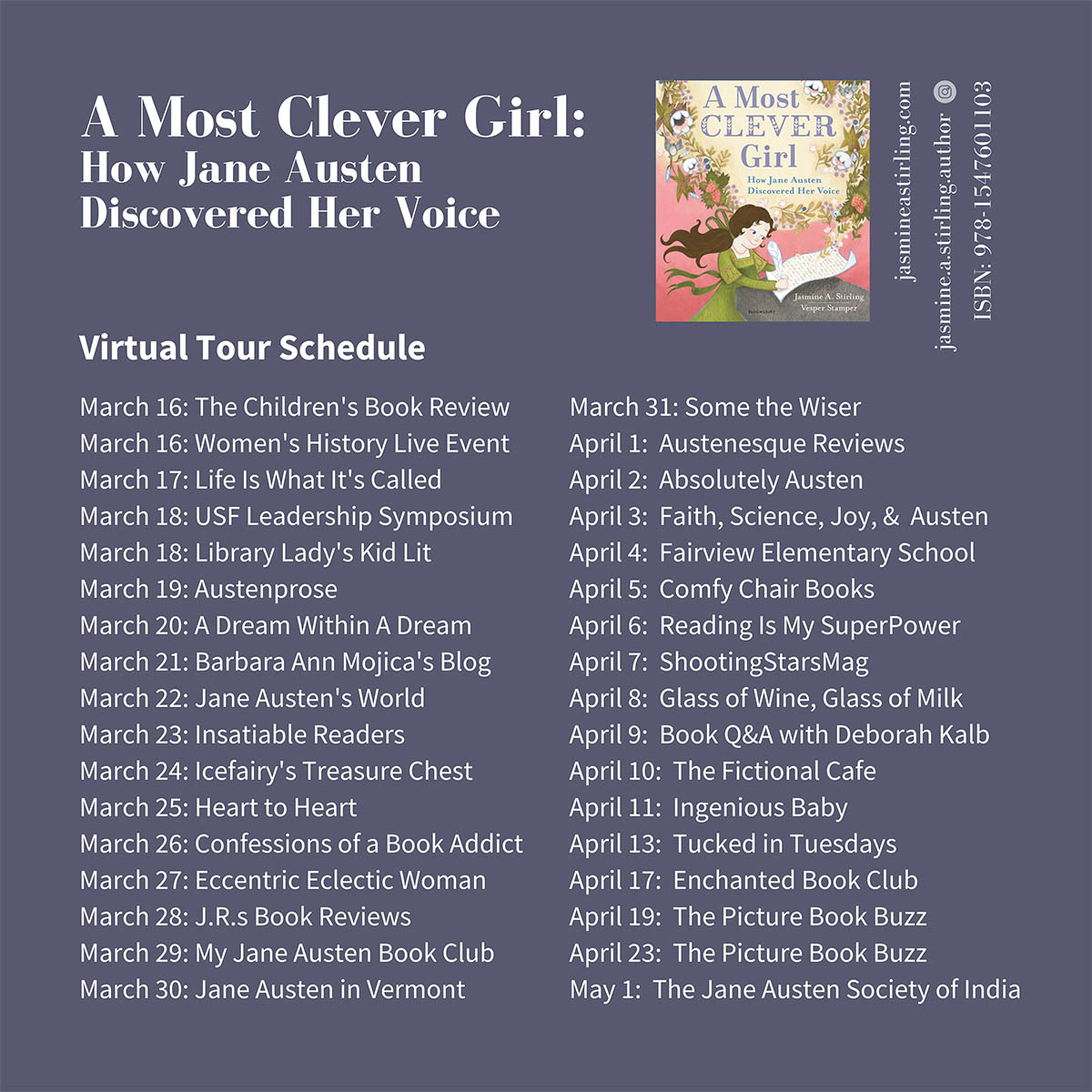
A Most Clever Girl: How Jane Austen Discovered Her Voice, by Jasmine A. Stirling; illustrated by Vesper Stamper. Bloomsbury Children’s Books, 2021
Dear Readers: Please see below my review information on the Book Giveaway. And join me again tomorrow for Part II with an essay by Jasmine A. Stirling on “How Jane Austen revolutionized the way the world viewed women.”
*************
The recent opinion essay by the New York Times Book Review editor Pamela Paul “You’re Not Too Old for Picture Books” (Feb. 21, 2021), presents a fine case for the importance, relevance, brilliance, and pure pleasure such books can give us. Paul admonishes us as parents to not confine ourselves to the parameters of the 4-8 age group, to not take such books away from our children too soon, nay, to not put them aside ourselves. How well we remember such books from our own childhoods (think Jessie Willcox Smith or Beatrix Potter or N. C. Wyeth), where words and pictures were made one, the art telling its own story beyond the words of the text.
In a past life as an elementary school librarian (I at the time also had small children), I found such joy in reading and re-reading these pictures books, designated for the younger grades but having the older students engage with them as well. I have never gotten over this love of these “juvenile” works and still try every year to at least purchase the newest Caldecott winner (a REAL book too, no kindle for these!) Biographical picture books have increased of late, and such works on Jane Austen can nearly fill a shelf – but each is unique, each brings a new take on Austen with new ideas, new art, new ways to engage readers of any age with her world.
A Most Clever Girl: How Jane Austen Discovered Her Voice, written by Jasmine A. Stirling and illustrated by Vesper Stamper, is a fine addition to this burgeoning shelf, this, as the press release says “an informative, engaging depiction of the life and growth of an exceptional literary talent.” It is funny and sad and profound, taking Austen from a happy childhood reading and writing for her family’s entertainment in the house at Steventon, where “her mother wrote verse…her brothers debated the news…Jane and Cassandra sang songs upstairs…her father taught Shakespeare below.” In this one sentence, with the accompanying illustration of a very busy household, Stirling and Stamper perfectly sum up Austen’s childhood world.
***************
We see her growing, seeking “a room of her own” to write her stories, observing the quirks and eccentricities of visiting friends and neighbors, and then the sadness and tragedy with the move to Bath and the death of her father, her life now “a quick succession of busy nothings.” Stamper leaves her colorful joyful world of Steventon behind and gives us a Bath that is dark and gray and lonely (Stamper writes that the color palette comes from the textile shades of Austen’s time), color to appear again when settling in Chawton, Jane finding words to write, creating the characters like Elizabeth and Emma and Anne and her many Heroes we have come to love – writing “hearbreak and sadness, happiness and hope” into her novels. Then she is PUBLISHED and we see an appreciative Prince Regent, patrons of circulating libraries choosing HER books, and US, still reading and loving her very original and brilliant voice.
I loved this book – the words and pictures taking us into Austen’s mind and her world – high praise to both writer and illustrator for such a beautifully told and rendered tale, as Stirling herself writes: “I wanted to tell a different kind of story – one centered on Jane’s genius” – and thereby giving hope to anyone out there who might be searching for their own voice, at any age. I found it as insightful and as complete as any of the many lengthy biographies I have read!
Included is a short nicely-written biography, a selection of the more famous Austen sayings sprinkled in the text (“indulge your imagination in every possible flight” – where does Austen say this??), a note from both Stirling and Stamper, and a listing of resources for further reading.
Chawton House – rear endpaper
A final word on the endpapers, one of my favorite parts of any and every book I handle – here Stamper gives us colorful and imaginative drawings of Austen’s beloved Hampshire, Steventon on the front endpaper, Chawton Cottage (now Jane Austen House Museum) and Chawton House on the rear endpapers, places that inspired Jane Austen to become the genius she indeed was, and places we visit (alas, only a pump at Steventon!) to get closer to her mind and art. Perfectly lovely – and quite “clever” itself!
GIVEAWAY!!
Enter for a chance to win a glorious Jane Austen-themed picnic basket, including a hardcover copy of A Most Clever Girl autographed by Jasmine A. Stirling!
One (1) grand prize winner receives:
A picnic basket filled with:
A copy of A Most Clever Girl: How Jane Austen Discovered Her Voice, signed by author Jasmine A. Stirling
Publisher’s Synopsis: Witty and mischievous Jane Austen grew up in a house overflowing with words. As a young girl, she delighted in making her family laugh with tales that poked fun at the popular novels of her time, stories that featured fragile ladies and ridiculous plots. Before long, Jane was writing her own stories-uproariously funny ones, using all the details of her life in a country village as inspiration.
In times of joy, Jane’s words burst from her pen. But after facing sorrow and loss, she wondered if she’d ever write again. Jane realized her writing would not be truly her own until she found her unique voice. She didn’t know it then, but that voice would go on to capture readers’ hearts and minds for generations to come.
PURCHASE LINKS: [always check your local bookstore first!]
Jasmine A. Stirling is the debut author of A Most Clever Girl: How Jane Austen Discovered Her Voice, a picture book biography of Jane Austen about persistence and creative mastery. Jasmine lives on a cheerful street in San Francisco with her husband, two daughters, and their dog. From a young age, she loved to write poems and stories and worked her way through nearly every children’s book (and quite a few for grownups, too) in her local library. When she’s not writing, Jasmine can be found hiking in the fog, singing songs from old musicals, and fiddling with her camera.
Jasmine first fell in love with Jane Austen as a student at Oxford, where she read her favorite of Jane’s six masterful novels, Persuasion. A Most Clever Girl is her dream project, done with her dream team—award-winning illustrator Vesper Stamper and Bloomsbury Children’s Publishing. Jasmine also has a YA/New Adult history of the women’s suffrage movement out soon, titled We Demand An Equal Voice.
Visit www.jasmineastirling.com to get a free Jane Austen paper doll kit with the purchase of A Most Clever Girl. While you’re there, enter to win a Regency tea party gift basket!
Follow Jasmine on Instagram and Facebook@jasmine.a.stirling.author where she posts about kidlit and life with two young girls.
ABOUT THE ILLUSTRATOR:
Vesper Stamper website
Vesper Stamper is an award-winning author-illustrator of picture books and historical fiction for young adults, including What the Night Sings, winner of the Sydney Taylor Book Award for the National Book Award, and A Cloud of Courageous Blue. She lives with her husband, filmmaker Ben Stamper, and her two teenagers, in the northeastern United States, but England is her happy place. Her favorite Jane Austen in Emma. You can visit her at vesperillustration.com.
































































 Jane Austen in Vermont